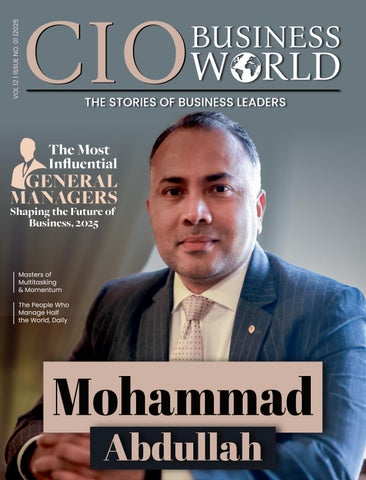
Cover story Mohammad 08 Abdullah Articles 18 Masters of Multitasking 20 & Momentum The Brains Behind 24 Every Breakthrough The People Who Manage 26 Half the World, Daily Handling Work, People, Pressure & Life Together
Guiding the Corporate Winds
I
n every era of business, a select group of leaders emerges individuals whose ability to navigate complexity, inspire people, and transform systems sets a new standard for managerial excellence. As we unveil “The Most Influential General Managers Shaping the Future of Business, 2025,” one thing becomes clear: today's general managers are far more than operational overseers. They are strategic orchestrators, technological adopters, cultural architects, and change navigators who stand at the intersection of innovation and execution. A general manager once told me, “The future doesn't arrive fully formed. We shape it one decision, one challenge, one courageous step at a time.” That sentiment captures the spirit of this year's featured leaders. They represent a generation of managers who are not simply adapting to rapid transformation, they are accelerating it. In 2025, the business world is moving faster than ever. Organizations operate in a landscape defined by digital disruption, economic volatility, heightened competition, and rising employee expectations. In this environment, influence is no longer tied solely to authority. It is defined by vision, agility, empathy, and the ability to guide teams through uncertainty with clarity and purpose. The general managers highlighted in this feature exemplify all of this and more. They are the leaders who transform data into insight, insight into strategy, and strategy into impact. They build workplaces where innovation thrives, where people feel valued, and where performance is not driven by pressure alone but by shared belief and collective ambition. They champion collaboration, accelerate digital adoption, and cultivate cultures that welcome experimentation rather than fear failure. What makes these general managers truly influential is not just their ability to lead it's their ability to elevate others. The most transformative leaders I have met consistently reinforce the idea that the role of a general manager is not to control every outcome, but to empower every contributor. As one of them told me, “If my team becomes stronger than me, that's how I know I'm doing my job right.” That perspective reflects a modern truth: leadership is no longer about being the smartest person in the room but about creating a room where everyone's intelligence has the space to shine. 2025's most influential general managers prioritize resilience over rigidity, curiosity over complacency, and long-term value over shortterm noise. They understand that technology is only powerful when paired with human insight, and that culture not strategy ultimately determines whether an organization can evolve. As CIO Business World celebrates this remarkable class of leaders, we acknowledge not just what they have achieved, but what their achievements signal about the future of business. They remind us that influence is earned through consistency, courage, and a commitment to shaping organizations that are stronger, wiser, and more humane. And as one of them once told me words that continue to echo today— “The future belongs to the managers who dare to build it.”
8
9
10
11
12
13
14
15
Handling Work, People, Pressure & Life Together
“
P
eople think I manage tasks,” said the manager, “but what I actually manage is an entire ecosystem.” Every morning begins with a list of responsibilities that spills beyond the edges of the page work targets, team morale, deadlines, decisions, conflicts, coordination, crises, and somewhere in the corner, a tiny sticky note labeled life. Balancing all of it requires more than skill. It requires stamina, empathy, discipline, and a resilience that quietly rebuilds itself every single day. Work: The Constant Wave That Never Stops Rolling Work comes first, not because managers want it to, but because it demands it. Projects move fast, requirements change instantly, and expectations rise without warning. “Some days,” the manager admits, “the only thing constant is the number of new problems landing on my desk.” Yet through shifting priorities and surging workloads, managers keep the flow steady. They organize chaos, connect dots, make decisions, and create direction where there was none. Work doesn't pause but neither do they. People: The Heartbeat They Must Protect A manager's real job begins where spreadsheets end with people. “If the team falls apart,” the manager says, “the work falls apart too.” Supporting people means guiding them through stress, motivating them during dips, clarifying confusion, and mediating situations that escalate without
18
reason. Managers become mentors, counselors, problemsolvers, and sometimes peacekeepers. They listen more than they speak, encourage more than they criticize, and hold the team together even when their own energy runs low. People don't just need leaders they need steady hands. And managers offer exactly that. Pressure: The Invisible Weight They Carry Alone Pressure is a manager's silent companion unseen but always present. Targets, timelines, escalations, and expectations often converge into a heavy load that few notice. “When the team succeeds, it's their win,” the manager smiles, “but when something goes wrong, it's mine.” Managers absorb pressure so their teams can work without fear. They remain composed even when uncertainty looms, and they make decisions that require confidence, clarity, and courage. Pressure shapes them but doesn't break them. Life: The Part They Try Not to Neglect Behind every manager's professional role is a personal world that demands attention from family, health, responsibilities, and the human need to rest. “Managing life while managing everything else is the hardest part,” they confess. Even after meetings end, thoughts continue. Even after tasks close, worries linger. Yet managers try to balance it all by showing up for their loved ones, protecting their well-being, and holding onto their passions outside the
workplace. Their lives may revolve around work at times, but their hearts remain firmly rooted in the world beyond it.
contribution is not just in what they do, but in how gracefully they carry everything at once.
The Art of Carrying It All Together
Said the Manager: “I Don't Do It Because It's Easy—I Do It Because It Matters.”
Handling work alone is tough. Handling people is tougher. Handling pressure requires strength. Handling life requires heart. But handling all four together? That is the true art of management. It's the reason managers are often the quiet backbone of an organization strong enough to keep standing, flexible enough to adapt, and steady enough to guide others through storms. Every day, managers choose responsibility over comfort, purpose over ease, and leadership over fear. Their
In the end, managers don't juggle work, people, pressure, and life because they enjoy the chaos. They do it because they know someone must be someone who cares enough to lead, support, protect, and push forward. Their strength lies in the quiet belief that progress is worth the effort, and their greatest achievement is the success of the people they guide. And so, as the world keeps moving, the manager simply smiles and says, “I'll handle it. I always do.”
19
Masters of Multitasking &Momentum I
n today's fast-paced professional world, managers are no longer defined by traditional responsibilities like delegation, supervision, or periodic performance reviews. Instead, they have evolved into the Masters of Multitasking & Momentum individuals who juggle diverse roles while keeping teams aligned, motivated, and continuously moving toward organizational goals. Their influence extends far beyond task management; they serve as catalysts who convert uncertainty into progress, complexity into clarity, and challenges into opportunities for innovation.
At the heart of this shift lies the rapidly changing nature of work. Globalization, digital transformation, remote collaboration tools, and heightened customer expectations have all intensified the pace at which businesses must operate. In such an environment, the modern manager must develop a unique blend of strategic thinking, emotional intelligence, problem-solving, and the ability to make swift, informed decisions. The combination of these skills allows them to steer teams toward momentum even when circumstances threaten to slow them down. Balancing Roles in a Dynamic Workspace One defining characteristic of modern managers is their ability to multitask without compromising quality. From leading cross-functional projects to managing team wellbeing, analyzing performance data, overseeing budgets, and adopting new technologies, their daily work encompasses a wide range of responsibilities. Yet, they are expected to pivot effortlessly between these roles, ensuring that every area receives the attention it deserves.
20
This capacity for multitasking is not about doing everything at once; rather, it is about prioritization and fluid transitions. Effective managers understand how to identify which tasks require immediate focus and which can be delegated or scheduled for later. This mindset prevents burnout, both for themselves and their teams, while maintaining consistent productivity. Their strength lies not just in handling many responsibilities, but in doing so with grace, efficiency, and strategic intent. Driving Momentum Through Leadership Momentum within a team does not arise by chance, it is built intentionally by managers who know how to inspire, guide, and empower others. These leaders create environments where progress feels natural and continuous. They set clear goals, communicate expectations, and ensure that everyone understands how their individual contributions fit into the organization's broader vision. A key element of sustaining momentum is effective communication. Modern managers excel at delivering information clearly, giving constructive feedback, and fostering open dialogue. They recognize that momentum thrives when team members feel supported and informed. Whether the team is working remotely, hybrid, or on-site, managers use technology and collaboration tools to maintain connectivity and shared purpose. Moreover, they are champions of adaptability. When changes occur whether technological, market-driven, or organizational, these leaders do not resist. Instead, they embrace new directions and model resilience. Their optimistic, solution-oriented mindset encourages teams to approach change with enthusiasm rather than fear. Emotional Intelligence: The Power Behind PeopleCentered Management While multitasking and strategic planning are essential, emotional intelligence is what separates good managers from exceptional ones. Understanding human behavior, recognizing stress patterns, and supporting individual growth enable managers to build strong, cohesive teams. They know when to push for performance and when to step back and provide space for learning and recovery. Empathy has become a critical managerial skill. Employees today value leaders who listen, acknowledge their challenges, and provide encouragement. Managers who practice empathy cultivate trust an essential ingredient for
long-term momentum. With trust, teams take initiative, embrace responsibility, and innovate freely. Innovation as a Momentum Multiplier Today's managers are also innovators. They actively seek opportunities to improve processes, adopt new tools, and eliminate inefficiencies. Rather than accepting “the way things have always been done,” they challenge outdated systems and explore better alternatives. This mindset ensures that teams remain competitive and future ready. Managers who embrace innovation empower teams to experiment, take calculated risks, and develop creative solutions. They create safe spaces where ideas can be tested, failures can be learned from, and successes can be celebrated. Innovation fuels momentum, and momentum, in turn, fuels further innovational cycle modern managers know how to sustain. Creating Workplaces That Thrive, Not Just Survive The modern manager's role extends beyond operational tasks; it includes shaping a positive, growth-oriented culture. They work to create environments where individuals feel valued, motivated, and aligned with the organization's mission. This involves promoting balance of work-life, encouraging continuous learning, and recognizing achievements in meaningful ways. By championing personal and professional development, managers ensure that teams not only meet expectations but exceed them. They understand that momentum is stronger when every team member feels capable, confident, and inspired. Conclusion: The New Face of Leadership The title “Masters of Multitasking & Momentum” encapsulates the essence of modern management. These leaders are adaptable, emotionally intelligent, innovative, and strategically driven. They coordinate multiple responsibilities while simultaneously propelling teams forward, maintaining productivity, and inspiring excellence. In an era where change is constant and expectations are high; the modern manager stands as the anchor of stability and the engine of progress. Today's organizations thrive because of these leaders, individuals who transform complexity into momentum and everyday challenges into stepping stones for success.
21
THE BRAINS BEHIND EVERY BREAKTHROUGH
I
n the world of business, innovation rarely comes from playing it safe. Every breakthrough, whether a product, a strategy, or a cultural shift, can usually be traced back to someone who dared to think differently. And in most organizations, those daring minds belong to managers. They are the “brains behind every breakthrough,” not because they always have the perfect answers, but because they have the courage to ask the unexpected questions. They must be, in a sense, a little crazy the kind of crazy that challenges norms, disrupts routines, and sparks new ways of working.
possibilities that others can't yet see. The very nature of the job demands a bit of unconventional thinking. Managers must brainstorm wildly, question assumptions, and embrace ambiguity.
A Little Madness Fuels Big Ideas
Balancing Logic with Unpredictability
Being a manager today is not about linear thinking or following rigid instructions; it's about juggling uncertainty, solving problems that didn't exist yesterday, and imagining
Great managers walk a fine line between logic and spontaneity. They make data-driven decisions, but they're also guided by intuition. They follow processes, but they
24
This kind of “crazy” isn't chaos it's creative courage. It means being willing to take risks, propose ideas that might fail, and experiment even when success isn't guaranteed. Breakthroughs are rarely born from slow, cautious steps; they emerge from brave decisions, bold perspectives, and managers who aren't afraid to shake things up.
know when to break them. They maintain stability, yet they push boundaries. This duality being rational yet unpredictable is what allows them to transform ordinary teams into engines of innovation. This controlled “madness” keeps teams energized. It keeps ideas flowing. It keeps companies from stagnating. And most importantly, it builds a workplace where curiosity and creativity feel not just welcome, but essential. Crazy Enough to Care Deeply Managers aren't just strategic thinkers; they are emotional anchors. And sometimes, caring too much about outcomes, people, and progress can feel like its own kind of craziness. They worry about team morale, chasing deadlines, handling conflicts, and still push for excellence. They see potential where others see obstacles, talent where others see trouble, and opportunities where others see risks. This level of commitment, sometimes bordering on obsession is a major driver of breakthroughs. Passionate managers bring passion out of others. Their enthusiasm spreads. Their energy lifts the entire team. Their “crazy” belief that anything is possible eventually becomes a shared belief. They Fight for Ideas Before Anyone Believes in Them In workplaces everywhere, managers often serve as the first champions of new ideas. Before a concept becomes measurable, profitable, or validated, someone needs to believe in it. And often that someone is a manager who is brave or crazy enough to see potential where no one else does. They defend ideas. They refine them. They argue for resources. They persuade senior leadership. They encourage teams to take that extra step, to test that hypothesis, to try one more iteration. Without such managers, many gamechanging ideas would be dismissed long before they had a chance to shine. Embracing Chaos with a Smile Being a manager means welcoming a certain amount of chaos. Problems arise without warning. Priorities shift overnight. Plans change mid-execution. And through it all, managers don't just cope they convert chaos into progress. They troubleshoot on the go. They adapt faster than most people can process. They put out fires while planning the
next strategy. They manage people's emotions while managing deadlines. It's a level of multitasking and mental flexibility that truly borders on wild. Yet they keep the momentum, keep the morale, and keep the team moving forward. This is the madness behind momentum. The Courage to Break Rules When Necessary Some of the greatest breakthroughs happen when managers decide that the old way simply won't work anymore. They bend rules, redesign systems, or question deeply rooted practices. Not recklessly, but fearlessly. Their rebellious streak and their willingness to challenge helps organizations evolve. Rule-followers maintain. Rule-benders reinvent. Managers who are willing to disobey outdated norms are often the spark behind a company's most successful innovations. The 'Crazy' That Inspires Others Most importantly, managers who embrace this creative boldness inspire their teams. Their unconventional thinking encourages others to think creatively. Their fearless approach gives others permission to take risks. Their resilience sends a message that mistakes are steppingstones, not roadblocks. A team led by a manager with a healthy dash of craziness becomes brave, energetic, and innovative. They learn to think big, move fast, and stay curious. These are the teams that don't just keep up they leap ahead. Conclusion: Every Breakthrough Begins with a Bold Mind Behind every major innovation or organizational success, there is usually a manager who dared to break patterns, question standards, and pursue ideas that felt impossible. These are the brains behind every breakthrough the leaders who mix curiosity with courage, logic with imagination, and discipline with just the right dose of craziness. Because in the end, the world doesn't need more ordinary managers. It needs visionary. It needs risk-takers. It needs managers who are unafraid to think differently, act boldly, and dream outrageously. It needs managers who are just crazy enough to create the future.
25
The People Who Manage Half the World, Daily
26
F
rom the far reaches of the Andromeda Spiral, Earth appears as a small, chaotic planet powered by ambition and constant motion. Among its many species, one group has fascinated alien observers for decades: managers. To extraterrestrials, these individuals are the true “people who manage half the world, daily,” not because they possess advanced technology, but because they keep humans functioning despite the disorder they continuously generate. Why Earth Needs Managers Alien civilizations often question how Earth has not collapsed under its own unpredictability. Humans change their minds frequently, alter plans without warning, and complicate simple tasks. Yet Earth remains operational. According to interstellar analysts, this stability can be credited to managers who transform human chaos into workable systems. The Interstellar Leadership Council even categorizes managers as “high-adaptation bipeds capable of maintaining planetary operations through multitasking, emotional regulation, and caffeine-based logic.” Masters of Everyday Chaos From an alien perspective, managers work in environments that would be unacceptable on many other planets. They face shifting deadlines, overloaded communication channels, and sudden crises. Yet they keep operations moving. They schedule, mediate, organize, coordinate, motivate, and troubleshoot all within the same day. Alien leadership scholars refer to this astonishing ability as the “Earth Manager Paradox”, arguing that managers perform tasks that even advanced species with multiple brains struggle to handle. Multitasking Beyond Intergalactic Standards Alien societies often rely on neural networks or multi-lobed brains to multitask. Still, they are amazed by how human managers juggle responsibilities with limited cognitive bandwidth. A manager might balance emails, meetings, team issues, budgets, deadlines, and unexpected problems simultaneously, all while appearing composed. Alien
researchers note that human multitasking is not a natural talent, but a survival skill perfected through necessity. Emotional Gravity and Human Complexity What shocks alien observers the most is how managers navigate human emotions one of the most unstable forces on Earth. Where other planets regulate emotions through technology, humans depend on managers to stabilize morale, address conflicts, and manage stress. This ability is described by alien anthropologists as “Emotional Gravity Stabilization,” a rare skill requiring empathy, patience, and psychological agility. The Galaxy's Respect for Earth's Managers Across various star systems, Earth's managers are recognized for their resilience. They operate in high-chaos environments with limited resources and endless changes, yet they consistently deliver results. The Intergalactic Academy of Administration classifies them as “resilient organisms capable of sustaining operational flow in suboptimal conditions.” Some alien cultures even study Earth's managers as models of adaptive leadership. Why They Truly Manage Half the World Every day, managers coordinate workflows, guide decisions, support teams, and keep organizations functioning. Their influence extends far beyond their job titles; they maintain the invisible systems that allow human life and business to progress. Aliens understand their impact; humans often overlook it. Conclusion: Earth's Unrecognized Leaders From a cosmic viewpoint, the true heroes of Earth are not the loudest or most celebrated individuals. They are the managers, the stabilizers, the strategists, and the quiet drivers of progress. Aliens admire them for their adaptability and courage, seeing them as essential figures who “manage half the world, daily.” Perhaps it is time for humans to recognize them with the same level of respect the galaxy already does.
27