Live Well Cincy
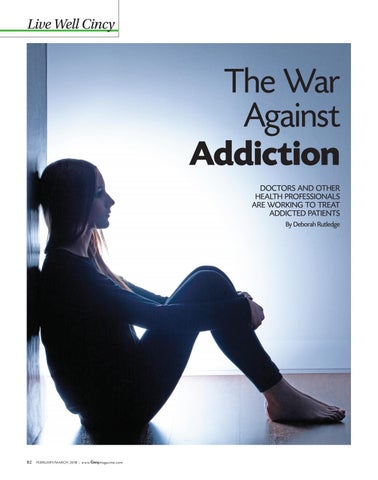
The War Against Addiction DOCTORS AND OTHER HEALTH PROFESSIONALS ARE WORKING TO TREAT ADDICTED PATIENTS By Deborah Rutledge
82
F E B R UA RY/M A R C H 2 0 1 8 : : w w w.
maga zine.com
I
n the war against opiate addiction, Kathy Noyes and her son, Micah, work triage on the front lines. Kathy is an independent nurse practitioner who has treated addicted patients in private practice and as a hospitalist over the past six years. She’s seen the life-altering effects of opiate abuse, how inpatient and outpatient treatment differs, and believes an originating factor of the crisis—pain management—remains a problem that needs to be solved. Micah is a licensed professional clinical counselor and licensed clinical alcohol and drug counselor at the Counseling and Diagnostic Center in its substance use program called New Directions. He’s seen patients in their late 20s and mid-30s lose jobs and housing—one who was driven away from her family because of stealing from them and another who kept his job and family, but because of relapse cannot be trusted to drive alone for fear that he won’t go where he says he will. Having a support system that helps keep the patient accountable makes a difference
in the success of outpatient treatment, Micah says. It also depends on the client’s level of functioning in several other areas such as employment, mental health and emotional functioning. But remaining in the community that facilitated the addiction obviously can be tricky, says Tom Schweinberg, clinical neuropsychologist at the Lindner Center of HOPE. “Outpatient treatment can be effective, especially when there is a combination of psychotherapy, medication and supportive groups in the community, such as AA or Smart Recovery,” he says. “However, the risk of relapse is relatively high as they still have access to drugs of reward while they are still in the community. “The advantage of a residential treatment facility is that the patients are kept away from any opportunity to relapse and to use substances for a period of time, and the longer that this is the case, the better—statistically speaking, the longer a patient can be free of addictive substances, the greater chance he or she has at lifelong sobriety.”
Micah Noyes, Counseling and Diagnostic Center But, Schweinberg adds, residential treatment is not always an option, since it is often cost-prohibitive for people. Nevertheless, addicted patients may find themselves needing hospitalization—for weeks at a time—to combat a host of
OH 45249
Patient-centered, comprehensive mental health and addictions care. Lindner Center of HOPE offers a quality continuum of care for mental health and addictions issues. A center of excellence, Lindner Center of HOPE offers hospitalization, outpatient programs, addictions services, residential diagnostic and treatment programs, and research. Lindner Center of HOPE has two locations. Both the main campus and outpatient addictions center, HOPE Center North, are located in Mason. lindnercenterofhope.org | (513) 536-HOPE (4673) for general inquiries or (513) 536-0050 for outpatient substance use treatment.
w w w.
m a g a z i n e . c o m : : F E B R UA RY/M A R C H 2 0 1 8
83
Less is More
with Spine Surgery Living with back pain can make everyday activities difficult. The expert spine surgeons at Kettering Health Network use the most advanced technologies to provide patients with minimally invasive surgical options.
For an appointment call toll-free
1-844-211-5482 less than one inch incision
Less Invasive • Less Pain • Less Time
ketteringhealth.org/spinecare
Live Well Cincy
Kathy Noyes
problems the ingested substances cause, says Kathy. “Patients who shoot up are injecting unsterile particles into their bloodstream,” she says. This can cause severe abscesses, like one Kathy saw at a patient’s elbow joint that required amputation. When unsterile particles and bacteria are introduced into the body by snorting or injecting, serious infections of the heart,
endocarditis, and bone, osteomyelitis, can result, requiring six to 12 weeks of IV antibiotics, Kathy says. “Then they’re really suffering from bone pain because of the infection of the bone,” she says. Apart from the addiction, users “don’t realize that what they’re doing is going to cause other body system failures.” She has seen a patient in her 20s need a heart valve replacement because unsterile particles that landed on a heart valve vegetated and destroyed it. “There is also the damage, sometimes irreversible, that the addict does to himor herself, says Schweiberg. “As a neuropsychologist, I have seen the profound cognitive deficits that alcohol and illicit drugs can cause. While these deficits are often reversible after a period of sustained sobriety, this is not always the case. “I have seen patients who, after years of substance misuse, have lost the full extent of their intellectual abilities, who have persistent difficulties with learning and recalling new information, as well as lasting deficits in executive function-
ing (skills which allow us to successfully navigate daily life, including planning, anticipating, organizing, problem-solving, etc.). Of course, it does not always require years of substance use to suffer neurological damage. I have evaluated patients who, due to an accidental overdose, suffer an anoxic brain injury, leading to permanent and sometimes disabling brain trauma.” “It’s just really sad, as a provider, you see a lot of people under 35,” with lifelong consequences from addiction, which may have started from legitimate pain problems, says Kathy. “Pain patients with true pain need to be treated,” she says of patients like those with chronic pain from hip surgeries or military injuries, for example. These days, many are being referred to cash-only pain management practices, which, to a population of patients, makes the out-of-pocket expense of prescription pain medication out of reach. So that population turns to the cheaper, easier-to-access heroin to take care of their pain, she says.
Our services include:
Sunrise TREATMENT CENTER
• Medication Assisted Treatment (available for pregnant patients, too) • Individual and Group counseling • Case Management (employment, resources, etc.) • Crisis Support • Continuing Care
Sunrise Treatment Center is a private, voluntary and outpatient substance abuse treatment center primarily focusing on Opioid Use Disorder. We offer quality programs staffed by physicians who have over 50 years of combined experience.
• Intensive Outpatient Program (IOP)
We have 2 convenient locations in Cincinnati with plans to expand to Middletown and Dayton at the beginning of 2018. Our hours alternate between early morning and later evening to accommodate the needs of our patients. Monday & Wednesday 7am-3pm; Tuesday & Thursday 9:30am-5:30pm; and Friday 7am-12pm. West Side 6460 Harrison Ave. Cincinnati, OH 45247
Forest Park 680 Northland Blvd. Cincinnati, OH 45240
513-941-4999 www.SunriseTreatmentCenter.net w w w.
m a g a z i n e . c o m : : F E B R UA RY/M A R C H 2 0 1 8
85
Live Well Cincy “Nobody should suffer,” Kathy says. “This is an evolution, the mindset about caring for the pain patient is in transition. “The pendulum swung from overprescribing, and now we’re underprescribing,” she says. Many in the field would say the overprescribing began in the late ‘80s, when pain began to be thought of as the fifth vital sign, says Dr. Jeffrey Bill, the founder of Sunrise Treatment Center. Up until that time, pain was not thought to be undertreated, and the use of narcotic pain medication was reserved for treating short-term acute injuries, surgeries and terminal cancer pain, he says. But then a not well-supported study came out that asserted treating pain patients with opiods instead of traditional pain medication did not pose a problem, Bill says. The pharmaceutical industry got onboard and a proliferation of pain pills were being prescribed, to the point that prescription was becoming more expected than a recommendation of rest, ice and higher doses of over-the-counter Ad_Layout 1 1/11/18 3:55 PM Page 1 pain
medication, he says. The introduction of Oxycontin “seemed to blow the lid off” the growing problem, he says. Taken correctly, t he power f u l, longacting medicine was fine, but when taken in excess, or crushed up to snort or inject, the medicine had a hardhitting effect that could, and did, ravage entire communities like Scioto County. When attention focused on the growing crisis, pharmaceutical companies developed abuse-deterrent formulations and crackdowns ensued on pill mills, “but that doesn’t mean there were any fewer people addicted to opiates,” Bill says. He says that a combination of counseling and medication-assisted treatment is most effective to deal with the addiction and often months-long after-effects of substance abuse, like cravings, sleep, appetite, mood and memory problems. These follow the
2018 Go Red Co-Chair
2018 Go Red Co-Chair
Debbie Hayes
Linda Clement-Holmes
Vice President Chief Operating Officer The Christ Hospital Health Network
Retired CIO The Procter & Gamble Company
2018 GO RED FOR WOMEN EXECUTIVE LEADERSHIP TEAM Tracy Artis Open Your Heart Chair I Hear Music
Delores Hargrove-Young Circle of Red Co-Chair d.e. Foxx & Associates, Inc.
Caitlin Clipp STEM Goes Red Chair UnitedHealthcare
Dr. Richard Lofgren Men Go Red Co-Chair UC Health
Robin Everhart Circle of Red Co-Chair Cintas
Gerald Sparkman Men Go Red Co-Chair d.e. Foxx & Associates
JOIN THE MOVEMENT! Visit cincinnatigored.heart.org
86
F E B R UA RY/M A R C H 2 0 1 8 : : w w w.
CONTACT Jenni Grammer, Sr. Director of Development, Go Red For Women at Jenni.Grammer@heart.org or 513.699.4231
maga zine.com
initial severe flu-like detox symptoms that can last for days. These days “my colleagues and I see many types of addiction and a wide array of substances being abused,” says Schweinberg. “Alcohol continues to be the most abused substance, but there has clearly been an increase in the abuse of marijuana, opiates [including heroin] and of stimulant medications, such as Adderall. “Anxiolytic medications (anti-anxiety medications), such as Xanax, continue to be abused at a high rate,” he says. n
12084 Montgomery Road, Cincinnati OH 45249 513-257-0705 • brainbalancecenters.com
B
rain Balance is a drug-free, non-medical approach that combines physical and sensory exercise with academic skill training and a Clean-Eating Nutrition System to improve individual performance and social behavior with children who struggle. Brain Balance creates a holistic view of your child through an initial set of tests that identify areas that need attention and strengthening. From the results of that assessment, we create a plan focused on getting your child back on track.
The Brain Balance program addresses: • Academic, Social or Behavioral Issues • Lack of Focus • Trouble Making Friends • Tantrums • Impulsiveness • Learning Disabilities • Family/Social Relationships
6460 Harrison Ave., Cincinnati, OH 45247 513-941-4999 • sunrisetreatmentcenter.net
S
The majority of patients with opiate addiction can be cared for on an outpatient basis, which is our focus. This alone sets us apart from a lot of the more notable, national addiction treatment centers. A variety of treatment settings is important to be able to best meet all patients’ needs,
but we have found that a combination of individual counseling sessions and regular visits with our experienced team of physicians works well for the large majority of our clients. The benefits of having therapeutic counseling relationships can’t be understated, and the fact that our team of physicians has over 35 years of experience in medication-assisted treatment is remarkable
HEALTH PROFILE
SUNRISE TREATMENT CENTER
unrise is a comprehensive, voluntary, outpatient treatment program for patients struggling with substance use disorders. Our primary focus is medication-assisted treatment for those addicted to pain medications and heroin. We use either Suboxone or Vivitrol in combination with medical, clinical and laboratory services to deliver this most effective, clinically proven system of care to manage people with this chronic, relapsing and progressive disease. For patients needing more support, we do also offer an intensive outpatient program. We are also open to helping pregnant patients with opiate use disorder.
HEALTH PROFILE
BRAIN BALANCE ACHIEVEMENT CENTER OF CINCINNATI
Sunrise offers treatment services that are private and convenient. Clients with state insurance coverage have little to no out-of-pocket costs for treatment with us. We are working to get contracts with private insurance companies, too, but our rates are affordable even if a patient doesn’t have insurance coverage. Sunrise currently has facilities serving patients on Cincinnati’s West Side as well as in Forest Park. Facilities in Middletown and Dayton are opening this year.
w w w.
m a g a z i n e . c o m : : F E B R UA RY/M A R C H 2 0 1 8
87