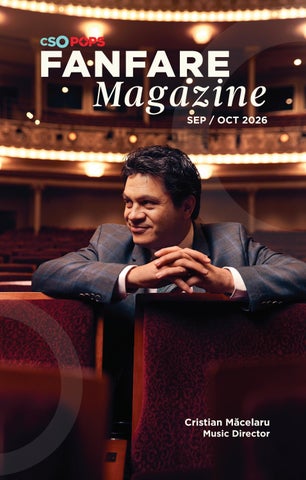
FANFARE MAGAZINE
FANFARE
Magazine
SEP / OCT 2026
CINCINNATISYMPHONY.ORG SEP / OCT 2026
Cristian Măcelaru Music Director
A proud sponsor of the musical arts
m or ial H a ll e M t a s e i r e O u r 113 R e c i t a l S o p ra no S o z z e M k c Welco m e s B a th
J A MIE BA RTO N !
Photo: Mark Allan
Sunday, October 25, 2026 3 PM
Along With Artists Making Their Cincinnati Debuts! Jonathan Mamora
Amelia Zitoun
Oliver Neubauer
Sunday, September 13, 2026 3 PM
Sunday, February 7, 2027 3 PM
Sunday, March 7, 2027 3 PM
PIANO
CELLO
VIOLIN
And Musicians Joining Their Considerable Forces! The McGill/McHale Trio Anthony McGill CLARINET
Demarre McGill FLUTE
Michael McHale PIANO
Thursday, April 15, 2027 7:30 PM
MatineeMusicale.com
Visit us on Facebook.
FANFARE
SEPTEMBER/ OCTOBER 2026
Magazine 8
CONTENTS 4
Directors & Advisors
5
Welcome from the President & CEO
7
Welcome to This Issue of Fanfare Magazine
8
Cover Story: Măcelaru and Marsalis: “Brothers from a Different Mother”
12
Spotlight: Why We Give: Crystal Kendrick, President of The Voice of Your Customer
13
Recap: 2026 Brady Block Parties
14
Spotlight: Contemporary Considerations at the Intersection of Jazz and the Orchestra
16
Spotlight: Life is Good When You’re Surrounded by Music, an Essay
18
Spotlight: In JMR’s Orchestral Canvas, Cincinnati is the Muse
“If Wynton Marsalis has written something for orchestra, Cristian Măcelaru has probably conducted it,” notes Fanfare Magazine’s Fanfare Magazine’s article on the artists’ decade-long partnership. Read more about the unique and fruitful relationsip between Marsalis and Măcelaru and the many parallels among their artistic and personal experiences, pp. 8–11.
14
20 Orchestra Roster 21
Artistic Leadership: Cristian Măcelaru, John Morris Russell
22
Concerts in this Issue: • SEP 5 & 6: La La Land in Concert (Pops) • SEP 12 & 13: Lea Salonga (Pops) • SEP 16: Boyz II Men (Pops) • SEP 19: The Music of Hans Zimmer (Pops) • SEP 22: Brahms: Radiant Joy (Winstead Chamber Series) • SEP 25–27: JMR’s Orchestral Canvas (Pops) • OCT 2–4: CSO + Jazz at Lincoln Center Orchestra with Wynton Marsalis Festival (CSO) • OCT 10: Ferdinand the Bull (Lollipops) • OCT 17 & 18: Songs of Destiny (CSO) • OCT 27: Psycho in Concert (Pops) • OCT 30 & 31: Gil Shaham Plays Tchaikovsky (CSO)
58
Financial Support
64
Administration
ON THE COVER: Music Director Cristian Măcelaru (Credit: Devyn Glista)
All contents © 2026–27. Contents cannot be reproduced in any manner, whole or in part, without written permission from the Cincinnati Symphony Orchestra and Cincinnati Pops.
From its roots in African American aesthetics and traditions to Scott Joplin to James Reese Europe to Duke Ellington, not to mention Billy Strayhorn and Nina Simone, the history of jazz in America is continually evolving, as is its relationship with classical forms. Read more on pp. 14–15. 14–15.
18
John Morris Russell leads the Cincinnati Pops in JMR’s Orchestral Canvas Sept. 25–27. 25–27. Learn from JMR himself what that canvas will reveal (hint: artwork will be projected throughout the Music Hall auditorium while the Pops plays music that highlights and complements the images), and find out about local connections to the art and music featured on the program, pp. 18–19. 18–19.
FANFARE
Magazine
CINCINNATI SYMPHONY ORCHESTRA & CINCINNATI POPS Music Hall, 1241 Elm Street, Cincinnati, OH 45202 Box Office: 513.381.3300 hello@cincinnatisymphony.org Group Sales: 513.864.0196 groupsales@cincinnatisymphony.org TTY/TDD: Use TTY/TDD Relay Service 7-1-1 cincinnatisymphony.org cincinnatipops.org
FANFARE MAGAZINE STAFF: Managing Editor Tyler Secor Senior Editor/Layout Teri McKibben Assistant Editor Gabriela Godinez Feregrino CINCINNATI MAGAZINE: Advertising and Publishing Partners for Fanfare Magazine Publisher Ivy Bayer Production Director & IT Systems Administrator Vu Luong Advertising Designer Sophie Kallis Account Representatives Laura Bowling, Maggie Wint Goecke, Chris Ohmer, Julie Poyer, Sarah Riesenberger Operations Director Missy Beiting Business Coordinator Meredith Carroll Advertising and Business Offices Atrium 2 — 221 E. 4th Street, Suite 130 Cincinnati, OH 45202 | 513.421.4300 Subscriptions: 1.866.660.6247 cincinnatimagazine.com
You are welcome to take this copy of Fanfare Magazine home with you as a souvenir of your concert experience. Alternatively, please share it with a friend or leave it with an usher for recycling. Thank you!
4 | 2026–27 SEASON
BOARD OF DIRECTORS Officers Charla Weiss, Chair Dianne Rosenberg, Immediate Past Chair Valarie Sheppard, Treasurer Gerron McKnight, Secretary
Directors Dorie Akers Nick Apanius Heather Apple Joseph Bricker** Kate C. Brown Trish Bryan* Otto M. Budig* Emma Compton Andrea Costa Adrian Cunningham Gabriel Davis Deneen DiFiore Maria Espinola Blair Fleischmann*
David Harper Kori Hill** Francie S. Hiltz* Peter Hiltz Joseph W. Hirschhorn* Kyle Inskeep Heidi Jark Edna Keown Florence Koetters* John Lanni Robert W. McDonald Dean Moulas Aik Khai Pung James B. (“Rick”) Reynolds* Jack Rouse* Patrick Schleker** Valarie Sheppard Brett Stover Kari Ullman Randolph (“Duck”) L. Wadsworth, Jr.* Elizabeth Warner Emeritus * Ex-Officio **
BOARD OF DIRECTORS COMMITTEES and MULTICULTURAL AWARENESS COUNCIL We thank our many partners who serve on the following CSO Board of Directors committees, as well as the Multicultural Awareness Council (MAC), as we collectively work to realize our vision to be the most relevant orchestra in America.
CSO Board of Directors Committees Audience Engagement Audit & Ethics Inclusion Executive Finance & Investment Learning Nominating & Governance
Non-Board Advisory Council Multicultural Awareness Council: Holly Bates Janet Bohne Rick Bohne Susan Carlson Andria Carter Piper Davis
Janine Gage Carolyn Glosby Eric Glosby Kori Hill Alverna Jenkins Beverley Lamb Paulette Moore Nicole Ortiz Aurelia “Candie” Simmons Daphney Thomas Community Advisory Council: Daniel Betts Myra Epps Crystal Kendrick Bernardo Lopez John Spencer Nick Wade
WE BELIEVE MUSIC LIVES WITHIN US ALL regardless of who we are or where we come from. We believe that music is a pathway to igniting our passions, discovering what moves us, deepening our curiosity and connecting us to our world and to each other. Our mission is to seek and share inspiration, and we exist to serve our community. Our entire community. Reflecting our community and the world around at every level — on stage, behind-the-scenes and in neighborhoods throughout the region — is essential to our present and future and makes us a strong ensemble and institution. LAND ACKNOWLEDGEMENT The Cincinnati Symphony Orchestra and Cincinnati Pops acknowledge that Cincinnati Music Hall occupies land that has been the traditional land of the Myaamia (Miami), Shawandasse Tula (Shawanwaki/Shawnee), and Wahzhazhe Manzhan (Osage) peoples, who have continuously lived upon this land since time immemorial. We honor past, present and future Indigenous peoples.
Welcome from the President & CEO powerfully, we saw it in Last season was my first as Stravinsky’s Firebird, President & CEO, and it when the Orchestra, gave me the opportunity to dancers, puppeteers experience this Orchestra and staff brought their from a different perspective. creativity, adaptability and I expected to spend most of trust together to create my time watching the stage. something extraordinary. Instead, I found myself Those sold-out focused on the audience. performances reminded us I watched students from that people seek experiences 23 schools experience that inspire, connect and the Orchestra for the leave a lasting impression. first time through our I hope you’ll find those Young People’s Concerts same moments this season. at Music Hall. I watched We begin with a remarkable residents in memory care collaboration between the experience the connection CSO, Cristian Măcelaru, and comfort music can Wynton Marsalis and the provide. I watched longtime Jazz at Lincoln Center subscribers welcome Orchestra, reimagining new faces and first-time Mussorgsky’s Pictures at attendees discover the Robert McGrath, CSO President & CEO. Credit: Claudia an Exhibition as a work same unexpected joy that Hershner that brings together two first captivated me as a great musical traditions. teenager attending concerts It’s a wonderful example of the artistic curiosity and with my hometown orchestra. After performances, I openness shaping this next chapter for the Orchestra. often found myself lingering in the foyer, listening to That same spirit extends throughout the season. conversations that began with music but continued Some of you are joining us for Pictures at an long after the final applause. Exhibition. Others are here to enjoy La La Land Those moments reinforced something I believe with the Pops live, hear Lea Salonga, celebrate Boyz deeply: an orchestra is defined not only by the artistry II Men or experience JMR’s Orchestral Canvas of the musicians on stage but also by the connection paired with visual projections of some of the world’s they create with everyone who comes to listen. greatest works of art. Each performance offers People sometimes ask what we mean when we something different, but all share the same purpose: say we want to be the most relevant orchestra in bringing people together through the power of live America. For me, relevance means being deeply orchestral music. connected to the life of our community. Whether you have been with us for decades or It means creating experiences that move this is your first visit, thank you for being part of longtime supporters while welcoming those who are the Cincinnati Symphony Orchestra. Your presence experiencing an orchestra for the first time. It means matters, and together you help make this investing in young musicians, creating pathways Orchestra an essential part of our community. for future artists, exploring music’s connection to I am grateful to share this season with you, wellness and ensuring more people see themselves and I look forward to the moments we’ll reflected in — and connected to — this institution. create together. Last season gave us many reminders of what that looks like in practice. We saw it in the excitement Warmly, and energy surrounding Cristian Măcelaru’s inaugural season. We saw it in audiences embracing everything from beloved classics to new multimedia collaborations with the Pops. Perhaps most Robert McGrath
Fanfare Magazine | 5
C
M
Y
CM
MY
CY
CMY
K
WHERE TO NEXT? After you’ve experienced the Cincinnati Symphony Orchestra, find your next stop on the ArtsWave App, your one-stop calendar for arts, entertainment, sports and more across the Cincinnati region. Grab the ArtsWave Pass on the app and you’ll unlock 50% off arts tickets, plus dozens of restaurant and shop offers too!
D OW N L OA D FOR
T O DAY
FANFARE
Magazine WELCOME
Along with the online version of Fanfare Magazine, the CSO has developed a digital platform to deliver concertspecific content.
FOLLOW US on social media for the latest updates! Facebook: @CincySymphony @CincinnatiPops Instagram: @CincySymphony YouTube: @CincySymphony TikTok: @cincysymphony
*By texting to this number, you may receive messages that pertain to the organization and its performances; msg & data rates may apply. Reply HELP to help, STOP to cancel.
to the September and October 2026 issue of Fanfare Magazine! Fanfare Magazine! In our cover story, on p. 8, writer Hannah Edgar shares Cristian Măcelaru’s M celaru’s views on his collaborations and friendship with composer and trumpet player Wynton Marsalis and explores how the CSO’s season-opening festival embodies their decade-long artistic partnership. Philanthropy and community partnership continue to strengthen the Orchestra’s mission both in and outside of Music Hall. For her article on p. 12, writer Nyla Nawab interviewed Crystal Kendrick of The Voice of Your Customer and learned more about her commitment to advocacy and how one person’s investment makes a big impact. On p. 14, writer Andre Jamal Cardine examines the evolving and complex relationship between jazz and orchestral music. Travel through more than a century of artistic and cultural exchange and consider how identity and history continue to shape one of America’s most influential art forms. Last season, to mark Cristian Măcelaru’s M celaru’s debut as Music Director of the CSO, Fanfare Magazine Fanfare Magazine invited graduate and undergraduate students to respond to his words, “Life is good when you’re surrounded by music,” in the magazine’s firstever writing competition. Read the final installment of this competition — thirdplace winner Kimberly Hamilton’s essay — — on on p. p. 16. 16. Writer Char Daston takes readers inside the concert JMR’s Orchestral Canvas, where iconic works of art and beloved orchestral music will converge on stage. Dive into some of the masterpieces included in this immersive concert experience on p. 18. Did you know that the Fanfare Fanfare Magazine Magazine experience is not limited to a print publication? On p. 13, get a sneak peak of what’s available at cincinnatisymphony.org/fanfare-magazine. There you can find the articles in this issue to share with friends and family as well as our web-exclusive articles. Along with the online version of Fanfare Fanfare Magazine, Magazine, the CSO has developed a digital platform to deliver concertspecific content to meet the CSO’s ongoing commitment to digital storytelling, innovation and accessibility. This digital platform offers early access to exclusive concert-specific content: full-length program notes, artist biographies, feature stories, up-to-the-minute information and much more! As a bonus, program notes and artist biographies for the entire season will be available on this digital platform in advance of the season-opening concerts, allowing you to engage with all the content before you arrive at Music Hall. Unlike a print magazine, this digital platform is compatible with all smartphone accessibility features. The CSO’s digital platform is easily accessible — — no no app app to to download download or or subscription subscription to to manage. manage. To explore our digital content, visit cincinnatisymphony.org/ DigitalProgram, text the word PROGRAM to 513.845.3024* or scan the QR code at right with your mobile device. The CSO hopes you find inspiration within these pages and within the music — past, present and future — — that that reverberates reverberates at at Music Music Hall Hall and and in in the the community. community. Thank you for being with us! Fanfare Magazine | 7
COVER STORY
Cristian Măcelaru (Credit: (Credit: Alex Alex Johnson) Johnson) and Wynton Marsalis
Măcelaru and Marsalis: ‘Brothers from a Different Mother’ by HANNAH EDGAR
If Wynton Marsalis has written something for orchestra, Cristian Măcelaru has probably conducted it. Marsalis’ new cello concerto? Măcelaru conducted the world premiere in the spring, with Yo-Yo Ma and young musicians from his alma mater, the Interlochen Center for the Arts. Marsalis’ Concerto for Orchestra? Măcelaru led the world premiere last year, too, with the WDR Symphony Orchestra in Cologne. The Blues Blues Symphony Symphony and Violin Concerto? Măcelaru has recorded them both and won a Grammy for the Decca recording of the Violin Concerto with violinist Nicola Benedetti after conducting the U.S. premiere of the Violin Concerto in July 2016. That deep connection opens the CSO’s new season. Cincinnati audiences will be among the very first to hear Marsalis’ epic symphony, Liberty, Liberty, commissioned by multiple American orchestras for
8 | 2026–27 SEASON
the country’s semiquincentennial. As with many of Marsalis’ previous symphonies, the Jazz at Lincoln Center Orchestra (JLCO) will join the orchestra onstage, as will bass-baritone soloist Kevin Short. “About once every decade, he writes a piece that’s a statement about America,” Măcelaru says, pointing to Marsalis’ Pulitzer Prize-winning oratorio Blood Blood on on the the Fields and Symphony No. 1, All Fields All Rise, Rise, both from the late 1990s. “This is the symphony of this decade.” Together, the CSO and JLCO will also unveil a new adaptation of Pictures Pictures at at an an Exhibition, Exhibition, the beloved Modest Mussorgsky/Maurice Ravel orchestral suite, reimagined by Măcelaru and arranged for JLCO by band member Sherman Irby. Other performers in the Wynton Marsalis extended universe also appear throughout the weekend. The JLCO performs in its own concert on Oct. 4, and the violinist Nicola Benedetti, dedicatee of his Violin Concerto, performs on Oct. 3.
COVER STORY
“For [Marsalis’] last season as managing and States, I thought, ‘Wow, you know, this guy has artistic director, leader and founder of Jazz at switched,’” Măcelaru remembers, chuckling. “But Lincoln Center, I really wanted to make it really, he’d always done both at the same time.” truly an event,” Măcelaru told Fanfare Fanfare Magazine. Magazine. Măcelaru and Marsalis finally crossed paths What is now a close friendship between the two in 2015, when Măcelaru conducted Benedetti musicians began as one-sided admiration. Twenty in Marsalis’ Violin Concerto at the Chautauqua years Marsalis’ junior, Măcelaru grew up listening Institution in western New York. Despite their to his acclaimed 1980s recordings obvious differences — growing up in of classical trumpet repertoire in different nations, generations and If Wynton Marsalis Romania. What he didn’t know was cultural contexts — — the the two two bonded bonded has written something over their upbringings. Both grew up that Marsalis was also the face of the “Young Lions” generation — — jazz jazz for orchestra, Cristian in large, working-class families led musicians who attended elite music Măcelaru has probably by principled and musical patriarchs: conservatories and largely rejected the Ellis Marsalis, a pianist who became conducted it. fusion experiments of the ’80s. a civic icon in the family’s native During this time, Marsalis founded New Orleans, and Dorel Măcelaru, a Jazz at Lincoln Center and the Jazz at Lincoln conductor in Timișoara, Timiăoara, Romania, who refused to Center Orchestra — the country’s leading big collaborate with the country’s brutal secret police. band, and the resident ensemble of the country’s “My dad was told, very clearly, that if he didn’t most visible and prestigious jazz institution. He comply, his kids would never have access to higher will step down from the organization next season. education. That’s why the three oldest of my siblings (Marsalis’ packed windup to that valedictory season did not go to university,” the younger Măcelaru tells prevented him from sitting with Fanfare Fanfare Magazine Magazine Fanfare. “I was very happy and proud that when we Fanfare. for this story.) went and we looked for my dad’s files, his dossier “There were a few of his jazz recordings in said that he could not be compromised. Period.” Romania that I knew as a kid. When I came to the Then, the pandemic struck. Dorel and Ellis Cristian Măcelaru and the Cincinnati Symphony Orchestra, October 2025. Credit: Credit: JP JP Leong Leong
Fanfare Magazine | 9
INVEST ENGAGE INNOVATE LEAD
Program Spotlight: POETRY OUT LOUD Ohio Poetry Out Loud State Champion Zeke Moses of Bexley High School (Franklin County) reciting a poem at the 2025 state finals. He represented Ohio at the national finals in Washington, D.C. Image credit: Terry Gilliam
Investing state and federal dollars, the Ohio Arts Council funds and supports quality arts experiences for all Ohioans to strengthen communities culturally, educationally, and economically.
Learn more about our grant programs and resources, find your next arts experience, or connect: OAC.OHIO.GOV.
es
COVER STORY
died on the exact same day: April 1, 2020. Măcelaru and Marsalis called to console one another, and their professional bond became more personal than ever before. “He played for my father’s virtual funeral. We had our own little wake, with a glass of whiskey,” Măcelaru remembers, his voice far-off and pensive. “So, yeah. I go very Wynton Marsalis. Credit: Credit: Frank Frank Stewart Stewart deep with Wynton. I kind of feel like a brother from a different mother.” rehearsing that section, he signaled a big cue to They also work well together. Măcelaru sees Marsalis. He was met with silence — then then the solo, parallels between Marsalis’ notation style and the just half a beat or so later. dozens of contemporary scores he studies each “He had meant to start that way. Then, of course, season, whether with the various orchestras he leads at the concerts it was different again,” Măcelaru says. or as the music director of the Cabrillo Festival of “Everything is written out, but it’s not treated as a Contemporary Music in Santa Cruz, California. never-changing thing, the way we treat Beethoven’s Marsalis’ symphonies, for example, often utilize box music. Things are written out as the first step notation, which directs musicians to freely repeat a towards you making it your own.” boxed figure over several bars. Plus, Măcelaru can roll with the punches if music The notation style is “usually used for abstract, gets tweaked at the eleventh hour — as could very weird stuff,” Măcelaru says. But in Marsalis’ music, it well be the case with both Liberty Liberty and the Pictures Pictures at at sounds so natural that many audiences would likely an Exhibition an Exhibition adaptation. As a steadfast champion assume the music was simply written out. of wet-ink works in all facets of his career, Măcelaru “He’s always tried to find ways to write a is not much cowed by the idea of moving parts in the combination between straight [notation] and rehearsal process. improvisation for the orchestra. Because in his “One of my weird gifts is I’m really, really quick in experience, as in mine, if you just write ‘improvise,’ learning music,” he says. it’s going to be terrible,” Măcelaru says. “You’ve got to More than a decade into their collaboration, give them something, then say, ‘Repeat this gesture Măcelaru looks forward to working with Marsalis five times and make sure it’s not at the same speed for many more years to come — and there will will be as your stand partner,’ or, ‘Start this, and then when more, including with our own Cincinnati Symphony you hear that, that, repeat this.’ Stuff like that.” Orchestra. (All we can say for now is: Watch this Even sections that are notated may not be played space.) With their shared history and candor, verbatim — yet another way Marsalis’ symphonies every collaboration runs deep. Neither can stand blur the lines between classical and jazz convention. superficiality, Măcelaru confesses. Each has found an The first time Măcelaru conducted Marsalis’ artistic partner for life. Symphony No. 4, The The Jungle, Jungle, he reached a section “Anyone that has met Wynton will know that it’s where the orchestra built up into fast swing under all genuine, and all true,” Măcelaru says. Marsalis’ trumpet melody. The next day, while
Fanfare Magazine | 11
SPOTLIGHT
Why We Give:
Crystal Kendrick, President of The Voice of Your Customer by NYLA NAWAB
When asked about her relationship with the Cincinnati Symphony Orchestra, longtime sponsor Crystal Kendrick reminisces, “I can’t really remember a time living in Cincinnati when Crystal Kendrick I wasn’t in love with the symphony.” Kendrick spent her formative years in Cincinnati but relocated to Philadelphia for middle school. She admits she can’t claim she’s a native Cincinnatian because she can’t answer the classic question, “What high school did you go to?” But, like most Cincinnatians, she is proud of the local arts scene. Since her return to Cincinnati almost 30 years ago, Kendrick has become a pivotal member of the Cincinnati community. Her company, The Voice of Your Customer, and her digital platform, The Voice of Black Cincinnati, were created to be touchpoints for both the art and business worlds. They allow people unfamiliar with these areas to discover them with ease. Kendrick’s unique insight and goal of providing access to her community inform why she felt an immediate connection with the CSO. Kendrick’s introductory CSO concert was also the first time she had ever seen a 100-piece orchestra in person. She was mesmerized. She recalls, “the music and the program just captured you. You listen so intently, you almost listen with a stare.” Beyond the music, she was also inspired by the diversity of age, race and lived experience among the musicians. “[The CSO] found the best of the best while still being incredibly inclusive.” Since that first concert, Kendrick has been an active CSO attendee and advocate. Her involvement in the CSO is present at multiple levels of the organization. Kendrick serves on the Community Advisory Council, communicating 12 | 2026–27 SEASON
Cincinnatians’ needs to the CSO so that strategic decisions can be made to benefit the community. She consistently sponsors CSO and Pops concerts, including Classical Roots, Kendrick Lamar X Stravinsky and Boyz II Men. For the last 10 years, Kendrick has purchased new music stands for the participants of the Nouveau Program, the CSO’s music program dedicated to achieving the goal of increasing African American and Latine student participation in orchestral music. Nouveau helps young musicians achieve their dreams by providing equitable opportunities to perform and study chamber music. The CSO, with the help of members like Kendrick, takes a multi-tiered approach to combating societal disparities, making music not only accessible but also enjoyable. “The CSO is one of the largest arts organizations in our region, and they have always been committed to diversifying their audiences. They have, for as long as I can remember, brought together individuals to help
Crystal Kendrick (right) at the Classical Roots Pre-Concert Reception, March 2025. Credit: Claudia Hershner
them authentically diversify their audience. For this reason, I have devoted my time, talent and treasure to this wonderful organization.” Kendrick built her career on advocating for those who need it most, noting that she felt compelled to become a committed advocate after seeing the
SPOTLIGHT
needs of her community go unmet or get lost in communication. She states that, “not a day goes by that someone doesn’t call or text or email to let us know that their life has changed because of something that they saw on our website.” Every day, Kendrick uses her greatest tool — her digital platform. She maintains a wealth of information resources designed to educate, recognize and create opportunities for her followers. “The CSO is built to do that. By their mission, by their vision, by their culture, by their values. The CSO is the one who can bring people with different lived experiences together in that way. The people at the CSO truly understand what is happening in our world, and they find the music or the songs or the message that reminds us [of] who we are, and at the end of the day, that we are more similar than we initially thought.” Kendrick plans to be involved in the growth of the CSO and the Cincinnati arts community for as long as possible. When asked to describe the CSO’s
Crystal Kendrick (second from right) at the BlaCkOWned Pre-Concert Pop-Up at the Nas concert, November 2025. Credit: Charlie Balcom
future, Kendrick smiles and says, “The future of the CSO is bright.”
Capturing Summer Sounds: A Brady Block Party Recap The CSO’s Brady Block Parties bring communities together through evenings of music, as well as partnerships with local food vendors and support organizations. Relive, or discover for the first time, the energy and spirit of these summer gatherings through an online photo essay that captures those connections and the unforgettable moments that unfold when the Orchestra takes the stage beyond Music Hall: bit.ly/BBP26Recap
Above, from left: Pops Conductor John Morris Russell conducting at the West End Brady Block Party (Credit: Mark Lyons). Two children at the instrument “petting zoo” at the Madisonville Brady Block Party (Credit: HATSUE).
Fanfare Magazine | 13
SPOTLIGHT
Contemporary Considerations at the Intersection of Jazz and the Orchestra by ANDRE JAMAL CARDINE, Ph.D. Candidate in Ethnomusicology, Indiana University
For more than a century, jazz and classical music have converged and diverged, shaping a dynamic history. While classical music was already an established genre by the turn of the 20th century, jazz was just beginning to develop as an art form. Early innovators of the field, including Scott Joplin, were pivotal to what jazz became as it expanded into one of the most popular genres of music in the U.S. by the mid-20th century. This new art form was a union between both Africanand European-derived aesthetics and traditions but was heavily reliant on African Americans and their experiences in America. As interest in jazz grew through the 20th century and was introduced to both national and international markets, it came to be defined not only by the Black experience but also by anyone invested in the genre. As a result, jazz is consistently being (re)defined. Although fusion-based terminology used throughout the 20th century, such as “third stream,” “Black classical music” and “American classical music,” has been employed to establish jazz as a high art, those terms may instead have erased the role African Americans had on jazz’s inception and development. However, jazz’s evolution also helped create new possibilities for classical music ensembles throughout the 20th and 21st centuries, as well as new entry points to engage with sociopolitical issues in the United States. Early 20th-century jazz (1900s–1930s): A historical overview of the fusing of cultural traditions and practices among jazz and classical music reveals that jazz combines both African and European traditions. Jazz follows much of the same tonal
harmonic structure and rules present within Western art music, and musicians in both also typically use sheet music when learning new material. While the goal of classical music is to interpret the song as closely as possible to the composer’s original intent, jazz adopts African-derived musical traditions such as syncopation, improvisation and call/response. One early innovator who demonstrated this combined approach was James Reese Europe. Europe was an outstanding composer, musician and bandleader who led the Clef Club Orchestra. The 125-member orchestra premiered the “Concert of Negro Music” for an integrated audience at Carnegie Hall in 1912, a significant early indicator of jazz’s role in forming new pathways within classical music. One year prior, in 1911, another innovator, Scott Joplin, composed Treemonisha. In Dr. Samuel Floyd’s The Power of Black Music he writes that Joplin’s work “aspires to the proportions of grand opera and includes an overture, instrumental act preludes … arias and recitatives … instrumental and choral ensembles and strong choral writing.” While Floyd is critical of Joplin’s modernist spirit and his rejection of African mythology in favor of “raising the race through education,” he asserts that Joplin’s work is a union of African American and European traditions. Only a few years after the Dixieland Jazz Band, an allwhite group, created some of the earliest recordings of jazz (and tried to claim authorship of the genre),
Below: James Reese Europe and the Clef Club Orchestra at the Manhattan Casino, May 1911. Right: Portrait of James Reese Europe, 1919.
14 | 2026–27 SEASON
SPOTLIGHT
small jazz ensembles began to thrive in nightclubs across the country. Jazz giants Duke Ellington and Louis Armstrong gained notoriety as musicians and bandleaders. During Prohibition, speakeasies were spaces where integrated audiences drank, danced and listened to jazz together. However, conservative groups were displeased with the racial mixing. By the late 1920s, jazz was banned in over 60 different dancehalls around the country. Once swing music became the popular music of the 1930s, concerns on what jazz is and how we define it began to spark debate. Issues within jazz’s “elevation”: “To most white people, jazz means Black and jazz means dirt and that’s not what I play. I play Black classical music.” —Nina Simone Jazz musicians have various (and often conflicting) viewpoints on what jazz is, how they fit within the genre, and what terminology is most appropriate to describe the consistently evolving relationship between jazz and classical music. While Nina Simone asserts herself as a practitioner of Black classical music, in 1957 the term “third stream jazz,” coined by composer Gunther Schuller, was used to describe compositions comprising both classical and jazz elements. Schuller defined third stream as “a type of music which, through improvisation or written composition or both, synthesizes the essential characteristics and techniques of contemporary Western art music and various ethnic or vernacular musics.” According to ethnomusicologist David Joyner’s analysis on third stream, “Many critics, musicians and listeners viewed this creation as a mutt — a dangerous half-breed that threatened the pedigree of each musical tradition.” One key figure in the third stream jazz movement was composer and jazz educator Dr. David Baker. Dr. Baker composed hundreds of works during his lifetime, notably receiving a Pulitzer Prize nomination for his 1973 Levels concerto and an Emmy for the musical score to For Gold and Glory (2003). To better understand concerns surrounding the terminology at the intersection of jazz and classical music, consider the work and influence of Dr. Billy Taylor. Jazz musician, educator and ambassador, Dr. Taylor championed the term “American classical music” to establish jazz as a legitimate art form. Dr. Taylor argued in his 1975 dissertation that jazz is an American classical music. Citing Amiri Baraka’s Blues People, Dr. Taylor found a crucial component of jazz to be the Black American experience. However, the term “American classical music” was eventually co-opted to advance a more nationalist project for the United States. In the 1980s, Dr. Taylor found himself as an ambassador for the United States International
Communications Agency, attempting to establish jazz as a legitimate art form worldwide, although the context of the Black American experience and contributions to both the genre and the field were lost in translation. However, the conundrum jazz musicians often wrestle with is that establishing jazz as a “classical” music was a way to get the same respect and financial security as their European counterparts. The trade-off, however, is that the genre (in these “established” spaces) reflects European values more than the Black experience. It’s important to consider: how can a genre establish legitimacy in this country without losing or minimizing core aspects of Above: Duke Ellington; portrait of its identity? American singer, composer and pianist Nina Simone (Credit: Ron Kroon); Billy Jazz is an Taylor Jazzmobile concert 1977. extension of the Black musical canon that has continuously expanded in the United States since Africans arrived over 400 years ago. Without Black Americans using music and sound to describe and contemplate their experience, jazz and its derivatives cannot exist.
UPCOMING EVENTS • Intersections abound between jazz and the orchestra Oct. 2–4 in concerts featuring the Jazz at Lincoln Center Orchestra with Wynton Marsalis: pp. 36–49. • The Nina Simone Piano Competition for African American Pianists is a collaboration between the Art of the Piano Festival, the CSO and the San Francisco Conservatory of Music. The Competition’s finale is a concerto round that includes three finalists competing for the grand prize on the Music Hall stage with the CSO. For details and tickets to the Oct. 7, 7:30 p.m. final round, visit bit.ly/26NSPC.
Fanfare Magazine | 15
SPOTLIGHT
Life is Good When You’re Surrounded by Music, an Essay To celebrate Music Director Cristian Măcelaru’s inaugural season with the Cincinnati Symphony Orchestra, we used his words, “Life is good when you’re surrounded by music” as the theme for the magazine’s first-ever writing competition. Fanfare Magazine invited local undergraduate and graduate students to celebrate the power of music through words. Students enrolled at colleges and universities in Ohio and Northern Kentucky submitted essays reflecting on the emotional, cultural, societal or personal significance of music in their lives. The essay below is by third-place winner Kimberly Hamilton. Look for more of the winning essays at cincinnatisymphony.org.
Life is Good When You’re Surrounded by Music by KIMBERLY HAMILTON, Third-Place Winner
Music has always been at the center of my life: past, present and future. Without it, the bright colors of my emotional world would fade into gray. You can always tell when music truly touches you. It’s when a chill runs down your spine, when your stress fades with a melody, or when a rhythm makes you feel alive. Music has an energy that goes beyond sound. It can transform a moment, a memory or even a person. At the age of four, I started teaching myself piano by ear. I would sit at the keys, pressing notes until I found the melody that matched what I heard in my head. I couldn’t read music efficiently back then; I still can’t read it quickly, but I could feel it. I learned to find songs through sound and emotion, to build meaning through noise. Even now, I sit at the piano and let my fingers wander, chasing melodies the way a child might chase light through a window. Someday soon, I hope to teach my daughter the same way: to listen, feel, and trust her ear before her eyes. My love for music deepened in eighth grade when I auditioned for the color guard in a performing arts program. That was when I first learned to cherish the way a song could travel through my body, changing how I moved and felt. Before every performance, our team would sit together listening to Rascal Flatts, tears in our eyes as we held each other close and wished one another good luck. In those moments, I learned how deeply music connects people. It can be the bridge between fear and courage, between nerves and confidence. As I grew older, my passion for performance expanded. I joined the Miami University Marching Band, performing at games and events, while competing independently through WGI and DCI, sharing the field with musicians from around the world. The thrill of performing under bright lights, hearing the first notes of a show echo across the field or gym floor, and feeling every beat pulse through my chest reminded me that music is more than sound. It’s an energy that binds us together. Even without words, it tells stories, carries emotion and unites thousands of hearts beating in the same rhythm. The power of music reached me on a much deeper level when my father became ill. He was diagnosed with cancer, and, one Christmas, he was hospitalized and became unresponsive, barely aware of the world around him. My mother stayed by his side for days, speaking softly and holding his hand, but there was no sign he could hear her. When I came to visit, I sat beside him and began to play our song, 16 | 2026–27 SEASON
SPOTLIGHT
Patty Loveless’ “Pretty Little Miss.” As the melody filled the quiet room, he squeezed my hand and mumbled a few words for the first time in days, maybe even weeks. My mom started to cry. That small moment, his faint response and sudden awareness sparked by music, was a miracle we both cherished. It reminded me that even when words fail, music still finds a way to speak. Eventually, I stepped off the performance field and into a new role as a teacher. For five years, I helped beginners find their rhythm, guiding them to feel the music in their steps and see how movement could express emotion. Watching a student’s confidence grow as they learned to trust their body and the beat was as fulfilling as any performance I had ever given. Teaching taught me that music doesn’t just shape performers; it shapes people. It builds discipline, empathy and connection. Through music, I watched shy students find their voice and uncertain ones find their strength. A decade later, I returned to the same soil where my own journey was shaped, my alma mater’s field. Now I stand on the sidelines, watching 25 incredible students discover what music can do for them. Their stories, their growth and their joy remind me that music’s impact never fades. It multiplies. It ripples outward from one generation of performers to the next. I see in their eyes the same excitement I once felt, the same nervous laughter before a performance, the same awe when a show finally comes together. It’s as if I’m watching my younger self, carried forward in new rhythms. Being surrounded by music again has reminded me that it’s more than a passion. It’s a thread that ties us to the past and the future. Every rehearsal, every note, every shared silence before a performance connects us in ways words can’t. When I hear my students laugh during water breaks or hum through their warmups, I realize I’m not just teaching them how to perform; I’m helping them build memories that will stay with them long after they’ve left the field. Even at home, I see how that rhythm continues. My four-year-old daughter sings “Jolene” by Dolly Parton at the top of her lungs and hums along to any tune she hears. In her voice, I hear the same spark that first moved me years ago. Music has already found her, just as it found me, and in that, I see the beauty of its legacy. Sometimes we dance in the kitchen, her tiny feet on mine, spinning until we both start laughing. In those moments, I realize that music doesn’t just live on the stage or field. It lives in every heartbeat, every laugh, every shared song between parent and child. Music has given me more than performances or accolades. It has given me community, courage and compassion. It has carried me through laughter and tears, connected me to people I might never have met, and reminded me that even in life’s quiet moments, a song is always waiting to be heard. It is the friend that celebrates with you and comforts you when words fail. Life is good when you’re surrounded by music because music surrounds you with life. Kimberly Hamilton is a Ph.D. student in computer science at Miami University, where she serves as a graduate assistant to the department’s director and as color guard director for the Miami University Marching Band. She holds B.A. and M.S. degrees in computer science as well as a B.S. in chemical engineering with a minor in paper science. Her academic work explores the intersection of technical innovation, education, leadership and creativity. Prior to her doctoral studies, Hamilton worked in the paper manufacturing industry, advancing through Kimberly Hamilton management roles and gaining experience in operations, process optimization and people development. A lifelong musician, she taught herself piano by ear at age 4 and remains passionate about mentorship through the performing arts. Outside of work, she is a proud mother to a 4-year-old daughter with whom she shares a joyful love of music. Fanfare Magazine | 17
SPOTLIGHT
In JMR’s Orchestral Canvas, Cincinnati is the Muse
will be inspired to appreciate the extraordinary art and architecture that surround us in Cincinnati. Featuring Cincinnati is an important consideration for Russell as he designs original concerts specifically for the Cincinnati Pops. “So many orchestras around the country present pops performances that are ‘add water and stir.’ They by CHAR DASTON can be performed anywhere. All the music comes in a box, and the artist flies in from wherever,” he says. “What makes the Cincinnati Pops unique is that much For Cincinnati Pops Conductor John Morris Russell, of what we do is developed here by us and for us.” music and visual art have something in common: Here are a few more of the Cincinnati connections they’re both multi-sensory experiences. you’ll notice in JMR’s Orchestral Canvas: “When I find a particular painting that really Music Hall Organ Panels. When Music Hall moves me, or that I really find connection with, I can opened in 1878, it housed one hear it, I can smell it, I can of the five largest organs in feel it,” he says. the world. Covering the pipes A great piece of music can were dozens of ornate wooden be equally transporting. panels carved mostly by local “It takes you into another women artists, including realm,” Russell says. “You students of what is now the can imagine images, colors, Art Academy of Cincinnati. textures and stories.” For JMR’s Orchestral In JMR’s Orchestral Canvas Canvas, Lightborne will (Sept. 25–27), the audience animate these panels, as well will embark on a journey as many of the extraordinary enhanced by both mediums. architectural details of Music The Cincinnati Pops will play Hall, while the Orchestra, great works from the popular fittingly, performs the finale classical canon as works of of Saint-Saëns’ “Organ art are dynamically projected Symphony.” around it, coming to life “As the music begins we’ll within the music itself. John Morris Russell. Credit: Alex Johnson see a stationary panel, and, as The Cincinnati Pops if enchanted, the carved birds Orchestra is no stranger to this and flowers come to life, becoming a dynamic, fourkind of cross-media performance — before BLINK, dimensional work of art,” Russell says. Lumenocity lit up the façade of Music Hall alongside According to the preservation organization Friends live music from the Orchestra. This concert is also of Music Hall, the style of the panels was influenced by inspired by “immersive experience” art exhibits, which John Ruskin, an English critic who decried industrially use projections and recordings to make visitors feel produced art and advocated for handcrafted designs as if they were inside famous paintings by Van Gogh inspired by nature. The panels are full of twisting ivy, and others. branching ferns and perching birds. Van Gogh does make an appearance in JMR’s When the organ was dismantled in the 1970s, many Orchestral Canvas; his “Starry Night” swirls into focus of the panels were put in storage or sold. For the last alongside Debussy’s Clair de lune. Other renowned 15 years, though, Friends of Music Hall has been artists are featured as well — Gustav Klimt (famous tracking down the missing panels. The project, steered for “The Kiss”) uses opulent colors punctuated by by preservationist Thea Tjepkema (who happens to be flecks of real gold to provide the undulating backdrop Russell’s wife), is ongoing, but many panels have been for Rimsky-Korsakov’s Sheherazade. found, restored and displayed in Music Hall’s Taft As audience members are transported by these Suite, where visitors can see them on guided tours. grand works, they’ll also recognize imagery from Charley Harper’s Animals. Nature lovers will home. The visuals, animated by the local firm rejoice to see a tribute to two other Cincinnati artists Lightborne, incorporate Cincinnati’s culture and who took inspiration from the natural world: Charley history. Respighi’s Pines of Rome, for example, won’t and Edie Harper. feature ancient Roman ruins, but iconic Cincinnati Born in Frenchton, W.Va., Charley Harper enrolled buildings — Union Terminal, the Carew Tower and at the Art Academy of Cincinnati, met his wife, even Music Hall itself — rising from the ground. Edie, in their first class and lived here for the rest Prominent local artists such as Charley and Edie of his life. In Cincinnati, his paintings of animals Harper will also be featured. Russell hopes audiences are ubiquitous — you might see them in a mural 18 | 2026–27 SEASON
Copland Symphony in Light concert, January 2025. Credit: Tyler Secor
downtown, on hundreds of gift shop coffee mugs or in the Cincinnati Zoo’s Wings of the World bird house. Charley Harper’s style, which he called “minimal realism,” tried to capture the essence of an animal in as few brushstrokes as possible, focusing instead on bold lines and colors. Julie Aronson, the Cincinnati Art Museum’s curator of American art, says his work lends itself to animation. For example, he might depict a bird in flight by showing the same wing three times in a single painting. “These repeated lines give you a sense that the bird is moving,” Aronson says. With orchestral accompaniment, Harper’s animals will flap their wings and soar around Music Hall in all their boldness and grace. Saul Steinberg’s Mural of Cincinnati. Saul Steinberg studied architecture in college, and, while a student in Milan, drew cartoons for a local humor magazine. Throughout his career, his work combined intricate architectural drawings and whimsically offkilter caricatures, exemplified by his many cartoons for The New Yorker. Both elements of his style were on full display during his 1948 Cincinnati visit, when he singlehandedly painted an 89-foot mural of the city for the Terrace Plaza Hotel. He depicted the city as a helterskelter collage of people and landmarks: a lady in an opulent feathered hat sitting down to dine, Fountain Square, a floor full of couples dancing, Music Hall and the city’s now-demolished Mount Adams incline. Paired with Steinberg’s mural will be George Gershwin’s An American in Paris. Like Steinberg in Cincinnati, Gershwin was an outsider as he traveled to France searching for creative inspiration. Also like Steinberg, he depicted his surroundings by zooming in on the details. In particular, in An American in Paris, Gershwin chose to capture the honking of taxicab horns on the busy Paris streets. According to the Gershwin Enterprises website, the composer even bought real car horns in local automobile shops so he could recreate exactly what he heard. [Ed. Learn more about Gershwin in Cincinnati: bit.ly/CSO-Gershwin.] Steinberg’s mural (on display at the Cincinnati art museum), paired with Gershwin’s music, reminds us that, if we look at our world with heightened attention
as visitors might, even our everyday surroundings can be springboards for imagination. Duncanson’s emotional landscapes. Nineteenthcentury landscape painter Robert S. Duncanson may seem like the stylistic opposite of Saul Steinberg. Duncanson’s paintings feature soft brushstrokes, serene forests and river valleys dappled with sunlight. But Duncanson, like Steinberg, used his subject matter to explore complex feelings and even political issues. Duncanson was born to a free African American family in upstate New York. In 1840, the 19-year-old artist moved west to Cincinnati to seek his fortune. As the Smithsonian American Art Museum notes, his Cincinnati friends and patrons included prominent abolitionists, including Harriet Beecher Stowe, author of the galvanizing antislavery novel Uncle Tom’s Cabin. During his two decades in Cincinnati, he gained a reputation as one of the greatest landscape painters of his time. While he traveled internationally for inspiration, he also painted scenes closer to home. A painting credited to Duncanson from the 1850s, for example, depicts rural northern Kentucky, with downtown Cincinnati visible across the river. As a digital exhibition curated by the Cincinnati Art Museum points out, the painting depicts the stark contrast between the rapid industrialization of the pre-Civil War North and the agrarian, slaveholding South. In the foreground, enslaved laborers do farm chores near a small cottage in a meadow, while in the background, smoke billows from factories and other multi-story buildings. But Duncanson’s paintings could express hope and serenity as well as discord. An 1859 painting in the collection of the Smithsonian American Art Museum shows a rainbow arching over a calm Ohio River, with a loving couple in the foreground wandering through a wide-open pasture of grazing cattle. The painting was displayed in the U.S. Capitol during the inauguration of President Joe Biden in 2021. Russell hopes to capture this feeling of serenity and freedom by pairing a Duncanson painting with a pastoral tone poem by the English composer Frederick Delius, “On Hearing the First Cuckoo in Spring.”
Fanfare Magazine | 19
Cristian Măcelaru Music Director
Louise Dieterle Nippert & Louis Nippert Chair
John Morris Russell Cincinnati Pops Conductor Louise Dieterle Nippert & Louis Nippert Chair
Matthias Pintscher CSO Creative Partner Damon Gupton Pops Principal Guest Conductor Louis Langrée Music Director Laureate Alex Amsel Associate Conductor Ashley and Barbara Ford Chair
Duo Shen Assistant Conductor Ashley and Barbara Ford Chair
FIRST VIOLINS Stefani Matsuo
Concertmaster Anna Sinton Taft Chair
Felicity James
Associate Concertmaster Tom & Dee Stegman Chair
Philip Marten‡
First Assistant Concertmaster
Charles Morey
Acting First Assistant Concertmaster James M. Ewell Chair++
Eric Bates
Second Assistant Concertmaster Serge Shababian Chair
Kathryn Woolley
Nicholas Tsimaras– Peter G. Courlas Chair++
Anna Reider
Dianne & J. David Rosenberg Chair
Mauricio Aguiar§
Anne G. & Robert W. Dorsey Chair
Minyoung Baik‡
Caterina Longhi Denisse Rodriguez-Rivera Dan Wang Joanne Wojtowicz CELLOS Ilya Finkelshteyn
Principal Irene & John J. Emery Chair
Principal Alberta & Dr. Maurice Marsh Chair++
CLARINETS Christopher Pell
Ona Hixson Dater Chair
Principal Emma Margaret & Irving D. Goldman Chair
Karl & Roberta Schlachter Family Chair
Associate Principal and E-flat Clarinet Robert E. & Fay Boeh Chair++
Lachezar Kostov* Ania Lewis**
Joseph Morris*
Drew Dansby§‡ Daniel Kaler
Ixi Chen
Osheen Manukyan
BASS CLARINET Ronald Aufmann
Peter G. Courlas– Nicholas Tsimaras Chair++
Resident Fellow
Nicholas Mariscal
Marvin Kolodzik & Linda S. Gallaher Chair for Cello
Jo Ann & Paul Ward Chair
Hiro Matsuo
Marc Bohlke Chair given by Katrin & Manfred Bohlke
Alan Rafferty
James Braid
ENGLISH HORN Christopher Philpotts
Laura Kimble McLellan Chair++ Ruth F. Rosevear Chair
Vicky & Rick Reynolds Chair in honor of William A. Friedlander
BASSOONS Christopher Sales
Principal Emalee Schavel Chair++
Martin Garcia*
Tianlu (Jerry) Xu
Hugh Michie
Elizabeth Furuta Gerald Itzkoff
BASSES Owen Lee
CONTRABASSOON Jennifer Monroe
Joseph Ohkubo Luo-Jia Wu Jonathan Yi
Luis Celis*
HORNS Molly Norcross
Jean Ten Have Chair
SECOND VIOLINS Gabriel Pegis Principal Al Levinson Chair
Yang Liu*
Harold B. & Betty Justice Chair
Scott Mozlin**
Henry Meyer Chair
Kun Dong
Charles Gausmann Chair++
Cheryl Benedict Evin Blomberg§
Sheila and Christopher Cole Chair
Rose Brown Rachel Charbel
Ida Ringling North Chair
Chika Kinderman Hyesun Park Michael Rau Stacey Woolley
Brenda & Ralph Taylor Chair++
VIOLAS Christian Colberg
Principal Louise D. & Louis Nippert Chair
Gabriel Napoli*‡ Celia Daggy*
Acting Associate Principal Grace M. Allen Chair
Julian Wilkison** Rebecca Barnes§ Christopher Fischer Stephen Fryxell
Melinda & Irwin Simon Chair
20 | 2026–27 SEASON
Principal Mary Alice Heekin Burke Chair++ Thomas Vanden Eynden Chair
Stephen Jones**
Trish & Rick Bryan Chair
Boris Astafiev§ Jessica Kovach Michael Martin Gerald Torres Rick Vizachero
HARP Gillian Benet Sella
Principal Cynthia & Frank Stewart Chair
FLUTES Henrik Heide
Principal Mary M. & Charles F. Yeiser Chair
Drew Morgan*
Ellen A. & Richard C. Berghamer Chair
David Alexander†
Acting Assistant Principal Sweeney Family Chair in memory of Donald C. Sweeney
Lisa Conway
Susanne & Philip O. Geier, Jr. Chair
Duane Dugger
Mary & Joseph S. Stern, Jr. Chair
Charles Bell
Donald & Margaret Robinson Chair
Acting Principal Carol J. Schroeder Chair
TRUMPETS Anthony Limoncelli
Acting Associate Principal Jane & David Ellis Chair
Micah Reinharz*†
Haley Bangs* Amy Taylor†
Charles Frederic Goss Chair
PICCOLO Rebecca Pancner
Patricia Gross Linnemann Chair
OBOES Dwight Parry
Principal Josephine I. & David J. Joseph, Jr. Chair
Mark Debski*
Stephen P. McKean Chair
Emily Beare
Principal Dorothy & John Hermanies Chair
Joseph Rodriguez**
Second/Assistant Principal Trombone Sallie Robinson Wadsworth & Randolph L. Wadsworth Jr. Chair
BASS TROMBONE Noah Roper
G. Franklin Miller & Carolyn Baker Miller Family Chair
TUBA Christopher Olka
Principal Ashley & Barbara Ford Chair
TIMPANI Patrick Schleker
Principal Matthew & Peg Woodside Chair
Joseph Bricker*
Morleen & Jack Rouse Chair
Christy & Terry Horan Family Chair
Rebecca Kruger Fryxell Clifford J. Goosmann & Andrea M. Wilson Chair
TROMBONES [OPEN]
Principal Rawson Chair
Acting Associate Principal Jackie & Roy Sweeney Family Chair
Alexander Pride
Otto M. Budig Family Foundation Chair++
Christopher Kiradjieff David C. Reed, MD Chair
PERCUSSION David Fishlock
Principal Susan S. & William A. Friedlander Chair
Michael Culligan* Joseph Bricker
Morleen & Jack Rouse Chair
Marc Wolfley+
KEYBOARDS Michael Chertock
James P. Thornton Chair
Julie Spangler+
James P. Thornton Chair
LIBRARIANS Christina Eaton
Principal Librarian Lois Klein Jolson Chair
Elizabeth Dunning
Associate Principal Librarian
Cara Benner
Assistant Librarian
STAGE MANAGERS Brian P. Schott Phillip T. Sheridan Daniel Schultz Mike Ingram Andrew Sheridan § Begins the alphabetical listing of players who participate in a system of rotated seating within the string section. * Associate Principal ** Assistant Principal † One-year appointment ‡ Leave of absence + Cincinnati Pops rhythm section ++ CSO endowment only
AND
ARTISTIC LEADERSHIP
CRISTIAN MĂCELARU Music Director
Louise Dieterle Nippert & Louis Nippert Chair
Cristian Măcelaru is a Grammy Award-winning conductor widely admired for a rare fusion of interpretive rigor, emotional intelligence and generosity of spirit. He is Music Director of the Cincinnati Symphony Orchestra; Music Director of the Orchestre National de France, for which he is in his seventh and final season; Artistic Director of the George Enescu Festival and Competition; Artistic Director and Principal Conductor of the Interlochen Center for the Arts’ World Youth Symphony Orchestra; and Music Director and Conductor of the Cabrillo Festival of Contemporary Music. After an acclaimed inaugural season featuring multiple sold-out programs, Măcelaru leads an ambitious second season with the Cincinnati Symphony Orchestra, featuring premieres by Errollyn Wallen and Mark Simpson, plus works by Jessie Montgomery, Steven Banks and Eunike Tanzil — — reflecting reflecting his lasting commitment to programming overlooked masterworks and championing the work of contemporary composers. Highly sought after as a guest conductor, Măcelaru has appeared with many of the world’s leading orchestras, including the Royal Concertgebouw Orchestra, Sinfonieorchester des Bayerischen Rundfunks, Staatskapelle Berlin, Leipzig Gewandhaus Orchestra, Wiener Symphoniker, New York Philharmonic, Boston Symphony Orchestra, Chicago Symphony Orchestra, The Cleveland Orchestra, The Philadelphia Orchestra and Los Angeles Philharmonic. His operatic work includes acclaimed productions at major houses such as Houston Grand Opera and Opera Națională Naăională București. Bucureăti. A passionate advocate for contemporary music, he has commissioned and premiered works by more than 52 composers, including Wynton Marsalis, Tan Dun, Gabriela Lena Frank, Jennifer Higdon, Jake Heggie, Nico Muhly, Sean Shepherd and Gabriella Smith. Măcelaru received a Grammy Award for his Decca Classics recording of Marsalis’ Violin Concerto with Nicola Benedetti and The Philadelphia Orchestra, and he has earned numerous international honors for his discography on labels including Deutsche Grammophon, Warner Classics, Naïve Records and Linn Records. Upcoming releases include Mahler’s Symphony No. 2 with the Orchestre National de France on Naïve Records and Bartók’s The The Miraculous Miraculous Mandarin Mandarin and Concerto for Orchestra with the WDR Sinfonieorchester on Linn Records.
John Morris Russell’s embrace embrace of America’s unique voice and musical stories has transformed how orchestral performances connect and engage with audiences. As conductor of the worldrenowned Cincinnati Pops Orchestra since 2011, the wide-range and diversity of his work as a musical leader, collaborator and educator continues to reinvigorate the musical scene throughout Cincinnati and across the continent. As Music Director of the Hilton Head Symphony Orchestra, JMR conducts the classical series as well as the prestigious Hilton Head International Piano Competition. A Grammy-nominated artist, JMR has worked with leading performers from across a variety of musical genres, including Aretha Franklin, Emanuel Ax, Amy Grant and Vince Gill, Garrick Ohlsson, Rhiannon Giddens, Hilary Hahn, Brian Stokes Mitchell, Cynthia Erivo, Sutton Foster, George Takei, Steve Martin, Brian Wilson, Leslie Odom, Jr., Lea Salonga, Mandy Gonzalez, Rick Steves and Bob Weir. For over two decades, JMR has led the Cincinnati Symphony Orchestra’s wildly successful Classical Roots program, honoring and celebrating Black musical excellence, which has garnered recordbreaking in-person and online audiences. JMR has contributed nine albums to the Cincinnati Pops discography, including 2023’s holiday album JOY! JOY! In 2015, he created the acclaimed “American Originals Project,” which has resulted in three landmark recordings: American American Originals (the music of Stephen Foster), the Originals Grammy-nominated American American Originals Originals 1918 1918 (a (a tribute to the dawn of the jazz age) and Harlem Harlem Renaissance with renowned jazz pianist Marcus Renaissance Roberts. Other American Originals concerts include King King Records Records and and the the Cincinnati Cincinnati Sound Soundwith with Late Show Late Show pianist Paul Shaffer in 2020 and the upcoming Bluegrass Bluegrass Summit Summit with Michael Cleveland + Flamekeeper, Sister Sadie and The Steel Wheels. This September, the Pops releases JMR’s newest recording, American American Reflections, Reflections, featuring introspective works for orchestra with narrator Martin Sheen. JMR served as co-producer and conductor of American Public Television’s Emmynominated Rick Rick Steves Steves Europe: Europe: A A Symphonic Symphonic Journey Journey in 2025. His American American Soundscapes Soundscapes video series with the Pops and Cincinnati’s CET Public Television has surpassed one million views on YouTube since its launch in 2016.
©
Mark Lyons
Louise Dieterle Nippert & Louis Nippert Chair
Alex Johnson ©
JOHN MORRIS RUSSELL Cincinnati Pops Conductor
For more information about Cristian Măcelaru and John Morris Russell, please visit cincinnatisymphony.org/about/artistic-leadership.
Fanfare Magazine | 21
Celebrating the brilliance that art brings to life. PNC is proud to be the Pops Season Presenter and to support the Cincinnati Symphony Orchestra and Cincinnati Pops. Thank you for mastering the art of making Greater Cincinnati a more brilliantly beautiful place.
Brilliantly Boring since 1865 is a service mark of The PNC Financial Services Group, Inc. ©2026 The PNC Financial Services Group, Inc. All rights reserved. PNC Bank, National Association. Member FDIC.
LA LA LAND IN CONCERT | 2026–27 SEASON SAT SEP 5, 7:30 PM | SUN SEP 6, 2 PM Music Hall
Damon Gupton conductor
Here’s to the fools who dream. Celebrate the 10th anniversary of Lionsgate’s 2016 Academy Awardwinning film, La La Land, in a swoon-worthy concert experience featuring the Cincinnati Pops, conductor Damon Gupton (who also appears in the film), a full jazz band and all of the unbelievable piano solos performed live-to-film. Starring Ryan Gosling and Emma Stone, written and directed by Damien Chazelle, with a score by Justin Hurwitz, La La Land showcases the captivating story of a promising pianist and aspiring actress who cross paths and fall in love, while attempting to harmonize their career journeys in the city of stars.
There will be one 25-minute intermission. Please do not record the concert.
The Cincinnati Pops Orchestra is grateful to Pops Season Presenter PNC. The Cincinnati Symphony Orchestra is grateful for the support of the Louise Dieterle Nippert Musical Arts Fund of the Greenacres Foundation, the Nina Browne Parker Trust, and the thousands of people who give generously to the ArtsWave Community Campaign, the region’s primary source for arts funding. This project was supported in part by the Ohio Arts Council, which receives support from the State of Ohio and the National Endowment for the Arts. The CSO in-orchestra Steinway piano is made possible in part by the Jacob G. Schmidlapp Trust. Fanfare Magazine | 23
LA LA LAND IN CONCERT
CONDUCTOR BIOGRAPHY
Damon Gupton, Pops Principal Guest Conductor Damon Gupton is the Principal Guest Conductor of the Cincinnati Pops. A native of Detroit, he served as American Conducting Fellow of the Houston Symphony and held the post of assistant conductor of the Kansas City Symphony. His conducting appearances include the Philadelphia Orchestra, Orchestra of St. Luke’s, Detroit Symphony, Boston Pops, National Symphony Orchestra, San Francisco Symphony, Atlanta Symphony, Baltimore Symphony, St. Louis Symphony, Toledo Symphony, Fort Worth Symphony, Florida Orchestra, San Diego Symphony, Long Beach Symphony, San Antonio Symphony, Princeton Symphony, Orchestre Philharmonique de Monte Carlo, Chineke!, NHK Orchestra of Tokyo, Orquesta Filarmonica de UNAM, Charlottesville Symphony, Brass Band of Battle Creek, Brevard Music Center, and Sphinx Symphony as part of the 12th annual Sphinx Competition. He led the Sphinx Chamber Orchestra on two national tours with performances at Carnegie Hall, and he conducted the finals of the Seventh Cliburn International Amateur Piano Competition and the 2021 Classic FM Live at Royal Albert Hall with Chineke!. Gupton received his Bachelor of Music Education degree from the University of Michigan. He studied conducting with David Zinman and Murry Sidlin at the Aspen Music Festival and with Leonard Slatkin at the National Conducting Institute in Washington, D.C. An accomplished actor, Gupton is a graduate of the Drama Division of The Juilliard School. He has had a number of roles in television and film, including in the Paramount+ series Happy Face and the film Lear Rex with Al Pacino, as well as on stage. He is represented by Harden Curtis Kirsten Riley Agency (HCKR), SMS Talent and Brookside Artist Management.
Design . Build . Remodel A Passion for Marrying Architectural Interest with Modern Amenities
nging Grea B ri t
r
Proud Sponsor of Cincinnati Public Radio + Institutions that shape our city
& ople Great H Pe
s Togethe
24 | 2026–27 SEASON
(513) 952-9200 RockIslandRealty.com
e om
ROCK ISLAND
Scan code for a FREE Quote
LEA SALONGA | 2026–27 SEASON SAT SEP 12, 7:30 PM | SUN SEP 13, 2 PM Music Hall
Lea Salonga John Morris Russell conductor* Daniel Edmonds piano Andrew Kotzen and Yasmeen Sulieman backup vocals
Tony Award–winning Broadway icon Lea Salonga returns to the Cincinnati Pops for an unforgettable evening of music and storytelling. Celebrated for her iconic performances in Miss Saigon and Les Misérables, and as the singing voice of Disney’s Jasmine and Mulan, Salonga brings her luminous voice and heartfelt artistry to a program filled with Broadway showstoppers, beloved film songs and timeless favorites — all soaring with the full symphonic splendor of the Pops. There will be one 20-minute intermission. Please do not record the concert. *A biography for Pops Conductor John Morris Russell is on p. 21.
To view the Digital Program, please text PROGRAM to 513.845.3024*, use your mobile device to scan the QR code or visit cincinnatisymphony.org/digitalprogram. *By texting to this number, you may receive messages that pertain to the organization and its performances; msg & data rates may apply. Reply HELP to help, STOP to cancel.
The Cincinnati Pops Orchestra is grateful to Pops Season Presenter PNC and Supporter Sponsor Asianati. Asianati
The Cincinnati Pops Orchestra is grateful to Mr. and Mrs. Val Cook whose generous endowment supports this performance. The Cincinnati Symphony Orchestra is grateful for the support of the Louise Dieterle Nippert Musical Arts Fund of the Greenacres Foundation, the Nina Browne Parker Trust, and the thousands of people who give generously to the ArtsWave Community Campaign, the region’s primary source for arts funding. This project was supported in part by the Ohio Arts Council, which receives support from the State of Ohio and the National Endowment for the Arts. The CSO in-orchestra Steinway piano is made possible in part by the Jacob G. Schmidlapp Trust. Fanfare Magazine | 25
BOYZ II MEN | 2026–27 SEASON WED SEP 16, 7:30 PM Music Hall
Boyz II Men Alex Amsel conductor
BOYZ II MEN, 9/16, no set, photo/ concert desc., conductor TBD Grammy-winning R&B legends Boyz II Men bring their silky harmonies and unmatched charisma to the Cincinnati Pops stage for a night of pure musical magic. Known for their smooth ballads, tight a cappella grooves, and iconic hits like “End of the Road,” “Motownphilly,” “I’ll Make Love to You” and “On Bended Knee,” the group infuses each song with soulful harmony — and enough butterfly-inducing feels to make hearts melt.
There will be one 20-minute intermission. Please do not record the concert.
To view the Digital Program, please text PROGRAM to 513.845.3024*, use your mobile device to scan the QR code or visit cincinnatisymphony.org/digitalprogram. *By texting to this number, you may receive messages that pertain to the organization and its performances; msg & data rates may apply. Reply HELP to help, STOP to cancel.
The Cincinnati Pops Orchestra is grateful to Pops Season Presenter PNC and Supporter Sponsors Center for Closing the Health Gap and The Voice of Your Customer. Center for Closing the Health Gap The Voice of Your Customer
The Cincinnati Symphony Orchestra is grateful for the support of the Louise Dieterle Nippert Musical Arts Fund of the Greenacres Foundation, the Nina Browne Parker Trust, and the thousands of people who give generously to the ArtsWave Community Campaign, the region’s primary source for arts funding. This project was supported in part by the Ohio Arts Council, which receives support from the State of Ohio and the National Endowment for the Arts. The CSO in-orchestra Steinway piano is made possible in part by the Jacob G. Schmidlapp Trust.
26 | 2026–27 SEASON
THE MUSIC OF HANS ZIMMER | 2026–27 SEASON SAT SEP 19, 7:30 PM Music Hall
Robert Bernhardt conductor Erika Noot vocalist Members of the May Festival Chorus Matthew Swanson, director All music by Hans Zimmer, unless noted otherwise
Theme from Backdraft
Pirates of the Caribbean: The Curse of the Black Pearl
Klaus Badelt
“Lost But Won” from Rush “Chevaliers de Sangreal” from The Da Vinci Code Interstellar Suite Gladiator Medley “Now We Are Free” from Gladiator
INTERMISSION “Davy Jones and the Kraken” from Pirates of the Caribbean: Dead Man’s Chest Theme from Madagascar “Oogway Ascends” from Kung-fu Panda “Escape” from The Little Prince “Paul’s Dream” from Dune “Drink Up Me Hearties Yo Ho” from Pirates of the Caribbean: Dead Man’s Chest
Lion King Medley Program subject to change
To view the Digital Program, please text PROGRAM to 513.845.3024*, use your mobile device to scan the QR code or visit cincinnatisymphony.org/digitalprogram. *By texting to this number, you may receive messages that pertain to the organization and its performances; msg & data rates may apply. Reply HELP to help, STOP to cancel.
The Cincinnati Pops Orchestra is grateful to Pops Season Presenter PNC. The Cincinnati Symphony Orchestra is grateful for the support of the Louise Dieterle Nippert Musical Arts Fund of the Greenacres Foundation, the Nina Browne Parker Trust, and the thousands of people who give generously to the ArtsWave Community Campaign, the region’s primary source for arts funding. This project was supported in part by the Ohio Arts Council, which receives support from the State of Ohio and the National Endowment for the Arts. The CSO in-orchestra Steinway piano is made possible in part by the Jacob G. Schmidlapp Trust. Fanfare Magazine | 27
BRAHMS: Radiant Joy | 2026–27 SEASON TUE SEP 22, 7 PM Music Hall Ballroom
Alyssa Mercedes Mena
El Ajiaco for Woodwind Quintet
(b. 1997)
Valerie Coleman
Umoja (“Unity”)
(b. 1970)
Rebecca Pancner flute Emily Beare oboe Ixi Chen clarinet
Carl Nielsen
Serenata in vano, CNW 69
(1865–1931)
Jennifer Monroe bassoon Lisa Conway horn
Allegro non troppo ma brioso Un poco adagio Tempo di marcia
Christopher Pell clarinet Lisa Conway horn Martin Garcia bassoon
Keeril Makan
2 for Violin and Percussion
(b. 1972)
Rose Brown violin Joseph Bricker percussion
Alan Rafferty cello Stephen Jones double bass
INTERMISSION
Johannes Brahms
String Sextet No. 1 in B-flat Major, Op. 18
(1833–1897)
Allegro ma non troppo Andante, ma moderato Scherzo: Allegro molto Rondo: Poco allegretto e grazioso
Evin Blomberg violin Rachel Charbel violin Christian Colberg viola
Celia Daggy viola Ilya Finkelshteyn cello Nicholas Mariscal cello
This performance is approximately 105 minutes long, including intermission.
YOU’RE INVITED to greet the musicians after the concert. The Winstead Chamber Series is endowed by a generous gift from the estate of former CSO musician WILLIAM WINSTEAD. 28 | 2026–27 SEASON
CONCERT PREVIEW PROGRAM NOTES
Alyssa Mercedes Mena: El Ajiaco for Woodwind Quintet Composed: 2025, co-commissioned by Quinteto Sol and Sugar Hill Salon Premiere: May 30, 2025, by Quinteto Sol, Jackie Robinson Park, New York City Duration: approx. 5 minutes
Alyssa Mercedes Mena is a Cuban-American flutist, composer and educator based in Miami, Fla. Her work explores storytelling through performance and composition, alongside a commitment to mentorship and community. As a composer, Mena draws inspiration from her Cuban heritage, weaving themes of identity, memory and cultural connection into her work. Her music often reflects intergenerational stories, honoring the experiences and resilience of her family and community. This tribute is expressed through elements such as Spanish text woven into the music and Latin rhythmic influence. Alongside this, she is committed to expanding the repertoire for auxiliary flutes while writing across the full flute family. Her work Los Sueños de Mis Abuelos, a chamber piece for flute, oboe and piano, was commissioned by the Seattle Symphony as part of their Through Her Window series. She has also received recent commissions for new works to be premiered at the National Flute Association Convention in 2026, including a work commissioned by the National LGBTQIA+ Flute Choir. Her woodwind quintet El Ajiaco was cocommissioned by Quinteto Sol and the Sugar Hill Salon Chamber Series Collective, an initiative dedicated to centering Black and Brown wind artistry in classical music. Her music has been featured on the albums Unseen//Unheard (Strange Moon Records) and Triptych: New Works for Alto Flute (Austrian Gramophone), contributing to the growing repertoire for alto and bass flute. Her solo alto flute work Hasta La Raíz was premiered at the National Flute Association Convention, published by Coleman Page Publishing, and received the 2025 NFA Newly Published Music Competition award. Deeply committed to collaboration and community engagement, Mena is a core member of the Sugar Hill Salon Chamber Series Collective in New York City, where she helps present outreach concerts that highlight underrepresented wind repertoire. alyssamena.com Mena describes El Ajiaco as follows:
Born: September 10, 1997, Hialeah, Florida
El Ajiaco was co-commissioned by NYC’s premier all-Latin woodwind quintet Quinteto Sol and Sugar Hill Salon. It celebrates cultural heritage and creative collaboration between myself, a Cuban-American composer, and Quinteto Sol, whose members are of Colombian and Mexican descent. The piece draws inspiration from three iconic songs — Chan Chan (Cuba), La Llorona (Mexico) and La Cumbia Sampuesana (Colombia) — not as direct arrangements, but through their atmosphere, gesture and emotional world. Each of these works is deeply rooted in the musical and cultural traditions of the countries they come from. Chan Chan reflects Cuban rural life and the resilience of its people, La Llorona (“The Weeping Woman”) evokes the haunting emotional depth of Mexican folklore and La Cumbia Sampuesana captures the vibrant communal spirit of family and celebration. The title references a traditional Latin American soup, symbolizing the blending of distinct cultural “flavors” into one communal work. Ultimately, the piece is a tribute to identity, shared stories and the power of collaboration.
To view the Digital Program for exclusive content, such as full-length program notes and artist biographies, please text PROGRAM to 513.845.3024*, use your mobile device to scan the QR code or visit cincinnatisymphony.org/digitalprogram. *By texting to this number, you may receive messages that pertain to the organization and its performances; msg & data rates may apply. Reply HELP to help, STOP to cancel.
Fanfare Magazine | 29
CONCERT PREVIEW
Valerie Coleman: Umoja (“Unity”) Composed: 2001 Premiere: 2001 by Imani Winds Duration: approx. 3 minutes
Born: September 3, 1970, Louisville, Kentucky
Valerie Coleman is an internationally acclaimed, Grammy-nominated composer and flutist. One of the most performed living composers in the world, she has been highlighted as one of the “Top 35 Women Composers” by The Washington Post, selected as Orchestra of St. Luke’s 2022 “Gift of Music” honoree and named Performance Today’s 2020 Classical Woman of the Year. Her works have garnered awards including the MAPFund, ASCAP Honors Award, Chamber Music America’s Classical Commissioning Program and Herb Alpert Ragdale Residency Award, as well as nominations from The American Academy of Arts and Letters and United States Artists. In February 2024, Coleman was appointed to the composition department faculty at The Juilliard School. She is the director of the woodwind quintet workshop at Boston University Tanglewood Institute and holds a faculty position with the Manhattan School of Music. In addition to multiple commissions at Carnegie Hall, Coleman’s works have been commissioned and performed by ensembles throughout the United States, as well as the BBC Symphony Orchestra in the United Kingdom. Among the highlights of her recent seasons, Coleman’s Concerto for Orchestra (Renaissance) premiered with The Philadelphia Orchestra and Yannick Nézet-Séguin in 2024. May 2025 brought the world premiere of Coleman’s All the People with the Saint Paul Chamber Orchestra, where Coleman was a featured Sandbox Composer-in-Residence. Her Piano Concerto premiered in June 2026 with the National Symphony Orchestra and Michelle Cann. Coleman’s compositions are published by Theodore Presser and her own company, Coleman Page. valeriecoleman.com | primoartists.com
GREATER CINCINNATI FOUNDATION
30 | 2026–27 SEASON
CONCERT PREVIEW
Of her anthem Umoja, which was chosen by Chamber Music America as one of the “Top 101 Great American Ensemble Works” and is now a staple of woodwind literature, she writes: Umoja is the Swahili word for “unity” and is the first day of seven in the AfricanAmerican celebration of Kwanzaa. The original composition calls for unity through the tradition of call and response and was first meant to be a simple family sing-along song for Kwanzaa. Coleman arranged the work for woodwind quintet during the genesis of her chamber music ensemble, Imani Winds, with the intent of providing an anthem that celebrated the diverse heritages of the ensemble members. It soon became a signature piece of the ensemble. The melody is mainly a horn solo with supporting rhythms from the upper winds and a constant motor played by the bassoon. Even though the meter is in 3/4 time, the melody and percussive upper wind accompaniment are mostly phrased in 6/8 when there is syncopation. Most importantly, the entire feel should be in 1. In 2019, Coleman created an orchestral version of Umoja for symphony orchestra, on commission from The Philadelphia Orchestra.
Carl Nielsen: Serenata in vano, CNW 69 Composed: 1914 Premiere: unknown Duration: approx. 8 minutes
The best-known of Carl Nielsen’s pieces for wind instruments is the sunny Quintet, Op. 43 of 1921. But he had shown his interest in using the wind instruments in a chamber setting several years earlier, when the bassist Anton Hegner asked him to compose something in a lighter vein for a concert at which he and some of his Royal Danish Orchestra colleagues were to offer Beethoven’s Septet for clarinet, bassoon, horn, violin, viola, cello and double bass. For Hegner, Nielsen created a delightful work — a “Serenade in Vain” — for Beethoven’s trio of winds supplemented by cello and bass. The Serenata in Vano is arranged in three continuous movements — a gently flowing Allegro with extended solo passages, a tender Adagio and a chipper closing March — to which Nielsen applied this tongue-in-cheek program: Serenata in Vano is a humorous trifle. First the gentlemen play in a somewhat chivalrous and showy manner to lure the fair one out onto the balcony, but she does not appear. Then they play a slightly languorous strain (Poco adagio), but that doesn’t have any effect either. Since they have played in vain (in vano), they don’t care a straw, and shuffle off home to the strains of the little final march, which they play for their own amusement.
Born: June 9, 1865, Sortelung, Denmark Died: October 3, 1931, Copenhagen, Denmark
Despite its charm and immediate appeal, the Serenata was regarded by Nielsen as a minor work, and he did not offer the score for publication during his lifetime; it finally appeared in print in 1942, a decade after his death. —©Dr. Richard E. Rodda
Keeril Makan: 2 for Violin and Percussion Composed: 1998 Premiere: unknown Duration: approx. 18 minutes
The first thing you will hear in this work is a single note 37 times, at fortissississimo. Not “a lot of times,” not “many times,” but 37, and then leave six-and-a-half beats of silence. Then the same note, 29 times. Then 25. Keeril Makan wrote 2 for Violin and Percussion in 1998, and from that opening bar he tells us, with cruel exactness, what kind of 18 minutes lies ahead. The marking above it reads simply: Unrelenting, violent. Makan’s music comes from a lineage that doesn’t develop so much as investigate; this is music that sets a single process in motion and follows it, without flinching, all the way to its end. Alvin Lucier’s Silver Streetcar for the Orchestra asks a player
Born: March 14, 1972, New Jersey
Fanfare Magazine | 31
A NEW GOLDEN AGE OF THE STRING QUARTET One of the ten greatest of all time —BBC
“… an exceptional quartet, whatever they play.” —New York Times
KRONOS QUARTET
DANISH STRING QUARTET
“Reimagining the string quartet …”–Gramophone
The most in-demand European quartet in America.
Tuesday, September 29, 2026
Tuesday, February 9, 2027
Program: Dylan, Glass, Olatunji, Ra, Young, more
Program: Shostakovich, Smith, DSQ Members
The only active five-time Gramophone Award winner
JEAN-GUIHEN QUEYRAS, cello ALEXANDRE THARAUD, piano
PAVEL HAAS QUARTET
“… French masters of their art …”–Gramophone
One of the ten greatest of all time —BBC
Wednesday, November 4, 2026
Thursday, March 18, 2027
Program: Bach, Brahms, Britten, Debussy
Program: Haas, Janáček, Beethoven
“Excitement fills the air around the Isidore.” —The Strad
“… a new wave of brilliant young string quartets.” –The Strad
ISIDORE STRING QUARTET with STERLING ELLIOTT, cello
LEONKORO QUARTET
Sterling Elliott: “ … an inspired soloist.” —The Strad
“… surely stars in the making.” —The Guardian
Tuesday, December 1, 2026
Tuesday, April 13, 2027
Program: Childs, Schubert, Webern
Program: Beethoven, Zinovjev, Mendelssohn
All concerts 7:30 p.m. at Memorial Hall, 1225 Elm Street. Subscribe to get all six concerts for $150 or $120—an up to 40% saving off single ticket prices—with code FAN2026. Single Orchestra and Center Balcony tickets, $40; single Side Balcony tickets, $25 (25% off on checkout with code FAN2026). Tickets and program information at
CincyChamber.org or call Memorial Hall at 513-977-8838. Students under 18 admitted free, 18 and over $10, if available, on the day of performance.
The World’s Leading Chamber Music Artists
CONCERT PREVIEW
to strike one triangle for 19 minutes, varying only speed and force so that our brains play tricks on us and hear things that are perhaps more grand than a triangle (an “orchestra,” maybe). 2 belongs to that family. Makan’s music has been described as “a fascinating wedding of intellect and expressivity,” and that’s the bargain of this work: this music pushes your mind and your nervous system. For 18 minutes, Makan is going to deny your brain its desire for logic, its hunger for comprehension, its appetite for comfort. The opening repeated hammers do not relent, but erode. New pitches creep into the pounding, the rhythmic twists, and just as you locate solid ground you catch a glimpse (30, 40 seconds worth) of something almost singable. It’s gone before you can hold it, pulled back under the current that Makan once likened to an inexorable stream, where ideas surface only to be swept away for good. Then, from nowhere, there’s space: pitches left to ring and sing and the storm seems to pass, which delivers us into a transition to the second section, where a single note repeats 16 times, now marked despondent and much softer, almost like a painful memory. Throughout the work, we never play the same pitch, not once. The percussion sits just above or just below the violin the entire way, a halo around Rose’s line rather than a counterpoint to it. Rather than a dialogue or duet in any comfortable sense, this piece has two players locked in near-unison, each wholly dependent on the other for the idea to cohere. Either of us alone would be skydiving without a parachute. Together, this nightmarish corn maze gets only marginally easier to navigate … marginally …. The long central section, marked anxious, unrelenting, is the heart of the piece and some of the most frightening music we’ve ever played: a torrent of twisting two- and three-note cells, roughly 1,908 notes with no rest, at breakneck speed, white-knuckle music. The instant you settle into a pattern, Makan flicks the smallest curveball and locks you back into the dread. The third section, then, is earned: distant, lyrical but estranged. Lyrical, after what we’ve just survived, for sure feels estranged. Here, Makan sharpens the halo — the percussion now plays both the note above and the note below the violin’s melody, and plays them a beat behind, “like a shadow.” It looks like peace, it may even sound like peace, but it doesn’t necessarily feel like peace. This is the Makan one critic called “hard-driving and visceral, but not without moments of quiet, beautiful repose.” Finally, the piece undoes itself. In the coda, pitch and rhythm fall away entirely. Rose drives extreme bow pressure into the string until it collapses into subtones — sounds below the violin’s nominal range — while a bow drawn across a thundersheet — a sheet of metal built to evoke distant thunder — makes the instrument cry out rather than rumble. The critic Chris McGovern compared the effect to “a metallic building collapsing on top of a den of lions inside the Grand Canyon if Arizona was the Sistine Chapel.” That is where Makan leaves us, both as performer and listener, in the aftermath of what he’s put all of us through. So: is 2 a beautiful piece? A comfortable one? I can’t answer these questions for you. To me, the risk of this music is real, and it is shared: ours onstage without a net, yours out there as the physical, psychological impact of sound works directly on you. That sharing, to us, is the point. —Joseph Bricker
Johannes Brahms: String Sextet No. 1 in B-flat Major, Op. 18 Composed: 1860 Premiere: October 20, 1860 in Hanover by an ensemble led by Joseph Joachim Duration: approx. 37 minutes
The Principality of Lippe-Detmold, midway between Frankfurt and Hamburg, was one of the leading centers of German 19th-century music. The reigning Prince, Leopold III, had a taste for music, which he was able to gratify by employing a permanent orchestra of 45 players that presented a broad spectrum of works
Fanfare Magazine | 33
CONCERT PREVIEW
Born: May 7, 1833, Hamburg, Germany Died: April 3, 1897, Vienna, Austria
from Mozart through Wagner. A great deal of chamber music was played by the principals of the orchestra, a choir was formed from members of the household and townsfolk, and guest artists were often asked to visit the court to perform with the resident forces. One such visitor was Clara Schumann, who not only performed but also gave piano lessons to one of the Prince’s sisters and to the sister of the Court Chamberlain. When Clara moved from Düsseldorf to Berlin in 1857, a year after her husband’s death, she recommended that the young composer-pianist Johannes Brahms continue the ladies’ lessons. So taken were they with their 24-year-old teacher that they wrangled for him a position at court that included conducting the chorus and orchestra, participating in chamber music and, of course, continuing their instruction. The post was only for the three months of October through December, but the salary was sufficient to sustain Brahms in his modest lifestyle in Hamburg for a full year. He returned again in 1858 and 1859. Brahms found much to like at Detmold. The rich musical atmosphere was an inspiration to his study of the Classical masters, aided by the performances of Mozart and Haydn the Prince required from the orchestra. The financial reward left him much free time to compose, and the lovely parks and forests surrounding the palace provided him a place to ponder his future and his art. Brahms conceived the B-flat major Sextet at Detmold in 1859, but largely composed it between March and September of the following year. Although he was only 27 when he wrote it, the Sextet displays the central tenet of Brahms’ music: Romantic emotional expression disciplined by impeccable Classical form. The B-flat Sextet is among the earliest evidences of Johannes Brahms, master composer. —©Dr. Richard E. Rodda
NEW ALBUM FROM THE POPS
harlem renaissance John Morris Russell conducts an homage to one of America’s most important artistic movements and the breadth of jazz styles it has nurtured.
This limitededition vinyl can be purchased exclusively at JMR’s Orchestral Canvas concerts SEP 25-27.
Listen on your favorite streaming platform today! 34 | 2026–27 SEASON
JMR’S ORCHESTRAL CANVAS | 2026–27 SEASON FRI SEP 25, 7:30 PM | SAT SEP 26, 7:30 PM | SUN SEP 27, 2 PM Music Hall
John Morris Russell conductor* Lightborne visual and light designer “Dance” from Othello Suite, Op. 79
Samuel Coleridge-Taylor
“Final Dance” from The Three-Cornered Hat “The Young Prince and the Princess” from Sheherazade, Op. 35
Manuel de Falla Nikolai Rimsky-Korsakov
Intermezzo from Cavalleria Rusticana
Pietro Mascagni
Symphony No. 3 in C Minor, Op. 78, Organ
Camille Saint-Saëns
IV. Maestoso—Allegro
INTERMISSION Clair de lune
Claude Debussy
An American in Paris
George Gershwin
“On Hearing the First Cuckoo in Spring” from Two Pieces for Small Orchestra
Frederick Delius
The Pines of Rome
Ottorino Respighi
I. The Pines of the Villa Borghese IV. The Pines of the Appian Way
Program subject to change * A biography for Pops Conductor John Morris Russell is on p. 21. Read more about JMR’s Orchestral Canvas on pp. 18–19.
To view the Digital Program, please text PROGRAM to 513.845.3024*, use your mobile device to scan the QR code or visit cincinnatisymphony.org/digitalprogram. *By texting to this number, you may receive messages that pertain to the organization and its performances; msg & data rates may apply. Reply HELP to help, STOP to cancel.
The Cincinnati Pops Orchestra is grateful to Pops Season Presenter PNC. This weekend’s concerts are sponsored in part by a gift from Susan Laffoon in memory of her brother. The Cincinnati Symphony Orchestra is grateful for the support of the Louise Dieterle Nippert Musical Arts Fund of the Greenacres Foundation, the Nina Browne Parker Trust, and the thousands of people who give generously to the ArtsWave Community Campaign, the region’s primary source for arts funding. This project was supported in part by the Ohio Arts Council, which receives support from the State of Ohio and the National Endowment for the Arts. The CSO in-orchestra Steinway piano is made possible in part by the Jacob G. Schmidlapp Trust. Fanfare Magazine | 35
MARSALIS PREMIERE & BRUCH’S VIOLIN CONCERTO | 2026–27 SEASON FRI OCT 2, 7:30 PM Music Hall
Cristian Măcelaru conductor Nicola Benedetti violin Kevin Short bass-baritone Jazz at Lincoln Center Orchestra with Wynton Marsalis Max Bruch
Concerto No. 1 in G Minor for Violin and Orchestra, Op. 26
(1838–1920) Vorspiel: Allegro moderato— Adagio Allegro energico
INTERMISSION
Wynton Marsalis
Symphony No. 5, Liberty cso co-commission
(b. 1961)
This We Did Despite the Word of the Lord — 1850
The Web of Human Consequences — 1776
On the Battlefield of Belief (the 369th)
The Spirit of Freedom — 1964
America My Home (Colonialism is not Patriotism)
The Hipness (Is Everywhere) — 2026
This performance is approximately 110 minutes long, including intermission.
The CSO is grateful to CSO Season Sponsor Western & Southern Financial Group. These appearance of Jazz at Lincoln Center Orchestra with Wynton Marsalis was financially assisted by Carl M. Jacobs Foundation, Fifth Third Bank, N.A., Trustee. The appearance of Jazz at Lincoln Center Orchestra with Wynton Marsalis was made possible by a generous gift from the Friedlander Family. The CSO co-commissioned Symphony No. 5, Liberty by Wynton Marsalis, is generously supported by Irwin and Melinda Simon. The Cincinnati Symphony Orchestra is grateful for the support of the Louise Dieterle Nippert Musical Arts Fund of the Greenacres Foundation, the Nina Browne Parker Trust, and the thousands of people who give generously to the ArtsWave Community Campaign, the region’s primary source for arts funding. This project was supported in part by the Ohio Arts Council, which receives support from the State of Ohio and the National Endowment for the Arts. Pre-Concert Talks are made possible by an endowed gift from Melody Sawyer Richardson and support from Marjorie C. Davies. Selections from CSO concerts are regularly broadcast by our media partner, 90.9 WGUC. Visit cincinnatisymphony.org/replay for the full broadcast and streaming schedule. The CSO in-orchestra Steinway piano is made possible in part by the Jacob G. Schmidlapp Trust. 36 | 2026–27 SEASON
MARSALIS & MUSSORGSKY REIMAGINED | 2026–27 SEASON SAT OCT 3, 7:30 PM Music Hall
Cristian Măcelaru conductor Nicola Benedetti violin Jazz at Lincoln Center Orchestra with Wynton Marsalis Wynton Marsalis
Violin Concerto
(b. 1961)
Rhapsody Rondo Burlesque Blues Hootenanny
INTERMISSION
Modest Mussorgsky
Pictures at an Exhibition
(1839–1881) orch. Ravel, concept by Cristian Măcelaru arr. for Jazz at Lincoln Center Orchestra by Sherman Irby
Introduction: Promenade Gnomus Promenade Il vecchio castello Promenade Tuileries Bydło Promenade Ballet of Little Chicks in Their Shells Samuel Goldenberg und Schmuÿle Limoges—Le Marché Catacombs—Roman Tombs Cum mortuis in lingua mortua (“With the Dead in a Dead Language”) Baba-Yaga The Great Gate of Kiev
This performance is approximately 125 minutes long, including intermission.
The CSO The CSO is is grateful grateful to to CSO CSO Season Season Sponsor Sponsor Western Western & & Southern Southern Financial Financial Group, Group, Encore Sponsor Encore Sponsor HORAN HORAN Wealth Wealth and and Presenting Presenting Sponsor Sponsor Taft Taft Law. Law. These appearance These appearance of of Jazz Jazz at at Lincoln Lincoln Center Center Orchestra Orchestra with with Wynton Wynton Marsalis Marsalis was was financially assisted financially assisted by by Carl Carl M. M. Jacobs Jacobs Foundation, Foundation, Fifth Fifth Third Third Bank, Bank, N.A., N.A., Trustee. Trustee. The appearance The appearance of of Jazz Jazz at at Lincoln Lincoln Center Center Orchestra Orchestra with with Wynton Wynton Marsalis Marsalis was was made made possible by possible by a a generous generous gift gift from from the the Friedlander Friedlander Family. Family. The Modest The Modest Mussorgsky Mussorgsky Pictures at an Exhibition, as as reimagined reimagined by by Cristian Cristian M celaruand Măcelaru andarranged arrangedfor forJazz JazzatatLincoln LincolnCenter CenterOrchestra Orchestraby bySherman ShermanIrby, Irby,isis generously supported generously supported by by Irwin Irwin and and Melinda Melinda Simon. Simon. The Cincinnati The Cincinnati Symphony Symphony Orchestra Orchestra is is grateful grateful for for the the support support of of the the Louise Louise Dieterle Dieterle Nippert Nippert Musical Musical Arts Arts Fund Fund of of the Greenacres the Greenacres Foundation, Foundation, the the Nina Nina Browne Browne Parker Parker Trust, Trust, and and the the thousands thousands of of people people who who give give generously generously to to the the ArtsWave Community ArtsWave Community Campaign, Campaign, the the region’s region’s primary primary source source for for arts arts funding. funding. This This project project was was supported supported in in part part by by the Ohio the Ohio Arts Arts Council, Council, which which receives receives support support from from the the State State of of Ohio Ohio and and the the National National Endowment Endowment for for the the Arts. Arts. Pre-Concert Talks Pre-Concert Talks are are made made possible possible by by an an endowed endowed gift gift from from Melody Melody Sawyer Sawyer Richardson Richardson and and support support from from Marjorie C. Marjorie C. Davies. Davies. Selections from Selections from CSO CSO concerts concerts are are regularly regularly broadcast broadcast by by our our media media partner, partner, 90.9 90.9 WGUC. WGUC. Visit Visit cincinnatisymphony.org/replay for cincinnatisymphony.org/replay for the the full full broadcast broadcast and and streaming streaming schedule. schedule. The CSO The CSO in-orchestra in-orchestra Steinway Steinway piano piano is is made made possible possible in in part part by by the the Jacob Jacob G. G. Schmidlapp Schmidlapp Trust. Trust. Fanfare Magazine | 37
CONCERT PREVIEW ABOUT THE PROGRAMS with Cristian Măcelaru, Music Director
These concerts celebrate the remarkable decade-long partnership between conductor Cristian Măcelaru and American musical icon Wynton Marsalis. The ensembles they both direct — — Măcelaru’s Măcelaru’s CSO CSO and and Marsalis’ Jazz at Lincoln Center Orchestra (JLCO) — — will will share share the the stage for two works this weekend: Marsalis’ brand new Symphony Symphony No. 5, No. 5, Liberty Liberty and a collaborative performance of Pictures Pictures at at an Exhibition, an Exhibition, the suite composed by Modest Mussorgsky and orchestrated by Maurice Ravel. Măcelaru is an expert in Marsalis’ symphonic writing, having led or premiered nearly all of Marsalis’ major orchestral works — — including his Violin Violin Concerto, Concerto, played on Oct. 3 by dedicatee Nicola Benedetti. The night before, Benedetti will also offer up Alex Johnson
©
a different jewel of the violin repertoire with the Concerto Concerto in in G Minor G Minor by by Max Max Bruch. Bruch. The The composer composer is is sometimes sometimes associated associated with with Scotland, Benedetti’s homeland — his other famous violin opus is the Scottish Scottish Fantasy, which, ironically, he wrote while living in his native Germany. (He Fantasy, relied on a book of Scottish folk tunes he’d picked up at the library.) The CSO/JLCO Pictures Pictures at at an an Exhibition Exhibition will be a true team effort: a reimagining by Măcelaru arranged for Jazz at Lincoln Center Orchestra by Sherman Irby, with the JLCO members and CSO performing the new work together. The second movement, Il Il vecchio vecchio castello castello (“The Old Castle”), will lean into Ravel’s saxophone-infused original by introducing a Duke Ellington-esque interlude for five saxophones. In three spots throughout, the JLCO will stray from the piece’s traditional pacing for extended solos. The idea was to avoid the show-and-tell quality of previous symphony– JLCO performances of the suite. In those, the orchestra would play a movement and the JLCO would respond with the same movement. Măcelaru wanted the ensembles “not to trade off, but to complement each other.” “The CSO will do part of a movement, the JLCO will continue it, and then we’ll come back in. Maybe they’ll do the next movement, and we don’t play it,” he says. “But at the end, and in the big climaxes, it’s all of us.” —Hannah —Hannah Edgar Edgar
To view the Digital Program for exclusive content, such as full-length program notes and artist biographies, please text PROGRAM to 513.845.3024*, use your mobile device to scan the QR code or visit cincinnatisymphony.org/digitalprogram. *By texting *By texting to to this this number, number, you you may may receive receive messages messages that that pertain pertain to to the the organization organization and and its its performances; msg performances; msg & & data data rates rates may may apply. apply. Reply Reply HELP HELP to to help, help, STOP STOP to to cancel. cancel.
38 | 2026–27 SEASON
CONCERT PREVIEW
ARTIST BIOGRAPHIES
Cristian Măcelaru, conductor A complete biography for Music Director Cristian Măcelaru can be found on p. 21.
Nicola Benedetti, violin Nicola Benedetti is one of the most sought-after violinists of her generation. Her ability to captivate audiences and her wide appeal as an advocate for classical music have made her one of the most influential artists of today. Benedetti opens the 2026–27 season with two major North American engagements — — this this weekend weekend with with the the Cincinnati Cincinnati Symphony Symphony Orchestra, Orchestra, as as well well as appearances with the San Francisco Symphony Orchestra in Prokofiev’s Violin Concerto No. 2 with Karina Canellakis. Other season highlights include returns to the Philharmonia Orchestra and the Los Angeles Philharmonic for Mendelssohn’s Violin Concerto and to the Scottish Chamber Orchestra, where she closes the season with Brahms’ Double Concerto directed by Maxim Emelyanychev. Winner of the Grammy Award for Best Classical Instrumental Solo in 2020, as well as Best Female Artist at both the 2012 and 2013 Classical BRIT Awards, Benedetti records exclusively for Decca (Universal Music). Her latest release, Violin Violin Café, Café, topped the U.K.’s Official Specialist Classical Chart and inspired her first solo tour in over a decade. Also among her recent recordings is her Grammy Award-winning album of works written especially for her by Wynton Marsalis: Violin Violin Concerto Concerto in in D D and Fiddle and Fiddle Dance Dance Suite Suite for for Solo Solo Violin. Violin. A dedicated, passionate ambassador and leader in music education, Benedetti’s commitment was underlined in 2019 when she established The Benedetti Foundation (benedettifoundation.org). With an aim to connect cultures and communities through combining excellence and inclusivity, tradition and innovation and meaningful collaboration, in its first four years, the Foundation has worked with close to 70,000 participants of all ages and levels, instrumentalists and noninstrumentalists alike, across 105 countries. Benedetti was appointed a CBE in 2019, awarded the Queen’s Medal for Music in 2017 and appointed an MBE in 2013. In October 2022, Benedetti became the festival director of the Edinburgh International Festival, the first Scottish and first female festival director since the festival began in 1947. nicolabenedetti.co.uk nicolabenedetti.co.uk
Franz Galo
©
Kevin Short, bass-baritone Kevin Short’s current and future engagements include Il Re in Aida Aida with Washington Opera and Philadelphia Opera, Angelotti in Tosca, Tosca, Lepidus in John Adams’ Antony Antony and and Cleopatra, Cleopatra, Frazier in Porgy Porgy and and Bess Bess with the Metropolitan Opera, Porgy in Porgy Porgy and and Bess Bess with the Gürzenich Orchester at the Kölner Philharmonie and soloist in Wynton Marsalis’ Symphony No. 5, Liberty Liberty with The Philadelphia Orchestra and on a U.S. tour that includes Carnegie Hall. Recent work includes Porgy with NDR Elbphilharmonie Orchester Hamburg, Headmaster/Preacher/Mr. Dingle in Paul McCartney’s Liverpool Liverpool Oratorio Oratorio with Cincinnati Opera, Beethoven’s Symphony No. 9 with The Philadelphia Orchestra, Mahler’s Symphony No. 8 with Chicago’s Grant Park Music Festival, and Rivers/ Ralston in Getty’s Goodbye, Goodbye, Mr. Mr. Chips Chips at the Joburg Theatre. He has sung over 20 operas at the Metropolitan Opera, with recent highlights including Porgy, Sam in Un Un ballo ballo in in maschera, maschera, Uncle Paul in Terence Blanchard’s Fire Shut Fire Shut Up Up in in My My Bones, Bones, Doctor Grenvil in La La traviata traviata and Pfleger in Elektra. Elektra. Short also performed roles such as Der fliegende Holländer, Sarastro in Die Die Zauberflöte, Rocco and Don Fernando in Fidelio, Zauberflöte, Fidelio, Nick Shadow in The The Rake’s Rake’s Progress, Mephistopheles in Faust, Progress, Faust, Philippe II in Don Don Carlos, Carlos, Zaccaria in Nabucco, Nabucco, Sparafucile in Rigoletto Rigoletto and Jack Rance in La La fanciulla fanciulla del del West West with companies, festivals and orchestras around the world. Concert appearances include several prominent international ensembles. He recorded a solo aria album with Lawrence Foster and the Orchestre de l’Opéra de Marseille (Pentatone). Kevin Short received his training at Morgan State University, the Curtis Institute of Music and The Juilliard School of Music. atholestill.com/artist/kevin-short atholestill.com/artist/kevin-short Fanfare Magazine | 39
FORT WASHINGTON PRIVATE CLIENT GROUP
Our team of wealth planners, portfolio managers, and relationship managers will work proactively to develop thoughtful strategies to help you achieve your goals. Your goals, hopes, and dreams are at the center of everything we do. At Fort Washington Private Client Group, we deliver tailored service designed to exceed expectations.
fortwashington.com/itstartswithyou
CONCERT PREVIEW
Wynton Marsalis, Jazz at Lincoln Center managing and artistic director & trumpet Few artists have shaped the course of American music as profoundly as Wynton Marsalis. As a trumpeter, composer, bandleader, educator and cultural leader, he has spent more than four decades defining and redefining how we hear and think about jazz. Moving to New York in 1979 to attend The Juilliard School, Marsalis joined the legendary Art Blakey & The Jazz Messengers in 1981. The next year he released his first jazz recording to great acclaim, which was followed in 1983 by a joint release of a second jazz album and a recording of classical trumpet concertos. Decades of performances in concert halls, clubs, schools and community spaces around the world have earned him a committed audience that spans generations and continents. In 1987, Marsalis launched Lincoln Center’s first jazz program, laying the foundation for what would become, in 1996, Jazz at Lincoln Center. As its artistic director and then managing and artistic director for nearly 40 years, he has transformed the organization into the world’s preeminent institution dedicated to the art of jazz. In 2004, JALC opened Frederick P. Rose Hall, the world’s first concert facility built for jazz performance, education and broadcast. He plans to transition leadership of Jazz at Lincoln Center in 2027. Marsalis has created groundbreaking educational initiatives at JALC, including the Louis Armstrong Curriculum for elementary and middle school non-music students and the internationally renowned Essentially Ellington High School Jazz Band Festival and Competition. In 2014, he founded the Jazz Studies program at Juilliard. Through concerts, lectures, books and countless educational programs, Marsalis has inspired generations of musicians and audiences and currently serves as President of the Louis Armstrong Educational Foundation. Born in New Orleans, Marsalis is the second of six sons of Dolores and celebrated pianist and educator Ellis Marsalis. Raised in an iconic musical family, Wynton performed with jazz, classical and funk ensembles from an early age. At 14, he appeared as a soloist with the New Orleans Philharmonic, performing Haydn’s Trumpet Concerto, and, at 17, he was the youngest fellow admitted to the Berkshire Music Center Orchestra at Tanglewood. Since 1980, he has performed more than 5,000 concerts in over 70 countries and recorded more than 130 jazz, classical and collaborative albums. Marsalis’ contributions and the artistry of his swinging bands have earned worldwide recognition. Statues of him have been erected in Marciac, France, and Vitoria, Spain. He has been named a United Nations Messenger of Peace, received the National Medal of Arts and the National Humanities Medal, and been appointed a Chevalier of the French Legion of Honor. In 2023, he received Japan’s Praemium Imperiale for Music and has been awarded honorary doctorates from 44 institutions. Marsalis has become one of today’s most distinctive symphonic composers, creating large-scale works that mine the foundations of American music where genre is far less important than genealogy. He has written more than 600 individual songs and movements, a jazz oratorio, jazz suites, TV and film scores, symphonies, dance scores, chamber works, and concertos for violin, trumpet, tuba, orchestra and cello. wyntonmarsalis.org
Jazz at Lincoln Center Orchestra With the world-renowned Jazz at Lincoln Center Orchestra and guest artists spanning genres and generations, Jazz at Lincoln Center produces thousands of performances and education and broadcast events each season in its home in New York City and around the world, for people of all ages. Jazz at Lincoln Center is led by chairman Clarence Otis, managing and artistic director Wynton Marsalis and executive director Greg Scholl. The Jazz at Lincoln Center Orchestra, comprising 15 of the finest jazz soloists and ensemble players today, has been the Jazz at Lincoln Center resident orchestra since 1988 and spends over a third of the year on tour across the world. Featured in all Fanfare Magazine | 41
CONCERT PREVIEW
aspects of Jazz at Lincoln Center’s programming, this remarkably versatile orchestra performs and leads educational events in New York, across the U.S. and around the globe; in concert halls, dance venues, jazz clubs and public parks; and with symphony orchestras, ballet troupes, local students and an ever-expanding roster of guest artists. Under music director Wynton Marsalis, the JLCO performs a vast repertoire, from rare historic compositions to Jazz at Lincoln Center-commissioned works. Throughout the last decade, the JLCO has performed with many of the world’s leading symphony orchestras. Marsalis’ three major works for full symphony orchestra and jazz orchestra, All Rise — Symphony No. 1 (1999), Swing Symphony — Symphony No. 3 (2010) and The Jungle — Symphony No. 4 (2016), continue to be the focal point of JLCO’s symphonic collaborations. Education is a major part of Jazz at Lincoln Center’s mission; its educational activities are coordinated with concert and JLCO tour programming. These programs, many of which feature JLCO members, include the celebrated Jazz for Young People™ family concert series; the Essentially Ellington High School Jazz Band Competition & Festival; the Jazz for Young People™ curriculum; Let Freedom Swing, educational residencies; workshops; and concerts for students and adults worldwide. Jazz at Lincoln Center educational programs reach over 110,000 students, teachers and general audience members. Jazz at Lincoln Center, NPR Music and WBGO have partnered to create the next generation of jazz programming in public radio: Jazz Night in America. Hosted by bassist Christian McBride, the series showcases today’s vital jazz scene while also underscoring the genre’s storied history. Jazz Night in America and Jazz at Lincoln Center’s radio archive can be found at jazz.org/radio. In 2015, Jazz at Lincoln Center launched Blue Engine Records (jazz.org/blueengine), a new platform to make its vast archive of recorded concerts available to jazz audiences everywhere. The label is dedicated to releasing new studio and live recordings, as well as archival recordings from past Jazz at Lincoln Center performances, and its first record, Live in Cuba, was released in 2015. Big Band Holidays, The Abyssinian Mass, The Music of John Lewis and the JLCO’s Handful of Keys followed. Blue Engine’s United We Swing: Best of the Jazz at Lincoln Center Galas features the Wynton Marsalis Septet and an array of special guests, with all proceeds going toward Jazz at Lincoln Center’s education initiatives. Blue Engine’s most recent album releases include 2020’s A Swingin’ Sesame Street Celebration and 2021’s The Democracy! Suite, featuring the JLCO Septet with Wynton Marsalis. jazz.org
n PROGRAM NOTES Friday, October 2
Max Bruch: Concerto No. 1 in G Minor for Violin and Orchestra, Op. 26 Composed: 1865–66 Premiere: April 24, 1866, Koblenz, Germany, with the composer conducting and
Otto von Königslöw, violin
Instrumentation: solo violin, 2 flutes, 2 oboes, 2 clarinets, 2 bassoons, 4 horns,
2 trumpets, timpani, strings
CSO notable performances: First: January 1897, Frank Van der Stucken
conducting; Charles Gregorowitsch, violin. Most recent: April 2025, Case Scaglione conducting; Simone Lamsma, violin. Duration: approx. 24 minutes
Max Bruch had an extremely long career. At age 11 he started composing. At age 12 he won prize money for his string quartet, which enabled him to formally study composition, music theory and piano in his native Cologne. At age 20 he completed his first opera, and at age 83 he wrote his last works. Yet it is his Violin Concerto No. 1, Op. 26, written in his 20s, that first launched him to international recognition and earned status as one of the jewels of the violin solo repertoire. In September 1865 Bruch was appointed to what he was sure would be his dream job: director of the Royal Institute for Music and of the Koblenz Subscription Concert series in Koblenz, Germany. Although his administrative duties kept him
Born: January 6, 1838, Cologne, Germany Died: October 2, 1920, Friedenau, Germany
Fanfare Magazine | 43
CONCERT PREVIEW
busy, he completed a handful of large-scale works for choir and orchestra during his first two years. When he took his first cautious steps composing in a newer, less familiar genre, he confided his doubts to his friend Hiller: “My violin concerto is progressing slowly — I do not feel sure of my feet on this terrain. Do you not think that it is, in fact, very audacious of me to write a violin concerto?” His work on the piece, which would eventually become known as his Violin Concerto No. 1 in G Minor, Op. 26, progressed in tentative fits and starts over the course of the next several years. By April 1866 he had completed his first draft, and had it performed. Unhappy with the results, he sent the manuscript to the violinist Joseph Joachim for advice. The edits that Joachim sent back to Bruch consisted largely of violinistic concerns, adjustments to make the piece fit better under the hand on the fingerboard. But his recommendations regarding the pacing and forward motion of the piece display an astute grasp of musical architecture that only a trained composer would possess. He urged Bruch: “Finish it very quickly and then allow me, if you do not find my request too forward, to write out a solo part so that I may learn the concerto before we meet, which I hope will be soon.” Bruch made changes to the piece, which he detailed in a written response to Joachim. As helpful as he found the violinist’s suggestions, he was concerned about how others might perceive them. Even after a private performance with the Royal Court Orchestra, conducted by the composer and with Joachim as soloist, Bruch was still not pleased with the work. Another violinist and composer, Ferdinand David, offered advice, but David’s revisions to the solo part were not entirely welcome. Even Bruch’s friend, the conductor Herman Levi, got involved. Levi stirred up Bruch’s own insecurities to such a point that their friendship chilled. After “nearly half a dozen” revisions the concerto was formally premiered.
Celebrating those who elevate our community’s vibrant cultural scene.
Taftlaw.com 44 | 2026–27 SEASON
CONCERT PREVIEW
The title of Bruch’s first movement Vorspiel, “prelude,” serves a dual purpose. It defines the first seven minutes of music in terms of its relationship to the Adagio that follows, but it also prepares the audience for its unorthodox structure, curbing expectations of a traditional sonata-form opening. In fact, there is no initial orchestra statement of the theme, just the exchange of musical ideas between orchestra and soloist that call to mind the opening of Beethoven’s Piano Concerto No. 5 from 75 years previous. The second theme offsets the brilliant opening with a simple folk tune that rises and soars. The Vorspiel settles seamlessly into the second movement with no break, much as Mendelssohn had done in his Violin Concerto decades earlier. This Adagio is the heart of the work, and it is exemplary of Bruch’s talent for breathtaking simplicity. Like the first movement, the Adagio is trimmed down to its bare essentials: each theme appears only once before Bruch launches into the finale. The Allegro energico has a bounce to it that Brahms seems to echo a decade later in his own Violin Concerto and its Hungarian flavor seems to be a nod to Joachim’s Magyar roots. In spite of the emotional honesty of its simpler tunes, the concerto is a virtuoso’s dream. Bruch employs open strings, the high register, four-note chords and rapid passages in double stops, all to great effect. —©Dr. Scot Buzza
Wynton Marsalis: Symphony No. 5, Liberty cso co-commission Composed: 2026 CSO notable performances: This is the first CSO performance of the Symphony
No. 5, Liberty.
Commissioned by the Philadelphia, National, Cincinnati, St. Louis, Berlin and London symphony orchestras and the Chautauqua Institute as part of America’s 250th anniversary observance, this work continues Marsalis’ investigation of the deep familial relationships between Jazz, Classical, Afro-Latin and Blues traditions. He believes in a plural America and in the use of vernacular forms and their practical solutions to technical challenges to further develop an organic (therefore hybrid) national fine art music. Reflecting on the work, Marsalis writes: I have always strived to bring cultures and styles together in ways that are natural to their origins and intentions. Under the umbrella of American music, there are endless pathways that connect every tradition. These paths can sometimes be treacherous. The same fake divisions that titillate and separate us also prevent us from understanding each other’s cultural objectives and achievements. Yet, I believe that music offers a painless opportunity for curiosity to counter corruption, and for collaboration to cause collective creativity where there was merely competition and an unquenchable thirst for conquest.
Born: October 18, 1961, New Orleans, Louisiana
This piece was written during a triumphant period of ascending sectarianism and xenophobia all across this land. Still, Marsalis resisted the temptation to surrender to profound disappointment that is often confused with gravitas. Writing with democratic ambition at the very time that our country is reclaiming its pride in the irrational but familiar forms of prejudice that have forever cumbered our aspirations, I hoped to transcend negative and apocalyptic conclusions, feeling that this capitulation would affront the very nature of my Crescent City upbringing (in a family of jazz no less). I believe that we divine the life we wish to live through our aspirations for others. And so, my thinking through this music led me to feel an even deeper yearning for the basic love for humanity that cannot be contaminated by the ruthless passions of a misdirected movement or moment, no matter how hurtful. The result is a work that draws upon the expressive power of both symphony and jazz orchestra to affirm a fundamental truth: though we are many, in life and death, we are truly one. The symphony unfolds in six movements.
Fanfare Magazine | 45
CONCERT PREVIEW
Saturday, October 3
Wynton Marsalis: Violin Concerto Composed: 2015 Premiere: November 2015 by the London Symphony Orchestra, James Gaffigan
conducting; Nicola Benedetti (for whom the concerto was written), violin
Instrumentation: solo violin, 3 flutes (incl. piccolo), 3 oboes (incl. English horn),
3 clarinets (incl. E-flat clarinet, bass clarinet), 3 bassoons (incl. contrabassoon), 4 horns, 3 trumpets, 3 trombones, tuba (incl. Sousaphone), timpani, African hand drums, bass drums, claves, cowbells, crotale, djembé, field drum, glockenspiel, high hat, marimba, police whistle, sandpaper blocks, sizzle cymbal, snare drum, splash cymbal, suspended cymbals, tam-tam, tambour de Basque, tom-tom, harp, strings CSO notable performances: This is the first CSO performance of the Violin Concerto. Duration: approx. 43 minutes
Marsalis has written the following about his Violin Concerto:
Read Andre Jamal Cardine’s article “Contemporary Considerations at the Intersection of Jazz and the Orchestra” on p. 14 of this issue of Fanfare Magazine for more about the history of jazz and its relationship with classical forms.
46 | 2026–27 SEASON
This piece was written for Nicola Benedetti. It takes inspiration from her life as a traveling performer and educator who enlightens and delights communities all over the world with the magic of virtuosity. Scored for symphony orchestra, with tremendous respect for the demands of that instrument, it is nonetheless written from the perspective of a jazz musician and New Orleans bluesman. We believe that all human beings are connected in the essential fundamentals of life: birth, death, love and laughter; that our most profound individual experiences are also universal (especially pain); and acknowledging the depth of that pain in the context of a groove is a powerful first step towards healing. Nicky asked me to “invite a diverse world of people into the experience of this piece.” Because finding and nurturing common musical ground between differing arts and musical styles has been a lifetime fascination of mine, I was already trying to welcome them. It may seem simple enough, but bringing different perspectives together is never easy. The shared vocabulary between the jazz orchestra and the modern orchestra sits largely in the areas of texture and instrumental technique. Form, improvisation, harmony and methods of thematic development are very different. The biggest challenges are: how to orchestrate the nuance and virtuosity in jazz and blues for an ensemble not versed in those styles (a technical issue), and how to create a consistent groove without a rhythm section (a musical/philosophical issue). Because modern living is an integrated experience, it is never difficult to discover organic connections. Turning those insights into something meaningful and playable, however, is another story. It has to be lived and digested. That’s why I looked for real-life examples in the history of jazz–symphonic collaborations and to the environment and experience that connect Nicky and me. I considered aspects of her Scottish ancestry, the great Afro-American abolitionist Frederick Douglass’ love of legendary Scottish poet Robert Burns, my love and inextinguishable respect for Scottish baritone saxophonist Joe Temperley (and his gleeful recitation of pungent limericks) and the luminous but obscure achievements of Afro-American keyed bugler Francis Johnson, father of the American cornet tradition and one of the first published American composers … who was also a fine fiddler. These sources led me to reconnect with the Anglo-Celtic roots of Afro-American music. The piece opens with Nicky whispering a solo note before the orchestra enters, as if to say “and so it came to pass” or “once upon a time.” Then we are into a form constructed in fours — as in the four corners of the earth, where her travels take her. Each of the four movements, Rhapsody, Rondo Burlesque, Blues and Hootenanny, reveals a different aspect of her dream, which becomes reality through the public storytelling that is virtuosic performance. Movement 1, Rhapsody, is a complex dream that becomes a nightmare, progresses into peacefulness and dissolves into ancestral memory. Movement 2, Rondo Burlesque, is a syncopated, New Orleans jazz, calliope, circus clown, African gumbo, Mardi Gras party in odd meters.
CONCERT PREVIEW
Movement 3, Blues, is the progression of flirtation, courtship, intimacy, sermonizing, final loss and abject loneliness that is out there to claim us all. Movement 4, Hootenanny, is a raucous, stomping and whimsical barnyard throwdown. She excites us with all types of virtuosic chicanery and gets us intoxicated with revelry and then … goes on down the Good King’s highway to other places yet to be seen or even foretold. As in the blues and jazz tradition, our journey ends with the jubilance and uplift of an optimistic conclusion. All of us — Nicky, our conductor Cristi Măcelaru, The Philadelphia Orchestra, our producer Steve Epstein and I — have come together to make a mutual statement on the common sophistication and soul in our respective and collective art that we hope can be enjoyed by any and all.
Modest Mussorgsky: Pictures at an Exhibition
orch. Maurice Ravel (1875–1937), concept by Cristian Măcelaru, arr. for Jazz at Lincoln Center Orchestra by Sherman Irby Composed: 1874, orchestrated by Ravel in 1923 Premiere: Orchestral version premiered May 3, 1923 in Paris, conducted by Sergei
Koussevitzky Instrumentation: 2 flutes, 2 piccolos, 3 oboes (incl. English horn), 2 clarinets, bass clarinet, 2 bassoons, contrabassoon, alto saxophone, 4 horns, 3 trumpets, 3 trombones, tuba, timpani, bass drum, bell in E-flat, crash cymbals, glockenspiel, ratchet, snare drum, suspended cymbals, tam-tam, triangle, whip, xylophone, 2 harps, celeste, strings, Jazz at Lincoln Center Orchestra CSO notable performances: First: December 1929, Fritz Reiner conducting. Most recent: April 2023, Ramón Tebar conducting. Duration: approx. 45 minutes
Although the history of the Russian nation extends far back into the mists of time, the country’s cultural life is of relatively recent origin. Russian interest in art, music and theater dates only from the time of Peter the Great (1672–1725), the powerful monarch who coaxed his country into the modern world by importing ideas, technology and skilled practitioners from western Europe. To fuel the nation’s musical life, Peter, Catherine and their successors depended on a steady stream of well-compensated German, French and Italian artists who brought their latest tonal wares to the magnificent capital city of St. Petersburg. This tradition of imported music continued well into the 19th century: Berlioz enjoyed greater success in Russia than he did in his native France; Verdi composed La forza del destino on a commission from St. Petersburg, where it was first performed. In the years around 1850, with the spirit of nationalism sweeping across Europe, several young Russian artists banded together to rid their art of foreign influences, in order to establish a distinctive nationalist character for their works. Leading this movement was a group of composers known as “The Five,” whose members included Modest Mussorgsky, Nikolai Rimsky-Korsakov, Alexander Borodin, César Cui and Mily Balakirev. Among the allies The Five found in other fields was the artist and architect Victor Hartmann, with whom Mussorgsky became close personal friends. Hartmann’s premature death at 39 stunned the composer and the entire Russian artistic community. Vladimir Stassov, a noted critic and the journalistic champion of the Russian arts movement, organized a memorial exhibit of Hartmann’s work in February 1874, and it was under the inspiration of that showing that Mussorgsky conceived his Pictures at an Exhibition for piano. At the time of the exhibit, Mussorgsky was engaged in preparations for the first public performance of his opera Boris Godunov, and he was unable to devote any time to his Pictures until early summer. When he took up the piece in June, he worked with unaccustomed speed. “‘Hartmann’ is bubbling over, just as Boris did,” he wrote to a friend. “Ideas, melodies come to me of their own accord, like a banquet of music — I gorge and gorge and overeat myself. I can hardly manage to put them down on paper fast enough.” The movements mostly depict sketches, watercolors and architectural designs shown publicly at the Hartmann exhibit,
Born: March 21, 1839, Karevo, Pskov District, Russia Died: March 28, 1881, Saint Petersburg, Russia
Fanfare Magazine | 47
CONCERT PREVIEW
though Mussorgsky based two or three sections on canvases that he had been shown privately by the artist before his death. The composer linked his sketches together with a musical “Promenade” in which he depicted his own rotund self-shuffling — in an uneven meter — from one picture to the next. Although Mussorgsky was not given to much excitement over his own creations, he took special delight in this one. And in Maurice Ravel’s masterful 1922 transcription for orchestra, created for the Parisian concerts of conductor Sergei Koussevitzky, it is a work of vivid impact to which listeners and performers alike can return with undiminished pleasure. Promenade. According to Stassov, this recurring section depicts Mussorgsky “roving through the exhibition, now leisurely, now briskly in order to come close to a picture that had attracted his attention, and, at times sadly, thinking of his friend.” The Gnome. Hartmann’s drawing is for a fantastic wooden nutcracker representing a gnome who gives off savage shrieks while he waddles about on short, bowed legs. Promenade — Promenade — The The Old Old Castle. Castle. A troubadour (represented by the saxophone) sings a doleful lament before a foreboding, ruined ancient fortress. Promenade — Promenade — Tuileries. Tuileries. Mussorgsky’s subtitle is “Dispute of the Children after Play.” Hartmann’s picture shows a corner of the famous Parisian garden filled with nursemaids and their youthful charges. Bydło. Hartmann’s picture depicts a rugged wagon drawn by oxen. The peasant Bydło. driver sings a plaintive melody (solo tuba) heard first from afar, then close-by, before the cart passes away into the distance. Promenade — Promenade — Ballet Ballet of of the the Chicks Chicks in in Their Their Shells. Shells. Hartmann’s costume design for the 1871 fantasy ballet Trilby Trilby shows dancers enclosed in enormous egg shells, with only their arms, legs and heads protruding. Samuel Goldenberg Samuel Goldenberg and and Schmuÿle. Schmuÿle. [Ed. Richard Taruskin, in Musorgsky: Musorgsky: Eight Eight Essays and Essays and an an Epilogue, Epilogue, correctly transcribes the title as “‘Samuel’ Goldenberg und ‘Schmuÿle.’” “The use of quotation marks points up the fact that the two zhidy zhidy (an antisemitic slur for diaspora Jews) have the same first name: one Germanized, the other in the original Yiddish. They are in fact one zhid, zhid, not two. The portrayal is a brazen insult: no matter how dignified or sophisticated or Europeanized a zhid’s zhid’s exterior, on the inside he is a jabbering, pestering little ‘Schmuÿle.’” This movement’s longstanding title of “Two Jews: Rich and Poor” was invented by Stasov for his 1881 obituary of Mussorgsky. —Tyler —TylerM. M.Secor] Secor] The Marketplace The Marketplace at at Limoges. Limoges. A lively sketch of a bustling market, with animated conversations flying among the female vendors. Catacombs, Roman Catacombs, Roman Tombs. Tombs. Cum Cum Mortuis Mortuis in in Lingua Lingua Mortua. Mortua. Hartmann’s drawing shows him being led by a guide with a lantern through cavernous underground tombs. The movement’s second section, bearing the title “With the Dead in a Dead Language,” is a mysterious transformation of the Promenade theme. The Hut The Hut on on Fowl’s Fowl’s Legs. Legs. Hartmann’s sketch is a design for an elaborate clock suggested by Baba Yaga, the fearsome witch of Russian folklore who eats human bones she has ground into paste with her mortar and pestle. She also can fly through the air on her fantastic mortar, and Mussorgsky’s music suggests a wild, midnight ride. The Great The Great Gate Gate of of Kiev. Kiev. Mussorgsky’s grand conclusion to his suite was inspired by Hartmann’s plan for a gateway for the city of Kiev in the massive old Russian style crowned with a cupola in the shape of a Slavic warrior’s helmet. The majestic music suggests both the imposing bulk of the edifice (never built, incidentally) and a brilliant procession passing through its arches. The work ends with a heroic statement of the Promenade theme and a jubilant pealing of the great bells of the city. —©Dr. —©Dr. Richard Richard E. E. Rodda Rodda
48 | 2026–27 SEASON
CSO PRESENTS: Jazz at Lincoln Center Orchestra with Wynton Marsalis | 2026–27 SEASON SUN OCT 4, 5 PM | Music Hall
JAZZ AT LINCOLN CENTER ORCHESTRA Wynton Marsalis music director, trumpet Ryan Kisor trumpet Kenny Rampton trumpet Marcus Printup trumpet Vincent Gardner trombone Chris Crenshaw trombone Elliot Mason trombone Sherman Irby alto and soprano saxophones, flute, clarinet Alexa Tarantino alto and soprano saxophones, flute, clarinet Chris Lewis tenor and soprano saxophones, clarinet, bass clarinet Abdias Armenteros tenor and soprano saxophones, clarinet Paul Nedzela baritone and soprano saxophones, clarinet, bass clarinet Dan Nimmer piano Carlos Henriquez bass Obed Calvaire drums Program to be announced from the stage. Visit us at jazz.org. Become our fan on Facebook: facebook.com/jazzatlincolncenter Follow us on Twitter: twitter.com/jazzdotorg | Watch us on Jazz Live: jazzlive.com Artists subject to change.
The CSO is grateful to CSO Season Sponsor Western & Southern Financial Group. These appearance of Jazz at Lincoln Center Orchestra with Wynton Marsalis was financially assisted by Carl M. Jacobs Foundation, Fifth Third Bank, N.A., Trustee. The appearance of Jazz at Lincoln Center Orchestra with Wynton Marsalis was made possible by a generous gift from the Friedlander Family. The Cincinnati Symphony Orchestra is grateful for the support of the Louise Dieterle Nippert Musical Arts Fund of the Greenacres Foundation, the Nina Browne Parker Trust, and the thousands of people who give generously to the ArtsWave Community Campaign, the region’s primary source for arts funding. This project was supported in part by the Ohio Arts Council, which receives support from the State of Ohio and the National Endowment for the Arts. Pre-Concert Talks are made possible by an endowed gift from Melody Sawyer Richardson and support from Marjorie C. Davies. Selections from CSO concerts are regularly broadcast by our media partner, 90.9 WGUC. Visit cincinnatisymphony.org/replay for the full broadcast and streaming schedule. The CSO in-orchestra Steinway piano is made possible in part by the Jacob G. Schmidlapp Trust. Fanfare Magazine | 49
PROUD SPONSOR OF THE LOLLIPOPS FAMILY CONCERT SERIES
PROUD SPONSOR OF THE LOLLIPOPS FAMILY CONCERT SERIES 12 JOHN MORRIS RUSSELL • CONDUCTOR
LOLLIPOPS FAMILY CONCERT: Ferdinand the Bull | 2026–27 SEASON SAT OCT 10, 10:30 AM | SAT OCT 10, 2 PM (Sensory Friendly) Music Hall
Duo Shen conductor CCM Preparatory Ballet Christopher Weaver narrator Soirées musicales (“Musical Evenings”), Op. 9
Benjamin Britten
I. March II. Canzonetta V. Tarantella
Ferdinand
Matthew Naughtin
“Toréadors” from Carmen Suite No. 1
Georges Bizet
The Cincinnati Pops is grateful to Series Sponsor UDF & Homemade Brand Ice Cream. Lollipops Family Concerts are supported in part through endowments from George & Anne Heldman and Vicki & Rick Reynolds. The Lollipops Series is made possible by a gift from Michael Bergan and Tiffany Hanisch.
STAY
MEET
SAVOR
TOAST
5345 MEDPACE WAY, CINCINNATI, OH 45227 | THESUMMITHOTEL.COM | 513.527.9900 Fanfare Magazine | 51
In collaboration with
4 minutes a day for a lifetime of calm and connection to music. n Here: Sca
Imagine an entire school – students, teachers, and administrators – taking time each morning to turn inward together, and listen to a brief mindfulness prompt and world-class music. The Well provides FREE access to daily, custom, audio and video content and classroom resources for PK-12 schools and organizations in Greater Cincinnati.
learn more on our website: www.thewell.world
SONGS OF DESTINY | 2026–27 SEASON SAT OCT 17, 7:30 PM | SUN OCT 18, 2 PM Music Hall
Cristian Măcelaru conductor Alexandra Conunova violin May Festival Chorus Matthew Swanson, Director of Choruses Dorothy Howell
Lamia
(1898–1982)
Aram Khachaturian (1903–1978)
Concerto for Violin and Orchestra Allegro con fermezza Andante sostenuto Allegro vivace
INTERMISSION
Johannes Brahms (1833–1897)
Nänie, Op. 82 Schicksalslied (“The Song of Destiny”), Op. 54
These performances are approximately 115 minutes long, including intermission.
The CSO The CSO is is grateful grateful to to CSO CSO Season Season Sponsor Sponsor Western Western & & Southern Southern Financial Financial Group. Group. The appearance The appearance of of the the May May Festival Festival Chorus Chorus is is made made possible possible by by a a generous generous gift gift from from the Nancy the Nancy & & Steve Steve Donovan Donovan Fund Fund for for Chorus Chorus and and Orchestra. Orchestra. The Cincinnati The Cincinnati Symphony Symphony Orchestra Orchestra is is grateful grateful for for the the support support of of the the Louise Louise Dieterle Dieterle Nippert Musical Nippert Musical Arts Arts Fund Fund of of the the Greenacres Greenacres Foundation, Foundation, the the Nina Nina Browne Browne Parker Trust, Parker Trust, and and the the thousands thousands of of people people who who give give generously generously to to the the ArtsWave ArtsWave Community Campaign, Community Campaign, the the region’s region’s primary primary source source for for arts arts funding. funding. This This project project was supported was supported in in part part by by the the Ohio Ohio Arts Arts Council, Council, which which receives receives support support from from the the State of State of Ohio Ohio and and the the National National Endowment Endowment for for the the Arts. Arts. Pre-Concert Talks Pre-Concert Talks are are made made possible possible by by an an endowed endowed gift gift from from Melody Melody Sawyer Sawyer Richardson and Richardson and support support from from Marjorie Marjorie C. C. Davies. Davies. Selections from Selections from CSO CSO concerts concerts are are regularly regularly broadcast broadcast by by our our media media partner, partner, 90.9 WGUC. 90.9 WGUC. Visit Visit cincinnatisymphony.org/replay cincinnatisymphony.org/replay for for the the full full broadcast broadcast and and streaming schedule. streaming schedule. The CSO The CSO in-orchestra in-orchestra Steinway Steinway piano piano is is made made possible possible in in part part by by the the Jacob Jacob G. G. Schmidlapp Trust. Schmidlapp Trust. Fanfare Magazine | 53
CONCERT PREVIEW ABOUT THE PROGRAM with Cristian Măcelaru, Music Director
CSO Music Director Cristian Măcelaru estimates that, in a given season, “40 to 50 percent” of the pieces he conducts are new to him. “I love the idea of discovery,” he tells Fanfare. Fanfare. “And I’m still discovering new things.” One discovery leads this program: Lamia, Lamia, a tone poem by the British composer Dorothy Dorothy Howell Howell (1898–1982). Măcelaru learned about Howell through a repertoire submission form he created for orchestra musicians he works with — the idea being that with others’ input he can program more widely, and equitably. Lamia was one of those submissions. Its inclusion on these Lamia concerts illustrates Măcelaru’s artistic philosophy when it comes to women composers: that championing female artists means digging into the voices of the past, and that music by women Alex Johnson
©
should feature across the season, rather than being siloed into select concerts. “I hate the [attitude of], ‘Hey, check this out, we’re doing works by female composers on this date,’” he says. “If you look at the whole season, I’m peppering things everywhere.” Closing the concert are Schicksalslied Schicksalslied and Nänie, Nänie, two choral-orchestral works by Johannes Johannes Brahms. Brahms. (Măcelaru leads even more Brahms in his next subscription concerts in January, featuring the composer’s Symphony No. 3.) After their triumphant Sea Sea Symphony Symphony together at the May Festival, Măcelaru looks forward to reuniting with the May Festival Chorus for these concerts. “Even in non-professional or semi-professional choruses, there is such a proud intensity about their approach to work. Then, at the same time, it’s so important for us as an orchestra to learn how to play with the chorus — we have to learn the soft palette,” Măcelaru says. In the middle is Aram Aram Khachaturian’s Khachaturian’s Violin Violin Concerto, Concerto, which soloist Alexandra Conunova performs in these concerts. This concerto is close to Cristi’s heart, as it was the first “modern” concerto he learned when he was training as a violinist. Now, it’s the folk elements — Khachaturian quotes traditional songs from his native Armenia throughout — which appeal to him most profoundly. “When I was a kid, I didn’t see any folklore in Khachaturian. It just speaks of how anti-folklore I was as a little kid, as a classically trained musician,” Măcelaru says. “Even classical music’s niche corner of the entertainment industry is segregated into different groups. … The older I get, the more I seek to eliminate those barriers.” —Hannah Edgar —Hannah Edgar
54 | 2026–27 SEASON
CONCERT PREVIEW
ARTIST BIOGRAPHIES
Cristian Măcelaru, conductor A complete biography for Music Director Cristian Măcelaru can be found on p. 21.
Alexandra Conunova, violin Alexandra Conunova is an artist of instinct, intelligence and fire. Trained in the European violin tradition and tested in its most demanding arenas, she won first prize at the Joseph Joachim Violin Competition in Hanover, Germany, and is a prizewinner of the Tchaikovsky Competition in Moscow and the Singapore International Violin Competition. She is also a Borletti-Buitoni Trust Fellow. She is equally compelling as a soloist with major symphony orchestras and as a leader from the violin, where her performances of Vivaldi’s and Piazzolla’s Seasons Seasons have become a defining part of her artistic identity. The 2026–27 season marks a major expansion of her international presence. Conunova makes important debuts with the Cincinnati Symphony Orchestra, Orchestre National de France, Tokyo Metropolitan Symphony, New Japan Philharmonic, Hong Kong Sinfonietta, Hyogo Performing Arts Center Orchestra, Stuttgart Philharmonic, Robert-Schumann-Philharmonie and Slovenian Philharmonic, alongside first appearances with the orchestras of Galicia, Bilbao, Navarra and Valencia, and the RTV Slovenian Radio Symphony and Filharmonia Szczecin, including the recording of Mieczysław Karłowicz’s Violin Concerto in A Major, Major, Op. Op. 8. 8. She She returns returns to to the the Orchestre Orchestre de de la la Suisse Suisse Romande, Romande, Nuremberg Nuremberg Symphony and Kristiansand Symphony and tours with the Copenhagen Philharmonic, Athens State Symphony and Orchestra della Toscana. In recital, she appears with Christian Zacharias and Eva Gevorgyan and is featured artist of the SettembreMusica festival. Her recordings on Aparté, including recent releases of the Prokofiev Sonatas with Michail Liftis and Vivaldi’s Four Four Seasons, Seasons, have earned high praise. Alexandra Conunova plays a Giovanni Battista Guadagnini violin, Turin c. 1785, ex-“Ida Levin,” generously loaned by a private patron. alexandraconunova.com alexandraconunova.com
A. Lordache
©
May Festival Chorus The May Festival Chorus is endowed by the Betsy & Alex C. Young Chair
Matthew Swanson, Director of Choruses Sponsored by Sherry & Mark Holcomb
Jason Alexander Holmes, Associate Director of Choruses & Youth Chorus Director Heather MacPhail, Accompanist Dami Choi, Choral Conducting Fellow Jennelle John-Lewis, Chorus Operations Manager
The May Festival Chorus has earned national and international acclaim for its musicality and command of repertoire. Consisting of 145 avocational singers who collectively devote more than 45,000 hours in rehearsals and performances annually, the Chorus is the core artistic element of the Cincinnati May Festival and the official chorus of the Cincinnati Symphony Orchestra and Cincinnati Pops. The premier choral ensemble in Cincinnati, the May Festival Chorus has garnered national and international attention through numerous PBS broadcasts and award-winning recordings, many in collaboration with the CSO and Pops. Most recently, a live recording of Robert Nathaniel Dett’s The The Ordering Ordering of of Moses Moses featuring then-Music Director James Conlon — — who who was was named named Music Music Director Director Laureate Laureate upon his retirement in 2016, following an unprecedented 37-year-tenure with the Festival — — conducting conducting the the Chorus Chorus and and CSO CSO at at Carnegie Carnegie Hall Hall was was released released to to critical critical acclaim in 2016 on Bridge Records, and, in 2017, the Chorus re-released its popular a cappella a cappella holiday holiday recording recording Christmas Christmas with with the the May May Festival Festival Chorus Chorus on the Fanfare Cincinnati label. The Chorus is also featured on several Pops recordings, which have sold more than 10 million million copies copies worldwide. worldwide. mayfestival.com/chorus mayfestival.com/chorus Fanfare Magazine | 55
CONCERT PREVIEW
Matthew Swanson, Director of Choruses Matthew Swanson is Director of Choruses for the Cincinnati May Festival. He is the artistic head of the May Festival’s choral ensembles — the May Festival Chorus, May Festival Chamber Choir, May Festival Youth Chorus and Cincinnati Boychoir — and collaborates with the annually appointed Festival Director to craft programming for the May Festival. He conducts and prepares the May Festival Chorus — the core artistic element of the Cincinnati May Festival and the official chorus of the Cincinnati Symphony Orchestra (CSO) and Cincinnati Pops Orchestra — for their performances at historic Music Hall and beyond. As Director of Choruses, he also leads the May Festival Conducting Fellowship, a collaboration of the May Festival and the Choral Studies Program at the University of Cincinnati CollegeConservatory of Music (CCM). Beyond Cincinnati, Swanson has been affiliated with the Mostly Mozart Festival, the Swedish Radio Choir and the Swedish Chamber Orchestra. He taught on the faculties of CCM and Xavier University and is frequently engaged as a presenter of lectures, concerts and broadcasts. A native of southeast Iowa, Swanson was educated at the University of Notre Dame (BA), CCM (MM, DMA) and King’s College, Cambridge (MMus). He held the May Festival Conducting Fellowship in 2015. Prior to his fellowship appointment, he began singing with the May Festival Chorus in 2012 and worked in the CSO and May Festival box office from 2014 to 2015. He was the Associate Director of Choruses and Youth Chorus Director for the May Festival 2018–2024.
MAY FESTIVAL CHORUS The May Festival Chorus is endowed by the Betsy & Alex C. Young Chair Caitlin Ahmann-Miller Hannah Bachmann Tracy Bailey Cassandra Bailey-Langjahr Avery Bargassé Mark Barnes Deborah Barnett Jim Baxter Ronny Beck Emily Benoit Mariah Berryman Nathan Bettenhausen Kenny Bierschenk Jennifer Blair Laurel Boisclair Ellsworth David Bower Scott Brody Dawn Bruestle Darren Bryant Sage Bushstone Christopher Canarie Timothy Carnahan Matthew Cheek Renee Cifuentes Alexis Cook Emily Cotten Julie Cowger Rachel Curran Char Daston Steven L. Dauterman Grace Devoid Kathy Dietrich Jennifer Dobson
56 | 2026–27 SEASON
Emma Doheny Bethany Dorsel Justin Dudley David Dugan Donna Dunlap Douglas Easterling Sarah Fall Jonathan Fissel Lindsey Fitch Benjamin Flanders Joy France Steve France Amanda Gast Ella Giesler Anita Marie Greer Bella Gullia Hannah Guo Melissa Haas Emma Hage Dana Harms Sally Vickery Harper Mary Wynn Haupt Grace Ho Mark Hockenberry Jason Alexander Holmes Kim P. Icsman Spence B. Ingerson Assia Johnson Philip Kaufholz Lauren Kerber Alexandra Kesman Erin Kieffer Jenifer Klostermeier
Andrew Kneer Takuya Konishi Lisa Koressel Judith C. LaChance Hilary Landwehr Julie Laskey Jim Laskey Emma Lawrence Megan Lawson Kevin Leahy Matthew Leonard Jennifer Leone Scott Lincoln Robert Lomax Alexx Lujan Julia Marchese David Martin Emily Martinez Keith McCutchen John McKibben Teri McKibben Salvador Miranda Jennifer Moak James Murray H Scott Nesbitt Emily Nichols Kirsten Nordland Scott C. Osgood Alison Peeno Amy M. Perry Caitlin Powell Regina Rancourt Jason Ramler
Kristi C. Reed Suzette Reid Brian Reilly Beth Roberts Christy Roediger Lily Rollison Hannah Schafer Reese Julia H. Schieve Ann Schwentker Karen Scott-Vosseberg Molly Scruta Adam Shoaff Emily Stevenson Katherine Sullivan Nikki Tayidi Katie Tesmond Maxwell Trombley Joshua Wallace Mark Weaver Megan Weaver Troy Welker Gary Wendt Paul Wessendarp Stephen West Patricia Wilkens Nathaniel Wilkens Rosie Wilkinson Emily Wright Evan Young Meg Zeller Olivia Zimmerman Roster as of July 30, 2026
CONCERT PREVIEW
n PROGRAM NOTES
Dorothy Howell: Lamia Composed: 1918 (published 1921) Premiere: September 10, 1919, Promenade Concerts, Queen’s Hall, London,
conducted by Sir Henry Wood
Instrumentation: 2 flutes, piccolo, 2 oboes, English horn, 2 clarinets, bass clarinet,
2 bassoons, contrabassoon, 4 horns, 3 trumpets, 3 trombones, tuba, timpani, triangle, tambour de Basque, crash cymbals, suspended cymbals, harp, strings CSO notable performances: These are the first CSO performances of Lamia. Duration: approx. 12 minutes
English composer Dorothy Howell demonstrated musical talent at a young age, learning piano and violin from her father, who worked as organist and music director at a local Catholic church. She began taking lessons in composition with Granville Bantock during her holidays from convent schooling; although her faith remained important to her, Howell left convent school to enter the Royal Academy of Music in 1913, when she was just 15 years old. She studied composition with Sir John Blackwood McEwen and piano with Percy Waller and Tobias Matthay, all of whom had great and long-lasting influence on her musical growth. Many of her early compositions were written for piano, and she began to build a reputation as a pianist performing her own works and those of her teachers. Howell also began to compose large-scale orchestral pieces, premiering her symphonic poem Lamia in 1919, followed soon after by a performance of her orchestral Danse Grotesque at Buckingham Palace. In 1921, she received the Cobbett Prize for her Phantasy for Violin and Piano, and she earned acclaim for her composition and performance skills after she played the solo part of her own Piano Concerto in D Minor for its premiere in 1923. Along with her success as composer and pianist, Howell was highly regarded as a teacher. She taught at several schools, and, in 1924, she was appointed professor of harmony and composition at the Royal Academy of Music, where she remained until she retired in 1970. Her final years were marked by illness, and, as she grew older, she performed less frequently, taught only private students and turned to the composition of small-scale works. First presented in the Queen’s Hall Promenade Concerts (Proms) in London by conductor Sir Henry Wood, Howell’s Lamia launched the young composer into the spotlight. On September 11, 1919, the day after Lamia premiered, The Times published a story on the Promenade Concerts bearing the heading “Miss D. Howell’s Symphonic Poem”:
Born: February 25, 1898, Birmingham, England Died: January 12, 1982, Malvern, England
Last night’s programme at the Queen’s Hall was remarkable, not so much for a new work as for a new composer. Miss Dorothy Howell is apparently quite a young girl, but without taking that fact into account, her symphonic poem “Lamia” would be remarked as a work of singular interest. The piece met with such positive reception at its premiere that it received a second performance by request just three days later. Sir Henry Wood conducted Lamia twice more in October 1919 and programmed the piece in several later seasons of the Proms, including his farewell season in 1940 — on August 24, months before Queen’s Hall was destroyed by bombs in World War II. Howell dedicated Lamia to Sir Henry Wood when the piece was published in 1921. The late Romantic style of Howell’s symphonic poem is similar to that of Richard Strauss’ tone poems, leading the media to dub her the “English Strauss.” The genre of symphonic poem was pioneered by Franz Liszt earlier in the 19th century as a single-movement orchestral work intended to convey a story or express imagery, and many composers, including Strauss and Howell, adopted the approach. Howell’s Lamia tells the story of Lamia, from ancient Greek mythology, as relayed in the narrative poem of the same name written by English poet John Keats in 1819 and published in 1820. A woman transformed into a serpent, Lamia dwells in a forest on the shores of Crete. She longs to become human and to seek out the man she loves, a Corinthian named Lycius. The god Hermes encounters Lamia and grants Fanfare Magazine | 57
CONCERT PREVIEW
her human form, and now appearing as a beautiful woman, Lamia finds Lycius and wins his love. They keep their love a happy secret for a time before holding a public marriage feast. The philosopher Apollonius, Lycius’ old teacher, attends the feast and recognizes Lamia’s past as a serpent-woman. As he reveals the truth, his piercing eyes and words cause Lamia to vanish, and Lycius dies of grief. The structure of Howell’s symphonic poem reflects the structure of the story. It begins with the sound of undulating flutes and a smooth violin melody, setting the scene of the forest of Crete. As the other instruments of the orchestra gradually add layers of color, the intensity builds with a dramatic timpani roll to the climax of Lamia’s transformation. The music fades again as Lamia searches for Lycius, and a harp glissando introduces a gentle love theme between the solo oboe and violins as Lamia and Lycius meet. Their love triumphs as the full orchestra swells again, and then their private romance continues in a moment of tranquility. A chiming triangle begins the marriage feast in the new dancing meter of 3/4 and quick tempo of merry festivities. However, the joyful celebration grows more anxious as the threat of Apollonius looms, and the music breaks suddenly as Lamia vanishes. The somber ending conveys the death of Lycius as the violins mournfully echo the earlier love theme. While Howell did not reveal why she chose Lamia as the subject of her symphonic poem, it has been suggested that it may have reflected her grief after losing her elder brother in World War I. Howell was not the only artist of the late 19th to early 20th century to be inspired by the Lamia story, however. American composer Edward MacDowell also wrote a symphonic poem based on the story of Keats’ Lamia, composed in 1888 and first performed and published in Boston in 1908. Furthermore, Lamia appeared in Pre-Raphaelite artwork, such as Isobel Lilian Gloag’s The Kiss of the Enchantress (c. 1890), which portrays Lamia as a half-serpent half-woman creature kissing a knight. Two versions by John William Waterhouse
Love music and like to sing?
This is for you.
Register to audition for the May Festival!
mayfestival.com/join 58 | 2026–27 SEASON
CONCERT PREVIEW
(1905 and 1909) and one by Herbert James Draper (1909) depict Lamia as a beautiful young woman draped in snakeskin, as though capturing the moment just after she transforms into a human and sheds the serpent side of herself. It is not known whether Howell encountered any of these works, but her symphonic poem contributed a rich interpretation to the cultural life of the Lamia story. Lamia was one of Howell’s most successful large-scale compositions during her lifetime and remains one of her most performed works. —©Dr. Rebecca Schreiber
Aram Khachaturian: Concerto for Violin and Orchestra Composed: 1940 Premiere: November 16, 1940, in Moscow, David Oistrakh, violin Instrumentation: solo violin, 2 flutes, piccolo, 2 oboes, English horn, 2 clarinets,
2 bassoons, 4 horns, 3 trumpets, 3 trombones, tuba, timpani, snare drum, suspended cymbals, bass drum, tambour de Basque, crash cymbals, harp, strings CSO notable performances: First: March 1978, Sixten Ehrling conducting; Mark Peskanov, violin. Most Recent: November 2011, Kristjan Järvi conducting; Mikhail Simonyan, violin. Duration: approx. 35 minutes
Aram Khachaturian was among the leading composers of the Soviet Union and the most celebrated musician of his native state of Armenia. When he arrived in Moscow in 1921 from his home town of Tbilisi, he had virtually no formal training in music, but his talent was soon recognized and he was admitted to the academy of Mikhail Gnessin, a student of Rimsky-Korsakov. Khachaturian’s first published works date from 1926; three years later he entered the Moscow Conservatory. His international reputation was established with the success of the Piano Concerto in 1936, composed at the time he became active in the newly founded Union of Soviet Composers, of which he was elected deputy chairman of the Moscow branch in 1937 and deputy president of the National Organizing Committee two years later. In 1939, he returned to live for six months in Armenia, where he immersed himself in the folk music of his boyhood home in preparation for composing the ballet Happiness. Russian–American violinist and musicologist Boris Schwarz noted that Khachaturian’s synthesis of vernacular and cultivated musical styles in Happiness “represents the fulfillment of a basic Soviet arts policy: the interpenetration of regional folklorism and the great Russian tradition.” Khachaturian’s compositional colleague Dmitri Kabalevsky added:
Born: June 6, 1903, Tiflis (now Tbilisi), which was then part of the Russian Empire Died: May 1, 1978, Moscow
The especially attractive features of his music are in its roots in national folk fountainheads. The captivating rhythmic diversity of dances of the peoples of Transcaucasia and the inspired improvisations of the ashugs [Armenia’s native bards] — such are the sources from which have sprung the composer’s creative endeavors. From the interlocking of these two principles grew Khachaturian’s style — vivid and dynamic, with keen contrasts, now enchanting in mellow lyricism, now stirring in tension and drama. Khachaturian remained a proud and supportive Armenian throughout his life, serving in 1958 as the state’s delegate to the Supreme Soviet of the USSR. “My whole life, everything that I have created, belongs to the Armenian people,” he said, and he imbued the Violin Concerto of 1940 with the spirit and idioms of his homeland. In 1939, the Union of Soviet Composers established an enclave on the Moscow River near the town of Staraya Ruza for creative work and rest. Khachaturian spent the summer of 1940 there in a cottage in a dense pine forest, where he composed his Violin Concerto for Russian virtuoso David Oistrakh. Khachaturian had largely prepared the formal plan for the piece in advance, and recalled: I worked without effort. Sometimes my thoughts and imagination outraced the hand that was covering the staff with notes. The themes came to me in such abundance that I had a hard time putting them in some order. … I wanted to create a virtuoso piece employing the symphonic principle of development and yet understandable to the general public. Fanfare Magazine | 59
CONCERT PREVIEW
He succeeded, and the concerto was a great success when Oistrakh premiered it on November 16, 1940, in Moscow, solidifying Khachaturian’s popularity at home and abroad; he was awarded the Stalin Prize for the concerto in 1941. The concerto’s opening movement is disposed in traditional sonata form, with two contrasting themes and a full development section. After a brief introduction by the orchestra, the soloist presents an animated motif that soon evolves into a bounding, close-interval folk dance. This theme, punctuated by the strong orchestral chords from the introduction, continues before giving way to a nostalgic lyrical strain. The movement then unfolds with one dazzling technical feat after another and culminates in an elaborate cadenza that bridges to the recapitulation. Both of the earlier themes return in elaborated settings to round out the movement. The Andante is a broad three-part design prefaced by a bassoon solo that Grigori Schneerson, in his study of Khachaturian, said imitated the improvisations of the Armenian ashugs, or bards. A melancholy tune occupies the movement’s outer sections while the central portion is more animated and rhapsodic. The finale is an infectious rondo, festive, brilliant and sparklingly virtuosic. —©Dr. Richard E. Rodda
Johannes Brahms: Nänie, Op. 82 Composed: 1881 Premiere: December 1882, Zürich, Johannes Brahms conducting Instrumentation: SATB chorus, 2 flutes, 2 oboes, 2 clarinets, 2 bassoons, 2 horns,
3 trombones, timpani, harp, strings
CSO notable performances: First (CSO subscription): March 1996, Jahja Ling, May
Festival Chorus. Most recent: October 2015, Simone Young conducting, May Festival Chorus. Notable: May 1989 as part of the May Festival, Robert Shaw conducting; May Festival Chorus. Duration: approx. 12 minutes
Born: May 7, 1833, Hamburg, Germany Died: April 3, 1897, Vienna, Austria
With Nänie, Brahms honored the memory of his friend Anselm Feuerbach (1829– 80), an artist whose paintings remained deeply meaningful to him throughout his life. He dedicated the work to Feuerbach’s stepmother, Henriette, who was so captivated by Nänie that she learned to play it from memory on the piano. The classical world that captivated both Brahms and Feuerbach likely drew Brahms to Friedrich Schiller’s poem Nänie. Invoking the tragic Greek myths of Eurydice, Adonis and Achilles, the poem reflects poignantly on the sorrow that even gods cannot shield humanity from death. Brahms deepens this atmosphere of remembrance by interweaving subtle echoes of earlier music associated with separation and longing. The plaintive opening melody in the oboe gently recalls Ludwig van Beethoven’s Piano Sonata Das Lebewohl (“Farewell”). Similarly, the opening melody of the central section recalls one of the songs from Beethoven’s An die ferne Geliebte (“To the Distant Beloved,” Op. 98), a collection of songs about lost love and separation. This section also echoes the fifth movement of Brahms’ A German Requiem, a movement conveying the comfort of a mother’s consolation. Henriette Feuerbach especially cherished the Requiem, and perhaps through this allusion Brahms sought to honor her enduring love for her stepson. The final section of Nänie returns to the ethereal music of the opening, but whereas the first section concludes forcefully with the death of Achilles, the latter subsides into quiet resignation. It closes with the words, “Even to be a song of mourning on the lips of the beloved is glorious.” Brahms’ friend Joseph Viktor Widmann offered perhaps the most poetic interpretation of this comforting realization that memorials, such as this work, offer a kind of immortality: The tone poet accepts this reassurance as enough, and on the melancholy, dark marble of graves in which everything beautiful is shut, and which is not the grave of an individual but of the all-encompassing unfathomable, falls a soft ray of evening light.
60 | 2026–27 SEASON
CONCERT PREVIEW
The music closes with extraordinary tenderness as Brahms softly repeats the word Herrlich (“glorious”), allowing the work to dissolve into quiet consolation. —©Heather Platt, Sursa Distinguished Professor of Fine Arts, Ball State University
Johannes Brahms: Schicksalslied (“The Song of Destiny”), Op. 54 Composed: 1868–1871 Premiere: October 18, 1871 in Karlsruhe, Hermann Levi conducting Instrumentation: SATB chorus, 2 flutes, 2 oboes, 2 clarinets, 2 bassoons, 2 horns,
2 trumpets, 3 trombones, timpani, strings
CSO notable performances: First (CSO subscription): April 1942, Eugene
Goossens, University of Cincinnati Oratorio Society Chorus. Most recent: October 2015, Simone Young conducting, May Festival Chorus. Notable: May 1989 as part of the May Festival, Robert Shaw conducting; May Festival Chorus. Duration: approx. 16 minutes
Johannes Brahms’ Schicksalslied (“Song of Destiny”) is a deeply emotional work meditating on fate, suffering and the possibility of peace. Its text comes from Friedrich Hölderlin’s novel Hyperion; oder, Der Eremit in Griechenland (“Hyperion; or, the Hermit in Greece”; 1797 and 1799). Toward the end of the novel, Hyperion sings to give himself strength during one of his most troubled moments. Brahms excerpted the words of this song and set them for chorus and orchestra. Hyperion’s poem unfolds in three stanzas. The first two describe the serene existence of the gods, while the last abruptly turns to the fate of suffering mortals. Brahms’ music mirrors this contrast. The first section, setting stanzas one and two, slowly unfurls in gentle, hymn-like phrases. The second section, setting stanza three, suddenly replaces peace with turbulence; it is faster, louder and more agitated. Although Hölderlin’s poem ends in despair, Brahms sought a different type of ending but had trouble doing so. For a time, he considered bringing back the chorus at the close, repeating lines from the opening as a gesture of consolation. Ultimately, he rejected this solution. Instead, he ended the work with a recollection of the tranquil orchestral introduction. This conclusion, however, does not provide complete reassurance and serenity. The return of the restless timpani and rising motives in the woodwinds and horns evoke hopeful longing and distance. Thus, the ending feels less like triumph than a fragile glimpse of transcendence — beautiful, distant and difficult to hold onto. Brahms’ contemporaries debated the meaning and effectiveness of this orchestral conclusion. Eduard Hanslick, one of the most powerful music critics in 19th-century Vienna, deeply admired it, describing the music as beautifully touching and as dissolving “the confused hardship of human life in blessed peace.” To him, the instruments alone articulated “that which can no longer be expressed in words.” Even so, Brahms leaves room for doubt. In Schicksalslied, peace is not fully attained; it is something hoped for, searched for and, perhaps, only momentarily glimpsed. —©Heather Platt, Sursa Distinguished Professor of Fine Arts, Ball State University
To view the Digital Program for exclusive content, such as full-length program notes and artist biographies, please text PROGRAM to 513.845.3024*, use your mobile device to scan the QR code or visit cincinnatisymphony.org/digitalprogram. *By texting to this number, you may receive messages that pertain to the organization and its performances; msg & data rates may apply. Reply HELP to help, STOP to cancel.
Fanfare Magazine | 61
Donate to the CSO by buying yourself a new piano.* STRIVE FOR EXCELLENCE For over 120 years, Willis Music and Cincinnati Symphony Orchestra have been serving the greater Cincinnati area with music, culture, and music education. STEINWAY.CINCINNATI.COM
Willis Music Kenwood Galleria
8118 Montgomery Road Cincinnati, Oh 45236 (859) 396-4485 pianos@willismusic.com *Willis Music will give a donation to the Cincinnati Symphony Orchestra for every piano that a Cincinnati Symphony Orchestra patron purchases.
PSYCHO WITH ORCHESTRA | 2026–27 SEASON TUE OCT 27, 7:30 PM Music Hall
Sarah Hicks conductor
PGM PRODUCTIONS A SYMPHONIC NIGHT AT THE MOVIES: PSYCHO WITH ORCHESTRA CAST Anthony Perkins..................................Norman Bates Vera Miles...............................................Lila Crane John Gavin.............................................Sam Loomis Martin Balsam.......................................Milton Arbogast John McIntire........................................Deputy Sheriff Al Chambers Simon Oakland.....................................Dr. Fred Richmond Vaughn Taylor......................................George Lowery Frank Albertson...................................Tom Cassidy Lurene Tuttle........................................Mrs. Chambers Patricia Hitchcock..............................Caroline (as Pat Hitchcock) John Anderson....................................California Charlie Mort Mills................................................Highway Patrol Officer Janet Leigh............................................Marion Crane Screenplay: Joseph Stefano and Robert Bloch Director: Alfred Hitchcock Music: Bernard Herrmann A UNIVERSAL PICTURE A Symphonic Night at the Movies is a production of PGM Productions, Inc. (New York) and appears by arrangement with IMG Artists. Production Credits Producer: John Goberman
There will be one 20-minute intermission.
To view the Digital Program, please text PROGRAM to 513.845.3024*, use your mobile device to scan the QR code or visit cincinnatisymphony.org/digitalprogram. *By texting to this number, you may receive messages that pertain to the organization and its performances; msg & data rates may apply. Reply HELP to help, STOP to cancel.
The Cincinnati Pops Orchestra is grateful to Pops Season Presenter PNC and Supporter Sponsor Beardo’s Curiosities.
Beardo’s Curiosities
The Cincinnati Symphony Orchestra is grateful for the support of the Louise Dieterle Nippert Musical Arts Fund of the Greenacres Foundation, the Nina Browne Parker Trust, and the thousands of people who give generously to the ArtsWave Community Campaign, the region’s primary source for arts funding. This project was supported in part by the Ohio Arts Council, which receives support from the State of Ohio and the National Endowment for the Arts. The CSO in-orchestra Steinway piano is made possible in part by the Jacob G. Schmidlapp Trust. Fanfare Magazine | 63
GIL SHAHAM PLAYS TCHAIKOVSKY | 2026–27 SEASON FRI OCT 30, 11 AM | SAT OCT 31, 7:30 PM Music Hall
Kwamé Ryan conductor Gil Shaham violin Carlos Simon
Fate Now Conquers
(b. 1986)
Piotr Ilyich Tchaikovsky (1840–1893)
Concerto in D Major for Violin and Orchestra, Op. 35 Allegro moderato. Moderato assai. Allegro giusto Canzonetta: Andante— Allegro vivacissimo
INTERMISSION
Franz Schubert (1797–1828)
Symphony No. 9 in C Major, D. 944, The Great Andante. Allegro ma non troppo. Più moto Andante con moto Scherzo: Allegro vivace Allegro vivace
This performance is approximately 130 minutes long, including intermission.
The CSO is grateful to CSO Season Sponsor Western & Southern Financial Group and Partner Sponsor Maple Knoll Village. The Cincinnati Symphony Orchestra is grateful for the support of the Louise Dieterle Nippert Musical Arts Fund of the Greenacres Foundation, the Nina Browne Parker Trust, and the thousands of people who give generously to the ArtsWave Community Campaign, the region’s primary source for arts funding. This project was supported in part by the Ohio Arts Council, which receives support from the State of Ohio and the National Endowment for the Arts. Pre-Concert Talks are made possible by an endowed gift from Melody Sawyer Richardson and support from Marjorie C. Davies. Selections from CSO concerts are regularly broadcast by our media partner, 90.9 WGUC. Visit cincinnatisymphony.org/replay for the full broadcast and streaming schedule. The CSO in-orchestra Steinway piano is made possible in part by the Jacob G. Schmidlapp Trust. Fanfare Magazine | 65
CONCERT PREVIEW ARTIST BIOGRAPHIES
Kwamé Ryan, conductor
©Valentin Behringer
Kwamé Ryan is a Grammy Award-winning conductor, currently in his third season as music director of the Charlotte Symphony Orchestra. Born in Canada then educated in Trinidad and Tobago and the U.K., Ryan formerly held the position of general music director of Freiburg Opera, Germany, from 1999 to 2003, and he served as musical and artistic director of the Orchestre National BordeauxAquitaine, France, from 2007 to 2013. As a guest conductor in Germany, he has conducted the radio orchestras of Stuttgart and Bavaria, the Deutsche Kammerphilharmonie, Konzerthausorchester Berlin, Staatsoper Saarbrücken and Staatsoper Stuttgart; while in France, he has worked at Opera de la Bastille, Opera de Lyon and the Orchestre Philharmonique de Radio France. Work in the U.S. and the U.K. has taken him to the symphony orchestras of New York, Baltimore, Cincinnati, Dallas, Detroit, Indianapolis, Atlanta, Houston, Boston Lyric Opera, English National Opera, the London Philharmonia and the BBC Proms. He is a regular guest with Washington National Opera and Dutch National Opera. A recipient of international awards for outstanding work in the field of music education, Ryan has served as director of Trinidad and Tobago’s Academy for the Performing Arts and musical director of the National Youth Orchestra of France, where he was made a Knight in the French state’s prestigious Order of Arts and Letters. Under his musical direction, La Monnaie’s 2021 production of Kris Defoort’s The Time of Our Singing was named World Premiere of the Year at the International Opera Awards, and Houston Grand Opera’s recording of Jake Heggie’s Intelligence was awarded the 2026 Grammy Award for Best Opera Recording. The 2026–27 season sees his debut with the Los Angeles Philharmonic and the Milwaukee Symphony as well as returns to Dutch National Opera and the Cincinnati Symphony Orchestra. kwameryan.com
Gil Shaham, violin
©Chris Lee
66 | 2026–27 SEASON
Gil Shaham is one of the foremost violinists of our time; his flawless technique, combined with inimitable warmth and generosity of spirit, has solidified his renown as an American master. The Grammy Award winner and Musical America’s “Instrumentalist of the Year” is sought after worldwide for concerto appearances with leading orchestras and conductors and regularly gives recitals and appears with ensembles on the world’s great concert stages and at its most prestigious festivals. Recent and upcoming highlights include acclaimed recordings and performances of J.S. Bach’s complete sonatas and partitas for solo violin, as well as recitals with his longtime duo partner, pianist Akira Eguchi, throughout North America, Europe and Asia. Shaham regularly appears with the Berlin Philharmonic, Boston Symphony, Chicago Symphony, Israel Philharmonic, Los Angeles Philharmonic, New York Philharmonic, Orchestre de Paris and San Francisco Symphony, and he has engaged in multi-year residencies with the orchestras of Montreal, Stuttgart and Singapore. He has maintained a particular focus on violin concertos of the 1930s — including works by Barber, Bartók, Berg, Korngold and Prokofiev — and, in recent years, he has premiered new commissions by Avner Dorman, Reena Esmail and Mason Bates. For his more than two dozen concerto and solo recordings, Shaham has earned multiple Grammy Awards, as well as a Grand Prix du Disque, Diapason d’Or and Gramophone Editor’s Choice. Many of these recordings appear on Canary Classics, the label he founded in 2004. Highlights include Virtuoso Violin Works, Elgar’s Violin Concerto, Hebrew Melodies and The Butterfly Lovers. His 2016 recording, 1930s Violin Concertos Vol. 2, was nominated for a Grammy, and his recording of the Beethoven and Brahms concertos with The Knights, released in 2021, was also Grammy-nominated. Born in Champaign-Urbana, Ill., in 1971, Shaham was awarded an Avery Fisher Career Grant in 1990 and received the Avery Fisher Prize in 2008. In 2012, he was named Musical America’s “Instrumentalist of the Year.”
CONCERT PREVIEW
He plays the 1699 “Countess Polignac” Stradivarius and performs on an Antonio Stradivari violin, Cremona c. 1719, with the assistance of Rare Violins “In Consortium,” Artists and Benefactors Collaborative. He lives in New York City with his wife, violinist Adele Anthony, and their three children. gilshaham.com
PROGRAM NOTES
Carlos Simon: Fate Now Conquers Composed: 2020 Premiere: March 26, 2020, Philadelphia’s Kimmel Center, Yannick Nézet-Séguin
conducting The Philadelphia Orchestra
Instrumentation: flute, piccolo, 2 oboes, 2 clarinets, 2 bassoons, 2 horns,
2 trumpets, timpani, strings CSO notable performances: These are the first CSO performances of Fate Now Conquers. Duration: approx. 5 minutes
Carlos Simon’s music ranges from concert works for large and small ensembles to film scores with influences of jazz, gospel and neo-romanticism. He is the current composer-in-residence for the John F. Kennedy Center for the Performing Arts and frequently writes for the National Symphony Orchestra and Washington National Opera. Simon also is the inaugural composer chair of the Boston Symphony Orchestra and, starting with the 2026–27 season, is composer-inresidence for Amsterdam’s Concertgebouw. Recent premiere performances of his music have been given by the National Symphony Orchestra, Boston Symphony Orchestra, BBC Symphony Orchestra for the Last Night of the Proms (his BBC Proms commissioning debut), Jacksonville Symphony Orchestra, Cincinnati Pops Orchestra, Carnegie Hall for the National Youth Orchestra of the USA and the LA Philharmonic. Simon was nominated for a 2023 Grammy for Best Contemporary Classical Composition for Requiem for the Enslaved, a multi-genre musical tribute to commemorate the stories of the 272 enslaved men, women and children sold in 1838 by Georgetown University. The composer earned his doctorate at the University of Michigan, where he studied with Michael Daugherty and Evan Chambers, and he has received degrees from Georgia State University and Morehouse College. He has served as a member of the music faculty at Spelman College and Morehouse College in Atlanta and now serves as associate professor at Georgetown University. carlossimonmusic.com Here is Carlos Simon’s synopsis of Fate Now Conquers, which was commissioned “with the generous support of The Philadelphia Orchestra and Yannick Nézet-Séguin”:
©Kendall Bessent
Born: 1986, Washington, D.C.
This piece was inspired by a journal entry from Ludwig van Beethoven’s notebook written in 1815: Iliad. The Twenty-Second Book But Fate now conquers; I am hers; and yet not she shall share In my renown; that life is left to every noble spirit And that some great deed shall beget that all lives shall inherit. Using the beautifully fluid harmonic structure of the second movement of Beethoven’s Seventh Symphony, I have composed musical gestures that are representative of the unpredictable ways of fate. Jolting stabs, coupled with an agitated groove with every persona. Frenzied arpeggios in the strings that morph into an ambiguous cloud of free-flowing running passages depicts the uncertainty of life that hovers over us. We know that Beethoven strived to overcome many obstacles in his life and documented his aspirations to prevail, despite his ailments. Whatever the specific reason for including this particularly profound passage from the Iliad, in the end, it seems that Beethoven relinquished to fate. Fate now conquers. Fanfare Magazine | 67
CONCERT PREVIEW
Piotr Ilyich Tchaikovsky: Concerto in D Major for Violin and Orchestra, Op. 35 Composed: March 17–April 11, 1878 Premiere: December 4, 1881, Vienna, Hans Richter conducting; Adolf Brodsky, violin Instrumentation: solo violin, 2 flutes, 2 oboes, 2 clarinets, 2 bassoons, 4 horns,
2 trumpets, timpani, strings
CSO notable performances: First: January 1899, Frank Van der Stucken
conducting; Willy Burmester, violin. Most Recent: January 2023, Louis Langrée conducting; Randall Goosby, violin. Duration: approx. 36 minutes
Born: May 7, 1840, Votkinsk, Russia Died: November 6, 1893, St. Petersburg, Russia
68 | 2026–27 SEASON
There is certainly no shortage of great masterpieces that have met with negative criticism at their premiere, but few have fared worse than Tchaikovsky’s Violin Concerto. This may sound surprising, since this work, now one of the most popular of all concertos, has none of the revolutionary spirit of Stravinsky’s Rite of Spring, Wagner’s Ring cycle or Beethoven’s Eroica, to name just three works that generated heated controversies around the time of their premieres. Yet there were some distinct ways in which the Tchaikovsky concerto clashed with the expectations of people who had very strong opinions about what a violin concerto ought to be. The great violinist and teacher, Leopold Auer, for whom the concerto was written, rejected it. And the Viennese critic Eduard Hanslick, a friend of Brahms’ and a fierce opponent of Wagner’s, uttered the immortal phrase after the 1881 premiere that the concerto “stank to the ear.” The harshness and vulgarity of these opinions likely exacerbated Tchaikovsky’s depressive tendencies, tendencies that were never far from the surface. The composer never forgot Hanslick’s diatribe to the end of his days. Why this unusually strong resistance to a work that did not attempt to challenge the existing world order but wanted “simply” to be what it was: a brilliant and beautiful violin concerto? In Hanslick’s case, the answer may lie in the critic’s inability to accept symphonic music that was not Germanic in spirit. The first great violin concerto to come from Russia, Tchaikovsky’s work certainly struck a chord that was disconcertingly foreign in Vienna. (It is ironic that Hanslick thought of Tchaikovsky as a Russian barbarian, while, in Russia, the composer was considered a “Westernizer” who was not as truly and completely Russian as Balakirev and his circle, known as the “Mighty Five.”) As for Auer, the novel technical demands of the piece may have at first seemed to him insurmountable; yet, to his credit, he soon took a second look and changed his mind. He became a great advocate of the concerto and taught it to many of his star students, among them Mischa Elman, Jascha Heifetz and Efrem Zimbalist. The concerto was written in the spring of 1878. It was then that, in order to recover from the recent trauma of his ill-fated and short-lived marriage to Antonina Milyukova, Tchaikovsky retreated to the Swiss village of Clarens, on the shores of Lake Geneva, accompanied by his brother Modest and a 22-year-old violinist named Iosif Kotek, who assisted him in matters of violin technique. The composition progressed so effortlessly that Tchaikovsky completed the work in only three weeks, with an extra week taken up by the orchestration. During this time, Tchaikovsky wrote not only the three concerto movements that we know, but a fourth one as well; the initial second movement, Méditation, was rejected at an early run-through and replaced with the present Canzonetta, written in a single day. Due to Auer’s initial unfavorable reaction, for three years no violinist accepted the work for performance, until the
CONCERT PREVIEW
young Adolf Brodsky, a Russian-born virtuoso living in Vienna, chose it for his debut with the Vienna Philharmonic — the performance that was so uncharitably described by Hanslick. One of the things that makes this concerto so great is surely the ease with which Tchaikovsky moves from one mood to the next: lyrical and dramatic, robustly folklike and tenderly sentimental moments follow one another without the slightest incongruity, similar to the famous Piano Concerto No. 1 he wrote three years earlier. Another remarkable feature is the combination of virtuosity with emotional depth: although the technical difficulties of the solo part are tremendous, every note also expresses something that goes far beyond virtuosic fireworks. All in all, it is one of the greatest violin concertos ever written, and no critic after Hanslick has ever challenged its status again or smelled anything unpleasant in the work! —©Peter Laki
Franz Schubert: Symphony No. 9 in C Major, D. 944, The Great Composed: 1825–1826 Premiere: March 21, 1839, Felix Mendelssohn conducting the Gewandhaus
Orchestra
Instrumentation: 2 flutes, 2 oboes, 2 clarinets, 2 bassoons, 2 horns, 2 trumpets,
3 trombones, timpani, strings
CSO notable performances: First: January 1896, Frank Van der Stucken
conducting. Most Recent: January 2020, Simone Young conducting. Duration: approx. 53 minutes
Schubert began working on his first symphony in 1811, at the age of 14; this fragment (in D major, D. 2B) is only 30 measures long. Between 1813 and 1818, he completed six symphonies in an idiom rather close to Haydn’s and Mozart’s symphonic style. Yet he grew increasingly dissatisfied with this style and began to think about the symphony on a grander scale, one that would reflect his response to Beethoven as well as manifest his own musical personality. Apparently, Schubert did not find it easy to realize his more advanced ideas right away. He began a symphony in D major in 1818, another one (also in D major) in 1820 and a third (in E major) in 1821; all three were left in various stages of incompleteness. The B-minor masterpiece of 1822 is therefore not the only “unfinished” symphony from this period of Schubert’s life. In 1824, he composed his Grand Duo for piano duet, D. 812, which also may have been planned as a symphony or as a piano reduction of one. (Joseph Joachim orchestrated this work in 1855, and it has occasionally been performed by orchestras since that time.) All these attempts at writing a grand symphony finally bore fruit in the “Great C Major” symphony. (During the last months of his life, Schubert had plans for another symphony, of which only sketches survive. From these sketches, Peter Gülke and Brian Newbould have each prepared performing editions of a “Symphony No. 10,” and Luciano Berio used the same material to create his orchestral work Rendering.) For many years, it was thought that the “Great C Major” dated from 1828, the final year of Schubert’s life. Although scholars knew all along that Schubert had completed a symphony in 1825 during his stay in the towns of Gmunden and Gastein, they assumed that this symphony was lost. In the late 1970s, musicologist Robert Winter proved that there was no missing work: the “Great C Major” actually is the symphony written at Gmunden and Gastein in 1825. This re-dating is important because it shows that Schubert reached his highest maturity as a symphonic composer earlier than previously believed. In October of 1826, Schubert presented his new symphony to the Austrian Philharmonic Society, but the musicians objected to the unusual length of the
Born: January 31, 1797, Himmelpfortgrund, Austria Died: November 19, 1828, Vienna, Austria
To view the Digital Program for exclusive content, such as full-length program notes and artist biographies, please text PROGRAM to 513.845.3024*, use your mobile device to scan the QR code or visit cincinnatisymphony.org/digitalprogram. *By texting to this number, you may receive messages that pertain to the organization and its performances; msg & data rates may apply. Reply HELP to help, STOP to cancel.
Fanfare Magazine | 69
CONCERT PREVIEW
symphony and its technical difficulty. The work was not performed during Schubert’s lifetime. Ten years after the composer’s death, Robert Schumann visited Vienna and met Schubert’s brother Ferdinand, who showed him the large number of unpublished works Schubert had left behind. Schumann returned to Leipzig with a copy of the symphony made by Ferdinand and, within a year, Felix Mendelssohn performed it with the Gewandhaus Orchestra. Schumann wrote a glowing review — a literary masterpiece in its own right — that immediately established the work’s status as a classic. The first movement opens with an andante introduction that is more substantial than most slow introductions: its theme, first announced by two unaccompanied horns, undergoes considerable transformations before the gradual transition into the allegro ma non troppo main section. We hear a lively first theme in C major in the strings (punctuated by the woodwinds), followed by a lyrical second melody played by oboes and bassoons, not in G major as the rules would have it but in the more poignant key of E minor. Then, just as G major has been reached and, according to classical formal expectations, it would be time for the exposition to end, the music takes a sudden detour into the extremely distant A-flat minor and the trombones play a new theme that is one of the movement’s high points. (It is also one of the earliest instances in a symphony of solo passages for trombones.) The development section is relatively short, and the recapitulation mirrors the exposition rather closely. The extended coda ends with the return of the theme from the andante section, as a triumphant hymn played by the entire orchestra. The second movement Andante con moto, in A minor, opens with one of Schubert’s great “wandering” melodies, played by the solo oboe. After it has been repeated several times, a second, more soothing melody emerges in the key of F major, as if a second character had entered the stage. This section begins pianissimo, rises to a powerful fortissimo and then becomes soft again. The opening melody now returns with the tiny addition of a soft fanfare rhythm played, in turn, by the first trumpet and the first horn. This detail is so small that
Indoor Tours of Music Hall: Tour guides lead you through public and private spaces. Tickets available weekly. Cincinnatiarts.org or 513.621.ARTS Become a Volunteer Tour Guide: Do you have a passion for Music Hall, its history, and the performing arts? Learn more at friendsofmusichall.org or 513.744.3293 70 | 2026–27 SEASON
CONCERT PREVIEW
it may almost be overlooked. Yet, as occurs so often in Schubert, small details may have mighty consequences. Out of this little fanfare motif grows one of the most searing climaxes in the symphonic literature, culminating in a dissonant diminished-seventh chord played with maximum intensity by the entire orchestra and followed by sudden silence. It is some time before the music “recovers” from this shock; the string pizzicatos and the beautifully entwined melodic lines of the cellos and the first oboe “clear the air,” leading back to the second, and eventually to the first, theme of the movement. The scherzo of this symphony is expanded into a short sonata form, with a distinct second theme, development and recapitulation. Its tone is close to many of Schubert’s German Dances, but the extremely refined orchestration and the innovative sequence of modulations make it quite unique. The Trio is a splendid Viennese waltz in A major, whose sophistication is hidden behind the façade of an engaging melody. As always, the Trio is followed by a full repeat of the scherzo. The finale is a real touchstone of the string players’ stamina and rhythmic precision. It lasts more than 10 minutes in a single celebration of joy and happiness. The lively triplet notes of the first theme recede into the accompaniment as the second theme begins, but they remain present throughout except when they are replaced by an equally taxing dotted-note figure. The development section introduces a new theme in the clarinets that bears a striking resemblance to the “Ode to Joy” theme from Beethoven’s Symphony No. 9, which was premiered in Vienna the year before Schubert wrote this symphony. The new theme gives rise to a stirring development in which the trombones again play a leading role. The recapitulation starts in the “wrong” key (E-flat major instead of C); the work’s home tonality of C major is reached only after many new tonal adventures and is called into question a few more times, particularly in the coda, which begins mysteriously before it reaches the concluding fanfares. —©Peter Laki
New Website Coming Soon! A better digital experience is launching by the end of this year! Our new website will feature powerful new tools, a mobile-first design and an intuitive experience designed with you in mind.
h ration wit
in collabo
COMING SOON
COMING SOON
Fanfare Magazine | 71
2026–27 Financial Support INSTITUTIONAL SUPPORT
Local and national foundations, businesses, and government agencies are integral to the Orchestra’s vibrant performances, community engagement work, and education activities. We are proud to partner with the following funders. To join this distinguished group, contact Sean Baker at 513.744.3363 or sbaker@cincinnatisymphony.org. ANNUAL SUPPORT
SEASON AND SERIES SPONSORS
Foundation Pops Season Presenter
IDEA Series Sponsor
Lollipops Series Sponsor
CSO Season Sponsor
PLATINUM BATON CIRCLE ($50,000+)
CONDUCTOR’S CIRCLE ($10,000–$14,999)
Anonymous ArtsWave Ellen and Richard Berghamer Foundation Charles H. Dater Foundation The Fifth Third Foundation The Greater Cincinnati Foundation The Carol Ann and Ralph V. Haile Foundation H.B., E.W. & F.R. Luther Charitable Foundation Dr. John & Louise Mulford Fund for the CSO National Endowment for the Arts Louise Dieterle Nippert Musical Arts Fund of the Greenacres Foundation Ohio Arts Council Oliver Family Foundation PNC Bank Margaret McWilliams Rentschler Fund of Greater Cincinnati Foundation Nina Browne Parker Trust Harold C. Schott Foundation / Francie and Tom Hiltz, Trustees The John A. Schroth Family Charitable Trust Western & Southern Financial Group
Chemed Corporation CVG Airport Authority Crosset Family Fund Graeter’s Ice Cream JRH Consultants Metro The Daniel & Susan Pfau Foundation YOT Full Circle Foundation
GOLD BATON CIRCLE ($25,000–$49,999)
The Cincinnati Symphony Club HORAN Wealth Louis H. and David S. Ingalls Foundation Inc. George and Margaret McLane Foundation The Ladislas & Vilma Segoe Family Foundation United Dairy Farmers & Homemade Brand Ice Cream The Unnewehr Foundation SILVER BATON CIRCLE ($15,000–$24,999)
Bartlett Wealth Management BlaCkOWned™ BT Rise Kelly Dehan and Rick Staudigel Johnson Investment Counsel The Serge Koussevitzky Music Foundation in the Library of Congress Messer Construction Co. Millstone Fund The Procter & Gamble Company The Rendigs Foundation Taft Stettinius & Hollister LLP Scott and Charla Weiss Wodecroft Foundation
CONCERTMASTER’S CIRCLE ($5,000–$9,999) GBBN Architects Interact for Health The David J. Joseph Company Richard and Carmen Kovarsky Medical Mutual of Ohio Queen City (OH) Chapter of The Links, Incorporated The Willard & Jean Mulford Charitable Fund Rock Island Realty Thompson Hine LLP Visit Cincy Foundation WOW Windowboxes
ARTIST’S CIRCLE ($2,500–$4,999) Classics for Kids Foundation Duke Energy Foundation Hispanic Chamber Cincinnati USA HUB International HyperQUAKE Maple Knoll Village Oddbeast Charles Scott Riley III Foundation Southern Grace Eats Visit Cincy
BUSINESS & FOUNDATION PARTNERS (up to $2,499) AARP Ohio American Red Cross, Greater Cincinnati-Dayton Region Beardo’s Curiosities The Blue Book of Cincinnati Center for Closing the Health Gap Cinsei William G. and Mary Jane Helms Charitable Foundation Hixson Architecture Engineering Interiors Robert A. & Marian K. Kennedy Charitable Trust The Kroger Co. Frances L. P. Ricketts Sullivan Memorial Fund The Voice of Your Customer
2027 ARTSWAVE PARTNERS
The Cincinnati Symphony Orchestra and Cincinnati Pops acknowledge the following Partners and their employees who generously participate in the annual ArtsWave Community Campaign at the $100,000+ level. Thank you! $2 million+ P&G $1 million to $1,999,999 Fifth Third Bank and Fifth Third Foundation $500,000 to $999,999 GE Aerospace Western & Southern Financial Group $250,000 to 499,999 The H.B., E.W. and F.R. Luther Charitable Foundation, Fifth Third Bank, N.A., Trustee
72 | 2026–27 SEASON
$100,000–$249,999 altafiber Cincinnati Children’s Hospital Medical Center The Cincinnati Insurance Companies Cincinnati Reds Dinsmore & Shohl LLP The E.W. Scripps Company and Scripps Howard Foundation The Enquirer | Cincinnati.com First Financial Bank Great American Insurance Group Greater Cincinnati Foundation The Kroger Co. Messer Construction Co. Taft Stettinius & Hollister LLP
FINANCIAL SUPPORT
PERMANENT ENDOWMENTS Endowment gifts perpetuate your values and create a sustainable future for the Orchestra. We extend our deep gratitude to the donors who have provided permanent endowments in support of our programs that are important to them. For more information about endowment gifts, contact Kate Farinacci, Director of Special Campaigns & Legacy Giving, at 513.744.3202. ENDOWED CHAIRS
The Louise Dieterle Nippert & Louis Nippert Chairs Grace M. Allen Chair Ellen A. & Richard C. Berghamer Chair Rawson Chair David C. Reed, MD Chair Robert E. & Fay Boeh Chair The Vicky & Rick Reynolds Chair The Marc Bohlke Chair given by in honor of William A. Friedlander+ Katrin & Manfred Bohlke Ida Ringling North Chair Trish & Rick Bryan Chair Otto M. Budig Family Foundation Chair Donald & Margaret Robinson Chair Dianne & J. David Rosenberg Chair+ Mary Alice Heekin Burke Chair Ruth F. Rosevear Chair Michael L. Cioffi & Rachael Rowe— The Morleen & Jack Rouse Chair+ the Honorable Nathaniel R. Jones Emalee Schavel Chair Chief Inclusion Officer Karl & Roberta Schlachter Family Chair Sheila and Christopher Cole Chair Carol J. Schroeder Chair Peter G. Courlas– Serge Shababian Chair Nicholas Tsimaras Chair Melinda & Irwin Simon Chair+ Ona Hixson Dater Chair Tom & Dee Stegman Chair+ The Anne G. & Robert W. Mary & Joseph S. Stern, Jr. Chair+ Dorsey Chair+ Cynthia & Frank Stewart Chair Jane & David Ellis Chair The Jackie & Roy Sweeney Irene & John J. Emery Chair Family Chair James M. Ewell Chair The Sweeney Family Chair Ashley & Barbara Ford Chair in memory of Donald C. Sweeney for Assistant Conductor Anna Sinton Taft Chair Ashley & Barbara Ford Chair Brenda & Ralph Taylor Chair for Assistant Conductor James P. Thornton Chair Ashley & Barbara Ford Chair Nicholas Tsimaras– for Principal Tuba Peter G. Courlas Chair Susan S. & William A. Thomas Vanden Eynden Chair Friedlander Chair+ Sallie Robinson Wadsworth & Charles Gausmann Chair Randolph L. Wadsworth Jr. Chair Susanne & Philip O. Geier, Jr. Chair+ Jo Ann & Paul Ward Chair Emma Margaret & Irving D. Matthew & Peg Woodside Chair Goldman Chair Mary M. & Charles F. Yeiser Chair Clifford J. Goosmann & Andrea M. Wilson Chair ENDOWED Charles Frederic Goss Chair Jean Ten Have Chair PERFORMANCES Dorothy & John Hermanies Chair & PROJECTS Christy & Terry Horan Family Chair Eleanora C. U. Alms Trust, Lois Klein Jolson Chair Fifth Third Bank, Trustee Josephine I. & David J. Rosemary and Frank Bloom Joseph, Jr. Chair Endowment Fund*+ Harold B. & Betty Justice Chair Cincinnati Bell Foundation Inc. Marvin Kolodzik & Linda S. Mr. & Mrs. Val Cook Gallaher Chair+ Nancy & Steve Donovan* Al Levinson Chair Sue and Bill Friedlander Patricia Gross Linnemann Chair+ Endowment Fund*+ Alberta & Dr. Maurice Marsh Chair Mrs. Charles Wm Anness*, Stephen P. McKean Chair Mrs. Frederick D. Haffner, Laura Kimble McLellan Chair Mrs. Gerald Skidmore and the The Henry Meyer Chair La Vaughn Scholl Garrison Fund G. Franklin Miller & Carolyn Baker Miller Family Chair
Fred L. & Katherine H. Groll Fund for Musical Excellence Fred L. & Katherine H. Groll Fund for Great Artists Fred L. & Katherine H. Groll Trust Pianist Fund The Carol Ann and Ralph V. Haile, Jr. Foundation Endowment Fund Anne Heldman Endowment Fund** Mr. and Mrs. Lorrence T. Kellar+ Lawrence A. & Anne J. Leser* Mr. & Mrs. Carl H. Lindner** Janice W. & Gary R. Lubin Fund for Black Artists PNC Financial Services Group The Procter & Gamble Fund Vicky & Rick Reynolds Fund for Diverse Artists+ Whitney Rowe and Phillip Long Fund for Emerging Artists Melody Sawyer Richardson* Rosemary and Mark Schlachter Endowment Fund*+ The Harold C. Schott Foundation, Francie and Tom Hiltz Endowment Fund+ Peggy Selonick Fund for Great Artists Dee and Tom Stegman Endowment Fund*+ Mr. & Mrs. Joseph S. Stern, Jr. Fund for Great Artists U. S. Bank Foundation* Sallie and Randolph Wadsworth Endowment Fund+
Educational Concerts
Rosemary & Frank Bloom * Cincinnati Financial Corporation & The Cincinnati Insurance Companies The Margaret Embshoff Educational Fund Kate Foreman Young Peoples Fund George & Anne Heldman+ Macy’s Foundation Vicky & Rick Reynolds*+ William R. Schott Family** Western-Southern Foundation, Inc. Anonymous (3)+
OTHER NAMED FUNDS
Ruth Meacham Bell Memorial Fund Frank & Mary Bergstein Fund for Musical Excellence+ Jean K. Bloch Music Library Fund Cora Dow Endowment Fund Corbett Educational Endowment** Belmon U. Duvall Fund Ewell Fund for Riverbend Maintenance Linda & Harry Fath Endowment Fund Ford Foundation Fund Natalie Wurlitzer & William Ernest Griess Cello Fund William Hurford and Lesley Gilbertson Family Fund for Guest Pianists The Mary Ellyn Hutton Fund for Excellence in Music Education Josephine I. & David J. Joseph, Jr. Scholarship Fund Richard & Jean Jubelirer & Family Fund* Anne C. and Robert P. Judd Fund for Musical Access The Kosarko Family Innovation Fund Elma Margaret Lapp Trust The Richard and Susan Lauf Fund Jésus López-Cobos Fund for Excellence Mellon Foundation Fund Nina Browne Parker Trust Dorothy Robb Perin & Harold F. Poe Trust Rieveschl Fund Thomas Schippers Fund Martha, Max & Alfred M. Stern Ticket Fund Mr. & Mrs. John R. Strauss Student Ticket Fund Anna Sinton & Charles P. Taft Fund Lucien Wulsin Fund Wurlitzer Season Ticket Fund CSO Pooled Income Fund CSO Musicians Emergency Fund *Denotes support for Annual Music Program Fund **Denotes support for the 2nd Century Campaign +Denotes support for the Fund for Musical Excellence
GIFT OF MUSIC: February 4–June 5, 2026 The following people provided gifts to the Gift of Music Fund to celebrate an occasion, to mark a life of service to the Orchestra, or to commemorate a special date. Their contributions are added to the Orchestra’s endowment. For more information on how to contribute to this fund, please call 513.744.3271. We are proud to support Dianne Rosenberg and her work with the Cincinnati Symphony Orchestra. James and Louisa McNamara In honor of Mary and Stephen Ziller Kathleen Weimann In memory of Michael Edward Ball Kaitlin Brooks Janice and Carl Falstrom Ken and Carrie Goldhoff Mary Ann Lana Christopher Neptune Sarah Snowden
In memory of Tommy Eagen Thomas and Frances Eagen In memory of Tom Hudges Kay Tagliaferri In memory of Mel Kuempel Mrs. Louise A. Head In memory of Eleanor McCombe Mrs. Donna A. Welsch
In memory of The Rev. Cannon James “Jim” Metzger Erin Cetera Jeffrey and Ann Gibson Ms. Elaine Heidrich Mrs. Susan Laffoon Mr. Peter Robinson In memory of George Edward Miller, MD Rita Eilers Mary Garamy Leslie Nettling Jill Sawyer
In memory of Joseph W. Raterman Therese Bower Joan Busek Richard Curry Aimee Fox Linda and Lawrence Jones Cathy Koopman Kimberly McDermott John Ploehs Cecelia Raterman Susan Thomson Heather Witt-Powers In memory of Geraldine Stapf Gerald Golski Dawn Goodman Alison Vernon
Fanfare Magazine | 73
FINANCIAL SUPPORT
HONOR ROLL OF CONTRIBUTORS The Cincinnati Symphony Orchestra and Cincinnati Pops are grateful to the following individuals that support our efforts by making a gift to the Orchestra Fund. We extend our heartfelt thanks to each and every one and pay tribute to them here. You can join our family of donors online at cincinnatisymphony.org/donate or by contacting the Philanthropy Department at 513.744.3201. PLATINUM BATON CIRCLE
Gifts of $50,000 and above
Mr. and Mrs. Frederick E. Bryan, III § Sheila and Christopher C. Cole § Robert W. Dorsey § Lynne Friedlander and Jay Crawford The Garber Family Healey Liddle Family Foundation, Mel & Bruce Healey Patti and Fred Heldman Harold C. Schott Foundation, Francie & Tom Hiltz Dr. Lesley Gilbertson and Dr. William Hurford § Florence Koetters Marvin P. Kolodzik and Linda S. Gallaher Jo Anne and Joe Orndorff Vicky and Rick Reynolds Irwin and Melinda Simon § Dee Stegman § Jackie and Roy Sweeney Family Fund* Mr. and Mrs. Jonathan Ullman Mr. Randolph L. Wadsworth Jr. § Ginger Warner Scott and Charla Weiss §
GOLD BATON CIRCLE
Gifts of $25,000–$49,999 Jan and Roger Ames Joe and Patricia Baker Dr. and Mrs. John and Suzanne Bossert § Robert and Debra Chavez Stephen J. Daush Marjorie C. Davies Mr. and Mrs. Tom Evans Dr. and Mrs. Carl G. Fischer Ashley and Bobbie Ford § Tom Hardy § Manuel Hernandez Ms. Barbara Johnson Mrs. Andrea Kaplan Mr. and Mrs. Richard Kovarsky Calvin and Patricia Linnemann Carolyn Baker Miller Mr. and Mrs. David E. Moccia § Dianne and J. David Rosenberg Moe and Jack Rouse § Carol B. Striker Sarah Thorburn Anonymous (2)
SILVER BATON CIRCLE Gifts of $15,000–$24,999
Access Audio, Inc. Michael P. Bergan and Tiffany Hanisch Mr. and Mrs. Larry Brueshaber Kelly Dehan and Rick Staudigel
Mr. and Mrs. Joseph W. Hirschhorn § John and Molly Kerman Mrs. Erich Kunzel Peter Landgren and Judith Schonbach Landgren Will and Lee Lindner Mark and Tia Luegering Mr. and Mrs. Timothy Maloney Susan McPartlin & Michael Galbraith Joseph A. and Susan E. Pichler Fund* Mark S. and Rosemary K. Schlachter § Brent & Valerie Sheppard Jacqueline Sifri DeeDee and Gary West § Mr. and Mrs. James M. Zimmerman §
CONDUCTOR’S CIRCLE Gifts of $10,000–$14,999
Mr. and Mrs. Andrew Akers Heather Apple and Mary Kay Koehler Mrs. Thomas E. Davidson § Dianne Dunkelman and Clever Crazes for Kids David and Kari Ellis Fund* Emory P. Zimmer Insurance Agency Dr. G. Russell and Renee S. Frankel John B. and Judith O. Hansen Daniel and Elaine Hartley Mr. and Mrs. Geoffrey Keenan Michael and Marilyn Kremzar § Susan Laffoon John and Ramsey Lanni Phillip Long David L. Martin § Mr. and Mrs. Robert W. McDonald James and Margo Minutolo Mike and Digi Schueler Mr. Lawrence Schumacher In Memory of Bruce R. Smith Dr. Jean and Mrs. Anne Steichen In memory of Mary and Joseph S. Stern, Jr Ralph C. Taylor § Laurent Huguenin and Elizabeth Warner Ms. Diana Willen § Anonymous (3)
CONCERTMASTER’S CIRCLE
Gifts of $5,000–$9,999
Mr. Nicholas Apanius Thomas P. Atkins Mrs. Thomas B. Avril Mr. and Mrs. Gérard Baillely Kathleen Ball Rexford Bevis Sharon Ann Kerns and Mike Birck Robert L. and Debbie Bogenschutz Glenn and Donna Boutilier
Thomas A. Braun, III § The Otto M. Budig Family Foundation Daniel A. Burr Emma Compton Sally and Rick Coomes Charles and Kimberly Curran § George Deepe and Kris Orsborn Dennis W. and Cathy Dern Mrs. Diana T. Dwight Ann A. Ellison Dr. and Mrs. Alberto Espay Estate of E.J. and Jean Krabacher Walter Frank Dr. and Mrs. Harry F. Fry Jim and Jann Greenberg Kathy Grote in loving memory of Robert Howes § J. Franklin Hall Ms. Delores Hargrove-Young William and Jo Ann Harvey Dr. James and Mrs. Susan Herman Ms. Sandra L. Houck § The Marvin Jester Family Barbara M. Johnson Robert Johnson Mrs. Barbara Kellar in honor of Mr. Lorrence T. Kellar Marie and Sam Kocoshis Mark and Elisabeth Kuhlman The Lewis and Marjorie Daniel Foundation Adele Lippert Merlanne Louney Elizabeth and Brian Mannion Mr. and Mrs. Donald Marshall Mandare Foundation Holly and Louis Mazzocca Barbara and Kim McCracken § Robert and Heather McGrath Mr. and Mrs. David W. Motch Ms. Mary Lou Motl § Dean and Catherine Moulas Marianna Narita Dr. Cora Ogle The Patel-Curran Family Poul D. and JoAnne Pedersen § Alice Perlman David and Jenny Powell Drs. Marcia Kaplan and Michael Privitera Ellen Rieveschl § Elizabeth and Karl Ronn § Ann and Harry Santen § Dr. E. Don Nelson and Ms. Julia Sawyer-Nelson Alice and Charles Schneider Sandra and David Seiwert Rennie and David Siebenhar Michael and Donnalyn Smith Brett Stover § Christopher and Nancy Virgulak Nancy C. Wagner and Patricia M. Wagner § Donna A. Welsch § Barbara Weyand Jo Ann Wieghaus Cathy S. Willis Ronna and James Willis Wright Brothers, Inc. In Loving Memory of Diane Harrison Zent Anonymous (4)
ARTIST’S CIRCLE
Gifts of $3,000–$4,999
CSO President & CEO Robert McGrath, John Kerman, Simone Cancela and Molly Kerman at the Conductor’s Circle Dinner. Credit: Claudia Hershner 74 | 2026–27 SEASON
Dr. Charles Abbottsmith Pamela & Jeffrey Bernstein Ms. Marianna Bettman Dr. Donna R. Jackson Mr. and Mrs. James Bilbo Neil Bortz Kate and Pete Brown Dr. Ralph P. Brown Ms. Jaqui Brumm Chris and Tom Buchert Janet and Bruce Byrnes
Tom Carpenter and Lynne Lancaster Peter G. Courlas § Bedouin and Randall Dennison Jim and Elizabeth Dodd David and Linda Dugan Hardy and Barbara Eshbaugh Babs and Tom Ferrell Mrs. Amy Forte TJ Gale and Victoria Hafner Naomi T. Gerwin Dr. and Mrs. Ralph A. Giannella Mr. Mark W. Glogowski Mrs. Elizabeth Lovett Grover Esther B. Grubbs § Mr. and Mrs. Byron Gustin Dr. Jack and Barbara Hahn Catherine K. Hart Mrs. Jackie Havenstein Mr. and Mrs. Robert R. Heidenreich Mr. Fred Heyse Mr. and Mrs. Stephen Hicks Ruth C. Holthaus In Memory of Benjamin C. Hubbard § Robin Hughes Heidi Jark and Steve Kenat Karolyn Johnsen Richard and Lisa Kagan Dr. Robert W. Keith and Ms. Kathleen Thornton Bill and Penny Kincaid Don and Kathy King Rachel Kirley and Joseph Jaquette § Lynn Keniston Klahm Frank and Ann Kromer Carol Louise Kruse Mary Mc and Kevin Lawson Richard and Nancy Layding Luke and Nita Lovell Mr. Jonathan Martin Glen and Lynn Mayfield The Allen-McCarren Trust John and Roberta Michelman Ms. Sue Miller George and Sarah Morrison III Phyllis Myers and Danny Gray § Mark and Kim Pomeroy Michael and Katherine Rademacher Sandra Rivers James Rubenstein and Bernadette Unger Carol J. Schroeder § Stanley and Jane Shulman Elizabeth C. B. Sittenfeld § Nancy Steman Dierckes § Christopher and Meghan Stevens Ellen K. Stillpass Elizabeth A. Stone Peggy and Steven Story Mr. Fred Tegarden Rich and Nancy Tereba Emily Terwilliger Mr. and Mrs. J. Dwight Thompson Mr. and Mrs. Ronald Tinklenberg Dr. Barbara R. Voelkel Dr. and Mrs. Matthew and Diana Wallace Mrs. Paul H. Ward § Dr. and Mrs. Galen R. Warren Jonathan and Janet Weaver Jim and George Ann Wesner Stephen and Amy Whitlatch Virginia Wilhelm Steve and Katie Wolnitzek Carol and Don Wuebbling Dona & Roland Young Anonymous (3)
SYMPHONY CIRCLE
Gifts of $1,500–$2,999
Jeff and Keiko Alexander § Judy Aronoff and Marshall Ruchman Ms. Laura E. Atkinson Dr. Diane S. Babcock § Beth and Bob Baer Glenda and Malcolm Bernstein
FINANCIAL SUPPORT
Representatives of Bartlett Wealth Management at the Conductor’s Circle Dinner. Credit: Claudia Hershner
Roger and Jan Ames with Associate Principal Bass Luis Celis at the Symphony Circle Reception. Credit: Claudia Hershner
David and Elaine Billmire § Dr. and Mrs. Jeffrey Bloomer Dawn L. Brandenburg David A. Brashear William L. Budde, Ph. D. Mike and Shirley Chaney Edmund Choi and Kieran Daly James Civille James Clasper and Cheryl Albrecht Carol C. Cole § Mr. and Mrs. Philip K. Cone Randy K. and Nancy R. Cooper Andrea D. Costa, Esq. § Mark Dauner and Geraldine Wu Tom and Leslie Ducey Mr. and Mrs. John G. Earls § Dr. and Mrs. William J. Faulkner Ms. Barbara A. Feldmann Mrs. Charles Fleischmann Dr. Charles E. Frank and Ms. Jan Goldstein Mr. and Mrs. John Freeman Carol S. Friel Dudley Fulton Anne E. Mulder and Rebecca M. Gibbs Louis and Deborah Ginocchio Donn Goebel and Cathy McLeod Ms. Arlene Golembiewski Dr. and Mrs. Glenn S. Gollobin Bill and Christy Griesser § Karlee L. Hilliard § Andrew MacAoidh & Linda Busken Jergens § Ms. Sylvia Johnson Kelly Duncan Christopher and Felecia Kanney Holly H. Keeler Mr. and Mrs. Woodrow Keown, Jr. Jack & Sharon Knapp Carol and Scott Kosarko § Mr. and Mrs. Robert H. Kraimer Pat and Randy Krumm § Everett and Barbara Landen Evelyn and Fred Lang Charles and Jean Lauterbach Mrs. Jean E. Lemon § Dr. Carol P. Leslie Mr. Peter F. Levin § Mr. and Mrs. Lance A. Lewis Mr. and Mrs. Clement H. Luken, Jr. Mark Mandell-Brown, MD and Ann Hanson Tim and Trish McDonald Mr. Gerron McKnight Evelyn McWhorter Mr. and Mrs. David A. Millett Terence G. Milligan Mr. and Mrs. Christopher Newcomer Amy Paul and Jerry Newfarmer Mr. Arthur Norman and Mrs. Lisa Lennon Norman Nan L. Oscherwitz Anne M. Pohl § Dr. Aik Khai Pung Dr. and Mrs. Robert Reed In Memory of Daniel H. Reigle Laurie and Dan Roche Ross Charitable Trust Amy and John Rosenberg Mr. and Mrs. Patrick Schleker Ms. Martha Slager Susan and David Smith
Gabriel A. and Princess J. Davis Ronda Deel Loren and Polly DeFilippo Stephen and Cynthia DeHoff Alan and Rose DeJarnette David DeLaet Robert B. Dick, Ph.D. Jeannie Donaldson Nancy and Steve Donovan Douglas & Kathy Dougherty Judy Doyle in Memory of James Johnson Ms. Andrea Dubroff Tom and Dale Due Mrs. Shirley Duff Mr. Corwin R. Dunn Dale & Kathy Elifrits Mrs. Joyce Elkus Ron Ellis Sally Eversole Ms. Kate Farinacci Mr. Robert Ferrell Ilya Finkelshteyn and Evin Blomberg Dr. and Mrs. Thomas Fischer Anne and Alan Fleischer Mr. David B. Fleming Mr. and Mrs. James Foreman Janice and Dr. Tom Forte Mr. and Ms. Bernard Foster Guy and Marilyn Frederick § Harriet and Bill Freedman Mr. Gregrick A. Frey Mr. and Mrs. Joseph Fricke Marjorie Fryxell Laurie and Art Ftacnik Mark S. Gay Dr. and Mrs. Freidoon Ghazi Kathleen Gibboney Dr. Jerome Glinka and Ms. Kathleen Blieszner Dr. and Mrs. Charles J. Glueck Dan Goetz Rob & Diana Goetz Susan Goldman Mr. and Mrs. Jim Goldschmidt Ellen Grabois John and Mary Graber William J. Gracie and Daniel Fairbanks John and Carolyn Grant Anita J. and Thomas G. Grau Robert and Cynthia Gray Carl and Joyce Greber Mary Grooms Janet C. Haartz and Kenneth V. Smith Mrs. Sandra Faith Hall Ham and Ellie Hamilton Walter and Karen Hand Roberta Handwerger, in memory of Dr. Stuart Handwerger Mariana Belvedere and Samer Hasan Dr. Deborah Hauger Amy and Dennis Healy Valarie Heggs Janet Heiden Angie Heiman Mrs. Betty H. Heldman § Howard D. and Mary W. Helms Bruce Henry Michelle and Don Hershey Janet & Craig Higgins
Stephen and Lyle Smith Standard Insurance Company Bill and Lee Steenken § Mrs. Donald C. Stouffer Mr. and Mrs. Richard Stradling, Jr. Susan and John Tew Ms. Nita Walker Michael L. Walton, Esq Ted and Mary Ann Weiss Dr. Jeffrey C. Williams § Rev. Anne Warrington Wilson Judith A. Wilson Judith R. Workman Mr. and Mrs. Robert L. Zierolf
CONCERTO CLUB
Gifts of $500–$1,499
Christine O. Adams Drs. Frank and Mary Albers Lisa Allgood Mr. Thomas Alloy & Dr. Evaline Alessandrini Larry and Sandy Andrzejewski Dr. Victor and Dolores Angel Nancy J. Apfel Alejandro & Tasha Aragaki James Babb Mr. and Mrs. Carroll R. Baker Mr. Sean D. Baker Jack and Diane Baldwin Scott Balmos Terry Bangs Drs. Carol and Leslie Benet Fred Berger Dr. Allen W. Bernard Karina Biehl Mr. Norman Jeffrey Blankenship Milt and Berdie Blersch Randal and Peter Bloch Rebecca J. Bolce and Keith S. Wood Ron and Betty Bollinger William Bonansinga Dr. and Mrs. Kevin Bove William & Mary Bramlage Ms. Susan Brengle Joan Broersma Kathryn L. Brokaw Harold and Gwen Brown Jacklyn and Gary Bryson Bob and Angela Buechner Gay Bullock Tom & Nancy Bunnell Dr. Andrew and Dr. Mary Burger Lawrence and Faye Busse Angie & Gary Butterbaugh Drs. Alan B. Cady and Anne K. Nestor Ms. Deborah Campbell § Mr. and Mrs. Christopher Canarie Joseph P. Cardone The Castellini Company Dee and Frank Cianciolo Fund* Mr. and Mrs. John Clapp Alfredo Colas Castellote and Maria Gullon Fred W. Colucci Marilyn Cones Janet Conway Martha Crafts Kevin Crowley & Edward Paredes Adrian and Takiyah Cunningham Mr. and Mrs. Henry F. Dabek, Jr.
The Rev. Canon and Mrs. George A. Hill III Mr. and Mrs. William A. Hillebrand Randy and Barbara Hirtzel Susan and Jon Hoffheimer Timothy and Constance Holmen Richard and Marcia Holmes Kevin Logeman & Joseph Hoskins Dr. Jonathan and Dr. Laura Howell Melissa Huber Mr. and Mrs. Bradley G. Hughes Dr. Edward & Sarah Hughes Tom and Susan Hughes § Mr. Michael Ilyinsky Judith Imhoff Caroline Isaacs Dr. Maralyn M. Itzkowitz Mrs. Charles H. Jackson, Jr. Joan and Richard Jackson Mr. and Mrs. Keith James Ruth and Frederick Joffe Elizabeth A. Jones Scott and Patricia Joseph Jay and Shirley Joyce § Rabbi Kenneth Kanter and Dr. Toni Kanter Dr. James Kaya and Debra Grauel Mr. Dennis G. King Larry Kissel Mr. and Mrs. Dave Kitzmiller Mr. Robert Kraus Kathleen B. and Michael C. Krug Fund* Mrs. John H. Kuhn § Janice Kummer Mr. and Mrs. Lawrence H. Kyte, Jr. Pinky Laffoon Patricia Lambeck § Angel Landeros Asher and Kelsey Lanier Ms. Sally L. Larson Elizabeth Lawson Ms. Katy Leitch Mr. Arthur Lindsay Mitchel and Carol Livingston Mrs. Marianne Locke Fred and Johna Lucas JP and Footie Lund Lyme House Creative Timothy and Jill Lynch Mrs. Mary Reed Lyon Marshall and Nancy Macks Jenea Malarik Barry and Ann Malinowski Ms. Elizabeth Mandeng Ms. Cheryl Manning Ms. Wendy Marshall David Mason § Mr. and Mrs. Dean Matz Ms. Mary Jane Mayer Tim and Jena McClanahan Ms. Elizabeth McCracken Mr. and Mrs. Richard A. McDaniel Mark McKillip and Amira Beer Art and Stephanie McMahon Charles and JoAnn Mead Laura Milburn Mr. Bradley Miller Sonia R. Milrod Leslie and Michael Minutolo Nora Mollmann Mr. Steven Monder
Fanfare Magazine | 75
FINANCIAL SUPPORT Mr. and Mrs. Fred Moore Mr. Edward Moran Regeana and Al Morgan Janet Mott Dr. and Mrs. M. J. Mueller Kevin and Lane Muth Alan Flaherty and Patti Myers § Cheryl and Roy Newman Jim and Sharon Nichols Northern Cincinnati Foundation Richard and Mary Oertel Robert and Carol Olson Steven Olson Mr. Gerardo Orta Ms. Sylvia Osterday Ms. Eileen Ostrowski Gaye Overton Anthony Paggett Ms. Beth A. Palm Ms. Catherine J. Pearce Carol and Jim Pearce Barbara Persons Ms. Kristin M. Peter Ann and Marty Pinales Mr. James Quaintance II and Mrs. Catherine Hann Kevin Ray Allan Reeves Samantha Perkins Michael Rench Kenneth and Danielle Revelson Dr. Robert Rhoad and Kitsa Tassian Rhoad Becky and Ted Richards Stephanie Richardson Drs. Christopher and Blanca Riemann Mr. David Robertson Mr. and Mrs. Samuel A. Rodner Dr. Anna Roetker Ms. Jeanne C. Rolfes Catherine Calko Dr. and Mrs. Gary Roselle Tina and Bruse Ross Mr. and Mrs. G. Roger Ross
Ann M (Nancy) Ruchhoft Dr. Deborah K. Rufner Catherine B. Saelinger Mr. Tom Samuels Mr. Christian J. Schaefer Cindy Scheets Ms. Carol Schleker Dr. and Mrs. Michael Schmerler Mr. and Mrs. William C. Schmidter, III George Palmer Schober Tim and Jeannie Schoonover Glenda C. Schorr Fund* Dr. Joseph Segal and Ms. Debbie Friedman Ms. Kay Shaner Mick and Nancy Shaughnessy The Shepherd Chemical Company Alfred and Carol Shikany Ms. Joycee Simendinger Nancy McGaughey and Sally Skillman Alice E. Skirtz Jennifer S. Smith Mark M. Smith (In memory of Terri C. Smith) Phillip and Karen Sparkes Mrs. John A. Spiess St. Teresa Benedicta of the Cross Mary Stagaman and Ron Kull Dr. Jeffrey Stambough Dana A. Stang Marian P. Stapleton Jason M. Steffen Mary M. Stein Susan M. and Joseph Eric Stevens Mr. and Mrs. Richard Stevie Stephanie and Joseph Stitt Ms. Dolores Stover Nancy and Gary Strassel Ms. Susan R. Strick Mr. George Stricker, Jr. Mr. Mark Stroud Tom and Keri Tami Dr. Alan and Shelley Tarshis Maureen Taylor
Carlos and Roberta Teran Linda and Nate Tetrick Dale and Yana Thatcher Carrie Thomas Matthew M. and Anne N. Thompson Marcia and Bob Togneri Dr. Ilse M. van der Bent Dr. Nicolette van der Klaauw Mr. D. R. Van Lokeren Jim and Rachel Votaw § Ms. Barbara Wagner Barbie Wagner Jane A. Walker Sarella Walton Ping Wang Dr. and Mrs. Stanley C. Wang Mrs. Louise Watts Wendell & Mary Webster Doug and Joan Welsh Mr. and Mrs. Frank Welsh Beverly G. Williams Mr. Bruce Williamson Steve and Nancy Wills Susan S. Windgassen Craig and Barbara Wolf Louise Wolf Donald and Karen Wolnik Susan and William Wortman Linda Wulff Mr. and Mrs. Robert Wylly III Mr. John M. Yacher Jeff and Jodean Yancey David and Sharon Youmans Judy and Martin Young Janice Zahn Cheryl Zalzal Barry Zaslow Dr. and Mrs. Daryl Zeigler Mr. and Mrs. John Zeller Moritz and Barbara Ziegler Ms. Nancy Zimpher Mr. Richard K. Zinicola and Ms. Linda R. Holthaus David and Cynthia Zink
Matthew Zory and Shelly Reese Daniel & Susmita Zuck Anonymous (21)
OVERTURE CLUB Gifts of $125–$499
Profs. David and Marjorie Aaron Karen Abel Barbara Aberlin Hiro Adachi Donald and Susan Adick Ms. Jennifer Ahoni Drs. Gordon and Dorothy Air Ken and Lois Allen Patrice Allen Ms. Ruth Alpers Patricia A. Anderson Tamara & Peter Anderson Theresa M. Anderson Mr. and Mrs. Tyler Andrew Dr. Michael and Lynne Archdeacon Ms. Jillian Aurisano Ms. Patricia Baas Mrs. Mary M. Baer Ken and Kathy Baier Dale and Tracy Bailey Jerry and Martha Bain Ms. Beth A. Baltzell Ruth Bamberger Mary Banner Dr. and Mrs. Robert Barnhorn Al Barrow Mr. and Mrs. Gene Bartholomew Mr. and Mrs. Ben Basone Ms. Jana Bass Glenda Bates Mrs. Joyce Battoclette Mr. Bruce Batts Heather Bauer Kate and Bill Baumann Jeannie Bechtold N. Lorraine Becker Mr. and Mrs. Michael C. Becker Wilma & Herbert Beigel
Welcome to SEP-OCT Groups! as of July 15, 2026
POPS La La Land | SEP 5 & 6
LOLLIPOPS Ferdinand the Bull | OCT 10
William Eller Friends & Family Seasons Retirement Community
The Walters Family Girls Scouts of Western Ohio
POPS Lea Salonga | SEP 12 & 13
CSO Gil Shaham Plays Tchaikovsky | OCT 30 & 31
Asianati Berkeley Square Evangeline De Leon Friends & Family Seasons Retirement Community
Barrington of Oakley Christian Village at Mason The Kenwood Knolls of Oxford Maple Knoll Village Otterbein Retirement Community Twin Lakes
POPS Boyz II Men | SEP 16 Adrian Cunningham Friends & Family Daman and Barbara Turner Friends & Family Sara Aschliman Friends & Family DePaul Cristo Rey High School
POPS JMR’s Orchestral Canvas | SEP 25–27 Bayley at Green Township Maple Knoll Village Seasons Retirement Community Twin Lakes
CSO + Jazz at Lincoln Center Orchestra | OCT 2–4 Teresa Christie Friends & Family HORAN Wealth Seasons Retirement Community Twin Lakes Cassandra Whittaker Friends & Family 76 | 2026–27 SEASON
ENJOY THE MUSIC, TOGETHER! • Groups of 10+ save 20% on most concerts and seniors and students save even more! • Curate your own event with a private reception, guided tour or meet and greet — the possibilities are endless. Contact CSO Group Sales: 513.744.3252 or wmarshall@cincinnatisymphony.org cincinnatisymphony.org/groups
FINANCIAL SUPPORT Dr. and Mrs. Thomas E. Bell Mr. David Bella Kim Benz Mr. and Mrs. Andrew R. Berger Robert & Tomasina Betz Ms. Barbara Bibbee Dr. Garry Binegar, MD Julie Bissinger Greg Blank Chelsea Blazer Kevin Bockenstette Michael and Pamela Boehm Dr. Connie Williams Boehner William & Carol Bonapfel Dr. Gail Bongiovanni and Mr. Everett C. Nissly Laurence and Hildy Bonhaus Mr. Peter Bonyhati Brenda Bowden Mr. Aaron Bowling Ms. Cassandra Boyles Mr. Daniel Bradhurst Barbara Elizabeth Brady Marilyn and John Braun Mr. and Mrs. Brian Bravard Sara Breiel Mr. and Mrs. Robert A. Brewster Mr. Gene Breyer Ross Bricker Lynn Britton Scott & Kara Brockman Marsha and Alan Brody Eric Brown Ms. Marinell Brown Ms. Sheila J. Brown Mr. and Mrs. Thane R. Brown Mr. Thomas G. Bruckmann Ralph and Diane Brueggemann Tom Brueneman Paul and Mary Ellen Bruening Dennis Bruns William Bryan David Bryant John and Leanne Budde Jack & Sue Buescher Ms. Susan Buring Mr. Mike Burke Mr. and Mrs. Fred Burnett Carol Bussey Ms. Martha Butler Claire and Thomas Cahill Mr. Jon Calderas and Dr. Corinne Lehmann Dr. William Henry Caldwell Janet C. Callif Bernie Calonge Kira Camara Craig Cameron Nina S. Campbell L.P. and Carol Campbell Vince and Mary Capasso Tim Cardinal Wendy Carpenter Mr. and Mrs. Chris Carr Bob and Lucy Carroll Mr. James E. Cartledge Ms. Nicole Carver Gary R. Catt Mr. and Mrs. Travis Caudill Eric J. Cheney Patrick Clapp Margee Clarke Louis & Kathy Claybon Dr. and Mrs. John S. Cohen Elizabeth Coley Ms. Jan Conversano Besl Mr. William Coombs Thomas and Sondra Copanas Deacon John & Sylvia Corson Ms. Melissa Cox Phillip Crabtree and Christy Backley Jeffrey Crago Susan Crain Nancy Creaghead Brian Crecco Dennis & Katja Creech Mr. and Mrs. William Creviston Madeleine Crouse Linda and James Crozier Jim and Susan Crumpler Leo & Janet Culligan Patricia Culp Susan and John Cummings Mr. James Curell Donald Daiker Neil Danielson & Kami Park Frank Davis Mrs. Sara Davis
Margaret Dawson Angelo De Jesus Mrs. Karen DeBruler Philip Delegal Dick DeLon Dr. and Mrs. Charles Demirjian Dr. Kimberly G. Deringer Mr. and Mrs. Rick Detjen Joyce Devoge Mr. Raymond Diedrichs Lisa S. DiGate Philip & Linda Diller Jerry & Susan Dolph Mary Donahue Maura Donahue Marianne Donohue Mr. Bill Dorward Rosfeld Doug Roger and Julie Doughty Mrs. John Doviak Emilie and David Dressler Clare & Michael Duane George DuChaine Darin S. Dugan Mr. Jeffrey Dugan Charles and Shelley Dumoulin Craig and Celeste Dunlap Mr. Dennis Dunwoodie David & Meg Dupee Susan and Duke Durfee Freeman Durham and Dean Clevenger Mr. Ronald S. Dvorachek Mr. and Mrs. John R. Dye Richard and Deirdre Dyson Mr. and Mrs. Donald L. Earnhart Earthward Bound Foundation Elspeth Eastman Dave and Kathy Eby Joseph and Kristi Echler Ken Eckert Peter Ehmke Tim Eiting Rae Elam Therese Ellsworth Ms. June E. Elwood Ramona and Steve Englender Gary and Hiba Ernst Ms. Maria Espinola Ruth Everman Mr. Douglas Fagaly Dr. William Fant and Ms. Jessie Leek Dr. and Mrs. Henry Fenichel Mrs. Diana Ficke Michael and Lori Fiedler John and Barbara Fillion Mr. and Mrs. Roger Fisher William and Carol Fisher Kay and Barry Fittes Cody Flynn Mr. Samuel Flynn Lesley Folan Janet and Robert Ford Elaine Fosse Mr. and Mrs. William Fotsch Marjorie Fox Ashton France Anna & David Frank John and Susan Frank Pamela Frischmuth Karen Fuchs Tom Fulbright August Funaro Courteney Gabennesch Laura Galganski Shirley Gallagher Charles Ganelin & Patricia Klingenberg Marti Gardner Mr. John Garnon Ms. Jane Garvey Amy Gath Richard Gatt Jackie Gehrt John and Janine Geisel John and Pat Geller Ms. Sandy Georgie Catherine Gerhardt Deborah Gers Ms. Kathryn Gibbons Mr. Stephen Gibbs Mrs. Patricia Gibson Patricia and Donald Gilb David & Linda Gillingham Mr. and Mrs. Frank Girolami Ms. Dana Glasgo Dr. Seymour I. Glick Karen Glover
Mr. Tom Godell Mrs. Karen E. Goderwis Edna Godsey Miriam T. Goel Dr. and Mrs. Richard Goetz Mrs. Nancy H. Goldberg Peggy L. Golden & Kerry J. Klumpe Steven and Shelley Goldstein Natalia Gomez Mr. Kenneth Gottlieb Robert and Christine Graeter Jim and Sherrill Graham Connie and Karl Graham Jim & Sherrill Graham Edward Grossman and Rochelle Stanfield Thomas and Nancy Gruber Randy Gudvangen and Brett Siereveld Andrew and Richelle Guinigundo Judith Guthrie J. Andrew & Martha Hadley Margaret E. Hagar Rick and Terri Hagee Dr. Kelly Hale Timothy Haller Mr. and Mrs. Steve Hammelrath Dr. Cindy Hansel Ms. Stephena Harmony James and Sally Harper Sarah Harrington Amanda Harter Petrina Hasinski Lenore Hatfield Mr. and Mrs. Isaac Hazen Mr. and Mrs. John Hehman Jan and Maria Heide Diane M. Heilmann Sharon Bergman and Stephen Heinzman Ms. Connie Henderson Ms. Bridget Henson Cheryl Hern-Janovic Mrs. Linda A. Herring Claude Hersh Ms. Veronica Hicks A. Kori Hill Mr. and Mrs. Russell W. Hill Mr. and Mrs. William C. Hill Kathy and Bob Hinklin Ms. Emily M. Hodges Tim and Joyce Hoerst Tom and Kathy Hogan Mr. and Mrs. Richard Hoge Scott and Christy Holland David and Marcia Hollmeyer Mr. George R. Hood § Jeffrey & Lisa Hoppe Mr. Donald B. Hordes David & Susan Horne Orson and Judy Hornsby Alan and Peg Hoskin Mr. and Mrs. Don Hotz Carol Rae Howard Deanna and Henry Huber Karen and David Huelsman Mr. David Hulefeld Ms. Jacqueline Hunt Teresa Hunt Nada Christine Huron R. Douglas and Joyce E. Hutchens Ms. Kim Hutchison Chrissy and Louie Hutzel Marilyn and Robert Hyland Ms. Lisa Imhoff Greg and Gloria Ionna Mr. and Mrs. Robert Isburgh Ivan Ivanov and Elena Ivanova Mr. and Mrs. Carl Jackson Mr. and Mrs. David A. Jackson Howard and Susan Jackson John & Faye Jaeger Dottie Janson Barbara Jennings Mr. and Mrs. Bruce Jewett Angeline Johnson Anna Johnson & John Guy Linda A. Johnson Mr. Randall B. Johnson Randy and Jan Johnson Sarah Raup Johnson Jack & Janice Johnston John Johnston Elza and Mark Jonas Mr. Andrew Jones Mr. Cody Jones Roy L. and Michaelle B. Jones
Ms. Katherine Jorgensen-Finley and Mr. James Finley Mr. and Mrs. Donald Junker Ms. Christine E. Kakehashi Carl Kalota Mr. and Mrs. Deepak Kamath Dr. John Kampen Richard Kaufman Jeanne Kavinsky Ms. Jill Keith Kenton County Public Library Susan Kies Tim Kilfoil Russell Kincaid Eileen & Dennis King Mr. George Kingston Marcene Kinney Ms. Kristin M. Carlson Jerry N. Kirby, M.D. Earl and Eileen Kisker Mr. and Ms. David Kitts Anne and Gary Klasmeier Lucy Klette Dr. Larry & Trish Kluener Mr. and Mrs. John Kmet Teri L Knox & Dr. Mara Helmuth Georgianne Koch Mrs. Carolyn W. Koehl § Mrs. Bet Koeninger Pamela Koester-Hackman Harold Kolenbrander and Judy Grooters Paul and Carita Kollman Arlene Koon Joel Kovacs Ms. Cheryl Kreindler Ms. Margaret Kuck Dawn Kurchak Mrs. Carolyn G. Laemmle Greg and Barb Lammeier Ms. Lori Lang Rita and Pete LaPresto Ms. Karen E. Larsen Thomas Lauchlan Mr. Nathan C. Lee John and Patricia Leikhim Tony and Elaine Leist Jennifer G. LeMasters-Wirtz Ms. Joyce Lepof Samuel Lessig Leah and Edward Levy Ken & Sarah Lewis Melissa Lewis Mr. Timothy Hamliton Iris Libby Mr. and Mrs. Gilbert Liechty Mr. and Mrs. Scott Liesch Mr. Doug Lillibridge Mr. and Mrs. James A. Link Paula and Nick Link Ms. Donna Lischer Mr. Mark Lloyd Mr. and Mrs. Barry L. Loeb Ms. Jo Ann Loftus Donald & Jean Lomax Betty Long Deborah Long Derrick Long Mrs. Mary C. Long Kay Luccasen Mrs. Jean H. Ludlow Jenny and John Luken Ms. Sally A. Lund David and Katja Lundgren Al Lusher Kenneth and Carol Luther Ms. Eva C. Lutz Julie Lyjak Ms. Tricia H. Lynn Robert Mabry Carol A. MacGregor Mr. and Mrs. Russell Mack Lee M. MacKenzie Allie and George Maggini Mr. Stephen Magnus Robert C Magrish Ms. Florence Mahoney Mr. and Mrs. Peter Manczyk Ms. Amy Marmer and Mr. John Ataman Ms. Danyale Marshall Christina Martich and Joseph Krumm Matthew Marvich David Mason Dave and Nancy Masters Mr. Raymond H. Matlock
Fanfare Magazine | 77
FINANCIAL SUPPORT Matt Matson William Mattingly Douglas and Sheila Maxwell Ms. Melisse May Donald Mayer Daniel Mazzella Larry McCafferty Adam McClanahan Ms. Kathleen McCormick Dorothy McCutchan John McFerran Sandy McGlasson Mike and Janet McGrath Catherine McGraw Mr. Darrell McKenzie James M. McKinley Elaine McLean Raymond McNeil & Kathleen Compton Mr. Gus McPhie Kate Means Mark and Marilyn Meckes Susan and Kurt Medert Carol Ray and Paul Medin Sally N. Melcher Lynn Meloy and Lyle Cain Mr. and Mrs. Craig A. Melvin Mr. Lon Mendelsohn Ms. Nancy Menne Abe and Marla Merdinger Mrs. Gloria A. Metz Joseph Metz Dr. Roger and Mary Ann Meyer James and Sarah Michael Ryan Michel Joanne Middlekamp and Walt Moll Jarel Middleton Mr. and Mrs. Chris Miller Flip Miller Mr. and Ms. Gary Miller Ms. Kathryn Miller Lynn Miller Dr. Stanley R. Milstein § Mr. Theodore Mitchel Brenda Mitchell Diane Mitman Lavinia Mitulescu Jasmine Mobley Norbert Moch John and Deborah Moffatt Charles and Sally Moomaw Leonard and Terry Moore Michael T. Moore, Jr. and Patricia Rin Rosalie Moorman Dr. and Mrs. Joseph J. Moravec Susanna Morse Kevin and Peggy Mosher Ms. Joyce A. Mueller Mr. Scott Muhlhauser Sandra Murawski Mary Jean Murray Ms. Renee Murray Mr. and Mrs. David Myers Marilyn Myers Adrienne Noble Nacev Janet Nailor Donald J. Naiman James and Robbie Nash Mr. and Mrs. Norman Neal Ms. Dawn M. Nebrig Doris Nell Barbara and John Neumann James Neyer Frances Nielson Luis and Gisela Nino Mrs. Hiroshi Nishiyama Kathryn and Bradley Nixa Bruce and Neda Nutley Mr. and Mrs. Michael Nutter Dan and Jennifer O’Brien Bill and Mary Carol O’Brien Ms. Kathleen O’Connell and Dr. H. Kenneth Peterson Maureen O’Driscoll J. Brett Offenberger and Douglas Duckett
78 | 2026–27 SEASON
Joseph J. O’Hare Mr. Christopher Olka and Mrs. Kimberly Russ Mr. and Ms. James Ollier Marianne ONeil Cynthia & Richard Oplinger Margot Osborne Eugene O’Shaughnessy Elizabeth Osterburg Mr. and Mrs. Robert B. Ott, Jr. Kathleen Overberg Bill and Linda Overholt Joseph and Mary Palascak Panarelli Family T. Parsons Mark & Donna Patterson William Patton Mr. Joseph A. Pauley Graham and Karen Paxton Leslie D. Payne Dr. and Mrs. Alter Peerless Don and Jan Perander Helen and Henry Perkins In Memory of Richard Peterson Mr. Gary C. Petty Chris Philpotts and Pam Schall Mr. Brian Pitts Ronald Plybon David and Hollace Poissant Dr. and Mrs. Martin Popp Chef Bill Porter Michael Potticary and Tellervo Juula-Potticary Elaine B. Powers Nina Prasanphanich Phil and Susan Price Mrs. Susan Prince Joshua Privett Dr. Michael J. and Mrs. Maureen T. Prokopius Steve & Sharon Pyrak Elizabeth Rabkin Matt Radcliff Mr. and Mrs. Thomas Ranks Jerry Rape Chris and Mary Ray Bethany Recht Lynne Williams Reckman Mr. Brian T. Reilly James and Jacquelyn Remley Ms. Patricia Ressler Roger Rettig Helen Rhoad Ms. Shirley Y. Riggs Jess Rinehart Jake Roberts Mrs. Judith R. Robertson Mr. Peter Robinson Susan Robinson John and Linda Rockaway Kathleen Rodenberg Gerardo Romo Garcia Bob and Mary Ann Roncker Letty J. Roosa Nelson Rosario Ms. Katlin Rose Denise Roseberry Patty and Keith Rosely Mr. and Mrs. Robert Rosing Mr. Dan Roughton Mr. Robert Russell J. Gregory and Judith B. Rust Patricia Ruthemeyer Mr. and Mrs. Robert Ryan Dr. Richard S. Sarason and Ms. Anne S. Arenstein Betsy and Kazuya Sato David and Judy Savage Ms. Leila Saxena Sally A. Schleker David and Nancy Schlothauer Ralph and Andi Schmidt Ronald & Ruth Schmiedeker Frederick R. Schneider Dr. James and Chris Schneider Mr. and Mrs. Paul Schneider Ms. Ann Schrader
Mr. Arthur and Donna Schuler Marcia Schulte Mr. and Mrs. Mark Schultheis Cynthia A. Schultz Troy Schwable Mark Silbersack and Ruth Schwallie Mrs. Arlene K. Schwerin Joseph Schwering Marilyn Schwiers Mr. and Mrs. Joseph Sciamanna Ms. Jane Sebree Ms. Barbara Seiver Steven L. Selss Janice Seymour Nancy and Fred Shaw Mary Jo Shearer James and Margaret Sherlock Haitham Shihada Mr. Eli E. Shupe, Jr. Jacqueline M. Mack and Dr. Edward B. Silberstein Linda Simon John and Janet Simpkinson Robert & Linda Singer Megan Sites Alisa Slovenski Mrs. Joanne Slovisky Mr. William Slutz and Ms. Linda A. Rooman Tracy Jo and David Small Arthur and Barbara Smith Gary A. Smith Jay and Michele Smith Philip and Karen Smith Gayle and Samuel Smith Drake Snarski Mr. and Mrs. Richard W. Sorg Natalie Leonhard and Chris Soto Jennifer A Southcombe Ms. Patricia Spalding Mr. C. Gregory Spangler Nancy Sparks Mr. and Mrs. Willis R. Sparks Paula Spitzmiller Mr. Lee T. Spitznagel Mr. and Mrs. Robert Sprengard, Jr. Laura St John Janet Stallmeyer Joe and Linda Staneck Kenneth F. Stang Barry and Sharlyn Stare § Joseph Stenken Frank and Rose Stertz Patrick Stevens Joe and Gladys Stolz Sarah and Gunter Storjohann Mr. Samuel M. Stover In Memory of Ruth Mary Sullivan Duane Sulski Jeff & Deby Sweren Zeke and Beth Swift Mr. and Mrs. Donald J. Swikert Ms. Adna Swinford Mr. Tod Switzer Ms. Donna Tabb William & Diana Taggart Thomas Talavage Pheruza Tarapore and Jimmy Antia Barbara Taylor Karl and Marilyn Technow Don and Linda Tecklenburg Ms. Paige Tedesco Angelique Teeters Kathy Teipen Mary Anne Tenfelde Tom and Sue Terwilliger Robert and Rosa Martha Thaler Glenn Theile Dr. Rachel Thienprayoon Robert and Pam Thomas Hugh Thompson James L. Thompson William Thompson David and Christine Thornbury William Thurman Samuel P Todd III
Ms. Katherine Todorov Michael R. Toensmeyer Edward and Kathy Topmiller Torey and Tom Torre Dr. Simon Tremblay Paul and Diana Trenkamp Timothy Troendle James and Susan Troutt Mr. and Mrs. Turner Emily Van Beveren John Vandike Nicole Vandivort Joan Schepers Villani Mr. and Mrs. Daniel Verney Devorah and Guenther Waesch Mr. George Wagner Mrs. Anne Marie Wagner Robert Wagner Ms. Barbara Walkenhorst Derby Cynthia and Garret Walker Rosemary Waller Rabbi and Mrs. Gerry Walter Maria Waltherr-Willard Dr. and Mrs. Jerry W. Warner Frederick and Jo Anne Warren Chad and Betsy Warwick Nancy Watts James and Carol Waugh Mark and Jennifer Weaver Dr. and Mrs. Barry Webb Mr. and Mrs. Terry N. Webb Robert and Ann Weber Kathleen Webster Paige Weeks Tom and Anne Weeks Ms. Alta Weinkam Sherry and Albert Weisbrot Janet Wernke Mr. Mark Wert and Mr. Mark Johnson Ms. Amy Wertheimer Jeff & Arlene Werts Mrs. Kim West Anne and John Westenkirchner Renee Westmark Ms. Joan Wham Michael and Laura Whitman Dr. and Mrs. Jeffrey A. Whitsett Mr. and Mrs. Daniel Whittenburg Mr. Nathan Wiebracht Ann Wierwille, M.D. Mrs. Sarah Wilder Mr. Brian Wildman Larry R. Wiley Allison Wilker Charles A. Wilkinson § Mr. and Mrs. George Wilkinson Emma Williams Michael George Williams Eliott Wilson Ted and Barbara Wilson Mr. and Mrs. Erwin J. Wolber Mr. Guy Wolf and Ms. Jane Misiewicz David Wolfer Anonymous (62) List as of June 24, 2026
GIFTS IN-KIND
Cinsei Graeter’s Ice Cream Redtree Coffee And Art The T Shirt Co The Voice of Your Customer WOW Windowboxes List as of June 15, 2026 * Denotes a fund of The Greater Cincinnati Foundation. § Denotes members of The Thomas Schippers Legacy Society. Individuals who have made a planned gift to the Cincinnati Symphony Orchestra and Pops Orchestra are eligible for membership in the Society. For more information, please contact Kate Farinacci at 513.744.3202.
FINANCIAL SUPPORT
THE THOMAS SCHIPPERS LEGACY SOCIETY Thomas Schippers was Music Director from 1970 to 1977. He left not only wonderful musical memories, but also a financial legacy with a personal bequest to the Orchestra. The Thomas Schippers Legacy Society recognizes those who contribute to the Orchestra with a planned gift. We thank these members for their foresight and generosity. For more information on leaving your own legacy, contact Kate Farinacci at 513.744.3202.
Mr. & Mrs. James R. Adams Jeff & Keiko Alexander Mrs. Robert H. Allen Dr. Toni Alterman Paul R. Anderson Carole J. Arend Donald C. Auberger, Jr. Dr. Diane Schwemlein Babcock Henrietta Barlag Peggy Barrett Jane* & Ed Bavaria David & Elaine Billmire Walter Blair Lucille* & Dutro Blocksom Dr. John & Suzanne Bossert Dr. Mollie H. Bowers-Hollon Ronald Bozicevich Thomas A. Braun, III Joseph Brinkmeyer Mr. & Mrs. Frederick Bryan, III Harold & Dorothy Byers Deborah Campbell & Eunice M. Wolf Catharine W. Chapman Michael L. Cioffi & Rachael Rowe Mrs. Jackson L. Clagett III Lois & Phil* Cohen Leland M.* & Carol C. Cole Sheila & Christopher Cole Jack & Janice Cook Mr. & Mrs. Charles Cordes Ms. Andrea Costa Peter G. Courlas & Nick Tsimaras* Mr. & Mrs. Charles E Curran III Amy & Scott Darrah, Meredith & Will Darrah, children Caroline H. Davidson Harrison R.T. Davis Ms. Kelly M. Dehan Amy & Trey Devey Robert W. Dorsey Jon & Susan Doucleff Ms. Judith A. Doyle Mr. & Mrs. John Earls Mr. & Mrs. Barry C. Evans Linda & Harry Fath Alan Flaherty Ashley & Barbara Ford Guy & Marilyn Frederick Rich Freshwater & Family Mr. Nicholas L. Fry Linda P. Fulton H. Jane Gavin Edward J. & Barbara C.* Givens Kenneth A. Goode Clifford J. Goosmann & Andrea M. Wilson Mrs. Madeleine H. Gordon J. Frederick & Cynthia Gossman The B & C Family Legacy Fund Kathy Grote Esther B. Grubbs, Marci Bein, Mindi Hamby William Hackman Vincent C. Hand & Ann E. Hagerman Tom & Jan* Hardy William L. Harmon Mary J. Healy Frank G. Heitker Betty & John* Heldman Karlee L. Hilliard Michael H. Hirsch Mr. & Mrs. Joseph W. Hirschhorn Daniel J. Hoffheimer
Kenneth L. Holford George R. Hood Mr. & Mrs. Terence L. Horan Sandra L. Houck Mrs. Benjamin C. Hubbard Susan & Tom Hughes Dr. Lesley Gilbertson & Dr. William Hurford Mr. & Mrs. Paul Isaacs Julia M. F. B. Jackson Michael & Kathleen Janson Andrew MacAoidh Jergens Jean C. Jett Jay & Shirley Joyce Anne C. & Robert P. Judd Margaret H. Jung Mace C. Justice Dr. & Mrs.* Steven Katkin Rachel Kirley & Joseph Jaquette Carolyn Koehl Carol & Scott Kosarko Marilyn & Michael Kremzar Randolph & Patricia Krumm Theresa M. Kuhn Warren & Patricia Lambeck Peter E. Landgren & Judith Schonbach Landgren Susan J. Lauf Owen & Cici Lee Steve Lee Mrs. Jean E. Lemon Mr. Peter F. Levin Janice W.* & Gary R. Lubin Mr.* & Mrs. Ronald Lyons Margot Marples David L. Martin Allen* & Judy Martin David Mason Barbara & Kim McCracken Laura Kimble McLellan Dr. Stanley R. Milstein Mrs. William K. Minor Mr. & Mrs. D. E. Moccia Mary Lou Motl Kristin & Stephen Mullin Christopher & Susan Muth Patti Myers Ms. Phyllis A. Myers Susan & Kenneth Newmark Dr. & Mrs. Theodore Nicholas Marja-Liisa Ogden Julie & Dick* Okenfuss Dr. & Mrs. Richard E. Park, MD Charlie & Tara Pease Poul D. & JoAnne Pedersen Sandy & Larry* Pike Mrs. Harold F. Poe Anne M. Pohl Irene & Daniel Randolph James W. Rauth* Barbara S. Reckseit Mrs. Angela M. Reed Melody Sawyer Richardson Ellen Rieveschl Elizabeth & Karl Ronn Moe & Jack Rouse Ann & Harry Santen Rosemary & Mark Schlachter Carol J. Schroeder Mrs. William R. Seaman Dr. Brian Sebastian Sue & Glenn Showers Irwin & Melinda Simon
Betsy & Paul Sittenfeld Sarah Garrison Skidmore* Denis & Lisa Skowronski Adrienne A. Smith David & Sonja* Snyder Marie Speziale Mr. & Mrs. Christopher L. Sprenkle Barry & Sharlyn Stare Bill & Lee Steenken Tom * & Dee Stegman Barry Steinberg Nancy M. Steman John & Helen Stevenson Mary & Bob Stewart Brett Stover Dr. Robert* & Jill Strub Patricia M. Strunk Ralph & Brenda* Taylor Conrad F. Thiede Minda F. Thompson Carrie & Peter Throm Dr. & Mrs. Thomas Todd Nydia Tranter Dick & Jane Tuten Thomas Vanden Eynden* & Judith Beiting
Mr. & Mrs. Robert Varley Mr. & Mrs. James K. Votaw Mr. & Mrs.* Randolph L. Wadsworth Jr. Nancy C. Wagner Patricia M. Wagner Mr. & Mrs. Paul Ward Mr. Scott Weiss & Dr. Charla Weiss Donna A. Welsch Anne M. Werner Gary & Diane West Charles A. Wilkinson Ms. Diana Willen Dr. Jeffrey Williams & Ann McGlone Susan S. Windgassen Dr. Mark* & Irene Zigoris Alison & Jim Zimmerman * Deceased New Schippers members are in bold
Fanfare Magazine | 79
Administration SHARED SERVICES & SUBSIDIARIES. The Cincinnati Symphony Orchestra’s business model is unique within the orchestral industry because it provides administrative services for other nonprofits and operates two subsidiary companies — Music & Event Management, Inc. and EVT Management LLC. With the consolidation of resources and expertise, sharing administrative services allows for all organizations within the model to thrive. Under this arrangement, the CSO produces hundreds of events in the Greater Cincinnati and Dayton regions and employs hundreds of people annually.
SENIOR MANAGEMENT TEAM Robert McGrath President & CEO Harold Brown The Honorable Nathaniel R. Jones Chief Inclusion Officer John Clapp Chief Orchestra & Production Officer Felecia Tchen Kanney Chief Marketing & Communications Officer Mary McFadden Lawson Chief Philanthropy Officer Anthony Paggett Chief Artistic Officer Gregory Purdlee Chief Financial Officer Kyle Wynk-Sivashankar Chief People Officer EXECUTIVE OFFICE Shannon Faith Executive Assistant to the President & CEO ARTISTIC PLANNING Julia Gaines Artist Liaison Theresa Lansberry Manager of Artistic Planning & Artist Servicing Shuta Maeno Manager of Artistic Planning & Assistant to the Music Director Ted Nelson Pops Artistic Administrator COMMUNITY ENGAGEMENT Key Crooms Director of Community Engagement
FINANCE, IT & DATA SERVICES Julian Cann Accounting Clerk Kathleen Curry Data Entry Clerk Jade Emmert Accounting Clerk Elizabeth Engwall Accounting Manager Matt Grady Accounting Manager Sharon Grayton Data Systems Manager Marijane Klug Staff Accountant
Jon Dellinger Growth Marketing Manager Drew Dolan Box Office Manager Kaitlyn Driesen Digital Media & Label Services Manager Jensen Fitch Publicity Manager Gabriela Godinez Feregrino Publications Manager Michelle Lewandowski Director of Marketing
Daniel Lees Data Systems Coordinator
Tina Marshall Director of Ticketing & Audience Services
Shannon May Staff Accountant
Wendy Marshall Group Sales Manager
Kristina Pfeiffer Director of Finance
Madelyn McArthur Audience Engagement Manager
Judy Simpson Director of Finance
Amber Ostaszewski Director of Audience Engagement
Tara Williams Data Systems Manager
PHILANTHROPY Sean Baker Director of Institutional Giving Ashley Coffey Foundation & Grants Manager Maddie Denning Institutional Giving Coordinator Kate Farinacci Director of Special Campaigns & Legacy Giving Catherine Hann Director of Individual Giving Rachel Hellebusch Corporate Giving Manager Leslie Hoggatt-Minutolo Director of Donor Engagement & Stewardship Quinton Jefferson Research & Grants Administrator Ethan Mann Individual Giving Manager D’Anté McNeal Special Projects Manager Martha Pike Donor Engagement Coordinator
Devon Pine Subscription Marketing Manager
Emma Steward Leadership Giving Manager
Tyler Secor Director of Communications & Content Development
PRODUCTION Laura Bordner Adams Director of Operations
Monica Lange Payroll & Human Resources Assistant
Alexis Shambley Audience Development Marketing Manager
Trevor Johnson Manager of Orchestra Personnel
Natalia Lerzundi Human Resources Manager
Lee Snow Digital Content Technology Manager
HUMAN RESOURCES & PAYROLL Megan Inderbitzin-Tsai Director of Payroll Services
LEARNING Hollie Greenwood Nouveau Program Manager
Pamela Jayne Volunteer & Community Engagement Manager
Talor Marren Educational Programming Manager
Andrea Saavedra Ferreira Community Engagement Coordinator
Jack Obermeyer Youth Orchestras Manager Hannah Ross Director of Learning MARKETING, COMMUNICATIONS & DIGITAL MEDIA Charlie Balcom Social Media Manager Leon Barton Website Manager KC Commander Director of Digital Content & Innovation
80 | 2026–27 SEASON
Maria Cordes Video Editor
Patron Services Representatives Hannah Blanchette, Lead Grace Mattina, Lead Marian Mayen, Lead Gregory Patterson, Lead Charlie Aurand Craig Doolin Abby Dreith Stephanie Hite Ebony Jackson Grant Linder Scott Molnar Kathleen Riemenschneider Elena Suárez Davila Mekhi Tyree Ally van Haaren
Alex Magg Production Manager Isabella Prater Production Coordinator Brenda Tullos Director of Orchestra Personnel
Upcoming Concerts Tickets on sale now
NOV 2026 LOUIS LANGRÉE CONDUCTS RAVEL NOV 13 & 14 FRI & SAT 7:30 PM Louis Langrée conductor
Anthony Limoncelli trumpet
Maurice Ravel Ma mère l’Oye (“Mother Goose”) Henri Tomasi Trumpet Concerto Maurice Ravel La valse Boléro
STRAUSS SPECTACULAR
SOLD OUT
NOV 21 & 22 SAT 7:30 PM & SUN 2 PM Philippe Jordan conductor Dwight Parry oboe
Louis Langrée
Dwight Parry
The Muppet Christmas Carol
Conrad Tao
Richard Strauss Tod und Verklärung (“Death and Transfiguration”) Oboe Concerto Also sprach Zarathustra (“Thus Spake Zarathustra”)
DISNEY’S THE MUPPET CHRISTMAS CAROL in Concert Live to Film NOV 28 & 29 SAT 7:30 PM & SUN 2 PM Duo Shen conductor
Limited seats remain!
The Muppets perform Charles Dickens’ classic holiday tale.
DEC 2026 CONRAD TAO, MOZART & PROKOFIEV DEC 4 & 5 FRI 11 AM & SAT 7:30 PM Gemma New conductor Conrad Tao piano
Maria Grenfell Clockwerk Wolfgang Amadeus Mozart Piano Concerto No. 23 Sergei Prokofiev Symphony No. 1, Classical Franz Joseph Haydn Symphony No. 104, London
CSYO Concert Orchestra DEC 6 SUN 2 PM
CSYO Philharmonic Orchestra DEC 6 SUN 7 PM
HOLIDAY POPS
DEC 11–13 FRI 11 AM & 7:30 PM; SAT 2 PM & 7:30 PM; SUN 2 PM & 7 PM John Morris Russell conductor Gaby Moreno vocalist Celebrate the magic of the season with Cincinnati’s favorite holiday tradition!
Holiday Pops
NEW YEAR’S EVE! DANCING IN THE STREET: Music of Motown
DEC 31 THU 8 PM Byron Stripling conductor Chester Gregory vocalist Byron Stripling Michael Lynche vocalist Crystal Monee Hall vocalist On New Year’s Eve, the Cincinnati Pops becomes a soul-powered time machine and a living jukebox of some of Motown’s greatest hits.
cincinnatisymphony.org • 513.381.3300