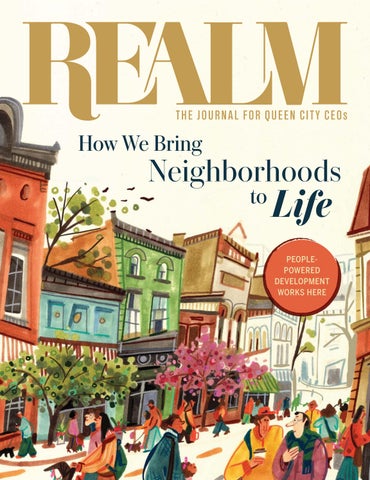
How We Bring
Neighborhoods to
Life PEOPLEPOWERED DEVELOPMENT WORKS HERE
Think Think differently
about benefits. aboutyour your small small business business health health benefits. Powered Poweredby by Ohio’s Hometown Health Insurer
In partnership with Medical Mutual, we are offering an expanded ChamberHealth® program to provide you – our members – with premium health insurance coverage while saving you money through group buying power. Through this partnership, we are now able to offer ChamberHealth insurance plans to businesses from 1 to 500 employees in the state of Ohio – an expansion of the program that was previously only available to companies from 2 to 99 employees.
THE BENEFITS
*
ADDITIONAL PLAN OPTIONS INCLUDE:
• Prescription drug coverage
• Wellness programs • Identity theft resolution and remediation services are offered at no additional cost.
TRADITIONAL COPAY AND HIGH-DEDUCTIBLE PLANS WITH HSA
Through ChamberHealth, small businesses and sole proprietors – a first for the ChamberHealth program – can partake in a self-funded insurance plan. Being self-funded has many benefits, including: • The ability to keep costs low since MEWAs are not subject to some of the Affordable Care Act’s (ACA) mandated benefits and taxes • The cost of benefits reflects the unique health of the company and its employees, recognizing that a healthier team should create a better benefits cost outcome • All benefit options are tied to Medical Mutual’s large network of doctors and hospitals, including TriHealth, the Christ Hospital Health Network, and Mercy Health
DENTAL PLANS
LIFE AND DISABILITY PLANS, INDEMNITY PLANS, AND STOP-LOSS COVERAGE
VISION PLANS
LEARN MORE > cincinnatichamber.com/chamberhealth
MEET, STAY, PLAY Credit: BLINK: Rhine Media “Radiant Rose” Credit: Ross Van Pelt
Host your next meeting right here in the Cincy Region and make a bigger impact - on your attendees and on our local economy. With reinvented venues like the First Financial Convention Center, Sharonville Convention Center, incredible dining, unique attractions and vibrant QHLJKERUKRRGV &LQFLQQDWL RHUV HYHU\WKLQJ \RX QHHG WR WXUQ PHHWLQJV LQWR PHPRUDEOH H[SHULHQFHV ΖWȇV WKH VDPH HQHUJ\ WKDW EULQJV YLVLWRUV KHUH IRU EDOOJDPHV IHVWLYDOV DQG ZHHNHQG JHWDZD\V DQG \RXU DWWHQGHHV ZLOO ORYH LW WRR $QG ZKHQ \RX NHHS \RXU HYHQWV ORFDO \RX NHHS \RXU GROODUV ORFDO VXSSRUWLQJ MREV VPDOO EXVLQHVVHV DQG WKH FRQWLQXHG PRPHQWXP RI RXU UHJLRQ Bring your next meeting home to Cincy. Contact us today and let’s create something exceptional for your organization and our community.
VISITCINCY.COM/MEETLOCAL
Connecting You to What Matters More Flights. More Florida.
Ft. Lauderdale
TABLE OF CONTENTS VOL.7, NO.3
ON THE WEB: REALMCINCINNATI.COM
CINCINNATI REGIONAL CHAMBER PRESIDENT AND CEO Brendon Cull
04 LETTER FROM BRENDON CULL 08 BY THE NUMBERS
THE JUMP
PG. 14
10 LEADERSHIP 50 YEARS OF LEADERSHIP CINCINNATI
16 EDUCATION HAPPIER FAMILIES AND A HEALTHY ECONOMY
Lauched in 1977, LC is now one of a dozen Chamber executive engagement programs.
Beech Acres Parenting Center offers tools to help working parents stay engaged in the workplace.
12 ECONOMIC DEVELOPMENT DATA FOR GOOD The United Way uses data analysis to amplify its Cradle to Career initiative.
14 PHILANTHROPY FOR THE KIDS
BLINK returns with more than 80 artists from Cincinnati, across the U.S., and around the world. Here’s where they’re from and what they’re doing during BLINK.
PG. 36
CHIEF BUSINESS OFFICER Kate Ward SENIOR MANAGER, MARKETING OPERATIONS Tracey Brachle BOARD CHAIR James Watkins President and CEO, Triversity Construction CHAMBER OFFICE 3 E. Fourth St. Cincinnati, OH 45202 (513) 579-3100 All contents © 2026 Cincinnati Regional Chamber. The contents cannot be reproduced in any manner, whole or in part, without written permission from the Cincinnati Regional Chamber.
18 TECHNOLOGY BRINGING LIFE SCIENCES ALIVE How Cincinnati developed a deliberate strategy to become a major player in life sciences.
DEEP DIVES
FROM THE PUBLISHERS OF
22
After a merger, Ronald McDonald House Southwest Ohio is now the country’s largest.
PEOPLE-POWERED DEVELOPMENT PG. 52
Here are four shining examples of how nonprofit community development corporations can reinvigorate neighborhoods.
The embattled media company is “refounding” its core mission in its local communities.
DIRECTOR OF BUSINESS DEVELOPMENT Tony Frank
GET US MORE NURSES, STAT!
52 PHOTO ESSAY: THE REGION’S WINERY BUSINESSES Take a colorful look inside the region’s surprisingly robust winery business sector, more than 20 in all.
DESIGN DIRECTOR Brittany Dexter ART DIRECTORS Jessica Dunham, Stefanie Hadiwidjaja, Matthew Spoleti, Emi Villavicencio
36 Get to know the new CEOs: Terri HanlonBremer of TriHealth, Kreg Keesee of Freestore Foodbank, and Rhiannon Hoeweler of MadTree
EDITOR-IN-CHIEF John Fox DIRECTOR OF EDITORIAL OPERATIONS Amanda Boyd Walters
30
SCRIPPS FOCUSES ON “LOCAL & MEANINGFUL”
50 ASK ME ABOUT
PUBLISHER Ivy Bayer
The region’s nursing schools (public, private, and national players) innovate to combat staffing shortages and burnout.
44
ARTSWAVE TURNS IT UP TO 100 Its Second Century campaign starts in October with Cincinnati Art Week and BLINK and culminates with a once-in-a-generation fundraising challenge.
SENIOR ACCOUNT MANAGERS Maggie Goecke, Joe Hoffecker, Julie Poyer SENIOR MANAGER, SPONSORSHIP SALES Chris Ohmer ACCOUNT REPRESENTATIVES Laura Bowling, Sarah Riesenberger PRODUCTION DIRECTOR Vu Luong EDITORIAL AND ADVERTISING Email cmletters@cincinnatimagazine.com Website cincinnatimagazine.com Phone (513) 421-4300 Subscriptions (800) 846-4333
O N T H E C O V E R : I L LU S T R AT I O N BY S A R A H M A R I S H A B OYA N
I M A G E S BY ( T O P ) M E G A N M c K E A N / ( M I D D L E ) C O U R T E SY U N I V E R S I T Y O F C I N C I N N AT I / ( B O T T O M ) J E R E M Y K R A M E R
FALL 2026 REALM 3
WELCOME
ne of the things I love most about Cincinnati is that our region’s growth doesn’t happen in just one place or because of one big idea. It happens neighborhood by neighborhood, organization by organization, and often because a group of people decides that something can be better and then gets to work. That idea runs throughout this issue of Realm. Our cover story looks at the community development corporations helping shape the future of neighborhoods such as College Hill, Covington, Northside, and Walnut Hills. These hyper-local organizations tackle everything from housing and small business development to arts spaces and commercial corridors, with residents playing a central role in determining what comes next. You’ll see that same spirit elsewhere in these pages. Cincinnati’s life sciences sector is growing through deliberate collaboration among businesses, universities, healthcare institutions, and organizations on both sides of the river. Our region’s nursing schools are responding to a critical workforce need. United Way of Greater Cincinnati is working with the Chamber’s Center for Research & Data to use data in new ways to improve outcomes for children and families. And, of course, this fall brings another great example of what happens when Cincinnati thinks big: BLINK. More than 80 artists from our region and around the world are transforming Cincinnati and Northern Kentucky in October. BLINK brings people into our neighborhoods, puts our region on an international stage, and reminds us how much creativity and energy exist here. At the Chamber, our vision is a growing, thriving region where everyone belongs. The stories in this issue are a good reminder that those words are connected. Growth is strongest when people are invested in the places where they live, businesses see opportunity here, and organizations across sectors are willing to work toward something bigger than any one of us could accomplish alone.
BRENDON CULL BCull@cincinnatichamber.com
4 REALM FALL 2026
P H O T O G R A P H OBY T O GJ ERRAEPMH YBYK RTAKMT KE RT K
SBA LOANS HERE & NOW The Next Chapter in Greater -2$-22!ধ SBA Lending Starts Here
Trust a Homegrown Bank to Grow Your Business
Learn More About Our SBA Approach
®
Miami Made Meet the leaders whose foundation in excellence started at Miami University.
Brian Niccol ’96 CEO and Chairman of Starbucks Coffee Company, former CEO of Chipotle and Taco Bell
How did your experiences in the College of Engineering and Computing prepare you to lead corporations at a high level? What I found most impactful from the curriculum was the focus on problem solving. You learn how to think critically and how to articulate solutions. I think so much of leadership is about being able to digest what’s happening, simplifying the situation, and then picking a path forward that leads to a clear solution. How has your Miami foundation shaped the way that you serve, lead, and inspire others? Don’t be afraid to ask questions. I’m still asking questions and trying to understand the “why’s.” I think that’s what makes people ultimately find success. What advice do you have for students just entering the workforce? Be committed to learning. Don’t be afraid to take the job that other people aren’t raising their hand for. Be a doer because those that do are those that ultimately learn and find themselves growing.
Miami University: We make leaders. MiamiOH.edu/MiamiMade
THE JUMP
ARTISTS AND VISITORS FROM EVERYWHERE COME TOGETHER FOR BLINK.
P H O T O G R A P H C O U R T E SY C I N C I N N AT I R E G I O N A L C H A M B E R ( B L I N K )
Get a jump on how Cincinnati and Dayton merged their Ronald McDonald Houses to create the nation’s largest and why the region has become a hotbed for life sciences development. And catch up on new programs at Beech Acres and the United Way and Leadership Cincinnati’s growth as it turns 50. FALL 2026 REALM 7
THE JUMP INTERNATIONAL ARTISTS [Home countries for 2026 participating artists]
ARGENTINA
HUNGARY
AUSTRALIA
ITALY
BRAZIL
NETHERLANDS
CANADA
ROMANIA
ENGLAND
SOUTH AFRICA
FRANCE
SPAIN
GEORGIA
SWEDEN
GERMANY
SWITZERLAND
BLINK returns to both sides of the Ohio River October 8-11, its fifth version since launching in 2017 as a biennial celebration of light-based art and public murals. After expanding into Newport for the first time in 2024, the festival this year focuses on expanding its footprint in Covington and kicking off with a block party outside of TQL Stadium on October 8. More than 80 artists from around the region and the world are creating public works from Covington to The Banks through downtown and Over-the-Rhine up to Findlay Market.
GREECE
THAILAND
Artist demographics provided by BLINK and 2024 statistics provided by the Cincinnati Regional Chamber’s Center for Research & Data.
[From event attendees and from event operations in 2024]
BLINK’S ECONOMIC IMPACT
DIRECT SPENDING ............... $205,243,931 WHO ARE THE ARTISTS
DIRECT EARNINGS .................. $95,487,314
[Home base for 2026 participating artists]
DIRECT JOBS SUPPORTED ................. 2,687
BLINK VISITORS BY THE NUMBERS [Event attendees in 2024]
CINCINNATI REGION
REST OF THE U.S.
OUTSIDE OF THE U.S.
28
19
39
WHAT ARE THEY MAKING? [Discipline of each 2026 artist]
UNIQUE ZIP CODES
COUNTRIES
216
15
LIVE OUTSIDE OF CINCINNATI
IT WAS THEIR FIRST BLINK
19%
19%
PROJECTION MAPPING 47% LIVE EVENT ACTIVATION 4% MURALS 17% LIGHT-BASED INSTALLATION 32%
8 REALM FALL 2026
When success creates opportunity, make room for impact. Whether you’ve sold a company, experienced a liquidity event, or are looking for smarter ways to manage charitable giving, a donor advised fund at Greater Cincinnati Foundation Öµµ¬ãçŕ¼ÏϬ¨¼ í¬ŕí Āŕ ¨ú Ðí ¶¬çŕ ШŕÊÖжŽí¬ãÏŕŬĀ¼¢¼Ê¼íāŘŕ8Öã¬ŕ¼ÏàÖãí ÐíÊāřŕāÖðƕÊÊŕº ú¬ŕ a local partner who understands both philanthropy and Cincinnati, helping you turn ¶¬Ð¬ãÖç¼íāŕ¼ÐíÖŕ ŕʬ¶ £āŕíº íŕÊ çíçŘ
Open a fund and ¢ð¼Ê¨ŕ ŕʬ¶ £āŘ GCFgive.org/DAF
THE JUMP
LEADERSHIP
ALL ALONG THE CAREER SPECTRUM Leadership Cincinnati, the Cincinnati Regional Chamber’s flagship civic engagement program, hosts its 50th class this fall. Today it’s one of a dozen professional development offerings within the Leadership Center.
THAT ‘70S SHOW
Class 1 kicked off the Chamber’s leadership programs in 1977. Participants included City Councilman Ken Blackwell, Daniel Ransohoff of the Community Chest (now United Way), Nelson Schwab III of Taft Broadcasting, and Rev. Robert Smith Jr. of New Mission Missionary Baptist Church.
REPEAT CUSTOMERS
The University of Cincinnati, Fifth Third Bank, and Procter & Gamble have each sponsored 50 or more executives in Leadership Cincinnati over the years. Larger companies often have internal vetting processes before submitting an application, says Leadership Center VP Sean Comer (crouching in front of Class 50). Applicants are selected by a committee of LC alumni.
MIX IT UP
The Cincinnati Police Department has sent 23 staff to Leadership Cincinnati classes, which Comer says benefits participants and the city at large by making personal connections among business and public officials.
SOMETHING FOR EVERYONE
Today applicants can choose from a variety of Cincinnati leadership programs, from WE Lead (women) and C-Change (mid-career leaders) to Hello Cincy Executive (new to town) and Cincy Next (early career).
10 REALM FALL 2026
P H O T O G R A P H BY F R A N K YO U N G
FALL 2026 REALM 11
THE JUMP any Cincinnati families struggle with stable housing, nutritious food, reliable childcare and transportation, and safe spaces to play, leaving both children and their caregivers with little support to ensure success in the world. While educators help fill the need during school hours, what happens before and after school also deeply shapes a child’s ability to learn. That’s where the United Way of Greater Cincinnati’s Cradle to Career/Amplify Greater Cincinnati initiative steps in. The chapter joined the StriveTogether network as an affiliate member earlier this year in order to apply StriveTogether’s Theory of Action model to the Cradle to Career concept and widen the initiative as Amplify Greater Cincinnati. Connecting with broader, established networks enables United Way to offer both tried-and-true and new strategies and services to address children’s needs. A crucial link to these services is the organization’s 211 telephone resource, which connects callers to a trained team member who listens to their needs, asks questions, and connects them with community resources. United Way works with more than 400 partners across the region, from the Cincinnati Regional Chamber and local CEOs to civic leaders and faith leaders, depending on the need. While the StriveTogether partnership helps United Way in on its mission, the organization also supports local providers to make sure their efforts come to fruition. One such partnership involves data sharing with the Chamber’s Center for Research and Data, which uses information (including from 211) to provide actionable insights for its own projects as well as to help area leaders and policymakers make informed decisions and identify opportunities to benefit their communities. Earlier this year, United Way of Greater Cincinnati CEO Moira Weir reported more than 50,000 annual helpline calls that connected people to housing, utilities, and other essential supports and reduced strain on public systems. The Chamber’s data analytics helped United Way quantify the calls in terms of returns for the region and showed them generating about $7.4 million in community benefits from referrals alone. This equated to $3 of community benefits for every $1 invested in the 211 service. Weir says that data sharing is integral to the success of Amplify Greater Cincinnati and looks forward to applying it to future initiatives. “We’re working closely with a few communities and partnering with neighbors, schools, nonprofit partners, and local leaders to concentrate resources and deliver early wins while building relationships, structures, and shared accountability to sustain progress over time,” she says. “No single organization can do complex work alone, which is why we must do this work in partnership. As we learn what’s working, we’ll expand efforts to improve outcomes for children and families across the region.”
M
ECONOMIC DEVELOPMENT
DATA FOR GOOD The United Way uses data analysis to amplify its Cradle to Career initiative. —ELIZABETH A. LOWRY
Roll Hill School opened a new library with funding support from United Way of Greater Cincinnati.
12 REALM FALL 2026
P H O T O G R A P H C O U R T E SY U N I T E D WAY O F G R E AT E R C I N C I N N AT I
CONNECT WITH THE REGION’S CEO CEOss by Advertising in REALM A joint partnership between Cincinnati Magazine and the Cincinnati Regional Chamber, Realm is a quarterly print publication designed to connect area executives with each other and with news, resources, and opportunities designed to help them succeed. Reserve your space today.
How immigrant business leaders help Cincinnati grow and prosper
MORE HOMES FOR THE HOMETOWN
How CVG Took off Under Candace McGraw
Manny Addo, Michelle Morales, and Qorinah Wardhani
AN ENGINE FOR GROWTH
GROWING THE AIRPORT INTO AN ECONOMIC FORCE FOR THE ENTIRE REGION.
GE Aerospace supercharges hiring, talent development, and community support.
How new zoning reforms can grow Cincinnati’s population.
In-person shops thrive in our digital city.
HOW TO DRIVE BUSINESS GROWTH The O.H.I.O. Fund raises $350 million to support scalable manufacturers.
Daryn Hillhouse and Tony Alexander of Remote Vans
The Appeal
of Analog
COAST TO COAST
GROWTH
Fifth Third spreads its banking reach to Texas, Arizona, and California.
HOME IS WHERE THE PORT IS CELEBRATING 200 NEW HAMILTON COUNTY HOME OWNERS.
TO ADVERTISE: advertise@cincinnatimagazine.com
THE JUMP
PHILANTHROPY
FOR THE KIDS
After a merger, Ronald McDonald House Southwest Ohio is now the country’s largest. —ELIZABETH WOOD
When children require long-term hospital stays, families often need to relocate temporarily to access the most appropriate care for their child. Ronald McDonald House (RMDH) is a global network of nonprofit residential facilities that embrace these families with free housing and dining accommodations just steps from their child’s medical facility. Until recently, Cincinnati and Dayton had operated separate RMDH locations for their corresponding children’s hospitals. But when Dayton’s long-time executive director, Rita Cyr, began planning her retirement in early 2025, the two organizations launched talks of a merger rather than finding a replacement for her. Boards met. Focus groups were formed. Financials were assessed. “Many times, you just don’t need two CEOs and two CFOs,” says Jennifer Loeb, CEO of the newly combined organization. “Mergers help to streamline the costs and put more money toward the care of the families, which is where it should be.” With all signs pointing forward, the merger took effect on January 1. Renamed Ronald Mc14 REALM FALL 2026
tions still offer free hot meal programs for residents—once per day in Dayton, twice per day in Cincinnati via the Taste of Hope program—as Donald House Southwest Ohio, the joint ven- well as daily continental breakfasts. Families are ture is the largest RMDH in the country based provided not just free private lodging, homeon the number of families served each night. cooked meals, laundry facilities, and transporIn 2025, the combined Dayton and Cincin- tation but also indoor and outdoor play areas, nati houses delivered 66,798 nights of care for activities, and programming, especially for sib2,820 families. The Cincinnati location offers lings. “We allow families to have some sense of 177 private rooms; Dayton offers 42, plus a normalcy and even some joy while things feel so non-overnight hospitality suite stressful,” Loeb says. Meeting othfor NICU families at Miami “We came er families in similar situations, she Valley Hospital. Average length adds, is yet another “magical” part of of stay is 15 days in Dayton and into the the RMDH experience. 34 days in Cincinnati. The nonprofit RMDH relies merger lookThough some adjustments ing for best heavily on volunteer support. Loeb have been made in the transinotes that preparing and serving meals through the Taste of Hope tion, Loeb notes operations ha- practices ven’t changed significantly. “We from both program is an excellent team-buildcame into it with the approach locations,” ing activity for businesses wanting of looking for best practices to get involved with the organizafrom both locations,” she says. says CEO tion. “It’s a really meaningful place “We wanted to see what we Jennifer Loeb. for people in our community to could learn from each other.” spend their time,” she says. “Ronald The two boards were combined into one, McDonald House is one of those organizations with eight spots allocated proportionally to that you never think you’re going to need, but Dayton and 22 for Cincinnati. Both loca- once you do, you’re so glad it’s there.” I L LU S T R AT I O N BY M E G A N M c K E A N
NOVEMBER 9–15, 2026
$11 PIZZA SPECIALS EAT PIZZA. EARN POINTS. WIN PRIZES. DOWNLOAD THE APP FOR PARTICIPATING RESTAURANTS AND EVENT INFORMATION.
CINCINNATIPIZZAWEEK.COM
# CINCYPIZZAWEEK
THE JUMP
EDUCATION
HAPPIER KIDS AND A HEALTHY ECONOMY
Beech Acres Parenting Center offers tools to help working parents stay engaged in the workplace. –ELIZABETH WOOD
t’s 10:30 a.m. on a Tuesday, and a parent gets a call from their child’s school saying the child has been disruptive—again. An immediate meeting is called with the principal. The parent’s workflow is disrupted and their focus is divided even after returning to work. Their production suffers, their coworkers are affected, and ultimately the employer pays the macro consequences. Beech Acres Parenting Center exists to help prevent situations like this by mitigating childhood behavioral issues before they flow over into the workplace. “A parenting issue
I
16 REALM FALL 2026
is not just a family issue but can really become a workplace issue,” says Laura Mitchell, president and CEO of Beech Acres Parenting Center, who worked as a leader and educator with Cincinnati Public Schools for 27 years before shifting her career focus in 2022. Mitchell was drawn to Beech Acres after witnessing countless behavioral issues in the schools that could have been addressed at home if only parents had the right tools. The Beech Acres Parent Connext program is an evidence-based hub for just such tools, offering 1:1 coaching, workshops, a resource library, a podcast, and a community app to
help parents navigate common parenting challenges. From sleep issues and picky eating to managing big emotions, co-parenting, positive discipline, ADHD, and screen time, Parent Connext covers the gamut of parenting hurdles. Beech Acres’ vision is to address parenting issues not only of today but also longer term. Its 10-year target for 2036 is to foster a regional ecosystem that supports emotionally healthy children, families, and workplaces. “It’s about developing kids who have a positive outlook on life and who are resilient and can bounce back from adversity,” says Mitchell. “We want Cincinnati to be known a region where you come if you want to raise healthier kids.” One of the biggest misconceptions about Beech Acres, Mitchell says, is that their services are only for low-income families or those in crisis. On the contrary, Beech Acres seeks to be a place all parents can turn before crisis occurs. “Parenting challenges cut across demographics, age, and socioeconomic status,” she says. “As opposed to thinking about us as a last resort, think of Beech Acres as a proactive partner.” Fees are determined on an income-based sliding scale, with many resources offered free of charge. With a team of professionals in education and child development, Beech Acres uses methodology backed by science while seeking to understand each parent’s “Parenting unique values. “We ask parents, ‘What challenges kind of adult do you cut across dewant to raise?’ ” says mographics, Mitchell, who encourages employers age, and soto become familiar cioeconomic with Beech Acres services so they can status,” says refer them to em- CEO Laura ployees struggling with family issues. Mitchell. “We The organization is try to be a eager to host inforproactive mational sessions at Lunch and Learns, partner.” teambuilding workshops, and PTO/PTA meetings. “We’re interested in partnering with other organizations to make this a region we can truly be proud of—a place where you can raise healthy families,” Mitchell says.
I L LU S T R AT I O N BY TAT S I A N A B U R G A U D
THE JUMP
LifeSciKY Executive Director Christin Godale leads Kentucky Governor Andy Beshear on a tour of its new Covington lab space.
TECHNOLOGY
BRINGING LIFE SCIENCES ALIVE How Cincinnati developed a deliberate strategy to become a major player in life sciences.
—SARAH M. MULLINS
incinnati is uniquely positioned to play a significant role in the growth of life sciences that’s happening nationally. According to research and consulting firm Towards Healthcare, the sector is expected to grow three times its current state, fueled by advances in personalized medicine and technology. This region is home to major anchor healthcare institutions, universities, and the Innovation District that impact the research and talent pipeline fueling life sciences companies. But turning that existing foundation into lasting growth takes more than institutions and infrastructure—it takes deliberate strategy, and REDI Cincinnati and LifeSciKY are leading the charge along with funders like the O.H.I.O. Fund and CincyTech. Andrea Enders, vice president of business development for REDI Cincinnati, which attracts new businesses and helps existing ones
C
18 REALM FALL 2026
expand, says Cincinnati is positioned to impact the full spectrum of life sciences, from discovery to commercialization. Discovery happens at healthcare and higher ed institutions, validation at clinical research organizations like CTI and MedPace, manufacturing at Thermo Fisher and Resilience, and then the product goes to market, a role filled by McKesson, Express Scripts, and Cencora. The region’s strengths in logistics also play a role. “You really can do every level of development here,” says Enders. “We’re winning in the space, and we have the success to prove it.” Life sciences is one of REDI Cincinnati’s four target industries when working to attract businesses to the region—along with aerospace and aviation, food, flavoring and beverage, and chemicals and materials. Beyond infrastructure and logistics, Enders says the region’s culture of collaboration is important as well. “One of the things that really
sets us apart is the Midwest work ethic and connections that you find here that you just don’t find in other places,” she says. Pharmaceutical company Cencoura recently announced it’s opening a distribution and storage facility in Harrison, while Eli Lilly and Resilience announced a $750 million facility coming to Blue Ash. For startup businesses, the Northern Kentucky nonprofit LifeSciKY was created to give life sciences startups a lower cost and faster path to growth. The 15,000-square-foot space in the Covington’s OneNKY Center has more than $1.8 million in shared scientific equipment, shared lab benches, private lab suites, and other equipment that companies can access from day one. “The entire model is designed to remove the enormous upfront cost of starting a life sciences company,” says LifeSciKY Executive Director Christin Godale. “A founder shouldn’t have to spend hundreds of thousands of dollars buying equipment, building out a lab, and setting up infrastructure before they can even begin doing the science.” Clareo Biosciences, CARTx Therapeutics, Mitsui Chemicals America, PAN Biologics, and Simbryo Technologies are some of the companies currently working out of the labs. Now that the physical lab is open, LifeSciKY’s next phase is focused on expanding the regional and statewide life sciences ecosystem. “Our goal is to remove as many barriers as we can between a good idea and a successful life sciences company,” says Godale.
REDI Cincinnati’s Andrea Enders
P H O T O G R A P H S C O U R T E SY ( T O P ) L I F E S C I K Y / ( B O T T O M ) R E D I C I N C I N N AT I
The essential guide to living your best life here. The city’s most respected and award-winning magazine, highlighting the region’s most interesting people, cultural issues, food, arts, fashion, and history. SUBSCRIBE NOW! @CINCINNATIMAGAZINE
CINCINNATIMAGAZINE.COM
SHARE A LAUGH, SUPPORT A CAUSE
FRI, OCT 23 | 8PM
FOR TICKETS VISIT HARDROCKCASINOCINCINNATI.COM MUST BE 21 OR OLDER TO G A MBLE. G A MBLING PROBLEM? CA LL 1-800-589-9966
DEEP DIVE
COMMUNITY REDEVELOPMENT GROUPS MAKE A DIFFERENCE IN WALNUT HILLS AND OTHER CITY NEIGHBORHOODS
22
People-Powered Development Works Here
P H O T O G R A P H C O U R T E SY WA L N U T H I L LS R E D E V E LO P M E N T F O U N D AT I O N
30
Scripps Focuses on “Local & Meaningful”
36
Nursing Schools Expand to Meet Huge Demand
44
ArtsWave Kicks off Its 100th Year Early FALL 2026 REALM 21
DEEP DIVE
PeoplePowered Development
E
ver wonder why some urban neighborhoods thrive while others languish? The answer often has to do with how involved and organized their residents are. The neighborhoods were catalysts for a reborn business district in Walnut Hills, a community center in the heart of Westwood, new housing in Madisonville, and an arts district in East Price Hill. None of these projects came about through for-profit developers who suddenly discovered an interest in communities that had experienced decades of disinvestment. They happened because a group of neighbors found the vehicle for their energies and vision in kind of not-for-profit organization that draws its power from the people. Community development corporations (CDCs) are resident-led organizations that use people power to shape the future of their neighborhoods. There are 36 of them in the city of Cincinnati, with more in Northern Kentucky and in suburban towns and cities. Some are dormant, some are waiting for a cause to ignite them, and others are following through on strategic plans. “The best aspect of any community development corporation is that it’s born of and driven by residents who live there,” says Rosa Christophel, executive director of HomeBase Cincinnati. Her organization, formerly the Community Development Corporation Association of Greater Cincinnati, is a support group for CDCs, a resource, and a link to other resources. CDCs grew out of the civil rights movement of the 1960s, largely as a response to neighborhoods getting plowed under by urban renewal programs and 22 REALM FALL 2026
FOUR SHINING EXAMPLES OF HOW NONPROFIT COMMUNITY DEVELOPMENT CORPORATIONS CAN REINVIGORATE NEIGHBORHOODS. BY DAVID HOLTHAUS PHOTOGRAPH BY ANDREW DOENCH
P H O T O G R A P H BY T K T K T K
WELCOME BACK NEST Executive Director Rachel Hastings at Knowlton’s Corner, the gateway to Northside on Hamilton Avenue. H E A D S H O T C O U R T E SY T K T K
SEASON 20X X REALM 23
DEEP DIVE
COLLEGE HILL’S EMMANUEL KARIKARI ASKS, “HOW DO WE DRIVE FOOT TRAFFIC AT A TIME WHEN FAMILIES ARE SPENDING LESS ECONOMICALLY?”
highways. The first one was formed in Brooklyn’s Bedford-Stuyvesant neighborhood, where housing had deteriorated and violence threatened residents. Anti-poverty programs initiated in the Kennedy and Johnson administrations provided funding and support for similar efforts around the country. “It was truly a grassroots effort,” says Christophel. “People asked themselves, How do we come together and from grassroots origins fight back against disinvestment and racial discrimination?” In Cincinnati, the first neighborhood development corporation was started in 1968, the Mt. Auburn Good Housing Foundation. Walnut
24 REALM FALL 2026
Hills, Avondale, Bond Hill, and Paddock Hills got organized by the mid-1970s. Today, organizations like The Center for Great Neighborhoods in Covington have served as center of gravity for city residents. “Our mission is to work alongside the residents of Covington to improve their lives as they improve their community,” says Executive Director Shannon Ratterman. In South Cumminsville and surrounding neighborhoods in the Beekman Street corridor, Working in Neighborhoods, led by Sister Barbara Busch, has promoted home ownership and provided financial education since 1978. Its work includes building nearly 200 homes for low- to moderate-income residents. On the west side, Westwood Works took the lead on reimagining an old town hall into a center for events and community gatherings. It’s now turned its energies to the old Westwood Theatre to find new life for that neighborhood landmark. Elsewhere, Price Hill Will turned a block of Warsaw Avenue into the
Warsaw Avenue Creative Campus and redeveloped a vacant 100-yearold Masonic lodge into a performance venue. 3CDC is a community development corporation with a mission to lead development downtown and in Over-the-Rhine. Mt. Airy CURE is figuring out what to do with that neighborhood’s iconic but deteriorating water towers. Each CDC has its own vision, personality, and methods for getting there. Here are deeper dives into the mission, the work, and the people at four impactful organizations.
COLLEGE HILL
A
NEIGHBORHOOD group of gardening enthusiasts was the catalyst for change in College Hill, where the business district suffering long-term decline was shocked when two anchors—a Kroger store and a longtime family-owned restaurant, Shuller’s Wigwam—closed around 2000. The neighborhood activists faced a choice: Either fight back and work to rebuild
PICTURE IT College Hill’s old Hollywood Theatre (opposite page) is primed for a makeover (below).
the business district or accept its impending demise. They fought back. Through the College Hill Community Urban Redevelopment Corp. (CHCURC), the neighborhood got a grant from the city and used it to buy vacant properties and hold them for the right opportunity. Affordable housing was built in the heart of the Hamilton Avenue district, followed by market rate apartments and condos. A brewpub opened up, then a pizza place, a Japanese restaurant, and a Mexican eatery. The neighbors raised money through dinner parties, a 5K race, and other fundraisers. Just in the last seven years, the residents have donated $5 million to the cause, says Executive Director Emmanuel Karikari. That money is used to leverage grants from the city and other organizations and, as a result, the business district was not only saved but re-energized. In the last few years, though, with
inflation pressures mounting, some of the new businesses closed, including a couple of high-profile restaurants. That’s caused a shift in priorities. “How do we stabilize this business district so we don’t continue that trend of small businesses leaving the community or closing?” asks Karikari. “How do we continue to drive foot traffic at a time when families are spending less economically?” CHCURC’s answer is to build more housing and bring more residents to the neighborhood. To that end, the organization bought the College Hill Plaza strip center with loans from Local Initiatives Support Corp., the city, and others. The 35-year-old center is past its prime and had become a magnet for crime. The CDC stabilized the property and did some cosmetic work to make it more attractive in the short-term. Long-term, its days are numbered. “We have a vision for what that site
will look like within the next five years, and that’s 250 mixed-income housing units,” Karikari says. “We need to be able to bring housing right on top of businesses, and the Plaza presents a tremendous opportunity to do that.” CHCURC has also acquired the old Hollywood Theatre on Hamilton Avenue and shored it up with a new roof, tuckpointing, and refurbished windows. It’s looking for an operator to program events. “Our overall goal is to turn that into a cultural arts center where we can hold a multitude of events that can drive economic impact within the business district,” says Karikari. As the plan evolves, it will be overseen by the community, including a board that’s composed mostly of people who live, work, or own a business in the neighborhood. “We’re governed by the community,” he says. “So the community actually gets to dictate what development looks like in College Hill.”
NORTHSIDE
T
HE GATEWAY TO THE Cincinnati neighborhood of Northside is an intersection of five streets known as Knowlton’s Corner. On one corner sits a gas station; another is vacant after a White Castle that served up sliders for 60 years was torn down; on another is an old, empty commercial building and warehouse; while on another is an ancient wood frame building that’s defied renovation efforts. It’s not exactly the most welcoming gateway to one of Cincinnati’s most diverse and eclectic neighborhoods. But check back, because that intersection is changing.
P H O T O G R A P H S C O U R T E SY C H C U R C
FALL 2026 REALM 25
DEEP DIVE
The Northside Gateway is being recreated mainly due to the efforts of its community development corporation, Northsiders Engaged in Sustainable Transformation (NEST), which acquired an empty four-story, 19,000-square-foot former costume store and warehouse with plans to
“WE’RE MORE FOCUSED ON A RENTAL HOUSING STRATEGY AND HELPING PRESERVE LONG-TERM AFFORDABILITY,” SAYS COVINGTON’S SHANNON RATTERMAN.
transform it into first-floor commercial space and 15 apartments upstairs. Behind it, NEST plans to build 45 apartments, for a total of 60 new units. NEST bought the old White Castle property, and long-term plans call for more apartments and retail. The long-vacant wood-frame building, one of the oldest existing in the city, survived two floods over the years and is now being renovated into affordable apartments and a small commercial space. This gateway to Northside is too important to be left to the profit-driven goals of private developers. There won’t be another gas station or fast-food purveyor there. Instead, its redevelopment will be driven by the neighborhood’s priorities of housing and small businesses. “Knowlton’s Corner is so important to the neighborhood that we couldn’t let an out-
26 REALM FALL 2026
side interest turn it into something else,” says NEST Executive Director Rachel Hastings. A couple of blocks up from that corner sits the Park Theatre, another major NEST project. Built in 1913, it served as a movie theater screening X-rated films as well as art house obscurities, a commissary for a local bakery company, a second-hand furniture store, and a used appliance warehouse. NEST bought it and is controlling its future, which will likely be as a performing arts space. “Everything that NEST does is by and for and of Northside,” says Hastings, who typifies an essential element of a successful CDC: committed, active leadership. She and her staff of one navigate real estate development, fund-raising, grant applications, and City Hall bureaucracy while organizing events and happy hours to keep the community engaged. Hastings cut her teeth on community development as a college student in the 1990s volunteering for ReSTOC, the low-income housing group founded by Buddy Gray. His confrontational style didn’t sit well with the young Miami University student from the Chicago suburbs, who decided there had to be a better way. “I wanted to do community development and affordable housing, but I didn’t want to be fighting people all the time,” she says. Hastings met the head of the Covington Community Center, precursor of The Center for Great Neighborhoods, and worked there for 22 years, rising to the role of executive director. “I found out there are so many people doing it in a much more collaborative approach,” she says.
That led to leadership at Price Hill Will and then NEST in Northside, where she and her family have lived for more than 20 years. “One of the things I love about Northside is that we’re still a neighborhood that wants more affordable housing and that sees the value of having a truly diverse population of folks from different income levels and different walks of life,” she says.
COVINGTON
T
HIS CITY OF 40,000plus is home to 19 distinct neighborhoods. Bringing them together is The Center for Great Neighborhoods, which dates back to the 1960s and two small neighborhood efforts founded by local churches. Those efforts served the emergency needs of low-income residents. And while the Center and its priorities have evolved with the times, it remains focused on Covington residents. “We try to just be available to the needs of Covington residents and be responsive,” says Ratterman, its executive director. That could mean starting and leading a program, partnering with another organization on an event or an initiative, or lending support to another neighborhood association or resident group in the city. These days, a top priority is affordable housing. Ratterman and the Center have been at the table advocating and helping to shape policy as Northern Kentucky leaders work through a strategy to fill the gap in housing that working people can afford. For many years, the Center was in the business of buying vacant, blighted properties, rehabbing them and selling them to low- and moderate-income
buyers. “That was responsive to the needs of the neighborhoods that we were working in,” Ratterman says. There was a concentration of vacant houses in some neighborhoods, and buyers were avoiding those neighborhoods. The Center helped to create a market in some of them and is responsible for 70 units of housing and $14 million in real estate improvements in the city. The housing market has shifted in recent years. Covington is in demand as a place to live, and there isn’t much of a need any longer for a not-forprofit to buy and rehab vacant houses. As the market changed, so did the Center’s focus. “We’re more focused on a rental housing strategy and how
can we help preserve long-term affordability,” says Ratterman. That means owning properties rather than selling them in order to preserve their affordability. The strategy includes an innovative plan to buy a property from Covington schools and create units dedicated to housing Covington Public Schools teachers. A starting teacher in the district makes about $50,000 a year, while the median cost of a home in the city is about $225,000, making affordable housing a priority for attracting new teachers. The first property, on Pike Street, will be a permanent home for the Covington Farmer’s Market, which the Center has owned for three years. There are a dozen or so active
P H O T O G R A P H S C O U R T E SY T H E C E N T E R F O R G R E AT N E I G H B O R H O O D S
neighborhood associations in Covington, and the Center is a resource for all of them, helping to navigate permits and paperwork, get programs off the ground, serve as an advocate at City Hall or other government agency, or act as a fiscal agent to help secure grants. “Wherever there’s a few residents who are getting together around an idea or a project that they want to do in their neighborhood, everything from green space improvement to housing to traffic safety, we will work with them to either make a connection or find resources they might need,” says Ratterman. “It’s an important way for residents to have opportunities to feel connected and to get their voices heard.”
LOVE THE COV The Center for Great Neighborhoods engages with Covington residents through the Covington Sparks youth program (left), the Covington Farmers Market (right), and other activities.
FALL 2026 REALM 27
DEEP DIVE
TAKEAWAYS POWER TO THE PEOPLE Community development corporations (CDCs) use people power to shape the future of neighborhoods across the city of Cincinnati and Northern Kentucky and in suburban towns and cities. Some are dormant, others are waiting for a cause to ignite them, and a select few are following through on strategic plans. CONTROL AND CLEAN CDCs are doing the kind of strategic planning work in communities such as College Hill, Covington, Northside, and Walnut Hills that for-profit developers can’t or won’t do. They start by buying and cleaning up key parcels of troubled land in their neighborhoods. STAYING TRUE “Walnut Hills is a historically diverse and historically Black neighborhood,” says Mona Jenkins. “As we go through changes, we’re adamant about preserving the cultural ecosystem that exists here.”
WALNUT HILLS
I
T WASN’ T ALL THAT long ago that the Walnut Hills neighborhood was on life support, with empty storefronts throughout its business district and historic homes and commercial buildings rusting and crumbling. Today, Walnut Hills is a model of conscientious redevelopment—a place where trendy bars, restaurants, jazz, and coffee share the neighborhood with new affordable apartments and restored housing. How did it happen? Some point to the opening 12 years ago of Fireside Pizza, with is wood-fired pies and craft beer in an old firehouse as a tipping point for the neighborhood’s rebirth. Others see the restoration of two-way traffic on the two main streets of its business district as the spark. Long-time resident Kathryne Gardette says the spirit goes back much further. “The tenacity of the neighborhood was the tipping point,” she says. Indeed, it was the Walnut Hills Area Council, the volunteer-run neighborhood group, that created the
WHEN THE WALNUT HILLS KROGER STORE CLOSED IN 2017 AFTER SERVING THE NEIGHBORHOOD FOR MORE THAN 30 YEARS, IT WAS A WAKEUP CALL.
Walnut Hills Redevelopment Foundation nearly 50 years ago to push for quality affordable housing in the community. That’s still a priority, and the not-for-profit foundation is still guided by its residents. “We want to make sure that folks in the neighborhood have the assets they need to ensure their quality of life,” says Mona Jenkins, president of the community council. Along with the Walnut Hills Business Group, the community council works with the Redevelopment Foundation to ensure that remarkable redevelopment in Walnut Hills is planned and completed with residents in mind, in a neighborhood where about 40 percent
are considered to be living in poverty. “Walnut Hills is a historically diverse neighborhood, a historically Black neighborhood,” says Jenkins. “As we go through changes, we’re adamant about preserving the cultural ecosystem that exists here.” When the Walnut Hills Kroger store closed in 2017 after serving the neighborhood for more than 30 years, it left a three-acre sized vacancy in the center of the business district. That’s now being filled with a mix of new affordable apartments, market-rate housing, and retail. Peebles Apartments features one-, two- and three-bedroom units dedicated to low-income renters, while Paramount Launch is mixed-income
housing with commercial space. For financing and development, these new projects were paired with the nearby Alexandra Apartments, where more than 80 units of affordable housing for seniors were restored. Altogether the project is creating more than 180 units of housing, the majority of them considered affordable for working people. “We believe a quality place should be accessible to everyone,” says Redevelopment Foundation Executive Director Samantha Miller. The organization purchased the Kroger building in order to control the site’s future. But the move was risky as they were unable to secure the surrounding land right away and had to
P H O T O G R A P H S C O U R T E SY WA L N U T H I L LS R E D E V E LO P M E N T F O U N D AT I O N
pay tens of thousands in rent in order to maintain its control. “We completely decimated our reserves,” says Miller. A successful community development corporation also needs productive partnerships with private developers. In Walnut Hills, Model Group was able to eventually gain secure the entire site and work with the not-for-profit to realize the neighborhood’s vision. Miller, who’s led the foundation for nearly seven years, says she turned to community planning in college after getting disillusioned with studying engineering. “It wasn’t speaking to my passions,” she says, recalling that community planning did. “Why build a building when I can build a community?”
HOUSING FOR THE PEOPLE Walnut Hills replaced its former Kroger store with Paramount Launch apartments and a grocery market (below) and Peebles Apartments on Gilbert Avenue (opposite page), both in partnership with Model Group.
FALL 2026 REALM 29
DEEP DIVE
Scripps Focuses on “Local & Meaningful”
THE MEDIA COMPANY IS “REFOUNDING” ITS CORE MISSION IN LOCAL COMMUNITIES. BY JOHN STOWELL
30 REALM FALL 2026
T
he mood in the room ranged from sullen to surly. One of the nation’s venerable institutions of journalism was transforming—“refounding” to use the term E.W. Scripps Company CEO Adam Symson preferred—and not everyone was going along for the ride. Scripps employees at its Cincinnati headquarters and in dozens of newsrooms across the country shifted in their seats as Symson answered a series of pointed questions from producers, technical directors, reporters, and photographers who wanted to know just one thing: Am I out of a job? “It was the most difficult thing I’ve had to do as CEO,” Symson says, recalling the first week of August when he announced Scripps was moving its news operation to a streaming model and would use enhanced technology and artificial intelligence to cut costs and reinvest in local newsgathering efforts. Intellectually, Symson maintains, employees get it. The news business has changed and, if Scripps is to survive and thrive, it can no longer operate as if Walter Cronkite is still in the anchor chair.
I L LU S T R AT I O N BY M E G A N M c K E A N
“But when the rubber hits the road, well, that’s when things get hard,” he says, still looking—two weeks after the announcement—like a man who’d just lost his best friend. And maybe he had. The company’s decision to lay off 268 mostly production workers and move to 24/7 streaming will hit some of Scripps’s smaller markets first. Along with the layoffs, the company has eliminated 432 positions and 126 open jobs for a total reduction of 12 percent of its 2025 workforce. “Some of these employees had been with us for decades, so it was a tough week,” says Symson. “And I had to remind employees that the work is not yet done.” What made the Scripps layoffs particularly hard for some employees was the company’s announcement that it would fully embrace an investment in enhanced technology and AI. They wondered if flesh-and-blood reporters and editors were about to be replaced with scurrying bots governed by a soulless algorithm. “No, news will not be written by a computer,” says Symson emphatically. “It will be covered, written, and edited by our reporters who will be in the field and able to stay there longer because of the automation we’re investing in the production area.” Symson pledges the savings that automation and AI make in the production processes will allow the company to hire more reporters who will then have the time to fully embed themselves in the communities they cover. “This is a reallocation of resources,” he says, “that will bring us back to what we always were: a customer-driven company that covers the good and the bad that happens in our communities.” Symson prefers talking about employing “automation and enhanced technology” in future news operations, but he acknowledges artificial intelliP H O T O G R A P H C O U R T E SY E .W. S C R I P P S
STREAMLINE PROCESSES E.W. Scripps Company CEO Adam Symson says AI and automation are allowing him to reduce TV station production jobs, but “news will not be written by a computer.”
gence is a key component. Use of these technologies, he says, will significantly reduce the time it takes to process raw video and audio, convert it into a finished product, and push it into the news stream. Reporters, he says, will be able to do that entirely from the field, eliminating the need for back-in-thenewsroom editors, producers, and oth-
er technical staff who have, for decades, refined those reports for broadcasting at scheduled times. “We don’t sit on the couch any more to watch the 5, 6 and 11 o’clock news,” Symson says. “We really haven’t done that for a long time. Americans depend on us all day long to get their news, and they do so on a variety of platforms.” FALL 2026 REALM 31
DEEP DIVE
V
IEWER HABITS HAVE evolved since CNN introduced 24-hour news in the 1980s, and the business model has changed with them. Symson sees Scripps’s “refounding” as essential to its survival. An unstable advertising market, heavy long-term debt, cord-cutting across its 61 local stations, and intensified competition—in both the business and journalism arenas—have made change imperative. He worries that Scripps and indeed the entire industry may be late to the party. But not too late. An internal Scripps task force
comprised of journalists and technical experts convened more than a year ago and designed the new business model that uses technology, including artificial intelligence, to lighten the production load while pouring more dollars into content and field reporting. Symson clearly sees Scripps’s journalistic niche as moving into communities that are left uncovered or only marginally covered by major news outlets. And why wouldn’t he? He is, first and foremost, a trained professional journalist and the first Scripps CEO to come from the industry’s TV/video segment. He has a degree in commu-
nications from UCLA and started his career as an investigative journalist for two CBS affiliates, KCBS in Los Angelos and WBBM in Chicago. He joined Scripps in 2002 to work at KNXV in Phoenix before moving to Cincinnati. After a five-year stint as the company’s chief digital officer and an even briefer stint as COO, he ascended to the CEO role in 2017. Under his leadership, Scripps has left the newspaper business, jettisoned its radio stations, sold its Stitcher pod32 REALM FALL 2026
cast company, partnered with Berkshire Hathaway to purchase the ION broadcasting network, bought and sold Court TV, fought off a hostile takeover attempt, and continues to build a growing portfolio of live sports broadcasting opportunities. Transformation into a streaming 24/7 news network and using cutting-edge technology to do so efficiently is another step toward successfully navigating the hypersonic changes happening in the business, Symson explains. “If there were no financial pressures, I would gladly just continue as we are,” he says. “But that’s not the case, so we have to change.” Change isn’t new to the business. When cable disrupted the over-theair news and entertainment business, it was massive. Following CNN’s entry as a 24/7 news channel in 1980, Fox Broadcasting followed up a few years later to create a network providing both news and entertainment and breaking the ABC/NBC/CBS stranglehold. Remember Married with Children and The Late Show with Joan Rivers? Homer Simpson still rules Sunday night on Fox and has since 1989. “But cable, massive as it was, was just one change,” says Symson. “Digital has lowered all barriers to entry and increased the speed by which everything in the world has changed: banking, pharmaceutical, healthcare and journalism.” That’s especially tough, he says, on legacy networks with large capital investments in equipment and people. On the entertainment side, they face competition from behemoths like Netflix and Amazon Prime, whereas it’s all about speed on the news side. Competitors range from huge news sites with worldwide reach like CNN to a local gadfly with a smart phone and a nose for good stories.
P H O T O G R A P H S C O U R T E SY W C P O
“In the past, CEOs would typically consider one or two competitors where we could lose or gain market share,” he says. “Our environment now is more like Gulliver’s Travels. We’re Gulliver and the Lilliputians are everywhere and some of them have actually become so big and massive that we’re now the Lilliputian and, not to mix metaphors, they’re Goliaths.” The Nielsen Gauge, which measures total viewing habits in the U.S., showed that Scripps had a 1.6% national market share in June, good for 10th place. The Goliaths? YouTube at 13.8%, Disney at 9.6%, NBC/Peacock at 9.1%, and Netflix at 7.9%. That’s a lot of muscle at the top, and none is likely to become a Lilliputian. But the fact that the leader commands just 13.8% of the market illustrates the media landscape’s immensity now and how scattered our eyeballs are. The aggregated mass of competitors has fundamentally disrupted the business by attracting your attention here, there, and everywhere. That’s significantly impacted advertising revenue, particularly in a shaky economy. This year’s mountain of political ads has helped, but Symson knows that revenue stream stops as soon as the ballots are cast. So where does Scripps find its place? Symson believes strongly that it’s in local news coverage. That, he notes, is the company’s legacy. Community journalism and, presumably, the advertising dollars it could attract is where its founder, Edward W. Scripps, made his mark, offering a newspaper for the masses for just 1 cent. It was the Gilded Age and the Scripps brothers, Edward and James, borrowed $10,000 to start penny presses in Cleveland and later Cincinnati. Ironically, the penny press was, like today, born out of technological innova-
P H O T O G R A P H C O U R T E SY W C P O
tion. The steam-powered printing press replaced hand-crafted printing, allowing for mass production of tabloids. Instead of relying on subscriptions, Scripps put newsboys out on the street hawking papers who readily found customers willing to part with a single penny to learn the latest news—much of it on the lurid side. E.W. was able to sell his newspapers for a fraction of the price of his competitors, relying on the blue-collar customer who often met those newsboys outside the factory gates when they ended their shift. The journalism was personal, based largely on what was happening in the community. Scripps’s journalists staked out the jails and the courthouses, writing spicy stories about barroom brawls, pickpockets, and swindlers. They rooted out political corruption and crusaded against big business. While the “big city” newspapers (usually selling for 6 cents) covered the news from Wall Street and Washington, D.C., in exhaustive detail for their mostly wealthy customers, Scripps condensed it to a sentence or two. The masses, he reasoned, were more interested in knowing what was happening in their neighborhood.
W
HILE THE WORLD may be more complicated now and certainly
FOCUS ON LOCAL Scripps TV stations will automate news production (above) while investing in news reporting from WCPO’s Valerie Lyons and Tanya O’Rourke (opposite page, top), Michelle Hopkins (bottom), and other local journalists.
more connected, Symson says the need for local journalism is as strong as ever. He considers it a Scripps core value and believes it’s the key to the company’s profitability. There are stories out there in northern Kentucky and Butler, Warren, and Clermont counties left untold because, with the limited legacy news time slots, there wasn’t enough time. With streaming, there will be. “We won’t just parachute in where there’s a big fire, a homicide, or a terrible crash,” he says. “There’s a lot of important stuff, good and bad, happening in the community, but it just doesn’t get covered.” Reporters on the ground in the communities, the technology to deliver the news quickly, and the 24/7 news cycle mean a viewer might see coverage of a local teacher being honored, city council members debating a zoning issue, road crews cleaning up after a bad storm, or “be there” for the grand opening of a new restaurant—all of it live, local, and available on a variety of devices. Symson decries niche advocacy journalism, the kind that pushes Republicans to Fox and Democrats to MS Now. Scripps, he says, is committed to “straight-down-the-middle journalism” that’s fact-based and gives the consumer the information he or she needs to make decisions on their own. “Our job is not to influence them but to inform them,” FALL 2026 REALM 33
DEEP DIVE
TAKEAWAYS STEP BACK TO MOVE AHEAD Scipps CEO Adam Symson announced in August the company was laying off 268 mostly production workers and reducing its total workforce by 12 percent in an effort to move its 61 TV stations to 24/7 streaming. Savings will allow the company to hire more news reporters in those communities. FEWER EYEBALLS Nielsen numbers showed that Scripps had a 1.6% national market share in June, good for 10th place overall. YouTube led at 13.8%, followed by Disney at 9.6%, NBC/ Peacock at 9.1%, and Netflix at 7.9%. The small market shares of each illustrates the media landscape’s immensity and how scattered consumer eyeballs are. SPORTS RULES Scripps’s strategy for reconnecting audiences includes broadcasting live sports, “one of those products that brings people together,” says Symson. Scripps has signed broadcast deals in college football, the NHL, NBA, and WNBA.
he says. “I’d say that’s a rarity today.” It is that difference in approach to journalism that Symson suggests doomed the merger discussions with Sinclair Broadcast Group, owners of Cincinnati’s CBS affiliate, WKRC. The Maryland-based broadcaster offered $622 million in November 2025 in a bid to acquire Scripps after purchasing a little over 8 percent of the company’s common stock. The Scripps board rejected the proposal a month later even though the $7 per share price offer was financially tempting. Symson believes the merger might have been beneficial to short-term traders but would fail in the long run. The two companies, he says, have vastly different management styles and ethics, making the combination “unwinnable.” “We have two very, very different visions for the way journalism, local media, and media in general is supposed to behave,” he says, reiterating Scripps’s adherence to objective journalism and suggesting Sinclair’s right-leaning and polarizing style would have been a bad fit. He notes that Scripps’s journalism focuses on local news with reporters embedded in the community. “Others,” he says without specifically naming names, “have made the choice of serving their customers by importing news from the outside.” In the long run, he says, the clash of styles and ethics would have doomed the combined company. Scripps rejected Sinclair’s purchase bid because “we have two very, very different visions for the way journalism is supposed to behave,” says Symson.but its success doesn’t happen until the business prospers,” he says. “For that to happen there needs to be a symbiotic culture with values and ethics that are com-
plimentary.” He harbors no second thoughts, and, as far as he’s concerned, Scripps has moved on. As Scripps prepares to refocus its journalism on local communities, the company faces a skeptical public who for years has witnessed the red line between objective reporting and advocacy fade. They’ve heard their political leaders decry unfavorable coverage as “fake news.” They’ve watched conspiracy theorists break into their Facebook feeds with oftentimes baseless “news.”
“WE CAN PLAY A ROLE IN BRINGING THIS COUNTRY BACK TOGETHER AGAIN,” SYMSON SAYS OF JOURNALISM. “DEMOCRACY DEPENDS ON US.”
An algorithm in their social media feed can give credibility to a Russian bot or an AI deep fake, triggering their rage button. What can you believe anymore? It’s a jungle out there. Meanwhile, the legacy media works to break through the noise, saddled with shrinking budgets and ad revenues and turned-off viewers. Profit margins continue to thin, and news deserts advance. Democracy, Symson says, depends on a healthy media ecosystem and an informed electorate. He hopes Scripps can fill that void, saying that’s a special responsibility for broadcast journalism. He thinks we need to find a way to rediscover the common experience that television brought us before fragmentation.
Back in the day, everyone watched the M*A*S*H finale, The Beatles on The Ed Sullivan Show, and Sammy Davis Jr. planting a kiss on Archie Bunker. “We had those common experiences, often through television, and then we went to work the next morning and had those water cooler moments,” says Symson. “We need that again.” Scripps’s strategy for reconnecting audiences centers on broadcasting live sports. “Sports is one of those products that brings people together,” he says. “We all watch the Bengals on Sunday.” While the Big 4 networks and streamers like Amazon have picked up the major sports leagues from the NFL to MLS, Scripps has found its local niche out west by aligning with the Big Sky Conference for football coverage. They’ve secured local rights for several men’s professional teams like the Detroit Pistons, Vegas Golden Knights, and Nashville Predators. And they have become leaders in broadcasting live women’s professional sports, covering hockey, volleyball, soccer, and, their biggest catch, the WNBA. Scripps distributes sports P H O T O G R A P H C O U R T E SY E .W. S C R I P P S
content through ION, the Scripps Sports Network, and local TV stations. None of those channels is behind a paywall, and Scripps intends to keep it that way with broadcasts supported solely through paid advertising. Like E.W.’s value proposition 150 years ago, Symson says, Scripps remains committed to offering both news, and now sports, to the masses. “Sports is just another way for us to wrap the community into something it loves,” he says. Locally, Scripps’s Channel 9 affiliate, WCPO, produces a weekly FC Cincinnati show even though live matches of our Major League Soccer team are behind an Apple TV paywall. Symson has a dim view of sports paywalls but clearly sees the trend: You can find NFL Thursday Night Football on Amazon, English Premier League soccer on Peacock, and MLB’s Home Run Derby on Netflix, and there’s nothing more exhilarating or dizzying than YouTube’s NFL Sunday Ticket. Scripps, he says, will be looking for more opportunities to partner with teams in the communities they serve,
SPORTS OF SORTS WNBA games on Scripps’ ION network (above) have helped the company deliver more live content.
no matter what the sport. Live sports programming is complementary to the company’s local news strategy and, when presented with a hometown feel, it can be an attractive option for advertisers. The refounding strategy Scripps launched in August was focused initially on some of its smaller markets, but the layoffs and reorganizing will eventually encompass all 61 of its stations, including WCPO. And what will you be seeing in the months to come? “There will still be the 5 o’clock, 6 o’clock and 11 o’clock regular TV newscasts,” Symson says. “The viewer won’t recognize a change there.” At the same time, though, they’ll be able to turn to their other devices—desktops, laptops, tablets, and smartphones—at any time of the day or night and watch the news, often a live broadcast. “It’ll be presented in a way that’s comfortable and familiar to them, and it’ll be local and meaningful.” As CEO, it’s Symson’s job to create economic value, see around corners, and figure out what’s next in an industry that continues to evolve with more competitors, disruptive technology, and limited resources. Pile that on top of a diverse customer base with dozens of viewing options and a skeptical to hostile view of the news media, and the path to success can look like a minefield. Symson admits it’s a challenge and some of the decisions he’s had to make are personally wrenching. He says more than once that “all I really ever wanted to be was a reporter.” But it seems the battle scars one incurs in the pugilistics of executive management haven’t drained him of his journalistic idealism, blended with fiduciary responsibility. “We can play a role in bringing this country back together again,” he says. “Democracy depends on us. We can heal what’s tearing us apart if we do our job right and create economic value at the same time.” FALL 2026 REALM 35
DEEP DIVE
Get Us More Nurses, Stat! THE REGION’S NURSING SCHOOLS—PUBLIC, PRIVATE, AND NATIONAL PLAYERS—INNOVATE TO COMBAT STAFFING SHORTAGES AND BURNOUT. B Y A L E X A N D R A F R O S T
M
ost people have been affected by a wonderful or wandering nurse at some point in their lives. Nurses are arguably the glue that holds the U.S. healthcare system together, as we found out during the pandemic when there weren’t enough skilled nurses to go around. Since then, Cincinnati’s bustling and expanding nurse education scene has seen exponential growth, from a surge in student interest to wider degree offerings and impressive new facilities. The region’s hospital groups are collaborative and competitive all at once, with
36 REALM FALL 2026
programs vying for new candidates starting in high school while also trying to capture the attention of busy working adults looking for a career change. Programs are considering the role of AI in a changing technology landscape, training nurses for a future that none of us can fully visualize yet and to ward off burnout before it happens. There was a shortage of more than 2,400 registered nurses across Ohio in 2025, according to the National Center for Health Workforce. Burnout and the subsequent shortage have a variety of causes, such as reports that more than 68
I L LU S T R AT I O N BY C H A N E L L E N I B B E L I N K
percent of direct care nurses have experienced workplace violence. Overall, nurses are leaving the profession within the first two years at rates as high as 33 percent, according to the Online Journal of Issues in Nursing. And yet, on a national level, nursing schools can’t find enough spots for those interested in the profession. Between 2024 and 2025, more than 90,000 qualified applications were turned away due to operational limitations and faculty shortages. Local schools—including public, for-profit, and private nonprofit—are answering the call, pouring resources into new facilities, larger education staffs, and attractive new programs. Here are a number of highlights in the robust Cincinnati nursing school ecosystem.
PUBLIC UNIVERSITIES University of Cincinnati College of Nursing BSN plus post-undergraduate, including MSN, PhD, and DNP; also offers an online master’s in nursing. P H O T O G R A P H C O U R T E SY U N I V E R S I T Y O F C I N C I N N AT I
In May, UC’s College of Nursing announced a $105 million renovation to move the program from its current space, Procter Hall, to a modern, updated version of Holmes Hospital nearby. UC expects fall 2026 first-year enrollment to grow by a third, or roughly 100 additional students, with applications up 23 percent. Dean Alicia Ribar of the UC College of Nursing says over the last two years they’ve increased enrollment by 112 percent, or about 125 students. “Holmes Hospital will almost triple the size of the teaching and education space that we currently have to be able to accommodate the increased numbers we’re admitting,” says Ribar. “We’re designing the space to meet our current needs, but we’re also beginning to design the space to think of 20 years from now. We’re trying to make more areas that are flexible, kind of white spaces that we can utilize virtual reality in but can also be turned into something else in the future should that technology be developed.” Ribar says since the original Holmes used to be a functional hos-
pital, it’s a unique opportunity for realistic training grounds. “We’re really trying to lean into the fact that there are some spaces that are already designed that we’ll be able to incorporate into student training that the students may not have otherwise seen,” she says. UC Health and multiple other schools work with The Health Collaborative, which many healthcare leaders mentioned as a critical part of connecting and partnering with local hospitals for nurse training. “It’s going to be imperative that schools like the University of Cincinnati, as well as all of our partner schools, come together to figure out how we can really address the shortage,” says Ribar.
RED MEANS GO Applications to the UC College of Nursing are up 23 percent this year.
Miami University Department of Nursing BSN, MSN, and DNP; the “One Plus Three program” offers high school students a year of nursing at county career centers to shorten time toward attaining their BSN. Miami University opened its Nursing Innovation Hub in 2022, featuring four high-tech classrooms, four FALL 2026 REALM 37
DEEP DIVE
high-fidelity simulation labs, and a multi-bed skilled nursing area. Miami also tries to plant seeds of interest early, collaborating with Butler Tech Career Center and Warren County Career Center to allow high school seniors to take Miami-taught nursing courses. From there, they can take a three-year BSN instead of a four-year route, according to Ande Durojaiye, vice president of strategy and partnerships. “When completing a nursing program is a question of affordability or access, we’re eliminating all that,” he says. Durojaiye says Oxford’s campus alone has exceeded 5,000 applications in the most recent cycle for nursing programs, and regional campuses at Hamilton and Middletown continue to grow. At the center of it all is a newly opened Cleveland Clinic Health Sciences Building, where 38 REALM FALL 2026
nursing programs have been offered since 2023. Having the physical space and equipment “state of the art” and highly realistic, through partnerships with healthcare systems such as TriHealth in that building, helps students work in a setting that closely mimics what they’ll see post-graduation. “We have an internal home-grown system to help students learn how to input information, keep track of meds and patient records, developed by one of our staff members,” Durojaiye says. “When they go out to the hospitals, they are ready to hit the ground on day one.”
Cincinnati State Bethesda School of Nursing BSN and Practical Nursing programs. Cincinnati State now has a complete
nursing pathway—perhaps the only such pathway in one location in the region—from nurse aide (STNA) to licensed practical nursing (LPN) to registered nurse (RN) to bachelor of science in nursing (BSN), according to Bonnie Smith, dean of the health and public safety division, which includes nursing. Nurses who are already working sometimes head back to school for a higher degree. Cincinnati State has turned its attention in recent years to offering an RN-to-BSN completion program for that reason. “Registered nurses move on and complete their course of study in three semesters using our eight-week format, so we’re in candidacy with that program and should have accreditation approval in October,” says Smith. This expansion is partially due to a $1.5-million grant from Hamilton
P H O T O G R A P H S C O U R T E SY ( L E F T ) M I A M I U N I V E R S I T Y / ( R I G H T ) N O R T H E R N K E N T U C K Y U N I V E R S I T Y
County through the American Rescue Act Plan to increase enrollment by more than 100 students each semester, which Cincinnati State has done, in addition to building a practical nursing lab. The lab has an interdisciplinary approach so that nurses learn to work alongside other medical and public safety roles, such as paramedics, respiratory therapists, and occupational therapy assistants. AI simulators can think and talk, and one even cries. “Simulator Victoria gives birth several times a semester, and there’s a toddler simulator,” says Smith. On “disaster days,” full-scale emergency simulations from shootings to crashes help nursing students work together across roles as well. But on the bad days nurses might face once they’re in their roles, Smith says Cincinnati State wants to support them through an upcoming planned men-
torship program.
Northern Kentucky University School of Nursing BSN and accelerated BSN, MSN (100 percent online), and DNP. Building competency and confidence is the top goal for a young nursing workforce rising through the ranks, says Jennifer Evans, director of NKU’s School of Nursing. With tech rolling out globally at a rapid pace, her focus is on getting nurses to be “practice-ready” through an increase in faculty to support a recent curriculum change called “competency-based education.” “Some of the expansions we’re looking at right now include adding faculty across the board from the BSN, MSN, and DNP programs, one of which is a popular and competitive certified nurse anesthetist track,”
she says. NKU offers a program called the Norse Nurse Scholars Program for high-achieving high school students to have a guaranteed spot in the nursing program if they maintain a 3.0 GPA and complete volunteer work their first year at NKU. And it tries to increase the industry’s retention rate by making sure nurses have access to a variety of pathways in case they “don’t like where they’re at,” says Evans.
BUILDING COMPETENCY Nursing programs at Miami University (opposite page) and NKU (above) focus on training nurses who can be “practice-ready” as soon as they graduate.
PRIVATE, NONPROFIT SCHOOLS The Christ College of Nursing & Health Sciences BSN and an accelerated BSN. Nursing can make an attractive second career for those looking for a change later in life versus the typical FALL 2026 REALM 39
DEEP DIVE
20-something graduate. Christ College of Nursing has been expanding to accommodate those students through a nights-and-weekend pathway. “We’re trying to fill a gap for people who are working and looking for a second career, and there has been a lot of interest in that pathway,” says Mary Page Dalrymple, nursing instructor and program chair. Programs offering expedited courses are also helpful to this cohort. “It used to be that students wanted the summers off, but now they want to get a degree much faster,” says Alicia Cole-Harmon, BSN program chair
“OUR ROLE IS TO REMOVE BARRIERS AND CREATE MORE OPPORTUNITIES FOR STUDENTS TO ENTER THE PROFESSION,” SAYS AMY WUTKE OF THE CHRIST COLLEGE.
and assistant professor. “So interest in our three-year year-round program has grown, and the accelerated BSN has doubled in size. We have plans to potentially roll out nights and weekends for accelerated students too.” Burnout prevention at Christ College involves proactive education, infusing “self-care” into the curriculum. Dalrymple says the lessons include “How do you teach patient self-care. How do you take care of yourself ? How do you debrief after those really traumatic experiences?” “We recognize there is no single path to becoming a nurse,” says Amy 40 REALM FALL 2026
Wutke, president of The Christ College. “As the demand for nurses continues to grow, our role is to remove barriers and create more opportunities for students to enter the profession and serve our communities.”
Xavier University College of Nursing BSN and graduate/accelerated tracks. “When we talk about nursing here at Xavier, I think the two words that come to mind are growth and evolution,” says Terri Enslein, interim dean of nursing. XU has seen a 44 percent increase in freshman deposits for the nursing school and a 9 percent year-over-year increase in graduate programs. An accelerated second-degree master’s track recently expanded its cohort size by 30 percent, and they’ve added a third nurse practitioner track in adult gerontology primary care. Beyond numbers, nursing at Xavier focuses a foundational Jesuit value called Cura personalis, or “care for the whole person.” Combatting nursing career burnout starts with that value during school, Enslein says. “We have smaller class sizes and more personalized focus and attention that sets us apart,” she says. A popular elective course in the undergraduate program is called “Success Over Stress” and specifically teaches recognizing the signs of burnout and knowing how to respond.
Good Samaritan College of Nursing & Health Science AASN and RN-to-BSN. Partnerships with local hospitals aren’t just talk; in some programs they directly lead to more money and opportunities for students. Good Sa-
maritan’s College of Nursing, for examples, partners with TriHealth and offers tuition discount for working in the hospital as well as mo tuition reimbursement if they stay after graduation and work in TriHealth, according to Marla Silliman, vice president of corporate strategy. Sherri Joyce, dean of academic nursing, says Good Sam tripled its enrollment post-COVID, started an LPN program and a surge-tech program, and took over a RadTech program from Xavier. “Since the pandemic, we’ve had a very intentional strategic focus on how we grow the workforce,” she says. One of the college’s core offers is a “two plus two” model that allows students to sit for RN licensure after two years before progressing with two more years of education to BSN, while also making a nursing salary through the last two years. “It’s a unique niche in the community,” says Joyce. “You can still obtain a bachelor’s degree in four years.” Joyce says the market is starting to level a bit, noting that TriHealth used to have 1,500 in-patient nursing openings per month on average but in April had just 125 open positions. “It’s in how you recruit and retain,” she says. “Nursing is a super-human job. You have to be highly quick and proficient in the computer and highly quick and proficient in people skills and life-saving skills and math skills.” Good Sam’s nursing school embraces AI, incorporating an AI-based learning tool “Claire” that can quiz students or answer questions. Beyond that, AI is “going to transform” nursing, Joyce says. “We’re using virtual nursing, and AI is a big tool in the hands of nursing this year and next year. I don’t know that we can fully appreciate how.”
Mount St. Joseph University School of Health Sciences
class sizes and hands-on learning.
BSN, accelerated three-year BSN pathway, MSN-MAGELIN, MSN, DNP, and nursing graduate certificates.
PRIVATE, FOR-PROFIT SCHOOLS
With 100 years of educational nursing behind them as of this year, Mount St. Joseph University nursing programs offer several nursing pathways for students, from undergraduate to graduate and doctoral degrees. The university focuses on a human-centered approach to learning, encouraging patient-centric care through interactive experiences while maintaining small
P H O T O G R A P H C O U R T E SY G A L E N C O L L E G E O F N U R S I N G
Chamberlain University Three-year BSN and fast-track programs. Entering nursing school shouldn’t depend on a twice-a year-semester change, says the folks at Chamberlain, where getting started is a possibility every eight weeks. Chamberlain chose Cincinnati after analyzing
markets with the largest gaps between nurse demand and supply; this region showed a “very large gap,” along with several large health systems, according to Priya Shastri, Chamberlain Cincinnati executive campus director. “For every graduate, there are six open positions,” she says. “Sometimes folks understand physician shortages for obvious reasons, but nursing shortages can impact patients even more.” So Cincinnati is becoming Chamberlain’s 25th location, beginning with students who started August 31 in Kenwood. The school’s national growth has been nearly 6 percent year-
CHANGING DIRECTIONS Nursing has become a popular choice as a second career. The average age of an associate’s degree student at Galen College of Nursing is 29.
FALL 2026 REALM 41
DEEP DIVE
TAKEAWAYS A SHORTAGE OF WORKERS The nursing profession is critically important in the U.S. healthcare system, yet its physical and emotional demands have led to high burnout rates. There was a shortage of more than 2,400 registered nurses across Ohio in 2025, and one-third of nurses are leaving the profession within the first two years. NEW FACILITIES The University of Cincinnati College of Nursing has doubled enrollment in the past two years and is looking to add 100 additional students by moving the program to the renovated Holmes Hospital site near UC Hospital. Miami University opened its Cleveland Clinic Health Sciences Building in 2023 to house its nursing program. LOTS OF CHOICES Cincinnati State, Mount St. Joseph, NKU, Xavier, The Christ College, and Good Samaritan College offer a variety of nursing programs as well, with schools catering to traditional college students as well as adults looking to change careers. National players have entered the market here, too.
over-year in the number of nurse practitioner graduates betwewen 2025 and 2026. The sharpest gains were in the Psychiatric-Mental Health NP track, which grew more than 25 percent yearover-year; the specialty is tied to one of the country’s most acute behavioral health shortages, Shastri says. Once the Cincinnati program is built out, capacity will be around 460 students, who will have options for evening and weekend classes or a fully online program. “The majority of the workforce tends to be younger, newer mothers coming back into the workforce wanting a career, so the idea is to be flexible so we can cater to everyone,” says Shastri. An advantage of a brand-new facility opening is “state of the art” technology and simulations. “I’m really excited that our students are going to get a Google Cloud AI certification along with their nursing degree,” she says. “It’s a solid career path full of opportunities where you can really help people.”
Galen College of Nursing Three-year BSN, LPN/LVN-toADN, 18-month fast path to BSN (18 months), and online options. Since 2007, Galen has been a mainstay for Cincinnati nursing students, now considered a “legacy campus” among the nationwide Galen programs that launched in 1989. This means they’ve forged a long history of clinical partnerships, says Candice D. Elmore, dean and program administrator. “We don’t take those relationships lightly.” An advisory committee meets with partners from Mercy and TriHealth to Kettering, Premier, Christ, and UC to
determine what nursing skills training would best serve their needs. Elmore says that a few years ago they determined together that nursing students should do 12-hour clinical days, as nurses do, to more closely mimic the profession. “So when they graduate, they understand the expectations, and they’ve been building with stamina in mind that this is what the normal healthcare environment looks like,” she says.
“WE’RE TRAINING QUALIFIED, COMPASSIONATE NURSES WHO CAN KEEP PEOPLE SAFE AND ALIVE, AND AI CAN’T DO THAT,” SAYS GALEN’S CANDICE ELMORE.
Elmore is seeing a decrease in interest in bachelor’s degree enrollment across the city, and the associate degree is the “fastest growing track” because both programs take the same exam, so getting the RN license faster means more nurses “are readily available at the bedside.” Technology can have a negative effect on students if they use it to bypass learning real-life skills. “Every time you discover one way students may be using AI or tech to get ahead, we have a constantly evolving process to deal with that,” says Elmore. “That tells you how fast we have to overturn to keep the profession the most trusted
profession. Our goal is to train qualified, compassionate nurses who can keep people safe and alive, and there isn’t enough AI in the world that can do that. As a nurse, you have to be 10 steps ahead.” The average age of an associate’s degree student at Galen is 29, showing the popularity of nursing as a second career. Elmore says the school is looking to “give people an opportunity by looking at more than GPA when evaluating applicants.”
nursing career. The college has been in existence since 2006 and offers classes during the day, evenings, and weekends, helping students balance family and class time. Additionally, the college offers a “Learn and Earn” Ladder approach to education, giving students the opportunity to earn income as they progress through their education.
Hondros College of Nursing
Beckfield College has been a staple in Ohio and Northern Kentucky for more than 40 years. With four nursing pathways, students are able to choose the program that best fits their career goals. The college utilizes clinical education, simulation learning,
LPN, RN, and direct-entry ADN. With eight campuses across Ohio, Hondros College of Nursing provides four start dates each year, ensuring it’s never too late to start a
P H O T O G R A P H C O U R T E SY U N I V E R S I T Y O F C I N C I N N AT I
Beckfield College DPN, AASN, BSN, and RN-to-BSN.
and nursing labs to prepare students for careers.
Arizona College of Nursing Three-year BSN. Arizona College of Nursing has three campuses across Ohio, offering a combination of virtual and hands-on learning, with evening classes available for general education requirements. There is no waitlist, and students have the ability to work through the program in three years or less, depending on eligible transfer credits. Classroom teaching includes simulation labs and real-world opportunities at partner healthcare providers.
MAKING MOVES UC’s College of Nursing announced a $105-million initiative to move the program from its current space, Procter Hall (above), to a modern, updated version of Holmes Hospital nearby.
FALL 2026 REALM 43
DEEP DIVE
ArtsWave Turns It Up to 100 ITS SECOND CENTURY INITIATIVE STARTS IN OCTOBER WITH BLINK AND CINCINNATI ART WEEK AND CULMINATES WITH A ONCE-IN-A-GENERATION FUNDRAISING CHALLENGE. BY JOHN FOX
C
incinnati’s support for our arts and cultural institutions can be measured in any number of ways. Their annual economic impact on the region is projected to be $587 million in 2027, not counting BLINK, which alone contributes $250 million in total economic output every other year. The arts create or support more than 6,500 jobs. Cincinnati is the top-ranked Ohio, Kentucky, or Indiana metro area in the 2025 Arts Vibrancy Index and ranks in the top 20 of large U.S. cities. Another key number is 100, as in ArtsWave’s 100th anniversary in 2027. The fundraising organization’s annual threeplus-month campaign raised $12.1 million earlier this year from more than 20,000 donors, raised primarily via workplace campaigns at 160-plus area companies. ArtsWave grants support more than 150 arts groups, projects, and individual artists in the region on both sides of the river. The Cincinnati Institute of Fine Arts launched in 1927 thanks to a challenge
44 REALM FALL 2026
P H O T O G R A P H S BY A N D R E W D O E N C H
STEPPING UP ArtsWave CEO Alecia Kintner (opposite page) is proud of Cincinnati’s 100-year history of public arts funding, from Anna Sinton and Charles Phelps Taft (below) and their 1927 contemporaries (left) to Fifth Third Bank CEO Tim Spence (bottom).
grant by Anna Sinton and Charles Phelps Taft, who would later donate their downtown home and art collection to create the Taft Museum of Art. The city’s business leaders of the day— from Fifth Third Union Trust’s John J. Rowe to Barney Kroger and William Cooper Procter—pledged their support in response. The first community fundraising campaign started in 1949 to support the Cincinnati Art Museum, Cincinnati Opera, Cincinnati Symphony, and Taft Museum. The ArtsWave name debuted in 2010, and today its annual campaign is the nation’s largest and oldest. ArtsWave and Fifth Third Bank, whose CEO Tim Spence chairs the 2027 community campaign, are sponsoring the new Cincinnati Art Week October 3-10 to lead into this year’s BLINK weekend and kick off the 100th anniversary celebration a little early. ArtsWave and Fifth Third will present light installations during BLINK at the Aronoff Center for the Arts and Fountain Square, respectively.
ArtsWave CEO Alecia Kintner discusses the 100th anniversary’s significance as well as new efforts to generate public support for the arts in the face of changing workplace trends.
Why are you kicking off the 100th anniversary year celebrations in October? The kickoff event, Cincinnati Art Week, is an inaugural program co-sponsored by ArtsWave and Fifth Third Bank that puts a spotlight on the fall’s two major cultural festivals in Cincinnati, starting with the FotoFocus Biennial and wrapping with BLINK. Cincinnati Art Week will have several pop-up galleries in the Over-the-Rhine area and local artist activations, artist talks, and opportunities for social interaction. It enables us to say to the community, Go to OTR during the day and enjoy the architecture, the shops, and the art, then come back in the evenings for BLINK.
P H O T O G R A P H S C O U R T E SY ( A N N A S I N T O N A N D C H A R L E S P H E L P S TA F T ) TA F T M U S E U M O F A R T / ( T I M S P E N C E ) F I F T H T H I R D B A N K
FALL 2026 REALM 45
DEEP DIVE
“THERE’S A PERCEPTION THAT CINCINNATI’S ARTS ARE THRIVING, BECAUSE OUR MAINSTAY INSTITUTIONS ARE IN DECENT FINANCIAL SHAPE COMPARED TO OTHER CITIES.”
It’s designed for our local community to get even more involved with BLINK, but also for those coming from out of town the week gives them something else to do. South by Southwest is a great example of what this week can be, because other producers have plugged into that music festival with film and technology programming. StartupCincy Week is the same week, so that’s an example of how content can be developed within this framework. We’d like to see more and more kinds of offshoot programming in the coming years. 46 REALM FALL 2026
How else are you supporting Cincinnati Art Week and BLINK? ArtsWave’s Cincy A&E app will be the guide to Cincinnati Art Week and then sort of the way to BLINK more, if you will. It’ll help you plan your experience before and during BLINK weekend and then afterwards keep you engaging and exploring with local arts. The Cincy A&E app is always free, but during the month of October the ArtsWave Pass is also free. That’s the way app users unlock ticket discounts and free ticket offers from local arts groups. All of those discounts are available for everyone during October, and during BLINK itself there will be special discounts by restaurants and bars and other partners, where you’ll have to show the app on your phone in order to access the drink special or discount. Our hope, of course, is that you enjoy the app, engage with it, see its value, and then by the end of the month you’ll be willing to become an
ArtsWave pass member for a $9.99 monthly subscription fee. The other thing about BLINK that’s different for us is that ArtsWave will have its own installation at the Aronoff Center. Local artist Greg D’Amico is the artist behind it, along with AGAR. That’s a storytelling opportunity about our mission and our history we haven’t had before.
Why is it significant that Fifth Third is partnering with you now and leading the centennial campaign? Tim Spence’s and Fifth Third’s commitment to this campaign and to all BLINK represents is core to their values as a bank, and we’re so fortunate to have that kind of leadership. We had a five-year plan for campaign chairs, and Tim was recruited to be the Centennial Chair. And we really are thinking about it as a “second century” campaign, not just an annual campaign, so by the time we get to February the campaign will look and sound differ-
P H O T O G R A P H S C O U R T E SY C I N C I N N AT I R E G I O N A L C H A M B E R ( B L I N K ) / A N D R E A S A B U G O ( C I N C I N N AT I A R T W E E K F O U N D E R S )
ent from our annual efforts. We have John Rowe’s pledge card hand-signed for $5,000 in 1927, along with other people related to the bank or its predecessor banks. We also have the original pledge cards from Barney Kroger, William Cooper Procter, Mr. Dinsmore, Mr. Seasongood, and the Tafts. Neither Tim nor I are native Cincinnatians, but this history is inspiring even if it isn’t our own personal history. Tim is the most creative banker you will ever find, and he’s a true contemporary art lover. That personal connection to art often creates the most authentic advocate for arts and culture. But Tim takes it up another notch because he’s personally invested in a lot of young artists around the country. He spots talent. He seeks it out. He’s a true Renaissance person and intellectual, and I think what we see in the bank in the last several years since he became CEO is a creative approach to transforming a traditional culture. Tim believes personally and passionately that the arts are essential
to Cincinnati’s economic future, and he’s willing to put himself out there with that kind of bold vision.
What is your vision for the Second Century campaign in 2027? We’ll have a subset of donors within the campaign called the Visionaries, which is 100 individuals who will make a one-time extraordinary gift to ArtsWave’s endowment, either as a current gift or as a planned gift for the future. They’ll do it in the spirit of the original Taft challenge and matching pledges. Tim has imagined an integrated campaign with the traditional workplace fundraising as well as this once-in-a-generation endowment drive, so when we finally announce the 2027 goal it will include everything. He’s also planning to challenge the arts community to increase arts patronage and ticket sales so that our second century is also sustained by better earned rev-
enue. ArtsWave is working on producing additional data and digital assets for our partners that can lead to greater ticket sales, and the app is already proving the potential for that. During the campaign, ArtsWave will promote 100 Days of Arts featuring one-time events and performances, including “ArtsWave Nights” at the Aronoff Center, Children’s Theatre of Cincinnati, Cincinnati Ballet, Cincinnati Playhouse, and Know Theatre. Other events include partnerships with 1001 Colors, Cincinnati Art Museum, and Summermusik.
BRIGHT LIGHTS Public support allows ArtsWave to provide funding for large-scale events like BLINK and the new Cincinnati Art Week (founders are above).
What’s the status of workplace giving campaigns now and fundraising in general? It remains challenging to engage newly located or newly started businesses here that don’t have that sense of history in Cincinnati. I used to benchmark Cincinnati from where I was in Connecticut (deputy director of the Greater Hartford Arts Council), and
FALL 2026 REALM 47
DEEP DIVE
TAKEAWAYS FIRST AND BEST The Cincinnati Institute of Fine Arts launched in 1927 thanks to a challenge grant by Anna Sinton and Charles Phelps Taft and supported by Fifth Third Union Trust’s John J. Rowe, Barney Kroger, William Cooper Procter, and other business leaders. The first community fundraising campaign started in 1949, and today it’s the nation’s largest and oldest. SECOND CENTURY Fifth Third Bank CEO Tim Spence, whom ArtsWave’s Alecia Kintner calls “the most creative banker you will ever find, a true Renaissance person and intellectual,” will chair the Second Century campaign in 2027 with plans for a supersized endowment fundraising push. CHANGES IN HOW WE WORK The American workplace has changed dramatically since the pandemic, and so has ArtsWave’s reliance on workplace campaigns. It’s now testing micro-giving options such as a $9.99/month ArtsWave Pass on the Cincy A&E app.
that’s the kind of thing you don’t really understand until you’re here. But figuring out how to use the high-profile advocates we have to bring others into that same tradition is not easy in the current environment. Certainly the Cincinnati Regional Chamber creating a plan that puts cultural vibrancy as one of three growth pillars (along with population and the economy) is another indication that the business community sees the importance of the arts. Having said all that, there’s also a perception, right or wrong, that the arts are thriving or at least doing as well as they ought to be, because our mainstay institutions are doing wonderful work, drawing audiences, and are in decent financial shape compared to other cities. We’re not talking about the Symphony shutting down or that kind of thing. There’s a a sense of I’ll just keep giving what we’ve given, because that’s obviously working. So Cincinnatians might be giving what they were giving in 1995, but the reality is that money
“MUSIC HALL IS A FABULOUS EXPERIENCE AND THE PLAYHOUSE’S ROUSE THEATRE IS SHINY AND NEW, BUT WHAT’S THE PLAN TO KEEP THEM THAT WAY?”
doesn’t buy the same talent or capital projects today. There is a point at which I fear in the next century that we won’t have kept up with the cost structure of the arts to the extent that we ought to have and this asset we’re banking on will be underresourced relative to the need and the potential— and that would be a shame. I’m hoping we can realize Tim’s vision to get out front, either through an endowment or just corporations coming together, and S C R E E N S H O T S C O U R T E SY A R T S WAV E / P H O N E I M A G E S BY R AW P I X E L / F R E E P I K . C O M
say, We need to invest in this asset we’ve built and not see it erode. Our public entities and governments are most helpful with capital projects, and we’ve certainly been able to build or improve cultural facilities. But you have to keep putting money into these facilities for them to remain state-of-the-art and competitive. Music Hall is a fabulous experience, and the Playhouse’s Rouse Theatre is shiny and new, but what’s the plan to keep them that way?
Do arts and culture organizations in other cities pay attention to what you’re doing at ArtsWave? Yes, we’ve presented at conferences about the ArtsWave app, and there’s a list of similar arts council organizations that are anxious for us to white label the app so they can introduce it in their communities. We hope to be able to get to that point. We’ll be announcing more strategic collaboration with Visit Cincy and meetNKY, because if we figure out how to have it be a useful tool in the tourism industry as well as the arts industry, the number of potential cities that would want to follow on is even larger. So if you want to host a conference and use the app as your conference guide, you can put the whole agenda or itineraries in, which is different from your traditional calendar.
How else is ArtsWave helping grow the region’s popular nonprofit arts and culture sector? Boardway Bound is a program for
those interested in joining arts boards that’s focused on understanding the business of the arts, because it’s a surprise to many people that the arts operate differently from other nonprofit organizations. It’s seven or eight sessions that go deep into the financial realities of producing and presenting art, board governance realities, and what arts organizations actually need from board members. The program culminates in speed dating, where there are generally about 30 arts organizations looking for board members and the class of 30 or so come together one night to take 10 minutes to go around the room and talk to each other. Everyone lists their top choices, and somehow we match. It ’s a really fun afternoon. We’ve placed several hundred folks on arts boards over the years, and at some organizations their entire board is made up of Boardway Bound graduates. From the annual campaign to Boardway Bound to our grant-making panels, we use hundreds of volunteers, who then go out in their communities as advocates who are invested in the arts. All of those people help us keep telling the story of Cincinnati’s support for the arts and culture.
How do you support dayto-day arts programming in neighborhoods beyond the big, historic institutions we all know? My hope is that the arts can impact you and your community via our 150 funding grants every year. You could argue or debate whether that approach spreads out our funding too
thinly, but the fact is that in a lot of cases a little bit goes a long way and makes something happen that otherwise wouldn’t. The reality on the other end is that our largest institutions have incredibly generous, passionate, loyal donors who are going to support those places, and the best thing we can do to ensure the long-term health and viability of our largest anchors is to be building the next generation of supporters, audience members, taxpayers, and voters— people who appreciate that the arts are important for their community. Otherwise we’re in an industry that’s losing audiences over time to Netflix and costing too much in terms of the product to actually meet the consumer where they can afford it. The idea of arts as infrastructure is something that hasn’t been talked about enough, and I think that’s the next concept we have to educate people about. In recent years the conversation about the city of Cincinnati’s railroad money was about infrastructure. Well, I would argue that the arts are civic infrastructure and of the same importance as a lot of other things. I often think it would be great if we had a citywide strategy to support an arts center in all 52 Cincinnati neighborhoods. What would it look like if we could somehow make that happen or define the arts district in every neighborhood so that Cincinnati is known as a collection of arts districts, with every one of them as unique as our neighborhoods.
FALL 2026 REALM 49
ASK ME ABOUT
KREG KEESEE PRESIDENT AND CEO FREESTORE FOODBANK
ASK ME ABOUT My new role as CEO and the broader impact of Freestore Foodbank.
TERRI HANLON-BREMER PRESIDENT AND CEO TRIHEALTH
HOW HAS YOUR EXPERIENCE PREPARED YOU FOR THIS POSITION? I began my career as a nurse, where I learned that every patient has a story, every interaction matters, and great care requires not only clinical excellence but also compassion, courage, and respect for human dignity. That foundation shaped every step
ASK ME ABOUT My new role as the first female President and CEO of TriHealth.
this has never been about one person or one title. It belongs to the extraordinary women who make up the heart of TriHealth—roughly 84 percent of our team—and who bring compassion, skill, and dedication to our patients, families, and community WHAT DOES IT every day. It MEAN TO YOU TO also reflects the BE TRIHEALTH’S remarkable legFIRST FEMALE CEO? I am deeply acies of the Sisters of Charity honored, but that followed, from community health and ambulatory care to operations, practice management, and leadership roles. Exceptional healthcare depends on bringing together the clinical and business sides of our work.
50 REALM FALL 2026
HOW HAS YOUR EXPERIENCE WITH MADTREE PREPARED YOU TO BECOME CEO? We began
and the German Methodist Deaconesses. These courageous women were trailblazers.
WHAT ARE YOUR GOALS FOR ADVANCING THE TRIHEALTH MISSION? For more
than a decade, TriHealth has been advancing our Population Health model of care, and that commitment remains stronger than ever. This approach sup-
ports the health and well-being of more than 600,000 people across the Cincinnati region by caring for the whole person, not just treating illness. It’s a smarter, more sustainable way to deliver care. More importantly, it helps more people access the care they need—when and where they need it most. —ELIZABETH WOOD
planning for this transition more than a year ago, and I worked closely with our founders, Kenny McNutt and Brady Duncan, as well as our new COO, Justin Wiener, to begin laying the groundwork. During the transition, we opened our third location, MadTree Parks & Rec, while also making organizational changes. Simultaneously, Kenny and Brady took steps back, paving the path for Justin and me to take the reins. That gradual transition was extraordinarily helpful. Today I’m able to focus more heavily on MadTree’s overall brand impact and long-term growth and direction.
WHAT IS SOMETHING NEW YOU HOPE TO BRING TO MADTREE? I
want to continue doubling down our impact in the community while thought-
P H O T O G R A PPHH OCTOOUGRRTAEPSYH TBYR I THKE TAKLTT HK
HOW HAS YOUR WORK EXPERIENCE PREPARED YOU FOR THIS NEW POSITION? Most recently, I served as Interim Chief Financial and Operating Officer at The Springer School and Center, and my previous leadership roles include executive positions at Cold Jet, Michelman, Sun Chemical Corporation, and Procter & Gamble. Those roles prepared me by reinforcing how important it is to listen carefully, build strong
fully growing our business, keeping our team and community at the center of every decision. We’re intentional about our 1 Percent for the Planet giving, meaning we give 1 percent of all sales to local environmental nonprofits. Additionally, our employees give back 16 hours per year of paid volunteer work throughout the city. Culturally, after bringing 200-plus new staff members on in the last 18 months, my focus is on grounding everyone in our core values—being warm and welcoming, crafting to exceed expectations, and building a company our kids will be proud of.
teams, and keep the focus on the people we serve across our 20 counties in Ohio, Kentucky, and Indiana. Leadership here is about aligning partners, staff, volunteers, and donors around a shared mission and making sure our work translates into real help for families.
is as important as ever, and my goal is to build on that foundation while continuing to adapt to changing community needs. That means strengthening partnerships, expanding access where gaps exist, and ensuring we use our resources in ways that provide both immediate relief and long-term stability.
HOW DO YOU PLAN TO ADVANCE THE MISSION OF FREESTORE FOODBANK? WHAT IS THE Freestore Food- UNIQUE ROLE bank’s mission FREESTORE
FOODBANK PLAYS IN CINCINNATI COMMUNITIES? Freestore Foodbank plays a unique role because it sits at the intersection of urgent need and community collaboration. We’re not only moving food, but we are also connecting people, agencies, donors, volunteers, and public partners so that the region can respond more effectively to hunger and the challenges that often come with it. – E . W .
RHIANNON HOEWELER CEO MADTREE BREWING
ASK ME ABOUT My new role as CEO and the future of MadTree Brewing.
WHAT’S ON THE HORIZON FOR MADTREE? We’re focused on growing with deep intention. Whether you’re visiting one of our four locations, now including Alcove at Summit Park, or enjoying our products at home or at your favorite bar or restaurant, we want every interaction to feel distinctly MadTree. – E . W .
PH HE AO DT OS GH RO AT PCHOSU CR OT EUSY R T ETSY K T (KT O P ) F R E E S T O R E F O O D B A N K / ( B O T T O M ) M A D T R E E
FALL 2026 REALM 51
PHOTO ESSAY
OVER THE HILLS AND CLOSE BY Take a look inside the region’s surprisingly robust winery business sector, more than 20 in all.
—JOHN FOX
PHOTOGRAPHS BY DEVYN GLISTA, CATHERINE GRACE, AND JEREMY KRAMER
52 REALM FALL 2026
Vinkolet Winery operates on more than 30 acres in Colerain Township and is the only working winery in Hamilton County.
FALL 2026 REALM 53
PHOTO ESSAY
WINE COUNTRY
The Cincinnati region is home to more than 20 working wineries, from Withamsville to Batesville and from Mason to Verona. Most of them allow visitors to observe grape harvesting and production, which is happening right now, and to sample wine and buy bottles to take home.
COLERAIN IS KING
Vinkolet Winery (top and previous pages) occupies 30-plus acres in Colerain Township and is the only working winery in Hamilton County. Founder Kreso Mikulic planted his first vines in 1986, and today the operation has grown to 30,000 vines producing 13 red, white, and fruit varietals. Vinkolet is home to a number of award-winning wines, including a gold medal in the 2019 Ohio State Wine Competition.
EAST IN EDEN
Bruce Murch and Nancy Rosenbaum Murch (right) operate Fulton Grove Winery near East Fork Lake in Withamsville. Bruce worked in research and development at Procter & Gamble for 32 years before he started making wine by hand in 2015 and eventually launching the winery in 2019.
54 REALM FALL 2026
SCHOOL HOUSE ROCK
Stonehouse Settlement Winery took root in 2019 on about a dozen acres in appropriately-named California, Kentucky. Steve and Sandy Compston Scott raise Noiret and vidal blanc grapes with the help of Lonnie Enzweiler (left and opposite page) and Jerry Lantry (bottom) during harvest time.
A FORMER WINE HUB
At one point in the mid-1800s, Cincinnati was considered the country’s winemaking capital, thanks in large part to Nicholas Longworth’s expansive vineyards in what are now Mt. Adams, Eden Park, and Columbia-Tusculum. Longworth became known as the Father of American Grape Culture.
CINCINNATI MAGAZINE PRESENTS
D AT E CHANGE
November 2 & 4–6 | 6–9:30 p.m. Hard Rock Casino Our lavish four-night dinner series returns to celebrate the bounty of fall. Be sure to #savorthedate for this ʹɷɔ̍ʹȲ ȬɔɷɔɷɆ Ȳ˗ʜȲʟɔȲɷȦȲ ȉɷȬ Ȳɷɣʁ˘ ȉ ʁɷȲॼʁɅॼȉॼɦɔɷȬ ɴȲȉɫ ɔɷ ȉ Ʌʹɷ ȉɷȬ ɅȲʦʰɔˑȲ ȉʰɴʁʦʜɏȲʟȲे ^ɔɴɔʰȲȬ ʰɔȦɦȲʰʦ ȉˑȉɔɫȉȥɫȲे
CINCINNATIMAGAZINE.COM/FALL_SAVOR PRESENTING SPONSORS
SPONSORS
GUIDING WRITING IN
THE AGE OF AI THE HOWE CENTER FOR WRITING EXCELLENCE WIDENS YOUR HORIZONS GUIDING AI PRINCIPLES
INNOVATIVE SUPPORT
LEADING IN WHAT’S NEXT
Miami University equips students with a compass to develop their own principles for integrating ethical use of AI into their writing processes.
The Howe Center for Writing Excellence (HCWE) provides innovative writing support and education, which is especially important in an age of generative AI tools.
A strong foundation in using writing tools gives graduates the guidance they need to succeed and thrive in any workplace.
Start here MiamiOH.edu/HWACAI