2026 / 2027
TEMPORARY STRUCTURES GUIDE BEST PRACTICE
HIRE GUIDANCE
INDUSTRY OPINION
SUPPLIER DIRECTORY
AND MORE…
Bringing projects to life by designing and building spaces that make a lasting impression. arenagroup.com
WELCOME AND CONTENTS
Temporary Structures Guide 2026 –2027
CONTENTS
04 Q&A WITH MUTA’S TOM BUCKNELL
09 BEST PRACTICE: CHOOSING A HIRER
12 THE JOCKEY CLUB’S SACHIN
KOTECHA ON HIS APPROACH TO TEMPORARY STRUCTURE PROCUREMENT
16 WHAT IMPACTS THE COSTS OF
W
elcome to the latest edition of StandOut Magazine’s Temporary Structures Guide. It’s bursting with advice and best practice, as well as practical tips and thought-provoking opinion that we hope will spark an idea. From big tops and framed marquees to stretch tents and triple deck hospitality units. Every single structure is different but whichever you choose, it will play a vital role in your event. A temporary structure can transform a live event, festival, sporting event, or outdoor show and can influence how an event looks and feels. Or even flows. Whether that’s practical back of house structures that are fit for purpose or bespoke designs that look out of this world. We have created this guide in association with MUTA, so you’ll find expert guidance from those in the know. For example, there’s advice on pricing and choosing a hirer and valuable opinion from respected industry professionals who believe that great events can be achieved with cross-supplier collaboration. This guide really is brimming with information so if you know someone who will find it useful, please share it with them. It highlights some fantastic best practice and wonderful creativity. Plus, there’s an incredibly helpful supplier directory, too. So, if you’re looking to source a new supplier, grab a coffee and take a look. Happy reading, Caroline
AN EVENT STRUCTURE? WH SILVERBACKS’ SARAH HODSON DISCUSSES WHY QUOTES VARY
19 FOCUS ON LOSBERGER DE BOER 21 FOCUS ON NEPTUNUS 23 LOCK 5’S LULU BEASLEY ON WHY EXPERIENCE MATTERS
26 FOCUS ON RÖDER UK 28 FOCUS ON EVENT IN A TENT 30 TEMPORARY STRUCTURES
ARE MORE THAN STRUCTURES. EVOLUTION DOME’S ASH AUSTIN EXPLAINS
32 FOCUS ON WH SILVERBACKS 34 FOCUS ON VISIONS GROUP
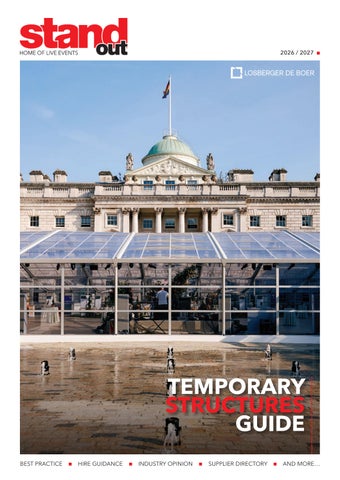
Front cover image: © Losberger De Boer
@standout.magazine
@StandOut Magazine
36 SUPPLIER DIRECTORY
@standout_magazine
@StandOut Magazine
@StandOutmag
Editor Caroline Clift caroline@standoutmagazine.co.uk
Marketing executive Katie Goldsmith marketing@standoutmagazine.co.uk
Advertising manager Jen Crisp jen@standoutmagazine.co.uk
Design and production Neil Hepden Jemma Heslop Emma Hickman Colin Swaffer standout@tandemmedia.co.uk
Account manager Sarah Bourne sarah@standoutmagazine.co.uk Account executive Lewis Briggs lewis@standoutmagazine.co.uk
Credit control Janine Walmsley creditcontrol@standoutmagazine.co.uk
Managing director Neil Fagg neil@standoutmagazine.co.uk T: 01795 509101 CEO John Denning StandOut Multimedia Limited, 10 The Metford, Evegate Business Park, Smeeth, Ashford, Kent, TN25 6SX T: 01795 509113 www.standoutmagazine.co.uk
No part of this guide may be reproduced or stored in a retrieval system or transmitted in any form – electronic, mechanical or physical – without express prior permission and written consent of the publisher. Contributions are invited and when not accepted will be returned only if accompanied by a fully stamped and addressed envelope. Manuscripts should be typewritten. No responsibility can be taken for drawings, photographs or literary contributions during transmission or in the editor’s hands. In the absence of an agreement the copyright of all contributions, literary, photographic or artistic, belongs to StandOut Multimedia Limited. The Publisher accepts no responsibility in respect of advertisements appearing in the guide and the opinions expressed in editorial material or otherwise do not necessarily represent the views of the Publisher. The Publisher cannot accept liability for any loss arising from the late appearance or non publication of any advertisement. Information about products and services featured within the editorial content does not imply an endorsement by StandOut Multimedia or StandOut magazine. © 2026. StandOut Multimedia Limited, 10 The Metford, Evegate Business Park, Smeeth, Ashford, Kent, TN25 6SX
www.standoutmagazine.co.uk n 03
MUTA Q&A
Achieving your vision with teamwork MUTA is the UK’s only trade association dedicated to marquees, tents, and structures. In this Q&A, Tom Bucknell, founder of Creative Structures Group, and a member of MUTA’s executive committee, discusses the importance that precise planning, collaboration, and communication play in the successful execution of memorable events
would you describe the current H ow events market?
The events industry remains resilient, and demand is generally strong with weddings, corporate events, and festivals all still wanting temporary structures, but the consensus is confirmation is slower and lead times have shrunk dramatically. Rising costs, tighter budgets, and increasing expectations from end clients means every event must work harder to deliver value. At the same time, clients expect higher standards of sustainability, safety, and customer experience, making the planning process more complex. What challenges are temporary structure and marquee providers facing and what impact do these challenges have on the services that your members are able to offer organisers? Three things: the cost inflation of virtually everything we buy or use; a genuine shortage of skilled crew comes up regularly from members; and a compliance bar that rightly keeps rising, requiring more paperwork. The consequence for organisers is that the gap between a professional operator and a cheap one has never been wider. Reputable members are absorbing what they can, but they cannot cut the quality and standards of what is being delivered. The cheapest quotation can quickly become the most expensive if corners are cut. Professional suppliers will work collaboratively to achieve the client’s vision while ensuring safety, compliance, and reliability remain paramount.
to rise, what can organisers and structure providers do to create efficiencies? Again, early engagement and communication is one of the biggest opportunities to reduce costs. Bringing structure providers into the planning process at an early stage often allows layouts to be simplified, access improved, and installation programmes optimised, reducing both labour and transport costs. Flexibility also helps, being open to alternative layouts, standard structure sizes or slightly adjusted event dates can create significant efficiencies without compromising the guest experience. Good communication between organisers and suppliers ultimately delivers better value for everyone. Organisers want to create spaces that add to the overall atmosphere of an event and enhance the guest journey. What role can event structures play in adding to the look and feel of an event? The structure is the venue – it’s the first and last thing a guest experiences. Clear-span marquees with glass walls, beautiful sail tents, rustic tipis, colourful stretch tents, ornate orangeries. Our members don’t just provide weather cover; they set the tone before anyone steps inside. The best events use structures to choreograph the journey – an elegant canopy, a reveal into the main space, a shift in ceiling height or lighting
MUTA represents marquee and temporary structure providers. Considering the current climate, what general advice would you give to event organisers looking to hire structures? Involve your structure provider before you finalise the site plan, not after. So much cost and risk is baked in by decisions about where a structure sits – ground conditions, access for vehicles, proximity to trees and buildings, what’s buried underneath, etc. Tell your provider everything about the site. Warts and all. And, of course, use a MUTA member: as members we are independently inspected against the industry’s best practice standards, which is the closest thing this sector has to a kitemark. The costs of putting on an event are causing some organisers to cancel. As costs continue
04 n www.standoutmagazine.co.uk
TOM BUCKNELL (he/him)
changes between dinner and dancing. When the lighting, linings, flooring, furniture, and correct flow are all planned with the structure rather than bolted on afterwards, the result feels designed rather than wedged together. Event suppliers always say they would like organisers to book the equipment they need early. What other best practice advice would you give to anyone looking to hire a structure supplier? Treat your structure provider as a project partner rather than simply a contractor. Share your vision, involve them in site visits, and discuss any operational challenges early. It really gives you the chance to get to know them. Ask questions about experience, safety credentials, and previous projects, and allow sufficient time for proper planning and approvals. The most successful events are almost always the result of strong collaboration between organisers and trusted suppliers who work together from the outset. MUTA plays a strong part in ensuring the UK temporary structures industry has an excellent track record of delivering safe, innovative, and memorable event spaces. We always strongly recommend working with MUTA members, as we know organisers can rely on them to create outstanding events while managing risk, controlling costs, and giving guests the best possible experience.
NEW EDITION
OUT NOW
Guide to Choosing a Hirer Marquees | Tents | Structures
J&JC
is
try Tip
arter
Coun
unus
Kings
mead
Nept Marq
uees ents
ing T
Stunn
Find out more information at www.muta.org.uk
CHOOSING A HIRER
Hire with confidence
FIELD AND LAWN
Whether you’re planning a large-scale festival, an intimate garden party, or a world-leading sporting event, MUTA’s new Guide to Choosing a Hirer is an invaluable free resource for anyone looking to hire a tent or temporary structure a temporary structure is not just H iring about appearance or cost – it is about
safety, compliance, and peace of mind. From structural integrity and weather resistance to proper installation and insurance, there are many important considerations that are not always immediately visible. MUTA, the UK’s only trade association for the temporary structure industry, has recently published updated guidance designed to provide practical advice to help anyone planning to hire a marquee, tent, or temporary structure. In the latest edition of Guide to Choosing a Hirer, MUTA outlines some helpful pointers that will help you to decide which company to work with. Because the best hirers will build you a first-class structure, keep your stress levels low, and be a delight to work with. The worst ones will make your event a nightmare.
supply of these items as you wish, acting as a one-stop-shop if that is what you require.
ON-SITE SUPPORT
If something goes wrong whilst the event is happening, what arrangements are in place to cope? Will your hirer’s staff be on-site during the event? If not, is there an emergency contact number, and how fast can you expect a response? Good hirers will be on hand to offer support.
COPING WITH PROBLEMS
All businesses face challenges. Staff go off sick. Vehicles break down. Equipment gets damaged. Good hire businesses solve these problems seamlessly. They have additional staff they can call on, arrangements in place to cope with broken down vehicles, and spare
equipment to hand. Ask your hirer about what contingency arrangements they have in place to cope when things don’t go to plan.
CONTRACT
Good hirers will insist on signing a contract with you and won’t take cash payments to avoid VAT (that’s illegal). The contract gives you and the hirer confidence because you both know clearly what you have agreed. The contract doesn’t need to be long or difficult – it is often just a booking form with a set of terms and conditions of hire.
PAYMENT TERMS
It’s worth being suspicious of companies offering big discounts in return for large deposits paid a long way before the event. It could be a sign that they are struggling to
EXPERIENCE AND TRACK RECORD
Look at how long the hirer has been trading. Most of the unprofessional companies won’t survive more than a few years. As part of the application process, MUTA members are required to provide evidence of sound trading and financial history. Does the hirer have a good track record? Is there evidence of recent customer thank you letters, testimonials, online reviews, or references? Will they let you talk to a previous customer? Have they won any awards? Is the hirer financially stable? Obtain a credit check from your accountant.
RANGE OF SERVICES
Apart from erecting the marquee or tent, there’s a lot to do to make an event happen, from flooring and staging to lighting and heating, the list goes on. Many hirers will be able to take on as much or as little of the
EVENT IN A TENT www.standoutmagazine.co.uk n 09
CHOOSING A HIRER survive, raising the possibility that they won’t be around by the time your event arrives. Typical payment terms tend to be 25 per cent paid when making the booking to reserve the equipment, 65 per cent on or before the first day of construction and the final ten per cent on completion of installation. In addition, if special nonstandard items, such as heating or furniture are required, the hirer may have different terms for these.
ARE THEY A MUTA MEMBER?
It is better to look at this question from the other direction. If the hirer you are proposing to use is not a MUTA member, ask why not? Members sign up to a code of practice requiring them to be legal, decent, honest, and truthful. They are obliged to provide a professional standard of workmanship, to check all their own work, and to maintain reasonable levels of both public, employers and in some cases professional indemnity insurance.
RÖDER UK
OTHER THINGS TO CONSIDER…
Don’t be afraid to ask to see the hirer’s safety policy, risk assessment, method statement, flame retardancy certificates, and structural calculations for the structure proposed. If erecting requires use of forklifts or other plant, ask to see the licences of the drivers. Be sure that your hirer is aware of the position of underground and overhead services (e.g. drains, gas pipes, electrical cables, irrigation systems). It is your responsibility to provide the hirer with a site plan of services. If in any doubt the hirer will arrange for a CAT scan. To ensure compliance with the structural calculations, it will be necessary to conduct a stake-pull test. This test confirms the resistance to wind uplift. Every site is different and as such different sub-soils will provide varying resistance values. A site on sand will provide very little resistance to uplift, whereas chalk or clay will provide greater resistance. The test will confirm if additional ballasting is required.
DANCO
10 n www.standoutmagazine.co.uk
FEWS MARQUEES MORE DETAIL…
Free to download from the MUTA website, the Guide to Choosing a Hirer has been written for a wide audience, from couples planning a wedding through to event organisers and local authorities delivering larger public events. As well as detailing what customers should expect from a professional hirer, outlining
the responsibilities that both clients and contractors share, the publication also introduces readers to the different types of temporary demountable structures available and offers practical planning advice. If you would like to discover more information or have questions about anything related to temporary structures, visit www.muta.org.uk
PROCUREMENT
Procurement: There’s a lot riding on it Last year, The Jockey Club’s temporary structures contract was up for tender, so the organisation used the opportunity to change its approach to procurement. Here, Sachin Kotecha, head of procurement at The Jockey Club, walks StandOut through the process
plays a significant role in P rocurement the success of any business. According
to Sachin Kotecha, head of procurement at The Jockey Club, it’s the foundation for operational transformation. “Procurement needs to be sitting at the head of the table, understanding exactly what’s going on, and providing suitable approaches and guidance,” he explained. Kotecha is an experienced procurement professional. Previously a consultant in procurement and product development at McKinsey and Company, he now oversees procurement at The Jockey Club, which organises great sporting events, including Cheltenham Festival, Randox Grand National, and Epsom Derby. “You need to look at procurement through three lenses to be effective,” Kotecha continued. “One is all about how you generate value. That’s your tenders and your supplier performance management. Then you need to look at value leakage, so that’s all about contract management,
12 n www.standoutmagazine.co.uk
governance, and controls. And then you have the environment and everything around it to make things happen, so data, culture, your capabilities, and your technology stack.”
A LOT RIDING ON IT
In 2025, The Jockey Club tendered its temporary structures contract – which comprised more than 40,000 square metres of tents and temporary structures at Cheltenham Festival alone. The tender was so large, it was split into phases. Phase one was eye-opening; an intense look at minute detail that enabled Kotecha and the wider Jockey Club team to create clear bills of quantities (BoQ). “Temporary structures are the biggest spend category we have,” Kotecha said. “This procurement exercise was interesting because we had some of our longerterm agreements coming to an end and inflationary costs on new contracts were looking at 15 to 20 per cent increases across the board.”
Kotecha stripped back the procurement process. He wished to start with a blank piece of paper. He soon realised that event procurement is nuanced. He explained: “The more I learn about events, and the focus of the people putting them on, it’s all about risk. It’s all about making sure you have what you need versus getting the best value every time. Because at the end of the day, no one wants to switch supplier to save money, only to find that when it comes to delivery, there’s nothing. Any cost benefit you had is completely wiped out. “Event procurement is probably a lot more sensitive than any other organisation or industry that I’ve been in before. There’s a lot more riding on it.” The Jockey Club undertook a huge information gathering exercise and “started from scratch”. The organisation realised that its suppliers held too much detail. It believed that some suppliers almost assumed they would win work again because they had “historically done it”. So, when The Jockey Club tried to
PROCUREMENT
CHELTENHAM FESTIVAL
extract data from existing suppliers, it was challenging. The scale was immense. One tent could have ten plus services inside it. From toilets to heating and cooling. “For ease, most people give a contract to one provider but the disadvantage of that is the information then exists with the supplier,” Kotecha continued. “It was paramount that we had drawings and BoQs. Both to understand how much something truly costs, but also to support long-term change processes and derive the cost/benefit of innovation.”
GOING BACK TO SQUARE ONE
Kotecha and his team drew up lists of all structures (roughly 100) and looked at the separate services. This meant the tender was incredibly “complex” and featured more than 150 separate lines of a rate card, per structure and supplier. More than 25 suppliers were approached for proposals. It was an immense amount of work, but Kotecha described the process as paramount. “You must take control of your procurement,” he said. “I think the previous approach was heavily focused on renewing contracts in line with their capacity and
once the supplier base was set-up, there wasn’t any real focus on how they managed suppliers or supported our racecourses in addressing performance.” Kotecha was brought in to turn procurement around and to transform operational efficiencies. “There was some frustration in service levels,” Kotecha admitted. “So, we went back to square one and asked every supplier to walk us through the size of marquees, whether it had windows or stairs; I wanted them to come back and talk to me about each service and give us a representative view of what it would cost. “I decided that if we had a 60 per cent BoQ that’s consistent across all our suppliers, and we compare those against each other, then I could assume that the other 40 per cent that we were missing, as long as we pick the supplier who’s most competitive, was probably going to be as competitive in those areas as well.”
A LESSON FOR EVERYONE
The Jockey Club wanted better quality structures and to reduce costs. It opened its tender process in April 2025. In September 2025, contracts were awarded to Fews Marquees, Losberger De Boer, and Arena.
SACHIN KOTECHA (he/him) Now, with racing season running from October until June, The Jockey Club has delivered its first full race season with the new temporary structure contracts in place. “I sat every night and analysed all the information,” Kotecha said, as he reflected on the project. “And the amount of information you get is incredible. I don’t think there’s
www.standoutmagazine.co.uk n 13
PROCUREMENT anybody else in procurement – anywhere in England – who would run that process like we ran it. Because we had 100 structures and we had 100 lines of items per structure, so we had 10,000 lines of information from each supplier. All that information needed to be evaluated to make sure proposals and bids were being put through a fair process. “I had never worked before with any of the suppliers who tendered for the contract, so I was more than happy to take an open lens and see what’s what’. “That hurt a lot of suppliers – large and small – because in some cases, if they didn’t put their best bid forward, and there was a substantial gap, we were open to looking at new partners and refreshing how we design and deliver an event. It was a lesson for everyone.”
IMPROVING PROCUREMENT
Kotecha joined The Jockey Club in 2024. His focus was to improve procurement and the way the organisation operated. From data to contract management and supplier management. The temporary structures tender was phase one of a much larger process. The key to its success was transparency, said Kotecha. “Once we signed contracts, we created new BoQ documents with all our suppliers, and we’ve put them all into a standardised document. What that means now is if I look at any structure or any service, I can see exactly what’s going on, at what cost, how inflation is going to hit us, and if there’s been any suggested changes in year one. We know exactly where we are. It also helps with upcoming investment cases to support customer experience where our teams need to have an ROI figure in mind. We can more accurately sketch out what that will be. “Also, when it comes to this year, we can look at our documents and say, ‘Okay, actually, there are a couple suppliers we really wanted to work with because their structures were such high quality and last year, when we ran the tender, we thought the cost difference looked tremendous. Now we have the bill of quantities in front of us, and we can see the increases that we’ve had to add on and suddenly, it doesn’t look all that
14 n www.standoutmagazine.co.uk
bad’. We can see the ROI per structure and if we want to suggest new things, it’s easy because we can do all the cost comparisons pretty much in real time.”
OPTIMISATION
Fews Marquees, Losberger De Boer, and Arena have signed multi-year contracts, and there are options to extend as well as “provisions”. Kotecha continued: “For example, if we change a structure in any way, or if we deem that a certain structure is uncompetitive, we have the right to go and make that change and evaluate our options. It means 80/90 per cent of the contract might be static every year, and 10/20 per cent might flux. I think this incentivises suppliers to keep optimising because if you’re delivering value and great service, then you know we’re going to come to you first when it comes to something new that’s popped up.”
GET A BETTER PRICE
Kotecha and the wider Jockey Club team are currently implementing Coupa, a new procurement system, which is on track to go live in October. It will create more efficiencies within The Jockey Club’s procurement function, enabling Kotecha to fulfil his mandate which was to “reset” the organisation’s buying powers through greater data transparency and control of information. “It’s important to look at costs because the landscape is changing really quickly,” Kotecha commented. “We’re looking at all the big stuff, but it’s also the small stuff that can really add up. Once you’re able to put an approach in place, to collaboratively manage strategic spend, that’s what gives you the long-term value. Otherwise, it’s unmanaged spend.” Now, that The Jockey Club has a benchmark, it has started to put a performance management process in place. Kotecha explained: “In the last couple of months, we’ve brought all our suppliers in and discussed some lessons learnt onsite. Including any observations that we have, where the contract’s going, where the industry trends are going, how we can improve for next year, and we do that alongside procurement, health and safety, the
facilities team, and racecourse management. It’s brilliant because we are looking at the contract and its delivery from all aspects. “We’ve gone through a season, and I think everyone anticipated teething problems, some additional costs and changes, and there definitely have been a few. But we’ve gone into the supplier performance meetings, and we’ve heard from our racecourse leads and suppliers, and the feedback is 95 per cent positive.” Kotecha explained that the long-term aim is to keep improving the organisation’s procurement processes year on year, building on the firm foundations created in year one. If there are issues, they are flagged quickly. “Procurement needs to understand exactly what’s going on so we can balance strategic objectives against value delivery,” Kotecha stated. But what has he learned during this process? And what goals did he set? “In year one, we didn’t put any concrete savings target on the table because I knew it was paramount that we created a foundation, a benchmark first,” he said. “I can deliver value and quick wins by running sourcing exercises, but in three years, that would dry up and then you’d still have no data. My priority was to go back to square one, gather the data so we knew what we were looking at and then we could attack the gaps. That’s what we have done in the last 12 months, and I think we’re halfway through our journey now.” He explained further: “In year one, our addressable spend was around £100 million. We’ve already generated £2.5 million of benefit, and I think we could probably optimise to deliver another £5 to 6 million in the next couple of years but the foundation must be right to be able to do that. “The problem now is in this inflationary climate it’s incredibly difficult to get anything cheaper than you did last year. But you can get a better price. “The main thing for me is having the information to prove something from the outset, so you can prove to the business what value you’re going to bring,” Kotecha concluded. “Until you have that, you can’t really put a number on anything.”
Large Scale Festivals | Sporting Events | Media & Press Corporate Events & Conferences | Education Facilities PR, Marketing Events & Brand Activation | Private Events Filming & TV Productions | VIP & Corporate Hospitality Industrial, Agricultural & Commercial Storage | Weddings
Leading supplier of Marquees and event equipment hire for over 25 years! Marquee Magic Event Hire Ltd
0208 854 1949
info@marqueemagic.co.uk www.marqueemagic.co.uk
SO_TS Guide26_Marquee Magic_HP.indd 1
03/08/2026 10:51
Celebrating
25 Years
of unforgettable event structures • Marquees • Glasshouse Orangery • Custom Shipping Containers • Perimeter Fencing • Luxury Toilets • Event Infrastructure • Furniture Whatever the occasion, our quarter-century of expertise ensures every detail is expertly covered.
01759 380 190 info@coopersmarquees.co.uk SO_TS Guide26_Coopers Marquees_HP_V4.indd 1
05/08/2026 11:45
www.standoutmagazine.co.uk n 15
STRUCTURE COSTS
Be clear on costs What impacts the costs of an event structure? Sarah Hodson, project director at WH Silverbacks, discusses pricing and why quotes vary
SARAH HODSON (she/her) planning an event, it’s not W hen uncommon to receive very different
quotes for what appears to be the same structure. On the surface, if you’re the event organiser gathering quotes, it can often feel confusing, especially when sizes and visuals look similar. In reality though, event structure pricing is influenced by a range of factors, and not all quotes are based on the same assumptions. Understanding what sits behind the numbers can help you make a more informed decision and avoid unexpected costs later on.
EVERYTHING STARTS WITH THE SITE
One of the biggest influences on temporary event structure costs is the site itself. First and foremost, the structure needs to be suitable for the environment it’s going into. At this stage, you may not have landed on the exact type of structure; whether that’s a truss system, stretch tent, curved marquee, or a bespoke combination. And that decision plays a key role in overall cost. No two locations are the same. Ground conditions, access, and location all affect not only how a structure is installed, but also which solutions are viable in the first place. A flat, open field with easy vehicle access is very different from a restricted city-centre site or uneven terrain. These differences directly impact the time, equipment, and labour required and, therefore, the cost. It may feel counterintuitive but start by understanding your site constraints first. From there, you can identify what will work practically in the space and cost it accurately.
ONE PART OF THE PICTURE
While size is often the first comparison point, it’s only one piece of the puzzle. Costs can vary depending on: • The type of structure (truss structures, stretch tents, marquees, pagodas, a mix of several options or a bespoke build) • Internal finishes (flooring, linings, and lighting integration) • Overall design and layout requirements
16 n www.standoutmagazine.co.uk
Even when structures appear similar, quotes may include very different levels of detail. • Two structures of the same size can deliver completely different experiences and may require very different levels of investment. Consider the size of the area you’ll need first and look at guest flow. Where will people enter and exit the structure? Are there back of house areas that are needed and what size do they need to be? What access is required for back of house spaces if you have them?
INSTALLATION COMPLEXITY MATTERS
What happens on site plays a major role in overall cost. This includes: • The type of fixings required (e.g. staking vs ballast) • Equipment needed for installation (plant, vehicle access, etc.) • Time and labour on-site (build schedule, access restrictions, crew size, health and safety requirements) Some installations are straightforward. Others require more detailed planning, specialist equipment, and longer – or more intense – build schedules, particularly on busy or restricted sites. Shorter build windows can also mean larger crews, which impacts cost. It’s worth noting that more experienced suppliers may appear more expensive upfront but often provide better value overall by factoring in these complexities from the start – even if they weren’t fully defined in the initial brief. Therefore, it’s important to understand your build requirements and parameters early on. This helps you cost accurately and avoid additional costs creeping in later that haven’t been planned for.
TIMING AND AVAILABILITY
When your event takes place, and how far in advance you plan it, can have a big impact on cost. Peak seasons (especially summer) bring higher demand for structures, equipment, and experienced crews. I see this time and time again, particularly with short lead-time enquiries. The reality is, the earlier you plan, the more choice you’ll
have and the better the price you’re likely to secure for the right structure.
THE WORK YOU DON’T SEE
Choosing a new supplier can feel daunting, but experience counts. Working with a team who’ve delivered at your level time and time again makes the process quicker, smoother, and often more cost-effective in the long run. A significant part of delivering a successful event structure happens before anything arrives on site. This includes: • Site assessments • Design input and layout planning • Coordination with other contractors • Project management These elements are essential to making everything run smoothly but they’re not always obvious when comparing quotes.
STRUCTURE COSTS An experienced supplier will think ahead, flag potential issues early, and be clear about any budget implications, helping you stay in control and avoid cost creep later on.
WHY QUOTES LOOK DIFFERENT
Even when structures appear similar, quotes may include very different levels of detail. Variations often come down to: • What’s included (or excluded) • Assumptions about the site • Differences in specification • Level of planning and support pre-event This is why comparing quotes isn’t always a straightforward like for like exercise.
QUESTIONS TO ASK
To make a fair comparison, it’s always worth asking: What exactly is included in the scope? Have site conditions been properly considered? What level of planning and project support is provided? Clarity at this stage helps prevent unexpected changes or additional costs later on. Why? Because the detail behind the design, the site, and the delivery approach all play a huge role in the successful execution of a project. We often see agencies and organisers trying to compare quotes purely on size or price, but the reality is that no two structures are ever truly the same.
FINAL THOUGHTS
Event structures are rarely as simple as they first appear. By understanding what goes into them, both on site and behind the scenes during planning, you can compare options more effectively and make decisions with confidence. And ultimately, that leads to better events and a smoother, more efficient build that stays on budget.
www.standoutmagazine.co.uk n 17
Goodwood Festival of Speed
High-profile Hospitality Venues
Space for Exceptional Hospitality Experiences. sales.uk@losbergerdeboer.com
01280 846500
PROMOTIONAL FEATURE
SOMERSET HOUSE
Executing your vision
Losberger De Boer details how a strong partnership approach helps it to support some of the world’s most prestigious events De Boer (LDB) delivers L osberger temporary and semi-permanent
structures for some of the world’s most recognised events, venues and brands. The company supports a wide range of event spaces, including premium hospitality suites, brand activations, immersive exhibitions, entrances and operational facilities, designed around the specific needs of an event.
BUILT THROUGH PARTNERSHIP
Temporary structures influence every part of the event experience, from arrival and guest flow to hospitality, operations and brand presence. The best results are achieved when the venues become part of the event strategy. Early collaboration helps organisers to create the right venue solution from the start, whether that is a simple canopy or a premium fully fitted building. This partnership approach improves planning, reduces risk, and helps ensure the venue is suitable for the site as well as the guest experience.
THE RIGHT STRUCTURE FOR EVERY SPACE
Losberger De Boer’s portfolio can cover the full event site. Popular solutions include large clear-span structures, double-decker hospitality suites, fully transparent luxury venues, branded boxes, entrances and supporting operational facilities, all planned around the brief and experience the organiser wants to deliver.
EVENT AND VENUE EXPERIENCE
With more than 100 years of experience, Losberger De Boer has supported a wide variety of events and addressed almost every brief imaginable.
GOODWOOD FOS GREAT EXHIBITIONS
Farnborough International Airshow is Losberger De Boer’s largest biennial exhibition project. The company supplies more than 60,000 square metres of event structures across the site, using 12 different types of LDB structures, representing around ten per cent of the global group stock. The scale means planning begins as the previous show ends, with build and dismantle taking six months in total. Chelsea Flower Show is another example of exhibition space on a grand scale. The Great Pavilion is the largest stand-alone structure the company builds annually, covering more than 12,570 square metres made up of two structures connected with a custom roof piece.
PREMIUM HOSPITALITY
Cheltenham Festival: Losberger De Boer is supporting a new partnership with The Jockey Club and Cheltenham Racecourse, delivering ten venues for the autumn and winter fixtures as well as Cheltenham Festival itself. A phased approach enabled the site to scale as the
season built towards the festival, including one hospitality structure which was expanded into a triple-deck venue, adding new floors above the existing structure without dismantling the space below. Goodwood Festival of Speed (FoS) and Revival: Losberger De Boer has been a key supplier at Goodwood for 30+ years providing high-class hospitality and brand activation structures for Goodwood FoS and Revival. Every space is thoughtfully designed and finished to the highest standards, made to feel like your favourite five-star restaurant or private members’ club. Losberger De Boer was also a key supplier at the Courchevel Méribel Skiing World Championships. The project required a wide range of facilities including hospitality pavilions for VIPs, public bar areas, athlete facilities, staff catering areas, and dedicated relaxation spaces for volunteers.
VENUE PARTNERSHIPS
LDB has various long-standing venue partnerships, including with Somerset House. Most recently, it worked with Somerset House and Moving Venue to create a stunning transparent structure hosting 15 events over four weeks. The project shows how venues can create new event opportunities using spaces that already exist.
SPACE FOR WHAT MATTERS
The most useful conversations often start with a simple question: what would make this event and space work better? Talk to Losberger De Boer about creating the right space for the experience you want to deliver. Speak to John Cochrane or Olivia Beaumont about your next event. Call 01280 846500 or email sales.uk@losbergerdeboer.com
www.losbergerdeboer.com/uk n 19
Specialists in Event Structures & Temporary Buildings
Neptunus LTD. Cob Drive, Swan Valley NN49BB Northampton +44 1604 593820 www.neptunus.co.uk
∏ THE NETHERLANDS ∏ BELGIUM ∏ UNITED KINGDOM ∏ GERMANY ∏ FRANCE ∏ POLAND ∏ AUSTRIA
PROMOTIONAL FEATURE
Pushing boundaries
ROYAL ASCOT
Neptunus’ Evolution structure is living up to its name, providing organisers and agencies with a myriad of creative solutions
is a “go-to” name in the N eptunus temporary structure sector thanks to a
global reputation – cultivated over almost 90 years – for outstanding service, cutting-edge creativity, and innovation. Renowned for constantly pushing the boundaries with dynamic new products or cleverly adapting existing structures to give clients bespoke space solutions, Neptunus invests millions of pounds in research and development to maintain its position as market leader. All products are manufactured in-house making them unique to Neptunus. Its wide variety of high-quality temporary structures combined covers more than 500,000 square metres.
FLEXIBLE SOLUTIONS
Neptunus has structures with the flexibility to meet every need from short-term rentals for major events, exhibitions, conferences, product launches, and iconic sporting occasions to semipermanent buildings, including warehouses, supermarkets, sports halls, hospitals, educational requirements, and much more. The product range is vast. It incorporates everything from smaller marquees and pavilions to its free-span Alure Globe and Alure Globe Giant range – which protects sightlines for performance and audience-focused layouts
– and double and triple-deck temporary structures for premium hospitality and viewing. The most recent addition to its product portfolio is the eye-catching fully rounded Salacia structure, which made its UK debut at Royal Ascot. It provided racegoers with a spectacular new covered area in the hospitality village, situated in the centre of the racecourse.
PREMIUM PRODUCTS
However, despite great innovation, the company’s most sought-after product remains the Evolution. Originally introduced nearly 25 years ago, incorporating sustainable materials with fast assembly using hydraulic lifting technology that is useful in assignments with tight schedules, the Evolution has proved particularly popular with event and exhibition organisers. Developed to keep pace with the demand for robust, environmentally-friendly temporary buildings, with the capability to suspend large amounts of heavy equipment from the roof, and that have the look and feel of a permanent building, Neptunus’ designers have constantly made subtle improvements and adaptations. Later versions of the Evolution are lighter in weight, quicker to build, and faster to de-rig while retaining all of the Evolution properties including standard gutters, insulated wall panels, and integral cassette floor systems.
SILVERSTONE
The Evolution has provided high-profile hospitality areas at a host of major sporting events in the UK during 2026, including the British F1 Grand Prix at Silverstone, the HSBC Championships at Queens Club, and the Genesis Scottish Open at The Renaissance Club. Plus, in July, Neptunus also created a spectacular facility at Farnborough International Airshow for its long-term client Spiro. Again, the Evolution structure’s versatility enabled Spiro to shine at the show. Ben Keast, UK managing director of Neptunus, said: “Neptunus continues to provide a premium level of service combined with delivery of well-engineered structures and subtle innovation tailored to clients’ specific needs. 2026 has been a year of incredible client satisfaction and fantastic project delivery. “Across a number of projects, we have provided something new to the UK market. From the Salacia, our round Evolution structure at Royal Ascot, and a black three-storey Evolution for the Paddock Club at Silverstone to providing an upgrade across the hospitality facilities at Silverstone with our Alure Globe and Evolution structures, showcasing our premium products alongside our trusted levels of service and sustainable delivery.” On Neptunus contribution to this year’s Formula 1 British Grand Prix, Stuart Pringle OBE, CEO of Silverstone, said: “2026 marked the first year Silverstone worked with Neptunus, and they proved to be an outstanding partner in the delivery of the Formula 1 British Grand Prix. Their expertise and professionalism were instrumental in creating the high-quality structures that housed key hospitality areas, including Ignition and Fusion, as well as several fan enclosures. This included our brand-new BOXPARK facility, the biggest enclosure at the event, and a popular location for many fans over the weekend. “Neptunus delivered an ambitious programme to an exceptionally high standard, and we greatly valued their commitment, collaboration and attention to detail.”
www.neptunus.co.uk n 21
SO_TS Guide26_Cover Marque_HP.indd 1
REDEFINING TEMPORARY EVENT SPACES
Quick to Install | Insulated | Wind Rated
www.evolutiondome.com | Info@evolutiondome.com | 01487 640640 22 n www.standoutmagazine.co.uk
30/07/2026 10:22
VIEWPOINT
Time to evolve Lulu Beasley, head of design and experience at Lock 5, on why it’s time the experience shaped the conversation, and not a structure…
What if every project began with one shared brief? Not a structural brief. An experience brief.
LULU BEASLEY (she/her)
years ago, I bumped into one of the T wo industry’s true stalwarts at a trade show.
We got chatting about projects, the market, and where the industry was heading. Always curious, I asked what he was looking for. “To see what’s next,” he replied. That conversation has stayed with me ever since. Because “What’s next?” is probably the most important question our industry can ask itself. Over the last decade, temporary structures have undergone an extraordinary transformation. They have reached a point where they are part of the experience, rather than simply the envelope that contains it. Many now sit comfortably alongside permanent buildings, not as a compromise, but as temporary event architecture in their own right. The next opportunity lies not just in the structures we build, but in how we imagine, design, and experience them. For most projects, the process is still remarkably familiar. A structure is chosen first, then you commission design, fit-out, production, and other specialist suppliers. Each contractor brings valuable expertise, but they are often appointed in sequence. Rarely, is there collaboration at the very beginning. We invest significant budgets transforming temporary structures. We build walls to conceal framework, install ceilings to soften roof systems, and introduce architectural and visual elements that shape how a space feels. Not because the structure is lacking, but because today’s audiences expect more than the shell alone can provide. It works. But guests don’t experience our disciplines. They experience our decisions. The question is whether we’re bringing those disciplines together early enough to make the best decisions. We often talk about collaboration, and rightly so. Our industry works well together. But there is still a disconnect, one that is often only discovered on site, when changes become costly and compromises unavoidable. Imagine arriving on site knowing every contractor understands not only their own
role, but how it connects to every other part of the experience. No surprises. No competing priorities. No last-minute compromises. Just a shared understanding of what we’re trying to achieve, and why. What if that was not simply a behaviour, but a prerequisite, a room full of expertise brought together before a site plan or floor plan has even been drawn, with the client leading a conversation about the experience they want people to have. Imagine what that collective could create. Budgets invested where they have the greatest impact on the guest experience. Assumptions challenged before they become constraints. Better solutions emerging because every discipline contributes from the outset, rather than responding in sequence. No legacy thinking. Just everything we’ve learned about visitor behaviour, temporary structures, experience design, and the psychology of space. Where would we begin? Would we start with what the structure needs to do? Or with
how we want people to feel? These are really important questions that our industry – full of people with amazing ideas – needs to ask. Perhaps this is the next evolution of our sector. Enabled by the remarkable progress of temporary structures, but driven by a desire to create more authentic, innovative experiences. Not just temporary architecture. Experience architecture. The opportunity is no longer simply to ask, “What’s next?” It’s to ask, “What if?” So, what if every project began with one shared brief? Not a structural brief. Not a fitout brief. An experience brief. From that point, every decision becomes collaborative, aligned around a single objective: creating the best possible experience. Because the next evolution isn’t about better structures or better suppliers. It’s about bringing the right people together at the very beginning. We’ve spent the last decade perfecting temporary architecture. Now it’s time to perfect the experience that shapes it.
www.standoutmagazine.co.uk n 23
PROMOTIONAL FEATURE
Rooting for the RHS Lee Dalton, Röder UK’s sales director, explains how sustainable event infrastructure played a key role at RHS Sandringham Flower Show one of the UK’s leading providers of A stemporary event structures, Röder UK
was appointed to deliver the infrastructure for the inaugural RHS Sandringham Flower Show. The project required the installation of more than 10,000 square metres of temporary structures, including the show’s signature floral marquees, while maintaining a strong focus on operational efficiency and environmental responsibility.
THE BRIEF
The floral marquee is the centrepiece of every RHS flower show and one of the event’s most visited attractions, housing the best of British horticulture. For Sandringham, Röder was tasked with creating a T-shaped configuration capable of showcasing the event’s major floral displays, while also supplying additional structures across the wider showground. The project demanded a build programme that balanced speed, precision, and reliability, ensuring the venue was ready to welcome thousands of visitors over a five-day period.
EXPERT DELIVERY
Drawing on more than 50 years of experience delivering temporary structures for the events sector, Röder coordinated the installation of multiple buildings across the site, with the floral marquee acting as the project’s focal point. In response to recent high temperatures, the structures incorporated mesh walls and mesh gables to maximise natural ventilation throughout the marquees. By improving airflow and helping regulate internal temperatures, the design created a more comfortable environment for exhibitors,
26 n www.roderuk.com
floral displays, and visitors alike, without compromising the aesthetic quality expected of an RHS event. Alongside the structural installation, Röder worked with local crews wherever possible, reducing travel distances and improving the efficiency of the build programme while supporting the regional workforce.
DRIVING SUSTAINABILITY
Röder is passionate about reducing the environmental impact of live event infrastructure, and RHS Sandringham provided another opportunity to demonstrate this commitment in practice. Working in partnership with electric haulage specialist Voltloader, Röder completed 14 deliveries to site using fully electric vehicles. The initiative built on the successful partnership established during the 2025 RHS Chelsea Flower Show, where the business successfully reduced transport-related emissions by 33 per cent. In the build phase of the project alone, estimated carbon emissions for Sandringham came to approximately 550kg of CO², compared with an estimated 1,596kg using conventional diesel vehicles – a saving of around 65 per cent with the break and derig still to be assessed.
RESULTS
The successful delivery of the RHS Sandringham Flower Show reinforces Röder UK’s ability to manage complex, largescale infrastructure projects where quality, programme delivery, and sustainability are equally important. By combining innovative structural solutions, lower-carbon logistics, and efficient workforce
planning, Röder delivered infrastructure that met the operational requirements of one of the UK’s most prestigious horticultural events while supporting the wider environmental ambitions of both companies.
AN INDUSTRY-LEADING PARTNER
As event organisers increasingly seek partners that can deliver both operational excellence and measurable sustainability benefits, Röder continues to invest in smarter infrastructure solutions, lower-emission logistics, and collaborative working practices. Whether supporting exhibitions, sporting events, festivals, or agricultural shows, Röder’s approach and focus remains the same: to deliver high-quality temporary structures efficiently, safely, and with sustainability built into every stage of the project. For more information about Röder UK’s temporary event infrastructure solutions, visit www.roderuk.com, email sales@roderuk.com, or call 01487 840840.
PROMOTIONAL FEATURE
Bringing a vision to life
Event in a Tent reveals the integral role it played in the creation of Amazon Ads’ Super Bowl VIP Lounge a temporary venue in the heart C reating of San Francisco is about far more
than finding an empty space. Jessie Square offered a fantastic location for Amazon Ads’ Super Bowl LX hospitality lounge, but mature trees and fixed features dictated how the 800 square metre venue could be designed. Here’s how Event in a Tent and other event professionals made it happen.
VERSATILE SPACE
Experience NVE led the creative direction for the Super Bowl LX hospitality programme. The agency required a lounge where Amazon could host clients around Prime Sports content, with private meetings taking place away from busier areas. Event in a Tent was commissioned to design and deliver a striking temporary structure, capable of bringing NVE’s creative vision to life. The UK company supplied six structures from its own Quad Dome range, plus the custom roof covers and glazed windows/ doors. Director of Event in a Tent, Matt Stephenson, led the full installation with his trusted in-house UK and USA teams. Four of the domes measured 10m x 15m and two measured 10m x 10m. Linking them created the required floor area without imposing a rigid rectangular footprint on Jessie Square. Each dome could be positioned around the existing obstacles, while the modular connections allowed guests to experience the lounge as a single venue. That arrangement also gave NVE room to vary the atmosphere inside. The Sports Bar could feel busy without taking over the boardrooms. Guests could customise a Levi’s jacket in the Denim Bar or try the golf simulator promoting The Masters on Prime Sports.
EXCEPTIONAL FINISH
Event in a Tent’s glulam frames remained visible throughout the interior. The timber softened the look of a large corporate space,
28 n www.event-in-a-tent.co.uk
and the glazing brought daylight into the reception and hospitality areas. Rather than appearing as temporary walling added to an event structure, the glazed elements became part of the architecture. The finish had to look exceptional from the first meeting through to the evening hospitality programme. While the structure defined the space, the bespoke roof covers became a branding canvas. Produced with AJ Tensile, they carried sports imagery from Amazon’s portfolio and the “Sports, Delivered” campaign line. From ground level, they gave the lounge an unmistakable silhouette. From nearby high-rise hotels, they made the roof a visible part of the campaign. Guests encountered the Amazon Ads presence even before they reached Jessie Square.
SEAMLESS PROJECT
Before production began, Event in a Tent met regularly with NVE and Amazon. The dome layout had to work with the rooms already planned, not merely fit the square. Once the plans were approved, the company produced the structures and walling for the build.
On-site, PRO EM’s timber subfloor provided the base. Each dome “leg” was bolted into it. Event in a Tent’s crews assembled the six linked structures and fitted the glazing. The whole lounge was completed in three days, ready for the interiors team. Completing a venue of this scale in a short timeframe was a big undertaking, but the team’s familiarity with the Quad Dome system played a significant role – crew understood the build process before arriving in San Francisco, allowing the installation to progress with efficiency. NVE’s design set the direction for the guest experience. Event in a Tent supplied the venue in which it happened. By opening day, the temporary venue felt as though it belonged in Jessie Square, providing Amazon Ads with a premium space that seamlessly supported meetings, entertainment, and live activations throughout Super Bowl week. When the best temporary event structures disappear into the experience itself, they’ve done exactly what they were designed to do. For more information, call 01978 661449, email info@event-in-a-tent.co.uk, or visit www.event-in-a-tent.co.uk,
Extraordinary spaces. Unforgettable experiences. Award winning event structures to create an incredible atmosphere for every occasion. BRAND ACTIVATIONS | FESTIVALS | CORPORATE POP-UP VENUES | TELEVISION UNIVERSITY OPEN DAYS | LUXURY EVENTS | ART EXHIBITIONS | XMAS MARKETS
Designed & Delivered.
We offer premium event structures to clients looking for a unique solution to create incredible spaces whether in open fields or complex sites.
TAILORED SOLUTIONS
DBS CHECKED CREW
01978 661 449
NATIONWIDE DELIVERY
UNIQUE RANGE
FULL DESIGN SUPPORT
info@event-in-a-tent.co.uk event-in-a-tent.co.uk
VIEWPOINT
Playing a key role Evolution Dome’s Ash Austin, founder, explains why temporary structures are more than a structure. They are the glue that holds an event together…
ASH AUSTIN (he/him) structure on an event site A temporary rarely stands alone. It’s the framework
everything else on that site depends on: production equipment, power distribution, climate control, catering. Every one of those trades relies on the shelter and structural integrity the building provides. That’s why the structure supplier can’t operate as just another contractor working to their own schedule. They’re a technical partner to everyone else on-site, whether they’ve been briefed that way or not. When suppliers work in silos instead, the result is predictable: schedule slippage, inflated labour costs, and safety standards that slip along with them. The clearest example of this is the interface between structural delivery and production. Rigging a large LED screen or a heavy lighting truss means someone has worked out the point loads and shared them with the structural team before anything goes up, not after. Get that sequencing wrong, and you’re either overloading a structure it wasn’t built to take, or wasting a day on-site while everyone waits for numbers that should have existed weeks earlier. The same logic applies to power and HVAC. Ducting and high-voltage cabling need a route into the planned structural footprint, not improvised; otherwise, you get air leaks, trailing cables, and airflow that never quite works the way it’s supposed to. Logistics matter just as much. On a constrained urban site, where only one HGV can gain access at a time, uncoordinated delivery schedules will bottleneck the build before it’s properly started. Getting the build order right matters, too: weatherproofing and sub-flooring need to be finished before sensitive, high-value kit turns up, or you’re risking equipment damage and paying crew to stand around waiting for a site that isn’t ready for them. The handover is where all of this either holds together or falls apart. Once the structure is up, the supplier needs to brief the wider event team properly, not a quick walkthrough, but a real briefing covering structural
30 n www.standoutmagazine.co.uk
The structure supplier can’t operate as just another contractor working to their own schedule. limits, emergency egress routes, and how the site’s wind management plan actually works. Everyone on-site needs to know what the structure can take, what the warning signs look like, and at what point an evacuation gets triggered. Skip this step, or rush it, and nobody downstream has the information they need when conditions turn. Regulation adds another layer that can’t be shortcut. In the UK, Safety Advisory Groups (SAGs) scrutinise joint documentation and method statements closely, and they expect suppliers to have already coordinated with each other before that paperwork lands on their desk. In North America, it’s local authority sign-off, state fire marshal approval, and
federal health and safety standards – different bodies, same underlying expectation. Clear, shared technical documentation moves these reviews along faster, because it gives the authorities confidence the whole site has been thought through, not just one part of it. None of this is really about being a good team player, even though it sounds like it. It’s a technical discipline. A structure supplier who gets it right gives AV crews a dry, secure space to install sensitive equipment, gives caterers the conditions they need to stay compliant, and gives production directors confidence that the build will hit its deadlines and hold up if the weather turns. Get it wrong, and every other trade on-site inherits the problem.
PROMOTIONAL FEATURE
Strong briefs = great events Building better events starts with asking better questions. Here, WH Silverbacks outlines five things that every organiser should include in their temporary structure tender many event organisers, choosing F ora temporary structure starts with the
obvious questions: How big does it need to be? Will it fit the space? How much will it cost? They are all important questions. But after more than 20 years delivering temporary event structures across the UK’s sporting events, festivals, hospitality venues, and brand activations, the team at WH Silverbacks knows that the quality of the brief will often determine the quality of the outcome. A vague or unclear brief does not just make pricing harder. It can lead to assumptions and, more importantly, solutions that are not fully suited to the site, the build programme, or critical safety requirements. Here, WH Silverbacks breaks down what a strong temporary structure brief should include and why getting the detail right from the outset matters.
START WITH THE SITE, NOT THE STRUCTURE
Rather than deciding on a particular type of structure from the outset, organisers should share as much information about the site as possible. Ground conditions, access routes, underground services, and build windows all influence what is practical, safe, and achievable within the available budget. Sometimes, the best solution is not the one originally imagined.
WHAT DOES THE SPACE NEED TO DO?
A temporary structure is there to solve a problem. Is it creating a hospitality space? Protecting spectators from the weather? Showcasing branding, a product, or activation? Managing guest flow in a certain way? The more context suppliers have, the better placed they are to recommend the right solution, rather than simply pricing a structure that may not meet the event’s needs.
32 n whsilverbacks.co.uk
TIMESCALES
Build windows, event dates, and de-rig requirements all have a significant effect on planning and on cost. Shorter installation periods may require additional labour, specialist equipment, or alternative logistics. Sharing this information early allows suppliers to plan properly and thoroughly from the outset.
DISCUSS BUDGETS
Not every quotation is based on the same assumptions. One supplier may have allowed for ballast, engineering calculations, site surveys, and project management, while another may not have included them if the brief is unclear. Comparing quotations only works when they are based on the same information.
EXPERTISE
Experience matters. Temporary event structures are safety-critical infrastructure, so choosing a supplier should never come down to price alone. The best suppliers will
not simply respond to a brief. They will help create the right solution for the event’s wider objectives. Asking about similar projects, understanding how challenges are managed, and checking relevant experience will almost always tell organisers more than the bottom line on a quotation.
HELPFUL INFORMATION
If you have found this advice useful, then there’s more. WH Silverbacks has created a series of practical guides covering a wide variety of topics such as how to brief a structure supplier, comparing structure quotations, understanding event build terminology, and winter event planning tips. The aim is simple: to help event organisers make better-informed decisions and deliver stronger, safer events. Many of these insights are shared through the company’s LinkedIn newsletter – From the Ground Up – where practical advice and behind-the-scenes expertise help event organisers plan with greater confidence. A temporary structure shouldn’t just fill a space. It should create an event that works seamlessly from build to breakdown. And that starts with a strong brief. WH Silverbacks works with event organisers across the UK to design and deliver temporary event structures for sporting events, hospitality, festivals, and live experiences. For more information, call 01202 096957, email sarah@whsilverbacks.co.uk, or visit www.whsilverbacks.co.uk
QUALITY TEMPORARY EVENT STRUCTURES
T The Th e entire entir ire ir re process pro rrocess was w s wa seamless, professional, pro rroffessional, ll, and delivered deli lliv verred to the highest hig i hest standard. ig standa d darrd.
STRETCH TENTS | TRUSS STRUCTURES | CURVED MARQUEES | PA P PAGODAS GODAS WH Silverbacks specialise in creating exceptional environments for events. With over 20 years experience we are trusted by the for London Marathon, The Open, Sail GP and Wimbledon. likes of London d exceptional exceptional delivery, we turn From customised solutions and bringiing your your ideas to life event planning stress into success - bringing with impeccable, personal service.
01202 096957
whsilverbacks.co.uk
SCAN FOR MORE
info@whsilverbacks.co.uk
PROMOTIONAL FEATURE
Shaping the experience Chris Norman, group CEO of Visions Group, explains why the most valuable event spaces are often temporary we talk about successful events, the “The same principle applies to brand W hen focus tends to be on what attendees activations,” he continued. “One of the
came to see: the headline speaker, the sporting action and entertainment, or the experience itself. But having worked behind the scenes at events across the country, Visions Group has learned that some of the most valuable spaces on-site are often temporary. These are the spaces designed to bring brands closer to audiences, create opportunities for client hospitality and help event organisers transform otherwise unused areas into valuable event assets. While they may only exist for a few days at a time, their impact can last much longer. For many years, event infrastructure has primarily been viewed as a practical solution – additional space added where permanent facilities have reached their limit. Increasingly, however, it’s being used to create opportunities rather than simply solve a problem. Whether supporting hospitality, guest arrivals or brand activations, Visions Group’s premium structures – such as the Avantgarde Pagoda, Tribeca, Icon, and Viewbox – are helping organisers make better use of their sites and create experiences that would not otherwise be possible. Chris Norman, group CEO at Visions Group, explained: “We’ve seen this at major motorsport events, where custom built environments become some of the busiest and most commercially important spaces on site. At Silverstone, for example, our Technical Overlay by Visions team delivered a bespoke heliport in partnership with Helipad, a leading provider of heliport facilities at major events across the UK. The facility included a dedicated guest reception and hospitality areas, helping to create a smooth arrival and departure experience during the race weekend.
34 n www.technicaloverlay.co.uk
biggest challenges brands face at events is finding the right environment to bring an idea to life, and some of the most effective brand experiences are created in spaces that didn’t exist a week earlier. These spaces give brands the freedom to build an environment around an idea, rather than trying to make that idea fit into an existing space.”
THE RIGHT INFRASTRUCTURE
It’s important to acknowledge that no two event sites are the same. Yet, an open greenfield space or section of a venue – not typically accessible to guests – can become a valuable part of the event experience if the right infrastructure is in place. Across the projects that Visions Group has supported, it has seen how the environment itself can influence the success of an activation. The best spaces do more than provide cover or square footage; they encourage people to stay longer, explore further, and engage with what’s in front of them. Temporary structures make that possible. They give brands the flexibility to create a space that feels considered and intentional, while making use of locations that might otherwise remain unused. Norman added: “Perhaps the biggest shift we’ve seen in recent years is the way temporary structures are being considered during the planning process. Too often, conversations around infrastructure happen once the event has been mapped out. By that stage, organisers are focused on fitting structures into the available space. Yet some of the most successful events take the opposite approach, considering bespoke infrastructure much earlier and using it to shape the guest experience from the get-go.”
SETTING THE TONE
Temporary spaces rarely serve a single purpose. A hospitality facility can create new revenue opportunities; a brand activation can transform an underused area of the site into a key visitor destination. Even a welcoming arrival space can help set the tone for the entire event. When viewed through that lens, these environments become far more than an operational necessity. They become a tool for creating opportunities and enhancing the overall experience. For event professionals, it’s worth asking a simple question: which spaces at your event deliver the greatest value, and are they receiving the same level of planning attention as the headline attractions? More often than not, the answer isn’t found in a permanent building. It’s found in the temporary environments that support the event around it. For more information, call 0118 935 8121 or email info@visionsgroup.co.uk
SUPPLIER DIRECTORY STRETCH TENTS
ASSOCIATION MUTA 10B Red House Yard Gislingham Road, Thornham Magna, Eye, Suffolk IP23 8HH T: 01379 788673 E: info@muta.org.uk W: www.muta.org.uk CREW Olympus Crew T: 07904 903452 E: info@olympuscrew.co.uk W: www.olympuscrew.co.uk INFLATABLES Evolution Dome 17, Highlode Industrial Estate, 17 Stocking Fen Rd, Ramsey, Huntingdon PE26 2RB T: 01487 640640 E: Info@evolutiondome.com W: www.evolutiondome.com MARQUEES Event In A Tent The Malthouse Business Centre, Regent Street, Llangollen, LL208HS T: 01978 661449 E: info@event-in-a-tent.co.uk W: www.event-in-a-tent.co.uk Danco The Pavilion Centre, Frog Lane, Coalpit Heath, Bristol, BS36 2NW T: 01454 250 222 E: info@danco.co.uk W: danco.co.uk TT Tents North Waltham Business Centre, Basingstoke, Hampshire, RG25 2DJ T: 01256 397 551 E: sales@tttents.co.uk Ziggu Marquees Dutton Green, Little Stanney, Chester, CH2 4SA T: 01244 722739 E: hello@ziggumarquees.com W: www.ziggumarquees.com SPERRY TENTS Sail Tent Company Creative House, Station Road, Theale RG7 4PD T: 0118 380 5570 E: team@sailtentcompany.co.uk W: www.sailtentcompany.co.uk Stunning Tents Creative House, Station Road, Theale RG7 4PD T: 0118 380 5590 E: team@stunningtents.co.uk W: www.Stunningtents.co.uk
36 n www.standoutmagazine.co.uk
Afon Events Unit 3, Wellington Penllyn Farm Estate, Cowbridge, Vale Of Glamorgan CF71 7FF T: 07887 796407 E: events@afonevents.com W: afonevents.com Ten By Fifteen T: 0118 380 5590 E: team@10x15.com W: www.10x15.com WH Silverbacks Unit 26, Oakfield Road, Woolsbridge Industrial Park, Dorset BH21 6FE T: 01202 096957 E: info@silverbacks.co.uk W: whsilverbacks.co.uk TEMPORARY STRUCTURES Arena Group Needingworth Industrial Estate, St Ives, Cambridgeshire, PE27 4NB T: 0148 046 8888 E: info@arenagroup.com W: www.arenagroup.com GL events Second Drove, Eastern Industry, Fengate, Peterborough PE1 5XA T: 01332 408 248 W: www.glevents.co.uk Losberger De Boer Castle Park, Boundary Road, Brackley, Northamptonshire, NN13 7ES T: 01280 846500 E: sales.uk@losbergerdeboer.com W: www.losbergerdeboer.com/uk Neptunus Ltd Cob Drive, Swan Valley, Northampton NN4 9BB T: 01604 593820 E: sales@neptunus.co.uk W: www.neptunus.co.uk Roder (UK) Ltd T: 01487 840840 E: sales@roderuk.com W: www.roderuk.com Technical Overlay T: 0118 9358121 W: www.technicaloverlay.co.uk Triton Projects Unit D, Islington Warehouse, Little Catterton Lane, Islington, Tadcaster, North Yorkshire LS24 8EA. T: 01937 229911 W: www.triton-projects.com
Triton Projects provides professional Event Scaffolding, Event Joinery and Temporary Power for the events industry.