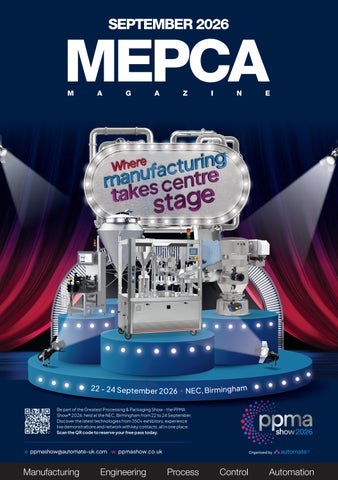
SEPTEMBER 2026
Manufacturing
Engineering
Process
Control
Automation
P 86 - In pharmaceutical and chemical production, decades-long plant lifespans clash with shortlived electronics. Outdated HMI systems jeopardise availability, audit security and cyber resilience.
Manufacturing has changed. Inspection must too. In an environment of constant change, manufacturers need smarter, more flexible inspection capabilities that can keep pace with evolving production demands.
Meet the NS42 AI Vision Sensor Does more. Costs less. The NS42 AI Vision Sensor is an all-encompassing, affordable smart vision sensor that helps you automate inspections, detect defects and improve quality. Without the complexity and cost you might find elsewhere.
Enhance quality with every inspection.
Automate more with one vision sensor.
Fast deployment with drag and drop programming
Future-ready through firmware upgrades.
Deliver rapid ROI.
Adapt effortlessly to evolving production requirements with the NS42 AI Vision Sensor. Keep your operations agile, competitive, and ready for the future of manufacturing.
AI-powered
Easy to deploy
Multiple inspection tools in one platform
Upgradeable
Ready to bring AI-powered inspection to your production line? Book a demo at www.zebra.com Food & Beverage
Pharmaceutical
Automotive
©2026 Zebra Technologies Corporation and/or its affiliates. Zebra and the stylized Zebra head are trademarks of Zebra Technologies Corporation, registered in many jurisdictions worldwide All rights reserved. All other trademarks are the property of their respective owners. 28/06/26
EDITOR’S NOTE Editor Oliver Batt oliver@cimltd.co.uk Publication Manager James Burke jb@mepca.com 01795 509105 Head of Brand Development Jim Bearden jim@mepca.com 01795 509105 Design & Production Grant Waters grant@cimltd.co.uk James Taylor james@cimltd.co.uk Administration Manager Natalie Woollin admin@cimltd.co.uk 01795 509103 Credit Facilities Manager Gwen Lee creditcontrol@cimltd.co.uk 01795 509103 Head of Digital Xhulio Bishtaja digital@cimltd.co.uk Marketing Manager Lucas Payne lucas@cimltd.co.uk Director Tom Woollin tom@cimltd.co.uk Managing Director John Denning © 2026 Cogent Multimedia Limited, 1st Floor, Saphir House, 5 Jubilee Way, Faversham, Kent, ME13 8GD. No part of this magazine may be reproduced or stored in a retrieval system or transmitted in any form – electronic, mechanical or physical – without express prior permission and written consent of the publisher. Contributions are invited and when not accepted will be returned only if accompanied by a fully stamped and addressed envelope. Manuscripts should be typewritten. No responsibility can be taken for drawings, photographs or literary contributions during transmission or in the editor’s hands. In the absence of an agreement the copyright of all contributions, literary, photographic or artistic, belongs to Cogent Multimedia Limited. The publisher accepts no responsibility in respect of advertisements appearing in the magazine and the opinions expressed do not necessarily represent the views of the publisher. The publisher cannot accept liability for any loss arising from the late appearance or nonpublication of any advertisement.
6
www.mepca.com
12
SEPTEMBER 2026
W
elcome to this colossal issue of MEPCA magazine. Our September edition focuses on Food Processing and is reflective of the importance of this sector to UK manufacturing. In this section we bring you a wealth of solutions, case studies and industry insights from across Food Processing. Turn to page 24 for an interview with Ann-Kathrin Kuehle, Industry Insights Manager at Mettler Toledo, who discusses the latest in inspection and detection technology. For those with a sweet tooth (of which I am guilty), Bronkhorst looks at controlled additive dosing in confectionary (p.28). Also to be found in this section, Croxons tells the story of the first British-made sparkling wine bottle; Miele reinforces the importance of pasteurisation; and SEEPEX explains how to turn organic waste into value; and many more. On our cover this month, The PPMA Show (p.12-13). Discover what’s in store at one of this year’s most hotly anticipated events. This is followed closely by MEPCA’s exhibitor preview featuring three PPMA regular: Beckhoff, Apex Dynamics and Kemtile (p.16-19). The MEPCA team will be attending The PPMA Show later this month, and I hope to see you there! Enjoy this issue in the meantime.
Oliver Batt, Editor @Mepca-magazine
To subscribe to MEPCA visit our website www.mepca.com or scan the QR code.
CONTENTS Industry Partners:
FEATURES 8 INDUSTRY NEWS 10 OPINION 12 COVER STORY 15 FOOD PROCESSING 74 DIGITALISATION 80 IMAGING & VISION SOLUTIONS
74
84 ADDITIVE MANUFACTURING 88 TEST & MEASUREMENT 90 DRIVES, MOTORS & CONTROLS 102 EVENTS 106 COMING UP
80
84
www.mepca.com
7
INDUSTRY NEWS
TIOXIDE RESTARTS TIO2 PLANT IN UK AT HISTORIC GREATHAM SITE
T
ioxide Materials Limited (Tioxide) today announced the successful recommissioning of the titanium dioxide (TiO₂) pigment production facility at Greatham in Hartlepool, marking a major milestone following LB Group’s acquisition of the site and its associated TiO₂ pigment assets earlier this year. Production has now commenced at the site, with single-stream operation underway and TIOXIDE® and DELTIO® products beginning to return to the market. The achievement represents an important step towards the new owners restoring the facility’s full manufacturing capability and enhancing long-term security of supply of TiO2 pigments for customers worldwide. The restart follows four months of careful commissioning, testing and maintenance work with Tioxide’s engineering, operations and technical teams working closely together to safely prepare the facility for commercial production. A phased ramp-up is now underway, with a clear roadmap to increase production capability and achieve full operational capacity by early 2027. Tioxide’s Greatham facility has a total nameplate capacity of 150,000 tonnes of TiO₂ pigment per annum, with production supported by a team of scientists at
the company’s new research and development centre in Wynyard and commercial and business support teams based at its headquarters in Stockton-on-Tees. Under its TIOXIDE® and DELTIO® brands, Tioxide produces a range of premium-performance TiO₂ pigments for use in coatings, plastics and inks applications. tioxide.com
PRECISION MICRO SEES SEMICONDUCTOR REVENUE SURGE
C
hemical etching specialist, Precision Micro has seen semiconductor-related revenue rise by 43 per cent over the past year, with semiconductor applications now accounting for around half of the company’s total revenue. As investment in artificial intelligence (AI), high-performance computing and advanced semiconductor manufacturing accelerates, demand for precision-etched metal components is placing increasing pressure on specialist manufacturing capacity. Precision Micro has secured multiple six-figure orders this year to manufacture ultra-precise metal components used throughout semiconductor production and advanced thermal management systems. Its chemically etched components are used within mass flow control systems that regulate specialist process gases during wafer fabrication, alongside precision cooling plates that manage heat within advanced semiconductor equipment. Manufactured from sheet metals ranging from 25 microns to 1.5 mm, these components require exceptional dimensional accuracy and repeatability. As semiconductor manufacturers expand production to meet sustained global demand, they are increasingly relying on specialist suppliers capable of delivering high-volume precision manufacturing without compromising quality.
8
www.mepca.com
“We’re seeing semiconductor demand shift from cyclical growth to sustained structural expansion, driven by continued investment in AI, advanced computing and semiconductor manufacturing,” said Ben Kitson, Head of Business Development at Precision Micro. With customer forecasts now extending years ahead rather than months, Precision Micro believes the semiconductor industry is entering a new phase in which access to specialist manufacturing capacity will become increasingly important to supporting continued growth across AI and advanced computing. precisionmicro.com
INDUSTRY NEWS
BF1SYSTEMS ACQUIRED BY LAGERCRANTZ BGF, the UK and Ireland’s most active growth capital investor, has successfully exited its investment in bf1systems (bf1), a leading provider of high-performance sensing, measurement and integrated electronics solutions for the motorsport, automotive and aerospace industries. The business has been acquired by Lagerantz Group.
L
agerantz Group AB (STO: LAGR-B), a technology group active in niche markets mainly in Northern Europe, providing bf1 with an owner experienced in supporting specialist engineering and technology companies. As part of the transaction, bf1 will operate autonomously within Lagercrantz’s Control Division, which specialises in products and solutions for control and measurement. Following BGF’s minority investment of £2.4 million in June 2019, bf1 has delivered consistent organic growth – increasing revenues to £17.8 million in the year to January 2026 – while broadening its customer base and deepening existing relationships with brands such as McLaren, Lamborghini and Porsche. With BGF’s support, bf1 also made the strategic acquisitions of KA Sensors and VPG Sim to expand the company’s product line, and sourced its Chair, Adam Robson, via the BGF Talent Network. Founded in 1994 and headquartered in Diss, Norfolk, bf1systems designs, manufactures and distributes highprecision components used across motorsport and performance automotive applications. Its products include steering wheels, tyre pressure and temperature monitoring systems, force measurement components, and integrated electronics. The company’s technology is used across major international motorsport series, including Formula 1, GT racing and IndyCar. Building on the development of its core tyre pressure monitoring systems (TPMS) offering, bf1 delivers this product into series such as Formula 1, IndyCar and the World Endurance Championship, and received a King’s Award for Enterprise in recognition of its TPMS technology. James Welham, MD of bf1, said: “bf1 has built strong momentum in recent years, supported by growing demand for our products and the continued development of our capabilities. BGF has been a hugely supportive partner over the past seven years, helping us broaden our product portfolio and accelerate our growth.” Matt Simcox, Portfolio Partner at BGF, said: “bf1 is a highly regarded British engineering business, with deep technical expertise and an established presence in the global motorsport industry. We have valued our longterm partnership with the business, supporting the team
through a period of sustained growth. Lagercrantz is a strong strategic and cultural fit, and we wish James and the team every success in the next chapter.” Grant Thornton UK advised bf1systems and its shareholders on the transaction. bf1systems.com
www.mepca.com
9
OPINION
DIGITAL FLOW IN THE UK PUMP INDUSTRY Wayne Rose, Chief Executive, British Pump Manufacturers Association (BPMA), looks at how harnessing data can transform the UK pump industry, from optimising production to improving product quality and traceability.
D
igitalisation is rapidly reshaping the UK pump industry, moving it beyond traditional engineering into a more connected, datadriven future. As expectations around efficiency, transparency and performance continue to rise, the ability to capture, analyse and act on data is becoming a defining factor in competitiveness across the sector. For many manufacturers, the journey towards digitalisation is already well underway. Advances in design software, simulation tools and smart manufacturing processes are enabling more precise product development and improved production efficiency. However, the most significant transformation is occurring not just in how pumps are made, but in how they are specified, operated and maintained throughout their lifecycle. A key driver of this shift is the growing emphasis on digital product information. Under frameworks such as the Ecodesign for Sustainable Products Regulation (ESPR), we are moving towards a future where products are accompanied by electronic nameplates and Digital Product Passports. These will provide detailed, standardised information on performance, energy use, materials and lifecycle characteristics, accessible throughout the supply chain. For the pump industry, this represents a major step forward in transparency and traceability. Specifiers and end users will be better equipped to make informed decisions, while manufacturers will need to ensure that their data is accurate, accessible and aligned with evolving standards. This shift is not without its challenges, particularly in terms of data management, interoperability and cybersecurity, but it is ultimately a positive development that supports higher standards and better outcomes. Beyond compliance, digital technologies are unlocking new opportunities to improve performance and reliability. The integration of sensors, connectivity and advanced analytics is enabling real-time monitoring of pumping systems, supporting predictive maintenance and reducing the risk of unplanned downtime. In sectors such as water and wastewater, energy and industrial processing, these capabilities can deliver significant operational and cost benefits. Artificial intelligence is also beginning to play a role, helping to optimise system performance, identify
10
www.mepca.com
inefficiencies and support more informed decision-making. Whether applied in design, manufacturing or end-use applications, these tools have the potential to enhance both quality and productivity. However, technology alone is not the answer. To fully realise the benefits of digitalisation, organisations must also invest in skills, processes and culture. This includes ensuring that employees are equipped to work with digital tools, that data is effectively managed and that systems are integrated in a way that delivers meaningful insight rather than complexity. At the British Pump Manufacturers Association (BPMA), we are supporting our members through this transition by providing guidance, promoting best practice and facilitating knowledge sharing across the industry. As digitalisation accelerates, collaboration will be essential to ensure consistency, interoperability and the development of common standards. Looking ahead, the UK pump industry has a clear opportunity to harness the power of data to drive innovation and performance. By combining engineering excellence with digital capability, the sector can continue to evolve and play a critical role in supporting modern, sustainable infrastructure. To learn more about the work undertaken by the BPMA on behalf of the UK and Ireland’s pump industry, please visit the organisation’s website. bpma.org.uk
OPINION
THE UK’S INVESTMENT MINDSET PROBLEM The UK doesn’t have a robotics problem, it has an investment mindset problem, argues Oliver Selby, BARA Chairperson and Head of Sales at FANUC UK.
T
he first half of 2026 has been notable for one reason above all others: the conversation around robotics in the UK has shifted. Manufacturers are asking how they can deploy it successfully and at scale. Across industry, government and technology providers, there is growing recognition that the challenge is adoption and skills. That is encouraging progress. Yet one stubborn obstacle remains in the UK: how investment decisions are made and then how quickly they get enacted. For years, UK manufacturers have approached automation through the lens of payback period. In many boardrooms, an automation project is expected to deliver a return within two years or less. While understandable, this mindset often leads businesses to prioritise the lowest upfront cost over the greatest long-term value. The reality is that automation is not a short-term purchase, but a long-term business capability. That is why manufacturers need to move beyond simple payback calculations and adopt a Total Cost of Ownership (TCO) philosophy when evaluating automation investments. A robot, machine tool or automated production cell should not be judged purely on its purchase price. The true value lies in everything that happens afterwards: productivity gains, labour efficiency, reliability, maintenance requirements, energy consumption, training, upgrades and service support. When viewed through a TCO lens, a very different picture emerges. Take reliability, for example. A lower-cost solution may appear attractive on day one, but if it generates higher downtime, longer repair periods or increased maintenance costs, the economics quickly deteriorate. In contrast, highly reliable automation can continue delivering productivity improvements for decades, dramatically changing the long-term return profile. The same principle applies to workforce development. One of the most significant themes emerging in 2026 has been the industry’s acknowledgement that successful automation depends as much on people as technology. New initiatives, including the Manufacturing Technology Centre’s Robot Experience Centre in Coventry, have been created specifically to help manufacturers build confidence, skills and understanding around automation adoption.
Training should therefore be viewed as an investment, not an expense. The organisations achieving the strongest automation outcomes are often those that invest not only in equipment, but also in developing the skills needed to maximise its value. There are broader strategic considerations too. As AI becomes increasingly integrated into robotics, manufacturers are gaining access to more capable offline programming tools, better more robust vision systems, and predictive maintenance tools. The question manufacturers should therefore be asking is not, “How quickly can this pay for itself?” but, “What value will this create over the next 10, 15 or 20 years?” If UK manufacturing is serious about addressing productivity challenges, labour shortages and global competitiveness, a change in mindset is required. We should stop treating automation as a cost to minimise, and start viewing it as a strategic asset to maximise. The UK’s robotics challenge is not a technology challenge; the technology already exists. Increasingly, the support infrastructure exists too. What is needed now is a more mature approach. bit.ly/4xapWfR
www.mepca.com
11
COVER STORY
REGISTER NOW FOR THE PPMA SHOW® 2026 Registration is now open for the PPMA Show® 2026. The UK’s leading event for processing and packaging machinery returns to the NEC, Birmingham, from 22–24 September 2026.
O
rganised by Automate UK, the three-day event brings together the latest innovations in processing, packaging, automation and industrial vision, giving manufacturers the opportunity to discover new technologies, gain expert insights and connect with the companies shaping the future of production. With more than 350 exhibitors representing over 1,500 leading brands, the PPMA Show® 2026 will once again attract thousands of manufacturing professionals looking for practical solutions to today’s operational challenges.
12
www.mepca.com
DISCOVER THE TECHNOLOGIES TRANSFORMING MANUFACTURING
Manufacturers continue to face increasing pressure to improve productivity, reduce costs, tackle labour shortages and meet evolving sustainability and regulatory requirements. At the same time, advances in automation, robotics, artificial intelligence and digital technologies are creating new opportunities to improve efficiency and future-proof operations. The PPMA Show® 2026 offers visitors the chance to explore these innovations first-hand. From processing and packaging machinery to robotics, automation systems, industrial vision and smart manufacturing technologies,
COVER STORY attendees can compare solutions from leading suppliers all under one roof. Whether investing in new equipment, upgrading an existing production line or planning future improvements, the event provides access to technologies designed to enhance productivity, consistency and operational performance. One of the show’s biggest attractions remains its live machinery demonstrations, allowing visitors to see equipment operating in real production environments and better understand how new technologies can be integrated into their own facilities.
EXCLUSIVE PRODUCT LAUNCHES AND LIVE INNOVATION
Returning for 2026 is the popular Innovations Eleven showcase. This dedicated feature gives selected exhibitors the opportunity to unveil brand-new technologies live during the exhibition, allowing visitors to be among the first to experience the latest product launches while hearing directly from the companies behind them. Alongside hundreds of additional product launches taking place across the show floor, the PPMA Show® continues to provide an unrivalled opportunity to discover the next generation of processing and packaging technology.
PRACTICAL INSIGHT FROM INDUSTRY EXPERTS
Alongside the exhibition, visitors can attend a comprehensive programme of keynote presentations from leading industry speakers and expert-led seminars exploring the trends shaping modern manufacturing. Sessions will cover topics including automation, artificial intelligence, digital transformation, sustainability, productivity, workforce and skills shortages, supply chain resilience and regulatory compliance. The seminar programme is designed to deliver valuable takeaways for every stage of the manufacturing journey. From practical implementation advice to emerging industry trends, visitors will leave with fresh ideas, expert guidance and greater confidence to make informed investment decisions that support long-term business growth and operational resilience.
BRINGING THE MANUFACTURING COMMUNITY TOGETHER
Beyond the technology on display, the PPMA Show® is one of the UK’s most important networking events for the manufacturing sector. Each year it brings together manufacturers, suppliers and technology providers from industries including food and beverage, pharmaceuticals, cosmetics, household products, industrial chemicals, pet food, engineering, FMCG manufacturing and contract packing. For many visitors, the opportunity to meet suppliers faceto-face, compare multiple solutions and discuss challenges with industry peers remains one of the event’s greatest strengths.
SUPPORTING MANUFACTURERS THROUGH CHANGE
Scott McKenna, Chief Operating Officer at Automate UK, believes the PPMA Show® continues to play a vital role in helping manufacturers embrace innovation and remain competitive. “The PPMA Show® is now in its 39th year, and our goal is to make it bigger and better every year, ensuring it remains relevant, educational and insightful for the entire manufacturing sector. “The processing, packaging and industrial vision sectors continue to face a range of challenges, from labour shortages and sustainability pressures to regulatory compliance and automation adoption. The PPMA Show® provides visitors with the opportunity to explore practical solutions, connect with leading suppliers and gain valuable insight from industry experts and keynote speakers. “As always, attendees will have access to state-of-the-art technologies designed to optimise performance, reduce costs and future-proof operations, with many innovations being showcased publicly for the very first time.”
REGISTER FOR FREE TODAY
Whether you’re looking to invest in new technology, compare suppliers, discover the latest innovations or gain practical advice from industry experts, the PPMA Show® 2026 offers everything you need to improve performance and prepare for the future. From live demonstrations and exclusive product launches to expert seminars and valuable networking opportunities, the exhibition remains the UK’s premier destination for manufacturing innovation. The PPMA Show® 2026 takes place at the NEC, Birmingham, from 22–24 September 2026. Attendance is free, and registration is now open. ppmashow.co.uk
www.mepca.com
13
food processing
Parvalux has extensive experience supplying the leading mixing machine manufacturers on the market today. With a wide range or standard products and an engineering team well-versed in modifying our products to suit, Parvalux geared motors can meet the exact requirements of your specification and offer the quality, reliability and durability that ensures your mixing system will continue to operate hassle-free for years to come. Visit https://www.parvalux.com/mixing-equipment or scan the QR code to find out more.
FOCUS ON:
FOOD PROCESSING
FOOD PROCESSING
THE PPMA SHOW® EXHIBITOR PREVIEW Ahead of this year’s PPMA Show, MEPCA spoke with a selection of the event’s regular exhibitors for previews of what they will be showcasing, and to gain an exhibitor’s perspective on why PPMA continues to be such a crucial fixture in the manufacturing and engineering events calendar.
T
he very first PPMA Show took place at the Telford International Centre in 1988. Since 1994, it has been held at the NEC, Birmingham, where this year’s highly anticipated show will take place 2224 September 2026. In an industry that is always in flux, whether this arises from geo-political or environmental crises, labour shortages, or the rapid evolution of disruptive technologies, The PPMA Show® seems, by contrast, reassuringly stable as it delivers a consistently vital event for the 38th year. This year, over 350 exhibitors are expected, showcasing the latest in processing and packaging machinery, automation, robotics, machine vision, and much more. Of those exhibitors, most return year-on-year (the retention
16
www.mepca.com
rate is over 70 per cent). Here, three of those regular exhibitors – Beckhoff Automation, Apex Dynamics and Kemtile – provide MEPCA’s readers with a preview of what technology they will be exhibiting this year, followed by insights into what keeps them returning to the show.
BECKHOFF AUTOMATION – STAND F40
Beckhoff will be showcasing a broad range of automation technologies aimed at helping machine builders and manufacturers create more flexible, compact and connected production systems. Highlights include the cabinet-free MX-System, a hygienic XTS linear transport system for washdown environments and XPlanar, which
FOOD PROCESSING
uses magnetic levitation for contactless product transport. Visitors can also see compact machine vision demonstrations, TwinCAT motion control, Beckhoff RT Linux and the new AX1000 servo drives and AF1000 variable frequency drives. Beckhoff will also be demonstrating a two-axis pickand-place system developed with HepcoMotion, showing how Beckhoff control technology can be combined with mechanical linear motion solutions. With so many systems running live, the stand gives visitors a chance to see how these technologies work in practice and discuss where they could fit into their own packaging or processing applications.
APEX DYNAMICS – STAND F62
Apex Dynamics will be showcasing a range of solutions at PPMA this year, including: • Demo units for automated pencil lead control • Rack and pinion system with lubrication control • Examples from our planetary servo gearbox ranges • SGM compact AC and DC gear motor units • High efficiency hypoid series • Apex’s servo worm range Apex Dynamics encourage visitors to drop by our booth and learn more about Apex Dynamics UK’s wide portfolio of precision gearboxes, rack and pinion systems, and couplings. The company will be showcasing some of our latest products and highlighting our unique offerings, which combine patented designs with a five-year warranty,
Apex Team 2025
two-to-three-week lead times, guaranteed delivery and ATEX as standard. Apex Dynamics team members on the stand this year: • Mike Gulliford, Managing Director • Andrew Parsons, General Manager • Malcolm Hillary, Northern Region Sales Manager • Jamie Coucher, Technical Sales Engineer, South / SW Region
KEMTILE – STAND D80
With sustainability, smart manufacturing and operational
www.mepca.com
17
FOOD PROCESSING
Kemtile - compliant flooring & drainage solutions
efficiency headlining at the show this year, Kemtile will be showcasing how its single source flooring credentials help to meet these modern-day demands in fast-moving process and packaging companies. All businesses are under increasing pressure to meet sustainability targets while maintaining the highest standards of hygiene, safety, and productivity. High on the agenda will be chat about the hidden environmental cost of flooring refurbishment, which means minimising the time spent replacing flooring. Longevity and durability will be top topics. Experts from partner supplier Polysto, Europe’s leading manufacturer of kerb and wall protection products will be demo-ing its new range of Cleanrock kerbs. The new recycled fibreglass formula is designed to deliver high impact resistance, improved hygienic performance while supporting more sustainable construction. Kemtile team members on the stand this year: • Akeel Ahmed – Business Development Manager • Dave Sleight – Key Account Manager • Jamie Cook – Operations Director • Paddy McGrath - Sales & Business Development • George Morton -Account Manager • Chris Cloherty - Head of Operations
WHAT DO THE EXHIBITORS HOPE TO GAIN FROM THE SHOW THIS YEAR?
Beckhoff: PPMA gives us the opportunity to speak directly with machine builders, OEMs and manufacturers about
18
www.mepca.com
The Kemtile Team
the challenges they are facing and the kinds of automation they need next. We want visitors to leave with a clearer idea of what is possible with technologies such as cabinetfree control and advanced motion, while also giving our team valuable insight into where the packaging and processing industry is heading. Apex Dynamics: We have been attending PPMA for many years and always look forward to attending, catching up with people we know, checking in with our existing customers and meeting new potential customers. As ever, we hope to communicate our messages clearly, gain insight into what’s driving our industry forward, have some fruitful conversations and make new connections.
FOOD PROCESSING Kemtile: We exhibit at PPMA for the opportunity to meet customers, chat through current and future flooring briefs, showcase innovation and most importantly win work. As one of the UK’s leading industrial flooring companies, we are always pushing boundaries, and PPMA is an invaluable opportunity to talk about flooring challenges direct with customer, and to promote quality, durable, single source solutions. We always get questions about listeria, cleanability of floors, maintenance & renewal of floors and enquiries around related services such as drainage and kerbs.
WHAT FEATURES OF THIS YEAR’S SHOW ARE THE TEAM MOST LOOKING FORWARD?
Beckhoff: For us, one of the best parts of PPMA is simply having the chance to catch up with customers, partners and other people from across the industry. It is always useful to hear first-hand what challenges people are facing and what they are working on. We are also looking forward to seeing the various live demonstrations at the show and hearing some of the discussions taking place in the seminar programme.
relationships and make new contacts that could turn into future business. Kemtile: In today’s tech-driven age it is great to do face to face with contacts old and new, get out from behind a desk or a floor and engage with experienced people. PPMA Show brings the best of the supply chain together and always presents opportunities to learn. It is a significant fixture for the industry because people do business there – we continue to win work from being at the show. For more information on this year’s PPMA Show®, visit the website below, or better yet, turn to pages 12-13 for the Cover Story. ppmashow.co.uk Beckhoff - XPlanar contactless product transport
Apex Dynamics: Every year at PPMA there is something new to see and more advancements in automation, some of which are new to us, some of which we are introducing to the market, and others that we have heard or read about but not had the opportunity to see in operation live. The live demonstrations, both on stands and in the theatre, are always interesting and it will be interesting to see how the 360° virtual stand tours enhance our experience as exhibitors. We also look forward to listening to the podcast. Kemtile: In particular, the Kemtile team are looking forward to the chance to mix with experts across the supply chain at speaking and networking mini events across the two days and just on the show floor, understanding the latest technological solutions and how others are approaching solving operational problems in the sector.
WHY DOES THE PPMA SHOW® REMAIN SUCH A SIGNIFICANT FIXTURE FOR THE INDUSTRY?
Beckhoff: Automate UK trade shows are always useful for us. They bring together so many people from across the processing and packaging industry in one place, giving us the chance to catch up with existing contacts, meet new people and see what is changing across the market. We expect PPMA 2026 will be a really valuable few days for the whole industry. Apex Dynamics: PPMA is always busy and well-attended. It’s a well organised and lively show, with lots of people coming with a genuine interest in discovering new ways of improving their applications of technology. Automate UK are continually innovating and introducing new ways for us to maximise the benefits of the show. It’s an excellent way to keep abreast of what is happening in the UK processing and packaging industry, as well as to strengthen existing
www.mepca.com
19
FOOD PROCESSING
PROFILE THE COOK & PROVE THE PROCESS Measurement instrument specialist PhoenixTM explains how thru-process temperature monitoring can support food processors with the validation of cook and chill processes as part of Hazard Analysis and Critical Control Point (HACCP).
A
s part of any food processor’s HACCP program, validation of cook and chill processes is a critical and significant task taking time, effort and resources. PhoenixTM have developed a thru-process temperature monitoring technology specifically for this task, designed to meet the challenges of the food processing market. It is deal for the validation process for any new cook regime, new product or annual process certification. Whether performing an oven survey, “oven mapping to identify cold spots” or validating the cook under production conditions, the thru-process profiling solution provides accuracy, efficiency and reliability needed to satisfy HACCP demands. As its name suggests, thru-process profiling is the method by which product and or process temperature is monitored throughout the complete cook/chill process. Where the use of external recorders with trailing thermocouples is impractical or unsafe, thru-process profiling can be used to monitor continuous conveyorised linear and spiral ovens, as well as semicontinuous or rotational batch cooks. Employing the thru-process principal process monitoring can also be performed under
true production conditions without compromising line productivity. At the heart of the thru-process monitoring system is the PhoenixTM data logger. The PhoenixTM NT data logger range has been designed specifically for the challenges of monitoring food processing applications with an IP67 case design protecting from moisture. Type K or Type T data logger options allow accurate measurement of both cook and chill processes. The data logger itself can operate between -40 °C to 80 °C with a data logger accuracy of ±0.3 °C operating below +50 °C. Data logger and thermocouple correction factors can be further applied to maximise measurement accuracy. PhoenixTM offer a family of thermal barriers to suit the process type, duration and temperatures of a wide range of cook regimes. An extensive range of different thermocouple types is also available to suit different product types, sizes and monitoring demands. The PhoenixTM Thermal View Food Software provides a comprehensive suite of analysis tools to convert the raw profile temperature data into useful process information. The analysis tools include the ability to calculate Fo/Pu values for the process against target micro-organisms. The information gathered, further to process validation, can be used to allow informed process problem solving and optimisation to maximise product quality, yield, process productivity and efficiency. phoenixtm.com
20
www.mepca.com
Why do 9 out of 10 business customers renew with us every year? Because the relationships we build with our customers are at the heart of everything we do.
Want to find out more?
We don’t just sell policies. We build partnerships.
Visit nfumutual.co.uk/MEPCA
We don’t just cover risks. We can help you avoid them. We don’t just show up when something goes wrong. We’re with you every step of the way.
That’s Manufacturer & Wholesaler Insurance the NFU Mutual way.
Closer to you. Closer to your business. Closer to what matters.
The National Farmers Union Mutual Insurance Society Limited (No.111982). Registered in England. Registered office: Tiddington Road, Stratford-upon-Avon, Warwickshire CV37 7BJ. Authorised by the Prudential Regulation Authority and regulated by the Financial Conduct Authority and the Prudential Regulation Authority. A member of the Association of British Insurers.
FOOD PROCESSING
OPTIMISING FOOD PROCESSING As food processing becomes increasingly automated, a reliance on manual inspection methods can hold back process optimisation. In the following article, LMI Technologies explains how manufacturers can harness the power of 2D and 3D vision with edge AI.
A
utomating food processing presents significant inspection challenges due to irregular product shapes, low-contrast surfaces and the high throughput of organic materials. Traditional manual inspection cannot keep pace with modern production speeds, or the rigorous quality and food safety standards required for mass production. To overcome these challenges, LMI Technologies delivers comprehensive, non-contact inspection solutions that combine metrology-grade 3D scanning and 2D imaging with advanced edge AI. By unifying 2D smart cameras, 3D smart sensors and on-device deep learning within the browser-based GoPxL® platform, manufacturers achieve intelligent inline inspection without external PCs or cloud dependency.
MAXIMISING PRODUCTION YIELD AND MATERIAL UTILISATION
Advanced inline inspection uses high-resolution 3D measurement to capture complete shape data and compute precise volumetric measurements that traditional 2D vision cannot provide. Networked Gocator® laser profilers continuously scan raw proteins, fish, cheese blocks, and other irregular products to calculate accurate volumes and cross-sectional geometry. This measurement data is transmitted instantly to downstream slicing and portioning equipment, enabling dynamic optimisation of cutting paths, improved slice consistency, higher product yield and reduced material waste.
COMPREHENSIVE DEFECT AND CONTAMINANT DETECTION
Combining 2D intensity imaging with 3D height data creates a complete surface profile for reliable defect detection. While 3D smart sensors accurately measure shape and volume, 2D smart cameras capture subtle cracks, discoloration, foreign material and surface blemishes that height data alone may not detect. The GoPxL® platform processes both inspection modalities within a single edge architecture. Using powerful tools such as GoPxL® Anomaly Detector, manufacturers can quickly train and deploy deep learning
22
www.mepca.com
models directly at the edge, enabling real-time detection of defects in baked goods, packaging and other food products with minimal development effort.
END-TO-END TRACEABILITY AND PACKAGING INTEGRITY
Food safety depends on complete product traceability and packaging verification. Beyond inspecting package features such as seals and closures, smart vision systems automatically read, decode and validate barcodes, batch codes and expiry information. Leveraging edge AI, Gocator® 2D Smart Cameras make real-time pass/fail decisions and immediately trigger rejection systems for mislabelled, damaged or noncompliant products.
NON-CONTACT QUALITY ASSURANCE AT PRODUCTION SPEED
Non-contact inspection eliminates contamination risk while maintaining reliable performance in demanding food production environments, including wet and washdown applications. Powered by NVIDIA® Jetson Orin™ NX processors, LMI inspection systems process complex datasets at rates of up to 3 kHz, providing 100 per cent inline inspection that improves product quality, maximises material utilisation, reduces downtime and scales efficiently across production lines and facilities. bit.ly/3TKT26K
Invertek Drives 2026 E4 Overview 1.00 MEPCA (210mm x 297mm) 3mm Bleed.indd 1
07/08/2026 11:04:33
FOOD PROCESSING
ASSURANCE IN PRODUCT INSPECTION In food production, the drive for smart manufacturing and stricter food & safety compliance increase in parallel. To understand how product inspection technology is evolving to support the production lines of tomorrow, our editor interviewed AnnKathrin Kuehle, Industry Insights Manager at Mettler Toledo.
A
s consumers, when we purchase a product, we trust we’re getting what’s on the label and that the product is of an acceptable and consistent standard. In Food Processing in particular, this trust is underpinned by an evolving architecture of regulation, technology and industry best-practice. Food manufacturers operate under increasingly demanding compliance and traceability requirements. Fortunately, detection and inspection technology continue to evolve to support them. Mettler Toledo provide cutting-edge product inspection solutions designed for the specific challenges faced by the diverse array of industries it serves, including food, pharmaceutical, cosmetic and chemical production. At Interpack in Düsseldorf, May, attendees queued to see Mettler Toledo’s latest product inspection technology in action. Among the technologies on display, the new M50 R-Series AdvancedLine Metal Detector and X56 DXD+ dual energy photon-counting x-ray inspection system proved to be particularly popular. Both were released earlier this year and feature the latest detection innovations. Ahead of our Food Processing-focused September edition, our editor got the opportunity to speak with Ann-Kathrin Kuehle (Anne), Industry Insights Manager at Mettler Toledo, who shared her insights in food safety and product inspection.
AI-ENHANCED INSPECTION
Addressing some of the challenges inherent in product inspection, Anne explained that there are combinations of different characteristics that contribute to certain foreign bodies being more difficult to detect than others. “Small contaminants can be difficult to detect, but also those with a low density or very similar to the product itself,” she said. The position of the contaminant can also play a role, as can the packaging material. For these challenges, X-ray inspection is often the right solution. “When it comes to X-ray inspection in general,” she continued, “low-density materials such as plastic or rubber are challenging, and for this we have a new photoncounting technology, which is really useful to detect low density or hard to separate foreign bodies.”
24
www.mepca.com
Ann-Kathrin Kuehle, Industry Insights Manager at Mettler Toledo. The company’s newest X-ray solution, the X56 DXD+, has increased sensitivity to overcome these challenges. Its advanced photon-counting technology has been enhanced with AI, making it more suited to the detection of low density or hard to separate foreign bodies, mitigating unnecessary product rejection in quality inspection. In the new M50 R-Series, AI-based machine learning is combined with 3S PLUS algorithm. However, metal detection offers a different challenge, as the product itself can create a signal that can mask that of the foreign bodies they are attempting to detect. This is known as “product effect”, which is common in high moisture, salty, or highly conductive products. “AI-based machine learning is used to reduce the active product signal to deliver the highest sensitivity, which also leads to greater detection accuracy,” she continued. This has helped them to “virtually eliminate false rejects.”
FOOD PROCESSING
M50 R-Series AdvancedLine Metal Detector
EPR AND SUSTAINABILITY
Extended Producer Responsibility (EPR) regulations officially came into full effect in January 2025, with the enforcement phase beginning in October 2025. It adds yet another dimension to manufacturers’ compliance duties. Offering advice to those businesses affected, Anne said: “Manufacturers should see this like a strategic, cross functional program and not just a compliance box ticking exercise.” The first step, she explained, is to identify the products and packaging streams are subject to EPR. The next step is to build-in traceability and data infrastructure. “And when it comes to products,” she continued, “Manufacturers may need to consider redesigning their packaging with EPR in mind.” Of course, this all about the bigger picture: sustainability. Something which Mettler Toledo take very seriously, as Anne highlighted: “We have a sustainability programme in place, which is called GreenMT.” Its focus is to reduce waste and packaging, shift towards recyclable materials and cut operational emissions. “We have now been carbon neutral for five years running and have received CDP Climate Change A rating,” she revealed.
AUTOMATED TESTING
Mettler Toledo has embraced automation testing method, and Anne explained how it has improved the efficiency and reliability of the technologies. To support the M50 R-Series, Mettler Toledo launched a new electronic test system called INFINITY. She described how, prior to this, the machines were tested manually using test pieces in a disruptive and time-consuming process. “You have to test it where it is least sensitive, and this is the centre of the machine. A manual process for which you need to stop your line,” she explained. “But with INFINITY, our electronic testing method, you don’t need to stop the line and you also don’t need to get an operator involved because it does the testing automatically.” This method doesn’t require actual test pieces, either.
M50 R-Series combines improved detection performance with intuitive operation
The benefit of automating inspection goes beyond efficiency and mitigating downtime, as Anne went on to illustrate with the automatic testing system (ATS), designed for gravity fall (aka gravity fed) and throat metal detectors. “So, to test those kind of metal detectors, you need to have an operator step on a ladder to work at height and put the test pieces into the gravity fall or throat metal detector. And from there, the operator also needs to reach the centre, and this can become quite difficult and also dangerous. With ATS, this is not necessary anymore, and it takes around 45 seconds.” With every dangerous manual test or inspection process that is automated, the safety of the operators working in these often-challenging environments is strengthened.
PROACTIVE, DATA-DRIVEN INSPECTION
The design of the company’s technology is driven by its customers. “We listen to them to really understand what their challenges are. And this is considered when we develop our new solutions and systems, and we also see what’s happening in the food safety compliance,” Anne said. Part of her role is to lead strategic market research projects and speak with customers and food industry organisations. This also involves looking for what’s on the horizon for the industry. “We believe that food inspection will move more away from reactive checks to really predictive, data driven end-to-end oversight across the whole supply chain. We expect to see even tighter regulation, more digitalisation, also greater use of AI and automation. But this also comes with more pressure to demonstrate transparency and sustainability,” she concluded. To see the technologies described here demonstrated, visit Mettler Toledo on Stand D84 this September at the PPMA Show®.
mt.com/pi
www.mepca.com
25
FOOD PROCESSING
PLANTRUN: THE SECRET INGREDIENT Driving improvements is all about the data and while manual data collection methods have long been the norm, they come with inherent limitations with their time-consuming processes and potential for inaccuracies. Enter PlantRun, the production monitoring game-changer.
P
lantRun goes beyond simple OEE and down time monitoring systems to integrate live machine data with production information. Developed by Tascomp, a Teesside-based industrial automation company, PlantRun is the result of over 45 years of software development. The secret ingredient to manufacturing excellence using PlantRun is that the data is collected directly from the machines and made available to everyone in the most appropriate way. Whether that is through integration with third party systems or triggered notifications that appear on TV screens or through text messages. Using this philosophy, PlantRun has tasted success helping numerous companies in the global food and drink industry, from monitoring sparkling wine bottling lines in Turin, to sandwich sealers and flow wrappers in Croydon.
FLIPPING QUALITY
A sausage and burger manufacturer implemented PlantRun for their production monitoring and continuous improvement processes. They also requested a number of interesting features, from on-the-fly translations, to foreign body alerts and a banger counter. Visualisation is an important lean technique for promoting improvements and here it has included making all staff aware of delays in production. With a “Time of First Pack” KPI making it clear as to how long it has been from the start of a shift to when the first product was received in the packing area. For product quality and mitigating waste, real-time tracking of scrap costs over the course of a shift makes it easier to be proactive about developing issues, with notifications through email and priority messages on TV screens triggering faster responses from key personnel.
BOTTLING SUCCESS
By analysing their captured production process data, a bottling plant are now reaping the benefits of implementing PlantRun on their site. As the plant’s manufacturing manager explained: “Initially in the early roll out of PlantRun we were unaware of the lost time that issues with line build back, and constant stop starting of the production line were
26
www.mepca.com
amounting to. PlantRun enabled us to see that short stoppage was the main driver. By analysing and using this data, we found that overall balancing of the line was crucial to minimising short stoppages.” By looking at optimum run rates identified by the data PlantRun collects, they were able to synchronise the speeds of the filler, labeller and packing machines and reduce downtime significantly. The results were clear to see for the manufacturing manager who added, “immediately we saw improvements in output and short stoppage went from hours lost to minutes per week”. Going forward they are now extending the functionality to focus on changeovers and ensuring that there is visibility of all of the key elements. plantrun.co.uk
✓ Peristaltic Pumps – Ideal for abrasive, corrosive and shear-sensitive media. ✓ Diaphragm Pumps – Handles aggressive, viscous and solids-laden fluids with safe dry-run capability. ✓ Lobe Pumps – Hygienic, low-shear pumping with smooth, pulsation-free flow for sensitive and high-viscosity applications. ✓ Dosing Pumps – Accurate, repeatable chemical dosing delivering precise flow control and reduced chemical consumption.
FOOD PROCESSING
CONTROLLED ADDITIVE DOSING From chocolate products to wine gums and liquorice, liquid additives play a decisive role in product quality. Measuring and controlling these flows directly offers a more reliable approach to dosing, explains low-flow specialist Bronkhorst.
I
n confectionery production, small quantities can have a large impact. Colourings, flavourings, acids and other liquid additives may represent only a minor part of the recipe, but they strongly influence taste, appearance and batch-to-batch consistency. In products such as chocolate articles, wine gums, liquorice and other sweets, inaccurate dosing can lead to visible deviations, flavour imbalance or rejected end product. When additives are expensive or highly concentrated, even small overdoses also have a direct cost impact. Many production lines still rely on dosing pumps that are set and validated on the assumption that their repeatability will remain stable under changing process conditions. In practice, viscosity, temperature, pressure, tubing condition and wear can all influence the actual amount being added. A pump may continue to run at the same setting, while the delivered dose gradually changes. Without direct flow measurement, such deviations are often detected only after quality checks on the finished product. A more controlled approach is to measure the additive flow continuously and use that signal to regulate a pump or valve. This creates a closed control loop: the desired dosing rate is defined, the actual flow is measured, and the system corrects the actuator when the process drifts. For confectionery manufacturers, this improves recipe control and reduces dependence on manual adjustments, operator experience or periodic calibration checks. Low-flow measurement technologies are particularly
28
www.mepca.com
relevant here because additives are often dosed in very small volumes. Coriolis mass flow meters, such as Bronkhorst mini CORI-FLOW instruments, measure mass flow directly and are suitable when high accuracy is required or when fluid properties may vary. Ultrasonic flow meters, such as Bronkhorst ES-FLOW instruments, measure volume flow through a straight sensor tube and are well suited for many hygienic liquid applications, including the dosing of colourants, flavourings and acids. The choice between technologies depends on the process, the medium and the required measuring principle. In both cases, the key improvement is the same: dosing is based on measured flow rather than pump behaviour alone. For batch dosing, dedicated instrument firmware such as FLUIFILL can further support the process by allowing the flow meter to handle dosing control, adapt to changing conditions and validate the delivered quantity. Configuration and monitoring can be carried out with FlowSuite, a free Bronkhorst software tool. This supports more consistent product quality, helps reduce additive waste and provides process data that can be used for traceability, troubleshooting and continuous improvement. For manufacturers facing frequent recipe changes, strict quality requirements or rising ingredient costs, controlled additive dosing is therefore a practical way to keep flavour, colour and texture within specification while reducing the risk of costly batch rejection. bronkhorst.com
od e Fo rag s ve on Be luti
So
MASS FLOW & PRESSURE MEASUREMENT AND CONTROL
Bronkhorst in Food & Beverage Dosage of liquid additives Fermentation process control Aseptic packaging Aeration of food products
Scan QR code for more information
Bronkhorst (UK) Ltd +44 (0)1223 833222 sales@bronkhorst.co.uk www.bronkhorst.com
FOOD PROCESSING
PRIORITISE END-OFLINE EFFICIENCY Across UK manufacturing, the conversation around automation is changing. While investment was once largely driven by growth, today’s manufacturers are increasingly focused on improving efficiency, resilience and making better use of existing resources. End-of-line efficiency could be the answer, explains Andrew Yates, Managing Director, Endoline Automation.
R
ecent industry initiatives and governmentbacked programmes are also encouraging businesses to accelerate the adoption of smarter manufacturing technologies to improve productivity and competitiveness. For many manufacturers, the biggest opportunity isn’t necessarily to add more production capacity – it’s to make existing operations work more efficiently. Rather than simply producing more, businesses are looking at how they can make better use of materials, labour, energy and production time without compromising output. Increasingly, that means taking a closer look at the end of the production line. Packaging may be the final stage of production, but its impact extends throughout the entire operation. A packaging bottleneck, inconsistent case quality or unplanned stoppage can quickly disrupt upstream processes, reducing Overall Equipment Effectiveness (OEE), increasing material waste and creating unnecessary downtime. Small improvements in packaging performance can therefore deliver significant gains in productivity, product quality, labour utilisation and overall line efficiency. For food manufacturers, the consequences can be even greater. A damaged case or failed pack may result in perfectly good product being rejected, increasing both operational costs and avoidable food waste. As businesses balance commercial pressures with sustainability objectives, reducing these inefficiencies has become an important operational priority. At the same time, packaging operations are becoming more complex. Product portfolios continue to expand, production runs are becoming shorter, and manufacturers are managing more frequent changeovers while maintaining consistent quality and throughput. End-of-line equipment must therefore deliver far more than speed alone; it must provide the flexibility and reliability needed to support an evolving production environment. The most effective end-of-line automation is the result of engineering the right combination of technologies to optimise the performance of the entire production line. Manufacturers are increasingly seeking solutions that
30
www.mepca.com
integrate seamlessly into existing operations, simplify changeovers, accommodate changing pack formats and can be scaled as production requirements evolve. These priorities are expected to shape many of the conversations at this year’s PPMA Show, where Endoline will showcase its expanded robotics capability. Visitors to PPMA 2026 (Stand D90) will be among the first to see this capability in action. Demonstrating a fully integrated end-of-line production line combining case erecting, case sealing and palletising, the company will showcase how connected automation can improve productivity while providing the flexibility to adapt to changing production requirements. Building on its established robotics division, Endoline has expanded its portfolio through a collaboration with Montech, enabling the company to offer both gantry and articulated robotic solutions. The combined demonstration will highlight how integrated, scalable end-of-line systems can be engineered to meet the specific requirements of modern food manufacturing operations. endoline-automation.com
SEE THE FUTURE OF
PACKAGING. Experience intelligent end-of-line automation in action. Visit our experts at the PPMA Show and discover how we drive productivity, reliability & ROI.
CASE ERECTING
CASE LOADING
CASE SEALING
ROBOTIC PALLETISING
COMPLETE SOLUTIONS
VISIT US AT
PPMA 2026 22-24 September 2026 Stand D90, Hall 5 | NEC Birmingham
+44 (0) 1767 316 422 sales@endoline-robotics.com endoline-automation.com
SM A RTE R AU TO M ATI ON. STRONG ER PERFORMANCE.
FOOD PROCESSING
FOOD PROCESSING’S HIDDEN INGREDIENT Modern food production lines demand greater connectivity, but what often gets overlooked is the infrastructure needed to support it. This article looks at why making room for network capacity in food processing is essential.
W
alk onto a modern food production line and it’s easy to see how much manufacturing has changed. AI-powered vision systems inspect fill levels and label placement, checkweighers verify product consistency, and sensors monitor everything from flow rate to temperature. Alongside them, predictive maintenance platforms and real-time production dashboards are helping manufacturers build a far more complete picture of what’s happening across the factory floor. This transformation is also being driven by demanding traceability regulations. In the UK, as well as across the EU, food businesses must operate a “one step back, one step forward” traceability system, meaning they must be able to identify exactly who supplied a particular ingredient or batch, and exactly where the finished product ends up. In the US, the FDA’s Food Traceability Rule requires electronic records of key tracking events for certain foods to be produced within 24 hours of a request. Whether it’s AI-driven quality inspection, predictive maintenance or digital traceability, these systems all have one thing in common: they rely on a continuous, reliable flow of data from the production line. Every improvement to quality assurance or traceability usually means another device joining the network. As more production-critical systems become network dependent, the impact of connectivity issues extends beyond inconvenience. A network interruption can affect production visibility, quality control and ultimately uptime. What often receives less attention is the connectivity infrastructure inside the control panel. It is a familiar scenario on live production lines: when a network switch runs out of ports, another is added. Before long, multiple
32
www.mepca.com
smaller switches can end up daisy-chained together. While this approach solves the immediate problem, over time it can increase wiring complexity, consume valuable cabinet space and introduce more hardware to power, maintain and troubleshoot. Traffic passing between switches is also limited by the single uplink connecting them, which can become a bottleneck as more devices share the network. In food processing, these challenges are often compounded by strict hygiene requirements. Smaller, simpler enclosures mounted close to the production line help minimise surfaces where residue or bacteria can accumulate, but leave far less room for networking equipment. The challenge is no longer simply connecting more devices; it is connecting more devices within cabinets that have not grown to accommodate them. Designing for future expansion means considering the sensors and systems required tomorrow. Recognising this challenge, Brainboxes will introduce a new solution later this Autumn: a compact 16-port Ethernet switch with top-and-bottom port orientation, developed for applications where panel space is limited. Rather than asking engineers to redesign cabinets around expanding network requirements, it brings greater capacity to the space they already have, reflecting Brainboxes’ approach to industrial connectivity: designing solutions around the realities of modern control panels. brainboxes.com/Inside-the-Cabinet
FOOD PROCESSING
WHY MANUFACTURERS MUST VALIDATE CIP Assuming that a production line is clean rather than validating it risks contamination and product recall. With regulatory scrutiny intensifying and recall costs escalating, the days of running fixed duration cleaning cycles are over, as Andy Walker of ifm explains.
I
t happens more often than the industry would like to admit: products having to be recalled because they potentially contain unwanted contamination caused by an inadequately cleaned production line. Clean-in-Place (CIP) cycles are often run for fixed durations with the assumption that after the scheduled cycle time is complete, the production line should be clean. This is not always the case;
34
www.mepca.com
‘should be clean’ is not the same as ‘validated clean’. Time-based CIP assumes everything is constant: media concentration, temperature, flow rate and contamination level. In reality, none of these variables remains fixed. A 10-minute rinse might be perfect when the system is lightly soiled and chemicals are at full strength. The next day, with heavier residue or diluted cleaning solution, that same 10 minutes might leave product residues that become the next batch’s contamination problem.
FOOD PROCESSING
Time-based CIP creates a dangerous choice: overclean to be safe (wasting water, chemicals, energy, and production time) or under-clean and risk product safety. Neither is acceptable when you can actually measure what’s happening. To validate a CIP cycle, you need to measure conductivity, temperature and flow rate. Cleaning chemicals, rinse water and food products each have distinct conductivity values. By monitoring conductivity in the return line, you can detect exactly when cleaning agents have been flushed out and pure rinse water is flowing through the system. This confirms complete removal of chemicals before reintroducing the product, preventing chemical contamination while eliminating wasteful extended ‘just to be sure’ rinse cycles. Temperature monitoring throughout the cycle confirms that cleaning is occurring at the correct temperature for effective chemical reaction and microbial control. Many plants measure supply temperature but fail to verify actual media temperature at the point of use, even though CIP effectiveness depends entirely on maintaining the correct temperature throughout the process. This is even more important in SIP (sterilise-in-place) applications, where thermal disinfection must be proven rather than simply assumed. Flow rate verification confirms sufficient mechanical action to remove residues. Inadequate flow results in incomplete coverage and ineffective cleaning, regardless of the length of the cleaning cycle. Monitoring flow through the system also reveals blockages or pump degradation before they compromise hygiene. Measuring conductivity, temperature and flow together creates an objective ‘cleaning signature’ for each cycle. This data-driven approach transforms CIP from a time-based ritual into a validated, optimisable process. The critical measurement point is the return line, where media exits the vessel or tank. This tells you what’s coming out of your system, not just what you’re putting in.
While inlet monitoring verifies supply conditions, only the return line data provides proof of cleaning effectiveness. Modern instrumentation can now monitor multiple parameters in a single device, reducing potential contamination points and simplifying installation. Look for sensors that integrate conductivity, temperature, volume, and flow measurement in a single device with IO-Link connectivity, such as ifm’s SM Foodmag, to ensure accurate data reaches your SCADA or MES system. Start by establishing a baseline ‘clean’ signature for each product and cleaning agent combination. Set clear acceptance criteria and log every cycle digitally. Once you have reliable data, use it to optimise cycle duration. Many plants discover they’re over-cleaning by 20-30 per cent because they’re working to conservative time estimates rather than measured completion. Validated CIP will let you reduce water, chemical and energy consumption. Beyond regulatory compliance, validated CIP delivers measurable financial returns. Water savings alone often justify the investment within 6 to 12 months. Shorter validated cycles mean more production uptime. Reduced chemical consumption cuts operating costs. And the ability to prove your cleaning process worked protects against the cost of recalls. More importantly, real-time validation prevents contaminated batches from reaching customers in the first place. The cost of a recall – in product waste, brand damage and regulatory consequences – far exceeds any investment in proper monitoring equipment. The regulatory environment is tightening and customer expectations for food safety continue to rise. Time-based CIP protocols that were acceptable 20 years ago no longer meet today’s standards for process validation and traceability. The technology to validate CIP properly is now accessible and cost-effective. The question every food and bev manufacturer should ask is not ‘Can we afford to implement validated CIP?’ but rather ‘Can we afford not to?’. ifm.com/gb/en
www.mepca.com
35
FOOD PROCESSING
PEACE OF MIND UNDER PRESSURE For a business operating at the forefront of food safety, confidence in its critical utilities is non-negotiable. In this case study, learn how Deli 24 strengthens reliability in food manufacturing with Atlas Copco Oil-Free Compressors.
A
t Deli 24’s Milton Keynes facility, where highpressure processing (HPP) is used to extend shelf life without heat, compressed air underpins everything from product handling to packaging. Ensuring that supply is consistent, clean and resilient is therefore central to maintaining both operational continuity and product integrity. Deli 24 is the UK’s leading contract HPP processor, supporting food manufacturers across a wide range of categories including baby food, meat, seafood, dairy and prepared products. Its process applies intense pressure to packaged foods, delivering the same pathogen reduction as pasteurisation while preserving taste, colour and nutritional value. Within this environment, compressed air plays a vital supporting role, powering machinery and enabling processes such as air knives for drying packaging prior to date coding. “Compressed air is an essential part of our whole process,” says Paul Winter, Director at Deli 24. “From conveyor systems to the operation of key machinery, it underpins a lot of what we do day to day. When you’re
36
www.mepca.com
producing food for major retailers, everything must work exactly as it should.”
A JOINED-UP APPROACH TO SYSTEM PERFORMANCE
Deli 24 had operated an oil-free compressor on site for more than 15 years, supported by a long-standing service relationship. As operational requirements evolved, however, the company took the opportunity to reassess its compressed air system more holistically. Atlas Copco began with a full air audit, examining not just the compressor itself but the wider distribution network and how air was being used across the site. This identified inefficiencies including previously undetected air leaks, prompting upgrades to pipework and connections using more modern systems. A follow-up audit confirmed the improvements, ensuring that the compressed air being generated was now being used effectively across the process. “It wasn’t just about replacing a machine,” Winter explains. “It was about understanding what we had, how
FOOD PROCESSING
we were using it, and where improvements could be made. That gave us a much clearer picture of what the right solution looked like.”
BUILDING RESILIENCE INTO PRODUCTION
Alongside system optimisation, Deli 24 introduced a second ZT22 VSD oil-free rotary tooth compressor, creating a duty/standby arrangement to support production continuity. The new compressor sits alongside the existing ZT22 VSD unit, providing additional capacity while maintaining operational flexibility for future growth. This configuration means that maintenance can now be carried out during normal working hours, without impacting production schedules. It also ensures that compressed air supply can be maintained even if one unit is offline. “For us, the biggest benefit is peace of mind,” says Winter. “We’ve had a very reliable system over the years but having that additional compressor in place gives us confidence that we can keep running without interruption. That’s particularly important in a food environment like ours.”
SUPPORTING FOOD SAFETY AND COMPLIANCE
Given the nature of Deli 24’s operations, air quality is equally critical. Oil-free compressed air from Atlas Copco’s ZT rotary tooth compressors supports applications where there is potential contact with food products or packaging, helping to eliminate contamination risk and support compliance with food safety standards. The company operates to strict retailer and certification requirements, with regular audits from both customers and regulatory bodies. Within this context, the reliability and quality of compressed air are closely linked to maintaining those standards. “As we work with a wide range of food products, including ready-to-eat and baby food, maintaining a clean and controlled environment is essential,” Winter adds. “That extends to utilities like compressed air, which form part of the overall process.”
A TURNKEY INSTALLATION
The project was delivered as a fully managed installation, covering planning, equipment positioning, pipework
modifications and commissioning. Despite the constraints of an existing plant room, the system was reconfigured to accommodate both compressors side by side, alongside additional equipment including an air receiver to support system stability. Installation was carried out in stages to minimise disruption, with work scheduled around production requirements. Once complete, the upgraded system was integrated seamlessly into operations. “We wanted a turnkey solution, and that’s exactly what we got,” says Winter. “From the initial discussions through to installation and commissioning, everything was handled as one joined-up process. That made a big difference for our engineering team.”
LOOKING AHEAD
In addition to improving reliability, the system has been designed with future growth in mind, providing additional capacity as Deli 24 continues to expand its operations. The company is also exploring digital monitoring tools to provide greater visibility over performance and maintenance planning. For Atlas Copco, the project highlights the importance of taking a system-level view of compressed air needs rather than focusing solely on equipment replacement. “Understanding how compressed air is used across the site was key,” says Michelle Tripp, Oil-Free Sales Engineer at Atlas Copco. “The audit allowed us to identify inefficiencies, address them, and then specify a solution that supports both current operations and future plans. Alongside that, introducing a duty/standby arrangement gives Deli 24 the resilience and flexibility they were looking for.” For a business built on delivering safe, high-quality food at scale, that combination of performance and reassurance is critical. By strengthening its compressed air infrastructure, Deli 24 has created a more robust foundation for its HPP operations, ensuring that essential processes continue to run smoothly, day in and day out. For more information on Atlas Copco’s oil-free compressed air solutions for food and beverage production, visit the address below. hubs.li/Q04ptKSB0
www.mepca.com
37
FOOD PROCESSING
QUALITY MONITORING & CLEANING EFFICIENCY In the following case study, a leading Japanese manufacturer of nutritional therapy foods improved quality monitoring and reduced cleaning time at its facility thanks to a hopper system designed by BFM®.
T
he Japanese nutrition manufacturer produces powdered formulations for patients with swallowing disorders and those requiring tube feeding. Maintaining hygiene at the facility is a top priority. The company sought to improve the monitoring of its powder production and optimise its cleaning processes. It also wanted to eliminate powder leaking into the plant from a free-fall hopper transition. But this proved difficult with its existing setup of fully steel hoppers, buffer tanks and traditional clamped sleeves. Seeking a versatile and hygienic solution, the manufacturer turned to the BFM® fitting connector system.
THE CHALLENGE
The plant used 840L steel buffer tanks that often encountered clogging, bridging and ratholing problems that were difficult to clear. There was no product flow visibility to alert the operators to bridging or ratholing. These large steel tanks also required cleaning once per month, which involved a difficult removal, relocation and replacement process that took four days and multiple staff. In addition to the buffer tanks, the company had a problem with dust leaking from a hopper connection under a vacuum conveyor. The powdered product was being fed into the hopper via freefall with just a short, oneended clamped connector surrounding the product flow. This meant the product was not fully contained and leaked into the production area, causing a health and safety concern.
THE BFM® SOLUTION
The local BFM® fitting distributor designed a two-piece hopper system using BFM®’s durable, transparent Seeflex 040E polyurethane. The customer now has constant visibility of the product flow, and the anti-static nature of the material has helped reduce powder adhering to the walls of the hopper. Any blockages can be easily seen and manually remedied by massaging the flexible walls of the tapered connector to free up the product flow. Cleaning time has also been significantly reduced as it now requires only one person who can easily remove and
38
www.mepca.com
BFM® Seeflex two-part hopper solution
transport the flexible connectors to the cleaning area. On the other hopper connection, a BLUEBAND™ connector system was installed to fully encase the gravity feed powder, providing a 100 per cent sealed system, improving hygiene for both product and staff. “We undertook lots of product tests on various options before deciding on changing to the BFM® fitting system. The transparency of the new hopper system lets us visually see the product and detect any issues before they become a problem. The ease of removal and refitting has also made our regular cleaning processes much more efficient.” – Maintenance Manager BFM® fitting is the world-leading snap-in flexible connector technology that has over 50 distributors around the world. ProSpare Ltd is authorised distributor for BFM® fitting in UK; it has a team dedicated to helping customers get the most from the BFM® range, including field-based application and technical assistance. prospare.co.uk
FOOD PROCESSING
INNOVATIVE LIQUID FLOW MEASUREMENT Today’s OEMs demand technologies that simplify system integration, improve hygiene, support environmental regulations and deliver long-term reliability. Responding to these requirements, Titan Enterprises’ strategic investment in research and development, demonstrates how engineering innovation can solve real-world application challenges in the food and beverage industry.
A
recent example is Titan’s new Ultrasonic Beverage Meter, developed specifically for OEM beverage dispensing systems. Unlike conventional turbine-based devices, the flowmeter uses ultrasonic time-of-flight technology with no moving internal parts, creating a straight-through flow path that eliminates mechanical wear while simplifying cleaning and reducing maintenance requirements. Designed for low-flow beverage applications, the compact sensor delivers repeatable measurement performance and straightforward integration into existing dispensing equipment. Importantly, the product has been developed through extensive customer evaluation, allowing operational feedback from active installations to refine its mechanical design and electronic signal processing, augmenting its commercial release. Collaboration is another defining element of Titan’s innovation strategy. The company’s partnership with RWC demonstrates how complementary technical expertise can accelerate product development. Working together, the two organisations integrated Titan’s proven flow measurement technology directly into RWC’s PolarClean range for tube-in-tube beer dispensing, creating a fully integrated flowmeter assembly that reduces installation complexity while maintaining flow measurement accuracy and system reliability. The project relied heavily on rapid prototyping, stereolithography (SLA) models, iterative design reviews and customer validation, highlighting the value of collaborative engineering throughout the product development cycle. Alongside product development, Titan is preparing for future regulatory change. As international legislation surrounding per- and polyfluoroalkyl substances (PFAS) continues to evolve, the company is evaluating alternative fluorine-free polymers capable of maintaining the chemical resistance, dimensional stability and mechanical durability required within its turbine flowmeters. Titan’s R&D team is investigating alternative PFAS-free materials through rigorous testing to ensure that future products continue to meet demanding industrial performance requirements without compromising reliability or measurement accuracy.
Taken together, these initiatives demonstrate that Titan’s approach to innovation extends well beyond individual products. By combining advanced sensing technologies, collaborative engineering partnerships and proactive materials research, the company continues to develop flow measurement solutions that address both today’s application challenges and tomorrow’s regulatory and operational demands. flowmeters.co.uk
www.mepca.com
39
FOOD PROCESSING
PORTABLE GAS DETECTION Effective gas detection and monitoring are therefore essential, enabling food processing operators to protect personnel, minimise operational risk and meet the requirements of UK health and safety regulations, as Paul Davidson, Gas Safety Expert, Draeger Safety UK describes here.
T
he use of gases is integral to many food processing operations, from beverage production and packaging to refrigeration and storage. However, gases such as carbon dioxide and ammonia can pose significant hazards to worker health and safety if leaks or elevated concentrations occur. Portable gas detection devices are an essential tool in protecting employees by providing early warning of the presence of toxic or flammable gases. As food processing becomes increasingly automated and production more complex, having a solid grasp of this important safety issue enables greater understanding and potentially more informed decisions when deploying gas detection equipment across food production facilities.
WHAT IS A PORTABLE GAS DETECTOR?
Portable gas detectors, sometimes referred to as personal or compliance monitors, are compact, battery-powered devices designed to be worn by workers, typically clipped to clothing within the breathing zone at chest height. They may also be handheld or used as standalone monitoring devices. Their purpose is to provide early warning of hazardous gas concentrations or oxygen depletion in the wearer’s immediate surroundings, allowing workers to evacuate or take other appropriate action before conditions become dangerous. Portable gas detectors are available as single-gas or multi-gas instruments. Multi-gas detectors are capable of simultaneously monitoring several hazards using multiple sensors within one device. When a detector senses gas concentrations reaching a pre-set alarm threshold, it activates audible, visible and vibrating alarms to alert the wearer. This warning enables workers to leave the area quickly and initiate emergency procedures before exposure reaches dangerous levels.
GAS DETECTION REGULATIONS IN THE UK Gas detection is tightly regulated in the UK to ensure worker safety, and there are three key regulations which employers must adhere to in order to keep their employees safe.
40
www.mepca.com
1. EH40/2005 Workplace Exposure Limits (WELs) EH40/2005 specifies WELs for many hazardous substances, including gases commonly encountered in food processing. Employers have a legal duty to prevent employees being exposed above these limits. The WEL values are split into two parameters: Long-Term Exposure Limit (LTEL), which means maximum average exposure over an eight-hour working day (Time Weighted Average); and Short-Term Exposure Limit (STEL), where the maximum average exposure over a 15-minute period to protect against acute health effects. Gas concentrations are measured using units including parts per million (ppm) and percentage by volume (%Vol).
FOOD PROCESSING For example, a reading of 50 ppm carbon monoxide indicates there are 50 parts of carbon monoxide in every million parts of air. 2. COSHH The Control of Substances Hazardous to Health (COSHH) regulations require employers to assess and control exposure to hazardous substances, including gases, vapours and airborne contaminants. COSHH makes compliance with WELs legally enforceable. 3. Flammable atmospheres Food processing facilities may also need to consider explosive atmospheres where flammable gases are present. Understanding the Lower Explosive Limit (LEL) and Upper Explosive Limit (UEL) is fundamental. The LEL represents the minimum concentration at which a gas can ignite in air, while the UEL is the maximum concentration capable of supporting combustion. Portable gas detectors typically alarm at around 10-20 per cent of the LEL, providing sufficient warning before an explosive atmosphere develops.
WHY PORTABLE GAS DETECTORS ARE USED
Portable gas detectors generally serve three key purposes: • Personal safety: to protect workers from immediate or long-term exposure. • Operational integrity: to identify leaks and prevent fires or explosions. • Regulatory compliance: to meet occupational health and safety regulations. Portable detectors often complement fixed gas detection systems rather than replace them. Fixed gas detection provides continuous monitoring in locations such as refrigeration plant rooms, carbon dioxide storage areas and packaging halls. Portable monitors provide personal protection for maintenance engineers, hygiene teams, contractors and workers entering confined spaces or areas where fixed monitoring may not be available. Using both systems together provides a comprehensive approach to gas safety.
EFFECTIVE GAS SAFETY PROCEDURES
Portable gas detectors are only effective when supported by robust procedures. Every food processing site should undertake a suitable and sufficient risk assessment to identify potential gas hazards, determine appropriate control measures and establish emergency arrangements. Essential elements of an effective gas safety programme include ongoing employee training to ensure employees understand gases present within their workplace, how detectors operate, alarms and how to respond and emergency evacuation procedures. Regular emergency exercises are also crucial to help reinforce procedures and ensure employees understand evacuation routes, assembly points and re-entry controls.
Paul Davidson, Gas Safety Expert, Draeger Safety UK
Also essential is regular maintenance, testing and calibration of equipment; manufacturers generally recommend servicing every six to twelve months, although requirements vary according to equipment type and operating conditions. Routine maintenance should include: • Visual inspection before use • Bump testing to verify sensors and alarms respond correctly • Calibration at intervals specified by the manufacturer • Replacement of consumable components where required. Calibration is particularly important because gas sensors naturally drift over time. Without regular calibration, detectors may fail to alarm at the correct concentration, potentially placing workers at risk.
CONCLUSION
Portable gas detectors save lives every day, but only when used correctly and when an effective procedure is in place. By integrating portable gas detection into a wider gas safety management programme, understanding the key regulations and health impact of gas exposure, food processors can reduce risk, helping to ensure that everyone goes home safely at the end of every shift. For more information, visit the company’s website. bit.ly/45EY1Zl
www.mepca.com
41
FOOD PROCESSING
HYGIENE IN FOOD PROCESSING Tork, a brand of Essity — a global, leading hygiene and health company — explains why hygiene and sanitation should be viewed as an essential part of productivity, compliance and operational resilience in food processing environments.
I
n food processing, hygiene is central to product safety, workforce wellbeing and business continuity. The UK is well regarded for its stringency with some of the strictest food safety, processing, and hygiene standards globally, frequently scoring highly in international food security and safety indices. The latest Economist Enterprise Resilient Food Systems Index (RFSI) ranks the UK in the top 10 (ninth) in food safety of 60 countries assessed. Food processing environments face specific pressures with tight production schedules, the necessary cleaning of equipment between runs and teams working across hygiene zones with procedures to prevent crosscontamination. In these environments, effective hygiene systems allow a food processing plant to operate efficiently and without unnecessary delay.
HYGIENE AND OPERATIONAL EFFICIENCY
Food manufacturers generally invest heavily in quality control, traceability and process optimisation, and hygiene systems should be considered part of the same operational framework. If cleaning materials are not available at the point of need or if dispensers run empty, avoidable disruption is creeps into the working day. Well-planned hygiene provision can help reduce these interruptions, supported by products designed to limit consumption and minimise refill times. Placing wiping, cleaning and hand hygiene systems close to where they are used supports compliance while reducing unnecessary movement around the site. Higher capacity, easy-to-maintain dispensers can also help facilities and hygiene teams keep pace with peak periods and cleaning schedules.
SUPPORTING SAFETY AND COMPLIANCE
Effective sanitation also supports food safety culture, especially in the UK where standards are so high. Intuitive hygiene systems reinforce expected behaviours and make compliance easier for employees and contractors to adhere to. In environments where contamination risks must be tightly managed, small improvements in accessibility, visibility and routine can make a critical difference. Food processing sites require hygiene products that are suitable for demanding tasks, including general cleaning of spillages and sanitising equipment in between production.
42
www.mepca.com
Using fit-for-purpose materials can help reduce waste, improve task efficiency and support more controlled cleaning processes. Tork manufacturing expertise highlights the role of industrial wiping and cleaning systems in helping sites save time, reduce waste and work more efficiently. While every food processing facility has its own risk profile and procedures, the principle that hygiene systems should be designed around the realities of the working environment remains the same.
A STRATEGIC APPROACH TO SANITATION
For food processors, hygiene and sanitation contributes to productivity, quality assurance, employee wellbeing and brand protection. By reviewing how hygiene products are accessed, used and maintained across the site, manufacturers can identify practical opportunities to improve efficiency and reduce risk. For more information, visit the website below. torkglobal.com
FOOD PROCESSING
A NEW DIMENSION IN PACKAGING LABELS Neil Cook, Marketing & Business Development Leader at Xaar, looks how digital embellishment is giving packaging and labels a new dimension.
I
n food and beverage, packaging has never been judged solely on its looks. Increasingly, it is now being designed to be felt as well as seen, with brands looking to deliver a much more engaging experience for consumers. Brands are therefore looking beyond colour and graphics to differentiate their products, and texture is becoming an increasingly important part of that packaging conversation. Raised varnishes, foils, embossed-style finishes and other tactile effects can add a physical element to packaging, encouraging consumers to pick up, handle and engage with a product before they buy it. This approach has long been seen in premium categories, particularly wine and spirits, where textured labels are used to signal quality and create a distinctive shelf presence. Similar techniques are now becoming relevant across confectionery, speciality foods and limitededition packaging, as brands seek new ways to strengthen shelf appeal and product recognition. Digital inkjet is playing a key role in enabling this shift thanks to advances in high-viscosity printing and highlaydown capability which make it possible to apply thicker layers of varnish with greater precision. This is helping converters create textured finishes and embossed-style effects as part of a more streamlined production workflow, reducing reliance on multiple finishing stages. Overall, this makes tactile effects far more practical across shorter runs and more varied packaging requirements. While tactile and embellishment effects were once more closely associated with specialist finishing processes, digital print technology is changing that picture. Printbars such as Xaar’s Versatex can bring digital capability to analogue label and finishing lines, enabling converters to add embellishment, braille and variable data capabilities to existing production environments. This has made tactile and value-added effects far more accessible to a wider range of food and beverage applications. For food brands, the appeal in embellishments is not solely aesthetic. As product ranges become more fragmented, packaging requirements are changing. Seasonal launches, regional variants and short-run promotions all place greater demands on production flexibility. Digital embellishment makes it easier to introduce tactile effects without the lead times and costs typically associated with conventional analogue processes.
Tactile packaging also offers another way to communicate value, quality and difference at the point of sale. For converters, this creates an opportunity to offer higher-value decorative effects while retaining the flexibility associated with digital production. Shorter runs, seasonal packs, regional campaigns and limited editions can all be supported without the same reliance on analogue tooling. In a market where standing out can be the difference between a sale or being left on the shelf, packaging that can be felt as well as seen has an increasingly important role to play thanks to the power of inkjet technology. For more information, visit Xaar’s website. xaar.com/products/print-engines/xaar-versatex-printbar/
www.mepca.com
43
FOOD PROCESSING
HOW PALLETS SUPPORT F&B AUTOMATION In this article on the importance of handling equipment, Dan Starnes, Sales Director, goplasticpallets.com explains why automation is only as strong as its weakest component.
I
f you ask any logistics or supply chain professional working within the food production industry what underpins any successful operation, they’d likely tell you hygiene, efficiency and reliability. This is one of the key reasons why food manufacturers continue to invest heavily in automated systems across their production facilities. However, in many cases, these sophisticated systems are only as reliable as the equipment feeding them. Therefore, it is vital to choose the right type of storage and handling solutions in order to meet stringent industry regulations whilst keeping productivity high. Automated systems demand consistency above all else. Handling equipment – such as pallets, boxes and trays – must offer uniform dimensions and predictable strength, while being manufactured from materials that can withstand constant mechanical use without degrading. Belgian firm Deprez Handling Solutions discovered this when developing a fully automated system for sorting, storing and packaging potatoes. The company needed a container that could withstand constant mechanical handling while meeting food safety requirements. After several conversations, they chose our 1,400-litre GoPalletBox 1311S 3R. The project demonstrated how durable, hygienic plastic pallet boxes can improve efficiency, support food safety standards, and help food producers increase capacity while reducing manual handling across their operations. Commenting on the project, Johan Deprez, Founder and CEO of Deprez said: “Our solution would simply not exist in this form without the plastic pallet box. Now, whenever we plan an automated solution for a new customer, we recommend it; in fact, we’ve already implemented 30 installations with this pallet box.” Our plastic pallets also solved a critical challenge for Thanet Earth, the UK’s largest glasshouse complex, within its automated storage system. Handling millions of fresh produce items every week, the operation relies heavily on automation to maintain efficiency, quality and food safety. But the existing wooden pallets simply weren’t up to the job. The company was seeing frequent pallet failures, which led to system jams and downtime. As a result, manual intervention was required to fix these ongoing issues, leading to health and safety risks.
44
www.mepca.com
The replacement plastic pallets provided the consistency and strength required for continuous automated handling. The robust design ensured they could withstand the repeated rotation and movement within the system without compromising their structural integrity. Crucially, the pallet failures that had previously caused frequent system disruptions were eliminated entirely. Both cases highlight the same lesson. Automation investment delivers on efficiency, sustainability and safety only when every component in the chain is built to the same standard. As food manufacturers continue to modernise their facilities with smarter, automated processing, the pallets and containers sitting on them deserve equal scrutiny. goplasticpallets.com
FOOD PROCESSING
LINEAR MOTION IN FOOD PROCESSING The food processing industry places stringent demands on the linear motion systems used across its production lines. From meat and dairy processing through to bakery lines and packaging, high-frequency cycles, aggressive sanitisation processes and variable layouts all shape what a system needs to deliver. This includes the optimal choice of linear actuator.
S
ervice continuity is a critical economic factor in food production. Lines often run 24 hours a day with limited maintenance windows, so unplanned downtime translates directly into lost productivity. Component service life and predictable wear behaviour become design parameters in their own right, not afterthoughts. This was central to a recent application developed by global linear motion specialist Rollon for a leading food machinery manufacturer, which needed a system to unload leavened croissant and pizza dough between conveyor belts. The brief called for reduced cycle time against a previous self-built solution, increased load capacity and precise handling dynamics, all while protecting the dough from contamination in an environment carrying a high risk of flour and yeast dust. Rollon’s solution used two ELM 80 linear actuators coupled in parallel with double carriages, creating a stroke of between 1300 and 2000 mm and a load capacity of 150 to 300 kg. The system operates at two distinct speeds: 0.6 m/s moving dough forward, and 1.3 m/s in a retracting motion that causes the dough to slip cleanly onto the next conveyor belt, with acceleration of 3 to 4 m/s² throughout. The ELM units are constructed from corrosion-resistant anodised aluminium with an integrated linear rail, sealed by a protective polyurethane strip that keeps contaminants and liquids away from the rolling elements, and internal lubrication away from the product. A corrosion-resistant version, using stainless steel components, rails and runners, added a further layer of protection, and the actuators were pressurised to 0.7 to 0.8 atmospheres. Lubrication used FDA-compliant vegetable greases specific to food industry applications. Lee Cheshire, Country Manager for Rollon UK & Ireland, said: “Food processing applications have to move fast and precisely, and need to be able to do this without any risk of contaminating the product or breaking down between cleaning cycles. That’s what drove the actuator choice on this project, and it’s the same thinking behind every foodgrade solution we develop. “The result met both sides of the customer’s brief: increased productivity and load capacity on the processing
Lee Cheshire, Country Manager for Rollon UK & Ireland
side, and a maintenance-light, contamination-resistant system able to withstand frequent liquid detergent cleaning without corrosion risk.” With decades of experience across food machinery manufacturers, Rollon works in close co-engineering collaboration with customers from early design stages, translating chemical resistance and dynamic performance requirements into linear systems built for the realities of modern food production. my.rollon.com
www.mepca.com
45
FOOD PROCESSING
EMBRACING MODERN ASSET MANAGEMENT As food manufacturers face mounting pressure on uptime, compliance and cost control, enterprise asset management is becoming a necessity. Berend Booms, Head of Enterprise Asset Management (EAM) Insights, Ultimo, illustrates how modern asset management is reshaping food manufacturing.
W
alk through any food or beverage plant and you’ll find maintenance teams juggling competing demands: keeping lines running, staying ahead of regulators, controlling budgets and managing a growing documentation burden. For years, the industry’s default response has been more paper, spreadsheets and reactive firefighting, a model now running out of road. Unplanned downtime in industrial manufacturing can cost more than $22,000 a minute, often exceeding $1 million1 an hour. In food production, where stock is perishable, the stakes are higher still: a conveyor failure, a refrigeration fault, or a missed maintenance task can cascade into quality loss or, in some cases, a food safety risk. Many food manufacturers still manage physical assets through disconnected systems, paper-based work orders and knowledge held by senior technicians. The risk is not just financial, but reputational, regulatory and, at times, a direct threat to consumer safety.
46
www.mepca.com
CIRCLE OF COLLABORATION
One of the biggest barriers to maintenance effectiveness is organisational, not technological. Maintenance teams, operations managers and HSE professionals often work in silos, sharing data only when something goes wrong. Progressive organisations address this through what EAM practitioners call a “circle of collaboration”: aligning maintenance KPIs with business goals and creating a single source of truth for asset data. When teams see the same information in real time, finger-pointing fades and maintenance becomes a shared discipline rather than a cost centre.
FROM REACTIVE TO PREDICTIVE
Most maintenance organisations sit somewhere on a spectrum from reactive to predictive, using IoT sensor data to anticipate failures before they occur. Feeding operational data into a centralised EAM platform lets teams spot patterns manual inspection would miss, such as a vibration trend in a motor or a decline in refrigeration
FOOD PROCESSING efficiency. Acting on these signals separates organisations that control their maintenance spend from those it controls.
SUNTREAT: A CASE STUDY IN PURPOSEFUL DIGITISATION
Suntreat, a leading citrus grower and packer best known for its Sumo Citrus brand, illustrates what thoughtful EAM adoption looks like in practice. Part of the AC Food Family, Suntreat handles citrus for around 150 grower families across over 9,000 acres, supplying millions of cartons of fruit each year. Like many midsize food manufacturers, the company had reached an inflection point: a modernising leadership team, expanding operations, and a maintenance function still largely on paper. Implementing an EAM platform was driven by clear needs: systematic work order tracking, multi-site visibility, efficient parts management and an auditable record for compliance. Kevin Watson, VP of Operations at Suntreat, explained: “We needed more than just a software tool. We needed a flexible, scalable platform and a partner who understands how to help us evolve at every stage of our asset management journey. Ultimo’s intuitive interface, track record and ability to integrate with our ERP system made it the clear choice.” Linking maintenance activity with inventory, procurement and operational planning keeps maintenance aligned with production schedules and parts availability. Suntreat’s ERP system is purpose-built for the fresh produce supply chain, and connecting maintenance data directly to it, rather than running parallel streams, is the coherence mature asset management requires. Suntreat will implement a full suite of EAM capabilities including Asset Management, EHS Incidents, Lockout/ Tagout, Work Permits and Power BI dashboards, across an asset base spanning forklifts, sorting and grading systems, irrigation infrastructure, and refrigeration and cold storage units. Implementation begins at the legacy site in Dinuba, California, with a broader rollout planned as the programme matures.
THE COMPLIANCE DIVIDEND
For food manufacturers, the regulatory dimension of asset management is central, not peripheral. An EAM system supporting real-time asset health monitoring, transparent history and accessible documentation does not just ease audits; it provides a continuous, defensible record of genuine commitment to safe operations. This investment proves its worth at the worst moments: a regulatory inspection after a near-miss, a recall investigation, or a shutdown review. Organisations that can produce a complete, timestamped maintenance history for every critical asset are in a fundamentally different position to those working off paper records scattered across laptops and sites.
Berend Booms, Head of Enterprise Asset Management (EAM) Insights, Ultimo
RESILIENCE AS A COMPETITIVE ADVANTAGE
The COVID-19 pandemic tested every assumption about operational continuity; facilities with digital maintenance management proved more resilient than those dependent on physical proximity and paper processes. That lesson persists: socio-economic volatility, supply chain challenges, labour pressures and extreme weather now make resilience a permanent strategic priority. Digital asset management is foundational to that resilience: it ensures critical knowledge is not locked in any individual’s head, workflows continue despite disruption and decisionmakers have the data to act decisively when conditions change.
STARTING THE JOURNEY
For manufacturers weighing EAM investment, Suntreat’s experience offers a practical template: the starting point is not the most sophisticated predictive analytics platform, but a clear-eyed assessment of failing processes and a commitment to building the data foundation more advanced capabilities will need. Centralising asset data, connecting maintenance workflows to broader business systems and creating a genuine audit trail: these capabilities compound over time, building the platform for everything that follows, from predictive maintenance to AI-driven optimisation. In a sector where getting it wrong is costly, not just in dollars but in food safety, consumer trust and regulatory standing, that foundation is worth building carefully. ultimo.com 1
ultimo.com/ultimo-trend-report
www.mepca.com
47
FOOD PROCESSING
UK-MADE SPARKLING WINE BOTTLES A major milestone in for British manufacturing, the first domestically produced sparkling wine bottle enters production. Read how a collaboration between Croxsons, a family-owned glass packaging specialist, and glass manufacturer designed the bottle specifically for the burgeoning English and Welsh wine sector.
C
roxsons, the 150-year-old packaging partner supplying glass bottles and jars to the food and drink sector, has worked in collaboration with glass manufacturer Encirc to oversee the first production run of Sovereign, the UK’s first British-made sparkling wine bottle, marking a significant milestone for UK manufacturing and the rapidly growing English and Welsh wine sector. Developed specifically for the English and Welsh sparkling wine industry, the amber bottle gives producers a British-made alternative to imported glass packaging
48
www.mepca.com
while supporting domestic manufacturing and more resilient supply chains. Compared with sourcing equivalent bottles from continental Europe, Sovereign can reduce transport distances by approximately 575 miles per shipment. For a producer ordering 100,000 bottles, this could equate to an estimated 4.6–7.7 tonnes fewer CO₂ emissions, excluding channel crossings, pallets and packaging. The project has been almost two years in development and reflects growing demand for a domestically manufactured bottle as the English and Welsh sparkling
FOOD PROCESSING wine sector continues to expand. Close to one million bottles were produced during the first production run of Sovereign at Encirc’s Cheshire facility. This milestone provides producers with access to a domestically produced bottle designed specifically for the sector at a time when the industry continues to expand and demand for reliable, high-quality packaging continues to grow. Until now, producers have largely relied on imported bottles from Europe, with no British-made bottle specifically designed for the English and Welsh sparkling wine industry. Sovereign has been developed to address that gap, offering producers a domestic alternative that strengthens supply chain resilience, improves availability and reduces reliance on overseas imports and potential border delays. By manufacturing the bottle in Britain, the initiative supports a more localised supply chain while strengthening both the sustainability and provenance credentials of English and Welsh sparkling wine. The UK now boasts more than 1,000 vineyards and over 200 wineries, with vineyard acreage more than doubling over the last decade. As sparkling wine remains the dominant category, demand for specialist bottles has grown alongside the sector, highlighting the need for a domestic solution capable of supporting the industry’s continued expansion. Speaking of the first production, Tim Croxson, CEO of Croxsons, said: “For many years, English and Welsh wine producers have built world-class sparkling wines using bottles sourced from overseas. Sovereign changes that. After almost two years of collaboration to bring the concept to life, this first production run represents the culmination of a huge collective effort. As the industry continues to evolve and strengthen its international reputation for quality, we believe it is important that the supply chain evolves with it. “This is about giving producers greater choice and creating a bottle that reflects the ambitions of the sector. We believe producers should have access to a bottle that is designed, produced and supplied closer to home.” Sovereign is produced at Encirc’s Cheshire facility, where glass is heated to temperatures of up to 1,200°C before being moulded into bottles. Developed specifically for sparkling wine, the bottle combines the performance and quality required by producers with the benefits of domestic manufacture. Its distinctive amber colour is achieved through a carefully controlled blend of materials, including iron, carbon and manganese, providing up to 99 per cent protection from UV light, helping to better preserve product quality compared with traditional flint and green glass alternatives. The colour also gives English and Welsh sparkling wine a distinctive visual identity, making it easier for consumers to recognise Sovereign bottles and helping the category stand out on the shelf. Nicola Bates, WineGB CEO said: “The launch of the Sovereign Bottle marks a defining moment for the sector, as its unmistakable colouring will give producers a powerful visual identity. If many adopt the bottle, it has
the potential to help our category stand out on the shelf and gives English and Welsh wine instant recognisability, such as with a Riesling bottle. The Sovereign Bottle signals confidence, heritage and gives the category the presence that it deserves.” Sustainability has been a key consideration throughout the development of Sovereign. Manufactured using 49 per cent post-consumer recycled glass, the bottle has been designed to support a more localised supply chain for English and Welsh sparkling wine producers. The bottle is already being adopted by producers including Three Choirs and Ridgeview, demonstrating growing demand for British-made packaging within the sector. Following the successful first production run, Sovereign is now available to English and Welsh sparkling wine producers. Croxsons is already working with wineries including Three Choirs and Ridgeview and is inviting other producers interested in exploring a British-made bottle solution to get in touch to discuss future orders and availability. croxsons.com
www.mepca.com
49
FOOD PROCESSING
LOCATION: WHY THE VENUE MATTERS From supplier conferences and sales meetings to product showcases, buying forums and compliance training sessions, face-to-face events continue to play a vital role across the food and drink sector. However, as businesses seek to maximise attendance and deliver greater value, choosing the right venue location has become increasingly important.
NEC
F
ood and drink organisations often bring together delegates from across the UK and beyond. Whether it’s manufacturers meeting with suppliers, brands engaging retail partners, or businesses delivering training to nationwide teams, event attendance can be heavily influenced by how easy it is to reach a venue. Accessibility is therefore a key consideration. Venues located at the heart of the UK’s transport network can help reduce travel times, improve delegate experience and encourage higher attendance levels. This is particularly important for organisations looking to bring together large, dispersed audiences while minimising disruption to dayto-day operations. Centrally located venues such as the ICC, Vox and NEC offer direct access to rail, road and air connections, making them well placed to support events ranging from small leadership meetings to large-scale conferences and product launches. For organisers, this can simplify logistics and create a more seamless experience for attendees. Beyond location, organisers are increasingly looking for venues that can combine meeting space, exhibition facilities, networking areas and high-quality catering within a single destination. Food and drink businesses often require events to fulfil multiple objectives, from sharing strategic updates and training teams through to showcasing products and strengthening commercial relationships.
50
www.mepca.com
ICC
Ultimately, successful events begin long before delegates arrive in the room. By selecting a venue that is accessible, adaptable and capable of supporting a range of event formats, food and drink businesses can maximise engagement, attendance and return on investment. The ICC’s purpose-built conference environment, the Vox’s contemporary and versatile spaces, and the scale and adaptability of the NEC collectively demonstrate how venues can support a wide range of event formats. Crucially, they enable organisers to create experiences that go beyond the traditional conference model, bringing together content, connection and hospitality under one roof. As the events industry continues to evolve, the role of venues will extend beyond providing space alone. Success will be measured by a venue’s ability to create environments where people feel engaged, energised and inspired. The products of the food and drink sector will remain central to that ambition, helping to facilitate conversations, strengthen networks and enhance the overall value delegates take away from an event. For organisers looking to deliver impactful meetings and conferences, the combination of exceptional facilities, operational expertise and thoughtfully designed hospitality experiences has never been more important. Find out more about the NEC, ICC and Vox on the website below. thenec.co.uk/foodprocessing
FOOD PROCESSING
PRECISION MOTION FEEDBACK In food processing, precision motion control is vital for maintaining consistent speed and positioning of equipment. As the industry becomes more automated and connected, selecting the right rotary encoder is ever more important, as British Encoder Products Company explains here.
F
ood and beverage production depends on consistency. Whether filling bottles, dosing ingredients, moving products through inspection or applying labels at speed, automated equipment needs to know precisely where something is, how fast it is moving and when the next operation should take place. Behind many of these processes are rotary encoders, providing the position and speed feedback that allows machinery and control systems to coordinate movement accurately. On a filling line, for example, encoder feedback can help ensure containers are correctly positioned as they move through filling, capping and subsequent operations, reducing overfill and product giveaway. Elsewhere on the production line, encoders can provide motor feedback, monitor conveyor movement, support registration timing for labelling and packaging, and provide positioning feedback for automated handling and pick-and-place systems.
DESIGNED FOR DEMANDING ENVIRONMENTS
Accuracy is only part of the challenge in food and beverage production. Equipment may also operate around moisture, temperature extremes, cleaning processes and aggressive substances, making the environment an important consideration when specifying motion feedback. Depending on where an encoder is installed, this can mean choosing appropriate environmental sealing, temperature resistance and housing materials. For particularly demanding applications, British Encoder Products Company (BEPC) offers solutions such as the A58SBS absolute encoder. Its heavy-duty stainless-steel housing provides IP69K protection and resistance to acidic and alkaline environments, making it suitable for applications where robust environmental protection and rigorous hygiene standards are required. The A58SBS uses magnetic sensing technology and is available in single-turn and multi-turn configurations. Its energy-harvesting multi-turn technology also removes the need for gears or batteries while maintaining absolute position information following a loss of system power.
52
www.mepca.com
CONNECTING MOTION WITH SMARTER AUTOMATION
Food production is also becoming increasingly connected. Modern encoder options include communication technologies such as Industrial Ethernet and IO-Link, allowing motion and device information to become part of the wider automation system. Depending on the encoder and interface selected, this connectivity can provide access to additional device information, configuration and diagnostics alongside position feedback, supporting the quality assurance and traceability records that food producers increasingly need to demonstrate. Consistent, well-documented positioning data also helps reduce material waste, supporting more sustainable processing across the line. From processing and filling through conveying, inspection, labelling and packaging, the requirements can vary considerably across a single production line. Selecting the right encoder therefore means looking beyond resolution alone and considering the environment, mechanical installation, feedback requirements and communication interface. Getting that specification right helps provide the reliable motion feedback on which accurate, efficient and increasingly connected food production equipment depends. encoder.co.uk
FOOD PROCESSING
WHY ENVIRONMENTAL MONITORING IS BEST Food manufacturers have always operated under rigorous quality and food safety standards. Today, however, environmental monitoring is becoming just as important for maintaining efficient production as it is for demonstrating compliance.
T
emperature and relative humidity influence far more than audit outcomes. They can affect product consistency, ingredient stability, packaging performance, equipment operation and ultimately the quality of the finished product. Even small environmental changes can introduce process variation, reduce shelf life or increase waste if they go unnoticed. For production, maintenance and process engineers, understanding these conditions is essential to maintaining stable manufacturing processes. Continuous environmental monitoring provides the visibility needed to identify gradual changes before they develop into costly production issues. Unlike periodic manual checks, automated data logging creates a continuous record of environmental conditions throughout production, storage, cold rooms, warehouses and laboratories. This allows manufacturers to identify trends, investigate excursions and understand exactly when and where environmental conditions begin to drift outside acceptable limits. The benefits extend well beyond compliance. Reliable monitoring data enables engineering teams to investigate recurring quality issues, optimise environmental control, validate process improvements and support root cause analysis. Rather than relying on assumptions, production decisions can be based on measured evidence, helping manufacturers improve consistency while reducing unnecessary waste and downtime. Environmental monitoring also strengthens traceability. As customer expectations and food safety standards continue to evolve, manufacturers are increasingly expected to demonstrate that products have been processed, stored and handled under controlled conditions. Continuous records provide valuable evidence during audits while supporting supplier assurance and customer confidence. Tinytag data loggers are used throughout the food and beverage industry to monitor temperature and relative humidity across production facilities, cold storage, warehouses, laboratories and distribution environments. Portable, accurate and simple to deploy, they provide dependable environmental monitoring without disrupting production, making them ideal for troubleshooting, routine
54
www.mepca.com
quality assurance and ongoing process optimisation. For more than 40 years, Tinytag by Gemini Data Loggers has helped manufacturers transform environmental monitoring into practical process control. By providing reliable, continuous data, Tinytag supports operational excellence, strengthens compliance and helps manufacturers protect product quality from production through to packaging. Because in modern food manufacturing, consistent products begin with consistent conditions. For more information about environmental monitoring within Food and Drink manufacturing, please visit the website below. geminidataloggers.com
Control The Environment.
Protect The Product.
Continuous environmental monitoring with Tinytag helps food manufacturers maintain consistent conditions from production through to packaging.
Explore environmental monitoring for food & drink production
9Continuous Monitoring - Detect issues before they become problems. 9Audit-Ready Records - Maintain detailed evidence of performance over time. 9Protect Product Quality - Strengthen supplier assurance and customer confidence. geminidataloggers.com/food-and-drink sales@geminidataloggers.com
BRITISH DESIGN & MANUFACTURE
MEPCA-A4Ad-Food-Compliance-Sept-2026.indd 1
+44 (0) 1243 813000
FROM COMPLIANCE TO CONFIDENCE FOR OVER 40 YEARS
04/08/2026 12:27:00
FOOD PROCESSING
TURNING WASTE INTO VALUE In food manufacturing, organic waste is unavoidable. However, the way waste is managed can significantly affect efficiency, operating costs and overall plant performance, as SEEPEX illustrates here.
E
very day, processors generate substantial quantities of peels, seeds and production leftovers. When handled manually, these materials can occupy valuable floor space, increase cleaning requirements and disrupt production workflows. A medium-sized vegetable processor in Austria experienced these challenges firsthand. Processing several tonnes of produce daily, the facility generated around 750 kg of organic waste each day. Manual handling and storage requirements created ongoing operational inefficiencies. “Previously, our waste handling processes were a constant source of disruption to daily operations,” recalls the facility’s plant manager. “Space requirements, hygiene demands and manual handling continuously slowed us down.” Many manufacturers are now integrating waste handling directly into the production process. Rather than treating waste as a disposal problem, modern systems, such as the SEEPEX FlowShred, shred and homogenise organic materials, converting them into a pumpable suspension that can be conveyed automatically. This process creates a continuous, predictable material flow, helping manufacturers manage diverse waste types, from soft fruit residues to fibrous materials and larger organic solids. By reducing blockages and manual intervention, facilities can improve process reliability while freeing valuable production space. “Many companies underestimate the extent to which waste streams affect overall operational performance,” says Bernd-Guntram Schulz, Product and Market Manager at SEEPEX. “When these streams are stabilised and controlled, the benefits can be seen across the entire operation.” These benefits extend beyond operational efficiency: automated waste handling can reduce disposal, labour and cleaning costs while supporting sustainability goals through fewer waste transport movements. Shredding can also improve the suitability of organic waste for resource recovery applications such as biogas production. For food and beverage manufacturers, reliable waste handling is increasingly becoming an important part of maintaining uptime and operational resilience.
58
www.mepca.com
FlowShred reliably shreds fibrous, round, and hard vegetable materials.
SEEPEX FlowShred makes food waste pumpable directly at the source. “Our goal is to transform a disruption-prone process into a stable part of production,” says Schulz. “When waste handling operates reliably, companies are free to focus on their core business.” The SEEPEX FlowShred is suitable for applications ranging from fruit and vegetable processing to meat, fish, frozen foods and commercial kitchens. Integrated waste processing solutions are helping manufacturers create more efficient, resilient and sustainable operations. As the plant manager concludes: “At the end of the day, it’s not just about disposing of waste; it’s about improving processes.” To learn more, visit the website below. seepex.com
The Place for Control
OEMs and machine builders with precision
Stepper motor drives, intelligent & integrated stepper and servomotor drives Slip ring assemblies and rotary joints
technologies
Servo Motors & Drives
Planetary and spur gear units
Geared DC motors
Stepper Motors & Drives Small brushed and brushless motors, frameless torque motors
Feedback Devices Precision resolvers, AC and DC servomotors
Gearboxes Mechanical Components
Robust incremental and absolute encoders
High performance,
Systems
Our comprehensive product range Challenge us to provide you
Vacuum and harsh industrial
Harsh industrial, vacuum UHV, cryogenic & space rated stepper motors
Small & precision stepper, brushed and brushless motors
Integrated AC servo and stepper motors
www.mclennan.co.uk
+44 (0) 1252 531444
sales@mclennan.co.uk
FROM WASTE TO EFFICIENCY FLOWSHRED SEEPEX FlowShred brings efficiency and process reliability to the food processing industry. This advanced unit reliably handles fibrous, bulky or hard components, ensuring a controlled and stable conveying process every time. y Uniform shredding ensures smooth material flow and prevents blockages
y Seamless transfer to the PC pump enables uninterrupted conveying
y Snail geometry safely handles large, round or fibrous components
y Compact design reduces odors and simplifies cleaning
SEEPEX UK Ltd. sales.uk@seepex.com www.seepex.com
www.mepca.com
59
FOOD PROCESSING
THE RISK POSED BY EVERYDAY ITEMS Contamination control is paramount to food safety. Advances in inspection and detection technologies are proving invaluable to food manufacturers. However, as BST Detectable Products highlights here, it is just as vital to track and manage the everyday items and tools used on the factory floor.
A
s with many industries navigating this digital age, food manufacturers are encouraged to invest in automation, digitalisation, and smart technologies, often centring on largescale innovations. Robotics, AI-driven inspection systems, predictive maintenance software and connected production equipment are transforming manufacturing at an unprecedented rate. However, while these technologies explore the new, some of the most important contributors to food safety and operational efficiency remain the simplest items on the factory floor. Every production environment relies on everyday consumables and tools. Pens, PPE, cable ties, scrapers, engineering components, scoops, brushes and maintenance equipment are all essential to keeping production moving. Individually they may seem insignificant, but collectively they represent an important part of a manufacturer’s contamination control and operational strategy. Every item entering a production area should be considered part of the wider process. If a component becomes damaged, misplaced, or accidentally enters the product stream, the consequences can extend far beyond the cost of replacing it. Production downtime, product waste, investigations, and potential recalls all have a measurable impact on productivity and consumer confidence. Digitalisation should support every aspect of production, including the management of physical assets. There are developing systems which help implement more structured approaches to tool control, stock management, and traceability, ensuring equipment is monitored throughout its lifecycle rather than simply replaced when it fails. Detectable and easily identifiable production tools naturally support this approach. Products manufactured from metal detectable and X-ray visible materials provide an additional safeguard should accidental product contamination occur, while colour coding, product identification and controlled inventory systems make inspections and routine audits more streamlined. These relatively simple measures complement sophisticated inspection technologies already installed on production
60
www.mepca.com
lines, creating multiple layers of protection rather than relying on a single point of control. The same philosophy applies to maintenance. Predictive maintenance strategies often focus on monitoring the health of machinery, but equally important is ensuring the tools used to service equipment are suitable for food production environments. Components designed for hygiene, durability and traceability help reduce risk during routine cleaning and maintenance activities, where many contamination incidents have the potential to originate. Success depends not only on advanced automation but on understanding how every element of the manufacturing environment contributes to food safety, product quality and operational performance. When advanced technology is combined with robust contamination prevention and carefully selected production tools, manufacturers are better equipped to improve efficiency, protect consumers and build more resilient food processing operations for the future. bst-detectable.com
w ppmashow.co.uk
See you at the PPMA Show 2026 22-24 September 2026, NEC Birmingham Register your interest in the show.
Organised by
FOOD PROCESSING
SMARTER AND MORE FLEXIBLE PRODUCTION In food processing in particular, the demand placed on manufacturers to both increase production and modernise their operations is considerable. Here, automation solution specialist Bosch Rexroth explains how intelligent automation can drive smarter, more flexible food processing.
F
ood manufacturers are under increasing pressure to produce more, respond faster to changing consumer demands and maintain consistently high standards of quality and hygiene. At the same time, labour availability, energy costs and sustainability targets are encouraging manufacturers to rethink how their production environments operate. Intelligent automation is increasingly important for addressing these challenges. By connecting equipment, processes and data, manufacturers can create production environments that are not only more efficient, but also more flexible and responsive. For Bosch Rexroth, this means bringing together expertise across automation, motion technology, robotics, material handling and digitalisation to help manufacturers address the demands of modern food production. Flexibility is particularly important in food and beverage manufacturing. Production lines may need to handle different product formats, packaging sizes and batch quantities, while maintaining reliable throughput and consistent quality. Open and modular automation architectures can help manufacturers adapt their machinery and processes as requirements change, rather than having to redesign entire production systems. Hygiene and product quality are equally critical. Equipment used in food production must be designed with the operating environment in mind, supporting effective cleaning and minimising opportunities for contamination. At the same time, products need to be transported carefully and consistently to avoid damage and maintain quality throughout the production process. Automated material handling can play an important role here. Bosch Rexroth’s VarioFlow plus conveyor technology provides flexible product transport for demanding food and packaging applications. Its modular approach enables conveyor layouts to be adapted to different production requirements, helping manufacturers make better use of available space while maintaining an efficient flow of products. Automation can also connect previously separate stages of production. Combining intelligent material handling with collaborative robotics can automate processes such as product handling, picking and palletising, reducing
62
www.mepca.com
manual intervention while improving consistency. Bosch Rexroth’s robotics portfolio, including Kassow Robots, provides manufacturers with additional flexibility where adaptable automation is required. Digitalisation provides another opportunity. By capturing and analysing production data, manufacturers can gain greater visibility of equipment performance, identify potential issues earlier and optimise processes over time. Bosch Rexroth’s open automation approach enables control, motion and software technologies to work together, supporting more connected and data-driven production environments. Ultimately, rather than being about the automation of individual machines, the future of food processing is about creating connected, flexible production systems that can respond to changing requirements while maintaining the highest standards of quality, hygiene and efficiency. By combining automation, robotics, material handling and digitalisation, Bosch Rexroth is helping food manufacturers build production environments that are more adaptable and efficient today, while creating the foundations for the factories of tomorrow. boschrexroth.co.uk
FOOD PROCESSING
OPTIMISED POWDER SIEVING EFFICIENCY In the following case study, discover how Russell Finex overcame processing challenges and production line limitations to improve food powder sieving efficiency for SternMaid by 50 per cent.
S
ternMaid, a world leading food ingredient company, faced inefficiencies in their production line that were limiting productivity. Specialising in producing blends of micronutrients, confectionaries and bakery products, SternMaid can process up to 5,000 tons of blending annually. Therefore, consistent product quality and efficient processing is essential to meet production demands. SternMaid’s process starts by dosing ingredients into a blender before discharging the blended product into super sacks. The sacks are transported to a separate filling area, where a crane lifts them to the third floor for sieving, metal detection, and final packaging.
OVERCOMING PROCESSING CHALLENGES
Some of SternMaid’s formulations contain three or four ingredients and require batches of up to 400 kg, creating significant demands on production. However, the facility’s single-sided powder dump station allowed only one operator to dose ingredients into the blender at a time. With raw materials supplied in 25 kg bags, loading ingredients was both labour-intensive and time-consuming. In addition, operators were required to manually transfer super sacks between blending and filling lines, adding unnecessary handling and increasing production time. From ingredient dosing through to blending, discharge and final filling, each batch took approximately one hour to complete. To meet growing production requirements and increase productivity, SternMaid needed to optimise their process.
A MORE EFFICIENT, INTEGRATED SOLUTION To address these challenges, SternMaid installed the Russell Compact Sieve® to screen powders before blending, alongside a magnetic separator to remove potential ferrous contamination. The Russell Compact Sieve® is a high-performance sieving solution designed to remove contamination from powders and liquid slurries. The solution integrates sieving, blending, and filling into a single streamlined process, allowing materials to be discharged directly into bulk bags ready for shipment. Russell Finex also built a custom double-sided configuration, enabling two operators to load ingredients
simultaneously and can now sieve 50 kg rather than 25 kg. Following implementation, SternMaid have been able to reduce their processing time from 60 minutes to 25 minutes, improving productivity by over 50 per cent. “Russell Finex’s reputation speaks for itself. They’ve been helpful all along the way. With their support, we’ll cut costs, improve efficiencies and increase throughput.” Stephen Adams, Operations Director. This project highlights how integrated sieving solutions can help food manufacturers improve operational efficiency while maintaining high product quality standards. To learn more about this application, read the full case study1.
WANT TO TRY RUSSELL FINEX’S EQUIPMENT RISK FREE?
Russell Finex’s ‘Test before you invest’ programme allows you to trial their separation equipment with your product before making a purchase. Book a trial on the website below. bit.ly/4qNmbe1 russellfinex.com/en/case-studies/food-powder-sieving-solutions/
1
www.mepca.com
63
FOOD PROCESSING
HIGH SHEAR MIXING: SMARTER PROCESSING For many mixing processes in food and beverage applications, high shear mixing has become the preferred solution because it can handle multiple processes in a single operation. High shear mixing experts Silverson explains more here.
A
high shear mixer utilises specialised rotor/stator technology to generate extremely high shear rates. The rotor creates a powerful suction effect that continuously draws materials into the high shear workhead. Centrifugal force then drives materials towards the periphery of the workhead where they are subjected to a milling action in the precision machined clearance between the ends of the rotor blades and inner wall of stator. This is followed by intense high shear as the materials are forced, at high velocity, out through the perforations in the stator and circulated into the main body of the mix. Unlike low shear devices such as stirrers and agitators, high shear mixers actively process the ingredients in the mix, enabling faster and more consistent results. This enables them to excel in mixing tasks and processes which are difficult or impossible for simple stirrers. For example, rapid, lump-free dispersion of gums and thickeners can be extremely difficult to achieve using a low shear device. Once agglomerates have formed, the stirrer or agitator simply moves them around the vessel. However, high shear mixing equipment can achieve agglomeratefree dispersions at ambient temperature. Obtaining full yield of the raw materials and eliminating agglomerates from the mix means that filtration steps aren’t required,
64
www.mepca.com
reducing processing times as well as ingredient waste, whilst improving product quality. Similarly, when trying to create fine, stable emulsions the key is obtaining the finest possible droplet size. When mixing it can appear that stirrers and agitators are forming an emulsion, but no energy is introduced into the mix, so when the agitation is removed the phases will separate. The more shear energy introduced into the mix, the smaller the suspended droplets will become, intensely mixing the oil and water phases and creating a stable emulsion. High Shear rotor/stator mixers can achieve exceptionally small droplet sizes without the need for additional equipment like high-pressure homogenisers. By utilising high shear mixing, manufacturers can simplify the homogenisation process, reduce production costs, and enhance overall efficiency. For manufacturers seeking to streamline their production processes and achieve superior product quality, Silverson High Shear mixers offer a proven and reliable solution. If you’d like to find out more about high shear mixers, visit the Silverson Machines website, or visit Stand F54 at the PPMA Show 2026. silverson.co.uk
FOOD PROCESSING
WHY PASTEURISATION REMAINS VITAL Few food processing techniques have had a greater impact on public health than pasteurisation. The process underpins the safety and quality of countless food and beverage products consumed every day. Nadine Bellamy-Thomas, National Account Manager at Miele Professional, looks at why pasteurisation remains central to food safety and quality.
F
rom bottled water and soft drinks to dairy products, juices and beer, modern food manufacturing relies on pasteurisation to reduce microbiological risk while preserving flavour, texture and nutritional value. However, successful pasteurisation does not operate in isolation. To achieve consistent results, manufacturers must support the process with robust hygiene protocols throughout production, ensuring equipment, utensils, testing apparatus and production components remain free from contamination at every stage. The science behind pasteurisation Pasteurisation uses carefully controlled heat to destroy harmful microorganisms that may be present in food and beverages. Unlike sterilisation, which aims to eliminate all microbial life, pasteurisation focuses on reducing diseasecausing pathogens and spoilage organisms to safe levels while maintaining product quality. By applying an exact combination of temperature and time, manufacturers can dramatically reduce microbial risk, but the margin for error is exceptionally small. Any deviation from the required parameters can compromise both safety and product quality. Today, the majority of beverage manufacturers utilise automated continuous-flow systems. Products move through heating, holding and cooling stages where temperatures and exposure times are carefully monitored and controlled. This level of precision helps maintain consistency across high production volumes while supporting regulatory compliance and product safety. Hygiene throughout the production chain While pasteurisation plays a critical role in reducing microbial contamination within the product itself, manufacturers recognise that food safety depends upon the integrity of the entire production environment. Contamination introduced after pasteurisation can compromise even the most carefully controlled process. This means hygiene standards must be maintained across laboratories, quality assurance facilities, production equipment and reusable components that come into contact with products throughout manufacture. Many of the principles that apply to food processing
66
www.mepca.com
mirror those seen in other hygiene-critical sectors. Consistency, validation and traceability have become increasingly important, particularly as regulatory scrutiny and consumer expectations continue to rise. The reliability of cleaning processes is therefore just as important as the reliability of production processes. Equipment that delivers repeatable results helps reduce variation, supports audit requirements and gives manufacturers greater confidence in their day-to-day operations. The importance of monitored cleaning and disinfection Automated cleaning and disinfection systems have become an important part of modern food and beverage production because they help remove the variability often associated with manual processes. Monitoring technologies can provide reassurance that cleaning cycles are performing as intended, identifying issues such as reduced wash pressure or blocked spray systems before they affect outcomes. Equally important is the ability to document cleaning processes, creating a clear record that supports quality management and compliance requirements.
FOOD PROCESSING This is particularly relevant in high-volume food and beverage production environments, where equipment and testing instruments are used continuously and must be returned to service quickly without compromising hygiene standards. Supporting these requirements requires a combination of effective production processes and robust cleaning protocols. For instance, the Miele Professional PG 8536 washerdisinfector is designed to support the automated cleaning and disinfection of laboratory and production-related equipment used within food and beverage facilities. Features such as wash pressure monitoring, spray arm monitoring, process documentation capabilities and EcoDry drying technology help provide consistent reprocessing outcomes while supporting operational efficiency. Supporting quality from production to packaging Pasteurisation remains one of the food industry’s most effective and widely used safeguards against microbiological contamination. Yet its success relies on more than temperature controls alone. Manufacturers that achieve the highest standards recognise that food safety is created through a series of interconnected processes, from production and testing to cleaning, packaging and distribution. Each stage contributes to the integrity of the finished product. Through combining proven pasteurisation techniques with validated cleaning and disinfection practices, food
and beverage producers can help protect product quality, support compliance and maintain consumer confidence. In an industry where consistency is everything, maintaining rigorous hygiene standards before, during and after pasteurisation remains central to delivering safe, highquality products to market. miele-professional.co.uk
Practical support for engineers and their families When life gets difficult, you don’t have to go it alone. Foothold is a charity that has been supporting engineers and their families since 1890. Whether you’re dealing with stress, money worries, family concerns, or legal issues, or simply want to look after your health and wellbeing, Foothold can help. Our free, confidential online support is designed to help you address problems early and move forward with confidence.
Wellbeing Hub
Health, work and life advice
Mental Health Check-In
Clinically validated assessment
Differently Wired Hub
Neurodiversity support and resources
Legal factsheets & app
Practical legal guidance
myfoothold.org
Monthly webinars
Expert talks and tips
www.mepca.com
67
FOOD PROCESSING
SAFETY DURING MACHINE MAINTENANCE In this case study, Royal Lactalis Leerdammer B.V. wanted to increase maintenance safety by reducing machine intervention risks in its production sites in the Netherlands, where Leerdammer cheese is produced. Read how Brady helped them to answer all challenges.
T
he company wanted to implement Lockout/ Tagout, a proven safety procedure that enables the complete isolation of machines from their entire energy supply while maintenance is ongoing. The procedure can remove all safety risks related to moving machine parts, premature machine energisation, and residual machine energy. Royal Lactalis Leerdammer B.V. wanted to set up their very own Lockout/ Tagout programme, and sought guidance from established expert, Brady.
SOLUTION: PROCEDURE CONSULTANCY AND RELIABLE TOOLS
Brady Corporation offered to train the company safety experts in creating best-in-class machine-specific Lockout/ Tagout procedures. A Brady Engineer created an example procedure on-site to enable a perfect lockout for a single machine. Using the procedure as a guide, safety experts expanded the Lockout/Tagout programme to a lot more machines, with Brady in standby to consult. Machines to prepare milk for cheese production, conveyor belts and also electrical cabinets were all in scope of the Lockout/ Tagout project to maximise maintenance safety. Every lockout procedure, managed in Brady’s LINK360 software, included step-by-step instructions to fully isolate a specific machine by blocking all of its energy control points in the off-position. Pictures were added to illustrate where to find each valve, button or fuse that controls the energy supply to a specific machine. Brady supplied all of the Lockout/Tagout tools needed to block access to the energy control points used in the production sites of Royal Lactalis Leerdammer. The customer’s maintenance specialists can lock these tools in place with their personal Brady padlocks. They selected nylon body padlocks with 38 mm, and with 25 mm nylon shackles. Compact, and lightweight, the 25 mm nylon padlock is ideal to lock out fuses in small electrical cabinets. Brady delivered the padlocks and keys in red, blue, green, yellow, white, black, orange and purple, so Royal Lactalis Leerdammer can visualise specific padlock purposes. These include neutralising maintenance risks such as electricity, compressed air, process fluids, gas,
68
www.mepca.com
steam, mechanical energy and machines, as well as highlighting padlocks for individual protection. Brady also offered its BBP12 Label Printers to enable on-site padlock personalisation. To complete the solution, Brady created large shadow boards to distribute all Lockout/Tagout tools in the workplace. The boards include a tool shadow for each Lockout/Tagout device in use and provide an easy tool return point, as well as a clear overview of available tools and lockouts in progress. Next to tools, the boards also offer space to attach work specific Lockout/Tagout/Tryout procedures. For further information, get a copy of the EN 17975 webinar from Brady, an experienced, worldwide Lockout/Tagout solution provider, via the QR code, or download the guide below. bit.ly/4gbLVgm
Roller Conveyor RBF 2000 The modular system for intralogistics
Standardised modules for implementing even complex route layouts Durable, low-maintenance design for reliable continuous operation High-performance, energy-efficient drives with clever control options Well-planned design for a simple and tidy electrical installation Flexibly expandable and adaptable to new requirements
www.adapt-tech.co.uk
FOOD PROCESSING
ROBOTS REVOLUTIONISE POTATO BOX PRINTING Automation through robotics is a trend being seen in almost every industry. In the timber industry, pallet and box producers are benefitting from the efficiency and quality improvements provided by this level of automation, as demonstrated here by Timbermark, the industrial inkjet specialist.
T
imbermark’s longstanding customer, Rowlinson Packaging South Ltd, is one of the largest manufacturers of potato boxes in the UK, making thousands each week. Printing and stacking the boxes’ side panels had been a manual process using stencils and paint rollers. It was a messy and labourintensive business, so Rowlinson approached Timbermark to discuss how the panels might be inkjet printed instead. The project was to print an image 1800 mm x 750 mm in size on the box panels using a printer mounted on a robot arm. Working closely with the customer and the robotics integrator, Phoenix Robots, Timbermark set about bringing the project to life. Its solution was to create special “image slicing” software and combine that with a UV-curing inkjet printer mounted on the robot arm. Firstly, giant, 125 MB bitmap files were cut into strips to match the size of the print head, and white strips were overlaid to coincide with the gaps between the boards, so that the printer did not print into the voids between the potato box boards. Next, the image slices were sequenced on each panel so that the large image was built up with each new pass of the robot arm. The robot moves at a fixed speed, and a pulse at the start of each pass activates the printing. The ink is UV cured and immediately “dry” on the panel. This gives instant weatherproofing (the UV LED is 150 x stronger than sunlight), and means the ink does not transfer between panels when they are stacked. Timbermark used its largest printhead for this project: a 108 mm printhead from longstanding supplier, Yeacode. The printer uses a recirculating ink system, which rarely needs priming and does not get clogged with dust. The printhead can print from up to 30 mm away, making it tolerant of variations in the board panels. Steve Jackson, Operations Director at Rowlinson Packaging South, says, “Where there are large volumes, it makes sense to automate when possible. Not just from a cost saving perspective, but for increased efficiencies, and, in this instance, to be able to offer our customers something not previously available in the marketplace. With the help of Timbermark we are now able to print high-quality images and detailed customer logos on to
70
www.mepca.com
our potato boxes. Previously we were limited to what could be cut in a sheet of stencil board. The accuracy and repeatability of the output is greatly improved and is being well received in the marketplace.” Colin Stewart at Timbermark, says, “This project shows how versatile inkjet printers can be. The latest printers combined with UV LEDs provide a really impressive mark and we can tailor our print software to tackle all kinds of projects.” timbermark.co.uk
www.timbermark.co.uk | sales@timbermark.co.uk 0330 153 8320
FOOD PROCESSING
DESIGNING OXYGEN DEPLETION PROTECTION Nitrogen has become a standard part of modified atmosphere packaging across the food industry, extending product shelf life without affecting quality. While the process is well established, introducing an inert gas into an enclosed production area also introduces a risk that deserves equal consideration during the design stage: oxygen depletion.
A
recent installation carried out by Shawcity at a UK cheese manufacturer illustrates how oxygen depletion is addressed through engineering controls. The company was introducing new Nitrogen lines into their packaging areas that would be used during the sealing process. As part of the project, the customer wanted reassurance that any leak from the newly installed pipework could be detected quickly, protecting operators working in the vicinity while supporting normal production. The design, based on the customer’s risk assessment, comprised two independent oxygen monitoring systems, one for each packaging area. Each system incorporated oxygen sensors, audible and visual alarms, and relays linked to external solenoid valves controlling the nitrogen supply. Should oxygen levels fall below the defined alarm threshold, the system not only alerts personnel but also isolates the nitrogen supply by automatically closing the appropriate valve. This approach reduces reliance on manual intervention and limits the duration of any gas release. One of the key aspects of the project was that the monitoring system was introduced alongside the installation of new nitrogen pipework on an existing packaging line. Considering gas detection at the same time as process modifications helps ensure safety
72
www.mepca.com
measures are integrated from the outset and can reduce the need for disruptive retrofits later. Food manufacturing presents its own engineering considerations. Ventilation strategies are typically based on extraction rather than introducing air into hygienically controlled environments, meaning oxygen monitoring becomes an important component of the overall risk reduction strategy where inert gases are used. Separating the installation into two independent monitoring zones also reflected the operational layout of the facility, ensuring each packaging area could be managed without unnecessarily affecting the other. Although this project centred on cheese packaging, the lessons extend across the wider food sector. Wherever nitrogen or other inert gases are used, the combination of risk assessment, continuous oxygen monitoring and automatic isolation should be considered alongside process design. Treating these measures as integral engineering controls, rather than optional additions, provides a more resilient approach to protecting personnel working in food production environments. Shawcity’s fixed gas detection specialists can help assess and support projects from initial design through to installation, commissioning and ongoing maintenance. shawcity.co.uk
FOOD PROCESSING
MOTOR TECHNOLOGY IN FOOD PROCESSING From mixing and preparation to packaging and finishing, motor technology is integral to food processing. Here, leading manufacturer of electric & geared motors Parvalux demonstrates their use across the industry.
F
ood manufacturers face increasing pressure to improve productivity whilst at the same time reducing energy consumption and waste, meaning the choice of motor technology is more important than ever. High-efficiency motors, combined with correctly matched gearboxes and intelligent speed control, can help reduce energy use, extend equipment life and lower maintenance requirements, supporting both operational performance and wider sustainability objectives. These industry challenges have led to Parvalux developing drive solutions that address the demanding requirements of the food processing industry. Parvalux’s motors are used in a wide range of equipment where precision, durability and consistent performance are essential to production efficiency. For example, the Mixing and Preparation process is a fundamental stage in food processing, and industrial mixers must deliver reliable torque and controlled speeds to handle a wide variety of ingredients and viscosities. A Parvalux AC motor has been integrated into a laboratory mixer – vital for mixing, emulsifying and homogenising applications – and delivers the precise speed control required to achieve repeatable results across multiple processing tasks. Automation has completely transformed Fresh Produce Processing with labelling being a key part of the process. A fruit labelling equipment manufacturer utilises Parvalux DC motors for their precise, repeatable movement needed for accurate label application. Additionally, improving motion control can help minimise rejected products and support efficient use of materials throughout the packaging process. Commercial Food Preparation Equipment requires motors capable of operating for extended periods whilst maintaining consistent performance. For example, kebab slicing machines rely on smooth, controlled movement to ensure safe operation and uniform product preparation. For this reason, a kebab machine manufacturer incorporates Parvalux DC motors, which deliver the dependable drive required. The final stage of food processing is often Packaging and Finishing, and Parvalux’s technology is common here too, with a bread bag sealing machine manufacturer
using a Parvalux AC geared motor. This enables bakeries to achieve consistent, efficient packaging performance as products move from production to distribution. Packaging equipment must operate continuously to match upstream production speeds whilst ensuring products are securely sealed and protected.
SUPPORTING A MORE SUSTAINABLE FOOD INDUSTRY
Across the food processing sector, manufacturers are investing in equipment that delivers greater efficiency, lower operating costs and improved environmental performance and electric motors play a significant role in achieving these objectives. Parvalux’s advances in motor design, gearing and control technology enable machines to operate more efficiently whilst extending service life and reducing maintenance as well as meeting the evolving demands of the food processing industry, delivering the performance, reliability and energy efficiency required for modern, sustainable food production. parvalux.com
www.mepca.com
73
DIGITALISATION
INSIGHTS FROM 70 ERP CASE STUDIES MRPeasy analysed 70 case studies from a range of industries, including food, electronics, chemicals, aerospace, metalworking and automotive. Its research sheds light on the reasons small manufacturers implement an ERP, the average implementation timelines, and the benefits of ERP software for small manufacturers. WHY SMALL MANUFACTURERS SWITCH TO ERP SOFTWARE
The most common issue, reported by 74% of small manufacturers, was a lack of visibility into operations. 54% of small manufacturers said they switched to ERP because they outgrew spreadsheets. In addition, 52% said that the administrative burden created by their systems led to ERP adoptions, 37% said multiple disconnected tools proved inefficient, and 35% pointed to lead time issues. “Sage didn’t have the capacity for production scheduling – so to that end, we used Microsoft Excel,” says Chris Landen, Managing Director at Bristol-based Exacta Technologies. “The manual data inputs made the system prone to mistakes and we knew it was not scalable; finally, we felt we had reached a limit.”
BENEFITS OF ERP IMPLEMENTATION
Here are the most common benefits of implementing ERP software for small manufacturers: • 82% of small manufacturers said that ERP software improved inventory accuracy • 67% said that production planning time was reduced • 49% noted an improvement in cost visibility • 43% reported improvements in lead time accuracy and quoting In many cases, implementing an ERP system also had a noticeable impact on the customer experience. 36% of small manufacturers reported that customer trust increased after implementing an ERP, and 34% noted
ERP IMPLEMENTATION STATISTICS AT A GLANCE • 74% of small manufacturers lack operational visibility before switching to ERP. • 64% rely on spreadsheets before adopting ERP software. • 82% report improved inventory accuracy after implementation. • 81% report reduced administrative work. • The median ERP implementation time for small manufacturers is 2 months.
74
www.mepca.com
improvements in customer documentation. Another benefit of ERP implementation is the reduction in administrative work and day-to-day stress: 81% of small manufacturers said ERP software has significantly reduced administrative work; 31% said ERP software has reduced day-to-day operational stress.
HOW LONG ERP IMPLEMENTATION TAKES
ERP software is often associated with long implementation times, with large-scale systems often taking years to implement. Software like MRPeasy can significantly reduce implementation time for small manufacturers. According to the research, ERP implementation time ranged from 2 days to 12 months, while median implementation time was 2 months. Implementation also largely depends on company size. Larger companies typically need more time for process configuration, data migration and team alignment. They also have more employees to train, and more products, parts and BOMS to manage. Here are the median ERP implementation times, based on company size: • 10 or fewer employees: median implementation time of 1 month • 11–25 employees: 2 months • 26–50 employees: 3 months • 51+ employees: 6 months For more information, visit the company’s website. mrpeasy.co.uk
DIGITALISATION
DATA AND GROUND TRUTH INTELLIGENCE The assumption that more operational data results in greater visibility is flawed, argues Dexory. In this article, the robotics and data intelligence company explains why manufacturers are turning to ground truth intelligence.
F
or most of the last decade, the conversation around warehouse technology has centred on connectivity. More sensors, better integrations, faster data, etc. The assumption has been that if enough information is flowing through systems, visibility follows naturally. It doesn’t, as manufacturers are beginning to realise. The problem is not the volume of data, but the nature of it. Every system in the warehouse stack – ERP, WMS, MES – is built on the same foundational architecture: the transaction. Something happens, someone records it and the system updates. That model is fine for financial reporting, but it is inadequate for a live manufacturing environment where the physical state of the operation changes continuously between transactions, in ways no system is designed to capture. The gap between what the system believes and what is physically true is where operational risk lives; that is, not in the data manufacturers have, but in the data they don’t know is missing.
FROM DATA COLLECTION TO PHYSICAL INTELLIGENCE
Physical AI changes the terms of this problem. Rather than waiting for transactions to update a system of record, autonomous robots move continuously through the facility-perceiving the physical environment directly, capturing what is actually present, and reconciling that against system data in real time. The output is a continuously verified picture of physical reality that the operation can act on rather than just another dataset to be managed. Platforms such as Dexory’s digital twin, DexoryView, are already deploying this at scale across global manufacturing and logistics operations. The results reframe what operational intelligence means in practice, changing the emphasis from how quickly information
76
www.mepca.com
flows through the system to the system knowing what is physically true.
WHAT CHANGES OPERATIONALLY
This matters most at the decision layer. With ground truth intelligence, a production manager does not start the shift reconciling discrepancy reports, but with a verified, timestamped picture of the facility-issues ranked by severity, evidence already captured. Where a safety lead would have conducted a two-hour walkaround to find what went wrong overnight, they now work from a prioritised list of flagged locations, each one image-verified and auditable. This enables a pattern recognition that changes the nature of the role entirely. Instead of finding problems, people start preventing them. Instead of managing uncertainty, they manage with evidence.
THE QUESTION WORTH ASKING
For operations leaders who have seen multiple generations of warehouse technology come and go, the real test is not whether a system generates more data, but whether it changes what the team can see-and therefore what they can do about it. Ground truth intelligence, properly implemented, shifts that line decisively. dexory.com
BUSINESS OPERATIONS – PROMOTIONAL FEATURE
MANUFACTURERS LOOK AHEAD The UK manufacturing sector appears to be gaining confidence. That’s according to recent industry research. In this article, insurance provider NFU Mutual shares key details from this research and addresses the challenges manufacturers face to build upon this renewed confidence.
T
he past few years have tested the UK manufacturing sector. Supply chain disruption, rising energy prices and ongoing skills shortages have created challenges for businesses across the
industry. Yet despite a difficult economic backdrop, there are signs that confidence is returning. Manufacturing remains one of the UK’s most important industries, supporting around 2.6 million of jobs1 and accounting for 8.5% of the total UK economic output (gross value added) from January to March 20262.
INVESTMENT BACK ON THE AGENDA
Recent industry research suggests manufacturers are increasingly confident about the opportunities ahead. Investment intentions are positive, with many businesses prioritising digital transformation, automation and expansion into new markets. Productivity is showing signs of improvement too, as firms continue to invest in technology, streamline operations and strengthen resilience.
TACKLING THE SKILLS CHALLENGE
Growth plans depend on having the right people in place, but recruitment remains one of the sector’s biggest challenges, with 51,000 live vacancies in the UK manufacturing sector reported as of April 20261. As technology becomes increasingly embedded within manufacturing, demand for digital, engineering and specialist technical skills is only expected to rise. Businesses are investing in training and development, but many believe greater support is needed to strengthen the future talent pipeline.
BUILDING RESILIENCE FOR THE FUTURE
Supply chain disruption has highlighted the importance of resilience across the sector. Many manufacturers are reviewing supplier relationships, investing in digital systems and strengthening contingency planning to help reduce the impact of future shocks. Greater visibility across supply chains is becoming increasingly important as businesses seek to manage risk in an uncertain environment.
Challenges remain, but manufacturers have shown remarkable resilience in recent years.
HERE FOR MANUFACTURERS
NFU Mutual takes the time to understand the unique needs of each manufacturing business. This helps manufacturers choose the insurance and risk management solutions they need to help safeguard the future of their operations, offering peace of mind and allowing them to focus on growing their business and building resilience for the future. That’s manufacturing insurance, the NFU Mutual way. To find out more, search: nfumutual.co.uk/protect The National Farmers Union Mutual Insurance Society Limited (No.111982). Registered in England. Registered office: Tiddington Road, Stratford-upon-Avon, Warwickshire CV37 7BJ. A member of the Association of British Insurers.
1. MAKE UK, July 2026 2. House of Commons Library, July 2026
NFU Mutual – Closer to You. Closer to Your Business. Closer to What Matters.
www.mepca.com
77
SENSORS & SENSING SYSTEMS
FUTURE-PROOF HMI CONCEPTS In pharmaceutical and chemical production, decades-long plant lifespans clash with short-lived electronics. Outdated HMI systems jeopardise availability, audit security and cyber resilience. In this article Pepperl+Fuchs demonstrates how modular and remotely maintainable HMI concepts reimagine the life cycle and resolve typical pain points.
A
n operator in the pharmaceutical filling area reports a flickering HMI. The display is flickering, and inputs are not being recognised. The suspicion: a hardware defect. But instead of a quick replacement, the process involves removal, shipping and waiting. The current batch is delayed, and the production line comes to a standstill. The next audit is just around the corner. Situations like this are an everyday occurrence in many chemical and pharmaceutical plants. They demonstrate how urgently HMI concepts are needed that meet the real-world demands of long-lasting equipment, and do not compromise availability, audits and flexibility. Reality in the Life cycle: When Technology Ages Production facilities in the process industry are designed to last for decades. HMIs, on the other hand, age faster— displays fade, touch screens respond sluggishly, power
78
www.mepca.com
supplies fail. If a defect occurs, replacement often means: entering the cleanroom, completely removing the device, waiting weeks for a replacement—often a no-go when production is running simultaneously. At the same time, changes to the HMI are always a compliance issue. In GMP-critical environments, a simple update can trigger a revalidation. Operators face a choice: take risks or postpone necessary updates. Cybersecurity, patch requirements, and new regulations such as NIS2 or the Cyber Resilience Act further exacerbate this conflict of objectives. At the same time, production itself is changing. Smaller batches, more frequent product changes, new locations. All of this requires mobile, flexible, and remotely manageable HMI systems. Traditional “send-in-and-wait” approaches are reaching their limits.
SENSORS & SENSING SYSTEMS
MODULARITY AS THE SOLUTION
The VisuNet series from Pepperl+Fuchs offers an alternative approach: modular instead of monolithic. The display, computer, and power supply are designed as separate, field-replaceable modules. This means that in the event of a failure, the entire device does not need to be removed—a targeted component replacement in the field is sufficient, even in explosion-hazardous areas up to Zone 1/21. The GMP environment remains unaffected and downtime is minimised. The housing design is also tailored to the requirements of hygienic environments: stainless steel, smooth glass front, no crevices. The devices meet IP66 and are designed for use in cleanroom classes up to B/C. In practice, they are frequently used in Class C or D environments, where auditors pay attention to every detail.
REMOTE MANAGEMENT WITHOUT CLEANROOM ACCESS
With the VisuNet RM Shell thin client firmware and the central VisuNet Control Center tool, configuration, updates, and user management can be controlled remotely. There is no need to enter the cleanroom (a massive relief for servicing, IT and quality assurance). Updates are performed securely, and are documented and traceable, in accordance with GMP, Annex 11 and 21 CFR Part 11. This is based on Microsoft Windows 10 IoT Enterprise LTSC, on which the VisuNet RM Shell runs. This “Long Term Servicing Channel” guarantees up to ten years of security support, without automatic functional changes or mandatory feature updates. For operators, this means: predictable servicing, long-term operational reliability and
audit compliance throughout the entire life cycle. Security features are also integrated: multi-factor login via radio frequency identification (RFID), role-based user management, and seamless audit trails ensure transparency. This means VisuNet HMIs remain on the safe side even in light of new cyber regulations, providing operators with greater control over the entire life cycle of their systems.
FLEXIBILITY AND SECURITY FOR DECADES
The demands on HMIs in the process industry are increasing. Plants operate for decade; systems installed today must still be updatable, maintainable and auditcompliant tomorrow. Pepperl+Fuchs meets this challenge with modular, remotely manageable solutions that take the life cycle into account rather than hinder it.
PARTNERSHIP WITH KÖRBER – END-TOEND LIFE CYCLE APPROACH
Pepperl+Fuchs and Körber have been working together since 2025 to further optimise the technical integration of VisuNet HMIs into the PAS-X MES. The goal is smooth and reliable operation in the field, especially in validated pharmaceutical environments. VisuNet devices are already PAS-X Ready today, meaning they are technically compatible with the leading MES for the life sciences industry. Together, both partners are working to further standardise the integration: with specific configuration profiles, coordinated recommendations and system structures that can be maintained over the long term. For operators, this means greater planning reliability throughout the entire life cycle; from initial commissioning to updateable, seamless operation in digitised production. pepperl-fuchs.com/en-gb
www.mepca.com
79
IMAGING & VISION SOLUTIONS
LEVERAGING QUANTUM CASCADE LASERS Quantum cascade lasers (QCLs) are powerful mid-infrared (MIR) light sources for gas sensing, but their adoption has been limited by manufacturing complexity, efficiency, system integration and portability challenges. Here, Hamamatsu Photonics explores the use of quantum cascade lasers to enable next-generation mid-infrared sensing.
O
ptical gas sensing is widely used across industrial, environmental, and medical sectors, where real-time, noncontact measurements are essential. Many established systems operate in the near-infrared (NIR), benefiting from mature components such as InGaAs detectors. However, absorption features in this region are relatively weak and spectrally close, which can limit performance in complex gas mixtures. MIR sensing (3–11 µm) overcomes these limitations by targeting stronger, well-separated absorption bands. QCLs provide a flexible, spectrally precise light source that can be engineered to match specific gas absorption features, enabling highly selective detection with ppm to ppb sensitivity. Unlike conventional semiconductor lasers, which rely on interband electron-hole recombination, QCLs operate via intersubband transitions within the conduction band. Their layered quantum well structure allows emission wavelength to be defined during fabrication, offering exceptional design flexibility. A cascade effect enables a single electron to generate multiple photons, supporting high optical output. Despite these advantages, several challenges affect wider adoption. Limited wall-plug efficiency leads to significant heat generation, requiring thermoelectric cooling and stable drive electronics. These factors increase system size, power requirements, and integration complexity. Ongoing research is addressing these barriers. Advances in photonic integration and fibre coupling are helping to simplify system design and improve robustness. QCL-based dual-comb spectroscopy is enabling compact, highresolution, broadband measurements without moving parts, offering a potential alternative to traditional FTIR systems. Increasingly, QCLs are also deployed within hybrid sensing architectures, combining distributed low-cost sensors with high-precision QCL nodes. Adoption is expanding across healthcare, emissions monitoring, industrial safety, and process control, driven by demand for selective and reliable gas analysis under challenging conditions. For example, QCL-based systems are used in emissions monitoring and methane detection at ppm to ppb levels, and are being evaluated for in situ
80
www.mepca.com
monitoring in pharmaceutical manufacturing. QCLs offer a powerful approach to MIR gas sensing by combining high selectivity with low detection limits. Although cost, efficiency and integration challenges remain, continued technical progress and increasing regulatory pressure are expected to drive wider adoption. To learn more about the future pathways to quantum cascade laser technologies, visit the website below. hamamatsu.com
Improves Hygiene
Quicker changeovers
Explosion Resistant
Reduces Downtime
More Durable
No Product Loss
Streamlines Inventory
Better Health & Safety
Regulatory Compliant
MATERIALS HANDLING
VALVE SELECTION PUT TO THE TEST Selecting a valve for dry bulk solids handling is rarely a catalogue exercise. The conveyed product, pressure, hygiene demands, cleaning access and expected maintenance all influence whether a valve will perform as intended.
A
valve specification that looks suitable on paper can still create wear, air leakage, cleaning difficulties or unnecessary downtime once the equipment is running. Selecting a valve for dry bulk solids handling is rarely a catalogue exercise. The conveyed product, pressure, hygiene demands, cleaning access and expected maintenance all influence whether a valve will perform as intended within the wider process. A specification that looks suitable on paper can still create wear, air leakage, cleaning difficulties or unnecessary downtime once the equipment is running. At DMN-WESTINGHOUSE’s UK office and training facility in Calne, Wiltshire, customers, distributors, and partners can examine equipment closely and assess how different valve types suit their applications. The facility supports the company’s customer base across the UK, Ireland and associated territories, offering demonstrations and product trials with technical guidance from the local team. “Customers handling powders and pellets cannot afford to get the valve specification wrong,” says Dave Howell, General Manager at DMN-WESTINGHOUSE UK. “The facility allows us to verify the design in the context of the wider system and build confidence before installation.” Valve selection at the facility begins with the process. Engineers can review the material being handled, conveying pressure, wear risk, hygiene requirements, and service access. The equipment available covers DMN-WESTINGHOUSE rotary and diverter valve designs, including the MZC rotary valve and PTD diverter valve. Visitors can discuss broader valve considerations before examining the features of a specific design. The facility also supports practical maintenance training. Service partners can work directly with the equipment while learning inspection and rebuild procedures. This helps organisations plan preventative maintenance and develop capability before carrying out the same work in the field. A recent enquiry from a local uPVC extrusion company shows how this approach can help. The company was concerned about wear and air leakage around an existing valve, which was affecting conveying efficiency. The UK team reviewed the installed valve and reconsidered the design and specification with the customer. The
82
www.mepca.com
resulting changes reduced air consumption and improved production uptime. For OEMs, system integrators, end users, and service partners, hands-on review creates an opportunity to identify weaknesses before installation or a recurring problem becomes accepted as normal. The Calne site provides a practical setting for that work, with direct access to the UK technical support team and DMNWESTINGHOUSE’s global engineering and R&D expertise. The aim is to give customers confidence in how a valve will support the process throughout its working life, from specification through to ongoing maintenance. For a video tour of the Calne facility, scan the QR code or visit the address below. bit.ly/UKCalnevid.
HANNOVER MESSE 2027
WHERE INDUSTRY DECIDES WHAT’S NEXT The global hub for industrial transformation, where innovation and responsibility shape the future of manufacturing.
5 – 8 April 2027 Hannover, Germany hannovermesse.com
THINK TECH FORWARD
082DM26_HM27_print_main_AdA4_EN.indd 1
13.07.26 08:51
ADDITIVE MANUFACTURING
CHOOSING THE RIGHT 3D PRINTING TECH Choosing the right additive manufacturing technology can be challenging because each process offers different advantages in terms of materials, accuracy, surface finish, production volume and cost. Here, 3D printing service provider Laser Lines provides a guide.
I
n 2026, five leading additive manufacturing technologies stand out: FDM, PolyJet, P3 Origin, SLA and SAF. FDM (Fused Deposition Modelling) is one of the most versatile options for engineering applications. It uses thermoplastic filament deposited layer by layer to produce durable components. FDM is particularly suitable for functional prototypes, manufacturing tooling, jigs, fixtures and low-volume production. Its low operating costs, reliability and wide range of production-grade materials make it a practical choice for many businesses. However, its surface finish is generally less smooth than resin-based technologies. PolyJet is ideal when appearance and detail are the priority. It jets tiny droplets of photosensitive resin and cures them with UV light, producing exceptionally smooth surfaces and fine details. PolyJet can also create full-colour, transparent and multi-material parts, making it well suited to product design verification, presentation models and realistic prototypes. Its main limitations include higher post-processing requirements and lower mechanical robustness than some production technologies. P3 Origin, an advanced form of Digital Light Processing, is designed for repeatable production rather than simple prototyping. It combines excellent surface quality with strong engineering performance and an open materials platform. This makes it suitable for bridge manufacturing, end-use resin components and low- to medium-volume production. SLA (Stereolithography) uses a laser to cure liquid resin layer by layer. It remains an excellent choice for large, highly accurate prototypes and models requiring exceptional surface finish and fine detail. SLA can support both individual parts and batch production, although washing, UV curing and specialist resin handling are required. Finally, SAF (Selective Absorption Fusion) is designed for production-scale additive manufacturing. It uses polymer powder and infrared energy to create strong, repeatable end-use parts. High throughput, packing density and material efficiency make SAF particularly suitable for larger-volume manufacturing. Ultimately, there is no single best technology for
84
www.mepca.com
every application. FDM offers versatility, PolyJet excels in visual quality, P3 Origin provides production-ready resin performance, SLA delivers large and highly detailed parts, while SAF is designed for high-volume production. The right choice depends on your specific materials, performance requirements, part size and production volume. laserlines.3dprinting.co.uk
Formlabs Fuse X1 Industrial-scale SLS production with same-day large parts, 3× higher throughput, and lower costs.
NEW GENERATION OF SLS 3D PRINTING Fuse X1 is a large-format industrial SLS 3D printer, built for engineers, manufacturers, and service bureaus looking to produce large prototypes and high-volume end-use parts with a faster turnaround. Its massive build volume and high packing density enable same-day large parts and 3x the throughput compared to competing platforms. AI-powered Print Intelligence monitors jobs from first layer to final part to reduce failures. Setup takes about an hour, print-to-print changeover takes minutes, and the same end-to-end workflow handles extraction, powder reclaiming, and finishing — moving parts from printed to polished in as little as 15 minutes.
Scan To Learn More
KEY FEATURES •
Build Big: Produce full-scale production-quality parts in a massive build volume or run production builds at over 30% packing density to manufacture thousands of end-use. Parts in days, not weeks. 330 × 330 × 565 mm build volume.
•
Low Part Cost: Fuse X1 delivers up to 50% lower part cost than legacy powder bed fusion systems in less than half the floorspace. Fuse X1 is cost-competitive with injection molding for tens of thousands of parts.
•
Productive: With 30%+ packing density and a 61.5L build volume, the Fuse X1 fits more parts in a single build than competing industrial SLS and MJF systems, resulting in thousands more parts per week. 3x throughput vs. Industrial Competitors
•
Intuitive and Reliable: Fuse X1 fits through a standard door, doesn’t require facility retrofit, and installs and prints on day one. An intuitive touchscreen guides you, while the build unit enables 5-minute changeovers
For printed samples, printer demonstrations, customised quotes or to discuss your specific requirements, please contact: Vicki Bromley | Product Specialist for: FormLabs & UltiMaker 3D Printers | DDI: 01295 672541 | E: vicki.bromley@advent3d.co.uk
PROCESS COOLING
5 WARNING SIGNS IN PROCESS COOLING Process cooling plays a critical role in plastics manufacturing, influencing cycle times, process stability, product quality and energy efficiency. Yet cooling systems often remain unchanged while production evolves. New machines are installed, throughput increases and processes change, placing additional pressure on existing cooling infrastructure.
R
ecognising the warning signs that process cooling systems need attention early can help manufacturers address issues before they affect productivity or reliability.
1. CYCLE TIMES ARE GRADUALLY INCREASING
Cooling can account for a significant proportion of the moulding cycle. If cycle times are increasing without an obvious change elsewhere in the process, reduced flow rates, insufficient cooling capacity or unstable temperatures may be contributing. Even a small increase per cycle can significantly reduce output over a full production run.
2. MOULD TEMPERATURES ARE FLUCTUATING
Consistent mould temperature is essential for repeatable production. Variations in water temperature, pressure or flow can contribute to inconsistent mould conditions, potentially affecting part quality, dimensions and surface finish. Operators may compensate by adjusting processing parameters, but this can mask the underlying cooling problem.
3. CHILLERS ARE RUNNING CONTINUOUSLY AT MAXIMUM CAPACITY A chiller operating close to maximum capacity for long periods may indicate that production demand has outgrown the original system design. This can become particularly noticeable during warmer conditions or periods of higher output when little spare capacity is available.
4. NEW MACHINES HAVE BEEN ADDED WITHOUT REVIEWING COOLING DEMAND
Adding or replacing machinery changes the total cooling requirement and can place additional demand on pumps, pipework and temperature control equipment. A system that was correctly sized several years ago may no longer suit today’s production requirements.
86
www.mepca.com
5. ENERGY COSTS ARE RISING DESPITE SIMILAR PRODUCTION LEVELS
Older equipment, inefficient pumps, incorrect system sizing or poor control can increase the energy required to deliver the same cooling performance. Manufacturers may also be missing opportunities to reduce mechanical cooling demand through technologies such as free cooling.
DON’T AUTOMATICALLY REPLACE LIKEFOR-LIKE
When a chiller reaches the end of its useful life, replacing it with another unit of the same capacity may seem like the simplest option. However, this assumes the original system is still right for the factory. Before replacing equipment, it is worth reviewing actual cooling demand, flow rates, required temperatures, chiller capacity, pumps, pipework, temperature control and future production plans. Opportunities for free cooling and improved system controls should also be considered. Looking at the complete cooling process can reveal issues that replacing one piece of equipment may not solve. Increasing chiller capacity, for example, will provide limited benefit if undersized pumps or restricted pipework prevent the required flow from reaching production. Summit Process Cooling works with plastics manufacturers to assess complete cooling systems and develop solutions around current production requirements, future capacity and energy efficiency. summitsystems.co.uk
If your cooling system is ageing, inefficient or struggling to keep up, it may be time for a replacement or upgrade. Summit Process Cooling provides expert support for system assessments, upgrades and turnkey installations. Improve efficiency
Reduce downtime
Replace ageing equipment
Expert installation & support
Speak to Summit Process Cooling about upgrades, replacements and maintenance
MEPCA Full Page - September 2026 - Summit-outlines.indd 1
20/08/2026 16:25:34
TEST & MEASUREMENT
THE L60 THERMOCOUPLE WELDER Labfacility, UK-based manufacturer of temperature measurement instruments, spotlights the L60 Thermocouple Welder, a precision solution for a variety of specialist thermocouple welding applications.
B
efore diving into the benefits of the L60 Thermocouple Welder, let’s first address the question: What is a thermocouple welder? A thermocouple welder is a specialised device used to join the ends of thermocouple wires together to create a reliable and accurate junction. This junction is crucial for accurately measuring temperature in various applications, ranging from industrial processes to scientific research. The L60 Thermocouple Welder is a compact, simple-touse instrument designed for thermocouple and fine wire welding, offering a range of features tailored to meet the diverse needs of users:
PRECISION WELDING
With precise control over welding parameters, the L60 welder enables users to create consistent and robust junctions for thermocouples of various types and wire diameters, ensuring accurate temperature measurements in any environment.
VERSATILITY
Whether working with type K, N, T, or other thermocouple wires, the L60 welder provides the versatility to handle a wide range of materials, making it suitable for a myriad of manufacturing applications.
EASE OF USE
Featuring an intuitive interface and user-friendly controls, the L60 welder simplifies the welding process, allowing operators to achieve professional results with minimal training or expertise required.
COMPREHENSIVE ACCESSORY KIT
The L60 welder comes complete with a comprehensive accessory kit providing users with everything they need to get started right out of the box. View the L60 welder full specification and on Labfacility’s website. Labfacility is a leading manufacturer of temperature sensors, thermocouple connectors and associated temperature instrumentation and stockists of thermocouple cables. The company has been trading since 1971 and is ISO
88
www.mepca.com
9001 accredited. Labfacility has two UK sites: West Sussex and South Yorkshire, and it exports to over 85 countries. Shipments are made to world-wide destinations on a daily basis. In addition to the stocked items, Labfacility also offers bespoke temperature sensors. The company specialises in the design and manufacture of custom-built temperature sensors at its 18,000 square foot Yorkshire plant located in Dinnington. Quality and service are key elements in the continued growth of Labfacility; technical support for both sensing and instrumentation is always freely available from its experienced technical sales teams. Through Labfacility’s partnerships with Digikey and Farnell, it provides multiple convenient options to access high-quality temperature measurement products. Both Digikey and Farnell stock an extensive selection of Labfacility’s products, including thermocouples, RTDs, and connectors, ensuring the specific product needed for any application can easily be found. This is supported by Labfacility’s reliable service and global distribution networks. labfacility.com
TEST & MEASUREMENT
KEEPING TEST EQUIPMENT RUNNING Reliable test and measurement equipment doesn’t happen by chance. Ideal Power explains why uptime is decided long before equipment goes into service, and what manufacturers can do to protect it once it’s running.
T
est and measurement equipment is only as dependable as the power behind it. When the power supply is matched properly to the application, from voltage stability to thermal performance, equipment runs consistently and produces results that can be trusted. When it isn’t, the effects show up as drift, noise, or unplanned failure, often long before the cause is obvious. On a production line, the impact of downtime is immediate: halted quality checks, delayed sign-off, and in regulated sectors, a requalification process that can take weeks to clear. Protecting uptime means addressing the power supply as a specification, not an afterthought.
RELIABILITY STARTS AT THE DESIGN STAGE The most effective way to protect uptime is to get the power supply right before equipment is built, not after it’s in service. Ideal Power’s design-in support means power requirements are addressed early, alongside the engineers specifying the equipment, so the supply is matched to the application from the outset. This reduces the risk of the instability and noise issues that surface once equipment is running, and it avoids the more costly alternative: retrofitting or troubleshooting a power supply problem after equipment has already gone into service.
RELIABILITY DOESN’T END AT INSTALLATION
Uptime also depends on what happens after equipment is running. A power supply component reaching end of life is one of the most common threats to long-term reliability. Without planning, a discontinued component forces a late substitution, and on calibrated or regulated equipment, that substitution can trigger requalification. A straightforward parts swap becomes weeks of downtime and paperwork. Ideal Power’s approach to supply continuity, including 12-month call-off arrangements where suitable, gives manufacturers a way to plan ahead of obsolescence rather than reacting to it. When a component nears end of life, Ideal Power works with customers to manage the transition before it becomes an unplanned outage.
90
www.mepca.com
WHY IT MATTERS
Keeping test and measurement equipment reliable is a decision made twice: once at the design stage, and again throughout the equipment’s working life. Manufacturers who treat both stages as part of the same specification protect uptime consistently, rather than reacting to failure after it happens. Ideal Power supports manufacturers across industrial automation, machine building, medical, rail and instrumentation sectors with technical and design-in support, dedicated account management and reliable long-term supply. idealpower.co.uk
Precision Starts with the Right PSU Reliable Power Supplies for Test & Measurement Equipment Specify the right power supply from the start of your project to achieve stable, repeatable measurements and avoid costly redesigns. Our team is here to help you source the right power solution, giving you dependable performance, reliable supply and technical support throughout your project.
Scan to explore our range
Low ripple & noise • High efficiency • Flexible call-off service • Design-in support
Speak to our team at www.idealpower.co.uk or call us on 01733 309865
DRIVES, MOTORS & CONTROLS
MCLENNAN HITS 50 YEAR MILESTONE Mclennan is celebrating 50 years of supporting OEMs and machine builders in the UK automation, manufacturing and science sectors with precision motion solutions. Learn more about Mclennan’s story and approach here, with commentary from Managing Director Helen Doel.
Mclennan Wireless World ad 1977
F
ounded in May 1976, the company has established itself as a specialist partner to OEMs, machine builders, systems integrators and specialist equipment designers requiring dependable motion solutions for demanding industrial and research applications. “Reaching 50 years in business is an important milestone for Mclennan and a reflection of the trust our customers have placed in us across generations of automation innovation,” said Helen Doel, Mclennan’s Managing Director. “Throughout that time, our focus has been on helping OEMs, machine builders and specialist equipment manufacturers solve real motion-control challenges with practical engineering support, dependable products and solutions tailored to the application. “As automation continues to evolve, we remain committed to investing in the technologies, skills and partnerships that will help our customers build the next generation of highperformance machines.” Over five decades, Mclennan has built its position in the market by combining component supply with in-house design, development and manufacturing capability. That model allows the company to move beyond catalogue distribution and support customers with application-led motion systems tailored to performance, precision, footprint,
92
www.mepca.com
duty cycle and cost targets. For automation engineers, this means access to both proven products and the technical resource needed to integrate them effectively. The company’s very first customer, Metham Engineering – now part of the Will-Burt Company – remains a customer almost 50 years later. The same continuity can be seen in its supplier partnerships. Mclennan has supplied motors from the Impex range since 1976, through its transition to Premotec and today as part of Allient group. In addition, the company has represented Portescap products for almost five decades, providing customers with continuity of supply, technical expertise and application support across multiple generations of motion-control technology. Looking ahead, Mclennan is focused on expanding its contribution to next-generation automation through continued investment in advanced motion technologies, engineering capability and supply-chain strength. As manufacturing becomes more connected, compact and performance-driven, the company sees significant opportunity to help customers specify and deploy motion solutions that improve precision, throughput and reliability. Reaching the 50-year mark is both a celebration of past achievement and a platform for continued support of UK and international machine-building innovation. mclennan.co.uk
Efficient HACCP Cook & Chill CCP Validation
! s t n u o c e c n ie r e p x Where e
Product Safety Process Efficiency Improved Product Yields Rapid Fault Finding Full HACCP Certification
ü
Thru-process temperature monitoring solutions for all your cook applications
PhoenixTM Technology • Accurate IP67 data logger (Type K or T) • 10 Measurement Points for full oven mapping • Thermal barrier options to suit cook regime • Comprehensive thermocouple range • Standard miniature thermocouple plugs • Calibrated thermocouple options • Food trays and thermocouple jig options • Full lethality (Fo/Pu) and reporting • Real Time RF Telemetry options • Local efficient calibration and service support
Phoenix Temperature Measurement 25 Earith Business Park, Meadow Drove, Earith, Cambridgeshire PE28 3QF, UK
T: 01353 223100 E: sales@phoenixtm.com
www.phoenixtm.com
DRIVES, MOTORS & CONTROLS
CONNECTED DRIVE TECHNOLOGY Here, leading drive technology specialist NORD Gear examines how more connected and intelligent drive systems are helping to shape modern automation.
F
requency inverters have evolved far beyond simple motor speed control. Today, they play a vital role in industrial automation, providing seamless communication with PLCs, supporting functional safety requirements and helping improve energy efficiency across a wide range of applications. Modern drive systems can be equipped with Industrial Ethernet connectivity, enabling direct integration into machine and plant-wide control networks. Multi-protocol communication platforms support widely used standards including PROFINET, EtherNet/IP and EtherCAT, allowing the required protocol to be selected through software configuration rather than dedicated hardware. This flexibility simplifies system design and enables a common drive platform to be used across different automation architectures. Industrial Ethernet enables continuous two-way communication between the PLC and the inverter. Controllers can transmit commands such as start/ stop signals, direction, speed and torque setpoints, while inverters return real-time operating data, status information and diagnostics. This ongoing exchange makes the drive an intelligent component within the automation system, improving machine control, troubleshooting and maintenance planning. The same flexible approach can also be applied to functional safety. A common communication platform allows both standard and safety-related communication to be configured without changing hardware. Depending on the selected Ethernet protocol, corresponding safety protocols such as PROFIsafe, FSoE (Fail Safe over EtherCAT) and CIP Safety can be implemented. Drive-based safety functions may include Safe Torque Off (STO), Safe Stop 1 (SS1), Safe Limited Speed (SLS), Safe Maximum Speed (SMS) and Safe Speed Monitor (SSM). In many applications, these functions can be achieved without additional motor encoders, helping to reduce system complexity, wiring and installation costs. Alongside connectivity and safety, energy efficiency remains a major consideration. When paired with highefficiency motors, modern frequency inverters can deliver excellent performance across a wide operating range while reducing energy consumption and operating costs.
94
www.mepca.com
CONTROL CABINET AND DECENTRALISED SOLUTIONS
Control cabinet-mounted inverters are available in a broad range of power ratings and can be tailored to application requirements through different performance levels and optional expansion modules. Beyond communication capabilities, many drives offer advanced motor control features such as closed-loop vector control, positioning and synchronisation functions. This allows motion-control tasks to be handled directly within the drive, reducing the need for additional control hardware. Many inverters also incorporate onboard PLC functionality, enabling application-specific logic to run locally. By distributing control tasks to the drive, processing demands on the central controller can be reduced. For distributed applications, decentralised inverters can be mounted directly on or close to the motor. This approach reduces cabling, simplifies installation and improves maintenance access, making it particularly attractive for conveyor systems, materials handling equipment and intralogistics operations. Combined with modern software tools, wireless diagnostics and mobile commissioning capabilities, today’s intelligent drive systems provide the connectivity, flexibility and efficiency required for increasingly automated industrial environments. nord.com
Our drive solutions for logistics centres Optimised drive technology for conveyor systems High efficiency LogiDrive Advanced Variant reduction Availability and support worldwide NORD GEAR LTD. | T: +44 1235 5344 04 | GB-sales@nord.com | www.nord.com
DRIVES, MOTORS & CONTROLS
EASY TO USE THE INVERTEK DNA Ease of use is in the DNA of Invertek Drives. It is fundamental to the way products are designed, technology is developed, and customers are supported. From selection and commissioning through to integration, operation, and service, the aim is to remove unnecessary complexity and help customers achieve results quickly and confidently.
V
ariable frequency drives (VFDs) are used by engineers and operators across a range of industries and applications, often working in demanding environments. This is why Invertek focuses on developing products that deliver high performance, are compact and robust, and are ready to use from the moment customers open the box. The ease of use of Invertek’s VFDs starts with installation. Its products include contactor-style, quick-connect terminals and DIN rail and keyhole mounting options. This ensures straightforward installation and helps prevent incorrect wiring, even where space can be limited. The Optidrive range includes an intuitive keypad and digital control, with as few as fourteen basic parameters. This makes setup quick and easy for most applications, without the need of having to configure advanced parameter settings. Invertek’s VFDs deliver precise motor control and energy savings and are suitable for all motor types. Sensorless Vector Control provides accurate motor performance without the need for additional feedback devices, simplifying system design. In its product offering, Invertek provides a wide range of communication options including Modbus RTU, BACnet, CANopen, PROFIBUS DP, PROFINET, EtherCAT, Modbus TCP, Ethernet/IP and DeviceNet. The next-generation Optidrive E4 series provides real-time data exchange for precision control and diagnostics, allowing simple integration with modern automation networks and meeting the requirements of Industry 4.0 and IIoT systems. This DNA goes beyond the product itself. Invertek’s ease of use philosophy is supported by a range of helpful tools and resources. OptiTools Studio is computer software that allows commissioning, monitoring, and parameter editing of its VFDs. For mobile phones and tablets, the Optistick Smart communicates with the OptiTools Mobile app via Bluetooth, making its range of Optidrive easy to commission. Invertek makes it straightforward for customers to find the support they need. Its website offers a range of resources including product information, technical documentation, training guides and videos. Finally, Invertek Drives thinks globally but acts locally, providing a network of sales and service partners operating in more than 80 countries worldwide. This
96
www.mepca.com
Engineered Global Support offers sales, training, service and application assistance. Pre-sales support gives partners access to training programmes, product selection advice, and application training specific to each region. A dedicated Customer Support team is on hand throughout the process. The entire support system highlights Invertek’s ethos of making its Optidrive VFDs easy to use at every stage, removing unnecessary complexity. invertekdrives.com
Practical support for engineers and their families When life gets difficult, you don’t have to go it alone. Foothold is a charity that has been supporting engineers and their families since 1890. We focus on providing practical tools based on what engineers tell us they need most. Whether you’re dealing with stress, financial pressure, family concerns, or legal issues, or simply want to look after your health and wellbeing, Foothold can help. Our free, confidential online support is designed to help you address problems early and move forward with confidence.
Our free, evidence-based support includes: Wellbeing Hub Expert guidance on mental and physical health, including stress, sleep, addiction, trauma, work and cost of living.
Mental Health Check-In A clinically validated assessment with a personalised report and recommended next steps.
Differently Wired Hub Support and resources for neurodivergent engineers, their families and employers.
Legal factsheets & app Clear, up-to-date guidance on topics like employment, family matters, injury and tax.
Monthly webinars
myfoothold.org
Talks from expert speakers on subjects across wellbeing and finance, with practical resources.
LUBRICATION
PARTNERED FOR SAFER PACKAGING Lubricants are a small but important part of any production process. Manufacturers wishing to maintain the highest quality standards are aided by the right lubricant products and services. This is illustrated in the following case study, in which a sustainable packaging manufacturer partnered with Klüber Lubrication, manufacturer of specialty lubricants. WHO?
An award-winning, UK-based packaging manufacturer specialising in sustainable solutions for a range of industries, including food & beverage, and personal care. As a leader in sustainable packaging production, the manufacturer provides items, such as cups, molded-fibre lids and cartons to global brands. To improve the quality standards of its products, the manufacturer partnered with, Klüber Lubrication, one of the world’s leading manufacturers of specialty lubricants. Established in 1929, Klüber works with some of the world’s largest food and drink brands to optimise performance, support compliance and ensure consumer safety.
MOSH/MOAH
Mineral oil aromatic hydrocarbons (MOAH) and mineral oil saturated hydrocarbons (MOSH) are hydrocarbons that are derived primarily from petroleum. These substances pose a potential health risk and can enter food & beverage packaging during production. Currently, there is no agreed standard method for MOSH/MOAH analysis, but there are calls from industry to tighten standards regarding these substances in both food and drink manufacturing and its packaging.
THE SOLUTION
Part of Klüber’s mission is to raise awareness of the MOSH/ MOAH topic and it has been proactive in the development of the Klüberfood 4DC (direct contact) range of processing aids, manufactured using food-grade ingredients of vegetable origin, with selected raw materials sourced in accordance with documented supplier sustainability criteria. The company is now using Klüberfood 4DC in the manufacturing process, which facilitates lower lubricant consumption by optimising performance, reducing waste and, importantly, removes traces of MOAH and MOSH from the company’s production process, helping them to deliver an enhanced product. In addition, access to seven ISO 21469-certified production sites and a network of food industry specialists provided the customer with local technical support and a
98
www.mepca.com
reliable supply model, helping minimise operational risk and maintain smooth production processes. Food safety is a serious topic, and as food and beverages packaged for consumption out-of-home, on-the-go, or for delivery directly to consumers continues to play an integral part in the active lifestyles of many, it is expected that tighter legislation focusing on consumer safety will come into force. Removing MOSH and MOAH is therefore a proactive step in assisting with future compliance requirements and protecting consumers. For more information on Klüber Lubrication’s products and services, visit the company’s website. klueber.com
PUMPS & PUMPING SYSTEMS
VISCOUS PRODUCT TRANSFER SOLUTIONS For more than 30 years, Kecol Pumping Systems Ltd has been developing and manufacturing specialist pumping solutions for the transfer of high-viscosity and nonflowable products. Learn here how Kecol provides efficient solutions for challenging viscous product transfer.
B
ased in the UK, Kecol Pumping Systems manufactures air-driven piston pumps and priming devices in polished stainless steel or painted construction, providing reliable solutions for demanding applications across the food, pharmaceutical, cosmetic, chemical and general industries. With extensive experience in tackling difficult pumping applications, Kecol has supplied systems to many of the world’s leading food, pharmaceutical and cosmetic manufacturers. Its air-powered drum pumps and transfer systems are designed to move challenging materials quickly, efficiently and with minimal product waste.
DESIGNED FOR DEMANDING APPLICATIONS
Kecol systems are suitable for all standard closed-top and open-top drums and can be adapted for open-top containers with internal diameters of up to 1,500 mm. For applications where hygiene and product integrity are critical, pumps are available with 316L stainless-steel contact parts, while clamp-construction designs provide an additional solution for hygienic processing environments. One of the key advantages of Kecol technology is its ability to transfer highly viscous products without the need for pre-heating. Products that would traditionally require heating to reduce viscosity can often be transferred cold at ambient temperature. Materials with viscosities of up to 10,000 poise can be handled, while Kecol’s follower plate systems continuously wipe the inside of the drum or vessel, helping to maximise product recovery and minimise waste.
PROVEN ACROSS MULTIPLE INDUSTRIES
In the food industry, Kecol systems are used for transferring a wide range of challenging products, including tomato purée, concentrated fruit juice, honey, fruit pastes, biscuit creams, jams, butter, margarine, sweet mince-meat, sausage meat and meat pie fillings containing cooked vegetables. For the pharmaceutical and cosmetic sectors, applications include mascara, petroleum jelly, face and base creams, magnesium hydroxide, aluminium hydroxide, toothpaste, lip-gloss waxes and suntan lotions. In the chemical and general industries, Kecol equipment is used to transfer products such as paints, resins,
100
www.mepca.com
adhesives, polymers, latex, high-viscosity greases, mastics and inks—often without the need for costly or timeconsuming pre-heating.
BESPOKE ENGINEERING FOR COMPLEX CHALLENGES
As a specialist manufacturer, Kecol Pumping Systems takes a solution-led approach to product transfer. Rather than relying solely on standard equipment, the company works with customers to understand their individual production requirements and develop bespoke systems tailored to the specific characteristics of the product and application. Whether the challenge involves extremely high viscosity, hygienic processing, product recovery or efficient transfer directly from drums and containers, Kecol combines decades of practical experience with specialist engineering expertise to deliver dependable pumping solutions. From difficult-to-transfer products to demanding production environments, Kecol Pumping Systems provides efficient, hygienic and cost-effective technology designed around the application. Kecol.co.uk
MANUFACTURER OF HIGH QUALITY ANTI VIBRATION PRODUCTS, MOUNTS & BUSHES FOR OVER 70 YEARS
RUBBER ENGINE MOUNTS • PEDESTAL MOUNTS • CAB / CONE MOUNTS • RUBBER BOBBIN MOUNTS RUBBER BUFFERS / RUBBER STOPS • RUBBER BUSHES / SUSPENSION BUSHES • UNIVERSAL MOUNTS • LEVELLING FEET
01282 878200 SALES@FIBET.CO.UK WWW.FIBET.CO.UK
www.mepca.com
101
EVENTS
HOME TO ENGINEERING BREAKTHROUGHS There is no shortage of pressures facing UK engineering and manufacturing. Skills shortages remain stubborn, supply chains are being rethought in response to geopolitical instability, and AI is rapidly moving from possibility to application. At the same time, new materials and net zero priorities are reshaping decisions across design, production and investment.
W
hat is often less clear is where those issues come together in one place. Returning to the NEC Birmingham on 4 and 5 November 2026, Advanced Engineering has opened visitor registration for its 17th edition. At a time when businesses are looking not only for new technologies, but for clearer direction and stronger connections, the event continues to provide a meeting point for the UK engineering community.
WHERE THE INDUSTRY CONNECTS
For many across the sector, Advanced Engineering is more than an event in the calendar. It is where engineers, manufacturers, technology developers and supply chain specialists come together to understand what is changing, what is emerging and what demands attention next. Engineering is no longer shaped within neat sector boundaries. Aerospace, automotive, defence, electronics, energy, advanced materials, composites and manufacturing technology are increasingly connected by shared challenges and overlapping opportunities. Questions around productivity, resilience, supply chain security and digital adoption now move across the wider industrial landscape. Stephen Phipson CBE, Chief Executive Officer at Make UK, said: “I love coming to Advanced Engineering because it’s a great place to see some of the most advanced technologies being deployed in manufacturing right now. I’m especially interested in those related to AI, green technologies, and renewables - areas where we’re seeing
102
www.mepca.com
high growth. This event is a fantastic showcase for cuttingedge innovation.”
BRINGING THE VALUE CHAIN TOGETHER WITH UK METALS EXPO
One significant development for 2026 is the event’s firsttime co-location with UK Metals Expo. Together, the two events will create one connected experience across metals, composites, materials and advanced engineering, bringing more than 700 exhibitors and over 15,000 visitors to the NEC Birmingham. More than a scale story, this reflects how engineering works in practice. By bringing both events together, the 2026 edition offers a broader, more joined-up view of the industrial landscape. Simon Farnfield, Head of UK Manufacturing Cluster at Easyfairs, said: “Businesses do not need more noise; they need relevant conversations, trusted connections and practical insight. Whether the issue is AI, supply chain resilience, advanced materials, electronics or long-term capability, our focus is to create an event where the industry can come together to share knowledge, explore solutions and better understand what happens next.” As the sector looks ahead, Advanced Engineering remains a place where the bigger picture can come into focus. Further information on Advanced Engineering 2026, visit the event’s website. advancedengineeringuk.com
EVENTS
SOUTHERN MANUFACTURING & ELECTRONICS Southern Manufacturing & Electronics 2027 will once again bring together the UK’s most dynamic manufacturing, electronics and engineering businesses for three days of innovation, problem‑solving and partnership.
T
he 29th edition of Southern will again provide a key early-year meeting point for the UK manufacturing and electronics sectors, bringing together the technologies, suppliers and expertise most relevant to design, production and purchasing professionals. It also reflects the growing convergence of electronics manufacturing with mechanical, automation and wider production engineering.
A ONE-STOP EVENT FOR PRODUCTION SOLUTIONS
With a broad exhibitor base spanning electronics, precision engineering, machine tools, materials, automation, metrology and subcontract manufacturing, the 2027 edition is expected to attract serious buyers looking for solutions they can put to work quickly. Among the companies listed to exhibit are Europlacer Ltd, ASMPT SMT Solutions, MYCRONIC LTD, Panasonic Connect UK, Rochester Electronics, Renishaw UK Sales Limited, KEYENCE (UK) LIMITED, Haas Automation Limited, TRUMPF Ltd, MAZAK, ZEISS and Newbury Electronics Ltd. There will also be a number of first-time exhibitors, including Tower Leasing Ltd, adding further breadth to the 2027 line-up. This mix of established global brands, new participants and specialist UK suppliers is one of the event’s biggest strengths, giving visitors the chance to compare technologies across the full manufacturing chain in one visit. By bringing together technology providers, subcontract partners and production specialists, the event aims to help visitors identify realistic, investable solutions to immediate operational and long-term business challenges such as supply chain resilience, practical AI adoption, sustainability and the skills gap. Stephen Smith, UK Head of Sales at TDK-Lambda UK Limited, said about exhibiting at the 2026 event “Southern Manufacturing & Electronics is one of our favourite events, and we’ve been attending for over five years. It’s a great place to network, connect with customers and distribution partners across the South of the UK, and have meaningful conversations that create real opportunities. We’re also seeing the electronics market pick up again, which makes the outlook even more positive.” With the event split roughly 50:50 between manufacturing and electronics, the electronics content will be equally strong. Product highlights include UK
104
www.mepca.com
Electronics Ltd’s PCB/PCBA assembly services, covering surface mount, conventional leaded and mixed-technology builds, with rapid prototyping, ATE testing and RoHScompliant production. R.D.P. Electronics will showcase sensing and measurement technologies including industrial and submersible LVDT displacement transducers, load cells, pressure transducers and signal-conditioning amplifiers. Beyond PCB assembly, AFC Europe will feature Smalley wave springs and ARaymond quick connectors, while Nitto Kohki Europe will present its MEDO air blowers. What makes Southern especially relevant in 2027 is its practical, solutions-led character. For OEMs, EMS providers, design engineers and manufacturing specialists, it is not simply a place to browse, but an event built around solving production challenges, strengthening supply chains and discovering new partners. For those tracking developments in electronics production, subcontract assembly, test and manufacturing capability, it remains one of the most useful UK events in the calendar. Register your interest for 2027 below. southern-manufacturing-electronics.com/register-yourinterest/
Co-located with:
The only UK event connecting you with all industrial ecosystems
9,000+ engineering professionals
200+ speakers
400+ suppliers
6
free CPD accredited forums
Register Now "Great to discover solutions we didn’t even know existed. Visiting gave us new ideas we can take forward and direct access to the people behind them. Jack Farrar, Automotive Engineer, JLR Association partners
advancedengineeringuk.com aeuk@easyfairs.com | +44 (0)20 3196 4300
COMING UP IN THE OCTOBER ISSUE MACHINE BUILDING Also featured in the October issue: STORAGE & WAREHOUSING PEOPLE & SKILLS PACKAGING & INSPECTION MANUFACTURING CHAMPION INDUSTRY NEWS EXPERT OPINIONS Events covered in the October issue:
WWW.MEPCA.COM
LEADING SWITCHGEAR SPECIALIST EST.1907
Safe. Assured control
Kraus & Naimer
SO YOU CAN FOCUS ON PRODUCTION Your choice of enclosed switches & functional handles. Customisable, IP rated for high pressure washdowns, pushbuttons, with or without auxilliaries, emergency stop function
IES FH10SERIES SE02 OSURE
erschiebbaren Griffschenkeln | Functional machine handle with
eitige Befestigung | Switch enclosures with bar handle for profile systems,
AVAILABLE FOR MOUNTING IN SWITCH PANELS/ ON MACHINERY OR READY MOUNTED IN ENCLOSURE
The expert technical guidance, high reliability & recognised quality workmanship, of course comes as standard. Befestigung | attachment:
www.krausnaimer.com
Durchgehende Nut in der Anschraubfläche für variablen Anschraubabstand.
t 01635 26 26 26
Continuous groove for a variable bolting distance.
Anordnung ohne Not-Halt | arrangement without emergency stop:
e sales-uk@krausnaimer.com
Your factory, Your way.
VarioFlow plus
VarioFlow belt
ctrlX FLOWHS
Belt, chain and electric: A solution for all your conveyor needs Contact us at: sales@boschrexroth.co.uk