OCTOBER 2026
Manufacturing
Engineering
Process
Control
Automation
P76 - Manufacturers are surrounded by technologies promising greater productivity, better quality and lower costs. The difficulty is deciding which of them will make a measurable difference on the factory floor.
Manufacturing has changed. Inspection must too. In an environment of constant change, manufacturers need smarter, more flexible inspection capabilities that can keep pace with evolving production demands.
Meet the NS42 AI Vision Sensor Does more. Costs less. The NS42 AI Vision Sensor is an all-encompassing, affordable smart vision sensor that helps you automate inspections, detect defects and improve quality. Without the complexity and cost you might find elsewhere.
Enhance quality with every inspection.
Automate more with one vision sensor.
Fast deployment with drag and drop programming
Future-ready through firmware upgrades.
Deliver rapid ROI.
Adapt effortlessly to evolving production requirements with the NS42 AI Vision Sensor. Keep your operations agile, competitive, and ready for the future of manufacturing.
AI-powered
Easy to deploy
Multiple inspection tools in one platform
Upgradeable
Ready to bring AI-powered inspection to your production line? Book a demo at www.zebra.com Food & Beverage
Pharmaceutical
Automotive
©2026 Zebra Technologies Corporation and/or its affiliates. Zebra and the stylized Zebra head are trademarks of Zebra Technologies Corporation, registered in many jurisdictions worldwide All rights reserved. All other trademarks are the property of their respective owners. 28/06/26
EDITOR’S NOTE Editor Oliver Batt oliver@cimltd.co.uk Publication Manager James Burke jb@mepca.com 01795 509105 Head of Brand Development Jim Bearden jim@mepca.com 01795 509105 Design & Production Grant Waters grant@cimltd.co.uk James Taylor james@cimltd.co.uk Administration Manager Natalie Woollin admin@cimltd.co.uk 01795 509103 Credit Facilities Manager Gwen Lee creditcontrol@cimltd.co.uk 01795 509103 Head of Digital Xhulio Bishtaja digital@cimltd.co.uk Marketing Manager Lucas Payne lucas@cimltd.co.uk Director Tom Woollin tom@cimltd.co.uk Managing Director John Denning © 2026 Cogent Multimedia Limited, 1st Floor, Saphir House, 5 Jubilee Way, Faversham, Kent, ME13 8GD. No part of this magazine may be reproduced or stored in a retrieval system or transmitted in any form – electronic, mechanical or physical – without express prior permission and written consent of the publisher. Contributions are invited and when not accepted will be returned only if accompanied by a fully stamped and addressed envelope. Manuscripts should be typewritten. No responsibility can be taken for drawings, photographs or literary contributions during transmission or in the editor’s hands. In the absence of an agreement the copyright of all contributions, literary, photographic or artistic, belongs to Cogent Multimedia Limited. The publisher accepts no responsibility in respect of advertisements appearing in the magazine and the opinions expressed do not necessarily represent the views of the publisher. The publisher cannot accept liability for any loss arising from the late appearance or nonpublication of any advertisement.
6
www.mepca.com
14
OCTOBER 2026
W
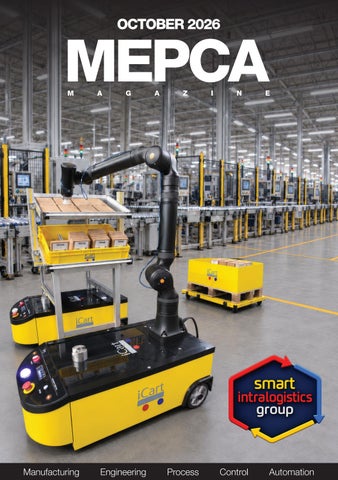
elcome to the October edition of MEPCA magazine. With the weather finally cooling and the days growing shorter, the spooky season is upon us. But what scares machine builders most? Our Machine Building focus uncovers some of the ghosts and ghouls terrorising the sector. Leading the focus, Ideal Power looks at how to select the right power supply unit in machine design builds (p.18). This is followed by an in depth look at the role Additive Manufacturing could play in machine building, with expertise from leading 3D printing bureaus. It has been many years since I first covered 3D Printing as a blog writer in finance. At that time, it was still a novelty, favoured by innovative product designers and hobbyists, and it produced products with unsightly layer lines. It has been fascinating to watch it evolve into a vital component of modern manufacturing. Also, within the focus, SolutionsPT addresses what the EU Cyber Resilience Act means for machine builders (p.40), Accu (p.26) provides an in-depth guide on rivet specification, and Gold & Wassall (p.36) discusses the importance of hinge selection. On the cover this month, Smart Intralogistics Group, which includes DM Automation, Bosch Rexroth and Kassow Robots, examines the benefit of Value Cost Ratio analysis (p.14). Also not to be missed, turn to page 12 to learn how this month’s Manufacturing Champion got into the industry by accident. I hope you enjoy this issue. Oliver Batt, Editor @Mepca-magazine
To subscribe to MEPCA visit our website www.mepca.com or scan the QR code.
CONTENTS Industry Partners:
FEATURES 8 INDUSTRY NEWS 10 OPINION 12 MANUFACTURING CHAMPION 14-15 COVER STORY 17 MACHINE BUILDING
14
48 TEST & MEASUREMENT 56 DIGITALISATION 62 EDITOR’S CHOICE 64 CONNECTORS 70 PROCESS CONTROL 78 COMING UP
18
28
www.mepca.com
7
INDUSTRY NEWS
UK MANUFACTURERS TURN TO AUTOMATION UK manufacturers remain confident about their future prospects, despite rising energy costs and ongoing geopolitical uncertainty. Barclays Business Prosperity Index1 research among manufacturing leaders shows businesses are responding by investing in automation, taking a longer-term approach to planning and pursuing opportunities in defence.
B
arclays’ anonymised client data from around 30,000 UK manufacturing businesses, comparing Q2 2026 to Q2 2025, shows a growing divergence between larger manufacturers and
SMEs. Among larger manufacturers served by Barclays UK Corporate Bank, cash inflows fell 3.5 per cent year-onyear, while loan balances increased by 12.8 per cent. This suggests businesses are continuing to invest despite softer trading conditions In contrast, SME manufacturers served by Barclays Business Banking, recorded a 1.4 per cent increase in cash inflows. However, average loan balances fell by 17.7 per cent, despite the number of loans increasing by 1.1 per cent, while savings balances also rose by 1.1 per cent, suggesting smaller firms are prioritising financial flexibility. Automation and storage transition Automation of robotics is becoming a key resilience tool for UK manufacturers, with 87 per cent saying it is helping them manage disruption and demand volatility across their operations. Manufacturers also report benefits ranging from improved order fulfilment and delivery performance (23 per cent) and better forecasting and decision-making through data insights (23 per cent), to stronger supply chain resilience (22 per cent). The next phase of investment is increasingly focused on AI and resilience. Over the next three to five years, more than a quarter (27 per cent) plan to invest in agentic AI or AI-driven planning, forecasting and decision-making systems, alongside cybersecurity and operational resilience technologies (25 per cent) and logistics automation (22 per cent). Businesses are also strengthening operational resilience through storage transition. More than one in 10 (13 per cent) have increased on-site storage or are holding additional buffer stock, while 10 per cent are actively expanding storage capacity. Defence and critical infrastructure More than three quarters of manufacturers surveyed (77 per cent) view working with the defence sector more positively than 12 months ago. As governments
8
www.mepca.com
and businesses respond to a more uncertain global environment, 72 per cent of manufacturers have reported increased demand from defence and security customers. Looking ahead, manufacturers are taking a longerterm view of emerging growth opportunities. More than a quarter (27 per cent) plan to develop or sell defencerelated products over the next three to five years, with the same proportion targeting dual-use products with both civilian and military applications. This shift is already influencing investment decisions, with 81 per cent of firms saying they have made changes to support defence, national security and critical infrastructure. This includes planned investment in physical security upgrades (66 per cent), security clearances and specialist recruitment (63 per cent). Sarah Collins, Head of SME Industries at Barclays Business Banking said: “Manufacturers are showing a remarkable ability to adapt, whether that’s embracing new technologies, strengthening their operations or exploring opportunities in emerging markets.” home.barclays home.barclays/insights/business-prosperity-index/
1
SCHMERSAL | Enigma Business Park Malvern, Worcestershire, WR14 1GL
www.schmersal.co.uk uksupport@schmersal.com
OPINION
THE DIGITAL SHIFT AND CYBER SECURITY As we encourage manufacturers to embrace digital transformation, it must go hand in hand with cyber security, argues Jessica Armitage, Programme Manager, Made Smarter Yorkshire.
O
ver the last eight years, Made Smarter has grown into a national movement to accelerate digital transformation in UK manufacturing. The Government-backed programme was created to help manufacturers understand and adopt technologies that can make them more productive, competitive and resilient. Since then, manufacturing has undoubtedly become increasingly digital, automated and connected. That transformation continues to create huge opportunities, especially with the capabilities AI now offers. But it also brings new risks. If we’re encouraging you as a manufacturer to become smarter, we also need to help you do it securely. You wouldn’t invest in an expensive new machine and then leave the factory door unlocked; manufacturers need to think about their digital security in the same way. Machinery, production systems, software and data are increasingly connected, not just within factories, but with suppliers and customers too. That means a cyber-attack isn’t just an IT problem. For a manufacturer, it can become a production problem. An attack can stop production, delay orders, increase costs and disrupt customers and suppliers. Government research estimates that a significant cyber-attack costs a UK business around £190,000 on average, while Make UK found that nearly one in three manufacturers experienced a serious cyber incident, either directly or through their supply chain, in the previous 12 months. For smaller manufacturers, however, one of the greatest challenges can simply be knowing where to start. Cyber security can sound complicated, technical and expensive, particularly for a business without a dedicated cyber team. But improving security doesn’t necessarily begin with sophisticated technology. Indeed, it can start with people. Human error remains the most common cause of security incidents. Giving employees the knowledge and confidence to recognise threats and encourage safer working practices can make a real difference. That thinking is behind a new £400,000 Governmentfunded cyber security pilot being delivered by Made Smarter Yorkshire with Sheffield Hallam University. The fully funded initiative will develop Cyber Security Champions within manufacturing businesses and provide
10
www.mepca.com
four progressive levels of support. Manufacturers can start with basic cyber awareness before progressing through Cyber Essentials and Cyber Essentials Plus to support towards internationally recognised ISO 27001 certification. Yorkshire is piloting the approach, but the ambition goes further. If successful, the learning could help shape how cyber security support is delivered through Made Smarter elsewhere in England. It feels like a natural evolution of the Made Smarter mission. We have spent almost a decade encouraging manufacturers to embrace the opportunities created by digital technology. As that transformation gathers pace, cyber resilience has to become part of the same journey. Visit the Made Smarter’s website for more information. madesmarter.uk/yorkshire-cyber
OPINION
FROM STRATEGY TO DELIVERY Ahead of the Autumn Budget, Verity Davidge, Director of Policy and Public Affairs at Make UK, discusses how this is an opportunity for the Government to bring Britain’s ambition of reindustrialisation a significant step closer to reality.
M
anufacturing is one of Britain’s greatest economic strengths. It generates £220 billion in output, supports 2.6 million jobs and anchors growth in communities across the UK1. Yet if the Government is serious about delivering long-term growth, improving resilience and raising living standards, it must move from industrial strategy to delivery. When Andy Burnham entered office, he placed reindustrialisation at the heart of his economic agenda. That ambition is welcome. For too long, manufacturing has been viewed as a sector to support, rather than a strategic asset capable of driving national prosperity. Make UK’s Makers’ Manifesto2 set out a clear challenge to Government: Britain does not lack industrial ambition, it lacks delivery. The opportunity is significant. Make UK research shows that increasing manufacturing’s share of GDP from 10 per cent to 15 per cent could add £142 billion to the economy3. But achieving that will require more than strategies, consultations and announcements; it will require practical action that gives manufacturers the confidence to invest, expand and create jobs in the UK. The Autumn Budget presents an opportunity to accelerate delivery. Manufacturers will judge its success not by the number of policy initiatives announced, but by whether it addresses the barriers businesses face every day. Energy costs remain one of the most significant challenges to competitiveness, leaving UK manufacturers at a disadvantage against international rivals. Employment costs are another. Additionally, the increase in employer National Insurance Contributions announced in the 2024 Autumn Budget, alongside the costs of implementing the Employment Rights Act 2025, is putting pressure on businesses. Investment conditions must also improve, with certainty and incentives to encourage new technologies, automation and capacity. The skills system must provide the technicians, engineers and digital capabilities modern manufacturing needs. Infrastructure and planning are equally critical. Delays to grid connections, planning decisions and transport improvements slow growth, while manufacturers need a simpler regulatory environment that supports innovation rather than adding unnecessary burdens.
These priorities are not theoretical. Make UK’s research for the Makers’ Manifesto found that while manufacturers support the Industrial Strategy’s ambition, more than half have yet to see tangible benefits4. The industry’s message is clear: the strategy should be accelerated, funded and delivered. Britain has a genuine opportunity to reindustrialise and secure a new era of manufacturing-led growth. The foundations are in place: an Industrial Strategy, world-class manufacturers and a government committed to economic renewal. The challenge is turning that ambition into action. The Autumn Budget should mark the moment Britain moves decisively from strategy to delivery, and from ambition to investment, with jobs and growth in every manufacturing postcode. makeuk.org makeuk.org/insights/reports/uk-manufacturing-facts-2025 makeuk.org/insights/reports/2026-makers-manifesto makeuk.org/insights/publications/industrial-strategy-tracker-monitoring-progressuk-manufacturing 4 makeuk.org/insights/reports/2026-makers-manifesto 1 2 3
www.mepca.com
11
MANUFACTURING CHAMPION
MANUFACTURING CHAMPION OF THE MONTH We’re delighted to introduce Neo Chatyoka, The Accidental Manufacturer, as this month’s Manufacturing Champion. The CEO & Founder of Uhuru Botanicals, and Women in Manufacturing board member, shares how a personal solution became an award-winning cosmetics business.
N
eo Chatyoka never intended to be a manufacturer. What started with her formulating skincare products in her kitchen led to the establishment of Uhuru Botanicals, an award-winning Wolverhampton-based cosmetics manufacturer. Founded in 2017, Uhuru Botanicals’ mission is to create plant-based products that celebrate African botanicals, and open more opportunities for women to enter formulation, production and manufacturing ownership. Uhuru means “freedom” in Swahili. Neo was assisted along this journey by Lloyds Bank Academy’s ‘Start Up, Scale Up’ programme and mentorship from then-Head of Manufacturing at Lloyds Bank, Dave Atkinson. In this Q&A, Neo tells the story of Uhuru Botanicals, and what it means to be a female founder in the cosmetics industry.
WHAT INSPIRED YOU TO SCALE A PERSONAL SOLUTION INTO A THRIVING BUSINESS?
Uhuru Botanicals began with my daughter’s eczema. I struggled to find products that were gentle, effective and made with ingredients I could trust, so I started formulating natural skincare products in my kitchen. When her skin improved, friends and family began asking me to make products for them. What started as a personal solution slowly grew from my kitchen into my garage and, eventually, into the Uhuru Botanicals manufacturing facility in Wolverhampton. As demand increased, I found myself sourcing ingredients, managing production, filling and labelling products, and carrying out quality checks. I realised I was no longer simply making skincare products; I was building a business.
YOU’VE DESCRIBED YOURSELF AS THE ACCIDENTAL MANUFACTURER. AT WHAT POINT WAS IT CLEAR YOU’D BECOME A MANUFACTURER?
I call myself an accidental manufacturer because I never set out to own a factory. I simply wanted to create
12
www.mepca.com
something through Uhuru Botanicals that could help my daughter’s skin. The turning point came when demand for Uhuru Botanicals products grew beyond what I could manage from home. I needed larger equipment, structured production processes, stronger quality controls and a suitable manufacturing space. When Uhuru Botanicals moved into a dedicated facility and I became responsible for sourcing raw materials, producing, filling, labelling and checking every batch, I realised I had become a manufacturer. It felt daunting because I had entered an industry where few people looked like me, and I had to learn many parts of manufacturing myself. It also gave me a strong sense of purpose: Uhuru Botanicals had grown from a skincare brand into a manufacturing business, creating products, knowledge and opportunities for other women.
WHAT LESSONS DID YOU LEARN FROM FORMULATING YOUR FIRST COMMERCIAL PRODUCT? Formulating the first commercial product for Uhuru
MANUFACTURING CHAMPION Botanicals taught me that a good idea is only the beginning. A product must remain safe, stable and consistent throughout its shelf life, not simply look and feel good on the day it is made. Through Uhuru Botanicals, I learnt the importance of researching every ingredient, recording each stage of development and testing a formulation before taking it to market. Moving from a small sample to a larger production batch also showed me that a formula may behave differently when scaled. Consistency became one of the most important lessons at Uhuru Botanicals. Every customer should receive the same quality, regardless of when the product was manufactured. That requires clear procedures, accurate measurements and strong quality controls. Most importantly, building Uhuru Botanicals taught me that customer trust takes time to earn. You must listen, keep learning and never compromise product safety for speed.
HOW ARE NEW TECHNOLOGIES AFFECTING COSMETICS MANUFACTURING? At Uhuru Botanicals, we see AI and automation as tools that can make cosmetics manufacturing faster, more consistent and more accessible. They can also give people more time to focus on creativity, judgement and problem-solving. We developed BOTANICS AI through Uhuru Botanicals after recognising how much time formulators spend researching ingredients, checking compatibility and reviewing regulatory information. Our goal is for BOTANICS AI to support ingredient discovery, identify potential formulation concerns and help formulators make better-informed decisions earlier in product development. As BOTANICS AI develops, it could reduce the time Uhuru Botanicals and other manufacturers spend on formulation research, repeated trials and preparation for production. When connected with automated manufacturing processes, it could support batch calculations, scale-up planning, stock control, production records and quality checks. This could shorten the journey from an initial idea to a manufacturing-ready formula. At Uhuru Botanicals, we believe technology should support skilled people rather than replace them.
WHAT CAN THE INDUSTRY DO TO ACCELERATE GENDER PARITY AND ACHIEVE 35% REPRESENTATION BY 2035?
My experience building Uhuru Botanicals and serving as a board member for Women in Manufacturing has shown me that the industry must create clearer pathways for women to enter manufacturing, remain in the sector and progress into leadership and ownership. Encouraging women to apply for jobs is not enough. They need practical training, mentoring, visible role models, fair promotion opportunities, flexible working arrangements and access to finance. Women who want to build manufacturing businesses like Uhuru Botanicals also
Women need visibility, but they also need decision-making power and genuine opportunities to own and lead manufacturing businesses Neo Chatyoka, CEO & Founder of Uhuru Botanicals need better access to investment, equipment, contracts and supply chains. Industry leaders must set measurable targets and remain accountable for progress. Women need visibility, but they also need decision-making power and genuine opportunities to own and lead manufacturing businesses. At Uhuru Botanicals, we support students through placements, formulation education and practical manufacturing experience. We want young women to see that manufacturing includes science, technology, creativity, entrepreneurship and ownership.
BEYOND PRODUCING PRODUCTS
The story of Uhuru Botanicals is a potent reminder that manufacturing is driven by real-world necessity, and that the impact of manufacturers on the communities around them reaches far beyond production. To learn more about Uhuru Botanicals’ products, Formulation Academy, or contract manufacturing services, visit the company’s website. Earlier this year, Neo also launched a monthly LinkedIn newsletter: The Accidental Manufacturer, to provide a candid account of her manufacturing journey. uhurubotanicals.com
www.mepca.com
13
COVER STORY
SMART INTRALOGISTICS STARTS WITH ANALYSIS How Value Cost Ratio analysis, a cost-based view of material movement and process actions, can reveal leaner solutions and provide a framework for determining where the latest intralogistics technologies can make a difference.
P
roduction processes receive intense engineering scrutiny. The movements and transfers connecting them often receive less. Between goods in, stores, production and despatch, people spend time collecting, transporting, positioning and transferring materials. Each activity may seem reasonable in isolation; together, they can consume substantial resources. For senior engineering teams, the challenge is deciding where to intervene. Would a revised layout deliver the greatest saving? Should roll cage or dolly movements be automated? Can a mobile cobot address both transport and handling?
14
www.mepca.com
The Smart Intralogistics Group, bringing together ADM Automation, Bosch Rexroth and Kassow Robots, proposes a structured way to explore those questions. The ratio between Value Added Cost and Total Cost, the Value Cost Ratio highlights where the biggest savings can be made. Value Cost Ratio analysis (VCR), examines where process and transfer costs arise, and how they relate to value creation. It provides a framework for evaluating solutions including iCart iSeries and iCart MOCO, with the emphasis on improving the whole flow alongside the required actions.
COVER STORY LOOK AT THE POINTS AND PATHS
The starting principle is straightforward: every system can be broken down into points where actions take place and paths along which items flow. At a point, an item might be picked, unpacked, assembled, inspected, processed or repositioned. Along a path, it travels between locations. Examining both reveals costs that can disappear inside headline measures such as throughput, travel distance or picks per hour. Consider a delivery to a production workstation or a packing bench. Reducing the journey time looks attractive. But if the material must then be unloaded, rearranged and transferred again before use, a faster journey leaves much of the handling burden intact. Equally, automating an individual handling task may offer limited benefit if people still spend significant time bringing work to it and collecting the output. A useful assessment therefore follows the material through the complete sequence. It asks where actions and journeys can be removed, simplified or combined before deciding what to automate.
A COMMON BASIS FOR COMPARING SOLUTIONS
VCR brings a cost-based perspective to that assessment. Building on lean principles and activity-based costing, it considers the resources consumed at the action points and along the movement paths, distinguishing value-creating work from supporting activity. Necessary handling and transport still carry a cost, even when the current operation cannot function without them. Making that cost visible helps engineers challenge the arrangement rather than simply make each existing step faster. This gives teams a common basis for considering very different proposals: a layout change, revised working practices, mobile automation or a combination of measures. The ratio is a diagnostic indicator, not a complete investment decision. Absolute savings, required throughput, safety, reliability and implementation costs remain essential. Its purpose is to sharpen the questions and identify where a more detailed business case deserves attention.
WHERE ICART ISERIES AND ICART MOCO FIT
iCart iSeries brings this discussion directly to roll cage and dolly movement. Where repeated transfers absorb operator time, it provides an automation option for the movement paths connecting stores, work areas and production. The engineering question extends beyond how quickly a cage travels. How much resource does the complete transfer consume? What happens at collection and delivery? Does the proposed arrangement reduce the overall cost of supplying the next process? iCart MOCO, with its fully integrated Kassow seven-axis cobot, broadens the opportunity to consider actions as well as journeys. By bringing a cobot to the warehouse or factory floor on a mobile platform, it opens up possibilities
for linking material movement with handling at the destination. That makes the points-and-paths perspective particularly relevant. A transport-only assessment may overlook the potential contribution of manipulation; a workstationonly assessment may overlook the benefit of mobility. Considering both helps establish where iCart MOCO could offer a leaner overall solution. Neither product needs to be justified by automation for its own sake. The strongest application is one in which the equipment addresses a clearly identified source of cost and supports the required material flow.
START WITH THE OPPORTUNITY
For manufacturing and intralogistics sites working within existing buildings, mixed processes and constrained budgets, improvement needs a practical starting point. The Smart Intralogistics Group combines this analytical approach with equipment demonstrations, seminars and site-level diagnostic work. Engineering teams can explore how VCR informs solution selection and where iCart iSeries or iCart MOCO could contribute to a more costeffective operation. To learn more about Value Cost Ratio Analysis, discuss an application or attend a Free Smart Intralogistics Workshop, contact the Smart Intralogistics Group. smartintralogisticsgroup.com
www.mepca.com
15
ANALOGUE BECOMES DIGITAL IOC 074 IO-LINK CONVERTER STEGO’s IOC 074 brings analogue sensors into the digital age by converting up to three 4–20 mA signals into the IO-Link protocol. It’s the ideal solution for retrofitting legacy systems and enabling modern, forward-compatible automation infrastructures.
www.stego-group.com
FOCUS ON:
MACHINE BUILDING
Sponsored By
MACHINE BUILDING
PRIORITISE POWER SUPPLY SELECTION In machine design, selecting the Power Supply Unit (PSU) earlier can help reduce redesign, compliance and supply risks as the machine moves from development into production. Ideal Power details how machine builders can benefit from prioritising PSU specification.
A
machine can be carefully designed, tested and prepared for production, yet the wrong power supply can still create problems late in the project cycle. If PSU selection happens after the wider design has taken shape, the machine builders will have fewer options and less flexibility when solving these problems. The answer is not simply to choose a PSU sooner. Machine builders must define what the machine needs from its power supply early enough for engineering, procurement and project teams to make informed decisions.
MORE THAN VOLTAGE AND WATTAGE
Voltage, current and wattage provide a starting point
18
www.mepca.com
for PSU selection. Electrical performance, operating conditions, physical integration and compliance requirements can all influence which product is suitable for the finished machine. These requirements become harder to accommodate as the design progresses. Cabinet dimensions may be fixed, layouts agreed, connections selected and prototypes built. If the PSU then requires more space, a different mounting arrangement or operating conditions the existing design cannot support, the engineers may need to find an alternative or make changes elsewhere in the machine. Either option can mean additional engineering time, revised drawings, component changes, or further testing. Ideal Power encourages its customers to discuss power requirements during the design stage. This creates
MACHINE BUILDING more opportunity to identify a suitable standard PSU, or consider a bespoke solution where the application has requirements that an off-the-shelf product cannot meet.
IDENTIFY COMPLIANCE REQUIREMENTS BEFORE TESTING
Compliance can create another late-stage problem if it does not form part of PSU selection from the start. A PSU may carry recognised approvals and meet relevant standards, but machine builder still needs to check that the exact model and supporting documentation suit the finished equipment and its intended market. Finding a gap once a machine reaches final testing can mean reviewing documentation, investigating alternative components, or repeating elements of testing. What could have been addressed during component selection can become a project issue when production dates are approaching. EMC needs similar early consideration. The PSU forms part of the complete electrical system, and its suitability needs to be assessed within the finished application. Identifying potential issues during development gives the engineering team more opportunity to respond before the design becomes difficult to change. Early discussion with PSU supplier can help establish what approvals and supporting documentation are available before committing to a product.
KEEP DESIGN OPTIONS OPEN
Earlier PSU involvement does not, however, mean selecting a part number before the team understands the machine requirements. Instead, it means making power supply considerations part of the design process while there is still flexibility to act. This becomes particularly valuable for machine builds with unusual specifications, limited installation space or demanding operating conditions. A standard product may meet most of the requirement but fall short in one area. Finding this early gives machine builders time to assess another product, or explore a bespoke PSU. Discovering it once the machine has been designed around a particular unit can leave far fewer practical options. It can help engineering and procurement work from the same requirements, too. Engineering needs a PSU that performs correctly within the machine. Procurement needs a product that can be sourced at the required quantity, price and timescale. Addressing both during development can prevent a technically suitable choice from creating a purchasing problem later.
PLAN BEYOND THE PROTOTYPE
A PSU working successfully in a prototype is an important milestone, but the requirement does not end there. The same product needs to be available when the machine enters production. Lead times, expected quantities, future availability and product lifecycle can become just as relevant as technical performance. A PSU that is readily available for a small prototype run may present different supply considerations when the
requirement is for hundreds of units, or regular scheduled deliveries. Discussing anticipated volumes earlier gives the supplier time to plan against the machine builder’s production requirements and identify potential availability concerns. It also gives procurement greater visibility before firm build schedules and purchasing commitments are made. Longer-term requirements matter, too. If the machine will remain in production for several years, the PSU may need to support repeat manufacture, servicing and replacement requirements throughout that period. Flexible call-off arrangements can help here. Rather than approaching each production requirement as an isolated purchase, stock can be planned against forecast demand and released in line with agreed requirements.
BRING PSU EXPERTISE INTO THE PROJECT EARLIER
A power supply should not become a project concern only when something goes wrong. Ideal Power works with machine builders from initial specification through to ongoing supply. It helps customers assess application requirements, identify suitable AC/DC and DC/DC solutions and explore bespoke options where a standard product does not provide the right fit. That support continues once the machine moves into production, with dedicated account management, flexible call-off arrangements and worldwide distribution helping customers manage ongoing requirements. Bringing PSU expertise into a project earlier gives machine builders more time to identify design, compliance and supply risks before they become harder to resolve. Additionally, it can reduce avoidable changes and create a clearer route from initial design through to repeat production. idealpower.co.uk
www.mepca.com
19
MACHINE BUILDING
5 SUPPLY RISKS THAT DELAY BUILDS Technical suitability is only part of PSU selection. Planning for availability, production volumes and future demand can help prevent component supply from becoming a problem once the machine moves into manufacture. Ideal Power shares 5 supply risks that can delay machine builds.
A
PSU can perform exactly as required during development, yet still create problems if it is not available when production begins. For machine builders, considering supply alongside the technical specification can reduce risk as a project moves from prototype to repeat manufacture.
1. LONG LEAD TIMES
Power supply lead times can vary between products and manufacturers. A PSU available during development may have a very different lead time when the production schedule is confirmed. Check lead times during component selection and revisit them as the project develops. This gives the procurement team more time to plan orders around expected build dates rather than reacting once components are required.
2. INCONSISTENT AVAILABILITY
Sourcing a small number of PSUs for prototypes is different from securing regular production quantities. Before committing to a product, a machine builder should discuss anticipated volumes and future demand with its supplier. A technically suitable PSU needs a supply route capable of supporting the quantities and frequency the manufacturing schedule requires.
updating them as plans develop gives the supplier greater visibility and helps align PSU supply with manufacturing requirements.
3. PRODUCT OBSOLESCENCE
5. REACTIVE PURCHASING
Machine production can continue for years, with further PSU requirements for servicing, repairs and replacement parts. If a selected PSU reaches end-of-life, replacing it may mean reviewing electrical specifications, dimensions, connections, approvals and testing requirements. Considering product lifecycle during selection can reduce the risk of an unexpected change after the PSU has become established within the machine.
4. POOR FORECASTING
Production plans change, making communication between the machine builder and supplier important. Ordering too early can mean holding unnecessary stock. Ordering too late can create a gap when production demand increases. Sharing realistic forecasts and
20
www.mepca.com
Buying PSUs separately for each production run leaves the next build dependent on the availability and lead time at that moment. For repeat manufacture, a longer-term supply plan can provide greater certainty. Flexible call-off arrangements can help machine builders plan stock against forecast demand and schedule releases in line with production requirements. Ideal Power supports machine builders from initial PSU specification through to ongoing supply. Its dedicated account management, flexible call-off arrangements and worldwide distribution help customers plan beyond the next order and manage PSU requirements throughout the life of their project. idealpower.co.uk
The Right PSU From the Start From Design to Production Your PSU choice affects more than electrical performance. Work with Ideal Power early to specify the right solution for your machine, with technical support from initial design through to production.
Design-in Support
Bespoke Solutions
Explore our Power Solutions
Flexible Call-Off
Worldwide Distribution
Speak to our team at www.idealpower.co.uk or call us on 01733 309865
MACHINE BUILDING
A WELCOME ADDITION TO MACHINE BUILDING Additive Manufacturing is known for rapid-prototyping and small-batch production. But could machine builders and OEMs make more of the technology? MEPCA assembled a panel of experts from Midlands 3D Printing, Laser Lines, and Xometry, to look at the barriers to adoption and how the technology could benefit machine builders.
I
n the most reductive of terms, Additive Manufacturing (AM) builds 3D objects, layer-by-layer, from digital data. This precision process significantly reduces waste in comparison to other traditional subtractive manufacturing methods, and it can produce highly complex shapes from a wide variety of materials, including numerous plastics, metals, resins and composites. AM has come a long way since its invention in the 80s, evolving from something of novelty used by agile product designers, and hobbyists, to being an integral component of Industry 4.0, often mentioned alongside AI, automation, or digital transformation. Over the years, AM technology has diverged into a number of variations. The development of AM as a
22
www.mepca.com
production method is exemplified by methods such as Fused Filament Fabrication (FFF) and Selective Laser Sintering (SLS), and Large Format Additive Manufacturing (LAFM). The latter uses robotic arms, or gantries, and can produce much higher volumes of material than other AM technologies. LAFM’s use is therefore growing in automotive, aerospace, construction and marine. Despite AM’s proven capabilities and continual evolution, in the UK, in particular, it remains more closely associated with universities and laboratories than the production line, and just 17 per cent1 of UK business have experience with the technology. To understand how AM technologies could be put to better use by machine builders and OEMs, MEPCA
MACHINE BUILDING assembled a panel of AM and custom manufacturing specialists. Sharing their insights in this feature are: Andrew Moloney, Sales and Marketing Director, Midlands 3D Printing; Mark Tyrtania, Sales Director, Laser Lines; and Nikolaus Mroncz, Head of Sales Engineering, Xometry Europe.
BARRIERS TO WIDER ADOPTION
Given that AM can offer efficiency, lead times and sustainability benefits over conventional subtractive methods, what is holding back its wider adoption in machine building? According to our panel, there are number of contributing factors, but all agreed that there is a fundamental skills gap, particularly when it comes to design for additive manufacturing (DfAM). “Most of it comes down to familiarity rather than the technology itself,” said Andrew Moloney. “Machine builders know what a CNC part or a casting will cost and how it will behave, and AM still reads as an unknown quantity. Design teams are trained to design for machining, not for AM, so parts often get evaluated against a process they were never drawn for and lose on that comparison.” Adding to this, Mark Tyrtania commented: “Most people entering manufacturing come from a traditional engineering background rather than an additive one, so understanding DfAM, material selection and process optimisation isn’t yet widespread.” The distinction between these design disciplines is enough that it would require a significant change in approach for most machine building teams, with additional training and upskilling unavoidable. As Nikolaus Mroncz put it: “DfAM requires a fundamental shift from traditional machining paradigms to avoid unviable production costs. Downstream operational hurdles—such as labour-intensive postprocessing and stringent safety certification protocols— further complicate integration.” Highlighting the complexity involved, he continued: “The vast ecosystem of complementary 3D printing technologies, each tailored to distinct applications, creates a complex landscape for companies trying to identify the right solution for their specific operational needs.” Another critical factor impacting adoption is investment, particularly concerns around the initial outlay for AM technologies and the unknowns around ROI. Indeed, Mark insisted that initial investment was the “biggest barrier”, though return on investment can be swift once the right application is found. As he went on to explain, “Many businesses simply haven’t identified where AM would deliver clear value for them, and without that clarity, the upfront cost of equipment feels hard to justify.” In agreement, Nikolaus added that that the high cost of equipment was especially off putting “for businesses with fully depreciated conventional machines.” In addition to the practical factors of cost, training and complexity, another common barrier to AM adoption is how it continues to be viewed by the industry. “There’s a lingering perception that AM means prototypes, not production, which undersells processes like
Nikolaus Mroncz, Head of Sales Engineering, Xometry Europe
DfAM requires a fundamental shift from traditional machining paradigms to avoid unviable production costs. Nikolaus Mroncz, Head of Sales Engineering, Xometry Europe. industrial FFF and SLS,” Andrew warned. Further to this, Mark had found that: “Awareness is improving as more materials come through with targeted properties and certifications, and as software and automation mature, but many businesses still see AM as suited only to prototyping rather than production, which limits how seriously they explore it for wider use.”
A SOLUTION TO SUPPLY CHAIN VOLATILITY This year, geopolitical tensions and increased tariffs have highlighted vulnerabilities in global supply chains and resulted in increased costs of, and lead times for, materials and components, leading inevitably to production disruptions. In the short-term at least, this global volatility shows no signs of abating, and machine builders and OEMs have had to accept these challenges as the new normal. For this reason, many affected businesses are rethinking their operations to combat the volatility of global supply chains, building in new resiliencies. On how AM can assist in this challenge, Nikolaus explained: “Additive manufacturing decentralises production by enabling on-demand, localised fabrication. This localised approach eliminates dependence on long lead times and international shipping logistics.” “It also shortens the chain itself: fewer overseas singlesource suppliers, less exposure to freight and customs delays, and no minimum order quantities forcing a
www.mepca.com
23
MACHINE BUILDING
Andrew Moloney, Sales and Marketing Director, Midlands 3D Printing
There’s a lingering perception that AM means prototypes, not production, which undersells processes like industrial FFF and SLS. Andrew Moloney, Sales and Marketing Director, Midlands 3D Printing.
business to buy more than it needs just to get a supplier’s attention,” Andrew added.” Mark agreed, but he also highlighted the relation of AM to reshoring: “AM allows parts to be produced locally and on demand rather than relying on long, often overseas, supply chains. There are examples of manufacturing processes that had been lost or moved abroad being brought back in house or closer to home using AM, which is directly relevant to machine builders struggling to source components.” However, shortening and de-risking the supply chain is only part of the benefit. “The biggest win is turning inventory into a file. Rather than holding stock of a bracket or housing against the risk a supplier goes quiet, a machine builder can hold the design and print it on demand, here or wherever it’s needed,” Andrew explained, providing on-demand replacement of legacy equipment components as an example. “As digital supply chains develop alongside AM, machine builders will increasingly be able to hold designs rather than stock, producing parts only when needed and reducing exposure to sourcing bottlenecks,” Mark added.
24
www.mepca.com
BEYOND PROTOTYPING
As detailed above, AM is still known predominately for rapid prototyping, repairs and low-volume production. The question is, what would need to change for this perception to shift, and for AM to be considered as a viable production process, or, further still, as an alternative to more traditional production methods? The panel were unanimous in pointing out that, at present, AM is not here to replace, part-for-part, techniques such as CNC machining. However, there were several things that could help locate AM more centrally in production workflows. “To move beyond prototyping and niche production, the post-processing workflow—including cleaning and finishing—must be fully automated to eliminate manual labour bottlenecks,” Nikolaus explained. “Integrating realtime, in-situ quality monitoring into machines is critical for replacing lengthy, expensive post-build inspection routines.” He went on to point out that print speeds would also need to increase, while the price of raw materials would need to decrease in tandem to make AM economically competitive.
MACHINE BUILDING For Andrew, this was the second of three key things would need to change for AM to be considered for wider production purposes. “First material data: engineers need consistent, documented mechanical properties for AM materials the same way they have for cast or machined metals, so a part can be specified with confidence rather than tested and hoped for.” “Third, and most overlooked, is design. Parts carried straight across from a subtractive process rarely make the best case for AM; the real gains come when engineers design a part for the process from the outset, consolidating assemblies or removing tooling constraints entirely. That’s a training and mindset shift as much as a technology one.” Agreeing that culture shift, or mindset, was critically important – referring back DfAM – Mark then summarised: “What needs to change is less about replacing traditional manufacturing processes and more about improving materials, automation and cost. As material properties, certifications and process reliability improve, and as AIdriven generative design and automation make AM more competitive, it becomes viable for more mid-volume, higher-value, complex components.”
Mark Tyrtania, Sales Director, Laser Lines
ADVICE FOR MACHINE BUILDERS
Many businesses simply haven’t identified where AM would deliver clear value for them, and without that clarity, the upfront cost of equipment feels hard to justify.
To bring the discussion to a close, each of our panel shared invaluable advice for machine builders, of all sizes, that are unsure whether AM technologies could be incorporated into their operations and how to begin that process. Mark Tyrtania, Sales Director, Laser Lines: “Start by identifying a genuine application rather than adopting the technology for its own sake. When the right use case is found, the return on investment can be quick, and this applies regardless of company size. Smaller machine builders can use bureau services, like Laser Lines’, to test applications before committing to their own equipment, while larger organisations can begin with targeted projects such as spares or low-volume parts to build internal knowledge. Bringing in outside expertise or speaking to specialists helps avoid costly missteps in technology and material selection. Given how quickly materials, software and hardware are advancing, businesses should treat this as an ongoing process of exploration rather than a single decision, revisiting AM’s potential as capabilities improve. This is also where Laser Lines can help with consultancy.” Nikolaus Mroncz, Head of Sales Engineering, Xometry Europe: “Machine builders should start small by identifying low-risk applications, such as custom jigs, fixtures, or components prone to frequent supplier delays, especially where lead time is a critical factor. Evaluation must extend beyond unit cost to total cost of ownership, accounting for savings in assembly time, weight reduction, and inventory management. Companies can initially minimise capital expenditure by outsourcing production to service bureaus to evaluate quality before investing. Crucially, companies must prioritise upskilling their design teams, as mastering additive design principles is vital to unlocking the
Mark Tyrtania, Sales Director, Laser Lines.
technology’s full value.” Andrew Moloney, Sales and Marketing Director, Midlands 3D Printing: “Start with one problem, not a strategy. Pick a part that genuinely causes pain, an obsolete spare, a jig that keeps breaking, a bracket with a long lead time, and get it made rather than researching AM in the abstract. Working with an established bureau is the lowest-risk way to do this: you get the material knowledge and quality assurance without buying capital equipment or hiring in expertise you don’t yet need. Bring your design engineers into that first conversation early, because the biggest gains usually come from small changes to the part rather than a straight swap. Once you can see the lead time, cost and performance for yourself on a real part, the business case for going further tends to make itself.” laserlines.3dprinting.co.uk xometry.uk midlands3d.com www.gov.uk/government/publications/3d-printing-in-greater-manchester/factors-
1
affecting-adoption-of-3d-printing-by-smes-the-case-of-greater-manchester
www.mepca.com
25
MACHINE BUILDING
AN ENGINEER’S GUIDE TO RIVETS Why do many engineers reach for a rivet before a bolt? Patrick Faulkner, Lead Engineer at Accu, looks at the reasons for the popularity of rivets, the essential mechanics of riveting and specifying the right rivet for the application.
R
ivets are widely specified on projects that are subject to continuous vibration, as it can lead to threaded fasteners failing. A bolt or screw holds a joint together through thread friction, but this can be disturbed by shock, vibration and thermal cycling, causing them to gradually work loose. In other cases, a threaded fastener may not be an option because an engineer is working in a boxed-in enclosure where it may be impossible to fit a spanner or their hand behind the joint to install a nut. The combination of permanence and one-sided access is why riveting remains the default choice in aerospace, automotive, marine, HVAC ductwork and electronics applications and increasingly in EV assembly.
26
www.mepca.com
THE MECHANICS OF A RIVET
A rivet is a permanent mechanical fastener recognised by its smooth, cylindrical, unthreaded shaft with a factoryformed head at one end. A rivet is fitted through a predrilled unthreaded hole in the parts being assembled and its plain tail is deformed under load into a second head, which clamps the joint shut. What makes that joint effective isn’t the head, it is what happens to the shaft. As the rivet sets, the shaft swells radially and fills the hole, so there is no clearance left for the parts to shift. That is the fundamental difference between a rivet and a bolted joint; a rivet’s strength comes from bearing across the full circumference of the hole, not from a limited number of thread contact points.
MACHINE BUILDING It makes rivets particularly good in shear. As they resist forces that act parallel to the joined faces and the load is spread evenly, fatigue performance under repeated loading holds up well. Once that joint is formed, there is no thread to back off, so under normal service loads a correctly set rivet simply cannot vibrate loose. Two commonly used rivets are Blind and Solid.
BLIND RIVETS
Blind rivets are two-part components, featuring a hollow body with a solid pin (mandrel) running through it, with an enlarged head. When the rivet is set, the tool grips the stem and pulls the mandrel back through the body, which flares the tail against the rear face. Once the joint is fully clamped, the mandrel reaches its designated break load and the stem snaps off at a deliberately weakened point. It required no heat, minimal operator skill and works on boxed-in enclosures where it would be impossible to fix on a nut from behind.
SOLID RIVETS
Solid rivets were the original design for rivets, featuring a single piece shaft and head deformed by direct force. On modern assemblies these are set in place with an air hammer or hydraulic rivet tool, rather than hammered by hand. Although they are older technology, they are still one of the strongest. These rivets are set by direct force from both sides: an air hammer or hydraulic tool on one face, a bucking bar crushing the tail on the other. With no hollow core, a finished solid rivet is effectively a single piece of wrought metal filling the hole, which is why it remains the standard for safety-critical aircraft structures despite needing far more force and access to fit.
RIVET NUTS
Rivet nuts offer a completely different approach to standard riveting. Rather than joining two panels permanently, they add a reusable machine thread to sheet metal that is too thin to tap. This means an engineer can bolt and unbolt an assembly as many times as they wish. Beyond the standard solid, blind and threaded varieties of rivet, there a number of other rivets tailored to specific engineering problems including multigrip rivets, sealed rivets, semi-tubular rivets, self-piercing rivets and plastic rivets.
RIVET, THREADED FASTENER OR WELD?
Whether to use a rivet, threaded fastener or to weld depends on many different factors. None of these is universally better than the other, for each has its relevance to different situations. Blind rivets are great for quick assembly and one-sided access, at the cost of being genuinely permanent. Solid rivets provide the highest shear and fatigue strength, but demand access to both faces and real installation force. Threaded fasteners are the best choice when a joint has to come apart, though they need thread lock or careful engagement to resist vibration. On the other hand, welding delivers the strongest continuous bond, but runs the risk of heat distortion.
If a joint is loaded mostly in tension or will need adjusting, a bolt usually wins. If it is shear-loaded, permanent and vibration is the enemy, a rivet is very hard to beat.
SPECIFYING THE RIGHT RIVET
Choosing the right size of rivet is essential. For generalpurpose work, 3.2 mm and 4.8 mm diameters cover most applications; go thicker, or add more rivets to the joint, if extra strength is needed. Length is governed by grip range; the minimum and maximum joint thickness a given rivet is designed for. If this is too short, it will not clamp properly; too long, and it deforms without compressing the joint. As a rough guide, to estimate grip, subtract 1.5 times the rivet’s diameter away from its overall length to estimate grip. However, it is worth spending time checking the manufacturer’s stated grip range against a measured joint thickness. Material selection is just as important as geometry. Aluminium is obviously popular for lightweight purposes and corrosion-resistant general use. Steel is widely used where cost and strength matter more than weight; stainless steel where the environment is wet, outdoor or hygienic; and copper or brass where conductivity or appearance is the priority. It is important to keep the rivet and the parent material galvanically compatible wherever possible, particularly outdoors, as dissimilar metals in a damp joint corrode and can leave the fastener at risk. There are a multitude of situations where a rivet is the only sensible option. For example, riveting an enclosure panel with no rear access, joining dissimilar or thin sheet metal where welding would distort the material, or any high-vibration assembly where a loosening thread simply isn’t acceptable. Understanding why rivets behave the way they do is what ensures an engineer specifies the right fastener, first time. accu-components.com
www.mepca.com
27
MACHINE BUILDING
THE CASE FOR EDGE COMPUTING UK manufacturers are under pressure to extract greater value from their production data. Yet many businesses continue to rely on centralised computing architectures that are prone to latency, create network dependencies and make it difficult to act on operational information. Jonathan Bye, Automation & Software Sales Manager, Routeco, makes a case for edge computing.
A
s factories become more connected, the volume of data generated by machines, sensors and production assets has increased dramatically. While cloud platforms and central servers remain an important part of many digital transformation strategies, sending every piece of operational data across a network is not always the most efficient approach. For applications that demand immediate responsiveness, local processing power is becoming increasingly important. This is where industrial PCs are playing a growing role. Rather than transferring all machine data to a central location for analysis, industrial PCs enable data processing at the point of production. Often referred to as edge computing, this approach allows critical information to be analysed and acted upon directly at the machine level. The result is faster decision-making, reduced latency and improved system responsiveness. Industrial computing platforms can also continue operating independently during temporary network interruptions, helping to maintain production continuity and minimise disruption. For machine builders, system integrators and manufacturers alike, industrial PCs help address several common challenges. They simplify the collection and management of production data, support real-time visualisation of machine performance and provide a platform for local analytics without overburdening existing IT infrastructure. By processing and filtering data locally, manufacturers can also reduce bandwidth requirements and lower the rising cost associated with transferring and storing large volumes of information. Modern industrial PCs combine computing power, visualisation and connectivity within robust industrialgrade hardware designed to withstand demanding production environments. Fanless architecture, shock-resistant construction and extended operating temperature ranges help deliver the reliability required for continuous operation. At the same time, support for remote access and scalable processing performance provides the flexibility needed to support future digitalisation initiatives. Industrial computing is particularly valuable in applications such as packaging machinery, material
28
www.mepca.com
handling systems and assembly lines where fast response times and local decision-making can have a direct impact on productivity and uptime. By bringing processing power closer to the machine, industrial PCs provide a practical pathway to achieving greater visibility, resilience and operational performance while supporting long-term digital transformation goals. Technology alone doesn’t solve manufacturing challenges; understanding how and where to apply it does. Routeco’s team of industrial computing specialists can help manufacturers, machine builders and system integrators explore practical ways to unlock greater value from their production data, improve operational resilience and accelerate their digital transformation journey. uk.routeco.com
High-Performance Industrial Computing Meets Rugged Visualisation Managing data locally at the machine level, users benefit from faster response times, greater system resilience, reduced network dependency, and improved control over critical operational data.
6300B
6300M
The Allen-Bradley® ASEM 6300B Box PC combined with the 6300M Industrial Monitor delivers a rugged, flexible, and future-ready HMI solution – offering high performance, improved cybersecurity, easy maintenance, and long-term upgrade options for modern panel builders.
Discover how the 6300B and 6300M can improve performance, resilience, and lifecycle value in your project.
Scan the QR code to view the options and get in touch
MACHINE BUILDING
GETTING MOTION FEEDBACK RIGHT Motion feedback is just one element of machine design, but selecting the right encoder early on can avoid retroactive challenges and improve machine lifespan, as British Encoder Products explains here.
M
achine builders today are balancing increasingly complex requirements. Machines need to be productive and reliable, but they may also need to integrate with connected control systems, operate in challenging environments and remain straightforward to maintain throughout their working life. Within that bigger picture, motion feedback can seem like a relatively small part of the design. However, considering the encoder early can help avoid unnecessary compromises later.
START WITH REQUIREMENT
The first question is not which encoder to choose, but what information the control system actually needs. Incremental encoders provide feedback on movement, speed and direction, making them suitable for many standard motion control applications. Absolute encoders provide a unique position value and can retain position information after a power loss, which can be valuable where machinery needs to establish its position immediately after restart. For applications measuring linear movement, measuringwheel and draw-wire solutions offer another option without translating every requirement into rotary shaft feedback.
THINK BEYOND RESOLUTION
Resolution is an important specification, but it is only one part of encoder selection. Machine builders should also consider mounting space, shaft or bore dimensions, operating speed, temperature, vibration and exposure to dust, moisture or washdown. An encoder that performs well in one environment may be unsuitable for another. Considering these factors during the design stage gives engineers greater freedom to select a solution suited to the application rather than adapting the machine around a component later.
CONSIDER COMMUNICATION
As machinery becomes increasingly connected, the interface between the encoder and control system also deserves early consideration.
30
www.mepca.com
Alongside conventional incremental outputs, today’s encoder technologies can support communication protocols including EtherCAT, PROFINET, EtherNet/IP, CANopen, IO-Link, SSI and BiSS C. The right choice depends on the machine architecture and the information the controller requires. Where functional safety forms part of the design, dedicated safety-rated feedback solutions, such as CANopen Safety encoders, can also be considered.
DESIGN FOR TOMORROW
A machine may remain in operation for many years, so maintainability should be part of the original design. Component availability, replacement options and technical support can become particularly important when an encoder eventually needs replacing. Selecting a well-supported solution and keeping clear specification information can make future maintenance considerably easier. From new machine designs to existing applications, BEPC helps OEMs and machine builders select the right absolute, incremental or linear encoder solution. Taking the time to consider motion feedback early means looking beyond a single specification. Mechanical fit, environment, communication, safety and long-term support all contribute to choosing an encoder that works throughout its working life. encoder.co.uk
Reliability Matters
Modern Inspection Tools for Smarter Plant Maintenance
Find problems before they become failures
Manufacturing facilities have never had more data available to them, yet maintenance teams continue to face the same fundamental challenge: finding problems before they affect production. Whether it's an overheating electrical connection, a deteriorating motor, a compressed air leak, or a hidden mechanical issue inside critical equipment, the speed at which a problem is identified often determines how costly it becomes.
Improve Uptime with Proactive Maintenance
As plants look to improve uptime, many are shifting from reactive maintenance toward more proactive approaches that help detect issues earlier and make better use of limited resources. Success increasingly depends on giving technicians faster access to meaningful information, allowing them to diagnose problems confidently and focus their efforts where they will have the greatest impact.
GainVisibility Inside Critical Equipment
www.flir.com Mepca.indd 1
4/09/2026 09:01
MACHINE BUILDING
THE BACKBONE OF MODERN MACHINERY Industrial gearboxes are the backbone of modern machinery and a key consideration in machine building. In this article, NORD Gear, industry leader in the design and manufacture of geared motors, highlights the versatility of industrial gearboxes and their continued significance in modern industrial operations.
I
ndustrial gearboxes are essential mechanical devices used to transmit high torques and reductions in speeds to a wide range of industrial applications. Found in manufacturing plants, mining operations, power generation facilities, and material handling systems, these gearboxes play a critical role in ensuring machinery operates efficiently and reliably. A gearbox works by transferring mechanical energy between a driving source, such as an electric motor, and the driven equipment. It achieves this through a series of gears arranged within a protective housing. By altering the gear ratio, a gearbox can increase torque while reducing speed, or vice versa, depending on the requirements of the application. This ability to modify power characteristics makes gearboxes indispensable in industrial environments. There are several common types of industrial gearboxes. Helical gearboxes that can be in parallel or inline design, are among the most widely used due to their smooth operation, high efficiency, ability to handle heavy loads, with typically lower costs. Bevel gearboxes are used where a right-angle transmission of power is required, frequently used in conveyor systems and packaging machinery, where space saving can be a requirement. Worm gearboxes are valued for their simplicity and high reduction ratios, often being used in lifting equipment and automated systems. The construction of an industrial gearbox typically includes gears, shafts, bearings, seals and a robust casing. These components are manufactured from high-strength materials such as alloy steel to withstand demanding operating conditions. Proper lubrication is vital to gearbox performance, as it minimises friction, reduces wear and helps dissipate heat generated during operation. Industrial gearboxes provide numerous benefits. They enhance equipment performance by delivering the precise speed and torque needed for specific tasks. They also improve energy efficiency by optimising power transmission and reducing mechanical losses. Furthermore, high-quality gearboxes contribute to increased equipment lifespan and reduced maintenance costs, resulting in lower overall operating expenses. Regular maintenance is essential to ensure gearbox reliability. Common maintenance activities include checking lubricant levels, inspecting seals for leaks,
32
www.mepca.com
monitoring vibration and temperature, and examining gears for signs of wear or damage. Predictive maintenance techniques, such as oil analysis and condition monitoring, can help identify potential problems before they lead to costly breakdowns. As industries continue to embrace automation and advanced manufacturing technologies, the demand for durable and efficient industrial gearboxes remains strong. Their ability to provide reliable power transmission makes them a fundamental component in modern industrial operations, supporting productivity, safety and operational excellence across countless sectors. nord.com
Clean efficiently Save time
Discover how Tork high-capacity dispensers can save your cleaners valuable time by making refilling quicker, easier and less frequent. Better hygiene for better business torkglobal.com/gb/en or tork.ie
Tork, an Essity brand.
www.mepca.com
33
MACHINE BUILDING
ADHESIVE ASSEMBLY SOLUTIONS MATTER While the latest advances in robotics and automation dominate industry discussions, the success of any machine build still depends on the integrity of its assembled components, as Paul Nelson, Sales & Marketing Director at Bondloc UK, explains here.
M
achine builders are under pressure to deliver equipment that is stronger, more efficient and more reliable. Whether designing automated production lines, packaging equipment, material handling systems, pumps, valves, motors, or industrial machinery, engineers must balance performance, durability and ease of maintenance. At the same time, equipment is becoming more compact, lighter, more automated and more energy efficient, while end users demand longer service life and reduced downtime. These challenges are driving manufacturers to look beyond traditional design approaches and consider how assembly methods contribute to overall machine reliability. While advances in controls, robotics and automation often dominate industry discussions, the success of any machine still depends on the integrity of its assembled components. Every fastener, bearing, shaft and sealing surface represents a potential point of failure if not properly secured during assembly. Vibration remains one of the most common causes of mechanical issues in industrial equipment. Over time, repeated movement can loosen threaded fasteners, leading to misalignment, increased maintenance costs, unplanned downtime, and, in some cases, equipment failure. Preventing these issues is a critical part of improving productivity and reducing lifecycle costs. Today, many manufacturers view threadlocking, retaining, sealing and bonding technologies as frontline engineering tools rather than simply maintenance products. By helping secure assemblies and protect critical components, these solutions play an important role in improving machine performance and longevity. The growing adoption of predictive maintenance and condition monitoring has reinforced this need. Advanced sensors can identify potential problems, but they cannot prevent failures caused by loose fasteners, corrosion, shifting bearings, or leaking flanges. Reliability begins with the physical assembly itself. As machinery becomes more sophisticated, engineers are increasingly looking for suppliers who can do more than provide products. They need partners that can help solve assembly challenges, recommend the right technologies for specific applications, and who will support
34
www.mepca.com
Bondloc Threadlocker Application
evolving machine designs with proven solutions that improve reliability and performance. For example, machine builders frequently use threadlockers to help prevent vibration-related loosening in motors, drives, gearboxes, pumps and conveyor systems. Retaining compounds are commonly applied to bearings, bushes and cylindrical assemblies where precise fit and long-term stability are critical. Bondloc’s range of UK produced threadlockers, retaining compounds, gasket sealants, RTV sealants are designed to support these assembly challenges, helping manufacturers improve reliability, reduce maintenance requirements, and protect critical equipment throughout its service life. As machine designs evolve to meet new demands, innovative bonding, sealing, retaining and threadlocking technologies will remain an essential part of building the next generation of industrial equipment. bondloc.co.uk
EXPERTISE BEHIND EVERY APPLICATION. Engineering Support from Concept to Production. From product selection and sampling to testing and production support, our team works alongside yours to simplify the process and identify the right solution for your application. Bring us your assembly challenge, and we’ll help you achieve reliable, high-performance results.
ON-SITE ENGINEERING SUPPORT
PRODUCT SAMPLES & TESTING
MANUFACTURED IN THE UK
Our sales engineers can visit your facility, assess your assembly and identify a solution.
Evaluate products in your application before moving into production.
30+ years of industrial adhesive manufacturing experience.
ISO 9001:2015 Consistent quality for demanding engineering and manufacturing applications.
FROM APPLICATION TO PRODUCTION Application Review l Product Selection l Samples l Testing l Production Support BACKED BY MERIDIAN ADHESIVES GROUP UK engineering and manufacturing expertise, backed by the resources and global reach of Meridian Adhesive Group.
Have an assembly challenge? Scan to discuss your application with the Bondloc technical team.
Unit 2, Bewdley Business Park, Bewdley, Worcs. DY12 2TZ, UK l sales@bondloc.co.uk +44 (0)1299 269 269 l bondloc .co.uk
MACHINE BUILDING
THE IMPORTANCE OF HINGE SPECIFICATION
I
A hinge is a load-bearing, moving component. Its specification should therefore be treated with the same engineering consideration as any other mechanical interface within an industrial assembly. From material selection, to geometry and manufacturability, UK-based hinge manufacturer Gold & Wassall details the importance of hinge specification.
n practice, hinge selection is often reduced to basic dimensions, load capacity or availability. That approach can overlook the factors that ultimately determine component performance: cycle frequency, mounting configuration, operating environment, material compatibility, alignment and required service life. For equipment manufacturers, these considerations become particularly important where access doors, inspection panels, guards, enclosures or articulated assemblies are subject to repeated operation. Vibration, shock loading, contamination, moisture and temperature variation can all influence hinge performance. A component that is suitable in a controlled environment may not deliver the same service life when exposed to continuous industrial use. Material selection is fundamental to this process. Gold & Wassall manufactures hinges in mild steel, 304 and 316 stainless steel, brass and aluminium, enabling material properties to be matched to the operating environment and mechanical requirements. Corrosion resistance, strength, weight, wear and fabrication characteristics all need to be considered as part of the specification rather than treated as secondary factors. Geometry is equally important. Pin diameter, knuckle configuration, leaf dimensions, material thickness and mounting-hole arrangement all contribute to the way loads are transferred through the hinge and into the surrounding assembly. Getting these interfaces right can improve alignment, movement and long-term reliability. Manufacturability must also form part of the design process. A hinge may satisfy a theoretical performance requirement but still present challenges during fabrication or assembly. This is where engineering input at an early stage can add significant value. Gold & Wassall has more than 230 years of hinge manufacturing experience and has produced more than 250,000 unique hinge designs. Its capabilities span presswork, tooling and UK manufacturing, supporting standard, modified and bespoke hinge requirements. This allows designs to be developed around the application rather than forcing the application to accommodate an unsuitable standard component.
36
www.mepca.com
Bespoke manufacture is particularly relevant where space is restricted, mounting requirements are nonstandard, operating cycles are high or environmental conditions demand a specific material or configuration. Engineering input can be introduced before a design is fixed, helping manufacturers address potential issues at the component specification stage rather than further downstream. Whether the hinge has been engineered for the loads, movements, environment and service life demanded by the application are therefore key considerations for engineers; not simply whether the hinge fits. Treating hinge specification as an integral part of the mechanical design process can improve reliability, simplify assembly and reduce the risk of premature component failure. For Gold & Wassall, that is the fundamental principle behind every hinge: specify for the application, engineer for the conditions and manufacture for performance. goldwassallhinges.co.uk
MACHINE BUILDING
COMMISSIONING PRIOR TO INSTALLATION Here, Grace Ball, Projects Supervisor UK&I at industrial assembly solutions manufacturer Desoutter Tools and Phil Coleman, Business Development Manager at bespoke automation system specialist adi Lean Manufacturing & Design, examine why successful commissioning starts long before installation.
Grace Ball, Projects Supervisor UK&I, Desoutter Tools
T
he success of commissioning is rarely determined during commissioning itself. By the time an automation system reaches site, many of the factors that will influence deployment speed, production ramp-up and long-term reliability have already been established. As automation systems become more complex, successful commissioning increasingly depends on the quality of the pre-work carried out during project scoping, stakeholder coordination and system design, rather than activities carried out during final testing. “Customers aren’t just looking for a system that works,” explains Coleman. “They’re looking for a solution that can be integrated, commissioned and brought into production with minimal disruption, supporting smoother ramp-up. For us, this means successful commissioning starts well before equipment reaches site.”
LAYING THE GROUNDWORK
Modern automation projects combine robotics, vision systems, intelligent tooling, control platforms and software
38
www.mepca.com
Phil Coleman, Business Development Manager, adi Lean Manufacturing & Design
from multiple vendors, introducing additional interfaces that must be managed and validated from the initial RFQ and system design stages through to Factory Acceptance Testing (FAT). “The more suppliers, technologies and stakeholders involved in a project, the greater the need for communication and coordination,” says Coleman. “Project success depends on everyone working towards the same objective, from defining the scope and selecting the right technologies.” Preparation is therefore one of the most important factors in commissioning success. Subsystem selection, validation, FAT, collaborative planning and early integration testing help to identify issues before equipment reaches site, while practical factors such as site readiness, available utilities and competing contractors can also influence deployment timelines. Every issue identified during FAT rather than on the customer site helps reduce the risk of costly production downtime and keeps deployment schedules on track. “Customers may have established standard operating
MACHINE BUILDING
procedures (SOPs), but when you get to the people actually using the equipment, they may have developed their own ways of working or individual operator variations,” explains Coleman. “Understanding those processes early helps prevent unexpected issues during commissioning.”
REMOVING RISK
Software integration is often the focus of commissioning discussions, particularly as systems become more connected, but the mechanical design, quality of the build and assembly processes of the system remain equally important. Even the most advanced software and control architecture cannot compensate for inconsistent assembly processes or avoidable variation within the equipment itself. “You can have the best software in the world, but if the machine has been badly designed or poorly built, those issues will still appear during commissioning,” says Coleman. “The objective is to remove as much uncertainty as possible before the system reaches site.”= This collaborative approach surfaces risks earlier in design, assembly and validation, giving manufacturers confidence before the system progresses through integration and deployment.
IMPROVING CONSISTENCY
As automation systems become more complex, manufacturers are increasingly looking for technologies that help control process variability, improve traceability and ensure critical assembly operations are completed as intended. The focus is moving beyond productivity alone, with manufacturers seeking greater repeatability, process adherence and digital records of critical operations. “Many manufacturers are operating with increasingly unskilled and flexible workforces while also introducing more complex products and production processes,” says Ball. “In this environment, relying solely on tribal knowledge becomes an impossible approach. Digital process control helps ensure critical information is embedded within the process itself.” Technologies such as Desoutter’s Pivotware process control system help manufacturers embed quality checks into assembly workflows. By guiding operators through the correct sequence and providing visibility into completed
operations, these solutions help reduce variation and improve repeatability. The need to adapt without losing consistency is most visible when subtle differences between products require different assembly processes. Without clear process controls, those distinctions may not be immediately apparent to operators. “We’ve worked with manufacturers where visually identical products require different assembly processes. Without built-in process control, it’s very easy for mistakes to occur,” says Ball. “By using solutions such as Pivotware to identify the product and present the correct workflow, manufacturers can reduce reliance on operator memory while improving first-time quality and process consistency.” The same principle applies on the human side of the process. “The human being is the most variable thing that we deal with,” adds Coleman. “By getting the process right, you can help ensure that whoever is carrying out the task follows the correct sequence and reduce inconsistencies.”
PROVING SYSTEM READINESS
“Commissioning should become less about troubleshooting and more about validation,” concludes Coleman. “If everyone involved has worked together from the outset, managed risk effectively and maintained high standards throughout design, assembly and integration, commissioning becomes the final confirmation that the system is ready for production.” “Commissioning confidence starts long before the system arrives,” adds Ball. “If the right process has been built in from day one, commissioning isn’t a leap of faith, it’s just confirming what you already know to be true.” If commissioning becomes a validation exercise rather than troubleshooting, manufacturers can deploy automation with greater certainty and fewer unexpected delays. Achieving that depends on reducing variability at source through robust project management, process control and traceability long before equipment reaches site. To find out how Desoutter’s assembly solutions help manufacturers build quality, traceability and process control into every stage of production, visit the company’s website. desouttertools.com
www.mepca.com
39
MACHINE BUILDING
CYBER RESILIENCE FOR MACHINE BUILDERS As machinery becomes more connected and HMI evolves, OEMs need to act on lifetime cyber security. This article by Sam Maesschalck, Senior Network and Cybersecurity Consultant, SolutionsPT, addresses what the Cyber Resilience Act means for machine builders.
I
n today’s machines, mechanical components are controlled by PLCs, drives, HMIs, gateways, software and connected technologies. Machines have become more capable, but it is hard to draw a line around cybersecurity responsibility. So, when most of the digital content in a machine are bought from vendors, where does the machine builder’s responsibility end? The EU’s Cyber Resilience Act (CRA) now answers that question. On 11 September 2026, new reporting of vulnerabilities and incidents became mandatory, with machine builders needing to raise an early warning within 24 hours of becoming aware and follow up with a detailed notification within 72 hours and issue a final report within 14 days or a month. However, machine builders should also start acting now to prepare for 11 December 2027, when the act will require OEMs to be responsible for cybersecurity across
40
www.mepca.com
all digital elements and components. This cannot be passed down the supply chain, meaning that a machine builder selling finished products in the EU under its own trademark will assume the responsibilities. Suppliers of individual components will have their own obligations, but ultimately machine builders have to show due diligence when integrating third-party technology and avoid compromising the cybersecurity of complete machines. In practice that means a conformity assessment, technical documentation, an EU declaration of conformity and the CE marking. OEMs will need to identify and document the vulnerabilities and components in the machine, including a software bill of materials that covers at least the top-level dependencies, and a process for handling vulnerabilities.
MACHINE BUILDING WHOEVER SHIPS THE MACHINE OWNS THE RESPONSIBILITY
The implication of the CRA on machine builders is significant in terms of design, build, testing and commissioning. Cybersecurity responsibility no longer ends when the machine leaves the factory, and buying compliant components does not automatically transfer responsibility to suppliers. Looking at HMIs as an example, a machine builder would traditionally ask whether it provides the visualisation, performance, communications, usability and functionality required. From December 2027, they will also need to ask, how is the product developed and maintained? How are vulnerabilities handled? What information will the supplier provide if a vulnerability is discovered? How quickly will the supplier do this? How long will the component be supported? And what evidence is needed to support the conformity of the complete machine? HMIs are an interesting example because, as well as providing local views of machines at the edge, they are increasingly used to feed data into supervisory and even enterprise systems. A more connected HMI is not inherently less secure in terms of CRA compliance, but it shows how the role of individual components is changing in the broader digital environment. When looking ahead, OEMs will need to develop an understanding of functionality and cybersecurity implications across the long lifecycle of an industrial machine. This requires specialised knowledge not all manufacturers have in house.
SUPPLIERS DECIDE HOW DIFFICULT COMPLIANCE BECOMES
Most OEMs integrate technology from numerous suppliers, each with their own software, firmware, development process and support arrangements. That means machine builders need visibility of cybersecurity from those suppliers. The quality of information will have a direct effect on the work needed for CRA compliance. Information also has to flow from OEMs, who must report vulnerabilities found in components to whoever makes or maintains that component, alongside fixing it in their own machine. The ISA/IEC 62443 series of standards provide a useful framework for compliance. Part 4-1 addresses product, design, verification, validation, defect management, patch management and end-of-life. Part 4-2 addresses security for industrial automation and control system components. Integrating ISA/IEC 62443-aligned components is not a quick fix for compliance as no harmonised standards for the CRA are cited in the Official Journal of the European Union (OJEU). However, it does provide structure for security processes and capabilities that will become as important as the components themselves. Machine builders don’t have to develop specialist cybersecurity expertise for every PLC, HMI, gateway, or software package. They should instead choose technology partners for transparency, evidence and ongoing support. The stronger that relationship is, the easier it will be for
OEMs support the cybersecurity of their installed base of machines.
DESIGN FOR DIGITAL LIFE
Today’s industrial operations are based on connected machines with real-time data and unified enterprise environments. This means machine builders need to be aware that customers’ architecture can change over time; software will update, vulnerabilities will be discovered, and new connectivity can be added. The act foresees this by requiring OEMs to maintain records so that they can quickly identify affected machines.
ASSIGNING RESPONSIBILITIES
Preparing for the CRA may look daunting but it does not require redesigning every machine or developing a new cybersecurity function. It requires clear internal ownership for maintaining records, assessing vulnerabilities and what they mean for machines, and coordinating the incident response. Past procurement, engineering and sales decisions could affect CRA compliance years after commissioning and businesses must commit to supporting CRA responsibilities for the life of the machine. OEMs must also test cyber security processes and vulnerabilities in secure scenarios to check the right people receive notifications, decide the next actions, and communicate with the end user.
A DEADLINE, NOT A STARTING POINT
While the CRA applies fully from 11th December 2027, the obligation for reporting of vulnerability and incidents has already started, covering the EU’s installed base of machines containing PLCs, HMIs, gateways, and software. If actively exploited vulnerabilities are identified, this requires OEMs to identify other machines in the field that are affected and be ready to respond. OEMs preparing for the full CRA deadline in December 2027 should prepare now by auditing processes, records and supplier relationships, as these cannot be established overnight. solutionspt.com digital-strategy.ec.europa.eu/en/policies/cyber-resilience-act
1
www.mepca.com
41
MACHINE BUILDING
RETHINK PRODUCTIVITY DURING SPECIFICATION Myles Johnson, autonomous specialist at Nilfisk, explains why specifying autonomous equipment requires engineers to look beyond hourly cleaning rates and consider how the machine will work across the operating day.
T
he amount of floor a machine can clean within an hour has become an established measure of productivity in floorcare. With a manually operated machine, every cleaning hour carries a corresponding labour cost, placing pressure on how quickly the work can be completed. Even an additional 45 minutes each working day, for example, equates to over 180 operator hours across a year. Autonomous equipment changes that calculation. Once the machine can work independently, productivity depends on how effectively its available hours can be used across the site. For engineers, this makes the duty cycle an important factor when assessing the capacity required.
MATCH CAPACITY TO THE DUTY CYCLE
An autonomous machine with a three-hour runtime and a two-hour recharge can deliver six productive cleaning hours across an eight-hour period. Assessing the three-hour runtime in isolation would therefore give an incomplete picture of its usable capacity. The specification should begin with the cleaning requirement and how that work fits into the operating day. A large facility may be cleaned progressively as different areas become available, so the machine only needs enough battery capacity to complete the work required before its next opportunity to recharge. This can prevent unnecessary capacity being built into the specification.
WORK WITH THE SITE’S OPERATING PATTERN
Site access has a significant influence on the duty cycle. In automated warehouses, access to different areas can change as operations progress, creating defined windows for autonomous cleaning. Those gaps can form part of the machine’s working pattern. If a two-hour recharge takes place while the cleaning area is unavailable, little productive cleaning time is lost. Extending the battery runtime in this situation adds capacity without increasing the work completed. The site’s operating pattern therefore becomes part of the specification, showing engineers how much runtime can be used productively and where recharging can fit within the machine’s working cycle.
42
www.mepca.com
RETHINKING THE PRODUCTIVITY METRIC
As autonomous equipment becomes more widely adopted, duty cycle needs to play a greater role in how productivity is assessed. Hourly cleaning rate shows how quickly a machine can work, while duty cycle shows how much productive work it can deliver across the time available. By assessing cleaning demand against the realistic duty cycle, engineers can determine the capacity an application requires and specify equipment around the productive time available. nilfisk.com
Your team is walking the equivalent of a marathon every week. Most of it is wasted.
DexoryView scans everything, so they don’t have to.
Dexory.com
MACHINE BUILDING
STANDARD PLATFORMS, TAILORED RESULT Standardisation can support true customisation in tailored machine builds, as demonstrated by this collaboration between global linear motion specialist Rollon and OEM Dexis Iberica, which resulted in a fully customised palletiser range without the need to bespoke engineer each installation.
E
very bespoke machine build has to solve the same equation: how to give the customer a result tailored precisely to their process, without that customisation coming at the cost of long-term maintainability. The best machine builders don’t treat this as a trade-off between the two; they build genuine customisation on top of standardised, well-documented platforms, so the result is bespoke exactly where it needs to be, and proven everywhere else. That’s the discipline global linear motion specialist Rollon applied when helping Dexis Iberica, the OEM division of the Descours & Cabaud
44
www.mepca.com
group, deliver a fully customised range of machinery without each installation becoming a one-off engineering exercise. Dexis needed a range of XYZ Cartesian palletisers
MACHINE BUILDING serving multiple industrial sectors. Each installation had to be configurable to a specific application (different box types, load capacities, cycle times and available space), and fully tailored to the customer’s process. Rollon’s linear actuator range provided the platform, and the solution came down to matching a different actuator type to each axis, based on the mechanical demand each axis carries.
MATCHING ACTUATOR TO AXIS, NOT AXIS TO CATALOGUE
For the X and Y axes, covering long-stroke, high-speed movement across the working envelope, Rollon’s Smart System actuators were selected for their balance of structural and dynamic rigidity under sustained motion. For the gripper, the requirement flipped: the compact, high-precision TH Precision System was used, since the gripper’s positioning accuracy determines the whole system’s placement tolerance. For the Z-axis, which sees the highest number of repeated cycles over the machine’s working life, Rollon’s ELM actuators were chosen for durability and cycle-life over raw speed or precision. “The value isn’t in specifying the biggest or most capable actuator available, but in matching the actuator’s strengths to what that specific axis is actually being asked to do,” said Lee Cheshire, UK & Ireland Country Manager at Rollon. “These solutions stand out for their customisability based on standard platforms, which is what let us tailor the system fully to Dexis’s needs while relying on proven, supportable components.”
HOW STANDARDISATION SUPPORTS TRUE CUSTOMISATION
The payoff of this approach shows up after commissioning, not before it. A machine built from standard, welldocumented components is easier to service, faster to source spares for, and simpler to scale into a wider product range, since the same actuator families can be reused and reconfigured across future builds rather than respecified from scratch each time. That doesn’t mean every requirement fits a standard product unmodified. On the Dexis project, space constraints meant the Z-axis actuator needed reducing in size to fit the available envelope. Rather than triggering a full redesign, the standard actuator was adapted and integrated into the reduced footprint without changes to the wider system architecture, an example of how close collaboration between machine
builder and component supplier can deliver a fully customised outcome without losing the standardisation that keeps the machine maintainable long-term. “Modular design only works if the components underneath it are genuinely modular,” Cheshire added. “That means being willing to adapt a standard product to fit a specific constraint wherever possible, so customisation stays deliberate and targeted, rather than spreading across the whole machine.”
A SPECIFICATION CHECKLIST FOR MACHINE BUILDERS
The underlying approach generalises well beyond palletising. When specifying linear actuation across a modular machine build, it’s worth assessing each axis independently against: • Load and speed profile: does this axis need highspeed, long-stroke movement, or slower, high-precision positioning? • Duty cycle: how many operating cycles will this axis see over the machine’s working life, and does the actuator’s rated cycle life comfortably clear that? • Space envelope: are there constraints that might require adapting a standard product to deliver the customisation needed? • Serviceability: will this actuator remain sourceable and supportable years into the machine’s operating life? For OEMs and machine builders under pressure to deliver fully customised equipment without inflating maintenance risk, the answer isn’t choosing between customisation and standardisation. They can instead build that customisation on proven, well-specified components, chosen axis by axis rather than machine by machine, as the collaboration between Rollon and Dexis Iberica demonstrates. my.rollon.com
www.mepca.com
45
MACHINE BUILDING
APPLICATION-LED CHAIN SELECTION FB Chain, specialist conveyor chain manufacturer, looks at how application-led chain selection protects OEMs from downtime by ensuring that chains are engineered for their intended use-cases and operating environments.
W
hen specifying conveyor chain during the early design stages of a new machine, catalogue components are often the default starting point. Standardised chains work well within defined operating conditions. They make materials costs predictable, simplify initial CAD layouts and can provide a reliable, proven solution. The challenge begins when real-world application demands move beyond those parameters. Shock loading, abrasive materials, aggressive washdown regimes, elevated temperatures and demanding duty cycles can all place additional stresses on a chain. If these factors are not considered during the design stage, the result can be accelerated joint wear, corrosion, elongation, increased maintenance requirements and, ultimately, unplanned downtime. For an OEM, the consequences extend beyond the component itself. When a machine underperforms in the field, the machine builder is often the first point of contact. Warranty claims, emergency site visits, remedial engineering and lost production can quickly outweigh any initial saving made by selecting a standard component. Application-led chain engineering changes the approach. Rather than specifying a bespoke chain just because it’s possible, the objective of this approach is to understand the application in detail and determine where a standard solution is appropriate, or where targeted engineering can deliver greater reliability. This can involve several engineering considerations. Material and heat-treatment selection can be tailored to the operating environment, with options such as hardened pins or link plates helping to improve resistance to wear in demanding applications. Specialist materials can also be considered where corrosion resistance or elevatedtemperature performance is required. The chain’s geometry and attachments can be engineered around the machine itself. Integrating application-specific attachments can eliminate secondary brackets or adapters, potentially simplifying assembly and reducing the number of components within the conveyor system. Manufacturing tolerances can also be controlled to support consistent sprocket engagement and smooth chain operation. Crucially, these decisions are most effective when made
46
www.mepca.com
early. Bringing a chain specialist into the design process while CAD models are still being developed creates an opportunity to optimise the chain, sprockets and conveyor arrangement together, rather than resolving limitations after commissioning. For OEMs, the benefit is ultimately about more than chain life. A chain engineered around its actual operating environment can help deliver more consistent machine performance, reduce maintenance demands and lower the risk of costly failures in the field. Standard where standard works; bespoke where the application demands it. Machine builders can achieve greater reliability when they design the chain around the application, rather than designing the machine around a catalogue page. To find out more about FB Chain’s bespoke conveyor chain solutions, visit the company’s website. fbchain.com
Precision Measurement
Teslameters + FP Series Hall Probes
For Electronics & Semiconductor Manufacturing
Accurate magnetic field measurements without re-zeroing
From device development to quality assurance M-81 SSM + SMU-10 Low-noise materials characterisation
UK/Ireland Distributors for:
Temperature Controllers Reliable temperature measurement and control
Tel: +44 (0)1372 378822 | Email: info@qd-uki.co.uk www.qd-uki.co.uk
REPEATABLE TESTING
|
PROCESS VALIDATION
|
QUALITY ASSURANCE
TEST & MEASUREMENT
RELIABILITY IN MODERN PLANT MAINTENANCE Manufacturing facilities have never had more data available to them, yet maintenance teams continue to face the same fundamental challenge: finding problems before they affect production. Fortunately, modern inspection tools are enabling smarter plant maintenance, as imaging technology specialist FLIR discusses here.
W
hether it’s an overheating electrical connection, a deteriorating motor, a compressed air leak, or a hidden mechanical issue inside critical equipment, the speed at which a problem is identified often determines how costly it becomes. As plants look to improve uptime, many are shifting from reactive maintenance toward more proactive approaches that help detect issues earlier and make better use of limited resources. Success increasingly depends on giving technicians faster access to meaningful information, allowing them to diagnose problems confidently, and focus their efforts where they will have the greatest impact.
48
www.mepca.com
IDENTIFYING PROBLEMS BEFORE FAILURE OCCURS
One area that has transformed maintenance practices is advanced imaging technology. Temperature and sound are often among the earliest indicators that something is wrong. An overloaded circuit, failing connection, worn bearing, compressed air leak, or partial discharge event can develop long before a failure becomes obvious through conventional inspection methods. Thermal imaging enables maintenance personnel to quickly visualise temperature differences and identify potential concerns during routine inspections. Acoustic imaging adds another layer of insight by helping teams
TEST & MEASUREMENT locate issues that cannot be seen, such as compressed air leaks, vacuum leaks, or electrical discharge events. Rather than relying solely on traditional inspection methods, technicians gain a broader view of asset condition, helping them prioritise corrective actions before minor issues escalate into production interruptions. Flir thermal and acoustic imaging solutions support predictive and preventive maintenance by helping teams identify issues before performance, efficiency, or safety are compromised.
FROM DETECTION TO DIAGNOSIS
However, finding an anomaly is only the first step. Maintenance teams must then determine the cause and severity of the issue. This is where test and measurement tools continue to play a critical role. Electrical troubleshooting remains a significant part of many plant maintenance programs, and technicians need tools that help quickly confirm whether abnormal conditions warrant further investigation. Instruments such as thermal multimeters combine visual thermal information with electrical measurements, allowing teams to move efficiently from detection to diagnosis and reducing the guesswork often associated with troubleshooting. IR windows can further support inspection programs by providing a safer, more efficient way to inspect energised equipment. Rather than opening electrical cabinets for routine checks, technicians can perform thermal inspections while minimizing exposure to potential hazards. Together with electrical testing tools, these technologies help improve both productivity and workplace safety.
GAINING VISIBILITY INSIDE CRITICAL EQUIPMENT
Not every problem can be found from the outside. Some of the costliest equipment issues develop within motors, pumps, gearboxes, compressors, and other critical assets where direct visual access is limited. In the past, gaining insight often meant partial disassembly, increased labour costs and additional downtime. Today, videoscopes offer a practical alternative. Tools such as the Flir VS80 Videoscope allow maintenance professionals to examine internal equipment conditions without unnecessary teardown. Being able to inspect hard-to-reach areas can reduce troubleshooting time while preserving production schedules. It also enables maintenance teams to verify conditions before committing resources to a repair, improving planning, and helping prevent unnecessary work.
SAFETY AND RELIABILITY GO HAND IN HAND
Safety is another important consideration. Maintenance personnel routinely work around energized electrical systems and other potentially hazardous equipment. Verifying conditions before beginning work is a key part of reducing risk while ensuring maintenance activities can proceed efficiently.
Tools such as voltage detectors, multimeters, clamp meters and insulation testers provide technicians with the information needed to work more confidently around electrical systems. When safety checks become easier and faster to perform, they are more likely to become a consistent part of everyday maintenance routines. The result is not only a safer workplace, but also a more disciplined approach to equipment reliability and asset management.
A MORE COMPLETE PICTURE OF ASSET HEALTH
Perhaps the biggest change in modern maintenance is not any single technology, but the way multiple inspection tools now work together. Thermal cameras help identify abnormal heat patterns. Acoustic imaging systems help locate air leaks, pressure leaks, and developing electrical faults. Electrical test equipment helps determine what is happening within a system, while vibration meters provide insight into the condition of rotating assets before failure occurs. Videoscopes provide visibility into areas that cannot otherwise be inspected without disassembly. Taken together, these technologies give maintenance teams a more complete picture of asset health and help them make decisions based on evidence rather than assumptions. Inspection technologies cannot eliminate every failure, but they can help maintenance teams respond before small issues become major disruptions. By combining thermal imaging, acoustic imaging, electrical testing, vibration analysis and advanced visual inspection techniques, today’s maintenance professionals have more ways than ever to identify problems early, diagnose them with confidence and keep operations moving. Ultimately, that means fewer surprises, better use of maintenance resources and more reliable production. flir.com
www.mepca.com
49
TEST & MEASUREMENT
THE NEXT GENERATION DIGITAL MICROSCOPE Vision Engineering Ltd, a global leader in optical inspection and metrology, announced EVO Cam AURA, its new digital microscope platform for industrial inspection, quality control and laboratory analysis.
A
URA succeeds EVO Cam II, the system that became an industry standard across electronics, automotive, aerospace, medical device and research applications worldwide. EVO Cam II built its reputation as a fast, reliable Full HD workhorse. EVO Cam AURA moves the range to true 4K imaging, delivering detail — hairline cracks, contamination, pad geometry — beyond the limits of lower resolutions, and it brings inspection, measurement and reporting into one workflow through new AURA software. Intelligent auto-recognition keeps magnification and measurement scaling correct, presets can be shared across systems and sites, and Supervisor Mode locks down critical parameters for consistent results. Built-in tools cover golden-sample image comparison, customisable go/no-go overlays, annotation and calibrated measurement, with metadata and timestamps captured automatically. AURA comes in three models — 4K Touch, 4K and HD — and operates standalone with no PC required, and connects via Wi-Fi or LAN with live streaming for remote oversight. Secure variants of AURA are available for restricted environments in which wireless connectivity, Bluetooth or removable storage cannot be permitted. The system is built for the same breadth of applications EVO Cam II already serves: electronics, automotive, aerospace, medical device manufacturing and research laboratories. “EVO Cam AURA is the latest chapter in EVO Cam innovation,” commented Sam Crossley, Vision Engineering Managing Director. “EVO Cam II set the standard for digital inspection, becoming an essential part of our customers manufacturing and quality workflows. With AURA, we have built on that legacy, combining the simplicity and reliability users depend on with enhanced imaging performance and a fully integrated toolset that addresses the evolving needs of today’s production environments. “This launch reflects our ongoing commitment to investing in market-leading technology and strengthens Vision Engineering’s reputation for delivering practical innovation that drives customer success worldwide.” EVO Cam AURA is available globally now through Vision Engineering and its network of authorised distributor partners. visioneng.com
50
www.mepca.com
QUALITY FOCUSED
INSPECT. MEASURE. REPORT. Flagship 4K digital inspection for confident quality control. EVO Cam AURA is digital inspection upgraded. • See the detail that matters. 4K image quality shows the fine detail your inspection demands. • Handle challenging parts with ease. A range of integrated tools brings uneven, reflective or hard-to-see samples into clear view. • Consistency built into every inspection. Auto-recognition, presets and Supervisor Mode keep settings controlled and traceable across your operation. • Document as you inspect. Annotate, measure and capture metadata directly on AURA. No separate PC required. Available in 4K and HD, with touch screen or buttons, and in standard and secure variants. Designed to suit your task and environment.
NEW EVO Cam AURA. Available now. Tel: +44 (0) 1483 248300 Email: enquiries@visioneng.co.uk
Evo Cam Aura Advert A4.indd 1
25/08/2026 10:00
DRIVES, MOTORS & CONTROLS
DRIVING PRECISE ROBOTIC MOVEMENT Nigel Evans, Marcomms Manager at Sumitomo Drive Technologies, discusses the gears, motors, drives and fully integrated drive solutions that are delivering smooth & precise robotic movement for leading robotics OEMs worldwide.
T
he global robotics industry is growing at an unprecedented pace and at the heart of every cobot, robot, AGV and AMR lies a critical need for reliable, precise and repeatable movement. “The pace of change in the robotics industry means the requirement for robust, precise, and compact products that control movement has never been greater,” comments Marcomms Manager Nigel Evans. “Our broad portfolio includes products designed specifically for robotics applications, delivering the zero-backlash performance, smooth continuous operation, and compact, quiet engineering demanded by this industry.” Industrial robots operating in extremely demanding conditions and collaborative robots (cobots) working alongside people, both execute repeatable movements and rapid changes of direction at high speeds, often within extremely confined spaces. This requires exceptionally high torque density, low inertia and absolute positional accuracy with zero-backlash. Sumitomo Drive Technologies’ FINE CYCLO® highprecision reducers are purpose-built for these exacting conditions. Delivering true zero-backlash operation and shock-load capacity of up to five times rated torque, the FINE CYCLO® series is ideal for robotic joints where repeatable positioning and long service life are nonnegotiable. The unique cycloidal architecture distributes load across multiple contact points simultaneously, resulting in a more compact, durable and precise solution than conventional gear designs. AGVs and AMRs are transforming logistics and warehousing, and their performance relies on the drive systems that power them. Precise, reliable navigation is essential to ensuring loads reach their destinations on time, every time. Smartris from Sumitomo Drive Technologies is a packaged drive solution designed specifically for AGV and AMR applications. Combining a cycloidal gearbox, servo motor and drive controller in a single compact, plugand-play package, Smartris delivers consistently smooth, fast and quiet movement, simplifying system design and reducing integration time for both OEMs and end users. “These are just a few examples of the extensive product range used in robotics applications,” continues Nigel. “Our team also offers specialist technical expertise, meaning we
52
www.mepca.com
are perfectly positioned to support customers with their precise control requirements. “With so much choice available in an industry, which is growing exponentially and has ever changing needs, it can be challenging for customers to identify the best solutions for their requirements. Our robust, proven products backed by extensive experience in this industry means our customers can be confident that they’ll get exactly what they need, whatever their project entails,” Nigel concludes. Whether the requirement is for a precision reducer in a robot joint, or an integrated wheel drive for an autonomous vehicle, visit the company’s website to find out more about Sumitomo Drive Technologies’ product range for robotics applications. sumitomodrive.com
Sumitomo 2026 Robotics Advert MEPCA (210mm x 297mm) 3mm bleed.indd 1
18/08/2026 10:30:55
CONVEYORS
NEW MODULAR ROLLER CONVEYOR The new RBF 2000 from mk Technology Group provides machine builders and system integrators with a flexible roller conveyor solution for the transportation, buffering and handling of containers, boxes and trays.
A
s intralogistics and production environments become increasingly automated, conveyor systems need to provide more than straightforward product transportation. They must integrate easily into wider automation systems, accommodate changing material flows and provide reliable control without unnecessary complexity. The new RBF 2000 roller conveyor has been developed with these requirements in mind. Based on mk’s modular conveyor technology, the system can be configured using a range of standard modules to create individual conveyor layouts for applications including internal material handling, production logistics, picking and distribution. The system is suitable for conveying products weighing up to 55 kg, with conveyor widths from 320 to 700 mm. Depending on the application, speeds of up to 60 m/min can be achieved, while the conveyor system can handle a total load of up to 400 kg.
INTELLIGENT ACCUMULATION
One of the key features of the RBF 2000 is its use of 24V motorised rollers and zone control to provide zero-pressure accumulation (ZPA). The conveyor is divided into individually controlled zones, with sensors monitoring whether each zone is occupied. If a product reaches an occupied zone, it stops in the preceding zone rather than coming into contact with the product ahead. As soon as the next zone becomes available, the product is automatically released. The control concept can also be adapted to the complexity of the application. For smaller systems, decentralised control allows the conveyor to operate without a higher-level PLC, while more complex installations can integrate the roller conveyor into a PLCcontrolled automation system.
MODULAR APPROACH SIMPLIFIES SYSTEM DESIGN
The RBF 2000 is based around a range of standard modules, allowing engineers to configure conveyor systems around the available space and required material flow. Straight sections can be combined with 45° and 90° curves, alignment conveyors, transfer units and infeed and outfeed modules, for greater flexibility of system design.
54
www.mepca.com
As part of mk’s modular construction system, the RBF 2000 can also be combined with other mk conveyor technologies. This allows different conveyor types to be incorporated into a single material handling system. The conveyor frame uses anodised aluminium profiles, with cables routed within the frame to maintain a clean installation. Sensors can also be integrated into the side guides, while the roller mounting system is designed to make individual rollers straightforward to replace. For machine builders and system integrators, this combination of standardised mechanical components and flexible control provides a practical way to develop conveyor systems without requiring every installation to be engineered from scratch. The RBF 2000 is the latest addition to mk Technology Group’s extensive conveyor technology portfolio. In the UK and Ireland, the RBF 2000 is available from AdaptTech Manufacturing Solutions, the exclusive distributor for mk Technology Group. adapt-tech.co.uk
ROLLER CONVEYOR RBF 2000 The modular system for intralogistics Standardised modules for implementing even complex route layouts Durable, low-maintenance design for reliable continuous operation High-performance, energy-efficient drives with clever control options Well-planned design for a simple and tidy electrical installation Flexibly expandable and adaptable to new requirements
www.adapt-tech.co.uk
MANUFACTURER OF HIGH QUALITY ANTI VIBRATION PRODUCTS, MOUNTS & BUSHES FOR OVER 70 YEARS
RUBBER ENGINE MOUNTS • PEDESTAL MOUNTS • CAB / CONE MOUNTS • RUBBER BOBBIN MOUNTS RUBBER BUFFERS / RUBBER STOPS • RUBBER BUSHES / SUSPENSION BUSHES • UNIVERSAL MOUNTS • LEVELLING FEET
01282 878200 SALES@FIBET.CO.UK WWW.FIBET.CO.UK www.mepca.com
55
DIGITALISATION
TURNING VISIBILITY INTO ACTION AI in Warehouse Management Systems is reshaping how quickly and accurately decisions get made. Here, Aptean — a global provider of industry-specific, missioncritical enterprise software — argues that the key to successful adoption is simple: start with the real operational problems faced, not the technology.
W
arehouse Management Systems (WMS) collect data continuously, making inventory and activity visible through dashboards and alerts. But visibility only gets organisations so far; someone still has to decide what action to take. If a dashboard turns red showing a replenishment bottleneck, picking rates drop immediately and the right call has to be made in minutes. This is where AI makes a practical difference, giving warehouse leaders instant answers from their own operational data. That’s the thinking behind WMS AI, the intelligence layer inside Aptean’s ProWMS and Indigo WMS solutions, which lets users interrogate operational data in plain language. This isn’t about replacing people; it’s about evolving how they work. Warehouses still need to move goods efficiently, control costs and stay resilient. AI doesn’t replace the WMS, it enhances it, making systems easier to use and unlocking faster decision-making. Historically, getting answers meant navigating complex reports or relying on technical specialists. With AI, any user can ask an everyday question and get an intelligent answer from the system. Managers don’t need to become AI experts; they just need to know their operations well enough to ask the right questions. Think of it like a sat nav: it finds the best route, but doesn’t drive the car. AI works the same way in a warehouse, identifying solutions and risks without replacing human judgement. Three practical uses for WMS AI: 1. Smarter slotting: Aptean WMS AI helps managers position SKUs dynamically using live data, reducing travel as demand shifts. 2. Smarter picking sequences: it improves pick paths, cutting unnecessary steps while supporting accuracy. 3. Smarter resource planning: forecast demand and suggest staffing changes, helping managers spot shortfalls early and respond confidently. Knowing there’s a bottleneck is useful, but accessing intelligent responses within minutes is far more valuable. This is the biggest opportunity for AI in warehouse
56
www.mepca.com
management: moving operations from dashboards to decisions. That doesn’t mean every decision should be AI-driven, as some genuinely need an experienced manager’s judgement. But many repetitive activities don’t, freeing managers to focus on higher-value work. If warehouse managers want to know where AI can help, don’t starting with the AI itself, start with the problems slowing your operation down: • Recurring bottlenecks • Issues that dominate meetings • Persistent manual interventions • Problems hitting throughput, cost or service • Routine decisions that are made dozens of times a day These are the real candidates for AI. Its value lies in transforming the data businesses already have into the right answers, at the right moment. aptean.com
DIGITALISATION
ELIMINATE STOCKOUTS AND OVERSTOCK ISSUES As Nexus Automation and Control Systems’ product range grew more complex, the industrial control systems manufacturer turned to software to gain control over multilevel bills of materials and eliminate stockouts and excess inventory.
B
ased in Lafayette, Louisiana, Nexus Automation and Control Systems is a manufacturer of custom industrial automation and control equipment. The company designs, engineers and builds solutions such as conveyors, filling equipment, robotics, hydraulic and pneumatic systems, and control panels for a range of industries, including food & beverage, oil & gas, infrastructure, agriculture and aviation.
STOCKOUTS AND OVERSTOCK ISSUES
By 2023, the operation had grown too complex for spreadsheets, and a new solution was needed for managing bills of materials, inventory and purchasing. The company needed something useful and flexible, with robust reporting and material requirements planning capabilities. After spending half a year evaluating platforms, David decided to go with MRPeasy, a solution designed specifically for manufacturing SMBs. “It enables us to operate efficiently,” said Jason David, President. “What set MRPeasy apart was the ability to manage multi-level BOMs with nested assemblies and manufacturing order processes,” he continued. “It gave us a simpler way to view everything in a product.” David started implementing the system on his own in July 2024, and by October, the team started running new projects and purchases through MRPeasy.
BETTER CONTROL OF SKUS AND CUSTOM PRODUCTS
A year and a half after going live, MRPeasy has brought across-the-board benefits to the company. Purchasing and inventory accuracy were the first to see substantial improvements. “We now have much better-quality information for purchasing. We know what materials need to be purchased and when, and we can track the statuses of our purchase orders in real-time,” David stated. “This has drastically reduced the risk of stockouts and the costs associated with overstocking.” The new system has also helped the company improve product quality and reduce administrative overhead by giving each department access to up-to-date information pertaining to their jobs.
58
www.mepca.com
“We can do more with fewer people and shift priorities because we can see exactly what we need to do this week to meet obligations months down the road,” David maintained.
BECOMING A PRODUCT KNOWLEDGE PARTNER
When a customer puts in an order, the Nexus team can instantly see what else the client will need thanks to the multi-level BOM data in MRPeasy. “When I look at the expanded bill of materials in MRPeasy, I can visually see the whole assembly on one screen,” David said. “That lets us tell the customer, ‘You need four of those on that item,’ even when their own teams don’t have that full view.” According to David, an affordable yet powerful solution like MRPeasy is invaluable for small manufacturers managing thousands of SKUs and complex builds. “It enables us to operate efficiently,” he continued. “Being able to visualise everything, tie documents and drawings directly to parts, and keep all information in one place is a great value. And not having to pay a lot to get it set up is also a big advantage.” mrpeasy.com
HVAC
ENGINEERED TO LAST THE NEXT 50 YEARS How early technical collaboration with Axair Fans shaped the fume extraction strategy for one of the UK’s most significant laboratory redevelopments.
T
he project began with a Grade II listed building. Originally designed by Sir Denys Lasdun and completed between 1968 and 1970, the Lasdun Wall landmark complex has stood at the heart of the Norwich campus at the University of East Anglia, for more than half a century. As with many university buildings of its era, it had reached the point where significant investment is needed to meet the demands of modern research. The redevelopment of Building 3 at the UEA’s Lasdun Wall is transforming one of Britain’s most recognisable post-war university structures into a future-ready science and teaching facility. Extending well beyond refurbishment, the project combines sensitive conservation of a significant building with the creation of contemporary laboratory space to support world-class research for decades to come. Alongside improvements to the building and energy performance, the project introduces scientific teaching spaces built to today’s laboratory standards. Laboratory extract systems differ fundamentally from conventional building ventilation. Rather than simply moving air from one place to another, they must safely remove hazardous and often corrosive contaminants while maintaining precise airflow conditions across multiple lab spaces. The project’s laboratory extract package was arranged across three independent systems, each built around a duty-duty-duty configuration rather than a conventional duty/standby arrangement. All fans within a system operate simultaneously, sharing the load, should one become unavailable, the remaining units automatically increase output to maintain negative pressure within the shared extract header. Rather than selecting equipment against a fixed set of numbers, Axair’s applications engineers worked to understand how each extract system would need to behave across its full operating range, not just at a single design point, but throughout the variable conditions a live laboratory produces. That approach led to the selection of fans from Axair’s MBPN polypropylene centrifugal range. Corrosionresistant, backward-curved impeller units purpose-built for aggressive laboratory exhaust streams and chemical processing environments, and fully compatible with variable-speed control.
60
www.mepca.com
“The motors can all be driven in excess of synchronous speeds. Sixty hertz would be standard and absolutely no issue,” explains Andrew Jones, Technical Director at Axair Fans. That extended frequency range gave the project valuable operating flexibility, allowing the same fan platform to be applied consistently across all three laboratory zones rather than requiring multiple bespoke product lines. Projects like Lasdun Wall demonstrate that fan selection is rarely just that. Laboratory ventilation is an integrated engineering discipline, where airflow, pressure, controls and system behaviour all shape the outcome. Early manufacturer involvement, before equipment is ordered rather than after, allows the operating philosophy of a system to be properly understood and validated, rather than assumed. For a building with fifty years of history behind it, and decades of research ahead, that distinction matters. axair-fans.co.uk
APPLICATION EXPERTISE THAT STANDS UP WE DON’T JUST SELL FANS!
We’re trusted by leading UK engineers to deliver industrial fan solutions that address complex application and air movement challenges. No AI responses, no stock photos. Real engineering expertise that stands up. www.axair-fans.co.uk
|
industrial@axair-fans.co.uk
|
01782 349 430
EDITOR’S CHOICE
A RECIPE FOR DIGITAL TRANSFORMATION Charlie Bigham’s was struggling with an outdated ERP, fragile integrations, frequent IT issues and security limitations that hindered agility and operational efficiency. The celebrated premium food manufacturer shares how upgrading to a modern, cloudbased system revolutionised how it operates.
F
or almost thirty years, Charlie Bigham’s has been blazing a trail as the UK’s premium provider of pre prepared meals. From humble beginnings, quite literally making home cooked meals to sell locally from Charlie’s home kitchen, the company now boasts 600+ staff across two UK kitchens and produces more than 50 different dishes. All are cooked just like you would at home, hand-prepared using fresh, high-quality ingredients and distributed via the nation’s favourite supermarkets. With annual sales topping £130 million, a string of business and food awards to its name and a Certified B-Corp, Charlie Bigham’s is not a company that stays still. Strategic vision and innovation are central to success and
62
www.mepca.com
nowhere is that more apparent than in its approach to technology. Having utilised Syspro ERP for well over a decade, the company was coming towards end-of-life with version 7, so Bigham’s looked again to Syspro and implementation partner HIT Technology to deliver an upgrade to version 8. But this was far more than just a modernisation of the software. What the organisation undertook was a transformation of the entire digital backbone known internally as ‘Project Integr8’. The goal was to enhance security, reliability and integrations, and to unlock new possibilities for future innovation.
EDITOR’S CHOICE OUT WITH THE OLD, IN WITH THE CLOUD
“Project Integr8 was about creating a modern, secure platform that could seamlessly connect all areas of the business,” explained Mike Calverley, Bigham’s Head of IT. “It wasn’t just limited to the core ERP software.” Instead, Bigham’s took the opportunity to replace a web of legacy tools with modern cloud-based solutions across the board. This included a cloud-based EDI for order and invoice processing and a cloud-labelling solution. Central to this was the replacement of existing middleware with the BPA Platform from Codeless Platforms. The new platform now facilitates seamless data flows between Syspro and key business systems and each upgrade reduced reliance on vulnerable, outdated infrastructure and brought the business significant benefits. A separate project to implement Indigo’s Warehouse Management System (WMS) was also made possible thanks to the BPA Platform and Project Integr8. This enabled the company to overhaul goods handling across functions including goods-in and finished goods right through to dispatch. With order data from supermarket customers, recipe management, labelling and warehousing all now completed faster and more accurately, the company has achieved measurable improvements in performance and operational resilience. “Previously our team spent too much time firefighting,” said Mike. “High priority IT support issues, often around how data was moving between systems, accounted for a disproportionate amount of resource. Project Integr8 has fundamentally changed how we operate and spend our time.” As Andrew Longland, Managing Director at HIT Technology reflected, Bigham’s previous setup left little room for agility or forward planning. “Syspro 7 had reached a point where legacy systems were layered on top of legacy systems. Every requirement for a new integration or feature inevitably meant a bit of a sticking plaster approach which was clearly unsustainable.”
TAKING USERS ON THE JOURNEY
For a business with operations running around the clock and 50 Syspro users, the implementation needed to be well planned and executed. To ensure minimal disruption, a team of super-users was established, representing departments from across the business. Working alongside the HIT Technology team and an in-house change manager, Bigham’s carried out extensive process mapping and business readiness assessments. While the underlying technology changed dramatically, the user experience remained largely consistent. “Most of our users didn’t see big changes day-today and that was by design,” said Sarah Elliot, Change and Programme Manager for Bigham’s. “We focussed on keeping interfaces familiar and preserving existing workflows wherever possible, unless there was a strong case for change.” That balance between continuity and progress helped ensure a smooth transition for Syspro users.
That user-focussed mindset extended beyond the ERP software. One of the most tangible benefits of the new warehouse management system (WMS) is the usability for warehouse staff. “The new WMS sends instructions directly to handheld scanners,” said Sarah. “It tells staff exactly what to pick, in what quantity, and where to find it. That reduces errors, improves efficiency and ultimately saves money, all of which is underpinned by Project Integr8.”
WHAT’S NEXT ON THE MENU?
This new digital foundation has kickstarted the launch of Bigham’s ambitious Information Revolution programme. This business-wide initiative is focussed on collecting, structuring and analysing data from every corner of the organisation. Using Microsoft Fabric and Power BI Copilot, the team is loading both transactional and unstructured data into a common environment for real-time analysis and reporting. With accurate and structured data, the business can begin to explore advanced reporting, forecasting and AI-assisted decision-making.
A PEOPLE FOCUSSED APPROACH
At every stage, the emphasis has been on enabling people to improve and grow. For a company built on hand-crafted meals, automation has to complement what makes the brand special, as Sarah underlined. “While our output is considerable in terms of meals produced, the human touch remains central to how we prepare our meals, making our dishes by hand, prioritising the highest quality, isn’t something we would ever compromise. The right technology stack simply enables us to do so faster and more efficiently.” That ethos informed every decision in the transformation project, from the selection of the WMS to the design of the Syspro user experience. And with a scalable, secure cloud platform now at the core of the business, Bigham’s is well placed to meet rising demand without sacrificing quality, freshness or character. From the outside, the changes may not be obvious. But behind the scenes, Bigham’s has revolutionised how it operates. “Project Integr8 gave us the platform to grow, with Syspro 8 at the core,” concluded Mike. “It’s made us safer, more connected and ready for whatever’s next.” syspro.com
www.mepca.com
63
CONNECTORS
MULTIPROTOCOL IOLINK MASTER ifm electronic introduces the new AL1602, a multiprotocol-capable IO-Link master from the AutomationLine range. The flexible device supports scalable automation, at field-level, in demanding industrial applications.
D
esigned for decentralised use directly in the field, the AL1602 combines flexible I/O configuration, high output current and robust IP67 construction to support scalable automation across a wide range of industrial applications where reliable field-level installation is required, such as Intralogistics. The AL1602 represents a new generation of decentralised IO-Link masters within the AutomationLine series. It addresses a common challenge in mechanical and plant engineering: reducing engineering effort whilst maintaining flexibility across different control architectures. By consolidating communication, power supply, and configuration into a single field-mounted unit, the AL1602 helps standardise machine designs and reduce the number of type variants required. The master provides eight IO-Link ports supporting class A and B, with 16 freely configurable digital inputs and outputs. Thanks to the optimised device architecture, these channels can be configured and operated flexibly to match the demands of each application. A current rating of up to 2 A per output makes the AL1602 well-suited to powerful actuators, including the direct control of motorised rollers, conveyor drives, diverters and stoppers.
64
www.mepca.com
Constructed for demanding industrial environments, the AL1602 features a glass-fibre reinforced polycarbonate housing and a fully potted printed circuit board. With an IP67 protection rating and an operating temperature range of –40 to 70 °C, the device is well-suited to decentralised installation in the field. The common ground concept (GND US = GND UA, without electrical separation) enables a compact, cost-efficient design, whilst the integrated daisy-chain function simplifies voltage supply to multiple masters and significantly reduces wiring effort. An integrated multiprotocol interface allows the AL1602 to be integrated into different fieldbus architectures without changing the hardware. This supports standardisation, reduces type versions, and sustainably minimises engineering effort across projects. For parameter setting of the IO-Link infrastructure, the device is compatible with moneo|configure free. ifm is a global leader in automation technology, providing innovative solutions for industrial automation, safety technology and sensor systems. With a strong commitment to technological advancement and customer satisfaction, ifm has established itself as a trusted partner for businesses worldwide. ifm.com/gb/en
CONNECTORS
RELIABLE ROBOTICS CONNECTIVITY The use of robotics in manufacturing is becoming increasingly dynamic, with robots tackling complex tasks and traversing challenging environments. In this article, HARTING, global supplier of connectivity technology, explores the role of connectors in supporting flexible and adaptable robotics solutions.
R
obotics has undergone a dramatic transformation in recent years. Traditionally, robots in manufacturing environments were stationary, performing repetitive tasks in fixed locations. These robots were efficient but inflexible, requiring the environment to be designed around them. Today’s robots are increasingly mobile and intelligent. With the rise of smart connectors for autonomous mobile robots, these machines can now navigate through facilities, adapt to their environment and perform a wider range of complex tasks. Mobile robots are no longer passive tools but active participants in the workflow, undertaking tasks such as moving materials through warehouses, performing inspections and even collaborating with human workers. This flexibility makes manufacturing more dynamic, efficient and adaptable. It’s especially valuable in environments where space is limited or tasks are spread across large areas. Compact connectors for mobile robotics enable these systems to be deployed in ways that were previously impossible, enhancing productivity and reducing operational bottlenecks. When it comes to designing hardware for robots, three factors stand out: robustness, weight and size. Robots operate in challenging environments, so they must be able to withstand physical stress, including shock and vibration, without failing. A sensor or connector that breaks due to vibration can render a robot blind, creating safety risks and operational disruptions. Since robots are battery-powered, reducing weight extends battery life and allows the robot to operate longer between charges. Every gram saved contributes to greater efficiency and productivity. Compact components allow for more functionality to be packed into a smaller space. This is especially important for humanoid robots, which need to maintain a human-like form factor to navigate humancentric environments. HARTING develops and produces connectivity solutions tailored to the specific requirements of robotics and automation. Our portfolio includes connectors for robots and control cabinets, pre-assembled cable harnesses and cable management systems designed to withstand continuous motion, repetitive mechanical stress and harsh industrial conditions.
66
www.mepca.com
For example, the Han® Miniature Power Connector (MPC) combines low weight with high current-carrying capacity. It has been specially developed for use in unmanned aerial vehicles, ground vehicles and humanoid robots. The MPC interfaces have been specially developed for harsh environments in accordance with IEC 61373 and feature the IP40 protection rating (IEC 61529) required for internal cabling. In addition, the ICC 20 sets new standards for industrial circular connectors. HARTING has expanded the ICC 20 series to include the Single Pole so that users can transmit significantly higher power for machines and devices. A single connector transmits up to 400A/600V, making it suitable for energy-intensive applications such as robot arms for heavy load handling or high-performance welding robots. To learn more about HARTING’s solutions for robotics, please visit the company’s website. harting.com/en-GB/robotics
H WATC AND EM ON-D EMINAR -S WEB OW N
Flexible and scalable circular connectors in harsh environments. Modular architectures and high productivity are the key to success in mechanical engineering and robotics. Flexible and reliable interfaces are essential in paving the way.
■ ■ ■ ■ ■
Space reduction of up to 20% for single interfaces, ideally for circular dresspacks Up to 50% higher performance in given space (e.g. 400 A for high performance welding) Cost savings due to Tested pre-assembledcable solutions enabling shared production Time savings due to easy installation and accelerated tool-changes Future-proof: driver of Single Pair Ethernet (SPE) technology
One Range. No Limits: www.HARTING.com/icc20
CONNECTORS
COMPLETE RELIABILITY IN THE FIELD Discover how an innovative tyre pressure control system relies on binder connectors to provide reliability in the field, quite literally, in this agriculture-based case study.
P
icture a tractor working a field and barely leaving a mark. What sounds like a detail actually determines yield, fuel consumption and the service life of expensive tyres. The Austrian company TerraCare has developed a fully automatic tyre pressure control system that adjusts the air pressure in the tyres of tractor and trailer to field or road within seconds. To make this work reliably under real operating conditions, TerraCare relies on connectors from binder. Out in the field, conditions put every electrical connection under strain: mud, dust, moisture, aggressive condensate in the compressed air, daily high-pressure cleaning and constant vibration, along with temperatures ranging from frost to summer heat. Every single tyre on the tractor carries its own pressure sensor; valves and compressor have to be controlled and supplied reliably. If a connection fails here, the entire system comes to a standstill. “Our vision was a fully automatic tyre pressure control system that would let the tyres adapt perfectly to ground conditions. But the loads and contamination made it extremely difficult for us,” said Michael Preuner, Head of Development and Production at TerraCare.
FINDING THE RIGHT CONNECTION TOGETHER
This is where binder came in as a development partner. Together with TerraCare, the right connection solution for these extreme requirements was defined, based on robust, field-proven connectors from the binder portfolio: • M12-A connector (series 763): signal transmission from pressure sensors and valves; 12 contacts, IP68/IP69K, suitable for high-pressure cleaning and moulded onto the cable • RD24 power connector (series 692/693): power and energy supply; IP67, screw locking, up to 16 A and -40 °C to +100 °C • Approvals: VDE, SEV and UL secure use across national borders • Operating environment: designed for dirt, moisture and vibration. “TerraCare brought us in as a development partner. With a tailor-made connection solution, we were able to master the particular challenges together,” Martin Grabler, Head of International Sales at the binder group commented.
68
www.mepca.com
TerraCare tyre pressure control system with connectors from binderbox
RELIABLE UNDER EXTREME CONDITIONS
Today, the system runs stably even under the toughest conditions. The benefits reach far beyond the technology itself. Lower tyre pressure in the field reduces soil compaction and protects soil fertility. Less slip means lower diesel consumption, more traction and reduced tyre wear. On the road, higher pressure means less rolling resistance and, once again, lower costs. Preuner concluded: “Without this joint solution, our vision would have been difficult to realise. Today our customers benefit from lower operating costs and more sustainable agriculture.” For binder, the project shows that reliability rarely depends on the spectacular component, but on the connection that simply holds up in the background: use after use, wash after wash. binder-connector.co.uk
EW
N
PBC15 Bayonet quick locking Screw clamp connection technology 3 Power + PE + 2 Signal, IP67 Shieldable
www.binder-connector.co.uk
PROCESS CONTROL
TEMP, PRESSURE AND FLOW MEASUREMENT Temperature, pressure, viscosity and the physical properties of a measured liquid can all influence a flowmeter’s performance and calibration, particularly in demanding industrial applications. Understanding these variables is therefore critical when specifying a flowmeter and interpreting its output, as Titan Enterprises explains here.
T
emperature is a particularly important consideration. As liquid temperature changes so too can its viscosity and density. Temperature can also cause thermal expansion within the flowmeter, potentially altering clearances between internal components. In positive displacement meters, where measurement depends on accurately defining a known volume, even small changes in internal geometry can influence the volume displaced per cycle. Titan Enterprises’ Oval Gear (OG) flowmeters are designed to minimise these effects. Two precisionmachined oval gears rotate within a closely defined chamber, trapping and displacing discrete volumes of liquid. Magnets embedded in one gear are detected through the chamber wall by a Hall Effect sensor, reed switch or Namur sensor. The resulting pulses correspond to gear rotation and therefore to a known volume of liquid displacement. This positive displacement principle provides an important advantage: measurement is based primarily on volume displaced rather than liquid velocity profile. Consequently, OG meters are highly tolerant of changes in liquid properties and installation effects. Unlike many flowmeter technologies, their accuracy generally improves as viscosity increases, moving from around 1 per cent to approximately 0.1 per cent of reading with higher-viscosity liquids. As viscosity increases, slip between the gears and meter body is reduced, allowing the meter to capture a greater proportion of the actual flow. Standard OG meters can measure liquids up to around 1000 cSt, with specially profiled gears available for higher viscosities. Pressure introduces a different set of challenges. Increasing pressure places mechanical stresses on the meter body, gears, bearings and seals, while pressure drop can become significant when measuring viscous fluids. Titan’s OG design uses the differential pressure across the meter to drive the gears. Their large effective surface area provides substantial driving force, delivering superior performance at low flow while maintaining comparatively low pressure drop. For high-pressure applications, mechanical integrity is equally important. Titan’s high-pressure OG options can operate at pressures up to 700 bar, with custom-designed
70
www.mepca.com
versions tested to 950 bar, depending on model and specification. Temperature and pressure therefore cannot be considered in isolation. Viscosity may change substantially with temperature, while pressure requirements influence mechanical design and pressure drop. Accurate specification must consider the complete operating parameters rather than simply nominal flow rate. With different gear profiles, materials, pressure ratings and configurations available, Titan’s OG range can be matched to the liquid and operating environment. Combined with individual calibration and controlled test facilities, this application-led approach helps maintain reliable, repeatable flow measurement where temperature, pressure and fluid properties would otherwise become limiting factors. flowmeters.co.uk
Innovative Liquid Flow Measurement Solutions Ultrasonic Flowmeters
Turbine Flowmeters
Titan Enterprises is a leading design and manufacturer of innovative end user and OEM high-performance flowmeters and flow measurement instrumentation, used within a wide range of processes, environments and applications. • Compact, robust, reliable • Excellent accuracy and repeatability • Measure low to high flow ranges • High chemical resistance • NSF-Approved mini turbine flowmeters Titan’s liquid flowmeters are designed and manufactured to ISO 9001 with traceable calibrations.
Oval Gear Flowmeters
Instrumentation
+44 (0)1935 812790 sales@flowmeters.co.uk www.flowmeters.co.uk
REQUEST A FREE QUOTE TODAY
Breakthrough Flowmeter Technology
Your technical experts for plastic injection moulding.
DESIGN DEVELOPMENT MOULDING TOOLING pentagonplastics.co.uk
BEYOND THE MOULD 1533425274-Print Ad Designs-210x148mm-A5-V1-CS.indd 2
Tel: +44 (0) 1403 264 397 14/02/2025 14:12
www.mepca.com
71
PROCESS CONTROL
INLINE DOSING OF FLAVOURS & ADDITIVES Beverage manufacturers are increasingly looking for ways to combine high-speed filling with precise inline dosing of flavours and additives. A recent implementation at Brouwersnös brewery, Netherlands, demonstrates how a compact, instrument-based approach can simplify this process while maintaining both flexibility and dosing accuracy.
A
t the heart of the solution is a Bronkhorst Coriolis mass flow meter equipped with dedicated FLUIFILL firmware. While conventional dosing systems often rely on multiple components, such as PLCs and additional sensors, this single instrument takes full control of the process. It actuates valves, reads process conditions and delivers the exact required dose per bottle. This integrated approach results in a robust and transparent dosing concept that can be added to existing filling lines with limited engineering effort. As a result, FLUIFILL is particularly attractive for producers seeking flexibility and scalability without increasing system complexity. FLUIFILL is designed with high production speeds in mind. The system can, in principle, be applied across a wide range of filling capacities, from around 1,000 up to 70,000 bottles per hour, while accurately dosing quantities ranging from a few milligrams to several grams. This level of precision is especially important when working with natural aromas and additives, where even minor deviations can affect taste and product quality. Each individual dose is measured and verified by the mass flow meter. Based on the Coriolis measuring principle, comparable to a highly responsive weighing system for flowing liquids, the system ensures high repeatability, even under varying process conditions. Flexibility was a key design principle in the development of FLUIFILL. By combining dedicated software, an optimised dosing algorithm and a specially designed nozzle, producers such as Brouwersnös can switch quickly between different additives. Multiple recipes can be processed sequentially without intermediate cleaning, lengthy changeovers or complex adjustments. At Brouwersnös, this flexibility is used to create different product variants from a single batch of beer, each with its own fruit flavour. On a single production day, multiple flavours can be filled at a rate of 2,000–2,500 bottles per hour. This demonstrates how technology can accelerate innovation and make smaller batch sizes economically viable. In addition to speed and flexibility, traceability is becoming increasingly important. FLUIFILL records exactly
72
www.mepca.com
which bottle received which dose and at what moment. This data is directly available for quality assurance, audits and process analysis. Each dosing event is measurable and verifiable, without the need for additional sensors or data acquisition systems.
BEYOND BREWING APPLICATIONS
Although this example focuses on the brewing industry, FLUIFILL has been developed as a versatile dosing platform. The technology is suitable for a wide range of liquids and industries, including soft drinks, food production and speciality chemicals. With FLUIFILL, the Bronkhorst flow meter evolves from a measuring instrument into a fully functional dosing controller, representing a next step in simplifying accurate, high-speed dosing, both now and in the future. bronkhorst.co.uk
od e Fo rag s ve on Be luti
So
MASS FLOW & PRESSURE MEASUREMENT AND CONTROL
Bronkhorst in Food & Beverage Dosage of liquid additives Fermentation process control Aseptic packaging Aeration of food products
Scan QR code for more information
Bronkhorst (UK) Ltd +44 (0)1223 833222 sales@bronkhorst.co.uk www.bronkhorst.com
INDUSTRIAL LABELS
ANTI-STATIC LABELS EXPLAINED CILS has seen a rise in enquiries from semiconductor and PCB manufacturers seeking labels that meet stringent anti-static requirements. Here, the industrial label specialist discusses the drivers behind this accelerating demand and explains the science behind static control and ESD protection.
E
lectrostatic charge can build up during manufacturing and assembly as materials come into contact, separate or move against one another. Labels are often overlooked when considering electrostatic discharge (ESD), yet they may be applied directly to equipment enclosures, PCBs or near sensitive electronic components. A conventional insulating label in the wrong location can retain surface charge, potentially increasing the risk of an ESD event. WHAT’S ACCELERATING DEMAND? A significant driver is the miniaturisation of electronic components. As device geometries shrink, ESD design margins can become more constrained, while higherspeed interfaces can place additional demands on component-level ESD protection. This reinforces the importance of effective ESD control during manufacturing and handling. Electronics manufacturers operate ESD control programmes, with requirements often extending through the supply chain. Quality frameworks such as ISO 9001 contribute indirectly through nonconformance management, cause analysis, corrective action and continual improvement. Compliance is another consideration. Facilities operating under ANSI/ESD S20.20 must control electrostatic risks within ESD Protected Areas (EPAs), including materials that could generate or retain charge near ESD-sensitive items. Labels therefore form part of the wider ESD environment.
THE SCIENCE OF STATIC-CONTROL MATERIALS
Static-control materials help manage electrostatic charge. Conductive materials allow charge to move readily and equalise quickly when an appropriate conductive path is available, while static dissipative materials transfer charge more gradually, reducing the likelihood of rapid discharge. Insulative materials have very high electrical resistance, which can leave charge localised on the surface. Their use near ESD-sensitive electronics therefore needs to be carefully assessed and controlled.
74
www.mepca.com
HOW TO KNOW WHAT WORKS?
ANSI/ESD STM11.11 is a recognised test method for measuring the surface resistance of planar materials used in static-control applications. For ESD-sensitive applications, manufacturers and procurement teams should look for test data showing how a label material performs under defined test and conditioning conditions. Surface resistance, expressed in ohms, can help characterise whether a material provides suitable chargedissipation properties for its intended application. Under established ESD guidance, static-dissipative materials generally have a surface resistance greater than or equal to 10⁴ ohms and less than 10¹¹ ohms when tested in accordance with ANSI/ESD STM11.11. The specification for a label will depend on its intended use and the wider ESD control environment.
CILS’ SOLUTION
To combat risks posed by static charge, CILS 8900ESD labels are EOS/ESD S. 11.11 tested and feature a robust polyimide construction. They are IEC 61340, ANSI/ESD S20.20 and ANSI/ESD S541 compliant, and resist abrasion, frequent handling, extreme temperatures, industrial solvents and chemicals (MIL-STD-202G, Notice 12, Method 215K & MIL-STD-883E, Notice 4 and Method 2015.13), providing a durable solution for demanding ESD-sensitive manufacturing environments. cils-international.com
Expert solutions for the metering, mixing and dispensing of all types of adhesives, resins and sealants as well as many other fluids and pastes.
Rockingham Systems are proud to announce the release of two new dispensing systems UDispense 1 and UDipsense 2, designed and controlled on a UR Robot, formally approved for use by Universal Robotic themselves. With native control on the robots, you can set recipes, control and oversee your dispensing setup, from the robot teach pendant itself, a fully integrated robotic dispensing solution. UDIspense 1 is for use in dispensing packaged materials such as syringes, cartridges and dual cartridges, whereas UDispense 2 is designed for use with bulk materials, this could be using a pressure tank or feed pump for low to medium viscosity materials or using a high-pressure ram pump for high viscosity paste like materials. Rockingham Systems can supply the full turn-key solution from tank to tip, or the system can be purchased as controller only and used with other dispensing hardware to ensure simple integration and setup for your Universal Robots dispensing application with all the controls you would expect from a precision dispense setup.
Adhesive Metering & Dispensing Systems
Sandwich Panel Systems
Turn-Key Automation
Continous Flow Metering & Dispensing Systems. Shot Metering & Dispensing Systems. Time Pressure Dispensing Systems. Fluid Transfer & Monitoring Systems.
Manual Pumping & Spreading Systems. Automated Adhesive Spreading Systems. Fully Automated Sandwich Panel Lines. Unique Flush Free Disposable Spreaders.
6-axis Collaborative Robot Systems Cartesian Gantry Systems. 6-Axis Industrial Robot Systems. Fully Custom Automated Production Lines
www.rockinghamsystems.co.uk
EVENTS
WHAT DOES A MODERN FACTORY NEED NEXT? Manufacturers are surrounded by technologies promising greater productivity, better quality and lower costs. The difficulty is deciding which of them will make a measurable difference on the factory floor.
F
or many production, maintenance and operations teams, the approach to digitalisation has matured. Where the temptation was to adopt technology because it was new, it is increasingly selected to solve specific problems: reducing unplanned downtime, improving inspection, increasing Overall Equipment Effectiveness, making better use of data and giving skilled people better tools. That practical focus runs through Advanced Engineering 2026, which returns to the NEC Birmingham on 4 and 5 November. The event’s Advanced Manufacturing and Industrial Machinery programme will cover process optimisation, quality assurance, inspection, tooling, fixturing, automation, and high-mix, low-volume production. At the same time, a separate AI, Digitalisation and Automation track will explore where industrial AI, robotics, machine vision, predictive maintenance and connected systems are already delivering value. That matters because production problems rarely sit neatly within one department. A change in maintenance can affect output, while inspection issues may trace back to how a process is run. The same applies to automation, where the technology itself is only part of the picture if the right skills are not available to support it. The programme is also looking at the problems that arrive with new technology. A session from the International Institute of Obsolescence Management will examine how products can be engineered for greater resilience and longevity, while manufacturers facing skills pressures will be able to visit the Skills Junction Zone, with content powered by Enginuity. Some of the most interesting ideas sit between established processes and newer digital tools. Ultima Forma will demonstrate how an AI feasibility tool is being used to help concept engineers assess electroforming against alternative manufacturing routes; Atomik AM will challenge the idea that the binding agent in binder jet additive manufacturing is simply a consumable, exploring how chemistry and process data can influence part strength and final performance. This year also marks the first time Advanced Engineering is co-located with UK Metals Expo. More than 700 exhibitors and over 15,000 visitors are expected across the two events, allowing engineers to move
76
www.mepca.com
between materials, manufacturing processes, automation, components and systems without treating each decision in isolation. That matters because improving manufacturing performance rarely comes from one dramatic intervention. Instead, it comes from a series of engineering decisions about machines, materials, data, maintenance, people and process. For anyone responsible for keeping production moving while improving what happens next, the most useful question at Advanced Engineering may be a simple one: which problem should be solved first? Further information on Advanced Engineering 2026, including visitor registration details, is available below. advancedengineeringuk.com
Co-located with:
The only UK event connecting you with all industrial ecosystems
9,000+ engineering professionals
200+ speakers
400+ suppliers
6
free CPD accredited forums
Register Now "Great to discover solutions we didn’t even know existed. Visiting gave us new ideas we can take forward and direct access to the people behind them. Jack Farrar, Automotive Engineer, JLR Association partners
advancedengineeringuk.com aeuk@easyfairs.com | +44 (0)20 3196 4300
COMING UP IN THE NOVEMBER ISSUE SUSTAINABILITY Also featured in the November issue: ROBOTICS DRIVES, MOTORS & CONTROLS MACHINING & TOOLING MANUFACTURING CHAMPION INDUSTRY NEWS EXPERT OPINIONS Events covered in the November issue:
WWW.MEPCA.COM
Kraus & Naimer LEADING SWITCHGEAR SPECIALIST EST.1907
ISOLATORS Choice of enclosure,
size, ampage, poles, aux, handle type & accessories.
Expert technical guidance, high reliability & recognised quality workmanship of course come as standard.
Our most popular KG series consists of switch disconnectors in high strength durable plastic enclosures which are also designed with extra space for ease of wiring.
ENCLOSURES ARE IP66/67 PROTECTED. We also have many variations of enclosure, depending whether the installation is inside or outside, if a high UV resistance is necessary or it’s situated within an aggressive environment.
www.krausnaimer.com
t 01635 26 26 26
e sales-uk@krausnaimer.com
260901_TRT_MEPCA_UK.indd 1
8/31/26 2:51 PM