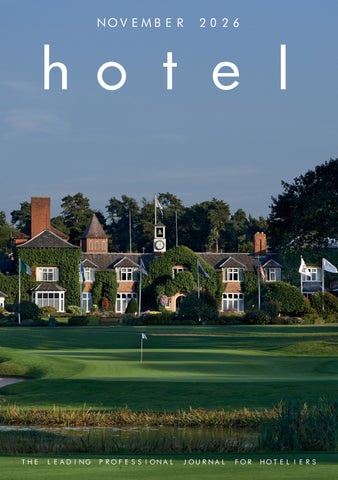
NOVEMBER 2026
THE LEADING PROFESSIONAL JOURNAL FOR HOTELIERS
Image courtesy of The Belfry Hotel & Resort
Apply
Now
www.hotelmagazineawards.co.uk/apply
Find Your One-Stop Shop for Hotel Room Products at
www.outofeden.co.uk
EDITOR’S NOTE
November 2026 A
s we head towards the final months of the year, our November issue looks firmly to the future – exploring how hotels can find new opportunities across food and beverage, sustainability and the festive season. Food and beverage takes centre stage this month, as we ask What’s Next for Hotel F&B? We’ve spoken to chefs, GMs, F&B directors, suppliers and hotel groups about the shifts they expect to shape the sector in 2027 – from smaller, smarter menus and premium non-alcoholic drinks to destination dining, technology, localism and more commercially driven approaches to sustainability. For our Essential 5, we also look beyond the traditional restaurant model to explore five alternative F&B revenue streams, from grab and go and private dining to retail, unique experiences and partnerships. As hotels look to make every space, skill and guest touchpoint work harder, the opportunities extend far beyond the dining room. Our second major focus is sustainability, with The Circular Hotel exploring how operators can move away from the traditional ‘buy, use, throw away’ model. From furniture and uniforms to mattresses, kitchen equipment, food waste and construction materials, we look at how circular thinking can become part of everyday hotel operations – and, increasingly, a commercially viable one. And, as Christmas approaches, we consider what happens when the decorations come down. Christmas Without the Hangover looks at the wider impact of the festive period, from staff exhaustion and food waste to financial pressure, empty rooms and the inevitable January slump. The best-run hotels shouldn’t just know how to survive Christmas; they should know how to come out of it stronger. Elsewhere, Paul Nash of The Doyle Collection takes to the Hot Seat, while Sea Containers London is our Hotel of the Month. We also bring you all the details from our recent housekeeping roundtable discussion in collaboration with Miele, examining some of the issues currently shaping this essential but often overlooked area of hotel operations. I hope you enjoy the issue!
Jade Evans, Editor-in-Chief
© 2026 Cogent Multimedia Limited, 1st Floor, Saphir House, 5 Jubilee Way, Faversham, Kent, ME13 8GD. No part of this magazine may be reproduced or stored in a retrieval system or transmitted in any form – electronic, mechanical or physical – without express prior permission and written consent of the publisher. Contributions are invited and when not accepted will be returned only if accompanied by a fully stamped and addressed envelope. Manuscripts should be type written. No responsibility can be taken for drawings, photographs or literary contributions during transmission or in the editor’s hands. In the absence of an agreement the copyright of all contributions, literary, photographic or artistic, belongs to Cogent Multimedia Limited. The publisher accepts no responsibility in respect of advertisements appearing in the magazine and the opinions expressed do not necessarily represent the views of the Publisher. The Publisher cannot accept liability for any loss arising from the late appearance or non publication of any advertisement.
8
www.thehotelmagazine.co.uk
CONTENTS
12 Cover Story
This month, we showcase The Belfry to explore the evolution of one of the UK’s best-known resort destinations.
17 Food & Beverage
18
20
We explore how hotel food and beverage is evolving, from new dining concepts and changing guest expectations to the ideas and innovations shaping the next generation of hotel F&B.
46 In the Hot Seat
This December, we put Paul Nash, General Manager of The Kensington, part of The Doyle Collection, in the Hot Seat to discuss leadership, luxury hospitality and his career in the industry.
50 Sustainability
42 46
72
Editor-in-Chief
Administration Manager
Head of Business Development
Design and Production
Jade Evans jevans@thehotelmagazine.co.uk
Jazmine Davis jazmine@thehotelmagazine.co.uk Tel: 01795 509 105
Account Manager Harrison Hume hh@cimltd.co.uk Tel: 01795 509 105
Marketing Manager Lucas Payne lucas@cimltd.co.uk
Natalie Woollin admin@cimltd.co.uk
Grant Waters grant@cimltd.co.uk
James Taylor james@cimltd.co.uk
Head of Digital
Xhulio Bishtaja digital@cimltd.co.uk
Social Media Manager
This month, we look beyond carbon to explore how hotels can move away from the traditional ‘buy, use, throw away’ model and embrace more circular ways of operating.
84 Roundtable Discussion
We bring you the key insights from our recent roundtable, hosted with Miele, which brought together leading names in hotel housekeeping to discuss the challenges, innovations and opportunities shaping the future of the department.
95 Hotel Magazine Awards Head over here to find out all the latest details on the 2027 HMAs, including how to apply and what the evening will entail!
Credit Facilities Manager Gwen Lee creditcontrol@cimltd.co.uk Tel: 01795 509 103
Director
Declan Wale declan@thehotelmagazine.co.uk Tel: 01795 509 112 Tom Woollin tom@cimltd.co.uk
Managing Director John Denning
Lily Lawson socials@cimltd.co.uk
www.thehotelmagazine.co.uk
9
COVER STORY
The Belfry Hotel & Resort Sutton Coldfield.
T
he Belfry Hotel & Resort is demonstrating how an established hospitality brand can evolve for a new generation without losing sight of what made it successful in the first place. At the heart of the country, the award-winning resort has undergone an £85 million-plus transformation over the past two years, almost doubling in size while significantly expanding its leisure and events proposition. The investment has broadened its appeal across the corporate, leisure and family markets, while repositioning The Belfry as a year-round destination resort. Once known primarily for world-class golf and elite competition, The Belfry now brings together 468 bedrooms, championship golf, premium events facilities, wellness and leisure experiences, family attractions and a diverse food and beverage offering. The scale of the transformation has been matched by its commercial impact, with record-breaking performance, strong guest satisfaction and industry recognition culminating in The Belfry being named Hotel of the Year at this year’s Cateys. For the team behind the resort, the achievement reflects not only the scale of the investment, but the strategy, innovation and people-first leadership underpinning its next chapter.
12
www.thehotelmagazine.co.uk
Growing without losing the identity
For Managing Director Chris Eigelaar, the central leadership challenge of the past 12 months has been ensuring that rapid growth strengthens rather than dilutes what makes The Belfry distinctive. “Growing the resort so successfully has been one of my proudest achievements as Managing Director,” he said. “But that’s also brought with it its own unique challenges – the biggest being managing this growth while, at the same time, protecting the history and sense of identity that our guests know and love.” With significant expansion comes complexity, and Chris’ focus has been on ensuring that development supports the resort’s future while respecting its established identity. The investment is intended to strengthen The Belfry’s position on the global stage, while responding to changing guest expectations and raising the standard of the experiences it provides. Throughout the transformation, communication and engagement have remained central. By explaining not only what was changing but why, the leadership team aimed to keep both guests and colleagues at the heart of the process.
COVER STORY For fellow hotel leaders, Chris’ advice is to remain focused on the characteristics that make a property distinctive. With guests having more choice than ever, he believes commercial performance and guest experience are intrinsically linked: successful hotels need to evolve while remaining true to their character, service and sense of place.
Diversifying the destination
At the centre of The Belfry’s strategy is diversity. Rather than relying on a single customer segment, the resort has broadened its proposition across leisure breaks, fitness and wellness, family stays, corporate events and weddings. The approach has been to develop targeted growth strategies around each existing market, increasing both scale and value across the resort’s revenue streams. The opening of The Masters Suite, a flagship events venue accommodating up to 920 guests, alongside the state-of-the-art fitness and wellness centre, The Club, and Brabazon House, which added 149 bedrooms, has significantly increased the resort’s capacity and reach. Together, these developments have strengthened The Belfry’s ability to attract large-scale events, premium leisure guests and longer-stay visitors, while supporting its ambition to operate as one of the UK’s leading resorts. For Commercial Director Katie Niland, the strategy has been about unlocking greater value rather than simply pursuing growth. “Sustainable commercial growth comes from making deliberate choices about where to invest, how to allocate resources, and ensuring the whole business is aligned behind clear objectives,” she explained. The physical transformation has also been accompanied by a development of the brand itself. A strengthened identity, new website and more targeted digital and social media strategy have increased visibility and broadened the resort’s reach. For Marketing Director Gail Aldridge, the redevelopment provided an opportunity to modernise the brand while retaining the heritage and character guests already associate with The Belfry.
The result is a proposition designed to communicate the breadth of the resort more effectively, ensuring its brand reflects the destination it has become.
One resort, many reasons to visit
The diversity of The Belfry’s audience presents its own operational challenge. On any given day, the resort can be welcoming golfers, families, spa visitors, leisure guests and corporate delegates, each arriving with different expectations and reasons for being there. Maintaining consistently high standards across such a varied customer base requires a strong understanding
Ch ris Eigel aa
r
www.thehotelmagazine.co.uk
13
COVER STORY of guest needs, alongside a highly skilled team and a willingness to continually review and improve the experience. The resort’s strategy is therefore centred on creating choice without compromising consistency. Guests can shape their stay around golf, wellness, family activities, dining, business or simply time away, while the breadth of the proposition allows different experiences to sit alongside one another within a single destination. The result is a resort model designed to increase both the reasons to visit and the opportunities to return, with the wider offering helping to support demand across different seasons and customer groups.
A destination beyond golf
The breadth of The Belfry’s leisure and food and beverage offering is now one of its defining strengths, helping to drive demand well beyond its traditional golf audience. Its restaurants and bars each offer a distinct proposition. Ryder Restaurant provides breakfast, buffet and à la carte dining, while Rocca’s brings Italian-inspired flavours to the resort. Sam’s Bar & Kitchen combines food with a lively sporting atmosphere overlooking the championship courses, while Brabazon Bar provides a space for everything from lunch and afternoon tea to cocktails and live evening entertainment. Within The Club, Revive Health Bar offers smoothies, juices, light bites and wholesome dishes designed around fitness and wellbeing. Innovation also plays a role in keeping the resort proposition fresh. Seasonal concepts such as Mani’s, the Indian-inspired pop-up restaurant, alongside competitive socialising and Bel Noir jazz evenings, provide new reasons for guests to visit and return. The Club has further expanded the resort’s leisure proposition, offering a Technogym-equipped gym, fitness studios, a 25-metre lap pool, family pool, indoor and outdoor hot tubs and a multi-use sports hall. Meanwhile, The Spa operates as a destination in its own right, with the Fire & Ice Experience providing a sensory thermal journey alongside relaxation areas, swimming and whirlpools, sauna and steam facilities, and treatments from ESPA and Dermalogica.
Meetings and events form another major pillar of the business, with 24 event spaces catering to everything from smaller meetings to conferences, exhibitions and gala dinners. Many spaces benefit from views across the resort’s golf courses, while the Masters Suite provides capacity for large-scale events. Together, these facilities create a proposition in which accommodation, dining, golf, wellness, leisure, family experiences and business can all be brought together under one roof.
Continuing the momentum
Having completed one of the most significant chapters in its history, The Belfry’s focus now shifts towards building on the momentum created by the transformation. The resort will continue to develop its meetings and events proposition, while further strengthening its leisure, wellness and family offering. New experiences will remain an important part of the strategy, ensuring the resort continues to respond to changing guest expectations and provides fresh reasons to visit. Sustainability will also remain a core priority, with continued investment in environmental initiatives sitting alongside commercial performance and guest satisfaction. For a resort with such an established history, the challenge is not simply to protect its legacy, but to ensure that legacy continues to have relevance. The Belfry’s transformation demonstrates one approach to achieving that: invest significantly, diversify intelligently and evolve the brand, while retaining the character and values that underpin its reputation. Its story is therefore no longer defined solely by championship golf. With 468 bedrooms, extensive events and leisure facilities, a growing wellness proposition and a broad range of food, drink and entertainment experiences, The Belfry is positioning itself for a future in which the resort itself – rather than any single element of it – becomes the reason to visit. thebelfry.com
14
www.thehotelmagazine.co.uk
Easy to use
Effortless Operation. It Pays Off. Experience superior performance from day one with the Benchmark range of commercial washers and dryers – Engineered for maximum efficiency and unmatched quality. Designed with you in mind for effortless operation with impressive OneFingerTouch door technology and a wide variety of programmes for every use – all whilst delivering significant energy and cost savings. It Pays Off. Learn more about the Benchmark models at www.miele.co.uk/pro/benchmark
Miele Professional. Immer Besser. 25-1092_02_e_Benchmark_Launch_PrintAd_Door_210x297mm_GB.indd 1
02.09.25 10:15
THE GUEST EXPERIENCE CURATORS
Introducing La Bottega Collective
A multidisciplinary collective of excellences: La Bottega, Vanity Group, Palatino, Beltrami, White Privé, and Colosseo. Through our integrated expertise across beauty, textiles, OS&E and design-driven consulting, La Bottega Collective partners with the world’s most discerning hospitality clients, from hoteliers to developers and designers, to transform the guest journey into memorable experiences. Because excellence is never an accident. labottegacollective.com
Food & Beverage
www.thehotelmagazine.co.uk
17
FOOD & BEVERAGE - ESSENTIAL 5
18
www.thehotelmagazine.co.uk
FOOD & BEVERAGE - ESSENTIAL 5
Beyond the Plate Food and beverage remains a significant part of the hotel proposition, but generating more revenue does not always mean increasing covers in the restaurant. As guest expectations evolve, operators are looking beyond traditional dining occasions to find new ways to monetise their kitchens, spaces, expertise and supplier relationships, here, we outline five ways to do so. Grab & Go
Not every guest has time for a sit-down breakfast or lunch. A well-designed grab & go offer can capture spend from guests who want convenience, whether that means speciality coffee and pastries in the morning, sandwiches and salads at lunchtime or snacks and drinks for a day out. The lobby is an obvious location, but hotels can also explore takeaway options for meetings, leisure facilities and guests heading off-site. The key is to make the proposition feel like an extension of the hotel’s F&B identity rather than a convenience store. Quality products, attractive packaging and locally sourced ingredients can turn a simple transaction into another brand touchpoint.
Events & Private Dining
Private dining and F&B-led events can transform underused spaces into valuable revenue-generating areas. Rather than simply hiring out a room, hotels can package the space with menus, drinks, entertainment and dedicated service to create a complete experience. Chef’s tables, tasting menus, supper clubs, wine pairings and seasonal events can also create reasons for both guests and local customers to visit outside traditional meal occasions. These events can help hotels make use of quieter trading periods while introducing new customers to their wider F&B offer.
Retail
Hotels already have products that guests associate with their stay, making retail a natural extension of the F&B proposition. House-made preserves, sauces, biscuits, chocolates, coffee, tea, wine and other branded products can give guests the opportunity to take a piece of the experience home. Retail can also extend beyond food produced in-house. Carefully selected local products can support the hotel’s
sense of place while creating additional commercial opportunities. For luxury properties in particular, beautifully presented food products can become premium gifts as well as souvenirs.
Experiences
The growing appetite for experience-led travel creates opportunities for hotels to monetise their culinary expertise. Cookery classes, cocktail masterclasses, wine tastings, chef-led dinners, market visits and behind-thescenes kitchen experiences can all become bookable products. These experiences do not necessarily need to be exclusive to overnight guests. Opening selected experiences to local residents can create an additional customer base and generate revenue during quieter periods. They can also provide a stronger connection between the hotel’s F&B team and its wider community.
Partnerships
Partnerships can introduce new revenue opportunities without requiring hotels to develop every product themselves. Collaborations with chefs, food producers, drinks brands and local businesses can create limitededition menus, pop-ups, events or co-branded products. The right partnership can also bring an established audience to the hotel. A collaboration with a popular local bakery, for example, could create a new breakfast or coffee proposition, while a drinks brand could support a ticketed tasting event. For hotels, the opportunity is not simply to sell more food and drink, but to think differently about where, when and how F&B can generate value. By looking beyond the traditional restaurant model, operators can create additional revenue streams while giving guests more reasons to engage with the property.
www.thehotelmagazine.co.uk
19
FOOD & BEVERAGE
What’s Next for Hotel F&B? From destination dining and hyper-local sourcing to smaller menus, smarter technology and a new definition of value, hotel F&B is evolving fast. We spoke to chefs, general managers, F&B directors, operators and suppliers about the shifts they believe will shape the sector in 2027.
20
www.thehotelmagazine.co.uk
FOOD & BEVERAGE
F
Chapter Chianti - Osso Restaurant
or years, hotel F&B has had something of an identity problem. Too often viewed as an amenity for residents rather than a reason to visit, hotel restaurants and bars are now being challenged to stand on their own – to attract locals, create a sense of place and offer experiences that guests cannot easily replicate elsewhere. At the same time, operators are under pressure to control costs, manage staffing challenges, reduce waste and meet increasingly sophisticated guest expectations. The result is not necessarily a more complicated F&B landscape, but a more considered one. Across our conversations with hotel leaders, chefs, consultants and suppliers, several themes emerged. The hotel restaurant of the future is likely to be more distinctive, more local and more focused, while technology will increasingly take care of the less human parts of the operation. For Anne Golden, General Manager of Pan Pacific London and Vice President of Operations for the UK and North America at Pan Pacific Hotels Group, understanding what guests actually want will remain fundamental. “A willingness to listen to guests and adapt around how they use the hotel” is key, she said, particularly as different customers look for different dining experiences. F&B needs to contribute throughout the stay, from the restaurant to in-room dining, with “convenience and comfort” sometimes just as important as the restaurant experience itself. Five years after opening, Pan Pacific London has developed a much deeper understanding of its guests, while its recent MICHELIN Key recognition has added further momentum. The hotel’s new Director of Food & Beverage, Mark Lee, joined in October with plans for the next chapter. “It’s a lovely time to be joining Pan Pacific London, with the team celebrating five years and the hotel’s first MICHELIN Key,” Mark said. “For me, a great restaurant is somewhere you feel at ease, enjoy really good food and find yourself coming back to.” That desire to create somewhere people actively want to return to sits at the heart of one of the biggest shifts identified by our contributors: hotel F&B becoming a destination in its own right. At Knockinaam Lodge, Hotel Manager Callum McCann believes the restaurant should be something guests seek out rather than simply encounter because they are staying at the property. “I think guests are increasingly looking for a sense of place when they travel, and food and drink are among the best ways a hotel can provide that,” he said. For Knockinaam, that means Scottish producers, ingredients from its kitchen garden and polytunnel, and menus dictated by the seasons. But the sense of place goes beyond ingredients. Guests are increasingly interested in “the story behind what people are eating and drinking” where something came from and why it belongs on the menu. Callum also sees a shift away from the formality traditionally associated with fine dining. The next generation of guests will still expect exceptional cooking and service, but increasingly value “personality, warmth www.thehotelmagazine.co.uk
21
FOOD & BEVERAGE
Chapter Chianti - Osso Restaurant
and authenticity over traditional fine dining”. That does not mean abandoning heritage. “Heritage can’t mean standing still,” he said. The challenge is to identify which traditions genuinely add to the experience, then give teams the freedom to evolve around them. Erhan Karadag, Deputy General Manager at Down Hall, sees the same movement towards experience-led F&B. “I think we’ll continue to see a move away from F&B being viewed simply as an amenity of the hotel, towards it
22
www.thehotelmagazine.co.uk
becoming a genuine reason for guests to visit.” At Down Hall, that thinking has informed its Woodland Table concept, which brings together the estate, produce, fire, people and storytelling. The food is only one part of the experience. For Oscar Salazar, Executive Chef at 7Pines Resort Ibiza, this is also changing what luxury means. “Guests are not looking for less luxury; they are looking for a different kind of luxury. They want more quality, but less formality.”
FOOD & BEVERAGE
The experience as a whole now matters: the food, service, music, atmosphere, timing, setting and value all need to work together. Nicolas Schell, F&B Director at The Savoy, believes individuality and a genuine sense of place will become even more important, particularly as London diners become increasingly discerning about where they spend their time. “A hotel restaurant or bar must be a destination in its own right,” he said. That is a significant change in mindset. Rather than asking how to persuade residents to eat in the hotel, operators are increasingly asking why a local customer would choose to eat there. If destination F&B is the direction of travel, authenticity is becoming its currency. Joan Escales, Head Chef at ANNUA’s Gran Hotel Margalida, said guests increasingly want “local produce, authentic stories, healthier options and experiences they couldn’t easily recreate at home”. In Banyalbufar, the sea, Tramuntana landscape, local agriculture and winemaking tradition are not simply marketing tools – they form the foundation of the restaurant’s identity. Diners want to “taste Mallorca”, rather than eat food that could be served in any international hotel. That means greater flexibility too, with the kitchen responding to what the market and sea offer rather than imposing a fixed menu for an entire season. Andrea
Giubbilei, Resort Manager at Chapter Chianti, believes this connection between food and place is already influencing booking decisions. “The biggest shift is that F&B is becoming a primary reason to book, not an amenity attached to the room,” he said. At Chapter Chianti, guests are mentioning breakfast from fresh ricotta and local prosciutto to homemade cakes - in reviews as a highlight of their stay, sometimes before the rooms or spa. “That tells us food is doing brand work, not just service work,” Andrea said. But today’s guests are increasingly able to distinguish genuine provenance from marketing language. “They can tell the difference between ‘local’ as a marketing word and local as an actual supply chain,” he explained. For Andrea, the commercial answer is specificity over scale. Rather than expanding a menu to satisfy everyone, operators should focus on what their property can genuinely do better than competitors nearby, whether that means working with a particular cheesemaker, baker or producer. That idea of focus comes through repeatedly in conversations about menus. Paulo de Tarso, Restaurateur and Founder of Paulo de Tarso Hospitality, believes hotels should be moving towards menus that are “more focused, more confident and easier for both the guest and the operation”. www.thehotelmagazine.co.uk
23
FOOD & BEVERAGE
Knockinaam Lodge Hotel & Restaurant
More choice, he argues, does not necessarily mean a better experience. Smaller menus can improve consistency, control food costs and waste, streamline training and give a restaurant a clearer identity. “I’d rather have 20 dishes that are brilliant than 50 dishes that are average,” he said. Oscar agreed. Guests are increasingly informed and can recognise when a concept exists simply to fill space in a hotel. “Smaller, more focused menus and concepts with a real reason to exist are becoming much more important
24
www.thehotelmagazine.co.uk
than trying to offer everything to everyone.” There is a commercial benefit, too. “Sometimes being more focused makes you more profitable,” Oscar said, pointing to oversized teams, unnecessarily large menus and operations attempting to do more than they can realistically deliver as areas where money can be lost. For Down Hall’s Erhan, the same principle applies across the operation. “Every dish, every outlet and every service style needs to have a purpose commercially and from a
OaTLY IS ON TOp! NEW!
AT LAST: A cloud you can eat! Oatly Barista Cold Foam is a plantbased topping that tastes amazing and adds some creativity to anything that needs an extra little fluff. Chill before use. Enjoy!
FOOD & BEVERAGE guest perspective.” Complexity can be expensive when it creates additional labour and stock requirements without adding meaningful value. Experience-led F&B does not necessarily mean adding more gimmicks, either. Max Tappeiner, President of Wynn Al Marjan Island, argued that the industry needs to broaden its definition of experience without confusing theatre with substance. “It isn’t about adding theatre for theatre’s sake,” he said. Instead, the fundamentals remain crucial: regional traditions, depth of service and best-in-class products prepared with authenticity and precision. At an integrated resort, however, the experience can extend beyond a single outlet. A guest might arrive for dinner and stay for entertainment, or come for a theatre performance and discover a restaurant they subsequently return to. The opportunity, Max believes, is to consider “the whole guest journey” - what brings someone in, what keeps them there, what else they discover and what gives them a reason to return. The Dilly’s F&B Director Stevel Ger also sees experience and storytelling becoming increasingly important. Its new Classic London Afternoon Tea draws on British culture and heritage, reflecting a wider appetite for F&B with a story behind it. “Guests want more than just good food; they want an experience with a sense of place and a story they can connect with,” Stevel said. For all the discussion around technology, efficiency and changing formats, one of the strongest messages from the contributors is that hospitality itself cannot be compromised. Paulo believes the future of F&B is ultimately about “getting back to the fundamentals of great hospitality”. Guests have more choice and are increasingly conscious of where they spend their money, making service, training and value more important rather than less. “You can have the most beautiful restaurant, an incredible chef and the best technology, but if the service is not genuine, professional and consistent, the guest will remember that,” he said. For The Savoy’s Nicolas, efficiency should similarly be about giving staff more time to look after guests, rather than simply reducing costs. “Thoughtful menus, enhanced planning and continued investment in training allow us to work more effectively while maintaining our Savoy standards,” he said. “The best efficiencies give our people more time to notice the details and create those personal moments guests remember.” Paul Bates, Executive Chef at Hilton London Metropole, has more than 40 years of hospitality experience and sees adaptability as one of the most important qualities for hotel kitchens going forward. Guests are more informed and individual in what they expect, while large hotels must cater to a huge variety of occasions. At Hilton London Metropole, that means everything from conferences and large-scale events to leisure stays, private dining and room service. “By 2027, I think adaptability will be one of the most important qualities for a hotel kitchen,” Paul said. “We need to understand our guests, anticipate their needs and
26
www.thehotelmagazine.co.uk
deliver something that feels considered, whatever the size of the operation.” Technology will undoubtedly have a role to play, particularly in large and complex operations, but the consensus is that it should support hospitality rather than replace it. With 54 chefs working across five kitchens, Paul sees technology as an opportunity to improve planning, stock management, consistency and food waste, while reducing repetitive administrative work. “The real opportunity is to use it intelligently across the operation,” he added, freeing chefs to focus on cooking, tasting, problem-solving and developing people. And there is an important caveat: “You cannot automate hospitality.” Erhan made a similar point. Technology and better data can help operators understand demand, labour
FOOD & BEVERAGE requirements, purchasing and profitability, but the goal should be to remove inefficiency and administration so teams can spend more time looking after guests. Sustainability is also moving away from being a collection of visible initiatives towards becoming embedded in how F&B operates. At Knockinaam, Callum says reducing food waste, responsible sourcing and using ingredients fully have been fundamentals for years. The next step is to look beyond the obvious, considering everything from the chemicals and products used by the hotel to guest behaviour. Paul also points to seasonality and provenance as areas that will continue to develop. At Hilton London Metropole, around 90% of ingredients are sourced from within 100 miles; a particularly significant figure given the scale of the operation. For suppliers, sustainability is increasingly becoming part of the partnership conversation. Patrick McCaig, Managing Director at Otter Brewery, revealed that guests are increasingly choosing destinations based on their local cuisine, with food and drink playing a growing role in regional identity. For hotels, that creates an opportunity to work with suppliers whose products genuinely connect the guest to the destination. Sustainability also needs to stand up operationally, Patrick argued, pointing to Otter Brewery’s use of leftover grains for cattle feed, yeast as food at a local piggery and on-site willow beds to return wastewater to the environment. Alongside the bigger strategic shifts, suppliers are also seeing opportunities in the small details that can elevate the guest experience. Matt Grenter, Sales Manager at Symphonie Pasquier, believes hotels will increasingly use “little luxuries” to enhance F&B without necessarily adding significant complexity. One example is the café gourmand model, pairing hot drinks with small pâtisserie, while tasting platters can allow guests to sample several desserts without committing to a full portion. For operators under pressure from labour and ingredient costs, Matt also sees a growing role for premium preprepared pâtisserie. Products that can be defrosted, plated and served can save kitchen time, reduce waste and make menu planning easier. It reflects the wider direction of travel: efficiency does not necessarily have to mean a less premium experience if operators are thoughtful about where complexity adds value and where it does not. Perhaps the clearest message from the conversations is that hotel F&B is not becoming less ambitious – it is becoming more deliberate. The winning operators of 2027 will not necessarily be those with the longest menus, the biggest teams or the most elaborate concepts. Instead, they will be the ones that understand what their particular guest wants, what their property can authentically offer and where investment will have the greatest impact. At The Savoy, Nicolas points to its new Beaufort Wine Bar as an example of innovation with a clear purpose. Coravin allows guests to explore rare wines by the glass with expert guidance, making an exceptional experience more approachable while also opening the door to a younger audience.
28
www.thehotelmagazine.co.uk
“For me, that is where innovation has real value: opening new possibilities for our guests while supporting a sound operation,” he said. That perhaps captures the future of hotel F&B most succinctly. The sector is being asked to do more with less, but the answer is not simply to cut back. It is to become clearer about what matters. A great restaurant needs an identity. A great menu needs a reason to exist. Technology needs to give people more time to be hospitable. Sustainability needs to run through the operation rather than sit on the sidelines. And above all, food needs to make people feel something about the place they are visiting. As Paulo put it: “Ultimately, hospitality is about how you make people feel. That will never change.”
c
c
LW_Baglietti Christmas Ad_v1.indd 1
28/09/2026 13:04
FOOD & BEVERAGE
Christmas Beyond Champagne Ben Cotts, Key Account Manager at Lanchester Wines, looks at the wine trends set to shape the festive trading period and explains how hotels can maximise guest spend through premium wines and a stronger no and low alcohol offer.
C
hristmas remains one of the year’s most important trading periods for hotels. Whether it’s festive lunches, corporate celebrations, overnight packages or New Year’s events, your customers are often more willing to spend on memorable experiences than at any other time. For hoteliers, this presents an opportunity to look beyond the traditional Christmas drinks offer and introduce products that add value, enhance the guest experience and increase spend per head. Sparkling wine will always play a central role during the festive season, but there are opportunities to offer guests alternatives that deliver quality and a sense of occasion without relying exclusively on Champagne. However, rather than replacing Champagne, consider creating a sparkling wine ladder that gives guests genuine choice across different price points. Crémant is one category continuing to gain traction. Produced using the same traditional method as Champagne, it offers the familiar brioche, citrus and toast characteristics guests enjoy, often at a more accessible price point. Franciacorta is another compelling option. This premium sparkling Chardonnay-based wine from northern Italy combines elegance and complexity with enough familiarity to appeal to Champagne drinkers while offering something different for guests keen to explore. Premiumisation remains one of the strongest trends in hospitality, and Christmas is arguably its biggest opportunity. Throughout the year, guests may be more cautious with discretionary spending, but during the festive season they are far more likely to treat themselves, particularly when celebrating with family, friends or colleagues. Use the festive season to showcase premium wines that may not feature prominently on your core list throughout the year. A dedicated seasonal wine menu can encourage guests to trade up while helping staff start conversations around food matching and special-occasion dining. Red Burgundy is a good example. Pinot Noir’s bright red fruit, subtle earthy character and moderate tannins make
30
www.thehotelmagazine.co.uk
it a natural partner for turkey and traditional Christmas accompaniments. Offering a premium Burgundy alongside festive menus can provide guests with an easy upgrade option and create a more memorable dining experience. Italian reds are also proving popular as customers seek richer, more indulgent styles during the winter months. Wines such as Barolo, Chianti Classico Riserva, Brunello di Montalcino and Amarone offer depth, complexity and a strong sense of provenance while pairing exceptionally well with festive dishes. Portugal is another category worth exploring this Christmas. Particularly reds from the Douro region offer ripe dark fruit, spice and structure that work across the festive menu and can pair beautifully with lamb, beef,
FOOD & BEVERAGE venison, duck, goose and hearty winter stews, while also standing up to dark chocolate desserts and the allimportant cheeseboard. While in Portugal, it would be remiss not to mention Port. Beyond its traditional role alongside desserts and cheese, Port is increasingly finding a place in festive cocktail menus as it brings sweetness, texture and complexity, pairing effortlessly with citrus, bitters, tonic and sparkling wine. Simple serves and twists on classics such as the Old Fashioned or Negroni can offer guests something distinctive while remaining easy for bartenders to execute during busy service. Importantly, premiumisation doesn’t require a larger wine list. A carefully curated selection of festive recommendations can often have a greater commercial impact than simply expanding the range. The objective is to make trading up easy and attractive while giving frontof-house teams confidence to recommend higher-value options. At the same time, no Christmas drinks strategy is complete without serious consideration of the no- and low-alcohol category. Your guests increasingly expect choice, quality and sophistication regardless of whether they are drinking alcohol. During the festive season, this becomes especially important as within almost every booking there is likely to be a designated driver, a moderation-conscious guest or someone choosing not to drink at all. For hotels, the challenge is ensuring these guests feel equally included in the celebration. Offering only a handful of soft drinks is unlikely to meet modern expectations. Instead, hotels should provide alcohol-free options that deliver the same sense of occasion as the rest of the drinks menu. A quality alcohol-free sparkling wine is an excellent place to start. Products such as Famille Moutard’s M 0% offer the ceremony and elegance associated with sparkling wine, while Tommy Bacco 0% provides a fresh, aromatic alternative inspired by generations of Italian winemaking. And, it also works exceptionally well in non-alcoholic spritz. Serving these products in the same way as traditional sparkling wine helps reinforce that they are considered choices rather than compromises. Visibility is just as important as availability. Featuring no- and low-alcohol recommendations on festive menus, training staff to suggest pairings and presenting alcoholfree sparkling wines with the same care and theatre as alcoholic alternatives can all help create a more inclusive experience. Ultimately, the most successful hotel drinks programmes this Christmas will focus on experience. Giving guests reasons to explore premium wines, while offering credible no- and low-alcohol alternatives, can drive both customer satisfaction and festive sales. Create opportunities for guests to trade up while ensuring non-drinkers enjoy the same sense of occasion. That’s where the greatest opportunities for revenue growth lie this Christmas.
Ben Cotts
For more information on Lanchester Wines, please visit www.lanchesterwines.co.uk www.thehotelmagazine.co.uk
31
FOOD & BEVERAGE
Savouring the Season The power of high-profile cultural partnerships, as told by Rowan MacMillan, Away from Home Marketing Manager at Lavazza.
H
otels often face an invisible barrier. For locals walking past, grand lobbies and elegant entrances can feel off-limits, reserved only for tourists, conferences, or overnight guests. Breaking that perception requires more than simply opening the doors; it takes a genuine reason to step inside. This challenge lands at an ideal moment. Guests are no longer stepping out simply to grab a quick drink on the go. Out-of-home beverage visits driven primarily by socialising have jumped to 27% year-on-year (CGA by NIQ / Lumina Intelligence). People crave connection. They are actively seeking warm, destination-led spaces where catching up over a drink feels like an occasion in itself. Major cultural moments give hoteliers the perfect bridge. When venues tap into events people are already excited about, they turn hotel bars, lounges, and terraces into lively neighbourhood meeting spots.
Case Study: Bringing Wimbledon to the London Hotel and Bar Summer in London offers a natural stage for this, anchored by the buzz of Wimbledon. As the Official Coffee of The Championships, Lavazza partnered with a select group of leading venues - including Bluebird Chelsea & City, The South Place Hotel, InterContinental London, Flemings Mayfair, Great Scotland Yard Hotel, and Roast—to take the
spirit of the court into hospitality spaces across the city. The strategy was simple: fit the activation to the venue, not the other way around. That meant adapting the experience to suit each location’s dayparts and guest profile: - Making the everyday feel special: For daytime coffee visits, every coffee was served with a complimentary, tennis-racket-shaped cake. Accompanied by official Wimbledon branding, a flat white became an instant
32
www.thehotelmagazine.co.uk
FOOD & BEVERAGE micro-celebration. It gave people a smile, something to photograph, and a reason to stay for longer. - Flexing from daytime to late evening: At cocktail destinations like Great Scotland Yard and Flemings Mayfair, the concept shifted into the evening. Bespoke tournament cocktails and coffee-infused nightcaps gave guests who were not following daytime matches a way to share in the mood after dark. - Inviting the street inside: At visual venues like Bluebird Chelsea and Roast, large-scale window vinyls and dedicated menus brought the excitement directly onto the pavement. Passers-by did not have to wonder if they were welcome; the visual energy invited them straight in. By giving guests tangible, thoughtful details—a playful pastry, an inventive serve, a dressed window, giving visitors something genuinely worth sharing.
How Hotels Can Bring Key Moments to Life
The success of summer activations proves that partnerships work best when they feel lived-in and real. For hotel operators looking to build an engaging, yearround calendar, here are three practical ways to translate big cultural moments into daily footfall: 1. Align with the right calendar moment—and brand partner Identify cultural or sporting events that naturally resonate with your core clientele, then collaborate with food and beverage brands already tied to the occasion. 2. Focus on small, high-touch details You do not need an overhaul to make an impact. A themed petit four beside an espresso or an unexpected terrace garnish costs little yet turns an ordinary drink order into memorable ritual guests naturally want to photograph. 3. Break down the street-level threshold Dressed windows, terrace styling, and visible signage instantly signal to passers-by that the space is open for everyday socialising, removing the hesitation locals often feel about stepping into a hotel.
When hotels treat the cultural calendar not as a corporate sponsorship exercise, but as an opportunity to host their local community they become the natural destination for people looking to celebrate the season together. For more information on how Lavazza’s coffee portfolio can work for your business, contact uk. salesorders@lavazza.com or visit www.lavazza.co.uk/en/contact-us
Rowan M ac M
illan
www.thehotelmagazine.co.uk
33
FOOD & BEVERAGE
Glencairn’s Guide to the Perfect Spirit Serve For over 40 years, Glencairn has partnered with the world’s leading distilleries and spirits brands to design glassware that brings out the very best in every serve. Here’s a guide to choosing the ideal glass for every spirit.
W
hen so much care goes into creating a premium spirit, the choice of glass should never be an afterthought. The right glass doesn’t simply enhance presentation, it influences how the spirit reaches the palate and, ultimately, how much the drink is enjoyed.
Whisky: The Glencairn Glass
The Glencairn Glass has become the world’s official whisky glass leading the way in appreciation. Its iconic tulipshaped bowl concentrates aromas while the wide crystal base showcases the whisky’s colour. Thoughtfully designed and expertly balanced, it brings every subtle note of the whisky to life.
Gin: The Glencairn Gin Goblet
Designed to highlight every botanical note, the Glencairn Gin Goblet features a gently curved lip that captures delicate aromas. Its generous shape allows plenty of room for garnish without excessive ice, preserving both flavour and balance.
Premium Spirits with Ice or a Mixer: The Glencairn Mixer Glass
Perfect for fine spirits and expertly crafted cocktails, the Glencairn Mixer Glass offers the perfect balance between versatility and performance. Originally developed for luxury Canadian whisky, the Glencairn Mixer became the official choice of the Canadian whisky industry. Its signature tulip shape retains the nosing benefits of a tasting glass while providing ample space for ice and mixers, making it ideal for all premium spirits.
Cocktails & Highballs: Glencairn Highball Collection
From timeless classics to contemporary creations, exceptional cocktails deserve equally exceptional glassware. Glencairn’s Highball Collection includes elegant handmade Edinburgh cut crystal for luxury serves as well as the classic Jura Highball, beautifully proportioned and robust enough for busy bars without compromising on style.
34
www.thehotelmagazine.co.uk
The Finishing Touch
True luxury is defined by thoughtful detail. Expertly crafted crystal glassware enhances aroma, presentation and perception, elevating the guest experience while reflecting the quality of the spirit. For hospitality venues, it also reinforces premium positioning and can even inspire guests to trade up and pay more for their drink choices. You can also complete the experience with Glencairn’s bespoke personalised branding service to create distinctive, Instagram-worthy glassware that leaves a lasting impression. For exclusive drinks industry pricing: contact@glencairn.co.uk glencairn.com @theglencairnglass
The Official Whisky Glass
Give whisky the glass it deserves this Christmas Over the past 25 years, more than 50 million Glencairn Glasses have been trusted by bars, restaurants, distilleries, and whisky events across the globe. Scan here to visit the Glencairn Whisky Hub for the latest whisky news, events, and history.
FOOD & BEVERAGE
The Dessert Series From apprentice to award-winning Head Pastry Chef, this month we meet the pastry chef behind London Hilton on Park Lane’s sweet creations, exploring the craft, creativity and precision behind pastry – and how desserts can become some of a hotel guest’s most memorable moments. What first drew you to pastry?
I was around cooking a lot when I was growing up. My family are incredible cooks, although not professionally, so food was a huge part of my childhood. Unfortunately, I wasn’t quite good enough to make it as a footballer, so I turned to something I knew I was good at! I originally trained as a hot kitchen chef, but I quickly realised that pastry suited me. I loved the combination of creativity, precision and technical skill. There is also a real science behind pastry, which I found fascinating, and I enjoyed that you could take a few simple ingredients and turn them into something completely different.
Where did your career begin?
I began my career with Hilton as an apprentice at Hilton London Heathrow Airport, primarily working in the hot kitchen and covering breakfast service. After six months, I entered a competition for Hilton’s London apprentices, with the prize being a work placement at London Hilton on Park Lane. I was fortunate enough to win and joined the hotel in 2011. What started as a work placement became the beginning of my career in pastry, and I’ve been at London Hilton on Park Lane ever since. I’ve progressed through the ranks from apprentice to Head Pastry Chef, which makes it particularly special to now be leading the team in the same kitchen where my career started.
What have been the defining moments in your career? There have been a few moments that really stand out. Winning Bake Off: The Professionals in 2018 was a huge one. It was an incredibly demanding competition and winning gave me a huge amount of confidence in what I could achieve.
Chef: Sam Leatherby Hotel: London Hilton on Park Lane Location: London, UK Years in pastry: 14+ years Signature style: Clean, symmetrical and flavour-led
36
www.thehotelmagazine.co.uk
Sam Leathe
rby
Becoming Head Pastry Chef at 29 was another defining moment. Having started at London Hilton on Park Lane as an apprentice, progressing through the ranks to lead the pastry team at the same hotel was something I was incredibly proud of. More recently, being named Pastry Chef of the Year at the Craft Guild of Chefs Awards in 2026 has been a huge honour. To be recognised by fellow chefs and industry professionals, while leading the team at the hotel where my career began, made it particularly special.
How has your style evolved over time?
It has got a lot cleaner and more symmetrical over the years. When I was younger, I think I was more focused on putting as much as possible onto the plate and showing what I could do technically. As I’ve developed, I’ve learnt that you don’t always need to do more. I’m much more conscious now of balance, presentation and making sure every element has a purpose.
FOOD & BEVERAGE
How would you describe your pastry philosophy?
Sometimes less is more. Although I want the desserts to look like pieces of art, I want the flavours to tell most of the story.
What influences your creativity?
There are so many things. Social media is a big one because you are constantly seeing what other chefs and pastry chefs are doing around the world. Travelling also has a huge influence on me, whether that is discovering new flavours, ingredients or different approaches to pastry. Having a multicultural team is another great source of inspiration because everyone brings different experiences, ideas and techniques into the kitchen. I think creativity often comes from simply being open to what is around you.
How do you balance innovation with familiarity?
Whatever we are looking to create or even recreate, the base flavours always need to be recognisable. You can make something look completely different or introduce a new technique, but the guest still needs to understand what they are eating. I think the best desserts have that balance where there is something familiar that makes you comfortable, with something unexpected that makes it exciting.
What ingredients or techniques define your style?
I like matching fruits with single-origin chocolate. I think there is something really interesting about letting the quality and character of those ingredients come through rather than adding too many different flavours. I also really enjoy working with soufflés and chocolate, particularly because both require a lot of precision and consistency.
How does creating desserts for a hotel differ from a standalone restaurant?
I don’t think it differs. Although we work with high volumes, I still believe what we create in the hotel is just as good, if not better, than a standalone restaurant. The difference is the scale and the variety of what we have to produce. In a hotel, you could be producing breakfast pastries, afternoon tea, restaurant desserts, room service, amenities and desserts for a banquet of 1,000 guests all in the same day. You have to be entrepreneurial and think about how you can deliver something special at every level while still maintaining the same standards.
How important is pastry to the overall guest experience?
Very! It is ingrained in so many parts of the guest experience, from a pastry at breakfast and dessert at dinner to something special waiting for them in their room. www.thehotelmagazine.co.uk
37
FOOD & BEVERAGE It can often be both a guest’s first and last impression. Pastry has the ability to be part of so many different moments throughout a stay, whether that is starting the day with a great pastry, finishing a meal with dessert or recognising a special occasion with a personalised amenity. That is why it is so important that we treat every one of those moments with the same level of care and attention.
Has the rise of afternoon tea, destination dining and experiential desserts changed the role of pastry?
Yes. The expectation of afternoon tea, for example, is no longer just finger sandwiches, tea and cake. It is now a fully immersive experience and people want to be able to capture images of that. Guests are looking for something that feels special and gives them something to talk about. That means pastry chefs have to think beyond just how something tastes. Presentation, creativity and the overall experience have become just as important.
How can hotels use pastry to create memorable moments? Amenities are a really good example because they give us an opportunity to make something personal to the guest and mark an important moment. We create bespoke newspaper cakes for special occasions and VIPs, using the guest’s image and tailoring the stories and copy around them and the moment they are celebrating. We also create small Big Bens made entirely from solid chocolate, which can be a great way to mark someone’s trip to London and give them something memorable to take away from their stay. It doesn’t always have to be something extravagant. Sometimes it is the personalisation and thought behind
Signature Dessert
Raspberry and Lime Soufflé
Inspiration behind it
The inspiration came from our last farm visit to one of our suppliers. We saw the care and passion that goes into growing their raspberries and it really made me think about how much work goes into producing such a simple ingredient. They can now grow their raspberries for six months of the year, which is very unique. When you see that process first-hand, you want to make sure you treat the ingredient with the respect it deserves. The dessert is designed to really let the raspberry and lime work together rather than hiding those flavours behind lots of other elements.
Ingredients
British raspberries, of course, lime, egg whites, cornflour, sugar, white chocolate and freeze-dried raspberries.
Techniques involved
Whisking, folding, cooking and chocolate tempering.
38
www.thehotelmagazine.co.uk
it that makes the biggest impact. When a guest sees something that has been created specifically for them, it becomes more than just a dessert or an amenity. It becomes part of their memory of the stay.
Behind the Scenes How large is your pastry team?
There are ten people who make up the team.
What does a typical day look like?
I’m usually in the kitchen by 6:30 or 7am so I can make sure breakfast has gone out smoothly and check that the bakers are all OK. I’ll then look through the functions and events for the day, before grabbing breakfast and catching up on emails.
FOOD & BEVERAGE From there, no two days are really the same. It could be meetings, tastings, planning for upcoming events or jumping in with the team wherever I’m needed. I still like to be hands-on in the kitchen and make sure I’m supporting the team wherever I can. On a regular day I’ll be finished around 5pm, but if we have a large event, it can be closer to 10pm.
What are the biggest operational challenges?
Last-minute demands can happen on a daily basis. We can do amazing things with notice, but, like everyone, it can be difficult to create something really special at short notice. In pastry, there are so many elements that need planning, from proving and setting times to chocolate work and sourcing ingredients, so you can’t simply rush something and expect the same result. That said, working in a hotel means you have to be adaptable. Things change constantly and part of my role is making sure the team can respond without compromising the quality of what we produce. We often have a back-up plan for the back-up plan!
How do you maintain consistency across hundreds of covers?
Training, consistent recipes, communication and standards. You have to make sure everyone understands not just what they are doing but why they are doing it. When you are producing something hundreds of times, small differences can quickly become noticeable, so having clear recipes and processes is really important. Ultimately, it comes down to having a well-trained team who take pride in what they produce and understand the standard we expect every time.
Quickfire Favourite ingredient? Pistachio.
Most underrated pastry technique?
Chocolate tempering. Most of it is done by a machine these days, but I make sure my team know how to do it by hand.
Dessert trend to watch?
Hybrid desserts. I love seeing different pastries and cakes being combined into something new. I saw Magnum ice creams being put inside croissants on social media recently and that’s definitely one I’m dying to try! I think it’s really interesting seeing which combinations people love and which ones make them think, “I’m not sure about that.”
The dessert you could never tire of making? Crumble. It’s a childhood favourite!
Sweet or savoury? Silly question!
The one dessert every hotel should master? Baked cheesecake.
How important is training and developing for young pastry talent?
It’s everything. I was lucky enough to come into a kitchen full of talented pastry chefs and be given the tools to learn, so I am always committed to doing that for any young chef who comes into our kitchen. When you are starting out, you learn so much from the people around you, not just techniques but discipline, standards and how a professional kitchen works. I think it is important to give young chefs the same opportunities that I was given. Seeing people you have trained progress into senior roles themselves is incredibly rewarding and one of the things I am most proud of. www.thehotelmagazine.co.uk
39
CHEF PROFILE
Richard Simms At Ellenborough Park, Chef Richard Simms is championing seasonal British produce, traditional techniques and a more considered approach to using the whole ingredient – with the Cotswolds providing plenty of inspiration. What is your culinary philosophy, and how do you translate that into the menus at Ellenborough Park?
My culinary philosophy is quite simple: start with good ingredients, treat them with respect and let them speak for themselves. I’d describe my cooking as seasonal, ingredient-led and rooted in British produce. I enjoy traditional techniques, particularly when it comes to sauces and getting the fundamentals right, but I also like bringing creativity into the kitchen and finding new ways to present familiar ingredients. At Ellenborough Park, I want the menus to reflect both that approach and the character of the hotel and its surroundings. We’re fortunate to be in the Cotswolds, with access to some fantastic seasonal produce, so I want to make the most of what’s available to us and let the ingredients guide the menus. The Kitchen Garden is also becoming an important part of that. We’re looking at how we can bring more of what we grow here into the kitchen, whether that’s tomatoes, herbs or more unusual garnishes. There’s something very satisfying about growing an ingredient at Ellenborough Park and then seeing it go straight onto a guest’s plate. Ultimately, I want the food to feel like it belongs here. It should be creative and contemporary, but still grounded in good British ingredients and proper cooking, giving our guests a real sense of where they are.
What are the biggest challenges and opportunities of running a kitchen within a hotel, compared with a standalone restaurant?
One of the biggest differences with a hotel kitchen is the variety of food and experiences you have to deliver. You’re not catering for just one style of dining or one type of occasion. At Ellenborough Park, the kitchen has to be able to adapt to everything from relaxed dining and special occasions to weddings, events and our tasting menu, while maintaining the same standards throughout. That brings challenges, particularly operationally, but I also see it as a great opportunity. A hotel gives us the chance to be creative across a much broader food and beverage offering, and to develop different experiences while still having a clear identity running through the food. For me, the key is having a strong team and making sure everyone understands what we’re trying to achieve. You
40
www.thehotelmagazine.co.uk
Chef Richard Simms’ signature dish
Creedy Carver Duck Honey-roasted breast and confit leg bonbon with smoked streaky bacon, pomme Anna, pickled blackberry, white onion, maitake mushroom, spinach and duck jus.
CHEF PROFILE can have all the ideas in the world, but it’s the people in the kitchen who bring those ideas to life and make sure the standards remain high every day. I also think a hotel environment can be a really good place for young chefs to develop. There are opportunities to experience different styles of cooking, different types of service and different pressures, rather than being exposed to just one type of restaurant. Developing that next generation of chefs is something that’s particularly important to me.
Is there an ingredient or menu that particularly represents you and what you’re trying to achieve at Ellenborough Park - and what’s the story behind it?
At the moment, I think our lobster and scallop ravioli is a really good representation of the kind of cooking I’m trying to achieve at Ellenborough Park. We’re fortunate to get hold of some fantastic fresh lobsters, and we use the meat to make the filling for the ravioli. We then use the shells to make a rich bisque to serve alongside it, so we’re making the most of the whole ingredient rather than allowing part of it to go to waste. For me, the dish brings together a lot of the things I enjoy about cooking. You’ve got a fantastic ingredient, traditional techniques, careful preparation and plenty of flavour, but without trying to make the dish overly complicated. I think the best dishes are often the ones where you can identify the ingredients and understand what the chef is trying to achieve. It also reflects something I’ve learned throughout my career: if you’re given a great ingredient, you should understand how to get the very best from it. That means looking at the whole ingredient and considering how every part can contribute to the final dish. That way of thinking is something I’m keen to carry
through the menus at Ellenborough Park, particularly as we continue to develop our approach to sustainability and the Kitchen Garden. Ultimately, I want the food here to be creative and contemporary, but still honest and grounded in good produce. The Creedy Carver Duck is a good example of that; it showcases a great ingredient, uses proper cooking techniques, makes the most of what we have, and, most importantly, is a dish that I hope our guests really enjoy. ellenboroughpark.com
Richard Simm
s
www.thehotelmagazine.co.uk
41
HOTEL OF THE MONTH
Making the Most of its Setting With a distinctive design identity, a diverse mix of food, drink and leisure experiences, and a new Gordon Ramsay restaurant joining the line-up, Sea Containers London continues to demonstrate how a lifestyle hotel can turn its location into a genuine competitive advantage. 42
www.thehotelmagazine.co.uk
O
HOTEL OF THE MONTH
n London’s South Bank, where the River Thames provides one of the capital’s most valuable hospitality assets, Sea Containers London has built its identity around making the most of it. The 354-room lifestyle hotel combines a striking 1920s transatlantic cruise linerinspired design with sweeping river views, a broad F&B offer and an energetic sense of place. For hotel operators, it is a useful example of what happens when a property’s identity extends well beyond its bedrooms. Rather than treating its riverside position as simply a backdrop, Sea Containers has made it central to the guest experience – from dining and drinking to leisure and entertainment. That strategy is particularly evident in its F&B portfolio. Alongside Sea Containers Restaurant, the hotel is home to Lyaness, the bold bar from the My Lyan team, rooftop venue 12th Knot, and the newly launched Gordon Ramsay at Sea Containers. The property also incorporates agua Spa London and Curzon Sea Containers Cinema, creating a collection of experiences designed to appeal to both hotel guests and the wider London market. The latest addition is arguably the clearest demonstration yet of this approach. Gordon Ramsay at Sea Containers represents a partnership between Gordon Ramsay Restaurants Global and Lore Group, bringing an all-day dining concept to the hotel from September 2026. Located directly on the Thames, the restaurant combines panoramic skyline views with an open-air riverside terrace – using the hotel’s physical setting as a key part of the proposition. The menu similarly connects the restaurant to its surroundings, with a strong British and maritime influence. Seafood dishes including Fruits de Mer, whole native lobster and Cornish crab tagliolini sit alongside grilled meats, while recognisable Ramsay signatures such as Beef
Wellington and Fish & Chips provide a sense of familiarity and theatre. The offering is designed to work across breakfast, lunch and dinner, helping position the restaurant as a destination throughout the day rather than a singlepurpose evening venue. There is an operational lesson here: a hotel’s F&B strategy can do more than generate ancillary revenue. Done well, it can help define the property, drive external footfall and give guests a reason to engage with the hotel beyond their room. Sea Containers’ collection of distinctly positioned venues allows the property to offer different experiences while maintaining a coherent overall identity. That identity also runs through the physical design. Designed by Jacu Strauss, Gordon Ramsay at Sea Containers takes subtle cues from the building’s 1920s transatlantic cruise liner heritage and river-mudlarking ceramics. An open kitchen, central bar and river-facing dining spaces reinforce the sense of energy and connection to the waterfront. It is this consistency that makes Sea Containers particularly interesting as a case study. Its 354 rooms and 57 suites are part of a much broader lifestyle proposition, with the hotel deliberately bringing together accommodation, F&B, wellness, entertainment and design under one roof. In an increasingly competitive hotel market, properties need to offer more than a place to sleep. Sea Containers London demonstrates the value of having a clear sense of place – and then translating that sense of place across every element of the operation. Its latest restaurant partnership adds another high-profile string to the bow, but the bigger story is the strategy behind it: build an environment people want to visit, not simply a hotel in which they happen to stay. seacontainerslondon.com www.thehotelmagazine.co.uk
43
WELLNESS LUXURY LIVING
INTRODUCING THE SAND STONE COLLECTION Step into a warm, refined aesthetic that blends Italian design with cutting-edge innovation to redefine the most exclusive wellness spaces.
Call +44 20 3907 5000 (UK) or visit technogym.com
Discover Sand Stone
In the Hot Seat
Paul Nash From opening hotels in Shanghai to leading the repositioning of The St. Regis New York, Paul Nash has built a career spanning continents, cultures and some of the world’s most prestigious properties. Now at the helm of The Kensington, he shares his approach to people-led leadership, the changing definition of luxury and why technology should enhance – rather than replace – genuine hospitality. 46
www.thehotelmagazine.co.uk
INTERVIEW
F
or Paul Nash, a career in hospitality was never the result of one defining moment. Instead, it was a gradual realisation that he had found an industry where he could combine his enjoyment of people with a genuine desire to make a difference to their experience. His introduction to hospitality came as a teenager growing up in London, when he took a job in a private members’ club. What initially felt like little more than a way to earn some pocket money quickly became formative. “I loved the atmosphere, the energy and, above all, the people,” he recalled. “Every member had a different story, every shift brought something new, and I quickly realised how much I enjoyed creating memorable experiences.” It was also during those early days that Paul began to appreciate the power of the small details – something that has remained central to his philosophy throughout his career. “Remembering a guest’s favourite drink, anticipating what they needed before they asked, or simply making someone feel recognised could completely transform their day,” he said. That focus on the human side of hospitality has remained constant as his career has taken him across Asia, the Middle East, North America and back to the UK. Now, as General Manager of The Kensington, part of The Doyle Collection, Paul sees an opportunity to bring that experience to a hotel whose philosophy closely mirrors his own. “The Doyle Collection has built a reputation for combining luxury with genuine warmth and individuality,” he said. “Its hotels feel deeply connected to their neighbourhoods while making every guest feel truly welcome, and that’s exactly the kind of hospitality I’ve always believed in.” For Paul, hospitality is an industry where careers are rarely built alone. His own progression has been shaped by the leaders, colleagues and teams he has encountered along the way, with each experience contributing to his approach to leadership. “Some taught me the importance of commercial discipline, others the value of operational excellence, but perhaps the most enduring lesson has been that leadership is ultimately about people,” he said. One particular mentor left him with advice that continues to influence his approach today. Early in his career, the mentor gave Paul a book and encouraged him
to focus on recognising people’s strengths rather than dwelling on their weaknesses. The lesson was simple: instead of trying to make everyone good at everything, build balanced teams where individual strengths complement one another. It is an approach that has informed how Paul recruits and develops people throughout his career. “Great leaders spend more time recognising what people do well than dwelling on what they don’t,” he said. His international experience has reinforced another important lesson: effective leadership requires listening. Having worked across different cultures, ownership groups and brands, Paul believes there is no universal management style. “Every hotel has its own story, every team has its own strengths, and every owner has a unique vision,” he explained. “My role has always been to bring those elements together around a shared purpose.” For Paul, that shared purpose starts with culture. “Culture isn’t created by policies or processes alone, it’s shaped by the behaviours leaders demonstrate every day,” he said. “When people feel trusted, recognised and empowered, they consistently deliver their very best.” Few careers provide quite as broad an international perspective as Paul’s, and several milestones have played a particularly important role in shaping his leadership philosophy. Opening The St. Regis Shanghai early in his career was one such moment. Building a hotel and its culture from the ground up gave him the opportunity to immerse himself in a completely different environment – and taught him that successful leadership cannot simply be transplanted from one destination to another. “Effective leadership isn’t about applying a single management style wherever you go; it’s about understanding the people you’re leading, appreciating the local culture and adapting your approach accordingly,” he said. That lesson continued as his career took him across Asia, the Middle East and North America. Each destination brought different cultural nuances and expectations, which Paul came to see not as challenges to overcome but as strengths to understand. “Learning to understand and respect those differences, and recognising them as strengths rather than obstacles, www.thehotelmagazine.co.uk
47
INTERVIEW made me not only a better leader, but also a better listener and decision-maker,” he said. Another defining chapter came with the renovation and repositioning of The St. Regis New York. Balancing the legacy of one of the world’s most iconic hotels with the need to modernise it for a new generation required careful consideration of guests, colleagues, ownership and commercial performance. The experience reinforced for Paul just how interconnected every element of a hotel is. “Successful leadership depends on aligning people behind a shared vision,” he said. At The Kensington, Paul described his leadership style as “collaborative, visible and built on trust”. For him, being a General Manager means being present – not just for guests, but alongside the colleagues responsible for delivering the experience. “I believe a General Manager should be present, not only with guests, but alongside colleagues throughout the hotel,” he said. That visibility is underpinned by a belief that great guest experiences begin with the people delivering them. Paul’s role, he believes, is to create an environment where expectations are clear, colleagues have the opportunity to develop and good work is recognised. “When people understand that their contribution matters and feel confident bringing their ideas forward, they naturally take greater pride in what they do,” he said. It is a philosophy he sees as closely aligned with The Doyle Collection’s own approach to people and culture. At The Kensington, his ambition is not to reinvent what already works, but to build on the foundations that are already in place and help the hotel’s culture continue to flourish. As guest expectations evolve, Paul believes the definition of luxury is shifting too. While flawless service and beautiful surroundings remain fundamental, today’s luxury traveller increasingly wants something more personal – and less predictable. “Today’s luxury guests expect more than flawless service; they want experiences that feel personal, genuine and effortless, while still reflecting the unique character of the hotel they’re staying in,” he said. Technology will inevitably play a growing role, but Paul is clear that it should remain an enabler rather than become the experience itself. Used intelligently, he believes it can give hotel teams greater insight into their guests, allowing them to anticipate preferences and deliver more personalised service. “The best technology is the kind guests barely notice because it simply enables our people to deliver even better hospitality,” he said. For Paul, this is part of a broader shift away from traditional formality towards authenticity. “Today’s luxury is defined less by formality and more by authenticity,” he explained. That presents a particular opportunity for The Kensington, where individuality and a strong sense of place are already central to the guest experience. For Paul, innovation should strengthen that identity, not dilute it. Looking to the next five years, Paul sees an industry undergoing significant but exciting change. The
48
www.thehotelmagazine.co.uk
fundamentals of luxury remain, but travellers are increasingly searching for experiences that connect them to the places they visit. “Guests are seeking experiences that feel personal, authentic and connected to the destination,” he said. “They want to discover the character of a neighbourhood, experience its culture and cuisine, and leave feeling they have experienced something that couldn’t easily be replicated elsewhere.” He also expects the industry’s focus on sustainability, wellbeing and community to deepen. For Paul, these should not be treated simply as trends, but as opportunities for hotels to strengthen their relationships with both guests and the communities in which they operate. Technology will continue to be part of that evolution, particularly as hotels become better at understanding their guests and using data to personalise experiences. But Paul believes the human element will become more important, not less. “As we continue to understand our guests better, our role becomes even more creative and relationship-driven,” he said. That, in turn, creates opportunities to mentor future leaders, develop talented teams and move away from standardised experiences. It is a future that Paul is excited to be part of, and one he believes aligns closely with the ethos of The Doyle Collection. “The Doyle Collection has always celebrated the individuality of its hotels and their connection to their local neighbourhoods while placing both guests and colleagues at the heart of everything it does,” he said. “I believe those qualities will become even more valuable in the years ahead.” Ultimately, despite the pace of technological and cultural change across the sector, Paul believes the fundamental purpose of hospitality remains remarkably simple. “Hospitality will continue to evolve, but its purpose remains unchanged – making people feel genuinely welcome.” For a hotel leader whose career has spanned continents, cultures and some of the world’s most recognised luxury properties, it is a fitting philosophy to take into his next chapter at The Kensington.
24-25 February 2027 | ExCeL, London
FREE VISITOR PASSES NOW LIVE! GET READY FOR WHAT’S NEXT! NoVacancy London is back for 2027
⭐ Inspiring keynote speeches M Insights from over 150 influential industry speakers Expo floor with 100+ exhibitors Unlimited peer to peer networking ʼn Start-up Zone NoVacancy Awards Networking party
Februa
ry 24-25
2027
| ExCeL
Londo n VISI T Mary OR Smith CT Terr O apin n
REGISTER NOW FOR FREE!
Terrapinn.com/novacancyldn/VisitorPass
SUSTAINABILITY
The Circular Hotel From refillable amenities and repurposed furniture to food waste, supplier partnerships and smarter procurement, hotels are beginning to rethink what happens to products and materials throughout their entire lifecycle. We explore how operators are moving beyond simply recycling waste towards a genuinely circular model.
50
www.thehotelmagazine.co.uk
SUSTAINABILITY
F
or years, sustainability in hotels has often focused on what happens at the end of a product’s life: whether it can be recycled, composted or diverted from landfill. But a growing number of operators are asking a more fundamental question – did the product need to be bought in the first place? That shift, from managing waste to designing it out, is at the heart of the circular hotel. Rather than following the traditional ‘buy, use, throw away’ model, circularity considers how products are sourced, used, repaired, reused and eventually disposed of, with the aim of keeping resources in circulation for as long as possible. It is an approach already gathering pace across the sector. At The Berkeley and The Emory, Back of House Manager and sustainability lead Degraft Kwame said the key was moving sustainability further upstream. “You cannot recycle your way out of waste you have already made,” he said. “So, we moved the whole thing to the front.” That means asking what will happen to something before it is purchased, a principle which has helped the properties move from four waste streams to 14, increase recycling from 36% to 96% and eliminate waste to landfill. More importantly, Degraft explained, circularity has become embedded in everyday decision-making. “Once the kitchen porter, the room attendant and the chef are thinking the same way, it stops being a campaign. It becomes the building’s own habit.” At The Headland in Cornwall, Sustainability Lead Bethany Branigan has taken a similarly incremental approach. The hotel has reduced its carbon footprint by almost 30% over three years, while its recycling rate sits at around 65%. The next step has been to look beyond recycling and tackle waste at source, particularly through supplier relationships. More than 60% of its suppliers now take packaging back, while conversations about packaging have become part of the onboarding process for new suppliers. For Bethany, establishing those foundations is essential. “You cannot jump straight into circularity - at least not in a way that works efficiently,” she said. “With waste you need to understand the waste you’re producing in the first place, where is it coming from.” Her advice to other operators is simple: “Start with your waste data, understand where it is coming from, and go from there.” Once hotels understand their waste streams, opportunities to keep materials in use begin to appear almost everywhere. At The Lovat, Director Caroline Gregory describes a circular hotel as one that keeps resources in use for as long as possible, with a focus on repurposing, recycling and reuse. That philosophy has resulted in an impressively inventive list of interventions: team notepads made from used menus; candle wax melted into old jars and cut wine bottles; surplus bannock bread turned into ice cream; and old roof slate reused as labels for the kitchen garden. Other materials are finding entirely different purposes. Linen is retained as dust sheets, while the hotel is exploring how old doors can be upcycled into headboards. Lovat silver that is no longer suitable for restaurant use has become wall art. The approach also extends to food. Fruit pulp left over from cocktail production can flavour breakfast kombucha, while vegetable peelings are boiled with sugar to create www.thehotelmagazine.co.uk
51
SUSTAINABILITY then converted into fuel for the company’s delivery trucks. “The oil that cooked tonight’s dinner comes back through our doors as the fuel that brings tomorrow’s delivery,” said Degraft. The Alpina Gstaad has taken a similarly low-waste approach across its four restaurants. Leftover rye bread is turned into pasta and pizza, damaged fruit and berries become chutneys for pastry fillings, while salad leaves, herbs and vegetable stems are used in pestos and sauces. Any remaining waste is converted into bio gas, while preferred suppliers deliver orders in returnable boxes. At Horwood House, chefs review food-waste data monthly to identify opportunities to improve forecasting and prevent waste before it occurs. Surplus ingredients are incorporated into staff meals where appropriate, while cooking oil and grease-trap waste are recycled. For independent hotels, The Lovat’s experience suggests that some of the most effective solutions need not be expensive or technologically complicated. They can begin with looking differently at something that would previously have been thrown away. Circularity also changes the way hotels think about procurement. Instead of simply considering price, quality and delivery, operators are increasingly asking what happens at the end of a product’s useful life. At The Headland, suppliers are vetted for end-of-life recycling options. Its mattresses, for example, are supplied by Hypnos, which recycles them when they reach the end of their life, while WorkwearPro recycles old uniforms.
syrups for porridge and cocktails. “The team have some excellent ideas,” said Caroline. “Circular practices mean you are forced to be resourceful, creative and inventive.” That creativity can also generate commercial value. The Lovat has introduced a deposit return scheme for hot drinks and bottled water, with many guests choosing to purchase the items at the end of their stay. As Caroline put it, the hotel is “creating stories and conversation, and promoting sustainability in a quirky way that reinforces our values, ethos and our Coftie lifestyle.” At Horwood House, ESG Champion Zaid Kassam has similarly looked at how existing materials can be given a second life. Working with Crisis UK and upcycling specialists Recoup, the hotel transformed a breakout space using reclaimed furniture, antique bucket lighting and a repurposed headboard wall. Its ‘Package with a Purpose’ initiative uses vintage crockery and event items sourced from local charity shops. The hotel’s historic fabric has also become part of the circular equation, with around two-thirds of the original tiles reused during refurbishment of its Grade II-listed Gate House roof. Food is another area where circular thinking can deliver immediate operational benefits. At The Berkeley and The Emory, food that is not served in the restaurants is redirected to the staff restaurant, while used cooking oil is collected by the same company that delivers fresh oil. It is
52
www.thehotelmagazine.co.uk
SUSTAINABILITY of the equation. “Working with local producers, suppliers and partners supports a more circular model at The Alpina Gstaad by keeping resources, value and economic benefits within the surrounding region for as long as possible.” That can also reduce transport impacts and strengthen local supply chains, while creating opportunities for longer-term collaboration with suppliers. The Alpina, for example, has highlighted its focus on seasonal ingredients and local producers, while partnering with ID Genève to showcase watches made from recycled steel and upcycled components. For luxury hotels, the challenge is often perceived to be maintaining high standards while reducing consumption and waste. But Degraft believes the two are not inherently at odds - “To me, going green has never meant giving anything up,” he said. “A cheap thing is made to be thrown away, but something beautiful is made to last, and to be cared for over years. That is what real luxury has always been about.” The principle is particularly visible in guest amenities. Ceramic dispensers on marble counters can replace clusters of small plastic bottles, while water served in glass can feel more premium than its single-use plastic equivalent. At The Headland, refillable toiletries are used across bedrooms, cottages, the aqua club and spa, while massage oils are supplied in refillable metal containers. The partnership has saved the equivalent of three times the width of the hotel in plastic in nine months.
The hotel also prioritises Cornish businesses, followed by suppliers in Devon and the wider South West, before considering how products are made, their lifecycle and their packaging and delivery logistics. The Alpina Gstaad, meanwhile, has been on its sustainability journey since 2016 and marked a significant 10-year sustainability milestone in October 2026 by becoming the first hotel in Switzerland and Mainland Europe to be certified by Control Union for achieving the EarthCheck Platinum Level. The Alpina Gstaad is committed to accountability, compliance and transparency around sustainability to ensure compliance with the Empowering Consumers Directive enforced on 27 September 2026. With its approach centred on the three Rs – reduce, reuse and recycle, Alexa Poortier, founder of sustainability platform itmustbeNOW and a longstanding sustainability partner of the hotel, says the property’s approach increasingly treats materials as resources rather than waste. “Materials are increasingly viewed as valuable resources that can be recovered, reused or transformed within circular systems,” she said. That thinking is evident in the hotel’s approach to refurbishment. During its 2026 FF&E project, the hotel prioritised selling furniture and other items to employees and the local community, while selected pieces were reupholstered rather than replaced. For Alexa, local relationships are another important part www.thehotelmagazine.co.uk
53
SUSTAINABILITY
The Alpina Gstaad has also replaced single-use plastic slippers with felt slippers designed to be taken home and reused, extending their lifespan rather than treating them as disposable. Flowers and plants used for decoration in public areas and events are donated to nursing homes and schools. For Molton Brown Global President Mark Johnson, the key is ensuring that sustainability does not become something the guest has to compromise on. “Responsible solutions should be thoughtfully designed to deliver on quality and ease of use, so that guests notice the product and not the change in format,” he said. The brand’s newly launched Ecosystem Dispenser is designed to replace single-use plastic amenities with refillable formats while simplifying housekeeping. A magnetic key system allows teams to access the dispenser for refilling and maintenance, while refill pouches reduce packaging waste. Ultimately, Mark argues that hotels should consider the entire amenity system, rather than simply swapping one format for another. “For Molton Brown, this means looking beyond packaging alone to how format, functionality and consumption can work together to support a more efficient amenity operation.” The move towards circularity does require investment. Hotels may need new waste infrastructure, different procurement systems or training for teams. But operators are increasingly finding that the financial and operational benefits can run alongside the environmental ones. Horwood House has invested in recycling infrastructure including a mixed recycling compactor, cardboard baler and glass crushers, while energy-efficiency improvements
54
www.thehotelmagazine.co.uk
have helped improve its EPC rating from C to B. Zaid says the most successful initiatives are those that make both environmental and operational sense. “Circularity cannot sit separately from how a hotel operates; it needs to be built into purchasing, maintenance, housekeeping, food planning and the guest experience.” At The Lovat, meanwhile, circular practices have encouraged teams to become more creative and collaborative, while its deposit return scheme has created a new revenue stream. And at The Berkeley and The Emory, Degraft believes the most powerful changes are often the least visible. “Most of the work that makes all this possible happens somewhere the guest will never see it, and that is exactly how we want it. Their stay should feel effortless. The effort is ours to carry, not theirs.” That may ultimately be the most important lesson of the circular hotel. Sustainability does not need to be visible at every turn, nor should it come at the expense of comfort or quality. Done well, it becomes part of the infrastructure and culture of the hotel, from what arrives at the back door to what sits in a guest bathroom, from what happens to yesterday’s bread to what becomes of a mattress ten years later. The journey will not be perfect. The Alpina Gstaad, The Headland, The Lovat, Horwood House and The Berkeley and The Emory are all approaching circularity in different ways and at different stages. But the direction is clear: the hotel of the future will need to think beyond what it consumes and consider what happens next. As Caroline put it: “Communication, clarity and consistency are key - this is a movement, not a monument.”
VENUE SPOTLLIGHT – SUSTAINABILITY
Sustainable by Nature The Torridon is showing how sustainability can be embedded across a luxury hotel operation, from renewable energy and local sourcing to biodiversity and food waste, while protecting the unique Highland environment it calls home.
S
et on the shores of Upper Loch Torridon in the North West Highlands, The Torridon has long had a close relationship with its surroundings. Now, the fivestar property is demonstrating how that connection can translate into meaningful action across the hotel operation, from energy and food sourcing to biodiversity and waste. The Torridon earlier this year became the first hotel in Scotland to achieve EarthCheck Silver Certification, and the most northerly five-star hotel in Britain to achieve the accreditation. More importantly, the certification reflects a wider approach to sustainability that is embedded into the day-to-day running of the property rather than built around individual initiatives. Following EarthCheck Bronze in July 2025, the hotel was required to demonstrate measurable improvements
in its environmental performance, independently verified through a two-day on-site audit. Annual audits will continue, reflecting the sensitivity of the Highland ecosystem in which the hotel operates.
Reducing energy consumption
Energy has been one of the clearest areas of focus. Between 2024 and 2025, The Torridon recorded greenhouse gas emissions per guest night at more than 60% below the regional average for comparable hotels. In 2025, gas consumption also fell by more than 70% following the replacement of kitchen gas cooktops with electric alternatives. Heating across the resort is powered by renewable energy, supported by FSC-certified responsibly managed forests. For hotel operators, the approach demonstrates how sustainability improvements can be achieved through practical changes to core infrastructure and equipment, rather than relying solely on guest-facing initiatives.
Working with the local larder
Food is another important part of the property’s sustainability strategy. Head Chef Danny Young places the local larder at the centre of the menus, helping to reduce food miles while showcasing the produce of the Highlands. Less than 10% of ingredients are sourced from outside the UK, with the kitchen instead prioritising local and
56
www.thehotelmagazine.co.uk
VENUE SPOTLLIGHT – SUSTAINABILITY
British suppliers where possible. The approach creates a stronger connection between the hotel’s food offering and its location, while demonstrating how procurement can support both sustainability objectives and a sense of place. The property’s kitchen garden further strengthens this relationship. Food waste is composted and used to nourish the garden, creating a simple circular system within the operation.
Making space for biodiversity
The Torridon is also looking beyond carbon reduction to consider the wider ecological impact of its estate. Beehives form part of the property’s biodiversity programme, while at least 10% of the grounds are deliberately left unmanaged for wildlife. It is an approach that recognises sustainability as more
than an energy-efficiency exercise. For rural hotels in particular, the land surrounding the property can become an important part of the sustainability strategy, providing opportunities to support biodiversity while enhancing the guest experience.
Embedding sustainability into the operation
For Managing Director and Owner Dan Rose-Bristow, protecting the landscape is intrinsically linked to the hotel’s identity. “As independent owners, Rohaise and I have raised our family here while developing the country’s most northerly five red star hotel,” he said. “Safeguarding this unique place for future generations is deeply important to us. Sustainability has always been central to who we are, and EarthCheck Silver reflects years of dedication to responsible hospitality.” The Torridon’s approach also highlights the importance of people in delivering a sustainability strategy. Sustainability Graduate Kristen Locy describes EarthCheck as a certification of the hotel’s systems and commitment to continual improvement, rather than a one-off award. That distinction is significant for hotel operators. The most effective sustainability strategies are not necessarily those with the longest list of initiatives, but those that become part of how a property is procured, powered, managed and maintained every day. For The Torridon, the result is a model of luxury hospitality that is closely connected to its environment – using the hotel’s location not simply as a selling point, but as a reason to operate more responsibly. @thetorridon | www.thetorridon.com www.thehotelmagazine.co.uk
57
SUSTAINABILITY
Sustainability in the Kitchen Turning Waste Reduction into Operational Efficiency.
F
or hotel operators, sustainability is no longer simply about meeting environmental targets. It is increasingly about finding practical ways to reduce waste, control costs and make busy kitchen operations more efficient. From food preparation to equipment and energy use, small changes across a catering operation can add up to meaningful improvements. Cooking oil is one area where this approach can make a particularly noticeable difference. Frequent oil replacement creates avoidable waste, while the cost of purchasing fresh oil can quickly add up in kitchens serving hundreds of guests each day. The disposal of fats, oils and grease can also create additional challenges. Poor disposal practices can lead to blockages, downtime and expensive repairs, while even responsible disposal carries costs and an environmental impact. The starting point, therefore, is to consider how waste can be prevented before it is created. Effective filtration can extend the usable life of cooking oil by removing food particles and carbon that accelerate degradation. This can reduce the amount of oil a kitchen needs to purchase and dispose of, while helping maintain the taste, texture and consistency of fried food. Valentine & Cuisinequip, the exclusive UK distributor of premium, German-made VITO oil filtration equipment, extends oil life by up to 50% using its systems. The technology micro-filters cooking oil without chemicals, using biodegradable, food-safe filters. As well as reducing
oil consumption, the systems are designed to make filtration safer by removing the need for operators to come into direct contact with hot oil. For hotel kitchens, where multiple fryers may be operating throughout a busy service, the operational benefits can be just as important as the environmental
58
www.thehotelmagazine.co.uk
SUSTAINABILITY
ones. VITO systems can automatically filter hot oil in a matter of minutes, removing suspended particles and bitter substances before shutting off when the cycle is complete. The VITO (mobile range) can be placed directly into the tank, filtering hot oil in minutes without the safety risks of handling it directly, while helping to maintain oil quality. Knowing when to filter is only part of the equation. Replacing oil too early wastes a resource, while keeping it for too long can affect food quality. This is where monitoring technology can help kitchen teams make decisions based on data rather than guesswork. The handheld VITO FT Connect uses Total Polar Material (TPM) analysis to provide a real-time indication of oil degradation. Its simple traffic-light system gives chefs an immediate visual guide to whether oil can continue to be used or should be replaced. For operators managing several fryers, measurements can be uploaded via Bluetooth and stored digitally, creating HACCP-compliant reports while removing the need for time-consuming paper records. The result is greater visibility of oil usage and a more consistent approach across teams and shifts. This combination of filtration and monitoring illustrates a wider principle for sustainable hotel kitchens: the most effective changes are often those that improve efficiency at the same time. Reducing waste does not necessarily mean adding another task to an already stretched team. The right equipment can help streamline processes, improve consistency and reduce unnecessary expenditure. Ynyshir Restaurant and Rooms provide a useful example of the importance of taking this approach to kitchen equipment. The rural Welsh Restaurant with Rooms, known for its demanding 30-course tasting menu, operates in a compact, open-plan kitchen where every
piece of equipment needs to earn its place. Precision is as fundamental to the operation and explains that equipment must deliver consistently rather than simply offering a lower initial purchase price. That principle is particularly relevant when considering sustainability investments. While the initial cost of equipment can be an important consideration, the longerterm picture also includes consumables such as oil, waste, labour, maintenance, food quality and reliability. Equipment that helps a kitchen use resources more efficiently can therefore support both environmental objectives and the bottom line. The same thinking can be applied beyond oil. Every stage of a hotel kitchen, from ordering and preparation to cooking and disposal, presents opportunities to reduce waste. Producing ingredients in-house and on demand, for example, can help operators avoid buying products in quantities that may not be used, while connected technology can provide better data on usage and performance. For hotel operators looking at their sustainability strategy, the most useful question may not be simply how to dispose of less waste, but how to prevent that waste from being created in the first place. Oil filtration is one practical example of how a relatively simple change can reduce consumption, support food quality and improve kitchen efficiency. With the right equipment and a data-led approach, sustainability becomes less about compromise and more about making the operation work better. For more information on Valentine & Cuisinequip, including the VITO range of oil filtration equipment, please visit www.vitouk.co.uk or call +44 (0) 118 957 1344. www.thehotelmagazine.co.uk
59
GUEST EXPERIENCE
Buy Smart, Save More Why off-season purchasing works for hotels, as told by the team at Hotel Buyer. Forward planning and seasonal buying can help hotels reduce costs, improve product availability and avoid the last-minute rush when demand is at its highest.
Running a successful hotel means keeping a close eye on both guest experience and operating costs. One simple way to achieve both is to think differently about when you buy. Many hotel products have predictable peaks in demand. Purchasing them outside those periods can mean better availability, a wider choice and, in many cases, more competitive pricing.
Prepare for summer in winter
As temperatures rise, so does demand for air-conditioning units, fans, parasols, outdoor tables and chairs, and other summer essentials. Waiting until the first spell of hot weather can mean popular products are already in short supply. Autumn and winter are therefore ideal times to review outdoor areas and cooling equipment. Buying early gives hotels more time to compare products, arrange installation where necessary and have everything ready before guests start heading for the terrace. The same principle works in reverse. Blankets, duvets, throws and other cold-weather products can be purchased during spring and summer, rather than waiting until temperatures fall and demand increases.
Use quieter periods to stock up
Seasonal planning isn’t limited to weather-related products. Hotels can also use periods of lower occupancy to replenish everyday consumables. Toiletries, soaps, shampoos, toilet tissue, cleaning products and guest amenities are ideal candidates. Quieter periods give housekeeping and purchasing teams an opportunity to assess stock levels, calculate typical usage and place planned orders rather than relying on frequent reactive purchases. Where storage space and shelf life allow, bulk purchasing can also consolidate deliveries and reduce the risk of running short during busy periods.
More choice, fewer compromises
Availability can be just as important as price. Buying outdoor furniture in the middle of a heatwave or sourcing additional fans during exceptionally hot weather can leave hotels choosing from whatever remains in stock. Ordering ahead provides more opportunity to select
60
www.thehotelmagazine.co.uk
products that complement the hotel’s décor, operational requirements and budget, while allowing time to consider dimensions, energy efficiency, replacement parts and delivery schedules. Jon Shepherd, Principal at Hotel Buyer, said: “Hotel purchasing shouldn’t just be about finding the best price on the day you need something. Some of the biggest savings – and certainly the best product availability – come from anticipating what you’ll need six months from now. Buy your summer products in winter, your winter products in summer, and use quieter occupancy periods to replenish everyday essentials. It’s a simple change in purchasing strategy, but it can make a significant difference.”
Turn purchasing into a year-round plan
Hotels can create a simple annual buying calendar: review summer equipment during autumn, winter bedding during spring and consumable stock during quieter occupancy periods. The principle is straightforward: buy when everyone else isn’t. A little forward planning can result in better prices, greater choice and fewer supply problems – ensuring the hotel is fully prepared before the next busy season arrives. Hotel Buyer, is a specialist supplier of hotel products, equipment and guest supplies. www.hotel-buyer-store.co.uk
contract
trusted
comfort
that doesn’t cost the earth Sustainability isn’t an add-on, it’s built in. As a B Corp™ certified business, we’re committed to responsible sourcing, low-impact manufacturing and verified standards of social and environmental performance. It’s planet-first thinking, made practical for real-world hospitality and living spaces. get in touch silentnightcontract.co.uk | +44 1282 811 795
SN 2884 Hotel Magazine FPS A4.indd 1
25/02/2026 14:03
SUSTAINABILITY
The Grove and Hypnos A Shared Commitment to Sustainable Comfort.
S
et within 300 acres of Hertfordshire countryside, The Grove offers the sense of a true country escape just 20 minutes from London. The vibrant five-star resort combines 214 stylish rooms and individually designed suites with an award-winning spa, championship golf course, distinctive restaurants and an extensive choice of activities for all ages. At a destination offering so many different ways to spend the day, a restful night’s sleep is essential. The Grove has partnered with Hypnos to provide the comfort expected from a five-star stay. With more than 120 years of bedmaking experience, the fifth-generation British bedmaker works closely with hospitality clients around the world, bringing together craftsmanship, comfort and considered material choices. “At The Grove and Luxury Family Hotels, creating an exceptional guest experience is at the heart of everything we do, and a truly comfortable, restorative night’s sleep is such an important part of that. We are delighted to partner with Hypnos, whose passion for exceptional craftsmanship, comfort and responsibly sourced materials reflects the same values and high standards we hold across our hotels. It’s a partnership we’re very proud of and one that helps us give our guests the quality, comfort, and restful experience they deserve.” Denise Newson, Group Purchasing Manager The estate balances its rich 18th-century heritage with a relaxed, contemporary personality. Accommodation spans the historic Mansion and modern West Wing, with interiors designed to make the most of the surrounding landscape. Generous windows frame views across the gardens and countryside, while natural tones, tactile fabrics and largescale artwork give the guestrooms a warm and individual character. The Grove’s Mansion suites blend antique and contemporary pieces with original Georgian features, including ornate fireplaces, mouldings and curved bay windows. In the West Wing, nature-inspired interiors bring the outdoors in, creating calm and welcoming spaces in which guests can relax. Beds form a natural focal point within the guestrooms. Their generous proportions and inviting presentation reinforce the sense of comfort, helping guests to switch off at the end of the day and wake feeling rested. The relationship is founded on more than comfort. The Grove’s commitment to protecting the planet and caring for the people within it is reflected in initiatives that champion sustainability, support the local community and invest in the development and wellbeing of its team. This
62
www.thehotelmagazine.co.uk
closely aligns with Hypnos’ own focus on people and planet, including its careful consideration of the provenance and performance of the materials used within its beds. Whether guests spend the day on the golf course, unwind at Sequoia spa, explore the woodland trails or enjoy time together in the Walled Garden, a great night’s sleep provides the foundation for the following day. Through its partnership with Hypnos, The Grove ensures that the comfort and attention to detail found throughout the resort continue into a restful night and a refreshed start to the day. Hypnos will celebrate the one constant in an everevolving hospitality landscape - sleep - at HIX, held this year at the London ExCeL on 25 and 26 November. Bringing its expertise in sustainable comfort to life across two uniquely different guest settings, Hypnos, in collaboration with hospitality designer Joanna Knight of JK Interiors, will demonstrate how thoughtful design can deliver comfort, quality and sustainability in equal measure. Find Hypnos on stand E20 at HIX 2026, 25 to 26 November at the London Excel. Register here www.hixevent.com For more information, visit www.hypnoscontractbeds.com or call 01332 497111
H O S P I TA L I T Y S L E E P S O L U T I O N S HAN D MA DE | SUSTA INA BL E | R E CYCL A B L E
V IS IT U S AT HI X, S TA N D E 2 0
+44 (0) 1332 497111 | info@hypnoscontractbeds.com | hypnoscontractbeds.com |
Hypnos - HOTEL MAGAZINE Aut 26.indd 1
@hotelhypnos
14/08/2026 14:00
TECHNOLOGY
Closing the Gap SiteMinder unveils Dynamic Commerce Engine to close the ‘execution gap’ in hotel distribution.
S
iteMinder, the world’s leading hotel commerce platform, has unveiled its Dynamic Commerce Engine to close the ‘execution gap’ in how hotels maximise revenue across all their commercial levers, including pricing and, for the first time, distribution. Until now, hotels have been limited by technologies that have surfaced only pricing recommendations upon request. SiteMinder’s Dynamic Commerce Engine will go deeper,
64
www.thehotelmagazine.co.uk
using machine learning (ML) and AI to surface and execute optimisation recommendations across every commercial lever for a hotel, both at the pricing layer and uniquely at the foundational distribution layer, where underlying issues can significantly limit revenue. These include broken distribution channel connections and unmapped room types, which often go unnoticed and contribute to a multibillion-dollar opportunity cost for hotels.
TECHNOLOGY
Sankar Narayan, CEO and Managing Director of SiteMinder. announcing the Dynamic Commerce Engine at SiteMinder’s “Emergent” event in Sydney in September
The engine will be powered by an unmatched scale of data and distribution capability within the hotel industry. SiteMinder’s platform, used for 20 years by hoteliers, including those at 56,000 individual properties, today powers 2.6 million hotel rooms, 140 million reservations and 300 million room nights every year. Its built-in ML model will leverage these, nearly 4 billion availability, rates and inventory (ARI) signals, to score optimisation opportunities for each property and then surface the most valuable recommendations. Designed as AI-enabled with hoteliers in control, users will then approve every recommended change before the engine executes. The Dynamic Commerce Engine comes at a pivotal time for hotels, with new SiteMinder research highlighting the need for a hotel’s online presence to stay accurate and consistent. In a survey of more than 12,000 travellers across 14 countries, more than half (51.4%) admitted to abandoning an online hotel booking because of a bad experience. At least one-in-four (26.5%) said it was due to the reviews, photos or details not feeling trustworthy. “Hotels want to keep up with today’s changing travel landscape, but they don’t have the time or resources to do it and so doing the bare minimum of staying ‘online’
becomes the easiest choice. This is a choice that too many hotels have made for too long, and what it has led to is an intention-action gap – an execution gap. SiteMinder’s Dynamic Commerce Engine is testament that AI has widened the execution gap for hotels, and that AI can also close it with hoteliers staying firmly in control,” says Sankar Narayan, CEO and Managing Director of SiteMinder. “Reports and AI assistants are no longer enough. Hotels need to know which opportunities actually matter, without having to ask their system, and to be able to convert those opportunities into revenue. This is what we’re making possible. Pricing can’t be the only focus; the same focus is needed for the distribution layer—the foundations— underneath, which has a direct impact on the guest experience. It’s only with an optimised distribution setup that a guest can know if a room is available, at the price they’re willing to pay.” SiteMinder’s Dynamic Commerce Engine will go live over the coming months and hotels can register their interest here.
“Reports and AI assistants are no longer enough.”
siteminder.com www.thehotelmagazine.co.uk
65
TECHNOLOGY
Maximising Profitability Why RevPAG is essential year-round and critical during the holidays.
D
ecember brings a massive wave of leisure travelers to hotels, with many properties experiencing significant earnings lifts as guests use accrued vacation days and year-end bonuses to travel farther to resort and entertainment destinations. These hotel guests also fill on-site restaurants, lounges, and venues for holiday events, themed dining, seasonal programming, and New Year’s Eve celebrations. During these high-traffic periods, properties have the ability to attract both locals and vacationers looking for holiday entertainment. Having extra time off work allows guests to indulge across multiple outlets, whether enjoying open buffets on Christmas Day, attending live music performances on Christmas Eve, or taking advantage of year-end promotional packages. For decades, hoteliers have evaluated performance
66
www.thehotelmagazine.co.uk
through RevPAR (Revenue Per Available Room), but this well-known metric ignores the economic impact of the guest’s interactions and activity across other outlets onsite. To capture true total yield, hotel operators must shift their focus to RevPAG (Revenue Per Available Guest). Unlike traditional RevPAR, RevPAG takes into account the broader economic footprint of today’s guests who dine and celebrate special events at a favourite restaurant on property, book spa treatments, participate in activities, shop, and access resort amenities. RevPAG is a strategic commitment to revenue optimisation across every guest touchpoint, capturing the total economic value of each guest at the exact moment of intent. In fact, many hotels are finding that successful integrated RevPAG strategies can yield up to 40% of total property revenue from nonroom sources.
TECHNOLOGY While RevPAG drives profitability year-round, its impact is magnified during the holiday season. This holiday traffic boom creates a critical opportunity to capture immediate spend while building comprehensive guest profiles for long-term loyalty. When a hotel leverages an intelligent guest profile that tracks cross-property history and preferences, staff can deliver hyper-personalised offers in real time, including AI-driven recommendations in food and beverage outlets or suggested activities to fill open reservations. A guest visiting during a holiday weekend might receive automated discounts on dining, complimentary spa access, or exclusive invitations to upcoming resort events based on demonstrated past behaviour. These personalised offers increase immediate RevPAG while reinforcing brand affinity to drive repeat visits long after the holidays are over. To unlock this potential, resort operators must shift focus toward improving guest outcomes through actionable intelligence. Hotels generate massive volumes of data across property management systems, dining and retail POS platforms, spa software, activity booking engines, and loyalty frameworks. The operational challenge isn’t a lack of data but converting that information into immediate action. A connected technology ecosystem solves this challenge by unifying guest data, POS transactions, bookings, and operational systems into a single foundation. With AIpowered analytics and dynamic profiles, this unified approach provides hotel teams with a single guest profile and revenue record. With this real-time foundation, staff across every department can recognise, personalise, and serve with total confidence. Front desk agents, concierges, restaurant managers, and spa coordinators gain immediate access to guest preferences without navigating multiple applications. Service issues are resolved faster, crossselling recommendations are relevant and match actual guest behaviour rather than broad demographics, and
administrative friction disappears. However, while the industry is interested in tools like these to help optimise guest spend, many hotels just aren’t ready. In fact, 82% of hoteliers state that identifying guestlevel revenue opportunities is their primary motivation for investing in new technology, and 82% recognise RevPAG’s profit potential, but only 56% currently feel prepared to execute a full RevPAG strategy. Bridging this execution gap requires moving past static legacy systems toward integrated, cloud-native platforms that make data accessible. When systems operate as a unified ecosystem, software quietly handles backend complexity, empowering staff to make faster decisions, personalise service at scale, and deliver the exceptional experiences guests remember. Throughout the year, the goal of hospitality is for a guest to return to a hotel or resort not simply for a room, but because they feel recognised, valued, and understood. When a guest feels that personal connection, it builds loyalty and encourages them to spend more at the property across multiple outlets. Today’s guest journey is no longer a linear path, and every touchpoint presents an opportunity to enhance both the guest experience and overall profitability. As these non-room opportunities expand, hoteliers require a more comprehensive way to measure performance. By prioritising RevPAG, hotels and resorts stop viewing guests as isolated room sales and individual transactions and start focusing on the full economic value of every relationship. Operators who combine connected data, intelligent guest profiling, and property-wide revenue optimisation will capture higher non-room spend during peak holiday windows and turn seasonal visitors into loyal, high-value guests year-round. agilysys.com www.thehotelmagazine.co.uk
67
Hospitality Technology at the
Step into the future of hospitality with an innovative technology ecosystem for PMS, POS, Golf, Spa & Club
When guest expectations rise, your technology should keep up. The Agilysys ecosystem unifies data, intelligence, and workflows across your entire hospitality operation with the power of AI to anticipate, respond, and personalise every guest moment in real time.
Interested? Snap to get started!
EMEASales@agilysys.com www.agilysys.com
CHRISTMAS
Christmas Without the Hangover The festive season may be one of the most commercially important periods in the hotel calendar, but what happens when the decorations come down? We explore whether the industry is doing enough to ensure hotels – and the people who run them – emerge from Christmas ready for the year ahead.
T
here is a particular kind of optimism that descends on hotels in December. The lights go on, the trees arrive, the festive menus launch and suddenly the lobby is full of people in party clothes, clutching Champagne and looking determined to make the most of the season. For hotels, Christmas can be lucrative. It can also be exhausting. While much of the conversation around the festive season focuses on maximising revenue – selling Christmas parties, filling restaurants, driving gift voucher sales and making the most of those all-important December bookings – perhaps we should spend a little more time thinking about what happens when it is all over. Because Christmas comes with a hangover. And I don’t just mean the obvious one. There is the physical hangover, of course. Long shifts, late finishes, back-to-back events and the relentless pace of December can leave teams running on fumes. For hospitality employees, who are already working some of the industry’s most demanding hours, the festive period can push that pressure to another level. Then there is the operational hangover. After weeks of heightened occupancy and F&B activity, there is stock to reconcile, kitchens to reset, equipment to maintain, spaces to turn around and annual leave to accommodate. The people who have spent December making Christmas magical for everyone else still need time to recover themselves. And then there is the financial hangover. December can look very healthy on a spreadsheet, but a strong festive month doesn’t necessarily mean a strong start to the new year. January brings quieter bedrooms, fewer events and customers tightening their spending after an expensive December. For some properties, that familiar January slump can arrive almost as quickly as the Christmas decorations come down. So perhaps the question hotels should be asking isn’t simply: ‘How much can we get out of Christmas?’ It is:
70
www.thehotelmagazine.co.uk
‘What will Christmas leave us with?’ That changes the conversation. Take food waste. Christmas is a period when hotels can be dealing with significant volumes of food, from largescale festive buffets and party menus to breakfast services and New Year’s Eve celebrations. Planning for demand is difficult, but waste shouldn’t simply be accepted as the unavoidable cost of doing Christmas well. There are opportunities to look at forecasting, portioning, menu design, purchasing and redistribution long before the first Christmas cracker is pulled. The same commercial thinking that goes into maximising a festive menu should go into understanding what isn’t being eaten.
CHRISTMAS
The same applies to people. If we know December will be intense, recovery shouldn’t be something that happens by accident in January. Rotas, annual leave, recognition, communication and wellbeing support all need to be considered before the pressure peaks. A team that is exhausted, disengaged or already thinking about leaving isn’t a particularly strong foundation for the year ahead. There is also a wider question around how hotels manage demand after Christmas. January doesn’t have to be an empty room problem waiting to happen. The industry has become increasingly creative about experiences, wellness, dining, staycations and gifting, but perhaps the opportunity is to think about the period immediately after Christmas as a distinct proposition rather than simply the quiet bit of the calendar. There is something appealing about a hotel in January.
The pace is slower. The crowds have gone. Guests can actually breathe. Could that become part of the product? A postChristmas wellness break. A January dining experience. A local resident offer. A couples’ escape. A business retreat. A genuinely restorative stay for people who have spent December running around after everyone else. The hotels that think commercially about January before December has even started will inevitably be better prepared for it. And perhaps that is the bigger lesson here… Hospitality is very good at creating moments. Christmas is the ultimate example: beautifully dressed spaces, elaborate food and drink, thoughtful service and an atmosphere that guests remember. But great hotel operations cannot be measured solely by how spectacular the peak moments are. They also need to be judged by what happens afterwards. Because there is a danger in celebrating a recordbreaking December while quietly ignoring the cost of achieving it. The strongest hotels won’t necessarily be the ones that squeeze every last booking, bottle or cover out of Christmas. They will be the ones that understand the whole cycle: how to prepare for the rush, how to protect their people during it, how to minimise the waste it creates, and how to turn the quieter weeks afterwards into an opportunity rather than a problem. Christmas should leave hotels with more than a healthy revenue line, it should leave them with a motivated team, a clear plan, strong guest relationships, lessons learned and enough energy to start the next year properly. In other words, perhaps the ultimate Christmas luxury isn’t another glass of Champagne, it’s waking up in January without a hangover. www.thehotelmagazine.co.uk
71
EDITOR’S TRIP
Chewton Glen A stay at Chewton Glen demonstrates how thoughtful personalisation, a strong sense of place and well-executed service can turn a hotel stay into something guests remember long after check-out.
F
or this month’s Editor’s Trip, I headed to the New Forest for an overnight stay at Chewton Glen, where the experience extended well beyond the traditional country-house hotel proposition. From sleeping among the trees to dining on ingredients grown just a short distance from the kitchen, the stay offered plenty of examples of how hotels can create a stronger connection between accommodation, destination and guest experience. I stayed in ‘The Yews’ Great Treehouse, one of Chewton Glen’s private treehouses, which offers a much more spacious take on the traditional treehouse experience. With generous living areas, woodland views, a private terrace and outdoor hot tub, the accommodation feels deliberately removed from the main hotel. This sense of privacy is an important part of the proposition – particularly for guests looking for a more immersive escape – while the dedicated treehouse team ensures that the service element remains firmly in place. The attention to detail started before we had even properly settled in. A chilled welcome bottle of LaurentPerrier was waiting for us, alongside an exceptionally wellstocked minibar and a selection of complimentary treats in both the fridge and cupboards. These are relatively simple additions, but they create an immediate sense of generosity and make the accommodation feel genuinely prepared for the guest, rather than simply stocked to a standard
72
www.thehotelmagazine.co.uk
checklist. For operators, it is a useful reminder that the perceived value of a premium room can be built through a collection of smaller touches, particularly when they feel relevant to the stay. Ed and Billy looked after us throughout our visit, transporting us around the estate by buggy and making sure everything ran smoothly. Having a dedicated team for the treehouses is a useful example of how hotels can introduce a more personalised layer of service around premium accommodation, without making the experience feel overly formal. Breakfast was delivered directly to the treehouse in a generous hamper, allowing us to enjoy a relaxed start to the morning on our own terrace. Packed with local produce, it included fresh juices, honey from the estate, warm pastries and plenty of choice. It was a simple touch, but one that made the accommodation itself feel like part of the dining experience rather than simply somewhere to sleep. That connection to place continued at The Dining Room, where the menu combines Chewton Glen classics with seasonal dishes. Ingredients from the Kitchen Garden – much of which travels less than 100 yards to the kitchen – give the menu a genuine sense of provenance. We enjoyed beautifully cooked grilled king prawns followed by a 24oz sharing T-bone steak, while the restaurant’s calm, romantic
EDITOR’S TRIP
atmosphere and genuinely warm service made the evening feel relaxed rather than overly formal. For hoteliers, the Kitchen Garden is perhaps as interesting commercially as it is gastronomically. Growing produce on site provides a compelling story for guests, while giving the culinary team a direct relationship with seasonality and provenance. It is a good reminder that sustainability and guest experience can work together when they are embedded into the operation rather than presented as separate initiatives. The wider estate is equally central to the experience. We explored the orchard and Kitchen Garden before taking a walk towards the nearby beach, making the most of Chewton Glen’s New Forest setting. Providing guests with reasons to leave their room and engage with the surrounding destination is increasingly important, particularly for rural properties competing on experience rather than convenience. No stay would be complete without a visit to the spa, which is a significant part of Chewton Glen’s wider wellness proposition. I enjoyed a full-body massage, with the treatment offering a welcome opportunity to slow down after a day exploring the estate. The scale and quality of the spa reinforces the value of wellness as an integrated part of the guest journey, rather than simply an additional facility. What stayed with me most was the consistency. The treehouse, food, spa, grounds and service all told the
same story: a private, restorative escape rooted in its surroundings. For operators, Chewton Glen demonstrates that luxury is not necessarily about adding more to the guest experience. Often, it is about making each element – from breakfast delivery to the journey across the estate – feel considered, connected and purposeful. chewtonglen.com
www.thehotelmagazine.co.uk
73
VENUE PROFILE
A Blueprint for Resort Growth Wyndham Portocolom: how IDILIQ is turning a tired resort into a flagship for owner-led growth.
A
full refurbishment and rebrand has given IDILIQ Hotels & Resorts its first Mallorcan property, and the first Wyndham on the island. It shows how a management-led, branded-residence model can scale. Wyndham Portocolom, an IDILIQ Development, reopened on 1 April 2026 after a full refurbishment and rebrand of the existing property. It sits on the bay of Portocolom on Mallorca’s south-east coast, 150 metres from the Blue Flag sands of Cala Marçal and about an hour from Palma Airport. The 115 self-catering studios and oneand two-bedroom apartments each have a private balcony, an open-plan living area and a kitchenette. It is pitched first at families, though the layouts work just as well for groups of friends and couples. Around the apartments is a resort offer with more range than the size of the property suggests. There is a pool with a children’s pool, a multi-sports court for volleyball, basketball, football and tennis, a fitness centre and a coworking space. Younger guests have a games room, an arcade and a cinema room. Dining runs from an on-site restaurant and cocktail bar to a coffee shop and takeaway service. Behind it sits a 24-hour multilingual reception, a car hire desk, a 24/7 airport shuttle and free Wi-Fi in communal areas. Check-in is at 4pm and check-out at 10am. The design brief was to marry the comfort of a residence with the amenities of a resort, and the finish
74
www.thehotelmagazine.co.uk
reflects it. Bedrooms are light and neutral, softened by textured, Mediterranean-inspired furnishings. Outside, scalloped parasols line a curved pool set among mature palms and the effect feels closer to a coastal home than a conventional aparthotel. My own stay, in mid-September, was a thoroughly positive one. Cala Marçal, a few minutes’ walk from the resort, is a beautiful beach and gives Portocolom a real draw beyond its own pool. Guests are also well placed for the harbour and historic centre of Portocolom, the lighthouse and coastal viewpoints, and walking trails along the coast to Cala Brafi. That is a lot of low-cost, low-effort leisure on the doorstep, and it suits a property that wants guests to stay for a week rather than a weekend. The location also works as a base for exploring the island, and two days out were highlights for me. Palma is roughly an hour away, and a guided walk through its historic centre, taking in the cathedral, made an easy and rewarding day, followed by lunch among one of the city’s most authentic Mallorcan restaurants - Celler de sa Premsa. Heading east afterwards, the Cuevas del Drach at Porto Cristo were the standout of the trip: a guided tour underground, along a path of about 1,200 metres, that includes a classical music concert. For hoteliers, the lesson is that guests on longer selfcatering stays want help filling their days as well as somewhere to sleep. Airport transfers, guided visits and
VENUE PROFILE
services such as the bike hire, delivered to the resort by a local operator, turn location into a better guest experience and, potentially, ancillary revenue. The refurbishment is also phased as the property opened
What hoteliers can take from this new opening:
• Pair a franchise with local character. Wyndham brings distribution and recognition. The design, the team and the “local feel” that the resort promotes give guests something the brand alone cannot. • Sell to two customers at once. In a branded-residence model, the owner and the guest are both customers. Guest experience protects owner returns, and owner confidence funds reinvestment. Reporting and communication should be built for both. • Phase your capital. Opening with a strong core and adding a Kids Club and dining later keeps early capital efficient and lets you invest where guests show demand. • Use self-catering as a strength. Space, kitchens and flexibility give value to families and groups. The layer of hotel services (reception, entertainment, co-working, airport transfers) is what justifies the premium over a rental. • Sell the destination, not just the room. Portocolom’s beach, harbour and trails, and its easy reach of Palma and the east-coast caves, are as much of the product as the apartments. Curated visits and local partnerships make that value visible to guests. • Design for the working holiday. Co-working space in a family resort reflects longer, hybrid stays and a wider shoulder season.
for the 2026 season with a complete core offer. A second stage in 2027 will add Balinese beds, a Padel offering, a Kids Club and the Flying Pizza takeaway, with those additions adding further to the guest experience. Portocolom is the first Mallorcan property for IDILIQ, a leading European real estate developer and hospitality operator. Established in 1984, the company specialises in branded residences, vacation rentals, and resort management. The rest of its portfolio is on the Costa del Sol, Tenerife and Florida, and much of it operates under Wyndham or Ramada franchises. IDILIQ describes itself as a pioneer of branded residences, a model in which owners buy individual units and the group runs the resort around them. Wyndham Portocolom has a defined guest, a real sense of place and a considered plan for future investment. It is a resort where the setting and the operation reinforce each other, and one worth watching through its first full season.
www.thehotelmagazine.co.uk
75
INTERVIEW
Wyndham Portocolom is the first Wyndham property in Mallorca for IDILIQ. What made Portocolom the right location for the brand’s latest expansion, and what opportunities do you see for Wyndham and IDILIQ in the Mallorcan market?
Portocolom was a very natural fit for us. It combines an exceptional coastal setting with the characteristics we look for in a resort destination, including strong leisure demand, golf, cycling and other sports tourism, as well as a wellestablished international visitor market. The resort is just 150 metres from Cala Marçal beach and close to Portocolom itself, so guests have both the facilities of the resort and the opportunity to experience a more authentic side of Mallorca. The wider eastern part of the island also gives us access to a diverse range of attractions and activities beyond the traditional summer season. For us at IDILIQ, this was an opportunity to bring the Wyndham brand into a market where we see significant potential. We believe the combination of IDILIQ’s experience in developing and operating hotel and resort-based accommodation, coupled with Wyndham’s international reach, creates a strong platform for growth.
The property offers self-catering studios and oneand two-bedroom apartments, alongside hotelstyle facilities and services. What is driving the continued demand for this ‘best of both worlds’ model, and how is IDILIQ adapting its accommodation proposition to meet changing guest expectations?
Building a Bigger Resort Future Following the opening of Wyndham Portocolom in Mallorca, IDILIQ Hotels & Resorts’ Managing Director Simon Jackson talks to Hotel Magazine about the thinking behind the new resort, the growing appeal of flexible, residentialstyle accommodation and the opportunities he sees for expansion across Europe and beyond.
Guests increasingly want flexibility. They want the space and independence of an apartment, particularly when travelling with family or for longer stays, but they also want the service and facilities they would expect from a hotel. The apartments provide a residential style environment, while guests also have access to a team on reception, restaurant and bar facilities, swimming pool, gym, coworking space, cinema, games room and sports areas. It is about recognising that people no longer necessarily fit into a traditional hotel or holiday apartment category. Our proposition needs to work for different types of stays and for different types of guests. That flexibility is increasingly important and will continue to influence how
76
Simon J ack
www.thehotelmagazine.co.uk
son the team at IDILIQ develops and operates resorts.
With flexible working and ‘bleisure’ travel continuing to influence how people use hotels and resorts, how important is it for properties such as Wyndham Portocolom to cater to guests who may be extending business trips, working remotely or combining work and leisure?
It is increasingly important. The distinction between business and leisure travel has become much less defined, particularly for international travellers who are able to work remotely. At Wyndham Portocolom, we have incorporated a modern and stylish co-working space alongside the leisure facilities, so guests can work when they need to without compromising the wider holiday experience. The apartments also lend themselves well to longer stays, giving guests more space and the flexibility to structure their time in a way that suits them. A resort has to work throughout the day and for different reasons, rather than simply being somewhere guests return
INTERVIEW
to at the end of the day. Providing the right combination of connectivity, workspace, dining, leisure services and accommodation gives guests that flexibility.
Family travel is another key part of the proposition, with the resort offering larger apartments alongside facilities including a children’s pool, games room, arcade, cinema and multi-sports court. How are you seeing the needs of family travellers evolve, and what does this mean for the way resorts are designed and operated? Families are looking for more than simply a large room. They want accommodation that gives everyone enough space and facilities that appeal to different ages, while still allowing them to spend time together. That is why the mix of accommodation and facilities is so important at Wyndham Portocolom. The different apartment types provide greater flexibility for families,
while the cinema, games room and arcade, sports facilities and pool give younger guests plenty to do within the resort. The result is an environment where different generations can enjoy the same destination in different ways. We also recognise that the children enjoying our resorts today are the holidaymakers and decision makers of tomorrow. Creating memorable experiences for families, and particularly experiences that children will remember as they grow up, is an important part of how we think about the guest experience. We want those memories to stay with them and help build a lasting connection with our resorts for generations to come. From an operational perspective, this means thinking about the whole guest experience rather than focusing only on the accommodation. Families have different needs at different points of the day, and a successful resort needs to respond to that through its facilities, food and beverage offering, activities and service.
Looking beyond Portocolom, what does the next phase of growth look like for IDILIQ Hotels & Resorts, and how do you see the business evolving its partnership with Wyndham as demand for resort-based, residential-style accommodation grows?
We are continuing to look at acquisition opportunities across Europe where we can apply our expertise in resort operations, accommodation and branded hospitality. We are particularly excited about our plans for a new Wyndham Grand resort in the Dominican Republic. The project is scheduled to begin construction in 2027, with a two-year build programme, and represents an important next step in our international expansion. We see our relationship with Wyndham as an important part of that growth, combining their international brand platform with our experience in developing and operating resort-based accommodation. wyndhamportocolom.com www.thehotelmagazine.co.uk
77
MARKETING
The Gift of Anticipation Why having something to look forward to can be part of the gift itself, as told by the team at Clockwork Marketing.
A
s Christmas approaches, gift vouchers naturally move higher up the agenda for hotels. They offer a useful seasonal revenue stream but looking at them purely as a transaction misses something more interesting about why people choose to give experiences in the first place. When we gift someone a dinner, a spa day or a night away, we are not simply handing over access to a product or service. We are creating an opportunity for time well spent, often with someone they care about, and giving them something enjoyable to put in the diary. That feeling of anticipation has value of its own.
Something to look forward to
A dinner voucher is not life changing. Nor does it need to be. Its value might simply be an evening together that would otherwise never happen, a spa day that creates permission to relax, or a night away that offers a welcome change of scene. Research by behavioural scientists Amit Kumar, Matthew Killingsworth and Thomas Gilovich found that people experienced more positive anticipation while waiting for an experiential purchase than for a material one. The point is not that experiences are automatically “better”, but that they create several moments of value: when received, while being planned, during the visit and later, when they become part of a shared memory.
More than the transaction
A £150 voucher is worth £150. Yet a dinner and an overnight stay for two gives the recipient more to picture: who they will take, when they might go and what it will feel like to spend that time together. Hotels already create experiences that carry meaning beyond the transaction. Afternoon tea can be time with Mum. Dinner can be a well overdue catch up with friends. A spa treatment can be a few uninterrupted hours to yourself. The job is not to exaggerate those moments, but to make them easy to understand and give. Modern neuroscience points to connections between memory, emotion and reward. Research into nostalgia shows that autobiographical memory and emotion draw on connected brain networks, which explain why meaningful
78
www.thehotelmagazine.co.uk
experiences can stay with us and become part of the stories we remember and share.
Making your experiences easy to give
For hotels, this makes gift vouchers more than a Christmas revenue stream. They package experiences you already deliver, putting them in front of people looking for something thoughtful to give, and bringing a future guest through your door. That is why the technology matters. Gift Voucher Brilliance from Clockwork Marketing is built for hospitality businesses, providing a secure way to sell stay, dining, spa, monetary and experience vouchers online through your hotel website. It turns the things you already do well into experiences that are easy to browse, buy and give. Once the voucher is opened, the next stage begins: the planning, anticipation and, eventually, the experience itself. So perhaps the most useful question in the lead up to Christmas is not simply, “What vouchers should we sell?” but: “which of our experiences would someone genuinely enjoy having in the diary?” To make more of those experiences, talk to Clockwork Marketing about Gift Voucher Brilliance. www.clock-work.co.uk | 01803 872999
EVENT ROUND-UP
The Key Takeaways from HoSS 2026 The inaugural Hospitality Social Media Summit brought together more than 200 hospitality professionals in London to tackle one of the industry’s biggest marketing challenges: how to make social media work harder for the business. As anchor media partner, we take a look back at the two-day event and the lessons hotel marketers should be taking away.
S
ocial media is no longer simply the place where hotels showcase their bedrooms, restaurants and destinations. It influences where guests discover properties, how they perceive brands, what they expect from their stay, whether they book direct and what they say about the experience afterwards. Yet for many hospitality businesses, the way social media is managed has not necessarily caught up with its growing commercial importance. That was the starting point for the inaugural Hospitality Social Media Summit (HoSS), held at the University of Chicago Booth School of Business in London on 3-4 September. Bringing together more than 200 hospitality professionals from 14 countries, the two-day event was designed to move the conversation beyond content calendars and follower counts and towards strategy, commercial performance, reputation and measurable business impact. Hotel Magazine was proud to be the anchor media partner for the inaugural summit, joining a programme designed specifically for the people responsible for hospitality marketing, social, digital, brand and commercial performance. And, importantly, this was not positioned as another marketing conference where delegates leave with a notebook full of ideas and little time to implement them. HoSS was deliberately structured around application, with delegates working through frameworks, case studies and practical exercises designed to produce tangible outputs for their own businesses. The result was a clear message for hospitality: social media needs to be treated less as a content channel and more as a commercial capability.
Strategy before social
One of the strongest themes running through HoSS was
80
www.thehotelmagazine.co.uk
the need to start with business objectives rather than platforms, trends or content formats. Day One was led by Whitney Reynolds, former Global Director of Social Marketing at IHG and Kimpton, who took delegates through a strategy masterclass covering everything from business goals and audience definition to content, brand personality, tactics and measurement. The approach was refreshingly simple: before deciding what to post, hospitality businesses need to be clear about what they are trying to achieve. That might mean generating direct bookings, increasing awareness in a particular source market, driving restaurant covers, building demand for a new opening, supporting recruitment or strengthening brand reputation. The social objective should then follow the commercial objective rather than the other way around. For hotels, this is an important distinction. A post can perform brilliantly from an engagement perspective
EVENT ROUND-UP without necessarily delivering meaningful business value. Equally, a piece of content with relatively modest reach could be highly valuable if it reaches the right audience at the right point in the booking journey. The takeaway is not to abandon engagement metrics, but to put them into context. The question should increasingly be: what is this activity doing for the business?
Know who you are trying to reach
The second theme was audience. Hospitality businesses can be guilty of trying to speak to everyone, particularly when managing social accounts for properties with multiple revenue streams and audiences. HoSS encouraged delegates to be much more deliberate about identifying priority audiences and then selecting the channels where those audiences are actually spending their time. For a hotel, that could mean thinking differently about leisure guests, corporate travellers, wedding couples, local diners, spa guests, international visitors and prospective employees - rather than attempting to create one social strategy that appeals equally to all of them. It also means accepting that not every platform needs to be treated equally. The pressure to maintain a presence everywhere can result in teams producing a high volume of content without a clear reason for doing so. A more focused strategy can allow teams to invest their time and budget where they are most likely to make an impact.
Content still matters - but content with a job to do
None of this means that content has become less important. Quite the opposite, but HoSS made the case for moving away from content for content’s sake. Day One explored the ‘scroll economy’ and challenged delegates to think about content pillars and repeatable series rather than constantly reinventing individual posts. Delegates were encouraged to develop content ideas that could be translated into a consistent system, rather than relying on a never-ending stream of one-off inspiration. For hotel teams, this could mean moving beyond the familiar cycle of room shots, food photography, sunsets and promotional offers. The strongest hotel social strategies increasingly have a recognisable point of view. They show the people behind the property, demonstrate expertise, tell stories about the destination, provide useful information and create reasons for audiences to return to the account. The challenge is to create content that people actually want to consume, while ensuring that it ultimately supports the brand and its commercial objectives.
Brand personality cannot stop at the logo
Another important strand of the programme was brand personality. Hospitality is fundamentally a people business, and social media is one of the most visible places where that personality is experienced before a guest ever walks through the door. HoSS explored the importance of establishing a clear voice, tone and approach to replies so that social activity feels like an extension of the brand rather than a disconnected marketing channel.
This is particularly relevant as hotels increasingly manage large numbers of guest comments, questions and messages across multiple platforms. A luxury hotel, a lifestyle property and a budget brand may all need to respond quickly, but they should not necessarily sound the same. The opportunity is to build enough clarity into the brand guidelines that teams, and external agencies, can make decisions confidently while retaining consistency.
Social care is guest experience
One of the most significant shifts in thinking at HoSS was the treatment of social care and reputation as part of the wider guest experience. www.thehotelmagazine.co.uk
81
EVENT ROUND-UP It means developing better measurement frameworks that recognise the different roles social can play across awareness, consideration, conversion, reputation and retention.
AI: opportunity, not autopilot
A comment on Instagram or a message sent through social media may look like a marketing interaction, but from the guest’s perspective it is simply another way of communicating with the hotel. That means the response can be just as important as the original post. Day Two moved into practical sessions covering social care and reputation, alongside content, social revenue, AI, paid social and international audiences. Santiago García Solimei, former Global Director of Social Media and Brand PR at Meliá Hotels International, was among the specialists contributing to the programme. For hotel operators, this has operational implications. Who is responsible for responding? How quickly should they respond? What happens when a complaint becomes serious? When should an issue be moved offline? How should teams identify recurring complaints that point towards a wider operational problem? Social media can provide a real-time window into guest sentiment, but only if businesses are listening properly.
Social can influence revenue
Perhaps the most commercially significant discussion was around social’s role in driving revenue. The industry has become accustomed to talking about reach, impressions, engagement and followers, but hotels ultimately need to understand how social contributes to demand and conversion. Day Two included a dedicated Social Revenue Blueprint led by Ben Lilly of Giant Leap Digital, focusing on creating desire, protecting rate and driving direct bookings. That requires a more sophisticated understanding of the customer journey. Social may not always be the final click before a booking, but it can influence whether a hotel enters the consideration set in the first place. A compelling video, creator recommendation, guest story or piece of destination content can create the desire that eventually results in a booking through another channel. The challenge for hotel marketers is therefore to avoid judging social solely on last-click attribution. At the same time, that does not mean abandoning measurement.
82
www.thehotelmagazine.co.uk
It would have been impossible to hold a hospitality marketing summit in 2026 without AI forming part of the conversation. But the message at HoSS was not simply to use AI because it is available. Instead, the focus was on where AI can genuinely improve the effectiveness and efficiency of hospitality marketing, and where human judgement remains essential. The Day Two programme included a practical session on AI content and AI search visibility, led by specialists from Push, covering how hospitality businesses can use AI while maintaining quality and commercial discipline. For hotel teams under pressure to produce more content across more platforms, AI clearly has the potential to reduce some of the more time-consuming aspects of the process. But faster production is not necessarily better marketing. The opportunity lies in using AI to support research, ideation, repurposing, analysis and workflow efficiency, while retaining human oversight of brand voice, creativity, accuracy and guest relevance. As AI-generated content becomes increasingly common, authenticity and distinctive brand thinking could become even more valuable.
International audiences need more than translation
Another area explored during Day Two was the challenge of reaching international audiences. For hotel groups and destination properties in particular, social offers an opportunity to build demand in markets long before a potential guest begins actively searching for accommodation. But international marketing cannot simply mean
EVENT ROUND-UP
translating the same post into another language. Different markets have different cultural references, booking behaviours, content preferences and reasons for travelling. HoSS’s international strategy sessions encouraged marketers to think about how brands can adapt their approach while retaining a consistent identity.
Measure what matters
Ultimately, many of the conversations at HoSS came back to one thing: measurement. If social is going to have a more prominent role within the commercial operation, marketing teams need to be able to explain what it is delivering. The programme’s measurement session challenged delegates to identify a KPI for each objective, establish targets and create a way of reporting performance to senior leadership. That means moving beyond reporting that simply says an account gained a certain number of followers or that a post achieved a particular reach - instead, marketers need to be able to connect activity to outcomes. That might include direct traffic, booking enquiries, revenue, restaurant covers, event enquiries, reputation metrics, audience growth within priority markets or other business-specific measures. The precise KPIs will differ from property to property. The principle is the same: measure social against the job you expect it to do.
From two days to a 90-day plan
Perhaps the most useful aspect of HoSS was its emphasis on leaving with something tangible. Rather than simply collecting notes, delegates worked towards a Social Strategy on a Page, a 90-day execution plan and a measurement framework, alongside practical blueprints, prompts, workflows and briefs from the specialist sessions.
That approach reflects a wider shift in hospitality learning and development. Marketing teams are under pressure to demonstrate immediate value, and time away from the business is increasingly difficult to justify unless it results in something that can be put into practice. HoSS was designed around that reality. The inaugural event attracted more than 200 participants across London and online, representing 14 countries, with 86% of attendees in senior or leadership roles. The programme brought together professionals from global hotel groups, multi-property operators, luxury and independent hotels, resorts, restaurants and other hospitality businesses. For Hotel Magazine, being the anchor media partner for the inaugural Hospitality Social Media Summit was an opportunity to be part of an important conversation for an industry increasingly shaped by digital discovery. The biggest takeaway from HoSS was not that hotels need to post more - it was almost the opposite. Hotels need to think harder about why they are posting, who they are speaking to, what they want the audience to do and how that activity contributes to the wider business. Social media has matured considerably. The platforms will continue to change, algorithms will shift, new formats will emerge and AI will alter how content is produced and discovered. But the fundamentals remain remarkably consistent: know your audience, understand your brand, create something worth paying attention to, respond properly when guests engage and measure whether your activity is achieving something meaningful. For hospitality, the next stage of social media is therefore not necessarily about becoming louder. It is about becoming smarter, more strategic and more commercially accountable. hospitalitysocialsummit.com www.thehotelmagazine.co.uk
83
INSIDE HOUSEKEEPING - IN PARTNERSHIP WITH
Housekeeping Leaders on What Comes Next Based on our recorded conversation at a recent roundtable hosted in partnership with Miele Professional, Tradelinens and Act Clean on ‘The Future of Housekeeping’, this is the essential industry discussion with some of the biggest names in housekeeping, distilled.
H
otel Magazine, in partnership with Miele Professional, Tradelinens and Act Clean, brought together executive housekeepers, service providers and suppliers to ask where housekeeping is heading over the next five to ten years. Technology set the agenda, but the conversation kept coming back to people: who will do the work, how they are treated, and whether anyone outside the industry knows the job exists. Asked what will change most, Shahnawaz Khan, Director of Housekeeping at Pan Pacific London, gave a three-part answer: technology, sustainability and the human touch. The first two are accelerating, he said, and the third isn’t going anywhere. The discussion that followed was candid about how much depends on all three.
Technology: a tool, not a replacement
The panel had little appetite for the idea that machines will replace housekeepers. The line that got the biggest reaction was “AI no eyes”, while a good housekeeper has an eye for detail. Gillian Thomson, Director at Act Clean called it a “ready-made strapline” for the profession. That doesn’t mean the panel was anti-technology. Several examples showed where it already earns its place: • Robotics in the right places Gillian described her experience of around 12 to 14 months of using robot vacuums in large ballrooms. “The machines run after an event, and a person then spends about half an hour checking the space and handling corners and stray debris… Previously two people would have vacuumed all night.” She reckons this saves roughly one person per night on that task, and says it absorbed the investment rather than passing it to clients. She added however that the robots are kept out of guest corridors, where they are a trip hazard, and out of back-of-house corridors, which are in constant use. Elinda Keenan, Assistant Executive Housekeeper at The Bulgari London was wary of robots in public areas and said, “They can’t smile at a guest”. Her concerns also lied in the fact that they raise liability and child-safety worries. • Smarter room allocation Pan Pacific London has linked its in-room systems so housekeeping is alerted when a
84
www.thehotelmagazine.co.uk
INSIDE HOUSEKEEPING - IN PARTNERSHIP WITH know their teams as people. Several warned against the opposite pull: pushing room allocations from 13 to 14 to 15 to improve the numbers can forget that front-line room attendants are often at the start of their careers, and that exhaustion kills any sense of a future. Desislava Petkova, Director of Housekeeping at The Berkeley & The Emory, also described her job as Head of Housekeeping stretching well beyond housekeeping. Supporting team members through health problems, family pressures and mental-health struggles is now a routine part of the role. Lisa Williams, Director of Housekeeping at The Grand York worried that no manager can be an expert in everything, and that this pressure could push operators towards robotics for the wrong reasons. The shared view was that hotels need to show more care and empathy without becoming less ambitious about the tools they provide.
The talent problem
Recruitment and retention were the most heated topics. Panellists pointed to several overlapping causes: • Visa restrictions and post-pandemic losses Sponsored routes favour some professions over others. One panellist noted that hotels sponsor chefs, at a reported cost of around £5,000 each, yet housekeeping is treated as unskilled work. In the example given, none of about eight sponsored chefs at one London hotel lasted more than a month. Others said many skilled overseas workers went home during Covid and were then caught by changed visa rules.
The one thing to do now
room has been unoccupied for a set time with no donot-disturb sign. Attendants can start at 8:30am rather than waiting in corridors until 9:00 or 11:00. The same technology now puts room information in the attendant’s hand instead of relying on paper and waiting around. • RFID linen tracking Sorting linen used to occupy one person from morning to night. RFID has largely changed that. • Ergonomics Bed-making and manual handling take a physical toll. All of our experts want the industry to look harder at tools that ease the strain, which could also make the job more attractive to a younger, tech-comfortable generation. The consensus was to use technology to give people better tools, not to take away the care and personalisation guests notice.
A changing role, and a changing culture
There was a consensus in the room and all of our panellists said the culture of housekeeping has shifted markedly in the last five to six years. Staff no longer fear asking for holiday or being penalised for sickness, and managers
Asked what hotels should do to prepare, the panel’s answers were practical and largely about visibility: • Show up Executive teams should visit the housekeeping department regularly, not only when something goes wrong. • Explain the whole job Most people, including new starters, don’t know housekeeping includes supervisors, florists, valets and more. One leader asks new starters in induction what they think housekeeping does, and few get beyond cleaning toilets. • Tell better stories Several panellists called for more housekeeping voices on LinkedIn and in the industry press, and for hotels to show the people behind the scenes. • Visit each other Shahnawaz described his experience of spending half a day shadowing a peer at another hotel and coming away impressed. Others want to see this become routine, along with suppliers spending time with housekeepers rather than only with finance. • Go into schools and colleges. Several panellists have been asked by friends abroad to mentor school children, and none had been invited to speak in UK schools. They see this as the missing link, together with parents who present hospitality as a real career. • Use role models. Panellists who started as room attendants said they want to tell that story more often, and one keeps a photograph of herself in the role in her office.
www.thehotelmagazine.co.uk
85
INSIDE HOUSEKEEPING - IN PARTNERSHIP WITH
• No education pipeline Culinary organisations have grown apprenticeship partnerships with colleges from around six to seventeen in two years, but panellists said none of these conversations mention housekeeping. Schools rarely discuss hospitality as a career at all. Housekeeping is often invisible even within hospitality. • Perception Several panellists said they are still mistaken for reception staff, and that people are surprised a housekeeping leader is “in charge of the cleaning”. There is also a misconception that management requires a degree. Panellists described progression routes that prove otherwise, including in-house management programmes, cross-training and the Umbrella apprenticeship programme. • Executive visibility Housekeeping now sits on many executive teams, which Shahnawaz called a “real change”. He urged housekeepers to see themselves as leaders, not “backbenchers”.
Barriers hotels can’t fix alone
Panellists said some of the biggest obstacles to recruiting and keeping staff sit outside a hotel’s control. • Entry-level realities Hiring an 18-year-old with no experience costs the same hourly wage as hiring someone with years of experience, and busy teams rarely have
86
www.thehotelmagazine.co.uk
time to train. Under-18s must be supervised around minibar alcohol and cleaning chemicals, unlike in food and beverage, where trainees are visible to guests and colleagues. Lisa suggested this stops young people building confidence. • The benefits trap Several panellists described staff turning down promotions or extra shifts because more hours would reduce housing support or Universal Credit. One example was a supervisor who calculated he’d be around £300 a month better off working two days a week instead of six. Rising travel costs compound this, as workers are priced out of living near central London. • Jobcentre sign-ups Open days attract candidates who need only a signature to show they attended an interview, not a job. • Flexibility Panellists agreed that hotels have made progress on shift patterns since the pandemic but could go further. Some argued that shorter, bookable shifts, like those common in banqueting, would open the industry to carers and parents currently excluded by the traditional 8am to 4:30pm pattern. Scheduling automation could make that workable. • Service charge reforms Panellists said new rules, including making service charge available to agency staff and requiring more transparency about distribution, are
INSIDE HOUSEKEEPING - IN PARTNERSHIP WITH
helping retention. Some hotels now pay staff £800 to £900 a month from it. There was disagreement, though, about how easily hotels can absorb the cost.
Sustainability: committed, but with a price tag
Cost still drives most decisions, panellists agreed, but sustainability is no longer optional, particularly at the luxury end. Corporate clients increasingly ask for evidence of carbon footprint, sourcing and disposal at every step of a supply chain. Hotels are moving from single-use plastic to ceramic and glass, and using sensors that shut off water or power when a room is empty. Panellists described the difficulty of pleasing several masters. Finance directors want the cheapest option, general managers want a sustainable story guests can hear, and the market rarely offers both at once. Some also find sustainability messaging contradictory, with different experts and bodies saying different things. Suppliers on the panel argued for lifecycle costing over upfront cost. Tracey Read, Head of New Business at Tradelinens revealed “We’ve had RFID-tracked linen that has survived 600 washes, and a client still using duvet covers from seven years ago.” Panellists agreed that owners often under-order linen, assuming it will last for years, and then face emergency air-freighting when stock runs out.
Another suggestion from Shahnawaz was to benchmark against a genuine comp set, comparing like with like on service level and room size when defending budgets. Water surfaced as a future concern. Guests still object to towel-reuse cards when they’re paying £1,000 a night for a room, and one Gillian pointed to drought and pressure on water companies. Nobody present reported being asked about water by clients yet, but several expect it to follow the path chemicals took a decade ago.
Linen, laundry and rising standards
The debate over in-house versus outsourced laundry turned on size, space and control. Kyle described his decision to bring laundry in-house after a warehouse fire left him without towels from the supplier for two weeks. Others noted that outsourcing means accepting a percentage of linen lost to damage or staining, and that a supplier’s rejection threshold may differ from a five-star hotel’s (“if I can see it, it’s a reject”). Standards are also tightening. Elinda described a new brand requirement to check beds with UV torches, spotchecking rooms after servicing, with audits to come. It is being rolled out first at luxury properties and then across the Marriott brand.
www.thehotelmagazine.co.uk
87
INSIDE HOUSEKEEPING - IN PARTNERSHIP WITH
AND
The Heart of Housekeeping St. Ermin’s Director of Housekeeping Ankica Korzelius on leading with empathy, maintaining exceptional standards and embracing technology without losing sight of the people at the heart of hospitality. Tell us about your journey to becoming Director of Housekeeping, and the key experiences that shaped your leadership style?
potential in everyone; sometimes, we simply need to take the time to discover what that potential is.
What are some lesser-known tips or
efficiencies you have discovered that maintain I graduated with two degrees, one in Ecology high standards while keeping your team and the other in Hospitality and motivated? Management, but somehow my path For me, it starts before was always leading me towards the guest even arrives. hospitality. Understanding guest Like many people in our preferences, special occasions industry, I had to start from and any relevant information the beginning and experience allows the housekeeping team hospitality for myself. This is to prepare properly and create a something that no classroom more personalised experience. can fully teach you or prepare I also believe inspections you for. Throughout my career, should not only be about finding I have worked in many different mistakes. I like to look at them roles, including Room Attendant, from an employee wellbeing Housekeeping Supervisor, Food perspective. If someone is and Beverage Attendant, Head struggling, whether because of Housekeeper and Assistant workload, equipment or the way General Manager. a task is being done, I want to Every role taught me understand why and see how we something different. I learned can make it better. that every job comes with its Another important part of my own challenges, but that is leadership style is being willing to also what makes hospitality so work alongside my team. If a Room interesting. No two days are Ankica Kor zelius Attendant is overwhelmed during the same, and you often have a busy period, I have no problem to think quickly, find solutions stepping in and cleaning a room with and adapt to situations as they them. Leadership is not only about arise. giving instructions; sometimes it is I believe we learn continuously; from our experiences, about showing your team that you are willing to share the our mistakes, our guests, our employees and the leaders workload. around us. Learning never really stops. Finally, I strongly believe in recognising good work. I have always believed that almost anything can be Positive guest reviews and individual mentions are shared achieved through hard work and consistency. Having high with the team during briefings. People need to know that standards and a clear vision for yourself and your team is their hard work is noticed, and a simple thank you or extremely important, but for me, leadership is also about acknowledgement can make a big difference. people. Our people are our biggest asset. I believe there is
88
www.thehotelmagazine.co.uk
INSIDE HOUSEKEEPING - IN PARTNERSHIP WITH
How has technology changed housekeeping in recent years? Are there any tools you now consider indispensable?
Technology has changed housekeeping considerably, particularly in the way information is communicated and how we manage the operation. Real-time communication, room-status updates and digital task management allow us to react much faster to changes in occupancy, guest requests and operational priorities. This helps us organise the team more efficiently and reduces unnecessary communication between departments. At the same time, I believe technology should support people, not replace the human side of housekeeping. Hospitality is still very much about attention to detail, judgement and teamwork.
What advice would you offer someone aspiring to a long-term career in hotel housekeeping or hospitality management?
The opportunities in hospitality are endless. If you invest in yourself, you can grow professionally while also enjoying what you do. This industry can take you to different parts of the world, so it is a fantastic career for anyone who enjoys travelling, meeting people and experiencing different cultures. My advice would be to always look for the best in people and to see difficulties as opportunities to learn rather than simply as problems. Don’t be afraid to start at the bottom. Every role teaches you something that will be valuable later in your career. The experience you gain from working directly with guests and teams is something you will carry with you throughout your career.
With ongoing staffing challenges and shifting guest expectations, what strategies have you found effective in maintaining service quality and team morale?
AND
things. People need to feel fairly rewarded for the work they do through competitive salaries and benefits, but money is only one part of it. Appreciation and recognition are equally important. Creating a positive and respectful working environment makes a huge difference; people perform better when they feel respected, supported and listened to. Training and professional development are also essential. Employees need to see that there are opportunities to learn, develop and progress. Internal promotion can be particularly powerful because it shows the team that career progression is possible.
What would you like to see evolve in hotel housekeeping over the next one to three years?
I would like to see a stronger commitment to both employee wellbeing and sustainable practices. Housekeeping is one of the most physically demanding areas of a hotel, so we need to continue investing in the health and wellbeing of our teams. Ergonomic equipment and better working practices can help reduce physical strain and prevent injuries. I also see housekeeping leadership becoming increasingly strategic. Housekeeping leaders are already involved in recruitment, training, employee wellbeing, retention and operational planning, and I think this role will continue to expand. I would also like to see greater investment in ergonomic tools, such as lightweight equipment, motorised cart assistance and adjustable tools that can make physically demanding tasks easier. While technology will continue to evolve, I believe one thing should remain at the heart of housekeeping: service that feels effortless to the guest. The best housekeeping is often the service the guest barely notices – everything is exactly where it should be, their privacy is respected and their needs are anticipated without the service ever feeling intrusive.
There is no single solution. It is a combination of many
www.thehotelmagazine.co.uk
89
BUSINESS
Leading Through the Festive Rush Why good leadership matters most under pressure, as told by Jane Pendlebury, CEO of HOSPA.
H
ere’s hoping as we move into November, much of the planning for the festive season is already in place. Most hotels will have Christmas menus agreed and bookings filling the diary, with a lot of careful preparation on going. However - of course - the coming weeks will inevitably bring situations spreadsheets simply can’t have anticipated. From last minute changes to large bookings or unexpected absence (a constant danger as we head firmly into sniffle season!) there are things that come out of the woodwork, which can really unsettle an evening’s service or put pressure on already stretched teams. It’s in those moments that the way a manager responds can make such a difference to everyone around them. Traditionally, hospitality has always depended on people who can deliver under pressure. We rightly celebrate resourcefulness and adaptability, but we should be careful about treating the ability to cope as a substitute for proper support. For hoteliers and other hospitality providers to enjoy a successful festive season, they shouldn’t have to rely on staff to repeatedly rescue situations that could, with a bit of foresight, have been prevented. For me, good leadership begins well before the conference delegates arrive or the first Christmas party descends on a venue. Hopefully, you already know that your team has the resources to deliver what’s been sold before it’s sold. However, while your bookings filling up is encouraging, it only tells part of the story. Assessing the operational reality to properly understand the demands on staff alongside the revenue opportunity is key to delivering a great event. This is particularly true when several events place demands on the same team members, managers or spaces. Communication between departments becomes essential. If a package includes something that’s difficult to deliver at peak times, that needs to be discussed while there’s still scope to adjust it. Colleagues should feel able to flag a concern without being seen as negative or obstructive. Often, they’re the people best placed to spot a problem before it reaches the guest. Once the busy period begins in earnest, clarity is important. All staff need to be fully briefed while being clear on who they can turn to when unsure. They also
90
www.thehotelmagazine.co.uk
Jane Pendl
ebury
need to know which decisions they’re trusted to make themselves. Dealing with a disappointed guest shouldn’t require someone having to track down a senior manager for every small adjustment. Equally, giving someone responsibility without clear boundaries can leave them feeling exposed. Leaders need to establish that understanding in advance, particularly for newer team members who may be experiencing their first conference or festive season in hospitality. There’s also a great deal to be said for being visible. Managers who spend time with their teams can see where the pressure is building and respond before it becomes overwhelming. That doesn’t mean taking over every task. Sometimes the most useful contribution is resolving a bottleneck or listening when a colleague says something isn’t working. The tone you set as a leader is equally influential. A calm
BUSINESS
response to a mistake gives people the confidence to raise issues early, while frustration expressed publicly can have the opposite effect and encourage staff to keep quiet until a manageable problem has become much harder to resolve. Finally, never overlook recognition, especially during a busy festive season. Whilst it’s easy to focus on what needs fixing and assume that good work speaks for itself, a specific thank you offered at the time, shows you’ve noticed someone’s effort. That matters during demanding shifts, when the next task can quickly overshadow everything that’s gone well and leave a lot of unspoken thank yous along the way. Here at HOSPA, our Inspirational Leader Awards (which should be being announced at HOSPACE potentially as you read this) recognise the contribution of people whose work
makes a meaningful difference to their businesses and colleagues. The festive season offers a daily reminder of why that leadership matters. Guests may never see the decisions that keep an evening running smoothly, but they experience the result. And when teams feel supported and trusted, they’re better equipped to provide the warm hospitality that brings people back. Giving them that foundation is one of the most valuable things you can do as a leader before the Christmas rush begins. Jane Pendlebury is CEO of HOSPA, the Hospitality Professionals Association. For more information on HOSPA and its offering, please visit www.hospa.org.
www.thehotelmagazine.co.uk
91
BUSINESS
A Budget for Hospitality Growth With the Chancellor’s first Budget approaching, UKHospitality’s Allen Simpson outlines the measures needed to ease rising costs, support hotel operators and unlock growth across the sector.
I
f ever hotels needed a positive Budget it’s this one, Chancellor John Healey’s first, on 28 October. Hoteliers will be forgiven for feeling a degree of trepidation in the run up to it, as they try to gauge whether this latest fiscal event will help or hinder, given the last two have certainly hindered and ramped up costs. Understandably frustrated about the recent announcement that regional mayors will be given the powers to levy uncapped holiday taxes, hotel operators whether big or boutique will be desperately hoping to see several things which together contribute to a considerable easing of their tax burden. On behalf of hoteliers and the whole of our sector, UKHospitality is urging the Chancellor to use his debut Budget to introduce measures that will cut costs and encourage growth, particularly for hoteliers, which have been hardest hit. The big-ticket measures are cutting VAT from 20% to 10% for hospitality, bringing us in line with Europe; reducing employer NICs for hospitality by progressively increasing the threshold to £10,000 by the end of this Parliament; and reforming radically the unfair and burdensome business rates regime that threatens smaller hotels with closure. On business rates specifically, we are asking for the Chancellor to increase the retail, hospitality and leisure multiplier discount towards 20p and removing hospitality businesses from the surcharge on properties with a rateable value over £500,000. Crucially, we are asking for the Government to provide hospitality businesses hardest hit by the 2026 revaluation, particularly hotels, to be given the same support package afforded to pubs. Seeing these measures in the Budget would give hotel operators cause for positivity, because they would help create jobs and getting young people into work, and because they’re obvious ways in which to slash costs that are currently holding back growth right across the hospitality industry. The holiday tax aside, we’ve reason to be cautiously
92
www.thehotelmagazine.co.uk
Allen Simps
on
optimistic ahead of the Budget, having already seen a promising narrative from the new government about how it will treat hospitality. However, the new PM’s warm words concerning our sector must be followed up with positive action. Those asks being delivered on would be significant in cutting costs, while giving hotel operators some reasons to be cheerful. Allen Simpson Chief Executive UKHospitality
Employee Assistance Programme. Support your team, strengthen your business. For hospitality businesses that truly care, Hospitality Action’s industry-specific wellbeing products provide comprehensive, round-the-clock support tailored to your team’s needs. With no shareholders to satisfy, our sole focus is to deliver the best possible service for the lowest price to improve the wellbeing of your team and the wider hospitality community. Affordable. Effective. Built for hospitality.
Scan to learn more
https://www.hospitalityaction.org.uk/eap/
Hotel Magazine Awards
www.hotelmagazineawards.co.uk
95
HOTEL MAGAZINE AWARDS
A Night to Celebrate The Hotel Magazine Awards are back for 2027, and next year’s event promises a few exciting changes alongside the much-loved celebration of the people and businesses at the heart of UK hospitality.
O
n Wednesday 14th April, the industry will come together at a brand-new home for the awards – the Royal Lancaster London – for an evening dedicated to recognising the people, properties, teams and businesses making their mark across the hotel sector. Overlooking Hyde Park, the Royal Lancaster London provides an impressive setting for the 2027 awards. The hotel’s blend of classic elegance and contemporary design makes it a natural fit for an event that celebrates both the heritage and the continued evolution of hospitality. It is also a particularly fitting choice having taken home the Hotel of the Year title at last year’s awards. The 2027 event will feature 12 awards in total, covering some of the key areas of hotel operations, innovation and leadership. Alongside returning categories including The Environment Award, Marketing Innovation Award, Best Spa and Wellness Venue, Hotel of the Year, Hotel Bar of the Year, Hotel Restaurant of the Year, Inclusive Employer Award, Unsung Hero, Technology Award and Hotelier of the Year, this year sees the introduction of two new accolades. The first, Hotel Team of the Year, will shine a light on the collective effort that goes into delivering exceptional hospitality, recognising the teams working together behind the scenes and on the frontline. The second, the Lifetime Achievement Award, will honour an individual whose career
96
www.hotelmagazineawards.co.uk
and contribution have made a lasting impact on the hotel industry. While the awards themselves are at the heart of the evening, the Hotel Magazine Awards have always been about bringing the industry together. It is an opportunity for hoteliers, suppliers, brands and hospitality professionals to step away from the day-to-day and celebrate the achievements of the sector as a whole. Guests will be treated to a gala dinner, an exclusive cocktail menu created specifically for the event and unlimited complimentary drinks throughout the evening, alongside entertainment and plenty of opportunities to connect with colleagues and industry peers. Supported by an impressive line-up of industry-leading brands, the evening promises to be as much about celebrating together as it is about recognising individual achievements. With a new venue, two new categories and 12 opportunities to recognise excellence across the sector, the Hotel Magazine Awards 2027 is set to be another highlight of the hospitality calendar. Applications are now open at hotelmagazineawards.co.uk and will close at the beginning of February. We look forward to welcoming the industry to the Royal Lancaster London on 14th April.
HOTEL BREAKS FOR
HIDDEN HEROES Join our Journey • Donate an Unsold Room • Make a Difference Room to Reward is a unique charity created to say ‘thank you’ to the Hidden Heroes - inspirational volunteers who give up their time to make a difference to those who need it most. Our hotel partners donate their unsold rooms, charities and community groups nominate their Hidden Heroes for a break - we make it happen!
R2R IMPACT
GET INVOLVED
Can you put a few unsold rooms to good use? Register here to find out more. Thank you!
Find out more about the hotels and organisations involved and meet some of the Hidden Heroes
950+
Hotels
4000+
Nominations
1000+ Charities
“I would urge anyone out there who has not signed up to this wonderful charity to reach out and do that today.” - Robert Richardson, CEO: Institute of Hospitality & Room to Reward Trustee. With less than 1% of annual unsold rooms, we can donate £1million worth of breaks to the Hidden Heroes helping people and places in need. Find out more & get involved: joe@roomtoreward.org roomtoreward.org @roomtoreward Image: A volunteer from National Autistic Society arriving for a Room To Reward break at Champneys Eastwell Manor. 09
HOTEL MAGAZINE AWARDS 2027
Meet the Sponsor We’re incredibly proud to announce that Stuncroft is returning as the official uniform partner for the Hotel Magazine Awards 2027 for the third year running! To mark the occasion, we spoke to Nikki McKinley, National Sales Manager at Stuncroft to find out why supporting events like ours is so important. Tell us about Stuncroft and what sets you apart within the hotel sector?
A hotel is judged on its details. The welcome, the surroundings, the service and, above all, the people representing it. Since 1975, Stuncroft has worked with some of the world’s most prestigious hotels, helping create a considered and consistent appearance across their teams. Our breadth of choice sets us apart, but our people are what customers remember. Clubclass provides ready-to-wear workplace tailoring. Clubclass Options adds individuality through buttons, embroidery and alterations. Stuncroft Made to Measure supports tailors with individually made garments where something entirely unique is required. Behind every division is an experienced Yorkshire-based team known for being approachable, knowledgeable and easy to work with. We understand that in hospitality, service is everything. The same should be true of your supplier.
What inspired your decision to sponsor the 2027 Hotel Magazine Awards?
Hospitality is the ultimate art of people and The Hotel Magazine Awards celebrate the individuals and teams creating exceptional guest experiences every day, making the event a natural fit for Stuncroft. Uniform plays an important role. It brings teams together, reinforces identity and communicates the standards of the hotel from the first interaction. The awards celebrate the very best in hospitality while showcasing what is coming next for the industry. That spirit of progression is something we share. From our new Knightsbridge high-rise wide-leg trousers to expanding the Envee collection (now available in green!), we are always looking at how workplace tailoring can evolve alongside the people wearing it.
How does supporting industry recognition impact Stuncroft and the wider sector?
Recognition gives great people a reason to feel proud of what they do. It gives the industry a chance to celebrate talent, share
98
www.hotelmagazineawards.co.uk
N ikki McK
inley
ideas and highlight what great hospitality looks like. For Stuncroft, it means spending time with the people we design and supply for, understanding what is changing and what they need from the next generation of hotel uniform and those conversations help us keep improving too.
Why do the Hotel Magazine Awards matter?
Because exceptional hospitality is built by exceptional people. Behind every memorable stay are individuals paying attention to hundreds of details and The Hotel Magazine Awards put those people centre stage. As The Workplace Tailors, that matters to us. Our role is to help people feel confident and represent the standards of the hotel they work for. These awards showcase the very best of our industry, and we are proud to be a longstanding sponsor, supporting the HMAs for the third consecutive year. stuncroftmtm.co.uk
Designed to be seen. Built to protect. G L A SS F IN ISH
INTE R IO R L IGHTIN G
SE CUR IT Y
Customizable tempered glass front
Bright LED lighting for easy visibility
Dual steel locking bolts for trusted protection
SE L F - DI AG N O S T ICS
ACCE S SIB ILIT Y
E ME R GE N CY ACCE SS
Predictive maintenance alerts to reduce downtime
ADA-compliant keypad for an inclusive guest experience
Concealed override system for discreet access
Safemark CG Series When every detail shapes the guest experience, security should be no exception. The CG Series brings design and security together, combining a customizable glass finish with the trusted protection guests expect. Safemark ranks among the top 35% of companies assessed by EcoVadis for environmental and social performance.
In collaboration with: Safemark.com | sales@safemark.com
aslotel.co.uk | asl@aslotel.co.uk
BUSINESS
From Cost Saving to Value Creation Ruth Duggan, Head of Group Procurement & Sustainability at The Doyle Collection and a founding member of the Hotel Procurement Association, explores how procurement has evolved into a strategic function – and why supplier relationships, sustainability, technology and resilience will shape its future. You were involved in establishing the HPA and have seen the procurement landscape evolve over recent years. What were the key drivers behind setting up the association, and what gaps did you feel it could address for hotel procurement professionals?
Having been involved in establishing the Hotel Procurement Association in the UK, one of the key drivers was recognising that procurement professionals within hospitality often worked behind the scenes, despite having a direct impact on profitability, risk management, sustainability, guest experience and operational performance. While most hotel disciplines had well-established networks and professional bodies, procurement lacked a dedicated platform for collaboration, knowledge sharing and professional development. The HPA helped fill that gap, creating a forum where procurement leaders could exchange best practice, discuss common challenges and raise the profile of the profession. Based in Ireland and responsible for procurement and sustainability across The Doyle Collection’s hotels in Ireland, the UK and the USA, I see a similar opportunity for procurement professionals here. We will be discussing the extension of the HPA to Ireland in the near future. As supply chains become more complex and businesses face increasing cost, compliance and sustainability pressures, procurement has evolved into a strategic business function. The introduction of the Procurement Professional of the Year category at this year’s Hotel Cateys Awards is also a significant milestone for the profession. The award acknowledges the important role procurement professionals play in delivering commercial value, managing risk, supporting sustainability goals and enabling operational excellence across our industry. It also reflects the vision of advocates such as Adam Gill, who championed both the profession and the introduction
100
www.thehotelmagazine.co.uk
BUSINESS of this award category. It is an important milestone and demonstrates how perceptions of procurement are changing.
Procurement is increasingly being viewed as a strategic function rather than simply a costsaving exercise. How has the role of the hotel procurement professional changed, and where do you see the greatest opportunities for procurement teams to add value to the wider business?
The procurement function has changed dramatically over the past decade. Historically viewed as a transactional role focused primarily on securing the lowest price, it is now expected to contribute far beyond cost savings. Modern procurement is about creating value through strong supplier partnerships, sustainability leadership, risk management and innovation. At The Doyle Collection, we view suppliers as extensions of our own team. We invest significant time in building trusted, long-term relationships that allow us to work collaboratively on efficiencies, service improvements, product development and sustainability initiatives. Success is no longer measured solely by price, but by reliability, quality, innovation, resilience and alignment with business values. The greatest opportunities for procurement teams lie in supplier relationship management, sustainability and risk management. Strong partnerships can drive innovation and competitive advantage, while procurement’s influence across the supply chain places it at the centre of helping organisations meet both commercial and sustainability objectives.
Hotels are facing pressure from rising costs, labour shortages and increasingly complex supply chains. What are the biggest procurement challenges currently facing operators, and how can hotels respond without compromising on quality or the guest experience?
must balance these pressures while maintaining the quality and service standards guests expect. The solution is not simply finding cheaper alternatives, but making smarter purchasing decisions that deliver the best overall value. Supply chain resilience has become one of the most important considerations. Recent years have shown the risks associated with over-reliance on single suppliers or purely cost-driven purchasing strategies. Strong supplier partnerships, transparency and proactive collaboration are essential to maintaining continuity of supply and protecting operational performance. Sustainability presents both a challenge and an opportunity. Increasingly, guests, investors and employees expect businesses to demonstrate genuine environmental and social responsibility. Procurement sits at the centre of this agenda because so much of a hotel’s impact is embedded within its supply chain. At The Doyle Collection, we recognise the importance of
Today’s hotel operators face a challenging environment characterised by rising food, labour and energy costs, supply chain disruption, geopolitical uncertainty and evolving sustainability expectations. Procurement teams
Ruth Duggan www.thehotelmagazine.co.uk
101
BUSINESS aligning commercial and environmental objectives through the combination of Procurement and Sustainability within a single leadership function. Bringing these disciplines together allows us to make decisions that simultaneously support profitability, responsible sourcing, operational performance and sustainability commitments.
Sustainability is now a major consideration across hotel operations, from food and amenities to furniture, textiles and energy. How can procurement teams make more responsible purchasing decisions while still balancing cost, quality and commercial realities?
Luxury and sustainability are often presented as competing priorities, but I believe the future of hospitality lies in proving they can successfully coexist. The most innovative procurement teams are showing that responsible choices can enhance quality, strengthen brand reputation and improve the guest experience rather than compromise it. The key is to focus on long-term value rather than shortterm price. A product may carry a higher upfront cost, but if it lasts longer, reduces waste, lowers energy consumption or improves supply chain resilience, it can often deliver greater overall value to the business. Sustainability should therefore be considered from the outset as part of the procurement evaluation process. Responsible purchasing relies on strong supplier partnerships and stakeholder engagement, and procurement sits at the centre of that ecosystem. Procurement is uniquely positioned to bring together operations, finance, sustainability teams and suppliers, ensuring decisions are commercially sound, operationally practical and aligned with the organisation’s wider objectives. In many ways, procurement is the connecting thread that links these functions together, balancing cost, quality, risk, sustainability and guest experience. By driving collaboration and focusing on long-term value, procurement helps turn business strategy into practical outcomes that deliver meaningful progress without compromising standards.
Looking ahead, what do you think will have the biggest impact on hotel procurement over the next three to five years – whether that’s technology and AI, changing supply chains, sustainability, new buying models or something else – and what should hotel operators be doing now to prepare?
I believe the greatest impact on hotel procurement over the next three to five years will come from technology and AI, sustainability requirements and supply chain resilience. AI and digital tools are already providing greater visibility of spend, identifying opportunities for efficiency and automating routine tasks. This will allow procurement professionals to spend more time on strategic decisionmaking, supplier relationship management and business partnering. However, procurement remains a people-focused profession, and technology will complement rather than replace the importance of relationships, trust and negotiation. At the same time, supply chain resilience will continue to be a strategic priority as businesses navigate geopolitical uncertainty, labour shortages and changing market conditions. Sustainability will also become increasingly important as regulation, investor expectations and guest demand continue to evolve. Procurement teams will play a critical role in helping organisations achieve sustainability objectives through responsible sourcing, supplier engagement and improved supply chain transparency – all of which contribute to a more commercially successful business. For hotel operators, preparation starts now. Investing in data and technology, strengthening supplier partnerships, understanding supply chain risks and embedding sustainability into procurement decisions from the outset will be essential. Most importantly, businesses must recognise procurement as a strategic function capable of driving profitability, managing risk, supporting sustainability goals, enabling innovation and enhancing the guest experience. Procurement is no longer simply about purchasing products. It is about creating long-term value for the business, its guests, its suppliers and the wider industry. Ultimately, it’s all about relationships – both internal and external. For more information, visit thehpa.uk.
102
www.thehotelmagazine.co.uk
every vape you sold was recycled? At Biffa we do more than bins and trucks. We find new ways to recycle and reuse difficult to process items, like vapes. We collect them from your business, separate the plastic, metal, lithium ion and other bits, and make sure as much is recycled as possible. We can work together to make it easy for your customers to dispose of vapes responsibly, today. Change begins with what iff…
Visit biffa.co.uk/vapes to find out more