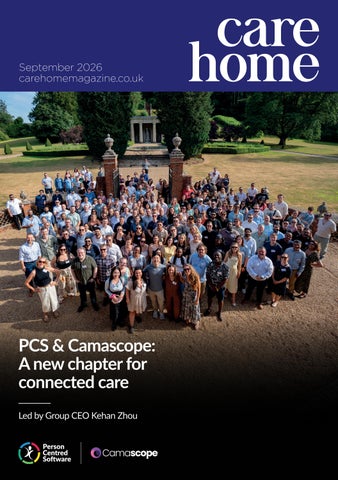
September 2026 carehomemagazine.co.uk
PCS & Camascope: A new chapter for connected care Led by Group CEO Kehan Zhou
Kehan Zhou, Group CEO of Person Centred Software (PCS) and Camascope
Connecting medication to the full picture of care The joining together of Person Centred Software (PCS) and Camascope marks an important next step in our vision for connected care. By bringing market-leading care and medication management capabilities together, we can increasingly connect medication information with the wider picture of a resident’s care information, helping care teams understand changes in health and wellbeing earlier. The first step is to deepen the connection between Camascope and PCS’s digital care planning and delivery solution. Today, care and medication are largely managed through specialist workflows. Our aim is to make those experiences increasingly connected, allowing care teams to move seamlessly between them with the right resident context, while retaining the depth and specialist functionality of each platform. Bringing medication and care data together will also strengthen IQ, a key part of PCS’s care intelligence engine. Over time, IQ will be able to combine signals from across a resident’s care to identify meaningful changes and emerging risks earlier. A medication change alongside reduced hydration and lower mobility, for example, could provide a much stronger signal than any one event viewed in isolation. By turning those signals into timely, actionable insight for care teams, our ambition is to help providers move from reacting to events after they happen towards earlier, more proactive and person-centred care.
See how PCS IQ is transforming care data into resident wellbeing insights at a national scale - p12
Chief Editor
Tani Farinacci Johnson tj@carehomemagazine.co.uk
Publication Manager
James Davies james@carehomemagazine.co.uk Tel: 01795 509 112
Credit Facilities Manager
Gwen Lee creditcontrol@cimltd.co.uk Tel: 01795 509 103
Design and Production James Taylor james@cimltd.co.uk Grant Waters grant@cimltd.co.uk
Administration Manager Natalie Woollin admin@cimltd.co.uk
Head of Digital
Xhulio Bishtaja press@carehomemagazine.co.uk
Marketing Manager Lucas Payne lucas@cimltd.co.uk
Social Media Manager
Lily Lawson press@carehomemagazine.co.uk
Director
Tom Woollin tom@cimltd.co.uk
Managing Director John Denning
Editor’s Letter September 2026
T
his September, our focus is on putting people first in every aspect. Our two main features explore staff and resident wellbeing from different angles: one directly addresses burnout and questions what genuine support looks like beyond wellbeing posters, while the other strongly advocates for resident voices, emphasising that being heard should be a fundamental part of quality care. Together, they remind us that wellbeing isn’t just a checklist for staff or residents; it must be integrated into the daily operation of a home. This theme continues in our cover story, which examines Person-Centred Software and why top systems now do much more than track compliance. If your care planning feels like mere paperwork rather than a tool that truly influences someone’s day, this article is worth reading. We visit this month’s Care Home of the Month, Loveday Belgravia. It’s a home that challenges traditional ideas of “luxury care,” showing what it can genuinely mean in practice, not just on a brochure. There’s a valuable lesson there for anyone considering what residents and families now expect as standard. Additionally, Vegetarian for Life demonstrates that plant-based food can be both satisfying and enjoyable. This issue’s feature, Dishing Up, highlights delicious, crave-worthy meals without compromise, reminding us that resident menus deserve as much creativity as restaurant menus. Finally, Activity of the Month celebrates National Wildlife Day with ideas such as birdwatching, mini gardens, and other small, outdoor-inspired activities. Sometimes, the simplest activities make the biggest difference. As always, I hope you enjoy the read and are inspired as you turn these pages heading into autumn.
Tani Farinacci Johnson, Chief Editor © 2026 Cogent Multimedia Limited, 1st Floor, Saphir House, 5 Jubilee Way, Faversham, Kent, ME13 8GD. No part of this magazine may be reproduced or stored in a retrieval system or transmitted in any form – electronic, mechanical or physical – without express prior permission and written consent of the publisher. Contributions are invited and when not accepted will be returned only if accompanied by a fully stamped and addressed envelope. Manuscripts should be type written. No responsibility can be taken for drawings, photographs or literary contributions during transmission or in the editor’s hands. In the absence of an agreement the copyright of all contributions, literary, photographic or artistic, belongs to Cogent Multimedia Limited. The publisher accepts no responsibility in respect of advertisements appearing in the magazine and the opinions expressed do not necessarily represent the views of the Publisher. The Publisher cannot accept liability for any loss arising from the late appearance or non publication of any advertisement.
4
carehomemagazine.co.uk
Table of
Contents
8 Stories of Care
How an accidental start as a care home cleaner led to a career as Operations Director, shaped by mentorship, resilience, and a deep belief in what people are capable of.
16
12 Cover Story
What 21 billion care notes reveal about resident wellbeing, inside the UK’s first national benchmark for measuring daily life in care homes with the same rigour as safety and compliance.
15 Resident Wellbeing
How one care home is turning resident feedback into visible action, exploring what genuine advocacy looks like when it moves beyond complaints handling towards real influence over daily life.
20
34 Care Home of the Month
How one London residence is redefining later-life care by treating hospitality and clinical rigour as inseparable, designing every detail around how residents actually want to live.
38
40 Sigvaris
Why the biggest obstacle to effective compression therapy isn’t clinical judgement but the physical act of application, and what care homes can do to protect outcomes and fragile skin.
43 Staff Wellbeing
Why dementia care carries some of the sector’s sharpest burnout risks, and how leadership behaviour, rather than individual resilience, determines whether staff hold up or break down.
54 carehomemagazine.co.uk
5
CHAMPIONING SOCIAL CARE
Celebrating our Sector’s Talent
The countdown is on for the Care Sector’s Got Talent Grand Final on 7th October 2026, with a record number of entries and a new judging panel waiting to choose a winner!
T
he deadline to apply for Care Sector’s Got Talent 2026 may have passed, but for care sector professionals, residents, suppliers and care staff up and down the UK, the annual talent-flooded spectacle is far from over. Taking place immediately after the doors close on day one of the Care Show Birmingham on 7th October 2026, the spotlight for Care Sector’s Got Talent now shines brightly on the upcoming Grand Final and the eight finalists that have yet to be announced. The Grand Final event will give these finalists the opportunity to perform in front of hundreds of care professionals attending one of the UK’s largest care events – alongside a brand new panel of judges. Social care influencer Bailey Greetham-Clark was one of the first judges to be announced back in August and will be sharing the panel with Hannah Montgomery from Graces Cares, Sarah Hyman from Nexus Media Group, and Jeremy Richardson, the CEO of Avery Healthcare. The winner will receive a £5,000 cash prize and invitations to perform at upcoming Championing Social Care events and other sector occasions over the next year, with a £1,000 talent development fund awarded to the runner-up. But even if you didn’t get around to applying this year, there are still ways for you to get involved! Whether you’re already planning to attend the Care Show at the NEC in Birmingham or not, the Grand Final is open to anyone from inside or outside the sector who would like to attend and support our finalists. Tickets are free, and if you would like to attend, please contact Championing Social Care for details.” Alternatively, if you are unable to attend the final, the full show will be broadcast a couple of days after the final, with an online screening that care homes can use to bring teams and residents together to join in the fun. An activity pack, in partnership with NAPA, will be shared, featuring scoring cards and other fun items, along with full details on how to access the broadcast. And of course, if you fancy your chances at a spot in next year’s final, keep your eyes peeled on our social media profiles for more updates about CSGT 2027! In the words of Angela Boxall, Co-Chair of Care Sector’s Got Talent, Chair of Care England and CEO
6
carehomemagazine.co.uk
of Majesticare: “One of our biggest ambitions this year was to reach even more people across social care and remind them that this competition is for everyone – whether you work in a care home, provide care in people’s homes or support services behind the scenes. The response so far has been incredible, but we know there are still thousands more hidden talents out there.” Care Sector’s Got Talent is open to everyone working across social care, including care home teams, home care providers, supported living services, day centres, administrators, chefs, housekeepers, maintenance teams, volunteers and suppliers. The competition is supported by lead partners Everywhen and Softcat, alongside sector partners Avery Healthcare, Florence, Majesticare, Compass Associates, The Access Group, The Good Care Group, MED e-care and Ashberry Healthcare; all united behind Championing Social Care’s mission to celebrate the people transforming lives every day across social care.
STORIES OF CARE – SPONSORED BY
Lauren Wraight
Lauren Wraight, Operations Director at LDC Care, did not plan a career in social care. At 15, she had no GCSEs, no clear direction and no idea that care could become a career; she simply wanted to ride her horse, have nice things and enjoy life. And yet her story deserves the attention of anyone who has ever wondered whether an unlikely start could still lead somewhere meaningful.
S
ome people arrive in care with a plan. Others arrive by accident and end up exactly where they were always meant to be. Lauren Wraight is firmly in the second camp. Today, she is Operations Director at LDC Care, calm, grounded and quietly powerful in the way she leads. But that was never the plan.
Falling into care and being seen
Lauren’s first experience of care came through supporting her grandad, who lived with dementia. It introduced her to the realities of care work, the patience it demands and the relationships at its centre, though at the time she still never considered it as a career path of her own. At 17, she applied for a job as a cleaner in a care home, and by her own admission, she wasn’t very good at it. “I was rubbish.” What she was good at, it turned out, had nothing to do with cleaning. It was talking to residents, sitting with them, listening, simply being present in a way that couldn’t be taught from a checklist. Her managers noticed. Instead of quietly letting her go or leaving her to muddle through, they saw potential she couldn’t yet see in herself and offered her a role as a care worker.
8
carehomemagazine.co.uk
“That was the moment. Once I could see what care really was, I knew I wanted to be in this sector.”
Learning, leading and rising
From there, Lauren worked her way through every level of care: support worker, team leader, care team manager. She developed a specialism in dementia care before joining LDC Care, where she discovered a particular passion for supporting people with learning disabilities, autism, mental health needs and behaviours that challenge, work that demands a different kind of patience and a deep understanding of the individual behind the diagnosis. From there came a steady progression through assistant manager, manager, service delivery manager, locality manager, operations manager and head of operations, before finally reaching Operations Director. Fifteen years, every level, every perspective, each one adding to her understanding of what good care actually requires on the ground rather than on paper. “Never in my life did I think Director would ever be a title next to my name.” Lauren speaks with genuine gratitude about the mentorship, opportunities and belief shown in her throughout that journey, crediting the people who saw something in her long before she saw it in herself.
STORIES OF CARE – SPONSORED BY
Turning pain into purpose
Lauren’s journey has not been without challenge. During her late teens and early twenties, work became a place of safety while she was living in an abusive relationship. She worked long days and nights, sometimes ten shifts in a row, not because she was chasing promotion, but because work gave her a stability and sense of control that life outside of it didn’t. It was the darkest chapter of her life, and it also shaped the leader she is today. Rather than allowing those experiences to harden her, they deepened her empathy. Today she leads with compassion, positivity and a quiet understanding that everyone around her, staff and residents alike, carries battles that aren’t always visible.
What keeps her going
Ask Lauren what motivates her day to day, and the answer comes easily: seeing support workers grow into leaders, watching people move from secure settings into independent lives that once felt impossible, and receiving handwritten cards and drawings from the people she supports. “Knowing they thought about you enough to do that means everything.” She loves improving services, developing teams and seeing the tangible difference that great care makes to someone’s life. And, she smiles, “It’s never boring.”
Pride belongs to the team
Lauren is quick to say that success in care is never individual. One of her proudest moments came when a residential service she managed achieved an Outstanding CQC rating. “I could have physically burst with pride.” Not because of the rating itself, she is careful to point out, but because of the dedication and passion her team showed every single day to earn it. More recently, becoming Operations Director marked another personal milestone, one she still finds difficult to quite believe. “I will always be grateful to the Managing Directors for believing in me and giving me so many opportunities.”
The difference belief makes
Lauren has seen first-hand how one person believing in someone can change everything. She has coached employees who lacked confidence or were navigating difficult periods in their lives, helping them grow into leadership roles they might never have considered possible for themselves. “Some people just need someone to see what they’re capable of.” That belief shaped her own journey, and now, deliberately, she passes it on to the people coming up behind her.
like, is beautifully simple: “Pure and true intentions.” Empathy, adaptability, emotional intelligence, seeing the person and not just the paperwork. Care, she believes, starts with being a good human being, and everything else follows from that.
A career that changes lives
Lauren’s advice to anyone considering a career in care? “Do it. Give it a try.” There are so many opportunities within the sector that if one path isn’t right, another probably will be. For Lauren, care didn’t simply become a career. It changed her life.
A Stories of Care reflection
Lauren’s story is proof that your starting point doesn’t determine your destination. A young woman who thought she was a terrible cleaner became an Operations Director because someone looked beyond the job description and recognised her gift for connecting with people. That moment of belief changed everything. Now Lauren spends her career doing exactly the same for others, helping people see potential in themselves before they can see it on their own. Sometimes that’s all it takes to change a life. bit.ly/AccessCareSOC By Anoushka Farouk
What makes great care
Her answer, when asked what great care actually looks
carehomemagazine.co.uk
9
RESIDENT WELLBEING
The B Happie Effect
Advinia has built a company-wide wellbeing framework, B Happie, around six pillars for residents and colleagues, moving beyond one-off activities towards a culture centred on connection, purpose and shared moments that matter.
W
ellbeing in care settings is too often reduced to a weekly activities timetable: quizzes, arts and crafts, the occasional singer. Advinia has taken a different approach with B Happie, a framework designed to embed wellbeing into every aspect of how the organisation cares for residents and supports its workforce. The model is built around six pillars, split evenly between the two groups it serves. For residents, these are: Safe, Connected and Relaxed. For colleagues, they are: Purpose, Recognition and Fulfilment. Together, Advinia says, they are intended to create environments in which both residents and staff can thrive, rather than treating wellbeing as an isolated function separate from day-to-day care.
Recognising the people behind the care
One strand of the initiative, Heroes of Happieness, focuses on recognising colleagues, and occasionally external partners, who go beyond their role to make a tangible difference to a resident’s life. This might be a carer who takes time to learn about a resident’s lifelong interests, a wellbeing coordinator who organises something memorable, or a local business that contributes something unexpected. The premise is straightforward: staff who feel their contributions are noticed are more likely to keep making them, and recognition schemes of this kind are increasingly common across the sector as providers look to improve retention.
Moments designed around the individual
A second strand, A Day to Remember, centres on personalised experiences built around what a specific resident wants, rather than generic group activities. At Hammerwich Hall, residents were treated to an afternoon tea served by entertainers from Butlers in the Buff, an event designed to bring humour and conversation into the garden setting. At Burrswood, a resident named Patricia was given the opportunity to go horse riding, an experience Advinia describes as reconnecting her with a long-standing personal interest. These examples illustrate a broader principle: that ambitions and interests do not need to end
10
carehomemagazine.co.uk
when someone moves into residential care, and that wellbeing initiatives are most effective when tailored to the individual rather than applied uniformly across a home. Advinia’s Happieness Team said the organisation’s suppliers had played a part in making these moments possible, helping “turn wishes into wonderful memories” and highlighting the colleagues, families and communities involved. Whether through a significant day out or a smaller daily gesture, such as playing a resident’s favourite song, Advinia frames B Happie as evidence that wellbeing works best when it is built into everyday culture rather than scheduled as a separate activity.
Your Voice Matters A secure, independent and impartial platform to raise concerns, designed specifically for Care Homes
What we do... How we do it... Why say so? At Say So we are on a mission to create safe and successful workplaces.
Actively listen, we cut through complexities getting to the heart of the matter, together.
We provide a platform to raise concerns with support services for employees and organisations to change attitudes and patterns of behaviour in the workplace.
Bridge any gaps between employees and organisations with open communication and honest facilitation.
We get to the crux of a problem no matter how raw or challenging, because change only happens when we face the truth.
Identify concerns and risks, uncovering issues before they become critical.
We are independent so people can speak up and say it how it is. Anonymous concern raising, where identities are only disclosed with written authority. Highly experienced safeguarding professional where a feedback loop is established.
Get in touch to find out more about how Say So can help your care business 0800 321 3546 info@say-so.co.uk www.say-so.co.uk
COVER STORY COURTESY OF
A National Picture of Wellbeing
What 21 billion care notes reveal about resident wellbeing: inside Person Centred Software’s national benchmark, the UK’s first for wellbeing in residential care.
E
very day, in thousands of British care homes, care workers record how the people they look after seem: settled or agitated, engaged or withdrawn, having a good day or a hard one. Nobody had ever added it up. A new analysis by Person Centred Software (PCS) has found that, across six months of care records, 72.8% of wellbeing observations were positive. The timing matters. In July, the Prime Minister committed to expediting Baroness Casey’s Independent Care Commission by a year, the most serious attempt at social care reform in a generation. That conversation has no shortage of evidence about system failures: unmet need, delayed discharge, low pay. It has almost none about daily life inside a care home. An inspection rating tells you whether a home meets a standard, not whether residents are having a good day. The figure holds across the nation. Each of the UK’s eleven mainland regions recorded a positive majority, from 64.6% at the lowest to 80.4% at the highest. None of which means the sector is comfortable. Workforce shortages, rising demand and financial strain are real and deserve attention, but they have also come to define public perception almost entirely. Research commissioned by PCS this year found that 41% of UK adults believe care homes are worse or no better than 10 to 15 years ago, a view shaped largely by media coverage rather than direct experience. The data suggests carers are delivering more than the public realises: helping residents rediscover hobbies, nurture friendships and live full lives. Those moments rarely make the headlines because wellbeing, unlike a
12
carehomemagazine.co.uk
fall count, has always been hard to measure. And what cannot be measured cannot be improved with rigour.
Thirteen years in the making
Closing that gap depends less on technology than on a decision taken thirteen years ago. In 2013, PCS chose to record care in a structured, standardised way, when most of the sector was still writing free-text notes. That choice has produced the UK’s largest structured social care dataset: more than 21 billion structured care observations, recorded consistently across more than 8,000 care homes, covering an estimated twothirds of the UK’s residential care beds. Around 5,000 of those homes feed the national benchmark; homes can opt out, and some do. It could not be assembled retrospectively. It exists only because carers have recorded the same way, day after day, for over a decade.
How the measure works
That consistency is what makes objective wellbeing benchmarking possible, and it is what IQ, PCS’s care intelligence solution, was built to read. As part of everyday notes, carers record each resident’s wellbeing on a standard scale, from very happy to very unhappy. Applied across millions of observations, statistical methods turn these ratings into percentages comparable across homes and regions. For the past six months, IQ has analysed wellbeing across 68 care themes, with eight indicators now surfaced for care teams, from falls with injury and infection prevalence to hydration and, uniquely, resident happiness. Happiness is captured six to ten times a day for
COVER STORY COURTESY OF
Wellbeing, unlike a fall count, has always been hard to measure. many residents. A happiness percentage reflects who a home cares for as much as how residents feel: higherneeds residents require more check-ins and are more likely to record unhappiness. More interactions mean more notes reflecting difficult days, so the value lies in comparing homes with similar profiles rather than a single national ranking.
Engagement and happiness rise together
A second, independent measure points the same way. Carers also assess how engaged residents are in their home’s activities, and nationally 71.2% of assessments were positive. The two move together: regions with higher engagement also record higher happiness (r = 0.57). For care teams, that link is practical, because activity provision is a lever a home controls directly.
London: clinically strong, and happy Homes in the capital recorded the joint-lowest rate of injurious falls, the lowest rate of inadequate fluid offered, the lowest unintentional weight loss and the fewest missed Malnutrition Universal Screening Tool (MUST) tasks of any English region, alongside the highest recorded happiness in the UK, at 80.4%.
Wales leads on safety
Wales leads on the measures that homes control most directly: the lowest infection prevalence in the UK, around half the national figure; the joint-lowest rate of injurious falls; roughly a third fewer missed care tasks
than average; and care hours per resident, around 9% above the national average. Welsh homes also record wellbeing more often than anywhere else, around 20% more check-ins per resident than London. Differences like these are exactly why benchmarking should compare homes with similar needs rather than rely on a single ranking.
It’s how the hours are spent
Scotland recorded the fewest care hours per resident in the UK, around 20% below average, yet sits comfortably in the positive majority on both measures. The North East recorded the most care hours, 14% above average, and topped engagement at 73.0%. Together they suggest contact quality matters as much as quantity. On the old North-South rivalry, the data offers a gentler story: southern homes recorded slightly higher happiness, 73.7% against 71.0%, with engagement levels within a decimal point. Different regions have different strengths, and none holds a monopoly on good care.
What it means for providers
The practical value is comparison. Through IQ, homes can see how they stand against anonymised data from thousands of others on a previously unbenchmarked dimension, identifying strengths, gaps, and where to learn from peers. Some findings are unexpected: falls resulting in injury run at roughly 0.2 per care home per month across the dataset. The same record is beginning to support earlier intervention, too. In homes piloting IQ’s next stage, changes in a resident’s pattern that are easy to miss day-to-day are surfaced for care teams to review so that a conversation can happen sooner. Safety, compliance and clinical quality will always be fundamental. What this analysis shows is that resident wellbeing deserves to be measured with the same rigour, and that, at last, it can be.
carehomemagazine.co.uk
13
Resident wellbeing
carehomemagazine.co.uk
15
RESIDENT WELLBEING
Finding Connection on Screen
Once treated as background noise, television is being reimagined as a tool for dementia care. My Life TV explains how the right content, used well, can calm, connect and celebrate the person behind the diagnosis.
T
elevision in care settings was once treated as passive background entertainment, something to fill an afternoon rather than a tool with therapeutic value. As understanding of dementia has deepened, so has recognition of what carefully chosen media can offer: support for emotional wellbeing, connection and a stronger sense of self. The relevant question is no longer whether people living with dementia should watch television, but what they are watching and whether it leaves them calmer and more connected. My Life TV, a charity offering dementia-friendly content, positions television not as a substitute for meaningful activity or human interaction, but as a support for both. Mainstream television can be overwhelming through fast-paced editing, complicated storylines, or intrusive advertising. Dementia-friendly media takes the opposite approach, focusing on accessibility, familiarity, and emotional comfort. Nature films, familiar music, reminiscence programmes, quizzes, gentle movement and slow-paced footage each offer a different route into engagement, depending on a resident’s mood and cognitive ability. There is no single formula that works for everyone. One resident might find comfort in watching wildlife, another might respond to music from their youth, while a third might enjoy travel programmes that spark memories and conversation. Preferences vary from person to person and change over time, so personalising content allows care teams to tailor engagement meaningfully.
Supporting emotional wellbeing
Evidence gathered by My Life TV points to measurable benefits. NHS-led evaluation, alongside independent work with care homes, has identified improvements in quality of life, social interaction, agitation and the overall atmosphere within participating settings, prompting some homes to incorporate My Life TV into personalised care plans as a non-pharmacological intervention. Alongside this formal evidence, the charity regularly receives feedback from care professionals describing residents who become calmer, smile more, reminisce
16
carehomemagazine.co.uk
with others or reconnect with aspects of their identity through familiar places, music and shared memories. Naomi Daglish, My Life TV Advisory Panel member and Lead Happieness & Wellbeing Ambassador at Advinia Healthcare, explains: “If used effectively, television can help reduce anxiety, promote orientation, improve social interactions and strengthen relationships between residents, colleagues and families.” Her point speaks to a wider truth about wellbeing: it is not always about increasing stimulation. In a communal lounge, sensory overload can be a genuine problem for people living with dementia, and sometimes the most useful intervention is a calmer one: gentle visual content or familiar music that can sit alongside other activity without competing for residents’ attention.
Creating connection, not replacing it
One question most frequently asked of My Life TV is whether screen-based tools risk replacing human interaction. The charity’s view is the opposite: the issue
RESIDENT WELLBEING
is not whether people should spend time with people or with screens, but whether screen-based experiences are designed and used in ways that strengthen relationships. A film about seaside holidays might prompt residents to share childhood memories. A wildlife programme may encourage quiet conversation, and familiar songs can lead to spontaneous singing, movement and laughter. In each case, the screen becomes a starting point for connection rather than the destination. This can also help families, for whom visiting a loved one with dementia can feel difficult as conversation becomes harder. Shared viewing creates common ground, easing the pressure to talk and allowing people simply to enjoy being together. Kerry Monaghan, Activities Coordinator at Rowan Lodge, part of Forest Care, explains: “I’m not a great believer in just watching the telly. I like there to be interaction. We pause, ask questions and engage everybody. We try to make it much more than just watching the telly; it’s about interacting, reminiscing and learning about residents at the same time.” Her approach reflects a shift in thinking: television becomes a starting point rather than an activity in its own right. A programme about Wimbledon becomes a conversation about sport and shared memories; coverage of the Chelsea Flower Show prompts residents to talk about their own gardens, with flowers brought in to stimulate the senses. Television provides the spark; the value lies in what follows.
Building the evidence base
While there is a substantial evidence base for music, reminiscence, and other non-pharmacological approaches in dementia care, the specific contribution of dementia-friendly television is far less well understood. Addressing that gap is now a priority
for My Life TV, which, with support from Dementia Research UK, is commissioning research into how dementia-friendly media contributes to emotional wellbeing, meaningful activity and person-centred care in everyday practice. Rather than simply asking whether My Life TV “works”, researchers want to understand which types of content are most effective for different people, how care teams use them in practice, and what difference they make to residents, staff and families over time, giving the sector robust, practical evidence for using screen-based media in high-quality dementia care.
Celebrating the person behind the diagnosis
Wellbeing, ultimately, is about more than occupying time; it is about helping people feel recognised, valued and connected. That philosophy extends into the charity’s wider work. In November 2025, My Life Films visited Cloisters Care Home in Hounslow to film the first episodes of its Sharing Stories series, giving residents the chance to share their lives, passions and achievements on camera and creating lasting memories for residents, families and care teams alike. Bubs, Activities Coordinator at Cloisters Care Home, reflected on the experience: “It was wonderful to see the residents speak so proudly about all their achievements and hobbies. Residents are still speaking about this experience today! Fabulous activity!” For My Life TV, that reaction captures what wellbeing looks like in practice: not reduced anxiety or filled time, but moments of pride, identity and joy. Designed with people living with dementia in mind, television and film can become far more than something to watch, another way to celebrate the person behind the diagnosis and strengthen relationships in everyday care.
carehomemagazine.co.uk
17
RESIDENT WELLBEING
Essential 5 Here are five thoughtful, person centred conversations that LifeLibrary feel a care home should have with their residents. They are the foundations for creating a person centred care plan. Regular conversations help staff understand the person behind the care plan and build a relationship rooted in dignity, comfort, and genuine connection.
1
Hello, how are you today?
A daily check-in gives a resident the confidence to express how they are feeling, both physically and emotionally. It helps the staff to spot any changes early, whether someone seems tired, unwell, worried, or simply in need of a little extra reassurance. By noticing these small shifts, staff can adjust care and support, so the resident feels comfortable, listened to, and well looked after throughout the day.
2
What important memories would you enjoy sharing with us?
Talking about memories, past roles, achievements, and important relationships helps staff truly understand the person behind the care needs. These conversations are especially valuable when someone is living with dementia, as familiar stories and identities offer comfort and connection. By learning what mattered throughout a resident’s life, staff can respond in ways that feel personal, respectful, and validating, helping each person feel recognised and understood.
3
What makes a day a good day for you?
Asking what a good day looks like helps staff understand the familiar routines, small comforts, and meaningful moments that can help someone feel settled and content. It encourages them to share long held habits, such as enjoying a quiet morning, listening to favourite music, spending time with others, or simply having space to relax. These insights guide staff in creating days that feel reassuring, enjoyable, and deeply personal.
4
Are there things that make you feel worried?
Knowing that it’s acceptable to feel worried can be reassuring. Exploring past experiences that caused worry helps staff recognise emotional triggers that still influence feelings today. By discussing who or what brought comfort when life felt overwhelming, the team can identify personalised calming strategies. These insights guide compassionate responses, reduce distress, and help create a predictable, reassuring environment that supports emotional safety.
5
Who are the important people in your life?
Talking about the important people in a resident’s life helps staff understand who brings comfort, joy, and a sense of belonging. It also guides how best to keep those connections active, whether through visits, phone calls, messages, or shared updates. Knowing who matters most supports family involvement and helps maintain relationships that strengthen wellbeing, offering familiarity and reassurance throughout daily life.
18
carehomemagazine.co.uk
For wellbeing, reminiscence, activities and joy...
My Life TV is a dementia-friendly streaming service which supports health and wellbeing. It has a breadth of on demand content designed to improve mood, provide stimulation and create meaningful moments of connection.
Monthly, quarterly and annual care setting plans starting at £34.99 / month, for access on up to 30 devices • Cited in CQC reporting as supporting outstanding care • Simple to install and use • Watch via TVs, laptops, tablets and mobiles, 24/7
To subscribe, please visit tv.mylifefilms.org or for more information, email the team at info@mylifefilms.org My Life TV is run by My Life Films, registered charity No: 1157198. Terms and conditions apply.
RESIDENT WELLBEING
Why Egg
Sourcing Matters Care home residents are among those most vulnerable to foodborne illness, and rising imports of lower-standard eggs are increasing the risk. British Lion Eggs sets out why sourcing and traceability deserve a closer look in every care home kitchen.
E
ggs are one of the most dependable ingredients in any care home kitchen. They are familiar, versatile, quick to prepare and, gram for gram, one of the most cost-effective sources of high-quality protein available to caterers. Yet for a food so commonplace, the sourcing decisions behind it carry unusually high stakes. Care home residents sit among the groups most vulnerable to foodborne illness, and any lapse in egg safety standards can have serious consequences. That vulnerability is precisely why egg sourcing deserves more scrutiny than it typically receives. Imported eggs and egg products, increasingly arriving from outside the UK’s regulatory framework, are moving into the foodservice sector in growing volumes. Some are produced using battery cage systems that have been banned in the UK for over a decade, meaning the welfare standards behind them fall well short of what British consumers and residents would expect. Traceability is often weaker too, making it harder to establish exactly what is being served and where it originated. “Care home residents are among those most vulnerable to foodborne illness, so egg sourcing is not an area where caterers can afford to take risks, particularly at a time when foreign eggs have been implicated in Salmonella outbreaks,” says Dr Lisa Ackerley, food safety expert, CMCIEH FRSPH. “By making sure that only British Lion eggs are used, care homes can be confident, with Food Standards Agencybacked assurance, that even if served raw or runny, eggs and egg dishes are safe.”
A wider European picture
Dr Ackerley’s warning sits against a backdrop of continued scrutiny of food safety standards across Europe. Salmonella remains one of the continent’s most significant foodborne risks, and eggs are consistently among the foods most commonly implicated. The European Food Safety Authority (EFSA) and European Centre for Disease Prevention and Control (ECDC) have continued to track and report on multi-country Salmonella outbreaks throughout 2026, working with
20
carehomemagazine.co.uk
national authorities to trace sources back through complex international supply chains. These investigations underline a point that matters directly for care caterers: origin and traceability are not administrative details; they are food safety controls in their own right. Outbreaks of this kind are rarely traced to a single farm or a single fault. They tend to expose weaknesses that run the length of a supply chain, from production standards through to labelling and distribution, which is exactly the territory the British Lion Code of Practice was designed to close down.
The British Lion difference
British Lion eggs exist to remove that uncertainty. Produced under a Code of Practice that covers the entire supply chain, from Salmonella vaccination of hens through to independent auditing, full traceability and rigorous hygiene controls, they carry a level of assurance that imported eggs cannot match. Critically, this is not a marketing claim but a recognised regulatory position: British Lion eggs are approved by the Food Standards Agency to be served raw or runny
RESIDENT WELLBEING
to vulnerable groups, including care home residents. That approval has a specific history worth understanding. Guidance introduced after the Salmonella crisis of the late 1980s told pregnant women, babies and elderly people to avoid raw and lightly cooked eggs altogether. It was only in 2017 that the FSA revised its advice, recognising that the Lion Code’s food safety measures had effectively eliminated Salmonella risk from eggs carrying the mark. For care homes, that means runny eggs, soft-boiled eggs and other lightly cooked preparations are back on the menu for residents, provided the eggs used carry the British Lion stamp. The distinction matters because it is not always visible on the surface. Eggs produced abroad can still be packed in the UK and carry a UK stamp on the outer carton, which risks giving caterers false confidence. The only reliable check is on the eggs themselves: genuine British Lion eggs carry both a Red Lion mark and a UK mark on the shell, alongside a best-before date. Specifying British Lion eggs in supply contracts, checking deliveries against what was ordered, and avoiding the temptation to source from local farms, where traceability and food safety controls cannot be guaranteed to the same standard, are simple steps that materially reduce risk. Duck eggs, too, should
be avoided in care settings, as they fall outside the Lion scheme and carry a higher Salmonella risk than hen eggs.
A nutritional case, not just a safety one
Food safety is only half the argument. Eggs are also one of the most nutrient-dense foods available to care caterers, delivering high-quality, highly digestible protein alongside vitamin D, B vitamins, selenium, iodine and choline. That combination matters enormously in a population where undernutrition and sarcopenia, the loss of muscle size and strength, remain persistent challenges. “Eggs are such an important and versatile food to use in care home catering and are instantly familiar to all,” says Alison Smith, consultant dietitian specialising in older people. “Malnutrition continues to be one of the main nutritional issues for many care home residents, requiring management, primarily using food, by all care home staff, and in particular care chefs,” Smith notes that nutritional advice has shifted in recent years, moving away from simply adding calories through fat and sugar and towards nutrient-dense foods instead. “Eggs are a brilliant nutrient-dense food in their own right and also provide a fantastic nutrient-dense
carehomemagazine.co.uk
21
RESIDENT WELLBEING ingredient which can be used to fortify a myriad of other dishes.” Older people, particularly those with reduced appetites, often need to eat a higher proportion of protein relative to their overall calorie intake than younger adults, and evidence suggests intake is often weakest at breakfast, precisely the meal where eggs are easiest to include. There is also no clinical basis for restricting egg consumption on cholesterol grounds. Major UK heart and health advisory bodies now agree that the dietary cholesterol eggs contain does not increase cardiovascular risk in most healthy people, which removes a common but outdated objection to serving them freely.
Dishes that meet specific resident needs
Eggs earn their place across a range of specific care needs, not just as a general menu staple. For residents identified as at risk of undernutrition, beaten egg is a simple and effective fortifier, stirred into mashed potato, sauces, porridge or custard. In contrast, whole egg dishes can themselves be enriched further with ingredients such as skimmed milk powder, ground almonds or cheese. As preferences and nutritional needs can change, what works for an individual resident is worth reviewing at least every six months. For people living with dementia, the familiarity of eggs, especially as part of breakfast and snack meals, can support recognition and appetite, helping residents engage with dishes that carry associations with their past. Traditional preparations such as boiled, poached or scrambled eggs tend to work well, though some residents are equally happy to try less familiar options such as smoked salmon frittata. Brightly coloured dishes, or those that contrast with the plate they are served on, can also help draw attention and encourage appetite. Eggs double as accessible finger foods too: hard-boiled eggs, stuffed eggs, homemade scotch eggs, mini omelette wraps and mini quiches all allow residents who struggle with cutlery, or with sitting for a full meal, to eat independently. For the significant proportion of residents living with dysphagia, up to 68 percent of older people in care homes are thought to experience some degree of eating, drinking or swallowing difficulty, texture matters as much as nutrition. Soft omelette, smooth quiche filling, scrambled egg and sweet or savoury baked egg custard all offer safe, palatable options that meet modified texture requirements without sacrificing nutritional value, and many of these dishes can be pureed further if needed.
A simple standard to apply consistently
None of this requires complex sourcing decisions. Storing eggs at a constant temperature below 20°C, keeping them separate from raw meat and strong-smelling foods, allowing them to reach room temperature before cooking and discarding any
22
carehomemagazine.co.uk
cracked or dirty eggs are straightforward practices that any kitchen can embed without disruption. Cooked egg dishes should be eaten as soon as possible after preparation, or refrigerated promptly if not for immediate use, and hands should always be washed before and after handling. The larger decision sits further up the chain: specifying British Lion eggs and egg products as standard, and verifying that what arrives actually matches what was ordered. For kitchens working with large volumes, or pooling eggs for baking and batch cooking, British Lion liquid egg offers the same audited assurance in a format that saves preparation time. It is also worth noting that pasteurisation is not a safety guarantee on its own; if non-British Lion eggs are heavily contaminated to begin with, pasteurisation may not be enough to make them safe, which is why choosing British Lion egg products from the outset matters as much for processed egg as it does for shell eggs. Telling serving staff why British Lion eggs are used, and sharing that reasoning with residents and visitors, is a small step that reinforces confidence in the food being served. Adding the British Lion mark to menus where relevant gives residents and families a clear, visible signal that a dish meets that standard. For a sector operating under constant regulatory and reputational scrutiny, egg sourcing is a rare case where the safest choice and the most nutritionally valuable choice are the same. Getting it right costs little and asks little of kitchen teams, yet it closes off one of the more preventable risks on a care home menu.
99 Problems
British Lion eggs ain’t one Don’t gamble on imported eggs, they can represent a serious health risk to vulnerable groups.
Make the Smart Choice. British Lion - The eggs you can trust.
egginfo.co.uk
RESIDENT WELLBEING
Where Residents Shape Change
Genuine resident advocacy means more than logging complaints. Krzysztof Zatorski, General Manager at Rose Water Place, part of Barchester Healthcare, shares how the home has built systems that enable residents to actively shape decisions about food, activities, and communal spaces.
M
ost care homes collect resident feedback. Fewer act on it in ways residents can actually see, and fewer still give residents a genuine role in shaping what happens next. Too often, “resident voice” begins and ends with a complaints procedure: a mechanism for flagging what has gone wrong, rather than a route for residents to influence what happens going forward. The distinction matters, because a home that only listens when something breaks down will always be reacting, never building. Real advocacy looks different. It means residents raising a preference and seeing it become policy, not just an entry in a log. It means feedback loops that run continuously, not just at the point of an annual survey or a formal review. And it means treating residents as people with ongoing opinions about their own home, rather than as a source of data to be managed. Building that kind of system requires more than
24
carehomemagazine.co.uk
good intentions. It needs structure: defined channels for residents to raise ideas, a clear process for turning those ideas into action, and visible proof that the loop closes. Without all three, feedback tends to either go nowhere or get buried in paperwork nobody outside the office ever sees. The homes that get this right tend to share one trait: they treat residents as ongoing collaborators in how the home runs, not as a stakeholder group to be consulted once a year and otherwise left alone.
Ambassadors, not just advisors
One practical model comes from Rose Water Place, where Resident Ambassadors act as direct liaisons between fellow residents and the management team. Rather than waiting for concerns to surface formally, Ambassadors proactively gather views and ideas across the home, closing the gap between what residents think and what staff actually hear.
RESIDENT WELLBEING “Formal feedback and structured documentation are essential; they give us a clear record of how we are doing and keep us accountable, but they are only half the equation,” says General Manager Krzysztof Zatorski. “The real heart of our home lives in the informal, everyday moments. Listening to our residents, becoming their friends and simply experiencing life side by side.” That philosophy played out when several residents mentioned, during routine conversations, how much they missed playing and listening to music. The feedback led directly to the purchase of a new piano for the main lounge, a modest change but one that reinforced to residents that their voice carried real weight, not polite acknowledgement.
Structured forums that generate momentum
Ad hoc listening only goes so far without a formal counterpart. At Rose Water Place, a monthly open forum brings together residents and department heads, providing a predictable opportunity for residents to raise issues and for staff to share departmental plans and challenges. The format matters as much as the content: residents know the forum is coming, know who will be in the room, and know their contribution will count. These sessions illustrate a wider point about advocacy: good systems don’t just capture requests; they let ideas develop. A conversation about adding fresh daffodils to the dining tables for spring evolved into a discussion about seasonal flowers year-round, which in turn led to a housekeeping collaboration that filled communal areas with living potted plants, a project one resident asked the life enrichment coordinator to lead. A similar chain of conversation, prompted by residents wanting a shaded garden corner, resulted in a bench and a sunflower border by the home’s wildlife pond. In each case, staff treated the original comment as a starting point rather than a request to be logged and closed.
Rituals rooted in memory
Advocacy also extends into routine, particularly around food, which residents consistently link to memory and comfort. This is where a genuinely resident-led approach tends to differ from a standard activities calendar: it responds to what residents specifically miss, rather than to what a provider assumes will generally please them. At Rose Water Place, many residents recalled missing family breakfasts before work or school in earlier life, prompting a Monthly Family Breakfast on the first Thursday of each month, giving families informal access to Zatorski and his department heads outside of scheduled meetings. Food choices are put to residents just as directly. When the kitchen wanted its Friday fish and chips to match residents’ memories of seaside trips, it ran a tasting session with different batter styles and chip cuts and let residents vote. The winning
combination is now the home’s standard recipe, chosen by the people eating it rather than decided on their behalf.
Keeping standards honest
Systems like these only work if the loop stays open day-to-day, not just during scheduled meetings. A dedicated Food Comments Book captures real-time impressions, and Zatorski and his department heads regularly join residents for lunch, turning shared meals into informal dining audits. This sits alongside more formal mechanisms. Tell Barchester Surveys, run annually, provide quantitative and written feedback to track trends over time, while monthly Resident of the Day Checks involve dedicated calls to relatives, giving families a reliable channel to raise updates or concerns outside of a visit. At Rose Water Place, an open-door policy and “You Said, We Did” display boards, which track suggestions alongside the changes made in response, serve the same purpose: showing residents and families that feedback consistently leads to visible action, rather than disappearing into a system with no return.
Advocacy as culture, not compliance
The individual mechanisms are not complicated. What makes them effective, at Rose Water Place and elsewhere, is that formal and informal channels reinforce each other, and that requests are followed through to something residents can actually see. A piano or a survey is easy to introduce; a culture in which residents expect to be heard, and are proved right, takes sustained effort across every level of the home. For care homes looking to move beyond complainthandling towards genuine advocacy, the lesson is straightforward: give residents a structured way to be heard, and make sure the outcome of that listening is visible, not just recorded.
carehomemagazine.co.uk
25
DISHING UP
Growing green menus Vegetarian for Life explains why care homes are falling behind on plant-based catering, and shares a recipe to help kitchens catch up.
A widening gap
Dietary inclusion in care homes has come a long way, yet plant-based catering remains an area many kitchens still get wrong. Vegetarian for Life (VfL), the charity supporting older vegans and vegetarians, says the gap between demand and provision is widening as more residents move into care having followed plantbased diets for decades. Just three fully vegetarian care homes currently operate in the UK, according to VfL. The charity’s UK List, a directory of homes that genuinely cater well for vegans and vegetarians, aims to change that. VfL wants at least one in six UK care homes to join the list, with one in 100 achieving full accreditation.
Confidence, not willingness
For catering teams, the barrier is rarely a matter of willingness. More often, it’s a lack of confidence with plant-based ingredients, or the assumption that vegan cooking requires specialist knowledge and separate menu planning. VfL’s recipes are designed to challenge that, showing how existing skills can be adapted rather than overhauled. This month’s dish, stuffed aubergine with tomato and spinach quinoa, is a good example. The quinoa filling also works in stuffed courgettes or peppers, making it easy to repeat across a seasonal menu.
Plan, don’t substitute
The dish illustrates a broader point: inclusive menus benefit from planning rather than from substitution. Building meals around vegetables, grains and pulses from the outset, rather than adapting a meat-based dish at the last minute, produces better results and reduces pressure on kitchens during service.
Beyond dietary preference
For some residents, plant-based eating is tied to longheld religious, ethical or cultural values, and being unable to maintain that at mealtimes can affect dignity as much as nutrition. VfL’s guidance helps care homes treat this as a standard part of person-centred catering rather than an occasional exception. Catering teams that build confidence with vegan and vegetarian cooking now may find it easier to meet resident expectations and inspection standards in future.
26
carehomemagazine.co.uk
Stuffed aubergine
Aubergine stuffed with tomato & spinach quinoa Serves 2 (scale up as needed) | Vegan Ingredients 100g quinoa; 1 aubergine; olive oil; 1 large red onion, chopped; 2 garlic cloves, chopped; sea salt; 1 can chopped tomatoes; 1 tbsp tomato purée; 2 handfuls baby spinach; 1 tbsp nutritional yeast Method 1. Preheat oven to 180°C/350°F/gas 4. 2. Cook quinoa in boiling water for 18-20 minutes until softened. Drain. 3. Halve aubergine lengthways, scoop out flesh, keeping skin intact. Dice flesh. 4. Bake skins hollow-side down with a little water, 15 minutes, then turn and bake 10 minutes more. 5. Sauté onion, garlic and salt in oil until softened. 6. Add aubergine flesh, tomatoes and purée. Simmer 15 minutes until thickened. 7. Stir in quinoa, simmer 4-5 minutes, then add spinach until wilted. 8. Fill aubergine skins, sprinkle with nutritional yeast, bake 10 minutes more.
RESIDENT WELLBEING
The Whole Person
LifeLibrary’s digital tools help care homes capture more than clinical need. At Georgian House Nursing Home, that shift transformed how staff understood resident Charles Langley and ultimately led to his being named Resident of the Year.
(captions) Home Owner, Damian Hopley with The MAyor of Ealing, Cllr. Faduma Mohamed
A different kind of record
For most of his time in care, the written record of Charles Langley’s days looked much like anyone else’s: tasks completed, needs met, boxes ticked. What it rarely captured was Charles himself, his moods, his interests, the small victories that mattered most to him. That began to change when staff at Georgian House Nursing Home started using the LifeLibrary App to log Charles’ daily activities, interests and achievements, rather than only his care needs. The shift sounds modest, but its effect has been significant. Staff report that Charles has become more active and attentive, more willing to walk through communal areas with support, and on his better days, has been seen dancing with staff, a small moment that speaks to genuine enjoyment rather than simple participation.
Respecting the harder days
Crucially, staff have not treated this as a straightforward improvement story. Charles still has difficult days when he does not want to take part, and the app has helped the team recognise that pattern rather than push against it. Encouragement is offered without pressure, adapted to his mood on any given day, a distinction that matters enormously in person-centred care but is easily lost when records focus only on tasks rather than the person behind them.
Family in the frame
The Family Support App has extended that person-
28
carehomemagazine.co.uk
centred approach beyond the home’s walls. Charles’s family can now comment on and respond to his daily activities directly, strengthening communication between them, Charles and the care team, and giving staff a clearer sense of what actually matters to him.
Recognition, and what it revealed
The cumulative effect became visible this year when Charles was named Resident of the Year 2026, with the award presented by the Mayor of Ealing during the home’s Summer Party. For a resident whose progress had, until recently, gone largely unrecorded in any meaningful sense, the recognition marked more than a personal milestone: it demonstrated what becomes visible when care homes capture the whole person rather than a checklist of needs. Charles’s case also offers a useful illustration for providers thinking about their own record-keeping. Evidencing person-centred care, family involvement and positive outcomes is a persistent challenge under CQC’s framework, and tools that document lived experience, not just delivered care, can make that evidence easier to gather and far more compelling when it is. For Georgian House Nursing Home, Charles’ journey has become a reminder that dignity in care often lies in the smallest details: a dance, a walk, a family comment read aloud. Digital tools cannot create those moments, but they can ensure they are seen, recorded and celebrated.
RESIDENT WELLBEING
Hearing Care Matters
Kasia Rybak, co-founder of Clear Sound Solutions, explains that addressing hearing loss in care homes is about more than ear hygiene: it underpins dignity, cognitive health and human connection.
D
uring more than ten years working in health and social care, I have met countless residents whose hearing had quietly declined without anyone recognising the full impact on their lives. I have watched residents withdraw from activities and spend more time alone, not because they wanted to, but because they were embarrassed by their hearing loss. Tired of asking people to repeat themselves, many simply stopped trying to engage. Too often I hear, “Most of our residents have dementia, so hearing care isn’t really a priority.” I understand why this assumption is made, but it is exactly why hearing care matters so much. Every resident, regardless of physical health, cognitive condition or disability, deserves the chance to hear clearly, communicate confidently and remain an active part of their community. Hearing health is not a luxury; it is fundamental to dignity, wellbeing and quality of life. The Lancet Commission on Dementia identified hearing loss as one of the most significant modifiable risk factors for cognitive decline. Hearing care cannot cure dementia, but supporting residents to hear as well as possible can help them stay engaged, communicate more effectively and remain connected to the people and moments that matter. For this reason, hearing health deserves recognition as an essential part of person-centred care. As the population ages and the number of people living with dementia continues to rise, integrating hearing care into routine care home practice has never been more important. One resident has stayed with me ever since. While working as an ear care practitioner, I visited a lady living with advanced dementia who was also blind and experiencing significant hearing difficulties. Her son told me they had reached a point where meaningful conversation was almost impossible
and, heartbreakingly, he felt his mother no longer recognised him. When I examined her ears, I found both canals completely blocked with wax. After removing the blockage, her son gently asked, “Mum, can you hear me? Do you know who I am?” She smiled and replied, “Of course I know who you are, you’re my son,” before calling him by his name. It is a moment I will never forget. That experience was one of the reasons I established Clear Sound Solutions, with the aim of making professional ear and hearing care more accessible in care homes. Throughout my career, I have seen how something as simple as restoring a resident’s hearing can transform daily life. clearsoundsolutions.co.uk
Hearing care is not just about ears. It is about brain health, connection and quality of life.
30
carehomemagazine.co.uk
RESIDENT WELLBEING
Sustainable Care, Smarter Choices
With plastic waste under growing scrutiny across health and social care, Vernacare’s Conti® Kind wet and dry wipes show how sustainability and everyday performance don’t have to be a trade-off.
W
ipes are among the most heavily used patient hygiene products in care settings, with millions used every day across the sector. As sustainability climbs the agenda for providers, families and regulators alike, more care homes are looking beyond performance alone and asking what these everyday products are actually made from. Conti® Kind’s Plastic-Free Wet Wipes and PlasticFree Dry Wipes have been developed with this shift in mind, offering care teams an alternative to conventional plastic-containing products without compromising strength or effectiveness. The environmental case is becoming harder to ignore. Wipes containing plastic fibres take far longer to break down and can shed microplastics into the waste stream. NHS Supply Chain’s new Skin Cleansing, Disinfection and Hygiene framework, launched in 2026, will requires all patient dry wipes supplied through it to be plastic-free, a change NHS Supply Chain estimates could remove up to 630 tonnes of plastic from the system annually. Care homes fall outside NHS procurement requirements, but the underlying logic still applies. Every pack of plastic-free wipes used in place of a conventional alternative reduces a home’s reliance on single-use plastic, and with millions of wipes used sector-wide each year, the cumulative effect of that choice adds up. In terms of performance, Conti® Kind’s wet wipes are gentle on sensitive skin while providing effective cleansing. Their soft yet durable construction supports
CONTI KIND Wet wipe
32
carehomemagazine.co.uk
comfortable bathing and personal care, particularly for individuals with sensitive skin or ageing skin, requiring gentle frequent cleansing. The Conti® Kind dry wipes are built for washing, drying and general use, strong and absorbent enough, the manufacturer says, to reduce the number needed per task, a practical consideration for busy care teams working through daily routines at pace. That practicality matters as much as the environmental credentials. Sustainable products only earn their place in a care setting if they hold up under real conditions: frequent use, sensitive skin, and staff who need equipment that works first time, every time. Conti® Kind’s range is designed to meet both demands, offering care homes an option that doesn’t force a trade-off between environmental responsibility and day-to-day clinical needs. For providers reviewing their patient hygiene product supply chains, plastic-free wipes represent a straightforward way to reduce environmental impact without disrupting established care routines, one of several small operational choices that, together, reflect a sector taking sustainability seriously.
CONTI KIND Dry wipe
RESIDENT WELLBEING
onth M e h t f o e Care Hom lgravia e B : y a d e v Lo
Designed Around Life Lived Well
The philosophy behind Loveday Belgravia was to challenge assumptions about what later-life care should look like. Care needs may change, but tastes, interests, and expectations do not disappear with them, and the aim was to create a residence that offers sophisticated nursing care without being defined by it. “The starting point was never to create a luxury care home,” the team explained. “It was to create a building that genuinely improves people’s quality of life.” Loveday worked with architects, clinical specialists, dementia experts, and its own operational teams to design every aspect of the residence around how people live, recover, and move through a space, supporting independence, reducing anxiety, and enabling clinical care while retaining the feel of an elegant London residence. That thinking runs through the layout, which is designed for intuitive navigation and confidence, with natural light, clear sightlines and domestic-scale spaces. Tactile materials, subtle colour cues and lighting that supports circadian rhythms feature throughout, while rehabilitation facilities, wellbeing spaces and communal areas are woven into everyday life rather than set apart from it. The approach was recently
34
carehomemagazine.co.uk
Sponsored By
Care is rarely just one thing. recognised with Best Architectural Design at the Healthcare Property Design Awards. “Clinical excellence is built into the fabric of the building, not simply delivered within it”; hospitality, architecture and clinical design are intended to work towards a single objective: enabling people to continue living as fully and independently as possible, whatever their care needs.
Where hospitality meets clinical rigour
Rather than treating hospitality and clinical care as competing priorities, Loveday Belgravia positions the former as a means of making the latter feel seamless. Behind the dining, concierge service and programme of experiences sits a clinical team providing bespoke 24-hour nursing and care, with the two sides working in tandem: chefs need to understand nutritional and dietary requirements, the lifestyle team needs to understand physical capabilities, and clinical staff need
RESIDENT WELLBEING to know residents beyond their medical history. That detail matters because what makes someone feel properly looked after is often small: how they like their day to begin, what they enjoy eating, the interests they have always pursued, or when they welcome company and when they prefer solitude. Clinical rigour provides the foundation, while hospitality shapes how that care is delivered in a way that respects the individual.
Tailoring recovery and long-term care
With rehabilitation, post-operative and respite stays forming a significant part of the offer, care planning begins with understanding why someone has come to Belgravia and what they hope to achieve. A resident joining permanently with complex nursing needs has very different priorities from someone recovering after surgery or rebuilding strength following a lengthy hospital admission. Post-operative and recovery stays can involve working alongside hospital clinicians and external specialists, managing medication and nursing needs, and providing physiotherapy using specialist equipment such as a hydro-treadmill. Recovery plans are developed individually following assessment, rather than applying a single programme to everyone. The wider picture matters just as much. Nutrition, sleep, movement, confidence, social interaction and having something to look forward to all contribute to recovery and wellbeing, whether a resident is staying for five nights or making Belgravia their long-term home.
Building a multidisciplinary team
Technical expertise, particularly in nursing and clinical roles, is essential but insufficient on its own. Recruitment at Loveday Belgravia looks for professional standards combined with judgement, curiosity and a genuine understanding of individual service. The team is deliberately multidisciplinary: nurses, carers, physiotherapists, chefs, hospitality staff and lifestyle specialists each bring distinct expertise, but all contribute to a consistent resident experience, with staff expected to understand how their role connects to everyone else’s and how small details can shape a resident’s day. Consistency, the team says, comes from setting high expectations, providing the training and support to meet them, and building a culture in which knowing the individual is part of doing the job well.
Stories that define Belgravia
Two stories are offered as illustrations of what the home is trying to achieve. One resident arrived following a long hospital stay; within two weeks, her family reported a significant improvement, crediting the combination of medical care, physiotherapy, dining and the surrounding environment. Another, an international visitor who sustained a serious injury while travelling
and required surgery, came to Belgravia for postoperative recovery and later spoke of both the medical and emotional support she received, particularly the patience and attentiveness of the nursing team.
A lesson for the sector
Asked what other operators might take from Belgravia’s approach, the team is direct: start with the individual, not the care model. Design around how people want to live, and integrate care naturally into that experience rather than allowing it to become its defining feature. People entering care today have spent decades making choices about where they live, what they eat and who they spend their time with, and those expectations do not disappear because someone develops dementia, needs nursing support or undergoes an operation. That has meant thinking beyond care as a standalone service, with architecture, clinical practice, hospitality, food, movement, culture and relationships all treated as interconnected influences on wellbeing rather than separate additions. As the team puts it, the ambition should not be to make care the centre of someone’s life, but to provide care of such quality that it allows the rest of that life to continue.
carehomemagazine.co.uk
35
RESIDENT WELLBEING
Wellness in Action
Six months after launching its Wellness Strategy, Signature Senior Lifestyle reflects on what it’s learned about embedding wellbeing into everyday life, and why personalisation, not programming, is at the heart of living well in later life.
A
few months ago, Signature Senior Lifestyle shared its belief that the future of care must be built around wellbeing. At the time, it marked the launch of a new Wellness Strategy built around four key pillars: Active Lifestyle, Meaningful Living, Culinary Vitality and Rest & Renewal. Since then, those pillars have become part of everyday life in our homes, shaping how we think about wellbeing and what living well means for each resident. As the strategy has become embedded, the focus has shifted beyond meeting care needs to understanding what matters to each individual. That means taking time to understand their interests, ambitions and life story, and creating opportunities for them to continue living with purpose. Wellbeing looks different for everyone. For one resident, it may be regaining strength after illness. For another, it could be rediscovering a lifelong passion, forming new friendships or spending meaningful time with family. There is no single definition of living well, which is why a personalised approach is so important. One of the most rewarding outcomes has been seeing colleagues embrace this philosophy. Wellbeing is not owned by one department or delivered through a programme of activities. It is reflected in everyday moments, from encouraging independence to celebrating personal achievements and creating experiences that bring genuine joy. Sometimes those experiences are the ones residents
36
carehomemagazine.co.uk
have always dreamed of. Whether it is helping someone fulfil a lifelong ambition, arranging a special reunion, organising memorable outings or bringing people together through exciting events, the aim is to create moments that matter. Moving into a care home should never mean putting life on hold. It should create new opportunities to make memories, try new things and, where we can, turn dreams into reality. The four pillars also work naturally alongside one another. Better sleep supports physical and emotional health. Good nutrition provides the energy to stay active. Staying active can build confidence and independence, while meaningful relationships encourage people to engage more fully in daily life. Together, they provide a framework that supports the whole person rather than one aspect of their wellbeing. While our Wellness Strategy is still in its early stages, the experience so far has strengthened our belief that wellbeing should never be viewed as an added extra. It sits at the heart of exceptional care. As expectations of later life continue to evolve, families want more than reassurance that their loved ones will be safe and well cared for. They want to know they will continue to enjoy life, pursue their interests and have new experiences. At Signature Senior Lifestyle, that remains our ambition. Because the future of care isn’t simply about helping people live longer. It’s about helping them live well, every single day.
The healthcare & care home interior design specialists
Catalyst Interiors is revolutionising the world of interior design with our ground-breaking experiential approach to dementia care environments! • Residential Care • Nursing Care • Dementia/Memory Care • Retirement Living • Care Villages • Assisted Living • Medium Secure • Mental Health Services • Addiction • Autism Scan here to see our award-winning care home interiors
ACTIVITY OF THE MONTH
Wildlife Wonders National Wildlife Day is the perfect opportunity for care homes to celebrate the natural world before the colder months set in, encouraging residents to connect with wildlife through gardening, birdwatching, crafts and reminiscence while supporting wellbeing and social interaction.
N
ational Wildlife Day, celebrated on the 4th of September, is a wonderful reminder of the positive impact nature can have on our physical and emotional wellbeing. For care homes, it offers the ideal theme for a month of activities that encourage residents to slow down, spend time outdoors where possible, and rediscover the wildlife right on their doorstep. Whether it’s spotting birds in the garden, creating homes for insects or sharing memories of countryside walks and family holidays, wildlife-themed activities can be adapted to suit residents of all abilities while providing meaningful opportunities for creativity, conversation and gentle exercise.
Bringing nature closer
Residents don’t need access to acres of countryside to enjoy wildlife. Even the smallest garden, courtyard or patio can become a hub of activity with a little planning. Setting up bird feeders, hanging nesting boxes or planting flowers that attract bees and butterflies creates opportunities for residents to observe wildlife throughout the month. Simply spending time outside with a cup of tea while listening to birdsong
38
carehomemagazine.co.uk
or watching insects among the flowers can have a calming effect and encourage mindfulness. For homes without outdoor space, nature cameras streaming live footage from wildlife reserves can offer a similar experience indoors.
Birdwatching made simple
Birdwatching is one of the easiest and most accessible wildlife activities for older people. A pair of binoculars, a simple identification guide and a comfortable seat by the window are often all that’s needed to get started. Residents can keep a daily record of the birds they spot, creating a communal wildlife diary or checklist to see how many different species visit throughout September. This gentle activity promotes observation, concentration and conversation, with plenty of opportunities to share knowledge and memories. Adding a bird table or offering different types of bird food can also attract a wider variety of visitors, making each day a little different.
Sparking memories through nature
Nature has a remarkable ability to unlock memories. Many residents will recall childhood adventures exploring woods, tending family gardens, fishing with
ACTIVITY OF THE MONTH
relatives or walking through the countryside. Using photographs, pressed flowers, bird calls or familiar scents such as lavender, rosemary and freshly cut grass can stimulate reminiscence and encourage residents to share stories from earlier in life. These conversations not only support emotional wellbeing but also help staff gain a deeper understanding of residents’ backgrounds, hobbies and interests. For those living with dementia, sensory experiences linked to nature can be particularly beneficial, offering familiar sights, sounds and textures that encourage engagement without placing pressure on memory.
Getting creative
Wildlife provides endless inspiration for arts and crafts. Residents could paint birds, create collages using autumn leaves, make pine-cone animals, or decorate flowerpots ready for autumn planting. Building simple bug hotels or decorating leafcutter bee boxes can also make for a rewarding group project, particularly if the finished pieces are installed in the home’s garden for residents to enjoy year-round. Displaying completed artwork around the home creates colourful reminders of the project and gives residents a real sense of pride in their achievements.
Wildlife in the garden
Gardening naturally complements National Wildlife Day. Planting late-season flowers, sowing spring bulbs or creating pollinator-friendly containers gives residents the opportunity to make a positive contribution to local biodiversity. Even residents who are unable to take part in person can become involved by choosing plants, watering containers from a seated position, or helping plan new wildlife-friendly areas. These shared gardening sessions encourage teamwork while providing gentle physical activity and fresh air, both of which contribute to overall wellbeing.
Connecting with the community
National Wildlife Day also presents opportunities
to involve local organisations and families. Wildlife charities, conservation groups or gardening clubs may be happy to visit the home to give informal talks or help residents create habitats for birds and insects. Schools and youth groups can also become involved through intergenerational gardening projects or wildlife-themed craft sessions. These visits encourage meaningful conversations between generations while helping residents remain connected to their local community. Families can contribute too by joining nature walks around the home’s grounds, donating plants or bird feeders, or simply spending time outdoors with loved ones.
Learning never stops
Wildlife-themed quizzes, documentaries and guest speakers can add another dimension to the month. Residents may enjoy identifying native British animals, learning about migration or discussing conservation efforts that have changed during their lifetime. These activities promote lifelong learning while encouraging curiosity and discussion, proving that engagement doesn’t have to be physically demanding to be rewarding.
More than a day outdoors
National Wildlife Day is far more than an opportunity to admire birds and flowers. It provides care homes with a flexible theme that combines gentle exercise, creativity, reminiscence and community involvement while encouraging residents to reconnect with the natural world. Whether residents are planting flowers, spotting robins from the lounge window or sharing stories of countryside adventures from years gone by, these moments of connection can have a lasting impact on wellbeing. With a little imagination, National Wildlife Day can become the starting point for a month of activities that celebrate not only Britain’s wildlife, but the memories, friendships and sense of purpose that nature so often inspires.
carehomemagazine.co.uk
39
RESIDENT WELLBEING
Compression Therapy’s Hidden Barrier
SIGVARIS GROUP Britain examines why the physical act of applying a compression garment, rather than clinical judgement, is often what determines whether treatment actually works in care home settings.
T
he resident has been assessed, the garment has been selected, and the instructions are sitting in the care plan. Then morning arrives, and somebody still has to work a firm compression stocking over a swollen foot, past the heel and up the leg, alongside everything else a busy shift demands.
Why compression matters
When someone walks, the calf muscles squeeze the deep veins in the leg and push blood back towards the heart, while a series of one-way valves stop it falling back down. Together, these form a pump that depends on movement to work. For a resident who spends most of the day seated with their legs down, that pump function is reduced, and blood can pool in the lower leg rather than returning upward. Prolonged sitting and immobility are well-recognised causes of poor leg circulation. A compression garment is designed to compensate: it is firmest at the ankle and progressively looser further up the leg, narrowing the veins slightly and helping blood flow in the right direction, effectively giving the leg some of the support that walking would normally provide.
What poor circulation leads to
Left unmanaged, that build-up of pressure inside the veins eventually shows on the skin, causing swelling around the ankle, rusty-brown staining, dry and itchy patches, and skin that hardens and takes on a shiny texture. Over time, this can progress to a leg ulcer. Leg ulcers are slow to heal and often uncomfortable for residents. Compression plays a central role both in treating them and in preventing recurrence once healed: a 2024 Cochrane review found that around twice as many
40
carehomemagazine.co.uk
people experienced a returning ulcer when they were not wearing compression, compared with those who were. Beyond ulcer prevention, compression also helps control swelling and ease the aching, heavy sensation many residents describe in affected legs. Legs that feel lighter are generally easier to stand on, which helps residents stay active.
When to stop and escalate
Compression is not appropriate for every leg, so staff should always follow the individual care plan. Application should stop, and a nurse or GP should be informed, if any of the following appear: • New or worsening pain, numbness or tingling • Toes that look pale or blue, or feel unusually cold • Any break in the skin, blistering or a new wound • Redness, heat or discharge suggesting infection • Sudden swelling in one leg only These signs call for escalation, not for staff to persist or apply more pressure.
Protecting fragile skin
Skin tears are among the most common wounds affecting older people, occurring more frequently than pressure sores. One long-term care study found that 22% of residents had experienced one. As skin ages, it thins and loses collagen, the fibre that gives it strength and structure. The join between the skin’s outer and underlying layers, which normally interlocks like Velcro, flattens over time, allowing the layers to slide apart far more easily than most people expect, with much less force required to cause injury. Dragging a firm garment up a fragile leg supplies exactly that kind of force. International skin tear prevention guidance specifically lists avoiding friction and shearing, as well as carefully applying clothing and compression garments, among its core recommendations. Simple measures can help protect fragile skin day to day, including moisturising twice daily, which has been shown to reduce skin tears by
RESIDENT WELLBEING
around half, washing with warm rather than hot water and a soap-free cleanser, patting skin dry instead of rubbing, keeping nails short and removing rings before personal care, and applying garments gently, without dragging the skin.
The challenge of getting past the heel
Compression garments are firm by design, since that firmness is what makes them effective. It is also what makes them difficult to stretch over the heel. In a 2021 trial involving people aged 65 and over, only 75% could put on a standard knee-length garment unaided, and just 66% could remove one independently. The researchers concluded that difficulty with donning and doffing is the primary reason people stop wearing compression garments, particularly among those with reduced grip strength or arthritis. In practice, this often means the garment catches, staff grip and pull, the resident tenses before it is even in place, and the whole process is repeated that evening. Before recording a resident as having refused compression, it is worth establishing what actually happened. Frequently, the garment and prescription
are correct, and the difficulty lies in the application method itself.
A different approach to application
National guidance has directly recognised this challenge. The National Wound Care Strategy Programme states that the need for application aids should be considered as part of compression therapy. One such aid, the DOFF N’ DONNER ROLLY, was designed specifically to address this problem by changing the movement involved. Rather than tugging the garment up the leg, it is prepared on a soft, reusable device using the accompanying DOFF N’ DONNER CONE, then rolled over the foot and heel; the same device is used to remove it. This approach reflects the same principle set out in skin tear guidance, minimising dragging and friction over fragile skin. It also changes who carries out the task. In a 2024 study, 93% of participants using an application aid were able to fit their garment successfully, shifting the process from something done to a resident towards something they can take part in. For staff, it can also mean one less difficult task at the busiest point of the morning, and even modest time savings on individual applications can accumulate meaningfully across a home over the course of a year.
Finding out more
The DOFF N’ DONNER CONE and DOFF N’ DONNER ROLLY set is a low-cost, one-off purchase, available on prescription or to purchase directly. SIGVARIS GROUP Britain is inviting care homes to trial the approach free of charge with their own residents and teams as part of an ongoing evaluation programme. Additional information on leg health, written in plain English, can be found for free at legsmatter.org sigvaris.com
carehomemagazine.co.uk
41
Live your life. Be yourself
60%
Over patient of s with co struggle mp garme ression to pain nts due , stiffne reduce ss or d hand s trength *
Simplifying compression for care homes and residents
DOFF N’ DONNER ROLLY
Save valuable time and improve resident comfort with the DOFF N’ DONNER applicators DOFF N’ DONNER CONE
Contact us TEL: 01264 326 666 WEB: sigvaris.com
Scan the QR code for more details SIGVARIS GROUP is a registered trademark of SIGVARIS AG, St. Gallen/Switzerland, in many countries worldwide. © 2026 Copyright by SIGVARIS AG, St. Gallen/Switzerland 2026/214
Find us on social media SIGVARIS GROUP Britain
*Rabe, E., et al. (2020). British Journal of Nursing, 29(8), S30–S36.
Staff wellbeing
carehomemagazine.co.uk
43
STAFF WELLBEING
Essential 5 Supporting neurodivergent employees goes beyond legal requirements; it’s about fostering a workplace where everyone can excel. By recognising individual needs, training managers effectively, and implementing practical adjustments, employers can develop a more inclusive, productive, and engaged workforce. Lorna Gemmell at WorkNest offers five methods for HR teams to better support neurodivergent employees.
1
Get to know the individual
No two neurodivergent employees are the same, so avoid assuming what support someone needs based on a diagnosis. The best starting point is an open conversation about the barriers they’re experiencing and what helps them work effectively. Many people already know which adjustments have worked well in previous roles, making their own experience invaluable.
2
Make small changes that make a big difference
Reasonable adjustments don’t have to be expensive or complicated. Extra time for tasks, structured breaks, quieter workspaces, consistent routines or assistive technology can all improve wellbeing and performance. The most effective adjustments are practical, affordable and tailored to the individual, rather than taking a one-size-fits-all approach.
3
Help managers feel confident
Line managers are often the first to spot when someone may need additional support, so giving them the confidence to respond is essential. Training should help managers recognise potential signs, have supportive conversations without making assumptions and work with employees to find practical solutions that help them succeed.
4
Make inclusion part of everyday HR
Supporting neurodivergent employees shouldn’t start only when someone asks for help. Review recruitment, onboarding and workplace policies to make sure they don’t create unnecessary barriers. Building inclusion into everyday people practices helps ensure everyone has the opportunity to thrive from the very beginning.
5
Focus on helping people do their best work
Creating an inclusive workplace means recognising both the strengths and support needs of neurodivergent employees. When people feel understood and are given the right support, they’re more likely to perform well, stay with the organisation and contribute fresh ideas, creativity and different ways of thinking that benefit the whole team.
44
carehomemagazine.co.uk
CARE HOMES. UNDERSTOOD.
Backed by decades of experience supplying uniforms to the UK’s largest healthcare organisations.
Come and visit us at the Care Show 2026 7-8th October | Stand M55 Scan to discover our groundbreaking stretch uniform collection
STAFF WELLBEING
The Cost of Silence
In this Q&A, Shaun Keep, co-founder of Say So alongside Paul Adams, tells Care Home Magazine why confidential reporting should be treated as an everyday management tool rather than a last resort.
For readers coming across Say So for the first time, how would you describe what you do and who you do it for?
Paul Adams and I have worked in safeguarding for more than 25 years between us, so investigating offences against vulnerable people and keeping them safe is second nature to both of us. After reviewing 125 serious care failures, we found that in 65% of cases, staff already knew about underperformance, poor-quality care or misconduct before allegations of abuse or neglect emerged; that finding was the catalyst for Say So. What we uncovered was a genuine fear among care staff about speaking up: the risk of losing their jobs, being sidelined, being labelled a troublemaker, or being bullied by colleagues. The standard speak-up or whistleblowing policies adopted by most providers, and routinely signed off by the CQC, simply were not working. Raising concerns directly with an employer felt like too great a risk for many staff to take. We had identified a gap in information, service and support, and the case for filling it was clear. Fewer serious care failures mean more vulnerable people are protected, which in turn strengthens care businesses, safeguards jobs, and reduces costs. It is a benefit that extends to every stakeholder, from owners and shareholders through to care staff and the people they support. Say So is an independent speak up service founded by two safeguarding professionals committed to protecting vulnerable people. Our work has also shown us that care staff themselves can be vulnerable, particularly as burnout and stress have risen alongside sector-wide pressures and broader economic uncertainty.
Reporting services are often seen as a last resort for when something has already gone wrong. Why should care homes instead treat confidential reporting as a proactive, everyday part of good management? We see whistleblowing as a failure of communication. It is far better for care leaders to actively support those who speak up, because when staff trust the system and the people running it, information about risks, care
46
carehomemagazine.co.uk
quality and staff wellbeing surfaces early rather than staying hidden until a crisis point. Early notice gives a provider the chance to assess a concern and act on it before it escalates. Where a pattern emerges, measures can be introduced to reduce or prevent future impact. We often ask care providers a simple question: if something is going wrong, would you rather know about it early or not? The answer is always yes, which is precisely the case with a trusted speak-up service.
How can a strong reporting culture become a selling point for a care home, both to prospective staff and to families choosing where to place a loved one?
An independent speak up service signals that a provider understands speaking up can be difficult, even impossible for some people, given the fears involved. It shows staff that their employer wants to hear from them under any circumstances, so that risks can be
STAFF WELLBEING
managed and standards maintained. That extra step gives residents, prospective clients and their families confidence that a provider is genuinely committed to delivering the best possible care, not simply meeting minimum compliance requirements.
You talk about encouraging reports while issues are still small. Why does catching a concern early matter so much more in a care setting than in other sectors?
Small problems matter more than they might appear to. Left unaddressed, they can escalate quickly, even without any deliberate intention to cause harm. If a minor issue goes unchallenged, staff can come to see it as normal, which it should never be. We have seen low-level issues resolved early, ultimately benefiting the whole staff team.
How does confidential reporting affect staff morale and retention, particularly in a sector already under pressure from workforce shortages?
A persistent but low-level issue, left unresolved, can be enough to push a member of staff to leave, which is detrimental to everyone involved. Where staff have a route to report concerns about their working lives, change can happen that keeps them in post and demonstrates the qualities of a genuinely listening employer. Word of that travels quickly among a team. When we roll out Say So, we brief staff in person, and the response has been consistently positive. Many say they feel relieved to finally have somewhere to turn when things are difficult. It clearly resonates: at each of my last three staff inductions, care staff gave a round of applause at the end.
What is it about this work that keeps you and your co-founders invested in it, and how would you describe the values driving Say So? It is genuinely rewarding to meet people across the care sector who care deeply about care, however familiar that phrase might sound. We meet hundreds of care staff every month, and their commitment, on the front line of social care, is inspiring. The patience, skill and expertise they bring to difficult circumstances, day after day, is remarkable to witness. Paul, I, and the wider Say So team exist to support that workforce by helping to make their workplaces as safe, wellrun and well-supported as they possibly can be. say-so.co.uk
Say So next to the time machine for staff visibility”
carehomemagazine.co.uk
47
STAFF WELLBEING
Caring for the Carers
Burnout is one of social care’s most persistent workforce risks, and dementia care staff face some of its sharpest edges. We spoke to Anoushka Farouk, from Aventurine Therapies and the National Dementia Care Accreditation Scheme (NaDCAS), about spotting the warning signs early and building cultures that protect staff before exhaustion takes hold.
T
here are few roles that ask as much of people, day after day, as caring for someone living with dementia. Carers become the calm in moments of fear and confusion, absorb the grief of families, and hold together relationships built over months or years, often while responding to safeguarding concerns, distressed behaviours, or the sudden death of someone they have come to know well. It is deeply meaningful work. It is also, cumulatively, exhausting. As workforce wellbeing rises up the care sector’s agenda, dementia care deserves particular scrutiny. The emotional labour involved is distinct from other care settings, and without the right support even the most committed professionals can begin to burn out.
A weight that builds quietly
The World Health Organisation defines burnout as the result of chronic workplace stress that has not been successfully managed, and for many working in
48
carehomemagazine.co.uk
care, that description will feel uncomfortably familiar. According to the National Dementia Care Accreditation Scheme (NaDCAS), burnout rarely arrives as a single crisis. It tends to build gradually through an accumulation of difficult days, emotionally demanding situations, and a constant sense of giving without time to recover. Unlike many healthcare settings, care home staff often support the same residents for years. They learn life stories, celebrate milestones, and become part of daily routines. When someone’s condition changes significantly, or they pass away, the loss can feel deeply personal, layered on top of the everyday pressures that rarely make it into inspection reports: managing incidents of aggression, supporting relatives through difficult decisions, and providing end-of-life care. Research consistently links this kind of emotional labour to a heightened risk of burnout where organisations fail to provide adequate support. The challenge for care providers is that the signs are
STAFF WELLBEING frequently subtle and easy to miss until they become rooted.
Recognising the signs early
Burnout doesn’t usually announce itself dramatically. NaDCAS points to a familiar set of behavioural shifts: the experienced carer who has become withdrawn, the colleague who no longer contributes ideas in handovers, the nurse who was once endlessly patient but now seems perpetually drained. Managers and colleagues might also notice rising sickness absence, reduced confidence, or difficulty concentrating, while individuals themselves may report poor sleep, irritability, anxiety, or simply describe themselves as “exhausted”. These changes are easy to dismiss as someone having an off week. NaDCAS is clear that they shouldn’t be. Recognising burnout early creates an opportunity for meaningful support before problems become embedded, both in an individual’s wellbeing and in a team’s culture.
The leadership factor
That culture, and the behaviours that shape it, start at the top. Anoushka argues that sustainable leadership isn’t about pushing through with greater resilience. It’s about “recognising the patterns that no longer serve us and having the courage to interrupt them.” Many leaders across the sector, she suggests, have adopted an unwritten set of rules without realising it: I have to hold it all together. I can’t let anyone down. I’ll deal with myself later. Saying yes when they mean no. Absorbing everyone else’s worries. Treating a request for help as a sign of weakness. Repeated for long enough, these behaviours stop feeling like choices and start to feel like identity. The risk, she says, is that this ripples outward. “If we’re constantly rushing, our teams feel they have to rush too. If we’re always firefighting, firefighting quietly becomes the culture. If we never give ourselves permission to pause, why would anyone else?” Those patterns shape communication, psychological safety, and ultimately the experience of both staff and the people they support. Culture, in other words, isn’t built through values on a wall. It’s built through the behaviours which leaders model daily and the emotional tone they set.
Building workplaces that hold, not just cope
Preventing burnout, both contributors agree, has to start with culture rather than individual resilience alone. Psychologically safe leadership, where staff can speak openly about struggling without fear of judgement, is a foundation. Supportive supervision that makes space for emotional wellbeing, not just performance, is another. NaDCAS also points to reflective practice and structured debriefs after difficult incidents as ways to help teams process what they’ve experienced rather than carry it alone.
Peer support matters too. Colleagues who understand the realities of care are often the first to notice when someone is struggling, and a team culture where asking for help feels normal makes early intervention far more likely. Workload is inseparable from all of this. Staff who feel unable to deliver the standard of care they believe residents deserve can experience moral distress, a significant contributor to emotional exhaustion. Addressing staffing pressures and setting realistic expectations is therefore as important as any standalone wellbeing initiative, not a separate conversation from it. Recognition and development complete the picture. Celebrating compassionate practice and investing in staff confidence reinforce a sense of purpose and tangibly signal that the work is valued. NaDCAS builds this thinking into its Framework for Exceptional Dementia Care, which promotes continuous improvement across foundations including team induction and training, nurture, approach and emotional connection, and vision, culture and leadership. Rather than judging quality on outcomes alone, the framework encourages organisations to build cultures where staff feel supported and equipped, on the basis that this shapes the experience of residents, families and the workforce alike.
Caring for those who care
Every care home has moments that never appear in an inspection report: the carer who stays a little longer to comfort someone, the team that somehow keeps going after a brutal week. These moments sit at the heart of dementia care, but compassion isn’t an unlimited resource. Without support, even the most committed professionals can reach the point of exhaustion. If people living with dementia are to receive the person-centred care they deserve, the workplaces around that care need to support the people delivering it just as deliberately. As both contributors suggest, caring well for residents begins with caring well for the workforce behind them.
carehomemagazine.co.uk
49
STAFF WELLBEING
A Perfect Blend
A well-made hot drink might seem like a small detail in the daily running of a care home, but for residents, visitors and staff alike, it can be one of the most reliable moments of comfort in the day. JDE Professional, a NACC Premier Partner explains what care providers should consider when reviewing their beverage offering.
A
cross the UK’s care homes, mealtimes and the rituals that surround them carry weight far beyond nutrition. A cup of tea offered on arrival, a coffee shared with a visiting relative, or the first hot drink of a night shift: these small exchanges shape how a home feels to the people in it. Yet beverage provision is rarely given the same scrutiny as catering more broadly, despite sitting at the intersection of hospitality, hygiene, and staff time. That gap is worth closing. Food and beverage services form part of daily life in every one of the country’s care settings, and expectations have shifted. Residents, visitors and staff increasingly compare the coffee on offer in a care home to what they would get in a café or workplace elsewhere. Meeting that expectation, however, means solving problems that have little to do with taste.
Where the pressure sits
For most operators, the barriers to a better beverage offer are practical rather than aspirational. Staff time
50
carehomemagazine.co.uk
is scarce, and any equipment that demands close supervision, complicated cleaning routines or specialist barista skill quickly becomes a burden rather than an amenity. A machine that breaks down mid-shift, or that takes several minutes to clean between uses, creates exactly the kind of friction that busy teams cannot absorb. Space presents a second constraint. Many care homes were not designed with high-volume beverage service in mind, and reception areas, lounges and staff rooms often have to accommodate equipment within a limited footprint. A solution that works well in a large hospital canteen will not necessarily translate to a care home reception desk. Choice is the third factor, and arguably the one most likely to be overlooked. Residents and visitors span a wide range of tastes and needs, from those who want a straightforward, familiar cup to those seeking decaffeinated options or a wider variety of drinks. A single, inflexible offer risks leaving a significant proportion of people underserved.
STAFF WELLBEING
Matching equipment to the setting
JDE Professional, a NACC Premier Partner, has built its care-sector offer around these three pressures: efficiency, space and choice. Its Cafitesse Excellence Touch machine is aimed specifically at high-throughput areas such as onsite breakfast areas and communal lounges, where speed and reliability matter without having to compromise on a varied drinks menu. The machine dispenses an Americano in about seven seconds and a cappuccino in about fourteen, which reduces queuing at busy times of day, such as visiting hours or shift changeovers. The machine serves a wide array of popular beverages, from classic black coffee and rich cappuccinos to comforting hot lattes and everyday flat whites using high-quality Douwe Egberts coffee. The appeal for care settings lies less in speed for its own sake than in what that speed frees up. A touchscreen interface is designed to be usable without training, meaning staff, residents and visitors can each operate it independently in either a served or selfservice format. Cleaning, meanwhile, is built around a routine of around six minutes, twice a week, rather than a daily task that competes with care duties. For homes weighing up new equipment, this solution provides a combination of low supervision and consistent output whilst maintaining a range of drinks on offer.
The instant coffee question
Not every space in a care home suits a machine-based solution, and instant coffee remains a mainstay in many settings, particularly in resident rooms, visitor lounges, and on catering trolleys, where portability matters more than variety. Kenco, part of the JDE portfolio, has been delivering delicious instant coffee blends and bringing people together since 1923, and its range illustrates how far the category has moved from a single, undifferentiated jar. Kenco Smooth offers a balanced, everyday cup and is supplied in a 750g tin, while Kenco Rich provides a fuller-bodied alternative for those who prefer a stronger flavour. Kenco Decaf, supplied in a 500g tin, addresses a genuine and growing need among residents who manage their caffeine intake for health reasons, without asking them to sacrifice the ritual of a hot drink. Individually portioned coffee sticks, supplied in cases of two hundred, offer a further option for homes that want consistent strength from cup to cup and simpler portion control across multiple service points.
variable training, and the sheer pace of care work all make it harder to guarantee consistency without the right systems in place. This is where the case for reviewing a beverage offer becomes an operational one rather than a cosmetic one. Getting it right removes a small but recurring source of friction from staff routines, while getting it wrong adds one. For homes weighing up their catering and hospitality budgets, a beverage service that is simple to run and dependable in quality is arguably as important as one that is simply premium in name. As with any area of hospitality in care, the goal is not novelty but reliability delivered warmly and without fuss, so that a good cup of coffee remains what it should be: one of the more dependable comforts in a resident’s day. jacobsdouweegbertsprofessional.co.uk
A question of consistency, not just quality
What links the equipment and product ranges is a single underlying issue for care operators: consistency. A resident who receives a strong, well-made coffee one day and a weak, over-diluted one the next is likely to notice, even if they cannot always articulate what has changed. Staff turnover,
carehomemagazine.co.uk
51
BUSINESS
Beating the Heat
As temperatures rise, Miele Professional outlines how care homes can protect residents while keeping kitchens, laundries and other operational areas running safely during periods of extreme heat.
H
eatwaves pose a dual challenge for care homes. Alongside protecting vulnerable residents from the physical effects of extreme temperatures, providers must also ensure that kitchens, laundries and other operational areas continue to function safely and effectively. The most successful heatwave plans take a whole-home approach, balancing resident wellbeing with robust operational controls, rather than treating the two as separate concerns. As UK summers bring more frequent spells of extreme heat, having a clear, tested plan in place before temperatures rise is becoming as important as any winter contingency planning.
Creating cool, comfortable spaces
Identifying cooler communal areas where residents can socialise, rather than remaining isolated in bedrooms, should be a first step in any heatwave plan. Blinds, curtains, shading and appropriate ventilation all help reduce indoor temperatures, and room temperatures should be monitored closely, with vulnerable residents relocated if their rooms become excessively warm. Simple environmental checks, carried out at the same times each day, can help staff spot rooms that are heating up before they become uncomfortable or unsafe.
Making hydration a social activity
Older people may not always recognise thirst, making proactive hydration essential rather than something residents are left to manage themselves. Drinks should be offered regularly throughout the day, with a variety of appealing options, such as fruitinfused water, smoothies, milkshakes, and ice lollies, where appropriate. Hydration stations, combined with encouraging residents to drink together during activities, can help turn hydration into a genuinely social occasion rather than a clinical task, making it more likely that residents will drink consistently throughout the day rather than only when reminded.
Adapting activities
Maintaining routine and social interaction remains important during hot weather, even if the format needs to change. Scheduling activities during cooler morning or evening periods, replacing strenuous exercise with seated sessions such as craft and music, and offering access to shaded outdoor areas when conditions allow,
52
carehomemagazine.co.uk
all help residents stay engaged without unnecessary risk. Cancelling activities altogether during hot spells can leave residents isolated for extended periods, so adapting rather than removing them should be the default approach.
Reviewing menus for the season
Lighter meals and cold protein options suit hot weather better than heavier, traditional dishes, and high-water-content foods such as watermelon, berries and cucumber can support hydration alongside drinks. For residents with reduced appetites during hot spells, smaller, more frequent meals may also be worth considering, helping maintain adequate nutrition without overwhelming them with larger portions in warmer conditions.
Increasing individual monitoring
Residents living with dementia, cardiovascular disease, respiratory conditions or reduced mobility may be particularly vulnerable to extreme heat. Increased wellbeing checks, closer monitoring of hydration, behaviour and alertness, and care plans updated to reflect individual heat-related risks and preferences should all form part of a home’s response. Where possible, these adjustments should be agreed in
BUSINESS advance of warmer months, so staff are working from an established plan rather than reacting once temperatures have already climbed.
Protecting comfort and dignity
Practical measures matter here too. Lightweight, breathable clothing, cool towels, and washing facilities all improve comfort, while linen and clothing changes may need to be increased for residents who perspire more heavily. Lightweight bedding and lower-tog duvets can also support better sleep quality during warmer nights, helping residents avoid disrupted sleep and increased confusion that heat and poor rest can sometimes bring.
Increasing cleaning and sanitation
Operationally, higher temperatures and humidity accelerate bacterial and mould growth, so cleaning frequencies in kitchens and laundry areas should increase accordingly. Particular attention should be paid to food preparation surfaces, equipment, storage areas and high-touch points, with laundry sorting areas and equipment exteriors cleaned more frequently during periods of increased throughput.
Monitoring critical equipment
Heatwaves place additional strain on the equipment responsible for food safety and hygiene. Checks of refrigeration systems, dishwashers, washing machines and dryers should increase, with fridge, freezer and dishwasher temperatures monitored more closely and faults addressed quickly before they affect service delivery. Equipment that is already working harder to cope with ambient heat is more likely to develop faults, so early identification is key to avoiding disruption.
Controlling moisture build-up
Moisture creates ideal conditions for bacterial and mould growth, so simple measures make a difference: leaving washing machine, dryer, and dishwasher doors open when not in use, cleaning rubber door seals regularly, and increasing the frequency of cleaning of lint filters, detergent drawers, wash chambers, and drainage areas.
Verifying cleaning performance
Detergent and chemical dosing systems should be checked regularly to ensure correct dosing levels are being delivered for effective cleaning and disinfection, with records maintained as part of wider infection prevention procedures. This is particularly important during periods when equipment is running more frequently, as higher throughput can place additional demands on dosing systems.
Improving ventilation and reducing heat
Extraction and ventilation systems should be verified to be operating effectively, and, where practical, intensive laundry processes should be scheduled during cooler
parts of the day to minimise heat transfer from laundry areas into resident spaces. This not only protects residents in nearby areas but also improves working conditions for staff.
Maintaining linen availability
Heatwaves often increase demand for clean bedding and clothing. Homes should hold sufficient linen stocks, prioritise laundry turnaround for residents most affected by heat, and ensure prompt replacement of damp bedding and clothing to support skin integrity and comfort.
Supporting staff wellbeing
Kitchen and laundry teams often work in the hottest parts of the home, and their welfare deserves equal attention. Easy access to drinking water, encouragement to hydrate regularly, additional cooling breaks where possible, and staff welfare measures built into heatwave risk assessments all help protect the people delivering care, not just those receiving it. A team that is well supported through hot weather is better placed to maintain the high standards residents rely on. A well-planned heatwave response goes far beyond keeping residents cool. By combining personalised resident support with enhanced hygiene, equipment monitoring, preventative maintenance, and staff wellbeing measures, care homes can protect health, maintain service continuity, and ensure residents remain safe, comfortable, and engaged throughout periods of extreme heat.
carehomemagazine.co.uk
53
BUSINESS
Foundations First
Gary Griffin, Senior Account Executive, and Jack Dillon, Business Development Executive from Advantage Business Systems, discuss the operational pressures behind the development of EdgeCare, the company’s care management platform.
The Administrative Burden
Billing across multiple funding models, fragmented reporting, and reliance on agency staff remain among the most persistent administrative burdens facing care providers. According to Gary Griffin, resident billing is often the first pain point providers raise: “It’s the management of resident billing across multiple funding models, including local authority funded, privately funded, NHS funded and mixed funding arrangements, often across multiple care homes within a group.” These pressures, combined with manual workforce scheduling and reporting that sits across disconnected systems, prompted Advantage Business Systems to develop EdgeCare, a configurable care management platform built on Microsoft technology. Griffin describes it as an accelerator rather than a bespoke build or an off-the-shelf package: “EdgeCare provides a proven foundation that delivers the majority of the functionality care providers require. We then work with care homes individually to tailor and extend the solution to align with their specific operational, regulatory and reporting requirements.”
Security By Design
Security was central to the decision to build on Microsoft’s stack. Care providers hold highly sensitive personal and medical data, making them, in the words of Jack Dillon, “a massive target for hackers and ransomware attacks.” Housing business applications within a single Microsoft tenant, rather than across multiple disconnected systems, is intended to give providers enterprise-grade security and compliance credentials from the outset, supported by tools such as
54
carehomemagazine.co.uk
Microsoft Purview, Defender for Cloud, and Sentinel.
Readiness and Reporting
Dillon identifies four recurring inefficiencies among the providers Advantage works with: cybersecurity and resilience, revenue leakage linked to inaccurate billing, compliance and inspection readiness, and workforce planning amid a growing reliance on agency staff. Delayed reporting compounds these issues, Griffin adds, as providers frequently resort to exporting data into spreadsheets to build a clear picture manually, leaving decisions based on outdated information. Centralising records is also positioned as a compliance tool: with CQC scrutiny of digital readiness increasing, Dillon argues that being able to produce audit information immediately has become a genuine operational advantage.
Preparing for AI
Both point to artificial intelligence as the next stage of development, though they frame it as dependent on existing infrastructure rather than a standalone fix. “Introducing AI into an already fragile solutions landscape doesn’t create efficiency; it simply accelerates the rate at which things break,” says Griffin. “Responsible AI governance begins long before model selection; it starts with building the right foundational systems, the right architecture and the right operational discipline.” For providers weighing up their next technology investment, the message from Advantage Business Systems is consistent: data architecture, security and governance need to be resolved before AI can deliver meaningful value.
EdgeCare™ - Run your care home from one connected Microsoft platform. From admissions to compliance, EdgeCare™ takes the manual work off your team’s plate. Enquiry to admission, tracked automatically. Fee splits, rate reviews and billing handled in the background. No more chasing spreadsheets, no revenue left on the table.
One audit trail. Zero last-minute scrambles. Policies, incidents and CQC-ready evidence, always up to date. Inspections don’t mean a week of pulling files together.
Explore EdgeCare™
A
A DV
N
TA
. GE
C
U O.
K
N /I
D
T US
R
S IE
Fewer phone calls. Faster answers. Families get updates, invoices and messages without ringing reception. Your team gets Copilot instead of digging through reports.
/
G ED
E
R CA
E
BUSINESS
Stopping Mobile Threats Jamie Lee from Subsidium explains why mobile devices have become a growing security risk for care homes, and how Mobile Threat Defence is designed to close the gap left by traditional device management.
A
s care homes digitise and embrace mobile devices, security concerns can bring stress and worry for staff and businesses. Mobile threats are on the rise, with 73% of UK organisations reporting a mobile-related breach in the past year, and 85% saying improving mobile device security is a critical or high priority for the year ahead. As care homes digitise further and connect directly with NHS networks, mobile devices become critical clinical infrastructure, holding everything from medication schedules to resident records. Cybercriminals follow sensitive data, including personal identities and medical records, and know that busy carers on the floor, often distracted mid-shift, are prime targets for extortion and ransomware. This is where Mobile Threat Defence, or MTD, becomes essential.
What is Mobile Threat Defence?
Mobile Threat Defence provides continuous security that actively monitors mobile devices for application, network and web-based threats, delivering dynamic protection across key areas. It intercepts malicious web links, phishing attempts and suspect-looking text messages before a busy carer accidentally grants network access. It prevents data breaches when staff connect mobile devices to unsecured or compromised Wi-Fi networks. It detects unauthorised access to device cameras, microphones or storage, protecting both data and workers. And it continuously monitors device health to identify unpatched security flaws and system exploits. While traditional mobile device management tools configure and restrict what a device can do, they cannot always detect active attacks, phishing links embedded in text messages or emails, or compromised Wi-Fi networks in real time. That distinction, between managing a device and actively defending it, is what sets MTD apart. Care staff operate in fast-paced environments where human error is inevitable, especially during long, demanding shifts. MTD acts as an automated, invisible safety net, detecting known and emerging threats in real time without invading employee privacy or disrupting daily care routines. Crucially, MTD runs in the background on the device, granting silent protection while it is in use. If a device connects to an insecure network or
56
carehomemagazine.co.uk
encounters malware, MTD can automatically mitigate the risk by revoking access to sensitive resident data until the threat is neutralised, addressing it before it develops into a fully fledged breach, which is particularly useful for fraudulent texts or emails. For care homes already managing tight budgets and stretched IT resources, this kind of automated protection means fewer decisions fall on staff focused on residents, not device security, and fewer incidents that require costly after-the-fact remediation. At Subsidium, advanced Mobile Threat Defence is offered alongside the company’s managed mobile solution. By combining zero-touch deployment and mobile device control with threat detection, Subsidium aims to help care providers maintain total compliance while removing the technical headache from staff and resolving problems before they arise. subsidium-ms.com
Jamie Lee
Don’t let unmanaged devices steal valuable time from your residents. Trust the experts.
Subsidium currently manages over 50,000 devices across the care sector. We turn chaotic, vulnerable tablets into secure, clinical tools instantly. From Kiosk Mode to device updates, we handle the entire lifecycle behind the scenes.
No distractions. No data risks. Just technology that works, so your team can too.
Book a demo today
BUSINESS
FYR referral passport
Find Your Room, the innovative app and website that links care seekers with available care services, is aiming to help care providers and potential clients with their new referral passport.
C
are providers and care seekers all know that finding the right care is time-consuming. Every day, thousands of patients are ready to leave hospital and move to supported living services, but they can’t. And many more potential residents are currently living in unsuitable accommodation, awaiting support from adult social care teams. No one wants to stay in hospital or unsuitable housing long-term – it increases the risk of infection, mobility loss, and poor mental health. The online referral passport is designed to speed up the care-seeking process, replacing hours of calling and emailing individual care services for discharge teams and social workers. Instead, they can simply complete the referral passport form. It doesn’t ask for identifying data. It simply includes information that can help decide placement criteria, such as details about care needs, mobility, and health conditions. Once the form is submitted, Find Your Room (FYR) shortlists a selection of appropriate, available accommodation. Social workers or discharge teams can contact providers via an email link, ensuring they’re only contacting available properties and saving them valuable time.
Helping care providers
The referral passport can help to inform you about a
58
carehomemagazine.co.uk
prospective client’s needs. Inevitably, social services and discharge teams will sometimes make inappropriate referrals, sending you clients who would be better suited to another care service. It’s understandable – social workers are rushed and often looking for placements urgently. However, as a care provider, you may request a copy of the completed referral passport form. This will give you all of the necessary details about the individual’s care needs, risk, mobility, and funding – helping you decide whether your service is suitable. If you only care for people with high needs, the referral passport will filter out individuals who would be better suited for supported living schemes, leaving your care service available for clients who truly need it. As a supported living provider, the referral passport might also help you fill your available vacancies. It can connect prospective clients with supported accommodation that they may not have considered previously. The form lets social workers and discharge teams find appropriate services anywhere in the country – so your supported living service might soon be home to residents from all over England. As a care provider, you can list a care home for just £24 per month. And, coming soon, if you’re a registered charity or supported living provider, you can list properties for free. findyourroom.co.uk
ONLY £24
per month, per property