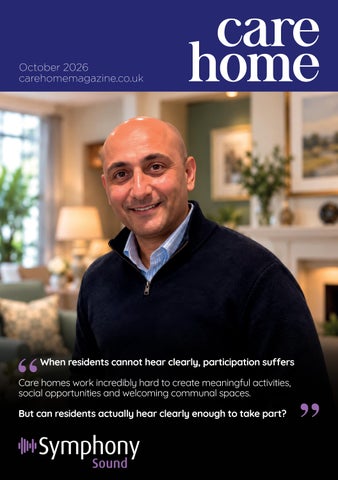
October 2026 carehomemagazine.co.uk
When residents cannot hear clearly, participation suffers Care homes work incredibly hard to create meaningful activities, social opportunities and welcoming communal spaces. But can residents actually hear clearly enough to take part?
F Portable Portable Case Case
Neckloop Neckloop Receiver Receiver
W Charging Charging Pack Pack Touch Touch ScreenScreen Mic Mic
DigiMaster DigiMaster Bluetooth Bluetooth Speaker Speaker
Wireless Wireless Pass Pass AroundAround Mic Mic
Reception Reception Loop Loop
03330333 323 0727 323 0727info@symphonysound.co.uk info@symphonysound.co.uk
p
When When residents residents cannot cannot hear hear clearly, clearly, participation participation suffers suffers Care homes Care homes work incredibly work incredibly hard to hard create to create meaningful meaningful activities, activities, social social opportunities opportunities and and welcoming welcoming communal communal spaces. spaces. But there But is there one is barrier one barrier that can that easily can easily be missed: be missed:
Can residents Can residents actually actually hear hear clearly clearly enough enough to take to take part?part? For people For people living living with hearing with hearing loss, group loss, group activities activities can become can become difficult difficult very quickly. very quickly. Background Background noise, noise, distance distance from the from person the person speaking, speaking, reverberation reverberation and competing and competing voicesvoices can allcan make all make it harder it harder to follow to follow what is what being is being said. said. That can That affect can affect far more far than morehearing. than hearing. A resident A resident may stop mayanswering stop answering questions questions duringduring a quiz,astruggle quiz, struggle to follow to follow a visiting a visiting entertainer, entertainer, lose track lose of track a group of a group discussion discussion or simply or simply choose choose not tonot jointo in.join in. It can It look canlike look disengagement. like disengagement. Sometimes, Sometimes, it is simply it is simply a listening a listening problem. problem. At Symphony At Symphony Sound,Sound, our focus our is focus on helping is on helping care homes care homes createcreate clearer clearer and more and inclusive more inclusive listening listening environments environments for residents for residents with and withwithout and without hearing hearing loss. loss.
Our approach Our approach is built is built around around one principle: one principle: Clarity Clarity over over loudness loudness SimplySimply turning turning up theup volume the volume is not is always not always the answer. the answer. By helping By helping speech speech reach reach residents residents more clearly, more clearly, particularly particularly in busy in communal busy communal spaces, spaces, technology technology can support can support betterbetter participation participation without without making making the whole the whole room unnecessarily room unnecessarily louder.louder. For residents For residents with compatible with compatible hearing hearing technology, technology, soundsound can also canbe also delivered be delivered more directly. more directly. For others, For others, headphones, headphones, neckloops neckloops and room-based and room-based soundsound can provide can provide additional additional support support depending depending on individual on individual needs.needs. But the But equipment the equipment is onlyispart onlyofpart it... of it... We also Webelieve also believe strongly strongly in training in training care teams, care teams, understanding understanding the environment the environment and making and making sure the sure technology the technology is actually is actually being being used confidently used confidently and appropriately. and appropriately. Because Because the real theoutcome real outcome is not is the not technology the technology itself. itself. It is seeing It is seeing a resident a resident join in.join in. It is hearing It is hearing more voices more voices around around the table. the table. It is helping It is helping someone someone stay engaged stay engaged duringduring an activity an activity ratherrather than withdrawing. than withdrawing. And it And is making it is making sure hearing sure hearing accessibility accessibility becomes becomes part ofpart the of wider the wider conversation conversation around around wellbeing, wellbeing, inclusion inclusion and person-centred and person-centred care. care. Care homes Care homes already already put enormous put enormous effort effort into bringing into bringing peoplepeople together. together. Our role Ourisrole to help is tomake help make sure people sure people can hear canenough hear enough to be part to beofpart it. of it.
www.symphonysound.co.uk www.symphonysound.co.uk
Symphony Symphony Sound Sound
Chief Editor
Tani Farinacci Johnson tj@carehomemagazine.co.uk
Publication Manager
James Davies james@carehomemagazine.co.uk Tel: 01795 509 112
Credit Facilities Manager
Gwen Lee creditcontrol@cimltd.co.uk Tel: 01795 509 103
Design and Production James Taylor james@cimltd.co.uk Grant Waters grant@cimltd.co.uk
Administration Manager Natalie Woollin admin@cimltd.co.uk
Head of Digital
Xhulio Bishtaja press@carehomemagazine.co.uk
Marketing Manager Lucas Payne lucas@cimltd.co.uk
Social Media Manager
Lily Lawson press@carehomemagazine.co.uk
Director
Tom Woollin tom@cimltd.co.uk
Managing Director John Denning
Editor’s Letter October 2026
T
rick or Treat! Despite the fun theme of the month, this issue of Care Home Magazine may be looking at one, if not the most, important sets of topics in the care sector: Staff Training and Recruitment & Retention. Without staff, care homes could not provide their vital service of caring for the elderly community. This month’s Staff Training feature looks at the importance of cross-training staff between departments. If a member of the kitchen team notices something in the wider home that is concerning, how to deal with it, emergency procedures, or, in a less urgent situation, who to turn to – and the undeniable benefits of this. The Recruitment and Retention feature reviews feedback and exit interviews. If you haven’t already implemented this, it may be worth reevaluating that practice, given the strong arguments our industry experts set out. The feedback that staff provide, if resolved correctly, can enhance both staff and residents’ experiences within the home, boosting your retention, a struggle all homes face. As usual, we have all our regular features and contributors such as Championing Social Care, The Access Group, Dishing Up, Care Home of the Month, and of course, most importantly, Activity of the Month. This month is all about Halloween and the autumnal season, with suggestions to boost creativity, involve the community, prompt reminiscence and create new memories. As always, I hope you enjoy the read, and perhaps we will run into you at the Care Show in Birmingham!
Tani Farinacci Johnson, Chief Editor © 2026 Cogent Multimedia Limited, 1st Floor, Saphir House, 5 Jubilee Way, Faversham, Kent, ME13 8GD. No part of this magazine may be reproduced or stored in a retrieval system or transmitted in any form – electronic, mechanical or physical – without express prior permission and written consent of the publisher. Contributions are invited and when not accepted will be returned only if accompanied by a fully stamped and addressed envelope. Manuscripts should be type written. No responsibility can be taken for drawings, photographs or literary contributions during transmission or in the editor’s hands. In the absence of an agreement the copyright of all contributions, literary, photographic or artistic, belongs to Cogent Multimedia Limited. The publisher accepts no responsibility in respect of advertisements appearing in the magazine and the opinions expressed do not necessarily represent the views of the Publisher. The Publisher cannot accept liability for any loss arising from the late appearance or non publication of any advertisement.
4
carehomemagazine.co.uk
Table of
Contents 10
12 Care Show Birmingham
Find out about the next Care Show and what to expect in Birmingham on the 7th and 8th of October.
16 The Access Group
Read Prash Patel’s story of care: how he went from building Specsavers to growing Nurse Next Door.
19 Staff Training
Discover the importance of crossdepartment training within the care home and how it can boost resident wellbeing and staff morale.
14
37 Recruitment and Retention
With insight from industry experts, we explore how staff feedback and exit interviews can play a monumental role in recruitment and retention.
44 Activity of the Month Spooky season is just around the corner; this month, we look at how to use Halloween to build community spirit and encourage creativity within your home.
28
50 Dishing Up
Ilona Tomza presents two memorable dishes: Balsamic Vinegar and Muscovado Coq au Vin, along with Whiskey and Orange Crème Brûlée served with Almond Puff Pastry Fingers.
34 carehomemagazine.co.uk
5
CHAMPIONING SOCIAL CARE
Who Cares Wins!
Championing Social Care’s Who Cares Wins! programme returned to the Kia Oval in March, connecting young people with employers and showcasing the breadth of social care careers ahead of a 2027 expansion.
A
ttracting the next generation of talented, passionate professionals to social care has never been more important. That is exactly why Who Cares Wins!, the care careers programme delivered by Championing Social Care, was created: to showcase the incredible opportunities available within the sector and inspire young people to consider a rewarding career in care. The Hallmark Foundation conceived the programme, and it is now entering its fourth year. Who Cares Wins! has established itself as a unique platform that connects young people with employers, innovators and leaders from across the care sector. The programme gives students an engaging introduction to the breadth of careers available within social care. While many are familiar with front-line roles, fewer realise the sector spans leadership, nursing, rehabilitation, hospitality, technology, recruitment, marketing, finance and innovation. Who Cares Wins! aims to change that perception, shining a spotlight on a sector filled with purpose, progression and possibility. In March this year, around 500 students, exhibitors, partners and guests gathered at the iconic Kia Oval cricket stadium in London for a day of learning, personal development and inspiration. The event featured a packed agenda, including a young people’s panel where attendees could ask questions directly and hear honest perspectives from their peers. The session generated lively discussion and highlighted the importance of giving young voices a platform within the sector. Attendees also received an exclusive introduction to RIA the Robot, showcasing how technology is
6
carehomemagazine.co.uk
increasingly supporting care delivery and creating exciting new career pathways. A vibrant exhibition area brought together partners from across the sector, giving students the chance to engage directly with employers. Looking forward to 2027, the ambition is to make Who Cares Wins! more accessible and valuable for both young people and providers. The programme is evolving from a single annual event into a series of localised and regional events across the UK, topped off by a national celebration event. By bringing Who Cares Wins! directly into communities, the aim is to engage more students, showcase local employment opportunities and create stronger connections between young people and care providers in their areas. To make this vision a reality, Championing Social Care is now seeking local partners to help host and shape the events. This includes care groups looking to connect with future talent, care innovators, and organisations actively involved in supporting the sector. If you are interested in partnering with a regional Who Cares Wins! event, please get in touch. We welcome conversations with organisations of all sizes and look forward to building this exciting next chapter together. Together, we can inspire the next generation to discover the many rewarding careers available in social care and help ensure the sector has the talented workforce it needs for the future. championingsocialcare.org.uk/who-cares-wins/
Lightening the load of medication management...
For residents who find managing medication overwhelming, staying on top of every dose can add unnecessary pressure. The Evondos Nora medication dispenser simplifies the routine, providing the right medication at the right time – supporting residents while preventing errors and lightening the load for care teams.
For more details go to
evondos.co.uk vAW_Envondos_Home Care_Nora_Print Ballon_210x297mm_3mmBleed.indd 1
10/09/2026 14:40
RESEARCH
Detecting Earlier
Dr Emer MacSweeney, CEO and Medical Director at Re:Cognition Health, discusses the new diagnostic pathway and prevention trials now reshaping how early Alzheimer’s disease can be caught and treated.
F
or decades, an Alzheimer’s diagnosis has arrived too late to change much. By the time memory loss is obvious, the disease has often been active in the brain for twenty years, and significant, irreversible damage has already occurred. Re:Cognition Health’s latest work aims squarely to close that gap, and the tools now exist to do it.
A structured route to diagnosis
The organisation has launched CognitionCheck, a diagnostic pathway that moves patients from initial concern to a specialist answer in four stages: an AIdriven cognitive assessment to establish a baseline, a P-tau217 blood test, a detailed MRI brain scan, and a consultation with an expert cognitive clinician. Each element builds on the last, rather than leaving patients with an isolated result and no context. The blood test is central to that shift. P-tau217 is a phosphorylated tau protein strongly associated with Alzheimer’s pathology, and elevated levels are highly predictive of the abnormal amyloid build-up seen in the brains of people with the disease, often long before symptoms are noticeable. This level of accuracy from a simple blood draw brings a form of testing once reliant on expensive PET imaging or invasive lumbar punctures within much easier reach.
Working towards a cure
Dr MacSweeney sees CognitionCheck, TRAILBLAZERALZ 3 and PrevenTRON as part of a longer journey towards earlier Alzheimer’s detection and intervention. She argues that research must look beyond amyloid to inflammation, vascular health, genetics and tau, alongside combination therapies similar to those used in cancer and cardiovascular medicine. She believes dementia should be recognised as a defining healthcare challenge, supported by a coordinated UK strategy that invests in biomarkers, imaging, workforce training, and memory-clinic infrastructure. Access must also be equitable, with eligible patients identified earlier and faster. Ultimately, cognitive change should prompt the same instinct to seek medical advice as changes in eyesight or heart health: something to be checked promptly, not written off as an inevitable part of ageing. To discuss referrals or clinical education sessions, contact referrals@re-cognitionhealth.com or visit recognitionhealth.com
Testing the case for prevention
That earlier window is also being tested directly. Re:Cognition Health is currently enrolling participants for the PrevenTRON clinical trial in the UK and USA. The study is for individuals who are cognitively healthy but have been found through testing to have abnormally elevated amyloid protein in the brain. The trial aims to determine whether Trontinemab, a monoclonal antibody designed to remove toxic amyloid protein from the brain before symptoms begin, can prevent or significantly delay the onset of Alzheimer’s symptoms. Another completed prevention study is the TRAILBLAZER-ALZ 3 clinical trial, which investigated Kisunla in cognitively normal individuals with high brain amyloid protein and was designed to answer the same question as the PrevenTRON study. If these studies are successful, they will mark a genuine shift in Alzheimer’s care, from treating disease once symptoms are established, to intervening with treatment before the onset of any symptoms.
8
carehomemagazine.co.uk
Dr Emer MacSweeney
When health is fragile, Nora strengthens support...
For residents living with frailty, managing medication can become harder as needs change. The Evondos Nora medication dispenser provides the right medication at the right time, reducing errors and freeing up valuable time to focus on those who need more hands-on, person-centred care.
For more details go to
evondos.co.uk vAW_Envondos_Home Care_Nora_Print Egg_210x297mm_3mmBleed.indd 1
10/09/2026 14:38
TECHNOLOGY
Time Well Spent
In this Q&A, Evondos explains how its automated dispenser, Nora, is designed to reduce dispensing errors, ease the pressure of staff medication rounds and give residents more independence over their routine.
What does Nora do?
The Evondos Nora is a CE-marked automated medication dispenser designed for people who may need support with their medication schedule. A pharmacy dispenses each resident’s prescription into sealed pouches, printed with their name and dose time, then joins them into a roll that is loaded into the device. At the scheduled time, the button and clock ring change colour and an audible signal sounds; one press releases the pouch. If a dose is missed, the button turns red and the pouch can still be taken, while care teams are notified when a dose is missed or there is an error on the machine. Support is available around the clock.
Who is it designed for?
Nora suits care homes, nursing homes, extra care and supported living settings, particularly residents taking several medicines a day, those living with cognitive impairment, or anyone for whom physical handling is the barrier, such as arthritis, tremor or reduced grip. Because a carer is present, it also works for residents who could not manage a dispenser independently; the device handles timing and preparation, while staff provide the prompting and reassurance only a person can.
removed entirely, freeing an hour of care time daily. For an 83-year-old resident receiving four hour-long visits combining personal care and medication, separating the two reduced her package from four visits a day to two.
Why should a care home consider it? Because it gives everyone time back. Residents can take medication around their own day rather than waiting in for it. For the organisation, preparation happens at the pharmacy, so refills become periodic rather than a daily task. For staff, each scheduled time prompts the resident directly, so nobody is racing the clock to reach everyone within the same window. The mechanical part of the round takes less time in the morning, leaving more time for the parts that need a person.
How does it reduce the risk of dispensing errors?
Mostly by removing steps. A traditional round involves handling loose tablets and blister packs, reading charts and working at speed, often for many residents in a short window, and each of those steps is a point where something can go differently than intended. With Nora, the pharmacy dispenses and checks medication into sealed, named pouches, and the device releases only the pouch that is due, when it is due. It does not remove human judgement from the process, and is not meant to; it removes the repetitive handling that judgement has to compete with.
What has changed for providers already using it?
Kyndi, a local authority trading company owned by Medway Council, has around 100 dispensers in use across Medway and the South East. One 81-yearold resident had been receiving four fifteen-minute medication-only calls a day; because those visits existed solely to hand over medication, they were
10
carehomemagazine.co.uk
Automated Dispenser, Nora
When care is complex, Nora finds the way.
For residents with complex medication needs, the Evondos Nora medication dispenser makes daily dispensing simpler – providing the right medication at the right time. For care homes, that means simpler medication rounds, a reduced risk of error, less administration and more staff time for person-centred care.
For more details go to
evondos.co.uk vAW_Envondos_Home Care_Nora_Print Maze_210x297mm_3mmBleed.indd 1
10/09/2026 14:37
BIRMINGHAM CARE SHOW 2026
Care Show
Birmingham Returns The NEC Birmingham welcomes back the UK’s leading care sector event on 7–8 October 2026, with a new Owners’ & Directors’ Forum, drop-in Care Business Clinics and over 300 exhibitors addressing funding, workforce and technology pressures across the sector.
What to expect at Care Show Birmingham 2026
The social care sector continues to face unprecedented change. From funding pressures and workforce shortages to evolving regulation and rapid advances in technology, care providers are navigating an increasingly complex landscape. That’s why there’s never been a more important time for the sector to come together. On 7–8 October 2026, Care Show Birmingham and the Retirement Living Show returns to the NEC Birmingham, bringing together the people, insights and innovations helping to support care through change. As the UK’s leading event for the care community, Care Show Birmingham provides two days packed with practical learning, meaningful networking and access to the latest innovations. Whether you’re an owner, director, registered manager or care professional the event offers valuable opportunities to gain fresh insights, discover new solutions and connect with peers facing many of the same challenges. With so much happening across the sector, it can be difficult to find the time to step back from the dayto-day and think about what comes next. Care Show
12
carehomemagazine.co.uk
Birmingham creates that space. It brings together the latest thinking, practical support and people with firsthand experience of the challenges care organisations are facing, helping visitors return to work with a clearer view of the opportunities ahead and ideas they can put into practice.
Practical learning for today’s care leaders
With more than 200 expert speakers delivering an extensive CPD-accredited conference programme, Care Show Birmingham focuses on providing practical advice. Through keynote presentations, panel discussions and solution-focused sessions, delegates will hear directly from sector leaders, regulators and providers tackling the biggest issues affecting care today. The programme is designed to help attendees make sense of a fast-changing landscape, whether they are looking for guidance on leading their teams, improving quality, managing costs or preparing for what comes next. Sessions are intended to be relevant beyond the conference room, giving visitors perspectives and examples they can reflect on with colleagues and apply
BIRMINGHAM CARE SHOW 2026
within their own organisations. It is a chance to turn fresh thinking into meaningful next steps. This year’s programme centres around five key themes: • Future of care • Workforce sustainability • Funding pressures • Compliance and regulation • Technology and digital transformation The conference also welcomes an impressive line-up of speakers, including Chris Badger, Chief Inspector of Adult Social Care and Integrated Care at CQC; Sarah McClinton, Chief Social Worker from the Department of Health and Social Care; Jeremy Richardson, CEO of Avery Healthcare; Raina Summerson, Group CEO of Agincare; Nitesh Somani, CEO of Kara Healthcare; Nye Brown, CEO of Hallmark Luxury Care Homes; Amrit Dhaliwal, CEO of Walfinch; and Baroness Glenys Thornton, Chair of the Social Care Institute of Excellence.
New for 2026
This year’s event introduces several exciting new features designed specifically for senior leaders and business owners. The brand-new Owners’ & Directors’ Forum has been created exclusively for strategic decision-makers. Dedicated to the realities of running a care business, the theatre explores everything from occupancy and commissioning to investment, business growth, funding challenges and long-term sustainability. It offers highlevel content tailored specifically to those responsible for leading care organisations through change. Alongside the forum, visitors can take advantage of the new Care Business Clinics. These informal drop-in sessions give care leaders the opportunity to speak directly with some of the sector’s most experienced business experts, ask pressing questions and gain practical advice from professionals who have successfully built and grown care businesses themselves. When the event closes on day one, the excitement continues with the return of Care Sector’s Got Talent, hosted at Care Show Birmingham for the very first
time. This much-loved evening event promises entertainment, networking and the chance to celebrate the incredible people that make the care sector so special.
Discover the latest innovations
Beyond the conference programme, visitors can explore more than 300 exhibitors showcasing the latest products, services and technologies supporting care providers. From digital care planning and AI-powered solutions to recruitment, compliance, facilities management and resident wellbeing, the event provides a unique opportunity to compare suppliers, experience live demonstrations and speak directly with the organisations driving innovation across the sector. With so much to see and compare, visitors can focus their time on the areas most relevant to their priorities. The event offers the chance to ask questions in person, see how different approaches work in practice and find out how new products or services could support the people and teams they care for.
Be part of the conversation
Care Show Birmingham brings together people from every corner of the sector because some of the best ideas don’t come from presentations - they come from conversations. Whether that’s with a speaker, another provider or an exhibitor, every discussion has the potential to spark something you can take back to your organisation. Join us at the NEC Birmingham on 7–8 October 2026 and be part of the conversations shaping the future of care. Register for your free pass today: https://forms.reg.buzz/care-showbirmingham-2026/carehomemagazine
carehomemagazine.co.uk
13
BUSINESS
onth M e h t f o e Care Hom ton: g n li r u B e Th Homes e r a C e u Boutiq
Sponsored By
The Burlington living room
A culture built on people
Ask what makes a care home stand out and most operators will point to policies or a well-designed activities programme. At The Burlington in Shepperton, part of Boutique Care Homes, the answer lies somewhere less measurable: a culture residents and families describe as family, built not through a single initiative but through the cumulative effect of how the whole team works together. Three people in particular give that culture its shape: Home Manager Margielyn, known to everyone as Margie, Admissions Manager Kirsty, and Sarah, Head of Lifestyle and Wellbeing. Margie leads through warmth rather than hierarchy, an approach recognised beyond the home itself when she won the Eminent Woman of Impact Award at the Women’s Community Impact Awards in March 2026, held for International Women’s Day. The award reflected work she does alongside her role at The Burlington, including a seat on the Executive Board of Women’s Voice and the presidency of the Aklanon Community UK & Ireland. “We create spaces where people feel valued and where their voices matter. That’s what drives me,” she said on accepting the award, a description that applies as much to how she runs the home as to the honour itself. Kirsty is often the first familiar voice a family hears, and she sees the role as one of staying power rather than a single conversation. “Families don’t just need information, they need someone who’ll still be there for the questions that come up months later,” she says.
14
carehomemagazine.co.uk
Sarah, meanwhile, designs and runs the activity and engagement calendar that turns the building from a place people live into a place people do things. Together, and with the wider team around them, they translate what could easily be a slogan into something residents and families experience daily.
Hospitality as part of the care offer
That philosophy extends into how The Burlington is designed to be used. The home’s Piano Bar and private dining room are not peripheral extras but a deliberate part of the care offer, built on the view that a home is judged as much on whether people want to spend time there as on the standard of care delivered. Coffee Connections, a regular community gathering, reinforces this, giving residents, families and local visitors a reason to be in the building on an ordinary day rather than only during a scheduled visit. Families have told the team it changes the character of a visit entirely, less an appointment, more the feeling of dropping in.
Recognition built over years, not months
The Burlington’s recognition has accumulated steadily rather than arriving all at once. The home won Care Home of the Year at the Surrey Care Awards in 2022, the NAPA Physical Activity Award in 2024, and Champion of People and Progress at the Surrey Care Awards in 2025. This year it was named a Top 20 UK South East Care Home, and it has held a 10 out of
BUSINESS
Residents baking with a carer at The Burlington
10 rating on carehome.co.uk for close to three years, a sustained mark rather than a single high point. Boutique Care Homes, the wider group The Burlington belongs to, has its own record to match, having won Care Home Group of the Year (Small) at the National Care Awards in both 2023 and 2025. That reputation is backed by consistency behind the scenes too: occupancy above 95%, staff retention at 98%, and no reliance on agency cover, figures that have held steady for several years rather than spiking around award season.
Rooted in Shepperton
The Burlington’s connection to its local community runs through several distinct relationships rather than one dominant partnership. In August, 862 Sunbury Squadron Royal Air Force Air Cadets visited the home, arriving with a musical parade before spending the afternoon with residents, sharing stories and photographs. Earlier in the summer, residents took a trip to the local pub, The Red Lion, for an afternoon of cocktails, nibbles, cards and friendly competition, part of the home’s Life Enrichment Programme, which
The Burlington’s Garden
treats getting out into the town as its own form of confidence-building. Residents have also spent an afternoon at Squires Garden Centre in Shepperton, browsing over tea and cake and swapping memories of gardens they once grew themselves. A uniformed youth organisation, a local pub, a garden centre: taken together, these everyday touchpoints keep life at The Burlington from stopping at the front door, for residents and for the wider community coming in.
The moment that captures it
One afternoon in particular illustrates what that openness produces. The Burlington’s Farm Experience Day in August, run with long-standing partner Browells Wood Pet Therapy, was deliberately timed to coincide with the school summer holidays, so that local children could take part alongside residents. The aim was simple: put a generation with time on its hands in a room with a generation full of stories to tell. As a group of residents gathered around a pen of lambs, children visiting with their grandparents crouched down to stroke them. It could have stayed a pleasant, unremarkable scene, had it not been for one exchange. A resident who rarely leaves her room unprompted spent twenty minutes narrating childhood farm memories to a six-year-old who had not stopped asking her questions since he arrived. Nobody scripted the conversation or assigned them to each other. It happened because the day had been built to give it room to. Residents at the centre of it all were cheerfully commenting on the lambs, the children and everything else within earshot. It is the kind of afternoon that is difficult to plan for on paper but easy to recognise in person: two organisations who trust each other, a purpose behind the timing, and a resident and a six-year-old who needed no introduction to find something to talk about.
carehomemagazine.co.uk
15
STORIES OF CARE - SPONSORED BY
Prash Patel
Prash Patel spent fifteen years building Specsavers into a household name before turning his talent for spotting problems on the UK’s home care sector. Discover how a career built on innovation, not vocation, led him to Nurse Next Door.
N
ot everyone who ends up in social care arrives through a sense of calling. For Prash Patel, it began with a problem he couldn’t walk past. Long before he had anything to do with care, Patel was part of the team behind Specsavers in the UK, working alongside his wife to build the brand from the ground up. Together they set new standards in service, customer experience and innovation, contributing to campaigns as recognisable as “Should’ve gone to Specsavers” and helping the business become first to market in hearing services and digital signage. Their work earned awards and industry recognition for doing things differently, and doing them well. After fifteen years in retail optical and hearing services, the pair felt the pull of a new challenge. They didn’t turn to care because of a lifelong ambition to work in the sector. They came because they recognised a system that was missing something, and believed they had the skills to fix it. “Sometimes you don’t find a calling, you create one”
Prash Patel
16
carehomemagazine.co.uk
Seeing opportunity where others see chaos
Patel and his wife identified a shortage of quality home care across the UK and drew on their experience building trust in health and retail services to launch their first home care business, Care More. From there, they moved into franchise growth with Kare Plus, before joining Nurse Next Door, the Canadian home care brand known for its Happier Ageing philosophy, an approach built around supporting independence, joy and dignity in later life. For Patel, the move made sense. It gave him the chance to bring an entrepreneurial mindset to a sector he felt was crying out for innovation and genuine human connection, rather than simply more capacity.
Pride in impact
Among the moments Patel is proudest of is being asked to contribute to the UK Parliamentary review into social care in 2020. For him, the invitation validated that his work was influencing more than individual
Leaders Council July 2023
STORIES OF CARE - SPONSORED BY
Prash Patel and his wife
clients or local franchises; it was helping shape thinking at a national level. But it’s the smaller, personal stories that keep him motivated day to day. One message from a family captures what he says his teams strive for: “At Christmas 2024, my Dad was in A&E suffering from dehydration. By early 2025, Nurse Next Door created a bespoke, flexible care package. Dad was able to watch his favourite football team win a play-off match at Wembley in May. This would not have been possible without their care. Simply put, Dad would not be able to live independently without their support, to the obvious benefit for him and the wider family.” For Patel, moments like this aren’t the exception. They’re what he considers the real measure of the work.
Creating culture and joy
Patel firmly believes that celebrating wins, however small, matters. Every week, his team gathers virtually for a seven-minute huddle to share good news from across every department: the big achievements, the smaller victories, and, by his own admission, the occasional corny joke to lighten the mood. “Celebrating together keeps us grounded,” he says. “It reminds us why we do what we do.”
What makes great care
Ask Patel what separates good care from great care, and he’s clear: it comes from genuinely wanting to make a difference, something he believes can’t be manufactured. He focuses on ensuring his teams are trained, supported, and given the confidence to lead with kindness, empathy, and consistency, arguing that the return on that investment speaks for itself: carers who are engaged, customers who thrive, and a culture that sustains itself without needing to be forced. He’s not naive about the pressures facing the sector. Patel points to providers cutting corners, mounting cost pressures from local authorities, and operators he
considers unscrupulous. Even so, he remains firm that integrity, service and heart aren’t optional extras in care. In his view, they’re the whole point.
Inspiring the next generation
When asked whether a career in care is worth pursuing, he won’t hesitate. “It’s not just rewarding, it’s transformative,” he says. “There’s room to grow, to lead, to innovate and to make lives better every single day.” He points to examples within the Nurse Next Door network of carers who progressed to become branch owners, people whose ambitions expanded once someone recognised their potential. That belief in people, and the willingness to see potential others might overlook, sits at the centre of his leadership approach. “Sometimes all it takes is someone to believe in you,” he adds.
A life dedicated to better care
Patel’s story reminds us that talent in social care doesn’t always come from lifelong devotion to the sector. Sometimes it comes from spotting a gap, having the confidence to fill it, and bringing everything learned across business, retail and life into a single purpose. Through problem-solving, ambition, and sustained commitment, Patel has helped improve the lives of thousands of customers, families, carers, and communities. It’s a career that illustrates, in practical terms, what strong leadership can look like when applied to care.
By Anoushka Farouk bit.ly/AccessCareSOC
Sometimes you don’t find a calling, you create one carehomemagazine.co.uk
17
EdgeCare™ - Run your care home from one connected Microsoft platform. From admissions to compliance, EdgeCare™ takes the manual work off your team’s plate. Enquiry to admission, tracked automatically. Fee splits, rate reviews and billing handled in the background. No more chasing spreadsheets, no revenue left on the table.
One audit trail. Zero last-minute scrambles. Policies, incidents and CQC-ready evidence, always up to date. Inspections don’t mean a week of pulling files together.
Explore EdgeCare™
A
A DV
N
TA
. GE
C
U O.
K
N /I
D
T US
R
S IE
Fewer phone calls. Faster answers. Families get updates, invoices and messages without ringing reception. Your team gets Copilot instead of digging through reports.
/
G ED
E
R CA
E
Staff
Training
carehomemagazine.co.uk
19
STAFF TRAINING
Essential 5 The first weeks in a new role shape whether care staff feel confident, supported and inclined to stay. We set out five priorities that help care home managers build induction programmes which go beyond compliance and prepare new starters for the realities of the role.
1
Start with values, not paperwork
Before policies and procedures, new starters need to understand what the home stands for and how that looks in everyday practice. Opening inductions with the organisation’s values, alongside introductions to residents and colleagues, gives context to everything that follows. When staff grasp why the home works as it does, mandatory training feels like preparation for meaningful work rather than a series of boxes to tick.
2
Make the Care Certificate count
The Care Certificate remains the benchmark for new care workers in England, but its value depends on how it is delivered. Carry out assessments in practice wherever possible, observing new starters as they support residents rather than relying on workbooks alone. Pairing each standard with real examples from the home helps staff connect theory to the people they care for.
3
Give shadowing a structure
Shadowing experienced colleagues is one of the most effective ways to build confidence, provided it has structure. New starters benefit from working alongside a consistent, trained mentor across shifts, gradually taking on tasks under supervision until competence is observed and signed off. Rushing this stage to cover rota gaps may ease short-term pressure, but it often leaves staff anxious and more likely to leave early.
4
Build confidence to speak up
Knowing safeguarding theory is not the same as feeling able to raise a concern. Induction should make reporting routes explicit, name the people new starters can approach, and reassure them that speaking up is expected and supported. Scenario-based discussion, using situations staff are likely to encounter, helps them recognise subtle warning signs and builds an open culture from their very first week.
5
Review, reflect and plan ahead
Induction should not end abruptly once mandatory modules are complete. Regular supervision during probation gives new starters space to reflect, ask questions and flag where they need further support, while giving managers an early view of emerging strengths. Agreeing a development plan at the end of this period signals that the home is invested in their progress, which can make a real difference to retention.
20
carehomemagazine.co.uk
99 Problems
British Lion eggs ain’t one Don’t gamble on imported eggs, they can represent a serious health risk to vulnerable groups.
Make the Smart Choice. British Lion - The eggs you can trust.
egginfo.co.uk
STAFF TRAINING
Vetted for Care
NaDCAS, the National Dementia Care Accreditation Scheme, has launched a Practice Development Guild connecting care providers with vetted specialist trainers, helping services turn dementia care ambitions into demonstrable, accredited practice.
T
he National Dementia Care Accreditation Scheme (NaDCAS) helps providers develop, demonstrate, and sustain exceptional dementia care. Its frameworks, built with research universities, sector specialists and people with lived experience of dementia, give services a practical structure for improvement, from an initial assessment of current practice through to formal accreditation as a recognised specialist dementia care provider.
A crowded market, simplified
Even strong training can lose impact if it does not connect to a home’s wider development goals, and the dementia care training market is a difficult one to navigate, with providers of varying approaches, depth and credibility competing for attention. NaDCAS has responded with its Practice Development Guild, a curated network of training and practice development organisations that share its commitment to raising dementia care standards. Each member is screened and reviewed by NaDCAS before joining, giving care providers a level of assurance that would otherwise take considerable time to establish independently.
well-supported teams and a genuine willingness among providers to keep learning. By vetting training partners against a consistent set of standards, NaDCAS aims to remove some of the guesswork, helping care homes invest with confidence that the support they commission is credible and relevant to dementia care. For care providers weighing up their next steps in dementia care development, the Guild offers a starting point grounded in independent scrutiny rather than marketing claims alone. To find out more, contact Claire Reading, Director of Partnerships and Operations, at claire.reading@nadcas.org, or visit www.nadcas.org.
Linking training to the bigger picture
What distinguishes the Guild from a simple supplier directory is its grounding in NaDCAS’ Nine Foundations for Exceptional Dementia Care, a framework spanning areas such as person-centred participation and leadership and culture. Guild members are selected because their expertise maps onto these foundations, giving providers a clearer route to specialist input that complements, rather than duplicates, their existing development priorities. This structure is designed to serve providers at any stage of their journey, whether they are identifying gaps through self-assessment, acting on the findings of a practice review, or working towards full NaDCAS accreditation. Guild members can be brought in to address specific priorities as they emerge, and the network’s breadth means providers are encouraged to think beyond one-off training sessions towards sustained team development and everyday practice change.
A shared standard
The Guild’s underlying premise is straightforward: better dementia care depends on better understanding,
22
carehomemagazine.co.uk
PCCC Certificate
A Game Changer for Dementia Care
Why choose My Life TV?
• First on-demand streaming service designed for people living with dementia • Hundreds of hours of carefully curated, dementia-friendly content • Supports cognitive, emotional, and physical wellbeing • Calm, engaging programmes – never overwhelming
What’s included?
• Nature films and reminiscence programmes • Music, sing-alongs and quizzes • Creative activities • Gentle movement sessions and chair yoga
Perfect for care homes
• Ideal for group sessions or one-to-one engagement • Helps spark conversation and connection • Easy to use for activity coordinators and care teams
“My Life TV is a complete game changer for our residents – we use it daily. Our residents are mesmerized, so focused!” Joanna Warren, St Mary’s Care Home, Hampton
Get started today
• Seven-day free trial • Full onboarding and ongoing support
– meaningful moments, made simple My Life TV is run by My Life Films, registered charity No: 1157198. Terms and conditions apply.
STAFF TRAINING
Compression Without Strain
SIGVARIS Britain explains the physical demands of applying and removing compression garments for care staff, and how application aids can help.
C
ompression therapy is widely recognised as an essential treatment for managing venous disease, oedema and leg ulcers. When prescribed and worn correctly, compression can improve outcomes, reduce swelling and support healing. Yet one part of the conversation is often overlooked: the impact that applying and removing compression garments can have on care staff. For many residents, compression garments are part of a daily routine. However, applying compression is rarely as simple as it sounds. Compression garments are designed to be firm. That firmness is what delivers the therapeutic benefit, but it can also make garments difficult to stretch over the foot and heel. Residents may have swollen limbs, limited mobility, arthritis, pain, fragile skin or reduced flexibility, all of which can make application more challenging. Research has shown that physical and repetitive strain can occur when applying and removing compression garments, affecting not only the wearer but also carers and healthcare professionals who help them. Staff often find themselves bending, kneeling, pulling and working in awkward positions to achieve a correct fit. The challenge extends beyond physical effort alone. Studies have found that around 27% of compression wearers cannot apply their garments independently, increasing reliance on carers for daily support. Whilst published studies have not quantified exactly how much time application aids save in routine care settings, even small efficiencies can have a meaningful cumulative effect. Consider a care home with ten residents wearing compression garments. If an application aid saves just two
24
carehomemagazine.co.uk
minutes per resident each day, that equates to more than 120 staff hours over a year. That is valuable time that could be redirected towards resident care, wellbeing activities and other clinical priorities. Perhaps more importantly, difficult application can affect the resident experience. If compression becomes uncomfortable, stressful or time-consuming, both residents and staff may begin to view it as a burden rather than an important treatment. This is where application aids such as the DOFF N’ DONNER® ROLLY and CONE can make a real difference. Designed to reduce the effort required to apply and remove compression garments, they help minimise pulling, bending and strain while making the process quicker and more controlled. For care home managers, this is not simply an equipment purchase. It is an investment in staff wellbeing, resident comfort and efficient care delivery. Application aids are available on prescription or as a relatively low-cost purchase. When we make compression easier for care staff, residents are more likely to receive the treatment they need. That benefits everyone. sigvaris.com
The healthcare & care home interior design specialists
Catalyst Interiors is revolutionising the world of interior design with our ground-breaking experiential approach to dementia care environments! • Residential Care • Nursing Care • Dementia/Memory Care • Retirement Living • Care Villages • Assisted Living • Medium Secure • Mental Health Services • Addiction • Autism Scan here to see our award-winning care home interiors
STAFF TRAINING
Returning to Good
As CQC scrutiny turns to services that have long held a Good rating, Quality Compliance Systems (QCS) explains why evidencing quality now depends on everyday practice, not paperwork produced for inspection.
A
s the Care Quality Commission turns its attention to services that have held a Good rating for several years, care providers face a subtly different challenge: showing that quality is lived day to day, not simply preserved for the next inspection. The regulator’s Returning to Good programme focuses on adult social care services likely to maintain a Good rating. Rather than testing this through a single snapshot, inspectors are placing greater weight on people’s experiences and outcomes, drawing on observation, conversations with staff and leaders, and proportionate checks of records. For managers, this shifts the emphasis away from gathering paperwork at short notice and towards building a culture in which good care is visible in ordinary daily routines. According to QCS, providers should review performance against the five CQC key questions and relevant quality statements, keep policies, audits, risk assessments, training records and feedback current, and ensure leaders can demonstrate how they listen to residents and act on what they learn. The most resilient services, QCS argues, are those where evidence sits naturally within care planning conversations, handovers, team meetings and quality improvement activity, rather than being assembled retrospectively. When staff understand the reasoning behind their guidance, and when feedback from residents, relatives, colleagues and visiting professionals
Returning to Good QCS
26
carehomemagazine.co.uk
is genuinely acted upon, good care becomes easier to demonstrate and sustain over time. This is where digital compliance support can play a practical role. QCS’s platform connects compliance, quality improvement, workforce support, and AIpowered guidance in one place, helping providers keep pace with regulatory change without losing sight of resident outcomes. Its mock inspection tool allows services to test readiness and identify gaps before an assessment. At the same time, its feedback survey system, developed with a former CQC inspector, helps providers collect and evidence how input from residents and staff translates into action. The company has also introduced Lyra, an AI tool designed to give staff instant, policy-backed answers rather than requiring them to search through lengthy documents or wait for support. QCS says the aim is to support staff judgement rather than replace it, giving teams confidence to act while keeping professional decision-making at the centre of care. Whatever stage a service is at, whether maintaining an existing Good rating, working towards Outstanding, or rebuilding confidence after a difficult period, the principle QCS sets out is consistent: quality demonstrated only for inspectors is quality that is difficult to sustain. Building the habits and records that make good care visible every day is what keeps a service genuinely ready for assessment, whenever it comes.
STAFF TRAINING
Dying Well
Care homes are increasingly delivering end-of-life care to the same standard as hospitals and hospices. The Gold Standards Framework explains how structured training is helping teams reach that standard.
Inglefield Nursing Home
T
here is a persistent assumption that endof-life care belongs in hospitals or hospices, and that care homes are a lesser setting for it, an assumption which is wholly inaccurate. With the right education and support, care homes can offer residents the chance to live well, plan ahead and receive high-quality care in the place they already call home. The Gold Standards Framework (GSF) training programme has been built around that principle. It gives care teams the knowledge, skills and confidence to deliver excellent end-of-life care, using a wholehome approach that helps staff recognise changing needs earlier, hold meaningful conversations and work together around each resident’s wishes. Homes that have completed the training describe its effect as transformational; one reported that GSF had “created a completely different culture and approach to living well and dying well”, with staff more confident in spotting needs early and acting on them.
From reactive to proactive
The training’s central aim is shifting care homes from a reactive to a proactive approach. As staff grow more confident having sensitive conversations, they are better placed to understand what matters most to residents, support advance care planning and bring families and wider care teams into decisions, keeping care person-centred throughout. The route to accreditation begins with six months of training delivered by GSF’s clinical team, all of whom have current or previous experience working in
28
carehomemagazine.co.uk
care homes. Once training is complete, organisations embed the framework into everyday practice before progressing to accreditation, which involves building a portfolio and undergoing an assessment visit. The long-term benefits reported by accredited homes include improved resident care, stronger communication, greater staff confidence, better teamwork and more residents supported to remain in their preferred place of care. As one home put it: “You only have one chance to get it right, and GSF means that everyone is aware of what is going on and how to manage each situation.” Families feel the impact as strongly as staff; one relative described how the framework had “taken the fear away” and allowed her to be her mother’s daughter again, rather than her carer, at the end of her mother’s life. For care home leaders, GSF training is best understood not as an added pressure but as an investment in existing good practice, one that builds a whole-home culture where everyone has a role in delivering compassionate, consistent, personalised care. info@gsfcentre.co.uk goldstandardsframework.org.uk
STAFF TRAINING
Care Has
No Department
Care homes are discovering that resident safety and dignity depend on more than clinical training reaching the right people. Abuka, a cross-functional training specialist, the Gold Standards Framework (GSF) end-of-life care programme, and the National Dementia Care Accreditation Scheme (NaDCAS) explain why kitchen, housekeeping, maintenance and activities teams need the same awareness as nurses and carers, and how to make sure that training is good enough to matter.
C
are home teams are rarely short of people committed to residents’ wellbeing, yet the way that commitment is organised can still leave gaps. Training tends to follow job titles rather than the resident’s actual day, so a nurse learns what a nurse needs to know, a chef learns what a chef needs to know, and the space between those two worlds is left largely unaddressed. Residents do not experience the home department by department. They experience whoever happens to be in the room, and that person’s ability to notice when something is wrong rarely depends on what is printed on their name badge.
Seeing yourself in the resident’s safety net
What changes when non-clinical staff receive training in moving and handling or recognising deterioration is not simply what they know, but how they see their own role. Abuka describes the shift as moving from “I’m here to complete a task” to “I’m part of the resident’s safety net”. Staff keep their core duties, but become far more alert to the person in front of them.
30
carehomemagazine.co.uk
The examples are often small but significant: a domestic might notice someone becoming breathless on the way to the bathroom, a kitchen assistant might spot a resident quietly leaving food that requires chewing, and a laundry assistant might pick up on a change in continence. None of these observations requires a clinical qualification, only the confidence to know they matter and how to raise them. Done well, cross-departmental training promotes shared ownership of issues such as safeguarding, falls prevention, hydration and deterioration, rather than leaving them as the sole responsibility of nurses or carers.
Overcoming “not my job”
The biggest barrier to buy-in, according to Abuka, is rarely a lack of care. It is role identity: staff viewing training through the lens of their job title rather than the resident’s experience. Progress comes when managers make clear that cross-functional training is not about adding clinical responsibility to non-clinical roles, but about giving staff the confidence to notice,
STAFF TRAINING
respond and escalate appropriately. One Experiencing Dementia course, run for a mixed group of carers, domestics and kitchen staff, illustrates how quickly that resistance can shift. The non-care staff arrived with a distinct “them and us” attitude, unsure why they had been included. By the end of the day, comments had moved from scepticism to recognition: “So that’s why Mr X has a different coloured plate,” and “I could never understand why Mrs Y always thinks I’m her daughter, but I do now.” That shift shows up in real incidents too. At one home where every member of staff had completed Emergency First Aid at Work training, it was the maintenance man, not the carers busy handing out breakfast, who spotted a resident choking and began back slaps to clear the blockage. At another, where staff had received joint dementia and dysphagia training, a domestic intercepted a visitor handing out boiled sweets in the lounge, recognising that a resident with both conditions might not refuse the sweet or understand its danger.
Where the gap becomes visible
The consequences of not extending this understanding are equally instructive in end-of-life care. GSF programmes rely on Champions who carry awareness beyond nursing and care teams into catering, housekeeping, activities and maintenance. When that awareness stays confined to the clinical team, the disconnect shows up in small but distressing ways. A housekeeper may continue their usual routine, unintentionally disturbing a resident or their family, or an activities coordinator may miss an opportunity for meaningful one-to-one time, simply because they were not aware a resident’s needs had changed. Families notice these gaps, and distress can follow even where everyone involved meant well. The GSF approach does not require every member of staff to become an end-of-life specialist, only the confidence to notice a changing need and know when to escalate it.
Making sure the training is actually good
Cross-functional training only closes gaps if it is genuinely good, and that is where NaDCAS comes in. The National Dementia Care Accreditation Scheme has built a Practice Development Guild, a vetted network of training providers committed to improving dementia care. Each member undergoes a NaDCAS screening and quality review before joining, giving care homes assurance about the quality, relevance and credibility of the training on offer. The Guild selects members because their work aligns with NaDCAS’ Nine Foundations for Exceptional Dementia Care, connecting individual sessions to a wider framework for practice development. It gives homes a clearer route to specialist expertise, and greater confidence that external training is relevant and consistent with the principles behind good dementia care, rather than simply another course in a crowded market.
Training that changes practice, not just policy
Good cross-functional training isn’t about putting everyone in the same room and delivering the same slides. It works best when sessions are practical and scenario-based, built around situations such as a resident not eating as usual or struggling to stand, so each department can talk through what they might notice and who they should tell. The strongest sessions bring care staff, nurses, kitchen, housekeeping, laundry, activities and maintenance into the room together, with managers attending too, since they set the culture around shared responsibility. Compassion has never been the preserve of any single department. Understanding, communication, confidence, and credible training turn that compassion into consistent care, and building them across the whole home remains one of the more overlooked opportunities in workforce development.
carehomemagazine.co.uk
31
STAFF TRAINING
Voices of Reform
Care Roadshows 2026 has confirmed its speaker programme, bringing together policy leaders, regulators and sector specialists, including Professor Vic Rayner OBE, CQC’s Alison Chilton and Joe Robertson MP, to address the issues shaping care delivery this year.
T
he 2026 Care Roadshows programme has confirmed its line-up, built around five themes that cover most of what’s currently keeping care home, home care and complex care providers up at night.
Reading the reform
Policy change is the backdrop to almost every operational decision providers are making right now. Sessions here, featuring Professor Vic Rayner OBE of the National Care Forum and public affairs specialists from Care England, will focus on what’s actually changing at national level, which developments deserve attention, and how to tell whether a current strategy still holds up against a shifting environment.
The retention problem
Recruitment and retention sessions move past the usual headline stats to look at what genuinely keeps staff in post: career development, culture, leadership, and where workforce strategy needs to go beyond simply hiring more people. Senior leaders from organisations including Walfinch, Signature Senior Lifestyle and Community Integrated Care will compare approaches across home care and care home settings.
Dementia, up close
This strand is less about theory and more about delivery: personalisation, the role of the physical environment, and where digital care planning and AI can genuinely support individualised care rather
32
carehomemagazine.co.uk
than adding another layer of admin. Specialists from Barchester Healthcare, Bluebird Care and Vida Healthcare feature among the contributors.
Tech that earns its place
The technology sessions take a deliberately practical line, weighing implementation against operation: which tools are actually reducing administrative pressure, what to check before introducing a new system, and how to avoid digital solutions that create more work than they save.
What regulators are watching
With CQC and Care Inspectorate Wales both represented, this strand offers direct insight into current regulatory priorities, what recent inspection findings mean in practice, and where expectations around quality and safety are moving next. A parliamentary perspective on dementia and social care policy adds a further layer.
Why it’s all in one room
None of these five areas sits in isolation. Recruitment affects quality. Regulation affects operations. Technology affects workload. Policy affects business planning. Care Roadshows’ bet is that hearing all five addressed together beats piecing the picture together afterwards, session by session. Registration for Care Roadshows 2026 is open now. https://tinyurl.com/crs-register-care-home
TECHNOLOGY
Consent-Led Care
Jayne Connery FRSA FRSPH, founder of Care Campaign for the Vulnerable, on why the sector’s next conversation about care technology should focus not on whether to use it, but on how to use it responsibly.
F
or the past 13 years, through Care Campaign for the Vulnerable (CCFTV), I have supported families who are often trying to navigate an incredibly complex care system at one of the most difficult times in their lives. That experience has shown me just how important transparency, communication and safety are when caring for vulnerable older people, particularly those living with dementia. I am now also seeing an increasing number of complex cases through Jayne Connery Consultancy, supporting families with issues including NHS Continuing Healthcare, safeguarding concerns, best interest meetings, care reviews, communication breakdowns and difficult relationships between families and care providers. These cases are rarely straightforward. Often, there are multiple issues happening at the same time, and families can feel overwhelmed trying to understand what should be happening, what questions they should be asking and how best to advocate for their loved one. My role is to bring experience, independent advice and a clear focus on the individual at the centre of the situation. Alongside this work, CCFTV is having ongoing discussions with regulators, care providers and technology businesses about the role technology can play in improving safety and transparency across care. I have been genuinely impressed by the innovation I am seeing. The technology now available is developing rapidly, from AI-supported systems and sensors to digital monitoring solutions capable of identifying changes in movement, behaviour and patterns that may indicate something needs attention. For a person living with dementia who may no longer be able to communicate pain, distress, discomfort or a change in their needs, this could be enormously valuable. But technology must be introduced responsibly. I don’t believe the answer is simply to put more technology into care homes. We need to consider why
Technology must be introduced responsibly.
34
carehomemagazine.co.uk
it is being used, how it improves safety, whether it is proportionate, and how consent, privacy and dignity are protected. For me, the future is about consent-led technology that complements good care rather than replaces people. Technology can provide another layer of information for care teams, support learning and potentially identify concerns earlier. It can also provide families with greater reassurance and confidence that their loved one is being cared for safely. After 13 years of leading the conversation around technology in care and supporting families through Care Campaign for the Vulnerable, I believe the conversation now needs to move beyond simply asking whether technology should be used. The question should be: how can we responsibly use the technology already available to make care safer, more transparent and more person-centred? That is an important part of the work I am now continuing: supporting families through complex situations while also engaging with regulators, providers and technology businesses to encourage innovation, accountability and better outcomes for vulnerable people and those who care for them.
CCFTV safety in care event 2026
CARE HOMES. UNDERSTOOD.
Backed by decades of experience supplying uniforms to the UK’s largest healthcare organisations.
Come and visit us at the Care Show 2026 7-8th October | Stand M55 Scan to discover our groundbreaking stretch uniform collection
Your Voice Matters A secure, independent and impartial platform to raise concerns, designed specifically for Care Homes
What we do... How we do it... Why say so? At Say So we are on a mission to create safe and successful workplaces.
Actively listen, we cut through complexities getting to the heart of the matter, together.
We provide a platform to raise concerns with support services for employees and organisations to change attitudes and patterns of behaviour in the workplace.
Bridge any gaps between employees and organisations with open communication and honest facilitation.
We get to the crux of a problem no matter how raw or challenging, because change only happens when we face the truth.
Identify concerns and risks, uncovering issues before they become critical.
We are independent so people can speak up and say it how it is. Anonymous concern raising, where identities are only disclosed with written authority. Highly experienced safeguarding professional where a feedback loop is established.
Get in touch to find out more about how Say So can help your care business 0800 321 3546 info@say-so.co.uk www.say-so.co.uk
Recruitment and Retention
carehomemagazine.co.uk
37
TECHNOLOGY
The BYOD Dilemma
As care providers turn to personal smartphones and tablets to cut costs and speed up access to care records, Subsidium examines how unmanaged devices can expose homes to UK GDPR breaches and CQC audit failures, and what a properly separated system looks like in practice.
D
igital transformation is reshaping how care is delivered, and Bring Your Own Device (BYOD) policies have become an increasingly common response to tightening budgets. Allowing carers to access care planning software on their own phones and tablets removes the cost of issuing new hardware, cuts training time, and gives staff instant access to digital records on shift. Left unmanaged, however, the same convenience creates a significant cyber blind spot.
The rise of BYOD on the care floor
The appeal is straightforward: care providers are under constant pressure to modernise workflows without inflating costs, and personal devices seem like a readymade solution. The risk lies in what happens once those devices are in use without oversight. Personal messaging apps, unapproved software and, unsecured public Wi-Fi can all compromise sensitive information, exposing providers to UK GDPR non-compliance and CQC audit failures.
The hidden security and privacy risks The core challenge is keeping business data separate from personal use. Without Mobile Device Management (MDM), providers have no visibility over where resident information travels once it leaves the building on a personal handset. A lost, stolen or passed-on phone can expose confidential medical histories, financial details and other personal data in seconds. Staff resistance is a genuine complication here too. Many carers are understandably wary of installing workplace management software on their own phones, worried that employers could access personal photos, messages, or location data.
Securing BYOD with work profiles
Separation is central to resolving this. Using Android Enterprise’s Work Profile feature, Subsidium builds an encrypted “work container” on staff devices that
The convenience is real, but so is the exposure.
38 carehomemagazine.co.uk
keeps care apps and resident data entirely isolated from personal photos, social media and messaging. IT teams retain full control over corporate data within that container, including the ability to remote-wipe work information if a device is lost or an employee leaves, without ever touching personal files. For care providers weighing up BYOD, the message is clear: the convenience is real, but so is the exposure if devices go unmanaged. A properly configured work profile allows staff to use their own hardware while keeping resident data and the organisation’s compliance position firmly protected. subsidium-ms.com
Don’t let unmanaged devices steal valuable time from your residents. Trust the experts.
Subsidium currently manages over 50,000 devices across the care sector. We turn chaotic, vulnerable tablets into secure, clinical tools instantly. From Kiosk Mode to device updates, we handle the entire lifecycle behind the scenes.
No distractions. No data risks. Just technology that works, so your team can too.
Book a demo today
RECRUITMENT AND RETENTION
Essential 5 In a competitive market, salary alone won’t secure the care talent you need. This Essential 5 reveals the five non-financial benefits that genuinely attract and retain high-performing staff, and keep them committed to your home in the long term.
1
Meaningful Professional Development
Care workers are drawn to employers who invest in their futures by offering structured training pathways, funded qualifications, and mentorship programmes. Recognition schemes celebrating competency levels boost morale significantly. Many staff prioritise learning opportunities over modest salary increases. Providing time for training during shifts demonstrates genuine commitment. When employees see clear progression routes and development support, retention improves dramatically. This investment signals you value their growth beyond immediate operational needs.
2
Genuine Work-Life Balance
Flexible scheduling continues to be key in recruitment. Provide predictable rotas well in advance, respecting personal commitments. Enable shift swaps and support staff with caregiving responsibilities. Remote admin tasks lessen commute stress. Employees value employers who recognise their lives outside work. Being able to balance caregiving and work is a game-changer. This flexibility helps prevent burnout and fosters loyal, sustainable teams dedicated to quality care.
3
Strong Workplace Culture & Support
A positive team environment surpasses many financial incentives. Build authentic camaraderie with team-building activities and peer support. Offer comprehensive wellbeing programmes, such as mental health resources and counselling. Recognise the emotional challenges of care work. Celebrate group successes and provide compassionate support during difficulties. When staff feel truly valued and psychologically safe, they become emotionally invested. A strong culture then becomes a key advantage in attracting caring, dedicated personnel.
4
Career Progression & Leadership Pathways
Ambitious employees look for organisations that provide opportunities to grow. Establish clear paths for care assistants to advance to supervisory and management positions. Offer leadership development and mentorship programmes for top talent. Introduce specialised roles in fields such as dementia care or activities coordination. Promoting internally shows appreciation for current staff and reduces the cost of expensive external hiring. Well-defined career progression inspires improved performance and higher engagement. When staff see a future within your organisation, they are more likely to become committed advocates.
5
Comprehensive Wellbeing & Support Services
Care work involves high emotional and physical demands. To support staff, provide occupational health services, counselling, and confidential wellbeing checks. Offer flexible benefits such as discounted gym memberships, mindfulness classes, or sleep programmes. Keep staffing levels adequate to avoid burnout and overtime. Recognise staff suffering from compassion fatigue and support them. Providing access to employee assistance programmes shows a true duty of care. When organisations genuinely prioritise staff wellbeing, recruitment is simplified, and retention significantly increases.
40
carehomemagazine.co.uk
The best thing since sliced bread! Our commitment goes beyond saving you money on regular commodity purchases. We provide a tailored service enabling you to concentrate on your business and the well-being of your residents. Think of us as an extension of your team, dedicated to achieving the best outcomes for your business.
I’ve worked with Greetwell Purchasing Solutions for a number of years and have the best possible prices available at the time, but will also ensure that they offer support wherever it’s needed. – Darren Klein, Catering Manager, PJ Care
Get a free, no obligation review of how we can help you today: Call:
01522 244680
Email: support@greetwell.co.uk Visit:
www.greetwell.co.uk
RECRUITMENT AND RETENTION
Making Exit
Interviews Count
Exit interviews are common across the care sector, but too often the feedback goes no further than a filing cabinet. Emma Jackson, HR Consultant at WorkNest; Jodie Pike, HR Director at Boutique Care Homes; and Holly Claydon, Customer Relationship Assistant at Principle Care Homes, explain how structured analysis and visible actions turn departure conversations into genuine retention tools, and why listening needs to start long before staff hand in their notice.
A
cross the care sector, exit interviews happen almost everywhere and change almost nothing. Providers ask the questions, note down the answers, and file them away, while the same reasons for leaving resurface month after month. With recruitment and retention pressures showing no sign of easing, that gap between collecting feedback and acting on it is one the sector can no longer afford. The real value of an exit interview lies not in the conversation itself but in what happens next: whether the feedback is analysed for patterns, whether it reaches the people who can act on it, and whether remaining staff can see the results.
Why exit interviews alone are not enough
Exit interviews are often the most candid conversations a provider will have with a member of staff. Departing employees have little left to lose, and in close-knit care teams that honesty can surface issues around workload, shift patterns, management support and
42
carehomemagazine.co.uk
recognition that might otherwise go unreported. But by the time someone has already decided to leave, much of the opportunity to change their mind has passed. Exit interviews work best as one part of a wider employee voice strategy, sitting alongside regular supervisions, team meetings and staff surveys, rather than as the only mechanism for understanding what staff think. Stay interviews are a useful complement: asking staff who remain what keeps them there, and what would make them consider leaving, captures the same themes before they commit to a resignation.
Turning individual comments into a wider signal
A single exit interview is only an anecdote. Its value emerges when providers group feedback into recurring themes, such as staffing levels, shift patterns, induction, training or support from managers, and check whether particular homes, roles or teams are raising the same issues repeatedly. Reviewing this data every few months, alongside sickness absence, turnover figures and staff survey
RECRUITMENT AND RETENTION
results, helps identify what genuinely needs fixing rather than reacting to the most recent or most vocal complaint. The final step, and the one most often skipped, is closing the loop: acting on what has been identified, tracking whether the change has worked, and telling staff what has actually changed as a result.
Small changes, visible results
Structured analysis matters, but so does following through on what it reveals, even when the resulting change is modest. At Boutique Care Homes, feedback that a team member had missed the chance to apply for an internal role while on annual leave led to a straightforward policy shift: internal vacancies are now advertised for a minimum of two weeks, giving every member of staff a fair opportunity to apply. At Principle Care Homes, feedback gathered through shift surveys and one-to-one supervisions prompted changes to handover processes, bringing senior team members and nurses into handovers earlier in the day. Previously, care teams could wait up to thirty minutes for tasks to be delegated; the revised approach has removed that bottleneck and allowed teams to begin their duties more promptly. Feedback also reshaped induction training, grouping related subjects together for a more logical flow and increasing the number of shadow shifts to build confidence before staff take on full responsibility. Neither change required a significant investment or a major restructure. Both came from listening to specific feedback and being willing to adjust an existing process in response.
Listening before it gets to that stage
The strongest argument for structured exit interview analysis is that, over time, it should generate fewer exit interviews to analyse. Providers that build listening into everyday working life catch frustrations while there is still time to address them. Boutique Care Homes uses a mix of informal conversations, team meetings, suggestion boxes and “Have Your Say” surveys, on the basis that not everyone
is comfortable raising concerns in the same way. That approach is reinforced by a genuinely flat structure, in which senior leaders take an active interest in getting to know staff individually, helped by an “All About You” form completed by every new starter. Principle Care Homes takes a similarly varied approach, combining town hall meetings, anonymous post-shift feedback, regular surveys and an open-door policy with its General Manager. Leadership visibility also plays a part, with senior figures periodically working alongside front-line teams to understand the day-to-day reality of the job. As the organisation grows, the intention is to keep managers close to the floor rather than allowing decision-makers to become removed from the people delivering care. Underpinning both approaches is psychological safety. Staff in care settings can feel particularly vulnerable raising concerns, given the emotional demands of the job and the closeness of most care teams, so managers need to be visibly approachable and to respond to issues without any hint of blame. Training leaders to run meaningful check-ins, recognising contributions consistently rather than only at appraisal, and encouraging peer support networks all help concerns surface earlier, while they can still be resolved rather than simply recorded on the way out.
Making it count
None of this requires an elaborate system. It requires providers to treat exit feedback as data rather than paperwork, to look for patterns across departures rather than treating each one in isolation, and to make sure staff who remain can see that raising a concern leads somewhere. Done well, exit interviews stop marking the end of the employment relationship and start functioning as an early warning system for the issues still affecting the people who stay. Combined with everyday listening, structured analysis, and visible follow-through, they turn a routine HR process into one of the most useful retention tools a care provider has.
carehomemagazine.co.uk
43
ACTIVITY OF THE MONTH
Spooktacular Celebrations
From pumpkin carving to themed games and sensory experiences, Halloween offers care homes the perfect opportunity to create fun, inclusive activities that encourage creativity, reminiscence and community spirit.
H
alloween has become much more than a day of costumes and sweet treats. For care homes, it presents an opportunity to brighten the darker autumn months with engaging activities that can be adapted to suit residents of all abilities and interests. Whether it’s a lively party, a calming craft session or a chance to reminisce about Halloween traditions through the decades, there are countless ways to make October memorable while supporting wellbeing and meaningful engagement.
Bringing out the creativity
Creative activities are at the heart of any successful Halloween celebration. Decorating pumpkins, painting wooden ornaments or creating autumn wreaths gives residents the chance to express themselves while exercising fine motor skills and hand-eye coordination. Pumpkin decorating can easily be adapted for different abilities. Residents with limited dexterity may prefer painting pumpkins or applying stickers and embellishments, while those who enjoy a challenge can take part in carving with appropriate staff support. Smaller squash or artificial pumpkins can also provide a safer, reusable alternative. Craft sessions also offer opportunities to decorate communal spaces. Handmade bunting, paper bats, autumn leaf garlands, and friendly ghosts can transform lounges
and dining rooms into festive environments, creating a sense of occasion throughout the month rather than just for one afternoon.
A trip down memory lane
For many older people, Halloween evokes memories that differ greatly from today’s celebrations. Rather than elaborate costumes and commercial decorations, residents may remember homemade lanterns carved from turnips, neighbourhood parties, apple-bobbing games, and seasonal traditions centred on harvest time. Using old photographs, newspaper clippings or music from different decades can encourage conversations about childhood experiences and family celebrations. Reminiscence sessions not only stimulate memory but also allow residents to share personal stories, helping staff learn more about their life histories and strengthening relationships. A themed quiz featuring Halloween customs, famous horror films, autumn folklore or traditional sayings can provide further cognitive stimulation while encouraging friendly competition.
Seasonal baking and tasting
Few activities bring people together quite like baking. Halloween offers the perfect excuse to fill the home with the comforting aromas of autumn by making pumpkin muffins, ginger biscuits, apple crumble or spiced cupcakes.
Residents can help measure ingredients, stir mixtures, decorate biscuits or simply enjoy tasting the finished products over a cup of tea. Baking sessions naturally encourage conversation and can easily involve visiting family members or local schoolchildren. For homes supporting residents with specialist dietary requirements, recipes can be adapted to accommodate allergies, texture-modified diets or diabetes-friendly alternatives, ensuring everyone can take part.
Games with everyone in mind
Halloween games don’t need to be frightening to be enjoyable. Gentle, inclusive activities often generate the biggest smiles. A Halloween-themed bingo afternoon, “guess the number of sweets in the jar”, beanbag pumpkin toss or spider-themed treasure hunt can all be modified for seated participation and varying mobility levels. Sensory games using textured autumn objects, scented herbs or mystery boxes can provide enjoyable stimulation for residents living with dementia. Music can also play a central role. A Halloween playlist featuring well-known classics such as Monster Mash, Thriller, and seasonal favourites creates a lively atmosphere, while dancing, seated exercises, or simply clapping along encourage movement and social interaction.
Opening the doors to the community
Halloween provides an ideal opportunity to strengthen relationships with the local community. Schools, nurseries, youth groups and families can be invited into the home for costume parades, pumpkin decorating competitions or intergenerational craft sessions. Many residents take great pleasure in seeing children dressed up, while younger visitors benefit from spending time with older generations and hearing their stories. These shared experiences help reduce social isolation and reinforce the care home’s role within the wider community. Some homes may even choose to organise a “trick or treat trail” around the building, allowing children to safely visit different areas while residents hand out sweets or small gifts from decorated doorways.
Creating an inclusive celebration
While many people enjoy Halloween, others may be less comfortable with spooky imagery or loud celebrations. It’s important that activities remain person-centred and considerate of individual preferences. Opting for warm autumn colours, harvest themes and friendly decorations rather than frightening displays can make celebrations more welcoming, particularly for residents living with dementia, who may become distressed by realistic masks, flashing lights or sudden noises. Providing quieter alternatives, such as autumn flower
arranging, seasonal film afternoons or craft sessions, ensures everyone has the opportunity to participate in a way that suits them.
Finishing with a celebration
As October draws to a close, bringing together everything residents have created can provide a fitting finale. A Halloween afternoon tea or autumn party gives everyone the opportunity to admire decorations, display crafts, enjoy homemade treats and celebrate their achievements together. Staff, families and volunteers can join in, with prizes awarded for favourite costumes, best pumpkin design or most creative decoration. Taking photographs throughout the month and displaying them on a memory board can also help residents reflect on the fun they have shared and create lasting keepsakes.
More than costumes and cobwebs
Halloween is about far more than fancy dress. For care homes, it offers a chance to combine creativity, reminiscence, physical activity and social connection within a single theme that can run throughout October. By adapting activities to meet individual needs and encouraging involvement from families and the local community, homes can create celebrations that are inclusive, meaningful and full of laughter. As the evenings grow darker and the weather turns cooler, a little seasonal magic can go a long way in bringing warmth, companionship and plenty of smiles to residents and staff alike.
carehomemagazine.co.uk
45
RECRUITMENT AND RETENTION
Wages On Demand
When Prosperity Care rolled out Level FT’s On-Demand Pay app, 77% of its carers had logged in and used it within the first month. Here’s what that uptake across case studies tells care leadership teams about the business case for Earned Wage Access.
A
new benefit only earns its place if staff actually use it. On-Demand Pay, also known as Earned Wage Access, allows staff to draw down a portion of wages they have already earned ahead of payday, without disrupting an employer’s cash flow or payroll cycle. A significant share of UK care providers now offers it, and for leadership teams still deciding, the case increasingly rests on more than staff wellbeing alone.
The financial argument
For registered managers, operations directors and finance leads, the appeal sits in three areas already under close scrutiny: recruitment and retention, agency spend, and staff engagement. When staff can access overtime pay sooner rather than waiting for the next pay run, demand for extra shifts tends to rise, helping providers cover rotas from within their existing team. Financial flexibility also makes staff less likely to leave for a marginal pay rise elsewhere, and same-day access to earned wages has been linked to lower next-day absence. Agency spend is where finance directors tend to focus hardest. By rewarding overtime faster, providers can encourage their own staff to pick up shifts rather than defaulting to costly agency cover. In a sector where agency spend is often one of the highest controllable costs on the balance sheet, that shift in behaviour compounds quickly. “We are really loving Level FT so far, and our staff have nothing but praise for it. It’s also helping to cover
46
carehomemagazine.co.uk
our rotas, as staff now have quicker access to any overtime they do rather than having to wait,” says Bluebird Care.
Built for the sector
Level FT works with care providers including Agincare, Home Instead, Bluebird Care, MACC Care, EQ Care Group and Prosperity Care, and says it understands the pressures facing ownership and senior leadership directly, from high staff turnover to franchise operating models and reducing reliance on agency staff. “Our employees really like having access to their pay through Level FT,” says Josh, Finance Director at Prosperity Care. Rollouts like Prosperity Care’s move quickly because Level FT’s On-Demand Pay connects directly with leading UK HR, rota and payroll systems, including Sona, Nourish, Birdie, Planday, Humanforce and IRIS meaning go-live is straightforward for operations teams with no added admin burden for the payroll team. For leadership teams still weighing up the decision, the Prosperity Care numbers make the point simply: introduced well, staff do not need convincing. The business case builds itself. Level FT is a UK financial wellbeing platform offering On-Demand Pay, Payroll Savings and more. It is a founding member of the CIPP’s On-Demand Pay Code of Practice and powers the service for many of the UK’s largest employers and HR technology providers. levelft.com
RECRUITMENT AND RETENTION
The Only Pipeline Left
New analysis from Care Hires’ Workforce Economics 2026 report finds retention is no longer a nice-to-have and has become the sector’s only working strategy, as overseas recruitment closes for good.
A closing door
The care worker visa route closed to new applicants in July 2025 and will be phased out entirely by July 2028. For a workforce that has leaned heavily on international recruitment to offset a shrinking domestic pipeline, that closure removes one of only two levers a provider has ever had. Growing a domestic workforce is slow. For the next three years, it is also the only option left. That reliance has been substantial. Skills for Care data cited in the report shows British nationals now filling 67.5% of posts, down from 84.5% five years ago, a fall of around 130,000 posts. The sector has spent five years quietly substituting one workforce for another. It no longer has that substitute available.
Redistribution, not recruitment
Closing the overseas route puts more weight on retention, but retention itself is already under strain. Independent sector turnover ran at 23.6% in 2025/26, and more than half of new starters, 53%, simply moved from another care provider. Very little of what looks like recruitment is actually growing the pool. Mostly, providers are hiring each other’s leavers and absorbing the cost each time. The most useful figure in the report isn’t the overall turnover rate, though. It’s where that turnover sits. Staff
48
carehomemagazine.co.uk
with under a year’s service leave at 43.5%. Staff with twenty years behind them leave at 17.6%. Whatever a provider is doing to support new starters in month one matters more than almost anything attempted later.
The gap that is left
Better retention slows the rate at which the pipeline drains. It does not refill it. According to the report’s numbers, the distance between the rota a provider has to fill and the permanent staff available to fill it widens between now and 2028 rather than closing. Meaning most providers will be covering more hours temporarily over the next three years, not fewer. The report treats that as a planning assumption rather than a failure.
One workforce plan
Recruitment, retention and temporary cover have generally been treated as three separate jobs with three separate budgets. That divide no longer holds. With no external route left to fall back on, the permanent workforce a provider can build and the cover it needs in the meantime are two halves of the same arithmetic, and from next month they sit under the same compliance duty as well. Workforce Economics 2026 is available free at carehires.com/workforce-economics.
DISHING UP
A Taste of Triumph
Porthaven Care Homes development chef Ilona Tomza, reigning NACC Care Chef of the Year, on the dishes that won her the title, and why she believes dementia-friendly plating and confident cooking go hand in hand.
G
ood care home cooking rarely gets the recognition it deserves, which is exactly the gap the National Association of Care Catering (NACC) has spent more than three decades working to close through its Care Chef of the Year competition, the sector’s most prestigious culinary award. This year’s reigning champion is Ilona Tomza, whose winning menu has since become a permanent fixture on the group’s dining offer. Ilona’s main course, a coq au vin built without a drop of wine, is the dish residents ask for most. Balsamic vinegar and muscovado sugar recreate the deep, rounded flavour traditionally drawn from red wine reduction, at a fraction of the cost. It is a clever piece of budget engineering that never reads as a compromise, with layers of smoked bacon lardons, baby onions and mushrooms built up over tender chicken thigh, served with silky mash and buttered savoy cabbage. The dish is also designed with dementia in mind. “I garnish the plates with what is in the stew so that they can look at the food and decide if it appeals to them,” Ilona explains. “It makes the choice easier for them.” Presentation, in other words, is communication. The dessert, a whiskey and orange crème brûlée, offers a lighter finish. The citrus and whiskey custard is set until just wobbling beneath its caramelised sugar top, while almond puff pastry fingers and semi-frozen orange segments add warmth and a cool, refreshing contrast, built entirely from ingredients suited to a care kitchen. Since her win, Ilona has become an unexpected but natural ambassador for the profession, demonstrating her winning dishes at the Public Sector Catering Expo alongside Hairy Bikers star Si King. “I’ve always been quite a confident
50
carehomemagazine.co.uk
Ilona’s winning main
Ilona’s winning dessert
DISHING UP
Balsamic Vinegar and Muscovado Coq au Vin Serves 3
Ingredients
450g chicken thigh 30ml balsamic vinegar 30g muscovado sugar 20g Knorr chicken stock 10g Knorr ham stock 30ml olive oil 5g garlic 100g smoked bacon lardons 100g baby onions 100g button mushrooms 100g carrots 100g parsnips 100g celery 600g white potatoes 50ml double cream 60g butter 300g savoy cabbage 1g thyme 5g cornflour 5g parsley
Method
1. Season the chicken and pan-fry in a large saucepan over a medium heat in olive oil. 2. Peel and dice the root vegetables and celery. 3. Remove the chicken from the pan and add the vegetables, then stir-fry and sauté for five minutes. 4. In a separate pan, brown the lardons, then remove and set aside. 5. Pan-fry the mushrooms, season, and set aside with a few drops of vinegar to marinate. 6. Cook the peeled onions in a little butter with a pinch of sugar. 7. Deglaze the lardon pan with 300ml of water diluted with the ham and chicken stock, then add the liquid to the pan of vegetables. 8. Return the chicken to the pan. 9. Add the garlic, balsamic vinegar and muscovado sugar, then simmer until tender. 10. Add half the mushrooms, bacon and baby onions to the pan, reserving the rest for garnish. 11. Thicken with cornflour to a medium consistency. 12. Garnish with the reserved bacon, mushrooms, baby onions and chopped parsley. 13. Meanwhile, peel and chop the potatoes and boil in salted water. 14. Drain the potatoes and pass through a sieve. 15. Melt the butter and cream together, add to the potatoes, then season and mix. 16. Shred the cabbage and sauté in olive oil in a large pan until tender. 17. Add thyme and seasoning to the cabbage.
Whiskey and Orange Crème Brûlée with Almond Puff Pastry Fingers and Semi-Frozen Orange Segments Serves 3
Ingredients
300ml double cream 125g egg yolks (approx. 3.5 eggs) 120g granulated sugar 15ml whiskey (optional) 115g orange (allowing for some segments as garnish) 2.5ml vanilla extract 160g puff pastry 1g ground cinnamon 50g flaked almonds 10g icing sugar
Method
1. Mix the egg yolks, vanilla, orange zest, 100g of the sugar, double cream and whiskey, if using. 2. Divide the mixture between ramekins. 3. Bake in a bain-marie, or at 40% steam, at 135°C until just set but still wobbling. 4. Chill in the fridge to set fully. 5. Sprinkle the custard with the remaining sugar and caramelise with a blow torch, or make a conventional caramel in a pan. 6. Roll out the pastry and cut into fingers. 7. Glaze with half a beaten egg. 8. Sprinkle with almonds and cinnamon. 9. Bake at 160°C on a low fan setting until puffed and golden. 10. Dust the fingers with icing sugar and garnish with orange segments.
person, but winning the competition and doing so many demos since has proved to me that I love having an audience while I’m cooking,” she says. “I’ve realised that my calling in life is teaching. I find those demos really fun, as well as rewarding when I can inspire others to look at care catering as a valuable and fulfilling career.” Entrants to the NACC’s competition, drawn from care homes, day centres and other care settings, must design a nutritionally balanced two-course menu costing no more than £4.50 per head, reflecting the real budgets care chefs work within. This year’s final takes place on 14 October at Loughborough College, where Ilona will join the judging panel. For Ilona, the title has clearly been about more than one winning menu. It has given her a platform to show that care catering deserves the same ambition and pride as any professional kitchen, one plate at a time.
carehomemagazine.co.uk
51
FOOD AND NUTRITION
Familiar Favourites, Every Day
Offering choice at breakfast and throughout the day can make all the difference to residents. Kellogg’s explores how changing snacking habits, the relaunch of Nutri-Grain Bakes and its cereal variety packs, can help care homes bring trusted brands to every part of the day.
F
rom early starts to well-earned pauses, the food and drink on offer in a care home needs to feel both comforting and considered. Whether it is a quick breakfast, a midafternoon pick-me-up or something indulgent to enjoy with a coffee, the best moments tend to come from familiar favourites done exceptionally well. That creates a careful balancing act at the heart of today’s snack and cereal offering, weighing convenience against quality, nostalgia against modern tastes, and indulgence against nourishment. Kellogg’s aims to deliver across every part of the day with brands that residents recognise and love, from baked bars made with wholegrain oats to indulgent treats and classic cereals, each with its own personality but all sharing the same promise of great taste, satisfying textures and effortless enjoyment.
Why convenience counts
Wider snacking habits help to explain why convenient formats matter. According to Holly Wright, Senior Activation Brand Manager at Kellogg’s, people are constantly on the move and searching for products that keep pace with their fast-paced lifestyles. When it comes to snacks, that means something portable and satisfying that fits seamlessly into the day, with 50% of consumers citing convenience as a key factor in their snacking choices. Cereal and snack bars are among the fastest-growing categories, with Mintel forecasting that sales of cereal bars and biscuits will reach £845 million by 2029. The category is also deeply embedded in regular habits,
52
carehomemagazine.co.uk
since three in five consumers eat cereal bars or biscuits and one in ten does so every single day. Loyalty is notably strong as well, with three in four cereal and snack bar users saying they already know which product they will buy before they enter a store. As Wright points out, stocking the right brands is therefore about ensuring that regulars can find their preferred product, a principle that applies as readily to a care home’s breakfast table and snack trolley as it does to a shop shelf.
A favourite returns
Nutri-Grain Bakes built a loyal following before leaving shelves, and consumer demand prompted their return. The soft-baked bars made a permanent comeback in April 2026 in participating depots and were relaunched with a new recipe that delivers all the flavour people know and love, now with a golden, oaty baked appearance. The strength of that demand was already evident before the relaunch. Over half a million shoppers bought Nutri-Grain Bakes in 2024, and they bought more frequently than the year before.
FOOD AND NUTRITION Made with wholegrain oats, the relaunched bars contain more oats for a heartier, more natural bite, while still providing the B vitamins and minerals Nutri-Grain is known for. NutriGrain contains at least 15% of the nutrient reference value (NRV) of vitamins B1, B2, B3, B6, B9 and B12, as well as iron, and vitamin B1 contributes to normal energy-yielding metabolism. The bars are intended to be enjoyed as part of a varied and balanced diet and a healthy lifestyle. Two flavours are available, each in single 45g packs. The Raisin Bake is the original, soft-baked, made with fruit and filled with plenty of juicy raisins, and it sits naturally alongside a morning coffee as a considered, feel-good choice. The Chocolate Bake, packed with generous dark chocolate chunks, speaks directly to one of the biggest trends shaping the category, with Mintel identifying chocolate as a key driver of new product development in cereal and snack bars as consumers look for indulgence and craving management. Individually wrapped for convenience, Nutri-Grain Bakes are designed as an on-the-go option for busy mornings. They also sit within a wider range of NutriGrain snack bars and Bakes, which includes flavours such as Apple, Blueberry, Strawberry and Chocolate.
Choice at the breakfast table
Breakfast plays an important role in setting the tone for the day, and offering choice can make all the difference to how residents begin theirs. Kellogg’s variety cereal packs offer a simple way to enjoy a selection of the brand’s cereals, whether residents want a timeless classic or effortless enjoyment. The Classic Variety Pack brings together the iconic trio of Coco Pops, Corn Flakes and Rice Krispies. From
chocolatey crunch to golden crispness, each portion offers something different. Featuring individually portioned packs, it makes breakfast simple for care home teams while giving residents the flexibility to enjoy a familiar favourite, and for adults who grew up loving these cereals, it can make breakfast feel fun, simple and intentional again, one favourite at a time. For those seeking a more indulgent breakfast, the new Taste Variety Pack brings together three iconic cereals: Crunchy Nut, Frosties and Corn Flakes. From the irresistible honey-glazed crunch of Crunchy Nut and the nostalgic appeal of Frosties to the toasted golden flakes of Corn Flakes, there is something to suit every taste. Convenient, easy to serve and packed with Kellogg’s favourites, the pack is designed to make breakfast both effortless and enjoyable.
Familiar favourites, done well
Whether residents reach for a timeless classic at breakfast, a Nutri-Grain Bake with a mid-morning coffee, or something more indulgent later in the day, the common thread running through the range is familiarity. By combining trusted brands with convenient, easy-to-serve formats, Kellogg’s aims to bring great taste, satisfying textures and effortless enjoyment to every part of a resident’s day, wherever that day takes them.
carehomemagazine.co.uk
53
Find Your Room can help you: • Reach More Customers • Increase Room Occupancy • Get Quality Enquiries & Conversions
ONLY £24
per month, per property
Meet Our Provider Portal Manage Property & Occupancy Effortlessly manage your property listings and occupancy status with the Find Your Room Partner Portal. Access all the essential tools to keep your property details up to date, maximize occupancy, and streamline the booking process. Manage Enquiries in Real-Time Effortlessly view and manage enquiries from prospective care seekers. Never miss a chance to connect with those actively searching for their next home. Monitor Performance Access a dedicated dashboard for valuable insights into your property’s availability, enquiries, and overall performance.
Free of charge for Supported Living & Not-For-Profits