November 2026 carehomemagazine.co.uk
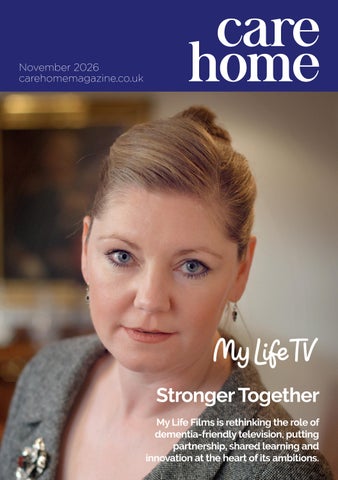
Stronger Together My Life Films is rethinking the role of dementia-friendly television, putting partnership, shared learning and innovation at the heart of its ambitions.
A Game Changer for Dementia Care
“My Life TV is a complete game changer for our residents – we use it daily. Our residents are mesmerized, so focused!” Joanna Warren, St Mary’s Care Home, Hampton
My Life TV is run by My Life Films, registered charity No: 1157198. Terms and conditions apply.
Why choose My Life TV? • First on-demand streaming service designed for people living with dementia • Hundreds of hours of carefully curated, dementia-friendly content • Supports cognitive, emotional, and physical wellbeing • Calm, engaging programmes – never overwhelming
What’s included? • Nature films and reminiscence programmes • Music, sing-alongs and quizzes • Creative activities • Gentle movement sessions and chair yoga
Perfect for care homes • Ideal for group sessions or one-to-one engagement • Helps spark conversation and connection • Easy to use for activity coordinators and care teams
Get started today • Seven-day free trial • Full onboarding and ongoing support
meaningful moments, made simple
Chief Editor
Tani Farinacci Johnson tj@carehomemagazine.co.uk
Publication Manager
James Davies james@carehomemagazine.co.uk Tel: 01795 509 112
Credit Facilities Manager
Gwen Lee creditcontrol@cimltd.co.uk Tel: 01795 509 103
Design and Production James Taylor james@cimltd.co.uk Grant Waters grant@cimltd.co.uk
Administration Manager Natalie Woollin admin@cimltd.co.uk
Head of Digital
Xhulio Bishtaja press@carehomemagazine.co.uk
Marketing Manager Lucas Payne lucas@cimltd.co.uk
Social Media Manager
Lily Lawson press@carehomemagazine.co.uk
Director
Tom Woollin tom@cimltd.co.uk
Managing Director John Denning
Editor’s Letter November 2026
A
s the evenings draw in and thoughts turn to winter pressures, and to the festive season beyond them, the November issue keeps returning to one question: how do we create more time for the moments that matter most? Technology sits at the centre of that conversation this month. Our technology and cost management features look past the price tag to ask what technology gives back; whether that is an hour on a night shift, a faster response to a family’s enquiry, or a manager freed from days of paperwork. The answers are encouraging and refreshingly practical, but they also make clear that the value always depends on how that time is used. Our cover story takes the idea in a different direction, exploring how dementia-friendly television is moving from something residents simply watch to something care teams can shape, share and build on together. It is a reminder that some of the best ideas in the sector already exist, waiting to travel beyond the home where they began. I would also encourage you to spend time with this month’s Stories of Care, a moving account of how lived experience can shape the empathy at the heart of good care, and of why carers must look after themselves too. Our Care Home of the Month, meanwhile, takes us to Bath, where a home draws much of its character from the city around it. October also brought my first ever Care Show Birmingham, and I came away with a notebook full of new contacts and a renewed sense of how determined this sector is to plan ahead. As always, I would love to hear what you are working on, so do get in touch. Wishing you a warm and cosy November,
Tani Farinacci Johnson, Chief Editor © 2026 Cogent Multimedia Limited, 1st Floor, Saphir House, 5 Jubilee Way, Faversham, Kent, ME13 8GD. No part of this magazine may be reproduced or stored in a retrieval system or transmitted in any form – electronic, mechanical or physical – without express prior permission and written consent of the publisher. Contributions are invited and when not accepted will be returned only if accompanied by a fully stamped and addressed envelope. Manuscripts should be type written. No responsibility can be taken for drawings, photographs or literary contributions during transmission or in the editor’s hands. In the absence of an agreement the copyright of all contributions, literary, photographic or artistic, belongs to Cogent Multimedia Limited. The publisher accepts no responsibility in respect of advertisements appearing in the magazine and the opinions expressed do not necessarily represent the views of the Publisher. The Publisher cannot accept liability for any loss arising from the late appearance or non publication of any advertisement.
4
carehomemagazine.co.uk
Table of
Contents
24
10 Access Group
Former pharmaceutical project manager Hannah Reseigh-Lincoln shares how lived experience led her into social care and shaped her advocacy for carer wellbeing.
12 Cover Story
My Life Films’ Gerri McHugh explains how partnership and shared learning are shaping the charity’s next chapter in dementiafriendly television.
15 Technology
30
Teton.ai and Loveday explain how smarter night-time monitoring is cutting unnecessary checks and alarm fatigue, freeing hours for residents and care teams.
32 Hallmark Midford Manor
We visit Hallmark’s Midford Manor in Bath, where relationship-centred care, heritage-inspired design and strong community links shape everyday life.
39 Cost Management
50
CoolCare, Teton.ai and Loveday explain where care technology delivers real savings and how operators can build a business case that stands up.
54 Editor’s Day Out
We report from Care Show Birmingham 2026, from AI and nutrition debates to the Care Sector’s Got Talent Grand Final.
58 carehomemagazine.co.uk
5
BUSINESS
Employment Rights With the Employment Rights Act 2025 reshaping everything from unfair dismissal to zero-hours contracts, the team at Quality Compliance Systems (QCS) outlines the changes care providers need to understand and the steps services can take now to prepare.
F
or a sector that depends so heavily on flexible rotas, casual staff and new recruits, the Employment Rights Act 2025 marks a significant shift in how care providers hire, manage and deploy their workforce. Many of the changes will be phased in over the coming year, and services that review their policies, contracts and rota practices now will be far better placed than those that wait.
Earlier protection, sharper probation
From January 2027, employees are expected to gain protection from unfair dismissal much earlier in their employment, placing far greater weight on recruitment, onboarding and probation. Managers will need to identify performance, conduct or suitability concerns quickly, document them clearly and follow a fair process from the outset.
Contract changes and restructures
Rules around “fire and rehire” are set to tighten, making it harder to dismiss staff and re-engage them on new terms without a strong financial reason. Planned changes to hours, duties, pay structures or working patterns should therefore be reviewed early and supported by consultation and clear evidence. Larger groups should also note that a new organisation-wide threshold for collective redundancy consultation is expected in 2027, meaning proposed redundancies will need to be tracked across every location rather than site by site.
Harassment and equality
Employers already have a duty to take reasonable steps to prevent sexual harassment, and further rules are expected to clarify what those steps involve. Thirdparty harassment protections are also due to return, leaving providers potentially liable for harassment by residents, families, visitors or contractors where reasonable preventative measures have not been taken, so risk assessments, reporting routes, training and the communication of expected behaviour all warrant review. From spring 2027, employers with 250 or more employees will be required to publish an equality action plan covering gender equality, the gender pay gap, sexual harassment prevention and menopause
6
carehomemagazine.co.uk
support, while mandatory ethnicity and disability pay gap reporting is expected under the Equality (Race and Disability) Bill, although no timeline has been announced.
Working families and flexible staff
Protections for pregnant employees and those returning from maternity leave are expected to strengthen, so managers should understand the risks surrounding dismissal, record decisions carefully and keep family leave and flexible working policies up to date. For many homes, however, the greatest operational impact is likely to come from new rights for zero-hours, low-hours and agency workers, including guaranteed-hours offers and reasonable notice of shifts, cancellations or changes. Providers may need to review their use of casual and agency staff, model the cost of guaranteed hours and tighten rota planning. To help providers prepare, QCS has partnered with law firm Weightmans to offer adult social care-specific guidance, practical resources and specialist legal insight within a single connected system. qcs.co.uk
CHAMPIONING SOCIAL CARE
Regulating Together Championing Social Care (CSC) has asked whether regulation has kept pace with modern care and how stronger relationships could help providers and regulators move forward. CSC Director, Ed Maxfield discusses the possible answers.
A
t CSC, we encouraged leading figures in care to think about risk and regulation this autumn. Our mission is to shine a positive light on social care, helping everyone understand what great, modern care looks like. In that spirit, we wanted a constructive, solutions-focused discussion about working with regulators to create a sector that meets everyone’s needs. A key theme was that modern care is fundamentally relationship-focused. While policies, procedures and evidence remain important, great care is often defined by the quality of relationships between people receiving support, their families and the professionals around them. Participants questioned whether regulatory approaches always capture this and argued that inspections should place greater emphasis on outcomes rather than process. Success should be measured by the difference made in people’s lives, not by whether every procedural box has been ticked. At our Thought Leaders in Care Lunch, participants said the sector can, and should, offer more opportunities for inspectors to experience frontline services. With rapidly evolving technology playing an essential role in care, tech firms can help educate inspectors and provide data and tools for a futurefocused regulatory system. Improved communication between the sector and the regulator could also revive the early ambition of CQC inspections to be part of a provider’s quality improvement journey. As part of our knowledge-sharing programme, we invited Michael Maslinski to speak with sector leaders about his book, What Would Maggie Do? Michael has a unique story to tell, having lived for nine years in a care home with his wife, who was living with dementia. His central message is that effective leadership requires judgement, confidence and the courage to make decisions rather than retreating into risk avoidance. Providers and regulators can adopt this core theme to increase flexibility and independence for those receiving care and reduce the pressure on staff. Innovation, personalised care and quality improvement all require people to think creatively and sometimes move beyond established practice. A system driven solely by fear of getting things wrong risks stifling progress, while a regulatory framework
8
carehomemagazine.co.uk
that promotes learning and improvement is more likely to support a resilient workforce. Perhaps most encouraging was the shared commitment to raising ambition. Providers should aspire to deliver far more than the minimum standards they are inspected against, while regulators should be supported to recognise and celebrate innovation and excellence. Participants identified three priorities: better communication, a stronger focus on outcomes, and ongoing education on both sides of the regulatory relationship. Alongside these came a call to revive the powerful “mum test”: asking whether the care is good enough for someone we love. If regulation can evolve alongside modern care, and providers and regulators work together with openness, trust and a willingness to learn, the sector has an opportunity not merely to meet standards, but to redefine what outstanding care looks like.
Michael Maslinski
Find Your Room can help you: • Reach More Customers • Increase Room Occupancy • Get Quality Enquiries & Conversions
ONLY £24
per month, per property
Meet Our Provider Portal Manage Property & Occupancy Effortlessly manage your property listings and occupancy status with the Find Your Room Partner Portal. Access all the essential tools to keep your property details up to date, maximize occupancy, and streamline the booking process. Manage Enquiries in Real-Time Effortlessly view and manage enquiries from prospective care seekers. Never miss a chance to connect with those actively searching for their next home. Monitor Performance Access a dedicated dashboard for valuable insights into your property’s availability, enquiries, and overall performance.
Free of charge for Supported Living & Not-For-Profits
STORIES OF CARE - SPONSORED BY
Hannah Reseigh-Lincoln After 15 years in pharmaceutical project management and a long recovery from two mental health breakdowns, Hannah Reseigh-Lincoln found her calling in social care. Now a support worker and sector advocate, she reflects on how lived experience shaped her empathy, and why carers must protect their own wellbeing.
M
eet Hannah Reseigh-Lincoln today and the first thing you notice is her warmth: a calm presence and an easy smile from someone who instinctively makes people feel safe. It would be easy to assume she had always been destined for social care, yet for 15 years her working life looked entirely different, built around a highly technical, fast-paced corporate career that slowly and quietly became a life that no longer felt like her own.
When work became identity
After graduating, Hannah built a successful career in the pharmaceutical industry, working in a highly technical project management role that carried significant responsibility and constant pressure. From the outside, it looked like success. Internally, however, something was unravelling. The role had become her identity, her days consumed by deadlines, expectations and performance, and the person beneath the professional exterior was gradually disappearing. Stress turned into overwhelm, and overwhelm into anxiety, until Hannah reached emotional rock bottom. Two serious mental health breakdowns forced her to stop, and what followed was not a quick recovery but five years of profound struggle. At times, the
depression was so heavy that she describes losing entire days, when simply existing felt exhausting. Yet it was within that darkness that something unexpected began to emerge: a deeper understanding, a new compassion, and a quiet rediscovery of who she truly was.
Rediscovering a natural carer
Beneath the corporate identity she had constructed, Hannah came to realise, there had always been another version of herself. Growing up as one of six siblings in a big family, she had been the child who naturally noticed when others needed support, someone who had always been good at caring for people and deeply attuned to their emotions. As she began to heal, she found herself noticing
10
carehomemagazine.co.uk
STORIES OF CARE - SPONSORED BY small things again: a good conversation, fresh air, shared laughter, and gratitude for simply getting through the day. From that place grew an empathy that feels less like a skill than a superpower, forged not in training rooms or leadership courses but through lived experience. Crucially, she was learning, slowly and painfully, to offer herself the compassion she had always given so freely to others.
A different path
Hannah then made a decision many people contemplate but rarely act upon, walking away from her career altogether. Her route into the care sector was unconventional, but the impact was immediate. She began in domiciliary care and later became a dementia champion, before moving into her current role as a full-time support worker in a residential home for adults with autism and learning disabilities. Alongside her frontline work, she now sits on the advisory boards of the Care Workers’ Charity and Homecare Voices, helping to ensure that carers themselves have a voice in shaping the future of the sector. Her motivation, she explains, is straightforward. “Other than providing for my family, my main motivation is to support people to live happy and independent lives. I see the impact every day.”
The cost of caring deeply
Her own recovery taught Hannah a lesson that many carers learn eventually: empathy is powerful, but it can also be exhausting. She speaks openly about empathy fatigue and the emotional weight carried by those who feel the struggles of the people they support most keenly. “You can’t pour from an empty cup,” she says, and it is a principle she now lives by, treating self-care, rest, and the protection of her emotional wellbeing as necessities rather than luxuries. She admits that she is still not great at asking for help herself, yet there is a disarming humility about her. She listens, learns, and accepts guidance openly, always with warmth.
The moments that matter
Ask Hannah about her proudest achievements and she does not begin with accolades, although being nominated for Southwest Carer of the Year at the Great British Care Awards 2025 and speaking at a House of Lords event remain deeply meaningful milestones. Instead, she talks about people, such as the woman living with dementia whom she supported to attend her granddaughter’s wedding. Moments like these capture the true nature of the role, preserving connection, dignity, and memory. Hannah also photographs the smaller, everyday wins and shares them with colleagues, ensuring that progress which might otherwise go unnoticed is properly celebrated.
positive. “Sometimes I have to fake it,” she admits, explaining that she might be the only person someone sees that day, and she wants that interaction to feel warm, uplifting and human. That honesty underpins her advocacy for emotional wellbeing across the workforce. Having lived through burnout and anxiety, she brings a perspective that cannot be taught, along with a genuine understanding of the courage it takes to keep going when everything feels overwhelming. Her advice to those entering the sector is simple: do not give up, listen to people’s stories, and keep going until the overwhelm softens. And, she adds with a smile, always keep snacks, drinks and a torch in the car, a piece of practical wisdom clearly earned on real shifts.
A calling found through healing
Hannah’s story is about far more than a change of career; it is about rediscovering identity. Today she is a wife, a mum to two boys and two cats, and a keen cook and baker who treasures time with friends and family. She is also proof that social care is often filled with people who arrive not by design but by calling, and a reminder that compassion born of lived experience carries a depth that cannot be replicated, and that changes lives. By Anoushka Farouk bit.ly/AccessCareSOC
Showing up on the hard days
She is equally honest about the emotional reality of the job, from long shifts to the emotional labour of staying
carehomemagazine.co.uk
11
COVER STORY COURTESY OF
Tuning In Together
Gerri McHugh, Executive Director of My Life Films, explains how a new strategic direction is building on the charity’s work in dementia-friendly television, putting partnership, shared learning and innovation at the heart of its ambitions.
A
cross the care sector, activity professionals, care providers, musicians, artists, researchers and community organisations are bringing remarkable imagination to dementia care, and much of that work is already collaborative. Yet effective approaches too often remain where they began, within one home or one team, while mainstream television has yet to give cognitive accessibility the recognition it deserves. At My Life Films, our ambition is not simply to extend the reach of My Life TV, our dementia-friendly streaming service, but to help make meaningful, inclusive audiovisual experiences an everyday part of life for people living with dementia, recognising that we cannot achieve this alone.
A strategy shaped by experience
Earlier this year, we undertook a strategic review, drawing on more than a decade of creating films and television for people living with dementia. We asked where we could make the greatest difference, what the people using our services had taught us and how effective approaches could reach many more people. One conclusion stood out. Excellent content is only part of the answer; what matters just as much is how that content is discovered, accessed and used, how confidently care professionals can build it into their activities, and how we learn from their experience in return. We therefore increasingly see ourselves as a collaborator, connector and advocate for dementiainclusive audiovisual experiences, an evolution of our work rather than a departure from it.
Rob series on My Life TV inspired participants to create a collaborative jungle collage, turning a screen-based activity into an ongoing creative project.
Learning that flows both ways
Beyond the care home
Our relationships with care providers are central to this approach and work best when learning travels in both directions. We bring expertise in dementiafriendly content, while activity professionals contribute invaluable knowledge of residents’ interests, changing needs and responses. Our partnership with Advinia Healthcare on regular quiz content, for example, lets us learn alongside care teams about what residents enjoy, how programmes can support different activities and where we can improve. Some of the most inspiring results, however, come when care professionals take a programme and make it their own. At Hertfordshire’s Ware Road and Broxbourne Day Opportunities services, the Draw with
12
carehomemagazine.co.uk
Our wider collaborations reflect the many ways people experience connection, enjoyment and a sense of identity. We were proud to be the first founding supporter of The Dementia Dialogues, Natalie Carter’s podcast sharing experiences and perspectives from across the dementia community. We have also worked with The Together Project to bring its intergenerational Songs & Smiles activities to My Life TV, capturing the joy of younger and older generations connecting through music, and we are exploring how to build on that relationship. Technology providers and broadcasters matter just as much, because they shape how easily people can reach dementia-friendly viewing. Building on
COVER STORY COURTESY OF
Behind the scenes as My Life Films captures an intergenerational activity, bringing care home residents, families and younger generations together through shared experiences.
our November 2025 report, The Inclusive Screen, we recently contributed to discussions with the Digital TV Group and Ofcom about how television technology, content and services could better meet the needs of people living with dementia, bringing insights from care settings and lived experience into conversations about how television is made and delivered.
From watching to participating
Earlier this year, we also completed a major migration of My Life TV to a new streaming platform. Much of that work happened behind the scenes, but it has given us room to think more ambitiously about a service that already spans music, nature, reminiscence, quizzes, gentle exercise and creative activities, including how it might connect care settings through shared experiences. Imagine residents in different parts of the country joining a synchronised sing-along to familiar songs, or care homes taking part in a shared quiz, an occasion reaching beyond any single setting. We are exploring opportunities to pilot ideas such as these in early 2027, working with care partners to understand what would be enjoyable, accessible and practical. The aim is not technology for its own sake, but technology that creates opportunities for participation and connection.
A shared body of practice
Activity professionals already share ideas with one another, and organisations such as the National Activity Providers Association (NAPA) play an invaluable role in championing and connecting that work. One of our longer-term ambitions is to contribute to this exchange by helping to grow a community of practice around dementia-friendly audiovisual content and meaningful activity, in which care teams pass on their favourite ways of using a programme, adaptations for different
interests and abilities, and honest accounts of what did not work as expected. Our hope is that My Life TV becomes not simply a library of programmes, but a resource through which practical learning travels across the sector.
Building the evidence
Our partnership with Dementia Research UK is helping us build stronger evidence about the role of dementia-friendly television. With its generous funding, we are working with the National Activity Providers Association (NAPA) on an independent evaluation of My Life TV, exploring how the service is used in care settings, its potential contribution to residents’ wellbeing and engagement, and the experiences of the professionals supporting them. Understanding what works, for whom and under what circumstances will help us improve the service while contributing practical learning to the wider care sector.
Stronger together
For My Life Films, partnership is not simply a means of delivering our strategy; it is central to the change we want to help create. We envisage a future in which dementia-friendly audiovisual experiences are readily accessible, technology makes participation easier, creative organisations and care providers develop new experiences together, and practical knowledge is widely shared. Much of the expertise, commitment and creativity needed to realise that vision already exists. As a small charity, we know our greatest contribution will come less from doing more ourselves than from combining our strengths with those of others, remaining open to learning and keeping people living with dementia at the centre of everything we do.
carehomemagazine.co.uk
13
Technology
carehomemagazine.co.uk
15
TECHNOLOGY
Essential 5 From lighting that follows the natural rhythm of the day to entertainment every resident can enjoy, the right technology shapes atmosphere as much as any soft furnishing. Here are five ways to make every day spaces feel more like home.
1
Lighting that follows the day
Circadian lighting systems gradually shift colour temperature and brightness through the day, from cool, energising tones in the morning to warmer, softer light in the evening. By mirroring natural daylight, they can help support residents’ sleep patterns and may ease the late-afternoon restlessness often associated with dementia. Many systems run automatically once programmed, so staff are free to focus on residents rather than switches.
2
Atmosphere on any budget
A full tuneable lighting installation suits a new build or major refurbishment, but smaller steps can still transform a room. Smart bulbs and app-controlled lamps can be dimmed and warmed for quieter evenings, while low-level motion-activated night lights guide residents safely to the bathroom without flooding a bedroom with harsh overhead light. Introducing changes room by room allows homes to gauge residents’ responses before committing to wider investment.
3
The lounge as a gathering place
A large smart TV with a quality sound system can turn a shared lounge into the social heart of the home, hosting film afternoons, live sport, concerts, and family gatherings. Positioning matters as much as specification: screens should sit at a comfortable viewing height, away from glare, with seating arranged for conversation as well as viewing. Discreet cabling and wall-mounted speakers keep the room feeling domestic rather than institutional.
4
Personal entertainment in every room
In-room smart TVs and streaming services let residents watch what they choose, when they choose, just as they would at home. Some providers offer care-specific platforms with curated content, video calling and personalised photo galleries, helping residents stay connected with family between visits. Robust Wi-Fi throughout the building is essential, and homes should consider how logins and subscriptions will be managed securely across multiple rooms.
5
Designed for every resident
Accessibility features ensure entertainment remains enjoyable for residents living with sensory or cognitive impairment. Subtitles, audio description, and adjustable text size are built into most smart TVs, and simplified remotes with a few large, clearly labelled buttons reduce frustration. Wireless TV listeners and hearing loops deliver sound directly to residents with hearing loss, keeping lounge volumes comfortable for everyone. Pared-back, picture-led menus also help people living with dementia choose independently.
16
carehomemagazine.co.uk
TECHNOLOGY
Innovation
With Integrity Jayne Connery, Founder and Director of Care Campaign for the Vulnerable, reflects on a recent conversation with Chris Badger of the Care Quality Commission about how technology can support safety, transparency and dignity in care settings, and why the sector needs a balanced, person-centred approach to its use.
I
recently had the opportunity to discuss the future of technology in care with Chris Badger of the Care Quality Commission (CQC), including how technology can support safety, transparency and better outcomes for people living in care settings. One of the key messages from the discussion was that technology should not automatically be viewed as surveillance. Used appropriately, with consent, choice and dignity at its centre, technology has the potential to become an important tool in modern care. For me, this is particularly relevant when we consider people living with dementia. Technology can provide additional information about what is happening in a care environment, help identify potential concerns and support professionals and families in understanding an individual’s needs. The important distinction is how technology is introduced and used. It should be proportionate, responsible and personcentred. Families and individuals should understand what technology is being used for, and there needs to be appropriate consideration of consent, privacy and dignity. My discussion with Chris also reinforced the importance of having a clear framework around safety monitoring. Providers should not feel that the introduction of technology is automatically a criticism of the care they provide. Equally, technology should not be imposed simply because it is available. There needs to be a balanced approach. Technology can support care professionals, but it cannot replace professional judgement, compassionate care or meaningful human interaction. Nor should it become an excuse to reduce staffing or personal contact. What I believe we need is greater openness to innovation and a willingness to properly evaluate what technology can bring to care. That means encouraging responsible pilots, learning from the evidence and involving providers, families, regulators and technology specialists in the conversation.
18
carehomemagazine.co.uk
The CQC has an important role to play in helping create clarity around this. Providers need to know what good looks like, families need confidence that technology is being used appropriately, and people receiving care must remain at the heart of every decision. My conversation with Chris Badger was encouraging because it demonstrated a willingness to engage with these issues and to understand how technology is evolving within the care sector. Technology is already changing care. The question is not whether we should use it, but how we use it responsibly to enhance safety, transparency, dignity and outcomes. For me, that is where the conversation needs to move next.
Your Voice Matters Employers must take ALL reasonable steps to prevent sexual harassment in the workplace The Equality Act 2010 requires employers to upgrade protection and Say So can help
What we do... How we do it... Why say so? At Say So we are on a mission to create safe and successful workplaces.
Actively listen, we cut through complexities getting to the heart of the matter, together.
We provide a platform to raise concerns with support services for employees and organisations to change attitudes and patterns of behaviour in the workplace.
Bridge any gaps between employees and organisations with open communication and honest facilitation.
We get to the crux of a problem no matter how raw or challenging, because change only happens when we face the truth.
Identify concerns and risks, uncovering issues before they become critical.
We are independent so people can speak up and say it how it is. Anonymous concern raising, where identities are only disclosed with written authority. Highly experienced safeguarding professional where a feedback loop is established.
Get in touch to find out more about how Say So can help your care business 0800 321 3546 info@say-so.co.uk www.say-so.co.uk
TECHNOLOGY
Between the Lines
Care plans set out the support a resident is expected to need, but much of what happens in a care home falls between those planned interventions. Syndora Alto explores how connecting nurse call and sensor activity with digital care records can give providers a more complete picture of care.
A
resident’s digital care plan may set out in detail the support they should receive throughout the day and night, yet between those planned interventions, life happens. A nurse call is activated at 2am, a resident needs unexpected help to mobilise, or a bed, movement or fall-prevention sensor generates an alert. Perhaps someone begins needing support more often than they did a week ago. Syndora Alto describes these moments as unplanned care. Viewed individually, they can appear to be isolated events but connected they can reveal how a resident’s needs are changing. Planned care tells staff what they expect to happen; unplanned care can help them understand what is happening.
From data to insight
For care providers, the opportunity is no longer simply to digitise more information but to connect the information they already hold. NHS England’s Enhanced Health in Care Homes Framework recognises digital technology as a key enabler of better information sharing, safety, and personalised care. It also highlights the role of digital records, remote monitoring, and sensor technologies in supporting more proactive approaches. Healthcare Improvement Scotland has similarly argued for greater use of qualitative and quantitative insight to inform decisionmaking around unscheduled care. Inside a care home, a single nurse call activation at night may say very little. If a resident who normally needs assistance once begins calling four or five times, however, and their sensor activity starts to shift as well, that change becomes significant. Technology should not attempt to diagnose the reason, but it can help care professionals see the pattern, ask the right questions, and decide whether something has changed.
Connecting nurse call to the care record
This thinking underpins Syndora Alto’s CHARIS Digital
20
carehomemagazine.co.uk
Nurse Call System, which connects nurse call activity with digital care management platforms including Person Centred Software, Nourish, Care Control and CareMeds. Unplanned interactions can then sit alongside planned care, creating a richer picture of each resident’s care journey. Importantly, providers do not necessarily need to replace their existing nurse call system to take that step. For homes with compatible infrastructure, AltoEnhance connects alerts to staff smartphones and allows nurse call activity to become part of a more connected digital care environment. The aim is not simply to generate more data. It is to give teams better visibility, better-informed conversations and greater insight into the care being delivered, while reducing duplication and freeing frontline staff to spend more time with residents. The future of digital care, as Syndora Alto sees it, lies not in another system working in isolation but in connecting the information providers already have and making it meaningful. www.syndoraalto.com hello@syndoraalto.com
TECHNOLOGY
Enterprise
Mobility Management In this Q&A, Jamie Lee, Mobility Solutions Specialist at Subsidium, discusses how the company supports care homes with digital devices as rapid technological change reshapes resident care.
What does Subsidium bring to the table for care providers?
Drawing on a history of supporting over 250 care providers and 50,000 devices, Subsidium focuses on removing friction from everyday care. Devices “just work,” allowing teams to focus on residents over technology. Everything from security policies to application lifecycles is managed behind the scenes. Subsidium ensures tech is fit for purpose, productive, and secure right out of the box. If problems occur, specialists are on hand to restore operations. Service extends beyond shipping; every stage of the device’s life is covered.
Where are care homes currently hitting a wall with their IT?
The biggest problem isn’t the software; it’s the unmanaged hardware it runs on. Devices are locked because a staff member left without sharing a passcode, tablets that haven’t updated in months, and systems that fail to communicate. This is frustrating, wastes time, and pushes staff to burnout. If technology feels like a failure, it won’t be embraced, leading to wasted investment and a significant barrier to providing care.
How does managed support help keep things running? In care, an IT issue isn’t just an inconvenience; it can stop medication records, handovers, and safety checks in their tracks. The strategy focuses on preventing issues before they happen. Updates and fixes are deployed quietly in the background, often overnight. Hardware health is closely monitored to spot problems early, and industry-leading resolution times ensure staff aren’t left staring at a frozen screen while delivering care.
What should operators do right now to protect data without making life harder for staff? Security must be automatic and invisible. If it slows people down, they will find workarounds, which is
22
carehomemagazine.co.uk
Jamie Lee, Mobility Solutions Specialist
where breaches happen. Enforcing secure logins, kiosk modes to lock down the devices, update management, banning unmanaged social media, and preventing accidental settings changes are all essential.
What’s the five-year outlook? What should owners be planning for now?
Care will be a fully connected model, linking homes directly with the NHS, GPs, and pharmacies. Devices are clinical infrastructure, not just gadgets. Without a managed setup and a strong digital foundation, providers will hit a “tech ceiling,” where outdated hardware prevents the use of the tools that will define the next generation of care. This is where we come in.
Don’t let unmanaged devices steal valuable time from your residents. Trust the experts.
Subsidium currently manages over 50,000 devices across the care sector. We turn chaotic, vulnerable tablets into secure, clinical tools instantly. From Kiosk Mode to device updates, we handle the entire lifecycle behind the scenes.
No distractions. No data risks. Just technology that works, so your team can too.
Book a demo today
TECHNOLOGY
Unlocking
Human Hours
Teton.ai and the team at Loveday explain how smarter monitoring is cutting unnecessary night checks and alarm fatigue, and how the hours it releases are being returned to residents, families and the people delivering care.
F
or much of the past decade, the case for digital systems in care homes has been made in the language of compliance, with electronic records, alarms and audit trails justified by what they could prove to an inspector rather than what they could give back to the people on shift. The more useful test for operators is whether a system releases time that can be spent with residents, and some of the most persuasive answers are coming from the part of the day where workload and wellbeing collide most sharply: the night shift.
Rethinking the night round
On a traditional night, a carer walks every room on the floor whether or not anything is happening, opening each door and often waking a resident simply to confirm they are safe. James de Bathe, Country Director UK at Teton.ai, which supplies in-room sensor monitoring to care settings, believes technology “changes what a round is for”. When the live state of every room is visible on a phone, the round becomes a visit to the residents who need one, with a glance at a screen for those who are asleep. Teton.ai reports that at two homes run by one of the UK’s three largest care operators, staff completed 9,400 digital night checks in place of physical room checks over 192 live days between August 2025 and January 2026, saving around an hour on every twohour round; that time was redeployed to direct care and oversight.
24
carehomemagazine.co.uk
Loveday has reached a similar point through a different route, pairing acoustic monitoring with the PainChek pain assessment tool. Acoustic monitoring allows night teams to pick up calls for help, movement, coughing or other unusual activity without repeatedly disturbing residents, while PainChek helps staff identify pain and discomfort early, particularly in residents who find it difficult to communicate their needs. The provider’s teams estimate that together the two save approximately 60 minutes per shift, largely by removing unnecessary routine checks and showing staff more quickly who genuinely needs support.
Where the hour goes
The value of that hour depends entirely on how it is spent, and Loveday is clear that it has not been taken out of care delivery. It has instead gone into one-to-one time with residents, activities and companionship, and essential care tasks that are otherwise hard to prioritise. “In many ways, technology has given our teams more time to focus on the human side of care,” Loveday says. Residents gain time of a different kind. Fewer nighttime interruptions mean better sleep, which Loveday links to reduced fatigue and potentially a lower risk of falls. Teton.ai’s own sleep research, drawn from more than a million resident-nights tracked since early 2024, found that residents in communities using its system sleep nearly an hour longer each night and 8% more efficiently than before go-live, although the company notes that the drop in wakeups is large only where
TECHNOLOGY
sleep was badly disturbed to begin with. For managers, the saving shows up in the office as well as on the floor. At Nightingale Hammerson, Teton. ai reports that serious incident investigations fell from up to ten hours to around two, while at the two-home operator, fall investigations went from over two hours to minutes, with time-stamped evidence attached. Those are hours a manager can give back to staff supervision, families, and the wider running of the home.
Alerting on risk, not movement
Monitoring only saves time if it does not bury staff in alerts, and de Bathe argues that most systems treat every resident the same, so a low-risk resident getting up for the sixth time in a day triggers the same alarm as a high-risk resident leaving bed at 3am after an hour of broken sleep. Teton.ai’s report, The Anatomy of 2,000 Falls, published in March 2026, draws on more than 2,000 staff-confirmed falls and over three million movement transitions across 853 residents in the UK, US, Denmark, and Switzerland. It found that getting out of bed carries 2.5 times the baseline fall risk and standing from a chair 1.6 times, while out-of-view movement in corridors or bathrooms, where many legacy alarms fire, is two to three times safer. The same transition at 3am is 63% more likely to end in a fall than at 3pm, and walking-aid users make up 32% of residents but 52% of falls.
Rebuilding alarms around those risks cut notifications per covered resident by 52% across five beta departments, from 24.6 to 11.7 a day, while extending fall prevention alerts from 50% to 60% of residents on the same staffing. Human judgement remains essential, de Bathe stresses, in deciding which residents need which alarms, in reviewing falls, and in the response itself, because “knowing that a resident is sitting on the edge of the bed tells you nothing about how to help that particular person.”
Earning trust
None of this works without the confidence of residents and families, and Loveday finds that some are initially cautious when they hear the word “monitoring.” Explaining that it promotes dignity, privacy, independence, and a more restful night by reducing room checks usually wins them round. Teton. ai’s system has no live video feed, keeps raw visual data inside the resident’s room, and shares only depthbased silhouettes for incident review, and the company reports a 99% opt-in rate across deployments, with consent revisited as circumstances change. Technology chosen to free people rather than simply to record them changes what a shift feels like for everyone in the building, and as Loveday puts it, “What resonates most with families is not the technology itself, but how it is used.”
carehomemagazine.co.uk
25
TECHNOLOGY
Is All Technology a Cost?
With budgets under pressure, care providers often start with one question about new technology: what will it cost? Sheridan Norrey, CEO of LifeLibrary, argues that the better question is what it gives back: more personalised care, stronger family involvement and a reputation that helps care homes stand out.
O
ver the past couple of years, I have sat down with many care home owners, managers and activity teams to talk about LifeLibrary, and however well the conversation goes it nearly always ends up in the same place. It is rarely about whether residents will enjoy it or whether carers will use it, it is “how much does it cost?” I understand why, given how tight margins are, but I would like to ask a slightly different question. Is all technology a cost?
The questions we always get asked
Providers’ worries are consistent; will the staff have time to use it? Is the data safe? Will it end up as another app on an iPad in the office that nobody opens? And will it take the place of real conversation between carers and residents? These are fair questions. On data, we built LifeLibrary with security and GDPR in mind from day one, and we are working towards ISO 27001 certification. But all these questions share one thing in common: they see
technology as something added on top of care rather than something that makes care better, and if you start from that point then of course everything looks like a cost.
A care plan is only as good as its relevance
A detailed care plan or a full activities calendar is of little value if it is not relevant to the person. Too often I see activities planned around a perceived level of need or ability, or around what someone could do when they were 21, rather than who they are today and the things they can and love doing. Good personalisation starts with someone’s life story, the places they have lived, the work they did, the music they loved and the people who matter to them and then looks honestly at what they can enjoy now. That is central to LifeLibrary, because when an activity or a conversation is built around the real person it gets used and makes a difference.
Sheridan Norrey, CEO of LifeLibrary, taking members of a dementia day centre through the LifeLibrary games.
26
carehomemagazine.co.uk
TECHNOLOGY
Technology should bring people closer, not replace them
A common fear is that technology will replace the human side of care, but good technology does the opposite. LifeLibrary holds a multimedia library of someone’s life, built with their family and full of photos, videos, stories and music, which carers can open on a phone, an iPad or a laptop in a few seconds. That turns a conversation from a generic “nice weather today” to “I see you used to play football for Ipswich”, and that is the moment a carer and a resident really connect. The technology is not doing the caring, it is giving the carer something meaningful to talk about, and it means a new member of staff or an agency carer can get to know a resident from their very first shift rather than after months of trial and error. It is also not a one-off activity. When the library is part of everyday care it gets used at mealtimes, during personal care, on a quiet afternoon or when someone is unsettled, and that is where the real value builds up.
A LifeLibrary life story library, built with the family and full of photos, videos, stories and music, which carers can open on a phone, iPad or laptop in a few seconds.
What it means for residents and their families For residents, the biggest outcome is simply being known. When the people caring for you know your story you keep your dignity, you have more to talk about and you can focus on the things you can still enjoy, rather than being defined by what you can no longer do. We have found it particularly powerful for residents living with dementia, and through our conversations with the lived experience team at Alzheimer’s Society we now turn someone’s life story and hobbies into personal quizzes, jigsaws, crosswords and pairs games. For families, it gives them a real part to play. They build the library, add to it and can see that the home is using it, which is especially important for relatives who live further away. We are also seeing more interest from younger generations, who love adding to a grandparent’s story.
So, is it a cost or an investment?
Care homes generate their revenue through their reputation, and when a family is choosing a home for their mum or dad, they are not reading the technology budget, they are asking whether their loved one will be known and cared for as a person. Word of mouth, reviews, inspection reports and that first visit are what fill rooms. That personalisation is being noticed. Georgian House was rated Outstanding in several categories at its CQC inspection, with LifeLibrary named in the report, and the Gold Standards Framework assessment at Sunley Court, an ExtraCare village, highlighted how well the team handles residents’ life stories using LifeLibrary. That is recognition a home can share with every family that walks through the door. So, if a platform improves a home’s personalised care, and people enquire on the back of it, is it a cost or an investment? A single extra enquiry that turns into a
A personalised pairs game made from a resident’s own photos, one of the games LifeLibrary creates from someone’s life story and hobbies.
A jigsaw made from one of the family’s own photos, turning a memory into an activity residents can enjoy and talk about.
resident moving in will pay for the platform many times over, before you count the staff time saved getting to know new residents and the families who feel involved rather than on the outside.
Looking at the bigger picture
Not every piece of technology is worth buying, and some really is just a cost. But next time something lands on your desk, rather than asking only what it costs, it might be worth asking what it could give back in happier residents, more involved families, carers who know the people they support and a reputation that brings in the next enquiry. Not all technology is a cost, and the right technology might be one of the best investments a home makes. Find out more at www.lifelibrary.io
carehomemagazine.co.uk
27
TECHNOLOGY
Less paperwork, more care
Funding complexity, staffing pressure and CQC scrutiny leave little room for disconnected systems. With insight from Gary Griffin, Head of Service Industries, Advantage Business Systems sets out how its EdgeCare™ consultancy combines care sector knowledge with whichever Microsoft solutions each organisation needs, giving time back to the teams who should be spending it with residents.
A
sk a care home manager where their week goes and the answer rarely starts with residents. It starts with invoices that need correcting because a local authority uplift arrived late. It moves on to a family enquiry that sat in someone’s inbox and was never followed up. By Friday it has reached the equipment service nobody booked and the figures the board wants by Monday. None of this is unusual. Most providers run on a patchwork of finance software, spreadsheets, email and a separate care planning tool. Each does its job. The trouble is in the gaps between them, where information is retyped, checked twice and still goes missing. Every hour spent there is an hour not spent with residents. EdgeCare™ is how Advantage Business Systems, a Microsoft Solutions Partner, helps providers close those gaps. It is a consultancy-led approach to digital transformation in residential, nursing and domiciliary care, drawing on the Microsoft solutions that fit the problem in front of it. For one provider that means a single, focused change. For another it is a programme spanning finance, admissions, maintenance and reporting. The examples below show what that work can include.
Billing that understands care funding Few sectors invoice like care. One home can have residents funded by a local authority, by an ICB through Continuing Healthcare, by themselves, and
28
carehomemagazine.co.uk
by families paying top-ups, each with different rates and uplift dates. For a group, that can mean hundreds of residents on dozens of contracts. General finance packages were never built for that mix. Where billing is the pain point, Advantage typically configures Dynamics 365 Business Central for multifunder billing. Fee uplifts and backdated changes are applied to the right residents without a spreadsheet exercise, and finance teams can see who owes what at any point. Groups can consolidate homes and companies in real time, with intercompany transactions and reporting by site. Month-end becomes a check instead of a scramble.
Getting a grip on agency spend
Agency staffing is one of the hardest costs to control. The same finance foundation can track staffing, agency and supplier spend by home, with approval workflows so budget holders sign off before costs are committed, not after the invoice lands. Connected to existing rostering and payroll systems, the figures reflect what happened on the rota.
From first enquiry to admission
Occupancy is the number every operator watches, yet the enquiry process is often the least organised part of the business. Where admissions are the priority, Dynamics 365 Customer Engagement can record every enquiry, assessment and admission in one place, along
TECHNOLOGY
with the conversations with families that follow. Nothing relies on one person remembering to call back, and managers can see the pipeline for each home before a bed falls vacant. Response times, conversion rates and the reasons families choose elsewhere are all recorded, so admissions decisions rest on evidence.
Keeping the building safe
A care home is a building as well as a service. For estates and facilities teams, Dynamics 365 Field Service can schedule planned maintenance, equipment servicing and safety checks, then record when the work was done and by whom. Contractors and in-house staff work from the same schedule, and overdue jobs are flagged before they turn into an inspection finding.
Numbers everyone trusts
Power BI dashboards can then draw on that data to show occupancy, staffing and agency costs, cost per occupied bed and cash position. Home managers and the board look at the same figures, updated as things change. An operator can spot a home where agency use is creeping up, or occupancy is slipping, weeks before a monthly spreadsheet would show it.
AI that takes on the admin
Microsoft 365 and Copilot help staff work across shifts, with Teams for communication and SharePoint for secure document storage. Copilot can summarise a long email thread, draft a family update or pull figures from Business Central in seconds. Staff stay in control: Copilot drafts, people check and send. Power Platform
automates routine jobs such as care plan review reminders and compliance reports. Advantage also integrates new systems with the care planning tools homes already use, so data is entered once. Governance is designed in from the start. Rolebased access, audit trails and data controls support Data Security and Protection Toolkit obligations and help providers evidence good oversight to CQC and commissioners.
One solution or many
Every EdgeCare™ engagement follows four stages: discover, design, deliver and evolve. It starts with understanding how a home or group is funded, staffed and run, and where time and money are leaking. Only then does Advantage recommend what to change, and in what order. Some providers need one focused change. Others want a phased programme that brings several Microsoft solutions together, often starting with finance and adding Copilot or automation once the foundations are in place. Proven care-sector configurations shorten delivery, and the work continues as regulation and the organisation change. Gary Griffin, Head of Service Industries at Advantage, says: “Care providers tell us their teams are losing hours to admin that should be spent with residents. EdgeCare™ isn’t a box we sell them. We start by understanding how they run, then bring in whichever Microsoft solutions will give that time back, whether that’s one change or several.” advantage.co.uk/industries/edgecare
carehomemagazine.co.uk
29
TECHNOLOGY
Time to Care
Melanie Grigg, Director of People and Service Excellence at Signature Senior Lifestyle explains how a year-long systems overhaul, including a move to Sona, is giving colleagues more time with residents.
T
echnology plays an increasingly important role in social care, but for us the test of any new technology is simple: does it make life better for our people and help them deliver a better experience for residents? At Signature Senior Lifestyle, our homes are built around people. Technology will never replace the relationships our colleagues develop with residents and families, but it can remove the administration and complexity that take them away from what matters most.
A Year of Transformation
Our move to Sona formed part of a wider transformation. In 12 months, we completed a full ERP replacement programme, replacing our sales CRM, resident billing platform, HR, workforce management, payroll, finance, and expenses systems. That is no small undertaking. Delivering change at that pace was possible because we had the right decision makers around the table and a determination to remove unnecessary red tape, allowing our teams to deliver what the organisation needed efficiently.
Joining Up the Workforce
We previously had separate systems for HR, payroll, time, and attendance. For managers and business administration teams, this could mean moving between platforms, maintaining spreadsheets and duplicating information. We wanted to simplify that experience, because having the right colleagues, with the right skills, in the right place at the right time is fundamental to running a great home. Sona stood out for its understanding of social care
30
carehomemagazine.co.uk
and the realities of managing a workforce operating 24 hours a day, seven days a week. Bringing scheduling, HR, payroll, time, and attendance together offered a more joined-up approach, and ease of use was equally important. Implementation was not simply about switching systems. We brought together processes that had previously operated separately and helped colleagues understand not only how to use the platform, but why we were changing.
Giving Time Back
Some of the clearest benefits have come from simplifying everyday tasks. Reporting that once took days now takes minutes, and one of our business administration managers estimates the new way of working saves her around two hours a day. Managing open shifts has become easier. Managers can add an open shift to the roster and eligible colleagues are notified through the app, improving visibility and flexibility while reducing administration. For us, the most important measure is what this means for residents. They and their families do not need to know which workforce platform we use; what they should experience is a well-organised home, supported colleagues and teams with more time to be present. Technology in social care should not be about replacing people; it should enable them. If it removes friction, provides better information, and gives colleagues back something valuable, their time, then it is doing its job. Perhaps, that is the real measure of successful technology in care: not how much of it we introduce, but how much more human it allows us to be.
EdgeCare™ - Run your care home from one connected Microsoft platform. From admissions to compliance, EdgeCare™ takes the manual work off your team’s plate. Enquiry to admission, tracked automatically. Fee splits, rate reviews and billing handled in the background. No more chasing spreadsheets, no revenue left on the table.
One audit trail. Zero last-minute scrambles. Policies, incidents and CQC-ready evidence, always up to date. Inspections don’t mean a week of pulling files together.
Explore EdgeCare™
A
A DV
N
TA
. GE
C
U O.
K
N /I
D
T US
R
S IE
Fewer phone calls. Faster answers. Families get updates, invoices and messages without ringing reception. Your team gets Copilot instead of digging through reports.
/
G ED
E
R CA
E
BUSINESS
onth M e h t f o e Care Hom anor M d r o f id M Hallmark:
Sponsored By
Rousemount Cafe
Personalised care, meaningful connections
Providing residential, nursing and dementia care, Hallmark Midford Manor combines personalised support with facilities that encourage residents to socialise, explore their interests and maintain their independence. Yet beyond its beautiful surroundings, it is the relationships between residents, their families and the team that truly bring the home to life.
A home inspired by Bath
The home’s colour palettes, artwork, wallpaper and furnishings take their inspiration from Bath’s architectural heritage, with references to landmarks including the Royal Crescent and the Roman Baths. Locally sourced artwork and a bespoke motif inspired by the city’s architecture create a distinctive sense of place. Residents can enjoy a coffee in the café, socialise over a drink in the adjoining bar, watch a film beneath a starry cinema ceiling or unwind in the hair salon and therapy room. A piano lounge, private dining room and equestrian-inspired reading nook offer further opportunities to relax and connect. Outside, landscaped gardens, a wraparound terrace and a summer house provide space to enjoy the fresh air. An intergenerational play garden, developed with residents and local school pupils, was designed to
32
carehomemagazine.co.uk
bring people of all ages together. For those seeking a more independent lifestyle with additional support, The Residences offers 16 suites with a dedicated concierge, local car service and a fully stocked pantry. It combines privacy and independence with the reassurance of support close at hand.
Care that starts with the individual
Midford Manor’s approach is rooted in Hallmark’s relationship-centred care philosophy. The team takes time to understand each person’s life story, routines, interests and relationships, shaping care around the individual so that they can continue living life their way. One memorable example is John, a lifelong cycling enthusiast who recently visited a local cycle track with fellow residents. Taking to a tricycle and a recumbent bike, John looked completely at home as he powered around the track. This is perhaps unsurprising, since in 1985 he set a Bath Cycling Club record for the Bathto-Salisbury round trip, completing it in three hours, 22 minutes and 59 seconds. The outing allowed John to reconnect with a lifelong passion and celebrate his achievements. It shows how understanding someone’s history can create meaningful experiences, and how moving into a care home need not mean leaving cherished hobbies behind.
BUSINESS
All-inclusive living, with wellbeing at its heart
Hallmark’s All-Inclusive offering is designed to make everyday life simpler. It brings together personalised care, meals, drinks and lifestyle services so that residents can focus on enjoying their time. From weekly hair appointments and manicures to favourite tipples, these comforts put individual choice and wellbeing first. At Midford Manor, this extends to residents’ wider health. Through a partnership with Bucks Dental, residents can see a hygienist every six months without leaving the home, and this is included within the All-Inclusive offering. It makes an important service accessible without the inconvenience of travelling to an appointment. Opportunities for connection extend beyond the home, too. Through Songs & Smiles, an intergenerational programme led by The Together Project, residents come together with babies, toddlers and their families for music, singing and shared activities. These simple experiences bring joy to every generation taking part. The home’s involvement in Bath in Bloom, alongside its Gardening Club, offers another way for residents to stay active and connected with their surroundings. Residents can nurture plants, enjoy the outdoors and continue interests that give their days purpose. Together, these initiatives reflect Hallmark’s belief that wellbeing encompasses much more than care alone. It is about making every day experiences meaningful and supporting people to maintain the connections and interests that make them who they are.
Investing in people to deliver better care
It is the team’s knowledge, consistency and compassion that shape everyday life at Midford Manor. The home is led by General Manager Aghileh Hatami, whose experience spans nursing, hospital services, community services and luxury care homes.
Midford Manor Gardens
Gabriel Bar
Hallmark recognises that great care depends on giving team members opportunities to learn, grow and progress. Its GROW leadership pathway offers four programmes: Get Ahead, Rev Up, Own It and Win Over. Together they take colleagues from building confidence through to leading teams and making a wider impact. Hallmark’s Development Pathways also offer professional qualifications through a blend of practical, on-the-job experience and face-to-face learning. They are funded through the company’s Apprenticeship Levy, so team members can gain recognised qualifications while putting new skills into practice. At Midford Manor, recruitment is equally important to building a consistent team. The home recruits to 117% of its staffing requirement to manage unforeseen absence and help build an agency-free culture. This supports continuity of care and allows relationships between residents, their loved ones and familiar team members to grow.
Becoming part of the Bath community
As a relatively new home, Midford Manor has been working to establish its place in the local community. Initiatives such as Bath in Bloom and Songs & Smiles create connections that reach well beyond its doors. The home also hosts regular events, including Taster Days and Care Funding Advice talks, for prospective residents, families and members of the local community. These events offer a relaxed setting in which to learn more about the home and explore care options. Looking ahead, the focus remains on strengthening local relationships, investing in the team and creating ever more meaningful experiences for residents. In doing so, Midford Manor reflects the character of Bath while offering something uniquely personal: a place where people are supported to maintain their independence, enjoy their interests and make the most of every moment.
carehomemagazine.co.uk
33
FOOD AND NUTRITION
Enriched with Philadelphia
Mondelēz UK Away from Home has worked with care catering experts Andy Cullum and Aaron Watson on a new Philadelphia recipe guide exploring how recognisable dishes can be enriched, adapted for texture, and served in flexible formats across the day.
E
very care kitchen knows the tension at the heart of the menu; residents need food that is nourishing, safe and suited to their individual requirements, yet mealtimes only succeed when the plate holds something they genuinely want to eat. With nutritional and texture needs varying from one resident to the next, and budgets, staffing and food waste adding pressure, the challenge is making every dish work harder.
Comfort on the plate
Familiarity remains one of the most valuable tools a caterer has, where a recognisable dish can encourage both appetite and engagement. Aaron Watson, Head Chef at Primrose Bank, has seen how even a familiar name plays its part: “If I offer a cream cheese cracker they may refuse but as soon as you offer a Philly cracker then I find they are more likely to accept as it reminds them of times gone by.” The Philadelphia Recipe Guide for Care Kitchens takes well-loved British dishes as its starting point and adapts them around resident needs rather than replacing them with alternative suitable meals
Making smaller portions count
When appetites are reduced, every mouthful matters. Adding Philadelphia to the mash on a shepherd’s pie creates an opportunity to fortify the meal without substantially increasing portion size, while Corned Beef Hash Cakes combine corned beef and Philadelphia with leftover mash in a format that works as a light supper or a main course. Several recipes, including Rice Pudding Fritters, are designed to repurpose leftovers, helping kitchens manage waste alongside nutrition.
Texture without compromise
For residents on modified diets, the risk is that food becomes functional rather than enjoyable. “Texture modification doesn’t have to mean compromising on the sensory aspects of food,” says Andy Cullum, an IDDSI trainer. The guide was developed with the IDDSI Framework in mind, and its advice is to begin with
34
carehomemagazine.co.uk
dishes residents already recognise before considering how texture, moisture and portion size might be adapted for the individual. Finished dishes should still be tested against the relevant IDDSI criteria for their intended texture level before serving.
Beyond three meals a day
Smaller formats give teams more flexibility across the day. Broccoli and Cheese Egg Muffins suit breakfast or a light lunch, Chicken and Stuffing Bites bring roastdinner flavours to a snack, and Savoury French Toast offers a softer alternative to a standard sandwich. Recipes such as these can also become part of resident activities, turning food into a shared, social moment. Philadelphia is a versatile ingredient that can add moisture, bind ingredients, and enrich dishes to support residents’ nutritional needs. As Andy puts it: “I enjoy using Philadelphia in my recipes because it is such a versatile and reliable ingredient.”
Philly does more for your care kitchen.
Philadelphia is a versatile ingredient that can help care teams bring familiar dishes together in practical, adaptable formats. From creamy texture and moisture to binding and enrichment, discover how Philadelphia can work harder across your menu.
1
2
Excellent taste*
Premium quality*
3
4
Standout heat stability*
Consistent creamy texture*
*Independent product benchmarking conducted for Mondelēz International August 2026.
Practical inspiration for care kitchens. Discover seven practical Philadelphia recipes developed with care catering experts, featuring ideas around enrichment, softer textures, and familiar favourites.
Expert insight from care catering The recipes in our guide have been developed by experts.
Andy Cullum IDDSI Trainer
Aaron Watson Head Chef, Primrose Bank
Scan to download your copy
ACTIVITY OF THE MONTH
A Gentler
Bonfire Night Bonfire Night stirs vivid memories for many care home residents, making it a natural focus for reminiscence. This month we explore how homes can bring the spirit of Guy Fawkes Night indoors through storytelling, crafts and seasonal food, while planning carefully around noise, mobility and the needs of residents living with dementia.
F
or many people now living in care homes, Bonfire Night was a highlight of the childhood calendar, and their memories of it often look very different from the organised displays and ticketed events familiar to younger generations. Ask residents how the night was marked when they were growing up and the answers tend to be vivid and personal: homemade Guys, bonfires built by the whole street, and food cooked over the flames. For care teams, many of whom are considerably younger than the people they support, that gap in experience is precisely what makes the occasion so valuable, since it places residents firmly in the role of storyteller and expert. Yet Bonfire Night also brings challenges; the noise and unpredictability of fireworks can cause real distress, and the dark November evenings coincide with the hours when many residents living with dementia are at their most unsettled. The aim, therefore, is not to recreate a traditional bonfire party but to capture what residents loved about it in a form that feels safe, inclusive and enjoyable.
Preparing for the noise
Even homes that choose not to mark the occasion will feel its effects, since fireworks often stretch across the weekends either side of November the 5th. Finding out when local displays are planned, through the council, nearby schools or community groups, allows teams to anticipate the busiest evenings and adjust staffing and routines accordingly. For residents living with dementia, a sudden bang can be frightening and difficult to make sense of when there is no visible cause. Some older residents may also associate explosions with wartime experiences, and with Remembrance events falling in the same month, staff should be alert to memories that surface unexpectedly. Drawing curtains before dark,
36
carehomemagazine.co.uk
playing familiar music or a favourite programme at a comfortable volume, and maintaining a calm, reassuring presence in communal areas all make a considerable difference. Hearing aid users may find loud noises especially uncomfortable, and life story information gathered on admission can help teams identify the residents likely to find the evening hardest.
Bringing the night indoors
A daytime or early afternoon celebration often works better than an evening event, avoiding the late afternoon period when sundowning is most common and allowing residents to enjoy the occasion without becoming overtired. With blinds lowered, lounges can be transformed with projected or televised displays, fairy lights and LED candles, offering the colour and spectacle of fireworks without the volume; recorded displays can be played quietly or set to music. Where residents would like to see real fireworks, positioning chairs and wheelchairs by a large window or in a conservatory with a view of a local display gives them the experience from a warm, quiet vantage point, with staff on hand to explain what is happening. Sparklers, though nostalgic, are best avoided altogether. Battery-operated LED sparklers and glow sticks offer a safe alternative that residents can hold and wave, and they are particularly well suited to those with limited grip. Any use of open flames, including fire pits or
ACTIVITY OF THE MONTH
Reminiscence activities
candles, should be considered against the home’s fire risk assessment, with particular attention to residents who use oxygen or paraffin-based emollients.
Remember, remember
The story of the Gunpowder Plot offers an engaging starting point for group discussion. Retelling how Guy Fawkes and his fellow conspirators planned to blow up the House of Lords in 1605 can lead naturally into conversation about what residents were taught as children and how the night was marked in their own towns and villages. Reminiscence works best when staff come with genuine curiosity rather than assumptions. Specific questions, such as how they made their Guy, who built the bonfire, what they ate and which fireworks they remember, give residents room to lead the conversation, and the details they share can be recorded in life story work to inform future activities. Younger team members need not know the answers themselves; in many cases, learning about
Paper craft activities
traditions they have never encountered makes the exchange more natural and gives residents a welcome sense of purpose. Old photographs and newspaper cuttings offer a useful starting point for residents who find open questions difficult, while for those living with more advanced dementia, the scent of woodsmoke, a warm mug of cocoa or the crackle of a recorded bonfire may connect more readily than conversation.
Crafts for every ability
Firework-themed art adapts easily to different levels of mobility and dexterity. Chalk pastels on black card, glitter pictures and paint sponged onto dark paper all produce striking results, while tissue paper collages and pre-cut shapes support residents with limited fine motor skills. Making a guy together can become a lively group project that draws on long-held skills such as sewing and stuffing, although homes may prefer to display the finished figure rather than burn it.
A taste of tradition
Food is often the most powerful link to past celebrations. Parkin, bonfire toffee, toffee apples, sausages, jacket potatoes and warming soup all carry strong associations. Every menu should, however, be reviewed against residents’ IDDSI levels and dietary requirements, as hard toffee and toffee apples present a serious choking risk for many. Softer alternatives such as sticky toffee pudding, baked apples with custard or warm parkin with cream allow everyone to share in the flavours safely.
Involving families
Inviting relatives and the wider community to an afternoon celebration strengthens connections and often brings fresh stories to the table, as grandchildren hear how Bonfire Night was celebrated decades ago. Planned with care, 5 November can become one of the most memorable dates in the activities calendar, honouring residents’ memories while keeping their comfort and safety firmly at its centre.
carehomemagazine.co.uk
37
You focus on care, we’ll handle the cart. Struggling to keep on top of purchasing across food, consumables and services? Greetwell provides independent support through a full audit of your commodity purchasing, from food and drink to waste management and more. We help reduce pressure on your team and bring clarity and control back to your budgets. Our free, tailored service is designed to be straightforward, so you can focus on what matters most: your residents’ wellbeing.
Get a free, no obligation review of how we can help you today: Call:
01522 244680
Email: support@greetwell.co.uk Visit:
www.greetwell.co.uk
Cost Management
carehomemagazine.co.uk
39
COST MANAGEMENT
Essential 5 Rising energy costs, workforce shortages and increasing regulatory expectations are putting every aspect of operational performance under scrutiny. An efficient on-site laundry can help control costs, support infection prevention and free up staff time for resident care. Gemma Christie, Business Account Manager at Miele Professional, sets out five key considerations for managing laundry costs in care homes.
1
Use data to support better decision-making
You cannot manage what you cannot see. Digital tools such as Miele MOVE Connect provide visibility of machine usage and process information, helping managers identify underused capacity or opportunities to streamline processes.
2
Improve load management
Care homes process large volumes of textiles every day, so small efficiencies across multiple cycles can quickly add up. Part-loaded machines often use more water and energy than necessary. Equipment with automatic load control will adjust resource consumption according to the size of each load, while weighing solutions help teams make better use of available capacity, reducing the number of wash cycles required without compromising hygiene performance or infection prevention.
3
Focus on water and energy efficiency
The lowest purchase price does not necessarily translate into the lowest running cost, especially when equipment runs throughout the day. Modern commercial machines offer efficient wash programmes that minimise water and energy use, while water recovery systems can further reduce fresh-water consumption by reusing water from selected stages of the process. Where multiple machines operate simultaneously, peak-load management can control periods of high electrical demand.
4
Reduce drying costs and staff time
Washers with a high extraction speed and G-factor remove more moisture from textiles before they enter the dryer, reducing both cycle times and energy demand. Dryers with residual-moisture control help prevent over-drying, while heat-pump technology can offer substantial energy-saving potential. Depending on the building’s available utilities, hot-water-heated models can also reduce reliance on electricity.
5
Take a whole-lifecycle approach
Long-term savings start with specifying the right equipment, matched to laundry volumes, textile types and operating patterns rather than purchase price alone. Preventative maintenance and staff training matter too, as reliable, correctly operated equipment reduces disruption and helps extend service life. For care home managers, effective cost management is not about cutting corners. It is about understanding where resources are being used and making smarter decisions across the laundry lifecycle, reducing avoidable cost whilst maintaining the reliable hygiene performance that residents and staff depend on. Find out more at www.miele.co.uk/pro/care
40
carehomemagazine.co.uk
COST MANAGEMENT
Doing Well by Doing Good
Steve Gibson, Managing Director of Greetwell Purchasing Solutions, explains why commercial success and positive impact need not compete, sharing how B Corp certification, a 1% for the Planet commitment and a closer look at the company’s own footprint have shaped the way it operates, and what that means for the clients it supports.
A different way of doing business
There was a time when a company’s social and environmental impact sat somewhere towards the end of the annual report, separate from the day-today job of running the business and often treated as an afterthought rather than a reflection of how the company performed. That is changing. Customers,
42
carehomemagazine.co.uk
employees and suppliers increasingly want to understand not only what a business does, but how it operates and what it stands for. At Greetwell, we believe commercial success and responsible business should go hand in hand. We are a commercial organisation and make no apology for that: we need to be successful, to grow and to deliver value
COST MANAGEMENT for our clients. However, we also believe that success creates both an opportunity and a responsibility to have a positive impact beyond the bottom line.
More than a badge
In 2025, Greetwell became a Certified B Corporation. Achieving certification required us to look closely at many aspects of the business, from governance and environmental impact to the way we work with employees, customers, suppliers and the wider community. What appealed to us most was that B Corp is not simply about environmental performance. It asks businesses to consider their impact more broadly and to balance people, planet and profit when making decisions, rather than treating any one of them in isolation. Certification was an important milestone, but the badge itself was never the objective. The real value lies in the process, the scrutiny it brings and the commitment to keep improving long after the assessment is complete.
Putting commitment into practice
That same thinking led us to join 1% for the Planet, committing 1% of our turnover to approved environmental organisations. Since beginning that journey, Greetwell has contributed £23,758 to environmental causes. The organisations we support are deliberately varied, ranging from projects working with young people to those focused on ocean conservation, reforestation, sustainable fashion, plastic pollution and access to outdoor experiences. As the business grows, so does our contribution, and we like the simplicity of that model: doing better commercially gives us the opportunity to do more elsewhere, so the two ambitions reinforce rather than undermine one another.
Looking at our own impact
Giving is only part of the picture. We also have a responsibility to understand and reduce the environmental impact of our own operations. Greetwell measures its carbon footprint and has taken steps to reduce emissions wherever practical, while offsetting more than the emissions we currently produce. We have invested in carbon literacy and continue to review the everyday decisions around travel, energy, purchasing and waste that, taken together, shape our footprint. We are realistic about this. No business operates without an impact, and we would never pretend otherwise. What matters is understanding that impact, taking responsibility for it and continuing to look for ways to improve.
decision has consequences beyond price: the products organisations buy, the suppliers they choose, the distances goods travel, the packaging they arrive in and the amount that ultimately goes to waste all contribute to a wider picture that is easy to overlook when attention is focused on unit cost alone. Cost will always matter, particularly in care, but value is increasingly about more than the figure at the bottom of an invoice. Reducing unnecessary waste, consolidating purchasing, improving ordering disciplines and making informed product choices can make good commercial sense while also reducing environmental impact. The two goals do not have to compete.
What this means for our clients
None of this changes the fundamental reason Greetwell exists. Our clients work with us because they want good procurement support: competitive pricing, reliable suppliers, useful information and someone at the end of the phone when they need help. Those things have to come first, and our values would count for little if we did not deliver on them. That said, we do think there is value in knowing a little more about the businesses you choose to work with. For us, responsible business is not a separate initiative or something that sits alongside our day-to-day work. It influences the decisions we make, the organisations we support and the type of company we are trying to build.
Business can do better
Responsible business is sometimes presented as a choice between doing good and doing well, but our experience suggests otherwise. We believe a business can be commercially successful, deliver genuine value for its customers, treat people properly, reduce its environmental impact and still contribute something back. We certainly have plenty more to do. Being responsible is not a destination or an award on the wall; it is a series of choices about how you operate and what you do with the success you create. For us, the ambition is quite simple: build a successful business, look after the people who put their trust in us, minimise our impact on the planet and use some of that success to support organisations doing genuinely worthwhile things. Doing good and doing good business are not opposites. Increasingly, we think they are simply good business.
Value beyond price
There is a natural connection between this approach and the work we do with our clients. Every purchasing
carehomemagazine.co.uk
43
COST MANAGEMENT
Smarter Spending
Fairfield Care explains how cost and usage audits, practical staff training and concentrated cleaning solutions can help care homes control spending without compromising hygiene, compliance or resident care.
M
anaging a care home is not just about balancing the books; it is about ensuring residents receive the highest standards of care while navigating rising operational costs, staffing pressures and increasing expectations around safety, hygiene and compliance. In this challenging environment, effective cost management is essential, but cutting costs should never mean cutting corners or compromising resident wellbeing. The real opportunities lie in working smarter, making informed purchasing decisions and ensuring products and equipment deliver their full potential.
Understanding usage
At Fairfield Care, we believe effective cost saving begins with understanding how a care home operates. Our cost and usage audits help identify where resources may be wasted or overused, and where alternative solutions could deliver better value. By reviewing purchasing patterns, product consumption and equipment requirements, we help care teams identify practical efficiencies tailored to their individual needs. This is not simply about finding the cheapest product. It is about understanding the total cost of use, ensuring the right products are used for the right tasks, and reducing unnecessary expenditure while maintaining high standards.
The value of training
Even the best products and equipment can become costly if staff are unsure how to use them correctly. Incorrect dosing, inefficient cleaning methods, and avoidable equipment issues can all contribute to unnecessary spending. Through comprehensive product and equipment training, we help teams build confidence, improve competency, and get the most from their supplies. From guidance on correct product usage and COSHH requirements to equipment operation and ongoing support, our approach helps embed good practice into everyday routines. Better-informed teams can work more efficiently, support compliance and focus their attention where it matters most: on their residents.
Room for innovation
Innovation also has a role to play. Our Pure.V range of
44
carehomemagazine.co.uk
concentrated cleaning chemicals has been developed specifically for care homes, combining effective cleaning performance with a more sustainable approach. Compared with ready-to-use alternatives, concentrated formulations help reduce cost per use, packaging waste, storage requirements, and delivery frequency. Pure.V also supports environmental ambitions through biodegradable formulations and packaging made from 100% post-consumer recycled (PCR) materials. With the right product selection, dilution and staff training, care homes can explore opportunities to reduce expenditure while maintaining hygiene standards and resident safety.
A partnership approach
Ultimately, effective cost management is more than reducing product costs; it is about bringing together purchasing, product knowledge, and training. That is why we work in partnership with care providers to identify opportunities, recommend practical solutions, and provide ongoing support. With more than 30 years’ experience in the care sector, we understand that every home has different priorities and challenges, so each solution is tailored to individual needs. By taking a proactive approach to managing costs and usage, care homes can make their budgets work smarter without compromising safe, high-quality care. fairfieldcare.co.uk
COST MANAGEMENT
Investing in People
Paragon Skills explains how apprenticeships and professional training can help social care employers retain staff, build career pathways, and reduce the cost of recruitment.
T
he social care sector continues to face significant workforce challenges. High staff turnover, ongoing vacancies and rising recruitment costs place pressure on care providers striving to deliver consistent, high-quality care. While recruitment remains a priority for many organisations, retaining existing employees can often be a more effective and cost-efficient solution. Investing in staff development through apprenticeships and professional training plays a vital role in building a stable workforce and reducing the need for repeated recruitment. At Paragon Skills, we work with care employers across the UK to develop their workforce through apprenticeships and funded training, and we regularly see how investing in people can improve retention, strengthen teams and support long-term resilience.
Retaining Talent in a Challenging Market
When employees feel valued and can see opportunities for progression, they are more likely to remain with their employer. In care settings, where continuity and trusted relationships are essential, retaining experienced staff benefits both the organisation and those receiving care. Replacing employees can be costly. Advertising vacancies, recruiting candidates, onboarding new starters and covering gaps in rotas all require time and resources. Frequent turnover can also affect team morale and place additional pressure on existing staff. By contrast, employers who prioritise workforce development often build more engaged teams and create clear career pathways that encourage employees to stay and progress within the organisation.
Apprenticeships That Support Progression
Apprenticeships are increasingly recognised as a valuable tool for developing and retaining talent within social care. They provide existing employees, as well as new recruits, with opportunities to gain skills, knowledge and recognised qualifications while continuing to work. Paragon Skills’ specialist care apprenticeship programmes support individuals from frontline care roles through to leadership and management positions.
46
carehomemagazine.co.uk
Programmes such as Adult Care Worker and Lead Adult Care Worker help staff build confidence and professional competence while preparing for future progression. Providing structured development opportunities demonstrates a commitment to employees’ futures. In return, employers benefit from increased engagement, improved retention and a stronger pipeline of skilled talent.
A Smarter Investment
For care providers, investing in staff development delivers clear business benefits. Retaining experienced employees helps reduce recruitment costs, preserve valuable knowledge and maintain continuity of care for residents and service users. In an environment where every budget decision matters, workforce development should be viewed as a strategic investment rather than an additional expense. At a time when recruitment remains challenging and costly, creating opportunities for progression allows care providers to build a skilled workforce while reducing the impact of staff turnover. In social care, investing in people is an investment in stability, quality and sustainable growth. The organisations that prioritise workforce development today will be best placed to deliver outstanding care tomorrow.
COST MANAGEMENT
Can Technology Pay Its Way?
Care technology is often judged on its price tag rather than on the costs it removes. CoolCare, Teton.ai and the team at Loveday explain where the savings really sit, from overtime and agency cover to empty beds and lengthy investigations, and how operators can build a business case that stands up.
W
hen budgets are tight, technology is easy to cut. A monitoring system or new piece of software arrives with a clear monthly cost, while the savings it brings are spread across the home and rarely appear on a single line of the accounts. That makes it hard to judge, and easy to dismiss. The better question for operators is not what a system costs, but which costs it removes and which income it protects. Looked at that way, the case for technology becomes far easier to test.
Staff time and overtime
Every hour a carer spends on a task that does not need doing is an hour the home is paying for without any benefit. At Loveday, acoustic monitoring and the PainChek pain assessment tool have reduced unnecessary night-time room checks, and with them some of the overtime those checks generated. Teton. ai reports a similar pattern at two homes run by a large UK operator, where digital night checks saved around an hour on every two-hour round. Those hours do not need to become job cuts to have value. They mean more gets done within shifts that are already paid for, which reduces the pressure to bring in extra hours to cover the same workload.
48
carehomemagazine.co.uk
Agency cover and equipment
Agency and backfill are among the most visible costs on any care home’s books. James de Bathe, Country Director UK at Teton.ai, reports that across their pilot, no last-minute absence needed backfilling, because overnight monitoring made the shift manageable with the staff already on duty. Smaller savings add up too. Sensor mats, which cost around £500 each and were being replaced up to ten times a year, were removed during the pilot. Equipment that a new system replaces is easily overlooked when a business case is built.
The cost of incidents
Investigations are rarely costed, but they consume senior time. Teton.ai reports that at Nightingale Hammerson, time spent on serious incident investigations fell from up to ten hours to around two, while at the pilot homes, fall investigations went from over two hours to minutes because time-stamped evidence was already available. De Bathe describes regulatory exposure as the cost line managers value most and quantify least. At one pilot home, objective evidence prevented regulatory escalation despite 13 fractures in two months. Loveday finds that its monitoring records and structured pain
COST MANAGEMENT
assessments give inspectors and families greater confidence that concerns are being identified early and handled appropriately.
Filling beds faster
For most homes, the biggest financial lever is occupancy, and this is where technology can protect income as well as reduce costs. Iain Corrigan, Commercial Director at CoolCare, which provides enquiry management software, says the company’s data shows its customers’ private funding enquiry timelines running at under 20 days. With self-funded fees averaging £1,540 a week, every week taken out of the admissions process is revenue the home would otherwise lose. Speed matters because families now move quickly. Corrigan says self-funders, often tech-savvy people in their 50s, typically make ten or more enquiries and start shortlisting straight away. Instant automated replies help, but same-day personal follow-up is what keeps a home on the list, and fees need to be shared early. “It’s no longer possible to arrange a visit and then share the weekly costs after the visit when that timeline is in weeks, by this point the enquirer has already moved on.” He also recommends making the enquiry process fully visible, with website forms feeding directly into the CRM and automated reports on enquiry sources, conversion rates, and bottlenecks. That gives owners, investors, and lenders a clear view of what their marketing spend is achieving. Monitoring can support occupancy in a different way. Teton.ai reports that accurate evidence of need at its pilot homes helped convert short-term discharge-toassess placements into permanent residents, about 1.1
extra on average, and both homes received private-pay enquiries that staff linked to the system.
Keeping staff
Turnover is one of the heaviest costs in social care, and Loveday points out that technology can help here too. When teams spend less time on repetitive tasks and more time with residents, the work becomes more rewarding, which over time supports retention and reduces the cost of recruiting replacements.
Building the business case
Corrigan suggests weighing the full cost against the time saved by managers and administrators. De Bathe recommends starting with whatever is costing the home most today. High overnight agency spend makes it a workforce case. Beds tied up in short-term placements make it an occupancy case. A safeguarding investigation that took up a manager’s week makes it a case about time and regulatory risk. Anything beyond that should be treated as a bonus. He also advises measuring the home against its own performance before go-live, rather than against a sector benchmark, which is how Teton.ai’s pilot was assessed. Loveday adds that the financial return is only half the test. A system should also improve safety and wellbeing, and both are essential when judging whether an investment has been worthwhile. Technology rarely pays for itself through one dramatic saving. It pays through a series of smaller gains across staffing, incidents, occupancy and retention, and operators are best placed to see that return when they measure each one from the start.
carehomemagazine.co.uk
49
COST MANAGEMENT
Fit for Purpose
Sara Catanzaro, Design Manager at alsico, explains how the right uniform can ease menopause-related symptoms, support wellbeing and help care homes retain their staff.
C
are workers are active throughout their shifts, supporting residents with mobility, responding to changing needs, and moving quickly between tasks. All of this happens while wearing a uniform which, although available in different sizes, often comes with predetermined fabric and design choices. Historically, uniform decisions have focused on durability, cost, and consistency. While these remain important, today’s workforce needs uniforms that perform as well as last.
What care workers told us
At alsico, we wanted to understand the real demands placed on uniforms by care workers across the UK. In a survey of 410 care workers exploring the key drivers of job satisfaction, we found that a comfortable, movement-friendly uniform ranked among the most important factors. Almost a third of respondents reported wearing garments that did not fit properly, while half said uniform fit affected their ability to do their job. Despite staffing and budget pressures, uniforms should support activity, not hinder it.
The menopause factor
Comfort is particularly important for a predominantly female workforce. Many women struggle with poor fit and inconsistent sizing while continuing to work through perimenopause and menopause, managing symptoms such as hot flushes and increased sweating. Our research found that 28% of respondents who had experienced menopause symptoms at work had considered leaving their role, while 68% said their uniform did not help them cool down after a hot flush. Fabrics that trap heat, retain moisture or restrict movement can add to the physical demands of long shifts, making it harder to stay comfortable and focused, and with summers becoming increasingly hot, overheating can also affect concentration.
Getting the fabric right
Fabrics that encourage airflow and support moisture management help reduce heat build-up and improve comfort during physically demanding work. Stretch is equally important, allowing garments to move naturally with the wearer when bending, lifting, and assisting residents.
50
carehomemagazine.co.uk
The type of stretch matters too. While highly elastic fabrics may feel comfortable initially, garments also need to allow air to circulate and heat to escape. Achieving the right balance between flexibility and breathability is key to maintaining comfort throughout a long shift.
Small changes, lasting impact
Individually, uniform issues may seem like a minor factor in job satisfaction, but our findings suggest their cumulative impact can be significant. Persistent discomfort can contribute to fatigue during long shifts, influence how supported staff feel, and affect their overall wellbeing. Paying attention to your team’s everyday irritations can make a real difference to their experience and wellbeing and can also act as a preventative measure against staff turnover. Wellbeing starts with a wider conversation about working conditions, including whether your uniforms still work the way your team needs them to. Inclusive sizing and fit, a choice of fabrics and opportunities for staff to give constructive feedback can all help ensure your uniforms meet everyone’s needs.
FOOD AND NUTRITION
Filling the Gap
Texture modified main meals have come a long way, yet snack time for residents living with dysphagia has barely changed. allmanhall’s Jamie Clews, Registered Dietitian Tess Warnes and dysphagia chef Niamh Condon explain how the Ocras range aims to restore choice, flavour, and dignity between meals.
F
or residents living with dysphagia, snack time has too often meant the same limited options, day after day. The choice is narrow, the presentation is uninspiring, and the nutritional value is often an afterthought. It is a gap that has sat in plain sight for years. While texture modified main meals have improved, the snack category for adults has barely moved. Care caterers know the problem firsthand: residents who need modified textures are served the same safe but repetitive options, while everyone else enjoys variety and flavour. The message that sends, however unintentional, is that choice and dignity are luxuries reserved for those who can swallow normally. Ocras is changing that. Developed by Niamh Condon, an independent dysphagia chef and founder of Dining with Dignity, the Ocras range brings texture modified snacks designed specifically for adults who require modified diets. “This range truly meets, and exceeds, that need,” says Jamie Clews, allmanhall’s Development Manager for the care sector. The range includes bread, toast, plain scones, ginger biscuits, chocolate biscuits, and potato waffles, each developed to be safe to swallow without sacrificing flavour, presentation or nutritional value. Tess Warnes, Registered Dietitian and Head of Sustainability and Nutrition at allmanhall, is happy that every product meets the dietary needs of residents with swallowing difficulties. “Guests living with dysphagia deserve food that’s safe, nutritious and enjoyable,” says Tess. For care homes, the impact goes beyond the kitchen.
52
carehomemagazine.co.uk
Residents regain the experience of choosing from a menu, looking forward to what’s on their plate, and enjoying food that looks and tastes like it was made for them, not modified to be safe. That sense of normality matters enormously for wellbeing, appetite and dignity at mealtimes. As Niamh Condon puts it: “This range is a game changer for care settings. Using one product to create a multitude of dishes provides true versatility to offer delicious and safe snacks to all residents.” For care home caterers, the operational case is straightforward. The Ocras range is frozen and ready to serve, reducing preparation time and kitchen complexity. It is available exclusively through allmanhall, distributed via Bidfood, and integrates into existing ordering without disruption. allmanhall have spent two decades supporting catering teams with their food procurement expertise, market intelligence and a dedicated care team. The development of Ocras reflects a commitment that goes beyond sourcing: investing in products that solve real problems for caterers and improve quality of life for residents. To find out more about Ocras and how to bring the range into your care home, visit allmanhall.co.uk or contact the team directly.
EDITOR’S DAY OUT
Inside Care Show Birmingham
Care Home Magazine spent both days at Care Show Birmingham 2026, sitting in on sessions, meeting suppliers on the exhibition floor and staying afterhours for the Care Sector’s Got Talent Grand Final.
T
here is a particular energy to Care Show Birmingham that is difficult to capture until you are standing in the middle of it. As this was my first ever Care Show, I arrived with few expectations and left with a long list of new contacts. Over two days on 7 and 8 October, Hall 3 of the NEC became a meeting point for providers, managers and suppliers, with the organisers reporting 4,500 care professionals and sector leaders through the doors and 300 exhibitors from across the UK. This year’s programme was built around five themes: the future of care, workforce sustainability, funding pressures, compliance and regulation, and technology. Sessions ran across seven theatres. Alongside them, a new Owners’ and Directors’ Forum hosted the show’s first Care Business Clinic, where operators could seek mentoring from experienced leaders, and the Executive Club gave senior figures from retirement living and social care space for roundtables and networking. Choosing what to attend was a challenge in itself, but two sessions in particular stayed with me, and both
54
carehomemagazine.co.uk
made a strong case for looking at familiar parts of care through a fresh lens.
AI beyond the hype
My first stop on the Wednesday morning was the Keynote Theatre for The next step: the impact of applying social care AI at scale. Paul Barnes, Chief Customer Officer at Nourish Care, chaired the session. He was joined by Mike Cleasby, Chief Quality and Risk Officer at National Care Group, and consultant Mark Hoult-Allen. Together they considered what happens once AI moves beyond startups and pilots and into everyday use across larger organisations. It is a timely question. AI featured heavily across the programme. For many operators, the challenge is no longer whether the technology has potential, but how to separate genuine value from the noise and adopt it responsibly at scale.
Putting food on the agenda
That afternoon, I returned to the Keynote Theatre for
EDITOR’S DAY OUT
Could Food Be Care’s Biggest Missed Opportunity? The session brought together Rachel Sipaul, Senior Dietitian at apetito, James Leigh, General Manager of Care Homes at apetito, and Emily Whitehurst, CEO of Constantia Healthcare Group. Their starting point was a deceptively simple question: food and drink are fundamental to high-quality care, but are they treated that way in practice? Mealtimes shape the rhythm of a resident’s day, influence hydration and wellbeing, and offer some of the most reliable opportunities for social connection in the home. Yet nutrition can slip down the list of priorities when staffing and budgets are stretched. A session positioning food as a core part of care, rather than a support service, felt like a timely challenge for any operator.
Talent takes the stage
When the exhibition closed on the first day, the NEC stayed busy for the Care Sector’s Got Talent Grand Final, organised by Championing Social Care. Around 500 colleagues, friends and supporters watched eight finalists. The acts ranged from a stand-up comedian and a self-taught saxophonist to a blues band, a care home choir and a performing arts group. The £5,000 top prize went to Tom Rose, a 23-yearold care worker at Avery Elstree View, who played Prince’s Purple Rain on the piano while blindfolded. The audience vote, and with it a £1,000 talent development fund, went to rapper Reward Jachiang Mangbon from Ashbrook Court in Waltham Abbey. After a day of policy and pressures, it was a joyful reminder of the people at the heart of the sector.
On the show floor
Away from the theatres, I spoke with more people over the two days than I could hope to mention here, and
the conversations ranged from digital care records and staffing to interiors and catering. CQC had a strong presence across the programme, including a keynote from Chief Inspector Chris Badger, and the chance to put questions to the regulator directly clearly resonated. Nikki Bedford, Director and Nominated Individual at Little Brooke Limited, Brookdale House Care Home, said afterwards that she had “so many ideas to implement which will only ever improve the life of the people we support.” One stand that caught my eye belonged to Greenbergs, the uniform supplier established in 1903. Greenbergs is a trading name of One+All, a certified B Corp, meaning the business has been independently assessed against standards of social and environmental performance, accountability and transparency. Uniforms are rarely the first thing operators consider when thinking about sustainability, yet they are a recurring, high-volume purchase. Knowing how and where workwear is made is becoming a more relevant question for care groups of every size.
The verdict
What stood out most across both days was a sector determined to plan ahead despite the pressures it faces. Renewed government focus on social care, including the national commission and the Fair Pay Agreement, added fresh momentum to the conversations. For a first visit, the show more than lived up to its reputation. The chance to step away from the day job, hear from peers and see new solutions firsthand remains one of the most valuable things an event like this can offer. Care Show Birmingham returns to the NEC on 6 and 7 October 2027, and it is already firmly in our diary.
carehomemagazine.co.uk
55
CHRISTMAS
What Will Christmas Smell Like?
Decorations, food and music all shape the festive atmosphere in a care home, but scent is often overlooked. EcoScent explains how seasonal and signature fragrances can help create welcoming, distinctive spaces for residents, families and staff.
A
truly festive care home is shaped by more than its decorations. It is the familiar traditions, shared moments and intricate details that make the season feel special for residents, families and staff alike. At Christmas, we tend to think first about how a space looks: the tree in reception, lights in the windows, festive table settings and decorations throughout the communal areas. Yet atmosphere is created by more than what we see, and what we hear, touch and smell all contribute to how a space feels. Fragrance can be an important part of that experience. The crisp scent of pine, the warmth of cinnamon or the freshness of citrus can feel instantly connected with the season. Used thoughtfully alongside decorations, food, music and activities, fragrance adds another layer to the environment, helping to transform everyday communal spaces into somewhere that feels distinctly festive. For care homes, where creating welcoming and comfortable surroundings is so important, scent offers an opportunity to think differently about the resident and visitor experience.
Creating spaces that feel welcoming
EcoScent is a fragrance and scenting specialist that works with care homes and other businesses to introduce fragrance into physical spaces through professional scent diffusion systems, fragrance oils and complementary scented products. Rather than simply making a room smell pleasant, commercial scenting is about treating fragrance as part of the wider environment. In a care setting, different areas naturally serve different purposes. Reception creates the first impression for visiting families and prospective residents, lounges and communal spaces are places for conversation and activities, and corridors connect the wider home. A considered fragrance can complement each of these spaces, contributing to an environment that feels cared for, welcoming and consistent, and creating a journey for guests and visitors as they move through the building. In this way, fragrance becomes part of a care home’s identity. Just as interior design, lighting, furnishings
56
carehomemagazine.co.uk
and music influence how people experience a building, scent offers another sensory element through which a home can create its own distinctive atmosphere.
The familiar fragrances of Christmas Christmas is one of the times of year when the connection between fragrance and experience feels especially strong. For many people, festive memories are accompanied by familiar scents: a real Christmas tree, spices from the kitchen, oranges, winter greenery or something warming in the air as family and friends arrive. EcoScent’s Christmas Collection takes its inspiration from these recognisable seasonal moments. Christmas Tree Pinecone captures the freshness of a winter forest, combining fir needle and eucalyptus with cedarwood, patchouli and a touch of sweet balsam, and is particularly suited to creating that unmistakable Christmas tree atmosphere throughout a space. For something warmer, Winter Season combines citrus and cinnamon with amber to create a cosy fragrance inspired by crisp winter days and festive interiors. The wider collection gives care homes the flexibility to select fragrances that suit their individual environment, rather than relying on a single approach
CHRISTMAS
for every space. That flexibility extends to how fragrance is delivered: EcoScent’s professional diffusers can be used across different areas and requirements, while portable systems such as the Puck+ and Barrel offer added options for more targeted scenting. Christmas packages, including The Scent of Christmas, Create Your Christmas Collection, The Festive Experience and the Winter Season Set, bring together seasonal fragrances and scenting products in different combinations, allowing homes to introduce fragrance in a way that works for their space.
From seasonal scent to signature fragrance
Christmas can also be the starting point for a much wider conversation about fragrance. For care groups looking to create greater consistency across their homes, EcoScent can develop a bespoke signature fragrance shaped specifically around the organisation. The process begins with the brand itself: its values, audience, environment and the feeling it wants to create. EcoScent’s perfumer then translates that brief into a fragrance for the organisation to experience and review, with opportunities to refine the scent before it is approved. Once created, the fragrance can become a consistent sensory thread across various locations and touchpoints. For a care home group, that could mean a recognisable fragrance running through receptions and communal areas, helping individual homes feel connected to the wider brand while keeping their own character.
Taking the experience beyond the building Fragrance does not have to end with scenting the
building itself. Through EcoScent’s private label service, care home operators can create their own branded scented products, including candles, reed diffusers, room sprays and bathroom amenities. Businesses can choose from EcoScent’s extensive fragrance library or use a bespoke signature fragrance, before developing products with packaging, colours and branding tailored to their organisation. For the care sector, this opens possibilities beyond traditional ambient scenting. A branded room spray or reed diffuser could become part of a welcome gift, a Christmas present, a family event or a seasonal gifting programme, while for larger groups it offers another way to carry the organisation’s identity consistently across multiple locations.
A question worth asking
The best care environments are created through layers of thoughtful detail. No single element defines how a space feels; it is the combination of people, surroundings and experiences that creates a sense of place, and fragrance can be one of those details. At Christmas, it might be the freshness of pine greeting families as they arrive, or warm citrus and cinnamon complementing an afternoon of festive activities. Beyond the season, it could become a signature scent that residents, visitors and staff come to associate with the home and the organisation behind it. So, this Christmas, alongside thinking about how your care home will look, sound and feel, there is one more question worth asking: what will Christmas smell like? Ecoscent.co.uk
carehomemagazine.co.uk
57
DISHING UP
Crumble Season
V for Life shares a plant-based take on a care home classic, pairing seasonal apples with a spiced oat and almond topping so that all residents can enjoy the familiar comfort of a hot crumble in this cold weather.
F
ew puddings carry quite as much memory as an apple crumble. For many residents, it recalls Sunday lunches; school dinners and autumn afternoons spent picking fruit, making it one of the most reliably welcomed dishes on any seasonal menu. That familiarity is exactly why it matters that every resident can share in it, whatever their dietary needs. For residents who follow a vegan diet, a pudding that looks and tastes like everyone else’s can mean as much as the nutrition on the plate. Serving a single dish the whole dining room can enjoy also simplifies service for kitchen teams and avoids any sense that plant-based
Nutty Apple Crumble Serves 4 | Vegan
Ingredients
• eating apples • 3 tbsp coconut oil • 1/2 cup maple syrup • 1 tsp cinnamon • 1/4 tsp ground cardamom • 1 tsp grated ginger • 1 cup of ground almonds • 1 1/2 cups oats • 2 tbsp crushed walnuts
Method
1. Peel the apples and remove the core, cutting them into bite-sized pieces. 2. Put the apples into a saucepan with 2 tbsp of filtered water. Cook gently on a medium heat for about 8–10 minutes until soft but still retaining bite. 3. Transfer to a baking dish. 4. Mix the ground almonds and oats together in a bowl. 5. Melt the coconut oil in a saucepan. Add the maple syrup, cinnamon, cardamom and ginger. Pour this over the oat and nut mixture and stir well until all the dry ingredients are coated with the coconut oil mix. 6. Distribute the topping mixture over the apples. 7. Sprinkle the walnuts evenly on top of the crumble and bake until golden (20–30 minutes). 8. Serve with dairy-free coconut yoghurt.
58
carehomemagazine.co.uk
residents are being catered for as an afterthought. This version swaps butter for coconut oil and sweetens the topping with maple syrup, while ground almonds and oats give it a rich, golden finish. Cinnamon, cardamom and fresh ginger add warmth without overpowering the fruit, and a scattering of walnuts brings extra crunch. Cooking the apples gently beforehand means they soften while still holding some bite, rather than collapsing into a purée beneath the topping. The recipe serves four, so it needs scaling up for a full dining room, although the method transfers easily to larger trays. Because the topping contains almonds and walnuts, tree nuts must be clearly identified in allergen information and the dish checked against each resident’s care plans, and those on texture-modified diets will need a suitable alternative. Served warm with a dairy-free coconut yoghurt, it is a pudding that deserves a regular place on the menu.
Think delicious, quality drinks. Choose Franke Coffee Systems. Upgrade your beverage service with the Classic A Line: Franke’s automatic coffee machine range, designed to simplify and elevate care home catering operations.
Latte, cappuccino, iced coffee, hot chocolate, and more... the Classic A Line crafts over 80 to 300 cups a day with effortless precision. Featuring customisable add-ons such as milk fridges, cup warmers, and automated cleaning systems, rely on the Classic A Line to ensure drinks are consistently delicious – and every shift runs seamlessly.
But that’s not all. Monitor and optimise fleet performance in real-time thanks to Franke Digital Services (IoT) access, alongside ongoing maintenance support from over 100 Franke engineers across the UK and Ireland. Make each sip all about the moment. Discover more at uk.franke.coffee
99 Problems
British Lion eggs ain’t one Don’t gamble on imported eggs, they can represent a serious health risk to vulnerable groups.
Make the Smart Choice. British Lion - The eggs you can trust.
egginfo.co.uk