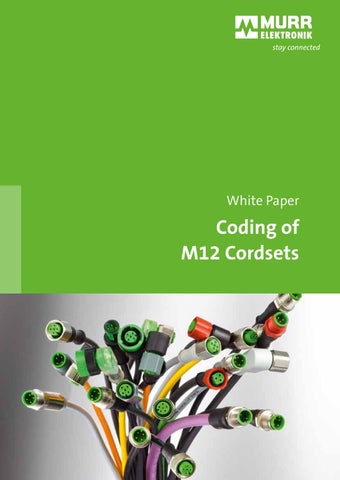
White Paper
Coding of M12 Cordsets
Unlimited compatibility through standardization Standardization simplifies things for us. An excellent example is DIN 66074-2, which regulates shoe sizes. When you go to buy a pair of shoes, you can be fairly confident when looking for the style and fashion you prefer in your designated size section and be sure of a good fit irrespective of the brand or model. This form of standardization generates added value for both customer and manufacturer alike, simplifying processes to create a classic win-win situation. So it goes without saying that great importance is attached to standardization in the automation industry. A glance at the M12 cordsets quickly reveals that standardization is one of the main reasons for their success and popularity. Thanks to uniform specifications in the regulations, customers don't need to worry about whether one manufacturer's cordset matches the next. Irrespective of who produces them, standard cordsets are compatible with one another, thus avoiding dependency on individual suppliers and potential bottlenecks.
In the wake of the boom in the automation sector, the demand for M12 cordsets has risen steeply; exponentially more sensors and actuators are built into machinery and plants compared to a few years ago with M12 emerging as preferred connection concept on the part of manufacturers. Cordset makers have responded to this decision by supplying customers with a wide range of products in terms of design, cable quality and color options. Users can thus put together comprehensive installation concepts from the control cabinet to the sensor in rugged industrial environments. Pre-wired, molded and pre-tested cables are most popular. They enable plug & play solutions and eliminate both time-consuming and incorrect wiring. At the same time, the M12 cordset has advanced greatly, and is used in a growing number of new applications and sectors. It is no longer solely employed to connect sensors, but is now also used for power and high speed data transmission. At the same time, all versions share a common feature: the M12's suitability for rugged industrial environments. Various coding forms are specified in the M12 cordset standards. Cordset coding is required to ensure accurate pin contact alignment of the male M12 cordset with the contacts of the female M12 cordset. Standards also cover the implementations and applications of the individual cordsets. After all, it would be nothing short of fatal if a signal connection suddenly supplied 630 V AC/DC and 12 A. Aside from the different codings, the standards also specify the exact dimensions of the cordsets (including the permissible tolerances) and specifications regarding the environmental influences and mechanical stresses the cordsets have to withstand. These documents also contain cross references to standard testing specifications.
3
The following standards provide a small insight into the main players in the M12 world:
DIN EN 61076-2-101
DIN EN 61076-2-101 is the longest established M12 cordset standard; it covers A, B, C and D-coded M12 cordsets. A-coding is traditionally used in the signal transmission sector. In this case, 3-17-pin M12 versions are available. By leaving out contacts a partial assignment of the 5-pin versions can be achieved without changing the pin layout. The 3-pin version therefore also fits a 5-pin version and is thus port-compatible. The power range covers the rated voltage: up to 4-pin partial assignment: 250 V AC/DC and 5-pin 60 V AC/DC with max. 4 A per contact. A-coded versions with more pins are no longer compatible and can only be used with identical counterparts. These include:
4
DIN EN 61076-2-101 A-coding
Copyright reserved 34-E) / Product conform according ME-substance guideline / The packaging be labeled. http://www.murrelektronik.com/en/service/information/lohs.pdf Copyright reserved (DIN(DIN 34-E) / Product conform according ME-substance guideline / The packaging unitunit mustmust be labeled. http://www.murrelektronik.com/en/service/information/lohs.pdf
M12 3-5-pin: rated voltage 250 V AC/ DC (3-/4-pin), 60 V AC/DC (5-pin) and max. 4 A per contact
M12 8-pin: rated voltage 30 V AC/DC and max. 2 A per contact
M12 12-pin: rated voltage 30 V AC/DC and max. 1.5 A per contact
M12 17-pin: rated voltage 30 V AC/DC and max. 1.5 A per contact
B-coding – was designed for the fieldbus sector for wiring PROFIBUS systems. In this case, the application focuses on data transmission. In contrast to other M12 versions, getting your connections wrong is impossible thanks to the B-coding of the electrical cordset. M12 B-coding: rated voltage 60 V AC/DC and max. 4 A per contact
Copyright reserved (DIN 34-E) / Product conform according ME-substance guideline / The packaging unit must be labeled. http://www.murrelektronik.com/en/service/information/lohs.pdf
D-coding – is the standard for cordsets in the industrial Ethernet sector. The application covers 100 MBit/s data transmission in rugged industrial environments. Getting your connections wrong is impossible here, too, as the D-coding of the electrical cordset does not work with other M12 codings. M12 D-coding: rated voltage 60 V AC/DC and max. 4 A per contact CAT5e to ISO/IEC 11801 (transmission characteristics of Class D up to 100 MBit/s)
5
L-coding
Copyright reserved (DIN 34-E) / Product conform according ME-substance guideline / The packaging unit must be labeled. http://www.murrelektronik.com/en/service/information/lohs.pdf
T-coding Copyright reserved (DIN 34-E) / Product conform according ME-substance guideline / The packaging unit must be labeled. http://www.murrelektronik.com/en/service/information/lohs.pdf
S-coding
Copyright reserved (DIN 34-E) / Product conform according ME-substance guideline / The packaging unit must be labeled. http://www.murrelektronik.com/en/service/information/lohs.pdf
substance guideline / The packaging unit must be labeled. http://www.murrelektronik.com/en/service/information/lohs.pdf
Copyright reserved (DIN 34-E) / Product conform according ME-substance guideline / The packaging unit must be labeled. http://www.murrelektronik.com/en/service/information/lohs.pdf
IEC 61076-2-111
IEC 61076-2-111 defines the standards for M12 power cordsets, which discusses voltages of up to 630 V AC/DC and currents up to 16 A. These cordsets can be classed as small, but powerful. The main coding types in this category include:
M12 4-pin: rated voltage 630 V AC/DC and max. 12 A per contact
M12 4-pin: rated voltage 63 V AC/DC and max. 12 A per contact
K-coding
M12 5-pin: rated voltage 630 V AC/DC and max. 12 A per contact
M12 5-pin (with/without functional earth): rated voltage 63 V AC/DC and max. 16 A per contact
6
DIN EN 61076-2-109
X-coding
Copyright reserved (DIN 34-E) / Product conform according ME-substance guideline / The packaging unit must be labeled. http://www.murrelektronik.com/en/service/information/lohs.pdf
X-coding and its requirements are described in DIN EN 61076-2-109. Data rates of 10 GBit/s can be achieved in a heavy duty industrial M12 connector by galvanically isolating the wire pairs with metal coding in the shape of an X. In view of steadily increasing data volumes, X-coding has a bright future, for connecting high definition camera systems, for example.
M12 8-pin: rated voltage 50 V AC/60 V DC and max. 0.5 A per contact CAT6A to ISO/IEC 11801 (Class EA transmission characteristics up to 10 GBit/s)
7
DIN EN 61076-2-113
DIN EN 61076-2-113 specifies the dimensions, characteristic values, requirements and tests for M12 cordsets, which are usually used for data and power applications in industrial environments. Metal coding in the shape of a Y effectively separates data communication from power transmission.
Y-coding
Copyright reserved (DIN 34-E) / Product conform according ME-substance guideline / The packaging unit must be labeled. http://www.murrelektronik.com/en/service/information/lohs.pdf
M12 8-pin: rated voltage 50 V AC/DC and max 0.5 A per contact (signal)/6 A (power) CAT5e to ISO/IEC 11801 (transmission characteristics of Class D up to 100 MBit/s)
8
Conclusion To sum up, the popularity of M12 cordsets has risen greatly thanks to standardization, consistent development and adaptation to market requirements. The demand for small compact cordsets is set to grow in step with increasing plant automation paired with component miniaturization. The M12 is the ideal solution here since it already ensures the power, data and signal of many machines and systems.
9
White Paper by Mail
Sebastian. Richter@murrelektronik.de Web
Senior Product Manager Head of Product Management BUC Phone: +49 (0)37296 503 328 Mobile: +49 (0)162 44 50 183
About the author Sebastian Richter joined Murrelektronik in August 2008 as Product Manager at the Competence Center for Cordsets in Stollberg (Saxony). He draws on more than eleven years of experience in automation engineering in the area of industrial signal, data and power cabling.
Along with his Product Management team in the Cordsets business unit, his job is to help customers and partners select the right cordset installation concepts for their needs.
About Murrelektronik Murrelektronik is an international, family-run company in the automation technology sector with more than 2,700 employees. The vision and mission of Murrelektronik is to optimize machinery and plant installations and thus generate a competitive edge for its customers. Decentralization is the company's speciality: the control layer of machinery
and plant is optimally connected to the sensoractuator layer with proven concepts and innovative technologies. Close customer cooperation is vital to develop customized solutions for optimum machine installation. High product availability rounds off the Murrelektronik portfolio and the customer experience.
10