LoadIQ - A simple addition to your grinding circuit, a big impact on your operation.
KEY BENEFITS ■
■
The theory is simple; to maximize the efficiency of a grinding mill you need the optimal load. But, in practice, the challenge has been to calculate the optimal mill load with precision. Not anymore. With LoadIQ you can typically increase throughput by 3 – 6%, with some even greater than a 10+% increase in tonnage.
LoadIQ Smart Sensor technology accurately measures volumetric filling and ore trajectory -- in real-time Combines with data about the ore type and liner profile to determine the optimum mill load
For more information: Tel: +1 801 871 7000 昀smidth.com
®
GrizzlyDrive Drum Motor Safe, Reliable, Efficient. Designed for reliability and longevity, the GrizzlyDrive® drum motor with VDG patented IronGrip™ lagging system is the drive solution for belt conveyors operating in extreme and abrasive environments, where performance and durability matter most. The robust GrizzlyDrive® encloses all drive components including the motor and gear reducer inside the drum and is designed for 80,000 hours of operation before maintenance, increasing safety, and reducing maintenance and operating costs.
IronGrip™ Lagging System EXTEND Lifespan of the Conveyor System INCREASE Belt Traction by 40% IMPROVE Belt Tracking
Available up to 500 hp and 42” diameter. Learn more at: vandergraaf.com/CIM
Visit us at Booth #5115
Opportunities Available:
• Sales Personnel • Sales Representatives • Resellers
Apply at: vandergraaf.com/jobs (888) 326-1476
AUGUST/SEPTEMBER 2021 | AOÛT/SEPTEMBRE 2021
39
feature
39 MINExpo 2021 preview The COVID-19-delayed trade show is finally happening, and the industry seems more than ready for it By Carolyn Gruske, with tools of the trade product previews by Matthew Parizot and Samuel Haughton
48
project profile
48 El Valle’s ongoing evolution Orvana Minerals overhauled the El Valle operation in northern Spain over the past five years, but with electrification and possible new discoveries on the horizon, the transformation has only just begun By Kylie Williams
technology
51 Improved intelligence The use of artificial intelligence in the mining industry is still finding its footing, but new technologies could see it impact every part of an operation
46 the current Tools of the trade at MINExpo Manufacturing giants Hitachi, Caterpillar and Sandvik unveil battery electric equipment at MINExpo By Samuel Haughton
4 | CIM Magazine | Vol. 16, No. 5
By Matthew Parizot
UPLIFT YOUR ORE GRADE
Visit us
at
MINExp Sep 13-1 o 5
Booth 2621 (No rth Hall )
With demand for raw materials increasing and ore grades declining, it’s more important than ever to optimise process plant efficiency. Our proven mobile sizing and ore diverting solutions, alongside new ore sensor technologies, can make this happen – separating ore from waste in the pit whilst uplifting ore grades through fines recovery. Introducing an automated ore sorting solution into your existing system ensures only the pay material is hauled to the process plant – meaning your mine can improve production whilst reducing energy usage and water consumption. Whether you have an underground or open pit operation, our network of technical experts can help develop a tailor-made in-pit sorting solution to boost productivity and deliver a leaner, greener mine.
Tel: +1 (780) 451 5100 email: information@mmdcanada.ca
Download the bulk ore sorting brochure at:
WWW.MMDSIZERS.COM/BOS
In-pit analysis and separation of ore and waste
AUGUST/SEPTEMBER 2021 | AOÛT/SEPTEMBRE 2021
in each issue 8 Editor’s letter 10 President’s notes developments 12 Solving the oracle problem By Samuel Haughton
16 Glencore to acquire full stake in Cerrejón mine By Samuel Haughton
18 Rio Tinto opens new Quebec scandium plant
18
By Samuel Haughton
column 22 Proactive corrosion management programs support asset integrity and mine sustainability By Zoe Coull
oil sands innovation 24 Research and development is a way of life at Syncrude, and has been throughout the company’s history By Sarah Treleaven
28 H2nanO is working on a way to remove naphthenic acids from oil sands tailings ponds By Alexandra Lopez-Pacheco
24 CIM news 54 CIM’s Strategic Plan: Creating sustainable prosperity together
56 The Professor Andy Mular mineral processing and metallurgy 30 Tarachi is just one of the many mining and metal processing companies that is finding profit in tailings By Kylie Williams
32 Thanks to a staggered froth management upgrade, Hudbay got to compare traditional radial launders with centre launders on identical processing lines
Memorial Fund will support students at the UBC’s Norman B. Keevil Institute of Mining Engineering
mining lore 66 Monarchs and mines By Samuel Haughton
32 contenu francophone 57 Table des matières 57 Lettre de l’éditeur 59 Mot du président profil de projet 60 L’évolution d’El Valle Ces cinq dernières années, Orvana Minerals a remis en état sa mine d’El Valle dans le nord de l’Espagne. Avec l’électrification et les nouvelles découvertes qui se profilent à l’horizon, la transformation ne fait que commencer Par Kylie Williams
By Alexandra Lopez-Pacheco
36 Rebecca Payant explains how St Barbara Limited’s Atlantic Operations saved $3 million a year by fine-tuning its cyanide use By Herb Mathisen
6 | CIM Magazine | Vol. 16, No. 5
l’actualité de l’ICM 63 Le plan stratégique de l’ICM : Créer ensemble une prospérité durable
More horsepower and improved undercarriage adds up to faster cycle times and more productivity The D375A-8 features an EPA Tier 4 Final certified engine that produces over 20% more horsepower while the dozer is traveling in the reverse direction. The additional horsepower yields faster cycle times and a productivity increase of up to 18%. This mining-class dozer also comes with structural enhancements for increased durability of the mainframe and track frame. The D375A-8 also features an improved suspended undercarriage, larger viscous cab mounts, and a new air-suspension heated and ventilated seat for overall operator comfort. Contact one of our mining experts today 1 866 458 0101
editor’s letter
Victory lap
S
pring is a frenzied time at CIM National. A firehose of deadlines has the entire staff going at full speed. Nevertheless, the editors carve out some time to review the previous year’s issues and pick out what we think is some of our best work to submit for magazine and publishing association awards. We make our pitches for the prizes, send them off and quickly forget about it. It is a nice surprise when, having lost track of those awards submissions, the notifications arrive in the summer that we have earned some recognition. This year, between Canada’s National Magazine Awards and the Trade, Association and Business Publications International Awards, five articles and a very handsome cover illustration of ours were named among the honourees. That both awards juries selected our February 2020 feature story “Has sustainability reporting become unsustainable?” was satisfying. However, hearing Jody Kuzenko, Torex Gold’s CEO, voice her frustration during a question period following the CIMVTL21 plenary about the inefficiency of reporting environmental, social and governance performance to a growing number of sustainability rating agencies, each with their own questionnaires, had me pumping my fist. The sentiment echoed what Omar Jabara, Newmont’s corporate communications executive, had told reporter Kelsey Rolfe for our story: “You could literally spend all your time just responding to questionnaires.” And it confirmed that this was a key issue for miners. Without a change in course, the performance of ESG reporting could require as many resources as the practices they are meant to detail. Since that story ran, progress has been made towards a more unified reporting structure. Last fall the World Economic Forum, in collaboration with members of the International Business Council, produced the Stakeholder Capitalism Metrics, which build on existing standards to speed the process of harmonizing ESG reporting and make them more consistent. A growing number of international firms have expressed their commitment to
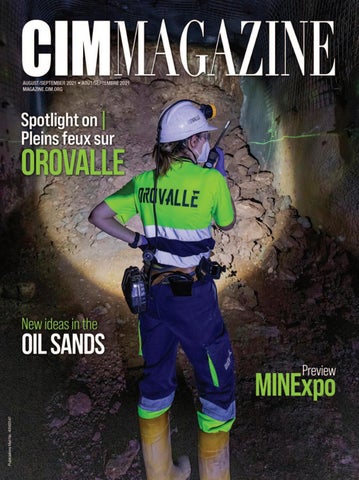
This issue’s cover Underground at OroValle’s El Valle operation – a subsidiary of Orvana Minerals
Ryan Bergen, Editor-in-chief editor@cim.org @Ryan_CIM_Mag
Editor-in-chief Ryan Bergen, rbergen@cim.org Managing editor Michele Beacom, mbeacom@cim.org Section editors Carolyn Gruske, cgruske@cim.org; Matthew Parizot, mparizot@cim.org Editorial intern Samuel Haughton, shaughton@cim.org Contributors Doug Bartlett, Zoe Coull, Alexandra Lopez-Pacheco, Herb Mathisen, Mike Mular, Sarah Treleaven, Kylie Williams, Angelica Zagorski Editorial advisory board Mohammad Babaei Khorzhoughi, Vic Pakalnis, Steve Rusk, Nathan Stubina Translations Karen Rolland Layout and design Clò Communications Inc., www.clocommunications.com
Advertising sales Dovetail Communications Inc. Tel.: 905.886.6640; Fax: 905.886.6615; www.dvtail.com Senior Account Executives Edyta (Edith) Dhillon, edhillon@dvtail.com, 905.707.3525 Leesa Nacht, lnacht@dvtail.com, 905.707.3521 Christopher Forbes, cforbes@dvtail.com, 905.707.3516 Subscriptions Online version included in CIM Membership ($197/yr). Print version for institutions or agencies – Canada: $275/yr (AB, BC, MB, NT, NU, SK, YT add 5% GST; ON add 13% HST; QC add 5% GST + 9.975% PST; NB, NL, NS, PE add 15% HST). Print version for institutions or agencies – USA/International: US$325/yr. Online access to single copy: $50. Copyright©2021. All rights reserved.
Published 8 times a year by: Canadian Institute of Mining, Metallurgy and Petroleum 1040 – 3500 de Maisonneuve Blvd. West Westmount, QC H3Z 3C1 Tel.: 514.939.2710; Fax: 514.939.2714 www.cim.org; magazine@cim.org
Courtesy of Orvana Minerals National Magazine Awards: B2B Prix du magazine canadien: B2B
2020
using the metrics, including a few companies with mining interests, such as Sumitomo and African Rainbow Minerals. It was also gratifying to learn that features editor Carolyn Gruske’s October 2020 profile “Renaissance in Red Lake,” about Pure Gold Mining’s project was honoured as well. She detailed nicely how a development team with experience in the district and a thorough investigation into the geology brought new life to the historic mining camp. The company has continued its work, ramping up production and pursuing further development plans. And since last fall, Evolution Mining, a relative newcomer to the district, has expanded its holdings in the region, purchasing the Bateman project to add to the Red Lake Operations it acquired from Newmont in 2019. Together these developments expand the scope of that feature headline and promise a new era of growth for the district. Chasing magazine awards is not really core to CIM’s mission, but the process of submitting material to awards panels is a valuable opportunity to look back at our work with a critical eye and consider what worked well and why. Putting the magazine together is a team effort, where the questions, suggestions and comments of each editor make the final product better. So, before we move on to the next series of assignments and deadlines, congratulations and thanks are due to Matthew Parizot, Carolyn Gruske and Michele Beacom for their outstanding work.
2021
8 | CIM Magazine | Vol. 16, No. 5
ISSN 1718-4177. Publications Mail No. 09786. Postage paid at CPA Saint-Laurent, QC. Dépôt légal: Bibliothèque nationale du Québec. The Institute, as a body, is not responsible for statements made or opinions advanced either in articles or in any discussion appearing in its publications.
Printed in Canada
?
Reduce CO2 by tens of thousands of tons? The answer is Enduron®
ENDURON® HPGR
We all know HPGR technology exists. Why have we not moved to a more sustainable approach? The Enduron® HPGR uses up to 40% less energy without grinding media, compared to traditional solutions. Combined this could reduce your CO2 by tens of thousands of tons annually. Plus, with our exclusive skewing and bearing system, you’ll increase your mine’s performance, reliability and efficiency. The real question isn’t why should you make the switch, it’s why not? Make the switch to Enduron® HPGR. Visit enduronhpgr.weir to find out more.
Copyright © 2021 Weir Minerals Australia Ltd. All rights reserved.
Visit us at MINExpo 2021, booth 4239
Courtesy of DRA Global
president’s notes
Collaboration… what’s all the fuss about?
E
veryone’s talking about it. Our companies want more of it. Industry says we need it. Everyone says they do it! Their counterparties say they don’t do it. We have all these cool tools: video conferencing, messaging, cell phones, shared files, etc. Our industry is flush with organizations that facilitate collaboration. Yet we struggle to advance innovation, we struggle to deliver projects on time and on budget, we struggle to engage society and change the views that society has of mining. The reality is that collaboration, and especially meaningful collaboration, is HARD. Unfortunately, to get to the optimum solution to any problem – from the acceleration of innovation, to the development of guidelines and standards, to the efficient delivery of services and products, to the challenge of ensuring the health, well-being and safety of our workforce – we need collaboration.
10 | CIM Magazine | Vol. 16, No. 5
I recently participated in the Mining Maverick’s round table discussion on collaboration between mining industry service providers and mining companies. The discussion revolved around the benefits of collaboration and the challenges of doing something that at a high level seems simple and obvious. During those discussions, one of the participants introduced Himmelman’s Collaboration Continuum. I personally had not seen this before. The continuum defines four different core levels, or stages, of collaboration. The first stage is networking, where we share information for mutual benefit. This requires little investment of time or resources, a low level of trust, and involves no sharing of turf, risks or rewards. The fourth, most advanced stage is real collaboration, which requires formalized organizational commitment, substantial time commitment, a very high level of trust, extensive sharing of turf, written agreements and sharing of risks, responsibilities, resources and rewards. For the first time, it struck me why collaboration might be so difficult. Many of us have a different interpretation of what collaboration looks like and most of us are likely see it closer to the first stage. However, our expectations are that we should be getting the results that come from the fourth stage of the collaboration continuum. There’s a disconnect between what needs to go into collaboration efforts and the expected outcomes. As individuals, as companies and as an industry, we will need to better understand what collaboration actually is, invest the time and resources, give up some turf and share the rewards of collaboration. Not doing so will ensure the status quo and the status quo is not acceptable. As we head back to an open world of conferences and the inevitable discussions on collaboration, we should keep in mind what our expectations are, and how big of a commitment we are willing to make to get the outcomes we are looking for.
Pierre Julien CIM President P.S. I would like to thank Dr. Deborah Mashek of myco.consulting for her insights into the science of collaboration and Jason Fearnow for facilitating excellent global round table discussions.
Developments Solving the oracle problem Blockchain technology promises to revolutionize the supply chain, but it is not without its issues
Blockchain technology has emerged as one of the most prominent tools for securely recording information of the 21st century. Blockchain technology allows any participant in the shared network to review and have access to the digital ledger, allowing companies to save time that was formerly spent synthesizing individual ledgers and reconciling their transactions. While the mining industry is taking steps to introduce the use of blockchain technology in its operations, questions remain as to its effectiveness and accuracy as a ledger. Companies are often concerned about communicating and gathering information about the ethicality of each step in the mining supply chain, and miners are starting to incorporate blockchain tech to do so in a number of key areas. Minespider, a blockchain company that caters directly to the mining sector, advertises a number of key areas in which companies can “showcase [their] responsibility efforts to downstream clients.” This can be done by communicating such information as the materials’ provenance, the company’s sustainability efforts, and carbon emissions data to clients and investors, providing a secure and reliable way to ensure that correct information has been relayed along the blockchain. Notably, Glencore announced in May that it would be teaming up with CMOC, Eurasian Resources Group and battery material supplier Umicore on ReSource, a project that aims to use blockchain tech to trace cobalt used in batteries for electric vehicles, and assure its responsible production at every step of the process. More recently, Trovio, a digital commodities registry service provider, and Blockhead Technologies, a company that aims to provide intelligent supply chain solu12 | CIM Magazine | Vol. 16, No. 5
Courtesy of ReSource
By Samuel Haughton
Glencore has introduced its ReSource blockchain project, which aims to ensure responsible sourcing of cobalt throughout the supply chain. tions, also announced that they would be partnering to develop a tracing system for other such minerals, tracking the provenance of physical assets for their entire life cycle. In this case, Blockhead will contribute its blockchain-based supply chain management system, STAMP, in order to determine the carbon footprint and provide a public record of the assets’ ESG score, detailing where it was sourced, and whether the labour that went into extracting it was ethical. The idea of applying automated blockchain systems to a complex, multifaceted area like mining supply chains has some significant upsides. Manish Chawla, general manager of global chemicals, petroleum & industrial products industries at IBM said that, “In the mining industry, understanding the origin of a material, the effort required to extract the material, and the waste generated in the process is becoming a key criterion for companies to retain licences to operate. Blockchain enables companies to record and prove that a mineral is ethically or sustainably produced at a specific mining site – without creating any competitive advantage or unnecessary disclosures.”
Additionally, he argued that use of the blockchain can have long-term beneficial effects on the industry, providing a way for companies to more confidently locate new resources: “If we fast forward to the future, we can see how blockchain technologies can accelerate confidence in knowing where both new (greenfield) resources exist, as well as recover more resources from existing (brownfield) mines. This has a dual benefit: it improves efficiency and value in operations, as well as aiding in reducing the greenhouse gas emissions associated with exploration and production.” On the other hand, as with any security system, there is the key question of how one can communicate information from outside of the system to inside of it, or in blockchain jargon – from “off the chain” to “on the chain.” David Uzsoki, a sustainable finance lead at the International Institute for Sustainable Development, describes the problem in his article, “How Can Blockchain Improve Sustainability in Mining,” as the inherent one of ensuring that the data uploaded to the blockchain ledger in the first place is correct and reflects the truth.
developments This is the so-called “oracle problem,” named after the beings from classical Greek myth that would supposedly convey truth and wisdom to the listener. Users of the blockchain need to ensure that the information being transferred from the real world to the blockchain ledger is accurate. In normal security systems, for example, this means making sure that a state’s intelligence bureau is not populated with double agents, providing false information to an otherwise efficient and effective chain of intelligence. In the case of blockchains, Uszoki says, an oracle can be one of the “trusted organizations that verify the validity of the information before it goes onto the blockchain.” For example, with regard to a similar effort by Ford Motor Company to trace cobalt provenance using blockchain technology, Uszoki suggested that RCS Global, a company specializing in data-driven sourcing for metals supply chains, could take on this role of oracle – heading off any potential for false inputs to the ledger. Chawla also pointed to the possibility that some solutions to this problem could be generated through working with the
blockchain itself, as well as third-party organizations and strict assessment of who has access to the blockchain: “It is true that blockchain networks record whatever data is submitted to it, so assurance that the original information submitted is accurate is critical. (Once submitted, the technology can highlight where inconsistencies occur, such as data that is altered or a user displays inconsistent behaviour.) One way to assure the accuracy of all information on the blockchain is third-party assurance and strict guidance for which organizations can participate in the network.” While this is perhaps a viable solution, it is open to the criticism that this again puts the question of ethical sourcing back in the hands of central authorities. Humans are not, after all, divine oracles, and they can make errors or input false information – undermining what is otherwise an efficient process for tracing how our raw materials get to us. Blockchain technology will support, rather than replace, the industry’s current environmental, social and governance reporting requirements. As Ivan Glasenberg, CEO of
Glencore, said with regard to the company’s cobalt tracing project: “Traceability is not enough on its own, it must be part of a wider industry effort to bring improvements to the entire cobalt supply chain. This starts with responsible sourcing compliance.” CIM
FROM THE WIRE Compiled by Matthew Parizot Ben Wyatt will be joining Rio Tinto’s
board as a non-executive director. Wyatt is currently acting as treasurer and Aboriginal affairs minister for the Western Australian government and has been an elected member of parliament in Victoria Park since 2006. Geoscience BC has appointed Diana Sollner as the chair of the Minerals Technical Advisory Committee. She first joined the committee in 2017 and works as an independent advisor to the mining industry, helping to develop strategies for multiple facets of mining operations.
The KCA Carbon Converter Recover Gold From Your Carbon Fines On Site
Kappes, Cassiday & Associates (KCA) now has three carbon converters successfully operating, at mines in Armenia, Argentina and Nevada. These units take carbon fines and dirty, wet waste carbon at gold leach plants, thoroughly ash it and remove all mercury. Recovery of gold and silver into bullion is typically 99%. For waste carbon loaded to 200 grams gold per tonne, operating cost is $6.00 per gram, or 11% of the value of the recovered gold. Often waste carbons are loaded much higher - the cost per gram drops accordingly. Mines with the Carbon Converter can recover their gold quickly without the Chain-of-Custody problems of shipping carbon to outside processors. Shipping mercury-contaminated wastes off site incurs large risks of environmental contamination, and the Carbon Converter eliminates this risk. Having the Carbon Converter on site allows the operation to explore various process optimization techniques. For example, carbon fines below 30 mesh are usually lost to tailings in CIL plants, because such fines cannot be recovered cleanly. These losses can account for 1% of the gold fed to the plant. The Carbon Converter can process them. Another opportunity exists where process facilities periodically discard a portion of their coarse carbon in order to maintain optimum carbon activity. With the Carbon Converter, this carbon can be consumed on site and the contained gold recovered economically. The installed cost of the Carbon Converter is about US$1 million including site services, a building, and infrastructure. For mines which generate at least 50 tonnes/year of carbon wastes and fines, payback is typically less than one year.
775-972-7575 www.carbonconverter.com or www.kcareno.com August/September 2021 • Août/Septembre 2021 | 13
Courtesy of the European Commission
Sherritt International has appointed Leon Binedell to its board of directors. Binedell is a 25-year veteran of the industry, previously serving as chief financial officer for Guyana Goldfields, helping guide the company through its sale to Zijin Mining in 2020. With Binedell’s addition to the board, former Sherritt president and CEO David Pathe has stepped down from the board. Alcoa has announced that Louis Langlois will be the new president of Alcoa Canada, and will subsequently represent the company on the board of the Aluminum Association of Canada. Langlois joined Alcoa in 2012 and since 2017 has served as the director for global strategic planning. He will be replacing Nicole Coutu, who will be retiring after 31 years with the company. The Mining Association of Canada (MAC) has appointed David Clarry as its new chair for the next two-year term. Clarry currently holds the position of vice-president of corporate social responsibility for Hudbay Minerals, and has previously participated in several MAC committees in the past. Rio Tinto has appointed Peter Cunningham as its new chief financial officer. Since January 2021, he has served as interim CFO, and will now be joining the company’s board as an executive director. Cunningham has been with Rio Tinto for 28 years and has held roles in the company such as global head of health, safety, environment and communities as well as head of climate strategy. Western Copper and Gold founder Dale Corman has retired as executive
chairman of the company’s board of directors. The company has appointed Ken Williamson as interim chairman as it searches for a permanent replacement for Corman. The Canada Mining Innovation Council (CMIC) announced the election of Mark Thorpe, CEO of EnviroGold Global, as its new chair of the board. Managing director at Hatch Alim Somani, director of the Troost Institute for Leadership Education in Engineering Emily Moore, Iamgold senior vicepresident of operations and projects Bruno Lemelin and Sudbury Integrated Nickel Operations vice-president Peter Xavier were also elected as members of the board.
14 | CIM Magazine | Vol. 16, No. 5
Ursula von der Leyen, head of the European Commission, first unveiled the Canada-EU partnership at a summit in June.
Canada and European Union outline critical minerals partnership Canada’s Minister of Natural Resources, Seamus O’Regan, and the European Commissioner for Internal Market, Thierry Breton, released a joint statement on July 19 on the Canada-EU Strategic Partnership on Raw Materials. The statement is a follow-up on the framework for the partnership, which was released on June 15. At that time, Ursula von der Leyen, head of the European Commission, said that the agreement was intended to encourage market diversification from China’s raw materials supply chain. “We as Europeans want to diversify our imports away from producers like China because we want more sustainability, less environmental damage and we want transparency on raw materials.” Prime Minster Trudeau underscored the potential climate and employment benefits of the partnership, saying that, “in order to continue creating good, green jobs for the middle class, we must secure supply chains for critical minerals and metals that are essential for things like electric car batteries,” indicating the centrality of materials crucial to the development of green tech to the partnership. The partnership is designed with the intention of solidifying supply chains for raw materials between Canada and the
EU, with the stated goals of creating jobs and combatting climate change. In the joint statement, the two parties announced some of the key initial deliverables for the project: securing European and Canadian financial support for critical mineral projects in both Canada and the EU; setting up prize-based innovation challenges; and advancing best practices on mapping and classifying critical minerals. A joint event is also planned on “Tracing Net-Zero Battery Minerals” in order to support research and innovation. The joint statement also re-emphasized some of its goals. “Through this strategic partnership, we are joining forces to tackle strategic dependencies, build critical minerals and metals value chains, boost our competitiveness in global markets and develop the clean technologies needed [to accomplish those goals].” – Samuel Haughton
Anaconda releases preliminary economic assessment for Goldboro project On June 23, Anaconda Mining released the results of the preliminary economic assessment (PEA) for its Goldboro gold project in Nova Scotia, which, according to the company, demonstrates “the potential for strong economics from both open-pit and underground mine
Courtesy of Anaconda Mining
developments
Anaconda is aiming to process 4,000 tonnes of ore per day once Goldboro is in production. operations over an estimated 17.6-year life of mine (LoM).” The mineral resource estimate found total measured and indicated resources of 1,946,100 troy ounces of gold, grading 3.78 grams per tonne, from 7,521,000 tonnes of ore. Based on this, and a gold
price of $2,000 per ounce, the PEA estimates an after-tax net present value of $547 million at a five per cent discount rate, with an internal rate of return of 24.4 per cent and an after-tax payback of 3.2 years. The total initial capital investment at Goldboro is estimated at $286
million, with total LoM sustaining capital costs of $269.2 million. The project is expected to process 4,000 tonnes per day with operating costs estimated at $68.92 per tonne milled and an average all-in sustaining cost per ounce sold of $1,031. Kevin Bullock, president and CEO of Anaconda, suggested that there may be room for future expansion of the mine: “Importantly, the Goldboro deposit is open in all directions and the company is initiating exploration to the west of the deposit, towards the past-producing Dolliver Mountain gold mine. We believe Goldboro has potential to be a multi-generational gold mine, which can create significant value for our shareholders and project stakeholders, including the community of Guysborough and the Mi’kmaq of Nova Scotia.” The company stated that the next step will be to “execute the mine plan outlined in the PEA in phases,” starting with a feasibility study on the first 10 years of surface mining at Goldboro, anticipated for Q4 of 2021. Following that, it will file an environmental assessment registration document. – Samuel Haughton
Continuous investment to support Canadian Mines Reinforcing Rock and Ground We are a permanent presence in your local market, giving you uninterrupted access to our expertise. We are committed to safety, and we can mobilise our resources quickly to provide dependable support in emergencies. Everything combined helps minimise downtime and drive continuous productivity into your operations to grow your business successfully. We are where you need us. We reinforce progress.
210212_CIM Ad.indd 4
dsiunderground.ca
23.07.2021 12:41:10
August/September 2021 • Août/Septembre 2021 | 15
Glencore to acquire full stake in Cerrejón mine Company emphasizes environmental positives of becoming sole owner of the Colombian thermal coal mine
Canadian government invests $40 million into CEMI’s mining innovation project On July 13, the Honourable FrançoisPhilippe Champagne, minister of innovation, science and industry, announced a $40 million investment into the $112.4 million sustainable mining project from the Centre for Excellence in Mining Innovation (CEMI). The project will bring together stakeholders from a wide range of fields to innovative technologies and make the mining sector more productive and sustainable. The investment will do this by supporting the creation of the Mining Innovation Commercialization Accelerator (MICA). 16 | CIM Magazine | Vol. 16, No. 5
“Today’s announcement will help bridge the innovation-to-commercialization gap for the benefit of both Canadian mining companies and innovators by providing them with the tools, knowledge and expertise they need to meet the future demands for Canada’s critical minerals,” Champagne said. MICA intends to bring mining companies, mining suppliers, academic and research institutions, innovators together to collaborate and create technical and business synergies. The headquarters will be in Sudbury, Ontario, but it will operate across Canada through the following main partners: the Bradshaw Research Initiative for Minerals and Mining, InnoTech Alberta, Saskatchewan Polytechnic, MaRS, Le Groupe MISA and the College of the North Atlantic.
will see the mine through the expiration of the company’s mining concessions by 2034. Consequently, Glencore sees the buyout as the right decision with regard to its climate targets, and the net-zero goals of the Paris Agreement. Glencore CEO Ivan Glasenberg said, “Glencore has been involved with Cerrejón for more than 20 years. We know the asset well and believe that we are the most responsible steward for Cerrejón at this stage of its life cycle. [...] We are confident we can manage the decline of our fossilfuel portfolio in a responsible manner that is also consistent with meeting the goals of the Paris Agreement, as demonstrated by our strengthened total emission reduction targets.” The company also announced that it had reviewed its fossil-fuel production profile and released a new short-term emissions reduction target of 15 per cent by 2026, and a medium-term target of 50 per cent (up from 40) by 2035. CIM
Courtesy of CEMI
Glencore announced on June 28 that it has reached an agreement with its joint venture (JV) partners BHP and Anglo American to buy both of their 33.3 per cent shares in the Cerrejón thermal coal mine in La Guajira, Colombia, becoming sole owner of the mine. The company said it expects to pay US$230 million for the combined two-thirds of the asset. The move comes as many companies and governments have started to shift away from thermal coal in order to better align themselves with climate According to Glencore, allowing a new joint-venture partner would targets. Glencore gave several compromise the operating philosophy at Cerrejón. reasons for the decision to take sole ownership, founded in what it sees as environmental upsides of extending production beyond the current the buyout. mining concessions.” First, Glencore said the alternatives to Giving up its stake in the company taking full ownership were less would also, according to Glencore, mean favourable from an environmental percompromising its commitment to a spective, since this would mean “one or “managed decline” of its coal portfolio, more new JV partners acquiring these and would not result in “a genuine reducshares, compromising the sustainable tion of absolute greenhouse gas emisoperating philosophy of Cerrejón and sions.” The managed decline, instead,
Courtesy of Cerrejón
By Samuel Haughton
Minister of Innovation, Science and Industry François-Philippe Champagne announces the investment at the Agnico Eagle mine in RouynNoranda.
The main goal of MICA is to strengthen the Canadian mineral supply chain and increase the domestic and export sales of Canadian innovators. The project intends to do this by accelerating the development and commercialization of innovative autonomous and clean technologies in the mining sector, with the goal of increasing the mine life of existing operations and lowering the barriers to bringing new deposits into production. At the investment announcement, Douglas Morrison, president of the Mining Innovation Commercialization Accelerator Network, said, “Supplying the demand for the minerals and metals needed to advance the green transition to a low-carbon economy is critical, but if mines are to produce more and do so faster, cheaper and more sustainably, implementing innovation is essential.”
Courtesy of Western Copper and Gold
developments
Western is currently looking into a possible phase II expansion for Casino, which would extend the life of the planned mine to 47 years.
– Angelica Zagorski
Western Copper and Gold outlines Casino project Western Copper and Gold Corporation released the results of its preliminary economic assessment (PEA) for its Casino copper-gold-molybdenum deposit, located 300 kilometres northwest of Whitehorse, Yukon, on June 22. The financial scenarios of the PEA, according to the release, “indicate that the potential economic returns from the [Casino] project justify its further development and securing the required permits and licences for operation,” the next step in a project which has been in development since 2008. The PEA is based on a previous resource estimate from July 2020, which found total measured and indicated resources of 14.5 million ounces of gold grading at 0.19 grams per tonne, 113.5 million ounces of silver grading at 1.5 grams per tonne and 7.6 billion pounds of copper grading at 0.14 per cent from 2.39 billion tonnes of ore. The study evaluated the project as an open-pit operation that would deliver 120,000 tonnes per day to the processing plant and also include gold heap leach facility designed to process 25,000 tonnes per day. The study estimates an after-tax net present value (NPV) of $2.3 billion with an eight per cent discount based on a US$1,600 per ounce gold price and a copper price of US$3.35 per pound, with a life of mine (LoM) of 25 years, processing 1.3 billion tonnes of mineralized
material. The total initial capital investment at Casino is estimated at $3.25 billion, with LoM capital costs of $3.97 billion, and operating costs calculated at $6.17 per tonne. Western also examined the possibility of extending the operation into a second phase, which would look to process the remaining one billion tonnes of ore from the mine over an additional 25 years, bringing the total LoM to 47 years. Factoring in the second phase, capital expenditures would increase to $5.06 billion over the total LoM, with a slightly increased after-tax NPV of $2.38 billion.
Western president and CEO Paul West-Sells said in the release that he is “extremely pleased with the results from the PEA,” and that “this study reaffirms Casino as one of the very few long-life copper-gold projects with robust economics in a top mining district, the Yukon.” On May 31, Western announced that it had completed a strategic investment from Rio Tinto of approximately $25.6 million, giving the mining giant an eight per cent stake in the company. The company stated the next step will be to define a mineral reserve for the project. – Samuel Haughton
Give tires with large injuries a second life.
Expect more tire life
Send tires with large injuries back into production and see up to thousands of hours of like-new performance with Ultra Repair™. Our proprietary process effectively repairs injuries on the tread, shoulder and sidewall of the tire, restoring its original strength and integrity at a fraction of the cost of new tires. Exhibiting at MINExpo 2021 Sept 13 - 15 Booth #8609 Central Hall
kaltiremining.com
August/September 2021 • Août/Septembre 2021 | 17
Rio Tinto opens new Quebec scandium plant The project, partially funded by the Quebec government, aims to meet 20 per cent of global demand for the critical mineral
Courtesy of Rio Tinto
By Samuel Haughton
The new scandium plant was added to Rio Tinto’s existing metallurgical complex in Sorel-Tracy, Quebec. Rio Tinto Fer et Titan (RTFT) announced the opening of its new scandium oxide plant at its metallurgical complex in Sorel-Tracy, Quebec, at a press conference on June 17. The six million dollar project, of which $650,000 came through the Quebec Plan for the Development of Critical and Strategic Minerals, was “completed on time and on budget, less than six months after the start of construction,” Rio Tinto said in a press release. Production is projected to reach a capacity of three tonnes of scandium oxide per year. The plant uses a process developed by Rio Tinto that extracts scandium oxide out of waste produced from titanium dioxide production, which the company says requires no additional mining. Rio Tinto plans to supply approximately 20 per cent of the global market for scandium, according to Stéphane Leblanc, managing director at RTFT. As a major aluminum supplier, the company 18 | CIM Magazine | Vol. 16, No. 5
also plans to produce aluminum-scandium alloys to meet further market demands. “For the first time, customers will benefit from a North American supply of scandium oxide for applications in solid oxide fuel cells, lasers, lighting products or as an additive to produce high-performance alloys,” said Leblanc. At the press conference, Guy Gaudreault, managing director at RTFT, emphasized the importance of having a North American scandium producer. “[RTFT] is the first producer of scandium in North America. In the past, when people wanted to develop scandium, the problem was with the reliability of the supplier, and we are a reliable supplier,” he said. Currently, most of the global scandium market is supplied by China, Kazakhstan, Philippines, Russia and Ukraine, according to a U.S. government data sheet. Quebec Minister of Energy and Natural Resources Jonatan Julien expressed
his pleasure at the efficiency with which the plant was constructed, especially given the economic challenges presented by the pandemic: “The completion of projects like this strongly encourages us to keep pushing for socio-economic development projects. [...] This project allows us to concretize the vision Quebec has with regard to critical and strategic minerals.” CIM
Federal government announces $420 million investment in Algoma Steel On July 5, the Government of Canada announced that Algoma Steel in Sault Ste. Marie, Ontario, will receive up to $420 million in federal funding in order to support its transition to electric-arc furnaces, and away from the coal-fired
Courtesy of Algoma Steel
developments
The investment is expected to create 500 construction jobs and over 600 co-op placements for students. steelmaking processes. The Office of the Prime Minister reported that switching to the arc-steel process is expected to cut greenhouse gas emissions by more than three million metric tonnes per year by 2030, the equivalent of taking nearly 900,000 passenger vehicles off the road – almost the number of passenger vehicles in Toronto.
The investment is expected to create 500 jobs through the project’s construction phase and subcontracting, and over 600 new co-op placements for students. In addition, 75 Algoma employees will receive skills training in STEM fields. The total cost of the project is estimated at $703 million.
Of the total funding, $220 million will be provided by Canada’s Infrastructure Bank and $200 million by the Strategic Innovation Fund’s “Net Zero Accelerator” initiative, a five-year, $3 billion initiative by the Canadian government “to rapidly expedite decarbonization projects with large emitters, scale-up clean technology and accelerate Canada’s industrial transformation across all sectors.” Prime Minister Justin Trudeau said, “Investments in clean technology benefit the environment and our economy. Today’s announcement is great news for the people of Sault Ste. Marie. It will help Algoma Steel create good middleclass jobs and cut pollution, while positioning Canada as a leader in cleaner and greener steelmaking. The government will continue to support Canadian businesses and workers as we accelerate our transition to a clean-growth economy that leaves no one behind.” On June 29, the federal government announced a similar $20 million investment in Rio Tinto and Alcoa’s ELYSIS joint venture for carbon-free aluminum smelting. – Samuel Haughton
BOXHOLE BACKREAMING MACHINE
RAPID AND SAFE BORING AND LINING The Herrenknecht Boxhole Backreaming Machine (BBR) bores and reams ore passes and ventilation shafts with diameters of up to 3.5 meters. Based on the proven BBM technology, the BBR is characterized by high efficiency and high safety standards. herrenknecht.com/bbr
August/September 2021 • Août/Septembre 2021 | 19
Mining 4.0 Symposium to provide data-usage expertise for miners Sean Dessureault is very passionate about how data is used. It is fitting then, that alongside his day job as vice-president, technology and innovation at The Mosaic Company, Dessureault is co-chairing with Mike Brown, executive vice-president, Technology & Innovation at SMS Equipment, CIM’s upcoming Mining 4.0: The Digital Mine Symposium. The online event will take place over three days starting Nov. 1. Rather than the flashy algorithms behind recent advancements in artificial intelligence in the mining industry (as it stands, AI has become a “marketing euphemism” in the mining industry, says Dessureault), the theme of Mining 4.0 is instead focused on how to use data gathered by mining companies in new and interesting ways. “I think people are recognizing that data has more value, and they’re starting to use it more effectively,” Dessureault said. Each day of the conference will be headed by a live plenary or keynote presentation, followed by technical sessions that speak directly to the theme of Mining 4.0. These sessions include topics ranging from how to transform a mining company for the digital age or how to use and obtain value from corporate and production data. According to Dessureault, the sessions were chosen specifically for how they could best demonstrate the advantages of using data correctly. “Some of the themes we have are very, very specific. Like, what is the infrastruc20 | CIM Magazine | Vol. 16, No. 5
ture that you have to have in place to get people to use the data? One of the sessions is called ‘Data to Action,’ to make sure that the point of this data is not to write some cool algorithm but to act on it in a smart way. So, what you’ll see is that a lot of the session titles are specifically directed around making use of data, or setting up programs to effectively use data,” he said. Using data effectively, Dessureault said, is a multi-step process. It is important to first confirm that the data being
used is correct, followed by the integration of different data sources together in a database in order to turn that data into information. The next step requires a knowledge model that can use information to improve a company’s processes, and finally an action plan to ensure people act on the decisions made, which can include techniques like gamification. Doing this can have some concrete benefits for an operation. Some of the examples Dessureault points to are data from mining vehicles collected wirelessly in a process known as telemetry to provide alerts about operators who are driving in a way that could be harmful to a machine, or account for delays in operations in order to more efficiently direct vehicles to their next locations. “None of this is really rocket science. You don’t need a super algorithm to do this stuff, but you do need to understand each one of those phases,” Dessureault said. “Good data coming in, proper integration to turn it into information, some good knowledge models like short-interval control and an action plan to make sure you act on it.” – Matthew Parizot
RopeCon® Ef昀cient Solutions for Bulk Material Handling Wherever bulk material needs to go – across impassable terrain, rivers, highways and buildings – RopeCon® delivers without a hitch! Long distances, capacities of up to 25,000 tonnes/hour, minimal environmental footprint, quiet operation plus low operating and maintenance costs: These are the features that convinced leading mining businesses. Visit us at our booth at the MINExpo, September 13-15, 2021, in Las Vegas and discover the latest news about our systems. We look forward to welcome you there at booth #7891. doppelmayr-mts.com
Doppelmayr Transport Technology GmbH, Konrad-Doppelmayr-Strasse 1, 6922 Wolfurt / Austria, T +43 5574 604 1800, dtt@doppelmayr.com Doppelmayr Canada Ltd., 800 St. Nicolas Street, St. Jérome, QC J7Y 4C8 / Canada, T +1 450 4321 128, silviu.varzescu@doppelmayr.ca
Courtesy of Zoe Coull
Corrosion control best practices By Zoe Coull
M
any miners think of corrosion as something that happens gradually and that only becomes an issue towards the end of an asset’s life cycle. While this can be true in some cases, the severity of corrosion risk for a processing asset or associated civil/structural infrastructure (including pipelines, ports and tailing dams) is a complex function of multiple factors: process chemistry and conditions, ore composition, water quality, age, climate, proximity to the coast, design and maintenance practices. As well as corrosion that happens over longer time frames, there are corrosion types that result in rapid failure. For example, there can be deterioration due to microbially influenced corrosion within months of asset commissioning, or unexpected catastrophic failures due to chloride stress corrosion cracking. These failures can impact a company’s ability to achieve its sustainability goals. Consider the environmental, economic and social impact of corrosion in mining: Environmental: Pitting corrosion is a frequent failure mode for pipelines and tanks and can cause leaks of potential pollutants, ranging from diesel to process water to tailings. Even a small leak can have big impacts on permitting and community relations. In some jurisdictions, there could also be legal implications for company management. Solid technical consideration of corrosion helps meet the expectations of stakeholders, including regulatory authorities and non-governmental organizations. Economic: The direct cost of corrosion globally is US$2.5 trillion (NACE Impact Study 2016). These direct costs (including repairs, replacements, materials) are usually bundled into maintenance budgets, so often it is not clear what is being spent specifically on corrosion-related maintenance. In addition, corrosion causes indirect costs due to unexpected shutdowns and production losses. In mining, these indirect costs are usually significantly higher than direct costs of corrosion maintenance. There can also be environmental fines, insurance premium increases and reduced access to capital, which are harder to track. Social: Unfortunately, there are multiple examples in the mining industry where corrosion failures have caused safety incidents, even fatalities. Stakeholders want critical physical assets on site to be safe for workers and communities. Proactive diligence on corrosion helps to reduce these incidents, helping to build a reputation for the mine as a safe place to work, supporting local recruitment and the mine’s social licence to operate.
driven and follow established international risk standards, such as ISO 31000. By adapting these proven frameworks for mining, companies can create proactive, structured plans to ensure due diligence around corrosion risk to gain a competitive advantage due to lower costs and greater reliability. These programs can be easily zippered into existing asset management/integrity programs.
Corrosion management directly supports the mine in working towards its sustainable development goals. Benefits can be significant. Consider one of the first corrosion management plans, mandated in 2002 by the U.S. Marines to reduce the time spent by troops on the maintenance of their mobile fleets. Within four years, they had reduced the maintenance budget by 15 per cent (US$85M), the depot repair costs by 22 per cent and the field repair hours by 46 per cent, thereby improving overall equipment availability and team safety. Owners of more recent programs report greater control over business risks through optimized designs, informed strategic decisions, better visibility on costs/budgets, reduced unexpected shutdown events, decreased maintenance costs, increased asset life and improved due diligence on health, safety and environmental risks.
Corrosion management tips through the mine life cycle
Corrosion management: money and time well invested
Here are some steps that can have a big impact on managing corrosion in mines: • Design your mine right from the start, with corrosion engineering integrated into specifications and risk-assessment processes. This helps avoid legacy problems that operation teams then have to deal with repeatedly. • Understand that the importance of strong quality assurance/control in construction cannot be overstated. • Build team resilience by creating internal training to build awareness and skills. • Include fixed assets (structures, concrete, civil structures) in risk assessment. • Remember that data is king. Visual inspection can be improved with quantitative technical and financial data and predictive models to inform decision-making. Beyond practical operational issues, corrosion management directly supports the mine in working towards its sustainable development goals. Proactive corrosion management is not just about doing the right thing, it makes sense for the bottom line. CIM
Best practices that have been developed in other heavy industries, such as oil and gas and the military, provide models for policy setting, resourcing, communication and documentation. These best practices are disciplined, risk-based, data-
Zoe Coull, PhD PEng, is a corrosion specialist, founder of ICE Dragon Corrosion Inc., and a member of Artemis Project, a collective of female entrepreneurs meeting the needs of the mining sector.
22 | CIM Magazine | Vol. 16, No. 5
DEEPLY INVESTED IN MINING. Maximum uptime and effective operating cost management are key to success in mining and to make it happen, you need a vendor/partner who is as deeply invested in the industry as you are. Brandt delivers:
More Equipment
More Support
More Technology
Complete lineup of John Deere equipment and a broad range of custom Brandt-designed/built units, tailored to your operation.
Mining equipment component repair and re-life programs to minimize total cost of ownership.
State-of-the-art solutions from Topcon, iVolve, and more to help you maximize productivity and profitability.
brandt.ca 1-888-227-2638
Courtesy of Syncrude
Before deploying Liebherr T282 trucks in its oil sands operations, Syncrude subjects them to an 11-point upgrade program to improve their structural integrity and functionality. Truck number 17-139, pictured above, hit the 100,000-hour operating mark this year.
Continuous improvement in the oils sands Research and development is a way of life at Syncrude, and has been throughout the company’s history By Sarah Treleaven
W
orking in a challenging and specialized environment often requires specialized equipment and processes. The question then becomes: who will supply them? For Syncrude, the answer is to develop them in-house. Over the last year, Syncrude has announced several innovations designed to make its operations more efficient. In April, a 16-year-old Liebherr “cake” truck used to haul treated tailings at the Mildred Lake facility hit a 100,000-hour milestone – a dramatic improvement over its expected 72,000-hour lifespan, and the product of a targeted set of upgrades. The news came just months after a related milestone: a Caterpillar truck at the Aurora site hit 150,000 hours – more than double the expected lifespan. And in June, the company made another announcement: it had found a solution to a chronic material-wear issue related to tertiary-sizer teeth. These accomplishments might, at first glance, appear to have little in common. But upon further inspection, the news about the haul trucks and the tertiary sizers embodies the same underpinning principle: the unique wear and tear of working in the oil sands has embedded a can-do spirit of innovation and 24 | CIM Magazine | Vol. 16, No. 5
preventive maintenance into the company – one that has yielded results that sometimes far exceed even the wildest expectations of the original equipment manufacturers. And for those working at Syncrude, such an outcome is the natural outgrowth of a company that has prioritized research and development since its founding. In 1964, research and development was actually the first department established at Syncrude. Since then, Mal Carroll, manager for research and development at Syncrude, estimates that the company has spent over $1.5 billion on R&D and over $900 million in just the last decade. “We always relate that spending back to the value we create,” said Carroll. “And we have created about $35 billion worth of value over the years.” The focus, he said, has been on improving the efficiency of operations while working in an increasingly responsible manner.
Making the LEAP into redesigning equipment for longevity Syncrude’s Leading Edge Advanced Performance (LEAP) project, for example, was introduced five years ago to tackle the
oil sands innovation challenge of extending the lifespan of equipment that comes into direct contact with oil sands materials. “The project is really focused on components in our mine operations,” said Carroll. “Oil sand is extremely abrasive and we wear a significant amount of material off of our equipment on a daily basis. That results in downtime to change components, and reduces the effectiveness of those components, which adds up to a significant cost.” LEAP has been focused on identifying components ripe for redesign. The tertiary sizers used in Syncrude’s ore-crushing units in the company’s North Mine operation are one example. They consist of four rotating shafts measuring five-metres long with a total of 1,728 “fist-sized” teeth, which are subjected to enormous wear and tear. These tertiary sizers comprise the final step in the process of preparing oil sand for hydrotransport. The feed is run through a series of crushers, where crushed oil sands are mixed with water and the material is broken down into progressively smaller chunks – from the size of a beach ball to a volleyball and finally, after the tertiary sizing, a softball. Over 2,000 hours, the machines will process more than 10 million tonnes of oil sand before they typically require maintenance. But when the tertiary teeth do wear out, it can create costly maintenance outages. So Syncrude sourced teeth studded with tungsten carbide, a material that is 10 times harder than steel, and has also added tungsten carbide studs to the tertiary sizers between the teeth, which is an upgrade estimated to reduce wear rates by 50 per cent. Tungsten carbide is prone, however, to breakage when attached to steel through conventional measures. “The problem is when you weld something, it heats up, and as it cools, [its] components [have] different coefficients of expansion, [and] you can create stress concentrations that result in cracks, which then, of course, result in the components falling off,” said Carroll. So Syncrude’s R&D team is working on a new approach: cladding blocks of the tungsten carbide with a Kovar coating – an iron-nickel-cobalt alloy – and then attaching them using a
friction welding technique adapted from the aerospace industry. Adding the Kovar reduces residual stress on the bond line and decreases the likelihood that cracks will form. Syncrude believes that this solution could dramatically extend the lifespan of the teeth – perhaps up to 20,000 hours – before they require maintenance. Carroll said that both the design of the components and the underlying materials play a crucial role. But it is the welding process that has the potential to be a game changer. “We’ve figured out how to take a very hard material and secure it to the crusher rolls with this new welding technique, which then provides us with the longevity we’ve been hoping for,” he explained. Syncrude is now exploring other potential applications for friction welding, including tools such as blades on graders or teeth on shovels.
Keeping the trucks moving While materials wear and tear has been a significant impetus to innovation, environmental factors have also played a key role. The Liebherr T282 trucks were purchased by Syncrude based on their performance in hard-rock mines, which are quite different from the Mildred Lake facility. There, the soft underfooting can create issues with rolling resistance and other stressors on the trucks. “That’s what really makes it a challenge, and it’s very much different than running on a hard, flat surface for the life of the truck,” said Craig Coolen, manager for mine mobile maintenance at Mildred Lake. “The challenging work environment is really the ultimate proving ground for some of this heavy equipment that we operate.” In order to pre-emptively address some of these concerns, Syncrude designed an 11-point upgrade program that targets structural issues in order to prolong the longevity of its 26 trucks. The upgrades include improvements to the hoist undercarriage linkage, and modifications made to the front suspension linkage (in order to reduce cracking problems). Syncrude also modified the truck bodies to better facilitate the hauling of tailings cake. New boxes were fabricated, complete with
CONNECTING IDEAS WITH EXPERTISE WE’RE MORE THAN ENGINEERS, WE’RE CONSULTANTS Engineering has evolved alongside many technological advances, and so has BBA. Looking beyond our short-term successes, we remain focused on the future to create long-term value for our clients. At BBA, over 1,000 professionals pool their expertise to develop some of the most innovative, sustainable and reliable solutions.
BBA.CA
August/September 2021 • Août/Septembre 2021 | 25
bespoke gates. “We wanted to build up the box to allow for additional capacity and really use the truck to its fullest potential,” said Coolen. The company also addressed issues related to the truck fleet’s high-pressure diesel-fuel-injection systems. Syncrude produces its own diesel from upgraded bitumen, and by changing the diesel specifications and adding some stabilizer, the company was able to prevent coke particles from forming and damaging the induction systems in the trucks. Even with the structural and performance upgrades, the trucks require regular preventative maintenance, and Syncrude’s service program accounts for that. The engine on the truck that hit the 100,000-hour milestone was rebuilt at least 10 times.
Cross-organization collaboration In order to maximize the trucks’ functionality, Syncrude’s team worked directly with Liebherr on the technical details. Coolen said that it is reflective of a true partnership, where the two parties pool technical resources and share findings. “We regularly interface and share much of what’s happening,” he explained. “We leverage expertise across internal and external support.” That collaborative spirit creates an internal feedback loop, where data regarding truck function is derived not just from a complex series of over 500 onboard sensors but from feedback from operators. “We want to make sure that [the truck] is not being damaged, that it’s not being pushed past what it’s capable
26 | CIM Magazine | Vol. 16, No. 5
of,” Coolen said. “Then it’s a question of creating good maintenance practices and adhering to them.” Coolen also explained that one of the most important elements of this kind of operational environment is internal communication, and that means getting everyone on board with the mentality of constant improvement and innovation. “That’s how you generate ideas,” he said. “It’s like, ‘We’ve developed this technology for this particular application, [but] I think that [it] will [also] work over here.’ So it builds some momentum. The relationship we have with our operations is how we identify the opportunities for research and development.” Moving forward, Carroll said that the LEAP project is focused on troubleshooting a couple of specific challenges including wear and tear on the blades for large graders, as well as additive manufacturing, which is essentially, the 3D printing of metal components. Carroll takes comfort from the idea that there is still a lot to learn when it comes to oil sands extraction. “I know we’ve been at it a long time, but we’re forever innovating,” he said. “We’re trying to get the most out of the resource in the most effective, efficient way possible.” A big part of that process is the creative teamwork that makes innovation a top priority across all of the company’s sectors. “In over 50 years of mining, we’ve had to adapt to new technology and changing conditions,” said Coolen. “The heart of the success of this story comes back to our people, who have learned to adapt and integrate and create new milestones. We’re really on a continuous improvement journey.” CIM
NINEml
INTERNATIONAL.
SEPTEMBER 13-15, 2021 LAS VEGAS, NEVADA, USA
VISIT FLETCHER AT BOOTH #2603
7
Fletcher values what their customers say. Since 1937, Fletcher has been answering some of underground mining's toughest questions. At Fletcher we provide an atmosphere for an open dialogue with customers to ensure their operations are reaching maximum efficiency. Is your operation facing obstacles that mass produced equipment isn't addressing? V ® ',. us at MINExpo lntemanonal 2021 to get your next solunon started. �
�1,z,w:zz•�.r
cg
Built On Answers.
800.543.5431
w
(n\ 402 HIGH STREIT HUNTINGTON, 1/N
� WWW.JHFLETCHER.COM
,.lit Retd1<J & en cam! "111d!Ele ,_., nn lmlrl! ltol may� <i.m,J use au...., J)RXim Fdfflol iru nn ID' ...Va roof aJ'IJd ID' im kl use a 111e ��use. rranmn:e a'ldCXdtiW:luse of ((EM)� eq.ipmenj pnwt Ile essenlllll fa� ope,al)1g .-202, JH Ael:l'8' & eo_,-, �-
Courtesy of H2nanO
Just add sunlight H2nanO is working on a way to remove naphthenic acids from oil sands tailings ponds By Alexandra Lopez-Pacheco
F
rank Gu, nanotechnology engineering professor and the CEO of H2nanO, a small clean-tech company based in Canada’s technology triangle (located in southwestern Ontario), remembers when he and his team of researchers set out to invent a new sunlight-powered process to treat industrial wastewater in Alberta’s oil sands. “Ten years ago, all of our work was in beakers,” said Gu, now a professor at the University of Toronto and the Natural Sciences and Engineering Research Council of Canada’s Industrial Research Chair in Nanotechnology. These days, the company in collaboration with Canada’s Oil Sands Innovation Alliance (COSIA), is conducting a demonstration pilot for the process, called SolarPass. The pilot is taking place outdoors, on an undisclosed mine site, using hundreds of tonnes of wastewater, as the SolarPass technology continues its journey towards scaled-up commercialization. If the project is successful, H2nanO could provide a sustainable and cost-effective treatment option for Alberta’s oil sands’ considerable challenges with naphthenic acids (NAs) in its tailings ponds. From Gu’s perspective, the project is also an example of what’s possible when small innovative companies are able to partner with industry giants – or more precisely, with COSIA, which was created by Alberta’s oil sands’ largest companies in order to collaboratively accelerate innovation to improve the industry’s environmental performance.
The micro and macro The story of the SolarPass process, in some ways, is the story of the powerful forces that can be created when you combine the very small with the gigantic. It is the story of a tiny startup and Alberta’s oil sands producers working together on developing a process conceived by a small group of researchers at the University of Waterloo who were looking for ways to apply their knowledge of the microscopic to solving big problems with the help of the sun. “We have expertise in quantum and nano technology,” said Gu. “Through a lot of interaction with industrial partners, we realized there are many major gaps in water research and environmental reclamation and that we could apply our knowledge and expertise to those gaps. We asked ourselves if we could develop something that is affordable and sustainable that could address a very practical question for the industrial setting.” When it came to treating NAs from process-affected wastewater in the oil sands, the answer, they decided, was yes. “That’s how it started,” said Gu.
Why NAs are a big deal for Alberta’s oil sands H2nanO’s goal was ambitious. NAs are naturally occurring in bitumen but are toxic to wildlife and the environment. To make 28 | CIM Magazine | Vol. 16, No. 5
H2nanO conducted a pilot study of SolarPass, its oil-sands process-affected water-treatment solution, in Edmonton in 2019. matters worse, their toxicity is long-lived, as it takes decades for NAs to degrade. The in-situ bitumen extraction used in Alberta’s oil sands requires massive amounts of water. According to the Alberta Energy Regulator, the oil sands use more than 800 million cubic metres of water annually. Although 75 per cent of this water is recycled from tailings ponds, the remaining 25 per cent is fresh water from the Athabasca River. As the water effectively separates the oil from the clay and sand, it retains the NAs from the bitumen-extraction processes. Additionally, when water from the tailings ponds is reused, the potential exists to further elevate the concentration of NAs in the process water. Given the amount of tailings generated by Alberta’s oil sands, containment in tailings ponds alone is not a long-term solution for the industry or the environment. If the NAs could be removed from the process water, potentially the industry would be able to dramatically reduce its need for fresh water. But the cost of treating the estimated 1.3 trillion litres of water in Alberta’s tailings ponds with conventional water-treatment methods such as advanced oxidation processes (AOPs) would be astronomical. So, that is the crux of the problem H2nanO set out to solve.
AOPs vs. SolarPass AOPs rely on ultraviolet (UV) light produced by lightbulbs to create a chemical reaction that empowers the oxidation process, which removes the contaminants from the water. “We essentially said, ‘What if we can do the same thing this traditional AOP process is doing but instead of using active electrical input to power this reaction, we could use natural sunlight?’” said Gu. “That creates not only tremendous savings in energy costs but makes it more practical because a lot of the mine sites have very little access to the electrical grid. It’s not just about economics or dollar savings, it’s also about the practicality. And also, from the angle of sustainability, this [technology] also provides a new way of looking at environmental reclamation in an environmentally sustainable fashion.” All the researchers had to do was find a way to harvest the UV wavelength in the sunlight and figure out how to get it to shine through the turbid process-affected wastewater. “It turns out water is a very good filter that blocks UV from deep penetration,” said Gu. “So, we have developed catalyst materials that can be powered by the sunlight and naturally flow to the water surface.” H2nanO’s process does not introduce nanoparticles into the water. “Nano [technology research] has the advantage of [creating] very custom and high-performance materials, but it also has
oil sands innovation some specific issues if it’s not being used properly in the environment,” said Gu. “What we have done is inspired by quantum and nano principles. We’re not pumping nanoparticles into the water.” What H2nanO is doing is creating the bulk material containing nanoscaled photocatalysts. Just as with more traditional AOPs, light – from the sun, not from lightbulbs – hits the photocatalyst, powering a reaction that separates the organic and inorganic waste material from the water. The advantage to using nano-based material to build the photocatalysts, explained Gu, is that surface-to-volume ratio is higher in nanotech materials. “As you reduce the material’s size, from small to smaller, the surface area of the object, relative to its volume, will increase… Nanotechnology will help us to offer a vast increase in the available surface area without using more real estate. Our catalysts can work more efficiently.” Again, just as with other AOPs, H2nanO’s photocatalysts are semiconductors, although instead of being based on titanium dioxide or zinc oxide, they are created with the company’s proprietary materials. The photocatalysts are mounted onto a buoyant substrate that can float on water. “Part of the idea was to have it deployed onto a water surface, do the treatment and when needed, we would retrieve it by using a skimmer to pull it back up onto shore,” said Gu.
Partnering with COSIA In 2013, Kitchener-based H2nanO submitted its process concept to COSIA’s Environmental Technology Assessment Portal
(E-TAP) program. It piqued the interest of the organization’s members. The company began working with COSIA and several of its members to develop and trial the technology. “There were a lot of iterations back and forth with them,” said Gu. “We were able to get a lot of knowledge about how to make this more practical for their applications. He added that “one of the key benefits of working with COSIA is they provide very active dialogue with us. And they facilitated effective dialogue with the operators who are ultimately the people who will use this technology. It really made all of it more efficient.” Over the last two years, H2nanO has conducted numerous successful outdoor field trials within the Edmonton region. “We selected areas that meet the criteria in terms of the outdoor climate and environment and we tried to demonstrate how this works and how well it works and how it adapts to a northern climate,” said Gu. In summer 2019, the team launched its demonstration pilot for SolarPass. “It’s really a story of a group of very hard-working engineers here that are guided and supported by a whole bunch of engineers in Alberta,” said Gu. “There is no way we would have gotten this far if it weren’t for engineers from both sides working together.” Realistically, said Gu, commercialization of H2nanO’s industrial water treatment technology in Alberta’s oil sands is still a few years away. But the closer that day comes, the closer the possibility of a cleaner future for Alberta’s oil sands’ tailings ponds. CIM
MINING HARD MINING SMART NEW ROSTA HIVE - THE POWER OF DATA, AT YOUR SERVICE SMART SENSORS FOR ASSET MONITORING AND IMPROVED EFFICENCY August/September 2021 • Août/Septembre 2021 | 29
Courtesy of Tarachi Gold
Tarachi Gold intends to reprocess historic tailings at its Magistral mill in Mexico. The company estimates that the tailings contain approximately 85,000 ounces of gold.
Taking a second look at what was left behind Tarachi is just one of the many mining and metal processing companies that is finding profit in tailings By Kylie Williams
A
perfect storm of financial, environmental and social drivers is motivating mining companies to reprocess old tailings. Squeezing more metal out of these accessible, low-grade ore deposits not only generates income but helps reshape the social and environmental legacy of older operations and the industry as a whole. Ore deposits mined 50, 100 or more years ago tended to be high grade and close to the surface. Also, their metal was relatively easy to extract using the technology available at the time. With the easy metal retrieved, about one-fifth to one-quarter of the metal content was left behind in the tailings. However, with commodity prices now close to (or at) record highs and with new metallurgical approaches available, reprocessing old tailings presents an opportunity for the mining industry to generate income from what was formerly seen as strictly waste. According to Matt Pyle, director of technical solutions at engineering company Ausenco, requests for engineering expertise for tailings reprocessing projects are becoming more frequent. “If the price of the commodity doubles, then you can better afford to process orebodies that are lower grade and metallurgically difficult,” said Pyle. “These tailings projects involve retreating material that has been processed before, so the lowhanging fruit, in terms of easily recovered minerals, has already been recovered. Despite this, modern approaches and new processing techniques mean that we can go back and re-treat the same material, recovering a large proportion of the metal value that was left behind. Certainly, we are seeing the big upswing in commodity prices coupled with an opportunity to rehabilitate and close the mines properly, leading to great outcomes for all stakeholders including the local communities.” 30 | CIM Magazine | Vol. 16, No. 5
Latest technology Over time, the grade of newly discovered deposits has declined, their depth has increased and they are more metallurgically complex. At the same time, economies of scale and processing technologies have improved. The range of technologies used to reprocess tailings varies according to the commodity sought, the nature of the material being processed and the initial method used to extract the metal. Most operations that process tailings turn to decades-old waste, but some use freshly processed material, such as Amerigo Resources’ MVC operation in Chile, which produces copper and molybdenum from both fresh and historic tailings from Codelco’s El Teniente mine. Old tailings still need to be explored to determine the grade and distribution of higher-grade material. Drilling, however, is cheaper and easier through loosely packed tailings material only tens of metres deep, even if there are challenges associated with fully understanding exactly what mineral content is left in the tailings, due to how the tailings were deposited. In general, however, mining methods for old tailings can be inexpensive compared to those used for some new orebodies. They include dredging or hydraulic mining, where powerful jets of water slice through the material. “The particle size is already fine, so much of the energy has already been spent,” said Pyle. “For some gold projects, being able to grind the particles down to really fine sizes can unlock some of the gold that previously wasn’t economical to recover. In other cases, newer technologies enable recovery of metal values at coarser sizes compared to what was previously possible.” Other improvements, specifically new reagents and more stable
mineral processing and metallurgy plant control mean that between 40 per cent and 60 per cent of remaining value in tailings can typically be recovered.
A social and environmental opportunity In many cases, the newer technologies that enable re-mining and reprocessing are coupled with remediation, providing opportunities to re-engineer tailings storage facilities and bring them up to modern standards. “A key part of the clean up is the dewatering technology that lets you dry the tailings out and store them more safely,” Pyle said. “Safe tailings storage is largely about reducing water within the dam, which can otherwise lead to dam failures with catastrophic consequences. Fortunately, large-scale filters and new centrifuge technologies are enabling viable dewatering of tailings, while also reducing water consumption. This is particularly important for mines in arid regions where the savings in water-supply costs can more than offset the cost of tailings dewatering.” An example is the Diemme Filtration GHT-F Filter Press, an accordion-like arrangement of dozens of giant plates fitted with filter fabric squeezed together to quickly dewater tailings slurry to produce a dry tailings “cake.” Diemme Filtration’s largest multi-filter installation can dewater more than 25,000 metric tonnes per day of material. Following reprocessing and dewatering, the new tailings can be stored in engineered facilities that comply with modern environmental requirements and rehabilitated into usable land. Nearby communities benefit from these drier and therefore, safer tailings while the mining company perhaps recovers an environmental bond, paid in advance for future clean-up, or uses the income to fund exploration. The latter is the case for Canadian company, Tarachi Gold, who has contracted Ausenco to develop an efficient tailings-reprocessing flow sheet for its plant in Durango, Mexico
Tarachi’s Magistral mill and tailings project in Mexico Tarachi purchased the Magistral del Oro mill in February 2021. The mill was built by its previous operator Manto Resources to reprocess the approximately 1.3 million tonnes of tailings left around Magistral, an area of historic mining. The mines in the Magistral area produced an estimated 800,000 ounces of gold between 1890 and 1960, and a historic resource estimate pinned the deposit at 10 to 11 grams per tonne (gpt) gold and around one per cent copper. Historic extraction techniques were around 80 per cent efficient: Tarachi estimates that what remains today is a tailings deposit measuring approximately 2.05 gpt gold containing around 85,000 ounces of gold. Mining engineer and Tarachi president and CEO Cameron Tymstra said, “The older the tailings are, the higher the potential is to find something of value. The average grade of most open-pit gold mines today is only one gram per tonne gold or less, so the actual grade of our tailings is higher grade than many conventional mining operations.” Tarachi took the opportunity to purchase the mill when the previous operator put it up for sale in 2020, intending to restart it to generate income to fund Tarachi’s exploration activities to the north, in Sonora, Mexico. The Magistral mill was custom built to reprocess gold tailings at a rate of 1,000 tonnes per day (tpd) with an agitated cyanide leach and Merrill-Crowe recovery system, a separation technique for removing gold from a cyanide solution by zinc precipitation.
“Probably our biggest technical challenge is the presence of some copper that also dissolves into the cyanide solution,” said Tymstra. This increases the consumption of cyanide. Ausenco has collected samples and is developing recommendations to modify the extraction process, or add another piece of equipment to maximize recovery. Tymstra said a preliminary economic assessment for the Magistral project is expected in August 2021, with gold production planned for the first half of 2022. Tarachi estimates the available tailings material could provide feed to the plant for approximately four years and produce up to 15,000 ounces of gold per year when operating at full capacity. He also noted the project’s environmental and social benefits. Based on material testing and research, Tarachi and Ausenco know the tailings contain mercury because the original facility was a mercury-amalgamation plant. “The tailings that we’ll be mining are adjacent to the local community,” said Tymstra. “The people live almost right up against it, but those tailings are not contained in an engineered tailings storage facility as they would be these days.” Tymstra explained that there is nothing to stop rainwater runoff carrying mercury-polluted waters towards the community’s drinking-water sources. “By mining them and putting our tailings in a properly engineered tailings storage facility, we get to make the area cleaner than when we got here,” said Tymstra. “It’s difficult for most mining companies to make a statement like that.” CIM
Water Treatment & Process Solutions for the Mining Industry Customized chemical products, technologies and services. Process, underground and environmental water solutions. Expertise, performance and cost savings.
ControlChem Canada Ltd. T: 905.319.2234 / 1.866.882.2436 E: info@controlchem.com www.controlchem.com
ISO 9001 (Quality) and ISO 14001 (Environmental) Registered. Proudly Canadian
August/September 2021 • Août/Septembre 2021 | 31
Courtesy of Metso Outotec Canada Inc.
A direct comparison demonstrated to Hudbay Mineral's Contstancia operation that centre launders recovered more copper and molybdenum than radial launders.
Centring in on froth-flotation optimization Thanks to a staggered froth management upgrade, Hudbay got to compare traditional radial launders with centre launders on identical processing lines By Alexandra Lopez-Pacheco
T
iming and scheduling problems are usually causes for concern, but Hudbay Minerals turned these issues into a study opportunity at its Constancia mine in Peru. It was an opportunity that the company and Metso Outotec could not afford to turn down, especially as it advanced the knowledge of froth-flotation management. The situation came about in 2019, when Toronto-based Hudbay was scheduled to shut down the Constancia mine concentrator plant for some planned maintenance. In addition to the regularly prescribed work, Hudbay decided to replace radial launders in the last three cells of two parallel rougher lines (each consisting of seven Metso Outotec TankCell e300s) with centre launders. The catch, however, was that there was not enough time to do both lines at once. That meant having to wait 32 | CIM Magazine | Vol. 16, No. 5
another six months to retrofit the second line. The upside of the delay was that it allowed both the mine and Metso Outotec to evaluate and compare the performance of the retrofit against the unchanged line. For Constancia, the results validated that the investment and upgrade would pay off. For Metso Outotec, it was an opportunity to study a real-life comparison between launder types and understand how centre launders and froth-flotation management can be implemented to tackle the growing challenge of diminishing processing-plant efficiency.
The bigger-is-better bubble has burst Today, mineral processors must confront declining head grades and the subsequent demand for higher throughput if
mineral processing and metallurgy they are to improve or simply maintain an operation’s profitability. The response has been to exponentially increase the size of flotation cells. Today, the average cell is 1,000 times larger than when the technology was first patented in 1905. In the last four decades alone, cell size has grown tenfold. With volumes in flotation cells today reaching up to 630 cubic metres, scaling up has not been a straightforward success. Instead, it has created its own set of complications. The sheer size of the froth zone in today’s massive cells drags down the stability and velocity of froth, in large part because the bubbles carrying the valuable metal that make up the froth have to travel far greater distances to the discharge lip than in yesteryear’s smaller tanks. In larger tank cells – typically those over 70 cubic metres in size – a percentage of the froth tends to gather in big stagnant froth zones. This results in less-than-optimal recovery, with these bubbles bursting, and dropping the valuable material they carry to the bottom, where it is lost among the tailings. Froth-flotation-system manufacturers over the last 20 years have attempted to improve recovery rates in larger cells by adding a series of internal elements such as launders and crowders to reduce the stagnation of froth and improve froth stability, mobility and recovery. This is according to a combined University of Guanajuato and Metso Outotec research team, who published a paper this year called “Recent advances in flotation cell froth management,” and presented it at CIMVTL21. But despite these efforts, the cells keep growing in size even while cell efficiency has not kept pace. “At Metso Outotec, we realized when the cells were growing bigger that without analysis of the new froth-zone parameters, recovery was okay but not optimal,” said Guillermo Bermúdez, product manager for upgrades, flotation, automation and thickeners at Metso Outotec. In their research, the team members found that while the new designs from the last two decades have led to overall improvement, that is often only the case for tank cells with volumes up to 300 cubic metres. For tank cells larger than that, adding these new elements does not work as well. To solve this, Metso Outotec created centre launders with retrofits that narrow the tank walls near the top. Installed between the froth cone and the narrowing tank walls, centre launders eliminate the stagnant froth in the middle by dividing the froth area into two concentrical sections, each of which pushes the froth towards the lip and to recovery. The centre launders reduce the froth area and shorten the distance the froth has to travel, resulting in improved froth stability, velocity and as a result, recovery, according to Metso Outotec – as well as the results from the Constancia retrofit project.
PROVEN PERFORMANCE USING THE LATEST TECHNOLOGY NEZHINSKY MINE
Nezhinsky Mine, Belarus: Peak performance: > 7 m/day.
MACASSA MINE
Macassa Mine, Canada: 1,010 m raisebore hole – Northern Hemisphere record.
Shaft Sinking Mine Development Contract Mining Raiseboring Raise Mining Underground Construction Engineering & Technical Services Specialty Services
Ghaghoo Diamond Mine, Botswana
The quest for optimization In 2011, when Hudbay acquired the Constancia property in the Andes Mountains of southern Peru and its more than 670 million tonnes of copper in reserves (not to mention molybdenum), it designed a concentration plant to process some 76,000 tonnes per day. A few years after the mine opened in 2015, Hudbay’s continuous improvement strategy led to an increase of daily tonnage in excess of 10,000 tonnes above design capacity, but there was a glitch. The gains were undermined by a bottleneck in the plant’s cleaner circuit. “When we increased the tonnage,” said Peter Amelunxen, Hudbay’s vice-president of technical services, “we didn’t actu-
AFRICA | ASIA | AUSTRALIA EUROPE | NORTH AMERICA SOUTH AMERICA
Mining Contractors and Engineers
Consider it done — safely.
redpathmining.com August/September 2021 • Août/Septembre 2021 | 33
ally increase the cleaning and regrinding capacity, so in order to not overload the cleaner circuit, we had to reduce the volumetric rate that we pulled from the roughers.” To translate the tonnage growth to higher profits, the company set out to improve its flotation-recovery efficiency. It began “working really hard to debottleneck the cleaning circuit,” said Amelunxen. That involved numerous steps, including changing the cyclone configuration, increasing the pump-size capacities and adding and increasing dilution-water flow rates. With an optimized cleaner circuit under its belt, Hudbay turned to what he described as the last mile: the rougher froth system. The company worked with Metso Outotec, which first analyzed the rougher system using the new froth-flotation parameters it had identified as key to understanding largecell-efficiency challenges, and then in June 2019, it installed its centre launders in the last three cells of the first seven-cell line. The installation took the full three days of the plant’s scheduled maintenance downtime. For the project to achieve a good return on investment (and not push the maintenance shutdown into a longer period than was originally planned) that meant having to wait until the next scheduled maintenance downtime in November 2019 to retrofit the cells in the second rougher line. Over the next six months, the team responsible for the upgrade observed the difference in recovery between the two lines. The results showed the retrofitted line had a 0.70 per cent higher (absolute) recovery rate for copper and 1.4 per cent higher recovery rate for molybdenum than the line with radial launders.
Connecting People. Powering Communities.
EPC+ Engineering
Procurement
34 | CIM Magazine | Vol. 16, No. 5
In November 2019, Metso Outotec installed its centre launders on the last three cells of the second line. The payback on investment depends on head grades, but at the time of analysis it was determined to be under six months for each of the lines. “We are now evaluating a multi-million-dollar expansion and reconfiguration of the cleaning circuit, and part of that is putting the froth centre launders on the rest of the rougher cells,” said Amelunxen. This next phase of the plant’s optimization is expected to begin in 2022 or 2023.
Seeing is believing Despite the advancements in understanding the importance of froth-zone management and how its parameters are affected by the size of a cell, “there are still a lot of operations that aren’t really aware about the new insights we’ve gained in froth management and optimization,” said Bermúdez. “They don’t realize they can perform better.” Lab-test results are sometimes not enough to convince companies of the benefits of retrofitting flotation cells with centre launders and neither are improved performance figures in other operations that have retrofitted their cells. The retrofit is often part of a larger optimization project, and the benefits cannot be solely attributed to the centre launders, even if they play a significant part in the optimization. “It isn’t uncommon for a company to say, ‘Okay, if I’m going to spend all this money, I expect it will perform better. Where’s the proof?’ Well, the proof is now in Constancia,” said Bermúdez. CIM
No matter how large or complex your mine’s power needs are, Valard has the resources to deliver a successful outcome. From engineering and procurement to construction and maintenance - get in touch with us for a simple, cost-efective solution. www.valard.com
Construction
A PERMIT TO PRACTICE IS NOW REQUIRED FOR MINING FIRMS Under BC’s new Professional Governance Act, organizations that engage in the practice of professional engineering or professional geoscience in BC must register for a Permit to Practice by September 30, 2021. A Permit to Practice grants organizations the legal authority to practice in BC.
WHO’S INCLUDED? All organizations in the public and private sector that engage in engineering or geoscience as part of their operations, even if these services are only provided internally. This includes: • Consulting 昀rms
• Local government
• Manufacturers
• Sole practitioners
Not sure if your 昀rm quali昀es? Find out at egbc.ca/assessment-tool.
HOW TO REGISTER 1. Provide business and contact information and pay fees to receive your Permit to Practice. 2. Complete training and documentation requirements within 12 months.
Visit egbc.ca/firms to register today.
Courtesy of Rebecca Payant
Chipping away at cyanide Rebecca Payant explains how St Barbara Limited’s Atlantic Operations saved $3 million a year by fine-tuning its cyanide use By Herb Mathisen
T
he Touquoy gold mine, which is run by St Barbara Limited's Atlantic Operations and is located roughly 80 kilometres northeast of Halifax, achieved commercial production in March 2018. Almost immediately, the Touquoy team began its next and ongoing project: optimizing the processing plant. One of the first areas to come under scrutiny was reagent use, and the Touquoy team quickly discovered that cyanide consumed in the carbon-in-leach (CIL) circuit was far lower than the plant’s initial design anticipated. That led the team to conclude it could use far less cyanide than initially planned in the CIL circuit, and also dedicate far less resources downstream to treating the cyanide – given there would be lower overall cyanide levels at the end of processing. From the original 150 parts per million (ppm) cyanide concentration planned as the setpoint for the circuit, the team was able to reduce that level to 60 ppm after gradual in-circuit reductions, without affecting gold recovery at all. This, and other changes made in the first year of commercial production, reduced the original consumption of cyanide required at Touquoy from 0.52 kilograms per tonne (kg/t) of ore processed down to 0.18 kg/t. It also meant a decrease in downstream reagents – specifically sodium metabisulfite (SMBS) and copper sulfate – used in cyanide destruction to bring cyanide concentrations down to one ppm before it is released to the tailings facility. In all, Atlantic Operations saved $2.7 million from October 2018 to October 2019 in sodium cyanide costs and another $279,300 in SMBS reductions. 36 | CIM Magazine | Vol. 16, No. 5
But Atlantic Operations is not stopping there. Rebecca Payant, Atlantic Operations’ metallurgy superintendent, and the processing plant team continue to measure and monitor cyanide use to chip away wherever they can. Payant, who contributed to a paper on Touquoy’s cyanide optimization and control philosophy that was presented at COM 2021, discussed the project with CIM Magazine.
CIM: Can you tell me about Touquoy’s processing plant? Payant: We’ve got three stages of crushing in our crushing circuit. Our final material is 14mm, 100 per cent passing. The crushed material is sent to the grinding circuit, which has a single-stage ball-mill operation in a closed circuit with classification cyclones. The fine fraction from our cyclone overflow – 80 per cent passing at 150 microns in size – is sent to our carbon-in-leach circuit, where carbon adsorption takes place. Once our carbon loadings get to about 2,000 to 3,000 grams per tonne, it is sent to an acid wash circuit and pressure Zadra elution circuit. Once the carbon is stripped, it goes through a carbon kiln. It’s regenerated and sent back to the tail-end of our CIL circuit. About 75 per cent of our cyclone underflow goes back to our ball mill and the remaining 25 per cent is sent to our gravity circuit, where we have two centrifugal concentrators followed by intensive cyanidation of the gravity concentrate. Both the carbon-in-leach and the gravity streams produce a loaded gold solution that each go through electrowinning and smelting to produce their own separate gold bars.
mineral processing and metallurgy Any solids that remain after our intensive leach process are sent back to our grinding circuit and all remaining solutions end up in our CIL circuit. All cyanide eventually makes its way through the CIL circuit, which reports to our cyanide destruction circuit. There, we have an air/sulfur-dioxide process that destroys our cyanide before our remaining slurry is sent to our tailings management facility.
CIM: How much ore do you put through the mill? Payant: Our design tonnage was 5,500 tonnes per day at 1.44 grams of gold per tonne, but we have been reaching throughputs of above 8,000 tonnes per day. Our mill was designed for harder Beaver Dam ore, but we’re processing the Touquoy ore first. The ore is a lot softer and allows for these record tonnages through our mill.
CIM: When you started optimizing the plant, was reducing reagent consumption the most obvious area to look at? Payant: Typically, when optimizing, you’ll tend to start with whatever problems pop up when you’re commissioning. In this case, it was the gravity circuit. First gold came from the gravity circuit, so that would have been problem one to be tackled. Some of the challenges encountered during the gravity circuit commissioning were the sizing of the gravity scalping screen, the use of third-party automation, mechanical modifications made to the Sepro Leach Reactor – such as the concentrate and tailings-transfers pumps. When the whole plant was up and running, we were faced with challenges with reagents. Initial test work showed that our cyanide consumption would have been 0.52 kilograms per tonne – and there were several studies done prior to creating the design criteria that stated this. We quickly realized that only a small portion of the cyanide was being consumed in the CIL circuit.
CIM: That must have been surprising. Payant: Absolutely. It was alarming as well, because we had to
we’re at a complete minimum cyanide concentration, but we’re pretty close to it.
CIM: How much did you save in total from cutting down on cyanide usage? Payant: From October 2018 to October 2019, roughly $3 million, with all three circuits combined. In 2018, our all-in sustaining costs were $725 per ounce and a portion of that low all-in sustaining cost was attributed to the reduction in reagent consumption, wherever it was possible. The environmental impact is less as well. We’ve got less reagent coming to site, less movement of reagent into our reagent building, less mixing, and then it’s easier for us to reach our one ppm cyanide-discharge limit.
CIM: You’re not having to purchase as much SMBS and copper sulfate, too. Payant: Yes, and we continue to try to fine-tune the cyanidedestruction process and the monitoring of our cyanide throughout the circuit. We mentioned in the paper at the time about a cyanide analyzer and that’s an ongoing process. Instead of having manual cyanide titrations done every two hours on the circuit, we would have an online cyanide analyzer that would do two titrations per hour and then adjust the cyanide concentration automatically. That’s not currently happening, but we’d like for that to take place. It’s still a work in progress, but we continue to make more reductions. It’s not nearly on the scale that we originally saw, but there’s still some room for improvement.
CIM: I imagine the better the measurement of cyanide concentration throughout your circuits, the more confidence you can have in the results and the better you can understand where to make changes. Payant: Absolutely. And hand in hand with that is continuously
destroy that cyanide before it went off to tailings. So not only was the cyanide consumption unexpectedly low, the cyanide destruction reagent consumption was unexpectedly high.
looking for improvements in all of our circuits. At the moment, we are looking to improve the instrumentation in the cyanidedestruction circuit. If we can find equipment that gives us better flow-rate readings, more accurate flow, then we can better track what’s going into the circuit and further optimize from there.
CIM: Do you have any explanation why the cyanide consumed in the CIL circuit was so different from design to reality? Payant: What I was able to find from the metallurgical test
CIM: Are there any learnings that other operations and mining companies can take from your paper and apply at their own sites? Payant: That’s a good question. I think the most important
work in the due diligence studies that were done prior to the design criteria was that depending on the test sample composition of argillite and greywacke, cyanide concentrations were varied to obtain highest gold recoveries and lowest gold in tail residues. They did find in the preliminary studies there was low presence of copper, low presence of zinc, so that does indicate that there might be low cyanide consumption.
thing that comes from this is to really brainstorm the ideas and go about them gradually. I think each site is really unique because when you’re in that commissioning phase, everyone is faced with different problems. Your problem areas tend to be your focus, but reagent consumption is something to consider fine-tuning, I think, for a lot of operations. Definitely start with that design criteria because it’s there for a good reason. There can be challenges when you change from bench-sized testing to industrial scale. It’s really important to make those gradual changes and also very important to do the bench-scale testing. CIM
CIM: As you optimize while in production, is there ever a risk to making a change and fouling everything up? Is that why you make small, gradual changes, monitor the results and fine-tune them so you’re not affecting recoveries? Payant: Yes, small, gradual changes are what got us to our current cyanide concentrations. We want to have some solid test work in before we make changes in the plant. I don’t know if
To read more about Touquoy’s cyanide reduction or view other metallurgy and mineral processing papers from the Proceedings of the 60th Annual Conference of Metallurgists, COM 2021, visit www.cim.org. August/September 2021 • Août/Septembre 2021 | 37
For over 50 years, Conspec Controls has delivered comprehensive solutions to ensure the protection of personnel, assets, and productivity in some of the most hazardous and remote locations on and below the earth. Conspec’s atmospheric monitoring, gas & early 昀re detection, ventilation management, and process control systems are trusted by hundreds of the world’s leading corporations to maximize safety and productivity in their underground coal & hard rock mines, tunnels, oil & gas operations, steel mills, mineral/ metals processing plants, power generation facilities, industrial plants, and commercial HVAC applications. Conspec continuously innovates to provide cost-effective solutions that combine the best in safety and productivity to maximize our customer’s pro昀tability.
Putting Safety & Productivity First Trusted for Maximum Safety & Productivity
Low Energy Costs & Greater Production Putting Safety Unique Solutions Fitted to Individual Requirements
Putting Safety & Productivity First Unique Solutions Production Trusted for Maximum Safety & Productivity
Low Energy Costs & Greater Production
Unique Solutions Fitted to Individual Requirements Putting Saf
Putting Safety & Productivity First Visit us at MINExpo® International September 13 - 15 Booth #722 North Hall Corporate Headquarters Canadian/International Sales & Service Conspec Controls Ltd.
United States Sales & Support Conspec Controls Inc.
China Sales & Support Conspec Controls Beijing Environmental System Ltd.
T. 1.416.661.0500 TF. 1.877.526.6773
T. 1.724.489.8450 TF. 1.800.487.8450 F. 1.724.489.9772
T. +86.10.6864.1936 F. +86.10.6864.1672
3390 South Service Road PH 2-3 Burlington, Ontario L7N 3J5
6 Guttman Blvd. Charleroi, Pennsylvania USA 15022
5 Floor Complex Building, 2 Jingquang, South Street, Fangshan District, Beijing, China 102488
sales@conspec.ca
sales@conspec-controls.com
sales@conspec.cn
conspec.ca
conspeccontrols.com
conspec.cn
MINExpo 2021 preview The COVID-19-delayed trade show is happening, and the industry is ready for it By Carolyn Gruske
tools of the trade The best in new technology at MINExpo International 2021
Tracked attachments Tracking the locations of assets in a mine’s inventory can help increase an operation’s productivity. To assist with that process, Weldco-Beales is introducing its new Smart-Tag technology, which enables Bluetooth tracking of assets for cloud-connected mines. When attached to one of Weldco-Beales’ heavy-vehicle attachments, such as an excavator bucket or dozer blade, the tag provides location data, movement data and shipping notifications to an accompanying phone application. Additionally, the company says that the tags come pre-loaded with key information on each attachment, such as installation and maintenance guides. All future Weldco-Beales attachments will now come equipped with the Smart-Tag as well. – Matthew Parizot Courtesy of Weldco-Beales
“U
nprecedented.” “Unlike any other.” These terms have become handy short-forms to describe the kinds of changes and challenges that have become commonplace over the past 18 months. They can also be easily applied to MINExpo International 2021. This year’s edition of the Las Vegas trade show is certainly going to be different from previous versions in a few significant ways. For starters, it’s being held in an off year, since its traditional four-year cycle was disrupted when the 2020 show was postponed. It also represents the first major event that the Canadian mining community will be able to (assuming the Canada-U.S. border is open to business travellers in September) attend in person since the 88th Prospectors & Developers Association of Canada (PDAC) in March 2020. Internationally, the U.S. border is still closed to visitors with passports originating from multiple European countries including travellers from the United Kingdom and Scandinavia. Citizens of mining countries Brazil, South Africa, India and China are also unable to enter the U.S. due to COVID-19 restrictions. For an international trade show, that means a lot of missing attendees and exhibitors. Even though Las Vegas itself was open and had no restrictions on gatherings as of late-July, COVID-19 had not disappeared from the area. The Las Vegas Review-Journal reported that state data showed that Nevada’s two-week positivity rate was on the upswing. Overall, new case numbers in Clark County have been steadily climbing since the end of May, and the County Commission ordered that when indoors, workers, even vaccinated ones, must wear masks. But the show will go on, even if it will have a slightly different look and feel than past events.
What to expect: Attendance Despite the challenges of pulling together a show in a few short months – the decision to go ahead with the event was only made in the spring – the Washington, D.C.-based National Mining Association, which runs the show, is expecting a good turnout of both exhibitors and attendees. And while there will August/September 2021 • Août/Septembre 2021 | 39
Rather than sending specialists to conduct water surveys in hazardous conditions such as mine tailings facilities, Copperstone Technologies will be demonstrating its alternative at the trade show: the HELIX Neptune robot. Due to the company’s patented screw-pontoon technology, the robot is amphibious and is able to transition from land to water without the use of a launch ramp or even human intervention. According to the company, the Neptune was designed for heavy-duty work in the mining industry, using a variety of data collection tools – such as sonar, imaging devices, sampling tools and in-situ characterization sensors – to complete tasks such as bathymetric surveys, water and sediment sample collection or even transporting heavy gear. “The mining industry is in high demand for autonomous vehicles for hazardous site investigations,” Copperstone Technologies chief engineer Jamie Yuen said. “We designed HELIX Neptune on a fully amphibious robotic platform that can carry a suite of custom sensors and payloads through the most challenging terrain.” –MP
Courtesy of Copperstone Technologies
Amphibious robots
Courtesy of TopROPS
First revealed in September 2020, Sandvik’s AutoMine Concept Vehicle is designed to be able to perceive its surroundings and environment in 3D, allowing it to react in real time using sensing technology and artificial intelligence. According to Sandvik, the vehicle can use tools such as obstacle detection and collision avoidance, as well as obstacle identification and classification to re-route itself and forge its own paths, resulting in higher productivity. Sandvik has also highlighted the safety benefits of the technology, which allow it to mitigate risks without the need for human intervention: “[It] has been designed to work with traditional safety-gate systems but also has a built-in, standalone safety system. In the new safety system, the vehicle can detect collision risks and stop collisions before they happen,” a Sandvik representative said. The vehicle itself, which is designed without a cabin, is optimized for its primary production tasks, and Sandvik says it is only a jumping-off point for introducing the Automine Concept into a range of different types of equipment that can be similarly optimized. Sandvik will be showing some newer applications of the Automine system, including Automine Surface Drilling, as well as the system’s new AutoCycle functionality, which “enables a fully autonomous drilling cycle with hole-to-hole tramming for automatic rig relocation according to the drill plan.” – Samuel Haughton
40 | CIM Magazine | Vol. 16, No. 5
Mixed material mancarriers Rollover protection structure (ROPS) manufacturer TopROPS will be showcasing its new model of mancarrier designed for the mining industry. Typically, mancarriers are built either from aluminum or steel, with the former being lightweight, inexpensive and corrosion resistant, while the latter is heavier but stronger. TopROPS’ new mancarrier has both materials, combining a steel frame for protection and an aluminum roof and body panels for weight reduction. According to the company, its combined solution will act as a lightweight alternative for vehicles that require heavy steel carriers and it can be easily incorporated into any vehicle, make or model. Additionally, says TopROPS, the mancarrier’s combination of aluminum and steel will satisfy requirements for ISO, SAE or CSA standards. –MP
Courtesy of Sandvik
A new face of automation
feature
CIM Magazine decided to run an experiment and posted a two-week-long survey on LinkedIn, asking people if they planned to attend the show, and if so if they were going to exhibit or just walk the trade show floor. Eighty-one people responded. Unscientific though these results may be, they offer some insight on the prevailing mood.
21% 21% “Maybe” “Maybe”
36% 36% “No” “No”
26% 26% “Yes, as as “Yes,
exhibitors” exhibitors”
17% 17% “Yes, “Yes,as as
attendees” attendees”
be some new exhibitors, there will also be some notable show, walking the floor and booking one-on-one meetings with customers and contacts. absences and perhaps a little less ostentation. SGS will have its traditional double booth, but as natural Ashley Burke, NMA senior vice-president of communicaresources marketing specialist Zac Brown explained, it will be tions, however, is very happy with the response. “It’s been really, really encouraging. We had 85 or 86 per staffed by “four or five colleagues from our various American cent of the 2020 exhibitors that we had booked pre-pandemic locations at this point” because the company is maintaining a rebook for the 2021 show. And we’ve had additional new travel ban for international travel. Like SGS, Epiroc will also present its usual booth, but fewer exhibitors come in. I think, as of last month [June], it was north of 1,300 exhibitors for the show. We’re not a hundred per cent company representatives will be attending the show and up to where we were pre-pandemic, and a lot of that has to do staffing the booth. One company that will be reviving its traditional booth is with the fact that we have a lot of international participation in the show, and different countries have different travel restric- Kal Tire, but it will be doing so in a more low-key manner, according to Dan Allan, senior vice-president, Kal Tire, mining tions. The U.S. has different restrictions on visas.” Still, there will definitely be some usual exhibitors absent. tire group. “We were not really sure what the current situation For example, in June, Metso Outotec, which is headquartered would do to attendance so we just decided to, let’s say, scale in Finland, announced that it would not exhibit at MINExpo back on the pomp and circumstance, so fewer TV screens, for 2021 or Bauma Munich 2022. The company cited COVID-19 example, and monitors. Basically, [we’re showing] the same and the fact that “the COVID-19 pandemic has changed the things we were going to display [in 2020], so that hasn’t really way we all interact with each other, and we recognize that our changed,” he explained. customers are looking for safer and more diverse ways to Overall, Burke is hopeful that as restrictions lift, the engage with us.” show will encompass even more than the 690,000 square Other companies, like mining-truck manufacturer Belaz feet of space that had been booked at the time she spoke with North America, are also out this year as exhibitors, although in the case of Belaz, executive director Yuri Tarasov company said it was because there was Liebherr will be showcasing its range of excavators: not enough time to put together the R 9150 Generation 7, the R 9200 Generation 7 and the an exhibit and ship one of its newly announced R 9600 Generation 8. All three will be trucks to Las Vegas. equipped with features such as the company’s Liebherr Another company that will Power Efficiency (LPE) system, which, according to Liebnot have a booth presence there herr, can reduce fuel consumption by up to 20 per cent. is Timberland Equipment LimThe company will also be showing off its new LiReCon ited. Like Belaz, Timberland (Liebherr Remote Control) teleoperation system, needs at least a year to plan its which is compatible with its flagship PR 776 dozer, booth and truck display – time which will also be present. Additionally, a new portit did not have this year. folio of mining technologies – such as assistance sysInstead, the company’s director tems, automation and digital service products – will be of business development, Jeff unveiled at the show. –MP Portelance, along with a sales manager, will be attending the
A new generation
August/September 2021 • Août/Septembre 2021 | 41
Courtesy of Liebherr
Are you attending MINExpo 2021?
Courtesy of Measurand
Extendable monitoring Measurand will be exhibiting its SAAV Extend shape array, designed to address the challenge of monitoring deformation during the raising of tailings dams. As a tailings dam can grow over time as more material is placed inside it, Measurand said, the SAAV Extend can grow to adapt along with it. Unlike a regular shape array, the SAAV Extend can be continuously extended by attaching additional extension segments to the base to increase its length. According to the company, the Extend can be installed into existing casings, including those that would normally be too distorted for conventional use, eliminating the need to drill additional boreholes. –MP
Courtesy of NORCAT
Augmented extinguishers
High-resistance lips Canadian wear materials manufacturer Domite will be showcasing its new cast lip for mobile mine equipment: the Domite BOLST. According to the company, its new lip provides high levels of impact resistance and toughness, alongside specially placed chrome-white-iron wear faces that provide even greater resistance, increasing the lifespan of the product. Other features of the BOLST include a bolt-on design that does not require welding to install, wear indicators for easier identification of when parts need to be replaced and a “self-sharpening profile.” Domite says the BOLST lips are suitable for any bucket width and is compatible with LHDs from large manufacturers like Sandvik and Caterpillar. –MP
42 | CIM Magazine | Vol. 16, No. 5
Courtesy of Domite
Joining forces with JHB Group, an agency specializing in public safety, NORCAT is introducing its FiAR augmented reality fire extinguisher training tool to the United States market. According to NORCAT, the FiAR offers an alternative to potentially dangerous live-fire training exercises and allows companies to conduct fire-extinguisher training more safely and more often. The FiAR kit consists of a fire extinguisher, an iPad and proprietary software that will allow users to fight fires in simulations customized for specific applications in mining or other industries. “[The] versatility of FiAR has sparked interest from adjacent sectors including airlines, hospitality, colleges, manufacturing and more,” said JHB Group CEO Chris Gantz. “FiAR is providing a cost-effective, versatile and easy-to-use fireextinguisher-training solution for organizations across North America.” –MP
feature CIM Magazine. She added that it was too early to have a solid idea of the expected general-attendance figures and that international travel restrictions were a complicating factor for those wishing to attend.
What to expect: Canadian presence Marla Tremblay and Ryan McEachern will both be at the show, and will be working to ensure that Canadian exhibitors will have the presence they need in order to be seen and the support they need in order to have a successful show. Tremblay is the executive director of MineConnect, a northern Ontario mining suppliers’ organization. McEachern is the managing director of the Mining Suppliers Trade Association (MSTA) Canada. MSTA Canada is host of the Canada Pavillion, a 10,000square-foot space that will be home to over 85 companies, and will offer meeting space for Canadian attendees. Tremblay is also part of the Ontario North Economic Development Corporation (ONEDC) and Northern Ontario Exports Program team that is organizing a space that will house 18 booths for companies based in Ontario’s northern region. In addition to companies themselves, McEachern said a number of government and regional agencies will be at the show. Included in that group are Natural Resources Canada, Global Affairs Canada, Export Development Canada, Investment Quebec, Opportunities New Brunswick and Saskatchewan Trade Export Partners (STEP). NMA’s Burke said that approximately 200 companies based in Canada will be part of the trade show, and approximately 50 of those will be first-time exhibitors.
What to expect: Beyond the trade-show floor
Courtesy of Kal Tire
The trade show is the main MINExpo draw, but it is not the only attraction. Pre- and post-show gatherings, customer-appreciation events and networking receptions are usually part of the whole experience. The expectation is that some of these will still take place, but they will be fewer
3 tips for MINExpo success From Marla Tremblay, executive director of MineConnect
1
If you’re a business from northern Ontario, or an organization from northern Ontario, and you’re considering going down, let us know, so that we can make sure that you receive the information about what we’re doing so you can take advantage of it.
in number and farther between (literally, to account for social distancing). MSTA Canada, which is celebrating its 40th anniversary this year, would like to hold a pre-show kick-off event but is still in the “exploratory stage” of planning and is considering the possibilities of organizing an outdoor event. Tremblay advises that attendees should temper their expectations for networking events. “For instance, normally, Quebec would have an event, and Ontario would have an event, but that’s not likely. We’re actually talking about now collaborating on one Canada event of some sort, but even then, what does that look like?” She added, that it is unlikely that companies and hosting organizations will be inviting people into tightly packed hotel rooms.” Other types of events that occur off the trade show floor are also expected to be limited in size and scope. Structured social functions and press events will be curtailed, noted Kal Tire’s Allan. “But I do think that there is a pent-up demand from customers and suppliers to really be able to go out in public and see people again, face to face.”
Tools for tire technicians Kal Tire will be showcasing two new innovation tools at the convention: the Magnet Clamp and the Wheel Inspection, both designed to improve safety and efficiency for tire technicians. According to Kal Tire, the Magnet Clamp is a remote-controlled clamp that can secure and release the last two wheel bolts on a tire. As technicians usually stand below a tiremanipulator forklift to release a tire, the Magnet Clamp allows them to perform this action safely at a distance. At mine sites, operators can choose to retire used tires at set intervals rather than send them to a wheel manufacturer for testing. The Wheel Inspection tool, according to Kal Tire, allows miners to scan their used tires and determine on site whether a tire can continue performing, needs repairs or should be scrapped entirely. –MP
August/September 2021 • Août/Septembre 2021 | 43
What to expect: Networking As with most trade shows, a big part of MINExpo involves forging new business relationships, reconnecting with old contacts, finding new customers and strengthening relationships with suppliers. That means networking. Figuring out how to do it in a way that makes everybody feel safe is the challenge. SGS’s Brown, whose duties include behind-the-scenes planning for trade shows, said the company will be taking a more personal approach when it comes to networking, now and for the foreseeable future. “We’re going to reallocate the budget and have more lunches, more dinners, more engaged, one-on-one meetings, which our team is currently in the process of arranging.” He did caution those who are going to the show to network that it might take a bit more effort and patience than normal. “I think the lead generation is still going to be good. I just think it will take one or two more extra steps because those decisionmakers or the people who have influence that need to be involved in the decision-making process might not be there,” he said. To get the most out of the networking opportunities available, Timberland’s Portelance advised people heading to Las Vegas to formulate a plan long before getting on the plane. “There is no relying on luck, especially at MINExpo because it’s so big,” he said. “I think being prepared, doing the work ahead of time is critical and key to a successful show.”
What to expect: The trends Coming, as it is, after COVID-19 hit the world and made people re-evaluate how to get work done in the modern world, MINExpo 2021 is expected to showcase technologies and trends that address those concerns.
Easier ejection When hauling ore underground, low overhead barriers can limit a haul truck’s ability to dump its payload. Philippi-Hagenbuch’s Rear Eject Bodies aim to circumvent that issue entirely. Instead of raising the truck bed, the Rear Eject Bodies use an ejector blade to push material to the end of the truck while a tailgate lowers down to completely eject the material, including tricky material prone to sticking to the walls or floor of the truck bed. This can be done while the truck is in motion as well, which, according to the company, allows for more dumps in less time, increasing productivity on site. The eject bodies can also be used as auxiliary feeders within quarries and mines, says Philippi-Hagenbuch, which can serve as an alternative means of delivering material to a crusher. –MP
44 | CIM Magazine | Vol. 16, No. 5
2
As a supplier from northern Ontario in mining, if you want to go to the event, you can apply to the Northern Ontario Export Program and your registration and your travel costs can be offset through the company.
“I think we’ll see more focus on increasing automation, imaging capabilities, things like that,” said Burke. “We are hearing a lot about the capabilities there are around sensors providing feedback to fleet managers, and things that decrease downtime of machinery and improve productivity. There is always a big focus on autonomous vehicles. “But I think one of the big things that I would look at is with everything that we’ve learned from the pandemic, the heightened focus on safety and keeping miners safe. And so that’s where you double down on autonomous features and any technologies that help improve miner safety. I think there’ll be a big emphasis on that.” Portelance also believes that safety will be the driving force behind many of the products being displayed at the show. “Autonomous vehicles are going to be key. Mines really want to get people away from the face, as best they can, so if they can automate that initial process – the drilling, the blasting – and get people out of that zone, that is for the better. That’s why they’re looking at continuous miners, automated scoops. Drills and ANFO loaders are going to be automated next.” Tim Ledbetter, vice-president engineering, automation at Epiroc, also anticipates that autonomous-vehicle technology to be one of the key technologies on display. “Automation of mining equipment will remain a strong trend at the show and in industry. This trend is evolving from machine-specific automation to fleet optimization and total value-chain optimization for the miners,” he said.
Courtesy of Philippi-Hagenbuch
The official events have been reduced in number, according to NMA’s Burke. The show will still begin with an opening ceremony and be followed by a panel discussion that will cover key topics and trends – an event that will be webcasted for viewing by those who cannot attend the show. The subsequent discussion tracks, however, will be fewer and held in larger, regularly sanitized rooms.
Cutting carbon emissions and reducing the environmental footprint of operations is getting plenty of attention and Kal Tire's Allan expects to see products and technology that reflect those goals. “I think the emphasis on the environment and the circular economy will be in big display there. I expect to see a lot of talk about re-using, recycling, fewer emissions, probably more electrification. Those sorts of trends are going to be pretty prevalent at the show in general,” he said. Looking beyond safety, automation and electrification, MSTA’s McEachern is curious about what comes next, as the industry moves beyond the bigger-is-better ethos for mining equipment. He also expects to see a focus on ways to reduce water consumption and increase (and improve) the use of drones. Tremblay said that based on searches that are done on the MineConnect website, there is interest in suppliers who offer smart mining and industrial internet of things.
What to expect: The deal-making climate With no show last year and a mining industry that never quit during the pandemic, there should be a healthy appetite for doing business at MINExpo. Allan expects people to be bullish in their desire to sign deals. While cautioning that companies still are displaying signs of hesitancy when it comes to adopting new technology (in part because there are questions around how to deal with legacy equipment), McEachern believes there is pent-up demand that is waiting to be unleashed. Portelance volunteered a bold prediction: “I think the market’s ready to burst, to be honest. I think Vegas is going to be the spot where tons of deals get made.” Brown of SGS is equally confident that MINExpo will be a show that puts deals into motion. He said the economics behind mining industry finance activities signal that money is ready to be spent.
Remote assistance New Brunswick-based Kognitiv Spark will be showcasing its new product aimed to bring mixed-reality technologies to the world of mining. The RemoteSpark is an application that works with Microsoft’s HoloLens headset and, according to the company, assists remote technicians and engineers in getting advice from specialists even in the field. “In a nutshell, what our solution does is allow people to connect with other people anywhere in the world on a moment’s notice with a low-bandwidth type connection,” Kognitiv Spark vice-president, energy and industrial engineering Rodney McAffee said. “You’re out in the boonies, somewhere on a mine site, and it’s not like you have stellar internet or cellular connectivity, and our solution allows you to make a video call through the HoloLens hands-free and heads-up.” Additionally, the expert will be able to see what the remote worker sees through the lens and can provide holographic assets, such as animated 3D CAD files, to support a task. –MP
Protected roads The Canada Pavilion is a great landing spot. Feel free to take advantage of the space. There’s space for impromptu meetings, tables, chairs – distanced as required. If you come on day one and check it out, you’ll know what you have and you’ll know who’s there to help you.
“I think last year companies were a bit hesitant, even though financings in the second half were strong, but money from the last 18 months has really been a positive. Companies don’t want to be in the position of ‘I don’t want to go raise more money and devalue stockholder and shareholder value without putting that back into the ground, whether that’s an exploration program or some flowsheet development testing from a metallurgical standpoint.’ It’s great that companies have money, but they ultimately need to spend it. It’s been a positive sign for us.” CIM
Cypher Environmental will be bringing its two rebranded flagship products to MINExpo. DUST/BLOKR is a non-toxic and non-corrosive formula designed to reduce dust production when driving on haul and access roads. According to the company, the formula is not adversely affected by heavy rains or dry weather, has no negative effects on the environment or on vehicles using the road, and allows for operations to save on fuel costs compared to watering roads. Cypher Environmental’s other product, ROAD//STABILIZR, is an enzyme designed to help stabilize roads with high clay content that could be negatively impacted by weather. The company says that the use of R O A D // S T A B I L I Z R allows for lower costs in road construction and can also reduce longterm maintenance costs for roads. –MP
Courtesy of Cypher Environmental
3
Courtesy of Kognitiv Spark
feature
August/September 2021 • Août/Septembre 2021 | 45
the current: tools of the trade Courtesy of Hitachi
Electric excavation Hitachi will be showcasing its EX-7 series of mining excavators. The 5600-7, part of the EX-7 series, is an excavator equipped with two 1,500 horsepower engines, a 34-cubic-metre backhoe bucket capacity, a 29-cubic-metre loading shovel bucket, and a 544,000-to549,000-kilogram operating weight, which, according to the company, is available in either fuel-efficient diesel or all-electric models. It also features computer-aided engine-pump control to achieve optimum efficiency from the engines and hydraulic pumps, and a large bucket shaped specifically to enhance operating efficiency. – Samuel Haughton
Smart bolters Sandvik will release its first battery-powered rock bolter, the Sandvik DS412iE, which the company says is designed to complement the intelligent family of battery-powered underground drill rigs. “It is basically an upgrade on our existing, well-liked rock bolter in this size class, Sandvik DS411,” said Anssi Kouhia, product manager, rock support drills at Sandvik. “We made an accomplished model even better with more advanced automation capabilities, improved data acquisition and upgraded ergonomics.” The DS412iE, will feature “one-bolt automation,” meaning the rig can carry out a single bolting cycle unassisted, so that ideally the operator only needs to move the boom from one bolt location to another. Additionally, using iSure software, companies can customize the particular bolting pattern they want the rig to perform and transfer it to the machine via WiFi or a flash drive. – SH 46 | CIM Magazine | Vol. 16, No. 5
Caterpillar will be unveiling its new battery electric vehicle, the CAT R1700 XE LHD, along with the MEC500 mobile equipment charger. The R1700 XE LHD features a 15-tonne payload, a 24,910-kilogram lift and tilt breakout and an 18-kilometre per hour top speed, all in a battery electric design that has the benefit of no engine heat or exhaust emissions. In addition to its 100 per cent battery electric propulsion, the LHD also features an autodig function that optimizes loading and traction control to extend tire life, as well as liquid cooling that allows the batteries to be cooled while the vehicle is in operation, which the company says will increase its uptime. The MEC500 is a 1,600kilogram portable charger that can be moved to wherever it is needed to charge quickly and safely. According to Caterpillar, it can be used to charge the R1700 XE LHD in less than 30 minutes, with one charger, or less than 20 with two, further increasing uptime of the vehicle. – SH Courtesy of Sandvik
Courtesy of Caterpillar
Rapid charging
SIGN UP TODAY AND GET50%0FF. cim.org/backtoschool AUGUST23-SEPTEMBER10,2021
Courtesy of Orvana Minerals
Located in Spain’s Rio Narcea Gold Belt, OroValle Minerals – a subsidiary of Toronto-based Orvana Minerals – is mining for gold, silver and copper.
El Valle’s ongoing evolution Orvana Minerals overhauled the El Valle operation in northern Spain over the past five years, but with electrification and possible new discoveries on the horizon, the transformation has only just begun By Kylie Williams
T
he desire to chase high-grade oxide ore, paired with record-low gold prices, inspired a significant overhaul of Orvana Minerals Corp.’s El Valle operations in northern Spain between 2016 and 2019. With these changes bearing fruit, momentum continues for the company as it considers new energy options and develops satellite discoveries. The El Valle operations, consisting of the El Valle-Boinás and Carlés (EVBC) gold-copper-silver mines, a processing plant and tailings-storage facility, are located in the Rio Narcea Gold Belt, which hosts gold-bearing copper skarns resulting from igneous intrusions into limestone. For many years, El Valle targeted the skarn mineralization; but as market conditions changed, it became clear that the company’s focus needed to switch to the richer oxide ore formed by remobilization of gold-rich fluids along later faults. “In 2016, we started a complete turnaround of the operation,” said Nuria Menendez, general manager of the El Valle operations and chief financial officer for Orvana Minerals, the Canadian parent company to subsidiary OroValle Minerals S.L. that operates El Valle. “When the company started underground production, 48 | CIM Magazine | Vol. 16, No. 5
the main focus was the skarn area. The operational process was based on production with a potential blend of 80 per cent skarn and 20 per cent oxide. The mining processes, the plant processes, all the auxiliary works were designed for that approach.” However, in order for OroValle to thrive economically, said Menendez, the company knew that its future focus would have to be on the oxides and that it needed to adapt the mining process and plant to accept more oxide ore.
More oxide, less skarn In 2009, Orvana purchased OroValle Minerals. Prior to that, in 2007, OroValle Minerals had bought the EVBC mines in the northern province of Asturias. The previous operators, Rio Narcea Gold Mines, had converted the Carlés mine from open pit to underground in 2003 and the Boinás mine, 30 kilometres to the south, in 2004, but closed both operations in 2006. The mines produced almost one million ounces of gold and over 20,000 tonnes of copper between 1997 and 2006. It took some time after the initial purchase before OroValle was ready to restart commercial production in mid-2011. In
project profile
Courtesy of Orvana Minerals
2020, the combined El Valle operations produced 51,100 ounces of gold and 5.6 million pounds of copper. Currently, it is the only producing gold mine in the country. To achieve this, OroValle gradually increased the ratio of higher-grade oxide to skarn going to the processing plant and more than doubled the monthly underground advance between 2016 and 2019. Orvana’s director of exploration and technical services, Raúl Álvarez, explained: “This is a skarn deposit. The orebodies are formed around a sub-circular granodiorite mass that intrudes into Paleozoic limestones and dolomite.” Overlapping the skarn are several structures that host the secondary oxide mineralization where gold was remobilized. The skarn ore is two to three grams per tonne (gpt) gold and generally harder, while the oxide ore is around four to six gpt gold and softer. OroValle also made some other changes. First, it stopped using a local contractor for underground oxides mining. Then it recruited and trained a new in-house workforce, bought new equipment and changed some mining procedures, such as employing smaller retro-excavators. “This is a process that is used here at El Valle-Boinás because of the low hardness of the ore,” said Menendez. “At the end of fiscal 2015, we were able to advance 250 metres per month with blasting and drilling and around 300 metres with retro-excavation. The current rate that we can achieve these days is 500 metres drilling and blasting in hard rock and 750 metres through weaker rock using retro-excavation.”
Two methods are used to transport the ore and waste rock to the surface. A 400-metre-deep vertical extraction shaft and hoist, installed in 2012 to optimize transport from the deepest area of the mine, carries the harder skarn material to the surface in sixtonne skips and provides airflow for the underground workings. The hoist can move 700 tonnes per day (tpd), while trucks move an additional 1,400 tpd of oxide ore via a single ramp.
Blending is critical at the plant The modernization project OroValle embarked on in 2016 included upgrading the mid-1990s era processing plant, designed at the time to process dominantly skarn material. Today, three treatment circuits in the plant – gravimetry, flotation and carbon-in-leach (CIL) – produce copper concentrate, gravimetrics dore and leaching dore. Ore grades and recoveries vary according to the blend of skarn and oxide ore treated, but the process plant can treat up to 2,300 tpd of a blended mix of oxide and sulfide ore containing up to 70 per cent oxide. However, the perpetual challenge for the metallurgists and plant operators is to select the correct mix of hard and soft, skarn and oxide material from the stockpiles outside the plant. “The target is threefold,” said Menendez. “First, they are trying to combine the material to ensure the hardness of the combined ore fits the requirements of the plant and leaves us flexibility in terms of the mechanical process of the plant. But at the same time, they are trying to ensure a consistent and homogeneous head grade along the process to maximize their recovery. The third element to consider is the quality of the final product.” OroValle transports the concentrate from El Valle by truck to a warehouse in the port city of Gijon, 60 kilometres to the north. According to Menendez, “the blending continues until the end, until we put the concentrate on the ship.”
Starting the electric journey
OroValle chose to use Yanmar SV-100 retro excavators and Epiroc SB552 hydraulic breakers.
The major operations turnaround by the company between 2016 and 2019 paid off for OroValle with steady performance and positive cash flow through 2020 and into 2021. The next challenges facing the El Valle operation are the pressure to go electric and the need to re-evaluate the electricity sources coming to the mine. “We are starting the testing mainly with the scoops with Epiroc,” said Menendez. “At this moment, the main limitation is the charge capacity of the batteries. We need to be sure that the machinery is going to be available the full shift.” Menendez believes that batteries will be the crucial element that will inform the decision to transition to electric equipment at El Valle. Her other concerns involve switching to in-house maintenance and retraining the El Valle mechanics. “Having recently brought on additional workers and trained them on equipment bought in the last five years, another training round would be necessary to prepare them to work on electric vehicles,” said Menendez. “It’s important to take into consideration the significant change of the machinery over the last five or six years. With the machinery that we have at the moment, the hydraulic and mechanical elements are the centre of the equipment. With the latest technology, the hydraulic system and the software are the centre.” Another element for El Valle to consider is the wider energy transition taking place in the province of Asturias. OroValle installed an eight-megawatt line directly from the supplier to August/September 2021 • Août/Septembre 2021 | 49
the mine in 2016 with the future transition to electric in mind. OroValle is reliant on the energy type provided by the supplier. Currently, that electricity is generated from both renewable and non-renewable sources (including coal-fired plants). Patricia Alvarez, chief legal officer at OroValle, noted: “In our region, currently, there are a lot of initiatives related to green energy. Initially, they were trying to consider photovoltaic solar energy, but we are not in a very sunny region. What we see currently is that the governmental entities are considering going to hydrogen.” Other energy options include biomass and wind. Several wind turbines have been installed within a few kilometres of the mine by the utility company.
Fueling the economic engine The last of the coal operations that previously dominated industrial activity in Asturias closed in 2018, leaving OroValle the principal mining employer in the area. Today, OroValle has 480 direct employees and 120 contractors and provides an estimated 2,000 indirect jobs. There is no camp, and all of the workers live close by and commute to the mine each day. “Our company is fully integrated into the community,” said Menendez. “There is no doubt that OroValle is the economic engine in the municipality.”
The company’s latest technical report forecasts five years of remaining mine life at current production rates from October 2020. Production guidance for the 2021 financial year is between 50,000 and 55,000 ounces of gold and 7.0 to 8.5 million pounds of copper. The most recent mineral reserves and resource estimates, prepared in December 2020, show measured and indicated resources of gold grading at 3.74 g/t, a copper grade of 0.51 per cent and a silver grade of 10.38 g/t for 955,000 ounces of gold, 89,641 tonnes of copper and 2.65 million ounces of silver out of 7.93 million total tonnes. For now, OroValle is focused on exploration to expand its resources in Asturias. OroValle has permits for over 45,000 hectares to conduct greenfield exploration in the three gold belts that stretch northeast-southwest across Asturias. It plans to focus on key targets at the Ortosa-Gordan project three kilometres northwest of the Carlés mine in the Rio Narcea gold belt and the Lidia project 20 kilometres west of the El Valle mine in the Navelgas gold belt. “Ortosa-Gordan and Lidia have a lot of potential,” said Menendez, “and we are sure that they will create a lot of value for OroValle in the future.” Material from Ortosa-Gordan could be trucked to El Valle for processing. Lidia, however, is farther away and OroValle would make alternative arrangements, depending on the grade. CIM
Geostatistical Mineral Resource Estimation and Meeting the New Regulatory Environment: Step by Step from Sampling to Grade Control This course is designed according to the latest regulations on public reporting of Mineral Resources. It aims at showing how state-of-theart statistical and geostatistical techniques help answer the requirements of those regulations in an objective and reproducible manner. A particular emphasis is put on understanding sampling and estimation errors and how to assign levels of estimation confidence through the application of resource classification fundamentals. In addition to a solid introduction to mining geostatistics, this course provides a comprehensive overview of industry best practices in the broader field of Mineral Resource estimation. INSTRUCTORS Georges Verly, Wood, Canada and Roussos Dimitrakopoulos, McGill University, Canada • DATE September 20 – 24, 2021
Strategic Mine Planning with New Digital Technologies, Risk Management and Mineral Value Chains At the time of a continuing rebound of metal markets, learn how the application of new digital technologies can add substantial value to strategic mine planning and asset valuation. The new technologies and related tools integrate technical risk management while capitalizing on the synergies amongst the elements of mineral value chains through their simultaneous optimization – from mines to products to markets. INSTRUCTORS Roussos Dimitrakopoulos, McGill University, Canada and Ryan Goodfellow, Newmont, USA • DATE September 29 – October 1, 2021. THIS COURSE MAY BE OFFERED VIRTUALLY.
50 | CIM Magazine | Vol. 16, No. 5
Courtesy of ThoroughTec
advances in AI
The WX Platform provides live analysis of a mine operator’s performance and identifies areas needing improvement.
Improved F intelligence The use of artificial intelligence in the mining industry is still finding its footing, but new technologies could see it impact every part of an operation By Matthew Parizot
ar removed from the anxieties generated by Hollywood classics like Terminator and The Matrix, artificial intelligence is proving to have numerous applications in revamping how industries process information and make important decisions, and the mining industry is no exception. With recent technological advances, artificial intelligence and machine learning models have shown applications in mining exploration, employee training and, of course, automated vehicles.
The seismic correlation AI has become a tool in a mining company’s exploration toolkit. Data processing and machine learning technologies can analyze vast quantities of core images and borehole data, allowing geologists to make more informed decisions, and new technologies are using artificial intelligence-informed models to help make the exploration process more efficient. Mila, the Quebec artificial intelligence institute, is teaming up with the Geological Survey of Canada (GSC), an arm of Natural Resources Canada’s Land and Minerals sector, on a collaborative project aiming to apply machine-learning methods to improve mineral exploration in Canada. The project officially kicked off in February 2021, and according to Gilles Bellefleur, a research scientist at GSC, it leverages the AI expertise of Mila with GSC’s knowledge of geoscience and earth science. “We wanted to develop some tools with machine learning. We didn’t have the expertise in-house, and we looked for possible organizations that had the expertise that could help get us started. We contacted Mila and we had meetings with them and discussed different things, different projects and came up with some specific projects that we agreed to mutually work on,” he said. “Mila, their field of expertise is really deep learning, so August/September 2021 • Août/Septembre 2021 | 51
Courtesy of the Geological Survey of Canada
Employee evaluation
An example of semantic segmentation applied to seismic data taken at the Lalor mine. Each colour represents a different mineral type. that’s the aspect they’re tackling. On our side, we provide the data, we explain the data and we talk on a regular basis, almost every week, and discuss their results.” The project will focus on the intersection between borehole data and seismic data to develop a new model for understanding and visualizing mineral deposits underground. Similar projects have been done in the past for the oil and gas industries, said Bellefleur, but never for mining. “We’re trying to develop a predictive model that will predict a rock type under the surface using seismic data. In order to get to that point, we have to train the models first. We have to use geophysical data, seismic data and geology data together and we’re training the predictive model based on that data.” The seismic data was collected using seismographs placed on the surface that detect vibrations from small explosives placed underground. This data, combined with the geophysical and geological data (all the data sets for this project were provided from Hudbay Minerals’ Lalor copper-gold-zinc mine in Manitoba), produces a 3D geological model and seismic data set, which will be processed using a technique called semantic segmentation. Put simply, semantic segmentation involves two components: an encoder that can take an image and break it down into smaller components, allowing the predictive model to make decisions, and a decoder to take these predictions and apply them to the input data, usually by applying different colours to different classes of data, which in this case would be different types of minerals. Bellefleur likens this technique to how self-driving vehicles identify cars, street signs and pedestrians through images taken by a camera. The predictive model is capable of making decisions by identifying each category in an image and giving each of them a different colour for easy classification. The project is still in its infancy, however, and other techniques will be tried as well before it is finished. The hope is that once it is completed in July 2022, the models will offer an advantage to the Canadian mining industry. “At the end of the project, we’re hoping to have a predictive model with the codes that will be put on public repositories, so people will be able to use the data and the predictive models and apply that to their data,” Bellefleur said. “That’s the ultimate goal.” 52 | CIM Magazine | Vol. 16, No. 5
Artificial intelligence applications can have positive impacts on the efficiency of an operation, but a mine is only as good as its miners. While automation is a growing trend in the industry, mining companies will always need employees working efficiently and effectively. Mining simulator supplier ThoroughTec has developed its WX Platform, which uses machine learning to track and analyze the performance of heavy-equipment operators in real time. The platform comes in two components. The first is the WX Training Management System (TMS), which acts as a learning management system, digitizing and centralizing the planning, control and record-keeping of an operation’s mine-training activities. WX Analytics, on the other hand, is the brains of the platform, integrating with TMS and evaluating an operator’s inpit behaviour through its analytics system to identify areas needing improvement. According to ThoroughTec CEO Justin Collins, the benchmarks that the operators need to match are established on a case-by-case basis for each mining-company client before each operator’s performance is analyzed by the platform. Once that’s done, the system is able to pre-emptively recommend remedial interventions that target bad practices. “As soon as the system detects a violation or even a subtle, but consistent negative trend, which could be detrimental to mine safety, productivity or machine operating costs, it flags the problem and automatically suggests one or more training interventions to remedy the issue,” Collins said. “By way of example, if the WX Analytics engine identified that a particular truck operator ‘spots’ inefficiently, it might recommend that they complete a short e-learning module covering the theory of ‘spotting,’ along with a series of simulator exercises that allow him to put that theory into practice and quickly develop the skills and techniques necessary to improve their in-pit performance.” While the idea of being continuously monitored by an AI might sound annoying to some, according to Collins, the platform is designed to minimize interruptions, delivering “effective, personal training with the minimum possible disruption to production.” The platform is currently in its product system trials, with its first set of clients getting their hands on the system throughout 2022.
Interoperable autonomy Autonomous mining fleets are typically the first thing thought of when the topic of AI in mining is brought up. The possibility of a driverless vehicle fleet capable of effectively carrying out operations without putting employees in danger is tantalizing to efficiency-obsessed mining companies. The issue, however, is that fully autonomous vehicles are still works in progress. Most, if not all, of the heavy equipment manufacturers are working on their versions of autonomy, but replacing a fleet of vehicles can run a hefty price tag and most mines run mixed fleets from different manufacturers, which may not sync well with one another once humans are not at the wheel. In order to bridge that gap, tech startup SafeAI has developed its Autonomous Kit, which, according to the company, can retrofit a mine’s existing trucks, dozers and loaders for autonomous operations, regardless of manufacturer. This is
possible, SafeAI’s CEO and co-founder Bibhrajit Halder said, thanks to the recent advances in AI technology. “Really, the fundamental core technology of autonomy has substantially improved over the last six or seven years,” Halder said. “Because the technology has improved significantly, along with the affordability being improved, if the cost goes down by an order of magnitude and the maturity goes up by an order of magnitude, then a lot more people can access it.” Rather than having the vehicles built with automation in mind, SafeAI instead installs a combined hardware and software modification to the vehicles, allowing them to communicate together through the company’s user interface. A process that Halder likens to installing a new operating system on a laptop. “What we do is we go to our end customer, say Mining Company A, [and] when we go to retrofit their existing vehicles maybe they have three different models of haul truck. We take all three haul trucks, and the first thing we do is add a hardware layer, where one side of the layer talks to the vehicle and the other side talks to our computer platform,” Halder said. “So that’s how we make it fully interoperable. We make it fully autonomous by adding that hardware, adding extra sensors and adding extra computers to make it fully autonomous and then we give it back to the user.” The company recently announced its entry into Canada, a market that Halder views as “very technologically savvy,” but also the start of a major upswing of autonomous adoption in the mining and construction industries.
Courtesy of SafeAI
advances in AI
The hardware layer provided by SafeAI allows for mixed fleets to operate with each other autonomously. “If there’s 100,000 [mining vehicles] in the world, barely one per cent of those are autonomous today. So how the future is going to go is that… you’ll see the number of autonomous assets start increasing in the mining industry, and obviously Canada will be one of the early adopters of that,” he said. “So, in the future you’ll see more and more mines will become autonomous. That means the number of assets working autonomously [will increase], efficiency will go up and safety will go up across the whole mining industry. And we want to play a part in accelerating that trajectory.” CIM
August/September 2021 • Août/Septembre 2021 | 53
Planning Strategically Creating sustainable prosperity together CIM’s five-year 2020 Vision strategic plan came to an end during a year that witnessed the shock and impact of the COVID-19 global pandemic and the cancellation of our annual CIM Convention + EXPO. Challenging times often offer an opportunity for reflection, and CIM did just that as we embarked on an ambitious strategic planning project in 2020, taking stock of the past and setting the stage for our recalibration, recovery and growth. The impacts of the pandemic shed light on how together, as OneCIM, we need to be better prepared to weather future challenges, seize new opportunities and advance a sustainable future for our Institute and the industry we serve. In the fall of 2020, a Strategic Plan Steering Committee was established and a third-party consultancy, SolutionStream Inc., was employed to assist with extensive outreach activities. New electronic engagement tools enabled us to engage with our members, constituents, volunteers and industry representatives in ways and numbers that we seldom could in the past. As the ongoing impacts of the global pandemic continue to obscure what the “new normal” will look like, CIM’s new strategic plan focuses on a three-year outlook consisting of three phases: Recalibrate (2021), Renew (2022) and Revitalize (2023). The plan concentrates on getting CIM back on its feet; diversifying our revenue streams; improving the member experience; retaining top billing as the premier source of knowledge and collaboration; and ensuring a healthy financial position to create sustainable prosperity throughout the organization. The plan also addresses the CIM business model, placing greater focus on member satisfaction, growth, and enabling and engaging volunteers. As OneCIM, we will become more agile, leverage the digital environment, further improve our professional development offerings, and measure our performance through member and industry feedback and
Members of the Strategic Plan Steering Committee: Pierre Julien (Chair), Samantha Espley, Karen Chovan, George Darling, Greg Richards, Dylan Shacker, Andrew Smith, Anne Marie Toutant, Angela Hamlyn, Benoit Sawyer, John Doyle, Jill Cashman
54 | CIM Magazine | Vol. 16, No. 5
CIM news Our collective ambition Together with our technical societies, local branches, regional chapters, expert committees, student chapters and dedicated volunteers, we will collectively advance a sustainable future through our mineral resources.
What We Do
OneCIM
• Curate Knowledge • Foster Connections • Drive Innovation • Recognize Excellence • Develop Expertise • Engage Society
Together with our technical societies, local branches, regional chapters, expert committees, student chapters and dedicated volunteers, we will collectively advance a sustainable future through our mineral resources
Vision
Mission
The trusted authority and collective source for advancing mineral industry knowledge, guidelines and best practices
Purpose:
Cultivate knowledge, best practices and innovation to support our members, improve awareness of the minerals industry in society and evolve the industry responsibly
Collaborating towards a sustainable future
Strategic & Operational Goals World-Class Knowledge, Personal and Professional Development Expert CIM Community Expand Awareness of the Essential Contribution Mining Makes to Society Best-in-Class CIM Operations
Focus Areas • Member-focused Institute • Constituent Enablement • Industry Needs • Volunteer Engagement • Innovation & Best Practices • Sister/Peer Partner Alignment
Brand Promise We help our members and the Canadian minerals industry make an impact and obtain a competitive edge through our OneCIM global community – a gateway to a world of knowledge
Read the full CIM Strategic Plan Report at: www.cim.org/about-us/vision-mission-strategicgoals/ August/September 2021 • Août/Septembre 2021 | 55
A Pioneer in Mineral Processing The Professor Andy Mular Memorial Fund will support students at the UBC’s Norman B. Keevil Institute of Mining Engineering By Doug Bartlett and Mike Mular
L
56 | CIM Magazine | Vol. 16, No. 5
Courtesy of Mike Mular
ong-time professor of authored with graduates workmineral engineering, ing in industry. These collaboraAndy Mular, passed tive projects were varied, some of away last year, leaving a legacy which included summer projects of groundbreaking work and at the Frood-Stobie mill, optimizleadership in the industry. His ing control at Chibougamau, and lifetime of contributions is now comminution simulation at being honoured with a growing Brenda Mines, Afton, Lornex endowment to support mining (Highland Valley Copper) and and minerals education scholIsland Copper. Although best arships into the future. known for his work in comminuFrom humble beginnings, tion and classification, he was growing up in Butte, Montana, also accomplished in flotation the son of an underground and flotation modelling. miner, Andy served in the U.S. Andy’s many and lasting Marines during the Korean contributions in both education War. Following his service, and in industry have been well Andy used the G.I. Bill to attend recognized. Andy was deeply the Montana School of Mines, honoured to receive the Walter where he attained both his BSc Gage Award in 1984 and the and MSc degrees in metallurgiRobert H. Richards Award in cal engineering. He was 1990. He was also an SME Publiemployed as a research engications Board Award winner, neer while pursuing a PhD at In memoriam: Professor Andy Mular passed away June 4, 2020. both a CIM and an SME DistinMIT under A. M. Gaudin. Folguished Lecturer, an SME Henry lowing MIT, Andy was a mineral research engineer at Michigan Krumb Lecturer, winner of the first Art McPherson Award, a Tech under M. E. Volin. He then worked with D. W. Fuerstenau at CMP-CIM Life Member, a CIM Fellow, and a CANMET TechnolUC Berkeley. In 1963, Andy joined Queen’s University in ogy Transfer Award winner. Kingston, Ontario, as an assistant professor. A vivid family recolAndy was a strong proponent of conferences and was probably lection is the day Andy, his wife, Ruby, and their three (later best known for the SAG Conference series, working tirelessly on four) children crossed into Canada on the same day that John F. organization, and reading and editing every paper. He was also a Kennedy was assassinated. Andy left Queen’s as associate pro- key organizer for the Plant Design Conferences. Andy authored or fessor in 1972 to join the University of British Columbia as full co-authored more than 90 technical papers and numerous texts. professor. He was head of the Mining and Mineral Processing The UBC MMPE Department fostered enduring relationships Engineering (MMPE) Department from 1986 to 1993 and retired with their students and Andy was a strong supporter of them, as Professor Emeritus in 1996. the industry, and its professional associations. From the many Andy was well known worldwide in academia and industry. testimonials his family received with notes of condolence upon While an associate professor at Queen’s, he was one of the first his death, it is clear Andy profoundly influenced the interests in mineral engineering to use time-share access to mainframe and careers of many mineral processing professionals. To computers, which he used to pioneer direct search methods to cement Andy’s legacy of support for mining students, the Profit mathematical models and solve mass balance problems. He fessor Andy Mular Memorial Fund will assist mining engineerwas also one of the first to introduce the Design of Experiments ing students in UBC’s Norman B. Keevil Institute of Mining to our industry. He taught numerous summer schools to indus- Engineering. Andy’s family hopes enough funds will be raised so try worldwide; perhaps the best known was entitled, “Mineral that UBC will be able to create two $2,000 scholarships for minProcesses: Analysis, Optimization and Control.” He and his fel- ing students in perpetuity. CIM low UBC MMPE Department colleagues designed and built the Coal and Minerals Lab, a world-class facility, where he studied Visit the Professor Andy Mular Memorial Fund website to conAG/SAG milling with a Dominion Engineering pilot mill. tribute to the endowment fund and to add your memory of Andy, Andy had strong connections with industry, favouring research at: https://give.ubc.ca/memorial/andy-mular/. into real-world problems, with many of his papers being co- Direct any queries to doug.bartlett@shaw.ca.
lettre de l’éditeur
SECTION
francophone AOÛT/SEPTEMBRE 2021
57 Lettre de l’éditeur 59 Mot du président profil de projet 60
L’évolution d’El Valle Ces cinq dernières années, Orvana Minerals a remis en état sa mine d’El Valle dans le nord de l’Espagne. Avec l’électrification et les nouvelles découvertes qui se profilent à l’horizon, la transformation ne fait que commencer Par Kylie Williams
l’actualité de l’ICM 63
Le plan stratégique de l’ICM : Créer ensemble une prospérité durable
Tour d’honneur
L
e printemps est une période frénétique au bureau national de l’ICM. Le personnel travaille avec zèle pour respecter la myriade d’échéances qui se présentent. Les rédacteurs trouvent tout de même le temps de relire les numéros de l’année précédente pour dénicher ce qu’ils considèrent comme leur meilleur travail, puis l’envoient aux comités des prix des magazines et des associations d’éditeurs. Nous préparons une présentation pour les prix, l’envoyons avec notre travail, puis passons rapidement à autre chose. Il est donc très plaisant d’apprendre, dans le courant de l’été alors que nous avons laissé ces prix derrière nous, que nous avons été récompensés. Cette année, entre les prix du magazine canadien et ceux du Trade, Association and Business Publications International (TABPI), cinq articles et une très belle illustration de couverture ont été sélectionnés parmi les lauréats. Le jury du comité des prix a sélectionné notre article de fond de février 2020, intitulé Has sustainability reporting become unsustainable?, une nomination fort gratifiante. Cependant, je me suis vraiment réjoui lorsque j’ai entendu Jody Kuzenko, présidente et chef de la direction de Torex Gold, exprimer sa frustration pendant une série de questions suivant la session plénière du congrès CIMVTL2021, concernant l’inefficacité de la communication des performances environnementale, sociale et de gouvernance (ESG) à un nombre croissant d’agences de notation spécialisées dans la durabilité, chacune ayant leurs propres questionnaires. Ce sentiment s’est fait l’écho des remarques d’Omar Jabara, directeur exécutif des communications en entreprise de Newmont, à notre journaliste Kelsey Rolfe lors de l’élaboration de l’article en question. « On pourrait littéralement passer notre temps à répondre à des questionnaires. » Ceci a confirmé qu’il s’agissait d’un problème fondamental pour toutes les sociétés minières. Sans changement de cap, la performance en termes de communication des critères ESG pourrait nécessiter autant de ressources que les pratiques qu’ils sont censés détailler. Depuis la publication de cet article, des progrès ont été faits vers une structure de communication plus unifiée. À l’automne dernier, le forum économique mondial, en collaboration avec des membres de l’International Business Council (IBC, le conseil international des affaires), a élaboré le Stakeholder Capitalism Metrics (critères d’évaluation du capitalisme des parties prenantes), un indice qui s’appuie sur des normes existantes en vue d’accélérer le processus d’harmonisation de la communication des critères ESG et de les rendre plus cohérentes. Un nombre croissant d’entreprises internationales a exprimé son engagement à utiliser ces critères, dont quelques sociétés ayant des intérêts dans l’exploitation minière telles que Sumitomo et African Rainbow Minerals. Nous avons également appris avec grand plaisir que l’article de fond d’octobre 2020 de notre rédactrice Carolyn Gruske, intitulé Renaissance in Red Lake et qui porte sur le projet minier de PureGold, a été mis à l’honneur. Elle y présentait de manière détaillée le renouveau d’un camp minier historique grâce à une équipe de développement chevronnée du district et une étude minutieuse de la géologie. La société a poursuivi ses travaux, mené le projet jusqu’à la phase de production et approfondi ses projets de développement. Depuis l’automne dernier, Evolution Mining, un nouveau venu dans le district, a développé ses avoirs dans la région en achetant le projet Bateman, qui s’est ajouté à ses exploitations de Red Lake, acquises auprès de Newmont en 2019. Ensemble, ces développements élargissent la portée du titre de l’article et promettent une nouvelle ère de croissance pour le district. L’ICM n’a pas vraiment pour mission de courir après les prix des magazines, mais la démarche visant à envoyer notre travail à des groupes d’experts sur les prix est une occasion précieuse de revenir sur nos travaux avec un œil critique et de réfléchir à ce qui a bien fonctionné, et à la raison pour laquelle on nous a récompensés. Même si le travail se fait à distance, l’élaboration du magazine est un effort collectif où les questions, les suggestions et les commentaires de chaque rédacteur et rédactrice contribuent à améliorer le produit final. Ainsi, avant de passer à la prochaine série de missions et d’échéances, nous tenons à féliciter et à remercier Matthew Parizot, Carolyn Gruske et Michele Beacom pour leur travail exceptionnel. Ryan Bergen, Rédacteur en chef editor@cim.org @Ryan_CIM_Mag
lnscrivez-vous des aujourd'hui et beneficiez d'une reduction de 50 %. cim.org/fr/backtoschool
23A00TAU10SEPTEMBRE2021
Avec l’aimable autorisation de DRA Global
mot du président
Pourquoi une telle agitation autour de la collaboration ?
C
e terme est sur toutes les lèvres. Nos sociétés en veulent plus. L’industrie nous dit qu’elle est nécessaire. Tout le monde affirme qu’elle est bien en place, mais leurs homologues déclarent qu’il n’en est rien. Nous disposons toutes et tous de ces outils fabuleux : conférences vidéo, messages, téléphones portables, fichiers partagés, etc. Notre industrie regorge d’organisations qui facilitent la collaboration. Pourtant, nous avons du mal à progresser en termes d’innovation, à finaliser les projets dans les temps et les budgets impartis, à mobiliser la société et à changer le point de vue qu’elle a de l’industrie minière. En réalité, la collaboration, et plus particulièrement la collaboration significative, est COMPLEXE. Malheureusement, pour trouver la solution optimale à tout problème, qu’il s’agisse d’ac-
célérer l’innovation, d’élaborer des lignes directrices et des normes ou d’offrir des services et produits en toute efficacité, ou encore de garantir la santé, le bien-être et la sécurité de notre main-d’œuvre, la collaboration est indispensable. J’ai récemment pris part au débat en table ronde Mining Maverick, qui réunissait des dirigeants de l’industrie minière, sur la collaboration entre les prestataires de services de l’industrie minière et les sociétés minières. Le débat portait sur les bienfaits de la collaboration et les enjeux liés à la réalisation d’un objectif qui, à première vue, peut paraître simple et évident. Durant ces discussions, l’un des participants a présenté le concept de Collaboration Continuum (le continuum des pratiques de collaboration) d’Himmelman. Je n’avais personnellement aucune connaissance de ce principe. Ce continuum définit quatre niveaux principaux (ou étapes principales) de la collaboration. La première étape concerne l’établissement d’un réseau de relations, durant laquelle on partage des informations selon le principe du bénéfice mutuel. Cette étape requiert peu d’investissement en termes de temps et de ressources, un faible niveau de confiance, et aucun partage d’actifs, de risques ou de récompenses. La quatrième étape, la plus avancée, concerne la véritable collaboration. Elle requiert une mobilisation organisationnelle officialisée, un engagement considérable en termes de temps, un très haut niveau de confiance, un partage important des actifs, des accords écrits et un partage des risques, des ressources et des récompenses. Pour la première fois, j’ai compris pourquoi la collaboration pouvait être si complexe. Nombre d’entre nous ont une interprétation différente de ce à quoi elle peut ressembler, et la plupart l’envisagent probablement comme la définition qu’elle revêt à la première étape. Cependant, nous nous attendons à obtenir les résultats propres à la quatrième étape du continuum de la collaboration. Il existe une différence entre ce qu’il faut intégrer dans les efforts de collaboration et les résultats attendus. En tant qu’individus, sociétés et industrie, nous devons mieux comprendre le véritable sens de la collaboration, investir le temps et les ressources nécessaires, renoncer à certains actifs et partager les récompenses de la collaboration. En ne procédant pas ainsi, nous serons confrontés à un statu quo. Et le statu quo n’est pas acceptable. Alors que nous retournons vers un monde ouvert de conférences et d’inévitables discussions sur la collaboration, nous devons garder à l’esprit nos attentes et l’engagement que nous souhaitons investir afin d’obtenir les résultats attendus.
Pierre Julien président de l’ICM P.S. : je tiens à remercier le Dr Deborah Mashek de myco.consulting pour ses réflexions sur l’art de la collaboration, ainsi que Jason Fearnow pour avoir facilité ces excellentes discussions internationales en table ronde. August/September 2021 • Août/Septembre 2021 | 59
Avec l’aimable autorisation d’Orvana Minerals
Située dans la ceinture aurifère de Río Narcea en Espagne, OroValle Minerals, une filiale de la société mère Orvana Minerals de Toronto, extrait de l’or, de l’argent et du cuivre.
L’évolution d’El Valle Ces cinq dernières années, Orvana Minerals a remis en état sa mine d’El Valle dans le nord de l’Espagne. Avec l’électrification et les nouvelles découvertes qui se profilent à l’horizon, la transformation ne fait que commencer Par Kylie Williams
L
a passion pour le minerai oxydé à haute teneur, associé à un cours de l’or au plus bas de l’histoire, ont incité Orvana Minerals Corp. à effectuer une remise en état radicale de sa mine d’El Valle dans le nord de l’Espagne entre 2016 et 2019. Ces changements commencent à porter leurs fruits, et le dynamisme se poursuit pour la société qui envisage de nouvelles options énergétiques et développe les découvertes de nouveaux gisements de minerais à proximité des propriétés d’origine. Le site d’El Valle comprend les mines d’or-cuivre-argent d’El Valle-Boinás et Carlés (EVBC), une usine de traitement et une installation de stockage des résidus. Il est situé dans la ceinture aurifère de Rio Narcea qui renferme des skarns cuprifères à minéralisation d’or résultant d’intrusions ignées dans le calcaire. Depuis plusieurs années, El Valle ciblait les minéralisations incluses dans les skarns. Cependant, les conditions de marché ont changé, et il est devenu clair que la société devait réorienter son attention sur le minerai oxydé plus riche formé par la remobilisation des fluides riches en or le long de failles étant apparues ultérieurement. « En 2016, nous avons commencé une transformation radicale de l’exploitation », déclarait Nuria Menendez, directrice 60 | CIM Magazine | Vol. 16, No. 5
générale de la mine d’El Valle et directrice des finances d’Orvana Minerals, la société mère canadienne de la filiale OroValle Minerals S.L., dont le siège se trouve à El Valle. « Lorsque la société a commencé la production en souterrain, elle s’est concentrée sur la zone de skarn. Le processus opérationnel reposait sur la production avec un mélange potentiel de 80 % de skarn et de 20 % d’oxyde. Les processus miniers, les processus de l’usine, tous les travaux auxiliaires ont été conçus pour cette approche. » Cependant, expliquait Mme Menendez, pour assurer la prospérité de la société sur le plan économique, cette dernière savait qu’il lui fallait se concentrer sur les oxydes et qu’elle adapte les processus miniers afin que l’usine de concentration traite davantage de minerais oxydés.
Plus d’oxyde, moins de skarn En 2009, Orvana achetait OroValle Minerals. Avant cela, en 2007, OroValle Minerals avait acheté les mines d’EVBC dans la province septentrionale des Asturies. Les anciens exploitants, Rio Narcea Gold Mines, avaient converti la mine Carlés d’une exploitation à ciel ouvert en une mine souterraine en 2003, et la mine Boinás, à 30 kilomètres au sud, en 2004. Les deux exploita-
tions ont cependant fermé leurs portes en 2006. Entre 1997 et 2006, les mines ont produit près d’un million d’onces d’or (environ 28,35 tonnes) et plus de 20 000 tonnes de cuivre. Il a fallu un certain temps après l’achat initial avant qu’OroValle ne soit prête à reprendre la production commerciale à la fin du premier semestre 2011. En 2020, les exploitations d’El Valle ont, ensemble, produit 51 100 onces (environ 1,45 tonne) d’or et 5,6 millions de livres (à peine plus de 2 540 tonnes) de cuivre. Actuellement, il s’agit de la seule mine d’or en production dans le pays. Pour y parvenir, OroValle a progressivement augmenté la quantité d’oxyde à haute teneur par rapport au skarn envoyé dans l’usine de concentration, et a plus que doublé la progression mensuelle souterraine entre 2016 et 2019. Comme l’expliquait Raúl Álvarez, directeur de l’exploration et des services techniques d’Orvana, « c’est un gisement de skarn. Les corps minéralisés se forment autour d’une masse de granodiorite subcirculaire qui pénètre les calcaires et la dolomite paléozoïques ». Plusieurs structures recouvrent le skarn, qui héberge la minéralisation secondaire d’oxydes où avait eu lieu la remobilisation de l’or. Le minerai de skarn contient entre deux et trois grammes par tonne (g/t) d’or et est généralement plus dur. Le minerai oxydé contient environ quatre à six g/t d’or et est plus tendre. Pour commencer, la société a mis fin à son contrat avec l’entrepreneur local pour l’exploitation minière souterraine des oxydes. Elle a ensuite recruté et formé une nouvelle maind’œuvre en interne, a acheté de nouveaux équipements et a modifié certaines procédures minières, par exemple en ayant recours à des rétroexcavateurs plus petits. « On se sert de ce processus à la mine d’El Valle-Boinás en raison de la faible dureté du minerai », indiquait Mme Menendez. « À la fin de l’exercice fiscal de 2015, nous avancions à hauteur de 250 mètres par mois grâce à l’abattage à l’explosif et au forage, et d’environ 300 mètres avec la rétroexcavation. Notre rythme de progression ces jours-ci est de 500 mètres grâce au forage et à l’abattage à l’explosif dans des roches dures, et de 750 mètres dans des roches plus tendres avec la rétroexcavation. » Deux méthodes sont utilisées pour transporter le minerai et les déchets jusqu’à la surface. Un puits d’extraction vertical et un treuil d’extraction minière de 400 mètres de profondeur, installés en 2012 pour optimiser le transport de la zone la plus profonde de la mine, transportent le skarn en surface dans des grandes bennes (des skips) de six tonnes et permettent l’écoulement de l’air pour les chantiers souterrains. Le treuil d’extraction minière peut déplacer 700 tonnes par jour (t/j) et les tombereaux transportent quant à eux 1 400 t/j supplémentaires d’oxydes par l’intermédiaire d’une descenderie unique.
Le mélange, un élément primordial à l’usine Le projet de modernisation dans lequel s’est lancé OroValle en 2016 comprenait la mise à niveau d’une usine de traitement construite dans le courant des années 1990, conçue à l’époque pour traiter principalement du minerai de skarn. Aujourd’hui, l’usine comprend trois circuits de traitement, à savoir la gravimétrie, la flottation et le procédé de lixiviation au carbone (CIL, de l’anglais carbon-in-leach). Ils produisent du concentré de cuivre ainsi que de l’argent aurifère issu de la gravimétrie et de la lixiviation. Les teneurs et les récupérations de minerais varient en fonction du mélange de skarn et de minerai oxydé traité, mais l’usine peut traiter jusqu’à 2 300 tpj d’un mélange de minerai oxydé et de minerai sulfuré contenant
Avec l’aimable autorisation d’Orvana Minerals
profil de projet
OroValle a opté pour les rétroexcavatrices SV100 de Yanmar et les brise-roches hydrauliques SB 552 d’Epiroc en raison de la polyvalence de leur mouvement dans toute la mine. jusqu’à 70 % d’oxyde. Cependant, l’éternelle difficulté pour les métallurgistes et les opérateurs de l’usine réside dans le choix du mélange adéquat de skarn et de minerai oxydé dur et tendre dans les réserves entreposées à l’extérieur de l’usine. « Nous avons un triple objectif », expliquait Mme Menendez. « Tout d’abord, nous essayons d’associer le minerai pour nous assurer que la dureté des minerais sélectionnés répond aux exigences de l’usine et nous laisse une certaine flexibilité en termes de procédés mécaniques de l’usine. Parallèlement, nous essayons de garantir une teneur de tête du minerai traité cohérente et homogène tout au long du procédé afin d’optimiser leur récupération. Le troisième élément à prendre en compte est la qualité du produit final. » OroValle transporte le concentré d’El Valle par camion vers un entrepôt dans la ville portuaire de Gijón, à 60 kilomètres au nord. D’après Mme Menendez, « le mélange se poursuit jusqu’au bout, jusqu’au transfert du concentré sur le navire. »
En route vers l’électrique La transformation radicale dans l’exploitation entreprise entre 2016 et 2019 a porté ses fruits pour OroValle. De fait, elle s’est traduite par un rendement stable et un flux net de trésorerie positif durant toute l’année 2020 et en 2021. Les prochaines difficultés pour l’exploitation d’El Valle concernent la pression à l’égard de l’électrification de la mine et la réévaluation nécessaire des sources d’électricité qui l’alimentent. « Nous commençons les essais avec les chargeuses souterraines d’Epiroc », indiquait Mme Menendez. « Pour l’instant, la principale limitation concerne la capacité de charge des batteries. Nous devons nous assurer que les machines sont disponibles sur toute la durée du poste de travail. » D’après Mme Menendez, les batteries constitueront l’élément critique qui permettra de prendre des décisions éclairées à l’égard de la transition vers un équipement électrique à El Valle. Son autre préoccupation concerne la transition vers l’entretien en interne et la requalification des mécaniciens d’El Valle. « Nous avons récemment embauché des travailleurs supplémentaires et les avons formés sur l’équipement acheté ces cinq dernières années. Il faut donc envisager une série de formaAugust/September 2021 • Août/Septembre 2021 | 61
Avec l’aimable autorisation d’Orvana Minerals
La société utilise trois circuits de traitement à l’usine : la gravimétrie, la flottation et le procédé de lixiviation au carbone (CIL, de l’anglais carbon-in-leach). tions pour les préparer à travailler avec les véhicules électriques », indiquait Mme Menendez. « Il est primordial de tenir compte du changement considérable des machines ces cinq ou six dernières années. Avec les machines dont nous disposons actuellement, les éléments hydrauliques et mécaniques sont au cœur de l’équipement. Avec les nouvelles technologies, ce sont le système hydraulique et le logiciel qui sont essentiels. » Un autre élément à prendre en compte pour la mine d’El Valle est la transition énergétique plus vaste qui a lieu dans la province des Asturies. En 2016, envisageant déjà la transition future vers l’électrification de la mine, OroValle a installé une ligne électrique de huit mégawatts qui relie directement le fournisseur à la mine. OroValle dépend du type d’énergie octroyé par le fournisseur. Actuellement, cette électricité provient de sources renouvelables et non renouvelables (dont des usines à charbon). Comme l’indiquait Patricia Alvarez, directrice des affaires juridiques à OroValle, « dans notre région actuellement, de nombreuses initiatives sont axées sur l’énergie verte. Initialement, l’énergie solaire photovoltaïque avait été envisagée, mais notre région n’est pas des plus ensoleillées. Actuellement, des entités gouvernementales envisagent l’hydrogène ». La biomasse et l’énergie éolienne font également partie des options énergétiques envisagées. Plusieurs éoliennes ont été installées dans un rayon de quelques kilomètres de la mine par l’entreprise de service public.
Alimenter le moteur économique La dernière des mines de charbon qui dominaient l’activité industrielle dans les Asturies a fermé ses portes en 2018, faisant d’OroValle le principal employeur de la région. Aujourd’hui, OroValle emploie 480 employés directs et 120 sous-traitants. La société offre environ 2 000 emplois indirects. Il n’y a pas de camp, tous les travailleurs vivent à proximité et font la navette de et vers la mine chaque jour. 62 | CIM Magazine | Vol. 16, No. 5
« Notre société est totalement intégrée dans la communauté », indiquait Mme Menendez. « OroValle est le moteur économique de la municipalité, cela ne fait aucun doute. » Le dernier rapport technique de la société prévoit encore cinq années de vie pour la mine aux rythmes actuels de production depuis octobre 2020. Les indications relatives à la production pour l’exercice financier 2021 font état de 50 000 à 55 000 onces (entre 1,42 et 1,56 tonne) d’or et de 7 à 8,5 millions de livres (entre 3 175 et 3 856 tonnes) de cuivre. Les estimations des réserves et ressources minérales les plus récentes, préparées en décembre 2020, évoquaient des ressources mesurées et indiquées à une teneur en or de 3,74 g/t, une teneur en cuivre de 0,51 % et une teneur en argent de 10,38 g/t pour 955 000 onces (environ 27 tonnes) d’or, 89 641 tonnes de cuivre et 2,65 millions d’onces (environ 75,13 tonnes) d’argent sur 7,93 millions de tonnes au total. Pour l’heure, OroValle se concentre sur l’exploration afin d’élargir ses ressources dans la province des Asturies. OroValle dispose de permis d’exploitation pour plus de 45 000 hectares, ce qui lui permettra de mener des travaux d’exploration de terres inexploitées dans les trois ceintures aurifères s’étendant du nord-ouest au sud-ouest de la province des Asturies. En 2021, la société prévoit de s’intéresser à trois cibles sur son projet d’Ortosa-Gordan, situé à trois kilomètres au nordouest de la mine Carlés dans la ceinture aurifère de Río Narcea, et sur le projet Lidia, situé à 20 km à l’ouest de la mine d’El Valle dans la ceinture aurifère de Navelgas. « Ortosa-Gordan et Lidia ont un fort potentiel », déclarait Mme Menendez. « Nous sommes convaincus qu’elles apporteront une grande valeur à OroValle à l’avenir. » L’équipement d’Ortosa-Gordan sera transporté par camion à El Valle pour son traitement. Le projet Lidia, par contre, est plus éloigné et OroValle devra prendre des dispositions différentes, en fonction de la teneur. ICM
l'actualité de l'ICM
Planification stratégique Créer ensemble une prospérité durable Le plan stratégique quinquennal Vision 2020 de l’ICM s’est achevé au cours d’une année qui a été marquée par le choc et l’impact de la pandémie mondiale de COVID-19 et par l’annulation de notre convention annuelle CIM + EXPO. Les périodes difficiles offrent souvent l’occasion de réfléchir, et c’est ce que l’ICM a fait en se lançant dans un ambitieux projet de planification stratégique en 2020. Nous avons fait le point sur le passé et préparé le terrain pour notre recalibrage, notre redressement et notre croissance. Les impacts de la pandémie ont mis en lumière la façon dont, ensemble, avec OneCIM, nous devons être mieux préparés à relever les défis futurs, à saisir les nouvelles opportunités et à promouvoir un avenir durable pour notre Institut et l’industrie que nous servons. À l’automne 2020, un comité de pilotage du plan stratégique a été mis en place et une société de conseil tierce, SolutionStream Inc, a été employée pour aider à la réalisation d’activités de sensibilisation étendues. De nouveaux outils d’engagement électronique nous ont permis de nous engager auprès de nos membres, de nos adhérents, de nos bénévoles et des représentants de l’industrie par des moyens et dans des proportions que nous avons rarement pu atteindre par le passé. Alors que les impacts de la pandémie mondiale continuent d’obscurcir ce à quoi ressemblera la « nouvelle normalité », le nouveau plan stratégique de l’ICM se concentre sur une perspective triennale composée de trois phases : Recalibrer (2021), Renouveler (2022) et Revitaliser (2023). Le plan se concentre sur la remise sur pied de l’ICM, la diversification de nos sources de revenus, l’amélioration de l’expérience des membres, le maintien de notre statut de première source de connaissances et de collaboration, et la garantie d’une position financière saine pour créer une prospérité durable dans toute l’organisation. Le plan aborde également le modèle d’affaires de l’ICM, en mettant davantage l’accent sur la satisfaction et la croissance des membres, ainsi que sur l’habilitation et l’engagement des bénévoles. Avec OneCIM, nous deviendrons plus agiles, nous tirerons parti de l’environnement numérique, nous améliorerons encore nos offres de développement professionnel et nous mesurerons notre performance grâce aux rétroactions des membres et de l’industrie mais aussi grâce à l’analyse des données en temps réel. L’ICM entame l’année 2021 avec une ambition collective renouvelée afin de promouvoir un avenir durable pour l’Institut, les membres et l’industrie que nous servons.
Membres du comité de pilotage du plan stratégique : Pierre Julien (Président), Samantha Espley, Karen Chovan, George Darling, Greg Richards, Dylan Shacker, Andrew Smith, Anne Marie Toutant, Angela Hamlyn, Benoit Sawyer, John Doyle, Jill Cashman
August/September 2021 • Août/Septembre 2021 | 63
Notre ambition collective Avec nos sociétés techniques, nos sections locales, nos antennes régionales, nos comités d’experts, nos sections d’étudiants et nos bénévoles dévoués, nous contribuerons collectivement à un avenir durable en nous appuyant sur nos ressources minérales.
Ce que nous faisons • Recueillir les connaissances • Favoriser l’innovation • Développer l’expertise
OneCIM
• Favoriser les contacts • Reconnaître l’excellence • Impliquer la société
Ensemble, avec nos sociétés techniques, nos sections locales, nos antennes régionales, nos comités d’experts, nos sections d’étudiants et nos bénévoles dévoués, nous contribuerons collectivement à un avenir durable en nous appuyant sur nos ressources minérales.
Vision
Mission Cultiver les connaissances, les meilleures pratiques et l’innovation pour soutenir nos membres, améliorer la sensibilisation à l’industrie des minéraux dans la société et faire évoluer l’industrie de Collaborer pour un manière responsable.
L’autorité de confiance et la source collective pour faire progresser les connaissances, les lignes directrices et les meilleures pratiques de l’industrie minérale.
Objet :
avenir durable
Objectifs stratégiques et opérationnels • Connaissances de classe mondiale, développement personnel et professionnel • Communauté d’experts de l’ICM • Augmenter la sensibilisation à la contribution essentielle de l’industrie minière à la société • Des opérations ICM de premier plan
Domaines d’intérêt • Institut axé sur les membres • Renforcement des capacités des adhérents • Besoins de l’industrie • Implication des bénévoles • Innovation et meilleures pratiques • Alignement des partenaires sœurs et pairs
Lire le rapport du plan stratégique de l'ICM : www.cim.org/fr/about-us/vision-mission-strategicgoals/ 64 | CIM Magazine | Vol. 16, No. 5
Promesse de la marque Nous aidons nos membres et l’industrie minérale canadienne à avoir un impact et à bénéficier d’un avantage concurrentiel par le biais de notre communauté internationale OneCIM - une passerelle vers un monde de connaissances.
marketplace
Sustainable We’ve helped mines around the world reduce their energy consumption and lower their greenhouse gas emissions. Your energy challenge may not be straightforward, but our solution can be. Learn more at stantec.com/mining
ADVERTISERS 25 11 23 38 31 21 15 35
BBA BME Brandt Construction Division Conspec ControlChem Canada Ltd. Doppelmayr DSI Underground Canada Engineers & Geoscientists BC
IFC 19 27 IBC 17 13 5 33
FLSmidth Herrenknecht Tunnelling Systems J.H. Fletcher & Co. Jennmar Corporation Kal Tire Kappes, Cassiday & Associates MMD Mineral Sizing (Canada) Inc. Redpath Group
29 26 OBC 7 34 3 9 65
Rosta Rulmeca Limited Sandvik Mining & Construction SMS Equipment Valard Van der Graaf Canada Inc. Weir Minerals North America Marketplace Stantec
August/September 2021 • Août/Septembre 2021 | 65
MINING LORE Monarchs and mines By Samuel Haughton
I
66 | CIM Magazine | Vol. 16, No. 5
Courtesy of the City of Greater Sudbury Archives
As much as there n June 1939, just was legitimate concern three months before for the health and the Second World safety of the women War broke out, Queen and children miners, Elizabeth visited Sudthere was also a deep bury, Ontario, and took a vein of Victorian journey underground at morality carrying the the International Nickel decision. There was, for Company’s (Inco) Frood one thing, the conflamine. tion of women and chilThe event, which dren by the law, despite saw the eventual Queen the fact that the initial Mother sporting a hardconcern was mostly hat and flashlight next regarding the treatto her husband, King ment of child workers. George VI, sporting overThere was also a genalls, was principally a eral sense among the strategic move by the public that men should Crown to gain a newly be the sole breadwinindependent Canada’s ners. A colliery owner, support in the coming who gave testimony as conflict. But it was also Queen Elizabeth walks alongside General Superintendent Ralph Parker at the Frood mine in part of the public the first time a woman Sudbury, Ontario. investigation, said had ever been underthat, though he objected to any sort of government interferground at one of Inco’s mines. Though the political tactic was successful, the then ence in private business, “the employment of women of any unheard-of visit by a woman to an underground mine site gen- age in and about mines is most objectionable.” He also felt erated whispers of “bad luck” amongst the men working at that men would require greater “religious and industrial Inco. In many places, including Ontario, it was against the law training” in order not to resist the barring of their children for women to work underground, and the Inco mine would and wives from work. shut down for several months immediately following the royal Due to the breadth of the British Empire at the time, the visit, for fear of what was sure to be some impending karmic Mines and Collieries Act would come to affect women’s work all punishment. over the world. In the 1920s and ’30s, the International Labour Just short of a hundred years before the Queen’s visit to the Organization (ILO) adopted several conventions around banInco mine, her husband’s great-grandmother Queen Victoria ning women from working underground, and according to a was worried about the presence of women and children in study from the National Resource Governance Institute, those British mines. During Britain’s rapid industrial revolution, provisions subsequently “became enshrined in the governing entire families would often work 12-hour days at the mines and documents of ILO member states, pushing women further into factories. By 1941, 216,000 people worked in the mines, includ- lower-status, lower-wage work, particularly in the global ing women and children. south.” This led to the deep cultural impression that mining was The mines were cramped and poorly built, always in danger “men’s work,” which likely contributed to the reaction of the of gas explosions or cave-ins, in addition to a general lack of Sudbury workers. adequate ventilation. In 1838, the deaths of 11 young boys and Though the restrictive and misguided laws surrounding 15 young girls during the Huskar colliery disaster finally drove women in mining are now mostly lifted, their legacy continues Queen Victoria to order a public inquiry into the incident, to influence the public perception of mining as a masculine which resulted in the publication by parliament of a report on profession. The gap in historical experience has led to fewer the working conditions at the mines, featuring testimonies women holding management or board positions, with less from miners. This report was carried in national newspapers, than five per cent of the mining workforce in Canada being and public outrage in response to the inhuman conditions of women. In fact, other than a brief repeal of the ban on women the workers led to the passing of the Mines and Collieries Act in mining during the war years, it was not until 1978 that of 1842, which banned women and children from working women in Canada were legally permitted to work underunderground. ground in mines. CIM
SAFETY, SERVICE, AND INNOVATION
Join us September 13-15, at the 2021 MINExpo INTERNATIONAL at JENNMAR Booth #4257
For more information on our portfolio of diverse and complementary brands visit us at www.jennmar.com.
C A N A D A L O C AT I O N • (705) 525- 0101 • SUDBURY, ON CANADA • W W W . J E N N M A R . C O M G L O B A L H E A D Q U A R T E R S • (412)-963-9071 • PIT TSBURGH, PA USA • WWW.JENNMAR.COM
M
SANDVIK DL422iE INTELLIGENT AND FULLY ELECTRIC Sandvik DL422iE is a fully automated, battery-powered, top hammer production longhole drill. The electric driveline system with zero diesel emissions while tramming and the continuous, automated production drilling ensure a safer, productive working environment for teams underground. Learn more about the Sandvik DL422iE.
Explore our website ROCKTECHNOLOGY.SANDVIK