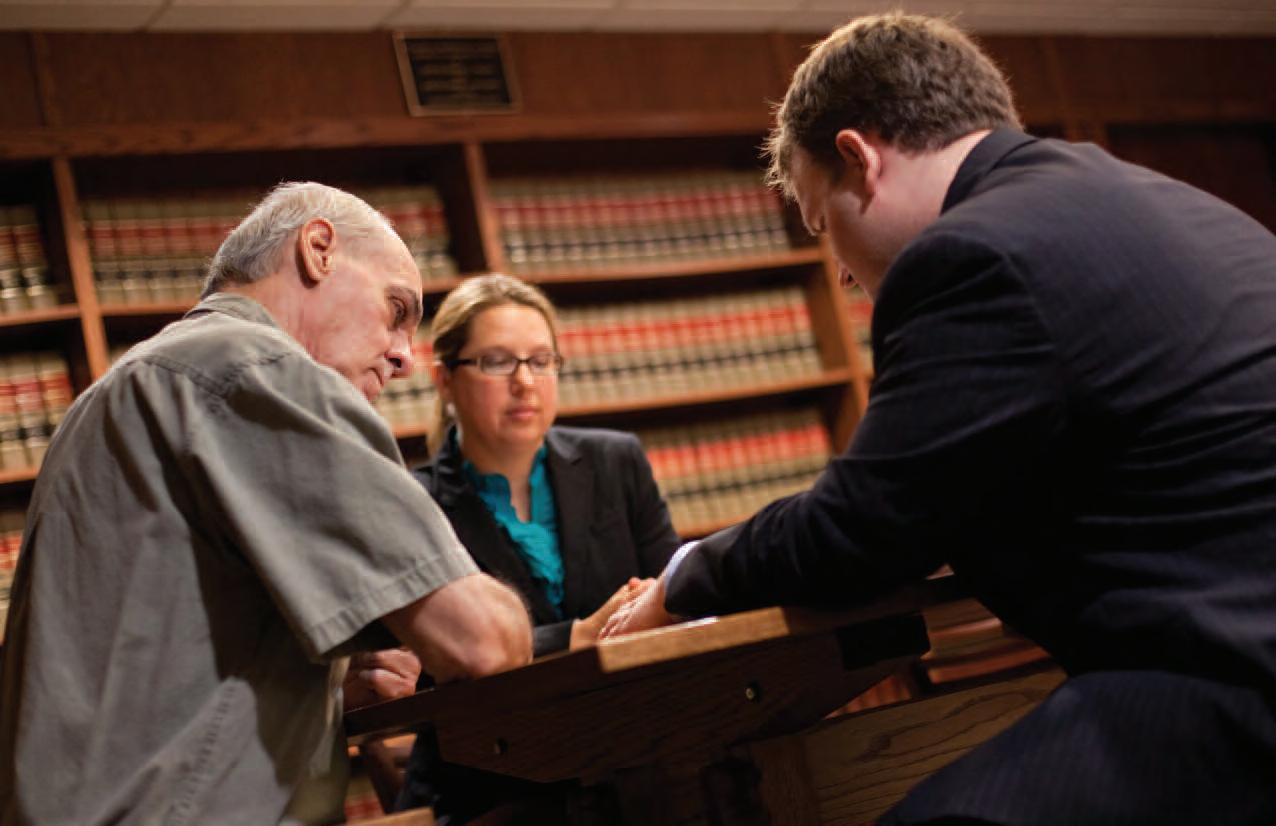
Veterans Law Clinic students advise a client on matters pertaining to veterans’ benefits.
Pennsylvania Criminal Defense Clinic
Delaware Campus
The Pennsylvania Criminal Defense Clinic serves as a law office specializing in criminal law and procedure. Here, you learn the fine points of criminal defense and gain the skills to represent clients—from preliminary hearing through bench or jury trial and beyond. In addition to regular practice before the Pennsylvania state courts of Chester County (West Chester), youmay participate in post-conviction representation of death row defendants and draft briefs to be filed with the Supreme Court of the United States.
Veterans Law Clinic
Delaware Campus
The Widener Law Veterans Law Clinic is the nation’s oldest clinical program designed to assist veterans while providing students an engaging, dynamic setting in which to learn
veterans’ law. Founded in 1997, the clinic offers you the opportunity to serve an underrepresented population in great need. Clinical students gain first-hand experience in client advocacy, case file management, and administrative practice by representing disabled veterans and/or their dependents before the Department of Veterans Affairs and federal courts.
Students from the Harrisburg Civil Law Clinic have argued before the U.S. Court of Appeals for the Third Circuit.
The Delaware Civil Law Clinic is the hub of civil legal services in Delaware. Students screen Legal Help Link calls to qualify prospective clients and refer others to appropriate resources.
In 2012, the Delaware Civil Clinic closed 73 cases representing 2,690 hours in pro bono time—equating to approximately $336,332 worth of legal services.
7/ Clinics: Gain hands-on experience in exceptional clinics
Widener Law students along with Delaware Volunteer Legal Services staff assisted an additional 267 survivors of domestic violence seeking protection from abuse through the Protection from Abuse Act.
“Clinical experiences show students how knowledge gained in the classroom can be put to use in the real world. One semester in a clinic isusually enough time to gain the confidence that you, too, will become a seasoned advocate.”
J. Palmer Lockard II Director, Civil
Law Clinic,
Harrisburg
Campus
“Participating in Widener’s Clinical Externship program has been the most advantageous experience of my law school career. Placement at the Montgomery County Public Defender’s Office in Norristown, Pennsylvania, granted me the opportunity to interview clients, both in-house and at the local correctional facilities, as well as the chance to speak in court on behalf of our clients. I realized success in law school was only a stepping stone to a successful law career, but it has been the hands-on experience inside the courtroom that has provided me with the practical learning required to become a successful attorney.
Nicolle
M. Vasconez ’14
Externship opportunities
Externships take you into the working world of the law. Widener’s strategic campus locations—a state capital and aglobal center for corporate law—offer unusually rich externship opportunities. Choose one, and you will learn how the law works day-to-day as you develop practical skills you can use over a lifetime. You might meet your future employer, make acrucial career connection, or discover theprofessional path that is yours alone—Widener externships open doors.
Clinical Externship Program
Delaware Campus
The Delaware Valley is a center for many types of law practice. Widener Law students who spend a year externing ina government and public service lawoffice earn academic credit working alongside attorneys who are carefully chosen fortheir skills as mentors.
Externships: Work alongside experienced practitioners
Placements often result in contacts and references for future employment. You will grow into the role ofattorney as you meet regularly with classmates in small groups to discuss your experiences and legal skills, professional and personal ethics, and the culture of a modern law office.
Recent placements include:
■ Delaware County (PA) District Attorney
■ Federal Public Defender (Wilmington, DE)
■ Mercer County (NJ) Prosecutor
■ Montgomery County (PA) Public Defender
■ Pennsylvania Attorney General— Torts Litigation Section
■ Philadelphia Municipal Court
Mediation Program
■ U.S. Department of Justice—
Office of Bankruptcy Trustee

Widener Law students like Nicolle M. Vasconez ‘14 participate in full-year externships in governmental agencies, public and private sector law firms, and local, state, and federal courts.
Judicial Externship Program
Delaware Campus
Some of the most respected state trial and appellate courts in the nation are within easy reach of the Delaware Campus. Widener Law students are often placed in the chambers of state courts—from trial courts to state Supreme Courts—in Delaware, Pennsylvania, New Jersey, and beyond. Widener Judicial Externs also are placed in such highly regarded specialty courts as the Delaware Court of Chancery, the Equity Division of the New Jersey Superior Court, and the Commonwealth Court of Pennsylvania. In federal courts, students have worked in the U.S. Court of Appeals for the Third Circuit, U.S. District Court, Magistrate Court and Bankruptcy Court. During the summer, Widener Law students have been placed in externships worldwide, including courts in Melbourne, Australia, and Hyderabad, India.
These judicial externships create exceptional opportunities for Widener students to work as law clerks for outstanding judges. As a mentor, a judge can help you map a career, challenge you to hone research and legal writing skills, and offer a working perspective on the courts. Placements often lead to contacts and references for future employment.
Recent placements include:
■ U.S. Court of Appeals, Third Circuit (Philadelphia, Wilmington)
■ U.S. Bankruptcy Court (Delaware)
■ U.S. Immigration Court (York, PA)
■ Delaware Court of Chancery
■ Supreme and Superior Courts in Delaware, New Jersey, and Pennsylvania
■ Circuit Court of Baltimore County, Maryland
“The judicial externship program was the highlight of my legal education at Widener. It gave me the opportunity to put into practice all of the information I learned in the classroom. I was able to draft judicial opinions, perform research, sit in on pretrial conferences, and learn how the courts work from behind the scenes. It was an experience that I will never forget.”
Christopher Feigenbutz ’11
Externships: Work alongside experienced practitioners
Public interest law offers you a chance to explore new areas of law, make a difference in someone’s life, find mentors, and build your résumé.

More than 80 judicial externs were placed with state and federal judges since spring 2006.
A Widener Law student is placed in the Pennsylvania Governor’s Office of General Counsel every semester for an externship.
Since 1999, we have matched 1,585 first-year law students with alumni who serve as mentors.
Widener Law consistently exceeds the national average for placement of judicial law clerks.
“When I made a career change, I chose Widener Law because of its dedication to helping students succeed. From professors, advisors, academic support to career planning, everyone is accessible, encouraging, and resourceful. They provide guidance as we find our way.”
Beth Godett ’15





Public interest law and pro bonoopportunities
According to the American Bar Association: “Every lawyer has a professional responsibility to provide legal services to those unable to pay.”When these services are performed for little or no tangible compensation, they are described as pro bono. Public interest law and legal services are integral to your profession— and to the Widener Law experience.
For students on both campuses, public interest and pro bono opportunities translate into real-world training and professional skill building—all while giving back by helping others.
Public interest lawyers provide legal services to charitable, religious, civic, community, governmental, educational, and other organizations established to help people of limited means. You may also find yourself performing legal services that advance the work of individuals or groups seeking to secure or protect civil liberties or public rights.
Public Interest at Widener
Delaware’s Public Interest Resource Center (PIRC) and Harrisburg’s Public Interest Initiative (PII) house libraries ofinformation about public interest agencies and resources to fund public interest work.
Both organizations maintain extensive and up-to-date lists of placement opportunities and are staffed with experts who can help you find a position that suits your interests and needs. We even track your volunteer hours; exceptional service receives special recognition at graduation.
“My experience working in the Superior Court of New Jersey was extremely rewarding. I gained much legal knowledge and advanced my legal writing skills immensely. It was inspiring to work with people who dedicate their lives to serving their community.”
Pamela Playo ’11
Public interest law and pro bono recent placements include:
■ New Jersey Protection & Advocacy, Inc., Trenton, NJ
■ Legal Aid of Southeastern Pennsylvania, Chester, PA
■ Pennsylvania Office of the Attorney General, Bureau of Consumer Protection, Philadelphia, PA
■ Domestic Abuse Project of Delaware County, Media, PA
■ PhiladelphiaVolunteersfortheIndigent Program, Philadelphia, PA
■ YWCA of Harrisburg, Domestic Violence Legal Center
The Widener Law Loan Repayment Assistance Program is available to students who decide to pursue careers in public service.
The Public Interest Law Alliance sponsors a silent auction each year to raise funds for public interest fellowships.