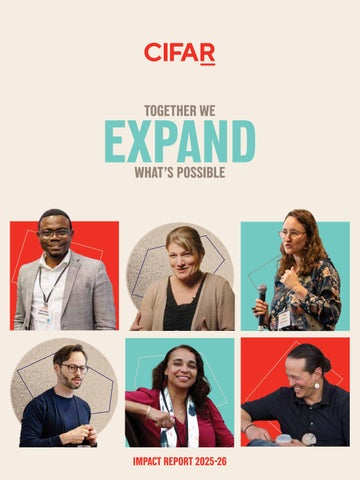
TOGETHER WE
EXPAND WHAT’S POSSIBLE
IMPACT REPORT 2025-26
LAND ACKNOWLEDGEMENT The land on which CIFAR operates has been the traditional territory of the Mississaugas of the Credit, the Anishnabeg, the Chippewa, the Haudenosaunee, and the Wendat peoples for thousands of years and it is still home to many diverse First Nations, Inuit and Métis peoples. We wish to pay respect to Turtle Island and to the Indigenous history of this land. We acknowledge that the area is covered by Treaty 13, signed with the Mississaugas of the Credit. As an organization, we are committed to respectful and collaborative relationships with Indigenous communities. We will continue to find ways to ensure that we are engaging in meaningful action to move reconciliation forward.
On the cover, from left to right: Top row: Blessing Ogbuokiri, Solution Network Co-Director, Canadian AI Safety Institute Research Program at CIFAR; Candice Odgers, Co-Director, Child & Brain Development; Bianca Dumitrascu, CIFAR Azrieli Global Scholar 2024-2026, CIFAR MacMillan Multiscale Human. Bottom row: Hugo Larochelle, Advisor, Learning in Machines & Brains, Canada CIFAR AI Chair at Mila; Asiya Gusa, CIFAR Azrieli Global Scholar 2023-2025, Fungal Kingdom: Threats & Opportunities; Steven Davis, Montana State University, was among participants at CIFAR’s Radical Interdisciplinarity forum on Indigenous Knowledges.
In 2025–2026, CIFAR’s global research community continued to drive extraordinary progress and impact, including historic Nobel Prize and Turing Award recognition that brought our totals to 26 Nobel laureates and 6 ACM A.M. Turing Award winners. This past fiscal year, CIFAR continued to play a prominent role in Canada’s AI leadership and also expanded
cifarimpact.ca
foresight work to identify the challenges and opportunities that will shape the future. This report covers the period between April 1, 2025 and March 31, 2026.
CONTENTS
04
Joint Message from our President & Chair
06
Highlights at a Glance
08
CIFAR Researchers Earn Science’s Highest Honours
12
CIFAR’s Fundamental Research Programs at a Glance
18
Driving Fundamental Research & Impact
24
CIFAR’s AI Leadership: Advancing Research, Talent and Impact
32
Exploring Challenges on the Horizon
38
Building Diverse Global Networks
42
Expanding the Next Generation of Research Leaders
50
CIFAR Supporters
52
CIFAR Financial Overview
54
CIFAR Board of Directors
IMPACT REPORT 2025-26
3
JOINT MESSAGE FROM OUR PRESIDENT AND CHAIR At CIFAR, we believe in backing ideas
Turing Award for their foundational
that challenge convention, long before
contributions to quantum information
their impact is fully visible. Over time,
science – a field of research CIFAR has
through interdisciplinary collaboration and
supported for decades, long before
sustained support, these ideas have the
quantum computing became a booming
power to reshape fields and futures. The
global industry.
accomplishments highlighted throughout this report demonstrate what sustained investment in interdisciplinary collaboration can achieve.
This is also the second consecutive year that we celebrated new Nobel laureates within our research community. Philippe Aghion, Joel Mokyr and Peter Howitt,
In our 2025-2026 Impact Report, we show
members of CIFAR’s former economics
how we’ve advanced our renewed Strategy,
programs, received the Sveriges Riksbank
helped strengthen Canada’s AI leadership,
Prize in Economic Sciences in Memory
deepened global partnerships, expanded
of Alfred Nobel for their work on inno-
opportunities for the next generation of
vation-driven economic growth. With
research leaders, and launched new fore-
their recognition, CIFAR’s community now
sight initiatives to identify the challenges
includes 26 Nobel laureates and 6 ACM
and opportunities that will shape the
A.M. Turing Award winners throughout
decades ahead.
our history.
The recognition of CIFAR researchers
This past year, CIFAR launched several
illustrated throughout underscores how
strategic initiatives to enhance our
sustained investment in fundamental
foresight and build the research pathways
research can advance science, nurture
needed to address complex global chal-
talent and drive innovation over time.
lenges. Highlights included our Radical
This year, researchers Gilles Brassard and
Interdisciplinarity forums on Indigenous
Charles H. Bennett received the ACM A.M.
Knowledges and the Future of the Arctic.
4
CIFARIMPACT.CA
JOINT MESSAGE FROM OUR PRESIDENT & CHAIR
Additionally, we published the Future of Food Report and hosted seven workshops through the CIFAR Arrell Future of Food Initiative, helping to identify emerging challenges around food security and shape meaningful solutions. We are equally proud of our expanding, increasingly diverse research community, which strengthens cross-border collaboration and supports the next generation of research leaders. This past year, CIFAR marked
Stephen J. Toope OC, FRSC, LLD President & CEO
10 years of the CIFAR Azrieli Global Scholars program, as well as the launch of new opportunities with our valued partners, including the Swiss National Science Foundation, Jacobs Foundation and Mitacs. None of this work would be possible without the support of our community. We are deeply grateful to the Government of Canada, our provincial partners – the Governments of Alberta and Québec – research partners, donors and collaborators around the world. We hope you enjoy learning about the power of collaboration, curiosity and fore-
Irfhan Rawji Chair CIFAR Board of Directors
sight – because that’s where the next leap begins.
IMPACT REPORT 2025-26
5
HIGHLIGHTS AT A GLANCE Bobby Maher, Australian National University, was among the participants at CIFAR’s Radical Interdisciplinarity forum on Indigenous Knowledges
HIGH-IMPACT RESEARCH
2,957 publications from 430 researchers
$317M in additional funding for research shaped through CIFAR’s research programs
Aviâja Lyberth Hauptmann, Fellow, Healthy Microbiomes in a Changing World; University of Greenland
1.85x the rate at which CIFAR researchers publish top 1% most-cited papers, compared with academics at the world’s top 20 research universities
6
CIFARIMPACT.CA
1,087 research outputs in the top 1% of most-cited papers in the world (2021-2025)
TRUSTED PARTNERS
77
CIFAR’s research is enabled by dedicated support from 77 formal partnerships with governments, foundations, industry and research organizations across 9 countries
CATALYZING BOLD IDEAS
$3.39M in Catalyst Funds committed to projects that will accelerate discovery
59 CIFAR’S GLOBAL RESEARCH COMMUNITY
Catalyst Fund projects awarded to bold, transformative research
548* researchers across 26 countries and 198 institutions, spanning 6 continents (62 Advisors, 263 Fellows, 22 CIFAR Azrieli Global Scholars, 37 Jacobs CIFAR Research Fellows, 11 CIFAR AI Safety Trainees, 7 Research Trainees, 135 Canada CIFAR AI Chairs, 24 Solution Network members) * A number of these researchers have appointments to multiple CIFAR programs and have only been counted once here.
SCIENTIFIC EXCELLENCE
108
major awards and honours received by CIFAR researchers and Canada CIFAR AI Chairs
Louis Taillefer, Fellow, Quantum Materials; Université de Sherbrooke
IMPACT REPORT 2025-26
7
CIFAR RESEARCHERS EARN SCIENCE’S HIGHEST HONOURS
Charles H. Bennett (left) and Gilles Brassard (right), recipients of the 2025 ACM A.M. Turing Award.
CIFAR RESEARCHERS EARN SCIENCE’S HIGHEST HONOURS
This year, CIFAR researchers once again received some of science’s highest honours, underscoring the lasting impact of supporting long-term funding across CIFAR’s history. Understanding sustained economic growth Over the past two centuries, technological innovation has transformed economic progress. Through their work, Philippe Aghion (Fellow, Institutions, Organizations & Growth1; Collège de France), Joel Mokyr (Advisory Committee Chair, Institutions, Organizations & Growth; Northwestern University and Tel Aviv University) and Peter Howitt (Associate Fellow, Economic Growth & Policy; Brown University) helped explain how that transformation happens and what makes it endure. Their work was recognized with the Sveriges Riksbank Prize in Economic Sciences in Memory of Alfred Nobel 2025.
1 The CIFAR Program in Institutions, Organizations & Growth (2004-2019) evolved out of an earlier CIFAR program in Economic Growth & Policy (1989-2002).
IMPACT REPORT 2025-26
9
Each scholar has deep ties to CIFAR’s
SPOTLIGHT
research community. As a long-time
“Having led CIFAR, I know firsthand that
member and Advisory Committee Chair
true scientific revolutions don’t happen
for Institutions, Organizations & Growth,
overnight; they are seeded by collabora-
Mokyr provided guidance and advice on
tive freedom and sustained by a dedicated
the program. Meanwhile, Aghion and Howitt
community. The recent Nobel laureates
had served as CIFAR Fellows, collaborating
are brilliant proof of what happens
extensively to analyze innovation-based
when we give the world’s finest minds
growth theory and investigate how compe-
the time and space to pursue unconven-
tition can enhance growth.
tional ideas. My gift honouring them is
In 2001, Howitt credited his involvement in CIFAR’s Economic Growth & Policy program as a key motivator for his work. “There is no other forum in the world where presenting my work on growth theory leads to more useful feedback,” he said. “From what I have learned in this program, I feel more confident than before that I am able to identify theoretical problems that are really important not just in purely intellectual terms but also from the point of view of history, public policy and the state of econometric knowledge.”
10
CIFARIMPACT.CA
both a celebration of that extraordinary legacy and an investment in the next generation of global breakthroughs.” CHAVIVA HOŠEK President Emerita and donor, CIFAR
CIFAR RESEARCHERS EARN SCIENCE’S HIGHEST HONOURS
Gilles Brassard (left) and Charles H. Bennett (right) at a Quantum Information Science program meeting in Banff.
Pioneering quantum information science
Brassard has been an active member of
CIFAR’s long-standing leadership in
He was initially appointed as a Fellow
quantum information was recognized with
to the Quantum Information Processing
the 2025 ACM A.M. Turing Award, given
program, which later became the
to researchers Gilles Brassard (Advisor,
Quantum Information Science program.
Fellow, Quantum Information Processing,
Most recently, he has served as an
Quantum Information Science; Université
Advisor to the program. Bennett served
de Montréal) and Charles H. Bennett
as an Advisor to both programs from
(Advisor, Quantum Information Processing,
2007 to 2013.
Quantum Information Science; IBM Fellow).
CIFAR’s research community since 2002.
“Since 2002, and until this program
They are globally credited as the founders
was eventually sunset in 2026, CIFAR’s
of quantum information science for their
Quantum Information Science program
role in establishing the foundations of
has played a formative role in shaping the
quantum encryption and communication.
field in Canada and globally,” says Kate
Their research bridges the gap between
Geddie, Executive Director of Research at
physics and computer science by using
CIFAR. “Gilles and Charles’ work has been
quantum-mechanical phenomena to
central to forwarding quantum research,
process and transmit information, rather
and created a strong, connected ecosys-
than treating them merely as properties
tem that continues to thrive today.”
of matter.
IMPACT REPORT 2025-26
11
CIFAR’S FUNDAMENTAL RESEARCH PROGRAMS AT A GLANCE
A busy year of bringing the CIFAR community together to collaborate and explore opportunities to amplify the impact of their research.
CIFAR’S FUNDAMENTAL RESEARCH PROGRAMS AT A GLANCE
Through our research programs, CIFAR convenes and mobilizes the world’s most brilliant people across disciplines and at all career stages to advance knowledge and address humanity’s biggest challenges, together.
Accelerated Decarbonization
Boundaries, Membership & Belonging
Brain, Mind & Consciousness
Child & Brain Development
CIFAR MacMillan Multiscale Human
Earth 4D: Subsurface Science & Exploration
Fungal KingFuture dom: Threats & Flourishing Opportunities
Gravity & the Extreme Universe
Humanity’s Urban Future
Healthy Microbiomes in a Changing World
Innovation, Equity & the Future of Prosperity
Quantum Information Science
Quantum Materials
Learning in Machines & Brains
To learn more about CIFAR’s Research Programs, visit cifar.ca/research-programs.
IMPACT REPORT 2025-26
13
ACCELERATED DECARBONIZATION
BRAIN, MIND & CONSCIOUSNESS
Innovative ways to capture and store
Consciousness is one of the fundamental
carbon are a key focus of the program.
features of our existence, and the most
Researchers are exploring how common
intimately familiar. Yet its nature remains
minerals, even waste like mine tailings, can
mysterious. The program brings together
help lock carbon away. Program members
neuroscientists, philosophers, and
are also exploring how captured carbon
psychologists to advance our understand-
can be used for low-emission cement and
ing, focusing on 3 key questions: the
crop-boosting fertilizers. The program was
distribution of consciousness (what organ-
founded in 2014 (originally as Bio-Inspired
isms/systems are, or can be, conscious),
Solar Energy) and sunsets in March 2027.
the functions of consciousness (what
BOUNDARIES, MEMBERSHIP & BELONGING
is it for, and why did it evolve) and the character of consciousness (how it differs between people and cultures, and how
The program explores how global crises,
it changes throughout the lifespan).
such as climate change, inequality, rising
Active since 2014.
authoritarianism and mass migration, reshape our sense of belonging in soci-
CHILD & BRAIN DEVELOPMENT
eties. From “polycrisis” to “permacrisis,”
The program examines how early environ-
these overlapping global challenges are
ment shapes the trajectory of our lives,
putting pressure on the ways communities
from the prenatal period through infancy
draw boundaries and define membership.
and into adulthood. Recently, program
To address contemporary crises of polar-
members have been using interdisciplinary
ization and democratic strain, the program
approaches to investigate modes of human
investigates interventions to break cycles
and animal memory through the lenses of
of hate, examines migrant claims-making,
mental health, innovation, biological sex
and analyzes nested local and Indigenous
and evolution, as part of a New Frontiers in
governance models. Active since 2019.
Research Fund exploratory grant. Active since 2003.
14
CIFARIMPACT.CA
CIFAR’S FUNDAMENTAL RESEARCH PROGRAMS AT A GLANCE
CIFAR MACMILLAN MULTISCALE HUMAN
FUNGAL KINGDOM: THREATS & OPPORTUNITIES
The program aims to revolutionize how
The program seeks to decipher how fungi
we predict, treat and understand major
adapt and evolve in a warming world.
diseases to support healthier, happier
To mitigate escalating threats to global
and longer lives. Using AI, genomics and
health, biodiversity and food security, the
advanced imaging, the team is working
program leverages artificial intelligence,
towards an unprecedented understanding
functional genomics and cross-kingdom
of the human body across global popula-
RNA interference to develop innovative
tions. This ongoing work directly addresses
vaccines and resistance-evading thera-
the fundamental, unresolved challenge of
peutics. Their agenda harnesses fungal
how to map and connect biological mech-
biodiversity to maximize planetary
anisms across highly disparate spatial and
carbon capture and pioneer sustainable
temporal scales, from molecules to whole
biotechnology solutions, including myce-
organs. Active since 2023.
lium-based biomaterials and alternative
EARTH 4D: SUBSURFACE SCIENCE & EXPLORATION
foods. Active since 2019.
FUTURE FLOURISHING
The program explores big, interconnected
The program explores what it means to live
questions about life, energy, water and
well without human exceptionalism, the
time, both on Earth and beyond. This year,
idea that humans are separate from their
a powerful new theme emerged: habitabil-
environment, other organisms or the tools
ity and energy. Researchers are studying
they use. “The House that Pigs Built,” an
how life survives in extreme environments
immersive exhibition curated by program
deep underground, as well as novel energy
members in Copenhagen’s Museum for Art
sources that could address the current and
in Public Spaces, exemplifies the program’s
future challenges of energy consumption
objective by showcasing how pigs shape
and climate change. Active since 2019.
modern environments, inviting new ways of thinking about how multispecies relationships are shaping our world. Active since 2023.
IMPACT REPORT 2025-26
15
GRAVITY & THE EXTREME UNIVERSE The program’s researchers play leading roles in detecting and analyzing gravitational waves and in supporting the development of CHIME/Fast Radio Burst Outriggers and the CHORD (Canadian Hydrogen Observatory and Radio-transient Detector) project. These efforts have produced important advances in our understanding of fast radio bursts, cosmology and transient phenomena, while also demonstrating the power of coordinated, interdisciplinary collaboration. The program was founded in 1986 and sunsets in March 2028.
HUMANITY’S URBAN FUTURE Bringing together urban planners, anthropologists, geographers, sociologists, and environmental studies scholars, the program is asking, what makes a good city of the future? Through the immersive and collaborative study of six global cities (Kolkata, Toronto, Shanghai, Naples, Mexico City and Kinshasa), program members are making a transformative impact on how planners, regulators, political actors and everyday citizens can imagine better urban futures, and how the next generation of
16
CIFARIMPACT.CA
urban scholars can understand cities in increasingly pluralistic ways. Active since 2023.
HEALTHY MICROBIOMES IN A CHANGING WORLD The program brings together anthropologists, biologists and other scholars to understand the features of healthy microbiomes. The focus is on interconnected microbial networks and the proposed sensory modality of “microbioception” to develop new approaches for repairing microbial systems that influence individual, societal and environmental health. Active since 2014.
INNOVATION, EQUITY & THE FUTURE OF PROSPERITY The engineers and social scientists in the program are trying to understand and develop innovations that ameliorate rather than intensify inequality in advanced industrial countries. The program is particularly interested in artificial intelligence, care and housing, three interdependent activities that loom increasingly large in the twenty-first century. Active since 2019.
CIFAR’S FUNDAMENTAL RESEARCH PROGRAMS AT A GLANCE
LEARNING IN MACHINES & BRAINS
QUANTUM MATERIALS
Studying neuro- and computer science,
The program is entering an exciting new
the program members are using artificial
chapter, focused on designing and explor-
intelligence to advance understanding of
ing “new quantum worlds.” Researchers
the brain through workshops and research
are advancing next-generation materials
that draw on recent developments in the
while expanding efforts in custom material
field to better understand the brain and
design. These discoveries aim to unlock
connect current machine-learning tech-
new possibilities in quantum technologies
niques with human intelligence.
and uncover principles of fundamental
Active since 2004.
physics. Active since 2012.
QUANTUM INFORMATION SCIENCE The program merges physics and computer science by using quantum-mechanical phenomena to process and transmit information, rather than treating them merely as properties of matter. Program members are exploring quantum technology in order to best harness it, solve pressing computational problems, and further advance fundamental research in the fields of physics and information. The program was founded in 2002 and sunsetted in March 2026.
IMPACT REPORT 2025-26
17
DRIVING FUNDAMENTAL RESEARCH & IMPACT
Students sample an oil and gas well in Utah’s Lisbon Valley as part of research supported by CIFAR’s Earth 4D: Subsurface Science and Exploration program.
DRIVING FUNDAMENTAL RESEARCH & IMPACT
Some of the most important breakthroughs happen when researchers are given the time and space to look beyond established boundaries. This year, CIFAR researchers continued to advance bold work driving real-world impact: from developing new frameworks to understand and interrupt cycles of hate, to challenging long-standing assumptions about ancient groundwater, to uncovering how breast milk antibodies help shape the infant gut microbiome. These stories show the power of fundamental research. Researchers discover link between ancient groundwater and climate change What began as a CIFAR-funded workshop among members of Earth 4D: Subsurface Science & Exploration became a high-profile paper
in Nature Geoscience, offering a new way to understand “fossil groundwater” and its role in a changing climate. The work challenges a long-standing assumption that groundwater stored in an aquifer for thousands of years is non-renewable. The researchers found that some aquifers containing very old water can
IMPACT REPORT 2025-26
19
CIFAR Fellow Victoria Esses speaks at a CBC Radio IDEAS event exploring the Cycle of Hate.
climate conditions, including changes in
Understanding and stopping cycles of hate
recharge from rainfall or snowmelt.
Boundaries, Membership & Belonging
still respond relatively quickly to modern
This means groundwater sustainability depends not only on the age of the water, but also on how quickly the aquifer system responds to present-day environmental
program members have developed an actionable framework that explains how intergroup hate takes hold, and how to stop it before it escalates.
change. As communities face growing
Their Detecting – and Stopping – the Cycle
pressure on freshwater resources, this
of Hate challenges the idea that hate is
research offers a more precise way to
simply an irrational emotion. Instead, it
assess when and how fossil groundwater
shows how historical narratives, political
can be used sustainably.
mobilization, social conditions and moral
This work was led by Michael Manga (Fellow; University of California, Berkeley), Jeffrey McDonnell (Advisor; University of Saskatchewan), Jennifer McIntosh (Fellow; University of Arizona), Barbara Sherwood Lollar (Co-Director; University of Toronto) and Richard Taylor (Fellow; University College London).
justifications reinforce one another, creating self-perpetuating cycles of animosity. The framework also identifies coordinated interventions – from early-warning systems to inoculation strategies – that can interrupt these cycles before hate becomes legitimized. The group’s work is gaining international traction, with a World Bank Policy Research Working Paper in 2026, presentations to the World Bank and the Pathways to
20
CIFARIMPACT.CA
DRIVING FUNDAMENTAL RESEARCH & IMPACT
Prosperity National Conference, and a forthcoming Sage Handbook chapter. They are now developing a “cycle of peacemaking” grounded in restorative justice and Anishnabeg conflict resolution. This work is led by Victoria Esses (Fellow; Western University), Allison Harell (Fellow; Université du Québec à Montréal), Matt Lowe (CIFAR Azrieli Global Scholar, 20232025; University of British Columbia), Hazel Markus (Advisor; Stanford University), Aaron Mills (Fellow; McGill University), Vijayendra Rao (Advisor; World Bank), Stephen Reicher (Fellow; University of St. Andrews) and Prerna Singh (Fellow; Brown University).
Putting workers at the centre of AI’s future
SPOTLIGHT
Future Flourishing program members Alejandra Echeverri (CIFAR Azrieli Global Scholar, 2024-2026; University of California Berkeley) and Kulbhushansingh Suryawanshi (Fellow; Nature Conservation Foundation) are working with farmers in
As AI systems enter more workplaces,
India’s Spiti Valley to understand how
researchers in CIFAR’s Innovation, Equity
traditional crops can support climate-
& the Future of Prosperity program are
resilient food systems. Their study found
examining how these technologies are
that black peas, a nearly extinct crop
changing jobs, in some cases by increas-
cultivated for generations in the Indian
ing monitoring, reducing autonomy or
Trans-Himalaya, outperformed cash crops
shifting workers into supporting roles for
under drought-like conditions. The work
automated systems.
also produced the first whole-genome
With support from a CIFAR Catalyst grant made possible through CIFAR’s partnership with the British Academy, Andrew Schrank (Co-Director; Brown University), Susan Helper (Advisor; Case Western Reserve University; National Bureau of Economic
sequencing data for black peas, revealing strong genetic diversity and high protein content. This work underscores how traditional crops and Indigenous knowledge can offer solutions to future food security in a warming world.
IMPACT REPORT 2025-26
21
Research) and Serena Booth (CIFAR
ramosum. By keeping this microbe in
Azrieli Global Scholar, 2025-2027; Brown
check, sIgA may help prevent immune
University) organized a worker-centred
overstimulation during a critical window of
AI workshop in Ohio with workers, labour
development.
leaders, economists and policymakers. Participants heard directly from workers about how AI systems are reshaping their daily work.
The findings show that breast milk contains immune factors that help shape the relationship between a baby’s microbiome and its immune system. This work could
The workshop is helping to inform policy
inform better approaches to supporting
conversations. The conversations at the
infant health, including for babies who
workshop inspired the organizers to
are not breastfed or who need additional
publish an article in Brookings, a leading
nutritional support.
U.S. public policy think tank. The piece drew the attention of state and federal legislators, and program members are now engaging directly in state-level policy writing.
How breast milk antibodies shape the infant gut microbiome
Finding new ways to fight fungal infections Fungal infections are an urgent and growing health threat, yet the world has far fewer antifungal drugs than antibiotics. As drug resistance increases, researchers are developing new treatments to stop danger-
Research out of the Healthy Microbiomes
ous infections before they become harder
in a Changing World program is deepening
to control.
our understanding of how breast milk affects infant health. The study focuses on sIgA, an antibody found in breast milk, and its role in shaping a baby’s gut microbiome and immune system.
Work led by Fungal Kingdom: Threats & Opportunities program members Leah Cowen (Co-Director; University of Toronto), Joseph Heitman (Co-Director; Duke University), Gerard Wright (Fellow; McMaster University)
Researchers Katherine Donald (Cornell
and James Kronstad (Power Corporation
University), alongside Meghan Azad
Fellow; University of British Columbia) has
(Fellow; University of Manitoba) and
identified new compounds that can enhance
Brett Finlay (Fellow; University of British
the potency of existing antifungal drugs,
Columbia) found that sIgA helps regulate
uncovering promising new drug candidates
gut bacteria in early life, including a
and revealing how disease-causing fungi
microbe called Erysipelatoclostridium
grow and survive.
22
CIFARIMPACT.CA
DRIVING FUNDAMENTAL RESEARCH & IMPACT
Bernhard Schölkopf, Advisor, Learning in Machines & Brains
This work will strengthen the next
Kyunghyun Cho’s (New York University)
generation of antifungal treatments,
seminal paper, “Scaling Laws Are
advancing drug discoveries that could
Unreliable for Downstream Tasks,” demon-
better protect people from life-
strates that merely expanding model
threatening fungal infections.
size does not automatically guarantee
Rethinking how AI understands the world For years, much of the AI field focused on the idea that bigger models, more data and more computing power would lead to better intelligence. Researchers in CIFAR’s Learning in Machines & Brains program
have long challenged this “scaling-only” hypothesis. Instead, they argued that true intelligence requires world models — internal systems that represent how reality works, allowing an AI to predict cause-andeffect, reason through counterfactuals, and plan beyond simple text prediction. That question is reshaping the field. This year, researchers in the program advanced work showing the limits of scaling alone and exploring new ways to build AI systems that can reason more flexibly. Fellow
competence in complex, real-world applications. At the same time, Yoshua Bengio (Advisory Committee Chair, Canada CIFAR AI Chair at Mila; Université de Montréal) and colleagues introduced Recursive SelfAggregation, a new approach to building systems that can reason dynamically. Meanwhile, work by Advisor Bernhard Schölkopf (ETH Zürich, Max Planck Institute for Intelligent Systems) advanced research on causal representation learning, helping AI systems better understand why things happen, not just what is likely to happen next. Together, these complementary breakthroughs — incubated and refined through sustained CIFAR convenings — are helping lay the groundwork for a new era of AI systems capable of genuine reasoning and world understanding.
IMPACT REPORT 2025-26
23
CIFAR’S AI LEADERSHIP: ADVANCING RESEARCH, TALENT AND IMPACT
Participants take part in a group discussion at the 21st annual CIFAR Deep Learning + Reinforcement Learning Summer School, a 10-day AI training program hosted by Amii in Edmonton.
CIFAR’S AI LEADERSHIP
For nearly a decade, the Canada CIFAR AI Chairs program has served as the foundation for Canada’s leadership in AI. Today, the Canada CIFAR AI Chairs are ranked as the third-highest-impact AI research group in the world, alongside Google and the Max Planck Institute for Informatics. By anchoring world-class talent, the Canada CIFAR AI Chairs program empowers researchers to drive nationwide societal impact across critical sectors, including health, energy, AI safety and fundamental AI science. Securing Canada’s AI talent advantage This year marked a historic milestone for the Pan-Canadian AI Strategy. The Canada CIFAR AI Chairs program reached a peak
of 135 active Chairs, solidifying Canada’s status as a global talent magnet. As the lead of the strategy’s research and talent pillar since 2017, CIFAR worked closely with federal partners and the three national AI Institutes – Amii, Mila and Vector Institute – to showcase the
IMPACT REPORT 2025-26
25
impact of Canada’s AI research commu-
prediction systems for Type 2 diabetes.
nity and to inform the development of
This approach provides policymakers
the new federal AI strategy. Together, we
with a humanized blueprint for targeted
demonstrated that sustained investment
resource allocation, enabling a transition
in research and talent is the foundation of
from reactive care to proactive, equitable
Canada’s AI ecosystem. With the refreshed
strategies that reduce strain on public
federal strategy, AI for All, this renewed
healthcare systems.
investment will grow the Canada CIFAR AI Chairs program from 135 Chairs today to nearly 200 — the largest expansion in the program’s history. By bridging world-class scientific excellence with a unified strategic vision, CIFAR and the three national AI institutes are strengthening Canada’s longterm success in developing and deploying safe and trustworthy AI that delivers social and economic benefits for Canadians.
Navigating AI and society As AI reshapes society, CIFAR researchers are connecting cutting-edge science and actionable public policy to ensure technology serves the public good.
Similarly, the CIFAR Integrated AI for Health Imaging Solution Network developed custom software to help clinicians address a critical bottleneck in Canadian healthcare by seamlessly and responsibly integrating AI models into hospital workflows. The Solution Network provides a blueprint for regulating safe, collaborative human-AI clinical environments. CIFAR’s impact extends to developing sustainable, ecosystem-wide capacitybuilding. The AI Insights for Policymakers Program, a joint collaboration between CIFAR and Mila, provides a platform for decision-makers and AI experts to share
Over the past year, CIFAR’s AI for Health
ideas on critical AI policy issues. This
Solution Networks brought together
engagement is a two-way street: during
experts across sectors and disciplines
program “office hours,” AI experts learn
to ensure AI tools are shaped by real-
to translate complex science into action-
world needs. The CIFAR AI for Diabetes
able governance, while gaining insights
Prediction & Prevention Solution Network
into policy friction points that reshape
integrated socioeconomic data with input
academic research trajectories and spark
from community advisors to improve risk
new collaborations.
26
CIFARIMPACT.CA
RESEARCH & TALENT RANKINGS
CANADIAN AI
BY THE NUMBERS
3rd highest impact research cluster in the world (Canada CIFAR AI Chairs)2
31,450+ authors and inventors in AI (5th highest number in the world)3
5th in the world for responsible AI research4
EXPANDING CANADA’S AI TALENT
135 world-class Canada CIFAR AI Chairs
SUPPORTING THE NEXT GENERATION
73 researchers funded by the CAISI
249 participants in CIFAR-partnered
Research Program at CIFAR
training programs
250 AI professionals trained by
73 CIFAR Inclusive AI Scholarships
Canada CIFAR AI Chairs enter the
for Black and Indigenous students
workforce each year
STARTUPS & INVESTMENT
4th in the world with 560 new AI startups created5
Zhijing Jin, Canada CIFAR AI Chair at the Vector Institute
2 Measured by Average Relative Citation (ARC). Proprietary analysis conducted by Elsevier. 3 https://hai.stanford.edu/ai-index/2026-ai-index-report Fig. 1.8.1
5th in the world for global private
investment in Canadian AI companies6
4 https://hai.stanford.edu/ai-index/global-vibrancy-tool 5 https://hai.stanford.edu/research/ai-index-report Fig. 4.2.13 6 https://hai.stanford.edu/research/ai-index-report Fig. 4.2.8
IMPACT REPORT 2025-26
27
“I’ve witnessed firsthand how the pro-
Mobilizing cutting-edge AI safety research
gram leads to the growth and flourishing
Public trust is one of the primary drivers
of science-policy networks. [The program
of successful technological innovation.
helps create] a better understanding of
Recognizing this, the CAISI Research
the real-world issues policymakers
Program at CIFAR has successfully mobi-
grapple with, which has enabled me
lized a national network of over 70
to adjust my own research trajec-
multidisciplinary experts to confront the
tory toward higher-impact outputs.
urgent sociotechnical risks of advanced AI
Several of our ‘office hours’ sessions
systems. More than $3.6M was invested to
have led to research publications
launch 24 high-impact research projects
and new project collaborations.”
designed to ensure AI systems are robust,
ALISSA CENTIVANY Co-Chair, AI Insights for Policymakers, Western University
safe and aligned with Canadian values.
SPOTLIGHT
The program is funding innovative solutions that are already delivering tangible public safety impacts: » Protecting Mental Health: To safeguard vulnerable populations, researchers at Mila’s AI Safety Studio developed a firstof-its-kind mental health benchmark as a guardrail to detect and block chatbot content that encourages self-harm.
28
CIFARIMPACT.CA
CIFAR’S AI LEADERSHIP
Yoshua Bengio Canada CIFAR AI Chair and 2018 ACM A.M. Turing Award winner
Elissa Strome CIFAR’s Executive Director, Pan-Canadian AI Strategy, delivers a plenary address at ALL IN 2025, Canada’s largest AI event.
» Defending Democracy: The CIPHER
The CAISI Research Program at
project at Amii is building an advanced
CIFAR funded two new AI Safety
human-in-the-loop AI system to
Solution Networks:
empower civil society to identify and combat sophisticated, state-backed foreign disinformation campaigns. » Ensuring Truthful AI: To counter unver-
» Safeguarding Courts from Synthetic AI Content: This network develops opensource verification tools to protect the integrity of the justice system from
ified AI outputs, researchers at the
AI-generated deepfakes, falsified digi-
Vector Institute developed an AI Debate
tal evidence and large language model
Framework that trains language models
(LLM) hallucinations.
to construct reliable justifications using valid evidence. » Evaluating Frontier AI: The Vector
» Mitigating Dialect Bias: Co-funded by the International Development Research Centre, this network designs culturally
Institute conducted a revolutionary
representative AI models to eliminate
benchmark study, independently evalu-
linguistic inequality, ensuring that
ating 11 global frontier models for safety,
LLMs do not misinterpret or penalize
and open-sourced tools to enable secure
marginalized dialects like Nigerian
AI adoption across businesses and
Pidgin English.
public services.
IMPACT REPORT 2025-26
29
SPOTLIGHT
SPOTLIGHT
Bo Wang (Canada CIFAR AI Chair, Vector Institute; University of Toronto) is leading the creation of the world’s first virtual human cell using generative AI. His team at Xaira recently launched X-Cell, a massive AI model that acts as a digital testing ground for biology. Instead of relying on slow laboratory trial-and-error, X-Cell uses a novel AI architecture trained on millions of data points to simulate cellular reactions. It accurately predicts how cells respond to new drugs and genetic mutations before a physical experiment even begins, transforming drug discovery into a faster, more predictable discipline.
Ross Mitchell (Canada CIFAR AI Chair, Amii; University of Alberta) is using AI to tackle the serious issue of physician burnout. Together with a group of clinical researchers, he helped create Jenkins, an AI-driven scribe that automatically generates medical notes by securely capturing patient-physician conversations. After a successful trial in Alberta emergency departments, where early users applied it in up to 85 per cent of patient visits, the tool is now accessible to all acute care doctors in Alberta.
30
CIFARIMPACT.CA
CIFAR’S AI LEADERSHIP
SPOTLIGHT
By mid-July 2026, more than 1,300 physicians across 12 medical specialties had signed up to use Jenkins. It has been utilized in 120,000 patient visits, with 1,100 new ones added every day. By reducing paperwork, this locally developed tool is significantly easing documentation tasks, improving hospital patient flow, and allowing doctors to spend more time directly caring for patients.
Tal Arbel (Canada CIFAR AI Chair, Mila; McGill University) is revolutionizing personalized medicine for neurological diseases. Brain imaging algorithms developed by her team are already used globally to analyze clinical trials for nearly all new multiple sclerosis drugs. In a recent collaboration with Mila and Microsoft Research, Arbel’s team introduced a groundbreaking AI framework that uses neural equations to predict individualized, continuous disease trajectories. By analyzing medical images and clinical data, this system forecasts patient disability progression with state-of-the-art accuracy, offering doctors a powerful new tool for precision treatment planning and targeted clinical trials.
IMPACT REPORT 2025-26
31
EXPLORING CHALLENGES ON THE HORIZON
How can food systems be better integrated into cities to support ecosystem health? This question guided CIFAR’s Urban Future of Food workshop, part of the CIFAR Arrell Future of Food Initiative.
EXPLORING CHALLENGES ON THE HORIZON
As the world faces increasingly complex and interconnected challenges, CIFAR is building new ways to look ahead. Complementing our existing approaches to identifying areas where CIFAR can have the greatest impact, the CIFAR Ralph M. Barford Discovery Initiative is growing our capacity to surface critical uncertainties and interdisciplinary opportunities. We’re applying these skills to explore new programs and ensure our existing programs remain on the frontier of knowledge creation. Building Our Foresight Capacity Looking on the horizon is core to how CIFAR works. We supported neural networks long before the modern AI revolution, and Quantum Information Science before quantum computing became a global field, backing emerging areas many years and decades before their influence was widely recognized. In 2025-2026, CIFAR strengthened its Challenges on the Horizon capability to help research programs identify emerging signals,
IMPACT REPORT 2025-26
33
questions and challenges that could shape
the Future of Food Report, released in July
society in the years ahead. This work also
2025, which identified emerging research
helps CIFAR determine where its unique
questions around sustainable food
model of long-term, interdisciplinary
production, nutrition and health, and the
collaboration can make the greatest differ-
relationship between local practices and
ence. That work led to:
global food systems. The report shaped a
» 164 CIFAR community members, including Fellows, Scholars and global partners taking part in structured foresight exercises. » The development and application of nine foresight tools and approaches to help researchers test emerging ideas and explore how their fields may evolve.
call for Discovery Workshops that drew 58 submissions from interdisciplinary teams representing 41 countries. Seven standout teams were selected to bring their work to the Discovery Workshop phase to test hypotheses and shape potential pathways for future transformative research. Across the workshops, participants examined how future food systems can
» The tools being used across nine meet-
become more resilient, equitable and
ings and events, including seven work-
sustainable, and explored how finance,
shops through the CIFAR Arrell Future
policy and technology can better support
of Food Initiative, focused on global
systems-level change. Through targeted
food security.
interactions, the workshops also brought
The Future of Food Takes Shape As part of CIFAR’s foresight work, CIFAR launched the CIFAR Arrell Future of Food Initiative in 2025. Designed as an ideato-program pipeline, the initiative uses a
some researchers into dialogue with farmers, policymakers and practitioners, helping to ground the research in the realities of who will ultimately turn that research into real-world impact.
multi-stage discovery framework to thor-
The next phase of this process is
oughly investigate high-risk, high-potential
already underway. Select workshops will
research fields before elevating them into
evolve into comprehensive Discovery
long-term research programs.
Programs, beginning in Fall 2026.
CIFAR first convened a global panel of experts to identify the challenges and opportunities facing the future of global food systems. Their insights culminated in
34
CIFARIMPACT.CA
Through this deliberate evolution, CIFAR is successfully translating early-stage foresight into structured, actionable research trajectories.
EXPLORING CHALLENGES ON THE HORIZON
SPOTLIGHT
Since 2007, the Metcalf Foundation has
cluster, empowering global, interdisci-
been a visionary partner in helping CIFAR
plinary teams to navigate the realities
look beyond the horizon towards tomor-
of an evolving world and create scalable
row’s defining challenges. Their long-term
solutions for a sustainable planet.
philanthropy has provided foundational
“The Metcalf Foundation is immensely
support for early-career researchers, first through the Global Academy (the precursor to the CIFAR Azrieli Global Scholars program), and later by driving bold sustainability research through the Bio-Inspired Solar Energy / Accelerated Decarbonization program. Today, the Metcalf Foundation continues this vital work through its support of CIFAR’s Nurturing a Resilient Earth impact
proud of our 20-year partnership with CIFAR. As a fellow Canadian organization dedicated to tackling complex societal challenges, we champion this extraordinary global network, whose boundary-pushing, interdisciplinary research is delivering breakthrough insights the world urgently needs.” JAMISON STEEVE President & CEO, Metcalf Foundation
IMPACT REPORT 2025-26
35
Charting bold research directions for the Future of the Arctic
quently culminated in The CIFAR Panel
As the Arctic warms nearly four times
on the Future of the Arctic Report, which
faster than the rest of the planet, changes
was released in June 2026. The report
in the region are offering an early view
outlines a series of critical tensions and
of the environmental, political and social
research directions designed to empower
pressures that will shape the future.
scholars to ask more profound questions
In February 2026, CIFAR convened in
that can shape the future of the Arctic for
Switzerland for a Discovery Panel on the
decades to come, particularly related to
Future of the Arctic to explore potential
governance, sustainability and resource
research directions for the region.
extraction. CIFAR is considering next
Using CIFAR’s unique convening model, 14 interdisciplinary experts based in Canada, Finland, France, Greenland, Norway, Sweden, Switzerland and the United Kingdom used foresight exercises, including building 2050 Arctic scenarios, to explore future research needs in the region.
36
CIFARIMPACT.CA
Findings from the Discovery Panel subse-
steps for advancing work on this theme, recognizing the Arctic as both a defining Canadian challenge and an increasingly urgent global one. The panel was developed in partnership with the Swiss National Science Foundation (SNSF) and made possible through the CIFAR Ralph M. Barford Discovery Initiative.
EXPLORING CHALLENGES ON THE HORIZON
Through seven CIFAR Arrell Future of Food workshops and the Discovery Panel on the Future of the Arctic, CIFAR brought researchers and partners together to examine emerging challenges.
BUILDING DIVERSE GLOBAL NETWORKS
At the Canadian Space Agency, CIFAR and IVADO brought together researchers and innovators from AI, data science, health and space for Aim4 the Moon: Innovation at the Edge of Space, AI, and Health.
BUILDING DIVERSE GLOBAL NETWORKS
CIFAR’s global networks move ideas across borders, institutions, disciplines and sectors. By creating sustained opportunities for collaboration, CIFAR helps researchers and partners build the momentum needed to pursue questions no single country, field or institution can address alone. In 2025-2026, our active partnerships with governments, research organizations, industries and foundations totalled 77, representing 9 countries around the world. These strong relationships with like-minded, innovative organizations allow us to expand and diversify the opportunities available to our research community and invest in bold ideas with the highest potential impact. Expanding opportunities for cross-border collaboration and impact CIFAR’s partnership with the Swiss National Science Foundation (SNSF) continues to expand opportunities for collaboration and scientific impact across CIFAR’s programs. This past year, CIFAR held three program meetings in Switzerland, as well as a Rare Diseases Workshop and the Quantum Materials School. Those meetings are already translating into action. The partnership generated 22 Catalyst Grant applications involving CIFAR and Swiss
IMPACT REPORT 2025-26
39
SPOTLIGHT
researchers, resulting in four funded proj-
The CIFAR Canada-Taiwan Frontiers of
ects, highlighting how our partnership has
Science Symposium marked the first
seeded high-impact collaborations across
joint activity between CIFAR and Taiwan’s
borders.
National Science and Technology Council as part of our new partnership. Hosted in Banff, the event convened a diverse group of researchers from Taiwan and CIFAR’s research community to explore the intersection of responsible AI, democracy, governance and social trust. The event created space for early-career researchers to consider how democratic states with relatively small populations, such as Canada and Taiwan can advance technological innovation while strengthening democratic resilience. Over the course
One recently funded project examines how urban growth is reshaping customary and collective lands across Sub-Saharan Africa, South America and India. By studying how shifting land systems are creating emerging “rural metropolises” and alternative urban futures, the project aims to inform local and regional planning, mentor early-career scholars, produce a joint comparative publication and lay the groundwork for larger international grant applications.
how meaningful interdisciplinary exchange
Data-Driven Solutions for a Changing World
can spark fresh perspectives and open
Together with the Helmholtz Information
new frontiers in research through
& Data Science Academy (HIDA), CIFAR
thoughtful discussion.
co-hosted a summer school in Berlin
of three days, participants exemplified
focused on data science for climate. This collaborative learning opportunity was the result of our deepening partnership with the Helmholtz-Gemeinschaft / Helmholtz
40
CIFARIMPACT.CA
BUILDING DIVERSE GLOBAL NETWORKS
Association, intended to build on our
SPOTLIGHT
existing collaboration and foster closer
In Quebec, CIFAR and IVADO convened
cooperation to drive innovative research.
a group of Canada CIFAR AI Chairs
CIFAR and HIDA’s immersive summer
and experts from the Canadian Space
school trained 30 graduate students and
Agency for the Aim4theMoon workshop.
postdoctoral fellows eager to tackle global
Discussions focused on how AI can sup-
climate challenges using interdisciplinary
port health applications in space and on
and innovative data-driven approaches at
Earth, specifically addressing the unique
the intersection of data science, AI, climate
challenges faced by extreme and under-
research and remote sensing.
served environments, such as remote
CIFAR speakers included Stefan Bauer (Fellow and CIFAR Azrieli Global Scholar, 2020-2022, Learning in Machines & Brains; Technical University of Munich),
communities and the Arctic. The event featured diverse, interdisciplinary researchers from across AI and aerospace engineering, representing Canada from coast to coast.
who discussed causality in AI, Ariel Furst (CIFAR Azrieli Global Scholar, 2022-2024, Accelerated Decarbonization; Massachusetts Institute of Technology), who spoke about data standardization for clean tech, and Ann Gregory (CIFAR Azrieli Global Scholar, 2024-2026, CIFAR MacMillan Multiscale Human; University of Calgary), who led a session on how genomics and data science can help uncover the role of viruses in climate-related processes.
IMPACT REPORT 2025-26
41
EXPANDING THE NEXT GENERATION OF RESEARCH LEADERS
Jenny Yun-Chen Chan, 2026-2028 Jacobs CIFAR Research Fellow, speaks at the 2026 All Cohorts Meeting in France, celebrating 10 years of the Jacobs Fellowship.
EXPANDING THE NEXT GENERATION OF RESEARCH LEADERS
CIFAR’s Next-Generation Initiatives give early-career researchers the support, networks and freedom to pursue bold, interdisciplinary research. At a challenging time for science and research funding globally, CIFAR is helping emerging research leaders take risks, build lasting collaborations and gain access to opportunities that are often difficult to find within academic norms. By investing early, CIFAR aims to shape a more connected, globally engaged research community ready to define the next frontiers of discovery. Advancing the Future of Child Development and Learning CIFAR and the Swiss-based Jacobs Foundation have partnered to support interdisciplinary early-career research on how children and youth learn and develop, enabling the effective scaling of education policies and practices worldwide. The newly named Jacobs CIFAR Research Fellowship harmonizes the complementary mandates of CIFAR and the Jacobs Foundation to extend opportunities for early-career researchers to advance their work towards societal impact. Twelve exceptional researchers were named as the first Jacobs CIFAR Research Fellows for the 2026-2028 cohort. The inaugural cohort spans a highly diverse and cutting-edge spectrum of specialties, whose interdisciplinary research addresses important research areas, including the effect of climate extremes on schooling, refugee education in crisis zones and the effects of AI and screen time on children’s mental health.
IMPACT REPORT 2025-26
43
Boróka Bó
Roni Porat Benjamin Rosman
SPOTLIGHT
In 2025-2026, CIFAR welcomed its 10th cohort of CIFAR Azrieli Global Scholars.
Dublin), Serena Booth (CIFAR Azrieli Global Scholar 2025-2027, Innovation, Equity &
In June 2025, Scholars from across every
the Future of Prosperity; Brown University),
cohort gathered in Halifax for a two-day
Roni Porat (CIFAR Azrieli Global Scholar
All-Cohorts Meeting celebrating the pro-
2025-2027, Boundaries, Membership &
gram’s 10th anniversary. The meeting
Belonging; The Hebrew University of
brought together more than 50 Scholars
Jerusalem) and Benjamin Rosman (CIFAR
from the 2016–2025 cohorts to lead dis-
Azrieli Global Scholar, 2022-2024, Learning
cussions on shared global challenges,
in Machines & Brains; University of the
hear from guest speakers and build new
Witwatersrand), that will leverage global
collaborations. The gathering culminated
interviews and AI-enhanced survey meth-
in 12 new Catalyst Fund projects, includ-
ods to investigate how venture capital
ing a cross-programmatic project led by
funding reinforces gender inequality in
researchers Boróka Bó (CIFAR Azrieli Global
artificial intelligence, aiming to provide
Scholar, 2025-2027, Innovation, Equity &
actionable, evidence-based strategies for
the Future of Prosperity; University College
a more inclusive technology economy.
44
CIFARIMPACT.CA
EXPANDING THE NEXT GENERATION OF RESEARCH LEADERS
From Emerging Scholar to AI Leader: Alona Fyshe’s CIFAR Journey Alona Fyshe’s trajectory within the CIFAR ecosystem is a powerful testament to the long-term impact of backing early-career researchers. Selected in 2016 for the inaugural cohort of the CIFAR Azrieli Global Scholars program within the Brain, Mind & Consciousness program, Fyshe began her journey by exploring the deeper mechanisms of human cognition. A decade later,
co-launched a collaborative Catalyst
she is a leading global voice in her field, a
project with Natalie Brito (CIFAR Azrieli
full Fellow in CIFAR’s Learning in Machines &
Global Scholar, 2022-2024, Child & Brain
Brains program, and a Canada CIFAR AI Chair
Development; New York University) titled
at Amii, where she was recently appointed
“Characteristics of Infant Learning and their
as Director of Scientific Operations. Her
Utility in AI.” By cross-pollinating insights
path illustrates how early support, mentor-
from early childhood development with
ship and sustained connection can propel
advanced machine learning, this initiative
next-generation thinkers into positions
exemplifies the boundary-pushing science
of leadership.
that CIFAR was built to sustain.
Now an Associate Professor with a joint
“The Global Scholars program absolutely
appointment in Computing Science and
changed my career trajectory, and was the
Psychology at the University of Alberta, Fyshe
reason (I believe) I was able to make the
is merging biological and artificial minds. By
connections I did, start the collaborations
applying machine learning to analyze brain
I did, and make the university move I did.
images of people reading, her lab investigates
CIFAR expanded my horizons, and I’m sure my
how humans represent and combine words
research career is better for it, and I hope will
to process higher-order meaning. Beyond
be more impactful because of it.”
her core research, she is a champion for public AI literacy, having recently launched the capstone course for the university’s AI Everywhere undergraduate certificate.
CIFAR proudly acknowledges the Azrieli Foundation, whose generous and visionary support was instrumental to the launch and nurturing of the Global Scholars program. As
Fyshe’s enduring connection to the CIFAR
Founding Partner, the Foundation’s profound
network continues to spark vital, cross-
commitment lit the way for the first 10
disciplinary breakthroughs. She recently
cohorts of the program (2016 to 2025).
IMPACT REPORT 2025-26
45
RI: Indigenous Knowledges brought together nearly 50 Indigenous researchers from 17 countries to explore solutions beyond traditional Western disciplines.
Radical Interdisciplinarity: Seeding Global Collaborations
For many participants, the forum was a unique opportunity to gather in an
CIFAR’s Radical Interdisciplinarity (RI)
Indigenous academic space to share
serves as a collaborative sandbox,
stories and connect across distinct
designed to break down traditional
communities, disciplines and geogra-
academic silos and seed new global
phies. Those connections are continuing
networks. In 2025-2026, this model
through seed-funded projects, including a
came to life through two landmark inter-
collaboration between researchers Jabulile
national gatherings.
Mzimela (University of Zululand) and
In Banff, Alberta, CIFAR partnered with Ngā Pae o Te Māramatanga Centre for Māori Research Excellence in Aotearoa New Zealand to host the inaugural RI: Indigenous Knowledges, uniting nearly
Lesedi Mashumba (University of Botswana) on how conservation systems in Botswana and South Africa continue to reproduce colonial forms of exclusion, militarization and Indigenous dispossession.
50 Indigenous researchers from 17 coun-
Meanwhile, in Geneva, Switzerland,
tries to explore solutions that transcend
CIFAR and the Swiss National Science
traditional Western disciplines – a mile-
Foundation (SNSF) convened the RI:
stone event that serves as a foundational
Arctic Horizons forum, bringing together
launchpad for CIFAR’s long-term commit-
nearly 40 early-career researchers from
ment to expanding capacity and ensuring
Canada and Switzerland to share research
Indigenous methodologies shape future
priorities and build community among
global research.
scholars exploring the interconnected
46
CIFARIMPACT.CA
EXPANDING THE NEXT GENERATION OF RESEARCH LEADERS
RI: Arctic Horizons united nearly 40 early-career researchers from Canada and Switzerland to explore challenges facing the Arctic.
geopolitical and ecological challenges facing the polar regions. This event was held in parallel with the Discovery Panel
Training the next generation of AI talent CIFAR is ensuring Canada’s AI leadership
on the Future of the Arctic. Following
is built on equity, diversity and inclusion.
the forum, all participants had met new
Together with partners across the country,
potential research collaborators, and six
we are driving next-generation training
collaborative seed-funded projects were
initiatives that are actively dismantling
launched on themes ranging from Arctic
systemic barriers. Over the past year, these
aerosols and solar reliability to Indigenous
collaborative efforts empowered nearly
food systems and research integrity under
250 students. Central to this mission was
geopolitical fragmentation.
the CIFAR Inclusive AI Scholarship program,
“The Radical Interdisciplinarity Forum on Arctic Horizons was like a minisabbatical. You put away the distractions and immerse yourself in different perspec-
which funded 44 self-identified Black and 29 self-identified Indigenous trainees, helping to diversify the pipeline of future leaders.
tives, different thought processes and, of
A prime example of this ecosystem-wide
course, different fields. The awareness of
impact was the 21st annual CIFAR Deep
these itself is transformative to research,
Learning + Reinforcement Learning
but the connections made are valuable
Summer School in Edmonton. This
for careers and the field, but also much
10-day intensive AI training program for
needed for the future of the Arctic.”
advanced students was made possible
- Srijak Bhatnagar, Athabasca University
IMPACT REPORT 2025-26
47
by host partner Amii, and our partners
SPOTLIGHT
and sponsors, including the Government
“My co-founders, our technical staff in
of Alberta, Cohere and RBC. Their invest-
Canada and around the world, and I have
ments continue to fuel Canada’s legacy
all benefited from the many ways CIFAR has
as an inclusive, responsible global
supported Canada’s AI ecosystem. CIFAR
AI powerhouse.
has helped create a community where
“One of the key things that I want to take from this summer school is bridging the gap between the academic community and the industry side of things because AI and machine learning techniques are still a little foreign in space sciences. Adoption of these newer techniques [...] would be a gamechanger for any project.” - Agnit Mukhopadhyay, Research Fellow, University of Alberta
48
CIFARIMPACT.CA
researchers, talent and companies like ours can grow and contribute on the global stage. We are deeply grateful for that work, and proud to support CIFAR’s continued leadership in advancing Canadian AI.” IVAN ZHANG Co-founder, Cohere
EXPANDING THE NEXT GENERATION OF RESEARCH LEADERS
Connecting emerging researchers to Canada’s innovation ecosystem
True validation of an organization’s
In our ongoing efforts to continually
impact comes from the inside. At CIFAR,
strengthen industry-academic collaboration
our researchers don’t just contribute
among the next generation of researchers,
their intellect: they actively fuel our
CIFAR partnered with Mitacs in March 2026
future through personal philanthropy.
to support up to 10 Mitacs-CIFAR Global
Our Fellows and Advisors are increas-
Excellence Award recipients. The new
ingly giving back to support both discov-
awards, under the Mitacs Accelerate Global
ery research and the next generation of
Excellence Award program, will attract
research leaders, creating new pathways
outstanding international postdoctoral
and opportunities for emerging talent
fellows and PhD graduates to Canada by
worldwide. We are deeply grateful to our
enabling recipients to gain access to Mitacs’
researcher-donors who lead by example.
industry-research partners and CIFAR’s global research networks and next-gen programming. Selection is underway and will be announced in 2027.
SPOTLIGHT
“As a scientist whose work has been focused almost entirely on cognitive neuroscience, being part of the Brain, Mind & Consciousness program for more than 10 years now, has been a mind-bending experience. I’ve had opportunities to interact with researchers from many different disciplines, from philosophy to anthropology to developmental psychology. I am so grateful to be part of the CIFAR community.” MELVYN GOODALE CIFAR donor and Advisory Committee Chair, Brain, Mind & Consciousness; Western University
IMPACT REPORT 2025-26
49
CIFAR SUPPORTERS We extend a heartfelt thank you to our supporters for your generosity and inspiring commitment to our mission. You empower CIFAR to address the most pressing questions facing science and humanity.
DONORS
Anonymous
Lifetime Giving
Arrell Family Foundation
We proudly celebrate the exceptional generosity of donors whose lifetime giving has helped shape CIFAR’s story. Discover the supporters whose cumulative giving of $1 million+ reflects a profound commitment to CIFAR’s mission at: cifar.ca/supporters.
The Azrieli Foundation
2025-2026 Giving
Bezos Family Foundation Chaviva Hošek Chisholm Thomson Family Foundation The David Family Foundation The George Cedric Metcalf Charitable Foundation
Every gift fuels CIFAR’s groundbreak-
The Henry White Kinnear Foundation
ing discoveries. Thank you to all who
Richard & Donna Ivey
supported our mission this year,
Rosamond Ivey
including these champions who made multi-year commitments (in italics) and gifts of $100,000 or greater between April 1, 2025 and March 31, 2026.
The Larry and Judy Tanenbaum Family Foundation Lister-Rundle Foundation MacMillan Family Foundation The Michael and Sonja Koerner Charitable Foundation The Molson Foundation Power Corporation of Canada The Ralph M. Barford Foundation RBC Foundation Richard Rooney Templeton World Charity Foundation, Inc. Trottier Family Foundation
50
CIFARIMPACT.CA
CIFAR SUPPORTERS
The Fraser Mustard Legacy Society
RESEARCH PARTNERS
We are profoundly grateful to the generous
Thank you to our research partners
individuals who have made CIFAR part of
for advancing CIFAR’s bold ideas
their legacy through a meaningful bequest.
and catalyzing our global impact
Lesley Evans
through collaboration, insight and shared commitment.
Elizabeth Gerrits Richard Ivey
The British Academy
Lawrence Tanenbaum
European Laboratory for Learning and Intelligent Systems (ELLIS)
To explore how you can further your impact or for any questions, please reach out to jennifer.marczak@cifar.ca, Manager, Donor Relations.
GOVERNMENT SUPPORT
With deep gratitude, we acknowledge the essential support of our government partners in advancing CIFAR’s mission:
Innovation, Science and Economic Development Canada (ISED)
Geneva Science and Diplomacy Anticipator (GESDA) Genome British Columbia Helmholtz Association (Germany) Inria (France) International Development Research Centre (IDRC) IVADO (Canada) International Research Center for Neurointelligence (IRCN) (Japan) Jacobs Foundation (Switzerland)
The Ministry of Technology and Innovation of Alberta
National Science and Technology Council (NSTC) (Taiwan)
Le Fonds de recherche du Québec (FRQ)
Swiss National Science Foundation (SNSF)
IMPACT REPORT 2025-26
51
thousands of dollars) CIFAR FINANCIAL OVERVIEW | (In March 31, 2026, with comparative information for 2025
SUMMARIZED STATEMENT OF FINANCIAL POSITION ASSETS Current assets (cash, accounts receivable and prepaid expenses) Investments Other assets LIABILITIES AND NET ASSETS Current liabilities Deferred contributions Net assets SUMMARIZED STATEMENT OF OPERATIONS REVENUE Government & Public Sector Partnerships Federal: Pan-Canadian AI Strategy Federal: CAISI Research Program at CIFAR Federal: Research Programs Provincial Private Sector Philanthrophy Partnerships Investment income RESEARCH PROGRAM EXPENSES Program expenses Fundamental Research Next Generation Research Leaders Challenges on the Horizon Diverse Global Network Non-program expenses Advancement Governance & Administration Support activities & Cost recovery for AI Secretariat (PCAIS only) PAN-CANADIAN AI STRATEGY EXPENSES Talent funding to AI Institutes (Amii, Mila, Vector) Operational Funding to AI Institutes (Amii, Mila, Vector) Research & ecosystem funding to CIFAR CAISI RESEARCH PROGRAM AT CIFAR EXPENSES AI Safety - Research, Capacity Building & Translation AI Safety - Priority Research AI Safety - Operational Costs AI Safety - Engagement & Networking Excess of revenue over expenses before the undernoted Unrealized gain on investments Excess of revenue over expenses 52
CIFARIMPACT.CA
2026
2025
$18,504 37,193 260 $55,957
$13,163 31,654 486 $45,303
21,899 0 34,058 $55,957
16,745 534 28,024 $45,303
2026
2025
27,456 6,805 11,600 1,576
29,668 1,645 11,200 1,031
10,765 5,194 2,722 $66,118
10,213 3,748 1,876 $59,381
15,329 5,695 1,391 1,325
14,004 4,757 578 1,760
2,540 811 1,930 $29,021
2,490 967 2,811 $27,367
17,808 5,996 4,229 $28,033
20,686 6,000 3,612 $30,298
3,476 3,072 332 173 $7,053
355 1,111 144 35 $1,645
2,011 4,023 $6,034
71 2,395 $2,466
CIFAR FINANCIAL OVERVIEW
TOTAL CIFAR REVENUE AI STRATEGY & 52% PAN-CANADIAN CAISI RESEARCH PROGRAM AT CIFAR
RESEARCH PROGRAMS
48%
RESEARCH PROGRAMS REVENUE
36%
Government (Federal)
5%
Government (Provincial)
34%
Philanthropy
16%
Partnerships
9%
Investment income
TOTAL EXPENSES
RESEARCH PROGRAM EXPENSES
53%
Fundamental Research
20%
Next Generation Research Leaders
5%
Challenges on the Horizon
5%
Diverse Global Network
8%
Advancement
3%
Governance & Administration
6%
Support Activities & Cost Recovery for AI Secretariat (PCAIS only)
PAN-CANADIAN AI STRATEGY EXPENSES
64%
Talent funding to AI Institutes
(Amii, Mila, Vector)
21%
15%
Operational funding to AI Institutes (Amii, Mila, Vector)
Research & ecosystem funding to CIFAR
CAISI RESEARCH PROGRAM AT CIFAR EXPENSES
49%
AI Safety - Research, Capacity Building & Translation
44%
AI Safety - Priority Research
5%
AI Safety Operational Costs
2%
AI Safety Engagement & Networking
This financial information is drawn from CIFAR’s full audited financial statements, available at cifar.ca/publications-reports. IMPACT REPORT 2025-26
53
CIFAR BOARD OF DIRECTORS The Board of Directors is responsible for the overall governance of CIFAR and is composed of distinguished individuals from the business, research and professional communities.
IRFHAN RAWJI (CHAIR)
CHONNETTIA JONES
Managing Partner, Relay Ventures, Managing Partner, Realize Capital Partners, Founder & Executive Chair, MobSquad Calgary, AB
President & Executive Director, Addgene Boston, MA
WILLIAM L. YOUNG (Immediate Past Chair) Chair, Intact Financial Boston, MA
JACQUELINE KOERNER (Vice-Chair) Fellow, Morris J. Wosk Centre for Dialogue, Simon Fraser University Vancouver, BC
HON. ANNE MCLELLAN, PC, OC, AOE (Vice-Chair) Edmonton, AB
SCOTT B. BONHAM Co-Founder, IntentionalCapital Real Estate San Francisco, CA
PAUL DHALLA Director of Environment, Climate and Sustainability, Aga Khan Development Network Vancouver, BC
54
CIFARIMPACT.CA
ESTIBALITZ LARESGOITI SERVITJE Tecnológico de Monterrey Montréal, QC
JASON MCLEAN
BARBARA G. STYMIEST, CM
President & CEO, McLean Group Vancouver, BC
Corporate Director Toronto, ON
PATRICIA MEREDITH
MARTINE TURCOTTE, AD. E., B.C.L., LL.B., MBA
Author, Teacher & Consultant, Strategic Governance Toronto, ON
Corporate Director Montréal, QC
JAMES MOORE, PC, MA
CEO, RBC Global Asset Management Toronto, ON
Senior Business Advisor Vancouver, BC
MARIE-LUCIE MORIN, PC, CM Corporate Director Quebec
ANN ROONEY Corporate Director Calgary, AB
INDIRA SAMARASEKERA, OC President Emeritus, University of Alberta; Senior Advisor, Bennett Jones LLP Vancouver, BC
DAMON WILLIAMS
To learn more about CIFAR’s visionary leadership and our current Board, visit cifar.ca/leadership/ board-of-directors.
TOGETHER WE EXPAND WHAT’S POSSIBLE IMPACT REPORT 2025-26
55
THE NEXT LEAP STARTS HERE
MaRS Centre, West Tower 661 University Ave., Suite 505 Toronto (Ontario) M5G 1M1 Canada
56
CIFARIMPACT.CA
Charitable Registration Number: 11921 9251 RR0001
© Copyright 2026 CIFAR. All Rights Reserved.