ARTIGO TÉCNICO João Monteiro* and Rui Rocha ISR – Institute of Systems and Robotics Department of Electrical and Computer Engineering University of Coimbra, Portugal joao.monteiro@deimos.com.pt, rprocha@deec.uc.pt
ROBUST REAL-TIME DIGITAL CONTROL FOR DIFFERENTIAL MOBILE ROBOTS ABSTRACT This article formulates the robust digital control of a differential mobile robot, including trajectory planning and real-time requirements. Pose stability convergence is used in order to meet high demanding timing restrictions and immediate responsiveness. A special emphasis has been put on the design of a robust controller, which is not only suitable for any robotic platform with differential kinematics but also can accommodate, through adaptive control, uncertainty regarding the platform’s dynamic parameters. The pose estimation in the controller’s feedback is achieved through the sensor fusion between odometry and vision in a high sampling rate Kalman filter. The controller is implemented in a real-time kernel, which allows to respond accurately, with high predictability. Experimental results obtained with small-sized soccer player robots demonstrate this high performance.
I. INTRODUCTION Trajectory planning and execution are well known tasks to be performed by mobile robots. Its importance aroused in the past from the need to replace humans when performing either complex or dangerous tasks, mainly in industrial environments. Nowadays, the capabilities and applications of mobile robots are far more general and more complex tasks pose more demanding control requirements within trajectory execution, including high responsiveness and predictability. Robot soccer might be used as a testbed to enact most of these requirements on an amusing environment and evaluate solutions to important robotic problems such as control, perception, intelligent systems, etc. Therefore, a robot-soccer team has been used as testbed to study and validate the motion controller described within this article. This controller’s project consists of two main parts: 1) the digital controller, and 2) the real-time system. Extensive work has been done on control of differential mobile robots. For instance, [1] presents a generic controller wherein pose estimation is extracted from the robot’s kinematics, and an adaptive control block is introduced to deal with modelling errors. In [3], a Lyapunov based nonlinear kinematic controller is presented where the influence of the control parameters is studied, without giving emphasis to modelling errors. The approach proposed herein brings together the simplicity of the Lyapunov mathematical laws, the adaptive control concept to deal with modelling errors and proper fusion of two sensorial data – vision and odometry – for robust pose estimation [4]. Besides addressing the control issue, this article also describes a real-time system to complement the developed control module, so that it is able to fulfill pre-defined timing constraints. A considerable number of approaches such as [7] and [8] evidence the need of integrating a real-time system in robot control. The modularity of the proposed control scheme makes easier its integration with higher level software modules for intelligent perception and actuation of the robot, based on either reference velocity vectors (magnitude and angle) or target poses within the environment.
[16]
robótica
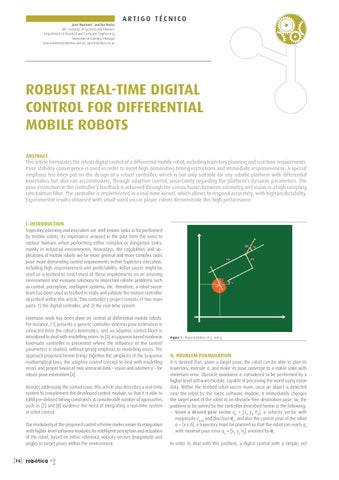
Figure 1 . Representation of qc and qd.
II. PROBLEM FORMULATION It is desired that, given a target pose, the robot can be able to plan its trajectory, execute it, and make its pose converge to a stable state with minimum error. Obstacle avoidance is considered to be performed by a higher level software module, capable of perceiving the world using vision data. Within the testbed robot soccer team, once an object is detected near the robot by the tactic software module, it immediately changes the target point of the robot to an obstacle-free destination pose. So, the problem to be solved by the controller described herein is the following: t (JWFO B EFTJSFE QPTF WFDUPS qd = [xd yd hd], a velocity vector with magnitude vmod and direction ev , and also the current pose of the robot q = [x y h], a trajectory must be planned so that the robot can reach qd with minimal pose error qe = [xe ye he] oriented by ev . In order to deal with this problem, a digital control with a simple, yet
"35*(0 5ÂŤ$/*$0
controller. These remarkable results allow the robot to precisely reach a desired target point and proceed to the next one with high precision.
Figure 6 . Robot-soccer player robot. Figure 8 . Instruction setTrajectory – case 2: Start point is the far left robot representation and the final position is the far right white dot.
The system is very accurate even in the presence of sensor noise. It is capable of reconfiguring the trajectory if it is placed elsewhere on the environment during the motion execution, due to the effective pose error elimination accomplished by the controller. The real-time system allows to attain dynamic responsiveness and task scheduling. For instance, due to the robust projected task priority system, the controller runs in parallel with the setTrajectory task which, in turn, checks periodically the distance left to the target point. The robot accurately switches the movement to reach the next target point, as soon as the actual target point accomplishment is detected.
VII. CONCLUSION Figure 7 . Instruction setTrajectory – case 1: Start point is the far left robot representation and the final one is the same as the start point.
As for task activation times, the observed values possess an average value of 10ms. These times are perfectly acceptable for the application. These practical results demonstrate that the system’s timing requirements are successfully met.
A real-time controller for pose error elimination of differential mobile robots was developed, which includes a trajectory planning algorithm. In the controller’s theoretical formulation, particular emphasis was given to the design of a generic control scheme, robust against errors in the estimation of the robot’s dynamic parameters. The projection of the real-time system was made so that specific timing constraints were also met. Experimental results obtained on a real mobile robot reveal that the proposed approach is not only valid but also robust. It allows the robot to correct its trajectory, leading it to converge to the desired pose.
VI. EXPERIMENTAL RESULTS A high number of experimental results with the robot on the field (see Fig. 6) were carried out in order to validate the proposed real-time controller. The following results were achieved by setting target points on the field which the mobile robot had to reach. The images represent screenshots of the developed visualization tool that depicts an on-line virtual representation of what is happening on the (real) field. It only receives data from the robot to update the image. Red dots represent the virtual points associated with the planned trajectory, white dots the actual (real) trajectory performed by the robot and the blue mark the real representation of the robot when a target is reached. The final position is not represented. As it can be seen from both Fig. 7 and 8, the robot accurately follows the self-planned virtual point paths, which validates not only the developed controller approach but also the trajectory planning capability. It is important however to underline that the virtual point path plan is made accordingly with a velocity vector with no stop point defined (visible by the red dots that go farther than the desired point to achieve. The stop point is detected by the setTrajectory task, which is periodically checking the distance to the desired point.
REFERENCES < > (IPMJQPVS " :B[EBOQBOBI . + %ZOBNJD USBDLJOH DPOUSPM PG OPOIPMPOPNJD NPCJMF SPCPU with model reference adaptation for uncertain parameters, in proc. ECC2003: European Control Conference, Cambridge, UK, Sep. 2003. [2] M. Vidygascar, Nonlinear Systems Analysis, Prentice Hall, New Jersey, NJ; 1993. < > ,BOBZBNB : ,JNVSB : .JZB[BLJ ' BOE /PHVDIJ 5 i" 4UBCMF 5SBDLJOH $POUSPM .FUIPE for an Autonomous Mobile Robot�, in: Proc. of the IEEE Internat. Conf. on Robotics and Automation, 1990, pp. 384-389. < > -BSTFO 5 % #BL . "OEFSTFO / " BOE 3BWO 0 i-PDBUJPO FTUJNBUJPO GPS BVUPOPNPVTMZ guided vehicle using an augmented Kalman filter to autocalibrate the odometry�. In FUSION98 Spie Conference, Las Vegas, USA, July 1998. < > % 8BOH (VBOHZBO 9V w'VMM 4UBUF 5SBDLJOH BOE *OUFSOBM %ZOBNJDT PG /PO)PMPOPNJD Wheeled Mobile Robots�, in Proc. of the American control Conference, June, 2000, pp. 3274 - 3278. [6] A. Martinelli, R. Siegwart, Estimating the Odometry Error of a Mobile Robot During Navigation, in Proc. of European Conference on Mobile Robots, ECMR03. < > 3 1JTTBSE (JCPMMFU , ,BQFMMPT 1 3JWFT $POUBDU + + #PSSFMMZ i3FBM UJNF QSPHSBNming of mobile robot actions using advanced control techniques�, Springer Berlin / Heidelberg 1997 < > ) #VSLIBSE i3FBM UJNF DPOUSPM GPS BVUPOPNPVT NPCJMF SPCPUTw 'VOEBNFOUB *OGPSmaticae, IOS Press Amsterdam, Netherlands, 2002, pp. 251 - 270.
robĂłtica [21]