ARTIGO TÉCNICO Nuno Lau1, Member, IEEE, Luís Seabra Lopes1, Member, IEEE, Gustavo A. Corrente2 1 Transverse Activity on Intelligent Robotics - IEETA, Dep. of Electronics, Telecommunications and Informatics, Universidade de Aveiro, Portugal {nunolau, lsl}@ua.pt 2 Nokia Siemens Networks Portugal / Aveiro, Portugal gustavo@ua.pt
CAMBADA: INFORMATION SHARING AND TEAM COORDINATION ABSTRACT This paper presents the architecture, information sharing and team coordination methodologies of the CAMBADA RoboCup middlesize league (MSL) team. An overview of the software architecture and individual decision capabilities of the agents is also presented. The information sharing and integration strategy is designed to both improve the accuracy of world models and to support the team coordination. Part of the coordination model is based on previous work in the Simulation League, which has been adapted to the MSL environment. With the described design, CAMBADA reached the 1st place in the Portuguese Robotics Open in 2007 and the 5th place in RoboCup 2007 world championship. I. INTRODUCTION ROBOTIC soccer is currently one of the most popular research domains in the area of multi-robot systems. The RoboCup rules and regulations for different robotic soccer modalities are widely accepted and followed. Many robotic soccer projects use RoboCup competitions for testing and validation of the adopted approaches. In the context of RoboCup, the so-called “middle-size league” (MSL) is one of the most challenging, since robotic players must be completely autonomous and must play in a field of 12 m x 18 m [13]. In this modality, teams are composed of at most six wheeled robots with a maximum height of 80 cm and a maximum weight of 40 Kg. The rules of this modality establish several constraints to simplify perception and world modeling. In particular, the ball is orange, the field is green, the field lines are white, the players are black, etc. The duration of a game is 30 minutes, not including a halftime interval of 5 minutes. The referee orders are communicated to the teams using an application called “referee box”. The referee box sends the referee orders to the team through a wired LAN TCP link connected to the base station of each team. It is the team’s responsibility to communicate these orders to the robots inside the field via standard wireless LAN. No human interference is allowed during the games except for removing malfunctioning robots and re-entering robots in the game.
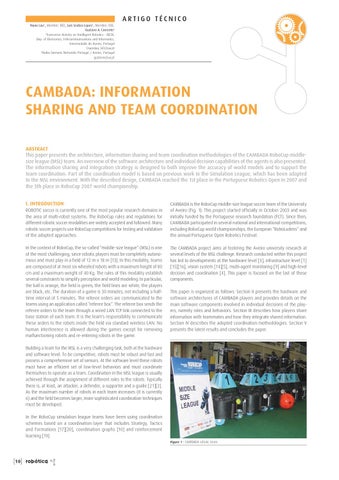
CAMBADA is the RoboCup middle-size league soccer team of the University of Aveiro (Fig. 1). This project started officially in October 2003 and was initially funded by the Portuguese research foundation (FCT). Since then, CAMBADA participated in several national and international competitions, including RoboCup world championships, the European “RoboLudens” and the annual Portuguese Open Robotics Festival. The CAMBADA project aims at fostering the Aveiro university research at several levels of the MSL challenge. Research conducted within this project has led to developments at the hardware level [3], infrastructure level [1] [15][16], vision system [14][5], multi-agent monitoring [9] and high-level decision and coordination [4]. This paper is focused on the last of these components. This paper is organized as follows: Section II presents the hardware and software architectures of CAMBADA players and provides details on the main software components involved in individual decisions of the players, namely roles and behaviors. Section III describes how players share information with teammates and how they integrate shared information. Section IV describes the adopted coordination methodologies. Section V presents the latest results and concludes the paper.
Building a team for the MSL is a very challenging task, both at the hardware and software level. To be competitive, robots must be robust and fast and possess a comprehensive set of sensors. At the software level these robots must have an efficient set of low-level behaviors and must coordinate themselves to operate as a team. Coordination in the MSL league is usually achieved through the assignment of different roles to the robots. Typically there is, at least, an attacker, a defender, a supporter and a goalie [21][2]. As the maximum number of robots in each team increases (it is currently 6) and the field becomes larger, more sophisticated coordination techniques must be developed. In the RoboCup simulation league teams have been using coordination schemes based on a coordination layer that includes Strategy, Tactics and Formations [17][20], coordination graphs [10] and reinforcement learning [19]. Figure 1 . CAMBADA robotic team.
[10]
robótica
The playon decision that assigns the Striker role and the positionings of the other robots in the formation is performed using an algorithm similar to DPRE [17], but with the innovation of considering different priorities for the different roles and positionings, so that the most important ones are always covered as the number of active players varies. The algorithm is presented in Fig. 9. Considering a team of R field players (not counting the goal-keeper which has a different mechanical configuration and therefore a fixed role), to assign the role and positioning to each robot, the distances of all robots to all strategic positions are calculated. Then the Striker role is assigned to the robot that is closest to the highest priority strategic position, which is in turn the closest to the ball. From the remaining R-1 robots the closest to the defensive positioning (second highest priority) is assigned to this positioning, then the closest to the third level priority positioning is assigned next and the algorithm continues until all active robots have positionings and roles assigned. This algorithm results in the Striker role having top priority, followed by the defensive positioning, followed by the other supporter positionings. The assignment algorithm may be performed by the coach agent in the base station, assuring a coordinated assignment result, or locally by each robot, in which case the inconsistencies of world models may lead to unsynchronized assignments.
the addition of new sensors. Access to the world model is performed by using specific queries. The adaptation of SBSP and DPRE [17][18] to the Middle-Size League environment resulted in a coordinated behavior of the team that contributed to its recent successes. The formation flexibility and adaptability was one of the components presented by CAMBADA in the 2nd Technical Challenge of RoboCup 2007 (based on Challenge 6 of [13]), Atlanta, where the team ranked in the 4th place. The robot malfunctions decrease the number of field players, but the positioning/role assignment algorithm maintains a competitive formation with fewer players in the field. Set plays were very efficient as several of the CAMBADA goals were the direct result of their activation. The work described in this paper was used in two RoboCup competitions: a. Portuguese Robotics Open 2007 (Portugal): 1st place, 6 wins, 0 draws, 0 looses, 16 goals scored and 3 goals suffered; b. RoboCup2007 (USA): 5th place, 7 wins, 1 draws, 1 looses, 24 goals scored and 7 goals suffered.
ACKNOWLEDGMENT The authors and the other CAMBADA team members thank Stefen Welker (Tribots team member) for the supplied material on the localization module, it was very useful to improve our team. Part of this work was funded through a research scholarship granted by IEETA.
REFERENCES [1]
MSL_DPRE(robotPositions, ballPosition, formation) clear assignments determine strategicPositions[N_POSITIONS] determine distSP[N_POSITIONS][N_ROBOTS] for each SPos sorted by priority determine closest free Agent to SPos assign SPos to Agent
[2]
[3]
[4]
Return assignments [5]
Figure 9 . CAMBADA Positioning/Role assignment algorithm. [6]
C. Set plays
[7]
One other coordination methodology that is being used in CAMBADA is the use of predefined set plays. Currently set plays are only initiated when re-entering the play-on mode. Set plays define a sequence of behaviors for several robots in a coordinated way. Each of the tasks that compose a set play are implemented using a special role. These roles are activated at the specific situation: kick-off, kick in, corners, free kicks and goal kicks.
[8] [9]
The assignment of the Barrier, Replacer and Toucher roles is executed by sorting the agents according to their perceived distances to the ball and selecting the closest ones, up to the maximum number of agents in each role. When selecting a role like the Replacer, which is exclusive, the agent looks at the other teammates role decisions and if it finds a Replacer with a lower uniform number it will never select the Replacer role. A similar approach is performed for the other roles. This assignment is always performed locally by each robot.
[10] [11] [12]
[13] [14] [15]
[16]
[17]
[18]
[19]
V. CONCLUSION The data structures used for world state representation clearly separate the raw sensor information from the world model that results of integrating local and shared information. This architecture is easily adaptable to
[14]
robótica
[20] [21]
Almeida, L., F. Santos, T. Facchinetti, P. Pedreira, V. Silva and L. Seabra Lopes, Coordinating Distributed Autonomous Agents with a Real-Time Database: The CAMBADA Project, Computer and Information Sciences - ISCIS 2004: 19th International Symposium, Proceedings, Aykanat, Cevdet; Dayar, Tugrul; Korpeoglu, Ibrahim, eds., pp. 876-886, Lecture Notes in Computer Science, Vol. 3280, 2004. M. Arbatzat, S. Freitag, M. Fricke, R. Hafner, C. Heermann, K. Hegelich, A. Krause, J. Krüger, M. Lauer, M. Lewandowski, A. Merke, H. Müller, M. Riedmiller, J. Schanko, M. Schulte-Hobein, M. Theile, S. Welker, D. Withopf: Creating a Robot Soccer Team from Scratch: the Brainstormers Tribots Proceedings of Robocup 2003, Padua, Italy, 2003 Azevedo, J.L., M.B. Cunha, L. Almeida, Hierarchical Distributed Architectures for Autonomous Mobile Robots: a Case Study. Proc. ETFA2007- 12th IEEE Conference on Emerging Technologies and Factory Automation, Patras, Greece, 2007. Bartolomeu, P., L. Seabra Lopes, N. Lau, A. Pinho, L. Almeida, Integração de Informação na Equipa de Futebol Robótico CAMBADA, Electrónica e Telecomunicações, vol. 4 (4), pp. 467-477, Universidade de Aveiro, Portugal, 2005. Cunha, B., J. Azevedo, N. Lau, L. Almeida, Obtaining the Inverse Distance Map from a Non-SVP Hyperbolic Catadioptric Robotic Vision System, U. Visser, F. Ribeiro, T. Ohashi, and F. Dellaert, editors, RoboCup-2007: Robot Soccer World Cup XI, LNAI, Springer Verlag, Berlin, 2008. Ferrein, A., L. Hermanns and G. Lakemeyer, Comparing Sensor Fusion Techniques for Ball Position Estimation, RoboCup 2005: Robot Soccer World Cup IX, A. Bredenfeld, A. Jacoff, I. Noda and Y. Takahashi, eds., Lecture Notes in Computer Science 4020, Springer, 2006 Ferreira, J.; Pedreiras, P.; Almeida, L.; Fonseca, J.A. The FTT-CAN protocol for flexibility in safety-critical systems, IEEE Micro, vol. 22 (4), pp. 46 – 55, 2002. Festival Nacional de Robótica’2007, Paderne, Portugal, http://www.ccvalg.pt/robotica2007/, 2007 Figueiredo, J., Lau, N., Pereira, A. Multi-Agent Debugging and monitoring framework, Proc. First IFAC Workshop on Multivehicle Systems (MVS’06), Brasil, October, 2006. Kok, J.; Spaan, M. and Vlassis, N., Non-communicative multi-robot coordination in dynamic environments. Robotics and Autonomous Systems, vol. 50 (2-3), pp. 99–114, Elsevier Science, 2005. Kopetz, H., Real-Time Systems Design Principles for Distributed Embedded Applications, Kluwer, 1997. Lauer, M., S. Lange and M. Riedmiller, Calculating the perfect match: An efficient and accurate approach for robot self-localisation, RoboCup 2005: Robot Soccer World Cup IX, A. Bredenfeld, A. Jacoff, I. Noda and Y. Takahashi, eds., LNCS 4020, Springer, 2005 MSL Technical Committee 1997-2008, Middle Size Robot League Rules and Regulations for 2008. Draft Version - 12.2 20071109, November 9, 2007. Neves, A.; Corrente, G. and Pinho A., An omnidirectional vision system for soccer robots. In Progress in Artificial Intelligence, Springer Berlin / Heidelberg, Lecture Notes in Computer Science. Berlin, 2007. Pedreiras, P., F. Teixeira, N. Ferreira, L. Almeida, A. Pinho, F. Santos, Enhancing the reactivity of the vision subsystem in autonomous mobile robots using real-time techniques, RoboCup-2005: Robot Soccer World Cup IX, LNCS 4020, I. Noda, A. Jacoff, A. Bredenfeld, and Y. Takahashi, eds., Springer Verlag, Berlin, 2006. Pedreiras, P.; Almeida, L., Task Management for Soft Real-Time Applications Based on General Purpose Operating Systems, In Robotic Soccer, edited by: Pedro Lima, Itech Education and Publishing, Vienna, Austria, 2007, ISBN 978-3-902613-21-9. Reis, L.P. and N. Lau, FC Portugal Team Description: RoboCup 2000 Simulation League Champion, RoboCup-2000: Robot Soccer World Cup IV, P. Stone, et al. eds., LNAI 2019, pp. 29-40, Springer Verlag, 2001, ISBN 3-540-42185-8 Reis, L.P. and N. Lau, and E.C. Oliveira, Situation Based Strategic Positioning for Coordinating a Team of Homogeneous Agents, Balancing Reactivity and Social Deliberation in Multiagent Sytems: From RoboCup to Real Word Applications, M. Hannenbauer, J. Wendler, and E. Pagello eds., LNAI 2103, pp. 175-197, Springer-Verlag, 2001, ISBN 3-540-42327-3 Riedmiller, M. Gabel, T.,On Experiences in a Complex and Competitive Gaming Domain: Reinforcement Learning Meets RoboCup, In Proceedings of the 3rd IEEE Symposium on Computational Intelligence and Games (CIG 2007), pp. 17-23. IEEE Press, April 2007. Stone, P. and M. Veloso, Task Decomposition, Dynamic Role Assignment and Low Bandwidth Communication for Real Time Strategic Teamwork, Artificial Intelligence, vol. 110 (2), pp. 241-273, 1999. Weigel, T. W. Auerbach, M. Dietl, B. Dümler, J.S. Gutmann, K. Marko, K. Müller, B. Nebel, B. Szerbakowski and M. Thiel, CS Freiburg: Doing the Right Thing in a Group, RoboCup 2000: Robot Soccer World Cup IV, P. Stone, G. Kraetzschmar, T. Balch, eds., pp. 52-63, Springer-Verlag, 2001.
CAMBADA: INFORMATION SHARING AND TEAM COORDINATION
be able to function with a varying number of active players in the team, either because of hardware or software malfunctioning or because of referee orders. These are very common situations in the MSL.