ARTIGO TÉCNICO António J. R. Neves, Daniel A. Martins, Armando J. Pinho e José Luís Azevedo Transverse Activity on Intelligent Robotics, IEETA / DETI University of Aveiro, Portugal {an, dam, ap, jla}@ua.pt
AN EFFICIENT REAL-TIME HYBRID VISION SYSTEM FOR SOCCER ROBOTS ABSTRACT In many robotic applications, autonomous robots must be capable of locating the objects that they have to manipulate. In the case of autonomous soccer robots, they must, at least, be able to locate the ball, the opponent robots and the team robots, and also to collect field information essential for self-localization. The recognition of colored objects is very important for robot vision in RoboCup Middle Size League competition. This paper describes an efficient hybrid vision system developed for the robotic soccer team of the University of Aveiro, CAMBADA (Cooperative Autonomous Mobile roBots with Advanced Distributed Architecture). The hybrid vision system integrates an omnidirectional and a perspective camera. The omnidirectional sub-system is used by our localization algorithm for finding the ball, detecting the presence of obstacles and white lines. The perspective vision is used to find the ball and obstacles in front of the robot at larger distances, which are difficult to detect using the omnidirectional vision system. In this paper, we present a set of algorithms for efficiently extracting the color information of the acquired images and, in a second phase, for extracting the information of all objects of interest. We developed an efficient color extraction algorithm based on lookup tables and we use a radial model for object detection, both in the omnidirectional and perspective sub-system. The CAMBADA middle-size robotic soccer team won the 2008 RoboCup World Championship and the 2007 and 2008 Portuguese Robotics Festival. These results show the effectiveness of our algorithms. Moreover, our experiments show that the system is fast and accurate having a constant processing time independently of the environment around the robot, which is a desirable property of Real-Time systems.
1. INTRODUCTION Vision is an extremely important sense for both humans and robots, providing detailed information about the environment. A robust vision system should be able to detect objects reliably and provide an accurate representation of the world to higher level processes. The vision system must also be highly efficient, allowing a resource-limited agent to respond quickly to a changing environment. Each frame acquired by a digital camera must be processed in a small, usually fixed, amount of time. Algorithmic complexity is therefore constrained, introducing a trade-off between processing time and the quality of the information acquired.
camera. The system finds the white lines of the playing field (used for selflocalization), the ball and obstacles. Our vision system architecture uses a distributed paradigm where the main tasks, namely, image acquisition, color extraction, object detection and image visualization, are separated into several processes, as presented in Fig. 2.
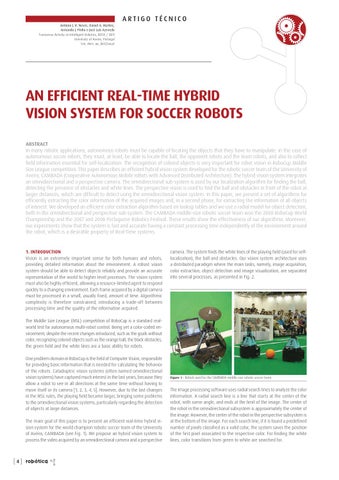
The Middle Size League (MSL) competition of RoboCup is a standard realworld test for autonomous multi-robot control. Being yet a color-coded environment, despite the recent changes introduced, such as the goals without color, recognizing colored objects such as the orange ball, the black obstacles, the green field and the white lines are a basic ability for robots. One problem domain in RoboCup is the field of Computer Vision, responsible for providing basic information that is needed for calculating the behavior of the robots. Catadioptric vision systems (often named omnidirectional vision systems) have captured much interest in the last years, because they allow a robot to see in all directions at the same time without having to move itself or its camera [1, 2, 3, 4, 5]. However, due to the last changes in the MSL rules, the playing field became larger, bringing some problems to the omnidirectional vision systems, particularly regarding the detection of objects at large distances. The main goal of this paper is to present an efficient real-time hybrid vision system for the world champion robotic soccer team of the University of Aveiro, CAMBADA (see Fig. 1). We propose an hybrid vision system to process the video acquired by an omnidirectional camera and a perspective
[4]
robótica
Figure 1 . Robots used by the CAMBADA middle-size robotic soccer team.
The image processing software uses radial search lines to analyze the color information. A radial search line is a line that starts at the center of the robot, with some angle, and ends at the limit of the image. The center of the robot in the omnidirectional subsystem is approximately the center of the image. However, the center of the robot in the perspective subsystem is at the bottom of the image. For each search line, if it is found a predefined number of pixels classified as a valid color, the system saves the position of the first pixel associated to the respective color. For finding the white lines, color transitions from green to white are searched for.
ARTIGO TÉCNICO
Figure 10 . On the left, examples of original images acquired by the perspective vision sub-system. In the center, the corresponding image of labels. On the right, the color blobs detected in the images. Marks over the ball point to the mass center. The cyan marks are the position of the obstacles.
Figure 11 . On the left, examples of original images acquired by the omnidirectional vision sub-system. In the center, the corresponding image of labels. On the right, the color blobs detected in the images. Marks over the ball point to the mass center. The several marks near the white lines (magenta) are the position of the white lines. The cyan marks are the position of the obstacles.
[7]
J. L. Azevedo, B. Cunha, and L. Almeida, “Hierarchical distributed architectures for autonomous mobile robots: a case study,” in Proc. of the 12th IEEE Conference on Emerging Technologies and Factory Automation, ETFA2007, Greece, 2007, pp. 973–980. [8] L. Almeida, P. Pedreiras, and J. A. Fonseca, “The FTT-CAN protocol: Why and how,” IEEE Transactions on Industrial Electronics, vol. 49, no. 6, pp. 1189–1201, 2002. [9] L. Almeida, F. Santos, T. Facchinetti, P. Pedreira, V. Silva, and L. S. Lopes, “Coordinating distributed autonomous agents with a real-time database: The CAMBADA project,” in Proc. of the 19th International Symposium on Computer and Information Sciences, ISCIS 2004. 2004, vol. 3280 of Lecture Notes in Computer Science, pp. 878–886, Springer. [10] J. Silva, N. Lau, J. Rodrigues, and J. L. Azevedo, “Ball sensor fusion and ball interception behaviours for a robotic soccer team,” in Proc. of the 11th edition of the Ibero-American Conference on Artificial Intelligence, IBERAMIA 2008, Lisbon, Portugal, october 2008. [11] P. Pedreiras, F. Teixeira, N. Ferreira, L. Almeida, A. Pinho, and F. Santos, “Enhancing the reactivity of the vision subsystem in autonomous mobile robots using real-time techniques,” in Proc. of RoboCup 2006. 2006, vol. 4020 of Lecture Notes in Computer Science, pp. 371–383, Springer. [12] P. Pedreiras and L. Almeida, Task Management for Soft Real-Time Applications Based on General Purpose Operating Systems, Robotic Soccer, Itech Education and Publishing, Vienna, Austria, 2007.
[13] N. Lau, L. S. Lopes, and G. Corrente, “CAMBADA: information sharing and team coordination,” in Proc. of the 8th Conference on Autonomous Robot Systems and Competitions, Portuguese Robotics Open - ROBOTICA’2008, Aveiro, Portugal, April 2008, pp. 27–32. [14] F. Santos, G. Corrente, L. Almeida, N. Lau, and L. S. Lopes, “Self-configuration of an adaptive TDMA wireless communication protocol for teams of mobile robots,” in Proc. of the 13th Portuguese Conference on Artificial Intelligence, EPIA 2007, Guimarães, Portugal, December 2007. [15] A. J. R. Neves, G. Corrente, and A. J. Pinho, “An omnidirectional vision system for soccer robots,” in Progress in Artificial Intelligence. 2007, vol. 4874 of Lecture Notes in Artificial Inteligence, pp. 499–507, Springer. [16] A. J. R. Neves, D. A. Martins, and A. J. Pinho, “A hybrid vision system for soccer robots using radial search lines,” in Proc. of the 8th Conference on Autonomous Robot Systems and Competitions, Portuguese Robotics Open - ROBOTICA’2008, Aveiro, Portugal, April 2008, pp. 51–55. [17] D. A. Martins, A. J. R. Neves, and A. J. Pinho, “Real-time generic ball recognition in RoboCup domain,” in Proc. of the 11th edition of the Ibero-American Conference on Artificial Intelligence, IBERAMIA 2008, Lisbon, Portugal, october 2008. [18] J. E. Bresenham, “Algorithm for computer control of a digital plotter,” IBM Systems Journal, vol. 4, no. 1, pp. 25–30, 1965.
robótica
[9 ]