ARTIGO TÉCNICO F. Gómez-Bravo, A. Ollero*, F. Cuesta*, D. López Escuela Politécnica Superior, Universidad de Huelva, Spain {fernando.gomez, diego.lopez}@diesia.uhu.es *Escuela Superior de Ingenieros Universidad de Sevilla, Spain {aollero, fede}@cartuja.us.es *Corresponding author: fernando.gomez@diesia.uhu.es
A NEW APPROACH FOR CAR-LIKE ROBOTS MANOEUVRING BASED ON RRT ABSTRACT This paper presents a new approach for the extension of the Rapidly Exploring Random Trees (RRT) path-planning algorithm to car-like vehicles, providing simple solutions in complex scenarios with low computational cost. The proposed method combines the advantages of RRT for exploring the free space with a technique for the generation of feasible paths developed from the concept of restricted manoeuvres.
I. INTRODUCTION
II. RAPIDLY EXPLORING RANDOM TREES (RRT)
Mobile robots motion planning involves the problem of searching for collision-free paths connecting a starting and a goal configuration. The path must accomplish several constraints imposed by obstacles and the robot kinematics. This topics has been largely approached in the literature [2], [8], [7], [19]. Especially the randomized methods have focused considerable attention in recent years [15], [16], [17]. For instance, in the randomized potential field approaches, random walks are used to help escape if the search becomes locked on a local minimum [2]. Another example of a randomized planning technique is the probabilistic roadmap method [16], [17]. This technique built up a graph in the configuration space by choosing many configurations at random, and using a local planner to connect pairs of nearby configurations. This approach might require the connections of thousand of configurations to find a solution. Furthermore, in general, the connection problem can be as difficult as designing a non linear controller.
The RRT is a path planning algorithm which provides continuous paths connecting a initial configuration, qinit, with a goal configuration, qgoal by applying a random method. Each configuration specifies the position and orientation of the robot in a 2D or 3D scenario. Obstacles and constraints can be defined. Let C be the set of configurations that the robot might have, regardless of existing obstacles. Thus, Cfree denotes the set of collisionfree configurations. It is assumed that a metric R is defined in C.
The Rapidly Exploring Random Trees [1], or RRT arises to improve the solutions to the path-planning problems. In this method there are not potential function because is a purely randomized technique. Also it does not require as many configurations as the probabilistic roadmap and is easy to extend to high-dimensional configuration spaces, yet to include different constraints. Many versions have been published, like the RRT Connect [4] or the ERRT [6], to fit RRT to different scenarios. There are several approaches for extending the RRT algorithms to nonholonomic vehicles [3], [6]. This article proposes applying the RRT algorithm to car-like robots similarly as was applied to differential drive vehicles in [18]. The method can be easily extended to more complicated nonholonomic system and provides simple solutions. This new approach presents a better performance and allows the RRT to work without dealing with kinematic constraints, improving the algorithm efficiency. The paper is organized as follows: At the following section the RRT method is described. The traditional application of the RRT algorithm in nonholonomic systems is introduced in section 3. Section 4 presents the basis for car-like vehicles manoeuvring. Section 5 is devoted to explain the proposed approach for applying the RRT algorithm to car-like vehicles. Finally, in section 6, simulation results are presented. The paper ends with the conclusions and the references.
[ ]
robótica
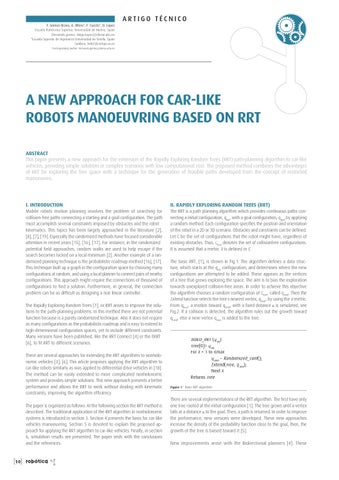
The basic RRT, [1], is shown in Fig.1. The algorithm defines a data structure, which starts at the qinit configuration, and determines where the new configurations are attempted to be added. These appears as the vertices of a tree that grows exploring the space. The aim is to bias the exploration towards unexplored collision-free areas. In order to achieve this objective the algorithm chooses a random configuration of Cfree, called qrand. Then the Extendd function selects the tree´s nearest vertex, qnear, by using the R metric. From qnear, a motion toward qrand, with a fixed distance H is simulated, see Fig.2. If a collision is detected, the algorithm rules out the growth toward qrand, else a new vertex qnew is added to the tree.
BUILD_RRTT (qinit) Tree[0]= qinit For k = 1 to Kmax qrandd = Randomized_conff(); Extend(Tree, qrand); Next k Returns Tree Figure 1 . Basic RRT algorithm
There are several implementations of the RRT algorithm. The first have only one tree rooted at the initial configuration [1]. The tree grows until a vertex falls at a distance H to the goal. Then, a path is returned. In order to improve the performance, new versions were developed. These new approaches increase the density of the probability function close to the goal, then, the growth of the tree is biased toward it [5]. New improvements arose with the Bidirectional planners [4]. These
ACKNOWLEDGMENTS This work has been partially supported by the National Spanish Research Program (project DPI2005-02293) and the AWARE project (IST-033579) funded by the European Commission.
REFERENCES [1] S. M. LaValle. Rapidly-exploring random trees: A new tool for path planning. TR 98-11, Computer Science Dept., Iowa State University (Oct. 1998). [2] J. C. Latombe “Robot Motion Planning”, Kluwer Academic Pulisher (1991). [3] S. M. LaValle and J. J. Kuffner. Randomized kinodynamic planning. In Proc. IEEE Int’l Conf. on Robotics and Automation, pages 473--479 (1999). [4] J. J. Kuffner and S. M. LaValle. RRT-connect: An efficient approach to singlequery path planning. In Proc. IEEE Int’l Conf. on Robotics and Automation, pages 995--1001, 2000. [5] S. M. LaValle and Kuffner. Rapidly-Exploring Random Trees: Progress and Prospects. Algorithmic and Computational Robotics: New Directions (May 2001) [6] Xiaoshan Pan, “Wheelchair Robotic Motion Planning” Civil and Enviromental Engineering, Standford University. [7] J. Bruce, Manuela Veloso “Real-Time Randomized Path Planning for Robot Navigation”, Computer Science Department, Carnegie Mellon University. 2002. [8] J.P. Laumont, P.E. Jacobs, M. Taix and M. Murray.“A Motion Planner for Nonholonomic Mobile Robots”.IEEE Trans. on Robotics and Autom,Vol 10,No 5:577-593 (1994). [9] F. Gómez Bravo, F. Cuesta and A. Ollero. “Parallel and diagonal parking in nonholonomic autonomous vehicles”. Engineering Aplication of Artificial Inteligence. Vol 14 No. 1, pp 419-434 (2001). [10] F. Gómez-Bravo, J. M. Martín Rámos, D. López García. “Aplicación De Técnicas De Decisión Multicriterio A La Planificación De Maniobras En Robots No Holónomos”. II Simposium de Control Inteligente CEA-IFAC (2006). [11] A. Ollero, B.C. Arrue, J. Ferruz, G. Heredia, F. Cuesta, F. López-Pichaco, and C. Nogales. “Control and perception componenets for autonomous vehicle guidance. Application to the Romeo vehicles”. Control Eng. Practice, vol. 7, no 10 pp. 1291-1299 (1999). [12] A. Ollero. “Robótica: manipuladores y Robots Móviles”. Marcombo Boixareu (2001). [13] F. Cuesta, F. Gómez-Bravo, A.Ollero. “Parking Manoeuvres of IndustrialLike Electrical Vehicles With and Without Trailer”. IEEE Trans. on Industrial Electronics. Vol. 51 nº 2- pp. 257-269 (2004) [14] Peng Cheng and Zuojun Shen and Steven M. LaValle. “RRT-Based Trajectory
b) Figure 8 . Two different feasible solutions.
Design for Autonomous Automobiles and Spacecraft” Archives of Control Sciences, Vol. 11 (XLVII), No, 3-4, pages 167-194 (2001). [15] J. Barraquand and J. C. Latombe. “Robot motion planning: A distributed
VII. CONCLUSIONS This paper propose a new method to apply the RRT algorithm for planing feasible manoeuvres in a car-like robot. The method takes advantage of the RRT algorithm capability for exploring the free space, and, at the same time, uses feasible paths developed from the concept of restricted manoeuvres. The method is based on a simplifying technique which allows to connect pair of vertices of the tree provided by the RRT by means of a set of connecting paths. The technique is capable of generating, in short time, a collection of different and admissible solutions. Future works will consider more complex vehicles. The development of an equivalent set of restricted manoeuvre will allow to extend this technique to this type of systems.
[ ]
robótica
representation approach” Int. J. Robot. Res., December (1991). [16] N. M. Amato and Y. Wu. “A randomized roadmap method for path and manipulation planning.” In IEEE Int. Conf. Robot. & Autom. (1996) [17] L. E. Kavraki, P. Svestka, J. C. Latombe, and M. H. Overmars. “Probabilistic roadmaps for path planning in high-dimensional configuration spaces”. IEEE Trans. Robot & Autom., (1996). [18] D. López, F. Gómez-Bravo, F. Cuesta and A. Ollero (2006). ‘Aplicación del algoritmo RRT a la aplicación de movimientos en robots noholónomos’. Revista Iberoamericana de Automática y Informática Industrial (RIAI).Vol.: 3 pp: 56-67 (2006) [19] S. M. LaValle, 2006, Planning algorithms, Cambridge University Press, Cambridge.