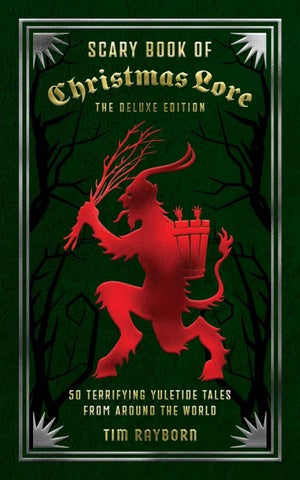
Scary Book of Christmas Lore Copyright © 2026 by HarperCollins Focus LLC. All rights reserved. No part of this book may be reproduced in whole or in part, scanned, photocopied, recorded, distributed in any printed or electronic form, or reproduced in any manner whatsoever, or by any information storage and retrieval system now known or hereafter invented, without express written permission of the publisher, except in the case of brief quotations embodied in critical articles and reviews. Published by Cider Mill Press, an imprint of HarperCollins Focus LLC, 501 Nelson Place, Nashville, TN 37214 USA. The scanning, uploading, and distribution of this book via the internet or via any other means without permission of the publisher is illegal and punishable by law. Please support authors’ rights, and do not participate in or encourage piracy of copyrighted materials. 13-Digit ISBN: 978-1-40035-622-5 10-Digit ISBN: 1-4003-5622-9 Books published by Cider Mill Press Book Publishers are available at special discounts for bulk purchases in the United States by corporations, institutions, and other organizations. For more information, please contact the publisher. cidermillpress.com Any internet addresses, phone numbers, or company or product information printed in this book are offered as a resource and are not intended in any way to be or to imply an endorsement by Cider Mill Press, nor does Cider Mill Press vouch for the existence, content, or services of these sites, phone numbers, companies, or products beyond the life of this book. Without limiting the exclusive rights of any author, contributor or the publisher of this publication, any unauthorized use of this publication to train generative artificial intelligence (AI) technologies is expressly prohibited. HarperCollins also exercise their rights under Article 4(3) of the Digital Single Market Directive 2019/790 and expressly reserve this publication from the text and data mining exception. HarperCollins Publishers, Macken House, 39/40 Mayor Street Upper, Dublin 1, D01 C9W8, Ireland (https://www.harpercollins.com) Design by Steve Cooley Illlustration by Neil Evans Typography: Brokenscript OT, HWT Aetna, Meno Text Cover art and vectors used under official license from Shutterstock.com Printed in Vietnam 26 27 28 29 30 SEA 5 4 3 2 1 First Edition
50 TERRIFYING YULETIDE TALES FROM AROUND THE WORLD
Illustrations by Neil Evans
Table of Contents Introduction.......................................................... 7 St. Nicholas and the Butchered Children · Turkey........ 10 Krampus · Austria, Slovenia, Croatia, and Northern Italy......... 13 Frau Perchta · Austria and Bavaria......................................... 16 Frau Gaude · Germany.............................................................. 19 The Night Folk · Germany, Austria, and Switzerland............... 21 Türst · Switzerland..................................................................... 24 Sträggele · Austria and Germany............................................. 27 Belsnickel · Germany, France,
Switzerland, and Pennsylvania Dutch Country.............................. 28
Knecht Ruprecht · Germany.................................................. 31 Schonperchten and Schiachperchten · Austria............. 33 Rauhnacht · Germany.............................................................. 35 The Knocking Nights · Austria,
Germany, and Switzerland............................................................. 37
Pelzmärtel · Austria and Germany........................................... 40 Wild Barbaras · Bavaria......................................................... 41
4
SCARY BOOK OF CHRISTMAS LORE
Bloody Thomas · Bavaria...................................................... 44 Schmutzli · Switzerland............................................................ 46 A Host of Holiday Horrors ............................................... 48 The Original Nutcracker · Germany.................................. 50 The Wild Hunt · Germany and England................................... 53 Victorian Christmas Ghost Stories · England................ 56 Mari Lwyd · Wales................................................................... 58 The Nuckelavee · Orkney Islands............................................ 61 Père Fouettard · France, Belgium, and Switzerland................ 64 Hans Trapp · Alsace-Lorraine and France................................. 67 Zwarte Piet · Belgium and the Netherlands............................. 70 Grýla and Leppalúði · Iceland.............................................. 72 The Thirteen Yule Lads · Iceland......................................... 75 Jólakötturinn, the Yule Cat · Iceland................................ 78 The Tomte · Scandinavia............................................................ 81 Is Santa Claus Actually Odin? · Scandinavia................... 84 Is Santa Claus a Shaman? · Polar Regions......................... 86 Nuuttipukki and Joulupukki · Finland............................. 88 The Hiding of the Brooms · Norway................................... 91 Lussi · Scandinavia..................................................................... 94
SCARY BOOK OF CHRISTMAS LORE
5
Mummers · Latvia and Elsewhere............................................ 96 La Befana · Italy....................................................................... 99 Saturnalia · Ancient Rome..................................................... 102 The Kallikantzari · Greece, Bulgaria, Serbia, and Turkey..... 105 Bocuk and Bocuk Night · Thrace and Turkey.................... 108 The Karakoncolos · Turkey.................................................. 110 Good King Wenceslas Looked Down… and was Stabbed and Impaled · The Czech Republic ......113 Caga Tió · Catalonia.................................................................. 116 Winter Werewolves · Pan-European................................. 118 Christmas Spiders · Ukraine................................................ 121 Svyatki · Russia...................................................................... 124 Korochun · Slavic................................................................... 127 Santa Kuroshu and Other Traditions · Japan............. 129 Yuki-onna · Japan................................................................... 131 La Quema del Diablo, the Burning of the Devils · Guatemala............................. 134 The Modern Mystery of Danny the Ghost · South Africa…or Not...............................137
6
SCARY BOOK OF CHRISTMAS LORE
Introduction Ah, Christmas and all the other December holidays! A time of joy, happiness, feasts, mirth, convivial gatherings, and good feeling all around. In the Northern Hemisphere, it’s a time to celebrate the darkest nights of the year with light, food, music, and hope for the season, as well as to ring in the new year. But it’s also a time of cannibals, kidnappers, horrific monsters, ghosts, torture, zombies, demons, blood and gore, and all sorts of other nasty and terrifying things. As we delve into traditional December celebrations, especially in Europe, we find that there is no shortage of tales meant to terrify right alongside those meant to warm the heart (or perhaps, roast the heart until it is well done!). In this book, we’ll peel back the layers of Christmas cheer and see what’s hiding underneath, infesting the darkest corners of the cellar and lying in wait in the frozen forests for the unsuspecting, the misbehaving, and the disbelieving. A whole horde of horrors lies just outside the mortal realm, ready to spoil your holidays in the most appalling ways possible! We’ll meet Krampus, the most popular holiday demon of them all, and look at his nefarious deeds—all in the service to St. Nicholas, of course. But did you know that he has many counterparts, spread all across Germany, France, Austria, the Alps,
SCARY BOOK OF CHRISTMAS LORE
7
and beyond? There are an astonishing number of variations on the theme of a dark companion to St. Nicholas, and this book will highlight just a few. We’ll also venture into the winter darkness of Iceland, where the ogress Grýla waits to snatch up naughty children in a bag and take them back to her volcanic lair to boil them up in a tasty holiday stew. And if she isn’t bad enough, just wait until you meet the Yule Cat! Or maybe you’d like to answer the door and see a horse skull on a stick, its eye sockets decorated with Christmas ornaments. Be ready to trade clever verses with the revelers, or you’ll owe them food and drink. That’s Mari Lwyd, coming to a Welsh town near you! If you live in the Balkans, you might have good reason to fear the Kallikantzari, horrifying creatures who will cause no end of troubles in your home if you don’t take precautions and basically bribe them to leave you alone. Why are there all of these scary stories and creatures? Shouldn’t the holidays be a happy time? Yes indeed, but recall that in earlier times, the long part of the year was dreaded by most who lived in northern, colder climates. Survival through the long, dark months was not guaranteed, when food supplies could run out and sources of heat could be scarce. So, it makes perfect sense that fear of creatures that personified the dangers of the winter and the darkness would take hold in the popular imagination. The celebrations of Yule, Christmas, the solstice, and the New Year were all meant as a respite from the terrors of the time, but these were ever on the edge of the mind, and the village, waiting to claim the unwary on a bitter winter’s night. Scary holiday lore still fits right alongside conviviality in the minds of many. These folktales and beliefs were passed down for generations and often enacted in pageants and festivals as
8
SCARY BOOK OF CHRISTMAS LORE
reminders of winter dangers, or at least as preludes to the fun that followed. Some of these legends and celebrations probably had their origins in pre-Christian beliefs, which were later either tolerated or altered to fit into a more Christian framework. Many festivals all but died out, only to be resurrected over the last few decades as symbols of regional tradition and pride. For many in the Germanic regions of Europe especially, it simply wouldn’t be Christmas without monsters and mayhem. It’s in the spirit of that relationship that this book presents these wonderfully weird and terrifying tales and creatures. So have yourself a scary little Christmas and read on to learn about the many nightmares lurking in the holiday dark.
SCARY BOOK OF CHRISTMAS LORE
9
St. Nicholas and the Butchered Children Turkey
S
ince St. Nicholas is at the heart of many of these tales and legends, we’ll begin our journey down the dark paths of Christmas terrors with him. St. Nicholas, or St. Nick, is a handy alternate name for Santa Claus, but there really was a St. Nicholas, who lived in Asia Minor, in what is now Turkey, from about 270 CE until his death on December 6, 343 (December 6 is still his feast day). In his own time, he was Nicholas of Bari, a Greek bishop in an age when the Roman Empire was not officially Christian, or even close to having a majority of Christians in its population. Not too much is known about his actual biography, but quite a few legends sprung up about him during and after his life. Many of these stories tell about his generosity and his secretly giving gifts to people or money to those in need. He was quite possibly the first Secret Santa! One such story says that he prevented three girls from being forced into prostitution by dropping sacks of gold through their window each night for three nights, which allowed their father enough money to pay dowries for them. The father discovered him on the third night, but Nicholas told him not to tell anyone about this generosity. Nicholas was also said to have performed miracles, such as calming a stormy sea while he was sailing to the Holy Land, and driving out demons. But the most famous legend about him concerns the fate of three children and a very evil butcher.
10
SCARY BOOK OF CHRISTMAS LORE
The story goes that these three kids were out in the fields and lost track of time. They came to a town and to a butcher’s shop, which was lighted inside. They were tired and hungry, and now they were lost, so they knocked on the door. The butcher answered, and they asked him if they could have some food and a place to sleep for the night. He was only too happy to welcome them in, but he had no intention of giving them a warm welcome. Taking out a sharp knife, he killed and butchered each of them, dismembering them and placing the body parts in a barrel with brine for curing. He intended to sell the pieces as ham to unwary customers when the curing was finished (it brings to mind the story of Sweeney Todd!). A long time went by (some accounts say as much as seven years), but Nicholas learned of the crime and went to the butcher. He commanded that this evil man open up his salting barrel, and the butcher could do nothing but comply. Once open, Nicholas made the sign of the cross over it and commanded the children to rise. The three dismembered bodies were miraculously repaired and the children brought back to life. No word on what happened to the butcher, but later legends say that he was forced to work with Nicholas ever after as penance for his sins. We’ll meet some of his incarnations in this book. This weird legend seems to be a fairly late addition to the stories about Nicholas, probably originating in the Middle Ages, but from it, some began to see Nicholas as a patron saint of children. This, combined with his reputation for gift-giving, dovetailed nicely with winter traditions of presents and miracles, such that Nicholas now has pride of place as a holiday gift-giver in many European countries on December 6, even if he is accompanied by that miserable old Krampus! Which is who we’re meeting next, incidentally…
12
SCARY BOOK OF CHRISTMAS LORE
Krampus Bavaria, Austria, Slovenia, Croatia, and Northern Italy
K
rampus is, of course, the granddaddy of all European winter holiday monsters: a fearsome, furry demon with a terrible attitude that can’t wait to get out in the snow and cause mischief. He’s certainly not the oldest beastie haunting the holidays, but these days, he’s definitely the most famous, so it’s natural to begin our ghoulish gallery with him. Krampus accompanies St. Nicholas and has his very own night—the eve of St. Nicholas Day, in fact: (the night of December 5.) Krampusnacht is the time when he is most active, and when children have the most to fear. He is often depicted as a horned, satyr-like, goat-footed demon, carrying a large basket on his back, into which he will toss naughty children to drag them off to terrible tortures. He usually drags chains and carries a Rute, a bundle of birch branches that he uses to swat misbehaving children. If that’s all they get from him, they should count themselves lucky! His name might come from the old Bavarian krampn, meaning “dead,” or the German kramp, meaning “claw.” Either word seems like a good etymology for him. He has long been associated with St. Nicholas, and tales of Krampus and his punishments might date back as early as the seventh century, though it seems that the earliest written records of this frightening figure date to the end of the sixteenth or the early seventeenth century. It’s possible that fears of a menacing Alpine winter visitor predate Christianity, and that the legends and festivals were
SCARY BOOK OF CHRISTMAS LORE
13
intertwined with Christian belief when the church realized that they couldn’t be eliminated entirely. So this fearsome night creature was given a holy role within the church to punish sinners, especially children. The Nazis banned Krampus celebrations, but the people were having none of it, and as soon as those losers were dispatched, Krampus came right back, bigger than ever. Today, of course, there are Krampus celebrations all across the Alps and beyond (even in the United States). They start in early December and extend into January, no longer limited to one night, which is a great thing! There is no shortage of people willing to dress up as Krampuses (Krampi?) and take part in parades and other big holiday get-togethers, posing for pictures, scaring kids, swatting tourists with fake birch switches, and having all sorts of fun. Dozens of people might show up dressed in their Krampus costumes, ready for a ghoulish party! Krampus is an institution now and a big business, though in the villages and more remote areas of the Alps celebrations tend to be smaller and more traditional, with just one costumed demon accompanying the beloved saint as they make the rounds from house to house, checking in on the behavior of the local children. Variations on Krampus are many, and we’ll look at some of them in the following pages. They are united by the idea of a menacing monster that threatens naughty children with torture and worse, and that often accompanies St. Nicholas, or sometimes other holy men. The blend of the blessings and the curses is a common theme, with the idea being that those who have been good will get what they deserve, as will those who haven’t… In recent years, Krampus has become something of a holiday classic, starring in horror movies, music videos, and more. This obscure figure from the frozen mountains of Europe has taken the world by storm!
SCARY BOOK OF CHRISTMAS LORE
15
Frau Perchta Austria and Bavaria
F
rau Perchta, or simply, Perchta, is a bit of a mystery. Some suggest that she was once a goddess in pagan Germanic times, one that the people viewed favorably. She might be a version or variation of any number of other Germanic goddesses whose legends spread throughout Germany and beyond in the times before Christianity. Or she might have been seen as a guardian spirit of some kind. She is first mentioned, disapprovingly, around the year 1200, and might have been a figure that was still venerated or placated in some ways. But, as often happened, the church was not thrilled with the idea of reverence of a rival spirit, much less a god, and probably set about blackening her name until such time as she was taken down a peg or two and made into a fearsome winter witch, accompanied by demons and other creatures of the darkness. Oh, and she also has a charming nickname: “the Belly Slitter.” A few centuries later, we find the words Perchten and Perchtenlaufen referring to ceremonies or processions in the Tyrol area of Austria that featured some of the demons and ghosts what we’ve come to associate with these holiday-time monster mashes at these holidays. In legends, they were demons and ghosts that roamed the night skies. And a demon named Percht seems to have become a Krampus-like figure. Did Perchta give her name to these celebrations? Quite possibly. The twists and tangles of the history of these mysterious beings are confusing and will probably never be unravelled. But at some point, Frau Perchta became another of those creatures that haunts the night. She came to resemble the classic stereotype of an old crone or witch: dressed in rags, holding a cane, old and wrinkly, but also
16
SCARY BOOK OF CHRISTMAS LORE
sometimes having a beaked nose made out of iron. And she would often carry a knife or other dangerous weapon with her. She loved spinning (which might give her an association with the old Germanic/Norse goddess Frigg) and keeping things tidy. According to legend, wool or flax had to be spun and ready to weave by January 6. And for those who didn’t have it ready, there would be some nasty surprises in store. She might visit the house and set fire to any fiber not yet spun. Worse, the householders had better have tidied up and left out a bowl of porridge for her. But if someone scoffs at this or forgets the oatmeal, old Frau Perchta will fly into a rage, burst into the bedroom, disembowel the offender, and fill their empty abdominal cavity with straw and rocks. Happy New Year! When she’s not busy ripping guts out of lazy housekeepers, she is sometimes said to ride with the Wild Hunt, accompanied by the Perchten (more on them later), on page 33. The sounds of wind and thunder are their noise, not anything as mundane as the natural elements. While Krampus focuses his evil on the early part of December, Frau Perchta prefers the Thursdays before Christmas and the whole of early January, which is one way to tell them apart. Well, that and the whole disemboweling thing. But maybe Krampus is into that, too—who knows?
18
SCARY BOOK OF CHRISTMAS LORE
Frau Gaude Germany
F
rau Gaude is especially well known in south-central Germany. In some ways, she is similar to Frau Perchta; there are many regional variations on the theme of a night witch that brings trouble and death. She is known to haunt the towns and villages of the area during the Twelve Days of Christmas, along with a pack of ghostly hounds. Legends say that she is doomed to wander with them forever, because once, as a mortal, she made the foolish wish that she could hunt forever. She got that wish; for much of the year, she rides with the Wild Hunt, and some tales even say that she leads it. During the Christmas holidays, Frau Gaude wanders about at night looking for homes with open doors and windows. If she finds one, she will send one of her dogs inside, where it will make itself at home. As long as the residents do not disturb it, nothing much will come of this. But if they do bother it or try to drive it out, disaster will strike. The dog might grow angry and attack the homeowner, even tearing them apart. And if the homeowner tries to kill it, the best that they will accomplish is to see it transform into a rock that will stay in that form until midnight each night. Then it will become a dog again, and likely a very angry one. It will howl at those who tried to kill it, and each of these howls is a curse that will affect the unfortunate villager. The curses can be anything from poor health to accidents, bad luck, or even death. Once Frau Gaude “blesses” you with one of her hounds, you’re stuck with it! And if the dog curses you, only Frau Gaude can remove the curse, but she will only do so once a year, on Christmas Eve, so if you are suffering from any kind of affliction, you’d better be
SCARY BOOK OF CHRISTMAS LORE
19
ready on that night and hope that she hears you and agrees to help you. Some say that she only helps because she was once worshipped in ancient times, and desires to take people’s attention away from their Christian faith by only offering her aid on that night. But whatever her motives, it’s best to make sure that your doors and windows are securely shut each night during the Christmas season, so that you won’t be hit with a dog’s curse and have to beg for relief the following year! Frau Gaude might have been a goddess; some say that she was the wife of the god Odin/Woden. One of her other names is Frau Wode, or Mrs. Woden. Some go even farther and speculate that she is merely Woden in disguise. Another related frau is Herke, who, like Gaude, is usually seen in the company of hounds, and, like Perchta, is concerned that everyone finishes their spinning on time—or else there will be consequences. As you can see, these legends overlap and often are simply variations on each other, with similar themes and always the warning to watch yourself and behave during the holiday season.
20
SCARY BOOK OF CHRISTMAS LORE
The Night Folk Germany, Austria, and Switzerland
A
t the intersection of Germany, Austria, and Switzerland, unfortunate people could sometimes catch a glimpse in wintertime of a mysterious and macabre procession: the Night Folk, also sometimes known as the Night Throng, or, even more charmingly, the Death Folk or Death Throng. Unlike the Wild Hunt (see page 53), this group does not fly about chaotically in the sky or engage in overt violence. They are a solemn procession of lost souls and perhaps other beings from beyond the veil. They most often wear all black, such as robes and shrouds, if they are seen at all. Sometimes one merely hears them, most often with music. Indeed, the Night Folk often appear with haunting music playing, melodies that can be sweet and strange enough to entice mortals to follow after them. In this, the Night Folk are similar to the fairies of Ireland and Britain, who would sometimes lure mortals into their circles or their realm with enchanting music. Such mortals were usually never seen again. The Night Folk might even offer to teach new songs and new instrument skills to the unwary, but it’s always best to say no. It was said that in the alpine areas—at the holidays especially—one needed to be on the lookout for the Night Folk. It was foolish to try to block their ghostly march, and if they processed toward a house or some other building, one always needed to open the doors on both sides to let them pass through. If not, disaster and ruin might befall the house or its owners. If the Night Folk were left alone, they would often leave those around them alone in turn. But not always.
SCARY BOOK OF CHRISTMAS LORE
21
22
SCARY BOOK OF CHRISTMAS LORE
In some regions the Night Folk could be relatively harmless, a sad procession of beings doomed forever to wander the land, denied eternal peace. But in some areas, especially in Switzerland, they could be outright malevolent if crossed. Here, the Night Folk often processed without music (or, at least, it was less enticing) and could herald plagues and disasters. One legend told of a man who encountered the procession after hearing the sound of a bowed instrument. He happened to catch sight of Death playing a violin and leading a long crowd of the Death Folk. The man saw many of his neighbors in the procession, who were still alive. At the end, he saw himself! And so the prophecy came true, as one by one, each of those neighbors died of a plague, and he was the last to die of it. Well, that would ruin the holiday celebrations, wouldn’t it? It was best never to gaze upon them if one could help it, for one would already know they were coming by their sound, which could be anything from pleasant to horrible, from singing to drumming to strange drones to the sound of rattling bones. Their presence often predicted the year to come; beautiful music meant that it would be a good year, while a cacophony meant that it would not. But really, most people lived in the hope that they would never hear the Night Folk at all!
SCARY BOOK OF CHRISTMAS LORE
23
SCARY BOOK OF CHRISTMAS LORE
141
142
SCARY BOOK OF CHRISTMAS LORE
About the Author Tim Rayborn has a lifelong interest in (obsession with, really) the unusual, the strange, the bizarre, and the rather creepy. He has written several books on these topics, including The Big Book of Paranormal, A History of the End of the World, and Beethoven’s Skull, among many others. He’s actually written a huge number of books (nearly fifty at present!) and magazine articles (more than thirty!) on subjects such as music, the arts, general knowledge, fantasy fiction, the whole weird and unknown thing, and history of all kinds. He is planning to write more books, whether anyone wants him to or not. He lived in England for several years and studied at the University of Leeds for his PhD, which means he likes to pretend that he knows what he’s talking about. He’s also an almost-famous musician who plays many unusual instruments from all over the world that most people have never heard of and usually can’t pronounce. He has appeared on more than forty recordings, and his musical wanderings and tours have taken him across the U.S., all over Europe, to Canada and Australia, and to such romantic locations as Umbrian medieval towns, Marrakech, Vienna, Renaissance chateaux, medieval churches, and high school gymnasiums. He currently lives in rainy Washington State with many books, recordings, and instruments. www.timrayborn.com
SCARY BOOK OF CHRISTMAS LORE
143
About Cider Mill Press Book Publishers Cider Mill Press publishes exceptional books that combine creativity and craftsmanship. As an imprint of HarperCollins Focus, we specialize in premium cookbooks, cocktail and spirits guides, and illustrated gift books, all distinguished by compelling content, striking design, and a commitment to quality in every detail. Cider Mill Press sets the standard for books that inform, inspire, and elevate everyday moments. Learn more at cidermillpress.com.
“Where Good Books Are Ready for Press” 501 Nelson Place Nashville, Tennessee 37214 USA