
All rights reserved. No part of this book may be reproduced in whole or in part, scanned, photocopied, recorded, distributed in any printed or electronic form, or reproduced in any manner whatsoever, or by any information storage and retrieval system now known or hereafter invented, without express written permission of the publisher, except in the case of brief quotations embodied in critical articles and reviews.
Published by Cider Mill Press, an imprint of HarperCollins Focus LLC, 501 Nelson Place, Nashville, TN 37214 USA.
The scanning, uploading, and distribution of this book via the internet or via any other means without permission of the publisher is illegal and punishable by law. Please support authors’ rights, and do not participate in or encourage piracy of copyrighted materials.
13-Digit ISBN: 978-1-40034-672-1
10-Digit ISBN: 1-4003-4672-X
Books published by Cider Mill Press Book Publishers are available at special discounts for bulk purchases in the United States by corporations, institutions, and other organizations. For more information, please contact the publisher.
cidermillpress.com
Any internet addresses, phone numbers, or company or product information printed in this book are offered as a resource and are not intended in any way to be or to imply an endorsement by Cider Mill Press, nor does Cider Mill Press vouch for the existence, content, or services of these sites, phone numbers, companies, or products beyond the life of this book.
Without limiting the exclusive rights of any author, contributor, or the publisher of this publication, any unauthorized use of this publication to train generative artificial intelligence (AI) technologies is expressly prohibited. HarperCollins also exercise their rights under Article 4(3) of the Digital Single Market Directive 2019/790 and expressly reserve this publication from the text and data mining exception.
HarperCollins Publishers, Macken House, 39/40 Mayor Street Upper, Dublin 1, D01 C9W8, Ireland (https://www.harpercollins.com)
Typography: Brandon Grotesque, Futura PT, SlimSansSerif
Printed in Malaysia
26 27 28 29 30 PJM 5 4 3 2 1 First Edition

© 2026 MARVEL MARVEL PUBLISHING
Jeff Youngquist, VP, Production and Special Projects
Sarah Singer, Editor, Special Projects
Jeremy West, Manager, Licensed Publishing
Sven Larsen, VP, Business Development and Licensed Publishing
David Gabriel, VP, Comic Sales and Content Planning
C.B. Cebulski, Editor in Chief

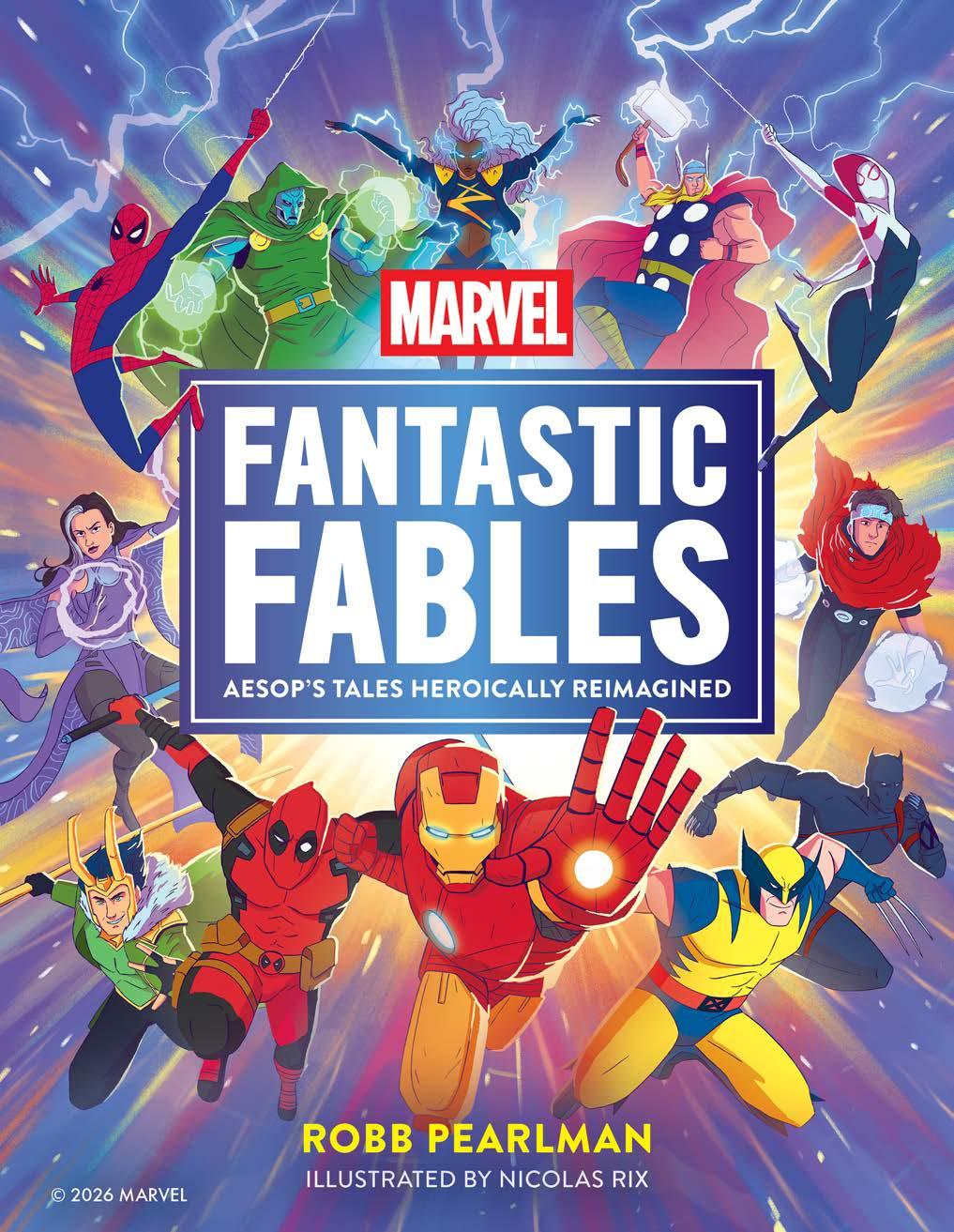
AESOP’S TALES HEROICALLY REIMAGINED
ILLUSTRATED BY NICOLAS RIX
One night, after everyone in Asgard had retired to bed, Loki skulked through the dark, quiet halls of Valaskjalf. Earlier he had escaped from another boisterous family dinner, where his brother Thor’s bravado and bluster had driven him away from the table before the main course was served—and into the comfort of his own mischievous thoughts.
Cloaked in an invisibility spell, Loki tiptoed past the guards stationed outside Odin and Freyja’s chambers. He avoided the light streaming from beneath Thor’s door and hopped over Volstagg, who was sleeping in the middle of the dining hall after losing a wager to Fandral and Hogun. Loki decided that the only way to put his brother in his place—or at least silence him long enough to enjoy a peaceful meal—was to match Thor’s feats of strength and prove his own heroism. To do that, he needed a weapon as powerful as Thor’s hammer, Mjolnir.
Loki’s hunger for power was matched only by his hunger for a snack. After a quick stop in the kitchen, Loki made his way to the vault where Odin kept Asgard’s most powerful weapons. He cast spells to unlock and swing open the heavy door. There, on a pedestal surrounded by a glowing force field, sat Odin’s spear, Gungnir.
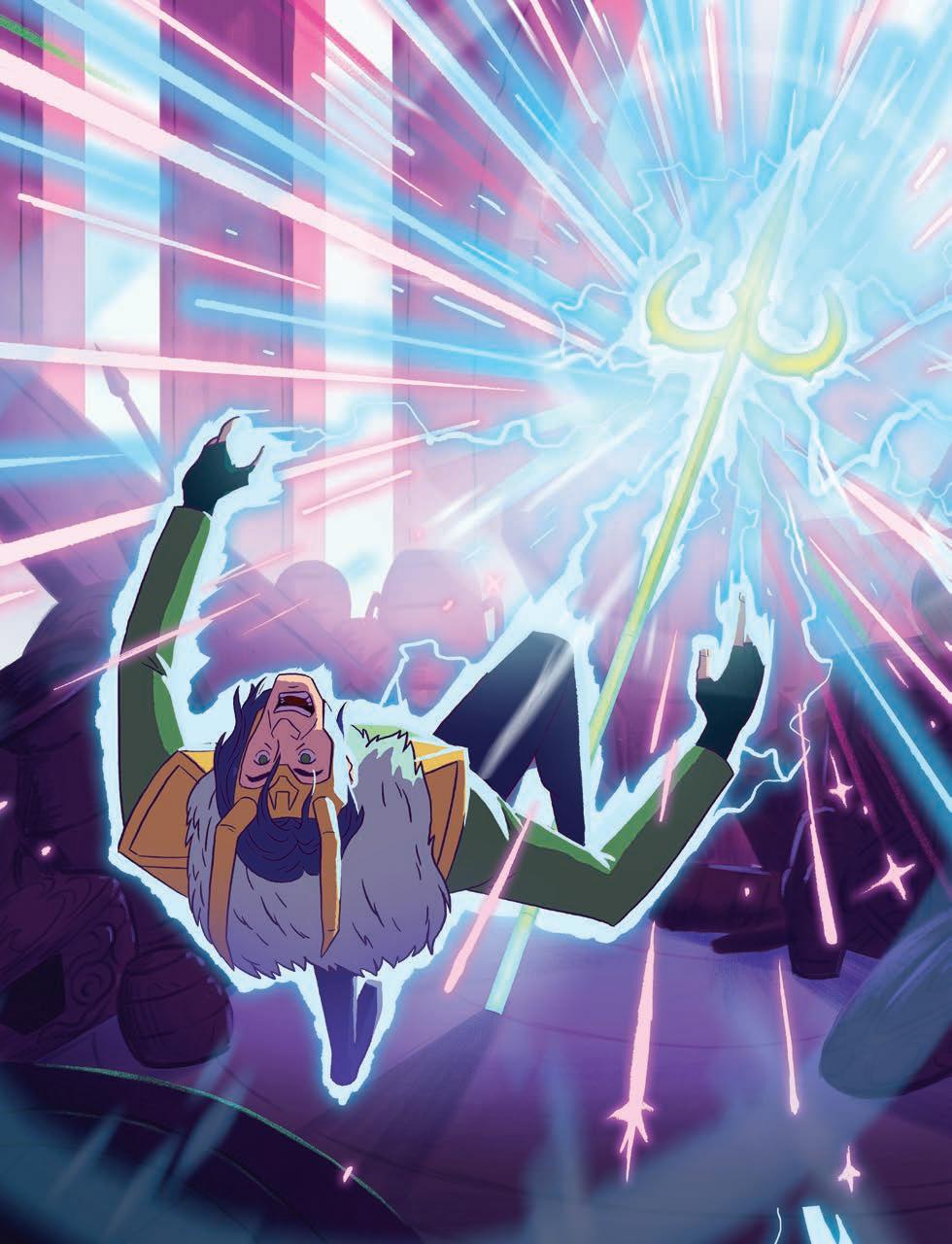
Loki reached out to grab the mighty weapon, but the force field repelled his hand. He threw an enchanted dagger strong enough to pierce the toughest armor, but the dagger bounced back and landed at his feet. He fired an energy blast from his hands, but the power was no match for the Odinforce protecting the spear. The blast rebounded and struck Loki, knocking him back against the wall.
Loki walked over and took a long look at Gungnir. “I’ve been a fool,” he sneered, looking from the spear to his dagger and back again, “to waste my time and energy on such a worthless weapon. It’s too big—any enemy or villain will anticipate its every move. The handle is worn down, and the uru blade is scratched. My dagger is much smaller and better for sneaking. Its handle is as unworn as its blade is unmarked.”
With a smirk he sheathed his weapon, straightened his clothes, and pushed his shoulders back. Then he took one last look at his father’s weapon before retreating to his room, alone.
Moral: People devalue what they cannot achieve.
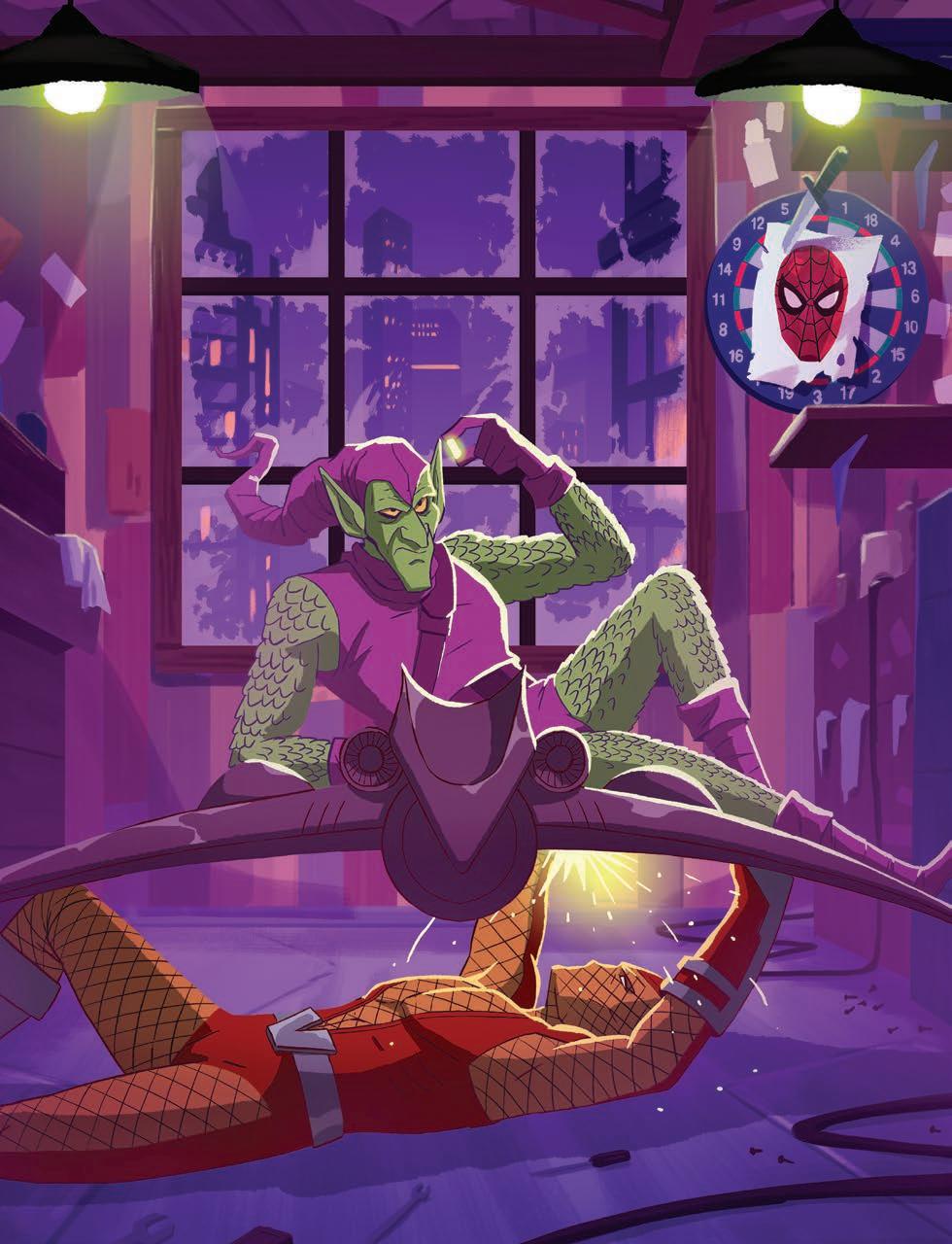
Herman Schultz, better known as the Shocker, was working in his basement workshop when he heard a crash on the floor above. He ran upstairs and couldn’t believe his eyes: Hovering on the Goblin Glider—in front of a huge hole in the wall where Herman’s TV had been—was the villainous Green Goblin!
“I’m glad you’re home, Herman,” said the Green Goblin, drifting above the bricks and insulation that littered the floor. “I need your help.”
“Me?” The Shocker was, well, shocked that the legendary Green Goblin would talk to him for any reason, let alone to ask for help. “What can I do for you, Norman?”
“Call me Mr. Osborn, Herman. Everyone knows you’re a skilled engineer, and I seem to be having a bit of trouble with my glider after my last run-in with Spider-Man.”
The Shocker knelt to get a better look at the glider. Sure enough, most of the flying machine’s ports and mechanisms were clogged with the sticky, messy fluid of Spider-Man’s webshooters. “I’m sure Spider-Man’s webs will all dissolve in an hour or so, Nor—Mr. Osborn.”
The Green Goblin looked at the countdown clock on his watch and then, impatiently, at the other villain. “I don’t have an hour, Herman. I need this taken care of—NOW. Clear it out, and I’ll give you a very, very valuable reward.”
The Shocker was as frightened to disappoint the Green Goblin as he was eager to get something of value. He ran downstairs to get his tools and solvents and returned, saying, “I noticed a couple of the pistons are bent, Mr. Osborn. I’ll fix those, too, while I’m at it.”
Soon the Goblin Glider was back in working order, if not a little more maneuverable than it had been before the Green Goblin crashed it into the Shocker’s home. The Green Goblin smiled and hovered back through the gaping hole.
“Wait, Mr. Osborn!” the Shocker called after him. “You said you’d give me a reward!”
But Gobby didn’t stop as he shouted over his shoulder, “Oh, I did, Herman! I’m giving it to you now.”
“What is it?” the Shocker asked.
The Green Goblin turned and glared at him before flying off into the New York City skyline. “I’m giving you the gift of living another day!”
Moral: There is no reward in helping a villain.
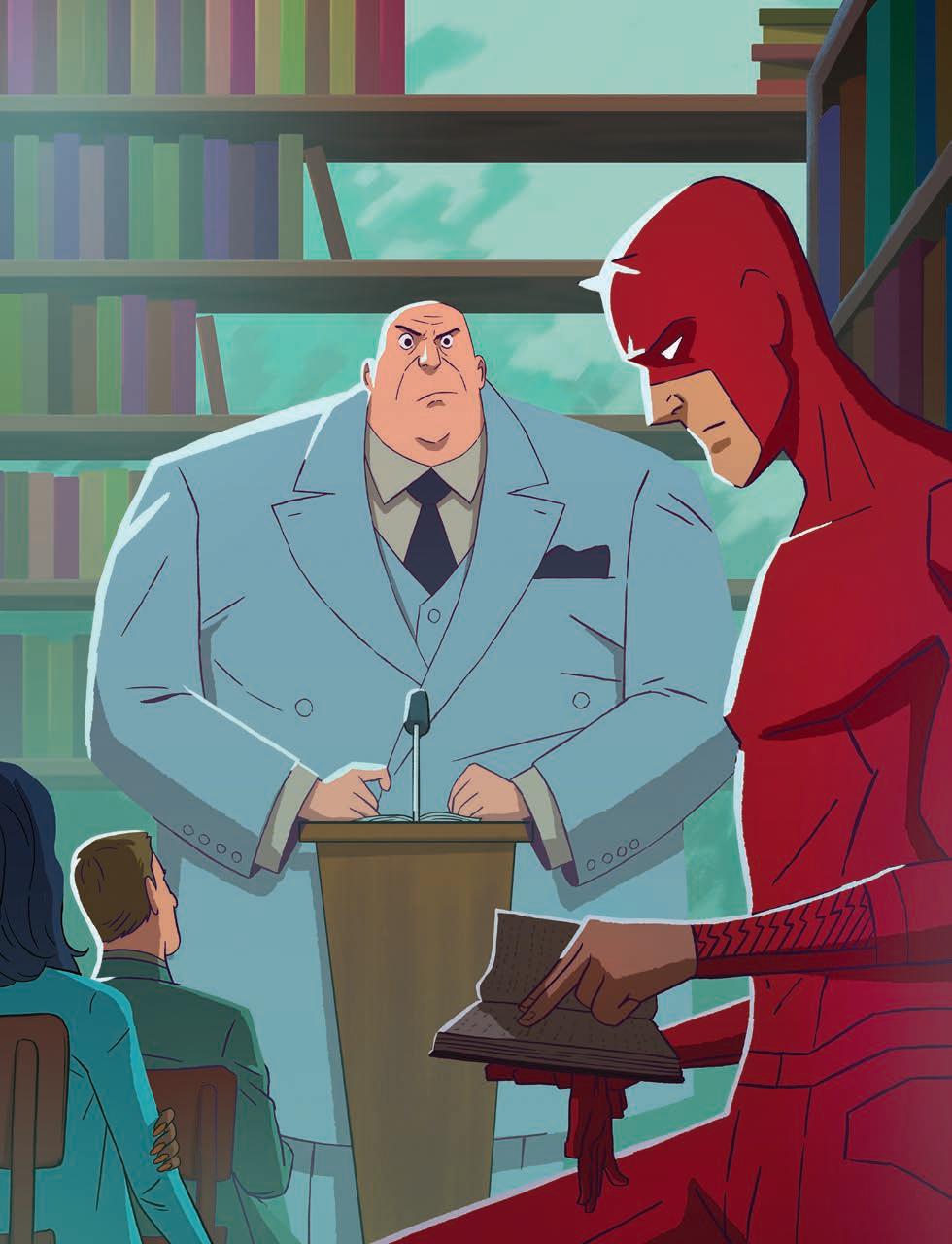
Matt Murdock, lawyer by day and the heroic Daredevil by night, worked tirelessly to thwart the evil plans of Wilson Fisk, the cunning and power-hungry crime lord known as the Kingpin—no matter how big or small they were. The Kingpin was determined to become president of the Hell’s Kitchen Bookstore’s weekly book club. He saw it as a seemingly respectable way to gain even more power over the community he wanted to control and as a way to access the club’s bank account.
The Kingpin stood before the group and gave a long, loud speech about the symbolism found in Herman Melville’s Moby-Dick. The book club’s members were intimidated and impressed by his wealth of knowledge, use of big words, and ability to talk for so long without stopping. All the members applauded. Except for one.
“Tell me, Mr. Fisk,” came a voice from someone lurking in the shadows of the bookshelves behind him. “What did you think about the conversation between Moby Dick and Dorothy the Dutch dolphin?”
The Kingpin could recognize Daredevil’s voice anywhere. “Well,” he said as the masked hero stepped into the light, “it’s clear that the author was offering a European viewpoint on an American narrative.” Daredevil’s enhanced senses picked up the telltale signs of deception and uncertainty beneath the Kingpin’s booming voice and confident tone.
But the rest of the book club’s members didn’t need powers to know that Fisk didn’t know what he was talking about. Anyone who had read the book would know that there was no character named Dorothy, and Moby Dick never spoke.
“You’re a liar, King . . . I mean Mr. Fisk,” said Matt. “You never read these books—you probably just read online summaries to try to impress us.”
Fisk’s face reddened with embarrassment and rage. He ran out of the bookshop into the night, vowing yet again to exact revenge on Daredevil—the Man without Fear!
Moral: True leadership is not earned through deception and greed.
— The Wild Boar and the Fox —
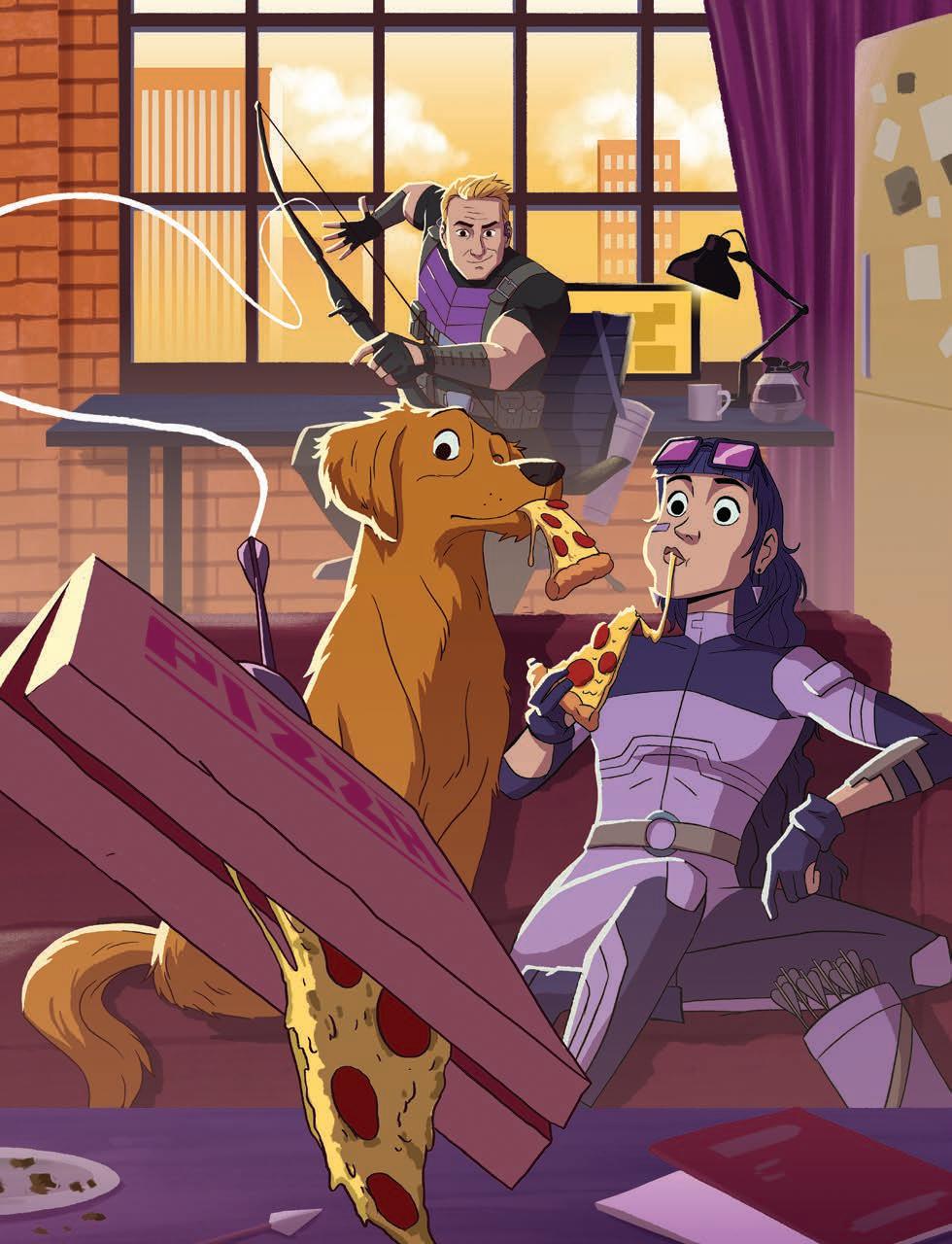
One warm summer evening, Kate Bishop rang Clint Barton’s doorbell. She and Lucky the Pizza Dog had decided to surprise Clint at his apartment with a relaxing night of pizza and movies.
After a few moments, there was no answer, so Kate picked the locks and opened the door. She found Clint with his head down, focused as he sharpened some arrows.
“I let myself in,” she said, pushing aside the arrows on the table to make room for the pizza.
“Mm-hmm,” Clint mumbled in response.
She took a slice of pizza and flopped down on the couch. “Movie or series? I hear there’s a new sixteen-part Thor doc dropping today.”
“Mm-hmm,” Clint mumbled without looking up.
Kate flicked a pepperoni at the back of Clint’s head. “What are you doing?” she asked. “The city’s been totally quiet tonight. And even if something happens, the other Avengers are already on duty.”
“That’s true,” Clint replied, picking up a whetstone to refine the tip of a trick arrow. “But I’ll need these arrows the instant there’s trouble. And when that happens, there won’t be any time to sharpen them.” He shifted his gaze across the table. “But that pizza does look good.”
He reached into the quiver slung over his chair and pulled out a suction cup–tipped arrow.
In less time than it took Lucky to steal Kate’s leftover crust, Clint expertly shot the arrow at the pizza box and reeled it in to his lap. “And if there’s trouble,” he said, stuffing a slice into his mouth, “then there won’t be any time to eat!”
Moral: Be prepared.
One afternoon, as he did every afternoon, J. Jonah Jameson, the cantankerous editorin-chief of the Daily Bugle, sat in his office after stomping around the newsroom. The office walls were filled with framed front pages featuring photographs and editorials calling Spider-Man a danger to the entire city.
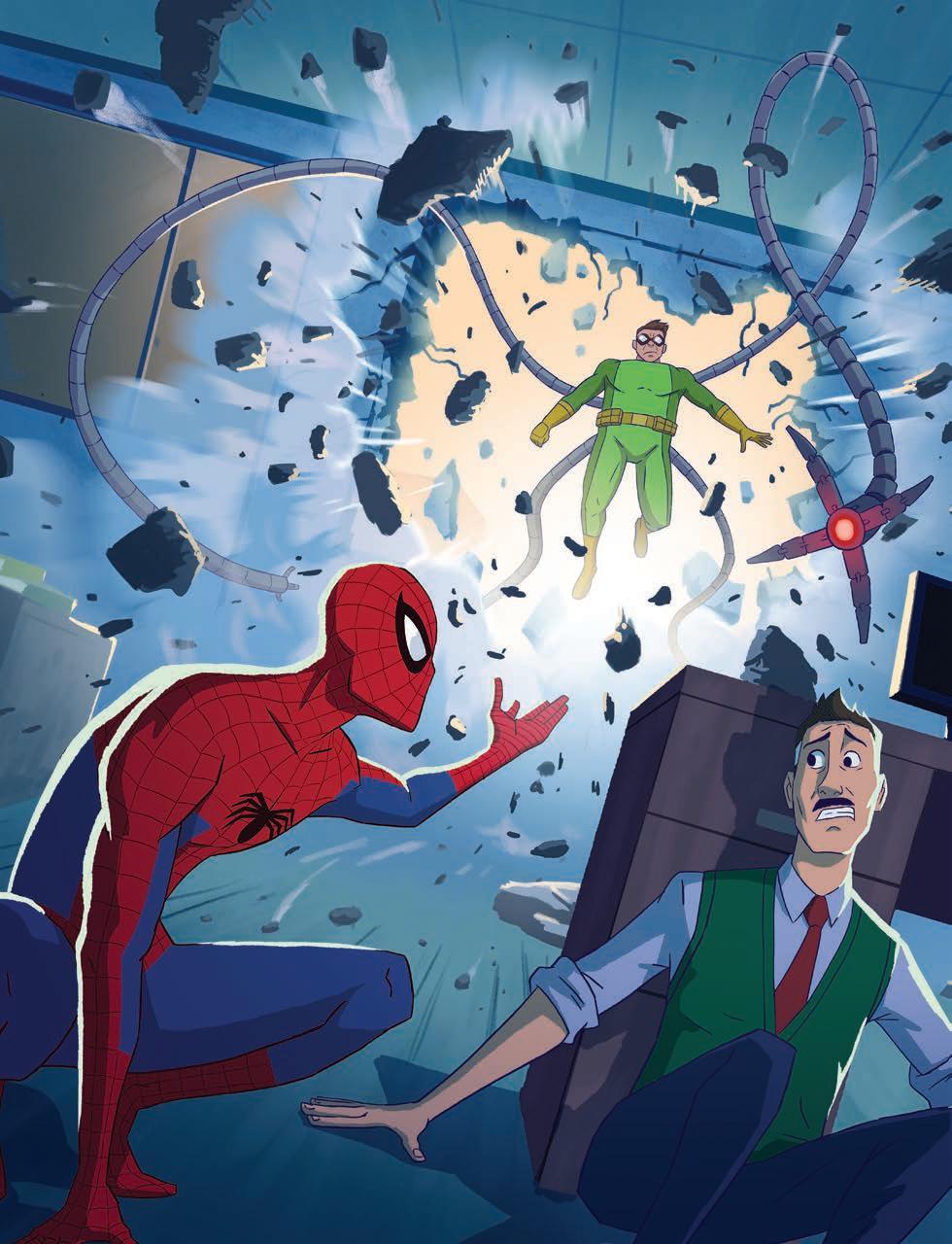
Jonah knew bold headlines and sharp words sold newspapers, but since Spider-Man hadn’t been seen in a few days, he needed someone new to complain about. He decided to turn his critical headlines in the morning edition of the newspaper toward Doctor Octopus. Filled with rage after reading an article that called him “a weak villain whose schemes were easily and laughably thwarted by Spider-Man,” Doc Ock had vowed revenge on the man who dared to criticize him.
While Jonah was dreaming up new headlines in his office, Spider-Man tracked Doc Ock’s movements across the city. When the villain neared the Daily Bugle building, the hero swung into action.
“Get out of here!” Jonah roared as Spider-Man swung into his office. “You’re a menace!”
“Easy there, Mr. Mustache,” said Spider-Man. “I’m just trying to help!”
“Help?!” Jonah scoffed. “I wouldn’t ask for your help if you were the last web-slinging—” Suddenly, Doc Ock’s metallic tentacles crashed through the window, and Jonah scrambled under his desk.
Spider-Man turned to Jonah. “You were saying?”
Jonah rolled his eyes and, silently, mouthed the words, “Help me, Spider-Man!”
Moral: Don’t say what you don’t mean.
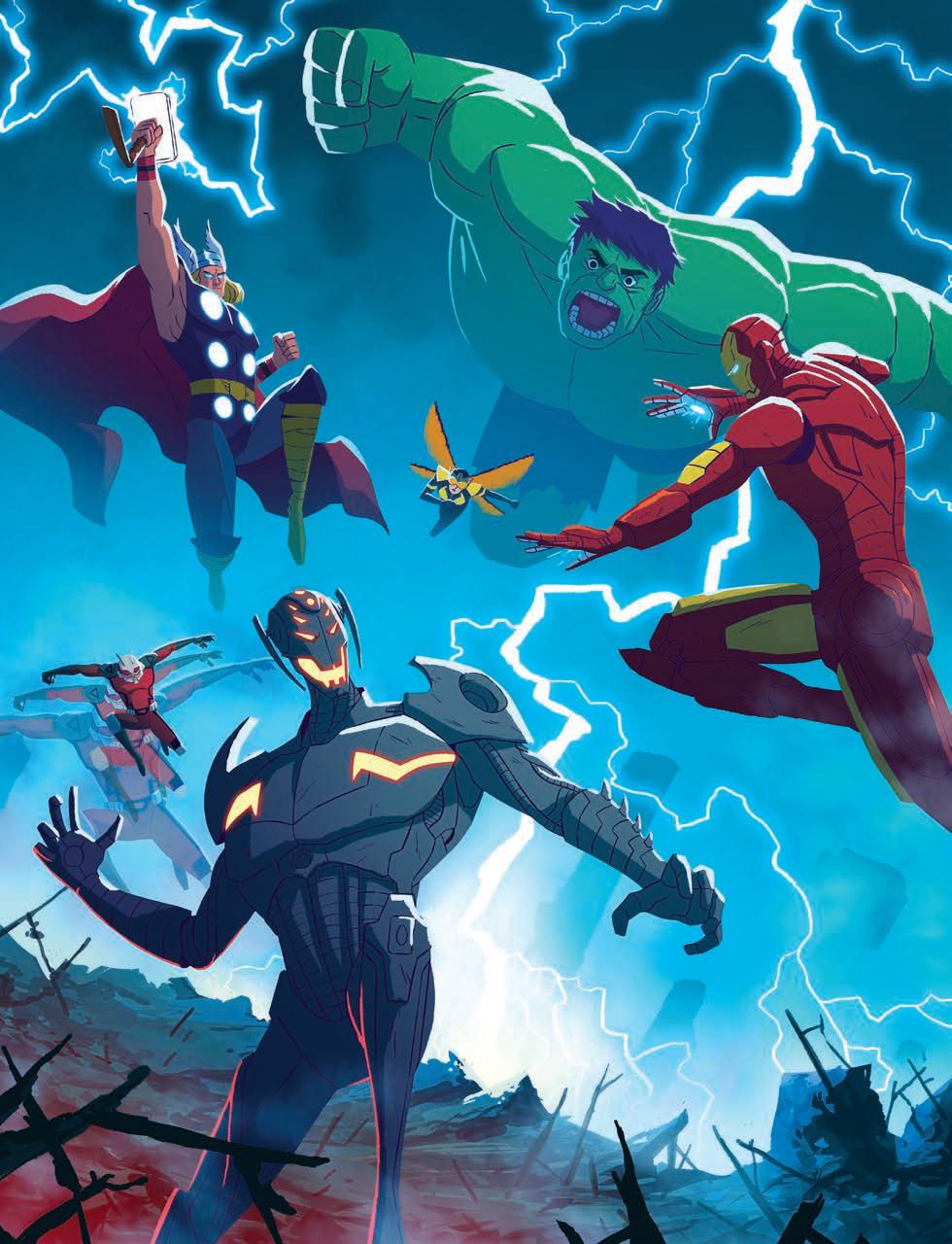
The Hulk, Iron Man, Thor, the Wasp, and Ant-Man found themselves facing a crisis: Ultron and his robotic legions were sweeping across the globe. Each Avenger, confident in their individual might, believed they could defeat the evil A.I. on their own.
Hulk, raging and unstoppable, was the first to charge into battle. Ultron deployed a sonic disruptor, stunning Hulk just long enough to capture and imprison him in a holding cell in the Pacific Ocean.
Next, Iron Man engaged Ultron with his advanced technology. But Ultron had infiltrated Stark Industries’ computer systems, allowing him to anticipate Iron Man’s every move. By detonating an electromagnetic pulse, he disabled Iron Man’s armor and took him to the secret lockup.
Then Thor unleashed a barrage of lightning. But Ultron’s powerful energy shield absorbed and redirected Thor’s thunderbolts, leaving the Asgardian weakened and vulnerable. He, too, was transported to the stronghold.
The Wasp and Ant-Man, each with their own Pym Particle–powered shrinking abilities, attempted to infiltrate Ultron’s central processing unit and systems. But his defenses were too sophisticated, and soon they were both trapped—first within the microscopic prisons of Ultron’s intricate circuitry, and then beside their fellow Avengers in the floating prison.
All defeated and captured, the Avengers faced a grim reality.
“Ultron was able to get the better of us individually,” said Iron Man. “But what if we worked together?”
Utilizing the laser in his gauntlet, Iron Man weakened one of Hulk’s restraints just enough to allow him to break free. Hulk used his strength to release the others and smash the guards.
Ultron tried to retaliate, but he was too stunned by a blast from Thor’s mighty hammer to notice Ant-Man and the Wasp shrinking down to sabotage his internal processors.
Defeated, Ultron’s computerized voice sputtered, “Nooooo!” as the Avengers, Earth’s mightiest heroes, looked on.
Moral: There is strength in unity.
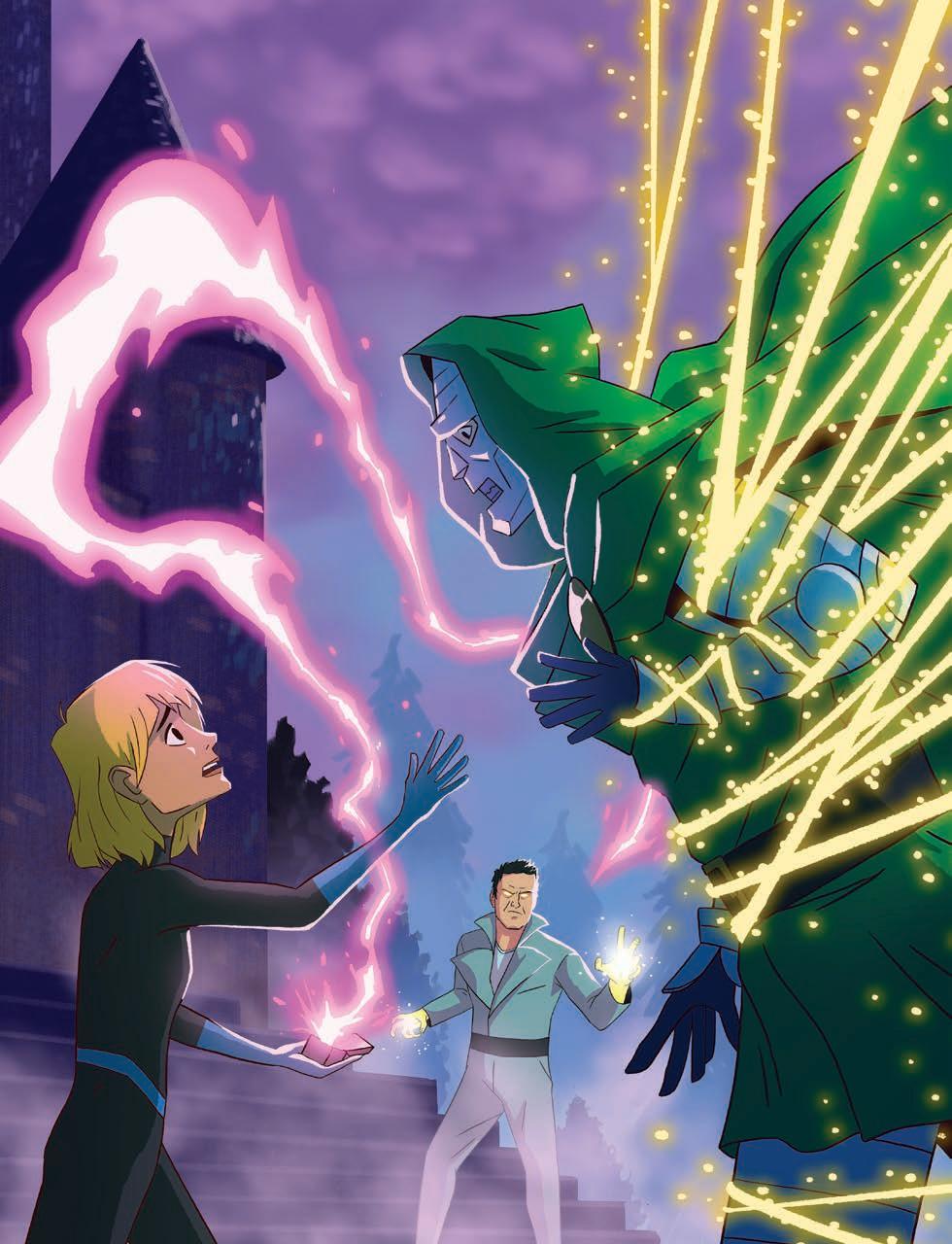
Deep within the heart of Castle Doom toiled Doctor Doom, the ruler of Latveria, in his secret laboratory. Suddenly, a small figure caught his eye—Valeria Richards, the brilliant daughter of the Fantastic Four’s Sue Storm-Richards and Reed Richards.
“Valeria!” Doom boomed, his voice echoing through the room. “What are you doing here? I explicitly forbade anyone from entering this chamber!”
Valeria blushed. “I-I’m sorry, Uncle Doom. Please don’t send me away.” She held up a small box. “I thought if I learned more about this . . . thing . . . I could help you one day.”
Doom examined the box with a mixture of anger and amusement. “That is a dangerously powerful Latverian artifact, far too dangerous for a child like you to handle.” He paused, a flicker of warmth appearing in his eyes. “Doom will forgive your transgression . . . this time. Now, leave and let me work.”
Valeria, ever resourceful, slipped the box back into her pocket as she gave him a quick kiss on the cheek. “Thanks, Uncle Doom!”
Days later, Doom found himself locked in a fierce battle with the Beyonder and was soon helplessly trapped within a psionic cage. Sensing her uncle’s peril, Valeria raced out of the castle and, with trembling hands, opened the mystical box. An Eldritch flame erupted from within, striking the Beyonder and shattering the energy field that held Doom captive.
As Doom and Valeria stood over the fallen Beyonder, the ruler of Latveria gazed at his niece with respect. “Thank you, Valeria,” he acknowledged, a rare smile gracing his lips beneath his mask as he patted her shoulder.
Moral: A kindness is never wasted.
Robb Pearlman is a #1 New York Times bestselling author of many books, including The Mighty Marvel Dictionary, Star Trek: Fun with Kirk and Spock, What Would Skeletor Do?, The Office: A Day at Dunder Mifflin Elementary, and Who is Superboy?. He is a pop culturalist, award-winning creative, and publishing professional who lives on Earth-616 and believes that every mutant should be proud of who they are.
Nicolas Rix is a self-taught artist who grew up on ’80s and ’90s cartoons and comic books, which fed his creativity all the way into adulthood. After switching careers to follow his illustration dreams, he fell in love with cel animation. His work is influenced by Hayao Miyazaki films, Samurai Jack, and French animation.
Cider Mill Press publishes exceptional books that combine creativity and craftsmanship. As an imprint of HarperCollins Focus, we specialize in premium cookbooks, cocktail and spirits guides, and illustrated gift books, all distinguished by compelling content, striking design, and a commitment to quality in every detail. Cider Mill Press sets the standard for books that inform, inspire, and elevate everyday moments. Learn more at cidermillpress.com.

“Where Good Books Are Ready for Press”
501 Nelson Place Nashville, Tennessee 37214 USA