Grow Copyright © 2026 by HarperCollins Focus LLC. All rights reserved. No part of this book may be reproduced in whole or in part, scanned, photocopied, recorded, distributed in any printed or electronic form, or reproduced in any manner whatsoever, or by any information storage and retrieval system now known or hereafter invented, without express written permission of the publisher, except in the case of brief quotations embodied in critical articles and reviews. Published by Cider Mill Press, an imprint of HarperCollins Focus LLC, 501 Nelson Place, Nashville, TN 37214 USA. The scanning, uploading, and distribution of this book via the internet or via any other means without permission of the publisher is illegal and punishable by law. Please support authors’ rights, and do not participate in or encourage piracy of copyrighted materials. 13-Digit ISBN: 978-1-40034-095-8 10-Digit ISBN: 1-40034-095-0 Books published by Cider Mill Press Book Publishers are available at special discounts for bulk purchases in the United States by corporations, institutions, and other organizations. For more information, please contact the publisher. cidermillpress.com Any internet addresses, phone numbers, or company or product information printed in this book are offered as a resource and are not intended in any way to be or to imply an endorsement by Cider Mill Press, nor does Cider Mill Press vouch for the existence, content, or services of these sites, phone numbers, companies, or products beyond the life of this book. Without limiting the exclusive rights of any author, contributor or the publisher of this publication, any unauthorized use of this publication to train generative artificial intelligence (AI) technologies is expressly prohibited. HarperCollins also exercise their rights under Article 4(3) of the Digital Single Market Directive 2019/790 and expressly reserve this publication from the text and data mining exception. HarperCollins Publishers, Macken House, 39/40 Mayor Street Upper, Dublin 1, D01 C9W8, Ireland (https://www.harpercollins.com) Cover and interior design by Steve Cooley Typography: Barlow Semi Condensed, Sherborne Text Printed in Vietnam 26 27 28 29 30 SEA 5 4 3 2 1 First Edition
INT_Grow_FNL.indd 2
5/20/26 12:44 PM
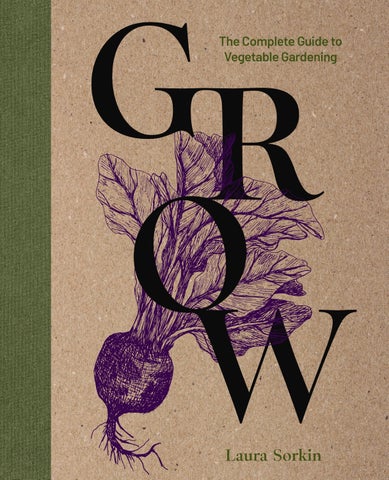
GROW The Complete Guide to Vegetable Gardening
Laura Sorkin
INT_Grow_FNL.indd 3
5/20/26 12:44 PM
INT_Grow_FNL.indd 4
5/20/26 12:44 PM
Dedication This book is in memory of Jones Deady. It is said a person’s soul is reflected in their garden. His was always complex, beautiful, and passionately tended.
INT_Grow_FNL.indd 5
5/20/26 12:44 PM
INTRODUCTION n 8 1: SOIL n 16 2: COMPOST 101 n 24 3: WATER n 30 4: GARDEN PLACEMENT n 34 5: GARDEN PLANNING n 40 6: CONTAINER GARDENING n 48 7: SEED SOURCING n 56 8: SEED STARTING n 60 9: MULCHES n 68 10: COVER CROPS n 74 11: TOOLS n 80 12: DISEASES & PESTS n 84 13: WEEDS n 90 14: GARDENING CLOTHES n 96 15: ARTICHOKES & CARDOONS n 102 16: BEANS n 110 17: BEETS n 118
INT_Grow_FNL.indd 6
5/20/26 12:44 PM
18: BROCCOLI n 124
36: ONIONS & SHALLOTS n 222
19: BRUSSELS SPROUTS n 128
37: PARSNIPS n 228
20: CABBAGE n 134
38: PEAS n 232
21: CARROTS n 138
39: PEPPERS n 240
22: CAULIFLOWER n 144
40: POTATOES n 246
23: CELERY & CELERIAC n 150
41: RADISHES n 254
24: CHARD n 156
42: RUTABAGAS n 260
25: CORN n 160
43: SCALLIONS n 264
26: CUCUMBERS n 166
44: SOYBEANS n 268
27: EGGPLANT n 172
45: SPINACH n 274
28: FENNEL n 176
46: SQUASH n 280
29: GARLIC n 180
47: SWEET POTATOES n 290
30: GREENS n 190
48: TOMATILLOS n 296
31: HERBS n 196
49: TOMATOES n 300
32: KALE & COLLARDS n 204
50: TURNIPS n 312
33: KOHLRABI n 208
SOURCES n 318
34: LEEKS n 212 35: MELONS n 216
INT_Grow_FNL.indd 7
5/20/26 12:44 PM
Introduction
8 n GROW: THE COMPLETE GUIDE TO VEGETABLE GARDENING
INT_Grow_FNL.indd 8
5/20/26 12:44 PM
I
t is the end of July and I have just come inside from chopping up bean plants. After multiple harvests, the green beans are done producing, and the family might welcome a break from them. Our bean-a-palooza has yielded green bean salad, stir-fried beans, and my favorite, dry-fried beans with little bits of pork. The spent plants have been cut up and incorporated back into the soil in preparation for the fall garlic crop. The cucumbers have also been on a tear, and offer three beautiful cukes almost daily. Every year I reduce the number of plants by one, and it is still too many for a family of four. The tomatoes are idling in the corner, with tresses of green tomatoes that have taunted me for weeks. After 25 years of gardening here, I know not to expect ripe toms until August—but, gracious, just turn already. The plants and their fruit look healthy, though, and ultimate BLTs are just a few weeks away. There are plenty of misses out there too. The Brussels sprouts are puny, the winter squash looks stalled, and the enormous tomatillo plant has zero fruit on it because I forgot you need two for pollination. In my defense, I haven’t grown them for years. It is a typical year where some things thrive and others disappoint, mostly because of conditions, but also human error. This is true for all gardeners and farmers everywhere, despite what the perfect photos and it’s-so-easy videos you may see on gardening platforms suggest. Every year there will be failures and you will ask yourself why you bother to put in the effort. The answer, every time, is that growing things is nothing short of thrilling.
INTRODUCTION n 9
INT_Grow_FNL.indd 9
5/20/26 12:44 PM
Personally, it is impossible to imagine not wanting to have a garden. Perhaps I am just a very simple-minded person, believing that since we all need food, producing it is fundamental to being. We live in a society where we can stand in a field in Vermont and watch a soccer game taking place in Azerbaijan on a little device we hold in our hands. Which is very cool. But we still need to eat. Every day. So I feel driven to plant things because it is essential to living. The fact that there is plenty of food available down the road at the market does not diminish this impulse one iota. I have come to realize that not everyone feels this way—in fact I am surrounded by the indifferent. My sister and my husband find no joy in digging around in the dirt. My daughter is actively disdainful of it. In my house, only my son inherited my love of gardening, though my brother and many friends share in the passion. I am writing this book for those who lie somewhere in between—they are gardening-curious, but don’t know where to start. In other words, this book is for people who have never grown anything but are ready to give it a shot. I intend to give you the basics of starting a garden, large or small, that will produce better food than you’ve ever tasted and foster a connection to the natural world outside your door. I recommend that you start with something manageable, which could be as small as a few containers on the patio. I also suggest that you grow both things that you love and vegetables that you’ve never tried before. Seed catalogs offer the most incredible array of things that would never be found in a store because they don’t travel well. Grow items that were bred for
10 n GROW: THE COMPLETE GUIDE TO VEGETABLE GARDENING
INT_Grow_FNL.indd 10
5/20/26 12:44 PM
flavor, not durability, and see just how good a vegetable can be. I ran an organic farm for 15 years and grew everything that is suitable for the northern climate, as well as, stubbornly, a few that weren’t. I planted two acres of berries and fruit trees, had three greenhouses, a mushroom operation, and six acres full of annuals. When I stopped growing crops for sale, I kept one greenhouse and scaled down to a few gardens in my backyard. All told, I have been growing fruit, flowers, mushrooms, and vegetables in northern Vermont for 25 years. Before I started my own place, I had very little experience in agriculture. I had had a small garden in a few of the places I lived and found myself obsessed with growing food on an ever-increasing scale. I considered starting a market farm but it just didn’t seem plausible to declare yourself a farmer, armed with an undergraduate history degree and a graduate degree in Coastal Environmental Management. I presumed that one had to come from a farming family, with on-the-ground training. Otherwise, where do you start? But my brief foray into office work made me realize that I am not suitable for sitting at a desk and the impulse to grow veggies on a large scale continued to grow. The theoretical farm that my husband and I talked about became the not-so-imaginary-farm (we actually considered naming it that) and we left our jobs in Washington DC and moved to Vermont. I apprenticed at an organic farm in central Vermont for one season, while we simultaneously looked for our own property. Our families thought we’d lost our marbles. We found
INTRODUCTION n 11
INT_Grow_FNL.indd 11
5/20/26 12:44 PM
a piece of land that had likely been a sheep farm over a century ago but had forests where there were previously fields. We started with minimal skills on land that had never been cultivated, but we were young with lots of energy. Or, as Eric liked to point out, equal parts chutzpah and naivety. In a pre-YouTube era, I learned by reading, asking questions, and making MANY mistakes. The latter were the most important, because then you really get the “why.” Why should you replenish the soil, why should you harden off your seedlings, why should you not garden naked (see page 97)? I am happy to share all of what I have learned so you can skip the truly hard lessons, but if you do have a few failed crops they are enormously instructive, and they happen to everyone.
I will do my utmost not to refer to anything as “easy.” When garden books refer to a crop like zucchini as “so easy,” and then your squash withers on the vine, you may feel defeated. The fact is that you might not have the right conditions to successfully grow squash, but your soil is ideal for celery (which some would consider “challenging”). Or a particularly wet year caused a hoard of slugs to devour the beans that were reported to be simple enough for a kindergartener to grow. You are not an incompetent gardener, it was just a tough year for beans. If it was as easy as tossing a few seeds over your shoulder and then checking back a few months later for harvest, everyone would do it. If you pay attention to a few basics, you will reap what you sow. Then again, some years are just rough.
Who This Book Is For
Norms Upended: Forecast Shmorecast
The majority of the advice in this book is for the Northeast of the United States. We have an enormous country that encompasses growing zones from 2b to 10b. In non-grower speak this means we run from Arctic regions in the Northern Plains to the tropics in the Florida Keys. Advice for irrigation in the arid Southwest is very different than it would be for the rainy Northwest. And the cold temps in northern Vermont require a different approach to spring gardening than in Louisiana. I hope, of course, that people everywhere read this book, get inspired to start a garden, and find a number of my recommendations and insights helpful. But the overall approach to seasons are most applicable to someone who lives east of Minnesota and north of Virginia.
There is no possibility of writing a gardening book in 2026 without mentioning climate change. The weather, to put it mildly, is in flux. Here in Vermont, we suffered catastrophic flooding three years in a row this decade, (freakishly all on the same day, July 10). Our ski resorts no longer have reliable snow. Producing maple syrup, which is very sensitive to temperature, has become unpredictable. Insects and plants that were previously kept out of our ecosystem because of winter’s cold are now moving in. In a gardening context, it means the way things have always been done is going to have to change. For example, growing instructions for many crops describe conditions of 75°F
12 n GROW: THE COMPLETE GUIDE TO VEGETABLE GARDENING
INT_Grow_FNL.indd 12
5/20/26 12:44 PM
Average Annual Extreme Minimum Temperature 1991–2020 Temp (F)
Zone
Temp (C)
Temp (F)
Zone
Temp (C)
Temp (F)
Zone
Temp (C)
INTRODUCTION n 13
INT_Grow_FNL.indd 13
5/20/26 12:27 PM
as ideal. When we first moved to Vermont in 2000, we would have maybe one week that was uncomfortably hot, we would all complain incessantly because no one has air conditioning, and then it would cool down to where we and the crops were happy. Now we have many weeks in the 80s and 90s. So, if you have a short growing season and the middle month is well above the recommended temperatures for a full-season crop, what do you do? The way we grow food is going to have to catch up to these changes. Developing new seed varieties that are more tolerant of heat or drought or excessive moisture is going to be critical. Each region is going to have to learn how to manage pests or diseases that were previously unseen. Unfortunately, it is not as simple as just shifting to growing things that do well south of us because frosts are also starting to become less predictable—just last year, a very unusual late one wiped out a lot of the apple blossoms, thus eliminating nearly the entire year’s apple crop. There is uncharted territory ahead. While the news about climate change is alarming, gardening can be one small, proactive activity to mitigate it. By growing your own food, you are reducing the amount of goods that are transported via fossil fuels. Having your own compost pile cuts down on landfill, the need for still more transportation, and recycles valuable nutrients. Using organic practices reduces erosion and the amount of pesticides and herbicides that poison our soil and water. I was an organic farmer and that is the only way I ever considered growing food because I could no more imagine spraying
toxins on my crops as I could sprinkling Comet on my salad. But growing food organically is more than just about inputs like pesticides and herbicides. It is learning how to work with nature, not in resistance to it. Yes, you are promoting the growth of one thing (your crop) and deterring other plants (weeds) and competition (bugs), but the best way to do that is to mimic nature itself—and that requires balance. You want adequate nutrients for your plants, but too much just leaches into the waterways. You want to protect the crops from predators, but spraying chemicals on everything kills off beneficial bugs, fungi, and bacteria. The number one way to have a vibrant garden is to promote healthy soil, full stop. As tempting as it might be to go for the quick fix, tossing lots of fertilizer and dousing everything with chemical sprays will not get you there. Furthermore, learning how food is grown might also make one more empathetic to farmers and their travails. When you discover that a great deal of what you grow is not perfect looking but tastes incredible, you might be more open to buying the produce with a few cosmetic dings, a practice that also reduces food waste and conserves resources. Not only is gardening helpful in mitigating climate change, it also gets you more in touch with your body and soul and why our natural world is worth fighting for. Seeing the first seedlings poke up in the spring brings renewal to a winter-weary spirit. Watching a flower turn into the start of a pepper or eggplant fosters hope and anticipation. And you will give your body a good workout. You might
14 n GROW: THE COMPLETE GUIDE TO VEGETABLE GARDENING
INT_Grow_FNL.indd 14
5/20/26 12:44 PM
be weeding, hoeing, or hefting bags of soil but looking at it from a different perspective, you are also doing squats, planks, weightlifting, and resistance training. I have never met a farmer of diverse veggies who isn’t—to use a Gen X term—totally buff. Consider your garden a gym that also gives you nutritious food. Even if you go about it gently, it will get you outside and away from screens, which, in itself, is revitalizing. But let’s not forget that it is mostly about eating the best food imaginable. You can’t beat a vine-grown tomato that is still warm from the sun or the vibrancy of just-picked herbs. The green beans we have been eating are crisper and sweeter than the wan, limp ones at the grocery. All in all, it is deeply satisfying to harvest a dinner’s worth of nutritious, tasty food and feed it to loved ones. On that note, having a garden is a surefire way to get children to start a lifetime of healthy eating. I have seen the pickiest of kids embrace vegetables when they grew them themselves. I witnessed class after class of our local elementary school munch away on raw beets and cucumbers when they were involved with them in the school garden, seed to harvest. And even my own daughter, who would listlessly move vegetables around her dinner plate for hours, would casually go out to the kitchen garden and pick and eat spinach leaves for a snack. Why they lost their appeal when they were brought inside and put on a plate was never clearly explained, but we took the win and let her forage. But the most important reason to garden is that it is really fun. When the garlic pokes
up in spring, you can marvel at its fortitude for making it through the winter. Following the progress of a pumpkin from blossom to bulbous gourd over a period of months, you can’t help but get invested in it, rooting for its increasing girth. Discovering a new vegetable in a seed catalog and then growing it is like a little adventure. Digging up a potato plant to find whether it has a cache of spuds is suspenseful. And threshing and winnowing your dry beans is an ancient tradition that you will find is quite elegant (see page 115). Even the missteps can be a hoot, like finding the healthiest squash plant growing out of the compost heap or discovering you love mustard greens because you planted the wrong seed. I hope in this book you will find information that will help you start a new chapter of gardening in your life. I’ll give it to you straight and admit to what I find challenging as well as set reasonable expectations. For crops that I have never figured out how to grow well, I tap my network of friends and fellow farmers to share their methods. I’ve inserted (attempted?) humor where appropriate because the act of gardening is one where humans try to control nature—which inevitably ends in a good story. It’s messy, frustrating, exhilarating, but, most importantly, fun.
INTRODUCTION n 15
INT_Grow_FNL.indd 15
5/20/26 12:44 PM
1: Soil
16 n GROW: THE COMPLETE GUIDE TO VEGETABLE GARDENING
INT_Grow_FNL.indd 16
5/20/26 12:44 PM
T
here is nothing more important to the success of your garden than the quality of the soil. When I started farming, I knew this to be true in theory but didn’t fully comprehend the holistic nature of the statement until I experienced it for myself. I knew that organic matter was important, but I didn’t appreciate how much was needed. I knew that fertilizer was necessary, but it turned out to be much more complicated than tossing some granules next to a plant. There were so many times I thought I had provided all that a plant was supposed to need in terms of water and nutrients, and yet it failed to thrive. After much time building the soil with cover crops, compost, lime, and other micronutrients and seeing results, I formulated a mantra that I would repeat to myself once things were finally going well: it’s the soil, stupid (ISS, for short). Healthy soil is one that contains life. There should be earthworms, fungi, and all of the microorganisms that break down big pieces of plants into smaller pieces. All of those organisms digest the organic matter, releasing nutrients and creating aggregates, which are like the glue that holds the soil together. A good rule of thumb to use when trying to determine if the soil is good is the degree it looks like a crumbly cookie dough: if it’s not too fine, yet not too clumpy, it’s good. The best thing you can do to encourage all of that life is provide plenty of food. Regular applications of compost that has been partially or fully broken down is very important. Any bare spot that you don’t have immediate plans for benefits from a cover crop (see page 75). Manure is great, but, if possible, it should
SOIL n 17
INT_Grow_FNL.indd 17
5/20/26 12:44 PM
be aged a little before putting it directly on the garden. And organic mulches (see page 69) are ideal for keeping in moisture and smothering weeds; they also break down and add to the health of the soil. Think of the supplements you add to your garden as you would the food you consume—it needs to be diverse, and everything must work in concert. You need vitamins, but you can’t just live on One-A-Day. You need fiber, but you can’t rely on just kale smoothies. For the system to thrive, you need calories, protein, carbohydrates, and fats to thrive. The same is true for soil. You can’t just give it fertilizer and consider the job done. You need to provide minerals, organic matter of all sizes (think of that as the garden’s fiber), a structure that allows for decent drainage, and habitat for fungi, bacteria, and worms. Compost is great, but it is at its best when incorporated into healthy soil. Building good garden soil takes time, patience, and good observation skills. I found that even if I had all of the right elements, it might take weeks for everything to settle in and power the plants. Not all dirt* is alike, so a good first step is to take a soil sample and send it into your local extension office or other testing service. That test will provide a baseline and let you know what you have in terms of pH and nutrients. You should also determine what type of soil you have. Generally, soil is broken into three categories which are, from largest particles to
smallest, sand, silt, and clay. Ideally, you want to have a combination of all three of these, along with plenty of plant matter and an array of microorganisms. In this ideal condition, soil is referred to as a loam. Of course, your patch of earth will likely incline more toward one of the categories than another. You will get more of the advantages that type of soil provides, but you will also feel its shortcomings more acutely, since it does not have enough of the other two elements to mitigate them. For instance, if you have very sandy soil, you will have good drainage, but your nutrients will easily wash out and you may have to water more often. If your soil leans toward clay, your soil is easily compacted, preventing oxygen from getting to the roots of a plant. (While we’re talking about compaction: try to avoid stepping in planting areas. This is one of the first rules I learned when I apprenticed on a farm and one of the basics of managing healthy soil. One can always have this in mind, but in practice it is easier said than done. If you are maneuvering yourself around your crops, always keep your weight in the walking aisles. And definitely don’t trample soil when it is wet.) For those who enjoy online assistance, two useful apps for identifying your area are LandPKS and SoilWeb. They were both developed by USDA and can walk you through how to classify your soil type and what soils are in your region. I’m not knocking soil apps,
*There is a sentiment among some who prefer the term “soil” to “dirt,” feeling that “dirt” is pejorative, and “soil” better defines the living substance that plants are grown in. While I agree that good soil is something to be revered, some of my best days ended with me covered in mud and dust, otherwise known as dirt. I don’t consider “dirt” to be negative in the slightest and will continue to use it.
18 n GROW: THE COMPLETE GUIDE TO VEGETABLE GARDENING
INT_Grow_FNL.indd 18
5/20/26 12:44 PM
they can be very helpful, but soil makeup can change quickly, even within a small area, so consider your own assessment of the ground beneath you to be the most accurate. Once you have determined the type of soil you have, the most important metrics to pay attention to are pH, nitrogen, phosphorus, potassium, micronutrient levels, and the percentage of organic matter. Below, I will briefly address each of the big
six and show why it is important, but be aware that volumes have been written about each one, so this will just be an introduction.
pH
This is a reading of how acidic or alkaline your soil is. Anything between 0 and 7 is acidic, with 0 being the most extreme. To give some examples, vinegar has a pH of 2 to 3, coffee has an acidity of 5, and water is neutral at 7.
SOIL n 19
INT_Grow_FNL.indd 19
5/20/26 12:44 PM
Things that are alkaline have a pH between 7 and 14, some examples being baking soda at 9 and bleach at 13. Being aware of the soil’s pH level, and being able to adjust it are two of the most important elements in becoming a successful gardener, but please don’t think that you have to be an expert in chemistry to be a successful gardener. Just be aware that adjusting your pH can be one of the most important steps for plant health because it affects a plant’s ability to take up nutrients from the surrounding soil and will have a huge impact on what grows. You can have the most lush conditions, but if the pH is too high or too low, they are wasted.* Most plants do best with a pH between 6.5 and 7.5, so if you aim for this level, you should be fine. Every plant has an ideal pH, but if you have a small kitchen garden, it can be difficult to create microclimates where each variety gets exactly what they prefer, especially if you are rotating crops. I bring this to the beginner gardener’s attention because it is something to check on if you find your plants are mysteriously failing to thrive in good growing conditions. Spinach, for example, prefers slightly alkaline soil (up to a pH of 8), so if you’ve attempted growing it in the past and it didn’t do much, you may have planted it in an acidic spot. Again, it is hard to provide just the right conditions in a small space, but it is always
helpful to know why something isn’t doing well. Changing the pH is a weighty matter, but all you need to know is this: if it is too acidic, add lime; if it is too alkaline, add sulfur. An extension office can give you recommendations as to how much you might need of one or the other based on the results of your soil test. Changing the pH is a slow process that can take months, so adding your amendments in the fall or early spring is best.
Nitrogen
Nitrogen (N) is one of the most important nutrients for plants. It is part of chlorophyll, enzymes, protein, and other vital components. You need healthy amounts of it for good foliage and strong stems—meaning just about everything you grow. Remember, it is the leaves that capture the sun and provide energy to power the plant, so if your leaves are weak, so is the plant. Though it is essential, nitrogen is also the hardest to manage. It is very soluble in water, so a heavy rainfall can wash it all away in an afternoon. You also don’t want too much of it for fruiting crops like tomatoes or you will end up with all foliage and no fruit. Ideally, you want to add reasonable amounts of nitrogen throughout the growing season—especially if it has been raining often. It is hard to resist the temptation to throw tons of fertilizer at an
*When I first started my farm, my soil was very poor and acidic, and I found that adding a huge amount of compost was usually the solution. When it came time to plant the blueberries, I dug out trenches of the rocky, acidic soil, replaced it with compost, planted about 60 young bushes and waited with anticipation for them to thrive. They sat there for weeks looking wan and yellow. I knew that they preferred acidic soil but I didn’t realize that they needed acidic soil to absorb nutrients, and all of the beautiful but pH-neutral compost I added was starving them. I dug them all up again, mixed in half of the native, acidic soil (pH of 4.2!) back in, and they have thrived ever since.
20 n GROW: THE COMPLETE GUIDE TO VEGETABLE GARDENING
INT_Grow_FNL.indd 20
5/20/26 12:44 PM
underperforming crop, but just realize you are wasting your money and contributing to runoff and, ultimately, pollution. If you follow the application rates given on the package, you should be in good shape. Organic sources of nitrogen fertilizer are blood meal, peanut meal, alfalfa pellets, fish emulsion, and guano (bat or seabird poop). Compost will give you some nitrogen, but as it can wash out quickly, it is not a reliable source. Chicken manure is high in nitrogen, but it can be so strong as to “burn” your plants. If you plan on using it, incorporate it into the soil well ahead of planting so it is not so intense. You also never want to apply fresh manure to plants you are close to harvesting because of the danger of pathogens like E. coli. Another means of gaining nitrogen is cover cropping, a process that takes more patience but provides big returns (see page 75 for more). You can grow a crop of legumes like peas or beans and instead of harvesting them when mature, till them under to feed the soil. Legumes have the superpower of fixing nitrogen from the air as opposed to picking it up from ions in the soil. When the cover crop breaks down, you have a net gain of nitrogen available for the next crop, plus the added benefit of extra organic matter to feed the organisms that make soil healthy: worms, bacteria, fungi. You can put a cover crop in any space, big or small.
While nitrogen is a very important nutrient for growing plants, it is also very volatile. Because of this it is not usually included in a soil report, because by the time the test is turned around the level will likely have changed. Judging how much nitrogen you have, and how much you need requires good observation skills—unless you are willing to shell out for a leaf test.
Phosphorus
Phosphorus (P) is necessary for root growth, photosynthesis, and overall plant health. If you find your soil is deficient, you can add rock phosphate,* manure, or compost. Phosphorous is much more stable than nitrogen and thus is less prone to washing away, but you should still avoid loading up on it. In fact, if you add too much compost each year, it can accumulate to very high levels. Phosphorus tends to latch on to soil particles and hang out there. Through the magic of water and/or microbial activity, it becomes available as “soluble P,” which is the form used by plants. If you are adding compost or manure every year, you likely have sufficient P, and adding more will only result in pollution. One of the reasons you should regularly take a soil sample and test it is to find out where your P levels are. If they are high and you are adding granular or liquid fertilizer, choose one with low P (the second number of the three on the container).
*If your soil is alkaline (above pH 7), rock phosphate will sit there like a pile of expensive sand, doing nothing. It needs to be in an acidic environment for the fertilizer to break down into soluble form that the plants can use. Most soils are naturally a little acidic so it should work for you if you need a little P boost. But if you are gardening over a limestone reserve, it should not be your fertilizer of choice. See, you did end up needing to pay attention in your chemistry class.
SOIL n 21
INT_Grow_FNL.indd 21
5/20/26 12:44 PM
Potassium
Potassium (K) plays a smaller, but still important, role in plant health. It is not part of the plant structure (stems, leaves), but it is present in the liquid that moves in and around cells, and thus vital to the enzymatic activity of plants, as well as their ability to prepare themselves for cold weather. K sits in between N and P in terms of solubility, but nevertheless it should not be applied too far in advance of planting. Organic sources of K include manure and wood ash. If you are looking for granular fertilizer, Sul-Po-Mag and potassium sulfate are both good options. Wood ash is an excellent source of potassium, but it will also raise the pH of your soil, so if you are already too alkaline, it will not be a good source of K for you.
Micronutrients
Other nutrients that plants need include calcium, magnesium, and sulfur. Most soils have these in sufficient quantities for plant growth, but you will be able to see for sure on your soil test. Micronutrients are aptly named because they are only needed in teeny, tiny amounts— the tricky part is making sure they are present. For example, boron is critical for healthy blueberries but only in scant quantities; too much of it is toxic. My soil is lacking in boron, so I asked my extension office for some guidance on how much to add per bush, and they recommended “a pinch” but no more. Every other year I walk around the bushes and toss about a teaspoon per plant like I’m adding salt to my chicken soup. This “seasoning” of the plants has kept them healthy for 25 years.
22 n GROW: THE COMPLETE GUIDE TO VEGETABLE GARDENING
INT_Grow_FNL.indd 22
5/20/26 12:44 PM
SOIL n 23
INT_Grow_FNL.indd 23
5/20/26 12:44 PM
2: Compost 101
24 n GROW: THE COMPLETE GUIDE TO VEGETABLE GARDENING
INT_Grow_FNL.indd 24
5/20/26 12:44 PM
C
ompost will be one of the most important factors in starting and maintaining your garden. You can source it from a garden center, but creating your own pile and having it on-site offers numerous benefits to the soil, the environment, and your wallet. Creating it may seem intimidating, but compost happens whether you want it to or not. Nature is always in a state of decay and growth, the older materials breaking down and creating new life. A compost pile is just a means of wrangling some of that cycle’s power for your garden. You start by figuring out your plan for containment. If you have unlimited space and no pets, you can just create a big pile off to the side of your yard. Not too many people have those conditions, however, meaning some sort of bin will be a good idea. If you live in a suburban place, a covered container is best to keep dogs out and any potential odors to a minimum. There are many store-bought options from basic to elaborate (read $$). Ask at your local hardware store or garden center for new, or check online to see if anyone has a used one they want to sell. If you want to DIY a compost bin you can make one out of anything as long as the materials do not contain toxins (like treated wood) and there will be ample airflow. A very simple design is to pound stakes in the ground and wrap chicken wire around them in a closed circle. You can even cut out a circle to put over the top and secure it with clips for easy access if you are very concerned about the compost attracting critters. Another DIY option is to acquire three shipping pallets and screw them together for a three-sided containment
COMPOST 101 n 25
INT_Grow_FNL.indd 25
5/20/26 12:44 PM
space. It will not be protected from animals unless you create a fourth side, but doing this means accessing the compost will require some effort. When you source pallets, make sure you pick ones that have the letters “HT” stamped on them; this means that they are heat treated rather than chemically treated. Avoid ones that have the letters “MB” as they have been preserved with methyl bromide. If you can’t find any stamps on the wood, better to pass on them. Because most people are constantly adding new materials like kitchen scraps, it is nice to have two piles going; one that has reached capacity and is doing its composting thing, and another that you are actively adding to. For this reason, when you first build your setup, make at least two bins. You may find that beyond the great results you see in your garden, you also save money by not filling up your garbage bin with food scraps. Once you have a containment setup, it is time to start filling it. Ideally, you want a 30:1 ratio of carbon to nitrogen. Put simply, carbon materials are brown, like wood and paper, and nitrogen materials are green/colorful, like grass clippings and kitchen scraps. The 30:1 ratio is not by volume; in other words, you don’t need 30 scoops of wood chips for one scoop of kitchen scraps. Carbon and nitrogen are just two elements among many that make up those substances. When the actual materials are in front of you, a good rule of thumb is two scoops of brown to one scoop of color. Start by putting a layer of carbon on the bottom. Tear up an old newspaper or put down a few inches of hay or wood chips. It helps
to have your carbon source in a pile nearby for easy layering. Begin adding your kitchen scraps and pulled weeds (as long as they haven’t gone to seed). Repeat, repeat, repeat, and repeat until it has reached the top of the bin and then . . . wait. Keeping the compost pile moist and infused with oxygen is also important. The microbes that you want are aerobic, which means they use oxygen in their breakdown process. If the pile gets heavy and compacted, it will switch into an anaerobic (lacking O2) process, which is less desirable. You can be active about it and mix the pile up, but if you do nothing, it will still break down, albeit more slowly. Regular rainfall should be sufficient to keep it at the optimum moisture but if there is a long dry spell, a good soak with the hose will help. There is no need for compost accelerators; the pile should be the perfect smorgasbord to sustain all of the microbes it needs to get things rocking. You can always toss in some regular dirt, which will have plenty of organisms to get it started. The decomposition will create heat which helps to kill weed seeds and pathogens. A pile that is really going can get as hot as 150°F. People who enjoy monitoring the process put large thermometers in the middle to watch it rev into high gear. When the temperature starts to drop, you can bring it back up again by mixing the pile up, which gets oxygen back in. Again, you can be as involved or passive as you like, but if you add all of these ingredients in layers, compost will eventually result. Also, as long as you have sufficient carbon, there should not be any offensive smell.
26 n GROW: THE COMPLETE GUIDE TO VEGETABLE GARDENING
INT_Grow_FNL.indd 26
5/20/26 12:44 PM
COMPOST 101 n 27
INT_Grow_FNL.indd 27
5/20/26 12:44 PM
Personally, I compost nearly everything from my kitchen, but keep in mind I live in a very rural area. Experts will tell you that you should not add meat or dairy because it will attract vermin and possibly give off an odor that neighbors will complain about. They are correct on both accounts. I occasionally add dairy scraps and meat in very small quantities knowing full well the local racoons will have a little feast if I don’t bury them. Also, don’t add pet waste because it can carry pathogens dangerous to humans. If you have an invasive weed that you are pulling, don’t add it or it may multiply in the pile. You also don’t want large amounts of oil or fat but residual amounts—like a leftover salad with dressing on it—are fine. The common feeling about diseased material is not to add it to the compost under the concern that the disease will survive in the pile to infect the next crop. The truth is that at the end of the growing season a lot of your crops will have succumbed to disease, as happens in nature. By late October, my tomatoes always have some form of blight (which arrived via the airstream, not the compost) and the squash are rife with powdery mildew. I tend to mix it all into the compost pile because it is very large and I count on it heating up. If you know for sure you have a pervasive disease, you should put the plants in the garbage to prevent perpetuating the problem. Other things I add to build the pile are horse manure with its accompanying straw bedding from my friend’s stables down the road. All of the dead plants from the spring and fall cleanup go on. Occasionally, I will make the effort to source local by-products like the
pressed apple pomace from the cider operation nearby. Diversity is good so the more variety, the better. And the larger you can get the pile, the better it is at generating that high heat to kill weed seeds.
28 n GROW: THE COMPLETE GUIDE TO VEGETABLE GARDENING
INT_Grow_FNL.indd 28
5/20/26 12:44 PM
Items That Are Good for Composting*
Things to Avoid Composting
All vegetables and fruit, skins, seeds, etc.
Meat
Coffee grounds
Pet waste (but hair and fur are fine)
Tea
Dairy products
Newspaper, paper towels (preferably brown, unbleached), paper napkins (ditto)
Plastic of any kind
Egg shells
Large quantities of fats (i.e. oils, butter)
All grains Pasta
Treated wood Invasive species (plants, not aliens)
Bread Manure Wood products of any type (as long as they are not treated) Grass clippings Weeds, preferably without seed heads
*I have included general food items, like fruit and pasta in this list, but yummy things may attract animals. While it is fun to see wildlife, you could be putting yourself and them in danger if you make your compost pile a readily accessible buffet. Raccoons can become a nuisance and bears may decide that your backyard is a great place to set up camp if they know food is regularly available. In my neighborhood, there has been more than one instance of bears getting so comfortable that they start breaking into kitchens looking for more goodies. A few years ago, one tore down a screen door to get into a house and, in a very Vermont way, consumed a gallon of maple syrup and a bunch of organic grapes. While his menu choice was amusing, Fish and Wildlife had to put him down because he had clearly lost his inhibitions around humans. If you are concerned that your compost will attract animals, restrict your pile to inedible items like weeds, paper, leaves, and wood chips. If you feel like you can construct a proper fortress, you can add food scraps.
COMPOST 101 n 29
INT_Grow_FNL.indd 29
5/20/26 12:44 PM
3: Water
30 n GROW: THE COMPLETE GUIDE TO VEGETABLE GARDENING
INT_Grow_FNL.indd 30
5/20/26 12:44 PM
W
atering plants might not seem like something that needs instruction, but plenty of people do it incorrectly. The biggest mistake is to not water deeply enough. It is tempting to see your dry soil turn black with moisture and assume you have given the plants enough, but thorough watering usually requires time standing with the hose. It is better to water less often and deeply, making sure it reaches the roots, than to water a little and more frequently. If you have let your soil get too dry, water will simply run off, rather than penetrate. If you get to this stage your plants are likely wilty and stressed. If you have neglected your plants to get to this point, you are probably a little distracted and stressed yourself. Not to worry. Some plants may have reached a point of no return, but you might be surprised at their resilience. To start your road to redemption, run the hose lightly at first so the water can saturate the top layer. When soil is especially dry it becomes hydrophobic—it repels water—so you want to start the process slowly and patiently. When it appears that the water is indeed seeping in and not running off, set up a sprinkler that will give small amounts continuously. If you live in an area where water conservation is a concern, only run the sprinkler in the early morning hours when you won’t lose a portion to the heat. If you don’t have a sprinkler, only a hose, you will have to give the parched plants some personal time. But maybe this will allow you to give yourself a moment to work through whatever it is you are so stressed about, and both you and your plants will come out better on the other side.
WATER n 31
INT_Grow_FNL.indd 31
5/20/26 12:44 PM
The last step in watering correctly is a tactile one; put your finger in the soil to see how far down the water has made it. This may seem unnecessary, but you would be surprised how easy it is to presume you are done when in fact the roots are still parched. You should not be able to feel any dry soil if you have done a good job. When you have reached this point, stop watering as you don’t want to leave your soil soggy or with standing water. I find a quality nozzle makes a big difference when watering. One that has several options like misting, gentle shower, or intense stream is also helpful for all of the different tasks required throughout the summer. At the beginning of the season, check to make sure the nozzle’s gasket or rubber seal is in good condition or the joint will leak all season long. This may seem like a small thing, but if you are already stressed, wet pants will frazzle you even more. If you want to put a little extra effort in up front for a decent payoff, invest in an irrigation system. The simplest version is a soaker hose which is laid at the base of your crops and gently releases water along the entire line. From there you can get more elaborate with a hose that you custom fit with emitters set for each plant. You can even set one up for container gardening. If you are concerned about water usage, this is a very efficient way to water. Once you have set up your network of irrigation hose throughout your garden, watering is as easy as turning on the faucet. Be sure to set a timer so you remember to turn it off. This type of irrigation has the added benefit of keeping the foliage dry, which reduces the spread of diseases.
32 n GROW: THE COMPLETE GUIDE TO VEGETABLE GARDENING
INT_Grow_FNL.indd 32
5/20/26 12:44 PM
WATER n 33
INT_Grow_FNL.indd 33
5/20/26 12:45 PM
About theAuthor
L
aura Sorkin has lived and farmed in northwestern Vermont since 2000. She has a BA from McGill University and a graduate degree in Environmental Management from Duke University. After training at the French Culinary Institute, she also spent some time cooking professionally in New York City. Along with her husband, she ran an organic vegetable and flower farm for 15 years and is the co-founder of Runamok Maple. Her first book, Vegetables, was a collection of recipes for . . . vegetables.
GROW: THE COMPLETE GUIDE TO VEGETABLE GARDENING n 319
INT_Grow_FNL.indd 319
5/20/26 12:50 PM
About Cider Mill Press Book Publishers Cider Mill Press publishes exceptional books that combine creativity and craftsmanship. As an imprint of HarperCollins Focus, we specialize in premium cookbooks, cocktail and spirits guides, and illustrated gift books, all distinguished by compelling content, striking design, and a commitment to quality in every detail. Cider Mill Press sets the standard for books that inform, inspire, and elevate everyday moments. Learn more at cidermillpress.com.
“Where “Wh ere Good Books Are Ready for Press” 501 Nelson Place Nashville, Tennessee 37214 USA
INT_Grow_FNL.indd 320
5/20/26 12:50 PM