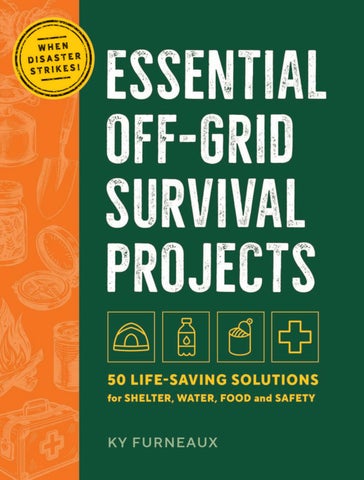
ESSENTIAL off-GRID SURVIVAL PROJECTS
ESSENTIAL OFF-GRID SURVIVAL PROJECTS Copyright © Cider Mill Press by HarperCollins Focus LLC. All rights reserved. No part of this book may be reproduced in whole or in part, scanned, photocopied, recorded, distributed in any printed or electronic form, or reproduced in any manner whatsoever, or by any information storage and retrieval system now known or hereafter invented, without express written permission of the publisher, except in the case of brief quotations embodied in critical articles and reviews. Published by Cider Mill Press, an imprint of HarperCollins Focus LLC, 501 Nelson Place, Nashville, TN 37214 USA. The scanning, uploading, and distribution of this book via the internet or via any other means without permission of the publisher is illegal and punishable by law. Please support authors’ rights, and do not participate in or encourage piracy of copyrighted materials. 13-Digit ISBN: 978-1-40035-548-8 10-Digit ISBN: 1-40035-548-6 Books published by Cider Mill Press Book Publishers are available at special discounts for bulk purchases in the United States by corporations, institutions, and other organizations. For more information, please contact the publisher. cidermillpress.com Any internet addresses, phone numbers, or company or product information printed in
this book are offered as a resource and are not intended in any way to be or to imply an endorsement by Cider Mill Press, nor does Cider Mill Press vouch for the existence, content, or services of these sites, phone numbers, companies, or products beyond the life of this book. Without limiting the exclusive rights of any author, contributor or the publisher of this publication, any unauthorized use of this publication to train generative artificial intelligence (AI) technologies is expressly prohibited. HarperCollins also exercise their rights under Article 4(3) of the Digital Single Market Directive 2019/790 and expressly reserve this publication from the text and data mining exception. HarperCollins Publishers, Macken House, 39/40 Mayor Street Upper, Dublin 1, D01 C9W8, Ireland (https://www.harpercollins.com) Typography: Text is set in Macklin Slab and TT Norms. Headers are set in Cralter Sans and Belfort. Image Credits: Projects and part openers illustrated by Roelien Immelman. Part opener backgrounds and footer art licensed from Adobe Stock (pp. 16, 110, 154, 206). Interior and cover design by Will Mack. Printed in Malaysia 26 27 28 29 30 PCA 5 4 3 2 1 First Edition
ESSENTIAL OFF-GRID SURVIVAL PROJECTS 50 LIFE-SAVING SOLUTIONS for SHELTER, WATER, FOOD and SAFETY
KY FURNEAUX
CONTENTS Introduction 6 The Benefits of a Preparedness Mindset 8
SHELTER 16 WATER 110 FOOD 154 SAFETY 206 First Aid 292 Conclusion 298 Index 299 About the Author 303
Introduction WHEN DID PREPPING TURN INTO A DIRTY WORD? The term prepping has, unfortunately, become something of a punchline in popular culture. Much of this stems from the way the media has sensationalized survivalists—often portraying extreme characters hoarding supplies, building elaborate bunkers, or obsessing over apocalyptic scenarios. These portrayals tend to focus on the fringes, creating caricatures rather than offering a fair and nuanced understanding of what preparedness actually involves. As a result, prepping is often dismissed as a fringe hobby rather than a practical approach to resilience. Skepticism about the likelihood of major disasters has further contributed to the idea that prepping is an overreaction. This makes it easy for critics to write it off as eccentric or paranoid rather than a thoughtful response to uncertainty. Another common misconception is that prepping stems from fear. In truth, it’s the opposite. Being prepared helps reduce fear and uncertainty because it offers a sense of security—knowing that even if the worst happens, you’ve got it covered. It’s about peace of mind, not pessimism. There’s a saying that sums it up well: “Expect the best but prepare for the worst.” For me, preparing allows space for optimism. And the best part? You don’t need to be a survival expert to get started. My journey into the world of off-grid living and survival skills has taught me that preparation isn’t just for the “survivalists” or the rugged outdoorsy types; it’s for anyone willing to learn and adapt. Whether you’re a seasoned expert or someone just starting, this book contains easy-to-follow, step-bystep instructions on how to turn any home into a life raft. Why should you prepare? Because anyone can learn basic off-grid living skills, and those skills can become invaluable in times of crisis. This book is structured in a project-based format, meaning each chapter is a clear, manageable step toward building your resilience. You’ll find consistent templates for each project, detailing when and how to do it, and the
6 6
ESSENTIAL OFF-GRID SURVIVAL PROJECTS
required tools. Whether you’re looking to enhance your food storage, secure a water supply, ensure safety, or create shelter, you can jump directly to the sections that address your specific needs or follow the entire program for a comprehensive approach. Imagine a world where disaster strikes: The lights flicker and then fade, the hum of appliances ceases, and the familiar sounds of a bustling life fall silent. In such moments, those who have cultivated a preparedness mindset stand apart. They have not only gathered essential supplies but have also equipped themselves with the skills and knowledge to thrive in adversity. But preparedness is more than just gathering supplies; it’s about cultivating a mindset that embraces flexibility, safety, and collaboration. I encourage you to involve your spouse, children, and even neighbors in these projects. Turn them into opportunities for skill-building and confidence-enhancing activities. Create family drills, practice plans regularly, and make preparedness a part of your family culture. By working together, we not only prepare ourselves for emergencies but also strengthen our bonds and build a support network. This mindset encourages a proactive response rather than a reactive one. In a world increasingly reliant on technology and the conveniences of modern living, the notion of a preparedness mindset can often feel distant or even unnecessary. However, a recent increase in natural disasters as well as the constant threat of potential hacks to technology transforms that mindset from a mere concept into a critical lifeline. As someone who has embraced the principles of survival and self-sufficiency, I can attest to the profound importance of being ready for unexpected challenges. A preparedness mindset fosters resilience, enabling us to navigate the tumultuous waters of uncertainty with confidence and capability. All of that said, this book is designed for the everyday person who, in the back of their mind, has a feeling that there is something more they can do to prepare for the unpredictable nature of the world we now live in. The projects within these pages are family-friendly, affordable, and adaptable to various situations, including accommodating pets, medical needs, or limited living spaces. But remember: The time to act is now— before an emergency occurs. Together, let’s embark on this journey toward preparedness, making it a fulfilling and enriching part of our lives.
INTRODUCTION
7 7
The Benefits of a Preparedness Mindset SURVIVAL, WHETHER WILDERNESS OR URBAN, triggers the same emotional and physiological states within us. For this reason I think it’s important to begin by discussing what happens in survival states and how best to combat them mentally. Survival has baffled people for centuries. Why, in the same given circumstances, does one person survive when another doesn’t? Phrases such as “the will to live” are often thrown around, but when you break them down, they seem to suggest that the mind holds such powerful influence over the body that it can simply decide to give up, causing vital bodily functions to shut down. This defies logic, yet time and again survivors of emergency scenarios have described the light fading in someone’s eyes as they give up when other people in the same situation push through. There have been real-life cases where people had access to food, water, and shelter yet still perished, often because the psychological weight of their situation became too much to bear. Some believe these individuals die because they became depressed and simply gave up, unable to adapt to a radically altered way of life. To better understand the mental aspects of an unexpected emergency, we need to look at what actually happens when such a crisis strikes. From there, we can begin to identify tools and strategies to protect our bodies and minds. As soon as an unexpected scenario occurs, the body’s fight-or-flight response is triggered, releasing a surge of adrenaline. This adrenaline can boost your energy enough to escape a life-or-death moment, but as that moment extends into minutes/hours/days, it can actually inhibit your ability to make good decisions. The brain can process only so much information at once. When overloaded with anxiety, its cognitive functions can become restricted. This can lead to an inability to think or make decisions, where a person becomes mentally “frozen” and unable to respond effectively in a dangerous situation.
8 8
ESSENTIAL OFF-GRID SURVIVAL PROJECTS
It has been recorded that during trauma, people regularly experience: • Cognitive paralysis (complete inaction) • Perseveration (repeating a particular response regardless of what is happening) • Stereotypical behavior (repeating a behavior that might not be suitable to the situation without being able to change it) • Hyperactivity (constant activity with a tendency to impulsive and aggressive behaviors) • Hypoactivity (the inability to motivate yourself to action) These responses can cause people to become disorganized, act inappropriately for the circumstances, or react too slowly to changing conditions. Survival demands the ability to cope with environmental stress and requires the flexibility to adapt to that environment. Some behaviors that I have identified as contributing to survival success include: • Being prepared: Having clear, actionable directives and equipment available to ensure your basic needs are covered. • Goal-directed behavior: Making a list of tasks you can complete and then working to complete them. • Managing emotions: Remaining calm and avoiding panic so you can maintain sound judgment and make good decisions. • Identifying assets: Noting what skills, abilities, and material possessions you have that will help you in this survival scenario. • Perseverance: Knowing that you are capable of far more than you think you are and putting one foot in front of the other, proving it to yourself with every step. The right mindset can make or break a situation. I have watched countless people succeed or fail when placed in emergency scenarios. Through the years I have tested what I consider the most essential strategies for surviving and thriving in extreme situations. I have documented and taught
THE BENEFITS OF A PREPAREDNESS MINDSET
9 9
them to many people who have then used them successfully throughout their lives to cope with both physical (outdoor) hardship and challenges in their everyday lives. These strategies are very simple and have been talked about forever, yet many people fail to remember or use them when unexpected scenarios arise. I believe these strategies can help ensure your success and survival too: 1. Educate yourself. 2. Be prepared. 3. Be positive. 4. Be adaptable. It is wise to practice these strategies in your everyday life before you are tested in extreme conditions so they become second nature, not something you struggle to recall under stress. Let’s take a closer look at each one.
EDUCATE YOURSELF
There is an old Latin saying: Scientia potential est—“Knowledge is power.” But I prefer to think of it as “Knowledge is empowerment.” When I learn skills and am confident that I know what to do in a given situation, I feel empowered. The problem is knowing what is important to learn—that’s where this book comes into play. Learning new skills is always a good idea. They not only could prove useful in an unexpected situation but also will keep your mind and body active. Stretching yourself is the best way to improve yourself. You might read about something in the library or online. Take an evening course or join a class at the gym. Whatever it is, give it a go. Personally, I learn best when I have a teacher. I like someone to show me the ropes and then guide me as I try things out. There are many good teachers ready to impart their knowledge on a whole range of subjects. Look for them online, in the newspaper, or at your local community center. A lot of people claim to be an expert at something, so be careful who you choose to be your mentor. I suggest going with a reputable company or
10 10
ESSENTIAL OFF-GRID SURVIVAL PROJECTS
someone who has good ratings and reviews rather than the cheapest price. I believe that when it comes to learning and being trained, you get what you pay for. But don’t just learn; practice the skills that you learn. Keep pushing yourself. Review your knowledge so you don’t get rusty. That way when things go wrong, you are far more likely to remember what to do, having tried it and mastered it. It’s also better to learn from mistakes when your life doesn’t depend on it.
BE PREPARED
This next strategy is critical but something most people skip after educating themselves: Act on the information that you have just learned. You’ve done the research; now you need to do it in the real world. Book that CPR course, restock your first-aid kit, clean out your leaf-filled gutters, and learn how to navigate with a map and compass if your GPS batteries run out. MAKE A LIST
Tasks can seem overwhelming at first, but a list turns a seemingly impossible project into manageable, bite-size chunks. Instead of listing a general task such as “fireproofing house,” focus on clear, manageable actions: 1. Clean out gutters. 2. Cut away overhanging branches. 3. Clear away undergrowth around the house. 4. Make sure all hoses are functional and reach the roof. 5. Identify all roads that lead away from the house—prioritize an escape route. 6. Ensure all valuable possessions are in one place and easily transportable.
THE BENEFITS OF A PREPAREDNESS MINDSET
11 11
DO THE LIST
Individual items typically don’t take much time to complete, meaning an entire list is often easily accomplished over a couple of weekends. Lists can also give us a sense of accomplishment as we tick things off, which encourages us to do more. “Be prepared” isn’t the Boy Scouts’ motto for no reason. To be best prepared for the challenges and goals ahead of me, I try to do one thing on my list a day. It can be a full-day task or one that takes five minutes, depending on the time I have available, but simply setting and achieving that goal makes me the most prepared I can be for any given emergency.
BE POSITIVE
How often do we hear the saying “Be positive”? It comes out of the mouth of every motivational speaker I’ve ever heard, a catchphrase often thrown out without consideration for how to actually do it when times are tough. But it is popular for a reason: It really can turn your life and a situation around. Negative thinking has been shown to hasten giving up, especially in dire situations. ACKNOWLEDGE THE SITUATION
The first thing I do when I find myself in a less-than-ideal situation is to acknowledge it. Let’s say my neighborhood is flooded and I’m cut off from the shops. That’s an awful situation to be in. But the first step is to face it head-on. Denial of a situation is a short-term solution and often ends badly when reality sets in, so it is important to take a realistic look at what has happened and where you are. Unfortunately, many people get stuck dwelling on this point, but this is precisely when you need to move ahead. Choosing to be negative about the situation you are in puts focus on, and enhances the perception of, the bad things about the circumstances. If you are in an emergency situation, you may be cold, tired, and hungry, but focusing on those things will not make them go away. Concentrating on them can make them seem worse than they are. Choose instead to focus on what you do have, like the fact that you are alive and coherent. Looking at the things that are working for you will help
12 12
ESSENTIAL OFF-GRID SURVIVAL PROJECTS
you figure out how best to deal with the situation. It allows you to discover your strengths and then use them to your advantage. ASSESS YOUR ASSETS
Take stock of what is working for you in the situation: Are you injured? Can you function? What resources do you have? The more things you can find that are in your favor, the less you will focus on the dire scenario. There is a difference between focusing on the negatives and assessing your weaknesses. Focusing on the negatives is complaining that you are cold. Assessing your weaknesses is realizing that your electricity is out and the food in your freezer is thawing. Noting that this is a weakness in your survival plan will allow you to make a strategy and act. For example, start by using up perishable foods first to avoid waste, then transfer any remaining food from your fridge into your makeshift cooler (see page 199). BE PRODUCTIVE
Something I ask myself when I am in extreme survival scenarios is, “What can I do today to make tomorrow better?” This not only helps me improve my current conditions but also keeps me proactive and in success mode. The problem-solving aspect of the question keeps my mind from wandering to dark places and distracts me from focusing on what I don’t have.
BE ADAPTABLE
“The best laid plans of mice and men…” Unfortunately, even with the best of planning, sometimes things still don’t turn out the way that we planned. Our well-rehearsed escape route may become blocked off or our water storage tanks may have leaked. Emergency scenarios are seldom ideal, which is why it’s important to maintain flexibility in your thinking, even within a well-structured plan. This is where problem-solving skills come into play. ASSESS THE SITUATION
After removing yourself from danger, the next thing to do is assess the situation. Consider your strengths and weaknesses within that scenario. Then figure out a way to make the strengths work for you.
THE BENEFITS OF A PREPAREDNESS MINDSET
13 13
TAKE THE TIME TO MAKE A PLAN
The next course of action is to make a plan based on your current predicament. By weighing the pros and cons of the situation, you will be able to determine the best course of action. By planning, you will avoid wasting time and energy trying avenues that will not be effective. It may seem that taking the time to plan delays action and therefore prolongs an outcome. Yes, this may be the case sometimes (like when you need to move fast to avoid an oncoming obstacle), but typically sitting down and planning saves time in the long run. And it will make you feel proactive. In an emergency situation, a feeling of helplessness can be just as deadly as the environment you are in. Your plan should be to assess the seriousness of the situation. Was it an earthquake that shook your house for a few minutes? Did your fight-or-flight mechanism take you to the street, where you joined your neighbors for a quick chat before returning to your home to straighten the pictures? Did a hurricane leave you without power and cut you off from the nearest town for three days? If that’s the case, you will need to think about how to keep yourself warm, hydrated, and fed until power can be reestablished. Your plan should take into consideration your personal “tool kit”—the lessons and skills you have learned through life. The more education and skills you bring into whatever situation life throws your way, the better your chances of coming out the other side with a positive result. Your personal tool kit could include: • The knots that you know how to tie • A first-aid course you took at work • The experience you have purifying water when backcountry camping You never know what may come in handy in any given situation, so count every skill as a bonus.
14 14
ESSENTIAL OFF-GRID SURVIVAL PROJECTS
TAKE ACTION
From the second you realize things are looking grim, do what you can to improve your situation. This will not only increase your chances of success but also enable you to be in better condition when the crisis is over. So, once your plan is in place, take action. PIVOT IF NECESSARY
It is important to remember that even though you have made a plan, it does not have to be set in stone. If it is not working for you, or if the situation changes, reassess and make a new plan. Don’t stubbornly persist with a plan that is no longer working. ATTITUDE CHECK
Your attitude in an emergency has a major impact on the outcome. While you can’t always control the situation, you can control your mindset—and that makes all the difference. The key is recognizing that your attitude is changeable, and choosing to shift it in a positive direction is the first step toward success.
THE BENEFITS OF A PREPAREDNESS MINDSET
15 15
PART 1
SHELTER
16
WHEN THE POWER GRID GOES DOWN, your home becomes your life raft: a sanctuary where safety and comfort must be preserved against the uncertainties of the outside world. In this section, we explore how to maintain your home as a habitable refuge, ensuring it remains both a protective shelter and a comforting space for your family during challenging times. In the absence of electricity and running water, simple measures like insulating your home can keep the cold at bay, while candles and lanterns provide illumination when darkness falls. A wood-burning stove or portable heater can offer both warmth and a means to cook hot meals, nourishing body and spirit alike. Beyond these essentials, maintaining a sense of normalcy becomes crucial. Crafting cozy spaces for your family to gather, share meals, and find solace can sustain morale. Simple comforts, like a favorite blanket or a cherished book, can provide much-needed reassurance and familiarity. In preparing your home for these scenarios, we also consider the importance of defensibility, especially during natural disasters: reinforcing windows and doors, securing loose objects that can become hazards in high winds or earthquakes, and establishing a safe room where your family can retreat if needed. By proactively addressing these aspects, your home becomes more than just a shelter; it becomes a symbol of resilience and comfort. With foresight and preparation, you can transform potential adversity into peace of mind, ensuring your family remains safe and secure, no matter what challenges arise.
17
18
PROJECTS 1
Set Up Backup Power Sources 20
2
Make a DIY Emergency Lamp (Candle or Oil) 35
3
Establish a Non-Electric Heat Source 44
4
Establish Non-Electric Cooling Options 59
5
Set Up an Off-Grid Cooking Method 63
6 Create a Wildfire-Defensible Space 78 7
Earthquake-Proof Your Home Interior 83
8 Storm-Proof Your House 87 9 Set Up a Safe Room 93 10 Stash Emergency Cash 102 11 Build Up Supply Caches 105
SHELTER
19 19
1
Set Up Backup Power Sources
Having backup power sources is not just a luxury; it’s a critical component of a comprehensive survival strategy. When the grid goes down—whether due to natural disaster, technical failure, or an unforeseen event—the absence of electricity can quickly escalate from an inconvenience to a crisis. Backup power sources such as generators, solar panels, or battery storage systems help to bridge this gap, ensuring that your home remains functional and your family stays safe and comfortable. First and foremost, backup power provides continuity in essential services. It keeps vital appliances such as refrigerators and freezers running, preserving food supplies and medications that require refrigeration. In extreme temperatures, backup power can operate heating or cooling systems, protecting your family from the dangers of heatstroke or hypothermia. Communication is another crucial aspect. During emergencies, staying informed and connected with the outside world can be life-saving. Backup power allows you to charge phones, radios, and other communication devices, facilitating your access to news updates, emergency alerts, and loved ones. Moreover, backup power supports lighting and security systems, helping to prevent accidents in the dark and deterring potential intruders. It also enables the continued use of essential household tools, which may be necessary for repairs or adjustments during prolonged outages. For people with medical needs, backup power is vital for operating life-sustaining equipment, such as oxygen concentrators or CPAP machines, without interruption. Investing in backup power sources equips your home to withstand grid failures. By planning ahead and making sure these systems are ready to activate when needed, you can safeguard your family’s well-being and enhance your home’s self-sufficiency. In doing so, you transform uncertainty into preparedness, ensuring that your home remains a stable and secure haven in the face of adversity.
20 20
ESSENTIAL OFF-GRID SURVIVAL PROJECTS
Portable Generators
A portable generator is a gas-powered machine that produces electricity and can be moved easily from place to place. PROS: Affordable and easy to use; suitable for short-term power needs CONS: Requires fuel, emits fumes, and can be noisy
Backup Power Sources
Several backup power sources can help ensure your home remains functional during an outage. We are going to look at the three most common: generators, solar power systems, and battery backup systems.
Portable Solar Power Systems with Battery Storage
A portable solar power system with battery storage is a compact, mobile device that uses solar panels to capture sunlight and a battery to store the energy. It lets you power devices like phones, lights, or small appliances anywhere—without needing fuel or being plugged into the grid. PROS: Renewable, quiet, and easy to set up CONS: Dependent on sunlight and may have lower power output
Battery Backup Systems
A home battery backup system is a large rechargeable battery or series of batteries that store power for if the grid goes down. The system typically includes an inverter and charge controller to ensure a continuous energy flow. PROS: Quiet, clean, and can be charged using grid power or renewable sources CONS: Limited power duration and may require a larger setup for whole-home coverage
SHELTER
21 21
Guidelines for Safe Fuel Storage 1. Use approved containers. Select containers rated for the specific fuel type (e.g., metal jerry cans or HDPE plastic fuel cans with proper seals). 2. Store in a cool, dry, ventilated area. Keep fuel away from heat sources, sparks, pilot lights, and direct sunlight. 3. Limit quantities. Store only what you realistically need; large volumes may require permits and fire-rated storage.
4. Label clearly. Mark each container with fuel type and the date stored. 5. Stabilize fuel. Add fuel stabilizers for long-term storage. 6. Rotate stock. Follow FIFO (first in, first out) practices to keep supply fresh.
Types of Fuel
22 22
GASOLINE • Shelf life: Stores for 3 to 6 months untreated, or up to 2 years with a stabilizer added. • Storage: Keep in tightly sealed containers filled to 90 to 95% capacity to allow for expansion. • Risks: Highly volatile and flammable; ethanol blends absorb water and degrade more quickly. • Tip: Use non-ethanol gasoline when possible, as it lasts longer in storage.
KEROSENE • Shelf life: Keeps for 5+ years when stored properly. • Storage: Store in metal cans or approved plastic containers, away from moisture. • Risks: Absorbs moisture over time and can degrade wick-based heaters or lamps. • Tip: Use only water-clear, 1-K kerosene for long-term storage and heating applications; avoid mixing grades.
DIESEL • Shelf life: Stores for 6 to 12 months untreated, or up to 2+ years with stabilizers added. • Storage: More stable than gasoline but susceptible to microbial growth (“diesel bug”) in the presence of water. • Risks: Water contamination and microbial growth. • Tip: Store in opaque, tightly sealed containers and add a biocide for long-term storage.
PROPANE/LPG • Shelf life: Keeps indefinitely (does not degrade). • Storage: Store in DOT-approved cylinders or tanks, always in an upright position. • Risks: Leaks can accumulate in enclosed spaces; store outdoors or in well-ventilated sheds only. • Tip: Check cylinder certification dates and inspect valves and seals regularly.
ESSENTIAL OFF-GRID SURVIVAL PROJECTS
Install backup power during the initial stages of creating your emergency preparedness plan. This ensures that your home is equipped to handle unexpected outages, providing peace of mind and security. An opportune time to integrate backup power systems is when you’re already planning renovations or upgrades. This can simplify installation and potentially reduce costs.
Portable Generators
Backup Power Sources
WHEN TO DO IT
MATERIALS • Portable generator with user’s manual (see page 26) • Fuel supply (see Tips) • Fuel stabilizer (see Tips) • Extension cords • Generator cover or enclosure (see Tips)
• Engine oil (consult manufacturer’s specifications; see Tips) • Oil filter, air filter, and spark plug (for regular maintenance) • Fire extinguisher • Carbon monoxide detector
KEY ACTIONS 1.
Select a suitable location. Place the generator outdoors in a well-ventilated area, at least 20 feet away from windows, doors, and ventilation intakes to prevent carbon monoxide poisoning. Ensure the location is dry and level, and use a protective cover if necessary to shield the generator from precipitation.
2. Fill the generator with the appropriate fuel (gasoline, diesel, or propane), as specified in the user’s manual.
3. Check oil level and top up if necessary. Ensure the generator is on a stable surface to avoid spills.
SHELTER
23 23
4. Use heavy-duty, outdoor-rated extension cords to connect essential
appliances directly to the generator. Alternatively, if your setup includes a transfer switch (see page 27), connect the generator to your home’s electrical panel using the transfer switch.
5. Follow the manufacturer’s instructions to start the generator. This usually involves turning on the fuel valve, setting the choke, and pulling the recoil cord or pressing the start button.
6. Once the generator is running, use extension cords to plug in the appliances or circuits you need to power, ensuring you do not exceed the generator’s wattage capacity.
7.
24 24
When you no longer need the generator, ensure all connected appliances are turned off and unplugged before shutting it down.
ESSENTIAL OFF-GRID SURVIVAL PROJECTS
• For a three-day emergency supply, you will need approximately 12 gallons of fuel (consult manufacturer’s specifications). • Fuel stabilizer is a chemical additive designed to slow the breakdown of gasoline or diesel during storage. It will extend the shelf life of your fuel from a few months to a year or more. Follow the manufacturer’s instructions. • Engine oil is a protective lubricant and may be required to coat moving parts, depending on manufacturer requirements.
Backup Power Sources
TIPS
• Ensure extension cords are long enough to reach from the generator’s location to where power is needed and that they accommodate the number of prongs you require. • Prioritize essential appliances like refrigerators, lights, and medical equipment. • Regularly check fuel levels, oil, and overall operation. • Follow the manufacturer’s instructions to turn off the engine and close the fuel valve. • After use, allow the generator to cool before refueling or storing.
CAUTIONS • Always operate the generator outdoors in a well-ventilated area, at least 20 feet away from windows, doors, and ventilation intakes to prevent carbon monoxide poisoning. • Keep the generator away from combustible materials and ensure it is placed on a stable, nonflammable surface. • Follow the manufacturer’s instructions for grounding the generator to prevent electrical shock.
SHELTER
25 25
How to Choose the Best Generator for Your Needs Not all generators are built the same. Whether you’re dealing with a blackout, heading off-grid, or looking to keep your whole home running in an emergency, it’s important to choose the right size for your needs—without buying too much or too little. SMALL GENERATOR (1,000 to 2,000 watts/1 to 2 kVA) • Powers: A fridge or freezer, a few lights, phone or laptop charging, a small TV • Good for: Camping, short blackouts, keeping food cold
STANDBY/FIXED GENERATOR (10,000+ watts/10+ kVA) • Powers: Most of a house, including large air conditioners, electric stoves, and pumps. • Good for: Full home or farm backup during long outages.
MEDIUM GENERATOR (3,000 to 5,000 watts/3 to 5 kVA) • Powers: Fridge and freezer, lights, modem, a few power tools, possibly a small pump • Good for: Running the essentials in a house during an outage
GENERATOR SIZING MADE SIMPLE: • Camping or tiny backup → Small generator • Household essentials → Medium generator • Most of the house → Large generator • Everything, automatically → Standby unit
LARGE PORTABLE GENERATOR (6,000 to 9,000 watts/6 to 9 kVA) • Powers: Fridge, freezer, lights, water pump, washing machine, small air conditioner • Good for: Most-of-home backup (excluding large air conditioners or electric ovens)
• Protect the generator from rain and moisture to prevent electrocution and mechanical damage. Use a canopy or tent designed for generator use if necessary. • Make sure all connected devices are turned off before starting the generator. • Avoid overloading the generator and keep an ear out for unusual noises, which could indicate a problem.
26 26
ESSENTIAL OFF-GRID SURVIVAL PROJECTS
A transfer switch is a small electrical panel that safely connects a generator to your home’s wiring. Instead of running extension cords through doors or windows, a transfer switch lets you power selected household circuits—such as the fridge, lights, or water pump—directly. WHY IT MATTERS • Safety: Prevents dangerous “backfeeding” into the grid, which can injure utility workers or damage your generator. • Convenience: With a single switch, your essential circuits run much like they normally would. • Code compliance: In many areas, a transfer switch is legally required for whole-home generator hookups. • Control: You choose which circuits stay on (e.g., kitchen or water pump) and which stay off (e.g., oven or clothes dryer).
TYPES • Manual transfer switch: You start the generator and switch power sources yourself. This type is more affordable and sufficient for most emergency setups. • Automatic transfer switch (ATS): Detects a power outage and switches to generator power automatically. This type costs more but provides seamless backup.
Backup Power Sources
What Is a Transfer Switch?
If you’re planning to use a generator during outages, budget for a transfer switch in your setup. It’s safer and turns a generator from a workaround into a reliable emergency power solution. Professional installation by a licensed electrician is strongly recommended.
• Store fuel in approved containers, away from living areas, and keep it tightly sealed. Refuel the generator only when it is turned off and cooled down to prevent fire hazards. • Use heavy-duty, outdoor-rated extension cords with grounded plugs to connect appliances. • Turn off and unplug all appliances before shutting down the generator. Follow the manufacturer’s instructions for proper shutdown procedures. • Perform regular maintenance to ensure safe operation, including changing the oil and cleaning air filters as recommended by the manufacturer, to keep the generator in good working condition.
SHELTER
27 27
Solar Power System with Battery Storage QUICK RULES • Think in 400 W panels. • Battery is what gets you through the night; prioritize safe, deep-cycle, long-life batteries. • Inverter must handle the biggest thing you turn on at once. BARE ESSENTIALS (phones, Wi-Fi, a few LED lights) • Panels: 1 × 400 W • Battery (usable): 1 kWh • Inverter: 300–600 W pure sine • What you can do: Charge devices, run modem, 6–10 LED bulbs FOOD SAFE (add a modern fridge) • Panels: 2 × 400 W • Battery (usable): 2 kWh • Inverter: 1,000–1,500 W • What you can do: Everything in “Bare Essentials” + run an efficient fridge 24/7 FOOD + COMMS + COMFORT (fridge, lights, Wi-Fi, laptop, TV) • Panels: 3 × 400 W • Battery (usable): 3 kWh • Inverter: 2,000 W • What you can do: Tier 2 + a laptop workday and a few hours of TV SMALL HOUSEHOLD FLEX (fridge + lights + Wi-Fi + laptop/TV + short microwave/kettle use) • Panels: 4 × 400 W • Battery (usable): 4 kWh • Inverter: 3,000 W • What you can do: Tier 3 + brief high-watt bursts (1–2 boils or a quick reheat)
28 28
ESSENTIAL OFF-GRID SURVIVAL PROJECTS
• Solar panels with user’s manual • Battery storage (see Battery Backup Systems, page 32) • Charge controller (see page 34)
• Inverter (see page 34) • Cables and connectors • Carrying case or protective cover
KEY ACTIONS 1.
Choose an area to set up your solar panels. Make sure the location receives maximum sunlight throughout the day. (On average, you will need three to four hours of direct sunlight for solar panels to be effective. Solar panels will generate power in cloudy conditions, but their output is greatly diminished, so it’s best to have a backup plan in winter months.) Ensure the area is free from obstructions like trees or buildings.
Backup Power Sources
MATERIALS
2. Unfold or set up the solar panels according to the manufacturer’s
instructions. Use any built-in stands or adjustable legs to position the panels at the optimal angle toward the sun.
3. Use the supplied cables to connect the solar panels to the charge
controller. (This device regulates the current and voltage flowing to the battery, preventing overcharging.)
4. Use appropriate cables to
connect the charge controller to the battery pack. Ensure all connections are secure and that you follow the polarity indicated on the devices.
5. If your system includes an inverter to convert DC to AC power, connect it to the battery. This is necessary if you plan to power AC appliances.
SHELTER
29 29
6. Allow the solar panels to charge the battery fully before use. The charge
controller will prevent overcharging and indicate when the battery is full.
7.
Use the built-in USB or DC ports on the battery pack to charge devices directly. For AC devices, plug them into the inverter’s outlets (see page 28 for wattage limits).
8. Regularly check the charge controller and battery indicators to monitor energy production and storage levels. Some systems offer mobile apps for remote monitoring.
TIPS • A charge controller regulates the voltage and current coming from the panels so your batteries get the right amount of charge without being overcharged or damaged. It also stops the batteries from sending power back into the panels at night. • Find a portable system that includes USB or DC ports for direct device charging, eliminating the need for separate adapters. • Look for panels and components that are weather-resistant for outdoor use. • Opt for high-efficiency solar cells to maximize energy capture, especially in variable lighting conditions. • Some systems allow for additional panels or batteries to be added, providing scalability for increased energy needs. • Throughout the day, adjust the angle and orientation of the solar panels to track the sun for maximum efficiency. • When panels are not in use, store them in a protective case. Keep the battery charged to maintain its health, and store it in a cool, dry place.
30 30
ESSENTIAL OFF-GRID SURVIVAL PROJECTS
• Ensure panels and batteries are securely set up to prevent tipping or falling, especially in windy conditions. Use stands or mounts as recommended by the manufacturer. • Use properly rated cables and connectors to prevent electrical hazards. Ensure all connections are secure and follow the correct polarity to avoid short circuits. • Utilize a charge controller to prevent overcharging, which can damage the battery and reduce its lifespan. Regularly monitor the charge levels.
Backup Power Sources
CAUTIONS
• Avoid exposing batteries and panels to extreme temperatures, as this can affect their performance and longevity. Depending on the battery type, they are far less flexible with extremes. Avoiding temperatures below 35°F and above 122°F is a good rule of thumb. • Store batteries in a cool, dry place when not in use. • Keep flammable materials away from batteries and solar equipment. Ensure proper ventilation to prevent gas buildup, especially for lead-acid batteries. Avoid keeping batteries in airtight spaces or areas without any airflow.
Batteries by Type Lithium-ion. Best for applications requiring long run times. Lightweight, high discharge rates, and minimal maintenance. Ideal for electric vehicles and portable electronics. Lead-acid. Suitable for applications that require high capacity at a lower cost, such as solar energy storage and backup power systems. Run time may be limited due to discharge depth and weight. Nickel-cadmium. While robust and capable of deep discharges, their self-discharge rate and memory can limit effectiveness in some applications, making them less common in new designs compared to lithium-ion.
SHELTER
31 31
Battery Backup Systems
MATERIALS • Deep-cycle batteries such as lithium-ion, lead-acid, or nickel-cadmium, chosen based on capacity, efficiency, and lifespan (see page 31) • Inverter/charger (see page 34)
• Battery management system (BMS) (see page 34) • Charge controller (see page 34) • Electrical wiring and connectors • Monitoring system
KEY ACTIONS 1.
Select a cool, dry, and accessible location to install the battery backup system. Ensure it is well-ventilated and away from direct sunlight or heat sources.
2. Securely mount the batteries on a rack or place them in a battery enclosure, ensuring they are stable and protected from physical damage.
3. Mount the inverter/charger close to the battery bank, following the manufacturer’s instructions. Ensure proper ventilation around the inverter to prevent overheating.
4. Connect the batteries in series or parallel, depending on the system’s
voltage requirements. Ensure all connections are secure and follow the correct polarity.
5. If using solar panels, connect the charge controller to the battery system to regulate charging. Ensure all connections are secure and follow the manufacturer’s guidelines.
6. Ensure the battery reaches full charge using grid power, solar panels, or another energy source before initial use. Monitor charging through the inverter or charge controller display.
7.
32 32
Turn on the inverter and ensure it is set to automatically switch to battery power during a grid outage. Test this function to verify operation.
ESSENTIAL OFF-GRID SURVIVAL PROJECTS
Backup Power Sources
TIPS • Regularly check the system’s display or monitoring app to track battery charge levels, inverter status, and overall system health. Follow the manufacturer’s maintenance schedule for battery health and longevity. • Periodically inspect connections, clean terminals, and check for any signs of wear or damage. • When not in use, system components should be stored in a safe, dry location to prolong their lifespan and ensure they are ready for future use.
CAUTIONS • Follow proper charging protocols to avoid overcharging or deep discharging, which can shorten the lifespan of the battery. • Ensure good ventilation for the battery backup system, especially if using lead-acid batteries that can emit harmful gases. • Perform regular checks and maintenance on your battery system to ensure it’s functioning properly. • Consider having an alternative backup power source, such as a generator, in conjunction with your battery system for extended outages.
SHELTER
33 33
Inverter An inverter converts the electricity stored in batteries (DC = direct current) into the type of power most household appliances use (AC = alternating current). WHY IT MATTERS: • Batteries and solar panels produce DC power (similar to a car battery). • Homes and household appliances run on AC power (like a wall outlet). • Without an inverter, you’re limited to DC devices or direct USB outputs from a solar panel, if available. • With an inverter, you can run everyday appliances—fridge, lights, laptops, TVs, even a kettle—just like normal. In short, an inverter makes stored battery or solar power practical for everyday household use.
CHARGE CONTROLLER A charge controller regulates the voltage and current coming from the panels so your batteries get the right amount of charge without being overcharged or damaged. It also stops the batteries from sending power back into the panels at night. WHY IT’S IMPORTANT: • Prevents overcharging, which shortens battery life. • Prevents over-discharging, which can kill a battery. • Protects against voltage spikes from the panels. • Improves efficiency by matching panel output to battery needs (especially with MPPT controllers).
Battery Management System (BMS) Many small, off-the-shelf lithium batteries (such as 12V 100Ah packs) include a built-in battery management system (BMS). Larger or DIY battery banks, however, require an external BMS to stay safe and reliable. An external BMS is a separate unit that monitors and protects a group of batteries wired together, rather than being built into a single battery case. It’s typically used in custom battery banks made from multiple lithium cells or modules.
34 34
ESSENTIAL OFF-GRID SURVIVAL PROJECTS
WHAT IT DOES • Monitors each cell or module in the bank. • Controls charge/discharge by signaling the charger or inverter to stop if limits are reached. • Provides balancing so all cells stay even in voltage. • Adds safety cut-offs for over-voltage, under-voltage, over-current, or overheating. Without a BMS, one weak cell could overcharge or over-discharge and destroy the whole bank (or worse, cause fire).
2
Make a DIY Emergency Lamp (Candle or Oil)
In times of unexpected blackouts, commercial lighting solutions may not be available, but materials for a homemade lamp are often found in most households. Additionally, creating your own lamp can be a cost-effective alternative to purchasing specialized emergency lighting products. With minimal expense and effort, you can have a functional light source at your disposal. DIY emergency lamps can also be customized to fit your specific needs and preferences. You can choose the size and type of candle or oil to use, allowing you to tailor the lamp to your situation. This flexibility is especially useful for different environments, whether you’re at home or in a camp setting. Making your own candles can also be a fun activity, so I have added two projects for DIY candles, using wax or oil, so you will have an endless source of candles for your lamps.
WHEN TO DO IT Make your DIY emergency candles or lamps prior to any emergency. Stock up before storm season, when there are far more power outages than any other time of year.
Wax Candle
MATERIALS • Wax (paraffin, beeswax, or soy; see Tips) • Candle fragrance oils (optional; see page 39)
• Colorants (optional) • Wicks (see page 38) • Heat-resistant containers or molds
SHELTER
35 35
About the Author Ky Furneaux is one of the world’s most recognized survival experts and the author of nine survival and preparedness books, including Survive, When the Grid Fails, Adventure Awaits, and Surviving the First 36 Hours. A former Hollywood stunt performer and Taurus World Stunt Award winner, she now dedicates her career to teaching practical survival skills that help people thrive in both wilderness and everyday life. Ky served as a survival consultant on the blockbuster film Send Help and has been featured as a survival expert across numerous international television networks. She is best known to audiences as a fan favorite on Discovery’s hit series Naked and Afraid, and for her own short series Outback Lockdown. Through her books, media work, and leadership programs, Ky helps people develop the mindset, resilience, and practical skills needed to face challenges with confidence—using survival principles not just for the outdoors, but for navigating life itself.
303 303
About Cider Mill Press Book Publishers Cider Mill Press publishes exceptional books that combine creativity and craftsmanship. As an imprint of HarperCollins Focus, we specialize in premium cookbooks, cocktail and spirits guides, and illustrated gift books, all distinguished by compelling content, striking design, and a commitment to quality in every detail. Cider Mill Press sets the standard for books that inform, inspire, and elevate everyday moments. Learn more at cidermillpress.com.
“Where Good Books Are Ready for Press” 501 Nelson Place Nashville, Tennessee 37214 USA