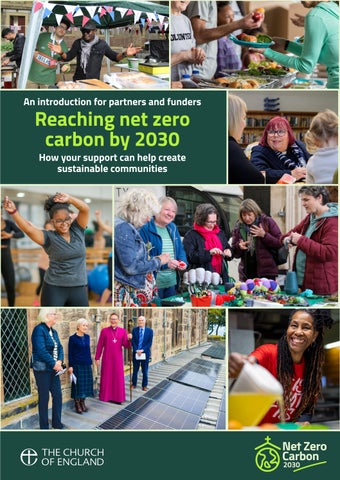
An introduction for partners and funders
Reaching net zero carbon by 2030 How your support can help create sustainable communities
Contents 3
Welcome
4
Community Assets
6
Climate Action
7
What is the the Church of England doing?
8
Impact so far
10
Our Net Zero goal is for everyone!
11
How you can help
12
Further information
Julian Atkins
Net Zero Programme Director
Welcome It is my pleasure to introduce you to our Net Zero Programme and the carbon cutting projects underway in our buildings across England and invite you to support this vital work.
Positive futures Grimsby community transformed by nature grants
“Before the net zero transformation of the church hall I was put off by the cold and having to wear my coat indoors. Now it’s a lovely warm place. It’s so improved. I go much more now. It’s wonderful as it stops me feeling lonely and I’m making more friends.”
Each week thousands of churches bring communities together and help people in need – whether that is through local food projects; providing hot meals for the homeless; hosting lunch groups for the isolated; running children’s groups, dementia cafes or health and wellbeing activities. It’s essential these buildings are bright, warm and welcoming to ensure communities can continue to flourish and be supported. Our vision is for these cherished community hubs to also be net zero carbon by 2030. We know this is a huge challenge but reducing the impact we have upon our planet is a fundamental aspect of our mission.
somewhere – climate change is real and it is happening. But small changes, when aggregated do make a difference and can create ripple effects when we do them together. The Church of England has already released grants and projects worth £30 million to help lower carbon emissions from its highest emitting buildings, but this is still not enough – there are over 16,000 churches in England. More funding is needed to support these churches at a local and regional level.
Climate change is having a devastating effect on the poorest people in the poorest countries and by reducing carbon emissions from our buildings across the country, we can all play a part in combatting climate change.
The buildings in our care are some of the most important, historically significant and culturally sensitive buildings in our nation, so if we can show what is possible in terms of reducing our carbon emissions then we can be a beacon for communities and others to follow.
We can’t ignore climate change and the longer we delay serious action, the more damaging the impacts are on the natural processes which sustain life. We have to start
Please support your local church and join us on our journey to be net zero carbon – ensuring our communities can continue to flourish for generations to come.
Dot Moore
Troon resident
Read more about these and other projects here
3
Small changes make a big difference at St Denys in Southampton
Community assets
7,500
12,500
30,000 SOCIAL ACTION PROJECTS
LUNCH CLUBS & COMMUNITY CAFES
7,000
3,500
3,400
PARISHES
Church spaces are embedded in our social fabric and support rich networks of relationships in the wider community. Alongside congregational life, parishes provide welcoming places where people of all faiths and none can find practical support with big societal challenges including loneliness, food poverty and mental health and come together for fun, culture and wellbeing. Each year over 30,000 social action projects are run through the Church of England’s 12,500 parishes; they cater for all with foodbanks, lunch clubs for older people, playgroups and community cafes topping the list 1. From Cubs and Brownies to job seekers clubs, English classes for refugees and alcohol and drug support services, church venues host a vast array of grass roots, community led work that strengthens and enriches our society. In areas of high deprivation, many churches run multiple projects, providing a lifeline to
communities hardest hit by the pandemic, austerity and higher cost of living. One study using HM Treasury guidelines puts the economic and social value generated through the UK’s church buildings at £55bn per year 2. Another calculates the community health benefits including social prescribing that churches host would cost the NHS £8.4bn a year to deliver 3.
YOUTH AND AFTER SCHOOL CLUBS
FOODBANKS
None of this could happen without publicly accessible church buildings including over 5,000 halls, which parishes as small, independent charities run and maintain entirely at their own expense. They receive no government funding, relying on voluntary contributions. In addition to providing frontline social support, parishes are now stepping up to meet the biggest challenge of our time and responding to the climate emergency.
4
PLAYGROUPS
£
2,200
HOMELESS SUPPORT & DEBT ADVICE PROJECTS
200,000
BAPTISMS, WEDDINGS & FUNERALS
5
Climate action
The Church of England recognises the global climate emergency as a crisis for God’s creation and a fundamental injustice and is taking bold action.
What’s the Church of England doing to lower its carbon emissions?
The church has an ambitious plan to reach net zero carbon by 2030, cutting emissions by 90% and offsetting the rest. The Routemap to Net Zero sets out the steps required to decarbonise buildings across the organisation as well as mobilising people to reduce energy use and adopt the low carbon solutions needed to reach national net zero targets.
The national strategy is to resource and support dioceses and parishes as they deliver their net zero plans.
Moving away from fossil fuels to run church spaces on renewable energy will ensure there are warm, comfortable places for everyone to use. With fuel bills reduced and carbon emissions cut, these community spaces will be more sustainable, both financially and environmentally.
Parishes identify solutions that match the use of their buildings. Low intervention ‘Heat the People’ options such as under pew heaters, heated seat cushions, and far infrared panels are cost effective for smaller congregations. Larger capital projects involving heat pumps and solar PV may be appropriate where buildings are in daily use.
Upgraded halls can increase rentals and boost parish income. Retrofitting in line with net zero legislation will keep these venues open: not doing so could attract fines for non-compliance or see them become stranded assets no longer eligible for community use 4.
3 /4
12,500 PARISHES
All are independent charities and financially responsible for the buildings they own
42
CHURCH OF ENGLAND DIOCESES
“We have insulated the building which means it’s cheaper to run and more accessible for the local community and projects throughout the week.”
gs have of church buildin and their heritage value akes listed status m n more decarbonisatio enging. costly and chall
Rev Simon Gatenby
6
The national church has committed £190 million to its Net Zero Programme through to 2031 but needs to leverage substantially more to decarbonise an estate which includes 42 cathedrals, 16,000 churches, over 5,000 halls, 10,000 clergy homes and nearly 2,200 church schools. The Church of England is working with external funders, donors, national, regional and local government to secure funding and form partnerships to drive this work forwards.
Rev Simon Gatenby explains how new insulation at Brunswick Parish Church in Manchester is helping to keep people warm and reduce energy costs.
7
Impact so far
Since 2023 the Church of England has used internal funding to:
Invest in people
With a core national team and a network of NZ officers across the 42 dioceses we’re building knowledge, skills and expertise.
Responsible for nearly 50% of the Church of England’s total carbon footprint, we’re helping schools to reduce energy use, drive behaviour change, and secure government funding to decarbonise their buildings.
Cut emissions
Test and learn
‘Quick wins’ grants funded small-scale parish projects such as LED lighting and insulation to reduce energy use and prepare buildings for low carbon heating systems.
Fundraise
Support church schools
We’re developing national projects with Trusts and Foundations, piloting partnerships with local government and supporting parishes with training, resources and schemes like our popular digital giving campaign Give To Go Green.
Crunch the data
We mined our data and audited carbon emissions across the organisation so we can target interventions and track progress.
With Benefact Trust the Church of England is co-funding over 100 church ‘demonstrator’ projects to showcase net zero in a range of building types which will be open for everyone to visit and take inspiration from.
8
9
Why our net zero carbon 2030 goal is for everyone! Church spaces serve the wider community through over 30,000 social action projects each year which benefit people of all ages and backgrounds and provide a lifeline for some of the most vulnerable in our society. Some 45 million people - 80% of England’s population - live in a parish that runs, hosts or supports at least one such project. The social, economic and health benefits generated through church buildings has been valued at over £55bn per year 2. As small volunteer-run charities, parishes are responsible for their church buildings, many of which are listed heritage assets and complex and costly to decarbonise. Parishes need to decarbonise their buildings in line with legislation to keep them in use
We are working to decarbonise • 42 cathedrals • 16,000 churches • over 5,000 halls
How you can help
• 10,000 clergy homes • and 2,200 schools
for future generations. Without retrofitting some halls could become ineligible for public use 4.
From 2025 our Environment Programme moves from the preliminary to the main capital phase. We will build on pilots, expand successful projects and continue to innovate and provide leadership and learnings as we move to delivering decarbonisation at scale.
Through the Eco Church scheme5, congregations are responding to the climate emergency and working on the behaviour change needed to meet national net zero goals.
Please support this urgent work! Our national and local net zero staff would love to talk to you about inspiring net zero carbon projects in your area and how your organisation can work with us to accelerate progress through partnership and funding.
The national church has so far invested £30 million in targeting its highest carbon emitting buildings. A dedicated network of net zero officers across the country is now in place, supporting parishes as they plan and raise funds to decarbonise.
To discuss further, please contact the NZC officer in your local diocese or our national NZC Fundraising Team: nzcprogramme@churchofengland.org
Through this work we are testing, piloting and generating learning we can share with other community and faith groups to help with their NZ journeys.
Parishes are small independent charities. Most are run by volunteers and rely on voluntary contributions. They receive no government funding. 10
The cost of getting church buildings closer to net zero carbon ranges from a few thousand pounds for LEDs and insulation to several hundred thousand for heat pump and solar PV
! u o y k n a h T 11
Support local churches and communities on their journey to net zero carbon
Footnotes 1. 2. 3. 4. 5.
Statistics for Mission 2022, Church of England The House of Good: The economic and social value of church buildings to the UK – 2021 update House of Good Health (nationalchurches trust.org) October 2024 Community Buildings: an evaluation of the improvement in energy performance in community buildings in England, Social Investment Business 2024 Eco Church, an A Rocha Project Eco Church - An A Rocha UK Project
Church of England Net Zero Carbon Routemap 2024 Impact Report
This document has been prepared by the Church of England Net Zero Programme team. If you have any questions, please email nzcprogramme@churchofengland.org