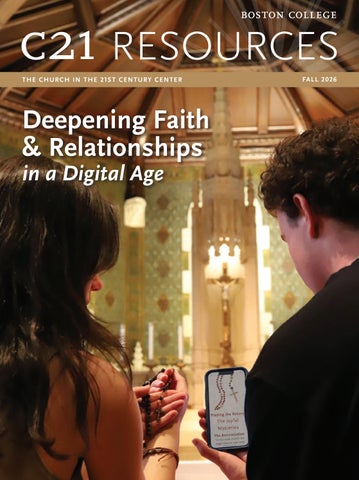
Deepening Faith & Relationships in
a Digital Age
The Church in the 21st Century Center is a catalyst and a resource for renewal of the Catholic Church.
C21 Resources, a compilation of the best analyses and essays on key challenges facing the Church today, is published by The Church in the 21st Century Center at Boston College, in partnership with publications from which the featured articles have been selected.
c 21 resources editorial board
Dominic F. Doyle
Karen K. Kiefer
Kalemba Kizito
Peter G. Martin
Jos Moons, S.J. Elizabeth H. Shlala
guest editor
Michael Serazio
managing editor Lynn M. Berardelli
assistant editor Frances Adjorlolo
the church in the 21 st century center Boston College 122 College Road, Lawrence House Chestnut Hill, Massachusetts 02467
bc.edu/c21 • 617-552-0470 church21@bc.edu
©2026 Trustees of Boston College
DEEPENING FAITH & RELATIONSHIPS in a Digital Age
Rremember the days when we grew our faith through the heart of the home and within the familiar neighborhoods of our Catholic parishes and schools? Today, God has greatly broadened our faith communities, connecting us to friends in faith around the world through technology and virtual opportunities. Through God’s grace and a click, I have been connected to Juan Pablo Cervantes from Mexico; Sarah Crockford from Canada; Thérèse Ferry from Ireland; Jim Macika from New Orleans; Margie Sherlock from New Hampshire, just to name a few, and there are hundreds more. They have become dear friends for whom I would do anything, yet I have never met most of them in person, only through C21’s online faith communities. A connected grace.
There’s a world of possibilities when God is working through our connections online, and yet Pope Leo reminds us in his first encyclical, Magnifica humanitas, that it’s our responsibility to engage with these digital tools and experiences with a strong mind and heart, always being aware of our responsibility to protect human dignity, champion peace, and care for creation. Pope Leo, as our pastor, seeks to show us God’s vision for the common good and advises us to use technological advances, especially artificial intelligence, to address global inequalities, build healthy relationships, and serve humanity.
Special thanks to our guest editor Michael Serazio, professor and chair of Boston College’s Communication Department, for honoring Pope Leo’s vision and gathering a fresh collection of voices, resources, and ideas to help us live an authentic and relational faith in the fast-paced world of evolving technology and virtual spaces. Enjoy newly commissioned articles, important articles worthy of reprinting, digital ministry ideas, virtual opportunities and programs, and forward-thinking wisdom for today and tomorrow.
Our prayer is that this collection will help strengthen your relational faith in new and surprising ways.

Karen K. Kiefer
Director, The Church in the 21st Century Center karen.kiefer@bc.edu

GUEST EDITOR
Michael Serazio is a professor and chair of the Department of Communication at Boston College who studies media production. In addition to earlier books on advertising and sports culture, he is the author, most recently, of The Authenticity Industries: Keeping It “Real” in Media, Culture, and Politics from Stanford University Press (2023). A former journalist, he has written essays for The New York Times, The Washington Post, The Atlantic, and other publications.
For more information on this issue and additional resources, please visit: bc.edu/c21digitalfaith.



• FIND Community— in person and virtually
• EXPLORE Faith Resources—all complimentary and accessible online
• JOIN C21 Programs Adult, Young Adult, Children
We
Emanuele Colombo
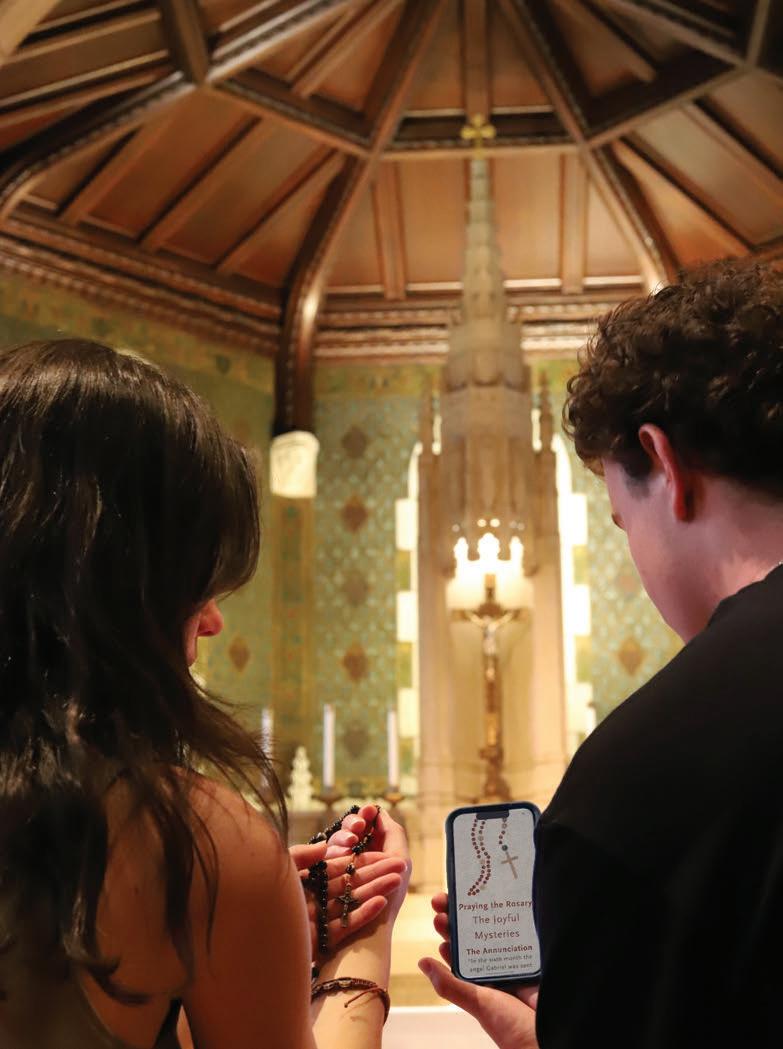
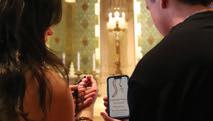
Students Allison Eidt '27 and Patrick Regan '28 visiting St. Mary's Chapel at Boston College for prayer and reflection.
photo credit: Courtesy of Andrew Craig, Boston College
Authentic Faith in an Age of Digital Humanity
Michael Serazio
Oon may 24, 1844 , an inventor named Samuel Morse tapped out the inaugural message to travel by electromagnetic telegraph. The dots and dashes raced through c opp er wires connecting Washington to Baltimore. His choice of words was striking, as revealing as it is enduring: “What hath God wrought?”
Some 179 years later, when a colleague demoed ChatGPT for the first time at a department meeting, I think I muttered much the same.
For religious believers, jaw-dropping breakthroughs in technology—the wheel, the printing press, the steam engine—naturally invite divine attribution. They signal a world transforming dramatically and possibly irrevocably. They can leave us confused and, by turns, anxious and hopeful.
Ours is just such an era.
From the dawn of the internet in the 1990s to social media’s emergence a decade later to the AI upheavals of today, digital change feels like the only societal constant. We shape those tools of technology and they, in turn, shape us. And we’ll believe differently because of them: a revolution of both mind and spirit.
For just as early Christianity was defined by the affordances of oral communication and, later, the development of writing, so, too, will the texture of faith be molded by digital conditions and values. Our relations with others—that social fabric animating the theological—can still thrive in those spaces if we’re thoughtful and deliberate about them.
Woven throughout the articles of this issue are varying names for the same central challenge of online lives: navigating the physical-versus-virtual; the profound-versus-superficial; the real-versus-fake.
AI is the apex of that. Such systems seek to read, think, speak, feel, and relate on our behalf. The Catholic Church will have to be a voice that articulates meaning and dignity on behalf of humanity against an AI intrusion that is, by definition, soulless.
This digital world therefore confronts us with a new context for an otherwise timeless question: If God hath wrought this, what does it now mean to be human? And how might we find God therein?
One could be forgiven for feeling less than hopeful about the prospect of “digital humanity.” For many, that’s a contradiction in terms. Scratch the surface of any number of societal scourges—fragmentation, polarization, alienation—and technology feels like a contributing culprit.
Smartphones were addictively designed; algorithms programmed to incentivize emotional extremes. Mix in a generation of vulnerable young people beta-tested by powerful, wealthy corporations eager to “move fast and break things”—and break things they did.
Social media overflows with likes—human affection superficially tallied as influencer currency—but Christian love, agape? Less so.
In public opinion surveys, AI remains consistently unpopular. That’s because it doesn’t just threaten to
photo credit
Siciliani
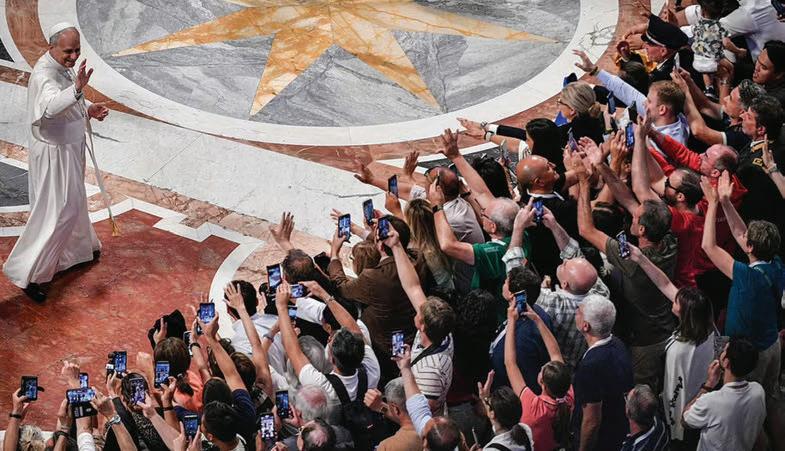
Pope Leo XIV greets the crowd gathered inside St. Peter's Basilica at the Holy Mass for the Jubilee of Sport on June 14, 2025.
automate out of existence countless forms of labor. Machines have been doing that for hundreds of years. AI threatens to overtake habits of the heart that have long formed the basis of friendship, feeling, and faith.
When the pandemic hit, and “social distancing” further atomized humanity, lives once lived in three dimensions suddenly felt depthless in Zoom rooms. And, yet, if Matthew 18:20 has it right, when “two or three are gathered in [Jesus’s] name, I am there among them.” Thank God for dependable Wi-Fi!
This is why the tech pessimists are only half right.
“Digital humanity” can be a sneer, sure—for all the evidence piled above that technology hollows out our capacity to be full, present, empathetic people of God. Yet, as many of the articles in this issue equally demonstrate, technology can also hallow out our potential as humans as well.
It feels like Pope Leo XIV is especially attuned to the promise and peril of this fast-arriving future. He’s no digital native, but then-Robert Prevost reportedly designed the first website for his Augustinian order in the early 2000s. More consequential, still, was his name choice: a nod to Leo XIII, whose papacy grappled with the turbulent aftermath of the Industrial Revolution and thus incubated central tenets of Catholic social teaching.
Much as heavy machinery transformed and reordered the world of the 1800s, digital technologies seem p oi sed to unsettle our century (as they already have, abundantly). And much like those Dickensian factories of old, the dignity and humanity of workers ought to be at the forefront of Christian concern.
We don’t tend to see that labor—mining rare earths, say, or moderating disturbing content—behind the clean sheen of smartphone glass. But our digital world cannot run without it. Or them. Pope Leo, I believe, will bear that in mind—and in heart.
His Magnifica humanitas encyclical, released this summer, is a testament to that. It has a pastoral protectiveness woven throughout: a call for safeguards against the threat that AI poses to workers, children, and people who seek peace in the world. And at a time when widespread unemployment is frighteningly forecast, it foregrounds that labor is not just a means to a paycheck but a means to meaning and self-worth.
And it’s not just workers who are unsettled. As AI is increasingly normalized, we’re on the cusp of radical cultural change too. Social relations that seem inauthentic now may well cease to be stigmatized as such in the near future—if Silicon Valley has its way. Indeed, part of what tech companies seek to simulate are relationships built upon faith: the most durable of foundations.
With more people turning to chatbots for friendship, therapy, romance, and even deepfake reanimations of deceased loved ones, calls will grow to affirm the “personhood” of what is, ultimately, just complex math.
Catholicism affirms the fundamental dignity of all human beings. If we reach an age of AGI (i.e., artificial general intelligence), large language models (LLM) will seduce many to be included in that category of consciousness. But an LLM is intrinsically derivative— and humans are created (and creative) in God’s likeness.
“We are born as originals, but many of us die as photocopies,” the first millennial saint, Carlo Acutis, cleverly lamented of social media conformity. That yearning that drives people online is, not coincidentally, the same yearning that drives people to faith: a desire for authenticity.
We seek from authentic spirituality that which the modern, mediated world often does not provide: a wholeness of true self. And yet, following the Jesuit ideal of “meeting people where they are,” the Christian message must go into that world and adapt to those imperfect conditions. From Archbishop Fulton Sheen charming audiences on broadcast TV to Pope Francis shattering Instagram records to the C21 Center durably “praying it forward” on Zoom—week in and week out—there is ample legacy of this.
For without communication, there can be no community. And for many who can’t always find that community in “real” life—say, the LGBT Catholics that Father James Martin, S.J., welcomes—that online space is vital, soulful, and, frankly, real.
The internet is a place of miracle databases and cathedral-tour TikToks and biblical podcasts and prayer apps galore. Finding God in all things means finding God there too.
In the end, for me, finding God is but an exercise in focus. That’s important to keep in mind because those same digital industries have designs on our attention more than anything else. Our eyeballs—and, in turn, our minds—form the basis of their billion-dollar industries.
Mindfulness is, therefore, a countercultural act against them. And being mindful of others in our lives—in that practice of a relational faith—is equally countercultural.
In some ways, one of my favorite parts of the Mass is the silence that precedes it. It’s a prayerful unplug—a mini-digital detox, if you will—from the many distractions that came before and the many that await us afterwards on our phones. Perhaps what we need most from our dazzling new technologies is a time and space for reflection—away from them.
As I often tell my students, the greatest gift you can ever give someone you love is your attention. God hath wrought that for us too. ■
Michael Serazio is the guest editor of this issue of C21 Resources . He is a professor and chair of the Department of Communication at Boston College.
Magnifica humanitas Key Points from Pope Leo's First Encyclical
Katie Prejean McGrady
Mmagnifica humanitas has arrived , and it is beautiful. It is well worth reading in full, because it is a wonderfully written, deeply thoughtful, clearly prayedthrough text that I think will stand the test of time. Leo’s first encyclical shows us his heart and invites us to consider what is happening in this current age, and how each of us is uniquely grand, dignified, valuable, and loved.
Magnifica humanitas is not a screed against AI, nor is it a full-throated endorsement of the technological advancements of the AI tools surrounding us. It is a consideration of the moments we face, how history got us here, how the social doctrine of the Church can guide us, and the responsibilities we each have in the current age of artificial intelligence.
Here are important themes/points from Magnifica humanitas as you sit down to read it.
Magnifica humanitas is magnificent , painting a picture of the grandeur of God writ large in the world, seen and experienced fully within His creation (namely us humans) and when we encounter the face of the Son of God, Jesus Christ. Pope Leo makes clear that we grand and magnificent humans face a pivotal choice: Will we build Babel or will we construct a city of God?
The social doctrine of the Church is a rich and deep well. Pope Leo traces its historical development, the ways it has been taught, interpreted, and implemented in the Church and world, and challenges us to consider that the teachings of the Church concerning the principles of common good, universal destination of goods, subsidiarity, solidarity, and social justice are more than nice ideas. These are ever-present realities we must embrace, live, fight for, and proclaim boldly, especially as people of faith.
The world in which we live is rapidly changing, and Pope Leo is calling us to ask one key question about what is unfolding: What are we building? Leo poses a few key questions worth considering:
“Where are we going? Toward what goal do we wish to orient ourselves? What direction should we choose as people and as a human community?” (MH, 6).
And to guide us through these questions, he offers two scenarios/characters: the building of the Tower of Babel and the rebuilding of the walls of Jerusalem.
“With the heart of a shepherd and a father, I ask everyone to abandon the construction of yet another Tower of Babel and to join forces in building up the common good, so that humanity will never lose its beauty, and the world once again will come to recognize the human heart as the place where God desires to dwell.” (MH, 16).
Humanity will always be greater than anything humans make, and while AI is a valuable tool, it is just that: a tool. AI is created and man made, and therefore under our control. We must fashion the use of AI around guiding principles and an ethical, moral code because technology is far from morally neutral. If artificial intelligence is set to try to build a new kind of conscience, a new kind of human, then this shows us the very real human desire for more, and that can ultimately only be satisfied in a relationship with Christ. This is key: Pope Leo does not spend his time in this encyclical just telling the world how to use or not use AI. Instead, he, as the shepherd and Father we need, points us back to Jesus. That is the only lens through which we can tackle any changes in the world, technological or otherwise. Humanity is magnificent because of the most magnificent human, Jesus, and we transcend ourselves in relationship with Him, through grace.
AI risks automating the human spirit, and as such, we have to ensure that AI and technological advancements are tools for us. We cannot become cogs in a machine that are simply productive and efficient. Our dignity, and the dignity of our work is paramount, and it comes not from what we do but simply because we are. That which is artificially intelligent cannot and must not replace that which is real and wise.
Peace is not merely an idea, or even just an ideal. It is a craft, and an unarmed and disarming peace is of the utmost importance in the world today. Leo extensively explores and calls out the military-industrial complex, the ways in which AI and technology create
First Encyclical Letter of His Holiness
Leo XIV—Magnifica humanitas
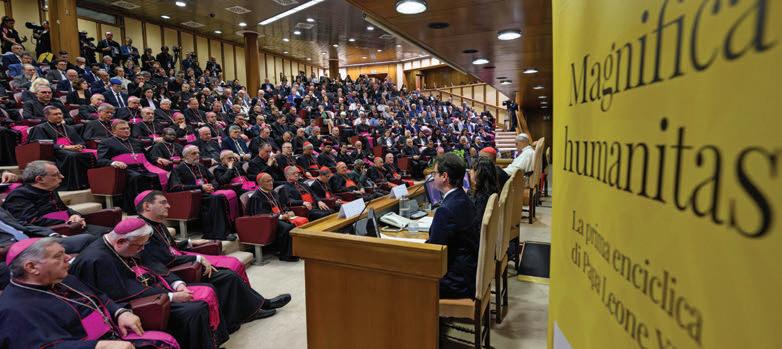
a divided world that can lead to quick, forever war, and a belief that holds (wrongly) that peace is just far too difficult to achieve. War is easy. Peace takes time, and Pope Leo asks us to work to create peace within so that peace can reign throughout.
Humans long for more. We would not have transhumanism, or post-humanist or even AI-driven movements and advancement if there was not a desire within the human heart for more . We are restless, after all, and our Augustinian Pope quotes St. Augustine to remind us the restless heart only comes to a satisfied stillness in the Lord. Some in this world falsely believe we can build the more, invent the more, and code the more. But no! That more for which we long can only be found in God.
“…as a believer among believers, I invite everyone to contemplate, in the face of the Son of God, the grandeur of humanity that shines a light also on the era of AI….No computational system, however sophisticated, can create a heart that gives itself, or a conscience that discerns good from evil. Even when machines excel in efficiency, a human face that asks to be gazed upon remains the center of our history.” (MH, 233).
We are not without hope in the age of AI. In fact, we should never be without hope when facing change. Because it is precisely in the face of change that God shows the strength of his arm, and the scattering of the proud, as he casts down the mighty, lifts up the lowly, fills the hungry with good things, and sends the rich away empty-handed. This is what Mary proclaims, what she prays, when faced with a challenge and a wild change in her life. She “bursts into a hymn of praise and joy. Her soul magnifies the Lord and her spirit rejoices in God her Savior, because he chose a young, poor, and humble
girl for his plan of salvation.” (MH, 243). In the age of AI, we must do the same. Just like Mary, we can see God’s invisible work in history and among mankind and ultimately direct our gaze to His face.
In the end, this is the question posed: What ultimately safeguards humanity? In short: a civilization of love, which we build in relationship with God and others. What protects us in an age of AI? Remembering it is a tool that we use, not a tool that uses us. What brings us hope in this rapidly changing era? The face of Jesus Christ, the fuel that is the Eucharist, and communion with one another.
We are the ones, loved into our existence, who must decide what to do with the time given to us. Pope Leo invites us to do with that time what we dignified, free, loved, creative, magnificent humans alone can do: build the civilization of love.
“The civilization of love will not arise from a single or spectacular gesture, but from the sum total of small and steadfast acts of fidelity that serve as a bulwark against dehumanization…it is worthwhile pausing to reflect on some aspects of how we, each in our own way, can cooperate in building the civilization of love.” (MH, 213). ■
Katie Prejean McGrady is an award-winning author, speaker, podcaster, and host of SiriusXM’s The Katie McGrady Show on The Catholic Channel. She is also a Vatican analyst for CNN and collaborates with the Vatican Dicastery for Communications on Digital Media initiatives.
This article excerpt was originally published on May 25, 2026 and is reprinted with permission: https://katieprejeanmcgrady.substack. c o m/p/10-key-points-from-pope-leos-first.
EVOLUTION OF Catholic Media Outreach
Kristin M. Peterson

Iimagine this : you come home after work and turn on your TV. Instead of scrolling through endless options of streaming platforms and cable channels, you have three channels to choose from. And on one of those channels is a Catholic bishop in his vestments giving a sermon to a live audience. This may sound like a fictitious story, but Catholics who lived through the early days of television remember the work of Archbishop Fulton Sheen, the first Catholic leader to effectively use television as an evangelization tool. His evening program, Life Is Worth Living, was regularly the top-watched show of the three options—quite the feat when you consider that a large portion of the American audience, Catholics and non-Catholics, were watching a Catholic bishop preach for an hour on television instead of watching other more traditional entertainment programs. Archbishop Sheen’s unprecedented work to use the new medium of TV to reach a large audience with God’s word was influential in how Catholics have continued to use new media technologies both to evangelize and to maintain the Catholic community.
Archbishop Sheen’s embrace of television fits into a larger tradition of Catholics and other Christians seeing media as gifts from God that can be harnessed for positive outcomes. Going back to the invention of the printing press, Christians believed that this was a way to spread God’s word further and to solidify Christian teachings for future generations to come. Significantly, the first printing press in the American colonies was set up in Cambridge, Massachusetts, to print religious materials, such as a Bible printed in 1663 in the Algonquian language. Later religious revival movements were often propelled by printed materials, both advertisements for upcoming preacher visits and printed copies of the sermons that would circulate after the fact. One preacher, George Whitefield, became one of the first celebrities in the colonies because of how he used theatrical techniques in his sermons and the publicity around his travels.
Venerable Fulton John Sheen (1895–1979) was a pioneer of Catholic evangelization known for his preaching, especially on television and radio, through his Emmy-winning program, Life Is Worth Living. He will be beatified on Thursday, September 24, 2026.
Nineteenth-century America saw the explosion of new religious movements and ideas that were circulated through printed materials. The Church of Jesus Christ of Latter-day Saints spread the Book of Mormon, the Christian Science Church circulated the writings of Mary Baker Eddy, and Jehovah’s Witnesses shared their faith through printed pamphlets.
While printing was a way for new religions to spread and solidify their teachings, Catholic immigrants to the United States in the 19th century often used printed newspapers to maintain strong faith communities and to help immigrant communities adapt to American life. Catholic diocesan newspapers, along with radio programs, have a similar role today of spreading news about the local and international Church.
Archbishop Sheen’s embrace of television fits into a larger tradition of… seeing media as gifts from God that can be harnessed for positive outcomes.
The development of broadcast radio and later television offered new avenues for religious groups to reach followers and maintain connections with members at a distance. Particularly for people living in rural communities, radio marked the first time when they could listen to a religious service or sermon simultaneously with people within a wide broadcast range. Archbishop Sheen initially hosted a radio program in the 1930s and 1940s, but his television shows, Life Is Worth Living (1952–1957) and The Fulton Sheen Program (1961–1968), were what made him a household name. His success was due to how adeptly he used the visual platform of TV to develop a personal connection with the audience through his charismatic personality and down-to-earth preaching style. He would begin each show with several light-hearted jokes, and his sermons focused on widely applicable topics in an easy-to-digest style. Archbishop Sheen became a national celebrity and a source of pride for many Catholics at the time to see a bishop representing their faith in such a bold and positive way.
Television expanded its reach beyond the broadcast signal in the 1970s and 80s with the development of cable

and satellite technologies. In the midst of an explosion of religious programming in the 1980s from an evangelical angle or what became known as televangelism, an American Catholic nun, Mother Angelica, started the Eternal Word Television Network (EWTN), a cable network to provide around-the-clock Catholic programming. This channel allows for Catholics to maintain their faith at home and spread the word to people who might be curious about the Catholic faith.
Along with television, Catholics have also embraced film as a medium that allows for a deeper exploration of elements of faith. Films have depicted the lives of saints, going back to an early silent film, The Passion of Joan of Arc (1928), to the recent film Cabrini (2024) about Mother Frances Cabrini’s missionary work in New York City. Films have also depicted deep spiritual struggles and moral choices, such as Silence (2016), Martin Scorsese’s film about Jesuit missionaries in Japan, and A Hidden Life (2019), Terrence Malik’s film about an Austrian Catholic who refused to fight for the Nazis. Other more recent films like The Way (2010) and Father Stu (2022) portray Catholics in contemporary times. Catholic priests have also been involved in the production of the wildly popular streaming series The Chosen , which tells the story of Jesus throughout multiple seasons. The Chosen is distinct from other streaming shows because it is funded through viewer support and available for free on several platforms.
The Vatican has long recognized the power of the media. Pope Paul VI established World Communications Day in 1967 in an effort to consider both the positive ways that media can be used to promote the Gospel and social justice and the risks of new media technologies to drive us apart from each other and from the teachings
of Jesus. On the Sunday before Pentecost each year, the pope issues a message about communication with topics ranging from entertainment media, journalism, mobile technologies, social media platforms, misinformation, and artificial intelligence.
While Pope Francis was known for his outreach to people through active social media accounts, it was Pope Benedict XVI who sent the first official papal Tweet in 2012 and wrote about the need to use digital media to spread the truth. Pope Francis continued this digital ministry by sharing prayers and words of guidance on Twitter accounts in multiple languages. When Francis joined Instagram in 2016, it broke the record as the fastest growing account. Francis was adept at authentically using social media to share God’s word and images of the faithful from around the world. Pope Leo XIV has continued these digital ministries with a particular focus on the effects of algorithms and artificial intelligence and the need to celebrate the distinctions of humanity, such as empathy, ethics, and justice.
Pope Leo XIV hosted a meeting in Rome in July 2025 for the Jubilee of Digital Missionaries and Catholic Influencers. Everyday young Catholics are using social media platforms to share relatable content about their families, relationships, faith life, and Catholic traditions. On TikTok, the Daughters of St. Paul share their joy and love of God through fun videos of the sisters singing hymns, sharing teachings from Scripture, answering questions about life as a sister, and even participating in TikTok trends. Catholic priests like Father Mike Schmitz are continuing the tradition of Archbishop Sheen by effectively using digital media platforms to create engaging content about the faith, whether that’s through his popular Bible in a Year podcast, YouTube sermons, or catchy short videos on Instagram. And Archbishop Sheen has even found his way to digital media, as Catholics are rediscovering his videos online and posting clips of his sermons on social media. ■
Kristin M. Peterson is associate professor of communication in the Morrissey College of Arts and Sciences at Boston College.
A Theology of Communication for a Wounded World
Janet Forbes
THE CHURCH DOES NOT EXIST WITHOUT COMMUNICATION
From the earliest days of Christianity, faith has been handed on through word, story, gesture, and symbol. The Gospel itself spreads through relationships, through people who encounter Christ and then share that encounter with others. Christianity is not first a philosophy or a system of ideas but a living, breathing relationship with God.
My belief is that relationships live or die through communication, and therefore, in this sense, communication is the essential glue that holds the Church together. When that glue weakens, communities fracture, trust erodes, silence replaces dialogue, and the polarization that we see writ large across the world today deepens. Conversely, when communication is authentic, truthful, attentive, and rooted in love, the Church becomes what she is meant to be: a communion of people bound together in Christ.
Seeing communication through this lens today means that communication can no longer be viewed merely as a practical tool and must be reflected on as a theological reality that mirrors something about the very life and essence of God.
COMMUNICATION AND THE LIFE OF GOD
At its deepest level, communication reflects the mystery of the Trinity. The Father, Son, and Holy Spirit exist in eternal relationship. Creation itself begins with communication: “Let there be light.” Revelation continues that communication through prophets, Scripture, and ultimately through Christ, the Word made flesh. In Jesus, God’s communication becomes embodied, relational, and visible to humankind.
The sacraments continue this pattern. They are forms of divine communication, that is, visible signs that communicate invisible grace. In Baptism, God communicates new life to us. In the Eucharist, Christ communicates his very presence; and in Reconciliation, God communicates forgiveness and mercy. Communication, it would seem, lies at the very heart of our Catholic tradition.
Seen in this way, communication cannot ever be viewed as neutral or benign because it participates in the divine work of building communion amongst God’s people and in the Church. It can divide or reconcile.
In essence, communication can either strengthen the covenant that binds the People of God together or weaken it.
A PROPHETIC COUNCIL TEXT
In 1963, the Second Vatican Council promulgated Inter mirifica , the Decree on the Means of Social Communication. Compared with documents like Lumen gentium or Gaudium et spes, Inter mirifica rarely receives sustained attention. Yet, when read carefully today, it appears remarkably prophetic.
When reading Inter mirifica , it is important to understand that the council fathers were writing before the dawn of the modern media age. Their world was shaped by newspapers, radio, cinema, and the rapidly expanding influence of television. Computers and technology, as we know them, did not exist.
In my teaching, I invite students to read Inter mirifica with a contemporary lens substituting original terms such as press, motion pictures, radio, and television with language such as podcasts, social media, digital platforms, and streaming services. Read in such a fashion, the document suddenly feels strikingly current, and with this revelation, we realize that the bishops gathered for the Second Vatican Council understood that communication technologies shape culture itself. So the Council’s concern was not merely functional and technological but moral and visionary.
COMMUNICATION AS COVENANT
In the biblical tradition, a covenant is not a contract but a relationship grounded in fidelity and trust. Covenant in the biblical tradition requires listening, response, and recognition of the other as a person rather than an opponent. Authentic Christian communication is therefore covenantal communication that says: I see you, I hear you, and I will not reduce you to an argument or an ideological label.
In an era of rapid digital reaction, this kind of communication is increasingly difficult. Many of the platforms that shape contemporary discourse were developed within corporate environments that prioritize attention, engagement, and market capture. Their algorithms often amplify conflict because conflict generates clicks. Yet we must understand that the Catholic imagination is broader than any one cultural model. The

Church is not simply Western. She is global. She speaks in African rhythms, Asian contemplative traditions, Latin American communal spirituality, Indigenous reverence for land and memory, and through centuries of European theological reflection. Catholic unity has never meant uniformity and across the ages this has always meant communion across difference.
The challenge we face today is one where we endeavour to honor difference online and in turn learn how to inhabit digital spaces without allowing those spaces to define who we are as Christians. If communication in the Church is covenantal, it must always be grounded in deep listening, remain attentive to cultural diversity and spiritual depth, and always allow room for different v oices and experiences within the Body of Christ.

COMMUNICATION AND THE HEART
Pedro Arrupe, S.J., the former superior general of the Jesuits, once observed that the most important question in life is what we fall in love with. For Arrupe, Christian mission was not about winning arguments but about helping people encounter Christ in a way that awakens love. Following Arrupe’s line of thought means that authentic communication flows from that encounter, encounter with God, and encounter with others.
...when communication is authentic, truthful, attentive, and rooted in love, the Church becomes what she is meant to be: a communion of people bound together in Christ.
Disarming language does not mean weak language. It means speech that refuses contempt, truth that is spoken without humiliation, and living the convictions of our beliefs without dehumanization. In a digital environment that rewards outrage and rapid reaction, this approach may appear countercultural, yet it does reflect the deepest logic and rationality of the Gospel. I f Catholic communication is understood as sacramental and covenantal, then it must resist mirroring the worst instincts of digital culture. The Church cannot simply use media platforms but must endeavor to humanize them.
THE ONGOING TASK
Throughout history, the Church has tackled the thorny issue of technology and has repeatedly navigated numerous thresholds of new media. She has navigated the shift from scroll to codex, from manuscript to printing press, from pulpit to radio, from television to livestream. Today, in an age shaped by algorithms and digital networks, the question is not whether the Church will communicate online, but how she will communicate within this new landscape.
Will our words build trust or erode it? Will our platforms reflect unity in diversity? Will our language disarm hostility or intensify it?
Communication grounded in the movement of the heart must always be understood as witness and not propaganda, branding, manipulation, or consumerism, always speaking in a language that invites encounter rather than domination. It listens carefully before responding. It respects cultural contexts while remaining f ai thful to the Gospel. Communication that ignores diversity fractures the Body of Christ. Communication that honors it strengthens communion. If communication is to be seen as the glue that holds the Church together, then this glue only retains its adhesion when it is rooted in love of God and love of neighbor.
DISARMING LANGUAGE
In the early days of his pontificate, Pope Leo XIV spoke of the need for a “peace that is unarmed and disarming,” inviting Christians to resist aggressive rhetoric and to cultivate language that fosters dialogue and encounter. In a world where words, communication, and even the technologies that carry them can easily become instruments of division, they can also become instruments of peace. The Church’s rich tradition of teaching on communication, dignity, and dialogue reminds us that language can be disarmed when it is rooted in truth, charity, and a genuine willingness to listen.
The Church has always been called to communicate the Gospel in every age. That task remains unchanged, but the form of communication must always reflect the message itself: the Word who became flesh, who speaks mercy from the Cross, and who continues to call humanity into communion. In a world weary from noise, a Church that communicates with patience, humility, and love may offer one of the most powerful witnesses of all. ■
Janet Forbes is northern youth coordinator and co-director of synod and digital evangelization for the Archdiocese of Armagh. She is also an adjunct lecturer at St. Patrick’s Pontifical College Maynooth, where she teaches on social media and engagement, and is a member of Ireland’s National Synodal Team.
The Second Vatican Council (1962–1965) opened the windows of the Church, reshaping how Catholics communicate by placing listening, dialogue, truth, and hope at the heart of her mission. This coat of arms of Pope St. John XXIII, who convened the historic council, stands as one of its enduring symbols.
Bridges and Blessings Listening to the Now Generation
Daniel Cellucci
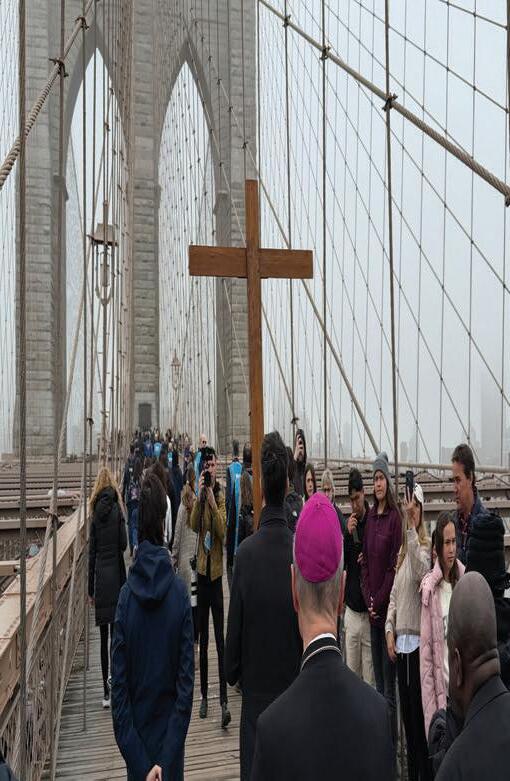
Aa few years ago, I was facilitating a diocesan planning effort and gathered together the bishop and his senior clergy and lay leaders. As we discussed preliminary plans for a commission that could direct the effort, I suggested that the diocese might be wise to ensure that at least two-thirds of the commission be made up of the millennial generation. “That’s a nice idea, Dan,” said one monsignor. “But we will need some adults around the table.” I had to remind the priest that at 41 years of age, I myself was a millennial and that several members of my generation were running small countries.
For the first time, the Church in the United States is ministering to eight living generations. At Catholic Leadership Institute, our decades-long research effort at understanding parish vibrancy was conclusive on multiple fronts. One point in particular is that the majority of parish life is revolving around those over 50. This isn’t intentional, and in large part, the lack of intentionality is the problem. We have not wrestled with the generational shifts or challenged the assumptions that have defined not only parish life over the last half century but society as a whole. With the average age of a diocesan priest at 61 and the average age of lay ecclesial professionals not far behind, we are often more comfortable running a parish playbook that might resemble a 55-and-over community for Catholics rather than a missionary community seeking to “go out and make disciples of all nations.”
Catholic Leadership Institute’s whitepaper on “Reaching, Engaging, and Inspiring the Next Generation”
distilled conversations hosted around the country with Catholics in their 20s, 30s, and 40s who represent the entire spectrum of faith practice—from those who are highly invested in faith to those largely disaffiliated. What was most striking about the research was that regardless of which end of the spectrum a millennial or Gen Z Catholic fell, both asked the same question: “Why would I ever register in an average parish?” This response, while difficult to hear, should be a wake-up call for every parish to ensure that as communities of faith we are responsive to three very important ingredients to cultivating a vibrant parish for every generation.
1. RELEVANCE
“The Church keeps answering questions we aren’t asking. Answer the questions we are asking.”
This quote from a millennial Catholic encapsulates one thing that helps all people connect to the Church, especially younger generations. Why does this matter? In our research, millennial and Gen Z Catholics are not entrenched in their parish of origin and not overly concerned with maintaining institutions for the sake of legacy or continuity. These generations have a general distrust of most institutions. Organizations and communities that they deem worthy need to be authentic in their mission and present a clearer value proposition, engage in conflict directly, and answer questions in an accessible and straightforward manner.
While on its surface this desire for relevance can be perceived as consumeristic, in the dialogues we facilitated, it was more about connecting the deepest truths that the Church teaches to the hurts, wounds, anxieties, and expectations of the day. Blind obedience will not fly, but an authentic invitation to a higher bar or to live a more meaningful life is what these generations are waiting for and desire.
2. SPACE FOR RELATIONSHIP
“The parish is open during the hours that work for retired people. Between 9am and 3pm, I’m working.”
For those younger adult Catholics who self-identified as more “devout,” they often admitted to having to meet for Bible studies in their homes and apartments, not necessarily because they wanted to, but because the neighborhood parish was uninterested or unable to provide space for them to gather. The sacramental schedules were also challenging for young professionals or those just starting their families. Likewise, those with little connection to the Church and their parish were frequently telling tales of a poor welcome or how logistically challenging it was to access things they needed from the parish. Registration and other “paperwork” were often experienced as a way to filter people out in moments that seem like natural opportunities for welcome. Often, millennials and Gen Z s eek “third spaces” where they can gather and build community with people who share their interests and values. Rather than have Catholics find third spaces to gather, how can the average parish become a third space?
3. THE VIRTUAL LEADING TO THE INCARNATIONAL
“Social media is the island on which Gen Z lives; communication is radically different for us.”
We need to make a distinction between that which might constitute a “phase-of-life” difference versus a “generational” difference. An example of a phase-of-life difference might be physical challenges one experiences in their 60s versus how they felt in their 40s. A generational difference, on the other hand, is that which defines an entire generation’s worldview or experience based on the environment or circumstances in which they were raised. There is no greater generational difference for millennial
and Gen Z Catholics than the role technology, especially the digital landscape, plays in their worldview. Even within these generations, we see major shifts in their acceptance and immersion in a digital experience. Throughout the various conversations, there was a healthy tension on the role of the Church and what the average parish needs to live in this environment. On the one hand, social media platforms have all but replaced these generations’ use of email and even text messaging for basic communication. On the other hand, older millennials who are now raising young children and/or have had their own negative experiences with social media addiction are craving a reprieve.
As she has through multiple evolutions and generational inflection points, the Church is poised to actually move from a laggard to a pioneer in navigating a healthy use of technology for the sake of human flourishing and connection. In so many ways, these generations are seeking a model of how to navigate the blessings and curses of a digital lifestyle. Parishes need to be poised to meet younger adults in a virtual reality and pull them into the grace of an incarnational existence.
Among all the challenges and seeming contradictions that often define the Church leadership’s perspective on younger generations, the greatest insight from our conversations was the opportunity. These women and men find themselves at a pivotal time in their lives—choosing career paths and discerning vocations. They have grown up in a world full of virtual friends, artificial intelligence, and instant gratification and have found it wanting. Regardless of their positions on faith, they seek authenticity, relationship, and impact for their lives. At her core, these are the hallmarks of the Catholic Church—marks that are definitional to a life as a disciple—and these will be the characteristics of a parish that thrives in the now and next generations. ■
Daniel Cellucci is CEO of Catholic Leadership Institute, an apostolate providing leadership training and consulting to religious and lay leaders in more than 120 dioceses.
For more information and resources, visit: www.catholicleaders.org/ whitepapers
‘Not for Likes, but for Love...’ Catholic Mission Online
Austen Ivereigh
Tthousands of digital missionaries across the Catholic world are opening up a new chapter in the Church’s history of evangelization, not simply generating content but creating an encounter of hearts.
At t he synod assembly in Rome two years ago, a Nicaraguan sister based in Palma de Mallorca in Spain with hundreds of thousands of followers on TikTok, Instagram, and X stood up to address bishops and cardinals from across the world. Most had no idea that the Church had legions of “digital missionaries” —priests, religious, and lay people—exercising an apostolate in a place where people now spend much of their lives. Most of them didn’t think of the web as a place, but an instrument. But when Xiskya Valladares spoke of the impact of the encounters she had had over the previous 10 years and the journeys of faith she had accompanied through her social media accounts, the penny dropped. One after another, bishops stood up to say that they now saw the internet in a new way.
Recalling that moment on July 28, 2025, in Rome at the first-ever Jubilee of Digital Missionaries and Catholic Influencers, @xiskya recalled how after her intervention she ha nded Pope Francis 10 pages of testimonies from her missionary encounters, which Francis read carefully, then told her: “You must carry on.” The idea of a digital mission had landed, as Monsignor Lucio Ruiz, secretary of the Vatican’s communications dicastery and organizer of the two-day jubilee, had dreamed it would.
support, blessing, and guidance—not to control them (which would be impossible and self-defeating) but to create a distinct apostolate.
The Synod’s October 2023 synthesis report dedicated an entire section (n.17) to what it called “Mission i n the digital environment,” recognizing that this was a new frontier for evangelizing, a “continent” that had its own culture (for good and ill) in which the Church was called to be present. “It is up to us to reach today’s culture in all spaces where people seek meaning and love, including the spaces they enter through their cell phones and tablets,” the Synod report noted, going on to call for “opportunities for recognizing, forming and accompanying th ose already working as digital missionaries, while also facilitating networking amongst them.”
The digital mission is a new chapter in the Church’s history of mission, and it matters to the Church.
It was while organizing a large-scale online listening exercise at the start of the Synod consultation, back in 2021, that Ruiz—an Argentinian priest who has been in the Vatican since the early 1990s—saw how large numbers of Catholics, quite independently of each other, and usually without any formal ties to Church evangelizing initiatives, had for the last few years been exercising this apostolate in the fast-expanding world of TikTok reels, Instagram pictures, and YouTube videos. The tech-savvy Ruiz, who naturally identifies with the influencers, saw their love of the faith and the Church and the impact they were having, especially on young people. His vision is of the Church catching up with the missionaries and hugging them close in the time-honored way by offering
Listening to the testimonies of the missionaries and influencers, a key theme emerged: the way in which they are present online matters in many ways more than the content itself. To put it theologically, the digital mission is fides qua —the personal act of faith, the impact of believing—more than fides quae , that is, the objective content, the doctrines. The key to every mission, Ruiz told the gathering, is the offering of God’s mercy, to offer hope and healing, to walk with people who suffer. Pope Francis stressed in an early message for World Communications Day that “Christian witness is not made by bombarding people with religious messages, but by the willingness to give oneself to others through a willingness to engage patiently and respectfully in their questions and doubts, in the search for truth and the meaning of human existence.” The great value of the digital mission is in this accompaniment, the “primary proclamation,” testifying to the joy of the revelation of God’s mercy, which Mary models in the Magnificat. (Mary’s canticle in the first chapter of Luke shows, Ruiz laughingly told us, that “she knew she would have many followers.”) Ruiz had a clear message: that the digital mission is a new chapter in the Church’s history of mission, and it matters to the Church. The flip side of this was the need for the influencers to be aware of this, too, that people need to see the Church behind them in the way they act and speak online. “Ask not: How many people follow

More than 1,000 Catholic influencers from 70+ countries participated in the first-ever Jubilee for Digital Missionaries and Catholic Influencers gathering in Rome in July 2025.
me? But: How many brothers and sisters have I learned to love?” as Fr. Antonio Spadaro, S.J., undersecretary in the Dicastery for Culture and Education, put it, adding: “How many stories have I listened to? How many wounds have I caressed with a word?” Spadaro went on to offer criteria for discerning before posting. “When you create content, ask yourself: Does this come from fire, or the fear of not being seen? Is this post a gesture of love, or a way to boost my profile?” There was advice on discernment, too, from Cardinal “Chito” Tagle, pro-prefect for the evangelization dicastery, at Mass the next morning in St Peter’s Basilica. God, he said in his homily, was the “great influencer”; we are asked to allow God’s love to influence us so that we might influence others.
At the end of the Mass that day, Pope Leo appeared, walking around the basilica to greet young people assembling for their jubilee. He said the Church’s mission to announce peace was one that was now entrusted to those “who are here to renew your commitment to nourish Christian hope in social networks and online spaces.” It was “not simply a matter of generating content, but of creating an encounter of hearts,” he observed, urging the missionaries to “seek out those who suffer, those who need to know the Lord, so that they may heal their wounds, get back on their feet and find meaning in their lives.” Observing that the Church, when faced with cultural change, had never remained passive but “sought to illuminate every age with the light and hope of Christ by discerning good from evil and what was good from what needed to be changed, transformed and purified,” he urged them to “humanize” the culture of the internet, especially at this time when “the widespread adoption of artificial intelligence will mark a new era in the lives of individuals and society as a whole.”
The Jubilee modeled in its two days the elements that bishops’ conferences and dioceses will need to adopt to embrace the digital mission. First, they need to gather those already doing it, inviting them to be part of a network that connects them to a diocese or the Church nationally, organizing in-person gatherings. Second,
they need to provide opportunities for prayer and spiritual formation so that the missionaries deepen their awareness of themselves as promoters not of themselves but of God’s mercy, to develop behavior that reflects that awareness, as well as a consciousness of the antihuman forces that drive social media: reducing people to algorithms, the cult of technical perfection, and the lure of popularity for its own sake. Third, they need to deepen the communion of the digital missionaries, who often work in isolation from the Church and from each other. That means giving a chance to meet, and celebrate, and deepen the bonds of unity.
The digital mission is young in every sense. Its idiom is sharp, succinct, joyful. At its best, it is creative, dynamic, and energetic. It feels like the future, the way of connecting our aging, shrinking congregations with a generation that has grown up outside them. For a Church learning to be synodal—humble, horizontal, missionary—the digital mission challenges it “to reconsider its understanding ‘place’ as the real and actual setting in which we come to experience our humanity, without denying that there is a geographical and cultural dimension to this as well,” as the Synod’s Final Document puts it, adding: “Here, where the web of relationships is established, the Church is called to express its sacramentality (cf. Lumen gentium 1) and to carry out its mission.” Or, as two young influencers put it in a 20-second TikTok recorded by Xiskya in the Vatican gardens, the digital mission is about learning that “the greatest influence we can have in the world comes from the heart, from our encounter with God.” ■
Austen Ivereigh is a biographer of Pope Francis, with whom he collaborated on Let Us Dream: The Path to a Better Future . His latest book, First Belong to God: On Retreat with Pope Francis , was published by Loyola Press (2024).
This article is reprinted with permission from The Tablet, August 6, 2025, www.thetablet.co.uk/features/ catholic-mission-online-not-for-likes-but-for-love.
photo credit
: Red Informática de la Iglesia en América Latina (RIIAL)
What AI “Reasoning” Really Means
Fr. Philip Larrey
Aa lot of today ’ s ai tools now advertise something called “reasoning.” That sounds impressive, but it can also be confusing. When a machine gives a step-by-step answer, is it really reasoning in the same way a human being reasons? This matters, because the words we use shape how we think about the mind, truth, and what makes human beings unique.
In ordinary life, human knowing begins with experience. We see things, hear things, remember things, and make sense of what happens around us. But we do more than take in information. We also think about it. We look for meaning, ask questions, and try to understand what something is and why it matters. In the classical tradition, especially in Aristotle and St. Thomas Aquinas, this is part of what makes human reason special.
So human reasoning is not just information processing. It is our ability to move from experience to understanding, and from understanding to judgment. We do not simply sort signals or repeat patterns. We try to know what is true. We ask whether our ideas match reality. That search for truth is at the heart of human reason.
Large language models operate very differently. They do not have senses, interior awareness, or lived experience. They do not encounter the world as a human person does. Instead, they are trained on immense quantities of data and use statistical patterns to generate highly probable outputs. Even when their results appear thoughtful, what is happening is not intellectual apprehension in the classical sense. The machine is not understanding reality from within. It is calculating relationships among symbols and producing language that resembles understanding.
This is one reason why the inner operation of AI is often described as a “black box.” We can observe the input and the output, while the intermediate computational process is often difficult to interpret in fully human terms. Some engineers even
photo credit : Courtesy of Caitlin Cunningham, Boston College
“Human reasoning is not just information processing. It is our ability to move from experience to understanding, and from understanding to judgment.”
describe this process as extra-linguistic, since the system is not literally composing sentences step-by-step in the way a person speaks or writes. Still, whatever terminology we choose, we should be careful not to confuse complex computation with thought in the full human sense. The machine is not reflecting on meaning. It is transforming patterns into new patterns.
For that reason, calling this process “reasoning” can be misleading. The term suggests an activity proper to rational beings, beings capable of understanding, judgment, and insight. AI can imitate the outward form of reasoning with astonishing power, but imitation is not identity. Just as “artificial intelligence” does not mean intelligence in exactly the same sense as the human intellect, so, too, “AI reasoning” should not be taken as evidence that a machine possesses a mind, wisdom, or consciousness.
From a broader philosophical perspective, two consequences follow from this distinction. The first concerns wisdom. Human reasoning can mature into wisdom, which is not merely the accumulation of correct answers but a deeper grasp of reality and of the good. Wisdom enables us to situate facts within a meaningful whole. It asks not only how something works but what it is for, how it should be used, and what it means for a flourishing human life. No machine, however advanced, possesses this form of interior participation in meaning.
The second consequence concerns truth. AI systems do not know truth as truth. They generate outputs based on probability, pattern recognition, and optimization. This helps explain why they sometimes produce socalled “hallucinations”: statements that are fluent and persuasive, yet false. Such failures are not accidental glitches added onto an otherwise human-like intellect. They reveal something essential about the system itself. Truth is not the interior norm by which the machine knows. Rather, accuracy is approximated externally through data, training, and feedback.
Here the Catholic intellectual tradition offers a particularly important contribution. The Church has long insisted that faith and reason are not rivals but allies. As St. John Paul II wrote in Fides et Ratio, faith and reason are like “two wings on which the human spirit rises to the contemplation of truth.” Human reason is a genuine participation in the intelligibility of creation. Because the world is created by God and ordered by divine wisdom, the human mind is capable of knowing reality, however imperfectly, and of seeking truth with confidence rather than despair.
From a Catholic perspective, then, the difference between human reasoning and machine computation is not simply one of degree but of kind. The human person is not a sophisticated prediction engine. We are creatures made in the image of God, endowed with intellect and will, and capable of moral judgment, selfreflection, love, and openness to transcendence. Reason is therefore inseparable from the soul and from the vocation of the person. It is part of what enables us to recognize truth, choose the good, and ultimately direct ourselves toward God.
This also means that wisdom cannot be reduced to data processing. For the Catholic tradition, wisdom is connected to both natural reason and grace. It includes the disciplined search for truth through philosophy and science, but it also opens onto theology, contemplation, and the moral life. A machine may help us organize information, summarize arguments, or test possibilities. It cannot pray, repent, behold, or love. It cannot enter into communion with God, and therefore it cannot participate in the deepest horizon within which human reason finds its fulfillment.
None of this means that AI is useless or threatening by definition. On the contrary, these systems can be powerful tools. They can assist research, education, communication, and discovery. But the proper way to value them is as instruments ordered to human ends, not as substitutes for human intelligence or spiritual depth. The Catholic view guards against both naïve enthusiasm and fearful exaggeration. It reminds us that technology is good when it serves the truth about the human person.
If we lose sight of that truth, we risk speaking about machines in exalted terms while speaking about ourselves in diminished ones. If we preserve it, however, AI can become an aid rather than an idol. The challenge before us is not merely to build more capable systems but to remain clear about what only the human person can do: know reality, seek wisdom, love the good, and respond freely to the God who is Truth itself. ■
Fr. Philip Larrey is a Catholic priest and professor of the practice in philosophy at Boston College. He previously held the chair of Logic and Epistemology and served as dean of the Philosophy Department at the Pontifical Lateran University in the Vatican.
A Call to Preserve the Work of Being Human
Molly Wysocki
Tthese days , it is nearly impossible to engage with any kind of technology without encountering generative AI. When I search on Google, the AI overview consolidates the relevant output into a neatly-packaged summary, as if the 0.2 seconds it took to answer my query wasn’t efficient enough. Google Docs now includes a “help me write” feature, prompting me to incorporate AI into my writing the second I open a new document. When I pose a question to Siri, I am immediately asked to choose if I’d like ChatGPT to answer the question instead. Gemini paints pictures. Suno composes songs. Grammarly writes poems. AI’s capabilities are seemingly endless.
I don’t live in the age of the dinosaurs when it comes to technology—I religiously utilize Reminders, Google Calendar, and all of the other apps you’d expect a typical
college student to regularly employ. These apps serve their purpose, no doubt. And yet, there’s something different about AI that unsettles me. As a student, writer, and musician, I’m deeply concerned that the creative process—the slow, messy, complicated, and fundamentally human task of perfecting a once-undeveloped idea—seems to be gradually moving into obsolescence in the age of AI. Moreover, I’m starting to believe that we as students and members of U.S. society are collectively losing our motivation to question, critique, and reckon with discomfort each time AI neutralizes nuanced questions with its agreeable tone.
My identity as a student at a Jesuit, liberal arts university largely predicates my unease with AI. Boston College (BC) is a place which prides itself precisely on
photo credit :
Lauren Moberley '22
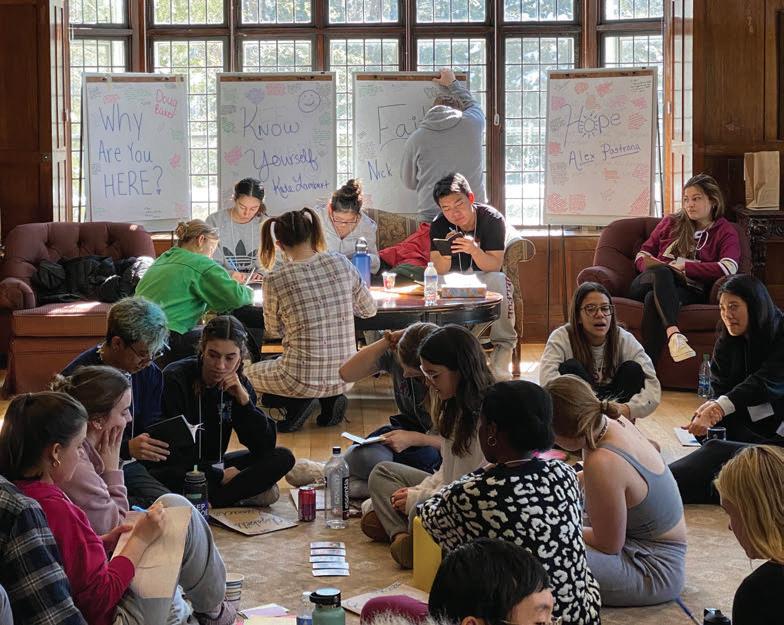
Students engage in a Kairos retreat at Boston College's Connors Center.
Kairos (Greek for "God's time") is a student-facilitated weekend spiritual retreat that allows for intentional reflection on relationships with God, self, and others.
“If we as students, staff, and faculty are to take seriously the Jesuit mission of educating “with a heart and soul,” we must acknowledge the ways in which AI’s enablement of fast-paced productivity endangers the integrity of our mission.”
teaching the critical thinking, reading, and writing skills that AI threatens to outsource. The efficiency so central to the productive function of AI is the antithesis of the reflective culture at BC, which I’ve grown to so deeply love. From my first day on campus, faculty and staff have encouraged me to wrestle with Fr. Michael Himes’s (1947–2022) famous three questions: What brings you joy? What are you good at? Who does the world need you to be? Answering these questions requires intense, focused thought, energy, and time. AI seems to respond, “Why bother?” Why bother with discernment if AI can compose the song, write the poem, and paint the picture in a matter of seconds? Why bother if all of these things can be done without the tiresome emotional labor of introspection? My experience as a BC student leads me to believe that Jesuit pedagogy is well suited to respond to this timely moral question. If we as students, staff, and faculty are to take seriously the Jesuit mission of educating “with a heart and soul,” we must acknowledge the ways in which AI’s enablement of fast-paced productivity endangers the integrity of our mission.
In his 2015 social and environmental encyclical Laudato si’ , Pope Francis warns of the “dominant technocratic paradigm,” a concept he defines as a social structure which “accepts every advance in technology with a view to profit, without concern for its potentially negative impact on human beings” ( LS 109 ). I see this kind of technocratic reign inching ever closer as AI improves on a daily basis. If Pope Francis had the foresight to name this reality over 10 years ago, I’d best believe he, too, would be gravely troubled by the way AI is eroding basic social and educational skills in our present moment. Luckily, Pope Francis remained hopeful, prescribing the medicine of awe-filled contemplation to remedy a growing culture of frenetic busyness and obsession with frictionless efficiency (LS 125 ). His orientation toward wonder frames a spirituality of slowness which enables the transcendent divinity present in otherwise unnoticed moments to be exposed. Calling his readers to
adopt this posture, he charges all people of goodwill to respond with increased attentiveness and a commitment to interpersonal accompaniment.
Like Pope Francis, I stand grounded in the steady hope that our curiosity and creativity will not be abandoned amidst the advances of AI. This hope persists because I’ve learned that our humanity depends upon these very qualities, and I see them in action daily. As students, faculty, staff, and everyday people, may we continue to question and wonder. May we find solace in the ability to be still. May we keep making art. And may we persist in our commitment to the gritty and complicated work of being human—work which remains necessary to bear the fruit of joy and love. ■
Molly Wysocki ’26 graduated from Boston College with majors in economics and theology and a minor in applied psychology. She is currently serving as a Joseph A. O’Hare, S.J., Postgraduate Media Fellow with America Media.
Fr. Michael Himes's
Three Key Questions for Discernment:
• What brings you joy?
• What are you good at?
• Who does the world need you to be?
For more information on the legacy of Fr. Michael J. Himes (1947-2022), visit the "The Guiding Lights" page on the C21 Center website.









How Gen Z Catholicism is growing in the digital age
Ariele Lee
Iif catholicism makes a comeback among younger generations, I don’t think this will occur despite digital culture but rather because of it. Catholicism is uniquely suited to the age of the internet.
According to a recent study of several hundred catechumens in France, 68 percent of recent Catholic converts said they turned to YouTube, Instagram, or TikTok to aid in their understanding of the faith. Creators like Father David Michael Moses and Father Mike Schmitz (whose The Bible in a Year program became the most popular religion podcast on Apple when it began in 2021) and podcasts such as Breaking in the Habit , which features perspectives from a Franciscan friar, reach millions, creating content on a range of topics from theology to apologetics to vocational daily life.
Three key characteristics of Catholicism may help explain why it is resonating so strongly with younger generations online: its intellectual depth, its aesthetic features, and its representation in popular media. Catholicism is rigorously cerebral—and made for the internet. Religious experiences are often mysterious, mystical, and profoundly personal. These are di fficult to convey online. But Catholicism also has a rich intellectual history in philosophy, metaphysics, theology, and Church history, grounded in the thinking of giants like St. Augustine and St. Thomas Aquinas. The internet has made this content far more accessible (often just a Google search away), and on platforms like YouTube and TikTok, creators can condense complex topics into digestible pieces that algorithms can then suggest to curious viewers. For example, Bishop Robert
Barron’s Word on Fire and the Thomistic Institute regularly tackle moral dilemmas and big topics such as arguments for God’s existence with approachability that doesn’t sacrifice intellectual rigor.
Catholicism also offers numerous points of entry for respectful and bridge-building dialogue with secular or non-Catholic audiences. Faith-based conversations can be tricky without baselines that establish common ground, but a shared interest in philosophy, ethics, or history can be a compelling place to start. All of these are foundational to Catholicism, and they thrive in internet spaces where religious opinions are regularly challenged, examined, and assessed by diverse audiences.
Catholicism is visually and ritually rich—with beauty as a digital gateway. Catholicism is deeply aesthetic and sensory. Incense, organ pipes, Rosaries, and the Eucharist are all immediate indicators you have entered a Catholic space. But the aesthetics aren’t performative. As Pope John Paul II wrote in his “Letter to Artists” in 1999, “Art remains a kind of bridge to religious experience,” and “Beauty is a key to mystery and a call to transcendence.”
It helps then, that the digital world is a highly visual medium. The liturgy, the sacraments, and other rituals offer something transcendent to a generation raised on curated content. Catholic creators don’t have to concoct a “vibe” or create an atmosphere; they can simply show the Church authentically as it is. Creators on Instagram and TikTok can display how their faith weaves into daily life, such as by praying the Rosary or attending a Mass celebrated in Latin. The combination of beauty and authenticity makes Catholic content rich with
“Caution is warranted, but online Catholicism is not a fleeting trend. It is how faith can be encountered by new generations, and it is flourishing.”
aesthetic and ritual substance that feels sacred. This is a natural fit with the visual landscape of the digital world; the content can tell a compelling story without being contrived and without resorting to artificial intelligence.
Catholicism is culturally iconic—a cinematic faith. Catholic imagery has long been a part of media storytelling: the priest’s collar, the nun’s coif, confessional booths, cathedral ceilings, the crucifix. These symbols carry cinematic weight, and pop culture has again taken notice.
In recent years, characters like the conflicted “hot priest” in the TV series Fleabag or Marvel’s Daredevil, a devout Catholic vigilante, have added a layer of both mystique and recognizability to Catholic identity for young audiences. The film Conclave, which was nominated for eight Oscars and won Best Adapted Screenplay in 2025, dramatized papal elections. Whether intentionally or not, popular media has warmed Gen Z to the visual language of Catholicism. Platforms like Instagram and TikTok continue to circulate clips of these widely viewed television shows and films, keeping Catholic iconography alive even for secular audiences.
The mystique and allure of highly recognizable Catholic imagery may have also carried over into the influencer space. Young priests, nuns, monks, and laypeople can reach wide audiences not only because of what they say but because of what they represent. They offer an authentic look at a faith that can sometimes seem “cinematized.” The gentleness and sincerity of creators like Father Schmitz and Father Moses make the mysteries of the magisterium more accessible.
Additionally, in a climate of rising political polarization, where some Christian identities are increasingly associated with partisan stances, Catholicism’s cultural identity may be offering a kind of refuge. Viewers can focus on reverence, beauty, and tradition instead of “culture wars.” (See Sister Albertine’s TikTok feed, which is in French, for a good example of this.)
INFLUENCER CULTURE— A DOUBLE-EDGED SWORD
Despite its many strengths, the internet is also a fast-moving Goliath that has some downsides. Some aspiring “influencers” create content that fuels division or speak on topics without having a full understanding of them. Fo r example, the #radtrad movement has gained popularity through its appreciation of the liturgy predating the Second Vatican Council. As with many
online communities, however, such groups can become insular and focused on solely ideological or theological purity. This is not to diminish the sanctity or beauty of, for example, the Latin Mass in an age of deconstruction and digital meaninglessness. But when online content is reviewed by no one other than the creators themselves, or is produced primarily to boost algorithmic engagement, it can, sometimes unintentionally, prioritize ideologies that foster discord instead of harmony. There is still an important role for the magisterium as the structure of accountability to help safeguard against oversimplification, inaccuracy, or disunity.
Indeed, magisterium content creators like Bishop Barron welcome and engage with all types of viewers and their questions, respond with theologically nuanced answers, and have a pastoral approach to their d ialogue. This type of digital interaction can help build the Church community instead of disconnecting it.
Caution is warranted, but online Catholicism is not a fleeting trend. It is how faith can be encountered by new generations, and it is flourishing. In an age of cynicism, it may be helping Gen Z not only discover the Catholic faith but rediscover transcendence itself.
As one Catholic convert posted on Reddit, “I started watching Father Mike Schmitz on YouTube, Franciscan Friars of the Renewal, and a host of others who ALL had relationships with God. After prayer and discernment, I then became Catholic.”
Even in the digital age, the Holy Spirit continues to find a way. ■
Ariele Lee, a Gen Z cusper herself, earned her M.F.A. from Emerson College, to which she returned as an adjunct professor. She works as an art director in marketing.
Reprinted with permission from America magazine, published by America Press, Inc. © 2026. All rights reserved. For subscription information, call 1-800-267-6939 or visit www.americamagazine. o rg /subscribe.
Explore digital ministry resources at: bc.edu/c21digitalfaith


St. Ignatius of Loyola on Spiritual Conversation
Barton T. Geger, S.J.
Iin the service of cura personalis , the writings of Ignatius and early Jesuits contain yet another gem, and one that bears numerous connections to other Jesuit values. It is the art of “spiritual conversation.”
Shortly after his spiritual conversion at Castle Loyola, Ignatius began to recognize that engaging people in relatively informal, spontaneous, one-on-one conversations about God, faith, and “best practices” in the spiritual life was a powerful means to edify both them and him. Such conversations, by their nature, circled around the particular concerns and desires of Ignatius’s interlocutors and, as a result, they could be much more effective than a sermon, lecture, or book. What is more, since they could be practiced by anyone, anywhere, Ignatius could make a conscious ministry of it without the need to be ordained a priest or to possess a theology degree (both of which were still fifteen years away).
Ignatius first learned the value of spiritual conversations while recuperating from his leg wounds in Castle L oyola. He had already decided to give his life to God and was anxious to begin, but was still trapped in bed. With no other means available to begin “helping souls,” he simply began to speak to relatives and friends who walked into his room of the things of God. Perhaps to his surprise, he discovered how effective it was. Looking back years later, Ignatius put it simply, “He did their souls good.”
A few months later, in Manresa, Ignatius made a point of seeking people reputed for holiness to ask their advice about prayer and spiritual practices. He noticed that they began to seek him out as well, not because (as Ignatius himself conceded) he knew much about spiritual things but because they could see that he had a strong desire for God. And engaging anyone with such a desire will likely be a fruitful experience, no matter how unknowledgeable that person might be.
Spiritual conversations became a deliberate strategy for Ignatius. His interlocutors might have perceived them as chance encounters, but Ignatius was always listening for anything that could serve as a segue to more spiritual subjects. He described one such encounter in Venice while he was waiting for a boat to take him to Jerusalem.
One day a rich Spanish man came across him, and asked him what he was doing and where he wanted to go. And learning of his intention, he took him to eat at his house. Subsequently he had him to stay for a few days until things were ready for his departure. Since Manresa, the pilgrim now had this custom: when he had a meal with people, he would never speak at table unless it was to reply briefly. But he would listen to what was being said, and pick up a few things from which he might take the opportunity to speak about God. And when the meal was ended, that is what he would do, and this was the reason why the good man with all his household became so fond of him that they wanted to have him as a guest, and pressed him to stay on in the house.
Still later, while studying theology at the University of Paris, Ignatius said that “he began to give himself more intensively to spiritual conversations than he normally did.” Although he was eager to engage anyone in conversation, he kept a lookout for gifted or popular students. Should they have a conversion experience, and even better, if they could be persuaded to make the Exercises, they could reap especially great fruit for the Church. Ignatius’s two greatest success stories were his own roommates in the dormitory: a popular track-andfield star named Francis Xavier and a pious farm boy with a gracious personality named Pierre Favre. Here are a few dynamics of spiritual conversation that bear notable connections to other Ignatian themes.
• Contemplation in Action: Persons who seek opportunities for spiritual conversation are profoundly m i ndful of the presence of God in every person they encounter: his or her desires for love, truth, meaning, value, beauty and immortality, which God Himself implanted in order to draw people to Him. To engage any person at the level of those desires is the ultimate cura personalis. St. Alphonsus Rodriguez, who worked for forty years as the doorkeeper of a large Jesuit community, is a wonderful model in this regard. Though the work itself could easily be considered humble or mundane, he chose to treat
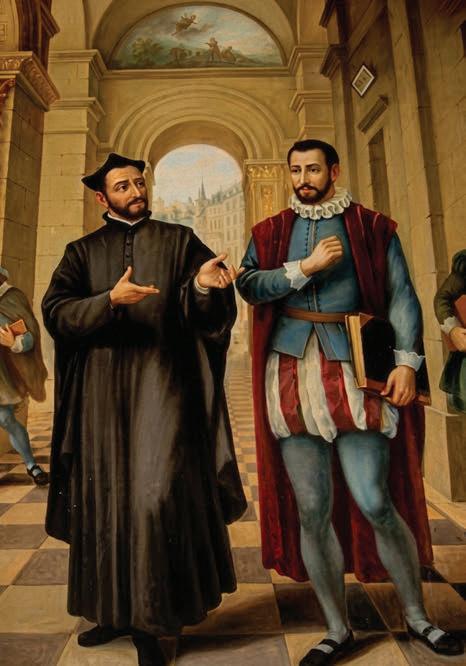
everyone who knocked on the door as if he or she were Christ himself and thereby transformed their lives and his.
• Respect for the Individual: Spiritual conversation by its nature gravitates toward the particular needs and concerns of the individual. For that reason, its practitioners must fight the temptation to react before they reflect. Are they listening attentively, or are they formulating a response in their minds while their interlocutors are still speaking? “Be slow to speak and ready to listen for long periods,” Ignatius advised Jesuits.
• Adaptation or “Inculturation”: Ignatius instructed Jesuits to adapt to their interlocutors. If one is cheerful, be cheerful; if serious and reserved, act similarly; if jocular and lighthearted, do likewise. “This is what pleases them,” he explained. People are more inclined to engage in substantial conversation if they feel a kinship.
A young St. Ignatius of Loyola and St. Francis Xavier are depicted walking the halls of the Collège de Sainte-Barbe at the University of Paris, where they first met. This image is an anonymous copy of a mid-19th-century wood engraving produced in a French workshop and originally used for black and white book illustrations.
“Ignatius began to recognize that engaging people in relatively informal, spontaneous, one-on-one conversations about God, faith, and ‘best practices’ in the spiritual life was a powerful means to edify both them and him.”
• Ends and Means: Socrates played dumb, but he knew exactly what he was doing. Jesus’ parables were a deliberate strategy also. Practitioners of spiritual conversation always keep in mind their deliberate purpose: to bring people to God. Otherwise, conversations become self-indulgent or wander wherever chance takes them. ■
Barton T. Geger, S.J., is associate professor of the practice at the Clough School of Theology and Ministry and a research scholar at the Institute for Advanced Jesuit Studies at Boston College.
This article is an excerpt from "Cura Personalis: Some Ignatian Inspirations." Jesuit Higher Education: A Journal, Vol. 3: No. 2 (2014). Available at: https:// digitalcommons.lmu.edu/jhe/vol3/iss2/2. Used with permission.
photo credit : Provenance
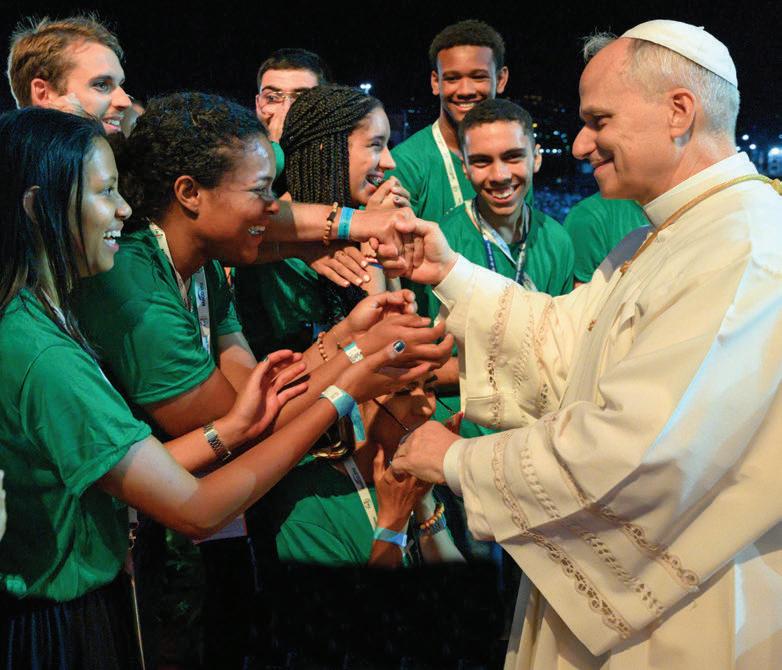
Pope Leo XIV Urges Youth Toward Real Relationships IN A DIGITAL AGE
Clemente Lisi
Iin a dusty roman field echoing with youthful energy and hope, Pope Leo XIV delivered a clear and urgent message to over a million young people gathered for the Jubilee of Youth: “You are not a product. Your relationships are not transactions. And your life must be rooted in something deeper than algorithms.”
Speaking from Tor Vergata, Pope Leo’s evening prayer vigil was more than a nostalgic reprise. It was a declaration of priorities—spiritual, pastoral, and, increasingly, digital—for a pontiff determined to guide the Church into a new technological and cultural era.
His address, warm yet firm, acknowledged the beauty and power of digital platforms but forcefully warned against their distortion. In fact, he got a welcome typically reserved for rock stars.
“W hen a tool controls someone, that person becomes a tool: a commodity on the market and, in turn, a piece of
merchandise,” he said, speaking to a generation immersed in online spaces but often starved for real connection.
This message was more than a mere moral reflection. It’s the foundation of Pope Leo XIV’s broader strategy: reasserting the Church’s role as a moral compass in an age increasingly shaped by artificial intelligence, data-driven relationships, and digital interactions.
Addressing questions from young pilgrims, he didn’t shy away from the contradictions of online life. Dulce Maria, a 23-year-old from Mexico, voiced what many of her generation feel: virtual friendships can excite but also isolate, amid an increase in mental health concerns among teens.
The pope’s response was telling. While affirming the internet as “an extraordinary opportunity for dialogue,” he cautioned against social media controlled by “commercialism and interests that fragment our relationships.”
photo credit :
© Vatican Media
Pope Leo XIV presided over a Mass for more than one million young people on Sunday, August 3, 2025, in Rome at Tor Vergata for the Jubilee of Youth, a pilgrimage that has drawn Catholics from across the world.
This critique echoes a core theme of his papacy— the human person cannot be understood, treated, or “engaged with” as a consumer good. His references to commodification signal a deeper anxiety about how data-driven systems—from social platforms to AI recommendation engines—subtly reshape our desires and choices.
The pope’s words implicitly call out not only Silicon Valley but a culture that increasingly blurs the line between identity and performance, connection, and consumption. Though not directly referenced during the vigil, the specter of artificial intelligence hovered over the pope’s remarks.
Over the past year, the Vatican under the pope’s leadership has hosted several symposia on AI ethics— signaling the urgency with which the Holy See views the issue. For example, the Dicastery for Culture and Education even released a draft document calling for “human-centric AI” that resists reducing people to “predictive patterns.”
At the same time, this pope is trying to get Catholic influencers to work as missionaries to spread the faith. In fact, Pope Leo’s Jubilee vigil called for something AI and the internet can’t replicate: vocation. That is, the discernment of who one is called to be in relationship with others and with God.
“To choose is a fundamental human act,” he said. “When we make a choice, in the strict sense, we decide who we want to become.”
Two days after saying that, the pope had a message for Gen Zers gathered at the 36th International Youth Festival in Medjugorje: “No one walks alone. We encourage each other. We ignite each other. The flames of our hearts unite to become one great fire that lights the way forward. You, too, dear young people, are not solitary pilgrims. This path toward the Lord is one we walk together. That is the beauty of a faith lived out in the Church.”
For Pope Leo, meaningful choices—in love, work, or religious life—are acts of liberation, not algorithmic outcomes. This may be one of the most subtle, yet radical, challenges the Church can offer to a world shaped by A I: that human beings are not reducible to data, and that the most important decisions in life cannot be optimized—they must be discerned.
In practice, Pope Leo is reshaping how the Church prepares young people for this world. Over the past summer, several Vatican-backed initiatives have begun promoting “digital discernment,” including training programs for youth ministers on social media literacy, AI ethics, and spiritual formation online.
“This may be one of the most subtle, yet radical, challenges the Church can offer to a world shaped by AI: that human beings are not reducible to data, and that the most important decisions in life cannot be optimized—they must be discerned.”
A key goal is to help young Catholics integrate their faith into a digital culture without losing sight of the deeper questions: Who am I? What am I called to do? Who is God calling me to become?
Pope Leo’s invocation of saints like Augustine and Pope John Paul II were not accidental. Augustine, the restless seeker, found truth not in superficial connection but in encounter with Christ. Saint Pope John Paul II, whose words the pope quoted—“It is Jesus that you seek when you dream of happiness”—offered a similar vision for a generation now facing an even more complex reality.
As he concluded the vigil, Pope Leo invited the young people to pray to remain “a companion on the journey for anyone I meet.” It was a simple invitation— but one that cut through the noise of platforms and performances, algorithms, and AI . ■
Clemente Lisi is the executive editor of Religion Unplugged , a non-profit online news magazine.
This article was originally published by Religion Unplugged, August 3, 2025, https://religionunplugged. com/news/2025/8/6/pope-leo-xiv-urges-youth-towardreal-relationships-in-a-digital-age.
For more information on this issue and additional resources, please visit: bc.edu/c21digitalfaith
The Gift of Spiritual FRIENDSHIP
Emily Egan
The Christian tradition is ripe with stories of spiritual friendship for the ages: John of the Cross and Teresa of Âvila, Francis and Clare of Assisi, Dorothy Day and Peter Maurin, Jesus and Mary Magdalene. In fact, the Jesuits began not as a formal institution but as a group of university friends studying together in Paris in the sixteenth century. Ignatius of Loyola and his first companions—such as Francis Xavier and Peter Faber—often described themselves as “friends in the Lord.”
Their deep friendships shaped their vision and gave them courage to dream about how they might serve God in the world. From that circle of first companions eventually grew the global Jesuit network of over 3,600 schools, colleges, and universities.
It is remarkable to realize how much of the Church’s history has been shaped by friendships grounded in faith. In today’s digital age, there are constant distractions and competing interests for our attention. It is tempting to underestimate the simple gift of spiritual friendship and its impact on a faith that is relational.
THE COURAGE TO ASK
Spiritual friendship requires courage. In fact, many people hesitate to talk about faith with others. I certainly did when I was younger. Faith mattered deeply to me, but I worried about how others might perceive this. I feared people would project certain beliefs onto me that I didn’t hold. I feared they might think I was naïve or overly serious. One memory from college captures this tension. I had a friend whose creativity and originality fascinated me. Our conversations were always interesting, but we had never spoken explicitly about faith. Eventually, I gathered the courage to ask him—rather awkwardly—“So…what do you think about God?”
He paused for a long time, staring into the distance. I thought the question had fallen flat. Then his face lit up. “I’m still figuring out what I think about God,” he said, “but I like to imagine God as a chef. We’re the ingredients, and God keeps creating new things through us all the time.”
What followed was one of the most imaginative reflections on the divine I had ever heard. It revealed a whole dimension of this friend that I would never have known if I didn’t conjure up the courage to ask.
Spiritual friendship invites that kind of discovery. It allows us to see depths in one another that ordinary conversation rarely uncovers. It is not simply friendship between people who happen to be religious. It is a relationship in which people intentionally help one another notice where God is moving in their lives. These friendships purposely make room for conversations about meaning, faith, doubt, hope, suffering,
and love—questions that shape the deepest contours of our lives.
FRIENDSHIP AS A PLACE OF GRACE
About five years ago, several students kept telling me that I should meet someone named Doc. They would say things like, “You two listen to students in similar ways,” or “You talk about God in a way that reminds me of one another.” Apparently, they were telling Doc the same thing about me.
For a long time, nothing came of it. Eventually, I invited him to an event I thought he might enjoy based on what I heard about him. He responded warmly and suggested we grab a coffee as well.
That first conversation was wonderful. I could immediately see why students thought we might connect despite being over 30 years apart in age. After that, we started meeting about once a month. Five years later, the rhythm of a monthly coffee continues.
What strikes me most about our conversations is how little time we spend on small talk. Instead, we talk about the moments when we glimpse something sacred in the people or places around us. We recount when we witness courage, humility, forgiveness, or solidarity in the face of injustice. We love to notice the quiet beauty of people who keep showing up for life even while carrying immense grief. We laugh at how our egos get in the way of our best intentions. We marvel at the beauty of the natural world and express gratitude for the unique particularities of our loved ones. To us, this is the Spirit at work in the world.
“
...A relationship in which people intentionally help one another notice where God is moving in their lives.”
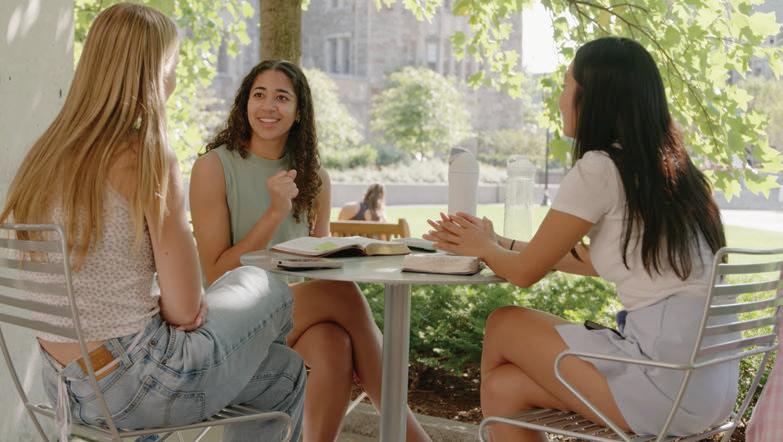
Reflecting on such moments together grounds me. It reminds me to pay attention to grace. The way our first meeting came about also points to the importance of taking initiative. Notice how I reached out to Doc to invite him to an event and then he responded in turn by suggesting we get coffee. We also commit to meeting once a month despite the busyness of life as well as the twists and turns of inevitable yet unexpected life events. Spiritual friendship won’t likely just “happen” to you.
SEEING BEYOND OURSELVES
Spiritual friends also offer something else we cannot easily give ourselves: perspective. Each one of us has blind spots evident to those close to us but difficult to see on our own.
Not long ago, I was sharing with Doc about someone whose actions had hurt me. I appreciated the space to express that pain; however, he did not let me remain stuck there. He gently reminded me that my relationship with that person was larger than this one hurtful action. Because he had heard me speak about the person for years, he was able to remind me of the bigger picture of that relationship.
More importantly, his words helped remind me of the kind of person I want to be, regardless of how anyone else behaves. “Friends in the Lord” can bring you back to who you want to be based upon your convictions, values, and relationship with God.
We all need people like that—friends who point us toward an ever-expanding horizon.
SAVORING LIFE
Perhaps the most beautiful gift of spiritual friendship is the opportunity to savor life together. When I speak with students, I often encourage them to think of life as a journey rather than a treadmill. It is easy to move through our days checking off tasks without noticing the gifts from God all around us.
Spiritual friends help us slow down. Shared moments become experiences of grace rather than a happy memory that quickly fades. Spiritual friends help us feast on the lives God has given us.
AN INVITATION FOR THE CHURCH TODAY
In The Joy of the Gospel , Pope Francis writes that sharing faith is not only about the transmitting of ideas but also the sharing of life and friendship rooted in God. Such friendship is supported by companions who help us notice God’s presence in our ordinary lives.
Spiritual friendship does not require elaborate structures. It begins simply: an invitation for coffee, a walk, a conversation that moves beyond surfacelevel updates. It requires initiative, intentionality, and vulnerability.
But its impact can be profound.
After all, the heart of Christianity is the astonishing claim that God desires friendship with us. ■
Emily Egan is associate director of Campus Ministry in the Division of Mission and Ministry at Boston College.
photo credit :
Courtesy of John Walsh, Boston College

Aa teenager in nikes who loved Pokémon and played PlayStation doesn’t fit the traditional image of a saint. But on September 7, 2025, Carlo Acutis was canonized as the first millennial saint in the Catholic Church. Both in his short lifetime and after his death, Carlo’s seemingly “ordinary” piety has attracted followers online and led pilgrims to travel en masse to his burial site in Assisi. Though Pope Francis approved Carlo for sainthood, it was fitting that Pope Leo XIV formally canonized Carlo: the saint’s prescient words on technology mirror some of Pope Leo’s early comments on the uses of artificial intelligence on the global stage.
Born in 1991 to a wealthy family in London, Carlo Acutis spent most of his childhood in Milan. In many ways, his childhood was typical for his generation: he had a regular group of friends and enjoyed playing video games. Realizing that some of his friends were addicted to their screens, Carlo restricted his video game time to one hour a week. He also volunteered at a local soup kitchen and regularly gave money and aid to the poor in his community. Though his parents weren’t religious, Carlo was moved by stories of the Eucharist and St. Francis of Assisi. His devotion to Francis was so significant that he requested that family vacations include visits to the Basilica of St. Francis. Carlo attended Mass regularly, and the passionate way he spoke about his
Meet St. Carlo Acutis The Millennial Saint
Vanessa Corcoran
faith led to the family housekeeper’s conversion and his parents’ eventual return to the Church.
By fourteen, Carlo had already taught himself computer coding, and his parish priest asked him to design a website for their parish. Combining his talents and an increasingly popular technology for the benefit of his fellow Catholics, Carlo soon began work on the defining project of his life: an online repository of Eucharistic miracles. Insisting that “the Eucharist is the highway to heaven,” Carlo spent over two years cataloging nearly 200 miracle stories on a website that he launched just weeks before he passed away.
In October 2006, when Carlo was fifteen, he fell gravely ill and was diagnosed with leukemia. Within a week of his diagnosis, he passed away. Even those who didn’t know him attended the funeral in Milan, queuing up to pay respects to the young teenager who spoke so lovingly about Jesus and the Eucharist. Carlo was later buried in Assisi because he spoke of his desire to be buried close to St. Francis. As social media became more popular, Carlo’s life got more and more attention: Facebook pages were dedicated to him and the story of the Catholic coder spread worldwide. Even before Carlo gained any formal status in the Church on the path to sainthood, people viewed him as an intercessor and prayed for miraculous intervention.
The first miracle that paved the way for Carlo’s beatification happened in 2013. A four-year-old boy in Brazil had difficulty eating due to a pancreatic illness. His mother prayed to Carlo for intercession and even visited a church in Brazil that housed a second-class relic of Carlo’s: a piece of his t-shirt. The child later asked for solid food and began to eat comfortably for the first time. Carlo’s beatification took place in October 2020, during the height of the Covid-19 pandemic. During his homily for Carlo’s beatification ceremony at the Basilica of St. Francis in Assisi, Cardinal Agostino Vallini, the papal legate for Assisi, remarked that Carlo viewed the internet “as a place to use with responsibility, without becoming enslaved.” The livestreamed Mass furthered global interest in the millennial teenager, causing many young people to flock to Assisi to see the embalmed boy dressed in jeans and sneakers.
Because many of Carlo’s contemporaries are still alive, his cause for canonization has looked different from those from centuries past. Most causes rely on written materials, such as journal entries, letters, and medical records, and even exhumations of the candidate’s body. In Carlo’s case, his family and classmates were interviewed. His mother, Antonia Salzano Acutis, has been one of the main advocates for his cause, giving speaking engagements and media interviews, commissioning artists to create prayer cards bearing his image, and discussing the posthumous miracles that shaped his path to sainthood. Others have promoted Carlo’s story in ways accessible to younger generations: comic books, video games, and even a version of his life told in a short Lego film.
Pope Francis touted Carlo’s coding abilities as central to his faith: “Since he was very good at getting around on the internet, he used it in the service of the Gospel, spreading love for prayer, the witness of faith and charity toward others.”
The second verified miracle happened in 2022, after a Costa Rican woman suffered a brain hemorrhage in a cycling accident in Florence. Her mother visited Carlo’s tomb in Assisi, and the woman recovered without permanent damage. Once the Dicastery for the Causes of Saints approved the miracle, Pope Francis announced that he had cleared the path for sainthood. While the average saint is canonized 262 years after their death, Carlo’s canonization was comparatively quick—just nineteen years after his passing. When discussing Carlo’s upcoming canonization, Pope Francis touted Carlo’s coding abilities as central to his faith: “Since he was very good at getting around on the internet, he used it in the service of the Gospel, spreading love for prayer, the witness of faith and charity toward others.” It is remarkable and new, not just that web design was a major part of Carlo’s life but that the Catholic Church praised it as an integral aspect of his sanctity.
Just as web design was an integral part of Carlo’s life, much of Pope Leo’s pastoral life has been intertwined with advances in technology. In the early 2000s, when the Order of St. Augustine lacked an online presence, it was a young Robert Prevost (then the prior general of the religious order) who designed their first website. Pope Leo XIV is the first pope with an extensive digital footprint prior to ascending to the papacy. When he chose his papal name on May 8, 2025, many noted the connection to Pope Leo XIII, whose 1891 encyclical Rerum novarum (“On New Things”) warned that the Industrial Revolution was stripping workers of dignity through inhumane conditions and unfair wages. Two days after his election, Pope Leo XIV spoke about artificial intelligence in one of his first public addresses to the College of Cardinals: “Today, the Church offers its trove of social teaching to respond to another industrial revolution and to innovations in the field of artificial intelligence that pose challenges to human dignity, justice and labor.”
Children’s words about their faith can cause a groundswell of inspiration. The young children who bore witness to the apparitions of the Virgin Mary in Fátima, Portugal, in 1917 led to a massive number of pilgrimages to the town. Over a century later, it remains one of the most visited Christian sites in the world. With over five million people expected to visit Assisi this year, it appears that Carlo is having a similar effect in the twenty-first century. This time, though, we aren’t witnessing the making of a saint from the distant past, sifting through frescoes and text fragments to learn more about them. Instead, we have an online platform and archival video footage of their life to bring us closer to them and offer an opportunity to learn from their devotion. One of Carlo’s most-repeated sayings (Pope Francis even cited it in a 2019 apostolic exhortation) was, “We are all born as originals, but many of us die as photocopies.” This sentiment aligns with Pope Leo’s statements on artificial intelligence: we must not allow our use of technology to make us less than what we are. ■
Vanessa Corcoran is advising dean and history professor in the College of Arts & Sciences at Georgetown University.
Reprinted with permission. © Commonweal Magazine https://www.commonwealmagazine.org
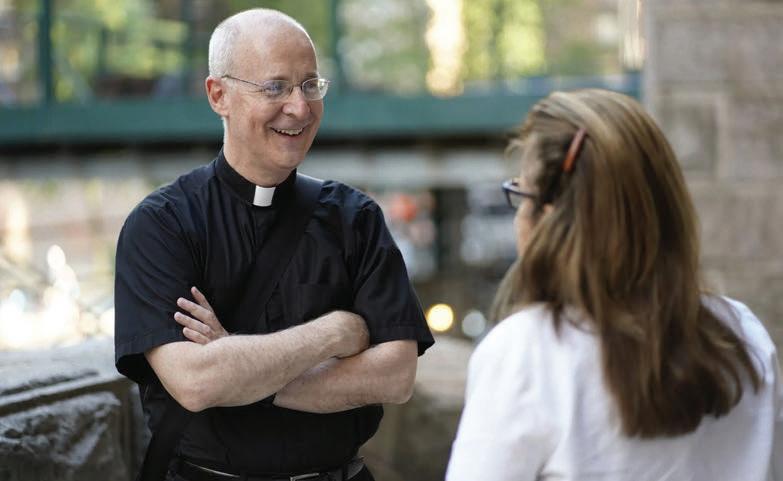
a conversation with James Martin, S.J.
Q: You’ve long been prolific and influential online, but how did that begin for you?
A: It started in a small way, with Loyola Press asking me to start a public Facebook page after they published my book My Life with the Saints. I thought: “Why would I want to do that? I’ve already got a personal page and I’m pretty busy already!” But it proved to be a great way of connecting with people and that led to Twitter, Instagram, and all the rest. And I think about that as a ministry of the Word (and image) and continuing what Jesus did, which was to meet people where they were, and once there, speak to them in their own language.
Q: You’ve described Jesus as engaged in the “ministry of communications” and you were appointed to the Vatican’s Dicastery for Communication. How can and should the Church go about using contemporary media tools to spread the Gospel?
A: Honestly, I think the Catholic Church is doing a great job. I might not have said that 25 years ago (then again, there was hardly any social media then) but it seems that, for example, both the Vatican and Pope Leo XIV (and before him Pope Francis) are using every conceivable type of platform to proclaim the Gospel and share news about the Church. As for Pope Francis, even though he was quite elderly when he was elected, he seemed to embrace
new technologies—you remember how big a deal it was for people to start taking selfies with him? So even if he wasn’t personally familiar with all those platforms, he was not averse to using them. Pope Leo, I think, while a more reserved man, is, on the other hand, younger and more familiar with social media. So we’ll see what the combination holds in store. But so far, he’s been on almost every social media platform, and of course speaks regularly to the mainstream media.
Q: Needless to say, the online world is not always—or even mostly—habituated to Jesuit ideals like attentiveness and reflectiveness. What practices and orientations can help us rise above the superficiality of discourse that often circulates there?
A: The most important one would be what we Jesuits call the “Presupposition,” which leads off St. Ignatius of Loyola’s Spiritual Exercises. In short, he says that we should always be more ready to put a positive interpretation on what someone says than a negative one. Basically, as one elderly Jesuit used to say, always give people the “plus sign.” That’s essential for simple dialogue. And then, perhaps more broadly, remember to adopt a contemplative attitude toward the world so you’re not simply “reacting,” but, more importantly, “reflecting” on what is going on.
photo
James Martin, S.J., known for his writing on spirituality, Catholic life, and LGBTQ outreach in the Church, has become one of the most influential Catholic voices on social media, engaging millions with reflections on faith, culture, and current events through his widely followed presence on platforms such as X, Facebook, and Instagram.
Q: Along similar lines, platforms tend to incentivize fragmentation, polarization, and anger. How can people maintain Jesuit ideals when engaging with each other on social media?
A: As I said previously, by trying to put a positive spin on what someone is saying, which also means understanding them, as far as you can, as a beloved child of God. I think this is essential. You may not agree with what a person believes or says, but you can always treat them with dignity. When I was a delegate at the Synod of Bishops, during the two sessions in 2023 and 2024, I met many delegates with whom I disagreed on a number of topics. With the encouragement of a cardinal friend, I made an effort to seek these people out and try to understand them. And of course it helps to establish a friendship first. Cardinal Timothy Radcliffe, OP, who led the retreats for the Synod delegates, quoted St. John Paul II: “Affective collegiality precedes effective collegiality.” In other words, before you have the tough conversations, it helps to be friends.
Q: On the positive side, the internet is also a space where marginalized populations can find spaces of care and inclusivity that aren’t afforded to them offline. Where do you see hope and find God like that online?
A: Well, the ministry for LGBTQ Catholics that I work with, Outreach, for example, has a wonderful website (Outreach.faith) where we try to “celebrate and elevate” LGBTQ Catholics around the world. We’ve had cardinals, archbishops, bishops, Catholic lay leaders, and many others write for us (and once interviewed Pope Francis). And I always imagine young LGBTQ Catholics who wonder if there is a place in the Church for them stumbling across our website and finding hope.
Q: We all spend too much time on our screens, but young people are especially prone to those habits. What advice would you offer them as they search for more authentic meaning, purpose, and community—both on and off those screens?
A: Take a break from your screens and you’ll feel better. It’s hard to do (even for me at times) but you have to
remind yourself that you’ll feel better if you take a break and focus on friends and family right in front of you. But the deeper question is, as you say, one of meaning, purpose, and community. For that (whether or not you’re an inveterate phone user) it’s about looking for signs of God’s presence all around you and seeing moments of consolation and connection as ways that God has of communicating with you.
Q: Your latest book is about your journey through all sorts of jobs and experiences before finding your calling and the lessons learned along the way. As you reflect on a few decades of ministering in and through new technologies and platforms, what lessons do you feel like you’ve learned?
A: Work in Progress is a memoir of how some crazy summer jobs (busboy, dishwasher, caddy, movie theater usher, and many more) helped to shape me as a young man, teach me some important life lessons, and even prepare me for my eventual life as a Jesuit priest. The lessons I learned from those jobs, as I detail in the book, were simple but important ones: work hard, be on time, ask if you don’t know how to do something, apologize when you need to, treat people who don’t have as much power as you do with gentleness, listen, and, above all, be kind. Those are important whether you’re a busboy, a caddy, a dishwasher, a mother, an attorney, a teacher, or even a Jesuit priest. I hope that book gives people a smile but also reminds them of these small but important avenues to living a life of compassion. ■
James Martin, S.J., is the editor at large of America Magazine, host of The Spiritual Life Podcast at America Media, founder of Outreach, consultor to the Vatican’s Dicastery for Communication, and a best-selling author. His most recent book, Work in Progress: Confessions of a Busboy, Dishwasher, Caddy, Usher, Factory Worker, Bank Teller, Corporate Tool, and Priest, was published in February 2026.

Explore the C21 Center's digital resources, including:
• Videos—on the C21 YouTube Channel
• GodPods—wherever you listen to podcasts
• C21 Resources magazine—digital archive
Media Ecology and THEOLOGY
Paul A. Soukup, S.J.
Ppeople tend to think of communication as mass communication, often overlooking the interpersonal communication that forms the background of our lives. Compounding that, a great deal of communication research in the United States has focused on media effects. Scholars investigate what media do to people, asking, for example, whether television causes children to engage in violent behaviors or whether advertising moves people to buy certain products. More recently we ask about the consequences of social media, with governments debating whether to place age limits on social media accounts. These questions and their focus miss something bigger: the communication environment. The media, as well as our interpersonal communication, form an environment, one that influences us without our being aware of it. Like fish unaware of water, we don’t think much about the communication environment. Over the last 30 years, communication research has begun investigating that environment. Neil Postman coined the term “media ecology” to describe both the environment and its study. In his book, Amusing Ourselves to Death , he points out how communication media have a greater impact than communication messages (an idea first proposed by Marshall McLuhan). In one example, he suggests that when evangelical preachers chose to use cable television to proclaim the Christian message, the television format (or environment) distorted the message, and televangelism became simply another form of entertainment television.

The media, as well as our interpersonal communication, form an environment, one that influences us without our being aware of it.
interaction—people took different well-defined roles (consumers with their particular habits and understandings, economic models in support, etc.). Then, we introduced that invasive species, the new technology of the smartphone. And the entire environment changed. People shifted from speaking on a telephone to texting; they moved from reading newspapers to newsfeeds. People stopped watching television for YouTube videos; their social interaction became social media. Authoritative sources gave way to influencers. Traditional media economics collapsed. The entire system, the ecology, changed.
Media ecology tells us to pay attention to the environment. Its premise makes more sense if we take its analogy seriously. In the ecosystem of a natural environment, each element influences the others and each is adapted to the environment. Think of a pond in a forest with fish and frogs and flowers and bugs and its other parts. If we introduce an invasive species, the entire environment changes. Some creatures thrive and others die out because each adds and subtracts from the environment. Communication is no different. Today we are living in such a period of change: up to about 20 years ago, the communication environment was more or less balanced, with technologies like television, radio, newspapers, telephones, interpersonal
One way to understand this comes from an analysis of the affordances of each medium. Like species adapted to their environment, each technology allows some things while hindering others. In other words, it affords the opportunity to do things that people otherwise could not do. That includes affecting how people think. In an era before writing, human societies had developed ways to manage their information, to remember important things, to teach the next generation, and to manage day-to-day living. These oral cultures functioned quite well. The invention of writing (a new technology) and the spread of literacy changed all that. Cultures created new ways to manage their information (writing things down); that led to new jobs and classes of people like scribes and librarians, and to new educational systems. Writing taught people to think in different ways. Where an oral culture depended on, as Walter Ong described it, “thinking memorable thoughts,” writing culture focused on analyzing what people had written down. Thinking changed because one could go back and review, one could look at the evidence recorded in writing, one could store more information. We can easily see this in retrospect but

such a change in thinking took place over generations as people learned what they could do with writing.
Christian theology (the habit of faith seeking understanding, in St. Anselm’s phrase) came to birth within that shifting communication environment. Christianity begins in the transition between an oral culture and a writing culture. Early Christian preaching occurred orally, addressed to people who were not literate in the new technology of writing. At the same time, Christianity took advantage of writing to record its reflections, its belief. Since its beginning, Christianity made quick use of every kind of communication technology available to it. Christian theology, over the centuries, has exploited the affordances of different media, taking advantage of how each prompts its own ways to understand belief, to “do” theology. The history of theology reveals how Christianity reflected in its belief in different media. That becomes clearer if we set aside for the moment our contemporary prejudice that only writing counts as a medium for theological reflection. Instead, consider what people have done. Here are a few examples.
The theology of an oral culture consists of storytelling and narratives. That appears in the structure of the Gospels and in the parables of Jesus, which operate according to a logic different from written argumentation. Even the letters of Saint Paul began orally, dictated to a scribe; they still manifest the thought patterns and organization of an oral culture. It’s only in later Christianity as writing becomes more established that theology takes on the organizational forms afforded by the medium: an abundance of sources, critical analysis of texts, greater abstraction, a more concise expression. Theological argument became more sophisticated as the written form allowed for revisions, comparisons, and the use of sources.
Throughout Christian history, people have used different media to reflect on their belief. Christian art, starting in the catacombs, expresses an understanding of Christian belief in visual forms. Art prompts different kinds of theology, often difficult to translate into words
but recognizable in their subjects: something easily seen in how the cross of Christ appears across the centuries. Something similar occurs as believers design worship spaces. Churches themselves become a communication medium that reflects the belief of the people. For example, the buildings offer an understanding of the rituals that take place within them: the placement of the altar, the place for the congregation, the kinds of decorations, the materials used for the building, the vessels, the vestments—all these things express a theology.
Music also has its theological place. This complex medium, which can consist of sound alone or sound together with text, provides a wide range of reflection upon belief. For example, the harmonies in many liturgical hymns echo the community’s understanding of unity and even of the Trinity.
Closer to our own day, film has emerged as another theological medium. This medium affords more possibilities than narrative, as it combines visual imagery, spatial arrangement, costuming, narrative action, musical accompaniment, point of view, and all of the other aspects of film to reflect on belief. Filmmakers have a more complex set of tools and many have used them to address theological issues and problems. Think of what Clint Eastwood does in Pale Rider, The Unforgiven, or Million Dollar Baby, or what John Ford does in The Searchers
Finally, today, in our upended communication ecosystem, social media offer their own set of affordances for theology, prompting new uses of theological language and imagery as well as opening up theological discussion to a much wider world. It may be too soon to tell how these media will affect theology, but that they will do so is a given. ■
Paul A. Soukup, S.J., is professor of communication in the College of Arts and Sciences at Santa Clara University.

reclaiming Small Moments
Scott Olivieri
THE BALANCING ACT
TECH CONFESSIONS
February sleet taps the windows of the classroom as students share the joys and burdens of group texts, following, and liking.
“Ok, let’s regroup!” I say over the din. But no one chooses to hear me.
I turn to the computer and pull up the slides.
“Let’s take a look at the screen time data you submitted.”
Words are clipped mid-syllable. Students turn away from each other and toward the screen at the front of the room, where a bar chart slams down like an anvil.
“Ok, what do we think about ‘total time on phone’ and ‘daily pickups’?”
The radiator hisses. I watch my students as they watch the screen.
Drew squints and leans toward the screen.
Pooja blinks at the data in disgust.
Sophie rescues us: “We are all rotting!”
The room fills with laughter and affirmation. “Yes we are!”
Liam presents his palms and confesses, “Yeah, ok. Fine, it’s me. I’m the 250!”
I teach a senior seminar at Boston College called “The Balancing Act.” Limited to 16 students, the small-group format and reflective environment, grounded in Jesuit principles such as the Examen and cura personalis, enables us to create a space for reflection, connection, and growth as we examine pressing post-grad topics: work and academics, relationships and family, faith and discernment, civic engagement, physical and emotional wellness, and flow activities/hobbies. Each module leverages an Examen -inspired format: glance back, assess now, look forward, and take action
It’s important to read research, assess, and reflect, but ultimately we have to do something . Based on the notion of Jesuits as “contemplatives in action,” students in my course must complete six Take Action Challenges during the semester. The most daunting and transformative work has been the Technology & Social Media Challenge, where students confront their technology use and work to reclaim small, sacred moments in their day.
THE TECH CHALLENGE
Our approach during the semester is to focus on small wins that add up over time. My goal is to help students optimize tech that supports their values and goals and limit tech that does not.
We start by discussing our relationships and values. Students analyze their social circles, reflect on the notion of dormant, active, and commemorative friendships, then focus on what anthropologist Robin Dunbar calls our core group
This group consists of the three to five people we go to for support—the people we truly rely on. Naming these people and reflecting on how we feel most connected to them presents opportunities for students to reallocate their social capital, focus on reciprocity, perform less, and bring more of their authentic selves to all of their relationships.
THE RISE OF THE PICKUP
Students anonymously submit their screen time data so we can review and discuss it. By discussing it and confronting it, students express a wide range of emotions: horror, anger, solidarity, and motivation. Most of these emotions trigger some form of action.
When I first started doing this in 2019, I was focused on total screen time. While screen time grew from under three to over four hours per day, the more troubling number is “pickups.”
A pickup is simply any time we pick up our phone and use it. Pickups are particularly damaging because they steal small moments that could otherwise be allocated for prayer, gratitude, reflection, creativity, or connection.
Pickups have skyrocketed in recent years. In 2019, I had a single student peaking at 150 pickups per day. Now, the median daily number of pickups is nearly 150. That’s every six minutes, every waking hour. Recently, three students like Liam cracked 250—every three minutes, every waking hour.
HOW DID WE GET HERE?
Students often beat themselves up, saying, “I have no willpower. I can't resist it.” But that’s not it. As they learn in my class, there are a thousand engineers behind every app who are paid to make it more engaging and addictive. Those engineers leverage the latest neuroscience, psychology, and behavioral economics research to create features that trigger the full spectrum of human emotions: companionship, love, social acceptance, fear, boredom, and anxiety. Willpower doesn’t stand a chance.
Research shows that frequent pickups train our brain to be distracted. As we perform hundreds of daily microshifts in attention, our capacity for sustained concentration and deep thought erodes. App features flood us with a cocktail of dopamine and cortisol—we’re excited and anxious and outraged and hurt by what our phones spray at us. For many, it becomes a limb with colors, sounds, and animations. Moments of separation can be excruciating.
A key part of our work in class is untangling this and developing alternative, contextual coping strategies, like seeking out or creating phone-free spaces and leaning into activities that students say bring them peace, such as prayer, solitude, and personal connection. Communicating changing expectations with our friends and family is an essential part of the process.
SMALL MOMENTS
Students are required to implement a half-dozen small changes from a collection of 30 “Tech Tactics” that I have compiled from research, my own experience, and students’ past successes. They write a reflection paper on their efforts, examining what worked, what didn't, and how to move forward. Students’ reflection papers express a range of emotions and experiences: small wins, epic fails, epiphanies, peer criticism, and frustration.
Implementing a regular walk with friends instead of a group text made one student “feel so much more peaceful and connected.”
Another marveled at his success: “Walked to Sunday night Mass, enjoyed Mass, and then got chicken nugs…2 hours, no phone!”
“For the four days, I replaced my wake-up scroll with an Examen. I really don’t miss TikTok at all!”
“The first time I sat in the dining hall eating without my phone, total shame! They made a reel of me—'Pooja being awwwkward!' But now, three of us do it all the time.”
For many students, the most rewarding gains often come by reclaiming the small moments sprinkled throughout their day:
Right when we wake up
Waiting for the coffee to brew
The five minutes before a meeting or class begins
Walking to class or work
Waiting in line
Immediately after a workout
In the elevator
When we’re bored or anxious or selfconscious, we often hide behind screens.
And then it becomes the social norm, and to not do it becomes awkward—just ask Pooja.
LOOKING BEYOND OURSELVES
Perhaps the most inspiring and surprising motivation for many students comes from their future children. Yes, that’s right.
In an anonymous poll on relationships, students are asked to share their future dreams and goals. In each of the last two semesters, 100% of my students expressed a desire to get married, and 100% of students stated they would like to have a child. This is far above national averages and reflects the values and goals of our students.
When students start discussing children, it’s no longer about them. They want to do better for the next generation.
TECH TACTICS
As one student named Anna explained in our small-group discussion, “It's only going to be worse for my kids. I’m not going to be one of those parents throwing an iPad in front of my kid while they’re in the stroller and I'm using my iPhone. This ends now.”
Every semester I'm inspired by their maturity, empathy, self-awareness, and courage. Anna’s next reservoir walk was phone free, with a friend, and she reported that it was “not that awkward.” An emerging social norm ■
Scott Olivieri is managing director of web services in the Office of Un iversity Communication and a professor in the Capstone program at Boston College.
Discover a list of tactics to optimize phone habits, and explore the app that students use to plan to reduce tech usage at: bc.edu/c21digitalfaith
photo credit : Courtesy of John Walsh, Boston College
voices on digital ministry
An Expanded Vision of CHURCH
John Roberto
we are witnessing an expanding vision of where church and faith formation happens. We’ve moved from a church building mindset to a multispace approach where faith formation happens at home, in online spaces, in small groups, in mentoring relationships, in independent learning, in the world. Church isn’t the building; it’s the people of God, the community of believers, the Mystical Body of Christ. And it can’t be contained by a physical space.
Theologian Dianne Thompson explains that St. Paul’s image of the church as the Body of Christ is virtual and physical. She writes, “Paul drew on ancient depictions of community as a body in order to image the Christian community as the body of Christ.... And even though Paul traveled only rarely to be physically present with the church communities through Asia Minor, he remained present with those communities virtually through his letters.”
Thompson emphasizes the virtual nature of Paul’s ministry when she writes,
Paul himself—even as he spent a year or more being physically present with churches like Corinth before moving on—is nevertheless more often a part of all of the particular local bodies of Christ in a virtual rather than a physical way. This point highlights the inadequacy of thinking about the term virtual as meaning almost Paul is decidedly more than almost a part of these communities; he is founder, leader, guide, and inspiration to multiple communities simultaneously….Even as he developed many close relationships through face-toface interactions with members of the churches scattered across the Mediterranean, it is also the case that he was only able to be physically
present with them on very occasional visits. That Paul’s relationships with the ancient churches are maintained primarily through the back and forth of letters has led pastor and writer Jason Byassee to propose that even in its earliest incarnations the body of Christ has always been a virtual body.
We now live in hybrid Christian communities. As Angela Williams Gorrell writes, “Hybrid Christian communities embody God’s love and ‘make the message believable’ through meaningful conversations and faithful habits that are both in person and mediated, that take place at various times, and that happen in both physical and digital spaces. I do not think it is too daunting for Christian communities to think about their community as being hybrid, given Paul’s letters and specifically his use of the metaphor of the ‘body of Christ.’ Paul’s letters are a clear example of hybrid Christian communities since his letters were extensions of his in-person ministry within particular communities and also provided mediated guidance for those communities.”
Many Christian communities are hybrid Christian communities because they are nurturing relationships, growing spiritually, and engaging in ministry in person and online. Through social media, members are cultivating connections online that are not that different from the relationships that prevailed before the internet and mobile phones.
LOOKING AHEAD
As the internet and its accompanying digital technologies have become increasingly embedded in Americans’ everyday lives, the desire and ability to use digital media to help facilitate relationships, enhance our sense of care

and value, learn and grow, and enable intimate communication and connection have only increased.
Technology is now seen as a helpmate of ministry and religious life, extending the reach and personal interaction beyond a single gathering place and religious event. Looking ahead, churches need to see online and offline strategies as complementary or two sides of the same coin.
Churches are learning to bridge and blend the social opportunities of digital media that can enhance community building, learning, discipleship, and more in order to help people connect their digital engagement with their offline church experiences. Rather than seeing the internet as a problem for religious communities, it should be seen as a gold mine of resources to enhance church relationships that could revolutionize faith-based communities worldwide.
Many researchers and Church consultants have noted that the new relationship forming between religious leaders and technology today represents a hopeful shift. Religious resilience and creativity were demonstrated
photo credit :
Courtesy of
Caitlin Cunningham, Boston College
throughout the pandemic by the embrace of technology. A willingness to experiment with technology shows an openness to change that could mark a shift toward potentially long-lasting changes and positive approaches to cultural and technological innovations ■
John Roberto is founder of LifeLong Faith Associates, and he has spent a lifetime working in Christian faith formation teaching,
writing, researching, consulting, and developing program resources.
This article is excerpted from Digital Ministry and Leadership in Today's Church, edited by John Roberto. Copyright ©2022 by Order of Saint Benedict, Collegeville, Minnesota. Used with permission.
We Still Print Bulletins LIKE IT’S 1999
Glorious POSSIBILITIES
Angela Williams Gorrell
there ’s a paradox at the heart of parish renewal. On one hand, we say we want young people in the pews. On the other, we build systems that assume they’re already connected.
This tension came into sharp focus during my second course at Villanova University, where we explored how information technology intersects with ministry. Topics ranged from spreadsheets and databases to data ethics, system development, website management, and organizational change. As I sat with these, one phrase kept returning: “We want the youth in church—but we still print bulletins like it’s 1999.”
Printed bulletins aren’t bad. But when we rely on them as our primary means of communication, we’re clinging to assumptions that no longer hold: that people attend weekly, read printed materials, and engage only in person. That’s simply not the lived reality of most young adults.
In July 2025, the Vatican hosted its first Jubilee for Catholic Influencers, welcoming over 1,000 digital missionaries from more than 70 countries. They weren’t gathering for fame, but for mission—affirming that the “digital continent” is real missionary ground. As Inés San Martín put it: “We’re not profiles—we’re faces.”
Yet many parish IT systems—if they exist—remain thrown together. Ministries use isolated databases, websites are static or outdated, and digital privacy is often overlooked.
The issue goes deeper than tech— it’s about mindset. We’ve built church
systems around being physically present and filling out forms. But younger Catholics live in a world where presence means being online, responsive, and engaged in real time.
Catholic author Katie Prejean McGrady, drawing inspiration from Saint Carlo Acutis, reminded the Jubilee audience that authenticity—not popularity—is what makes digital evangelization effective. Others highlighted leaders like Fr. Mike Schmitz and the Hallow prayer app as digital doorways to parish life— welcoming, accessible, and relevant.
Parish renewal means rethinking how we communicate, relate, and steward our message. The question isn’t “paper or pixels,” but: What habits are we willing to change to prepare the Church for the next generation?
Because if we’re serious about reaching young people, we have to ask: Are we speaking in ways they can actually hear? Digital systems aren’t a novelty—they’re an expectation. When used wisely, they aren’t a distraction from the Gospel. They are a pathway into it. ■
Fr. Jonathan Blake is a priest of the Archdiocese of Ottawa-Cornwall.
This article was originally published on Facebook, August 4, 2025.
god is online. god is active in every place and at every point of our lives. God’s investment in creation extends to the various developments of human culture, including internet spaces like social media sites. The Holy Spirit can be our companion in online spaces, as in all other aspects of life—teaching us; reminding us; empowering us; encouraging us; revealing truth to us; bringing us grace, joy, hope, and peace; praying on our behalf; telling us what to say; setting us free; making us holy; and, thus, inviting human beings to be receptive to and share in God’s loving, reconciling ministry in our hearts and in the world (Luke 2:26, 10:21, 12:12; John 14:26; Acts 1:8, 9:31, 13:9; Rom 8, 14:17, 15:13; 2 Cor 5:14–21; 1 Pet 1:2). God is with us during our engagement with new media just as God is with us when we engage in physical spaces and activities and use other tools. Given God’s dynamic participation in people’s lives and the entire world, new media has glorious possibilities. In other words, incredible, meaningful things can happen as people use new media—because of God’s guidance, love, and active presence in our new media landscape. ■
Rev. Dr. Angela Williams
Gorrell is an author, speaker, and consultant. She speaks and writes about finding the life worth living, joy, meaning and purpose, and the intersection of spiritual and mental health.
This article is excerpted from Always On: Practicing Faith in a New Media Landscape (Baker Academic, a division of Baker Publishing Group, 2019). Used by permission.
Fr. Jonathan Blake
The Thirst and the Fountain A Course I Taught at Boston College
Emanuele Colombo
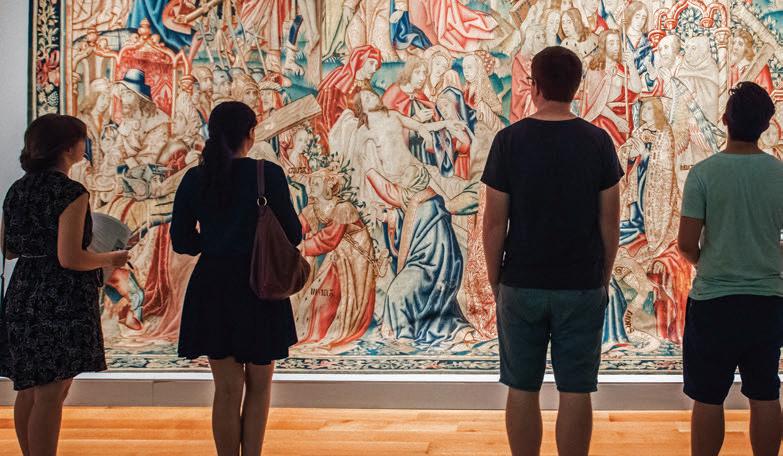
G“good morning ,” said the little prince . “Good morning,” said the merchant.
Thus opens a scene from The Little Prince by Antoine de Saint-Exupéry, which first returned to my mind a year ago as I tried to show my students that something essential is lost when we outsource our thinking—even to something as efficient as AI.
In the book, the merchant is selling pills designed to quench thirst. People who take one per week are freed from the need to drink water. The little prince, with his simplicity of heart, is able to reveal the absurdity of such attempts at efficiency:
“Why are you selling those?” the little prince asked.
“Because they save a tremendous amount of time,” the merchant replied. “Experts have done the calculations. You save fifty-three minutes every week.”
“And what do I do with those fifty-three minutes?”
“Anything you like…”
The little prince fell silent.
“As for me,” he said at last, “if I had fifty-three minutes, I would walk—slowly—toward a spring of fresh water.”
This year, for the second time, I taught a course that, in a way, felt like a leisurely stroll toward a fountain. It’s called “Spiritual Exercises” and is part of the major in Transformative Education, though many students arrive out of curiosity. What we seek in this class is
something that is both very precise and of the utmost urgency today: whatever keeps our deepest questions alive—the thirst for meaning that refuses to go away. In this course, the goal matters less than the path. And to walk, we begin by clearing space.
For an hour and forty-five minutes, twice a week, we set technology aside. If attention wandered, it wandered inward—into memory, into restlessness, into thought. We returned, deliberately, to writing by hand. I distributed small notebooks—bright, almost childlike— that became our companions. The “notebook rule” was simple: what is written there belongs to you and can be brought to any test, any conversation—even the mid-term oral exam. And slowly, something happened: memory became dense, words took root, and the classroom became more human.
The course unfolded in four movements.
The first, The World We Live In , asks us to look without flinching at our contemporary lives. We live in a world of loneliness masked by noise, where we can feel alone even when surrounded by people. The quiet fatigue of relationships never quite begins, and the immersion in our phones consumes our days. We ask what holds us back from “spiritual exercises”—concrete actions and activities that allow us to reflect on what is happening to us—in our questions and in our intuitions about possible answers.
We start by discussing “This Is Water,” a commencement address by David Foster Wallace, who invites us to resist the dull gravity of the “default setting,” that inward collapse of attention that renders the world outside ourselves almost invisible.
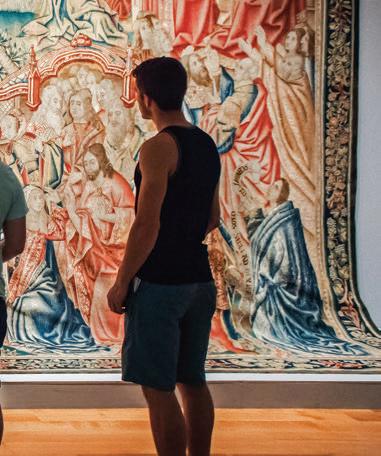
Then we encounter the famous psychologist Jonathan Haidt, who, in his book The Anxious Generation , highlights the effects of excessive technology use, including spiritual degradation. Though he calls himself an atheist, he declares that, in order to describe human beings, he cannot help but use religious language (maybe because we are religious beings?). He says it plainly: we carry within us a God-shaped hole that we try to fill with whatever we can but it does not hold. The students recognize this immediately; there is no need to persuade them. They know the pull of the phone, the quiet compulsion, the way attention fractures, and the neglect of their own hearts. And yet, they also speak—sometimes hesitantly—of another possibility: of gestures, however small, that seem to gather the self back together.
Even our viewing of “Nosedive,” an episode of the cynical British TV series Black Mirror, becomes a kind of parable in our classroom. The episode depicts how, in a world governed entirely by ratings, where every gesture is calculated, it is the flawed, unguarded figures who appear most alive—more fragile, perhaps, but also more real.
In the second movement, Witnesses of Spiritual Exercises, we encounter men and women who, even in dire circumstances, have never given up on practicing “spiritual exercises.” A visiting scholar introduced us to Etty Hillesum (1914–1943), a young Dutch Jewish woman who wrote letters and diaries from the Westerbork Transit Camp, where she and thousands of other Dutch Jews awaited their transport to Auschwitz. Surrounded by destruction, she remained attentive to beauty, to music, to the presence of others and the need to care for them, and to God. Her life is a journey, from
Students regard Fourth, Fifth, and Sixth Articles from the Apostles’ Creed, a Belgian tapestry dating to around 1500, at the McMullen Museum of Art on Boston College's Brighton Campus.
being a “kneeler in training” to someone who cannot live without God.
A similar journey can be found in Dorothy Day’s (1897–1980) long loneliness that slowly becomes a longing; in the burning colors and restless letters of Vincent van Gogh (1853–1890); in the quiet, sustained attention of Patrick Bringley, who, after a great personal loss, chooses to quit his job at a prestigious magazine and stand still—by working for ten years as a guard at the Metropolitan Museum of Art—until beauty begins, slowly, to speak again, as he tells in his memoir All the Beauty in the World
At the McMullen Museum, guided by Carina, a PhD student in Formative Education, we practiced contemplation: not consuming, not passing through, but remaining in front of artworks. Miriam, a professional pianist and a mother of six, came to visit us and turned an ordinary Gasson classroom into a concert hall. She gave us Bach, Chopin, and Schubert, but also a personal testimony: for her, music is not a luxury, but a necessity of the soul.
Two Formative Education PhD students accompanied us in understanding the relevance of the body f or “ s piritual exercises.” Paul spoke of his life with people with disabilities in a L’Arche community, where vulnerability strips away illusion and reveals something essential. Harrison opened up a conversation on sports—not as performance but as a space in which the body itself searches, strains, and reaches beyond itself.
The third movement—Spiritual but Not Religious? challenges a nonsensical but oft-repeated self-descriptor of our age. Here we are accompanied by Augustine of Hippo and Ignatius of Loyola—two restless seekers who discovered, each in his own way, that finding does not mean ceasing to search but rather intensifies the quest. To encounter God is not to arrive but to begin again. As Gregory of Nyssa writes, life unfolds “from beginning to beginning, through beginnings that have no end.”
We ended our semester with a long-awaited Spiritual Exercises Workshop. Each student brought something of their own life—an experience, a fragment, a gesture that, somehow, represented for them an exercise of the spirit. They spoke of walking, silence, music, friendship, of moments in which the surface of things gave way, just enough, to reveal a depth.
And listening to them, you begin to recognize it again—that quiet, insistent thirst. A thirst that does not disappear, that cannot be managed or replaced; the thirst that, if we allow it, sets us in motion—slowly, patiently—toward a fountain. ■
Emanuele Colombo is professor of formative education in the Lynch School of Education and Human De velopment and a research scholar at the Institute for Advanced Jesuit Studies at Boston College.
photo credit : Courtesy of Gary Wayne Gilbert, Boston College
THE CHURCH IN THE 21ST CENTURY CENTER
Find Community & Deepen Faith Explore
C21 Digital Ministry Programs

"I never anticipated that connecting with others via Zoom to reflect and pray would profoundly enrich my faith."
Margie S. New Hampshire, USA
"In a world where there is so much concern over the use of social media and digital platforms, the engagement with the C21 Center's resources has had a very positive impact on the diocese."
Thérèse F. Derry, Northern Ireland

"Faith Feeds has become a spiritual home because it has fostered connection, community, and acceptance for me and all who participate."
Jim M. Louisiana, USA

Read stories from community members around the world.


Explore programs,