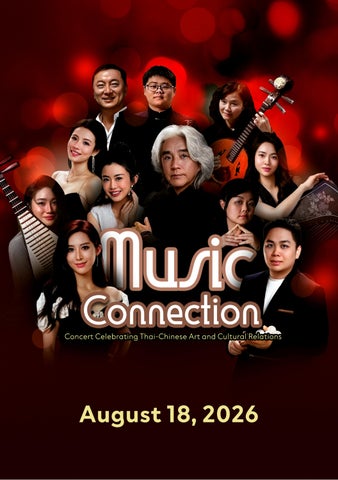
Program Guangzhou Institute of Technology Chinese Traditional Orchestra Peaceful Celebration & Rising Step by Step Moonlight over the Spring River Dance of the Golden Snake & Colorful Clouds Chasing the Moon Brewing Tea under the Moon The Horse Race Purple Bamboo Melody Ode to Lychee Thunder in an Arid Sky Give Me a Rose Joyful Atmosphere Mountain Songs Bring Good Omens Combined with Chulalongkorn University Chamber Ensemble Bua Khow (White Lotus)
M.L. Puangroi Sanidvogs Apaiwong Arranged by Julian Khow
Mo Li Hua (Jasmin Flower)
Chinese Folk Song Arranged by Li Wenping
‘Ever-Forever’ From OST. Lahn Ma
Written by Sichen Li Music by Prateep Siri-issranan Arranged by Chen Yiwei
‘Pure as I Am’ From OST. Pursuit of Jade
Written by Xi Chen Music by Dongdong Dong Arranged by Feng Junhao
Blooming Flowers and Full Moon
Huang Yi Jun
Program Notes Peaceful Celebration & Rising Step by Step Two famous Guangdong pieces. Peaceful Celebration, played on the gaohu, conveys a serene and joyful atmosphere depicting bustling urban life; Rising Step by Step features an ascending melody implying thriving careers and lives. The cheerful and inspiring medley conveys eager hopes for a bright future. Moonlight over the Spring River A classic folk ensemble piece derived from an ancient pipa melody. The graceful, picturesque melody evokes the tranquil scene of river tides and moonlit flowers on a spring night, embodying the traditional Chinese aesthetic of “interplay of void and solidity,” and offers the audience a poetic dream of the Jiangnan water towns. Dance of the Golden Snake & Colourful Clouds Chasing the Moon Dance of the Golden Snake is a gong-and-drum piece adapted by Nie Er, with a rapid and forceful rhythm symbolising the soaring momentum of dragons and snakes; Colourful Clouds Chasing the Moon, A classic Chinese orchestral piece with an ethereal, floating melody that evokes the fantastic scene of clouds and moon chasing each other. Based on the pentatonic scale with refined harmonies, it possesses both Eastern mystery and romantic charm, symbolising the Chinese people’s harmonious coexistence with nature and longing for reunion. Brewing Tea under the Moon Theme song of the film A Letter to Grandma, inspired by Chaozhou kungfu tea. With a gentle melody, it tells the story of a granddaughter’s longing for her grandmother, highlighting the resilience and devotion of Chaoshan women. The interweaving of guzheng and xiao sounds infuses a modern narrative with deep Lingnan nostalgia. The Horse Race A famous erhu piece that, with its galloping melody and bowing techniques imitating hoofbeats, depicts the spirited scene of horses racing at the Mongolian Nadam Fair. With a brisk rhythm and bold grassland sentiment, it showcases the vigour and vitality of China’s northern ethnic groups.
Purple Bamboo Melody Purple Bamboo Melody is a gentle and graceful Jiangnan ditty with the warmth of Wu dialect. The contrast of strength and tenderness highlights the musical differences between northern and southern China. Ode to Lychee A famous Cantonese operatic tune, praising the Lingnan lychee with sweet vocal melodies. The lyrics cleverly employ allusions, and the melody is graceful and melodious, full of rural southern Chinese flavours. The performance incorporates dialectal rhythmic speech, vividly presenting the local customs and harvest joy of Guangdong. Thunder in an Arid Sky Thunder in an Arid Sky uses leaping melodies to mimic thunder, symbolising the joy of rain after a long drought. The lively and playful combination reflects the optimistic and humorous temperament of the Lingnan people. Give Me a Rose A pipa piece adapted from a Xinjiang folk song, passionate and exuberant with strong Uyghur characteristics. The rhythmic beats and ornamental notes imitate the hand drum and dombra, conveying young lovers’ sincere confessions of love and showcasing the brilliant colors of Western Regions music. Joyful Atmosphere Joyful Atmosphere is light and jubilant, overflowing with festive cheer. Mountain Songs Bring Good Omens Adapted from a Heyuan Hakka mountain song in Guangdong, with the interjection “hei liao liao luo” embodying the Hakka style. The bright and spirited melody celebrates labour and harvest, conveying the Hakka people’s optimism and diligence, and is full of rustic vitality and auspicious wishes. Bua Khaw (White Lotus) This is a timeless Thai pop song honored as a national heritage. Composed in 1937, it was featured in the movie Tan Fai Kao (Old Embers) by Thai Film Company, one of Thailand’s earliest sound-on-film movies. The melody of Bua Khaw (White Lotus) uses Western classical music structures and a pentatonic scale, yet it beautifully captures a traditional Thai atmosphere. In 1979, the Asian Cultural Centre for UNESCO in Japan selected it as the 'Song of Asia.' It was then recorded and distributed worldwide as part of
an Asian hits compilation album. For this performance, it will feature an erhu solo accompanied by a Western string ensemble. Mo Li Hua (Jasmin Flower) This is one of the most famous and internationally recognized ancient Chinese folk songs, often regarded as an unofficial 'cultural national anthem.' Passed down since the 18th century during the Qing Dynasty, its roots lie in a traditional folk melody known as the 'Yangzhou Ditty Ever-Forever This soundtrack from the 2024 Thai blockbuster movie ‘Lahn Ma’ (How to Make Millions Before Grandma Dies) beautifully conveys the deep emotional bonds within a ThaiChinese family. The song has been rearranged for a Chinese instrument ensemble and a Western string orchestra. In its Chinese lyrical version, the song is officially titled Yǒngyuǎn 《永远》, which means 'forever.' This title mirrors the meaning of the original Thai track, 'Suay Ngam Samur' (Ever-Forever), suggesting that while time passes, these profound connections and beautiful memories will remain forever. The Chinese lyrics were written to build upon the movie’s phenomenal box-office success in China. Pure as I Am This is the theme song for the 2026 epic historical romantic-political Chinese drama series ‘Pursuit of Jade’《逐玉》. Officially titled Qīng Qīng Rú Wǒ《清清如我》, which translates to 'As Pure as I am,' the song was crafted by a renowned songwriting couple. The lyrics depict a story of pure love and devotion. Despite facing a cruel fate and fierce political warfare within the imperial court, they are ready to dedicate their entire lives to protecting that love and goodness forever. Blooming Flowers and Full Moon This is one of China’s most famous and popular traditional classical instrumental pieces. Officially titled Huā Hǎo Yuè Yuán《花好月圆》, which translates to 'Blooming Flowers and Full Moon,' it is commonly performed during major festivals and celebrations, such as the Mid-Autumn Festival and Lunar New Year, to bring good fortune and auspiciousness
Guangzhou Institute of Science and Technology Chinese Traditional Orchestra Introduction: The Guangzhou Institute of Technology Chinese Traditional Orchestra is an artistic ensemble based in the Guangdong–Hong Kong–Macao Greater Bay Area, dedicated to preserving and promoting China’s outstanding traditional music culture. Rooted in folk music and grounded in Chinese orchestral traditions, the ensemble adheres to the artistic philosophy of “inheritance with innovation, openness and inclusiveness,” and continuously explores ways to inherit and develop Lingnan music. The orchestra has a complete section structure, comprising stringed, plucked, wind, and percussion instrument groups. Its faculty includes senior professors specialising in Lingnan music research as well as young doctoral graduates from top music institutions both at home and abroad, demonstrating solid professionalism and vibrant artistic vitality. The Orchestra actively expands international cultural exchanges. In November 2025, at the invitation of the Gyeryong City government of the Republic of Korea, it participated in the “Gyeryong Byeolgok” International Cultural and Art Exchange Gala. As an important part of Gyeryong City’s series of international cultural exchange events, the Orchestra performed alongside the Cheongryong Art Troupe of Korea, presenting a programme with distinctive Lingnan characteristics. The performance received high praise from the Mayor and the Speaker of the City Council of Gyeryong, and the Mayor personally awarded a certificate of merit to the ensemble’s representative.
Musician Roster
Ding Yi
Xie Tingfeng
Tenor
Sheng Player
Professor, Doctoral Supervisor
National First-Class Performer, Professor
Lin Danhong
Wang Tingting
Zhongruan and Liuqin Player
Doctor, Yangqin Player
National First-Class Performer, Professor
Vice President of the Asian Yangqin Association, Music Director of the Hundred-Strings Yangqin Ensemble
Zhang Lin
Yu Jiao
Erhu Player
Guzheng Player
Master’s Degree, Associate Professor
Doctor, Associate Professor
Hu Huijie
Zhao Nanying
Soprano
Young Vocalist
Doctor
Doctor, Lecturer
Yu Junhong
Li Yuchen
Percussionist
Young Pipa Player
Master’s Degree
Master’s Degree
Luo Zhen Young Dizi Player
Chulalongkorn University Chamber Ensemble Musician Roster Violin 1
Flute
Nitada Upatamtanont
Monnapha Chaichanayotinvatchara
Karnsinee Suriyapattamalai Apikoch chuankratoke
Oboe
Paphawarin Thana
Punyaporn Chanjitwitayasuti
Violin 2
Clarinet
Anita Yunyongkul
Wipanee Thongbai
Pimyada Wongjaroenying Apichaya Taveechokrieangrai
Bassoon
Pakkakorn Thiramonkolchai
Kemjira Nitithammanart
Viola
Horn
Natamon Atsavakovith
Suparat Thongbai
Krittapat Sanitrum Sirikorn Kaewsuk
Piano Khitalant Sitthiphong
Cello Chompunuch Pakaponwiwat
Percussion
Rachmal Jitpirom
Nuttanun Iamdang Supatat Bandasak
Double Bass Chattamon Panprasert
Conductor
Kittikorn Thongin
Sirowut Srinitedwatin
Acknowledgement Chinese Embassy Bangkok China Cultural Center in Bangkok Guangzhou Institute of Science and Technology Wanchai Yanubol General Manager, Royal Bangkok Symphony Orchestra