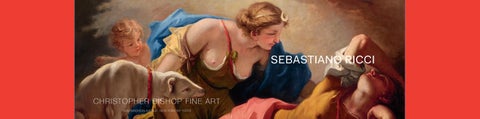
SEBASTIANO RICCI
C H R I STOP H E R B I S H OP F I N E A RT 1046 MADISON AVENUE NEW YORK NY 10075
LOVE, LOSS, AND IMMORTALITY: SEBASTIANO RICCI’S DIANA AND ENDYMION
SEBASTIANO RICCI’S DIANA AND ENDYMION
CHRISTOPHER BISHOP FINE ART 1046 MADISON AVENUE NEW YORK
ACKNOWLEDGMENTS: This catalogue is dedicated in friendship to all those who helped Sebastiano Ricci’s Diana and Endymion along its journey of rediscovery: Charles Beddington, Virginia Brilliant, Annalisa Scarpa, and Cydney W. Williams. Copyright © 2022
An expertise confirming the attribution of the Diana and Endymion (Plate I) to Sebastiano Ricci (1659-1734) and discussing its art historical and stylistic context written by Dottoressa Annalisa Scarpa, author of Sebastiano Ricci: Catalogue Raisonnée a cura di Annalisa Scarpa (Milan, 2005), signed and dated April 17th, 2022 is available upon request. Sebastiano Ricci (Italian, 1659–1734), Studies of Dogs, ca. 1734, pen and black ink over traces of black chalk, 189 x 273 mm. Royal Collection Trust / © Her Majesty Queen Elizabeth II 2022
PROVENANCE: Presumably George Hill, Esq., Dublin; (His sale, Thomas Jones, Dublin, 1 August 1821, lot 35, along with a pendant The Death of Orpheus, lot 34). J. D. Mullen, Esq., Dublin; (Sold Christie’s, London, 1824, date unknown, lot 26, for 3 pounds, along with a pendant The Death of Orpheus lot 27, for 3.10 pounds); To Doherty (Lord Chief Justice John Doherty 1785-1850?) according to an inscription in the margin of Lugt 10788 (Br-2523); Possibly Christie’s, London 6 May 1837, lot 49a “A pair of Sopra-Porta’s and a head” seller McCracken, buyer Captain Smith according to a note in the margin of Lugt 14702 (Br-4742); Presumably M. N. Smith, London; (Sold Christie’s, London, 10 March 1838, lot 135, “Diana and Endymion and the companion”); To Morris (per Lugt 14970, Br-4857). (Sold Auction Gallery of the Palm Beaches, 27 March 2021, lot 66 as “Italian School 19th Century Painting”).
Plate I. Sebastiano Ricci (Italian, 1659–1734), Diana and Endymion, ca. 1720, oil on canvas, 94.3 x 147.3 cm (37 1/8 x 58 in.). Christopher Bishop Fine Art
Love, Loss, and Immortality: Sebastiano Ricci’s Diana and Endymion Vista non son da te, benchè presente, E trovando ti perdo eternamente. I am not seen by you, even though present, and in finding you I lose you eternally. Tasso, Gerusalemme Liberata, 19.105
“She red and hot as coals of glowing fire / He red for shame, but frosty with desire” Shakespeare, Venus and Adonis, 35–36.
“Vista la facia scolorita e bella, Non scese no, percipitò di sella” Tasso, Gerusalemme Liberata, 19.104; As she caught sight of his handsome discolored face, she didn’t dismount, but leapt instead from her horse.
Figure 2. Sebastiano Ricci (Italian, 1659– 1734), Diana and Endymion (detail), ca. 1720, oil on canvas, 94.3 x 147.3 cm. Christopher Bishop Fine Art.
I. Diana and Endymion: Love and Loss
Figure 1. Sebastiano Ricci (Italian, 1659– 1734), Diana and Endymion (detail), ca. 1720, oil on canvas, 94.3 x 147.3 cm. Christopher Bishop Fine Art.
Sebastiano Ricci’s (1659–1734) Diana and Endymion (ca. 1720) (Plate I) is a revelation. Emerging from the mists of time after more than two hundred years of benign neglect, Ricci’s painting surprises us by its scale, ambition, and frank sexuality. Its vibrant, phantasmagoric colors are those of Iris, the goddess of early morning, messenger of the gods. The entire canvas is suffused with a divine glow. Flashes of Venusian red can be seen in the face and neck of Diana, engorging the lips of Endymion, lighting up the cheeks of the small cupid with his butterfly wings, and even tinging the underbelly of Diana’s dog (fig. 1). In this moment, as the sun rises, the animating blood of life begins to course through the veins of the world as Venus’s power takes over control from the cold, virginal Diana. Love is in the air. Diana’s surprise discovery turns her world upside down. This huntress is stopped in her tracks by the sight of Endymion’s perfection. It brings her to her knees. The tables have turned. The goddess who had previously rejected every man is now subject to a spell cast by this simple shepherd. Her fierceness, discipline, and self-control are all cast aside, replaced by abject adoration. She is prey for the first time to her passions, suddenly vulnerable to the frailties that plague humanity. It is Endymion who is the god
now—untouchable, perfect, whole, and remote. He has become everything she was until just a moment ago. Diana’s inner glow is a reflection of the way her body has been activated by his presence, how the color has come into her face as a result of the flush of love she feels for him. This even as the color is washed out of Endymion’s visage. Diana in effect is falling in love with her own cold moonlight as reflected back to her in the mirror of her desire, Endymion. A warmth illuminates her body from within as a result. Her white silk undergarment now chafes her exposed, pink nipple. She is in full sympathetic response to his unconscious arousal (fig. 2). There, within our own shadows, we find the pleasure of seeing ourselves reflected in others. This vanity, however, is by definition illusory. It will end in tragedy. Diana will never be able to possess the perfection she creates. From this perspective, painting is the shield of Medusa: it immortalizes but also kills, turning its victims to stone. Our gaze is captured by the light on the surface of the mirror Ricci puts before us. Like a dream sent by Morpheus, this love will soon vanish, leaving us wondering if any of it was ever real. What we behold is merely a transfixing dream, a vision in achingly beautiful chiaroscuro. Each moment of beauty is fleet-
10
“Con luci ella ridenti, ei con accese, mirano in vari oggetti un solo oggetto: ella del vetro a sé fa specchio, ed egli gli occhi di lei sereni a sé fa spegli” Tasso, Gerusalemme Liberata, 16.20; Her eyes laughing with light, his set ablaze, in various objects they can only see one thing: she sees herself in the mirror, while he sees himself in the serene reflection of her eyes.”
Figure 3. Sebastiano Ricci (Italian, 1659–1734), Diana the Huntress, ca. 1717, oil on canvas, 200 x 140 cm (oval). Palazzo Taverna (Rome)
Figure 4. Sebastiano Ricci (Italian, 1659–1734), Diana and Endymion, ca. 1718, oil on canvas, 125 x 178.7 cm. Princeton University Art Museum
“[T]he subject is no one. It is decomposed, in pieces. And it is jammed, sucked in by the image, the deceiving, and realized image, of the other, or equally by its own specular image” Lacan, The Seminar of Jacques Lacan: Book II, 1991.
ing. The colors flickering in the light will soon be extinguished. The coming day will rob Diana of her lover. Love and perfection cannot coexist with possession for long. In his Diana and Endymion, Ricci has constructed in this way a reflection on the artistic process itself—on the connections between the notions of vanity, immortality, and perfection. This Baroque self-conscious meditation on the mechanisms of aesthetics would no doubt have appealed to both Ricci and his important, but as yet unknown, patron alike. The seduction of the mirror, however, does not stop there. It begins to change us, drawing us into the depths of our self-obsession. From this perspective, painting is the surface of the water in which Narcissus drowns. This vertiginous effect makes us start to question even the reality of our self-perceptions. Endymion is a sculpture within a painting, and
Diana falls in love with this artwork and is transformed by the experience into another goddess entirely. It should hardly surprise us that this play of illusions, profiles, color, and light fascinated Ricci as a painter. When viewed from varying degrees of removal, the stakes of this game are in fact quite different. Endymion’s dream locks him in a blissful solipsism. Only at one step removed does the viewer first take in Diana’s beauty, enthralled by her presence in the same way in which she is captivated by Endymion. From this perspective, we are watching her watch him. Our position is that of the hunter, Acteon, who spied on Diana—the threat of her violence only temporarily suspended in the surface of the paint. There is a distinct perversity in the fact that Diana’s tragedy ends up being our pleasure, an effect that decidedly begins to undermine the
11
place of the viewer. As a result, creator, created, and owner are truly at play in this Baroque masterpiece. Ultimately, only the painter himself is able to cast his figures into immortality. Only he can possess his lovers. They will never grow old. Here, they are in their full glory: some three hundred years later, the vermillion hues that dominate the canvas are just as brilliant as they were on the day it was painted. The triumph of Venus, her gift to Pygmalion, is this. Painting is immortality in color. II. Endymion and Rinaldo: Shepherd and Soldier This freshly uncovered Diana and Endymion is the result of Ricci’s long meditation on the meaning of this particular subject, reiterated through several versions created by the artist in the immediately preceding period. This new version ought to be considered the summa of these, the capolavoro of the whole series. One can closely follow Ricci’s progress from the earliest version of the subject now at Chiswick House (ca. 1713) to those in Rome’s Palazzo Taverna (ca. 1717) (fig. 3) and at Princeton University Art Museum (ca. 1718) (fig. 4), all of which incrementally lead toward the more complex presentation of the myth seen here. Ricci’s Diana and Endymion reverberates with multiple layers of meaning, the true depths of its mirror inexhaustible. These manifold readings are derived from the interwoven poetic narratives that lie just beneath the surface of the work. The most important of these are taken from Tasso’s story of Rinaldo and Armida as told in his Gerusalemme Liberata (1581). Our first hint as to these connections is the strange presentation of Endymion. Endymion’s extravagant red mantle opens not to reveal his nakedness, as would be expected (fig. 5), but instead to show the ornamented
Figure 5. Sebastiano Ricci (Italian, 1659–1734), Diana and Endymion, ca. 1713, oil on canvas, 190 x 106 cm. Chiswick House (London)
12
troubled in this Baroque travesty, where women dress up as soldiers and soldiers dress up as women. Nothing is as it seems. It is quite possible that Ricci knew Nicolas Poussin’s (1594–1665) famous Dulwich composition (ca. 1628–30), itself based in part on ancient sculptures of Endymion. Ricci has cleverly reversed the course of these influences that dovetail so closely with the underlying allusions to the story of Diana and Acteon in his own composition (Ovid, Metamorphoses, 3.165–252). Ricci’s characteristic white dog seems to have a deeply visceral memory of this particular episode. He leans his head forward with a curiosity about—even a suspicion of—this stranger, as if asking permission from his mother to tear him apart as he once did Acteon (fig. 8).
Figure 6. Sebastiano Ricci (Italian, 1659–1734), Diana and Endymion (detail), ca. 1720, oil on canvas, 94.3 x 147.3 cm. Christopher Bishop Fine Art
leather cuirass of a Roman soldier. In the near foreground, under the edge of his cloak, an ornate damascene quiver can be seen, its inlaid gold glinting in the light (fig. 6). Neither of these accoutrements belongs to an impecunious shepherd. These attributes connect Endymion instead to the figure of the crusading soldier Rinaldo. In the Gerusalemme Liberata, when Armida first comes upon the sleeping Rinaldo, she presumes that he is dead. Armida’s first response is one of confusion when she subsequently discovers that Rinaldo is only asleep. Torn between love and violence (fig. 7), she reaches for a knife. Deeply Baroque, this conception depends on the reflections, visions, and illusions of love. Armida’s anger ultimately derives from the fact that her deep admiration for Rinaldo damages her own vanity. She sees this aspect of herself reflected in his armor. Armida, intending at first to seduce and kill the Christian knight Rinaldo, is subject instead for the first time to the kind of enchantment that she herself would normally dispense. Like Armida, our Diana is enraptured, suddenly bound by the chains of love (la catena d’amore). The veil between delight and violence is tragically thin. From the very outset of this epic, therefore, Tasso establishes a theme of role reversal. The surface of the waters is
Figure 7. Nicolas Poussin (French, 1594–1665), Armida and Rinaldo, c. 1628–30, oil on canvas, 82.2 x 109.2 cm. Dulwich Picture Gallery (London)
13
Figure 8. Antonio Tempesta (Italian, 1555–1630), Acteon Killed by His Dogs (plate 26 from Ovid’s Metamorphoses), ca. 1606, etching, 105 x 117 mm. The Metropolitan Museum of Art
“Qual uom da cupo e grave sonno oppresso dopo veneggiar in sé riviene” Tasso, Gerusalemme Liberata, 16.31; as a man oppressed by heavy sleep after empty dreams comes into himself again.
Figure 9. Domenico Zampieri [called il Domenichino] (Italian, 1581–1641), Rinaldo and Armida, ca. 1617–21, oil on canvas, 121 x 168 cm. Louvre Museum
He portrays Endymion trapped in numbing slumber, the ultimate figure of vanity, completely unaware of the world around him, contemplating only his own perfection. Like Narcissus at the edge of a pond, Diana gazes into the mirror that is Endymion and is finally consumed by him (“pende omai si che par Narciso al fonte” Tasso, Gerusalemme Liberata 14.66; hanging over him like Narcissus at the fountain). Diana’s mimetic attraction slowly begins to turn her into a projection of Endymion’s beauty. Her color and profile shift to mimic his as she lights up with passion. Endymion, it ought to be remembered, was considered the father of Narcissus. His body is turned pointedly toward the viewer, as if posing for himself (and us) in the mirror that is the surface of the painting. These two lovers are tied together in this way by the symbolic antinomies that link death and sleep, presence and absence, passion and violence, illusion and artifice, and arousal and consummation. This profound reflection on Ricci’s part upon the art(tifice) of the mirror of the canvas would be inconceivable without Tasso’s example. The philosophical distinction at work in Tasso’s epic poem is between two kinds of mirrors and therefore two kinds of art. The first is the mirror of vanity (surface); the second,
His lip is curled in the beginning of a snarl, showing just how quickly passion turns to violence. The last man his mistress caught spying was dismembered for the offense. In an equally famous scene from Tasso’s Gerusalemme Liberata, Armida holds Rinaldo captive, emasculating the formidable soldier. He has fully succumbed to his vanity, spending his time holding the mirror of his mistress (fig. 9) (“In lei pascendo si consuma e strugge” Tasso, Gerusalemme Liberata, 16.19; as he fed on his sight, he was consumed and destroyed). Armida holds him on the narcissistic surface of life, painting for him an illusion that replaces reality itself—a magical garden of her own creation. Conversely, when at the end of this episode he finally looks onto the surface of the shield proffered by his fellow soldier Ubaldo (fig. 10), Rinaldo suddenly remembers his identity and purpose. As if awakening from a long slumber, he returns to his martial vocation. Armida’s spell is finally broken, as it was fated to be from the beginning. Diana’s love is equally doomed. The imminent sunrise will break Endymion’s spell on her. In his Diana and Endymion, Ricci employs the same symbolic vocabulary established by Tasso in the Gerusalemme Liberata.
14
necessarily known for his antiquarian interests, there can be little doubt that this work relies on a close study of the typologies of ancient sculpture. It could be that these references reflect the deep collecting culture of the Sagredo family of Venice or even perhaps the specific antiquarian interests of one of Ricci’s English patrons, such as the third Earl of Burlington (1694–1753). The depths of Ricci’s cultural knowledge are in any case truly remarkable. It starts with an understanding of Selene (Diana), the goddess of the moon, as the “golden-tressed” (σέλας) goddess. Her luminous hair is banded and adorned with a lunar disk that references the horns of the bull. She is the very light of the moon penetrating into the cave of Endymion on Latmos. Diana’s intensely aquamarine blue cloak, bunched up over her shoulders, is the cloak of night, pulled back to symbolize the advent of dawn. This is the hood of Selene (fig. 11). Underneath, Diana wears an iridescent silk robe that hangs from her shoulder. This silk, very much at home in the Venetian context, is certainly an incarnation of the shimmering light of the moon. It should also be understood, however, as a symbol of change connected to Iris, goddess of this hour of shifting light. Ricci’s composition is every bit as sophisticated in its iconography as Poussin’s Diana and Endymion (ca. 1630) in Detroit (fig. 12).
Figure 10. Francesco Maffei (Italian, 1605–1660), Rinaldo and the Mirror-Shield, ca. 1650–55, oil on copper, 29.8 x 34 cm. J. Paul Getty Museum
the mirror of self-knowledge (depth). There are two corresponding kinds of love: the seduction of the mirror (illusion/vanity) and the lure of the Other (the transcendent/the unknown). These twinned loves are necessarily in tension with each other and cannot fully coexist. The final question for the viewer is this: which type of mirror (art) is painting? Painting is both artifice and illusion, but also a path to a higher truth. Love and vanity, the surface and the depths, are separated only by a razor’s edge. Who will win in the end: Eros or Thanatos (Freud, Beyond the Pleasure Principle, 1920)? Endymion’s name in Greek means “the diver”—the depths—while Diana comes from on high. This makes of her a source of enlightenment and of him a pool of deep Orphic knowledge. Can these two paths ever truly meet? Only for a moment. III. Ancient Statues / Modern Meanings Ricci’s Diana and Endymion reverberates not only with these myriad poetic references but with specific visual allusions to important examples of the statuary of antiquity. While Ricci is not
Figure 11. Roman, 2nd–3rd century CE, Statue of Selene (detail), marble. Capitoline Museums (Rome)
15
half-Hora. The symbolic gender confusions begin to accumulate. Ricci’s challenge was to update the models of antiquity for the Baroque age. Somehow he had to find a way to combine the austerity of these white marbles with the colorful splendor of contemporary Venice. Part of this updated synthesis clearly comes from the way in which Ricci manipulates the iconography, but other strategies it seems he took from the modern sculptors and sculptures he encountered. Having just returned from Paris, where he might very well have been able to observe Jean-Louis Lemoyne’s (1666–1755) A Companion of Diana (1710–24) in progress (fig. 15), Ricci was ideally positioned to understand the latest advances in French painting and especially sculpture. From Lemoyne he took a certain love of the way in which a narrative can be told directly through the materiality and clarity of stone. From Charles de la Fosse (1636–1716), perhaps, he borrowed an intense lighting that focuses the attention of the viewer on the central figures
Figure 12. Nicolas Poussin (French, 1594–1665), Diana and Endymion, ca. 1630, oil on canvas, 121.9 x 168.9 cm. Detroit Institute of Arts
This kneeling female figure is not a Diana per se. She is instead a Crouching Venus (fig. 13). The original context of the Crouching Venus is one that expresses her modesty, and Ricci may well have enjoyed the irony of linking the pudicitia of this Venus with the sudden licentiousness of the virgin goddess Diana. Furthermore, the putto who holds her back belongs more properly to Venus than to Diana. His mischievous smile—that of Cupid— tells us that it is he who has introduced a note of trouble into this otherwise peaceable scene. His unusual butterfly wings, a symbol of transience, are most often seen in the putti who accompany Iris or Aurora (fig. 14). He may be associated, therefore, with the Horae (hours), who denote the passage of time. The Horae are the daughters of Selene and as such are usually depicted as female. Ricci’s male putto must therefore be understood as half-Cupid,
Figure 13. Marcantonio Raimondi (Italian, ca. 1489–before 1534), Venus Crouching by a Plinth on Top of Which Stands Cupid, ca. 1510–27, engraving, 21.7 x 14.2 cm. The Metropolitan Museum of Art
16
particularly close study for Ricci. Not only is its editing down of the figures to a bare minimum an important precedent for Ricci’s painting, but the contrast between Charity’s long silken robe— pooling around her feet—and the crisp pleats of the paneggio of the prisoner’s loin cloth offers a clear parallel to Ricci’s work. The stark juxtaposition between Charity’s fleshy stone breast and the prisoner’s lean, carved body is, moreover, a bravura feat of carving. These types of divergent sculptural styles helped Ricci to tell
Figure 14. Nicolas Poussin (French 1594-1665), Helios and Phaeton with Saturn and the Four Seasons (detail), ca. 1630, oil on canvas, 122 cm x 153 cm. Gemäldegalerie, Berlin
of the composition. Ricci needed this French interlude to mediate between the relative visual austerity of the English context and the lighter touches of Venice. Upon his return to Venice at the end of 1718, Ricci could now also draw from the best sculptural examples in the Sagredo collection, both ancient and modern. Among the most important collections of sculptures in Italy, those collected by the Sagredo family were put on display by Zaccaria Sagredo in his home, where renovations were then in full swing. Foremost among the modern works were those of Giusto le Court (1627–1679), who translated Gianlorenzo Bernini (1598–1680) for Venice. Le Court’s visual vocabulary manages to seamlessly blend ancient stillness with a more modern richness consisting of deeply pleated and layered stone garments (fig. 16). This way of working seems to have inspired Ricci. His Diana and Endymion is a perfect painted translation of this sculptural style. Everything is undercut, everything delineated by the chiseled precision of his chiaroscuro lighting. Le Court’s Roman Charity (ca. 1660) (Museum of Fine Arts Budapest) (fig. 17)—then almost certainly placed in the entrance of Ca’ Sagredo—would presumably have been an object of
Figure 15. Jean-Louis Lemoyne (French, 1666–1755), A Companion of Diana, ca. 1710–24, marble, 182.5 x 76.5 cm. National Gallery of Art (Washington, DC)
17
his story. The undercut carved relief of Endymion with his stolid, weighty, and pleated cloak is markedly contrasted to the light, diaphanous garments of Diana. Whereas Endymion’s vestments are fixed eternally in place, Diana’s fluttering robes are indicative of her sudden arrival. At this point in his career, Ricci was at last prepared to present his complete aesthetic thesis, to create a résumé of his thoughts on the evanescence of love and color. His mature understanding is a distillation of the best examples of antiquity made possible through the mediation of contemporary Venetian sculptors. These borrowings should perhaps not surprise us as much as they do. Contemporary sculptors, after all, were working with the exact same materials as their ancient counterparts, and Ca’ Sagredo was effectively one big living sculpture, full of stuccos and statues culminating in Zaccaria’s own bedroom (1718), now in the Metropolitan Museum of Art. Why shouldn’t sculptors have taught
Figure 17. Giusto le Court (Italian, b. Flanders, 1627–1679), Roman Charity, ca. 1660, marble, 250 x 92 x 71 cm. Museum of Fine Arts Budapest
Ricci how to look at antiquity? If one really wants to understand form, the best way is simply to remove color. The restrictions of the colorless marble allowed sculptors to see all the details of antiquity more clearly. This lesson shines forth in the vivid splendor of Ricci’s Diana and Endymion. The full synthesis is complete as marble is rendered into living flesh.
Figure 16. Giusto le Court (Italian, b. Flanders, 1627–1679), Diana, ca. 1650, marble, 54 x 40 cm. Palacio Real de La Granja de San Idelfonso (Segovia) (formerly Odescalchi Collection, Rome)
18
features of Venus’s lover Adonis. Ricci is hardly alone in the Venetian context in exploiting these narrative ambiguities to create poetic and visual crossovers. When examining Pietro Liberi’s (1605–1687) Sleeping Endymion (ca. 1660) (fig. 18), for example, the blurring of these narrative lines is taken to the extreme. Determining whether the principal figure is a dead Adonis or a sleeping Endymion is left to the viewer, as is the true meaning of the red lanyard of his horn, here depicted almost like broken ligatures around his wrists. The nudity, vulnerability, and beauty of Liberi’s male figure is allowed to take center stage, a cipher of the connections between beauty, sexuality, and mortality. Ricci’s composition can be usefully compared then to depictions of Venus discovering the body of Adonis or even to such a painting as Paolo Veronese’s (1528–1588) well-known Venus and Adonis (1580) (Prado), wherein Adonis’s death is only alluded to by the arrival of his dogs. The story of Venus and Adonis (Ovid, Metamorphoses, 10.708–39) would have certainly been close at hand for Ricci and
IV. A New Adonis: The Poetic Ambiguities of Antonio Corradini I think he’s very good-looking, Aphrodite, especially when he sleeps with his cloak under him on the rock, with his javelins just slipping out of his left hand as he holds them, and his right hand bent upwards round his head and framing his face makes a charming picture, while he’s relaxed in sleep and breathing in the sweetest way imaginable. Selene to Aphrodite in Lucian, Dialogues of the Gods, vol. 7, 331 (Translation by M. D. Macleod, 1911)
Ricci takes extensive poetic license in creating visually mirrored links between the love stories of Venus and Diana. These subtle but ample confusions are quite purposeful. Diana is out of her mind; she is acting like Venus. Ovid specifically recounts that when Venus fell in love with Adonis, she hiked up her skirt and ran through the fields hunting like Diana (Metamorphoses, 10.503– 59). It makes sense, therefore, that in Ricci’s depiction, Diana does exactly the opposite. She begins to take on the features of Venus, selfishly neglecting her hunt and her dog in favor of her new love. Partly this is because the story of Diana and Endymion does not feature in the litany of tales in Ovid’s Metamorphoses, forcing Ricci to look elsewhere for his interpretations. The mirrored nature of the star-crossed love stories of Venus and Diana underlies Ricci’s work. It highlights the upsidedown nature of true love. The two goddesses, Diana and Venus, are effectively sisters, two planets trading spaces in the sky, so close that they may be confused with each other in certain circumstances (compare Virgil, Aeneid, 1.327–29 and 1.314–20). Lucian’s dialogue is put into the mouth of Aphrodite (Venus) and Selene (Diana) precisely in order to underline the reciprocal meanings of the great loves of these goddesses. Not surprisingly, Ricci’s figure of Endymion begins thereby by analogy to take on many of the
Figure 18. Pietro Liberi (Italian, 1614–1687), Sleeping Endymion, ca. 1660, oil on canvas, 84 x 147 cm. The State Hermitage Museum
19
Figure 19. Nicolas Poussin (French, 1594–1665), Venus and Adonis (detail), ca. 1628–29, oil on canvas, 98.5 x 134.6 cm. Kimbell Art Museum (Fort Worth, TX)
Figure 20. Lucio Fontana (Italian, 1899–1968), Concetto spaziale, Attese, 1960, water-based paint on canvas, 125.7 x 100.6 cm. The Museum of Fine Arts Houston
also resonates deeply with the central themes of Diana and Endymion. Several details of Ricci’s composition point directly towards an intended Adonis-Endymion comparison. Not only is Adonis proverbial for an impossibly beautiful man, but the hunting horn that hangs from Endymion’s neck would be much more at home around that of Adonis (fig. 19). The blood-red lanyard from which it hangs, moreover, cuts across his body like a gash. The “pool” it forms on the ground may be read as a reference to the death of Adonis upon being gored by a boar. This vermillion color embodies the double-edged sword of life and death (fig. 20). The cut is effectively the love wound of Dido (Virgil, Aeneid, 4.100–101) but also the string given by Ariadne to Theseus in order to defeat the Minotaur. This is no mere metaphor during the period, as heat was understood to animate not only the blood but the soul. The night and the moon, conversely, were understood to be full of stillness and the potential for tragedy (“The motions of his spirit are dull as night” Shakespeare, The Merchant of Venice, 5.1). Endymion’s sleep is therefore the exact physical opposite of Diana’s arousal. Sex and love are here presented by Ricci as the only true antidotes to death. Ricci’s poetical borrowings likely had a very specific
source: Antonio Corradini’s (1688–1752) statue Adonis (ca. 1725) (fig. 21). When it was rediscovered in 2013, the figure was at first identified as an Endymion, but a historical reference to the work in the Sagredo collection where it was paired with a now missing Venus statue makes it clear that it must be identified instead as an Adonis. Nevertheless, one must assume that the ambiguity between these two mythological references introduced into this sculpture was a deliberate choice on the part of Corradini. Corradini’s figure seems to be sleeping, not dead or wounded. This blurring of Ovidian lines only adds to the symbolic depth of his work. Commissioned by Sagredo, Corradini’s Adonis would certainly have been a high-profile sculptural work in contemporary Venice. Moreover, it would likely have been in the course of completion as Ricci painted his Diana and Endymion. Ricci’s painting shares Corradini’s specific vocabulary of sexual and semiotic ambiguity. Their comparable scale and poses make it tempting to imagine that Diana and Endymion was conceived by Ricci to ri-
20
Figure 21. Antonio Corradini (Italian, 1688–1752), Adonis, ca. 1725, marble, 142.2 x 53.3 cm. The Metropolitan Museum of Art
21
val Corradini’s sculpture in a kind of paragone contest. This thesis would not only go a long way toward elucidating the deep culture of Ricci’s painting but might also help explain his intense meditation on the art of painting itself in this work. This symbolic rivalry between sculpture and painting carves much deeper thanks to the poetic confusion introduced into this context by the sculptor Corradini. Somewhat unexpectedly, in the process of exploring the parallels between these sister arts, Ricci’s Diana and Endymion begins to form a bridge from the Baroque toward a more Neoclassical vision.
Figure 22. Giulio Cartari (Italian, ca. 1663–1680), Cupid and Psyche, ca. 1719, marble, 150 x 130 x 101 cm. The Summer Garden (St. Petersburg)
V. Plato and the Surface of Marble: Michelangelo, Artifice, and the Surpassing of Nature
Figure 23. Michelangelo Buonarroti (Italian, 1475–1564), Creation of Eve, ca. 1508–12, fresco. Sistine Chapel, Vatican Museums
is, however, a tragic fault within this love: Endymion does not fully belong to either world, his external beauty only an outward reflection of the immortal soul within. When looking upon Endymion, Diana is confronted therefore by the perfection of a new Adam, in whom there is something she cannot fully assimilate. His place among mortals is not certain; his form seems instead just minted, freshly carved of marble, his rib exposed to the sky. Ricci’s Endymion may thus be compared to Michelangelo’s (1475–1564) Adam from his Creation of Eve (fig. 23), torn halfway between perfection and the physical vulnerability of this world (compare Genesis 2:21). Michelangelo’s Adam is effectively a dead Saint Sebastian who has fallen to the foot of his tree. His hands are “tied” to the stump of a tree like those of a prisoner but with an invisible rope. He is now for the first time a prisoner of the flesh, bound to death. Ricci’s Diana, by extension, is a new Eve. In her fallen state, she is now prey to the adoration of this perfect, yet mortal man. It will all end in lamentation. This fate of theirs is driven home by a visual comparison of Ricci’s work to Antonio Giorgetti’s (doc. 1668–1682) Tomb of
[T]he Mother of the gods castrates Attis while even retaining him as an object of longing, the blessed nature (...) of the transcendent and eternal realms, recalls to itself the masculine power of the soul. Hippolytus, Refutation of the Heresies, Book 5.7 (Translation R.S. Birdsall, 1984)
There can be little doubt that Ricci’s Diana and Endymion is at its core a painting about the connections between mortals and a higher power. One clearly senses that one is face to face here with a reunion between heaven and earth, body and soul, Cupid and Psyche (fig. 22). Part of this is simply the traditional understanding of Diana as the moon (Selene), a pure and perfect divine essence. She visits Endymion from another, spiritual world to which she will have to return. This interpretation fits a Neoplatonic idea of Diana as a representation of the supersensible world (nous); Endymion, the sensible world (hyle). The viewer is witness to a transcendent moment of connection between these two realms. There
22
They mirror an understanding of the relationship between body and soul. Upon death, we will shed our body just as Endymion is understood by the viewer to be able to shed his cuirass; both are but an empty shell. Only the soul will remain. The importance of this metaphor is underlined by the presence of the myth of Diana and Endymion on ancient sarcophagi (fig. 26), where the immortality of the soul is figured in the remote perfection of Endymion. No less an authority than Plato explicitly makes the argument that the myth of Endymion is proof of the eternal nature of the soul (Phaedo, 72). The connection between sleep and death is also a key concept explored in Cicero’s Tusculan Disputations. For this reason, Cicero says that Selene kept Endymion to herself by having him sleep eternally. Here is the heart of her dilemma, for she must choose between having her love and keeping him. The play of textures within Ricci’s painting seems to be designed to underscore this analogy. The rough burlap of Endymion’s pants and the stiffness of his rough-hewn cloak give way to the softness of his form. Rendered in supple ochres, one can almost feel the leather of his cuirass, which is both hard and yet was once necessarily magically pliable like the very clay of man. His delicate
Figure 24. Antonio Giorgetti (doc. 1668–1682), Tomb of Saint Sebastian, ca. 1672, marble. Basilica di San Sebastiano Fuori le Mura (Rome)
Saint Sebastian (ca. 1672) in Rome (fig. 24), a masterpiece executed under the aegis of Bernini. In Giorgetti’s sculpture, the figure of Saint Sebastian, with his leather cuirass tucked beneath his head, is made akin to an Endymion or an Adonis. Rather than being tied to a tree, this Saint Sebastian is instead presented prone like the saint he is. Death, it seems, will come between Diana and Endymion, one way or another. The profound connection between all of these works should not perhaps surprise us as they are ultimately mediated through Bernini’s Martyrdom of Saint Lawrence (1615) (Uffizi), which daringly explores the connection between martyrdom and ecstasy. In the final analysis, however, Ricci’s Endymion might best be understood as Michelangelo’s Dying Slave turned onto its side (fig. 25). This comparison is important not only because of the explicit Neoplatonic references of Michelangelo’s writings but because of the way in which the sculpture is shedding its mortal coil. Endymion’s layers—first his cloak and then his cuirass, which mimics the nudity beneath—are more than simply clothes.
Figure 25. Michelangelo Buonarotti (Italian, 1475–1564), Dying Slave, ca. 1513–16, marble, 215 cm (h.). Louvre Museum
23
“Quam qui leviorem faciunt, somini simillimam valunt esse” 1.38; They who make the least of death, consider that it has a great resemblance to death.
between artifice and reality. This dialogue between the real and hyperreal is an integral aspect of the paragone debates. As one ascends the ladder of creation, the layers of materiality are peeled back, exposing the spiritual underpinnings of the world. An attempt to surpass Michelangelo’s sculptures in this regard is the height of ambition—if not arrogance—for a painter. It is a mark of divinity. VI. Role Reversal: Turn Around Is Fair Play Men act and women appear. Men look at women. Women watch themselves being looked at. John Berger, Ways of Seeing, 1972
Perhaps the central theme of Ricci’s painting is that of gender reversal. Surprisingly modern in its outlook, Ricci’s painting turns all of our usual sexual expectations on their ear. In this mirror of Armida, everything is backward and no one is quite themselves. Rather than a satyr surprising a sleeping Venus, it is the virgin goddess who intrudes upon this ephebe. The central sex object of the work is Endymion. He is put on a silver platter, displayed before the viewer as if a sculpture on a plinth. Diana’s muted tones take a back seat to Endymion’s extravagant plumage. In this representation of the myth, he is the passive recipient of her gaze (fig. 27). She takes on the traditionally male role of the aggressor, of the voyeur. She is King David spying on Bathsheba. This reversal begins to shift our ways of seeing. Endymion’s twisting Mannerist forms, highly exaggerated in their elongation, are those of the Borghese Hermaphrodite (fig. 28), restored by Bernini in 1620. This association is more than merely formal. It argues for an understanding of Endymion as the primal Adam, the perfection of both male and female in one. Diana sees in En-
Figure 26. Roman, early 3rd century BCE, Marble Sarcophagus with the Myth of Selene and Endymion, marble, 72.39 cm (h.). The Metropolitan Museum of Art
profile is a particularly beautiful passage in this intended succession. The puffy white silk of his sleeves emerges from underneath his armor. The unbuttoned chinstrap of his leather armor—a bravura touch of impasto catching the light—pops open to reveal the delicacy of his collarbone as he languishes in an almost postcoital pose. His capping glory is his soft disinvoltura, worthy of Samson. These incremental movements from hard to soft incarnate for the viewer a Neoplatonic understanding of the relationship between the material and immaterial. It is the virtù of the painter to outdo the sculptor in his ability to reproduce light effects and surfaces, to mix textures in unexpected and wondrous ways. The confusion of the tactility of Endymion’s leather nipples and his perfunctory belt, made to accentuate his waist, is a masterful example of this effacing of the line
24
attraction seems to have been well understood by contemporary painters, as can be seen for instance in Paulus Moreelse’s (1571– 1638) Allegory of Vanity (1627) (fig. 29), in which the complex relationship between desire and art is put on full display. The inclusion of a painting of Salmacis and Hermaphrodite in the background of Moreelse’s work cannot be considered a coincidence. It incarnates instead the ambiguous relationship between possession and desire that affects painters, collectors, and lovers equally. Ricci’s Diana and Endymion is in fact part of a group of works created in Venice during this period that complicates our usual assumptions about gender and the reception of paintings. A wildly popular small-scale composition by Jacopo Amigoni (ca. 1685–1752), Jupiter and Callisto (Diana and Callisto) (ca. 1750) (fig. 30), known in multiple versions, explores the love affair of this “lesbian” couple. Here, once again, Diana’s white dog seems to sense that something is not quite right. Jupiter has disguised himself as Callisto in order to seduce Diana (Ovid, Metamorphoses, 2.441–44). This deception begins to undermine the very status of the scene being depicted. What for the patron(s) might have been a convenient evasion of the sexual implications of the scene reveals to us, instead, something more profound about the nature
Figure 27. Bartholomeus Spranger (Flemish, 1546–1611), Hermaphroditus and the Nymph Salmacis, ca. 1580–82, oil on canvas, 110 x 81 cm. Kunsthistorisches Museum (Vienna)
dymion the beauty of the originary hermaphrodite. Thus Diana’s fascination is both with the alien nature of Endymion and with his sexual ambiguity, not in spite of it. In many ways, therefore, Ricci’s composition may be understood as a scene of creation. Rather than Eve being pulled out of Adam’s rib, the gender roles have been reversed: here Galatea brings Pygmalion to life. The god of creation is a woman, who admires her own handiwork. When we begin to consider that the beauty Diana admires in Endymion is his feminine aspect, her own light reflected back upon her, we enter particularly a complex territory characterized by the subversion gender roles. This realization forces us to question our usual assumptions regarding our supposedly immediate and unmediated relationship with artworks. This destabilizing understanding of the connection between creation, vanity, and
Figure 28. Roman, 2nd century BCE, restored by Gian Lorenzo Bernini (1598–1680), Sleeping Hermaphrodite, restoration ca. 1620, 169 cm (l.). Louvre Museum (formerly Borghese Collection)
25
outside the mirror of painting, forced to acknowledge that our ways of seeing are gendered. This realization has profound implications for aesthetics. The consequent potential link between love and violence is inescapable. A creative distortion that relies on the erasure of boundaries, Ricci’s work challenges the more usual treatments of sexuality in the period. The Baroque symbolism of this work extends and amplifies a vertiginous set of gender and visual reversals, undermining the status of the viewer as objective aesthetic judge—all of this from Ricci, a painter with his own questionable sexual mores who may well have felt himself a hypocrite just like us. The mise en abyme is enough to make one’s head spin. Eros begins to lose ground to Thanatos.
Figure 29. Paulus Moreelse (Dutch, 1571–1638), Girl with a Mirror, an Allegory of Profane Love, 1627, oil on canvas, 105.5 x 83 cm. The Fitzwilliam Museum (Cambridge)
of painting itself. The voyeuristic character of Amigoni’s work ends up making viewers question the nature of their own perceptions and sexual intentions in relation to the painted work. Ricci’s Diana and Endymion similarly demands that we think about the balance between our own desires, vanities, obsessions, and scopophilia. The artist’s strategy in this work makes it difficult for us to identify ourselves fully with either Diana or Endymion. We are excluded as voyeurs coming upon a voyeuristic scene, very much in danger of having our hypocrisy exposed. As in some of the best feminist works of the twentieth century—such as those of Cindy Sherman (b. 1954) (fig. 31)—viewers are actively critiqued in their ways of looking. Like Acteon, we end up fearing the judgment of the objects of our contemplation. When we are confronted with this mirror of female desire (fig. 32), our assumption of an aesthetic distance from the artwork is challenged. We are made uncomfortable in our position, locked
Figure 30. Jacopo Amigoni (Italian, c. 1685–1752), Jupiter and Callisto, ca. 1750, oil on canvas, 26 x 35.5 cm. Private collection, Buenos Aires
26
VII. The Operatic Vision: Chiaro / Scuro Zeffiretti leggieri Che intorno a lui volate, Per Pietà, no’l destate. Che nel mirarlo io sento Un’ Piacer,’ che diletta ed è tormento! Ah sportive Zephyrs, who around him play, For pity, wake him not. What strange Emotions Rise in my Bosom, whilst I gaze upon him! A Pleasure which delights at once and pains me. Pietro Metastasio, L’Endimione Serenata, 2.1 (1721) (Printed with translation by William Sleater, 1758, Dublin)
A previously unknown masterpiece, our Diana and Endymion is emblematic of a crucial juncture in Ricci’s stylistic development. The painting at hand shows the Venetian master at the height of his power. The composition is a symphony of color and sensuality—allure and vanity at its finest. Ricci’s mature, visual clarity and mastery of form speak clearly to his profound understanding of the lessons of the Venetian High Renaissance. Irony of ironies, he learned this trick in England but perfected it upon his return to Venice. It is impossible to imagine this canvas without Veronese’s shimmering silks or the superlatively dramatic lighting of a Tintoretto altarpiece ensconced deep in an aedicule of a Venetian church. Ricci’s painting is an exploration of the chasm between aesthetic appreciation and lust, between the vanity of the mirror and the seduction of the canvas. We hold our collective breath with Diana as the beauty of Endymion is revealed to us for the first time. He is an Adonis, as still as a statue, fully studied for us
Figure 31. Cindy Sherman (American, b. 1954), Untitled Film Stills #14, 1978, 1978, gelatin silver print, 24 x 19.1 cm. The Museum of Modern Art (New York) Figure 32. Helmut Newton (Australian, b. Germany, 1920–2004), From Vogue US, May 1975, Shot in Saint Tropez (model: Lisa Taylor, wearing Calvin Klein), 1975, print
in the round. An artwork within an artwork, his form is defined by Diana’s eye. In a world without artificial light, Ricci has managed to capture the quality of a single beam of moonlight penetrating through the fog. Filled, therefore, with an almost theatrical spotlight bursting forth from above, the work is an allegory of vision. Diana creates Endymion out of nothing. Her light gives the youth his alluring clarity, his crispness of form, his seductive chiaroscuro, which caresses his every muscle. His frontal body, lost profile, and receding legs underscore an extreme perspective, an exaggerated scorcio and deep relief. He is a colossus of antiquity. Diana is the sculptress par excellence. If she is chiaro (light), he is scuro (darkness/obscurity).
27
sopraporte possibly for an English patron of dual titles. The pairing makes perfect sense. The extreme violence only hinted at in Diana and Endymion comes to full fruition in its pendant, The Death of Orpheus. Diana’s dog has his vengeance in the end. If Diana represents female power tamed, then the death of Orpheus is an example of female fury unleashed. Here, twin madnesses are portrayed, two different types of divine furore. The very extremes are on display: silence vs. screams, heat vs. cold, dismemberment vs. union, sex vs. death. Full of high Baroque intensity, the two works represent a beginning and an end—the full circle of tragic love. Orpheus is often called Endymion’s son, and the story of Diana and Acteon is told by Orpheus in Ovid’s Metamorphoses (3.138–250). Ricci’s twin pendants therefore have a certain internal logic. Each of these paintings figures the opposite aspects of the fragile triangle of death, violence, and immortality. Characteristic of the Baroque aesthetic evident in these works, however, are the slippages and symbolic reversals between the two paintings; they mirror each other. Even in antiquity, the darkly humorous nature of similar pairings was not lost on viewers. This may be discerned from the themes of a sarcophagus now in the Lateran Museum (fig. 35). Its mirrored subjects prove that gender has long been considered fungible in both myth and art. Ricci’s choice of these twin subjects and his staging of them, however, may have also been influenced by another, more surprising, source: contemporary opera. A city with a great operatic tradition, Venice regularly produced the works of Claudio Monteverdi (1567–1643), including L’Orfeo (1607), and returned time and again to music in the myth of Orpheus. The reason for this is obvious: Orpheus is the key figure in Greek and Roman mythology representing musical harmony. From this point of view, the
Figure 33. Diagram of Sebastiano Ricci’s Diana and Endymion, ca. 1720, with its compositional diagonal highlighted, Christopher Bishop Fine Art
This drama plays out along the compositional diagonal that cuts the work in half (fig. 33). This line physically designates the edge of Endymion’s hip and the tip of his elbow. It divides the work into two worlds: that of mortals and that of immortals, the animate and the dead, the hearing and the deaf, the seeing and the blind. The diagonal that splits the composition gives it its sense of drama and impending tragedy. Two worlds collide, and it is unclear whether this edge of violence will hold. The answer, it seems, is that it will be impossible in the end to hold the line. A world split by vanity and narcissism cannot stand. Ricci’s Diana and Endymion is almost certainly the same work that appears repeatedly in early nineteenth-century auction catalogs in London and Dublin (fig. 34). At auction it appears consistently as a pendant to another work of Ricci’s: The Death of Orpheus, now lost. This pair of works may have been designed as
28
“Tamquam haec sit nostri medicina furoris, Aut deus ille malis hominum mitescere discat” Virgil, Eclogues, 10.69; As if in this were medicine for my madness, or the god might learn how to soften human sorrows.
Figure 35. Roman, 3rd century CE, Sarcophagus with the Myths of Mars and Rhea Silvia and Selene and Endymion, marble. Lateran Museum (Rome)
mirrored by violence, as Pietro Metastasio (1698–1792) clearly understood in his presentation of this myth in his L’Endimione Serenata (1721). Visually rhymed, these two works (fig. 36) would certainly have represented an operatic crescendo within the oeuvre of Ricci. His Diana and Orpheus has all the lyric tension of an opera crystallized into a single moment of silence. Like music, the harmonic, sympathetic coordination between the sexual bodies of Endymion and Diana suggests that beauty is the only thing that has the power to transcend death. Might not have the painter gone to see George Frideric Handel’s (1685–1759) Rinaldo (1711), much admired by Ricci’s young patron the third Earl of Burlington, and come back to Venice with a renewed sense of drama? That his nephew, Marco Ricci (1676–1730), then under his tutelage, seems to have worked on the sets for this opera only adds to the plausibility of the thesis. Ricci had an abiding fascination with music and the opera, and it seems a little exaggerated to call his Diana and Endymion operatic in its scope and ambition. A silent Orphic hymn to Diana does not seem out of place in Venice. It is nice to imagine that Ricci crystalized this vision one night watching Handel’s opera, in which every scene is the reverse of the last, the impossible
Figure 34. Catalogue of a Collection of Most Valuable Paintings: Property of J. D. Mullen, 1824, by M. Gernon Auctions (lots 26 and 27). Getty Provenance Index (Photo: the author)
pendants would incarnate the connection between motion, music, and harmony. Life, blood, sound, and color are all connected in a synesthetic vision. This silent music, this painted poetry, disarms us. Here, the Baroque vision reaches its zenith of irony and complexity. The goddess and her dog are transfixed by Endymion’s stillness. Facing them, the Maenads tear Orpheus to pieces. If the work we have recovered is in tune, the whole a pyramid of light, then the murder of Orpheus would have represented an abiding chaos, the dark side of loss and desire—a discordant murder in broad daylight. The song of Orpheus is dark and bitter indeed. Love is
29
Figure 36. Proposed Reconstruction of Sebastiano Ricci’s Pendants Diana and Endymion and The Death of Orpheus, both ca. 1720, the latter based on an engraving by Reinier van Persijn (1614–1668) depicting a Roman Sarcophagus Featuring the Death of Orpheus then in the Giustiniani collection from the Galleria Giustiniana del Marchese Vincenzo Giustiniani II (ca. 1636–47)
voice of a castrato is that of the hero, and the light reflected off of the face of a singer is a kind of visual music. Love is tethered to vanity and beauty by a thin red string. This fragile link, for better or worse, is our only real tie to transcendent divinity.
30
PHOTOGRAPH CREDITS: Studies of Dogs, Sebastiano Ricci (Italian, 1659–1734), Royal Collection Trust / © Her Majesty Queen Elizabeth II 2022 Fig. 5: Courtesy of Princeton University Art Museum. Museum purchase, bequest of Gilbert S. McClintock, Class of 1908, and gift of Mr. & Mrs. Harry L. Tepper, by exchange y1964-167 Fig. 11: Courtesy of Eric Vandeville / akg-images Fig. 12: Courtesy of Detroit Institute of Arts. Fig. 16: Courtesy of Maichol Clemente / storiedellarte.com Fig. 17: Courtesy of the Museum of Fine Arts, Budapest Fig. 20: Courtesy of the Museum of Fine Arts, Houston Fig. 22: Courtesy of the Victoria & Albert Museum, London Fig. 25: Courtesy of the Victoria & Albert Museum, London Fig. 29: Courtesy of University of Cambridge, The Fitzwilliam Museum Fig. 31: Copyright 2022 Cindy Sherman, courtesy of the artist and Metro Pictures, New York Fig. 32: Courtesy of VOGUE Fig. 35: Courtesy of Fondazione Federico Zeri catalogue, University di Bologna