The Astronomer, the Princess, and the Order of Things Christine Dixie
Ashraf Jamal Opening Speech, 8th September 2022
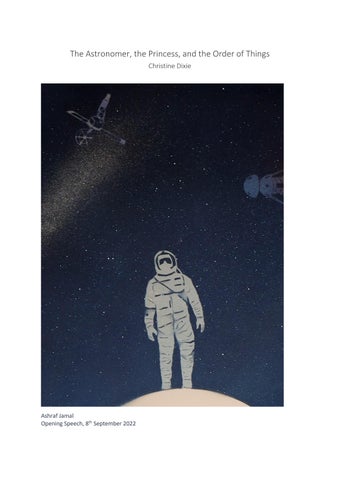
The James Webb telescope is much celebrated. As to whether chaos precedes order is up for grabs. What we do know, is that we know very little. But while we ooh and ah about extra-terrestrial frontiers we forget that each one of us is also a cosmos, planetary, composed of infinity rather than the mere dust we, the miserable amongst us, claim ourselves to be. It is this sense of boundlessness, my sense that we are amphibian, as much ocean as we are earth, as much bonded to this world as well as unknown others, that I turn now to Christine Dixie’s monumental show – The Astronomer, the Princess and The Order of Things – a multi-media tour de force which flies in the face of contemporary art, a machine designed to break down, delimit its agency, fixate on currency, at the expense of the greater question – what it means to be human, and our greater place in a boundless cosmos. I know, I’m sounding heyshoowow. But my point is that art, today, is no longer a religion for atheists. Today we are far more introspective and soul-searching, uninspired by the mere look of things, and their secular cache. In this regard Christine Dixie’s The Astronomer, the Princess, and The Order of Things reads as a fable, as fabulation, as invention. As a body of work, it is fantastical, but it is also grippingly current, in so far as it is wholly concerned with an interpenetrative elemental world in which perceived order is turned on its head, deep sea divers become astronauts, and the order and chain of being is disrupted and realigned. This is because Dixie is intrigued by obfuscation, messing with order, repositioning the human – in the figure of the princess – as a dreaming tool in the greater scheme of things.
Wonder and awe play their part, we the audience entangled in a magically cryptic fretwork. Perhaps our innocence, through the figure of the princess, is returned to us. Certainly the vision Dixie conjures possesses the symbolic and mythic force of stain glass paintings, the riddle, wonder, awe triggered by faith or intuition, because it is not Reason which the artist presents to us, but unconscious dreamworlds. This is why Dixie’s paintings – in this time of great inner searching -have garnered a greater appeal. Is it surprising that Surrealism is making a comeback? That more and more we desire stranger scenes which tug us away from the drab data of everyday life? This was not
Dixie’s intention, She simply and authentically fell into a rabbit hole, and has pulled us along with her into nether and other worlds. What she has emphatically refused is some Reality Principle. If the French philosopher, Michel Foucault, is a key to her vision for over a decade it is because of his brilliant opening essay of The Order of Things, which deals with Velasquez’s painting, Las Meninas. An optical trick, the painting, for Foucault, stands ‘at the threshold of…two incompatible visibilities.’ There is far more than we think we see. ‘The painter, observing a place from moment to moment, never ceases to change its content, its form, its face, its identity’. What this insight triggers in Dixie is the realization that a double vision is inescapable. This realization stems from her work as a printmaker – the creator of images intrinsically Janus faced – which amplify the ambivalence central to her theme. If innocence is the ability to refuse preordained knowledge, then Dixie is an innocent. Her astronomer, her princess, are the avatars in an adventure that trespasses the tropes typically associated with these figures – the astronomer’s gaze turns inward, the princess is no innocent foil. Instead, as tropes, these figures allow us to enter fathomless worlds, not withstanding the grids the artist sets up between heaven and earth, sea, and sky, because, in the beginning and the end, these worlds dissolve into each other. Long before the age of reason, embodied in Plato, Socrates’s ventriloquist, the pre-Socratic philosopher, Heraclitus observed: The earth is melted Into the sea By that same reckoning Whereby the sea Sinks into the earth. This dissolution is ours. While the fearful and hateful draw lines, build barriers, those softer, kinder, warmer, dissolve themselves, knowing that so doing can better embrace the loop of our beginning and our end. This is why Dixie creates circular motifs, as embroiled as they are infinite, for hers is a planetary humanism.