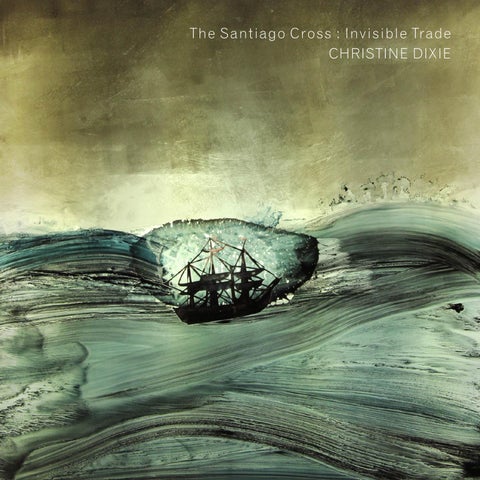
The Santiago Cross : Invisible Trade CHRISTINE DIXIE
The Santiago Cross : Invisible Trade Christine Dixie
Index
Introduction
2
Trade Ship
4
The Colony
10
Velasquez at BurntKraal
14
The Visitors
20
The Mirror
26
The History of Art
32
Biography
37
2
Introduction The Santiago Cross: Invisible Trade, draws upon and extends concerns developed in the video installation To Be King. The painting Las Meninas by Diego Velásquez (1565) and a subsequent essay on the painting by Michel Foucault (1966) were the impetus for To Be King. In this installation the intersecting vectors of psycho-social power relations was reframed against the backdrop of the South African Eastern Cape landscape. The Santiago Cross: Invisible Trade, recontexualises images drawn from the stopframe animation component of the To be King installation through the lens of 'trade'. “Invisible trade, in economics, the exchange of physically intangible items between countries. Invisible trade can be distinguished from visible trade, which involves the export, import, and re-export of physically tangible goods.” https://www.britannica.com/topic/invisible-trade The Palette and the Paintbrush In Las Meninas Velásquez looks out at the viewer with his paintbrush mid-stroke deliberately placing himself in the role of the 'artist at work' and thereby arguing for the philosophical status of painting. This was at a time in Spain when artists did not have high social standing, painting being regarded as a manual trade, and paintings classified as 'manufactured goods' along with cloth and barrels (goods that would have been transported on ships to the colonies). It has been argued that one of the key imperatives driving the painting of Las Meninas was to establish the credibility of painting as worthy of nobility and correspondingly the conferral, on the painter, of nobility. For Diego Velásquez, the recognition of his
3
status would have been the conferral on him of the title of the Knight of the Order of Santiago, an elite aristocratic military order. Legend has it that the Santiago Cross, was superimposed on Velasquez's doublet (in the painting) on the King Philip IV's orders, after the painter's death. As an emblem in Las Meninas, the Santiago Cross becomes a metaphor for the recognition received by Velasquez for the worthiness of art as a trade. However, its history is double-edged as the emblem originates from the Military Order of St James of the Sword founded in the middle ages and is steeped in the violence of the Spanish crusades. It's legacy as an order became closely allied to expedition and exploitation as the explorers Vasco da Gama, D. Francisco de Almeida, D. Afonso de Albuquerque and Duarte de Meneses, were leading knights of the Order of Santiago. Between the Visible and the Invisible In The Santiago Cross: Invisible Trade, the images reveal the process of production. Ink rollers, scissors, rags and turpentine - the tools of the trade, are made visible. These objects are analogous to Velásquez's deliberate exposure of his palette and paintbrush. The dialect between the actual (the tools) and the imaginary (the depicted image) deliberately reveals the labour of art and the trade between the visible and the invisible both inside and outside the 'frame' of the artwork.
2
3
4
Trade Ship The trade of materials and people which underpinned the imperial project is symbolised by the recurring image of a ship sailing across the horizon line from one edge of the frame to the other. The ship I depict is drawn from an 'ex voto' painting from the Cathedrale de la Rochelle called, La Rochelle Slave Ship Le Saphir, painted in 1741. The original painting depicts slaves and slavers, with God in the right hand corner, ambiguously blessing or urging the ship on. Brothels and colonies are two extreme types of heterotopia, and if we think, after all, that the boat is a floating piece of space, a place without a place, that exists by itself, that is closed in on itself and at the same time is given over to the infinity of the sea and that, from port to port, from tack to tack, from brothel to brothel, it goes as far as the colonies in search of the most precious treasures they conceal in their gardens, you will understand why the boat has not only been for our civilization, from the sixteenth century until the present, the great instrument of economic development, but has been simultaneously the greatest reserve of the imagination. The ship is the heterotopia par excellence. In civilisations without boats, dreams dry up, espionage takes the place of adventure, and police take the place of pirates. Foucault, Michel. 1984. 'Of Other Spaces, Heterotopias', Architecture, Mouvement, Continuité 5, 46-49
5
Trade Ship - Triptych | 2018 | digital print on 6mm polymer | edition of 5 +1AP | 92 x 183cm
6
Trade Ship - Blessed | 2018 | digital print on 6mm polymer | edition of 5 +1AP | 92 x 61cm
7
Trade Ship - Watched | 2018 | digital print on 6mm polymer | edition of 5 +1AP | 92 x 61cm
8
Trade Ship - Cursed | 2018 | digital print on 6mm polymer | edition of 5 +1AP | 92 x 61cm
9
10
The Colony The land across which the prone figure moves in Malaria is the previously British occupied territory of the Eastern Cape, a predominantly rural environment known for its violent frontier history. The Atlantic Ocean is the space across which trade of goods and people, words, ideologies, plants and animals, disease and religion travelled. Yet, in the image of the sea and of the land, none of this history can be discerned. The 'space of compensation', the 'real' space of the colony that Foucault makes reference to below is instead alluded to in the titles of the work. The last trait of heterotopias is that they have a function in relation to all the space that remains. This function unfolds between two extreme poles. Either their role is to create a space of illusion that exposes every real space, all the space that remains. This function unfolds between two extreme poles. Either their role is to create a space of illusion that exposes every real space, all the sites inside of which human life is partitioned, as still more illusory (perhaps that is the role that was played by those famous brothels of which we are now deprived). Or else, on the contrary, their role is to create a space that is other, another real space, as perfect, as meticulous, as well arranged as ours is messy, ill constructed and jumbled. This latter type would be the heterotopia, not of illusion, but of compensation, and I wonder if certain colonies have not functioned somewhat in this manner. In certain cases, they have played, on the level of the general organization of terrestrial space, the role of heterotopias. Foucault, Michel. 1984. 'Of Other Spaces, Heterotopias', Architecture, Mouvement, Continuité 5, 46-49
11
Malaria | 2018 | digital print on 6mm polymer | edition of 5 +1AP | 177 x 92cm
12
Atlantic Ocean | 2018 | digital print on 6mm polymer | edition of 5 +1AP | 177 x 92cm
13
14
Velasquez at BurntKraal In To be King text is used literally as image. “The artist, Christine Dixie, standing in for the figure of Velásquez, becomes a paper cut-out made from the pages of the text Las Meninas by Foucault. In a climatic sequence of the video she is burnt away, the ashes blown across the South African landscape.” (Sey, 2) The hand of the artist intrudes in two of the images, doubling the action that is being represented, to play on the dislocation between the real and the illusion. Sey, James. 2015. 'The Visual Field and the Place of the King’
15
Prove This | 2018 | digital print on 6mm polymer | edition of 5 +1AP | 92 x 61cm
16
A Distant Visitor | 2018 | digital print on 6mm polymer | edition of 5 +1AP | 92 x 61cm
17
Slant Away Slightly | 2018 | digital print on 6mm polymer | edition of 5 +1AP | 92 x 61cm
18
Dividing the Canvas | 2018 | digital print on 6mm polymer | edition of 5 +1AP | 92 x 61cm
19
Like an Angel | 2018 | digital print on 6mm polymer | edition of 5 +1AP | 92 x 61cm
20
The Visitors In 1820 around four thousand British settlers were deposited on the South African Eastern Cape coast. This was a strategy employed by the British Empire to create a human barrier against the displaced amaXhosa. I perceive the position of these settlers as paradoxically 'unsettled', designated to that of perpetual visitor whose role shifts between that of an interloper, spectator and concealer. In The Visitors the artist has burnt away to reveal an alien animal like figure. This 'visitor' who is attempting to capture the colonised landscape before her, is cut out from Foucault's text, Las Meninas. The truncated sentences that make up the figure fail to make sense, their original meaning is confounded and the grammatical rules of syntax collapse. Heterotopias are disturbing, probably because they secretly undermine language, because they make it impossible to name this and that, because they shatter or tangle common names, because they destroy 'syntax' in advance, and not only the syntax with which we construct sentences but also that less apparent syntax which causes words and things (next to and also opposite one another) to 'hold together'. Foucault, Michel.1970. The Order of Things: An Archaeology of the Human Sciences. London: Tavistock Publications, xvii
21
Visitor | 2018 | layered digital print on 3mm polymer | edition of 5 +1AP | 82 x 70cm
22
Painter | 2018 | layered digital print on 3mm polymer | edition of 5 +1AP | 82 x 70cm
23
Spectator | 2018 | layered digital print on 3mm polymer | edition of 5 +1AP | 82 x 70cm
24
Concealer | 2018 | layered digital print on 3mm polymer | edition of 5 +1AP | 82 x 70cm
25
26
The Mirror At the centre of the To Be King narrative hangs the mirror. The mirror is also the centre around which the painting Las Meninas by Velásquez and the text Las Meninas by Foucault circulate, for it is in the mirror that the shadowy Spanish King Philip IV and his wife are depicted. In the narrative of To Be King, the mirror is the place where the body of the King materialises and is 'dethroned' by characters from the periphery. Placing the dwarfs, meninas and the princess in the role from which the dominant gaze of the king originates points to the possibility of a different order of things and highlights the fragility of the established and dominant order. The mirror functions as a heterotopia in this respect: it makes this place that I occupy at the moment when I look at myself in the glass at once absolutely real, connected with all the space that surrounds it, and absolutely unreal, since in order to be perceived it has to pass through this virtual point over there. Foucault, Michel. 1984. 'Of Other Spaces, Heterotopias', Architecture, Mouvement, Continuité 5, 46-49
27
Dwarf I - Catastrophe | 2018 | digital print on brushed aluminium | edition of 5 +1AP | 42 x 30cm
28
Dwarf II - Derivation | 2018 | digital print on brushed aluminium | edition of 5 +1AP | 42 x 30cm
29
Menina I - Structure | 2018 | digital print on brushed aluminium | edition of 5 +1AP | 42 x 30cm
30
Menina II - Analysis | 2018 | digital print on brushed aluminium | edition of 5 +1AP | 42 x 30cm
31
Princess - Criticism | 2018 | digital print on brushed aluminium | edition of 5 +1AP | 42 x 30cm
32
The History of Art Volume I-IV The History of Art Volume I-IV mimics a Western narrative of the History of Art. In these 'books' the linear narrative of progression is destabilized as the 'painting within a painting' spills over the frame. The viewer's complicity in 'reading' this history is evoked through the use of the mirror in which he/she catches glimpses of him/herself. Vol I: The Window as World In his treatise on painting, the 15th century architect, sculptor, painter, and theorist Leon Battista Alberti described painting as the construction of an image that resembles a window.
His simile of the window emphasized the illusionistic
representation of a three-dimensional object on a two-dimensional surface, in effect denying the material surface of the canvas. In this configuration, the painting as a window becomes a transparent surface through which the viewer can glimpse an ordered, one-point linear perspective of the world. A perspective that privileges a particular viewpoint. Vol II: The Mirror as Phase During the Renaissance artists attempted to mirror 'nature' – there was a belief in the notion of a universal truth and a transcendental ideal that art should attempt to reflect. This belief system could be considered a 'phase' in the narrative of western art. The other phase I refer to here is the French philosopher Jacque Lacan's mirror phase in which the infant, at around 6 months recognizes herself as the “I” in the mirror and irrevocably enters the realm of the linguistic.
33
Vol III: The Canvas as Object In the mid to late sixties under the label minimalist art, artists started to emphasize the canvas as an autonomous object possessing an internal coherence. Art theorists claimed that these “objects' are not like other objects because they are produced in a particular 'medium' such as paint. Vol IV: The Matrix as Disorder The matrix is defined as 'an enclosure within which something originates or develops (from the Latin for womb). The systems that make up the matrix of the narrative of The History of Art have come under contest from feminist, postcolonial and queer theory. The 'womb' of the matrix is threatened by disorder, spilling over into more complex terrain to include gendered, raced and classed 'readings' of the History of Art.
34
Volume 1 : Window to the World | 2018 | digital print on 6mm polymer | edition of 5 +1AP | 30 x 21cm
35
Volume 2 : Mirror as Phase | 2018 | digital print on 6mm polymer | edition of 5 +1AP | 30 x 21cm
36
Volume 3 - Canvas as Object | 2018 | digital print on 6mm polymer | edition of 5 +1AP | 30 x 21cm
37
Volume 4. Matrix as Disorder | 2018 | digital print on 6mm polymer | edition of 5 +1AP | 30 x 21cm
38
Biography Christine Dixie's work is predominantly focussed on two interlinked concerns, the visual strategies deployed in frontier landscape representation and the narratives used in constructing images of gender. Extending the boundaries of print making as a medium by working in installation and by using a variety of matrix's and materials, her work is intent on drawing the viewer into a mesmeric yet disquieting space. In 2012 she was awarded an Artist Research Fellowship at the Smithsonian Institute, Washington D.C. Her work is represented in national and international collections including The New York Public Library, The Smithsonian National Museum of African Art, The Johannesburg Art Museum and the Iziko National Art Museum. The installation The Binding, 2010, which examines the relationship between sacrifice and male identity, was acquired by the Smithsonian National Museum of African Art. Her latest multimedia installation, To Be King was exhibited in Venice at the Palazzo Bembo and was part o f the International Festival at the Coronet Cinema, London (2017) p.11 – Sea: The Atlantic Ocean p.12 Land: Malaria
For enquiries, please contact:
LONDON Christian Sulger-Buel Tel: +44 203 268 2101 Cell: +44 7775 782 955 christian@sulger-buel-lovell.com CAPE TOWN Tamzin Lovell Miller Tel: +27 21 447 5918 Cell: +27 79 176 42 92 tamzin@sulger-buel-lovell.com www.sulger-buel-lovell.com