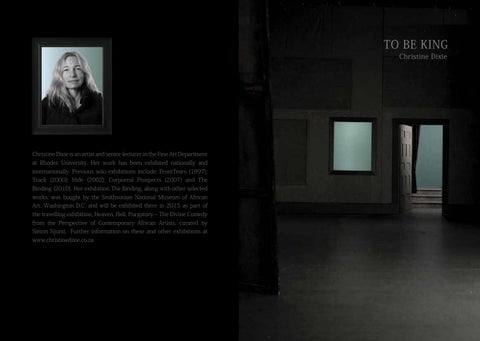
TO BE KING Christine Dixie
Christine Dixie is an artist and senior lecturer in the Fine Art Department at Rhodes University. Her work has been exhibited nationally and internationally. Previous solo exhibitions include: FrontTears (1997); Track (2000); Hide (2002); Corporeal Prospects (2007) and The Binding (2010). Her exhibition The Binding, along with other selected works, was bought by the Smithsonian National Museum of African Art, Washington D.C. and will be exhibited there in 2015 as part of the travelling exhibition, Heaven, Hell, Purgatory – The Divine Comedy from the Perspective of Contemporary African Artists, curated by Simon Njumi. Further information on these and other exhibitions at www.christinedixie.co.za
TO BE KING
To Be King It’s good to be king, if just for a while To be there in velvet, yeah, to give ‘em a smile It’s good to get high and never come down It’s good to be king of your own little town It’s Good to be King Words and music by Tom Petty
The context
At the Centre: Seventeenth century Spain, in the Hapsburg court of Philip IV places Velasquez, “at the heart of the centralized power structure of one of the original nation-states of early modern Europe, one that was also on the forefront of early modern cultural production” (Amy M. Schmitter). The setting for the Las Meninas, on which the set of To be King is based, is a room in the Alcazar, Madrid. Here in the centre, in the royal chamber, Velasquez paints himself gazing at the king, who is reflected in the mirror. Shmitter argues that, “the King’s representation is a force or power, a manifestation of royal power that embodies, displays and extends it.” (266) On the Periphery: On the outskirts of Grahamstown is a small area of commonage locally known as Burnt Kraal. It lies adjacent to the farm Burnt Kraal originally owned by Duncan Campbell in 1823 and subsequently transferred to Pieter Retief. The name, Burnt Kraal, is attributed to a fire which took hold because of a deep accumulation of dung in a cattle kraal. The fire, which burnt for about ten years, had started before the arrival of the 1820 Settlers. The property was bought by the South African Defence department in the 1970s as a practice range for the adjoining Military Base. (Algoa Gazetteer compiled by C.J. Skead. 1993)
Picturing Power: Representation and Las Meninas , Amy.M.Schmitter Journal of Aesthetics and Art Criticism 54:3 Summer 1996
1
The text
In 1966 Michel Foucault wrote an essay entitled Las Meninas which appears in the beginning of his book The Order of Things. Art historians and philosophers have written extensively in response to this essay which broke with traditional modes of interpretation. It has become almost impossible for a viewer to encounter this ‘masterpiece’ without the veil of text which shrouds it. Taking a leaf out of Foucault’s book, the text in To Be King is literally embodied in the figure of the artist. Foucault suggests that it is through language, the taxonomy of the day, that things are ordered but that order is often dependant on who is ‘king’. Ultimately, the order of things is as tenuous as the multiple viewpoints represented within Las Meninas which serves to highlight the subject’s precarious position in the world.
The order of things: archaeology of the human sciences Foucault, Michel London: Routledge, 2002 Representing Representation, Reading Las Meninas, Again Estrella de Diego Velasquez’s Las Meninas, edited by Suzanne L. Stratton-Pruitt Cambridge University Press, 2003
3
The rose
In 1891, Oscar Wilde wrote a short story, The Birthday of the Infanta. This tale tells of a heartless young girl who flirts with the dwarf given to her for her twelfth birthday by giving him a rose from her hair. The dwarf falls in love with the girl and, never having seen himself in a mirror, does not realise he is only there to amuse her. Rambling around the palace, he accidentally sees himself in a mirror, “A monster, the most grotesque monster he had ever beheld”. The princess arrives, and oblivious to his despair, demands that he continue to dance and entertain her. His heart is broken and he dies, leaving the Infanta to declare: “For the future let those who come to play with me have no hearts…” The dwarf, who in Wilde’s story is more fully human than the princess, reverses the dominant logic of the Spanish court. Dwarfs in that context were present to reinforce the established ‘order of things’. The hereditary right of the royal lineage was made visible by deliberately placing a misshapen dwarf next to a prince or princess. This coupling was often depicted in dynastic children’s portraits of this era. “The grotesque body is foundational for the court body, just as we, as the absent subjects of the painting replace the King’s body” (Davidson 2013).
The Rage of Caliban: Missing Bodies in Modernist Aesthetics (7-18-13) Michael Davidson “The Birthday of the Infanta” The Complete Shorter Fiction of Oscar Wilde, ed. Isobel Murray (Oxford: Oxford University Press, 1979), 185 -202
5
The cross
The Santiago Cross and The Southern Cross The Santiago Cross In Spain during the 16th and 17th century, artists did not have high social standing, painting being regarded as a manual trade, and paintings classified as ‘manufactured goods’ along with clothing, shoes and barrels. In his essay, The Meaning of Las Meninas, Jonathan Brown argues that the major impetus behind this large-scale work is the credibility of painting as worthy of nobility and correspondingly the conferral, on the painter, of nobility. Velasquèz, Brown writes, desperate for promotion to knighthood “lavished the last ounce of his genius upon it.” (109) The story goes that the Santiago cross, one of the most elite aristocratic military orders of Spain, was superimposed on Velasquèz’s doublet (in the painting) on the king’s orders, after the painter’s death. Ironically, for such a noble pursuit as the legitimization of painting, the cross has violent origins. The Order’s insignia is a red cross simulating a sword, it is the cross of the apostle Saint James who was decapitated with a sword. It is also said that the shape originated in the era of the crusades when the knights took with them small crosses which they had sharpened at the end so that they could be driven into the ground.
Images and ideas in Seventeenth-Century Spanish Painting Jonathan Brown Princeton University Press, Princeton, New Jersey, 1978 http://en.wikipedia.org/wiki/Order_of_Santiago
7
The cross
The Southern Cross Originally known by the Latin name Crux, the Southern Cross is a constellation of stars which is only visible south of the equator. It was not observed by people in the northern hemisphere until the Age of Discovery (from the early 15th to early 17th centuries). The first Europeans to observe the constellation were the Portuguese, who mapped it for navigational purposes while rounding the tip of Africa. During the 17th century, Crux was separated from the constellation Centaurus, placing its ‘discovery’ within the context of European expansion. ‘Grounded in the history of colonial expansion, it offers a kind of prototypical global positioning system that allows the viewer to know precisely where she stands depending on what she can or cannot see’ (Gabara 2010).
Esther Gabara Perspectives on Scale: From the Atomic to the Universal in Art and Globalization edited by James Elkins, Zhivka Valiavicharska, and Alice Kim, Pennsylvania State University Press, c2010
9
The ship
The ship is an image from an ‘ex voto’ painting from the Cathedrale de La Rochelle called La Rochelle Slave Ship Le Saphir, painted in 1741. ‘Ex voto’ refers to “A painting commemorating the rescue, or salvation, at sea of someone who had vowed, before embarking on a dangerous sea voyage, to give thanks for his or her safe arrival: the depiction is usually of the specific disaster survived through the help of Jesus, the Virgin Mary, St. Christopher, or some other source of Christian salvation” (Isham 2004).
Isham, Howard F. Image of the Sea: Oceanic Consciousness in the Romantic Century. Bern: Peter Lang, 2004.
11
The paintings
In Las Meninas, two paintings hang on the back wall of the royal chamber, they are copies by Juan Bautista del Mazo of Pieter Paul Ruben’s Pallas and Arachne and Apollo and Pan by Jacob Jordaens, two myths that depict an artistic contest between a god and a mortal. Several other copies of paintings by Rubens were owned by King Philip IV and it is speculated that these are depicted on the side walls. Rubens was greatly admired by Velasquèz. He lived and worked at the Spanish court for a nine month period (September 1628 – April 1629). He was granted a knighthood on August 30, 1631, an honour unprecedented for an artist. This recognition of nobility greatly inspired Velasquez and fuelled his ambitions for a similar attribute. The ‘paintings’ in To be King come from drawings made by William Kentridge They are drawn from his films Weighing…and Wanting (1997-8); Stereoscope (1998-99) and Tide Table (2003). In these films Kentridge depicts himself as the artist Felix Teitlebaum and his antagonist Soho Eckstein, a mining magnate. Kentridge ranks among the top ten most critically acclaimed artists in the world. His artistic impact has been recognised with numerous prestigious awards from institutions in the USA, Germany, France, South Africa and Japan. Images and ideas in Seventeenth-Century Spanish Painting Jonathan Brown Princeton University Press, Princeton, New Jersey, 1978
13
The textiles
Although the roots of indigo cloth probably extend as far back as early Arab and Phoenician trade, the arrival of indigo cloth emerged more distinctly after the 1652 establishment of a seaport at the Cape of Good Hope. Slaves, soldiers, Koi-San and Voortrekker woman all wore clothes made of indigo cloth. During the 18th and 19th centuries, European manufacturers developed a block and discharge printing style on indigo cotton fabric. In the early 1840s French missionaries presented king Moshoeshoe with a gift of indigo printed cloth, which is where the name shoeshoe or isishweshwe originated. German settlers to the Eastern Cape in 1858 often wore the Blue print which was widely available as a trade cloth; and Mission educated Xhosa women gradually added what they termed Ujamani to their red blanket clothing. It was originally manufactured and printed in Hungary and Czechoslovakia before the factory was moved to Britain in the 1930s. The production of Indigo Discharge Printed Fabric in South Africa started in 1982 when Tootal, a British based company, invested in Da Gama Textiles. In 1992 Da Gama had all the copper rollers shipped out to the Zwelitsha factory in King Williams town in the Eastern Cape which is where it continues to be produced today.
Information obtained from the Dagama website: www.dagama.co.za
15
The artist
Christine Dixie is the artist, she is “….standing a little back from his canvas. He is glancing at his model; perhaps he is considering whether to add some finishing touch, though it is also possible that the first stroke has not been made.” She is married to Iain Reid, who stands in the doorway. “Like the images perceived in the looking-glass, it is possible that he too is an emissary from that evident yet hidden space. Even so, there is a difference: he is there in flesh and blood; he has appeared from the outside, on the threshold of the area represented; he is indubitable – not a probable reflection but an irruption.” She is the mother of two children, with whom she is “like a donor in prayer, like an angel greeting the Virgin, a maid of honour on her knees…” Rosalie, her daughter’s gaze “… is directed absolutely straight towards the spectator standing in front of the painting. ‘… here, beyond all question, resides the principal theme of the composition; this is the very object of this painting.” The artist lives in the Eastern Cape, this place and the history with which it is marked, informs her work. Like a space on the periphery stand a group on the edge of a painting, two dwarfs (Dixie and her daughter) and a Rhodesian ridgeback. “ …to the right the dog lying on the floor, the only element in the picture that is neither looking at anything nor moving, because it is not intended, with its deep reliefs and the light playing on its silky hair, to be anything but an object to be seen.” The order of things: archaeology of the human sciences Foucault, Michel. London: Routledge, 2002
17
Acknowledgements
Production Credits To Be King was created in collaboration with Mark Wilby. Mark Wilby is an artist and film maker. His current work explores intersections between video, social networks and public intervention. Video Editor Animation Sequencing Costume Design Composition Voice Sound Design
Mark Wilby Samantha Munro Junitha Els Jared Lang Lotta Matambo Corinne Cooper
Cast Velasquez King Queen Princess Lady in Waiting I Lady in Waiting II Dog Courtier Dwarf I Dwarf II
Christine Dixie Brent Meistre Dina Belluigi Rosalie Dixie Reid Monica Nkombisa Christine Dixie Madembo – belonging to Andrew Tracey Iain Reid Rosalie Dixie Reid Christine Dixie
Thank you to the Rhodes University Research Committee for their support of this exhibition as well as the Rhodes University Drama Department for the use of their theatre. ©Christine Dixie 2014
19