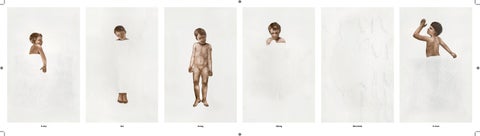
To sleep
Bind
Burning
Offering
Blind (detail)
To dream
T h e B i n d i ng Chris tine Dix ie
The ritual of sacrifice which seems to be intrinsically linked to the establishment of male identity and the unspoken central role of the mother as witness to the father-son relationship, is at the heart of this exhibition. Daniel, my son, was six years old when I took the photographs I used as reference material for the prints and sculptures which make up this installation. Six is a transitional age, an age when boy children seem to be hovering in between their mother’s and father’s worlds. It is at this age when the young boys of Sparta had to leave the homes of their mothers and move to the military camps of their fathers to start their military training. The six prints that constitute the exhibition are loosely based on the narrative of Isaac and Abraham, a story also known as ‘the binding’, or ‘aqedah’. (Binding refers to the ancient practice of binding a human sacrifice before it was put on the altar.) In the story of Isaac’s near sacrifice, the child symbolically dies and is then reborn through the hand of the father. The witnessing of the child reborn becomes visible evidence of fatherhood. Unlike maternity which is visible, paternity is not biologically visible, and it is this evidence which is needed to establish the patrilineal line. The first and last prints in the series depict a sleeping boy, his body partially covered by a woven blanket (the warmth and comfort which is associated with the mother), next to him a toy gun, an object manufactured to imitate the masculine world of weapons but useless as a means of defence. These two prints, respectively titled To sleep and To dream, frame the narrative told in the other four ‘in- between’ prints, which narrate the boy’s dream of near-sacrifice.
8 - 29 May 2010
G A L L E RY AO P www.galler yaop.com
In the second print, Bind, he is wrapped, mummy-like, in tight bandages, seemingly oblivious of his eminent sacrifice. Burning, the third in the series, shows the boy wideeyed and dazed, as if awoken from a bad dream. In Offering, number four in sequence, the boy’s body is completely covered with a sheepskin, perhaps anticipating his own ‘skinning’ or sacrifice. In the fifth print, Blind, the image of the boy seems to be obliterated completely: he is submerged, foetus-like under a blanket, as if this hurdled bodily stance would protect him, in his dream, from the anticipated ritual sacrifice.
is used to create the blind embossing on the print. The etching component of the print was made by cutting out the image in the copper plate, in this way introducing an embossed edge in the picture plane. The cutting out of the plate meant that the embossed edge was sympathetic to the blind-embossing which made up the rest of the print. The matrix or collagraph which creates the blind-embossing is from an actual blanket, sheepskin, bandage, etc. My intention was through the combination of these two techniques to create a dreamlike illogicality, the three-dimensional illusion of the real in the etching placed against the trace of the real, or indexical in the collagraph component. The socialisation of children through contemporary culture, in this instance male children, is a central topic that I explore in this exhibition. From a young age a multitude of toys and video games are available which make children feel very familiar with weapons and war. Toy soldiers, as objects and on screen, familiarize children with war and violence, yet the reality of loss is beyond the child’s comprehension. This disjunction between fantasy and reality is an area which interests me. In the gallery installation, the six large-scale prints are hung on one long wall (the narrative reading from left to right) invoking a sense of an army barrack, or a dormitory, or hospital ward. Placed underneath each of the six prints is a bed which could also be read as an altar or operating table. Over each of these beds is an altar cloth. On the ‘altar’ lies a mirror image, or shadow of the sleeping child. This embodied shadow is made from plastic toy soldiers, mass manufactured in China. While making these shadow boys, I often had to chop off the arms and legs of these toy soldiers to make them fit into the shape on which I was working. This action seemed to in many ways imitate the real violence of war, and positions me in a complex relationship as an artist creating metaphorical images of sacrifice, while addressing the real fears of a mother for her son. Christine Dixie
Only in one image, Burning, does the boy ‘wake up’ to look at the viewer. The viewer stands in the place of the parent, but more particularly, the father, looking at his child. The role of the viewer/father as a witness to this dream is a crucial one, for it is central to an understanding of how fathers are linked to sons. While conceiving the prints I made a deliberate decision to make the child, Daniel, to scale. This, I anticipated, would create a more intimate relationship between the child and the viewer. These prints combine etching and collagraph; it is the collagraph which
Christine Dixie obtained a BA (FA) at the University of the Witwatersrand in 1988 and a MFA at Michaelis School of Fine Art in 1993. She is currently a lecturer in the Rhodes University Fine Art Department, Grahamstown, South Africa. Solo exhibitions include Corporeal Prospects, Standard Bank Gallery and Durban Art Gallery (2007); Parturient Prospects, The Albany Museum, Grahamstown (2007); Hide, The Millennium II Gallery, Johannesburg , The University of Stellenbosch Gallery and The Albany Museum, Grahamstown (2002); Track, The Market Theatre Gallery, Johannesburg (2000); FrontTears, The Thompson Gallery, Johannesburg (1998); The Gendered Gaze, The Irma Stern Museum, Cape Town (1993) and Parturient Prospects, GALLERY AOP, Johannesburg (2008). Christine Dixie has taken part in numerous group exhibitions, several of which have been accompanied by catalogues (see www.artonpaper.co.za for details). Her work is well represented in public and corporate collections in South Africa. Images left to right Installation accompanying To dream (detail) plastic toy soldiers, wood, fabric To dream (detail) Images verso To sleep, Bind, Burning, Blind, Offering and To dream 2009 etching and collagraph edition of 10, each 1970 X 1250mm, each These prints were printed at Fine Line Press, Rhodes University, Grahamstown
Acknowledgements I wish to thank the Rhodes University Joint Research Committee for their support. Thanks to Bevan de Wet for help with the printing. And Daniel, for his enthusiastic collaboration.