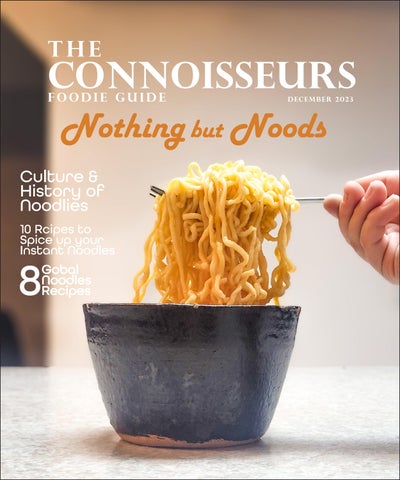
The
Connoisseurs Nothing but Noods Foodie Guide
Culture & History of Noodlies 10 Rcipes to Spice up your Instant Noodles
8
Gobal Noodles Recipes
D e c e m b e r 2 0 2 3
AD HERE
Table of
Contents NOTHING BUT NOODS
A breif history of N o o d le s . . . . 06 . . . . . Instant Pot Beef Pho . . . . . . . . . . . . Ro t i s s e r i e C h i c k e n N o o d l e S o u p . . . . . Rich & Creamy Tonkotsu Ramen Broth
T h e S t o ry B e h i n d i n s ta n t Noodles . . . . . . . . . . . . . . . . . . . Topping for Your Homemade Noodle Soup . . . . . . . . . . . . . . .
07 08 09
11
. . . . .
12 14
Garlic Noodle . . . . . . . . . . . . .
16
Amish Macaroni Salad . . . . . . . .
18
Ta k e o u t S e s a m e N o o d l e s
Margins: 0.5 in Rows: 3 Columns: 3 Gutters: 0.1667 Bleeds 0.125 in Font: All Round Gothic Font: Brevia Font: Perpetua Titling MT
Rule Guide
Body copy: The & Connoissures: 59 pt Connoissures & Foodie Guide: 24 pt Sub-title: Nothing but Noods ( Punny, 1-5
Page size: 10X12
words title based on the cover topic)
Grids
Placement: Under the cover title
Margins: 0.5 in Bleed: 0.125 in Columns: 3
chosen font, as long there is an apparent
Font size: 65 pt (but can vary based on hierarchy size from the magazine title)
Gutter: 0.1667
Additional Grid Lines:
TOC: Page top & bottom placement: varies
Center split: vertical and horizontal
with content amount, as long as it is
Gutter: 0.2708 in
proportional
Horizontal line: 1 in from the top of the page (0.5 in from margins)
Font: PERPETUA TI-TLING MT (One Shown in Cover and TOC) Font: Brevia (TOC & copy) Font: All Round Gothic (The third font choice is subject to change based on the cover photo). Choose a font that best fits the cover photo and use it as the article title.
All: Align Left Graphic line design: Horizontal Length: width of copy Stroke: 1 pt Placement: follow copy Sub-title of the cover: (titles & authors) Font: Brevia Font size: 9 pt
Placement: Left alignment to horizontal line and 0.1361 down from the graphic line
Cover: Magazine Title: THE CONNOISSEURS FOODIE GUIDE (CAPS) Placement: 0.5 in from the top margin and center Font: PERPETUA TI-TLING MT (bold)
Font size: The: 39 pt Connoisseurs: 66 pt Foodie Guide: 22 pt Month Editon/Year: 12 pt (only right align)
Leading
Drop Cap: 1 Font: Brevia Font size: 9 pt Font color: Black (83%) Leading 14 pt Tracking: 40
Pull quotes: Font: Brevia (medium italic) Font size: 11 pt Font color: sample from article photo Leading: Auto Tracking: 80
Recipe: Title:
Title:
Font: All Round Gothic
Font: PERPETUA TI-TLING MT (bold) Font size: Table of: 30 pt Contents: 67 pt Leading: 51 pt
Font size: 35 pt
Left align
Placement: On the left side of the margin, take up two columns
Magazine article title content: Font: PERPETUA TI-TLING MT (bold) Font size: 17 pt Sub-title: Indented Font: PERPETUA TI-TLING MT (light) Font size: 12 pt Leading: 25 pt
Font color: sample from photo Leading: 44 pt Left align Placement: center
Body copy: Font: Brevia Font size: 9 pt Font color: Black (83%) Leading: 14 pt Tracking: 40
Sub-titles: Font: Brevia (Semi-bold) Font size: 11 pt Font color: Sample from photo
Dots: Tracking: 660 Placement: 0.85 in from the graphic line
Features/Shorts/Briefs: Article-related photo: Types: Half-page horizontal bleed Two columns side bleed Full page bleed
Title: Font: All Round Gothic Font size: 45 pt Sub-title font-size: 24 pt Font color: Sample from Photo Leading: 36 pt Left Align Placement: center
Prep & Ingredients box: Size: 2.8889 X 7.7917 in (varies) Color: Sample from photo Sub-title: Font: Brevia (medium) Font size: 12 pt Copy font: Brevia Font size: 11 pt Leading: 11 pt Left align
Placement: The copy is 0.4768 in from the top of the box Box bleeds off the top or bottom page and overlaps partly cover photo
A Brief History of Noodles: Tour of one of the world’s favorite Comfort food TARA STEVENS
O
ne of my favourite meals when I get in late, or I’m too lazy to cook, or
there’s no real food in the house, is a bowl of whole wheat, soba noodles, tossed with a spoonful of butter and marmite. If I have Parmesan I’ll scatter that over too. Bizarrely it’s a recipe that came from an Italian prince via a British friend and it’s been my go-to, five-minute-meal, ever since for its ability to comfort and nourish both stomach and soul as few other foods can. So, when I came across a blog by
Frank Striegl, by the name of 5 AM Ramen,
Noodles first reached Japan during the
I was intrigued by an entry advocating the
Heian period around 800AD, but it wasn’t
joys of pineapple Ramen at Papapapapine
until the late 1800s that they became
in Machida, Tokyo.
popular. The hybrid Chinese-Japanese dish
Using pineapple pieces as toppings, and the juice in a salty, shrimp broth, Striegl says
“this juxtaposition of salty and sweet actually works quite well. There is a harmony between the broth, noodles and toppings.” Striegl also offers ramen tours and an online, Airbnb experience offering fans the chance to ‘Become a Ramen Expert’ and deep dive into its history and culture.
known as ramen was introduced to Tokyo by way of Yokohama’s china town with the opening of a restaurant called Rai-Rai Ken around 1910. Their ‘shina soba’ quickly became a favourite among Japanese working classes because it was cheap, delicious and filling. Students fast caught on.
“There is something wonderful about hot noodle soup.” Striegl explains via email from Tokyo.
“It appeals to gentler Japanese tastes, but also has a punchiness borrowed from Chinese cuisine. A classic Tokyo ramen is quite simple, but the new-wave are bolder and more daring. Ramen keeps evolving and this keeps it exciting.” As Japan began to specialise in ramenonly shops – there are now over 30,000 across the country – and chefs began to dedicate their entire careers to making them, as well as using premium ingredients like Cochin chickens, and multiple types of soy sauce in the seasonings, ramen took on a gourmet kudos that spread to major cities around the world, while simultaneously identifying as Japanese.
Cook Time: 12 hrs 15 mins
In Bangkok, a similar phenomenon took
Active Time: 2 hrs
place. In the late 1930s, then prime
Total Time: 12 hrs 15 mins
minister, Plaek Phibunsongkhram, launched a national campaign called ‘Noodle is Your Lunch’ which promoted the country’s new signature dish using rice noodles, bean sprouts, eggs,
Yield: 6-8 Serving
Instructons
•
3 pounds pig trotters, split lengthwise or cut crosswise into 1-inch disks (ask your butcher to do this for you)
1.
2 pounds chicken backs and carcasses, skin and excess fat removed
2.
3.
paste, palm sugar and fish sauce.
•
help cement a deep-rooted nationalism as the country went from being the absolute monarchy of Siam to Thailand. The recipe,
•
2 tablespoons vegetable oil
along with free carts for street food
•
1 large onion skin on & roughly chopped
•
12 garlic cloves
•
One 3-inch knob ginger roughly chopped
•
2 whole leeks washed & roughly chopped
•
2 dozen scallions, white parts only (reserve greens and light green parts for garnishing finished soup)
vendors selling it and a ban on the sale of Chinese street food, ensured it gained traction. It was also practical. During the rice shortages that befell the country after the second world war, turning the grain into noodles made the yield go twice as far. Today, Thai noodles have evolved from street food to Michelin starred fare. 75-year-old, Supinya Junsuta aka Jay Fai (327 Mahachai Road), saw her street food stall become a world-renowned restaurant
•
that sees people queuing hours for her legendary crab omelette and pad kee mao goong (drunken, flat-rice noodles,
J. Kenji Lopez-Alt
Ingredients:
peanuts and protein dressed in tamarind
Named ‘pad Thai’ the dish was intended to
Rich and Creamy To n ko t s u R a m e n B r o t h
•
6 ounces whole mushrooms or mushroom scraps, such as cremini 1 pound slab pork fat back
Cover pork and chicken bones with cold water in a large stockpot and bring to a boil. Once boiled, remove from heat. Heat vegetable oil in a skillet until lightly smoking. Add onions, garlic, and ginger and cook until deeply charred. Set aside. Wash all bones under cold running water and return to the pot along with charred vegetables, leeks, scallion whites, mushrooms, and pork fatback.
4.
Bring to a rolling boil, skimming off any scum. Reduce heat to a bare simmer and place lid on top.
5.
Boil broth until pork fatback is completely tender and then continue cooking until broth is opaque with the texture of light cream.
6.
Cook over high heat until reduced to around 3 quarts. Strain through a fine-mesh strainer into a clean pot. Discard solids.
7.
Finely chop cooked pork fatback and whisk into finished broth. Serve with cooked ramen noodles and toppings as desired.
Instant Pot Beef Pho DIANA YEN
Total Time: 1 hr 30 mins Yield: 4 Servings Ingredients: •
3 Star anise pods
•
1 3” Cinnamon stick
•
4 whole cloves
•
2 tbsp Vegetable oil
•
2 med Onions peeled & halved
•
1 2” piece Ginger scrubbed & sliced lengthwise 1/4 thick
•
3 lb 2”-3” sections mix soup beef bones (oxtail, marrow, knuckles, and/or neck bone), rinsed under cold running water to remove blood and excess bits
Instructons
•
1 lb Beef brisket or chuck, cut into 2” pieces
•
2 tbsp Fish Sauce
•
2 1/2 tsp Diamond Crystal or 1¼ tsp. Morton kosher sal
2.
•
10 oz dried thin Banh Pho rice noodles
Soak noodles, drain. Freeze beef eye, thinly slice.
3.
•
8 oz beef eye of round, sirloin steak, London broil, or tri-tip steak
Remove bones and strain solids. Skim fat, season, simmer.
1.
Toast spices, onions, ginger. Add water, beef bones, brisket, fish sauce, sugar, salt. Cook and release pressure.
cookery teacher and author whose passion CONTINUE stir-fried with seafood). She received her Michelin star in 2018 but startled pundits a year later when she wanted to give it back. The little restaurant is now almost too busy for her to cope with.
for pho resulted in The Pho Cookbook.
“Vietnam is on the southern border so we consume more rice noodles, such as flat banh pho and round bun, which are also employed in Chinese cooking.” Pho likely evolved through the cross-
Like the ramen of Japan, and the pad Thai
culinary pollination of Chinese noodles
of Thailand, the northern Vietnamese dish –
liberally seasoned with French technique
pho – first made an appearance in Hanoi at
and a penchant for eating beef as
the start of the 20th century. Different kinds
opposed to water buffalo. Indeed, some
of noodles were likely introduced through
schools of thought believe the dish grew
migration and trade as people travelled in
out of a pot au feu (boiled beef) with
search of a more prosperous life.
added bánh pho (flat rice noodles).
With China as Vietnam’s neighbour, there was a lot of interaction between the two.
“The southern part of China is more rice oriented, the northern part more wheat oriented,” says Andrea Nguyen (vietworldkitchen.com), a
“The noodles are tender-chewy and silky,” says Nguyen. “They perfectly convey the flavours of pho broth because of their flatness – they are cut from sheets of steamed rice batter – but the dish also signals a party or individual contemplation.
4.
Cook noodles, drain, toss with oil.
5.
Divide noodles, top with meat, onion, scallions, cilantro. Ladle hot broth over raw beef.
6.
Serve with herbs, sprouts, chiles, lime, sauces.
Viet noodle dishes are infinitely customizable so each person can craft their own unique flavour. Selfdetermination is very Vietnamese.” As such they evolved in myriad ways, including a diversion in the late 1950s as the country entered into war when the noodles were made with potato starch to save precious rice. But their true origins remain opaque. “We’ll likely never know for certain how pho first came about,” Nguyen writes in her blog.
“But it’s in great company. Almost all beloved foods have origin controversies that fuel conversations and imaginations. What’s clear is that pho was created from cultures rubbing shoulders.” Until the discovery of 4000-year-old, millet noodles at an archaeological site in Lajia in
Northwest China in 2005, there was much debate as to where they originated – China, Europe or the Middle East. Many believed that the Arabs were eating a form of noodle from as early as the fifth century, and today, all across the Maghreb, dishes like seffa medfouna (a Moroccan delicacy of broken vermicelli, chicken, honey, butter and saffron) and Lebanon’s macaroon bil toum (a peasant dish of tender garlic dumplings in a lemon garlic sauce) remain some of the region’s most emblematic dishes. It is also suggested that Arabic traders introduced Italians to pasta by way of Sicily around the 13th century. Europe’s love affair with the noodle does seem to have come later. Spätzle noodles (traditionally made using spelt flour
Prep Time: 9 mins
for its high gluten content) appeared in
Cook Time: 21 mins
Germany in the early 16th century, and
Total Time: 30 mins
quickly spread to Austria, Switzerland
Yield 8 1/2 cups
Rotisserie Chicken Noodle Soup
They are typically served with pork and
Ingredients:
Shelley
onions, or cheese sauce. Kluski, haluski
•
and Northern France.
and pierogi (flour and potato noodles) made their appearance in the 18th century and spread from Poland and Slovakia across most of the Central and Eastern European countries. These are typically topped with fried
•
1/2 cup sweet Onion finely chopped
•
2/3 cup peeled Carrot thinly sliced
•
64 oz fat-free, reducedsodium Chicken broth
•
2 cups Rotisserie chicken breast shredded or chopped
•
1 tbsp dried Parsley
•
4 oz whole wheat Eblow pasta
•
3/4 tsp Kosher salt
bacon and cabbage. What ties them all together is that noodles appeared wherever people had grains to eat and represent a kind of migratory comfort food that brings people together. As I p e n t h i s p i e c e f r o m m y h o m e in Morocco, I’m awaiting delivery of a takeaway meal from Ameya Ramen, a new restaurant that had its opening plans scuppered by the Covid19 lock-down. It’s for chicken ramen, hand-made by a Thai chef, living in the Fez Medina. A sure sign that noodles as a bridge to culture and human connection is as strong as ever.
1/2 cup 1-2 stalks of Celery thinly sliced
Optional: Minced fresh parsley for garnish
Instructons 1.
In a large soup pot, heat oil briefly over medium heat. Add celery, onion, and carrots. Cook for 5 minutes, stirring occasionally to prevent browning.
2. Add broth, chicken, and dried parsley. Cover and bring soup to a simmer. Simmer for 5 minutes, and then increase heat to bring soup to a boil. Once boiling, add pasta and continue gently boiling (covered) until pasta is done (following time recommendation on pasta package). 3. Taste and season with salt, as needed, so the flavors pop. (This can vary a bit depending on your brand of chicken broth, but we find approximately 3/4 teaspoon typically works well.) Garnish with fresh parsley if desired.
Jjapaguri: Korean Noodle Dish From The Movie Parasite
Prep Time: 5 mins Cook Time: 15 mins
Michelle
Total Time: 20 mins
Jjapaguri, also called Ramdon, is a Korean noodle dish that has become quite popular from the movie “Parasite”. This recipe creates a slurp-worthy bowl of noodles that is saucy and flavorful.
Yield: 2 Serving
Jjapaguri is a hodgepodge Korean noodle dish, also known as “ramdon.”The dish is a hybrid combination of 2 instant noodles: ramen and udon. In particular, Chapaghetti and Neoguri (hence, “chap/jjap-guri”) are the particular types of noodles used for making this dish.
Instructons 1.
Heat a frying pan over medium high heat. Add in the oil and sear the steak for about 2-3 minutes per side. Remove from heat. Transfer to a clean plate, cover and let it rest.
2.
Remove the noodles from their packaging. Take out the sauces and seasonings and place to the side. In a large saucepot, bring 4 C of water to a boil. Add in the noodles from both packages. Stir with a pair of tongs and cook for about 2-3 minutes, until al dente.
3.
Drain the noodles in a colander, reserving about 1 C of the starchy liquid. In a large bowl, add in the sauces and dry seasonings from both the Neoguri and Chapaghetti packages. Add in the reserved starchy liquid and mix together to make the sauce.
4.
Transfer the hot noodles back into the bowl and toss to coat with the sauce. Cut the steak into cube sized pieces and add to the noodles. Portion into bowls and serve hot.
Ingredients: •
1 tsp Vegetable Oil
•
200g Sirloin Steak
•
1/8 tsp Sea Salt
•
1 pkg Chapaghetti noodles
•
1 pkg Neoguri noodles
The Story Behind Instant Ramen Noodles: and how did post-war America influence their invention? LISA CAM
According to Ando’s biography, on a cold winter’s night he came upon a long queue in front of an unlicensed food stall selling ramen.
I
t’s no secret that the invention of instant ramen in Japan was a game-changer in modern Asian cuisine. Starting as a premium
product that evolved into a cheap staple in every kitchen in Asia, instant ramen is now consumed all over the world. But there were a lot of socioeconomic and political factors that led to this innovation, which can be traced back to post-war USA. Instant noodles were created by Momofuku Ando, owner and founder of the famous Nissin company in Japan in 1958. Ando developed the entire manufacturing process – from noodlemaking, steaming and seasoning, to dehydrating the noodles in oil heat, a process now known as flash frying – creating what we now know as the first “instant” noodle. This new invention had a longer shelf life than that of frozen noodles and sold for 35 yen. Ready to eat in just two minutes by adding boiling water, Nissin’s Chikin Ramen was considered a novelty, as fresh noodles sold for only a fraction of the price. Ando was born and grew up in Japanese-occupied Taiwan in 1910. After the war, he had to choose between remaining a Japanese subject or becoming a citizen of Taiwan. Ando chose the latter to keep his inherited properties in Taiwan but stayed in Japan. He would later start his salt producing company, Nissin, in Osaka. One economic factor that had a huge impact on the food cultures of Korea, Taiwan, and Japan after World War II was the supply of surplus wheat by the United States. In 1953 and 1954, America’s farms yielded an extremely bountiful wheat harvest and in the early post-war years, American surplus agricultural produce was given as aid. At the time, Japan, Korea, and Taiwan all suffered from shortages in staple foods and all three were under the political, economic and military purview of the United States.
“The faces of the people who were slurping warm ramen looked happy. The Japanese really like noodles. Looking at the line in front of the stall, Ando got a feeling that there was a big demand hiding there.” It was this incident that the image of ramen was imprinted on his mind. Due to the influx of wheat flour coming in the form of aid from the US, the Japanese government actively encouraged citizens to eat bread made with that wheat. In a chance meeting with Kunidaro Arimoto, who worked for the health ministry, Ando candidly criticised the policy: “With bread, you need toppings or side dishes. But the Japanese are eating it only with tea. It is not good for their nutritional balance. In the East, there is a long tradition of eating noodles. Why not also promote noodles, which the Japanese already enjoy, as a flour-based food?” To this affront, Kunidaro replied, “Why don’t you solve this problem?” And he did. Ten years later, in 1957, Ando purchased a second-hand noodlemaking machine, 18kg of wheat flour, cooking oil, and other ingredients, and went on a mission to find a way for noodles to be easily made at home. Instant ramen, under the trademark Chikin Ramen, was marketed in Japanese stores the following year. How impactful was Ando’s creation? Sixty years after its invention, it’s estimated that 100 billion servings of instant ramen are eaten every year around the world. We’d slurp to that. Where are Singapore noodles from? How are century eggs made? Are French fries improperly named? And what’s the final verdict on where tikka masala was created? With the Origins series, STYLE delves into the often surprising beginnings of iconic dishes or foods, how they’ve evolved over time and the many ways they’re enjoyed today.
Top p ings for You r H omemade Noodl e Soup: Traditional Ramen Topping KAYE
A
sian cuisine has truly taken the world by storm, and the
Aonegi (Chopped Green Onions)
worldwide popularity of ramen is a testament to that. If
The best tonkotsu recipe would most likely call for this ingredient
you’re wondering what kind of food ramen is exactly, it’s a
as a garnish. Although, aonegi (or chopped green onion) would be
Japanese noodle soup traditionally made with broth, meat, and
able to elevate any kind of good ramen recipe. This vegetable adds
vegetables. This noodle soup is also well-known for its colorful
an aromatic quality, as well as a necessary kick of heat that isn’t
ramen toppings. Many variations have emerged since ramen was
overwhelming to Japanese ramen dishes.
popularized, like the (in)famous instant noodles.
Shiraga Negi (Julienned Green Onions)
No matter what kind you have at home, you can instantly spruce
Shiraga negi or siraganegi basically refers to a specific cut
up your ramen with toppings of an extra ingredient or two. If
of green onion. Instead of the regular circular slice, this one
you’re wondering what to put in this dish, then you’re in luck
requires cutting scallions into thin strips (julienne). Either
because we’ve put together an extensive list of the best ramen
an aonegi or shiraga negi ramen topping would be best
toppings and condiments! You can use these to garnish your
for different ramen noodle soup flavors. For instance, this
instant noodles and your homemade pork or beef ramen recipe.
julienned scallion is one of the standard miso ramen toppings
Chashu
that you wouldn’t want to miss out on.
Chashu is one of the most popular tonkotsu ramen toppings in
Kamaboko (Steamed Fish Cake)
the world. Essentially, it’s a thinly cut piece of fatty pork that has
Kamaboko is a soft and chewy type of fish cake made with surimi
been slowly simmered or braised. You may also find other varieties
or kane (white fish paste). It’s usually produced with white and
of this ramen meat, such as chashu beef, chicken, or duck. Two
pink parts, and it may either have a playful shape and print that
pieces of this tender ingredient are enough to tie your soup
makes for a kawaii or cute ramen aesthetic. The most popular
together, although you may add even more if you like.
variant of this fishcake is the narutomaki which has a distinct
Nori or Wakame (Dried Seaweed) Dried seaweed is the rectangular leaf-like topping that you’ll usually see in pictures of ramen noodles. Nori, or dried red algae,
pink swirl design. A bowl of traditional Japanese ramen noodles can do without this ingredient, but a tasteful kamaboko ramen add-on is always a welcome addition.
is the most popular type to use. It’s sold as a flattened sheet, and
Garlic
it imparts a unique seafood-y taste. Dried brown algae, such as
Garlic is the most accessible out of all the typical ramen toppings
that used in wakame salad, is a possible alternative although its
out there. It’s easy to prepare, too! You can either have it freshly
texture is more shriveled up.
grated, roasted or fried to ramp up your noodle soup’s umami
Ajitama or Nitamago (Flavored Egg)
flavor and give it a distinct garlicky flavor.
Ajitama, a type of flavored egg with a runny yolk, is a staple in
Sesame Seeds
most authentic ramen recipes. Unlike a regular soft-boiled egg,
Sesame seeds are some of the simplest things you can add to
it has a savorier flavor and a brownish exterior. Nitamago, which
ramen. A dash of this ramen garnish is definitely enough to give
is on the hard-boiled side, is also good. Hard and soft-boiled eggs
your bowl a bit of life. It would also impart a subtle but more-
are accessible protein sources for your dish. So, the next time
than-welcome nutty flavor to your traditional ramen noodles.
you look for things to put into ramen, you won’t have to go any further than your fridge.
Prep Time: 5 mins Cook Time: 15 mins Rest Time: 2 hrs
Mayak Gyeran:
Yield: 12 Eggs
Korean Marinated Eggs
Ingredients: •
A dozen Eggs
•
2 tsp of salt
•
2 tbsp of Vinegar
Get your rice ready because these delicious, garlicky, and savory Korean Marinated Eggs
•
6 cloves of Garlic minced
Marinated Eggs – Mayak Gyeran, you are seriously missing out. The egg yolk is gooey and
•
2 Korean Green Pepper Chopped
•
1 Red Chili Chopped (optional)
•
3 stalks of Green Onion Chopped (optional)
Tiffy Cooks
will be your go-to side dish for breakfast, lunch, and dinner! If you never tried Korean soft on the inside, while the egg is marinated in a savory, spicy, and sweet sauce that pairs perfectly with a hot bowl of rice! Mayak Gyeran is easy and affordable to make, and I promise you will love it too!
Instructons 1.
In a pot, add in water (enough to cover all the eggs) and add salt and vinegar. Turn the heat up to medium-high and bring the water to a simmer. Once the water is boiling,
•
1 tbsp of Sesame Seed
carefully egg in the eggs and let ti eggs cook for 6 minutes. After 6 minutes, remove
•
1 cup of Soy Sauce
carefully and set them aside.
•
1 tbsp of Sesame Oil (optional)
•
1/2 cup of Water
the egg and let it rest in a bowl of ice water for at least 10 minutes. Peel the eggs
2.
In a container, add garlic, chopped green pepper, red chili, green onion, soy sauce, honey, sesame oil, and water. Mix till everything is combined. Add in the peel eggs and making sure the eggs are covered in the marinade. Let the eggs rest in the fridge for at least 2 hours or better overnight.
Serve with a bowl of hot rice and enjoy!
Takeout Sesame Noodles: MARIA LICHTY
W
e don’t do takeout very often because we love cooking and have found that we can make our favorite takeout dishes at home…and our versions always taste better.
Plus, our dishes are healthier and we always save time and money. Time? Yes, because by the time you drive to pick up the food and come home, you could have made dinner at home. For example, this Sesame Noodle recipe only takes 20 minutes to make and these noodles are WAY better than any noodles I have ever ordered at a restaurant.
Easy Sesame Noodles This easy sesame noodle recipe comes from Chef Chloe’s new cookbook, Chloe Flavor, and they are the BEST sesame noodles. The Asian peanut sauce is AMAZING! So amazing you will probably want to drink it before you even pour it over the noodles.
The sesame noodle sauce is made with: sesame oil tamari or soy sauce seasoned rice vinegar peanut butter brown sugar fresh ginger garlic
Prep Time: 10 mins
sriracha
Cook Time: 10 mins
I don’t know about you, but I always have these ingredients on hand, so no need to go to
Total Time: 2o mins
the grocery store for this recipe! And if you don’t have these ingredients in your kitchen,
Yield: 4 Servings
make sure you go buy them ASAP because you are going to want to make these sesame noodles every week. And pro tip-we always keep fresh ginger in our freezer in a small freezer bag. It is easy to grate when it is frozen and it lasts longer!
Ingredients: •
10 oz Udon noodles can use Soba or Spahetti
•
3 tbsp toasted Sesame Oil
•
1/4 cup tamari or lite Soy Sauce
•
1/4 cup seasoned Rice Vineger
Instructons
•
3 tbsp Peanut Butter
1.
•
2 tbsp l ight Brown Sugar
•
1 tbsp fresh ginger minced
•
half a clove of Garlic
•
2 tsp Sriracha
You make the sauce in a blender and it blends up in no time! So simple!
You only need 20 minutes to make this easy sesame noodle recipe! Perfect for a quick and easy lunch or dinner! And leftover cold sesame noodles are SO good!
Bring a large pot of heavily salted water to a boil over high heat. Add the noodles and cook according to the package directions. Drain and rinse with cold water. Transfer noodles to a large bowl.
2. Meanwhile, in a blender or food processor, combine the sesame oil, tamari, vinegar, peanut butter, brown sugar, ginger, garlic, and sriracha. Blend until smooth. Add more sriracha, to taste, if desired. 3. Add the sauce to the pot with the noodles. Toss to coat; taste and adjust seasoning. Top each serving with peanuts, scallions, and sesame seeds.
Note-use gluten-free noodles and gluten-free tamari to make it gluten-free.
Toppings: • Roasted Peanuts chopped • Scallions thinly sliced •
Sesame seeds
GARLIC NOODLES : BETH
T
hese sweet, salty, and rich Garlic Noodles are an absolutely addictive dish that you’ll want to make again and again. Serve them as the bed for glazed meat, like my Sticky Soy Ginger Glazed Chicken, Honey Sriracha Tofu, or simple stir-fried vegetables. With a super short ingredient list of pantry staples, this delicious garlic noodles recipe will become a staple in your menu. Where Do I Find Oyster Sauce? Oyster sauce can be found in the International aisle of most major grocery stores (look near hoisin sauce). If you can’t find it there, it’s worth it to seek out an Asian market, where oyster sauce is likely to be much less expensive than in chain grocery stores.
Prep Time: 10 mins Cook Time: 15 mins Total Time: 25 mins Yield: 1 Servings Ingredients:
What Can I Use in Place of Oyster Sauce? I personally feel that the salty rich flavor of the oyster sauce makes this dish what it is and I wouldn’t suggest substituting it. That being said, several readers have said they’ve used hoisin sauce, which is much sweeter, and have enjoyed the results. Substitute the oyster sauce in this garlic noodles recipe at your own risk. What Else Can I Add to Garlic Noodles? This is a great base recipe to which you can add all sorts of other ingredients! Garlic noodles are great as a side dish, but you can add protein and vegetables to make it a meal. Check out my Garlic Noodles with Beef and Broccoli for some inspiration. You could also add shrimp, snow peas, egg, bell pepper, or tofu!
•
8 oz Angel Hair Pasta
•
4 cloves of Garlic
•
1/2 bunch of Green Onions
•
4 tbsp Butter
Instructons
•
2 tsp Soy Sauce
1.
•
2 tbsp Brown Sugar
•
1 tsp Sesame Oil
•
2 tbsp Oyster Sauce
Garlic Noodles are sweet, rich, and savory with a strong garlic punch. They make the perfect side dish to any Asian inspired meal.
Add the oyster sauce, brown sugar, soy sauce and sesame oil to a bowl and stir until combined.
2. Bring a large pot of water to a boil and cook the noodles according to the package directions (boil for 7-10 minutes). Drain the cooked noodles in a colander, then set aside. 3. While the pasta cooks, mince the garlic and slice the green onions. Melt the butter in a large skillet over medium-low heat. Once the butter is melted and bubbly, add the garlic and onions (save a few for garnish) and sauté until they are soft and fragrant (1-2 minutes). 4. Remove the skillet from the heat. Add the drained pasta and oyster sauce mixture to the skillet, and stir well to coat the pasta. If your pasta is stiff or sticky making it hard to stir, sprinkle a small amount of hot water over the pasta to loosen it up. Garnish the pasta with any reserved sliced green onions, then serve.
Amish Macaroni Salad: A
mish macaroni salad is a spectacularly hearty and creamy pasta salad bursting with flavor. It’s made up of elbow macaroni loaded with hard-boiled eggs, red peppers, celery, onion, and pickle relish. Then, you’ll coat it in a sweet, tangy, and savory dressing. Not only is Amish macaroni salad delectable, but it’s also very easy to make.
What is Amish Macaroni Salad? Amish macaroni salad is simply macaroni salad but with a fun twist. The secret lies in the dressing. Unlike regular macaroni salad which uses Miracle Whip, Amish macaroni salad uses real mayo, yellow mustard, sugar, and vinegar. The result is a sweet and tangy flavor.
Ingredients The ingredients list is a little long, but don’t let that scare you away. It’s mostly common stuff that you probably already have at home.
Macaroni. Uncooked elbow macaroni is the standard choice for this recipe. You’ll want it uncooked because it will cook in the recipe. Also, elbow macaroni has the perfect shape for pasta salad. You could use bowtie or another type of pasta in a pinch, though.
Eggs. Dice up some hard-boiled eggs and toss them in for extra protein. Veggies. You don’t want the salad to be too sweet. Adding diced onion, celery stalks, and red pepper helps prevent that. These veggies add a savory twist to the sweet and tangy salad. The onion also adds a bit of heat.
Dill pickle relish. Adding dill pickle relish ups the tanginess factor of the recipe.
Dressing ingredients. As mentioned, the sweet-n-tangy dressing is what makes Amish macaroni so special. You’ll make it with mayo, yellow mustard, sugar, and white vinegar.
Salt & celery seed. Use both to season the dressing to suit your tastes.
Instructons 1.
2.
3.
Cook macaroni noodles according to package instructions. Set aside to cool. In a large bowl, combine the hard-boiled eggs, onion, celery, red pepper, and dill pickle relish. In a separate container, mix together the mayo, mustard, white sugar, vinegar, salt and celery seed.
4.
Pour the dressing mixture over the vegetables. Add the macaroni and mix until well combined.
5.
Cover the bowl and refrigerate for at least one hour. Serve chilled.
Prep Time: 15 mins Cook Time: 10 mins Total Time: 25 mins Yield: 6 Servings Ingredients: •
2 cup Elbow Macaroni
•
3 hard-boiled eggs chopped
•
1 small Onion chopped
•
3 stalks of Celery chopped
•
1 small Red Pepper seeded & chopped
•
2 tbsp Dill pickle relish
•
2 cups Mayonnaise
•
3 tbsp prepared Yellow mustard
•
3/4 cup white Sugar
•
2 1/4 tsp white Vinegar
•
1/4 tsp salt
•
3/4 tsp Celery seed
Citations Traditional Ramen Toppings by Kaye (page 12) “40 Best Ramen Toppings for Your Homemade Noodle Soup.” Recipes.Net, 6 July 2022, recipes.net/articles/bestramen-toppings/#:~:text=Traditional%20Ramen%20
Cover Photo:
Toppings%201%20Chashu%20Chashu%20is%20one,...%20
Photo: Photo Credit: Christina Vang Editing Credit: Keith Kunze
Feature:
5%20Garlic%20...%206%20Sesame%20Seeds%20.
Photo: Photo Credit: Christina Vang Editing Credit: Keith Kunze
A Brief History of Noodles by Tara Stevens (pages 6-9) “A Brief History of Noodles: Lojel Journal.” LOJEL, 9 Aug.
Shorts Recipes:
2023, www.lojel.com/journal/a-brief-history-of-noodles/.
Jjapaguri (aka Ramdon) – Korean Noodle Dish From The Movie Parasite by Michelle
“A Brief History of Noodles: Lojel Journal.” LOJEL, 9 Aug.
Michelle. “Jjapaguri (Ramdon Recipe from the Movie
2023, www.lojel.com/journal/a-brief-history-of-noodles/.
Parasite) • Curious Cuisiniere.” Curious Cuisiniere, 15 Apr.
Photo:
2021, www.curiouscuisiniere.com/jjapaguri-ramdon/.
Feature Recipes:
Photo:
Rich and Creamy Tonkotsu Ramen Broth Recipe by J. Kenji Lopez
Photo Credit: Christina Vang
López-Alt, J. Kenji. “Rich and Creamy Tonkotsu Ramen
Editing Credit: Keith Kunze
Broth Recipe.” Serious Eats, www.seriouseats.com/richand-creamy-tonkotsu-ramen-broth-from-scratch-recipe.
Korean Marinated Eggs – Mayak Gyeran by Tiffy Cooks
Accessed 20 Dec. 2023.
Tiffany. “Korean Marinated Eggs - Mayak Gyeran (Easy!).”
Photo:
Tiffy Cooks, 27 Sept. 2021, tiffycooks.com/koreanPhoto Credit: Christina Vang Editing Credit: Keith Kunze
marinated-eggs-mayak-gyeran-easy/.
Photo: Photo Credit: Christina Vang
Instant Pot Beef Pho by Diana Yen
Editing Credit: Keith Kunze
Yen, Diana. “Instant Pot Beef Pho.” Bon Appétit, Bon Appétit, 3 Feb. 2021, www.bonappetit.com/recipe/instantpot-beef-pho.
Briefs:
GARLIC NOODLES by Beth
Photo:
Bytes, Beth - Budget. “Quick & Easy Garlic Noodles Photo Credit: Christina Vang
Sweet, Savory, Addictive!” Budget Bytes, 3 May 2023, www.
Editing Credit: Keith Kunze
budgetbytes.com/garlic-noodles/.
Photo: Rotisserie Chicken Noodle Soup by Shelly
Photo Credit: Christina Vang
Uttara et al. “Rotisserie Chicken Noodle Soup: Easy,
Editing Credit: Keith Kunze
Comforting, 30-Minute Recipe!” Two Healthy Kitchens, 18 Apr. 2022, twohealthykitchens.com/quick-easy-chicken-
Easy Sesame Noodles by Maria Lichty
noodle-soup-rotisserie-chicken/.
Lichty, Maria. “Sesame Noodles Recipe.” Two Peas & Their
Photo:
Pod, 18 May 2019, Photo Credit: Christina Vang Editing Credit: Keith Kunze
www.twopeasandtheirpod.com/sesame-noodles/.
Photo: Photo Credit: Christina Vang
Shorts:
Editing Credit: Keith Kunze
What’s the story behind instant ramen noodles? by Lisa Cam (page 11) “What’s the Story behind Instant Ramen Noodles?” South
Amish Macaroni Salad
China Morning Post, 6 Apr. 2020, www.scmp.com/
“Amish Macaroni Salad.” Insanely Good Recipes, 28 Aug.
magazines/style/news-trends/article/3077785/whats-storybehind-instant-ramen-noodles-and-how-did.
Photo:
2023, insanelygoodrecipes.com/amish-macaroni-salad/.
Photo: Photo Credit: Christina Vang
Photo Credit: Christina Vang Editing Credit: Keith Kunze
Editing Credit: Keith Kunze
The
Connoisseurs Foodie Guide
ja n u a ry 2 0 2 3
Egg-quisite Tasting