THE CHRISTIAN
· A ·n · E · R
MAY 1995
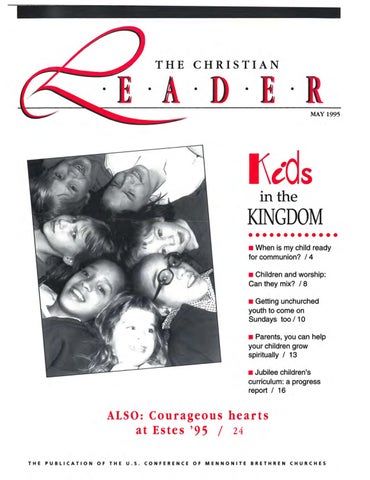
I\tds in the
KINGDOM
••••••••••••• • When is my child ready for communion? / 4 • Children and worship: Can they mix? / 8 • Getting unchurched youth to come on Sundays too / 10 • Parents, you can help your children grow spiritually / 13
• Jubilee children's curriculum: a progress report / 16
ALSO: Courageous hearts at Estes '95 / 24 THE
PUBLICATION
OF
THE
U.S.
CONFERENCE
OF
MENNONITE
BRETHREN
CHURCHES
MAY
1995
FIR S TWO R D S from the interim editor
I
T TAKES A VILLAGE to bring up a child," states an African proverb. One family is not enough. In our culture, where the intimacy of the village is lacking, it takes an entire church family to bring up the child. At one time children of all ages sat with their parents throughout services, they were sent out during communion, and had only Sunday school and vacation Bible school to look forward to. Today there is a growing awareness of children's spirituality, which has led to changes in the place of children in the church. In this issue David Wiebe sets forth a broadened view about the child in relationship to communion and baptism. Janice Porter gives us several options for introducing children to worship. Mark C. Thompson addresses the topic of assimilating the unchurched teenager into church life . Jenny Wall and Jo Schrock, fresh from having coordinated a six-week elective on spiritual nurture of children, offer their insights. Share with the editorial staff your insights about the place of children in church life.-KFW
Page 4
Page 8
COMING • JULY 6-9-60th convention of the General Conference of Mennonite Brethren Churches, Fresno, Calif.
--":--.110:....<....:.:----1
Page 10
• JULY 25-30-Joint Mennonite Church/ General Conference Mennonite Church convention, Wichita, Kan. • OCTOBER 27-29-Central and Southern districts meeting
jointly for their annual convention; hosted by Tabor College. • OCTOBER-NOVEMBER-Pacific District Conference regional rallies; specific sites and dates to be determined.
Page 13
QUOTABLE Do not enclose love within the four walls of your house. Don't think that love of your neighbor is exhausted in love for your family. It is easily transformed into cheap selfishness. A home should not be a cast/e, but a base. Your family affairs should not claim all your attention and energy but help you to go out to those around you. -MIECZYSLA W MALIN5KI IN O UR DAILY BREAD (SEABURY).
2 · THE
CHRISTIA N
LEADE
R
____
__
__----,Page16
INS MAY
IDE 1995 THE CHRISTIAN
VOLUME 58, NUMBER 5
FEATURES - Theme: Children and the church
4 When is my child ready for communion? Here's the case for letting a child take communion at an earlier age and delaying baptism until an older age. BY DAVID WIEBE.
8 Children and worship: Making the mix meaningful Worship can be made meaningful to children by choosing one of several options. BY JANICE PORTER
10 Missing in action Unchurched kids come to youth group meetings. But why don't they come on Sunday morning? BY MARK C. THOMPSON
13 Parents, you can help your children grow spiritually Parents don't have to use the hit-and-miss method to nurture their children spiritually. An intentional approach works best. BY JO SCHROCK AND JENNY WALL.
16 Mixed news for 'Good News'
Sales are slow among u.s. churches, but most of those who have tried the new Jubilee curriculum for children seem to like its distinctive approach. BY CONNIE FABER .
DEPARTMENTS Inquiring Minds . ... .. . . .. ... ....... by Marvin Hein 18 • Are strong leaders dangerous? • Responding to existentialism
Ph'lip Side .... . .................... by Philip Wiebe 19 • Common nonsense
What readers say .. . ............... . ....... . .... 20 Musings .. . ... . . .... . . .. . .. . ... .. . .. by Jim Holm 23 • The wasted mind
Bodylife . . .... .. .. .. ....... . . .. . .. . ... .. . .. .. . . 24 • SPECIAL REPORT: Estes '95 24 • Canadian leaders support MBBS subsidy change 30 • MBM/S encouraged by giving increase 31 • Loewen to move from MBBS to FPC 31 • Japan relief fund tops goal 31 • U-SERV travels to Phoenix 32
Guest editorial .. ... . .. . ... .. ... . ... .. by Marvin Hein 36 ART CREDITS: Cover, page 8, Cleo Freelance Photo; pages 4 and 5, Orley Friesen; page 10, Skjold Photography; page 13, Jim Whitmer.
INTERIM EDITOR Katie Funk Wiebe
ASSISTANT EDITOR Connie Faber
EDITOR: Don Ratzlaff (on sabbatical) BOARD OF COMMUNICATIONS: Ron Braun (chair), Noelle Dickinson, Jeanie Klaassen, Herb Schroeder, Kathy Heinrichs Wiest MANDATE.' THE CHRISTIAN LEADER (ISSN 00095149), organ of the U.S. Conference of Mennonite Brethren Churches, is published monthly by the U.S. Conference Board of Communications, 315 S. Lincoln, Hillsboro, KS 67063 . The Christian Leader seeks to inform Mennonite Brethren members and churches of the events, activities, decisions, and issues of their denomination, and to instruct, inspire and initiate dialog so that they will aspire to be faithful disciples of Christ as understood in the evangelical! Anabaptist theological tradition. EDITORIAL POLICY: The views and opinions of our writers and advertisers are their own and do not necessarily represent the position of The Christian Leader, the Board of Communications or the Mennonite Brethren Church. The editors invite free-lance article submissions, but ask that each submission be accompanied with a SASE . The editors reserve the right to edit, condense or refuse all copy submitted for publication; anonymous contributions will not be published . READER PARTICIPATION: The editors encourage readers to interact with our articles through letters to the editor and essays to Forum, our op-ed column. Letters for What Readers Say must include the author's name and address. Forum is open to members or attenders of Mennonite Brethren churches. Essays to Forum can address any issue of relevance and interest to the faith and life of the Mennonite Brethren Church. The essay should be no longer than 800 words and should include the home church, occupation and a clear photo of the writer. COMMUNICATION: All correspondence should be addressed to The Christian Leader, Box V, Hillsboro, KS 67063 . Phone: (316) 947-5543 . Fax: (316) 9473266. ADVERTISING: Clearinghouse ads should be submitted in writing. Cost: $.25 per word . Send no advance payments. For display-ad rates, contact the editor. SUBSCRIPTIONS: Rates: $16 for one year, $30 for two years, and $42 for three years ($20, $38 and $54 in Canada); $1.50 per copy. ADDRESS CHANGES: Send both old and new address to Circulation Secretary, Box V, Hillsboro, KS 67063. Allow up to one month for transition . MEMBERSHIP: The Christian Leader is a member of the Evangelical Press Association and Meetinghouse, an association of Mennonite and Brethren in Christ editors. PRINTING : The Christian Leader is printed on recyclable paper by Mennonite Press, Newton, Kansas . POSTMASTER: Send Form 3579 to The Christian Leader, Box V, Hillsboro, KS 67063 . Second-class postage paid at Hillsboro, Kansas .
MAY
995
3
by DAVID WIEBE
I\tds in the
KINGDOM
hen is my child ready for communion?
••••••••••
U/ have come to
the conclusion that children are ready quite early in lifefor communion. But/favor delaying baptism until later. " 40THE
CHRISTIAN
LEADER
nion (around first grade), then confmnation. Mennonite Brethren don't baptize infants, so we encourage nite Brethren person who's had half our children to accept Jesus as Savior early in life, then baptize them a communion. When I was 16, I later to confirm their faith. Since the recent change in our Confession of decided to be baptized, but I had Faith, we have opened the Lord's Supper to people who confess Jesus just moved to Winnipeg, Man., and every- as Savior before they are baptized . • Communion unites us with one who knew me lived in the small town the covenant community. We celebrate our togetherness. Children where I had grown up. So I chose to be want and need to feel they are a part of the faith community. Probaptized in myoid church. grams for children are one important area of inclusion, but instincA week before my baptism my new church tively every child knows that the Lord's Supper is held communion. I was not well versed in all the a key spiritual marker. Such markers are valued unwritten communion protocol at that church. I above regular programing. Baptism is also a knew we weren't supposed to take communion marker, one that happens but once in a lifetime. This makes baptism a different issue than comuntil after we were baptized, but what about one measly week before? I had no chance to check munion. • Children's faith is real. A child's faith is a with anyone about that. I decided I was close enough. model for us, said Jesus (Matthew 18). A child's I self-consciously stood to take the bread. As faith is also a following faith. John Westerhoff I ate, an acquaintance from the youth group (Will Our Children Have Faith?) and Stephen leaned over and asked if I had been baptized yet. Jones (Faith Shaping) say children instinctively I said "no" because in the quietness of the serfollow the faith of the adults who impact them. Children's logic is simple: "I believe in Jesus .... I vice , I didn't feel I could explain the whole thing. He suggested I should not participate. I sat would like to show that I believe." They naturally with considerable embarrassment while everywant to participate in the Lord's Supper and get one else stood for the juice. I tried to look as if I baptized, like other Christians. wasn't well_ So there's the half communion. Why do some people object to children parI think I was ready. I doubt God would have ticipating in the Lord's Table? objected. Since then I have thought about when • The apostle Paul told the members of the people are ready to take communion and be bapCorinthian church to examine themselves so as tized. I have come to the conclusion that chilnot to participate unworthily (1 Corinthians 11). dren are ready quite early in life for communion. Some people object to children participating in But I favor delaying baptism until later. the Lord's Supper because children aren't mentally capable of doing this self-examination. Why do I think children should take comIn this Corinthians passage, Paul is trying to correct a potentially severe breakdown in unity munion? • Communion is like the Jewish Passover. It between the rich and poor at the meal they is a dramatic retelling of the story of salvation. In shared. Not only did the rich have more, they the Jewish home, the celebration includes chilconsumed it greedily in the presence of those dren through active learning. They eat and drink who had little or nothing. highly symbolic foods and ask questions Paul was upset about the damage this kind of designed to help them understand the story. God eating was doing, and highlighted the spiritual instituted the Passover so that children would reimportance of the Lord's Supper, celebrated with enter the story of the exodus. The same power the Corinthians' evening meal. He cautioned lies within the observance of the Lord's Supper. them to be more careful to show unity when • Communion unites us with Jesus. Denomthey celebrated it. That's why he encouraged inations that baptize children begin children 's self-examination- to see if their actions were faith journey with baptism, then first commuoffensive to the weaker persons present.
'M PROBABLY THE ONLY MENNO-
MAV
I;:
As part of the believer's church tradition, we expect people to be ((adult" in their commitment before baptism. It presumes the person owns faith at a less dependent level. When pressures come, the adult is expected to maintain faith.
Aren't children "weaker persons?" Jesus warned that "Whoever welcomes one such child in my name welcomes me. If any of you put a stumbling block before one of these little ones who believe in me, it would be better for you if a great millstone were fastened around your neck and you were drowned in the depth of the sea" (Mt. 18: 5-6, NRSV). So we should examine ourselves regarding whom we exclude at such an important spiritual marker event. Besides, children are capable of seIf-examination-at their level. And they're usually a lot more honest than adults. So who's better qualified to take communion on this count?
What if children haven't prayed a prayer to receiveJesus as Savior? If from a churched home, children develop
instinctive faith early in the preschool years. Their faith is more emotional than cognitive. In the elementary years, they build in more cognitive dimensions and exercise the will more. Even if they don't pray to "accept Jesus into my heart," their faith is real. If an adult asked, they would say they believed and loved Jesus and wanted to follow him. How is an adult Christian different?
What if children don't understand what communion is? It is inappropriate to give communion to a very young child who doesn't understand at all what is going on. But it is also inappropriate to deny children who do understand. This capability to understand emerges already in the preschool years. The child capable of praying to "receive Jesus" at age 3 or 4 is capable of understanding communion. It is up to the parent to discern whether the child understands the meaning of the event.
So why do I suggest delaying baptism? • Baptism is a "bigger" spiritual marker. It symbolizes more strongly commitment to the body of Christ- the church. It happens once in a lifetime . As part of the believer 's church tradition, we expect people to be "adult" in their ....
or...
"'
'I'
('I
T
4
1IIr.T
T
DAn
P
D
commitment before baptism. It presumes the person owns faith at a less dependent level. When pressures come, the adult is expected to maintain faith. • Children's faith will be tried and tested in the teen years. The desire of children to follow adults in their faith is wonderfully conforming. But, in adolescence, because of their agenda to fInd out who they are as people emerging into adulthood, they begin searching. Things once believed are questioned. Behaviors once accepted are ignored or resisted. Emotions are confusing at times; they don't feel close to God. It's all part of growing up. Eventually parents and friends hope their teens will "own" or personalize their faith. The teens need to stand on their own and not be dependent on adults to tell them what to believe and do. Until that happens, however, their faith will be tested. They may decide to ditch their faith roots; they may commit themselves wholeheartedly to Christ.
Baptism for Children of the Church) suggests candidates for baptism should be in their midteens. By that time they will have gone through some searching and fmding experiences. The church can fInd loving, accepting ways to help a child delay the decision to be baptized. There may be exceptional children who are ready for baptism, but not as a general rule. The Lord's Supper is an important spiritual marker, but since it is held more regularly, there is less pressure to have a more complete commitment. It is a visible way to show children their emerging faith is valid. Let's not take the attitude that we have to allow children to the Lord's Supper because they happen to be at the service and the Confession of Faith now says they can participate. Rather, let's encourage children to participate for their spiritual growth and discipleship. It is my thinking that children will grow more and, in the end, be better qualifted to make that 62. all-important step of baptism.
Should children be baptized? I don't think so, because they haven't yet been tested by life. Marlin Jeschke (Believer's
David Wiebe is director of Christian Education of the Canadian Mennonite Brethren Conference.
Tips toward a more kid-inclusive communion ARE A few suggestions • Link the Lord's Supper to to do intergenerationally HERE to make your communion your church fellowship with children present. this
service more "child-friendly." • Plan a Passover church event. Go through the Jewish seder feast and end with a communion service to honor Christ. Tie it all together with an explanation or reading so that everyone present will know the meaning of the Lord's Supper and how it helps us re-enter the salvation story. Involve families during the communion service. Designate families to serve. This gives the deacons a chance to receive the service for a change. • Have families sit together as the service begins. Serve communion to these families , or have families come to the communion table.
suppers. This is reminiscent of early church practice. Check a Bible dictionary or encyclopedia to fInd out how they might have set it up. Eat your meal, then enter a special ceremony with readings by different people to add variety yet keep it solemn. Have key leaders bring the communion elements to each table and then allow each person at the table to serve the next one. Place small loaves of bread at each table and have everyone break off a piece as they are passed around. • Commission the small groups in your church to hold communion services in a designated month. Encourage them
• Pastors, meet with some of your children's ministry leaders and together plan ways of holding the Lord's Supper in creative, solemn ways meaningful to children. Cultivate the belief that children can worship, but that adults are responsible to plan it so children can understand and not get bored. • Parents, orient your children to the meaning of communion and baptism with stories from Adam and Andrea Learn and Grow by Sheri Martens of Fairview, Okla. It is available from Kindred Productions, 315 S. Lincoln, Hillsboro, KS 67063, for $7.95 plus postage and handling.-DW MAY
lQQC;
7
by JANICE PORTER
hildren and worship: MAKING THE MIX MEANINGFUL
I\tds
E WAS IN THE MIDDLE OF HIS SERMON,
in the
getting ready to use another illustration to bring his message down to earth, when the
KINGDOM
kids became so squirmy their folks decided
••••••••••
it was time to interrupt. Without warning, the mothers, children in tow, marched down the aisle where they were intercepted immediately by the head usher. But the preacher smiled and said, "Let the little children come to me .... " We know from the Scriptures that children are important to Christ. Worshiping and knowing him are
n
-
......
.........
,....
1'l
n
,
C'
'T'
,
"
1\1
,
PAn
J;'
»
not only important for adults, but for children children. Children participate in the worship ser· too. So, how do we make worship meaningful vice until a designated time, then leave for their for both adults and children? own service. We purposefully leave children in Are children's needs uppermost when we the service during the offering so they can be ask them to patiently sit through a 20· to 30- involved in active giving. minute talk geared to challenging adult minds? When the children go to their own place of Some adults have a tough time concentrating on worship, we put the Three D's into practice: the pastor's message. The added distraction of Delighting in God - a time of praise and worCheerios rolling down the aisle sometimes makes ship; Discovering God's Word - creative Bible it easier to see the need to provide 11lI••".... lessons done with pup· children'S church for the benefit of pets, role play, flannelboth them and the adults. graph or storytelling; and Doing - activities that But there are options. reinforce the Bible lesson, congregation, • Totally integrated worship. If using anything from playyou, as a church fellowship, decide to dough to seeds or don't pretend they keep your children in the corporate crayons. worship service for the entire time, Learning centers aren't there or create moments of learning for chilwork beautifully under they and their dren throughout the service. this arrangement . We With the use of storytelling, visual divide the children into parents will feel aids and object lessons, the worship three groups with leaders experience will not only be more bento provide reinforcing they aren't wanted. eficial to children, but to adults as activities. If the Bible story well. Encourage your pastor or woris the parable of the seeds ship leaders to keep children in mind in their from Matthew 13, in one learning center the chilpreparations. dren sort different kinds of seeds. In another cenThese children's moments will enhance ter, the children create a picture with seeds, and adult learning instead of distracting from it. Part in the final group children actually plant seeds. of what made Jesus such a great communicator The children spend five to ten minutes at each was his ability to tell stories and use object center and then rotate to the next until they have lessons that even children could understand. experienced all of the activities. If you keep Our church periodically has a special chilactive children moving, the learning experience dren's feature in the service. My format for is more enjoyable for child and teacher. telling a children's message is called "In a Nutshell." Each time I place a few miniature objects • Totally separate children's worship service This third option of a full hour program inside a walnut shell to bring my story to life. I incorporates all the various aspects of worship, might even let the children pass the objects developed specifically with children in mind. around. And, in the case of jelly beans, we might One benefit is that both the adult's and chileven eat them. Right in front of the adults! Quite dren's worship can be more focused to the learna few of them shared with me later they had no ers' needs. God is able to guide you in deciding idea that a jelly bean had any spiritual signfiwhat is best and most meaningful for your local cance. church body. Some churches use a special bulletin insert Let's take the initiative in purposefully plancalled "Kid's Notes" designed to help children ning for children's worship. Unlike the diSCiples follow the pastor's message. If children are part who wanted to tum the children away, we have of the congregation, don't pretend they aren't the opportunity to invite our children with open there or they and their parents will feel they arms to an encounter with Jesus. Then we are aren't wanted. truly fullfilling Christ's command, "Do not hinder them, for the kingdom of heaven belongs to such Split-service method. The North Fresno e!2 as these." Church in Fresno, Calif., uses the split-service type of children's church, which incorporates Janice Porter is pastor to children and families at the North Fresno (Calif) Mennonite Brethren family worship and the opportunity for parents Church. to model their relationship with God to their MAY
Recommended reading: • Children's Ministry That Works, compiled by GROUP Publishing, 1991 , Group Books, Box 481, Loveland CO 80539. • "Top-flight Children's Church Curricula ." Children'S Ministry Magazine, February 1995.
199<;
9
issing in action They come to your church's youth meetings, but where do all the unchurched teens by MARK C . THOMPSON go on Sunday morning? CROSS THE COUNTRY, YOUTH PASTORS FILL YOUTH
rooms with energetic teens participating in church-
I\tds in the
sponsored youth programs. These teenagers often ring life and energy into the church. They are often bold in proclaiming their faith in the resurrection of Jesus
KINGDOM
Christ. Many of them who come to Christ are from
••••••••••
group and to the youth pastor. Yet, Sunday morning and at
10 • T H F.
unchurched homes. They are usually faithful to their youth
\. H R 1ST I A N
LEA D E R
other church gatherings , many of these new believers are nowhere to be found. Where have all the teenagers gone on Sun· day mornings? Integrating new teenage converts into the local church is not an easy task. If you ask a teen who recently received Christ in your youth pro· gram, "What church do you attend?", don't be surprised if he or she answers, "This youth group is my church. I come to every meeting. " Reasons for difficulties in assimilating teens into the church are many. Sometimes the worship is not relevant to their needs and desires. Some teens are self-centered, immature, and rebellious toward adults. Yet it is unfair to say that all teens are uninterested in Sunday morning worship because they have "a problem ." The blame isn't totally theirs. It is difficult to get our own "churched" teens involved in the life of the local church outside youth ministries. Assimilating unchurched teens is even harder, but it can be done by including the following:
• Emphasize the essential elements of faith in Christ. The root of the conflict between the Gentile and Jewish believers of the early Jerusalem church was over expectations of Christian living. Some men from Judea were teaching the Gentile believers they had to be circumcised to be saved. The Gentile believers understood that their faith in Christ was sufficient and practicing the law was unnecessary. Do we, like the Judaizers in the early church, have a list of cultural laws which new teen converts must follow to be "really clean"? Which of the following do you agree or disagree with? "We'll know she had a real conversion when she attends our Sunday evening service." "If the teen's decision was real, he'll get his hair cut and remove his earring. " "If she wants God to work in her life, she'll stop wearing those clothes to church." "When he stops listening to that style of music, I'll know his decision was real." "We'll know he's maturing in Christ when he stops going to school dances." We must be careful not to place stumbling blocks in the way of teen conversions or attaching any extra "provisions " to their salvation. When sin is the issue, the new convert needs a loving person to confront un biblical misbehavior. However, if the teen's personal taste or cultural style is in question, then we should allow freedom of expression in non biblical actions (actions not specifically mentioned in Scripture). Cultural biases and emphasis on human tradi-
tions hinder the assimilation of teens into our churches. At the cross, everyone finds acceptance, forgiveness and belonging. Teens need to know that through regeneration by Christ and by joining a local church, they become equal, vital members ofthe body.
• Being receptive to teens' needs. Before King Agrippa's court, Paul explained the ministry God had called him to fulfill. It wasn't just to save the Gentiles but to help all people find a place of belonging among the saints. For teenagers, belonging to a group is important . Gang membership feeds on the basic human need to belong. Yet for teens to feel at home in the congregation demands that people receive them and are relevant to their needs. Gangs offer teens a place to belong. Members' receptivity is based upon the gang's code: "Belong to us (the gang), follow our rules (code), then we'll offer you relevant service in your life now (protection, people to be with, care, a title). " The church of Christ is in a position unlike any ever before in history. Teenagers are looking for a place to belong and need receptive saints to care for them. Yet how can a congregation model receptivity? Medford Jones, professor at Pacific Christian College Graduate School, said recently, "A church will grow in proportion to the amount of sin it can tolerate." Reaching the unsaved implies that sinners will enter the church but not contaminate the saints. It takes time, work and sensitivity to successfully unify the teen with the membership. It requires people and prayer. Receptivity demands patience with spiritually immature teens, as it does with all new converts. Yet we must not treat the new convert as a "sub-member," but grant him or her equal status in Christ, for all believers are born of the same Spirit. • Being relevant to teen culture. Curt Shirey, youth pastor at Rosedale Bible Church, says worship styles in many churches are traditional and "not relevant to teen culture." "Music styles, formalities and dress codes are stumbling blocks toward teen assimilation," adds Randy Reiswig, youth pastor at Dinuba MB Church. "Kids feel uncomfortable being alone in a large church," said Deb Loewen, assistant director of high school ministries at Reedley MB Church. To create a more comfortable and familiar environment for new believers, Shirey'S youth group sits together in the worship service. MAY
1995
11
A fonnal service where everything has to be "perfect" doesn't foster teen involvement. "Some feel as if adults don't listen to them, and often overlook their musical interests," Loewen adds. Music often divides a church, and teens are not exempt. A church that sings exclusively traditional hymns may hinder teen assimilation. Incorporating some of their music into the Sunday morning worship service helps. However, teens must realize that the older adults in the church are equal partners as well. It doesn't help if one group ridicules the favorite music style of the other. Cooperation is the key to unity. Teens are also the video generation. They live in an electronic world and prefer visual communication over print. Drama in worship, and preaching that incorporates storytelling are effective tools in reaching teens. These fonns of communication encourage imagination and creativity and stimulate interest.
• What is working in Mennonite Brethren churches now? The answer is simple: prayer and people. Nick Delgado, youth pastor at Reedley MB Church, has discovered that peer ministries based on school affiliation are the most effective way to assimilate unchurched teens into the body of Christ. He notes: "We assign a church
Successful assimilation occurs when a teen ...
teen to do three things for the new convert: pray for the person, come alongside him or her to encourage and support, and initiate frequent contacts with the new believer." Delgado urges teens to follow up and meet with the new convert even outside church events. "Connecting a teen convert with an adult discipler helps greatly with assimilation into the church," notes Loewen. The Dinuba church has seen four teens successfully included into the life of the church in the past year. "Rosedale Bible Church allows teens to participate in services by sharing and praying," says Shirey. "Teens thus feel included, valued and like participants in the church. Our church believes that teens are a valuable asset. They are often the first to respond to the teachings and challenge of the Holy Spirit." Assimilation does not occur automatically in most cases. We cannot rely on Christian homes alone to usher new teens into our churches. We must go and make disciples of today ' s unchurched teen generation. The church is big enough for them too. 62 Mark C Thompson is pastor of family life and discipleship at Reedley (Calif) ME Church.
Teen assimilation helps:
Teen assimilation hindrances:
• peer ministries to new teen converts
• teens uninvolved in follow-up
• contemporary music in worship
• traditional music styles
• attends worship at least three times per month
• casual dress code in worship
• formal dress code (though unwritten)
• informal worship
• much formality in worship
• is actively involved in a small group (preferably youth group)
• teen involvement in services
• teens never involved
• adults disci piing teens
• lack of adult disci piing
• patience in Christian growth
• impatience and intolerance
• acceptance by congregation
• congregational indifference
• teen ministries deemed important
• teen ministries deemed less important
• prayer, prayer, prayer
• lack of congregational prayer, care
• drama in worship services
• predictable worship
• is sharing his/her faith with unchurched friends and family
• emphasis on the meaning of atonement
• emphasis on human traditions
• begins giving monetarily to the church .
• storytelling from the pulpit
• has a network of friends within the church
• is serving in a ministry in some capacity • understands and is pursuing the goals of the church • is growing and developing in faith • has become a baptized church member
12· THE
C H R 1S T I A N
LEA D E R
I\tds in the
KINGDOM
by JO SCHROCK and JENNY WALL
••••••••••
Parents, you can help your children
SPIRITUALLY had witnessed regarding the Exodus (Deut. 4:9). They were to impress the pate the birth of a child. Yet the commandments on their children. "Talk about them when you sit at days of diapers, sleepless nights, home and when you walk along the road, when you lie down and when kindergarten, toothless smiles, you get up" (Deut. 6:7). The following are ways some adolescence, dating and driving stretch parents have found to carry out this biblical admonition. Some ideas will endlessly before them. However, before not be appropriate in some families because of schedules, personalities, they know it, their childen are ready to leave for ages of children, or issues the family is dealing a job or college. Some parents panic when they with. Most important, however, is for parents to realize that they haven't taught them all they had understand that they play a critical role in help· intended. Are their children as strong spiritually ing their child grow spiritually. as they need to be? The Bible doesn't say a great deal about Start with Scripture teaching children spiritual truths, but what it • Pray Bible verses, substituting your child's does say is clear. The apostle Paul admonishes name for the pronoun in the verse. By doing this the Ephesian church to bring up children "in the you are praying God's will for your child. training and instruction of the Lord" (6:4). The • Place notes with Scripture on them related writer of Deuteronomy instructs the Israelites to to current issues in your child's room or give teach their children and grandchildren what they them to the child. One parent found the cards
OST PARENTS EAGERLY ANTICI·
MAV
lOa"
stuck in her children's mirrors or in their room, with evidence that they'd been read. This is especially good for children who don't talk much, or fmd it difficult to talk with their parents. • When you run across information in the newspaper or on the news that agrees with Scripture, point this out to your child. • Don't use Scripture in the middle of an argument or fight to reprimand your child. It is more important to express God's love and acceptance at such times and to patiently correct. When emotions are calm is the time to show children from Scripture how God wants us to live.
When a young child refuses to take prayer seriously or refuses to pray ... • Ignore the behavior and go ahead and pray. Prayer is abstract and therefore difficult for young children to comprehend. • Use a devotional guide with questions and a prayer. • Sing your prayers. • Hold hands to keep hands busy. • Have children suggest things to thank and pray for • Keep prayers only as long as the child can sit still.
• Try reading and praying while the child is eating breakfast. • Compliment the child's prayer, keeping the developmental level in mind . ..
C'
'T'
T
.4.
1\.,
,
'P
A.
n
Ji
»
• Sing Scripture verses put to music. Check your local Christian bookstore for songbooks or cassette tapes. • Buy or make a pillow with a pocket to keep small 3x5 cards on which you have written verses. Have the child read one twice each night at bedtime. It will probably be memorized by the end of a week.
Devote time to prayer • Lead by example. Your children need to see you pray. They vividly remember parents kneeling in prayer. Recent research has shown that parents who want their children to have faith would do well to participate in a church. • Teach children to pray. Use Scripture, songs and hymns. Allow children to pray "giveme" prayers to help them develop dependence on God. Pray with your children, especially at bedside and before meals. Fold the hands even of an infant. Patterned prayer is okay for preschoolage children, but encourage them to pray conversational prayers also. It is hard to break out of patterned prayer as an adult if that is all you did as a child. Refer to conversational prayer as "big boy/girl" prayer to encourage it. • Pray for family members as well as other people in the child's life, such as teachers, pastors, Sunday school teachers, friends. • As children mature, help them set up their own devotional time. Provide them with devotional helps, such as 7 Minutes with God, also known as "7-up." Check bookstores for other helps.
• Pray for your children. Consider each child a wonder child, believing God has a wonderful plan for his or her life.
Recognize the power of influence and example Parenting is intimidating because it is a Godgiven responsibility that is never finished. Parents are not experts. They never get a chance at a dry run first. Yet as one mother said, "Everything we do is an opportunity to teach our kids about God." Influence and example are strong nurturing factors. • Enjoy being with your children. Do fun things together regularly. No material possessions are worth not letting kids be kids. • Teach children to make good decisions. This will help them make the ultimate decision to follow Jesus someday. • Christian music in the home is a great source of instruction and uplifting thOUghts. Give each child a tape player for his or her room. Play tapes while driving with the children. One parent said that one of their children asked Jesus into his heart as a result of listening to a tape and asking questions. • Don't hide your faults from your children. They know them anyway! Admit what you are asking God to do in your life. This openness helps them to understand that everyone is accountable to someone at all stages of life. • Give your children the gift of your time. Consider having a family night once a week when each child gets a turn to pick the activity of the evening for the whole family. • Encourage children to observe traits in others they would like to have in a spouse some day as well as those they wouldn't like to have.
Develop a daily devotional period Parents needs to have their own personal quiet times with God daily. Family devotions can result from these times. • Have a time of Bible reading and prayer with your children daily. Some parents do this
Parenting is intimidating because it is a God-given responsibility that is never finished. Parents are not experts. They never get a chance at a dry run first.
Parents, pray your children would ... • enjoy Bible stories • understand who Jesus Christ is • boldly speak about and become a leader for Jesus • understand he or she was created by God • never be without godly friends and role models • be protected from immoral people and activities • recognize sin and flee from it, and realize the consequences • learn to love to give and serve • learn to love to pray and develop intimacy with God • treat people with kindness and a gentle spirit
FOR ADDITIONAL READING: • Carpenter, Darlene. Spiritual Nurturing: How to Help Your Child Grow Spiritually. Design Press, 1994. • Chall, Sally Leman. Making God Real to Your Children. Revell, 1991. • Davis, Cos H., Jr. Children and the Christian Faith, rev'd ed ., Broadman, 1990. • Kimmel, Tim. Raising Kids Who Turn Out Right. Multnomah , 1993. • How to Raise Courageous Kids: Home-grown Heroes. Multnomah, 1992. • Miller, Stephen M., ed . Raising Kids. Beacon Hill, 1993.
• readily ask forgiveness and quickly forgive • grow spiritually as rapidly as the child does physically and mentally.
individually with each child and others do this as a family. Keep the developmental levels of your children in mind as well as issues your family is facing . Be flexible. Schedules change. Maybe the best time to pray with the children is when you are waiting for the school bus. • Let your children hear you pray for them. • Pray with your children every summer for the best teacher for them in the coming fall and for a special friend in their class. • When a tough situation arises at school or a teacher is difficult, help your child to see what they can learn from the experience. • If your children know many Bible stories but not the sequence of events, start with Genesis to help them put stories in order. • Learn the books of the Bible together. ef2
Jo Schrock, children's ministries coordinator at First ME Church, Wichita, Kan., andJenny Wall facilitated a six-week elective on "Nurturing Your Children Spiritually " in spring 1995 from which they developed this article. " ....
AV
1nnl:.
Mixed news for 'Good News' The new Anabaptist Jubilee curriculum for children has received good reviews from most ME users, but promotion challenges have limited U.S. distribution by CONNIE FABER
I\tds in the
KINGDOM
••••• ••••••
WO YEARS AGO MENNONITE
GOO'S GOOD nEUJS
Kroeker has been recruited as a resource person for jubilee. She is Brethren congregations formally trained to promote the curriculum and to show teachers how to use embraced Jubilee: God's Good it. Hudson had hoped to have a resource person placed in each of the three largest districts, but News by voting to become "coopKroeker is the only one presently erative users" of this, the first cooperative on board. The Pacific District Board of Anabaptist curriculum venture for children Christian Education supports jubilee, says chair Kim Ewert. Unfortunately, their promotional since 1977. How has the venture gone? effort-a workshop at last fall's district convention-was canceled When the new material rolled off the presses this because the presenter was unable to attend. past fall, only 10 of more than 130 Mennonite Meanwhile,jubilee got off to a rocky start in Brethren congregations in the United States the Southern District. In April 1994 the district's ordered it. Christian Education Commission wrote a letter to Judging from those meager sales, jubilee SDC churches stating that it "neither endorses may be the best kept secret in resource material nor discourages the use of the jubilee curricufor children. The General Conference Board of lum." To address concerns voiced by a few conResource Ministries, led by administrative assis- gregations, the district's Faith and Life Commistant Marilyn Hudson, has enthusiastically promot- sion did a theological review of the material. A edjubilee since 1993. "We bent over backward follow-up letter written by commission member to sell this to our churches," she says. Churches Ken Ediger outlined their conclusions and recwere offered sample kits at a reduced rate and ommendation this way: "This commission urges received brochures, postcards and letters high- churches in the Southern District to give serious lighting the unique features ofjubilee. consideration to jubilee curriculum as a viable Hudson would like to see more U.S. congre- option." The letter cited the new curriculum's gations usejubilee, but she is not discouraged by "Significant contribution to Mennonite Brethren the numbers. In fact, she describes North Ameridistinctives not found with other publishers." can Mennonite Brethren interest as "substantialSeveral participating congregations are ly better" than anticipated : 59 Mennonite reviewing their experience with jubilee, but Brethren churches in the United States and Canamost are committed to continuing with it. At da currently use the material. least one church will discontinue though, citing One reason jubilee has sold better in Canada cost and dissatisfaction as primary reasons. is that the Canadian Conference has a Christian education staff person to coordinate promotion. Strong activities No such position exists in the U.S. Conference, Teachers agree that the graded activities are so jubilee promotion has varied among the three the greatest teaching strength of jubilee. These largest districts. In the Central District, Elaine activities are generally seen as age appropriate
••••••••
• • ""IIIF
...
and filled with variety. This feature has been a bonus for teachers at Edmond (Okla .) MB Church, says Gladys Klassen, education director. "There are many hands-on activities . This is where we see jubilee ahead of what we had been using." Pastor Bill Braun of College Community Church in Clovis, Calif. , describes the activities as practical, easy to put together, and well related to the Bible story. "There's almost an over abundance of things to do," Braun says. "(jubilee) stands a level above anything else we've used the past few years." Alan Inouye, Sunday school coordinator for Fig Garden Bible Church in Fresno, Calif., says their teachers are pleased with the material's "easy access" and are excited about the program. Hudson emphasizes that churches should not try to use jubilee curriculum in the same way they would use mainstream material. "This material uses story figures and reflective questions to bring the story into the context of the present time," she says. "Everything either builds up or reflects the story." Some teachers hesitate to use reflective questions, preferring a more traditional instructive approach . But Elaine Kroeker believes guided questions help young people internalize their beliefs. "The story tells the facts," Kroeker says. "The wondering questions teach the children to use their minds ." She describes the reflective questions as bringing "head and heart together." Except for perhaps GROUP Publishing, Inc., no company provides a more experiential approach, says Jo Schrock, children's ministries staff person at First MB Church in Wichita, Kan. "But jubilee is more biblically based," she adds. Hudson says mainstream publishers Scripture Press and David C. Cook are looking at jubilee's pedagogical methods and will be incorporating them into their curricula.
Anabaptist emphasis Several churches c hose jubilee in part because they wanted to use a curriculum with Anabaptist distinctives. Teachers at College Community Church, for example, weren't happy with the focus of the material they had been using. "We look at the world a little differently than the evangelicals," Braun says. "Every curriculum has to be put through a church's own sieve, " says Nadine Friesen, coordinator of discipleship ministries at Hillsboro (Kan.) MB Church. "Jubilee will be more alert to some things we're sensitive to as an Anabaptist covenant community."
While the Anabaptist emphasis is a plus for some churches, Hudson says others see it as a problem. "This curriculum is written by Anabaptist writers and its theology slants to Anabaptist, not evangelical (thought), and Mennonite Brethren are an evangelical!Anabaptist hybrid," she says. One concern everyone shares is the cost of the program. jubilee publishers list the cost for the first quarter of the first year at $17.58 per student for 20 students and $12.57 per student for 40 students (assuming a class size of five students and one teacher.) The publishers remind churches that the teacher's guide and resource materials are reused beginning the fourth year, reducing the cost per student to $5.76.
Editorial influence While jubilee doesn't have the track record of other curricula, getting in on the ground floor of a new product can be exciting. "We have an opportunity to give feedback that can actually change something about the curriculum," Schrock says. Because Mennonite Brethren are cooperative users, the denomination is given editorial and marketing input in spite of minimal financial investment. "Considering we have no (financial) investment whatsoever, we have had phenomenal influence, " Hudson says. At one editorial meeting, for example, Hudson presented a salvation aid developed by a Mennonite Brethren teacher. It was received enthusiastically by several of the other participating denominations and will be included in the third year resource boxes currently being developed for older children. Hudson says the editorial process is a giveand-take proposition among the cooperating groups . The Brethren in Christ Church, the Church of the Brethren, the General Conference Mennonite Church and the Mennonite Church are full publishing partners. Mennonite Brethren and the Friends United Meeting maintain cooperative-user status. Because of the diversity among the groups, Kroeker believers Mennonite Brethren teachers need to "adapt jubilee just like you would another curriculum ." As one Mennonite Brethren teacher put it, "No curriculum is perfect." Churches interested in reviewing jubilee can order a samp le kit from Kindred Press, Box V, Hillsboro, KS 67063 or by calling (316) 9473914.
Mainstream publishers Scripture Press and David C. Cook are looking at Jubilee's pedagogical methods and will be incorporating them into their curricula.
Connie Faber is assistant editor of the Leader. MA.V
100"'
17
I
N
Q
u
I
R
I
N
BY MARVIN
Q A
Is it dangerous to have very strong leaders who may lead with tunnel vision on spiritual matters? (MINNESOTA)
G
M
The inquirer is not one who disdains all strong spiritual leaders. He prefaces the question by observing that Anabaptists like John Holdeman and Jacob Hutter held their groups together long past their own lifetimes, even though some of us would want to argue that they were also held together in false teaching. But that's just the point the inquirer is making: Don't strong leaders with singular theological notions often lead to false teaching? No doubt, God uses strong leaders. Any reading of either the Old or New Testament would reinforce that notion. The pastorate often attracts the person who senses leadership gifts. Those of us directly involved probably call it "holy ambition" or "a divinely implanted drive." And in many, many congregations, past and present, so-called "success" can be traced to leaders who were very influential and gifted. So we cannot downgrade the gift of leadership. It is also true, however, that strong leaders face peculiar temptations. There is a tendency to minimize the importance of laypeople. A veteran pastor is supposed to have said: "Don't expect too much of ordinary people in the pew because most of them live by God's minimum requirements." The same man said something to the effect that in preaching he aimed low, since the people were riding Shetlands. That sounds a bit arrogant to me. Leaders are subject to the sin of arrogance. Strong leaders are even more subject to that sin. While many congregations are How would you explain the eager to have a "faster pastor," who existence of God to a secular will take them places in a hurry, we existentialist, such as Jean-Paul do well to examine what it is the Sartre, who does not believe that church should be doing and becom- faith is a relevant part of life? ing. Marshall Shelley, writing in Lead- (KANSAS) ership several years ago, likened the church to a ship . But he asked the How would I answer Jean-Paul question: Is it the Kon-Tiki or the Sartre? I probably wouldn't. My Love Boat? On the Kon-Tiki, he said, predisposition and training fail
A
40
_
...
u.,
r
U
D
T
c;:
T
TAN
,
"
An"
R
N
D
s
HEIN
everyone has to work-or you're thrown overboard. A leader gives directions but it is servant-style leadership. On the Love Boat, the majority of the people lounge in their deck chairs and enjoy the ride or complain about the service. It's easier to be a very strong leader on the Love Boat. But my reading of the New Testament tells me the Lord's church should be more like the Kon-Tiki. We need good, capable, even strong leaders_ But they should never forget that they are leading for the sake of the passengers and the Chief Pilot. When the strong leadership tends to increase the ego and prestige of the pastor, he runs the risk of steering the boat aground. Heresy, as the inquirer suggests, may even follow. With due apologies to city folks, I recall the advice of a writer who said there is a distinct difference between farmers and city people. Urbanites tend to expect each year to be better than the last. Farmers, on the other hand, expect good years and bad. They can't control the weather, so they pray to avoid disaster and work hard and accept what comes. Strong pastors might learn from that story_ Holy ambition should be tempered with godly contentment. Godly contentment is not a warm, cozy glass of milk that makes us drowsy. Godly contentment means faithful effort. Godly contentment avoids the sin of building towers of Babel and "making a name for ourselves." In a word, we commend Godpleasing, servant-style, strong leadership.
Q
I
Do you have a question about a Bible passage, doctrine, conference policy, or other spiritual issue? Send it to "Inquiring Minds, " c/o Marvin Hein, 4812 E. Butler, Fresno, C4. 93727. to qualify me to answer that question. I could only witness to him about my own life of faith in Christ, but obviously he would not be impressed. One of my professor friends suggested that in some respects the secular existentialist is easier to win to Christ than many others--he has nothing to demolish. And to reinforce that argument, my friend related a recent experience with an international student. My friend and his wife have a "practical" existentialist from China with them. After studying the Bible and relating on a personal basis for six months or so, the young man became a believer_ I have posed this collegian's question to several professors. One of them suggested that not all existentialists are secular. Some, like Soren Kierkegaard, are very spiritually minded. He had little trouble believing that faith is relevant. Perhaps the inquirer could try to discover what Kierkegaard has to say. One last comment: evangelicals generally do not begin at "ground zero"-which is the only starting point for a rank unbeliever. Our curricula doesn't make much room for "apologetics." We assume the existence of God. I heard today about the Russian who scoffed at the "missionaries" flocking into the former Soviet Union . He said simply: "You're talking to us about Jesus. We don't even believe in God." Some few of us, at least, need to learn how to begin at "ground zero. " You've asked a good question! I'm sorry my answer is not more definitive. Keep reading and studying and praying, young man. In another decade, the Lord willing, I'll ask you if you've arrived at an answer. You should do better than I have.
Side BY PHILIP WIEBE
Common nonsense
I
N ANOTHER LANDMARK STUDY, it has recently been determined that, and I quote exactly, "Teen boys present challenges to moms." Really. "Teen-age boys today face special challenges," shocking new evidence suggests, "and so do their mothers." How about that. I don't know about you, but I'm certainly glad researchers have sacrificed their time and my money to extract a truth previously known by only a select few, such as "people who breathe." I'm not sure when the research industry crossed the line from clarifying the obscure to rehashing the obvious, but it seems as if I regularly unfold my paper to find the results of yet another eye-rolling, forehead-slapping kind of study: Research reveals IV shows a lot of sex and violence (slap). Study indicates that people who work long hours and don 't get enough rest tend to be tired (slap). Long-term data suggests that too much food and too little exercise can lead to weight gain (slap). It's getting a bit painful. This is no slam against research in general. It's easy to forget that much we take for granted couldn't be taken for granted without ongoing research. Common sense alone couldn't have told us that too much sun causes skin cancer or too much stress heart attacks. Observation only wouldn't have made it clear that overiogging, energy inefficiency and other resource abuse could lead to complex environmental problems. Many of our safety codes, health guidelines, relational principles and countless other cultural standards have come not through lone lightbulbs clicking on over individual heads, but through long group efforts of observation, research and study. In a day when intelligence is not always considered an asset (polls tell us that the brainiest sounding political candidates, for instance, are consistently the least popular), it's good to remember that God has always held knowledge in high esteem . Solomon was commended when he asked God for wisdom instead of wealth. Daniel was more interested in gaining knowledge and character than power and position. "To the one who pleases him," Solomon said, "God gives wisdom, knowledge and happiness" (Ecc. 2:26). How often does our culture link "happiness " with "wisdom and knowledge? " You don't need a lot of knowledge to know the answer.
But God isn't pleased with over-intellectualizing, either. "Has not God," Paul asked, "made foolish the wisdom of the world?" (1 Cor. 1:20). As with the philosophically obsessed folks Paul was referring to, our information age can produce reams of research without much reason. In such an atmosphere, conclusions come off more like Trivial Pursuit than Truth or Consequences. To overwhelming data linking television to various social ills, for example, culture responds by watching even more TV. Maybe that's why studies seem to be getting more common than common sense. While common sense declares, "This is how it is, so do something," studies say, "This is how it appears; so what?" To ongoing studies suggesting again and again that stable, two-parent families provide the healthiest environment for kids, what can we say? Stay married, stay faithful, stay committed? "Well," culture hedges, "it isn't our place to inflict values on anyone." A serious problem in our information age, according to media theorist Neil Postman, is the "information-action ratio." In the past, information derived its importance, Postman writes, "from the possibilities of action." But today's information glut has "made the relationship between information and action both abstract and remote." As a parent, I can relate. These days we parents have access to far more parenting resources than we can manage, having the cumulative effect of making us feel ludicrously underqualified for parenthood. Fortunately Kim and I have discovered a parenting secret to fall back on when all these resources start to make us dizzy: Our own good God-given sense. Not that we don't appreciate the books and tapes. Scripture wisely teaches us both to trust ourselves and not trust ourselves. God created humans not only with amazing brain capacity, but also with amazing freedom to act brainlessly. That's why Paul urged, "Do not think of yourself more highly than you ought, but rather think of yourself with sober judgment" (Rom. 12:3). Thinking soberly, I think, demands both study and common sense. They keep each other honest. When common sense is more common than senSible , study points to new sensibilities. Where study hedges and convolutes, common sense steps in with clarity. One without the other leads to nonsense. And if you don't believe me, send in your tax e2. dollars and I'll perform a study to prove it. MAY
God created humans not only with amazing brain capacity, but also with more amazing freedom to act brainlessly.
Philip Wiebe lives in Salem, Ore. 1995
19
w
H
A
T
R
E A
D
E
R
s
s
A
Y
----II ;tnll----A hearty thank you In the past we in Phoenix may have felt alone in trying to forge a ministry here in the desert so far from other Mennonite Brethren churches. TIlis past week has proven that we are not alone and forgotten: a USERV team moved into town. What a joy to have our church members work alongside these capable volunteers as we worked, prayed and ate together. These men and their wives are to be thanked for their hard work and the inspiration they showed to us. The roof of our sanctuary needed to be replaced. We could not have done it without the expertise and help of the U-SERV volunteers. A special thanks to Loyal Funk, Ted Thiesen, Richard Schellenberg, Wally Koop, Don Loewen, Herman Reimer, Gene Loewen, Fran Janzen, Bob Unruh and their wives. We had a wonderful outpouring of love from all of them . We are grateful to God for a conference where concern for our fellow members is so sincerely shown. Ed Toews, pastor Desert Valley Community Church Phoenix, Ariz.
Whatever it takes to serve When I read George Nachtigall's letter (April), my first response was to chuckle. But after reading it several times, I was saddened by George's judgmental attitude. I do agree when he says "From Palm Glen MB Church to Desert Valley Community Church is more than a mere name change." This is true. It is a response to the realities of ministry in the eighth largest city in the United States, a city where Men-
nonites are confused with Mormons and where Mennonite Brethren transplants (many from Kansas churches) are notorious for attending large "community" or "Bible" churches rather than help a small struggling Mennonite Brethren congregation sur· vive. I have been a member of this church for 30 years. I am not an ethnic Mennonite Brethren. My wife's family names are Buhler, Ratzlaff and Lepp. I love being a Mennonite Brethren. I am not ashamed of the name of Menno Simon. I have read the Complete Writings of Menno Simon
(has George?) and I am sure Menno doesn't care if we drop "Mennonite Brethren" from our name. TIlis "Men· nonite" label made him uncomfortable anyway. My church is trying to display our love for the lost in every way possible. One of our members shares that she had driven by our church many times but never would come in because she saw the Mennonite Brethren name. She thought she had to be born a Mennonite to attend. It wasn't until her son married a member that she bothered to check us out. We do not hide the fact that we are affIliated with the Mennonite Brethren Conference . We teach the Word of God. We love the Lord. We are not trying to be anonymous. Desert Valley Community Church is just what it says it is: a community church in Desert Valley. Of the several Mennonite Church and General Conference Mennonite congregations in Phoenix, we have the only successful pre-school program. We have by far the largest
c...ti:.. Pontius' Puddle IT' S
DO
20 • TH E
C H R 1 S T I A N
E
L E A D E R
I
.
and most active youth program among these churches. People are being saved. God is working at Desert Valley Community Church. Finally, regarding the invitation of the pastor for musically talented peo· pIe to move to Phoenix-why is George so upset? All we want is a way to offer a better music program for our youth and adults. We have some talent already: six of our youth will tour England and Scotland in an acap· pella choir next summer (no Karaoke allowed). We have a professional music teacher and band director. If trying to present a worship ser· vice that softens the heart of the unchurched through music makes us guilty of trying to "do church" then I guess we are gUilty. If it takes Karaoke, guitars, drums or even a harmonica to prepare the way, then I say let's do it. Ric Brown, moderator Desert Valley Community Church Phoenix, Ariz.
God was at work at Estes! Estes '95! What an experience, especially for district conference ministers. It was a privilege to be invited to witness the energy and activity of about 1,500 people (mostly high schoolers) from across the country. Our sincere thanks to the planning committee for inviting the district ministers to attend as participants/ observers. It was also an outstanding opportunity to see God at work in the hearts and lives of Mennonite Brethren youth and their friends from North Carolina, South Texas, New York, Slavic con· gregations and Central, Pacific and Southern districts. The energy and activity of God 's Spirit was present! The response of youth to the call to live clean, dedicat· ed lives in radical discipleship was a moving experience- like a revival. Now our task as congregations and conferences is to nurture and guide those who made commitments for and to Christ. This event, w hich w as
W
HAT
READERS
intended by the planners to focus on mission, could be a giant step in making Mission USA a movement of God in our country and around the world. The national youth conference has entered its third decade. It is a successful and challenging venture. It highlights the place and prominence of our youth giving hope to our vision for keeping "a strong flame burning" in the next century. With God's help and blessing the planning committee, youth pastors and sponsors, together with parents, families and congrega· tions across the United States did a great job of putting Estes '95 together. Maybe we should ask them to pray, plan and promote our next "adult" conventions. Let us commit ourselves to prayer and commitment in seeking God's blessing for our youth and our churches. Roland Reimer Southern District Minister Clint Grenz Central District Minister
Dispatching the expendable I am writing in regard to the answer that was given in Inquiring Minds regarding why God ordered people in Old Testament times to be killed (April). As I understand the answer, God's righteousness and justice is the most important thing. When people are sinful they are "dispatched" and become "expendable." It seems to me if we go along with this line of reasoning we can "dispatch" just about anyone we feel like. All we would need to say is I believe God would have me do this. Have we not heard just recently of some religious fanatics killing doctors who per· form abortions because God told them to do it? Is this also the reason we can feel it's our patriotic duty to "dispatch" people in Vietnam, Panama, Iraq and other areas because some people are expendable? Is this the reason we don't hear sermons in our churches anymore on nonresistance? I see signs along the road that say "Abortion is murder." What if some of these unborn are some of the expendable ones also? After all, some of those who were ordered killed in the Old Testament also were innocent children , were they not?
SAY
MISSION
I wonder sometimes what the status of these heathen peoples was in Old Testament times. Were they ever given a chance to know the God of Jacob? Or were they just like animals, killed when they got in the way of "the plan"? I recall the time when David went out and killed 100 Philistines just as a dowry for a wife. He was called a man after God's heart. In our day we are under the impression that God cares for each of us so much that he is not willing that any should perish. He even said he knows how many hairs are on our head. Are people in our time more important to God then they were in Old Testament days? Donovan Ediger Inman,Kan.
Why we don't write Yes, we are reading! (March editorial). No, we don't always agree or understand. So what else is new? In the 1950s a group of men in Paxton, Neb., after doing a 15-minute radio program for two years, asked for letters. "No funds please ... this is a community service ... we like to sing." They did not receive a letter, so they stopped the program. Then the word came back, "We miss your program, we listened all the time." So why don't we write? I taught high school at one time. Kids of all ages really do not want others to know what they think! Most of what they said is vanilla, "not to offend or not to reveal," yet they want classes which are discussion oriented. On the other hand, people who like discussion and like to write are misquoted, misunderstood, called "debaters," controversial, etc., by ... and so these people quit writing and attending "discussion" classes. What I am saying is that people who like to play with ideas eventually do not do so publicly partly because half way through an issue, it gets derailed into some petty little story someone tells and then the idea is not completed, a faulty conclusion is drawn , and "ink gets spilled" at the local coffee shop or qUilting bee. So much for my "spilled ink"! How about a good discussion? The Old Testament teaches that all debts are to be canceled in seven years. If the debtor cannot pay the debt in the seventh
F
or more than 50 years, Palm VIllage Retirement
Community has served seniors. Since our humble begining in a two-story frame house, our campus has grown to include skiUed nursing care, residential care and independent living. Today, more than 250 seniors call Palm Village home. For more information, call DAVID REIMER
EXECUTIVE DIRECTOR
(209) 638-6933
PALM VILLAGE RETIREMENT
COMMUNITY
Lie. # 100404809 701 W. HERBERT P.O. BOX 1028 REEDLEY CA 93654-1028
MAY
1 9
9
c;
21
W
HAT
year, it is canceled. If businessmen today handled their money from this perspective, would they be more careful to whom they loaned money? Or, could they with good conscience repossess or take ownership because of a bad debt? Or would they teach the person to whom they loaned money how to manage carefully so they could both win (sort of like having all things in common). Be assured that we are reading, probably even thinking. Paul Flaming Dinuba, Calif.
God's Zairian miracles In February my son Larry and I returned once again to Zaire, where my wife, Rose, and I had been longterm missionaries. Larry and I flew three laps with Missionary Aviation, some 720 air miles. From the outset, I told the Zairians that I had not come with silver and gold, but to share what God had done for Rose and myself, after which I preached a sermon. This became a powerful means of communication. Pastors told me there had been 210 conversions (mainly adults) and 578 renewals. This is no small result! A total of 2,193 stood to their feet in different services, wanting me to pray for their physical condition, since many didn't have money to go to a dispensary or hospital to receive help. No services were rained out, although sometimes it rained at night or before or after the service. The heat and humidity didn't allow me to
READERS
forget I was in Zaire, just below the equator. The receptions and hospitality were something that's earned through long-lasting friendships, love and service. The Zairians said, "A friend is truly a friend when he comes to see you when you are in a crisis." Unfortunately, most government-employed personnel have not been paid for about one year. Roads are nearly impassable. The economy is based on the American dollar. You rent a vehicle for $1.00 a kilometer, or about $1.60 per mile. Merchandise in stores is often coded and paid in zaires after being calculated according to the U.S. dollar. Most of our expenses on our own field were reimbursed in dollars. We purchased 112 Bibles and 640 New Testaments for $1,000, including transportation. They will be trucked and flown to various areas for distribution. Help us pray that God's Word will not return void. Nationals said, "Your coming is giving us riches that are worth more than material goods you could give us. You encourage us." One woman put a blessing on our visit in her cultural setting: "God will be with you while you are among us. Snakes may bite you and you will not die. If you drink poison, it will not kill you." When I asked the Zairians how they could keep the faith during such a crisis, they said, "God knows everything. This crisis is in God's hands .... If we are in trouble, we pray to God. There's not a friend like the lowly Jesus, no not one! ... It is true, nothing
The Ontario Conference of MB Churches Board of Spiritual & Social Concerns invites prayer, nominations and applications for the position of
ONTARIO CONFERENCE MINISTER The successful candidate wiD be someone who • deeply loves the Lord and His people • is gifted by God - to encourage pastors, pastors' families, and church leaders • will be able to cast spiritual vision • is experienced as a Mennonite Brethren pastor
Stllrting tl4te is negotiable Please submit written res"mes to John Hiebert, BSSC Chair. 469 Grantham Ave .• St. Cathatrines, ON L2M 3J2 22·
T H F.
C. H R 1ST I A N
LEA D E R
SAY
will separate us from the love of God. We will not run away. We accept the difficulties as God gives them to us .... God said that in the end-times it would be like this. " May God help us to pray continually for those who made commitments and for those who will receive the Scriptures. Arnold Prieb Fresno, Calif.
Too many conventions? Why do we go to our conventions or why do we stay at home? We do both. There's no way we can attend all of them. They come too often. I was surprised that at our last General Conference convention we voted to meet every two years instead of three. Loyal Funk expressed my feelings, "It's too expensive." It should be stretched to once every four years for both the General and U.S. conferences. The years slip by so rapidly, we're going in circles with voting committees. There's no reason these committees can't serve longer terms. Most of the work has to be done through committees anyway as it is impossible for all issues to be hammered out on the conference floor. How is it too expensive? In time, energy and money. Our time is valuable. It is already going too fast. Why spend so much of it clearing our schedule, working ahead and trying to catch up with the backlog of work waiting at home? Preparing a convention requires a lot of energy with the committees and host church planning everything. The many details are involved and complicated. It takes money for guests and delegates to attend. Transportation to get there isn't cheap. Then there's the registration fee and the meals, which cost more than we ever allow ourselves on other vacations. The lodging, too, is more than our vacation budget allows. The convention hotels are listed from $56 to $67 (special rates?) plus tax. Our vacation budget allows us $40 with tax. Since a convention involves so much and so many people, there really is no other way to cut expenses when it comes to planning a convention except by limiting their number. Name withheld by request
ct(usings BY JIM
HOLM
The wasted mind
.N
MIND IS A terrible thing to waste. What a thought·provoking statement. I someimes wonder if we evangelical Christians are wasting our minds, if we are giving as much attention to the development of the mind as we should be. We come from a long line of spiritual ancestors who were distinguished by having probing, creative and fruitful minds. Think of Martin Luther, Ulrich ZWingli, John Calvin, and our own Anabaptist forebears. All of them believed that stimulating the mind, expanding its potential, was one way to glorify God. Jonathan Edwards, perhaps the foremost American evangelical, was known for his brilliant thinking. All these people believed God had given our minds as a gift and that deliberate mental activity was an important aspect of Christian living. Things have changed. Modern evangelical Christians, in general, do not think comprehensively, do not attempt to stretch their minds to new limits, while still holding to Christian, biblical values. Why is it that there seem to be so few Christian political thinkers, or economists, or historians? Are any leading authors in America today totally committed to Christ? Are there Christians doing imaginative writing, studying science, social theory, linguistics, philosophy, and so on? The Lebanese diplomat and Christian Charles Malik wrote in 1980 that the greatest danger facing American evangelicalism was anti-intellectualism. He said, "People are in a hurry to get out of the university and start earning money or serving the church or preaching the gospel. They have no idea of the infinite value of spending years of leisure in conversing with the greatest minds and souls of the past and thereby ripening and sharpening and enlarging their powers of thinking. » Malik said the result is that the arena of creative thinking is abdicated to Satan. Do we respect the use of the mind? Do we think it is important to study, to contemplate deep ideas, to interact with great thinkers of the past and present? Or do we think such endeavors are a waste of time? Cultivating the mind is important. A study of history will show that Christianity has most often made a lasting impact on the culture of a society when it motivated the intellect of people. More than that, the mind is God's gift to us. Because God has put us into this world, we need to learn as much about our world as we possibly can. God expects us to understand our times, as the
men of Issachar did (1 Chron.12:32). The Bible makes reference, intentionally I believe, to the mind. Jesus said we were to love him with all our being, including the mind (Mk. 12:30). Peter writes, "Prepare your minds for action.» Jesus opened the minds of his disciples so they could understand the deep things of God. Christ himself, while he was on this earth, grew in the use of his mind. Christians need to do creative thinking. It is sad that the book which Christians have purchased more in the last 20 years (except for the Bible) is The Late Great Planet Earth, a book that is hardly a feast for the brain. And, during the Gulf War four years ago, instead of reading books that helped us to understand the stir of forces in the Persian Gulf, we were reading writings that said Saddam Hussein was the antichrist and the Persian Gulf War was the beginning of the end times. Frank Peretti's books have been wildly successful, but what do they tell us about how men and women throughout history have experienced spiritual warfare and how we can learn from their experiences? By contrast, Paul's address on Mars Hill, in the city of Athens (Acts 17:16-34) is a model of intellectual insight and acumen. As Paul wandered through that brilliant but godless city, he met Epicurean and Stoic philosophers. How many of us would have known how to talk to them? But Paul knew. He knew their philosophy, he knew their line of reasoning, he could even quote their own poets. Would I do as well dialoguing with a New Ager, or a secular humanist, or an atheist? Would you? I write to urge all of us: learn to think. Pray that you will develop your mind. Read those books that are difficult to understand; that challenge your thinking, and stretch your comprehension. Take classes that sharpen your mind, that make you think. Talk with thinking people. I pray that out of the Mennonite Brethren church will come philosophers, scientists, writers of literature, painters, sculptors, dramatists, professors, researchers, and so on. If we believe that the issues which the Bible raises are important, and if we believe the Bible gives truthful answers to every human question, then we oUght to give the greatest intellectual effort possible to explain and understand the ideas of our culture. That is what Paul did. A mind is a terrible thing to waste. I hope you and I are not wasting ours. $2 MAY
If we believe... the Bible gives truthful answers to
every human question, then
we ought to give the greatest intellectual effort possible
to explain and understand the issues of our culture.
jim Holm is from Reedley, Calif. 1 995
23
BODYLIFE MENNONITE
BRETHREN
NEWS
Enthusiasm and energy were in no short supply as 1,500 Mennonite Brethren and youth made it one more time to a mountaintop experience.
EST E 5
' 9 5
Hearts courageous, hearts outrageous BY CONN IE FABER
C
OURAGE. It was evident from the start as 1,500 young people and their sponsors gathered in Colorado's Rocky Mountains for Estes '95, the quadrennial national Mennonite Brethren youth conference. Courageous endurance: Youth groups and home churches alike eating countless spaghetti suppers to raise funds needed to attend this event. Latin America MB (LAMB) Conference participants spilling from the bus as the record holders: more than 26 solid hours on the road. Putting up with long lines and cold weather at meal times. Planning team members running on high energy and low sleep. College represen24
• THE
C H R 1ST I A N
LEA D E R
tatives inflating 2,500 balloons for "Balloon-ograms." Courageous legs: Hearty teenagers braving a snowy day in shorts and sandals. Sponsors and youth making one more trek up "that hill" for an evening meeting. Roaming the streets of Estes Park for a "shop 'til you drop" afternoon outing. Courageous hearts: Young people jumping like popcorn to proclaim, "Satan, you're out. Jesus, you're in." A speaker sharing her own painful growing-up experiences. Youth group members confessing sins to one another and experiencing forgiveness. Estes '95 was about courage.
BODYLIFE
• Burns, Koons: speaking heart to heart
cold-hearted: "God does love you." .To those with compassionate hearts: love those living in pain; help a friend in need of healing. Koons concluded the conference Expectations ran high Friday with a challenge to be a courageous night as the Estes '95 planning team, witness . "I would not know God staff and various other participants today if it weren't for turned-on discussed the onslaught of young teenagers like you." people expected the next day. Sure, Koons described the group of they were concerned about programChristian teenagers who were determing details. But these 25 adults mined to change her high school camwere more interested in creating an pus for Christ. She shared her realizaatmosphere in which young hearts tion that she needed to choose could be touched by God. The Longbetween jail and Jesus: "I didn't know house was silent as people moved which one frightened me most!" As a from seat to seat praying for each fledgling Christian, she became person represented by the 1,500 involved in missions programs and chairs. today is responsible for taking 5,000 Speakers Burns and Koons dissected spiritual Twenty!our hours later the spatruth like well-trained surgeons. high school students for week-long cious meeting hall was filled with missions experiences into Mexico. noisy energy as the largest group of "If God can take me-the little kid Mennonite Brethren youth to date abusive family. At the age of 16, "as far as I was concerned, my life was with all of the garbage in my life-and met for their quadrennial conferover," she said. At that time, those use me in great ways, just think how ence. After putting up with hours in buses, vans, cars and planes, these around her predicted she'd end up in he can use you! God is going to open up incredible opportunities in your young people were ready to go! And jail or juvenile hall. ,,., "I stand before you to tell you that llle." so were the weekend speakers. God can save us and heal us," said Burns ardently challenged his lisKoons. teners to allow God to work in their EART TRANSPLANTS. That's lives whether they come from tough Comparing a life to an empty jar, what it was all about. Cold hearts becoming hearts of flesh. Koons spoke of the messages thrown backgrounds like Koons's or "vanilla" backgrounds like his own. "Satan, you're out. Jesus, you're in!" into her jar as an abused child and teenager: don't Burns set the tone for the Hearts committed to revolutionary talk, don't show emotions, /1/ stand weekend with his Saturday Christian living. Hearts courageous. Like a team of well-trained sur- don't trust people, there before you to night challenge: trade-in a cold heart of stone for a geons, the speaking duo of Ridge are no boundaries, it's your courageous heart of flesh. He fault. Her earliest memory Burns and Carolyn Koons took turns tell you that illustrated ways in which popchallenging their audience to consider is that of her mother holda heart transplant. Stories from ing a loaded gun to her God can save ular culture fosters cold hearts using video clips shot Koons's personal life were balanced head while informing Koons that her father up on two large screens posiby Burns's passionate calls to action. us and heal intended to kill her sometioned on each side of the The young crowd listened attenUS./I -CAROLYN stage . He contrasted a cold tively as Koons told of meeting Tony, day. After becoming a Chrisheart with a courageous heart a cheerful 5-year-old Mexican boy by featuring a video clip "I never doubted God KOONS tian, imprisoned for a murder he didn't was in my life," she said. telling the story of professioncommit. She described the lengthy "But down inside of me al football player Dennis Byrd. process of fighting for his release and Next, Burns attacked the footholds the dismay she felt in learning only a there was a deep pain. I wasn't sure of Satan that can be found in lives of week before it was granted that a cou- God could take care of that pain." Koons said she put all the garbage Christians. After citing five footholds ple who had planned to adopt him from her past "in a jar, put a lid on it given in Ephesians 4, Burns urged his had reconsidered. She spoke of her surprise in discov- and hid it away." It wasn't until the listeners to "take away the foothold of ering that "God had spent two and age of 35 when her father threatened Satan and replace it with the tools of one half years getting me ready to to kill her, that Koons opened her jar Christ. "You came with one heart and you adopt Antonio." She described the and shared her pain with others. "Don't carry your jar out of this may need to leave with another," adjustments her son was required to make in his new life as well as her building," Koons pleaded. "Don't do Burns said. Referring again to Ezekiel 11 :19, he invited the convention parstruggles in being the single parent of like Carolyn Koons .... Let's open the jars today." ticipants to look at their heart and disan angry, abused young boy. cern whether it was divided or whole, Koons and Burns teamed up folKoons also shared her personal story of growing up in a violent and lowing her presentations to challenge cold or of flesh. For those who had the audience. Their message for the made a decision to undergo a heart
H
M
A
V
1
00"
.,1:
BODYLIFE
transplant, Burns invited them to then two-week mission trips .... This stand on their chair and proclaim, revolution will cost you everything. "Satan, you're out. Jesus you're in." It's not a game. It won 't be easy," And the students and their sponsors claimed a passionate Burns. "Are you responded, some loudly and others bored? Not me. I'm in the revolution." Burns invited those ready for a radisoftly. "What has happened to the passion cal Christian life to stand to their feet that should be in our lives as Chris- "knowing it may cost you your life. tians?" was the question Here am I, send me." As posed by Burns in his final young people eagerly rose to address. He offered two rea- "We have to their feet, Burns cautioned sons for becoming passion· them to take their decision ate based on the words of get more seriously: "This is not a game. the prophet Isaiah. radical than This will haunt you the rest "Start worrying about of your life." your friend's future," said two-week Before departing for their Burns citing Isaiah 58:6-9. home communities Tuesday "You don't believe you're mIssIon morning, Estes '95 particigoing to heaven or else pants took communion toyou'd act differently. Heav· trips .... This gether. The communion was en won't have pain, tears, led by planning team memsickness, prejudice, divorce, revolution bers Stuart Pederson, pastor abuse, failure, guns, rapes of Emmanuel MB Church in .... Why wouldn't you want will cost you Onida, S.D., and Greg to take your friends there?" Schmidt, pastor at Koerner Offering a barrage of everything." Heights MB Church in Newstatistics concerning ton, Kan. Schmidt encourhunger, safe drinking water, -RIDGE BURNS aged the young people to orphans, illiteracy, abuse, _______ regard their participation in death and poor health, commuiuon as "the commitBurns then asked his audience to ment that seals all the commitments "start worrying about the world." He you made this weekend." reminded the group that the state of Friday night the battle lines of the world is their problem as North spiritual warfare were drawn in a American young people. "I'm here to start a revolution quiet time ofprayer. The prayers spotonight. We have to get more radical ken that night by planning team
Burns makes his call for revolutionary commitment . .,..::
-
'T'
u"
r
u
u
, " T
I
4
N
,
PAn
P.
R
members and guests were answered - some in dramatic ways. The total number of commitments made by teens during'Estes '95 is difficult to count. The counseling staff received decision cards from 88 individuals including 5 who made first-time faith commitments. But hundreds of kids stood in response to invitations from Burns and Koons. So, Estes '95 was a spiritual victory-if you count heart transplants.
• The largest, most diverse gathering ever
T
HE ESTES '95 planning team chose to focus the quadrennial conference on missions and youth. Estes '95 publicity stated that all events would "focus attention on training teenagers to make a difference in their schools, neighborhoods and families." Youth Mission International, the Mennonite Brethren missions program for young adults, was given ample stage time to present SOAR, the new summer missions program targeted to individual high schoolers as well as entire youth groups. "Why lie around this summer when you can SOAR?" asked the YMI promotional video. Randy Friesen, YMI coordinator, challenged the young people to employ "random acts of senseless kindness" to change their world for Christ. A limited number of seminars offered twice during the conference gave minimal exposure to missions but maximum attention to leadership training. Issues of leadership development among young people were addressed by Koons and David Wiebe, Canadian MB Conference Christian education coordinator. Randy Friesen spoke about sexual purity. Burns's one-time seminar on evangelizing the high school campus attracted the largest number of people. Conference planners also chose to limit exhibitors to United States Mennonite Brethren colleges and Mennonite agencies offering services and mission opportunities targeted to young people. While the number of Mennonite
BODYLIFE
offer conference goers the opportunity to send words of encouragement via balloon-ograms to fellow participants. College volunteers, including presidents David Brandt (TC) and Richard Kriegbaum (FPC), kept busy attaching balloons, messages and candy to one another. The entertainment preference of this diverse group of young people was unpredictable. The music of Bryan Duncan was not well received by the crowd, but the comedy concert highlighting the voice impressions of Steve Bridges and the visual antics of Cary Trivanovich was received with much enthusiasm. The two evening concerts were followed by "LateNite in the Longhouse" which translated to a never-ending supply of pizza The worship team, led by Tim Neufeld (with accoustic guitar). Joining them on stage is the yellowone night and ice cream the jacketed planning team. next. Two adult conference particiBrethren agencies represented and pants shared their stories with the speakers utilized was reduced, Estes young people: Habakuk Calavai, pastor of an East Indian church in '95 planners strongly emphasized the diversity of the Mennonite Brethren in Elmhurst, N.Y., and Jerry Ediger, the United States. Opening prayers youth pastor of the Henderson (Neb.) were offered by black, Slavic, East HEN ONE young man returned MB Church. Habakuk told of the MenIndian, hispanic, and Southeast Asian home, he described Estes '95 nonite Brethren influence in his family representatives. as a "conference on a different plane." history and introduced two young Nine congregations were repre- While the daily sessions featured women from their church who read sented for the first time at a national hard-hitting challenges from speakers Scripture and sang a hymn in Telegu. youth conference: East Indians from Ridge Burns and Carolyn Koons, Ediger described how a high school New York City; Slavics from Ohio, other activities scheduled during the football injury left him in a wheelSeattle, Wash., and Portland, Ore.; weekend offered participants a chair. He encouraged participants to Ethiopians from San Jose; Hmong and chance for fun, entertainment and remember that "our joy is based on what Christ has done for us," referring Khmu congregations from Fresno; and camaraderie. hispanic congregations from South Variety was the operative word to life with Christ as a no-lose situaTexas and Nebraska. during free time. Participants scat- tion. This made Estes '95 the most ethni- tered across the YMCA of cally diverse gathering of Mennonite the Rockies grounds to play Brethren to date. basketball or miniature golf, Diversity also brought its chal- swim, hike, check out the lenges, primarily in the area of wor- snack bar, or play cards ship styles. Convention worship times warmed by several fireled by Tim Neufeld of Fresno, Calif., places in the administrative were seen as an effective contribution building. A shuttle service by many people, but not all. offered the chance to Neufeld addressed the issue openly browse through the shops reminding the group that while wor- of Estes Park. ship styles among participants varied, College Night featured the focus of Estes '95 music was the Tabor College SymphonChrist-centered worship. ic Band and Parable, a Neufeld was assisted in his task as troupe of actors from Fresworship leader by a group of youth no Pacific College. The two workers and students from Tabor and Mennonite Brethren schools Fresno Pacific colleges. also worked together to worship was enthusiastic and participatory.
• To laugh, to cry, to play, to be inspired
W
MAY
1 995
•
27
BODYLIFE
• She came to pray...
N
ANCY BOOTHE of First MB Church in Wichita, Kan., came to Estes '95 for one purpose: to pray. Her conviction regarding the importance and power of prayer prompted her to contact Greg Schmidt, Estes '95 administrative director, volunteering to be an on-site prayer warrior. Boothe's offer was immediately accepted and she was made a member of the support staff. Boothe says she realizes other people involved in Estes '95 were upholding the weekend in prayer but unlike other participants, prayer was her top priority. Prayer cards and a guide to prayer were prepared and distributed to each participant. Boothe received prayer cards from about one-half to two-thirds of the 1,500 participants. People submitting prayer cards were asked to identify their home church and to answer several short questions aimed at gleaning specific requests. At the conclusion of the weekend, Boothe turned the prayer cards over to the youth workers of each church. Boothe prayed before and after each general session. She herself had intended to pray for each person turning in a card, but received so many cards that she enlisted the help of other staff members. Even so, the prayer requests were seen only by one individual. "I prayed more than ever before,"
Boothe says . She says she was impressed by the students' honesty in completing their prayer cards and their belief in the power of prayer. The most common request was for boldness in witnessing rather than buckling to peer pressure. She was also struck by the number of requests for family situations. Many teenagers did not ask for prayer for themselves but rather for unhappy parents. Boothe also noticed a seriousness in the worries of recent Slavic immigrants that was not present in requests from other students. Their concern for family members and friends involved in situations of war spoke of a personal history not shared by most other conference participants. Praying for Mennonite Brethren youth has touched Boothe's heart . Reading through hundreds of prayer cards "leaves you burdened for our young people and the friends they are praying for."
... and she came to love
W
INNIE BARTEL of Shafter, Calif., looks more like a church organist than a "cop." But every four years, Bartel dons an identification jacket, grabs a two-way radio and for a weekend volunteers her time as a campus dean-the closest thing the national Mennonite Brethren youth conference has to a "police force ."
Times of confession and encouragement strengthened relational bonds within youth groups.
28·
THE
CHRISTIA N
LEADER
The "campus cop." Winnie Bartel (upper right). finds time between patrols for a friendly game of cards with other staff.
Bartel speaks with the voice of experience when it comes to discipline at these gatherings. She has served as a dean since 1975, when the first conference was held in GlOrieta, New Mexico. That first year each dorm had an assigned dean. Since 1979 Bartel has worked as the only women's dean. She has paired with numerous men's deans to enforce the guidelines established by the planning team as well as the host conference center. This year she and Doug Wiens of Fairview, Okla., (a "real" law enforcement officer) were a familiar pair as they patrolled the YMCA of the Rockies convention center on foot or in their little red car. The size of this year's crowd created more work for the two deans. Not only were there more lodging locations to check each night but the dorms were spread from one end of the conference grounds to the other creating a two-mile round-trip trek making the car a necessity. Bartel and Wiens called it a night when all the lights were out: usually about 2 a.m. The deans deal regularly with discipline issues during their nightly patrols. "We do take action," reports Bartel, often in the form of revoking privileges. But she tries not to be too legalistic. "Rules" at these conferences are kept to a minimum . The planning team establishes a chain of command for the weekend retreat: Discipline is first handled within a youth group before being referred to the campus
BODYLIFE
deans. Youth leaders receive copies of the guidelines prior to the conference with instructions that "each participant is responsible for knowing and abiding by every guideline." In reviewing the past 20 years, Bartel describes drug use as the major issue in 1979. In later years, male/ female relationships took priority. Pranks are a common discipline matter; firearms were the most serious situation Bartel recalls. Bartel has also been involved in a variety of crisis counseling situations. She sees discipline problems as a sign that God is working in the lives of the young people involved. "Often times the Holy Spirit is working on a child and they need to be shown Christ's love," she says. Bartel admits she often stretches and bends the rules" in an effort to "come along beside a teenager" -especially if the young person shows a remorseful attitude. Bartel's generous approach is successful, judging by the fact that she has never sent anyone home. "Kids have always responded to love and attention," she says. She sees her role as a campus dean as an opportunity to exemplify godly leadership. After all these years, how does Bartel view Mennonite Brethren young
He ate the whole thing: Jesse Warkentin, Wichita, mugs for the camera at the foot of Mount Pizza Boxes.
people? "I can truthfully tell you the kids are good. They have their problems, but we can help them address these concerns." Bartel's commitment to youth events is shared by her family. Husband Erwin has also worked as a staff volunteer, most recently as transportation coordinator. Both Bartel daughters were Estes '95 youth sponsors. Next time, Winnie and Erwin will also have a grandson at the conference.
• From seed money to record harvest
M
ANY FAMILIES hope the check book balances at the end of the month. So did planners for the national Mennonite Brethren youth conference. The u .S. Conference has fmancially supported the national youth conference throughout the past 20 years. Sometimes the conference has employed a part-time youth conference administrative director or simply subsidized the event, says Elgin Glanzer, Estes '95 treasurer. Since 1987, the conference's financial support has been in the form of "seed money." "From a financial standpoint we have been the recipients of seed money from previous national youth events and have been blessed with a growing number of attenders," Glanzer says. The 1995 conference offered organizers an unexpected bonus. Registration for the conference was higher than estimated-in fact, it broke the previous record by almost 400 people. More participants translated into substantially more income. Planning team members were thrilled to be part of an event free of last-minute financial stress and resolved to reinvest the unexpected income back into the weekend. The group considered scheduling a "high dollar" Christian recording artist but opted instead to upgrade the program in other areas. Estes '95 on-site material (including a slick, professional souvenir program) was distributed to each participant in a bright teal nylon Zipper-folder. Free food was featured at two late-night parties . Two
local pizza parlors delivered a combined order of 400 pizzas Sunday night. The following night every flavor of ice cream imaginable was served until there were no more takers. Where did these "extra" people come from? The planning team had originally hoped for a high number of participants from churches new to the u .S. Conference. Glanzer reports that 71 participants came from such churches. A further break-down of registration figures shows that the recordbreaking attendance was a result of an overall increase in the number of participants from the Central, Pacific and Southern districts. Final fmancial figures for Estes '95 won't be available until the middle of May, but Glanzer anticipates another "black" conference.
National MB Youth Conference Attendance Summary
1991
1995
202 54 12 0 0 282 511 18
262 55 15 5 5 470 639 12
1,079
1,463
Central District LAMB North Carolina New York Ohio Pacific District Southern District Other Guests Total
A word of thanks .... The photos used in our Estes '95 coverage were supplied by participants. We are grateful for their generosity. Specifically, credit goes to: • Page 24: Christy Goentzel • Page 25: Christy Goentzel • Page 26: Nancy Boothe • Page 27: Christy Goentzel (both) • Page 28: Nancy Boothe Lynn Jackson • Page 29: Christy Goentzel
MAY
1
<)
<)
"
BODYLIFE
IN BRIEF
STEWARDSHIP
HOT SELLER: More than 13,000 copies of Worship Together have been sold, even before the first volume has been printed, reports Ron Wood of The Christian Press, publisher of the new Mennonite Brethren worship resource. Almost one-third of the 341 Mennonite Brethren churches in the United States and Canada have placed orders for the book. Christian Press had planned to print only 10,000 copies in the first run, according to Wood, so the deluge has created a "happy headache." Clarence Hiebert, chair of the Hymnal Commission, said he is pleased by the number of requests. "It shows that churches are looking for something to help them worship," he said. "We think Worship Together will really fill that need." The first volumes are expected to be shipped in mid-May. (CP) INJURED: Lynn Jost, Bible instructor at Tabor College presently on doctoral leave at Nashville, Tenn., was injured while riding his bike. He sustained, among other injuries, a broken jaw. His oral examinations, scheduled for early April were postponed.
Canadian leaders approve revised funding plan for MBBS subsidy • New plan grows out of binational negotiation
A T THE ANNUAL January meetings .!"\.of the Canadian MB Conference boards, the executive board won approval for a revision of the formula governing funding of MB Biblical Seminary. The revision was worked out by a committee representing the U.S. and Canadian MB conferences. Under the new agreement the total subsidy from the two conferences will be frozen at $635,000 U.S. for 1995-96 and following years, just slightly more than the current level. The conferences will continue to work toward a 60/40 split, now expected to be reached in 2001. While the Canadian conference will officially continue to pay its part of the subsidy in U.S. dollars, a mini-
mum exchange rate of 82 cents will be phased in over three years beginning in 1996-97. Even if the Canadian dollar is worth only 70 cents U.S. (as it is now), a Canadian dollar will count as 82 cents U.S. when the Canadian conference pays its subsidy. If the Canadian dollar rises above 82 cents U.S., the Canadian conference will pay the actual exchange rate. Beginning in 1996-97, the Canadian conference will fund half the cost of a full-time seminary fundraiser (with the seminary funding the other halt), as is now done in the U.S. The original agreement, made in 1975, called for the two conferences to share equally the subsidy for MBBS. The Canadian conference grew faster
CONTEST: High school students can win up to $1,000 in an essay contest on the theme of using money responsibly. The contest, sponsored by Mennonite Mutual Aid, has a deadline of May 12. Eight prizes will be awarded and winners will receive from $500 to $1,000. The contest is open to youth from the Mennonite Church, General Conference Mennonite Church, Brethren in Christ, and Mennonite Brethren. For more information contact MMA at 1-800-348-7468. (MMA) EXPANSION: Fresno Pacific College is launching two new master's programs beginning this fall. An administrative leadership track is geared for people in management roles and designed to provide "education concerned with values," according to John Yoder, dean of graduate studies. A program in conflict management is expected to attract students in education because of the demand for training in conflict management in schools. Several certificate options are available. (FPC) :2n
•
T
J.r
r
J.r
R
,..
T
JAN
COLLAPSE: Storms which ravaged much of California this spring wreaked havoc on the campus of MB Biblical Seminary in Fresno. High winds around 10:30 p.m. March 10 uprooted? 75-foot tall Stone Pine tree that was more than 80 years old. The tree fell between the semInary's administration building and the Mission Court Apartments. It took with it an 8S-foot redwood tree that was 55 years old, according to Phy Mac Hau, building and grounds superintendent. Two of the seminary's apartments were evacuated during the storm when a 75foot pine leaning over the apartments began to sway. It was removed piece-by-piece the following week. No seminary buildings were damaged during the storm. MBBS student Robert Jackson purchased the straight redwood trunk. Jackson, a Visalia farmer and rancher, plans to make a 65-foot pole out of the tree with an eagle nest on the top and two barn owl houses farther down. (MSSS)
I
F.
A
n F.
R
BODYLIFE
than the u.s. conference, however, and in 1993 it was decided to increase the Canadian portion by $10,000 a year and decrease the u.s. portion by $10,000 a year until a 60/40 ratio was achieved. Two developments prompted the latest revision. One is that the Canadian dollar has dropped from 86 cents u.s. to 70 cents U.S., making it more expensive for Canadians to pay the subsidy, which must be paid in U.S. dollars. The second problem is that for two years the u.s. conference has been unable to raise its full portion of the subsidy and has had to borrow money to cover the shortfall. The agreement was accepted by the Canadian Council of Boards, acting as the conference in interim, and will go into effect as soon as it is passed by the u.s. conference. (MB Herald) BUDGETS
MBMjS buoyed by increased giving • Contributions in first nine months up by 7. 6 percent
F
OR THE FIRST TIME in some years, financial optimism animated discussions and decisions at MB Missions/Services board meetings held March 30-April 1 in Abbotsford, B.C. Buoyed by the fmancial report, the MBM/S board adopted a $4.85 million budget for 1995-96-$350,000 more than the projected limit set six months ago. Part of the increase will go to upgrading mission salaries which were cut by 3 percent last year. Fred Epp, director of finances, reported that during the first nine months giving had exceeded the previous year's contributions by 7.6 percent while expenditures were $129,000 less than budgeted. "I feel very positive about the contributions this year," Epp said. "Interest earnings and bequests and memorials are all up. As it looks now our expenses will probably be ... below budget so that income more than 3.45 percent above last year will exceed this year's requirements ."-MBM/ S
TRANSITION
Loewen to move from MBBS to FPC • Seminary dean named college's academic v.p.
H
OWARD LOEWEN, academic dean and professor of theology at MB Biblical Seminary in Fresno, Calif., has accepted the position of academic vice president at Fresno Pacific College, beginning June l. "It is very unusual for a theologian such as Howard to have a call and a giftedness for administration," said Richard Kriegbaum, Loewen FPC president. "He has demonstrated his administrative skills during the time he served on FPC's board of trustees and in his work as academic dean at MB Biblical Seminary. " MBBS president Henry Schmidt expressed appreciation to Loewen for his years of service at the seminary. "For me personally it has been a good 15 years of working together as colleagues, friends and administrators," Schmidt said. Schmidt thanked Loewen in particular for "making my past year and a half in the president's office easier" and for laying the groundwork for the new distance-learning program in British Columbia. Loewen, who began at MBBS in 1980 as professor of theology, was named academic dean in 1992. He was on the FPC faculty from 19771980. He received a bachelor of arts degree from the University of Winnipeg (Man.), a bachelor of theology from MB Bible College (now Concord College) in Winnipeg, master of divinity and doctorate in theology from Fuller Theological Seminary in Pasadena, Calif. He has done postdoctoral work at Graduate Theological Union in Berkeley, Calif., and was a visiting scholar at the University of Edinburgh, Scotland. Loewen will teach one course at
MBBS during the 1995 summer term and another for the 19% spring term. He will also continue to work with some seniors on their master's theses, Schmidt reports. Loewen succeeds Gerald Winkleman, who is retiring at the end of this school year. (FPC/MBBS) RELIEF
Japan quake relief funds exceed goal • U.S., Canadian churches raise more than $63,000
M
ENNONITE Brethren churches in Canada and the U.S. have raised more than $63,000 in earthquake disaster assistance for use by the Japan MB Conference. In the aftermath of the Jan. 17 earthquake which demolished much of the city of Kobe, General Conference chair Edmund Janzen appealed to the conference for $10,000 to be used by the Japan MB Conference for ministries of compassion and relief. In less than a week it became apparent the goal would be quickly surpassed. According to Janzen, smaller congregations spearheaded the effort. Among the first churches to rally to the cause were the EI Faro MB Church of Reedley, Calif., and Gospel Fellowship of Wolf Point, Mont., with more than $900 each. "Two churches with a combined membership of less than 100 came through with almost 20 percent of the announced goal," says Janzen. He offers "profound thanks for the generosity and love these gifts demonstrate." Congregations in the U.S. donated $26,000 while Canadian MB churches contributed about $37,000 (Canadian). Additional funds also came in from partner conferences in Brazil, Colombia, Paraguay and Uruguay. "Our Latin churches have again shown us how, together as international partners, we are all stronger and able to accomplish more in global mission," says Harold Ens, general director of MB Missions/ Services . (MBM/ S) MAY
1 9 9 'i
•
31
BODYLIFE
TRANSITION
U-SERV volunteers aid Phoenix church • California team replaces roof in late March
V
-m, Organized by MCC East Coast
Cycle Virginia's Skyline Drive and Shenandoah Valley on this first-ever Bike Skyline-Virginia tour for the benefit of MCC. For infonnation contact: MCC East Coast, Fern Kuhns, PO Box 500, Akron, PA 17501 (717) 859-3889
[m"hc?J . . . Your lIJ.indolIJ on Ihe lIJorfd" o/Ghr.isl.ian 7efeco0101unicalions
• CHURCH NOTES
SPIN 180 - 1.6* million listeners weekly
• Baptisms/membership
LICHT DES EVANGELIUMS - 7,000* German listeners weekly
LICHT VOM EVANGELIUM .,.. - 15,000* Low
listeners weekly
ustcilers weekly RAdiO.nets - 2'.000·
U *cmiJllon listcnors
-
weekly
' •5.000" . Spanish listenerS .
. ,. Look f .... us lit the
Total: listeners weekly . * numbm are approximate
Conference Df Ma
MINOT, N.D. (Bible Fellowship)-Jeff Thumma and Bob and Ilene Sorensen gave their testimonies, were baptized and welcomed as members Feb. 26 . DENVER, Colo. (Garden Park)-Joyce Mendez, Mike McNeill Jr., Alice Owens and Jameelah Tardio were welcomed to the church fellowship March 5 .
CONNECTING ·ROl!frS .,
OLUNTEERS with U-SERV, the short-term ministry program of the U.S. Conference, helped members of Desert Valley Community Church in Phoenix, Ariz., repair the roof of their meetinghouse March 24-27. A crane was used to lift two 800pound air conditioners off the roof, which allowed U-SERV volunteers and about 20 individuals from the church to remove the old roofing material. New felt paper and shingles were then put in place. The efforts of the volunteers saved the church several thousand dollars. Ted Thiesen of Bakersfield coordinated the team. Other members were Fred Janzen and Richard Schellenberg of Reedley, Gene Loewen of Clovis, Herman Reimer of San Jose, Wally Koop of Shafter, Don Loewen and Bob Unruh, both of Bakersfield.
b..n:hes In Fresno,CR,fuy
1!J95
Mennonite Bretlj.ren Communications.225 Riverton Avenue.Winnipeg MB R2L ONI.Tel:I-800-565-181O.Fax: (204) 669-6079.Compuserve: 74222,3503
BAKERSFIELD, Calif. (Heritage)-Stan and Carol Balzer, Steve and Dianne Snitchler, Jeff Jones, Shannon Tate and Scott Englert were welcomed as new members March 12 . REEDLEY, CaIif.-Tyson Derksen, Roberta Heinrichs, Blair Lane and Michael Manahan were baptized and received as church members March 19. Loren and Barbara Buller, Dewayne and Sheila Davison, Toni Ensz, Rosemary Manahan and Eugene San· talov were also received into membership.
• Proclamation DINUBA, Calif.- Mark Kroeker, Los Ange· 32·
THE
CHRISTIAN
LEADER
BODYLIFE ApPLICATIONS REQUESTED FOR
les Police Department deputy police chief, was the guest speaker Feb. 26 for "Police and Fire Department Appreciation Day." FRESNO, Calif. (North)-Missions was the focus during three Sundays in March. Guest speakers included Gary Hardaway and Pakisa Tshimika of MB Missions/Services. An international dinner March 19 featured MBM/ S workers Tim and ]anine Bergdahl and Phone Keow, pastor of a Khmu Mennonite Brethren congregation in Fresno. PHOENIX, Ariz. (Desert Yalley)-A oneday Bible conference April 2 featured Jim Holm, pastor of the Reedley (Calif.) MB Church .... Harold and Rosalie Nickel, biblical counselers, led a six-hour "Focus for Living" seminar March 12-13. •
Celebrations
INMAN, Kao. (Zoar)- Flowers were placed in the sanctuary March 12 to honor the 60th wedding anniversary of John and Ann]anzen. BUHLER, Kao.-The family of Dan and Lynda Goertzen hosted a 50th wedding anniversary open house March 19. HENDERSON, Neb.-The congregation broke ground April 9 for a new 7,300square-foot family activity center. A fellowship lunch followed the ceremony. Construction on the addition is expected to begin in May. CORDELL, Okla. (Bible)-The congregation celebrated its 90th anniversary April 23. The worship service included a time of reflection on the past and prayer for the future. A fellowship meal followed the service . •
Workers
LODI, Calif. (Vinewood)-Kelly Thomas was continued as the congregation's permanent youth pastor Feb. 19. CIDCAGO, IlL (Lakeview)-Ellif Kahn will serve as part-time pastor. He is presently a student at North Park Seminary. GRANT, Neb. (New Life)-Charles Harder was installed Nov. 13 as senior pastor. He and his wife, Peggy, previously served pastorates in the Central District from 19791990. FRESNO, Calif. (Butler)-Baltazar Garcia and his wife, Gloria, were welcomed Feb. 19 as pastoral couple of the congregation's Spanish service.
INDIAHOMA, Okla. (post Oak)-Wilfred Niedo began his work as pastor in March. He and his wife, Jewel, have served a variety of Native American congregations in Arizona and Oklahoma. ULYSSES, Kao.-Denny and Arlene Lopes have resigned as pastoral couple and have relocated to California. David and Elvira Plett are serving as interim pastoral couple. SAN JOSE, Calif. (Lincoln Glen)-Larry Albright has been granted a partial sabbatical from his church assignment to complete a master's degree in choral conducting. Brad Kunkel has assumed the responsibility of worship leader during Albright's sabbatical. NEWTON, Kan. (Koerner Heights)-]unior high Sunday school teacher Randy Sharp was named a KLASS (Kansas Leadership and Sunday School) Convention Teacher of the Year in the youth category March 9. HERBERT, Sask.-Gene White has resigned as pastor effective June 1. He had served the congregation for more than six years. He and his wife, Marcy, have led Mennonite Brethren congregations in Mountain Lake, Minn., and Tulsa, Okla. They are open to further ministry. YALE, S.D. (Bethel)-Gary and Kathy Janzen have accepted the call to serve as pastoral couple of the congregation. BAKERSFIELD, Calif. (Heritage Bible)John Scoggins was installed as senior pastor April 2.
DIREcrOROF ADULT MINISTRIES First Mennonite Brethren Church in Wichita, Kansas, seeks a full-time staff member to help develop our growing ministry with adults. Experience in leading adults in personal discipleship and equipping leaders is essential. We are a growing church of over 600 people with strong lay leadership open to cutting edge urban ministry_ Our Adult Ministry Team includes leaders of Men's, Women's and Older Adult Ministries, with expansion planned to include Small Groups, Young Adults and Outreach. The position requires a master's degree from seminary, or equivalent, and at least five years experience in adult leadership. Submit resume and references to: Arlan Sudennan, Chainnan Adult Ministries Search Committee First Mennonite Brethren Church 8000 W. 2 I st Street Wichita, Kansas 67205 FAX: (3161722-5931 Complete job description available upon request.
First Mennonite Brethren Church
WORSHIP TOGETHER PUBUSHED FOR THE GENERAL CONFERENCE OF MB CHURCHES IN NORTH AMERICA
FEATURING
• help for worship leaders • brief services and medleys • a comprehensive index • a wide variety of musical styles • spoken worship resources • resources for accompanists • special features
$11.80 each PLUS APPLICABLE TAXES & SHIPPING CHARGES
MORE INFORMATION, CONTACT
REEDLEY, Calif.-Mark Thompson was installed as minister of family life and discipleship and Nick Delgado was installed as minister of youth Feb. 26. M
A
V
1
00"
"
BODYLIFE
• Youth TOPEKA, Kan.-The MBY held a "Read-AThon" March 5 to raise funds. Members of the congregation were invited to contribute a per-page amount and then come and listen to the youth read The Book of Virtues by William Bennett. NEWTON, Kan. (Koerner Heights)-The youth group from the Hesston MB Church presented a puppet and drama program March 19. COUJNSVILLE, Okla. (Westport)-Twenty members of the youth group participated in a 30-hour famine to raise money for World Vision. ENID, Okla.-The congregation sent "care packages" to 20 college students in eady spring. HAYS, Okla. (North Oak)-Mothers of the congregation's college students meet monthly to pray for the students.
. DEATHS FAUL, GIDEON, Martin, N.D., a member of the Harvey (N.D.) MB Church, was born Sept. 9, 1920, to Charlie and Caroline Faul near Harvey, and died March 10, 1995, at the age of 74. On Oct. 17, 1948, he was married to Verla Heizeiman, who survives. He is also survived by three sons, Eugene of Bismarck, N.D., Reginald of Santa Rosa,
Calif., and Morey of Martin; five brothers, Tony and leRoy of Harvey, Robert of Martin, John of Denver, Colo., and Bennie of Kenya, Africa; six sisters, Loretta Reiswig, Helen Fadenrecht and Alyce Loewen all of Hillsboro, Kan., Linda Liebelt of Sawyer, N.D., Carolyn Klein of Munich, N.D. and JoAnn Isaak of Greenville, S.c.; and two grandchildren. LOEWEN, AGANETHA GLADYS, Peabody, Kan., and a charter member of Marion (Kan.) MB Church (now Good News Christian Fellowship), was born Dec. 8, 1918, to Henry and Katharine Rempel Regier at Hillsboro, Kan., and died Dec. 1, 1994, at the age of 75. She was married to Eimer Loewen, who survives. She is also survived by one son, Richard of Baltimore, Md.; three daughters, Judy Dick of Hampton, Neb., Janet Oursler and Joelen Entz both of Peabody; two sisters, Luella Popp and Margie Christensen of Marion; four brothers, Wesley of Peabody, Vernon of Clay Center, Kan., Herbert and Arnold of Marion; and 11 grandchildren. WARKENTINE, MARY BROWN, Fairview, Okla., a member of the Fairview MB Church, was born Feb. 13, 1913, to Dietrich and Mary Brown near Orienta, Okla., and died March 13, 1995, at the age of 82. On Aug. 15, 1937, she was married to Harry Sam Warkentine, who survives. She is also survived by two daughters, Elsie Marie Oliver of Waukomis, Okla., and Flora and Gary Gunter of Fairview; one brother, John Brown of Oklahoma City, Okla.; and six grandchildren. rf2
Faith of our Fathers (and Mothers) ... Join historianlstozyteller John Ruth as he takes us on a back roads tour of Europe. You will visit cities and villages where many Anabaptists lived and died for their faith. Time is running out! Call today for infonnation.
European Anabaptist Heritage European Pax Tour July 10 to 26, 1995
- -TOURMAGINATION-1011 Cathill Road Sellersville, PA 18960
Tel. 1-800-565-0451 (U.S. & Canada) :a! "".
'T'
U
C
r
I-r
D
,
"
T
TAN
T. F. A D
E R
Shiny SlID. on Dusty Paths by Joanne Kroeker
Travel accross boundaries of time and culture. Discover through true stories answers to many of today's problems: family and peer pressure, substance abuse, religiosity, crime, inter-racial conflict, stress, materialism, trauma, loss. uncertainty and more Drawn from the lives of Abe & Mary (Neufeld) Kroeker, the first in a 2 part series due off the press August 1995. Order today I Joanne Kroeker P.O. Box 44, Palo Cedro CA 9f:XJ73. $9.95 less pre-publication discount 1hrough JUy 1995 (15%) + tax In calif. Include $1.74 S& H
CLEARINGHOUSE POSITIONS AVAILABLE DIRECTOR OF LEARNING RESOURCES (full time). Qualifications include a graduate degree from an ALA-accredited institution; successful administrative experience in a college library setting; leadership ability; and the ability to interact effectively with faculty and others in promoting the mission of the library. Responsibilities include managing the overall operations of the Tabor College Library, including acquisitions, audiolvisual selVices, bibliographic instruction, overall collection development and service to patrons. All employees must be supportive of our mission as an evangelical Christian college. Salary depends on experience. The position will be filled as soon as a qualified candidate is found. Send resume and three reference letters to Dean of the Faculty, Tabor College, Hillsboro, KS 67063. Minorities and women are especially encouraged to apply. CANNER OPERATOR needed by Mennonite Central Committee. This volunteer selVice worker position is available summer 1995 and requires a two-year commitment. Qualifications include a commitment to Christian faith, active church membership and nonviolent peacemaking. The canner operator is part of a three-man crew that travels to 30 communities in 11 states from October to April canning meat with local groups. Summer months are spent in Akron, Pa., working on canner maintenance and a variety of tasks. Applicants should have relational and mechanical skills and previous job experience with equipment. Interested persons in the United States contact Goldie Kuhns, 21 South 12th Street, PO Box 500, Akron, PA 175010500, phone (717) 859-1151. In Canada contact MCC Canada Personnel, 134 Plaza Drive, Winnipeg, MB R3T 5K9, phone (204) 261-6381.
July 5 to 21, 1995 And there is stiU room on the
22 King Street South, Suite 40 1 Waterloo, ON N2J INS (Reg. #1667624)
Exciting New Release
OPENINGS FOR RESIDENTS at Menno House, a Christian community in Mid-Manhattan. 314 E.
19th St., New York 10003. Phone/fax (212)6737970.
Vacation Bible School Learning and Giving Project
MENNO HOUSE MANAGERS. Congregation seeks live-in managers, preferably a couple, to oversee guest house and resident community as part of our mission. Contact John Rempel, 314. E. 19th St., New York, 10003. Phone/fax (212) 673-7970. FOR SALE BIBLE SOFTWARE CLEARANCE. 19 Bible versions, 25-book reference library $19 and up! DOS/MAC/Windows/CD-ROM. Call 24 hours. 800-991-3004. GREENWICH VILLAGE, Fresno, Calif. A planned community of 38 lots for retirement living . Buy your lot and have your own home built. $36,000 each . Choice location, adjoining Bethany MB Church. For information call John D. Berg (209) 226-3202.
ASSINIBOINE TRAVEL SERVICE
-'
Asia Resource Box The Asia Resource Box equips VHS teachers with powerful lessons about peace. Tells how war disrupted life in Laos, how people continue to die and how children can work for peace by raising funds for MCC's Laos bombie removal project. Includes Letter from Laos/Taste of Thailand videos, a 4-day curriculum with bulletin board ideas and show-and-tell items. Contact an MCC office for free loan.
Your vas contributions are needed for this million dollar project.
GROUP TOURS OF CULTURE, HISTORY & FAITH
(
(20-28 persons)
Mennonite
.. Central Committee
..611
Mennon"_ Central Commltt.. and MCC U.S. 21 South 12th Street, PO Box 500, Akron, PA 17501 ·0500 (717) 859-1151 (717) 859·3889
"Through Layers of Time" (Tour to Western Turkey)
June 11-28, 1995 Host: Dr. James Pankratz (president of Concord College & formerly of MCC) Istanbul, Ankara, Cappadocia, Antalya, Pamukkale, Kusadasi, Ephesus, Canakkale
"
MennonHe Central Commltt.. Canada 134 Plaza Drive. Winnipeg. MB R3T 5K9 (204) 261-6381
CHURCH PARTNERSHIP EVANGELISM (CPE) INVITATION
Egypt, Israel & Jordan
October 16-November 1, 1995 Host: Jake Pauls (Formerly Vice President of Mennonite World Conference) Cairo, Luxor, Aswan, St. Catharines, Aqaba, Amman, Jerusalem, Tiberias Upper Galilee, Tel Aviv
Kenya Safari
January 12-28, 1996 Hosts: Bill & Helen Norrie (Former Mayor of Winnipeg) Nairobi, Lake Nalvasha, Masal Mara Game Reserve, Lake Nakura, Aberdares, Amboselt National Park Tsavo National Park, Mombasa
Italy, Turkey & Greece
April 22-May 1D, 1996 Host: Dr. Bernie Wiebe (Menno Simons College) Rome, Istanbul, Cappadocia, Izmir, Kusadasi, Samos, Piraeus, Athens, Nauplia, Olympia, Delphi For further information, contact: John Schroeder ASSINIBOINE TRAVEL SERVICE 1317A Portage Avenue Winnipeg, Manitoba R3G OV3 Tei (204) 775-0271
King Road MB Church in Abbotsford, B.C., is seeking volunteers for its Church Partnership Evangelism outreach to .... PERU, Piura & Sullana ....... . . . ........ .. ...... May 2-18,1995 RUSSIA, Zaporozje, Molotschna, Chortitza, Berjansk ... June 5-30, 1995 FIJI ISLANDS ........ . .. . ... . ......... . ....... .July 10-28,1995 RUSSIA, Odessa . . ......... . ....... . .... . . .. ... Aug. 14-31, 1995 CANADA, Fraser Valley . ...... . . ... .............. Sept. 7-21, 1995 PERU, Chiclayo .......... . .. . .................. Oct. 3-19,1995 INDIA, Gadwal area ....... .. ............... . .... Nov. 13-30, 1995 • Team up with national Christians and witness for Christ door to door. • Some knowledge of the country's language is helpful. • Each participant must raise or contribute half of the cost, which is $1,500. • Similar campaigns have resulted in 200 to 400 conversions. • Come and be part of an enriching spiritual experience, discover what GOD can do through you. For further information, contact: Evelyn Unruh, 604-852-5744 or CPE 604-864-3941 Peter Loewen, 604-853-3173 or FAX 604-853-6482 Peter Huebert Missions Committee President
Peter Loewen Promoter
"
1
n
n
u
G
s
E
T
E
D
I
T
o
R
I
A
L
Name change: What a novel idea! BY MARVIN HEIN
T
HE YEAR WAS 1960. The place was Reedley, Calif. has studied the matter. Not satisfied, the executive comThe occasion was the centennial conference of mittee appoints a second task force. A second questionthe Mennonite Brethren Church. The "bad boys" naire is distributed, this time to almost a thousand conwere the members of the Board of Reference and Counsel stituents. Three names are proposed. All three meet high(BORAC) , now called Board of Faith and Life. Their out- ly unfavorable reaction. Suggestions for names number 110. landish recommendation was to change the conference name from "The General Conference of the Mennonite A few respondents vigorously protested "wasting Brethren Church of North America" to "The General Con- time" on the name-change study. The constituency ference of the Mennonite Brethren Churches." We voted should know that the study was mandated by the convenit down! Why all this tampering with sacred titles? We tion. No board or committee thought it up. referred it back to the board. Where are we as a conference with the name Three years later, in Winnipeg, this insistent group change? Most agree we should drop "General Conferelected to keep our theology pure came to the conven- ence" to avoid confusion with the name of a sister tion with the same recommendation as in 1960. They denomination. Just a trifle more than half believe "Brethren" should be changed or omitted. But almost half came with persuasive rationale: The "brotherhood" has expanded far beyond North America, so let's call it the are convinced the gender-loaded word is no problem. The word "Mennonite," while objectionGeneral Conference of Mennonite Brethren Churches. Then all fellow }\ T able to many, nevertheless has the favor of national conferences around the world 1 l/ 0 doubt about more than two-thirds of our leaders. We're will be included. So throw out "North divided almost equally on whether we America"! The suggested name would it, our conference should be a "church" or "churches." transcend national and geographical Can you imagine the predicament of a is diverse. No task force designated to suggest a name for boundaries. And should we be a church or a con- suggested name our conference? Maybe the wag was right, who, in jest, suggested we call ourselves ference of churches? BORAC brought a convincing rational for "churches." has as yet "The Former Mennonite Brethren Church." The executive committee has Armed with Webster's definitions of "conference," "association" and "conven- captivated our said from the outset that a new name should be "consistent with the identity of tion," they defended the concept of "churches" rather than "church." Histori- emotions. the MB Church ... , resolve at least three of cally, they said, we are an "association of the problem issues ... , receive the support churches functioning autonomously in the administration of a substantial number of members in the denominaof local affairs but banded together in voluntary interde- tion." We haven't arrived at that point. No doubt about it, our conference is diverse. No sugpendence for the purpose of mutual strengthening and cooperative action in matters of common spiritual her- gested name has as yet captivated our emotions. I appreitage and mission under the headship of our Lord and Sav- ciated the comments of one thoughtful responder: "We ior Jesus Christ" (Yearbook, 1963, p.44). Now that's a need to be cautious in this matter because no name has mouthful! arisen that has excited much passion or commitment .... What happened? Noting that Webster provides eight The recommended names are inadequate because they shades of meaning for the word "conference," but that all are didactic and try to say too much .... I think we are trymeanings demand at least two or more entities, the dele- ing too hard .. .. When I come up with a name that I think gation voted for the change. We became a "General Con- will create great enthusiasm and unity, I will be sure to let you know." I have waited anxiously, but that good ference of Mennonite Brethren Churches. " The scene shifts to Hillsboro, Kan., 1990. The Board brother hasn't written again. My suggestion: Conference of the Mennonite of Faith and Life, assuming they have heard from the grass roots, recommends a change to "Mennonite Brethren Brethren. This name was not suggested among the 110. I Church in North America." The idea is soundly rejected. know it won't sit right with about 50 percent of the peoA call comes for more radical change . Take out ple. But nothing else has either. And it's not too distant "Brethren." We want "Churches" rather than "Church." from "The Former Mennonite Brethren Church." The list of objections is even longer. The decision: Send the issue back for more study. Marvin Rein is executive secretary of the General ConWinnipeg, Man., 1993! The Name Change Task Force ference of Mennonite Brethren Churches. -
'T'
'TT
or,
r
TT
n
1
C'
'T'
,
A
1\.,
1
J4
A.
n
F
R
Reports And Recommendations
. . . . . . . ..................................................
-.
,..."......
//"A Firm
Foundation for aChanging Future . . . . .,.
........
1995 General Conference Mennonite Brethren Churchej:i:i i i i i July 6-9 • Fresno, Coiiforqiii!I!I!I!1 '::::
Nominations
R S NO
.
EXECUTIVE COUNCIL Ed Boschman, Kelowna, B.C. Harry Heidebrecht, Calgary, Alta. Larry Martens, Fresno, Calif. Phil Plett, Olathe, Kan.
·AFirm Foundation for aChanging Future
BOARD OF FAITH AND LIFE Pierre Gilbert, St. Laurent, Que. Peter Klassen, Virgil, Ont. Wally Klassen, Winkler, Man. Lynn Jost, Nashville, Tenn. John Warkentin, Wichita, Kan. ·
1995 Generol Conference Mennonite Brethren LnunrneJ.: July 6-9 • Fresno,
Table of contents Nominations .'
2 .
.
.'......
Executive Council
3
Board of Faith and Life
6
Board of Resource Ministries
7
Board of Trustees
10
Board of MB Biblical Seminary
12
Historical Commission
19
Board of Missions/Services
21
2-8 • THE C H R 1ST I A N LEA D E R
..
BOARD OF MISSIONS/SERVICES C.B. (Neil) Fast, Winnipeg, Man. Loretta Snider, Kitchener, Ont. Delores Friesen, Fresno, Calif. Marlene Wall, Wichita, Kan. Hugo Zorilla, Fresno, Calif. Elfrieda Schroeder, Kitchener, Ont. BOARD OF MB BIBLICAL SEMINARY Bill Fast, Winnipeg, Man. Ron Toews, Calgary, Alta. Dan Unrau, Richmond, B.C. Leland Kleinsasser, Yale, S.D. Ken Neufeld, Clovis, Calif. Jason Trego, Wichita, Kan. BOARD OF RESOURCE MINISTRIES Wilma Derksen, Winnipeg, Man. Gareth Goossen, Kitchener, Ont. Bob Rempel, Kitchener, Ont. Loren Kroeker, San Jose, Calif. John Warkentin, Dinuba, Calif. BOARD OF TRUSTEES Ron Martens, St. Catharines, Ont. Lyndon Vix, Wichita, Kan.
. .
"'
.
Greetings
from the moderator
W
elcome to the 60th convention of the General Conference of Mennonite Brethren Churches! The 350 churches in Canada and the u.s. have reached a milestone: We are 60 years old this year. I hore we are maturing, not merely aging! For 40 of our 60 years of joint ministry we have operated a seminary together. The reason we will meet in Fresno is because our seminary wants to host us in a celebration of gratitude-to God and the churches. President Henry Schmidt and faculty, staff, and students are inviting pastors and churches to come for this 40th birthday celebration. Our convention will enjoy the spacious and air-conditioned facilities of the People's Church in Fresno as well as the gracious hospitality of our Fresno and Reedley MB churches. Welcome also to good preaching and uplifting worship as we explore the meaning of 1 Corinthians 3: 11 and our theme, "A Firm Foundation for a Changing Future." Between times of celebration we will hear of the progress of our ministries as the boards of Missions/Services, Seminary, Resources Ministries, Trustees, and Faith and Life report. So we bid you come-and a warm welcome to sunny California! -Edmund Janzen, moderator
The familiar campus of MB Biblical Seminary.
Fulton Mall, downtown Fresno.
Welcome from the arrangements team
V
isiting around the kitchen table is a great way to build friendships and maintain a family identity. This year, we invite family and friends to come around "our table" here in Central California. MB Biblical Seminary, Fresno Pacific College, and the area churches have teamed up to welcome delegates and guests to the . upcoming convention. We want to do our best to make you feel comfortable. Weather forecasters assure us we will not have rain during the convention ... though it may be a little warm. We are privileged to use the campus of People's Church, spacious and air-conditioned. This year also marks celebrations for both MBBS (40th Year) and FPC (50th year). We're pleased to also invite you to an anniversary party on the MBBS campus Saturday afternoon. Sunday will offer an opportunity to either join the convention service at Bethany Church or attend one of the area Mennonite Brethren churches. God sent us lots of snow this winter. The mountains are beautiful and early July will find the national parks outside of Fresno in almost perfect condition. Lots of water will be coming over the falls in Yosemite and snow will still be visible on the majestic Sierras. The San Joaquin Valley is rich with fruit. There will be much to enjoy! You're invited to our table. We look forward to your visit.
- The arrangements team: Jim Aiken, Bethany Church; Jim Holm, Reedley Church; Henry Pauls, administrative assistant; Ron Penner, MBBS; Bruce Traub, FPC
MAY
19 9 4 •
3-8
Executive Council
Executive Council
T
he Executive Council serves the General Confere.nce in .setting and coordinating functions. Smce the councIl consists of the executive officers of the conference, the moderators of the national conferences, and the chairs of the boards, this is the forum where "it all comes together." Further, it is the responsibility of this council to construct and monitor the biennial budget of the General Conference. Hence the council must have a planning and goal setting function as well. The following items have occupied our agenda in twice yearly meetings: 1. Bylaws and restructuring related matters a. The bylaws (provisionally accepted in 1993) have been reviewed and updated. These minor items will be reported to the convention. b. We will recommend a revision of the Articles of Incor-
EXECUTIVE COUNCIL MEMBERS: Edmund Janzen Moderator, Fresno, Calif. Harry Heidebrecht, Assistant moderator, Clearbrook, B.C. John E. Toews Secretary, Fresno, Calif. Ed Boschman Faith and Life, Kelowna, B.C. Ernie Friesen MB Missions/ Services, Wichita, Kan. Stanley Clark Resource Ministries, Hillsboro, Kan. Jim Enns Trustees, Fresno, Calif. Chuck BuUer MB Biblical Seminary, Visalia, Calif. Dennis Fast U.S. Conference, Hillsboro, Kan. Abe Konrad Canadian Conference, Edmonton, Alta.
4-8 • THE C H R 1ST I A N LEA 0 E R
poration to ensure the legal continuance of the General Conference. c. A recommendation to increase the membership of the Seminary Board by the appointment of four members who may be non-Mennonite Brethren will be forwarded for con· sideration to the convention. 2. Name-change issue The 1993 convention instructed the council to continue to study the name-change concern that has occupied a task force for several years. A comprehensive leadership survey and extensive interaction with pastors and laity (Denver study conference) reveal that this is a difficult issue. There is little agreement, yet strong convictions and sentiments on this matter. While we have been urged to attempt to come up with a comprehensive proposal, we have found that to be impossible. Instead we will recommend the deletion of the word "General" and recommend the formal name to be: "Conference of Mennonite Brethren Churches" (Canada) (U.S.). 3. New logo The council will recommend the use of a new logo. 4. Board appointments The council, functioning as the conference in interim, has filled a number of board appointments: • Neil Klassen (Winnipeg) to Resource Ministries • Delores Friesen (Fresno) and Loretta Snider (Kitchener) to MBM/S • Jason Trego (Wichita) to MBBS • Pierre Gilbert (Quebec) to Faith & Life. 5. Seminary subsidy issues At the request of the U.S. Conference executive, the council formed a task force to review the funding formula of the MB Biblical Seminary under which it has been operating since 1990. Both national conferences, as well as the Seminary Board, have had occasion to review the proposed formula which will be brought to the conference as a notice of motion. 6. The India MB Conference situation This issue has caused us much concern inasmuch as the leadership crisis in India remains unresolved. Two years ago, our conference sent Werner and Elsie Ann Kroeker to minister for one-half year in India. Last October (1994) the International Committee of Mennonite Brethren (lCOMB) sent Dr. Jake and Ruth Friesen to visit with Dr. P.B. Arnold. These on·site ministries (and others from Canadian MBs) have provided disappointing documentation of the reality of a rift in India Conference leadership. As a result, MBM/ S has chosen to stop its financial support for India Conference ministries. By the time of the General Conference in July, a
Executive Council
delegation (the General Conference moderator and MBM/S representatives) will have visited in India in an attempt to negotiate new relationships, etc. (An updated report will be available at Fresno '95.) 7. Internationalization issues
Through our conference moderator (who serves as chair of ICOMB) we are in communication with the other 12 national MB conferences-excluding Canada and the U.S. Representatives from these conferences form a consulting
committee which meets annually to work on mutual issues such as our common Confession of Faith, leadership development, doing missions and evangelism, church/pastor relations, etc. This year the seven-member ICOMB met in Osaka, Japan, May 1-3, in conjunction with the 45th anniversary of the Japan MB Conference. 8. MB-BIC relations
Conversations are continuing with Brethren in Christ leaders both at the U.S. and General Conference levels. We
Summary of notices of motions and recommendations NOTICES OF MOTION The bylaws call for all major changes to the constitution to be presented at one convention and voted upon at the following. Consequently, the following motions will be presented at Fresno '95 and actions will be taken at future conventions.
1. Moved that the Articles of Incorporation (charter) be revised to ensure the legal continuance of the General Conference in perpetuity. (The present charter expires legally in 1999 and according to the bylaws must be presented and then voted on two conventions later: 1999.) 2. Moved that the number of directors on the Board of the MB Biblical Seminary be increased by the appointment of four additional members. 3. Moved that the name of the conference be changed to "The Conference of Mennonite Brethren Churches." (The word "General" would be deleted.) 4. A motion to include a member on the board of directors of the seminary from each national trustee/ management board mayor may not be presented. This action is still being considered by national conference executive committees.
RECOMMENDATIONS
3. Recommendation for a new seminary subsidy arrangement The following proposals for revised funding are being suggested: a. That we affirm continued support of the Canadian and U.S. conferences for a unified seminary. b. That the total guaranteed subsidy provided by the national conferences be increased to $635,000 for fiscal year 1995-1996 and be fixed at that amount for subsequent years. c. That we continue to work toward a 60/ 40 ratio between Canadian/U.S. subsidy support d. That an exchange rate of a minimum of $.82 be accepted for Canadian funds and phased in over a threeyear period beginning fiscal year 1996-1997. e. That beginning in fiscal year 1996-1997, the Canadian Conference fund one-half of a full-time seminary fund-raiser position, similar to the position already established in the United States, to promote the seminary commitment in Canada and to raise funds for the seminary programs. f. That this agreement shall be subject to review in or after FY 2000-2001, such review being called by the General Conference executive or upon notification of either partner of this agreement 4. Recommendation of the budget by the Executive Counsel in consultation with the Board of Trustees. The proposal will call for an increase of less than 2 percent over the previous biennium.
1. Recommendation for the acceptance of a new conference logo.
5. Recommendation to accept the revised bylaws that were provisionally accepted in 1993 in Winnipeg.
2.Recommendation for the extension of the term of the executive secretary for two years, with termination in 1997.
Note: Other recommendations may be presented at the convention by the respective boards and were not avai/able at the present time.
MAY
19 9 4 •
5-B
Executive Council / Faith & Life
continue to explore a mutual interest in closer relationships between our two bodies. We are relating at levels of fellowship and function and are not pursuing conciliar unity or merger interests at this time. The BIC conference is working at clarifying its own internal polity and restructuring issues. We continue our mutually beneficial dialogue.
9. Futures thinking/planning The Executive Council has occupied itself more than once in looking forward to 2000 A.D. and beyond. In March '95, resource person John Redekopp led us to ask significant questions related to the future of our denomination-both organizationally and programmatically. We recognize the importance of vision building and planning for the future. Questions worthy of consideration relate to "the center": • What provides the cohesion-the "glue" for our conference of churches? • How does (should) localism impact the nature of our conference? • How will ministry be accomplished in the next century, given our technological options and communications network? • What form of conference structure/ organization will serve us best in the future? • What role, can/ will the seminary play in our denomination's future? • Are our cultures-both nationally and within the church different, and if so, how does that impact what we do as a church? These and numerous other questions are part of this significant agenda item.
Faith & Life
T
he Board of Faith & Life has, in the last biennium, taken courage from the fact that Jesus Christ is our leader and that he is the same yesterday, today, and forever. The next level management of our group has unfortunately not been as stable. Gerry Ediger ended up with a responsibility overload and was succeeded by Roland Reimer. Roland's accident became the reason for another change of hats shortly thereafter. These significant adjustments, attached to our normal workload, have presented us with sizeable challenges. Sincere thanks are due to our Lord and leader and also to each of his BFL servants.
1. Publications We are anticipating a formal presentation of the new hymnal at Fresno '95. The task force has worked diligently toward this culmination and orders are ahead of expectation. The revised "Becoming Disciples" manual will be available under the title "New Life in Christ." It will include a major rewrite (by Herb Kopp) and user-friendly format, including teaching helps. Many pastors/ church leaders have also anticipated an updated "Church Leadership Manual" and it is our plan to have it available this summer.
2. Confession of Faith 10. Budget formation and monitoring It is this council's responsibility (with the assistance of the Board of Trustees) to recommend a biennium budget and to hold boards and agencies accountable for living with· in those budget constraints.
The convention delegates at Winnipeg '93 mandated the revision of our Confession of Faith and the development of helpful commentary and pastoral application sections. That
BOARD OF FAITH & LIFE MEMBERS: 11. Future convention dates and sites: • 1997: July 10-13, Ontario • 1999: July 8-11, Southern District . 2001: July 12-15, British Columbia • 2003: July 10-13, Pacific District • 2005: July 7-10, Manitoba
It has been a positive experience to be your stewards in exercising conference leadership for the past two years. Your prayers and affirmation have been appreciated. Thank you to the churches and pastors for your support.
-Edmund Janzen, moderator
Ed Boschman
David Reimer
Chair, Kelowna, B.C.
Reedley, Calif..
Winnie Bartel
Roland Reimer
Shafter, Calif.
Wichita, Kan.
Robert Friesen
John Warkentin
Chilliwack, B.C.
Wichita, Kan.
Pierre Gilbert
John E. Toews
St. Laurent, Que.
Exec. rep., Fresno, Calif.
Lynn Jost
Marvin Hein
Nashville, Tenn.
Exec. sec., Fresno, Calif.
Herb Kopp Edmonton, Alta.
6·B •
THE CHRISTIAN LEADER
Faith &: Life / Resource Ministries
process is now under way. We are planning to present two revised articles under notice of motion at the Fresno conven· tion. The complete revision is projected to be completed by the year 2003 (barring the parousia-in which case, we will joyfully celebrate our failure to complete). 3. Study conferences Denver (pre·new airport) played host to our consultation on "Ordaining, Using and Abusing Authority in the Church." Evaluati ons indicated largely that the meeting was important and effective. It is out of this cradle that we will present a statement intended to lead us toward a common understand· ing of ordination. We expect that the document will help us with definition and also with practical application. We anticipate another study conference in the next biennium. We expect to be doing some work in the areas of creation, human sexuality, and marriage and home. This will be in conjunction with confessional revision work. We also hope to focus the futures question. What does the Lord want from the North American MB Church in the next decade? Stay tuned. 4. Uniqueness of Christ We live in an increasingly pluralistic culture. Our missionaries serving outside of North America have faced the reality of competing religions for many decades. Now it's our turn. We will bring to Fresno '95 a brief statement about our convictions regarding the uniqueness of Jesus Christ and Christianity. It is important for the sake of our ongoing MBM/ S ministries and also for rank-and-file MB witnesses in North America. 5. Women in church leadership Subsequent to the Winnipeg '93 decision, we have restated our encouragement for churches to involve women in all church ministries except senior (lead) pastor. Our interaction with one of our churches, where the constituency position is not being practiced, resulted in a statement of understanding which acknowledges disagreement and incongruence, but as a special case interim concession, allows the current pastor to continue ministry. We believe this pastoral response: (a) protects and promotes the positive ministry of the church; and (b) responds faithfully to covenant relationships to which we are committed. A copy of the statement of understanding will be presented at convention. 6. Pastoral orientations It has been our practice to provide an annual opportunity for pastors who are new to our denomination to gather for an orientation session. Though the winter of 1994-95 did not offer that event, we are committed to February 1996 as our next such gathering. We plan to continue on an annual schedule and will normally be attaching these orientations to the School for Ministry offered by MBBS in Fresno.
7. Executive team members Our appreciation for Marvin Hein as a brother and coworker is sincere. He very capably serves our constituency with joy and faithfulness. We are grateful that John E. Toews has represented the Executive Committee on our board. He is an invaluable contributor. Please pray with us for the wisdom of God. We have a heartfelt (sometimes head-pounding) awareness that nothing less will do. -Ed Boschman, chair
Resource Ministries
W
e praise God for the way he has led our board in the past two years. We have moved beyond the organizational work of the early 1990s and into an action mode and have sensed God's blessing at each step on the journey. The members of the Board of Resource Ministries have been a highly effective team, and our meetings together have been a joy. I want to express at the outset my thanks to each board member for the sacrifice of time and energy to create and sustain the work of resourcing our churches. I have asked our two full-time employees to report, in their own words, the challenges and successes we have experienced in working with the resources of our conference in the past two years. Michael Dick, our executive secretary, has been a real blessing. His energy and vision for the work,
BOARD OF RESOURCE MINISTRIES MEMBERS Stanley Clark Chair, Hillsboro, Kan.
Dennis Langhofer Fresno, Calif.
Loretta Jost Aurora, Neb.
Katie Funk Wiehe Wichita, Kan.
Bob Rempel Lethbridge, Alta.
David Wiebe Winnipeg, Man.
Lortie Barkman Winnipeg, Man.
Michael Dick Exec. sec., Clearbrook, B.C.
Ed Boldt Kitchener, Ont
Marilyn Hudson Admin. ass't, Winnipeg, Man.
Neil Klassen Winnipeg, Man. MAY
1994 •
7·8
Resource Ministries
coupled with his wide range of contacts, have made him an invaluable part of our team. Marilyn Hudson performs her managerial duties in Winnipeg with excellence and enthusiasm. It is a rare gift and privilege to have two such highly competent, self-motivated servant leaders working among us for the cause of Christ.-Stanley Clark, chair
A. EXECUTIVE SECRETARY REPORT It has been a privilege to serve our conference this past year as executive secretary of the Board of Resource Ministries. In the midst of my deliberations regarding the invitation of the board to consider this position, our church held its annual missions conference based on the theme, "Behold an Open Door." I stepped through that open door and joined the BRM in seeking to fulfill its mandate of providing resources in print and media through networking with other conference boards and agencies to enhance the ministry of our churches. In my travels to the various district and provincial conferences I have appreciated the "open doors" with pastors, conference leaders, and the faculty of our schools as we have dialogued regarding effective resources and resourcing. A number of curriculum projects have occupied a large part of my time to date. Faith Family Focus curriculum series was approved in principle at our 1990 General Conference convention. Since becoming cooperative users of Jubilee, we have scaled down the FFF project. Last summer a team of writers, editors and resource people met in Fresno to create the framework for the FFF curriculum. The team focused on three key areas unique to our conference: MB history and distinctives; MB missions and services; and peace and reconciliation. Adult and youth tracks were designed with four lessons in each unit. Currently a team of six writers and two editors are working on developing the lessons. Plans are being made for field testing this fall and the material should be ready for distribution in early spring 1996. The Board of Faith and Life approached us to help produce a new membership manual. Becoming Disciples, the current membership manual, is out of print. At their request, Herb Kopp wrote a new manual. I was pleased to edit and oversee the study guide. The new membership manual is titled New Life in Christ, and will be available at our convention in July. The MB Bible Study Guide is a teacher/ student supplement for the Scripture Press Adult Quarterly. Presently it
GOOD nEWS
8·8 • THE C H R 1ST I A N LEA D E R
has a circulation of 2,100 copies quarterly in the U.S. and Canada. Given that Kindred Productions and our editor, David Wiebe, are in Winnipeg, it was decided to move the printing of the study guide to Winnipeg. KP is the distributor in Canada; The Bookstore in Hillsboro, Kan., markets and distributes the study guide in the U.S. The study guide has been translated into German in the past as the Lektionsheft. The small market no longer made it cost effective to translate the English version and therefore the board decided to discontinue the translation as of fall 1994. Our plan was to reprint back issues of Lektionsheft for those who still wanted adult German Sunday school classes. In response to this change, our circulation fell to about 100 copies. It was decided that distribution will cease with the summer 1995 quarter. Rejoice! is a daily devotional guide that is copublished with the General Conference Mennonite Church and the Mennonite Church. As the executive secretary of the BRM, I chair the publishing committee. Given the resignation of our editor, Katie Funk Wiebe, I coordinated the search process for a new editor. We were pleased to appoint Philip Wiebe, a freelance writer from our Kingwood Bible Church in Salem, Ore., as editor. As a means of strengthening spiritual devotion I encourage your church, or you as an individual, to subscribe to Rejoice!. In order to spread the word regarding resources, I designed a newsletter that will highlight a cross section of material that I or others have found particularly helpful. I am building a network for distribution with moderators, conference ministers, and academic deans. The newsletter is simply titled "Resource Review," and I trust that it will be a useful tool. I look forward to the "open doors" that are still before us and trust that resources can be produced and promoted to help build the church of Jesus Christ. -Michael Dick
B. KINDRED PRODUCTIONS REPORT The poster advertising Banff '95, a youth event for Canadian MB senior high students held in Banff, Alta., shows two climbers scaling a very thin precipice. As you gaze at this picture, the first feeling you have is one of relief that you are not the one in that precarious situation. Further reflection leads to a feeling of adventure, of reaching inside to find those hidden reserves of strength, of moving beyond the comfort zone.
Resource Ministries
Though this is not an accurate picture of Kindred these last two years, we have experienced a feeling of adventure as we sought to expand our boundaries and move beyond the routine and mundane. Expanding our boundaries has involved a number of different fronts. Early on in this biennium, we analyzed the relationship between Kindred and the Board of Resource Ministries. We felt the need to unify the image of the board with Kindred Press and its efforts in providing resources for our churches and beyond. At the same time, we felt that the name Kindred Press did not accu· rately reflect the full mandate of the board to produce both print and non print resources. In fall 1994, Kindred Productions came into existence with the description of being the umbrella organization in charge of producing, marketing and distributing the products of Kindred Press, the Board of Resource Ministries, other Mennonite Brethren agencies and boards. It is also in charge of promoting and distributing various resources which are not direct products of Kindred. This last provision led to our association with NavPress, whose head office is in Colorado Springs, Colo. We have become the distributor of their products to our churches and other interested individuals. We started with five titles and have expanded to 17. The introduction of new titles has helped to increase interest and awareness of our own titles. We are pleased with the working relationship that has been established with them. Two years ago, Jubilee, the Anabaptist Sunday school curriculum, was introduced to the delegation. Its acceptance by our conference has moved us beyond the comfort zone. At times, we have felt like we were on that precipice when we had to project what responses would be like eight to nine months down the road for a product that had no track record. The initial response of the churches was beyond our
KINDRED
P RO D UCa:i! ION'S
The new Kindred Productions logo.
wildest dreams. We sent out 120 sample kits, and from those initial responses we have 59 churches who are presently using the material. Ten are in the U.S. and 49 in Canada. This number includes four nonMB churches. For many of these churches, it has meant reaching into those inner reserves-financially as well as rethinking teaching techniques. Growth is not without pain. For a few churches, the transition was not what they had anticipated. Two churches who started in the fall have gone back to mainline evangelical curriculum. Resource people in five provinces and in one U.S. district have been trained to work with the churches in their area. We are very thankful for their involvement and commitment. Our goal is to find people to resource the other districts as well. Distributing products for the Board of Resource Ministries brought the Rejoice! devotional under our umbrella. Until a few years ago, our association with Rejoice! was very loose. The editor was from our conference but we did not take real ownership of the project. Through the joint efforts of the board and Kindred, we are trying to rectify this. At present we have 89 churches and individuals who have subscribed in the U.S., 79 in Canada, and six international subscriptions. Delegates at the provincial conferences in Canada this spring received a complimentary copy, and delegates to the fall U.S. district conferences will receive the same. It is a publication worth our endorsement and reading. Mountain climbing entails moving on. It means exploring new methods and new vistas. Publishing needs to follow the same philosophy. We have spent concentrated time analyzing where we want to go and what is our contribution to our churches and the broader market. We have looked at what we have that we can expand and what new areas we could possibly enter. Our "Luminaire Studies" series has been well received. It is a commentary series for the discerning lay reader and is designed for a Sunday school and Bible study setting. A plan is in place to publish a volume a year until the New Testament is complete. Volume 5 on Philippians, titled A Testament ofJoy, was released this spring. Next year's release will address the book of James. A New Life in Christ, the new membership manual, First Steps, a disci piing curriculum for children ages 7-11 published in conjunction with the Canadian Board of Christian Education Ministries, The Mennonite Brethren Church at Mid-Century volume 8 in the "Perspectives on Mennonite Life and Thought" series, and A Time for Training Wheels family devotions for children ages 3-7 are all new titles to be released this spring and fall. We continue to work with the Canadian Conference Board of Faith and Life in producing their "Faith and Life Pamphlet Series." A pamphlet on MAY
19 9 4 •
9·B
Resource Ministries / Trustees
divorce and remarriage will be released early this summer. Many of us find ourselves spending more time on the road or at other activities, leaving little time for the pleasure of reading. Audiobooks are realizing a resurgence in popularity in answer to this problem. We are doing some serious investigation about whether to become involved in this market. Surveys we have done show a keen interest in the product, with the most interest expressed for devotional and Bible study material. Reprints have been minimal these last few years. We have reprinted Turkey Red and Purple Prairie, two books in the Prairie Trilogy and part of the Junior/Teen series. After the last convention, an updated edition of the Confession of Faith was printed. Your response was beyond our projections and we have had to reprint to meet demand. While German is almost extinct in our churches, the churches in South America continue to use the Gesangbuch. About every two years we need to print another 1,500. Each time we wonder if this print run will be the last, but sales continue. The Low German New Testament, Daut Niehe Tastament continues to be popular in these areas as well. Displays at the various district, provincial and national conferences and select nondenominational conferences, along with the trade catalog and some direct mail pieces, have helped to reduce some of the backlog of old inventory. We are still left with a fair inventory of backlist products which is evaluated every year. We wrote down $14,000 the first year and $7,000 the second year. The sales record of each title is checked before the decision to write down a portion is mqde. This continual monitoring of the inventory has enabled us to stay within the mandated limit of $100,000, even with the addition of products from NavPress, Jubilee and new titles. A sermon title I saw recently was "Grace, Growth and Gumption." Mountain climbing and book publishing both entail a certain degree of all three of these elements. Grace and sometimes gumption are needed to see growth become a reality. Kindred is growing slowly. With growth comes more work. We have hired a part-time fulfillment clerk in the Winnipeg office. At present, this position is 10 hours a week. Arlene Schale continues to provide excellent fulfillment services on a need basis in the Hillsboro office. The Banff poster is titled "Beyond Extreme." Though we don't see our mandate as going beyond extreme, we want to stretch ourselves to provide the best resources we can for our constituency. -Marilyn Hudson
Trustees "... guard what has been entrusted to your care... " (1 Tim. 6:20, NIV)
T
he Board of Trustees continues to function, although its role has changed significantly over the last eight years. Prior to the 1987 convention, the trustees were responsible for a major ministry of stewardship, while maintaining "trusteeship" over significant assets of the conference. Because of continuously changing laws related to taxes and charitable giving, with significant differences between Canada and the United States, the "Stewardship Ministries" programs, including deferred giving, estate planning, church loans, etc., were transferred by delegated authority to the national conferences (Board of Management in Canada and Board of Trustees in the U.S.) in 1987. The 1987-1990 triennium began a significant period of transition, with the official transfer of assets from the General Conference to the national conferences at the 1990 convention. The 1990 convention was also the beginning of a reorganization of the General Conference structure. The Board of Trustees' role continued to change by virtue of this organization restructuring, which has continued through the last five years (1990-1993 triennium and 1993-1995 biennium). With the transfer of assets to the national conferences, the name "Trustees" may have become a misnomer, as we no longer have "trusteeship" over a large portfolio of assets. However, with the reorganized structure and bylaw changes, the board still retains "trusteeship" responsibility over the financial aspects of conference operations. During this biennium, besides the more routine responsibilities of budget preparation and monitoring, maintaining
BOARD OF TRUSTEES MEMBERS Jim Enns Chair, Fresno, Calif.
Don Martens Fairview
Ron Martens Vineland, Ont.
John Regier Reedley, Calif.
Lyndon Vix Wichita, Kan.
Peter Falk Chilliwack, B.C.
Lynford Becker Hills.boro, Kan.
Harry Olfert Winnipeg, Man.
Jake Neufeld Winnipeg, Man.
10-8 • THE CHRISTIAN LEADER
Trustees
financial liaisons with the other "program" boards of the conference (Missions/ Services, Seminary, and Resource Ministries), and other administrative functions and duties, the board has been involved in the following: • Filing as a foreign corporation (Kansas) to do business in California, relative to our Fresno offices for Missions/Services and our executive secretary. • Executing legal documents for Missions/Services property transfer in Austria. • Executing a contract with Christian Press (Canadian Conference) for the publication of the new hymnal, Worship Together (release date was in mid-April). • Participating in the development of the seminary funding proposal. • Initiating an amendment of the Articles of Incorporation and review of articles for further changes.
• Securing exempt status for the General Conference operations in Fresno, and continued maintenance thereof. We want to express our gratitude to our treasurers, Jake Neufeld in Canada and Lynford Becker in the U.S., together with their staffs, who provide our accounting and receipting in their respective countries. We also want to thank you, our constituents for your financial support of conference ministries. At the time of this writing, conference giving at most levels is above prior years. For this we thank our God and the constituency for its continued support As trJ.lstees, we continue to function as your servants in the area of finance and stewardship. We welcome your questions and comments, while we also solicit your continued prayerful and financial support for conference ministries.
-Jim Enns, chair
GENERAL CONfERENCE OF MENNONITE BRETHREN CHURCHES SUMMARY OF PROPOSED BUDGET Ln#
1 2 3 4 5 6
7 8 9 10 11 12 13 14 15 16 17 18 19 20 21
(Share) ****BOARDS**** TRUSTEES-CANADA TRUSTEES-U.S. (40/60) FAITH & LIFE EXECUTIVE COUNCIL (40/60) RESOURCE MINISTRIES(40/60
1994-95 BIENNIUM BUDGET
PROPOS 1996
PROPOSED 1997
1996-97 BIENNIUM BUDGET
46,400 60,000 79,400 104,500 216,400
25,000 31,250 28,750 71 ,775 111 ,900
25,000 31,250 28,750 57,325 105,100
50,000 62,500 57,500 129,100 217,000
Ln#
-------------------- ...-------------- --------------- ---------------(US$) BOARD BUDGET Via Gen. Conf. Treasury ****AG EN CYII NSTITUTION**** M.B. MISSIONS/SERVICES Voluntary Contributions M.B. BIBLICAL SEMINARY Canada United States
506,700
268,675
247,425
516,100
10,200,000
4,850,000
4,850,000
9,700,000
(Goal is 40/60 share) 347,500 662,832 602,832 287,500
357,500 277,500
705,000 565,000
------- --------- -- ------------------ ------------------ -----------------
TOTAL AGENCYIINSTITUTION
GRAND TOTAL GEN. CONF.
11,465,664
5,485,000
5,485,000
10,970,000
11,972,364
5,753,675
5.732,425
11,486,100
----------- =========== =========== =========== MAY
1994
1 2 3 4 5 6 7 8 9 10 11 12 '13 14 15 16 17 18 19 20 21
•
11-8
Biblical Seminary
Biblical Seminary Board of Directors Report
W
elcome to the party! MB Biblical Seminary turned 40 this year and we don't intend to pass up the opportunity to celebrate God's faithfulness during these years. When you come to the General Conference convention this summer, you are invited to celebrate MBBS's 40th birthday on July 8. Plans include a dinner for friends and alumni of the seminary on the campus (3:30-6:30 p.m.) and an evening session of celebration at People's Church (7 p.m.). We've decided not to have a midlife crisis! In most human life spans, the 40th birthday is considered the midpoint, and often spoken of in jest as the initiator of the mid life crisis. We at the seminary like to believe that our 40th birthday is hardly a midlife crisis, but certainly a time of passage. In many ways the past two years have served as a fast-paced microcosm of the last 20 years of growth and change in the institution. Although most students who study at our seminary don't remember what it was like prior to the 1975 partnership between the Canadian and U.S. conferences, the reality is, 20 years have produced changes on every front 40 years of personnel, program changes The past two years at MBBS have gone very quickly and
BOARD OF MB BIBLICAL SEMINARY Chuck Buller Chair, Fresno, Calif.
Vernon E. Janzen Visalia, Calif.
Dan Unrau Richmond, B.C.
·Abe Konrad Edmonton, Alta.
Harold Enos Reedley, Calif.
Ron Toews Kitchener, Ont
Irma Epp Winnipeg, Man.
Jason Trego Wichita, Kan.
Bill Fast Winnipeg, Man.
Harvey Wollman Frankfort, S.D.
Vern Heidebrecht Matsqui, B.C.
Henry Schmidt President, Fresno, Calif.
12·8 •
THE C H R 1ST I AN LEA D E R
produced significant changes in campus life and future direction. The primary change included the appointment of a new president, Dr. Henry J. Schmidt. (See institutional report for additional staff and faculty changes). The most significant recent program change came in the board decision to launch the BC Centre. This opportunity in British Columbia for church-based seminary training is at the heart of where many seminaries are going in the future. At the same time, keeping a geographic and theological center in Fresno is at the heart of the General Conference vision. God's sovereignty cannot be minimized-he established our training center in a multiethnic, economically diverse region in the heart of the Pacific Rim, and this has a vital impact on how we train effective leaders. 40 years of fine-tuning the vision Though some changes are occurring in the delivery of theological education, our mission remains the same. The board of directors has committed itself to a new, popularized version of our mission statement that was approved in 1991: Mennonite Brethren Biblical Seminary's purpose is to inspire and equip men and women for kingdom mission and ministry in the church and the world. This is accomplished through theological reflection from a Believer's Church perspective, building solid Christian character, and hands-on experience in ministry. Education takes place in the context of a Christian community of disciples growing in the knowledge and image of Jesus Christ, seeking to understand the meaning of ChTist and Scriptures for the church and for the world. Biblical-theological orientation
The beliefs held and taught by the seminary flow out of the Anabaptist and evangelical traditions, resulting in a strong emphasis on believers' church, conversion, believers' baptism, discipleship, evangelism, nonconformity to the world, service and peacemaking. We focus on: 1. Christ-centered education: The seminary teaches that Jesus Christ is the Lord of creation and redemption, and the only foundation for the faith and life of the church. Theological training for ministry is centered in God's revelation in Christ, who brought the good news through his perfect life, authoritative teaching and redemptive work in death and resurrection. Faculty and students are called to submit to Christ's lordship, and to become obedient disciples. 2. Church-centered education: The seminary teaches that the church is the called-out people of God in the world, and it serves as God's agent for proclaiming salvation for the world through Jesus Christ. Theological training is centered in commitment to the local church as well as to the many different ministries of the church worldwide. Faculty and students are called to be servants of the church as well as its leaders. 3. Bible-centered education: The seminary teaches that "all Scripture is inspired by God" as people were moved by the Holy Spirit. The Old and New Testaments are accepted as the infallible Word of God and the authoritative guide for the faith
Biblical Seminary
The seminary is relational.... and life of Christian discipleship. The center for biblical interpretation is the church. The seminary curriculum emphasizes biblical theology, and the importance of bringing life into conformity with the teachings of the Bible. 4. Ministry-centered education: The seminary teaches that the purpose of ministry is to disciple and equip all believers for their unique ministries in the church and the world. The seminary seeks to foster the leadership qualities modeled by Jesus and taught in the New Testament. The preparation for ministry includes a strong emphasis on practical training. The context for theological education The seminary is more effective in training leaders because it is shaped by a historical context in the church. 1. The seminary builds on a rich history. The Mennonite Brethren Church, which created MB Biblical Seminary in 1955, grew out of the Anabaptist movement of the sixteenth century and the pietist revivals of nineteenth century Europe. This historical heritage and vision shapes the theological identity of the seminary. While the seminary's historical roots are found in the sixteenth and nineteenth centuries, the Mennonite Brethren vision is to be a New Testament church in contemporary society.
2. The seminary appreciates its denominational ties. The seminary's primary supporting and student constituency is the Mennonite Brethren Church. Its secondary constituency includes students from 30 different denominations and 20 nations. The seminary both adheres to the Mennonite Brethren confessional understanding and seeks to articulate its meaning for its students and for the larger church. The seminary is both a servant and a leader in the thought and life of the church. It shapes a program of study that addresses the needs and ministries of the church. 3. The seminary is culturally discerning. The seminary's historical forefathers stressed the importance of being in the world, but not of the world. The seminary attempts to prepare students who are discerning in their response to modern cui·
ture. It also teaches students to penetrate the structures of society with the message and power of the kingdom of God. The seminary equips students to meet the crucial needs of modern society and to avoid conforming to its fundamental values and patterns. 4. The seminary is missional. The biblical mandate to "make disciples" of all people in all cultures calls every believer to be an active witness to the gospel of Jesus Christ. A central thrust of the seminary is to prepare men and women for evangelism, church planting, leadership and counseling in a constantly changing world. Special attention is given to mission to the whole person and to church planting in urban centers. 5. The seminary is relational. Biblical Seminary stresses the importance of living honestly, openly, lovingly and accountably. Such a lifestyle is understood as an integral definition of what it means to be the church. Interpersonal relationships are central to a seminary education. Theological education is understood as a conversation between generations of church leaders about the faith, life and ministry of the church. The faculty and other trusted leaders in the church serve as models and mentors for students. 6. The seminary is a graduate school. It emphasizes scholarship and practical training for ministry. The school presupposes a bachelor's degree as a prerequisite to entering degree programs. Mennonite Brethren Biblical Seminary is committed to preparing Christian leaders who are biblical, who love and care for people, who preach with conviction, and who evangelize with passion.
40 Years of changing economies The critical changes in the past two years were the General Conference decisions to cap the guaranteed subsidy beginning in July 1996 at $635,000, to peg the value of the Canadian dollar at 82 cents U.S. as it relates to Canadian contributions, and to enter into a partnership with the U.S. and Canadian conferences in hiring full-time fund-raisers on both sides of the border to meet the growing need for funds above and beyond the subsidies. The increased pressure of meeting budget while capping the subsidy as well as the growth of our budget has placed our 40-year-old institution in a challenging position. On one hand, the seminary must exercise caution in developing new programs, while on the other hand we must grow in our student body to create more tuition-generated dollars. We are grateful for the excellent work of Harry Olfert, MBBS director of development (Canada) and President Henry Schmidt in fund-raising. The search for a U.S. director of development continues and should be finalized in coming months.
40 years and expanding the board The ongoing task of the board of directors is to clarify the vision of the seminary and to ensure the fulfillment of its mission. Over the past 40 years, God has provided strong and capable leadership at our institution through the board MAY
19 9 4 •
13-8
Biblical Seminary
the institution because the Executive Council has the final word on appointees.
The next generation What shape the seminary takes into the new millennium is very much an issue with which the General Conference must grapple. As paradigms shift in this post-modem culture, all institutions which have successfully served an entire generation evaluate how to serve the next. The seminary has boldly faced the future in establishing the British Columbia Centre, in offering more courses for part-time students, in attempting to make seminary more relevant for the vocational-ministry person. As the programs and student body shift to reflect our rapidly changing society, the General Conference has committed itself to maintaining excellence in graduate theological training in Fresno, Calif. The seminary board appreciates that ongoing commitment and relishes the opportunity to lead our conference in its future of training people for ministry. -Chuck Buller, chair MBBS is committed to preparing Christian leaders who are biblical, who love and care for people, who preach with conviction, and who evangelize with passion. .
Institutional Report
T
foundation for a changing future"
of directors. Changing realities dictate the need for a chang· ing configuration of board members. The notice of motion being presented at this convention, for ratification in 1997, addresses this issue. The official recommendation from our board minutes, September 1994, reads: "That the Board be reconfigured to add up to four additional voting members who would be appointed by the Executive Council, upon recommendation by the Seminary Board. These appointees may be drawn from the larger Christian constituency." We desire that the ownership and governance of MBBS remain anchored in the Mennonite Brethren Church. The rationale for this board action: 1. Board size: The vast geographic spread of Mennonite Brethren calls for a larger board. This would provide more direct connections between MBBS and its various constituencies, for the purposes of public relations, fund-raising and listening to concerns of the churches. 2. Board configuration: More directors would help achieve better balance in terms of geography, gender, continuity and expertise. Frequently, the board is too heavily weighted with pastoral representation.
3. Board representation beyond Mennonite Brethren. A larger board would bring representation from an expanding multidenominational/cultural base in Fresno and other regions in our decentralized seminary model. We would hope that at least one of the four could be drawn from the "larger Christian constituency." We already have freedom to appoint local/regional advisers to the board, but we hope to develop greater ownership within the MB denomination and beyond. Mennonite Brethren maintain primary ownership of
14·8 •
THE CHRISTIAN LEADER
he Mennonite Brethren Biblical Seminary is grateful for the "firm foundation" that has been built over the past 40 years, 20 of which have been under joint Canadian-U.S. ownership. Our thankfulness for that firm foundation has grown as we come to the close of the 20th century and realize the vast scope of the changing future we face together. The past two years have seen the seminary hold fast to its biblical roots and mission, while beginning to find new ways to carry out its original 1955 mandate to train men and women for kingdom mission and ministry. With my presidential term has come a new board mandate to repackage and reconfigure how theological education is delivered and how leaders are trained for the 21st century. A significant milestone passed early in 1995 with the death of Dr. D. Edmond Hiebert, professor emeritus of New Testament and the last remaining member of the original 1955 faculty. Dr. Hiebert was a man of exemplary scholarship and character who taught full-time until 1975 and parttime into the 1980s. When the seminary was launched on Sept. 5, 1955, it had six faculty and 18 students (15 full-time and three parttime). In our 40th year, MBBS has 10 full-time and 22 adjunct faculty, 153 credit students (plus audit students) and more than 1,050 alumni serving as pastors, counselors, missionaries, church planters and Christian professionals.
Vision for 2000 and beyond As the seminary faces the question of how to train
Biblical Seminary
Christian leaders in a post-Christian age, it becomes clear that our central task is, in some ways, more simple-we must train missionary leaders, whether their future occupation is in a church, counseling, business, education, the home, labor or traditional overseas missions. A number of crucial commitments emerge: 1. Biblical foundations. Though the times are always changing, God's truth remains timeless. Today's church leaders must be grounded in their theology but very flexible in their methodology. 2. Character formation. Spiritual and character formation of Christian leaders is foundational for training at MBBS. Personal/group mentoring and supervised ministry are at the core of our training. 3. Church-based ministry. While many seminaries have drifted far from their roots and look more like professional schools than extensions of the church, we will remain a part of the church. We are first and foremost a church and parachurch training institution. 4. A diverse and balanced faculty. A full-time faculty core, along with more adjunct and part-time church-based faculty, will feature a mixture of excellence in scholarship and theory with effectiveness in practice and community transformation. A mission mindset. Both the church and educational institutions are moving from maintenance to mission, and
s.
1994 graduating class.
this trend will continue well past the year 2010. Seminary graduates will increasingly be seen as missionaries .to their own cultures, as well as cross-cultural workers. 6. Quality education. The seminary is improving the excellence of its educational products, while making more options available. Graduates will be able to read and understand both the Bible and the culture. They will develop strong abilities to think biblically and theologically and find effective answers for the increasingly complex issues facing a missionary church. 7. Diversity. "One size fits all" no longer applies to Christian leadership training. Seminary students and the churches they serve will be increasingly multiethnic and international. From all groups served by the seminary, the "best and brightest" men and women of many ages and races will need to be called out and trained. 8. Flexibility. While a community of growing disciples and faculty scholars and mentors will continue to be important to the seminary, leadership training for an increasingly decentralized church will be done in a variety of new methods, including interactive video courses, multiple-staff courses, modular courses, short-term classes in churches and other off-campus facilities. 9. Affordable education. Because of denominational support, the seminary is not primarily a tuition-driven institution. Student tuition at MBBS represents 30-35 percent of the total cost Our commitment is to deliver quality education at a price that is affordable for students. To accomplish this, we must strengthen the connection between local churches and the calling, training and financial support of leaders. Faculty/staff changes The faculty at MBBS has undergone change in the past two years and faces important changes in the very near future. James Westgate was appointed half-time associate professor of practical theology, effective Sept 1, 1994. His primary focus is on urban evangelism and church planting, global mission, leadership training and turning around plateaued churches. Tim Geddert, associate professor of New Testament, returned from teaching and pastoring in Germany in 1993 and has served not only in the classroom, but as acting dean of students and academic dean for faculty on sabbatical. A significant change has recently occurred. Howard Loewen, academic MAY
19 94 •
15·8
Biblical Seminary
ENROLLMENT
1993·94
1994·95
157
153
27
33
DENOMINATIONAL DISTRIBUTION
DEMOGRAPHIC DISTRIBUTION
GENDER DISTRIBUTION
DEGREES OF GRADUATES
GRADUATES
dean and professor of theology, has resigned his position effective at the end of the current semester. A search has begun for his replacements in administration and teaching. He has accepted the position of academic vice president of Fresno Pacific College. The seminary has also seen the retirement of Hans Kas· dorf, 15·year professor of world mission (1993) and Elmer Martens, who has been with the seminary since 1969 as professor of Old Testament and president (1977-86). MBBS is moving forward aggressively with a search for new faculty members. Both Kasdorf and Martens (pending board approval) will continue their relationship with MBBS as emeritus professors, teaching several courses each year. The goal is to maintain a strong core of full·time faculty and to supplement their teaching with church·based scholars and practitioners. Changes have also occurred in the seminary staff. In 1993, Linda Bowman began as executive administrator and Harry Olfert accepted the position of Canadian director of development In 1994, John Neufeld was named director of recruitment, Connie Thiessen joined the staff as secretary to the president and Dr. Ron Geddert was named director of the B.C. Centre. Kent Gaston began as director of communi· cations in 1995. We also appreciate board members who have served the Lord well on behalf of the seminary and who will leave the board at the end of the current term: Abe Konrad and Har· vey Wollman have served the maximum terms allowed, and Chuck Buller, Vern Heidebrecht and Vernon Janzen have
16·8 • THE CHRISTIAN LEADER
indicated they will not seek renomination because of other commitments. We appreciate their service.
Enrollment Student enrollment (full-time equivalent) has increased 12 percent during the 1993-94 and 1994-95 academic years, with more students taking classes in summer and January interterm, and fewer during traditional fall and spring semesters. During the previous triennium (1990-93), enrollment at MBBS averaged 149 credit students. In the 1993-94 school year, total enrollment was 157 credit students, with 153 during the current year. Full-time equivalent (total units divided by 12) was 99.3 for 1993-94 and 99.5 for 1994-95. The trend continues toward higher enrollment in summer and interterm, and the seminary continues to package its courses in shorter, more intensive modules and evening and weekend classes to encourage enrollment by students who have full-time jobs in churches, in counseling or elsewhere. More ethnic diversity is being experienced on campus, and relationships with Hispanic and Southeast Asian church leaders are bearing good fruit as we attempt to discern how best to help provide leadership training. Placement continues to be strong. Of the 28 graduates in 1993, 17 are working as pastors or associates, six in counseling, and one each in teaching, missions, further studies, business and chaplaincy. The 1994 graduating class of 27 saw 14 placed as pastors or associates, six in counseling, two in teaching, three in missions and two in business.
Biblical Seminary
Curriculum Significant changes in the MBBS curriculum have occurred in the past two years. Mentoring has been strength· ened as the seminary has emphasized the importance of character development for its students. Through one·on·one and small·group relationships among students and between students and faculty, the seminary seeks to help train men and women not only in ministry skills and knowledge, but in integrity. Ron Penner, dean of students, and Ray Bystrom, director of supervised ministry experience, have reshaped the role of mentoring at MBBS and tied it more closely to field assignments in churches. These supervised ministry experiences not only strengthen the seminary's connection to the church, but also create an apprenticeship for students to gain more practical experience in leading and serving in God's Kingdom. The Marriage, Family and Child Counseling program, under the direction of Delores Friesen and Al Dueck, has also emphasized supervised ministry experience as students jump "feet first" into counseling experiences in schools, com· munity agencies and government programs. The curriculum has also focused more on the role of pastors and leaders in evangelism and mission. More courses have been added in leadership skills-the management of vision, change, people, time and schedules. The seminary's move toward individually tailored majors, more hands·on training and more cross·cultural training have been very successful in the past two years. Overall, the program has maintained its academic integrity and excellence while providing new opportunities for growth in relevant ministry skills and personal accountability. For the future, some seminary courses will be offered on video and through computer networks, and the seminary's new partnership in a multimedia center with Fresno Pacific College, AIMS and MB Missions/ Services will help us utilize these technologies to make Christian leadership training more accessible. MBBS continues to bring excellent outside resources to campus, and continues to "suitcase" courses by our faculty to other locations. In the past two years, Delores Friesen taught workshops at Concord College, Ron Penner taught a class at Bethany Bible Institute and Tim Geddert taught a class at Columbia Bible College; the 1994 School for Min· istry featured Don Posterski, Rick Warren, Mark Pickerill and Carol Davis, and the 1995 School for Ministry took Ray Bystrom, Delores Friesen and Elmer Martens from the MBBS campus to the Central District. Conferences, lecture· . ships and special classes have featured, among others, Vinay Samuel, Myron and Esther Augsburger, Stephen Githumbi, John Perkins, Chuck Miller and John Hartley. British Columbia Centre A great deal of hard work, vision and planning has been spent in the past two years on the launching of the semi·
MBBS Balance Sheet 1993
1994
44,761 642,152 67,757 123,864 432,413 1,500 4,824
106,068 613,960 86,018 122,284 465,667 8,012 1,207
1,315,771
1,403,216
Accounts Payable Accrued Employee Benefits Accrued Payroll Taxes Interest Payable Professional Advancement Payable Student Deposits Due to Plant Fund Due to Agency Funds Restricted Fund Balances Unrestricted Fund Balances
50,696 23,638 490 1,137 3,826 7,035 74,433 2,930 1,078,550 73,036
25,717 15,999
1,287 5,343 13,096 128,377 5,191 1,133,106 75,100
Total Current fund
1,315,771
1,403,216
Land, Building and Campus Development 280,075 Chapel 30,054 275,476 North Wing Building 445,663 Teaching/Student Center library Addition 530,716 library Books 828,853 106,138 library Equipment 34,000 Maintenance Shop 31,932 Maintenance Equipment 271,148 Furniture, Fixtures and Equipment 133,778 Apartments, Furnishings
284,738 30,054 275,476 445,663 530,717 881,367 106,138 34,000 42,054 · 322,918 142,425
2,967,833 1,277,841
3,095,550 1,380,376
1,689,992
1,715,174
ASSETS Cash in Bank Investments Cash·Restricted/Ctr. for MB Studies Accounts Receivable Student Loans Receivable Prepaid Expenses Loans Receivable Total Current Fund LIABILITIES
o
EDUCATIONAL PLANT
Less Accumulated DepreCiation
MBBS Current and Proposed Budget 1994-95
1995·96
430,840 64,800
467,400 64,300
495,640
531,700
632,832 439,989 6,192 25,000 0
635,000 444,976 17,500 25,000 110,000
1,104,013
1,232,476
Rental Income/Auxiliaries
61,992
63,652
Total Educational Income
1,661,645
1,827,828
890,042 50,000 721,603
°
921,836 60,000 120,000 725,992
1,661,645
1,827,828
Income Student Fees: Tuition Other Fees Gifts, Grants: SubSidy and CMBS Unrestricted Gifts Restricted Gifts J.B. Toews Chair B.C. Center
Expenditures Salaries/Benefits Fund Raiser B.C. Center RemainIng Expenditures Total Educational Expenses
Percentage Increase with New Programs 10.00% Percentage Increase without New Programs 2.25%
MAY
1994
• 17·8
Biblical Seminary
nary's British Columbia Centre under the leadership of director Ron Geddert. The program will "take the seminary to the church," allowing students to take two-thirds of their master of divinity program in B.C. and the remaining third in Fresno. At the heart of the program is a commitment to do theological training in very close partnership with churches. Geddert, appointed director in 1994, has been busy with student recruitment, visiting churches and conferences to the program and preparing for the beginning of classes in the fall of 1995. One-half of the B.C. portion of the program will be taught by MBBS, while the other half will be taught through cooperative arrangements with Regent College and the ACTS seminary in Langley. Such centers will continue to develop in order to help MBBS meet the training needs of a global constituency and a widespread North American constituency. The seminary continues to move forward on developing other sites in negotiation with accreditation agencies and regional constituencies.
Financial support We are grateful that the 1993-94 MBBS budget of $1.6 million closed with a surplus of $2,074 on May 31, 1994. . Regretfully there was a $67,000 shortfall on the U.S. Conference guaranteed church subsidy portion of $306,416. The 1994-95 MBBS budget, adopted at the board of directors meeting in fall 1994, is $1.66 million. Income is from four sources: church subsidy (U.S. and Canada) $632,800 (38 percent); student tuition $495,640 (30 percent); individual and corporate donors $439,000 (26 percent); and other income $93,000 (6 percent). The U.S. and Canadian conferences have capped their support at $635,000 at a time when overall budget cuts are impossible because the B.C. Centre is being launched and other new programs have been mandated. Fund-raising continues to grow in scope and importance, the gifts and prayers of churches and individuals are appreciated.
Recommendations Recommendation: That the 1995-96 proposed budget be approved.
-Henry Schmidt, president
Distribution of Finances 1993-94 OTHER
2.4%
'DMINISTRAllON
9.9% UBRARY & ARCHIVES
9%
INCOME
EXPENDITURES
Distribution of Finances 1992-93
ADMINISTRAllON
9.4% UBRARY •
INCOME
EXPENDITURES
18-8 • THE CHRISTIAN LEADER
Histor-i cal Commission
'Historical Commission
O
ur mandate is the biblical injunction .found
Psalm 78:
"Give Ear, 0 my people to my teach mg... thmgs that we have heard and known, that our ancestors have told us. We will not hide them from their children; we will tell to the coming generation the glorious deeds of the Lord and his might and the wonders that he has done. "He established a decree in Jacob, and appointed a law in Israel, which he commanded our ancestors to teach to their children; that the next generation might know them, . the children yet unborn and rise up and tell them to their children so that they should set their hope in God and not forget the works of God but keep his commandments. " We live in a century that closes dramatically different than it began. At the outset of the 20th century religious leaders in North America confidently looked forward to a "Christian Century." Now we increasingly hear that we live in a post-Christian world. The reasons for the shift are many. Certainly one is the loss of memory. With the loss of memory comes the loss of identity. The church has historically been not only a community of witness and service but also a community of memory. The Scriptures, including the passage from Psalm 78, are a retelling of the story of God's people punctuated by the instructions to remember the fathers and mothers and what God did for and with them. The Mennonite Brethren story is a rich one worthy of our remembrance. The primary task of the commission is to ensure that the materials are preserved to permit us to nurture the memory of God's work among us.
THE PAST (1993·1995) The commission's work during the past biennium consisted primarily of North American conference and agency archival collection and preservation, the preparation of print materials and a major thrust in the preservation of congrega· tional archival materials.
HISTORICAL COMMISSION MEMBERS Abraham Friesen
John H. Redekop
Chair, Santa Barbara, Calif. Abbotsford, B.C.
Valerie Rempel
Marlyce Friesen
Nashville, Tenn.
Abbotsford, B.C.
John B. Toews
Paul Toews
Vancouver, B.C.
Exec. Sec., Fresno, Calif.
Archival collection The Center for Mennonite Brethren Studies in Fresno is the archival depository of General Conference materials. Currently the General Conference collection includes 175 linear feet of fully processed records and an additional 50 linear feet in varying stages of being processed. The transfer from most major conference agencies is systematized under "record management agreements." For conference boards, particularly those working without offices or staff, we contino ue to rely on the generosity and assistance of individual board members. We are grateful for all who faithfully seek to preserve and send us the minutes, important correspondence, memoranda, and documents relative to their work. The work of the other MB denominational archival agencies (Hillsboro, Clearbrook, Winnipeg) is also progressing. All are adding materials from the regional and national conferences for which they are responsible. The relationships between the various·archival units remain complementary and harmonious. An annual meeting of the commission together with representatives from these agencies ensures maximum cooperation. . All of these archival institutions not only collect conference and congregational materials but also the papers of individuals whose life and work in some ways intersects with the Mennonite Brethren story. Individuals and families wishing to preserve important papers (diaries, correspondence, unpublished writings, etc.) are encouraged to converse with one of the archival centers about depositing such materials.
International actiVity The Historical Commission and its archival center in Fresno hold not only the materials to understand the North American Mennonite Brethren story but, by maintaining the Missions/ Services archives, also have the materials critical for the memory of MB people around the world. We are interested in nurturing the historical identities of our worldwide MB community of faith. To assist in the deVelopment of approaches appropriate to understanding their own history the commission funded the attendance of one Zairian and one Indian leader at an international consultation on the development of a postcolonial mission historiography. The consultation, held in Elkhart, Ind., in spring 1995, brought together representatives from the member denominations of the larger Mennonite family. We also continue to supply several Mennonite Brethren schools around the world with printed materials on Anabaptist-Mennonite history.
Congregational archives The 1993 convention approved a "Congregational Heritage Preservation" program. During the first year of the biennium we, together with the Historical Committee of the General Conference Mennonites, jointly published Heritage Preservation: A Resource Book for Congregations. During the past year we introduced the book to our congregations MAY
1994 •
19·8
Historical Commission
J.B. Toews introduced his book, A Pilgrimage of Faith. at the 1993 convention in Winnipeg, Man. through workshops in the Central District, Pacific District, Ontario, Saskatchewan, Alberta and British Columbia provincial conventions. We hope to hold similar workshops at the Quebec, Manitoba, Southern District, Latin America and North Carolina conventions in 1995 and 1996. Print materials At the end of the triennium concluding in 1993, the commission released two volumes in its "Perspectives on Mennonite Life and Thought" series: Mennonites and Baptists: A Continuing Conversation, edited by Paul Toews and, A Pilgrimage of Faith: The Mennonite Brethren Church; 1860-1990, by J. B. Toews. Both volumes have been well received. At the end of this biennium we are releasing
Bridging Troubled Waters: Mennonite Brethren at MidTwentieth Century. This collection of essays probes a series of important churchly and cultural transitions during the middle decades of this century. The commission also worked collaboratively with the Board of Resource Ministries toward the preparation of the new church school curriculum. Limited financial assistance was given and members of the commission participated in the conceptual and research stages of the project Symposia The commission and the Center for MB Studies in Fresno were pleased to cooperate with Mennonite Central Committee in jointly hosting in March 1995 an MCC 75th Anniversary Symposium-"Unity Amidst Diversity: Mennonite Central Committee and the Twentieth Century North American Mennonite Experience."
20·8 • THE C H R 1ST I A N LEA D E R
P. M. Friesen Essay Contest The P. M. Friesen Essay Contest, an annual event designed to stimulate original historical research among high school, college and graduate/seminary students has produced encouraging results during the past biennium and is now an ongoing part of our work. The winners of the contest in the past two years were the following: 1993 - College/Seminary/Graduate School Division: Mary Anne Isaak (Winnipeg, Man.), "A Description of the Theology Expressed in Song of the Mennonite Brethren Church of Zaire" (MB Biblical Seminary); High School Division: Jacob Matthies (Frankenthal, Germany), "The Russian Germans in Prussia: Their Migration to Russia and Their Return to Germany as Illustrated by the Matthies Family" (Albert Einstein Gymnasium) 1994 - Seminary/Graduate School Division: Heath McClure (Fresno, Calif.), "The Challenge of Yesterday: History of the Mennonite Brethren Church at Rosedale, California" (MB Biblical Seminary); College Division: Krista Enns (Kingsburg, Calif.), "Shall Your Daughters Prophesy?: Mennonite Brethren Women and Ordination" (Pomona College); High School Division: Judith Dueck (Winnipeg, Man.), "The Anabaptists: Why They Were Persecuted During the Reformation" (MB Collegiate Institute) THE FUTURE (1995-1997) A continuing major focus of the next biennium will be the gathering of congregational archives. Introducing congregations to Heritage Preservation is only the first step in a sustained effort to ensure the preservation of congregational materials. The commission is calling on congregations to deposit records (either originals or copies) at one of the MB archival institutions. We will be in closer contact with each congregation in hopes of working collaboratively to ensure preservation. Two additional volumes have been approved for inclusion in our "Perspectives on Mennonite Life and Thought" series and will be released in the coming year: Jacob Loewen and Wesley Prieb, Only the Sword of the Spirit (an examination of the evolution of Mennonite Brethren theology of nonresistance and peacemaking) and a history of MB missions in India by Peter Penner. In 1991, the commission mailed to all congregations a small pamphlet, Basic Mennonite Library for Mennonite Brethren Congregations. Within the next 12 months we anticipate mailing a revised and updated edition. The preservation of congregational and conference archival materials are auxiliary to the larger task of nurturing the memory of God's work among us. Nurturing that memory is not only remembering the past In so doing we help to refashion and solidify our identities as Christians. Knowledge of God's acts in history empowers us and encourages us to be sensitive to his acts in our present.
Missions/ Services
MissionsjSer,ices Board chairman's report
A
s we move through the decade of the 90s, the globe-and its peoples-is a swiftly changing panorama, but the good news remains: the gospel in Jesus Christ is an unchanging message_ We rejoice in echoing with the Apostle Paul that "Christ Jesus came into the world to save sinners ... " (1 Tim. 1:15). The Board of Missions/Services is committed to continue in sharing with our changing world that Jesus is Lord. As your board, we wish to express our gratitude to the constituency for the faithful support in prayers, encouragement and finances. We thank the Lord for the administrative staff, the missionaries and the many faithful workers and constituency of our sister churches around the globe. It is challenging to partner with Mennonite Brethren conferences in other countries who share the vision of proclaiming the gospel.
Significant actions The board continues to meet biannually in various locations. Meetings begin the latter part of the week, and on Sundays, board members and staff minister in area churches. We appreciate the opportunity of serving in the churches
BOARD OF MISSIONS/SERVICES MEMBERS Ernest H. Friesen
Loretta Snider
Chair, Wichita, Kan.
Kitchener, Ont
and wish to especially thank those churches who have hosted the board meetings. Within the past two years, the board has called for a five-year cycle of evaluation of MBM/S ministries in all the countries where we are serving. Thus far, Spain, Panama, Germany, Austria and Thailand-with Panama as an exception-have been reviewed by missiologists other than Mennonite Brethren. This has given valuable and at times painful insight in understanding needs, recognizing failures and projecting for future ministry. At the 1990 convention, the challenge of giving priority to work in a new country in Asia was presented. After thorough research and a favorable evaluation of Thailand, the board, in the October 1994 meetings, decided to launch a 15year ministry to the Khmu people of Thailand and Laos. The plan is to form a cross-cultural team of workers (three couples) based in Thailand for evangelism, church planting and leadership training. Russell and Elizabeth Schmidt presently serve in Thailand, and a second couple has been appointed. We ask you to pray for this new venture, that the Lord will raise up a vibrant witness to the Khmu people. At the 1993 convention, long-term commitment to ministry in Lithuania was approved. We are pleased to report that a missionary team of four couples is almost fully in place in Lithuania. They too appreciate our prayers, as do all of our workers.
Finances The shortfall of finances in the past four years has created major concern. Reserve funds were applied, and almost depleted, to make up for the deficit. However, the present trend of contributions, coupled with a reduced budget, encourages us that this fiscal year will end in the black. The board has approved various budgeted "Adoption Options" for project giving which the staff is promoting in the churches. A number of churches have chosen to personalize their giving in this way, so as to foster greater involvement in missions. We encourage more churches to consider these options. The board is dependent upon the Lord, through the faithful stewardship of his people, to provide the finances for the ministry of MBM/ S.
C.B. Fast
RudieWiDms
Winnipeg, Man.
Vancouver, B.C.
Elmer Martens
Eric Wingender
Fresno, Calif.
Boisbriand, P.Q_
Dennis Fast Hillsboro, Kan.
Hugo ZorriDa Fresno, Calif.
Open doors await
Delores Friesen
Harold Ens
Fresno, Calif.
General director, Fresno, Calif.
The doors of opportunities for the remainder of the present decade and beyond the year 2000 are before us as we engage in global mission. "Look around you! Vast fields of human souls are ripening all around us, and are ready now for reaping...What joys await the sower and the reaper, both together" (In. 4:35-36, LB). -Ernest H. Friesen
David Poon Vancouver, B.C.
MAY
1 994 •
21·8
Missions/Ser"ices
General director's report
C
"Energize the Enterprise"
onvention '95 marks the half-way point in our effort to bring new energies to our global mission efforts during this final decade of the 20th century_ The outline of our new mission paradigm was described in Vision for the Future, Goals for the '90s, adopted by the General Conference in Hillsboro in 1990. I'll use the summary of that 1990 vision to review our mid-point progress. 1. We strongly affirm the centrality and urgency of Christ's mission. The purpose of our mission enterprise is to carry out Christ's command to "disciple all the peoples." While the church today exists on all continents and the Mennonite Brethren Church is present in some 22 countries, some 5,300 major "people groups" are still unreached by the gospel message. These are ethnolinguistic groups that do not have a viable, indigenous church movement within them. They must become a priority focus of our global mission enterprise. MBM/S seeks to refocus more of its resources toward reaching these unreached peoples. Our new efforts to date include these groups: • Baluch. The effort to reach the Baluch people in Pakistan and other parts of Central Asia has moved slowly but shows promise. The focus of our current program is a radio broadcast in the Baluchi language that is heard throughout the region. Fifty or more letters per month come in from listeners and are being followed up by our team. • Kyrgyz. In partnership with LOGOS, we support the
work of the Ray of Hope mission in Bishkek, Kyrgyzstan, in the former Soviet Union. They are doing evangelism and church planting amongst the Kyrgyz people. Reports indicate several recent baptisms and two congregations emerging. • Khmu. Our board recently approved a IS-year commitment by MBM/ s to work among the largely unreached Khmu people in Southeast Asia. While our initial base of ministry is in Northern Thailand, the majority of these people live in Laos, and others are scattered throughout Southeast Asia. In order to facilitate the prioritization of this effort, MBM/ S has joined the "Adopt-a-People Clearinghouse." We are currently working with one local church mission committee who desire to adopt a specific unreached people group, the Chechen, who live in the Caucasus region of the former Soviet Union. We will soon have an "Adopt-a-People" packet available for those churches that desire to explore this focus in greater detail. 2. We must increase our efforts to reach the lost. In a day of growing religious pluralism in both Canada and the United States, we reaffirm our commitment to declare both in word and deed that Jesus is Lord. As churches and individuals, we must renew our commitment to share the message of grace with all people. We have sought to strengthen the ability of our teams to communicate the good news of salvation in Jesus Christ to people blinded by other religions and to those with no religion. In Mrica, Asia, Europe and North and South America, our workers are bringing Good News to Animists, Materialists, Buddhists, Hindus, and Muslims.
Maria Bergen with friends in Burkina Faso. Her parents, Phil and Carol Bergen, are translating Scripture and trying to reach 50,000 Nanerige there.
22·8 • THE CHRISTIAN LEADER
3. Certain contemporary world trends provide new opportunities for church planting and care ministries. • The collapse of communism in the former Soviet Union has opened a vast new region to us for active mission witness. We are grateful for the new longterm workers that form the team in Lithuania. We are currently completing our strategy for ministry in other parts of the CIS and will have a more detailed update at convention '95. • Urbanization continues at a rapid pace in the two-thirds world. Most of our workers are now in the cities, with about two-thirds of our current program budget now spent on urban work. We expect this to remain at this level for the rest of the decade. • Continued movement of peoples from Asia, South America, and the Middle East to North America is opening other
Missions/ Services
new doorways for us in global mission. One especially exciting development is the emergence of an Arabic MB congregation in Vancouver with a vision to reach back to the Middle East with the gospel before the end of this decade. 4. Worldwide partnership will provide more resources for our mission work. • While our commitment to the internationalization of MBMjS continues strong, the pace of implementation has been varied. On the administrative level, our regional offices for Mrica and Europe are fully functional on their respective continents. We are grateful for the good integration of Pakisa Tshimika and Franz Rathmair into our administrative team . . We continue to work toward the full internationalization of these offices in Asia and Latin America before the end of the decade. The formation of international worker teams has moved much more slowly. We currently have only a few non· North Americans in service. The goal of having one-third of our MBMjS team from outside Canada and the u.s. by the year 2000 seems highly unlikely at the midpoint of the decade. We are in discussion with other conferences through the International Committee of Mennonite Brethren (I COMB) on how to develop stronger partnerships in mission.
our constituency in fulfilling our missionary task during the first half of the decade. Certainly we have not experienced increased financial commitments as we endured four deficit budgets in a row from 1991 to 1994. Neither have we experienced the projected growing missionary force as measured by fully supported North American long-term missionaries. That number decreased from 121 to 84 over the four-year period. • However, other more subjective measures would indio. cate there is indeed a growing interest in the mission of the church. We have had increasing requests for literature and prayer guides. The response to our "Seizing the Day" regional seminars this past year has been most encouraging. We had more short-term volunteers going out last year (over 400!) than ever before in our history. And even giving seems to again be increasing with an anticipated balanced budget in 1995. Global mission priorities for the year
2000 Looking ahead to the second half of the decade, I'm fully convinced that our churches are committed to global mission. I believe you in our constituency will pray, give, and send workers into the harvest as our MBMj S vision for mission meshes 5. Three priorities govern our ministry. together with your own. Therefore, I want to pledge MBM/ S to serve you • Evangelism and church growth currently take about 45 percent of our budand your churches in three ways: get, while leadership training takes 8 per1. We will continue to provide cent and social ministries 6 percent. We mission education regarding opportuMBMjS bottle banks are sprouting up are currently reviewing our program prior- allover North America to help enernities and effective strategies in ities along with systematically evaluating today's global mission paradigm. gize the enterprise. each country program. While we are still 2. We will continue to challenge strongly committed to planting new churches, the work will each member to get actively involved in global mission as a not be done only by North Americans but by nationals as "world Christian." well. 3. We will listen carefully to the vision that God is giving our churches for global mission, seeking to work in part• We currently help to support over 360 national partner workers. We will likely need to devote a greater portion nership. of our budget to training national workers during the second Working together, we can energize the greatest enterhalf of this decade. prise to which God has called us: global mission. Together, we can be ambassadors for Chris·t, sharing hope in a trou• Our commitment to holistic ministry is being tested as governments cut back their funding assistance. However, we bled world. Together, we can reach the unreached as we will seek to continue to provide ministries in health, educalook forward to that great day described by John: "After this tion, and community development in the areas where we I looked and there before me was a great multitude that no plant churches. one could count, from every nation, tribe, people and language, standing before the throne and in front of the Lamb 6. We anticipate growing interest in fulfilling our mission... And they cried out in a loud voice: 'Salvation belongs to ary task. our God, who sits on the throne, and to the Lamb'" (Rev. 7:9,10, NIV). -Harold Ens • It has been difficult to evaluate the interest level of MAY
1 994 •
23·8
Missions/Services
COUNTDOWN 2000 -----1990 - - - - • Convention '90 affirms the MBM/S "Vision for the '90s," which emphasizes urban church planting as the paramount objective_ The mission statement also includes international students and ethnic groups arriving in Canada and the u.s.
EUROPE • MBM/S relationships begin with key national Christian agencies in Kazakhstan and Kyrghyzstan. Many come to Christ and are baptized through tent evangelism campaigns in Omsk, Karaganda, Slovgorad and Bishkek.
el in Karachi in friendship ministry to the Baluch people. • Japan: Laurence and Leona Hiebert start new outreach in Toyota City.
EUROPE • First short-term MBM/S missionaries arrive in Lithuania. Since then: - Lithuania Christian College, in which we participate as full partners, has emerged as a vital, respected force in Lithuanian culture. - Many students have come to Christ. - Groups of believers now meet in eight cities. - Three summer Youth Mission International teams and one year-round team. - On one occasion, 40 were baptized. - A leadership training institute has begun. - Opportunities abound for teaching English, leading Bible studies, personal witnessing.
LATIN AMERICA • Miller and Isabella Zhuang respond to the call for workers among 60,000 Chinese in Venezuela. Soon... - Two churches are started in Caracas and Puerto La Cruz. - A Bible study starts in Maracaibo, led by a convert from the Caracas group. - Other short-term workers help with the vast workload.
LATIN AMERICA • 60 percent of MBM/S personnel serve in this region in 1991. About half of our partner conferences are in this same area. The needs of Asia and the former Soviet Union, combined with the emergence of strong national partners, will cause a shift in this proportion.
NORTH AMERICA
-----1991----AFRICA • Zaire: Military violence, rioting and looting result in the deaths of more than a thousand Zairians and the breakdown of the national economy. Widespread hunger ensues. MBM/ S missionaries are evacuated. Team leader Rob Neufeld stays on to assist the national church in coping with the crisis. MBM/S relief funds eventually total $80,000, added to significant gifts from MB conferences in Europe and Japan. Net result: - The Zairian MB Church has grown steadily through the nineties. Membership now estimated at 60,000. - The Zairian Conference has assumed almost all mission functions and responsibilities. ASIA
• Pakistan: Tim and Janine Bergdahl join Gordon and Gwen Nick-
24·8 •
THE C H R 1ST I A N LEA D E R
• After 56 years in Hillsboro, Kan., the U.S. MBM/S office moved to Fresno, Calif. The U.S. administration now has easy access to - the MB Biblical Seminary community and resources - Fresno Pacific College - Missionary Training Institute, MBM/S's pre-placement
Missions/Services
training program - Link Care, a ministry for missionaries in need of emotional support/healing - a metropolitan airport and - the growing, multiethnic MB congregations on the West Coast
-----1992----• After nine years at the helm of MBM/S, Victor Adrian retires and Harold Ens, formerly secretary for Latin America, assumes the post of General Director_ Harold brings 25 years of mission experience to his new role. AFRICA • Botswana: Bryan and Teresa Born arrive as Bible teachers among the African Independent Churches. In three years they develop a noteworthy ministry of leadership development among pastors, elders, women and youth. ASIA • Thailand: Russell and Elizabeth Schmidt enter Thailand to research opportunity for ministry among Buddhists. Later they: - identify the Khmu as a prime unreached people - learn the language - begin evangelistic and church planting work - with Khmu workers, lead fifty plus to Christ • Japan: Laurence and Leona Hiebert launch East Toyota MB Church in the home city of the famed automobile. In two years - several make decisions for Christ - attendance at worship services averages 40-50 - many show interest, curiosity, desire for gospel - some new believers encounter fierce family opposition - some move away; one new convert dies - Overall, a strong start for a church in a resistant land. EUROPE • Former East Germany: Lawrence and Selma Warkentin begin church planting in Dresden. In three years, congregation numbers over 80, new building program underway, young German pastors in training. • Russia: MBM/S partners with St Petersburg Christian College, which, upon gaining government accreditation, becomes St Petersburg Christian University. 150 students from all over the former Soviet Union prepare for ministries. University receives eight times as many applications as it can accept LATIN AMERICA • First Regional Leadership Conference gathers in Paraguay with eight countries represented. Leaders agree to
advance toward national ownership of mission. • Mexico: Twelve MB churches of Mexico begin organizing and registering as a national conference. New constitutionalliberties available to evangelicals. Hugo Hernandez elected president of the new Christian Churches of Peace in Mexico. Jon Pritchard arrives in Mexico City to begin church planting in the Los Frentes neighborhood-population 30,000 with no evangelical church. Jon works with an interMennonite team. Bible studies and kids clubs are laying a foundation for the projected church. NORTH AMERICA • A number of pastors begin to minister overseas to MBM/S team retreats in Colombia, Peru, Germany, Brazil, Mexico, etc. Each pastor commits to sharing in three or four home churches regarding global mission.
-----1993----• CONVENTION '93 in Winnipeg affirms full commitment to Lithuania, Venezuela and Muslim world. Downturn in giving causes strong concern. AFRICA • MBM/S becomes a full partner with Africa Inter-Mennonite Mission for the purpose of cooperating in reaching unreached peoples. Plans begin for first joint missionary appointment . ASIA • China: After 42 years of separation, contact reestablished with Mennonite Brethren in Shanghang, China. Church of 120 is growing. Letter from a similar group in a city in Mongolia reports a church of over a thousand. • India: Legal, financial and spiritual problems surface in governing body of the 60,000+ member MB Church. MBM/S begins to evaluate the means of distributing its $55,000 yearly subsidy to Indian national workers. • Japan: Steve and Bobby Friesen begin outreach and church planting in Komaki. EUROPE • Franz Rathmair, of Walsee, Austria, appointed as regional secretary for Europe, the first non-North American mission administrator. The Europe office moves to Austria. • Spain: The board withdraws missionaries from Spain. Two primary reasons: fewer funds and no growth for several years. LATIN AMERICA • Church Partner Evangelism programs involve 40-45 North Americans in two campaigns: Paraguay and Peru. Several hundred indicate some response to the gospel. In MAY
199 4 •
25-B
Missions/Services
Peru, about one-third of the 450 to 500 who profess desire for Christ continued in regular Bible study. NORTH AMERICA • International Student Ministries Coordinator, Pat Wall, receives half support for pilot ministry to international students in Fresno. Pat serves as consultant to other MB coalitions desiring to explore starting such a program.
1994----Ii Church Partnership Evangelism campaigns link 200 North Americans with churches in Peru, Brazil, Paraguay. AFRICA • Pakisa Tshimika appointed as regional secretary for Mrica, the second non-North American MBM/ S administrator. He is assisted by his wife, Linda. • Burkina Faso: Phil and Carol Bergen of Shafter, CA become first couple jointly sponsored by MBM/S. Working among the 50,000 unreached Nanerige ...
- They're learning the difficult Nanerige language. - They're assisting in translating Scriptures. - They're discovering that the Nanerige are eager to hear the good news. ASIA • Pakistan: Christian radio programs in the Baluch language generate unprecedented response of 50 per month from several countries among this Muslim people. MBM/S missionaries Tim and Janine Bergdahl, in Karachi, take on ministry of follow-up. In October, 85 responses were received. • Thailand: Pilot project declared successful by MBM/S Board. 15 -year commitment to church planting among Khmu people. New team openings announced. EUROPE • Austria: AI and Karen Stobbe begin church planting in Enns. • Russia: Herb and Maureen Klassen establish first MBM/S presence in Moscow where they concentrate on friendship evangelism and assess the various spiritual needs of Russia's largest city (9 million). Jon and Mary Anne Isaak begin teaching at St. Petersburg Christian University. • Lithuania: Gerald and Jean Paetkau join faculty of Lithuanian Christian College, becoming first long-term workers in the country. LATIN AMERICA • Uruguay: Ernst and Ursula Janzen initiate church planting effort in the Malvin sector of Montevideo, a professional class residential area, untouched by any evangelical witness. • Peru: Gordon and Marta Boettcher, both fluent in Spanish, join church planting team in Piura. • Colombia: Two growing churches in Bogota launch daughter church planting projects. • Mexico: Gordon and Dora Isaak join Mexico City team. NORTH AMERICA • Largest deficit in many years causes cuts in personnel, programs and salaries. Despite the red ink, giving climbed 3.7 percent.
----- 1 9 95----First baptismal candidates from the new East . Toyota MB Church in Japan with church planter Laurence Hiebert.
26·8 • THE CHRISTIAN LEADER
• Bob and Susan Gulack arrive in Lithuania to begin language study and church planting in Panevezys, the city where MBM/S started work in 1991. • The percentage of workers in Asia has increased from 10 percent in 1991 to 18 percent in 1995. Latin America mis-
Missions/Services
sionaries comprise 42 percent, compared to 60 percent in 1991. The former Soviet Union now accounts for 7 percent of the MBM/S total personnel. • Encouraging progress in many church planting efforts: Piura, Peru; Caracas and Maracaibo, Venezuela; Dresden, Germany; northeast Thailand; Toyota and Komaki, Japan; Lisbon, Portugal. • Church Partnership Evangelism outreach in Hyderabad, India, results in 1,000 persons expressing the desire . and praying to receive Christ as Savior. Several Urduspeaking Muslims took this step. • Convention '95 takes up the challenge of how best to "Energize the Enterprise."
Energizing the Enterprise 1996-2000 1. Strengthen our investment in Lithuania and the former Soviet Union. In Lithuania, we now have a very capable team of church planters and teachers working alongside our partners there. In Russia and Kyrgyzstan, we assist gifted, consecrated leaders who already have years of mission experience. 2. Intensify efforts among Muslims. Convention '93 affirmed this mandate, and we seek to identify the most strategic means of fulfilling it. 3. Recruit and integrate missionaries from mature partner conferences into our MBM/S team structures. Pray with us that the Lord of the Harvest will send forth international teams with workers from countries such as Zaire, Japan, Paraguay, Colombia and Brazil. 4. Focus increased resources in Asia among Bud· dhists. MBM/S will develop a team in Thailand and seek networks to reach into Laos and Cambodia. 5. Continue to train national leaders for expanding roles in church, mission and global fellowship. Seek a Latin American and an Asian for regional director roles. 6. Continue to emphasize the unreached billions amassing in the great cities of the world. For good reason, MBM/S has evolved into an urban mission planting urban churches. We intend to pursue the goal of starting more middle-class and professional class churches. 7. Practice systematic, thorough evaluations of every program and country involvement to maximize stewardship of people and funds. This may mean ending long-standing programs in order to seize new opportunities. 8. Encourage North American Mennonite Brethren churches to become more fully involved in mission - not only through giving, but through high-tech, high-touch interaction with adopted missionaries, nationals, and projects. - Such interaction will often include visits to mission sites.
- Encourage every larger church to become a sending church. 9. Explore how our agency fits into the global movement to fmd and reach unreached peoples. Cooperate with and promote prayer movements for unreached. 10. Reduce mission personnel and subsidies in countries where North Americans are less needed. Encourage partner conferences to recognize their readiness to evangelize their own nations. 11. Provide increasing opportunities for short·term service - through Youth Mission International, Global Volunteers, Retiree Volunteer Program, Missionary Assistant program, Fraternal Medical Program, China Educational Exchange, and Japan English Teaching 12. BOTIOM LINE: Place highest priority on reaching the un reached.
Personnel... The missionary corps Though the corps of missionaries in service fluctuates often, the number has remained fairly steady since 1993. As of June 1, 1995, MBM/ S includes the following kinds of overseas personnel. Missionaries: 78 Good News Interns: 10 Christian Service Workers: 7 Missionary Assistants: 2 Vocational Missionaries: 18 China Educational Exchange teachers: 2 Regional Administrators Europe, Mrica: 3 TOTAL: 120 About 55 percent of our supported workers are engaged primarily in evangelism/ church planting. Almost 100 percent are involved in some outreach to non-Christians. About 30 percent of our corps focuses on leadership development: theological education, personal discipleship, pastoral training and Christian education. Mission and church growth is a key component of most leadership development efforts. A directory of MBM/S personnel, PEOPLE, is available for free from your MBM/S offices in Winnipeg, Fresno or Clearbrook. Global Volunteers The dynamics of global mission today enable many more people to get involved in diverse ministries. Volunteers create a whole new dimension of MBM/S outreach. • About 80 per year serve with Youth International Mission, our official summer program especially for youth. • About 200 North Americans per year invest two to three weeks in church partner evangelism. MAY
1994 •
27-8
• About 100 more worked at Lithuanian Christian College in teaching, administration or remodeling of the dormitory. • A few dozen others have helped build churches in Mexico, Japan, Colombia, Germany; hospital facilities in Zaire; a mission residence in Burkina Faso. From September 1993 to September 1994, 345 work-
PARTNER CONFERENCE INFORMATION Compiled by Franz Rathmair, secretary International Committee of Mennonite Brethren MEMBERS
CHURCHES
PASTORS
Zaire India Canada U.S. Germany (3 conferences & independents) Former U.S.S.R. Brazil Paraguay Spanish German Angola Japan Colombia Panama Austria Mexico Peru Uruguay Venezuela Argentina Portugal Spain
69,400 65,000 28,800 17,600 13,775
328 810 206 146 51
402 128 371 214 22+
4,000? 3,600
15? 38
? 41
2,150 1,400 3,664 1,950 1,550 710 370 240 220 190 45 40 15 20
41 7 20 26 30 15 8 12 4 7 4 1 1 1
10 12 ? 28 32 4 5 7 2 2 0 1 0 0
ApPROXIMATE TOTAL
212,000
1,970
1,300
Other Non-MB Partners Indonesia 13,000 Muria Mennonite Peru Ashaninca 1,500 Evangelical TOTAL
14,500
100
40
40
40
140
80
The above statistics indicate baptized members. When nonmember regu· lar attenders are counted. in some countries the totals are doubled.
28·8 • THE CHRISTIAN LEADER
ers-mostly short-term volunteers-went out under the auspices of MBM/S. National partner workers In early 1994, MBM/S helped support as many as 440 national workers in evangelism, church planting, conference leadership, teaching and some medical work. About 75 of those were in India. Due to the serious problems within the India MB Conference, the board has temporarily discontinued those India subsidies. An estimated 360 workers in other countries receive some financial support. Fifty are in Indonesia, where MBM/S has no resident missionaries. MB Missions/Services staff General director. Harold Ens Director of programs: Dave Dyck Regional secretary for Zaire/Angola: Pakisa Tshimika Regional secretary for Asia: Dale Warkentin Regional secretary for Europe: Franz Rathmair Regional secretary for Latin America: Harold Siebert Director of support services: To be named June 1995 Secretary for constituency ministries, Canada: Steve Klassen Secretary for Constituency Ministries, U.S. : Dale Warkentin Secy for communications/public relations: Gary Hardaway Secretary for media: Craig Hallman Director of finances: Fred Epp Fresno office manager: Craig Hallman Winnipeg office manager: Fred Epp Clearbrook office manager: Betty Loeppky Support staff, Fresno: Carol Hagen, Jill Janzen, Sherry Rempel, Jill Siegrist, Support staff, Winnipeg: Justina Bergmann-Pankratz, Marni Enns, Ethel Goertzen, Support staff, Clearbrook: Betty Loeppky Support staff, Bogota: Dorothy Siebert Support Staff, Wallsee: Franz Rathmair Medical Advisor: Dr. Warren Froese Regional Medical Advisors: Drs. Randal Claassen, Jim Pankratz, Warren Froese, Vern Isaak Psychological coordinator: Dr. AI Dueck Regional psychological consultants: AI Dueck, Dan Heinrichs, Hedy Martens, Erika Voth Retired from service John and Janice Goertz, Aug. 1993, 24 years Ferne Hiebert, U. S. administration, Sept. 1993,20 years Frank and Helen Peters, Brazil, Aug. 1993,34 years James and Lois Wiebe, Brazil, Jan. 1994,32 years Alumni and workers with the Lord James Arthur, missionary to Brazil, Sept. 2, 1994 Margaret Willems Balzer, May 19, 1994 Anna Goertzen, July 11, 1994 Peter Hamm. Aug. 16, 1993 Erwin Klaassen, voc. missionary to Portugal, Oct. 1, 1993 Lillian Schaefer, Sept. 10, 1994
Missions/Services
Recommendations... 1. Church Planting in Thailand
The Board of MBM/S recommends that the conference affirm the board decision of Sept. 29, 1994, to commit to a 15-year church-planting program among·the Khmu people, based in Thailand, with outreach to Laos and southeast Asia in a holistic ministry; with reassessment every five years.
established cooperative protocol of working under the Evangelical Fellowship of Thailand, in affiliation with the Associated Churches of Thailand. Though not bearing the MB name, they will embody Anabaptist beliefs, theology, identity and principles of community. 2. Biennial budget
The Board of MBM/S recommends: that the budget for 1995/96 be set at $4.85 million; that the budget for the 1995-97 biennium be set at $9.8 million.
Rationale: Fulfilling a 1990 conference decision to Rationale: In the early 1990s, MBM/ S budgets aimed increase mission in Asia, MBM/S missionaries Russell and for as much as $5.6 million, a goal that did not materialize. Elizabeth Schmidt began service in Thailand in 1992, with Income at one point did reach $5.2 million, but did not the assignment of exploring and researching potential oppor· remain at that level. The need to downsize or "rightsize" tunities for church planting among the Buddhist population. became urgent. Their research eventually focused on the Khmu, an Though necessary, this reduction came at a time of unreached people group among whom the Schmidts had preexploding opportunity in the former U.S.S.R. and new conviously worked in Fresno for seven years. After language cern for the unreached peoples of Asia. Remembering our study, they conducted a pilot outreach project in Khmu mandate to seize the day and share the light: region at Tha Wang Pha, in northeastern Thailand, near the • MBM/ S has sought to emphasize these growing priorborder of Laos. There are 20,000 Khmu in Thailand and ities amid deepening budget cuts. 400,000 in neighboring Laos. • We have also initiated church-planting projects in In a year and a half, the Schmidts have seen between other pockets of the unreached in Venezuela, Peru, Uruguay 50·70 conversions to Christ. A number of villages desire to and Burkina Faso. build churches. Local believers and a missionary with Far • Personnel numbers in Latin America and Zaire have Eastern Broadcasting Company have joined in spreading the diminished accordingly. Word and edifying the faithful. Pastor Phone Keo, of the • All workers took a 3 percent cut in pay. Fresno Khmu congregation, visited and ministered with Last year's budget of $4.6 million appears to have suc· much response in both late 1993 and a year later. cessfully brought finances into healthy balance. Many In summer 1994, independent evaluation by Reg churches and individuals have increased their commitment Reimer, director of leadership development for World Evangelical Fellowship, affirmed the pilot project as successful and indicative of much church-planting potential. The report also praised the Schmidts for their excellent strategy and efforts. The board also received encouraging news from the Japan MB Conference that a Japanese couple had begun preparing for mission among the Khmu. Upon reviewing the outside evalu· ation, reports by the Schmidts and the evidence of Japan MB readiness to contribute to a mission team, the board voted to place an international church planting team in the area, with the Schmidts as team leaders. Candi· dates Fritz and Susi Peters have been appointed to begin in fall 1995. A full three-couple team seems probable in the not·too-distant future. The board also recognized that The growing MB churches of Bogota, Colombia, are building larger facilities and churches which form will adhere to starting new congregations in other parts of the city. MAY
1 994 •
29-8
MissioBs/Services
and involvement in global mission to new levels. Our missionaries have received much affirmation and appreciation in their ministries with home churches. Direct mail, adoption options, more focused constituency ministries, regional seminars and Pastors Overseas Program have heightened mission interest and awareness. The board favors a budget that builds realistically for growth rather than calls workers home from overseas service. The recommended budget will enable MBM/ S to expand in a few strategic areas, especially Thailand and Lithuania. It will provide a 5 percent salary increase to compensate for a 3 percent cut in 1994/95. We trust that the constituency also desires to "Energize the Enterprise."
Issues ... ISSUE 1: Mission strategy in the Commonwealth of Independent States (CIS) Background: Many in our constituency are ardently interested in mission in the former Soviet Union. Since the disintegration of the U.S.S.R. in 1991, hundreds of North American Mennonite Brethren have journeyed to the region to serve in short-term mission or to visit relatives and places historically connected with the MB community. Much evidence indicates that many people in the former Soviet Republics want to know more of biblical Christianity. Numerous ministries-such as Kingdom Ventures, Church Partner Evangelism-fostered by MB people and resources, have sprung up and are doing fine work. Mennonite Brethren Communications and Viktor Hamm, now with the Billy Graham Evangelistic Association, have made an historic impact on the spiritual scene. Opportunities for more outreach abound among the approximately 300 million former citizens of the CIS. MBM/S, though significantly-and increasingly-involved in CIS, is regularly asked or urged to start new work in various republics. Suggested projects include all three MBM/ S priorities: evangelism/church-planting, leadership development and social programs. Among the plethora of potential mission enterprises an agency might engage in, on which should MBM/S concentrate? Regional secretary for Europe, Franz Rathmair, has contributed a very valuable analysis of the options to be considered.
The board continues to process the options and will await the outcome of consultations with the Mennonite Council of International Ministries in Moscow in May. The board will bring recommendations to the convention in July. Option 1: Our highest priority should remain theological training of effective leaders. Rationale: Many gifted leaders are emerging who
30·8 •
tHE C H R 1ST I A N LEA D E R
already minister to growing bodies of believers. Many churches have come into being because of the spiritual zest and organizational ability of the key leader. Such leaders often already have successful careers in science, engineering, management, government service or similar fields. What they need most is thorough biblical grounding in the faith. The Bible is new to them, but they learn quickly and absorb deeply from the Word. Mennonite Brethren educate well. We have experience, personnel, sister institutions, and a distinctive tradition of biblical theology to share for the equipping of CIS Christians. Moreover, they do not especially ask us to come and help them plant churches, since they are able to do that themselves. In partnership with LOGOS of Canada/Germany, MBM/ S aims at placing one long-term couple at St. Petersburg Christian University (SPCU), and short-term teachers, particularly for the SPCU graduate school. Though the new republics are generally open to western mission, volatile politics can cause doors to close as fast as they opened. The tide of Western workers could precipitate a
Otonas and Raimunda Balciunas lead the Lithuanian Christian Fund, our partner in church planting in several Lithuanian cities.
Missions/ Services
backlash from other religious or ideological groups. MBM/S cannot assume free access to the CIS will continue as is. In view of the above factors, the board considers leadership training and development as the highest priority for our role in the CIS.
Option 2: We should provide increased support for indigenous church planters, understanding that the churches planted may not adopt the MB name and identity. Rationale: Our partner in the CIS, LOGOS, has six mostly Russian-born German Bible school graduates working in Kyrgyzstan, along with 25 others from the Ray of Hope Mission based in Bishkek-a strong, stable, indigenous mission with Anabaptist roots. This team engages in evangelism/church planting and operates a Bible school. MBM/S has invested from $10,000 to $15,000 per year for the last four years. In that period, about 300 Kyrgyz have come to know the Lord and have been gathered into new congregations. As the Christian influence has grown, so has the opposition from the surroundA Youth Mission International team enjoys its bus ride through Cali, ing culture, which is imbued with occultism and Colombia. Several more YMI teams are planned for 1995. Islam. The Kyrgyz are an unreached people. It Rationale: Hundreds of agencies now work in the CIS; appears that God has placed Ray of Hope Mission in a most strategic position to win Kyrgyz to himself and plant churchmost have offices or representatives in Moscow. Coalitions of es in their culture. With rather modest additional funds, agencies have formed into such cooperative ventures as more laborers can be activated for fruitful kingdom work. CoMission and the Russia 250 Project. The number of evanThe well-known advantages of national workers are gelical churches in Moscow has multiplied from six in 1991 quite evident in this situation: mastery of the language, to 160+ in 1995. MCC also has a base in the capital. knowledge of the culture, no image of foreignness, much Due to the swiftly expanding spread of Christian work in many of the republics, it seems wise to engage in frequent, lower travel, education and housing costs. Whether we should concentrate our investments in Kyr- . informative exchanges about: needs being met in specific cities and regions, needs still unmet in specific places, among gyzstan or include other similar missions needs further peoples, needs especially relevant to Mennonites, and study. Opportunities exist in Moscow, Omsk (and other tions and opportunities for cooperative effort. Siberian locales), Ukraine, and other areas with less linkage to the MB community. Option 5: MBM/ S continues intentional conversation with MB Communications in Moscow/Winnipeg. MeanOption 3: We should consider a ministry of training youth leaders. while, financial involvement has begun to decline. A threeyear phase-out of subsidies began lest year and has entered Rationale: MBM/S has been invited to consider particiits second year. pating in establishing, staffing and operating the Leadership Training Institute Center in southern Russia. Kingdom VenRationale: As MBM/ S continues to place more persontures reports that 10,000 children and youth participated in nel and resources in the CIS and Lithuania, some adjustcamps in 30 locations in 1994. Sunday school teachers and ments have to be made. The three-year phaseout of subsidies enables consideration of some of the above options. youth leaders are vitally needed to reach and disciple the younger generation. ISSUE 2: Reviewing and Focusing our MBM/S Priorities Option 4: We should maintain a presence in Moscow The Board of MBM/S has begun a five-year process of in order to network with the many agencies and churches strategic evaluation of the work in each country where we working in the former Soviet Union. are involved. It should be completed by 1998. We hope the MAY
1 994 •
31·8
Missions/Services
Priorities as Reflected in
Program Spending by
by Region Latin America $1,504,500
Ministry Area
$770,250
24%
46%
Asia
by level of
.
Urbanization
angelism & urch Growt $2,080,800
45.3%
by level of
Evangelization
Major Urban
Areas $2,159,375
66%
32-8 • THE C H R 1ST I A N LEA 0 E R
$2,165,700
67%
Missions/Services
results will help us to know where our work as a global mission agency may be completed, where we should make significant changes, and where we may need to expand. Last fall, the board also commissioned a study of our current program priorities as reflected by the portion of our budget that we invest in each area. While realizing that financial investment is not the only measure by which to judge the value of our programs, it does provide us with a way to compare our priorities. The initial results of the study, based on the 1994-95 budget in four categories of comparison, are illustrated by the "pie graphs" accompanying this report (page 32). 1. Geographic region: As we look at our program expenditures by region, it is clear that Latin America has become our largest regional program (46 percent, 9 countries). This is followed by Europe (24 percent, 6 countries), Asia (15 percent, 8 countries), Africa (12 percent, 4 countries), and Canada/USA (3 percent). Some questions to be addressed as we refocus our work for the next five years include: A. Could we reduce program investment in Latin America where several well-established MB conferences exist? B. Should we move to increase our investment in Asia, since our "Goals for the '90s" called for placing priority there and many of the world's "unreached peoples" live there? C. Our Europe program now includes ministry in the former Soviet Union. What adjustments are needed to focus our ministry toward the unevangelized? 2. Area of ministry. When we classify our total budget according to the kind of ministry it supports, we see that about 45 percent is spent on evangelism and church growth. Only about 8 percent directly goes for leadership training, while about 5.7 percent is spent on social ministries. The "constituency ministries" sector includes the support of our missionaries during furlough. Our "overhead" at about 12 percent is quite comparable to some of the best-rated charities. Some questions for discussion include: A. In view of the need for training strong national leaders and church workers to form strong national conferences, should we increase the portion of our budget dedicated to leadership training, perhaps moving toward 20 percent by the year 2000? B. In view of the paradigm shift taking place where more evangelism and church planting is being done by TwoThird World partners and we serve more as catalysts, might we be able to -reduce this portion of our budget? C. At this writing, we are appealing a decision by the Canadian International Development Agency to deny us further funding for social ministries. Are we prepared to increase the 5.7 percent of our budget currently invested in these programs?
3. Level of Urbanization. Note that we currently spend about two-thirds of our program budget in ministry to urban areas. This reflects the fact that over 55 percent of the world's population is currently urban. A question we will need to consider is: As we seek to refocus more resources toward reaching the unreached, might we need to increase our budget for ministry to tribal and village peoples? 4. Level of evangelization. For a mission agency with a 106-year history in global mission, it is not surprising that two-thirds of our program budget is invested in "ministry partnerships" with existing conferences. Meanwhile, about 26 percent is focused on "pioneer work" in partially evangelized areas and a paltry 7 percent is currently committed to reach "unreached people groups." Some questions to be addressed include: A. Can we move away from funding "conference ministries" of established partner conferences through MBM/S? B. What can be done to promote the development of strong conference-to-conference relationships as projected in our "Goals for the '90s" and envisioned by ICOMB? C. What are some of the potential "mission focused partnerships" with the mission committees of other established MB Conferences as we move toward Century 21? ISSUE 3: Focus on synergistic churches: Three models of church-agency mission The history of mission has produced several types or models of church-mission relationships. Recently these models have been called "paradigms" by mission analysts.
1. The support model. Perhaps the most familiar model is an active mission board supported with prayer and giving from many individuals and churches. The board plans, promotes, motivates, initiates, and, with broad support, carries out its vision of ministry. The churches support. Both the churches themselves and the board define the church's role in terms of prayer and financial support. About 90 percent of North American churches fit this description. Experts call this model "Paradigm One." MBs did not start out with this model. 2. The sending model Early in our history, before we had a board, missionaries sometimes went out to India, China or the Belgian Congo, either on their own or through their home church. A local congregation, plus family and friends, sometimes sent and provided missionaries with all the needed resources. Some MB churches strongly identify themselves as sending churches. They can point to a record of sending many of their own sons and daughters into global mission. Sending MAY
1 994 •
33·8
Missions/ Services
churches not only support but often plan and take action without necessarily consulting with an agency. About 8 or 9 percent of North American churches can be labeled as sending churches. Experts view this pattern as "Paradigm Two."
3. The synergystic model Yet agencies are still needed. Most churches cannot conduct a full-fledged mission program from their own base. Even if that were possible, much needless duplication would result if all developed separate, unrelated plans, budgets, candidate processes, training programs, adm·inistrative policies/procedures, and global staff. Agencies enable many churches to get more things done, more efficiently, with more competence and expertise. That's why a third kind of church-mission pattern has emerged: the synergystic paradigm. Synergystic churches strongly participate in the action: from initial planning to placement to field supervision and evaluation. Synergystic churches concentrate on doing a few strategic things very well. Where they do choose to get involved, they usually do so on a large scale. They intend to make a significant impact for Christ on the world. These churches are not satisfied with giving, praying and sending. They aim at getting everyone involved in witnessing and serving. Often they will send teams of members to work short-term with their missionary overseas. They emphasize empowering and equipping each Christian for effective kingdom work.
Thinking together MB Missions/ Services works with all three kinds of congregations. Probably most of our relationships fit the description of Paradigm One. Yet, we welcome the more intensive relationships of the other categories. We rejoice that the Lord used the vision and energy of our Chinese churches to deploy Miller and Isabella Zhuang in Venezuela for evangelism among the many thousands of Chinese immigrants. We are working closely with other synergistic churches who have adopted the Mexico City work, Lithuania, Sao Paulo, and other cities and unreached peoples. Large, urban Mennonite Brethren congregations tend to follow this pattern. As we think together on the implications of the changing paradigms, some key questions will serve to clarify our conversation: • Inventory: Which paradigm or model best describes your church? Do you sense some movement or transition from one model to another? • Opinion: D6 you think MBM/S should encourage churches moving toward Paradigm Three? Do you support MBM/S working with all three? • Especially for synergystic churches: Has MBM/ S placed its resources and mission expertise at your disposal? Has your church shared its goals and vision with MBM/S? If so, has the dialogue resulted in positive outcome or positive direction? Has consultation with MBM/ S caused any problems or undesirable resu lts? Thank you for your input. We invite such churches to utilize MBM/ S in achieving your global mission goals. We are open to what God wants to do through you. Let's pool our ideas and resources. Our combined energies will accelerate the advance of Christ's kingdom.
Shirley Schmidt (right). part of a short-term Canadian ministry team. poses with her new Paraguayan friend near the end of the Church Partner Evangelism Campaign.
34-8 • THE CHRISTIAN LEADER
While motoring around Fresno... A
N
PEOPLE'S CHURCH
Herndon
People's Church is located at Hemdon and Cedar To People's Church from the north: take Hemdon exit from either 99 or 41.
41
From Fresno Air Terminal to People's Church, take McKinley west to Cedar and take Cedar north to Hemdon
McKinley
Enter from I
BuUer
_Butler
_MSSS
.... ctI
't:I CD
o
-
Fresno Pacific College
MBBSis located at the SEcomerof Butler and Chestnut
::::I
c: C/) CD
.I:: ()
To People's Church from the south: from 99, take 41 north to Hemdon exit, then Hemdon east to Cedar.
From People's Church to MBBS Saturday, take Cedar south to Butler; then Butler east to Chestnut.
MAY
1 994 •
35·8
Program GENERAL CONFERENCE CONVENTION SCHEDULE JULY 6·9,1995
Theme: A Firm Foundation fora Changing Future (1 Cor. 3:11) Speakers: John Unger: "What Kind of Christ?" John Warkentin: "What Kind of Church?" Ron Toews: "What Kind of Leadership?" Lynn Jost: "What Kind of Direction?" THURSDAY, JULY 6 7:00 to 9:00 p.m. 7:00·8:00 - Worship Moderator's message 8:00 - 9:00 - Nominating Comm. Report Board of Trustees Report Executive Council Report FRIDAY, JULY 7 8:30 a.m. to 9:00 p.m. 8:30 a.m.-Noon 8:30·9:00 - Worship/Message (John Unger) 9:00 - 9:15 - Greetings 9: 15 - 10:00 - Seminars I 10:00 -10:30 - Break 10:30 . 11:30 - Board of Faith and Life 11:30 . 12:00 - Elections
SATURDAY, JULY 8 8:30 - Noon 8:30 - 9:00 - Worship/Message (1. Warkentin) 9:00 - 10:00 - MBBS Report 10:00 - 10:30 - Break 10:30 - 11:30 - Board of Resource Ministries 11:30 - 12:00 - Plenary Issues II
1:30 - 5:00 p.m. 1:30 - 2:00 - Worship/Message (R. Toews) 2:00 - 3:00 - Unfinished Business 3:00 - Break & Tours to Seminary 7:00 . 8:30 p.m. - MBBS program
SUNDAY, JULY 9 1:30 . 5:30 p.m. 9:30·10:45 a.m. - Worship Celebration 1:30 - 2:30 - Plenary Issues I (Bethany Church-L. lost) and other 2:30 - 3:15 - Seminars II local churches 3: 15 - 3:45 - Break 7:00 - 8:15 p.m. - MCC 75th Anniversary 3:45 - 4:45 - Board of Missions/ Services Celebration-Reedley MB Church 4:45 - 5:00 - Elections
7:00 . 8:30 - MBM/S program
36·8 •
THE CHRISTIAN LEADER
Registration notice Registration forms were included in the April issue of the Christian Leader and an April issue of the Mennonite Brethren Herald.