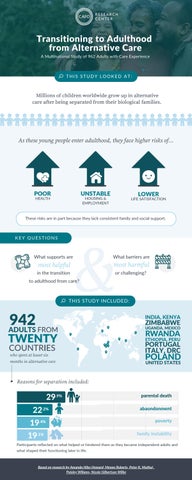
Transitioning to Adulthood from Alternative Care A Multinational Study of 962 Adults with Care Experience
THIS STUDY LOOKED AT:
Millions of children worldwide grow up in alternative care after being separated from their biological families.
As these young people enter adulthood, they face higher risks of...
POOR
UNSTABLE
HEALTH
LOWER
HOUSING & EMPLOYMENT
LIFE SATISFACTION
These risks are in part because they lack consistent family and social support.
KEY QUESTIONS
What supports are
most helpful
in the transition
&
What barriers are
most harmful or challenging?
to adulthood from care?
THIS STUDY INCLUDED:
942 ADULTS FROM
INDIA, KENYA
ZIMBABWE
UGANDA, MEXICO
TWENTY
RWANDA
who spent at leaset six months in alternative care
POLAND
COUNTRIES
ETHIOPIA, PERU
PORTUGAL ITALY, DRC
UNITED STATES
Reasons for separation included:
29.9%
parental death
22.2%
abaondonment
19.4%
poverty
19.1%
family instability
Participants reflected on what helped or hindered them as they became independent adults and what shaped their functioning later in life.
Based on research by Amanda Hiles Howard, Megan Roberts, Peter K. Muthui, Paisley Willams, Nicole Gilbertson Wilke
Transitioning to Adulthood from Alternative Care A Multinational Study of 962 Adults with Care Experience
STUDY FINDINGS
Three major themes emerged:
Relationships & Social Networks Supportive relationships were central to successful transitions. Participants highlighted caregivers, mentors, extended family, friends, and access to counseling. When these supports were missing, participants often felt isolated or emotionally unsupported.
Well-Being & Resilience Participants described both mental health challenges and strong resilience. When supported emotionally and encouraged to grow, participants reported
Resources & Opportunities Education, employment, stable housing, and life skills training strongly shaped adult outcomes. Financial insecurity and limited opportunities created long-term barriers.
increased confidence, better coping, and greater independence.
IMPLICATIONS FOR PRACTICE These findings point to concrete actions practitioners and policymakers can take to improve outcomes for young people aging out of care:
Prioritize permanency and stability Stable placements support emotional development and identity formation.
Build social networks
Adopt a personcentered approach
Helping youth form and
Support must be
maintain healthy
individualized, as participants
relationships offers
had diverse needs.
emotional support and practical guidance.
Improve access to psychosocial services
Promote empowerment and resilience
Counseling and therapy
Programs that build
enhance coping and well-
confidence and
being.
independence support healthier transitions.
Ensure access to resources and opportunities Equitable access to education, employment, and housing is critical.
Provide long-term support Transition does not end at age 18. Mentorship and peer networks can make a meaningful difference.
KEY TAKEAWAYS Transitioning to adulthood is especially difficult for those raised in alternative care, but targeted support can significantly improve outcomes. Across countries, three supports matter most: relationships, resilience and well-being, and access to resources. Effective policy and practice should be person-centered, relationshipdriven, and long-term, with expanded access to mental health services and removal of barriers to education and employment. These findings can help improve care systems and support young people in building healthy, stable adult lives.
Based on research by Amanda Hiles Howard, Megan Roberts, Peter K. Muthui, Paisley Willams, Nicole Gilbertson Wilke