LAWRENCE ALKIN Collection
Copyright © Chris Beetles Ltd 2026
8 & 10 Ryder Street, St James’s London SW1Y 6QB 020 7839 7551
gallery@chrisbeetles.com www.chrisbeetles.com
ISBN 978-1-914906-18-3
Cataloguing in publication data is available from the British Library
A Chris Beetles Gallery Publication
With contributions by Chris Beetles, Alexander Beetles, Phoebe Bowsher, Agnes Dauti, Edina Horvathova and Fiona Nickerson
Edited by Chris Beetles, Alexander Beetles, Fiona Nickerson and Pascale Oakley-Birch
Design by Pascale Oakley-Birch
Photography by Giulio Sheaves
Reproduction by www.cast2create.com
Colour separation and printing by Geoff Neal PrintWorks
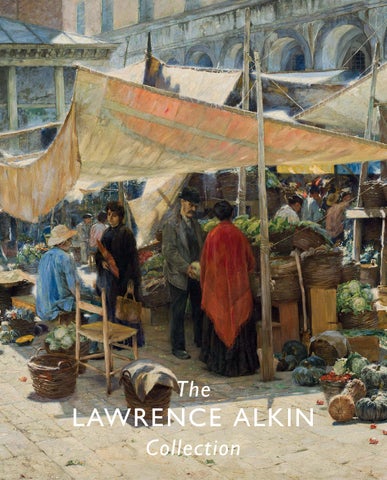
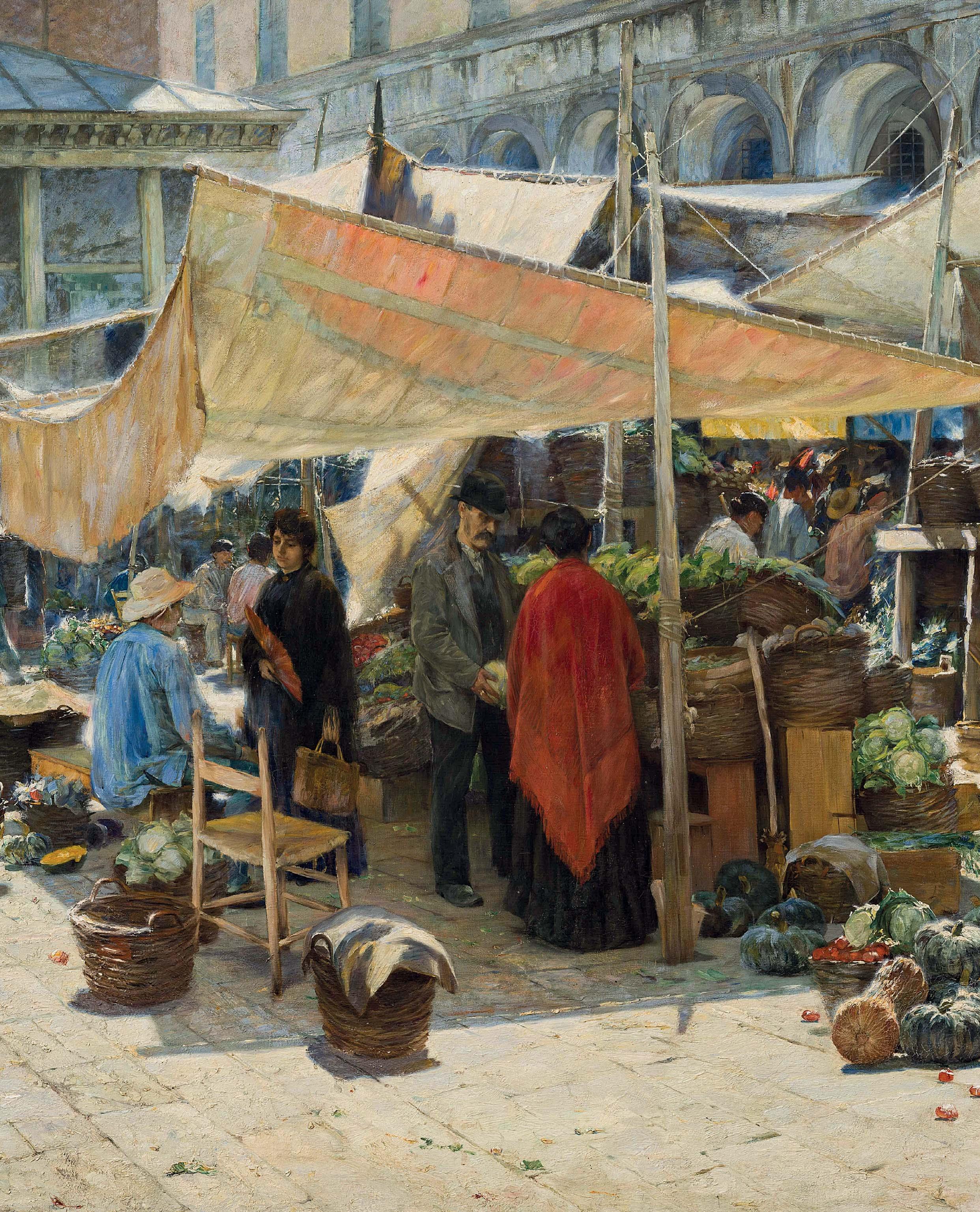
Front cover: Oscar Björk, Venezia [43]
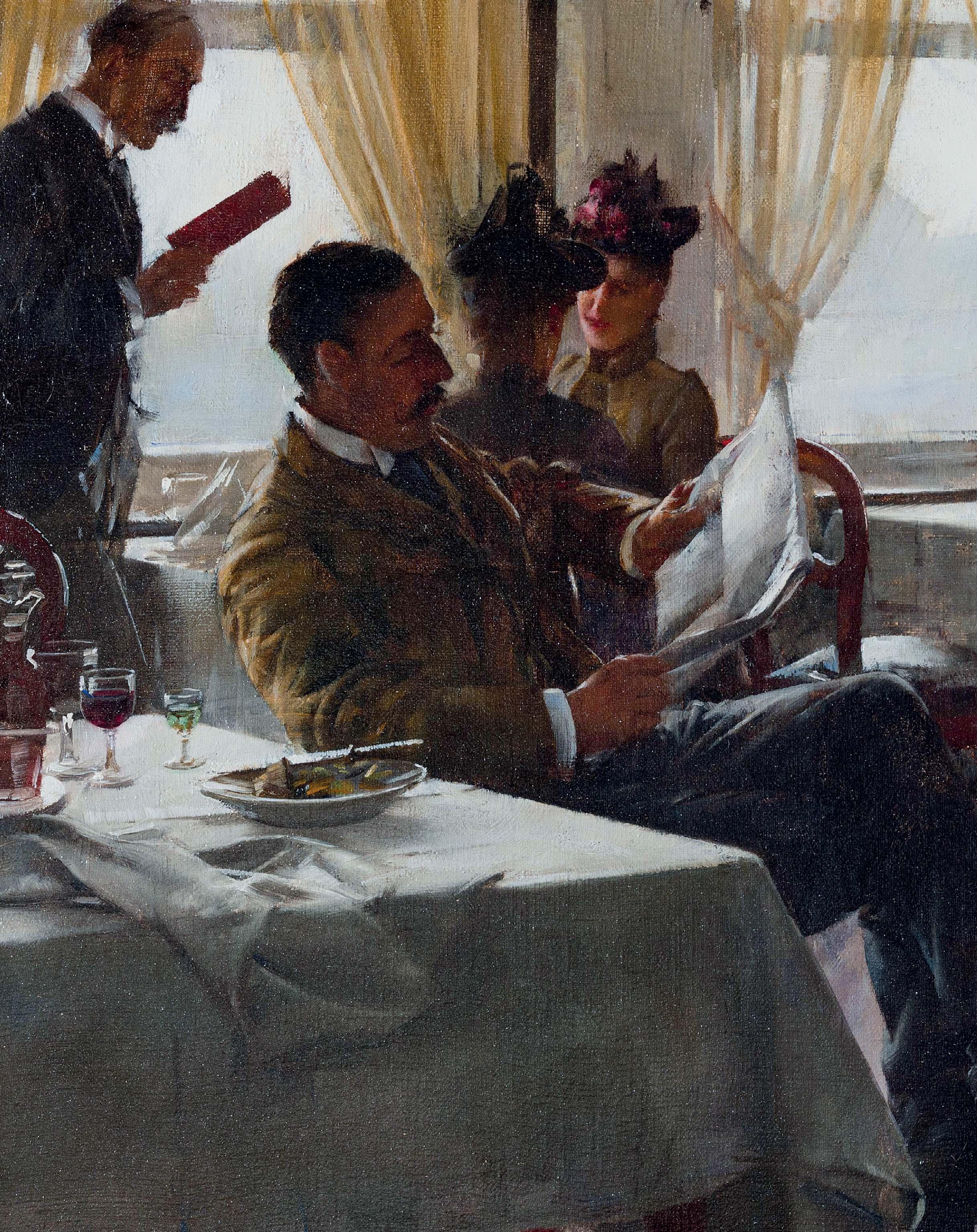
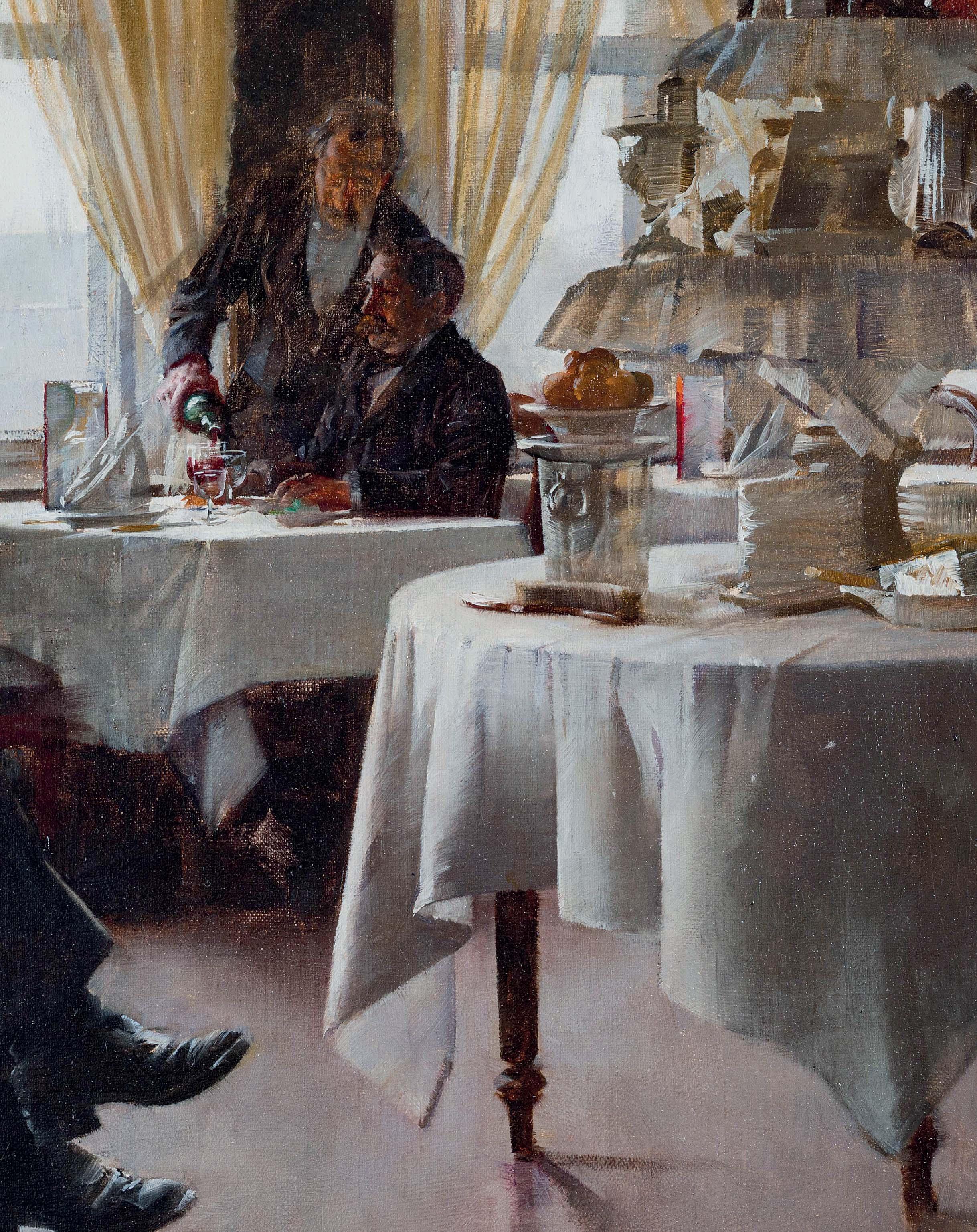
Front endpaper: Albert Chevallier Tayler, The Dining Room [36]
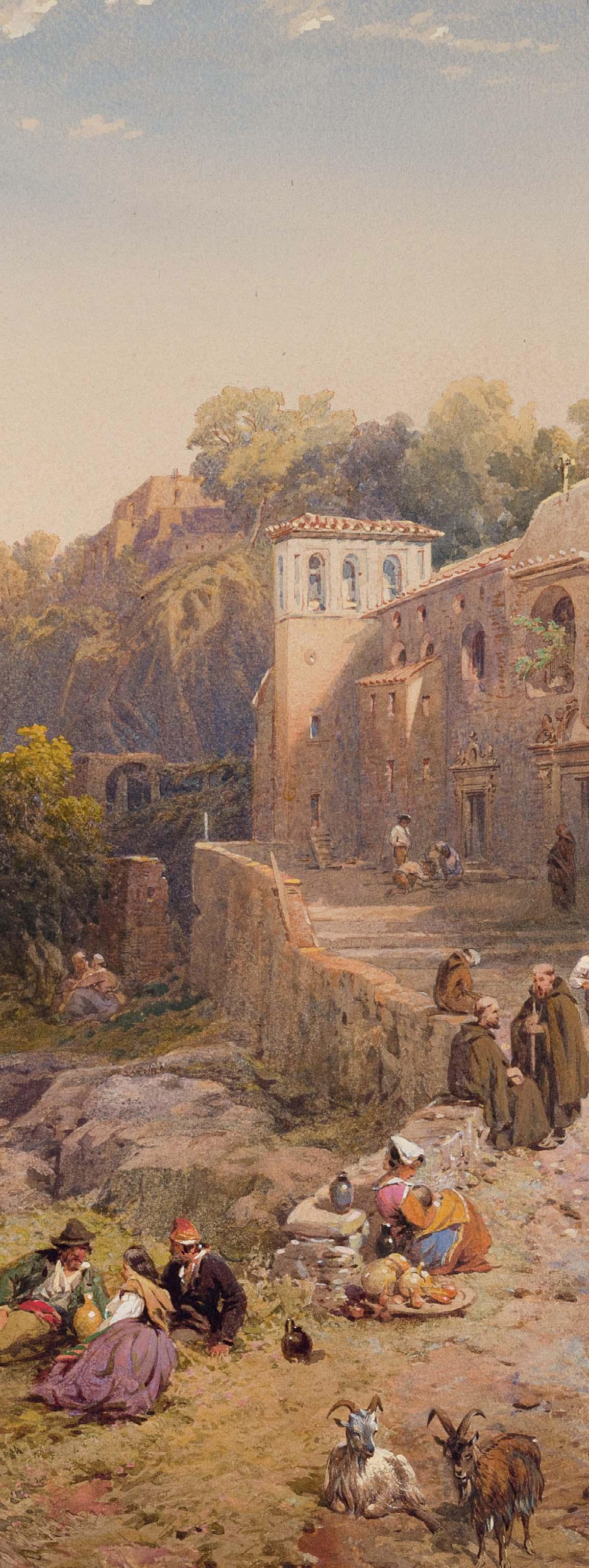
This page: Thomas Miles Richardson Jnr, Ischia [detail of 13]
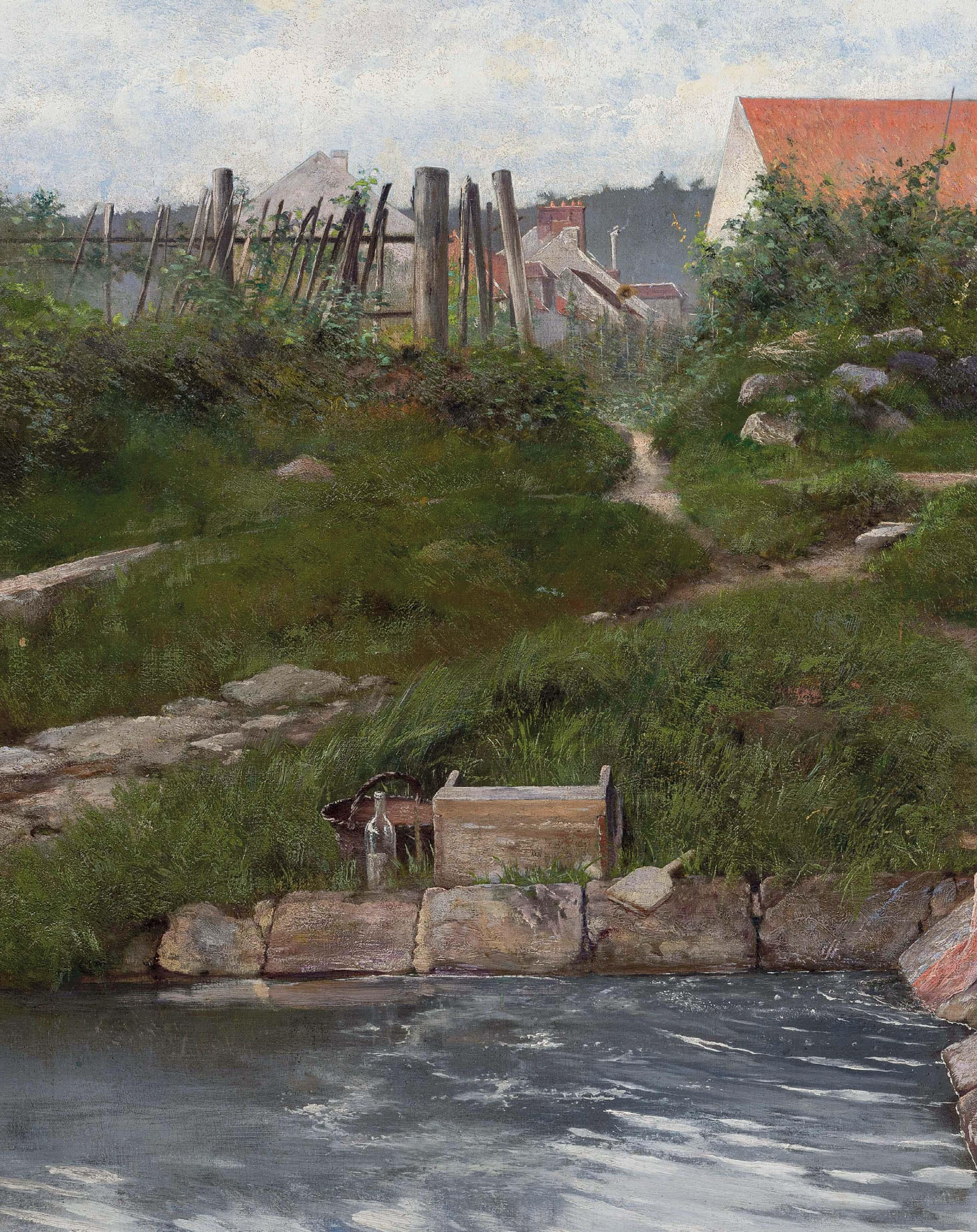
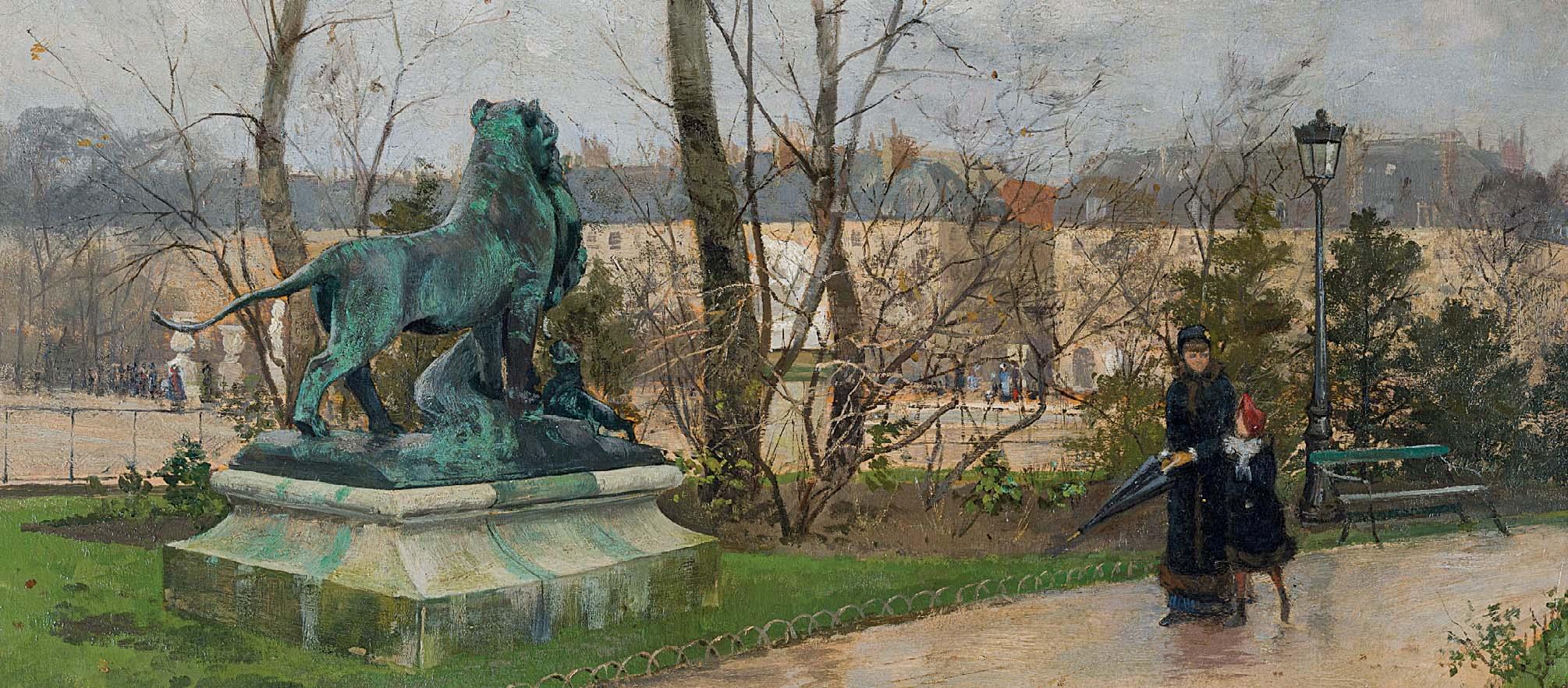
Title page: Fritz Thaulow, Fra Luxembourg-haven [detail of 45]
Page 4:
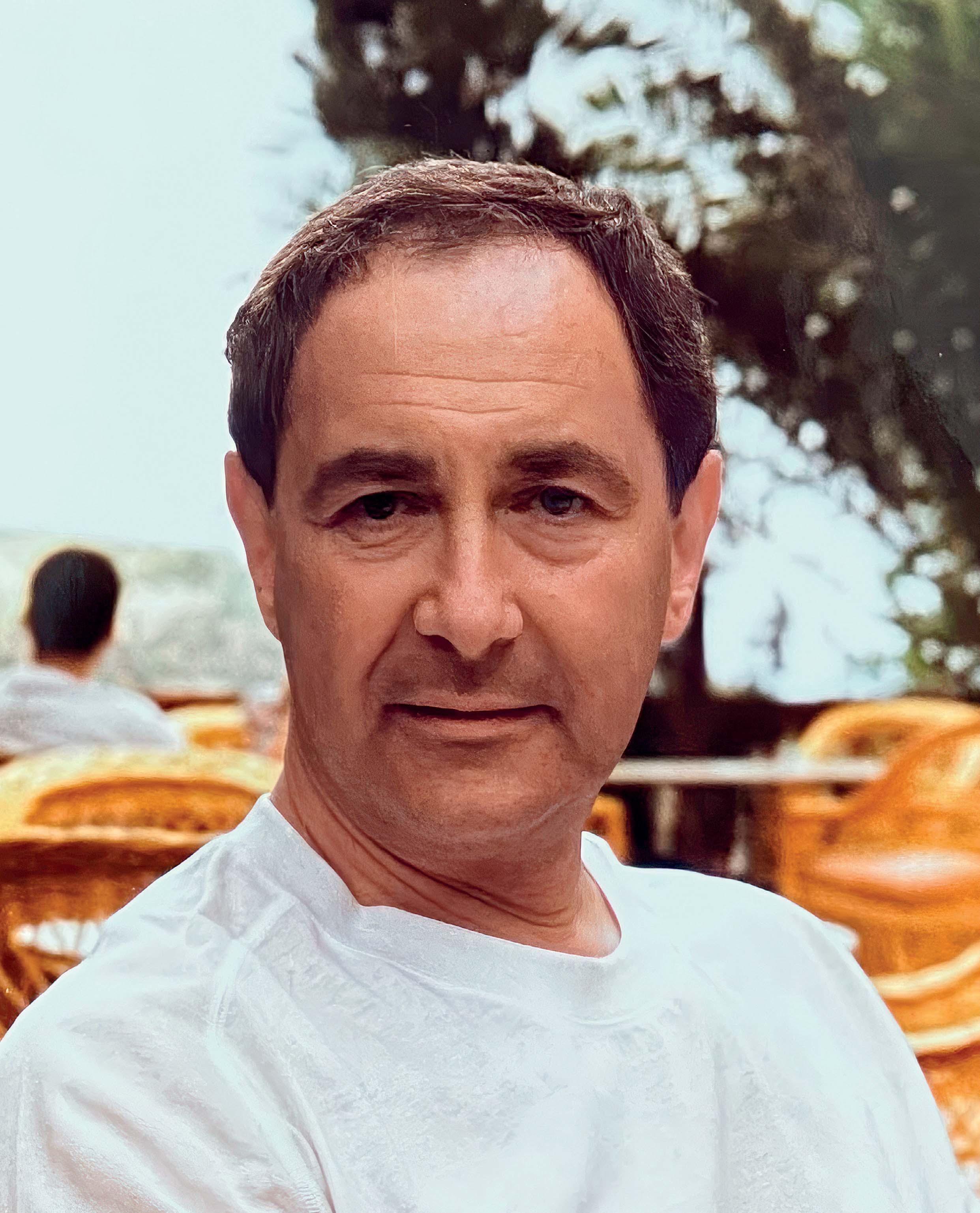
Photo of Lawrence Alkin
Page 7:
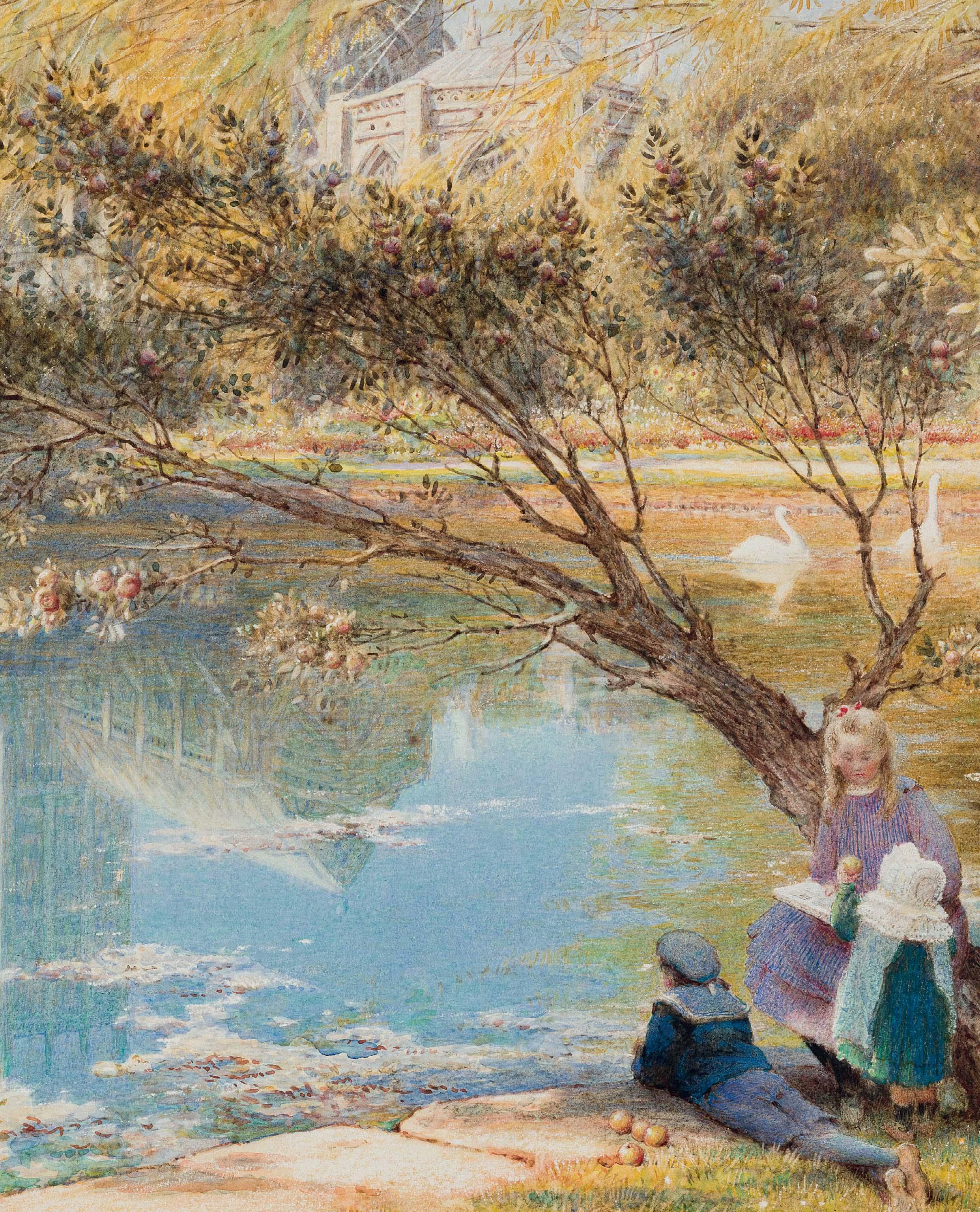
Albert Goodwin, Wells [detail of 23]
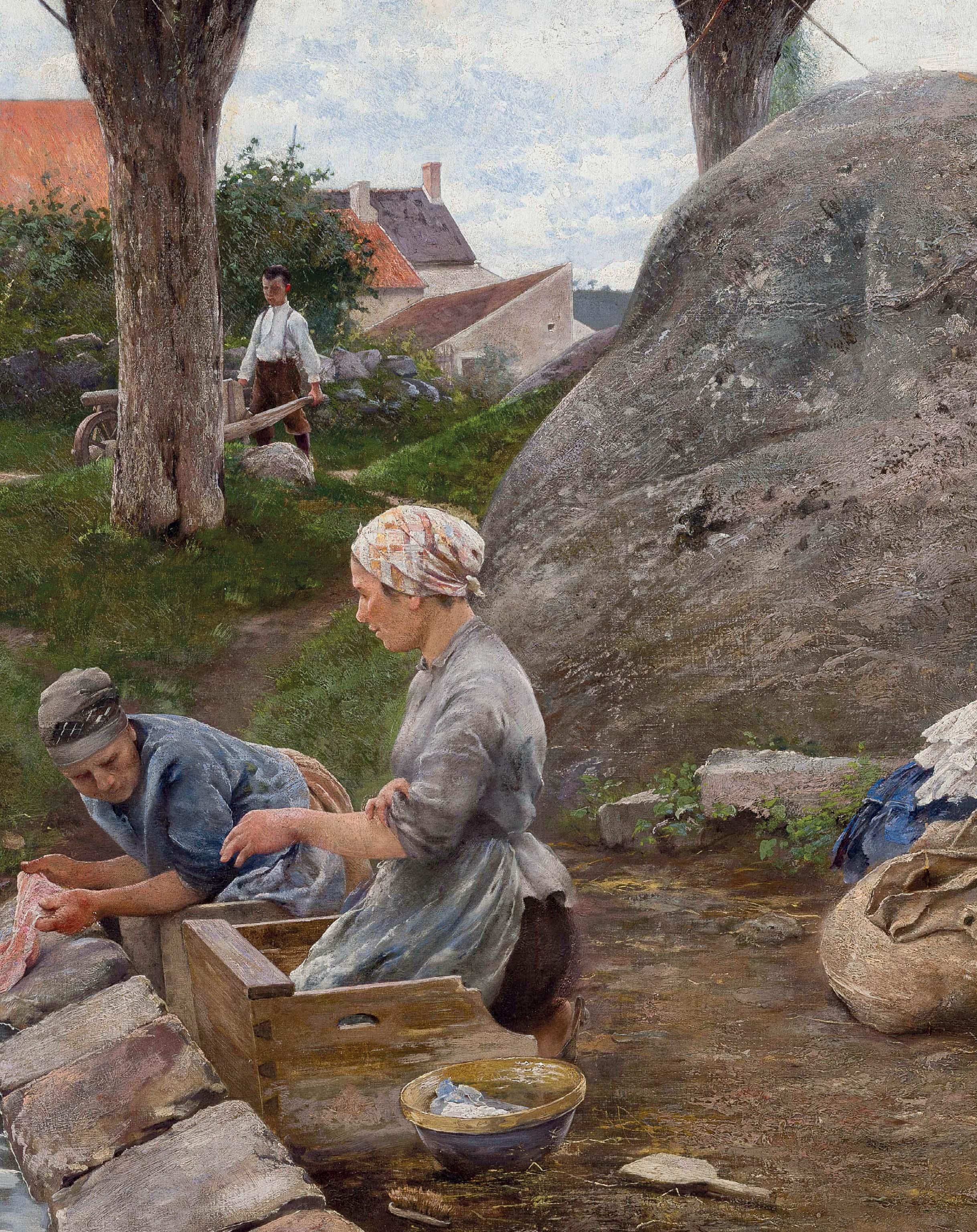
Back endpaper: August Hagborg, Tvatterskor [38]
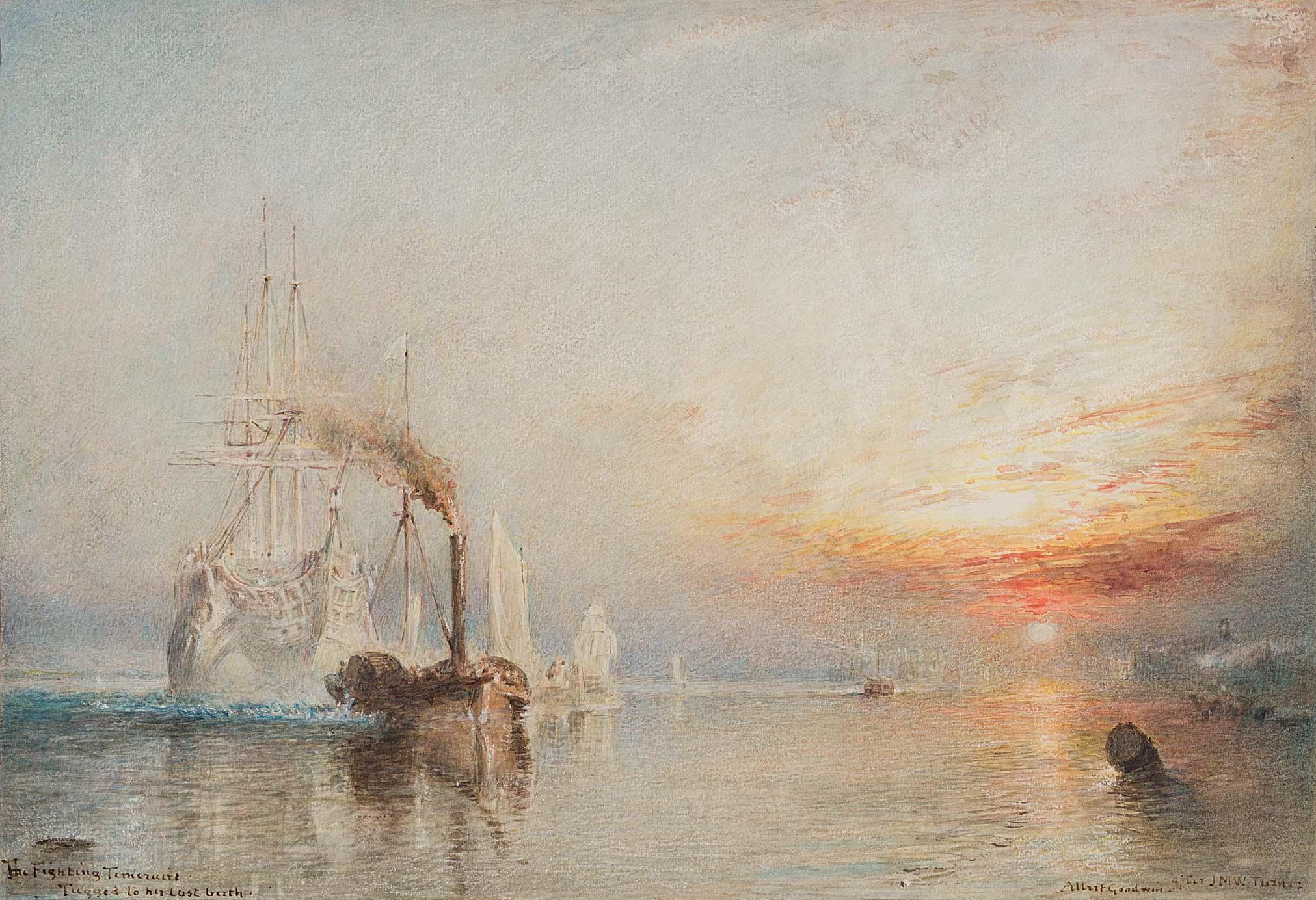
Back cover: Albert Goodwin, The Fighting Temeraire Tugged to her Last Berth.
After J. M. W. Turner [22]
The LAWRENCE ALKIN Collection
CHRIS BEETLES GALLERY
Lawrence Alkin Remembered
Lawrence Alkin was a serially successful entrepreneur, art collector and philanthropist, and my good friend and client for over 40 years. Looking back with fondness and admiration it is with an easy con dence I can say that he was one of the most singular and remarkable men I have met.
We were introduced by Michael Parkin, the legendary dealer in Motcomb Street, whose gallery I supplied with an annual Louis Wain show in the days before I had a gallery of my own. Lawrence and I found our tastes and interest in traditional 19th Century English watercolours was shared, nuanced and revisited many times over the next 45 years.
It is a characteristic of self-made men and women that they trust their judgement, whether based in instinct, analysis, or the magical melding of both. Lawrence was one of that number of new collectors from the post-war generation who embraced tradition but rejected the mere buying of ‘names’, eschewed faded and damaged artworks, and rejoiced in the value a orded by ‘forgotten’ artists that had been stars in the heady days of 19th Century Industrial England. Those ‘new rich’ collectors, often from the industrial North, applied the same air in choice and acquisition that Lawrence Alkin asserted a century later. Artists like Albert Goodwin, J W North, Alfred William Hunt, Walter Tyndale, Thomas Miles Richardson, and the Channel Island celebrity Paul Jacob Naftel all came under his approving gaze. When his eye was turned to the 20th Century, he chose exceptional pieces but always rooted in a narrative and gurative tradition. Among contemporary artists he had his favourites also, particularly Lesley Fotherby, with whom he lled many of his health clubs with her vital and spontaneous ‘dance’ pictures.
His omnivorous taste in art mirrored his curiosity about life and on taking on a house in Sweden with his Swedish partner, he inevitably engrossed himself in the Europhile naturalism that drew late 19th Century Scandinavian painters to Paris. These striking conversation pieces gave him much pleasure and were enthusiastically brought over to London as soon as the Swedish idyll was over.
Lawrence had a forensic intelligence, discursive and questioning, and employed it with a bemused detachment that never contained anger or prejudice. He was able to nd humour in most situations – a Matt-esque view of the world. Humour is not far from insight, and maybe this cerebral combination contributed to his successful decision making. It was the psychology of crowds that interested him, trends and the opinions of groups, that he would then translate into market forces. This probably informed his business decisions as he
seemed to make a tycoon-like success of his ‘hobbies’; property, tness, wine and food. I say probably, as he rarely talked of his commercial successes to me. And in turn, I nd his life-long professional advisors and business partners knew little of his artistic predilections.
A pressing thought now comes to me that demonstrates his compartmentalised loyalties. He was a life-long Tottenham Hotspur supporter and though he went through the predictable undulations of glee and disappointment, he never wavered. Carol Beetles misses his weekly, hour-long telephone calls of analytical despair.
As sometime Founder-Chairman, always heavy investor and often the Independent Director of my many EIS ventures over 30 years, I witnessed his business experience up close. In board meetings he was amusing, supportive and trusting, and his wise counsel and encouragement contributed to the serial successes of Cradlecall Ltd, Albert Goodwin PLC, Brabazon Brabazon Ltd, and most recently Arthur Rackham Ltd.
The comfort of country cottage isolation in Berkshire suited him for a while, and the coastal aspect of a Cornwall house gave intermittent pleasures, but London always played host to his multi-faceted life and was the the repository for his ever-changing art collection. His partner was an amateur artist of a great proli c energy and her vigorous colourful daubs left no hanging space in Newbury. Berkshire’s loss was Battersea’s gain, as an eclectic mix of style and taste crammed happily in his penthouse at in the iconic Montevetro building overlooking the Thames. It was a glasshouse eyrie, a gallery in the sky, and from here, internally enriched, Lawrence could survey a city landscape full of stimulus and possibilities to come; a metaphor of a life well-lived.
Dr Chris Beetles, April 2026
LAWRENCE ALKIN
(1939-2025 )
Lawrence was born in North London, the only child of Phyllis and Henry. He attended Mill Hill School and after that went on to study law at university and law school in London and to qualify as a solicitor. He was highly successful as a solicitor, both in terms of building a well-known practice with colleagues including the late Carlo Colombotti, but also the use of the opportunity created by his practice to become involved in other businesses. Originally, he started in property and would buy properties for conversion and upgrade in the up-and-coming parts of London, which he would then sell on at a handsome pro t. Not content with merely a successful property company, Lawrence also developed a whole range of other business interests. The most important one was Holmes Place, a health club which was ground-breaking in its atmosphere and style. Holmes Place expanded both in the UK and internationally and was a highly successful and well-regarded brand, setting new standards in the health and leisure business at a time when the options were far fewer. The group was eventually sold to Virgin Active.
Lawrence also became involved in Winkworth, the estate agency, where he worked with Simon Agace and others and served as a non-executive director until his death. He helped to build the brand with his knowledge of both property and business alongside colleagues. He bought, sold and in many cases successfully retained and enhanced many properties in the UK and in America.
His other business interests included a shareholding in the A to Z Restaurant Group, which were the owners of, amongst others, Aubergine, helping to launch the career of Gordon Ramsay, Za erano run by Giorgio Locatelli, and a range of other restaurants in central London including Memories of China.
He also invested extensively in commercial property and hotels, and in later life, took what he would describe as ‘punts’ on new and innovative businesses, some of which proved to be highly successful, some less so, but he was always sanguine and accepting of those that did not fare so well.
On the personal side, he was a loyal and long-standing supporter of Tottenham Hotspur, and attended matches when he was able, although that became increasingly di cult as age and in rmity impeded his activity. He also, as we can see, had a wonderful eye for acquiring and collecting including paintings, not just watercolours, but also a range of other items which he chose principally because he liked them. He had somewhat eclectic tastes, but all were his and he chose well and built a wonderful collection.
He was also a man who enjoyed ne wine with an extensive and well-stocked cellar, and over the years dabbled in racehorses, again successfully to the extent that he inspired the notice and admiration of other owners. Although essentially a modest and private man he had many of the trappings of a successful and wealthy businessman and when single enjoyed fast cars and entertaining beautiful women, including a lady called Shakira, who went on to marry Sir Michael Caine.
Although he never married and had a family of his own he settled with Berit, former top model and enthusiastic artist and enjoyed a long relationship with her and her children and grandchildren who gave huge pleasure to him in later life. Lawrence divided his time between homes in London and the country, and he extended his collection to his other properties.
As a business colleague, I can only say that Lawrence was a wonderful partner, never judgmental or critical, and always supportive and prepared to see the positive in transactions for which his enthusiasm never waned. He was still buying properties up until the time he died taking an active interest in the details of how to ensure that those investments worked well, not just for him, but for those whom he was in partnership with and whom he helped enormously on the way.
Jonathan Glanz, April 2026
The LAWRENCE ALKIN Collection
THOMAS ROWLANDSON
Thomas Rowlandson (1757-1827)
Thomas Rowlandson raised comic art to a new level by representing the panorama of contemporary life with almost incomparable uency – adopting lyricism or incisiveness as best tted the subject. In capturing an abundance of picturesque detail, his work provided a parallel to the novels of Henry Fielding or Laurence Sterne.
For a biography of Thomas Rowlandson, please refer to Chris Beetles Summer Show, 2017, page 4.
1
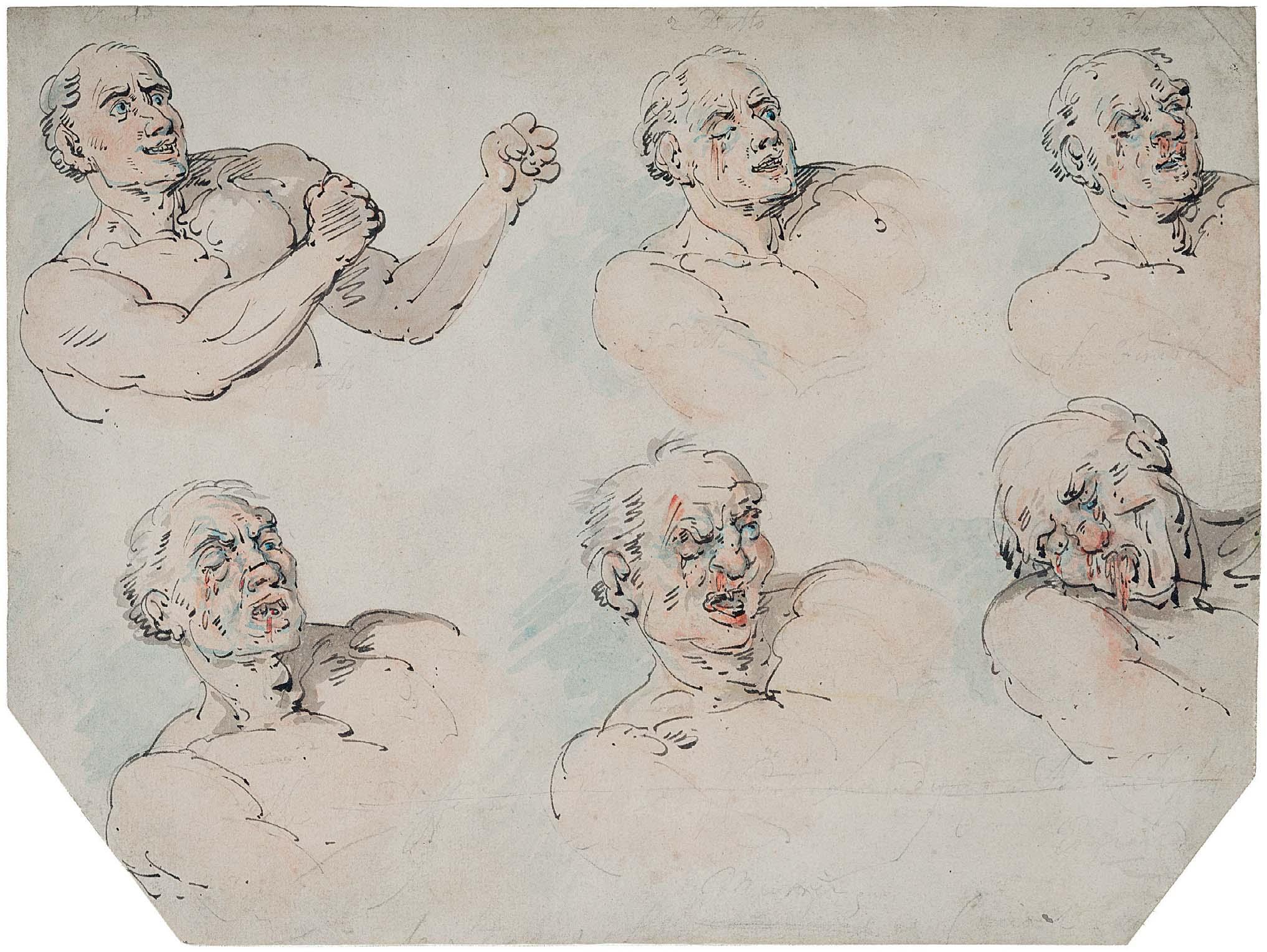
Six Stages of Marring a Face Ink and watercolour 10 x 13 inches
Study for a print published by S W Fores, No 3 Piccadilly, 29 May 1792
The present image is a preparatory study for a print published by the printseller Samuel William Fores in 1792. In the plate of the print (a copy is held in the collections of The Metropolitan Museum of Art, New York), Thomas Rowlandson dedicates the work to the subject, ‘his grace the Duke of Hamilton’. Douglas Hamilton was the 8th Duke of Hamilton, who inherited his title as a teenager. According to the academic Andrew Steptoe, the Duke was ‘one of the handsomest men of his day … [but] gradually gave way to dissipation. He was fond of boxing and low company’.
(Andrew Steptoe, ‘John Moore, 18th century physician, bearleader and social observor’, Journal of the Royal Society of Medicine, vol 98, no 2, February 2005, pp 70-74.)
2
Physiognomic Portraits:
Ink and watercolour
3 ¾ x 6 ½ inches
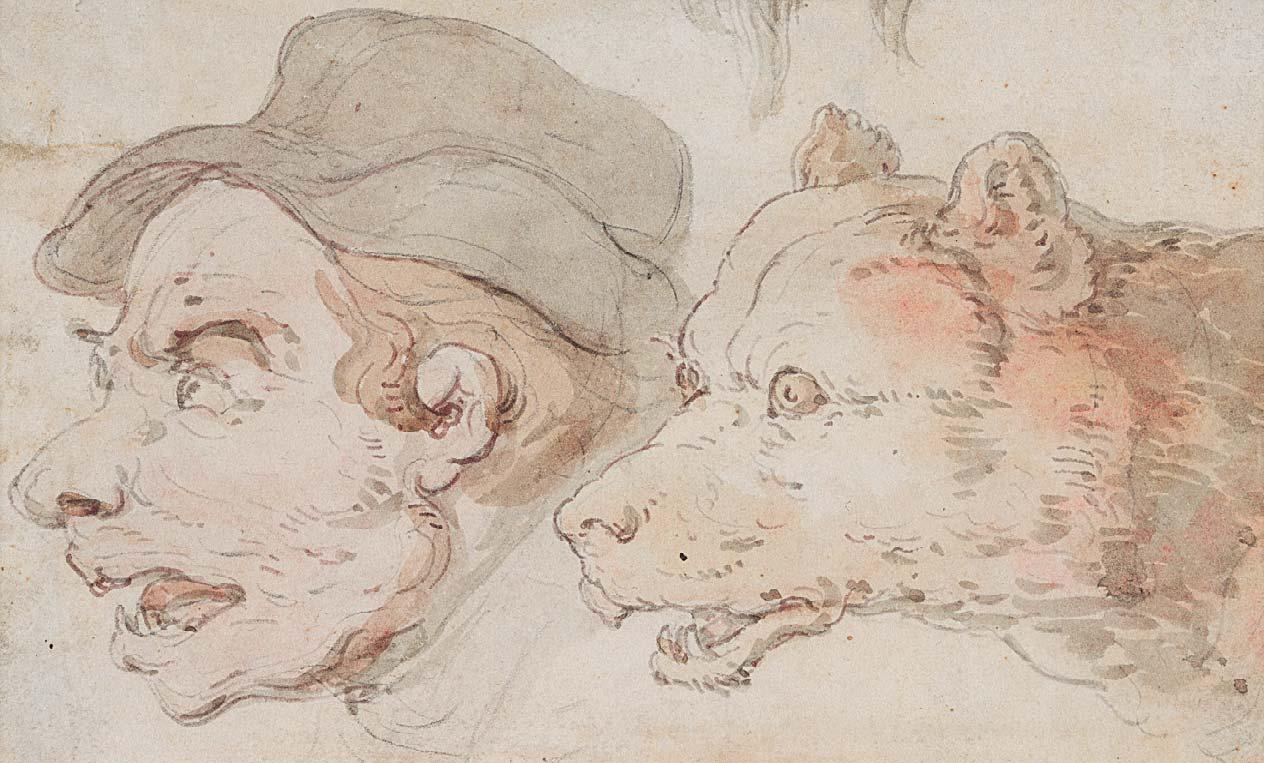
Physiognomic Portraits
The concept of exploring visual similarities between human faces and various creatures was a theme that Thomas Rowlandson returned to frequently. The faces are often grotesque in nature, and matched with monstrous, ugly creatures, such as lizards and, in the case of these two works, sh, and dogs or wolves. Rowlandson’s interest in physiognomy was shared by some of his contemporaries, and was often thought to imply personality or moral standard of the subject.
3
Physiognomic Portraits:
8 ½ x 6 ½ inches
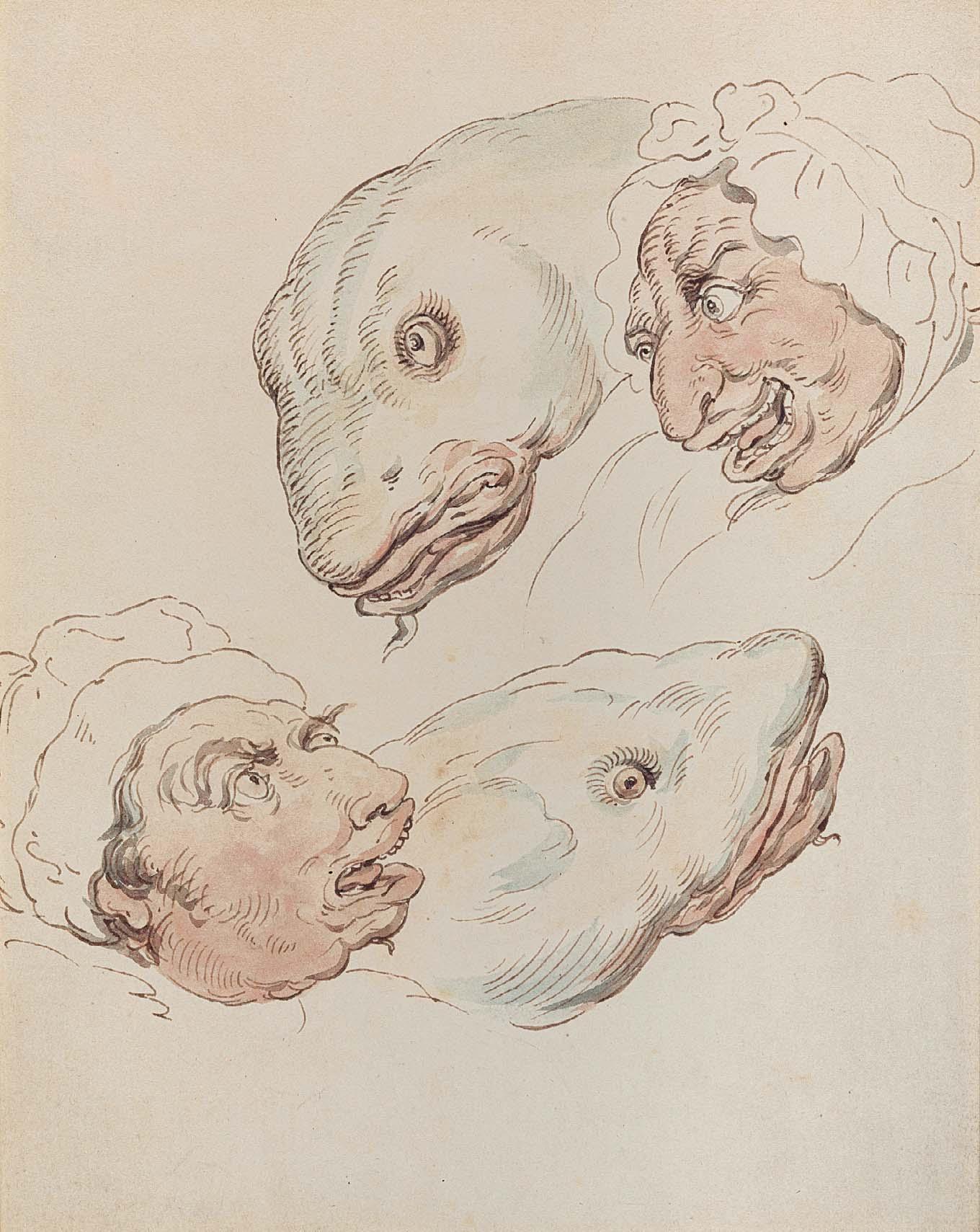
Man and Wolf
Man and Woman and Fish Ink and watercolour
4
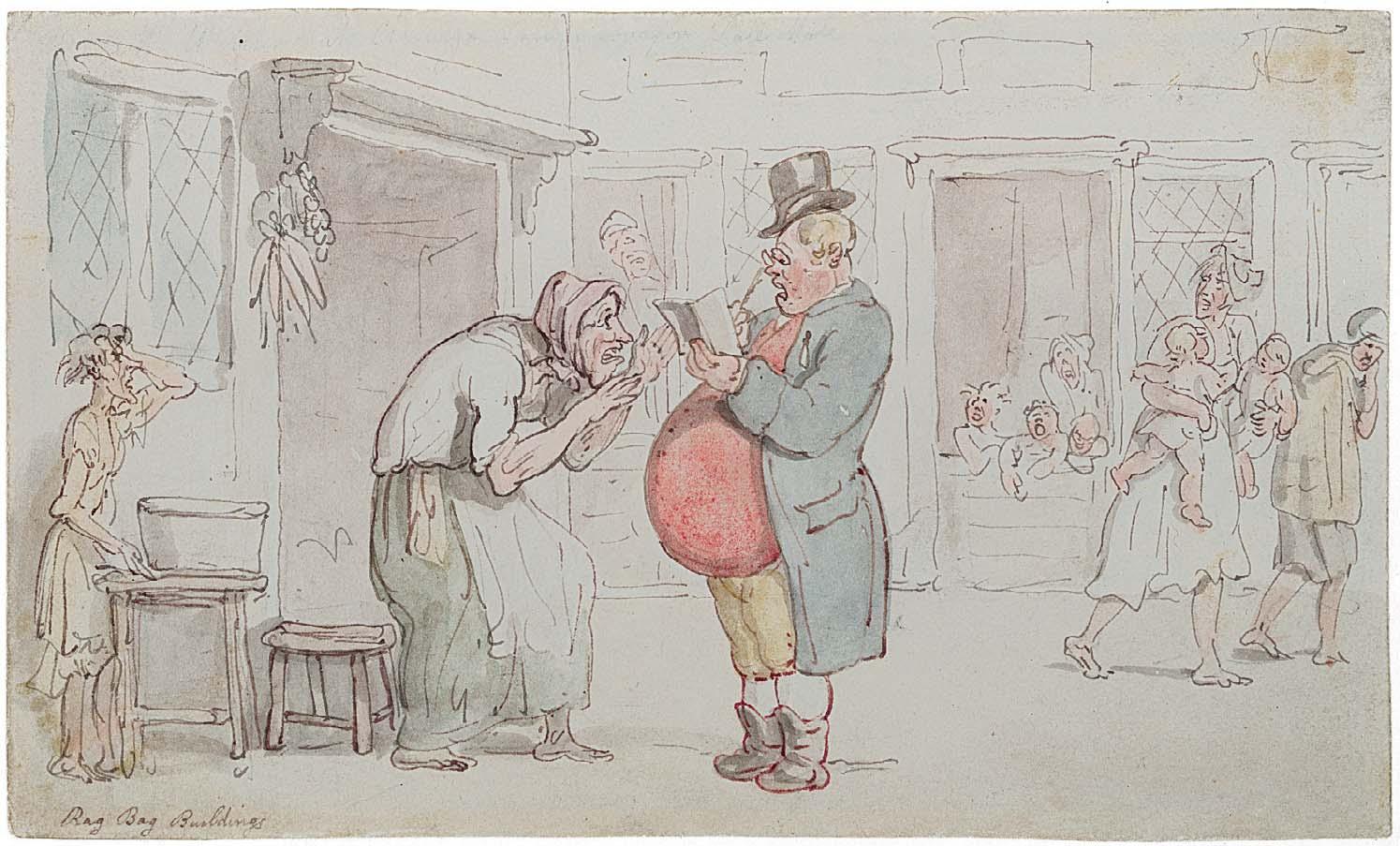
The Tax Collector
Inscribed ‘Rag Bag Buildings’ Ink and watercolour 4 ½ x 7 ½ inches
5
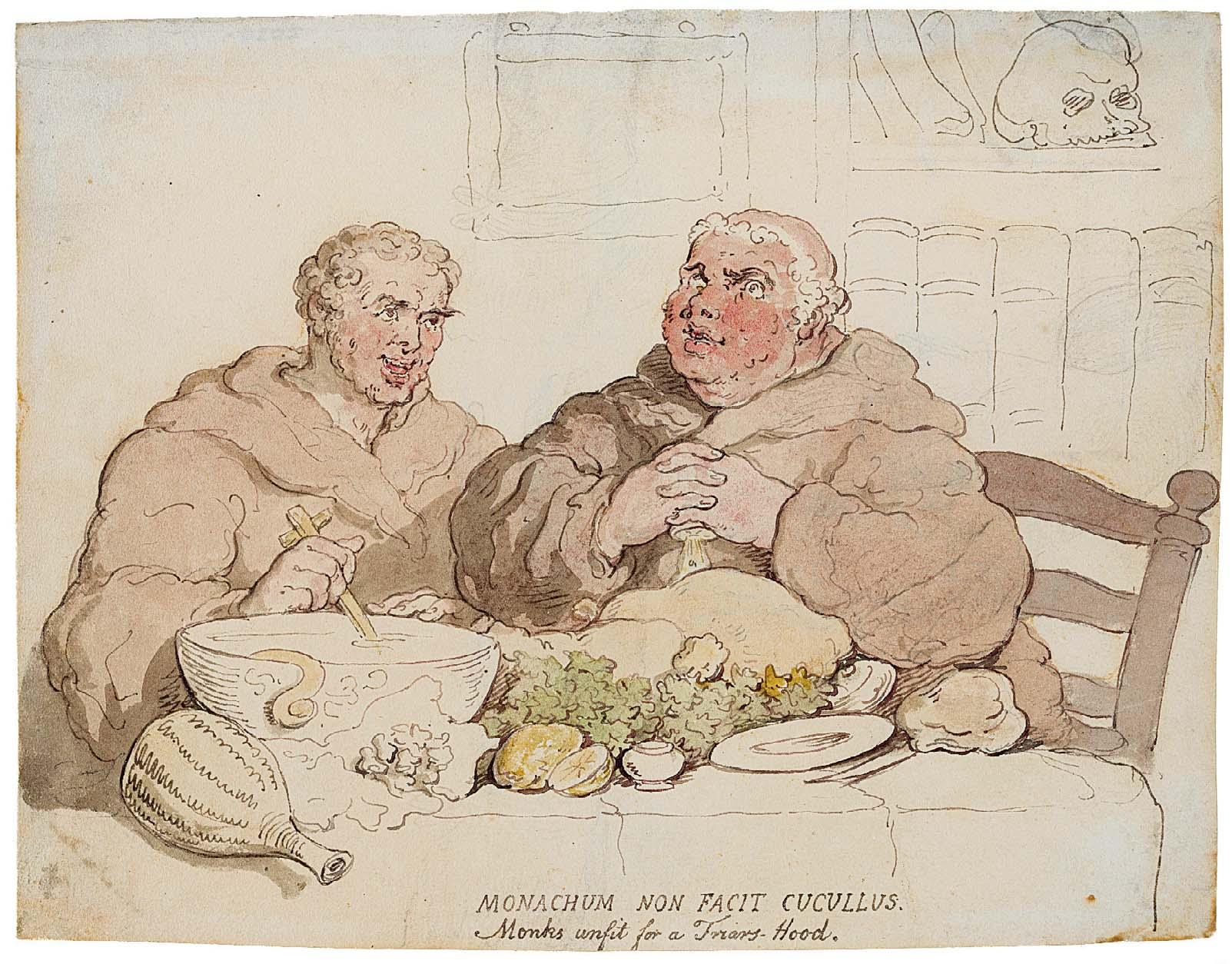
Monachum Non Facit Cucullus Monks un t for a Friars Hood
Inscribed with title Ink and watercolour
7 ½ x 10 inches
The Tax Collector (opposite, above)
The heavy taxation of the Georgian era was a common theme in Thomas Rowlandson’s work. The present composition of a round, o cious tax o cial demanding money from a poor old woman was one that Rowlandson returned to on a number of occasions. This theme appeared as a print in 1799 published by Rudolph Ackermann as the ‘Tax Gatherer’, and in 1805, in the print ‘Quarterly Dunns, or Clamorous Tax Gatherers’, published by Samuel Howitt. The inscription ‘Rag Bag Buildings’ inscribed on the work refers to the run-down dwellings occupied by the poor individuals visited by the tax collector.
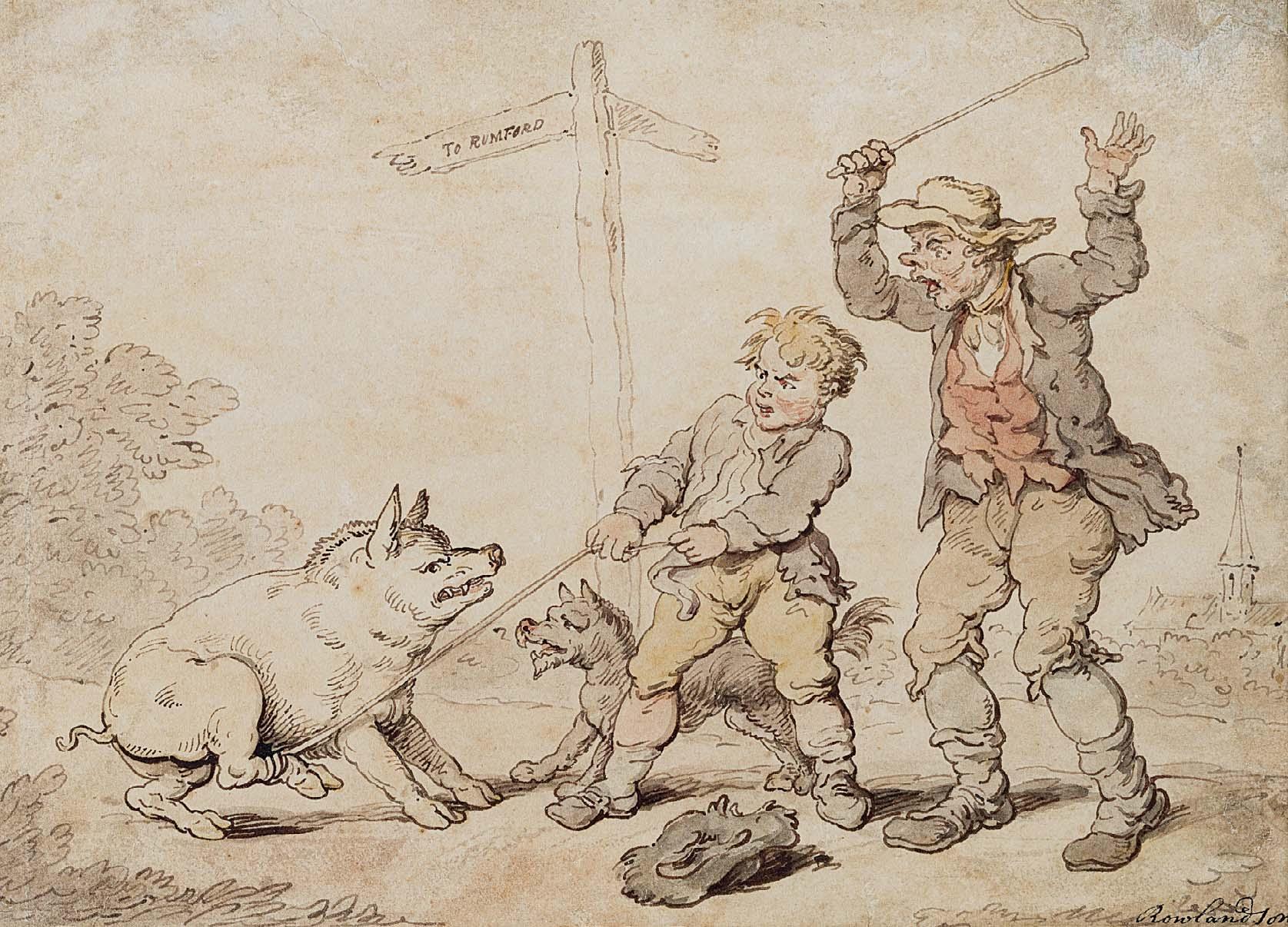
Rusty Bacon (below)
The present image of Rusty Bacon is one from a set of four prints etched by Rowlandson in 1807, inspired by drawings by William Henry Bunbury of various animals resisting being led away. The other three prints in the set were Calf’s Pluck, A Pull’d Turkey, and Collar’d Pig.
In the background is a sign pointing to Romford, on the outskirts of London. This is likely to be a reference to Romford Market, which has been in operation since the 13th century, and indicates where the pig was purchased. The term ‘Rusty Bacon’ was used to describe discoloured, rancid bacon. In this case, could be a reference to the pig’s disgruntled temperament.
Monachum Non Facit Cucullus
Monks un t for a Friars Hood (opposite, below)
In the present image, Thomas Rowlandson satirises the hypocritical morality of monks, depicting them feasting gluttonously despite their religious vows. One monk can even be seen stirring the soup with a cruci x. The Latin proverb was also commonly translated as ‘The hood does not make the monk’.
On the shelf behind the monks sits a skull; a Memento Mori that perhaps serves as a warning to the sinful monks.
6
Rusty Bacon
Signed Ink and watercolour 7 x 10 inches
Literature: Joseph Grego, Rowlandson the Caricaturist, London: Chatto and Windus, 1880, volume II, page 80 [ref] and 82
THomAS RoWLANdSoN
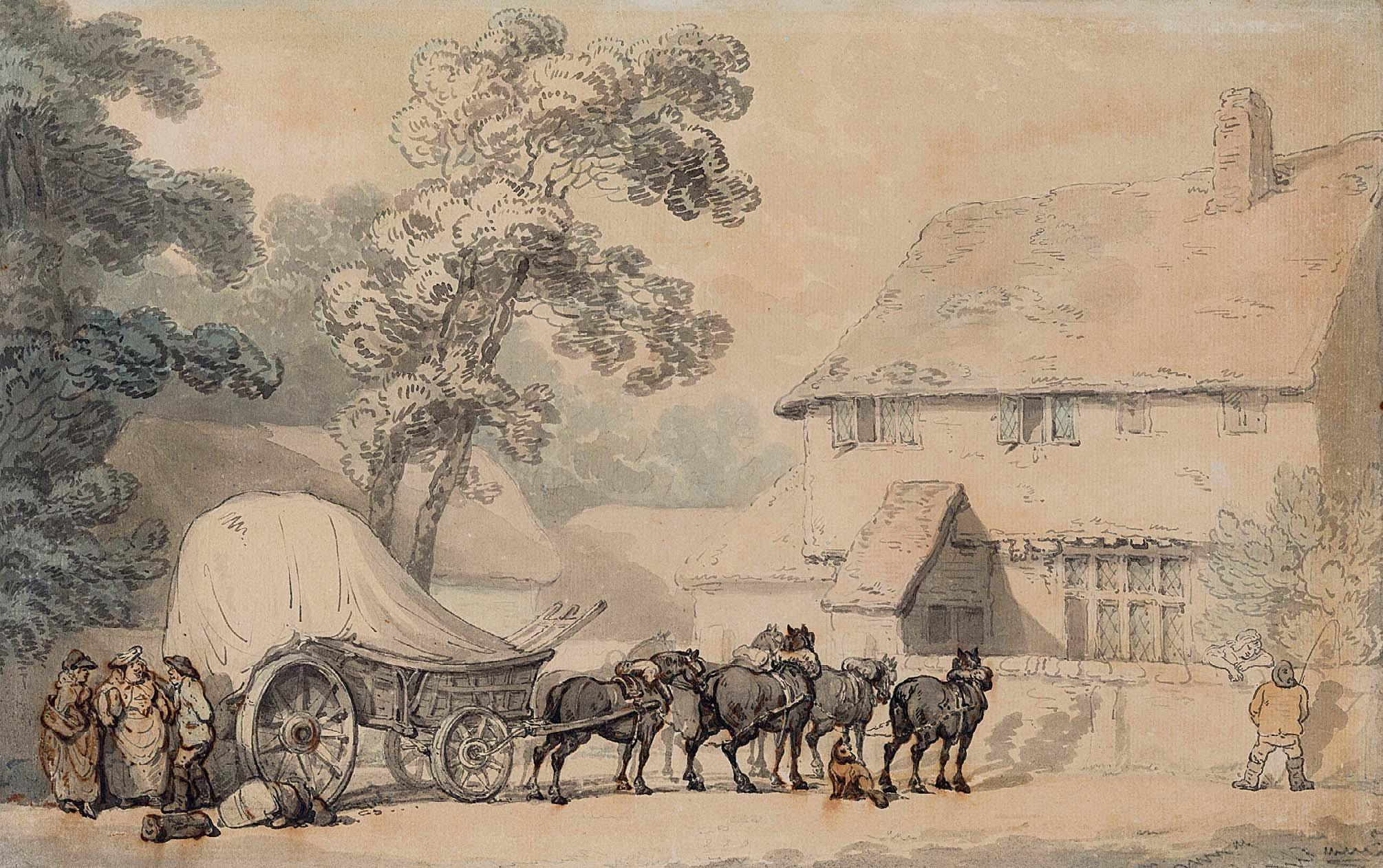
This peaceful, rural scene was a common composition in Thomas Rowlandson’s work. The artwork A Carrier’s Waggon (in The Paul Mellon Collection at the Yale Center for British Arts) features a similar cart in front of the same cottage. Another example of wagons or carts arriving at a rural home or inn can be seen in the print Black Dog Inn Yard at Belfont, published by Elizabeth Jackson (a version is in the collection of The Metropolitan Museum of Art, New York).
Arrival of the Wagon Ink with watercolour 11 x 17 ½ inches
CLARKSON STANFIELD
Clarkson Stan eld, RA (1793-1867)
The most successful British marine painter of his age, Clarkson Stan eld drew directly on his own wide experience of the sea.
For a biography of Clarkson Stan eld, please refer to Chris Beetles Summer Show, 2018, page 19.
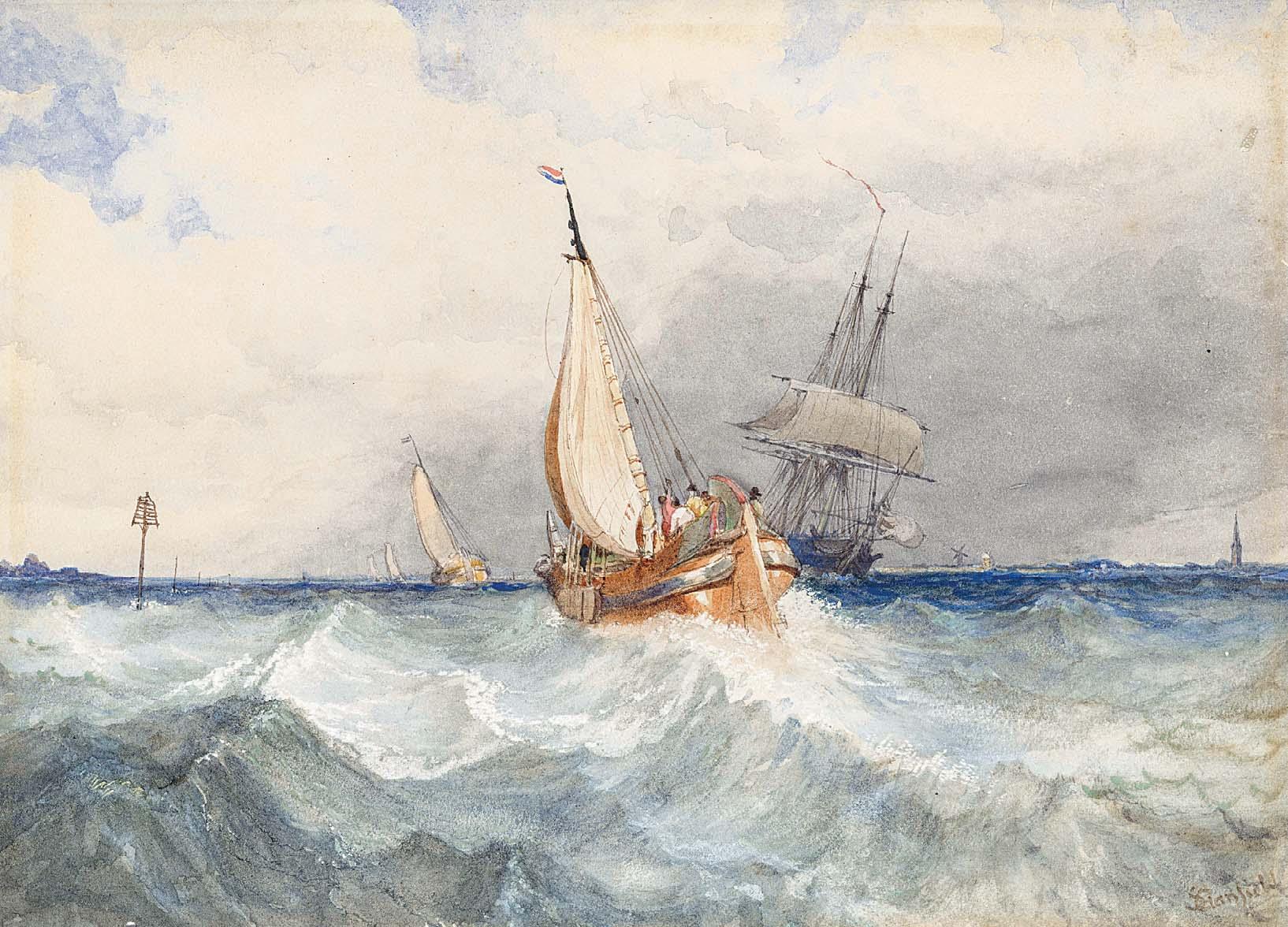
8 Homeward Bound Signed Watercolour
8 ½ x 12 inches
Exhibited: ‘The spectacular career of Clarkson Stan eld, 1793-1867: seaman, scene-painter, Royal Academician’, Sunderland Museum and Art Gallery, 1979, no 193
19TH CENTURY BRITISH SCHOOL
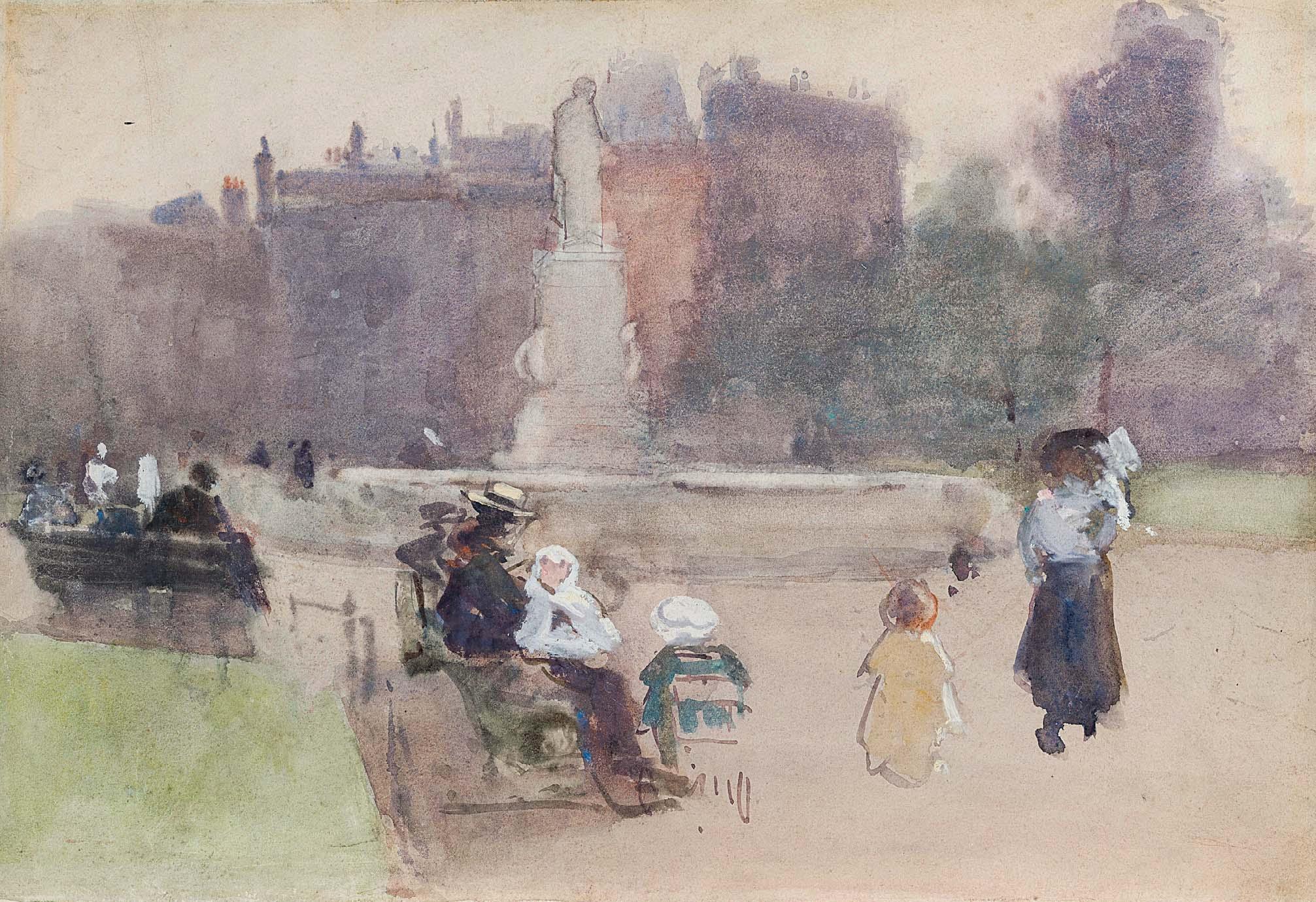
THOMAS LOUND
Thomas Lound (1801-1861)
Thomas Lound was born on 13 July 1801. His parents were Mary and Thomas Lound, who ran the family brewery Charles Tompson & Sons in Norwich. The business was successful and Lound grew up in an a uent environment. He was involved in the family business throughout his working life as well as being considered an accomplished and proli c artist.
At the age of 18, he became a member of the Norwich Society of Artists and exhibited his watercolours annually with them, until the Society’s closure in 1833. He was a prominent member of the Norwich Amateur Club with his good friends Robert Leman and David Hodgson, and a member of the Norwich School of Painters. He was taught by John Sell Cotman and strongly in uenced by artists such as David Cox and Joseph Stannard, often making copies of their works as practice. He mainly worked in watercolour but also produced oils, etchings and works in charcoal.
Thomas Lound lived in Norwich his whole life, but was known to have travelled on sketching tours with his peers to Wales and Yorkshire. Between 1845-1855 he exhibited several works in London at the Royal Academy of Arts and the British Institution.
Thomas Lound was also a passionate early photographer and committee member of the Norwich Photographic Society. Alongside painting, he was an avid collector of artwork by his contemporaries as well as those he particularly admired. On one occasion he purchased 75 works by John Thirtle, one of his favourite artists. Alongside his main residence in King Street, Norwich, Thomas Lound owned a yacht, The Kathleen, where he displayed part of his collection and entertained friends.
In 1821, Lound had married Harriot Wetherill, and together they had three children; Henry, Ellen and Harriot. His wife died unexpectedly in 1859, aged only 58, and the following year, his son Henry died. Shortly after, Thomas Lound died on 18 January 1861, said to be from apoplexy, aged 59. The sale of his estate took place on 6 March 1861 in the Bazaar Room, Norwich.
His work is represented in the collections of the V&A; National Trust, Norfolk Museums Collections; and Yale Centre for British Art (CT).
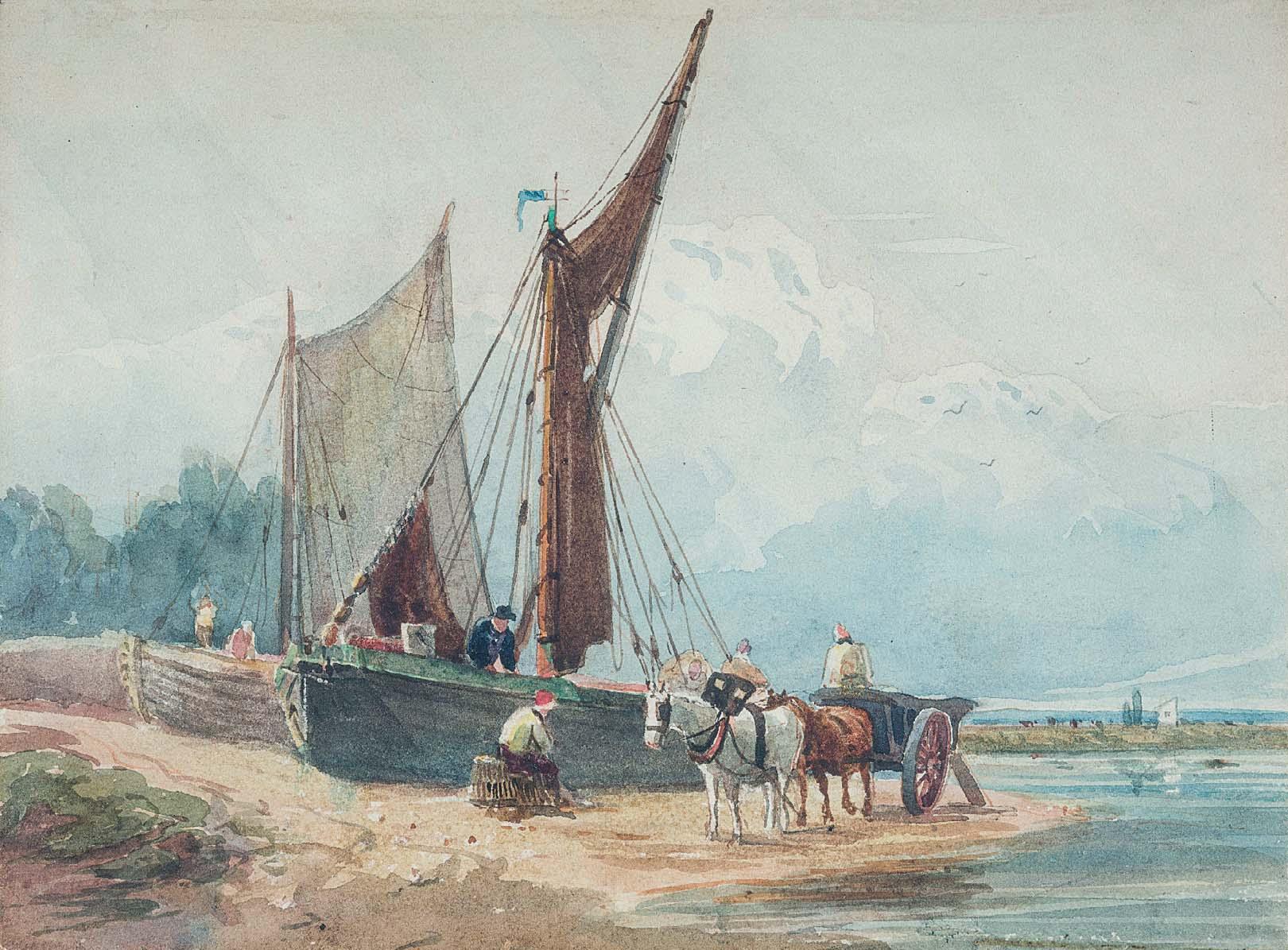
WILLIAM WYLD
William Wyld, AA RI (1806-1889)
A diplomat and latterly a wine merchant, William Wyld was inspired by the example of Richard Parkes Bonington to become a watercolourist. His strongly coloured, virtuoso townscapes and landscapes proved highly in uential in the development of watercolour in France.
For a biography of William Wyld, please refer to Chris Beetles Summer Show, 2017, page 48.
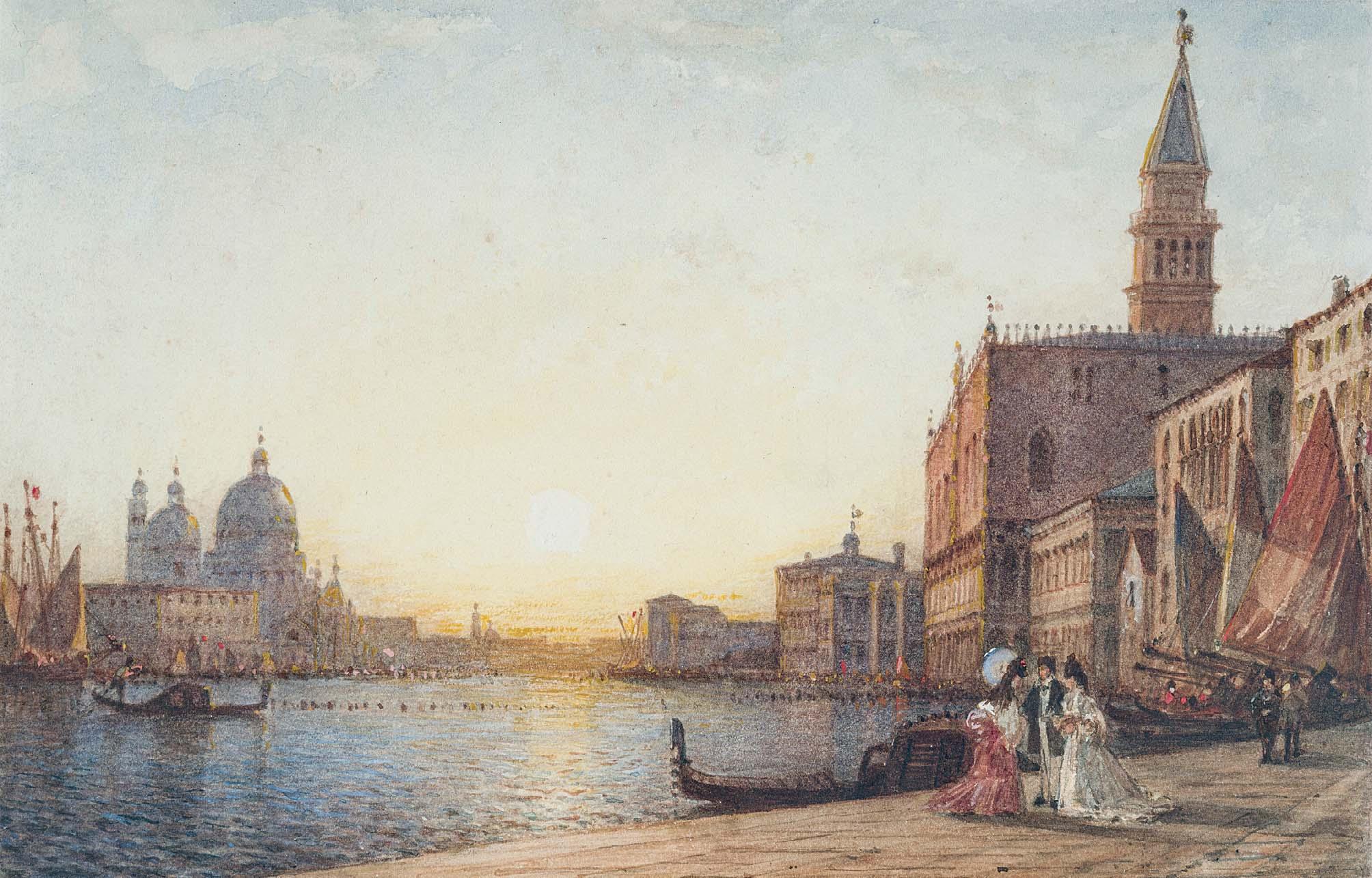
GEORGE WEATHERILL
George Weatherill (1810-1890)
One of Yorkshire’s nest watercolourists, George Weatherill spent his entire life in the Whitby area. Though painting only in his spare time until the age of 50, his artistic reputation was such that he became known as the ‘Turner of the North’.
For a biography of George Weatherill, please refer to Chris Beetles Summer Show, 2013 page 10. 12
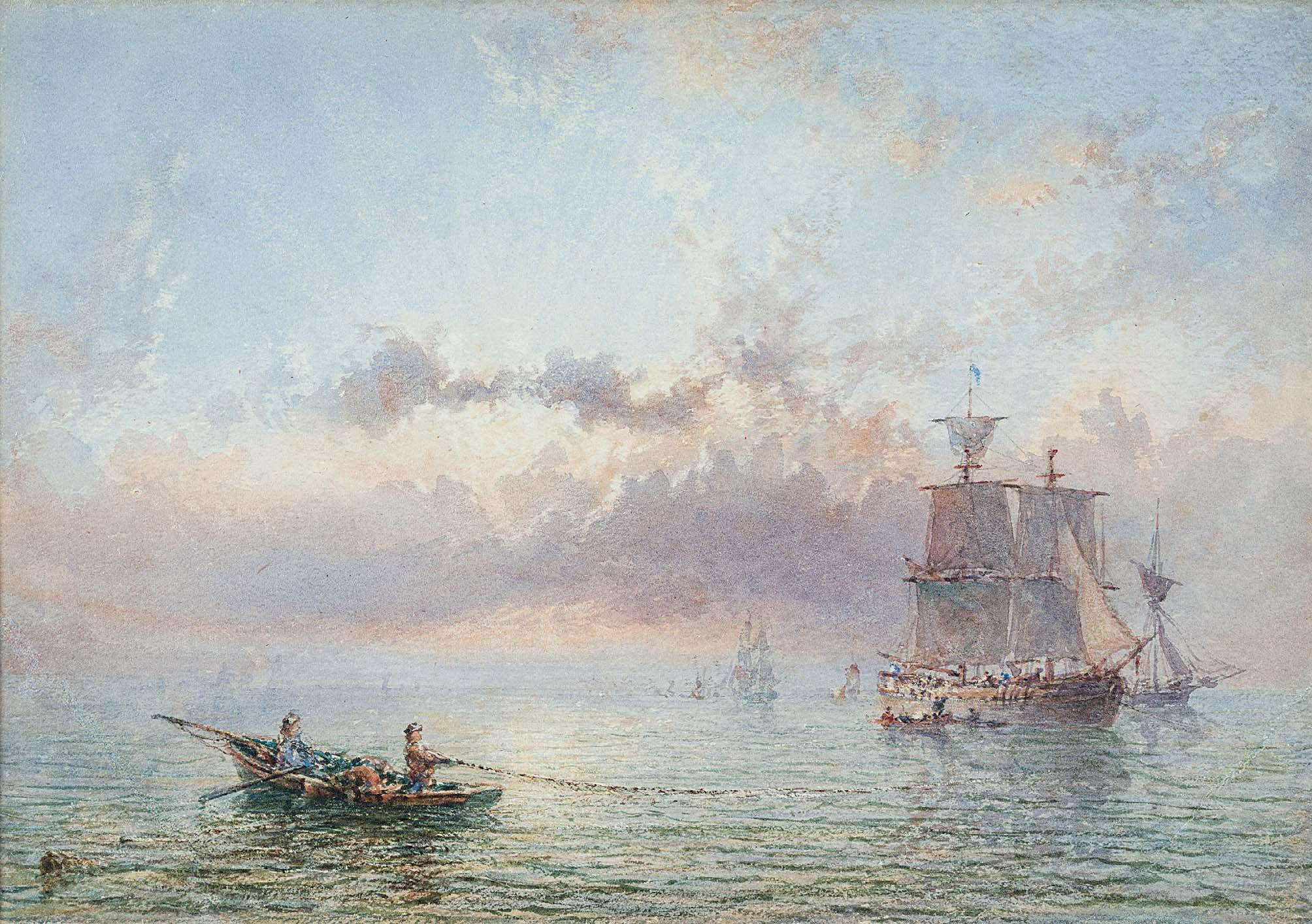
Fishing in a Calm Watercolour 6 ¾ x 9 ¾ inches
THOMAS
MILES RICHARDSON JNR
Thomas Miles Richardson Jnr, RWS (1813-1890)
Thomas Miles Richardson Jnr was born in Newcastle in 1813. His father was the landscape artist Thomas Miles Richardson Snr, who is regarded as Newcastle’s ‘Father of Fine Arts’. He was the third of six sons, and his father taught them all painting from an early age. Though Richardson Jnr was seen as particularly gifted, all ve of his brothers went on to become artists. His father had established the Northern Academy of Fine Arts in Newcastle along with its annual exhibition, the rst of its kind in Northern England. In the inaugural exhibition in 1828, Richardson Jnr exhibited two pictures, aged only 14. It was the beginning of a distinguished career to rival his father’s.
From 1832, Thomas Miles Richardson Jnr began sending his artwork to London to be exhibited with the Royal Academy of Arts and the British Institution. At rst, he was mostly painting in Newcastle before gaining particular renown for his depictions of Scotland and the Highlands. He had a preference and skill in capturing mountainous landscape and coastal scenes.
In 1837, he embarked on an artistic tour across Europe, including travel to France, Italy, Germany, Switzerland and Holland. The result of this trip was Sketches on the Continent, a folio of 26 hand-coloured lithographs produced from his drawings. The volume was published in 1838 and is dedicated to the Duchess of Northumberland, who may have been his patron.
While in Newcastle, Thomas Miles Richardson Jnr founded a private art academy with his eldest brother George, who died suddenly in 1840, aged only 33. George’s death, coupled with the growing demands of his own artwork, forced the closure of the art academy.
In 1843, he was elected an associate of the Society of Painters in Water-Colours and moved to London in 1846. In 1851, he was made a full member of that society and exhibited regularly thereafter. By the end of his career he had exhibited over 700 paintings with this society alone, and in 1857 John Ruskin praised the ‘manual power’ and use of colour in his work.
Thomas Miles Richardson Jnr died in January 1890, aged 77. The sale of his estate was held at Christie’s in June 1890.
His work is represented in the collections of the V&A; and the Laing Art Gallery (Newcastle).
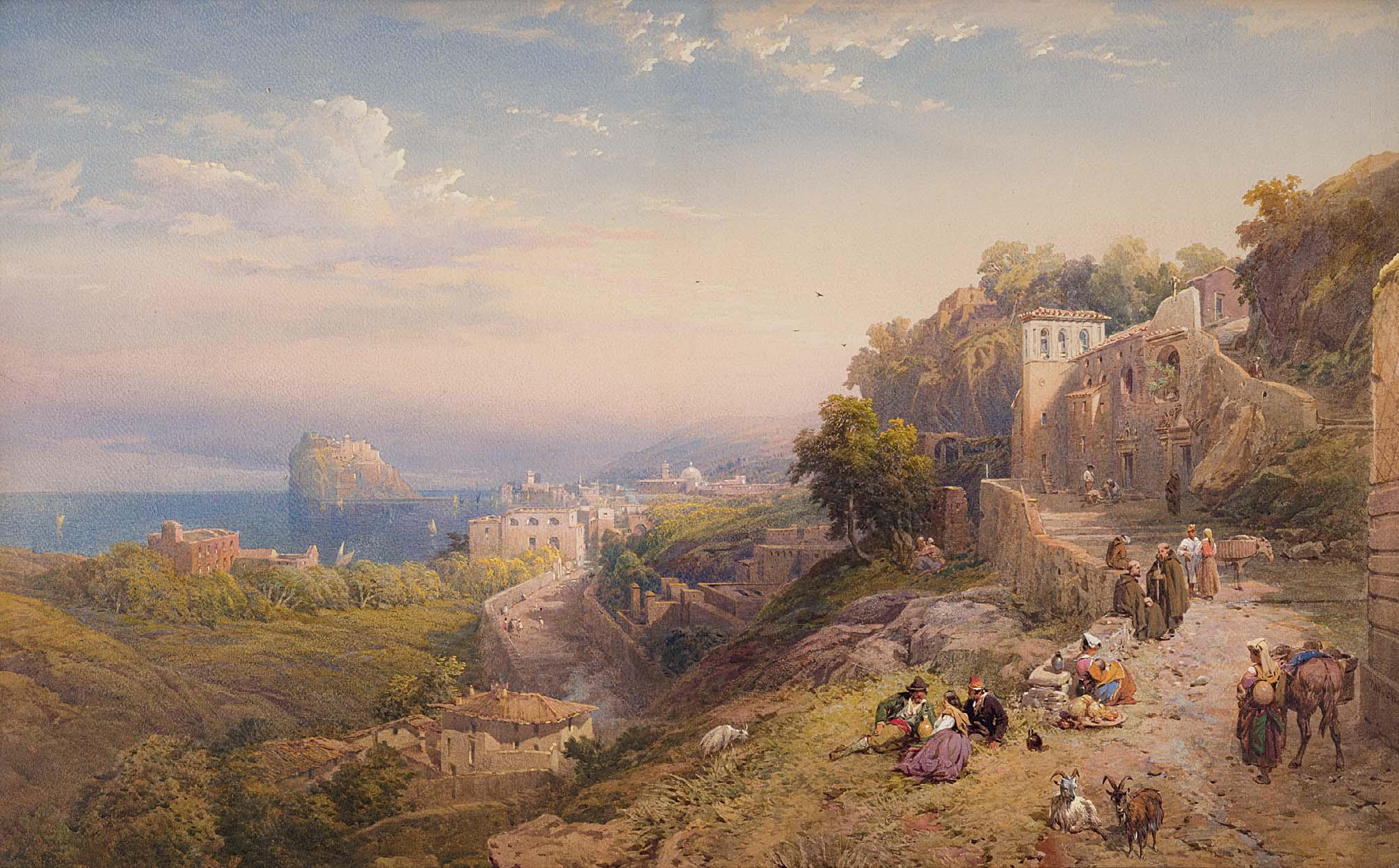
13
Ischia Watercolour
PAUL JACOB NAFTEL
Paul Jacob Naftel, RWS (1817-1891)
Paul Jacob Naftel was born on 10 September 1817 in Guernsey, to parents Paul Naftel and Sophia Bird. While neither parent was artistic, his father sold artist materials and prints on the island. From an early age, Naftel showed talent for drawing, and he taught himself how to paint by carefully copying reproductions of J M W Turner and John Varley watercolours. Another early in uence was James Du eld Harding, whose books he greatly admired as a child. Despite being self-taught, by the time he was twenty, he had been appointed as the drawing teacher at Elizabeth College in Guernsey.
In 1846, Queen Victoria visited Guernsey and Naftel’s watercolour of the event was published in The Illustrated London News. The painting was widely reproduced and highly praised, and marked the beginning of his career outside of the Channel Islands.
Paul Jacob Naftel was rst married to Elizabeth Robilliard, who died in 1849, aged just 39. After her death he met Isabel Oakley, the youngest daughter of Octavius Oakley, on one of their visits to Guernsey. Both father and daughter were watercolour artists from London. In 1853, they married in Dorking, Surrey. Together they had two sons; Cecil Oakley Naftel and Percy Hartley Naftel, and a daughter, Maud.
Paul Jacob Naftel began exhibiting with the Society of Painters in Water-Colours from 1850, and in February 1856 was elected an associate. He was made a full member three years later in June 1859. The following year he travelled to Italy with his wife on a year-long painting tour, the rst of many trips there.
In 1862, he illustrated The Channel Islands by David Ansted and Robert Gordon Latham. It included 59 illustrations, and established his reputation as one of the most successful artists from the area.
In 1870, he moved to London and lived with his family at St Stephen’s Square, Westbourne Park. From there he would travel for ‘sketching seasons’ in the Scottish Isles, Ireland and North Wales. He painted a wide range of landscapes across the United Kingdom as well as further a eld, including visits to the Pyrenees in 1881.
In 1884, Naftel moved to a studio house designed by J P Seddon on Elm Park Road, Chelsea. He continued teaching in London from this studio and his notable pupils included Rose Barton, Mildred Anne Butler and Kate Prentice. In 1889 the Fine Art Society held a solo exhibition of Paul Jacob Naftel’s artwork. It was at the height of his popularity and commercially his works were incredibly successful.
In the same year it was remarked that ‘it is rarely that a drawing of his is left unsold after private-view day’. However, in 1890, it was reported that Paul Jacob Naftel was ‘suddenly stricken down with paralysis’, leaving him without the use of his hands and unable to paint. He moved to Twickenham and isolated himself at home, only making the occasional exception for visitors. His daughter Maud had since followed her father to become a celebrated artist, but died aged just 34 in 1891. Shortly after, Naftel died in Twickenham on 13 September 1891. His studio sale was held at Christie’s in April 1892.
His work is represented in the collections of the V&A; and the Ashmolean Museum (Oxford).
14
Signed with monogram and dated 1882
Watercolour
9 ½ x 6 ¾ inches
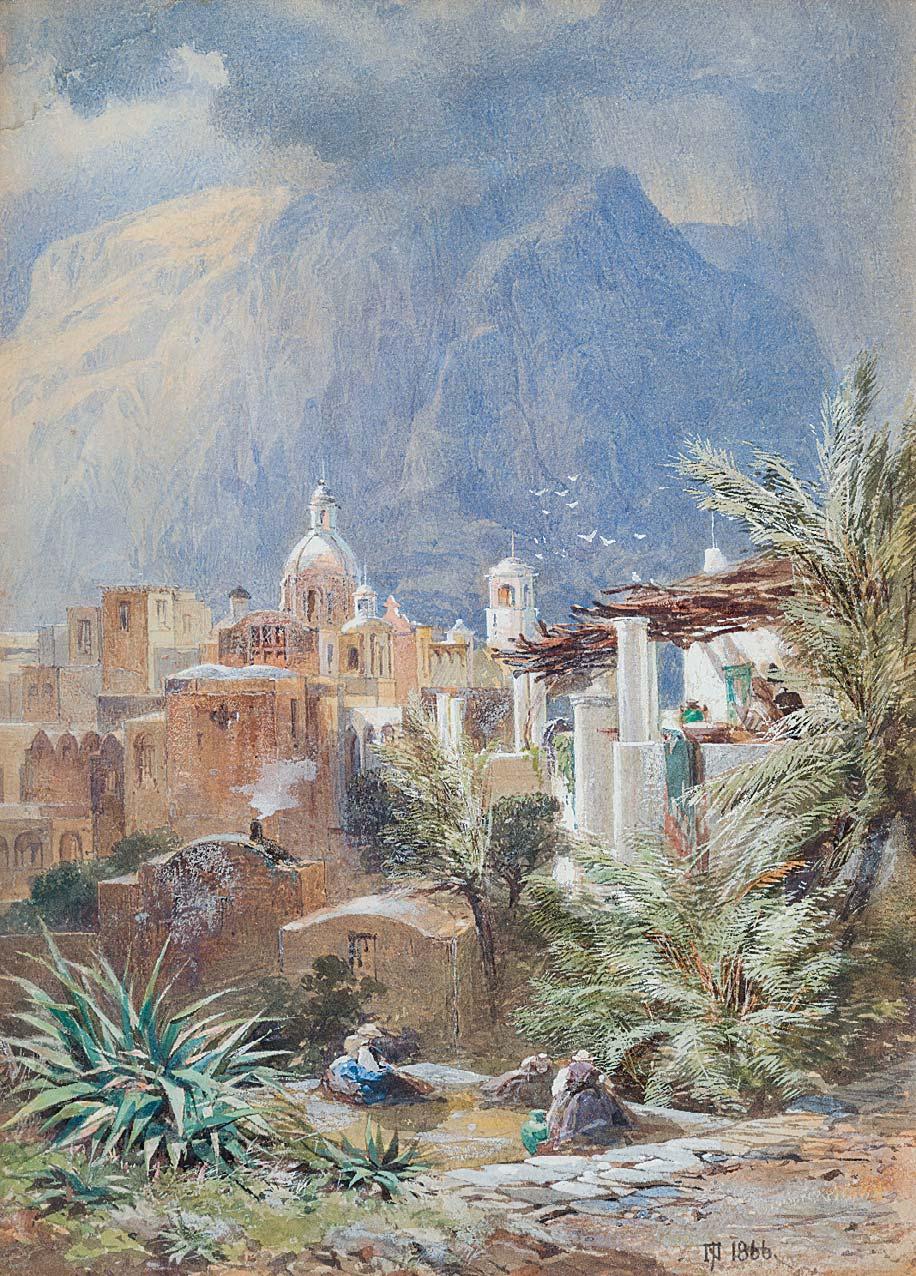
Capri
PAuL JACoB NAfTEL
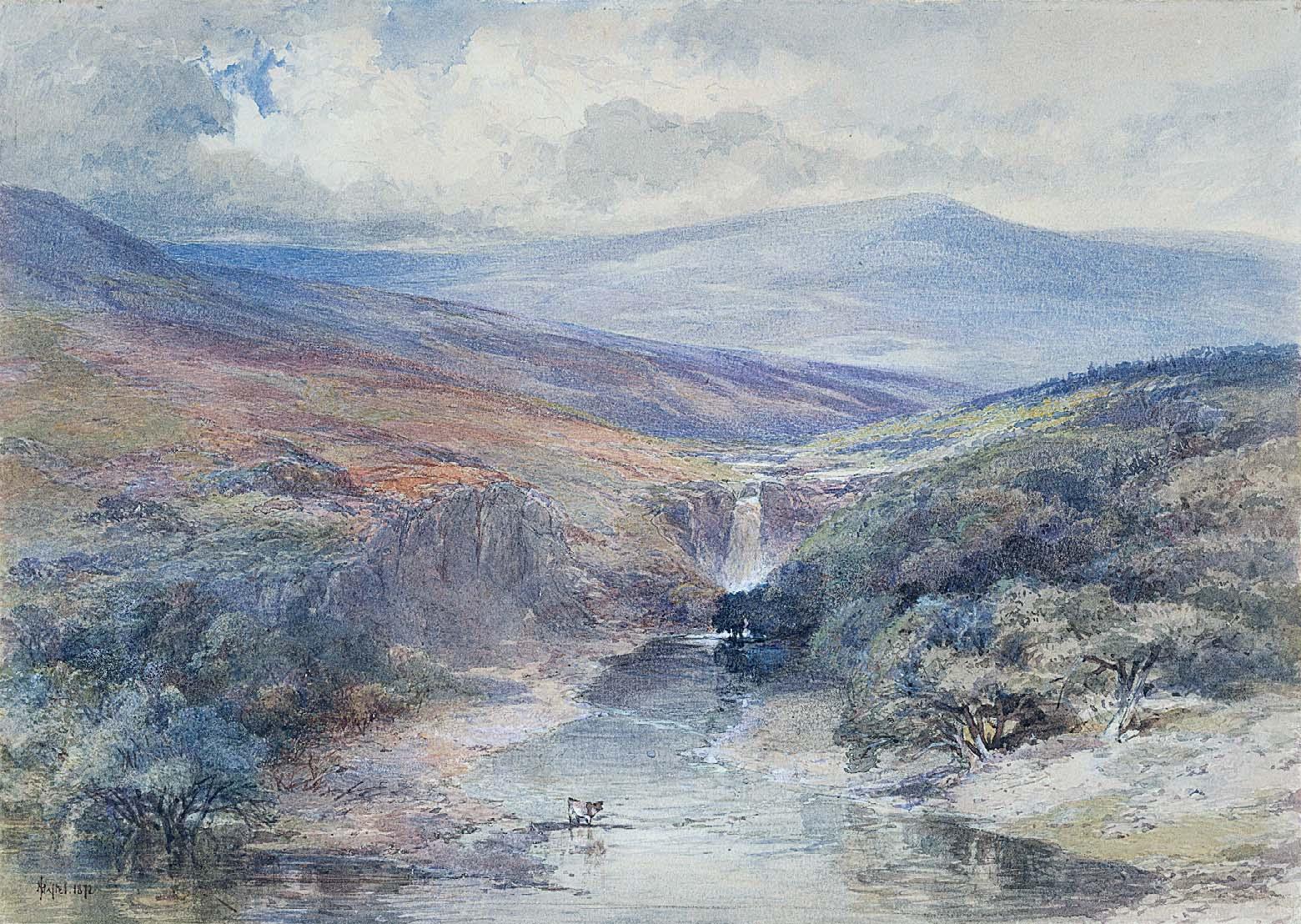
16
The Thames near Windsor
Signed and dated 1857
Watercolour, bodycolour and pencil
16 ¾ x 32 ½ inches
15
Upper Fall of the Tees, Yorkshire
Signed and dated 1872
Watercolour and bodycolour 10 x 14 inches
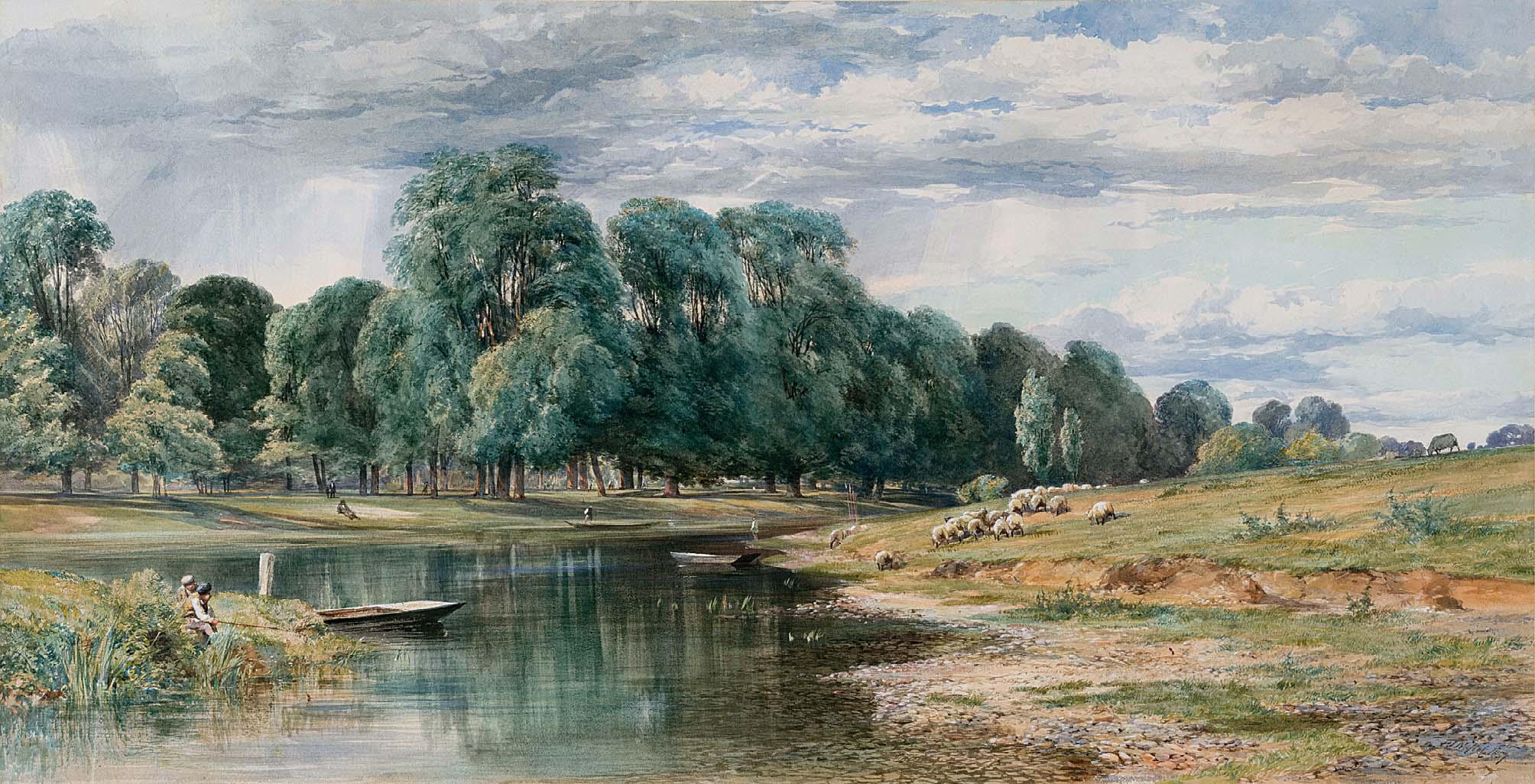
EDWARD ANGELO GOODALL
Edward Angelo Goodall, RWS (1819-1908)
A member of a well-known family of artists, Edward Angelo Goodall established his individuality by recording the places and people that he encountered on wide-ranging travels. These included an early expedition to British Guiana (1841-44) and a commission from The Illustrated London News to cover the Crimean War (1854-55). Increasingly, he became associated with scenes of the Mediterranean, from Gibraltar to Constantinople, and especially Venice, which he visited on 15 occasions. His work is restrained, meticulous yet often luminous.
For a biography of Edward Angelo Goodall, please refer to Chris Beetles Summer Show, 2021, page 101.
17 Basilica of St Francis, Assisi
Signed Watercolour 8 x 13 ½ inches
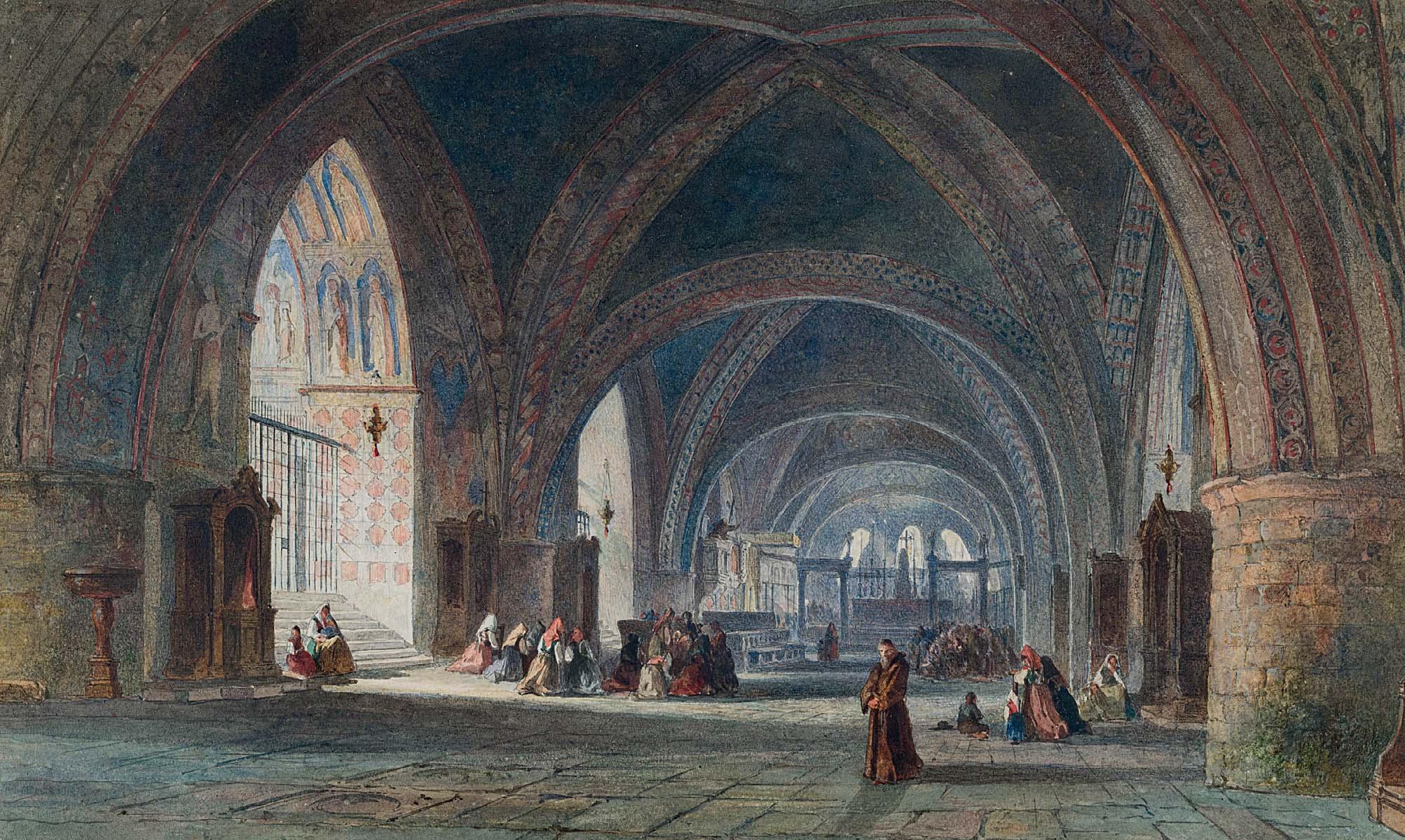
EdWARd ANGELo GoodALL
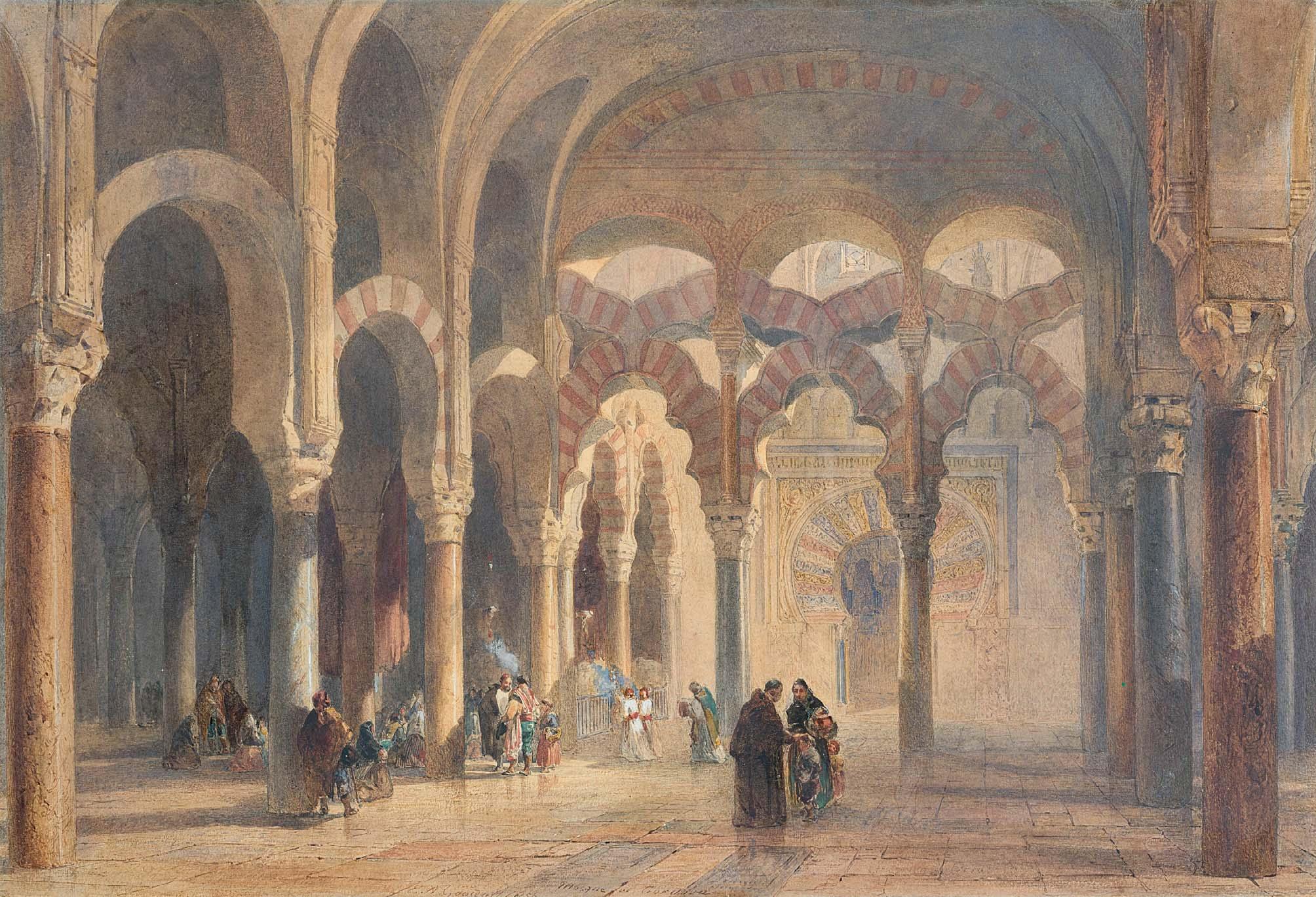
The Mosque–Cathedral of Córdoba, Andalusia, is also known as both the Cathedral of Our Lady of the Assumption and as a former mosque, the Mezquita. The Great Mosque was constructed in 785 on the orders of Abd al-Rahman I and expanded multiple times subsequently under his successors until the late 10th century.
In 1236, the mosque was converted to a cathedral when Córdoba was captured by the Christian forces of Castile during the Reconquista. It remained relatively unchanged until the 16th century when a new Renaissance nave and transept was added into the centre and the former minaret, which had been converted to a bell tower, was also remodelled. Today it is not only Córdoba’s serving cathedral but also a UNESCO World Heritage Site.
KEELEY HALSWELLE
Keeley Halswelle, ARSA ROI (1832-1891)
John Keeley Halswelle was born on 23 April 1831 in Richmond, Surrey. The son of David Halswelle, a merchant, he grew up in a middle-class family which allowed for some level of education and artistic training. From an early age, Keeley Halswelle showed a talent for drawing. Rather than entering a traditional academic or university education, he pursued art directly. His rst professional steps were in London, where he worked as a draughtsman and illustrator, contributing to The Illustrated London News, the world’s rst illustrated weekly news magazine. This work required speed and high accuracy, which e ectively served as his artistic training. This brought him into contact with publishers in Edinburgh, such as William Nelson, one of the leading gures in Victorian publishing, producing images for publications of major classic literary gures such as Byron, Scott and Wordsworth. Keeley Halswelle spent a period living and working there, which helped establish his reputation during the 1850s and early 1860s. By 1863 he was residing at Bell eld House in Duddingston, then a semi-rural area just outside the city.
It was in Edinburgh that Halswelle began to shift from illustration to painting in the late 1850s. He exhibited at the Royal Scottish Academy, starting in 1857, and was elected an associate of the Academy in 1865. This institutional recognition marked his emergence as a serious painter, rather than solely a commercial illustrator.
After his brief rst marriage ended, he married his Maria Browne in 1861, the daughter of James Browne,
19
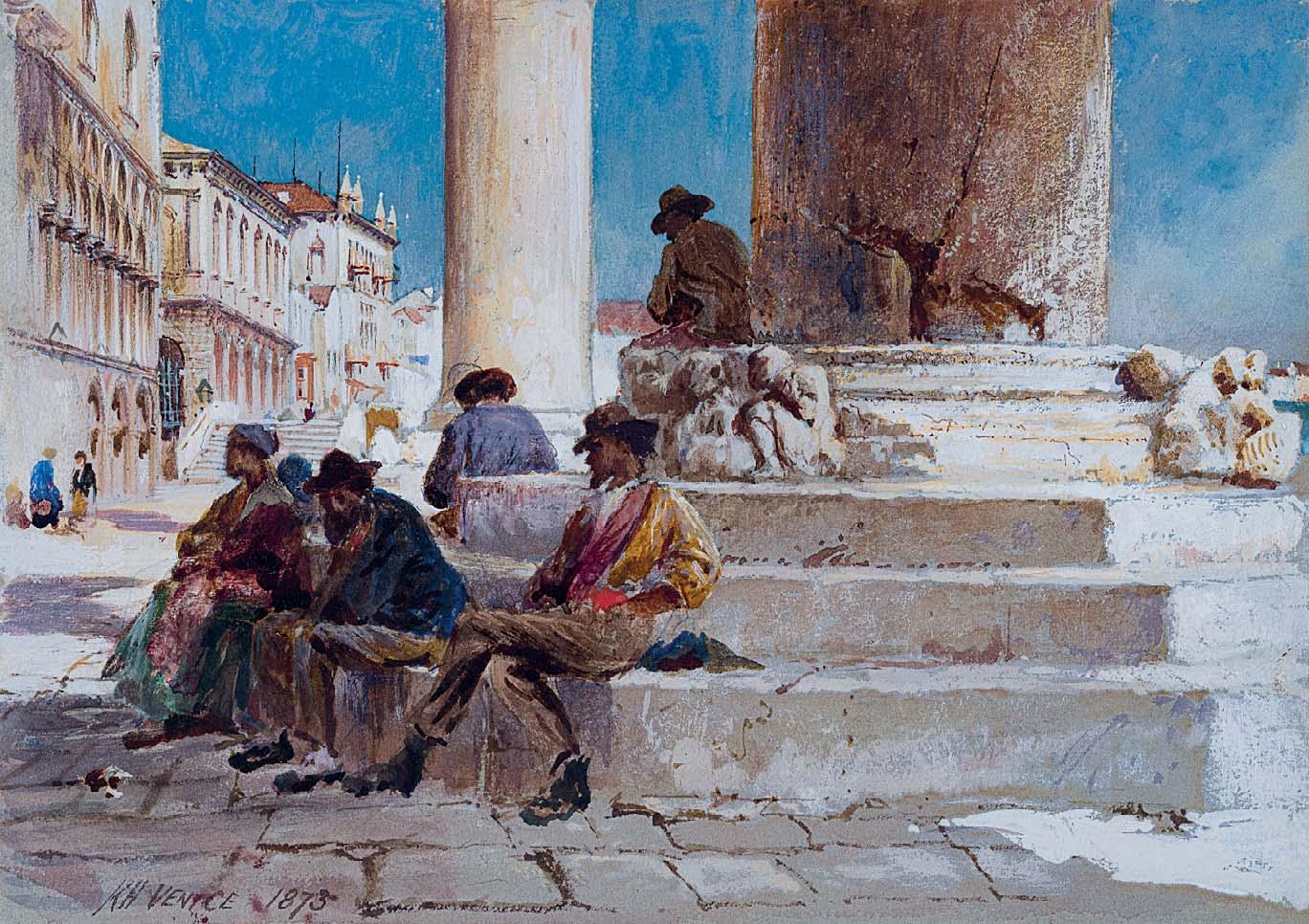
Venice
Signed with initials, inscribed with title and dated 1875
Watercolour and bodycolour; 7 x 9 ¾ inches
The Venetians in this painting are seated on the octagonal base of the column of St Tòdaro, the Byzantine St Theodore of Amasea, the city’s rst protector. Its pair, surmounted by the winged Lion and symbol of St Mark, is seen in the distance looking down the Riva degli Schiavoni. The small sculptures on the base amongst the sitters depict the trades – a shmonger, who o ers sh from a wicker basket and a blacksmith hitting an anvil with a hammer. Other trades that were portrayed included a butcher and a wine seller, but, sadly due to erosion and damage the gures are gravely depleted and many are missing.
an Edinburgh advocate. A signi cant turning point came with their move to Italy in 1869, where he spent several years painting continental scenes. His early paintings were largely gurative, often with literary or historical narratives. Maria died in 1873.
Upon his return from Italy in 1873, Keeley Halswelle married Helen Gordon, a daughter of a British Army major-general. The couple had two sons, one of them Wyndham Halswelle, who would later become a notable British athlete and Olympian.
After his return to London, Keeley Halswelle increasingly focused on landscape painting, particularly scenes of the River Thames – the works he is best known for today. His inspiration was mainly drawn from life as he spent several years aboard a houseboat, The Kelpie, which he used as a oating studio, allowing him to paint river scenes at rst hand. This later resulted in the book Six Years in a Houseboat (1883).
In 1880, Halswelle established a more permanent base at Stoner House in Steep, Hampshire. From here, he continued to travel and maintain connections with London’s art world. His Thames paintings and en plein air sketches were widely exhibited in London, many of which have ended up in notable collections such as the V&A and the National Gallery. In 1882, he was elected a member of the Institute of Painters in Oil Colours, marking formal recognition by his peers.
Keeley Halswelle died in Paris on 11 April 1891, from pneumonia, and was buried on 20 April 1891 in Steep, Hampshire.
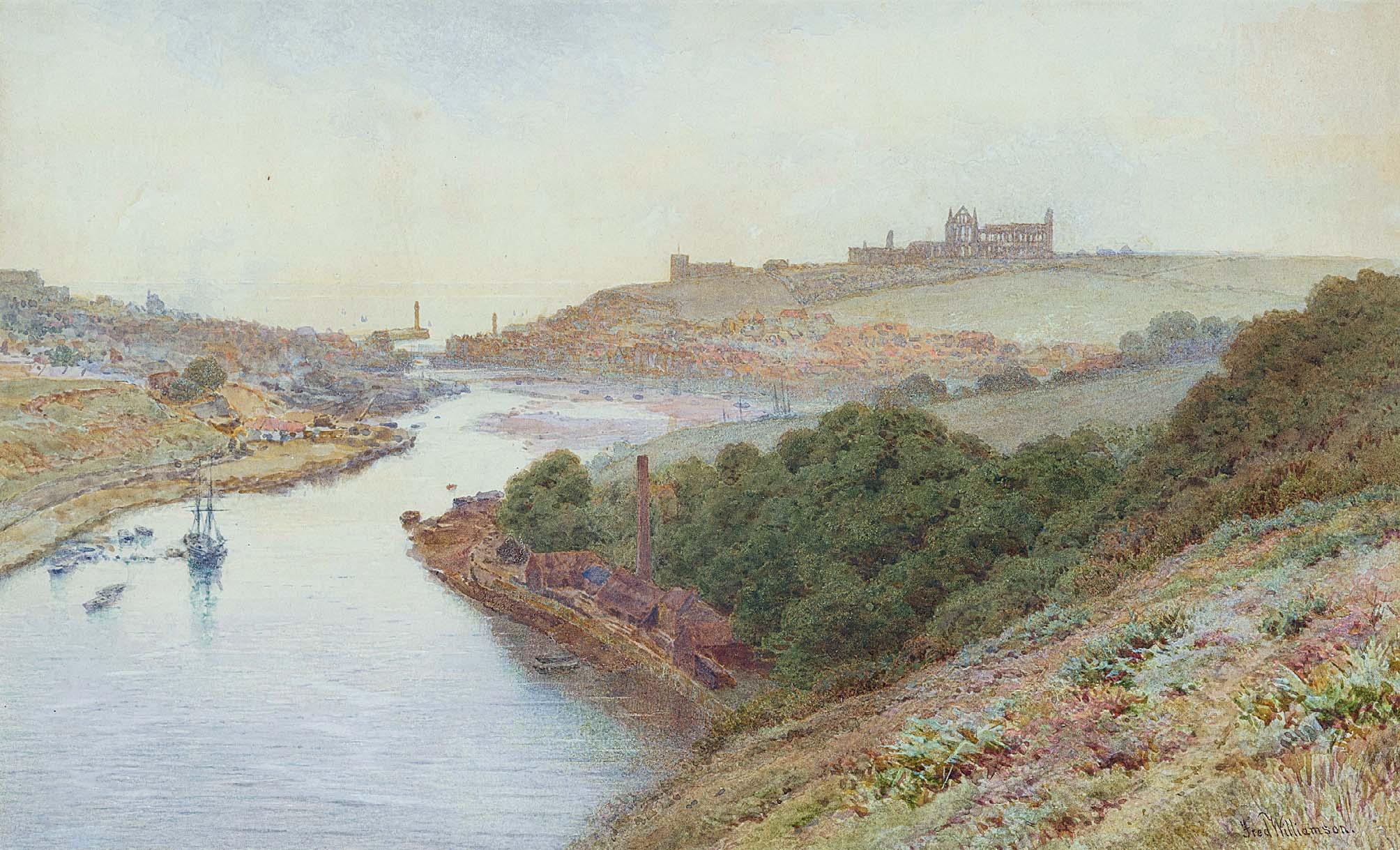
FREDERICK WILLIAMSON
Frederick Williamson (1835-1900)
Frederick Williamson was a Victorian landscape painter, best known for his nely executed watercolours and pastoral scenes.
Born in London, he later settled at Farncombe Villas in Godalming, Surrey, from where he developed a successful exhibiting career. He exhibited widely, most notably at the Royal Academy where he showed thirty-seven works between 1864 and 1899.
Frederick Williamson had a particular passion for depicting the English countryside, which he portrayed with great precision. His landscapes, frequently featuring sheep and cattle, are distinguished by their delicate touch, subtle
colouring and close observation of seasonal change. Williamson brought freshness and variety to this popular subject matter, often being compared to Thomas Sidney Cooper. Although working with established traditions, Williamson’s work remains appealing for its charm, skill, and beautiful re ection of the Victorian countryside. He died in 1900.
His work is represented in the collections of the V&A; the Fitzwilliam Museum (Cambridge), and Colchester and Ipswich Museums.
ROBERT THORNE WAITE
Robert Thorne Waite, RWS RBC ROI (1843-1935)
Robert Thorne Waite was a painter, mostly in watercolour, of bright and airy landscapes and pastoral scenes. He was particularly fond of the corn and hay elds of the South Downs.
For a biography of Robert Thorne Waite, please refer to Chris Beetles Summer Show, 2020, page 120.
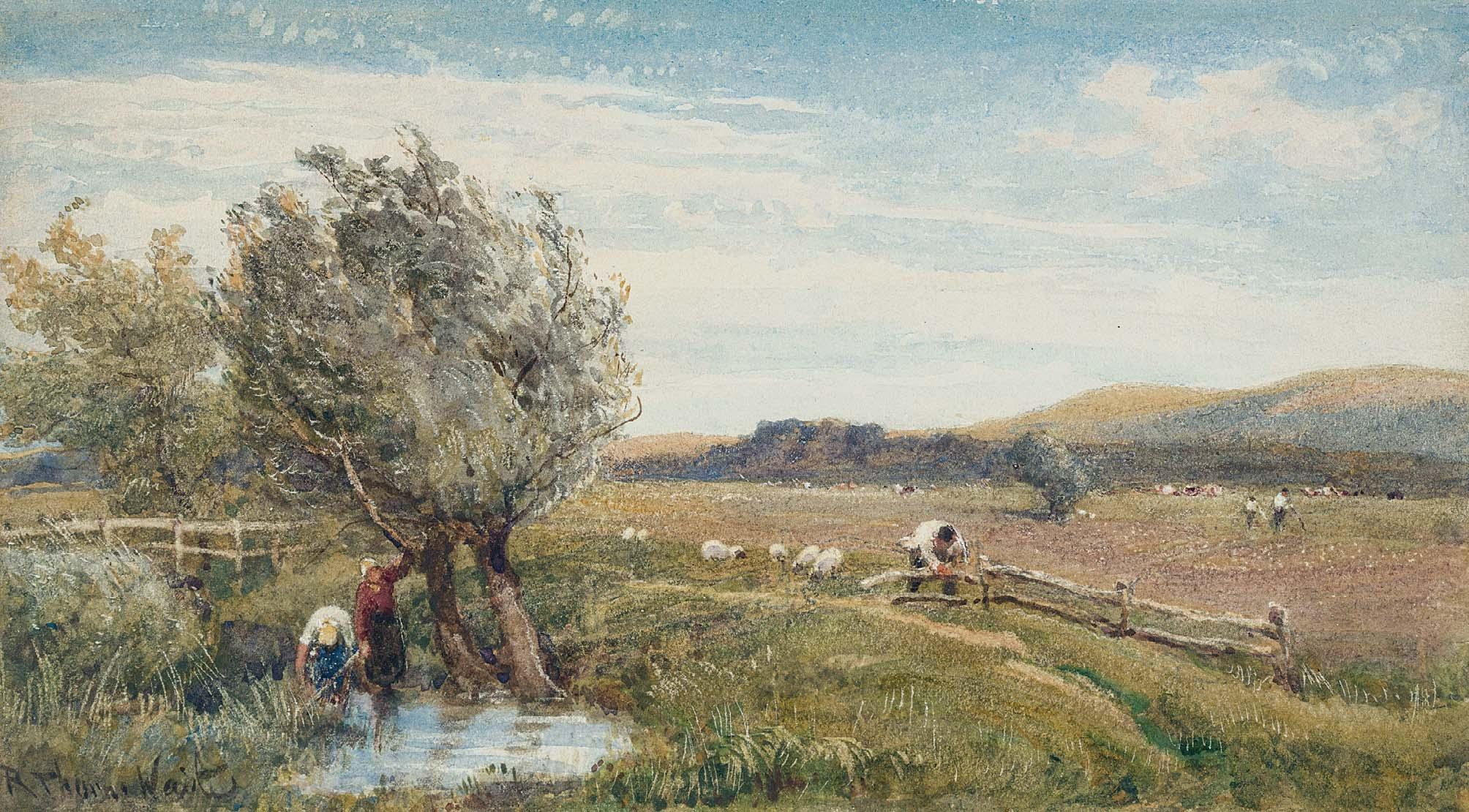
21
Midhurst, Sussex
Signed
Watercolour
5 ¼ x 9 ½ inches
ALBERT GOODWIN
Albert Frederick Goodwin, RWS RWA (1845-1932)
In synthesising the in uences of J M W Turner and the Pre-Raphaelites, Albert Goodwin may be considered one of the most Ruskinian of Victorian landscape painters. Indeed, he was taken up by John Ruskin and, in 1872, given the opportunity to travel with him on an intensive tour of Italy and Switzerland. This set the pattern for many further and extensive travels. Like Ruskin, Goodwin
responded to landscape with a religious fervour and understanding; but he interpreted it with greater eclecticism than did his mentor, even experimenting with the style of James McNeill Whistler, Ruskin’s adversary in the eld of aesthetics.
For a biography of Albert Goodwin, please refer to Chris Beetles Summer Show, 2014, page 26.
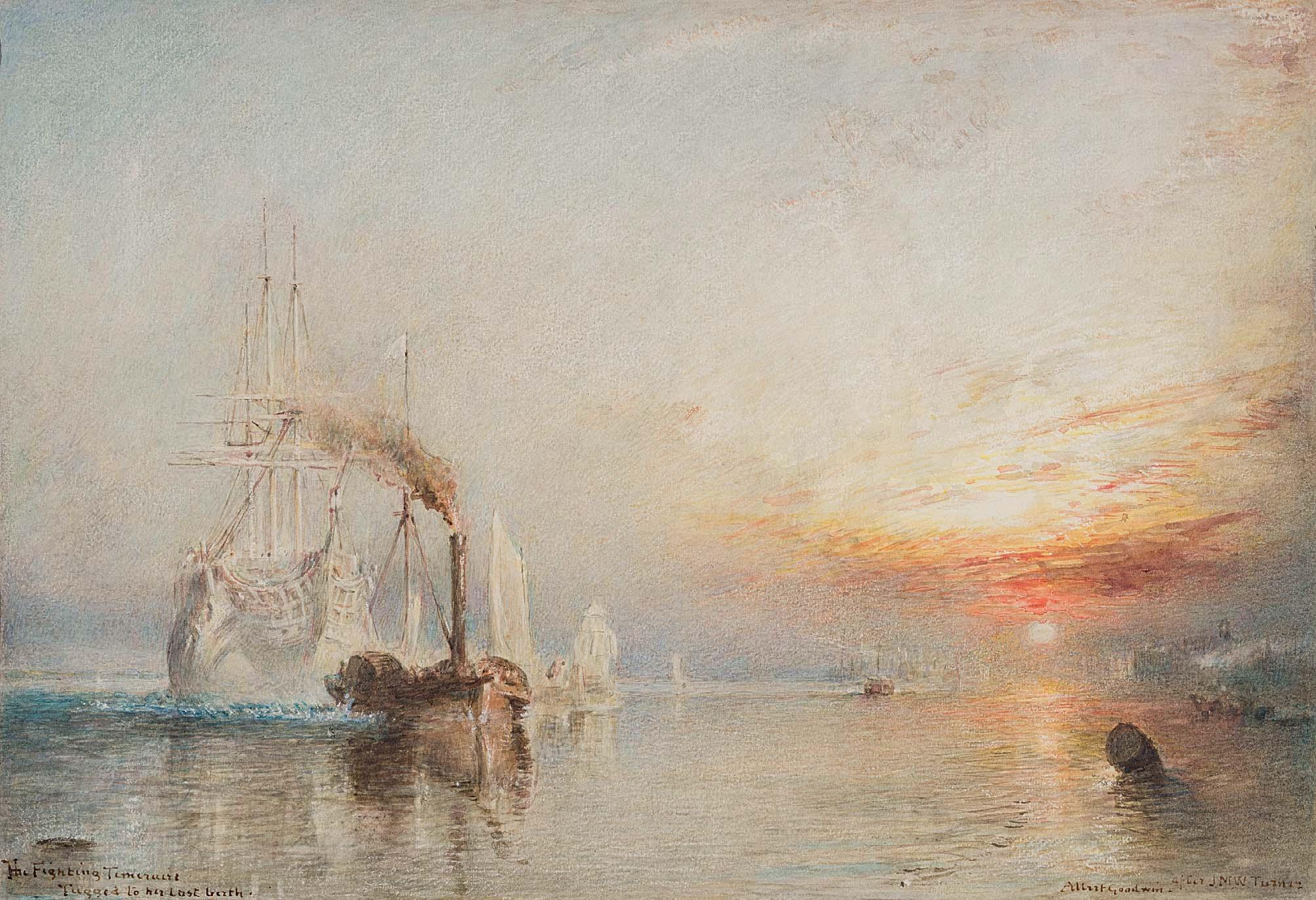
22
The Fighting Temeraire Tugged to her Last Berth. After J. M. W. Turner
Signed, inscribed with title and ‘After J M W Turner’ Watercolour with ink and bodycolour 10 x 14 ¾ inches
Literature: Albert Goodwin RWS, 1845-1932, London: Chris Beetles Ltd, 1986, Limited Edition of 1000, plate 153
This watercolour is a beautiful and rare example of Goodwin in Pre-Raphaelite mood. It also con rms the strength of his style and uniqueness of his vision even while displaying so much outside in uence. The composition has many of his traits; for example, multiple subjects, here the focus being divided between the group of children at the water’s edge and the re ection of the Cathedral in the water, with plenty of incidental detail. The device of a tree in the foreground
diagonally dissecting the image plane also appears frequently in his work. Technically there is also much that is typical, including the deliberation in the brushwork of the foliage and the scratching-out of the apple blossom. However the palette is highly unusual with its pretty pastel shades so reminiscent of Arthur Hughes. Above all, the execution is absolutely exceptional in its degree of detailing throughout and in particular the exquisite nishing of the children.
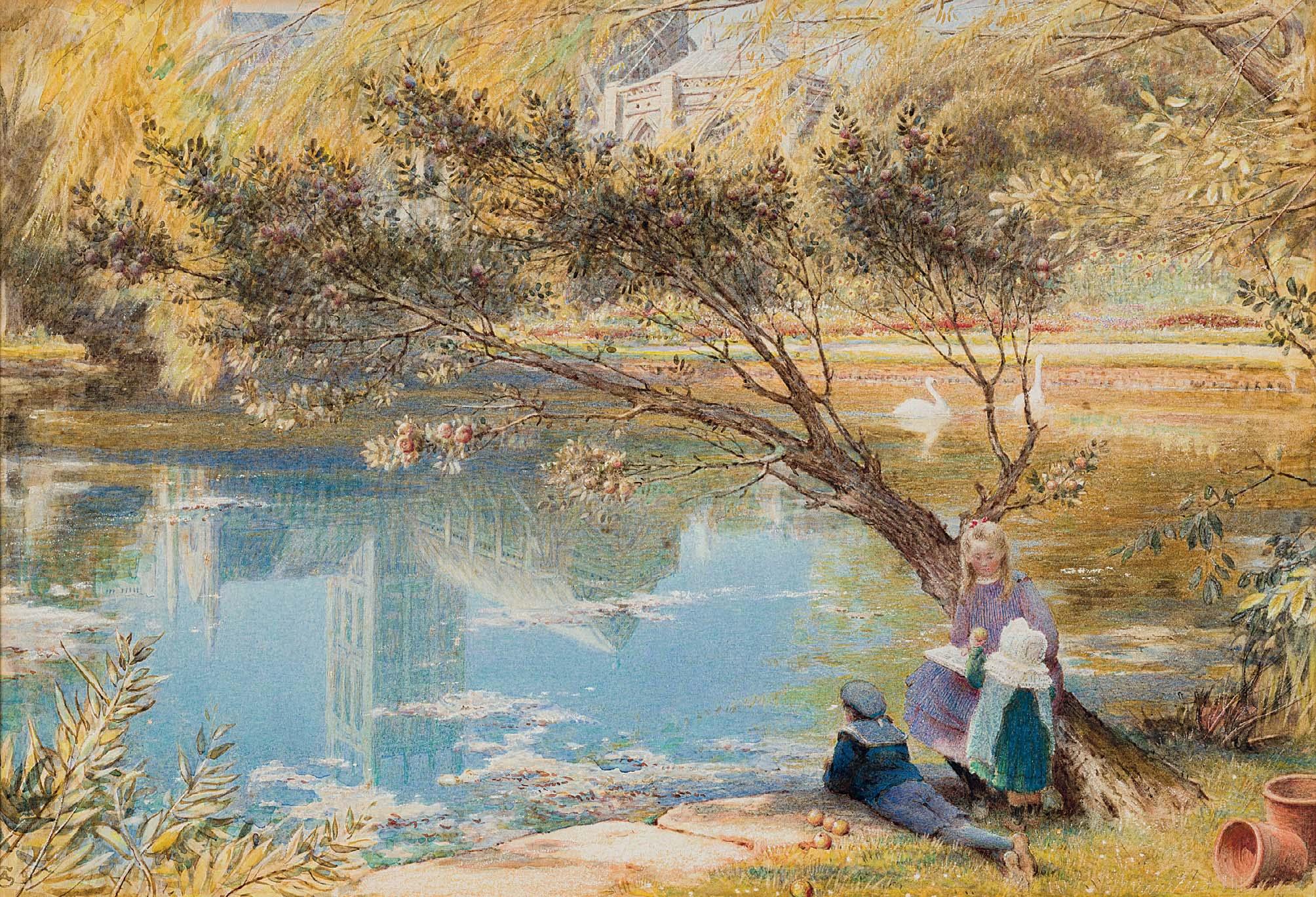
23
Wells Signed with monogram Watercolour and bodycolour 13 ¾ x 20 ½ inches
Exhibited: ‘The Chris Beetles Summer Show’, Chris Beetles Gallery, London, 2003, no 14; ‘Albert Goodwin RWS (1845-1932), The John & Mary Goodyear Collection’, Chris Beetles Gallery, London, April-May 2022, no 14
JOHN WILLIAM NORTH
John William North, ARA HRSW RWA (1842-1924)
John William North was one of the most successful of late Victorian painters at capturing the experience of the rural atmosphere, in both oil and watercolour. Though he was best known for his English landscapes – and especially those of Somerset – his intense, almost tactile, approach to representing dense foliage equally suited the lush vegetation of the Bay of Algiers, which he visited regularly during the late 1870s.
For a biography of John William North, please refer to Chris Beetles Summer Show, 2014, page 24.
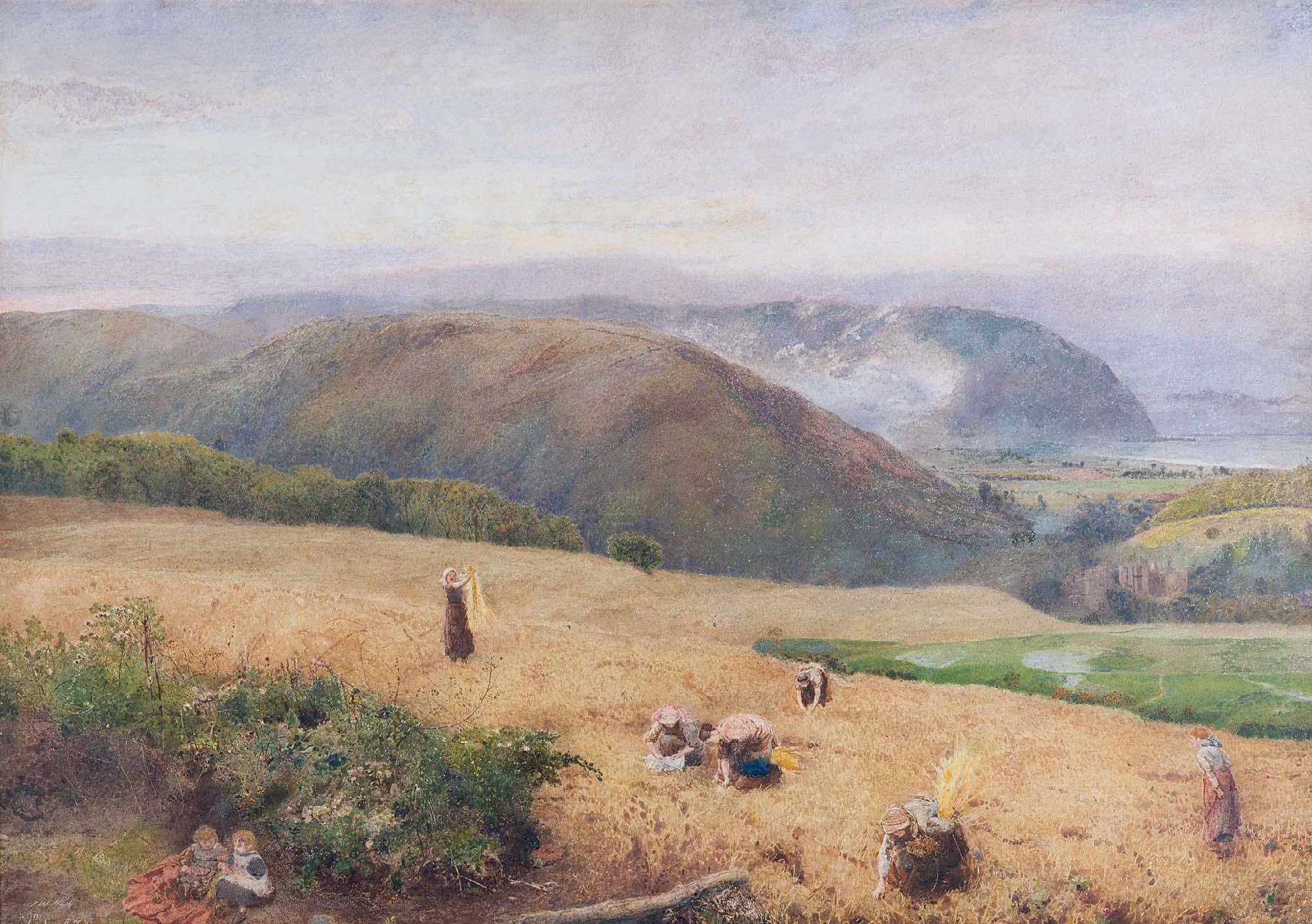
24
Gleaners, Coast of Somerset
Signed and dated 1890 Watercolour with bodycolour 26 x 36 ¾ inches
Exhibited: Old Watercolour Society, London, 1891, no 67
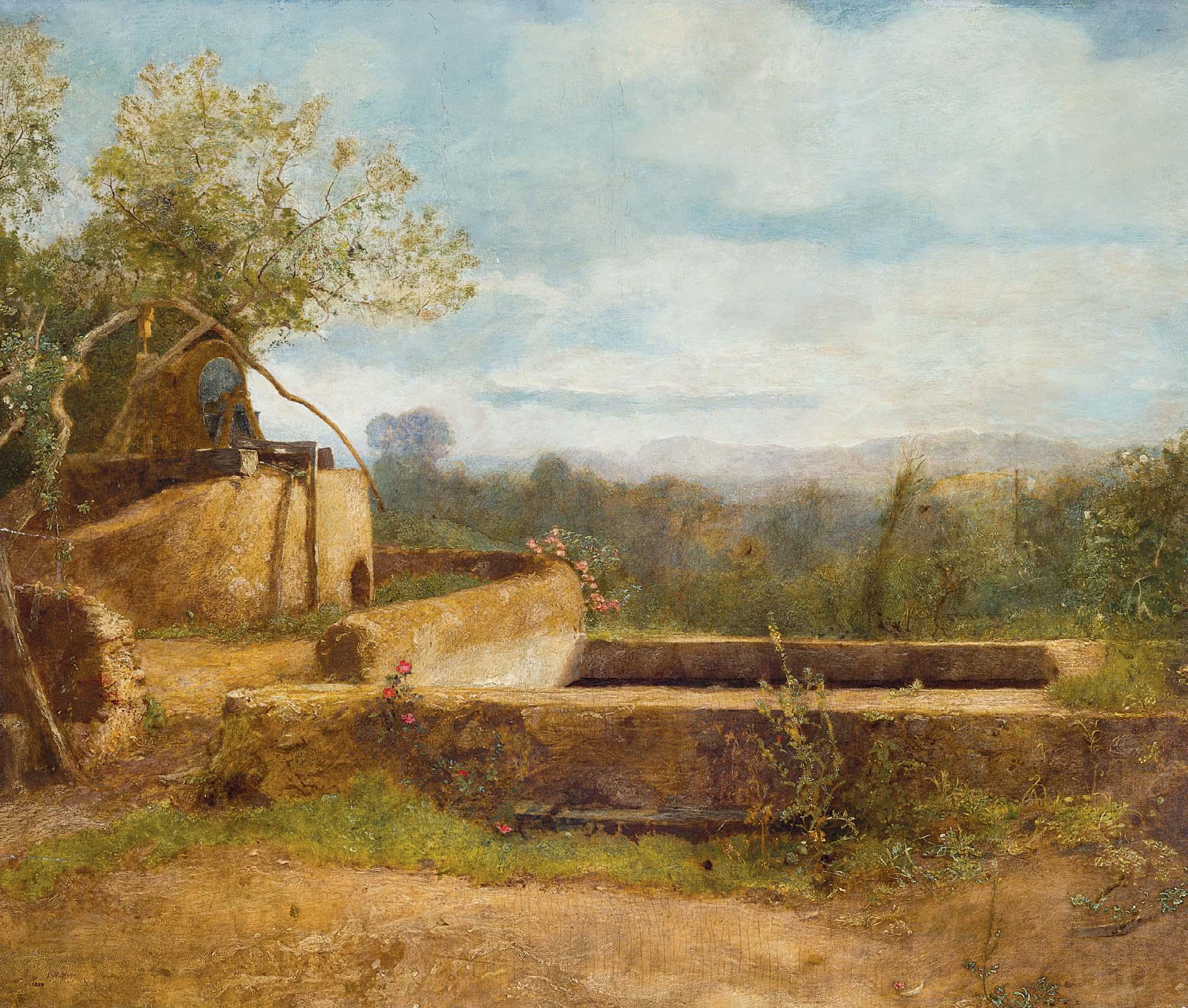
Signed, inscribed ‘Algiers’ and dated 1880
Algerian Afternoon
Oil on panel
24 ¾ x 30 inches
WALTER TYNDALE
Walter Frederick Roope Tyndale, RBC RI (1855-1943)
Walter Tyndale was one of the most popular and in uential topographical watercolourists working at the turn of the century. He was also one of the rst to bene t from the printing revolution of 1901 when his publishers, A & C Black, pioneered the use of three colour half-tone plates. The ensuing publishing boom led to a wealth of commissions for Tyndale for illustrated travel books, which took him from the Wessex countryside to Europe and the Far East.
For a biography of Walter Tyndale, please refer to Chris Beetles Summer Show, 2021, page 112.
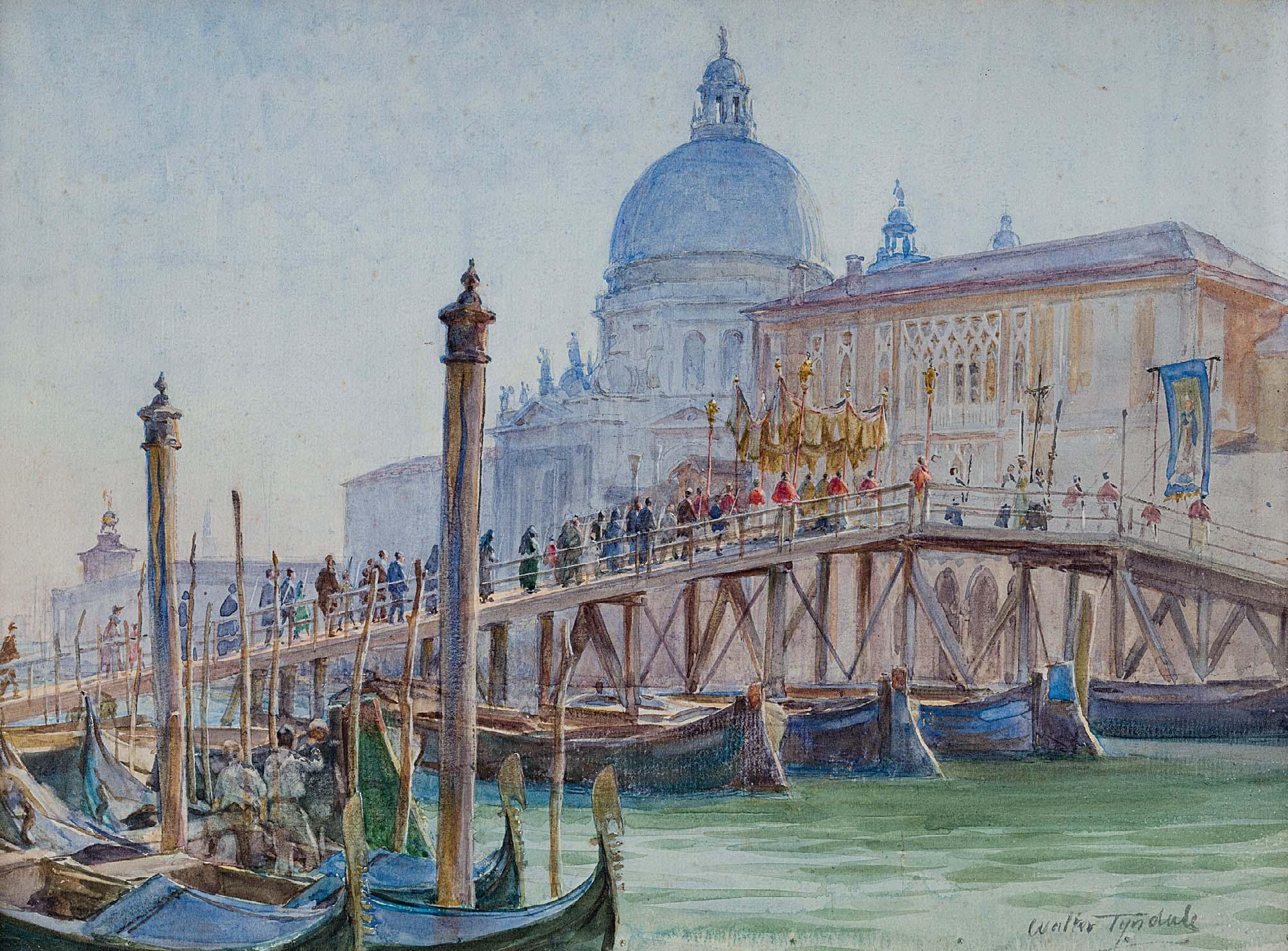
26
The Feast of Our Lady of Health, Grand Canal, Venice Signed Watercolour 9 ½ x 13 ½ inches
Exhibited: ‘Three Victorian Travellers’, Chris Beetles Gallery, London, March-April 2024
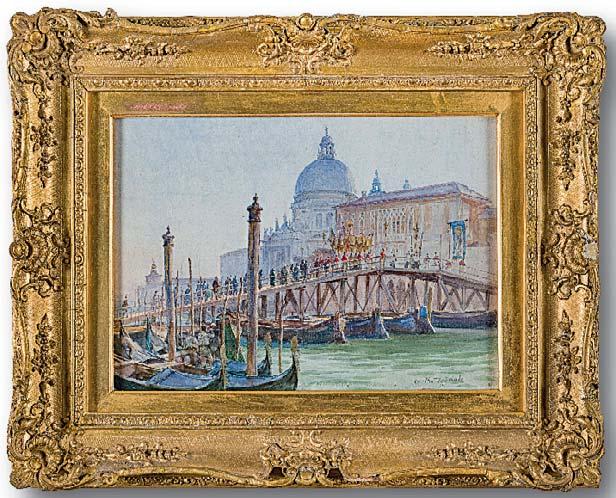

The Feast of Our Lady of Health (Festa della Madonna della Salute) is a major Venetian festival held annually on 21 November to commemorate the end of the 1630 plague (in which which over 47,000 Venetians died). Thousands of residents make a pilgrimage to the Basilica di Santa Maria della Salute, crossing a temporary bridge over the Grand Canal to light candles, pray, and feast on traditional Castradina soup, a rustic dish made from castrated mutton, cabbage and spices.
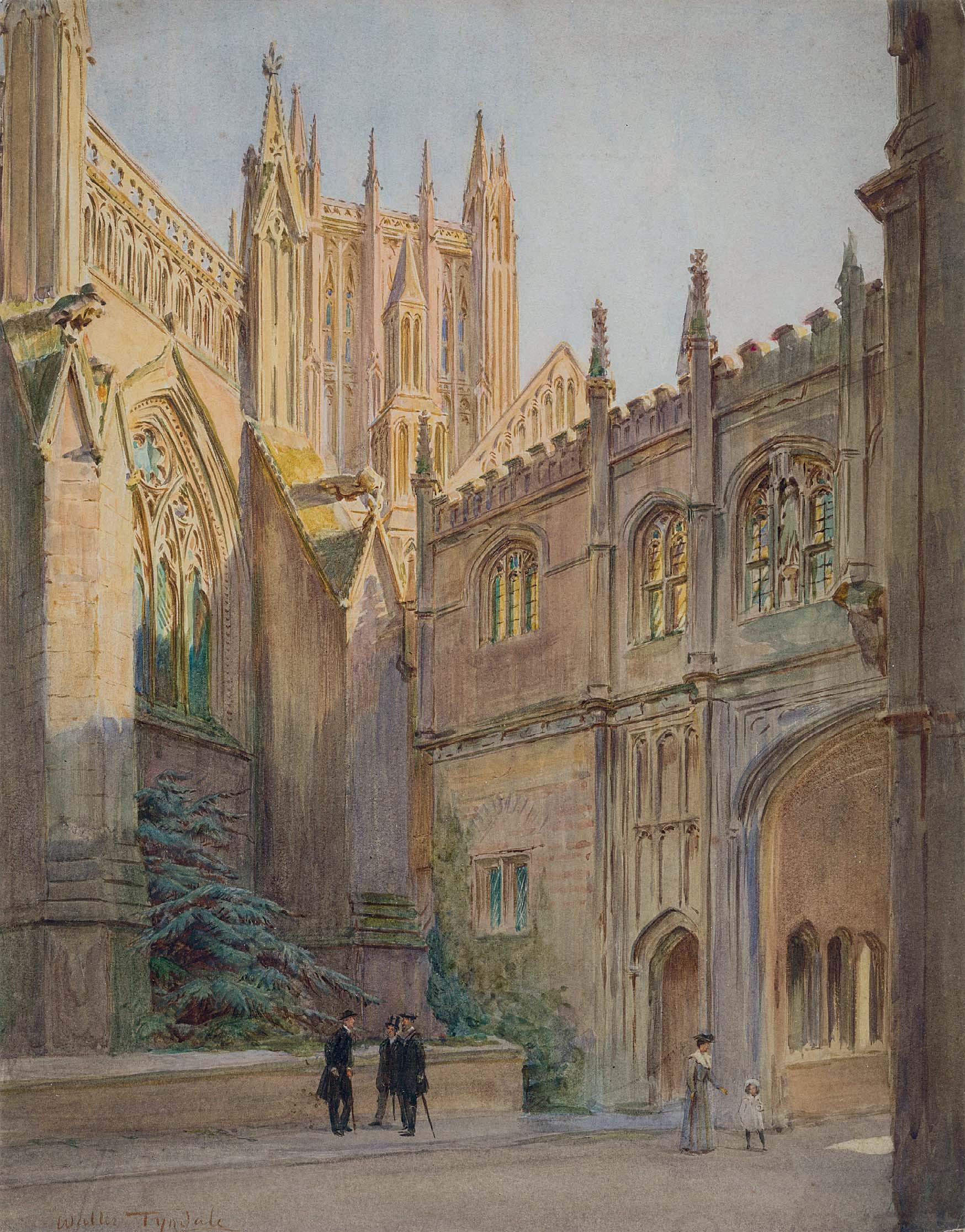
The Chain Gate, Wells Cathedral
Signed
Watercolour 11 x 9 inches
The Chain Gate, on the north side of the cathedral, was built around 1460 to link the cathedral to Vicars’ Close. The passageway on the upper level enabled clerics to enter the chapter house without having to cross either the public streets or battle inclement weather.
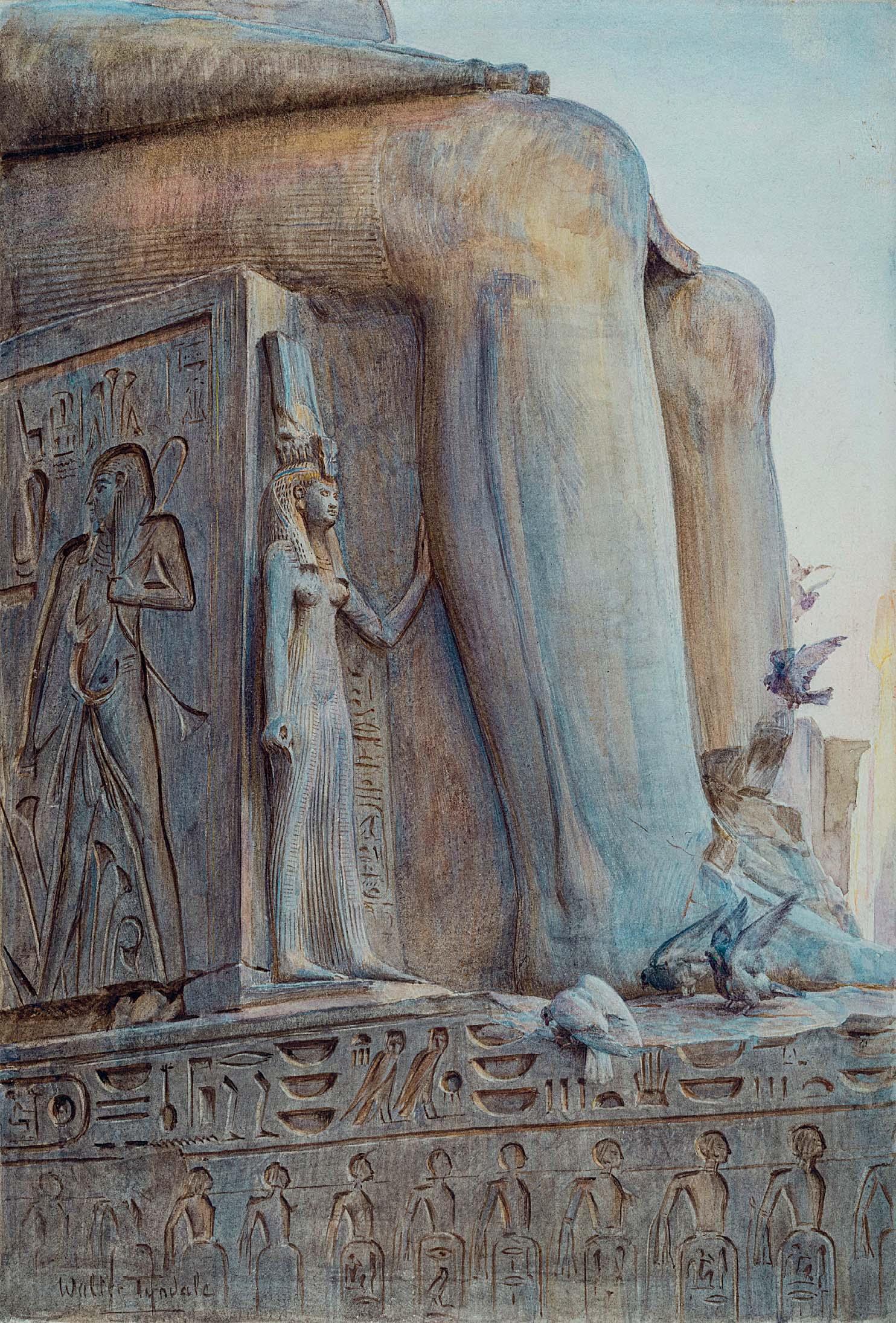

The statue of Queen Nefertari with her hand touching the leg of colossus Ramses II, is located in the rst courtyard (also known as the Court of Ramses II) of the Luxor Temple. The a ectionate gesture is a re ection of Nefertari’s status, she was the rst and most beloved ‘Great Royal Wife’ of Pharaoh Ramses II and as a highly educated woman, played a pivotal role in diplomacy in 19th Dynasty Egypt. At Abu Simbel, Ramses II broke with tradition by carving statues of Nefertari at the same height as his own, representing her as his equal partner.
28
Nefert Ari, Luxor Temple
Signed Watercolour
10 ¼ x 7 inches
Illustrated: Walter Tyndale, Below the Cataracts, London: William Heinemann, 1907, frontispiece
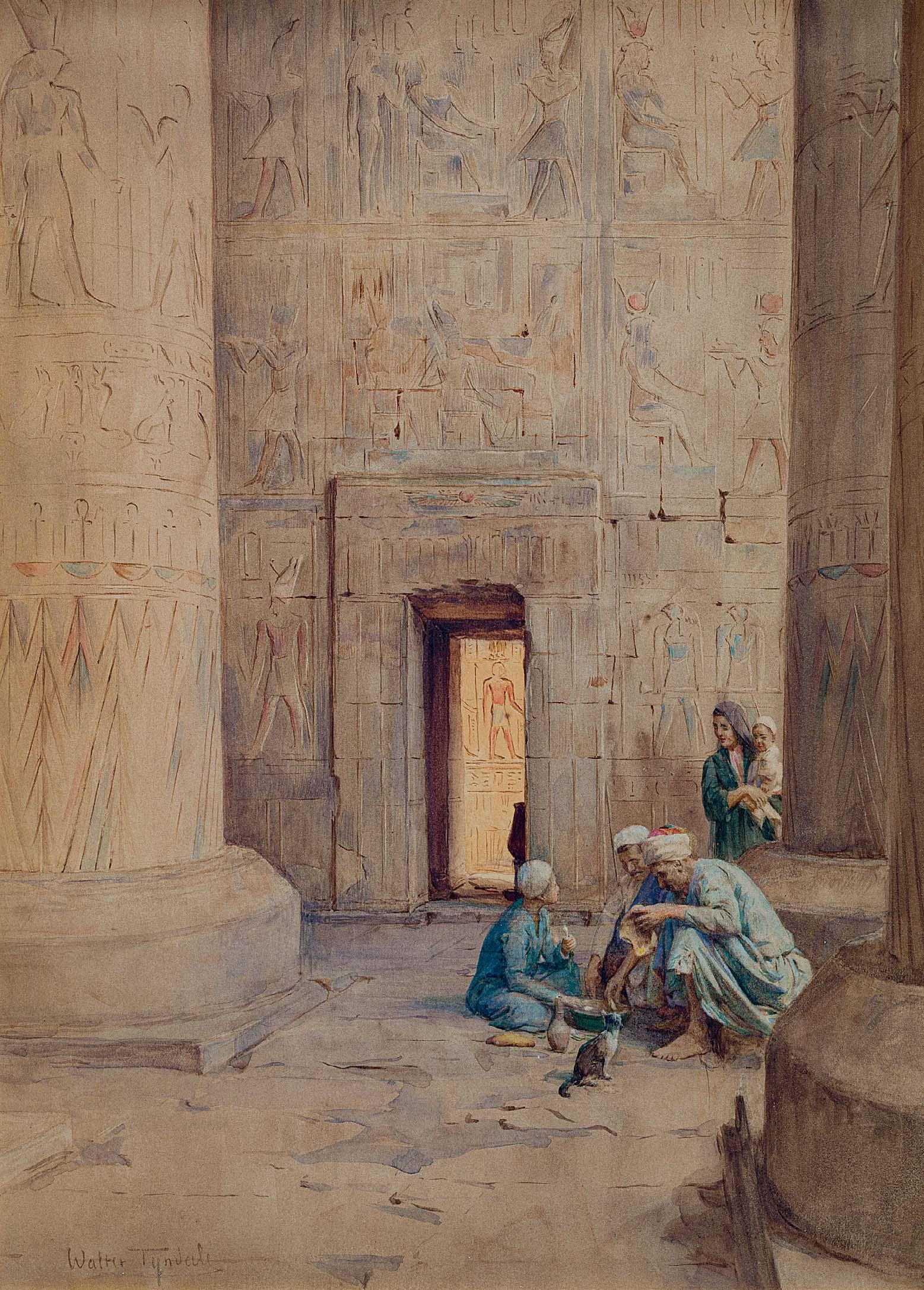
Among the Temple Columns, Cairo
30
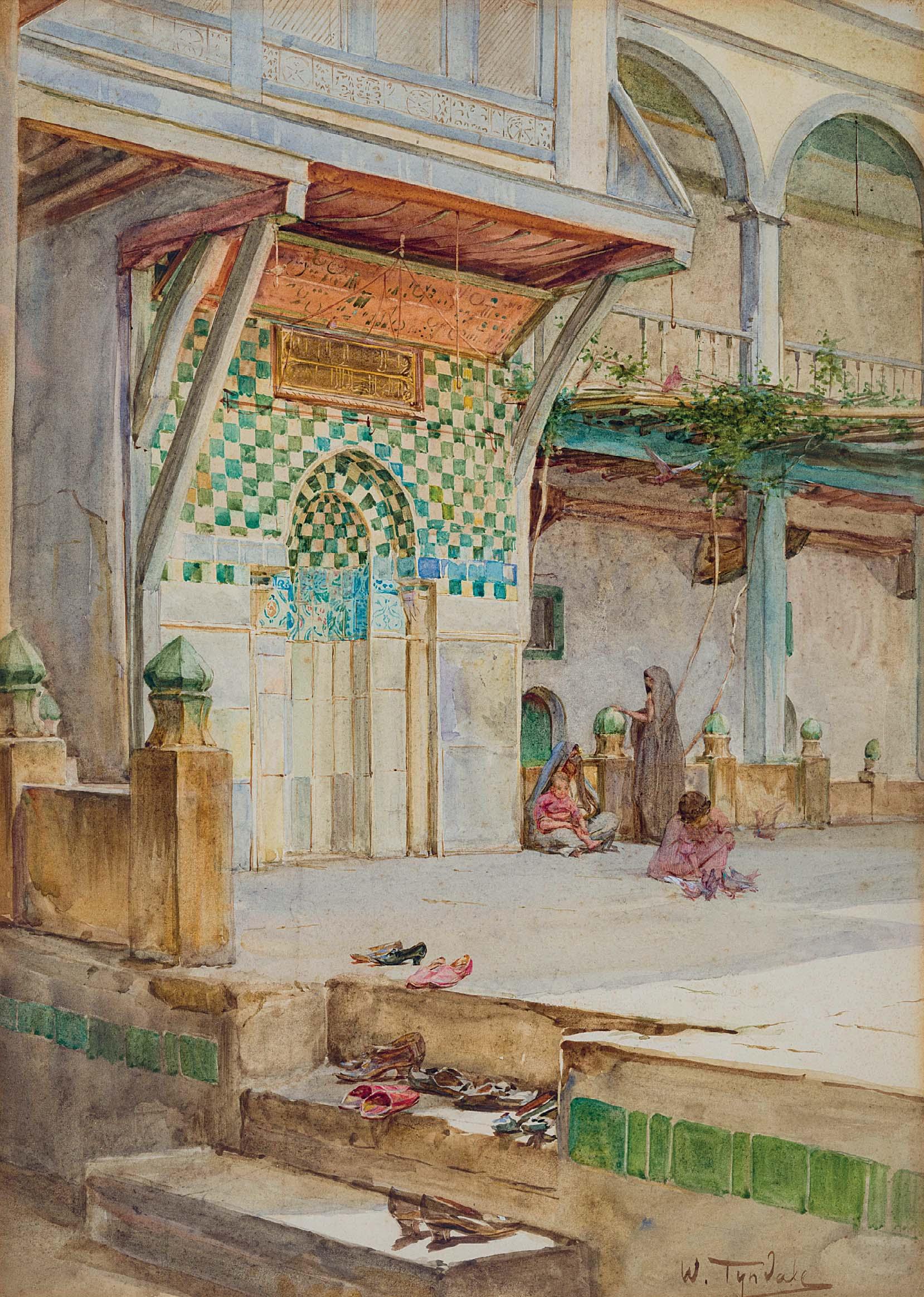
Courtyard at Ustaes Kulchim, Cairo
Signed Watercolour
13 ½ x 9 ½ inches
31
Heiliges Blut Kapelle
Signed
Watercolour with bodycolour
10 ¼ x 14 inches
32 (below right)
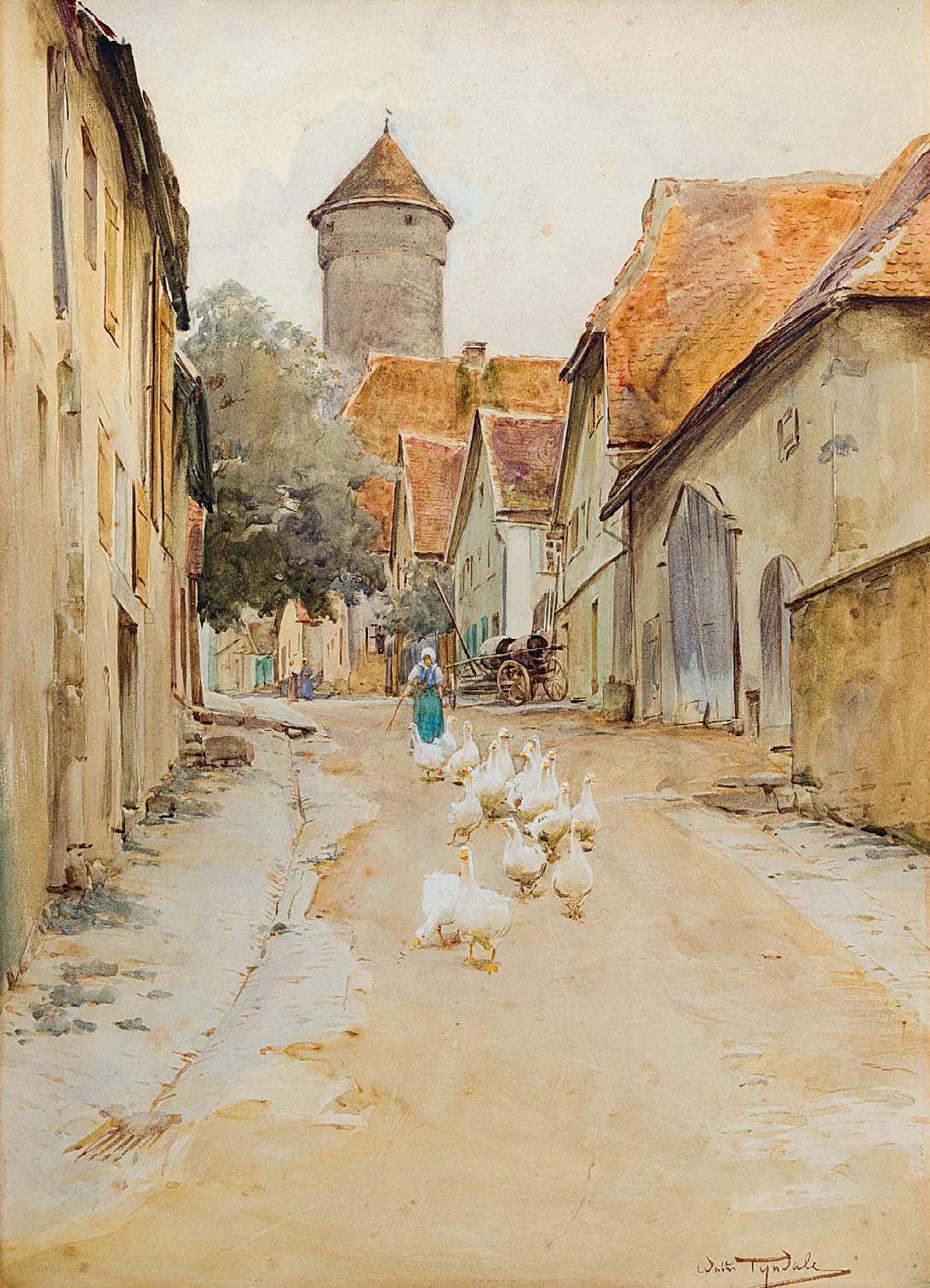
Woman herding geese, Rothenburg
Signed Watercolour 14 x 10 inches
33 (below)
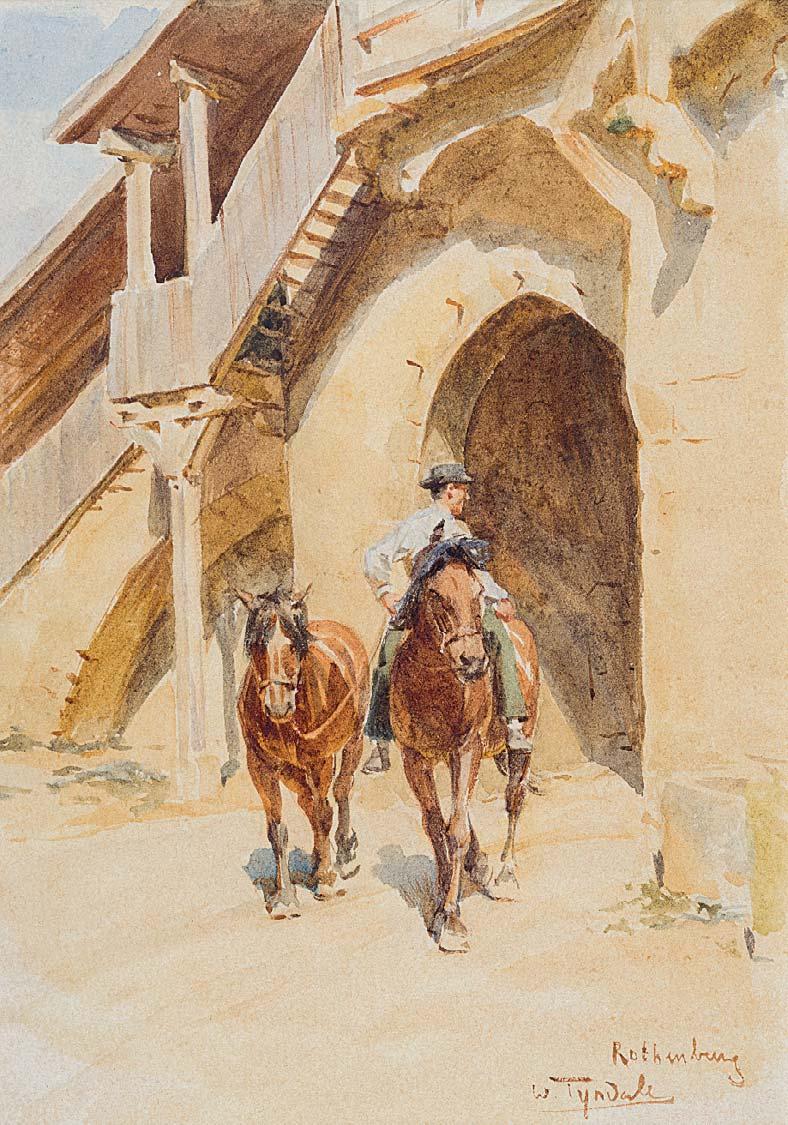
Klingen Gate, Rothenburg
Signed and inscribed with title Watercolour 16 x 10 inches
Klingen Gate, Rothenburg
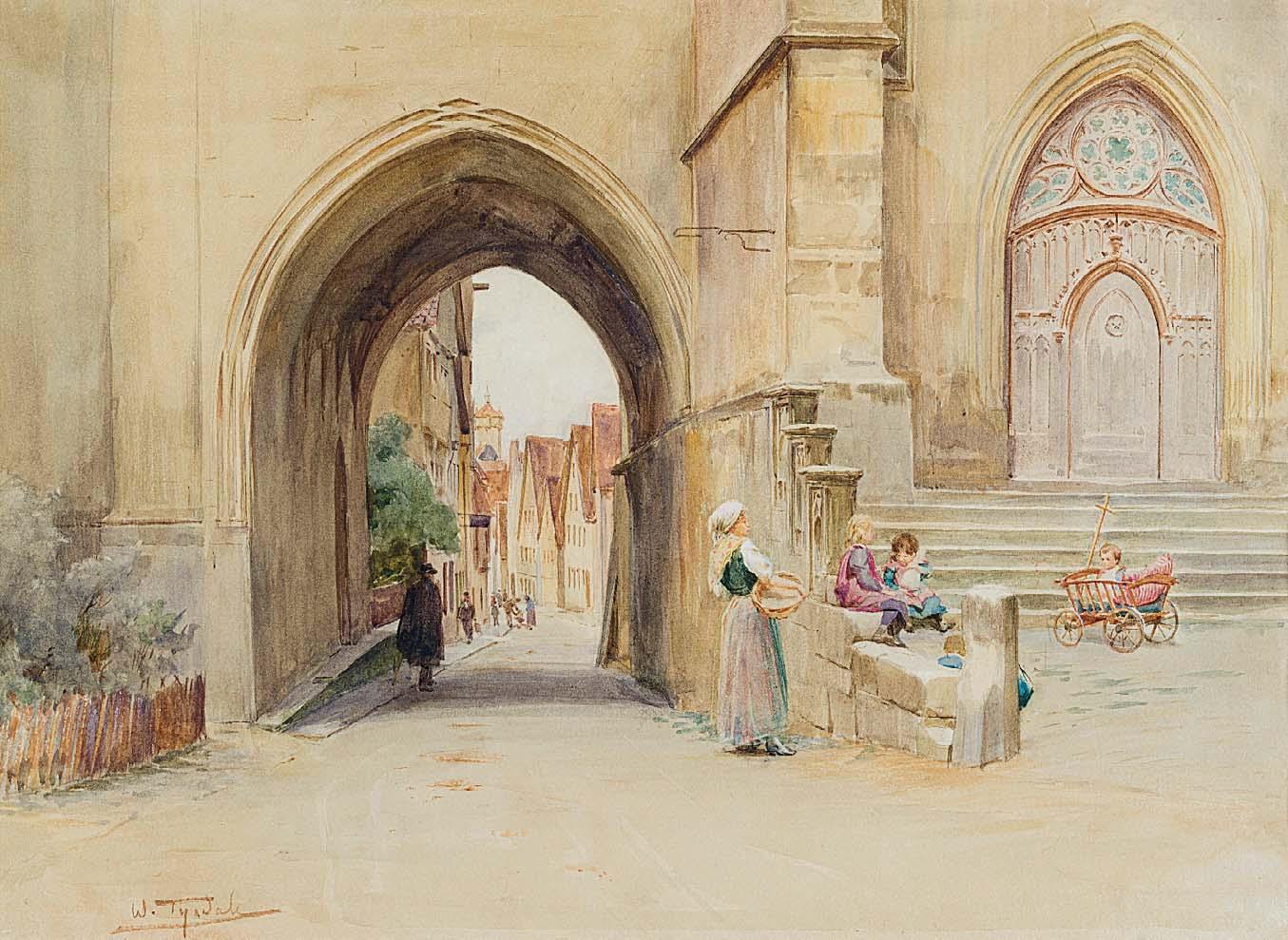
The medieval walled town of Rothenburg ob der Tauber, Bavaria, sits on a plateau above the eponymous river. Its forti cations include 46 towers and numerous gateways, the northern entrance to the town is through the Klingen Gate (named after the gorge below). This gateway links the forti ed St Wolfgang’s church and the 37 metre Klingen Tower and was strategically designed to funnel attackers into a narrow, con ned space, making them more vulnerable to re from the surrounding towers and forti cations.
WILLIAM WOODHOUSE
William Arnold Woodhouse (1857-1939)
William Woodhouse was an English painter well-known for his highly detailed depictions of animals, particularly dogs and horses, within the British sporting and rural tradition.
William Arnold Woodhouse was born on 1 October 1857 in Poulton-le-Sands, Lancashire (now part of Morecambe), into a shing family and remained closely connected to this region throughout his life.
William Woodhouse showed artistic promise from an early age. He received his training at the Lancaster School of Art but was largely self-taught in the area of animal painting. Although he painted a range of subjects, including landscapes, marine scenes, still lifes, and occasional portraits, he is best known for his animal paintings. His style was largely in uenced by the Victorian animal painter Sir Edwin Landseer. Like Landseer, Woodhouse captured his subjects with a strong sense of character and presence, especially when painting hunting dogs and horses. His approach to learning included direct anatomical study, visiting slaughterhouses to better understand animal forms which contributed to the realism of his work. He worked primarily in oils before World War I and shifted to watercolours and gouache afterwards.
William Woodhouse started exhibiting work early in his career, rst showing at the Lancaster Exhibition at the age of twenty-four and continuing to exhibit there until 1927. He also exhibited at major institutions, including the Royal Academy in 1889 and 1911, the Royal Society of British Artists and the Royal Scottish Academy.
After his marriage in 1892, Woodhouse lived in Kenilcote, a house which he designed himself, and was portrayed in his painting The Reaper. His son Ronald Basil Emsley Woodhouse was born in 1897, he would later become a notable painter and etcher. Woodhouse’s reputation remained largely regional as he rarely travelled or worked outside Lancashire. Despite being associated with northern England, he travelled abroad on at least one occasion, undertaking a tour of the Near East in 1899, visiting Greece, Turkey, and other parts of the Mediterranean. In 1902, he moved to Auburn Court in Heysham, a more rural setting that further inspired his work.
William Woodhouse achieved success during his lifetime, receiving commissions for sporting and animal subjects and producing works that were valued for their technical accuracy and expressive character.
He died on 13 January 1939 and is buried with his wife at St Peter’s church in the village of Heysham, near Morecambe, Lancashire.
His work is represented in the collections of Lancaster City Museum and the Lancaster Maritime Museum.
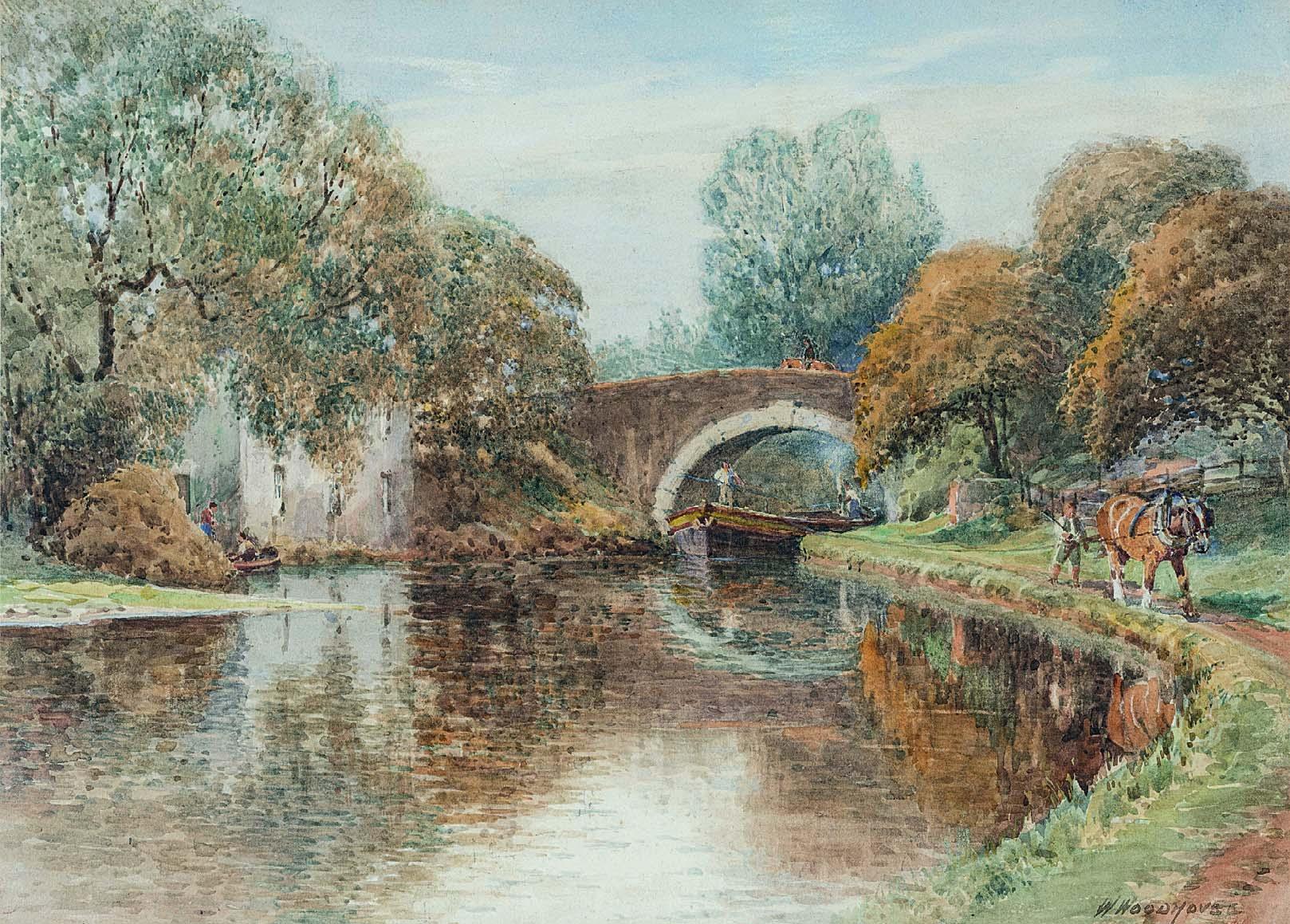
34
The Canal Barge Signed Watercolour 10 ¼ x 14 ¼ inches
CHARLES HARRINGTON
Charles Harrington (1865-1943)
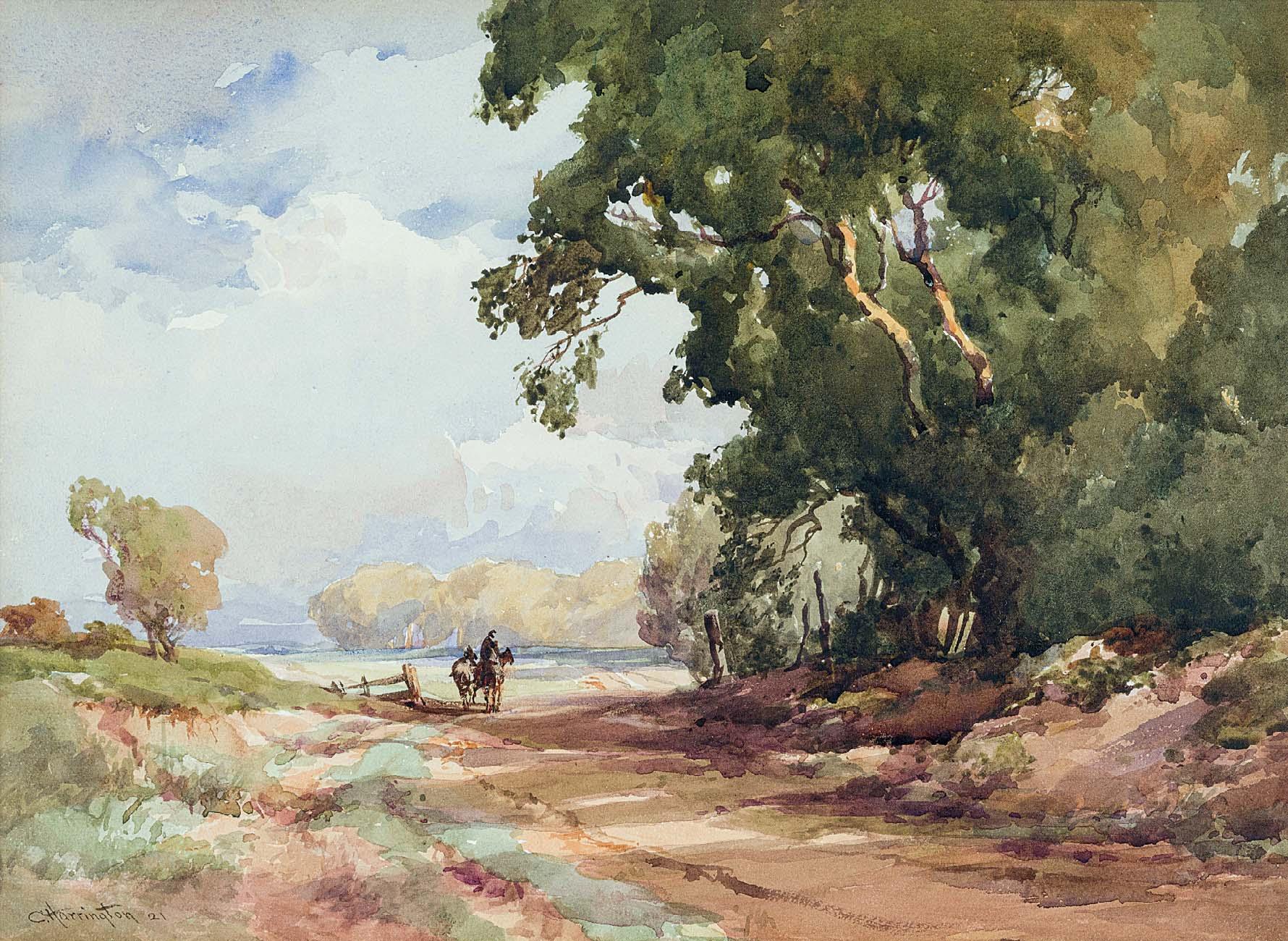
Charles Harrington was a Sussex landscape watercolourist, he was self-taught and lived in Lewes.
Active from the early years of the twentieth century, he exhibited at the Fine Art Society, Royal Institute of Painters in Water Colours and notably the Royal Academy during the years 1913-1935, working from addresses in Brighton and Lewes. With several other artists including Louis Ginnett (1875-1946), he founded the Brighton Art Club in 1895.
35
The Wooded Path
Signed and dated 21 Watercolour
10 ¼ x 14 ½ inches
ALBERT CHEVALLIER TAYLER
Albert Chevallier Tayler, RBA RBC ROI NEAC (1862-1925)
Albert Chevallier Tayler painted a variety of gure subjects, both contemporary and historical. He became best known for his interior scenes, including dinner parties and domestic celebrations, and was admired for the high nish of his canvases. Absorbing continental in uences through study in Paris, he established himself as a member of the Newlyn School by producing social realist scenes en plein air. Then, following his conversion to Catholicism in 1887, and his move to London in 1895, he focussed increasingly on religious imagery, middle-class settings and portraiture.
For a biography of Albert Chevallier Tayler, please refer to Chris Beetles Summer Show, 2020, page 118.
36
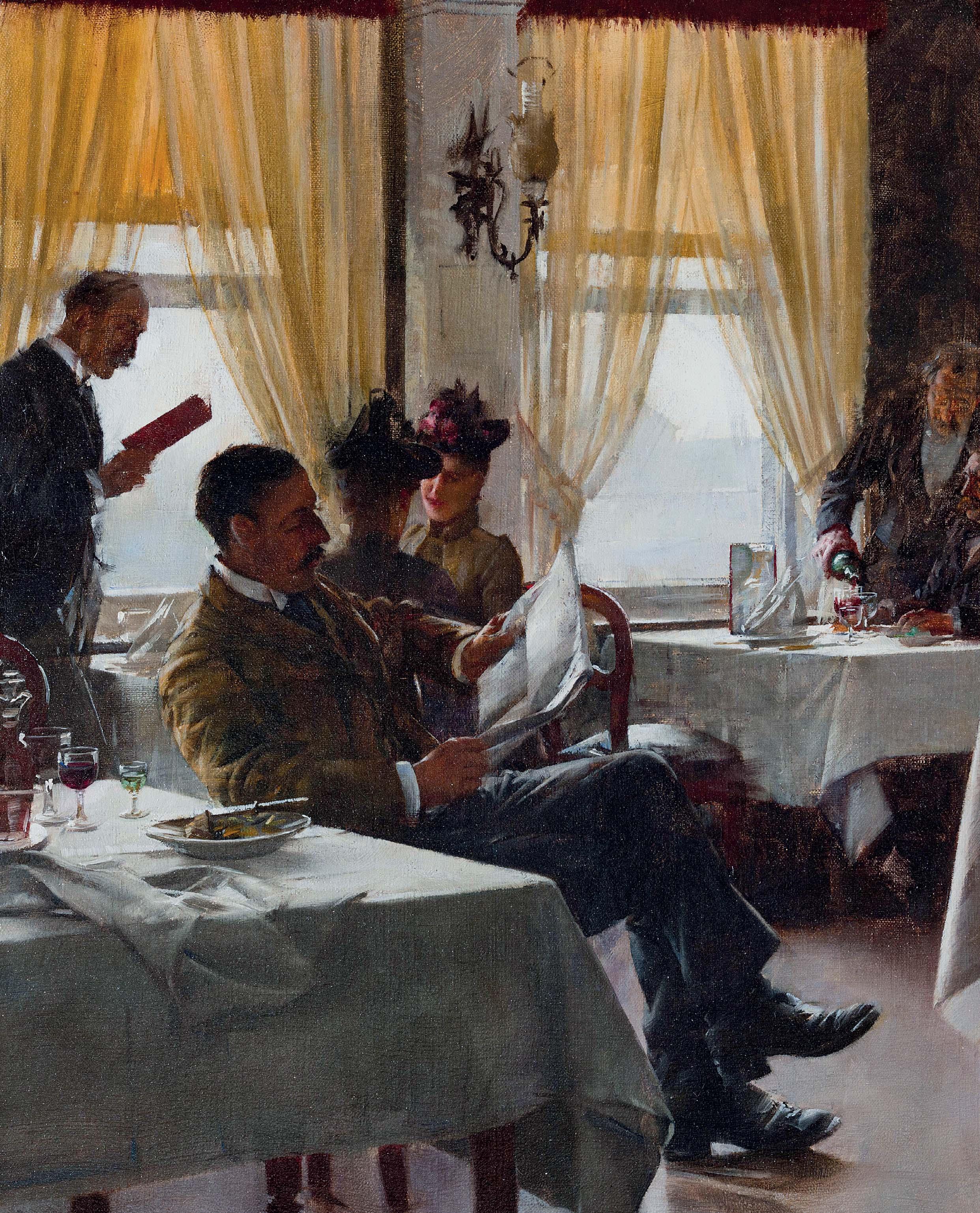
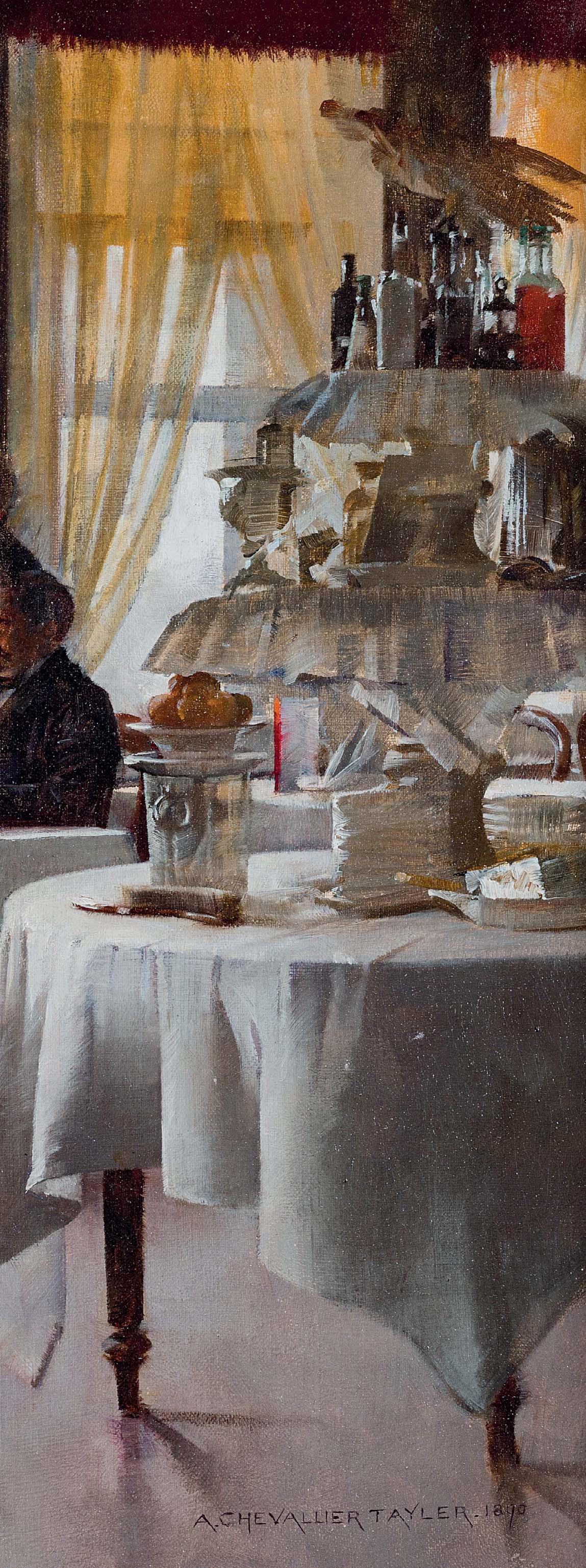
The Dining Room
Signed and dated 1890 Oil on canvas
17 ¾ x 21 ½ inches
Exhibited: ‘Chris Beetles Summer Show 2020’, Chris Beetles Gallery, London, no 59
In 1890, the year in which he produced the present work, Albert Chevallier Tayler received a commission from the Fine Art Society to visit Boulogne-sur-Mer, in order to paint the ceremony of the blessing of the sea. The best known result of the trip was The Departure of the Fishing Fleet, Boulogne, which was exhibited at the Royal Academy in 1891 as La Vie Boulonnaise, and bought by the private collector, Richard Payne, for presentation to Birmingham Museum & Art Gallery (where it still resides).
Given that The Dining Room was produced during the same period, it is at least possible that it represents lunch in a Boulonnaise restaurant or hotel dining room, and perhaps the hotel at which Tayler stayed. Certainly the artist beautifully captures a sense of light suggestive of a coastal location; it penetrates semi-transparent curtains, illuminates the whiteness of cloth and napkin, and re ects o the polished surfaces of china, glass and metal, the linoleum oor and even the shoes of the most prominent diner. At once precise and atmospheric, the work appears to emulate such French realist interiors as Gustave Caillebotte’s Le Dejeuner of 1876. Though much smaller than The Departure of the Fishing Fleet, Boulogne, it acts as a counterpart to it in encapsulating a clean, calm middle-class interior that is the very opposite of the bustling working-class quayside.
AUGUST HAGBORG
August Hagborg (1852-1921)
Born and raised in Gothenburg, August Hagborg spent much of his life in Paris, where he absorbed the in uences of the leading French naturalist painters such as Jules Breton and Jules Bastien-Lepage, to become one of the most important Scandinavian painters of the age.
Vilhelm Nikolaus August Hagborg was born on 26 May 1852 in Gothenburg, Sweden, the eldest of two sons of Nikolaus Hagborg and Wilhelmina Margareta Schagerström. Born into an a uent, academic family, his father being a respected lecturer at the local grammar school, August Hagborg was discouraged from pursuing the early artistic talent he demonstrated as a child, instead being encouraged to follow more intellectual interests. In 1860, his father passed away suddenly when Hagborg was just eight years old, and despite his mother’s e orts to maintain a legacy of academic expectation, he continued to show aptitude and passion for the arts. His mother eventually relented and allowed her son to follow his artistic pursuits and on 30 September 1871, at the age of 19, August Hagborg enrolled at the Royal Swedish Academy of Fine Arts in Stockholm. He studied there for three years under the tutelage of Johan Christo er Boklund, who encouraged his e orts in genre and historical painting.
In 1875, August Hagborg relocated to Paris to continue his education, a move that would have a signi cant in uence on his career. In Paris, he applied himself in the rigorous academic tradition and was exposed to the work of the leading French naturalist painters of the day, such as Jules Breton, Léon Bonnat and Jules Bastien-Lepage. Paris at this time also had a vibrant community of Nordic artists, and Hagborg immersed himself in this world, socialising with artists such as Frithjof SmithHald and Hugo Salmson. In 1876, Hagborg made his debut at the Paris Salon, exhibiting the painting Gavroche, which was purchased the following year by King Oscar II of Sweden. He continued to exhibit regularly at the Paris Salon until 1909. In 1878, he represented Sweden at the Paris Exposition Universelle. He did so again the following year, presenting the large-scale oil Grand mareé dans le Manche, for which he won a third-class medal. The artwork was purchased by the Musée du Luxembourg (and is now in the collections of the Musée D’Orsay). Whilst in Paris, Hagborg became a member of the Société des Beaux-Arts, exhibiting with them at the Salon du Champ-de-Mars in the 1890s. While exhibiting at the Exposition Universelle in 1889, he received a commission to paint a portrait of King Oscar II.
In 1885, August Hagborg joined a collective of 84 Swedish artists known as the Opponenterna. Led by Ernst Josephson, the group was formed in protest to the Royal Swedish Academy’s perceived adherence to outdated academic traditions and rigid exhibition policies. The group organised independent exhibitions to challenge the Academy’s dominance, advocating for greater artistic freedom and the incorporation of contemporary international in uences into Swedish art.
On 16 June 1885, August Hagborg married Gerda Christina Göthberg (1863-1934), the daughter of a merchant, Per Thure Göthberg, in Stockholm. They had at least two children, Elsa (born 1888) and son Jean (born 1892). The family alternated between Paris, where Hagborg had his main studio, and regularly spent summers in Sweden. During these summer visits back to Sweden, he painted in the rural settings of Skåne and Dalarö. In 1909, Hagborg and his family moved permanently back to Sweden, making only occasional trips back to Paris after this time. After 1914, he came to favour working in the picturesque Swedish region of Dalarna, and his works became more abstract. He died on 30 April 1921 during one of his visits to Paris. His body was returned to Sweden and he was buried at the Norra begrayningsplatsen cemetery in Stockholm.
His work is represented in the collections of the Nationalmuseum (Stockholm), the Göteborgs konstmuseum (Gothenburg), and the Musée D’Orsay (Paris).
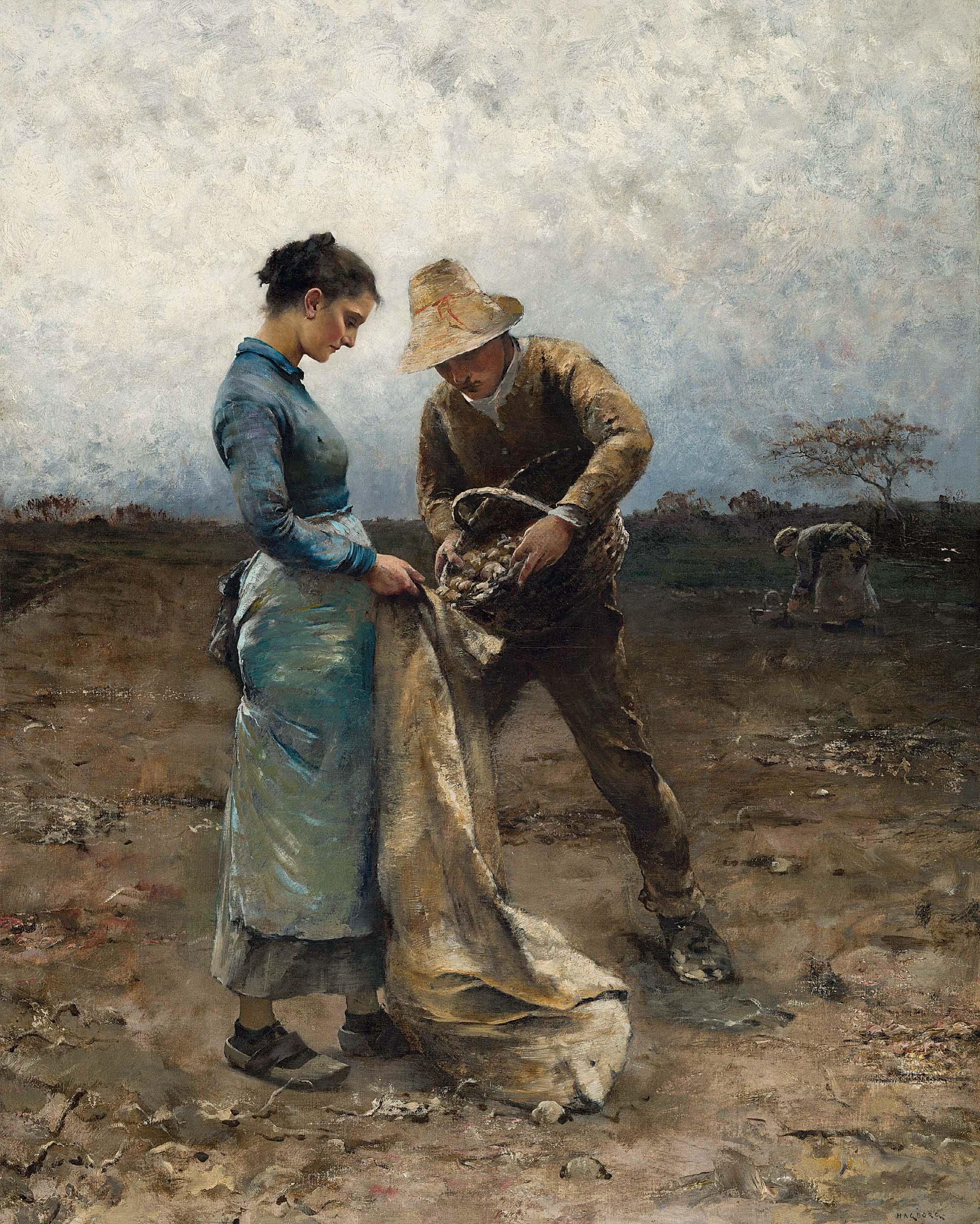
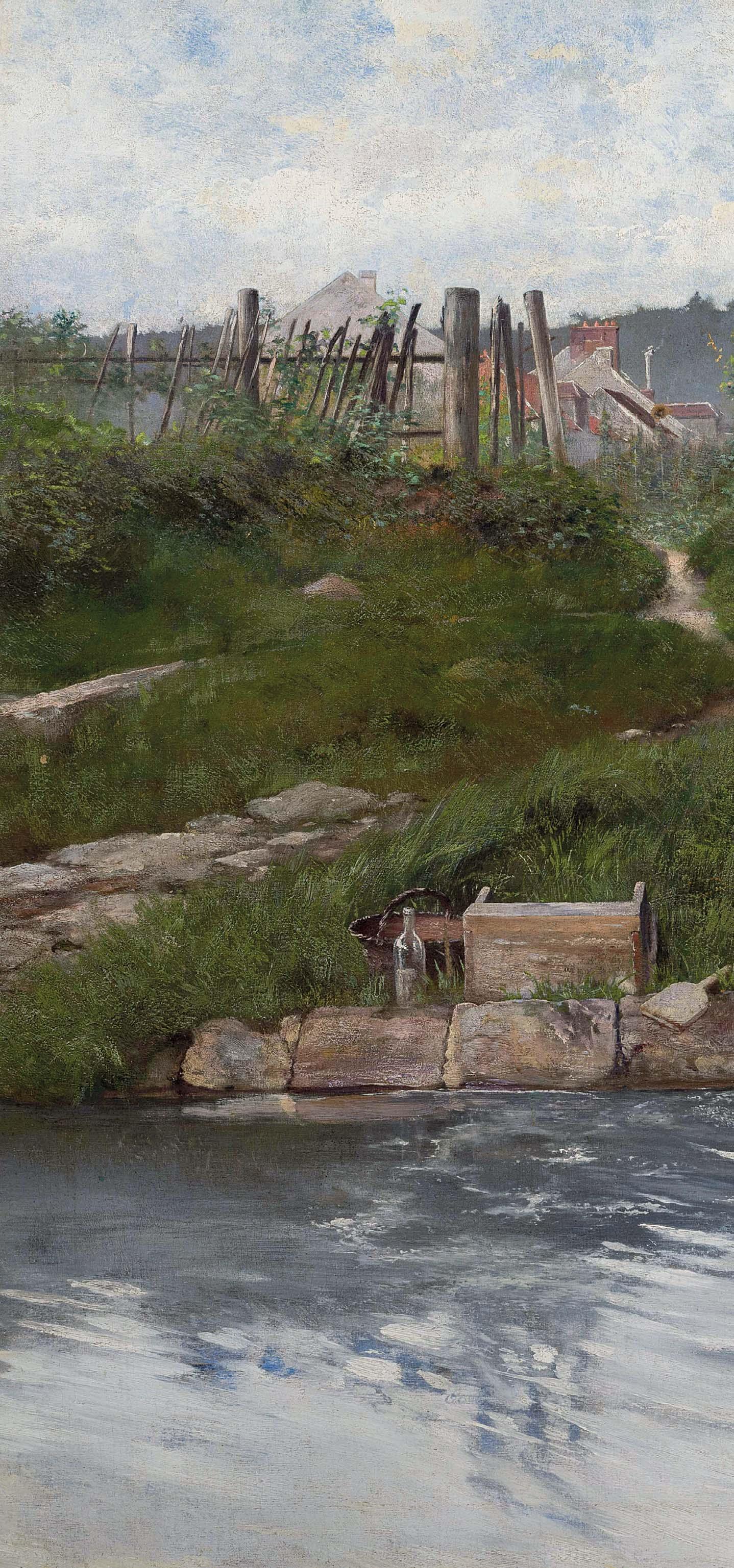
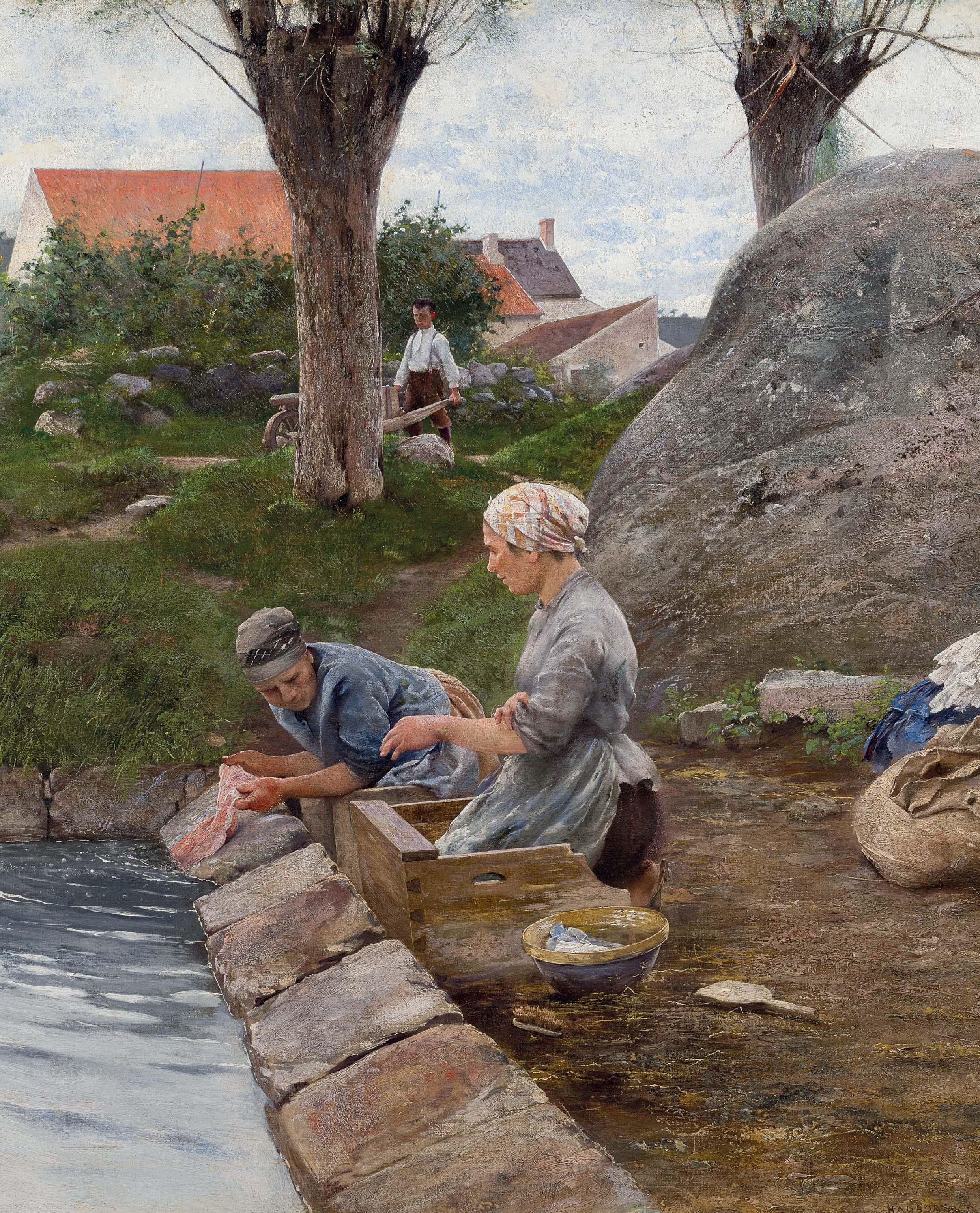
37 Potatisplockarna Oil on canvas
38 ½ x 30 ¾ inches
In Swedish, ‘Potatisplockarna’ means ‘Potato Gatherers’.
AuGuST HAGBoRG
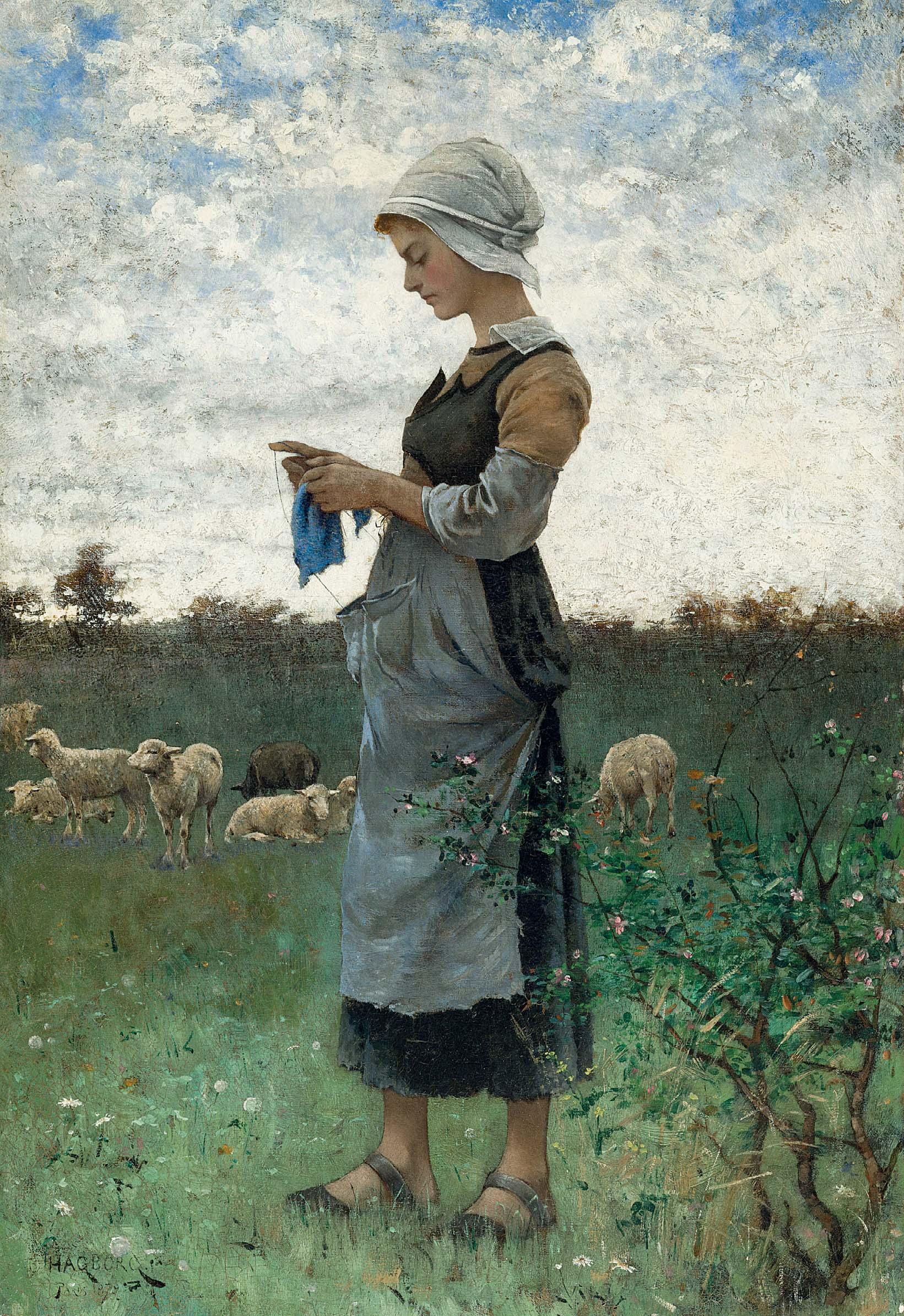
39 Herdinna Signed, inscribed ‘Paris’ and dated 1879 Oil on canvas
23 ½ x 15 ¾ inches In Swedish, ‘Herdinna’, means ‘Shepherdess’.
ERIK SääF
Erik S f (1856-1934)
Born in a small town in Sweden, Erik Sääf spent much of his career living and painting in Paris. Immersed in a thriving Scandinavian artistic community, he established a reputation as a skilled painter of coastal and rural scenes, in uenced by the French Naturalists of the n de siècle.
Erik Albin Anton S f was born on 16 February 1856 in Norrköping, a town south-west of Stockholm, one of eight children of Martin Samuel Anton S f and Maria Vilhelmina (neé Cimmerdahl). Erik S f began his artistic education at genre painter, Edvard Perséus’ painting school in Stockholm, before studying at the Royal Swedish Academy of Fine Arts from 1880 to 1884. In the summer of 1880, he spent time painting and studying with fellow academy artists in Mariefred, a lakeside town west of Stockholm.
After graduating from the Royal Swedish Academy, S f travelled, rstly to Denmark with his friend and fellow artist Edward Rosenberg, and later to Austria and Italy to continue his studies. In 1890, he moved to Paris, and would remain largely in France for the rest of his life, apart from regular summer visits back to Sweden. In Paris, S f was an active and popular member of ourishing Scandinavian artistic community in the city, and was close friends with contemporaries such as Gustave Albert and Georg Arsenius. In his rst few years in Paris, S f would send artworks back for exhibition in Sweden, but soon chose to focus exclusively on producing work for exhibition in Paris. He represented Sweden at the World Exhibitions in Paris in 1889 and 1900, and also exhibited at the Paris Salon.
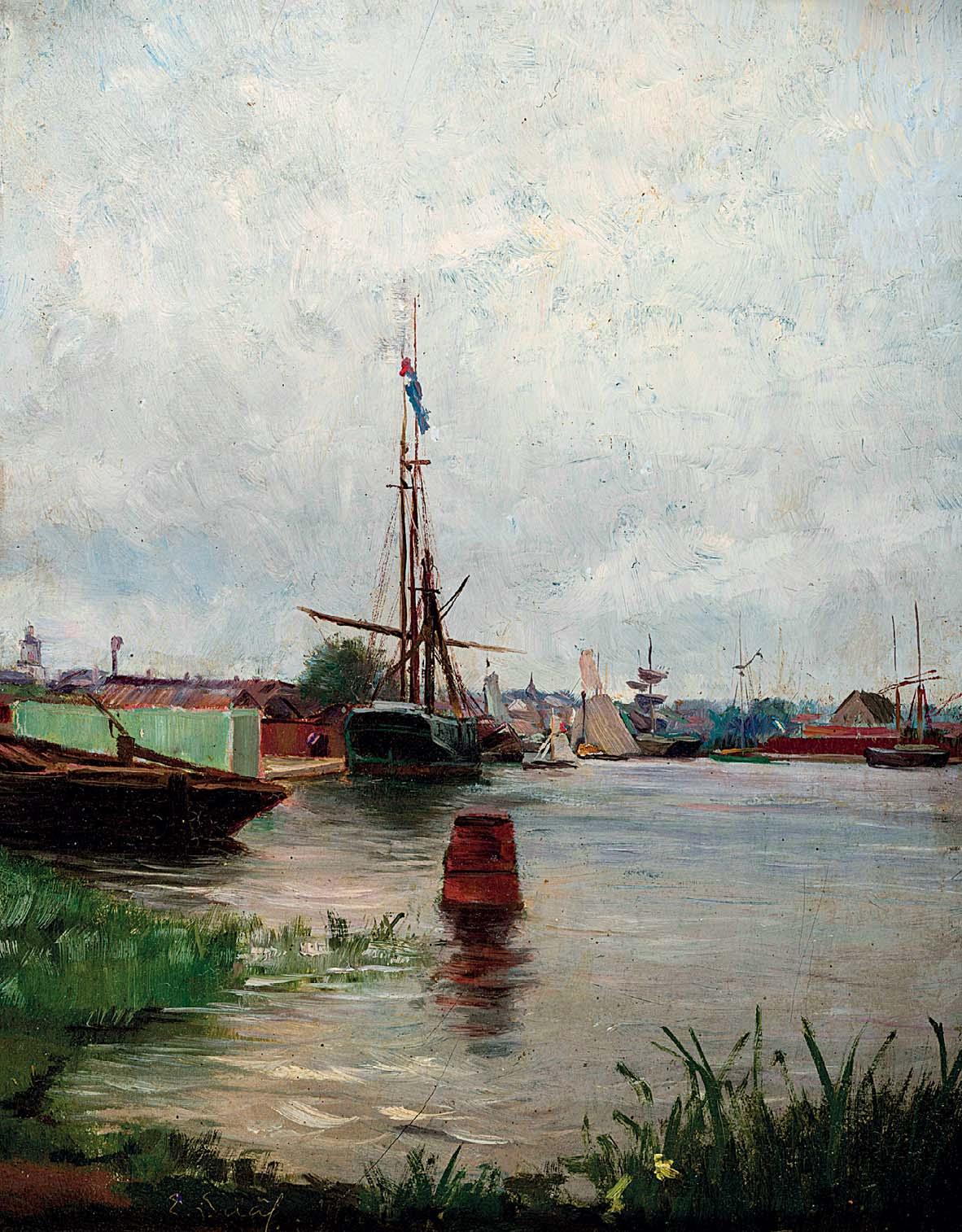
40 Hamnmotiv Signed Oil on panel 13 x 10 inches
‘Hamnmotiv’ is Swedish for a harbour scene, a term particularly used in relation to genre painting.
Sometime after 1905, Erik S f married Jeanne Clémentine Étienne, the widow of his friend Gustave Albert. S f died on 17 February 1934 in the town of Gouvieux, in Oise, northern France. After his death, his widow helped to establish the ‘Erik S f Scholarship Fund’ in 1947 at the Royal Swedish Academy of Fine Arts to support young Swedish landscape artists, particularly from the Östergötland region, who wished to study in France.
His work is represented in the collections of the Nationalmuseum (Stockholm), the Norrköping Art Museum, and the Swedish Club (Paris).
GEORG PAULI
Georg Pauli (1855-1935)
A graduate of the Swedish Royal Academy of Fine Arts, Georg Pauli was a notable member of a community of Scandinavian artists based in the artistic French village of Grez-sur-Loing. Together with contemporaries such as Peder Krøyer, Julia Beck, and his wife, Hanna Hirsch, Pauli embraced the in uences of French Naturalism to become one of the most signi cant and celebrated Swedish artists of the period.
Georg Vilhelm Pauli was born on 2 July 1855 in Jönköping, Sweden, a small town on the shores of Lake V ttern, east of Gothenburg. Descended from a noble Italian family, he was the fourth of six children of August Ferdinand Pauli, an apothecary and manufacturer, and Maria Laurentia Augusta (neé Gagner). From 1871 to 1875, Georg Pauli studied at the Royal Swedish Academy of Fine Arts, and spending two years travelling in France and Italy, before completing his studies at the Academy from 1878 to 1879.
Returning to France in 1879, George Pauli settled in the village of Grez-sur-Loing, south-west of Paris, where a burgeoning artistic community had grown. The community included a number of signi cant Scandinavian artists, such as Carl Larsson, August Strindberg, Peder Krøyer and Julia Beck, who had been a contemporary of Pauli’s at the Academy. At Grez-sur-Loing, he also met the Swedish artist Hanna Hirsch. They married in 1887 and together would have three children, Torsten (born 1889), Göran (born 1891) and Ruth Emerentia (born 1896).
From the late 1870s, Georg Pauli attended the Académie Julien in Paris, where he was strongly in uenced by the work of the French Naturalists, including Jules Bastien-Lepage. In 1885, he exhibited the painting La collation des Paysans a la recolte du Colza, Calvados, at the Paris Salon, for which he received an honourable mention. He would exhibit there again in 1889 and 1890. After he and Hanna Hirsch married, they spent time travelling in Italy, where Pauli was exposed to Italian fresco painting, which became an inspiration to his work on his return to Sweden. In 1905, Georg Pauli moved with his family to the town of Stor ngen, south-east of Stockholm, settling in a manor house and studio they called ‘Villa Pauli’. Back home, Georg Pauli taught at the Våland Academy in Gothenburg, and was commissioned to paint many frescoes in various public buildings, including the East India House (now home to the Museum of Gothenburg), Stockholm City Hall and the Royal Dramatic Theatre, as well as in secondary schools in Stockholm and his home town of Jönköping.
In 1911, Pauli returned to Paris for a time, where he worked with the French painter André Lhote, developing an interest in Cubism, which would manifest itself in some of his later fresco and mural work.
In addition to his work as an artist, Georg Pauli also developed a reputation as a talented author of historical and biographical works, including biographies of fellow artist Ernst Josephson (1903 & 1914), Konstnärsliv och om konst (Artist’s Life and About Art) (1913), I Paris, nya konstens källa (In Paris, the source of new art) (1915), Väggmåleri (Mural Painting) (1920) and Prins Eugen (1925). He also wrote about his own travels in En Målares resa (A Painter’s Journey) (1922). From 1917 to 1921, he published the art journal, Flamman
He died on 28 November 1935 in Stockholm.
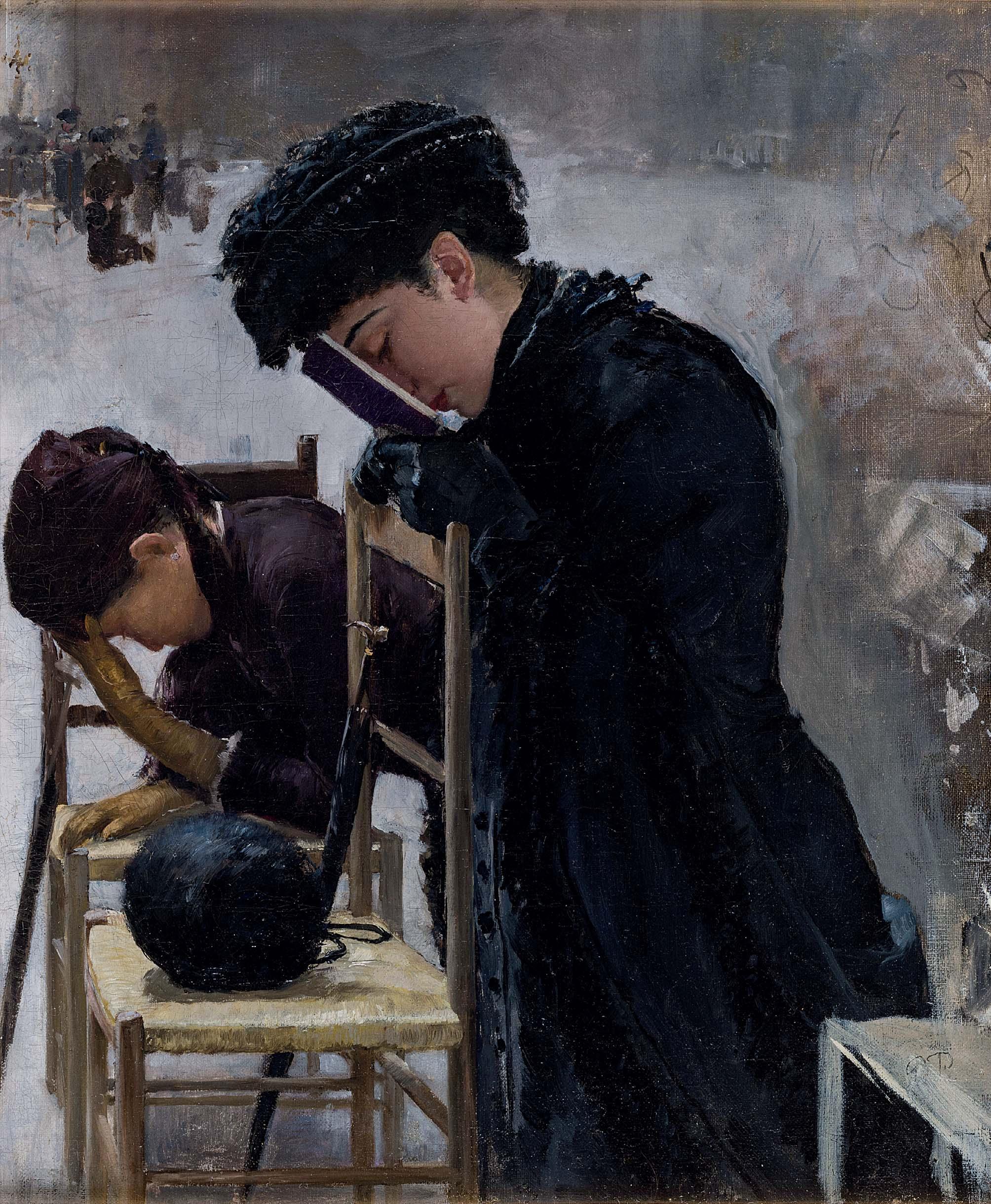
41 Andakt Oil on canvas
20 ¾ x 16 ½ inches
‘Andakt’ in Swedish means a short, simple worship of devotion or prayer and can also signify a moment of reverence or quiet contemplation.
ESTHER KJERNER
Esther Kjerner (1873-1952)
Classically trained at the Royal Swedish Academy of Arts and the Académie Colarossi in Paris, Esther Kjerner did not receive critical recognition for her artwork until the later years of her life. However, in the years after her death, she is celebrated for her vibrant still lifes and idyllic landscapes and acknowledged as a leading Swedish painter of the early 20th century.
Esther Kjerner was born on 29 October 1873 in Stockholm, one of seven children of Karl Kjerner, a doctor, and Emelie Constance (neé Magnell). She was educated at the
42
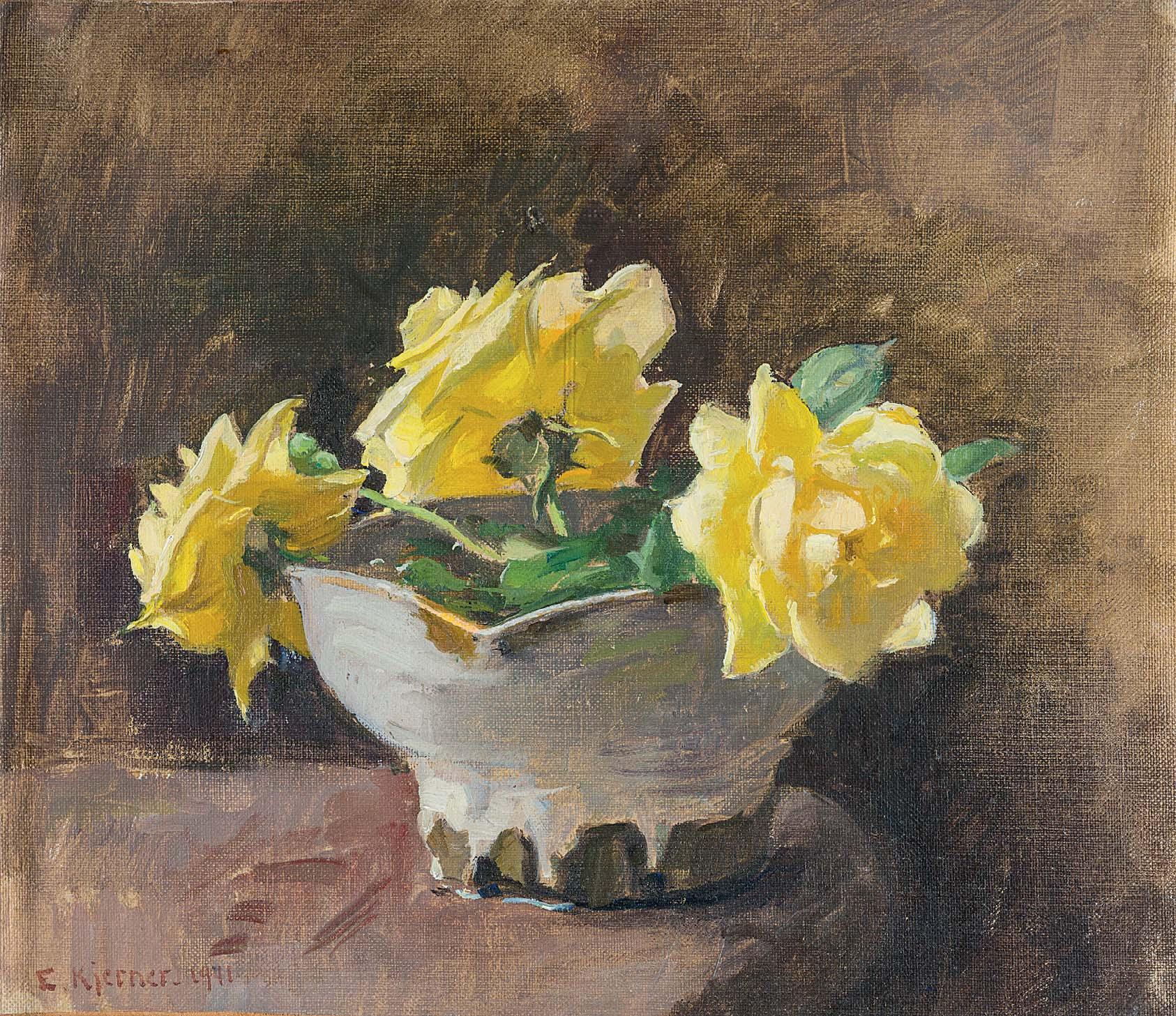
Stilleben med gula rosor
Signed and dated 1941 Oil on canvas laid on board 12 x 13 ¾ inches
In Swedish, ‘Stilleben med gula rosor’ means ‘Still life with yellow roses’.
Royal Swedish Academy of Art, before travelling to study in Rome, Brittany and Paris, where she studied at the Académie Colarossi. It was not until 1941, when Esther Kjerner was 67 years old, that she had her rst solo exhibition, held by the art critic and dealer Gösta Stenman. She died on 3 October 1952.
Her work is represented in the collections of the Nationalmuseum (Stockholm), M lmo Museum, the Prins Eugen Waldermarsudde Museum (Östersund), Norrköping, Kalmar and Eskilstuna Museums.
OSCAR BJÖRCK
Oscar Björck (1860-1929)
Oscar Björck developed a reputation as one of the most signi cant Scandinavian artists of the late 19th and early 20th centuries, as a member of the Skågen Painters, a close knit school of artists who summered together in the Danish shing town of Skågen. Along with contemporaries such as Per Severin Krøyer and Michael Ancher, Oscar Björck painted bright, naturalistic scenes in uenced by the French Impressionists. He also travelled extensively across Europe, becoming a saught after portraitist and genre painter, before settling in his later years as a celebrated professor at the Royal Swedish Academy of Arts.
Oscar Gustaf Björck was born in Stockholm, Sweden on 15 January 1860, the son of Albert Björck, a goldsmith, and Augusta (neé Pihlgren). In 1877, he was accepted into the Royal Swedish Academy of Arts, where he studied under the Swedish genre painter, Edvard Perséus. Much of his painting during this period was religious in nature, and in 1882, his nal year at the Academy, he was awarded the Royal Medal for his painting Der förlorade sonens återkomst (The Return of the Prodigal Son). The award included a travel scholarship, and Björck spent the winter of 1883 studying and painting in Paris. In 1884, he married Isaria ‘Sas’ Boklund, the daughter of the painter Johan Christo er Boklund. Together they would have two children, Margit and Ingrid.
Between 1884 and 1887, Oscar Björck continued to travel around Europe, particularly developing a reputation as a talented portrait painter. In the winter of 1884, he completed a number of portraits whilst staying in Munich, including one of his new wife. The following spring, he travelled to Italy, moving rst to Venice and then, in the autumn, to Rome. Whilst in Italy, he completed several important paintings, including the large portrait Susanna, Romerska smeder (Roman Blacksmiths), Veneziansk saluhall (Venetian Hall) and Lördagmässa I Markuskyrkan (Saturday Mass in St Mark’s Church). Though he spent his winters across Europe during this period, between 1882 and 1884 Björck would spend each summer in the Danish town of Skågen, in the north of Jutland. He was rst encouraged to visit Skågen by the artist Peder Severin Krøyer, whom he had befriended while staying in Paris. A close knit artistic community had grown in the remote Danish town, a part of which Björck became an important member, developing close friendships with in uential Nordic artists including Michael Ancher and Holger Drachmann. These artists, known as the Skågen Painters, painted en plein air and emulated the French impressionists, painting in a bright, naturalistic style.
In 1888, Oscar Björck returned to settle in his native Stockholm, where he returned to painting largely portraiture, including several of King Oscar II of Sweden. In 1889, he was elected a member of the Royal Swedish Academy of Arts, joining the teaching sta that year, before becoming a professor in 1898. He was chosen to further the cause of Swedish art through his appointment as Commissar for Art at the Stockholm Exposition in 1897, the Baltic Exposition of 1914, and the Swedish Exposition in London in 1924. He continued to teach at the Royal Swedish Academy until his death on 5 December 1929.
His work is represented in the collections of the Skågens Museum, the Nationalmuseum of Sweden (Stockholm), Gothenburg Museum of Art; and the Washington National Gallery of Art (DC ). In 2022, his 1889 painting The Janse Children, was acquired by the Musée d’Orsay (Paris).
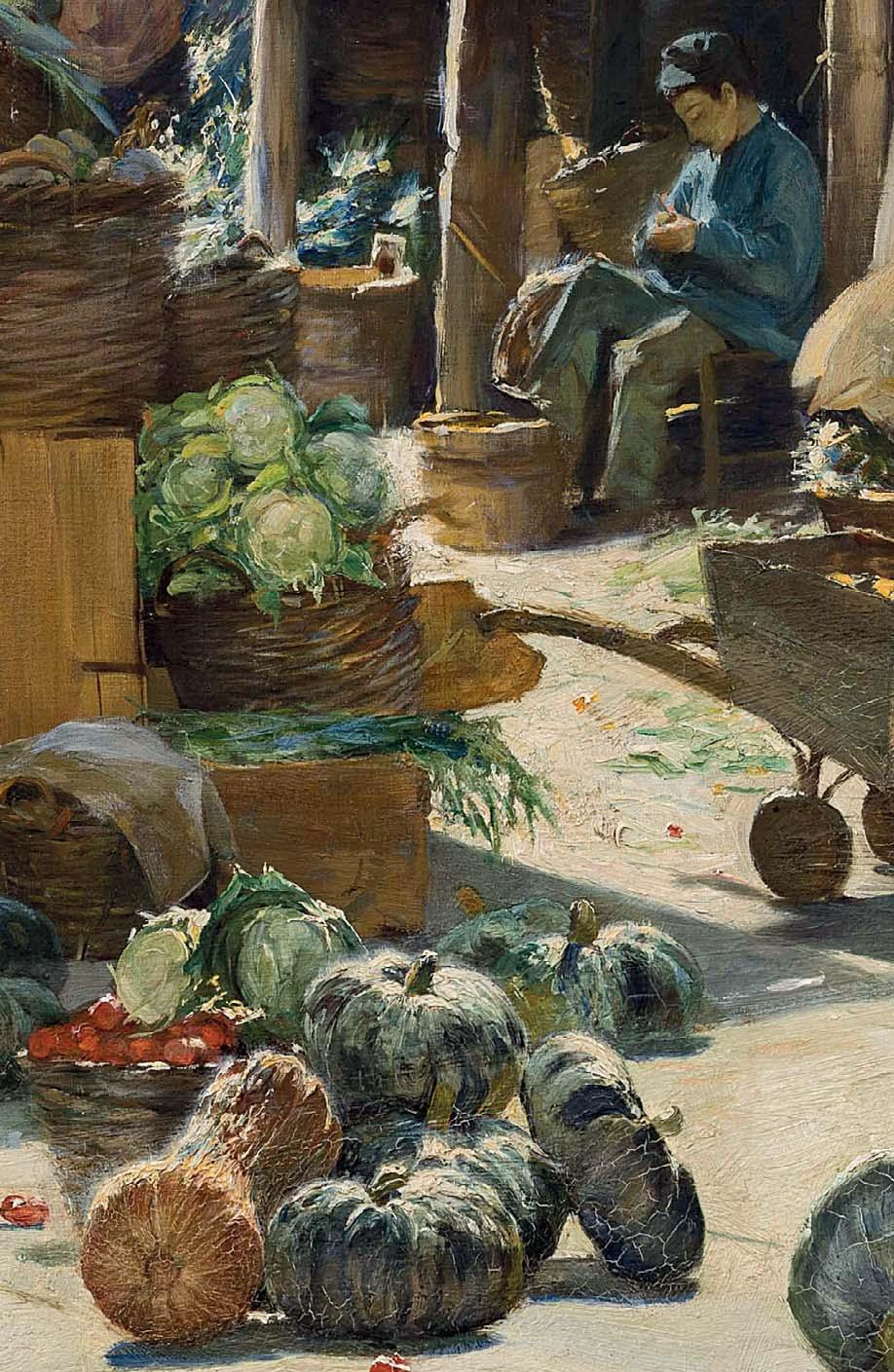
Detail of Venezia [43] (see overleaf)
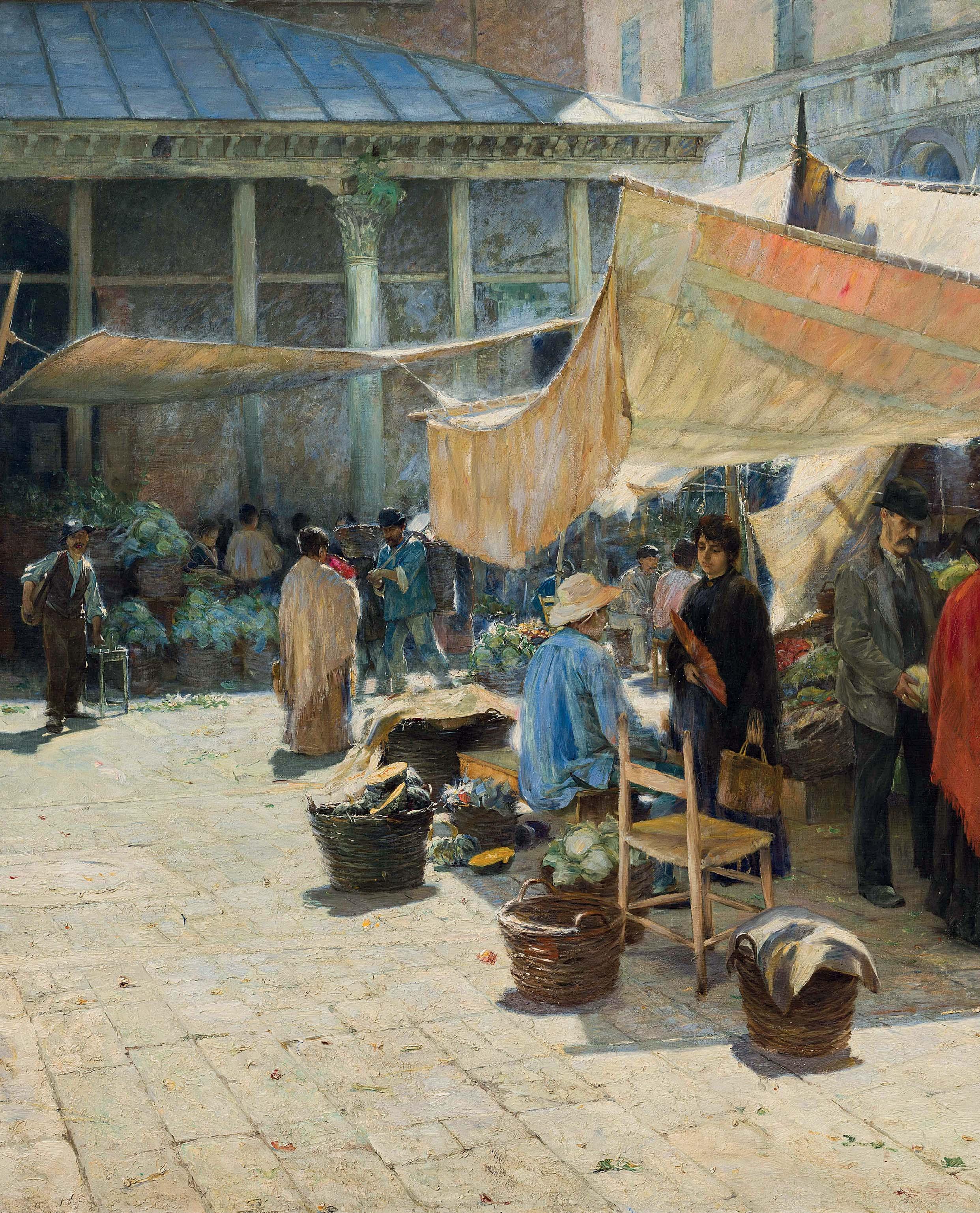
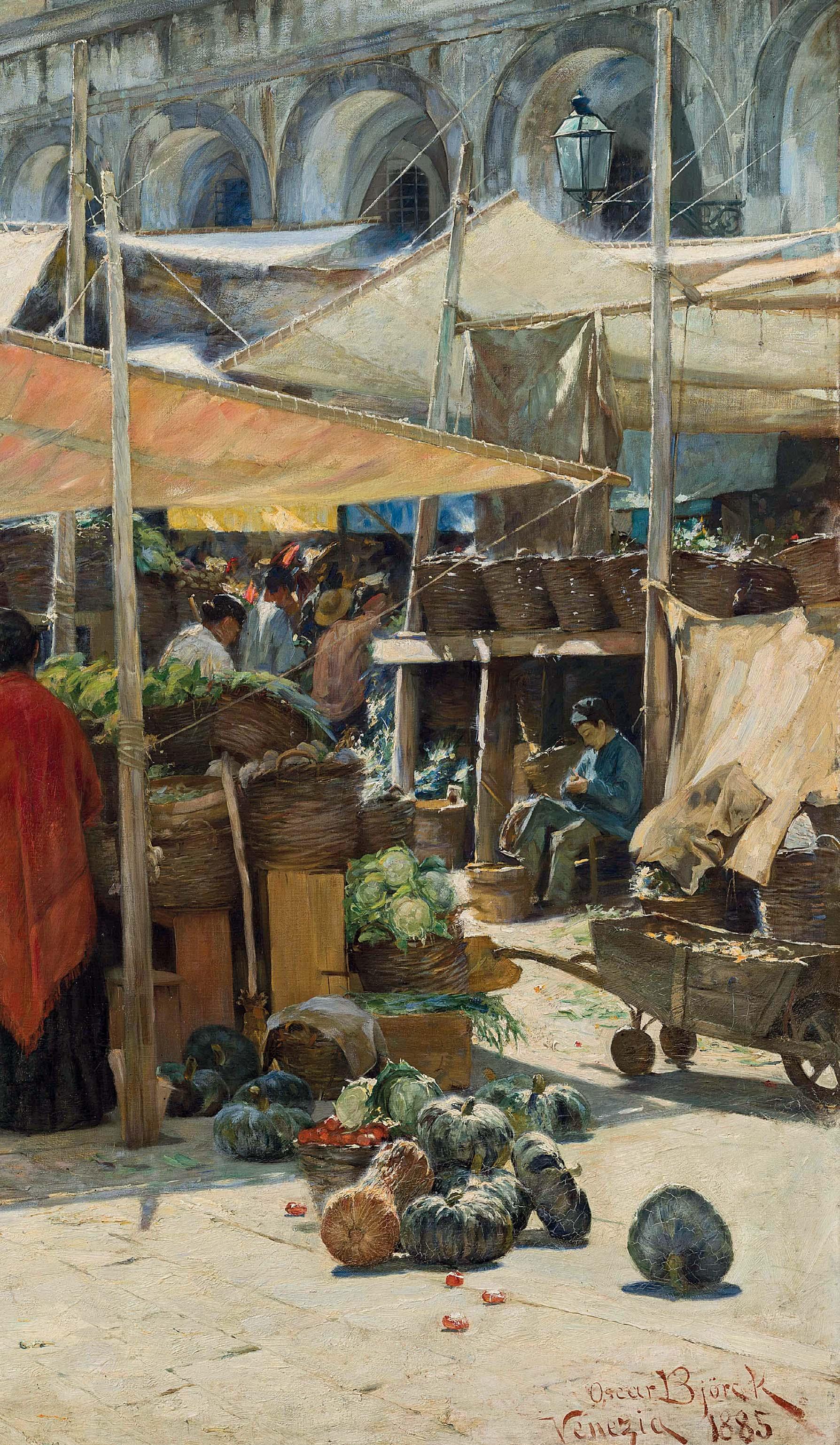
Signed, inscribed with title and dated 1885 Oil on canvas
43
Venezia
53 ¼ x 72 ¼ inches
OLLE HJORTZBERG
Olle Hjortzberg (1872-1959)
Trained in his native Sweden as an ornamental artist, Olle Hjortzberg travelled extensively across Europe and the Middle East, taking inspiration from visits to Palestine and Syria to enhance his talents as a painter of decorative, brightly coloured still lifes.
Gustaf Olof Hjortzberg was born on 14 November 1872 in Stockholm, Sweden. He was one of seven children of Olof Arvid Hjortzberg, a chief engineer at the Stockholm gasworks, and Maria Henriette (neé Lyon). His father was also an amateur painter and taught watercolour painting to Hjortzberg during his childhood in Linköping, a town in the south of Sweden. In 1886, the family returned to Stockholm, where he was introduced to ornamental artwork and book illustration by his elder sister Annie’s husband, Agi Lindegren, an architect and illustrator. As a teenager, Hjortzberg worked as an assistant in decorative painting for the artist J A G Acke and assisted in the decoration of Uppsala Cathedral.
In 1892, Olle Hjortzberg was accepted into the Royal Swedish Academy of Arts. During his time there, he received a Royal Medal for academic excellence in recognition of his contributions to decorative projects such as the one he undertook in Uppsala Cathedral.
In 1898, he married Elin Matilda Andersson, the daughter of a merchant, and later that year travelled together to Paris. This marked the beginning of intense travel that would have a profound in uence on Hjortzberg’s career. The following year, he travelled to Italy, visiting Florence and Perugia. From Italy, he travelled via Greece to Syria and Palestine, where his interest in ornamental art was further enhanced. He visited London in 1902 before returning to Italy, where he studied in Rome and then Ravenna, taking further inspiration from the city’s Byzantine art. When he returned to Sweden in 1905, his focus turned to religious artwork, designing stained glass windows for the Katarina Church in Stockholm, and a mural for the ceiling of the Klara Church. In 1913, he decorated the Uppenbarelsekyrkan Church in the town of Saltsjöbaden, and also began murals in the Engelbrektskyrkan Church in Stockholm the same year. From 1916, he produced murals for Linköping’s grammar school.
Once settled back in Sweden, Olle Hjortzberg began to nd additional success as an illustrator. In 1912, he designed a poster for the Olympic Games in Stockholm and also began designing a series of commemorative stamps depicting national themes during the inter-war period, including a series portraying King Gustaf V of Sweden. His illustrations were also used in periodicals and books, produced as prints, and were also used as the artwork for Nobel Prize for Literature certi cates in 1928.
From 1911 to 1937, Olle Hjortzberg held a teaching position at the Royal Swedish Academy. In 1920 he was appointed as the Academy’s Director, a position he held until 1941. Additionally, he taught at the School’s decorative arts programme from 1921 to 1938, and was the Professor of Drawing between 1937 and 1939. In 1945, he was awarded the Prince Eugen Medal, awarded by the King of Sweden for ‘outstanding ar tistic achievement’.
He died in Stockholm on 8 March 1959, aged 86.
His work is represented in the collections of the Nationalmuseum (Stockholm), the Modern Museum (Stockholm), and the Norrköping Museum.
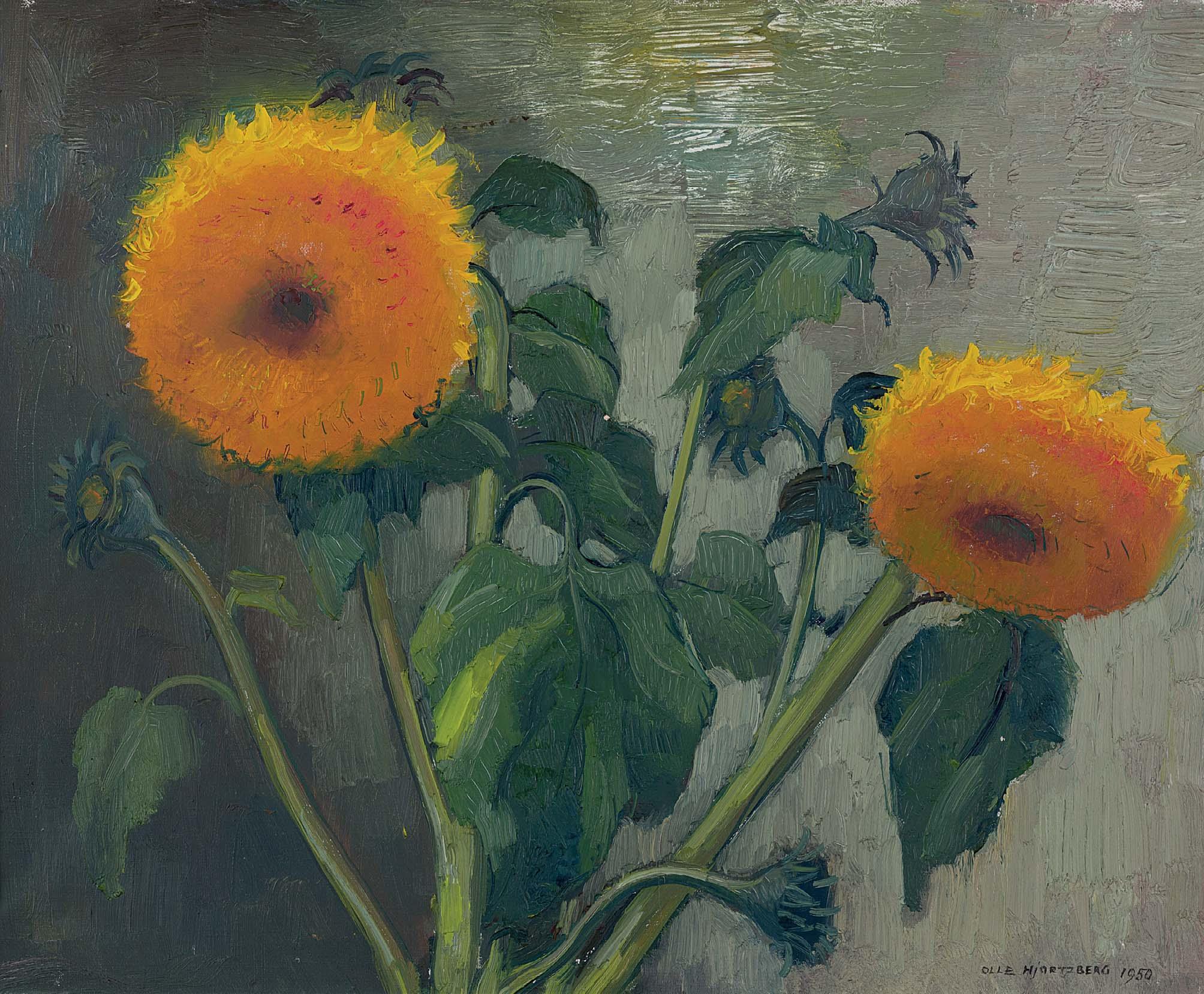
44 Solrosor Signed and dated 1950 Oil on canvas 19 x 23 ½ inches
In Swedish, ‘Solrosor’ means ‘Sun owers’.
FRITS THAULOW
Frits Thaulow (1847-1906)
Alongside contemporaries such as Michael Ancher, P S Krøyer and Christian Krohg, Frits Thaulow is considered to be one of the nest and most important of the Scandinavian proponents of Naturalism.
Johan Frederik Thaulow was born on 20 October 1847 in Christiana, Norway, one of nine children of a wealthy pharmacist, Harald Conrad Thaulow, and Nicoline Louise (neé Munch). As a young man, he honoured his father’s wishes to follow a traditional, academic education. He had also shown a passion and talent for painting and in 1870 at the age of 23, enrolled at the Academy of Art in Copenhagen. There, he studied under the marine painter Carl Frederik Sørensen. He left Copenhagen in 1872 and the following year he travelled to Germany, where he studied at the Baden School of Art in Karlsruhe. There, he was in uenced by the Norwegian marine and landscape artist Hans Gude. In 1874, he married Ingeborg Charlotte Gad, whose sister had married the French painter Paul Gauguin the year before. Together, they would have two children, before their marriage ended in 1886. Between 1875 and 1879, Frits Thaulow settled in Paris, where he immersed himself in artistic the community, and exhibited at the Salon des Artistes Français.
In 1879, along with his friend and fellow artist Christian Krohg, Frits Thaulow travelled in a small boat to the shing village of Skagen in the far north of Jutland. From the early 1870s, an artist community had developed in Skagen, started by artists such as P S Krøyer, Michael Ancher and Viggo Johansen. These artists had grown tired of the rigid teachings of Neoclassicism and Historicism by establishments such as the Royal Swedish and Danish Academies. Instead, they chose to embrace the trends of Naturalism, and were attracted by the area’s peaceful, coastal scenery and quality of the light. As Thaulow had been exposed to the fashions of Naturalism and in uence of artists such as Jules Bastien-Lepage while in Paris, Skagen greatly appealed to him, and his work would be inspired by and associated with the Skagen Colony for the rest of his career.
Thaulow returned to Norway in 1880, and in 1882 he helped organise Norway’s rst National Art Exhibit (also known as the Autumn Exhibit or Høstutstillingen), along with Krohg and Erik Werenskiold. Held in Oslo, this exhibition was seen as a radical protest to the established dominance of the Christiana Art Society. Thaulow would spend the next decade in Norway, during which time he would establish himself as a leading proponent of the new wave of Scandinavian Naturalism. He made several visits to Paris during this period,
exhibiting at the Universal Exhibition in 1889, where his work was noted by Monet and Rodin, and at the Salon du Champ-de-Mars the following year. He also made several trips to Venice, producing many drawings and paintings of the city. In 1890, he exhibited at the Munich Salon, where he was awarded a Gold Medal.
In 1892, Frits Thaulow returned permanently to France, initially in Paris, but he soon moved out of the city, instead preferring to live and work in smaller French villages, where the many rivers and waterways were often a main element of his work. He spent time in Montreuil-sur-Mer in northern France between 1892 and 1894, in Dieppe between 1894 and 1898, and in Quimperle, Brittany and Beaulieu-sur-Dordogne from 1901. Thaulow and his second wife, Alexandra Lasson, whom he had married in 1886, socialised regularly in the artistic communities that had evolved in rural France in this period. They became acquainted with visitors to the region such as Charles Conder and Aubrey Beardsley, and Thaulow developed a friendship with Claude Monet, whom he had rst met in Paris. The two would often paint en plein air together. His work continued to be exhibited widely during this period. He was awarded a Gold Medal at the Vienna Salon in 1894 and won the Great Prize of Paris during the 1900 Universal Exhibition.
In addition to the individual awards and medals for his artwork, Frits Thaulow was recognised across Europe with numerous personal awards. He was appointed Commander of the 2nd Royal Norwegian Order of St Olav in 1905 and received the French Legion of Honor (Knight in 1889, O cer in 1901). He was also awarded the Order of Saints Maurice and Lazarus in Italy, and the Order of Nichan Iftikhar in Tunisia.
In 1897, Thaulow developed diabetes and over the next nine years his condition worsened. He died on 5 November 1906, aged 59.
His work is represented in the collections of the National Museum of Norway (Oslo), Hermitage Museum (St Petersburg); and the Museum of Fine Arts (Boston, MA), and the Busch-Reisinger Museum (Harvard, MA).
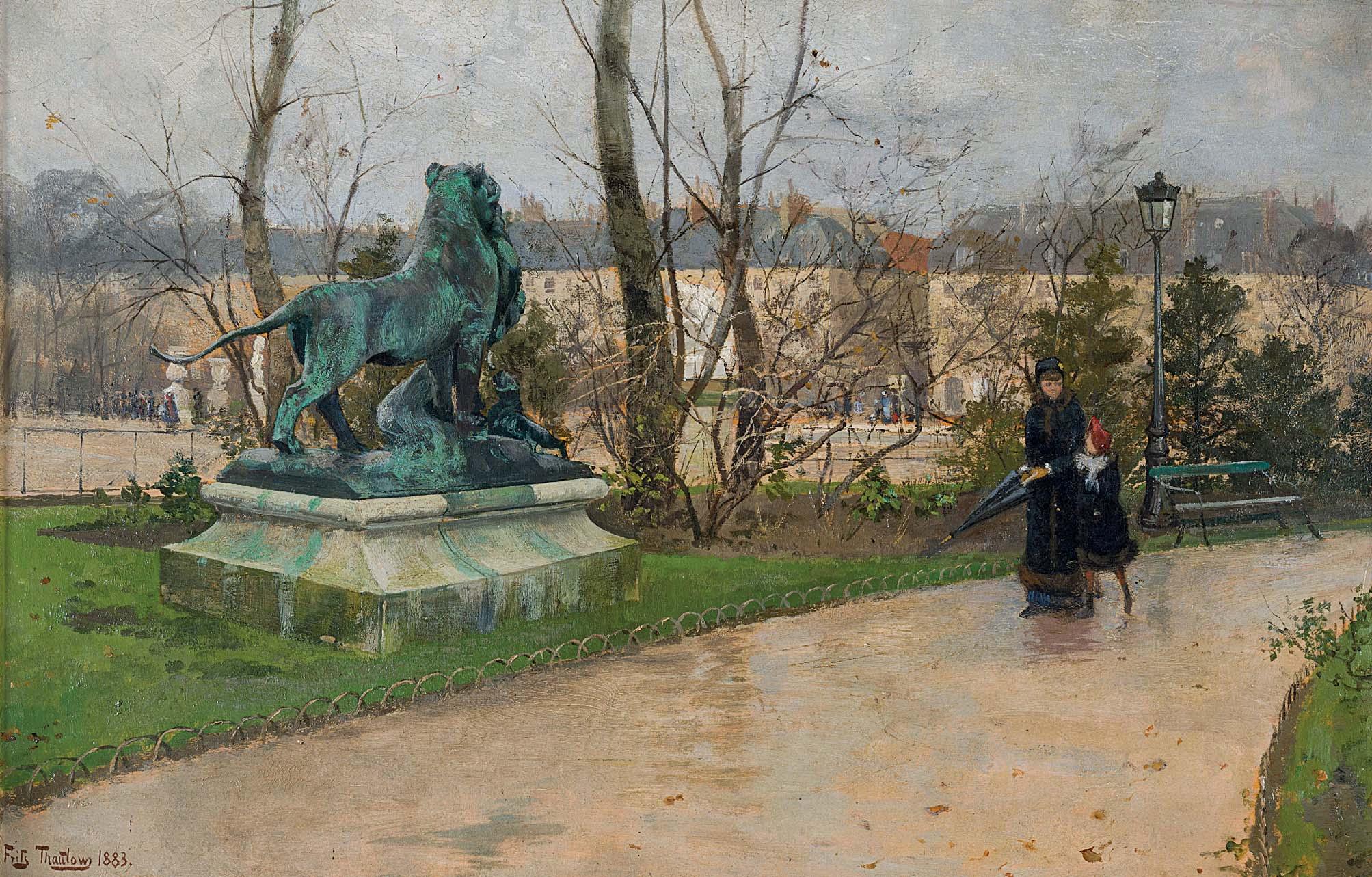
The Luxembourg Gardens, or Senate Gardens, in Paris were created in the early 17th century on the construction of the Luxembourg palace for Marie de Medici. (The palace is now where the French Senate meets hence the garden’s newer colloquial name).
Fra Luxembourg-haven Signed and dated 1883
The bronze sculpture depicted in Thaulow’s painting is the Nubian Lion and its Prey (1870) by Auguste Cain (1821-1894). It is still on display in the Luxembourg Gardens and shows the triumphant lion standing atop its prey, an ostrich.
THURE WALLNER
Thure Wallner (1888-1965)
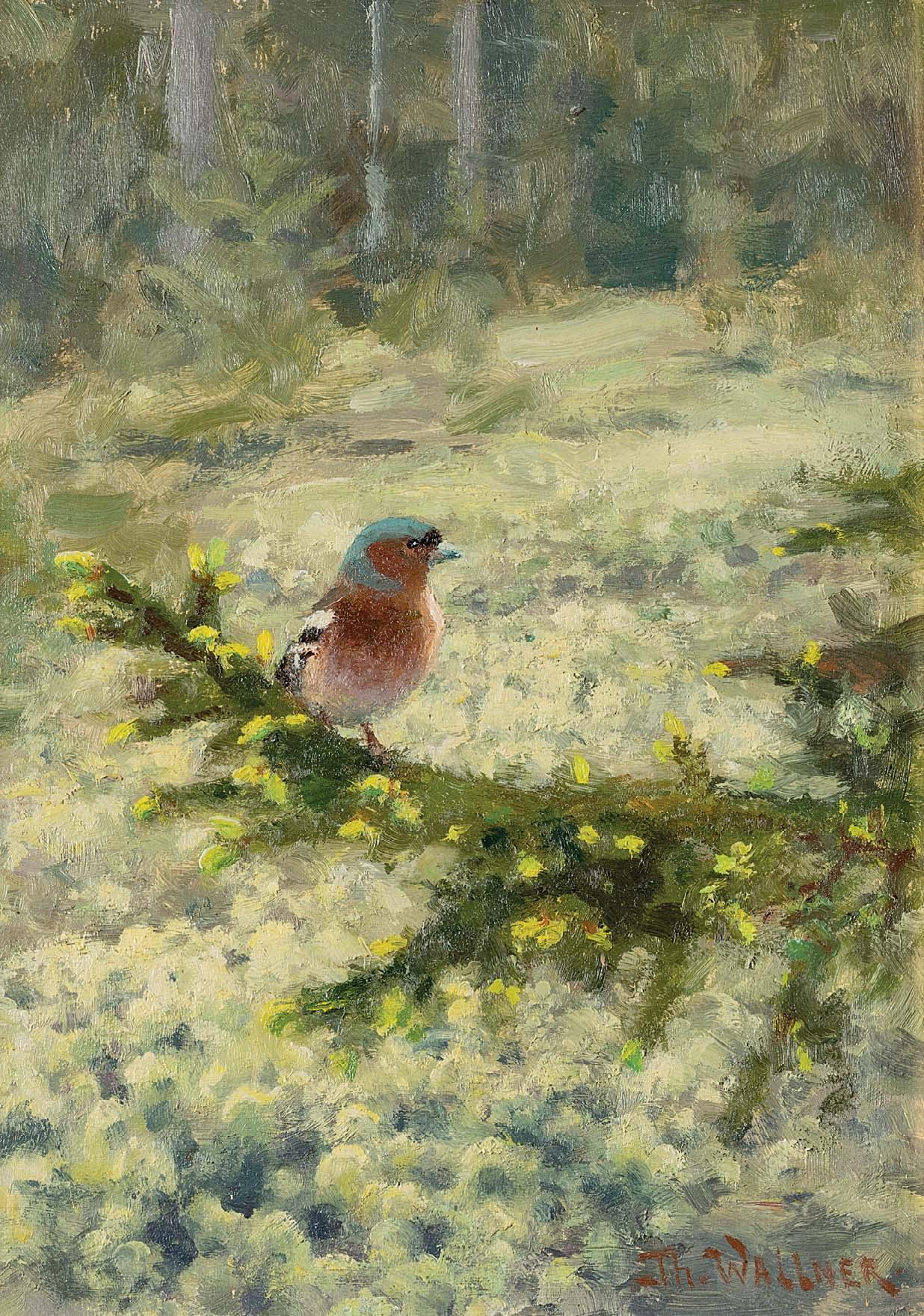
Thure Wallner was a Swedish naturalist painter and illustrator. He was born on 15 August 1888 in Salem, near Stockholm, studied at the Althins School of Painting in Stockholm and lived in Södert lje, a town south of the city. Wallner specialised in studies of native animals and birds in their natural habitat both in the Swedish countryside, often in the M laren landscape, and abroad (Lapland, Europe and America).
His meticulous draughtsmanship led him naturally to illustration work: he contributed to the Swedish hunting magazine Svensk Jakt, produced illustrations for children's books, and educational posters for schools. He died on 15 March 1965 in Södert lje.
His work is represented in the collection of Nationalmuseum (Stockholm).
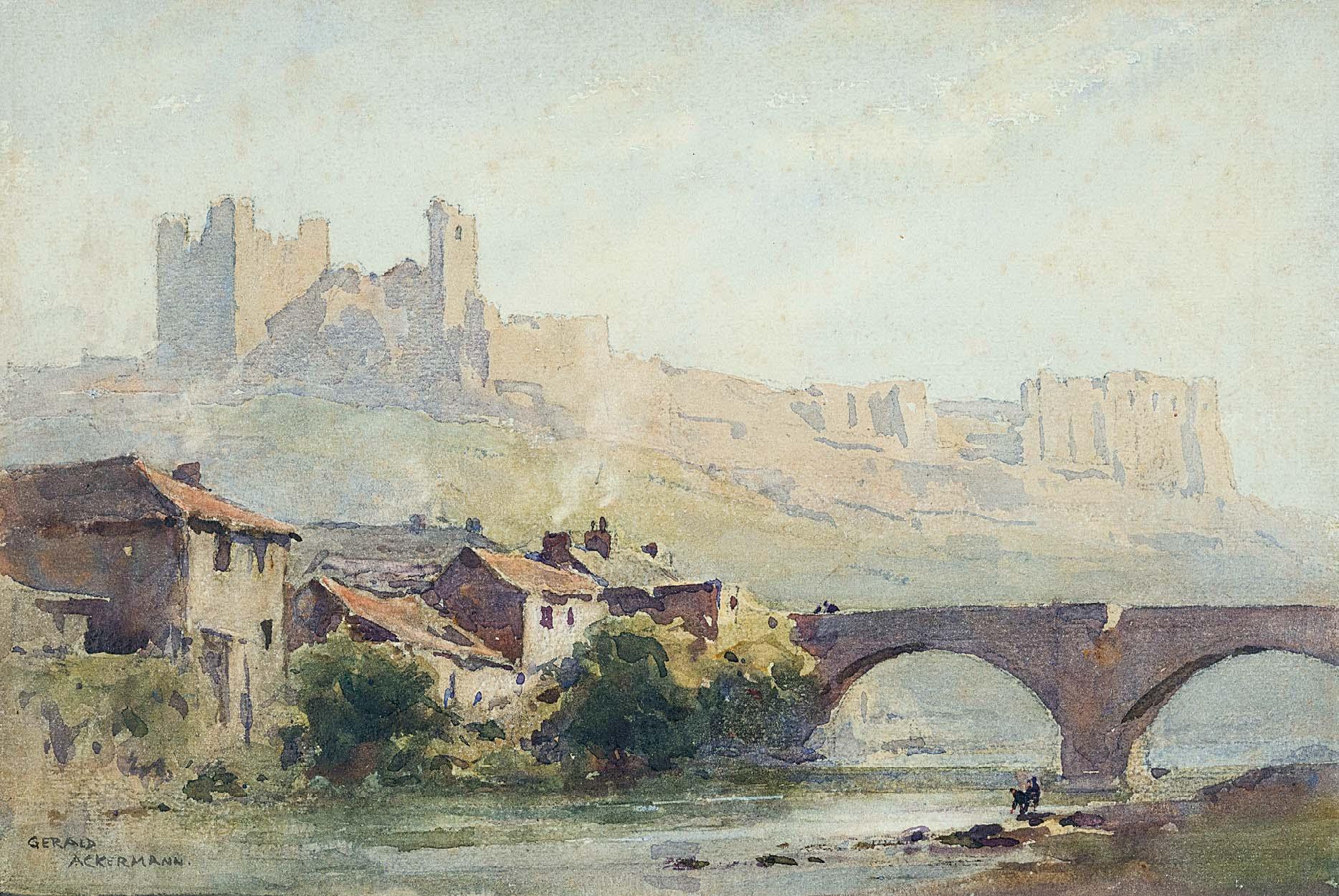
GERALD ACKERMANN
Gerald Ackermann (1876-1960)
Arthur Gerald Ackermann was a British watercolour painter who found inspiration in nature and consistently looked to still life and the sweeping green landscapes of Great Britain. While his style is more typical of the 19th century than when he was actively painting, his subjects were drawn directly from his own surroundings.
For a biography of Gerald Ackermann, please refer to Chris Beetles Summer Show, 2025, page 79.
47
Richmond Castle, Yorkshire
Signed Watercolour with pencil 9 ¼ x 14 inches
ARTHUR REGINALD SMITH
Arthur Reginald Smith, ARA RSW RWS (1871-1934)
Though most associated with his fresh and silvery watercolours of his native Yorkshire and, more generally, of northern England, Arthur Reginald Smith also captured the warmth of Italy.
For a biography of Arthur Reginald Smith, please refer to Chris Beetles Summer Show, 2017, page 95.
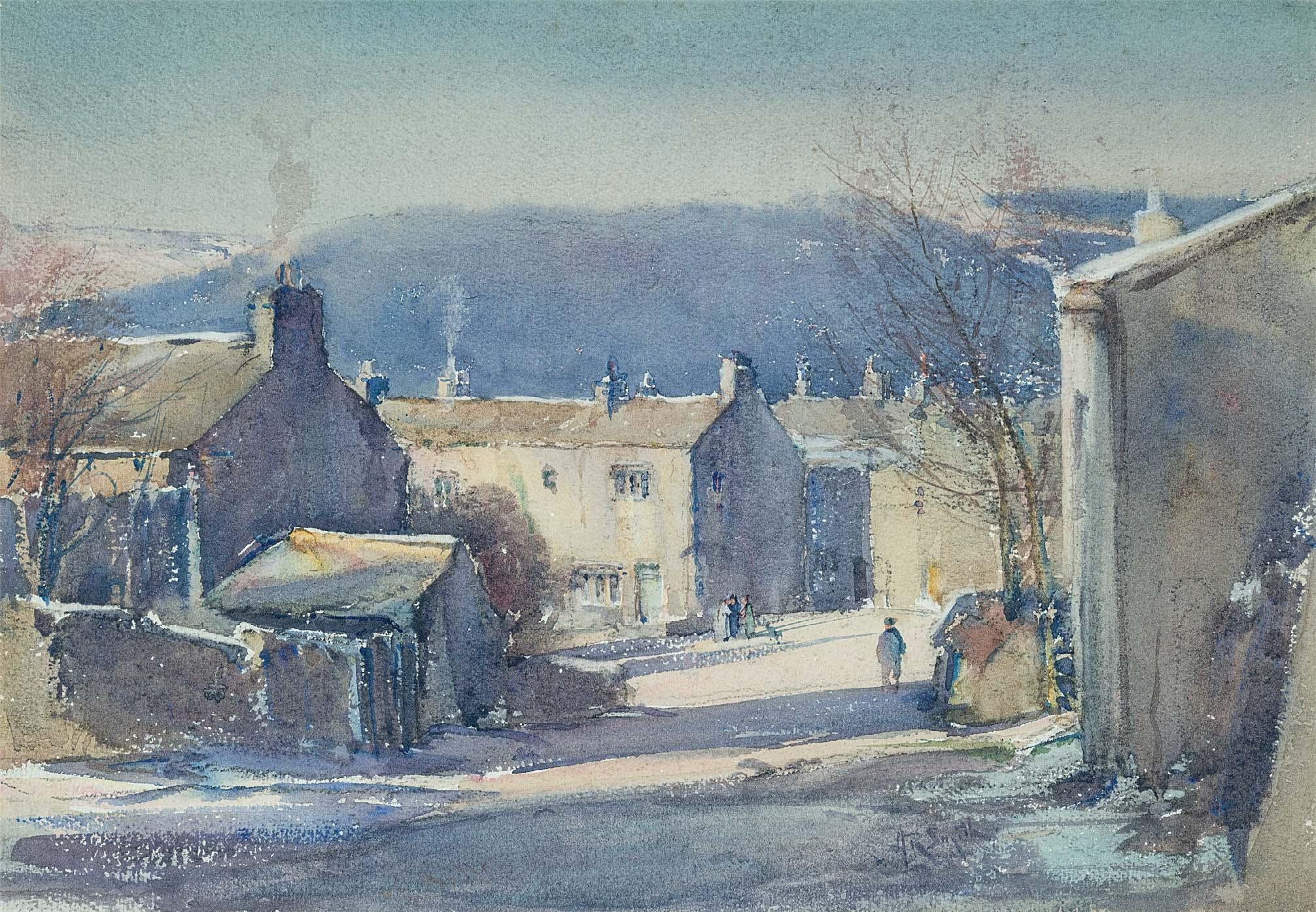
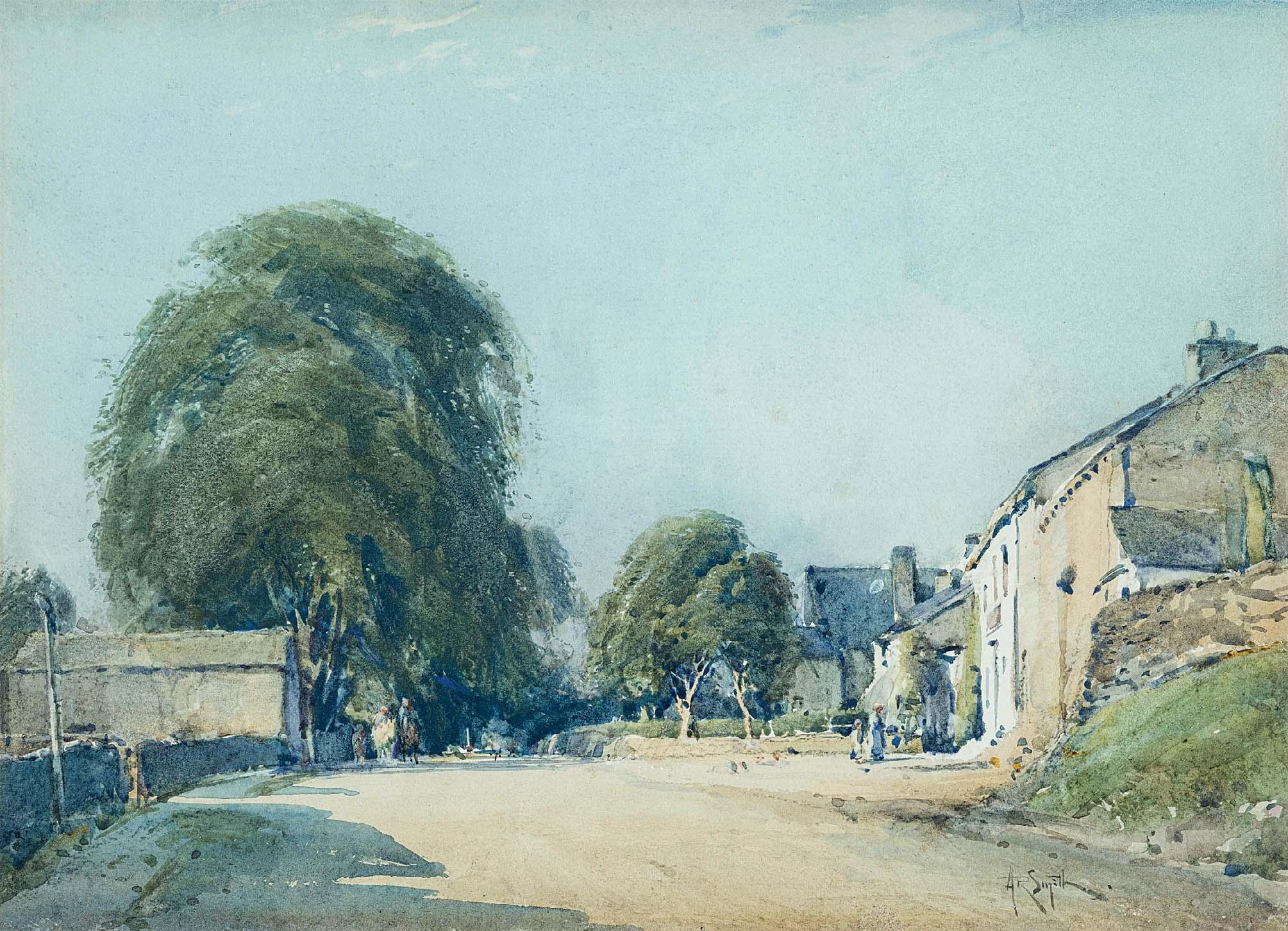
¼ x 14 ½ inches
RANDOLPH SCHWABE
Randolph Schwabe, RWS LG NEAC (1885-1948)
A clear eye and sure hand enabled Randolph Schwabe to produce drawings, etchings and lithographs of consistent clarity and strength. Trained at the Slade School of Fine Art, he would return there to become an in uential Principal and Professor. He also held a signi cant position as an o cial war artist in both world wars. Though he is best remembered for his attentive, absorbing
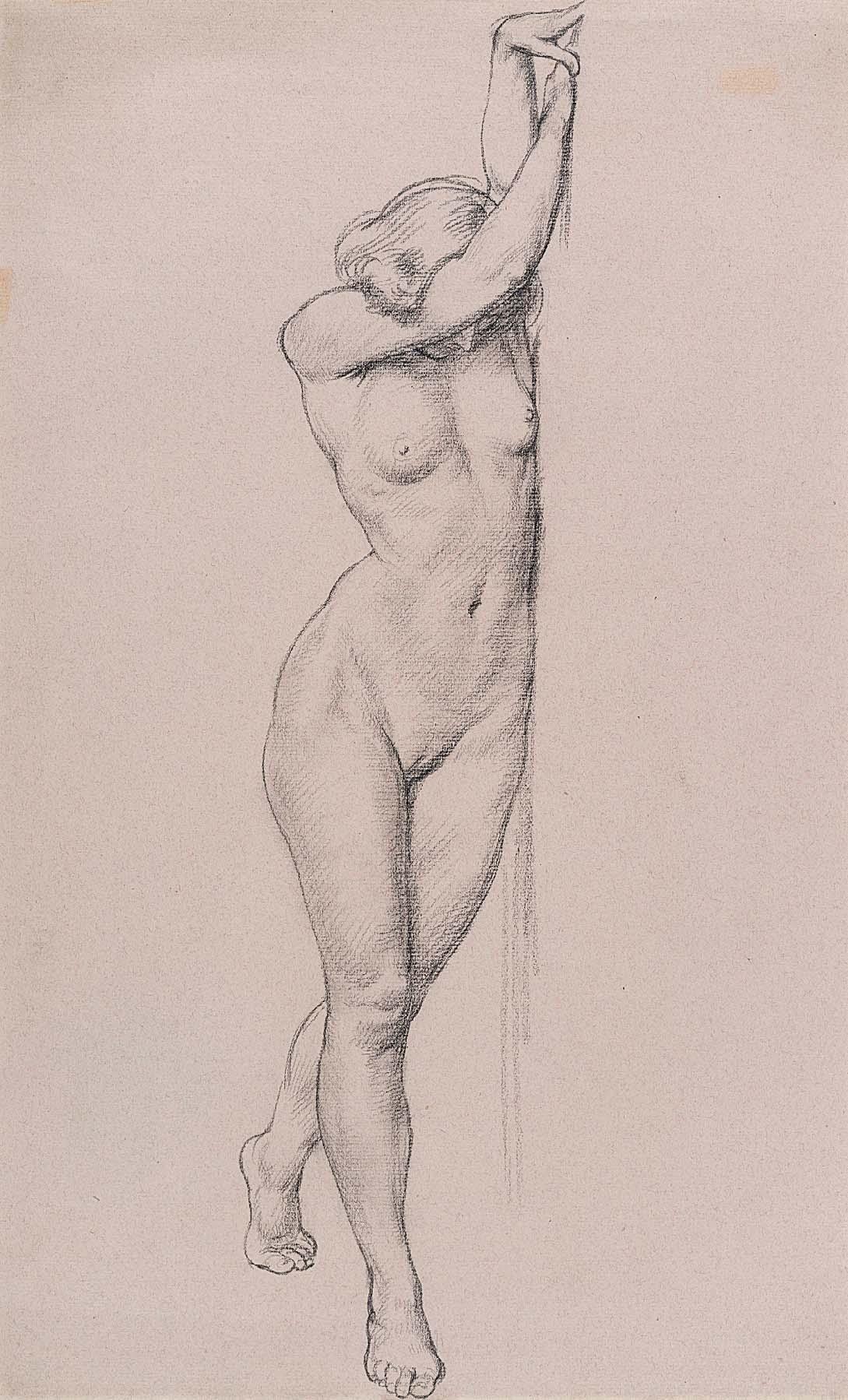
images of buildings and landscapes, his subjects included gures and still life compositions, and he also produced illustrations and designs for the theatre.
For a biography of Randolph Schwabe, please refer to Chris Beetles Summer Show, 2017, pages 115-116.
50 Standing nude Pencil on tinted paper 15 ½ x 11 ¼ inches
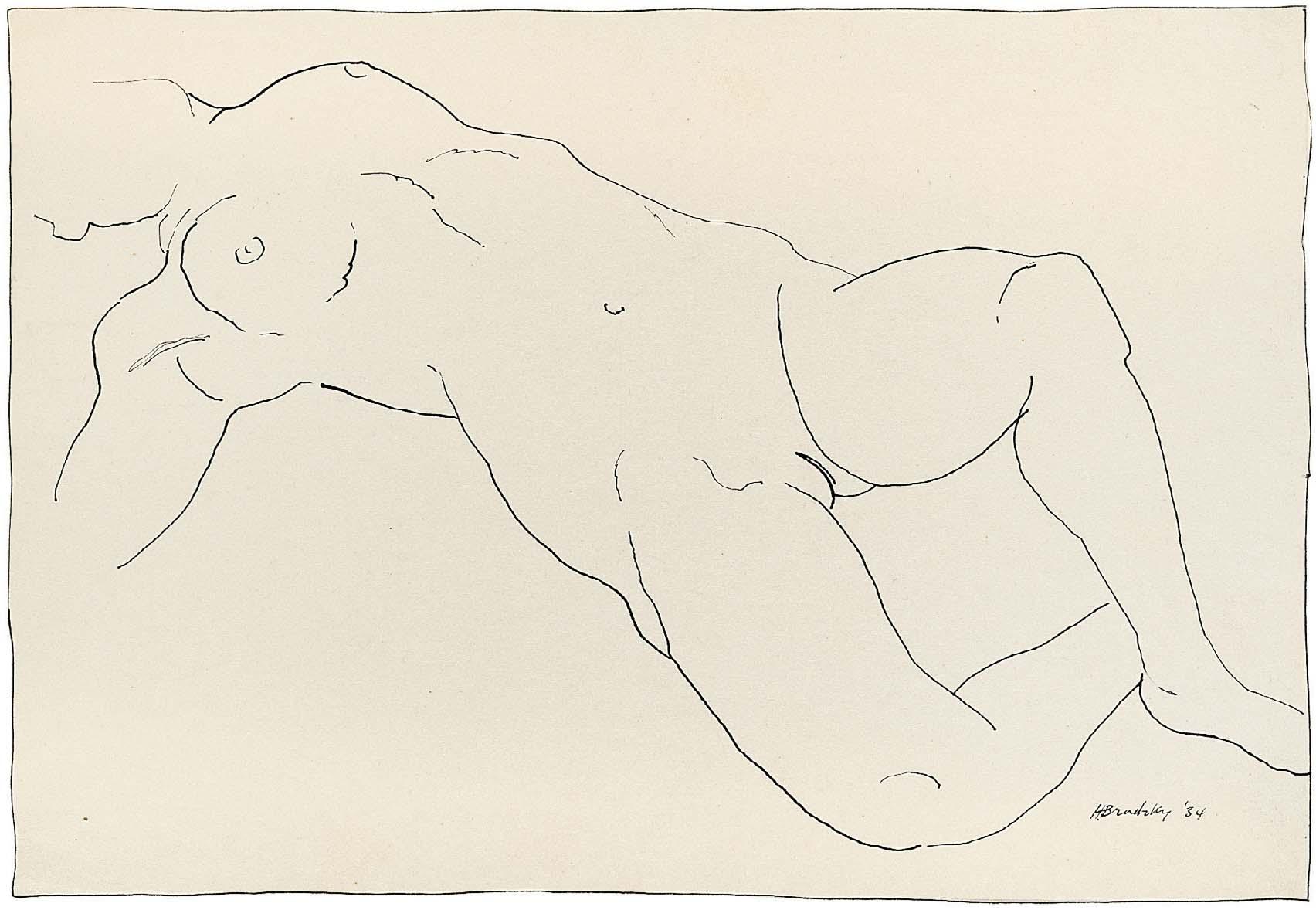
HORACE BRODZKY
Horace Brodzky (1885-1969)
Horace Ascher Brodzky was born in Kew, Melbourne, in 1885, the son of the Australian journalist Maurice Brodzky and his wife Flora. He studied at the National Gallery School in Melbourne and, after a period in San Francisco and New York, settled in London in 1908, where he continued his training at the City and Guilds South London Technical Art School. In London he became part of a lively avant-garde circle, moving among Walter Sickert, Henri Gaudier-Brzeska, Mark Gertler and the Vorticists, developing a distinctive body of work in paintings, drawings and prints.
Horace Brodzky was an early pioneer of linocut, a medium in which he helped open up new possibilities for modern printmaking in Britain. He travelled to Italy with the poet John Gould Fletcher, and a work from that journey was selected for the 1912 Venice Biennale, making him the rst
Australian to be shown there. After moving to New York in 1915, he worked as a poster artist, arts journalist and designer of book jackets for writers including Eugene O’Neill and Theodore Dreiser, while continuing to paint and make prints.
Returning to London in 1923, Brodzky settled in Kilburn and Willesden, where he remained a lively and engaged gure within the artistic community. He supported himself through teaching, stage-design and, from 1948 to 1962, as art editor of the Antique Dealer and Collector’s Guide. In later years, he turned his attention to writing, producing thoughtful biographies of Henri Gaudier-Brzeska and Jules Pascin. Since his death in 1969, Brodzky’s work has enjoyed a growing appreciation, celebrated for its vitality, invention and enduring contribution to the story of modern British printmaking.
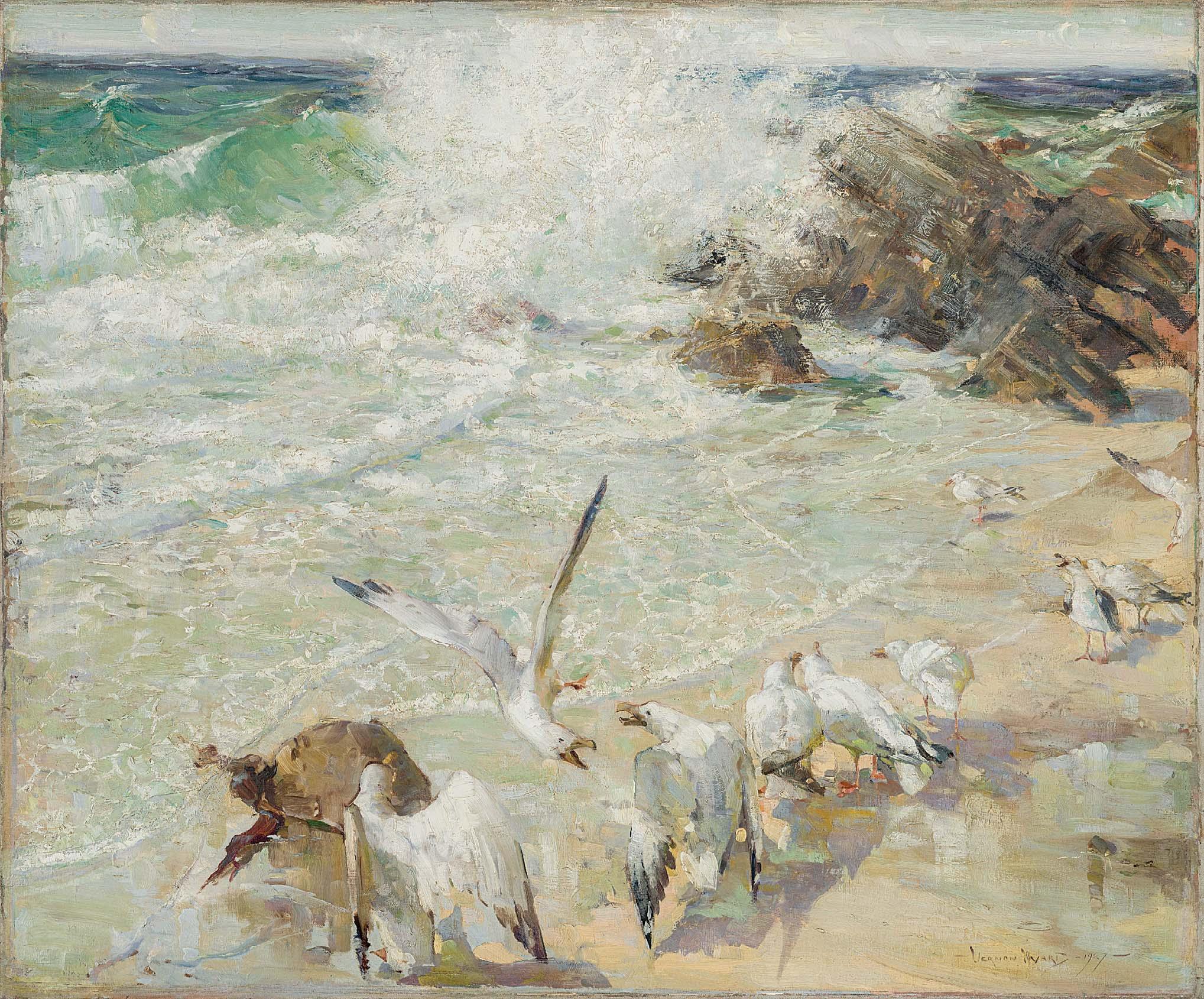
VERNON WARD
Vernon Ward RBA (1905-1986)
Vernon Beauvoir Ward was an English painter of owers, birds and gently nostalgic Edwardian subjects, closely associated with Hampstead, where he was born and spent most of his life. The son of an art dealer, Vernon Ward grew up surrounded by paintings and developed an early fascination for copying a wide range of styles. At 14 he entered the Slade School of Art, studying under Henry Tonks, Wilson Steer and Sir Walter Russell.
Following his father’s death, Vernon Ward turned largely to commercial work, producing images that achieved wide circulation through prints, greetings cards, chocolate boxes and puzzles. His preferred subjects such as roses, bird studies and period gures, were handled with a light, decorative touch that appealed to a broad audience.
He exhibited with a number of established societies and was elected a member of the Royal Society of British Artists at a notably young age of 21. During the Second World War, he served with the Civil Defence Service in Richmond, contributed a symbolic composition for the Free French, and later designed a naval memorial for Twickenham. He occasionally worked under the pseudonym ‘Bertram Linder’.
Vernon Ward travelled and sketched extensively, particularly in the Lake District, and continued to paint despite signi cant physical challenges, including loss of sight in one eye and later, severe arthritis. His rst solo exhibition was held in 1976. Vernon Ward died in 1985, leaving a substantial and widely reproduced body of work that has retained its quiet appeal.
52
Seagulls on the Beach
Signed Oil on canvas
33 x 40 ½ inches
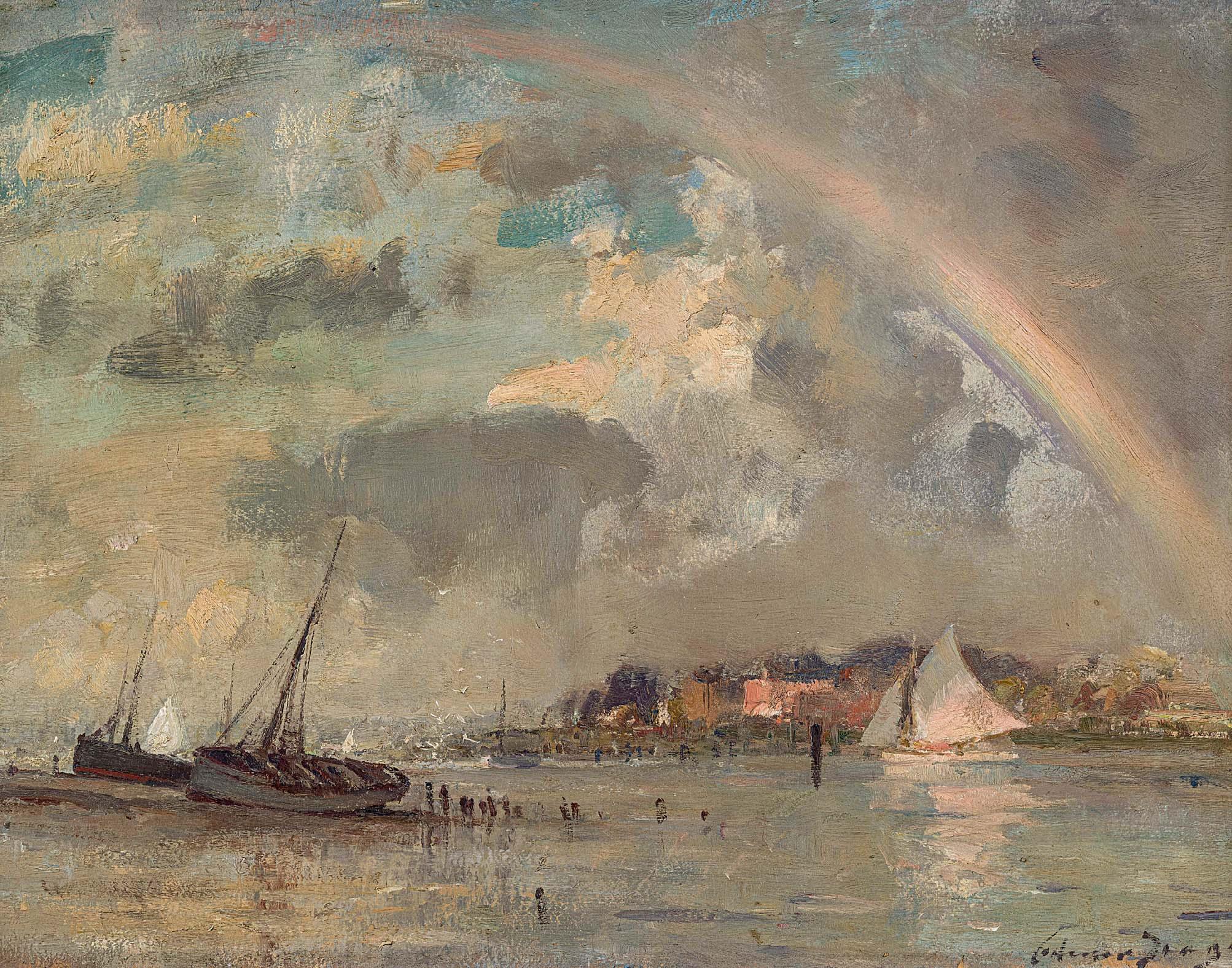
EDWARD SEAGO
Edward Seago, RWS RBA (1910-1974)
One of Britain’s best loved and most widely collected twentieth-century artists, Edward Seago painted fresh and vigorous oils and watercolours of a variety of subjects, including portraits and, especially, landscapes.
For a biography of Edward Seago, please refer to Chris Beetles Summer Show, 2004, page 369.
53
Breydon Water, Norfolk
Signed Oil on board
11 ½ x 15 ½ inches
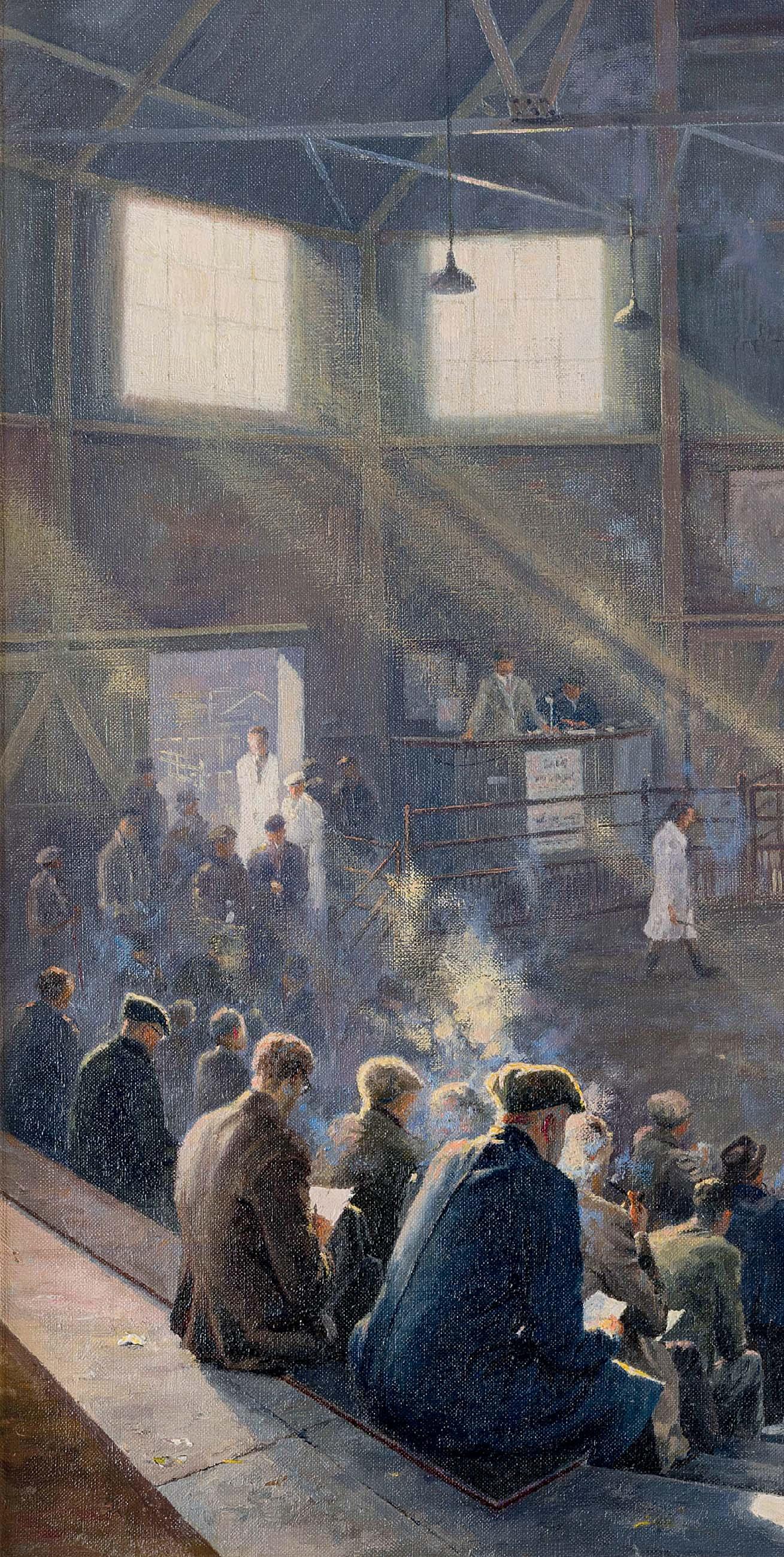
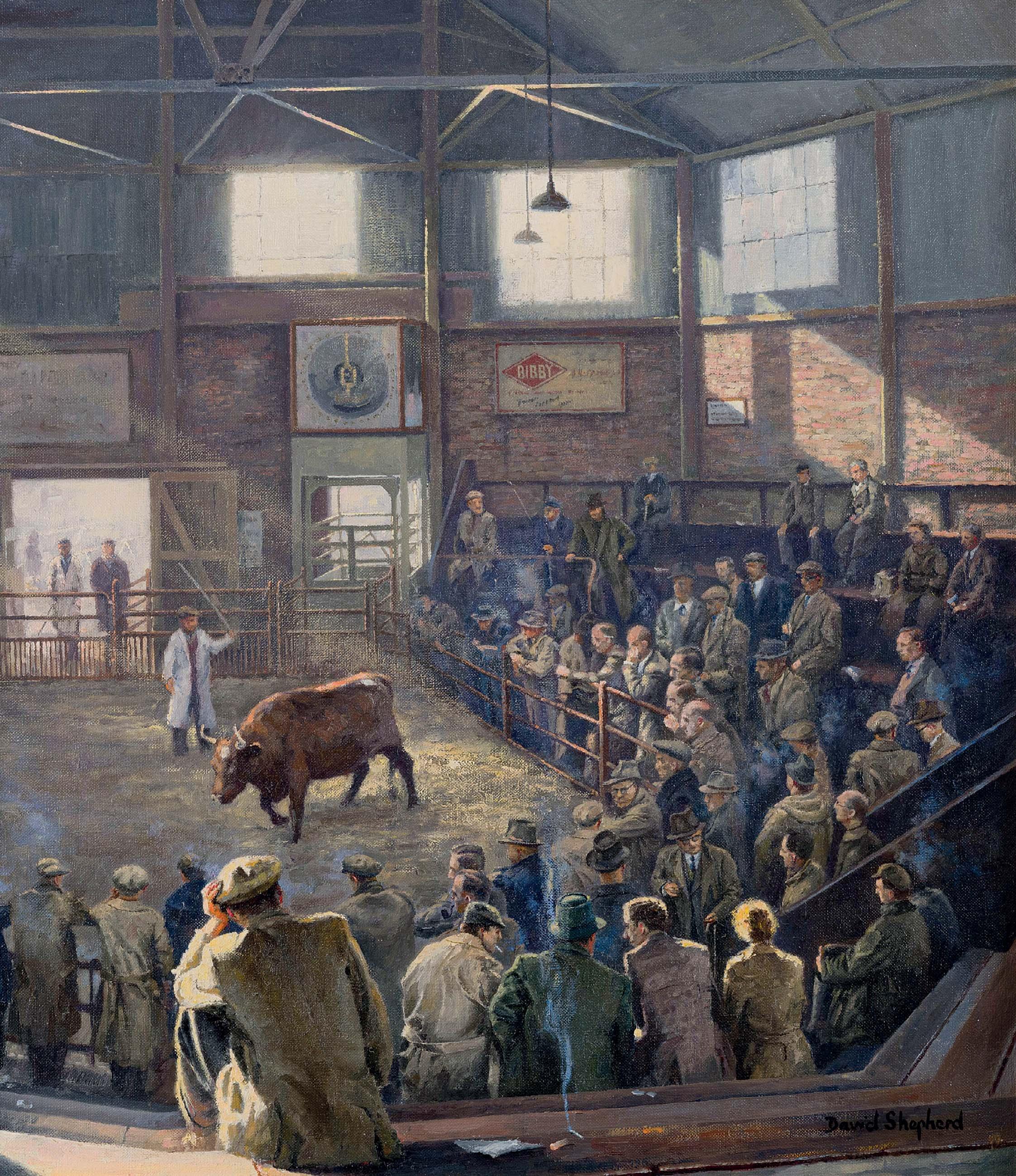
DAVID SHEPHERD
Richard David Shepherd, CBE FRGS FRSA (1931-2017)
David Shepherd was a naturalistic painter in oils of a wide range of subjects, and most notably of African wildlife and steam railways, both of which were dear to his heart. Becoming one of the world’s best known and most outspoken environmentalists, he raised millions for conservation through sales of his wildlife paintings. He became so popular with the public that, during the 1960s, prints of his images of elephants outsold reproductions of works by Canaletto.
For a biography of David Shepherd, please refer to Chris Beetles Summer Show, 2020, pages 126-127.
David Shepherd produced this highly atmospheric portrait of the cattle market in Reading, Berkshire, early in his career. It follows in the tradition of works by both William Gunning King (1859-1940) and James Bateman (1893-1959). King’s images advertised the animal feed manufacturer, J Bibby, and a poster for the same company can be seen on a wall in Shepherd’s painting.
A cattle market has existed on the same site in Reading since 1850, when a public company was established to found such a building, as a replacement for the slaughterhouses in the centre of the town. The company chose as its site a meadow south of the railway line and north of Great Knollys Street.
In 1901, the auctioneers, Bailey & Thimbleby, approached the farmer, George Shorland, to run the agricultural side of its business at Reading Cattle Market. By 1903, the rm had become known as Thimbleby & Shorland, and it still operates from the market. The present buildings – including the ring that probably features in Shepherd’s painting – were constructed in the late 1930s, by which time Thimbleby & Shorland was bringing loads of Ayrshire cattle from Scotland to the market.
However, since the closure of the slaughterhouse in 1996, the focus of sales has been on goods rather than animals, from antiques to contractors’ plant.
54 Reading Cattle Market
Signed Oil on canvas
21 ½ x 29 ¼ inches
Exhibited: ‘Chris Beetles Summer Show 2020’, Chris Beetles Gallery, London, no 10
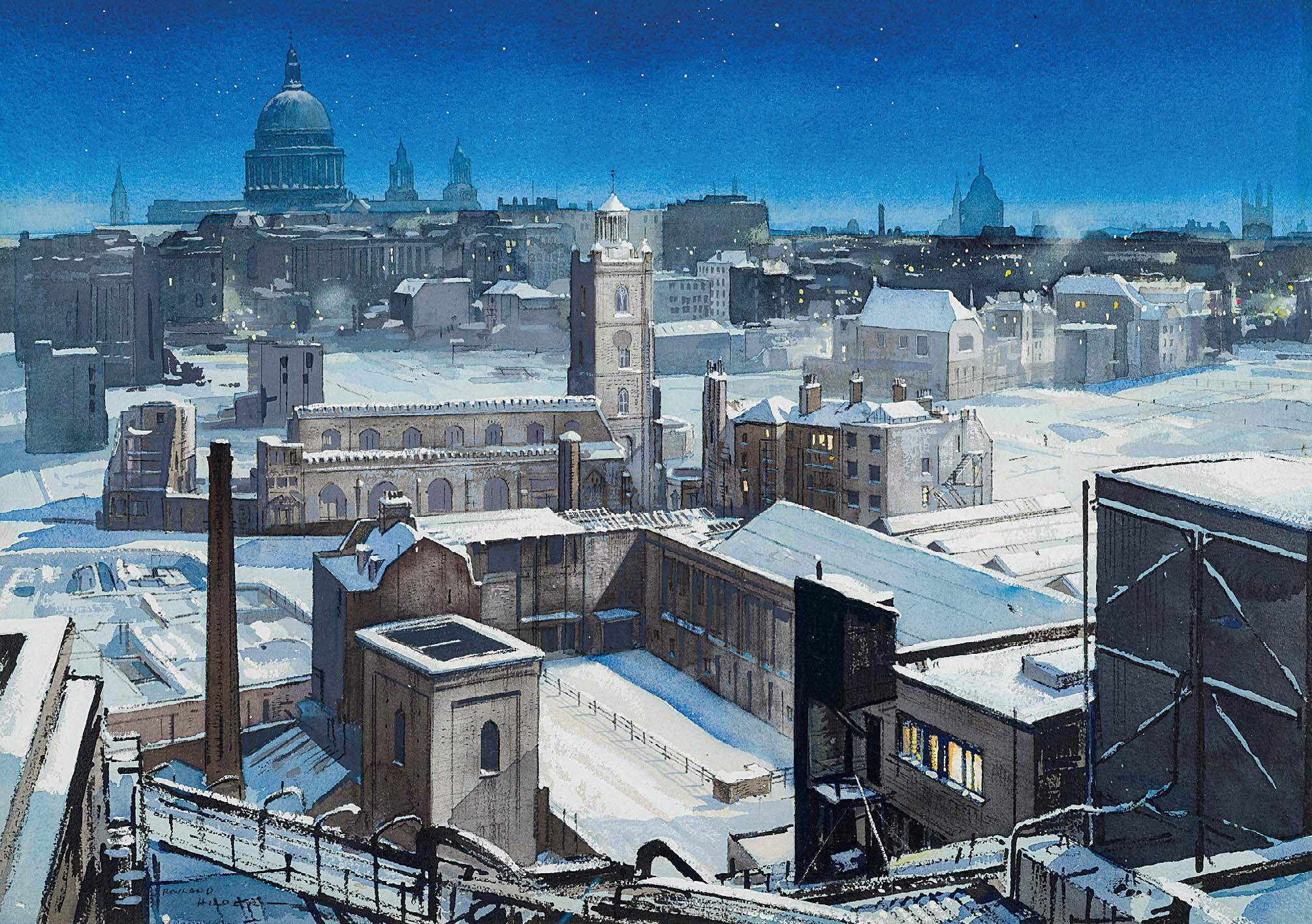
ROWLAND HILDER
Rowland Frederick Hilder, OBE PRI RSMA (1905-1993)
A highly uent watercolourist, Rowland Hilder became synonymous with the Kent countryside that he painted for much of his life. However, he was a wide-ranging painter and illustrator, who tackled cityscapes, marines and gure subjects with equal con dence and success.
For a biography of Rowland Hilder, please refer to Chris Beetles Summer Show, 1998, page 20.
55 Winter Snow, St Paul’s
Signed
Watercolour, bodycolour and charcoal 21 ½ x 30 inches
Exhibited: Chris Beetles Summer Show 2012, no 50
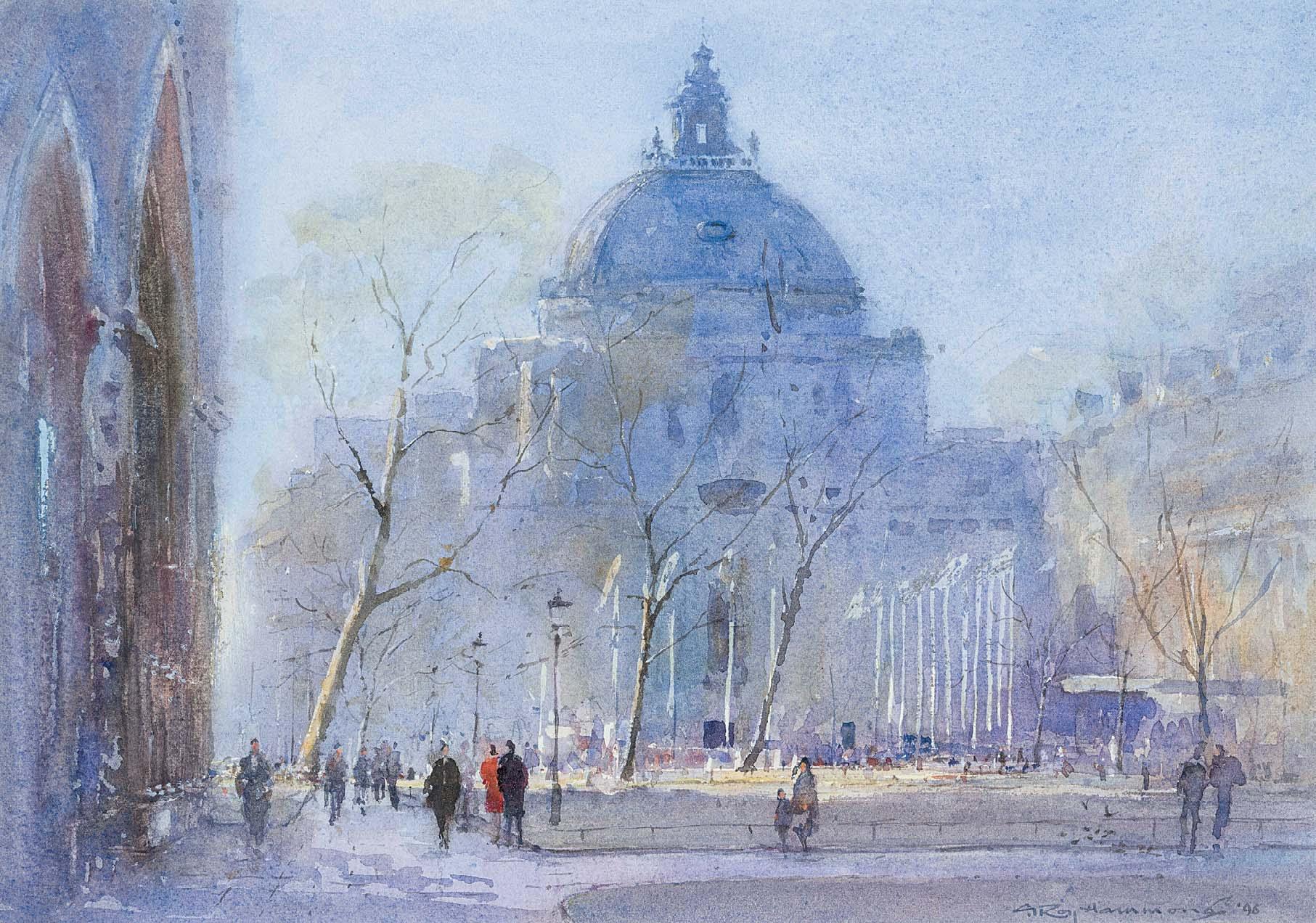
ROY HAMMOND
Roy Hammond (born 1934)
Over the last forty years Roy Hammond has built up a devoted following for his watercolours through eight sell-out shows at the Chris Beetles Gallery, including ‘Journey Down the Nile’ (1987), ‘In Istanbul’ (1988), ‘Roy Hammond’s London’ (1990) and ‘Roy Hammond’s Travels’ (1992). Each exhibition has focused on his responses to particular locations, both domestic and foreign, so that his oeuvre as a whole suggests an artist in the tradition of the Victorian or Edwardian travelling painter; he has shown allegiance to Turner and Goodwin in his ‘souvenirs’, a term which also calls to mind the work of Brabazon.
56 By the Abbey – Westminster, London Signed and dated 96 Watercolour and bodycolour 9 ¼ x 13 ½ inches
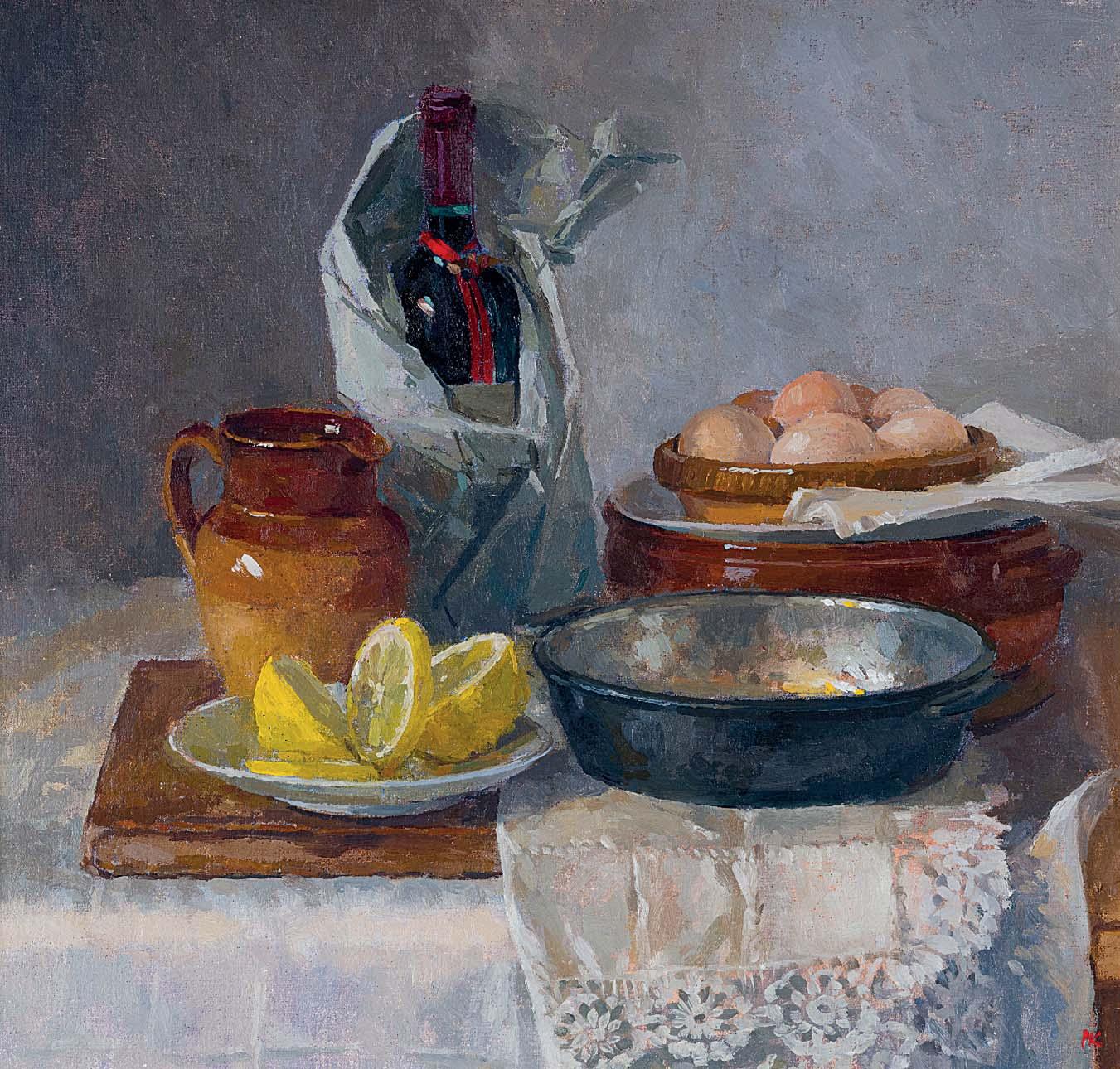
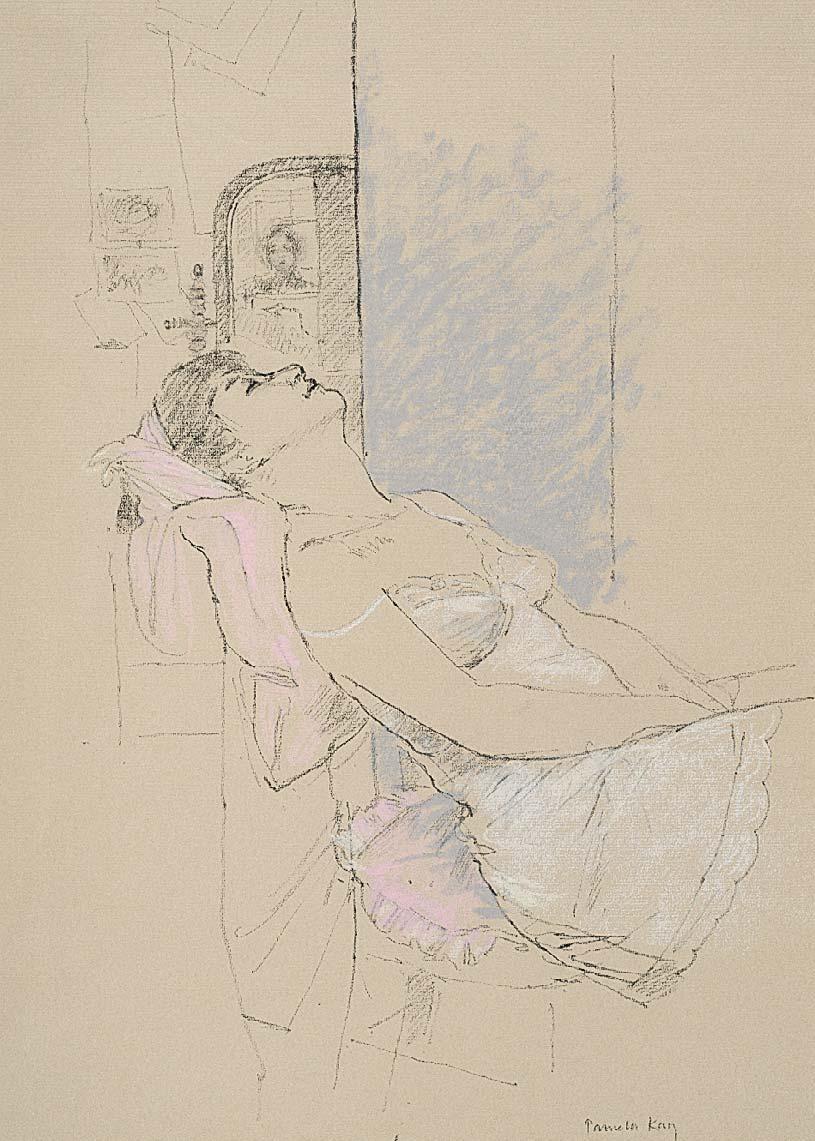
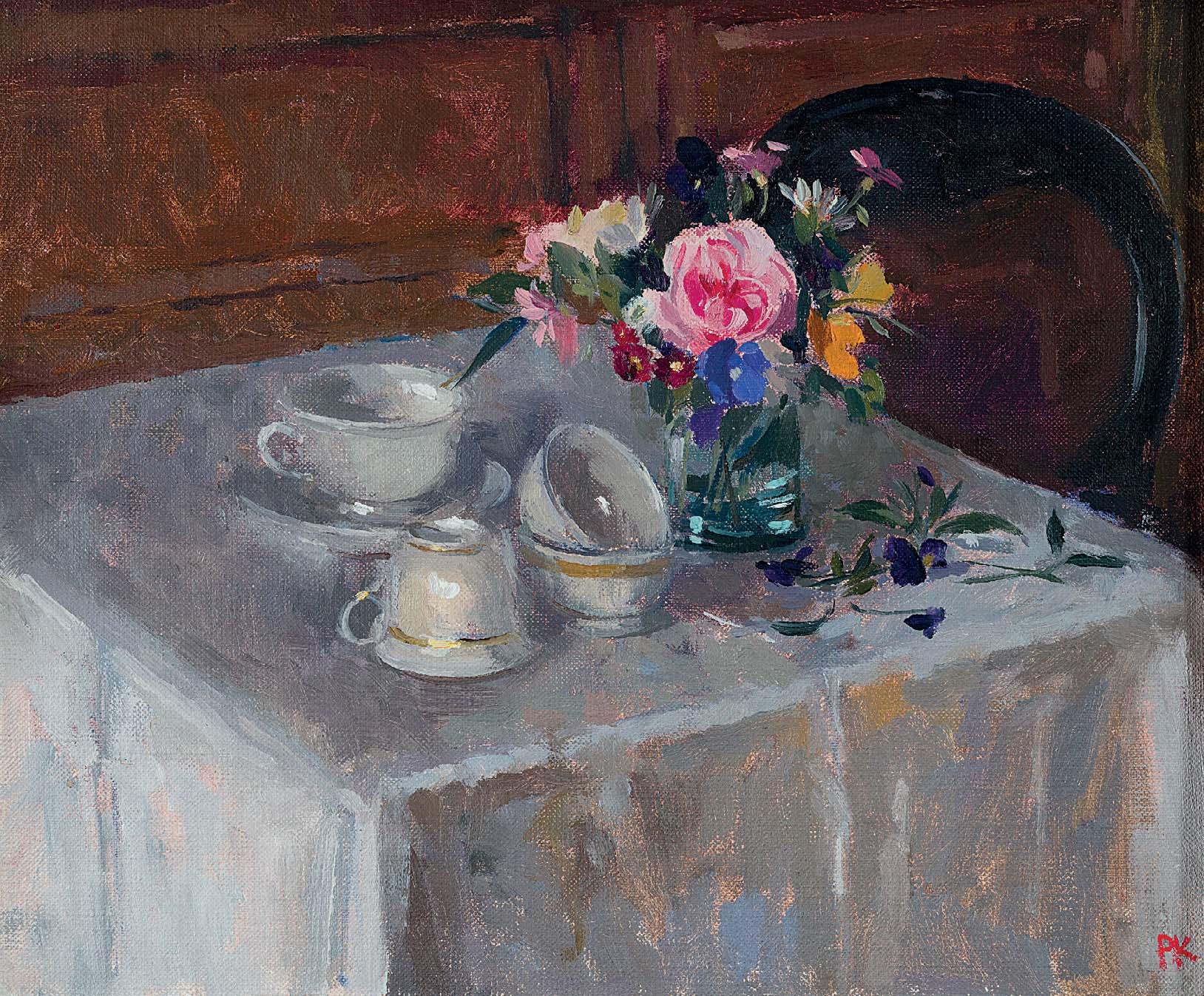
PAMELA KAY
Pamela Kay, RWS RBA NEAC (born 1939)
As a painter and draughtsman, Pamela Kay considers herself to work in the French tradition of Chardin, Ingres and Fantin-Latour. She is best known for still life subjects that often open out to include interiors and gardens, though she
also produces landscapes and portrait in oil and watercolour. In addition, she has worked as a designer, illustrator, teacher and writer on art.
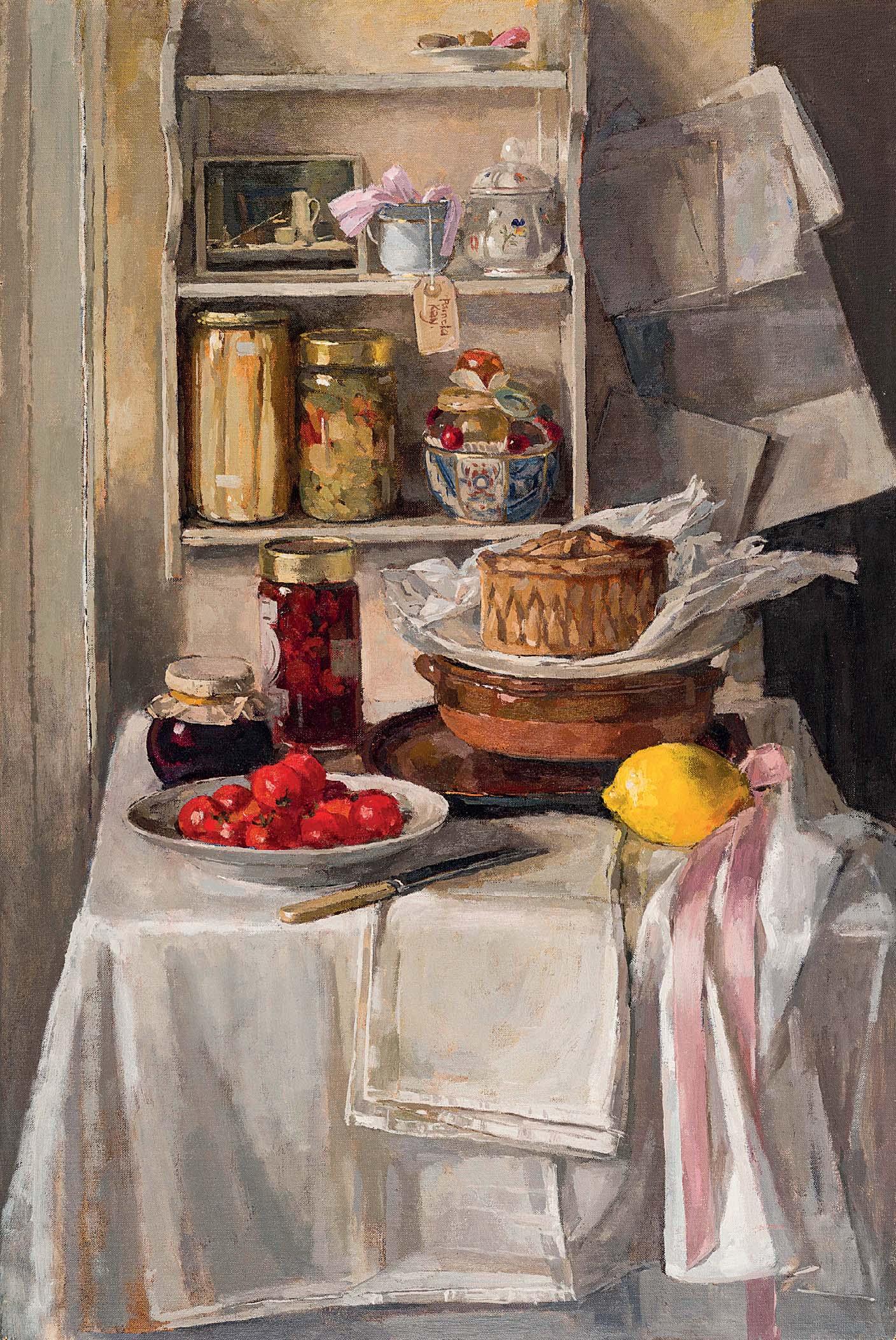
57 Pie and Tomatoes Signed Oil on canvas
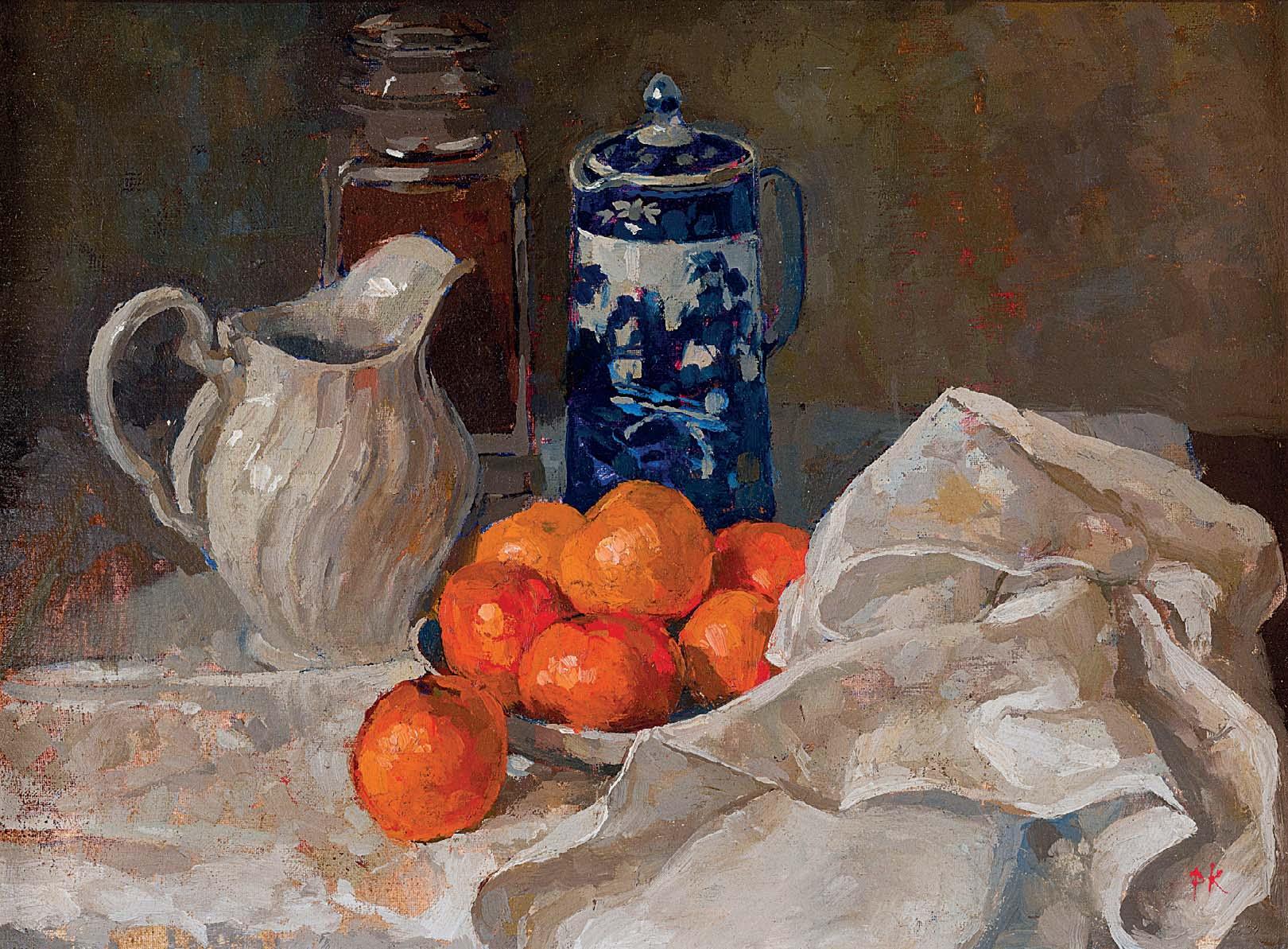
59 Clementines and Blue and White Pot
Signed with initials Oil on board 8 ½ x 11 ¼ inches
Still life with Lemons, Wine and Eggs
Signed with initials Oil on board 12 ½ x 13 ½ inches
60
Victoria Resting with Head Back
Signed Chalk with pastel on tinted paper
19 x 13 ½ inches
61
Interior with Flowers and Cups
Signed with initials
Oil on board
10 x 12 inches
LESLEY FOTHERBY
Lesley Fotherby (born 1946)
Multi-talented and multi-faceted, Lesley Fotherby goes from strength to strength in expanding her range and increasing her popularity. She perpetually strives to capture the moving world around her, with fresh approaches and new appeal, from evocatively descriptive landscapes and the vivacity of dance to the ne naturalistic detail of the world of cats.
For a biography of Lesley Fotherby, please refer to Chris Beetles Summer Show, 2024, page 149.
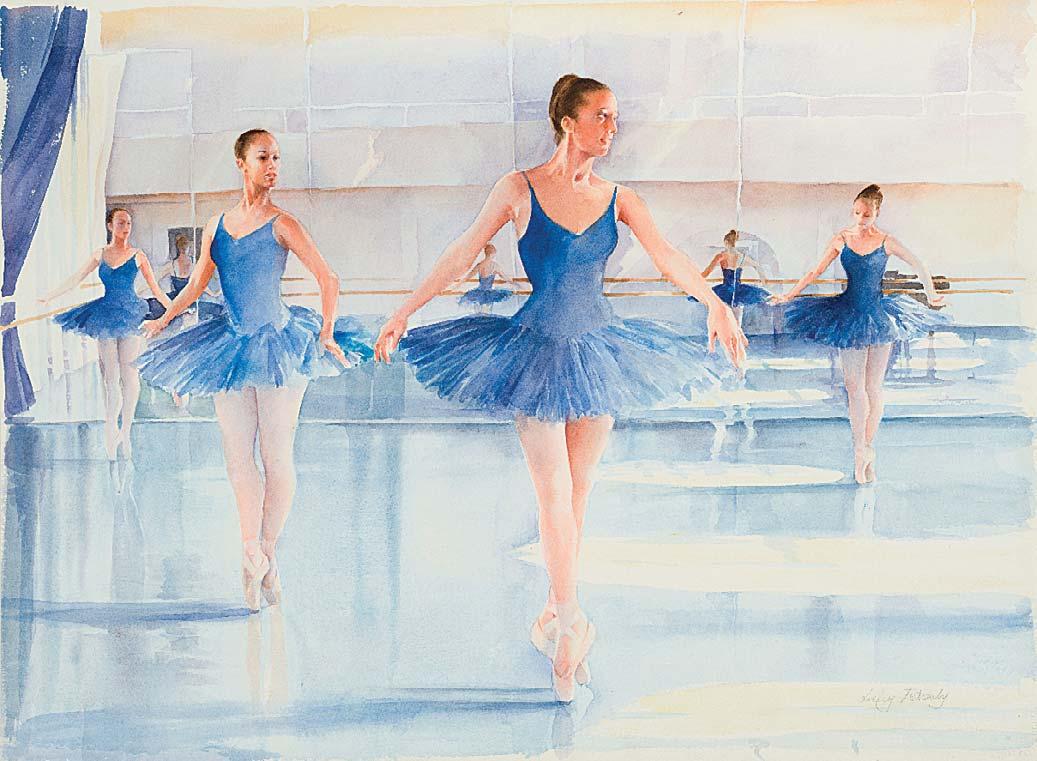
62
Blue Dancers in front of the Mirror – English National Ballet School, March 1997
Signed
Inscribed with title and dated on reverse
Watercolour
20 ½ x 28 ½ inches
63
Dance on a Summer Afternoon, Tring
Signed Watercolour
28 ½ x 21 inches
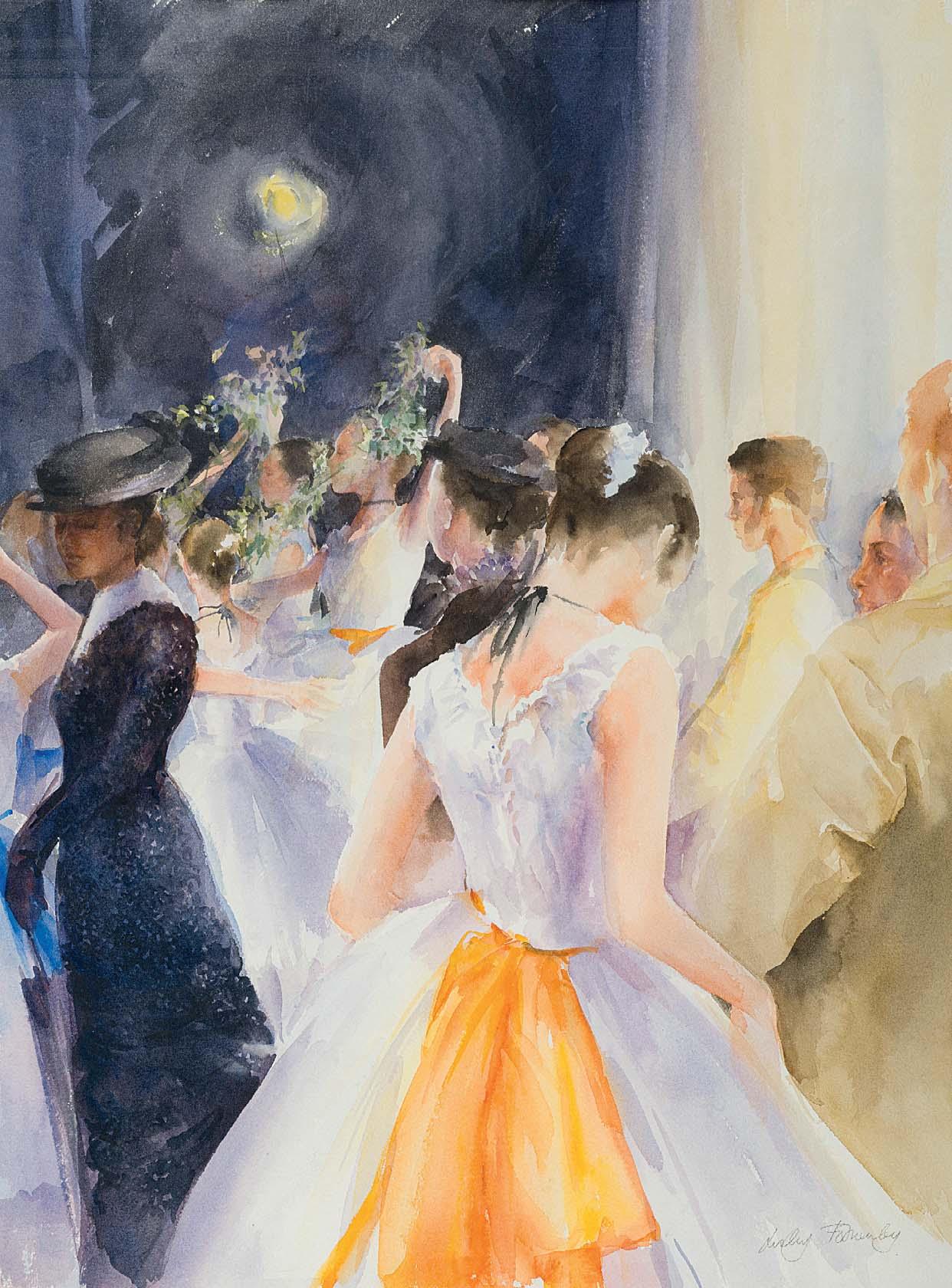
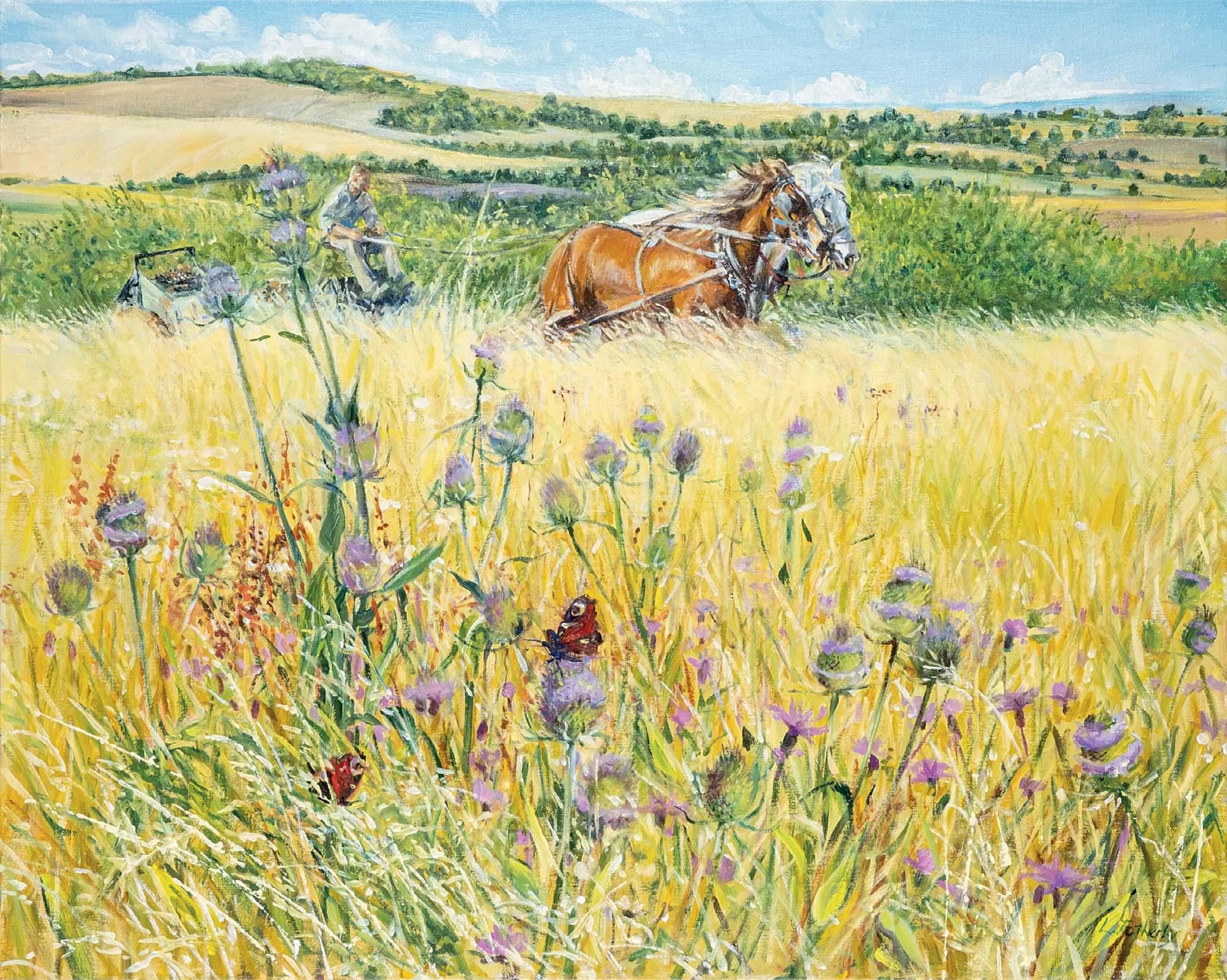
with
64
Horses and Teasel
Signed Inscribed
title on reverse Oil on canvas 24 x 30 inches
Exhibited: ‘Chris Beetles Summer Show 2024’, Chris Beetles Gallery, London, no 158
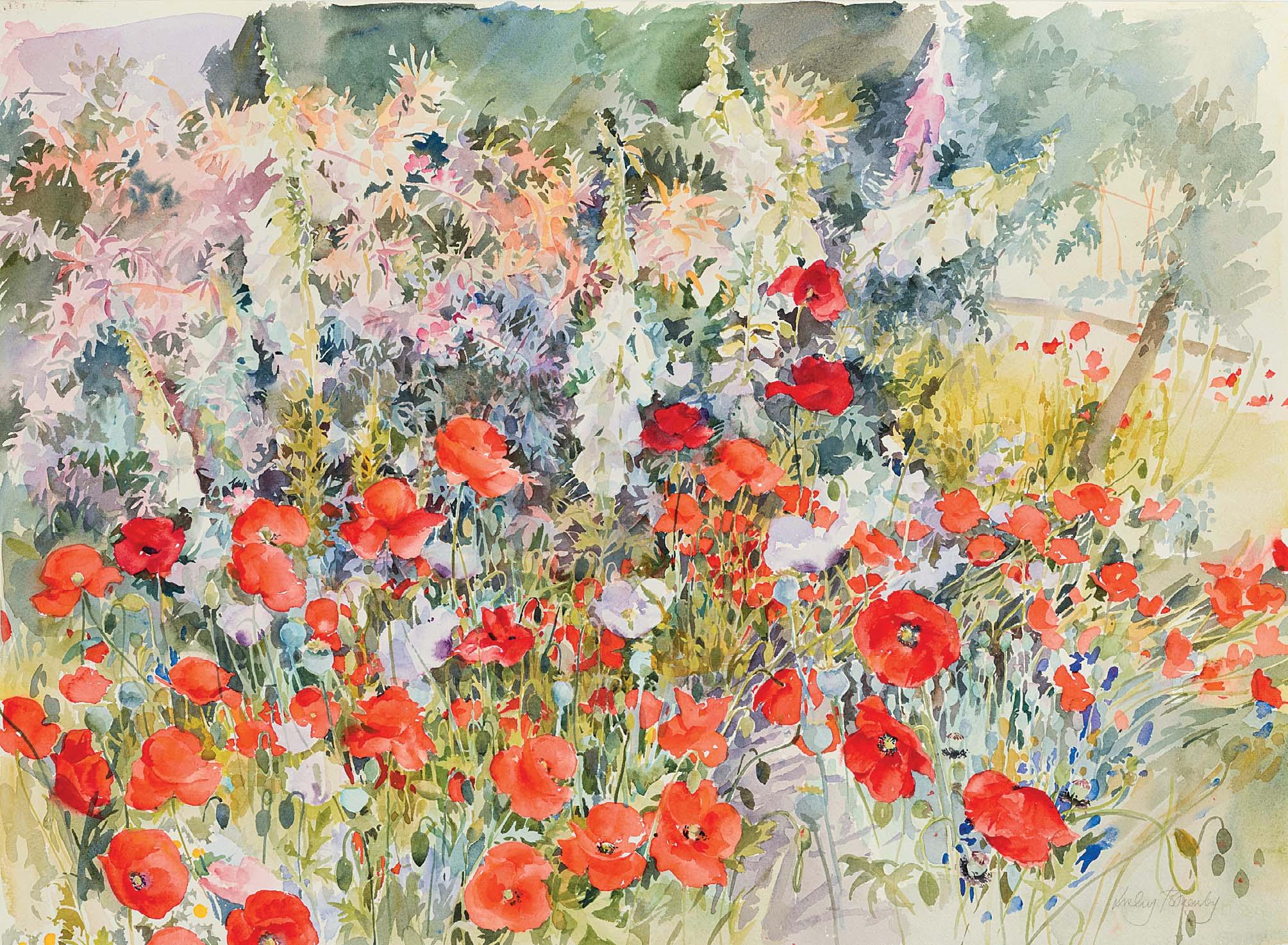
JACK RUSSELL
Jack Russell (born 1963)
After a highly successful career as an international Test cricketer, rising to become England’s greatest wicketkeeper, Jack Russell has grown into an acclaimed painter of atmospheric landscapes, idyllic cricketing scenes and stirring portraits. In recent years, he has focused on a series of powerful portraits of war heroes and veterans.
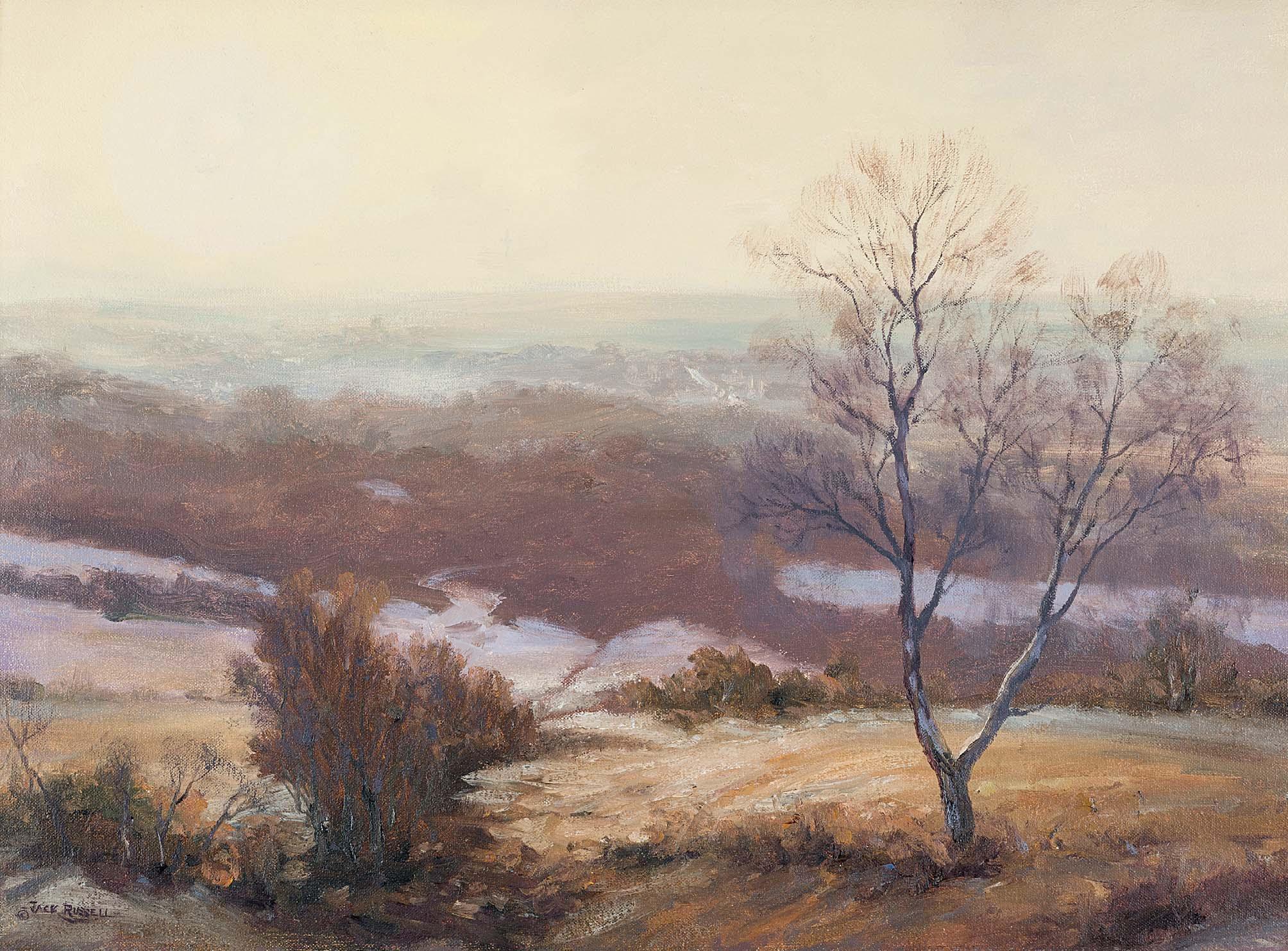
PETER BROWN
Peter Brown (born 1967)
While the practice of many artists is described as en plein air, Peter Brown really does do most of his painting outside. He sets up his easel in all weathers and happily works among people and directly from the subject, in a vigorous impressionist style. Even when completing larger canvases in the studio, he never refers to photographs, but utilises the charcoal drawings, pastels and smaller paintings that he has made on site. He is best known for his views of British cities, including London, Cardi and Edinburgh, as well as Bath. However, his range is wide, and he has engaged with the cli s
and beaches of the West Country and Brittany, a number of European cities, and many more distant locations. He has also developed an interest in painting interiors. Whether he is working inside or out, he always instils his canvases with a dynamic sense of life, for he interested in people as well as places, and is equally skilled as a portraitist. From 2018 to 2023 he has further demonstrated his empathy and sociability the President of the New English Art Club.
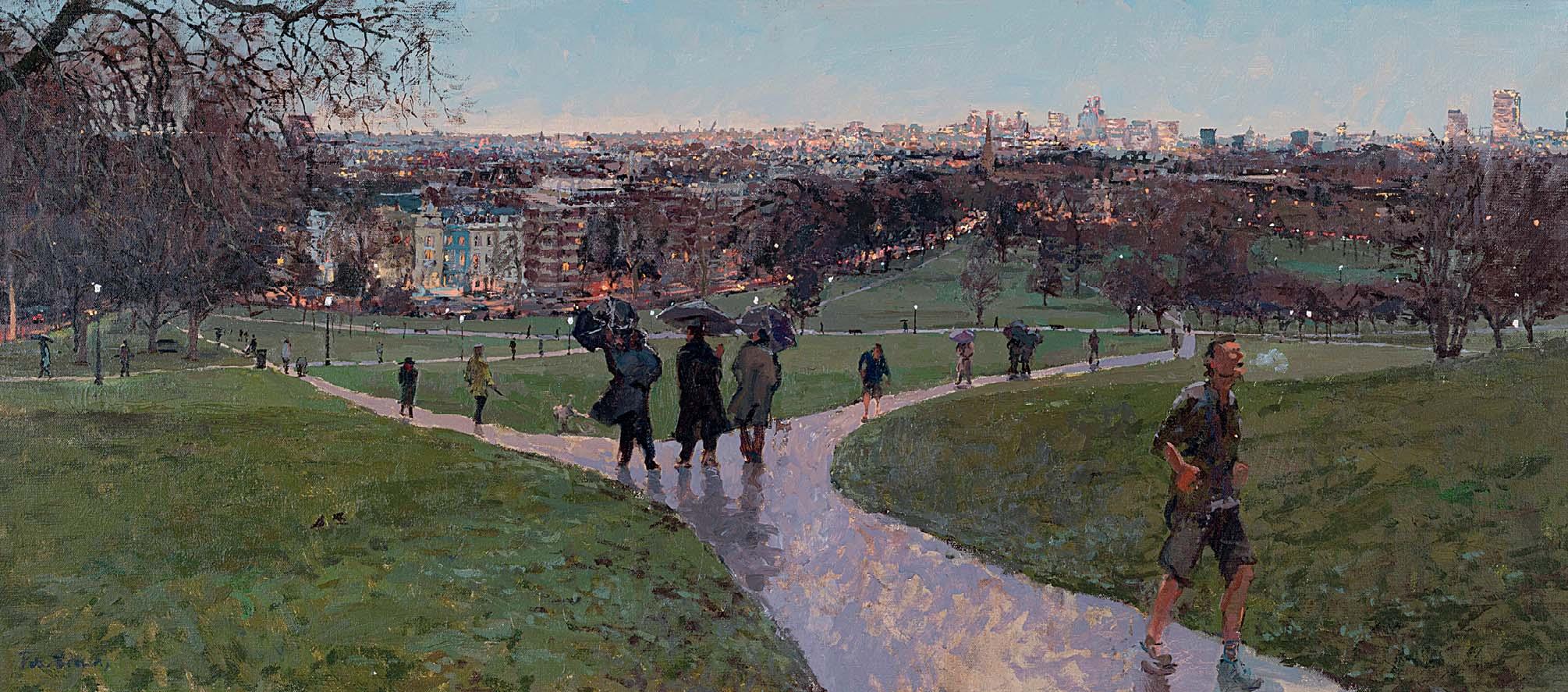
67 The End of the Day, Primrose Hill Signed Oil on canvas
19 ½ x 44 ¼ inches
Exhibited: ‘The Figurative Tradition, A Celebration of Contemporary British Art’, Chris Beetles Gallery, London, October-November 2020, no 82
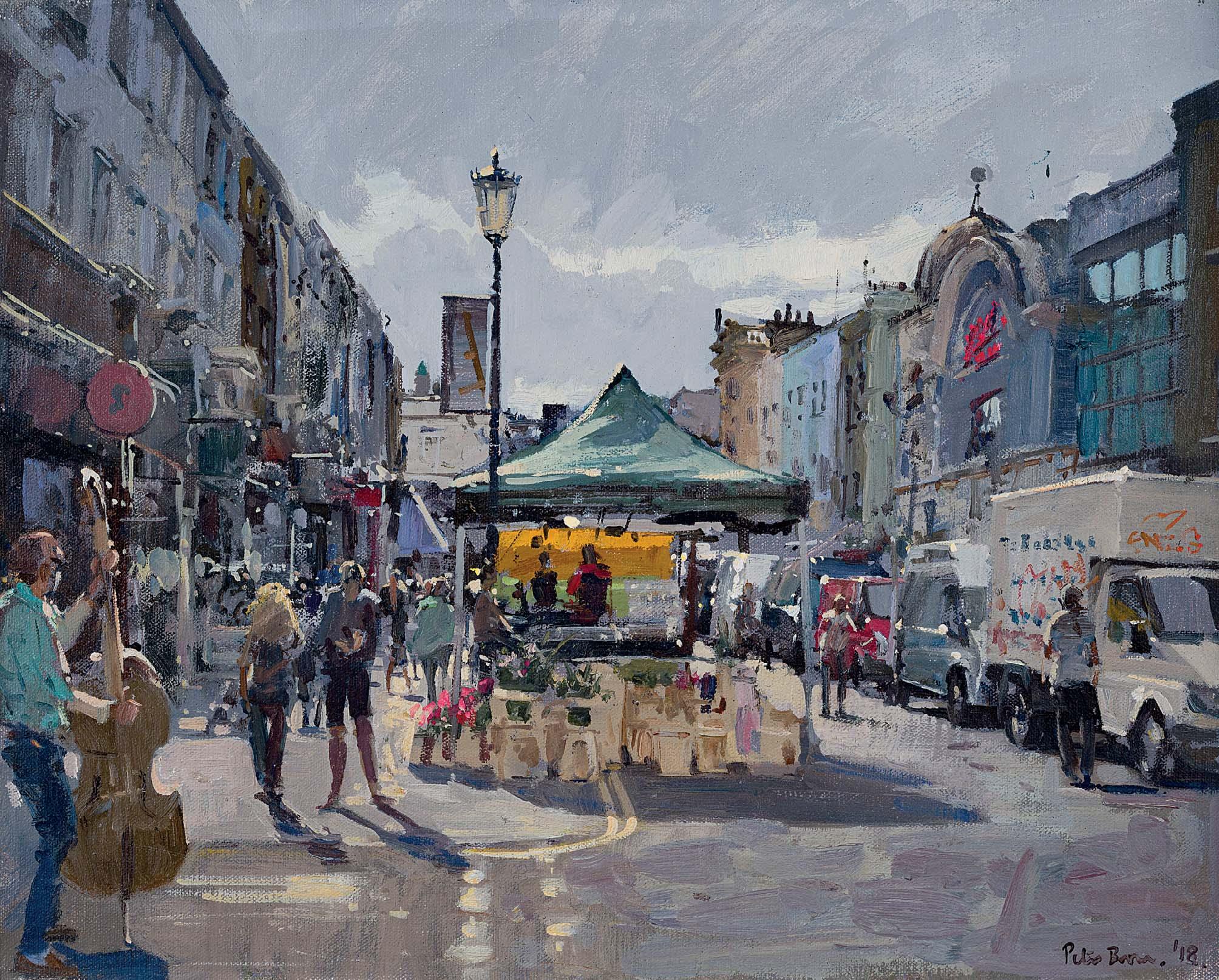
68
The Rockabilly, Portobello Road
Signed and dated ‘18
Oil on canvas
15 ½ x 19 ½ inches
Exhibited: ‘The Figurative Tradition, A Celebration of Contemporary British Art’, Chris Beetles Gallery, London, October-November 2020, no 80
HENRI PERNOT
Henri Pernot (1859-1937)
Henri Pernot was born in Ghent, Belgium, in 1859. He was of French-Belgian nationality and a sculptor, working in both marble and bronze. His bronze works were cast by award-winning foundries in France, including F Barbedienne, Siot, Etling, Thiébaut Freres, E Blot and Susse Frères.
Henri Pernot’s sculptures were exhibited at the Fine Art Society in London in 1902. In Paris, his work was shown at the Salon of the Société des Artistes Français at the National Galleries of the Grand Palais in 1909, and in the following year at the École des Beaux-Arts.
Henri Pernot died in 1937.
His work is represented in the collections of the Musée d’Orsay (Paris) and Musée d’arts de Nantes.
69
La Grande Soeur
Signed
Stamped with the Thiébaut Freres foundry stamp Bronze
13 x 16 x 10 inches
On a wooden base measuring 2 ½ inches high.
Plaque reads: ‘Les Interessés
Des Grands Magasins du Louvre
A Leur Collègue et Ami 1917’
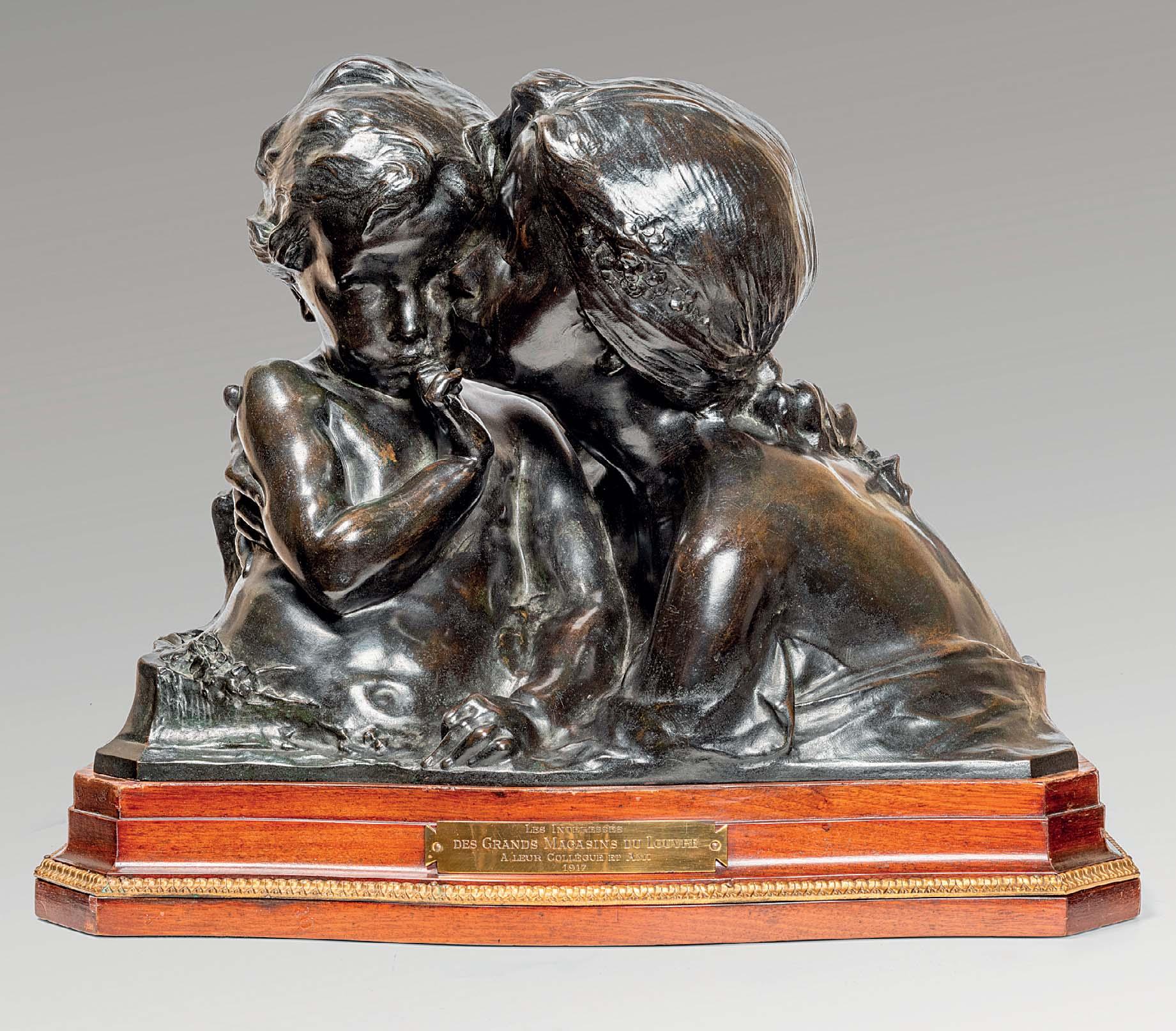
SYDNEY HARPLEY
Sydney Harpley, RA FRBS (1927-1992)
The work of Sydney Harpley always surprised and delighted: dancers, acrobats, girls on swings were posed and executed with equal audacity and elegance. Establishing the single female as his favourite subject while still a student, he rose to become the most popular sculptor, not only among Royal Academicians but among all who exhibited at the Royal Academy Summer Exhibitions.
For a biography of Sydney Harpley, please refer to Chris Beetles Summer Show, 2015, page 67.
70
L’Apres Midi 1988
Signed and numbered 3/9
Bronze
38 ½ x 63 x 16 inches
Exhibited: Duncalfe Fine Art, Harrogate, November 1988, no 19; ‘Sydney Harpley RA, New Sculptures’, Chris Beetles Gallery, London, 1990, no 4
On a travertine base measuring 3 x 30 x 18 inches.
Basia was the lover, model and continued inspiration for the Harpley girl. She lived with him during his most ‘bohemian’ times, after the departure of his rst wife and before the determined arrival of his second, Josephine, now his widow.
The idea for this size of bronze, a larger medium size, was during the late 1980’s in response to requests from the Chris Beetles Gallery. The edition has been sold entirely through the gallery.
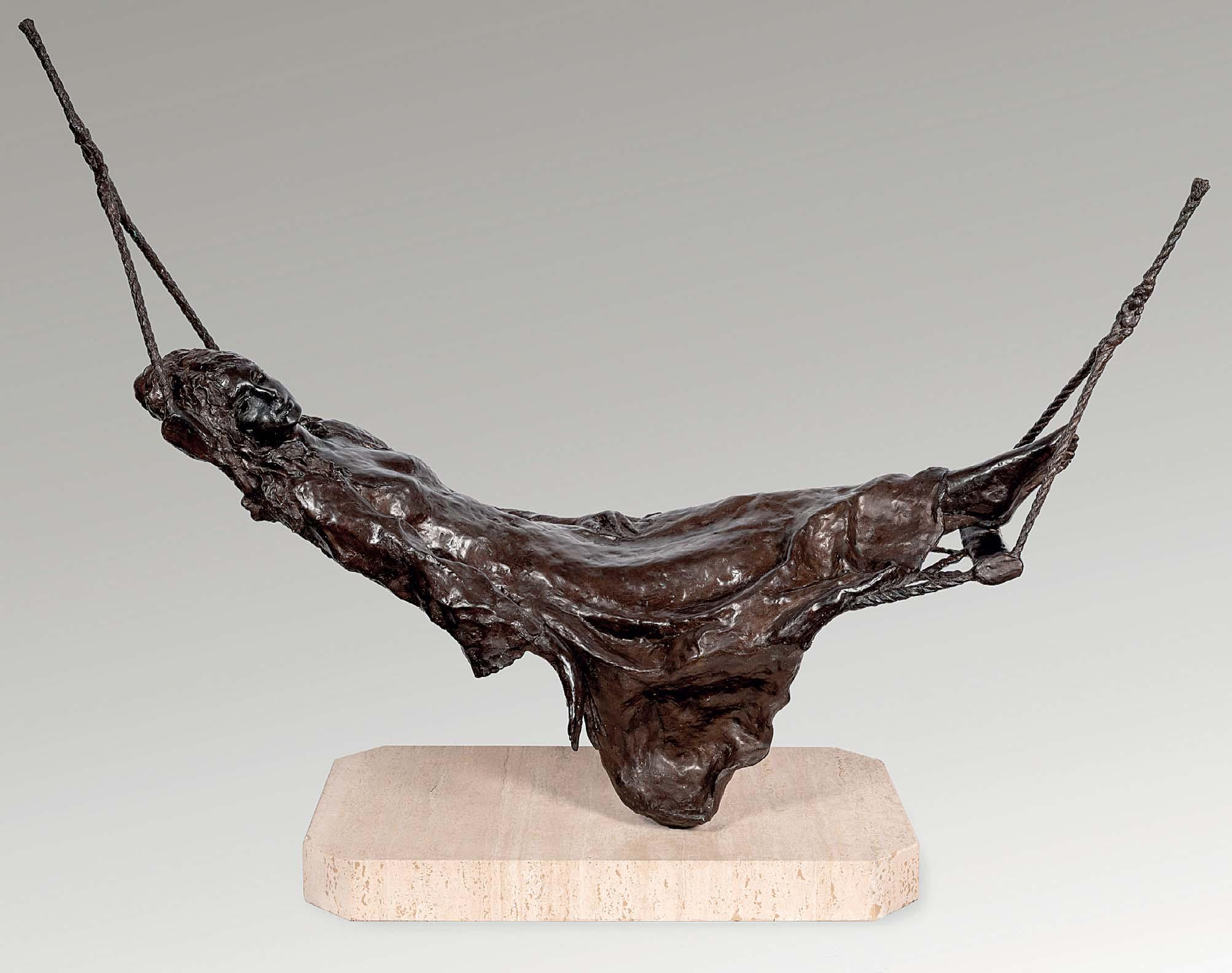
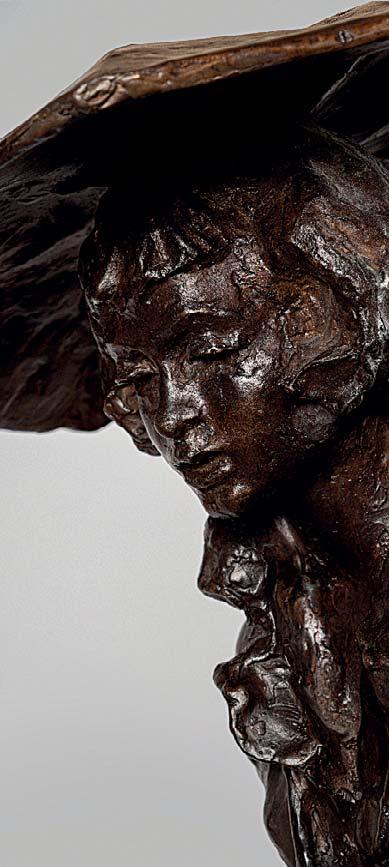
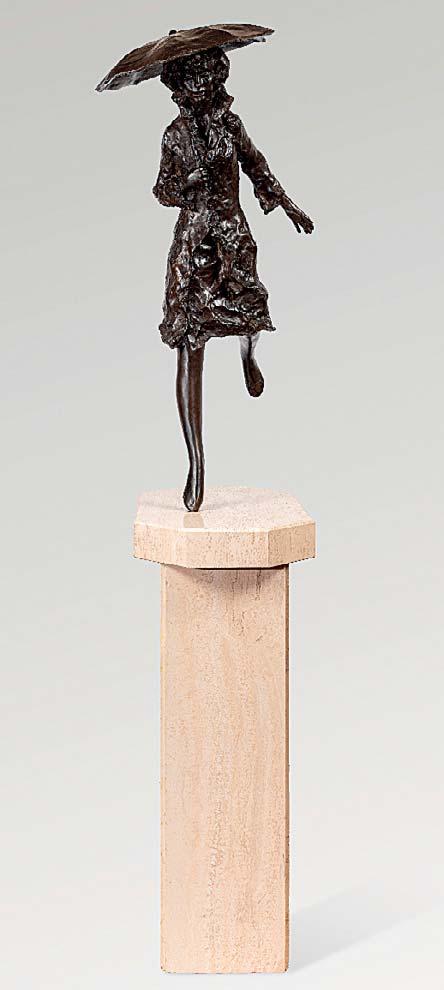
Raining 1986
Signed and numbered 5/9
Bronze
37 ½ x 19 x 20 inches
Exhibited: Royal Academy Summer Exhibition, 1986, no 1230;
‘Sydney Harpley RA’, 1987, no 30; ‘Chris Beetles Summer Show 2015’, Chris Beetles Gallery, London, no 121
On a travertine base and pedestal measuring 34 x 14 x 24 inches