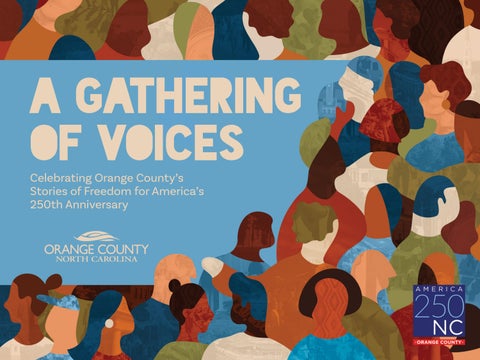
A GATHERING OF VOICES
Celebrating Orange County’s Stories of Freedom for America’s 250th Anniversary
Celebrating Orange County’s Stories of Freedom for America’s 250th Anniversary
Celebrating Orange County’s Stories of Freedom for America’s 250th Anniversary
Valarie Schwartz
Published by
The Chapel Hill-Orange County Visitors Bureau
Chapel Hill, NC 27516 visitchapelhill.org
Copyright © 2026 by Chapel Hill-Orange County Visitors Bureau
Book design by Bailey Birtchet & Jon Parker
All rights reserved
First published 2026
Manufactured in United States
ISBN 979-8-218-86340-1
Library of Congress Cataloging-in-Publication Data
This book was made possible in part through support from the North Carolina America 250 Grant, administered by the North Carolina Department of Natural and Cultural Resources. The grant program supports local projects that commemorate the 250th anniversary of the United States in 2026, encouraging communities across North Carolina to document and share the people, places, and events that shaped their history. Through this funding, A Gathering of Voices brings together stories from Orange County residents— preserving local perspectives, traditions, and experiences that reflect the community’s role in the broader American story as the nation approaches its Semiquincentennial.
Notice: The information in this book is true and complete to the best of our knowledge. It is offered without guarantee on the part of the author or The Chapel Hill-Orange County Visitors Bureau. The author and The Chapel HillOrange County Visitors Bureau disclaim all liability in connection with the use of this book.
All rights reserved. No part of this publication may be reproduced or transmitted in any form whatsoever without prior written permission from the publisher except in the case of brief quotations embodied in critical articles and reviews.
Schwartz, Valarie.
A Gathering of Voices
Celebrating Orange County’s Stories of Freedom for America’s 250th Anniversary
Includes bibliographical references.
Orange County (NC)—History—1976-2026
For the people of Orange County, North Carolina, gathering, voicing, and uniting.



As the United States commemorates 250 years since the signing of the Declaration of Independence, A Gathering of Voices spotlights life in Orange County, North Carolina since the nation celebrated its Bicentennial in 1976.
In the fifty years since, Orange County has changed in ways both dramatic and subtle. The pages that follow offer snapshots of that evolution, occasionally glancing farther back to understand how we arrived here.
When established in 1752, Orange County was nearly nine times its present size. By 1881, its boundaries had been carved into the neighboring counties we know today. Long before that,
Native villages flourished along the Eno River. The Great Indian Trading Path later carried settlers into this Piedmont landscape of fertile soil, steady water, and pine and hardwood forests. English Quaker families were among the early arrivals in what became Hillsborough, named the county seat in 1754.
In 1976, the county’s population was estimated at 70,832. By March 2026, it had more than doubled to approximately 154,153. Growth has brought new homes, schools, roads, and opportunities—along with strain. Even in 1976, longtime residents would say the towns had grown too big and that it was harder to run into someone you knew. That refrain has not changed.

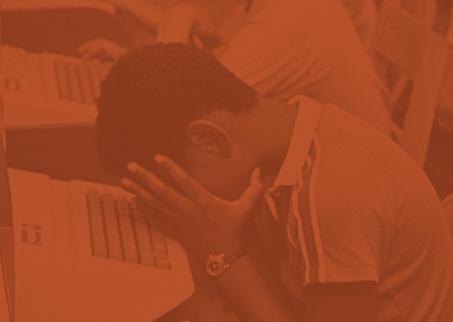

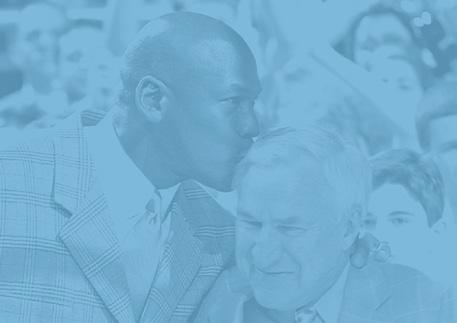
The University of North Carolina at Chapel Hill has long been the county’s engine, drawing people from across the nation and around the world. They have brought new ideas, new energy, and lively debate, helping shape a community that often leans forward. Student activism helped bring about the removal of “Silent Sam,” the Confederate monument on campus, along with other racist commemorations.
Chapel Hill became the first Southern town to elect a Black mayor. Carrboro became the first municipality in North Carolina to elect an openly gay mayor and later the state’s first openly lesbian mayor. The county was also among the early communities nationwide to gain internet access.
Investments in the arts, athletics, and tourism have made Orange County a destination—welcoming thousands each year for festivals, concerts, and games—while preservation efforts strive to protect the landscape that drew people here in the first place.
We hope readers will recognize pieces of their own experience in these glimpses of life here, and that traces of who we were remain visible in who we are. When Orange County marks the nation’s Tricentennial in 2076, may those looking back at this Semiquincentennial year find that we continued moving, however imperfectly, in the right direction.
I would like to acknowledge that we are on the land of the Eno, the Tupelo, the Saponi, Occaneechi, and the Shakori people. The Occaneechi are committed to this land. We are connected to this land, spiritually and physically.
“It provided all we needed to sustain our community. We hunted in the forests, fished in the streams, and grew our crops in the woodland clearings. We picked the wild grapes, gathered the acorns, harvested the poplar bark, and built our homes. We raised our children and protected our families. We are bonded and one with this land—yesterday, today, and tomorrow. It flows within our veins. Despite how the landscape has changed, regardless of the concrete, asphalt, and steel that covers it today, it is still our home, and the bones of our ancestors sleep in this part of our Mother Earth.
“Do not forget that our people love this land. We did not willingly sell or willingly vacate the land, so it remains in our hearts. This land does not belong to the man. We belong to the land.
“Our hope is that we all exist, acknowledging this sacred land together, and in a good way.”
Beverly Payne, speaking at “Ceremony for the Unveiling of the Manly McCauley Historical Marker,” by the Orange County Community Remembrance Coalition, in Carrboro, Feb. 18, 2024
We certainly did not begin our research with knowledge of any local communities that might claim descent from those who once lived at the archaeological sites in the Hillsborough area. Our goal was simply to develop a better understanding of the various ways Native people in the North Carolina Piedmont were impacted by European settlement along the Atlantic seaboard in the 1600s and early 1700s. And, because the Wall site at Hillsborough had been investigated decades earlier and identified as an historic Native village, it seemed like a good place to begin our research.
“In the 1990s, on Native American History Day, we would go up to Chase County, VA and set up exhibits together, conducting day-long programs for grade school kids. We presented back-to-back archaeology lessons, and John and Lynette Jeffries and Beverly Payne, dressed in their regalia, with the women in buckskin dresses, established the modernday presence of the Occaneechi.”
Steve Davis, associate director (retired), Research Laboratories of Archaeology, UNC-Chapel Hill
Research over the last fifty years has shed new light on the ancestors of the Occaneechi tribe, the most prominent Native inhabitants of Orange County. From the mid-17th century to the early 1700s, the Occaneechi, Shakori, and an ancestral group lived in three successive palisaded villages within a U-shaped bend of the Eno River in what is now Hillsborough.
When the Research Laboratories of Archaeology at the University of North Carolina at Chapel Hill (UNC) returned in 1983 to continue excavations first undertaken from 1938 to 1941, they discovered that descendants still living in the region were eager to learn more about their predecessors. John “Blackfeather” Jeffries, the Hillsborough authority of his tribe, visited the site frequently. Archaeologists called him whenever excavations revealed human remains, and he would convene a group to conduct blessing ceremonies.
A detailed map of the excavated Occaneechi village—created by plotting dark soil stains in the subsoil clay that indicated postholes and refuse-filled pits—sparked Jeffries’s vision for a full-scale replica village. In 1997, using grants and donations, construction began. After gathering four hundred cedar trees for the palisade walls, tribe members, townspeople, schoolchildren, and visitors from across the country joined in the work.
Completed in 1998, the Occaneechi Village became a symbol of cultural pride and was later incorporated into Hillsborough’s Riverwalk. “Indian Day” in 2000 celebrated its presence with dancing, flute and drum music, craft demonstrations, and food, led by thirty Native American participants.
In 1994, the Occaneechi Band of the Saponi Nation (OBSN) became a 501(c)(3) nonprofit organization as it began pursuing tribal recognition and political representation. The OBSN achieved state recognition in 2002, though federal recognition remains elusive, limiting access to sovereignty and federal support. In 2004, the tribe purchased twenty-five acres of farmland on Dailey Store Road in Burlington, now the site of tribal meetings and annual powwows.
Using detailed notes preserved by Jeffries, restoration of the replica village was completed in April 2022 and marked with a rededication ceremony. In 2025, damage caused by Tropical Storm Chantal served as a reminder that building with natural elements—like building community—requires ongoing commitment.
John “Blackfeather” Jeffries died at age eighty-three on January 24, 2023, two years before the land containing the three village sites became part of Eno River State Park, owned and protected from development by The Archaeological Conservancy.
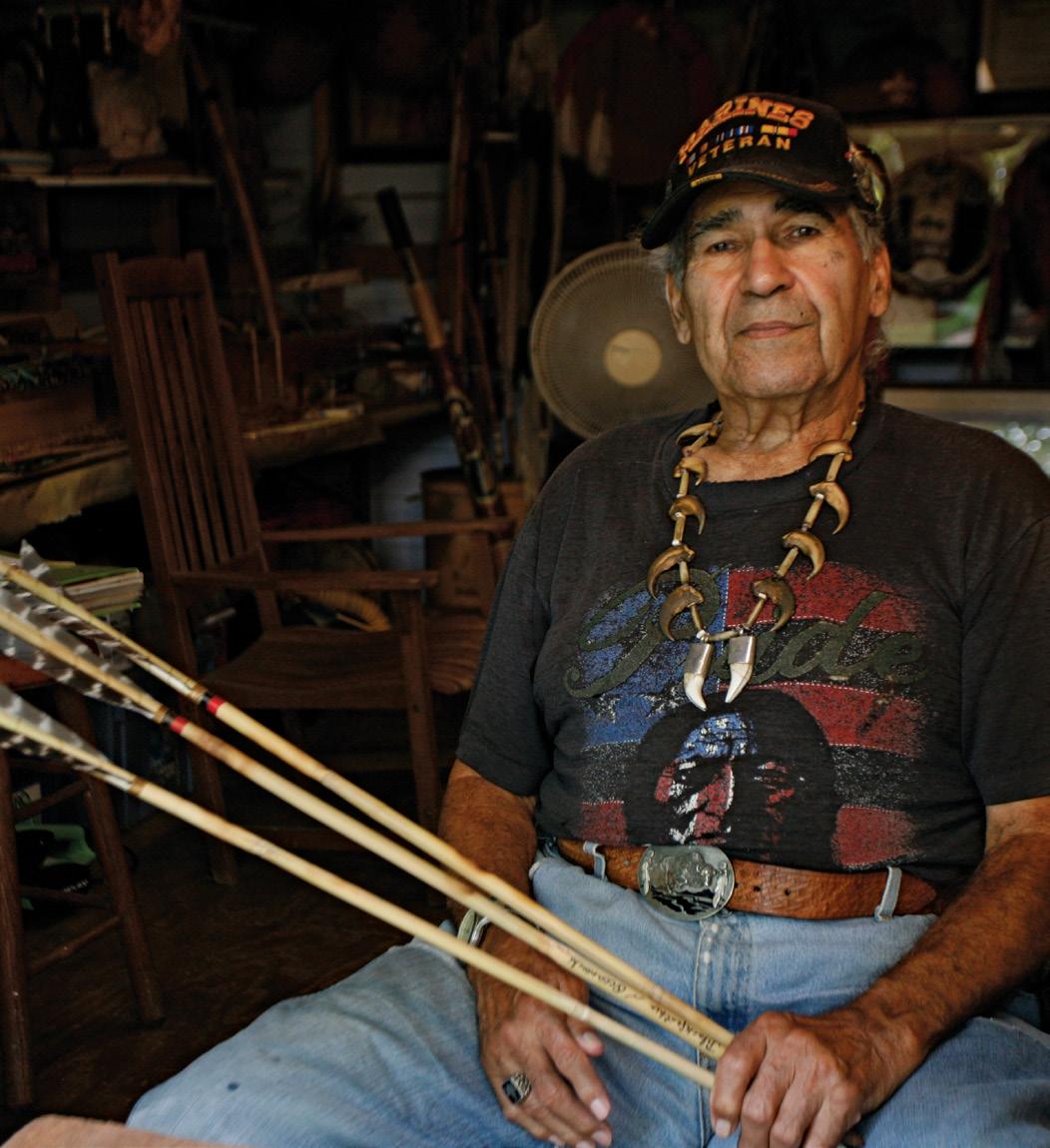
“When I took this photo on September 13, 2021, in an outdoor shed in his backyard, John was making some of his signature arrows. He used native river cane for the shafts, flint-knapped arrowheads, and fletched the shafts with turkey feathers in a way that made the arrows spin when they were shot. He signed them on the shaft and gave most of them away.”
Joe Liles, photographer, artist, Durham
Lloyd’s Farm in Orange County is rooted in more than 250 years of agricultural tradition. Our story begins in the 1750s, when Thomas Lloyd, my tenth-generation grandfather, began growing indigo in the Calvander community of Orange County on his farm called the Meadows. In addition to being a successful farmer, Thomas Lloyd served as a Major General for the British before helping to fund the Patriot movement and donating the property where UNC stands today, leaving a legacy of leadership and land stewardship that has carried through generations.
“Over the centuries, the Lloyd family has worked this land producing timber, cotton, soybeans, hay, and corn, adapting to changing times while remaining committed to agriculture. In the modern era, my father—now 95 years old—still manages the family’s 700-acre farm in Efland, earning a reputation for a once top-quality dairy herd and strong farm management.
“Today, Lloyd’s Farm continues to evolve. Honoring our agricultural roots, the next generation has expanded into agritourism, opening the farm to host weddings, events, and community gatherings—inviting others to celebrate life’s milestones on land that has been cherished by our family for generations.”
Craig Lloyd, The Barn at Lloyd’s Dairy Partner, Efland
In 2011, at the age of 60, I started a farm in Orange County using principles of organic, regenerative farming. They have evolved considerably since I learned them during the ‘back to the land’ movement of the 1960s.
“After farming commercially for eight years I began to wonder if there was a better way to feed people with local organic food. I approached TABLE, a Carrboro food relief group that provides food and nutritional education to local hungry kids. We worked out a simple deal: TABLE supplies money for materials and all the farm labor is free, drawn from their substantial volunteer list. The result is that we produce food for twenty percent of the retail price—organic, local, and delivered to recipients within twenty-four hours of harvest—many times on the same day. One dollar invested brings back five dollars worth of produce.
“We have started a second farm on the outskirts of Carrboro called Twin Creeks, located on Orange County park land. We will be producing hundreds of thousands of dollars of organic produce each year, teaching people how to garden, getting them into nature, while they develop a sense of community by serving a common purpose—making us all healthier, starting with our kids.
“It’s been a long, rewarding journey, which we hope to duplicate many times over in Orange County and beyond.”
Jim Sander, farmer, Wildflower Lane Farm, Efland
As sure as the soil beneath our feet, farming remains at the soul of Orange County—nourishing not only tables but also the local economy. By 1976, most of the county’s once-500-acre farms had been scaled down, and many livestock, tobacco, corn, cotton, and wheat operations had already given way to housing developments.
As the 1970s “new age” reached Orange County, the area became a hub for alternative lifestyles that embraced small-scale, nonchemical farming. Between 1992 and 2017, the number of farms increased by 58 percent, even as average farm size continued to shrink. Universities and Cooperative Extensions expanded sustainable agriculture programs, while co-ops, farmers’ markets, and Community-Supported Agriculture (CSAs) grew— often quite literally—organically.
Today, many of the county’s agribusinesses have become destinations in their own right. Visitors can find farm stores, tractor trikes for exploring, forest-bathing walks, breweries, and accommodations for retreats, weddings, and other gatherings. U-picks offer berries, flowers, and pumpkins in season. Alongside cows, goats, and chickens, farms now also raise bison, alpacas, and llamas.
Farmers’ markets have supported local growers since 1754, even before Hillsborough laid out its first downtown plan. That early market—still known as the Eno River Market—was the first structure sited in town. It remains not far from its original location in the David E. Price Farmers Market Pavilion, where 36 vendors set up on Saturdays.
In Chapel Hill, farmers sold at various sites until 1977, when Carrboro, seeking to revitalize its downtown, leased space owned by Carr Mill Mall on Roberson Street. The Carrboro Farmers’ Market flourished there until the lease ended, prompting the town to build Carrboro Town Commons, with dedicated space for 65 Saturday vendors and a Wednesday market operating eight months a year.
In 2008, Chapel Hill opened a vendor-run market at University Mall (now University Place), held on Tuesdays and Saturdays. Across all markets, vendors offer not only local vegetables, fruits, and flowers, but also prepared foods—pasta, tamales, soups, hummus, baked goods—along with mushrooms, cheeses, plants, and artisan crafts. All three Saturday markets now operate year-round.
According to the 2022 Census of Agriculture, Orange County had 687 farms averaging 77 acres, covering nearly 53,000 of the county’s 256,000 acres. It is also home to 24 “century farms,” held by the same families for over a century. The market value of agricultural products sold totaled $32,449,000, averaging $47,233 per farm.
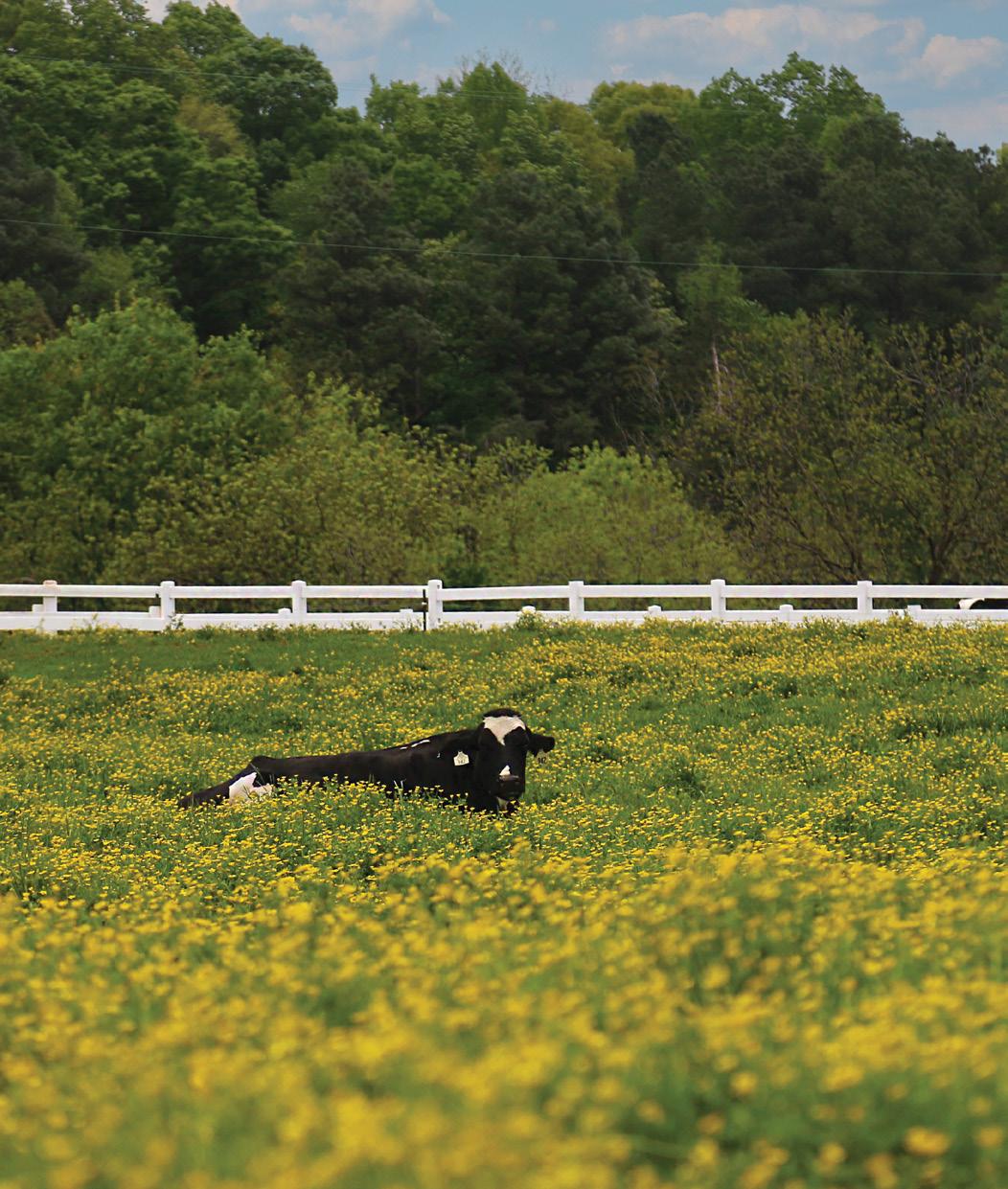
The country roads of Orange County reveal views of productive farmland—and bucolic moments of leisure.
I felt comfortable here, unlike Wilmington, a very polarized place at the time. I sat on the stone wall across from the old post office and thought, ‘This just feels right.’ Chapel Hill is where I really began to take root and grow into my person. I found it to be fertile ground for growth intellectually, socially, and professionally. It is like a giant transfer station, people coming and going, exchanging ideas and cultures.”
Dr. Lonnie Merrick, Chapel Hill; anesthesiologist, retired; B.S ’74; M.D. ’78
continue to celebrate University Day, sing the alma mater after every game, and are kind human beings, I will be content.
“Hark the Sound!”
Laurie Norman, director of alumni relations, UNC School of Education
I immediately went to work for the UNC General Alumni Association after graduation in 1983. My entire career has been on campus, and I would not have wanted it any other way!
“Carolina has changed immensely in the last five decades. Change and growth are hard and require compromise. These changes have made the university more inclusive and diverse, driving global improvements in many fields.
“I hope that Carolina traditions, the Old Well, and the treasure trove in Wilson Library’s North Carolina collection will always be of interest to young historians, and that new leaders will work tirelessly to uphold the mission of the first state university. If the generations that follow will
When I was 20 years old I got a job at UNC working in a research lab. I worked eight hours a day and every two weeks I got $125. I worked with the animals upstairs in the department of medicine, with Dr. William Blythe. The second year I was there he said they were going to open a dialysis unit and he wanted me to be involved with it.
“Once we got the dialysis machine we started having patients and I started working in the hospital. One day I told Dr. Blythe I hadn’t had a raise in three years. The next check I got was so much I thought they’d made a mistake and he said, no, that’s your raise. He told me to take that extra money and put it in savings and I’d be able to pay for my children to go to college. I did—and they graduated from college debtfree! I worked there for 40 years.”
Braxton Foushee, Carrboro
The University of North Carolina, the first state-supported university in the United States, was 183 years old in 1976, America’s bicentennial year. That fall, 2,895 freshmen matriculated, joining an established population of upperclassmen to create a student body of about 20,000. In-state, full-time tuition and fees totaled $239 per semester, not including housing or meals.
By fall 2025, the freshman class had nearly doubled. A total of 5,094 first-year students arrived, joined by 1,097 transfer students, bringing overall enrollment to 32,438. In-state undergraduates paid $4,543 in tuition and fees, plus roughly $1,000 for books. Adding a median estimate of $8,000 for housing and meals brought the per-semester total to approximately $13,543—before everyday living expenses.
An increase of roughly 10,000 students over fifty years may not sound dramatic, but it helps put Chancellor Lee Roberts’ August 27, 2025 plan into perspective. His proposal calls for adding half that amount over the next decade.
With hundreds of buildings already packed into UNC’s densely developed 760-acre campus, accommodating that growth raises an obvious question: where will everyone go? The answer is Carolina North. Planned for a 230-acre site at and beyond the former Horace Williams Airport, it will be the university’s largest expansion since the cornerstone of Old East was laid on October 12, 1793. Designed as a “learn-live-work-play” academic and research campus for 2,000 students, Carolina North will be linked to the main campus by a rapid-transit bus system. Groundbreaking is scheduled for summer 2027.
Population growth and rising costs tell only part of the story. The student body has also changed in composition. In 1975, women outnumbered men at UNC for the first time; that gap has only widened. The 2025 incoming class included 1,912 men and 3,179 women, while faculty gender balance is approaching parity. The student population is also far more racially diverse than it was in 1976, though that diversity has shown signs of recent decline.
Academic life has evolved just as dramatically. In 1976, students registered in person and consulted printed course catalogs; today, nearly everything happens online. Women’s Studies debuted that year. Today, the curriculum includes offerings such as “Japanese Video Games: Genre and Design.”
This is but a snapshot of Orange County’s largest employer, with a workforce of more than 10,000. The university gave birth to Chapel Hill and remains its heart, even as both continue to test the limits of growth and possibility.
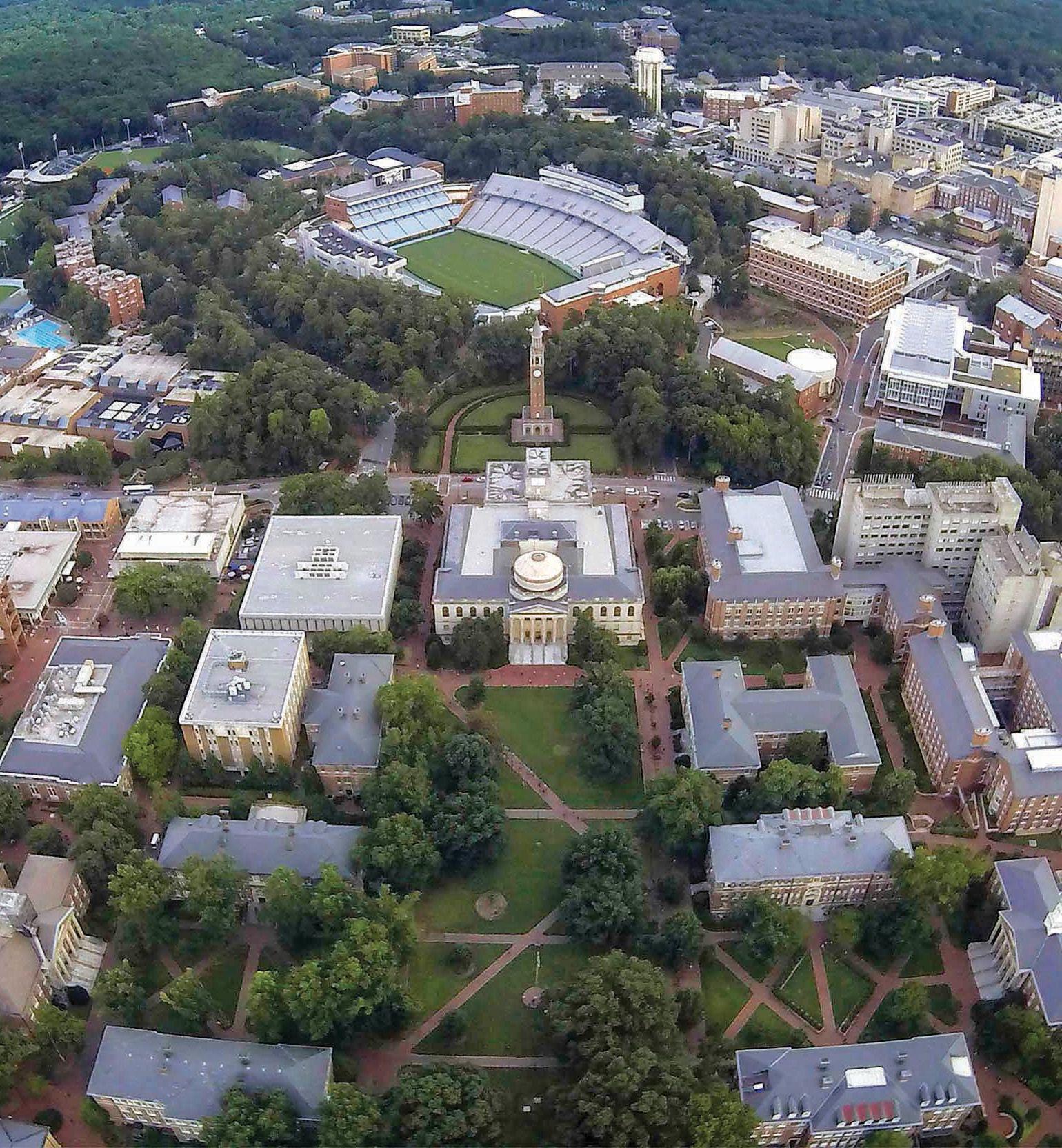
Photo by Jeffrey A. Camarati
I grew up in Hillsborough and apparently my mom did a magnificent job sheltering us from signs for ‘white only.’
“One day after court, I was sitting and talking with a bailiff who brought up things he remembered from his childhood and I said I thought the signs were gone by the time I could read. I told him I had been at a CIAA basketball tournament in Charlotte around 2005 and that was the first time I saw the signs. And they were for sale! Amongst T-shirts and other memorabilia was a booth with signs on a table and the walls and I just stood there. I was so shocked to see them and how many there were. Signs like: “White Only,” “Colored Only,” and “Colored Entrance.” The couple at the booth said they had purchased them from flea markets and antique stores and were selling them to Blacks to keep them out of the hands of others.
“The bailiff told me they weren’t completely gone in Hillsborough when I was a child, but that my mother had just made sure I didn’t see them.”
“Today, I can go wherever I want around Hillsborough, but there are places I don’t want to go. And places I go where I’m ignored.”
Judge Beverly A. Scarlett, retired, Hillsborough
Ms. Rebecca Clark was a neighbor and she got me into politics. She sent me out with flyers, telling people how to register to vote.
When I was about thirty, she wanted me to run for a council seat in Carrboro and she took me to Hillsborough and got my name on the ballot. I won that race, and came on at the same time that Howard Lee got elected mayor in Chapel Hill. I was the only Black person on the board and served from 1969 to 1981. I spoke for most of the Black people in Carrboro.
“We did a lot. We hired two Black managers and tried to integrate the work force in town, we hired police officers, and that was a big thing. We got the bus service and brought buses to town.
“Probably the biggest thing we did was save Carr Mill. They were going to tear it down to build a new shopping center. We wanted them to rehabilitate the building into a mall. We saved it by referendum.”
Braxton Foushee, Civil Rights activist, Carrboro
By 1976, Black residents of Orange County had begun to find light after a long, dark stretch. Desegregation had not come easily, but following the Voting Rights Act of 1965, the tide turned in 1969 when Howard Lee was elected mayor of Chapel Hill, serving two terms; and later served two terms as a state senator.
Robert Drakeford was mayor of Carrboro (1977–1983), and Horace Johnson represented Hillsborough for twelve years before serving as mayor (1989-2001). The legacy continues: Barbara Foushee is now serving her second term as Carrboro’s second Black mayor and the county’s first Black woman mayor.
Across Orange County, Black elected officials have shaped town boards and the county commission, and Black judges have taken their seats on the bench. Valerie Foushee moved through decades of service on civic boards, and terms as a state representative, to two terms (and counting) in Washington, D.C.
Lee had lived in Chapel Hill just five years when he ran for mayor after seeing that platform as the only way to pass an open housing ordinance that would allow Black families to buy homes wherever they could afford. His earlier petitions had failed, but as mayor, he also helped secure long-denied improvements in the historically Black neighborhoods of Northside and Pine Knolls, where streets were unpaved and water and sewer service lagged behind.
Yet progress carried complications. By the 1990s, gentrification reshaped these neighborhoods as modest homes gave way to larger student rentals, altering the character of long-standing communities and driving up property taxes.
In 2007, residents of the Rogers-Eubanks community organized to demand closure of the county landfill that had burdened them since 1972. After decades of air, noise, and water pollution—and broken promises—the landfill closed in 2013.
In Hillsborough, overt injustices of the past have given way to more subtle pressures. Rising property taxes pushed once downtown-rooted Black families farther out, reshaping the community in quieter but lasting ways.
With each decade of the 21st century, their numbers have declined, a demographic shift shaped by rising costs, displacement, and changing housing patterns. As of the 2020 census, only 10.7% of the overall county population of 148,696 is Black or African American.
It is a story of representation won, communities defended, and progress that continues to demand vigilance. The hope is that Black children growing up here today will inherit not only the gains their ancestors fought for, but the freedom to expand them.
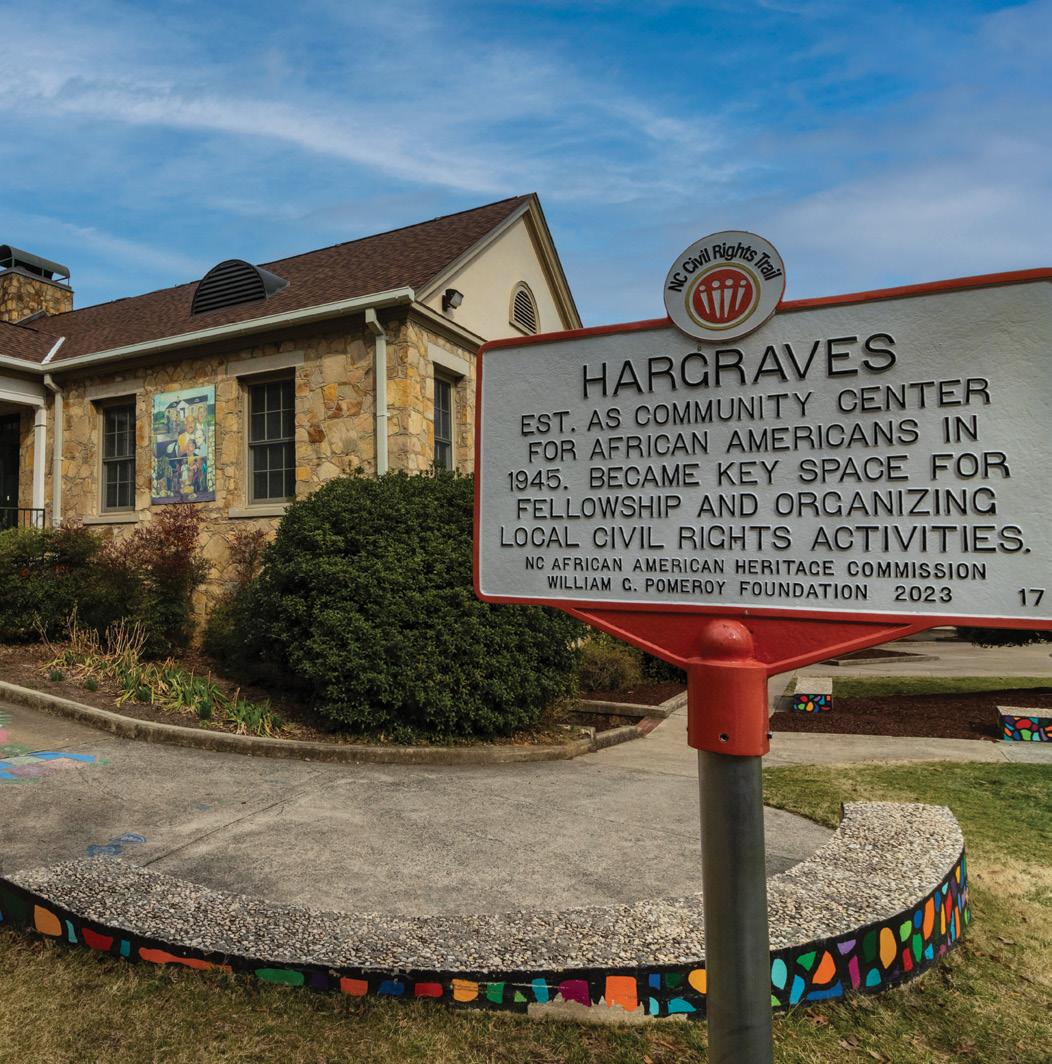
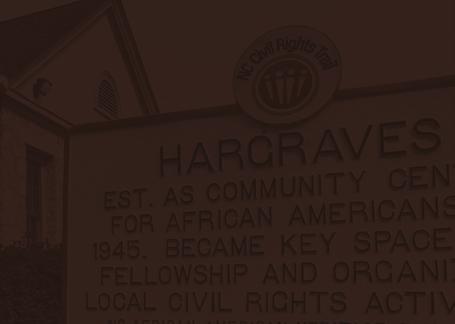
Built in the early 1940s by local Black brick masons and carpenters with funding from the Works Progress Administration, Chapel Hill’s Black community created the Negro Community Center—a safe haven then and today. Later renamed the Roberson Street Community Center, it received its permanent name in 1973 after the death of William Manning Hargraves Jr., a devoted volunteer killed in a car accident on Rosemary Street at age 38. “Billy” Hargraves, a native Chapel Hillian, was the first Black employee hired to work with the public at the Chapel Hill Post Office. Today, the Hargraves Community Center welcomes families in Chapel Hill and Carrboro with programs for all ages, a basketball court, and an outdoor swimming pool.
Photo by Randy B. Young
Growing up, seeing prejudice and discrimination against Blacks and other minorities, I felt called to use my voice and my body to resist all that was unfair. I was arrested with many others at the North Carolina Legislature for the “crime” of attempting to meet with our elected representatives. Our choice was to pay a fine or go to jail, and I chose jail because I wanted to be with my Black sisters who couldn’t pay the fine. When the story got around, I was greeted and hugged by the Black and Latina women jail guards.
“There were many more arrests to follow. I have been arrested more times than I can remember for standing up and speaking out against war, voter suppression, and any governmental policies that harm the innocent and the poor.
“In 1996, I was among the founding members of the Triangle gaggle of Raging Grannies, singing out against governmental policies that would endanger our grandchildren’s rights to determine their own futures and be all they could be, and to have a sustainable planet on which to live and thrive. I sing with them still.
“I guess you could say that I’ve been an activist for peace, justice, equality, and the Earth itself, all my life. At 95, my hope is to see peace, an end to war and discrimination against anybody based on their ethnicity, race, religion, wealth, or beliefs. We need more love, more empathy, more willingness to give up some of what we have so others can survive and thrive.
“While I might not see that in my lifetime, perhaps it will come to be in my great-granddaughters’ lifetimes. I won’t stop now.”
Ruth Rose Zalph, Chapel Hill
Following the fraught 1960s with Civil Rights, the Speaker Ban, UNC’s food worker’s strike, and Vietnam protests, tensions calmed somewhat.
After Congress passed the Equal Rights Amendment (ERA) in 1972, granting women equal legal rights, thirty-eight states were given until 1979 to ratify it. Students, faculty, the campus YMCA, and local residents mobilized to persuade North Carolina leaders to sign on. A local chapter of the National Organization for Women (NOW) formed, and Chapel Hill activists organized letter-writing campaigns and frequent bus trips to the General Assembly. Although renewed national attention eventually led to ERA ratification by enough states in 2020, the effort came decades after the deadline, and without North Carolina, leaving the amendment still unenforced.
The controversial Silent Sam monument, erected in 1913 to honor UNC students who fought for the Confederacy, became a recurring source of friction on campus. For decades it drew vandalism, rallies, and impassioned debate. On the eve of the first day of classes in 2018, protesters toppled the statue. Tensions heightened when the UNC Board of Trustees later proposed a $5.3 million facility to house the monument. Instead, in 2019, the statue was given to the Sons of Confederate Veterans along with a $2.5 million trust for its care under the condition it not be displayed in any county containing a UNC campus. The settlement was later voided in court and the sum never paid. Silent Sam is now housed in an undisclosed location.
Debate over gun rights surfaced on July 21, 2018, when about one hundred supporters—some wearing empty holsters—gathered for a Second Amendment rally in Hillsborough. Counter protesters had already left chalked anti-gun messages around the Old Courthouse sidewalks, but the event itself remained peaceful.
A new wave of activism emerged after George Floyd’s death on May 25, 2020 in Minneapolis. Black Lives Matter launched a series of demonstrations beginning with a June 3 march down Franklin Street. Fueled by social media, thousands from around the state participated despite the pandemic. On June 5, several hundred rallied in Hillsborough. The next day, the Chapel HillCarrboro NAACP led a solemn gathering where hundreds knelt on west Franklin Street for eight minutes and forty-six seconds, the length of time police restrained Floyd with excessive force before he died. UNC Health workers marched on June 23 to draw attention to healthcare inequities for minorities, and on August 29, UNC student-athletes from all sports united in a march against racial injustice.
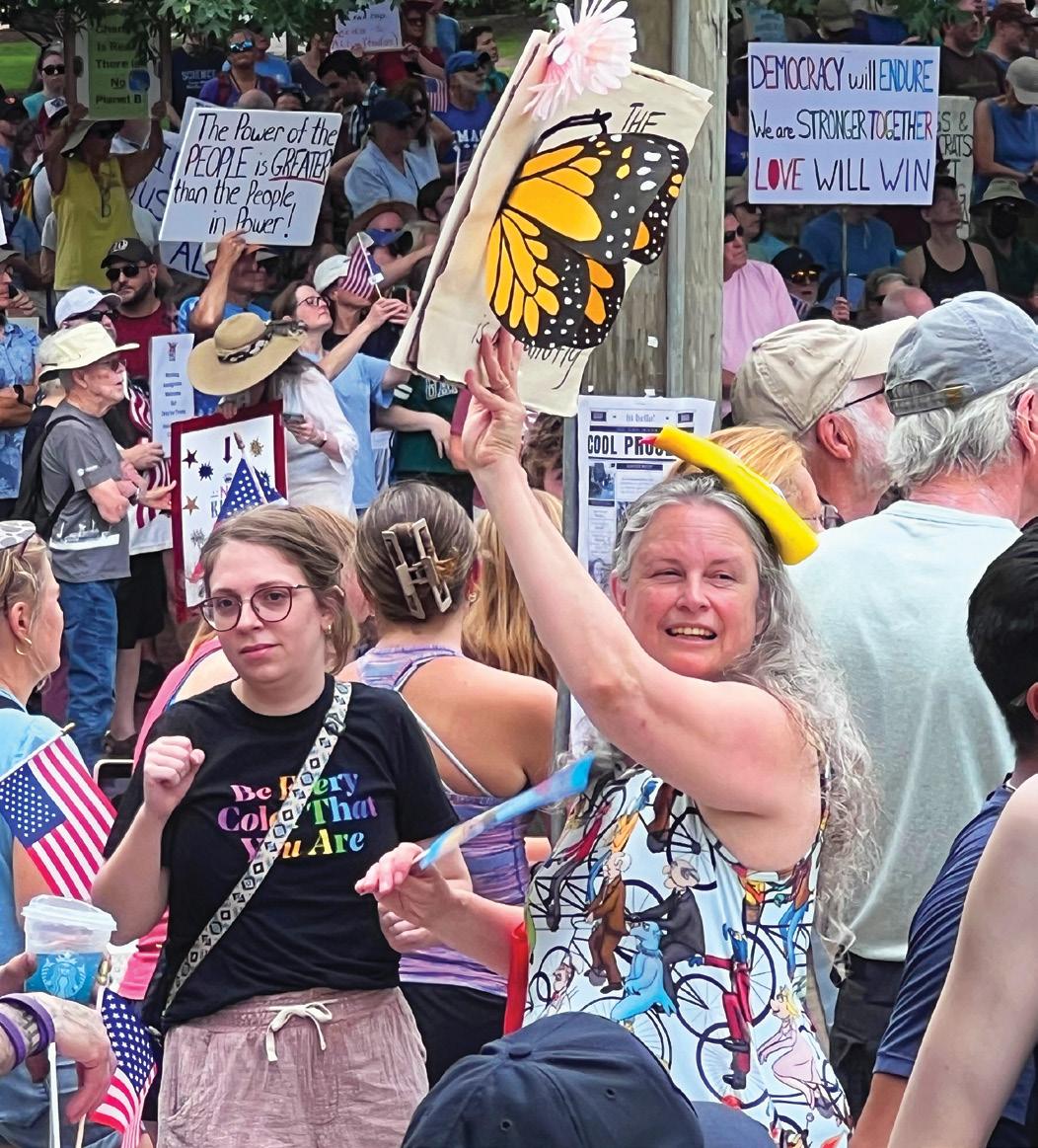
Then came 2025, opening a new era of protests across the country.
I go to CrossFit Chapel Hill every other Sunday as I am a part of a program for adapted fitness. I love getting out of the house. I’ve been to many UNC sporting events and they have great seating for me.
“I don’t go downtown often. There are a couple restaurants I’ve tried to go to, but they’ve had stairs and are not accessible. I don’t like crowds and downtown can feel too crowded. I roll around Umstead Park a lot.
“Sometimes I have trouble getting into places, bumpy sidewalks can be annoying for me. I use a large van that can sometimes be hard to find parking for.”
Gunnar
Levin, Chapel Hill
One of the big areas we look at is our transit system. Whenever there are upgrades or improvements we not only take into consideration what ADA requires, we work hard to really make it as accessible as possible.
“The Town of Chapel Hill spent a year and a half developing an ADA Transition Plan that included site assessments and program
review across the organization. We identified areas needing improvement so that the town can work strategically on improvements in a systematic way.”
Wade Gulledge, risk manager, Town of Chapel Hill
I use an electric wheelchair and go to school on the UNC campus.
The sidewalks are a little bit uneven on some streets. I go to the sporting events at UNC and the people who work there usually save a spot for my wheelchair. I use the Chapel Hill Transit system to get to and from home.
“I go to Franklin Street sometimes but I have trouble finding parking because my ramp usually scrapes on the entrance of the parking lot or garage. I’ve noticed that the sidewalks are not very wide and feel like my wheelchair might fall off the sidewalk.
“I often go to Umstead Park where I’ve had positive experiences because the paths are paved.”
Elianna
Horner, Chapel Hill
The 1970s marked an era when people with disabilities began demanding their right to public access. After years of living in the shadows—or worse, being housed in facilities with minimal care—recognition that people with disabilities could live vital, rewarding lives became an issue that could no longer be denied.
In 1973, the Rehabilitation Act became the first federal law recognizing the rights of people with disabilities. Municipal buildings began reflecting the needs of those with mobility challenges by providing designated parking spaces and modifying entrances with ramps and wider doorways. Even so, installing curb cuts and ramps at every corner along every town street took decades to complete.
Public pressure in the 1980s led to changes in building codes, but those updates did not require the adaptation of existing structures until the passage of the Americans with Disabilities Act (ADA) in 1990. The ADA mandated renovations to accommodate access into all public buildings. Implementation, however, required planning, money, and time—especially in historic towns like Hillsborough, where narrow, uneven downtown sidewalks and older restaurants and shops often had steps leading to very narrow doorways. An accommodations plan for Hillsborough was completed in 2017, and improvements continue to be an ongoing consideration.
Chapel Hill Transit introduced its first accessible buses in the 1980s. Today, all buses are wheelchair accessible, equipped with lifts and designated seating areas. E-Z Rider provides another option in Chapel Hill and Carrboro, offering door-to-door shared service for those unable to use regular transit buses.
In 2025, Chapel Hill’s Community Park opened a playground designed for all abilities. Its poured-in-place rubber surface accommodates all modes of mobility, with pathways wide enough for walking side by side. Among the inviting features shaded by colorful canopies, are a ground-level merry-go-round, which allows safe access; a ramp equipped with two heights of handrails leads to a platform featuring tactile games and other interactive elements. The jungle gym uses rope-style webbing instead of bars, and a molded plastic bucket-seat swing offers support for larger children who need neck support from waist to head. All Town of Chapel Hill parks include some of these inclusive elements. All three municipal swimming pools in Orange County have wheelchair lifts and/or waterproof wheelchairs and ramps.
The Riverwalk Greenway in Hillsborough and the Bolin Creek Greenway in Chapel Hill and Carrboro meet ADA accessibility standards, offering rolling strolls through Orange County’s urban nature.
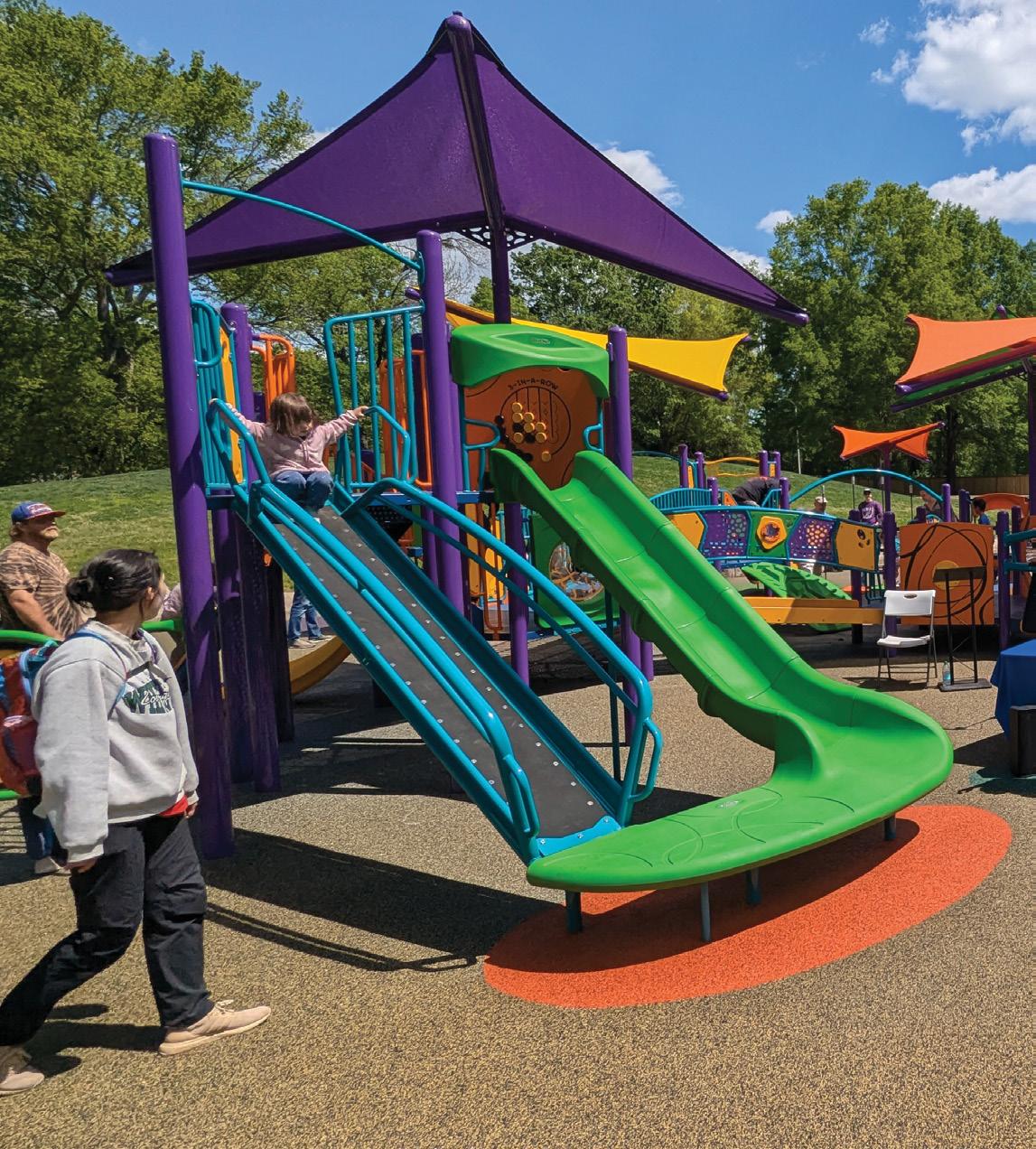
Parents may enjoy this inviting all-inclusive playground at Chapel Hill Community Park as much as their children, with plenty of room to play alongside or within easy reach on a poured rubber surface.
After leaving for two years, in 1982, I returned to Chapel Hill to learn how to be a writer. One reason I did that is I felt that the field had been well-tilled. So many writers lived here! Clearly, to be a writer wasn’t out of the ordinary: I saw Lee Smith buying groceries, Jill McCorkle crossing the street, Kathy Pories, who would later become my editor at Algonquin, playing basketball at the Y. Thomas Wolfe studied here, William Faulkner got drunk here—what great company for a young writer to have as he learned how to string words together. Chapel Hill was where my future life began. Coming back here was the best decision I ever made.”
Daniel Wallace, writer, Chapel Hill
Things come in waves but I got to be a teenager in this town at a really exciting time. Around 1985, Dexter Romweber and his gang were my best pals. We listened to records and went to shows.
“There were a lot of really good shows then. The Turning Point was kind of a teen center behind the car wash in Carrboro where you could go see Dexter’s band, the Flat Duo Jets, or go to the teen center under the post office in Chapel Hill and see punk rock bands.
“I was really lucky to be around when all of that was happening so that when I broke out and started making strange-for-the-time music—the Squirrel Nut Zippers—people were really receptive.”
Katharine Whalen, musician, Chapel Hill
I was a psychotherapist for 42 years. It was a really difficult decision to retire from Duke where I worked for 30 years. When I turned 65, I loved making art and decided if I was going to do that, now was the time. But I feared that going from doing something helpful and beneficial to becoming an artist was going to be something very selfish.
“Years ago the town of Chapel Hill had a community art project where I sold my first piece. When Frank Gallery opened I applied, was accepted, and became a full member after I retired.
“The funny thing is, I get little notes from people telling me how they bought a piece of my art and when they look at it, it helps them. I never thought that art would bring meaning to people in a way that I hoped being a therapist would bring meaning. Art makes a difference as well as therapy makes a difference.”
Carol Retsch-Bogart, mixed media artist, Chapel Hill
Where there’s a university, there’s a wellspring of creativity—and by 1976, Orange County’s had only just begun.
The music came first, low and intimate. In 1969, Cat’s Cradle opened in a Chapel Hill basement on West Rosemary Street, holding maybe thirty very friendly people pressed shoulder to shoulder. It moved, grew, and by 1993 had settled in Carrboro for good. Today its 750-capacity main room and smaller Back Room host touring acts, rising bands, and local musicians nearly every night of the week. Then in 1998, at a Carrboro Arts Committee meeting, then-mayor Mike Nelson floated a quiet idea that became a beloved fall ritual: the Carrboro Music Festival. Each year, one hundred musicians are selected to fill more than twenty downtown venues—for free—from afternoon into night. Thousands come. The music flows like weather.
The visual arts were already taking root. In 1973, a group of women stopped talking about women’s rights and started a co-op, calling it WomanCraft. More than fifty years later, it still produces and sells handcrafted work in Chapel Hill. Two years later, the ArtsSchool opened its doors, eventually becoming the ArtsCenter—the county’s largest arts education nonprofit, offering classes, exhibitions, and gathering space to all ages. Since 1985, the Orange County Arts Commission has deepened the county’s creative infrastructure through grants, programs, and—since 2021—studio and gallery space at the newly opened Eno Arts Mill. The annual Open Studio Tour launched in 1995 is supported by the Orange County Artists Guild, representing 150 artists as of early 2026. FRANK Gallery, a nonprofit collective founded in 2010, carries the spirit forward in Carrboro with roughly seventy member artists sharing walls and vision.
And still the calendar fills. The 2nd Friday Art Walk winds through Carrboro and Chapel Hill, with more than twenty venues throwing open their doors. Over in Hillsborough, the Last Fridays and The Art Walk pulses with drumming circles, poetry readings, music, and sometimes street-dancing—a full-sensory invitation to show up and feel something.
Then there are the writers. Orange County has long been a haven for them and has nurtured Pulitzer Prize winners, books that found their way to Broadway, and stories that became major motion pictures (Paul Green achieved all three). Every week, local authors read from their works to neighbors who show up listening and lingering in one of four local bookstores.
The arts here are not a district. They’re a disposition.
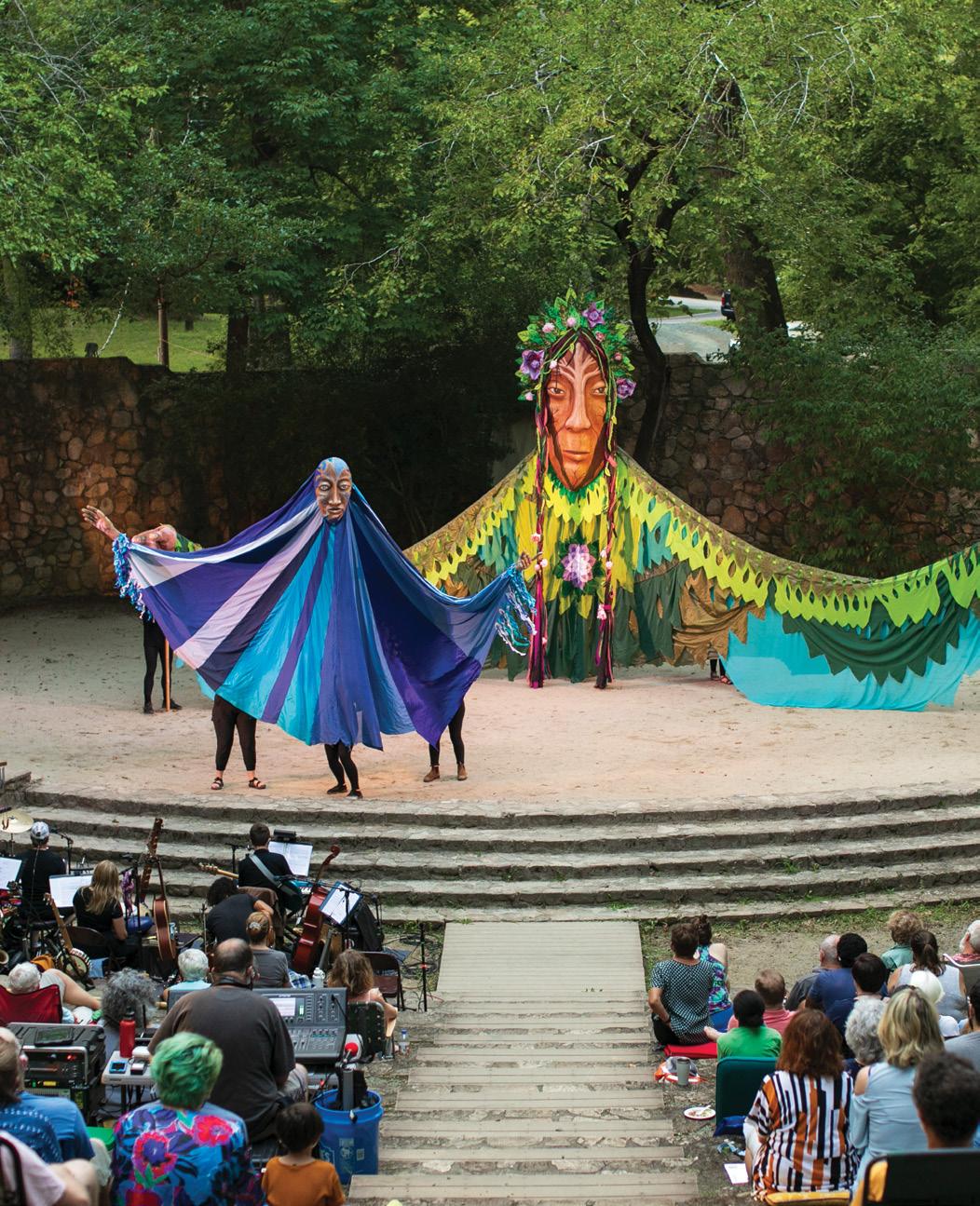
Since 2001, Paperhand Puppet Intervention has marked summer’s end with performances in UNC’s Forest Theatre, where volunteers bring dazzling, larger-than-life puppets of cardboard, cloth, and clay to life in soaring, imaginative productions.
So many in our community are suffering with addiction, mental illness, and homelessness—and negotiating a complex mental health system is a challenge for anyone.
“We are learning more and more about the significance of ‘social determinants of health,’ the awareness of how important all the factors of mental health are—really all health—outside of medical treatment. This includes diet, exercise, economic stability, healthy relationships, and housing.
“There are multiple resources for help in Orange County, like Club Nova, Freedom House, and the Center for Excellence in Community Mental Health at UNC. The Center started in 2009 and I am directly involved with some of their efforts.
“For family members looking for a support group, there is NAMI, a national group with a longtime chapter here for many years. It’s an excellent way to learn how to manage a complex situation and system following a loved one’s diagnosis.”
Jay Miller, Chapel Hill; founder of Shared Visions Foundation
The Orange Person Chatham (OPC) Mental Health Center was thought of as one of the best in the state, people in the community knew where to go for help, there was probably the best 24/7 helpline, and there was continuity and stability in the care people received.
“Then came mental health reform starting in the early 2000s. The 41 area programs like OPC were told they must privatize and become managed care entities, providing no direct care except by contracts. Confusion reigned; patients did not know where to go to get help.
The change was too much and too rapid; patients lost their longtime practitioners in many cases, career professionals had to look for jobs in the private sector.
“There were some positives, of course, with this massive transformation from forty-one area programs to four local management entities. Evidence-based practices were much more prevalent, housing focused on what the person needing housing wanted, though in the rush to have independent living with supports, some who were happy with group homes lost those options and became unhoused.
“Police were trained in responding to crises with empathy rather than force, mental health courts were developed—Orange County being a leader in this. Stigma lessened considerably partly due to COVID: everyone was anxious and depressed!
“The jury is still out on system reform; without a doubt there has been a loss of a sense of community and belonging.”
Debra Dihoff, Chapel Hill; over 40 years in mental health field
By 1976, mental health was beginning to be recognized more as a medical condition than as a source of shame, as the psychological wounds of the Vietnam War became apparent in roughly one-quarter of returning veterans nationwide. Those attending UNC on the GI Bill found a community already laying groundwork to support individuals facing emotional struggles.
The passage of the Community Mental Health Act in 1963 had set in motion a shift from institutionalization toward communitybased care. Building on this momentum, the Orange Person Chatham (OPC) Mental Health Services was formed in the early 1970s to offer coordinated local support. OPC developed local programs, hired young professionals, launched a Community Resource Court, opened group homes, and maintained close working relationships with county commissioners.
In 1973, the Chapel Hill Police Department launched its pioneering crisis unit. This team provided counseling and support not only for victims of crime or traumatic events but also for individuals in mental health crisis. That effort has evolved into today’s CARE (Crisis Assistance, Response and Engagement) Team—a mobile unit staffed by a crisis counselor, a peer support specialist, and an EMT. The team responds to calls requiring skills beyond traditional policing, assisted by a crisis counselor embedded in the 911 Call Center. The Orange County Sheriff’s Department has a similar crisis unit supported by grants from the Criminal Justice Resource Department.
In 1974, Freedom House Recovery Center was founded to serve adults and children dealing with mental health and/or substance use challenges. It operates a 16-bed crisis unit, a halfway house for individuals lacking a support system, outpatient clinics, and peer support services. Many staff members are themselves examples of successful recovery.
In 2001 the NC legislature sent shockwaves statewide when it introduced Mental Health Reform. A $44 million budget cut led to the closing of all but four of the state’s forty-one area programs, including OPC. Long-term group homes shut down, services fragmented, and families scrambled to find care. The number of people experiencing homelessness rose as many community supports collapsed.
In downtown Carrboro, Club Nova opened in 1987 as a community mental health clubhouse, offering structure, peer support, employment opportunities, and the possibility of independence within a safe environment. In 2004, Club Nova Apartments opened. A new clubhouse opened on Main Street in 2023.
Groundbreaking for a crisis diversion facility in Hillsborough is scheduled for late 2026, creating an alternative to emergency rooms and jails for those in behavioral health crisis.
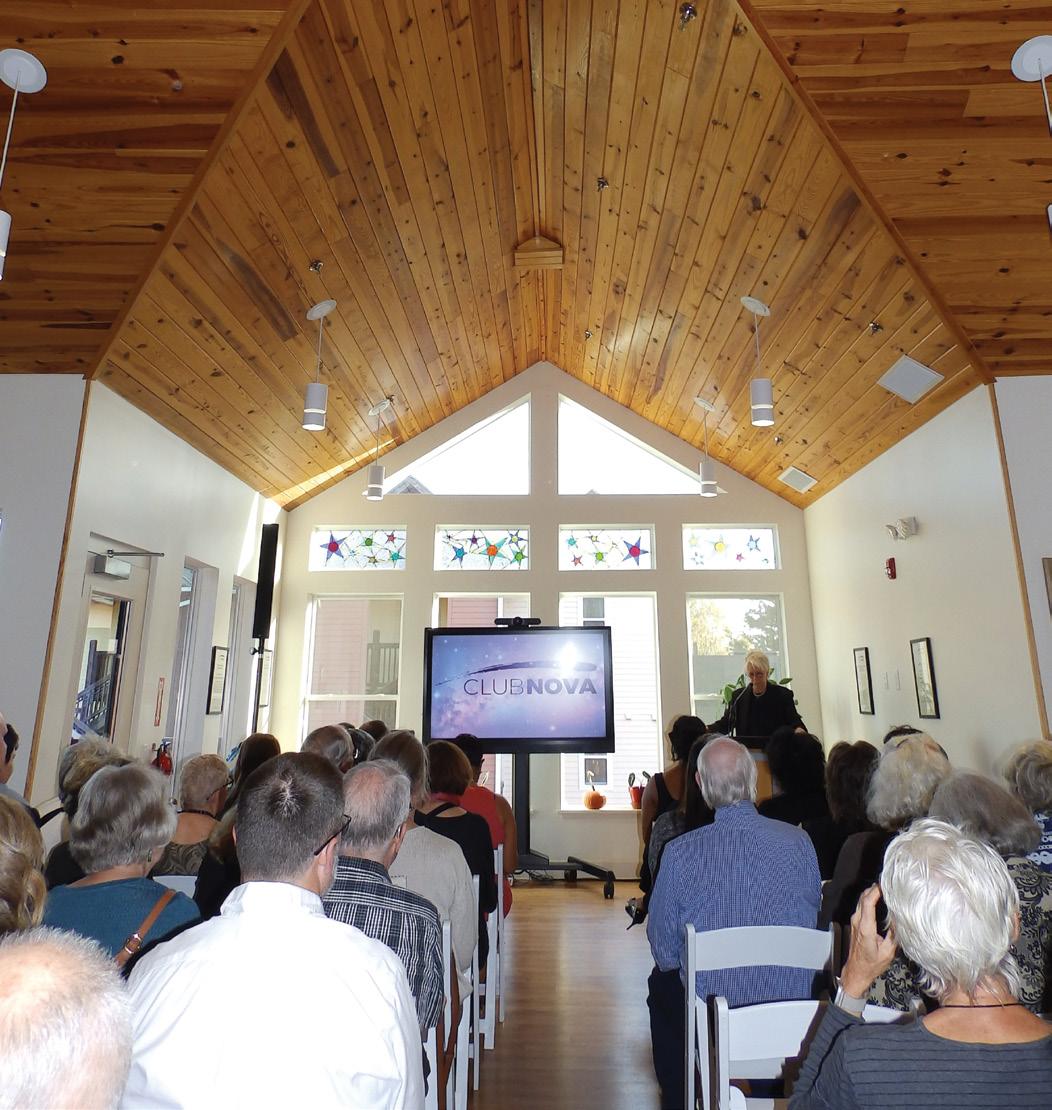
Since 1987, the
At the dedication ceremony on October 24, 2024, supporters celebrated its new clubhouse—a bright, 9,125-square-foot building where members cook daily lunches, tend herbs and vegetables in a patio and greenhouse garden, and build confidence through activities and meaningful work in a supportive community.
The fare-free system works. I wish more people would take the bus. It’s a very good system if people would use it. I’ve been using it for 20 years—haven’t had a car for 15 years.
“The system has taken the student schedules into account and noted which routes are student heavy. There are different sized buses in their inventory and they run larger buses where needed and sometimes send two buses at the same time.
“UNC is a year-round operation so they don’t change the schedule for summer. They do a very good job and don’t pull back service during low periods. I use the paper maps and schedules—I’ve become a big critic of digitalization. The realtime tracking is fairly reliable and paper maps are far easier.”
Amanda
Ashley, retired, Carrboro
My family and I moved to Chapel Hill from Boston, where we only needed one car—my daily commute was by public transportation. When we arrived in Chapel Hill where I now work from home and my wife teaches on the UNC campus, we found that it was just as easy to maintain that single-car lifestyle, which we consider both financially and environmentally beneficial. On the rare occasions when we both need a car, it is easy enough to fill those gaps with ride-hailing apps, which still amount to much less than the cost of owning, insuring, and maintaining a second vehicle. It’s a win-win for our bank account and for Mother Nature.”
Michael Sullivan, book editor, Chapel Hill
By 1976, rail travel in and out of Orange County had largely come to an end. Passenger trains had first arrived in Hillsborough in 1855, but service there ended in 1971 when Amtrak was established and did not include a stop in the county. Service to Carrboro had ended in 1936.
To keep Chapel Hill connected, the Carolina Trailways bus company began service in 1933 and, in 1948, opened a Colonialstyle terminal at 133 W. Franklin Street, providing students and residents with travel across the state. But as car ownership increased, ridership declined and the bus station closed. In 2000, the station was sold and demolished to make way for what is now the Graduate Hotel.
The Chapel Hill Airport, established in 1931 as North Carolina’s second official airport, later became known as Horace Williams Airport. During World War II, its three runways supported preflight training for the U.S. Navy. By 1972, with only one runway still in use, it became home base for UNC’s Area Health Education Center (AHEC), which flew medical providers to rural communities statewide. Over time, concerns about safety, rising operational costs, and proposed creation of the “Carolina North” campus ended this lofty era. AHEC operations were relocated to RDU in 2011, and the airport closed in May 2018.
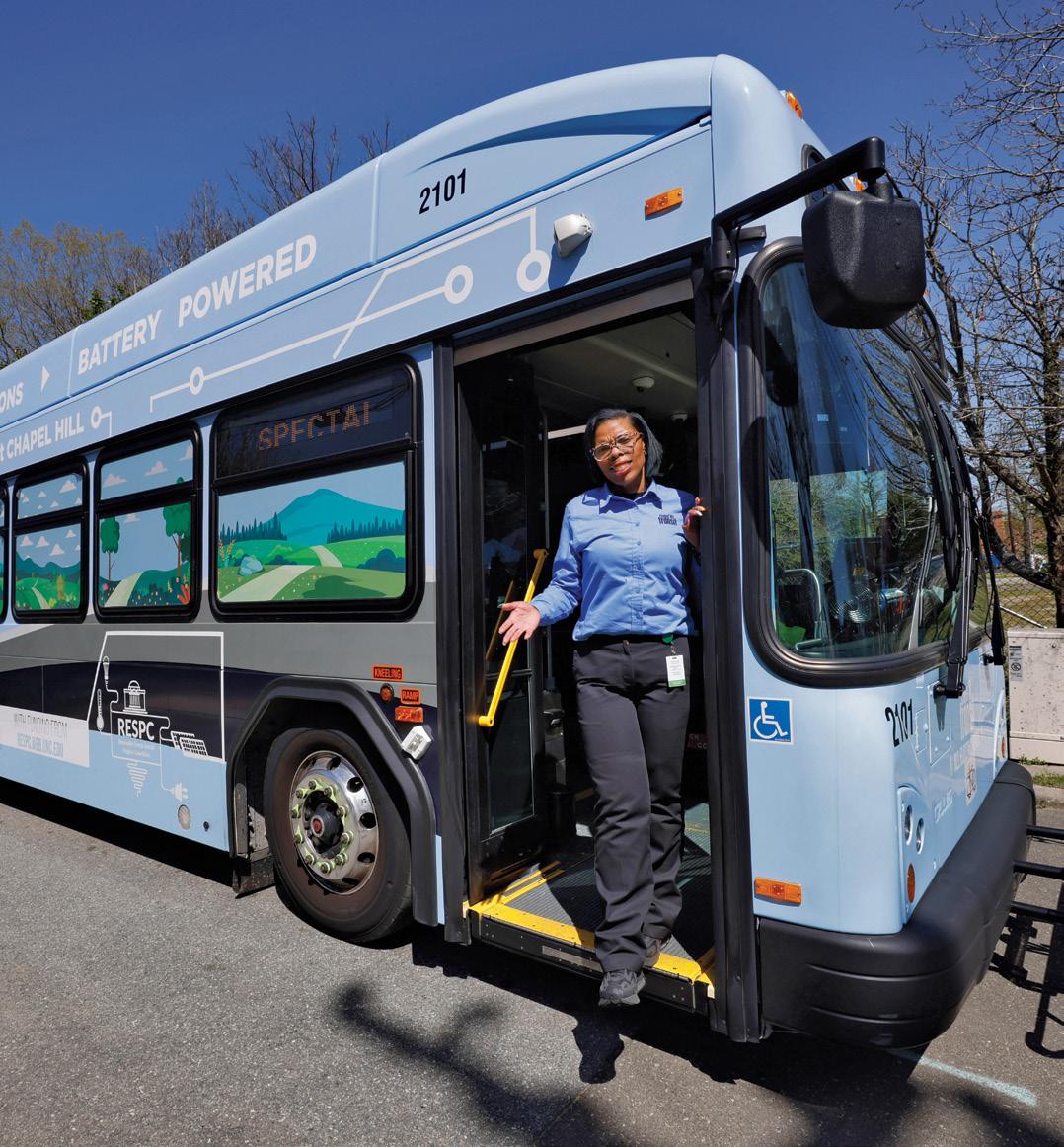
In 1969, Howard Lee became the first Black mayor of a Southern town with the pledge to tackle Chapel Hill’s growing traffic congestion. He delivered by launching a public transit system serving Chapel Hill, Carrboro, and UNC on August 1, 1974. Twentytwo used buses, each with a forty-five-passenger capacity, rolled out on ten routes. Today, Chapel Hill Transit is among the nation’s highest per-capita ridership systems, providing seven million fare-free rides each year on twenty-one routes across sixty-two square miles, logging more than two million service miles annually. Technology has made riding easier than ever: the Transit Royale app shows real-time bus arrivals, maps trips, and even tells riders when to leave home to reach their stop on time.
Hillsborough’s needs are different, and its transit system came later. The Hillsborough Circulator launched in 2016, offering fare-free weekday service to key locations from 7 a.m. to 5 p.m. The Orange-Chapel Hill Midday Connector (“Hill to Hill”) links the towns hourly on weekdays for a $2 fare, and Chapel Hill Transit operates a fare-free express route between Chapel Hill and Hillsborough from the Durham Tech Park-and-Ride.
Approved and funded future plans include an Amtrak station in Hillsborough.
I was a senior in high school and remember watching the local news on the first Tuesday in November 1987 when it was announced that Joe Herzenberg was the first openly gay person elected to public office in North Carolina. I felt called to Chapel Hill. I came out by the first semester of my second year—very obviously and unapologetically.
“I’ve been in public service for 25 years. I’ve had death threats, threatening letters, people show up at my front door to scare my husband. The people of Orange County allow me to keep doing my job. What I’ve done for my community is one of the things they appreciate. I will continue to do what I do boldly and proudly. I’m not changing how I live my public life because of who is in the White House.”
Mark Kleinschmidt, Orange County ex officio judge of probate and clerk of Superior Court since 2018; helped win North Carolina’s 2014 marriage equality case; mayor of Chapel Hill 2009-2015
“After 15 years together, Susan and I got married on July 13, 2025 in Oregon—where my eldest son and his family live—just in case the law changes in North Carolina.”
Maggi Grace, artist, Carrboro
I’ve known since childhood that I was lesbian, though I didn’t know that I could live that kind of relationship, so I married men—twice—and after the second divorce fell in love with a woman. I spent the next ten years being sued for primary custody of our two sons, being deemed as the one who was unfit. The judges clearly thought it was pathetic but there was no precedent or law to protect me.
In 1980, Stanley and I, both 27, met and fell in love in Chapel Hill.
We’d been together for almost 35 years when the law changed and our lawyer advised us to marry for legal reasons. So, on November 29, 2014, in front of 10 witnesses, we got married at a friend’s home.
“But so many loved ones wanted to share our joy, and because Stanley Finch had always wanted a church wedding, we met with the Rev. Stephen Elkins-Williams of Chapel of the Cross, where Stanley is a faithful member. He happily officiated on May 9, 2015 in front of 150 guests, making ours the first legal same-sex wedding at the church.”
Jeffery Beam, author, poet, retired UNC Botanical librarian, Hillsborough
Amid the civil rights movement, antiwar demonstrations, and counterculture of the 1960s, the Gay Rights Movement emerged after a series of riots in New York City following police raids at the Stonewall Inn. The first Gay Pride marches were held in 1970, and the phrase “come out of the closet” entered common use, describing the decision to live openly as gay—a choice that often came with the loss of jobs, family ties, and social standing.
In 1974, UNC’s Carolina Gay Association—now SAGA (Sexuality and Gender Alliance)—became one of the earliest gay student organizations in the South, providing safe spaces to gather and build community. In April 1976, Chapel Hill hosted the first annual Southeastern Gay Conference, drawing hundreds for workshops, panel discussions, and solidarity.
The AIDS epidemic that began in the early 1980s cast a devastating shadow over gay life for decades. By 1985, an estimated 15–20 percent of admissions to UNC hospitals were for AIDS-related care, prompting the hospital to establish a walk-in clinic and a specialized ward.
In 1987, Joe Herzenberg made history when he was elected to the Chapel Hill Town Council as the first openly gay politician in North Carolina. Two years later, he wrote to the North Carolina Civil Liberties Union, urging that “we must examine carefully the justifications offered for coercive or discriminatory responses to AIDS.”
Support efforts expanded in 1990 with the founding of the AIDS Services Agency of Orange County, created to assist people living with AIDS and to establish a family care home. After two years of largely bureaucratic funding denials, approval came with help from Congressman David Price. The agency then faced opposition from some Carrboro neighbors, including unfounded fears that their daughters would be endangered by gay men. When the house opened in April 1995, neighborhood children later presented residents with a gingerbread house bearing the address of the Orange AIDS House.
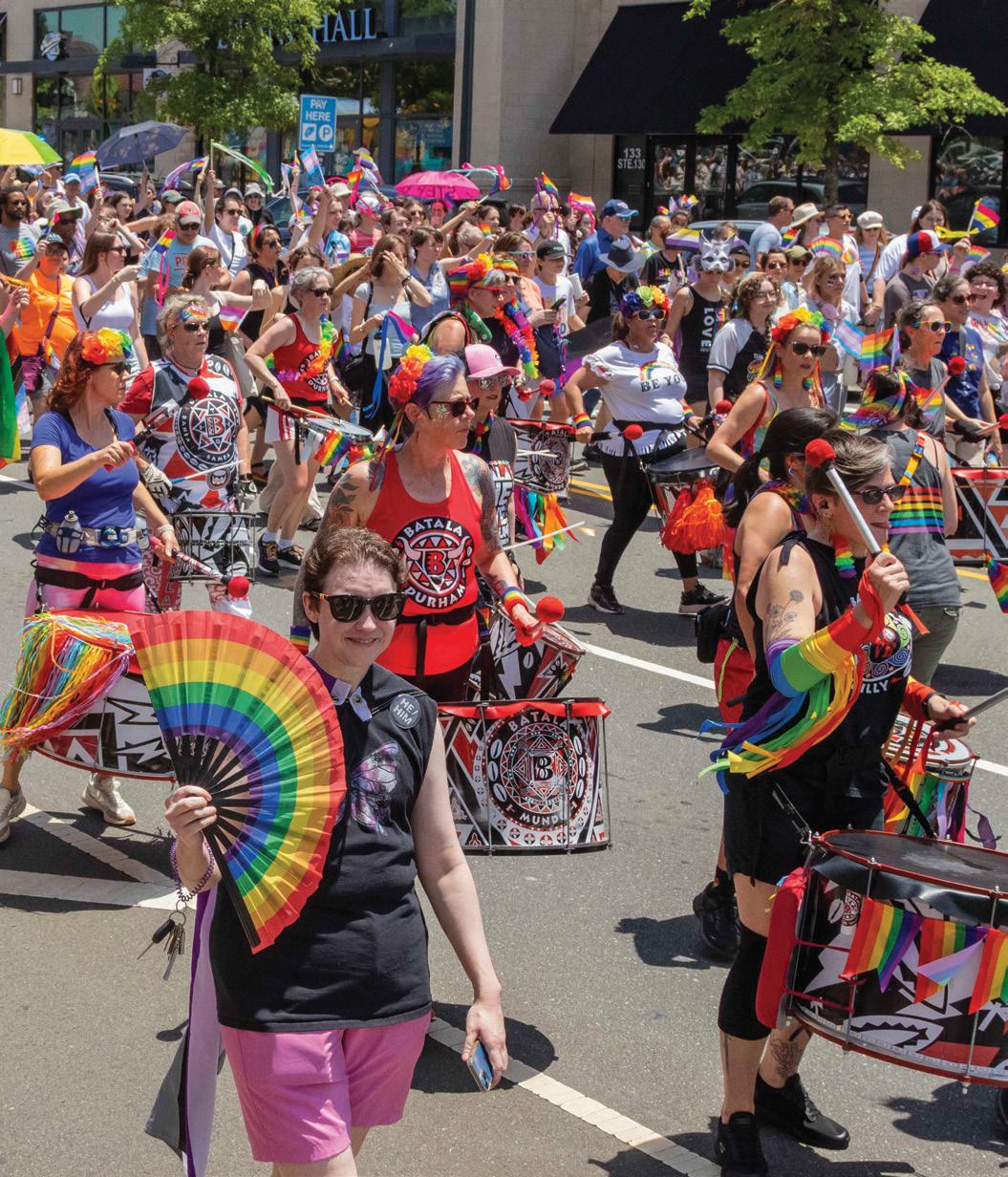
That LGBTQ+ people were living openly in Orange County became unmistakable in 1995, when Carrboro elected Mike Nelson as the first openly gay mayor in North Carolina, later serving as an Orange County commissioner. In 2009, Chapel Hill elected Mark Kleinschmidt as its first gay mayor, followed in 2013 by Carrboro’s Lydia Lavelle, the state’s first openly lesbian mayor.
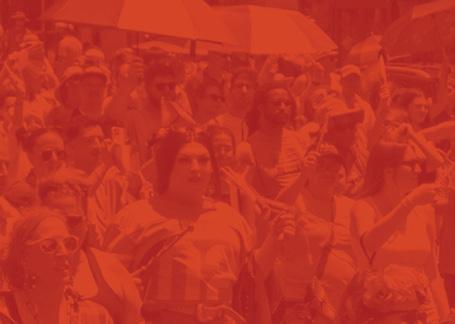
They were firsts, but not the last, as LGBTQ+ residents continue to blend fully into the fabric of Orange County.
I was raised in a predominantly Jewish neighborhood in New York City and had never even tasted bacon or ham until I was an undergrad at SUNY-Albany. I came to UNC in 1978 for my internship after graduating from Albert Einstein College of Medicine, also in New York City.
“I didn’t find it difficult to be different here even though I was a Northerner, a former hippie who spoke with a different accent. My wife, Dr. Susi Lieff and I embraced life in the South, but not specifically with Christian culture. Having children brought it home—Christmas. It was always challenging to find the balance, being close with our friends and neighbors and spending time together, at the same time maintaining our own beliefs and Jewish family life.
“We joined Beth El Synagogue in Durham, where our children had B’Mitzvahs and we found common community.”
Dr. Arthur Axelbank, Hillsborough
In 1971 my husband and I moved to Chapel Hill without a thought about facing a different culture; at that time we were returning from the Peace Corps in eastern Iran! But we did find differences from the northeast where we’d grown up and gone to college. I found a general dislike of Yankees, but I never experienced any overt anti-semitism here.
“Religion played a greater role in society here than in the northeast. People often asked, in a friendly way, which church we belonged to.
When our first-born was five and came home from public kindergarten with the Baptist view of the universe, we decided that it was time to join a Jewish congregation. We did, and are active in it to this day.”
Sonna Loewenthal, retired assistant manager, Town of Chapel Hill
We’ve been long-term active members of Judea Reform Congregation in Durham. It is an important part of the sense of community we sought as our lives took root in this area. Through the congregation we’ve found the feeling of continuity we sought with the Jewish people and our heritage. I am deeply grateful to have had an opportunity to serve as president of the synagogue and as a lay cantor, among other forms of involvement in the congregation.
“At the same time, I value greatly the rich diversity of this area in terms of ethnicity, religion, and background, and over the years have come to feel more strongly about that precious quality of the wider community of which we are a part.”
Norman Loewenthal, retired director, UNC’s Friday Center
Early in the twentieth century, being Jewish in Orange County meant living as an “other.” By 1976, the “other” had blended into us.
The presence of Jewish life at UNC grew slowly. The first Jewish students arrived in 1883, and by 1910 fewer than twenty of the university’s roughly 1,000 students were Jewish. In 1912, undergraduate Samuel Newman founded the first Hebrew Culture Society at a Southern university—an organization that became the UNC Hillel House in 1936.
During the 1920s, UNC added a question about religious affiliation to its application forms. Soon afterward, the university quietly imposed entry quotas limiting Jewish students to four per freshman class, and Jewish students were also steered into segregated housing, which is why two Jewish fraternities were established, Tau Epsilon Phi in 1924, and Zeta Beta Tau in 1927. In 1933, President Frank Porter Graham abolished the quota system after a qualified Jewish applicant to the medical school was rejected because the “limit” had already been reached. Yet unofficial housing segregation persisted until 1945, when student leader Allard Lowenstein publicly linked it to Jim Crow practices in the South. Only then did President Graham end the “unofficial policy.” The university ultimately removed the religion question from its applications in 1955.
Jewish students began to take on prominent roles. In 1957, Lenny Rosenbluth of New York led the Tar Heels to an NCAA basketball championship, and in 1958, Eli “Sonny” Evans became UNC’s first Jewish student body president. But Jewish students were still required to attend Saturday classes until 1970.
A broader transformation was underway as well. With the opening of Research Triangle Park in 1959, the region attracted scientists, scholars, and industry leaders—including many Jewish families seeking a progressive congregation. In 1961, they organized Judea Reform Congregation in Durham, which purchased land on Jones Ferry Road outside of Carrboro in 1982 and established a cemetery there.
Orange County’s first Jewish congregation emerged in 1996, as local families began meeting in one another’s homes and formally founded the Chapel Hill Kehillah. When the Chapel Hill Bible Church vacated its Mason Farm Road building, the Kehillah acquired the space and dedicated it in May 2002. The ceremony marked the first official act of Rabbi Jen Feldman, who continues to serve as Orange County’s first rabbi. By 2012, with members coming from across the area, the congregation adopted the name Kehillah Synagogue.
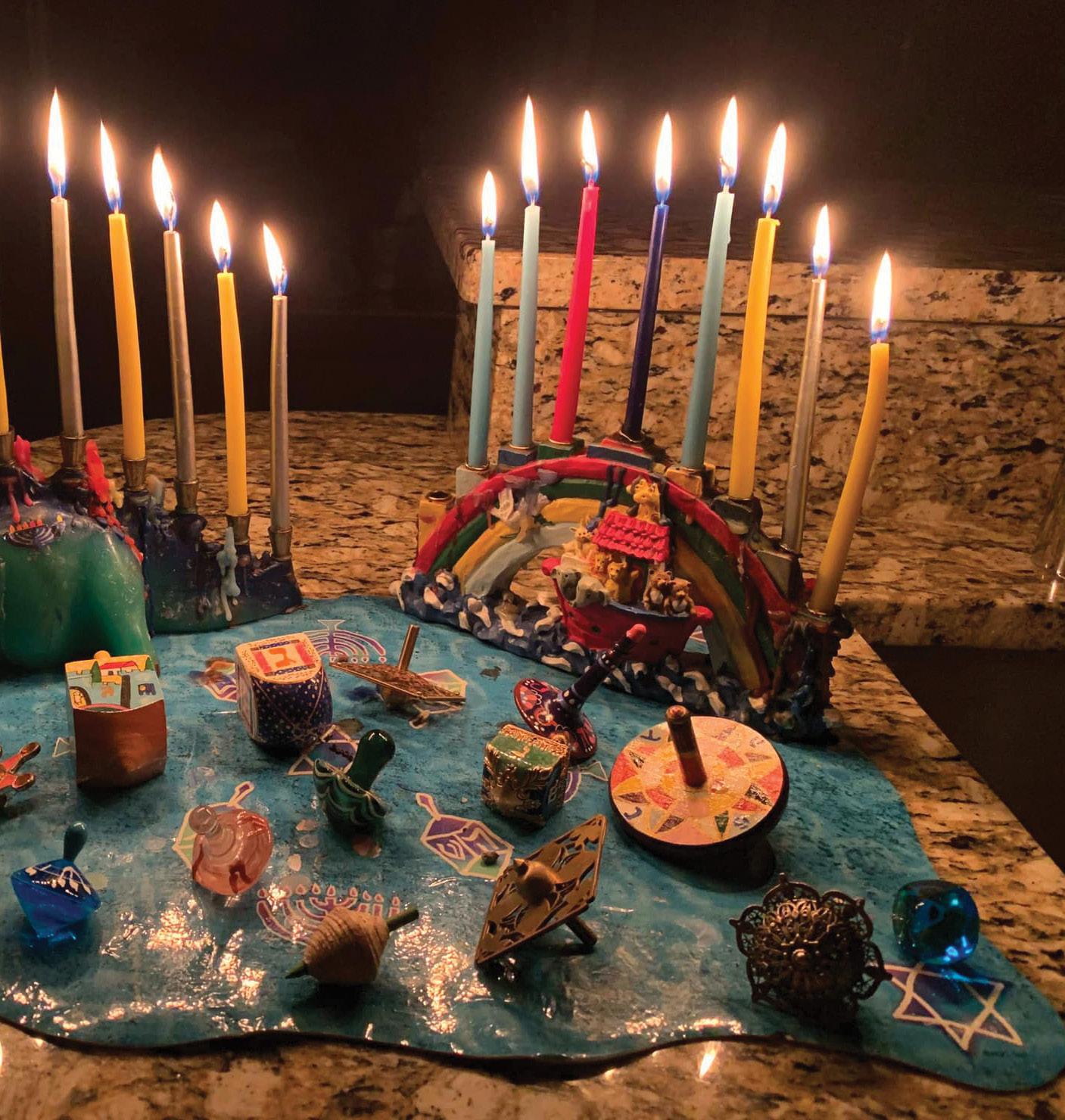
When I first came to WCHL in the summer of 1977, I thought I already knew what being involved with the community meant, but the commitment to community service at this radio station was far different from any other station I ever worked at.
“The Chapel Hill-Carrboro community was special and we all worked really hard to serve it—especially during the infamous ice storm of 2002. It seemed that everybody around town lost electricity, including the station. But we had a generator with enough electricity for our onair studio. It was up to us to make sure the community had access to information about the roads, where to get firewood, how people could get food, plus information from the police, fire, and power companies.
“The murder of Eve Carson in 2008 had a huge impact on everyone in our community. She was the UNC student body president, abducted from her apartment, forced to draw money out of her account at an ATM machine, and then killed and left in the street. There have been other crimes that took place over the years, but I think that one, more than any other, shattered our feelings of peace and innocence.
“In those early days of my time here, Chapel Hill was a lot like a village. I thoroughly enjoyed waking up our listeners every day.”
Ron Stutts, retired after 43 years with WCHL
When I came to The Chapel Hill News in 1993, the community was a Heaven for journalists—and newspaper readers! No fewer than seven newspapers covered news in Orange County.
“This was an information feast for citizens, who had a smorgasbord of news with which to form opinions about elections, local government, their children’s schools, local sports, restaurants, churches, and other essentials of community life. We made sure, for instance, to publish each grading period the names of every schoolchild who made the Honor Roll—a guarantee of readership by their parents. When I spoke in public, I reminded folks how lucky they were to have such information every day on their doorsteps.
“Alas, the internet came along and quickly siphoned advertising from the papers. Media amalgamation brought combining or folding of daily newspapers. Social media stole eyeballs from print media. This has resulted in what media experts call ‘a news desert,’ where citizens are deprived of the essential information to make decisions necessary to preserve democracy.”
Ted Vaden, former publisher, The Chapel Hill News
In 1976, people relied on local media to stay informed. For many, mornings began with a clock radio tuned to WCHL 1360 AM, which had served Chapel Hill since 1953 and, after 1968, provided Tar Heel sports and local news around the clock.
WCHL—“Where Chapel Hill Listens”—reported from the scene on the night Howard Lee won the mayoral election, succeeding Sandy McClamroch, the station’s founder, who built it as a community service. Community involvement was expected of every employee, including Jim Heavner, who later became owner and continued that mission. In the early 1990s, Curtis Media Group purchased WCHL, changed the format, and moved operations to Durham. Five years later, Heavner’s Vilcom bought the station back and returned it to Chapel Hill. During the December 2002 ice storm, which shut down much of the Triangle, WCHL remained on the air providing essential local information. Since 2015, the station has been owned by Chapel Hill Media Group, and in 2016 it became 97.9 FM, The Hill, simulcast on Chapelboro.com, a daily news forum.
On April 3, 1976, UNC’s formerly student-run station became a member of National Public Radio and continues as WUNC, 91.5 FM throughout the Triangle, with five affiliates across the state. Local volunteers provide the talent for a wide variety of programming at two nonprofit, 100-watt FM stations in the county. Carrboro tuned its community radio voice in 2004 with the launch of WCOM 103.5, and Hillsborough powered up in 2015 with WHUP 104.7.
In 1976, Chapel Hill was served by two daily newspapers: The Daily Tar Heel (founded in 1893) and The Chapel Hill Newspaper (founded in 1923 as The Chapel Hill Weekly). In Hillsborough, The News of Orange, also established in 1893, covered the northern part of the county. Together, these papers documented government decisions, civic organizations, school activities, and university athletics, providing a shared record of community life.
The Chapel Hill Herald began publication in 1988. The News & Observer acquired The Chapel Hill News in 1993, and after years of driveway delivery three days a week, its publication schedule was reduced to twice weekly in 2006. Eventually, both papers were folded into the N&O, marking a decline in locally produced daily coverage. From 2007 to 2012, The Carrboro Citizen attempted to fill that gap with a renewed focus on local reporting.
As advertising revenue increasingly shifted online, many local newspapers struggled to remain viable. Since 2018, the web-based Local Reporter has provided community coverage in Chapel Hill.
Chapel Hill Magazine has filled a full-color niche since 2006, offering longer-form features and community profiles.

Back in the day: The Carrboro Citizen
The Village Advocate 1978-1983 merge with Indy The Independent Weekly (INDY) 1983-
The Friday in 1976 that my military service ended, I got a call from the Orange County Library. They were looking to let the community know that they were desegregated, even though the sign outside the library had ‘Confederate Memorial Library’ on it!
“They wanted me to drive the bookmobile. I had a degree in social work, had served in the Army; not another person working in the library had a degree, but I was driving the bookmobile. So I went to school and got my master’s in library science. In 1993 I became North Carolina’s first Black library director.
“Years later a friend of my daughter’s told her to tell me he was sorry. When he was a kid he had so many late fines on his library card that his mama couldn’t pay, he’d throw books out the bathroom window, read them, then turn them back in. Another kid who did well for himself was Matt Hughes. He was a latchkey kid and he was there after school every day, hitting the books.”
Brenda Stephens, retired, Hillsborough
The Friends of the Carrboro Branch Library was established in 1987, spearheaded by then Mayor Ellie Kinnaird, who gathered local librarians, educators, and Carrboro citizens to highlight that Carrboro was the largest town in North Carolina without a free-standing public library.
“Our first meetings were large, full of wonderful local people, and the main issue was finding a venue. Space was eventually offered in the planned McDougle Middle School media center. So in 1995, the Carrboro Library was born. Maintaining it presented ongoing challenges, and it still wasn’t a centralized free-standing library.
“Then in 2016, with former Carrboro Mayor Mike Nelson’s appointment to the Board of Orange County Commissioners (BOCC), a Carrboro library site appeared in future plans. When the town parking lot was donated to the program, everything changed. There was local concern, but the town and county had it together this time.
“But in May 2023 the project faced closure because of COVID-related supply chain backlash—an extra $10 million was needed. At a dramatic BOCC meeting, with $5 million committed from Carrboro and the rest from the county, it was approved.”
Nerys Levy, artist, Carrboro
The public libraries of 1976 looked far different than they do today. Back then, the only things on the shelves were books. To find a title, you went to the card catalog—cabinets filled with long, index-card drawers containing alphabetized cards that listed each book and its call number. Libraries had areas for periodicals—newspapers and magazines, current and past, local and national—along with a wide array of reference books, including decades of phone books.
Today’s libraries have computer terminals where we type in a title or author to find the call number. Books now come as ebooks and audiobooks, and bound books are available in large print. Instead of aisles of reference volumes, libraries offer rows of computers for public use.
Orange County’s first public library opened in 1901 in a small building where the Orange County Historical Museum stands today. In 1934, using New Deal funds and a $7,000 contribution from the United Daughters of the Confederacy, the current building was constructed and named the “Confederate Memorial Library.” The sign remained outside until 2015, even after the library had relocated twice. In the 1980s, the library moved to the former high school building on Tryon Street, where it occupied the second floor for nearly 25 years before moving into its modern downtown location on January 8, 2010.
The Chapel Hill Public Library opened in 1958 in a cottage on West Franklin Street. In 1967, a new mid-century-designed library opened at East Franklin and Boundary streets. The Friends of the Chapel Hill Library, which became a nonprofit in 1961, held its first book sale in 1971. The library moved a mile east in 1994 to sit above a 32-acre public park with walking trails, and in 2013 expanded into the 63,000-square-foot building of today.
Carrboro did not have a library until 1995, when one opened inside the new McDougle Middle School on the edge of town. The Carrboro Cybrary followed in 2000 in the Century Center, offering computer access and digital materials until its closure in early 2026. Years of advocacy finally led to the Southern Branch Library’s placement in downtown Carrboro, inside the new Drakeford Library Complex, a cultural center named after Carrboro’s first Black mayor, Robert Drakeford. Its 52,000 square feet include a deck with 171 parking spaces, meeting rooms, Durham Tech classrooms, and WCOM radio station. Its grand opening was February 21, 2025.
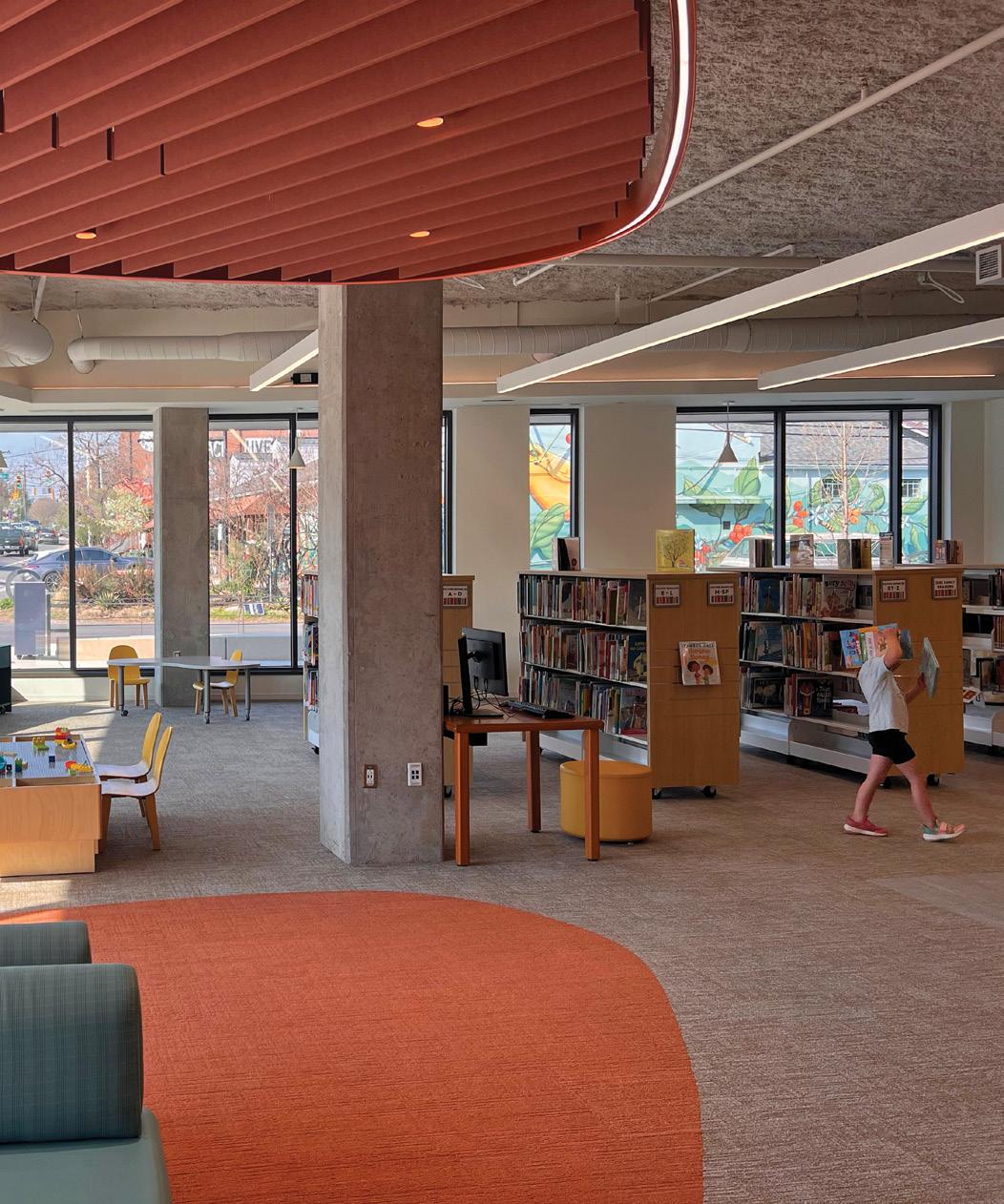
I’ve spent my life in Orange County. Now, I work twice a week over at the Carolina Basketball Museum. People from all over the world come in there on their way to somewhere from somewhere else. The busiest time of the year is summertime. We get about 30,000 tourists a year—one year we had 40,000. People are always asking where to go, what to eat, and so forth, and we direct them around to get a taste of the community.
“Sometimes I feel like as a community, we aren’t as visitor-friendly as we could be. We make parking difficult, and there’s an element of people in town that complains about visitors and the problems they bring, like traffic congestion.
“Tourism to me is the perfect clean industry. People come here, they visit, they spend the money and then they leave.”
Bob Ward, retired banking executive, Chapel Hill
I’ve been talking to Chapel Hill visitors throughout my lifetime at Julian’s, our family’s clothing store on Franklin Street. But it was my work at UNC Visitors Center that led me to the rarely told history about the university, the town, and our landmarks.
“I’ll never forget a woman I toured from California. Her family had settled West during the Great Migration of the 1920s, and, recently retired, she was retracing her ancestral roots through Louisiana and Mississippi. Her family was terrified of her traveling the South—even today—and had begged her not to go.
“She had spent weeks visiting plantations, sites, and museums across the region before arriving at our campus. As we walked through McCorkle Place, I stopped at Silent Sam. The confederate Civil War monument had been a fixture of the landscape my entire life, but I didn’t give the ‘polished’ version. I shared the hard facts, the context, and the controversy I had been uncovering. She listened in silence as others asked questions. But as we walked away, she leaned in and said, ‘This is the first time in all my travels that I feel I’ve heard the truth without having to ask for it. Thank you.’
“We often feel pressured to show the polished, curated version of our history. But the complete story builds the scaffolding we need to connect and understand each other—and strengthens our community with genuine respect, empathy, equity, and opportunity.”
Missy Julian-Fox, Chapel Hill native, educator, entrepreneur, author
The visitor story stretches back decades. In the 1970s, when the economic impact of tourism first started being calculated, Chapel Hill greeted travelers with a modest but memorable lineup of roadside motels and early chain hotels along all the roads into town. The Tar Heel Motel, Holiday Inn, Watts Motel, and the University Motor Hotel offered basic, friendly accommodations that fit the era’s easygoing pace and the town’s unpretentious character.
The Carolina Inn stands as one of Chapel Hill’s most enduring lures. Built in 1924 by alumnus John Sprunt Hill, it remains as beloved as ever, welcoming generations of alumni, parents, and visitors who want to stay somewhere that feels inseparable from the campus itself.
Some hotels today have become destinations in their own right. The Graduate leans hard into UNC spirit, complete with its Michael Jordan–themed Room 23 and an atmosphere that feels part academic lounge, part fan shrine. The Sheraton anchors the area’s meetings and events, its spacious lobby and polished comforts reflecting the scale of a growing region. Carrboro’s Hampton Inn offers downtown walkability and easy bus transit around both towns.
Hillsborough has experienced a defining hospitality revival with the reopening of The Colonial Inn. Its return has brought new energy to the historic downtown, boosting the local economy and restoring that powerful sense of place. More than a hotel, The Colonial Inn remains a symbol of Hillsborough’s momentum, drawing visitors who linger—dining, shopping, and exploring the town at a slower, more intentional pace.
What draws people here is no mystery. Chapel Hill, Carrboro, and Hillsborough are each vibrant in their own ways, rich with culture, food, festivals, farm treks, and an unmistakable warmth. Franklin Street continues to evolve as a welcoming crossroads.
Hillsborough has cultivated its Riverwalk, arts scene, and destination restaurants. Carrboro, reborn after the textile mill era, emerged as a hub of music, art, and inclusion.
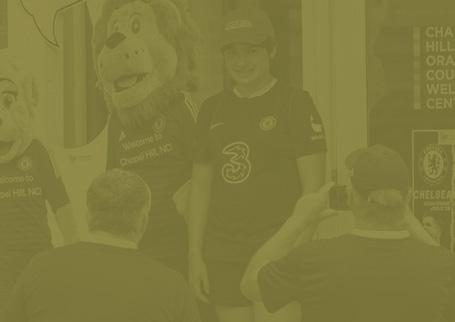
UNC Athletics now activates Kenan Stadium year-round, hosting international soccer clubs and global crowds. Yet the spirit remains familiar.
Orange County now welcomes more than two million visitors each year—more people than live in Philadelphia. Those travelers spend over $280 million annually, the equivalent of about $1,830 for every resident of Orange County!
For a place that still feels intimate and its towns walkable, the impact of tourism is anything but small.
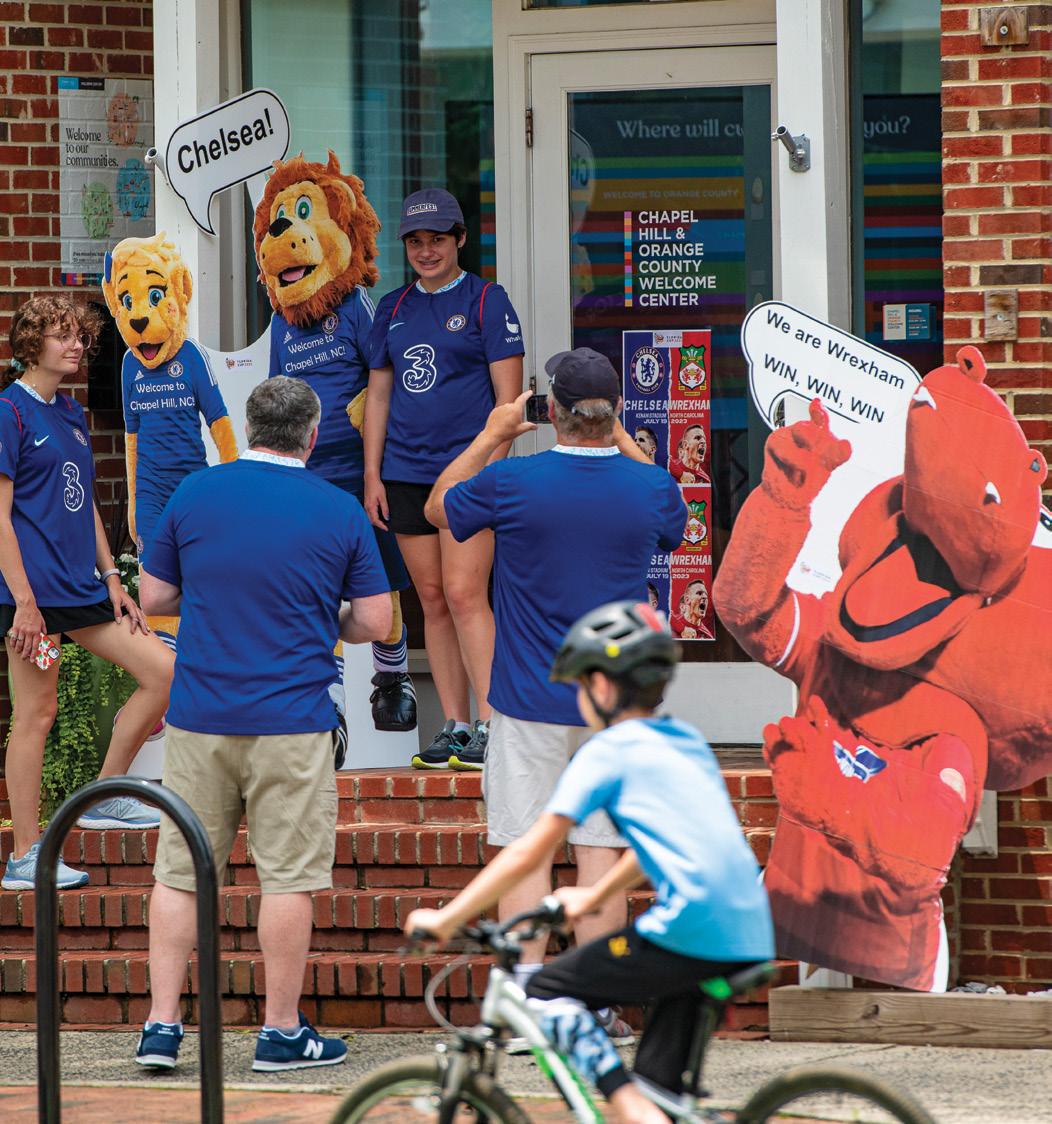
Paul Jones qualifies as Orange County’s communications guru. During his 40-plus-year career at UNC—where he served as a clinical professor in both the School of Journalism and Mass Communication, and the School of Information and Library Science—Jones helped pioneer several “firsts.”
In the 1980s, he collaborated on the first campus-wide email program for UNC. In 1991, he installed the university’s first web server—“one of the first in the United States,” he said. A year later he was the first manager of SunSITE, one of the first non-science or governmental World Wide Webs in North America. “Soon after, we began hosting such sites as Project Gutenberg (the first ebooks), and a large array of free software projects,” Jones said.
In 1994, he was part of a small team that created the first simulcast streaming radio station for UNC’s WXYC, which first hit the air on March 18, 1977.
Drawing a line between communication technology and another worldchanging invention, he said,
The deadliest technology that we’ve ever invented is the automobile, the internal combustion engine. We changed the entire planet to serve the automobile. It kills us more than any other thing on the planet— directly, in wrecks; indirectly, with air pollution. It’s ruined humanity by one measure; by other measures, it’s let us live and marry farther than 16 miles from our homes, which we didn’t do before World War II. It lets us see the world in a way we’ve never seen the world before.
“I don’t know if information technology and communication will be the same, but we have a revolution now. We can know where our senile elderly parent or a child is, we can communicate with family living anywhere.”
In 2021, Jones was inducted into the North Carolina State Computer Science Hall of Fame.
Paul Jones, professor, School of Journalism and Mass Communication, and the School of Information and Library Science, UNC-CH
In 1973, Motorola built the first cell phone, a two-and-a-halfpound brick with a price tag to match. Two decades later, they were finally cheap enough for regular folks. But in 1976? “Phone” meant landline, period.
“Touch-tone” push-button phones, introduced in 1963, were slowly replacing rotary dials, allowing long-distance calls without operator assistance. For a “collect call” (where the other person paid) or “person-to-person” call (you only paid if that person was on the line), you dialed “0” and a real, live woman would respond: “Operator, how may I assist you?” You found out how much those long-distance chats cost when the bill arrived by U.S. Mail—the only “mail” of the day.
Letter carriers had far heavier loads in the 20th century. Longdistance calls were pricey, so people still wrote letters, mailed greeting cards, and—until 1975, when United Parcel Service began delivering to all 48 contiguous states—relied on the Postal Service for packages.
By the 1980s, cordless phones freed us to walk and talk inside our homes, and answering machines took messages when we were out (or not in the mood to answer). Caller ID didn’t go mainstream until 1990, so the person on the other end was always a surprise. Pagers kept some people on call 24/7, and fax machines began whirring in the late ’80s, quickly becoming office—and even home—staples.
Thanks to Research Triangle Park and the University of North Carolina, email and text messaging arrived in Orange County in the early 1980s. But they didn’t really take off until the 2000s, just as cell phones began replacing pagers. Personal computers had entered a few homes in the late ’70s, and hit mainstream in the mid-’80s, but email didn’t become an everyday habit for another decade.
In 2007, the iPhone’s touchscreen signaled the end of buttons and turned our “phones” into pocket computers. Two months later, you could check Facebook on one (the social network had launched in 2004), and Android phones soon joined the party. Landlines began their slow fade as texting, video calls, and online video conferencing systems connected us instantly across the globe.
News, entertainment, and personal messages travel faster than ever. The dinner bell has been replaced by a text to family members upstairs, or out playing—with many children now wearing watches that let parents track them. Some fantastical what-ifs of 1976 have become what-is.

Coach Smith always emphasized that first, he was a teacher, and through that medium we came to respect him as a leader. With the court as classroom he saw the frenzied activity of a basketball game and turned it into an orchestrated ballet and in that athletic theatre he taught that no individual was greater than the team.
“He emphasized organization and stressed preparation, discipline, sharing. His constant mantra was ‘play hard, play smart, play together’ and that produced a program of unparalleled success. Yet in the same breath, tethered with triumph, Smith produced teams that not only won but did so with class.
“Winning was important to Coach Smith…make no mistake, his competitive drive and expectations were demanding, but far more important was that each player realized his potential and worth to the team and as a person.”
Fred Kiger, teacher, author, Chapel Hill
I was a sportswriter at The Chapel Hill News, and one day in 1992 I was surprised to receive a letter from Dean Smith, gently scolding me for writing that an upcoming game against Butler should be ‘a breather’ for the powerful Tar Heels. ‘I am not mad or upset,’ he wrote, but he explained in some detail why I should expect Butler to be ‘great @ home!’
“If my house ever catches fire, that letter, now framed, is one of the first things I will grab (by the way; Carolina won by 47 points).
“All coaches teach their players how to play the game, and no one did that better than Dean Smith. But he didn’t just teach them how to be better players; he taught them how to be better people. And I think, just by watching how he coached and how his teams played, we absorbed those principles too: Commit deeply. Play fair. Lead by example. Own your mistakes. Point to the passer. Respect your teammates, your opponent, and the game. Win with grace, and lose with grace.
“The last time I saw him was at the Lumina movie theater in Southern Village with his lovely wife, Linnea. Once he had possessed the most astonishing memory I have ever encountered; it seemed he could describe every play from every game he had ever coached. I doubted he would remember me, and I certainly didn’t want to bother him, but I couldn’t help approaching. ‘I just wanted to say hi,’ I said. ‘We love you, Coach.’”
Dave Hart, Chapel Hill
Like so many before and after him, Dean Smith arrived in Chapel Hill primed and eager to prove himself. He was twentyseven years old in April 1958 when he moved to town from his home state of Kansas to serve as assistant coach of UNC’s basketball team under Frank McGuire, who had led the Tar Heels to their first national championship the year before.
Three seasons later, thirty-year-old Dean Smith became head coach after McGuire suddenly left in August. In their first game on December 2, 1961 against Virginia, the “tired signal” from a player was flashed for the first time. Coach Smith wanted to know when his players needed a break, and a closed fist in the air told him—one of many Dean Smith traditions that continue to this day. His first year at the helm was his only losing season during thirty-six achievement-filled years.
The 1960s were especially turbulent years in the South, including “progressive” Chapel Hill, where desegregation was an ongoing pursuit supported both quietly and openly by Smith. In 1966 he fulfilled his goal of integrating the basketball team by bringing in Charles Scott, UNC’s first Black scholarship student-athlete. Before the first game, at Smith’s request, the UNC pep band removed “Dixie” from its repertoire.
By 1976, the Tar Heels had won the first five of what would be thirteen ACC championships under Smith, and it was his fourthyear named ACC Coach of the Year. He would win that honor another four years.
With every accolade, he gave the credit to his players. In 1982, when they won the first of two national championships under him, Smith said, “I’m not a better coach today than I was yesterday.” In his thirty-six seasons and 879 victories he was always more than a winning coach.
Smith made the “Carolina Way”—winning without cheating, valuing student-athletes, and playing a disciplined, teamoriented game—the right way. He never swore at players, but there was no mistaking the need to listen when shown what they did wrong and how to do it right. Many players considered him their second father, and every coach since his retirement in 1997 until the hiring of Coach Michael Malone in 2026, has been a man who either coached under him or played as a Tar Heel—in other words—family.
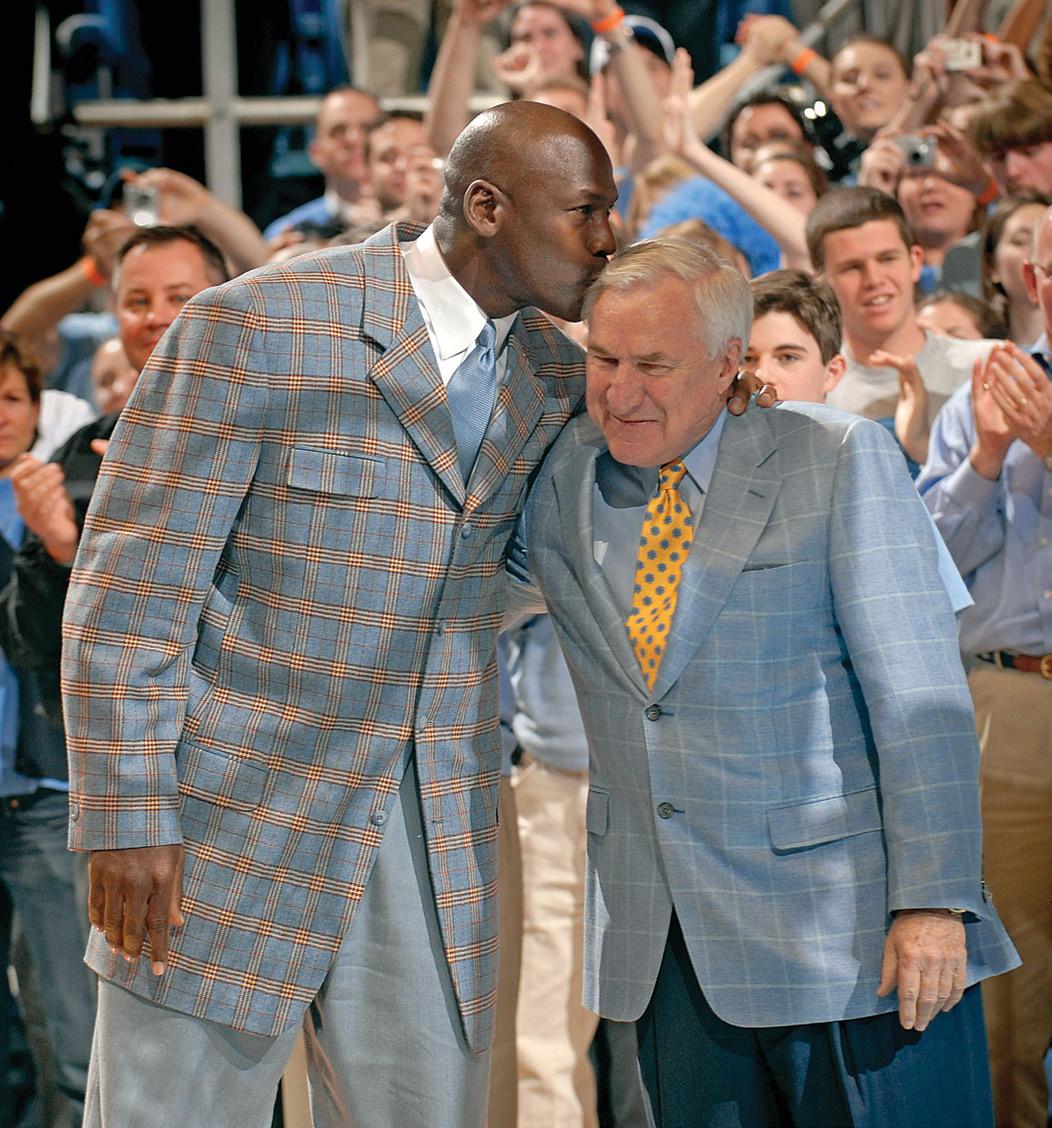
On November 22, 1963, I was a ten-year-old having lunch in my elementary school cafeteria when President John F. Kennedy was shot eight miles away. That night, I lay buried under heavy covers, aware that suddenly everyone in the world knew my hometown: Dallas, Texas. Over the next three days, spent mostly watching history unfold on our black-and-white television, the erasure of my childhood began—continuing through one civil rights march, Vietnam War protest, and one assassination after another during the turbulent sixties and early seventies.
As the nation celebrated its Bicentennial in 1976, I claimed my own independence from Texas when American Airlines hired me as a flight attendant and moved me to New York City. There, in both the city and my travels, I came to understand what a dynamic melting pot this country is. When the Revolutionaryera tall ships sailed past the Statue of Liberty, backlit by Fourth of July fireworks, I felt a sense of national pride for perhaps the first time.
A few years later, life took me to Los Angeles, where I naively believed racism was a thing of the past. People seemed to live side by side in harmony. On March 3, 1991, the brutal beating of Rodney King by Los Angeles police officers shattered that illusion. One of the first widely seen videos of police brutality, it spread quickly after a bystander recorded it from a balcony
and shared it with a local television station. Once again, I was living in a city the world was watching. A little over a year later, following the acquittal of the officers, the nation witnessed six days of unrest—an eruption born of generations of injustice.
When I arrived in Chapel Hill on January 27, 1994, I quickly knew I had found my forever home. It was everything I had long imagined: a small town with the cultural life of a city, set among pine and hardwood forests, and filled with people of generous spirit.
My love for this place only deepened when I began writing feature stories for The Chapel Hill News in 1996. Soon I was assigned the “Neighbors” column, where I had the privilege of meeting—and telling the stories of—people working for the common good. Their efforts are everywhere: from the Hillsborough Kiwanis Club, raising funds for elementary schools, to the Chapel Hill Rotary’s youth leadership programs, to the garden clubs that support the North Carolina Botanical Garden, and far beyond these few examples.
Across Orange County, more than 2,000 nonprofit organizations provide services ranging from addiction recovery to emergency response to student support—touching nearly every aspect of community life. Where there is need, there are people creating solutions.
People have often asked what great lesson I learned as a flight attendant. My answer is the same as the one I learned as a journalist: there are more good people in the world than bad.
And so, as this book leaves my hands, my faith in “We the People” has never been stronger. In this 250th year, we find ourselves in a time when history echoes the past—and history also suggests that we will endure.
Dean Smith built a program defined by its comebacks. May the United States of America continue to find that same resilience as we move through each uncertain chapter in our history.
The world is watching.
Valarie Schwartz
April 10, 2026
A native of Dallas, Texas, Valarie Schwartz attended the University of Texas at Arlington before her life took flight—literally—in 1976, when she began a career as a flight attendant for American Airlines in New York City and later Los Angeles. She quickly discovered how readily people shared their stories with her. While raising a family, she prepared for a writing career, and after finding her true hometown in Chapel Hill, she began writing for the Chapel Hill News in 1996. For eleven years she wrote the “Neighbors” column, chronicling the people and organizations of Orange County and the good they fostered in their communities.
In 2009, The History Press published her book Remembering Chapel Hill: The 20th Century As We Lived It. Her freelance work has included writing for Chapel Hill Magazine, Durham Magazine, and two “Accessible Orange County” guides for the Chapel Hill–Orange County Visitors Center, detailing services at restaurants, hotels, and tourist locations for people living with a variety of disabilities.
Many thanks to the Chapel Hill–Orange County Visitors Bureau, which acquired the funding from the state of North Carolina as part of the America250 Project. For many years, it has found creative and functional ways to spotlight Orange County, drawing visitors into the contemporary, as well as the historical features at the heart of who we are. Kudos for recognizing the need for a lasting memento of our county during this historic celebration. Thank you for entrusting me with the honor of delivering it.
Thank you to every person who agreed to be a voice in this book. Without your willingness to speak—or in some cases write me, or send photos—this would not be the book that it is. Your shared experiences reflect who we have been, and became through the past fifty years.
There are many “background” voices as well, whose words or photos may not appear here but who paved my way: Delores Bailey, Samia Serengaldi, Fred and Sylvia Black, Lydia Lavelle, Alicia Stemper, Linda Convissor, Rabbi Jen Feldman, Dr. Leonard Rogoff, Lucy Lewis, Ellie Kinnaird, Patti Saponaro, Rosemary Waldorf, Vicki Ryder, Blair Pollock, Lori Hoyt, Lindsay Metivier, Marian Kaslovsky, Colby Wilkinson, Linnea Smith, Lisa Kaylie and those at Wilson Library who aided in my searches.
Special thanks to Dr. Lonnie Merrick, whom I met last year at the Chapel Hill–Carrboro NAACP Spring Brunch. When I told him about this book, he mentioned two books he felt I needed to read, and when I later went to his home to interview him as a “voice,” he placed them in my hands: Game Changers by Art Chansky and To Drink From the Well by Geeta Kapur. He was absolutely right. Even after more than thirty years here— and twenty-five years of writing about this place—I learned even more about its root stories. For anyone interested in civil rights and the hard truths of our history, these books will expand your knowledge. It was through that lens that I wrote this book.
Thank you to the excellent design team at Clean Advertising & Design, who put all of this together in such a beautiful, creative package while ushering me through the last days of production when I’d had enough of this project!
Finally, many hugs to those in my daily life who supported me: my out-of-state family, my wonderful neighbors; my Wednesday pals at OCSC, and great friends Jackie Helvey, Suz Robinson, H.R. Malpass, and Sally Heiney, who kept me going during moments that felt insurmountable—along with my husband, John Flinchum. During these last few months he has made every trip to the store, provided me with quiet space to work, and loving reminders that I could do this.
Chansky, Art. Game Changers: Dean Smith, Charlie Scott, and the Era That Transformed A Southern College Town. Chapel Hill: University of North Carolina Press, 2016.
Encyclopedia of Southern Jewish Communities: North Carolina. http:isjl.org/north-carolina-durham-encyclopedia
Kapur, Geeta. To Drink From the Well: The Struggle For Racial Equality At The Nation’s Oldest Public University. Durham: Carolina Wren Press, 2021.
McDonald, Thomasi. “A Panel Explores the Triangle’s Deep History of Housing Segregation.” Indy (November 25, 2020). indyweek.com
Palmer, David. “LGBTQ Identities, Communities and Resistance in North Carolina, 1945-2012.” outhistory.org
Rogoff, Leonard: Homelands: Southern Jewish Identity in Durham and Chapel Hill, North Carolina. Tuscaloosa: University of Alabama Press, 2001.
Schwartz, Valarie: Remembering Chapel Hill: The Twentieth Century As We Lived It. Charleston: History Press, 2009.
Seymour, Robert: Whites Only: A Pastor’s Retrospective on Signs of the New South. Valley Forge: Judson Press, 1991.
Smith, Dean. Dean Smith: A Coach’s Life, edited by John Kilgo and Sally Jenkins. New York: Random House, 1999.
Smith, Dean. The Carolina Way: Leadership Lessons From A Life in Coaching, edited by Gerald D. Bell. New York: Penguin Press, 2004.
Soltz, Wendy F. “A Color-blind Protest of Jewish Exceptionalism and Jim Crow.” Association for Jewish Studies, Spring 2021, pp. 25-26. https://www.associationforjewishstudies.org/
Ward, Trawick, Davis, R.P. Stephen. Time Before History: The Archaeology of North Carolina. Chapel Hill: University of North Carolina Press, 1998.
Williams, Shane. “North Carolina History Project: Occaneechi.” https://northcarolinahistory.org/encyclopedia/occaneechi/
Portions of this manuscript were developed with the assistance of AI tools used for editing, proofreading, and organizational support. All interpretations and conclusions are the author’s own.