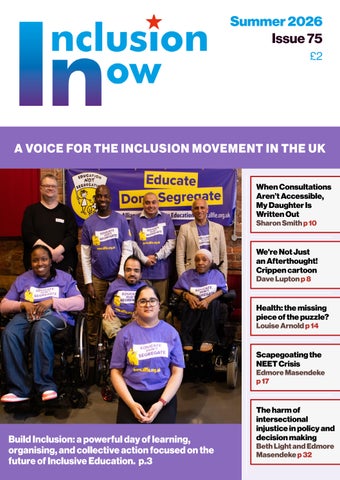
Summer 2026 Issue 75 £2
A VOICE FOR THE INCLUSION MOVEMENT IN THE UK When Consultations Aren’t Accessible, My Daughter Is Written Out Sharon Smith p 10
We're Not Just an Afterthought! Crippen cartoon Dave Lupton p 8
Health: the missing piece of the puzzle? Louise Arnold p 14
Scapegoating the NEET Crisis
Edmore Masendeke p 17
Build Inclusion: a powerful day of learning, organising, and collective action focused on the future of Inclusive Education. p.3
The harm of intersectional injustice in policy and decision making Beth Light and Edmore Masendeke p 32
Editorial A voice for the UK inclusion movement
Contents 3
8 10
14
17
22
25
32
35
Raising Our Collective Voice to Build Inclusion ALLFIE & Our Voice Crippen Cartoon Dave Lupton Parent Perspective: When Consultations Aren’t Accessible, My Daughter Is Written Out Sharon Smith Health: the missing piece of the puzzle? Louise Arnold Challenging Milburn's scapegoating of the NEET Crisis Edmore Masendeke Motability: What Families Need People to Understand Sharon Smith Segregation: What It Means and How It Harms Disabled Children and Young People in Education Maresa MacKeith and Edmore Masendeke The harm of intersectional injustice in policy and decision making Beth Light and Edmore Masendeke Legal Question
Inclusion Now occasionally includes adverts for products, services or events offered by other organisations. This doesn't imply we endorse the products or services. Readers are advised to check details and make their own judgements. Inclusion Now provides an opportunity for information exchange. All views expressed are not necessarily the views of ALLFIE, Inclusive Solutions or World of Inclusion. We reserve the right to edit articles. Inclusion Now is also available in audio or text. Search past issues online
Editor: Catherine Bebbington
2
Welcome to Inclusion Now 75. We expose how segregation is embedded in systems, processes and attitudes, and how Disabled people and their allies are taking collective action to challenge it. A key theme is the UK Government’s SEND reform agenda, which will determine whether Inclusive Education is strengthened or undermined in practice. Alongside this, wider narratives and policies continue to influence Disabled people’s lives. Persistent myths often lead to scapegoating, whether in debates about NEET rates (p17) or mobility support such as Motability (p22), rather than addressing structural barriers that drive exclusion. Opening this edition, ALLFIE’s ‘Build Inclusion’ event highlights collective action across the Inclusive Education Movement, including strengthening regional campaigns (p3). Sharon Smith offers a powerful parent perspective on how inaccessible processes exclude young Disabled people from participating in policy consultations directly affecting their lives (p10). Beth Light and Edmore Masendeke examine how these consultations continue to overlook the intersectional realities of Disabled people’s lives (p32). Louise Arnold examines how health and social care remain a missing piece in SEND provision, exposing how systemic gaps undermine Education, Health and Care Plans (p14). Maresa MacKeith and Edmore Masendeke draw on ALLFIE staff research to show how segregation is embedded in policy and practice, producing exclusion, intersectional injustice, emotional harm and denial of rights (p25). Together, these articles highlight a shared concern: current reforms risk reshaping, rather than resolving, the barriers Disabled children and young people face in education and participation. As SEND reforms move into the legislative stage, this is a critical moment to challenge what is being proposed, shape what becomes law, and defend and advance the right to Inclusive Education for all Disabled children and young people. By Catherine Bebbington, ALLFIE Communications Lead and Inclusion Now Editor
Movement building
Raising Our Collective Voice to Build Inclusion From powerful speeches and youth leadership to collective chants and campaigning, Build Inclusion: event showcased the strength of the Inclusive Education movement. Bringing together Disabled people and allies from across the country, the event reaffirmed that lasting change is driven by collective action and lived experience. On 30th April 2026, Disabled people, our organisations, campaigners and cross-movement allies, gathered in Manchester for the ‘Build Inclusion’ event. The event was a powerful day of learning, organising, and collective action focused on the future of Inclusive Education.
Organised in partnership with the Greater Manchester Coalition of Disabled People (GMCDP), the event created space for attendees to contribute directly to the Alliance for Inclusive Education’s (ALLFIE’s) response to the government’s SEND reform: putting children and young people first and the accompanying White Paper Every child achieving and thriving proposals. It also marked the launch of a new Northern Network on Inclusive Education, designed to strengthen organising and campaigning across the country and connect regional voices into the wider movement. From the beginning, the atmosphere reflected both urgency and determination. Opening the event after introductions from GMCDP’s Rick
3
Movement building
Burgess, Michelle Daley delivered a powerful message that captured the spirit of the day: “We have occupied today! Right, we have occupied the sky, and we have occupied the ground, we have occupied everywhere.” She reminded participants that the movement for Inclusive Education is rooted in collective action and resistance: “We mobilise, we disrupt, we challenge systems that choose to exclude and segregate us.” And in perhaps one of the most powerful moments of the opening session, she declared: “We are not here to fit into broken spaces. We are here to remake them.”
4
The Mayor of Greater Manchester, Andy Burnham, also sent a message of support, recognising the importance of the event: “Events like this matter deeply. Every young person with a disability deserves to learn in an environment where they feel they belong, are supported to succeed, and where difference is recognised as a strength.” Throughout the day, speakers highlighted the deep concern many Disabled people and campaigners feel about the direction of current education reforms and the continued expansion of segregated provision. ALLFIE’s Chairperson, Navin Kikabhai, spoke powerfully about the Government’s long-standing failure to address the harm caused by segregation within the education system. He argued that the current SEND proposals represent a continuation of exclusion, rather than a move towards genuine inclusion.
Movement building
Referencing the late ALLFIE Chairperson and disability rights campaigner Joe Whittaker,
of impairments within education policy, proposed changes to Education, Health and Care Plans
Navin reflected on how segregated spaces are often disguised through comforting or “friendly” language.
(EHCPs), and the future role of tribunals.
“Flowery named rooms like the Rainbow Room, the O’clock Room or Tree Top Rooms may sound environmentally friendly, but they are all forms of segregation.” He also reminded participants that the injustice experienced by Disabled children and young people must be openly named and challenged: “For many of us who experience these kinds of inequalities, the injustice in our education system needs to be named and called out.”
Edmore pointed out: “The last concern we have is these reforms are system-led rather than person-centred.” He went on to state: “The aim of these reforms is to manage budgets, not to support pupils”. Highlighting the lack of meaningful engagement throughout the consultation process, Edmore continued:
ALLFIE’s Policy and Research Lead, Edmore Masendeke, gave a detailed overview of the SEND consultation and White Paper proposals and outlined ALLFIE’s major concerns. Central to
“There is limited engagement with Disabled people, DPOs and young people and their families. That is why it is critical we respond, challenge and advocate for a system built on inclusion and lived experience.”
these concerns was the Government’s promotion of “inclusion bases” within mainstream schools, the expansion of specialist provision, the categorisation
The ‘Build Inclusion’ event centred the voices of Young Disabled people through ALLFIE’s
5
Movement building
youth campaign group, “Our Voice”. The Our Voice members who participated online and in person were Simmy Kaur, Umar Aziz Khan, and Hilary Balogun. According to “Our Voice” co-lead, Yewande Akintelu-Omoniyi, the event highlighted how crucial young leaders are for the Disabled People’s Movement. Throughout the day, the young people drew on collective learning from their past six months of organising together. They shared their personal and intersectional experiences, that are too often ignored in mainstream policy discussions. Their contributions highlighted issues including communication injustice, discrimination faced by young Deaf people within the education system, and the importance of accessible face-to-face work experience opportunities.
6
One young participant reflected on the event: “The event left me feeling highly invigorated, as it gave me a platform to talk about inclusive face-to-face work experience programmes and the support required to successfully complete them.” Our Voice members interviewed Inclusive Education expert Navin, in his capacity as ALLFIE Chairperson, about the movement and its history. This interview provided important context and highlighted the relevance of history to the present. As ALLFIE’s first hybrid event, participants could attend either online or in person, giving people different ways to access the event. British Sign Language interpretation and live captioning
Movement building
supported meaningful engagement across the day, while the programme structure allowed flexibility for participants who could not attend every session. The energy of the event extended beyond formal presentations. During one break, participants were led by disability activist Dennis Queen, a trustee of GMCDP, in collective chants (newly commissioned by ALLFIE and written by Miri, a Disabled song writer) demanding Inclusive Education and justice for Disabled people: “We know our lives best, Pay attention to our movement. Justice and rights in education means inclusion, Segregation's No Solution.” “Educate don't segregate. We demand a revolution. We're fighting for inclusion. 'Our Voice' is the solution.”
These moments reflected the spirit of solidarity that ran throughout the event. A reminder that movement-building is not only about policy discussions, but about connection, shared purpose, and collective resistance. The ‘Build Inclusion’ event marked the culmination of a series of consultation sessions, it brought together lived experience, expertise in Inclusive Education, and collective learning to strengthen the next phase of campaigning. At its heart, the event demonstrated something powerful: As Disabled people we are not waiting to be included in decisions made about us. We are organising, leading, challenging injustice, and building a movement rooted in rights, inclusion, and lived experience. This article was written by ALLFIE staff Lani Parker (Capacity Building Lead), Iyiola Olafimihan (Campaigns and Justice Lead) & Yewande Akintelu-Omoniyi (Our Voice Youth Project Co- Lead), in collaboration with Our Voice members.
7
Cartoon ALT TEXT
8
Cartoon
9
Parent Voice
Parent Perspective: When Consultations aren’t Accessible, My Daughter is Written Out Sharon Smith examines why government consultations continue to exclude and silence many young people with learning disabilities. Drawing on her daughter’s experiences, she calls for genuinely accessible participation that enables Disabled people to speak for themselves about decisions that directly affect their lives, rather than through others. My daughter is 21. She has Down’s syndrome, two part-time jobs she loves and a developing sense of herself as a young Disabled woman. She is also someone who cares deeply about fairness. She wants to understand the world around her, and she most definitely wants to have a say in the decisions that affect her life. And yet, every time a major policy consultation is launched, she is effectively shut out before she can even begin.
respect her right to speak for herself. But the way government consultations are currently designed makes that almost impossible.
As a parent, I sit in a complicated space. I am her mother, her advocate and – I hope – an ally to the wider Disabled community. I am constantly navigating the tension between supporting her voice and accidentally speaking over her. I don’t want to be her proxy. I don’t want to be the
Young people with learning disabilities still often find themselves on the margins, even in movements committed to inclusion.
interpreter of her experiences or the filter through which her views are shared with policymakers. Instead, she needs to be provided with accessible options to engage, ones that work for her and that
10
Disabled activist spaces, like any political space, can also sometimes be exclusionary, as they tend
Parent Voice
to amplify those who can process information quickly, speak fluently, and navigate complex discussions. This means that young people with learning disabilities still often find themselves on the margins, even in movements committed to inclusion.
Where are the accessible versions? Most Government consultations still launch without Easy Read versions, without plain language summaries, and without formats that work for people who use visual supports, Makaton, AAC, or other communication systems. When Easy Read versions do appear, they often arrive weeks after the main documents, leaving learning Disabled people with the least time to engage. And even when Easy Read is provided, it is rarely meaningful. The recent SEND Reform consultation is a perfect example. The Easy Read version was published on time, but the questions were abstract, conceptual and detached from my daughter’s lived experience. They required a level of policy interpretation that even seasoned professionals struggled with. For my daughter, the questions were simply not accessible. They were not rooted in real world scenarios, not scaffolded, not concrete, and certainly not designed for people who have a learning disability. If the questions themselves are inaccessible, then the consultation is inaccessible, no matter how many Easy Read icons are sprinkled across the pages.
If the questions themselves are inaccessible, then the consultation is inaccessible Where are the accessible routes to respond? Even when young people with learning disabilities manage to understand the consultation, the next barrier appears: how to respond. Most consultations assume literacy, assume confidence with online forms, the ability to type long answers, and that the person has the time, support and cognitive energy to navigate complex digital platforms. There are rarely options to respond through video, audio, symbol supported formats, or facilitated sessions designed around communication access. My daughter cannot travel independently to in person consultation events. Many are held in locations that would be impossible for her to reach alone. And even if she could get there, the events themselves are rarely designed with communication access in mind. They are fast paced, jargon heavy, and dominated by adults who already know how to work the system.
11
Parent Voice
Organisational responses cannot replace the right of individual young people to speak directly, in their own words, on their own terms.
Organisations like the Down’s Syndrome Association do incredibly important work through
Our role as parents, as I see it, is to:
programmes like Our Voice, gathering views and feeding them into policy processes. But collective organisational responses cannot replace the right of individual young people to speak directly, in their own words, on their own terms.
— Publicly call out inaccessible consultations every single time we see them; — Demand Easy Read and alternative formats from day one; — Support our young people to understand the issues, not speak for them; — Help them prepare their own responses, in their own words or communication style; — Advocate for, and support, accessible activism spaces, not just accessible government processes; — Model allyship, including by stepping back when their voice needs to be centred.
My daughter deserves opportunities to engage as herself, not only through intermediaries.
What should the role of parents be? Parents like me can sometimes be positioned as either sharp-elbowed, overbearing or irrelevant. But parents can be partners, we can offer support and scaffolding, to enable our young people to develop skills and share their views. We are the people who know what support our young people need to participate, and we are often the ones who can spot when a system is quietly excluding them.
12
Our role is to help clear the path, so that their voice can be heard.
Parent Voice
What the government must do The government must treat accessibility as a legal duty, not an optional extra. That means: — Always publishing Easy Read, plain language and alternative formats at the same time as the main consultation; — Designing Easy Read questions that are concrete, scenario based and genuinely accessible; — Providing multiple routes to respond: video, audio, symbol supported, facilitated sessions; — Ensuring consultation events are accessible in content, pace, communication support and location, with agendas and papers sent out in advance to allow for preparation; — Co designing consultation materials with young people with learning disabilities; — Recognising young people with learning disabilities as rights holders, not afterthoughts.
My daughter is a young Disabled woman with opinions, insights and experiences that matter. She shouldn’t need to rely on me to translate her voice into a system that refuses to hear her directly. If consultations continue to exclude her, then they are not consultations at all. They are gatekeeping exercises dressed up as democratic participation. Young people with learning disabilities deserve better. And it is long past time that government redesigned participation so that they are not merely included, but centred. Sharon Smith is an independent researcher and parent/carer.
My daughter is a young Disabled woman with opinions, insights and experiences that matter. She shouldn’t need to rely on me to translate her voice into a system that refuses to hear her directly.
13
Health and Social Care
Health: the missing piece of the puzzle? Drawing on research with families, Louise Arnold argues that health and social care remain the missing pieces of the SEND system. Without meaningful involvement from health and social care professionals, Education, Health and Care Plans cannot deliver the holistic, rights-based support Disabled children and young people deserve. In the 2014/2015 ‘SEND’ reforms, there was a focus on joint working and joint commissioning between health, education and social care professionals. This included collaboration on needs assessments, shared aims and outcomes, and responsibility for supporting families to meet these aims and outcomes. The purpose was to create aspirational, individualised Education, Health and Care Plans (EHCPs) with Disabled children, young people, and their families that were produced, delivered and reviewed jointly (DoH and DfE, 2015). Subsequent research has shown that this did not happen. The aptly titled ‘Forget the ‘Health and Care’ and just call them Education Plans’ shows that health and social care aims and outcomes have been underrepresented in EHCPs. Forgetting the Health and Care element of these plans has continued since 2018. In research I have undertaken in the years following, families expressed a distinct lack of input from health professionals in their journey towards creating their EHCP. Families also described having to chase health and social care professionals for assessments, reports, and contact. In some cases, reports provided from health professionals
14
Families expressed a distinct lack of input from health professionals in their journey towards creating their Education, Health and Care Plan. contained errors, information about other children, and inaccurate assessments of their children’s capabilities or experiences. Several families described having to pay privately for an assessment by a health professional because they were either denied an assessment or because they were having to wait so long. The resulting reports from professionals are the evidence upon which the EHCP is built, so having these reports available, making sure they are accurate, and receiving them in a timely way, is vital for moving forward with the EHCP. If reports
Health and Social Care
from health professionals are delayed, inaccurate or missing, either the EHCP cannot be completed within the legal timeline (only 46.4% of new EHCPs were issued within the 20-week timeline in 2025) or the EHCP is completed without input from health professionals, leaving an absence in aims, outcomes and support linked to health. Families have explained feeling that the information they provide about their child is not listened to, as one parent said:
What you say counts for nothing. Unless there’s a specialist that says it, you don’t count for shit. Arnold, 2024
There is a privileging of the information provided by professionals over the information provided by families, so functional working relationships between families and professionals is crucial, in addition to accurate and timely reports from professionals to create aspirational, co-produced documents. Without input from health and social care, there is a risk that these documents miss out core elements of a child or young person’s support plan. The government’s white paper, ‘Every Child Achieving and Thriving’ purports to address this discrepancy, however duties are again falling on schools to deliver these outcomes. The paper promises £1.8bn for ‘Experts at hand’ and
‘wraparound support’ – health professionals in mainstream schools, but even in the language, the health professionals are positioned as separate and as being outside the core team of school staff. The paper also suggests raising the threshold for eligibility for an EHCP and linking them to seven Specialist Support Packages. This puts at risk the individualised, child-centred support that families and creative school teams have managed to design around the child or young person. The paper states that most children will be able to have their needs met with an Individual Support Plan (ISP), but without the statutory protection that the EHCP offers, and without the legal duty to carry out a needs assessment, the support outlined on the ISP becomes effectively optional. With the move to the structured Specialist Support Packages for EHCPs, the commitment to partnership working with parents on the EHCP is
There is a privileging of the information provided by professionals over the information provided by families, so functional working relationships between families and professionals is crucial.
15
Health and Social Care
not renewed. The white paper states that ISPs will be created collaboratively with parents, though without acknowledgement of solutions to the many issues families have faced with partnership working that have been documented in the past. Families have already reported being made to feel grateful for what they do have access to, and reminded of the scarcity of resources. This could worsen without the protection of the legal duty to assess, and with the ISP being dependent upon the school, their resources, budget and their understanding of the child or young person and their needs. Without the legal duty to assess, there is a risk that access to health and care professionals will be seen as optional or extra. These changes give families and schools even less of a guarantee that there will be appropriate involvement from health and social care professionals, risking holistic support and input from professionals further. Even in the consultation process around the white paper, the government have not explicitly asked for feedback from health and social care professionals, instead focusing on “children, young people and families, teachers and leaders, and schools and trusts” (DfE, 2026). Whilst these groups are undoubtedly central in creating policy change that addresses the concerns of children, Young people and their families, it appears again as though the onus for change is on families and education professionals, with health and social care a missing piece of the puzzle. Louise Arnold is a Senior Lecturer in the Department of Education at the University of East London.
16
Without the legal duty to assess, there is a risk that access to health and care professionals will be seen as optional or extra.
Policy
Challenging Milburn's scapegoating of the NEET Crisis The government-commissioned Young People and Work: Interim Report examines rising numbers of young people who are Not in Education, Employment or Training (NEET). Edmore Masendeke argues that the report risks scapegoating young Disabled people while overlooking the structural barriers shaping post-16 transitions, including the legacy of segregated education and Access to Work failures, and sidelining their lived experience. A Familiar Narrative The government-sanctioned assault on Disabled people continues. Disabled people are yet again identified as the main cause of another crisis – rising NEET rates. Before this, it was rising welfare costs, growing NHS waiting lists, persistent labour shortages, widening local authorities’ budget deficits, and mounting pressures on public services. This is more than just a coincidence;
Disabled people are yet again identified as the main cause of another crisis – rising NEET rates.
it is a repeated pattern of portraying Disabled people as the source of the nation’s most pressing social and economic problems, while downplaying or ignoring the structural and systemic barriers that exclude them from education, employment, training, and wider society.
Disability on the Margins This narrative, and the systemic injustice it reflects, is deeply embedded within the fabric of British society, shaping public attitudes, policy decisions, and the way social and economic problems are understood. While the report identifies numerous structural and systemic barriers driving young people out of education, training and employment, it pays little attention to the experiences of young Disabled people in relation to those barriers. Instead, their experiences are treated as a matter of “additional barriers”, marginalising disability as a secondary issue rather than recognising it as
17
Policy
central to understanding exclusion. This ignores the fact that young Disabled people have always been disproportionately affected by the structural and systemic barriers identified in the report and often face those barriers in ways that are more severe, more persistent, and more difficult to navigate than their non-disabled peers because of ableism, disablism and other forms of oppressions.
Getting the Problem Wrong Instead, the report frames the so-called “disengagement” of young Disabled people as a consequence of dysfunctional healthcare and welfare systems, implicitly suggesting that these systems encourage economic inactivity. This narrative is both reductive and harmful. It draws broad conclusions from statistical trends while failing to engage meaningfully with the lived experiences of young Disabled people, many of whom face systemic and structural barriers to education, employment, healthcare, transport, and social participation.
What the Report Misses More significantly, the report fails to acknowledge two major structural and systemic barriers that exclude many young Disabled people from education, employment and training and restrict opportunities for progression throughout their lives: the continued legacy of segregated education and the ongoing failures of the Access to Work scheme. Together, these issues shape Disabled people's opportunities long before they enter the labour market and continue to
18
Inclusive Education, when properly resourced and supported, disrupts the inequalities produced by segregation.
affect their ability to obtain, retain and progress in employment.
The Legacy of Segregated Education First, the report sidelines the impact of segregated education on Disabled people and how it limits opportunities for progression in education, employment and training. Segregated educational settings restrict access to mainstream qualifications, social networks, work experience opportunities and career pathways, creating barriers that persist into adulthood. Inclusive Education, when properly resourced and supported, disrupts the inequalities produced by segregation. It creates equitable learning experiences, real pathways into paid employment and secures full social inclusion. By failing to consider the long-term consequences of segregated education, the report fails to address a key structural factor contributing to employment inequalities Disabled people experience throughout their lives.
Policy
Access to Work Failures Second, the report disregards the evidence that many Disabled people face significant barriers to entering and remaining in work due to delays, administrative burdens and inconsistent decisionmaking within Access to Work. Current wait times for an Access to Work assessment can be up to 37 weeks for employed applicants, with even longer waits reported for some groups. Evidence submitted to Parliament has highlighted increasing rates of non-approval, with around onethird of applications reportedly being rejected. These delays and refusals can leave Disabled people without the workplace adjustments and support they need to obtain, retain or progress in employment. Recent proposals to reform Access to Work have raised concerns that eligibility may be tightened and costs shifted onto employers, potentially further restricting Disabled people's access to the support they require to enter and remain in work.
The report perpetuates damaging stereotypes that portray Disabled people as dependent on welfare, while obscuring the structural inequalities that continue to exclude many young Disabled people from meaningful economic participation.
Blaming Disabled People and Getting PIP Wrong Taken together, these omissions reflect a broader tendency within the report to minimise or disregard well-established structural and systemic injustices Disabled people face, when they challenge its central narrative of welfare dependency and labour market disengagement. This tendency is further reflected in the report's treatment of disability benefits, particularly Personal Independence Payment (PIP). PIP is not an out-of-work benefit and is not intended to replace employment income. Rather, it exists to help Disabled people meet additional disability related costs, regardless of whether they are in work. By conflating disability benefits with unemployment-related support, the report perpetuates damaging stereotypes that portray Disabled people as dependent on welfare, while obscuring the structural inequalities that continue to exclude many young Disabled people from meaningful economic participation. ALLFIE is deeply concerned by the conclusions of this interim report, as they will form the basis of the recommendations included in the final Milburn Review report. These recommendations will be detached from the lived experiences of young Disabled people, fail to tackle the structural and systemic barriers that continue to exclude them from education, employment and training, and reinforce damaging stereotypes of Disabled people as dependent, disengaged and economically inactive. In doing so, they will legitimise policies that further marginalise Disabled
19
Policy
We therefore make the following recommendations:
They should recognise and address the structural and systemic barriers that drive exclusion and seek to realise social justice for young Disabled people as an achievable and tangible outcome.
people, rather than promote their inclusion and participation, while validating narratives that place responsibility on Disabled people, rather than on the institutions and systems that exclude Disabled individuals.
What Needs to Change Given the extent of these omissions and mischaracterisations, ALLFIE cannot support a final report that is based on the assumptions and conclusions set out in this interim report. Any final recommendations should be co-produced with young Disabled people and Disabled People’s Organisations, and grounded in the Social Model of Disability, intersectionality, and a human rightsbased understanding of disability. They should recognise and address the structural and systemic barriers that drive exclusion and seek to realise social justice for young Disabled people as an achievable and tangible outcome.
20
— Co-produce a review of the situation of young Disabled people in partnership with young Disabled people and Disabled People’s Organisations. The review should focus on understanding the lived experiences of young Disabled people and the structural and systemic barriers they face in accessing and remaining in education, employment, training and wider society. This should include an analysis of how the structural and systemic barriers identified in the interim report affect young Disabled people, as well as the identification of all the barriers omitted from the report. — Stop reinforcing narratives that place responsibility on Disabled people, rather than on the institutions and systems that exclude them. Avoid conflating disability benefits with unemployment-related support and recognise that disability benefits exist to meet additional disability related costs, regardless of employment status. Recognise how these narratives dehumanise young Disabled people. — Develop recommendations, co-produced with young Disabled people and Disabled People’s Organisations, underpinned by human rights and social justice frameworks including the Social Model of Disability and the UN Convention on the Rights of Persons
Policy
with Disabilities (UNCRPD), that signal government’s active responsibility and accountability. These recommendations must tackle the structural and systemic barriers that drive exclusion and commit to realising Disabled people’s right to Independent Living (Article 19), Education (Article 24), Work and Employment (Article 27) and an Adequate Standard of Living and Social Protection (Article 28). In line with the UNCRPD’s intersectional obligations, any proposed changes must be rooted in lived experience and recognise how disability intersects with protected characteristics, socioeconomic background, and social mobility.
Conclusion The main failing of this interim report is that it treats young Disabled people as a problem to be explained, rather than a group experiencing exclusion that must be addressed. In doing so, it shifts attention away from the intersecting structural and systemic injustices that continue to shape Disabled people's lives and risks legitimising policies that deepen, rather than reduce inequality. Young Disabled people deserve more than recommendations based on stereotypes, assumptions and incomplete analysis. They deserve policies grounded in their lived experiences, developed in partnership with Disabled People’s Organisations, and committed to removing the barriers that deny them equitable access to Inclusive Education, Independent Living, decent employment and full participation in society. Edmore Masendeke is Policy and Research Lead at the Alliance for Inclusive Education (ALLFIE).
The main failing of this interim report is that it treats young Disabled people as a problem to be explained, rather than a group experiencing exclusion that must be addressed.
21
Policy
Motability: What Families Need People to Understand Sharon Smith challenges common misconceptions about Motability, arguing that accessible transport is not a luxury but a lifeline. Drawing on her experience as a parent, she explores why reliable transport is essential for Disabled children and young people’s access to education, inclusion, independence and everyday participation. For many families raising a Disabled child, transport is not a lifestyle choice. It is the infrastructure that makes ordinary life possible. The recent debates about Motability, from mileage limits to changes to which cars are eligible, have highlighted how little the wider public understands about what these cars actually do for Disabled people and their families. As a parent, I see every day how mobility shapes opportunity, inclusion, and wellbeing. My daughter doesn’t have a Motability car. Families make different decisions for all kinds of reasons. Not everyone who is eligible will take up the scheme, and not every Disabled child or adult needs an adapted vehicle. Some families already have a suitable car, some can’t manage the advance payments, some don’t drive and some simply don’t have the kinds of journeys that make Motability essential. But standing slightly outside the scheme also gives me a clear view of why it is so vital for the families who do rely on it: it exists for the people for whom safe, reliable transport is the only way to access education, healthcare, community life and independence.
22
As a parent, I see every day how mobility shapes opportunity, inclusion, and wellbeing.
Why Motability matters and why the public narrative gets it wrong There is a persistent myth that Motability is about parents or Disabled people getting “nice cars for free”. It is a narrative that is both inaccurate and deeply damaging. What people don’t see are the adaptations that make a vehicle usable: swivel seats, wheelchair hoists, hand controls, lowered floors, specialist harnesses. These are not optional extras. They are the equipment that allow some Disabled children and adults to travel safely, with dignity, and without pain.
Policy
Families also make journeys that other families simply do not. Multiple medical appointments each week. Long trips to specialist hospitals. Therapy sessions miles from home because local provision doesn’t exist. School runs that stretch across boroughs because the nearest mainstream school is not actually accessible or resourced for their child’s needs. And when local authorities refuse or withdraw SEND transport, something families are reporting more frequently, parents are left to fill the gap.
The hidden cost of “extra journeys” Even without a Motability vehicle, I see how transport shapes my daughter’s life. Every appointment, every activity, every attempt to access the community requires planning, time, and money. Public transport is rarely accessible in practice, even when it is accessible on paper. We live in a rural area. The nearest bus stop is one mile away, with infrequent buses often running late. Trains have few staff available to provide assistance should there be delays or issues, a frequent occurrence on our local services.
Every appointment, every activity, every attempt to access the community requires planning, time, and money.
And then there are the financial pressures. Families of Disabled children and young people already face significantly higher costs for heating, equipment, therapies, childcare, specialist clubs and lost income from reduced working hours or career breaks. Transport is another layer. Fuel costs. Parking at hospitals. Taxis when a child cannot manage a bus. Motability doesn’t remove all of these pressures, but it gives families a predictable, reliable, safe way to get from A to B. It reduces the cognitive load of “how will we get there” so parents can focus on “what else does my child need”.
The 10,000-mile mileage allowance: why it matters Mileage limits penalise families for the failures of the system around them. Many families exceed 10,000 miles a year, not because they are travelling for leisure, but because the system pushes them into long journeys. If local schools were genuinely inclusive, if therapies were available in the community, if health services were joined up, families would not need to clock up thousands of miles simply to access the basics. The strength of feeling around this issue is clear. A petition to Parliament calling for the 10,000 mile limit to be reviewed has gathered significant momentum, with families describing how easily they exceed this threshold because services are scattered, transport is unreliable, and inclusive local options are limited. The petition isn’t about wanting more miles for leisure, it’s about recognising the
23
Policy
reality that Disabled children often have to travel further or more frequently, just to access what their non-disabled peers can and do take for granted.
Motability as part of a bigger picture: inclusion close to home Transport should not be the sticking plaster that compensates for inaccessible communities. The long term solution is not simply to protect Motability, though that is of course essential, but to reduce the need for long journeys in the first place. That means: — Local mainstream schools that welcome and include all Disabled children, rather than pushing them out or sending them miles away;
Keeping the focus where it belongs: those who need it The scheme must remain protected for the people it was designed for: Disabled individuals whose mobility needs cannot be met in other ways. That includes children who require specialist seating, equipment, or adaptations; families who make unavoidable high mileage journeys; and adults whose independence depends on accessible transport. The conversation should not be about who “deserves” a car. It should be about what Disabled people need to live full, connected, meaningful lives, and what society must do to remove the barriers that make mobility such a challenge in the first place.
A final thought
Motability is vital, but it should not be the only way
As I said at the beginning of this article, my daughter doesn’t have a Motability car. But I still see clearly why the scheme is essential. I know families who rely on it, children who would be isolated without it, and adults whose independence depends on it. Protecting Motability is not about protecting a benefit, and it is certainly not about providing luxury cars at the taxpayers’ expense. It is about protecting the right to move, to participate, to belong. And until our communities are truly inclusive, until Disabled children can access school, healthcare, and leisure close to home, Motability must remain one of the few lifelines
Disabled children can access their communities.
families can count on.
— Health and therapy services delivered in the community, not concentrated in distant hubs; — Accessible and inclusive leisure, sports, and social opportunities so Disabled children can participate in ordinary childhood experiences close to home; — Safe, reliable public transport that works for Disabled people every time, not just in theory.
Sharon Smith is an independent researcher and parent/carer.
24
Research
Segregation: What It Means and How It Harms Disabled Children and Young People in Education Maresa MacKeith and Edmore Masendeke draw on research with ALLFIE staff to explore segregation in education through lived experience and the UNCRPD framework. Findings highlight structural exclusion, emotional harm, intersectional injustice and denial of rights, showing segregation is systemic and embedded within education systems and practices. Introduction Segregation starts at birth with the negative attitude towards a Disabled child assuming disappointment and grief. This carries on through early childhood with endless assumptions about development and therapy instead of play, and isolation of the family or within the family, creating fear both for the family and the wider world. Children need to grow up together with their families alongside the support they need. It is necessary for every child’s birth to be celebrated, and every child's development is valued with their presence as a gift to other children.”
The aim of this research project was to examine segregation, and how it harms Disabled children and young people in education. We first looked at how the UN Convention on the Rights of Persons with Disabilities (UNCRPD) defines segregation. After that, we sent Alliance for Inclusive Education (ALLFIE) team members a survey asking them about their experiences of segregation and how it impacted them. Five themes emerged from their responses: structural exclusion; emotional and social isolation; integration versus inclusion; intersectional injustice and denial of rights. Each theme is discussed in turn below.
– Maresa MacKeith
25
Research
Segregation
WHAT IT IS
occurs when the education of Disabled students is provided in separate environments designed [or used] to respond to a particular or various impairments, in isolation from non-disabled students*.
?
‘Segregation means isolation by design’
HOW it HARMS ‘Segregation occurs when impairment is treated as a loss’
Structural Exclusion Systems and policies separate Disabled people from others.
Emotional and Social Isolation
Being seen as different and made to feel like you don’t belong. *
26
From the UNCRPD Article 24 – The Right to Inclusive Education General Comment 4, Paragraph 11.
Research
Five themes emerged... structural exclusion; emotional and social isolation; integration versus inclusion; intersectional injustice and denial of rights.
The UNCRPD and Segregation
The UNCRPD Committee further conceptualises segregation as a type of discrimination, saying In General Comment No. 4, the UNCRPD that: Committee states that segregation occurs when the education of Disabled students is provided [t]he right to non-discrimination in separate environments designed or used to includes the right not to be segregated respond to a particular impairment or to various and to be provided with reasonable impairments, in isolation from non-disabled accommodation,” which means that students (UNCRPD General Comment No. 4, para States have a duty “to provide accessible 11). It also highlights that: learning environments and reasonable accommodation” integration does not automatically (para 13). guarantee the transition from segregation to inclusion.” (para 11).
Integration is the process of placing Disabled people in: existing mainstream educational institutions with the understanding that they can adjust to the standardized requirements of such institutions."
Segregation means isolation by design.
(para 11).
27
Research
Segregation from the Perspective of ALLFIE Staff There were five themes that emerged through all the answers given, these were:
1. Structural Exclusion Segregation as systemic and institutionalised “Segregation means isolation by design. Separating groups of people (Disabled people) from other groups of people through structures like policies, institutions, and restricting access to certain places....” – Respondent 3 “In activism and campaigning for Inclusive Education, we know that segregation usually means segregated schools and institutions.” – Respondent 4 “It can be systemic e.g. policy which causes separation” – Respondent 5 “It's intentional and designed to protect specific groups/folks.” – Respondent 2
It's intentional and designed to protect specific groups/folks.
28
2. Emotional & Social Isolation Psychological impacts of feeling othered or excluded “Always being seen as different and never able to feel like you belong with wider society.” – Respondent 1 “… me and many of my Disabled peers in school faced ableism from our non-Disabled peers who did not want to build friendships with us. I also experienced bullying in my first year of secondary school. This really affected me because I continued to feel like an outsider, and less than my non-Disabled peers.” – Respondent 4 “This can be internalized, e.g. so we feel differently about ourselves and may choose to separate ourselves. It can be being misunderstood, leading to feeling isolated even when we're not.” – Respondent 5 “Are Disabled babies celebrated when they are born, are families proud or is this an occasion to mourn because society assumes a tragedy has just occurred? Segregation also occurs if a child acquires an impairment and the event is treated as very sad with professionals and therapists visiting the family and grieving families and friends.” – Respondent 6
Research
Integration vs Inclusion
Presence is not the same as participation.
Intersectional Injustice Multiple identities can increase exclusion.
Denial of Rights Being denied access and support.
‘Segregation means not having the right support’
Bullied
The rate of bullying that Disabled students experience is double that of non-disabled students+
Excluded
Students with a label of ‘SEND’ make up half of all exclusions, even though they are only 15% of the school population+
DENIED
Fewer qualifications & reduced life opportunities come from a segregated educational expereince+
+ From Disability Rights UK (www.disabilityrightsuk.org/education).
29
Research
People are treated differently by being excluded from ordinary life experiences based on their intersectional identities and lived experiences.
3. Integration vs. Inclusion Being present physically isn’t the same as being meaningfully included “Disabled kids in units within mainstream schools, using different curricula and prevented from participating in social activities with their peers.” – Respondent 6
4. Intersectional Injustice Segregation varies by protected characteristics and socioeconomic background, including impairment, language, etc. “Segregation can also be seen through intersectional lenses. In a white dominated world, a Black Disabled person can feel segregated if opportunities available to a Disabled white person is not accessible to them.” – Respondent 6 “People are treated differently by being excluded from ordinary life experiences based on their intersectional identities and lived experiences. For example, during the daily COVID-19 announcements in 2020, there were no BSL interpretations, (which) basically meant some Deaf folks were denied access to crucial public information.” – Respondent 2
“I went to mainstream schools with non- 5. Denial of Rights Disabled people throughout my life, and I Denial of access to education, public did not have an inclusive experience. I life, or information experienced what is known as integration. Being in the mainstream environment but not “Segregation also included not having the right being included properly. As a result of this, support in some subjects or having certain I felt segregated from many aspects of my subjects not being made accessible enough school experience.” – Respondent 4 for me …” – Respondent 4 “It’s often being separated physically/spatially, e.g. being in a separate location such as a segregated educational institution or being excluded from a location.” – Respondent 5
30
“… being denied resources or services. Being treated differently by society and others.” – Respondent 5
Research
Further reflections by Maresa
Conclusion
The right to Inclusive Education is undermined by systemic barriers that stop schools from providing support and adopting inclusive practices. Weak enforcement of legal obligations and insufficient accountability mechanisms allow these barriers to persist, resulting in the continued segregation of Disabled pupils and a failure to uphold their rights on an equal basis with others.
This research shows that segregation is not only about physical separation but also about policies, attitudes, and practices that exclude Disabled children and young people in education. The experiences shared by ALLFIE staff demonstrate how segregation can lead to isolation, discrimination, and the denial of rights. They also emphasise that integration does not achieve Inclusive Education.
In addition, the curriculum is not inclusive. It is not right to have limited choices based on your needs. Everyone should have access to all subjects as a right. Mainstream schools are not set-up for inclusion, and segregation occurs as a result. Accessibility should always be available to all, regardless of their needs. Friendship and belonging in society shape us all and impact our futures. Not having the right support restricts our options, which leads to isolation and being misunderstood.
To realise the right to Inclusive Education as set out in the UNCRPD, schools, policymakers, and the government must take stronger action to remove systemic barriers, ensure accessibility, and provide the support required for all pupils and students to participate equally. Inclusive education is not a privilege but a fundamental right. Maresa MacKeith wrote this article in her capacity as ALLFIE’s Youth Parliamentary Co-lead and Edmore Masendeke is ALLFIE’s Policy and Research Lead
Friendship and belonging in society shape us all and impact our futures. Not having the right support restricts our options, which leads to isolation and being misunderstood.
31
Intersectionality
The harm of intersectional injustice in policy and decision making Government consultations continue to overlook the intersectional realities of Disabled people’s lives, treating disability as a single issue while ignoring its links to race, gender, migration status, poverty, and other inequalities. Beth Light and Edmore Masendeke argue that inaccessible consultations, siloed policymaking, and the exclusion of Disabled People’s Organisations from decision-making perpetuate injustice.
Over the last year, ALLFIE has responded to over five consultations and calls for evidence from multiple government departments, across several areas of our work around Inclusive Education. Across every one of these consultations, we have seen a consistent pattern that, while not unique to these departments or consultations, highlights the significant challenge facing Disabled People’s Organisations (DPOs) across the UK: a systemic failure to address intersectional injustice, at both the structural and institutional level. Disability is consistently homogenised and treated as a single, isolated category, rather than a lived experience shaped by migration status, poverty, gender, race, class, and other factors. These consultations also fail to acknowledge how Disabled people are disproportionately segregated, excluded, and negatively labelled as “problems”, “burdens”, or “drains on the system”. There is no meaningful accountability
32
for intersectional injustice, no mechanisms for monitoring or collecting intersectional data, and no recognition of how policy development must account for Disabled migrants, LGBTQI+ Disabled people, and other groups who experience compounded marginalisation. Additionally, there
Disability is consistently homogenised and treated as a single, isolated category, rather than a lived experience shaped by migration status, poverty, gender, race, class, and other factors.
Intersectionality
is no recognition that DPOs hold the expertise throughout July. However, while addressing that should shape policy from the outset and not admissions, behaviour, attainment and belonging, as an afterthought. the call for evidence states explicitly that this is separate from the issue of SEND reform. But At the Alliance for Inclusive Education (ALLFIE), Disabled children and young people, whether our work is grounded in an intersectional, justice- they’re labelled with SEND or not, experience led and rights-based approach. We embed these school as more than just their SEND provision. Like principles into every piece of work we do. When all pupils and students, they have, and should be responding to government policy, a significant able to enjoy, the full school experience including element of our response is to challenge the friendships, favourite and least favourite lessons, absence of intersectional and social justice and all other aspects of school life. If admissions frameworks, and to encourage the removal of policies are exclusionary, they cannot attend the deep-rooted systemic barriers from the beginning school. If the behaviour policy fails to recognise of the policy process. unmet need or self-regulation as behaviours that may come under the behaviour policy, Disabled The recent Special Educational Needs and students will repeatedly fall foul of it. If attendance Disabilities (SEND) Reform consultation illustrates policies do not accommodate hospital visits, to this clearly. Although ALLFIE responded to the attend therapy appointments, punish disabilityconsultation itself, this consultation was released related sickness, and do not allow flexibility around alongside the government’s Every Child Achieving managing health then Disabled students will be and Thriving white paper, detailing their wider punished for situations outside their control. school reform agenda. Both documents claim to have been made with the intention of bringing This failure to understand intersectional lived inclusion into mainstream educational settings, experience is not limited to education. The recent yet their frameworks are fundamentally flawed. call for evidence for the Timms Review, for instance, The SEND Reform consultation addressed only the used just 4 themes to try and discuss the whole of experiences of Disabled children through the lens people’s experiences with Personal Independent of SEND provision, in both mainstream and special Payments (PIP), and claiming PIP. It failed to ask, schools, implying that the education of Disabled or identify, if there are groups of people who are children and young people is a favour, rather repeatedly failed in the PIP application process, than a right. The consultation failed to address despite years of evidence that assessor’s own intersectional barriers that drive Disabled children biases make a significant difference in PIP award out of mainstream education settings. claims. It failed to recognise the diverse ways Disabled people use PIP including in education, The Every Child Achieving and Thriving white where PIP may be the only income for those paper has its own call for evidence open unable to work, covering essential costs not met
33
Intersectionality
Every consultation response ALLFIE submits is a form of resistance.
by Disabled Students’ Allowance. It failed to ask about how experiences of losing PIP or how being called for reassessment for PIP has been found to be responsible for the deaths of Disabled people. Across all these consultations, the pattern is the same narrow, siloed thinking, inaccessible processes and absence of intersectionality. Often, the questions that are not asked are more telling than those that are. Equally, the way the questions are asked push out more people than they open up to respond. For instance, Disabled people frequently wait several weeks into the consultation period to receive British Sign Language (BSL) and Easy Read versions, and on some occasions these delays have led to deadlines being extended. More often, Disabled people who require accessible formats are left with less time to answer. The consultations are inaccessible to most of the public. Consultations are often not published in languages other than English, and the policy documents they ask people to comment on are not written with the public in mind. Instead, they are jargon-filled documents that often run to tens of pages. They require time, capacity, and
34
a grasp of the topic to understand – sometimes requiring further reading to understand the legal and political contexts the documents refer to. Until the government changes how it engages the public and embeds intersectional, social injustice frameworks into policy development, systemic and structural barriers will remain intact. This is why every consultation response ALLFIE submits is a form of resistance. ALLFIE works to ensure that intersectional experiences are addressed by decision and policy makers, by ensuring we hear from diverse voices especially the most marginalised, and by answering questions that need to be answered, not just the ones that are asked. Until the government employs social justice frameworks to make and to consult on decisions, they will continue to fail the commitment to Inclusive Education made when ratifying the United Nations Convention on the Rights of Persons with Disabilities (UNCRPD). The government simply reproduces inequalities and deepens harm, by continuing to treat Disabled people less favourably, designing policy and consultation processes that ignore structural discrimination, homogenising disability, erasing the intersectional realities of people’s lives and excluding DPOs from shaping policy. Beth Light is Policy and Parliamentary Coordinator and Edmore Masendeke is Policy and Research Lead at ALLFIE
Legal Question
Legal Question The question (posed by Sharon Smith) A collective of young Disabled people has come together to challenge the way education consultations continue to shut them out of decisions that shape their lives. They tell us that these processes are still built on inaccessible formats, narrow routes for participation, and timelines that assume everyone can read, process and respond in the same way. Across the collective, young people describe consultations as tokenistic, a performance of listening rather than the real thing, and rooted in discriminatory practice that ignores how disability intersects with race, gender, class, sexuality and other identities. They are also clear about something adults rarely acknowledge. Young people want, and have the right, to respond to consultations independently. They want to speak without being monitored, corrected, or channelled through parents, schools or professionals. They want their words to be their own, not filtered or spoken for. It is especially stark how young people with learning disabilities are pushed out of these processes and conversations. They are rarely provided with Easy Read versions, accessible formats, or information in the communication systems they actually use. They are almost never given the time, support or reasonable adjustments needed to participate meaningfully. When consultations are not accessible, young people
with learning disabilities and those with need for greater communication support are simply not present, not because they lack interest or insight, but because the system has designed them out. So the legal questions they are putting to us are these: — What rights do young Disabled people, including those with learning disabilities, have to full, accessible and independent participation in policy consultations? — Under the Equality Act 2010, what duties do public bodies have to anticipate access needs, provide reasonable adjustments, offer information in accessible formats, and remove barriers that prevent young people from contributing directly? — How does the UN Convention on the Rights of Persons with Disabilities reinforce young people’s rights to be heard, to express their views freely, and to participate on an equal basis with others? — And crucially, what mechanisms exist for young Disabled people to challenge consultation systems that discriminate against them, erase their intersectional experiences, or deny them the right to speak for themselves on matters that shape their education and life chances?
35
Legal Question
The answer (By Polly Kerr, Simpson Millar Solicitors) When public bodies consult on education policy, they are not simply carrying out a good practice exercise. They are operating within a legal framework that requires Disabled people to be able to participate on an equal basis with others. Accessibility, reasonable adjustments and meaningful participation are legal obligations, not optional extras. Under the Equality Act 2010, public bodies must think ahead about the barriers Disabled people may face and make reasonable adjustments to remove them. This means accessibility should not be treated as an afterthought or something provided only if someone asks. It should be built into every consultation from the very beginning. For consultations, that could include providing Easy Read documents, British Sign Language interpretation, accessible online surveys, audio or video response options, longer deadlines or support with communication. Public bodies also have a legal duty to promote equality and encourage Disabled people's participation, not discourage or prevent it. If consultation processes consistently exclude young Disabled people, especially those with learning disabilities or higher communication support needs, those organisations should be asking how they can do better, not expecting young people to overcome barriers on their own. Human Rights strengthen these protections. The UN Convention on the Rights of Persons
36
with Disabilities says Disabled people, including children and young people, should be closely involved in decisions about the laws and policies that affect them. It also recognises their right to express their views freely and to receive information in ways they can access and understand. This is about much more than making documents easier to read. It is about recognising young Disabled people as experts in their own lives. It is about respecting their independence, supporting self-advocacy, valuing their experiences, and making sure they are included in decisions that shape their education, their future, and their opportunities. Good and lawful consultation is not about simply asking for opinions. It is about removing barriers so everyone can take part equally. Until consultation processes are genuinely accessible and designed with young Disabled people, not just for them, we cannot honestly say that every voice has been heard, and without accessibility, can public bodies honestly say that the consultation was a lawful process? Arguably, not.
This magazine is published by: The Alliance for Inclusive Education (ALLFIE)
A national campaigning organisation led by disabled people. ALLFIE works to change laws, practices and procedures which discriminate against Disabled Young people and prevent inclusion. ALLFIE works together with allies to build a social climate in which everyone has a valued place.
336 Brixton Road, London SW9 7AA Tel: 020 7737 6030 Email: info@allfie.org.uk Website: www.allfie.org.uk
In collaboration with: Inclusive Solutions
A team of psychologists and associates who specialise in cutting edge practical strategies and ideas for developing effective inclusion in local mainstream schools and communities. We work with anyone who wants to bring about the real systems changes that are necessary to move towards a truly inclusive society.
Tel: 0115 9556045 or 01473 437590 Email: inclusive.solutions@me.com Website: inclusive-solutions.com
World of Inclusion
A consultancy that provides advice, resources and training in the UK and around the world to develop equality for disabled people especially in education. Richard Rieser is an expert disabled international equality trainer, consultant, film maker and writer and teacher.
Basement, 78 Mildmay Grove South, London N1 4PJ Tel: 020 7359 2855 or 07715 420727 Email: rlrieser@gmail.com Website: worldofinclusion.com
DISABLED PEOPLE, PARENTS AND ALLIES, WORKING TOGETHER to educate, facilitate and empower everyone who wants to be part of the growing inclusion movement. Together we want to bring down the barriers so all young people can learn, make friends and have a voice in ordinary school and throughout life. For each and every young person, this is an essential human right.
ALL MEANS ALL