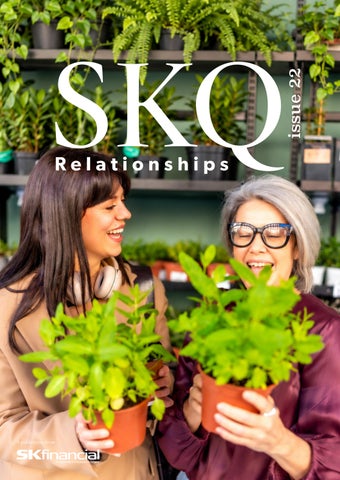
issue 22
Relationships
Contents 03
Editor's Welcome.
04
Trust in what you do well.
06
Money & Relationships: It pays to talk.
08
The Currency of Trust.
10
My daughter wanted another Hello Kitty game. I said no. She built her own.
SKQ issue 22 | 2
Relationships
EDITOR’S WELCOME
Welcome to issue 22
When we think about relationships, it is usually family and friends or romantic relationships that spring to mind. But here in this, the 22nd issue of SKQ, we’re looking beyond these, because in fact, our lives are full of all kinds of challenging, dynamic and rewarding relationships. And these interactions affect our everyday lives. First up, Kunle talks candidly about how
The Sunday Times. She has also written
he has built a career on trust, how and
articles on pensions and investments,
why he put the bonds he has built with
savings and banking and pretty much
people front and centre here at SK and
everything in between for the likes of The
the rewards he has reaped as a result. It is
Daily Telegraph, The Times Money section
a valuable insight into just how vital these
and The Daily Mail. As a result, she has
relationships are for him both personally
well and truly got under the bonnet of the
and professionally and highlights the fact
British people’s relationship with money. In
that every new client SK signs comes as the
her article, she reflects on how our beliefs
result of a referral. That really is well worth
around, and interactions with, money can
celebrating.
impact our personal relationships deeply as well as how to avoid potential conflict with
Matt Crowfoot, meanwhile, is the CEO of
family and friends. It is an absolute must
Unified 24 Services Group that provides
read for those navigating inter-generational
touring security for some of the biggest
financial planning.
names in the music business (Spoiler Alert – he started his career looking after
Our fourth and final article is one that is very
Mick Jagger). And as you can imagine,
close to my heart. Joel Parkes is Founder
relationships and trust are at the very heart
/ CEO of Bamboo Bamboo (which makes
of everything he does. In his article, he
incredible bowls and plates for kids) and
talks very openly about what it felt like to
is a father of four. His article highlights
start out in the business and what it’s really
parents’ complex and sometimes
like to work in such close proximity to the
conflicted relationship with tech and with
stars. He gives us a fascinating front row
AI and how we can help our own children
seat into a world very few get to inhabit. He
navigate this ever-changing landscape.
also talks honestly about how his job has
He also raises important questions about
moulded him as a person and as a family
our education system, in light of the rapid
man.
technological advances we have made.
For this issue, we’re really excited to
As always, we hope that you will find
include the first (of many, we hope) article
something that sparks interest, an idea or a
from award-winning personal finance
conversation. And of course, we’d love to
journalist, Holly Thomas. Here, she tackles
hear your thoughts.
Jenny
one of the most complicated, controversial (and relevant!) relationships there is – our relationship with money. Holly is the former deputy personal finance editor at SKQ issue 22 | 3
Trust in what you do well By Kunle Olafare
Trust has shaped every stage of my career. Not the abstract kind, but the real, lived trust that grows when you listen, when you show up, and when you do what you say you will do.
When I joined this industry, the mortgage market was in crisis. Interest rates were climbing towards 16%. I remember walking past building societies and seeing people push their house keys through letterboxes because they could no longer keep up with their monthly repayments. I remember adults crying because they couldn’t fix their mortgage rates at 18%. Fear sat in every conversation. I was struggling too, not with clients, but with myself. In those early years, the industry was built around selling products. And although I could sell, I didn’t believe deeply enough in what I was selling. That conflict stayed with me until I made a decision that changed everything: I would rather sell service than products.
of mouth and referrals. Clients refer their friends. Professional partners refer their clients. Our extended team refers people they trust. Those referrals help us build our business, our brand, and our reputation. They help us build trust. My role has evolved. I spend more time on the business than in the business. But when I do get the chance to work directly with clients, I enjoy it deeply. Relationship building, for me, is simple: spend time with people, remember what matters to them, and deliver what you promise.
So, I focused on understanding people. I listened. I learned their stories. I tried to see the world through their eyes. Clients became relationships, and those relationships became referrals. Slowly, I built a client bank not through transactions, but through trust.
One thing has always grounded me, especially when things are going well. I put a small pebble in one of my shoes. It reminds me to be myself. To stay present. To stay honest. Because regardless of client agreements or legal documentation, one principle guides everything I do: my word is my bond. If I say it, I will do it. If I don’t, I will own it. I won’t repeat the same mistake, and I will always aim to do better.
That behavioural change, along with the help of someone I first met when he was working for an IFA firm, took me into private banking. When I arrived, I realised how investment-heavy the environment was. Yet when I sat with clients and asked what worried them most, the answer was almost always the same: “Kunle, can you help me lower my mortgage costs?”
As I write this, a long-standing friend and client from my Bournemouth days is about to complete on a complex commercial property purchase. I smile not just because of the nature and duration of the deal, but because this is the same friend whose family helped me build my early network with professional footballers. Thirty years on, the trust is still there.
That became my way in. It opened doors, created referral opportunities, and allowed me to deliver financial planning in a way that felt natural, human, and genuinely helpful.
Relationships built on service last. Trust built through action endures. And referrals built on both are the strongest foundation any business can have.
Now 10 years into running SK Financial, two themes have never changed: relationships and service. The relationships I have with clients, colleagues, professional advisers, and our wider network. And the service I provide consistently, quietly, and with care. I am fortunate that every new enquiry I receive comes from word
Best Wishes,
SKQ issue 22 | 4
Kunle
“
One thing has always grounded me, especially when things are going well. I put a small pebble in one of my shoes. It reminds me to be myself. To stay present. To stay honest.
SKQ issue 22 | 5
Money & Relationships: It pays to talk By Holly Thomas
SKQ issue 22 | 6
Emotion is never more heightened than when it comes to having to discuss money within families. Succession and estate planning are one of the most emotionally charged tasks, particularly when it comes to communicating decisions to those closest to you. The problem is that it’s typically British to feel uncomfortable in tackling the topic of wealth. It has led to a longstanding money taboo which means important things can go unsaid.
Emotional impact of wealth Understandably there’s a fear of how discussions and decisions about wealth can impact relationships and how these conversations bring about change in the dynamics of a family. Indeed, within families, there may be very different attitudes towards wealth. On one hand a grown-up child faced with a large sum of money coming their way as part of a lifetime gift from wealthy parents might feel very uncomfortable with it. Some beneficiaries report feelings of shame about having wealth they haven’t worked for and are overwhelmed with how to handle it. The fear of losing wealth can feel like a huge burden. But if you want to get the family financial situation straight, it's necessary to talk about how older generations plan to distribute wealth and about the values behind some of the financial decisions that have been made.
It pays to talk Talking openly about estate planning within families is a must – and the earlier this is done, the better. Leaving it too late can have tricky consequences. Just look at brothers Eddie and Freddy Horniman in Guy Ritchie’s Netflix series The Gentlemen. They come to blows after Freddy remains bitter (for two series and counting) that his father wrote him out of his will, making second son Eddie the heir to everything instead, including his title of Duke. These are wild and wonderful fictional characters and (hopefully) family disputes won’t end in Ritchie-esque showdowns. But it’s fair to say that much of the upset (and gunfights) could have been avoided if the late Duke had been upfront about his plans before his death. Though, it would have made for a less entertaining tale. Whether it’s good or bad news for the next generation, it’s helpful to be open. A recent study by Aviva showed that more than four in 10 people expecting to receive an inheritance say it will be essential to their financial security.
FA MI LY MAT T E R S
Wealth is not just about numbers – there’s much more to it. Namely, there is an emotional side to money which is often underestimated.
Almost four in ten of those (37%) say they are financially dependent on receiving it to cover day-to-day living costs, 32% to fund retirement, 29% to pay off debt and 27% to repay a mortgage. However, 60% admit they don’t know how much they will eventually inherit. Indeed, over half (51%) of parents admit they haven’t discussed their inheritance plans with their children, although 31% planned to do so in future. Just 15% have discussed their plans in detail. These numbers show that it’s important to break the estate planning taboo. At the very least it means that older generations have the peace of mind their decisions have been communicated. And younger generations who might be silently depending on an inheritance know where they stand. Being open is especially important with families becoming more complicated. An increase in disputes within blended stepfamilies has been noted which isn’t surprising perhaps. A common source of friction is the unequal treatment of siblings and conflict between children and stepchildren.
How to start the conversation There’s a growing interest in financial literacy and in getting money on the curriculum for younger generations – and rightly so. But what about the work that needs to be done to break the money taboo? Remember, it’s not just up to the older generations to broach the subject of money. Younger generations can take the lead too, by encouraging older family members to be open about what’s to come. It might feel like a tricky topic to initiate as you’re entering new territory with uncertain results. But equally your family might be grateful you’ve brought it up. People often envisage family feuds when it comes to discussions of money. Yet being open can help solidify relationships and offer some certainty about a financial future. It might also offer an opportunity to find practical solutions to any particular challenges posed. Advisers have an essential role in facilitating and mediating such conversations. Advising clients is not just about asset allocation, tax mitigation and portfolio management. They can assist in aligning generational values and defuse moments of emotion or tension among the family. You can make family-money conversations a regular occurrence, which over time will get easier. A previous guest columnist in this magazine wrote that the most financially content people are those who know with quiet confidence what they need and know how to get there. This surely applies to being open about wealth as well as building wealth. SKQ issue 22 | 7
The Currency of Trust By Matt Crowfoot, CEO, Unified 24 Services Group If I'm honest about my career, it doesn't come down to training, or timelines, or any of the things that look good on a CV. It comes down to two things: making the most of the opportunities I’ve been given and the relationships I’ve built by earning people’s trust. Tour security looks, from the outside, like logistics and risk and close protection. It isn't, really. It's personal. You're let into someone's private world, often at their most exposed; the artist, their family, the crew who've been on the road with them longer than some marriages last. None of that opens up for you just because you've got the right accreditation round your neck. It opens up because someone decides, quietly, that they can trust you. And that only ever happens slowly, night after night, tour after tour. I started in Sydney. I was given the chance to look after Mick Jagger, and I remember exactly how small I felt walking into that world; green, nervous, a bit shy, surrounded by people who had been doing this for decades. I didn't have much to offer yet except attention. So that's what I gave. I asked questions. I watched everyone and everything. I soaked it in, day by day, and let my confidence catch up with the job in front of me. It was a steep climb. But somewhere on that tour, I stopped surviving it and started to thrive in it. What I learned there has never really left me: the job was about more than security. It was about reliability. Turning up prepared, before anyone asks you to. Reading a room in silence. Being discreet without being told to be. Small things, repeated so often they become who you are, and slowly, one-off jobs become lifelong relationships. That same instinct followed me home, into my own life. I've become careful about who I let in close, but once someone's in, I'm generous with them. The friends I trust most are the ones I've quietly given access to: a walk around the stage before the doors open, a seat at a game no money could buy, a glimpse of a world most people only see from a distance. I don't hand that out easily. Being able to share those experiences with people I care about is something I never take for SKQ issue 22 | 8
granted. Being trusted with access also means knowing where the boundaries are, and respecting them. That's the same thread that's run through building the business, too. Every relationship we hold with a sporting team, a label, a venue, started the same quiet way; showing up, being reliable, being trusted with something small before we were ever trusted with something big. Over the years that's grown into a network I'm genuinely proud of: relationships that mean our clients can be in a corporate box at a match most people would never get near, or backstage somewhere that isn't open to the public. And it runs both ways. When someone from that same sporting team or label has a show of their own, or needs the same discretion extended to them, we're there for them too. That's not a transaction. It's the same trust I learned to build on a global tour from Sydney to the UK, just scaled up into a business. And then there's the harder part, carrying that trust back through my own front door. After weeks inside someone else's inner sanctum, it would be easy to come home guarded, still holding the world at arm's length out of habit. I try not to let that happen. The same trust I give on the road, I try to bring home to the people I love, pulling them into that world when I can, and simply being present with them when I can't. In the end, I keep coming back to the same lesson: relationships built my career, and trust sustains it. At home, that trust matters just as much.
LIFE EXPE R I E N C E
“
I started in Sydney. I was given the chance to look after Mick Jagger, and I remember exactly how small I felt walking into that world. SKQ issue 22 | 9
My daughter wanted another Hello Kitty game. I said no. She built her own. It took an afternoon. If a 13-year-old can do this at a kitchen table, why aren't they doing it in the classroom? By Joel Parkes, CEO and Founder of Bamboo Bamboo I'm a father of four. I spend my days using AI to run a business and my evenings worrying about what the same technology is doing to my children. That tension is real and I don't think it's going away.
and reproduce when the world is asking them to create and question. The tools are right there. They're free. A thirteen-year-old picked one up in an afternoon and started seeing the world differently. All I did was say no.
But one Tuesday in the kitchen gave me something I wasn't expecting. A bit of hope. My daughter built a Hello Kitty game using AI. And somewhere between the first question and the last, she started seeing the world differently.
We'd downloaded enough games that week
And here's what I keep coming back to. Everything Eva learned that afternoon, the thinking, the questioning, the building, none of it is happening in schools. Not in any structured way. We're still teaching kids to absorb SKQ issue 22 | 10
It's the summer holidays. If you're not the superorganised parent who has every day planned from morning to night (me), then you know the drill. A tween, glued to a screen, appearing every now and then only to ask, "can I have a snack?" Today, the request was different. "Dad, can you download this Hello Kitty game for me?" If you don't have a thirteen-year-old daughter, let me
paint the picture. Hello Kitty is everywhere. Plushies on the bed, stickers on the laptop, a pencil case she won't let go of. This is a brand that's done collaborations with the Kardashians, Bruno Mars, McDonald's. A £12 billion empire that knows exactly how to stay relevant. And my daughter is one of its most loyal customers. Especially when it comes to the game apps. How do I know? Well...I'd be lying if I said I hadn't helped her through a level or two.
She looked at me like I'd spoken another language. "What's a PRD, Dad?" A PRD is a Product Requirements Document. It's what software teams write before they build anything. It forces you to think before you do. And I'll be honest, it's not something I ever expected to explain to my thirteen-year-old on a Tuesday afternoon in the kitchen. But I did, and this is where it got interesting. I gave her five questions. Simple ones, but the kind that make you stop and actually think.
But today I'd had enough. YouTube was already on the banned list to avoid brain rot, and we'd downloaded enough games that week. "Not today, Eva." I expected the huff and puff and the eyerolls. Instead, she said something I wasn't ready for. "Can I make a game? With AI?" I looked at her for a second. Then I said yes.
We all want to jump to the doing Now here's the thing, I use AI every single day to run my business. It helps me with strategy, marketing, product development, customer service. I've been deep in this world for a while. But I had never sat down with one of my children and actually built something with it. She wanted to build a character-guessing game using Hello Kitty characters. Hello Kitty, Kuromi, My Melody, the whole crew. Great idea. Let's go.
“It was delayed gratification at its finest. All the thinking had to happen before any of the building. But we weren't going to just dive in, because that's not how you build things. "Before we touch anything, we need a PRD."
What are we building? What are we not building? How should it look and feel? Who is it for? How will someone use it? She wanted to skip straight to the fun part. The characters, the colours, the sounds. Every thirteen-year-old does. Every adult does too, if we're honest. We all want to jump to the doing. But I made her stay with the questions. Write it out. Think it through. Justify every choice. Why this character and not that one? Why this type of game? Who is actually going to play this, and what will make them want to keep playing? It was delayed gratification at its finest. All the thinking had to happen before any of the building. And something shifted.
She started looking at the apps on her phone differently She started making connections I didn't expect. As she worked through the PRD, she began asking questions that had nothing to do with Hello Kitty. "Is this what they do when they make games? Like the ones I play?"
“She learned that the apps she uses every day were designed by people who made very deliberate choices about how to keep her attention. And she started questioning those choices. She went quiet for a bit. Then she started looking at the apps on her phone differently. The language-learning app she uses every day. The games she'd been asking me to download all Summer. She wasn't just seeing the screen anymore. She was seeing the choices behind it. "They do that on purpose, don't they? The thing where you nearly run out of lives and then they make you watch an advert to get more?" Yes. That's exactly what they do. On purpose. We built the game that afternoon. She designed the characters, chose the questions, tested it, broke it, fixed it. She was proud of it. And I was proud of her. But the game isn't the point of this story. The point is what happened in the space between "can I make a game?" and the finished thing. She learned to think before building. To ask who something is for and why it exists. She learned that the apps she uses every day were designed by people who made very deliberate choices about how to keep her attention. And she started questioning those choices. My daughter went from being a consumer to being a questioner in a single afternoon. I said no to a download, and she surprised both of us with what came next. The question now is, why is this not happening in schools?
I told her yes. Every game she plays, every app she opens, someone sat in a room and made these exact decisions. What to include. What to leave out. How to make you come back tomorrow. Where to put the reward that keeps you tapping.
SKQ issue 22 | 11
“
The only thing that really matters in life are your relationships to other people. George Vaillant Psychiatrist and former director of the Harvard Study of Adult Development
The value of your investments (and any income from them) can go down as well as up and you may not get back the full amount you invested. Past performance is not a reliable indicator of future performance. Investments should be considered over the longer term and should fit in with your overall attitude to risk and financial circumstances. Your home is at risk if you do not keep up repayments on a mortgage or other loan secured on it. This document is distributed for information purposes and should not be considered investment or other advice or an offer of any product/security for sale. This document contains the opinions of the authors but not necessarily the firm and does not represent a recommendation of any particular security, strategy or product. Information contained herein has been obtained from sources believed to be reliable, but is not guaranteed.
SKF Trading Ltd trading as SK Financial. SK Financial is directly authorised and regulated by The Financial Conduct Authority. SKQ issue 22 | 12