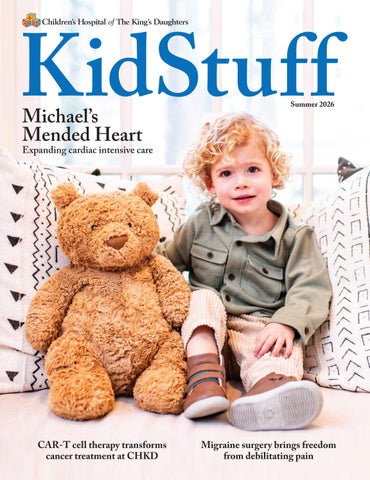
KidStuff Michael’s Mended Heart
Summer 2026
Expanding cardiac intensive care
CAR-T cell therapy transforms cancer treatment at CHKD
Migraine surgery brings freedom from debilitating pain
KidStuff is a publication of Children’s Hospital of The King’s Daughters 601 Children’s Lane, Norfolk, VA 23507 (757) 668-7043
Contents 2
News from Around the Blocks
President & CEO Amy Sampson
8
Releasing the Pain
OUR BOARDS OF DIRECTORS (as of July 1, 2026)
– Children’s Health System – Brian Skinner, Chair
Julie Beck Larry Bernert George Clarke IV
Miles Leon Katrina Lesher, MD Lemuel Lewis
Martha Colen
Scott Nottingham, MD
Mark Compton
Kieran Poulos
Leslie Doyle
Taylor Priest
Owen Griffin
Amy Sampson
Randolph Hoover
Eleanor Smith
Katherine Knaus
Carl St. Remy, MD
John Lawson
Kathryn Van Buren
Nicole Legum
Susan Wynne
– The King’s Daughters – Taylor Priest, President
Robin Broadnax
Carter Madson
Beth Ensley
Amy Moynihan
Leslie Crocker
Carie Shiels
Lori Fagan
Sunny Sonner
Laura Fulton
Renee S. Walker
Margaret Kelly
Carrie Williams
Carrie L. Lauck
– KidStuff Editorial Team – Editor Medical Editor Managing Editor Associate Editor Art Director
Heather Kent
Nerve decompression surgery relieves young artist’s debilitating migraines after COVID, helping her reclaim her life and creativity
11 Three Tiny Fighters
Triplets who faced life-threatening challenges from their first breaths guided home by the expert hands of CHKD’s Level IV NICU team
14 Engineered Hope
Facing leukemia on top of cystic fibrosis, 22-year-old Adam found healing as CHKD’s first patient to receive groundbreaking CAR-T cell therapy
20 A Mended Heart, A Lasting Gift George B. Clarke IV’s transformative support expands cardiac intensive care at CHKD
22 Be a Superhero for CHKD Kids Like Me 23 Make Your Support Mean Even More 24 Corporate Partners Invest in Our Mission
Chris Foley, MD Brandi Potts MaryClaire Hudson Eric Cardenas
© 2026 Children’s Health System Inc. To be removed from the KidStuff mailing list, email Gifts@CHKD.org or call (757) 668-7070.
Connect with CHKD through social media.
CHKD.org
SUMMER 2026
PHOTOGRAPH BY Ken Mountain
F
or 65 years, CHKD has been a source of health, healing, hope, and brighter futures for families across Hampton Roads and beyond. This year also marks the 130th anniversary of our founding organization, The King’s Daughters. On May 8, we hosted a special birthday-themed Team CHKD night at Harbor Park. Employees and their families filled the stands in CHKD gear, waved festive banners, and cheered on the Norfolk Tides, turning the evening into a true show of pride and camaraderie.
Sa’Rya Olds, daughter of CHKD team member China Slade, enjoys her time at Tides Night.
News from Around the Blocks
CHKD’s CAR-T Team Wins Healthcare Heroes Award
I
n 2025, CHKD reached a groundbreaking milestone in pediatric cancer care by successfully treating the hospital’s first cancer patient using CAR-T cell therapy, an innovative form of gene therapy that re-engineers a patient’s own T cells to target and destroy cancer cells. This moment marked the arrival of one of the world’s most advanced and promising pediatric cancer treatments to Hampton Roads, offering new hope to children and families facing life-threatening diagnoses. Each year, as many as 70 families at CHKD hear the devastating words, “Your child has cancer.” Behind every diagnosis is a long, complex, and exhausting treatment journey that affects not only the child, but parents, siblings, and caregivers. Until now, families in Hampton Roads had to travel hours away or leave the state entirely to access advanced therapies like CAR-T, adding financial strain and emotional hardship during an already overwhelming time. Bringing this life-changing therapy to CHKD took more than two years of relentless dedication, collaboration, and expertise from a multidisciplinary team. For their work, the CAR-T cellular team was recognized in early 2026 by Inside Business with a Healthcare Heroes award for Advancements in Healthcare. Pioneering the effort were: Dr. Eric Lowe, CHKD chief clinical academic officer; Tiffany Hurst, Children’s Cancer and Blood Disorders Center practice manager; Rachel
2 Children’s Hospital of The King’s Daughters
Doyle, oncology specialty program coordinator; Heather Bamford, oncology specialty program coordinator; Whitney Horsley, associate chief nursing officer; Stephanie Langevin, hematology and oncology director; Jennifer Martin, cellular therapy specialty program coordinator; Dr. William Owen, division director of the Children’s Cancer and Blood Disorders Center; and Grant O’Connell, strategic planning manager (pictured below, L-R); as well as Amanda Cavness and Jessica Price, clinical pharmacist specialists. Together, this team navigated rigorous clinical, operational, and safety standards. They built complex new workflows and forged partnerships with the American Red Cross and Novartis, ultimately earning CHKD certification as a Novartis treatment center for Kymriah, the first FDA-approved gene therapy for relapsed acute lymphoblastic leukemia. These efforts will expand what is possible for the children and families we serve and bring hope closer to home. In the future, Kymriah is expected to be approved by the FDA as a first-line therapy and CHKD will be fully positioned to expand access and continue to advance pediatric cancer care as cellular research evolves and additional cell and gene therapies become available. Read more about CAR-T cell therapy and CHKD’s first patient to receive the treatment on page 14.
More than 100 Robotic Surgeries
C
HKD surgeons are celebrating an exciting milestone: completing more than 100 surgeries with the da Vinci robotic-assisted surgical system. Since adopting this technology in 2023, the robotic surgery program has continued to grow. As a Level I Children’s Surgery Center, CHKD has earned the highest certification from the American College of Surgeons, showing its commitment to top-notch care, safety, and training. “Robotic surgery is another way we can do minimally invasive surgeries,” says Dr. Janelle Fox, pediatric urologist, chief of pediatric urology, and director of robotic surgery. “The da Vinci system helps us operate inside places like the chest, belly, or pelvis. Surgeons use a console in the operating room to control the tools. The camera we use gives us binocular vision and zooms in on everything, which makes it easier to see details than with regular laparoscopy.” For patients, the benefits are significant. Robotic-assisted procedures rely on small incisions, which can result in less pain, reduced blood loss, and a lower need for narcotics. These advantages are especially meaningful for children, helping many return home and back to school more quickly. The da Vinci system, introduced in 1995, is now used worldwide by more than 60,000 surgeons who have
completed more than 10 million procedures. Reaching the 100th surgery at CHKD reflects our dedication to providing children with the safest, most advanced, and most compassionate surgical care possible. Every movement a surgeon makes at the da Vinci system’s control console (shown here) is translated by advanced software into microscopic, precise movements for the robotic arms to make at the patient’s side.
Summer 2026 3
A Tribute to Dr. Qureshi
I Dr. Faiqa Qureshi
I
n May, CHKD held a dedication ceremony to honor the life and legacy of Dr. Faiqa Qureshi, a respected physician who served the hospital for more than three decades, including many years as medical director of the Emergency Department. Colleagues, leaders, and friends gathered to reflect on the exceptional leadership, unwavering enthusiasm, and heartfelt compassion that defined her care. A commemorative plaque, unveiled in the Emergency Department, now stands as a lasting tribute to her profound impact on patients, families, and future healthcare providers, and a legacy that will continue to inspire the CHKD community.
Kangaroo Care: More than Bonding
n CHKD’s Neonatal Intensive Care Unit, where advanced technology surrounds the smallest and most fragile patients, one powerful intervention requires no machinery at all – human touch. Kangaroo care, or skin-to-skin contact, in which a diapered baby is held against a parent’s chest, is widely used and encouraged, with benefits that extend far beyond bonding. As the infant’s nervous system responds to this familiar closeness, heart rate and breathing stabilize, body temperature regulates, and sleep becomes more restful. Skin-to-skin care also improves growth and development and can even shorten a baby’s hospital stay!
4 Children’s Hospital of The King’s Daughters
Dr. Orhan Atay
Neurogastroenterology Motility Program
C
Healthy Bear Sports New Look
S
ay hello to the new Healthy Bear! Our beloved mascot is stepping out in style with a slimmer silhouette and a fresh new outfit. While the look has gotten a fun update, Healthy Bear is still the same friendly face you know and love, spreading smiles, sharing high-fives, and brightening everyone’s day. Keep an eye out … you never know where Healthy Bear will pop up next!
HKD offers Virginia’s only dedicated pediatric Neurogastroenterology Motility Program, providing highly specialized care for children across the state and beyond. Digestive motility involves the contraction of muscles in the digestive tract, moving food and liquids from the mouth through the esophagus to the stomach, then the intestines, and finally out of the body as waste. When abnormalities occur in these contractions, it can lead to serious health issues. CHKD cares for children with complex medical needs and conditions such as spina bifida, cerebral palsy, autism, Down syndrome, and muscular dystrophy that may cause motility disorders. Diagnosing these issues through advanced diagnostic testing, including manometry studies and EndoFLIP technology, is the first step in improving a patient’s quality of life. “Our mission is always to put the patient first,” says Dr. Orhan Atay, pediatric gastroenterologist and director of CHKD’s Neurogastroenterology Motility Program. “We strive to ensure that everything we do benefits our patients, helps change the course of their health, and allows them to thrive, overcome challenges, and move forward in life.” Our patients benefit from the comprehensive medical and support services only available at a dedicated children’s hospital. Our team, which includes a motility nurse, works with patients and families to help children feel more comfortable and understand their care. Learn more about the Neurogastroenterology Motility Program.
Summer 2026 5
First Pediatric Hospital in Virginia to Offer Advanced CT Imaging Technology
A
new era of CT imaging is humming to life at CHKD thanks to the photon-counting CT scanner, NAEOTOM Alpha.Peak. With the new technology installed in December 2025, scan times are cut in half from the previous scanner. Patients are benefitting from both faster and more comfortable scans, decreasing the need for repeat exams, sedation, or anesthesia – especially important for young or medically complex patients and most beneficial within the trauma, cardiology, neurology, and hematology departments. The NAEOTOM Alpha.Peak is a giant leap forward in CT imaging technology, providing high-quality images
6 Children’s Hospital of The King’s Daughters
while reducing radiation dosage by up to 40%. With higher-resolution scans, smaller doses of contrast can be used without sacrificing imaging quality. These advancements improve patient safety and help CHKD’s pediatric radiologists make quicker diagnoses to assist care teams with treatment plans. “Being the first pediatric hospital in Virginia to offer this new state-of-the-art technology, we’re continuing our commitment to providing the safest, most advanced care for every child who comes through our doors,” says Dr. Jennifer Rush, pediatric radiologist and CHKD’s radiation safety officer.
Welcome, Wally!
T
here’s a new face bringing smiles to kids at CHKD. He has four legs, a wagging tail, and a very important job to do. Wally is a facility dog specially trained by Canine Companions® to work in a healthcare setting. Alongside his handler, Kristen Morales, a physical therapy manager at CHKD (pictured above), Wally works with children to help them reach their therapy goals in ways that feel less like work and more like play. In the inpatient rehab gym, and at CHKD Therapy Services locations throughout the region, Wally is a constant source of motivation and joy. He might be found teaming up with patients for a game of soccer or basketball, trotting alongside them during walks and jogs, or calmly resting as a child practices balance and coordination by petting or brushing him. For many patients, Wally is more than a therapy partner. He’s a source of comfort, confidence, and connection. His
gentle, steady presence can be especially helpful for children recovering from brain injuries, offering soothing sensory input and a reassuring companion during challenging moments. Of course, Wally also knows how to celebrate the wins. Whether it’s sticking around for a well-earned cuddle, helping reach a milestone, or giving a wagon ride after a big accomplishment, he’s always ready to make progress feel a little more special. As friendly as he is, Wally is also a professional. When he’s at CHKD, he’s focused on supporting his patients, so staff and visitors are encouraged to admire him from a distance while he’s hard at work. With his calm demeanor, playful spirit, and unwavering dedication, Wally is already making a meaningful impact. And CHKD is thrilled to have him on the team.
Summer 2026 7
Nineteen-year-old Audrey Maynard is thrilled she has no visible scars from the surgeries that changed her life.
8 Children’s Hospital of The King’s Daughters
Nerve decompression surgery relieves young artist’s debilitating migraines after COVID, helping her reclaim her life and creativity WRITTEN BY Alice Warchol • PHOTOGRAPHY BY Ken Mountain
A
udrey Maynard remembers her junior year of
high school in fragments.
For seven months, after a mild case of COVID,
she lived with an unbroken migraine so severe that light
and noise became hard to tolerate, and even standing was
difficult. A student at the Governor’s School for the Arts, she couldn’t attend class regularly. She gradually lost the ability to do what had always grounded her – drawing
and painting.
Due to her chronic pain, Audrey
also struggled to eat. She developed gastritis and lost 30 pounds,
requiring a special device called an NG tube that went from her nose directly to her stomach to deliver
“It was amazing,” Audrey says. “It was like a switch
flipped, I was back, and I was pain-free.”
For the first time in months, Audrey felt like herself again.
She rushed home and painted for hours, channeling months of agony into a single piece of art.
“It’s still one of my favorite pieces,” she says.
Unfortunately, Audrey’s relief didn’t last. She soon needed
more nerve blocks, but each one seemed to wear off more
“There are not very many surgeons who do what Dr. [Yifan] Guo does.” Dr. Ryan Williams, pediatric neurologist at CHKD, on nerve decompression surgery
extra nutrition.
quickly than the last. That’s when Dr. Williams referred her to
Dr. Yifan Guo, a plastic surgeon at CHKD, to consider nerve decompression surgery, an
option that could possibly provide longer-lasting migraine relief.
“This kind of surgery can be very
Desperate for help, Audrey visited pediatric neurologist,
helpful for a small percentage of patients,” Dr. Williams says.
director of the Headache Center at CHKD. Under his care,
to refer patients outside Virginia for surgical consultations
from bed rest to medications. “I was just miserable,” she says.
who do what Dr. Guo does.”
Dr. Ryan Williams, a headache specialist and medical
Audrey tried various methods to control her head pain – “And the migraines did not stop.”
Dr. Williams then tried nerve blocks around her eyebrows
and other areas of her head. Remarkably, the pain vanished. Audrey cried with relief.
Before Dr. Guo joined CHKD in 2021, Dr. Williams had
on nerve decompression. “There are not very many surgeons When Audrey first met Dr. Guo, her severe migraines
were back. Dr. Guo began by asking Audrey exactly where she felt the pain, then used nerve blocks in a few targeted areas to pinpoint which nerves might be involved.
Summer 2026 9
After months of constant, agonizing headaches, Audrey Maynard received a nerve block at CHKD that made her cry with relief and inspired her to put months of agony into painting the red artwork shown above. Today, since nerve decompression surgery, Audrey has not had a single migraine and continues to find solace and strength through her art.
He checked if the pain went away after each block. If it did,
It wasn’t long after the first surgery that Audrey began to
Audrey would go home and wait for her migraine to return.
feel some relief.
same nerves were responsible.
with my life again,” Audrey says. “And after a couple of
Dr. Guo. “If the nerve block works, that’s telling me it’s a
can’t even see the scars. Dr. Guo did a wonderful job.”
Then, Dr. Guo repeated the nerve block to confirm that the “The nerve block is both diagnostic and therapeutic,” says
peripheral nerve problem.”
“Once the swelling went down, I was able to get on
weeks, I felt amazing. I was no longer in any pain. You
Today, Audrey remains pain-free and deeply grateful
After a few appointments to verify that the nerve blocks
for the care she received at CHKD. With her appetite
would need two surgeries. The first procedure would focus
some weight back. She is studying business management
were consistently successful, he determined that Audrey
on the nerve behind her eyes, which was causing her the
most pain. He would access the nerve by going through the crease in her eyelids. The second surgery would address the nerve at the base of her skull.
During each procedure, Dr. Guo cauterized blood vessels
pressing on the nerve and released any muscle or fascia causing constriction.
10 Children’s Hospital of The King’s Daughters
restored and the migraines gone, she has been able to gain at Christopher Newport University and once again
spends her free time painting and drawing – activities that seemed impossible during the worst months of her illness. “My surgeries with Dr. Guo changed my whole life.
I never thought they would work so well,” she says. “I haven’t had a migraine since.”
y n i T e e r h T hters g i F
Triplets who faced life-threatening challenges from their first breaths are guided home by the expert hands of CHKD’s Level IV NICU team WRITTEN BY Brandi Potts • PHOTOGRAPHY BY Ken Mountain
Images in this story were taken in a clinical environment during a supervised photo shoot and are not intended to represent safe sleep guidelines. Always follow the ABCs of safe sleep: Alone, on their Back, in a Crib.
W
hen Tristan, Trenton, and Terry “Tre” Waters were born 15 weeks early,
they were rushed to CHKD’s Level
IV Neonatal Intensive Care Unit, where the region’s
smallest and sickest babies receive the highest level of care available.
Due to the babies’ extremely low birth weights –
just under 2 pounds each – a CHKD neonatal care
team was waiting to rush them through the adjoining hallways from Sentara Norfolk General, where they were born, to the NICU at CHKD.
“Our care team was the heartbeat of our entire
CHKD journey. They know about babies. They truly Tristan
love them. And they are honest,” says the triplets’ mom, Kendall Perkins. “They cared for each baby according to their unique needs.”
“At CHKD, they don’t just treat the baby; they care for the family as a whole.” Kendall Perkins, mother of Tristan, Trenton, and Tre
Due to the high risk of the pregnancy, Kendall
and her husband, Terry Waters, met Dr. Jamil Khan,
neonatologist and medical director of CHKD’s NICU, before their sons arrived. “Dr. Khan answered all our Trenton
questions,” Kendall says. “What could go wrong, what
could go right, and how things could progress. He even came in on his day off to be in the delivery room.”
For families with a newborn needing critical care,
the journey can be emotional, often filled with fear and uncertainty. CHKD’s skilled neonatal specialists offer reassurance, patience, and compassion when parents need it most.
“At CHKD, we want to assure families that their
babies are in the best hands,” says Dr. Khan. “Every
baby arrives with a unique story and a unique set of
challenges. Our responsibility is to be ready for all of
them. Having the capacity to treat all kinds of medical conditions is not just about expertise, but about giving every child the best possible start, no matter how Tre
12 Children’s Hospital of The King’s Daughters
complex their journey begins.”
Kendall and Terry, a military family from Newport News
who already had a 9-year-old son and an 18-month-old daughter at home, faced daily challenges managing the
needs of all their children while navigating the roller coaster of emotions that come with having newborns requiring
a quiet space for rest, which is essential for tiny patients. Families receive support from social workers, child life
specialists, parent support coordinators, chaplains, lactation consultants, and more.
After more than four months in the NICU, including
intensive care.
surgery for baby Tristan to insert a shunt to drain excess
NICU in a different hospital than me,” says Kendall. “My
come home … one by one. The family is back together now,
“Initially, I was scared because the babies were going to a
daughter spent time in a NICU in an adult hospital. But
this was a different experience. At CHKD, they don’t just treat the baby; they care for the family as a whole. And
because our sons were there for so long, the staff became an
fluid from his brain into his abdomen, the babies began to all under one roof and settling in. The three brothers will
continue to be followed closely by specialists at CHKD on an outpatient basis.
“We’re so grateful for support from our CHKD family,”
extension of our family, too.”
says Kendall. “They’ve allowed us to focus on our children,
CHKD’s NICU, the largest in the region, was thoughtfully
how to be a new family of seven.”
With 50 private rooms and 10 rooms with two beds each,
designed to provide each family with maximum privacy and
and now that all three boys are home, we are navigating
The Highest Level of Care As the region’s largest and most sophisticated critical care facility for newborns, CHKD’s Neonatal Intensive Care Unit combines advanced technology and trained healthcare professionals to provide specialized care for more than 500 of the region’s tiniest and sickest babies every year. On average, babies stay a length of 41 days, but for our smallest patients – those weighing less than 2.3 pounds – the average is 87 days. Lindsay Parrish, RN, with Trenton
Summer 2026 13
Engineered Hope Facing leukemia on top of cystic fibrosis, Adam finds healing as CHKD’s first patient to receive groundbreaking CAR-T cell therapy WRITTEN BY Alice Warchol • PHOTOGRAPHY BY Ken Mountain
14 Children’s Hospital of The King’s Daughters
T
he pain started in Adam Wiscarson’s back – an ache so severe he couldn’t sleep. Within days, it worsened. He couldn’t eat.
He couldn’t drink. Nothing stayed down. When he went to an
emergency department near his home in Yorktown, he received a diagnosis he never expected: he had cancer.
Adam, who was 20 at the time, was transferred immediately to
CHKD, a place that was already very familiar to him. Since he was
a toddler, Adam has received treatment at CHKD for cystic fibrosis, a genetic disease that can cause life-threatening lung infections,
liver disease, pancreas issues (including diabetes), and gut problems, all of which Adam has endured. Now, he was facing another devastating illness.
Lying in a hospital bed at CHKD, Adam tried to process the
news. He thought about his mom, who had died of cancer just a few years earlier. He worried about his own survival and the toll it could take on his family members. Then, he met his oncologist, Dr. Linda Pegram, who gave him some hope. The type of cancer Adam had – acute lymphoblastic leukemia (ALL) – was potentially curable.
“I was so relieved,” Adam says. “I started breaking down in the
hospital room.”
What Adam couldn’t have known at the time was that in less
than a year, he would become the first patient at CHKD to receive CAR-T cell therapy, a groundbreaking treatment that genetically engineers a patient’s own T cells to recognize and destroy their cancer cells.
At this time, CAR-T therapy isn’t a first treatment option
for patients. The Food and Drug Administration has approved it for patients whose leukemia returns or doesn’t respond to standard treatment.
From the beginning, Adam’s diagnosis carried added risk because
of his age and the high-risk genetic features of his leukemia cells. Additionally, Adam’s cystic fibrosis multiplied his risk when receiving conventional therapy. These treatments came with
potential side effects for his organs, such as his liver, lungs, and
intestinal tract, which were already affected by his cystic fibrosis, according to Dr. William Owen, pediatric hematologist and
oncologist, and division director of the Children’s Cancer and Blood Disorders Center at CHKD.
First, Adam had induction chemotherapy, designed to push him
into remission, but it became clear the treatment hadn’t worked.
“We gave him two more months of what’s called consolidation
chemotherapy, hoping he would be in remission at the end of that,” says Dr. Pegram. “But he still had detectable disease.”
Summer 2026 15
The next step was blinatumomab, an immunotherapy that
triggers the immune system to attack leukemia cells. “We didn’t know whether it was going to work,”
Dr. Pegram says. “But thankfully, it worked beautifully. It
put Adam into a deep remission and kept him there. He had
no detectable leukemia cells after one cycle of blinatumomab,
so we continued this treatment for a total of four cycles, based on clinical trial results for young adults with ALL.” With his cancer finally under control, Adam could begin preparing for what came next: CAR-T cell therapy.
Historically, he would have proceeded next to a bone
marrow transplant to treat refractory ALL, but Adam had
no matched family donors. The risks of using an unrelated
donor, given the underlying organ dysfunction from his cystic fibrosis, were simply too high.
CAR-T cell therapy was by far the best treatment option
for Adam.
First, Adam’s T cells, a type of white blood cell that helps
the body fight infection, were collected by the American Red Cross at CHKD during a process called apheresis. The cells were then shipped on dry ice to Philadelphia for cryopreservation before being sent to a Novartis
manufacturing plant in New Jersey, where they were
genetically modified and programmed to find and attack
his cancer cells. Over several weeks, the lab grew millions of these new cells and stored them until Adam was ready for his infusion.
Before receiving the engineered T cells, Adam had a
short course of chemotherapy to further suppress his own
immune system so the CAR-T cells could grow, stay active, and effectively kill cancer cells. Without chemotherapy, the
CAR-T cells wouldn’t work well because his body’s immune system would overpower them.
On the day of his infusion, Adam waited with his brother
in a patient room inside the hospital’s cancer clinic as his
care team meticulously thawed his CAR-T cells. Despite its
medical innovation, the treatment resembled a simple blood
transfusion. However, for the team, it was a historic milestone after years of effort to bring CAR-T cell therapy to CHKD. “It’s just exciting to be able to do this here without having
to send Adam elsewhere,” Dr. Pegram says. “He’s been
followed at CHKD his whole life because of his cystic
fibrosis, so all his subspecialists are here. Everyone who 16 Children’s Hospital of The King’s Daughters
Dr. Linda Pegram gives Adam Wiscarson a high five as they prepare for his CAR-T cell infusion.
Despite its medical innovation, the CAR-T cell infusion resembled a simple blood transfusion. However, for the team, it was a historic milestone after years of effort to bring CAR-T cell therapy to CHKD.
Summer 2026 17
Adam’s T cells were collected at CHKD, then shipped to special labs out of state to be cryopreserved, genetically modified, and multiplied into millions, before returning to CHKD, where staff carefully thawed the engineered cells for infusion in Adam’s blood.
knows him, who cares about him – they’re all here. It’s also
A critical part of the CAR-T cell therapy was making
easier for his family, logistically.”
sure Adam stayed close to CHKD for two weeks after his
an extraordinary level of coordination. He relies on the
could require immediate hospitalization. He attended daily
Throughout Adam’s cancer journey, his care required
medication Trikafta because of his cystic fibrosis. Trikafta is a combination of three drugs that work together to fix the
infusion in case he experienced any side effects, which follow-up visits at the cancer clinic.
Thankfully, Adam hasn’t faced any serious issues. All tests
protein that doesn’t function properly due to the inherited
have returned the same result – no evidence of cancer.
had to be paused and adjusted multiple times during his
to resume his Trikafta treatment, and he remains grateful for
genetic mutation that causes CF. However, this medication cancer treatment due to liver damage.
Managing his medical needs required constant
communication among CHKD specialists in oncology, pulmonology, infectious diseases, endocrinology, and
pharmacy. Dr. Pegram collaborated closely with Dr. Laura Sass, Adam’s infectious diseases specialist; Dr. Cynthia
Today, Adam’s health continues to improve. He’s been able
all the care he’s received at CHKD and for the opportunity to get CAR-T cell therapy so close to home.
“It would have been much worse for me if I had to leave
the area to have CAR-T cell therapy,” Adam says. “Everyone has been great. I love CHKD.”
For Dr. Owen, witnessing Adam’s progress has been
Spoolman, his pulmonologist; and Sarah Parsons, the clinical
extraordinary. “He’s doing fabulous,” says Dr. Owen. “It’s
been a group effort,” says Dr. Pegram. “That’s part of the
patient’s attitude and drive. Adam is beyond belief in terms
pharmacist who oversees his Trikafta treatment. “It’s really
reason it was so important for him to be able to do CAR-T cell therapy here.”
18 Children’s Hospital of The King’s Daughters
just been remarkable. A big part of treatment success is a of his attitude.”
Bringing Advanced Bringing Advanced CAR-T Cell Therapy to CHKD CAR-T Cell Therapy to CHKD
C
HKD’s certification to administer Kymriah, a CAR-T cell therapy produced by Novartis, places the hospital among an elite group of institutions capable of providing this innovative treatment to children and young adults whose leukemia hasn’t responded to treatment or has relapsed. CAR-T cell therapy involves re-engineering a patient’s own T cells to recognize and destroy cancer cells. “CAR-T cell therapy is truly transforming cancer treatment,” says Dr. William Owen, division director of CHKD’s Children’s Cancer and Blood Disorders Center. “In the future, we hope to see its availability for other types of cancers, too.” When CAR-T cell therapy is successful, it can help patients avoid more aggressive treatments, such as bone marrow transplants, and reduce both shortand long-term side effects.
“Having this available at CHKD allows us to offer state-of-the-art care locally, so families don’t need to travel out of town for weeks or months for these treatments,” says Dr. Owen. “Cancer already disrupts a family’s life enough. Uprooting them for any length of time only makes it harder. Having these therapies available locally is highly beneficial in every way.” The effort to bring CAR-T cell therapy to CHKD started over two years ago and required relentless dedication, collaboration, and expertise from a multidisciplinary team. Together, this team navigated rigorous clinical, operational, and safety standards. They built complex new workflows and formed partnerships with the American Red Cross and Novartis. In early 2026, the team received a Healthcare Heroes award from Inside Business for Advancements in Healthcare. Read more on page 2. T cells are modified in a special lab with chimeric
2 antigen receptor (CAR) and programmed to find T cells are collected through a
1 process called leukapheresis.
T cells
and attack cancerous B cells.
CAR T cells
CAR-T Cell Therapy
of new CAR-T 3 Millions cells are grown in the lab.
cells circulate throughout the patient's 5 CAR-T body to find and attack cancerous B cells.
4 CAR-T cells are infused back into patient's body.
Summer 2026 19
After his grandson Michael Ettel III (center) underwent heart surgery at CHKD as an infant, George Clarke IV (left) was inspired to help CHKD establish the Clarke Ettel Cardiovascular Intensive Care Unit, scheduled to open next year.
A Mended Heart, A Lasting Gift
George B. Clarke IV’s transformative support expands cardiac intensive care at CHKD
T
WRITTEN BY Jessica Davenport • PHOTOGRAPHY BY Amanda MacDiarmid
wo-year-old Michael Ettel III is busy running
of cardiac issues, the Ettels were shocked. “We were
agenda: pushing his dump truck, giving a quick
“The newborn bubble just burst, and we went into
around his house in Virginia Beach. On his
new parents, and then everything stopped,” says Laney.
pet to his dog, and seeing what his baby brother, Charlie,
medical mode.”
climb into his mother’s arms for a quick hug, his blonde
that Michael would need surgery. They first met with
in search of a snack.
CHKD’s Heart Center to discuss treatment options.
is up to on his playmat. The happy toddler stops briefly to curls smooshing sweetly against her cheek before he’s off Born full term in early spring 2024, Michael was the
first child of Michael Ettel II and his wife, Laney, and
the grandchild of George B. Clarke IV, CEO of MEB
and member of the Children’s Health System board of
After a CT scan and additional tests, the family learned
the pediatric cardiac surgery and cardiology team from Then, wanting to be certain they were making the right
decision for Michael, the family also traveled out of state for a second opinion.
The Ettels chose CHKD. “The surgeons showed us
directors. Soon after birth, the Ettels noticed Michael
scans, compared cases, and explained why they were
referred him to CHKD for an echocardiogram, which
through his side versus open-heart surgery – would provide
struggling to gain weight. At four weeks, his pediatrician revealed a congenital heart defect. With no family history 20 Children’s Hospital of The King’s Daughters
confident that the procedure they recommended – going in the same results,” Laney says. “It would be less invasive and
would lead to a shorter recovery for Michael.”
At 10 weeks old, Michael had successful heart surgery at
CHKD. “They called us every hour from the operating room.
Afterward, while he was being transferred to the PICU, they even explained what we could expect when we saw him,” says Laney. “In the PICU, truly every person is a hero.”
Michael, to the delight of his family, was home just a few
days after surgery. He now only needs annual checkups with his CHKD cardiologist, Dr. Tracy Alderson.
It was an eye-opening experience for George, who Michael calls
Papa, to see firsthand the challenges families face when a child is seriously ill, especially when traveling away from home. “I can’t
imagine how hard it would be to leave your support system, your job, and your other children for weeks at a time,” he says. “This
experience showed me just how lucky we are to have a first-class facility like CHKD.”
Moved by his grandson’s journey, George made a transformative
gift to establish the new Clarke Ettel Cardiovascular Intensive
Care Unit (CVICU). Scheduled to open in late 2027, the CVICU
“This experience showed me just how lucky we are to have a first-class facility like CHKD.” George B. Clarke IV
will feature larger rooms for complex equipment, space for
bedside procedures, and a dedicated team of nurses, respiratory therapists, nutritionists, and intensivists. Individual stations
outside each room will allow nurses to monitor patients directly, while the unit’s design will focus on comfort and healing.
“The CVICU will provide space for the specialized care needed
to care for critical patients,” says Dr. Umar Boston, chief of
cardiac surgery at CHKD. “Our hope is that we can handle even more complex cases here, helping kids recover faster and have better outcomes closer to home.”
Both the Ettel and Clarke families are excited that the new
CVICU will provide greater access to care for children with complex heart conditions.
“We are so blessed to have such a great facility in our
backyard,” says Laney. “I’m so thankful to know that more
families will have the peace of mind that comes with this level of dedicated care.”
Summer 2026 21
E
very day, donations help Children’s Hospital of The King’s Daughters save lives. It’s why I’m here today. I was born with hydrocephalus and a cyst in my brain. Now 15 years old, I’ve been a patient at CHKD my whole life. Thanks to CHKD, I can get all the care I need right here in my hometown. I had neurosurgery at just 6 months old and again at age 8. I grew strong in CHKD’s Neonatal and Pediatric Intensive Care Units and the Rehabilitation Unit. I’ve been followed by many specialists, therapists, and my CHKD pediatrician. And I’ve been shown special care and love by child life specialists. Everyone makes me and my family feel at home. We don’t know what we’d do without CHKD. That’s why I’ve been teaming up with CHKD’s philanthropy office to encourage our community to give and help patients like me. I hope you’ll support CHKD in one of the ways below so they can keep being here for every family who needs them.”
Read my story at CHKD.org/EathanTheBrave.
Donate now. You can make a difference for children at CHKD right now. Use the enclosed envelope or donate securely online – scan the QR code here or visit CHKD.org/GiveCHKD. Transfer stock. Appreciated securities make a valuable gift while providing you with potential tax benefits. Ask your broker to transfer shares directly to CHKD; find our account details at CHKD.org/Donate.
Give through a donor-advised fund. You can use the flexibility of your DAF to recommend a grant or recurring grants directly to CHKD. Contact your fund administrator to make a gift. Make a distribution from your IRA. If you are 70½ or older, you can make a gift to CHKD from your IRA to save on taxes. For those 73 or older, this can help you meet your required minimum distributions. Contact your IRA administrator to request a qualified charitable distribution to CHKD.
Children’s Hospital of The King’s Daughters is a 501(c)(3) organization with a federal tax ID (EIN) of 54-0506321. This information is not intended as legal or tax advice. Please consult an attorney or tax advisor to determine what is best for your personal circumstances.
Learn about more smart giving options at CHKD.org/Donate.
22 Children’s Hospital of The King’s Daughters
Make Your Support Mean Even More Join our community of monthly donors Monthly donations help us meet the needs of CHKD and the families we serve all year long. With your ongoing support, we can provide advanced pediatric care and bring comfort to families when they need it most. Recurring gifts can be changed or stopped at any time.
Double your impact with employer matching gifts Thousands of companies match their employees’ donations to organizations like CHKD to encourage philanthropy. Some will even match contributions made by spouses, retirees, and part-time employees. Visit CHKD.org/MatchYourGift to see if your employer will match your donation and access forms, guidelines, and instructions to help you complete your submission for a match.
Fundraise your way Plan today for a better tomorrow Planned gifts to CHKD – no matter the size – make an even greater difference, helping us care for children who need us right now and thousands more who will turn to us in the future. Consider creating a legacy of health, healing, and hope by designating CHKD in your estate plan and joining our Beth Duke Legacy Society of donors who have invested in a better tomorrow.
Join hundreds of CHKD champions in our community who help us raise crucial funds for the unique programs and services our children need to heal and grow. With our online fundraising platform, the opportunities are endless. Set up your fundraising page today at CHKD.org/FundraiseYourWay.
For help getting started, CHKD has partnered with FreeWill, a no-cost online resource that helps you write or update your will in just minutes. Learn more about the Beth Duke Legacy Society and planned giving options at CHKD.org/PlannedGiving. Our philanthropy team is happy to share more and answer your questions. Reach a member of our team at (757) 668-7070 or Gifts@CHKD.org.
Summer 2026 23
Corporate Partners Invest in Our Mission
A
t CHKD, it takes extra resources to deliver on our promise to care for every child who needs us, regardless of their family’s financial situation. Every year, contributions from local corporate and Children’s Miracle Network partners play an integral role in keeping the services our children need right here in our community: critical programs, new medical treatments and research, and emotional and developmental support services. As a member of CMN, a network of 170 children’s hospitals across the U.S. and Canada, CHKD is connected to corporate partners and programs that are committed to raising funds through round-up campaigns, point-of-sale fundraising, and other creative initiatives. Every dollar raised locally stays here to support the children and families CHKD serves.
Spirit Halloween
Chick-fil-A Coastal Virginia
Harris Teeter
Walmart
Log A Load For Kids
Panda Express
Mid Atlantic Dairy Queen
Costco
Scan the QR code to find our corporate partners’ current fundraising campaigns and learn how your business or organization can partner with us to help our patients and families.
24 Children’s Hospital of The King’s Daughters
Work Where Your Family Comes First At CHKD, many of our team members are parents, which means their most important title isn’t on a badge; it’s found at home. Caring for kids isn’t just our mission – it’s how we support our employees, too.
A Trusted Community Resource Dedicated to providing reliable information to support children’s health and well-being, CHKD offers education classes and engagement opportunities for families, caregivers, and health professionals across our community on topics like parenting, children’s health and development, safety, mental wellness, sports performance and injury prevention, and so much more.
When you join Team CHKD, your family benefits right alongside you. And one of our greatest benefits for parents is for their dependents! Kids on a CHKD health plan have no copays or deductibles for most CHKD services. That means everything from office visits to therapy services and inpatient stays is covered by CHKD. We want to make life easier when it matters most. Our family-focused benefits also include: • Paid parental leave so you can spend meaningful time with your newest family member. • Flexible schedules that balance work and home life. • Pre-tax savings through a Dependent Care FSA to help with childcare costs.
Plus, special workshops, webinars, and events: • The Upstanders Film and Discussion: Building Resilience and Empathy to Stand Against Cyberbullying, September 24 • Positive Connections Over Power Struggles (Ages 5-12), August 4 • Reset For Success: Navigating Back-to-School Changes at Home, August 11
Read Our Blog! At CHKD.org/Blog, find articles on all things children’s health written by CHKD experts and partners, plus news and stories from across our health system. Find the schedule and our latest Community Connections bulletin at CHKD.org/Classes.
Learn more about working at CHKD and browse current openings at CHKD.org/Careers.
NON-PROFIT ORG US POSTAGE PAID CHKD
601 Children’s Lane • Nor folk, VA 23507
ROUND UP FOR CHKD KIDS! Your spare change helps provide a healthier future for local children. Rounding up for CHKD is available at any Mid Atlantic Dairy Queen location.
Round Up or Donate $1 at
or A Project of The King's Daughters To Benefit
5K Run • 2 Mile Walk • Virtual Option
Saturday, Aug. 29, 2026 Norfolk Waterside District
Register NOW! RunWalkForTheKids.org
100% of donations at local stores support CHKD.