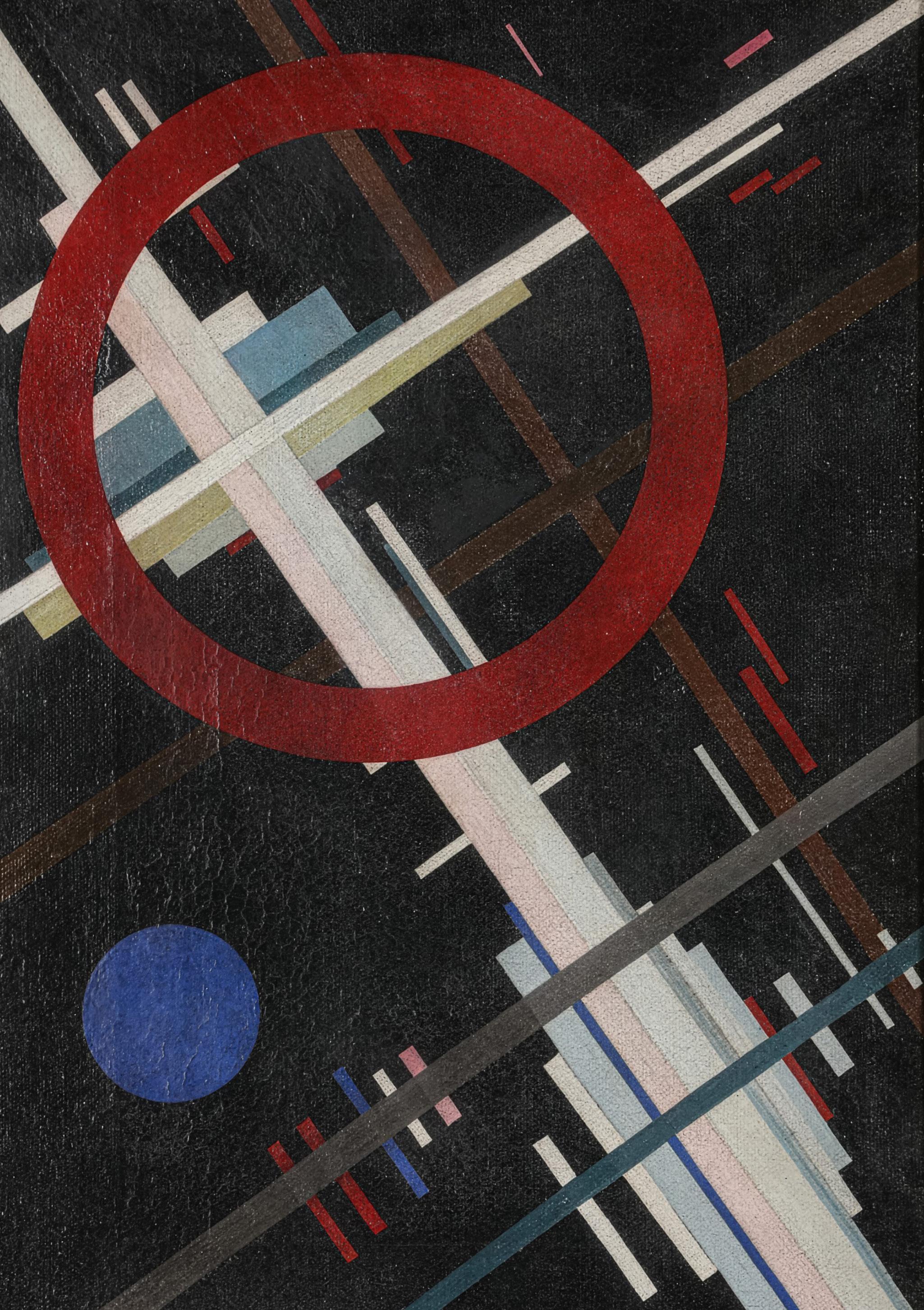
Our bi-annual 20th/21st Century Art auction showcases an incredibly wide range of works spanning from the 20th to 21st Centuries until the present day.
This season’s catalogue presents collectors with an opportunity to explore contrasting artistic movements and acquire works that span the international landscape, from the 20th century to the present day.
At the heart of the sale is a strong curation of Russian avant-garde highlights. Featuring works by Constructivist pioneer Naum Gabo, alongside celebrated names such as Pavel Filonov and Oleksandr Bogomazov, among other notable figures. This selection offers a compelling look at the figures who helped shape modern art. The auction also features notable pieces by other significant international artists. A standout is a sweeping 1955 abstract painting by Paul Jenkins, which sits in fascinating contrast to two highly structured, expressive canvases by Ecuadorian master Oswaldo Guayasamín.
Furthermore, the sale highlights French modernism, tracing a line from the Jazz Age energy of Paul Colin to the bold textures of Claude Venard. Bringing the collection fully into the present day, the catalogue rounds out with striking contemporary pieces, offering a dynamic range of artworks suited for both new and established collectors.
20th/21st Century Art
Thursday 28 May 2026, 14:00
Viewing exclusively at the Barley Mow Centre, W4 4PH
Saturday 23 May 11:00–15:00
Sunday 24 May 11:00–15:00
Monday 25 May Closed
Tuesday 26 May 10:00–17:00
Wednesday 27 May 10:00–17:00
Thursday 28 May 10:00–12:00
Collection of Lots
We continue to offer Click and Collect service for all purchased lots. The process is quick and easy and can be done personally or via your chosen courier: Contact collections@chiswickauctions.co.uk for more information.
Condition Reports
All our sales are fully illustrated online and have been expertly catalogued by our specialists. We recommend you request a condition report via our website prior to the sale.
Terms & Conditions
For a full list of our Terms & Conditions, please visit www.chiswickauctions.co.uk
Buyer’s Premium
The buyer shall pay Chiswick Auctions Ltd. a premium on the hammer price of 26%+ VAT on that commission.
Symbol Key:
§ - Artist Resale Rights/Droit de Suite. Lots marked with ‘ARR/ §’ may be subject to a levy.
† - Normal VAT rules apply and the standard rate of VAT will be charged on both hammer price and premium.
* - These lots have been imported from outside the UK for sale and placed under the Temporary Admission regime. Import VAT is payable at 5% on the hammer price. VAT at 20% will be added to the buyer’s premium but will not be shown separately on the invoice.
If you are re-exporting a * lot outside of the UK, you must use Chiswick Auctions Ltd TA Shipper.
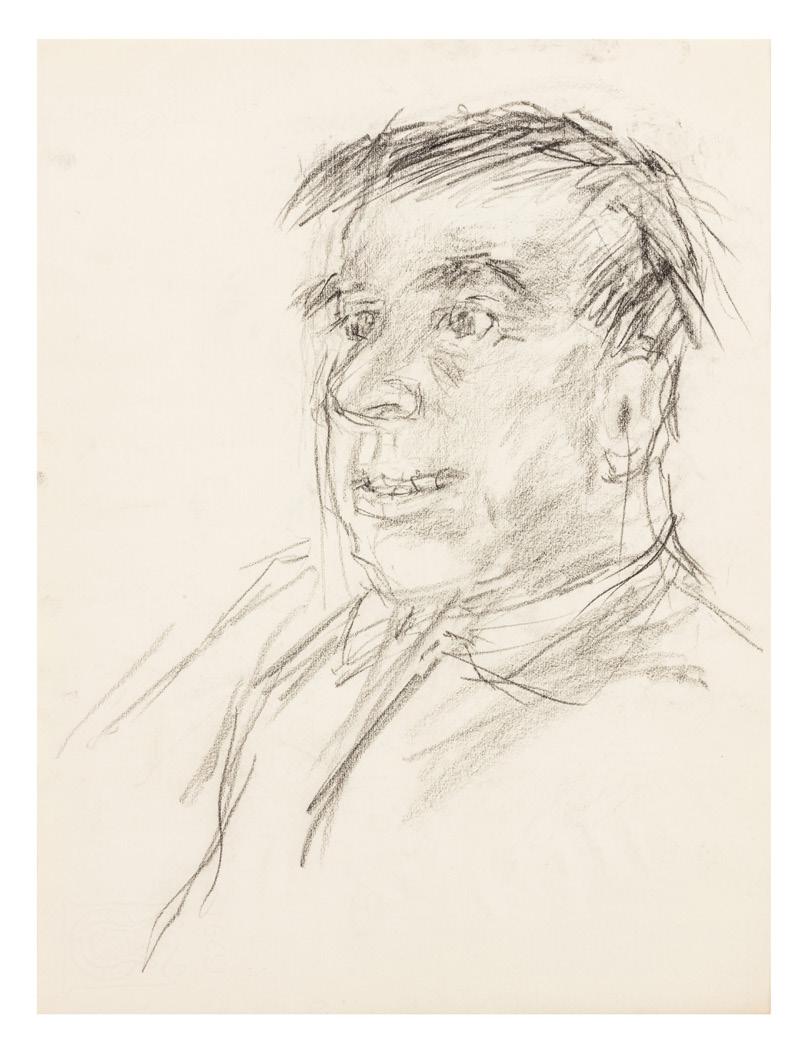
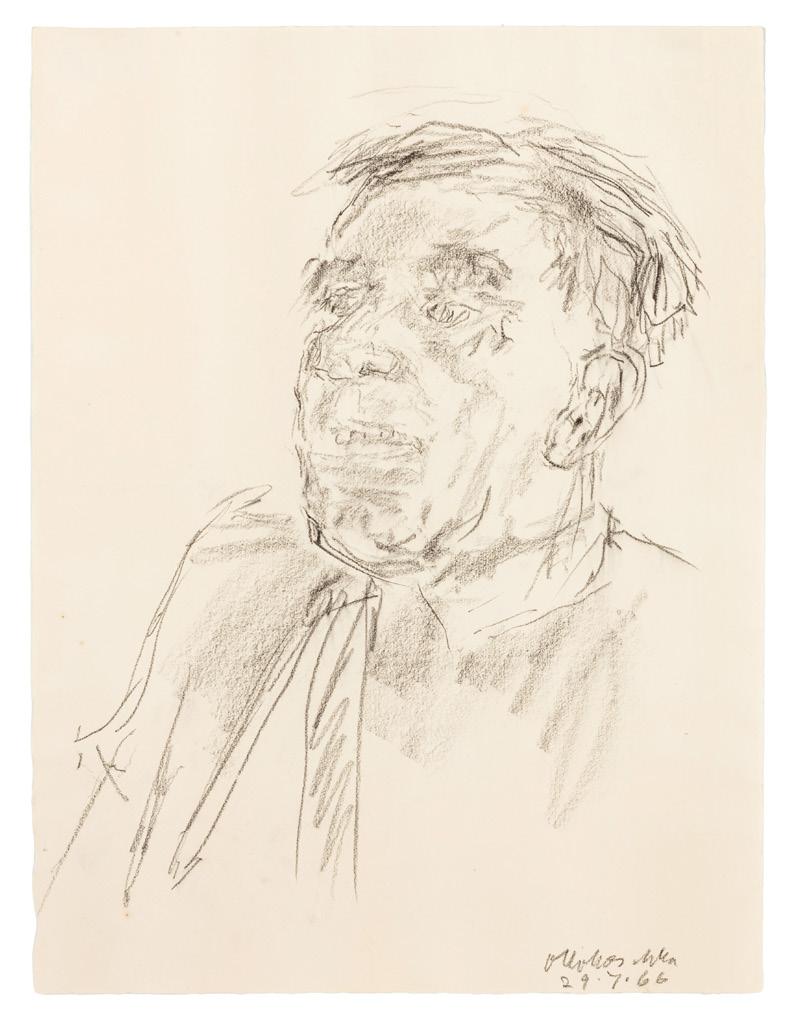
Portrait of Dr. Walter Strebi-Erni signed and dated 'Kokoschka/29.7.66' (lower right); inscribed 'Dr Strebi' (verso) charcoal
Executed on 29 July 1966
Unframed: 51.7 x 39.5 cm. (20 3/8 x 15 5/8 in.)
£3,000 - 5,000
Provenance
Acquired directly from the artist by Dr Walter Strebi, Lucerne, From whom gifted to Private Collection
Their sale; Sotheby's, Cologne, 28 May-5 June 2025, lot 35, where purchased by the present owner
Oskar Kokoschka was a painter, printmaker, and playwright, best known for his expressive, emotionally charged portraits and landscapes. Associated with Austrian Expressionism, he developed a highly individual style defined by restless brushwork, psychological depth, and a focus on inner life rather than outward likeness. Working across Vienna and later Europe, he often depicted friends, intellectuals, and patrons in psychologically heightened states, where faces and bodies appear distorted or animated by emotional intensity.
Unlike his oil paintings, Kokoschka’s works on paper rely on sparse but highly intentional strokes to convey character and tension. His drawing style is defined by nervous, agitated lines that suggest movement and psychological charge, rather than fixed form.
In the Strebi-Erni portraits, expressive line becomes the primary means of construction. The sitter is not rendered through detailed description but through shifting contours and immediate, responsive marks.
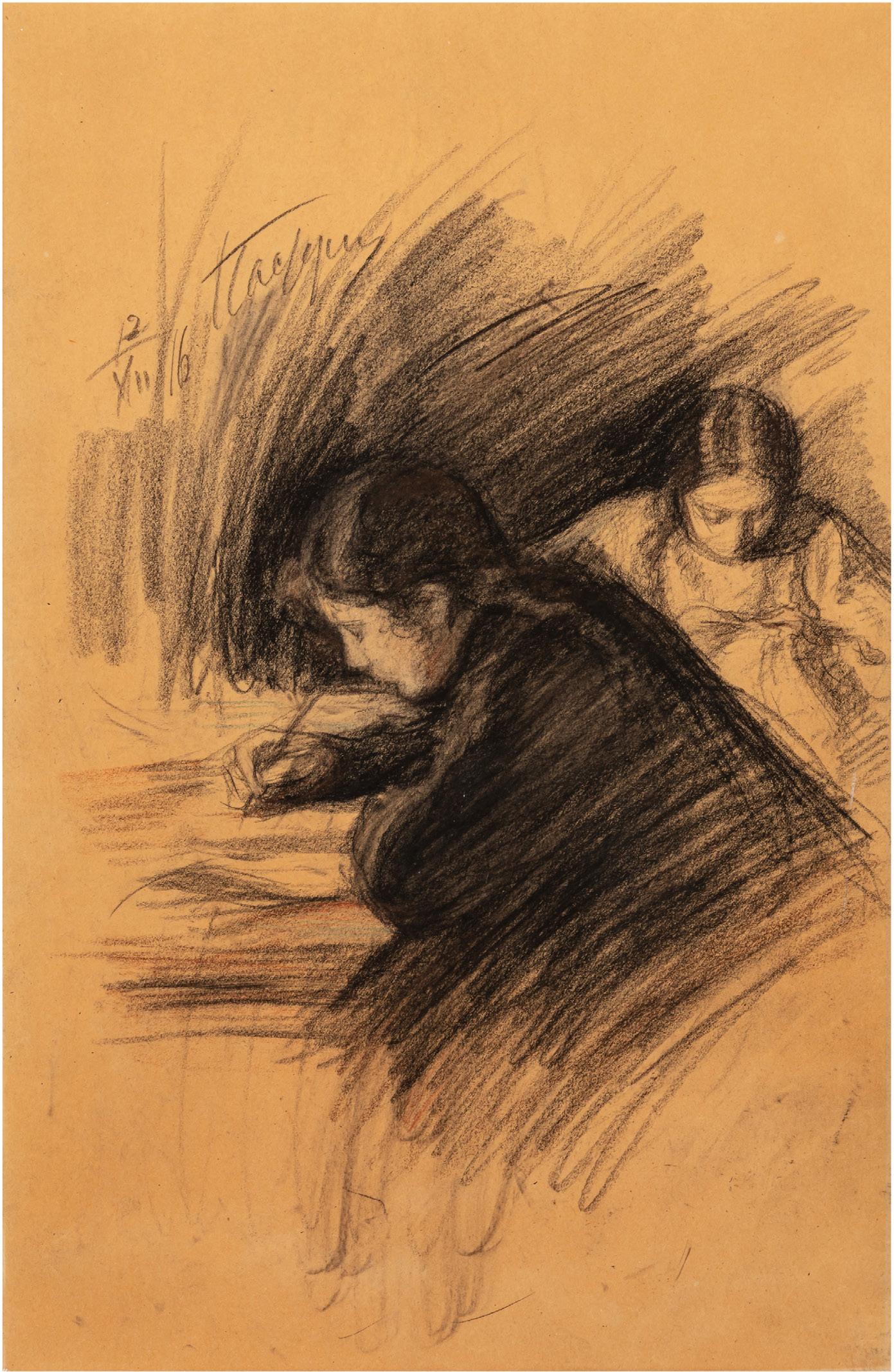
Leonid Pasternak (Ukrainian/Russian, 1862-1945)
Lydia writing at the table and Josephine sewing in the background signed in Cyrillic and dated '2.XII.16' (upper left) black chalk on paper
Unframed: 41.2 x 27.3 cm. (16 1/4 x 10 5/8 in.)
Framed: 55 x 41.5 cm. (21 5/8 x 16 3/8 in.)
£1,500 - 2,500
Provenance
James Butterwick
Private Collection, London, from whom acquired by the present owner
A leading portraitist and illustrator, Leonid Pasternak was a widely respected and influential artist. Born in Odessa, Pasternak studied medicine and law before enrolling at the Royal Academy of Fine Arts in Munich in 1884. Having moved to Berlin in 1921, Pasternak had two one-man exhibitions at the Galerie Hartberg (1927, 1932). However, Nazi persecution in the years preceding World War II forced the Pasternaks to move to Oxford, England, where the artist lived until his death in 1945. He was the father of the Doctor Zhivago writer Boris Pasternak.
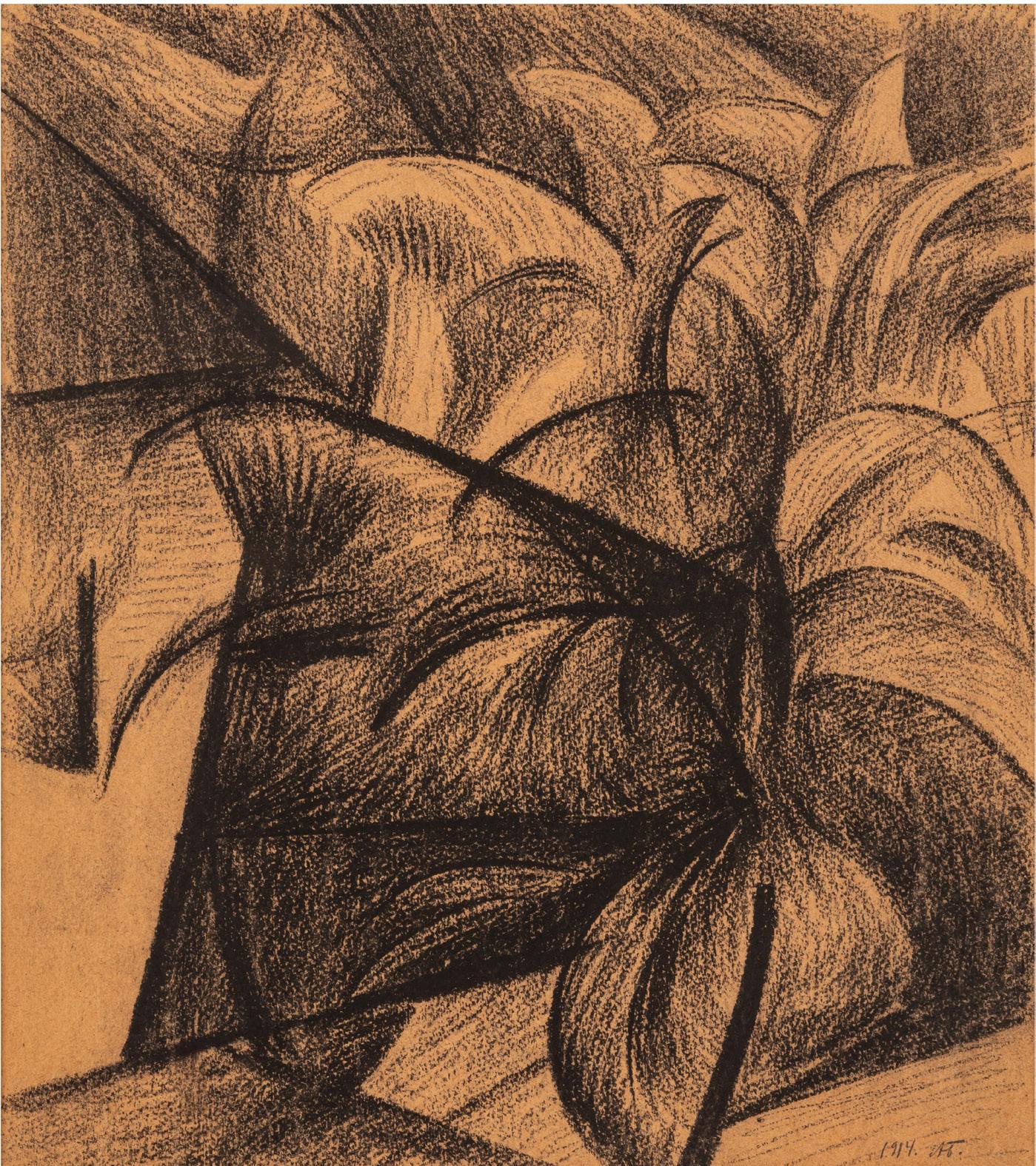
Oleksandr Bogomazov (Ukrainian, 1880-1930)
Abstract composition
signed with initials and dated '1914 AB' (lower right) charcoal on paper
Unframed: 33 x 29 cm. (13 x 11 3/8 in.)
Framed: 59.6 x 55.4 cm. (23 1/2 x 21 5/8 in.)
£1,000 - 1,500
Provenance
The family of the artist, Kyiv Sergei Ivanovich Grigoryants (1941–2023), Moscow
James Butterwick, London
Private Collection, London, from whom acquired by the present owner
Exhibited
Kyiv, National Museum of Ukrainian Art, Alexander Bogomazov, Dec-Jan 1992
Literature
James Butterwick, James Butterwick: A personal Choice Russian paintings and graphics 1867-1945, KitArt Publishers, Moscow, 2004, cat.no.22, illustrated.
The Ukrainian Avant-Garde painter Oleksandr Bogomazov is one of the most significant figures in the advent of Cubo-Futurism. A modern theoretician recognised as one of the key figures of the Ukrainian avant-garde scene. In 1914, Oleksandr wrote his treatise The Art of Painting and the Elements. In it he analysed the interaction between Object, Artist, Picture, and Spectator and sets the theoretical foundation of modern art. Bogomazov's Cubo-futurist artworks were first presented to the public in the artist’s native Kyiv at the Kol'tso exhibition organised in early 1914 by himself and Alexandra Exter (1882-1949). Bogomazov confirmed his position as an important figure in Kyiv art circles. Here the painter demonstrated that he was already aware of the Futurist idea of motion and Cubist principle of deformation and managed to create his own formula of Cubo-futurism.
'Painters are faced with a dilemma at this moment: either to move forward or turn back in fear of the New Art. Boundless joy and throes of creation are in store for those who are brave enough to advance, while melancholy, frustration and the tedium of repeating the known and blaming everything new await those who are not. It is about this New Art that I want to speak and to tell the reader, to the best of my abilities, what I see, feel and understand'. (A. Bogomazov, Zhivopis' i ee elementy [Painting and its elements], Kyiv, 1996, p. 91).
25, 26 & 27
Naum Gabo (Russian, 1890-1977)
Naum Gabo was a central figure in Constructivism, a movement that rejected the idea of "art for art's sake" in favour of art as a practice directed towards social purposes and industrial design. However, Gabo took a more philosophical and sculptural approach than many of his peers.
Born in Russia to a Jewish family, he was the younger brother of fellow Constructivist sculptor Antoine Pevsner. In 1920, they wrote The Realistic Manifesto, which became one of the most important and radical documents in the history of modern art.
"The realisation of our perceptions of the world in the forms of space and time is the only aim of our pictorial and plastic art." - The Realistic Manifesto
This publication ultimately saw the split between Gabo and other Constructivist artists, such as Vladimir Tatlin and Alexander Rodchenko. Their functional and productive approach to art departed from Gabo’s belief that art should stand independently as a pure investigation of the universe, unbothered by the politics of elsewhere.
Following 1922, the Soviet government began taking a hard-line approach to pure abstraction, leading to Gabo’s eventual departure from Russia for Berlin. It was here he was able to keep his concepts of Kinetic art alive, which subsequently led to his strong influence on the Bauhaus in Germany, and now internationally.
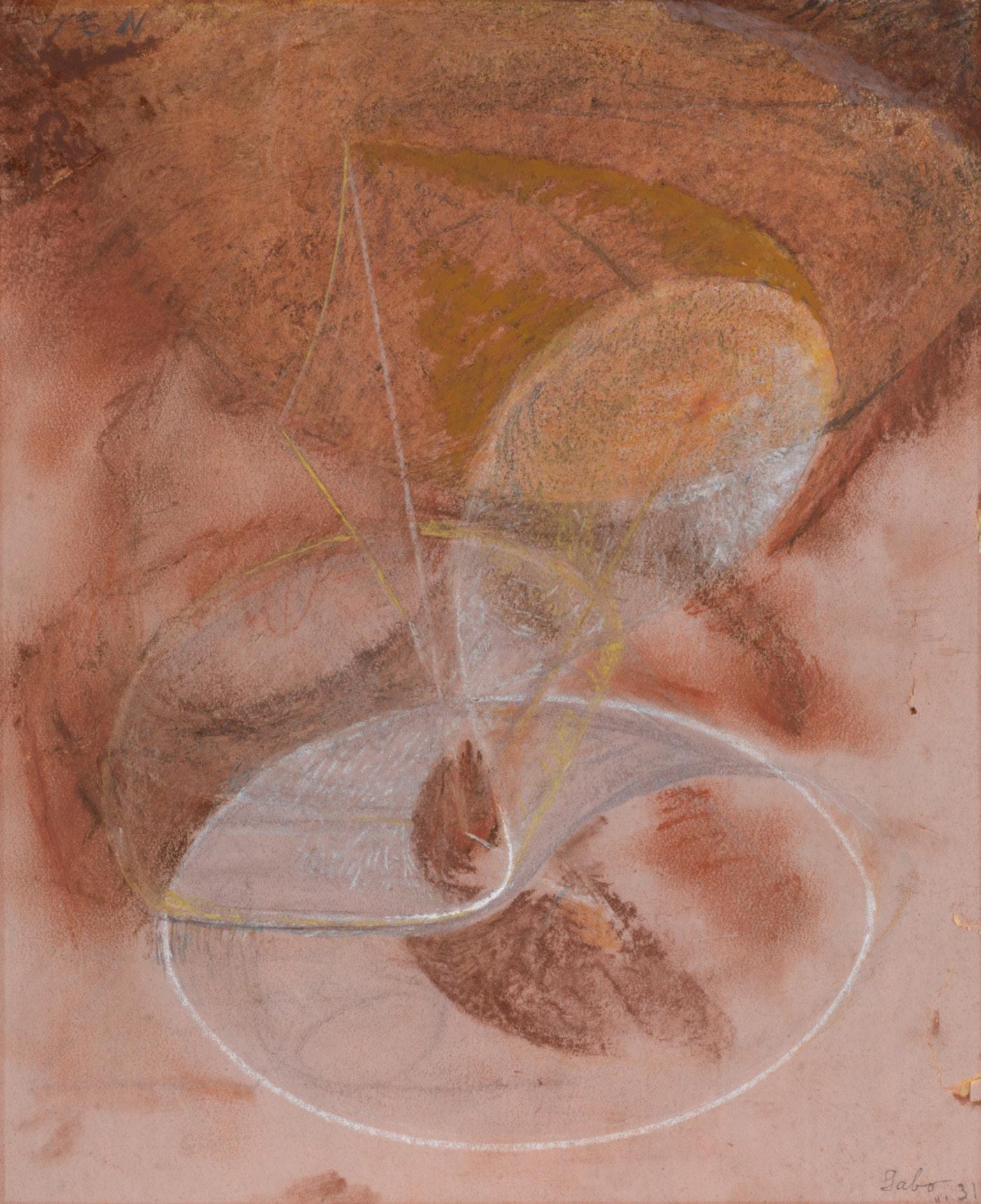
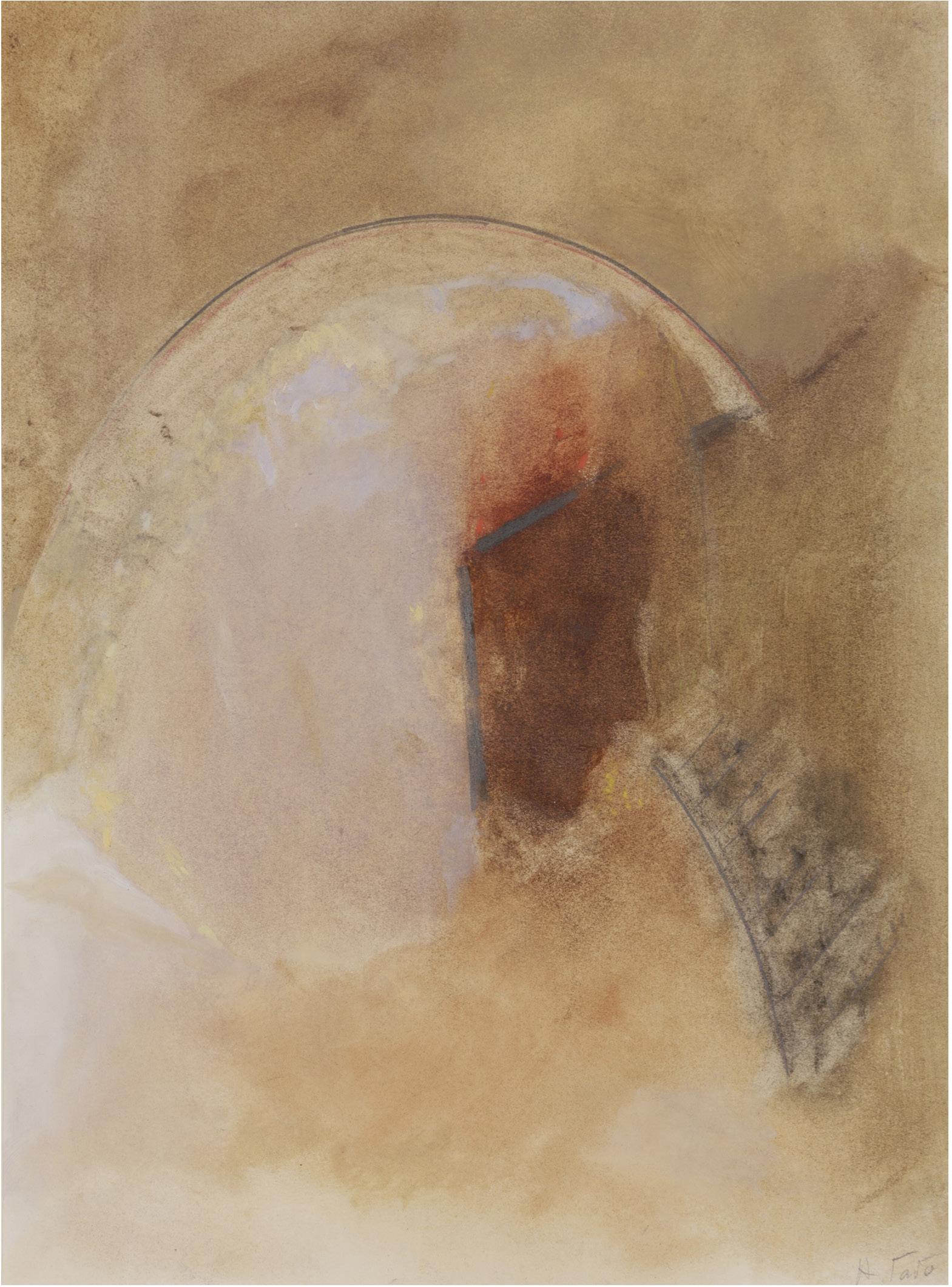
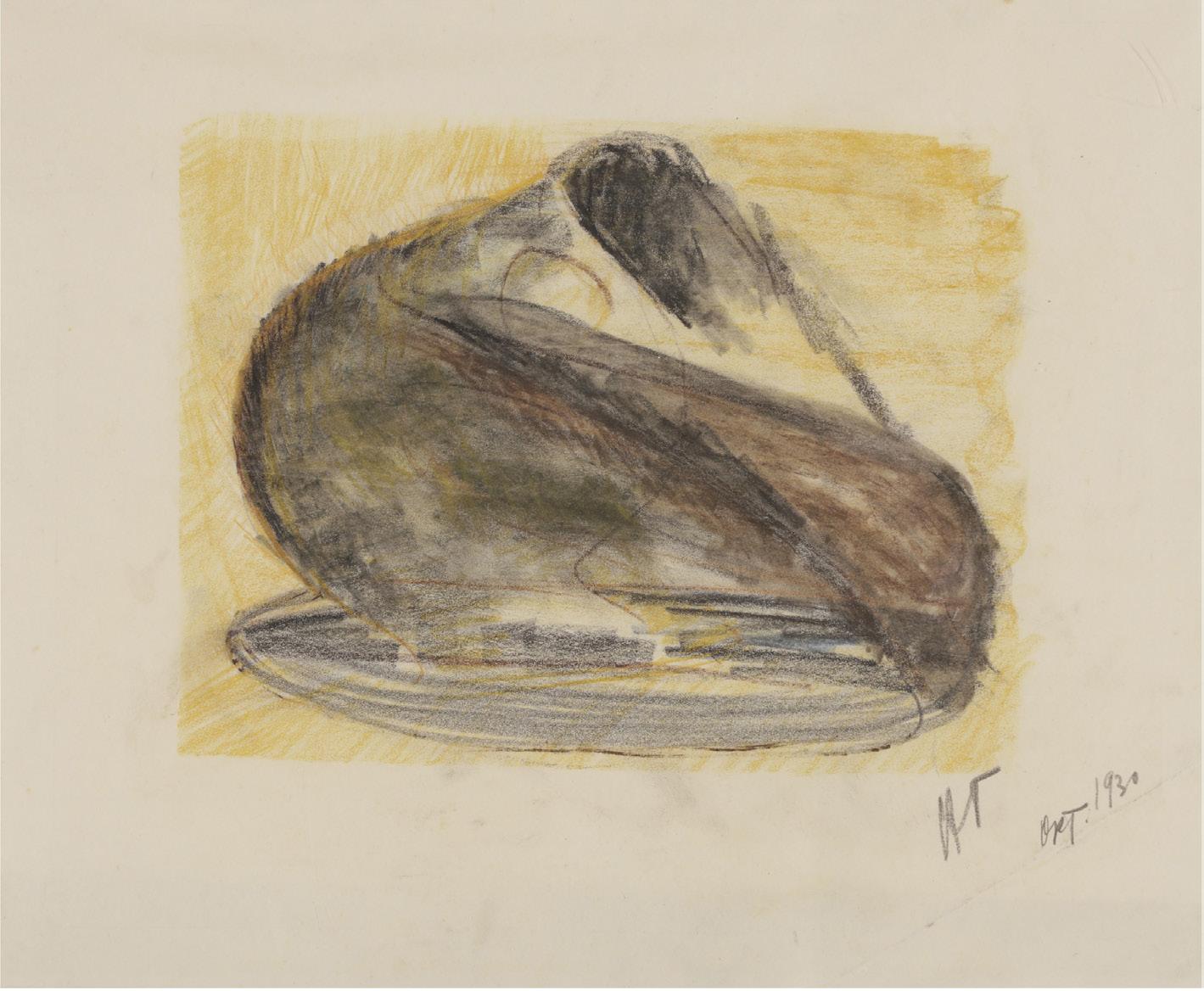
In this collection of drawings (Lots 25–27), Gabo's formal education in medicine, natural sciences, and engineering in Munich is evident. His approach to form and space is constructed with a logical mind rather than through pure creativity.
The year 1930 was a pivotal moment in Gabo’s career. Having fled the Soviet Union, he was living in Berlin, where he was deeply engaged with the Bauhaus and other European avant-garde circles. During the late 1920s and early 1930s, Gabo began moving away from the rigid, linear geometry of his early work toward more complex, curvilinear, and spherical shapes. His early drawings explore the "shell" or "envelope" of space, a concept that would later culminate in his famous works like Spheric Theme (1937).
Unlike traditional sculptors who carved from a solid block, Gabo "constructed" space. This is the case with all three drawings, Construction for a Pond (1931), Sketch for a Carving Stone (1930), and Face in a Headdress (1926), despite the fact they differ in subject matter and execution. Naum Gabo’s approach to negative space is evident; he didn’t draw a solid object, he drew the boundaries of a volume. Gabo often viewed his small drawings and models as prototypes for "monuments" or architectural structures.
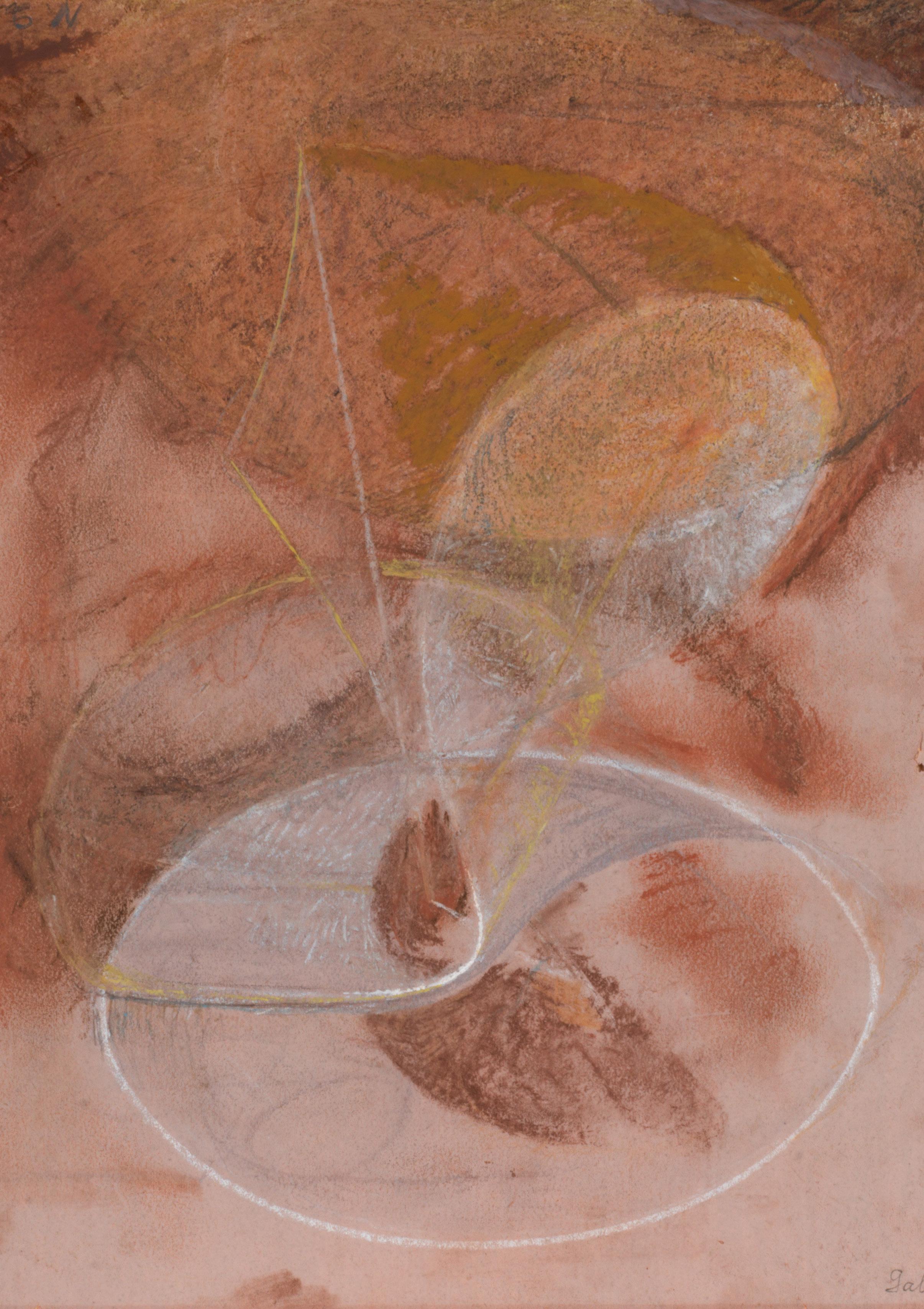
The oval base in Sketch for a Carving Stone (1930) suggests a pedestal, indicating that he was imagining this form as a large-scale public sculpture that would integrate with a modern urban environment. Many years later, he created Stone Carving 1967/(73), made from Portuguese stone in the likeness of this original sketch.
Despite the present examples being works on paper, Gabo was one of the first artists to use industrial materials like Perspex (acrylic), nylon monofilament, and glass. The translucent quality of the shading in these drawings mimics the transparency he sought in his physical sculptures.
While Naum Gabo is fundamentally remembered as a titan of Constructivist sculpture, his works on paper, particularly his drawings, sketches, and unique monoprints, hold a highly significant, albeit quieter, place in his legacy. They are not merely afterthoughts to his three-dimensional work; rather, they serve as the conceptual blueprints and intimate extensions of his obsession with space, time, and movement.
Naum Gabo (Russian, 1890-1977)
Construction for a Pond signed and dated 'Gabo 31' (lower right); further signed 'N Gabo' (upside-down upper left) pastel and watercolour on paper
Unframed: 21 x 17 cm. (8 1/8 x 6 5/8 in.)
Framed: 50.2 x 45.2 cm. (19 3/4 x 17 3/4 in.)
£2,000 - 3,000
Provenance
The artist, thence by descent
The Collection of Nina Williams (née Gabo), London
With Annely Juda Fine Art, London
James Butterwick, London
Private Collection, London, from whom acquired by the present owner
Exhibited
Mannheim, Kunsthalle & Duisburg, Wilhelm-Lehmbruck-Museum der Stadt Duisburg, Naum Gabo, 23 Jun-8 Aug 1965 (as Construction for a Fountain)
New York, Albright-Knox Art Gallery, Plus by Minus: Today's Half Century, Mar-Apr 1968
London, Annely Juda Fine Art, Naum Gabo 1890-1977 Centenary Exhibition, 28 Jun-29
Sep 1990, pp.74-5, cat.57, illustrated.
London, Annely Juda Fine Art, The Thirties. Influences on Abstract Art in Britain, 2 Jul-19
Sept 1998, cat.no.7, illustrated.
New York, PaceWildenstein, Naum Gabo Pioneer of Abstract Sculpture, 4 Nov-11 Dec 1999, cat.no.16, illustrated.
London, Annely Juda Fine Art, Naum Gabo, 29 Apr-26 Jun 1999, cat.no.17, illustrated.
London, Annely Juda Fine Art, Gabo and Colour, 15 Jan-27 Mar 2004, cat.no.11, illustrated.
We are grateful to Dr Christina Lodder for her assistance in cataloguing this lot.
Naum Gabo (Russian, 1890-1977)
Face in a Headdress signed in Cyrillic 'N Gabo' (lower right); inscribed and dated 'Berlin/c.1926' (verso) gouache, crayon and pencil
Unframed: 35.5 x 25.4 cm. (14 x 10 in.)
Framed: 52 x 42.3 cm. (20 1/2 x 16 5/8 in.)
£2,000 - 3,000
Provenance
The artist, thence by descent
The Collection of Nina Williams (née Gabo), London
With Annely Juda Fine Art, London
James Butterwick, London
Private Collection, London, from whom acquired by the present owner
Exhibited
London, Annely Juda Fine Art, Gabo and Colour, 15 Jan-27 Mar 2004, cat.no.3, illustrated.
We are grateful to Dr Christina Lodder for her assistance in cataloguing this lot.
This work titled Face in a Headdress is an incredibly unusual one for Naum Gabo. Apart from the figurative drawings that Gabo executed very early on in his career, and the figure of a man in Study for a Construction on a Stairway, this is one of the few, if only figurative drawings by the artist known.
27 §
Naum Gabo (Russian, 1890-1977)
Sketch for a Carving in Stone signed with initials in Cyrillic and dated 'NG/Okt.1930' (lower right) numbered twice 'No.17' (verso beneath the fold) and '17' (upper-right verso) crayon and gouache on paper
Unframed: 33 x 49.2 cm. (13 x 19 3/8 in.)
Framed: 43 x 52 cm. (17 x 20 1/2 in.)
£1,500 - 2,000
Provenance
The artist, thence by descent
The Collection of Nina Williams (née Gabo), London
With Annely Juda Fine Art, London
James Butterwick, London
Private Collection, London, from whom acquired by the present owner
Exhibited
Buffalo, New York, Albright-Knox Art Gallery, Naum Gabo, 2 Mar-14 Apr 1968, p.17, cat. no.77
London, Tate Gallery, Naum Gabo: The Constructive Process, 3 Nov-12 Dec 1976, p.59, cat.no.38
London, Tate Gallery, Naum Gabo: Sixty Years of Constructivism, 1987, p.31, cat.no.123
Dallas, Dallas Museum of Art, Naum Gabo: Sixty Years of Constructivism, 29 Sep-17
Nov 1985; this exhibition toured to Toronto, Art Gallery of Ontario, 13 Dec 1985-9
Feb 1986, New York, The Solomon R. Guggenheim, 6 Mar-27 Apr 1986, West Berlin, Akademie der Künste, 7 Sep-20 Oct 1986, Düsseldorf, Kunstsammlung NordrheinWestfalen, 20 Nov 1986-11 Jan 1987 and London, The Tate Gallery, 11 Feb-20 Apr 1987
London, Annely Juda Fine Art, Naum Gabo 1890-1977 Centenary Exhibition, 28 Jun-29 Sep 1990, pp.74-5, cat.no.103, illustrated.
London, A South Bank Centre Exhibition, Naum Gabo: The Constructive Idea Sculpture, Drawing, Painting, Monoprints; this exhibition toured to Oxford, Museum of Modern Art, 13 Dec 1987-7 Feb 1988, Newcastle, Hatton Gallery, 20 Feb-25 Mar 1988, Hull, Ferens Art Gallery, 9 Apr-15 May 1988, Manchester, Manchester City Art Gallery, 28 May-3
Jul 1988, Birmingham, Birmingham City Art Gallery, 16 Jul-4 Sep 1988 and Glasgow, Glasgow Art Gallery & Museum, 16 Sep-23 Oct 1988, p.64, cat.no.63
London, South Bank Centre, The Non-Objective World, 1992-93; this exhibition toured to Cambridge, Kettle's Yard, 6 Jun-19 Jul 1992, Swansea, Glynn Vivian Art Gallery, 25 Jul- 6 Sep 1992, Liverpool, Walker Art Gallery, 18 Sept- 25 Oct 1992 and Kendal, Abbot Hall, 31 Oct 1992-3 Jan 1993, p.45 cat.no.11
New York, Pacewildenstein, Naum Gabo Pioneer of Abstract Sculpture, 4 Nov-11 Dec 1999, cat.no.15, illustrated.
London, Annely Juda Fine Art, Gabo and Colour, 15 Jan-27 Mar 2004, cat.no.11, illustrated.
Literature
Steven A. Nash and John Merkert (ed.), Naum Gabo 60 Years of Constructivism, Including Catalogue Raisonné of the Constructions and Sculptures, Prestel-Verlag, Munich, 1986, p.176, cat.no.111, illustrated.
We are grateful to Dr Christina Lodder for her assistance cataloguing this lot.
28, 29 & 30
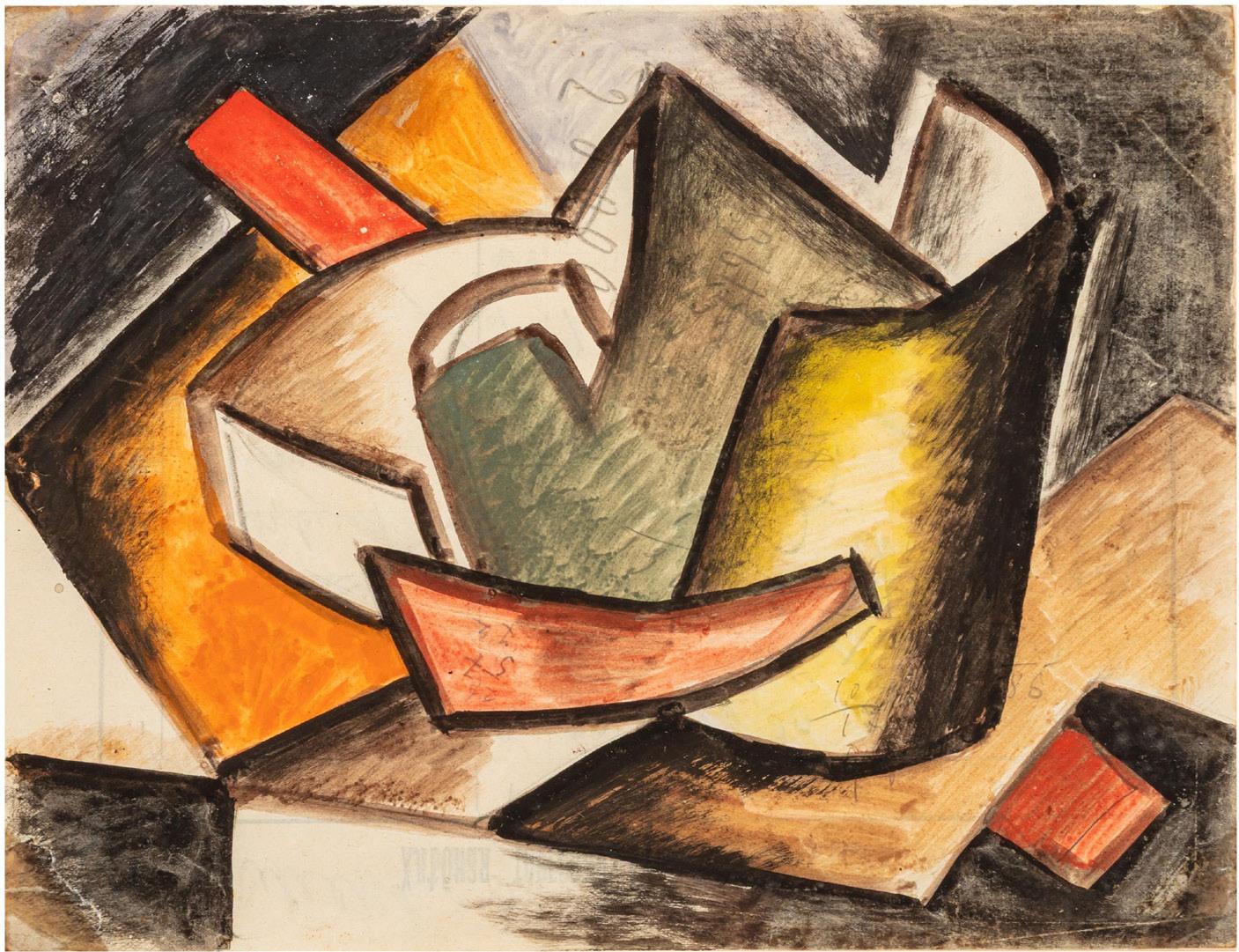
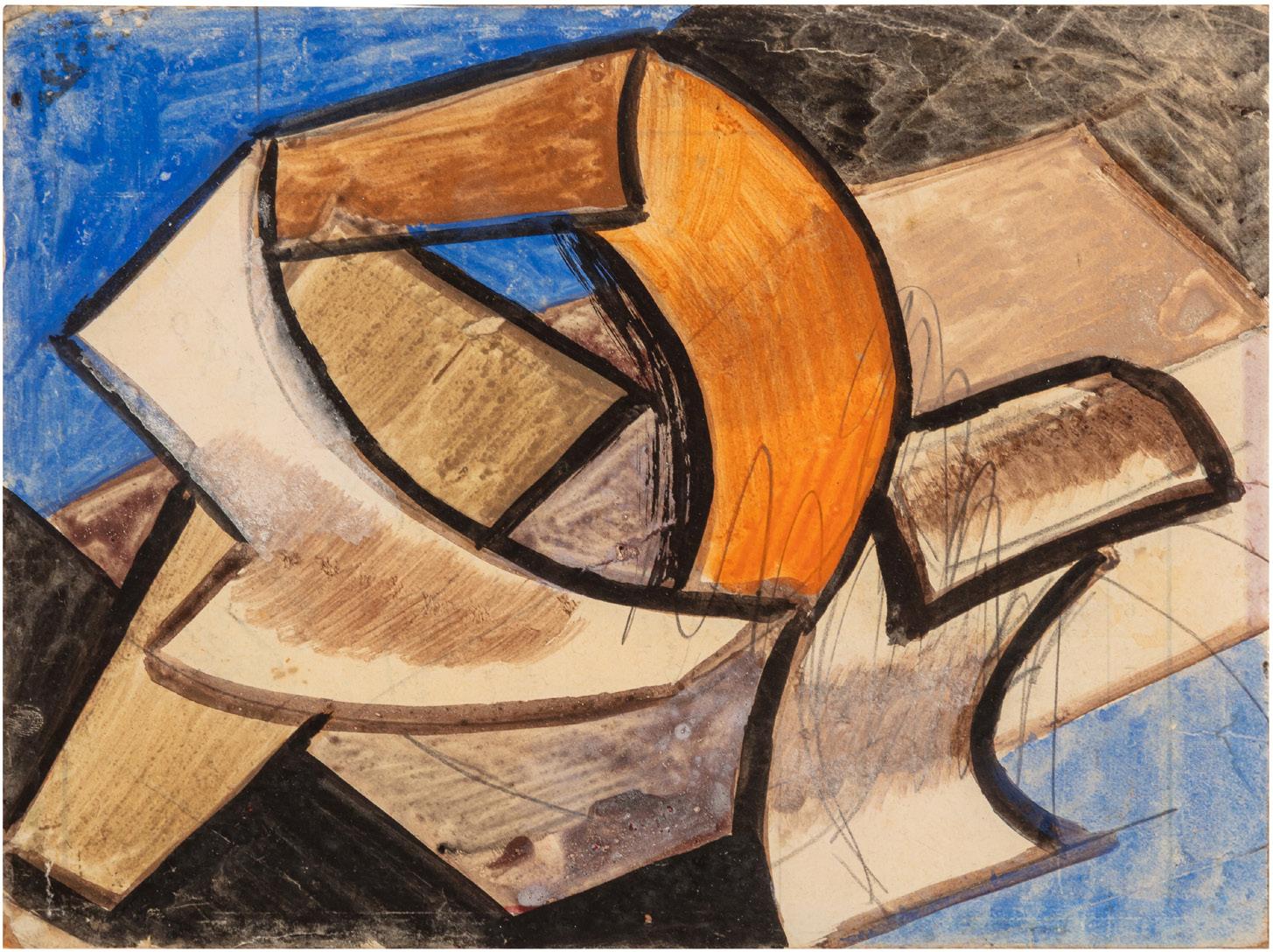
Vladimir Baranov-Rossiné (Ukrainian, 1888-1944)
Vladimir Baranov-Rossiné began his formal training at the Odessa Academy of Art (1903–1908) before crossing paths with seminal avant-garde figures like Larionov, Goncharova, and Burliuk at the St. Petersburg Academy (1908–1909). However, feeling profoundly constrained by academic traditionalism, he abandoned his studies in 1909 and relocated to Paris. Immersing himself in the city's radical modern art scene under the pseudonym Daniel Rossiné, he quickly established himself as a fiercely experimental voice within the École de Paris.
Gravitating toward the epicentre of artistic innovation, he set up his studio in La Ruche (The Beehive) in Montparnasse. This legendary enclave of visionary artists placed him in direct dialogue with other groundbreaking expatriates, including Soutine, Chagall, Archipenko, and Sonia and Robert Delaunay. In this highly charged, collaborative environment, Baranov-Rossiné’s work rapidly evolved as he began to test the limits of form and colour.
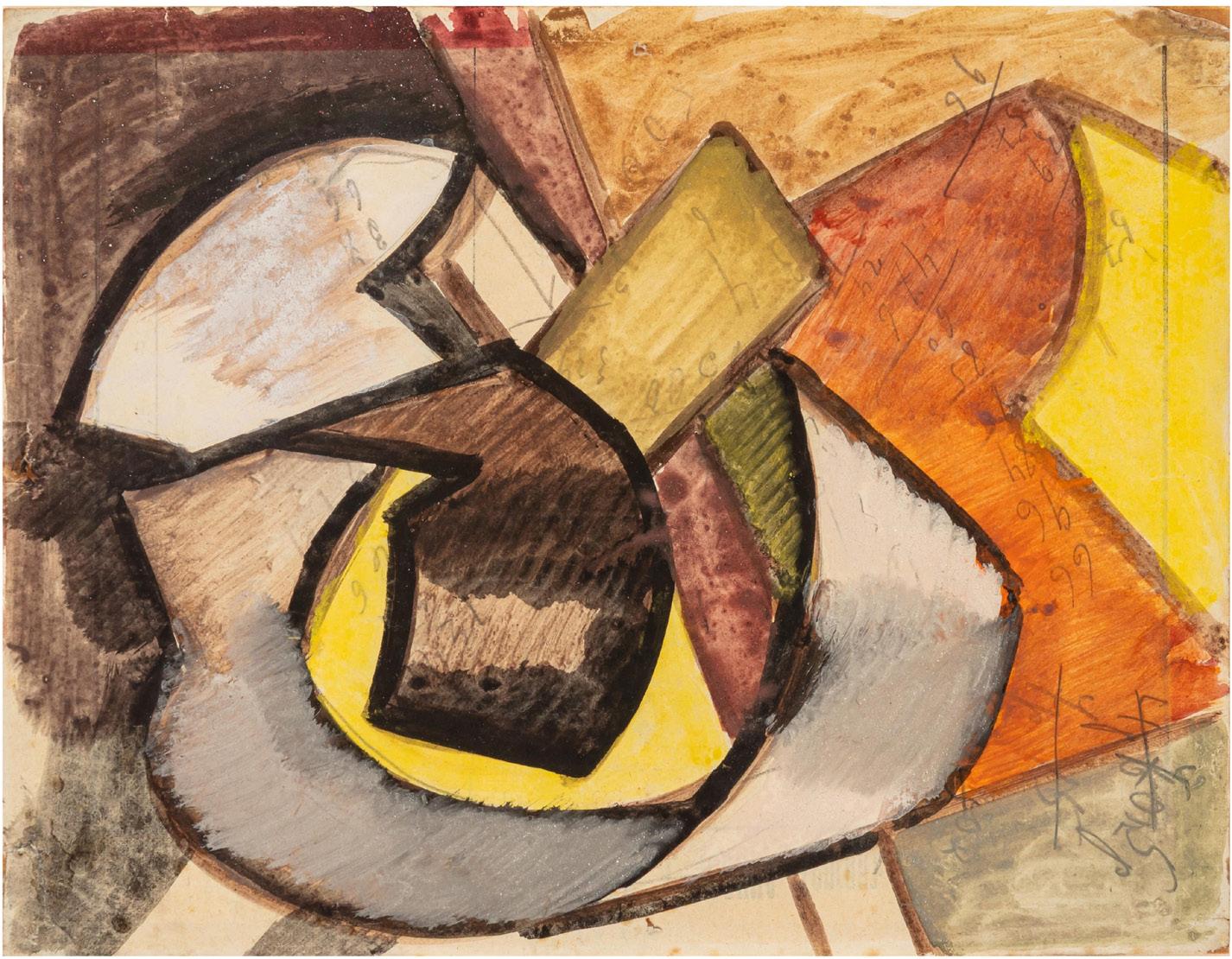
This drive to push the boundaries of visual perception is strikingly evident in the present works. Rather than relying on traditional perspective, the artist utilised bold, experimental pools of colour to carve out multidimensional depth. By masterfully orchestrating a complex network of sweeping, curved forms, he creates a profound optical dynamism, causing the very surface of the composition to pulse and vibrate with kinetic energy. These works are not typical of his style; they are somewhat crude and use bold colours, specifically orange and brown tones, with thick black lines.
In 1943, he was arrested by the Gestapo in France and deported. He died in the Auschwitz concentration camp, Poland, in 1944 at the age of 56.
Vladimir Baranov-Rossiné (Ukrainian, 1888-1944)
Untitled gouache on paper
Executed circa 1915
Unframed: 16.7 x 21.5 cm. (6 5/8 x 8 1/2 in.)
Framed: 39.3 x 44.3 x cm. (15 1/2 x 17 3/8 in.)
£1,500 - 2,500
Provenance
The artist’s family, Paris Private Collection, London James Butterwick, London Private Collection, London, from whom acquired by the present owner
Exhibited
St Petersburg, The Russian Museum, Russia, Vladimir Baranov-Rossiné, 4 Apr-3 Jun 2002
Moscow, State Tretyakov Gallery, Russia, Vladimir Baranov-Rossiné, 21 Jun-20 Jul 2002
Literature
Exhibition Catalogue, The Russian Museum, St. Petersburg, Vladimir Baranov-Rossiné, Trilistnik, Moscow, 2002, p.118
Andrey Sarabianov, Vladimir Baranov-Rossiné, Trefoil Press, Moscow, 2002, p.56
Vladimir Baranov-Rossiné (Ukrainian, 1888-1944)
Untitled gouache on paper
Executed circa 1915
Unframed: 17 x 22 cm. (6 3/4 x 8 5/8 in.)
Framed: 44 x 39 cm. (17 1/4 x 15 3/8 in.)
£2,000 - 3,000
Provenance
The artist’s family, Paris
Private Collection, London
James Butterwick, London
Private Collection, London, from whom acquired by the present owner
Exhibited
St Petersburg, The Russian Museum, Russia, Vladimir Baranov-Rossiné, 4 Apr-3 Jun 2002
Moscow, State Tretyakov Gallery, Russia, Vladimir Baranov-Rossiné, 21 Jun-20 Jul 2002
Literature
Exhibition Catalogue, The Russian Museum, St. Petersburg, Vladimir Baranov-Rossiné, Trilistnik, Moscow, 2002, p.118
Andrey Sarabianov, Vladimir Baranov-Rossiné, Trefoil Press, Moscow, 2002, p.56
Vladimir Baranov-Rossiné (Ukrainian, 1888-1944)
Untitled gouache on paper
Executed circa 1915
Unframed: 16.5 x 21.6 cm. (6 1/2 x 8 1/4 in.)
Framed: 39 x 44 cm. (15 3/8 x 17 1/4 in.)
£1,500 - 2,500
Provenance
The artist’s family, Paris Private Collection, London James Butterwick, London Private Collection, London, from whom acquired by the present owner
Exhibited
St Petersburg, The Russian Museum, Russia, Vladimir Baranov-Rossiné, 4 Apr-3 Jun 2002
Moscow, State Tretyakov Gallery, Russia, Vladimir Baranov-Rossiné, 21 Jun-20 Jul 2002
Literature
Exhibition Catalogue, The Russian Museum, St. Petersburg, Vladimir Baranov-Rossiné, Trilistnik, Moscow, 2002, p.118
Andrey Sarabianov, Vladimir Baranov-Rossiné, Trefoil Press, Moscow, 2002, p.56
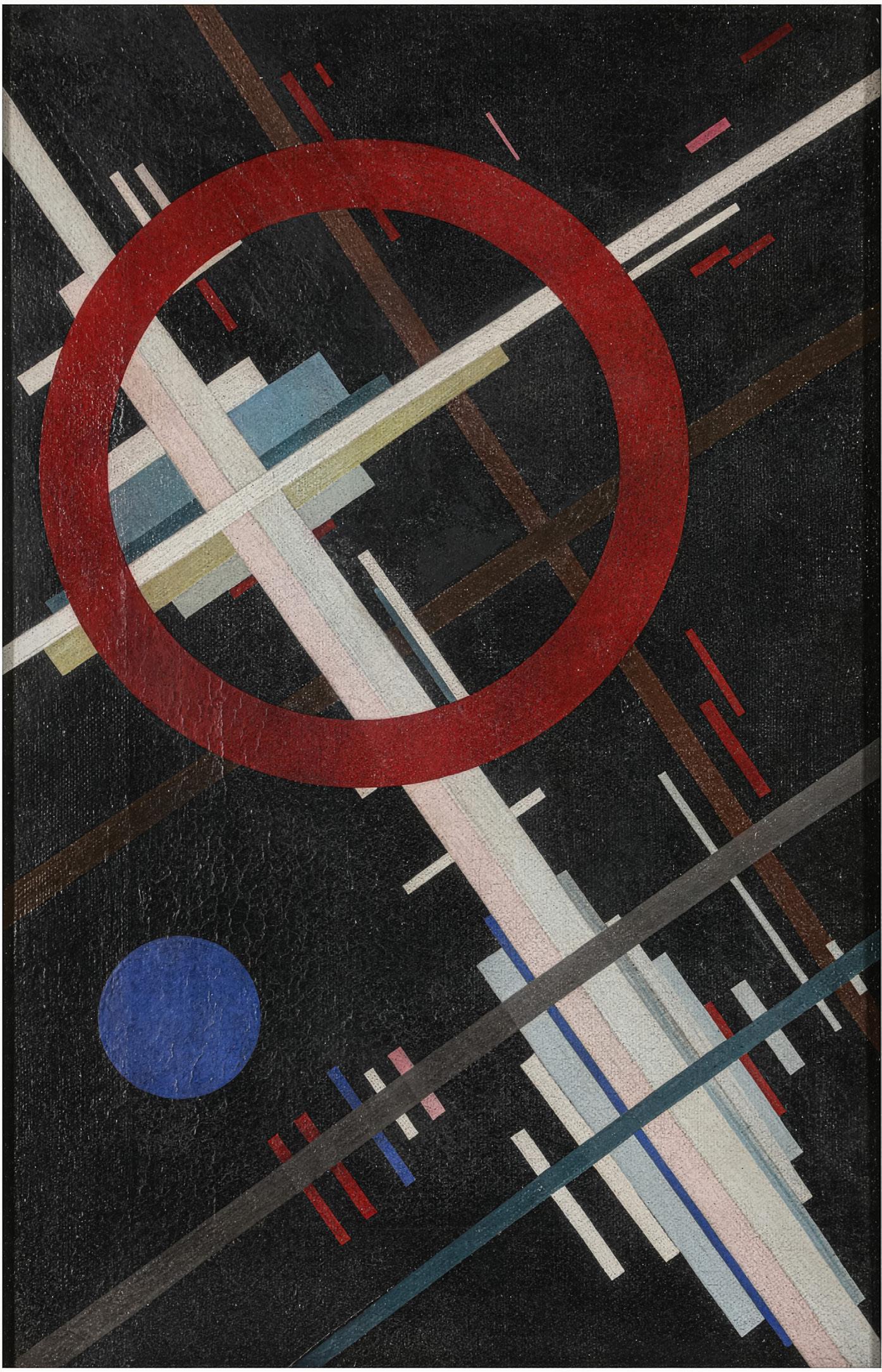
School of Ilya Chashnik
Suprematist composition oil on canvas
Painted circa 1926-7
Unframed: 49 x 32.5 cm. (19 1/4 x 12 3/4 in.)
Framed: 64.5 x 47.5 cm. (25 1/4 x 18 3/4 in.)
£4,000 - 6,000
Provenance
Private Collection, London, from whom acquired by the present owner
Chashnik was one of Suprematism’s brightest stars. His first studies were under Marc Chagall, before he went on to develop his Suprematist principles under Kazimir Malevich at the Vitebsk Art School. Described as ‘feverish’ and ‘magnetic’ by his peers, he worked across many disciplines, including porcelain, architecture, textile and furniture design, and typography.
Chashnik's life was short-lived, and he died at the age of 27. The combination of this and the almost total destruction of the UNOVIS archives at Vitebsk during the Second World War meant that little of the artist’s work survives. Chashnik's first posthumous exhibition in the West was organised by his son in Germany in 1978.
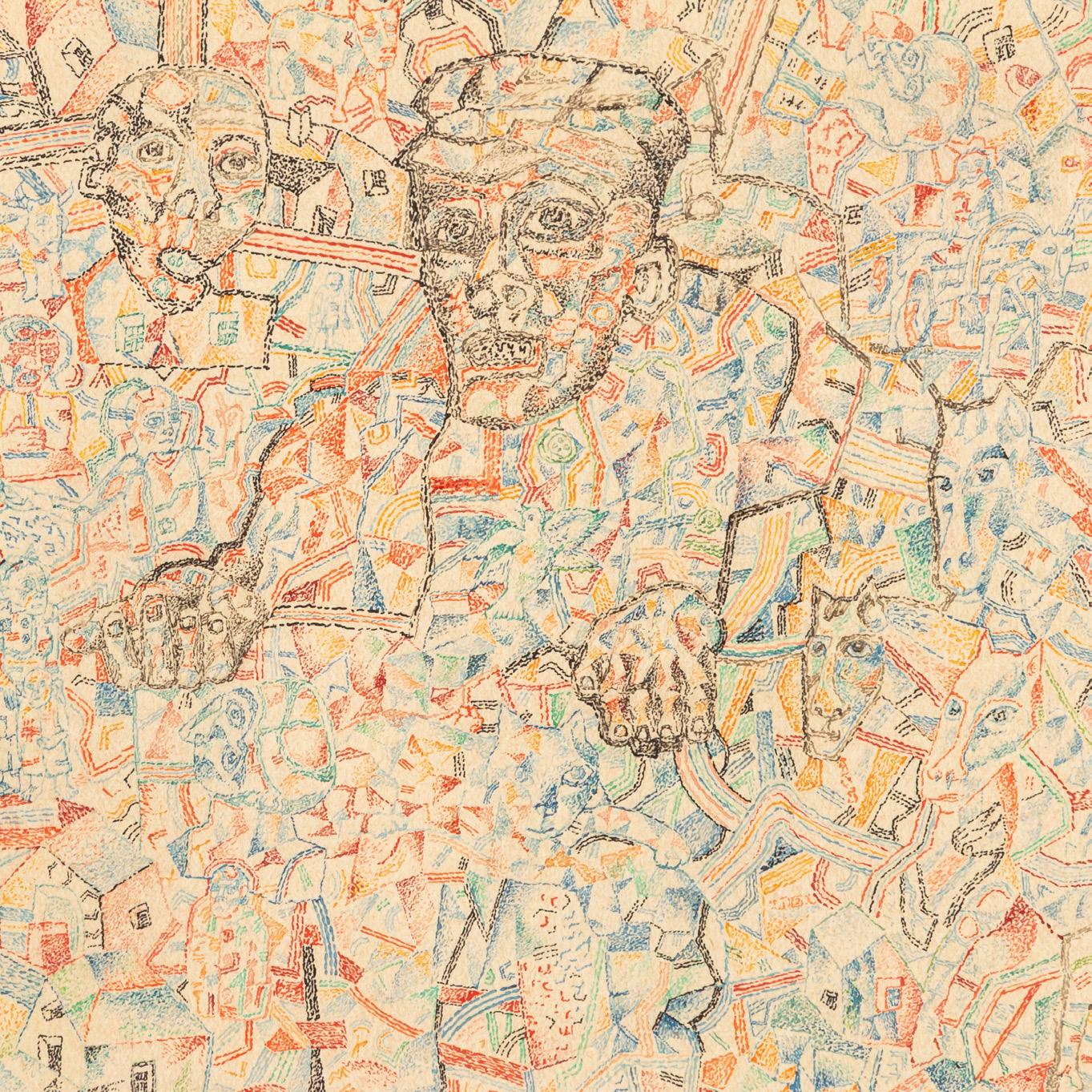
Pavel Filonov (Russian, 1883-1941)
Untitled (The Town) watercolour and mixed media on paper Executed circa 1920s
Unframed: 20.4 x 21 cm. (8 1/8 x 8 1/4 in.)
Framed: 35 x 36 cm. (13 3/4 x 14 1/4 in.)
Please note there is a further sketch verso
£8,000 - 12,000
Provenance
The artist, St. Petersburg, thence by descent to Evdokia Nikolaevna Glebova, the artist’s sister, circa 1988
With Galerie Gmurzynska, Cologne, 7 May 1992
With Galerie Piltzer, Paris Private Collection, Geneva James Butterwick, London
Private Collection, London, from whom acquired by the present owner
Exhibited
Cologne, Galerie Gmurzynska, The Physiology of Painting - Pavel Filonov in the 1920s, Apr-May 1992; the exhibition was in association with the State Russian Museum Paris, Galerie Gerard Pilzer, Malevich & Filnov, 1992; the exhibition was in association with the State Russian Museum
Literature
Krystyna Gmurzynska, Chrysanthi Kotrouzinis, and Mathias Rastorfer (eds.), The Physiology of Painting - Pavel Filonov in the 1920s, 1992, p.69, cat.no.17, illustrated.
Pavel Filonov was born in 1882 into a large, impoverished family in Moscow, and by the age of 14, he was orphaned. These formative years of poverty and tragedy informed his artistic career and, in many ways, defined much of his life. He served during World War I, became deeply involved in revolutionary movements within the army, and tragically died of starvation in 1941 during the Siege of Leningrad.
Pavel Filonov and his art have been less regarded internationally than his contemporaries, such as Wassily Kandinsky and Kazimir Malevich. While Kandinsky left Russia for Germany and France, and Malevich was able to leave many of his works behind in Warsaw and Berlin in 1927, Filonov never left Russia. Like many others, he welcomed the 1917 Revolution, and his art mirrored that ambition and excitement. Filonov’s philosophy of Sdelannost, defined as "made-ness" or craftsmanship, mirrored the physical label of the "worker" that was so heavily emphasised by the revolutionary rhetoric of the years following 1917. The sheer detail and construction of his works in many ways aligned with the principles of the revolution.
Filonov is widely known as the founding father of Analytical Realism. The movement departed
from others like Cubism and Impressionism that embraced purely stylistic methods; for Filonov, art was a scientific method for comprehending the world around him. Despite remaining in Russia, he transitioned from a respected leader of the avant-garde to an outsider as Soviet art shifted from the experimental to the rigid style of Socialist Realism. Filonov’s art was considered too detailed, intellectual, and philosophical for the masses.
After his death, his sister, Evdokia Glebova, hid his collection from the authorities. It wasn’t until the 1970s, after she had preserved the collection, that she donated it to the State Russian Museum, maintaining her brother's philosophy that his work had always belonged to the people.
The Town is no exception; the work was shown in two major exhibitions in Paris and Cologne in 1992 that were held in association with the State Russian Museum. Ultimately, Pavel Filonov’s work provides audiences with an alternative view of the Russian avant-garde: rather than following Malevich and Lissitzky’s move towards pure, empty, geometric abstraction, it demonstrates that avant-garde art could also be incredibly dense, microscopic, and biologically complex.
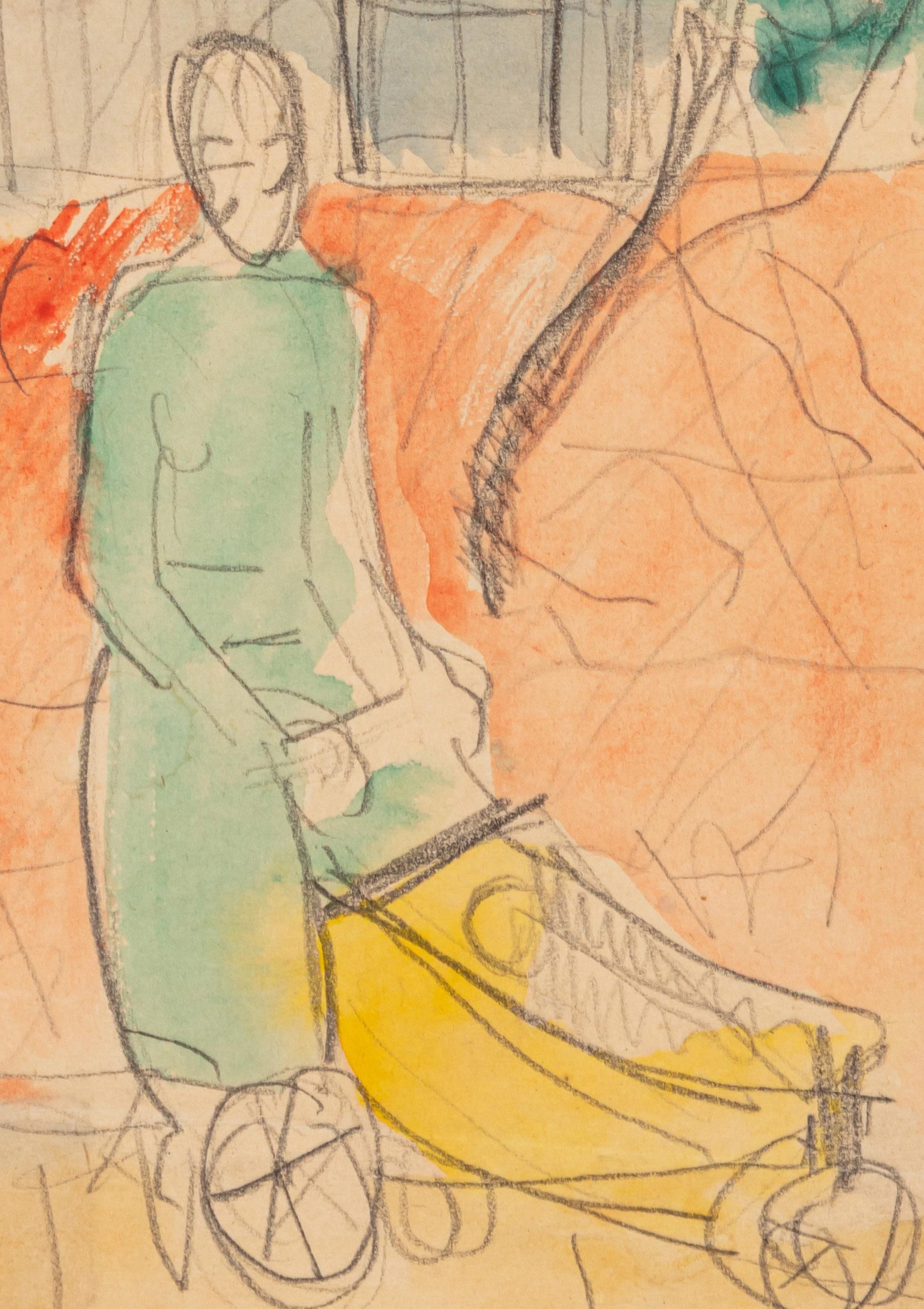
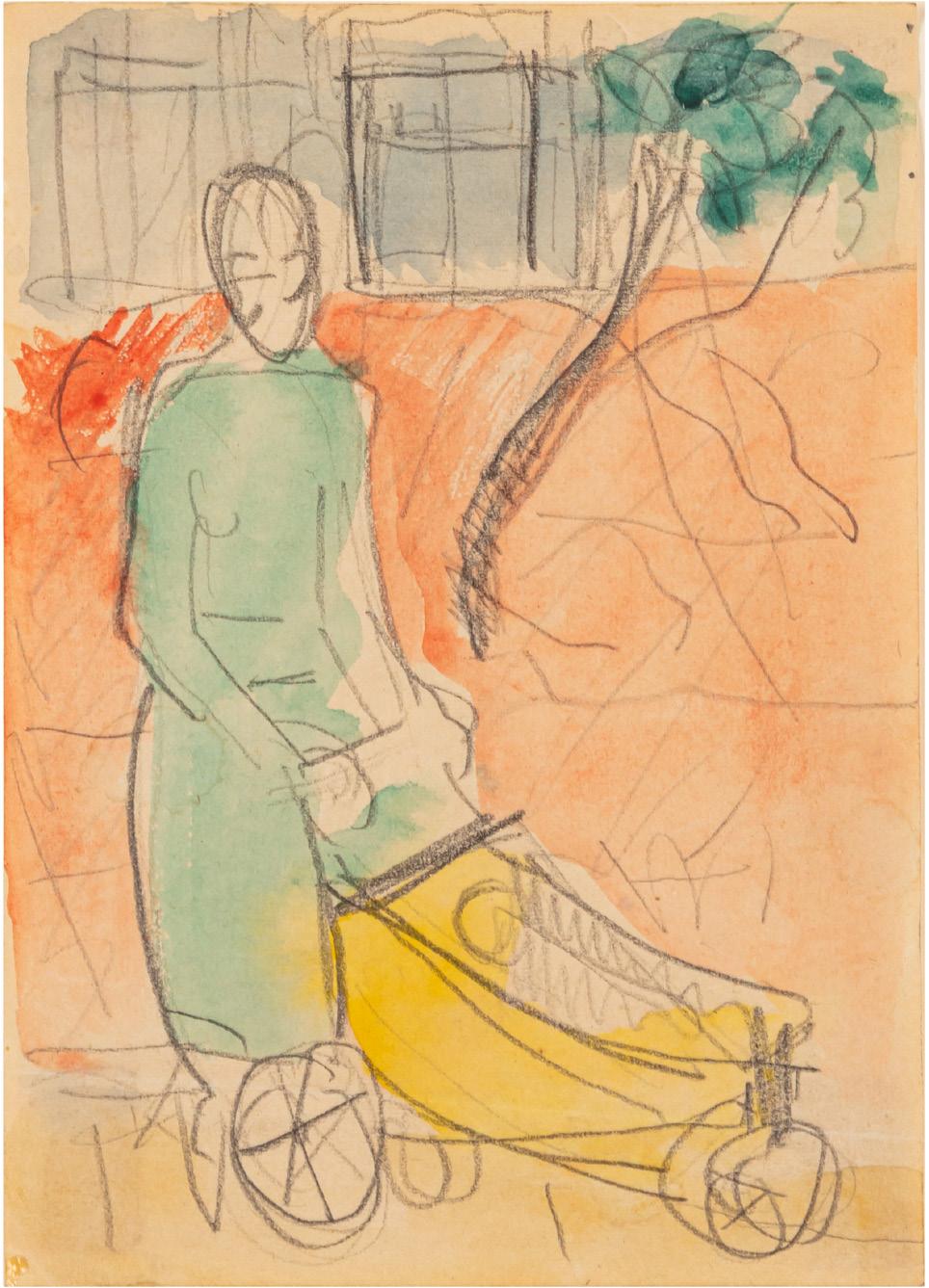
Alexander Rusakov (Russian, 1898-1952)
Study for Woman with a Pushchair pencil and watercolour on paper
Unframed: 13 x 9.5 cm. (5 1/8 x 3 3/4 in.)
Framed: 39.5 x 31.9 cm. (15 1/2 x 12 1/2 in.)
Please note this work is one of multiple studies for a larger work by the artist, Woman with a pushchair (1927-1928)
£300 - 500
Provenance
With The Rusakov family, St. Petersburg James Butterwick, London
Private collection, London, from whom acquired by the present owner
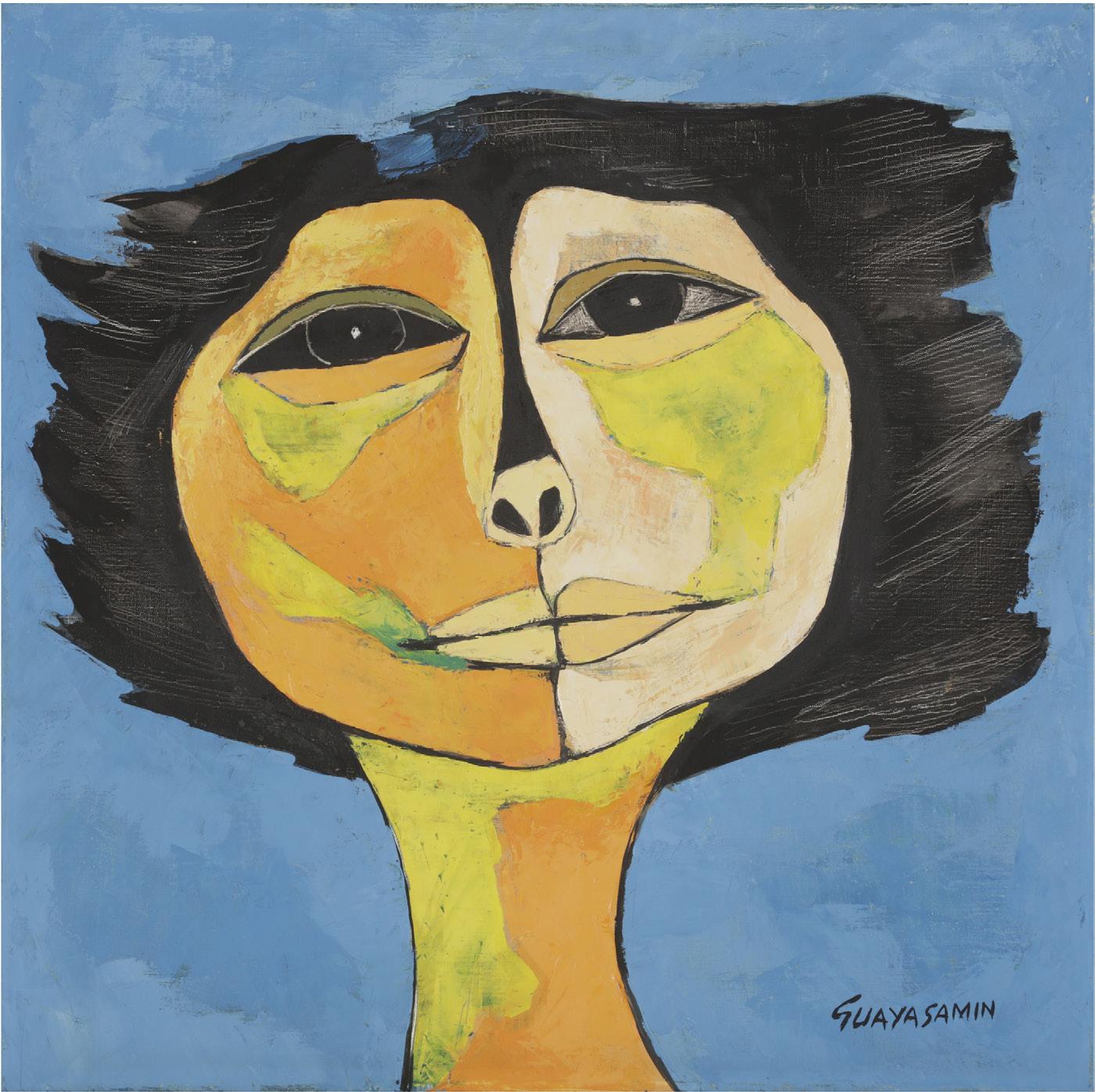
Oswaldo Guayasamín (Ecuadorian, 1919-1999)
La cabeza signed 'GUAYASAMIN' (lower right) oil on canvas
Painted in 1990
Unframed: 60 x 60 cm. (23 5/8 x 23 5/8 in.)
£10,000 - 15,000
Provenance
With Foundation Guayasamín, Quito
Private Collection, U.K., from whom acquired by the present owner
We are grateful to the Fundación Guayasamín for their assistance in confirming the authenticity of this work.
Oswaldo Guayasamín was an Ecuadorian painter and sculptor whose art focused on social and political issues, as well as indigenous and human rights. He is considered one of the most important Latin American artists of the 20th century, and his work has had a significant influence on both the art world and social movements.
Guayasamín's art often depicted the suffering and oppression of marginalised communities, such as indigenous peoples, peasants, and the poor. His paintings and sculptures were highly emotional and expressive, using bold colours and strong lines to convey his message. He also drew inspiration from the pre-Columbian art and culture of his native Ecuador, as well as from European modernism.
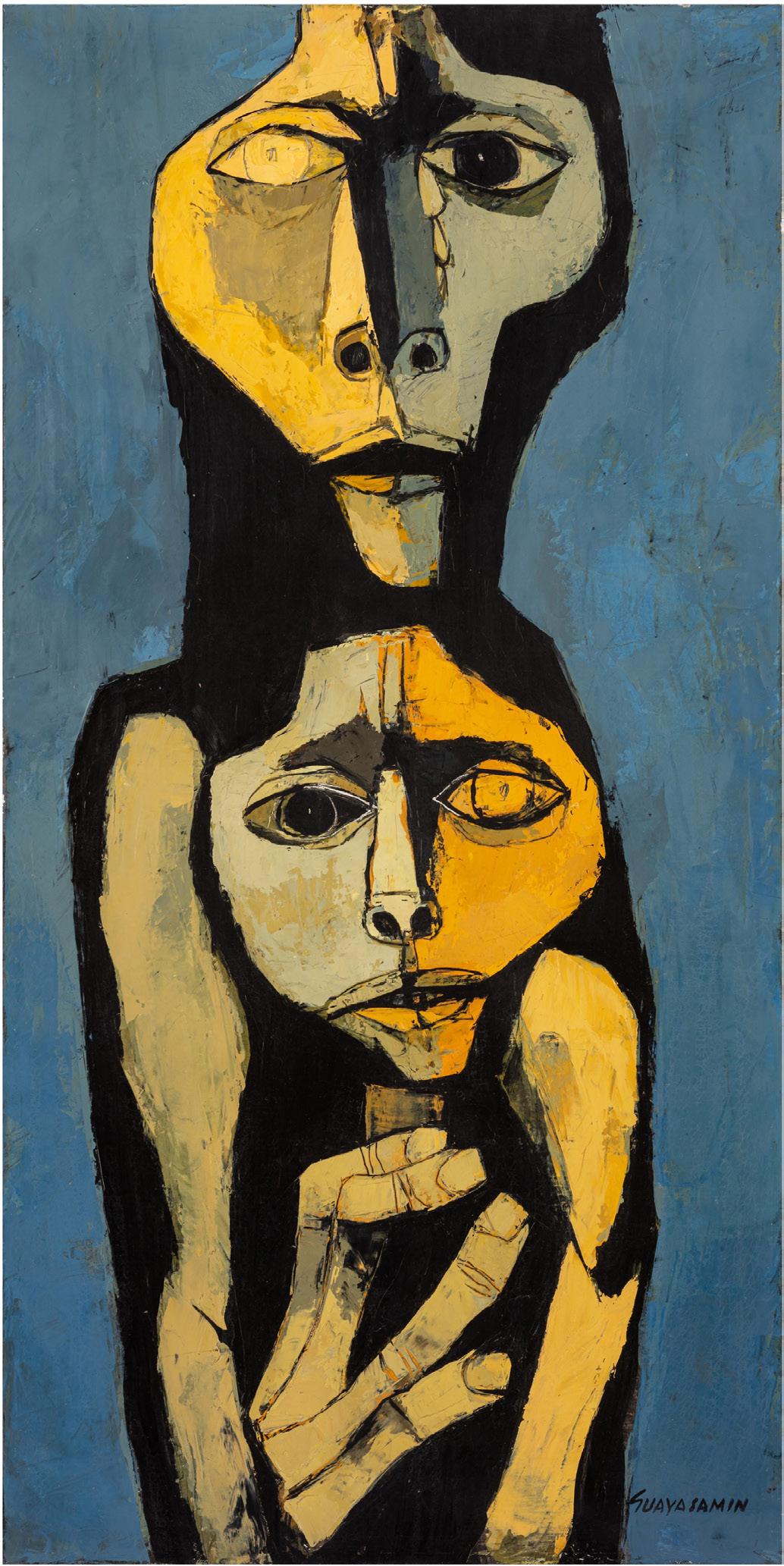
Oswaldo Guayasamín (Ecuadorian, 1919-1999)
Madre y Niño signed 'GUAYASAMIN' (lower right) oil on canvas
Unframed: 90 x 45.2 cm. (35 3/8 x 17 7/8 in.)
£10,000 - 15,000
Provenance
Private Collection, U.K., from whom acquired by the present owner
We are grateful to the Fundación Guayasamín for their assistance in confirming the authenticity of this work.
Oswaldo Guayasamín is a central figure in twentieth-century Latin American Expressionism, who gained international stature in the 1950s and 1960s for the insistent, visceral force of his depictions of an oppressed and tragic humanity. His work, characterised by powerfully graphic, modernist forms, draws on Cubist structure to portray Latin American subjects shaped by political oppression, racism, poverty, and deep class divisions. This visual language was formed through early experiences in Quito, including the death of a close friend during political unrest, and underpins his sustained focus on social injustice and human suffering.
Madre y Niño distils these concerns into a concentrated, intimate composition. The vertically aligned figures of mother and child are compressed into a shallow pictorial space, their forms defined by angular planes and heavy black contours. Their mask-like faces, articulated through contrasting zones of ochre and shadow, balance individual presence with a more universal expression, while recalling the formal influence of pre-Columbian art. The palette is deliberately restrained: ochres, blacks, and a muted blue ground establish a sombre register, avoiding decorative effect in favour of clarity and weight. The mother’s elongated hand, placed across the child’s chest, anchors the composition; the gesture is protective yet tense, conveying vigilance rather than comfort.
Although more intimate in scale than the artist’s well-known large cycles, this work maintains the same ethical focus. It avoids sentimentality, presenting maternity as a condition defined by fragility and endurance. Madre y Niño thus serves as a concise statement of Guayasamín’s broader artistic vision.
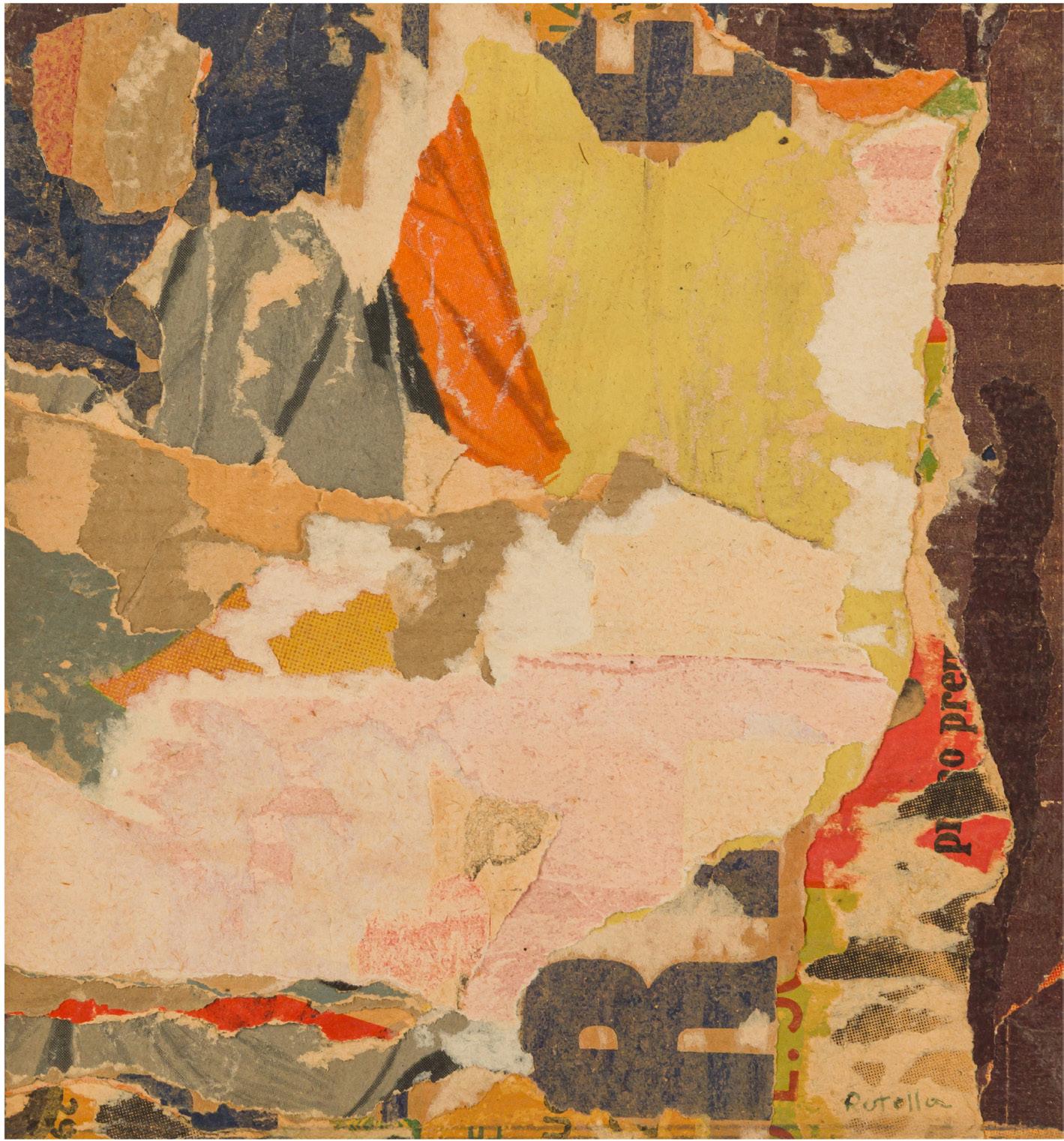
Mimmo Rotella (Italian, 1918-2006)
Untitled signed 'Rotella' (lower right) collage
Executed in 1960
Unframed: 19.4 x 18.2 cm. (7 5/8 x 7 1/8 in.)
Framed: 37 x 36 cm. (14 1/2 x 14 1/4 in.)
£4,000 - 6,000
Provenance
The artist, early 1960s, from whom gifted to Private Collection, U.K Their sale; Christie’s, London, 17 October 1991, lot 69 Private Collection, U.K., circa 2007, from whom gifted to the present owner
Domenico “Mimmo” Rotella was born in Catanzaro in 1918. He studied at the Accademia di Belle Arti in Naples before moving to Rome in 1945. In 1951, Rotella won a Fulbright Foundation Scholarship, which saw him travelling to the United States. This undoubtedly influenced his artistic practice. During his time in America, he met emerging and established giants of the American post-war art scene, including Jackson Pollock, Robert Rauschenberg, and Cy Twombly. He absorbed the explosive energy of American consumerism, advertising, and pop culture.
By 1953, having moved back to Rome, Rotella created his first décollage; this collection of works was composed of pieces from advertisement posters that he had ripped off the walls. They mirrored the gritty, informal textures of the war-torn urban landscape. They looked raw, chaotic, and heavily textured, focusing on the materiality of torn paper and peeling glue. This early phase heavily echoed the energetic, nonfigurative aesthetics of American Abstract Expressionism (like the works of Pollock or the gritty textures of Rauschenberg's early combines).
This Untitled work, executed in 1960, depicts
both the continuity and change that Rotella shared with his American counterparts who were also working in the '50s and '60s. Both Pop Art and Abstract Expressionism were inspirations; while Pop Art ultimately had far more influence on his oeuvre, Abstract Expressionism gave him his method, and Pop Art gave him his subject matter.
This work is critical to this period, as it almost occupies the space between the two movements. Rotella fully adopted the process of physically making works, tearing posters and compiling his décollages. However, the elements of pop lettering and the use of colour are also apparent in this work. Rotella’s influence is most acutely felt in how contemporary art interacts with the public sphere. He was among the first to recognise that the billboards and cinema posters blanketing the city were not just advertisements, but the new frescoes of the modern age. His work laid the crucial groundwork for subsequent generations of street artists, collage makers, and mixedmedia creators who view the city itself as both a canvas and a quarry for raw materials. By elevating the torn, weathered, and discarded elements of urban life, he challenged traditional aesthetic hierarchies and democratised the materials of art-making.
37
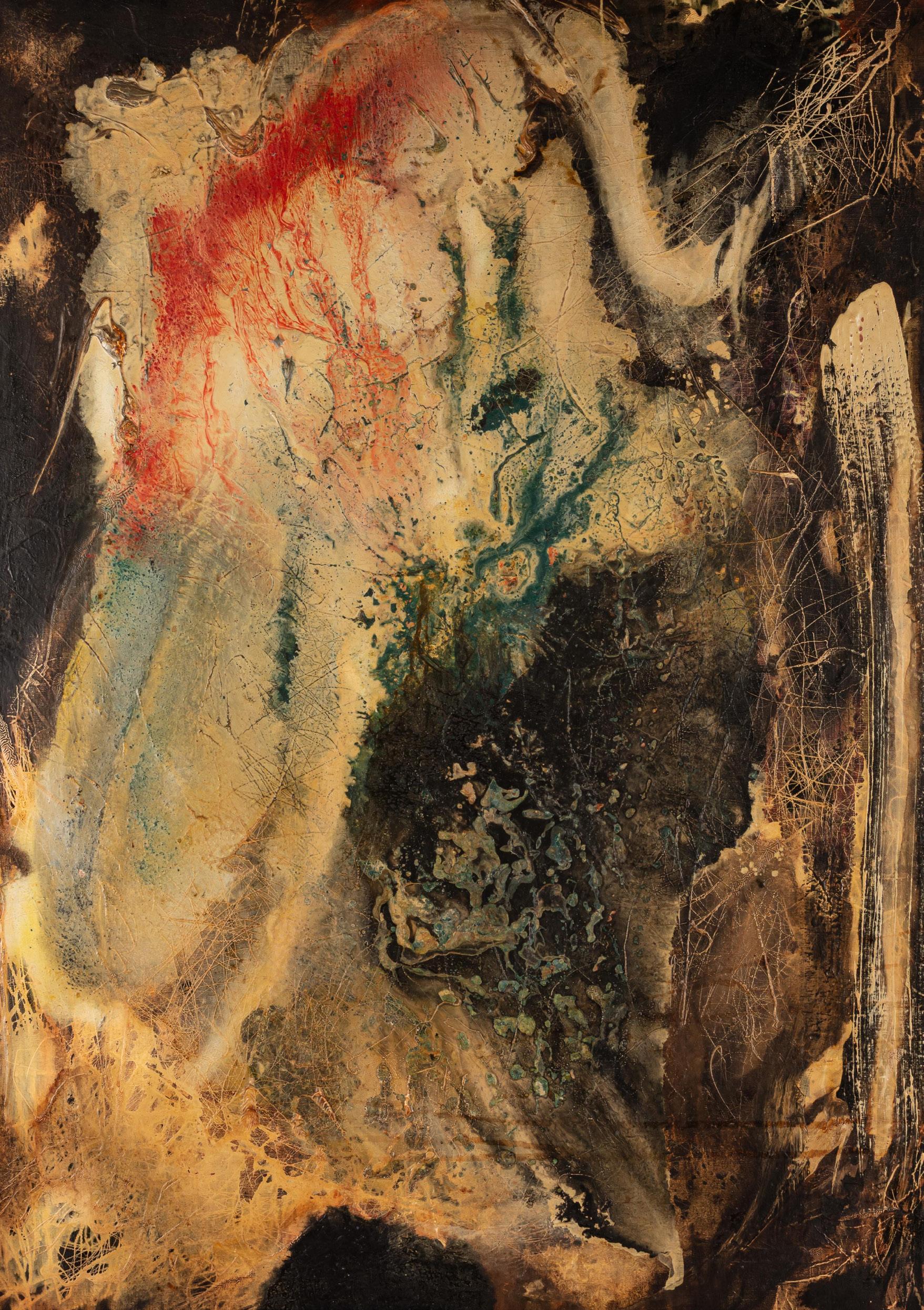
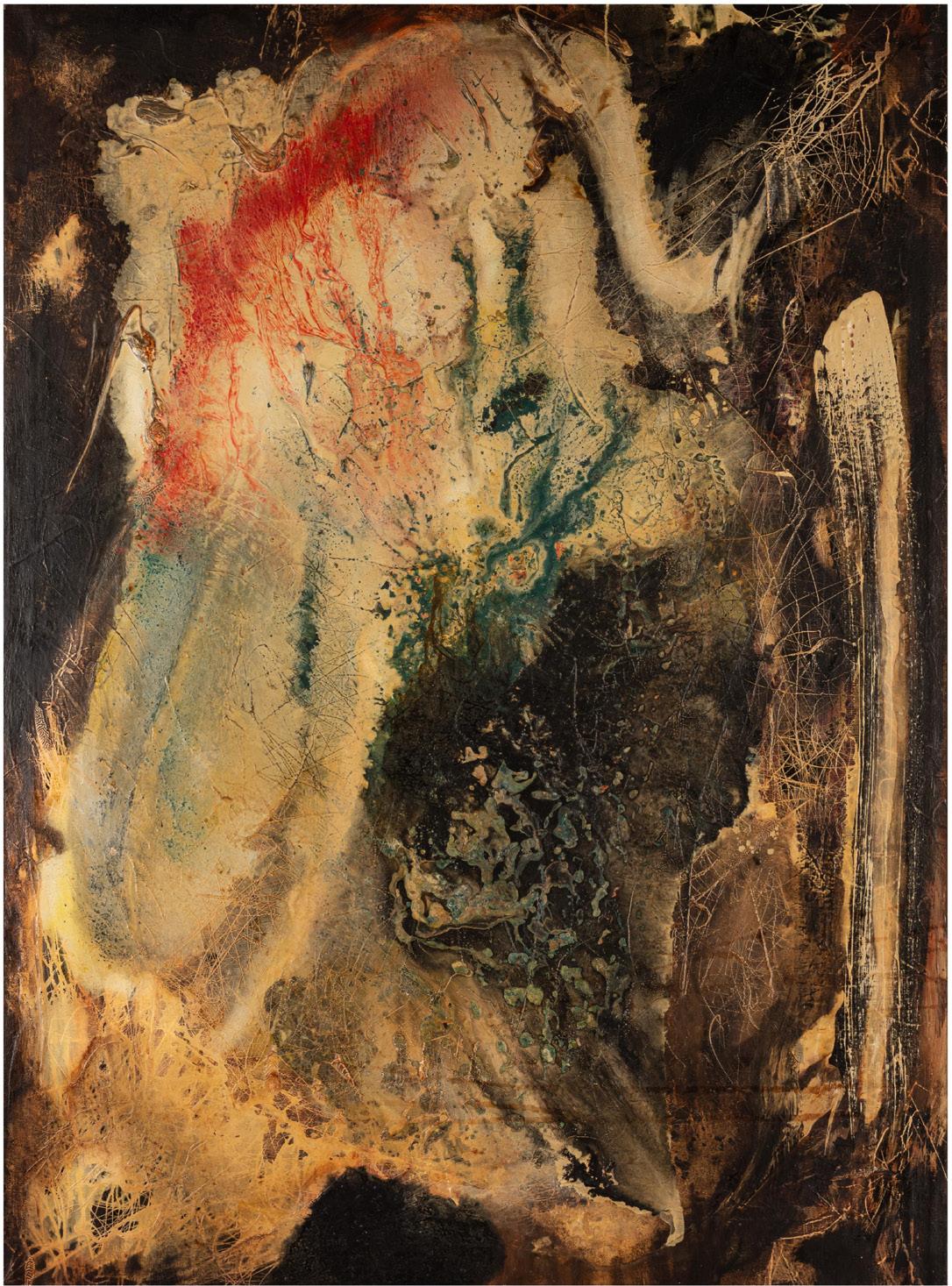
Paul Jenkins (American, 1923-2012)
Phoenix oil on canvas
Painted in 1955
Unframed: 130 x 97 cm. (51 1/4 x 38 1/4 in.)
Framed: 136.6 x 100.4 cm. (53 3/4 x 39 1/2 in.)
£10,000 - 15,000
Provenance
E.J. Power (1899–1993), London
With Galerie Rive Droite, Paris
With Arthur Tooth & Sons Ltd, London
The Collection of Lady Rosemary d'Avigdor Goldsmid, thence by descent
Exhibited
Cambridge, Arts Council Gallery, New Trends in Painting: Some Pictures from a Private Collection: Tachisme and Action Painting, 20 Oct-10 Nov, 1956, cat.no.22; this exhibition travelled to York, City Art Gallery, 17 Nov-8 Dec; Liverpool, Walker Art Gallery, 15 Dec-29 Jan 1957; Newcastle, Hatton Gallery, 14 Feb-7 Mar; Edinburgh, The Arts Council Gallery, Mar-May, and London, The Arts Council Gallery, 25 May-22 Jun 1957
Born in Kansas City, Missouri, Paul Jenkins became recognized as a key secondgeneration American Abstractionist, celebrated for his stained, large-scale canvases. Jenkins’s technique of the controlled poured canvas is characteristic of many of his artworks. He used the technique of pouring liquid paint, oils, acrylics, and enamels directly onto canvases and allowed the paint to drip, bleed, and pool naturally into fluid abstract washes of colour. His finished works are celebrated for their vibrant, jewel-toned, and translucent colours. The layers often resemble natural elements like oceanic pools, ceramic glazes, wind, tides, or vibrant smoke. Phoenix (1955) is no exception.
His early years based in the Midwest laid the foundations for what was to define his working practice. Growing up in Kansas City, Jenkins worked in a local commercial ceramic factory. This experience later proved crucial in defining his artistic practice through his manipulation of materials, which went beyond traditional oil and paint. His experience with the ceramics craft enabled Jenkins to fully understand both colour theory and how to manipulate materials to create fluidity within his works.
Paul Jenkins occupies a unique and vital space in the history of mid-century modernism. While he is often categorised
within the broader umbrella of Abstract Expressionism, his true impact lies in how he bridged the gap between different artistic philosophies and pushed abstract art toward a more fluid, process-driven future.
Jenkins’s art occupies a space between the bold, aggressive, and impactful Abstract Expressionism of New York, expressed in works by Jackson Pollock and Willem de Kooning, and the materiality and unconventional approach used by European artists such as Jean Dubuffet and Pierre Soulages.
While Paul Jenkins is frequently discussed alongside the pioneers of the Colour Field movement, his relationship to it is nuanced. He was certainly a peer to Colour Field giants like Helen Frankenthaler and Morris Louis, and like them, he was obsessed with expansive areas of vibrant, poured colour.
However, Jenkins deliberately stood apart from the strict Colour Field dogma. He engineered a completely different technical approach that gave his work a distinct, luminous signature because he used a primed surface; his paintings interact with light in a way that traditional Colour Field paintings do not. Jenkins was a maverick who defied strict categorisation, and because of this, he served as a crucial bridge between several major artistic movements, philosophies, and even continents.
38 §
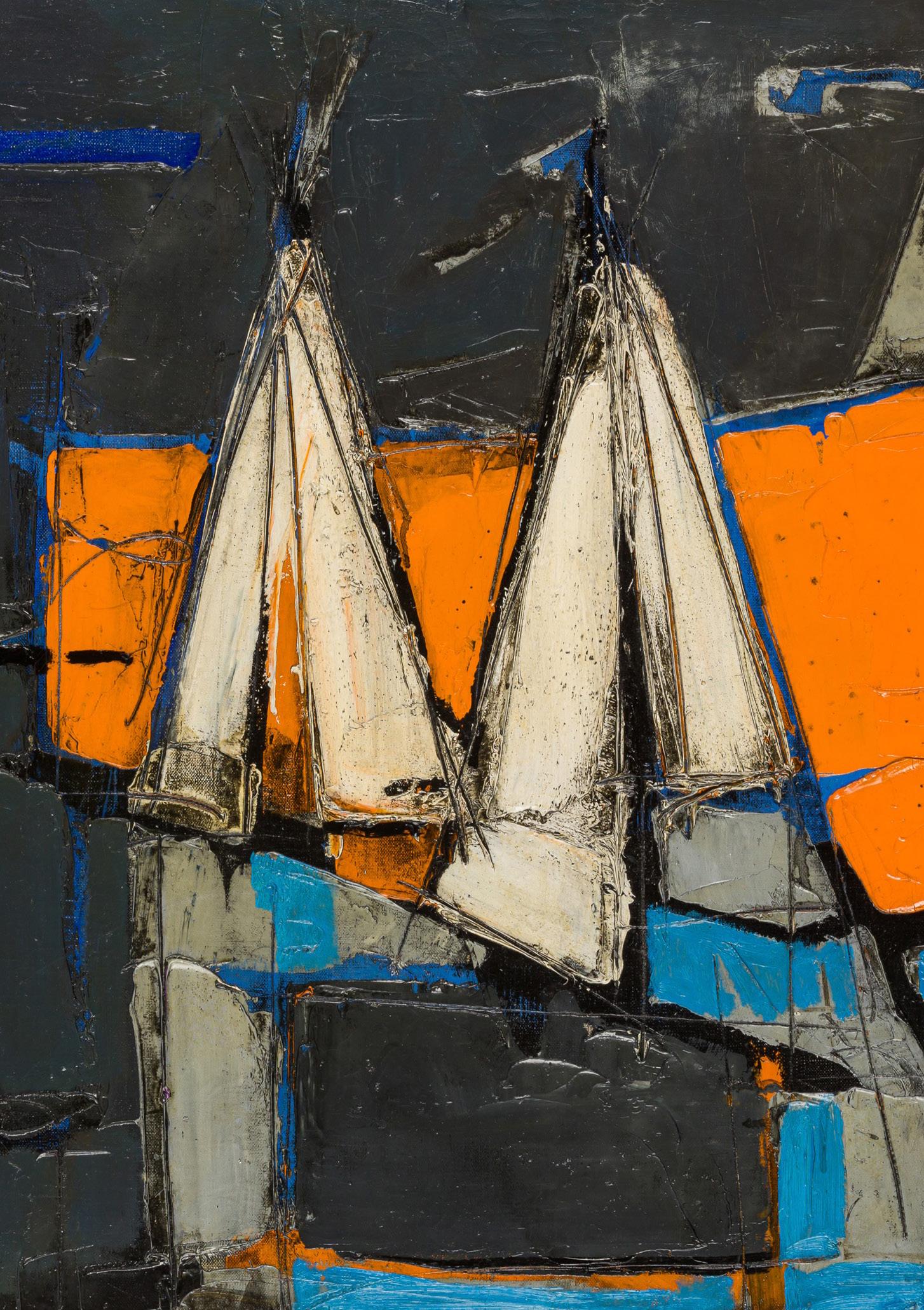
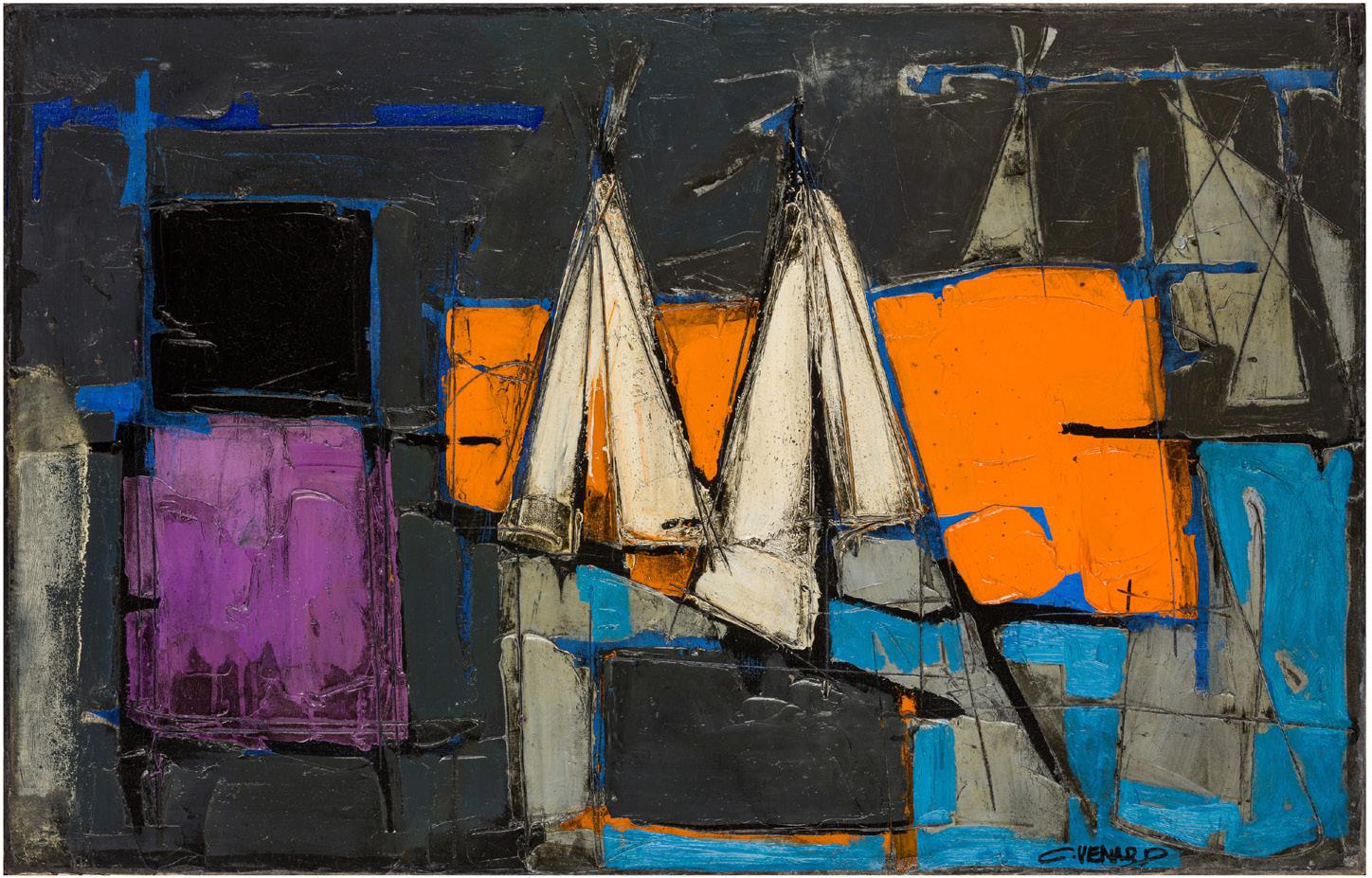
Claude Venard (French, 1913-1999)
Les Bateaux à Voiles signed 'C.VENARD' (lower right) oil on canvas
Painted circa 1955
Unframed: 65.2 x 100.2 cm. (25 5/8 x 39 1/4 in.)
Framed: 67 x 101.5 cm. (26 1/4 x 43 1/2 in.)
£6,000 - 8,000
Provenance
With Edgardo Acosta Gallery, Beverly Hills
Private Collection, London
Their sale; Sotheby's, Paris, 26 May 2008, lot 121
Claude Venard (French, 1913-1999)
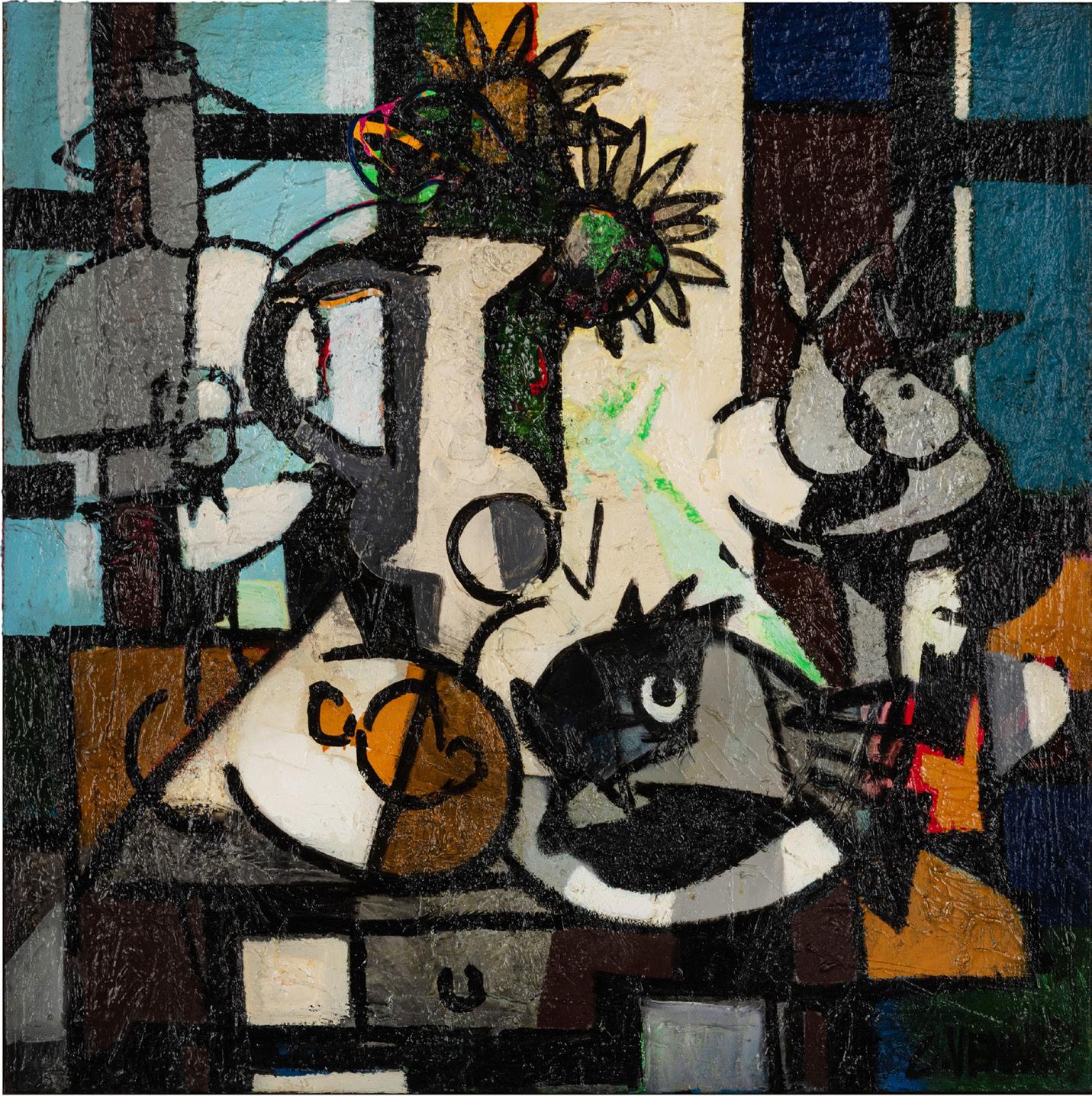
Nature Morte avec Poisson et Tournesols signed 'C.VENARD' (lower right); dated '1957' (to the canvas stretcher) oil on canvas
Unframed: 100 x 100 cm. (39 1/2 x 39 1/2 in.)
Framed: 101 x 101 cm. (39 3/4 x 39 3/4 in.)
£7,000 - 10,000
Provenance
Private Collection, Paris, 1998
A leading figure of the post-war École de Paris, Claude Venard is renowned for a distinctive post-Cubist style that deftly unites structural rigour with spontaneity. During the 1950s, Venard moved from the sombre realism of his youth towards a highly individualistic aesthetic that prioritised the physical presence of the medium. This mid-century maturity is marked by a mastery of the palette knife, employing thick layers of impasto which he would incise and scrape to reveal hidden depths of colour and form.
In Nature Morte avec Poisson et Tournesols, the composition centres upon a rhythmic interplay between the organic and the domestic. A towering white pitcher, anchored by heavy black outlines, serves as the principal vertical axis. From its mouth bursts a bouquet of sunflowers, their golden petals rendered with aggressive, sun-drenched strokes that echo the radiating energy of the artist’s technique. At the base rests a grey fish, a recurring motif in Venard’s oeuvre, its eye providing a singular, graphic focal point of stillness amidst the broken planes.
Venard’s still lifes appear fragmented and abstracted, as he deliberately combines multiple, layered views of his subjects within a single composition. The artist’s fascination with form and perspective is central, allowing the essence of the subject to emerge subtly through thick, richly textured brushstrokes, ultimately transforming a simple tabletop arrangement into a powerful exploration of light and matter.
Anton van Wouw (South African, 1862-1945)
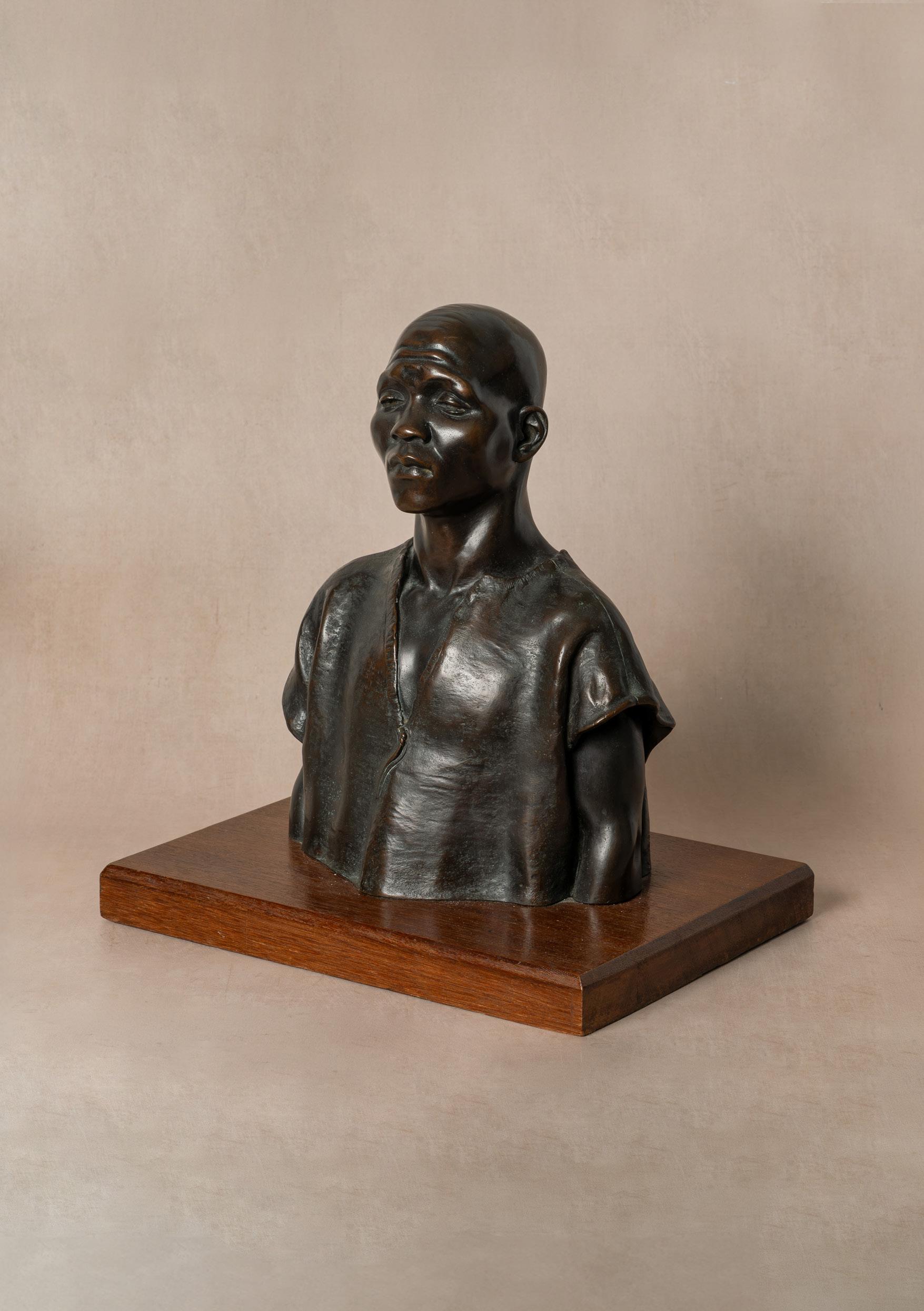
The Accused bronze with dark brown patina
33 cm. (13. in.) high
£5,000 - 8,000
Provenance
Private Collection, Cape Town, thence by descent
The Accused is among Anton van Wouw’s most psychologically nuanced works. The sculpture depicts a mineworker standing in quiet apprehension, his arms held close to his body, his brow furrowed, and his heavy eyelids conveying fatigue and uncertainty. While the figure’s legal position remains ambiguous, van Wouw imbues him with a palpable dignity, capturing a moment that is both deeply personal and emblematic of a broader social reality.
Van Wouw’s sensitivity to his subject reflects his wider engagement with the lives of migrant labourers in early twentieth-century South Africa. By the time he produced this work, Johannesburg had become the epicentre of a rapidly expanding mining industry, reliant on poorly paid workers drawn from across the region. Rather than treating such figures as ethnographic types - a tendency common among his contemporaries - van Wouw approached them as individuals. In The Accused, this manifests in the careful observation of posture and expression, suggesting not only the sitter’s immediate anxiety but also the disorientation of a man likely unable to fully comprehend the legal proceedings surrounding him.
Born in Driebergen in the Netherlands, van Wouw trained in drawing and modelling at the Rotterdam Academy before relocating to Pretoria in 1890. His early career in South Africa was marked by limited opportunities, but a pivotal commission from the industrialist Sammy Marks in 1899 for a monument to President Paul Kruger secured his reputation. He would go on to produce many of the country’s most recognisable public sculptures, including major monuments in Pretoria and Bloemfontein, establishing him as a foundational figure in South African sculpture.
Despite the prominence of these large-scale commissions, van Wouw’s smaller bronzes are often considered his most compelling achievements. Produced following the establishment of a syndicate in 1907 that supported the casting of editioned works in Rome, these sculptures frequently depict Boer and African subjects with remarkable immediacy and detail. His practice was grounded in a rigorous naturalism, informed by direct study from life models and characterised by meticulous attention to anatomical accuracy and surface texture.
While his work was rooted in European academic tradition, van Wouw’s sustained engagement with local subjects lends his oeuvre a distinctive character. The Accused exemplifies a work of technical refinement that also offers a quietly powerful commentary on the human condition within a specific historical context.
Babajide Olatunji (Nigerian, b.1989)
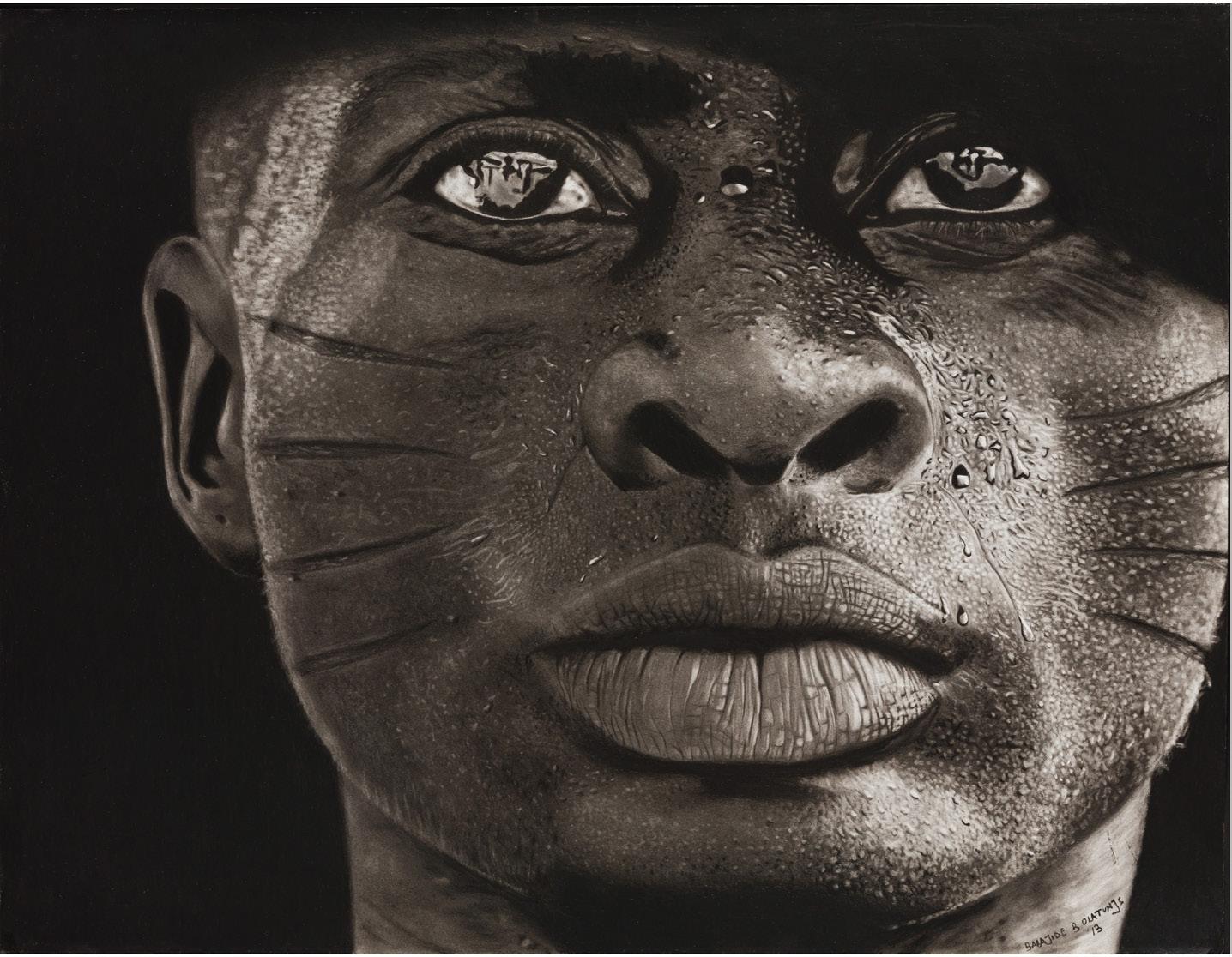
Tribal Marks no.1 signed and dated 'Babajide B Olatunji/'13' (lower right) charcoal and graphite
Unframed: 49.5 x 64.5 cm. (19 1/2 x 25 3/8 in.)
Framed: 58.3 x 72.8 cm. (23 x 28 5/8 in.)
£6,000 - 8,000
Provenance
Sale; Bonhams, London, 21 May 2014, lot 112, where purchased by the present owner
Babajide Olatunji is a self-taught hyperrealist artist who gained international attention as one of the youngest exhibitors at the Royal Academy of Arts Summer Exhibition in 2017. His work focuses on imagined subjects, rendered with meticulous precision. Best known for his Tribal Mark series, Olatunji examines the cultural significance of facial scarification within Yoruba society. His portraits depict fictional sitters, each constructed with a distinct identity, allowing the artist to explore themes of heritage and identity beyond individual likeness.
Tribal Marks No. 1 highlights his technical control and attention to detail, particularly in the rendering of skin and scarification. The work presents the face as both a visual and cultural surface, shaped by history and meaning.
§
A.R. Penck (German, 1939-2017)
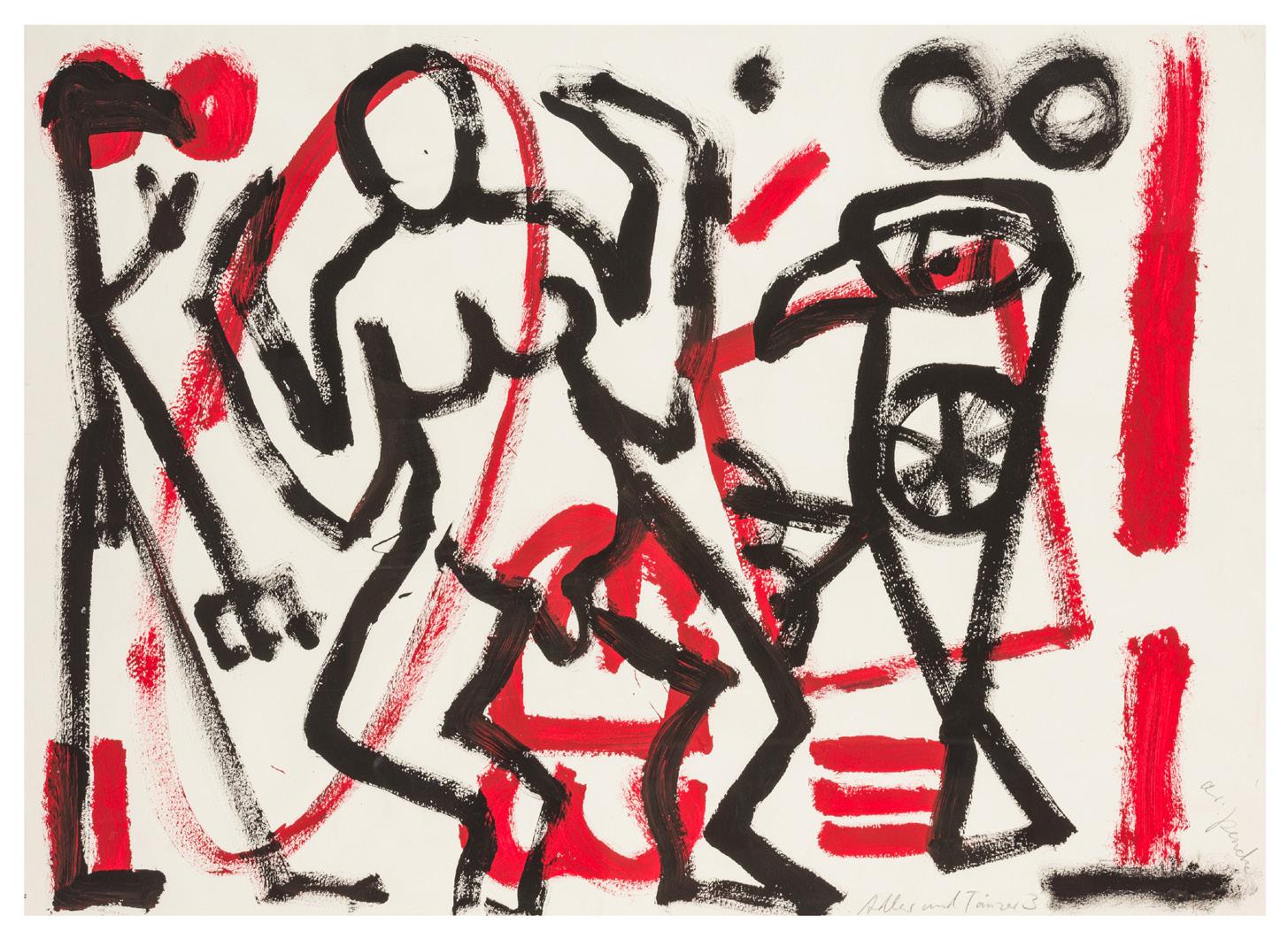
Adler und Tänzer 3 (Eagle and Dancer 3)
signed and titled 'a.r. penck, Adler und Tänzer 3' (lower right) gouache Executed in 1983
Unframed: 63.5 x 87.6 cm. (25 x 34 1/2 in.)
Framed: 81.5 x 114.5 cm. (32 x 114.5 in.)
£7,000 - 10,000
Provenance
With Galerie Michael Werner, Cologne, where acquired by Ernst Beyeler (1921-2010)
Sale; Christie's, London, 14 September 2011, lot 135, where purchased by the present owner
Born Ralf Winkler in Dresden, A. R. Penck was a painter, sculptor, and jazz musician, who emerged as a leading figure of German Neo-Expressionism. Early in his career, he pursued an uncompromising artistic path, co-founding the Erste Phalanx Nedserd group in defiance of academic orthodoxy. Working for years under close Stasi surveillance and enduring repeated censorship, he relied on the Cologne gallerist Michael Werner to smuggle works to the West; this period of pressure culminated in 1980, when his refusal to adopt and promote Socialist Realism propaganda resulted in his forced expulsion to West Germany. There, he became a central figure among the Neue Wilde (Young Savages), alongside Georg Baselitz and Markus Lüpertz, marking the height of his international recognition.
Painted in 1983, Adler und Tänzer 3 belongs to this pivotal period of artistic freedom and growing acclaim. The work exemplifies Penck’s concept of “Standart,” a visual language that fuses the notion of the banner (Standarte) with that of standardisation. Through the reduction of forms into pictographic signs, he developed a universal and accessible mode of expression. While his graphic vocabulary of stick figures and symbols is often likened to that of Keith Haring and Jean-Michel Basquiat, Penck’s imagery evolved independently as a politically charged response to censorship and lived experience in the GDR.
The composition stages a primal tension between human and mythic forces through a stark palette of black and crimson. At its centre stands the Tänzer (Dancer), its contorted limbs evoking a ritualistic, almost trance-like movement. This sense of fluidity is set against the rigid presence of the Adler (Eagle), a potent emblem of German heraldry, which is fragmented into a totemic, near-abstract form. Surrounding both figures, a charged field of red pigment creates a psychological space that feels at once archaic and immediate.
By stripping away any narrative detail, Penck compels the viewer to engage directly with the elemental force of his symbols. Adler und Tänzer 3 thus stands as a compelling articulation of his belief in art as a system of signs, one that negotiates the tension between individual agency and broader social structures. Today, his work is held in major institutional collections, including the Museum of Modern Art and the Städel Museum.
§
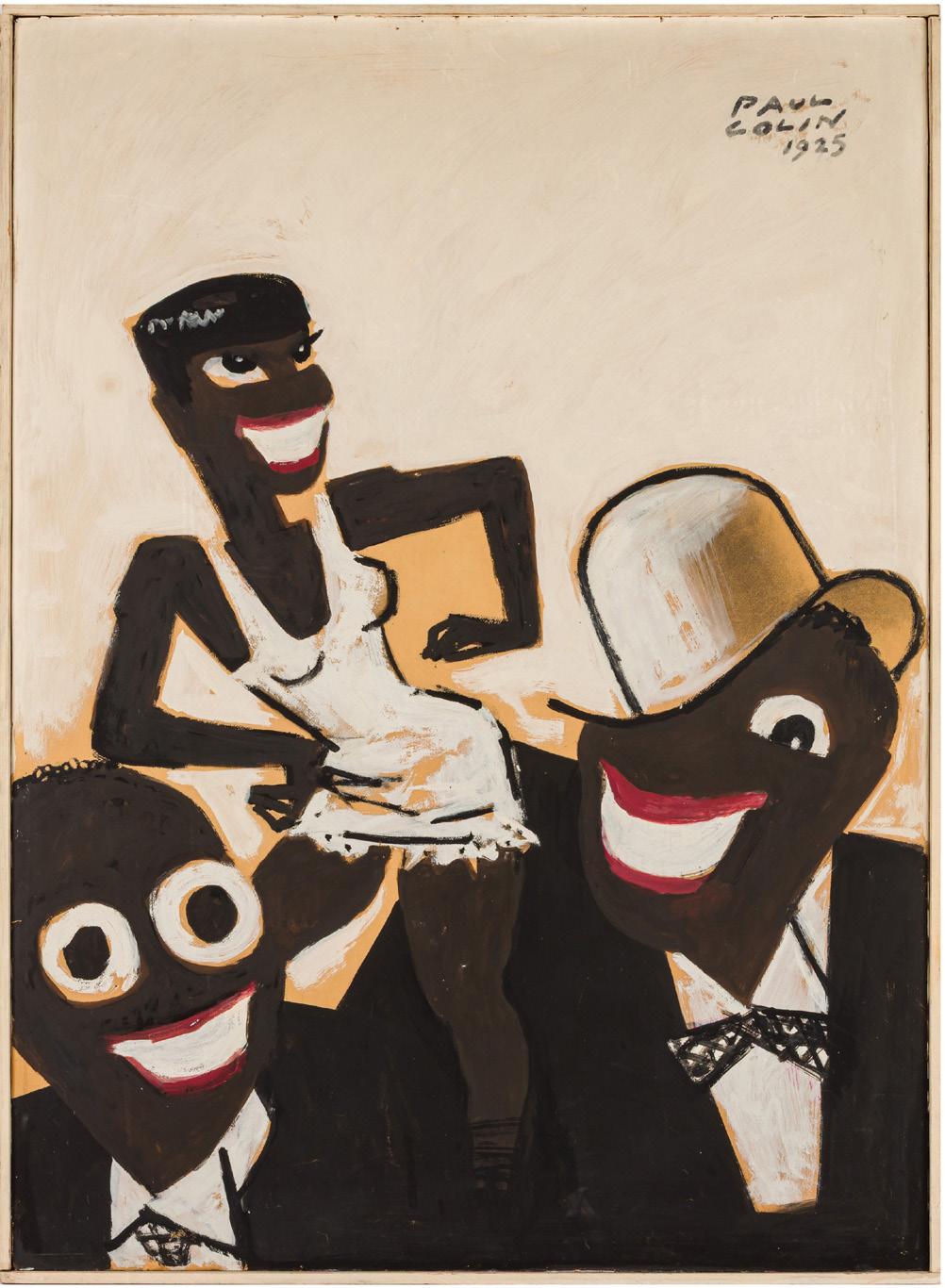
Paul Colin (French, 1892-1985)
La Revue Negre signed and dated 'PAUL/COLIN/1925' (upper right); inscribed and dated again 'La Revue Negre/théâtre ch. Élysées/1925' (verso) oil on board
Unframed: 100 x 72.8 cm. (39 3/8 x 28 5/8 in.)
Framed: 102 x 75 cm. (40 1/4 x 29 1/2 in.)
Please note this work is accompanied with a reproduction poster by the artist
£6,000 - 8,000
Provenance
With Lords Gallery Ltd, London, where purchased by Private Collection, U.K., from whom gifted to the family of the present owner, thence by descent
Exhibited
Paris, Musée des Arts Décoratifs, The Legacy and Heritage of Art Deco, 3 Mar-16 May 1966, cat.no.103
Josephine Baker (1906-1975) was an American-born French dancer, singer and cultural trailblazer who became an international icon of the Jazz Age. Born into poverty in St. Louis, Missouri, she began her career in vaudeville and Broadway chorus lines before her life changed decisively in 1925, when she joined La Revue Nègre, a troupe assembled by Caroline Dudley Reagan to introduce African American music and dance to Paris. Following rehearsals in New York and aboard the SS Berengaria, the production premiered on 2 October 1925 at the Théâtre des Champs-Élysées.
The revue proved a defining cultural phenomenon. While some critics celebrated it as a vital infusion of energy into a perceived stagnating French culture, others regarded it as a challenge to established artistic norms. At its centre was Baker’s danse sauvage with her partner Joe Alex, an uninhibited and highly theatrical duet that captivated audiences through its blend of eroticism and what was then framed as ‘primitivism’.
The visual identity of this phenomenon was shaped by the young French artist Paul Colin. Commissioned to design the poster, Colin drew directly from his observations of Baker in rehearsal, initiating a lifelong creative partnership. The resulting composition, executed in a bold palette of red, black and white, stands as a landmark of Art Deco graphic design. Using Cubistinflected distortion, Colin conveyed Baker’s rhythmic vitality, presenting her with slicked-
back hair and arms set akimbo at the apex of a human pyramid.
Yet the poster also reflects the racial stereotypes embedded within 1920s Parisian society. Baker’s depiction in minimal attire and an exuberant, exaggerated pose aligns with a broader primitivist fascination that frequently exoticised and objectified Black performers. In contrast, the two male figures are rendered through overt caricature, with exaggerated features derived from minstrel imagery that reinforce demeaning visual tropes positioning Black men as comic or subordinate figures. This stark visual duality underscores the tension between Baker’s agency in shaping her public persona and the racialised frameworks through which she was received, highlighting the complexities of her status as both a modern icon and a subject of projection.
The collaboration proved transformative for both figures: Baker became the most celebrated performer in France, while Colin emerged as one of the leading poster artists of his generation. Beyond the stage, Baker’s legacy extended into political and humanitarian spheres. She served with distinction in the French Resistance during the Second World War and became an outspoken advocate for civil rights in the United States. In 2021, she was inducted into the Panthéon in Paris, becoming the first Black woman to receive this honour, an enduring recognition of a life that navigated, and ultimately transcended, the constraints of race, performance and modern identity.
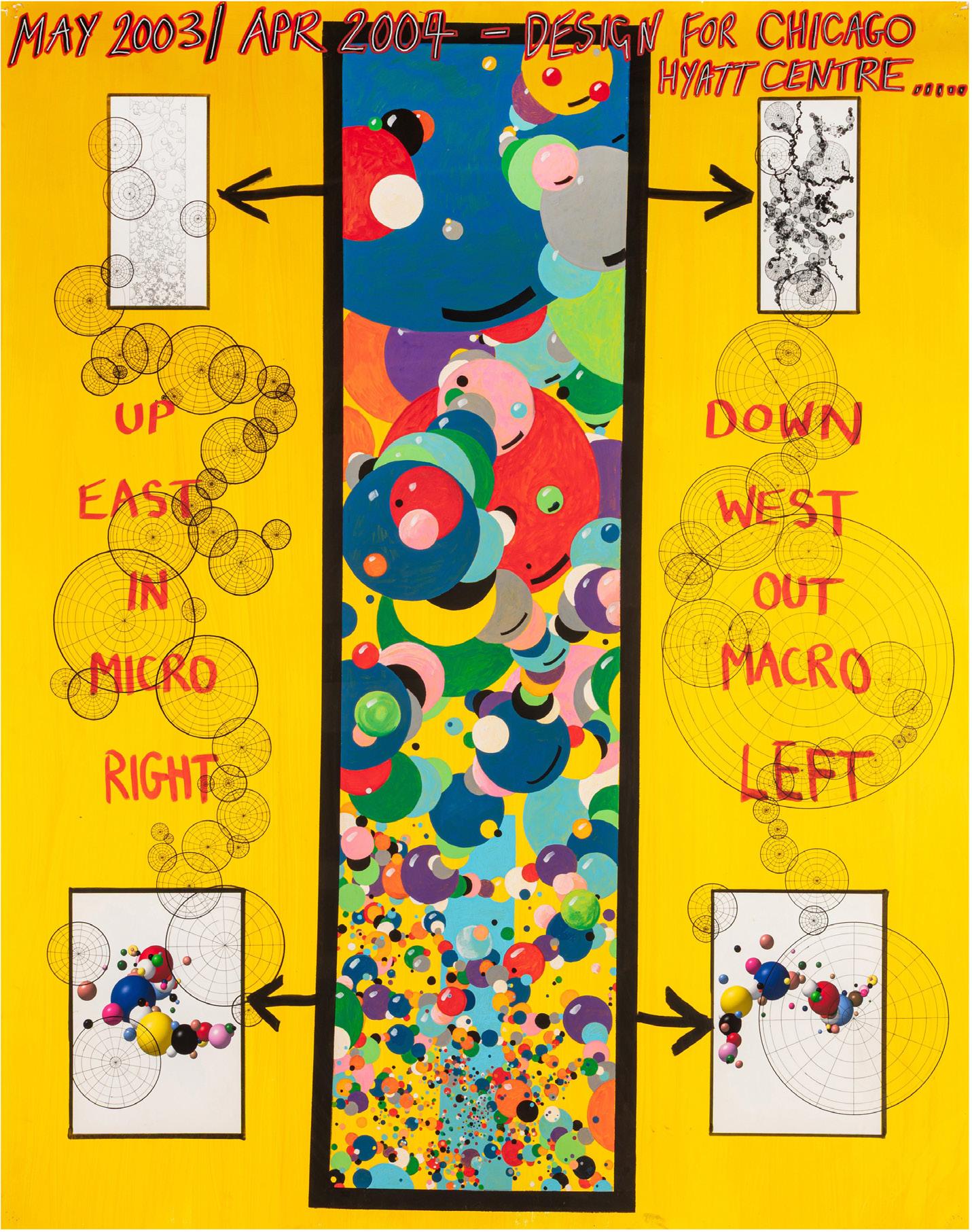
Keith Tyson (British, b.1969)
Studio Wall Drawing: MAY 2003/APR 2004 - Designs for Chicago Hyatt Centre
acrylic, collage and pen on watercolour paper
Executed in 2005
Unframed: 150.5 x 121 cm. (59 1/4 x 47 5/8 in.)
Framed: 157.4 x 126.3 cm. (62 x 49 3/4 in.)
£4,000 - 6,000
Provenance
With Haunch of Venison, London Sale; Phillips, London, 11 April 2019, lot 146
Studio Wall Drawing: MAY 2003 / APR 2004 - Designs for Chicago Hyatt Centre belongs to the artist’s ongoing Studio Wall Drawings series (1977-), a key strand of his practice in which the studio wall is transformed into a structured field of ideas, diagrams, and notes.
The work functions as a conceptual map rather than a finished pictorial composition. Tyson uses this format to record and organise thinking in real time, combining fragments of text, schematic diagrams, and abstract visual structures. The result is a dense, systemlike composition that reflects the processes behind the generation of ideas rather than a singular resolved image.
This particular drawing relates to design thinking for the Chicago Hyatt Centre, operating as a speculative set of proposals and conceptual instructions rather than a literal architectural blueprint. As with other works in the series, it blurs the boundaries between art, design, and architecture, presenting the studio itself as a site of continual production and analysis.
The Studio Wall Drawings are central to Tyson’s practice, exemplifying his interest in systems, knowledge structures, and the mechanics of creativity. Rather than illustrating a fixed outcome, the work documents the evolution of thought, positioning process itself as the subject.
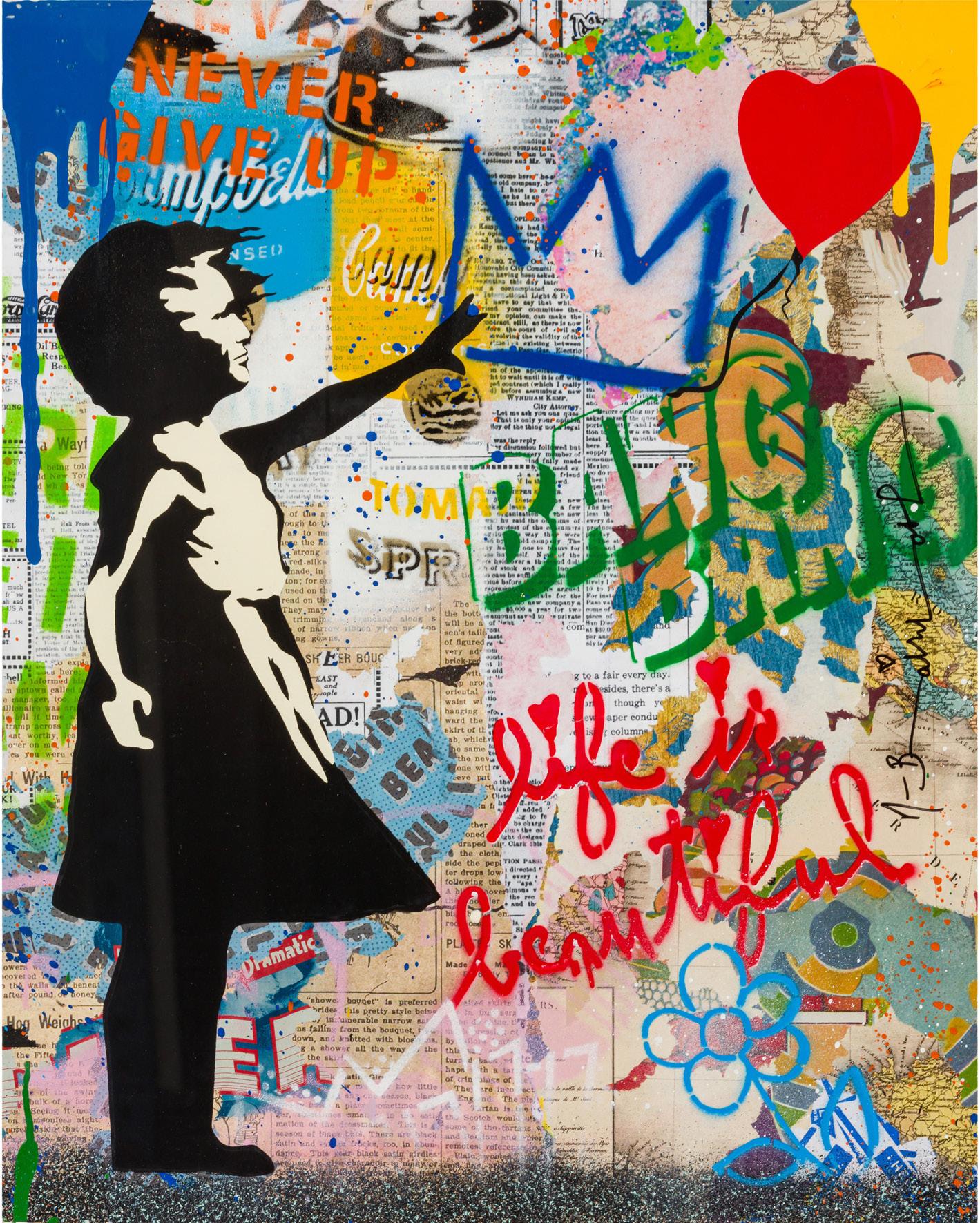
Mr Brainwash (French, b.1966)
Balloon Girl
signed and dated '2024/Mr Brainwash'; further signed with artist insignia (verso) mixed media on paper
Unframed: 50.5 x 40.5 cm. (19 7/8 x 15 7/8 in.)
Framed: 66 x 55 cm. (26 x 21 5/8 in.)
Please note this work is accompanied with a Certificate of Authenticity
£1,500 - 2,500
Provenance
With Clarendon Fine Art, Britannia, where purchased by the present owner
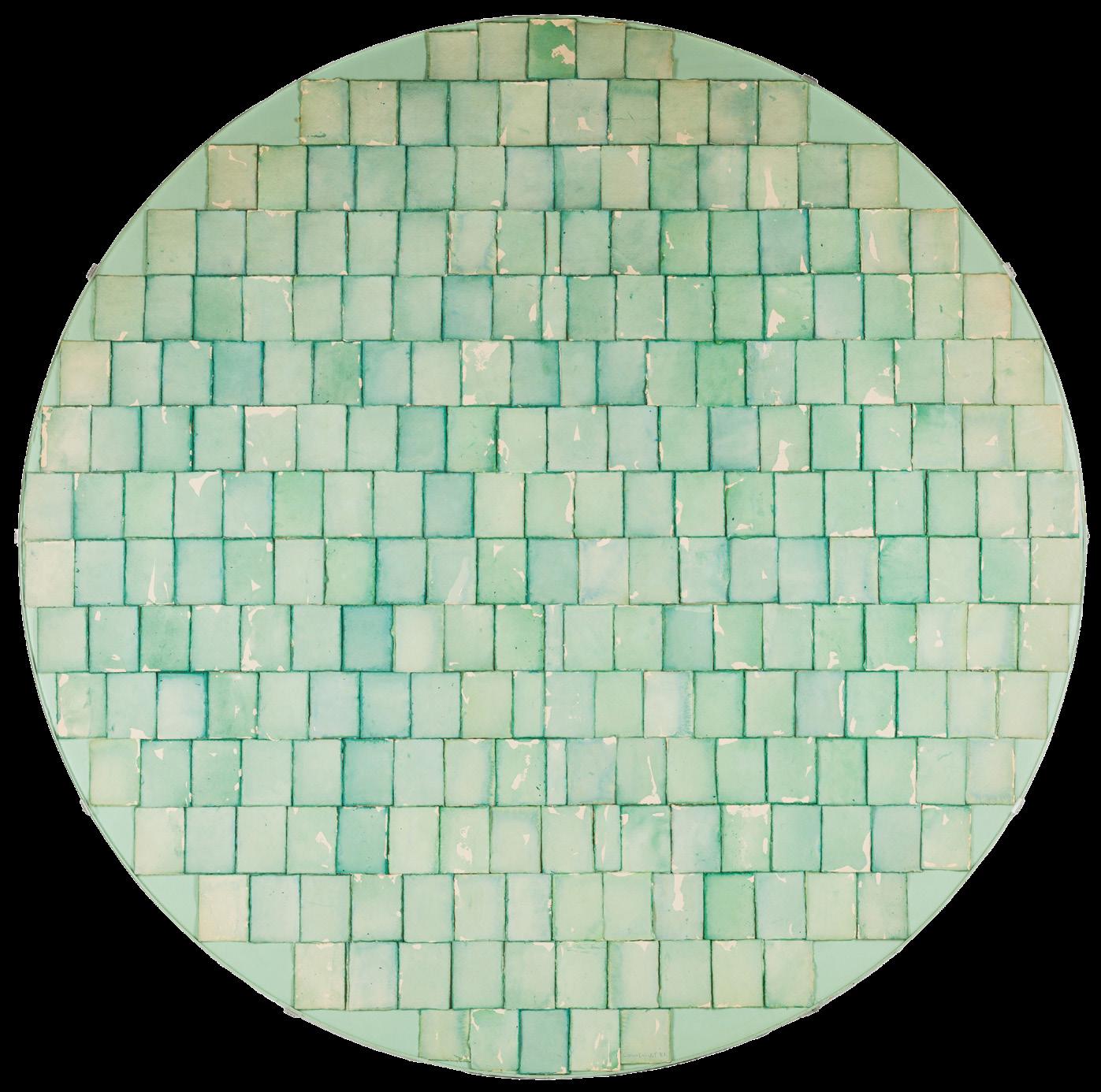
Robert Courtright (American, 1926-2012)
Untitled (Round Pale Green) signed and dated 'Courtright '81' (to a backboard) collage
125.5 cm. (51 in.) in diameter
£2,000 - 3,000
Provenance
With Andrew Crispo Gallery, New York, 20 July 1981, where purchased by the family of the present owner, thence by descent
Robert Courtright was an American artist known for his precise, architectural approach to abstract collage. Working primarily with cut paper, acrylic, and mixed media on board, he developed a disciplined visual language based on geometry, repetition, and subtle material variation. His career was strongly influenced by his time in Rome in the early 1950s, where classical architecture and structured urban forms shaped his sense of composition. Rather than depicting imagery, Courtright constructed visual systems that resemble fragments of architectural plans or ordered spatial fields.
Term and Conditions for Buyers at Chiswick Auctions
1. BEFORE THE SALE
1.1 Agent for the seller
Unless otherwise agreed, Chiswick Auctions Ltd, hereafter referred to as CA LTD acts as agent for the seller. The contract for sale of the property is therefore made between the Seller and the Buyer.
1.2 Definitions
For the purposes of the current Terms and Conditions, the Seller shall be defined as the owner of the Goods. It is implied that the Seller is the legitimate owner and is authorised to sell the Lot. The Bidder is any registered person participating in the auction, and the Buyer is the successful Bidder for a particular Lot.
The Lot means the item(s) put up for sale by CA Ltd and to which the present Terms and Conditions apply.
1.3 Catalogue descriptions
Any representation in any catalogue or otherwise as to the origin, date, age, attribution, authenticity or estimated selling price of any lot is a statement of opinion only. Such statements do not constitute a representation warranty or assumption of liability by CA Ltd in relation to the Lot. Any prospective Buyer should satisfy themselves prior to the sale as to the reliability of the catalogue description. The absence of mention related to prior restorations in the catalogue descriptions does not imply that the good is exempt thereof.
Photographs of any Lot provided by CA Ltd are for indicative purposes only and are not deemed to be a precise representation of the said Lot.
The Buyer is advised to seek independent expert advice in order to be assured of the authenticity and true state of the good.
1.4 Inspection
Prior to auction, prospective purchasers are strongly advised to personally examine any property in which they are interested to satisfy themselves in relation to matters which may concern them.
1.5 Condition report
CA Ltd may issue a Condition Report on request prior to the sale. This Condition Report is for identification purposes only and cannot be considered as giving a precise account of the Lot’s true state. Thus, some imperfections and faults may not be accounted for in the Condition Report.
As aforementioned, and in the absence of any contractual value of the Condition report, it is the Buyer’s sole duty to inspect in person the Lot in order to be assured of its true condition and CA Ltd shall not be responsible for assertions within the Condition Report hereto.
1.6 Electricals
All electrical items are sold as seen and CA Ltd offers no guarantee as to the working condition of such items or their safety. It is the Buyer’s duty to take necessary steps to be assured that the Lot is safe for normal use.
1.7 Estimates
Estimates are based on various factors inherent to the situation of the market at the time of the sale, as well as considerations such as the condition, rarity, or quality of the item etc. Estimates are only indicative and represent the opinion of CA Ltd. Estimates provided by CA Ltd cannot constitute a guarantee as to the value of the good. Subsequently, goods may sell at prices lower or higher than the provided estimates.
1.8 Reserves
Many Lots are offered subject to a reserve, which is the confidential minimum sale price. The reserve will never exceed the low estimate printed in the catalogue. CA Ltd may open the bidding on any Lot
below the reserve by placing a bid on behalf of the seller, and may in their discretion continue to bid up to the reserve price. This can be achieved by bidding in response to other bidders or alternatively by placing consecutive bids.
1.9
Registration to the sale
New bidders will need to register prior to the sale. It is strongly advised bidders register at least 24 hours before the sale.
Registration thereafter shall be at the auctioneer’s entire discretion. International bidders may be required to register 48 hours before the sale and to submit bank details.
A deposit may be requested prior to each sale.
Failure to register shall result in the impossibility for the bidder to purchase a Lot.
1.10 Proof of identity
Bidders not previously known to CA Ltd will be required to provide:
• Official proof of identity in the form of a passport or photocard driving licence. No other forms of ID are acceptable.
• Proof of address of main residence. Only official documents showing name and address will be accepted.
• Both landline and mobile telephone numbers
• A bank reference for foreign bidders may be requested
• Corporate clients will have to provide a certificate of incorporation prior to the auction, along with the representative’s ID in accordance with the above mentioned requirements for proof of identity.
Any Bidder that does not match the provided identity for registration may not purchase during the sale.
2. DURING THE SALE
2.1
Attendance at auction
Attending the auction in person is recommended.
CA Ltd has the right at their absolute discretion to refuse participation in any auction, to reject any bid, and to refuse admission to the premises.
Bidders are not obliged to be present in person at the auction. Absentee bidders shall be required to make necessary arrangements with CA Ltd prior to the sale.
2.2 Personal bidding
Bidders attending the auction in person shall be required to collect a unique bidding paddle prior to bidding in the sale.
2.3 Commission bids
CA Ltd will use reasonable efforts to carry out Commission bids received by them prior to the sale for the convenience of clients who are not present at the auction in person. Execution of Commission bids is a free service provided to help clients and CA Ltd does not accept liability for any failure to execute a Commission bid or for errors and omissions in connection with it.
Commission bids shall be executed at the lowest possible price, subject to competing bids and reserves. Although CA Ltd will endeavour to inform Buyers, it is the Buyer’s responsibility to check if they have been successful in purchasing a Lot.
In the event of multiple commission bids set at the same price, the first registered commission bid will take priority.
2.4 Telephone bids
If a bidder is not able to attend in person an auction, CA Ltd will use reasonable efforts to contact prospective Buyers who make arrangements prior to commencement of the sale to bid by telephone. CA Ltd cannot be held responsible in the event of issues affecting connectivity, resulting in the loss of a chance of purchasing the Lot for the Bidder.
2.5 Internet bids
Some sales may be available to internet bidding, as well as personal attendance. In this event, CA Ltd shall not be held responsible for issues affecting connection. In addition to having our own in-house online bidding platform, some sales are also offered with online live bidding by third party platforms, CA Ltd is not responsible for any issues that may arise during registration or untilising said platforms. CA ltd encourages prospective bidders to bid directly with Chiswick Live or via traditional direct in-house means wherever possible.
2.6 Bidding on behalf of someone
A Buyer may bid by proxy. In this event, proof of identity of both the Buyer and the proxy must be communicated to CA Ltd prior to the sale. A copy of the mandate shall also be required.
2.7 Bidding on an item
Bid incrementation is at the auctioneer’s entire discretion.
2.8 Video transmission
For the purpose of the sale, Lots may be displayed on video during the auction. In the event of transmission issues, CA Ltd shall not be held responsible for any subsequent outcome.
2.9 Online-only auctions
Some auctions may only be available to bidders via an online platform sale. In this event, Buyers have a 14 day period from the receipt of goods to withdraw from the sale, in accordance with EU Consumer Law. This returns policy relates only to lots where physical viewing of lots prior to sale is not offered by CA Ltd.
2.10 Dispute resolution during the auction
Any dispute shall be settled at the auctioneer’s absolute discretion. Under no circumstances will a sale be cancelled after the fall of the hammer, except at the auctioneer’s entire discretion.
3. CONTRACT FORMATION AND EFFECTS
3.1 Contract of sale
The contract of sale is between the Buyer and the Seller. The Buyer shall be the bidder at the highest price at the fall of the hammer. The sale is deemed complete once the auctioneer announces its completion by the fall of the hammer and the contract shall be binding thereafter between the Buyer and the Seller and CA Ltd.
When a Buyer purchases multiple Lots, each Lot is the subject of a separate contract of sale.
3.2 Transfer of property
Property of the goods shall pass to the Buyer only once CA Ltd has received full payment for the goods, this includes the price at the fall of the hammer as well as Buyer’s premium, relevant taxes, and costs in relation to shipping.
3.3 Transfer of risks
Purchased Lots shall be at the Buyer’s risk in all respects from the fall of the hammer, and neither CA Ltd nor their agents shall be responsible for any loss or damage of any kind, whether caused by negligence or otherwise.
3.4 Cancellation of the sale
At the fall of the hammer, the contract is formed between the Buyer and CA Ltd and is binding thereafter.
Under no circumstances can the Buyer cancel the sale.
CA Ltd may at its entire discretion, during or after the auction, cancel the sale of the Lot or reoffer and resell the Lot if it becomes aware of any error or dispute of any nature, whether or not title has passed to the Buyer, and up to a period of 6 months after the said sale.
Grounds for cancellation under the present section shall include
but not be limited to any dispute relating to the attribution or provenance of the Lot, ownership and title, fraud or deceit, lack of relevant licences or certificates, any subsequent changes in domestic or international legislations restricting the sale of export of goods etc.
In the event of internet-only auctions (where are no offered advanced physical viewing times), the Buyer shall have a 14 day right to retract, after receipt of the Lot, under EU Consumer Law. Public auctions are not covered by this right to retract.
4. AFTER THE SALE
4.1 Payment
All purchased lots must be paid for on the day of the auction. Commission bids must be paid for no later than the day after the auction. Payment must be made by cash, debit, credit card or bank transfer. We do not accept cheques. We do not currently accept American Express.
CA ltd adheres strictly to current anti-money laundering regulations and reserves the right to refuse payment or cancel the sale of any lot, should suspicion or evidence of regulation infringement arise.
The 2020 guidelines reference ‘Art Works’, but are as yet to be fully defined. As such, CA Ltd reserves the right to adapt buying/selling rules at any time, in order to maintain compliance.
Cash payments shall not be receivable for amounts over €10,000, regardless of the payment being for one or multiple Lots. As of 2020, new directives also extend to other forms of payment where the amount is in excess of €10,000 and this may require further information sharing covering both buyers and sellers.
Should it encounter contravention of said regulations, or is unable to bring buyers/sellers into line with said regulations through advice and support, CA ltd reserves the right to cancel any lot transaction and offer said lots to underbidders and where applicable will notify the relevant authority of the suspected contravention if deemed intentional.
Payments made by someone other than the registered Buyer shall not be accepted.
Title will not pass to the Buyer until CA Ltd has received all amounts due to them in cleared funds even if the Lot has been released to the Buyer.
4.2 Buyer’s Premium
The Buyer will pay CA Ltd a premium of 26% on the hammer price plus VAT on that premium on the first £500,000 and 12% plus VAT on the balance thereafter. A Buyer’s Premium of 21% plus VAT is charged on Wine & Spirits Lots.
The VAT payable varies by symbol as below:
No Symbol: The standard rate of VAT is charged on the premium under the Auctioneers Margin Scheme in accordance with Art. 333 of 2006/112/EC. Standard UK VAT will be charged on the buyers’ premium and invoiced on an inclusive basis.
†: Normal VAT rules apply and the standard rate of VAT will be charged on both hammer price and premium.
*: These lots have been imported from outside the UK for sale and placed under the Temporary Admission regime. Import VAT is payable at 5% on the hammer price. VAT at 20% will be added to the buyer’s premium but will not be shown separately on the invoice.
If you are re-exporting a * lot outside of the UK, you must use Chiswick Auctions Ltd TA Shipper.
4.3 Online Bidding Surcharges
Customers bidding through Chiswick Live are liable for a 1% surcharge on the hammer price, plus VAT. This is in addition to the Buyer’s Premium.
Customers bidding through the third-party auction platform thesaleroom.com are liable for a 4.95% surcharge on the hammer price,plus VAT. This is in addition to the Buyer’s Premium. Customers bidding through the third-party auction platforms
Invaluable.com, Artsy.net or Liveauctioneers.com are liable for a 5% surcharge on the hammer price, plus VAT. This is in addition to the Buyer’s Premium.
4.4 Taxes
VAT is payable on the buyer’s premium, and for some lots, VAT is payable on the hammer price. The successful bidder will be responsible to ascertain and pay any applicable taxes including VAT, sales tax or any equivalent tax arising on sale of a particular lot.
W.e.f. 1st January 2021 (Post Brexit), Private individual buyers based outside UK will now be charged VAT at the applicable rate and will not be able to claim a VAT refund.
Trade clients based outside UK and who arrange for their own shipping can get the VAT refunded if all the below conditions are met:
1. Have registered to bid with an address outside of the UK
2. Provide immediate proof of export out of the UK within 90 days from the date of the auction
Please note, we charge an administrative fee of £35 per invoice to check export documents and arranging VAT refunds. VAT refunds will be done to the original method of payment used by the buyer. No VAT will be refunded where the total VAT on an invoice is under £70.
Trade clients based outside UK and who arrange shipping with our recommended shipper JGM Shipping can get the VAT taken off the invoice prior to making payment. In order to do this, you must email katy.mcevoy@chiswickauctions.co.uk a confirmation of shipping with JGM Shipping. If you cancel or change the shipping with our recommended shipper, we will issue a revised invoice charging all applicable taxes.
4.5 Artist Resale Rights / Droit de Suite
Lots marked with ‘ARR’ may be subject to a levy.
Droit de Suite is a royalty payable to a qualifying artist or to the artist’s heir each time a work is resold during the artist’s lifetime and up to a period of 70 years after the artist’s death. Royalties are calculated on a cumulative sliding percentage scale based on the hammer price excluding the buyer’s premium. The royalty does not apply to Lots selling below the sterling equivalent of €1,000 and the maximum royalty payable on any single Lot is the sterling equivalent of €12,500.
Royalties for Droit de Suite are as follows:
• From 0 to €50,000 4%
• From €50,000.01 to €200,000 3%
• From €200,000.01 to €350,000 1%
• From €350,000.01 to €500,000 0.5%
• Exceeding €500,000 0.25%
4.6 Remedies for non-payment
If the Buyer fails to make full payment in cleared funds within the time required as aforementioned, CA Ltd shall be entitled to exercise any one or more of the following rights or remedies additional to such other rights or remedies available:
• To cancel the sale
• To resell the Lot on such terms by auction or otherwise entirely at CA Ltd’s discretion. The Buyer will be liable for all costs including legal fees incurred in the sale and will remain liable for any shortfall arising upon sale.
• To offset against any sums which CA Ltd may owe the Buyer the outstanding sums unpaid by the said Buyer
• Where the Buyer owes sums to CA Ltd in respect of different transactions, to discretionary apply any sum paid by the Buyer for discharge of any owed sums.
• To refuse entry to the Buyer at any future auction and/or reject any future bids by the Buyer and/or seek a deposit from the Buyer entirely in the discretion of CA Ltd.
• To exercise a lien over the Buyer’s property in the possession of
CA Ltd as collateral for any outstanding sums owed and to exercise all the rights and remedies of a person holding security over any such property, whether by way of pledge, security interest or in any other way to the extent permitted by Law.
• To commence legal proceedings for the recovery of the total amount due together with interest, legal fees and costs.
• To take such other action as is permissible by Law and in the discretion of CA Ltd.
4.7 Collection
Purchased Lots can be collected from the auction room after the sale has ended or between 10am and 6pm up until close of business on the Friday following the sale. Special arrangements may be made for collection on Saturday at CA Ltd’s discretion. Any delay in collection must be communicated clearly to CA Ltd in advance of the collection deadline and CA Ltd reserves the right to impose charges thereafter at its utter discretion (see 4.7).
4.8 Storage
CA Ltd offers a discretionary 14 days free storage on purchased and unsold Lots from the date of the sale. Thereafter Lots not collected shall incur storage charges of £5.00 per lot, per day or part thereof for smalls and pictures (defined as anything that can be handled by one person) and £10.00 per lot, per day for furniture and other larger lots. CA Ltd shall be entitled to retain said Lots until all sums due have been paid to CA Ltd. If any lot remains uncollected 21 days after the sale, storage charges shall thereafter be £10/£20 (smalls/ larger items) per day and CA Ltd shall, in accordance with the Law, have the right to sell the purchased Lot to recover payment of storage charges outstanding. Any balance proceeds of sale received after payment of all sums outstanding and due to CA Ltd shall be held for the account of the Buyer.
4.9 Shipping
Any shipping costs that may arise subsequent to the sale shall be at the Buyer’s expense. Such costs may include but not limited to postage, import and export permits where required and any other licence necessary for goods to be shipped outside of the European Union.
CA Ltd does not offer insurance for shipping. However, CA Ltd may arrange insurance upon the Buyer’s request and at the Buyer’s expense.
CA Ltd cannot be held responsible for any damages that may be incurred to goods prior to the fall of the hammer.
4.10 Loss or Damage
CA Ltd does not accept liability for loss or damage occurring to Lots after the sale. CA Ltd will use reasonable efforts when handling Lots, but shall not be responsible for any loss or damages that may occur whilst the said Lot is in any third party’s care.
4.11 Cultural Goods import and export restrictions
Cultural goods may be subject to import and export restrictions. Under EU Regulations related to the trade of cultural goods, export licences may be required for export outside of the European Union if the item’s value exceeds the EU threshold. Under UK Law, a licence may also be required for intra-EU trade.
Licenses are issued by Arts Council England and it is the Buyer’s duty to obtain them. Some countries restrict the import of specific cultural goods. For example, the United States prohibits the import of pre-Columbian monumental or architectural sculpture or murals, as well as any cultural goods in provenance from some countries subject to armed conflicts.
The Buyer must verify local legislation prior to the sale in order to be assured that import or export is possible.
4.12 CITES
Import and export restrictions
Certain endangered species are listed in the CITES Convention. Listed specimens and any parts or products thereof are subject to
issuance of an export permit when leaving the European Union. Appendix I species, are also subject to issuance of a prior import permit from the country in which the goods are to be imported. Such permits are necessary before applying for export permits and it is the Buyer’s duty to initiate the proceedings with the relevant authority.
The Buyer must be aware that certain countries prohibit the import of some species or any parts or products derived thereof. For example, the United States prohibit all import of African elephant ivory, and any item containing parts that may merely resemble African elephant ivory must be accompanied by relevant documentation stating it is not the latter.
Worked items that are dated before 1947 are exempt from import restrictions for intra-EU trade and shall not require export licences. Please be aware that all Lots marked with the symbol λ are subject to CITES regulations.
4.13 Limitation of liability regarding CITES export licenses
Where licences are required for importing or exporting outside of the European Union, it is the Buyer’s duty to obtain them. CA Ltd cannot be held responsible if the Buyer’s application for an export permit is unsuccessful. Subsequently, in the event of failure thereof, CA Ltd shall not permit cancellation or rescission of the sale.
4.14 Warranties
CA Ltd does not provide the Buyer with warranties relating to any Lot, unless required by Law.
4.15 Authenticity warranty
In the event of a Lot being sold as authentic under the catalogue description and the Buyer provides evidence in the form of a written report by a recognised expert or test results that the said Lot is not authentic, CA Ltd will refund the purchase price.
The Buyer shall give notice to CA Ltd within 28 days from knowledge or any event giving reasons for suspecting that the item is not authentic, and within one year of the said sale. Any claim thereafter shall not be receivable. For the purposes of the present paragraph, authenticity shall be defined as the state of a Lot that is genuine and not a forgery or a copy.
5. ANTIQUITIES AND TRIBAL ART
5.1 Import and export restrictions and regulations
Archaeological goods over 100 years of age, unless covered by exemption of limited scientific interest, will require an EU Licence for export to a third country, regardless of their value.
It is recommended that the Buyer contact the Export Licensing Unit at Arts Council England in order to be assured the good is or not of limited archaeological or scientific interest.
Archaeological goods found on United-Kingdom soil or in UK territorial waters over 50 years of age shall require a UK Licence regardless of their value and regardless of the export destination. Other archaeological objects regardless of their origin will require an Individual Licence or OGEL depending on their value.
Both European-Union and UK Licences may be required simultaneously for some items. It is the Buyer’s duty to undertake the necessary steps. CA Ltd cannot be held responsible and the sale cannot be cancelled in the event of failure to obtain the relevant licences.
6. JEWELLERY
6.1 Gemstone treatment and estimates
Many gemstones on the market have been treated so as to augment their appearance, in a reversible or permanent manner. Treatments under the present section may be but not limited to:
• Heat treatment to enhance sapphires and rubies’ clarity and colour
• Oil and resin treatments for emeralds applied in different ways, to enhance clarity of the stone
• Staining
• Irradiation
• Coating
Estimates provided by CA Ltd are deemed to be based on the fact that the gemstone may have been subject to any type of treatment in the past. CA Ltd shall not be responsible in the absence of mention thereof.
A certificate may be issued by a laboratory, providing with detailed information on the condition of the gemstone and any treatment applied thereto. The Buyer must be aware that different laboratories have different approaches as to the degree or type of treatment for a particular gemstone.
If a certificate accompanies the Lot, the Buyer must be aware that it is merely a statement of the laboratory’s opinion and in no way can CA Ltd be held responsible for any mentions therein. Such certificates are deemed to be delivered with the Lot for informative purposes only.
6.2 Estimated weights
If a stone’s exact weight appears within the body of the description, the stone has been un-mounted and weighed by CA Ltd. If the weight of a stone is stated to be approximate, the stone has been assessed by CA Ltd within its setting, and the defined weight is a statement of opinion only. This information is given as a guide and bidders should satisfy themselves with regard to this information as to its accuracy.
6.3 Signatures
‘A diamond ring, by X’: When the maker’s name appears in the title, in Chiswick Auctions’ opinion the piece is by that maker.
‘A diamond ring, signed X’: Has a signature that, in Chiswick Auctions’ opinion, is authentic but may contain gemstones that are not original, or the piece may have been altered.
‘A diamond ring, mounted by X’: Has been created by the jeweller, in Chiswick Auctions’ opinion, but using stones or designs supplied by the client.
‘Maker’s mark for X’: Has a maker’s mark which in Chiswick Auctions’ opinion is authentic.
Some items may include parts or products derived from endangered species, such as ivory or coral. Such items may be subject to import or export restrictions. See section on CITES regulations for more details.
7. CLOCKS AND WATCHES
All Lots are sold as seen. Clocks and watches are therefore not deemed to be sold in working condition. Absence of reference thereof in the description does not imply that the Lot is in good condition and without defects, or has been subject to repair or restoration.
CA Ltd makes no representation or warranty that any clock or watch is in working order. As clocks and watches often contain fine and complex mechanisms, bidders should be aware that a general service, change of battery or further repair work, for which the Buyer is solely responsible, may be necessary.
Most clocks and watches are likely to have been repaired in the past, and as a result may include parts that are not original thereto.
The United-States restrict the importation of watches such as Rolex, Frank Muller or Corum. Such models can only be imported personally by the Buyer and CA Ltd cannot assist with shipping thereof.
Some watches may include leather straps derived from endangered species. Buyers may be required to obtain appropriate permits for import or export purposes in accordance with CITES regulations. CA Ltd acts in compliance with such legislations and shall take necessary steps where required. Subsequently, watches may be deemed sold without their straps.
8.1 Upholstered furniture after 1950
According to The Furniture and Furnishings (Fire Safety) Regulations 1988, furniture that was upholstered after the 1st of January 1950 is subject to restrictions in the United-Kingdom. Exempt upholstered furniture that does not meet such requirements is deemed sold for purely aesthetic purposes. CA Ltd shall not be responsible for later alterations to the furniture, making it unfit for sale.
9. GLOSSARY OF PICTURE CATALOGUING TERMS
Any Statement as to authorship, attribution, origin, date, age, provenance and condition is a statement of opinion and is not to be taken as a statement of fact. The Company reserve the right, in forming their opinion, to consult and rely upon any expert or authority considered by them to be reliable.
1 JMW Turner: In our opinion a work by the artist. When the artist’s forename(s) is not known, a series of asterisks, followed by the surname of the artist, whether preceded by an initial or not, indicates that in our opinion the work is by the artist named.
2 Attributed to JMW Turner: In our opinion probably a work by the artist, but less certainly as to the authorship expressed than in the preceding category.
3 Studio of JMW Turner: In our opinion probably a work by an unknown hand in the studio of the artist, which may or may not have been executed under the artist’s direction.
4 Circle of JMW Turner: In our opinion a work by an as yet unidentified but distinct hand, closely associated with the named artist and of the period, but not necessarily his pupil.
5 Style of; Follower of JMW Turner: In our opinion a work by a painter working in the artist’s style, but not necessarily his pupil.
6 Manner of JMW Turner: In our opinion a work in the style of the artist and of a later date.
7 After JMW Turner: In our opinion a copy (of any date) of a known work of the artist.
8 The term ‘signed’ and/or ‘dated’ and/or ‘inscribed’ means that in our opinion the signature and/or date and/or inscription are from the hand of the artist.
9 The term ‘with signature’ and/or ‘with date’ and/or ‘with inscription’ means that in our opinion the signature and/or date and/ or inscription have been added by another hand than that of the artist.
10 Pictures are framed unless otherwise stated.
10. ASIAN ARTS
10.1 Import and export restrictions
When dealing with Asian Arts and more specifically with items made of exotic wood (e.g. all species of rosewood) or elephant ivory, the Buyer must be aware of import and export restrictions in accordance with CITES Regulations. As aforementioned in the Section relating to such matters, import and export permits or re-export certificates may be required. Verification letters will be required for re-export of worked Rhinoceros items.
10.2 Fine Chinese Paintings
Current scholarship in the field of Chinese Paintings and Calligraphy does not permit unqualified statements as to the authorship or date of execution. The limited right of rescission contained in the present terms and conditions does not apply to Chinese paintings. Notwithstanding, if within 28 days of the sale of any such Lot, the original purchaser gives written notice to CA Ltd that the Lot is a forgery and within fourteen days after giving such notice, the original purchaser returns the lot to us in the same condition as at the time of sale and demonstrates to our satisfaction that the lot is a forgery, CA Ltd will rescind the sale and refund the purchase price received. For this purpose, a ‘forgery’ is defined as a work created with the intent to deceive.
11. BOOKS AND MANUSCRIPTS
Books and manuscripts sold as incomplete are not subject to returns.
Printed books may be returned for a full refund only if they prove to be defective in text or illustration. This shall not apply to the absence of blanks, half titles or advertisements, to un-named books or to books sold under the heading of ‘binding’ or ‘bindings’.
12. WINES AND SPIRITS
In accordance with agreed standards in the trade, estimates shall be deemed to have taken into account the fill level.
For the purposes of the present Terms and Conditions, the ‘Fill Level’ refers to the space between the base of the cork and the liquid in the bottle. Fill levels may vary with age or depending on the condition of the wine or spirit.
Lack of mention thereof in the description is not a representation of an ‘acceptable’ fill level from CA Ltd.
CA Ltd offers no guarantee as to suitability for drinking of the wine or spirit. The Buyer must be aware of the risk that the taste of a wine or spirit may be altered due to factors such as age, storage conditions, oxidation, etc.
13. COPYRIGHT
CA Ltd shall own the copyright on all images, illustrations and written material produced by or for CA Ltd relating to a Lot, including catalogue contents. Such copyright shall remain at all times the property of CA Ltd. Neither the Buyer nor anyone else shall use the above-mentioned materials without the prior written consent of CA Ltd.
Some Lots may be subject to copyright protection, CA Ltd does not guarantee said Lots are free thereof.
14. DATA PROTECTION
The Buyer agrees that personal information transmitted to CA Ltd may be disclosed exclusively for the purposes of business, or as required by Law. CA Ltd shall not use personal information for any other purpose without the Buyer’s prior consent.
CA Ltd never sell, lend or trade in personal data provided by any Bidder.
15. SEVERABILITY
Whenever and to the extent that any provisions of these terms would or might contravene the provision of any relevant legislation, such provision is to take effect only in so far as it may do so without contravening such legislation and the legality, validity and enforceability of any of the remaining provisions are not in any way to be affected or impaired as a result.
16. AMENDMENTS
The current Terms and Conditions may be amended, verbally or in writing, prior to the sale.
17. LAW AND JURISDICTION
The rights and obligations of the parties with respect to these Conditions of Sale and the conduct of the auction and any matters related to any of the foregoing shall be governed by and interpreted in accordance with the Law of England and Wales.
For the benefit of CA Ltd all bidders and sellers agree that the Courts of England are to have exclusive jurisdiction to settle all disputes arising in connection with all aspects of all matters or transactions to which these Conditions of Sale and Authorship warranty relate or apply.
All parties agree that CA Ltd shall retain the right to bring proceedings in any court other than the Courts of England.