
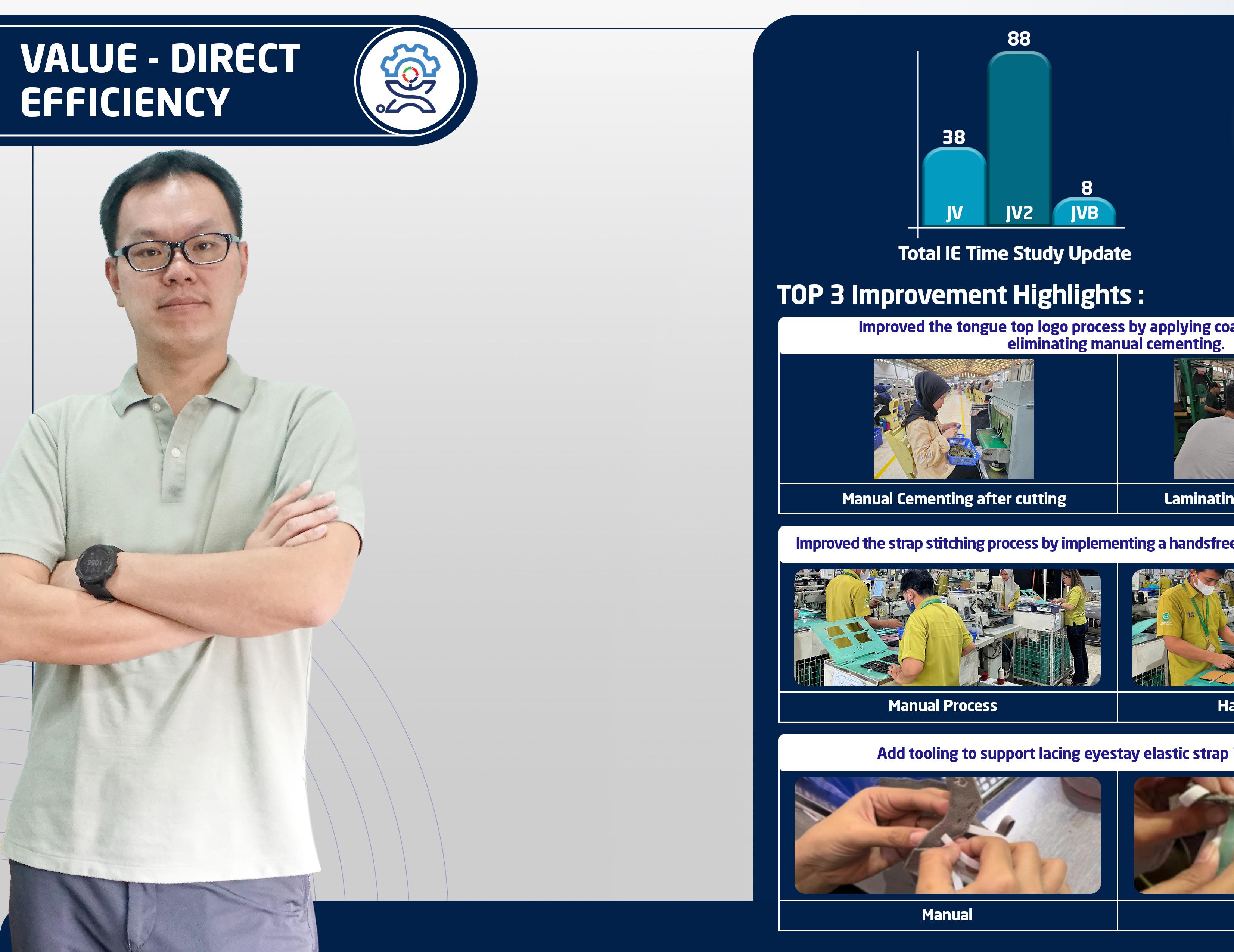
Today, I’d like to talk about what ‘Direct Efficiency’ really means.
To many, shoemaking is seen as a traditional industry—one that relies purely on workers’ craftsmanship, experience, and a ‘gut feeling’ on the shop floor. However, I believe that modern shoemaking is, at its core, a science—one that can be precisely calculated through mathematics and time. Why do I say this? Because efficiency is not a slogan, and it’s certainly not a feeling.
First, time is our yardstick. From cutting and stitching to lasting and assembly, ‘Labor Minutes’ (LM) for every single operation on a shoe are rigorously calculated. Every second is a fixed, tangible reality.
Second, mathematics is our validation tool. When we multiply our actual output by the standard time, and then divide it by the total actual hours invested, the resulting percentage gives us the most objective scientific data.
Data never lies. When efficiency numbers drop, mathematical logic tells us exactly where the problem lies: Is it an issue with line balancing? Is there a pile-up at a bottleneck station? Or is non-productive time running too high?
Sicientific data is a powerful tool. We do it because: ‘If you can’t measure it, you can’t manage it; and if you can’t manage it, you can’t improve it.’
While shoemaking craftsmanship has an emotional, artistic side, production line management must be absolutely rational. Let’s look at the value of every second through a scientific lens, and use mathematical logic to drive our efficiency forward.
Let’s make it this happened together.
Mark Chien JV Facility GM
MOPz and FEM projects are continuous improvement projects focused on driving end-to-end manufacturing performance by improving productivity, efficiency, and cost effectiveness through optimization of direct labor (MOPz) and indirect labor (FEM)
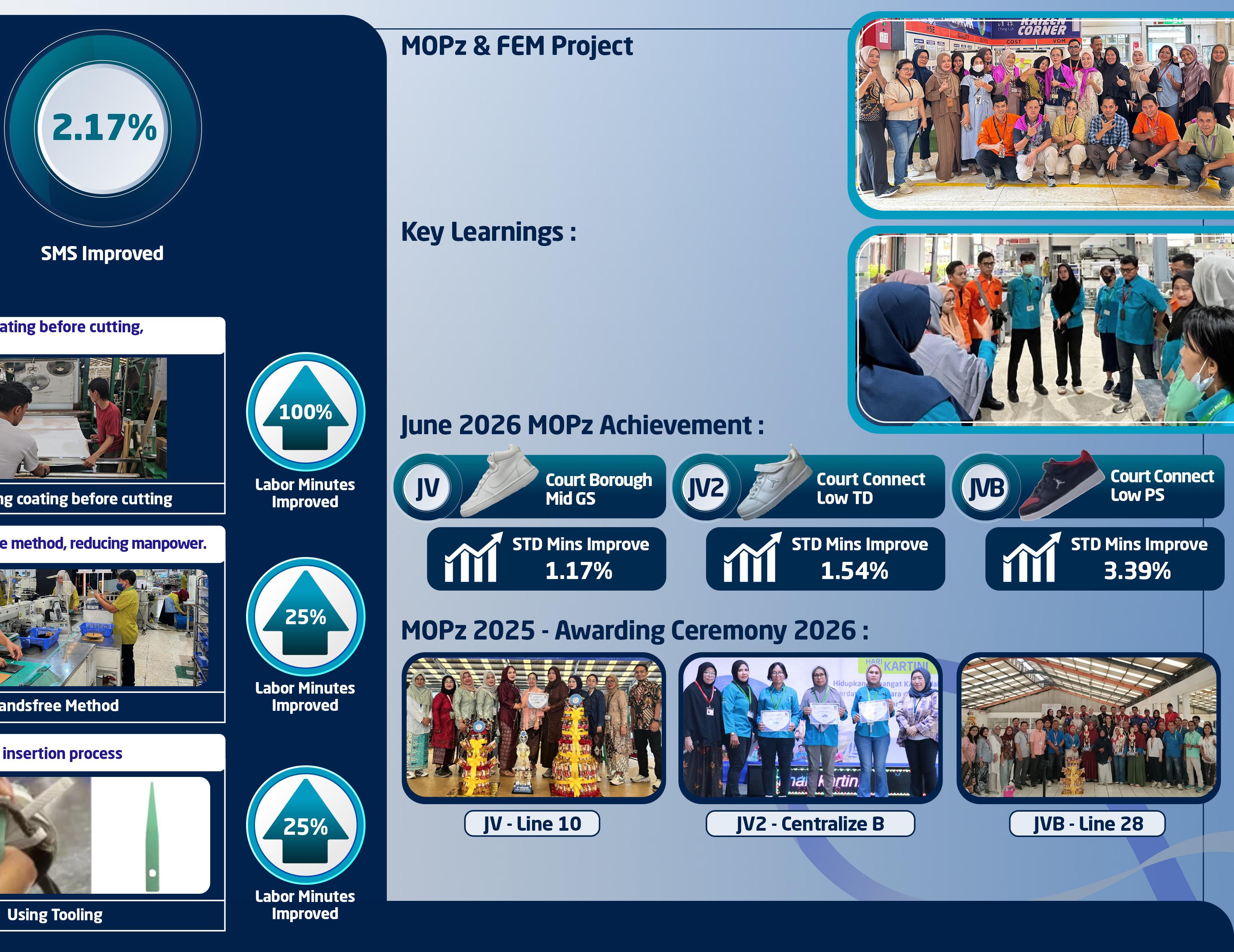
• Eliminate non-value-added activities
• Cross-functional teamwork accelerates implementation
• Validate improvements with actual data
• Sustain gains through standardization
• Safety and quality cannot be compromised
Congratulations to our MOPz Award recipients for their dedication, innovation, and continuous improvement efforts. Thank you for making a positive impact on our operational performance
• Smarter traffic management
• Faster task scheduling
• Improved AGV stability
• Enhanced obstacle avoidance
• Better battery utilization
• Real-time operational visibility
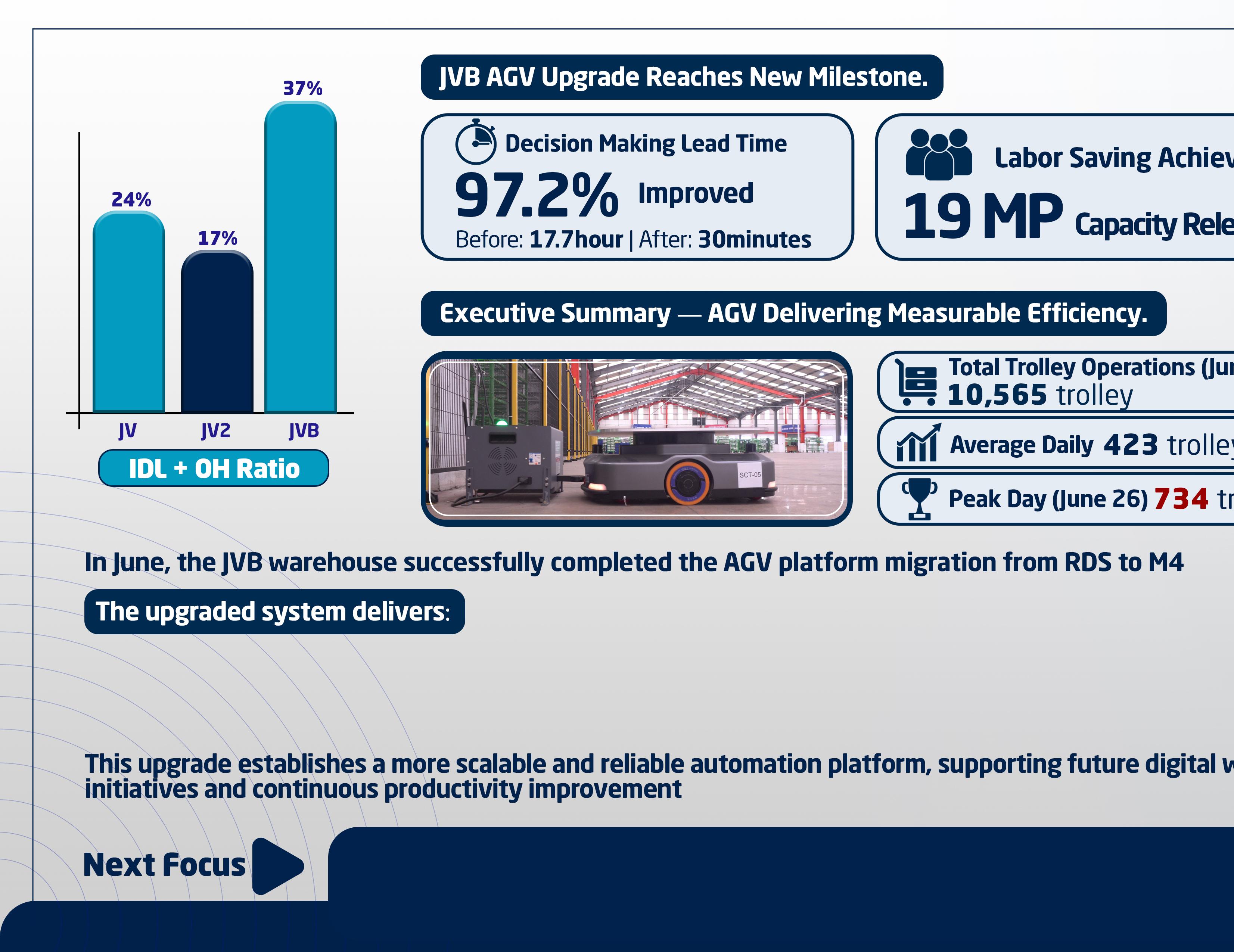
Integrate SAP and SFC data with WMS to improve the management of manual shipping order operation
One of my key focus areas this year is improving indirect labor efficiency by eliminating non-value-added work and enabling our teams to focus on activities that create greater value for the business.
My approach is centered on three areas:
Task Integration – Simplifying workflows and reducing duplicated efforts across functions.
Task Redesign – Challenging existing practices and streamlining processes to improve productivity.
Work Smart & Automation – Leveraging digital tools, system integration, and automation to reduce manual work and improve efficiency.
Our goal is not simply to do more with less, but to create a smarter, leaner, and more agile organization. By continuously improving the way we work, we can enhance productivity, support sustainable growth, and allow our teams to focus on higher-value contributions.
Jerry Wu
JVB Site Leader