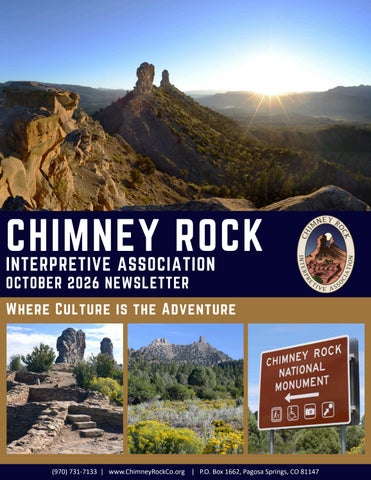
CHIMNEY ROCK INTERPRETIVE ASSOCIATION OCTOBER 2026 NEWSLETTER
Where Culture is the Adventure
(970) 731-7133 | www.ChimneyRockCo.org | P.O. Box 1662, Pagosa Springs, CO 81147
Message from the President of the Chimney Rock Interpretive Association Board In my role as a volunteer tour guide and plaza host, I often reflect on the ancestral Puebloans who built architectural marvels and observed celestial events millennia ago. Recent torrential rainfall caused severe road and trail damage, forcing a temporary three-day closure for cleanup and repairs. This closure highlights a striking reality: While extensive efforts have been made to protect historic structures that have stood for generations, unexpected contemporary weather events can rapidly disrupt access and daily activities. It underscores how safeguarding heritage requires active, continuous and at times spontaneous efforts. This dynamic relationship with the elements is foundational to Chimney Rock. Erosion shaped the iconic twin pinnacles, and ancestral inhabitants continually adapted to natural cycles. Managing current weather disruptions offers a connection to their experiences. Thanks to prompt cleanup efforts by U.S. Forest Service Site Manager Cody Cammack, the Forest Service crew, and CRIA volunteers, the Monument has reopened to safely welcome visitors. Preserving the past means facing natural forces with resilience, stewardship, and community action as we continue to protect this national treasure. Jill Sutton, CRIA Board President
Crow Canyon Webinars Crow Canyon has a lengthy series of one-hour webinars on a variety of topics – well worth watching! Here is the playlist link: Crow Canyon Webinar series playlist
(970) 731-7133 | www.ChimneyRockCo.org | P.O. Box 1662, Pagosa Springs, CO 81147
The Dating Game: Archeological Dating Methods Dr. John Kappelman Tuesday, October 27, 2026 6:00-7:30PM Community Methodist Church - Pagosa Springs | 434 Lewis Street The lecture will be offered both in person and via Zoom. Zoom link: https://us02web.zoom.us/j/5210476574?omn=83592279580
Thank you for your Support
This fascinating lecture explores how archaeologists and scientists determine the age of ancient objects, structures, and events—helping us understand what happened, when, and why. John will introduce the geological foundations of dating techniques and examine a range of scientific methods, including radiometric dating, paleomagnetism, archaeomagnetism, dendrochronology, and cultural seriation. With special emphasis on Southwestern Ancestral Puebloan sites such as Chimney Rock National Monument, he will discuss the strengths, limitations, and accuracy of each approach—highlighting key methods like carbon dating and dendrochronology that are essential to understanding the region’s past. This one-hour presentation will conclude with a brief Q&A session, offering attendees a deeper appreciation for the science behind uncovering history. Education & Interpretation in Action A classroom without walls Astronomical alignments and lunar cycles Engineering of the Great House Pueblo Trade routes and regional networks Cultural continuity and ancestral traditions Our Impact Last season over 19,000 visitors experienced guided interpretation. Educational programs were delivered, volunteers contributed thousands of service hours, and preservation initiatives continued through collaborative partnerships.
INSIDE Free Lecture by John Kappelman Did You Know? Colorado Gives Day CRIA Volunteer Spotlight: Susan Yalom Sidewalk Sale Where Did They Go? Recent Evidence From Wild Turkey DNA October Calendar of Events The Subcultures of the Ancestral Puebloans Trail Tip of the Month
Every ticket purchased, every donation made, and every volunteer hour strengthens our ability to steward this sacred place.
(970) 731-7133 | www.ChimneyRockCo.org | P.O. Box 1662, Pagosa Springs, CO 81147
Did You Know? Yaupon holly (Ilex vomitoria) is a tough, broadleaf evergreen shrub or small tree native to the southeastern United States. It is one of the very few native North American plant species containing caffeine. The leaves were historically brewed by Indigenous peoples into a ceremonial "Black Drink" and are experiencing a modern commercial resurgence as yaupon tea. The Latin name was given by early European observers who misunderstood Indigenous purification ceremonies—where vomiting was part of the ritual—and incorrectly assumed that the plant itself was emetic. Archaeologists discovered that ancestral Puebloans living in the arid southwest, including Chaco Canyon, consumed yaupon tea. Because yaupon is native only to the southeastern United States, its presence in the southwest indicates a thousands-of-miles long trade network. The testing of organic residues left on various pottery sherds and cylinder jars showed that this caffeinated brew was drunk between 750 and 1400 AD. At Chaco, archaeologists believe yaupon tea was used only for communal, sacred ceremonies and high-status rituals in the great houses.
Happy Guests, Happy Tour Guide “This past Monday when the monsoon was making the Great House Tour questionable, we got six folks to take a chance on driving up to the Mesa top for the tour; and then the rain stopped for ninety minutes to allow for a wonderful tour before new storms came thundering through, and we escaped from the top. So, it was worth going out to Chimney Rock, even when no one had signed up online. With the low clouds and mist in the valleys, it was a beautiful scene as backdrop for our tour. One of the best, actually! “
(970) 731-7133 | www.ChimneyRockCo.org | P.O. Box 1662, Pagosa Springs, CO 81147
Colorado Gives Day: Your Gift Helps Keep the Story Alive Every visit to Chimney Rock offers an opportunity to make a connection—to the landscape, to the people who lived here more than 1,000 years ago, and to the remarkable cultural history that continues to be shared today. Behind many of those connections is the Chimney Rock Interpretive Association (CRIA) and the generosity of people who believe this story is worth sharing. Colorado Gives Day is December 10, and it is one of the most important opportunities of the year to support CRIA and the programs that bring Chimney Rock National Monument to life. Your gift has a very real impact. A gift today can help introduce area school children to Chimney Rock through our School Week and Youth Workshop Programs, giving young people the opportunity to explore, ask questions, and experience history beyond the classroom. A monthly or recurring gift provides dependable support for programs throughout the year, including the Annual Life at Chimney Rock event, where visitors are immersed in hands-on cultural activities and experience the beauty and excitement of Native American dancers and cultural traditions.
Colorado Gives Day is about more than making a donation. It is about choosing what we want to preserve, teach, and pass along. CRIA's mission is to provide our community, youth, visitors, and volunteers with a meaningful connection to Chimney Rock National Monument through enjoyable, educational, and interpretive programs that connect our modern lives with those of the ancestral Puebloans. When you support CRIA, you become part of that mission. Whether you make a one-time gift, become a monthly donor, or simply help share our story with others, your support helps ensure that Chimney Rock continues to inspire curiosity, understanding, and connection for generations to come.
And gifts of every size help CRIA continue its broader mission of education, interpretation, and stewardship. Your support helps make possible daily guided tours, special programs and events at Chimney Rock National Monument, our Cultural Lecture Series, and other opportunities that deepen the public's understanding of this extraordinary place.
Support CRIA through Colorado Gives: https://www.coloradogives.org/organization/CRIA
(970) 731-7133 | www.ChimneyRockCo.org | P.O. Box 1662, Pagosa Springs, CO 81147
CRIA VOLUNTEER SPOTLIGHT: Susan Yalom By Joanne Lucariello Acknowledging the dedication and support Chimney Rock Interpretive Association (CRIA) receives from our volunteers is extremely important. Without our volunteers the programs we offer to the community at Chimney Rock National Monument (CRNM) would not be possible. In light of this, CRIA has instituted a “Volunteer Spotlight” article series, regarding a current or former volunteer. To kick off our series, the Board of Trustees has selected Susan Yalom as our first honoree. Sue is originally from Pittsburg, California, and was an elementary school teacher in Livermore, California, for 35 years. Having read several Tony Hillerman novels, she was drawn to the southwest and was intrigued with Native American culture. She and her husband, Mark, decided to come out to visit the area in 2005, had reservations for the Durango/Silverton railroad, and decided to stay in Pagosa Springs. After staying here for a week, they decided Pagosa Springs was the place for them and purchased property in Timber Ridge to build their dream home. While waiting for their home to be finished, Sue took a few tours at the site, was impressed with the tour guides she encountered, and fell in love with Chimney Rock. In 2008, after speaking with her neighbor, Joan Ward, Sue joined CRIA and decided to become a tour guide. She became quite active in CRIA and was asked to join the Board of Trustees in 2012, becoming board president in 2013. In fact, Sue was the first president to write a monthly update for the newsletter.
Sue has helped to develop and/or been involved in numerous programs at Chimney Rock. She took over the Full Moon program and the Night Sky program, which were already in place, in addition to continuing to provide guided tours. Having previously volunteered at Death Valley, Sue was aware of their Junior Ranger program and decided to institute a similar program at CRNM around 2015. She formed the Education Committee along with other volunteers, and they developed the Junior Archaeology Program. Susan Fischer, a member of the committee, took the lead on creating the Junior Archaeology booklet that we hand out to children at the site. Sue also implemented our very successful School Week Program that occurs prior to our official season opening. Area schools’ students and teachers arrive for a tour of the site, learn about ancient Puebloan life, and participate in various activities similar to those offered at Life at Chimney Rock.
(970) 731-7133 | www.ChimneyRockCo.org | P.O. Box 1662, Pagosa Springs, CO 81147
CRIA VOLUNTEER SPOTLIGHT: Susan Yalom Continued When asked what she likes most about Chimney Rock, Sue stated that “Chimney Rock is absolutely unique. The Major Lunar Standstill is a natural event – with the moon rising between the pinnacles - in a natural environment.” She loves to emphasize this to visitors and believes that the most satisfying thing about volunteering is the reaction of the visitors to the site. She is over the moon when they exclaim, “This place is fantastic!” because that is exactly how she feels about it too. Her understanding and affinity for the pinnacles is rooted in something she was once told by a Native American: “The pinnacles should be revered and respected and never approached.” Sadly, in the fall Susan and Mark will be moving to Tucson, Arizona, to begin a new chapter in their lives: Traveling to new places to explore new opportunities for adventure and knowledge. We wish her well but certainly will miss her enthusiasm and dedication to Chimney Rock and CRIA. Lastly, Sue’s hope for the future of CRNM is that the partnership between CRIA and the Pagosa Forest Service District remains strong and continues to stay strong and grow.
If you “Made it to the Top” at Chimney Rock National Monument, don’t leave without one of our brandnew commemorative stickers! These fun, new stickers are the perfect way to celebrate your accomplishment and share your Chimney Rock adventure with friends and family. Whether you place it on your water bottle, hiking gear, laptop, or vehicle, it’s a great reminder of the incredible journey to the mesa top and the unforgettable views waiting at the summit. After making the climb and experiencing the breathtaking panoramic views from the Great House Pueblo, you’ve definitely earned bragging rights! Be sure to stop by the Gift Shop and grab your sticker after your tour and let everyone know — I Made it to the Top!
Thank you, Sue, for your many years of support!
(970) 731-7133 | www.ChimneyRockCo.org | P.O. Box 1662, Pagosa Springs, CO 81147
Making a Difference at Chimney RocK Chimney Rock Program Supporter Levels At Chimney Rock National Monument, the work of Chimney Rock Interpretive Association (CRIA) extends far beyond a single program. Through School week, Life at Chimney Rock, guided tours, lectures, and special events, CRIA creates meaningful connections to history, culture, and the land—many offered free or at low cost to ensure access for all. Each season, these programs reach hundreds of visitors of all ages. From students exploring hands-on activities like rock art and atlatl demonstrations to adults attending lectures and cultural events, these experiences spark curiosity and deepen appreciation for this remarkable place. With the help of dedicated volunteers and generous supporters, these efforts continue to inspire and connect visitors year after year. Your support helps ensure these programs remain accessible and impactful for future generations. Level
Contribution
Supporter of Chimney Rock
$50-$99
Listed in one CRIA Newsletter
$100–$249
Name listed on CRIA website Listed in CRIA Newsletter Listed in group social media post
$250–$499
Name listed on CRIA website Listed in CRIA Newsletter 1 individual shoutout on Social Media Digital “Proud Supporter” badge for your website
$500–$999
Business name + website link listed on CRIA website Listed in CRIA newsletter + logo included with link 2 business shoutouts on Social Media Digital “Proud Supporter” badge for your website
$1,000+
Prominent logo placement + link on CRIA website Listed in CRIA Newsletter for 6 months with link to business website 2 business shoutouts on social media Feature ad in upcoming newsletter (1/2 page) Digital “Proud Supporter” badge for your website
Friend of Chimney Rock
Steward of Chimney Rock
Community Partner
Heritage Sponsor
Recognitions
* Currently 2+K subscribers to CRIA Newsletter / ** Currently 15+K followers on Facebook
Contact us at (970) 731-7133 OfficeMgr@ChimneyRockCo.org Scan the QR Code to show your support! (970) 731-7133 | www.ChimneyRockCo.org | P.O. Box 1662, Pagosa Springs, CO 81147
SIDEWALK SALE - October 17 Typically, you clean house in the Spring, but at Chimney Rock we clean in the Fall. Mark your calendar to participate in our Fall Sidewalk Sale on Saturday, October 17th, from 10-3 in the parking lot next to the Community Methodist Church.Drop off your items from 9:00-9:30 AM, and we’ll take care of the rest. Since money accepted for items will be considered a donation, items will not be priced. We will have designated cashiers, and all the funds will go to CRIA. Actually, this fundraiser is targeting our Junior Archaeology Program. We want to upgrade the booklet, print it in color and offer our Junior Archaeologists a custom-made badge. That takes money!!
The Methodist Church Thrift Store is also having a sidewalk sale across the street in front of their store, so you have a chance to double your fun! There is a rumor that credit cards will be accepted that day; so drop off your slightly used items, then turn around and buy someone else's stuff. You know what they say: One man’s junk is another man’s treasure. Come join us and find that treasure!
(970) 731-7133 | www.ChimneyRockCo.org | P.O. Box 1662, Pagosa Springs, CO 81147
Where Did They Go? Recent Evidence from Wild Turkey DNA By David Bouquet A frequent question from CR guests relates to where the Ancestral Puebloans migrated to when they left the Chimney Rock area. Per the Core Curriculum: “Archaeologists believe that the ancestral Puebloans left Chimney Rock and migrated to various places within the Four Corners region. Some eventually settled along the Rio Grande River where many of them live today. Others may have gone west toward the lands where the Hopi now live, and to the south eventually settling around Zuni Pueblo (Lekson 2008). Modern Pueblo structures and features bear strong resemblances to the Great Houses of their ancestors.” Additionally, the core curriculum notes that oral histories from the Tewa peoples support these ideas.
Note Wild Turkeys around Pagosa Springs, Chimney Rock and Mesa Verde are almost always the Merriam subspecies.
(Photo of a Map from the Salmon Ruins Museum in Bloomfield, NM)
A recent study from the University of Colorado Boulder and Washington State University used domesticated turkey bones as a genetic proxy for human movement to add some additional scientific evidence to the interpretation. DNA analysis showed that turkey populations in the Northern Rio Grande region before 1280 were distinct, but a new genetic strain identical to the Mesa Verde turkeys flooded the area right after the migration from Mesa Verde. The influx suggests that migrating Puebloan families brought their domesticated turkeys with them, providing physical evidence that supports modern Tewa oral traditions linking contemporary Puebloan communities to Mesa Verde and possibly to Chimney Rock. Out of respect for tribal preferences, no attempt was made to use human bones for this analysis. As with any archeological study, this is analysis is supportive, but has some caveats and is not necessarily definitive.
Citation: Kemp BM, Judd K, Monroe C, Eerkens JW, Hilldorfer L, Cordray C, et al. Prehistoric mitochondrial DNA of domesticate animals supports a 13th century exodus from the northern US southwest. PLoS ONE 12(7): e0178882. https://doi.org/10.1371/journal.pone.0178882
(970) 731-7133 | www.ChimneyRockCo.org | P.O. Box 1662, Pagosa Springs, CO 81147
Upcoming Special Event FREE Lecture FREE Lecture with with John John Kappelman Kappelman The Dating The Dating Game: Game: Archeological Archeological Dating Dating Methods Methods Tuesday, October Tuesday, October 27, 27, 2026 2026 from from 6:00-7:30pm 6:00-7:30pm
Join our Join our mailing mailing list list to to receive receive the the link link to to watch watch from from home via home via Zoom! Zoom! Click HERE Click HERE to to join join our our mailing mailing list! list!
Support the Mission The Chimney Rock Interpretive Association is a nonprofit organization dedicated to supporting the preservation, interpretation, and education efforts at Chimney Rock National Monument. Educational programming Volunteer training Site preservation initiatives Community outreach Special events and lectures
(970) 731-7133 | www.ChimneyRockCo.org | P.O. Box 1662, Pagosa Springs, CO 81147
The Subcultures of the Ancestral Puebloans by Ernie O’Toole
Continuing Education Article The CRIA Education Committee has decided to contribute Continuing Education Articles and Tips to the Newsletter monthly to keep our Guides, Volunteers, and Guests up to date on new findings, corrections to the current narratives, etc.
There are four generally recognized subcultures of the Ancestral Puebloans: Mesa Verde, Chaco, Kayenta and Virgin. Described below are the western most subcultures, the Kayenta and Virgin. The Kayenta branch is also sometimes called the Kayenta-Tusayan branch to emphasize its links to the modern Hopis. They occupied the area west of Mesa Verde, in northern Arizona, southern Utah and southeast Nevada. The Kayenta branch developed from Basketmaker through Pueblo III times in terms of architecture and pottery styles. Between 800 and 1150 CE there were many small settlements throughout the area. About 1000 CE, the characteristic residential structures were the “Prudden Units”. Each of these settlements consisted of an above-ground masonry storage room block with habitation rooms on either end, facing a belowground kiva. Between 1150 and 1250 CE the Kayenta settlement pattern changed dramatically. Due to drought, people migrated into centers near wellwatered arable land. As part of this aggregation, they began to build a new type of site, the plaza site, and to return to the pit house village plan. Plaza sites consisted of one or more masonry room blocks facing a central plaza with a central kiva. These sites were never large, with less than 50 rooms. Pit house sites consisted of scattered pit houses, storage structures and a kiva. There is no evidence of local or regional site hierarchies or for settlement interdependence in crafts. There is also very limited evidence of interaction with Chaco. Between 1250 and 1300 CE, the Kayenta area was depopulated due to drought and related social stresses. Many migrated to the Hohokam area in Arizona, some moved into Tsegi Canyon where they established 20 villages, others moved onto the Hopi Mesas and elsewhere.
There are two cultural features that are distinctive of the Kayenta culture, the entry boxes and perforated ceramic plates (flat dishes with holes punched around their rims). Entry boxes are small box-like U-shaped stone enclosures built into the floor right inside the doorway. Archaeologists believe they acted as a type of threshold barrier or draft deflector to keep wind, dirt, etc. out of the main living area. The Virgin Ancestral Puebloans were the western most subculture, occupying the Virgin and Muddy River valleys of Nevada, Arizona and Utah from around 1 CE to 1200 CE. They were bordered by the Fremont culture to the north and Kayenta peoples to the east. Like all the Puebloan subcultures, they depended on maize, bean and squash agriculture, relying heavily on flood water, dry farming and some small-scale irrigation. They built pit houses and later masonry surface pueblos, although not large. Unlike their Kayenta neighbors, they had no kivas or other ceremonial structures and did not transition into large aggregated pueblos or cliff dwellings. This suggests that they had a different social or religious organization. By 1200 CE they began to gradually leave the area, with some integrating with the Southern Paiute. The depopulation was caused by a combination of severe environmental collapse, resource depletion (deforestation and game scarcity) and social pull factors (attraction to better opportunities elsewhere).
(970) 731-7133 | www.ChimneyRockCo.org | P.O. Box 1662, Pagosa Springs, CO 81147
Trail Tip of the Month One Last Walk Up the Trail in 2026 There’s something special about Chimney Rock in October. The air is cooler, the landscape is beginning to take on the colors of fall, and the changing season offers a beautiful backdrop for one last visit to the Monument. Chimney Rock National Monument closes for the 2026 season on October 15, so if you’ve been thinking about making another trip—or haven’t made it up the trail yet this year—your window is getting short. Fall weather can change quickly at Chimney Rock’s 7,000+ foot elevation, so come prepared. Check the forecast before leaving home, dress in layers, wear sturdy shoes, and bring plenty of water. Give yourself enough time to slow down along the trail, explore the archaeological sites, take in the views, and appreciate the remarkable landscape that has drawn people to this place for generations. Don’t forget your camera. October light, fall colors, sweeping views, and perhaps even a peregrine falcon sighting can make a final visit of the season especially memorable. October 15 will be here before we know it. Come take one last walk with us before the trails close for the season.
Book Your Next Visit at www.ChimneyRockCo.org.
Learn more or donate: www.ChimneyRockCo.org or Scan the QR Code to support Chimney Rock Interpretive Association (970) 731-7133 | www.ChimneyRockCo.org | P.O. Box 1662, Pagosa Springs, CO 81147
CHIMNEY ROCK INTERPRETIVE ASSOCIATION BOARD OF DIRECTORS
Jill Sutton President
Ernie O’Toole Vice President
Bernadette Sikes
Rhonda Julian
Secretary
Treasurer
Tony Aldwell
Ronnie Vera Doctor
Kathleen Thompson
Trustee At Large
Trustee At Large
Trustee At Large
John Kappelman Trustee At Large
Joanne Lucariello Trustee At Large
We look forward to your visit and to sharing in the experience of this truly remarkable place. Chimney Rock is more than a destination—it is a landscape rich with history, culture, and connection. As stewards and advocates, we are honored to help preserve and share the stories of the Ancestral Puebloans and the significance of this sacred site. Our passion for Chimney Rock National Monument is what brings us together, and it is our privilege to help create meaningful experiences for each visitor who walks these trails and takes in these views. We hope your time here inspires curiosity, reflection, and a deeper appreciation for the history and beauty that make Chimney Rock so special. We look forward to welcoming you. (970) 731-7133 | www.ChimneyRockCo.org | P.O. Box 1662, Pagosa Springs, CO 81147
Tribal Partnerships Since Chimney Rock was designated a National Monument by Presidential Proclamation 2012, the San Juan National Forest consults and partners with many Native American Tribes and Pueblos to manage the monument, including restoration. In August 2024, the Ancestral Lands Conservation Corps (a corps program that partners with tribal communities and land managers to accomplish projects based in historical preservation and traditional knowledge) conducted a structural stabilization project at Chimney Rock National Monument. The Chimney Rock area holds deep spiritual significance for modern pueblo and tribal communities. Today, descendants of the Ancestral Puebloans, Navajo, Jicarilla Apache and Ute return to this important place of cultural continuity for ceremonial and traditional purposes. The area is also an important source of traditional cultural materials that are collected by tribal members for food and medicine. Chimney Rock National Monument is managed to protect and preserve access by tribal members for traditional cultural, spiritual, food and medicine gathering purposes, consistent with the purposes of the monument, to the maximum extent permitted by law. The San Juan National Forest ensures that the hunting rights of the Southern Ute Indian Tribe within the exterior boundaries of the Southern Ute Indian Reservation, including lands within the Monument, are upheld. The San Juan National Forest also ensures that the hunting and fishing rights of the 1873 Brunot Agreement are upheld on public lands under its management jurisdiction, including those lands within the Monument. Tribes with ancestral and cultural ties to the Chimney Rock National Monument landscape: Kewa Pueblo Pueblo of Santa Ana Pueblo de Cochiti Pueblo of Santa Clara Pueblo of Acoma Pueblo of Taos Pueblo of Isleta Pueblo of Tesuque Pueblo of Jemez Pueblo of Zia Pueblo of Laguna Zuni Tribe of the Zuni Reservation Pueblo of Nambé Ohkay Owingeh Pueblo of Picuris Hopi Tribe Pueblo of Pojoaque Jicarilla Apache Nation Pueblo of San Felipe Navajo Nation Pueblo of San Ildefonso Pueblo of Sandia Ute Mountain Ute Tribe Southern Ute Indian Tribe Ute Indian Tribe of the Uintah & Ouray Reservation https://www.fs.usda.gov/r02/sanjuan/recreation/chimney-rock-national-monument
SUPPORT THE MISSION www.ChimneyRockCo.org
To book and see a full listing of tour/program times and dates, scan the QR Code.
Designation 2025
/chimneyrockco
chimney_rock_interpretive_association
Chimney Rock Interpretive Association P.O. Box 1662 Pagosa Springs, CO 81147 970-731-7133
@ChimneyRockInterpretiveAssoc
In Partnership with
Chimney Rock National Monument 30841 State Highway 151 Pagosa Springs, CO 81147 970-883-2496