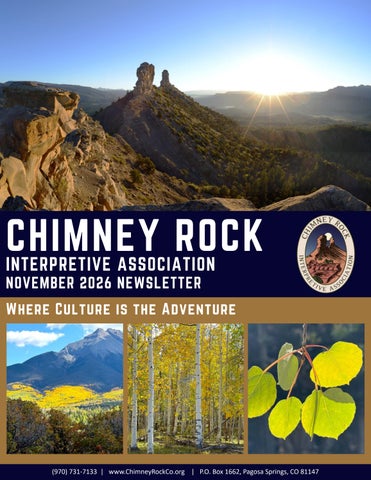
CHIMNEY ROCK INTERPRETIVE ASSOCIATION NOVEMBER 2026 NEWSLETTER
Where Culture is the Adventure
(970) 731-7133 | www.ChimneyRockCo.org | P.O. Box 1662, Pagosa Springs, CO 81147
Message from the President of the Chimney Rock Interpretive Association Board Heartfelt Gratitude: Thank You to Our Extraordinary Community “Community means that people come together around the table, not just to feed their bodies, but to feed their minds and their relationships.” – Henri J.M. Nouwen Chimney Rock is far more than an archaeological landmark; it is a living classroom and a gathering space where history, nature, and human connection meet. Operating as a non-profit organization without direct government funding, our mission to educate, inspire, and preserve this sacred ancestral Puebloan site is made possible solely through the generosity, passion, and spirit of our surrounding community. To our incredible team of volunteers—thank you. Whether you braved the summer heat to greet guests as plaza/mesa hosts, guided visitors up to the Great House, shared astronomical marvels during night sky programs, managed gift shop operations, or assisted behind the scenes, your dedication brings Chimney Rock to life. You are the bridges connecting our modern visitors to the rich story of those who walked this land a millennium ago. We extend our deepest appreciation to our essential community partners. Our close alignment with the U.S. Forest Service forms the cornerstone of our stewardship efforts. Local organizations—including the La Plata Electric Association, Pagosa Tourism Board, and the Southwest Community Foundation—sustain our free educational initiatives through grant funding. The Community United Methodist Church offers the use of its facilities to host volunteer training, meetings and our free lecture series. Thank you for standing alongside us, for sharing the wonder of this unique place, and for keeping the spirit of Chimney Rock thriving.
Jill Sutton, CRIA Board President
Crow Canyon Webinars Crow Canyon has a lengthy series of one-hour webinars on a variety of topics – well worth watching! Here is the playlist link: Crow Canyon Webinar series playlist
(970) 731-7133 | www.ChimneyRockCo.org | P.O. Box 1662, Pagosa Springs, CO 81147
School Week – Juniper School Visit By Susan Yalom, Education Coordinator Thank you for your Support
CRIA provides field trip experiences for school groups every season. Our volunteers give guided tours and offer hands-on activities such as trying the atlatl, weaving, rock art, pottery and others, to provide students with background information about the everyday life of the Ancestral Puebloans. Field trips are always free, including guided tours and all activity materials. On October 1, a group of sixth-grade students came from Juniper School in Durango. Their trip was arranged by their teacher, Rush Cosgrove, who was accompanied by many adults to help as needed. Students and adults were very enthusiastic and wonderful, and our volunteers had a great time working with them. Guided tours of both the Mesa Village and Great House trails were led by Pat Hasenbuhler, Joel Rubin, Michael Lopez and me, Susan Yalom. Students were interested and asked lots of good questions. Learning about the Native American history of our area is part of their sixth-grade curriculum. We do our best to support this during the field trip experience. After the guided tours, everyone had lunch together in the Picnic Area. Then students were divided into smaller groups to rotate through three activities: the atlatl, an artifact display, and a weaving activity led by Gloria Bissmeyer. A few days later, I received an email from Rush that contained thank-you notes from the students and adults. I forwarded them to the volunteers who helped that day. Receiving feedback is very important to us. I asked Rush if it was OK to print one or two of the notes in our newsletter. (See one on page 4!) Thank you to all our volunteers who have helped with field trips this season. Thanks also to the students and adults at Juniper School. We loved working with them and greatly appreciate the thank-you notes.
Education & Interpretation in Action A classroom without walls Astronomical alignments and lunar cycles Engineering of the Great House Pueblo Trade routes and regional networks Cultural continuity and ancestral traditions Our Impact Last season over 19,000 visitors experienced guided interpretation. Educational programs were delivered, volunteers contributed thousands of service hours, and preservation initiatives continued through collaborative partnerships.
INSIDE School Week: Juniper School Visit Did You Know? The Zuni Origin Story A Student’s Thank-You Note Colorado Gives Day Chaco and Mesa Verde Subcultures Program Supporter Levels Sidewalk Sale Thank You Southwestern Colorado Tarantulas Thanksgiving Bake Sale Kayenta and Virgin Subcultures In Recognition: Dr. J. McKim Malville
Every ticket purchased, every donation made, and every volunteer hour strengthens our ability to steward this sacred place.
(970) 731-7133 | www.ChimneyRockCo.org | P.O. Box 1662, Pagosa Springs, CO 81147
Did You Know? Like all Puebloan peoples, the Zuni have an Origin Story. They were created in an underground world and were led by their gods into the light of Father Sun and Mother Earth. Their emergence from the fourth underground world was from a canyon along the Colorado River. From there they began a journey in search of a middle or center place. As the people traveled from locale to locale, they stopped and built villages and stayed there for a time. Each stream, spring or stopping place became a sacred shrine, which is still remembered in their prayers. Offerings are still left when Zuni people visit them today. From the Place of Origin, the people traveled to the San Francisco peaks. From there, they went westward up the Little Colorado River valley. Here the Zuni people were given a choice of accepting a gift of a very plain egg or an egg with beautiful blue spots. One group chose the beautiful egg, out of which hatched a black raven. Out of the very plain egg hatched a colorful parrot. The people who had chosen this egg traveled southward to the Land of Everlasting Sunshine, never to return. As the other Zunis resumed their journey to the middle place, they split into three groups. Separately they traveled through the canyons and deserts of what is now Arizona and New Mexico. Eventually the three groups were united close to the middle place. Then a water spider assisted them in finding the exact center point. He did this by spreading out his legs until he reached the four oceans to the east, west, south and north, and also touched the zenith and nadir. His heart was now over the long-sought middle place, and it was here that the Zunis settled for the final time.
Happy Students, Happy Volunteers Dear Chimney Rock volunteers, I appreciated how you helped us learn about really cool things that couldn’t be taught as well as you guys did in school. I really liked the experience. I really want to thank some of the people who helped us have a lot of fun, like Pat, our tour guide; Michael, also a tour guide, and the artifacts; Gloria, weaving, and that is how weaving is not just about how fast you can get the project done, it’s about taking your time and being patient; Joel, for teaching us about the atlatls and how to throw them (it’s all in the wrist and moving forward); Susan, for taking her time to go up the mountain, and how kivas are placed for a ceremonial place, also how pit houses were the old people’s homes. I really loved the way everybody chipped in to make the field trip to Chimney Rock the best it could be. Thank you a lot, keep up the good work! Sincerely, a student from the Juniper School
(970) 731-7133 | www.ChimneyRockCo.org | P.O. Box 1662, Pagosa Springs, CO 81147
Colorado Gives Day: Your Gift Helps Keep the Story Alive Every visit to Chimney Rock offers an opportunity to make a connection—to the landscape, to the people who lived here more than 1,000 years ago, and to the remarkable cultural history that continues to be shared today. Behind many of those connections is the Chimney Rock Interpretive Association (CRIA) and the generosity of people who believe this story is worth sharing. Colorado Gives Day is December 8, and it is one of the most important opportunities of the year to support CRIA and the programs that bring Chimney Rock National Monument to life. Your gift has a very real impact. A gift today can help introduce area school children to Chimney Rock through our School Week and Youth Workshop Programs, giving young people the opportunity to explore, ask questions, and experience history beyond the classroom. A monthly or recurring gift provides dependable support for programs throughout the year, including the Annual Life at Chimney Rock event, where visitors are immersed in hands-on cultural activities and experience the beauty and excitement of Native American dancers and cultural traditions.
Colorado Gives Day is about more than making a donation. It is about choosing what we want to preserve, teach, and pass along. CRIA's mission is to provide our community, youth, visitors, and volunteers with a meaningful connection to Chimney Rock National Monument through enjoyable, educational, and interpretive programs that connect our modern lives with those of the ancestral Puebloans. When you support CRIA, you become part of that mission. Whether you make a one-time gift, become a monthly donor, or simply help share our story with others, your support helps ensure that Chimney Rock continues to inspire curiosity, understanding, and connection for generations to come.
And gifts of every size help CRIA continue its broader mission of education, interpretation, and stewardship. Your support helps make possible daily guided tours, special programs and events at Chimney Rock National Monument, our Cultural Lecture Series, and other opportunities that deepen the public's understanding of this extraordinary place.
Support CRIA through Colorado Gives: https://www.coloradogives.org/organization/CRIA
(970) 731-7133 | www.ChimneyRockCo.org | P.O. Box 1662, Pagosa Springs, CO 81147
The Chaco and Mesa Verde Subcultures By Sue Fischer A major, and in many ways unique, culture of the ancestral Puebloan world was Chaco, which is located in the southern part of the San Juan River basin. Many archaeologists consider Chaco to be a system, with a large sphere of influence emanating from its center in Chaco Canyon. One part of Chaco Canyon is referred to as “Downtown Chaco”; this is the densely built area surrounding the great houses there, including Pueblo Bonito, Chetro Ketl, Pueblo Alto and Pueblo del Arroyo. Beginning in Basketmaker times (1 – 700 AD) there were already several aspects of the emerging Chaco culture that were both remarkable and impressive. Chaco Canyon was home to two of the largest Basketmaker III settlements known, Shabik’eshchee and 29SJ423. These villages had 70 to 100 or more pithouses, which was unusual in that most Basketmaker III sites elsewhere were small and dispersed. They also both had large community structures, which have been considered to be great kivas. The development of the Pueblo II culture at Chaco saw the earliest multi-story masonry construction of what are now known as great houses. They are unique in the ancestral Puebloan world because of the core-and-veneer walls, the pattern of the rocks making up the walls, their symmetry and the inclusion of clan kivas within the structures. Between the late 800s and 1150 AD, a dozen or so great houses, as well as numerous small houses, were built in Chaco Canyon, with the largest being Pueblo Bonito. The distribution of exotic goods was clearly inequitable, with small houses having far fewer material goods than great houses. Most archaeologists also view great houses as residences for the elite, although great houses also had other functions. Burial practices differed between great house sites and small house sites.
The middens of small house sites contained most burials, while some have also been found under the small house floors. The middens of great houses were not generally used for burials; the burials were usually in abandoned rooms. There are several other lines of evidence to support Chaco as a hierarchical political system. An analysis of mitochondrial DNA from a cluster of burials from Pueblo Bonito demonstrated that all the elites were related. Elite status may have arisen for a variety of reasons, including knowledge of astronomical events and knowledge of, or possession of, ceremonial rituals or objects. Another distinguishing feature of the Chaco regional system was the appearance of great house architecture and pottery in outlying villages. These villages, which number approximately 200–250 and include Chimney Rock, were often linked to Chaco Canyon by roadways and visual communication systems. Between 1130 and 1150 AD, much of Chaco was depopulated. This may have occurred for several reasons, including a drought-induced food shortage, social unrest due to increased exclusionary ceremonies and several astronomical events not predicted by the elite sky watchers. The migration pathways out of Chaco were to the south and to the Rio Grande valley. The first inhabitants of the Mesa Verde region were nomadic Paleo Indians who arrived in the area around 9500 BC. The extinction of the megafauna marked the beginning of the Archaic period, which developed from local Paleo Indians. The Archaic people inhabited the outlying areas of the Mesa Verde region as well as the mountains and mesa tops, where they created rock shelters and rock art. By the late Archaic period, people were living in semi-permanent rock shelters and rudimentary houses made of mud and wood.
(970) 731-7133 | www.ChimneyRockCo.org | P.O. Box 1662, Pagosa Springs, CO 81147
The Chaco and Mesa Verde Subcultures Continued With the introduction of corn around 1000 BC, the Archaic people transitioned away from nomadism to permanent pithouse settlements. The developing Basketmaker culture is known for its finely woven baskets and emphasis on corn as a major part of their diet. They buried their dead near or amongst their settlements, and often included luxury funerary items. By 600 AD, pottery was introduced and the first year-round settlements were constructed. For the next 150 years, villages typically consisted of small groups of one to three subterranean pithouses. By 775 AD, large aboveground storage structures were being built. By the end of the eighth century, the smaller hamlets were supplanted by larger ones.
The 1200s saw below-average rainfall, and after 1270 AD the area suffered from increasingly cold temperatures. The period from 1276 AD to 1299 AD is known as the Great Drought and was associated with widespread conflict. The need for highly defensible residences led to the construction of houses in cliff alcoves. Some of these had T-shaped windows and doors, which may have been a Chacoan influence. By the late 1200s, the drought-induced depletion of resources forced people to leave Mesa Verde permanently. Many emigrants relocated to southern Arizona and the Rio Grande region of New Mexico, where many modern pueblos are located today.
Selected References Cordell, LS and McBrinn, ME (2016) Archaeology of the The subsequent Pueblo I period (750-900 AD) was Southwest (3rd Ed.) Routledge, New York, NY. characterized by above-ground pueblos as residences with Chaco Revisited. (2015) Heitman, CC and Plog, S (Eds), The University of Arizona Press, Tucson, AZ. pithouses used for ceremonies. Because of unpredictable rainfall, numerous villages were abandoned and many people The Archaeology of Chaco Canyon: An Eleventh-Century Pueblo Regional Center. (2006) SH Lekson (Ed), School of moved south of the San Juan River to Chaco Canyon. American Research Press, Santa Fe, NM. Lekson, SH (2008) A History of the Ancient Southwest. During Pueblo II (900-1150 AD), Mesa Verde people School for Advanced Research Press, Santa Fe, NM. interacted with the Chacoan system but still retained their Plog, S. (2014) Ancient Peoples of the American Southwest, cultural identity. Their social organization differed from the 2nd Ed. Thames & Hudson Inc. New York, NY. hierarchical Chacoan system in that there was a collection of The Mesa Verde World: Explorations in Ancestral Puebloan communities that never integrated into a larger civic Archaeology, (2006) DG Noble (Ed), School of American structure. Several roads were constructed connecting Research Press, Santa Fe, NM.
communities and shrines but none connected with Chacoan sites. The expansion of the Chacoan influence led to the building of Chacoan great houses, which became the focal point of many villages.
Pueblo III (1150-1300 AD) was marked by a severe drought in many parts of the San Juan Basin. During this time the Chacoan system collapsed, and there was increasing migration from Chaco to Mesa Verde. Massive multi-story masonry pueblos were built and this was associated with a population increase. Pottery was decorated with intricate geometric patterns, including checkerboards, zig-zags and stepped motifs. Their vessels were noted for their square rims decorated by ticking.
(970) 731-7133 | www.ChimneyRockCo.org | P.O. Box 1662, Pagosa Springs, CO 81147
Making a Difference at Chimney Rock Chimney Rock Program Supporter Levels At Chimney Rock National Monument, the work of the Chimney Rock Interpretive Association (CRIA) extends far beyond a single program. Through School Week, Life at Chimney Rock, guided tours, lectures, and special events, CRIA creates meaningful connections to history, culture, and the land—many offered free or at low cost to ensure access for all. Each season, these programs reach hundreds of visitors of all ages. From students exploring hands-on activities like rock art and atlatl demonstrations to adults attending lectures and cultural events, these experiences spark curiosity and deepen appreciation for this remarkable place. With the help of dedicated volunteers and generous supporters, these efforts continue to inspire and connect visitors year after year. Your support helps ensure these programs remain accessible and impactful for future generations. Level
Contribution
Supporter of Chimney Rock
$50–$99
Listed in one CRIA Newsletter
$100–$249
Name listed on CRIA website Listed in CRIA Newsletter Listed in group social media post
$250–$499
Name listed on CRIA website Listed in CRIA Newsletter 1 individual shoutout on Social Media Digital “Proud Supporter” badge for your website
$500–$999
Business name + website link listed on CRIA website Listed in CRIA newsletter + logo included with link 2 business shoutouts on Social Media Digital “Proud Supporter” badge for your website
$1,000+
Prominent logo placement + link on CRIA website Listed in CRIA Newsletter for 6 months with link to business website 2 business shoutouts on social media Feature ad in upcoming newsletter (1/2 page) Digital “Proud Supporter” badge for your website
Friend of Chimney Rock
Steward of Chimney Rock
Community Partner
Heritage Sponsor
Recognitions
* Currently 2+K subscribers to CRIA Newsletter / ** Currently 15+K followers on Facebook
Contact us at (970) 731-7133 OfficeMgr@ChimneyRockCo.org Scan the QR Code to show your support! (970) 731-7133 | www.ChimneyRockCo.org | P.O. Box 1662, Pagosa Springs, CO 81147
THANK YOU FOR A SUCCESSFUL SIDEWALK SALE! When I served on the board of directors for CRIA, I learned a lot about what it takes to keep a non-profit financially operational. Yes, we get funds from our tours and from our magnificent gift shop, but there are other ways to raise funds to make CRIA a success. There are grants available for organizations such as ours, and our grant committee actively pursues that avenue to generate funds. Another is through donor requests, and we have one of those coming up on December 8th: Colorado Gives Day. This special way of giving to CRIA reminds all of us how lucky we are to live in a community that loves its non-profits and is willing to put money where their mouths are. But the one I want to talk about this month is our 1st Annual Sidewalk Sale held this past October 17th. The day was perfect: perfect temperature, perfect location and plenty of perfect “goodies” to sell to our customers. Even the wind cooperated, staying calm until a light, gentle breeze at the end of the sale.
Yes, we began the day with doubts: Will we have enough “stuff”? (Yes!) Will we have enough helpers to encourage our customers? (Yes, and thank you!) And most importantly — will there be customers? (Yes – a steady stream all day!) By 2:30 there wasn’t much left. We donated some of the remainder to the Methodist Thrift Store (Thank you for letting us use your parking lot.) and the rest to the Humane Society Thrift Store (Thank you, Jeanie, for your connection!). This was our first — but it won’t be our last sidewalk sale — so keep an eye out for one in the spring. Go ahead and start collecting “stuff” now so we have more to sell and can make even more funds for CRIA. This fundraising effort was earmarked for next season’s publication of the Junior Archaeology Booklet and Badge given out free to young people visiting our site. We want to upgrade the booklet, make the badge a little more “glamorous,” and print a bunch for next season. Your support of this fundraiser did just that! Congratulations!! And now on to the next fundraiser: November 24th Bake Sale in front of City Market (just in time for Thanksgiving). I have a great pecan pie recipe, and I am planning on baking them just for you! Denise Fisk, Chairman of the Fundraising Committee
(970) 731-7133 | www.ChimneyRockCo.org | P.O. Box 1662, Pagosa Springs, CO 81147
Key Details About Southwestern Colorado Tarantulas Species Found: Aphonopelma marxi and Aphonopelma vogelae are native to southwestern counties like Archuleta, Conejos, and Dolores. Size: These western species are generally smaller than the large “Oklahoma brown” or “Colorado brown” tarantulas (Aphonopelma hentzi) found in the southeastern part of the state. Behavior: They live in vertical, silk-lined burrows in the ground and hunt insects at night. Visibility: Unlike the massive autumn mating treks seen on the southeastern plains near La Junta, tarantulas in Archuleta County are much more secretive and rarely encountered in large wandering groups. Safety: Their venom is not dangerous to humans (a bite, if provoked, feels like a mild bee sting), and they prefer to avoid people.
Thank You, LPEA Round Up Foundation! CRIA is proud to be a recipient of an LPEA Round Up Foundation grant. Thank you to LPEA and to every member who rounds up! For 30 years, LPEA members have rounded up their monthly electric bills to the next dollar, turning small change into more than $2.5 million for local nonprofits. If you're an LPEA member, you can help grow that impact by signing up for Round Up. It costs less than $1 a month, but together it makes a big difference.
Sign up: lpea.coop/round-your-lpea-bill
(970) 731-7133 | www.ChimneyRockCo.org | P.O. Box 1662, Pagosa Springs, CO 81147
Colorado Gives Day is Tuesday, December 8! Your gift helps keep the story of Chimney Rock alive. Gifts to CRIA introduce area school children to Chimney Rock through School Week and our Youth Workshops, support the Annual Life at Chimney Rock event, and make possible daily guided tours, special programs, and our Cultural Lecture Series. Whether you make a one-time gift, become a monthly donor, or simply share our story with others, your support helps Chimney Rock inspire curiosity and connection for generations to come. Give: coloradogives.org/organization/CRIA
Upcoming Special Event Thanksgiving Bake Thanksgiving Bake Sale Sale Tuesday, November Tuesday, November 24, 24, 2026 2026 || 10:00 10:00 AM AM to to 1:00 1:00 PM PM In front In front of of City City Market Market
Homemade goodies Homemade goodies just just in in time time for for Thanksgiving, Thanksgiving, all all to to support support CRIA. Denise CRIA. Denise Fisk Fisk is is even even baking baking her her pecan pecan pies! pies! Lecture update: Lecture update: The The October October 27 27 lecture lecture with with Dr. Dr. John John Kappelman Kappelman was canceled was canceled due due to to weather weather and and will will be be rescheduled rescheduled in in 2027. 2027. HERE to to join join our our mailing mailing list! list! Click HERE Click
Support the Mission The Chimney Rock Interpretive Association is a nonprofit organization dedicated to supporting the preservation, interpretation, and education efforts at Chimney Rock National Monument. Educational programming Volunteer training Site preservation initiatives Community outreach Special events and lectures
(970) 731-7133 | www.ChimneyRockCo.org | P.O. Box 1662, Pagosa Springs, CO 81147
In Recognition of Dr. J. McKim Malville On October 11, 2025, the Chimney Rock Interpretive Association recognized Dr. J. McKim Malville, Professor Emeritus of Astrophysical and Planetary Sciences at the University of Colorado, for his many significant contributions to the understanding of the archaeoastronomy of the Major Lunar Standstill phenomenon at Chimney Rock National Monument. His plaque is displayed with the first known photograph documenting the Major Lunar Standstill moon rising between the rock pinnacles at Chimney Rock National Monument, a photo Dr. Malville took himself.
Book Your Next Visit at www.ChimneyRockCo.org.
Learn more or donate: www.ChimneyRockCo.org or Scan the QR Code to support Chimney Rock Interpretive Association (970) 731-7133 | www.ChimneyRockCo.org | P.O. Box 1662, Pagosa Springs, CO 81147
CHIMNEY ROCK INTERPRETIVE ASSOCIATION BOARD OF DIRECTORS
Jill Sutton President
Ernie O’Toole Vice President
Bernadette Sikes
Rhonda Julian
Secretary
Treasurer
Tony Aldwell
Ronnie Vera Doctor
Kathleen Thompson
Trustee At Large
Trustee At Large
Trustee At Large
John Kappelman Trustee At Large
Joanne Lucariello Trustee At Large
We look forward to your visit and to sharing in the experience of this truly remarkable place. Chimney Rock is more than a destination—it is a landscape rich with history, culture, and connection. As stewards and advocates, we are honored to help preserve and share the stories of the Ancestral Puebloans and the significance of this sacred site. Our passion for Chimney Rock National Monument is what brings us together, and it is our privilege to help create meaningful experiences for each visitor who walks these trails and takes in these views. We hope your time here inspires curiosity, reflection, and a deeper appreciation for the history and beauty that make Chimney Rock so special. We look forward to welcoming you. (970) 731-7133 | www.ChimneyRockCo.org | P.O. Box 1662, Pagosa Springs, CO 81147
Tribal Partnerships Since Chimney Rock was designated a National Monument by Presidential Proclamation in 2012, the San Juan National Forest consults and partners with many Native American Tribes and Pueblos to manage the monument, including restoration. In August 2024, the Ancestral Lands Conservation Corps (a corps program that partners with tribal communities and land managers to accomplish projects based in historical preservation and traditional knowledge) conducted a structural stabilization project at Chimney Rock National Monument. The Chimney Rock area holds deep spiritual significance for modern pueblo and tribal communities. Today, descendants of the Ancestral Puebloans, Navajo, Jicarilla Apache and Ute return to this important place of cultural continuity for ceremonial and traditional purposes. The area is also an important source of traditional cultural materials that are collected by tribal members for food and medicine. Chimney Rock National Monument is managed to protect and preserve access by tribal members for traditional cultural, spiritual, food and medicine gathering purposes, consistent with the purposes of the monument, to the maximum extent permitted by law. The San Juan National Forest ensures that the hunting rights of the Southern Ute Indian Tribe within the exterior boundaries of the Southern Ute Indian Reservation, including lands within the Monument, are upheld. The San Juan National Forest also ensures that the hunting and fishing rights of the 1873 Brunot Agreement are upheld on public lands under its management jurisdiction, including those lands within the Monument. Tribes with ancestral and cultural ties to the Chimney Rock National Monument landscape: Kewa Pueblo Pueblo of Santa Ana Pueblo de Cochiti Pueblo of Santa Clara Pueblo of Acoma Pueblo of Taos Pueblo of Isleta Pueblo of Tesuque Pueblo of Jemez Pueblo of Zia Pueblo of Laguna Zuni Tribe of the Zuni Reservation Pueblo of Nambé Ohkay Owingeh Pueblo of Picuris Hopi Tribe Pueblo of Pojoaque Jicarilla Apache Nation Pueblo of San Felipe Navajo Nation Pueblo of San Ildefonso Pueblo of Sandia Ute Mountain Ute Tribe Southern Ute Indian Tribe Ute Indian Tribe of the Uintah & Ouray Reservation https://www.fs.usda.gov/r02/sanjuan/recreation/chimney-rock-national-monument
SUPPORT THE MISSION www.ChimneyRockCo.org
To book and see a full listing of tour/program times and dates, scan the QR Code.
Designation 2025
/chimneyrockco
chimney_rock_interpretive_association
Chimney Rock Interpretive Association P.O. Box 1662 Pagosa Springs, CO 81147 970-731-7133
@ChimneyRockInterpretiveAssoc
In Partnership with
Chimney Rock National Monument 30841 State Highway 151 Pagosa Springs, CO 81147 970-883-2496