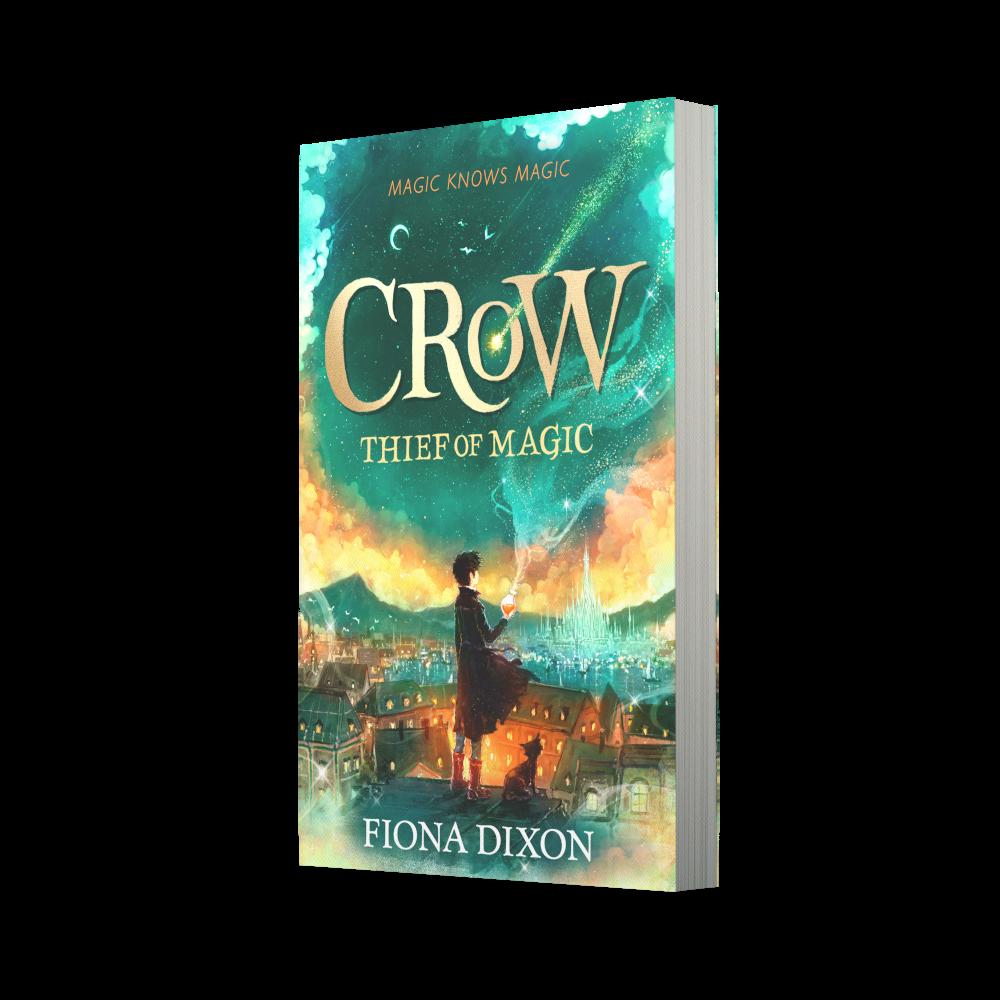
Read Chapter 1 (where Crow looks out over the city from the cathedral rooftop)
Discussion questions:
What can you see, hear, and smell in this scene?
How does the author make you feel like you ' re standing beside Crow?
Find examples where the author compares one thing to another (e.g., "lamps glowed like fireflies")
Task:
In pairs, list 5 words or phrases that help create the atmosphere of Starsgard.
Teaching Resources: Crow: Thief of Magic
Main Activity 1: Metaphor Hunt (15 minutes)
The book is rich with figurative language, such as these examples below:
"Ships clustered in the harbour like a flock of birds" (p.1)
"The Market, the beating heart of the city" (p.1)
"His life often depended on being able to outthink any security system and open any lock".
What does this tell us about Crow's world?
Class Discussion:
Why do you think authors use comparisons like this?
Do you think these creating these images helps us to understand the story better and spark our imaginations?
Independent Task:
Have a go at creating your own metaphors or similes for some of these things throughout the story:
The city of Starsgard – imagine what the streets and buildings are like
A mysterious old house – focus on a building and its features
The bottles of dream essences – what do you imagine them to look like? How Crow might feel when he’s going through the city undercover – would he be nervous, excited?
Teaching Resources: Crow: Thief of Magic
Main Activity 2: Create Your Own District (20 mins)
Starsgard has different districts: Old Town, the Market, the Garden District, the Narrows.
Writing Task:
Pick one of the districts and write 2-3 paragraphs describing the below. Think about how Crow might experience it from his point of view.
What does it look like?
What sounds and smells fill the air?
What kind of people live there?
And does it hold any secrets?
Success Criteria:
✓ Use at least 2 similes or metaphors
✓ Include sensory details (sight, sound, smell)
✓ Create atmosphere through word choice
✓ Show what makes this place unique or dangerous
Support:
Provide a word bank of atmospheric adjectives: grimy, gleaming, shadowy, bustling, desolate, mysterious, treacherous, welcoming
Plenary (5 minutes): Share and Compare
Volunteering pupils can share their district descriptions. Class discusses:
Which descriptions created the strongest mental ima
What techniques made them effective?
How would Crow navigate this new place?
Teaching Resources: Crow: Thief of Magic
Extension Activities:
Use the opening chapter to:
Draw a map of your district
Write a scene where Crow explores a new street in the city of Starsgard
Assessment Opportunities for Lesson 1:
Quality of figurative language used
Ability to create atmosphere through description
Use of sensory details
Teaching Resources: Crow: Thief of Magic
Lesson Two
Character Development and Story Structure (45-60 minutes)
Learning Objectives:
To understand how characters are revealed through actions and choices
To explore themes of friendship, loyalty, and belonging
To plan and write a narrative scene with dialogue
Key Vocabulary:
character development, motivation, dialogue, conflict, theme, narrative voice
Starter Activity (10 minutes): Character Web
Create a character profile for Crow on the board, with students calling out:
What we know about him (street smart, thief, orphan, magical talent)
His relationships (Sal, Jonas, Viktor, Nekima)
His qualities (resourceful, loyal, brave, uncertain)
His conflicts (internal and external)
Key Question:
What makes Crow a compelling character? What do we want to know about him?
Teaching Resources: Crow: Thief of Magic
Main Activity 1: Friendship in Action (15 minutes)
Read the rooftop scene (Chapter 1, pages 2-9) where Crow, Sal, and Jonas celebrate Sal's name day.
Comprehension Questions:
1.How does Crow show he cares about his friends?
2.What does "someday" mean to them? Why is it important?
3.Why does Crow feel torn about Viktor's offer? (Use evidence from later chapters)
4.What does the phrase "All or nothing" reveal about their friendship?
Discussion Task (in small groups): What different kinds of loyalty does Crow experience in the story?
To his friends (Sal and Jonas)
To Viktor (gratitude vs. truth)
To himself (survival vs. morals)
To the city (when facing the mara)
Think-Pair-Share:
Have you ever had to make a difficult choice between two people or things you cared about?
Teaching Resources: Crow: Thief of Magic
Main Activity 2: Writing a Pivotal Scene (25 minutes)
Context:
Throughout the story, Crow must make difficult choices. He's constantly balancing competing loyalties.
Writing Task - Choose ONE scenario:
Option A: Write a scene where Crow must choose between: Helping a friend in danger OR protecting a secret Taking something valuable OR staying honest
Option B: Write a scene where Crow discovers something about someone he trusts that changes everything.
Option C: Write the moment Crow and his friends say goodbye before a dangerous mission
Scene Writing Framework: Structure your scene with:
1.Opening - Set the scene (Where? When? Who's there?)
2 Rising tension - What creates the conflict or difficult choice?
3.Dialogue - Show the relationship between characters
4.Internal thought - What is Crow thinking/feeling?
5.Decision/Action - What does Crow choose to do?
6.Consequence - What happens as a result?
Teaching Resources: Crow: Thief of Magic
Success Criteria:
✓ Use dialogue to show character relationships
✓ Include Crow's internal thoughts and feelings
✓ Show (don't tell) emotions through actions
✓ Create tension or conflict
✓ Make Crow's choice believable based on what we know about him
Writing Support:
Dialogue Tips:
Use speech to reveal personality
People don't always say exactly what they mean
Include action beats: "Crow clenched his fists." / "Sal twisted her braid."
Vary your dialogue tags: said, whispered, muttered, snapped
Showing Emotion (instead of "Crow was scared"):
"Crow's heart hammered against his ribs"
"His hands curled into fists"
"Sweat beaded his forehead"
"His stomach twisted"
Challenge:
Include a secret sign or signal between Crow and his friends (like the hand signals they use in the book).
Teaching Resources: Crow: Thief of Magic
Plenary: Gallery Walk or Performance (5-10 minutes)
Option 1: Students can swap their work with a partner or group to read each other’s work
Option 2: Volunteers read their scenes, with others providing feedback:
What worked well?
Did the dialogue sound natural?
Could you feel the character's emotions? Was the choice believable?
Extension Activities:
1. Character Hot-Seating: One student becomes Crow, others ask questions about his motivations, life in Starsgard, what it’s like to be a thief, and what it was like to enter The Dream Room for the first time
2. Letter Writing: Write a letter from Crow to Viktor, or Crow to his friends, explaining a difficult decision
3. Storyboards: Turn your scene into a storyboard with pictures and writing to explain each scene
4. Theme Exploration: Create a mind map exploring the themes of:
Belonging and home
Trust and betrayal
Power and responsibility
Loyalty and sacrifice
Teaching Resources: Crow: Thief of Magic
Assessment Opportunities for Lesson 2:
Understanding of character motivation
Effective use of dialogue
Story structure and narrative coherence
Ability to show rather than tell emotions
Challenge:
Include multiple narrative perspectives
Experiment with flashback or foreshadowing
Create a series of connected scenes
Explore moral ambiguity in choices
Use more sophisticated vocabulary and sentence structures
Support:
Provide sentence starters
Offer word banks
Use story mountains/planning frames
Allow dictation or paired writing
Reduce writing length requirements
Cross-Curricular Ideas:
History: Victorian street children, historical Starsgard parallels to real cities
PSHE: Making difficult decisions, friendship, finding where you belong, dealing with loss
Drama: Role-play scenes from the book, explore character motivations
Art: Design dream bottles, create a map of Starsgard, illustrate key scenes
Science: Comets and astronomy (Oros), properties o