Issue 95 Winter 2025 childreninwales.org.uk
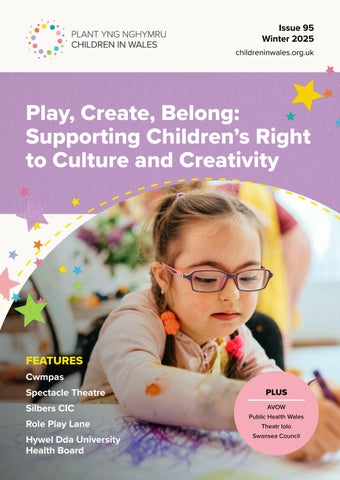
Play, Create, Belong: Supporting Children’s Right to Culture and Creativity
FEATURES Cwmpas Spectacle Theatre
PLUS
Silbers CIC
AVOW
Role Play Lane Hywel Dda University Health Board
Public Health Wales Theatr lolo Swansea Council
2 | childreninwales.org.uk
Welcome! Welcome from the Chief Executive, Hugh Russell
4
Children in Wales Training Course Calendar (January 2026 - June 2026)
6
Children in Wales Events
7
Creativity in young social entrepreneurship - Social Spark Cymru (Cwmpas)
8
Creative approaches to support children and young people’s participation in the Additional Learning Needs reform (Children in Wales)
10
Building brighter futures in Port Talbot: How Bulldogs Boxing & Community Activities supports our children and community (Bulldogs Boxing & Community Activities)
12
Alan’s Journey from Childhood to Teenager (Two Rhythms)
14
Christmas song by heart surgery children (Hywel Dda University Health Board)
16
Why theatre matters and how it helps children make sense of the world around them (Theatr Iolo)
18
Young Wales Summit 2025: A Celebration of Art, Culture & Youth Voice (Children in Wales)
20
Working creatively with children – Special Guardianship Participation Group, Glynn Vivian Art Exhibition 2025 (Swansea Council)
22
Spaces of Possibility: The transformative power of playwork (Association of Voluntary Organisations in Wrexham (AVOW)
24
Co-creating mental health support: a drama-based co-production approach with young people in South Wales (Spectacle Theatre)
26
Resilience through craft and play (Seren in the Community)
28
Making Memories – Alex’s day out with Family Fund (Family Fund)
30
All children deserve fair play (Save The Children Cymru)
32
Sparking creativity, building confidence and celebrating the right to play (Heol Chwarae Rol - Role Play Lane)
34
Creative Connections: Building Confidence and Community through Arts and Culture at Ebbw Vale Institute (ProMo Cymru)
36
Playing: the culture (Play Wales)
38
Winter 2025 | 3
Wellbeing for You: Creativity, Connection and Calm at the Heart of Family Life (Silbers CIC)
40
Building a strong, connected system with children’s voices at the heart (Cwm Taf Morgannwg Regional Partnership)
42
KnowURights Project – Arts and Culture as Everyday Rights (Neath Port Talbot Children’s Rights Unit)
44
Arts, Culture and Creativity: Protecting Babies, Children and Young People’s Mental Health and Wellbeing (Public Health Wales)
46
Creativity as a Right: Making Article 31 a Living Reality in Cardiff Schools (Cardiff Council)
48
Call for contributions for the Spring 2026 magazine
52
26 16
37
Editor: Louise O’Neill louise.oneill@childreninwales.org.uk Cardiff University Social Science Research Park (SPARK), Cardiff, CF24 4HQ 029 2034 2434 info@childreninwales.org.uk Bluesky: @childreninwales.org.uk Facebook: @childreninwales Instagram: @youngwalesciw LinkedIn: Children in Wales Registered Charity No: 1020313 Company Reg No: 2805996 The views expressed in this publication are not necessarily those of Children In Wales and we reserve the right to edit for publication.
4 | childreninwales.org.uk
Welcome from Chief Executive, Hugh Russell Croeso cynnes, a warm welcome to the Winter 2025 edition of Children in Wales’ magazine.
I would particularly like to welcome the new members who have joined us in the few months since our last edition; it’s great to have you onboard. I am writing this on the evening before our Manifesto launch event in the Senedd. The event is fully booked and I’m looking forward to the opportunity to discuss our manifesto – Champions for Children - with representatives from across the political spectrum. We’ll be joined by dozens of Children in Wales members and children and young people, and we’re expecting a good turnout from Senedd members, whom we will be pressing to show their support for children’s rights in the run up to the 2026 election.
We want to see action from whoever forms the next Welsh Government, including a cabinet position focused specifically on babies, children and young people, and a First Minister who will prioritise children’s rights. We want to see investment in children too; in their education, in where they live, in their health. One of the areas we have concentrated on, particularly in our calls, is child poverty, which was the focus of our Autumn magazine and an area on which Children in Wales has campaigned vigorously for many years. It was, therefore, with relief that we welcomed the UK Government’s recent decision to scrap the two-child benefit limit, which has done so much
Winter 2025 | 5
to deepen poverty for children growing up with more than one sibling. This decision will lift tens of thousands of children in Wales out of poverty by restoring access to the Universal Credit and tax-credits which were withdrawn under that policy. It is long overdue, but there is still much work ahead and we will continue to amplify the voices of babies, children and young people, as well as the voices of our members who campaign on their behalf, to build a better, rights-respecting Wales. With that promotion of our members and their communities in mind, I am proud to introduce an issue of the magazine that shines a spotlight on the fantastic work being done in Wales to help children access their rights under Article 31 of the United Nations Convention on the Rights of the Child (UNCRC). This article recognises every child’s right to rest, leisure, play and to participate in cultural and artistic life, supporting their well-being, development and happiness. Across the next few pages you will find uplifting examples of such work. Highlights for me include the contribution from Spectacle Theatre, who have used drama to co-design with young people improvements to mental health services for their peers. Theatr Iolo operate in a similar space, and it is inspiring to read about their mission to deliver dramatic work for young audiences which demonstrates the same artistic respect, complexity and emotional depth as that provided for adults. Play is another motif running through this edition. Article 31 is the bedrock of Wales’ world-leading play legislation, so it’s important to highlight examples like that of AVOW’s work, where Playwork facilitators support hundreds of children in Wrexham to explore, experiment and take risks in inclusive, child-led environments. We also have a piece from Save the Children Cymru on their aspiration to establish a Fair Play Fund for children, and we hear from Play Wales on some of the fundamental benefits of play for children and for partners, such as museums and galleries that promote opportunities for play. Local authorities and regional partnerships are well represented too. Cwm Taf Morgannwg Regional Partnership highlight the role of creativity in their strategic approach, which has been co-designed with varied and innovative methods; and Swansea
Council focus on how their Family and Friends Team have helped children in kinship care express their emotions through art. A further strong theme is engaging children through inventive methods, tapping into their innate desire to be creative and playful. Claire Hathway, from Children in Wales, shares insights from her recent report on young people’s experiences of the ALN system and how creativity was key to unlocking those experiences. Two Rhythms demonstrate the power of creativity in supporting a child they have worked with for over 10 years to manage emotions, build stronger family relationships and develop confidence. There is also a wonderful contribution from the Neath Port Talbot Children’s Rights Unit, describing how creativity becomes a language of rights, transforming abstract principles into lived experiences of voice, joy and participation. My thanks to everyone who has contributed, and those whose excellent pieces I have not had the word count to mention. It is a privilege to share the outstanding contributions you all make to help children in Wales access their rights. Diolch o galon Hugh
6 | childreninwales.org.uk
Training course calendar January 2026 – June 2026 Here are some of the training courses available to help keep you informed and up-to-date. Members receive discounts off all our courses. Courses are either delivered online or face-to-face. Group C: Safeguarding for the Designated Person & Senior Practitioners
Group C: Safeguarding for the Designated Person & Senior Practitioners
Tuesday, 20 January 2026 09:30 – 16:00
Tuesday, 24 & Wednesday, 25 February 2026 09:30 – 16:00
Thursday 26, & Friday, 27 March 2026 09:30 – 16:00
SPARK, Cardiff Members: £126, Non-members: £140
Cardiff Central Library Members: £252, Non-members: £280
A practical, interactive session for CEOs, Directors and Board Chairs to strengthen safeguarding leadership. Learn key legislation, governance, risk management and strategies to embed a safeguarding culture across your organisation. Includes networking lunch.
Designed for Designated Safeguarding Leads and senior practitioners, this course strengthens your expertise in managing safeguarding responsibilities, making informed decisions, and leading effective safeguarding practice.
January 2026 Group F Safeguarding for Senior Leaders
Recognise, Respond, Support: Addressing Self-harm & Suicide in Young People Thursday, 22 January 2026 09:30 – 16:00 Online event Members: £126, Non-members: £140 This training provides the knowledge and practical strategies to understand, identify and support individuals at risk of self-harm and suicide, helping you respond with confidence and compassion.
February 2026 Grief, Loss and Resilience: Tools for Supporting Looked After Children Wednesday, 4 February 2026 09:30 – 16:00 Online event Members: £126, Non-members: £140 This compassionate and practical training helps professionals understand and respond to grief and loss in children, offering tools to support emotional healing and resilience.
eSafety Essentials: Your Toolkit to Protecting Children Online Tuesday, 10 February 2026 09:30 – 16:00 Online event Members: £126, Non-members: £140 Equip educators, parents and professionals with practical tools to keep children safe online. Learn key risks, trusted resources and strategies for open conversations. Includes a Digital Safety Toolkit to support children’s digital wellbeing.
PACE & Trauma Informed Recovery: Using PACE to Support Children and Young People Thursday, 26 February 2026 09:30 – 16:00 Online event Members: £126, Non-members: £140 This course offers key insights into how trauma affects children and young people, and shows how PACE principles help build safe, trusting relationships that support recovery and resilience.
March 2026 Group B Safeguarding Children, Young People and Adults at Risk Thursday, 5 March 2026 09:30 – 16:00 Online event Members: £126, Non-members: £140 Gain up-to-date knowledge and confidence to protect children, young people and adults at risk. Covers legislation, safe practices, recognising abuse, and effective response.
Group F Safeguarding for Senior Leaders Thursday, 5 March 2026 09:30 – 16:00 Adferiad, 36 Princes Drive, Colwyn Bay Members: £126, Non-members: £140 A practical, interactive session for CEOs, Directors, and Board Chairs to strengthen safeguarding leadership. Learn key legislation, governance, risk management, and strategies to embed a safeguarding culture across your organisation. Includes networking lunch.
Online event Members: £252, Non-members: £280 Designed for Designated Safeguarding Leads and senior practitioners, this course strengthens your expertise in managing safeguarding responsibilities, making informed decisions, and leading effective safeguarding practice.
May 2026 Group B Safeguarding Children, Young People and Adults at Risk Wednesday, 13 May 2026 09:30 – 16:00 Online event Members: £126, Non-members: £140 Gain up-to-date knowledge and confidence to protect children, young people and adults at risk. Covers legislation, safe practices, recognising abuse, and effective response.
June 2026 Group C: Safeguarding for the Designated Person & Senior Practitioners Wednesday, 3 & Thursday, 4 June 2026 09:30 – 16:00 Online event Members: £252, Non-members: £280 Designed for Designated Safeguarding Leads and senior practitioners, this course strengthens your expertise in managing safeguarding responsibilities, making informed decisions, and leading effective safeguarding practice.
Autumn Winter 2025 | 7
Events
S T E K IC T D IR B Y L R A E FOR MEMBErvedRheSre. se Early bird tickets can be re 23 January 2026. Early bird access closes on
CHILDREN IN WALES 026 2 E C N E R E F N O C L A U N N A Voices in Action
Putting Participation at the Heart of Change Wednesday, 25 March 2026 sbarc|spark, Maindy Rd, Cardiff, CF24 4HQ Keynote Speaker: Professor Laura Lundy Leading expert on children’s rights and participation
Interested in participating? Contact emma.butler@childreninwales.org.uk
8 | childreninwales.org.uk
Creativity in young social entrepreneurship Social Spark Cymru Elizabeth Hudson, Cwmpas
Winter 2025 | 9
A pilot learning programme for young people unlocks creativity to solve problems while developing social enterprise skills.
If the young people are ready to take their idea forward, Cwmpas and Social Business Wales will help them through the next steps.
Social Spark Cymru is an enterprise programme with a difference - it aims to take young people, aged 16 - 24 in the Cardiff Capital Region, on a social enterprise journey to help them come up with creative business ideas to make positive change. The students also learn about social enterprise through case study visits, hearing first-hand about the highs and lows of running a business and the social impact.
In the social enterprise sector, arts and leisure is one of the biggest sectors according to Social Business Wales’ recent sector mapping report (2025). There are many social enterprise arts venues, theatres and galleries across Wales from Galleri in Caernarfon to Elysium in Swansea.
The programme is delivered by Cwmpas, in partnership with Children in Wales, and is funded through the Welsh Government Child Poverty and Innovation Fund. It aims to help make sure the most disadvantaged young people can reach their potential. The course structure has been codesigned by young people and is adapted to suit the groups’ needs. During an ideas generator the young people were encouraged to come up with lots of business ideas. A research phase helps identify issues in their community they would like to tackle through business or a cause they would like to work on. The course takes learners through the fundamentals of starting a social business, including calculating costs and marketing, and learners develop a pitch to share their ideas and gain feedback. Their ideas were also expressed on an illustrated business canvas, instead of a typed business plan, and to make it as accessible as possible leaners can use a padlet to upload notes and ideas. The young people’s business ideas showed great creativity in tackling issues important to them and include an illustrative design business for users of assistive technology, a chocolatebased candle range tackling isolation, a sober youth club and a curious conversations café. The course tutors at the students’ Academy were impressed by the young people’s creative ideas, confident communication and detail in the plan. “From identifying community needs to designing sustainable business models, they’ve shown creativity, confidence, and a real commitment to making a difference. Innovation and enthusiasm truly shone through.”
The next course for young people will be in Cardiff starting 8 January 2026 and will include an immersive study visit to Boss and Brew in the Millennium Centre. Course participants will find out how the business tackles youth unemployment through coffee, and perhaps even some latte art, before developing their own ideas. To book a place for a young person, please use this link: Book here The pilot programme ends in March 2026, so for anyone interested in finding out more or to express an interest in future bespoke programme delivery, please contact: elizabethhudson@cwmpas.coop
10 | childreninwales.org.uk
Creative approaches to support children and young people’s participation in the Additional Learning Needs reform Claire Hathway, Development Officer ALN Children in Wales Every child has the right to enjoy their childhood fully. Article 31 of the United Nations Convention on the Rights of the Child (UNCRC) recognises that every child has the right to rest, leisure, play and to participate fully in cultural and artistic life (United Nations, 1989). This right supports a child’s wellbeing, development and overall happiness. It is about more than just fun, it is about allowing children to explore, create, express themselves and be heard. In Wales, creative approaches are being used to ensure children and young people are central to shaping their experiences, particularly within Additional Learning Needs (ALN) reform. Children in Wales, commissioned by the Welsh Government, has worked directly with children in
educational settings across the country to develop a Wales-wide ALN Children and Young People’s Participation group. This ensures young voices influence how the ALN system is shaped and improved, while also understanding the impact of the reform on children and young people. The project has reached four education settings across Wales, delivering 36 sessions to 33 pupils in both English and Welsh primary and secondary schools, as well as a local authority house specialist class, with children and young people aged 6-16. The purpose has been to gather their experiences, understand challenges, and identify effective practices in implementing the new ALN system and Code.
Winter 2025 | 11
A multi-method, creative, and participatory approach has been key to this work. Children’s feedback was captured in group sessions, small focus groups, and one-to-one interviews, with opportunities for neurodivergent or non-verbal children to express themselves visually through doodling, photographs, painting, drawing, and building activities such as Lego. Colours, textures, and objects were used to represent feelings and preferences, and tools like floor maps and mood boards helped children articulate ideas physically. Each session began with games-based activities to break the ice, have fun, ease tension, and build trust. Children co-design how sessions will look and feel, creating informal contracts that give them ownership over the process. Digital tools such as online polls, interactive mood boards, and podcasts further allowed the children to participate and provide feedback anonymously, giving confidence to share their thoughts honestly. These creative experiences have enabled a needs-led, equitable, and non-discriminatory process, supporting children with diverse communication styles to share a range of perspectives. Relational practices in the sessions also helped children with emotional regulation and wellbeing, while developing trusting and respectful relationships. This approach reduces barriers to participation and gives children autonomy to express their thoughts and emotions, even when they do not have the words for them. Importantly, this process recognises children as stakeholders in their own education. It validates their lived experiences, empowers them to identify priorities and solutions, and ensures their voices are central to decisions affecting their education and lives. The feedback collected by the ALN Ambassadors group has provided rich insight into the challenges children and young people face in accessing education, as well as highlighting effective practices currently in place across Wales. Findings are being published and disseminated to inform policy and practice more widely. Supporting children’s right to rest, leisure, play, and cultural participation is essential to their happiness and development. Creative approaches, such as those used in this project, demonstrate how children and young people can
be fully engaged, valued, and celebrated for their contributions. When children are given the time, space, and freedom to express themselves through play and artistic experiences, they thrive. This shows us that Article 31 is not a luxury, but a cornerstone of childhood itself. If you would like to reach out and discuss this work further, please email: claire.hathway@childreninwales.org.uk Also, to read more please click here: Children in Wales | Additional Learning Needs (ALN) Ambassador Programme
Building brighter futures in Port Talbot: How Bulldogs Boxing & Community Activities supports our children and community Ceri Stilwell, Bulldogs Boxing & Community Activities
Bulldogs Boxing & Community Activities has long been committed to improving the lives of children and young people in Port Talbot, providing safe, structured and inspiring environments for them to grow, interact and thrive. Central to our work is the belief that every child deserves meaningful opportunities for rest, leisure, play and participation in cultural and community life. Through our youth club, Champs Camp - alternative education and youth gym - Bulldogs has created a holistic offer that brings Article 31 to life for the children who need it most. In communities like Port Talbot, where many young people face social, economic and educational challenges, access to positive activities is not guaranteed. Bulldogs provides a vital open door - one that welcomes every child and gives them space to feel safe, valued and supported. At the heart of this is the boxing club, a vibrant and inclusive environment where children can socialise, relax and express themselves freely. The youth
club supports the right to rest and leisure by giving young people a break from the pressures they may be experiencing at home or school. It also offers a reliable routine and a sense of belonging, which are key to emotional wellbeing. Leisure and play take many forms at the youth club. From games and creative projects to informal social time, children are encouraged to explore their interests, develop social skills and build positive relationships with peers and trusted adults. These interactions help strengthen confidence and communication while reinforcing that play is not an optional extra, but a core component of healthy childhood development as recognised in Article 31. Our Champs Camp, an activity-based programme rooted in boxing, teamwork and resilience-building, further supports these rights. Champs Camp provides structured play and physical activity that allows children to experience challenge in a safe and supportive setting. Through boxing
Winter 2025 | 13
drills, fitness sessions, group activities and personal development tasks, children are encouraged to set goals, work collaboratively and celebrate their progress. Champs Camp is not simply about sport, it is about giving young people an outlet for energy, emotion and creativity. By participating fully in these activities, children strengthen both their physical wellbeing and their sense of achievement, autonomy and identity. We also take the children to local attractions which they may not be able to go to due to the cost. Champs Camp incorporates elements of storytelling, reflection, and sometimes creative expression such as music or art linked to confidence-building themes. These opportunities help children connect with their own narratives and experience the joy of creating something meaningful. The youth gym plays a crucial role in providing access to physical leisure activities that might otherwise be unavailable. It is more than a fitness space, it is a positive alternative for young people who may be vulnerable to antisocial behaviour, low self-esteem or isolation. In the youth gym, young people learn skills, discipline and respect in an environment where they are encouraged to try new things without fear of judgement. Physical activity is strongly linked to improved mental wellbeing, and the youth gym empowers young people to take care of both their bodies and minds.
Across all three settings, Bulldogs prioritises inclusion and participation. Children are given a voice in shaping activities and programmes, ensuring that their needs and interests are reflected in what we offer. By providing safe spaces for leisure, play, creativity and physical activity, Bulldogs is not only supporting the practical needs of children in Port Talbot, but is actively upholding their fundamental rights. Our work demonstrates the transformative impact that rights-based youth provision can have, ensuring that every child has the chance to enjoy their childhood, feel valued within their community and build the foundations for a positive future. Please email ceri.stilwell@bulldogsbca.org if you would like to discuss the work that we undertake.
14 | childreninwales.org.uk
Alan’s Journey from Childhood to Teenager Gray Hill, Two Rhythms
This case study chronicles the journey of a young boy, Alan, who has a diagnosis of Autism and his engagement with Two Rhythms, a charity offering person-centred arts programs. The charity, which works with individuals with learning and sensory needs, provides a safe space for creative activities. For confidentiality, Alan is a pseudonym. Establishing a safe space Alan first attended a Two Rhythms session in 2015 at the age of seven, with limited verbal communication. He entered the building in a stroller and walking reins to provide extra safety due to his tendency to run in open spaces. Once in the session room, Alan displayed high-energy behaviour, racing around and bouncing between beanbags - his mum apologised frequently.
Creative Facilitator, Liberty, offered reassurance to both Alan and his mum. She emphasised that the space was non-judgmental and allowed them to be themselves, aligning with the charity’s core belief to “meet our ‘guests’ where they are,” trusting that “where they are is always right.” This approach established an environment where Alan’s individual choices and authentic creative expression would be encouraged and nurtured. Physical/emotional regulation and creative expression Over the next few years, Alan showed significant progress, gaining the ability to regulate himself. The headbanging that was once a common response has lessened. Alan became able to utilise the relaxation methods used in sessions and in triggering situations.
Winter 2025 | 15
His creative expression blossomed through movement and music:
• Music: During percussion exploration, he
shifted from fleeting exploration between instruments to playing sustained tunes on the xylophone and turn-taking with Liberty
• Movement: Alan grew from hiding under
fabrics to confidently requesting songs to dance to. He explored movements using props such as ribbons, materials, and capes, igniting imagination. He expressed his enjoyment through smiles, laughter, and even initiating holding hands to dance
Family connection and bonding Another significant outcome of the sessions was the creation of a special bonding time for Alan and his mum. At the close of each session, Alan became able to relax in stillness. He would lie down and ask his mum for a hug, sharing a precious time together. Developing confidence, communication and looking ahead Post COVID-19 lockdowns, Alan has continued to build confidence and communication skills. His mum shared that he now copes well with various activities outside of the sessions and shared a video of him enjoying social events with beaming smiles; marking a significant milestone that demonstrates increased confidence.
More recently, Alan has become confident enough to verbally share his inner experiences. He can express anxieties about school and his upcoming transition to college - acknowledging the uncertainties ahead. He is given the time to process these thoughts, after which he often shifts his focus to things he enjoys, sharing his happiness through smiles and dancing. Two Rhythms feels privileged to have this connection with Alan and his family for over 10 years and looks forward to continuing to support his journey into his teenage and adult years. Please do get in touch if you would like to know more about the work that we do: gray.hill@tworhythms.co.uk
16 | childreninwales.org.uk
Christmas song by heart surgery children Sian Jenkins, Hywel Dda University Health Board This Christmas, a choir comprising of children who have bravely faced heart surgery, alongside the friends and family of a talented young band, have come together to create something truly special. They have recorded a beautiful Welsh Christmas song “Pob Un Plentyn” (“Every Child”).
The choir, known as “Cân o’r Galon” (“Song from the Heart”), was formed to celebrate the courage of these children, and foster a sense of community and support for children and families in West Wales navigating the challenges of living with Congenital Heart Disease (CHD).
Winter 2025 | 17
Families of children with CHD, under the care of the Hywel Dda University Health Board’s Paediatric Cardiology Team, were contacted in September with the opportunity to join the choir. The response to the project was overwhelmingly positive. Common themes of parents feeling isolated and children not knowing anyone else who had undergone heart surgery or had a scar, quickly became apparent. Bringing families together in this way allowed parents to share their experiences with others who understood the difficulties and challenges of caring for a child with congenital heart disease, whilst the children sang, played and made new friends. The song was written by Paediatric Consultant, Dr Sian Jenkins, who led the project and is performed by the choir, accompanied by “Coron Moron,” a young Carmarthen band made up of seven friends, all in Year 7 at school. Weekend rehearsals took place in October, led by Dr Jenkins and supported by Jen Stirling, Paediatric Cardiology Nurse and Ellen Huish, Clinical Child Psychologist. After just three weeks the children were ready to record at SonicOne Studio in Llangennech, under the brilliant guidance of Tim Hamill. ‘Pob Un Plentyn’ was released on 19 November 2025 and is available on all main music platforms: https://www.youtube.com/watch?v=66lfhmA4D8c Since then, the children have performed live at The Lyric theatre in Carmarthen, at a Christmas lights event in Carmarthen and a Christmas fair in Cardigan Castle. The project has been an absolute joy and feedback from the children and families has been very positive. It has given the children huge pride, confidence and connection, after what has been for many of them some very difficult years. “The choir has been a lifeline already. I know we have some major surgery ahead and I feel so much better now that I have friends who have been through it. It’s also helped my son with getting to realise that many others have and are going through the same hospital appointments as us as he’s in a small primary school and there are no other children with heart conditions in his school.”
“Joining the group has been really lovely for Levi & Alice. We’ve met lots of new people and had some exciting new experiences. It is so refreshing to meet other children going through similar things to ours. We have been able to talk about our personal experiences and maybe help others, whilst the children are having fun.” “Being in this group means so much to Alice and me. It’s given us new experiences, new memories and, most importantly, the chance to meet other parents and children who truly understand what this journey feels like. Seeing the children sing, grow and support one another after everything they’ve been through is something incredibly special. I’m so grateful for the friendships we’ve made, the comfort we’ve found and the strength that comes from being surrounded by people who know the highs and lows of a heart journey. Thank you.” Our hope is that this project will help us to support more children and families in West Wales affected by CHD. There is a JustGiving page for donations here: Paediatric Cardiology Team is fundraising for Hywel Dda Health Charities Donations will be put towards helping to develop and build the support network, arranging fun family days and improving the environment in which children have heart scans during clinic appointments in Withybush, Bronglais and Glangwili Hospitals, to minimise anxiety. More information on CHD can be found on these websites: https://heartresearch.org.uk/information/heartconditions/congenital-heart-disease https://111.wales.nhs.uk/congenitalheartdisease/
18 | childreninwales.org.uk
Why theatre matters and how it helps children make sense of the world around them Lee Lyford, Theatr Iolo
Theatr Iolo has been at the forefront of creating theatre for children in Wales for nearly 40 years. We are passionate about nurturing and igniting the imagination and creativity of young minds, to help children make sense of the world around them and to find their place within it. At Theatr Iolo we believe that all children have as much right to access arts and culture as any adult, and this principle underpins everything we do. Our Theatre Director, who predominantly creates work for family audiences, is often approached for insight into this so-called ‘subset’ of the audience, as though it requires a fundamentally different or unusual approach. But in truth, the work is simply driven by the same artistic rigour, curiosity, and most importantly respect, that should be applied to any audience. Like their adult counterparts, children deserve work that acknowledges their complexity, honours their intelligence, and offers them an emotional and imaginative space in which to explore and make sense of the world.
Theatr Iolo’s show, Owl at Home, was about to go into production as the pandemic hit, but the closure of theatres meant it was unexpectedly delayed until 2022. Looking back, it seems like a moment of serendipity! Based on Arnold Lobel’s book of the same name, this tale of an Owl living off grid in isolation, pottering about in his dressing gown, the story was more significant than ever before. In the play, Owl endures a range of challenges and emotions - his greatest crisis arrives when he allows Winter into his home. Winter doesn’t just drift in politely; it bursts through the door in a snowstorm of mayhem and mischief, dismantling Owl’s carefully ordered world. Everything Owl relies on is suddenly in pieces, and he is at a loss as to how to put his home, and himself, back together. At this low point, the Moon appears. Owl befriends it, allowing this quiet, steady presence into his life, opening himself up to the possibility of connection, comfort and ultimately a triumph of resilience. For the children watching, this is a tale about an owl who lives alone. It’s playful, funny, and engaging. Yet beneath that surface, we are inviting them to think
Winter 2025 | 19
about profound human experiences. What happens when your world is disrupted, how do you rebuild when things fall apart, how friendship can arrive in unexpected forms, and how we cope with forces beyond our control. These are the same questions many children navigated during the pandemic questions of isolation, uncertainty, and how to find hope against the odds. But we never state this explicitly. We believe that theatre for children, as for adults, is at its best when it creates space for them to find their own meaning, at their own pace. And find it they did! Here are just a couple of the hundreds of postcards that children wrote to Owl after watching the show… “I hope you and the moon will be friends forever” “The bumps were your feet, so you don’t need to be afraid. You are safe” “…you can come and live with us, but in the attic” “I think it was funny and happy but sad too”
Like most good art, theatre is a space for thinking and ideas, but it is the communal nature of the experience that is crucial to its brilliance. Where better to learn about difficult feelings such as loss, fear, despair etc than sitting together in a room - children, parents, teachers, strangers - and experiencing it in real time. It teaches us empathy. It fosters a shared imagination, and it reminds us that we are not alone. Our upcoming tour of Tidy | Taclus, based on the illustrated children’s book by Emily Gravett, is a tale of a restless badger who is obsessed with tidying and cleaning to the point where he destroys the wood he lives in, by laying concrete over the ‘untidy’ ground. Tidy’s more obvious themes of the importance of environmental care are tackled from an emotional and character-led perspective, we laugh at Pete the Badger’s foibles and scream when he chops down another tree. Ultimately, whether we are telling a tale about a restless badger who destroys his environment or an owl rebuilding his home after winter’s storm, we’re exploring the same universal truths that unite us all. And children deserve nothing less than theatre that honours their capacity to feel, understand, and imagine. That’s why we do this work. That’s why theatre matters. To find out more about Theatr Iolo’s work, please visit: theatriolo.com Photographer: Kirsten McTernan
Young Wales Summit 2025: A Celebration of Art, Culture & Youth Voice Gwen Jenkins, Engagement Worker Young Wales
Winter 2025 | 21
Creative energy continued to flow through New Era Talent’s workshops, where young people explored DJ skills in Boost, made their mark in the She Paints the Streets graffiti workshop, and wrote empowering verses in a rap lyric-writing session with Missy G. These sessions were b ursting with confidence, experimentation and self-expression - proving that culture is a powerful tool for youth voice.
This year’s Young Wales Summit, held on 15 November 2025, brought together young people from across Wales for a dynamic day of creativity, culture and youth voice. Packed with authentic conversations, bold ideas, activism and hands-on artistic energy the event showcased the power of young people’s perspectives. Held to mark World Children’s Day, the Summit came alive with expression and imagination – showing exactly how young people are shaping Wales’ future. The Summit placed a strong spotlight on Article 12 of the UNCRC, celebrating every child’s right to share their views and influence decisions that shape their lives. In doing so, it naturally echoed the spirit of Article 31, which recognises children’s rights to rest, play, participate in cultural life and the arts. The whole day brought these rights to life in a genuinely integrated way with young people exploring creativity, shaping discussions and expressing themselves through art, music, movement, and conversation. The day opened with an inspiring opportunity for young people to share their priorities directly with Welsh leaders, setting the tone for an event centred on youth voice. A lightning-round Members’ Showcase followed, highlighting exciting participation work from across Wales and reminding everyone just how imaginative and capable young people are when given the space to lead. But the heart of the Summit belonged to art, culture and creative expression. In The Big Conversation Art Workshop, Welsh textiles designer and climate activist Ophelia Dos Santos guided young people through using art as activism, expressing their hopes for a fairer, greener future through colour, texture and imagination.
Young people also shaped discussions in the Listen Up! Workshop and the World Café, where they explored the online world, shared lived experiences and sparked thoughtful group conversations. Both spaces offered relaxed, youth-led environments that celebrated their perspectives. Adding to the creative pulse of the day was the Champions for Children Workshop, a hands-on filmmaking and storytelling session with Becky Homes, that placed imagination centre-stage. In this lively, high-energy space, young people stepped behind and in front of the camera to explore the centra; question: What would you do if you were First Minister for a day? With lights, lenses and laughter, participants crafted their own mini-manifestos, storyboarding ideas, performing on camera, and shaping bold, artistic visions for Wales’ future. Their filmed pieces captured raw creativity and confidence, blending performance, narrative and activism into a vibrant showcase of youth leadership. The Summit was more than a gathering. It was a creative movement: a space where young people painted their ideas, mixed their own sounds, shaped conversations and demonstrated the power of combining art and youth voice. To find out more about the work of Young Wales or the annual Summit, please email: gwen.jenkins@childreninwales.org.uk
22 | childreninwales.org.uk
Working creatively with children – Special Guardianship Participation Group, Glynn Vivian Art Exhibition 2025 Sarah Ford, Swansea Council Special Guardianship (SGO) was introduced through an amendment in the Children and Adoption Act 2005 to the provisions of the Children Act 1989. Since implementation on 30 December 2005, SGO has provided an additional pathway to permanence for children up to the age of 18 (alongside adoption, residence orders and long-term fostering) for children who are unable to live with their birth parents. Kinship Cymru reports that there are over 141,000 children living in kinship care across England and Wales, but despite this research often little is known about special guardians and the children they care for. In 2023, Swansea Council’s Family and Friends Team launched an initiative to enable young people to meet and talk about their experiences living in a special guardianship kinship family, so that they could become more involved in the services that shape that them. The group was well attended and discussions soon centred around the importance of creating information that was able to be led by the children and
shared with others. With the help of staff at Swansea Glynn Vivian Art gallery, the children in the group attended four sessions and lead by local artist, Richard Monahan. This project ultimately produced a nine foot art montage which was displayed in the gallery and was viewed by families and leaders within Swansea Council’s Social Services and Education alike. The group’s intention was to develop information around SGO, whilst also creating a piece of children’s artwork based on the premise that…. “Whilst we can’t change what has happened, we can always change the way we and others think about things.” All the support officers within the group have past experience as teachers, residential care staff or therapists, and have been very much aware that creative expression supports children’s emotional wellbeing and offers a way for them to make sense of the world and contemplate difficult issues.
Winter 2025 | 23
“When we created the art project we knew the powerful ability of art as a non-threatening medium that expresses old hurts, worries and best hopes and in a form of symbolic resolution.” The drawings from the montage were thereafter captured into a booklet written by the children entitled “What is a Special Guardianship Family?” This booklet is now a main part of information sharing within the SGO process in Swansea and is regularly offered to families and children considering progressing onto SGO.
We believe that the project was a fantastic opportunity to shine a light on how children can engage with arts and culture, how their voice can be heard and how their messages can be celebrated by a wider audience. Special thanks go to Daniel Mcabe and Richard Monahan at Glynn Vivian Art Gallery for getting the project off the ground, our young people Lilly May, Daisy, Lilly May, Sienna, Leeroy. Riley, Jay, TJ, Bella and Sydnie (because without you none of this would have happened) and our wonderful support officers who frequently go above and beyond to help the children and families in our service. These are Jayne Lewis, Chloe Thomas and Samantha Rickard. If you want to hear more about this work, please email Sarah Ford, Deputy Manager Family and Friends Team, Swansea Council on: Sarah.Ford2@swansea.gov.uk
24 | childreninwales.org.uk
Spaces of Possibility: The transformative power of playwork Claire Pugh, Association of Voluntary Organisations in Wrexham (AVOW) Established in 1988, AVOW is Wrexham’s County Voluntary Council (CVC), providing infrastructure support, representation, and partnership opportunities - a trusted, innovative organisation, bridging communities, local authorities and Welsh Government. For the past 14 years, AVOW has supported The Land, a unique adventure playground in Plas Madoc. In summer 2025, AVOW also stepped in to protect Gwenfro Valley Adventure Playground in Caia Park, preventing its closure due to funding pressures. AVOW’s commitment to play is inseparable from its wider mission: empowering people, strengthening organisations, and building resilient communities. By advocating for Article 31, AVOW positions play as a cornerstone of community wellbeing - a right that connects children, families, and communities to brighter futures. The Land and Gwenfro Valley are Adventure Playgrounds that operate on a principle of inclusion.
There are no entry fees, no booking systems, and no barriers to participation. Both sites stand as vibrant, child-led spaces where creativity is not just encouraged but embedded in the very structure of daily life and despite being classed as deprived communities, our children are wealthy in terms of play and opportunity – essential components to happy, healthy childhoods. Our model is rooted in Playwork: a radical approach that creates the conditions for children and young people to thrive, raising aspirations, building resilience, and fostering meaningful involvement. The team works across two communities, sharing expertise, pooling resources, and fostering a sense of belonging and collective strength for children/ young people. By creating playful, welcoming spaces, we support children and people of all ages in navigating challenges and discovering new strengths. Our approach is relational, responsive, and grounded in the belief that play is a catalyst for community transformation.
Winter 2025 | 25
For over 40 years, the adventure playgrounds have served as safe havens for children, young people and families - spaces where confidence, resilience, and aspiration are nurtured through play. Through trusted relationships and meaningful engagement, children and young people find their voice, build emotional resilience, and begin to shape their futures. Together, we are building resilient, inclusive services where children and families experience continuity and care across all areas of life. Play is more than recreation - it’s a catalyst for change, helping children find their voice, strengthen relationships, and shape their futures. Playwork is rooted in the belief that play is a right and a powerful force for wellbeing, connection and growth. It prioritises children’s agency/ emotional safety, creating spaces to explore, take risks and express themselves freely. Playworkers listen, observe and respond - building trust and resilience through relationships. This approach strengthens not just children, but families and whole communities. By embedding play, youth development and family support into the heart of the community, our Playgrounds spark a ripple effect of pride, opportunity, and lasting change - led by those who live it.
In the Playgrounds, children design and build structures, choosing materials, colours, and layouts through hands‑on experimentation with playworkers. They create signage and murals that reflect their language, humour, and identity. Agency is central: children construct dens, fires, and memorable opportunities with minimal adult intervention, learning through trial, collaboration, and adaptation. They establish their own rituals and rules, from sharing tools to naming spaces while co‑creating safety practices with staff who facilitate rather than direct. Children shape the emotional climate, deciding when to be loud, quiet, communal, or solitary, and adapting the space to their needs. Across both playgrounds, creativity is not confined to art or performance - it’s expressed in relationships, routines, and the everyday beauty of play. These are living, evolving spaces where children are trusted to lead, and where their ideas are not only welcomed but foundational. They shape the rhythm of the day, the materials they use, and the stories they tell - whether through den‑building, painting, hanging out with friends, or spontaneous performance. Staff act as facilitators, not directors, offering tools, materials, and emotional support while trusting children to lead. This radical approach fosters confidence, belonging, and a deep sense of ownership- proving that when children are given space to shape their world, they do so with imagination, care, and brilliance! If you would like to find out more about this work, please contact Claire Pugh, AVOW Play Department Manager & Plas Madoc Community Development Manager on: claire.pugh@avow.org
At The Land and Gwenfro Valley children are not just participants - they are co-creators. These spaces operate on an approach to working with children and young people, where agency, experimentation, and expression are embedded in everyday practice. Today, both playgrounds are shaped by the 750+ children who attend annually, with structures and opportunities evolving through their ideas, input, and lived experiences.
26 | childreninwales.org.uk
Co-creating mental health support: a drama-based co-production approach with young people in South Wales Steve Davis, Spectacle Theatre Spectacle Theatre has implemented an innovative co-production project using theatrein-education techniques to engage children and young people in designing mental health support solutions for their peers in South Wales. Project development The project emerged from conversations between Spectacle Theatre and educational partners during theatre productions across schools in Rhondda Cynon Taf (RCT) and Merthyr Tydfil. Discussions about mental health provision revealed a critical opportunity that children and young people awaiting mental health services could become active participants in developing support solutions, rather than passive recipients. Funded by the Co-Production Incentive Grant (CPIG) and in partnership with Cwm Taf Morgannwg Regional Partnership Board, the initiative addressed growing concerns about young people’s mental health and waiting lists for services while recognising young people as experts in their own experiences.
Implementation From January 2025 until November 2025, Spectacle worked with students from Afon Taf Secondary School Merthyr (year 8), a Tuition Group in Merthyr, Ysgol Llwyncelyn in RCT (year 6) and Porthcawl Comprehensive School (year 8). The intervention established theatre-in-education drama techniques designed to provide safe frameworks for exploring complex emotions and lived experiences. The project positioned young people as co-researchers, acknowledging their expertise through structured creative activities that enabled authentic expression, while maintaining emotional safety. Workshop structure Workshops began with drama games to build trust and group cohesion. Participants collaboratively created three fictional characters experiencing mental health challenges who were absent from school that day, creating narrative distance and emotional safety. Through these fictional personas, young people explored complex issues while maintaining appropriate boundaries.
Winter 2025 | 27
Using their created characters, participants explored support available from three interconnected systems: school-based support, family support and community support. This enabled identification of both existing provision and critical gaps. Key findings Young people demonstrated sophisticated understanding of mental health support needs. They showed awareness of available resources like ChildLine, NSPCC and ELSA, and understood practical strategies, including talking to trusted adults, attending therapy, using school support spaces and peer support. However, they identified a gap between knowledge and the confidence to act.Critically, young people expressed feelings that barriers exist: fear of not being understood, worry about potential consequences, and perceptions that school is not always a safe place where teachers listen or act helpfully. They felt things are often done to them rather than with them. Solutions and recommendations Young people provided clear guidance for adults to: Be calmer - when young people share concerns, they should avoid reacting with agitation or shouting Be kinder - listen without judgment, learning when to act Be supportive - listen actively rather than passively observing or note-taking Be understanding - include young people in decisions affecting them and communicate before sharing their information Key recommendations included:
• Joint training for pupils and teachers (Mental Health First Aid)
• Young people creating and delivering training for adults (teachers, school governors, parents, professionals)
• Drama-based projects to develop critical thinking skills and empathy
• Development and distribution of a toolkit for teachers
Young people highlighted the need for better communication about support services, clarity around confidentiality, and the importance of role models promoting positive mental health. In Afon Taf, they noted how staff and students use the “blue room” differently, despite students’ involvement in its creation. Future directions The project’s ongoing development includes a toolkit based on theatre techniques for wider dissemination, and a Theatre-in-Education play exploring similar themes, which will tour RCT in Spring 2026. Partners will work to ensure that insights translate into tangible improvements in mental health support across the region. This project has demonstrated the viability and value of theatre-based participatory approaches to co-producing mental health support solutions with children and young people. Drama and theatre create safe distance through fictional frameworks, enabling authentic emotional exploration and positioning young people as genuine partners in service design. The approach is replicable in other contexts. If you would like to learn more about this work, please do get in touch by emailing: steve.davis@spectacletheatre.co.uk
Resilience through craft and play Charlotte O’Neill, Seren in the Community
Seren in the Community is a small charity that delivers play sessions within the CF24 area of Cardiff, primarily in outdoor public green spaces and parks. 2026 marks our 10th anniversary as an established charity working hyper-locally and in partnership with our fellow third sector organisations within the area.
Being an almost exclusively outdoor play organisation presents its own challenges before we even begin to consider the social, economic and cultural barriers of including the arts in our sessional delivery. Naturally, being Wales, the weather is almost always a factor that must be considered when planning or facilitating artistic expression, but is not
Winter 2025 | 29
impossible to overcome. Our children and young people particularly enjoy making their own paint from mud and chalk which they use on rolls of paper during brief periods of dry weather, but also directly on footpaths during the inevitable wet.
health and safety talk, supervised the sessions, cleaned up and evaluated the sessions afterwards! We were very proud of the effort they put in and all of the beautiful creations that they and the other participants were able to create.
We have also found that, during the autumn months, pumpkin carving proves to be a most effective and almost waterproof activity with the children and young people taking great joy in creating intricate, and occasionally grotesque carvings, to take home. This is often welcomed by parents as they sometimes lack the confidence to allow the children to use carving tools or are unsure about how to support them, and our group carving sessions enable the children and young people to participate fully in the autumn experience.
Our fellow third sector organisations also put their best foot forward to support the children within the local area in participating in the arts, and we are always happy to support these efforts as they so generously support ours. We developed a Play Action Group that ensures that all organisations wishing to facilitate free and accessible activities for children and young people within the area are supported fully, whether this be lantern making with Railway Gardens, circus skills with NoFitState and Fiery Jack’s circus, dance with Rubicon or family craft with Oasis, Splott Community Volunteers and Boomerang.
Within our area of delivery we regularly engage with a very high number of children and families who are asylum seekers or refugees, and participating in these seasonal activities is often a new experience for these children. It is important to us that these families are able to experience all aspects of Welsh life, despite their often unstable living conditions, restricted finances and language barriers. Christmas is another time of the year where the urge to craft is strong, particularly within our 8-12yrs demographic. We are blessed with strong connections within the community who are always happy to offer us a free space in which to whip out the glue guns and craft all the Christmas sparkles. As funding is difficult to come by, and the majority of our service users are living in a state of poverty, facilitating workshops without the support of the other third sector organisations and the community would be impossible. Due to the high level of children and young people on reduced timetables, or who have difficulty engaging with formal educational settings within the area, we try to provide plentiful opportunities for our children and young people to gain additional skills outside of the traditional school settings. Last year we were able to facilitate a Christmas craft programme that was led entirely by our young people, with the support of our playworkers. The young people planned, budgeted, purchased resources, delivered the
During these trying times, the children and young people with whom we engage are struggling more than ever with anxiety, stress and fear about a world that they don’t understand and a future that is so uncertain. Misinformation from social media and overexposure to hate and conflict are just some of the issues that contribute heavily to these children’s childhoods, but by taking the time to engage with the workshops and activities that we provide and support, they can breathe within the escapism of the arts; have meaningful discussions about their wellbeing without the distraction of a screen; mix and mingle with our diverse community; and gain a greater understanding of the possibilities that exist outside of a traditional educational path. But also have a whole lot of fun! If you would like to learn more about our work, please email: Charlotte.sereninthecommunity@outlook.com
30 | childreninwales.org.uk
Making Memories – Alex’s day out with Family Fund Davina Carey-Evans, Family Fund When we think about play, we typically think of it as a leisure activity, but play is very important for all of us. Playing helps children and adults navigate the world, explore curiosity and engage with others. For every child, playing is a right. For disabled children, playing has a profound impact on their ability to connect with others, break down social boundaries, expand their curiosity and increase their quality of life. Alex is like all children, a bundle of energy, happiest with wellies on, exploring and adventuring in the great outdoors. With his grandparents, Alex loves to trek across the countryside in pursuit of telegram poles, and it is in this way that he maps his world. Alex doesn’t have all the other privileges of most children, however. Living with autism, Alex is non-verbal, so he interacts with the world in a different way. Living with his grandparents, Alex’s grandmother Lyn told us that he needs constant supervision as he cannot perceive certain
dangers. Social stigma can also be a huge issue to overcome for disabled children, before even considering challenges such as mobility issues or family resources. Last year, Alex’s grandparents took him to Glan Llyn, the Urdd Residential Centre in North Wales. They joined a group of other families with autistic children who were given the chance to use the climbing wall, go on the high ropes, build rafts and go canoeing. The staff have extensive experience working with disabled children, giving Alex’s grandparents the confidence to relax and allow their grandson some independence. The trip gave Alex new confidence and skills, which he showed off to his schoolteachers along with his photos of the residential. His grandparents were equally excited to take him again and Alex counted down the days with anticipation.
Winter 2025 | 31
Their dreams were stalled, however, after both Tim and Lyn were diagnosed with cancer forcing Lyn to give up her job as a ceramics tutor. Added financial pressure left them worried about being able to afford the trip, a heartbreaking sacrifice for Alex and his grandparents. So, when they found out they qualified for our Family Fund Take a Break Wales grant they were relieved to be able to have another opportunity to make memories with him. Returning to Glan Llyn gave the family a muchneeded break during an especially difficult time. While visiting, the team did everything to ensure that the family had a wonderfully relaxing time. Not only taking care of Alex, but ensuring his grandmother had a quiet space to recover from surgery and even baking a cake and singing Happy Birthday to Tim. The trip was not without bumps in the road, as Alex did get upset at the end of an activity. The amazing staff at Glan Llyn were able to bring Alex down and calm him, leaving his grandparents to enjoy him when he’d returned to his best. Residential experiences like this at Glan Llyn are a valuable tool for caregivers to meet other carers of autistic children, to relate to each other’s experiences and share advice on how to manage their situations. Community is an incredible asset to these families and it’s amazing to see them come together at Glan Llyn. Almost as heartwarming as seeing Alex beaming with pride at his photos. At Family Fund, we understand the difficulties that many children face in being able to access a safe and free environment to play in. This can be by providing sensory toys or technology, grants for breaks and day trips and for essentials for everyday living. Alex’s story shows the importance of leisure time to build confidence, discover abilities and socialise, as well as giving caregivers space to rest and enjoy time together. At Family Fund, we will continue to provide these life-changing experiences while urging policymakers, play facilities and venues to follow the example of inclusive spaces like Glan Llyn.
Alex will always be able to look back on the photos of his trip, remember the fun he had on the lake, the thrill of the high ropes, the freedom of the outdoors and the calm presence of his relaxed grandparents. All children deserve to hold such happy memories. If you know of someone who could benefit from our grant scheme, please ask them to contact: Davina.Carey-Evans@familyfund.org.uk
32 | childreninwales.org.uk
All children deserve fair play Melanie Simmonds, Save the Children Cymru Too many children are missing out on things that should be part of every childhood: sports, music, the chance to play and appreciate the arts, go on school trips and just spend time with friends. When some children can join in while others cannot, the result is exclusion and inequality that can last a lifetime. We know this because we hear it time and time again from talking to children and young people, to their parents and our partners who work with families living in the most deprived areas in Wales. We are also aware of the important personal and social benefits that these experiences provide, and the positive impact they have on wellbeing and mental health. This is why we are calling in our Senedd Election 2026 Manifesto for the next Welsh Government to develop a Fair Play Fund so that every child in Wales can join in, build friendships, and grow their talents, no matter what their family’s income is.
Listening to children as part of our Power of Voice research showed how deeply poverty affects children’s lives. Those who took part in the project regularly referenced the importance of places within their community and how the activities they took part in enriched their lives. These included parks, sports centres, libraries, churches and youth clubs. Hobbies and activities included listening to music, art classes. reading, drama club, Cadets, skateboarding, and simply ‘hanging out and walking around.’ Participants discussed how these activities provide them with a reason to leave the house and enable them to spend time with family and friends. Participating in different activities or socialising with friends provided children with a sense of identity and benefited their wellbeing. Children also shared how taking part in clubs can connect them with role models and help them learn new skills and reach their ultimate goals in life. What was common across many of these opportunities was that they were, by in large, led by community volunteers from within participants’ communities.
Winter 2025 | 33
However, they also highlighted the lack of choices in the activities they can take part in within their local area, with some noting that these options have been reduced further in recent years with youth clubs and leisure centres closing. In many cases, children also explained how local spaces, such as parks, can feel unsafe and about the challenges of different age groups mixing in these spaces. The cost of transport and fees or lack of public transport was also a recurring theme restricting access to activities or ability to socialise. Many had to rely on an adult to take them to clubs or activities, which was a challenge for some as their parents were not always available due to work, or looking after other children, or because the family didn’t have a car. Some also discussed youth groups closing or not having the best facilities or equipment available or being able to recruit or retain volunteers to run them and the need to fundraise. As we look ahead to the Senedd election in May we are calling on politicians to consider the lifechanging opportunities that accessing cultural, sport and play activities can provide, especially for children living in poverty. It’s a chance to show that Wales puts children first and deserve fair play. To view our Manifesto please visit: www. savethechildren.org.uk/what-we-do/child-poverty/ uk-child-poverty/wales
34 | childreninwales.org.uk
Sparking creativity, building confidence and celebrating the right to play Joanne Baldock, Heol Chwarae Rol - Role Play Lane
At Heol Chwarae Rol - Role Play Lane, we believe that play is far more than just a pastime; it is a fundamental right, a powerful tool for learning and a vital foundation for emotional well-being. Rooted in the principles of Article 31 of the United Nations Convention on the Rights of the Child (UNCRC), our not-for-profit centre in Llantwit Fardre provides children with safe, inclusive and inspiring spaces where imagination, creativity and cultural expression can flourish. Our role play environment is designed to reflect real-life scenarios through child-sized shops, cafés, construction areas, salons and emergency
service settings. These immersive spaces allow children to explore different roles, develop social skills, build confidence and express themselves freely. Through imaginative play, children learn to negotiate, collaborate, problem-solve and understand the world around them – all while having fun. Arts and culture sit at the heart of what we do. We deliver a wide range of creative workshops and themed events including craft sessions, sewing, storytelling, music, seasonal celebrations and sensory play experiences. These activities not only nurture creativity, but also celebrate Welsh culture,
Winter 2025 | 35
language and community identity, ensuring that children feel connected to their heritage whilst exploring new artistic interests. Inclusivity is central to our mission. We proudly support children with Additional Learning Needs (ALN), neurodiverse children and families who face barriers due to cost-of-living pressures. By offering funded sessions and subsidised activities, we ensure that all children, regardless of background, have equal opportunities to participate in cultural and creative experiences. Many of the families we support report increased confidence, improved social skills and stronger emotional resilience in their children, as a result of attending our sessions. Beyond play, Heol Chwarae Rol serves as a welcoming community hub where families can connect, build friendships and access additional support. We regularly collaborate with local organisations, schools and wellbeing services to provide holistic opportunities that promote positive mental health, family bonding and community cohesion.
By championing Article 31, we are not only protecting children’s right to rest, leisure and play, but actively celebrating it. At Role Play Lane, every game, creative activity and shared moment contributes to a happier, more confident generation of children who feel valued, inspired and empowered. We see daily how these opportunities strengthen children’s emotional well-being, deepen their sense of identity and encourage them to explore their unique talents. In a world where children’s time is increasingly structured and pressured, we are proud to offer a space where imagination leads, curiosity thrives and every child is free to simply be themselves. If you would like to learn more about the work we do, please get in touch by email: visitsatroleplaylane@gmail.com
36 | childreninwales.org.uk
Creative Connections: Building Confidence and Community through Arts and Culture at Ebbw Vale Institute Taylor Powell, ProMo Cymru
Winter 2025 | 37
ProMo Cymru is the custodian of Ebbw Vale Institute (EVI), a community and cultural centre at the heart of Blaenau Gwent. During the summer of 2025, EVI hosted a programme of free family events, offering creative and educational experiences in a welcoming community space. With many areas in Blaenau Gwent falling within the 10% most deprived in Wales, and recognising that summer holidays can be expensive, EVI offered children the chance to participate without having to worry about the cost. Funded through the UKSPF Fund, the events allowed children to have fun, enjoy new experiences, and feel connected to their local community. Many activities gave children the chance to learn, explore and express themselves in new ways - sessions like the ”Encounter with Owls,” delivered with a local owl sanctuary, and the ”Animals Interactive Experience” provided a rare opportunity to meet endangered animals, exotic creatures and birds of prey. Children learned about habitats, conservation and the natural world while gaining confidence through handson, engaging experiences. These events often inspired artwork and discussions in the community café afterwards. This link between learning and creativity continued through EVI’s art-focused events, including maskmaking, badge-making and glitter tattoos. These free workshops encouraged children to explore their own interests and creative styles. These events were fully inclusive, ensuring every child could take part and enjoy the activities. Interaction is a key focus in all the events hosted at EVI, helping children feel part of a shared community experience where their ideas and voices matter. Working closely with Louby Lou’s Storytelling, EVI hosted interactive performances such as ‘EVI Superheroes’ and ‘The Big, Good Wolf.’ Storytelling supports children’s creative development, allowing them to imagine more deeply and connect with others through fun, engaging stories. Beyond providing enjoyable experiences, EVI’s events contribute to children’s confidence and community involvement. They offer accessible
opportunities to try new things, make friends, and learn about the world around them, while also helping families access local support and services, such as a food pantry, Repair Café, and multiple wellbeing activities and initiatives. EVI continues to offer a wide range of support and services for children, families and the wider community across Blaenau Gwent. For more information, visit evi.cymru.
38 | childreninwales.org.uk
Playing: the culture of childhood Marianne Mannello, Play Wales Many of us have fond memories of growing up and playing in groups of children of different ages - with siblings, cousins and neighbours. Playing across the ages provides rich and lively experiences where older and younger children can thrive. It supports the development and acceptance of playfulness, which is a distinct feature of human behaviour across history and cultures. Every child in every culture plays. Human children have a particularly long childhood (18 years) that allows for plenty of play and all types of play, which in turn nurtures health, happiness and creativity. As General Comment number 17 of Article 31 of the United Nations Convention on the Rights of the Child (UNCRC) notes, ‘children create and pass on culture through imaginative play, songs, dance, stories, games and festivals.’ When they play together, older children feel a sense of responsibility and younger children feel supported and encouraged to try new things and gain confidence. This supports all children to feel connected to each other and to the places where they play. Younger children learn by watching the older children around them and then copying the behaviours they see. Older children also see and copy playful behaviour which comes so instinctively to younger children. Practitioners in playwork settings who work with children aged five to 15 view children as competent
and active participants in their play. The play spaces in which they operate enables them to respect and work with each child’s unique qualities and needs. We can draw on playwork skills to support multi-age play, by:
• Communicating the importance of play across the ages with parents and caregivers to help them understand the value for their children
• Providing flexible spaces which allow children of different ages to play alongside and with each other. Ideas include, offering:
• Plenty of loose parts play materials • Sensory play, such as sand, water and mud • Outdoor space for large traditional games, like hide & seek and hopscotch
• Natural play space for treasure hunts, playing in leaves and tree climbing
• Music, which encourages children to lead
activity such as fun dancing and musical chairs
• Arts and crafts supplies, to allow skill sharing and co-operation
Play is at the core of children’s lives and is vital for their health, happiness and creativity. As has been the case for generations through play, children:
Winter 2025 | 39
• Develop a sense of, and value for culture • Are encouraged to explore cultural ideas
and celebrations, fostering an appreciation for diversity
• Better business for settings and venues,
attracting more new and returning visitors
• The creation of lively, social spaces that encourage play and engagement
• Work together, negotiate and build relationships
For more information, take a look at:
• Feel connected to each other, their settings
Focus on play: museums and cultural sector
and their neighbourhoods
• Create and pass on games, songs and stories • Absorb culture, customs and practices Play and cultural institutions General Comment number 17 also reinforces that: ‘Involvement in cultural life and the arts is an important element of children’s sense of belonging. Children inherit and experience the cultural and artistic life of their family, community and society, and through that process, they discover and forge their own sense of identity and, in turn, contribute to the stimulation and sustainability of cultural life and traditional arts.’ As well as supporting children with opportunities for recreational activities, cultural life and the arts, museums, galleries and other cultural organisations can offer children the chance to realise their right to play. Museums, galleries, heritage sites and cultural venues have a wealth of experience and understanding of children and families as visitors. The cultural sector is well placed to make their spaces and settings welcoming to children and their families by offering opportunities to be playful. Small changes to invite playfulness and movement around the venue, can make a big difference. It’s good for children and their families to have opportunities to play and be playful. These opportunities benefit cultural settings and venues, too. Benefits include:
• The improved wellbeing of children and families • Children’s enjoyment of their Article 31 rights thanks to the support of the setting or venue
• Increased visitor engagement
This briefing for managers and strategic leaders provides information about how the cultural sector can support and influence children and teenagers’ opportunities to play. Play, museums and cultural organisations This information sheet aims to support museums, galleries and cultural organisations working with children and families to broaden their understanding of play. It offers ideas to incorporate play into the cultural sector’s day-to-day work and service provision. Visit our Playful Childhoods website for information and ideas about supporting play between children of different ages.
40 | childreninwales.org.uk
Wellbeing for You: Creativity, Connection and Calm at the Heart of Family Life James Silbers, Silbers CIC Across South West Wales, Silbers CIC’s Wellbeing for You programme is quietly transforming family life - one creative breath, stretch and brushstroke at a time. Delivered weekly across the school year, Wellbeing for You offers parents and carers a rare thing: space. Space to breathe, create, and rebuild confidence alongside their children in a warm, inclusive environment. The programme blends arts, mindfulness, bodywork, and practical life skills to help families regulate emotions, strengthen relationships, and rediscover joy in the everyday. At its core, Wellbeing for You champions Article 31 of the UNCRC - a child’s right to play, rest, and participate in cultural and artistic life. But Silbers CIC doesn’t stop there; we invite parents into that right too. Because when adults heal, grow, and express themselves creatively, the ripple effects reach every child in the home. Each weekly three-hour session begins with shared creative activities - cooking, music, art,
voice, and movement - intentionally designed to calm the nervous system, nurture connection, and strengthen trust between parents and children. Families paint, cook, breathe, and laugh together, rediscovering the simple joy of shared experience. Once the children return to class, parents stay on for a relaxed but purposeful space - a mix of mentoring, peer support, and a good cuppafuelled chat about life’s real challenges. Our team is right there to help parents take practical steps: making calls, filling in forms, and tackling issues with Universal Credit, housing, schools, or social services. Grounded in the principles of the Wellbeing of Future Generations (Wales) Act 2015, the Social Services and Well-being (Wales) Act 2014, and the Children and Families (Wales) Measure 2010, our work actively supports families to build resilience, wellbeing, and stronger community connections here in Pembrokeshire.
Winter 2025 | 41
Silbers CIC is proud to work in partnership with schools, families, and communities to ensure every child in Wales not only survives, but thrives, through education, play, and the art of being human together. If you would like to learn more about this work, please email: james@silberscic.org.uk or visit our website: www.silberscic.org.uk Transforming lives through education, play, and nature.
This isn’t therapy - it’s community in action. Real support, real people, making life a little lighter, one week at a time. Our male and female co-facilitators model equality and emotional intelligence, challenging outdated gender expectations and showing what healthy collaboration looks like in practice. This dual approach creates balance and safety — essential when working with families affected by trauma, stress, or ACEs. What makes Wellbeing for You stand out is its creative flexibility. Every session is co-designed with participants. If families say, “We need to move more this week,” we get them dancing. If they say, “We need calm,” we bring in art, breath, and quiet craft. The message is clear: wellbeing isn’t a lecture - it’s a lived, shared experience. The results speak volumes. Parents report lower stress, improved self-esteem, and stronger family bonds. Children show better emotional regulation, concentration, and confidence. Schools notice calmer classrooms, happier homes, and earlier intervention before crisis points hit. But beyond the statistics, there’s something beautifully simple here - a return to connection through creativity. In a world where families often feel isolated and overstretched, Wellbeing for You reminds us that art, movement, and shared meals aren’t luxuries. They’re lifelines. As one parent put it: “This group gave me back my spark — and my child noticed before anyone else.”
Building a strong, connected system with children’s voices at the heart Stacy Chamberlain, Cwm Taf Morgannwg Regional Partnership
Creativity is both an enabler and a connector in strategic processes. As a regional partnership, we exist to create space for bold, meaningful change across a complex and connected health and social care system. Our ambition for babies, children, young people and families is clear: to uphold their right to have happy and healthy lives. However, we also recognise that children living in our region are experiencing poorer outcomes than in many parts of Wales. Addressing complex challenges and shifting trends demands true partnership between professionals and the community, built on trust, accountability and relationships. This belief is the foundation of our Whole System: Whole Heart children’s strategy launched on 21 November 2025. Our strategy sets out eight ambitions that ensure children, young people and families are receiving the care and support they need, at the right time.
We are committed to driving real transformation, but this can only happen through meaningful co-production with our communities. When launching our strategy, we were mindful that the word “strategy” can feel jargon-heavy and overly professional. Our purpose is to improve outcomes for babies, children, young people and families. That means ensuring our approach truly resonates with them, and is clear, accessible and rooted in what matters most. We know that inviting communities into a strategic process can sometimes feel tokenistic. That’s why our ongoing ambition is to create safe, meaningful opportunities for them to shape this work with us - as experts in their own lives. We have spent years developing ways for communities to feel truly heard and deeply listened to. For children and young people, the most powerful connection
Winter 2025 | 43
happens when they can creatively express their experiences, needs and aspirations - bridging the gap between their world and the professionals who support them. For example, creative activities with children and young people, such as a hackathon and a poetry slam, have directly shaped our strategic thinking and direction. Ahead of launch day, we used our Regional Integration Fund Co-production Grant to support Rhondda-based Spectacle Theatre in delivering a compelling creative performance. Teenagers co-produced a play that reflected their experiences of mental health systems. By staging contrasting scenarios, showing both poor and positive experiences, they communicated directly to professionals what needs to change. Using performance as a communication channel proved incredibly powerful - it allowed professionals in the room to truly experience the system through the voices and actions of young people. Alongside funding a live performance, we also created a film with babies, children, young people, and parents. Local mother-and-baby groups, schools, and youth groups came together to express why change matters, share what they need from professionals, and their hopes for the future. Ryan, a teenager from Bridgend, says in the film: “If young people were equal, their voices would be stronger. So, listen to our voices, listen to us.” We’ve used this powerful message as a creative challenge to us all - to ensure equality and amplify the voices of young people in everything we do. Ryan joined our launch day and took part in a creative workshop with other young people and Rocio Cifuentes, the Children’s Commissioner for Wales. In this small, safe space, children and young people used art to express what matters most: emotional wellbeing and a sense of belonging. They shared that they want to feel safe, heard, understood, and supported - in everyday environments like school, home, and community. They also highlighted the importance of trust, respect, positive relationships, and meaningful opportunities to connect. These insights reinforce the core vision of Whole System: Whole Heart: support must be relational, compassionate, and rooted in the voices of children and young people.
Creativity has been a true enabler - building trust and acting as a connector between professionals and communities. As we move into the next stage of our journey, creating spaces for children, young people, parents and carers to be active participants in decision-making, we will continue to use creative processes to make these environments accessible and empowering. Through creativity, we can lift their voices as co-creators of a fairer, more equal region where every child can grow up happy, healthy and heard. Read our full strategy here. Watch our film here: Launch of Whole System: Whole Heart For more information please visit our webpage: https://ctmregionalpartnershipboard.co.uk/ childrenstrategy/ or email Stacy Chamberlain, Regional Children Services and NYTH/NEST Framework Coordinator on stacey.chamberlain@rctcbc.co.uk
44 | childreninwales.org.uk
KnowURights Project – Arts and Culture as Everyday Rights Clare Pritchard, Neath Port Talbot Children’s Rights Unit
Article 31 of the United Nations Convention on the Rights of the Child (UNCRC) recognises every child’s right to rest, leisure, play, and to participate fully in cultural and artistic life. In the Upper Afan Valley, the KnowURights project has, over the past two years, championed this right by embedding creativity and play into children’s daily experiences. Creativity as a language of rights At the heart of the KnowURights project is the belief that children’s voices matter. Arts-based methods - music, craft and cooking classes have become powerful vehicles for children to express their identities, views in their community and hopes. Workshops are deliberately hands-on, enabling children aged 7 to 16 to explore UNCRC articles through creative practice. By turning rights into real-life experiences, creativity becomes more than an activity - it becomes a language of rights. When children design, sing, cook or craft they are not only enjoying play and culture, but actively claiming their entitlement to participation, voice and joy. This everyday practice makes rights visible, tangible and lived, rather than abstract principles. Expanding access to play and culture Children in the Upper Afan Valley often face rural isolation and limited transport. The KnowURights
project responds by bringing arts and culture directly into their communities. Community hub sessions have included tie-dye bag design, sustainable craft-making for World Sustainability Day, and Afan Valley Rock music workshops delivered in partnership with local organisations. A defining feature of the KnowURights project is co-production. Children and young people shape the content and direction of workshops in the community and schools. Young people also co-created a video to share with adults who make decisions in their area. This video shaped clubs and projects such as a new Minecraft club & a community-run Youth Club age 7+ by the local library, in Cymmer, and Table Talk cooking workshops in some villages where young people aged 11+ can have fun and meet friends, learn new skills, and share their views. Video Link: https://www.childrensrightsunit.org. uk/2025/07/04/you-spoke-we-listened/ Barriers and enablers To address these issues, the KnowURights project is strengthening community partnerships, increasing youth-led planning, and piloting popup creative events shaped entirely by young people’s interests, including trips outside of the area. These steps aim to ensure that arts and culture remain accessible, relevant and inclusive.
Winter 2025 | 45
Voices from practice Through the project, we have seen how play, arts and culture nurture wellbeing, confidence and inclusion. They remind us that participation is not a privilege but a right, and that every child deserves opportunities to rest, play, create, and belong. Anchored in Article 2 of the UNCRC, these opportunities are for every child, without discrimination of any kind. The KnowURights project actively works to ensure that children of all backgrounds, abilities, and circumstances are included, so that joy, creativity, and belonging are universal experiences - not limited by geography, identity or circumstance. The KnowURights project will continue championing Article 31 by ensuring that children in the Upper Afan Valley have opportunities to participate fully in cultural and artistic life. By embedding creativity into everyday practice, the project celebrates uniqueness, strengthens community, and protects children’s right to joy, play and cultural participation - now and into the future. Most importantly, by turning rights into real-life experiences, the project shows that rights are not distant promises but everyday realities. Children’s voices, creativity, and play become living proof that rights can be claimed, celebrated, and sustained in daily life. If you would like to learn more about this work, please email Clare Pritchard, Children’s Rights Project Development Officer on clarep@childrensrightsunit.org.uk
46 | childreninwales.org.uk
Arts, Culture and Creativity: Protecting Babies, Children and Young People’s Mental Health and Wellbeing Amy Davies, Public Health Wales How Public Health Wales are supporting children and young people’s access to arts and culture for mental health and wellbeing benefit. Mental health challenges are rising New evidence shows that mental health difficulties among children and young people in Wales are rising, underlining the need for early intervention, prevention, and collaborative action across all sectors. The Joint Statement on Children and Young People’s Mental Health and Wellbeing, published by Public Health Wales, brings together expert views, young people’s voices, and the latest data and evidence from Wales, the UK, and globally. The results show:
• Rates of diagnosable mental health
conditions among children and young people have doubled over the past two decades—from one in ten in 2004 to one in five in 2023
• There are complex causes behind these
increases, including family poverty, social inequality, academic pressure, parental mental health difficulties, and the influence of digital technology
• Barriers to accessing services and limited
community-based opportunities to connect with others and take part in hobbies and interests remain major concerns for young people
What supports mental health and wellbeing? The evidence shows that strong community connections, trusted relationships, and opportunities to engage with nature, sport, music, and creativity can make a real difference. The findings also reinforce the need to focus on children’s wellbeing from the earliest years, so families get the right support and young people grow up in environments that protect their health and emotional resilience. Creativity matters There is well established evidence that the arts are beneficial to our health and have a role to play in improving health and wellbeing for all. Evidence strongly demonstrates that participation in arts, culture, and creative activities is a powerful protective factor for children’s mental health and wellbeing. These activities support emotional resilience, reduce symptoms of mental health difficulties, and promote positive social connections.
Winter 2025 | 47
At any age being creative helps us to express ourselves, learn new skills, and feel connected. Doing something creative can help us to look at life differently, work out problems, and gain new perspectives on things. Creativity looks different for everyone and can include engaging with:
• Performing arts: music, dance, theatre • Visual arts and crafts: painting, textiles • Literature: reading, writing • Culture: museums, galleries, objects, story • Digital media: animation, film For babies and infants, music and singing strengthen caregiver bonds and support speech and language development, laying foundations for emotional health. For children and young people, creativity builds confidence, improves self-understanding, and helps manage emotions during tough times.
• Increasing access to wellbeing-promoting activities, including arts and culture
• Helping schools implement Whole
School Approaches to emotional and mental wellbeing
• Implementing the Early Years Framework for Action
• Enabling a national conversation on mental
wellbeing, and inspiring action to protect and promote family wellbeing through Hapus
Want to find out more? HI-Programme.Support@wales.nhs.uk For information about the things you can do to protect and promote your mental wellbeing, including a range of creative wellbeing tools, visit www.hapus.wales
Evidence shows that creative activity provides safe spaces for self-expression, reducing stress and anxiety. It matters how activities are run; the most effective are safe spaces where people do not feel stigmatised and are facilitated with empathy by skilled practitioners. Creative therapies significantly reduce symptoms of post-traumatic stress in children and adolescents worldwide. There is also evidence that involvement in community arts initiatives improves relationships, belonging, and longer-term life trajectories, such as education and employment outcomes.
References
Delivering Wales’ Mental Health and Wellbeing Strategy (2025–2035)
Fancourt, D., et al. 2020. The role of arts in improving health & wellbeing.
The strategy sets clear ambitions; including ensuring everyone has the knowledge, opportunities, and confidence to protect and promote good mental health. Public Health Wales are working closely with Welsh Government, NHS partners and wider organisations to support the implementation of the strategy. We are:
• Developing a detailed report on the
mental health needs of babies, children, and young people
Applewhite, B. et al. 2025. Creative arts-based interventions for the improvement of PTSD symptoms in young people: a meta-analysis with a focus on non-Western populations.
Jenkins, C. et al. 2025. An introduction to creative health. Peppler, K. et al. 2025. Creative Expression, Caring Relationships, and Career Pathways: A Guide to Youth Outcomes in Community Arts Programs. What Works Wellbeing. Culture, Arts & Sport. World Health Organization (WHO). 2019. What is the evidence on the role of the arts in improving health and well-being? A scoping review.
Creativity as a Right: Making Article 31 a Living Reality in Cardiff Schools Alan Chappell-Williams, Cardiff Council
Winter 2025 | 49
Article 31 of the UNCRC sets out every child’s right to participate in cultural and artistic life. In Cardiff, this isn’t an aspiration - it is the basis of how we design learning, build partnerships and create opportunities that reflect the identity, diversity and potential of our young people. As the Curriculum Team, we work across all phases and communities to ensure creativity is a lived entitlement. Through our wide Expressive Arts partnership network, strengthened by the Cardiff Commitment, we connect schools with the cultural energy of the capital and offer experiences that support wellbeing, confidence, voice and belonging.
public gigs and shared billings with professional musicians. Little Gigs Bach doesn’t just showcase Cardiff’s music scene - it helps shape its future. Filmmaking at Willows High This year, Willows High has become a centre of creative filmmaking. Through Into Film Cymru’s Every Child a Filmmaker, pupils produced short films - including Snapped Strings, which opened the Iris Prize Festival. Alongside this, partners such as Deedy Media, the BBC, Buffoon Media and Boom Cymru have supported learners to document the construction of their new school. Through drone footage, interviews, directing and editing, pupils are shaping a multi-year documentary told entirely through their own eyes. The project gives young people ownership of their story and shows them a future in Wales’ world-leading screen sector - a sector located on their doorstep. Wales: Home from Home Exhibition
A city-wide commitment to creativity This term alone, more than 70 cohorts of learners have taken part in programmes across all five Expressive Arts disciplines. Each opportunity is co-constructed with partners, rooted in Curriculum for Wales and shaped around the needs of school communities. Four projects in particular show the depth and impact of this approach. Little Gigs Bach Delivered with CerddCF, local musicians, producers and promoters within the Cardiff City Music network, Little Gigs Bach starts by bringing live music into schools - often a first for learners across the Southern Arc. But the real power of the programme lies in what comes next: mentoring, hands-on production experience and genuine pathways into the city’s music ecosystem. Pupils explore instruments, sound engineering and performance, with our bands progressing to
Developed as a pilot with Vision Fountain, this project combines digital innovation with community heritage. Using VR headsets, interactive exhibits and film-making tools, young people explored stories of migration, identity and belonging from across Cardiff. The resulting exhibition blends technology with lived experience, elevating the voices of learners - particularly those from the global majority - and offering an immersive look at the diverse cultural identities that shape Wales today. The Fight Brought to Cardiff through a collaboration between the Curriculum Team, Theatr na nÓg and Arts Council Wales, The Fight became one of the term’s most impactful cultural moments. The production tackles identity, fairness and societal expectation through the story of Welsh boxer Tommy Farr and the overlooked legacy of Jack Johnson, America’s first Black heavyweight champion. In just over a week, more than 2,000 learners from 37 schools experienced theatre that challenged assumptions and sparked critical conversations about justice and resilience.
50 | childreninwales.org.uk
rebuild confidence after anxiety or absence; for others, they spark new aspirations in music, film, theatre or design. A shared city mission Cardiff’s cultural organisations - theatres, studios, musicians, filmmakers, youth groups, archives and universities - make this work possible. Together, we are showing what Article 31 looks like in practice: barriers removed, diverse voices centred, creativity embedded in everyday learning, and young people encouraged to discover who they are and what they can contribute. If you would like to learn more about the work that we do, please email Alan Chappell-Thomas, Lead Curriculum Officer, Cardiff Council: Thom-WillA@Hwbcymru.net
Reaching the learners who need it most Equity drives the work we do. Around two-thirds of participating learners came from Southern Arc communities, and nearly four in 10 were eligible for Free School Meals. More than thirty languages were represented among the 31% of pupils learning English as an Additional Language, and 11% had Additional Learning Needs. In total, 37% of learners identified as being from global majority or mixed ethnic backgrounds. These figures highlight why access to culture must never depend on postcode, income or circumstance. By intentionally prioritising communities facing the greatest barriers, we ensure that creativity - and the confidence and sense of belonging it inspires - is available to every learner. Creativity as wellbeing, identity and progression Teachers across the city report the same pattern: creative engagement transforms learners. Pupils who rarely speak find their voice. Young people develop healthier ways to express emotion. Relationships strengthen, empathy deepens and horizons widen. For some, creative projects
Winter 2025 | 51
Organisational links Children in Wales AVOW Bulldogs BCA Cardiff Council Cwm Taf Morgannwg Regional Partnership Cwmpas Family Fund Hywel Dda University Health Board Neath Port Talbot Children’s Rights Unit Play Wales ProMo Cymru Public Health Wales Role Play Lane Save the Children Seren in the Community Silbers CIC Spectacle Theatre Swansea Council Theatr Iolo Two Rhythms
52 | childreninwales.org.uk
Call for contributions to our Spring 2026 Special Edition magazine SPECIAL EDITION to be produced both digitally and in print, with hard copies launched at our Annual Conference on 25 March 2026. Early bird tickets are available for our members here. Theme: Babies, children and young people’s participation best practice across the sector We are seeking contributions for the Spring edition of our magazine, focusing on effective participation practice across Wales. This issue will explore how babies, children and young people influence the world around them, and how professionals in health, education, social care, childcare, youth work and the third sector embed their voices in everyday practice. As a valued member of our community, your experience matters. We welcome submissions grounded in lived experience, frontline practice, policy or research, including:
• Case studies led by or featuring young people • Opportunities for developing participation skills • Projects children and young people can join • Children’s rights and participation in action • Engagement with diverse communities • Co-production models that elevate young people’s voices • Insights from Participation Workers on overcoming barriers Together let us share learning, amplify what works, and champion meaningful change for babies, children and young people in Wales. Submission guidelines:
• Articles should be 500 and 750 words • Please provide your submission in both English and Welsh • Include a title, your name and organisation • High quality JPEG images welcome • Deadline for submissions Thursday, 26 February 2026 To express interest or reserve space in this special edition, please email: membership@childreninwales.org.uk as soon as possible. Please note: the magazine is shared publicly on our social media accounts, giving your contribution the opportunity to reach a wider audience beyond our membership. We look forward to hearing from you and sharing your voice in this important conversation.
BUILDING VOICES PROGRAMME
Children in Wales is pleased to introduce Building Voices. A consultancy service designed to help organisations embed meaningful youth participation and co-production into their work. With over 30 years of expertise in children’s rights, we o er tailored support including strategy development, sta training and youth voice facilitation. Our flexible packages are designed to ensure children and young people’s voices genuinely shape services and policies.
BUILDING VOICES
To explore how Building Voices could support your organisation, please contact Kate.thomas@childreninwales.org.uk for more information. SEE MORE
You can also check out our digital brochure and video showcase below to see how we’re already making a di erence with the FAW.