TECNICA
n. 32
Autumn issue 2026
MOLITORIA graphic: ellittica.it
INTERNATIONAL
INNOVATION AT ITS BEST
www.favastorci.com
WITH SUPPLIERS DIRECTORY
10064 PINEROLO - ITALY - Tel. +39 0121393127 - e-mail: info@chiriottieditori.it Supplemento al n° 10 del 2026 di Tecnica Molitoria - Sped. in A.P. - D.L. 353/2003 (Conv. in L. 27/02/2004 n° 46) art. 1 comma 1 DCB TO - n. 2 anno 2026 - IP
07/10/2026 16:36:43
ISSN0040-1862
ADV26_CTA_Cop_TM-Int.indd 1
graphic: ellittica.it
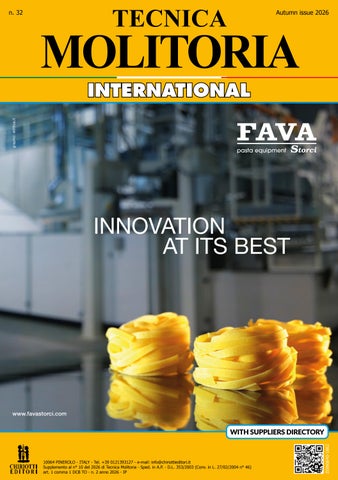
The Fava Storci solution to the industrial production of specialty dried pasta: our CTA line for round nests, with production capacities up to 1000 kg/h, is designed to ensure high performance, maximum reliability, and perfect nest formation, even for the most delicate of shapes such as capellini, spaghetti, and tagliatelle. Its advanced technology leads to ideal drying diagrams for each and every raw material used.
www.favastorci.com
INNOVATION AT ITS BEST
1
2
3
4
Fragola Spa
Fragola SPA
fragolaspa
5
* HAMMERS * PLATE * SIEVES * VARIOUS ACCESSORIES FOR FLOUR AND FEED MILLS
O.B.R. BULGARELLI srl Via Parri, 3 - 42045 LUZZARA (RE)
6Tel. +39 0522 976972 - www.obr.it - obr@obr.it
defino-giancaspro.com
INNOVATE TO FEED THE FUTURE Discover how to transform your production with cutting-edge solutions We are constantly seeking innovative solutions for the food industry. Our team of experts: engineers, food technologists, and specialists, develops tailor-made systems that meet the needs of an everevolving market. With an innovative approach and meticulous attention to detail, we ensure customized solutions and outstanding performance.
DESIGN | PRODUCTION ASSEMBLY | ASSISTANCE MACHINERY | STEEL STRUCTURES SILOS | ACCESSORIES | PIPING FOOD INDUSTRY PLANTS
7
Ca priccio (1942) D a nt e Ruffin i’s n o n - fini t o sc u l p t u re 8
THE FUTURE COMES TO LIFE O N LY I N T H E H A N D S OF THOSE WHO ARE ABLE T O C R E AT E I T
ocrim.com
paglierani.com
9
10
Everywhere You Make Pasta, We're Already There.
Via Maestra Grande 20 - 44045 Cento (FE) Italy
E. marketing@axor-italia.com
T. +39 051 6842166
11
campbelladv.com 17020A
BORGHI horizontal storage ideal partner Grain conservation and storage automated plants Storage space optimization.
Stocked product excellent conservation.
Low energy consumption product conservation.
Big storage economically advantageous.
More possibilities to receive financing.
Wholly automated management.
High operating speed.
ENGIN
EER
ING
OD -PR
UCTI
ON-SERVI
CE
BORGHI Srl 45037 Melara (Rovigo) Italy Phone +39-0425.89689 Fax +39-0425.89636 E-mail: info@borghigroup.it 12
INFINITY SMART AI SYSTEM Quality and on line control
input product for analysis
transfer information and machine setup control
MAGIC BOX OPTICAL ANALYZER
sending reports
quality feedback and color sorter setup
MAGIC BOX OPTICAL ANALYZER
INFINITY PLUS-8 OPTICAL SORTER
sending reports
The MAGIC BOX AI optical analyzer, installed before the INFINITY PLUS optical sorter, can obtain a precise analysis of the input product with a corresponding report. Based on the results obtained, we will be able to set the sorter’s parameters to ensure the quality of the output product. The MAGIC BOX installed after the sorter will analyze the processed product for quality control purposes, producing a report. If the quality of the processed product does not meet the limits set by the operator, the device will send the necessary parameter changes to the optical sorter.
www.ist2000.com IST 2000 S.r.l. via Corazza, 22 - 44124 Ferrara | +39 0532 099536 | info@istsort.com
13
14
15
16 32
CE ATEX
Via del Santuario, 41-43 - 12045 Fossano (CN) Italy Tel. +39 0172 692579 - Fax +39 0172 692578 vdlolocco.com - info@vdlolocco.com
17
18
M-JET LINK Connection box
19
20
ARTICLES AND SPARE PARTS FOR MILLS, AGRICULTURE AND INDUSTRIES
OFFICIAL DEALER
SAVIGLIANO (CN) - www.agrinova.it info@agrinova.it - 0172 715488
21
22
CHIRIOTTI EDITORI MAGAZINES anno 65 - n. 681 settembre 2026
CON IL PATROCINIO DI
INDUSTRIE
ALIMENTARI
NOVANTA9.COM
PJT.2026.5099.1
Poste Italiane spa - Sped. in A.P. - D.L. 353/2003 (Conv. in L. 27/02/2004 n° 46) art. 1 comma 1 MBPA NORD OVEST - n. 8/2026 1/2021 - IP - ISSN 0019-901X
Viale Rimembranza, 60 - 10064 Pinerolo - TO - Italy Tel. +39 0121 393127 - info@chiriottieditori.it chiriottieditori.it - shop.chiriottieditori.it
AFFIDABILITÀ ED EFFICIENZA IN OGNI FASE, DALLA PESATURA AL CONFEZIONAMENTO
VI ASPETTIAMO:
comek.it
25/08/26 16:39
SETTEMBRE/OTTOBRE 2026 ANNO 55 - N. 325
INDUSTRIE DELLE
EDITOR-IN-CHIEF Livia Chiriotti
Rubrica BIRRA&MALTO
BEVANDE
Poste Italiane spa - Sped. in A.P. - D.L. 353/2003 (Conv. in L. 27/02/2004 n° 46) art. 1 comma 1 MBPA NORD OVEST - n. 5/2026 - IP - ISSN 0390-0541
WORLDWIDE BOTTLING
PUBLICATION MANAGER Alberto Chiriotti
• CIBUSTEC | Stand B 026 @Parma | 27-30 ottobre 2026
10064 PINEROLO - ITALIA Tel. +39 +0390121393127 0121393127 info@chiriottieditori.it
COP IA 2026.indd 8
Join us at
CIBUSTEC 27-30 Oct. 2026 Parma
Find Us on the Floor
3/E038
10064 PINEROLO - ITALIA Tel. +39 0121393127 info@chiriottieditori.it
COP IB 2026.indd 5
EDITOR Federica Diaferio: diaferio@chiriottieditori.it CIRCULATION Monica Primo: primo@chiriottieditori.it
07/09/26 09:30
AROMI ADDITIVI SEMILAVORATI
INGREDIENTI
ALIMENTARI Settembre/Ottobre 2026 anno 25 - numero 148
Poste Italiane spa - Sped. in A.P. - D.L. 353/2003 (Conv. in L. 27/02/2004 n° 46) art. 1 comma 1 MBPA NORD OVEST - n. 5/2026 - IP - ISSN 1594-0543
CONTRIBUTING EDITORS Laura Sbarato, Elena Folco, Chiara Mancusi, Rossella Contato, Matteo Barboni
10064 PINEROLO - ITALIA Tel. +039 0121393127 info@chiriottieditori.it
COP INGAL 2026.indd 5
15/09/26 10:44
Alimenti
SUBSCRIPTIONS Marilù Cianflocca: Tel. +39 0121 378147 - abbonamenti@chiriottieditori.it
Funzonali i LIFESTYLE
BENESSERE
PETLOVE
Settembre 2026 | anno 18 - numero 59
LAYOUT DESIGNER Anna Boscolo MARKETING MANAGER Monica Pagliardi: pagliardi@chiriottieditori.it
Poste Italiane spa - Sped. in A.P. - D.L. 353/2003 (Conv. in L. 27/02/2004 n 46) art. 1 comma 1 MBPA NORD OVEST - n.3/2026 - IP - ISSN 2039-6155 10064 Pinerolo - Italia tel. 0121393127 www.alimentifunzionali.it / www.chiriottieditori.it / info@chiriottieditori.it
COP AF 2026.indd 3
02/09/26 10:14
ITALIAN
ADVERTISEMENT MANAGER Luca Russo: russo@chiriottieditori.it
GENERAL MANAGER Giuseppe Chiriotti
Supplemento al n. 08, settembre 2026 di Industrie Alimentari - Sped. in A.P. - D.L. 353/2003 (Conv. in L. 27/02/2004 n° 46) art. 1 comma 1 DCB TO - n. 113 anno 2026 - IP
ADVERTISEMENT Federico Breusa: breusa@chiriottieditori.it
n. 113 - September 2026 ISSN 1590-6515
FOOD & PACKAGING TECHNOLOGY
10064 PINEROLO - ITALIA Tel. +39 0121393127 info@chiriottieditori.it
COP IFPT 2025.indd 5
15/09/26 15:18
TECNICA
Anno 77 - n. 10
ottobre 2026
MOLITORIA sili - molini - mangimifici - pastifici
MOLE ABRASIVE PER L’INDUSTRIA MOLITORIA
PRINTED BY La Stamperia Pinerolese srls - Pinerolo (To) Supplemento a Tecnica Molitoria n. 10 Ottobre 2026 ISSN 0040-1862 Spedizione in abb. postale Torino Autorizzazione n. 172 (5-5-1950) e n. 233 (30-1-1961) del Tribunale di Pinerolo
Socio Sostenitore:
Copyright Clearance Center
Prezzo una copia € 1,00 - numeri arretrati € 10,00
MOLE CONVENZIONALI
MOLE DIAMANTATE
DA SEMPRE AL CUORE DELLA LAVORAZIONE ALIMENTARE. Certificate per uso alimentare. SCOPRI DI PIÙ E RICHIEDI DI ESSERE CONTATTATO
Saint-Gobain Abrasivi S.r.l. CORSICO (MI)
10064 PINEROLO - ITALIA - Tel. 0121393127 - info@chiriottieditori.it Poste Italiane spa - Sped. in A.P. - D.L. 353/2003 (Conv. in L. 27/02/2004 n° 46) art. 1 comma 1 MBPA NORD OVEST - n. 10/2026 - IP
COP TM 2026.indd 10
ISSN0040-1862
COPYRIGHT © 2026 Chiriotti Editori srl - All rights reserved
29/09/26 15:40
TECNICA
n. 32
Autumn issue 2026
MOLITORIA INTERNATIONAL
Cereals......................................................................................................................................................................................25 Cereals, EU production down and world trade under pressure - Prospects for world trade in grain and oilseeds production in 2026/27 - Global outlook for grains, oilseeds, INNOVATION ITS BEST of rice, and pules - Oilseeds, world production toward 721 million tonsAT - Comparison the fermentation characteristics of five maize varieties Milling....................................................................................................................................................................................... 38 Global flour market expected to reach US$225 billion by 2032 - Improving the texturization of upcycled durum wheat proteins Pasta.......................................................................................................................................................................................... 42 Grape pomace flour as a functional ingredient for gluten-free pasta - The potential use of “second cheese whey” as a water substitute in pasta production - Inulinenriched pasta shows promising prebiotic potential - Pumpkin flour for nutritionally enhanced dried egg noodle www.favastorci.com
WITH SUPPLIERS DIRECTORY
ADV26_CTA_Cop_TM-Int.indd 1
10064 PINEROLO - ITALY - Tel. +39 0121393127 - e-mail: info@chiriottieditori.it Supplemento al n° 10 del 2026 di Tecnica Molitoria - Sped. in A.P. - D.L. 353/2003 (Conv. in L. 27/02/2004 n° 46) art. 1 comma 1 DCB TO - n. 2 anno 2026 - IP
COP TM int.indd 16
07/10/2026 16:36:43
ISSN0040-1862
contents
graphic: ellittica.it
AUTUMN ISSUE 2026
12/10/26 14:20
Bread.........................................................................................................................................................................................48 Industrial bread enriched with insoluble dietary fiber - Inulin improves bread functionality and reduces predicted glycaemic index - Development of nutritionally enhanced sourdough bread - Sprouted chickpea grits enhance bread quality Bread with fermented bean flour - Development of functional gluten-free bread by incorporating amaranth and lentils - Valorization of durum wheat milling byproducts for breadmaking Feedstuff .............................................................................................................................................................................. 56 Supplemented feed for broiler chickens: the influence of red grape pomace Inclusion of partially destoned olive cake in sheep diet - Effect of grape pomace supplementation in mid-lactation dairy ewes - Replacing soybean meal and maize with lupin in growing lambs - Olive cake improves the nutritional quality of beef Machinery............................................................................................................................................................................ 62 When digital twins and artificial intelligence rethink food production - Storage, dosing and feeding system for dry pasta production lines - Food safety in the flour mill: Ocrim’s vision through sanitation, research, and sustainable innovation - Long life abrasive grinding wheels for food applications - CTA Line: the original round nest technology - A new project for Algeria’s feed industry - Tailored-made agro-industrial plants - Machinery and plants for the animal feed industry - Vertical packaging machines - Borghi expands its silo production with fire-fighting systems - Plants for pasta production - Mycotoxin contamination: how to monitor it simply, quickly, and reliably Packaging............................................................................................................................................................................. 86 Innovation is essential to keep pace with global packaging regulations News......................................................................................................................................................................................... 90 FoodTech Village: the digital ecosystem connecting innovation, technology and the food industry - AI at the service of the global grain trade - Diary of international events in Italy and worldwide events Suppliers directory......................................................................................................................................................... 97 Advertisers index - Companies index.......................................................................................................... 104
CEREALS Cereals, EU production down and world trade under pressure According to the August 2026 update of the USDA’s Foreign Agricultural Service, the world cereal market in the 2026/27 marketing year shows differentiated trends between wheat, corn and rice, in a context conditioned by production revisions, logistical difficulties in the Black Sea area and the evolution of international demand. The situation in the European Union appears to be particularly delicate, where heat and drought have reduced harvest prospects, with possible repercussions on trade.
European Union, cereal production down According to the USDA’s Foreign Agricultural Service’s Grain and Feed Quarterly and subsequent August update, the outlook for European Union cereal production in 2026/27 has weakened further. At the end of July, FAS analysts estimated the overall harvest of Europe’s main cereals at around 266 million tonnes, compared to 289.2 million in 2025/26; in the August update, wheat and coarse grain production was indicated at 264.8 million tonnes, 8% less than in the previous campaign. The decline is due to the reduction in cultivated areas and above all the worsening of yields, conditioned by drought and repeated heat waves. Cereal areas are expected to be around 48.6 million hectares, compared to 49.4 million in the previous campaign. Sowing decisions were also affected by the high costs of fertilizers and fuels and less favorable profitability prospects, pushing in several countries towards crops that are less demanding in terms of inputs or more resistant to water scarcity. The most critical situation concerns France, the EU’s main cereal producer, where high temperatures and particularly dry soils have reduced yields of winter cereals and slowed down spring sowing of maize and sorghum. Germany and Poland have also been affected by heat and lack of rainfall, with the addition, in the Polish case, of spring frosts. In Hungary, the effects of the new drought add to the difficulties accumulated in previous seasons. Relatively
Tecnica Molitoria International • AUTUMN ISSUE 2026
25
more favorable conditions are reported in Romania and especially in Bulgaria. For wheat, the report at the end of July estimated EU production at 133.8 million tonnes, down sharply from 145.3 million tonnes in 2025/26. The sharpest decline is in France, but lower harvests are also expected in Germany, Poland and Spain. Romania and Bulgaria show better prospects than previous estimates, although overall they remain below last year’s levels. Strong initial stocks should help limit import needs, which are expected to be around 6 million tonnes, while exports are estimated at around 31 million. The lower French availability is expected to be partly offset by higher shipments from Germany, Romania and Bulgaria, with Romania listed as one of the main candidates to return to the top of European wheat exports. The contraction appears even more pronounced for corn. At the end of July, production was estimated at 52.5 million tonnes, compared to 56.8 million in 2025/26; in the August update, the forecast was further reduced to 50.2 million tonnes, a level that, if confirmed, would represent the lowest European harvest in almost twenty years. The reduction in acreage mainly affects France, followed by Poland, Hungary, Bulgaria, Romania, Spain and Portugal, while the worsening yields reflect the effects of drought and high temperatures. The lower availability of maize is expected to increase the use of imports, with Ukraine, the United States, Brazil and Canada among the main suppliers to the European market. However, supplies remain exposed to logistical difficulties in the Black Sea, while in Brazil the growing domestic demand for maize, including for biofuel production, is slowing the pace of exports. For 2026/27, EU maize imports were estimated at around 21.5 million tonnes, while exports are expected to fall to 1.6 million. Overall consumption is also expected to decline to around 73 million tonnes, mainly due to lower use in animal feed. For barley, production is expected to be around 52 million tonnes, below the average of the last five years. France and Spain are making a significant contribution to the downward revision, after high temperatures during decisive phases of crop development. On the other hand, better prospects are indicated for Romania and Bulgaria. Despite the lower availability, barley 26
CEREALS is expected to remain competitive in animal feed compared to maize, whose supply appears to be more limited. Overall, European demand for cereals for animal feed is expected to decrease slightly, to around 159 million tonnes. It is slowed down by the higher costs of intensive animal husbandry, the difficulties related to animal diseases and the contraction of some farms, in particular cattle and pigs. The poultry sector maintains a relatively more favourable trend, but not enough to compensate for the reductions in the other segments. Maize remains the most widely used cereal in animal feed, with an expected use of around 53 million tonnes, while the use of wheat is expected to increase. On the trade front, overall EU cereal imports are expected to rise from 26.5 to 28.4 million tonnes, while exports are expected to decrease from more than 43 million tonnes to around 40 million tonnes. The improved prospects of Romania and Bulgaria would not be sufficient to compensate for the reduction in supply, especially in France. Logistical difficulties in the Black Sea area and low levels of European rivers, which slow down domestic transport to ports, contribute to further limiting the fluidity of trade. These factors, together with the deterioration in production prospects, contributed to the rise in European cereal prices recorded in mid-July and the increase in transport and insurance costs. Finally, for rice, European production is expected to decrease to around 1.7 million tonnes processed. Areas are expected to shrink especially in Greece and France, while they are expected to remain
Tecnica Molitoria International • AUTUMN ISSUE 2026
27
substantially stable in Italy, Spain, Portugal, Bulgaria and Hungary. Lower volumes are expected in Italy, Greece, Portugal and France, while Bulgaria and Hungary are expected to record an increase in production. Consumption is expected to be broadly stable, also supported by demand from catering and hospitality.
Wheat, world production below previous estimates For wheat, the USDA revised down its 2026/27 world production, mainly due to lower prospects in the European Union and the United Kingdom. Positive revisions for Ukraine, Canada and Kazakhstan only partially offset these reductions. Global production is indicated at around 819.3 million tonnes, compared to 843.4 million tonnes in 2025/26, while consumption is expected to exceed 826 million tonnes. On the world market, wheat trade is being scaled back mainly as a result of lower exports expected from Russia and Ukraine. Russian shipments are estimated at 46 million tons, 1.5 million less than the previous forecast, while Ukrainian shipments fall to 13.5 million. On the other hand, the outlook improves for Canada and Kazakhstan, whose harvests allow export estimates to be brought to 28.5 and 10 million tons respectively.
Wheat prices supported by tensions in the Black Sea
Cereal areas and production in the EU (Source: FAS EU).
28
Logistical difficulties and uncertainty about exports from the Black Sea area contributed to the rise in international quotations. Compared to the WASDE in July, export prices rose for almost all major suppliers. In the European Union, quotations rose by $25 per tonne to $262, while in the United States they rose by $26 to $321. Increases were also recorded in Canada, Australia and Argentina. Russia is the exception, with a slight decrease to $224 per tonne. Cereal prices also accelerated on European markets in mid-July.
CEREALS The reduction in production prospects, especially for maize, was compounded by problems with Black Sea logistics and rising insurance premiums and transport costs.
Corn, world production close to 1.3 billion tons For maize, world production in 2026/27 is estimated at around 1.299 billion tonnes. The more favourable outlook for the United States, Russia, Ukraine and Zambia, where a record harvest is expected, offsets the European Union’s new downward revision. Global consumption is expected to reach around 1.316 billion tonnes, outpacing production and contributing to the reduction of ending stocks to around 274.7 million. The European situation remains one of the main elements of uncertainty. At the end of July, the FAS still estimated the EU harvest at 52.5 million tonnes, already down sharply from 56.8 million in 2025/26; the world update in August subsequently reduced the forecast to 50.2 million. Cultivated areas fell mainly in France, followed by Poland, Hungary, Bulgaria, Romania, Spain and Portugal. France and Hungary are particularly exposed to yield losses caused by drought and high temperatures, while Romania and Bulgaria are in better shape. The lower European availability is expected to increase the use of imports and reduce the use of maize in feed, to the benefit of other cereals, in particular wheat and barley. International trade in corn has been slightly reduced. The lower exports expected from Brazil, Ukraine and the European Union are only partially offset by the United States, whose shipments are estimated at 83 million tons. Brazilian exports fall to 43 million tons and Ukrainian exports to 22 million, while EU exports are expected to reach 1.6 million. Prices have remained relatively stable over the past month: at the beginning of August, Argentine corn was listed at $206 per tonne, Brazilian and US corn at $222 and Ukrainian product at $223.
Tecnica Molitoria International • AUTUMN ISSUE 2026
Cereal production in EU Member States (Source: FAS EU).
29
Production (left) and trade (right) of wheat and coarse grains in the EU (Source: FAS EU).
Compared to a year earlier, the biggest change was in the United States, with prices 13% higher. Rice, stable world trade The picture for rice appears more stable. For 2026/27, world production was slightly higher than the previous forecast thanks to the improved US outlook, which offsets the downsizing of the Peruvian harvest. Consumption was also revised marginally upwards, while international trade estimates remain broadly unchanged. In the European Union, on the other hand, the harvest is expected to decrease slightly. The FAS estimates milled rice production at around 1.7 million tonnes, with lower volumes in Italy, Greece, Portugal and France. Areas are expected to remain broadly stable in Italy, Spain, Portugal, Bulgaria and Hungary, while consumption is expected to remain unchanged, also supported by demand from catering. On the international market, India remains the main exporter with 25 million tons, followed by Vietnam with 8.1 million, Thailand with 7.5 million and Pakistan with 5 million. Overall, world exports are estimated at around 62.9 million tons. China is expected to import 4 million tons in 2027, supported mainly by demand for broken rice. Prices show more differentiated trends. US prices rose to $537 per tonne and Uruguayan prices to $531, supported by sales to Latin America. Vietnamese rice reached $437 per tonne, while Thai prices fell to $458 and Pakistani prices to $395. The Indian product remains the most competitive of those considered, at $358 per tonne. fas.usda.gov
30
CEREALS
Prospects for world trade in grains and oilseeds production in 2026/27 According to the International Grains Council (IGC), the outlook for global grain markets in 2026/27 points to tighter supplies, lower stocks and firm prices, despite upward revisions to some crop forecasts. The IGC has raised its estimate for total grains production by 4 million tonnes from the previous month, to 2.420 billion tonnes, supported by improved prospects for barley and wheat which more than offset lower forecasts for maize and sorghum. Production would nevertheless remain around 3% below the previous season’s record. Global consumption is projected at 2.444 billion tonnes, while closing stocks are expected to fall by 4% year on year to 608 million tonnes, 24 million tonnes less than at the beginning of the season. World grains trade is forecast at 451 million tonnes, down 3%, also reflecting disruptions to Black Sea exports. Soyabean production is expected to reach a new record in 2026/27, increasing by around 3% year on year thanks to sizeable crops in major exporting countries. Rising demand for soyabean products is set to support further growth in crushing and overall utilisation, while inventories are expected to tighten, particularly among leading exporters. Global imports are forecast to increase for a fifth consecutive year to a record of almost 191 million tonnes, up 2%. For rice, the IGC expects global production to decline in 2026/27 for the first time in more than a decade, largely due to a possible reduction in India’s crop. Consumption is nevertheless projected to rise by 1%, driven by demand in Asia and Africa, leading to tighter global stocks. International rice trade in 2027 is forecast to expand by 3% to a new high of 61.7 million tonnes. The outlook is also tighter for dry beans, with world production expected to fall by 3% in 2026/27, mainly because of smaller crops in key producing countries, including India. Consumption and stocks are both projected to contract, while trade should remain relatively strong at around 5.2 million tonnes in 2027. Prices have strengthened across the main grains and oilseeds markets. The IGC Grains and Oilseeds Index rose by 6% over the month to its highest level in three years and was 20% higher year on year. Wheat prices increased amid persistent shipping bottlenecks in the Black Sea region, while maize was supported by a tighter US supply outlook and continuing disruptions to Ukrainian exports. Rice prices also firmed, while the soyabean sub-index rose by 7%, supported by strong international demand and higher energy prices. igc.int
Tecnica Molitoria International • AUTUMN ISSUE 2026
31
Global outlook for grains, oilseeds, rice, and pulses At the 64th session of the International Grains Council (IGC), new forecasts were presented for global grain, oilseed, rice and pulse markets. The outlook points to diverging trends among the main crops, with a possible contraction in global grain production contrasting with more favourable prospects for soybeans, rice and pulses. For the 2026/27 season, world grain production is forecast to decline by 3% year on year to 2,414 million tonnes. The decrease is mainly attributed to smaller harvested areas and less favourable yields, with wheat and maize expected to account for much of the reduction. If confirmed, this would represent the first contraction in global grain output after four consecutive years of growth. Consumption is nevertheless expected to increase slightly, supported by food and industrial uses. As a result, global ending stocks are projected to decline, with a more pronounced reduction among the major exporting countries. International grain trade is also forecast to fall by 2%, mainly reflecting lower shipments to North Africa and Near East Asia.
Soybean production heading towards a new record The outlook for soybeans is more positive. Global production is expected to increase by 3% in 2026/27 and reach a new record, supported by large crops in the main producing countries, particularly Brazil and the United States. Demand is forecast to remain strong across all major uses, driving soybean processing to record levels, although overall stocks are expected to decline slightly. World trade could expand by 2% to approximately 190 million tonnes, with Brazil accounting for more than 60% of global export flows. Rice production, meanwhile, is initially forecast to remain broadly stable in 2026/27. Higher output in India should offset declines in other producing countries. Global consumption is expected to rise by 1%, mainly as a result of population growth, while stocks are projected to increase further. International rice trade could reach a record 62 million tonnes in 2027, an increase of 4%, largely supported by stronger demand from African importing countries.
32
CEREALS Growing international demand for pulses The IGC also examined the outlook for pulses. Global trade in 2026 is forecast to increase by 5% to 22.3 million tonnes. Growth is expected to be driven mainly by demand from India and China, particularly for dry peas and lentils, with larger shipments anticipated to these key markets. Beyond production and trade forecasts, the Council discussed several developments in its work programme. One concerns improving transparency in the Japonica rice market. This variety accounts for around 15% of global rice production and is particularly important in several countries exposed to food insecurity. The IGC Secretariat and its members are working towards a shared definition of Japonica rice, with the aim of improving the accuracy of market data and forecasts and providing a more reliable basis for potential policy responses.
Greater focus on logistics and market transparency Another area of activity concerns monitoring port congestion and connectivity. In collaboration with the OECD, the IGC is developing a visual tool dedicated to dry bulk logistics. The system is intended to help identify potential bottlenecks at an early stage, assess delivery times and estimate the impact of disruptions on international grain flows. Improved monitoring of logistics, combined with more transparent market information, could become increasingly important in a global agricultural market exposed to production variability and supply-chain disruptions. igc.int
Tecnica Molitoria International • AUTUMN ISSUE 2026
33
Oilseeds, world production towards 721 million tons According to the August 2026 update from the USDA’s Foreign Agricultural Service, the outlook for the global oilseed market points to a further increase in production in the 2026/27 crop year. The global estimate has been raised to around 721 million tonnes, compared to 700.6 million tonnes forecast for 2025/26. The increase is mainly supported by higher rapeseed production in Canada and soybean production in the United States, while forecasts for Ukrainian soybeans and European Union sunflower seeds have been revised downwards. Soybeans remain by far the largest crop in the sector, with world production expected at 442.25 million tonnes in 2026/27, up from 429.46 million tonnes in the previous year. For rapeseed, the estimate reaches 98.09 million tonnes, while sunflower is expected to stand at 62.62 million. Overall, industrial oilseed processing is also expected to grow, to around 609.5 million tonnes, supported in particular by the increased processing of soybeans in the US and rapeseed in Canada. Canada is one of the most significant elements of the update. The 2025/26 campaign closed with new highs for the transformation of the rapeseed: almost 1.2 million tonnes were processed in June, a new monthly record, while the expansion of the Yorkton plant in Saskatchewan helped to further increase production capacity. The estimate of Canadian processing for 2025/26 has therefore been raised to 12.7 million tonnes, while for 2026/27 the forecast rises to 13.7 million. The growth is based on higher raw material availability, plant expansion and particularly favourable processing margins. Demand for rapeseed oil remains strong both domestically and abroad. In Canada, its use in the production of biomass diesel is increasing, while significant quantities are exported, especially to the United States, where they are used in the food industry and biofuels. The increased processing also generates record volumes of rapeseed
34
CEREALS meal: exports are estimated at 6.1 million tonnes in 2025/26 and 6.4 million tonnes in 2026/27. On the vegetable oil front, the USDA forecasts total production of almost 245 million tonnes for 2026/27, compared to 238.75 million in 2025/26. Palm oil is expected to maintain the top position with 81.44 million tonnes, followed by soybean oil with 75.03 million tonnes and rapeseed oil with 37.6 million. World consumption is indicated to grow to 238.6 million tonnes, while international trade has been revised slightly downwards, mainly due to lower palm oil exports from Indonesia, where higher domestic absorption is expected. As for prices, in the first half of July, export prices of US soybeans temporarily exceeded $500 per tonne, a level that had not been reached since the beginning of 2024. Chinese purchases and drought conditions in several production areas of the United States supported the market. Subsequently, between the end of July and the beginning of August, prices partially fell back thanks to expectations of new rainfall. Similar trends affected the prices of Brazilian and Argentine soybeans and related flours. fas.usda.gov
Comparison of the fermentation characteristics of five maize varieties The quality of maize silage plays a crucial role in ruminant nutrition, influencing feed efficiency, volatile fatty acid production, and overall livestock performance. A recent Italian study published in Fermentation journal compared the fermentative characteristics of five maize varieties – Tiesto, R7001, MAS 78.T, DKC 7074, and KWS Kantico – by evaluating their chemical composition and in vitro ruminal fermentation behavior both as fresh forage and after ensiling. Samples were incubated for 72 hours with buffered rumen fluid collected from dairy cows to assess gas production, fermentation kinetics, and key metabolic parameters. The results showed no significant differences in the chemical composition of the five varieties, confirming their overall nutritional similarity. Ensiling, however, altered certain fermentation characteristics, leading to a slight reduction in gas production and fermentation rate, most likely due
Tecnica Molitoria International • AUTUMN ISSUE 2026
35
to the consumption of soluble sugars during the preservation process. One of the most affected parameters was organic matter loss (OM loss), which differed significantly (p < 0.01) among the silage varieties and was closely correlated with neutral detergent fiber (NDF) content. In contrast, total volatile fatty acid (VFA) production – the primary indicator of ruminal fermentation efficiency – remained essentially unchanged across the different maize hybrids. Ensiling also resulted in a significant increase in ammonia (NH₃) production, reflecting the higher non-protein nitrogen content generated by both microbial proteolysis and the activity of plant enzymes during storage. In addition, the buffering capacity ratio (BCR), used as an indicator of protein degradation, varied among the different varieties. According to the authors, these findings demonstrate that a comprehensive evaluation of the fermentative characteristics of maize silages can help identify the most suitable hybrids and optimize feeding strategies for cattle, ultimately improving nutrient utilization efficiency and livestock productivity.
36
Dust Collectors
MILLING Global flour market expected to reach US$225 billion by 2032 From bread and baked goods to ready meals and functional foods, flour continues to be one of the cornerstone ingredients of the global food industry. According to recent market analyses, the global flour market is expected to reach a value of US$225 billion by 2032, up from an estimated US$183.8 billion in 2025, with a compound annual growth rate (CAGR) of 2.9%. The sector’s growth reflects evolving food consumption patterns and the gradual diversification of the market offer, which today includes not only traditional wheat-based flours, but also alternative
38
MILLING ingredients derived from cereals, legumes, seeds, and innovative raw materials.
Alternative flours and new dietary models One of the main drivers behind market expansion is the growing popularity of alternative flours. The rise of gluten-free, plantbased, and low-carb diets has fueled demand for flours made from almonds, coconut, chickpeas, quinoa, and other high-value nutritional ingredients. These solutions not only meet the needs of gluten-intolerant consumers, but also open new application opportunities for the bakery, snack, and convenience food industries, thanks to flavor and functional profiles that differ from conventional flours. At the same time, interest in wholegrain and minimally refined flours is increasing, as they are considered richer in fiber, vitamins, and micronutrients. Demand for products perceived as healthy and natural is significantly influencing product development strategies across the food industry.
Tecnica Molitoria International • AUTUMN ISSUE 2026
39
Innovation and sustainability Alongside nutrition, sustainability is becoming an increasingly central issue. Traditional wheat flour production requires intensive use of water, land, and energy, encouraging the market to explore lower-impact alternatives. Among the most promising options are flours produced from legumes and even insects, capable of offering attractive nutritional profiles combined with a reduced environmental footprint. The use of local supply chains and regional raw materials also contributes to lowering transport- and logistics-related emissions. Sustainability is also closely linked to global food security. In a context marked by population growth and increasing pressure on agricultural resources, innovative flours are being viewed as strategic ingredients for building more resilient and efficient food systems.
Convenience foods and functional products drive demand The flour market is also benefiting from the continued expansion of convenience and processed foods. Bread, pasta, snacks, confectionery, and ready meals remain fast-growing categories worldwide, supported by urbanization and changing lifestyles. At the same time, demand is rising for functional foods with enhanced protein and nutritional content. Flours derived from seeds, legumes, and ancient grains are playing an increasingly important role in the development of products focused on wellness and advanced nutrition. Within the functional flour segment, the projected growth rate is expected to reach 3.8% annually, outperforming traditional commodity flour products.
China leads global growth From a geographical perspective, the United States remains the leading market, with an estimated value of US$56.6 billion in 2025. However, China is expected to post the strongest growth outlook, with a projected CAGR of 5.6% through 2032. Other international markets are also expected to record positive, albeit more moderate, growth trends, including Canada (+2.3%), Germany (+1.8%), and Japan (+1.3%). The evolution of the sector highlights how flour – a historic ingredient in food processing – is taking on an increasingly strategic role in technological innovation, sustainability, and the transformation of global dietary habits. 40
MILLING
Improving the texturization of upcycled durum wheat proteins The valorization of milling by-products is one of the major challenges of the circular economy in the cereal sector. An Italian study published in Applied Food Research optimized the extrusion process of a defatted durum wheat meal protein (DWMP), an ingredient obtained from semolina production side-streams and intended for the manufacture of texturized plant-based foods. The researchers formulated a blend consisting of 75% pea protein isolate and 25% recovered durum wheat proteins, evaluating the effects of three extrusion parameters: pH (6.9 and 7.5), screw speed (400 and 600 rpm), and moisture content (28% and 32%). The objective was to obtain a more fibrous structure and sensory characteristics closer to those of meat analogues. Increasing the screw speed improved the water-holding capacity, which increased on average from 2.7 to 3.4 g H₂O/g, and enhanced the specific volume of the extrudates, while reducing both hardness and the water solubility index. Conversely, a higher moisture content produced denser and firmer products with lower elasticity but a slightly greater sensory perception of fibrousness. Raising the pH to 7.5 proved particularly effective in improving the quality of the final product. The extrudates exhibited higher water-holding capacity, a softer texture, and greater perceived juiciness, together with reduced sensory hardness. According to the authors, the appropriate combination of extrusion parameters can significantly improve the physicochemical and sensory properties of proteins recovered from durum wheat milling by-products. The findings confirm the potential of these upcycled ingredients for the production of high-value plant-based foods, contributing to waste reduction and the development of more sustainable food supply chains.
Tecnica Molitoria International • AUTUMN ISSUE 2026
41
PASTA Grape pomace flour as a functional ingredient for gluten-free pasta In an Italian study published in International Journal of Gastronomy and Food Science, Grape pomace (GP), a winemaking by-product rich in polyphenols and anthocyanins, was used as a functional ingredient to enhance the nutritional and functional properties of gluten-free pasta. Grape pomace flour (GPF), from red grape varieties, was characterized for its moisture content (2.13 ±0.41 g/100 g), total polyphenols (1773.52 ±207.24 mg GAE/100 g), anthocyanins (72.38 ±16.18 mg/100 g), pH (3.59 ±0.02), titratable acidity (12.32 ±0.45 g/100 g), fibre (64.1 ±5.02 g/100 g), water binding capacity (420.38 ±15.75 g/100 g), and oil binding capacity (340.63 ±57.97 g/100 g). Gluten-free fettuccine was formulated with 0%, 5%, and 10% GPF, and the cooking, chemical, and physical properties of both fresh and dried pasta were evaluated. The incorporation of GPF significantly affected the pasta’s functional properties and nutritional profile. The optimal cooking time increased from approximatively 5 min for control samples (0% GPF) to about 7 min for pasta containing 10% GPF. Enriching gluten free pasta with GPF significantly increased the content of bioactive compounds. Total polyphenol content increased from three to sixfold compared to the control sample, depending on the level of GPF added and the drying process. Furthermore, anthocyanin content increased up to 88.05 ±4.14 mg/kg in fresh gluten free pasta samples, however, the drying process induced degradation of these pigments up to 29%. The results showed that fortifying gluten-free pasta with grape pomace flour improves its nutritional and functional properties and promotes circular gastronomy practices through the valorisation of agri-food by-products and their sustainable reintroduction into the food system. 42
PASTA
The potential use of “second cheese whey” as water substitute in pasta production An Italian study investigated the potential application of scotta, the whey-based leftover from Ricotta cheese production, as a water substitute in dry pasta production and its impact on physicochemical, textural, antioxidant and sensory characteristics of the resulting product. Two types of scotta were investigated, obtained as by-products of the Ricotta cheese produced using the whey leftover from the Toma Piemontese PDO and cow’s milk Mozzarella cheeses production. Five pasta formulations were developed: a control sample (Ctrl, 100% water) and samples with 50% or 100% water replaced by scotta from Toma Piemontese PDO (T50, T100) or cow’s milk Mozzarella (M50, M100) whey. Each pasta sample was evaluated for proximate composition, cooking properties, colour, texture properties, antioxidant activity and sensory characteristics and acceptability. Results showed that the scotta type played a critical role in shaping the overall quality characteristics of pasta. Scotta substitution affected cooking behaviour and increased the antioxidant properties of cooked pasta. Sensory perception, rather than instrumental texture, was the most influenced parameter. The M50 sample showed the best balance of colour, antioxidant activity and sensory characteristics, resulting the formulation suitable to enhance the nutritional and functional profile of pasta without compromising consumers’ acceptability. Conversely, Toma Piemontese PDO scotta-based formulations led to more marked changes mainly in texture properties, including increased firmness, chewiness and adhesiveness, which negatively affected consumers’ liking. Overall, this study published in Applied Food Research journal suggested scotta as a sustainable ingredient that reduces dairy waste and promotes innovation in pasta production, providing a foundation for broader applications of dairy by-products in food systems.
Tecnica Molitoria International • AUTUMN ISSUE 2026
43
Inulin-enriched pasta shows promising prebiotic potential Enriching pasta with chicory inulin may offer an effective way to develop functional foods capable of supporting gut health. Researchers from the Institute of Sciences of Food Production (ISPA-CNR, Bari, Italy) evaluated pasta containing 12% inulin through simulated gastrointestinal digestion followed by in vitro gut fermentation. Compared with conventional pasta, the enriched product achieved superior sensory scores and improved cooking performance, although its protein content was slightly reduced because part of the durum wheat semolina was replaced by dietary fibre. Microbiological analyses demonstrated that the inulin-enriched pasta significantly promoted the growth of the probiotic strain Lacticaseibacillus paracasei IMPC2.1 while increasing the production of short-chain fatty acids, metabolites closely associated with intestinal health. The study published in Foods journal demonstrates that incorporating inulin into a complex food matrix such as pasta is an effective strategy for developing innovative prebiotic foods without compromising their technological performance or consumer acceptability.
44
PASTA
Pumpkin flour for nutritionally enhanced dried egg noodles The use of plant-based flours rich in bioactive compounds can increase the nutritional value of cereal products while maintaining suitable technological and sensory characteristics. A Thai study published in Applied Food Research evaluated the effects of incorporating pumpkin flour (Cucurbita moschata) into dried egg noodles. Pumpkin flour was incorporated at levels ranging from 0 to 20%, evaluating composition, β-carotene content, colour, pasting and cooking properties, texture, tensile strength and sensory acceptability. Increasing substitution levels significantly enhanced β-carotene, fibre and ash contents, while reducing protein and carbohydrate Via Tessara 9/11 35010 Curtarolo (PD) Italy levels. Tel +39 049 557094 - cell. +39 3287753783 Enrichment also affected noodle info@rambaldoantonio.com www.rambaldoantonio.com structure, increasing hardness, gumminess and chewiness while reducing tensile strength due to gluten dilution. Higher a* and b* values also resulted in a more intense colour, reflecting the increased carotenoid content. From a sensory perspective, the highest acceptability was achieved with 10-15% pumpkin flour. The study therefore indicates that this ingredient can be used to develop functional nooNEW ALUMINIUM, dles with increased β-carotene POLYPROPYLENE OR and fibre contents, improving STEEL FRAMES FOR their nutritional profile without ANY MODEL OF PLANSIFTER excessively compromising textural and sensory characteristics.
Tecnica Molitoria International • AUTUMN ISSUE 2026 RAMBALDO ANTONIO 2022.indd 15
45 22/09/22 16:38
BREAD Industrial bread enriched with insoluble dietary fiber The growing demand for functional foods has led to the exploration of alternative fiber sources for bread enrichment. An Italian study published in Food Structure journal examined how highlyinsoluble citrus fiber (Vitacel CF 312), known for its nutritional benefits to consumers, such as reducing the intestinal absorption of fatty acids and glucose, modifies the structure-function relationships of industrial bread doughs focusing on their rheological and microstructural behavior. Dough formulations were prepared varying fiber content (1-6% w/w) and hydration level (50-84% w/w), and their viscoelastic behavior was assessed under shear and uniaxial extension. Epifluorescence microscopy revealed a progressive disruption of gluten network continuity in the case of recipes with similar hydration and reduced starch granule swelling due to competitive water uptake by fiber. These structural changes were directly linked to increased dough consistency and toughness, while enhanced hydration mitigated these effects through partial recovery of gluten-starch interactions. Among all formulations, doughs containing 4.5% fiber at elevated hydration exhibited microstructural and rheological properties closest to the commercial benchmark. Even if lower fiber fractions can perform similarly under optimized hydration conditions, the sample with 4.5% fiber was considered as the best choice, among the tested samples, because it yields the highest fiber apport, offering a superior nutritional profile, with minimal compromise to technological performance.
48
BREAD
Inulin improves bread functionality and reduces predicted glycaemic index Inulin, a dietary fibre widely recognised for its prebiotic properties, can significantly influence dough behaviour while enhancing the nutritional profile of bread. A study published in Foods journal by researchers at CREA (Acireale, Italy) investigated the replacement of wheat flour with 5%, 10% and 20% inulin. Increasing inulin levels reduced water absorption but increased dough development time, stability and mixing consistency, resulting in firmer doughs. The enriched breads showed a reduction in specific volume and a darker crust, but also experienced lower weight loss during short-term storage. Nutritionally, increasing inulin incorporation substantially enhanced fibre content while reducing the predicted glycaemic index of the bread. Considering both technological and nutritional characteristics, the authors identified the 5% inulin formulation as the most balanced solution for producing high-quality functional bread with improved health benefits.
Tecnica Molitoria International • AUTUMN ISSUE 2026
49
Development of nutritionally enhanced sourdough bread An Italian study for the first time investigated how Tritordeum bran incorporation and starter-assisted sourdough fermentation influence bread nutritional features and gut microbiota, using a defined starter composed of Lactiplantibacillus plantarum LM108.5, Pediococcus pentosaceus TLD10-13, Latilactobacillus curvatus TLD10-17, and Saccharomyces cerevisiae TYD10-5. The bran-based sourdough bread (BSD-B3) showed higher total phenolic compounds (1185 mg GAE/kg), DPPH radical scavenging activity (10.83 mM BHT/100 g), beta-glucans (0.39%), arabinoxylans (3.22%), and total free amino acids (1758 mg/kg), together with a reduced predicted glycemic index (8.83%) and improved in vitro protein digestibility (up to 77.2%) compared to the control (baker’s yeast bread (BYB). Targeted phenolic profiling revealed increased levels of protocatechuic, ferulic, and vanillic acids in BSD-B3, highlighting the contribution of bran and sourdough fermentation to phenolic bioavailability. The impact of Tritordeum sourdough breads with or without bran (TSD-B1 and BSD-B3) on colonic microbiota was evaluated in vitro using the Simulator of the Human Intestinal Microbial Ecosystem (SHIMER). Application of sourdough bread digesta in the SHIMER model enhanced short-chain fatty acid production, with BSD-B3 sustaining higher butyrate levels, while TSD-B1 and BYB favored acetate- and propionate-linked bifidogenic activity. Amplicon sequencing (16S rRNA gene) indicated that these metabolic shifts were accompanied by distinct changes in microbial composition and diversity. These findings published in Future Foods journal suggest that sourdough fermentation, particularly when combined with Tritordeum bran incorporation, produced nutritionally superior bread that selectively alters the gut microbiota.
50
BREAD
Sprouted chickpea grits enhance bread quality The incorporation of sprouted chickpeas into bread formulations offers an effective strategy to improve the nutritional value of bakery products, but particle size plays a key role in determining dough performance and bread quality. Researchers from the University of Milan compared the use of 25% sprouted chickpeas in the form of coarse grits or fine flour,
evaluating their effects on dough rheology and bread characteristics. Coarse grits exhibited higher water absorption capacity and viscosity, producing doughs with longer development times, greater stability and increased resistance to extension. These technological improvements translated into breads with higher specific volume and a significantly softer crumb throughout storage compared with products made using sprouted chickpea flour. The findings published in Foods journal suggest that controlling particle size is essential for maximizing the nutritional benefits of sprouted chickpeas while maintaining excellent technological performance and consumer acceptance in bread production.
Tecnica Molitoria International • AUTUMN ISSUE 2026
51
Bread with fermented bean flour Legumes are a sustainable source of proteins and dietary fibre, but their use in breadmaking is often limited by the presence of antinutritional factors and their impact on dough technological properties. An Italian study coordinated by the Institute of Sciences of Food Production (ISPA-CNR, Milan) developed a composite bread containing 25% fermented common bean flour, using different lactic acid bacteria strains to improve its nutritional quality, rheological performance, and technological acceptability. Fermentation was carried out with Lentilactobacillus buchneri, Lacticaseibacillus rhamnosus, and Leuconostoc lactis. All strains enhanced dough leavening and delayed bread staling during the first 24 hours after baking. In particular, Leuconostoc lactis increased loaf volume by approximately 15% compared with the control bread fermented only with baker’s yeast. One of the most significant findings was the complete elimination of raffinose-family oligosaccharides, which are responsible for many of the gastrointestinal discomforts associated with legume consumption. At the same time, antioxidant capacity increased markedly, with free radical scavenging activity nearly ten times higher than that of conventional wheat bread. Volatile compound analysis revealed a richer and more complex aroma profile. Breads containing fermented bean flour showed elevated concentrations of 2-pentylfuran, a compound associated with the characteristic aroma of legumes, while the formulation fermented with L. rhamnosus exhibited higher levels of diacetyl and acetoin, contributing pleasant buttery and caramel-like notes. Microbial fermentation also improved protein digestibility through the proteolytic activity of lactic acid bacteria while promoting greater starch hydrolysis. The findings, published in the Journal of Agriculture and Food Research, demonstrate that fermentation is an effective strategy for expanding the use of legume flours in breadmaking, simultaneously enhancing nutritional value, technological quality, flavour, and shelf life of the final product.
52
BREAD
Development of functional gluten-free bread by incorporating amaranth and lentils The growing awareness of the importance of a healthy and sustainable diet among consumers, in combination with the increase in gluten intolerance, has prompted the food industry to explore new alternatives in the context of baking. In this work, the integration of legumes and pseudocereals provides a novel solution to make functional products that are also gluten-free. To evaluate the integration of lentil and amaranth flours in new gluten-free bread formulations, six types of bread enriched with different percentages of amaranth and lentils were developed. All products were subjected to sensory analysis and chemical characterization of their nutritional properties (lipidic, phenolic, antiradical, and amino acid compounds). As shown by the panel test, the incorporation of amaranth and lentil flours into these food products did not compromise the general liking of breads, but according to crust and crumb colorimetric analysis, the increasing percentages of these flours led to darker products than the control sample. Using amaranth and lentil flours enriched the nutritional profile of the gluten-free breads: there was not only an increase in protein content and essential amino acids such as lysine and threonine, but also an enhancement of antioxidant activity due to the presence of bioactive compounds. In addition, squalene and gamma-sitosterol, which have several properties including antioxidant, anti-inflammatory, anti-atherosclerotic, antitumor, and interesting hypoglycemic and antihyperlipidemic properties, were also detected in all the bread samples. According to this Italian study, published in Applied Food Research journal, this synergistic approach could represent a significant alternative within the gluten-free bread market. Tecnica Molitoria International • AUTUMN ISSUE 2026
53
Valorization of durum wheat milling by-products for breadmaking The valorization of durum wheat milling by-products represents one of the most promising strategies for making the cereal supply chain more sustainable while developing new functional ingredients for bakery products. A recent Italian study published in Food and Bioprocess Technology demonstrated that wheat bran and wheat germ can be transformed, through lactic acid fermentation followed by freeze-drying, into high-value bioingredients capable of improving both the nutritional and technological properties of bread. The researchers fermented bran and germ flours using the strain Lactiplantibacillus plantarum ITM21B, inoculated at 5 log CFU/g and incubated for 14 hours at 37°C. The fermentation process resulted in a marked increase in lactic acid production and a
54
BREAD substantial modification of the by-products’ composition. In particular, protein content decreased by 87% in fermented bran and by 95% in fermented wheat germ. The fermented germ also showed a significant increase in total free amino acids and glutamic acid, a compound closely associated with the development of the umami taste. An initial trial using flour substitution levels ranging from 4% to 7% indicated that a higher proportion of the bioingredient was required to achieve a meaningful functional effect in the final product. Consequently, in the second phase of the study, researchers replaced 24% of the wheat flour with the freeze-dried bioingredient. The resulting breads contained higher concentrations of organic acids, proteins, and amino acids – including alanine, glycine, aspartate, arginine, and L-glutamate – than the control breads. Beyond enhancing the nutritional profile, fermentation also improved the technological performance of the dough. Breads produced with the bioingredient derived from fermented wheat germ exhibited lower crumb hardness, higher specific volume, and improved chewiness compared with formulations containing nonfermented wheat germ. According to the authors, this technology offers new opportunities for the recovery and valorization of milling by-products, supporting the development of sustainable ingredients capable of enhancing the nutritional and quality attributes of bakery products without compromising their technological performance.
shop.chiriottieditori.it RIEMPITIVO LIBRI 2025_TM.indd 2
Tecnica Molitoria International • AUTUMN ISSUE 2026
30/01/26 11:28
55
FEEDSTUFF Supplemented feed for broiler chickens: the influence of red grape pomace Intensive broiler chicken farming is one of the most important livestock sectors globally. However, intensive production systems raise concerns about farm sustainability, as well as ensuring animal welfare and product quality. For this reason, identifying novel, high-value-added feed ingredients is crucial. Winery by-products (WBPs) are a valuable source of bioactive compounds and can be utilized as functional feed ingredients. An Italian study evaluated the effects of dietary supplementation with grape seed meal and grape pomace meal in diets for broilers up to 42 days of age. Three dietary treatments were formulatedgrape seed meal (3% and 6%), grape pomace meal (3% and 6%), and a combination (3% seed meal + 3% pomace meal)-along with a standard diet (control). The proximal composition (moisture, protein, fatty acid profile, fats, ash), antioxidant parameters (ROS, GSH, NO, POV), free radical scavenging activity (DPPH and ABTS+), and total phenolic content of the meat and physical characteristics (color) were assessed. While proximal composition of meat was not significantly influenced by the dietary treatment, some parameters, such as total phenolic content, PUFA levels, and antioxidant and free radical scavenging activity, were improved. These results published in Animals journal demonstrate enhanced favorable traits improving chicken meat quality and confirm the potential of WBPs as functional feed ingredients, promoting a more sustainable production model aligned with the principles of the circular economy.
56
FEEDSTUFF
Inclusion of partially destoned olive cake in sheep diet The valorization of cull sheep and the incorporation of agro-industrial by-products into animal feeding represent effective approaches to enhancing the sustainability of small ruminant production systems. An Italian study published in Animals journal investigated the effects of dietary inclusion of 17% partially destoned olive cake (OC) in the concentrate fed to Valle del Belice ewes on carcass characteristics, as well as on meat and salami quality. A 14-week feeding trial was conducted on 124 animals allocated to a control (CTR) and an experimental (EXP) group, balanced for parity, days in milk, and daily milk yield. At the end of the trial, five animals per group were slaughtered and their meat was processed into three types of salami: 100% sheep meat (SM), 90% sheep meat with 10% beef heifer brisket (HB), and 90% sheep meat with 10% pork backfat (PB). Meat and salami were evaluated for chemical composition, fatty acid profile, polyphenol content, antioxidant capacity, lipid oxidation, microbiological status, textural properties, and sensory characteristics. Dietary OC supplementation resulted in increased carcass weight, separable fat, intramuscular fat content, and monounsaturated fatty acidsparticularly oleic acid-along with higher polyphenol levels and antioxidant activity. Salami produced from OC-fed ewes exhibited reduced weight loss during ripening, lower lipid oxidation, an improved MUFA/SFA ratio, and satisfactory sensory attributes. Microbiological analyses indicated a dominance of lactic acid bacteria and coagulase-negative staphylococci, with no pathogenic microorganisms detected. Overall, the inclusion of olive cake in the diet enhanced meat and processed product quality, supporting the valorization of olive oil by-products within circular economy frameworks. Tecnica Molitoria International • AUTUMN ISSUE 2026
57
Effect of grape pomace supplementation in mid-lactation dairy ewes The aim of an Italian study was to evaluate the effect of including grape pomace (GP) in the diets of ewes during mid-lactation on milk composition, milk coagulation properties (MCP), and methane emissions, using a Laser Methane Detector (LMD). Twenty-four Sarda dairy sheep, homogeneous in body weight (BW; 59.1 ±0.75 kg), milk yield (MY; 2.4 ±0.007 kg/d), and days in milk (DIM; 101 ±1 d), were allocated into 3 treatment groups. The control group (CTR) received no GP supplementation, the GP100 group was supplemented with 100 g/d per head of GP, and the GP150 group with 150 g/d per head of GP. The trial lasted 6 wk, including 1 wk for adaptation and 5 for sampling. Feed intake was recorded daily using an individual automatic feeding system (Biocontrol AS, Rakkestad, Norway), and individual milk samples were collected weekly. Methane emissions were measured during the final week of the trial over 3 consecutive days during both morning and evening milkings, with 2-min measurements per ewe. The inclusion of GP, at both dosages, did not affect milk yield, fat content, or protein content. However, GP reduced the concentration of saturated fatty acids (SFA) while increasing monounsaturated fatty acids (MUFA) and total unsaturated fatty acids (UFA) in the milk. Notably, GP150 significantly increased the levels of CLA cis-9, trans-11, and C18:1 trans-11 compared to the CTR and GP100 groups. ME, expressed as respiration and eructation peaks, were not affected by GP supplementation. The means of concentration of methane during eructation events were 188.7, 160.64, and 185.45 ppm for CTR, GP100, and GP150, respectively. These results published in Journal of Animal Science suggest that including 100 to 150 g of GP per day in the diet of lactating ewes can improve the fatty acid profile of milk without negatively impacting production traits, offering potential benefits for milk quality.
58
FEEDSTUFF
Replacing soybean meal and maize with white lupin in growing lambs An Italian study of University of Catania evaluated the impact of replacing soybean meal and part of maize with white lupin (Lupinus albus L.) seeds in growing lamb diet on animal performance, rumen fermentation, fatty acid (FA) metabolism, and meat quality. Twenty male lambs were assigned to a control diet (CON) or to an experimental diet (LUP) in which white lupin seeds were included at 350 g/kg dry matter (DM) of the total diet. In the LUP diet, soybean meal was completely replaced and 30 % of maize was substituted with lupin seeds. Diets were formulated to be similar in crude protein content and metabolizable energy. Over 56 days, lambs fed the white lupin-based diet exhibited significantly lower feed intake, final body weight, and average daily gain compared to control, likely due to reduced palatability and the presence of antinutritional factors. Moreover, white lupin-based diet altered ruminal fermentation by increasing acetate and butyrate proportions, and shifted FA biohydrogenation pathways, favoring the production of C18:1 t11 and C18:2 c9, t11 beneficial to human health. Meat from white lupinfed lambs had a higher n-3 PUFA content and a reduced n-6/n-3 ratio, with no detrimental effects on meat oxidative stability or color during storage. These findings published in Animal Feed Science and Technology journal suggest that fully replacing soybean meal and 30 % of maize with white lupin seeds could beneficially influence meat lipid quality, though adjustments to diet formulation are necessary to mitigate negative effects on feed intake and growth.
Tecnica Molitoria International • AUTUMN ISSUE 2026
59
Olive cake improves the nutritional quality of beef Partially destoned olive cake, a by-product of the olive oil industry rich in natural polyphenols, may represent a valuable feed ingredient for beef cattle. An Italian study published in Animals evaluated the inclusion of olive cake at 10% and 15% of dietary dry matter in the finishing diets of 45 Limousin young bulls over a 250-day feeding period. Although supplementation did not affect post-mortem pH or meat colour after ageing, it significantly improved the fatty acid profile of the Longissimus dorsi muscle. In particular, olive cake reduced hypercholesterolemic saturated fatty acids while increasing oleic, α-linolenic, EPA and DPA fatty acids, resulting in more favourable PUFA/SFA and UFA/SFA ratios and lower atherogenic and thrombogenic indices. Meat from supplemented animals also exhibited higher total polyphenol content and greater antioxidant capacity, together with detectable levels of hydroxytyrosol and tyrosol. According to the authors, olive cake can be included at levels of up to 15% of the finishing diet, improving the nutritional and functional quality of beef while contributing to the sustainable valorisation of olive oil processing by-products within a circular economy.
60
MACHINERY When digital twins and artificial intelligence rethink food production The digital transformation of the food industry is entering a new evolutionary phase. After years in which automation, sensors and data collection have been at the heart of industrial innovation, today the focus is shifting towards tools capable not
62
MACHINERY only of monitoring processes, but of interpreting, predicting and optimizing them in real time. In this scenario, digital twins emerge, dynamic virtual models that replicate the behavior of plants, production lines and complex systems. Integrated with artificial intelligence, these tools are redefining the very concept of food production.
From virtual simulation to the connected factory Digital twins are establishing themselves as a central interface between simulation, automation and data-driven production management. Their diffusion in the food industry responds to the growing need to manage production efficiency, sustainability and diversification of the offer at the same time. According to Roland Thiemann, Director of Anuga FoodTec, it is no longer possible to deal with these aspects separately: an integrated understanding of processes from design to resource use is needed. Companies such as Siemens, ABB and Rockwell Automation are already developing digital models capable of unifying plant design, simulation and operational management. Particularly interesting is the application in batch processes typical of the food industry, where digital twins allow production configurations to be virtually tested before real commissioning. The concept of commissioning is thus changing radically. Many operations that were previously carried out directly in the plant can now be carried out in a virtual environment. Through digital simulation, it is possible to verify control logics, operating sequences and software interfaces in conditions that are extremely close to reality, reducing start-up times, errors and plant downtime. Tecnica Molitoria International • AUTUMN ISSUE 2026
63
Artificial intelligence makes digital twins “active” The most significant evolution, however, concerns integration with artificial intelligence. Digital twins are no longer simple static virtual replicas, but dynamic systems capable of learning from data and proposing automatic optimizations. In food, where packaging speeds, package geometries and flow dynamics interact continuously, these tools take on strategic value. Digital twins make it possible to simulate different scenarios, assess the impact of process changes and simultaneously optimize productivity, operational stability and resource consumption. The ability to dynamically intervene on production parameters also opens up important prospects on the sustainability front: less product waste, reduction of energy consumption and optimization of cleaning cycles represent concrete advantages for modern plants.
From reactive maintenance to predictive manufacturing At the same time, the concept of industrial automation is also evolving. If in the past control panels and SCADA systems were mainly visualization tools, today the paradigm is oriented towards predictive systems based on mathematical models and advanced data analysis. In this context, predictive maintenance is one of the most mature applications. Through the continuous analysis of operating data, digital twins are able to identify anomalies, wear and operational deviations before they turn into real failures. Artificial intelligence recognizes complex patterns that are difficult to identify with traditional methods, correlating historical data, physical simulations and plant behavior. The result is the transition from scheduled maintenance at fixed intervals to maintenance based on the real state of the equipment. In the most complex food productions, characterized by highly interconnected lines, this transformation progressively leads to increasingly autonomous and self-optimizing production models. Digital twins are thus candidates to become one of the pillars of the future food industry: not just simulation tools, but real intelligent ecosystems capable of integrating design, operational management and sustainability in a single digital architecture. anugafoodtec.com
64
MACHINERY
Storage, dosing and feeding system for dry pasta production lines The collaboration between Girolomoni pasta factory and the Cusinato Group dates back to the early 1990s and has supported the development of systems for handling raw materials and dry pasta over time. Founded by Gino Girolomoni, the pasta factory is closely associated with organic production and with a model strongly integrated into the local area, where wheat is grown and processed into pasta within the same production context. As part of the collaboration, CMB designed and supplied the storage, dosing and feeding system for the dry pasta production lines. The wide range of organic semolina flours used by the plant required a highly flexible configuration, allowing each storage silo to feed any production line simultaneously. Cusinato Giovanni was responsible for the conveying and storage system for short-cut dry pasta. The installation was designed to efficiently manage different raw materials and adapt to varying production requirements. The partnership is continuing with a new expansion of the storage facility, scheduled to become operational in 2027. cmbsrl.com Storage, dosing and feeding system for dry pasta production lines for Cusinato (CMB).
Tecnica Molitoria International • AUTUMN ISSUE 2026
65
Food safety in the flour mill: Ocrim’s vision through sanitation, research, and sustainable innovation Food safety has long become a fundamental and indispensable requirement for flour milling plants, as it must be ensured throughout every stage of the production process and not merely in downstream operations. This vision has shaped Ocrim’s design philosophy for many years: preventing risks, controlling processes, eliminating conditions that favour contamination, and making sanitation an integral and structural component of the flour mill. Cereals entering a milling plant inevitably carry various types of contaminants – physical, chemical, and biological. Among the latter are pathogenic microorganisms such as Escherichia coli and Salmonella, as well as moulds capable of producing mycotoxins. These organisms naturally occur in agricultural environments, and their concentration may vary significantly depending on environmental and agronomic conditions, potentially posing a threat to human health. Grain cleaning prior to milling is therefore an essential step in the production of safe flour. Technological and engineering advancements have led to increasingly efficient machines capable of removing larger contaminants such as stones, straw, insects, and foreign seeds. However, when microorganisms are involved, their microscopic size makes detection and removal considerably more complex and, in some cases, insufficient. The challenge is further compounded by the microbiological variability of incoming grain lots. Without proper control measures, cross-contamination may occur: residues left by previous batches can become new sources of contamination, affecting grain lots that were initially pathogen-free. These microenvironments provide ideal conditions for bacteria and moulds to proliferate, ultimately compromising the safety of the entire production process. 66
MACHINERY Preventing rather than correcting: the key to the Ocrim approach Microbial load reduction within a flour mill can be addressed through several strategies, including intensive mechanical removal, the use of high temperatures, chemical treatments, or radiation applied at specific stages of the process. Ocrim has long chosen a more advanced approach, focusing its Research & Development activities on the structural prevention of microbial proliferation. Drawing on more than 80 years of experience in the design and maintenance of flour milling plants worldwide, and supported by constructive collaborations with leading Italian universities, Ocrim embarked on an extensive research programme aimed at identifying the areas within a flour mill most exposed to cross-contamination phenomena. Although, under theoretical conditions, water activity within a flour mill is generally not conducive to microbial growth, practical experience has shown that localized situations – such as product accumulation, micro-condensation, and poorly ventilated zones – can create environments suitable for the development of bacteria and moulds. Ocrim’s strategy has therefore focused on eliminating these conditions by intervening directly on selected components and on the most critical stages of the milling process.
Innovation applied to plansifters: a pioneering technology, now well established The use of antimicrobial materials to limit the spread of microorganisms in critical areas of food-processing facilities is now widely adopted throughout the food industry. As early as 2017, Ocrim recognized the potential of transferring this technology to the milling process and identified flour sifting as one of the most strategic areas for intervention. This led to the development of Ocrim’s antimicrobial plansifter sieves, an innovative solution that moved immediately beyond the experimental stage and into practical application in flour mills. Today, nearly ten years after their market introduction, these sieves represent a mature, validated, and extensively proven technology capable of delivering concrete and measurable benefits over time. Research activities resulted in the development of an antimicrobial composite material specifically engineered to inhibit the growth of bacteria and moulds directly within the process area. Material selection was a crucial step: the objective was to combine antimicrobial effectiveness, food-contact compliance, mechanical reliability,
Tecnica Molitoria International • AUTUMN ISSUE 2026
67
and long-term durability without compromising the performance of the plansifter. The result is a material in which the antimicrobial agent is permanently embedded within the matrix itself. The antimicrobial component is not released into the flour during sifting and does not affect the rheological or functional characteristics of the finished product. Instead, its action remains continuous and stable on the surface of the sieves, maintaining effectiveness throughout the entire service life of the component. It is important to emphasize that antimicrobial plansifter sieves represent a truly unique solution within the milling industry. Today, Ocrim is the only company in the global flour milling sector to design, manufacture, and supply this innovative technology. This achievement further confirms the company’s pioneering role and its ability to anticipate market needs.
Proven effectiveness and superior performance compared with conventional materials The performance of the antimicrobial material has been validated through microbiological testing conducted according to internationally recognized standards. Results confirmed antibacterial ac-
68
MACHINERY tivity against pathogenic microorganisms including Escherichia coli, Salmonella enteritidis, and Staphylococcus aureus, while also demonstrating a significant fungistatic effect. Additional testing was carried out on mycotoxin-producing fungi such as Aspergillus flavus, Fusarium graminearum, and Penicillium verrucosum, demonstrating that the material’s antimicrobial activity is also effective against these strains, thereby reducing the risk of fungal growth and potential mycotoxin contamination in flour. Comparative studies involving conventional materials commonly used in sieve construction, including plywood and other standard plastics, clearly demonstrated the superiority of the Ocrim solution. While widespread microbial growth was observed on conventional materials, the antimicrobial composite remained resistant to microbial colonization.
Food-contact compliance Today more than ever, ensuring high food safety standards is an essential priority for the flour milling industry. In this context, the food-contact compliance of materials plays a crucial role in safeguarding product quality and safety throughout the entire production process. In addition to inhibiting the proliferation of bacteria and molds, the new antimicrobial material developed for the sieves is suitable for food contact and complies with the main international regulatory requirements governing food-contact materials, including Regulation (EC) No. 1935/2004 for the European market and applicable FDA regulations for the United States market. The same attention has also been dedicated to the second generation of plastic sieves which, although not featuring antimicrobial properties, have been designed in full compliance with the requirements governing direct food contact.
Ten years of results for millers and consumers Beyond their microbiological performance, Ocrim antimicrobial sieves have demonstrated outstanding mechanical reliability and operational stability over time, as confirmed by laboratory testing and field applications in numerous flour mills. Thanks to advanced manufacturing technologies, they can be installed on virtually any plansifter model – whether manufactured by Ocrim or by other suppliers – allowing existing milling plants to further enhance their food safety standards. Tecnica Molitoria International • AUTUMN ISSUE 2026
69
Nearly ten years after their introduction, these sieves represent far more than a technological innovation: they constitute a concrete and long-lasting contribution to food safety. For mill owners, they provide improved risk control, greater process stability, and higher sanitary standards; for Ocrim, they validate a vision based on responsible innovation; and for end consumers, they translate into safer, higher-quality flour products. Today, Ocrim routinely employs this technology in the manufacture of its sieves and continues to invest in Research & Development to extend its application to other strategic areas of the flour mill, with the objective of further strengthening sanitation practices and microbiological control in both present and future milling facilities. Food safety cannot and should not be reduced to a marketing slogan. It must instead represent a tangible and measurable responsibility for every company operating within the sector. Ocrim demonstrates this commitment every day by going beyond simple declarations and transforming health protection into verifiable, innovative solutions founded on rigorous research and process control, for the benefit of the entire supply chain and the final consumer. ocrim.com
70
MACHINERY
Long life abrasive grinding wheels for food applications With more than twenty years of experience in abrasive grinding wheels for cereal dehulling, pearling and whitening, Dellavalle has developed a range of solutions for food-processing plants. The company supplies Satake-type grinding wheels complete with a central core and, since 2012, has offered products certified as suitable for food-contact applications. Each wheel is also individually balanced rather than balanced as part of a complete set, with the aim of simplifying maintenance operations. Stock availability of the most commonly used models also enables the company to respond quickly to replacement requirements caused by wear or breakage. The Long Life range was developed through cooperation with industrial groups and companies of different sizes, with the aim of extending operating life and ensuring more uniform wear of the abrasive surface. The wheels incorporate a patented ingredient which, according to the company, delivers higher performance than conventional green silicon carbide solutions. In terms of service life, Long Life wheels are positioned closer to diamond-coated wheels, while maintaining a significantly lower stated cost, by up to approximately 80%. Each wheel is individually packed in a box with shock-absorbing material to reduce the risk of damage during transport and handling. A dedicated warehouse of approximately 500 m², stocking the most frequently used models, allows the company to process orders within a few days and respond more rapidly to unexpected replacement needs. cerealmachinery.it
A Long Life abrasive grinding wheel (Dellavalle).
Tecnica Molitoria International • AUTUMN ISSUE 2026
71
CTA Line: the original round nest technology The CTA line is the solution designed by Fava Storci for the production of round nests, made from semolina or flour and primarily formed through extrusion. It delivers a final product that is both visually attractive and very resistant. The process is distinguished by two key engineering solutions: • Synchronized nest-forming machine: Nest formation is carried out within dedicated tubes that deposit the product while moving linearly in perfect synchronization with the conveyor chain speed. This mechanical synchronization eliminates abrupt or jerky movements, ensuring smoother operation and reduced mechanical stress on components. • High-efficiency predrying: During the initial drying stage (predrying), the product is collected in specially designed cups featuring mesh bottoms to promote optimal airflow. The cups are mounted on metal slats connected by hinges and attached to side chains, creating a continuous conveyor belt. The system incorporates an exclusive patented technology derived from the extensive experience and proven performance of short-pasta production lines. The Drying Process The distinctive feature that makes this dryer unique is its ongoing predrying phase. The product is conveyed along an inclined tier that simultaneously functions as an elevator. This configuration ensures uniform and constant ventilation efficiency over the entire product transit, while temperature increases progressively and in a controlled manner. This allows the nest structure to be stabilized and set gradually before it is transferred to the tier underneath. The transition from one tier to the next is engineered to preserve the nest’s shape and prevent breakage.
Rotary valve system Positioned at the outlet of the upper tier, the rotary valve performs a critical dual function. First, it maintains an airtight thermal seal between the two dryer chambers. Second, it gently transfers and distributes the nests onto the first drying tier, forming a thin and uniform product layer.
72
MACHINERY
CTA line: continuous pre-drying phase with inclined tier which also serves as an elevator (Fava Storci).
Anti-breakage mobile chutes The dryer features a modular multi-tier configuration, where the number of tiers determines the line’s production capacity. To ensure maximum product protection, nests are transferred between tiers through mobile chutes that substantially reduce drop distances. This exclusive handling system accommodates the increasing thickness of the nest layers as the product moves from one tier to the other, safeguarding shape integrity and ensuring a neatly arranged final product while minimizing breakage.
End-of-line configuration After the stabilization stage, the nests are gently transferred onto a robust reversible metal slat tier capable of handling very high product loads. Acting as an integrated buffer system, the tier provides exceptional operational flexibility by managing product flow between the dryer and the air-conditioned cooling section. The system is equipped with an intelligent dynamic accumulation logic that automatically compensates for downstream packaging stoppages.
Tecnica Molitoria International • AUTUMN ISSUE 2026
73
During a packaging line stoppage The reversible conveyor automatically changes direction and reduces its speed, allowing the nests to be deposited in progressively thicker layers. This maximizes the available accumulation capacity and fully utilizes the conveyor surface as a temporary storage area within a climate-controlled environment.
Upon restart of the packaging line The conveyor returns to its normal direction of transit and operates at a controlled low speed, gradually releasing the accumulated product. The discharge rate is automatically synchronized with the packaging machine’s intake capacity, ensuring a smooth and continuous product flow until the buffer zone has been completely emptied. Upon exiting the cooler, the nests are transferred via a dedicated chute to a slotted vibrator. The slots effectively separate and remove small scraps and fragments, which are collected separately, while only intact and compliant nests are conveyed to the packaging line.
Automation and remote support Nest cups (Fava Storci).
74
Every stage of the process is managed by state-of-the-art automation and control systems. The advanced automation not only optimizes work cycles and direction changes in real time but also enables full remote control, allowing Fava Storci technicians to provide remote assistance and support directly on the customer’s machine. To conclude, the CTA line represents the pinnacle of cutting-edge technology, design simplicity, and cost-effectiveneness available on the market. It is a technology capable of automatically managing every stage of the production process while delivering the specific benefits the customer truly needs. favastorci.com
MACHINERY
A new project for Algeria’s feed industry In September, Cimas Group successfully completed the commissioning of a new turnkey feed mill plant in Algeria, further strengthening its presence in one of the Group’s strategic markets in North Africa. The new plant has been designed and built for a production capacity of 15 t/h of mash feed and 10 t/h of pelleted feed. From the outset, the configuration was developed to allow for future expansion, with the possibility of doubling the pelleting line in order to support the customer’s future production growth. The completion of this project represents another important milestone for Cimas Group in Algeria, a market where the company has been active for many years and where it is approaching the milestone of 100 plants commissioned since the early 2000s. This achievement is the result of a long-standing presence, continuous technical support in the region, and the ability to deliver complete solutions for feed production and raw material storage. North Africa has long been a key area within the Group’s international strategy. Cimas has been active in the region since the 1990s and, since the early 2000s, has also operated through its own production facility in Tunisia, which today employs more than 90 people. Its deep knowledge of North African markets and direct presence in the region enable Cimas Group to support each project through every stage, from engineering and manufacturing to installation, commissioning and after-sales service. Cimas Group’s activity in Algeria continues at a strong pace: the company is currently completing five additional plants in the country, reflecting the dynamism of a market characterized by significant investment in the agricultural, grain and livestock sectors. This development is taking place within a broader context of growing focus on agriculture and food security, both of which are also among the priorities of the Mattei Plan for Africa, with Algeria identified as one of its focus countries. cimasitalia.it
Tecnica Molitoria International • AUTUMN ISSUE 2026
Interior and exterior of the new feed mill built in Algeria (Cimas).
75
Tailored-made agro-industrial plants Founded in Altamura on the basis of the experience of its founder, Giuseppe Pellicola, the Knight of Labour, in the milling sector, Molitecnica Sud is now part of the Pellicola Group, a family-owned Italian industrial manufacturing company. The expertise gained in the mills has gradually been extended to other agroindustrial processes. The primary focus today is on the pasta and couscous industry, alongside applications for floury and granular products and the company’s long-standing presence in the milling sector. Before specifying machinery, connections and technologies, it is essential to understand the production process: objectives, product characteristics, available space and operational constraints. It is on the basis of this analysis that Molitecnica Sud develops tailormade agro-industrial plants, acting as a technical partner throughout the entire project. The company’s approach is divided into four coordinated stages. The initial consultation allows to listen to the client’s requirements and analyses the operational context. The technical design translates the information gathered into a solution that is consistent with the actual process. This is followed by production, with direct supervision of the manufacturing process, and after-sales service, which continues after installation and commissioning through technical support and maintenance.
Flour silo feeding system at ground floor (Molitecnica Sud).
76
MACHINERY
Trevira silos for flour storage with extraction system (Molitecnica Sud).
For pasta manufacturers, Molitecnica Sud designs systems for the feeding and storage of flour products, the feeding of presses, the control of flours and semolina, the recovery and grinding of dry pasta offcuts, and mechanical or pneumatic conveying. The offer also includes solutions for the conveying, storage and sorting of couscous. The same expertise is applied to the handling of floury and granular products, with systems for storage, feeding, extraction, conveyance, dosing, mixing, control and extraction. In the milling sector, the company manufactures complete plants, which include systems for the storage, cleaning, milling and sorting of cereals. Internal design, research and development, automation integration, supervision and Industry 5.0 technologies enable us to tailor each solution to the customer’s specific production conditions. Innovation is thus applied to the practical requirements of plant management, control and development. Production is managed entirely in Italy. The IT01 certification – 100% Original Italian Quality – attests to the Italian origin of the machinery and plant, as well as the associated production process. In this context, Made in Italy embodies technical expertise, highquality workmanship and consistency between what is designed and what is installed. From the initial consultation to ongoing support, the value lies not in the individual machine, but in the consistency of the entire process: transforming a production requirement into a reliable, integrated system capable of generating value over time. molitecnicasud.it Tecnica Molitoria International • AUTUMN ISSUE 2026
77
Machinery and plants for the animal feed industry Founded in 1961, Fragola designs, manufactures and installs machinery and turnkey plants for a wide range of industrial sectors. Its activities focus in particular on solutions for the production of animal feed, premixes, pet food and aquafeed, as well as complete processing lines for the chemical and grain industries, fertilizer production and rendering. In the feed industry, the company has a well-established position in the Italian market. According to company data, approximately half of Italy’s animal feed production is processed using Fragola machinery and plants. Over more than sixty years of operation, the company has also developed a significant international presence, while progressively expanding its technological and engineering expertise. Each plant is developed according to specific production requirements. The in-house engineering department analyses the process, production characteristics and customer requirements in order to develop tailor-made solutions focused on reliability, efficiency and consistent long-term performance.
Feed production plant expansion – capacity 40 t/h (Fragola).
78
MACHINERY
Vacuum coating system for pet food – capacity 7 t/h (Fragola).
Technicians and engineers oversee all stages of each project, from engineering and manufacturing through to plant installation. Ongoing cooperation with the customer throughout project development makes it possible to adapt plant configurations and technical specifications to actual production needs. Installation is also carried out by specialised in-house personnel. This stage is followed by operator training and remote software support, aimed at facilitating commissioning and ensuring the correct use of the newly installed equipment. After-sales service also covers both software and mechanical issues, with interventions carried out by experienced technicians supported by supervisors familiar with the specifications and service history of each plant. In recent years, Fragola has further strengthened its organisational structure through the implementation of an Integrated Management System. The company holds UNI EN ISO 9001 certification for quality management, UNI EN ISO 14001 for environmental management, UNI EN 1090 for the manufacture of structural steel components, ISO 45001:2018 for occupational health and safety management, and ISO 50001 for energy management. fragolaspa.com
Tecnica Molitoria International • AUTUMN ISSUE 2026
79
Vertical packaging machines Since 1962, Dolzan vertical packaging machines have been specifically designed to weigh, dose, and package flour, cereals, and powdered food ingredients with maximum precision, as well as coffee, spices, granules, protein powders, and other bulk food products for processors of all sizes. Each system can be customized based on the physical and chemical characteristics of the product (such as powder flowability or cereal grain size), as well as the desired weight and format: from four-side seal stabilo bags to block bot-
VFFS with three dosers (Dolzan).
80
MACHINERY tom bags, and from pillow packs to doypacks and vacuum packaging. This versatility allows producers to respond quickly to market demands with functional and eye-catching packaging. The core of this technology – ideal for handling powders and flours that require high hygiene standards – consists of inspectable stainless steel dosing systems, which can be fully opened to ensure quick, simple, and residue-free cleaning. Format changeover is fast and intuitive, making it possible to switch from one type of flour or cereal to another in just a few minutes, thereby reducing downtime and increasing productivity. All components in contact with the product comply with FCM (Food Contact Materials/MOCA) regulations, ensuring consistent safety and hygiene. Dolzan machines are modular and can be integrated with specific loading hoppers for containing volatile powders and food ingredients, logistics vacuum systems, label applicators, modified atmosphere packaging (MAP) devices (essential for preserving the product’s shelf life), and other accessories, creating turnkey systems capable of managing the entire process from weighing to final packaging. Particular attention is paid to sustainability: the packaging machines are compatible with latest-generation recyclable films, helping to reduce environmental impact without compromising product protection and packaging quality. Furthermore, the company brings its technology to major international markets by participating in leading trade fairs such as Cibus Tec and Gulfood Manufacturing, which are important opportunities to showcase innovations and address the needs of a constantly evolving sector. In addition to technology, Dolzan offers dedicated technical consulting, supporting customers in defining the most suitable configuration for their flour, cereal, and food powder production lines, with the aim of ensuring reliability, efficiency, and operational continuity. dolzan.com Tecnica Molitoria International • AUTUMN ISSUE 2026
VFFS with auger filler (Dolzan).
81
Borghi expands its silo production with fire-fighting system
Fire-fighting tanks (Borghi).
82
Borghi’s production includes complete agro-industrial plants and solutions for the storage, handling and treatment of cereals, flours, derivatives and other products for the food, feed and industrial sectors. The range includes metal silos of different configurations, loading and unloading systems, elevators, chain and belt conveyors, augers, suction and filtration systems, as well as components and accessories for the handling of bulk products. The company combines the production of individual machines with the design of complete systems, adapted to the characteristics of the product and the needs of the production site. Borghi expands its silo production range with the new Fiore Antincendio division dedicated to fire-fighting systems, creating water storage and pressurization stations consisting of a modular water reserve and a technical compartment with installed pressurization unit. The systems built are designed and built in compliance with UNI EN 12845, UNI 11292, UNl10779 and UNI EN 13565 standards. A recent example is a fire-fighting water reserve installed in the province of Biella, consisting of a bolted silo 8 meters high, with a diameter of 5.5 meters and a capacity of about 150 m³, flanked by a box dedicated to the pump unit. The solution uses a modular structure in panels assembled on site, particularly suitable when high capacities and greater dimensional flexibility are required. An internal membrane ensures water containment, the system is completed by construction measures aimed at durability and corrosion protection. borghigroup.it
MACHINERY
Plants for pasta production Pasta may speak Italian, but it has long since become a universal language. It is a food that has crossed borders, cultures and continents, becoming part of the daily lives of millions of people around the world. And wherever pasta production grows, so does the need to manufacture it with technology, reliability and the ability to adapt to ever-changing requirements. This is where Axor comes in. Axor’s work is built on industrial expertise, experience and in-depth knowledge of the production process, but above all on the ability to work with people, companies and businesses that are all very different from one another. From new businesses entering the market to well-established companies with decades of experience, Axor can work with everyone, everywhere in the world. Every company has its own requirements, objectives and production method: that is why Axor believes in customized plants and systems capable of meeting each customer’s specific needs in a practical and effective way. For Axor selling worldwide means being present, understanding the environment in which that production line will operate, working closely with the customer and supporting them throughout the different stages of the project, including comprehensive aftersales service. Axor’s strength lies in combining more than 30 years of expertise in the metalworking industry with technology and flexibility, while always keeping a close eye on developments in the pasta sector. axor-italia.com
Tecnica Molitoria International • AUTUMN ISSUE 2026
83
Mycotoxin contamination: how to monitor it simply, quickly, and reliably Every year, there are numerous cases of grains contaminated with mycotoxins, the presence of which poses a serious risk to animal and human health. In Italy, fumonisins have become a chronic and structural risk for corn cultivation. The risk of aflatoxin development is also increasing significantly due to the hot and dry weather patterns that have become increasingly frequent in recent years. European regulations set maximum mycotoxin levels for various categories of grains and require rigorous testing protocols. The consequences of a product recall due to the presence of mycotoxins in quantities exceeding legal limits can be highly detrimental to producers, resulting in adverse health effects, reputational damage, and significant financial losses. The most effective solution for reducing the risk associated with mycotoxins is the timely analysis and systematic rejection of contaminated grains before proceeding with any further steps in the production process. Alitest is the official distributor in Italy for the rapid tests produced by the American company Charm Sciences Inc., a global leader in
84
MACHINERY
Charm ROSA tests enable the rapid detection of mycotoxins (Alitest).
the production of rapid tests for the detection of mycotoxins and MRL residues of aflatoxin M1 and antibiotics in milk. Charm tests for monitoring mycotoxins – accurate and easy to perform – can be carried out directly on-site in just a few minutes. Numerous companies – flour mills, pasta manufacturers, and feed mills – have adopted a best-practice approach to self-monitoring that involves careful monitoring of mycotoxin levels across their entire production using Charm ROSA rapid lateral flow tests, demonstrating greater sensitivity to food safety issues in order to protect consumers. Alitest offers a wide range of tests for detecting the main mycotoxins found in grains: aflatoxin, DON, fumonisin, ochratoxin, and T-2/ HT-2 toxins. The tests are FGIS-certified and can be used to analyze grains and legumes (wheat, corn, barley, oats, rye, soybeans, rice, millet, sorghum, triticale, sunflower seeds, flaxseeds, chickpeas, lentils, etc.). Results are detected after just a few minutes of incubation, and the quantitative result is obtained by inserting the test strip into the Charm EZ-M reader, eliminating long wait times and the high costs associated with outsourcing analyses. Sample extractions for ROSA® mycotoxin tests can be performed using plain water (WET® technology) or methanol/acetonitrile solvents (FAST technology). alitest.it
Tecnica Molitoria International • AUTUMN ISSUE 2026
85
PACKAGING Innovation is essential to keep pace with global packaging regulations The rapid evolution of packaging regulations worldwide is creating significant challenges for packaging manufacturers and food and beverage companies. Driven primarily by environmental concerns and the need to accelerate the transition towards more sustainable packaging systems, the new regulatory framework is forcing companies to adapt their strategies, materials and production technologies. According to GlobalData innovation will be essential for remaining competitive as important regulatory deadlines, particularly in the European Union, draw closer. Measures such as the EU Packaging and Packaging Waste Regulation (PPWR), together with national initiatives introduced or planned in countries including Canada, Mexico, China and Indonesia, demonstrate that packaging sustainability is becoming a global priority. Extended Producer Responsibility (EPR) legislation and Deposit Return Schemes (DRS) are particularly important, as they require manufacturers to rethink packaging materials and design while developing increasingly sophisticated systems for collecting and managing compliance data.
Sustainability pressure drives packaging innovation Environmental concerns surrounding packaging waste are generating increasing pressure from consumers, brands, governments, NGOs and the media. As a result,
86
PACKAGING sustainability is no longer considered an additional packaging attribute but is becoming a fundamental design requirement alongside protection, functionality, convenience and product preservation. Regulations are encouraging manufacturers to adopt circular economy principles throughout the packaging value chain. One of the most immediate priorities is compliance with recycled-content targets. In the United Kingdom, for example, plastic packaging containing less than 30% recycled material is subject to the Plastic Packaging Tax. This creates an incentive for manufacturers to secure reliable sources of recycled raw materials and, where feasible, develop closed-loop systems capable of providing greater transparency, traceability and quality control. Reuse and refill requirements will also have significant consequences for production lines and packaging portfolios. At the same time, redesign is becoming increasingly important. Difficult-torecycle multi-material structures are progressively being replaced by mono-material alternatives, while design-for-disassembly concepts can facilitate material separation, increase recovery rates and improve the quality of secondary raw materials.
New materials and digital compliance Material substitution represents another major field of innovation. Regulatory pressure to reduce conventional plastics is stimulating research into bio-derived polymers as well as paper- and boardbased solutions. New barrier coatings and films can potentially extend the use of fibre-based packaging to applications traditionally dominated by plastics while improving recyclability. Digitalization will play an equally important role. Packaging regulations are expected to require increasingly standardized information both on the package and through digitally traceable systems, strengthening transparency and accountability throughout the supply chain. Labels and digital identification technologies are therefore becoming essential tools for demonstrating regulatory compliance. Production processes themselves are also under scrutiny. Packaging manufacturers must improve the efficiency with which they use water, natural gas and electricity. This is particularly relevant for materials such as glass and aluminium, whose manTecnica Molitoria International • AUTUMN ISSUE 2026
87
ufacturing and recycling processes can be highly energy intensive. Consequently, innovation in processing and recycling equipment will be necessary alongside innovation in packaging materials. EPR schemes create an additional challenge because manufacturers must manage increasingly complex reporting obligations while absorbing or transferring additional compliance costs. Reducing packaging weight, simplifying structures and optimizing material consumption can help contain these expenses. However, regulatory requirements differ considerably among countries, making a single global packaging strategy increasingly difficult to implement.
Brands prepare for future regulatory targets Several major brands are already adapting their packaging ahead of upcoming legislation. According to GlobalData, sustainability regulations should therefore be regarded not simply as compliance obligations but as drivers of technological development. Consumer expectations reinforce this trend, with almost 80% of consumers globally reportedly stating that they already use or would be willing to use local deposit return systems. However, sustainable packaging solutions must remain economically viable and continue to deliver the functional benefits expected from the packaged product. For packaging producers and user industries, circular economy strategies are consequently becoming an integral part of business planning. Companies capable of anticipating regulatory requirements through material innovation, packaging redesign, digital traceability and more resource-efficient production will be better positioned to control compliance costs and maintain competitiveness as global packaging legislation becomes increasingly demanding. globaldata.com
88
NEWS FoodTech Village: the digital ecosystem connecting innovation, technology and the food industry A platform for the future of Food & Beverage Digital transformation and the accelerating pace of innovation are profoundly reshaping the food industry. Against this background, FoodTech Village was created as an international platform developed by Chiriotti Editori with the aim of establishing a permanent meeting point for companies, startups, researchers, technology suppliers and professionals from the food and beverage industry. The project is designed as a digital ecosystem dedicated to knowledge sharing, professional networking and the promotion of innovations that are redefining the future of the Food & Beverage sector. Unlike traditional trade fairs, which are limited in time and space, FoodTech Village operates as a year-round platform, enabling companies to showcase products, technologies, services and expertise to an international community of industry professionals. Its main objective is to connect the supply and demand for innovation, creating tangible opportunities for collaboration and business development. The scientific direction of the project is entrusted to Professor Sebastiano Porretta, President of the Italian Association of Food Technology (AITA), whose expertise helps ensure the technical and scientific rigor of the content provided.
Specialist content and continuous professional updating One of FoodTech Village’s distinctive features is the wide range of content available. The platform covers numerous areas of the food industry, including bakery and confectionery, beverages, cereals and pasta, ingredients, milk and dairy products, meat and fish, as well as fruit and vegetables and processing technologies. 90
NEWS Particular attention is devoted to the issues driving the evolution of the sector, including industrial automation, robotics, artificial intelligence, sustainable packaging, food safety, quality control, process digitalization, nutrition and health. Through articles, technical insights, application case studies and presentations of new technological solutions, FoodTech Village aims to provide food industry professionals with a continuously updated source of specialist information. The platform also offers a comprehensive programme of specialist webinars and workshops. These events address highly topical subjects such as the gluten-free market, new generations of nonalcoholic beers, advanced packaging, innovative ingredients and emerging trends in the food industry. Content is developed with contributions from experts from industry, academia and applied research, providing participants with a multidisciplinary perspective on market challenges and opportunities. Workshops are designed around an interactive approach and include discussion sessions, case studies and practical insights, facilitating the transfer of knowledge that can be directly applied in production environments.
Tecnica Molitoria International • AUTUMN ISSUE 2026
91
Networking, visibility and innovation growth In addition to its information and educational role, FoodTech Village serves as a strategic networking platform. The project was created to facilitate interaction between innovators, startups, technology suppliers and established companies, providing a digital environment capable of accelerating the adoption of innovation and encouraging new industrial collaborations. Companies can use the platform to increase their international visibility and showcase machinery, raw materials, ingredients, specialist services and technological solutions to a highly qualified audience. At the same time, industry professionals gain access to a network of expertise and knowledge that facilitates the identification of technology partners and new business opportunities.
92
NEWS
Further value is provided by networking activities organized through webinars, virtual round tables, thematic events and online meetings. These tools make it possible to establish professional relationships that extend beyond traditional geographical boundaries and contribute to building an international innovation-oriented community. In a context characterized by increasingly complex challenges – from environmental sustainability and digitalization to food safety and evolving consumer demands – FoodTech Village is positioned as a digital hub integrating information, education and networking. Its mission is to contribute to the development of a more innovative, sustainable and competitive food ecosystem by connecting expertise, technologies and ideas capable of transforming the future of the Food & Beverage industry. foodtechvillage.com
Tecnica Molitoria International • AUTUMN ISSUE 2026
93
AI at the service of the global grain trade As part of London Grains Week 2026, the International Grains Council (IGC) and the India Middle East Agri Alliance organized the first edition of the Global Grains Trade Challenge, dedicated to the role of artificial intelligence in the international grain trade. The competition, created with the support of Microsoft AI for Good Lab and the collaboration of Gafta and IGTC, involved innovative companies at different stages of development, from startups to more structured companies, with a category dedicated to scaleups, committed to the development of digital solutions to make trade more efficient, transparent and resilient.
94
NEWS The initiative comes in a context in which the global trade in cereals has taken on increasingly significant dimensions. In the last 15 years, trade has grown by 90% and today moves over 650 million tons, for a value of more than 210 billion dollars. In the face of increasing volumes, complex logistics chains, geopolitical tensions, climate change and market pressures make it increasingly important to adopt tools capable of improving flow management, data analysis and risk assessment. The candidate solutions covered various areas, from price forecasting to the digitization of commercial documents, up to the optimization of post-harvest handling. The jury, composed of representatives from GAFTA, IGC, IGTC and IMEAA, selected the most promising projects from over 50 applications, evaluating their practical impact on international trade, the level of technological innovation, scalability, economic sustainability and contribution to food security. The three winners represent different approaches to the application of AI in the cereal supply chain. In the startup category, the Indian AgPulse Analytica, which develops predictive price models for major commodities, including legumes, along with market analysis tools for operators, was awarded. Among the scale-ups, the Argentine EdoxOnline stood out, with a platform for the digitization of international trade processes and documents. In the mature companies category, the French Javelot Agriculture was selected, which uses AI to support cooperatives and storage centers in the management of grain flows from the post-harvest phase to food industry plants. The Challenge highlights how digital innovation can contribute to strengthening world agricultural trade, improving coordination between operators, the availability of reliable information and the ability to respond to critical issues in the supply chain. The attention also paid to projects with development potential in the Global South also confirms the strategic role of new technologies in making trade more inclusive and supporting food security at an international level. igc.int Tecnica Molitoria International • AUTUMN ISSUE 2026
95
event
The Chiriotti Editori Publishing house takes part at the coloured events, where you can find our magazines free of charge
Italy 27-28 October 2026 - Labotec - Laboratory analysis exhibition - Parma - www.labotec.one 27-30 October 2026 - CibusTec - Food Industry exhibition - Parma - www.cibustec.it 25-26 November 2026 - In-Vitality - Functional ingredients and foods exhibition - Milan - www.in-vitality.it 26-28 November 2026 - Fiere Zootecniche - Livestock exhibition - Cremona - www.fierezootecnichecr.it 13-14 January 2027 - Marca by BolognaFiere - Private label exhibition - Bologna - www.marca.bolognafiere.it 23-27 January 2027 - Sigep - Pastry, gelato, bakery and coffee exhibition - Rimini - www.sigep.it 21-23 February 2027 - Sana Food - Organic food exhibition - Bologna - www.sana.it 4-7 May 2027 - Cibus - Food exhibition - Parma - www.cibus.it 11-13 May 2027 - Zoomark - Pet food exhibition - Bologna - www.zoomark.it 25-27 May 2027 - SPS Italia - Automation exhibition - Parma - www.spsitalia.it 22-26 October 2027 - Host - Professional hospitality exhibition - Milan - host.fieramilano.it 2-5 February 2028 - Fieragricola - Agriculture exhibition - Verona - www.fieragricola.it 16-17 February 2028 - Solids - Bulk solids handling technology exhibition - Parma - www.solids-parma.de 8-11 May 2028 - TuttoFood - Food exhibition - Milano - www.tuttofood.it 29 May - 1 June 2028 - Ipack-Ima - Packaging and pasta exhibition - Milan - www.ipackima.com
Worldwide 3-5 November 2026 - Gulfood Manufacturing - Food industry exhibition - Dubai (UAE) - www.gulfoodmanufacturing.com 16-18 November 2026 - Interpack China - Food and packaging Industry exhibition - Shanghai (China) - www.interpack-cn.com 24-26 November 2026 - SPS - Automation exhibition - Nuremberg (Germany) - www.sps-exhibition.com 24-26 November 2026 - All4Pack - Packaging exhibition - Paris (France) - www.all4pack.com 7-10 December 2026 - Pacprocess MEA - Food and packaging industry Exhibition - Cairo (Egypt) - www.pacprocess-mea.com 31 January - 3 February 2027 - ISM Manufacturing - Confectionery industry exhibition - Cologne (Germany) - www.prosweets.com 16-19 February 2027 - Biofach - Organic products exhibition - Nuremberg (Germany) - www.biofach.de 20-23 February 2027 - GEAPS Exchange - American grain industry exhibition - Kansas City (USA) - www.geaps.com 23-26 February 2027 - Anuga FoodTec - Food industry exhibition - Cologne (Germany) - www.anugafoodtec.com 2-5 March 2027 - Mobac Show - Bakery industry exhibition - Chiba (Japan) - www.mobacshow.com 16-19 March 2027 - Auspack - Packaging exhibition - Melbourne (Australia) - www.auspack.com.au 19 March - 26 September 2027 - Green Expo 2027 - Exhibition on sustainability in agricultural production - Yokohama (Japan) expo2027yokohama.or.jp/en/ 4-7 May 2027 - Hispack - Food and packaging industry exhibition - Barcelona (Spain) - www.hispack.com 9-11 June 2027 - Foteg - Food industry exhibition - Istanbul (Türkiye) - www.fotegistanbul.com 9-12 June 2027 - Propak Asia - Packaging exhibition - Bangkok (Thailand) - www.propakasia.com 14-18 June 2027 - Achema - World chemical exhibition - Frankfurt (Germany) - www.achema.de 22-24 June 2027 - Propak China - Packaging exhibition - Shanghai (China) - www.propakchina.com/en 22-25 June 2027 - Fispal Tecnologia - Food and packaging industry exhibition - San Paolo (Brazil) - www.fispaltecnologia.com.br 11-14 July 2027 - IFT Expo - Food technologists’ conference and exhibition - Chicago (USA) - www.iftevent.org 7-9 September 2027 - Propak West Africa - Packaging exhibition - Lagos (Nigeria) - www.propakwestafrica.com 21-23 September 2027 - FachPack - Packaging exhibition - Nuremberg (Germany) - www.fachpack.de 26-28 September 2027 - Natexpo - Organic products exhibition - Lyon (France) - natexpo.com 27-29 September 2027 - Pack Expo Las Vegas - Packaging exhibition - Las Vegas (USA) - www.packexpolasvegas.com 9-13 October 2027 - Anuga - Food and beverage exhibition - Cologne (Germany) - www.anuga.com 24-28 October 2027 - Iba - Bakery products exhibition - Munich (Germany) - www.iba.de/en 26-28 October 2027 - EATS - Food industry exhibition - Chicago (USA) - www.theeatsshow.com 21-22 June 2028 - Snackex - Snack exhibition - Lisbon (Portugal) - www.snackex.com 10-13 September 2028 - IBIE Baking Expo - Bakery industry exhibition - Las Vegas (USA) - www.bakingexpo.com 26-28 September 2028 - Powtech - Bulk material technology exhibition - Nuremberg (Germany) - www.powtech.de 12-14 June 2029 - Victam International - Feed industry exhibition - Utrecht (Netherlands) - www.victaminternational.com
SUPP LIERS DIREC TORY
YRO T C E R I D S R E I L P P U S
2026
✔
Ancillary
Packaging
Feeds
cereal milling equipment belts brush sieves pipes, piping clothing, gaskets stitching ancillary equipment sleeves bucket elevators
Pasta
AGRINOVA SRL Via Togliatti 52 12038 - SAVIGLIANO CN - ITALY +39 0172 715488 info@agrinova.it www.agrinova.it ALAPALA DIŞ TİCARET LTD. ŞTİ. Organize Sanayi Bölgesi 12. Cadde No:18 PK54 19040 - CORUM TURKEY +90 364 254 95 60 info@alapala.com www.alapala.com ALITEST SRL Via Circonvallazione Fosse 7 46019 - VIADANA MN - ITALY +39 0375 780789 info@alitest.it www.alitest.it AMANDUS KAHL GMBK & co KG Dieselstrasse 5-9 D 21465 - REINBEK - GERMANY +49 40 727710 info@amandus-kahl-group.de www.akahl.de ANSELMO IMPIANTI SRL Via Fossano 33 12041 - BENE VAGIENNA CN - ITALY +39 0172 654755 anselmo@anselmoitalia.com www.anselmoitalia.com ANTENORE VISENTIN SRL Via Cartera 39 31100 - TREVISO TV - ITALY +39 0422 300311 info@antenorevisentin.com www.antenorevisentin.com AXOR SRL Via Maestra Grande 20 44045 - CENTO FE - ITALY +39 051 6842166 info@axor-italia.com www.axor-italia.com BARRA PROJECT INTERNATIONAL SRL Via Lombardia 43 24027 - Nembro BG - ITALY +39 035 270820 barra@barraproint.it www.barraproject.com BECCARIA SRL Via Sperino 46 12030 - SCARNAFIGI CN - ITALY +39 0175 274737 beccaria@beccaria.it www.beccaria.it BORGHI SRL Via Paradello 7 45037 - MELARA RO - ITALY +39 0425 89689 info@borghigroup.it www.borghigroup.it BRAMBATI SPA Via Strada Nuova 37 27050 - CODEVILLA PV - ITALY +39 0383 373100 info@brambati.it www.brambati.it BÜHLER SPA Via San Bovio 3 - San Felice 20090 - SEGRATE MI - ITALY +39 02 703111 buhler.milan@buhlergroup.com www.buhlergroup.com CAREDI SRL Via Sant’Elena 52 31057 - SANT’ELENA DI SILEA TV - ITALY +39 0422 94073 info@caredi.it www.caredi.it
Mills
Name Street City Tel. E-mail web Name Street City Tel. E-mail web Name Street City Tel. E-mail web Name Street City Tel. E-mail web Name Street City Tel. E-mail web Name Street City Tel. E-mail web Name Street City Tel. E-mail web Name Street City Tel. E-mail web Name Street City Tel. E-mail web Name Street City Tel. E-mail web Name Street City Tel. E-mail web Name Street City Tel. E-mail web Name Street City Tel. E-mail web
Cereal Equipment
SUPPLIERS DIRECTORY
✔
cereal milling equipment ✔
analyzers ✔
feed equipment ✔
pasta machines ✔
cereal milling equipment ✔
✔
pasta machines ✔
✔
ancillary equipment extractors ✔
cereal milling equipment feed equipment silos hammer mills feed mixers extractors pneumatic conveyors ✔
cereal milling equipment bucket elevators dust collectors, cyclones pipes, piping silos fans, blowers ancillary equipment sifters sieves hoppers rice milling trieurs
✔
✔
✔
✔
✔
✔
✔
✔
✔
✔
✔
✔
✔
pasta machines coffee equipment silos feeders, proportioners, dosers roasters crackers extractors peelers cutting machines peelers
washers pellet mills driers alveographs cereal milling equipment feed equipment pasta machines confectionery bakery equipment dampers sifters farinographs roller mills moisture testers silos pasta presses purifiers plansifter extruders coffee equipment cocoa processing machines granulators granulating machines degerminators rice millings courers hammer mills refiners pasta driers trieurs silos
✔
✔
✔
Ancillary
Packaging
Feeds
Pasta
CBC SRL S S 75 C. U. Km 4,190 - Z.I. 06083 - OSPEDALICCHIO BASTIA UMBRA PG - ITALY +39 075 808151 sales@concetti.com www.concetti.com CESCO EPC SRL Via Cartesio 2 42122 - REGGIO EMILIA RE - ITALY +39 0522 943002 info@cesco-group.com www.cesco-group.com CIMAS SRL Via Val di Rocco 42 06134 - PONTE FELCINO PG - ITALY +39 075 5918339 cimas@cimasitalia.it www.cimasitalia.it CIMBRIA SRL Via Colombarotto 2 40026 - IMOLA - BO - ITALY +39 0542 361423 seainfo@grainproteintech.com www.cimbria.com CMB SRL Via Monte Pelmo 8 35018 - SAN MARTINO LUPARI PD - ITALY +39 0424 780176 info@cmbsrl.com www.cmbsrl.com CMF FERRARI CARLO SRL Via Venezia 3 25037 - PONTOGLIO BS - ITALY +39 030 7376774 amministrazione@cmf-italia.it www.cmf-italia.it COLOMBO PIETRO SRL Via Marco D’ Oggiono 21 23848 - OGGIONO LC - ITALY +39 0341 576251 info@colombopietro.it www.colombopietro.it CONCETTI SPA S S 75 C.U. Km 4,190 - Fraz. Ospedalicchio 06083 - BASTIA UMBRA PG - ITALY +39 075 801561 salesitaly@concetti.com www.concetti.com CPS SRL Via Montecassino 47 - Località Larghe 40050 - FUNO DI ARGELATO BO - ITALY +39 051 6647979 info@cpscucitrici.it www.cpscucitrici.it CUSINATO GIOVANNI SRL Via Monte Pelmo 8 35018 - SAN MARTINO DI LUPARI PD - ITALY +39 049 9440146 info@cusinato.com www.cusinato.com D.V. SRL DEPURATION VEHICULER Via E. Ellero 9 33080 - CUSANO DI ZOPPOLA PN - ITALY +39 0434 574192 info@dvsrl.com www.dvsrl.com DEFINO & GIANCASPRO SRL Via Archimede 27/33 - Zona Pip 70024 - GRAVINA IN PUGLIA BA - ITALY +39 080 3266196 info@defino-giancaspro.com www.defino-giancaspro.com DELLAVALLE SRL Via Per Suno 2 28040 - MEZZOMERICO NO - ITALY +39 0321 97097 dellavalle@cerealmachinery.it www.cerealmachinery.it
Mills
Name Street City Tel. E-mail web Name Street City Tel. E-mail web Name Street City Tel. E-mail web Name Street City Tel. E-mail web Name Street City Tel. E-mail web Name Street City Tel. E-mail web Name Street City Tel. E-mail web Name Street City Tel. E-mail web Name Street City Tel. E-mail web Name Street City Tel. E-mail web Name Street City Tel. E-mail web Name Street City Tel. E-mail web Name Street City Tel. E-mail web
Cereal Equipment
SUPPLIERS DIRECTORY packaging equipment sacks filling machines palletizers depalletizers weight checker
✔
material handling and storage silos ✔
silos ✔
✔
✔
graders, sorters ✔
✔
feeders, proportioners, dosers ✔
feed equipment flakers driers roller mills toasters sacks filling machines scourers ✔
✔
✔
flour, feed, rice mills handling and storage sub supplying screws, worms ancillary equipment ✔
✔
packaging and bottlingh handling and storage packaging equipment sacks filling machines depalletizers palletizers palletizing robots stitching
✔
stitching sacks filling machines ✔
pasta machines material handling and storage silos bucket elevators sieves sifters pipes, pipings crews, worms conveyor belts silos hoppers vibrators
✔
✔
probes ✔
pipes, piping ancillary equipment cereal milling equipment ✔
rice milling aspirators, suction units, exhaust units dust collectors, cyclones scourers bucket elevators plansifter bleachers graders, sorters
✔
✔
✔
Ancillary
Packaging
Feeds
Pasta
DOLZAN IMPIANTI SRL Via Roma 260 35015 - GALLIERA VENETA PD - ITALY +39 049 5969375 dolzan@dolzan.com www.dolzan.com ELETTRONICA ZAMBELLI SRL Via Amendola 8 47039 - SAVIGNANO SUL RUBICONE FC - ITALY +39 0541 941104 zambelli@zambellionline.com www.zambellionline.com FAVA SPA Via IV Novembre 29 44042 - CENTO FE - ITALY +39 051 6843411 info@fava.it www.favastorci.it FRAGOLA F.LLI SPA Via Del Caminaccio 2 06088 - SANTA MARIA ANGELI PG - ITALY +39 075 805291 commerciale@fragolaspa.com www.fragolaspa.com FRIGORTEC GMBH Hummelau 1 88279 - AMTZELL GERMANY +49 06831-88870 info@frigortec.de www.frigortec.de/en GENERAL DIES SRL Via Strà 182 37030 - COLOGNOLA AI COLLI VR - ITALY +39 045 7650600 info@generaldies.com www.generaldies.com GRESPAN IMPIANTI TECNOLOGICI SRL Via Roma 144 31020 - CASTRETTE DI VILLORBA TV - ITALY +39 0422 608848 info@grespan.it www.grespan.it GROUP PACK SRL Strada del lavoro 71 47892-ACQUAVIVA - RSM +39 0549 911186 info@group-pack.com www.group-pack.com IMAGIN SOLUTIONS SRL Via Dante Alighieri 25 24030 - MEDOLAGO BG - ITALY +39 035 902103 info@bonfanti.eu www.bonfanti.eu IMMAC SRL Via Strada Nuova 25 27050 - CODEVILLA PV - ITALY +39 0383 373044 info@immacsrl.com www.immacsrl.com IST 2000 SRL Via Corazza 22 44124 - FERRARA FE - ITALY +39 053 2099536 info@istsort.com www.istsort.com ITALPACK SRL Via Costa 106 47822 - SANTARCANGELO DI ROMAGNA RN - ITALY +39 0541 625157 italpack@italpack.net www.italpack.net KONICA MINOLTA SENGING EUROPE B.V. Viale Fulvio Testi 128 20092 - CINISELLO BALSAMO MI - ITALY +39 02 84948800 info.italia@bs.konicaminolta.it www.konicaminolta.eu
Mills
Name Street City Tel. E-mail web Name Street City Tel. E-mail web Name Street City Tel. E-mail web Name Street City Tel. E-mail web Name Street City Tel. E-mail web Name Street City Tel. E-mail web Name Street City Tel. E-mail web Name Street City Tel. E-mail web Name Street City Tel. E-mail web Name Street City Tel. E-mail web Name Street City Tel. E-mail web Name Street City Tel. E-mail web Name Street City Tel. E-mail web
Cereal Equipment
SUPPLIERS DIRECTORY packaging equipment vffs vertical form fill seal machines vacuum packaging machines filling closing machines
✔
automation and controls switch boards ✔
✔
✔
✔
pasta machines pasta presses pasta driers emulsifiers ✔
✔
feed equipment silos crumblers pellet mills ✔
✔
refrigerating units ✔
✔
✔
✔
feed equipment
feed equipment silos ✔
✔
✔
sacks filling machines ✔
driers ✔
cereal milling equipment roller mills plansifter material handling and storage aspirators, suction units, exhaust units
✔
✔
✔
✔
graders, sorters ✔
feeders, proportioners, dosers filling closing machines vffs vertical form fill seal machines sacks filling machines packaging equipment shrink tunnels
✔
✔
automation and controls ✔
✔
Ancillary
Packaging
Feeds
Pasta
LANDUCCI SRL Via Landucci 1 51100 - PISTOIA PT - ITALY +39 0573 532546 landucci@landucci.it www.landucci.it MAGNETICA TORRI SNC Via Giovanni XXIII 10 25086 - REZZATO BS - ITALY +39 030 2594184 info@magneticatorri.it www.magneticatorri.it MARANI SNC Frazione Casalfoschino 16/BIS 43018 - SISSA TRECASALI PR - ITALY +39 0521 877223 info@marani.it www.marani.it MECMAR SPA Via Copparo 29 37046 - MINERBE VR - ITALY +39 0442 99229 info@mecmargroup.com www.mecmargroup.com MOLITECNICA SUD SRL Cda Torre La Macchia 70022 - ALTAMURA BA - ITALY +39 080 3101016 info@molitecnicasud.it www.molitecnicasud.it MULMIX SRL Via Palladio 7, Marsango 35010 - CAMPO SAN MARTINO PD - ITALY +39 049 9638211 mulmix@mulmix.it www.mulmix.it NEWPHARM SRL Via Tremarende 24/B 35010 - SANTA GIUSTINA IN COLLE PD - ITALY +39 049 9302876 info@newpharm.it www.newpharm.it NICCOLAI TRAFILE SRL Via Cardarelli 19 - Z I Sant’Agostino 51100 - PISTOIA PT - ITALY +39 0573 92731 niccolai@niccolaitrafile.it www.niccolai.com OBR BULGARELLI SRL Via Parri 3 42045 - LUZZARA RE - ITALY +39 0522 976972 obr@obr.it www.obr.it OCRIM SPA Via Massarotti 76 26100 - CREMONA CR - ITALY +39 0372 4011 info@ocrim.com www.ocrim.com OFFICINE LOPORCARO SRL Via Del Grano 1 - Z.I. 70022 - ALTAMURA BA - ITALY +39 080 3101167 info@loporcaro.it www.loporcaro.it OLOCCO SRL Via Del Santuario 41 12045 - FOSSANO CN - ITALY +39 0172 692579 olocco@olocco.it www.olocco.eu PAGANI IMBALLAGGI SNC Via G. Morandi 32 21047 - SARONNO VA - ITALY +39 02 96701343 info@paganiimballaggi.com www.paganiimballaggi.com
Mills
Name Street City Tel. E-mail web Name Street City Tel. E-mail web Name Street City Tel. E-mail web Name Street City Tel. E-mail web Name Street City Tel. E-mail web Name Street City Tel. E-mail web Name Street City Tel. E-mail web Name Street City Tel. E-mail web Name Street City Tel. E-mail web Name Street City Tel. E-mail web Name Street City Tel. E-mail web Name Street City Tel. E-mail web Name Street City Tel. E-mail web
Cereal Equipment
SUPPLIERS DIRECTORY pasta machines dies cutting machines washing machines
✔
✔
ancillary equipment ✔
cereal milling equipment assistance, maintenance ✔
✔
driers ✔
cereal milling equipment ✔
feed equipment silos driers hammer mills ✔
✔
disinfestation ✔
pasta machines dies washing machines dough sheeter cutting machines ✔
✔
ancillary equipment cereal milling equipment feed equipment ✔
cereal milling equipment silos roller mills cleaners pneumatic conveyors purifiers degerminators washers hammer mills
✔
✔
✔
✔
✔
✔
cereal milling equipment
ancillary equipment valves pipe fittings pneumatic conveyors ✔
bundling machines sacks filling machines palletizers depalletizers palletizing robots sealing welding machines pallet wrapping, hooding machines
✔
✔
Ancillary
Packaging
✔
Feeds
✔
Pasta
PARTISANI SRL Via Buli 2 47122 - FORLI’ FC - ITALY +39 0543 796165 info@partisani.com www.partisani.it PLP SYSTEMS SRL Via Provinciale SP 21,303 29018 - LUGAGNANO VAL D’ARDA PC - ITALY +39 0523 891629 info@plp-systems.com www.plp-systems.com RAMBALDO ANTONIO SRL Via Tessara 9/11 35010 - SANTA MARIA DI NON - CURTAROLO PD - ITALY +39 049 557094 info@rambaldoantonio.com www.rambaldoantonio.com RIMA SRL Via Viazza Sinistra 2 40050 - MEZZOLARA DI BUDRIO BO - ITALY +39 051 805912 rimarticolitecnici@libero.it www.articolitecnici.it ROSA CATENE SPA Via San Rocco 5/b 23801 - CALOLZIOCORTE LC - ITALY +39 0341 630294 rosa@rosacatene.com www.rosacatene.com SAINT GOBAIN ABRASIVI SRL Via per Cesano Boscone 4 20090 - CORSICO MI - ITALY +39 02 44851 stefano.natalicchio@saint-gobain.com www.saint-gobain.com SARP srl Via Montebelluna 43 - loc. S. Andrea o. m. 31033 - CASTELFRANCO VENETO TV - ITALY +39 0423 482633 sarp@sarp.it www.sarp.it SEFAR ITALIA SRL Via Nazioni Unite 44 10093 - COLLEGNO TO - ITALY +39 011 42001 info@sefar.it www.sefar.it STM MICROTEC SRL Via Milano 14 20064 - GORGONZOLA MI - ITALY +39 02 9516875 sales@stm-microtec.com www.stm-microtec.com STUDIO TECNICO APPIANI Via G. Garibaldi 63 int. 8 14 20061 - CARUGATE MI - ITALY +39 02 92220062 contact@stappiani.com www.stappiani.com TE.COM DI DEL VACCHIO via emilia Est 1420/3 41100- MODENA MO - ITALY +39 059 282353 info@te-com.it www.te-com.it TECALIT SRL Via Leonardo 60 35018 - SAN MARTINO DI LUPARI PD - ITALY +39 049 9460985 tecalit@tecalit.it www.tecalit.it TECNOGRAIN CARLINI SRL Via Aldo Moro 23 46010 - CURTATONE MN - ITALY +39 0376 478584 info@tecnograin.com www.tecnograin.com
Mills
Name Street City Tel. E-mail web Name Street City Tel. E-mail web Name Street City Tel. E-mail web Name Street City Tel. E-mail web Name Street City Tel. E-mail web Name Street City Tel. E-mail web Name Street City Tel. E-mail web Name Street City Tel. E-mail web Name Street City Tel. E-mail web Name Street City Tel. E-mail web Name Street City Tel. E-mail web Name Street City Tel. E-mail web Name Street City Tel. E-mail web
Cereal Equipment
SUPPLIERS DIRECTORY cereal milling equipment cleaners, stone mills
feed equipment, liquid and powder dosing, coating ✔
✔
ancillary equipment ✔
stitching sacks filling machines ancillary equipment ✔
✔
✔
✔
chains ✔
✔
sieves ✔
fresh pasta machinery proving tunnel freezing tunnels pasta machines fresh pasta pasteurizers ✔
ancillary equipment textiles frames ✔
pilot plants ✔
services
ancillary equipment ✔
pasta machines pasta presses pasta driers ✔
✔
refrigerating units ✔
✔
graphic: ellittica.it
TUBIMONT SRL feeders, proportioners, dosers INTERNATIONAL Corso Asti 2 I 12050 - GUARENE CN - ITALY +39 0173 228414 info@tubimont.it www.tubimont.it Tecnica Molitoria International is published twice a year with a circulation of 6,500 free V PROJECT SRL design and implementation of industrial electrical copies either by air mail or distributed at international exhibitions. Furthermore it Via Papa Giovanni XXIII sent 5 systems 26021 - ANNICCO CR - ITALY ✔ is sent to over 18,500 email addresses. +39 0374 77041 amministrazione@vprojectsrl.it If your company is not yet in the mailing list and you wish to receive the next issue, www.vprojectsrl.it please complete the form below. automation and controls VEGA ITALIA SRL Via Fermi 8 20090 - ASSAGO MI - ITALY ✔ ✔ ✔ +39 02 8914081
INNOVATION AT ITS BEST
info.it@vega.com www.vega.com VERDI SPA ancillary equipment bucket elevators screws, worms conAnno 77 - n. 10 ottobre 2026 Via Volta 7 1 veyor belts level indicators 42024 - CASTELNUOVO DI SOTTO RE - ITALY www.favastorci.com +39 0522 683899 WITH SUPPLIER DIRECTORY info@verdispa.com www.verdispa.com sili - molini - mangimifici - pastifici WAM ITALIA SPA material handling and storage ancillary equipment Via di Sotto 9/A conveyors valves MOLE ABRASIVE 41032 - PONTE MOTTA DI CAVEZZO MO - ITALY PER L’INDUSTRIA +39 0535 740111 MOLITORIA gianni.salvioli@wamgroup.com Since 1950 Chiriotti Editori has published the monthly technical magazine Tecnica www.wamgroup.com Molitoria devoted to flour and feeddriers mills, storage, ZANIN SRL ancillary equipment rice and pasta industries. Even though Viale Delle Industrie 1 it is in Italian, this journal is sent to paying subscribers all over the world. In each issue, 31032 - CASALE SUL SILE TV - ITALY ✔ +39 0422 785444 scientific and technical studies carried out by universities and researchers are featured, info@zanin-italia.com besides a rich choice of articles and news about new machinery, plants, equipment and www.zanin-italia.com
TECNICA
MOLITORIA
07/10/2026 16:36:43
ISSN0040-1862
ADV26_CTA_Cop_TM-Int.indd 1
MONTHLY IN ITALIAN
10064 PINEROLO - ITALY - Tel. +39 0121393127 - e-mail: info@chiriottieditori.it Supplemento al n° 10 del 2026 di Tecnica Molitoria - Sped. in A.P. - D.L. 353/2003 (Conv. in L. 27/02/2004 n° 46) art. 1 comma 1 DCB TO - n. 2 anno 2026 - IP
COP TM int.indd 16
MOLE CONVENZIONALI
MOLE DIAMANTATE
DA SEMPRE AL CUORE DELLA LAVORAZIONE ALIMENTARE. Certificate per uso alimentare. SCOPRI DI PIÙ E RICHIEDI DI ESSERE CONTATTATO
Saint-Gobain Abrasivi S.r.l.
ISSN0040-1862
CORSICO (MI)
FREE sample request form to fill in and send to info@chiriottieditori.it or visit shop.chiriottieditori.it 10064 PINEROLO - ITALIA - Tel. 0121393127 - info@chiriottieditori.it Poste Italiane spa - Sped. in A.P. - D.L. 353/2003 (Conv. in L. 27/02/2004 n° 46) art. 1 comma 1 MBPA NORD OVEST - n. 10/2026 - IP
COP TM 2026.indd 10
29/09/26 15:40
o
TECNICA
n. 32
Autumn issue 2026
MOLITORIA INTERNATIONAL
TECNICA
o MOLITORIA Anno 77 - n. 10
ottobre 2026
sili - molini - mangimifici - pastifici
MOLE ABRASIVE PER L’INDUSTRIA MOLITORIA
graphic: ellittica.it
Please send me a sample copy of:
✔
✔
✔
✔
08/10/26 08:59
technology, new product developments, economical and legislative news, statistics and trends, congresses and exhibitions, and so on. To receive a free sample copy, please complete the form below.
!
Ancillary
MOLITORIA
Packaging
Autumn issue 2026
Feeds
n. 32
Pasta
Surname and name ................................................................................................................................................................................. INNOVATION AT ITS BEST
Company name ................................................................ Type of business ................................................................................. Address ............................................................................................................................................................................................................. MOLE CONVENZIONALI
MOLE DIAMANTATE
DA SEMPRE AL CUORE DELLA LAVORAZIONE ALIMENTARE. Certificate per uso alimentare.
www.favastorci.com
SCOPRI DI PIÙ E RICHIEDI DI ESSERE CONTATTATO
WITH SUPPLIER DIRECTORY
ADV26_CTA_Cop_TM-Int.indd 1
10064 PINEROLO - ITALY - Tel. +39 0121393127 - e-mail: info@chiriottieditori.it Supplemento al n° 10 del 2026 di Tecnica Molitoria - Sped. in A.P. - D.L. 353/2003 (Conv. in L. 27/02/2004 n° 46) art. 1 comma 1 DCB TO - n. 2 anno 2026 - IP
07/10/2026 16:36:43
ISSN0040-1862
Saint-Gobain Abrasivi S.r.l. CORSICO (MI)
City ..................................................................................................... State/Province ............................................................................. COP TM int.indd 16
10064 PINEROLO - ITALIA - Tel. 0121393127 - info@chiriottieditori.it Poste Italiane spa - Sped. in A.P. - D.L. 353/2003 (Conv. in L. 27/02/2004 n° 46) art. 1 comma 1 MBPA NORD OVEST - n. 10/2026 - IP
08/10/26 08:59
COP TM 2026.indd 10
ISSN0040-1862
Name Street City Tel. E-mail web Name Street City Tel. E-mail web Name Street City Tel. E-mail web Name Street City Tel. E-mail web Name Street City Tel. E-mail web Name Street City Tel. E-mail web Name Street City Tel. E-mail web Name Street City Tel. E-mail web Name Street City Tel. E-mail web Name Street City Tel. E-mail web Name Street City Tel. E-mail web Name Street City Tel. E-mail web Name Street City Tel. E-mail web
BIANNUAL IN ENGLISH
Mills
Cereal Equipment
SUPPLIERS DIRECTORY TECNICA
29/09/26 15:40
Country ............................................................................................................... Zip/postal code ....................................................... e-mail.................................................................................................................................................................................................................. CHIRIOTTI EDITORI SRL
Viale Rimembranza, 60 - 10064 PINEROLO (TO) - Tel. + 39 0121 378147 www.chiriottieditori.it - abbonamenti@chiriottieditori.it
✔
✔
ADVERTISERS index Agrinova - Savigliano (I) - agrinova.it......................... 21 AXOR - Cento (I) - axor-italia.com.................................. 11 Beccaria - Scarnafigi (I) - beccaria.it..............cover 3 Borghi - Melara (I) - borghigroup.it............................. 12 Brambati - Codevilla (I) - brambati.it........................20 CesCo EPC - Reggio Emilia (I) cesco-group.com.................................................................10 Cimas - Ponte Felcino (I)
Cusinato - S. Martino di Lupari (I)
Molitecnica Sud - Altamura (I)
cusinato.com...............................................................46-47
molitecnicasud.it..............................................................18
Defino & Giancaspro - Gravina in P. (I)
Niccolai Trafile - Pistoia (I) - niccolai.com.............3
defino-giancaspro.com................................................7 Fava - Cento (I) - favastorci.com...............cover 1-2-1 FoodExecutive - Pinerolo (I) foodexecutive.com.........................................................89 FoodTech Village - Pinerolo (I)
cimasitalia.it.............................................................................2
foodtechvillage.com......................................................61
CMB - Marostica (I) - cmbsrl.com......................46-47
Fragola - S. Maria Angeli (I)
CMF Ferrari - Pontoglio (I) cmf-italia.it.............................................................................22 Colombo - Oggiono (I) -
fragolaspa.com...............................................................4-5 General Dies - Colognola (I) generaldies.com................................................................14
colombopietro.it................................................................19
Immac - Codevilla (I) - immacsrl.com...............April
Concetti Group - Bastia Umbra (I)
IST 2000 - Ferrara (I) - ist2000.com........................... 13
concetti.com...................................................................cover 4
Marani - Sissa (I) - marani.it.......................................April
OBR Bulgarelli - Luzzara (I) - obr.it...............................6 Ocrim - Paglierani - Cremona (I) ocrim.com............................................................................8-9 Olocco - Fossano (I) - vdlolocco.com.......................17 PLP Systems - Lugagnano Val d’Arda (I) plp-systems.com............................................................... 15 Rambaldo Antonio - Curtarolo (I) rambaldoantonio.com................................................45 Tecalit - S. Martino di Lupari (I) - tecalit.it.............16 Tubimont - Guarene (I) - tubimont.it................April Wamgroup - Cavezzo (I) - wamgroup.com..... 37
COMPANIES index Alitest - Viadana (I) - alitest.it...................................................................................................................................... 84 Axor - Cento (I) - axor-italia.com.................................................................................................................................83 Borghi - Melara (I) - borghigroup.it..........................................................................................................................82 Cimas - Ponte Felcino (I) - cimasitalia.it................................................................................................................75 CMB - S. Martino di Lupari (I) - cmbsrl.com........................................................................................................65 Dellavalle - Mezzomerico (I) - cerealmachinery.it...........................................................................................71 Dolzan - Galliera Veneta (I) - dolzan.com............................................................................................................ 80 Fava-Storci - Collecchio (I) - favastorci.com........................................................................................................74 Fragola - S. Maria degli Angeli (I) - fragolaspa.com......................................................................................78 Molitecnica Sud - Altamura (I) - molitecnicasud.it ......................................................................................76 Ocrim - Cremona (I) - ocrim.com...............................................................................................................................66
INNOVATION AT ITS BEST
INNOVAZIONE SENZA FINE There is a history that for over 70 years has supported customers all over the world in the design and construction of made-in-Italy plants for grinding, mixing, dosing and storing bulk products. It is our story. Together we build that of your company.
HIGH-SPEED TURNKEY PACKAGING SOLUTIONS FOR FLOUR • Double-spout bagging machine • Robotic palletiser with bag gripping system, layer placement and side compaction Poduction/ up to 900 bags/hour Range/ 5-50 kg Bags/ open mouth / pinch-top / gusseted or not-gusseted / with handles Closing/ simple sewing / folding and sewing / pinch-top HIGH PERFORMANCE / RELIABILITY / FOOD SAFETY
SUSTAINABILITY. SAFETY. EFFICIENCY. OUR COMMITMENT TO A MORE RESPONSIBLE FUTURE.
Discover Concetti’s second Sustainability Report