SUPPLEMENTO AL N. 376, OTTOBRE 2026 DI PASTICCERIA INTERNAZIONALE - SPED. IN A. P. - D.L. 353/2003 (CONV. IN L. 27/02/2004 N° 46) ART. 1, COMMA 1, DCB TO - N. 02/2026 - IP - ISSN 0392-4718
PA S T RY B A K E RY C O F F E E C U I S I N E
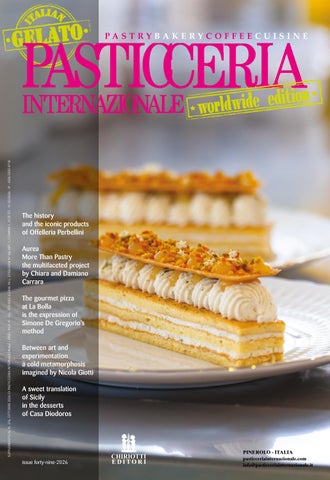
The history and the iconic products of Offelleria Perbellini Aurea More Than Pastry the multifaceted project by Chiara and Damiano Carrara The gourmet pizza at La Bolla is the expression of Simone De Gregorio’s method Between art and experimentation a cold metamorphosis imagined by Nicola Giotti A sweet translation of Sicily in the desserts of Casa Diodoros
issue forty-nine-2026
PINEROLO - ITALIA pasticceriainternazionale.com info@pasticceriainternazionale.it
Discover our Forno selection, available in various flavors and sizes.
Bake-stable fruit preparation. Only selected fruit.
------------------------------------------------------------------------------------------------------------------------------------------------------------- golden Italy
SUPPLEMENTO AL N. 376, OTTOBRE 2026 DI PASTICCERIA INTERNAZIONALE - SPED. IN A. P. - D.L. 353/2003 (CONV. IN L. 27/02/2004 N° 46) ART. 1, COMMA 1, DCB TO - N. 02/2026 - IP - ISSN 0392-4718
PA S T RY B A K E RYC O F F E E C U I S I N E
In this issue
4 The boundary between
The history and the iconic products of Offelleria Perbellini Aurea More Than Pastry the multifaceted project by Chiara and Damiano Carrara The gourmet pizza at La Bolla is the expression of Simone De Gregorio’s method
numbers and methods
Between art and experimentation a cold metamorphosis imagined by Nicola Giotti A sweet translation of Sicily in the desserts of Casa Diodoros
PINEROLO - ITALIA pasticceriainternazionale.com info@pasticceriainternazionale.it
issue forty-nine-2026
Pasticceria Internazionale WorldWide Edition 10064 Pinerolo (Torino) Viale della Rimembranza 60 tel. +39 0121 393127 info@pasticceriainternazionale.it www.pasticceriainternazionale.com Editor-in-chief Livia Chiriotti News editors Cristina Quaglia Milena Novarino Web editor Chiara Mancusi Marketing manager Monica Pagliardi
10 A sea view in Tuscany 16 Beyond the postcard of Sicily 24 Lust for life 26 The sweet side of pizza 32 Luxury and family language 42 Cold Metamorphosis News
Advertising manager Luca Russo
When ingredient science sets a world record
Federico Breusa
New solutions unveiled
Advertisement
Art director Anna Boscolo
18
35
Professional results
Pasticceria Internazionale WorldWide Edition is happily published in Italy by Chiriotti Editori Copyright © 2026 All rights reserved No part of this magazine may be reproduced without prior written permission from the publishing house Supplement of “Pasticceria Internazionale” 376 - 2026 ON OUR COVER Polline Damiano Carrara atelierdamianocarrara.com
Welcome to Sigep World More control in the pastry lab Pralines perfect for winter All the gelato you need, in a compact space Premium ingredients for successful recipes Excellence in baking meets technological innovation in Verona
44
Andrea Restuccia € 80,00 app € 42,99 Martino Liuzzi € 50,00 app € 22,99
Alessandro Dalmasso € 65,00 - app € 32,99
DISCOVER ALL THE PROFESSIONAL BOOKS IN ENGLISH
Lorenzo Puca € 120,00 app € 89,99
pasticceriainternazionale.com shop.chiriottieditori.it
WWW.PASTICCERIAINTERNAZIONALE.COM
41
3
4 contemporary pastry making ------------------------------------------------------------------------------------------------------------------------------------
The boundary BETWEEN NUMBERS AND METHODS Offella d’Oro, Pan dei Siori, Millefoglie Strachìn… these are just some of the iconic products which come from more than 150 years of history at the renowned Offelleria Perbellini
The Perbellini pastry shop in Bovolone, near to Verona (Veneto region), represents an emblematic case in contemporary Italian pastry-making: a family business operating on a significant scale while continuing to base its identity on artisanal
WWW.PASTICCERIAINTERNAZIONALE.COM
49
processes, human intervention, and technical knowledge accumulated over time. It is a company fully aware that the distinction between artisanal and industrial production is not defined by numbers, but by method.
The earliest documents date back to 1872, when Luigi Perbellini worked as a baker in Isola della Scala. At a time when laboratory pastry-making was not yet widespread, production was limited to dry goods, compatible with
------------------------------------------------------------------------------------------------------------------------------------- contemporary pastry making
the lack of cream-preservation systems. The decisive turning point came with Giovanni Battista Perbellini, the second generation, who trained in Milan and in the Austro-Hungarian area before joining the Melegatti grocery business in Verona. It was in this context that, starting from the traditional star-shaped Veronese Nadalin, he developed the Offella d’Oro in 1891: a sweet leavened cake topped with almond granules. A precursor to pandoro, softer, richer in butter, and more airy, it was destined to become one of the company’s symbols. Around 1900, Giovanni Battista moved to Bovolone and founded the Caffè Pasticceria Commercio Perbellini, where he began independent production focused precisely on this technically complex product. Today, in the sixth generation, it still follows natural fermentation cycles lasting between 48 and 72 hours. The laboratory itself reflects progressive expansion: additions built vertically over nearly seventy years to meet logistical needs. The family describes this growth as a “patchwork”—functional rather than architectural—designed to accommodate 45 employees and an annual production of around 100,000 leavened products. Rotor ovens are used for biscuits and panettoni, while pandoro and Offella d’Oro are baked in deck ovens. As for ingredients, the company uses whole eggs separated in-house and Northern European centrifuged butter, considered more plastic and consistent. To ensure the shelf life of packaged leavened products, to sterilize them, and to prevent mold development, alcohol is sprayed inside the bag before sealing. Along the timeline Continuing the story of these 150 years, Giovanni Battista’s son Ernesto was born in 1909. He carried on the family business with entrepreneurial spirit and creativity. He is credited with creating the Dolce Dorato, a small crumbly plum cake made with flour, eggs, sugar, and butter. Conceived in the postwar period to meet growing demand for breakfast products, it is baked for about 20 minutes. A special mention goes to the Millefoglie Strachìn, much loved by customers. This dessert is prepared fresh to order and is available only in the Bovolone and
From left: Enzo, Flavio and Giovanni Battista Perbellini.
Isola Rizza shops because its whipped butter-based custard (without cream, soy, or cheese) begins to collapse after a few minutes. In the Veneto dialect, se stràca means “it gets tired,” hence the name Strachìn. The puff pastry layers are baked daily to guarantee crispness, while the amaretti are made and baked in-house using a high percentage of almonds to enhance the flavor of the almond granules that coat the cake. Historically present in noble households since the 1920s, this dessert was gradually abandoned because of its instability. In the 1980s, the company modified the recipe to make it stable for more than two hours without altering its structure. Today, annual production reaches approximately 33 tons, and on December
24th the laboratory is almost entirely devoted to this product, demonstrating its commercial importance. As the business continued to grow, production moved to its current location on Via Vittorio Veneto in Bovolone. Ernesto’s sons Giovanni Battista and Enzo, followed by Flavio, joined the company, continuing the production of classic specialties alongside new creations such as the Ciambella, a soft and airy leavened cake, the lightest in the family of leavened products, produced year-round and especially popular after Christmas among pandoro lovers. Another is the Pearini, a small peppered almond biscuit recalling the clever tradition of old tavern keepers who used it to encourage customers to order another glass of wine.
The single-serving version of Millefoglie Strachin®, also featured at the beginning of the article on the previous pages.
WWW.PASTICCERIAINTERNAZIONALE.COM
49
5
6 contemporary pastry making ----------------------------------------------------------------------------------------------------------------------------------A definition based on process Over the decades, Perbellini has upheld an idea of craftsmanship rooted in direct human intervention. Shaping the dough is done by hand, dough management relies on the experience of pastry chefs, and packaging is performed manually. Machines are present, but they do not replace the crucial stages of production. This approach imposes concrete production limits: during the Christmas season, maximum capacity is 1,500–1,600 panettoni per day, while maintaining artisanal care in timing and methods. Specifically, Offella d’Oro is produced from October through the following spring under the supervision of Pierluigi Perbellini, head of the laboratory. The dough, made with flour, sugar, butter, whole eggs, and natural sourdough starter, ferments for more than 48 hours before being placed into molds lined with finely chopped Prima Bari almonds. The result is a soft, fragrant cake with a delicate almondcrusted exterior. Once baked and rested, each Offella is wrapped by hand in the traditional white-and-red packaging and tied with a vine branch—an iconic gesture that has accompanied the product since its origins and reinforced its connection to the Veronese territory. The same vine branch is used for Perbellini’s pandoro. Offella d’Oro is now a registered trademark, produced exclusively in the
From left: Pierluigi Perbellini, production; Laura Perbellini, administration and sales; Teresa Mantovani, at the Bovolone shop (mother of Pierluigi and Laura); Flavio Perbellini, production (father of Pierluigi and Laura); Silvana Favalli, at the Bovolone shop (mother of chef Giancarlo Perbellini and grandmother of Andrea, Ilaria and Alessandro); Alessandro Perbellini, at the Isola Rizza shop; Ilaria Perbellini, Bistronomia and social media; Jonathan Mc Crea, production (Laura’s partner); Paola Secchi, Bistronomia (mother of Andrea, Ilaria and Alessandro); Andrea Perbellini, administration, online sales and commercial operations.
Perbellini laboratory. The company’s portfolio also includes other registered classics, such as Pan dei Siori, so called because its ingredients were expensive and only the richest could afford it. It is inspired by the Tyrolean Zelten and enriched with spices, dried fruit, and candied fruit. Another exclusive creation is Fior d’Albicocca, a soft leavened cake filled with small drops of
apricot jam and topped with almond glaze. Introduced by Pierluigi in 2006, it anticipated the trend of summer panettone and celebrated its 20th anniversary in 2026.
“
Perbellini has upheld an idea of craftsmanship rooted in direct human intervention
“
Pan dei Siori®.
WWW.PASTICCERIAINTERNAZIONALE.COM
49
STRATOS XP
Modular Electric Baking at the Highest Level
Flexible to operate and stable at the set temperature. Ensures consistently perfect baking results for all pastry products. Oven chamber heat control with patented technology: a unique, flexible and dynamic system. Independent touch controls for each chamber, featuring innovative, user-friendly software. Low energy consumption thanks to reduced heat loss and exclusive energy-saving and self-regulating functions. Wide range of deck configurations and sizes to meet any production requirement.
www.polin.it
8 contemporary pastry making ----------------------------------------------------------------------------------------------------------------------------------People, taste, seasonality, and positioning Today, alongside Flavio and his son Pierluigi, Ilaria, Andrea, Laura, and Alessandro represent the sixth generation. The seventh generation is already emerging with the birth of two new family members in recent years. The harmony among family members is evident, as is their ability to combine different skills with mutual respect. This atmosphere extends to the staff, one of the company’s greatest assets: average seniority ranges from 15 to 20 years, while the workforce is gradually becoming younger, creating a balance between experience and new expertise. Perbellini’s philosophy favors clear, recognizable flavors. The company prefers products that are less aromatically layered and suitable for packaging, ensuring good turnover, freshness, and a domestic product line of around 200 items at prices consistent with local purchasing power. Consumer habits have changed over time: sales of fresh pastries for Sunday consumption have declined, while whole cakes and customers from other provinces have increased. Product sizes have become smaller, reflecting the trend toward smaller post-COVID households. Easter has lost some commercial importance, partly due to rising cocoa prices, while occasions such as Valentine’s Day, Father’s Day, and Halloween have become increasingly significant. For about 15 years, e-commerce has grown steadily by 20–30% annually, becoming a crucial niche for reaching customers beyond the local area. Shipments cover Italy and Europe, while some non-EU markets are avoided because customs costs and risks are considered prohibitive for an artisanal product. In the United States, demand is growing, and to offset higher tariffs the family has chosen to grant additional discounts to distributors, sharing the burden. The bistro that tells the family story The two shops in Bovolone and Isola Rizza preserve the original concept of a carefully designed self-service format, intended to encourage sales while maintaining an artisanal, welcoming atmosphere. The Isola Rizza location
WWW.PASTICCERIAINTERNAZIONALE.COM
49
Offella d’Oro® and its packaging featuring the unmistakable grapevine motif.
also includes a high-quality bistro and takeaway gastronomy area, offering a 360-degree hospitality experience that reflects the family’s DNA—something also evident in the Michelin-starred career of chef Giancarlo Perbellini. In the modern, informal space called Bistronomia, customers can enjoy breakfast, aperitifs, snacks, lunches, and dinners of excellent quality. Looking back over these 150 years, it becomes clear that the Perbellini family has followed a path shaped by love, expertise, humility, and harmony across generations. They have succeeded
Sfoiade al burro (butter puff pastries).
in challenging preconceptions and standardized categories, consistently giving value to craftsmanship expressed through numbers, methods, and a deep awareness of the production process. In an increasingly polarized market, their strength lies in coherence. L.C. perbellini.com
Our values. Carved into the material.
Expertise means being a partner to all professionals. We provide research, technique, study of aromatic profiles, and precise solutions for every process. We know how to listen to those who create, anticipate production needs, while guaranteeing consistent results, even in the most complex projects. It’s the know-how that defines every ICAM Professional and Agostoni product.
It’s not just a promise. It’s a value engraved in our way of working.
icamforprofessionals
professional.icamcioccolato.com
10 Tuscan excellence-----------------------------------------------------------------------------------------------------------------------------------------------------
A SEA VIEW IN TUSCANY
Nestled between the sea and the Apuan Alps, Aurea – More Than Pastry is the new project by Chiara and Damiano Carrara within Hotel Excelsior in Marina di Massa, Tuscany
It is called pastry house, and indeed stepping inside feels like entering a welcoming and elegant home. Yet the project is much more than that. It introduces a well-established international concept—particularly common in Paris
WWW.PASTICCERIAINTERNAZIONALE.COM
49
and London but still relatively unexplored in Italy—which, thanks in part to the media profile of its creator, finds effective expression in the synergy between contemporary pastry and hospitality. Located on the seafront of Marina di
Massa, within Hotel Excelsior, Aurea – More Than Pastry is a vibrant, multifaceted space open to hotel guests, external customers, and international travelers alike. Conceived by Damiano Carrara and made possible through a fortunate
----------------------------------------------------------------------------------------------------------------------------------------------------- Tuscan excellence
partnership with hotel owner Sara Giannelli, it brings together fine pastry and hospitality, introducing desserts into different settings, occasions, and experiences. Following the success of Atelier Damiano Carrara, opened in Lucca (always in Tuscany) in 2021, the pastry chef and television personality takes another step forward in his creative and entrepreneurial journey, alongside his wife Chiara since 2018. Together they have created a destination designed to broaden and diversify the ways people can experience their pastry vision, integrating it into a highend hospitality environment that elevates both tasting experiences and convivial moments. Damiano and his team have applied the same philosophy here, in beloved Tuscany, framed by the sea and the Apuan Alps: meticulous attention to detail, thoughtful development of the logo, payoff, packaging, and communication strategy. Above all, they continue to pursue excellence in taste and aesthetics, with a strong commitment to inclusivity through a substantial gluten-free and lactose-free offering. Having become a household name in Italy through television—he has been one of the beloved faces of Bake Off Italia on Real Time for eight seasons—Carrara has
Gluten-free is not treated as a compromise or a secondary offering, but as an integral part of the overall experience also demonstrated his versatility through technical expertise and entrepreneurial vision, always working in harmony with Chiara (who has also made him a proud father to their daughter Dafne). A Setting that makes the difference The project takes shape within Hotel Excelsior, a historic landmark of hospitality on the Apuan Riviera, between Versilia and the Cinque Terre. Established more than thirty years ago through the expansion of the historic Villa Pellerano
and distinguished by its Rationalist architecture designed by Ezio Bienaimé in collaboration with Aldo Pisani, the hotel has been completely renovated and now offers 55 rooms, including suites, junior suites, and rooms overlooking either the sea or the Apuan Alps. One of the hotel’s highlights is its panoramic restaurant, Il Sestante, led by young chef Luca Marino. Since last year, the dessert menu has been curated by Carrara himself. The restaurant offers contemporary fusion cuisine that celebrates local produce and fresh seafood through technical expertise, creativity, and respect for ingredients, with a particular appreciation for Japanese influences. Within this context, Aurea positions itself as a contemporary pastry house, as its founders like to describe it, dedicated to breakfast and lunch occasions. The offering ranges from viennoiserie and à la carte desserts to plated sweets, artisan gelato, fresh cakes, and baked specialties, all centered on aesthetic research, lightness, and emotion. Particular attention is given to gluten-free and lactose-free desserts, not as alternatives but as an integral part of the overall experience. “My goal is to offer a wonderful experience by bringing together signature pastry and the world of hospitality, creating a place
The new destination on the Apuan Riviera is intended not only for guests staying at Hotel Excelsior in Marina di Massa, but also for those seeking a carefully crafted breakfast or a contemporary dessert in an elegant and relaxing setting.
WWW.PASTICCERIAINTERNAZIONALE.COM
49
11
12 Tuscan excellence---------------------------------------------------------------------------------------------------------------------------------------------------where service, emotion, and flavor can coexist,” says Damiano proudly. Driven by a constant pursuit of perfection and improvement—from suppliers and ingredients to methods and production processes—the project was developed with great rigor. Particular care was devoted not only to the guest reception and retail area, housed within what was once a spacious lobby featuring an American bar and piano bar accessible from the reception, pool area, and outdoors, but also to the optimization
From left to right: Sara Giannelli, Chiara Carrara, and Damiano Carrara.
of the production facilities within limited available space. Part of the production is carried out in Lucca, while baking, assembly, finishing, and decoration take place on site within the hotel’s kitchen facilities. Adjacent to this area, a glass-walled laboratory has been dedicated exclusively for gluten-free production. A focus on free-from and design The à la carte desserts and plated sweets are entirely gluten-free and lactose-free, while maintaining the same technical, sensory, and aesthetic standards of
contemporary haute pâtisserie, just as at the Atelier in Lucca. Damiano’s attention to the free-from world stems both from his international experience, having begun his career in Ireland and the United States, and from his personal life, as Chiara is celiac. “The development of recipes that are delicious, balanced, and visually appealing has been my goal for years,” he explains. Every product is inspired by a memory, a journey, or a local ingredient. Citrus fruits, honey, almonds, vanilla, wild herbs, and seasonal fruit become the building blocks of a pastry philosophy focused on balance, elegance, and lightness. The interiors reflect the same vision. Soft materials, sandy hues, satin finishes, and blue-green reflections inspired by the sea create a refined and welcoming atmosphere that conveys wellbeing, warmth, and a natural sense of harmony. The name Aurea (from Latin aureus, made of gold, golden, ndr.) itself evokes balance, light, and harmony, while the payoff More Than Pastry encapsulates the ambition to go beyond the traditional concept of a pastry shop: not merely a place where to buy desserts, but a destination to be enjoyed throughout the day. “The project is a complete experience that goes beyond sweets and embraces atmosphere, service, and environment,” explains Chiara. “It is also a tribute to the preciousness and luminosity of this location, suspended between sea and mountains.” Sara Giannelli, whose family has owned Hotel Excelsior since 1993, adds: “Our collaboration with Damiano and Chiara began almost by chance when we found ourselves without a pastry chef at the beginning of last summer season. We started sourcing Carrara’s desserts directly from the Lucca laboratory in a semi-finished format, which allowed us to maintain a high-quality dessert offering. Over time, the relationship grew stronger, eventually leading to the idea of creating something entirely new together,
The name Aurea evokes balance, light, and harmony, while the tagline More Than Pastry encapsulates the ambition to go beyond the traditional concept of a pastry shop: not just desserts, but a place to be enjoyed throughout the day. WWW.PASTICCERIAINTERNAZIONALE.COM
49
sparked during a dinner around Christmas. Today, that idea has become a growth opportunity for everyone, with the ambition of achieving international standards and strengthening our cosmopolitan vision through the energy and professionalism that Damiano and Chiara have brought to the project.” The dream has become a reality thanks to a carefully planned investment and the commitment of the hotel staff, led by maître Alessia, together with the wellestablished Atelier team of young and motivated professionals: Alberto, Flavia, Alice, Francesca, and Chiara. Chiara’s mother, Nicoletta, oversees the chocolate department, while Damiano’s brother, Massimiliano, coordinates operations. Aurea is poised to become the new destination of choice on the Apuan Riviera—not only for guests of Hotel Excelsior in Marina di Massa, but also for anyone seeking a refined breakfast or a contemporary dessert in an elegant and relaxing setting. L.C. hotelexcelsior.it - atelierdamianocarrara.com
DANISH COOKIES XS 15 The elegance of tradition in mini format.
Silikomart moulds in XS size, ideal for small pastries. The highlight of any joyful occasion, they can be used for petits fours or for savoury canapés with a surprising shape. Conceived with Marike Van Beurden. Silicone mould
M A D E I N I TA LY
14 Tuscan excellence-----------------------------------------------------------------------------------------------------------------------------------------------------
Polline Pine nuts, helichrysum, wild herbs, citrus fruits, fig leaves, pollen—
Cocco
ingredients that evoke childhood memories and lived experiences deeply rooted in Carrara’s Tuscany.
Lucca
A dessert featuring wild field herbs, pine-nut frangipane, cinnamon, citrus fruits, and caramelized pine nuts. An identity-driven creation that is contemporary, emotional, and deeply connected to its territory.
Pomodorino
(Cherry Tomato) A distinctive interpretation highlighting unexpected flavors and seasonal inspiration.
Vegana (Vegan) A plant-based dessert designed with the same attention to flavor, texture, and aesthetics that characterizes the entire pastry collection. WWW.PASTICCERIAINTERNAZIONALE.COM
49
--------------------------------------------------------------------------------------------------------------------------------------------------
Professional results Since 1946, Bigatton has managed every step of the production chain to ensure high-quality, professional results. The pistachio supply chain is a good example of the comprehensive approach applied by the Portogruaro based company to processing raw materials for the artisanal gelato, pastry, and industrial sectors. Bigatton sources premium Italian and international pistachios, evaluating their origin and aromatic profile based on the final
When ingredient science sets a world record
Close-up of a Bigatton jar inside the Portogruaro plant.
Pistachio roasting: control of the Bigatton production process.
news
product requirements. The processing phases (roasting & refining) develop the fruit’s natural flavor and create fine, smooth, and consistent pure pastes without masking natural notes. Products are available in versatile formats, i.e. small packages (1 kg and 2.5 kg) for artisans, as well as industrial sizes (10 kg and 1,000 kg bulk tanks) to guarantee continuity and standardization for large-scale production. In terms of product range, beyond pure pastes, the complete “pistachio system” includes traditional and pralined chopped pistachios (granella) for decoration, specific flavors to boost taste constancy, and natural colorants to enhance visual appeal. bigatton.it
New solutions unveiled As ICAM celebrates its 80th anniversary, the company introduces a range of new products under its ICAM Professional and Agostoni brands, reaffirming its commitment to supporting pastry chefs, chocolatiers and gelato makers with high-quality, innovative ingredients. For Agostoni, two new dark chocolate references highlight the richness and diversity of cocoa origins. The Grand Cru Grenadine Dark Chocolate 73%, made with cocoa from Saint Vincent and the Grenadines, offers a complex aromatic profile combining delicate acidity, balanced sweetness and bitterness, alongside notes of fresh and dried fruit and hints of tobacco. Expanding the Single-Origin range, the new Vietnam Dark Chocolate 70% showcases the distinctive character of Southeast Asian cocoa, with fruity, tangy notes and a subtle bitterness. Within the ICAM Professional range, the spotlight is on versatility and performance. Genea Dark Chocolate 80% has been developed for pastry and gelato applications, delivering intense cocoa notes and a persistent flavour profile. The company is also expanding its baking solutions with sugar-free Dark Chocolate Chips 56% and Dark Baking Sticks 44%, designed to meet growing demand for functional and high-performing ingredients. Further enriching the portfolio are the new Chocolate Nuances chunks, created to inspire creativity through unique flavour combinations. The Cheesecake Chocolate Chunks combine white chocolate, yoghurt and fruity notes, while the Ginger Chocolate Chunks pair dark chocolate with the warm, spicy character of ginger. Completing the line-up are two new ready-to-use chocolate creams, Mabel and Regina, inspired by iconic ICAM references and developed for a wide range of pastry and chocolate applications. Through these innovations, ICAM continues to combine technical expertise, quality ingredients and creativity, providing professionals with new opportunities to develop distinctive and memorable creations. icamcioccolato.com
In April London hosted the making of the world’s longest tiramisu: 440.58 metres, officially certified by Guinness World Records. Beyond the impressive figures—including more than 3 tonnes of mascarpone cream—the achievement required overcoming several major technical challenges, as for example the maintenance of the structural integrity of the cream component. Mascarpone cream is a semi-solid colloidal system characterized by a soft, creamy, highly hydrated matrix supported by a weak protein network (caseins and whey proteins) together with a lipid structure that, under prolonged mechanical stress and at ambient temperature, tends to lose cohesion and structural stability. In a system extending over 440 metres and weighing more than 3 tonnes, exposed for several hours to ambient temperature, humidity, and its own gravitational load, it was essential to target engineering of the colloidal submatrices—namely the aqueous, lipid, and air phases. The solution, developed by Gelecta by Italgel, consisted of incorporating 300 kg of Gelecta Cream, a synergistic clean-label ingredient system specifically designed to address the critical stability issues of a 3,000 kg cream subjected to severe processing and environmental stresses. Its functionality focused on reinforcing and protecting the water–fat and fat–air interfaces, reducing water migration, and modulating the viscosity of the continuous phase through multiple complementary mechanisms. This multi-level, multifunctional approach dramatically improved both thermal and mechanical stability while preserving, over time, the sensory characteristics typically associated with freshly whipped mascarpone cream. Rather than producing the nonspecific gel stiffening commonly associated with conventional hydrocolloids, Gelecta Cream selectively acted on the physical mechanisms responsible for structural deterioration, maintaining the dessert’s characteristic texture, mouthfeel, and overall sensory identity even under exceptionally demanding conditions. This achievement demonstrates how advanced ingredient technology—combining gelatin with selected plant fibres and proteins—can support and preserve the authenticity of traditional pastry products, rather than compromising it. gelecta.it/gelectacream
15
16 alternative paths -----------------------------------------------------------------------------------------------------------------------------------------------------
BEYOND
THE POSTCARD OF SICILY Casa Diodoros gives new life to the places located in the heart of Agrigento’s Valle dei Templi
There are places where pastry is primarily about technique, craftsmanship, and precision. And then there are places where it becomes something more—a language, a way of telling the story of a territory without reducing it to a postcard image. Casa Diodoros, located in the heart of Agrigento’s Valle dei Templi, belongs to the latter category. Set within one of the most significant archaeological and cultural landscapes of the Mediterranean, the project does not simply use its surroundings as a backdrop; it makes them an active part of the experience. Here, food is not merely a service. It is storytelling, culture, and a form of giving back to the land. Federica Farruggia, pastry chef at the Sicilian establishment, captures this vision perfectly when she says, “Food is not a service; it is a language”. And that is precisely where this story begins. From philosophy to a new calling Casa Diodoros is part of the broader Diodoros project, an initiative aimed at restoring life to the agricultural lands within the Parco della Valle dei Templi by promoting historic crops, biodiversity, and the landscape itself.
“
“
In all the desserts, the territory is not merely referenced—it is translated
WWW.PASTICCERIAINTERNAZIONALE.COM
49
------------------------------------------------------------------------------------------------------------------------------------------------------ alternative paths
and development at Fabrizio Racca Dessert in Turin. According to Farruggia, Piedmont left her with “rigor, method, and great attention to detail,” as well as an appreciation for discipline and constructive dialogue. At the same time, however, the desire to return to Sicily continued to grow. It was not a nostalgic return but a deliberate choice: to bring back home
“
everything she had learned elsewhere. An this is precisely what makes her work at Casa Diodoros so compelling. Returning to Agrigento, for Federica, means taking a stand. It means choosing to build her future there and contributing, through her craft, to a deeper and more nuanced narrative of the city and its territory. Her goal, she says, is to leave those who taste her desserts with “an
For those familiar with Sicily, the dessert may recall a flavor, a place, or a deeply personal sensation. For visitors arriving from elsewhere, it offers an entirely new imaginary world to take home with them
“
Today, this vision has evolved into a network of producers creating olive oil, wine, citrus fruits, almonds, grains, honey, cheeses, and preserves under a single brand. It is a collaboration between public and private stakeholders built on a shared respect for place. The restored rural house that hosts Casa Diodoros serves not only as an operational headquarters but also as a living space where this philosophy takes shape every day. Within this context, Farruggia’s pastry offering is not a separate chapter but a natural extension. Her personal journey helps explain why. Before stepping into a pastry laboratory, she studied Philosophy and later Educational Sciences. Pastry came afterward, but not as a sudden change of direction. Rather, it represented the natural outcome of a quest that had already begun years before. “Philosophy taught me to question, to seek meaning in things, and pastry making became my tangible way of expressing that search.” Her story begins within a family where art, craftsmanship, and cooking already held an important place. Her father was an art master and archaeological restoration specialist with a deep passion for baking and pastry. Her grandmother preserved the traditional recipes of the Agrigento area. Her mother, highly creative, applied her artistic sensibility both to cooking and to designing clothing. Farruggia grew up surrounded by books, the aroma of biscuits, and orange cakes fresh from the oven. Her studies later took her first to Catania and then to Turin, yet pastry steadily occupied more and more space in her life, almost silently. After every exam, she recalls, she would prepare desserts for friends and colleagues. Eventually it became clear that this was no longer a temporary passion. Lessons from Piedmont and the return home The decisive turning point came during the pandemic, when Farruggia enrolled in the advanced training program at IFSE - Italian Food Style Education school (see also ifse.it) in Piedmont (region in the north west part of Italy). This was followed by two important experiences with two renowned Italian professionals–an internship in the pastry laboratory of Alessandro Dalmasso in Avigliana and later a role in research
WWW.PASTICCERIAINTERNAZIONALE.COM
49
17
18 alternative paths ----------------------------------------------------------------------------------------------------------------------------------------------------
emotion of Agrigento”—something akin to an impression in the fullest sense of the word: an experience capable of conveying the magic of the Valle dei Templi not as a scenic backdrop, but as a living presence. When ingredients originate within such a carefully defined agricultural and cultural project, the way one works inevitably changes. “The raw material is no longer simply an ingredient; it becomes a story” she says. It becomes a responsibility, a relationship with place. And that requires a more conscious, essential, and respectful approach. At Casa Diodoros, quality goes far beyond the concept of local sourcing. It lies in the very meaning of the product itself. Fruits, almonds, olive oil, citrus fruits, and aromatic herbs all carry both the
WWW.PASTICCERIAINTERNAZIONALE.COM
49
Beyond stereotypes: ingredients and signature desserts Among the ingredients Farruggia feels most connected to are citrus fruits, almonds, grains, wild herbs, and extra virgin olive oil. In Sicily, these elements can easily slip into cliché, yet here they are treated with restraint, intention, and precision. A perfect example is EVA, a dessert dedicated to Mother Earth and the olive. The composition features a soft plum cake made with Diodoros extra virgin olive oil, paired with a white chocolate, vanilla, and lemon ganache. It is accompanied by a sweet-and-sour salmoriglio prepared with olive oil, lemon, and lemon thyme, and completed with olive oil gelato and osmotically infused apricots. The dessert employs olive oil—one of Sicily’s most iconic ingredients—not as a statement of principle but as the foundation for an elegant and highly personal balance of flavors. Another significant creation is Kolymbethra, inspired by the historic
“
The greatest challenge lies in transforming deeply rooted ingredients into an elegant and contemporary pastry language without slipping into folklore
“
weight and the privilege of belonging to a landscape that must be interpreted rather than exploited. The pastry offering unfolds not only through tasting menus but also through experiences designed as genuine journeys of discovery, including the Diodoros Breakfast, Brunch, and Diodoros Tea. These experiences seek to weave together territory, biodiversity, personal memories, and contemporary technique. The desserts themselves embody two parallel impulses: on one hand, the desire to preserve the flavors of memory intact; on the other, the ambition to create a new pastry language—deeply Sicilian, yet free from the constraints of repetition and folklore.
garden of the same name within the Archaeological Park. It combines pistachio Bavarian cream, mandarin gelée, licorice ganache, almond sucré pastry, and orange blossom water. Equally representative is Fondente di Sicilia, featuring cocoa and almond sablé, Modica chocolate mousse, blood orange gelée, and saffron sauce. In all of these desserts, the territory is not merely referenced—it is translated. There is no anxiety about placing Sicily on the plate in a didactic way; rather, there is a desire to let a few carefully chosen ingredients speak as clearly as possible. Tradition and innovation Within Farruggia’s work, the relationship between tradition and innovation is never constructed as a contrast. More often than not, the creative process begins with a memory: a childhood flavor, a familiar aroma, a fleeting sensory impression. Some traditional desserts, however, she prefers to leave untouched. She mentions rustic cakes, genovesi, and Marsala zabaglione—that continue to arouse the same feelings she felt when she first encountered them through family traditions. In these cases, she feels no
Download the Pastry World Champion’s Recipe: The 4 textures of milk by Francesco Boccia.
gelecta.it Made in Italy info@gelecta.it +39 0172 478047
20 alternative paths ----------------------------------------------------------------------------------------------------------------------------------------------------SICILIAN FLOWER
into molds and blast-freeze. Allow 35 g of Bavarian cream per serving.
BLOOD ORANGE AND ROSEMARY SORBET
Yield: 20 servings ALMOND SUCRÉ SHORTCRUST PASTRY Yield: 40 discs
butter..................................................... g 52 icing sugar............................................. g 34 almond flour......................................... g 9 bitter almond........................................ g 1 all-purpose flour................................... g 86 eggs........................................................ g 17 salt........................................................... a pinch total........................................................ g 200
Mix all dry ingredients together, then incorporate the liquids. Form the dough and roll it out to a thickness of 2.5 mm. For each dessert, prepare two discs measuring 4 cm in diameter, approximately 10 g each. Bake at 170°C (338°F) for 6 minutes.
SAFFRON BAVARIAN CREAM
saffron crème anglaise (50/50)............ g heavy cream (35% fat)......................... g sugar...................................................... g gelatin (200 bloom)............................... g saffron................................................... g total........................................................ g
320 320 58 6.5 0.2 700
Hydrate the gelatin and dissolve it in a small portion of the cream, previously semiwhipped with the sugar. Combine with the saffron crème anglaise, then fold in the remaining semi-whipped cream. Pipe
blood orange juice................................ g sugar...................................................... g water...................................................... g glucose................................................... g rosemary............................................... g lemon juice............................................ g total........................................................ g
250 88 125 25 2.5 10 500
Bring the water, sugar, glucose, and rosemary to a boil. Allow to infuse for 7 minutes. Add the citrus juices, strain, and churn. When serving, shape into a rose using a dedicated spoon or molding technique. Allow 25 g of sorbet per serving.
DIODOROS POMEGRANATE SAUCE
Diodoros pomegranate nectar............. g dextrose................................................. g lemon juice............................................ g total........................................................ g
180 10 5 200
Mix all ingredients cold until smooth. Allow 10 g of sauce per serving.
EVO OIL AND CITRUS MINI BRIOCHE
Yield: 20 pieces Manitoba flour...................................... g fresh yeast............................................. g water...................................................... g malt........................................................ g extra virgin olive oil............................. g sugar...................................................... g egg yolks................................................ g salt......................................................... g honey..................................................... g
Mix the dry ingredients with the liquids, adding the salt and olive oil last. Allow the dough to proof in bulk. Remove the gas and shape into small rolls. Proof again until fully risen. Bake at 190°C (374°F) with 10% humidity for approximately 6 minutes.
WHITE CHOCOLATE PETALS 190 6 95 2 27 36 34 3 4
white chocolate................................... as needed
Temper the chocolate. Shape into delicate petals and allow to crystallize completely. Assembly Place one almond sucré pastry disc in the center of each plate. Position the saffron Bavarian cream on top. Add the second pastry disc and place the blood orange sorbet rose above it. Arrange the white chocolate petals around the sorbet rose to recreate the appearance of a flower. Pour the pomegranate sauce around the dessert and serve with the mini EVO oil and citrus brioche on the side. Tasting Note For the best sensory experience, guests are encouraged to begin with the sorbet and white chocolate petals, to continue with the saffron Bavarian cream and pastry layers, and to finish by dipping the mini brioche into the pomegranate sauce, allowing the final flavors to unfold gradually. FEDERICA FARRUGGIA Casa Diodoros Agrigento, Sicily diodoros.shop
WWW.PASTICCERIAINTERNAZIONALE.COM
49
------------------------------------------------------------------------------------------------------------------------------------------------------ alternative paths
WWW.PASTICCERIAINTERNAZIONALE.COM
49
21
22 alternative paths ----------------------------------------------------------------------------------------------------------------------------------------------------
The Senses and the Landscape Farruggia’s perspective on Sicily is equally clear. In her view, the island possesses enormous potential within contemporary pastry, yet it is still too often represented through partial or stereotypical narratives. The great classics of Sicilian pastry deserve respect and remembrance, certainly. Yet Sicily cannot be reduced to them alone. It is a land extraordinarily rich in fruits, vegetables, herbs, and seasonal WWW.PASTICCERIAINTERNAZIONALE.COM
49
“
Food is not a service; it is a language
“
need to intervene, except perhaps by incorporating subtle references to them within new creations. At the same time, she enjoys developing contemporary desserts capable of expressing biodiversity and local identity through the technical skills she has acquired over the years. According to Farruggia, every dessert begins with extensive research. “Often everything starts from a single episode: a walk, a scent, the taste of a fruit. But the intuition must then pass through a process of abstraction, research, and technical rigor”. On one side lies thought; on the other, the necessity of transforming that thought into something tangible, balanced, and pleasurable to taste. It is this transition that allows a dessert to become more than a technically flawless creation. It becomes something capable of evoking memories and emotions. For those familiar with Sicily, it may recall a flavor, a place, or a deeply personal sensation. For visitors arriving from elsewhere, it offers an entirely new imaginary world to take home with them.
produce—a territory capable of offering endless inspiration to those willing to look beyond the obvious. The greatest challenge, therefore, lies in transforming these deeply rooted ingredients into an elegant and contemporary pastry language without slipping into folklore.“It takes sensitivity to refine, simplify, and reinterpret without losing authenticity”. Perhaps this is the most distinctive aspect of her work: a pastry philosophy capable of evoking the colors, forms, and vitality of the natural landscape while maintaining a contemporary, essential, and never excessive aesthetic. It is a pastry rooted
in place yet open to the world. Looking ahead, this remains her guiding ambition: to build an increasingly recognizable pastry identity in Agrigento, one capable of contributing to a different narrative of the territory. Not merely a land of celebrated classics, but a living space for research, biodiversity, and creative expression. This vision also informs the ongoing development of Pasticceria Diodoros, conceived as a natural extension of the existing project. More than a gastronomic experience, Casa Diodoros ultimately offers a perspective. A vision of pastry that does not use territory as decoration but truly listens to it. And precisely because of this, it succeeds in transforming landscape into edible memory. SILVIA FEDERICA BOLDETTI
24 artisan gelato --------------------------------------------------------------------------------------------------------------------------------------------------------
Lust
FOR LIFE
Not just healthy but also precious to boost good mood, here are Palmiro Bruschi’s smiling recipes
The inspiration came from the desire to taste a healthy and elegant gelato, a balance of pleasant ingredients which, with their health-promoting properties, boost good mood in the heart and soul. I conceived these sorbets with the intention of sharing moments of pleasant emotion with friends and customers, highlighting their sustainability while respecting nature, thanks to the use of healthy products, which naturally provide colors and nutritional properties.
A SORBET FOR GOOD MOOD
water .................................................g wildflower honey .............................g maltodextrin ....................................g glucose 38 DE ..................................g inulin ................................................g stabilizer ...........................................g total ...................................................g
594 220 70 70 40 6 1,000
Bring the water to the boil, pour it over the premixed powders with flower pollen (4 g) and mix. Add the honey, blend for another 1 minute and mix. Blast chill for 15 minutes and display for sale. WWW.PASTICCERIAINTERNAZIONALE.COM
49
PERSIMMON SORBET WITH CHIPS
water .................................................g sucrose ..............................................g persimmon powder .........................g glucose 38DE ...................................g stabilizer ...........................................g persimmon .......................................g total ...................................................g
261 180 25 30 4 500 1,000
Pour the water into the premixed powders and mix. Add the ripe fruits, blend for another minute and stir. Blast chill for 15 minutes, decorate with persimmon chips and display for sale. To obtain the persimmon powder, blend the ripe fruits and spread a thin layer on a pan. Allow them to dry completely until they are vitrified. Blend until you have a powder, to be used as a monosaccharide. To obtain the persimmon chips, use fruits that are not too ripe. Once sliced, let them dry and use them as decorations. PALMIRO BRUSCHI palmirobruschi.it gelateriaghignoni.it
26 gourmet fermentation ---------------------------------------------------------------------------------------------------------------------------------------------
The sweet A
SIDE OF PIZZ
At the restaurant-pizzeria La Bolla in Caserta, pizza becomes special gourmet dessert thanks to Simone De Gregorio’s method
Pizza is undoubtedly the most iconic Italian dish in the world. Over the years, it has undergone profound transformations, evolving from a simple and affordable meal for everyone to a gourmet excellence. Today, its evolution faces a new challenge: transcending the boundaries of savory to become a dessert, an integral part of an increasingly sophisticated menu. In this scenario, the restaurant-pizzeria La Bolla in Caserta (Campania region) stands out for its methodological approach that elevates pizza not just to a dessert, but to a news gourmet leading actor. La Bolla in Caserta: the method Under the guidance of Pasquale Di Matteo and Vincenzo Di Leva, the restaurant has adopted an operating model in which sustainability is the fundamental prerequisite for technical experimentation. A 30-person team allows for shift management, combining human well-being with constant customer focus and research. This vision also includes the decision to use exclusively electric technologies rather than wood-fired ovens: a specific environmental mandate aimed at eliminating combustion residues, thus translating the principles of the UN 2030 Agenda for Sustainable Development into practice. The pizza chef Simone De Gregorio investigates in this field, testing the potential of a unique dough matrix, which is then developed into different consistencies and textures depending on the intended use. This is not simply a variation of toppings, but an in-depth study of the biology of the wheat WWW.PASTICCERIAINTERNAZIONALE.COM
49
-----------------------------------------------------------------------------------------------------------------------------------------------gourmet fermentation
Assoluto di Mela Annurca.
high-oleic oil. This extreme temperature seals the gluten network, preventing the absorption of fat. Immediately afterward, the product is blast chilled to -18°C, a step that allows for optimal shelf life manage-
grain and the stability of contemporary doughs. We asked De Gregorio to analyze the key steps of the protocol he adopts to transform leavened products into a central element of restaurant pastry making. “For our base, we use low-glycemic type 0 flour, with whole grain particles that
preserve the whole organic wheat germ. The process involves approximately 36 hours of fermentation and maturation: the result is a lively dough, with a bold acidic note that becomes the perfect base for our pizzas. We start with a 24 cm diameter disc of neutral dough, fried at 210°C in
Simone De Gregorio.
WWW.PASTICCERIAINTERNAZIONALE.COM
49
27
28 gourmet fermentation -------------------------------------------------------------------------------------------------------------------------------------------ment, ensuring absolute freshness upon regeneration. When serving, the Spicchio (slice) is removed from the freezer and seared on both sides with powdered sugar and cinnamon. The heat transforms the surface into a golden, crispy crust, similar to a doughnut, but with the typical air bubbles of fermented pizza”.
LA BOLLA’S SPICCHIO Low-glycemic type 0 flour with whole grain particles that preserve the whole organic wheat germ. Ferment and mature for 36 hours for a lively dough, with a strong acidic note, the perfect base for any creation. In high-oleic oil, fry a 24 cm diameter disc of neutral dough at 210°C: the gluten network is sealed, preventing fat absorption. Chill at -18°C to ensure absolute freshness when regenerating. To serve, remove the slice from the freezer and dust both sides with powdered sugar and cinnamon for a golden, crispy crust with the typical air bubbles of fermented pizza. Garnish as desired. labollacaserta.it
WWW.PASTICCERIAINTERNAZIONALE.COM
49
What is Spicchio? Based on the technically leavened base, Simone has conceived a range of Spicchio desserts, that explore different flavor frontiers, each with a specific challenge. Assoluto di Mela Annurca is the flagship, in which the apple is used in every way: peel gel, heart jam, fried raw apple, and scrap chips. The research then extends to international territories with Pizza Baburu, an organoleptic challenge that explores umami through the use of miso soup and the fatty note of macadamia nuts, demonstrating how the fermented base can support gastronomic toppings. On a more evocative note —”to transform memories into sensory experiences”— is Nuova Fiesta, a reinterpretation of a famous Italian snack from the 1980s, while “another is Flurry Bolla, freely inspired by the soft ice creams from a well-known fast food chain: fried dough, artisanal salted caramel sauce — made with water brought to a boil with a sugar solution, a splash of cream, and a pinch of salt — vanilla mascarpone mousse, praline peanuts, and dark chocolate”. The Slow Six Six marks the extreme boundary between sweet and savory: a sort of pizza taco, where the fried base hosts slow-cooked pork and coleslaw (a crunchy, sweet and tangy cabbage salad made with mayonnaise, mustard, vinegar, and a touch of sugar or honey), highlighting how the dough’s texture can adapt to diametrically opposed temperature and consistency contrasts. The dessert menu La Bolla’s dessert project doesn’t stop at leavened products: the offering is entrusted to chef Giovanni Zullo, who expresses himself in a cuisine that breaks down the clear distinction between the courses, making the menu unique, developing desserts in which the boundaries of taste are fluid, in a millimetric balance between sweet notes, The Savory Cocoa Tartlet is proof
30 gourmet fermentation -------------------------------------------------------------------------------------------------------------------------------------------of this: a technical, slightly savory shortcrust pastry which embraces the texture of a sheep’s ricotta mousse and the acidic note of tomato jam. It is precisely this latter ingredient that reintroduces the concept of umami, profoundly stimulating the taste receptors and precisely balancing the dessert’s sugary curve. This variety of approaches has allowed to develop a pastry offering that now includes 13 products, all made entirely in-house. A gastronomic offering that explores the evolution of pizza, which until recently was conceived as solely savory or at most accompanied by sweet creams. And customers are proving this choice right: “80% of them choose the sweet pizza, which has become a real draw”. “The heart of everything remains the chemistry of the wheat grain – concludes De Gregorio –. The use of the hydro-whole matrix is not just a fad, but the need for a fiber that responds to thermal shock without collapsing. Thus, a contemporary pastry-making approach to dough promises great surprises. We are convinced of it!”. SIMONA BUONAURA
Chef Giovanni Zullo. The savory cocoa tartlet.
WWW.PASTICCERIAINTERNAZIONALE.COM
49
32 international vision---------------------------------------------------------------------------------------------------------------------------------------------------
LUXURY
AND FAMILY LANGUAGE Pastry chef Daniele Bonzi tells how he develops Langosteria’s sweet identity in Milan, Paris and London
“I was looking for new challenges, and I found them all!” Daniele Bonzi, our interviewee, opens with a smile. A long-established pastry chef, he embodies the essence of what his role represents: pastry-making that masters the technical vocabulary while following the
rhythms, rules, and emotions of fine dining. Today, Daniele’s daily challenge is to coordinate pastry teams across multiple cities, maintain consistently high standards, and at the same time build a recognizable identity as Corporate Pastry Chef of Langosteria. In just over a year, he has
structured the group’s pastry division, defining processes, signature recipes, and a vision capable of engaging with different markets without losing coherence. A journey that he describes as a stimulating challenge, expressing happiness at every stage of our conversation. It is the satisfaction that comes from experience and the awareness of being able to do what one truly loves, finding energy in continually raising the bar. The story of Langosteria The idea of a restaurant centered on the quality of raw ingredients—first and foremost langoustines—and on emotional guest experience, condensed into the name Langosteria, dates back to 2007 and originated with Enrico Buonocore, an entrepreneur from Campania. Over nearly twenty years, the concept has expanded progressively on an international scale and has now entered a new phase with a renewed identity: Buonocore Hospitality Group is today the company that manages and creates brands in the world of high-end hospitality and dining. “With the growth of the project and new concepts, the need naturally emerged to give a clearer structure to this reality, which brings together different brands united WWW.PASTICCERIAINTERNAZIONALE.COM
49
--------------------------------------------------------------------------------------------------------------------------------------------------- international vision
by the same approach to hospitality and the same focus on product excellence and guest experience,” says the Group’s Founder and CEO. His ambition is to establish the company as the world’s leading Italian-rooted restaurant group by developing its brands in key global destinations and catering to an international clientele. “We want to give life to places where people feel comfortable and connected, capable of speaking to an international audience without losing our identity, while continuing to carefully select the locations where we open,” Buonocore continues. He controls the Group alongside its longstanding partners and Archive, the holding company owned by the Ruffini family, which also controls Moncler, holding a 40% stake. The Group currently employs 500 people—a figure expected to grow to around 1,000 by 2030—with projected revenues of approximately €180–200 million by 2030 (2025 turnover: €68 million, as reported by Il Sole 24 Ore), supported by an industrial plan that includes new openings and the consolidation of existing brands. The concept of informal yet luxurious service, distinct from the rigidity often associated with Michelin-starred restaurants, has taken shape in Enrico Buonocore.
four locations in Milan (the original venue in Via Savona, in the Tortona district) and internationally in Paris (since 2021, on the seventh floor of Cheval Blanc Paris overlooking the Seine and owned by LVMH) and now London, at the Raffles London at The OWO, a five-star hotel inaugurated two years ago in the historic 1906 Old War Office building. There are also seasonal openings in St. Moritz and Paraggi (since 2021, with the Bagni Fiore beach club), with Porto Cervo and Madrid soon to follow. It is a significant yet carefully curated expansion based on positioning and leadership, with Buonocore openly expressing his dream of eventually opening in New York City. A vertical gastronomic destination The historic Milan restaurant on Via Savona has been complemented by the Bistrot since 2012. Moreover, since last November, it has also been joined by Langosteria Montenapoleone, located inside Palazzo Fendi in the heart of Milan’s Fashion Quadrilateral. The opening embodies Buonocore’s vision, transforming Langosteria into one of the leading players on the contemporary gastronomic scene through a concept that combines a strong focus on seafood, meticulous ingredient sourcing, luxury, and a cosmopolitan atmosphere. Several concepts coexist within the same building. On the sixth floor, Ally’s Bar is the Group’s first project dedicated to mixology. The name pays tribute to Alessandra Maestroni, Buonocore’s wife. Alongside the beverage program curated by Bar Manager Stefano Agostino, the
The tenth season of Langosteria Paraggi, located in the bay between Santa Margherita Ligure and Portofino, is overseen by General Manager Marco Pannacci and Executive Chefs Antonio D’Ambrosio and Alfredo Dentice, with desserts conceived by Corporate Pastry Chef Daniele Bonzi (Photo Tommaso Gesuato).
menu offers a selection of dishes designed specifically for the bar experience, fully aligned with the Group’s culinary style. Also on the sixth floor is a 12-seat private dining room dedicated to exclusive events and tailor-made dining experiences. On the fourth floor is Pepe – Barra Italiana, the restaurant led by Corporate Executive Chef Luca Fantin. The space revolves around three solid walnut counters accommodating 36 guests around an open kitchen, with an additional 16 seats at the counter and bar. The menu includes dishes such as grilled salad, Roman-style artichokes, mixed fried seafood, Fassona beef tartare “alla Pepe,” fried veal meatballs with tomato, parsley, and horseradish sauce, 1980s-style beef fillet carpaccio, valdostana veal, grilled scorpion fish, Tagliatelle Giallo a Milano,
The Paris and St. Moritz locations (Photo Danilo Scarpati).
WWW.PASTICCERIAINTERNAZIONALE.COM
49
33
34 international vision---------------------------------------------------------------------------------------------------------------------------------------------------
Langosteria Montenapoleone, located inside Palazzo Fendi in Milan, offers multiple concepts, including the Private Restaurant for tailor-made dining experiences and Pepe – Barra Italiana, led by Corporate Executive Chef Luca Fantin.
pan pizzas, and a selection of cheeses and cured meats. Among the desserts by Daniele Bonzi, standouts include milk rice with vanilla, chocolate bonet with amaretti biscuits, and baba with cream and rum. For Fantin—who will oversee the future Italian and international openings of the brand—the restaurant represents both a return to Italy and a new way of conceiving the restaurant experience. The story of a pastry chef A true Milan native, Bonzi always knew he wanted to become a pastry chef. He was determined from middle school onward and even had to challenge his parents to pursue his chosen path. At 18, he began working at Sant Ambroeus, the historic Milanese venue. In 2002, he joined the brigade of the Four Seasons Hotel Milan, which would later become his professional home once again. It was there that he fell in love with the world of fine dining, progressing to Junior Sous Chef under
renowned Executive Chef Sergio Mei. In 2006 came his first major international experience: London, at Harrods Knightsbridge, where he worked in the pastry brigade led by Philip Morbelli. The experience refined his vision and exposed him to world-class standards. Upon returning to Italy in 2007, he worked alongside Executive Chef Elio Sironi at the Bulgari Hotel Milan. Between 2010 and 2011, he embarked on an entrepreneurial venture in Ascona, Switzerland, where he became partner and managing director of a gelateria and pastry shop. In January 2012, he completed a stage in the UK at Heston Blumenthal’s The Fat Duck in Bray, one of the most experimental kitchens in the world. Later that year, he returned to luxury hospitality in Italy, first at Castiglion del Bosco in Montalcino and then for two years at La Torre del Saracino in Vico Equense under chef-patron Gennaro
The challenge is to create Langosteria’s sweet identity, with its own style and simple yet consistent creations, instantly recognizable for their Italian character WWW.PASTICCERIAINTERNAZIONALE.COM
49
Esposito. This was followed by a couple of years at Da Vittorio in Brusaporto alongside Enrico Cerea. “It was an eclectic experience that helped me develop the ability to manage multiple dynamics, something that is invaluable today,” Daniele comments. In 2015, he returned to the Four Seasons Hotel Milan, first as Head Pastry Chef and then, from 2017 onward, as Executive Pastry Chef. These were also the years in which relationships among colleagues strengthened, leading to the Pass121 Collective, an initiative designed to highlight the work of restaurant pastry chefs. This exciting journey—further enriched by meeting Diletta, his life partner— has brought him to where he is today, energized by the “new challenges” offered by Langosteria. Since March 2025, Bonzi has served as Corporate Pastry Chef for Buonocore Hospitality Group. “I coordinate all the pastry brigades within the Group, both in Milan and in our other locations, including Paris, London, and the seasonal venues,” explains Daniele. “My role covers both production supervision and the final finishing of desserts to ensure extremely high quality standards. At the same time, there is a major development
--------------------------------------------------------------------------------------------------------------------------------------------------- international vision
component: building a recognizable and coherent sweet identity across all locations, despite working with different teams and contexts.” Managing multiple locations means dealing with significant numbers: what is the biggest challenge? Maintaining the same quality level everywhere. As the organization grows across multiple cities and brigades, complexity increases significantly. This is why organization and methodology are essential: recipes must be codified, processes defined, and constant monitoring maintained. Only in this way can you guarantee that the result consistently meets expectations. Is the dessert menu identical everywhere, or does it vary by city? Some desserts represent the Group’s identity and therefore remain fixed points. We currently have three signature desserts, one of which is seasonal. At the same time, we allow room for a certain degree of customization, because each location has its own sensitivities and dynamics. The goal is to find a balance between brand consistency and the ability to engage with the local context, especially considering how loyal our guests are.
To maintain clarity and consistency, you need to learn how to manage your energy. Today, workplace well-being is increasingly discussed, and it is a central issue even for positions of responsibility The project is deeply connected to seafood and raw ingredients. Does this influence the pastry offer? More than influencing the recipes themselves, it influences the way we think about dessert. The same focus on ingredient quality that guides the kitchen also guides pastry. For me, this translates into sourcing exceptional ingredients and pursuing a very clean flavor profile. The Mediterranean, both as a gastronomic culture and as a pantry of extraordinary products, remains an important reference. You joined the group about a year ago. What were your priorities during this initial phase? The first task was to structure the pastry identity. We invested heavily in research and development, defining signature recipes and codifying processes. When working across multiple locations, it is essential to make recipes reproducible
without losing their artisanal soul. It is a delicate but necessary balance. Among your signature desserts is tiramisù. what role do great classics play in a contemporary menu? Classics are fundamental because they are part of people’s culinary memory. Our goal is to encourage the rediscovery of Italian desserts that are deeply rooted in our culture but are not always executed properly. We reinterpret them carefully, preserving recognizability while introducing technical precision and exceptional ingredients. A perfect example is the tiramisù originally conceived by Maxime Frédéric in Paris for Langosteria. We reworked it and turned it into one of our most representative desserts. We personally bring it to the guest and unmold it tableside so that the cream flows in a very precise way. And, of course, our stracciatella gelato with sour cherries and chocolate biscuit is always on the menu.
WWW.PASTICCERIAINTERNAZIONALE.COM
49
35
36 international vision-------------------------------------------------------------------------------------------------------------------------------------------------Let’s talk about the teams. how large is the pastry division across the group? Every venue has its own pastry brigade. The size varies from a small team at the Bistrot to six pastry chefs at Montenapoleone. Interestingly, while our kitchens are highly international, pastry is still made up almost entirely of Italians. How do you encourage communication throughout the operational chain? We organize meetings that involve the dining room, kitchen teams, and executive chefs from every restaurant. This strengthens collaboration, allows everyone to taste dishes together, exchange feedback, and build a shared Group identity. The company invests heavily in growth and training, guided by principles of respect, precision, and attention to detail. Are you also involved in recruitment? Absolutely. It is a crucial aspect, as is providing conditions that allow people to grow and develop their skills while maintaining a healthy quality of life, something younger generations increasingly expect. I enjoy seeing people grow, listening to them, and motivating them, including facilitating transfers between locations when appropriate. Naturally, I also oversee team organization and procurement,
WWW.PASTICCERIAINTERNAZIONALE.COM
49
because the final quality depends heavily on teamwork. How important is training for new generations? It is essential. We need to train professionals with a contemporary vision of kitchen work. The industry is changing, and some outdated models must be left behind in favor of education, growth, and responsibility. Working in international environments also encourages a constant exchange of ideas and inspiration. Your role involves extensive travel. how do you manage supervision? From November until now, I have been heavily focused on Milan due to the opening of two restaurants and a bar. I regularly visit the seasonal locations, and this summer I am concentrating on the openings in London and Porto Cervo. The brigades are structured to operate autonomously, but I move among the different sites to monitor operations and maintain consistent standards. It is a balance between presence and trust. A corporate chef must ensure a shared vision while allowing teams the autonomy to perform effectively. Through constant communication and standardization? Internal communication is essential. We maintain an ongoing dialogue through
photos and videos, ensuring everyone stays aligned. We also use a shared recipe system stored on a central drive, based on a standardized format that I personally developed. This even accounts for technical details such as adjustments to cooking times required by different altitudes, since our locations range from seaside destinations to mountain resorts. Do you also handle special events? Absolutely. Everything is supervised by our team and, according to internal policy, all celebration cakes—even fully customized ones—are produced exclusively by us. In such a demanding role, how important is it to find time to recharge? Extremely important. To maintain clarity and consistency, you need to learn how to manage your energy. Today, workplace well-being is discussed more than ever, and I believe it is a central issue, especially for leadership roles. Your roots are in Milan. how has your journey influenced your perspective? Milan is an incredibly dynamic city, and working here teaches you to engage with different environments and realities. My career then led me to work in a variety of settings, pushing me to develop a broader perspective that I now try to bring into the Group’s projects. L.C.
®
38 virtual dialogue -------------------------------------------------------------------------------------------------------------------------------------------------------
An impossible but REVEALING INTERVIEW
The virtual dialogue between Salvatore Farina, historian and pastry expert, and the late Italian cook Gualtiero Marchesi, who was a true master of modern cuisine
Referring to “Intervista,” an Italian magazine from the 1990s, which published exclusively interviews, both real and fictional, I remember that the pieces that most struck me were the virtual ones, addressed to artists, writers, and philosophers of the past. In these cases, the journalist’s skill laid not only in asking a
“
range of interesting questions, but also in knowing how to answer them in the most believable manner. The author had to truly know the person he was “interviewing” inside out. I can’t consider myself an expert on Gualtiero Marchesi, the legendary Italian cook died in 2017, but I believe I have
“
Definitions are important: they can’t be improvised. They are the very heart of knowledge
a good grasp of how to evaluate a text, both in terms of form and content. When recently I came across the preface Marchesi wrote in 1987 for “Le cento pasticcerie – Guida ai più dolci peccati d’Italia” by Giorgio Mistretta, a supplement of “L’Europeo (i.e. one of the most influential Italian weekly magazines until 1995), I immediately recognized the brilliance of a master of modern Italian cuisine. What struck me as I read the three dense and intense pages of his preface was the ease with which he constructed— line by line—a series of fundamental definitions regarding the world of pastry making. Definitions are important: they cannot be improvised. They are the very heart of knowledge. Definition, in fact, is what can describe, reveal, and convey the true meaning of things. Socrates managed to defeat the dangerous relativism of the sophists thanks to his skillful use of definitions. My virtual interview with Gualtiero Marchesi therefore consists of extracting the most beautiful definitions he wrote in the preface I mentioned before, entitled “Sensi in Paradiso”. What links pastry making to regional cuisine? It’s a subtle, often indefinable bond that unites them: while their flavors, ingredients, and production techniques are different, both remain expressions of a single taste, the reflection of a single
WWW.PASTICCERIAINTERNAZIONALE.COM
49
-------------------------------------------------------------------------------------------------------------------------------------------------------- virtual dialogue
But what if you had to identify the unique feature that unites the multifaceted richness of our specialties? Regardless of its place of origin, pastry making universally evokes a paradise for the senses. Even more, it is the earthly incarnation of the sin of gluttony. Indeed, it is in the discovery of sweetness that we commit the primordial sins of gluttony: the budding gourmet spontaneously turns to the union of primary flavors capable of providing a sensation of pleasure in itself, and it is precisely in the instinctive seduction of sweetness that the taste receives the first, indelible impressions of harmony. Later, this original addiction fades, giving way to other attractions, but the palate cannot erase the memory of those ancient pleasures. Indeed, I believe that—in foods, in wines—we continually seeks sweet emotions very similar to those that enchanted us in that distant lost paradise. Be that as it may, even in adults, pastry continues to be the privileged model of gluttony, so much so that—compelled by the success of diets and the cult of weight loss—we consume it with a sense of guilt. We eat out of necessity, often mechanically and without any pleasure, but we reserve sweets for our personal delight. Here we discover what, I suppose, is the peculiarity of pastry making: precisely because it’s not meant to satisfy the appetite, but the palate, it seems linked to the image of tables laden with food and celebrations. Moreover, it is always served at the end of a meal. Even when it comes to small, starter pastries, served alongside a cup of tea or hot chocolate, desserts retain their distinct propensity to entice and entertain the palate, much more than to satiate the stomach.
“
Future pastry will be focused on freshness, “express,” designed to be consumed immediately, and more fragrant
What do you think of what was once called “vocation”? Today we speak of “talent.” In short, is one a born pastry chef? Indeed, pastry making is a genre that requires a particular predisposition. Of course, in the cultural baggage of every chef, it represents a mandatory apprenticeship: it’s in the pastry lab that one learns to be methodical and acquires a sense of precision, two very useful, I would say indispensable, skills in any other branch of cuisine. However, in my opinion, pastry chefs are born. While a skilled chef must also be a skilled pastry chef, pastry chefs by vocation are usually reluctant to venture outside their own field, the only one that seems to bring them satisfaction. It’s not just a matter of taste, but also a question of temperament. The pastry chef is a bit like a kitchen apothecary: accustomed to weighing every ingredient, to measure and to plan. Since most of the preparations can be done in advance, they aren’t affected by the hustle and bustle that reigns in a restaurant during service. Thus, if the team can be compared to a large orchestra—where audience participation and collective harmony are both vital—the pastry chef’s work is more like a soloist performing in a recording studio; devoted to monotonous and immutable rituals that require unyielding technique and meticulous patience. This highlights another difference: while in large restaurants, repetitiveness quickly becomes boring and the public expects constant renewal, the production of large pastry shops seems to have crystallized into absolute, timeless forms. Can we make a comparison between restaurants and pastry shops? In terms of professionalism, pastry shops boast a more solid technical
“
style. Just think of German desserts, elaborate and baroque like their dishes; French desserts, rich and sumptuous like their gastronomic tradition; and Italian desserts, simple and with immediate flavors, a happy mirror of our cuisine. To turn to the salient characteristics of Italian pastry making, one might note the prevalence of dry pastries over leavened ones (which are nevertheless successful exceptions), and—almost everywhere—a generous profusion of dried and candied fruit.
expertise than restaurants. It must also be recognized that Italian pastry shops have kept regional traditions alive much more than restaurants have. When restaurants—perhaps driven by market demands for hybrid and standardized cuisine—wanted to try their hand at classic international pastry preparations, without possessing the necessary expertise or the appropriate staff, the result was mostly bland and pedestrian desserts. They thus left the heritage of tradition to the almost exclusive prerogative of pastry shops. While these have been faithful custodians, it’s rightly important to emphasize the importance of the artisan dynasties that pass down the secrets of the trade from generation to generation: until recently, pastry chefs were, in fact, our only authentic chefs proprietaires. What will pastry of the future be like? We may witness some radical innovations, comparable to those that have occurred in the kitchen. So let’s try to guess what the contours are. The new pastry will be the offspring of what we’re beginning to glimpse in today’s great restaurants, where typical pastry preparations are mostly used as miniature accompaniments to spoon desserts, prepared or assembled on the spot. It will be a pastry characterized by freshness, an “express” pastry, designed to be consumed immediately—like soufflés and hot cakes—and more fragrant, thanks to the use of all those ingredients that, unable to withstand prolonged storage, have until now been neglected. I imagine the pastry of tomorrow transforming into different establishments, more like restaurants, where—seated comfortably at a table—we can consult the dessert menu and have them instantly prepare whatever irresistibly tempts our palate. SALVATORE FARINA
WWW.PASTICCERIAINTERNAZIONALE.COM
49
39
--------------------------------------------------------------------------------------------------------------------------------------------------
Welcome to Sigep World The 48th edition of Sigep World, organized by Italian Exhibition Group (IEG), will take place in Rimini, Italy, from January 23rd to 27th. The 2027 event aims to double the number of top buyers through dedicated experiences. As highlighted by Ilaria Cicero, Global Exhibition Director of IEG’s Food & Beverage Division and CEO of IEG Asia, this demonstrates that “Sigep is now a global network that builds year-round relationships between businesses, markets, and cultures, with an offering that embraces the entire supply chain, from raw materials to the most advanced technologies”. A major highlight will be Vietnam as the guest country: recognized as one of the most dynamic markets, it will be represented by a government delegation and qualified buyers. Furthermore, the technology supply chain will include the Kitchen Equipment Hub, a showcase for foodservice technologies, and the Digital District dedicated to robotics, AI, and digital services. The Orbital Kitchen, in collaboration with BEX (Beyond Exploration Expo, also organized by IEG), will spotlight AI-driven cooking and smart solutions replicable on Earth, water purification systems, and pasta-making machinery. Additionally, a new concept dedicated to luxury hospitality pastry and specialty coffee will debut, featuring international executive and pastry chefs. The Vision Plaza will host Sigep Vision, while the Sustainability District will welcome a Symposium and an area dedicated to coffee extraction methods. Regarding competitions, the lineup includes Bread in the City – Bakery World Cup in partnership with Richemont Club; 7 Italian Barista Championships with SCA, valid for the World Coffee Events; and Pizza Club, with 50TOP Pizza. Sigep Academy will focus on youth training, featuring events like SigepGiovani and a competition dedicated to schools. Crucially, the Gelato World Cup – European Selection will host teams chosen through national selections, challenging them with trials designed to evaluate both technical mastery and creativity. Candidates will have to create a decorated chocolate gelato tub, judged on taste and presentation; gelato cakes using sponsor ingredients; and a plated dessert featuring gelato. Competitors will also face two “mystery box” trials—one dairy-based and one fruit-based—requiring them to create recipes with ingredients revealed only at the start. In addition, teams will prepare a traditional specialty like cassata and an artistic chocolate sculpture assembled live, culminating in a grand final buffet. Four nations will be selected for the Gelato World Cup 2028 finals, where they will compete against teams identified through other continental selections, for a total of 12. The 2027 calendar also includes Sigep USA in Las Vegas from April 13 to 15, and Sigep China in Shanghai in June. Meanwhile, Sigep Meets the World—aimed at potential exhibitors, buyers, and media—will stop in Warsaw, Istanbul, Munich, and Paris (following previous stops in Chicago, São Paulo, Ho Chi Minh City, and Tokyo), in collaboration with the Italian Trade Agency (ICE) and Chambers of Commerce. sigep.it - gelatoworldcup.com
Pralines perfect for winter Conceived in collaboration with World Chocolate Master Lluc Crusellas, the winter Choco Stamp collection by Silikomart is the ideal solution to enrich and enhance a praline display during the festive season. Paired with the Semisfera 01-P mould, these silicone stamps allow for quick and easy decoration starting from a completely smooth mould. In just a few steps, it is possible to create original, high-impact finishes, adding variety to your production and surprising customers both in sight and taste. Praline dimensions: ø31 h 17 mm; volume: 8.5 ml x 24. silikomart.com
news
More control in the pastry lab When the pace in the pastry lab picks up, pastry cream preparation also needs to fit smoothly into the workflow, with precision, consistency and control. ROBOcream is designed to help professionals organise this stage of production more efficiently, optimise working time and make the entire process easier to manage throughout the day. The recipe, the method and the expertise remain in the pastry chef’s hands. ROBOcream provides a tool to programme the process and keep every stage under control, leaving more time to focus on other tasks. A solution designed to support everyday work and adapt to different production needs, ensuring more control, more simplicity and more space for creativity. robocream.com
41
42 not only airbrushing ------------------------------------------------------------------------------------------------------------------------------------------------
Cold
METAMORPHOSIS Between art and experimentation, technical expertise and creative flair, Nicola Giotti deals with cold in terms both of decoration and of a sweet celebration of the artistic heritage of his homeland
WWW.PASTICCERIAINTERNAZIONALE.COM
49
-------------------------------------------------------------------------------------------------------------------------------------------------- not only airbrushing
A few years ago, a special airbrushing technique was developed and launched by Apulian pastry chef Nicola Giotti, called aerografia indiretta speculare lucida (shiny specular indirect airbrushing). His aim was to give “a distinctive communicative power” to airbrushed surfaces, thanks to the brilliance and special luminosity of the graphic elements resulting from the employment of this method. All the steps of the process are illustrated in his book “Metamorfosi – Aerografia Indiretta Speculare Lucida”, with photos by Michele Illuzzi, published by our publishing house (shop. chiriottieditori.it). In ten key points, he explains how to work on chocolate surfaces, before moving on to silicone molds, isomalt, polypropylene sheets, and stencils. It is worth recalling that the design and chromatic variations obtained with the airbrush are applied directly onto the
mold where the subject is “built,” thanks to the use of film-coating colors, and that a similar method is used on sheets or with stencils. But beyond coloring chocolate, as the author himself reminds us, his technique also allows one to “have fun with semifreddo, Bavarois, mousses, and gelato,” giving them a new dimension shaped by light and color. AIRBRUSHING SEMIFREDDO, BAVAROIS, MOUSSES, AND GELATO “The temperature of a mousse or a Bavarian cream ranges from 16°C to 20°C when poured into molds – Giotti says –. This types of desserts have a high water content, which may hydrate and destabilize colors, so I recommend not moving them too much to avoid halos or other issues. Once a mold is adequately filled, it should be frozen quickly, minimizing movement when transferring it from the
workbench to the blast chiller. After blast freezing, the semifreddo (or mousse) can be unmolded while it is still very cold— ideally immediately after the blast-chilling cycle ends. Any type of contact would compromise the chromatic result and unmolding must therefore be performed in a way that avoids touching, similar to
shop.chiriottieditori.it/prodotto/ metamorfosi-aerografia-indiretta-speculare-lucida/
1
2
3
4
Some working phases in the mold, from color application to filling with ice cream.
WWW.PASTICCERIAINTERNAZIONALE.COM
49
43
44 not only airbrushing ------------------------------------------------------------------------------------------------------------------------------------------------
peeling a banana. It is also advisable not to touch the airbrushed areas of the silicone mold with one’s hands: their heat could damage airbrushing. If the dessert has minor imperfections, you can act on the surface with the airbrush later, but only when the product is very cold and only for relatively small details. It is not possible to make major corrections after freezing because, in the presence of high humidity, color will not adhere to the surface and a watercolor effect will appear, ruining the work already done. When correctly unmolded, the dessert (semifreddo, mousse, Bavarian cream…) can boast excellent color stability for several days, both at positive temperatures and at -18°C.” FROM A UNIQUE DETAIL IN THE WORLD A connoisseur of pastry arts and of his region Nicola Giotti works successfully in Giovinazzo, in the province of Bari. His “mission” has gained numerous admirers, including institutions, not only because he is the regional president of the Pastry Division of ConfArtigianato Puglia and a member of the national pastry board of ConfArtigianato Imprese, but also because WWW.PASTICCERIAINTERNAZIONALE.COM
49
his talent for blending culinary heritage with tourism and Apulian history is widely recognized. His Rosone cake and the semifreddo version celebrate one of the architectural treasures of his city. Built between 1125 and 1180, Santa Maria Assunta is the Romanesque cathedral of Giovinazzo and it stands on a small hill overlooking the town. Its imposing transept rose window with twelve spokes is so distinctive that it
has been nominated for Unesco World Heritage status. Divided into sections by an arcade of small columns, it is decorated with a ring of Norman-influenced zigzag patterns; surrounding it, on protruding corbels, are statues of lions and, below, the figure of a telamon. This detail makes the rose window truly unique: the Roman legionary supports it on his shoulders, in an iconography reminiscent of a contrapasso from Dante Alighieri’s Divine Comedy: “Just as the legionaries forced Christ to carry the weight of the cross on His shoulders, now Christian art condemns them—through one of their own—to bear on their shoulders the weight of the stone rose window.” “The dessert was inspired by prof. Antonio Trimani, a fine art teacher and conceptual artist from Bari, who suggested me to use this symbol of the city – Giotti explains –. From there began an extensive process of millimetric mapping through ultra-high-resolution photographs, to obtain a proper mold crafted by the experts of decosil, an Italian producer of molds, who did not use 3D printers but relied solely on skilled craftsmanship—true proof of Italian excellence!” The Rosone cake is highly praised thanks to its fresh composition (it must be stored in the refrigerator), featuring an almond Bavarian cream as the outer layer and, inside, a coulis made with a local variety of cherries (Ferrovia di Turi) and sour cherries, vanilla cream, crunchy almonds (Filippo Cia di Toritto), and chocolate sponge cake made with Oliarola extra virgin olive oil from Giovinazzo. A combination that—in both appearance and flavor—recalls the many excellences and traditional tastes of the region. The dessert comes in a tailor-made packaging. Today, it accompanies the candidacy of the Rosone of Puglia for Unesco World Heritage recognition.
--------------------------------------------------------------------------------------------------------------------------------------------------
news
Premium ingredients for successful recipes The traditional Tyrolean company Darbo has been offering a wide range of fruit fillings for more than 145 years. Their success is the result of high standards applied in the selection of raw materials through rigorous quality controls. The new 70% line combines innovation and maximum ease of processing: thanks to the high content of fruit pieces, these fillings enhance desserts with an intense fruity component. They are also characterized by their bake-stability, maintaining their texture and distinctive qualities during the baking
process. Furthermore, they are suitable for cold filling, as well as freezing and thawing, making them highly versatile for multiple applications thanks to the wide variety of flavors available. The 70% line enriches Darbo’s extensive offering of fruit fillings for professional use. More information on both this line and the entire product range is available at darbo.com
All the gelato you need, in a compact space Bringing artisanal gelato into restaurants, cafés, bistros and hospitality venues of all sizes, Carpigiani continues to expand its range of solutions for the foodservice sector. Among the latest additions is Synthesis 1 Counter Top, the most compact version of the Synthesis system, designed for businesses with limited space but high-quality standards. A complete gelato station that allows you produce, store and serve gelato directly in front of your customers, all from a single countertop unit. With one cylinder, you can make gelato, sorbets and Sicilian granitas, while static, dynamic and overnight storage modes keep your products ready to serve throughout the day. The refill system ensures continuous product availability, while self-adjusting scraper blades maintain consistent texture and structure. Compact, versatile and complete, it is the solution to produce, store and serve artisanal gelato in one countertop solution. carpigiani.com
Excellence in baking meets technological innovation in Verona Polin Group’s headquarters in Verona plays a leading role in Ruta del Arte Blanco, an international advanced training programme that, in October 2026, brought together a selected group of Argentine professionals from the bakery, pastry and pizza sectors. An immersive experience dedicated to knowledge sharing and professional development, the programme featured a series of masterclasses and meetings led by some of the most renowned Italian masters of the baking and pastry arts: Francesco Arena, Gabriele Bonci, Renato Bosco, Ezio Marinato, Stefano Priolo, Francisco Seubert and Mirko Zenatti. The initiative also offered participants the opportunity to explore the Group universe through visits to its manufacturing facilities and insights into the technologies developed by its brands Polin, Mixer and RAM. It brought
the Group’s “All your equipment” concept to life, showcasing a comprehensive ecosystem of solutions for professional laboratories, covering every stage of production, from dough preparation and processing to sheeting and baking. Organised in collaboration with Olex Global, the Group’s official distributor in Argentina, Fuerte
Harinas and the Italian Chamber of Commerce in Argentina – Rosario office, Ruta del Arte Blanco reaffirmed Polin Group’s commitment to promoting baking culture and fostering dialogue among international professionals, highlighting the role of technology as a key partner in craftsmanship, professional expertise and production excellence. polin.it
45
THANK YOU! For reading this issue of “Pasticceria Internazionale WorldWide Edition”! You can find more information, recipes, news, and curiosities on pasticceriainternazionale.com And you can download many other issues of the magazine for free here If you want to discover all the technical books by our publishing house Chiriotti Editori, many also in English, click here Let's stay in touch and work together to share, promote, and spread confectionery culture around the world!