June 2020
leave the compound to go to work when we fully locked down. I was s ll able to work from home. Now we are par ally open, so we have staff coming in part me, Phil can go to his job, etc., so things are at least a bit freer.
Wow – what a year 2020 has turned out to be so far – or hasn’t turned out to be whichever way you look at it. So much expecta ons for the year, and yet instead we have found ourselves si1ng at home, working or not working, or doing things completely unexpected. We are so glad that at least NZ has now returned to some normalcy in everyday life and that you can mix freely. Here everybody outsid our compound is also mixing freely, because they never really stopped. Not many people are listening to the warnings and life has carried on as normal, with people crowding together in markets, at ea ng places and in their homes. Numbers of cases are con nuing to be discovered due to some tes ng and we are sadly hearing that deaths in South Sudan are increasing too – especially here in the capital city. This has meant different things for Phil and me. Phil had approx. one month at home because he couldn’t
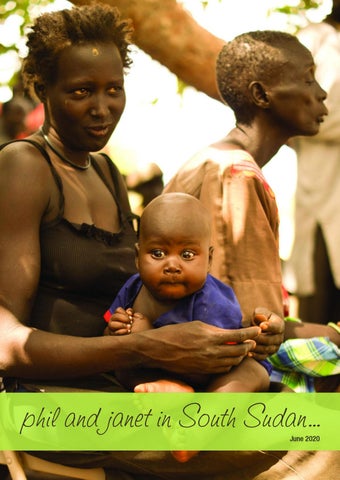
For my part I (Janet) have mostly been using this me to start wri ng a bible study / basic theology course on the bible and how God sees men and women and their worth. I will be so excited to actually be able to start using it and seeing what the response might be. I am also excited at the thought of being able to do some Truth Centered Transforma on teaching with community groups that we work with when we are able to start gathering together again. This is a series of teachings wri)en by another organiza on that works to teach biblical truth and obedience to God in prac cal areas Cover Photo: In mid May 2019, MAF flew a team from In Deed and Truth Ministries to the remote village of Malony in South Sudan to do a medical outreach. Pictured are a mother and her baby. Below and Right: MAF flew to collect COVID-19 test samples to bring them back to Juba for tes/ng. Pilot Chris Ball had his head in the clouds quite literally for most of the flight as the wet season weather closed in.
of our lives. So many here think they are obeying God if they go to church and pray, but they don’t realise that they should or can obey God in their everyday lives, in the way they relate to their families, in the way they work, their farming or anything else they do. I want to use parts of this training that teach on the importance of obeying God and his word, being good stewards of the resources he has given us, and confron ng cultural lies (that keep us in poverty) with biblical truth. We really hope that some of this teaching may start to open the eyes of community members to God being their provider and the hero of the story, not to be looking to others or outside organiza ons to solve all their problems. All in all, I look forward to when we can start working with communi es again, and working to encourage them in their rela onship with God, and to do all that they are doing with us for God’s glory, whilst taking full ownership of it. This has all been put on hold, but I am trus ng God to fulfill his plans and inten ons regardless of what has stopped us for the moment. MAF has been able to do some flying while all normal flights have been essen ally grounded other than humanitarian, cargo, etc. MAF have been flying tes ng kits and samples around the country to aid the government and the Ministry of Health in their efforts to ba)le the spread of Covid. The airport is now finally open to passenger flights so they have been able to resume a small amount of their usual opera ons as well. They have also moved their office staff into the new airport offices which Phil has been busy helping to prepare. He has completed building a slow sand filter to supply drinking water for all the MAF staff and has been working to increase security of the airport office. He has also helped pave the roof top relaxing area - including shade ne1ng for staff. Please pray for the South Sudanese as we wade through what Covid-19 means for this country. The cost could be huge, not just with direct coronavirus deaths poten ally, but also with any poli cal insecurity that may arise as a result, as well as ongoing problems with food insecurity, flooding, pests, etc. There seem to be a lot of challenges facing this country at the moment and only God can bring true healing and peace. Because the benefits of MAF’s work are not always directly seen, we like to put a story in the newsle)er of what some of their missionary partners are doing
in the country. In part, they are able to do what they do because of MAF being able to transport them and their staff as well as bring much needed supplies to more remote regions. This story is about In Deed and Truth Ministries and a kiwi couple working in SS.
Medical Outreach in Witchcra2 Territory In Deed and Truth Ministries’ (IDAT) mission is to bring the love of Jesus Christ and the hope of the Gospel to the remote area of Tonj in South Sudan. A very prac cal side of this is to provide health services at the clinic in Tonj and to the surrounding bush communi es. Text & Photos: Thorkild Jorgensen, MAF SS
Approximately once a week a team goes on a medical clinic outreach to a village near Tonj. The communi es o>en don’t have clinics nor do the villagers have the means to travel to IDAT’s clinic in Tonj. IDAT is known in the area for proper management when using health unit facili es and for a con nuous supply of medicine. Since the ministry started 20
years ago, the clinic has grown exponen ally. In 2014, they saw 14,000 mothers & children while in 2018 they saw 52,000. In 2018, a seven bed ward was replaced with a 21 bed ward, but already a year later they are adding six beds, because the ward is totally full with up to five extra pa ents sleeping on the floor. For years IDAT has been doing regular weekly outreaches to villages, first with Dr Tom, an American FP doctor, and then with Jono and Des nee Macleod, two doctors from New Zealand who came to work and live at IDAT with their three girls in 2014. No health service without IDAT When IDAT decides where to do a medical outreach, they send someone to tell the village chiefs, the officials and the church that they are coming in a few days. Then the word spreads and people show up. When the team went to Malony village in the middle of May 2019, government workers at hospitals in town and at the primary health units in the villages had been striking for about a month to force the government to increase their very low salaries. “It’s a blessing for the villagers that we can come to them – especially in the malaria season which has just begun,” Sabet Kuj the CEO of IDAT explains, “but because of the strike it has become so much more important that we go to the villages with our health services. Only the government hospital in Tonj opened up three days ago for emergencies, but on
today’s outreach to Malony we couldn’t even use the health unit. It was completely shut down.” Malony is an hour’s drive from Tonj when the roads are good. It is a very widespread combina on of small villages with an es mated popula on of at least 30,000 people – Dinka, Luer and Bongo. This me a makeshi> clinic with four sta ons with chairs and maybe a table was set up under a big tree next to the primary school. The first sta on was where people were registered, then they were sent on to Dr Jono and a clinical officer for consulta on. At the third sta on, they would get the prescribed medicine and at the last sta on they would receive prayers and spiritual counselling from Pastor San no. Serving one master Because of the steady stream of people, San no’s message is short.
He sees a lot of people who are divided between witchcraft and church and he tells them that just as you don’t serve two chiefs, you cannot serve two spiritual masters. People believe that sickness comes as a result of a curse, so they come to the witch doctor to put a
curse on a foe, or to have a curse revoked, and to receive blessings. 260 pa ents were registered under the tree, and 22 decided to believe in Jesus Christ. Two elderly men stood out as San no shared the gospel with them. A light turned on in their eyes, as they pondered why they were inclined to use witchcra> and offering sacrifices according to their culture and tradi on. It didn’t make sense to do these things, they realized, when there is a God who has created them and a book that tells who he is and his plan for mankind.
“One of them was a chief,” Sabet recalls. “He said that he couldn’t accept Jesus Christ right now, but needed to go home to discuss it with his family and to tell his people that he would undo some of the things he had done in relation to witchcraft and not be doing it again. The other man agreed completely with what San no was preaching and said that he would be going to church and heeding God’s word.” Choosing medicine over witchcra2 Two infants had to go with IDAT to Tonj to receive further treatment. One baby had necro zing fascii s, a flesh-ea ng bacterium that was just under the skin of half his skull, and the other was malnourished. When Jono told the mother of the malnourished baby that she had to go to Tonj so that her child could receive an bio cs over the next few days, her sister-in-law objected and said that the mother could not leave because she had to complete the child’s sessions with the Spearmaster (what they call witch doctors in the Dinka tribes). Sabet explained in Dinka that just as we need food inside our bodies when we are hungry, this child also needed this medicine inside its body to fight the sickness. The Spearmaster would slaughter a chicken and let it bleed out while spraying the blood over the child and it wouldn’t help. In spite of the pressure of being blamed and shunned for not following the family’s advice if the child died, the mother was convinced. She agreed to go to IDAT’s clinic and accepted Sabet’s prayer for her child.
Community Health Evangelism Some mes the medical outreaches are combined with Community Health Evangelism (CHE), which happens more than once a week when IDAT’s CHE pastors/health workers go to villages to give them lessons on how to improve spiritual and physical wellbeing and health. Spiritual lessons are about having a rela onship with God and the physical lessons are mainly about preven on, nutri on and farming. The CHE workers act as catalysts while people exchange ideas on how to use local resources to prevent diseases, how to ensure be)er health through good nutri on, and how to improve their crops. Village commi)ees then discuss how the lessons can be implemented in the villages. The CHE workers also go from house to house to encourage people to use dish racks, pit latrines, trash pits, mosquito nets etc. When a home has made a certain
Le2: In mid May 2019, a team from In Deed and Truth Ministries went to the remote village of Malony in South Sudan to do a medical outreach. Four sta/ons were set up under a big tree. At the small pharmacy at the third sta/on a baby is given medicine. Above: Sabet Kuj is here trying to convince a mother and her in-law sister and mother not to leave the child to witchcra2, but to let the child go with the team to IDAT's clinic in Tonj so that they can treat her malnourished child.
number of improvements they are awarded a cer ficate called ‘A Happy Healthy Home’. Cer ficates really mo vate people and everybody wants one.
clinical officers. This year they will be sending the first female candidate to medical school in Uganda. She has been working at IDAT’s hospital as a community health worker.
“CHE mee ngs are very helpful in bringing communi es together socially, and churches are planted out of this work,” Sabet says. “When other villages see that people in neighbouring villages meet and improve their lifestyle and look organized, they want the same. We have done medical outreaches in Malony for many years, and our evangelist San no, who graduated from our Bible school some years ago, has planted two churches there. Over the next three to four months we will also be doing CHE there.”
To empower and educate a woman to come back as a doctor will send a huge message to a community where girls and women are underprivileged.
Training local staff IDAT has paid for the educa on of some of their staff and sent them to Uganda to be trained as nurses or Above: This is the second sta/on where Dr Jono Macleod (blue T-shirt) and a clinical officer consulted pa/ents. Right: At the last sta/on pa/ents received prayers and spiritual counselling from Pastor San/no or Sabet Kuj who here is praying for a child. Following Page: At the first sta/on (to the right) people were registered, then Dr Jono and a clinical officer did consulta/on. The third sta/on was a small pharmacy, and at the last sta/on pa/ents received prayers and spiritual counselling.
They marry early and have responsibili es in their households that makes it almost impossible for them to a)end school. In this case, the family has agreed to raise the kids while she is gone for the next six years, only to come home once or twice a year. “To have a female doctor is very important to us, because our clinic focuses on Child Health & Maternity,” Sabet explains. “Obviously, we have our missionary doctor, Des nee Macleod, who is a OB/ GYN (obstetrician/gynaecologist), but to have a local, female doctor will mean a lot to our pa ents who are mostly being treated by male staff. Volunteering Alley a Bennet, an Australian nurse, came to South Sudan first to volunteer for a week in a Samaritan’s Purse cle> lip programme in Juba, and then to volunteer for six months at IDAT’s ministry. “I have come to help out in the rainy season when many are sick with malaria,” Alley a says. “Already
we have been six to eight beds over capacity in the two weeks I have been here. I am also here to support the clinical health workers and provide them with extra training in nursing and assessment skills. I’m very excited to be part of the team and to be going out with the wonderful ministry group to different villages to see how the CHE programme works. What strikes me is the extreme poverty here. I have lived in many countries in East Africa, but to see people’s acceptance of disease and death is remarkable. Parents don’t expect their children to do well, although they at the same me have great love for them. We have had a few deaths at the clinic which has been difficult, but at the same me it has been a great honour to be there in the midst of it to show them that you care and to share the love of Christ.
I have been privileged to pray with many patients and talk to them about salvation and hope when all other hope fails.”
Filling flights The same day as Alley a boarded MAF’s northeastern shu)le in Juba to go to Tonj was the day that both the Kuj and the Macleod families were returning to Tonj a>er both families had been on leave to visit their families and friends in the US and in New Zealand. Nine passengers, two motorbike tyres, fresh food and clothes were booked by IDAT on that shu)le. “We are so grateful to MAF that they facilitate us when we need to travel,” Sabet says. “The northwestern weekly shu)le that they started last year is a huge blessing. Before we had to drive for hours to Wau to get on a commercial flight and that is always risky, because road security is really bad and people get ambushed and shot. On top of being more secure, we benefit from the fact that it is just so easy to drive to our local airstrip. It only takes five minutes.”
If you would like to help support our work, please write (on e-mail or paper) your name, contact details, how much and how often you want to give. Send that info to WBTNZ, PO Box 276005, Manukau City, Auckland 2241 or send an email to admin@wycliffenz.org with a note requesting an automatic payment form. Or post a cheque to the same address, payable to Wycliffe Bible Translators, with a note saying it’s for Janet and Phil Buhler. For those of you at Life Church, you can also give via EFTPOS at church. You can also give directly online through the Wycliffe website donation page: https://wycliffenz.org/give-now/ Fill out the form. Use the dropdown for 'member support' and add 'Buhlers' and your amount.