Program Book - Yuja Wang & the Mahler Chamber Orchestra
NINETY-FIFTH
SEASON
Wednesday, April 29, 2026, at 7:30
MAHLER CHAMBER ORCHESTRA
YUJA WANG
Piano and Conductor
Matthew Truscott Concertmaster
PROKOFIEV
Piano Concerto No. 2 in G Minor, Op. 16
Andantino
Scherzo: Vivace
Intermezzo: Allegro moderato
Finale: Allegro tempestoso
YUJA WANG
INTERMISSION
PROKOFIEV
Symphony No. 1 in D Major, Op. 25 (Classical)
Allegro con brio
Larghetto
Gavotte: Non troppo allegro
Finale: Molto vivace
CHOPIN
Piano Concerto No. 1 in E Minor, Op. 11
Allegro maestoso
Romanze
Rondo
YUJA WANG
The appearance of Yuja Wang is made possible with support from the Women’s Board Guest Artist Endowment Fund.
The Chicago Symphony Orchestra Association acknowledges support from the Illinois Arts Council.
The appearance of Yuja Wang is made possible with support from the Women’s Board Guest Artist Endowment Fund—a fundraising effort created for Women’s Board members to join in support of the SEMPRE ALWAYS campaign. This fund will support the appearance of a guest artist or conductor each season.
The mission of the Women’s Board of the Chicago Symphony Orchestra Association is to promote the artistic excellence, exemplary educational programs and community involvement of the CSO by engaging women leaders in advocacy and fundraising efforts.
For more information about the Women’s Board, visit cso.org/womensboard or contact Kim Duffy at 312-294-3162.
The Chicago Symphony Orchestra Association thanks Women’s Board members
Sharon Angell, Ila Bahuguna, Katie Barber, Betsy Berry, Liz Branch, Juli Crabtree, Judy Feldman, Donna Fleming, Kim Flynn, Helen Han, Elisa Harris, Kyle Harvey, Mia Martich, Mimi Murley, Shelley Ochab, Mary Rafferty, Sandy Rusnak, Cynthia Scholl, Courtney Shea, Kim Shephard, Leah Simmons, Lynn Singer, Cheryl Sturm, and Laura Truax
for their contributions to the Women’s Board Guest Artist Endowment Fund, sponsoring the appearance of Yuja Wang.
COMMENTS by Richard E. Rodda
SERGEI PROKOFIEV
Born April 23, 1891; Sontsovka, Ukraine
Died March 5, 1953; Moscow, Russia
Piano Concerto No. 2 in G Minor, Op. 16
COMPOSED 1912–13
Politics was not the only revolution brewing in Russia in the 1910s. A brash, arrogant student at the St. Petersburg Conservatory was helping forge a new musical language, with a special assault concentrated on that most hallowed of romantic instruments, the piano. Sergei Prokofiev took the conservatory by storm, and by sheer dint of self-will bent faculty, students, and outsiders to his desires. Shostakovich, a fellow student but never a friend, recalled, “Prokofiev was a hard man and didn’t seem interested in anything other than himself and his music.” Prokofiev’s boundless self-esteem was undoubtedly one of the catalysts of his great international success.
Prokofiev’s iconoclastic views of modern music engendered his piano style, one that broke from the romantic, lyrical, virtuoso manner of Chopin and Liszt to create a new sound for a new age. Former New York Times critic Harold Schonberg, in his volume on The Great Pianists, wrote of Prokofiev’s pianism,
Young Sergei Prokofiev, the pianist of steel, came raging out of Russia, playing his own music and startling the world with his vigor, his exuberance, his wild rhythm, his disdain for the trappings of romanticism. Gone were romantic color, wide-spaced arpeggios, inner voices, pretty melodies. Prokofiev at the piano attacked the music with a controlled fury, blasting out savage and complicated rhythms, giving or asking no mercy. He went about it almost without pedal, and with a percussive, metallicsounding tone. Prokofiev decided that the piano was a percussive instrument, and there’s no use trying to disguise the fact that it had hammers. So let’s face up to it and treat the piano as a percussive instrument. . . . The anti-romantic age was under way.
Prokofiev’s steely piano style was the perfect match for his athletic compositions and his strutting personality. The polite audience of gentry at the summertime premiere of the Second Piano Concerto in 1913 in the fashionable resort of Pavlosk, near St. Petersburg, was “puzzled” by the “mercilessly
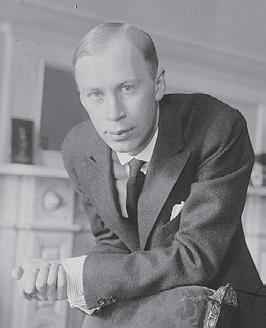
above: Sergei Prokofiev, ca. 1918, New York City. Prints and Photographs Division, Library of Congress
dissonant combinations,” according to one reviewer. The listeners, disdaining the decorum that they were convinced the young composer had already shattered, greeted the work with a sonorous round of hisses and catcalls. Prokofiev responded with his own characteristic rejoinder: he sat down and thundered through one of his noisiest solo works as an encore. It was not long, however, before his playing and his music gained a wide audience, the fascination and innate musicality of his style sweeping away all initial reservations.
The Second Piano Concerto is a work “full of splinters,” as Prokofiev wrote to Igor Stravinsky. Through its handling of rhythm, melody, and harmony, it achieves a quality of galvanic dynamism unknown in the music of the preceding century. Of it, Leonid Sabaneyeff wrote, “Vigorous, clear-cut rhythms, and naïveté of melody are raised to a cult; the technical methods themselves become a negation of those that had just been in vogue. Savagery and barbarism also become something needed and desirable as a reaction against the refinement of the preceding epoch.” This concerto is music of youth and flamboyance and stirring visceral excitement.
Of the instrumentation of this work, Prokofiev noted, “It seems to me that in general, piano concertos are of two kinds: in the first, the composer succeeds in writing an ensemble for the solo instrument with the orchestra; in the second, the solo is dominant,
while the orchestra serves merely as an adjunct. My First Concerto is closer to the first kind, my Second to the second.” The soloist presents the principal theme of the opening movement; a saucy melody in quicker tempo provides contrast. The formal development and recapitulation of the principal theme are combined into an enormous solo cadenza before the orchestra is recalled to provide a coda. The quiet ending section mirrors the opening measures, bringing the movement round full circle. Prokofiev cited the brief but brilliant scherzo as an example of his “motoric” style, and this movement is, indeed, a display of perpetual motion. The soloist, in a mighty exhibition of technique and endurance, plays continuously in octaves without a single beat of rest or one long note throughout the entire movement. The slower third movement is in Prokofiev’s best nose-thumbing, wrong-note idiom. The opening and closing sections of this movement make much use of a chugging bass ostinato, with the middle section given over to music of a more gentle character. The finale is a dazzling showcase for the soloist. The lightning-flash opening section returns to finish the movement, but in between are themes of contrasting character in which the soloist frequently charges forth alone, the orchestra sitting silently amid the pianistic fireworks. In his Second Concerto, Prokofiev created a daring, virtuosic tour-de-force of pianism that remains as vibrant and exciting today as when it roused its first hearers from their seats in the waning days of Imperial Russia.
Symphony No. 1 in D Major, Op. 25 (Classical)
COMPOSED 1917
“In the field of instrumental music, I am well content with the forms already perfected. I want nothing better, nothing more flexible or more complete than sonata form, which contains everything necessary to my structural purpose.” This statement, given to Olin Downes by Prokofiev during an interview in 1930 for the New York Times, seems a curious one for a composer who had gained a reputation as an ear-shattering iconoclast, the enfant terrible of twentieth-century music, the master of modernity. While it is certainly true that some of his early works (Scythian Suite, Sarcasms, the first two piano concertos) raised the hackles of musical traditionalists, it is also true that Prokofiev sought to preserve that same tradition by extending its boundaries to encompass his own distinctive style. A glance through the list of his works shows a preponderance of established classical forms: sonatas, symphonies, concertos, operas, ballets, quartets, overtures, and suites account for most of his output. This is certainly
not to say that he merely mimicked the music of earlier generations, but he did accept it as the conceptual framework within which he built his own compositions.
Prokofiev’s penchant for using classical musical idioms was instilled in him during the course of his thorough, excellent training: when he was a little tot, his mother played Beethoven’s sonatas to him while he sat under the piano; he studied with the greatest Russian musicians of the time—Glière, Rimsky-Korsakov, Liadov, Glazunov; he began composing at the Mozartian age of six. By the time he was twenty-five, Prokofiev was composing prolifically, always brewing a variety of compositions simultaneously. The works of 1917, for example, represent widely divergent styles—The Gambler is a satirical opera; They Are Seven, a nearly atonal cantata; the Classical Symphony, a charming miniature. This last piece was a direct result of Prokofiev’s study with Nikolai Tcherepnin, a good and wise teacher who allowed the young composer to forge ahead in his own manner while making sure that he had a thorough understanding of the great musical works of the past. It was in 1916 that Prokofiev first had the idea
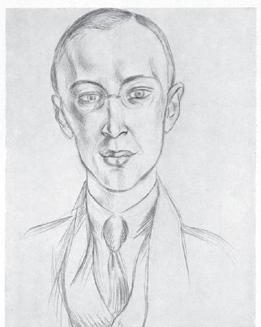
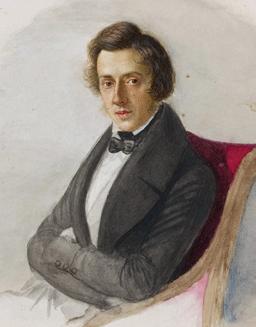
this page: Sergei Prokofiev, drawing by Henri Matisse (1869–1954), April 25, 1921. Bibliothèque nationale de France | next spread: Chopin, watercolor and ink drawing by fiancée Maria Wodzińska (1819–1896), 1836. National Museum, Warsaw, Poland
for a symphony based on the Viennese models supplied by Tcherepnin, and at that time he sketched out a few themes for it. Most of the work, however, was done the following year, as Prokofiev recounted in his Autobiography:
I spent the summer of 1917 in complete solitude in the environs of Petrograd; I read Kant and I worked hard. I had purposely not had my piano moved to the country because I wanted to establish the fact that thematic material worked out without a piano is better. . . . The idea occurred to me to compose an entire symphonic work without the piano. Composed in this fashion, the orchestral colors would, of necessity, be clearer and cleaner. Thus, the plan of a symphony in Haydnesque style originated, since, as a result of my studies in Tcherepnin’s classes, Haydn’s technique had somehow become especially clear to me, and with such intimate understanding it was much easier to plunge into the dangerous flood without a piano. It seemed to me that, were he alive today, Haydn, while retaining his style of composition, would have appropriated something from the modern. Such a symphony I now wanted to compose: a symphony in the classic manner. As it began to take actual form, I named it Classical Symphony; first, because it was the simplest thing to call
it; second, out of bravado, to stir up a hornet’s nest; and finally, in the hope that should the symphony prove itself in time to be truly classic, it would benefit me considerably.
Prokofiev’s closing wish has been fulfilled—the Classical Symphony has been one of his most successful works ever since it was first heard.
The work is in the four movements customary in Haydn’s symphonies, though at only fifteen minutes, it hardly runs to half their typical length. The dapper first movement is a miniature sonata design that follows the traditional form but adds some quirks that would have given old Haydn himself a chuckle—the recapitulation, for example, begins in the “wrong” key (but soon rights itself), and occasionally a beat is left out, as though the music had stubbed its toe. The sleek main theme is followed by the enormous leaps, flashing grace notes, and sparse texture of the second subject. A graceful, ethereal melody floating high in the violins is used to open and close the Larghetto, with the gentle pizzicato middle section reaching a brilliant tutti before quickly subsiding. The third movement, a gavotte, comes not from the Viennese symphony but rather from the tradition of French baroque ballet. The finale is the most brilliant movement of the symphony and calls for remarkable feats of agility and precise ensemble from the performers.
FRÉDÉRIC CHOPIN
Born February 22, 1810; Żelazowa Wola, Poland
Died October 17, 1849; Paris, France
Piano Concerto No. 1 in E Minor, Op. 11
COMPOSED
Chopin, the greatest poet of the piano, left a slim catalog of works involving the orchestra. All of those include parts for solo keyboard: two concertos (opp. 11 and 21), a set of variations on “La ci darem la mano” from Mozart’s Don Giovanni (op. 2), Fantasy on Polish Airs (op. 13), Krakowiak (op. 14), and Polonaise brilliante (op. 22). Despite the opus numbers, which indicate the sequence of publication rather than composition, these are all very early works, completed by 1830. In other words, Chopin did not write a note for orchestra after his twentieth year. The reasons for this illuminate not just Chopin’s career, but also the musical milieu in which he excelled in his own unique way.
The music of the first half of the nineteenth century was ruled, in large part, by the touring virtuoso. With the advent of Paganini in 1805 and Liszt in 1823, the performance standards, methods of concertizing, and show business savvy of the master executant were established. If any young hopeful wanted to crash the gates of such elite company, he not only had to play like a
wizard but he also had to play his own music. Such music was of three sorts: improvisations, composed solo works, and concerted pieces with orchestra. All were included in a typical early nineteenth-century concert, along with a miscellany of vocal and orchestral compositions. The actual pieces chosen for these programs were dictated by the crossing paths of performers, the availability of certain instrumental combinations, and the current love affairs of the participants. (Chopin’s inamorata of 1830, a soprano, shared the bill with the premiere of the E minor concerto.) Chopin had determined to make his mark in the world as a pianist, so he needed to produce the required works for solo piano with orchestral accompaniment if he was to have any thoughts of organizing successful concerts across Europe.
So why, then, did Chopin stop composing concertos? He stopped precisely because he was Chopin. He was probably one of the most sensitive pianists ever to walk the earth, but he was not a showman, at least not in the extravagant manner needed to attract attention in such a highly competitive field. He was unable to create the thunderous avalanche of sound required to: 1) acoustically fill a large hall; 2) be heard above the orchestra; and 3) drown
out the competition. Hector Berlioz said that to appreciate Chopin’s playing, “It is necessary to hear him at no great distance, rather in the salon than in the theater.” He was a good judge of his own talents, and when fate beckoned him to abandon the public concert platform in 1835 by becoming the darling of Parisian society and its private salons, he bought himself some fancy clothes and waded right into the aristocratic whirl. The need for concerted pieces evaporated, and he never wrote another.
The E minor concerto was premiered at Chopin’s third public concert in Warsaw, a performance that was not only to be his last in that city but also the final one he would ever play on his native Polish soil. Three weeks after he departed for Vienna, the political ferment sweeping across Europe swept into Warsaw, and insurrection broke out. Prevented from returning, Chopin eventually settled in Paris and never set foot in his home country again.
The E minor is actually the second of Chopin’s two piano concertos, but because it was published before the F minor it is known as no. 1. Its three movements follow the classical pattern of fast–slow–fast, but it is considerably expanded in length from the Mozartian model. For the work of a twentyyear-old composer, it is an amazing accomplishment. All the characteristics of Chopin’s mature genius are here: the sure melodic sense, the beautiful harmonic felicity, the perfect understanding of the piano’s sonorities, and
the ineffable quality of generating exactly the mood appropriate for the material and the genre.
The opening movement begins with a long orchestral introduction that presents the thematic material: a melodramatic main theme in E minor and a perfect, grandly arched second theme in E major. The piano enters for the reprise of the themes to complete the exposition. The development is largely occupied with the main theme, around which the soloist strews exquisite scales and chords, evidence that Chopin was a master of keyboard figuration from his earliest works. The recapitulation commences with the orchestra alone while the pianist returns only with the second theme. An abrupt unison closes the movement. Of the second movement, titled Romanze, Chopin wrote, “[It is] of a romantic, calm, and partly melancholy character. It is intended to convey the impression that one receives when the eye rests on a beloved landscape that calls up in one’s soul beautiful memories, for instance, of a fine moonlit spring night.” This lovely soliloquy is the closest of this concerto’s three movements to the finely wrought mastery of Chopin’s later works. The rondo–finale partakes of the jubilant character of a native Polish dance, the krakowiak, with the returning theme separated by several tuneful episodes.
Richard E. Rodda, a former faculty member at Case Western Reserve University and the Cleveland Institute of Music, provides program notes for many American orchestras, concert series, and festivals.
Evgeny Kissin
Lisa Batiashvili
Maxim Vengerov
Yuja Wang Nemanja Radulović
Bruce Liu
Leif Ove Andsnes
Jean-Yves Thibaudet
PROFILES
Mahler Chamber Orchestra
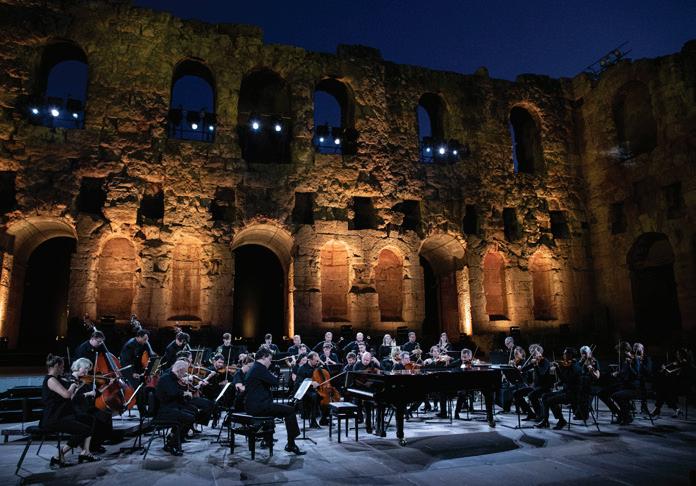
Since its creation in 1997 by the musicians of the orchestra, the Mahler Chamber Orchestra (MCO) has established itself as one of the world’s leading chamber ensembles. Working as a global collective, the MCO is led by its members in collaboration with its Berlin-based management office. The musicians, who come from around twenty-five different countries, unite for each tour or project. The chamber music dialogue and unanimous act of listening shape the orchestra’s sound; it’s a philosophy inspired by the orchestra’s late mentor and longtime partner Claudio Abbado, which the MCO calls “The Sound of Listening.”
In the 2024–25 season, the MCO performed with conductors and soloists such as Antonello Manacorda, Riccardo Chailly, and Leif Ove Andsnes, among many others. The MCO is also known for its performances without a conductor; its artistic partners Yuja Wang and Mitsuko Uchida, with whom the orchestra went on several tours, often lead the MCO from the piano.
In the 2025–26 season, the MCO takes the stage with Maxim Emelyanychev, Gianandrea Noseda, Augustin Hadelich, Kian Soltani, Adam Fischer, Igor Levit, Yuja Wang, Joana Mallwitz, Piotr Beczała, Hélène Grimaud, Víkingur Ólafsson, Thomas Adès, Daniel Harding, Daniil Trifonov, and many others.
The orchestra maintains residencies in Berlin and Lucerne. From March 2026 to 2028, it will succeed the Berlin Philharmonic Orchestra at the Baden-Baden Easter Festival. In 2024 the MCO assumed the role of artistic director of Musikwoche Hitzacker, where it presents a diverse chamber music repertoire every year. In March 2026, violist Antoine Tamestit, a longtime MCO friend and collaborator, will be the festival’s artist-in-residence.
The MCO is committed to enriching lives through music and actively creates on-and-off-stage encounters that bring music, learning, and creativity to communities across the globe. Its program Feel the Music introduces music to deaf and hard-of-hearing individuals, while the MCO Academy allows orchestra members to share their expertise with the next generation of musicians. Additionally, the MCO’s school concerts invite students on a multicultural journey, fostering introspection and contemplation on the theme Belonging.
The MCO’s performances are often recorded and aired by major broadcasters and on ARTE; the ensemble’s most recent CD featuring George Benjamin’s opera Picture a Day Like This was released by Nimbus in September
PHOTO BY THOMAS DASKALAKIS
2024. Together with its Artistic Partner for Immersive Experiences Henrik Oppermann/Schallgeber, the MCO has developed a series of virtual reality concerts, showcasing them at Princeton University and Mozart Wohnhaus in Salzburg. Since July 2024, some of the chamber music pieces produced in virtual reality have been available in the Mahler Chamber Orchestra app for Apple Vision Pro, and the orchestra is recording new material and developing the concept in 2025–26.
Yuja Wang
Piano and Conductor
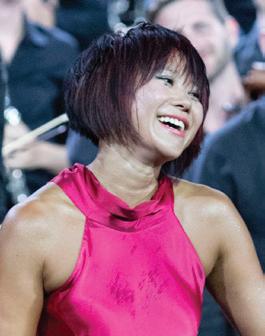
Pianist Yuja Wang is celebrated for her charismatic artistry, emotional honesty, and captivating stage presence. She has performed with the world’s most venerated conductors, musicians, and ensembles and is renowned not only for her virtuosity but also for her spontaneous and lively performances, famously telling the New York Times, “I firmly believe every program should have its own life and be a representation of how I feel at the moment.”
Yuja Wang was born into a musical family and began studying the piano at the age of six. She received advanced training in Canada and at the Curtis Institute of Music under Gary Graffman. Her international breakthrough came in 2007, when she replaced Martha
Argerich as soloist with the Boston Symphony Orchestra. Two years later, she signed an exclusive contract with Deutsche Grammophon and has since established her place among the world’s leading artists with a succession of critically acclaimed performances and albums. Her recordings have garnered multiple awards, including five Grammy Award nominations and her first Grammy win for Best Classical Instrumental Solo with her 2023 release of The American Project, which also won an Opus Klassik Award in the concerto category.
Recent projects include a collaboration with David Hockney at London’s Lightroom, play-direct tours with the Mahler Chamber Orchestra to Europe and South America, international duo recital tour with pianist Víkingur Ólafsson, and residency with the New York Philharmonic.
Yuja Wang opened the 2025–26 season of many major U.S. orchestras, including the San Francisco Symphony and Philadelphia Orchestra, and at Carnegie Hall’s opening night gala, she play-directed Tchaikovsky’s Piano Concerto no. 1. In her orchestral performances, she embarks on a major European tour with the Swedish Radio Symphony Orchestra and performs with the Royal Concertgebouw Orchestra, New York Philharmonic, Cleveland Orchestra, and Rotterdam Philharmonic. Her play-directing continues with tours with the Mahler Chamber Orchestra to Spain and the United States, and she gives a recital tour throughout Asia. In November
PHOTO BY THOMAS DASKALAKIS
2025, Playing with Fire: An Immersive Odyssey with Yuja Wang opened at the Paris Philharmonic. This groundbreaking multisensory installation takes visitors behind the scenes, offering a rare perspective on the emotion and artistry behind Wang’s performances.
Matthew Truscott Concertmaster
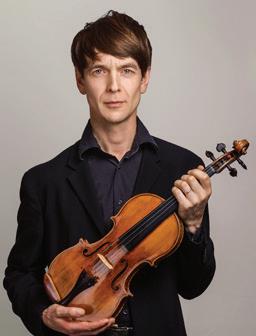
Matthew Truscott is a versatile violinist who shares his time between period instrument and modern performance, appearing with some of the finest musicians in both fields. He is concertmaster of the Mahler Chamber Orchestra and one of the leaders of the Orchestra of the Age of Enlightenment.
He is in demand as a guest leader, and his engagements in this capacity have included projects with English National Opera, Dutch National Opera, the Netherlands Chamber Orchestra, Budapest Festival Orchestra, the English Concert, Le Concert d’Astrée, the King’s Consort, and Arcangelo. He is also leader of Classical Opera, St James’s Baroque, and the Magdalena Consort.
Truscott, a keen chamber musician, has recordings that include a set of Purcell’s trio sonatas with Retrospect Trio; chamber music by Bach with Trevor Pinnock, Emmanuel Pahud, and Jonathan Manson; and a piano trio by Haydn with Richard Lester and Simon Crawford-Phillips.
Matthew Truscott teaches baroque violin at the Royal Academy of Music in London.
REFRESHMENTS AT SYMPHONY CENTER
You can order drinks and snacks before the performance or during intermission at various bars located throughout Symphony Center, including the Bass Bar in the Rotunda and most of the lobby spaces in Orchestra Hall.
SYMPHONY CENTER PRESENTS
Jeff Alexander Chicago Symphony Orchestra Association President Cristina Rocca Vice President for Artistic Administration
The Richard and Mary L. Gray Chair
James M. Fahey Senior Director, Programming, Symphony Center Presents Lena Breitkreuz Artist Manager, Symphony Center Presents
Michael Lavin Director of Production
Joseph Sherman Associate Director of Production, SCP and Rental Events
PHOTO BY GEOFFROY SCHIED
PROFILES
Mahler Chamber Orchestra
FLUTES
Chiara Tonelli (Italy)
Julia Gallego Ronda (Spain)
OBOES
João Da Silva (Portugal)
Iria Folgado (Spain)
CLARINETS
Vicente Alberola Ferrando (Spain)
Jaan Bossier (Belgium)
BASSOONS
Mathis Stier (Germany)
Chiara Santi (Italy)
HORNS
Juan Manuel Gomez Gonzalez (Spain)
Gerard Sanchez Safont (Spain)
Aurora Kuo (Taiwan)
Lily Kern (USA)
TRUMPETS
Per Ivarsson (Sweden)
Florian Kirner (Germany)
TROMBONES
Carlos Jimenez Fernandez (Spain)
William Stenhouse (United Kingdom)
Jürgen Oswald (Austria)
TUBA
Jose Martínez Anton (Spain)
TIMPANI AND PERCUSSION
Rodolphe Théry (France)
Rizumu Sugishita (Japan)
Christian Miglioranza (Italy)
* Concertmaster ** Section Leader
VIOLINS 1
Matthew Truscott* (United Kingdom)
May Kunstovny (Austria)
Hildegard Niebuhr-Candan (Germany)
Alexandra Preucil (USA)
Tim Summers (USA)
Clara Scholtes (Germany)
Elena Rindler (Germany)
Elvira van Groningen (Netherlands)
Hwa-Won Rimmer Pyun (Germany)
Mona Burger (Germany)
VIOLINS 2
Johannes Lörstad** (Sweden)
Michiel Commandeur (Netherlands)
Fjodor Selzer (Germany)
Christian Heubes (Germany)
David Moosmann (Germany)
Beatrice Colombis (Italy)
Hayley Wolfe (USA)
Jana Lebrova (Czech Republic)
VIOLAS
Beatrice Muthelet** (France)
Yannick Dondelinger (United Kingdom)
Frida Siegrist Oliver (Norway)
Sofie Van der Schalie (Netherlands)
Aline Saniter (Germany)
Justin Caulley (USA)
VIOLONCELLOS
Frank-Michael Guthmann** (Germany)
Stefan Faludi (Germany)
Philipp von Steinaecker (Germany)
Clara Grünwald (Germany)
Katharina Kühl (Germany)
DOUBLE BASSES
Sebastian Breidenstein** (Germany)
Jon Mikel Martínez Valgañón (Spain)
A Musical Journey
In June 2026, Symphony Center marks America’s 250th anniversary with a month of performances that honor the nation’s rich and evolving cultural landscape, reflecting the country’s resilience, creativity and musical traditions.
Create your own subscription of three or more programs and save 15%.
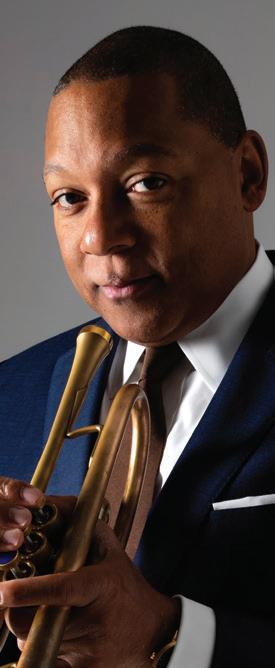
Jazz at Lincoln Center Orchestra with Wynton Marsalis
JUNE 2
Alsop Conducts Adams, Copland & Marsalis
JUNE 4-6
Conrad Tao piano
JUNE 7
Chris Thile & the CSO
JUNE 8
Gaffigan, Thibaudet & Bernstein
JUNE 11 -1 3
Lincoln Portrait & Ellington Harlem
JUNE 1 8-21 A Musical Tribute to John Williams & Steven Spielberg