KLAUS MÄKELÄ Zell Music Director Designate | RICCARDO MUTI Music Director Emeritus for Life
Thursday, June 11, 2026, at 7:30
Friday, June 12, 2026, at 1:30
Saturday, June 13, 2026, at 7:30
James Gaffigan Conductor
Jean-Yves Thibaudet Piano
Apostolic Church of God Sanctuary Choir
Brian Creighton Rice Director
WEILL Lady in the Dark
First Chicago Symphony Orchestra subscription concert performances
TRADITIONAL Didn’t My Lord Deliver Daniel? (arr. Hogan)
Kimberly C. Cothran, Krystal Royalle Gaston, Andrea D. Morris, soloists
APOSTOLIC CHURCH OF GOD SANCTUARY CHOIR
HAILSTORK I Will Lift Up Mine Eyes from I Will Lift Up Mine Eyes
First Chicago Symphony Orchestra performances
Kiel Williams, soloist
APOSTOLIC CHURCH OF GOD SANCTUARY CHOIR
GERSHWIN Overture to Girl Crazy (orch. Rose)
First Chicago Symphony Orchestra subscription concert performances
TRADITIONAL Witness (arr. Halloran)
APOSTOLIC CHURCH OF GOD SANCTUARY CHOIR
JOHNSON Lift Every Voice and Sing (arr. Carter)
First Chicago Symphony Orchestra subscription concert performances
APOSTOLIC CHURCH OF GOD SANCTUARY CHOIR
INTERMISSION
BERNSTEIN The Age of Anxiety, Symphony No. 2 for Piano and Orchestra
Part 1
The Prologue: Lento moderato—
The Seven Ages (Variations 1–7)—
The Seven Stages (Variations 8–14)
Part 2
The Dirge: Largo—
The Masque: Extremely fast—
The Epilogue: L’istesso tempo—Adagio—Andante—Con moto
JEAN-YVES THIBAUDET
The Chicago Symphony Orchestra Association acknowledges support from the Illinois Arts Council. Newsradio 105.9 WBBM is a Media Partner for this event.
This month, as we present a series of concerts honoring our country’s 250th anniversary, it is clear that the music of our land has come of age. In 1892, near the end of the Chicago Orchestra’s opening season, the ensemble played its first all-American program: works by four male composers born within 250 miles of each other along a narrow slice of New England. Their music was “made according to German models,” a local critic pointed out. “Any idea or orchestral effect that can be considered as distinctively and peculiarly American is not found in them.”
What you will hear this month is distinctively American, not because it has a singular instantly identifiable accent or style, but because it reflects the breadth and variety of the landscapes, traditions, and peoples of America. There is music from Charles Ives, often called the father of American music, to John Adams, who, as his presidential name suggests, is a founding father of a new world of contemporary music that has swept the land: from Jessie Montgomery, born, raised, and trained in New York City, to Kurt Weill, who fled the Nazi takeover of his native Germany to settle in that same city, where the luxury of freedom inspired some of his most successful scores; from Duke Ellington, who wove jazz and symphony together in unexpected harmony, to Wynton Marsalis, who imbues that tradition with unforeseen power and provocation today; from Leonard Bernstein to Aaron Copland, whose very names bring to mind the music of the urban jungle and our open prairies. There are pieces inspired by “The Star-Spangled Banner” and by Plymouth Rock. There is music as timeless as the singing of Black spirituals and as genre-defying as Chris Thile’s mandolin playing, and there are the indelible words of Abraham Lincoln, still potent after all these years.
The music of America has broadened to encompass the full richness— and the complexity—of our land and our citizenship. The European models are still with us, but there is now a wealth of new music unlike anything being written on the other side of the ocean. Some of the pieces we perform this month have roots as old as our country; some are brand new. That is what these concerts celebrate: an American music that is too diverse to be pigeonholed because it mirrors the dizzying wealth of styles and backstories and ambitions of the composers working here. These programs reflect how far we have come as a land of music and musicians. And in the end, they speak to us about who we are now.
KURT WEILL
Born March 2, 1900; Dessau, Germany
Died April 3, 1950, New York City
Lady in the Dark, Symphonic Nocturne (Arranged
by Robert Russell Bennett)
“For every age and part of the world,” Kurt Weill said many years after he had settled in the United States, “there is a place about which fantasies are written. In Mozart’s time it was Turkey. For Shakespeare, it was Italy. For us in Germany, it was always America.” (“We had read Jack London and knew absolutely all about your Chicago gangsters,” he added.)
As a Jew in Germany—the son of a cantor—and as an outspoken artist, Weill began to have problems in his homeland shortly after the premiere of the musical theater piece The Silver Lake in February 1933. Hitler had been appointed chancellor at the end of January. Only days after the premiere, a performance of The Silver Lake was disrupted by Nazi hooligans; the following week the Reichstag (the German parliament) burned. Rehearsals for a Berlin production were shut down, and by the beginning of March all of Weill’s works were banned in Germany. Scores and orchestra parts were recalled by Weill’s publishers and destroyed. Few composers have endured such a total suppression of their work. (The Silver Lake was never performed again in Germany during Weill’s lifetime.)
Weill fled Germany in March, traveling by car as far as the French border and then on foot, to avoid attracting attention. He arrived in Paris two days later. In April Weill and Bertolt Brecht began The Seven Deadly Sins, their final collaboration. It is a postscript to their brilliant, short-lived career together, and to an era that was no more—and with its setting in the United States, a county Weill had not yet visited, it was a portal to Weill’s own future.
Weill’s escape from his homeland and his eventual arrival in the United States in 1935 is a dividing line in his life and career, signaled by his abrupt decision to begin pronouncing his name with a W, not a V, once he settled in the States. Unlike Arnold Schoenberg, who legally changed the spelling of his name from Schönberg when he became an American citizen but then asked that his remains be returned to Europe after his death, Weill turned his back on his roots. “I never felt the oneness with my native country that I do with the United States,” he
FIRST CSO PERFORMANCE August 8, 2009, Ravinia Festival. James Conlon conducting These are the first Chicago Symphony Orchestra subscription concert performances.
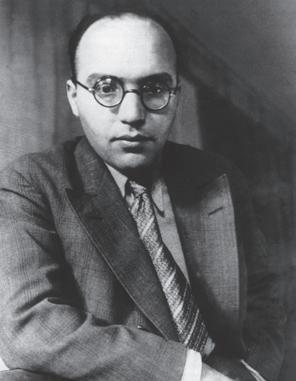
above: Kurt Weill, portrait, ca. 1940. Photo by Keystone-France/GammaKeystone via Getty Images
said. “The moment I landed here I felt as though I’d come home.”
There are several Kurt Weills. There is the German Weill and the American Weill, the European and the émigré, the classically trained student of Ferruccio Busoni and the Broadway tunesmith, the avant-garde composer of symphonies and the writer of “Mack the Knife.” Lady in the Dark is prime latter-day, liberated Weill—pronounced with a W.
In his youth Weill had played organ in the synagogue by day and piano in the beer hall at night—a musical split personality that was reflected throughout his career in the provocative, impossible-to-pigeonhole music he wrote. He was one of the earliest composers to ignore the differences between serious and light music: “There is only good music and bad music,” he said. Once in New York, Weill began to study American popular song and theater music. Although he had written two symphonies, many lieder, and a large number of orchestral works in Germany, he now began to focus on the great American musical stage, leading ultimately to the stellar collaboration with the playwright Moss Hart and the lyricist Ira Gershwin (George’s older brother) in Lady in the Dark. It took fourteen months of tiresome work to jell, but Lady in the Dark was a huge hit, becoming the second longest running book musical between Showboat in 1927 and Oklahoma! in 1943.
The success of Lady in the Dark was unexpected, for it is not standard Broadway fare. It examines the life of Liza Elliott, who cannot decide between the two men courting her and begins to see a psychiatrist, who wants to explore her dreams. The work is structured as a straight play that contains three large dream sequences—the Glamour Dream, the Wedding Dream, and the Circus Dream, each with its own mood and character—which contain Weill’s music. It marked a milestone in the relationship of music and theater on the American stage.
The Symphonic Nocturne that was later arranged by Robert Russell Bennett, drawing extensively from the complete score, opens with a simple, haunting melody (“My Ship”) that is crucial to the story: it is the tune that Liza continues to hear in her head but cannot place, and in Weill’s hands it becomes a recurring motif throughout the musical. (As it does in the musical, it closes this symphonic suite.) The nocturne sweeps several of Weill’s songs into its rich orchestral sweep, including “Girl of the Moment,” “This is New,” and the evergreen “Saga of Jenny,” which has been sung by everyone from Ute Lemper to Julie Andrews (and was rewritten by Stephen Sondheim for Leonard Bernstein’s seventieth birthday as “The Saga of Lenny, with no apologies to Kurt Weill and Ira Gershwin”). But it is the startlingly individual voice of Kurt Weill, the man of many musical guises and master of all of them, that sticks in the memory.
REFRESHMENTS AT SYMPHONY CENTER
You can order drinks and snacks before the performance or during intermission at various bars located throughout Symphony Center, including the Bass Bar in the Rotunda and most of the lobby spaces in Orchestra Hall.
Didn’t My Lord Deliver Daniel?
I Will Lift Up Mine Eyes from I Will Lift Up Mine Eyes
These are the first Chicago Symphony Orchestra performances.
Witness
Lift Every Voice and Sing
FIRST CSO PERFORMANCE
October 13, 2016, Apostolic Church of God. Riccardo Muti conducting
These are the first Chicago Symphony Orchestra subscription concert performances.
Song texts found on pages 7–9
The music of Black Americans, for so long unknown and overlooked, and performed only among themselves, in the fields and family gatherings and in church, is now recognized as one of the cornerstones of the evolving American musical style. From music that was never written down over the ages to more recent hymns and cantatas, the music that Black Americans sing has long been a powerful way to convey their hope and resilience in the darkest of times and to demonstrate the deep roots of their religious faith. The great songbook of spirituals, an oral tradition associated with the enslavement of Africans, has become a music that is regularly sung at celebrations, memorials, protests—all manner of communal gatherings, including those like this one in a historic concert hall.
(1957–2003), a pianist and conductor who published nearly one hundred arrangements of spirituals in his short life. “I Will Lift Up Mine Eyes” is the opening movement of a cantata by Adolphus Cunningham Hailstork III (born April 17, 1941; Rochester, New York). He composed the work in memory of Undine Smith Moore (1904–1989), who has often been called “The Dean of Black Women Composers,” and whose works, like those of Florence Price, are at last enjoying a renaissance today.
The music the Apostolic Church of God Sanctuary Choir sings at these concerts opens with the spiritual “Didn’t My Lord Deliver Daniel?” in a version by Moses George Hogan
The spiritual “Witness” was arranged by Jack Halloran (1916–1997), who earned degrees in music from Morningside College in Iowa and Northwestern University in Evanston. “Lift Every Voice and Sing” (arranged by Roland M. Carter, born 1942) has become widely known as the Black National Anthem. The poem was written in 1900 by James Weldon Johnson for a school celebration of Abraham Lincoln’s birthday and later set to music by his brother
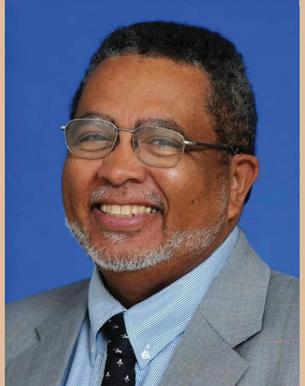
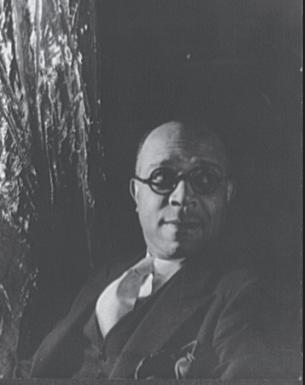
from left: Adolphus Hailstork | John Rosamond Johnson, portrait by Carl Van Vechten (1880–1964), 1933. Library of Congress, Prints and Photographs Division, Washington, D.C.
John Rosamond Johnson (born August 11, 1873, Jacksonville, Florida; died November 11, 1954, New York City). When Jessie Montgomery wrote Anthem, the forerunner of Banner, which is being performed as part of our festival next week, she wove together the themes from “The
Didn’t My Lord Deliver Daniel?
Didn’t my Lord deliver Daniel, Then why not every man?
Refrain:
Didn’t my Lord deliver Daniel, And why not a every man?
He deliver’d Daniel from the lion’s den, Jonah from the belly of the whale, And the Hebrew children from the fiery furnace, And why not every man? Hallelujah! [Refrain]
The wind blows east and the wind blows west, It blows like the judgement day. And ev’ry poor soul that never did pray Will be glad to pray that day. Hallelujah! [Refrain]
I set my foot on the Gospel ship, And the ship, it begin to sail. It landed me over on Canaan’s shore, And I’ll never come back anymore. Hallelujah! [Refrain] —Traditional
Star-Spangled Banner” and “Lift Every Voice and Sing,” which, as she discovered, share the same phrase structure. As early as 1917 the NAACP began to promote “Lift Every Voice and Sing” as a national anthem, with its journey from the dark past to “the harmonies of liberty.”
I Will Lift Up Mine Eyes
I will lift up mine eyes to the hills, From whence cometh my help.
My help cometh surely from the Lord, Maker of heaven and earth.
He will not suffer thy foot to be moved.
He that keepeth thee will not slumber nor sleep. The sun will not smite thee by day
Nor the moon by night.
The Lord shall preserve thee from evil.
The Lord shall preserve thy soul!
I will lift up mine eyes to the hills.
—Psalm 121:1–3, 6–7
SCAN TO LEARN MORE
Witness
Who’ll be a witness for my Lord?
Oh, I’ll be a witness for my Lord. There was a man of the Pharisees, His name was Nicodemus and he didn’t believe. The same came to Christ by night, Wanted to be taught out of human sight. Nicodemus was a man who desired to know How a man can be born when he is old.
Christ told Nicodemus as a friend, “Man, you must be born again.”
He said, “Marvel not, man, If you want to be wise, Repent, believe, and be baptized.”
Then you’ll be a witness for my Lord, You’ll be a witness; soul is a witness for my Lord.
You read about Samson, from his birth He was the strongest man that ever lived on earth. Way back yonder in ancient times He killed ten thousand of the Philistines. Then old Samson went a wand’rin’ about. Samson’s strength was never found out ’Til his wife sat upon his knee.
She said, “Tell me where your strength lies, if you please!”
Well, old Samson’s wife, she talk so fair, Samson said, “Cut off a my hair! Cut it off!”
Shave my head just as clean as your hand, And my strength will ’come like a natural man.”
Samson was a witness for my Lord, Soul is a witness for my Lord. There’s another witness for my Lord! My soul is a witness for my Lord!
—Traditional
Lift Every Voice and Sing
Lift every voice and sing, ’Til earth and heaven ring, Ring with the harmonies of liberty, Let our rejoicing rise, High as the list’ning skies, Let it resound loud as the rolling sea.
Sing a song full of the faith that the dark past has taught us, Sing a song full of the hope that the present has brought us; Facing the rising sun of our new day begun,
Let us march on ’til victory is won.
Stony the road we trod, Bitter the chast’ning rod, Felt in the days when hope unborn had died,
Yet with a steady beat, Have not our weary feet
Come to the place for which our fathers sighed? We have come, oh, we have come over a way that with tears has been watered. Oh, we have come treading our path thro’ the blood of the slaughter’d, Out of the gloomy past, Till now we stand at last
Where the white gleam of our bright star is cast.
God of our weary years, God of our silent tears, Thou who hast brought us thus far on the way; Thou who hast by Thy might, Led us into the light, Keep us forever in the path, we pray.
Lest our feet stray from the places, our God, where we met Thee, Lest our hearts, drunk with the wine of the world, we forget Thee; Shadow’d beneath Thy hand, May we forever stand, True to our God, True to our native land.
—James Weldon Johnson
GEORGE GERSHWIN
Born September 26, 1898, New York City
Died July 11, 1937; Los Angeles, California
Overture to Girl Crazy (Orchestrated by Don Rose)
George Gershwin made his first appearance in Chicago in June 1933—the hottest June the city had known. The concert, given by the Chicago Symphony on the fourteenth, the night before the historic premiere of Florence Price’s first symphony, was part of the Orchestra’s Century of Progress series at the Auditorium Theatre. Gershwin performed his Concerto in F and Rhapsody in Blue. “I have never played before in Chicago, and am not well known here,” he told a reporter when he got to town, despite the fact that Rhapsody in Blue was the most talked-about piece of American music at the time. The Auditorium was filled to the last row on June 14. “He seems never to have cast the eye of desire in the direction of the music being done on the other side of the Atlantic,” the Tribune said. The Chicago American wrote simply: “He is the music of America.”
When Gershwin returned to perform with the Orchestra in July 1936, during the first season of the Ravinia Festival, the crowd was so large—reportedly more than 8,000 people, most of them gathered on the grounds, as the pavilion had long been sold out—that many were forced to climb trees to catch a glimpse of the composer. Probably for the first time in their lives, one reporter suggested, several members of high society, accustomed to having the best seats, had to jostle with everyone else for a place to sit or stand in order to hear Gershwin play.
Among Gershwin’s recent successes at the time was the Broadway musical Girl Crazy, which he wrote with his brother Ira. When it opened in the fall of 1930, the New York Times called it a “lively and melodious show,” with Gershwin’s brilliant music triumphing over a serviceable if somewhat preposterous story, set in a dude ranch, about a New York playboy who falls in love with a girl from Custerville, Arizona.
The Overture to Girl Crazy is a patchwork quilt of some of Gershwin’s most popular songs from the show—a few of them among the great classics of the American songbook—with a hint of “I’ve Got Rhythm” woven into the bustle of the very opening bars. It continues with “Embraceable You” and “But
August 10, 1979, Ravinia Festival. Erich Kunzel conducting December 31, 1995, Orchestra Hall. William Eddins conducting
MOST RECENT CSO PERFORMANCES
July 13, 2014, Ravinia Festival. Ted Sperling conducting
These are the first Chicago Symphony Orchestra subscription concert performances.
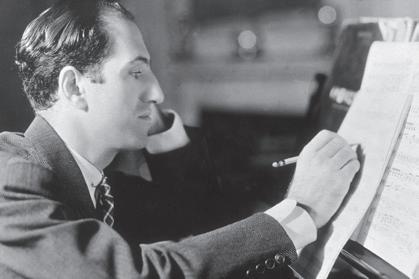
this page: George Gershwin, 1930, New York City. Photo by Hulton Archive/ Getty Images
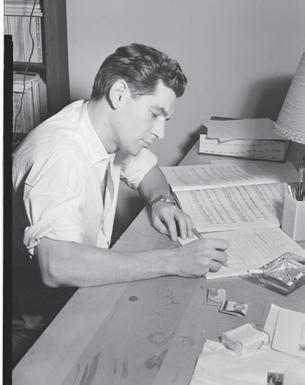
opposite page: Leonard Bernstein, portrait by William P. Gottlieb (1917–2006), ca. 1946–48. Library of Congress, William P. Gottlieb Collection, Music Division, Washington, D.C.
Not for Me,” as well as tunes that have been forgotten along with the musical itself, even though it was adapted for the movies and revived on Broadway Girl Crazy holds an important place in the history of American musicals nonetheless: in addition to the classic songs it introduced, it launched the careers of Ginger Rogers and Ethel Merman. The overture, which on opening
LEONARD BERNSTEIN
Born August 25, 1918; Lawrence, Massachusetts
Died October 14, 1990; New York City
night was played by a pit orchestra that included Red Nichols on cornet, Benny Goodman on saxophone, trombonists Glenn Miller and Jack Teagarden, Jimmy Dorsey on alto saxophone, and Gene Krupa on drums, remains an enduring jewel that survived a dated story and lives on as a perfect snapshot of Gershwin’s infectious lyricism and irresistible rhythm.
The Age of Anxiety, Symphony No. 2 for Piano and Orchestra
On November 14, 1943, Leonard Bernstein, the twenty-five-year-old assistant conductor of the New York Philharmonic, stepped in for Bruno Walter. His debut, broadcast nationwide over the radio, was a triumph and made the front page of the New York Times. In the twelve months that followed, Bernstein continued to make news with the premieres of his First Symphony (Jeremiah); the ballet Fancy Free; and a Broadway musical, On the Town. Never before had an American succeeded so brilliantly both as a conductor and as a composer. In fact, the music world had never encountered a major talent of such startling diversity. (As Stravinsky later said, Bernstein was “a department store of music.”)
From the start, Bernstein’s work was not easy to pigeonhole, and, as his career exploded, it continued to ignore conventional boundaries. He was a conductor, a pianist, and a composer; at various times each of those interests took center stage, sometimes at the expense of the others. (In particular, Bernstein complained of having to “flip the switch” from creator to performer and back again.) He conducted at La Scala and the Metropolitan Opera and in 1958 was named music director of the New York Philharmonic. He became a lecturer and writer, and a television star (the Young People’s Concerts designed for eight- to eighteen-year-olds captivated music lovers well into their eighties). He was, above all, a teacher—a “closet rabbi,” as he put it.
COMPOSED
1948–March 20, 1949
FIRST PERFORMANCE
April 8, 1949; Tanglewood, Massachusetts. The composer as soloist
INSTRUMENTATION
solo piano, 2 flutes and piccolo, 2 oboes and english horn, 2 clarinets and bass clarinet, 2 bassoons and contrabassoon, 4 horns, 3 trumpets, 3 trombones, tuba, timpani, 2 harps, snare drum, bass drum, tenor drum, tam-tam, cymbal, temple blocks, triangle, glockenspiel, xylophone, celesta, chimes, pianino, strings
APPROXIMATE
PERFORMANCE TIME 35 minutes
FIRST CSO PERFORMANCES
July 27, 1956, Ravinia Festival. Byron Janis as soloist, the composer conducting
April 27, 28, and 29, 1989, Orchestra Hall. James Tocco as soloist, Michael Morgan conducting
MOST RECENT
CSO PERFORMANCES
August 9, 2016, Ravinia Festival. Misha Dichter as soloist, David Zinman conducting
March 29, 30, and 31, 2018, Orchestra Hall. Gilles Vonsattel as soloist, Kent Nagano conducting July 27, 2019, Ravinia Festival. Harmony Zhu as soloist, Marin Alsop conducting (The Masque and The Epilogue)
As a composer, Leonard Bernstein was equally at home in the concert hall and the music theater. He wrote works for each venue and a great many pieces that combined stylistic traits from both traditions. Throughout his life, Bernstein championed the idea that a true American music, by definition, should be eclectic, and he never thought of that word as pejorative (though he often wondered why others did). But the way Bernstein regularly merged both popular and serious styles within the same work regularly drew fierce criticism. He proudly persisted in his efforts to marry the high and the low, or the light and the serious. As time goes by, his career, his life, his output, and his impact on American musical life all seem even more extraordinary. In addition to his many, varied musical talents, Bernstein was also a fine and insightful writer—his first book, The Joy of Music, originally published in 1959, is a classic—and below we reproduce his original program note for The Age of Anxiety.
Leonard Bernstein on The Age of Anxiety
W.H. Auden’s fascinating and hair-raising poem, The Age of Anxiety: A Baroque Eclogue, began immediately to affect me lyrically when I first read it in the summer of 1947. From that moment, the composition of a symphony based on The Age of Anxiety acquired an almost compulsive quality; and I worked on it steadily in Taos, in Philadelphia, in Richmond (Mass.), in Tel Aviv, in planes, in hotel lobbies, and finally (the week preceding the premiere) in Boston. The orchestration was started during a month-long tour with the Pittsburgh Symphony, and was completed on March 20, 1949, in New York City.
I imagine that the conception of a symphony with piano solo emerges from the extremely personal identification of myself with the poem. In this sense, the pianist provides an almost autobiographical protagonist, set against an orchestral mirror in which he sees himself, analytically, in the modern ambiance. The work is therefore no “concerto” in the virtuosic sense,
although I regard Auden’s poem as one of the most shattering examples of pure virtuosity in the history of English poetry.
The essential line of the poem (and of the music) is the record of our difficult and problematic search for faith. In the end, two of the characters enunciate the recognition of this faith—even a passive submission to it—at the same time revealing an inability to relate to it personally in their daily lives, except through blind acceptance.
No one could be more astonished than I at the extent to which the programmaticism of this work has been carried. I had not planned a “meaningful” work, at least not in the sense of a piece whose meaning relied on details of programmatic implication. I was merely writing a symphony inspired by a poem and following the general form of that poem. Yet, when each section was finished, I discovered, upon rereading, detail after detail of programmatic relation to the poem—details that had “written themselves,” wholly unplanned and unconscious. Since I trust the unconscious implicitly, finding it a sure source of wisdom and the dictator of the condign in artistic matters, I am content to leave these details in the score.
If the charge of “theatricality” in a symphonic work is a valid one, I am willing to plead guilty. I have a deep suspicion that every work I write, for whatever medium, is really theater music in some way, and nothing has convinced me more than these new discoveries of the unconscious hand that has been at work all along in The Age of Anxiety.
I have divided Auden’s six sections into two large parts, each containing three sections played without pause. A brief outline follows:
PART 1
(a) The Prologue finds four lonely characters, a girl and three men, in a Third Avenue bar, all of them insecure, and trying, through drink, to detach themselves from their conflicts, or, at best, to resolve them. They are drawn together by this common urge and begin a kind of symposium on the state of man. Musically, the Prologue
is a very short section consisting of a lonely improvisation by two clarinets, echo-tone, and followed by a long descending scale which acts as a bridge into the realm of the unconscious, where most of the poem takes place.
LEONARD BERNSTEIN IN CHICAGO
In September 1943 Artur Rodziński, music director of the New York Philharmonic, invited Leonard Bernstein to be his assistant conductor. Barely two months later, on November 14, the twenty-five-year-old conductor was a last-minute substitute for an ailing Bruno Walter, leading the ensemble in Carnegie Hall without a rehearsal. The next day, he was the front-page story in the New York Times.
Less than a year later, Bernstein made his debut with the Chicago Symphony Orchestra at the Ravinia Festival for a four-concert residency beginning on July 4, 1944. “A fascinating fellow, this Bernstein, dynamic, emotional, yet under complete control,” wrote Claudia Cassidy in the Chicago Tribune, with “hands that gyrate so convulsively they scarcely could hold a baton if they tried, and eyes that somehow manage to be agonized, supplicant, and truculent without losing their place in the score.” For the final concert of his inaugural residency, Bernstein led his Jeremiah Symphony, described by Cassidy as “undeniably impressive [and] a sound piece of work.”
(b) The Seven Ages. The life of man is reviewed from the four personal points of view. This is a series of variations which differ from conventional variations in that they do not vary any one common theme. Each variation seizes upon
ing week, he closed the Orchestra’s ninety-seventh season with Shostakovich’s Seventh Symphony (Leningrad) on June 21 and 22 in Orchestra Hall and June 24 in Lincoln Center’s Avery Fisher Hall in New York.
Bernstein would continue to appear with the Chicago Symphony until 1956, including his debut in Orchestra Hall in 1951. After more than thirty years, he returned to Chicago in June 1988 to act as artistic advisor for the American Conductors Program, a joint project of the American Symphony Orchestra League and selected major American orchestras. For the program, he coached three young conductors—Kate Tamarkin, Leif Bjaland, and John Fiore, all chosen following a nationwide competition—in works by Richard Strauss.
On the June 16 and 17 concerts with the Orchestra, Fiore conducted Death and Transfiguration, Tamarkin led Don Juan, and Bjaland conducted Till Eulenspiegel’s Merry Pranks. After intermission, Bernstein took the podium for Shostakovich’s Symphony no. 1. The follow-
“I cannot recall a season finale of recent years, in fact, that sent the audience home on such a tidal wave of euphoria, and for so many of the right reasons,” wrote John von Rhein in the Chicago Tribune, following the first performance of the Leningrad Symphony. “Indeed, the conductor was constantly pushing the music beyond the rhetorical brink, then drawing back when things threatened to go over the top. Of course, he had the world’s greatest Shostakovich brass section at his ready command. The augmented brasses blared with magnificent menace, the violins sounded their unison recitatives with vehement intensity. And the woodwinds, with their always crisp and characterful playing, reminded us of the many poetic, soft sections that separate the bombastic outbursts.”
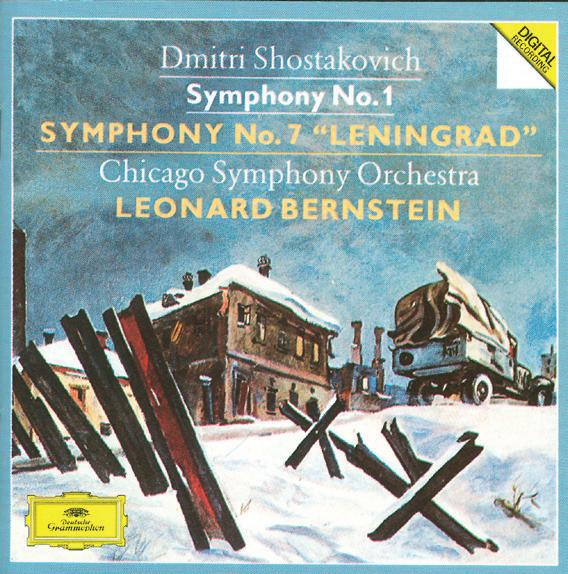
Both of Shostakovich’s symphonies were recorded live by Deutsche Grammophon and the subsequent release received the 1990 Grammy Award for Best Orchestral Performance.
Frank Villella is the director of the Rosenthal Archives. For more information, please visit cso.org/archives
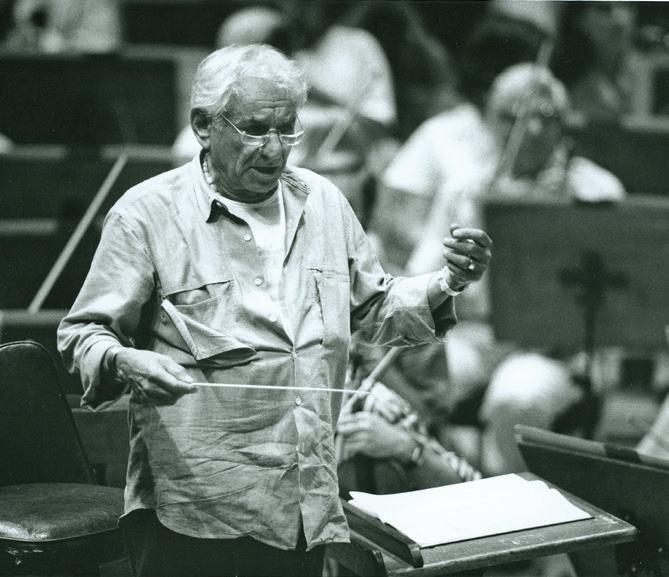
from left: Leonard Bernstein leads the Chicago Symphony Orchestra in rehearsal in June 1988 (Jim Steere) | Shostakovich’s First and Seventh symphonies, released by Deutsche Grammophon
some feature of the preceding one and develops it, introducing, in the course of the development, some counter-feature upon which the next variation seizes. It is a kind of musical fission, which corresponds to the reasonableness and almost didactic quality of the four-fold discussion.
(c) The Seven Stages. The variation form continues for another set of seven, in which the characters go on an inner and highly symbolic journey according to a geographical plan leading back to a point of comfort and security. The four try every means, going singly and in pairs, exchanging partners, and always missing the objective. When they awaken from this dream-odyssey, they are closely united through a common experience (and through alcohol) and begin to function as one organism. This set of variations begins to show activity and drive and leads to a hectic, though indecisive, close.
PART 2
(a) The Dirge is sung by the four as they sit in a cab en route to the girl’s apartment for a nightcap. They mourn the loss of the “colossal Dad,” the great leader who can always give the right orders, find the right solution, shoulder the mass responsibility, and satisfy the universal need for a father-symbol. This section employs, in a harmonic way, a twelve-tone row out of which the main theme evolves. There is a contrasting middle section of almost Brahmsian romanticism, in which can be felt the self-indulgent, or negative, aspect of this strangely pompous lamentation.
(b) The Masque finds the group in the girl’s apartment, weary, guilty, determined to have a party, each one afraid of spoiling the others’ fun by admitting that he should be home in bed. This is a scherzo for piano and percussion alone (including harp, celesta, glockenspiel, and xylophone), in which a kind of fantastic
piano-jazz is employed, by turns nervous, sentimental, self-satisfied, vociferous. The party ends in anticlimax and the dispersal of the actors; in the music, the piano-protagonist is traumatized by the intervention of the orchestra for four bars of hectic jazz. When the orchestra stops, as abruptly as it began, a pianino in the orchestra is continuing the Masque, repetitiously and with waning energy, as the Epilogue begins. Thus a kind of separation of the self from the guilt of escapist living has been effected, and the protagonist is free again to examine what is left beneath the emptiness.
(c) The Epilogue. What is left, it turns out, is faith. The trumpet intrudes its statement of “something pure” upon the dying pianino; the strings answer in a melancholy reminiscent of the Prologue; again and again, the winds reiterate “something pure” against the mounting tension of the strings’ loneliness. All at once, the strings accept the situation, in a sudden radiant pianissimo, and begin to build, with the rest of the orchestra, to a positive statement of the newly recognized faith.
Throughout the Epilogue, the piano-protagonist has taken no part, but has observed it, as one observes such development on a movie screen, or in another human personality. At the very end, he seizes upon it with one eager chord of confirmation, although he has not himself participated in the anxiety-experience leading to this fulfillment. The way is open; but, at the conclusion, is still stretching long before him.
Bernstein 1949
Phillip Huscher has been the program annotator for the Chicago Symphony Orchestra since 1987.
Leonard
Let music resound
The Chicago Symphony Orchestra Association gratefully acknowledges the Helen Zell Contemporary Music Fund for its leadership support of the presentation of contemporary music in the CSO’s 2025–26 season.
Major support is also provided by Sally Mead Hands Foundation, The Irving Harris Foundation, and Lori Julian for the Julian Family Foundation.
Sep 25–28
PÉPIN Les Eaux célestes
Oct 3–4
SIMON Fate Now Conquers MUSGRAVE Piccolo Play
Dec 18–20
WIDMANN Con brio CHIN subito con forza
Feb 5–7
SMITH Lost Coast
Feb 12–15
THOMPSON To See the Sky
Apr 2–4
TÜÜR Prophecy
May 7–9
LIEBERSON Neruda Songs
May 21–23
CLYNE Sound and Fury
FORMER MEAD COMPOSER-IN-RESIDENCE
June 18–21
MONTGOMERY Banner
FORMER MEAD COMPOSER-IN-RESIDENCE
Contemporary music remains a vital thread in the CSO’s artistic legacy, and this generous support ensures that bold, innovative repertoire continues to resonate with audiences today. We are proud to carry forward this tradition by featuring compelling new works throughout the 2025–26 concert season.
Joshua Weilerstein (June 18–21)
Marin Alsop (June 4–6)
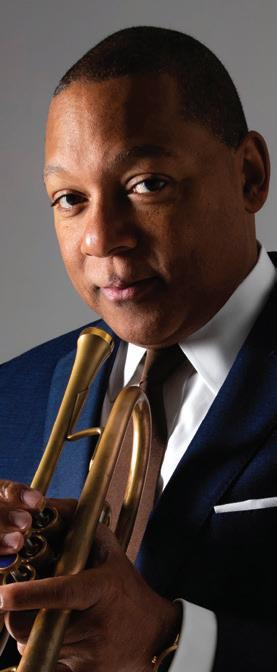
Wynton Marsalis (June 4–6)
James Gaffigan Conductor
FIRST CSO PERFORMANCES
February 21 and 24, 2009, Orchestra Hall. Root’s The Battle Cry of Freedom; Payne and Bishop’s Home, Sweet Home; Awakening from Harris’s Symphony no. 6 (Gettysburg); Selections from Bennett’s Abraham Lincoln; Copland’s Lincoln Portrait with James Earl Jones; and Beethoven’s Symphony no. 5
MOST RECENT CSO PERFORMANCES
May 21, 22, and 23, 2026, Orchestra Hall. Grieg’s Holberg Suite, Kreisler’s Violin Concerto in C major with Yuan-Qing Yu, Clyne’s Sound and Fury, and Haydn’s Symphony no. 101
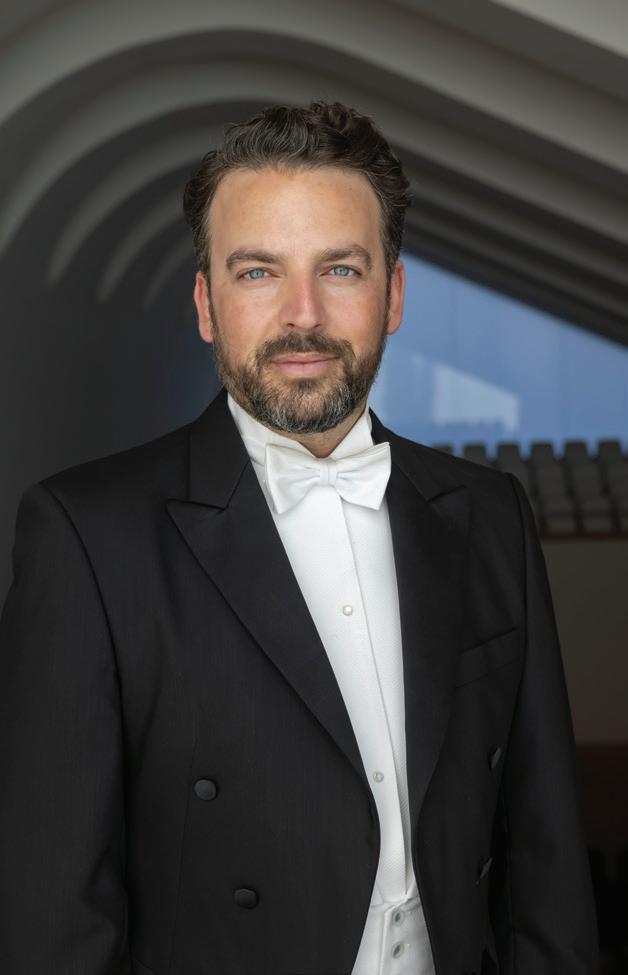
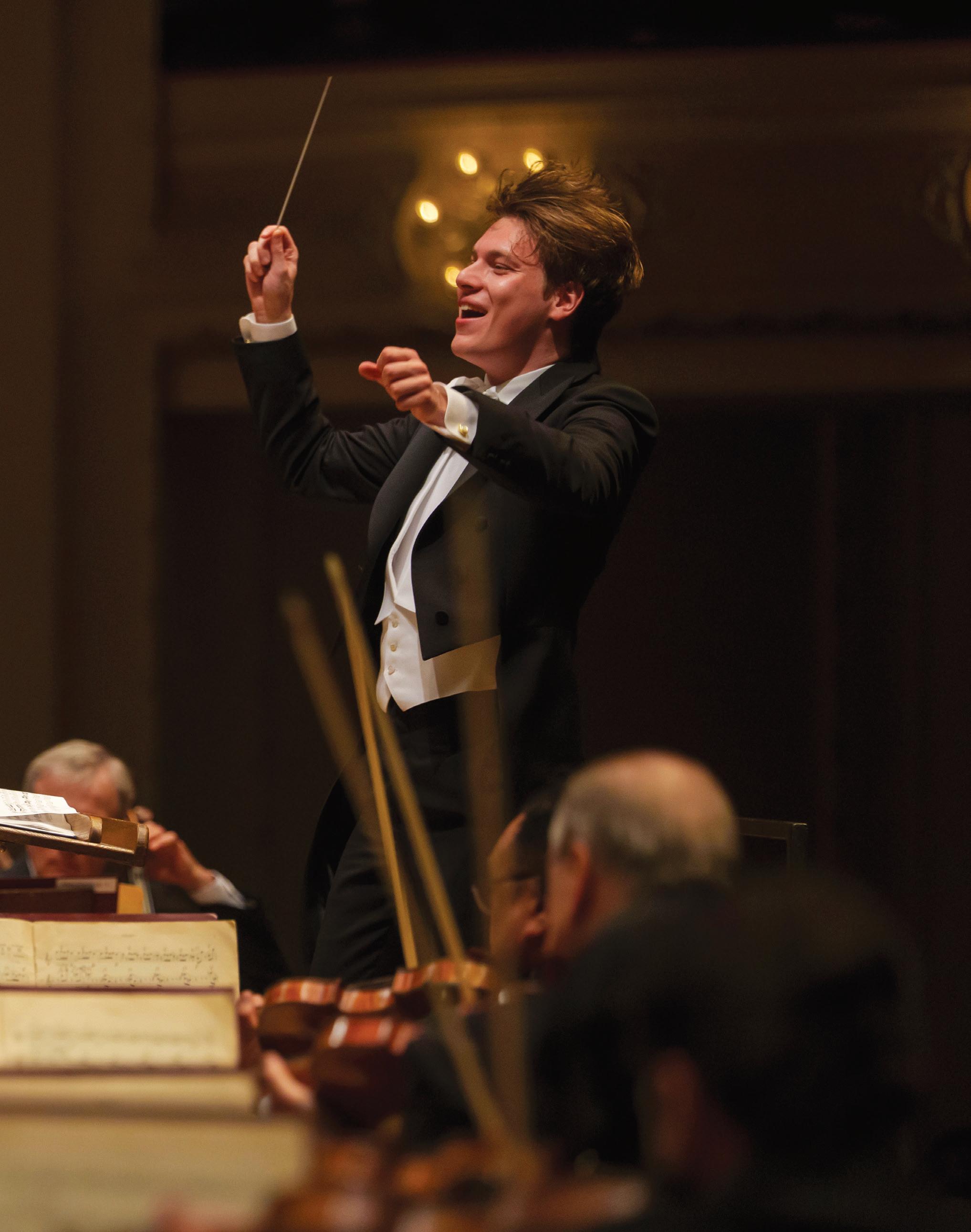
Recognized worldwide for his extraordinary collaborative spirit, James Gaffigan has attracted international attention as a conductor of both symphony orchestras and opera.
Recently named the next music director of Houston Grand Opera, Gaffigan assumes his new role in the 2027–28 season. He begins as music director designate in the 2026–27 season, and his initial term lasts for five seasons, through 2031–32.
A rarity among American conductors for his rise to prominence in the esteemed houses and concert halls of Europe, Gaffigan is in demand across the world. He serves as general music director of Komische Oper Berlin, where he currently leads his third season, and as music director of the Verbier Festival Junior Orchestra.
In August 2025 Gaffigan marked his fourth and final season as music director of the Palau de les Arts Reina Sofía in Valencia. He is former chief conductor of the Lucerne Symphony Orchestra and former principal guest conductor of both the Netherlands Radio Philharmonic Orchestra and the Trondheim Symphony Orchestra and Opera.
Gaffigan regularly leads the world’s greatest orchestras, including the New York Philharmonic, Chicago Symphony Orchestra, San Francisco Symphony, Los Angeles Philharmonic, National Symphony Orchestra in Washington (D.C.), Boston Symphony Orchestra,
Cleveland Orchestra, Philadelphia Orchestra, and the Pittsburgh Symphony Orchestra.
In Europe, he has appeared with the London Symphony Orchestra, London Philharmonic Orchestra, Bavarian Radio Symphony Orchestra, Royal Concertgebouw Orchestra Amsterdam, Staatskapelle Berlin, Deutsches Symphonie Orchester Berlin, Staatskapelle Dresden, NDR Elbphilharmonie Orchestra in Hamburg, Tonhalle-Orchester Zürich, Rotterdam Philharmonic Orchestra, and the Czech Philharmonic.
A champion of new music, Gaffigan has led more than thirty premieres by composers including Thomas Adès, Kaija Saariaho, Anders Hillborg, Andrew Norman, Sarah Kirkland Snider, and Wynton Marsalis. His robust discography features recordings with the Lucerne Symphony, Netherlands Radio Philharmonic, Netherlands Radio Choir, and the Frankfurt Radio Symphony Orchestra.
Gaffigan’s early training in New York City’s public schools inspired his belief in music education and access to the arts. He regularly works with young musicians at the Juilliard School, Aspen Music Festival and School, Music Academy of the West, and the Verbier Festival. His first titled positions included associate conductor of the San Francisco Symphony, a position created for him by Michael Tilson Thomas, and assistant conductor of the Cleveland Orchestra, where he worked with music director Franz Welser-Möst. Gaffigan was first-prize winner of the 2004 Sir Georg Solti International Conducting Competition.
James Gaffigan earned his undergraduate degree at the New England Conservatory of Music in Boston, followed by conducting studies at the Shepherd School of Music at Rice University in Houston, Aspen Conducting Academy at Aspen Music Festival and School, and the Tanglewood Music Center.
June 29, 1991, Ravinia Festival. Ravel’s Piano Concerto in G Major, James Levine conducting
November 11, 12, 13, and 16, 1999, Orchestra Hall. Chopin’s Piano Concerto No. 2 in F Minor, Riccardo Chailly conducting
MOST RECENT CSO PERFORMANCES
June 6, 7, 8, and 11, 2024, Orchestra Hall. Saint-Saëns’s Piano Concerto no. 5, Stéphane Denève conducting
July 12, 2025, Ravinia Festival. Gershwin’s Concerto in F, Marin Alsop conducting
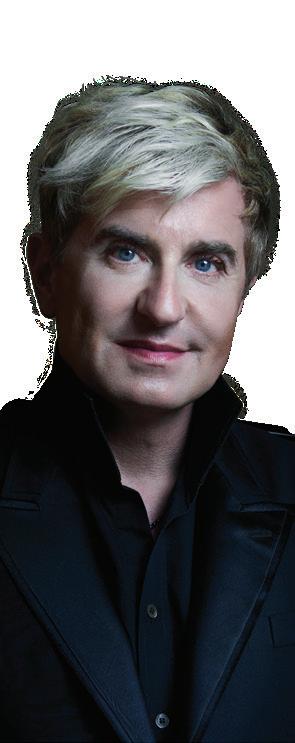
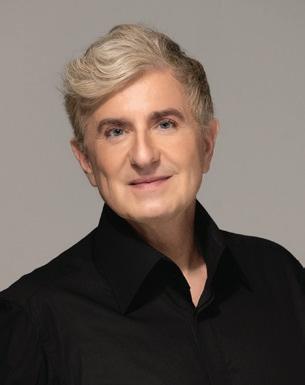
Through elegant musicality and an insightful approach to contemporary and established repertoire, Jean-Yves Thibaudet has earned a reputation as one of the world’s finest pianists. He is especially known for his diverse interests beyond the classical world, including numerous collaborations in film, fashion, and visual art. He is the first-ever artist-in-residence at the Colburn School in Los Angeles, which awards several scholarships in his name.
This season, Thibaudet appears in concerts and recitals around the world in works ranging from Gershwin’s Concerto in F to Saint-Saëns’s Piano Concerto no. 5, Bernstein’s Symphony no. 2 (The Age of Anxiety), Scriabin’s Prometheus, and Messiaen’s Turangalîla-symphonie. A major
champion of Khachaturian’s Piano Concerto, Thibaudet performs the piece with the St. Louis Symphony Orchestra and New York Philharmonic. In addition to his orchestral dates, Thibaudet joined violinist Lisa Batiashvili and cellist Gautier Capuçon on a fall trio tour, with stops throughout western Europe. He also continues his multi-season focus on Debussy’s preludes, performing both books in their entirety at recitals around the world.
A prolific recording artist, Jean-Yves Thibaudet has appeared on more than seventy albums and six film scores. His extensive discography has received two Grammy Award nominations, two ECHO awards, the German Record Critics’ Prize, the Diapason d’Or, the CHOC du Monde de la Musique, the Edison Prize, and Gramophone awards. Recent recordings include Khachaturian, a celebration of the Armenian composer, including his Piano Concerto and several solo piano pieces; and Gershwin Rhapsody, a selection of pieces by the composer recorded with Michael Feinstein, including four newly discovered works. He is soloist on Dario Marianelli’s recently reissued score to the film Pride and Prejudice, which was certified gold by the Recording Industry Association of America (RIAA) in 2025; he can also be heard on scores by Marianelli for Atonement, Alexandre Desplat for The French Dispatch and Extremely Loud and Incredibly Close, and Aaron Zigman for Wakefield.
His concert wardrobe is designed by Dame Vivienne Westwood.
PHOTO BY ELISABETH CAREN
Apostolic Church of God
Sanctuary Choir
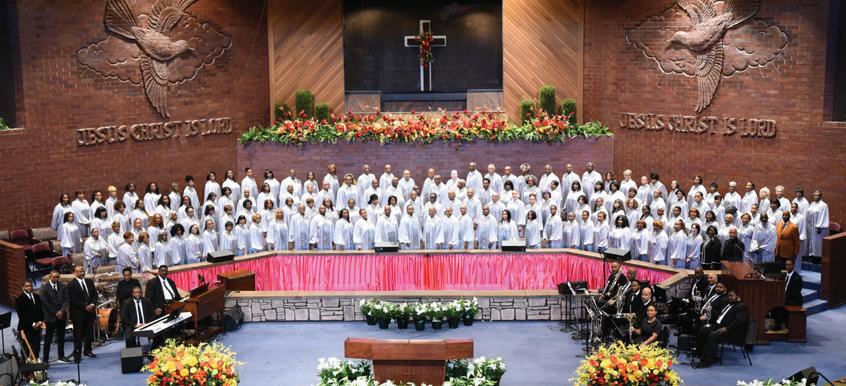
The Sanctuary Choir has been an anchor for the music ministry of the Apostolic Church of God throughout the seventy-plus-year history of the church. The focus of the choir is centered on quality presentations of sacred music, including anthems, gospel, hymns, and inspirational songs.
Under the leadership of the late Bishop Arthur M. Brazier, the choir was established as a powerful presence in the revitalized South Shore–Woodlawn community and throughout the church’s music ministry, a legacy it continues under Bishop Byron T. Brazier.
Notable performances include appearances at the Chicago Sinfonietta’s Martin Luther King, Jr., celebrations at Symphony Center, Chicago’s Gospel Festival, Millennium Park Opening Festivities with the Chicago Symphony Orchestra, at inaugural ceremonies, and with the Czech National Symphony Orchestra in Prague. The Sanctuary Choir has also appeared in concert with such renowned artists as Yolanda Adams, Kurt Carr, Maurette Brown Clark, Kirk Franklin, Gladys Knight, Dwayne Lee, Wynton Marsalis, Donnie McClurkin, Elizabeth NormanSojourner, Kirk Whalum, CeCe Winans, and the artists formerly known as Three Mo’ Tenors.
Brian Creighton Rice Choir Director
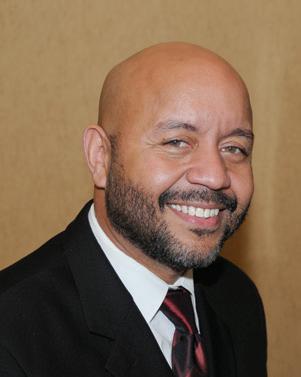
Brian Creighton Rice began his formal piano training at an early age and quickly found opportunities to share the many facets of his musical gifts within the church. He earned a bachelor’s degree in music education from Sterling College in Sterling, Kansas, and has since established himself as a classically trained pianist, conductor, teacher, music educator, and choral clinician.
Rice’s musicianship extends far beyond traditional European styles. He is deeply knowledgeable and highly proficient in the sacredmusic traditions of the Black Church, including hymns, spirituals, jubilee songs, traditional and contemporary gospel, and praise-and-worship repertoire. His exceptional teaching and conducting reflect a keen attention to choral diction, intonation, interpretation, dynamics, and precision, qualities that are evident each time his choirs minister in song.
Brian Creighton Rice currently serves as minister of music of the Apostolic Church of God, where he leads two choirs, a praise team, and a cadre of skilled musicians. He is supported by the outstanding leadership of directors Andrea D. Morris, Raymond Nuckolls, and Richard Nunley, whose partnership he deeply values and without whom, he notes, none of this work would be possible.
Apostolic Church of God Sanctuary Choir
Brian Creighton Rice Director
Elnora Abston
Lawrence Adams
Carl Allen
Shirley Allen
Diane Anderson
Barbara Armour
Lolita Avery
Debra Baker
Shawnee Barlow
Karen Barnes
Pamela Bates
Felicia Bohanon
Agyeman Bonsu
Deboris Brantley
Barbara Brooks
Anthony Brown
Terese Brown
Caroline Burton
Bertha Caldwell
Fillmore Cameron
Delanah Clark
Melvin Clifton
Patricia Cole
Emma Colston
Anita Cotton
Carolyn Coty
Duane Darden-Mills
Joe Davis
Nicole Davis
Tony Durrant
Toni Dyer
Joyce Eberhardt
Therese Elewa-Gidado
Keith Evans
Ronald Foster
Saleria Gano
Joshua Giles
Geneva Gore
Gregory Guy
Curtis Hagans
Robert Hamer
Eric Hammonds
Barbara Hardaman
Verdina Hardiman
Gertrude Harris
Leola Harris
Zita Hill
Lisa Hobbs
Dale Hollingsworth
Katrina Honeycutt
Stacy Hutson
Steven Jackson
Cary James
Frank James
Dawn Cherie Jasper
Katrina Johnson
Kenneth Johnson
Licia Johnson
Oscar Johnson
Vanessa Johnson-Davis
Brenda Lee
Annie Lewis
Ronald Lewis
Kimberly Lindsey
Doris Lowe
Tiffany Marshall
Bryan Martin
Johnny Maxwell
Zandar McNeil
Vivian Medious
Marie Meyers
Andrea Moore
Marc Moran
Linda Morgan
Andrea Morris
Shaneen Murray
Mario Myles
Fred Nance
Kiana Newell
Teresa Nix
Richard Nunley
Vivian Nunn
Rochelle Odum
Brenda Om
Eugene Orr
Eric Owens
Betty Phillips
Kaye Phillips
Peggy Phillips
Kenneth Pickens
Charles Pinkins
Marion Posey-Haynes
Patricia Powell
Michael Price
Carolyn Pruitt
Jackie Quinn
Phyllis Ratliff
Alanna Redd
Brian Rice
Sheila Rice
Tony Richardson
Denise Rivers
Jerry Robertson
Marilyn Rodgers-Porter
Darnella Rolle
Jimmy Rolling
Kanika Sago
Ericka Sandru
Harold Sawyer
Victoria Sawyer
Robert Scales
Steve Schurr
Lestine Scott
Janet Shadd
Ethel Sharpe
Carolyn Shaw
Angela Smith
Tanya Smith
Sharon Sneed
Brenda Stephens
Andrew Stevens
Judy Stewart
Maurice Stewart
Vickie Stokes
Lorraine Sullivan
Cynthia Taylor
Honora Taylor
Rita Terry
Arita Thomas
Ryan Treaseh
Jodi Vinson
Lester Walker
Ernest Wallace
Deloris Washington
Elzie Washington
Larry Washington
Anthony Weathersly
Minzey Weathersly
Reginald Weaver
Lawrence Whiters
Pamela Wilbert
Eric Wiley
Debra Williams
Harold Williams
Kiel Williams
Juanita Willis
Tracey Willis
Angela Windham
Bridget Woods
Tiffany Wright
Christopher Young
Ethel Young
Fred Young
A Musical Tribute to
JOHN WILLIAMS & STEVEN SPIELBERG
Tuesday, June 23, 2026
6:00 PM Drinks & Bites
7:30 PM Concert
Celebrate the legendary collaboration between composer John Williams and filmmaker Steven Spielberg as the Chicago Symphony Orchestra brings to life some of cinema’s most iconic music.
Enhance your evening by ordering the event package, which includes preconcert drinks and bites plus prime seating at the concert. Ample food and drink stations will feature heavy hors d’oeuvres and refreshments. Mingle with other guests while enjoying lounge seating in Symphony Center’s Forte event space.
SCAN TO LEARN MORE
The Chicago Symphony Orchestra—consistently hailed as one of the world’s best—marks its 135th season in 2025–26. The ensemble’s history began in 1889, when Theodore Thomas, the leading conductor in America and a recognized music pioneer, was invited by Chicago businessman Charles Norman Fay to establish a symphony orchestra. Thomas’s aim to build a permanent orchestra of the highest quality was realized at the first concerts in October 1891 in the Auditorium Theatre. Thomas served as music director until his death in January 1905, just three weeks after the dedication of Orchestra Hall, the Orchestra’s permanent home designed by Daniel Burnham.
Frederick Stock, recruited by Thomas to the viola section in 1895, became assistant conductor in 1899 and succeeded the Orchestra’s founder. His tenure lasted thirty-seven years, from 1905 to 1942—the longest of the Orchestra’s music directors. Stock founded the Civic Orchestra of Chicago— the first training orchestra in the U.S. affiliated with a major orchestra—in 1919, established youth auditions, organized the first subscription concerts especially for children, and began a series of popular concerts.
Three conductors headed the Orchestra during the following decade: Désiré Defauw was music director from 1943 to 1947, Artur Rodziński in 1947–48, and Rafael Kubelík from 1950 to 1953. The next ten years belonged to Fritz Reiner, whose recordings with the CSO are still considered hallmarks. Reiner invited Margaret Hillis to form the Chicago Symphony Chorus in 1957. For five seasons from 1963 to 1968, Jean Martinon held the position of music director.
Sir Georg Solti, the Orchestra’s eighth music director, served from 1969 until 1991. His arrival launched one of the most successful musical partnerships of our time. The CSO made its first overseas tour to Europe in 1971 under his direction and released numerous award-winning recordings. Beginning in 1991, Solti held the title of music director laureate and returned to conduct the Orchestra each season until his death in September 1997.
Daniel Barenboim became ninth music director in 1991, a position he held until 2006. His tenure was distinguished by the opening of Symphony Center in 1997, appearances with the Orchestra in the dual role of pianist and conductor, and twenty-one international tours. Appointed by Barenboim in 1994 as the Chorus’s second director, Duain Wolfe served until his retirement in 2022.
In 2010, Riccardo Muti became the Orchestra’s tenth music director. During his tenure, the Orchestra deepened its engagement with the Chicago community, nurtured its legacy while supporting a new generation of musicians and composers, and collaborated with visionary artists. In September 2023, Muti became music director emeritus for life.
In April 2024, Finnish conductor Klaus Mäkelä was announced as the Orchestra’s eleventh music director and will begin an initial five-year tenure as Zell Music Director in September 2027. In July 2025, Donald Palumbo became the third director of the Chicago Symphony Chorus.
Carlo Maria Giulini was named the Orchestra’s first principal guest conductor in 1969, serving until 1972; Claudio Abbado held the position from 1982 to 1985. Pierre Boulez was appointed as principal guest conductor in 1995 and was named Helen Regenstein Conductor Emeritus in 2006, a position he held until his death in January 2016. From 2006 to 2010, Bernard Haitink was the Orchestra’s first principal conductor.
Mezzo-soprano Joyce DiDonato is the CSO’s Artist-in-Residence for the 2025–26 season.
The Orchestra first performed at Ravinia Park in 1905 and appeared frequently through August 1931, after which the park was closed for most of the Great Depression. In August 1936, the Orchestra helped to inaugurate the first season of the Ravinia Festival, and it has been in residence nearly every summer since.
Since 1916, recording has been a significant part of the Orchestra’s activities. Recordings by the Chicago Symphony Orchestra and Chorus— including recent releases on CSO Resound, the Orchestra’s recording label launched in 2007— have earned sixty-five Grammy awards from the Recording Academy.
Chicago Symphony Orchestra
Klaus Mäkelä Zell Music Director Designate
Joyce DiDonato Artist-in-Residence
VIOLINS
Robert Chen Concertmaster
The Louis C. Sudler Chair, endowed by an anonymous benefactor
Stephanie Jeong § Associate Concertmaster
The Cathy and Bill Osborn Chair
David Taylor*
Assistant Concertmaster
The Ling Z. and Michael C.
Markovitz Chair
Yuan-Qing Yu* Assistant Concertmaster
So Young Bae
Cornelius Chiu
Gina DiBello
Kozue Funakoshi
Russell Hershow
Qing Hou
Gabriela Lara
Matous Michal
Simon Michal
Sando Shia
Susan Synnestvedt
Rong-Yan Tang
Baird Dodge Principal
Danny Yehun Jin
Assistant Principal
Lei Hou
Ni Mei
Hermine Gagné
Rachel Goldstein
Mihaela Ionescu
Wendy Koons Meir
Ronald Satkiewicz ‡
Florence Schwartz
VIOLAS
Teng Li Principal
The Paul Hindemith Principal Viola Chair
Catherine Brubaker
Youming Chen
Sunghee Choi
Paolo Dara
Wei-Ting Kuo
Danny Lai
Weijing Michal
Diane Mues
Lawrence Neuman
Jikun Qin
Max Raimi
CELLOS
John Sharp Principal
The Eloise W. Martin Chair
Kenneth Olsen
Assistant Principal
The Adele Gidwitz Chair
Karen Basrak
The Joseph A. and Cecile Renaud Gorno Chair
Richard Hirschl
Olivia Jakyoung Huh
Daniel Katz
Katinka Kleijn
Brant Taylor
The Ann Blickensderfer and Roger Blickensderfer Chair
BASSES
Alexander Hanna Principal
The David and Mary Winton
Green Principal Bass Chair
Alexander Horton
Assistant Principal
Dan Carson
Ian Hallas
Robert Kassinger
Mark Kraemer
Stephen Lester
Bradley Opland
Andrew Sommer
FLUTES
Emma Gerstein
Jennifer Gunn
PICCOLO
Jennifer Gunn
The Dora and John Aalbregtse Piccolo Chair
OBOES
William Welter Principal
Lora Schaefer
Assistant Principal
The Gilchrist Foundation, Jocelyn Gilchrist Chair
Scott Hostetler
ENGLISH HORN
Scott Hostetler
Riccardo Muti Music Director Emeritus for Life
CLARINETS
Stephen Williamson Principal
John Bruce Yeh
Assistant Principal
The Governing
Members Chair
Gregory Smith
E-FLAT CLARINET
John Bruce Yeh
BASSOONS
Keith Buncke Principal
William Buchman
Assistant Principal
Miles Maner
HORNS
Mark Almond Principal
James Smelser
David Griffin
Oto Carrillo
Susanna Gaunt
Daniel Gingrich ‡
TRUMPETS
Esteban Batallán Principal
The Adolph Herseth Principal Trumpet Chair, endowed by an anonymous benefactor
John Hagstrom
The Bleck Family Chair
Tage Larsen
TROMBONES
Timothy Higgins Principal
The Lisa and Paul Wiggin
Principal Trombone Chair
Michael Mulcahy
Charles Vernon
BASS TROMBONE
Charles Vernon
TUBA
Gene Pokorny Principal
The Arnold Jacobs Principal Tuba Chair, endowed by Christine Querfeld
* Assistant concertmasters are listed by seniority. ‡ On sabbatical § On leave
The CSO’s music director position is endowed in perpetuity by a generous gift from Zell Family Foundation. The Louise H. Benton Wagner and Erika and Dietrich M. Gross Principal Flute chairs are currently unoccupied.
TIMPANI
David Herbert Principal
The Clinton Family Fund Chair
Vadim Karpinos
Assistant Principal
PERCUSSION
Cynthia Yeh Principal Chair sponsored by an anonymous benefactor
Patricia Dash §
Vadim Karpinos
LIBRARIANS
Justin Vibbard Principal
Carole Keller
Mark Swanson
CSO FELLOWS
Ariel Seunghyun Lee Violin
Jesús Linárez Violin
The Michael and Kathleen Elliott Fellow
ORCHESTRA PERSONNEL
John Deverman Director
Anne MacQuarrie
Manager, CSO Auditions and Orchestra Personnel
STAGE TECHNICIANS
Christopher Lewis
Stage Manager
Blair Carlson
Paul Christopher
Chris Grannen
Ryan Hartge
Peter Landry
Joshua Mondie
The Chicago Symphony Orchestra string sections utilize revolving seating. Players behind the first desk (first two desks in the violins) change seats systematically every two weeks and are listed alphabetically. Section percussionists also are listed alphabetically.
Discover more about the musicians, concerts, and generous supporters of the Chicago Symphony Orchestra Association online, at cso.org.
Find articles and program notes, listen to CSOradio, and watch CSOtv at Experience CSO.
cso.org/experience
Get involved with our many volunteer and affiliate groups.
cso.org/getinvolved
Connect with us on social @chicagosymphony
Chicago Symphony Orchestra Association Board of Trustees
OFFICERS
Mary Louise Gorno Chair
Chester A. Gougis Vice Chair
Steven Shebik Vice Chair
Helen Zell Vice Chair
Renée Metcalf Treasurer
Jeff Alexander President
Kristine Stassen Secretary of the Board
Stacie M. Frank Assistant Treasurer
Dale Hedding Vice President for Development
Chicago Symphony Orchestra Association Administration
SENIOR LEADERSHIP
Jeff Alexander President
Stacie M. Frank Vice President & Chief Financial Officer, Finance and Administration
Dale Hedding Vice President, Development
Ryan Lewis Vice President, Sales and Marketing
Vanessa Moss Vice President, Orchestra and Building Operations
Jonathan McCormick Managing Director, Negaunee Music Institute at the CSO
Visit cso.org/csoa to view a complete listing of the CSOA Board of Trustees and Administration.
For complete listings of our generous supporters, please visit the Richard and Helen Thomas Donor Gallery.
cso.org/donorgallery
CHICAGO SYMPHONY ORCHESTRA
90th SUMMER RESIDENCY
JULY 11 - AUGUST 16 •
HIGHLAND PARK
Featuring three weeks with Ravinia Chief Conductor MARIN ALSOP
Six weeks of guests include Yunchan Lim, Lizzo, Emanuel Ax, St. Vincent, Stella Chen, María Dueñas, Daniel Lozakovich, Carlos Simon, Laura Karpman, and many more —plus two concerts with Zell Music Director Designate Klaus Mäkelä— performing in the newly renovated Hunter Pavilion!
LOOKING FOR SOMETHING INDOORS?
James Conlon leads Mozart’s The Abduction from the Seraglio semi-staged in the Martin Theatre